-
Early Settlers: Richard Spencer Gregory
The following is from a work-in-progress about the history of Fullerton. You can support my ongoing research and writing on Patreon.
Richard Spencer Gregory was born in Chesterfield County, Virginia in 1876. His father E. S. Gregory, a farmer and merchant, fought with the Confederate Army during the Civil War.
In 1893, Richard moved to California, first settling in Placentia, and then coming to Fullerton 1896. He partnered with Mr. Balcom, Mr. Fuller and Mr. Welton to purchase 100 acres just north of Chapman and east of Spadra (Harbor) and subdivided it for homes. This area included the present grounds of Fullerton Union High School.
He developed the area known as “Hill Crest” with homes. His residence on Hill Crest was one of the nicest homes in the city.
Gregory also laid out the following subdivisions in Fullerton: “Hermosa,” “Jacaranda,” “Ramona,” “Orange Grove,” “Wilshire.” “Gregory,” “Glenwood Square,” as well as subdividing several ranches into smaller tracts.
In addition to real estate, he engaged in citriculture, having improved several orange groves, and owned his own orchard.
He married Mabel B. Schulte in Fullerton in 1899, whose parents William and Mary Schulte were pioneers of Orange County. They had two children–Erma and Merrill.
Mr. Gregory was a member of Fullerton City Council for six years in the 1920s, the last two of which he served as mayor. According to biographer Samuel Armor, “His service as trustee and mayor was the era of the beginning of public improvements in Fullerton. The streets were paved, the city sewer plant constructed, the city water plant built, the fire apparatus bought and the fire department started.”

Richard Spencer Gregory. Photo from History of Orange County by Samuel Armor. He was a director of the Home Mutual Building & Loan Association of Santa Ana, and a director of the Farmers & Merchants National Bank of Fullerton. He was a director of Orange County Y.M.C.A. and belonged to the Fullerton Club, the Newport Yacht Club, and a Mason at the Fullerton Lodge.
Richard served as postmaster in the 1930s and 40s.
His son R. Merrill Gregory, was president and chairman of Fullerton Savings and Loan – later Fullerton Community Bank. His grandson Carl, who passed away in 2009, served as CEO of this bank.
Source: History of Orange County, California : with biographical sketches of the leading men and women of the county who have been identified with its earliest growth and development from the early days to the present by Samuel Armor. Los Angeles Historic Record Co, 1921.
-
Early Settlers: William J. Wickersheim
The following is from a work-in-progress about the history of Fullerton. You can support my ongoing research and writing on Patreon.
William J. Wickersheim was born in Illinois in 1866. In 1894 he moved to California where he taught school and purchased two orange groves in Orange.
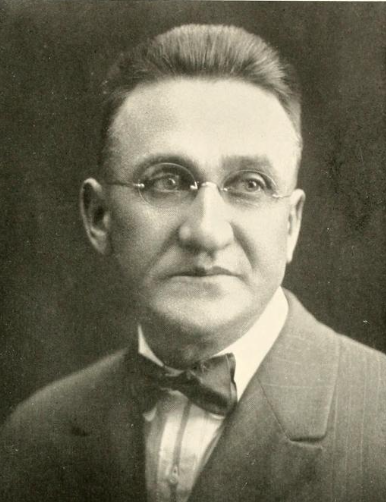
William J. Wickersheim. Photo from History of Orange County by Samuel Armor. He moved to Fullerton in 1902 and opened a bicycle, vehicle, and implement store called the Wickersheim Implement Company. In 1913, he secured the franchise to sell Ford automobiles in the Fullerton area.
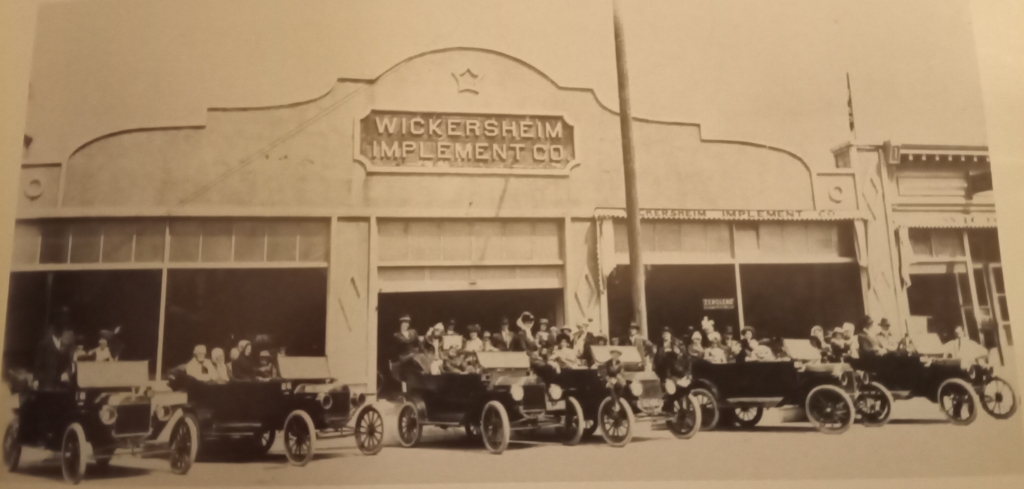
Wickersheim Implement Company on the 100 block of West Commonwealth, 1920s. Photo courtesy of Fullerton Public Library Local History Room. In Fullerton: a Pictorial History, Bob Ziebell writes, “Fullerton residents apparently were enamored of the automobile. From the first appearance of the automobile at the turn of the century, the popularity grew to where photos were taken in the mid-1920s show cars and trucks crowding the streets. Fullertonians liked to travel so much that they organized community outings, as seen in the photo above where residents are about to leave from in front of the Wickersheim Implement Company on an automobile trip. In another photo (below), also in front of the Wickersheim store, 100 block West Commonwealth, vehicles from P.E. Taylor’s “Stage” Line are lined up ready to take tourists on trips to several locations, ranging from the desert to the sea.”
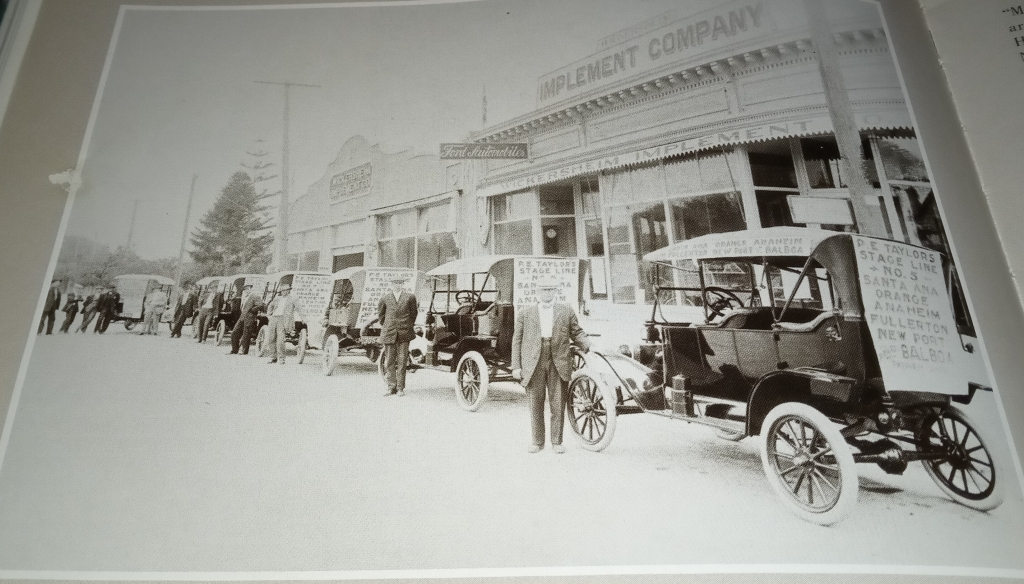
Wickersheim Implement Company, 1920s. Photo courtesy of Fullerton Public Library Local HIstory Room. Wickersheim married his first wife May in 1893. They had two children: Lyle and Mildred, both graduates of Fullerton High School. May died in 1898. In 1902, Wickersheim married Emma, and they had a son, Theodore J.
William served as a delegate to Republican state and county conventions. He was a member of the California Auto Trade Association and a charter member of the Fullerton Board of Trade.
He died in 1942.
-
Early Settlers: The Ford Family
The following is from a work-in-progress about the history of Fullerton. You can support my ongoing research and writing on Patreon.
Herbert A. Ford was born in Wright, Michigan in 1859. In 1884 he moved to Orange County, eventually settling in Fullerton in 1887, the year the town was founded, where he opened the first store with a Mr. Howell–called Howell & Ford (located inside the Wilshire Building at the corner of Harbor and Commonwealth–one of the first buildings in town). Fullerton’s first postal service began in his store in 1889.
In 1889 Herbert married Carrie E. McFadden, daughter of local pioneer William M. McFadden. They had three sons: Alvin, Herbert, and Maurice.
Ford sold his store in 1890 to focus on ranching. He and his wife purchased 20 acres of property that included the site of present day City Hall and built a home on the site of their ranch, where they grew walnuts, peaches, and oranges.
Herbert died young, in 1894 at the age of 35 from tuberculosis, leaving Carrie in control of business affairs.
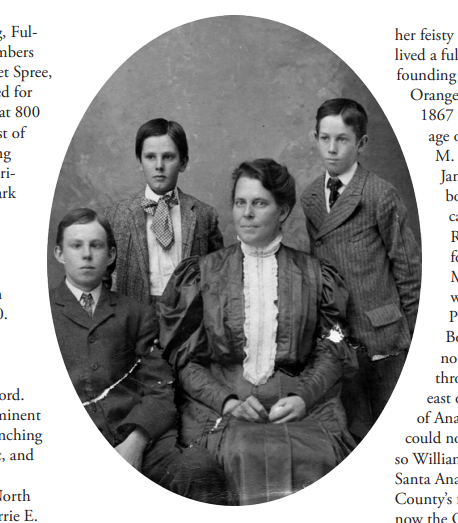
Carrie Ford with her three sons. Photo from Fullerton Heritage Newsletter, 2011. In an article entitled “Carrie E. Ford: Fullerton Pioneer, Historian, and Philanthropist” published in the May 2011 issue of Fullerton Heritage Newsletter, local historian Debora Richey gives a lengthy portrait of Carrie Ford.
“Widowed at the young age of twenty-seven, Mrs. Ford quickly took control of the ranch and her extensive land holdings, establishing herself as a powerful business figure in her own right. During this era, she was the only woman running a ranch in the Area,” Richey writes.
Mrs. Ford was a woman ahead of her time, and very active in local civic affairs and philanthropic activities.
“In 1912, shortly after the State of California granted women the right to vote, Mrs. Ford, along with Mrs. Joan Hale, ran for the Board of Trustees (now the City Council), becoming the first women to run for public office in Fullerton (a woman was not elected to the Fullerton City Council until 1970),” Richey writes.
A staunch prohibitionist, Mrs. Ford was a charter member of the Fullerton Women’s Christian Temperance Union (WCTU).
“In 1906, she worked with Mrs. Clara Chapman and other prominent women in the WCTU to pass an ordinance banning the issuance of saloon and liquor licenses, which remained in effect until the end of Prohibition,” according to Richey.
She was also an original and/or founding member of many local organizations, including the Woman’s Club of Fullerton, the Women’s Missionary Society of the Fullerton Presbyterian Church, the Fullerton Ebell Club, the Order of the Eastern Star, the Mojave Chapter of the Daughters of the American Revolution, and the Native Daughters of the Golden West.
Starting in 1917, Carrie began to subdivide and develop the Fullerton property, which was known as the Orchard Subdivision, which “quickly became the choice residential district of Fullerton.”
Carrie Ford died in 1961.
-
Early Settlers: The Des Granges Family
The following is from a work-in-progress about the history of Fullerton. You can support my ongoing research and writing on Patreon.
An important family that settled in the area that would become Fullerton was the Des Granges.
In Fullerton, a Pictorial History, Bob Ziebell writes: “In 1873, Otto des Granges, a native of Prussia, Germany, the eighth child in a family that had fled France during the Huguenot Uprising, purchased 80 acres of land bounded by State College Boulevard and Acacia Avenue on the east and west respectively and by Chapman Avenue and Commonwealth Avenue on the north and south.
The property was devoted first to general farming and later to walnut and orange production…Ranch access was off Acacia and the family built the home at 2000 East Wilshire Avenue–once known as the oldest in Fullerton. The southwest quarter of the property plays host to Ladera Vista Junior High.
Otto des Granges died in 1898 (at age 90) but he left behind a family–his widow, Josephine, and children John C., Joseph P., Otto, and Mrs. C. W. Crall.”
Josephine died in 1914, at age eighty-six.
Otto’s son Joseph des Granges was instrumental in setting up Anaheim’s modern electric light system, and setting up a grist mill in that town.
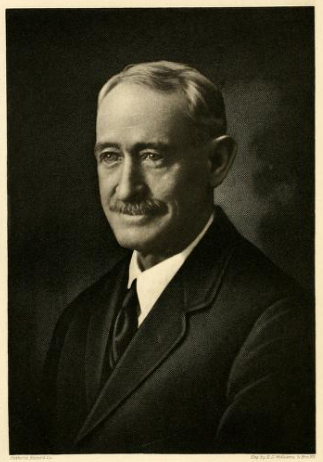
Joseph des Granges. Photo from History of Orange County by Samuel Armor. Paul Des Granges, Otto Jr.’s son, who was born in 1891 in Fullerton, was interviewed in 1971 by Anne Riley for the Fullerton College Oral History program. Here are recollections of Fullerton over the years from a man who was here from almost the very beginning of the town.
On Who Owned Fullerton Land before the Amerige Brothers
“Stearns’ Ranch was all over here at one time. They owned quite a bit of that property here. It’s an old Spanish land grant is what it was. You’d have to dig into some of California’s history to get who Abel Stearns was, but he married a Spanish woman. He was a Yankee, and he knew how to get things.”
On Working the Brea Olinda Oil Fields
“You had to work in those days! Well, if you got a Sunday off once in a while, you was in luck…We had twelve hour days, 365 days a year.”
On Charles C. Chapman (orange rancher/Fullerton’s first mayor)
“He had his own private drive-way for quite a few years, coming through there…State College to Acacia. He used to have to close it off at each end about once a year, a day or two, to hold it…When it [Fullerton] was incorporated, a good Christian member [Chapman] employed enough men to vote for him…that he knew would vote the right way for him…built the Christian church for them.”
On Who Provided Water During the 1933 Earthquake
“I knew very well that the water tank out by the stallion barn had come down, because water had all come down through there and down through the yard. And we didn’t have any water there at the house that night, except a couple of ten gallon cans that we got down in Mexican Town. [At this time, Mexican Americans lived in segregated work camps called “Citrus Towns” or “Mexican Towns”] They were on the hillside below the place…and we got a couple of ten gallon milk cans full of water, and that’s all. We had twenty-one people there in the yard that night.”
On Hippies
“A lot of these hippies that are coming in here, they’ve got to be fed or something, or taken care of, and they’ve got to have the money enough to pay the rent for the rent for the thing…I don’t know.”
On the Decline of the Citrus Industry
“Well, they call it progress. I guess so…The tax bill got too big. Orchards…you couldn’t make decent sized oranges to save your soul in this part of the country. We don’t know to this day, for an honest fact, any more than to say that it’s just the smog that did it, that’s all.”
-
Early Settlers: Dr. William Freeman
The following is from a work-in-progress about the history of Fullerton. You can support my ongoing research and writing on Patreon.
An early doctor of Fullerton, William Freeman was born in Medina County, Ohio in 1841. In 1861, at age 20, he enlisted in the Union Army during the Civil War. As a soldier in the infantry saw action in a number of important battles including the battle of Shiloh, Stone River (in which he received a gunshot wound through the right hand), and the battle of Chicamauga, where he was permanently disabled by a shot through the body.
He recovered for a while in a hospital in Chattanooga, and was eventually taken home by his father on a stretcher. After some recovery, he was made a sergeant of sanitary police at Totten Field Hospital in Louisville.
Before he enlisted, Freeman had began to study medicine. After he was honorably discharged, he continued his medical studies, graduating from Cincinnati College of Medicine in 1867.
He worked as a doctor in Indiana for twenty-five years, often riding horseback over long distances to see patients. During these years, he also served for a couple of terms in the state legislature.
“Still suffering from the wounds he had received in the service of his country and broken in health from overwork,” biographer Samuel Armor writes, “Dr. Freeman left the Middle west in 1894 and sought relief in less frigid California.”
After two years of rest and restoration in San Diego, he moved to Fullerton, California, where he served as a doctor for eighteen years. He was one of the early promoters of the Fullerton Hospital, which also became a training school for nurses.
The first hospital in Fullerton was built in 1903 on the corner of Pomona and Amerige Avenues. It contained twenty-two rooms, containing “modern appliances and furnishings throughout.” The first Board of Directors included: Charles C. Chapman, Dr. C.L. Rich, B.C. Balcom, William Starbuck, Dr. D.W. Hasson, Dr. George C. Clark, and Dr. William Freeman.
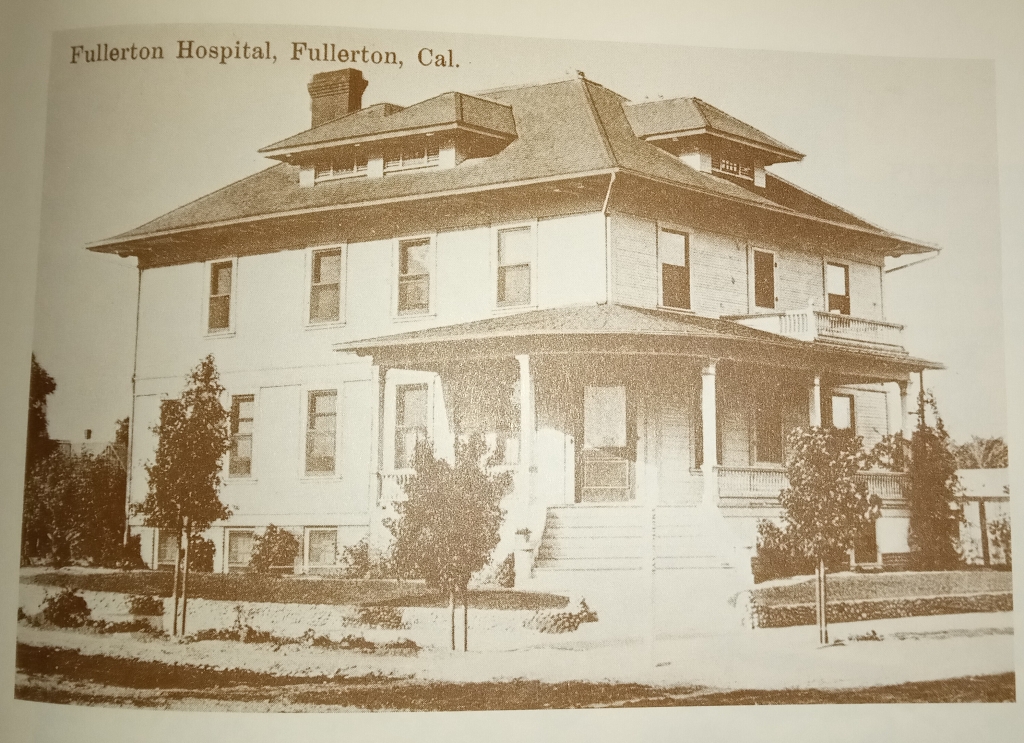
Fullerton’s first hospital, built in 1903 on the corner of Pomona and Amerige Avenues. Photo from Images of Yesterday: Fullerton Photo Album. The second Fullerton hospital was built in 1915 on the same site as the first, and it still remains today.
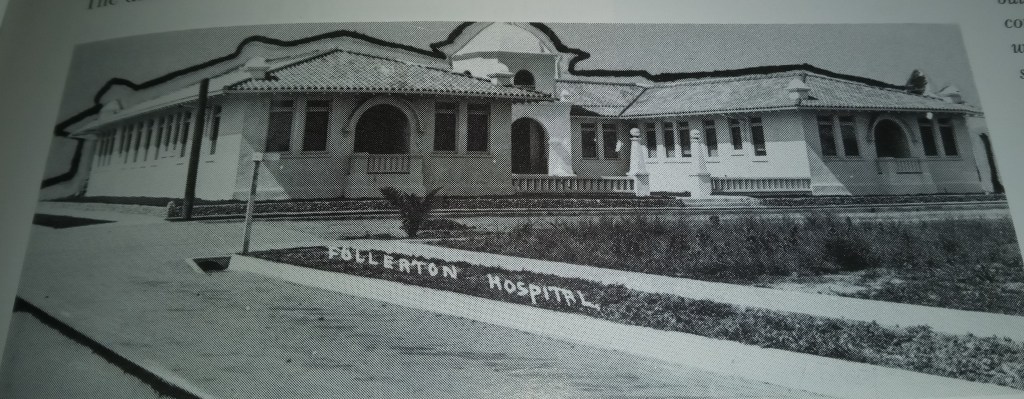
The second Fullerton hospital was built in 1915. It still stands today. Photo courtesy of the Fullerton Public Library Local History Room. Dr. Freeman purchased twenty-seven acres on Orangethorpe Avenue, where he built a house and planted a small orange ranch.
He served as city health officer, and was one of the founders of the local Chamber of Commerce.
By his first marriage, he had four children. His second wife was Belle McFadden.
Source: History of Orange County, California : with biographical sketches of the leading men and women of the county who have been identified with its earliest growth and development from the early days to the present by Samuel Armor. Los Angeles Historic Record Co, 1921.
-
Anti-Chinese Sentiment in Early Fullerton
The following is from a work-in-progress about the history of Fullerton. You can support my ongoing research and writing on Patreon.
I’ve been looking at microfilm of the Fullerton Tribune newspaper from the years 1893-1894. Fullerton was a small but growing community at this time, inhabited mainly by farmers and merchants. The local paper, edited by a man named Edgar Johnson, was probably fairly typical of small-town newspapers of that time. A weekly paper, its slim pages were filled with national news, local gossip, advertisements, and items of local interest. Pressing local issues included the Temperance Movement, the establishment of a local high school, incorporation as a city, lots of crop-related issues…and disturbing anti-Chinese sentiments.
In 1892, the Geary Act passed, which extended the infamous 1882 Chinese Exclusion Act for another ten years. This act and its consequences are one of the more unpleasant aspects of American history. Basically, what the Chinese Exclusion Act did was severely limit immigration of Chinese into America, provided for an apparatus of identification and deportation of Chinese people, denied Chinese people citizenship, and limited their rights in other nefarious ways. Chinese exclusion was a really big deal in California, particularly, because there was a fairly large Chinese population here, in part due to the recruitment of Chinese labor to build the Central Pacific Railroad a couple decades earlier.
In 1893, America was hit by a great economic depression, known as “The Panic of 1893,” and jobs became scarce. The Chinese Exclusion Act was seen as a way to protect the jobs of white people, at the expense of the Chinese. It is an unfortunate fact that recent immigrants are often the first to suffer in times of economic uncertainty, both in the past, and today in America.
As I scrolled through the microfilm of the Fulllerton Tribune of 1893-1894, I noticed a running trend of articles dealing with the topic of Chinese Exclusion, all of which heartily supported it. It’s amazing to me how, in this small newspaper, the line between news and opinion was so blurred. Edgar Johnson was not shy about giving his views on the topic of what to do with the Chinese. In an article from May 20, 1893, he suggested the U.S. use its war ships to transport the Chinese back to China: “What have we got all these war vessels for if they are not to transport Chinese upon? If they will just begin moving these fellows, it won’t be very long before there be some room left for white people in this country.”
On October 7, 1893, Johnson reported that “Two Chinamen were arrested at Santa Ana Tuesday and taken to Los Angeles to go before Judge Ross on a charge of violating the Geary act by not registering within the time prescribed by law.” On Jan 6 of 1894, Johnson called it a “well-known fact that the Chinese do not make desirable residents in this country.” Edgar Johnson often refers to Chinese people with the racist (but commonly used) term “Chinamen.”
On February 17, 1894, Johnson reported an event that happened in Fullerton. Apparently a mob of 40 locals forced some Chinese workers to leave town. Here’s a screen shot of this article and its opening paragraph:

-
Fullerton Water Wars Part 3: 1901-1905
The following is from a work-in-progress about the history of Fullerton. You can support my ongoing research and writing on Patreon.
“Eternal vigilance is said to be the price of liberty, and with equal truthfulness it may be said to be the price of water in Southern California.”
—from The Fullerton Tribune (1905)
A few summers ago, I used some of my free time to continue researching the history my hometown of Fullerton, focusing mainly on the Fullerton Tribune newspaper archives. These papers are not digitized, and the articles are not searchable for content. Thus, what I had to do was look at microfilm, lots of microfilm. At first, I was overwhelmed. What do I focus on? There is so much content to sift through, from the articles to the advertisements to the illustrations and photographs. As I read over these hundred-year-old newspapers, for hours and hours, more than once I was confronted with the inner question: What the hell am I doing? Why does this matter? Who cares about the history of this medium-sized American city? Who will want to read this?
And then I thought about a book I’d recently read, a recommendation from my friend Steve Elkins. The book is called simply Imperial, and it’s a 1,200-page history of Imperial County, California. It’s an astonishing book, but I have to believe that it’s author, William T Vollmann, over the course of his research, was probably confronted with similar inner questions: Why am I spending hours and hours looking at old photographs in a Mexicali Municipal Museum? Why am I reading about the history of alfalfa, watermelon, and date crops? Who cares? The book took him ten years to write. What emerges from his study is a profound meditation on America, Mexico, land, water, and people. His book turns out to be super insightful in helping us understand some of the problems facing California (and America) today. All this comes from looking, very carefully, for a very long time, at a single region.

So, I think, it must also be with my (or anyone’s) hometown. Another inspiring book, for me was D. J. Waldie’s Holy Land: a Suburban Memoir, a poetic meditation on the nearby city of Lakewood, one of the first master-planned communities in post-war America. It became a kind of template that was reproduced throughout the southland, and eventually across the U.S. Understanding the past helps us understand the present. Often, I’ve discovered that the problems that have arisen here (political, social, environmental) have arisen elsewhere. In some ways, understanding the history of an American city is a way of understanding the history of America itself. Cities can become microcosms of the larger society and nation.
And so, inspired by Vollmann and Waldie, I dive into the microfilm, looking for stories. For the moment, I’ve decided to focus my gaze on the history of water. How did a desert region like Southern California in general, and Fullerton in particular, manage to become such a major metropolitan center that uses way more water than is locally/naturally sustainable? Where has the water come from, and what battles led to us getting all this water from distant places like the Colorado River? How did we get here, and where are we going, water-wise?
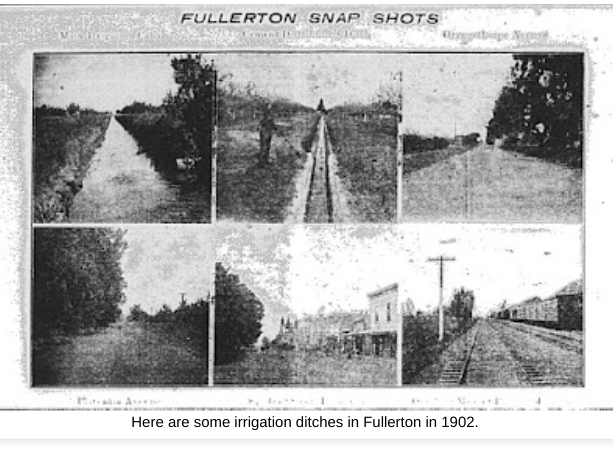
The main local water entity in 1901 was the Anaheim Union Water Company (AUWC). They had water rights to (some of) the Santa Ana River, and shared these rights with other companies like the Santa Ana Valley Irrigation Company. These were private companies whose Board of Directors tended to be owners of large, local ranches. Water rights (also called riparian rights) were a really big deal—water is life, and profits for farmers. Around 1901, these two water companies met together to bring legal action against a Mr. Fuller, “the Riverside county land-grabber” to prevent his taking water from the Santa Ana River. This would be one of many ongoing legal battles over local water rights.
In the meetings of the AUWC, there was discussion of purchasing the water rights of James Irvine, the man whose descendants founded the Irvine Company, which now owns the city of Irvine. In those early days, “maintaining an accurate division of the water [was] difficult if not impossible to devise.”
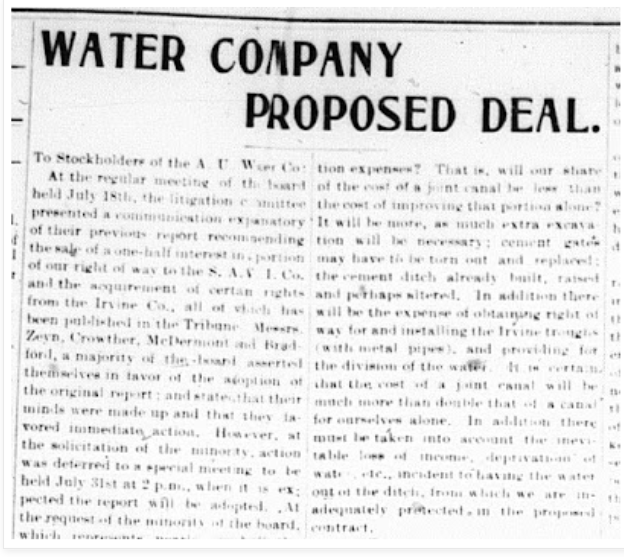
The local climate was also not conducive to a steady supply of water, specifically from the Santa Ana River. The AUWC concluded: “The conditions of our climate are such that it is impossible to determine ahead when the water can be turned out of the ditch for any definite time, without danger of loss to our irrigators.” New sources of water would be needed to irrigate the growing fields of Orange County.
Like any political entity vested with power, the AUWC was occasionally hostile to journalists who were critical of its policies. In 1903, the Board of Directors passed a resolution excluding reporters from their meetings. Shortly thereafter, the Tribune got word that an important report had been suppressed, to which Tribune editor Johnson replied: “The best way would be to permit the reporters to attend the meetings, then the reports and proceedings would not be suppressed.”

Meanwhile, the Anaheim Union Water Company and the Santa Ana Valley Irrigation Company cut a deal to share water rights. Mr. Sherwood, a sometimes Board Member who liked to write lengthy articles in the Tribune criticizing the AUWC, took issue with the deal. To which Samuel Armor of the Santa Ana Valley Irrigation Company replied: “G.W. Sherwood seems to be afflicted with a diarrhea of words accompanied by a costiveness of ideas. For two years or more he has been filling the papers west of the river with misrepresentations and insinuations against the S.A.V.I. Co. until his followers have come to believe the people on this side are equipped with hoofs and horns and forked tails.” To which Sherwood replied: “I have always taken pleasure in setting Armor right, when he gets tangled up in the mazes of his own alleged erudition…With regard to the proposed division of water, Armor’s premises are false and his conclusions are wrong.”
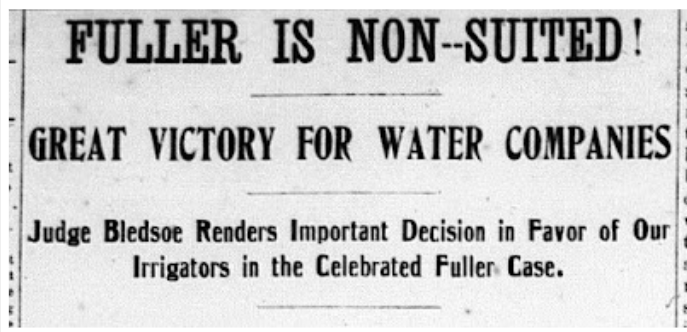
Meanwhile, Fuller, the “Riverside land-grabber” lost in court. An article gleefully proclaiming FULLER IS NON-SUITED! stated: “The decision sends a thrill of joy through the hearts of the stockholders, as it again establishes their absolute right to the waters flowing in the [Santa Ana] River for lo! these many years. Encroachers, who may in the future attempt to divert the water from its natural course, will please take warning. The decision further cements our rights to the life-giving fluid.”
An article from 1904 proclaimed direly: WATER SUPPLY NEED: Volume doesn’t keep pace with our growth: “For many years past we have had, with the exception of last winter, a series of dry years.’ We are now confronted with the possibility of worse than has gone before. During this period our orchards have grown, new acreage has been set out, and a general development has taken place that renders imperative the development of a greater supply of water to keep pace with the growth of the community.” This question of growth vs. water supply would continue for the next several decades.

As more and more lands were added to be irrigated, it became clear that the Santa Ana River would be insufficient to supply future water needs. Other water sources were necessary, and the first solution was pumping water from wells, tapping into underground sources. Pumping would be done from wells by electric motors. A Tribune article explains: “A 40-horsepower motor should pump up to 150 inches…By this system plants could be multiplied indefinitely…The addition of 1000 inches to our present supply would permit the issue of more of the capital stock of the company, which applied to the payment of the debt would reduce the fixed charges and assessments; and eventually the price of water, its the result that investors and home seekers would find this locality more attractive, and the values of property would be advanced.” The logic of infinite growth necessitated an infinite water supply.
Remember Mr. Fuller, the infamous “Riverside land-grabber”? You gotta admire his tenacity and “fuck off” attitude. He ignored the court order, and just kept using Santa Ana river water: “the waters have never ceased flowing through the ditches constructed for the purposes of such unlawful diversion and the action and its continuance is contempt of court and those responsible are amenable to law.” Meanwhile, in 1904, the city of Fullerton decided to incorporate as a city. Local rancher Charles Chapman was elected the first mayor.

Tensions also existed between AUWC and SAVIC. In an article entitled “Local Water Shortage,” Johnson writes: “Irrigators in the AUWC district have believed for some time that they were not getting their fair share of water from the Santa Ana River up at Rincon, where it is supposed to be equally divided between the local and Santa Ana companies. Superintendent Porter and Director Sherwood made a trip to the head of the canal this week to investigate, and state that the SAVIC was getting 1,000 more inches than the AUWC. The local company will no doubt at once demand an equal division.”
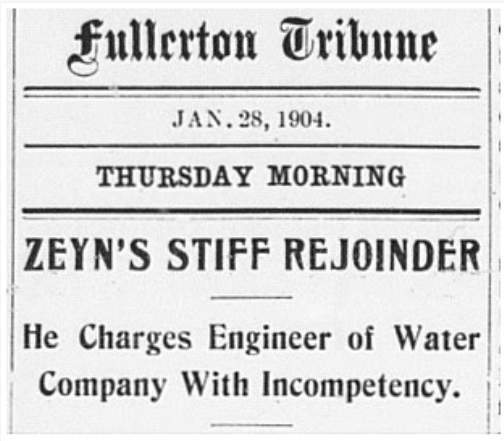
Around this time, an argument arose between a Mr. Zeyn and Mr. Sherwood, who at this time was the engineer of the AUWC. Zeyn charged Sherwood with incompetence, and Sherwood responded in kind. It seems that, personal differences aside, these two men represented the interests of different farmers—Zeyn those in Anaheim, and Sherwood those in Fullerton. Zeyn published his criticisms on the eve of an AUWC election, to which Sherwood replied: “The criticisms of my ability as an engineer would have had more weight had they been made at the meetings of the board instead of in a newspaper a few days before election.” After answering Zeyn’s criticisms (mainly dealing with poor ditch construction), Sherwood stoops to some classic ad hominem attacks: “The people of Anaheim will have a chance to demonstrate in a few days, whether they are mindful of their interests or are tied to the tail of Zeyn’s kite like so many rags. His capacity for business is well known. It is a perennial joke…Will the Anaheim people be the fools of a tool?”
But the big controversy of the 1904 AUWC board of directors election was Charles C. Chapman. When the results of the election were tallied, Chapman had been elected president of the board. However, upon closer inspection, it was asserted that a Mr. Crowther had in fact been elected. Whereupon the old board of directors voted to put Crowther in power. Chapman legally challenged this, and a judge declared that Chapman was, in fact, the president. These shenanigans remind me of the controversial 2000 presidential election where George W. Bush defeated Al Gore—when the election was decided by the Supreme Court. Anyway, Chapman was the new president of the AUWC.

1904 was a big year for Charles C. Chapman—he was elected mayor of Fullerton and president of the AUWC—giving him a great deal of local power. Under the new Board of Directors, the same questions remained—how to provide enough water for a steadily-growing region. Most of the “growth” at this point in history had to do with expansion of the local ranchers’ acreage—think business (not necessarily population) growth. They would look underground, to local artesian wells, and the creation of “pumping plants”: “In the vicinity of Anaheim there are upwards of 7,000 inches of water being pumped by power plants. The acreage which is irrigated with this water produces annually to its owners an income of over $500,000. The many pumping plants in operation make possible enormous returns upon the acre of big and little ranches alike in this territory.” Drink that milkshake, drink it up.

In a letter to the editor, an anonymous stockholder wrote: “Eternal vigilance is said to be the price of liberty, and with equal truthfulness it may be said to be the price of water in Southern California…There is a scheme on foot to smuggle nearly three thousand acres of outside land in the territory of the AUWC, I thought that a few facts in relation to that matter might be of interest to the readers of your valuable paper.” The writer doesn’t name names, but says that this scheme was to benefit certain ranchers in Fullerton: “The parties that are working this scheme are like moles—shrewd underground workers. The same influences are behind them that secured the post office appointment in Fullerton. Of course there is no use to get alarmed. They will tell you that their intentions are honorable. It is nothing but a bogie man. But the bogie man will get you if you don’t watch out.” Who are these bogie men?
In 1905, Mr. Bradford of the AUWC attended a conference of the California Water and Forestry service, and reported: “Our water problem is of the gravest nature, and conserving the rain and snowfall by planting trees and shrubs, and covering our barren and fire-swept hills and mountains with new vegetation. The storm waters are thereby retained and allowed to soak down to our underground reservoirs and fill them up instead of the floods sweeping down to the ocean and lost. When one studies these problems and notes the swiftly lowering water flow in our pumping wells, it is time that we are all active before it is too late. We are using the water very much faster than it is being stored and some radical measures must be taken by the state and government. A bill was endorsed, called the Forestry bill, which is needed very much, or something of the kind, as our laws are not strong enough and the foresters have to cover many miles of forest and it is impossible to do this work in a satisfactory manner—there should be double the number of men employed. But a system of rules, regulations and penalties more severe will have to be put in force before the stock and lumbermen can be compelled to observe them.” The lumber industry was clearly conflicting with the ranching industry.
Meanwhile, the AUWC continued cementing irrigation ditches, and even building metal pipes, ensuring that water would not be replenishing groundwater sources. To pay for all this, the water company planned to take on more bond debt. This set off a flurry of editorials in the Tribune—some people for, some against the bond issue. Reading these debates, one gets the impression that where people fell on the bond issue was determined by three factors: political ideology, self-interest, and whether one lived in Fullerton or Anaheim. A Mr. Holcomb was vehemently against the bond, saying that it’s unfair to saddle future generations with debt. He wrote, mockingly: “What has posterity done for us, anyway?” Ultimately, the bond failed to get enough popular support.
As more water was machine-pumped up from wells, concern arose over not just the Santa Ana river, but also diminishing groundwater supplies. A Mr. Kroeger wrote: “In 1862 the water in my well was 14 feet from the surface. From that time it fell steadily up to 1868 to 30 feet below…As our water then got a smell of the graveyard, I had a deep well bored to 105 feet deep, and have not measured the sinking of water until about four months ago, when Mr. Seale found it to be 71 feet below the surface, and today it is 72 feet. So you see it is sinking very rapidly, and if it is going at that rate in a few years our drinking water will be scarce. But the underground supply will run as long as there is a drop of water on the surface of the Santa Ana river. Our government is spending millions of dollars at the present time to increase the water supply, while in this county our authorities try by all means to destroy it. It is high time this practice was stopped.”
Meanwhile, a Mr. Armour attended a conference in Riverside on this question of diminishing water supplies and concluded: “Ten years ago nearly all the users from the Santa Ana river had plenty of flowing water: today, with the exception of a few prior rights, everybody in San Bernadino and Riverside counties is pumping and each year from a greater depth.” A solution was discussed to replenish underground reservoirs with excess water that flowed in the winter.
As the Tribune continued to do its job of reporting on water issues, suggesting that that Charles Chapman was using his position on the AUWC board to advance his own interests, Chapman began to take issue with this, and revoked his agreement to publish AUWC notices in the Tribune. Those in power have, historically, had an adversarial relationship with the press. To which Tribune editor Johnson responded with a nickname that he would use for Chapman in the coming years, Czar Chapman.

In an article entitled “Interesting Facts About Irrigation” (which offers few facts, but lots of ideology), Johnson basically gives a manifesto on the goodness of irrigation, perhaps in light of recent concerns about dwindling water in the Santa Ana river and local groundwater. Here are some excerpts from his treatise, which seems fairly representative of the ideology of the time. I wonder what Johnson would think if he could see these lands today—the logical end-game of the doctrine of infinite growth:
“Few people realize that there is more land developed under irrigation than under rainfall. It has been said that the first irrigation canals were run from the four rivers of paradise, and that Assyria, Nineveh, Egypt, Peru, and Mexico owed their beauty and power to the ordered ministration of conducted water. The loftiest achievements of the human mind and heart had birth in the rainless lands. Irrigation has always been the religion of the semi-arid lands—the faith which sees in the desert the promise of springtime blades.
The western world was to furnish yet more magnificent proofs of the transcendent value of irrigation as the foundation of nation building…Homes will rise above crumbling ruins…now new life invades the solitudes…the Midas touch which turns the desert sands to gold is the presence of water…the transplanted eastern farmer could not at first comprehend that cactus-covered, alkaline, sage brush land could be made to blossom like the rose. And now he is learning the science of irrigation in America…irrigation of the semi-arid regions is the greatest question of public internal policy in the development of the United States…the reclamation of profitless desert by development…
Irrigation beckons to the man who is not needed to go where he is needed. It offers him a clean sweet home where his children can learn the language of Shakespeare and the doctrines of the Declaration of Independence. Here will be no idling loiterers under a tropical breadfruit tree, but irrigated gardens in the temperate zone, where the desire to labor creates its own reward. Irrigation brings the ‘landless man to the manless land.’ It leads the congested hoards of cities to the sane and simple methods of living in nature’s bounteous land, where they may be inspired by uplifting peaks and turquoise skies.”
Faced with the same problem of diminishing water, Los Angeles began to consider purchasing land/water rights in the Owens Valley. In an article entitled “Water May Be Scarce,” the Tribune writes: “Through the Los Angeles papers we are informed of a very important and large deal which that city is contemplating, the buying up of all the Owens river country and bring all water of Owens river to Los Angeles.” Ultimately, this is exactly what happened, much to the detriment of the Owens Valley, and allegations of misconduct.
Meanwhile, closer to home, on a smaller scale, the ever-controversial Mr. Sherwood pointed out a bit of local profiteering on the part of the engineer and superintendent of the AUWC, who made personal profits through water deals and land sales. Those accused denied these allegations, of course.
There also arose, around this time, the question of who should own Fullerton’s water system and supply. At this time, it was in private hands. An article in the Tribune written by an anonymous “taxpayer” suggested that it would be a good idea for the city to own its own water system and supply. This raises the larger question: should public utilities like water be government-run or privately-run? What are the costs and benefits of each situation? Stay tuned for Fullerton Water Wars Part 4: 1906-1010, coming soon!
-
Early Settlers: Pierre Nicolas
The following is from a work-in-progress about the history of Fullerton. You can support my ongoing research and writing on Patreon.
Pierre Nicolas was born in the French Alps, date uncertain. Upon migrating to the United States, he first settled in Northern California before settling in Whittier, where he raised cattle and sheep.
He married Hypolite Vicente, also from France, in Los Angeles in 1871.
In 1887, the year of the town’s founding, he moved to Fullerton. He was 42 years old. He purchased 131 acres on the east side of what is now Euclid Street, for cultivation of citrus, walnuts, and other crops.
According to Fullerton: a Pictorial History, “He later acquired interests in the central part of Fullerton, at one time owning a busy hotel, and much of that property remains in the family to this date.”
Tragedy stuck the family in 1899 when Hypolite died and that same year two of their sons, Hilary J. and Martin A., aged 14 and 12, died in a cave-in at a gravel pit.
Pierre’s son (also named Pierre) was born in Los Angeles in 1881. Growing up, he worked on his father’s ranch and when not in school or otherwise employed. Pierre Jr. married Kathryn Backs (from Anaheim) in 1914.

Pierre Nicolas the younger. Upon the death of the elder Pierre, the property came into possession of his son, Pierre “all of which he improved with pipe lines and pumping plant and set to oranges, lemons, and walnuts…His greatest ambition was to make of his home a desirable place of residence and that he succeeded no one need doubt who has ever visited the spot. Here he and his wife entertained in true Californian style.”
Pierre the younger died in 1920 from the flu. After his death, management of the ranch and properties fell to his wife.
For many years, the street now named Euclid was called Nicolas Ave, in honor of Pierre Sr. I’m not sure if Nicolas Jr. High is named after the family.
This information is taken from Bob Ziebell’s Fullerton: a Pictorial History and Samuel Armor’s History of Orange County, California: With Biographical Sketches of the Leading Men and Women of the County who Have Been Identified with Its Earliest Growth and Development from the Early Days to the Present.
-
Fullerton Water Wars Part 2: 1897-1900
The following is from a work-in-progress about the history of Fullerton. You can support my ongoing research and writing on Patreon.
In a previous post, I began a research/writing project called Fullerton Water Wars, in which I started going through the Fullerton Tribune newspaper microfilm archives in the local history room of the Fullerton public library, and reading all the articles pertaining to water. My goal with this project is to chronicle the tumultuous history of water use in my hometown. In my first post, I chronicled the years 1893-1896. For this post, I’ll continue where I left off, and tell what happened between 1897-1900 with regards to the life-giving natural resource of water.
By 1897, conflict had developed between the Board of Directors of the Anaheim Union Water Company (hereafter referred to as the Water Company) and Edgar Johnson, editor of the Fullerton Tribune (the only paper in town). Apparently, after Johnson printed some articles criticizing the management of the Water Company, the board of directors decided to stop doing business with the Tribune, which caused Johnson to write an angry editorial in which he said, among other things: “Because a paper criticizes the board is no reason why business should be withdrawn.” As it turned out, it was.
Complaints continued from residents of the region of Yorba, particularly from a Miss Yorba, probably a relative of the famous Bernardo Yorba, who refused to accept $100 for a “right-of-way” for water to pass through her lands. The residents of Yorba seemed to increasingly get screwed in these complex water dealings.
When an election was held for a new Board of Directors of the Water Company, Johnson criticized the election as corrupt: “Forgery was used to carry out the program of the water ring.”
In 1897, the Water Board voted to add over 1000 acres of irrigable land to the Water District, most of which was east of town and owned by two primary entities: a Mrs. Haynes and the Security Savings Bank of Los Angeles. Here we see the first bank-owned land in the region. This was probably the result of all the bonds (loans) which the Water Company had taken out to finance massive irrigation projects (mainly cementing ditches). These loans were taken out with banks. Thus, banks got into the land/agriculture game.
As landowners, the Bank got shares of the Water Company, but Johnson (again) smelled corruption, writing that, for the vote to expand the Water District, “of the 3,967 shares signed, there were 961 bogus shares mainly made up of persons who had signed twice and, in some instances, stock was signed three times…and in one case, the name of a man appeared who had been dead for two or three years.” An editorial in the Tribune considered the actions of the Water Board to be criminal: “At the present time, a great many stockholders are demanding that if individual guilt can be brought home to any person in connection with the rascalities now being developed…then criminal prosecution should follow.” It seems that no criminal prosecution followed.
Meanwhile, the controversial Wright Act, which (in theory) allowed small farmers to create Irrigation Districts for the purpose of deciding fair water use, was upheld by the U.S. Supreme Court. This was bad news to the Anaheim Union Water Company, which pretty much held the monopoly on local water use. From their perspective, the Wright Act was nothing more than a tax-raising scheme created by government bureaucrats.
In 1898, as the Water Company expanded irrigation and ditch-cementing at a relatively rapid pace, a voice of environmental conscience was raised by a Judge Charles Silent of Los Angeles. In an April 13th editorial, Judge Silent wrote: “I desire to call your attention to the fact that many applications are being made to the Secretary of the Interior for rights of way on the Forest Reservations of Southern California for ditches and canals for purposes of power and irrigation. Some of these projects contemplate taking the water from the natural stream at the head, and carrying it along the mountainside, across ridges, and uniting various branches, by which scores of miles of the natural bed of the stream will be abandoned, the little feeders coming into it lost and wasted, and the source of the water supply disturbed and endangered. It is self evident that such wholesale abandonment of the natural beds of the mountain streams must seriously injure the forest growth and not only defeat the object of the Government in making these reservations, but will endanger the permanency of the water supplies for irrigation.” The question behind Judge Silent’s concerns is: Is all of this irrigation sustainable? We shall see.
It’s easy, in hindsight, to criticize the Water Company for their relentless expansion and cementing of irrigation ditches, but from their perspective, this was primarily a matter of business. These dudes were ranchers, and they wanted to grow, and that meant more water. A Captain Schumacher explained quite eloquently why the ditch by his farm must be cemented. With his dirt (uncemented) ditch, he irrigated with 50 inches of water (this meant many hundreds of gallons), but the loss by seepage, evaporation, and gopher holes was such that whereas he paid for 50 inches of water, he really only got 35 inches.” For Captain Schumacher, it was simple math. More cement = more water = more profits.
Meanwhile, with more land and money at stake, it appears that the Board of Directors of the Water Company acted with increasing power. An anonymous editorial from “a stockholder” asks: ” What is the matter with the Water Co.? They refuse to let stock-holders irrigate for early barley, cabbage, etc., or to their water on other than land covered with their own stock. Does the Water Co. belong to the stock-holders or to the president of the company?… Be liberal, Messrs. Directors of the water company, and let any stock-holder put his water where he pleases at this time of year, and the company will be better off and the stock-holders will also feel better if the President does not exercise quite so domineering a spirit.”
Editor Johnson was even more blunt in his assessment of the situation. In an editorial entitled “Plain American Talk,” he wrote: “Dear sir, and friend, you will excuse me if I indulge in a little very plain American talk. I now have no interest in the A.U. W. company district, nor do I ever expect or desire to have in as much as I am satisfied there is an element in the water board constantly seeking to centralize power regardless of the best interests of the company and would to all appearances jeopardize the interest of the small stockholders by limiting the supply of water until the small holders are forced to the wall in the interest of corporate greed and a damnable selfishness which in its character in my estimation is beneath that of the highwayman.”
In 1899, the idea of building a reservoir in La Habra (as opposed to poor Yorba) was again raised. Editor Johnson, perhaps speaking on behalf of Fullerton ranchers, heartily supported the proposal, writing: “May I have the privilege through the columns of the Tribune to speak to the land owners of Fullerton and stockholders of Anaheim Union Water Co? Another dry year is on us with a prospect of great scarcity of water for irrigation and likewise short crops of hay, nuts, oranges, etc. Would not La Habra reservoir with its 400 acres filled 50 feet deep be a great relief to the agriculturalist just at this time?”
Meanwhile, another legal battle began between rival water companies. The Anaheim Union Water Company and the Santa Ana Valley Irrigation Company went to court to prevent ranchers from the San Joaquin Valley from trying to use water from the Santa Ana River. An agreement was reached.
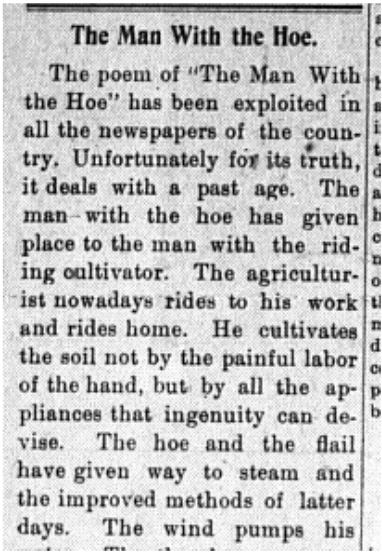
As the 19th century drew to a close, the Industrial Revolution was spreading to agriculture, pushing out the small farmer in favor of large, corporate farming companies and ranchers. At this time, there was a famous poem called “The Man With the Hoe,” which was a kind of elegy to the small farmer. Edgar Johnson thought it was a bullshit poem, preferring to celebrate modern advancements in farming. In an editorial, he wrote: “The poem of ‘The Man With the Hoe’ has been exploited in all the newspapers of the country. Unfortunately for its truth, it deals with a past age. The man with the hoe has given place to the man with the riding cultivator. The agriculturalist nowadays rides to his work and rides home. He cultivates the soil not by the painful labor of the hand, but by all the appliances that ingenuity can devise. The hoe and the flail have given way to steam and the improved methods of latter days.”
In what can only be described as a minor tragedy of local history, the entire year of 1900 is missing from the Fullerton Tribune microfilm archives. Thus, I have no idea what happened that year. Stay tuned for more on Fullerton’s Water Wars…
-
Fullerton Water Wars: Part 1
The following is from a work-in-progress about the history of Fullerton. You can support my ongoing research and writing on Patreon.
One of the real goldmines of local historical information is the microfilm archive of the Fullerton Tribune, the town’s first newspaper, which was created in 1893 by a Mr. Edgar Johnson.
At first, looking at this microfilm is quite overwhelming. I am assaulted with vast amounts of data and the question becomes: what do I, as a researcher/writer, choose to focus on? I thought it might be interesting to focus on one specific issue, and read all the articles pertaining to that issue over a few years. Perhaps an interesting narrative will emerge.
And so, I chose the issue of water. Living in a densely populated desert like Southern California, I am fascinated by the history of water. How does this region, which cannot naturally support such a vast population, manage to get all that water? I suspect that studying the history of water in my town will provide some interesting insights into questions of power, politics, business, and the natural environment, which has been so profoundly altered by human beings.
The Fullerton Tribune began in 1893, so our story will begin there, but it’s important to note that this date is totally arbitrary in the longer history of water use in this region. For those interested in earlier water history, I would refer you to a post I wrote on a book called A History of Orange County Water District, which goes all the way back to Native Americans and the Spanish Missions. Anyway, let’s begin our story in 1893…
In 1893, the board of directors of the Anaheim Union Water Company were mostly notable OC pioneers: Hiram Clay Kellogg, William McFadden, Edward Amerige, John Tuffree, Charles Rust, and a Mr. Zeyn. These men were all prominent businessmen and local ranchers who had a vested financial interest in making sure the water kept flowing to their fields and towns.
At a meeting in 1893, several ranchers from a town called Yorba complained that “they were not receiving their fair share of water” and that their irrigation ditches were damaged. Residents of Yorba tended to have Spanish surnames like De los Reyes and Valenzuela. It does not appear that the residents of Yorba had a representative on the board of directors of the Water Company. Their complaints will continue.
Six years prior, in 1887, the same year that the town of Fullerton was formed by George and Edward Amerige, the California state legislature passed the Wright Act of 1887, whose purpose was to give small farmers a fair shake by allowing them to band together, form public collectives called Irrigation Districts, and get water to where it was needed. This was NOT how the Act was presented in the Fullerton Tribune. Reading articles from 1893 onward, one gets the impression that the sole purpose of the Wright Act was to unfairly tax water companies. It was met with near immediate outrage by the larger local ranchers, who in 1893 formed the Anti-Wright Irrigation League, which saw itself as a defender of taxpayers (Which taxpayers? One wonders.)
The stated function of the Anti-Wright Irrigation League was “the complete annihilation of the Wright Act.” Edward Amerige, co-founder and member of the Board of Directors of the Water Company wrote in the Tribune: “I see inevitable ruin and bankruptcy in the future if the Wright Act is not wiped out.” William McFadden, also on the board, took a more nuanced approach, writing, “I am in favor of the [Irrigation] District, but think the directors made a mistake in levying the special tax. I think the Wright Law would be the best thing for the people if successfully carried out, but if it cannot be done, wipe it out completely.”
Meanwhile, members of the Anti-Wright Irrigation League refused to pay their water tax, prompting William A. Witte, tax collector for the Irrigation District, to write to the Water Company: “Dear Sir: Your taxes in Anaheim Irrigation District for 1893-1894 amounting to $14.80 are now due and payable to me at my office on Los Angeles street, Ahaheim. On the last Monday in December 1893 at six o’clock pm all unpaid assessments will be delinquent and an additional 5 percent will be added on all delinquents. Respectfully, Wm. A. Witte, collector.”
To which Edgar Johnson, ardent defender of (certain) taxpayers, replied by comparing the tax collectors to vampires: “Blood suckers are living off the money from the people…It is time for the…people to begin to protect themselves from the public robbers who are ruining the country. We will pay our taxes when we have to.” Which, apparently, was not when they were due. This is also ironic in the sense that the purpose of the Wright Act was to empower small farmers against the interests of large ranchers, who tended to monopolize water resources. The Fullerton Tribune seems to take the side of the large ranchers. It was important to stay in their good graces.
Meanwhile, the Santa Ana River and its irrigation ditches were protected by men called zanjeros, paid by the Water Company, to ensure the water flowed to its rightful owners: “The zanjeros were instructed not to deliver water to anyone not a stockholder and then not to exceed his stock limit.” These private water police were needed because some people still had the gall to partake of a local natural resource without paying. Early in 1893, a “zanjero reported that the Chinese at the vegetable gardens north of town had been stealing water form the ditches.” One doubts the veracity of this report, as the Chinese, at this particular moment in American history, were the feared and hated immigrant group of the day. They would soon be run out of town by armed vigilantes. Many of them would also be deported due to the various Chinese Exclusion Acts.
In addition to taxes, part of the conflict between the Wright-created Irrigation District and the Anti-Wright League (i.e. the Water Company) had to do with the creation of a reservoir. The Irrigation District, presumably representing the interests of small farmers, sought to create a reservoir in the under-represented region of Yorba. The Water Company, presumably representing the interests of the larger ranchers, sought to create a reservoir in La Habra. Legal battles will ensue. Who will get the reservoir: La Habra or Yorba? Time will tell.
When all this was transpiring, there was across the United States the Panic of 1893 which led to the greatest Depression the country had ever seen. Like other Great Depressions, this led to lots of bank failures, closures, and general financial hard times. Owing to these trying times, the board of directors of the Water Company felt compelled to raise their rates. The self-serving philosophy of the Water Company was: taxes bad, raising rates necessary.
Also, at this time, another combatant entered the Water Wars–the Jurupa Land and Water Company, who claimed water rights that overlapped with the Water Company. The Board of Directors proclaimed in the Tribune: “During the past year the Jurupa Company appropriated and used to our injury two hundred inches of water more than formerly, and the [Santa Ana] River at that point by expert management had 400 inches of water in the season of scarcity less than the year previous, which very materially affected our stream of water, our irrigators and the income of the company.”
Meanwhile, in 1894, there was an election for the Board of Directors of the Water Company. All of the previous directors were re-elected, minus Kellogg, who was replaced by a Mr. Botsford (remember that name!)
And then came the Age of Cement. Perhaps irrigation ditches were already being cemented, but the first mention of this increasingly popular trend appears mid-1894, when the Water Company hired contractors “for cementing the south branch ditch from Crowther’s corner to Brookhurst, 24,244 feet, and the East street ditch form Sycamore Street to Santa Ana Street, 3,300 feet.” More cementations will follow. The stated reason for these first cementations was “to keep the squirrels [and gophers] from working through the banks.”
Around this time, a “ditch committee” was formed to examine all ditches. Their recommendations will prove prophetic: “that all improvements on the ditches hereafter be made with permanency and utility and that all wooden gates be removed as fast as they are out, and be replaced with cement.” The Romans would be proud.
Let me pause here for a moment, in case you are bored. I don’t expect that many people will find this terribly interesting or important. As I sit here at 9:30pm on a Thursday night in a coffee shop reading proposed amendments to the bylaws of the Anaheim Union Water Company in 1894, I think to myself: so this is how I spent my break? Why does this stuff matter? And who will care to read it? I’m reminded of one of my favorite writers, David Foster Wallace, who prepared for his last unfinished novel (The Pale King) by reading the entire Senate hearing transcripts of the Tax Reform Act of 1986. He had to take accounting classes to begin to decipher its near impenetrability. Wallace notes in his voluminous footnotes that he may have been one of the only living Americans to have read these tax debates in their entirety. Why did he do this? I think it had something to do with the fact that the 1986 Tax Reform Act, though nearly incomprehensible to 99.9 percent of ordinary Americans actually had profound, real-world economic consequences for those same ordinary Americans. And so, I think, it is with the history of water. Hold your nose, dear reader, as we take the plunge back into those increasingly cemented (yet rodent free!) irrigation ditches.
In a late 1984 meeting, the Water Company was faced with rising costs of cleaning irrigation ditches. More cementing was proposed. A surreal/funny quote from this article is: “Mr. Ryan thought it would be a good idea to get cheaper money.” Great idea! The hated Irrigation District was also facing hard times, this being the First Great Depression. They had virtually no money, probably because the cash-strapped Water Company was refusing to pay its taxes, on principle. Maybe 1895 will be a better year. (Spoiler alert: It won’t.)
If 1894 inaugurates the Age of Cement, 1985 brings the Age of Bonds. I don’t entirely understand the concept of bonds. In my day, the state of California will occasionally “float a bond” to get itself out of debt or pay for some massive project. It feels like bonds are magic, free money, though I don’t think that’s the case. At my favorite bar in downtown Fullerton, Mulberry St., I run into a friend who knows more about economics than I do, and I ask him what a bond is. He explains that it’s basically a loan, not magic free money. And, like all loans, it must be paid back. It is the tendency of politicians with short terms to take out long-term loans. “Leave it to the next generation to sort it out,” he says, a bit cynically.
Anyhow, in 1895, with cash flow relatively low, the Water Company began doing large-scale infrastructure projects (i.e. cementing ditches). How will it pay for this? Why, with bonds: “Speaking of the bonds, Mr. Botsford said that Los Angeles capitalists were eager to purchase the whole issue.” This Mr. Botsford will turn out to be an enthusiastic (and controversial) advocate of bonds.
Edward Amerige, Fullerton co-founder, emerged as the principal opponent of Mr. Botsford’s bond schemes. In an 1895 letter to the editor, Amerige wrote: “To increase the present great indebtedness of the company at a time when the water sales do not pay running expenses, let alone interest on outstanding notes and bonds, which now amount to $1000 per month, or there about, by cementing the Placentia ditch at a cost of $14,000, is suicidal. It looks as the though the company was run in the interest of 1 or 2 directors.”
Part of the push for more bonds and cementing had to do with a push to expand the territory of the Water Company. Amerige noted: “Who are the people who are clamoring for an increase of the present district? Mostly speculators.” This is a bit ironic because when George and Edward Amerige founded Fullerton, just 8 years earlier, they could be considered speculators. This conflict was really about settled speculators vs. new speculators. Ultimately, it was a conflict over resources.
It was also a conflict of philosophies: unlimited vs. limited growth. One could say that this is still the primary debate amongst city planners. In 1895, Mr. Botsford was the advocate for unlimited growth, and Mr. Amerige was the adovcate for limited growth. But, again, behind this was economic self-interest for both parties. Tribune Editor Edgar Johnson unequivocally sided with Amerige, making no pretense of journalistic “objectivity.”
And then another party entered the fray, a Mr. Groat–preferred contractor of the water board for ditch cementing, who developed a nice business relationship with the Water Board. Mr. Groat got lots of juicy contracts, paid for with bonds. Mr. Amerige was, of course, not happy, writing in the Tribune: “Admitting, for argument sake, that contractor Groat’s claim for payment of 1000 yards of earth was a just one, then there was a direct loss to the company of $223 through the unbusinesslike methods pursued by the board of directors. It is a nice thing for the contractors to have an employee on the board of directors, but is it as nice a thing for the stockholders?” E. Johnson adds: “The past transactions of the present board of directors, since they came into power, is a veritable gold mine for the newspaperman. Dig in any direction you like, you are certain to unearth something unsavory.”
In response to the “unsavory” actions of the board of directors, some stockholders (probably led by Amerige) formed the Reform League of the Anaheim Union Water Company, to encourage the election of new men. Johnson wrote: “It will be something entirely new to the present board of directors to have men on the board who will work for the best interests of the stockholders and not trying to grab everything in sight.” Johnson advocates electing “men who will manage the affairs of the water board in a business-like manner.” This is a bit ironic because one could argue that, in promoting infinite growth and their own financial self-interest, the current water board was acting in a very business-like manner.”
In reading about these water wars, it is often difficult to determine whether anyone is acting altruistically. Even Mr. Amerige, in his opposition to bonds and expansion, is also looking out for his own self-interest, for in 1896 he will run for board of directors, and be elected.
Amerige’s critiques of the water board become more direct and angry as 1896 rolls on. In an article called “The Water Fight,” he writes: “In looking over the cementing that has been done in the water district I find that the greatest outlay and the most expensive ditches have been made in the vicinity of several gentlemen’s places, namely W.F. Botsford, Wm. McFadden, W. Crowther, and F.G. Ryan. Does this not seem a little singular when all of these gentlemen are directors in the water company?” Mic drop!
In response to these direct attacks, the water board embarked on a public relations campaign, by issuing circulars to stockholders making them sound awesome and responsible, to which Amerige promptly replied: “Does it not seem rather ludicrous for men who are sending out circular letters, commending their financial ability and wisdom to the stockholders in the work performed, to have most of the work done around their own places?” In a similar vein, Johnson wrote: “The circular letters which have been sent out to the stockholders of the Anaheim Union Water Company from the office of the company during the past three months, are misleading, untrue, and evidently intended to deceive.”
What is the upshot of all of this? I draw a few conclusions regarding water wars in early Fullerton:
1.) Water is politics.
2.) Water is power.
3.) Water is business.

-
Subscribe
Subscribed
Have a WordPress.com account? Log in now.

