-
Water Use in Early Orange County
The following is from a work-in-progress about the history of Fullerton. You can support my ongoing research and writing on Patreon.
When we turn on the tap, or take a shower, few people take time to wonder: Where does the water come from? Like many aspects of life in developed areas, water is one of those things that we just take for granted.
But the reality behind water is vastly deeper than we might suspect. It involves agencies, agencies within agencies, politicians, lawyers, engineers, bureaucrats, and businessmen. Average folks like you and me have, historically, existed on the outside of water debates. Well, my fellow water-users, here’s an inside scoop, based mainly on the book A History of Orange County Water District by Barbara Milkovich. I’m fairly certain that I am one of a very small handful of people who have actually read this book. It’s no thriller, but it is instructive.
For centuries, water use in Orange County was fairly simple. Native Americans built their dwellings along the Santa Ana river and had all the water they needed to survive. This was at a time when the Santa Ana river was a real river, capable of sustaining local people, plants and animals, and not the man-made concrete trickling channel it has become.
The coming of the Spanish conquistadors and missionaries signaled the end of the Santa Ana river as it had existed for centuries. Milkovich writes, “Beginning in the 18th century, Europeans introduced their concept of community control of irrigation and water management as their colonies developed.” Only a European would view a river as something to be “managed.”
As they built missions and military outposts, the Spanish began the project of “controlling” the land and water for maximum yield: “Eventually the Mission [San Gabriel] had some 6,000 acres of land under irrigation, including tracts in Santa Ana.” They dug ditches [or, rather, compelled the Native Americans to dig ditches] to divert water from the Santa Ana river to their crops. It was the Spanish who taught the Native Americans to abandon their “primitive” ways and to embrace “civilization.”
Irrigation projects expanded as the Spanish government in California divided the land into ranchos, spanning thousands of acres, which needed increasing amounts of water.
When the United States took over California in 1851, water became a commodity to be bought and sold, like everything else. The first water company in Orange County was the Anaheim Water Company, which was owned and controlled by local landowners.
By the 1870s, other developers arrived on the scene, hoping to make lots of money off the land. A.B. Chapman and his partner established the Semi-Tropical Water Company to irrigate their lands from the Santa Ana river.
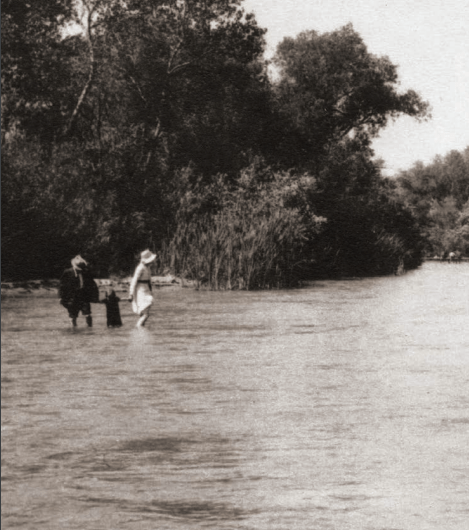
Santa Ana River, circa 1899. Photo courtesy of Anaheim Public Library This ultimately led to a legal battle over water “rights” between the Anaheim Water Company and the Semi-Tropical Water Company, which went all the way to the California Supreme Court. Eventually, after a couple mergers of companies into larger more powerful companies, the case was settled out of court and the Santa Ana river water fell under the control of two large companies: The Anaheim Union Water Company and the Santa Ana Valley Irrigation Company. These two companies controlled and sold the water until the 1960s.
With the gold rush and agricultural boom of the late 19th century, the water of the Santa Ana river became inadequate to support all the new settlers and developers. To paraphrase a film: We drank that milkshake. We drank it up.
So developers looked to other water sources and found them in underwater artesian wells, which at one time held 2.5 to 3 million acre-feet of water in Orange County. Drawing water from these underground wells, the Santa Ana river, and the Bolsa Chica wetlands, agriculture skyrocketed in Orange County. Between 1888 and 1912, the amount of irrigated acres rose from 23,500 to 50,000.

This massive exploitation of local water resources was not without consequences. Water levels were dropping rapidly, faster than they could be naturally replenished by rain and mountain runoff. In 1925, water engineer J.B. Lippincott reported to the Orange County Board of Supervisors that the underground artesian well water had shrunk from 315 square miles in 1888 to 52 square miles in 1923.
So what was Orange County’s solution to this very real problem? Did they scale back the massive development? Did they seek more sustainable lifestyles? No way. They looked eastward, thirstily, to the mighty Colorado River. They didn’t want to limit growth and production. They wanted to exand, expand, expand! They wanted more, more, more! It was the American way.
In 1924, local growers like Charles C. Chapman (Orange Tycoon/Fullerton Mayor) lobbied hard for the creation of the Boulder Dam and the building of an aqueduct to bring water from the Colorado River to Orange County. They were successful. Consequently, the value of citrus crops rose in value and profits from $2.7 million in 1911 to $28 million in 1927.
That same year, 1927, saw the formation of the Metropolitan Water District, a joint business venture between wealthy growers and local governments. The MWD, which to this day provides Fullerton with some of its water, ensured decades of water to Orange County, courtesy of the Colorado river. By 1935, 54,000 acres of orange groves existed in Orange County, irrigated by diminishing local supplies and a seemingly endless supply from the Colorado river.
In 1931, prompted by concerns over shrinking groundwater levels, the Orange County Water District was formed with the purpose of conserving and replenishing OC groundwater. The directors of the OCWD were elected by property owners, who were in turn charged a “pump tax” in addition to whatever they were paying the MWD.
Stay tuned for more on water in Orange County…
-
The Amerige Brothers: Founders of Fullerton
The following is from a work-in-progress about the history of Fullerton. You can support my ongoing research and writing on Patreon.
To commemorate the 50th anniversary of the founding of the City of Fullerton, some local residents interviewed many early pioneers of the city in 1937. These interviews were paraphrased and compiled into a document entitled “The Story of Fullerton and Its Founders” which is available in the Local History Room of the Fullerton Public Library.
Included in this document is a narrative based on a series of interviews with George Henry Amerige, one of the founders of Fullerton. The interview was conducted by Darrel A. McGavran, whose father worked for the Chapman ranches. The following information is taken from this, and other, sources.
The Amerige Family
The Amerige family is of ancient Italian origin, being one of the oldest protestant families of Italy. The name, in Italian, Amerigo, is from the same derivation as that of Amerigo Vespucci (1451-1512), Italian explorer after whom the American continents were named.
Because of religious persecution (Italy was catholic, the Ameriges were protestant), the Amerige family moved to Germany. Maurice Amerige, grandfather of George Henry Amerige, came to Boston, Massachusetts around 1807. Maurice Amerige was a dealer in horses, and the Ameriges became one of the prominent colonial families of New England. Maurice Amerige and his wife Sarah had three sons:
George Brown, who went to California during the gold rush of 1849 and became the owner and editor of the Alta Californian, the first paper ever published in California.
William Amerige, who went to China as a trader, and died there in 1839.
Henry Amerige, father of George Henry Amerige, who became a prominent sail-maker and ship outfitter in Boston. Among the ships outfitted by Henry Amerige was the “Star of the East,” which carried missionaries to Honolulu, Hawaii. Henry Amerige outfitted the ship for the arctic explorer Dr. Elisha Kent, for his trip to the North Pole in 1852. In his early years, Henry traveled extensively and visited almost all of the continents of the world.
Henry Amerige helped develop the Boston suburb named Malden (after which Malden street in Fullerton is named), and became a leading citizen and city planner. There is a park in Malden called “Amerige Park.”
Henry Amerige married Harriette Elizabeth Russell, who also came from an old and prominent New England colonial family. Her great great grandfather, Eleazer Giles, lived in Salem, Massachusetts during the Salem Witch Trials. Her grandfather, also named Eleazer Giles, fought in the American Revolutionary War, commanding the armed brig “Saratoga.” He was a seafaring man and actually had a wooden leg. Her father, Benjamin Russell, was a slave trader.
Harriette and Henry Amerige had five children, of whom George Henry Amerige was the second born.
George Amerige was born in Malden, Massachusetts in 1855. Edward R. Amerige was born in 1857. The brothers established a successful grain and hay business in Massachusettes, before moving to California in 1886.
George and Edward Found Fullerton
The two brothers first visited northern California where they purchased some land in Sierra Madre. It was on a duck-hunting trip south that they discovered the potential for development in Southern California and decided to move here and invest.

George Amerige. 
Edward Amerige. They first moved to Anaheim, which was an already-established town.
According to “The Story of Fullerton and Its Founders”: “Driving out from Anaheim in all directions to shoot quail and dove, they became interested in what is now the Fullerton District and conceived and formulated a plan to start a town, thinking here, of all the places they had examined, would be the location for a successful and permanent municipality.”
In 1909, Edward reflected on their decision in “The Pictorial American and Town Talk”:
“At the close of the great boom of 1886 and 1887, when Southern California was attracting the attention of the whole United States, and, might I say, civilized world; when people were flocking to Los Angeles and vicinity by the thousands, attracted by its wonderful matchless climate and the possible resources of this, the new Mecca, for ambitions people of all climes–a land of peace, plenty and equitable climate excelled by no other; when cities sprang up like magic from wasteless and treeless plains; when by the advent of the eastern capitalist, who, with an abundance of enterprise and capital, made the supposed desert blossom and bloom like the rose; when, by the development of and use of water for irrigating purposes, a transformation scene was enacted that would equal ‘the fairy tales of Aladdin’–two young tenderfeet, G.H. and E.R. Amerige, attracted by the rich and beautiful Fullerton-Placential District, the accessibility and abundance of water for both domestic and irrigation purposes; after a thorough and careful inspection of all the surrounding country and many other locations, conceived and formulated the plan of starting a town, thinking that here, of all locations thy had examined, would be the ideal location for a successful and permanent municipality.”
The Amerige brothers purchased 390 acres from brothers D.E. and C.S. Miles, 20 acres from William S. Fish and another 20 acres from Joseph Frantz, to establish a 430-acre townsite.
In Fullerton: a Pictorial History, Bob Ziebell writes, “Using current names, the property was bounded approximately by Chapman Avenue on the north, Valencia Drive on the south, Raymond Avenue on the west. A copy of the agreement with the Miles brothers dated May 14, 1887, indicates the purchase price was $68,250.”
Starting a new town involved more than just purchasing a property. There was surveying, plotting, and grading to be done, as well as construction of some initial buildings.
According to “The Story of Fullerton and Its Founders”:
“When they learned that the California Central Railroad Company, a subsidiary of the Santa Fe Railroad, would soon build a line from Los Angeles to San Diego, passing through Orange County [then, it was not yet a county] the Amerige Brothers waited on George H. Fullerton who, at that time, was president of the Pacific Land Improvement Company and also the ‘right-of-way’ man for the railroad, who informed them that several surveys had been made, but none of them would take in their tract of land. By offering him a right-of-way through their land and an interest in the town-site, they prevailed upon him to change the survey to bring the railroad through their land and south into Anaheim.”
The Ameriges then formed a closed stock company, partnering with the Pacific Land Improvement Company and H. Gaylord Wilshire [who later developed parts of Los Angeles].
On July 5, 1887, Edward R. Amerige drove the first stake in a field at what is now the corner of Commonwealth Ave. and Spadra Road (now Harbor Blvd.).

As for the naming of the town, George Fullerton’s son, Perry, told it this way in 1947:
“Well, the way my father has always told it to me–I heard him tell it a number of times, was that they had laid out various towns around Southern California for the Santa Fe Railroad, and…they decided to put a town at this location, and when it came to the question of a name, why the board of directors…wanted to name it for my father. My father said no, he didn’t want to; he was a man who never wanted to put himself forward at all in the public eye, and he said no, he didn’t care for that at all. So it was stopped right at that time…but he had to leave the vicinity for a few days and when he came back, why, the town was named Fullerton, and the President of the Santa Fe Railroad had okayed it, so that was all there was to it. I guess that’s about the whole story. Oh, yes, Mr. Smith, who was then President of the Santa Fe Railroad, wanted to name the town Marceline, after his wife, but the board members thought it sounded too much like vaseline, so they said no…so they went ahead and named it Fullerton.”

George Fullerton. The Amerige brothers’ real estate office, the first structure built in the town, still stands next to Amerige park on Commonwealth.

Amerige Brothers Real Estate office. George and Edward named many of the first streets of Fullerton after streets of their hometown of Malden. Some of these include: Commonwealth Avenue, Malden Street, Highland Avenue, and Amerige Avenue. Other streets were named after officials of the Pacific Land and Improvement Company and the Santa Fe Railroad Company, which were business partners with the Ameriges.
George Amerige says he installed the town’s first water system “employing Chinamen to do the excavation work on the ditches…Hooker Bros. supplied the water pipe and made the connections…The first well was drilled by Padderatz Bros. [in the block bounded by Highland, Malden, Whiting, and Wilshire Avenues] on September 26, 1887…the first water was raised by an old fashion hot air engine and later by a windmill.”
Ziebell describes early buildings: “The first ‘significant’ building–and an imposing one it was–was the St. George Hotel, an elaborate three-story facility set back from the northeast corner of Commonwealth and Harbor, about where the southwest portion of the block’s interior parking lot is now located. Other structures soon followed, the first built by H. Gaylord Wilshire on two lots at the southeast corner of Harbor and Commonwealth, home of Fullerton’s first grocery store (Ford and Howell) and later the famed Stern and Goodman general merchandise story; the next by C. Schindler, P.A. Schumacher, and T.S. Grimshaw–the center store becoming known as the Sansinena Block–on three East Commonwealth lots behind the Wilshire Building: followed by the Chadbourne Block on four lots at the northwest corner of Commonwealth and Harbor.”
-
The California Native American Genocide
The following is from a work-in-progress about the history of Fullerton. You can support my ongoing research and writing on Patreon.
“The land we occupy today is the very same ground on which these terrible crimes took place. We Californians are the beneficiaries of genocide. I suspect few Californians today contextualize their homes as sitting upon stolen land or land gained by bloody force or artful deceits, nor do they likely consider the social and political questions of present day Native American affairs in this light.”
—Brendan Lindsay, Murder State: California’s Native American Genocide, 1846-1873
In fourth grade, attending a public school in Fullerton, I learned about the history of California. One aspect that was not covered in this curriculum was the fact that in the first three decades of American statehood, California’s Native American population experienced a genocide at the hands of white American citizens.
This was not just an accidental by-product of disease or “natural” forces—many thousands of Indians in California were violently massacred by legal state-sponsored militias. These roving death squads operated under color of law and with the support of politicians, the press, and local citizens. Other Native Americans perished due to starvation, slavery, and planned neglect.
This tragedy, often overshadowed by nostalgic recollections of the Gold Rush, has only recently been making its way into public consciousness. I would wager that most Californians today have no idea.
The first comprehensive treatments of this subject were published very recently, in 2012 and 2014. These are An American Genocide: The United States and the California Indian Catastrophe, 1846-1873 by Benjamin Madley, and Murder State: California’s Native American Genocide, 1846-1873 by Brendan Lindsay. Both authors are professors of history in California.
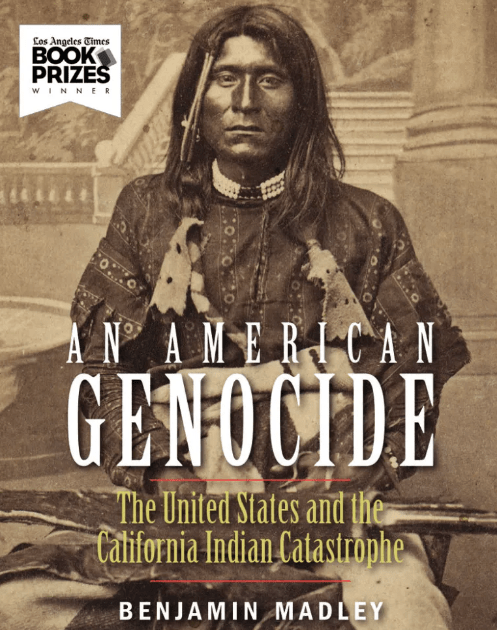
Over the past few months, I’ve read these books and have been working on this report. More than any other aspect of local history I’ve written about, this has been the most difficult. This is not because these books are not well-written. It is because this topic is, to quote Madley, “unrelentingly grim.” This project has taken me longer than normal because it is emotionally very heavy. It is profoundly disturbing and unpleasant.
So why, then, is it important to understand this history? The answers to this are many, but for Lindsay, they are actually very practical and relevant.
“The motive for this book rests upon a very practical foundation,” Lindsay writes. “Native Americans in California today are making inroads in matters of health, cultural renewal, sovereignty, and the reclaiming of lost lands and other rights. California voters, teachers, courts, and lawmakers thus continue to make choices that affect Native American people in the state.”
Over the past few years, in the course of researching and writing about the local Native American tribe (the Kizh), I’ve actually befriended living members of this tribe. They are a kind and generous people with a sad history, and they are still seeking official federal recognition today, in 2020.
An honest assessment of the way California and the United States have treated the Kizh and other California tribes (of which there are around 100) is essential in making fair public policy decisions about justice for living tribal members.
And so, in a spirit of honesty, empathy, and justice, I present a summary of what I’ve learned about California’s Native American genocide.
When scholars like Madley and Lindsay use the term “genocide” they are not being sensationalistic, but rather are referring to something that is clearly defined by international law, specifically the 1948 UN Convention on Genocide. Using this legal framework, it is clear that what Euro-Americans did to Native Americans in California meets the legal criteria for genocide.
A notable difference between what happened here and what happened in other genocides like the Holocaust is that, instead of being directed by a central authority, genocide in California was largely conducted by ordinary citizens through the democratic process (more on this later).
The Ideology Behind Genocide
Early in his book, Lindsay poses the question: “How did unthinkable acts, such as the purposeful murder of infants, become thinkable, thinkable in fact to people who valued freedom, had deep faith, loved their own children, and sought to make better lives for themselves and their families? How could otherwise good people commit such heinous atrocities, and indeed honor and celebrate those atrocities?”
A similar question was posed by Jewish philosopher Hannah Arendt in her book Eichmann in Jerusalem: Notes on the Banality of Evil, in which she explores the 1960 trial of Nazi war criminal Adolf Eichmann. During the trial, Eichmann appears to be a painfully ordinary bureaucrat, not a bloodthirsty monster. Arendt’s explanation is that most people who commit atrocities, past and present, do so because they uncritically accept a popular ideology, and act in accordance with this.
In the case of the California Native American genocide, two main ideologies lay behind the catastrophe: Manifest Destiny and racism against Indians.
“Manifest Destiny,” a term coined by Stephen O’Sullivan in 1845, was the popular notion that it was America’s God-ordained destiny to expand all the way to the Pacific Ocean. This despite the fact that, at that time, the west was part of Mexico and peopled by hundreds of indigenous nations.
This ideology, combined with a pervasive racism against Native Americans (as inferior savages), allowed for what Troy Duster has called “conditions for guilt-free massacre…the denial of humanity to the victim.”
Lindsay cites numerous examples of 19th century historians, politicians, and journalists expressing these twin ideologies of Manifest Destiny and racism to support territorial expansion of the US (and the resulting genocide).
Caleb Cushing, an influential politician and supporter of expansionism said in 1859, “We belong to that excellent white race, the consummate impersonation of intellect in man, and loveliness in woman, whose power and privilege it is, wherever they may go, and wherever they may be, to Christianize and civilize, to command be obeyed, to conquer and to reign. I admit to an equality with me, sir, the white man, my blood and race, whether he be the Saxon of England or the Celt of Ireland. But I do not admit as my equals the red men of America, the yellow men of Asia, or the black men of Africa.”
Cushing was not an outlier, but expressed commonly-held beliefs of the era. Newspapers and popular publicans in the 19th century routinely portrayed Native Americans as inferior savages. To quote but a few examples:
From Parley’s Magazine of New York: “Equally inanimate and filthy in habit, they do not possess ingenuity and perseverance…sullen and lazy, they only rouse when pressed by want.”
From the Chico Weekly Courant: “They are of no benefit to themselves or mankind…If necessary, let there be a crusade, and every man that can carry and shoot a gun turn out and hunt the Red Devils to their holes and there bury them, leaving not a root or branch of them remaining.”
Wagons West
From 1846-1848, guided by the ideology of Manifest Destiny, the United States waged an expansionist war against the fledgling Republic of Mexico. The US won and under the terms of the Treaty of Guadalupe Hidalgo, acquired half of Mexico’s territory—all the way to California.
In 1848, gold was discovered in California, sparking what became known as the Gold Rush. Tens of thousands of Americans flocked westward seeking their fortunes.
The influx of tens of thousands of Americans into California proved disastrous for native Californians. In 1848, the indigenous population of California was estimated at around 150,000. Within 60 years, this population would collapse by nearly 90%.
The Real Gold Rush was Land
While the original impetus for massive westward expansion was gold, the commodity of more lasting value turned out to be land.
The US government offered “public” lands to Americans at the tiny sum of $1.25 per acre through many programs such as the School Land Warrant Program.
The War Department also decreed that up to 160 acres per person could be had by all veterans of the Mexican American War.
Upon claiming all this cheap or free land for grazing, timber, minerals, water, and farmland, some American Californians faced a problem.
As it turned out, much of the land was already occupied by Native Americans who had been there for millennia.
What to do?
Democratic Death Squads
While both Lindsay and Madley’s books cover much of the same material, Madley’s is more comprehensive in its documentation of direct massacres of Indians, primarily by white settlers in the form of militias.
In the appendices to An American Genocide, Madley documents dozens of specific massacres, taken largely from primary sources.
Madley was able to document these because those committing these mass murders were not ashamed. The unfolding genocide was not a secret, but something openly celebrated and called for by newspapers, politicians, and local leaders up and down the state.
The pattern became a familiar one, as Lindsay describes: “This cycle of starvation of native peoples, their stock theft for food, and the bloody, retaliatory vengeance by settlers and ranchers, exacted often with self-righteous fury, was the key sequence of events leading to the Euro-American claim that extermination of Indigenous populations was a practical necessity.”
That was the term often used at the time: extermination.
The Marysville Evening Herald proclaimed in 1853: “Extermination is no longer even a question of time—the time has already arrived, the work has been commenced, and let the first white man who says treaty or peace be regarded as a traitor and coward.”
Anthropologist Robert Heizer estimated that “for every white man killed, a hundred Indians paid the penalty with their lives.”
Many of these retaliatory massacres of Indian villages were conducted by democratically-organized militia of local volunteers with names like the Eel River Rangers.
In these punitive expeditions, the brave volunteers didn’t just kill men; they killed women and children.
U.S. Army Lt. Edward Dillon “reported to his supervisors in 1859 that he had received intelligence that during a twoweek expedition led by [a man named] Hall and other citizens, some 240 Indians were killed.”
Hall later recalled, “We took one boy into the valley and the infants were put out of their misery and a girl 10 years of age was killed for stubbornness.”
These “volunteers” were usually reimbursed for their expenses by the state and federal governments.
Here’s a list of some of the murderous “expeditions” documented in Madley’s book, along with how much the “volunteers” were reimbursed by the state of California:
Gila Expedition (1850) in Quechan country near the Colorado River: 12 Indians reported killed at a cost of $113,482.
First El Dorado Expedition (1850) in Nisenan territory: More than 19 Indians reported
killed at a cost of $101,861.
Mariposa Battalion (1851) in the southern mines: Between 73-93 Indians killed for $259,372.
Second El Dorado Expedition (1851) in Nissan territory: 21 Indians killed for $199,784.
Siskiyou Volunteer Rangers Expedition (1852) in Modoc territory: Between 73-200 Indians killed for $14,987.
Shasta Expedition (1854) in the McCloud River Valley: 58-63 Indians killed for $4,068.
Coast Rangers and Klamath Mounted Rangers Operation (1854- 1855) in Del Norte County region: “Hundreds” of Indians killed for $0.
Klamath and Humboldt Expedition (1855) in Northwestern California: 45-80 Indians killed for $99,096.
Let me pause here for a moment for those tempted to think that these expeditions constituted “war” and were thus justified. In the vast majority of cases, the number of non-Indians killed was zero. This had to do with superior firepower of the militias and a strategy of opening fire from a distance upon unarmed villages. Again, the most common motive for these massacres was theft of cows or horses by starving Indians. Okay, on with the list.
Siskiyou Expedition (1855) in Modoc Territory: 25-45 Indians killed for $14,036.
Tulare Expedition (1856) in Tulare County region: Over 59 Indians killed for $12,732.
Modoc Expedition (1856) in Modoc country: 185 Indians killed for $188,324.
Mounted Volunteers of Siskiyou County: 59-72 Indians killed for $5,149.
Second Klamath and Humboldt Expedition (1859): 100-125 Indians killed for $52,185.
Pit River Expedition (1859) in Achumawi, Atseguwi, Maidu, and Yana territory: 200 Indians killed for $72,156.
Mendocino Expedition (1859-1860) in Yuki territory: 283-400 Indians killed for $9,347.
Humboldt Home Guards Expedition (1861) in Humboldt County: 77-79 Indians killed for an unknown amount of money.
This is by no means an exhaustive list.
“Perpetrators, bystanders, survivors, and secondary sources indicate that non-Indians killed at least 9,492 to 16,094 California Indians, and probably more, between 1846 and 1873,” Madley concludes.
In Humboldt County, the citizens of Uniontown and Eureka voted for a tax to be levied on residents “to prosecute the Indian war to extermination.” Indian hunting could be a profitable endeavor.
“Scalp and head bounties were instituted in some towns and counties. In one example, a county paid 50 cents for every Indian scalp and $5 for every Indian head brought in…One man brought in as many as 12 Indian heads in one trip alone,” Lindsay writes. “Perhaps the most shocking bounty opportunity was one suggested by the editors of the Lassen Sage Brush in 1868, a $500 bounty for “every Indian killed.” This would be such an incentive as to make killing Native Americans tantamount to California’s new Gold Rush.”
This “war of extermination” was not just the result of some callous locals, but found sanction at the highest levels of government.
In an address to the state legislature in 1852, California governor Peter H. Burnett, said, “That a war of extermination will continue to be waged between the two races until the Indian becomes extinct, must be expected; while we cannot anticipate this result with but painful regret, the inevitable destiny of the race is beyond the power and wisdom of man to avert.”
Meanwhile, his administration reimbursed the Indian-killing militias hundreds of thousands of dollars.
“By January 1854, the state of California had already spent $924,259 on Native American genocide,” Lindsay writes. “Some of the money had been reimbursed by the federal government, but much remained unpaid. The state resorted to issuing war bonds to pay for the costs of campaigns against Native Americans.”
Under California law at this time, Indians had little recourse or protections for crimes committed against them. California’s criminal code prevented Native peoples from serving as witnesses against whites, stating “No black or mulatto person, or Indian shall be permitted to give evidence in favor of, or against, any white person.”
Indian Slavery in California
Although California was never officially a slave state, white settlers created a system of de facto slavery for Native Americans.
“Destroying Native lifeways, economies, and people, EuroAmericans created an economy based on stolen land worked by what was, in many of its essentials, slave labor,” Lindsay writes.
In the early 1850s, the California legislature passed the ill-named “Act for the Government and Protection of Indians.” According to Lindsay, this act made California’s indigenous population “practically legal non-entities and the objects of legalized kidnapping, enslavement, and murder, ensuring that access to Native labor would not only continue, but increase.”
In Los Angeles in the 1850s, there was actually a de facto slave mart for Native Americans.
“Euro-Americans harnessed laws contained in the act against Indian vagrancy and drunkenness to obtain a form of short-term slave labor from Native Americans,” Lindsay writes.
A lack of Native resources created an “economy of slow starvation” for native peoples.
In addition to this legalized slavery, “the legal system placed Native workers in homes all over Southern California through apprenticeship laws, also contained in ‘An Act for the Government and Protection of Indians.’ Scholars have estimated that white Americans enslaved as many as 20,000 Native Americans in California. This slave system, disguised as an apprenticeship in advanced civilization for inferior peoples, contributed to the genocide of Native peoples tremendously. By separating families, depriving children of Native linguistic and cultural education, and inflicting mental and physical hardships, Euro-Americans destroyed Native families, lowered birthrates, and committed physical, cultural, and economic genocide.”
Broken Treaties and Neglected Reservations
In 1850, the year California became a state, three federal treaty commissioners were sent to the new state. They were able to negotiate 18 separate treaties with various Native American tribes.
Unfortunately, under pressure from California senators, the US senate voted not to ratify these treaties. They also voted for an “injunction of secrecy on the treaties, which were hidden from the public until 1905.”
With no ratified treaties, the federal government allotted no land to California tribes, but instead created reservations that were “federal property where Native Americans were housed.”
“Native Americans living east of California had for centuries been pushed westward but in California that option was unavailable, lest one push California’s population into the Pacific Ocean,” Lindsay writes.
Lacking official treaties which might have guaranteed rights and sovereignty, California Indians were left at the mercy of federal Indian commissioners.
The first superintendent of Indian affairs in California was a man named Edward F. Beale. Upon his arrival in 1852, he sent this report back to Washington:
“Driven from their fishing and hunting grounds, hunted themselves like wild beasts, lassoed, and torn from homes made miserable by want, and forced into slavery, the wretched remnant which escapes starvation on the one hand, and the relentless Americans on the other, only do so to rot and die of a loathsome disease, the penalty of Indian association with frontier civilization. This is not idle declamation—I have seen it; and I know that they perish by the hundreds; I know that they are fading away with a startling and shocking rapidity, but I cannot help them. Humanity must yield to necessity. They are not dangerous; therefore they must be neglected.”
Beale, like later Indian commissioners, was eventually fired for mismanagement and fraud.
His replacement, Thomas J. Henley, was even worse.
“In 1855 John Ross Browne, a US Treasury agent empowered as a special investigator for the federal government, was sent to inspect Indian affairs and conditions on California’s reservations…Brown excoriated Henley and other federal agents associated with Indians affairs in California. In a series of reports to the commissioner of Indian Affairs in Washington, he described the corruption apparent on the reservations he visited and the utter waste of federal funds. In particular he noted the shady dealings of the officials, including Henley. In one telling report, Brown said that private enterprises by the officials were seen on the reservations and seemed to make use of Native labor, federal funds, and land set aside for the care of Native people on the reservation. Timber from federal land was being harvested without recompense, and the discharges of a sawmill were destroying the fisheries Native people depended on. Much of this, Brown charged, was for the profit of Henley and other whites living on the reservation. Indeed his many reports charged that those empowered to carry out the operations were inept, ineffective, and downright corrupt,” Lindsay writes.
Under Henley’s leadership “funds in the thousands of dollars meant for the subsistence of Native peoples were being expended on for-profit ventures of federal employees and white settlers on reservation lands.”
Many on the reservation were being slowly starved to death or died of disease brought on by malnutrition or their weakened state.
Henley, like his predecessor, was eventually fired for mismanagement and fraud.
There also existed a lucrative trade of kidnapping women and children from the reservations.
Army Lt. Dillon reported in 1861 “that he knew of at least 50 instances when Native children were kidnapped and sold to local settlers.”
Despite being fired from their positions as Indian commissioners, both Beale and Henley “obtained land near reservations and used Native Americans as unpaid labor to make their fortunes.”
By 1860, the seven reservations in California “were either reduced or closed altogether.”
Lindsay concludes that “genocide in the state of California in the 19th century was planned by white settlers, miners, and ranchers who used extermination, either physical or cultural, to obtain Indian land and resources…Hopefully this study is sufficient to generate shame and outrage, today at least, and help in the process of revitalizing, rebuilding, and enumerating Native communities by educating all Americans of the genocidal past of the shared place that Native and non-Native persons now call home.”
-
Early American Settlers
The following is from a work-in-progress about the history of Fullerton. You can support my ongoing research and writing on Patreon.
Following the Mexican-American War (1846-1848), the Gold Rush of 1849, and California becoming an American state in 1850, American settlers began arriving and putting down roots on the land that would become Fullerton.
In the 1860s, much of this land was owned by the Stearns Rancho Company, and so many of these early settlers purchased land from this company. The town of Fullerton wouldn’t be established until 1887.
My source for this initial survey of early pioneers is Bob Ziebell’s Fullerton: a Pictorial History.
An early settler was the Basque sheep herder Domingo Bastanchury, who arrived in 1868, and first leased, and then purchased land in what is now north Fullerton for his growing sheep herd. Over time, he acquired more acres, and expanded his business into cattle, hogs, citrus, and other crops.
Another early farmer/settler was Daniel Kraemer, perhaps more known as a Placentia pioneer who purchased 3,900 acres from August F. Langenerger and moved his family into the old Ontiveros adobe and began farming in 1867.
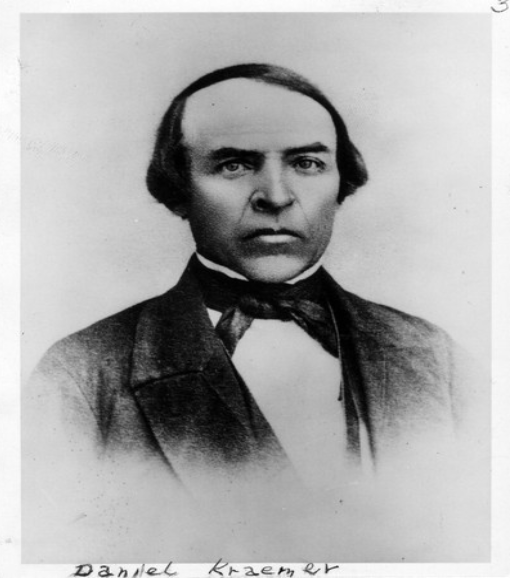
Image courtesy of the Online Archive of California In 1868, Jerome B. Stone and his wife Anna arrived and purchased two hundred acres of land that extended from present day Harbor/Orangethorpe to the Santa Fe railroad tracks. Before it was called Fullerton, this area was known as Orangethrope. Other early settlers in the Orangethorpe area were the Germans Henry Burdorf, Chris Rorden, and Henry Boeckman.

Jerome B. Stone (seated at center) with his family. Photo courtesy of the Fullerton Public Library Local History Room. In 1869, William McFadden purchased 90 acres around what is now Placentia and Yorba Linda Boulevards, and began farming. He, like many of these early settlers, would become involved in civic affairs like the Chamber of Commerce and water issues.

Photo courtesy of the Online Archive of California. Alexander Gardiner, a native of Scotland, moved here with his family from Tennessee in 1869, and established a walnut farm.
Benjamin Franklin Porter came here from Texas on a wagon train in 1870, and purchased 40 acres of land on the north side of Orangethorpe. He and his wife raised 15 children. Porter helped establish the Orangethorpe school in 1872 and Fullerton High School in 1893.
In 1873, Otto Des Granges, a native of Prussia, bought 80 acres of land around present day Cal State Fullerton and Acacia Ave. and built up a citrus and walnut farm.
Richard H. Gilman owned another citrus ranch near Des Granges’. It was here that the first Valencia oranges would be cultivated.
I plan to research more about these early settlers, and will post more as I learn more.
-
Fullerton Businesses in 1893

The following is from a work-in-progress about the history of Fullerton. You can support my ongoing research and writing on Patreon.
Part of my research into Fullerton history involves looking at microfilm from the Fullerton Tribune newspaper, which stretches back to 1893. This is available in the Local History Room of the Fullerton Public Library.

One aspect of history that these newspaper archives reveal is the evolution of businesses that have come and gone.
Here are some of the businesses that existed in Fullerton in 1893.
For groceries and provisions, you could go to Stern & Goodman or E.M. Sprague’s.

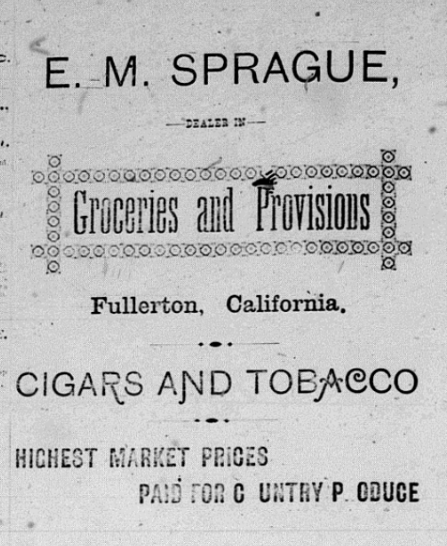
If you wanted fancy groceries, you could try M.H. Dunn’s.

The butcher in town was Brunswicker & Finley.
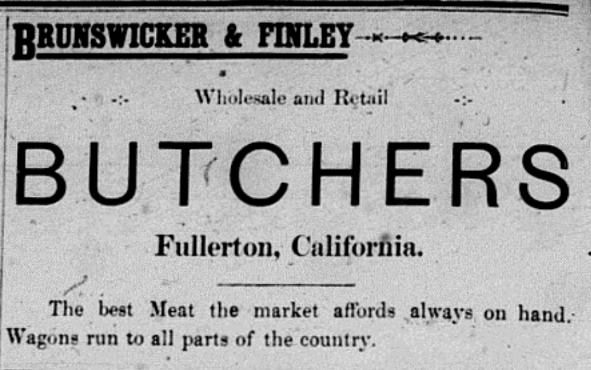
Edward R. Amerige who founded Fullerton with his brother George just six years prior, sold real estate and insurance.

Jennings & Co. ran the Fullerton Stables.
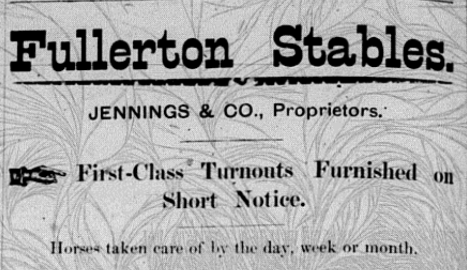
For medicinal needs, there was the Gem Pharmacy.

George Case was the tinner and plumber in town.

Schumacher ran the local nursery.
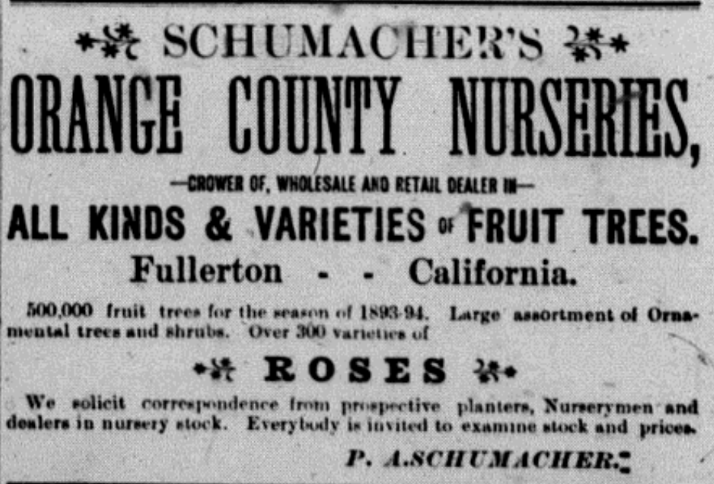
A. Henderson was the town blacksmith.
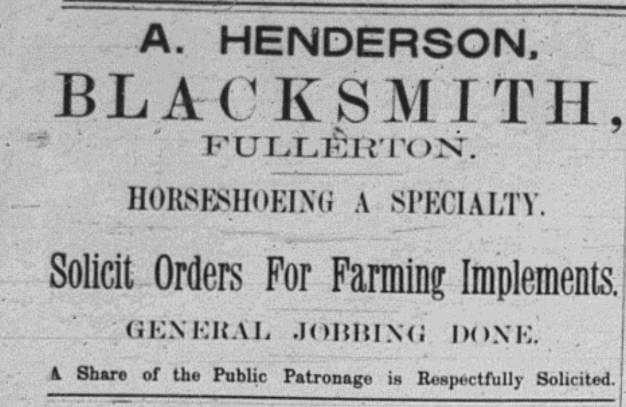
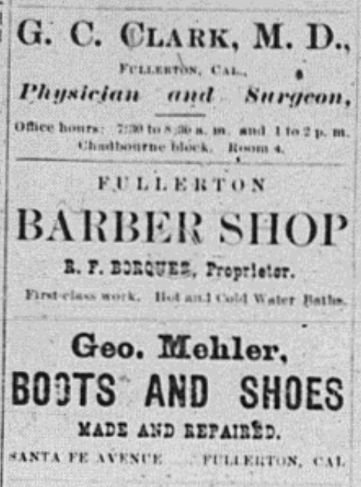
Dr. Clark was the town doctor, R.F. Borques the town barber, and George Mehler sold and repaired boots and shoes.
And it wouldn’t be Fullerton without saloons…

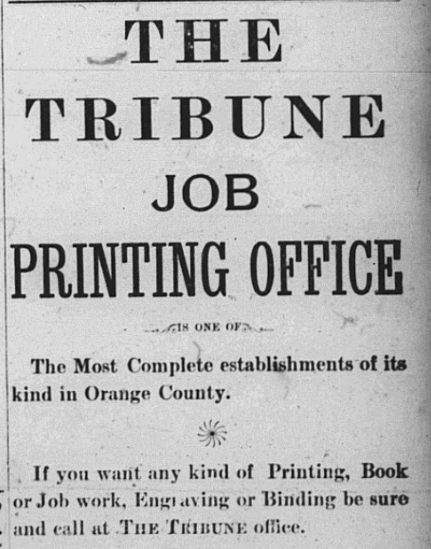
The Fullerton Tribune’s editor and proprietor Edgar Johnson offered printing services.
-
The Journals of Juan Crespi
The following is from a work-in-progress about the history of Fullerton. You can support my ongoing research and writing on Patreon.
Juan Crespi was a Franciscan missionary who accompanied Gaspar de Portola on his 1769 overland expedition from San Diego to Monterey. The party included another friar named Franscisco Gomez, several Spanish soldiers, and a number of native “footmen” who did much of the grunt work of clearing the trail.
At this time, there was no European settlement in Alta (“Upper”) California. The purpose of Portola’s expedition was to begin the process of Spanish colonization of this region by establishing missions, presidios (military forts), and pueblos (towns).
Both Portola and Crespi kept journals of the expedition, and both of these journals survive. Of the two, Crespi’s is way more detailed. In 2001, San Diego State University Press published Crespi’s journals in both English and Spanish, translated by professor Alan K. Brown.

Title page from the journals of Juan Crespi. What follows here are excerpts from the portion of Crespi’s journal as he traveled through present-day Orange County–from July 22-30, 1769. To me these first-hand accounts provide a unique window into first contacts between the native inhabitants of this area, and the Spanish colonizers. The journals are also valuable in that they record what the land looked like before it was developed by Euro-Americans into the landscape we know today.
July 22, 1769: [To Christianitos Canyon, which reaches the Pacific at the southern edge of today’s city of San Clemente]: “At eleven o’clock we came to a pool of fresh water, found by the scouts yesterday at a dry creek where there is a great amount of sycamore and live oaks. We must have gone four leagues to reach this spot. We stopped close to the pool and close to a village of heathens who visited us once, some fourteen men and as many more women with boy and girl children. They are all very tractable Indians. They say there is another large pool further downstream at this place. The spot, a good one for a farm, has its small share of soil and good grass.
On our reaching this spot the scouting soldiers told us that they had seen yesterday a girl infant in arms who was dying. We requested the Governor for two or three soldiers to go with us, and then we two Fathers went to the village to try to see this infant in arms and baptize her if she was in danger. We did find her in her mother’s arms, scarcely able to nurse, but the mother would not in any wise see us. We gave her to understand, as well as we could that we did not wish to harm the child, only to wash its head with water, so that if it died it would go to Heaven. As well as he could with her clutched to her mother’s breast, Father Fray Francisco Gomez baptized her; she was named Maria Magdalena, and I have no doubt that she will die and that in passing by we have won this soul’s passage to Heaven. We named this spot the small pool of San Apolinario, Saint Apollinarius.
We met not a heathen upon this whole day’s march before reaching this spot. As I was finishing writing up this day’s march, we were reminded of another little girl, about two and a half years old, who had also seemed ill to us though we had never been able to assure ourselves whether this were the case. In the end we went back with some soldiers and learned that she had been burned and was feeling very sick, so that I took the measure of baptizing her. Since Father Gomez had baptized the other, I christened this one myself, naming her Margarita. God take both of them into Heaven; and so, in passing by, we have gained these two who would to pray in Heaven for the winning over and conversion of all these poor wretches here.
About on a parallel with this spot lies the first island of the Santa Barbara Channel, called San Clemente.

The Trek of Father Crespi, by Katherine S. Works, 1938 July 23: [North up Christianitos Canyon, over the hills and down to San Juan Creek (named later for the mission). They followed the creek west to the future location of Mission San Juan Capistrano. The state highway that now follows San Juan Creek in this area is named Ortega Highway after the leader of Portolá’s scouts]:
A good many live oaks have been seen all along the way, here and there on the knolls and hills. We came across a good-sized heathen village at one of the two hollows, where they commenced shouting to us as soon as they were aware of us, and came to meet us as though to set us on the watering place whither we were bound…The spot seems a very fine one for a mission…
In all of the past days marches, I have been forgetting to set down that they possess dogs at all of the villages. We have seen villages having two or else three black and white parti-colored dogs; in the village we set out from today we saw a black one.
On this day’s march we came across two mines of what seemed good red-earth, ochre, and a very white earth. They were located at some small knolls, and we passed nearly through their midst; clearly, they must have been opened by the heathens to get the paints which are their normal dress.
This hollow and stream rises at the foot of the mountains within view here, and runs from about north-northeastward, with the whole of this direction being very much lined with a great deal of trees, sycamore, willows, large live oaks, cottonwoods and other kinds we could not recognize. It is a well-watered spot, one for founding a good-sized mission at…On reaching this spot, we heard some heathens crying out across some knolls, but they have not shown themselves nearby.
July 24: To Aliso Creek. [The neighborhood where the creek exits the hills is now called Portola Hills]:
Before our setting out, about nine heathens belonging to the villages of this hollow showed themselves, coming up unarmed. They are very friendly, tractable Indians, and by no means unruly like what we had experienced with the ones at San Diego. Coming down into the hollow here, we shortly came upon two good-sized villages worth of of them where they were encamped beneath some bushes with their women and children. We were unable to count them because of their being packed together; with the heathen men all smoking upon very big, thick Indian pipes of baked clay. Upon our greeting them, none of them stirred, except to make the usual speech (no telling what they were saying to us), and we passed on.
We went two leagues through this hollow, with very good soil; its width between hills must be three to four hundred yards in spots; it had all been burnt off by the heathens [local tribes would do controlled burns as a type of land management].
…On going about another league over good-sized tablelands, we came down to a pleasant stream and hollow all lined with a great many large sycamores and large live oaks, so that the entire bed of this hollow looking so handsome makes a very agreeable effect, seeming like a fig orchard. On going about three hours, in which we must have made three leagues…
This lovely spot, so excellent for a good-sized mission…hoping for it to be in time to come a good-sized mission for the conversion of the tractable, well-behaved, and friendly heathen folk here.
Here we met a good-sized village of heathens who at once, on seeing us approaching, all set up a sort of general howling at us, as though they had been wolves, but all of them well-pleased; and at once upon our arriving, they all came over entirely weaponless to our camp, and have stayed with us the whole time we have spent here. A very fine heathen folk indeed: they presented us with a great deal of their grass seeds, which are very good [and] a great deal of very good sage [gruel] refreshment; while the soldiers have also gotten a great amount of them by barter. Our governor, and the Captain, presented them with beads, with which they were well-pleased…
They make very good-sized and fine baskets, bowls, and a sort of rushwork-wickerweave made of very close-woven rushes. Because we stopped very close by their village, we have had them at the camp almost continually, men, women, and children showing such friendliness, cheerfulness, and happiness as though they had been dealing with us forever. We counted twenty-some men; there were a good many women and children, and some of the children are very fair and red-haired. The women are very decently covered up. The two of us have been saying many things to them about God, saying “love-God,” “amor a Dios,” very often, and we have had them kiss the crucifix and our rosary crosses, which they did many time without the slightest reluctance. Whenever we would retire into our little tent, the moment we came out to get anything they would see us and all together would break out with “Amar a dios, amar a Dios.” I have had the little ones repeating the Acts of Faith, Hope, and Charity over and over; indeed these heathens have so entirely won my heart that I very gladly would have stayed with them.
From a high knoll at this place, we saw the first two islands of the Santa Barbara Channel, called San Clemente and Santa Catalina, about four leagues off.
(Every day, we can plainly recognize that there is a change in the language.) I shall set down here some terms belonging to the language of this spot; as I saw afterward, it goes on being understood over a distance of some leagues. They are as follows; first the Spanish and then come the word in the language:
What is it called: Ibi
Water: Pal
Bear: Junut
Live oak: Uasal
Hand: Nima
Is Coming: Igage
Fish: Loquiuchi
Hare: Suichi
Deer: Sucuat
Antelope: Pat
Way: Petlou
Sea: Momt
Village: Esat
Sun: Temete
Moon: Muil
Sage: Pasal
Sky: Tupachi
Canoe, or balza float: Paut
Earth: Exel
Stone: Tot
Man: Potato
Woman: Sungal
Small child in arms: Amaisicalla
Cup or bowl: Joil
Fire: Cut
Tobacco: Piut
Pipe: Cabalmel
Reed: Juiquichi
Flint: Tacat
Arrow: Jul
Bow: Catapichi
July 26: [Short march northwest along the edge of the foothills, to a spring at the northern edge of today’s Irvine, California. From a hill above, the party first sees the broad coastal plain of northwestern Orange County]:
On our setting out from there, the entire village gathered together as though to show they were sorry, telling us over and over what we had taught them to say, “Love-God, Love-God,” by way of a farewell…
We traveled over very open country of very low rolling knolls and tablelands all very grass-grown, up hill and down through three of four hollows with very good soil and a great deal of sycamore trees in the hollows. We came across six antelopes and a great many hares, none of which could be taken, all of them being very swift runners.
July 27: [To Santiago Creek, so named by Crespí]:
The water here flows through the midst of this large plain of apparently very good soil and of leagues in breadth and length; how far away the sea must be there is no telling. We christened this grand, fine, and lovely spot with the name of Santiago Apostol, Saint James the Apostle, Patron of the Two Spains…
July 28: [To the Santa Ana River, one of the major rivers of southern California. The soldiers of the expedition gave the river the name Santa Ana. A strong earthquake is felt that afternoon; aftershocks are recorded over the next few days]:
We pursued our way and at about a scant league and a half came to this full-flowing river, and indeed it is one, a good-sized river going through the midst of the plain here. It is not sunken in: its bed must hold at least ten yards worth of running water, with a depth of half a yard of water all across the bed.
Its course comes out of the mountain range that must lie about two or three leagues away from us, from northeast to southwestward, an it is imagined that southwestward it must empty into the sea…This river bed here is very much lined with trees, white cottonwoods, willows, sycamores, and other kinds we have not recognized.
By what we have noticed from the sands along its banks, this river must plainly carry very large floods, and we had some trouble fording it even now, in the depth of the dry season and the dog days. There will be no crossing it in the rainy season–its current is rapid enough now. They have seen good-sized catfish in it.
A large village of friendly tractable heathens is upon the other side of the river, who came over as soon as we had arrived and set up camp, about 54 heathens, bringing us their usual present, two large bowls half full of sage gruel, and other sorts of parched grass seeds that they consume…The women and children were so many that we were unable to count them…Their chief gave the usual speech and presented it to our Governor, and their chief took a string of shell-beads of the sort that they use and a net out of his pouch and made a present of it as well. (Our Governor presented them with the usual beads, and a handkerchief.)
They are all very well-behaved, tractable folk, who seem somewhat lean–though the men were very strongly built–and food must be in short supply with them.
We made camp close to the river here, and we have felt these strong earthquakes within less than an hour today at noon. The first and most violent must have lasted the length of a Creed, the other two less than a Hail Mary, a great shaking of the ground, however, was felt during all three.
This is the most beautiful spot, with a great amount of soil and water–with this beautiful river going, as it does, through the midst of the wide and far-reaching level here–for founding a mission…We christened this grand spot here The Most Sweet Name of Jesus, of the rio de los Temblores, River of Eartqhakes. This afternoon the villagers returned and kept inviting us to come dance at their village, but we told them it was not our custom to dance.
They also brought white gemstones appearing like fine glass, which we understood they had gotten from the islands of the Santa Barbara Channel. They urged us not to go away, saying that this is their land, that they will sustain us on sage [gruel] of which they have a good amount, and on bear [meat]. We told them that we are coming back, and we will stay with them and build a house with them.
In order to have us remain, they pointed out for us one man who is their chief and the owner of all this land. Our Sergeant and the two of us Fathers told them we would come back, and when we did, we would make a house for the Sergeant and for ourselves (and one for God that He might be worshipped by them), and upon our saying this, such tears of joy and happiness sprang to their chief’s eyes as he touched the hearts of all of us.
And would they allow me to, I would most gladly return in order to stay with these poor wretches for their conversion and the good of their souls–That in case any people shall want to harm us, they will protect us, and we said the same to them, and that we will keep them fed and clothed as well. Blessed be God, for I trust the hour is near that they shall know and worship Him.
July 29: [North-northwest to the hills north of modern Fullerton, or possibly a little further north into La Habra]:
Once across the river, everything is overgrown with prickly pear and sage; very shortly the soil became very grass-grown with dry grass. On going a short way we turned north-northwestward, and on going about a league and a half back again to the northwest, and went up the aforesaid nearer range, which had become very low in this direction, and at a bit over two hours travel came down to a little, very green hollow where there was a large heathen village with a small pool of fresh water. Here at this village we met a great many heathens from the river we had set out from. They wished us to stop at their village, but as it lacked convenience there, we withdrew to a very grass-grown knoll about a musket shot away and there set up camp. Because this knoll lies in a large valley, three of four leagues in length, it may be; the width may be a league, and by what we understood from the heathens there, there is no water in it but this little pool, which only had what was needed for the people, and this evening the mounts had to go without. Once camp was made, the whole village came over, so that what with men and boys we counted about seventy souls of them, all very fine, well-behaved heathens like the ones at the river we last crossed, and we saw none of them carrying weapons.
We have been gathering that messengers are going out to the following villages to tell that we do not harm them but are good people, so that they are already notified, and quite fearless of us. I give this spot the name of The village of the little pool and valley of Santa Marta, Saint Martha. A strong quake was felt here, though lasting less than a Hail Mary.
July 30: [Leaving Orange County and entering Los Angeles County, the expedition heads north over the pass (La Habra) through the Puente Hills. Today’s North Harbor Boulevard follows the Portolá route over the pass. The march continued northwest to the San Gabriel River, where the party built “a bridge of poles” to cross the miry riverbed. This bridge (La Puente in Crespi’s diary) is remembered in the name of today’s nearby city of La Puente]:
Once across this valley here, which has very fine soil and better grass, we went up a hill, all grass-grown and sheer soil, and came into hollows with er large live oak, and sycamores, and through these, on going three hours in which we must have made three leagues, we came down to a very wide-reaching, green, exceedingly spacious valley of dark, very level friable soil, all burnt off by the heathens. Going about a league through this valley, we came to the water the scouts had found; it is a very large stream of running water flowing through the midst of a very green swamp much clad in all sorts of plants and good grasses, and here we made our camp…
This swamp and watering place here lies upon the east of this valley, and because of it being very miry, a bridge had to be made to get across the aforesaid stream. In every way a very grand, excellent spot for a very large plenteous mission. I called it La puente del arroyo del Valle de San Miguel, the bridge of the stream of the Saint Michael Valley. A strong earthquake was felt this afternoon, though a very brief one, yet the ground shook a great deal. I observed this spot in north latitude 33 degrees 54 minutes.
-
Domingo and Maria Bastanchury
The following is from a work-in-progress about the history of Fullerton. You can support my ongoing research and writing on Patreon.
Continuing my research into the history of my hometown of Fullerton, I’ve begun flipping through Samuel Armor’s massive 1,600 hundred page book History of Orange County: With Biographical Sketches of the Leading Men and Women of the County who Have Been Identified with Its Earliest Growth and Development from the Early Days to the Present (1921). Here’s what I learned from reading the section on Fullerton pioneers Domingo and Maria Bastanchury. Fellow locals will recognize Bastanchury Road, one of Fullerton’s main thoroughfares, named after the Bastanchury family.
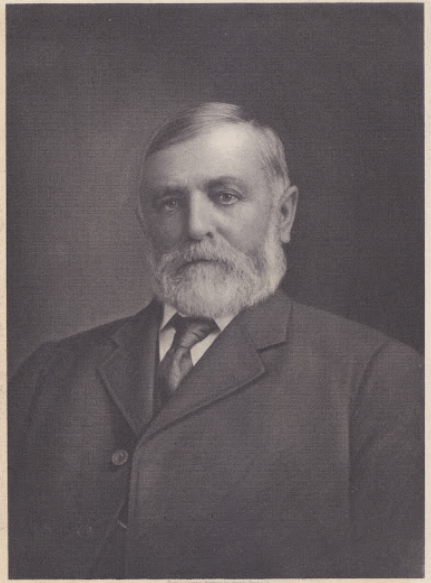
Domingo Bastanchury Domingo was born in Aldudes, Basses-Pyrenees, France in 1839, son of Gracian Bastanchury. He never received any formal education, but instead made his living as sheep herder. At age 21, he sailed for America, around Cape Horn, and landed in California. The difficult voyage took six months. He continued working as a sheep herder, gradually acquiring lands. At one time, he was the largest sheep herder in LA County (before the formation of Orange County in 1889), owning between 15,000 and 20,000 head. He eventually acquired over 6,000 acres, in and around present-day Fullerton, and switched his business to citrus cultivation. At one time, the family owned the largest citrus grove in the world. He and his sons (Gaston and John) formed the Bastanchury Ranch Company.
In 1874, he married Maria Oxarart, who was born in 1848, also in Basses-Pyrenees. She obtained a limited education in her home country before immigrating to America. Biographer Samuel Armor writes: “Mrs. Bastanchury shared with her husband all the trials and hardships incident to pioneer life on the plains of Southern California and while he was in the mountains with his sheep she was alone with her little family, her nearest neighbors being several miles away. She well remembers the country when there was no sign of the present town of Fullerton; all the trading was done in Los Angeles or Anaheim…There were only two houses between her home place and Los Angeles, and where now hundreds of autos travel the main road between Los Angeles and Fullerton, in the early days there would not be more than one team a week.”

Maria Bastanchury Evantually, Domingo and Maria had four sons: Dominic (who owned a 400-acre ranch in La Habra), Gaston (manager of the Bastanchury Ranch Company), as well as Joseph and John (who also oversaw the ranch). Domingo died in 1909, leaving the vast family holdings to his wife and sons.
-
Objects of Kizh Culture
The following is from a work-in-progress about the history of Fullerton. You can support my ongoing research and writing on Patreon.
In his book The Gabrielino, Bruce Miller includes a number of photographs of objects from the native American tribe who were the original inhabitants of Los Angeles and north Orange County, who are also called the Kizh.
Additionally, the Bowers Museum in Santa Ana has in its collection a number of objects of Kizh culture.
Here are some of the images from Miller’s book and the Bowers Museum, as they give visual evidence of some important aspects of daily life of local culture before Europeans arrived in Southern California.
Basketry

Basket hopper mortar. Courtesy Southwest Museum. 
Wicker seed beater. Photography by Bruce Miller. Courtesy Southwest Museum. 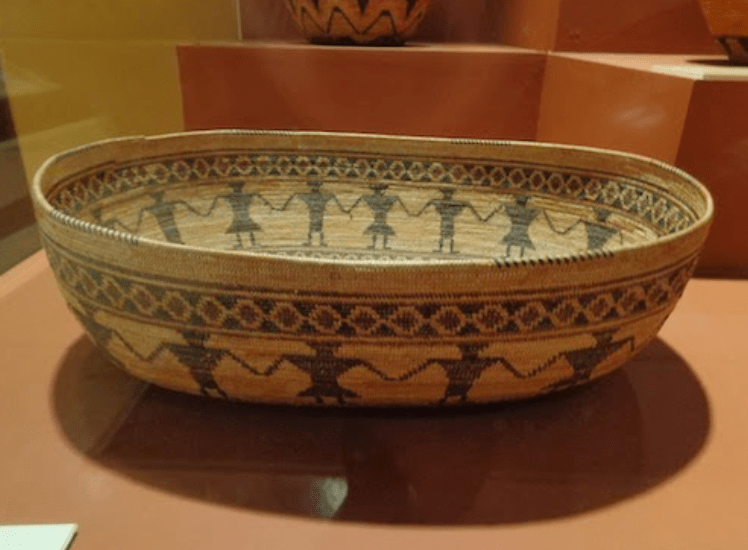
The Kizh were expert basket weavers, and the Bowers Museum contains some lovely examples of this. Wood and Stone Tools
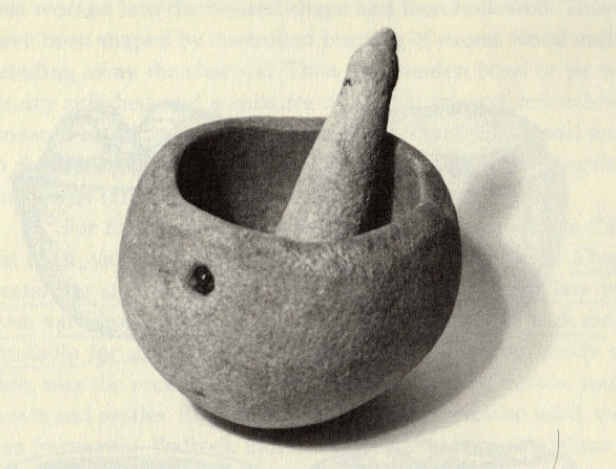
Small sandstone mortar and pestle. Photography by Bruce W. Miller. Courtesy Antelope Valley Indian Museum. 
Steatite Cup. Courtesy Antelope Valley Indian Museum. 
Sandstone cup. Courtesy Antelope Valley Indian Museum. 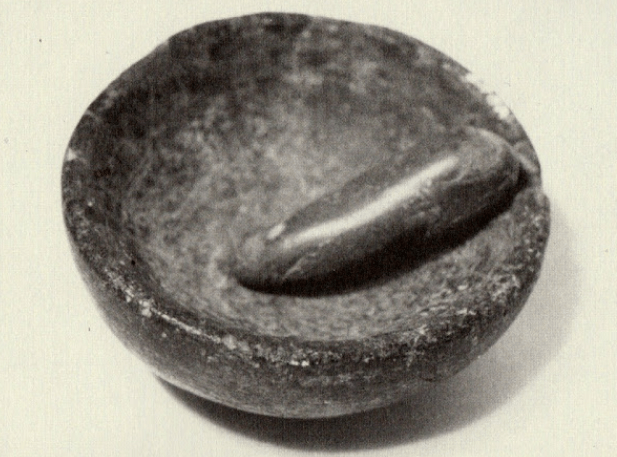
Steatite paint mortar and pestle. Courtesy Antelope Valley Indian Museum. 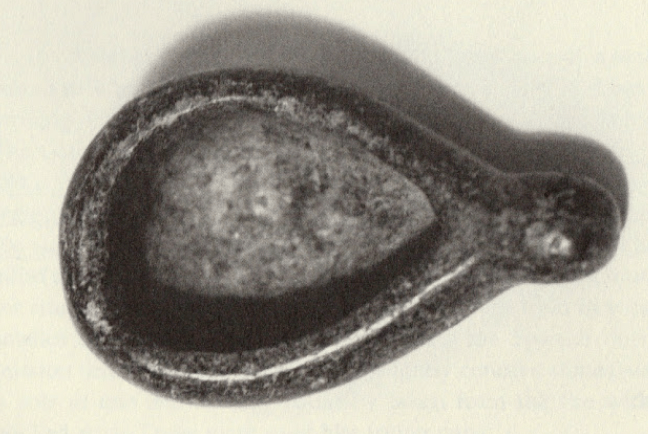
Small Serpentine finger bowl possibly for ritual use. Courtesy Antelope Valley Indian Museum. Effigies (animal figurines with spiritual significance)
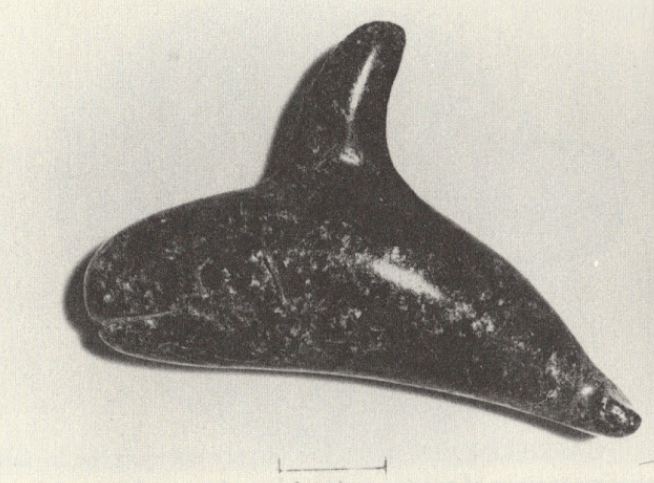
Steatite killer whale effigy found on the Rindle Estate, LA County. Courtesy Southwest Museum. 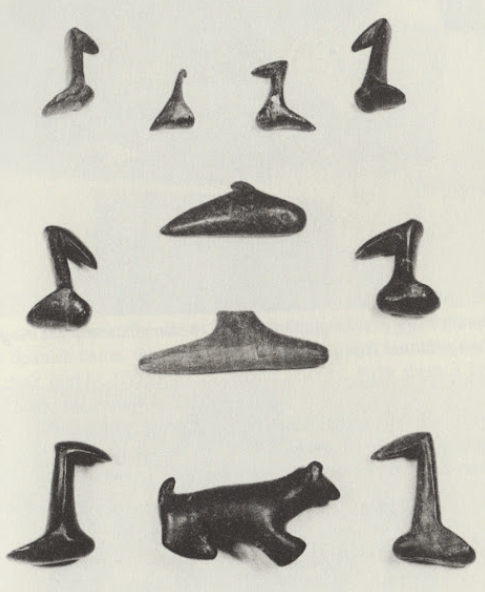
Seatite charms from Catalina Island and other sites. Courtesy Southwest Museum. 
Swordfish effigy. Photograph Bruce W. Miller. Courtesy Los Angeles County Natural History Museum. 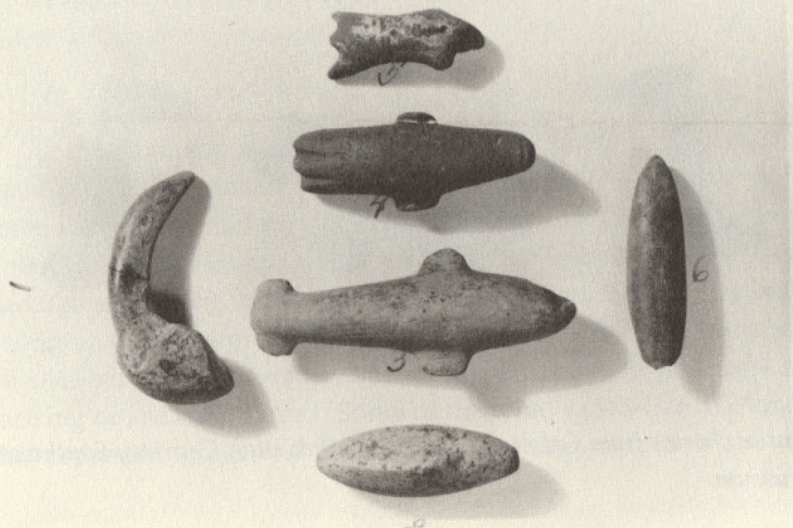
Steatite charms and fetishes from Southern California. Courtesy Southwest Museum. Hunting
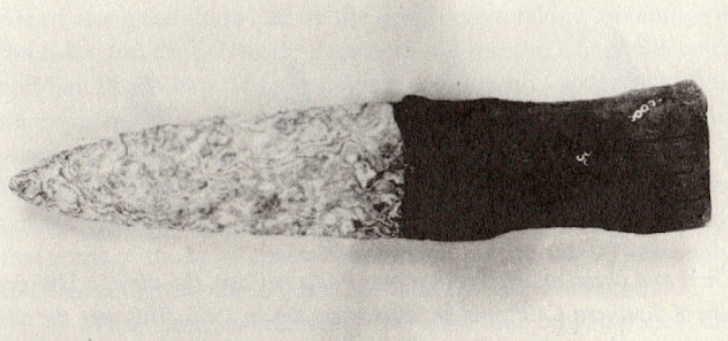
Stone knife with a wooden handle–Seal Beach, CA. Note shell bead inlay. Courtesy Southwest Museum. 
Chert and obsidian arrow points form Malaga Cove, site of prominent Kizh village Chowigna. Fishing
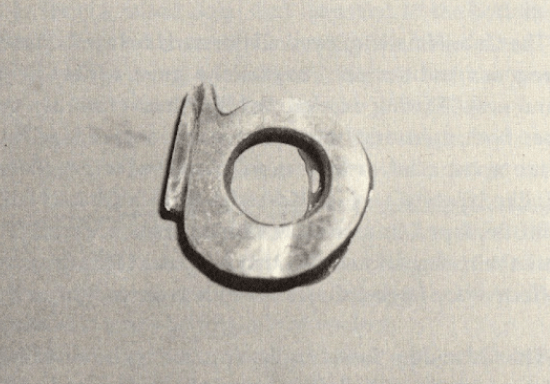
Unfinished abalone shell fishhook. Courtesy Antelope Valley Indian Museum. 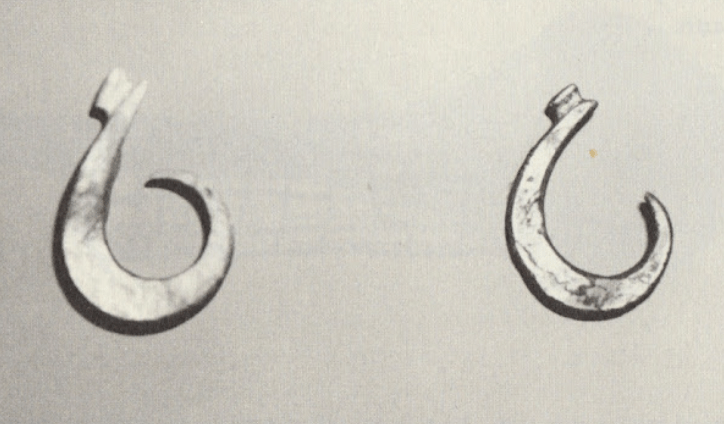
Two finished abalone shell fishhooks. Antelope Valley Indian Museum. 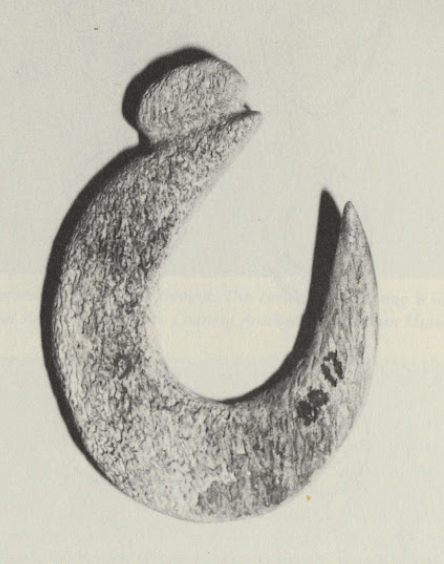
Large fishhook, perhaps for ceremonial purposes. Antelope Valley Indian Museum. Food/Cooking
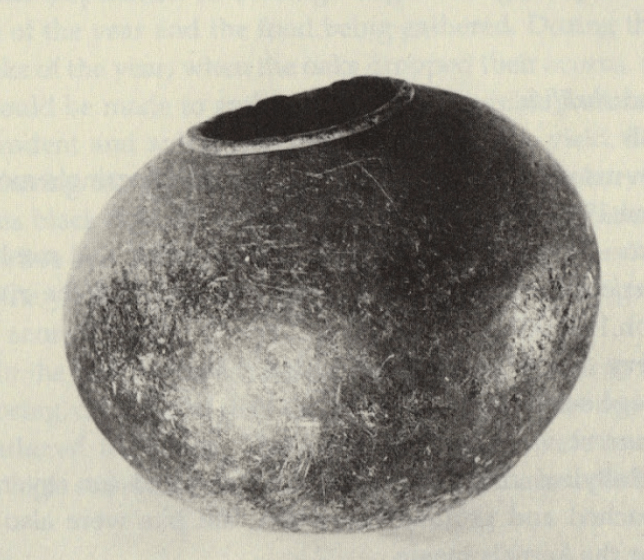
Steatite cooking bowl. Courtesy San Luis Obispo Historical Museum. 
Incised steatite bowl. Courtesy Southwest Museum. Clothing
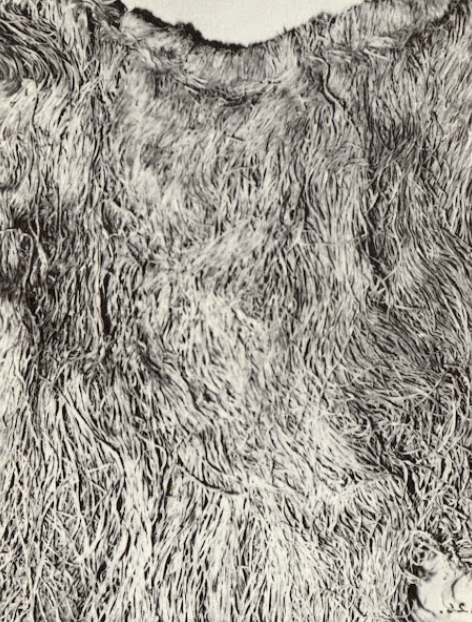
Woven grass skirt. Courtesy Antelope Valley Indian Museum. 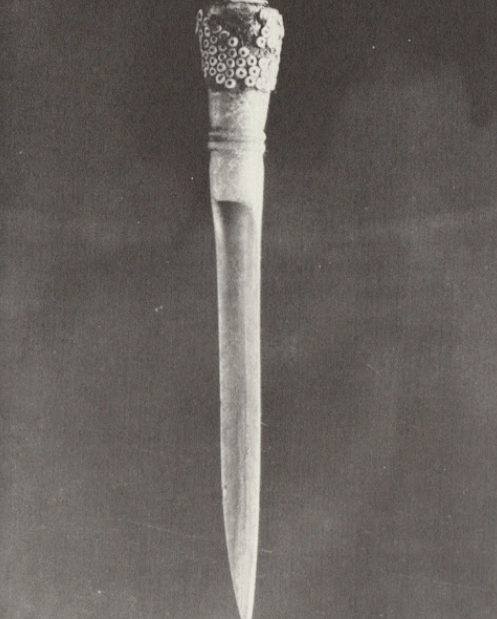
Bone awl or hair ornament. Decorated with olivella shell beads. Southwest Museum. 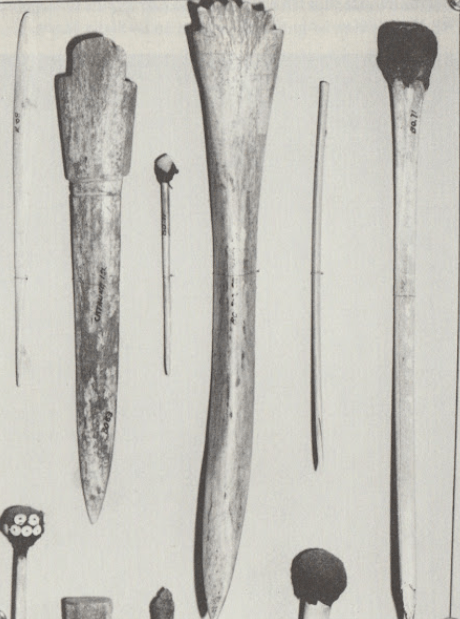
Carved bone hairpins, some with decorative shell beads. Antelope Valley Indian Museum. 
Steatite finger rings. Antelope Valley Indian Museum. 
Perforated steatite pendants from Catalina Museum. 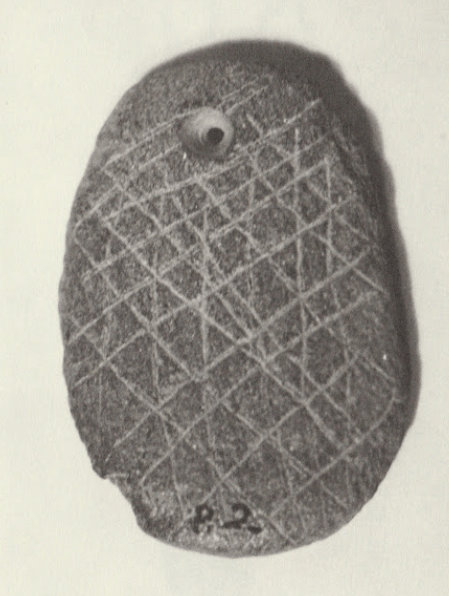
Incised sandstone pendant. Antelope Valley Indian Museum. 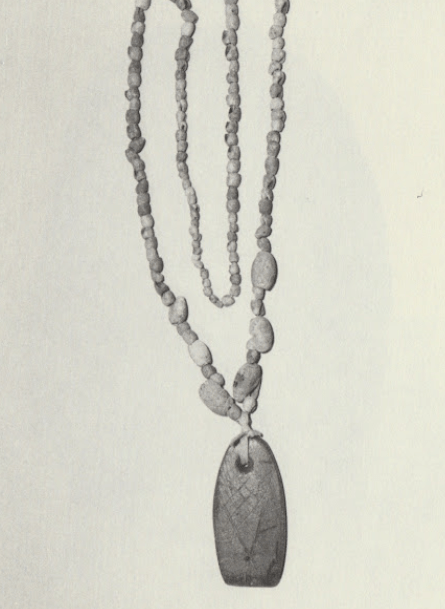
Olivella shell bead necklace with steatite pendant strung on rawhide. 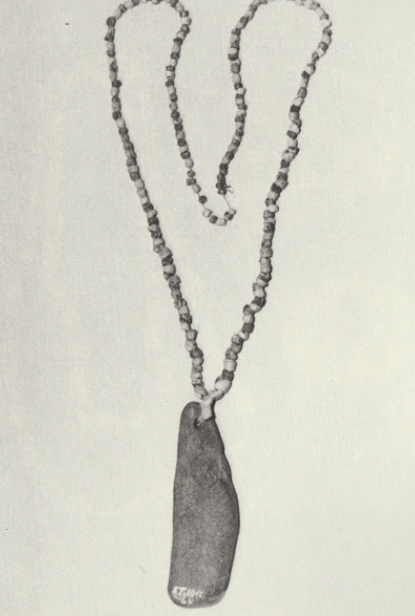
Olivella shell bead necklace with sandstone pendant. Antelope Valley Indian Museum. 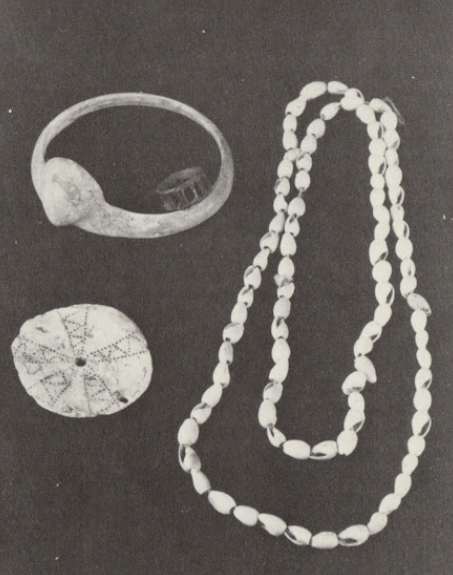
Shell artifacts from Catalina Island: bracelet, sand dollar pendant, ring. Shelter
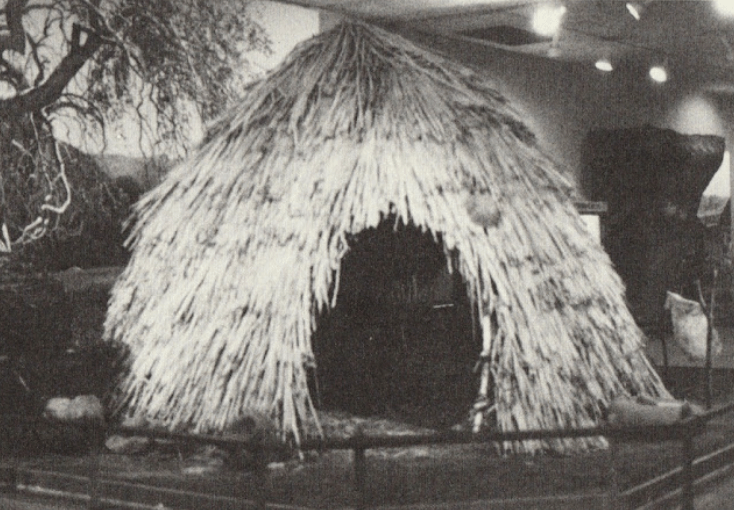
Thatched Kizh domicile. Photo by Bruce W. Miller. LA County Natural History Museum. Trade

Shell bead money. Note relative uniformity. Antelope Valley Indian Museum. Art

Rock painting attributed to both Chumash and Kizh/Gabrieleno. Southwest Museum. Shamans


Charmstones. Used by shamans to predict the future and change the weather. Music
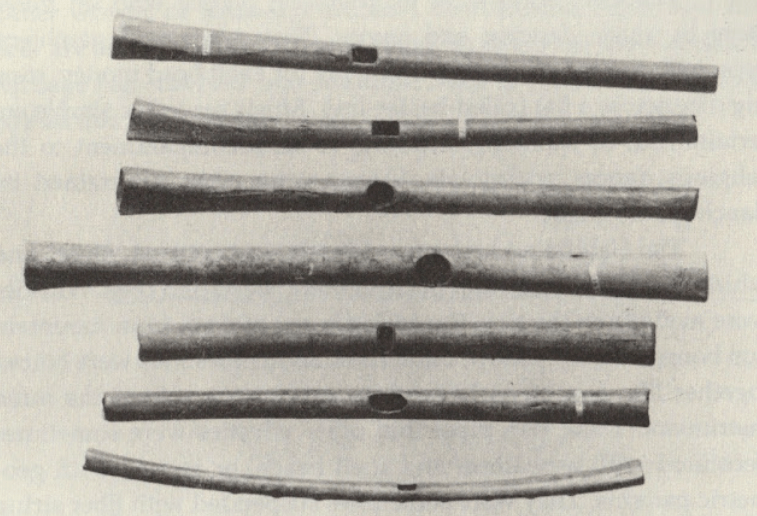
Bone whistles. Courtesy collection of J.A. Barro and Southwest Museum. 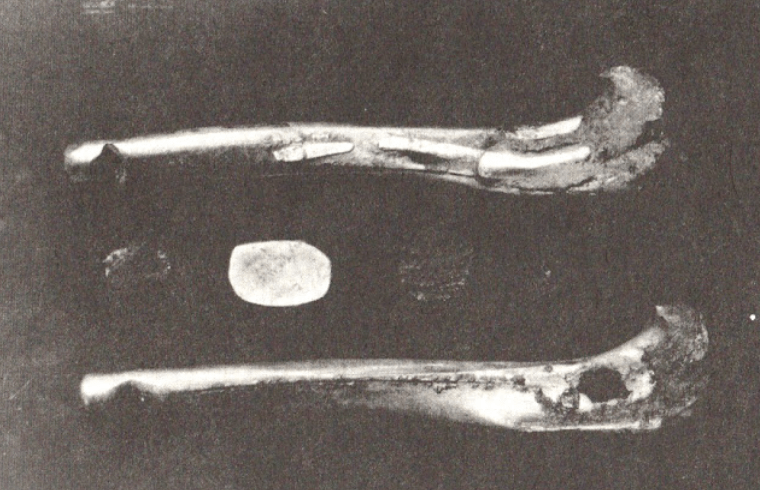
Deer tibia whistles from San Nicolas Island. Southwest Museum. And lest we forget that the Kizh are a still-existing tribe, here is former tribal chairman Ernie Salas with some cultural artifacts at an event at Ralph Clark Park in Fullerton in 2013.
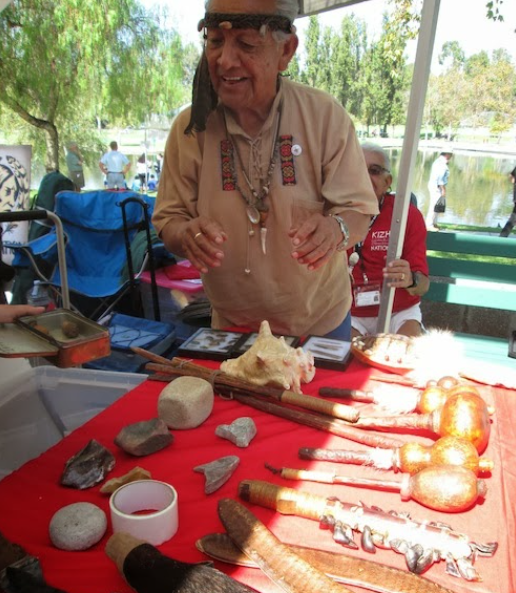
-
Toypurina: Hero to the Kizh
The following is from a work-in-progress about the history of Fullerton. You can support my ongoing research and writing on Patreon.
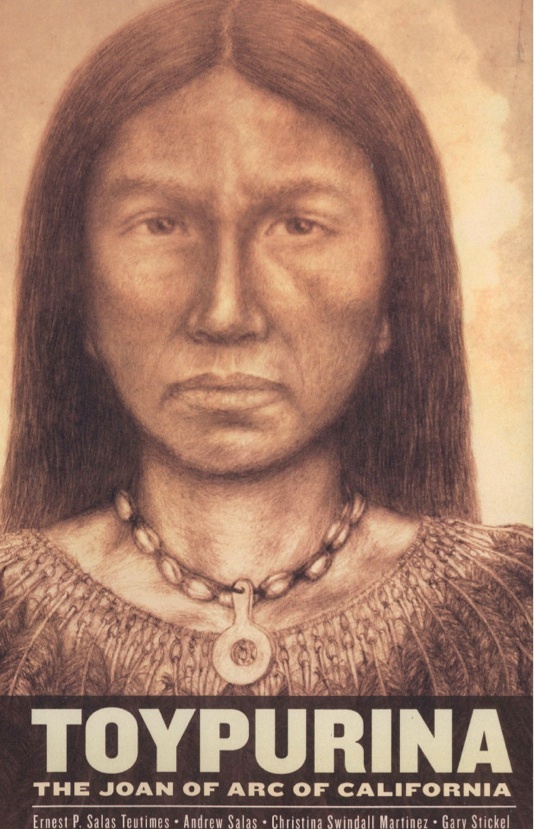
A number of years ago, I had the privilege of meeting with the chief and other members of the Gabrieleno Band of Mission Indians, Kizh Nation, which is the tribe who first inhabited the areas of Los Angeles and North Orange County. When I tell people I met the local tribe, the most common reaction is, “There’s a local tribe?” This is not a historical accident. The story of the Kizh people has been one of tragedy after tragedy, and their history has been largely suppressed or distorted. When I met the members of Kizh nation, they told me their tribal history, and I picked up a relatively new book they published called Toypurina: the Joan of Arc of California. The book tells the little-known history of a Kizh woman named Toypurina who, in 1785, led her people in a revolt against their Spanish oppressors. She is a folk hero to the Kizh people and, according to the book, “She is the only Native American woman to have initiated, organized, and led a revolt against foreign oppression in all American history. She is outstanding and unique in Native American history and therefore, in American history as well.”
Here’s a brief summary of Toypurina’s story, taken from the book:
“In 1785, she was approached by a neophyte (baptized captive) Nicolas Jose at Mission San Gabriel. He was reacting to the conduct of the Spanish not only to his own situation, but also to the atrocities (murders, whippings, rapes, forced religious conversions, and slave labor) that had been committed against the Kizh from the beginning the Spanish invasion until that point. Toypurina, age 25, accepted the challenge and initiated, organized, and carried out a revolt utilizing an armed force of Indian warriors. On the night of October 25th, 1785, Toypurina led her force and attacked the mission. But because a corporal of the guard had been informed of the revolt ahead of time, the Spanish mounted an ambush. When Toypurina arrived, she and some of her warriors were arrested. She was then subjected to a sham trial at the mission where no less than the governor of Alta California, Pedro Fages, sat in judgment. As punishment, she was exiled, baptized into Christianity, forced to divorce her Native husband and remarry a Spanish soldier and then eventually was buried at Mission San Juan Bautista.”
Though the revolt was unsuccessful, it stands as an inspiring testament to the spirit of the Kizh, and their resistance to oppression. The authors of the book compare her to Joan of Arc because “Both were religious leaders of their people, both organized revolts against invading foreign powers, both led rebel forcers in the field, both were betrayed, both were subjected to sham trials, and both suffered tragic ends.”
The authors also compare Toypurina to other, more well-known female American heroes like Betsy Ross, Abigail Adams, Susan B. Anthony, Eleanor Roosevelt, and Coretta Scott King because “the common threads of all Ameicans are our love of freedom and our ‘American Dream’ to provide the best, both spiritual and material, for our families and for our children’s future…Toypurina rose to the occasion. She wanted to right the wrongs done to her people and to her land.”
The book serves as not only a biography of Toypurina’s life, but also as a kind of tribal history written, not from the perspective of outsiders, but by the tribe itself. The authors (which includes the chief) write at the outset: “With this work, we, the Gabrieleno Band of Mission Indians, are writing a new kind of history for us–our own history. It is a humanistic history rather than a cold, dispassionate typical study.”
Because Toypurina has been so grossly misrepresented even by scholars, much of the work of the book Toypurina is deconstructing false histories (which abound for Native Americans) and trying to reconstruct the real history, based both on scholarly study and tribal oral history. It is a unique book in this way. It is deeply self-conscious of the problems inherent in trying to reconstruct the past, and this is something more historians ought to wrestle with, especially when dealing with histories that have existed only on the margins of “official” history. It is a lovely, thought-provoking, and inspiring book that serves as a model of a how a group of people can, through research and storytelling, assert their identity and self-worth.
As the authors rightly note in the introduction: “Sometimes, in order to right the wrongs of the past, it is necessary to write the wrongs of the past.”
-
Abel Stearns: A Transitional Figure
The following is from a work-in-progress about the history of Fullerton. You can support my ongoing research and writing on Patreon.
Just as Pio Pico, the last Mexican governor of California, represents an important (and representative) transitional figure in California’s history, stretching from the Native American Era to the Spanish Era to the Mexican Era, to the American Era, so does Abel Stearns, who once owned nearly all the lands that encompass present day Orange County, including Fullerton. Who was he? To answer this question, I just read a very interesting chapter on him from local historian Phil Brigandi’s book Orange County Chronicles. Here’s a little bit about Abel Stearns, aka Horse-Face.

Abel Stearns He was born in Massachusetts in 1798, but was orphaned at age 12. After spending his adolescence traveling on trading ships, he settled in Mexico in the early 1820s, where he became a Mexican citizen. This was just after the Mexican War for Independence, and about 20 years before the Mexican-American War. Stearns eventually moved to Los Angeles in the 1830s. This was when Los Angeles (and all of California) was still a part of Mexico. This was the era of the Californios–Spanish-speaking residents of Alta (“Upper”) California.
In LA, Stearns opened a store dealing with cow hides and tallow (oil), which were the main exports of California in those days. The wealthiest California landowners at this time were almost all cattle ranchers. Abel became a sort of “middle-man” between the producers of cow hides, and the merchant ships. He was very successful at this, eventually establishing a warehouse near present-day San Pedro in 1834. The following year, he got into a knife-fight with a drunken sailor, who cut up Stearns’ face pretty bad. His ugly face earned him the nick-name “Caro de Caballo” aka “Horse Face”.
What he lacked in beauty, he made up in wealth. In 1841, at age 43, he married the 14-year-old daughter of a wealthy rancher. Her name was Arcadia Bandini. The following year, Horse-Face purchased his first rancho from governor Jose Figueroa, the 28,000-acre Rancho Los Alamitos, the first of many large ranchos he would purchase from debt-ridden Californios. The loss of the Mexican-American War proved disastrous to Californios, but provided a nice business opportunity for the Yankee Abel Stearns. By the late 1850s, Horse-Face had acquired the following ranchos: Los Coyotes, La Labra, Las Bolsas, Yorba, and San Juan Cajon de Santa Ana. At the height of his weath, Stearns owned around 200,000 acres of Southern California land.

Map courtesy of the Los Angeles Public Library. Several factors contributed to Stearns’ decline. The dwindling of the Gold Rush hit him pretty hard–he’d made a fortune selling beef to gold-hungry miners in the 1850s. Then, there was a massive drought in 1863-64, which took a major toll on his cattle. By the late 1860s, Stearns began selling off his vast holdings to pay off debts. Along with his friend Alfred Robinson and other businessmen, he formed a real estate company, which sold off subdivided acreage to prospective settlers and town-builders. Two of these town builders were George and Edward Amerige, who bought the land which would be called Fullerton.
-
Subscribe
Subscribed
Have a WordPress.com account? Log in now.

