-
Pio Pico: The Last Governor of Mexican California
As part of my research of Fullerton history, I will often read books about California history more broadly, to help give context for local events. Such a book is Pio Pico: The Last Governor of Mexican California by Carlos Manuel Salomon. Pio Pico is often not given his just place in California history, and this book seeks to show how this one man’s life embodied dramatic changes in California. Here is a book report on what I learned. You can support my ongoing research and writing on Patreon.

Pio Pico’s Ancestry
Born in 1801 at Mission San Gabriel, Pio Pico had a relatively poor childhood. His lineage included Indian, Spanish, and African ancestry, which initially placed him near the bottom of the racial caste system of Spanish society in the New World. His grandfather, Santiago de la Cruz Pico, accompanied the Spanish soldier/colonizer Juan Bautista de Anza in 1775 on an expedition north into Alta California, part of Spain’s plan to settle California with missions and soldiers.
Pio’s father, Jose Maria Pico, served as a guard in California missions. He was instrumental in foiling Kizh-Gabrieleno leader Toypurina’s rebellion at Mission San Gabriel. Jose Maria joined the Mexican Independence movement, for which he was imprisoned in San Diego in 1811. He never achieved his goal of obtaining a California land grant.
Pio Pico’s Political Rise
Pico rose to prominence through the marriages of his sisters to prominent Californio families. In 1826, he was elected to San Diego town council, and eventually became a part of a political leadership cadre known as the disputation, which also included the Yorba family (who owned the rancho where modern-day Yorba Linda exists). In 1829, California governor Jose Maria de Echeandia gave Pico his first land grant, Rancho Jamul, east of San Diego, and he became an emerging cattle baron.
In Mexico at this time (including California) the two political factions were: conservatives (who favored a centralized military-type authority), and liberals (who favored more local/civilian authority). Pico was a liberal. When the conservative General Manuel Victoria was appointed governor of California, Pico opposed him.
In conjunction with other political and business leaders, Pico began fomenting dissent against Victoria, writing manifestos and distributing circular pamphlets. In 1831, he and other leaders led a rebellion against Victoria’s government. They marched into San Diego, captured military leaders, and took weapons. At the Battle of Cahuenga (outside LA), the two forces met and Victoria was defeated. Pico became temporary governor of California.
There followed a power struggle between Pico and Echeandia in the south, and Victoria’s secretary Augustin Zamorano in the north. In 1833, Jose Figueroa was appointed governor of California. In 1834, Pico married Maria Ignacia Alvarado in the plaza church in Los Angeles. Governor Figueroa was present as the best man.

Pio Pico and his wife Maria Ignacia Alvarado. Secularization of the Missions
In 1833, partial secularization of the missions was enacted, divesting the catholic church of mission lands, but not distributing them to the Indians, as was seen by many as the goal of secularization.
Instead of re-distributing the mission lands to the Indians, regional politicians were given control over them as comisionados. In 1835, Pico was named comisionado of Mission San Luis Rey, and almost immediately ran into conflict with the Luisenos (native tribe) over the labor requirement of secularization (the Indians were still required to work the lands for free). In 1836, Pico was named encargado de justica, a position of judicial power which basically undermined the authority of the local leader of the Luisenos, Pablo Asis.
Author Carlos M. Salomon writes, “His primary aim was to operate an enterprise rather than to ensure the transition of former neophytes into Mexican society…Forcing the Indians to work, denying their promised liberties, treating them harshly, and encroaching on Temecula, where he grazed his own cattle, led to Indian protests and eventually rebellion.” Eventually Pico acquired the Luisenos’ land of Temecula.
Thus, the Luisenos despised Pico. Salomon writes, “Although many historians say he was the worst exploiter of the missions, he seems to have done no worse or better than the other administrators…The proponents of secularization believed that liberty, private ownership of land, and the ‘gift’ of entering Mexican society would transform the Indian population. Yet, in many instances, the Indians simply wanted to be left to themselves.”
In 1837, Pico joined a rebellion against the new governor of California, Juan Bautista Alvarado.
War With the United States
Under the administration of governor Alvarado, Pico lost Mission San Juis Rey and Temecula, but gained Rancho Santa Margarita. Thus, his status and wealth remained relatively intact. At this time, Pico lived in Los Angeles, as a member of a kind of rancher-political elite. Los Angeles at this time was the most populous town in California. In 1845, after another uprising against the governor, Pico was appointed interim governor and he named Los Angeles the capital of California.
Meanwhile, illegal immigrants (Yankees) from the United States began arriving in California. After the annexation of Texas, and the continuous tide of Anglo settlers, war with the US seemed imminent. The United States’ designs on California were an embodiment of Manifest Destiny and the expansionist policies of president James K. Polk. In 1846, U.S. military leader/explorer John C. Fremont arrived in Caifornia with soldiers and unstated intentions.
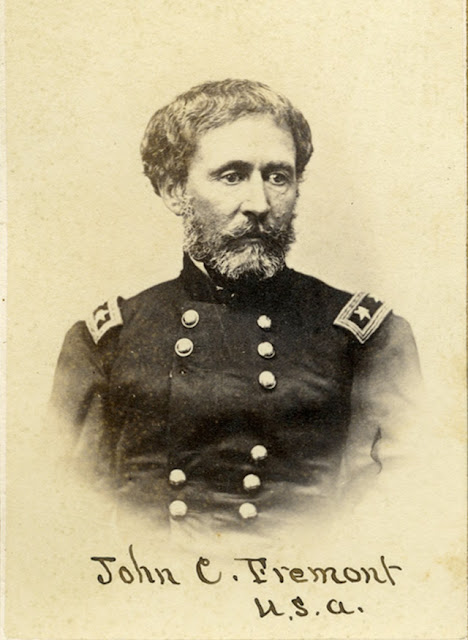
Not only was California facing a potential external threat (from the US), but it was having strong internal problems too. In 1846, Pico was officially made governor, however, he immediately came into conflict with the northern military leader Manuel Castro, who threatened civil war. Meanwhile, in defiance against the Mexican government of California, Fremont raised an American flag at his “fort” and lead a rag-tag independence movement called the “Bear Flag Revolt” (or, California Republic). At first, Pico thought it was a hoax. But when Fremont refused to leave, Pico protested the actions of the American squatters.
In the face of imminent attack, Pico and Castro reconciled their differences for the defense of California. In 1846, the U.S. occupation of California began, as part of the larger Mexican-American War. Military leader Robert F. Stockton landed in California with troops intent on conquest. Despite being outnumbered, Pico refused surrender. Instead, he left California to seek assistance from Mexican president Santa Anna.
During the war (seeing opportunity), some Californios sided with the US, including Abel Stearns. Meanwhile, American troops besieged Los Angeles. Andres Pico (Pio’s brother), a valiant leader of the Californio defense against the United States, defeated general Stephen W. Kearney at San Pasqual, just outside of San Diego. Ultimately, however, the Californio forces were outmatched by the American forces. President Santa Anna did not send reinforcements, and in 1847, Andres Pico signed the Treaty of Cahuenga, which ended fighting in California.

Andres Pico (Pio’s brother). In 1848, the Treaty of Guadelupe Hidalgo was signed, which ceded half of Mexico to the United States, including California.
After the War
After the Mexican-American War, under the U.S. military occupation, Californios experienced new kinds of racial discrimination. Salomon writes: “To the racially conscious Yankees, Pico’s African features made his wealth and influence problematic. When California became a state, less than two years after his return, blacks weren’t allowed to own land or attend public schools…The first state legislature passed a statute prohibiting blacks, Indians, and individuals having at least one-eighth African ancestry from testifying against white citizens.” Indeed, the 1850s were “a period of unrelenting violence and prejudice against Mexicans.”
Describing racial violence in Los Angeles in the 1850s (the years immediately following the American conquest), Salomon writes: “Los Angeles became the most violent city in California in the 1850s, and for a time it claimed the highest murder rate in the United States. Lynch mobs were not uncommon, and many Mexicans fell victim to racial intolerance.”
In 1850, California became a state, and in 1854, the Know Nothing Party gained political power—known for their anti-Mexican and anti-immigrant views. Pico sided with the newly-formed Republican party (Lincoln’s party). Democrats at this time were pro-slavery. He even supported the presidential candidacy of John C. Fremont! Pico used his influence as an arbiter between Californio and Anglo tensions. He supported Lincoln’s candidacy for US president.

Pio Pico’s Decline
The main problem facing Californios after the war was land. Though they enjoyed some legal protection under the treaty of Guadalupe Hidalgo, they faced legal challenges to their land grants, Yankee squatters, and real estate speculators keen on acquiring former rancho lands. The Land Act of 1851 proved disastrous for Californios, divesting them of thousands of acres. At first, Pico proved economically resilient after U.S. annexation. He and his brother held over 290,000 acres.
The Gold Rush was actually an economic boon for Pico. The 49ers needed food, and became a steady a consumer market for his cattle. Also, Andres co-founded California’s first oil company, Star Oil, which eventually became Standard Oil (by this time the Picos had sold their stocks). Meanwhile, Pio invested in the Los Angeles Plaza (today, Olvera Street). He built the luxury hotel Pico House, which still stands.
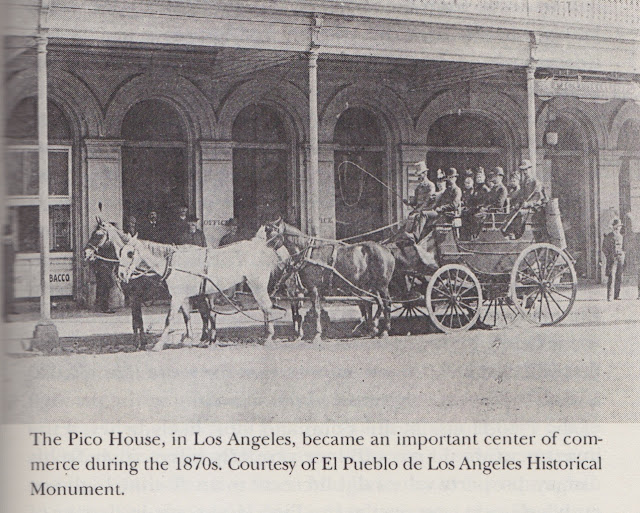
However, in the 1850s, the cattle industry in California began to decline, and the last decades of Pico’s life would be years of loss and decline. He lost Rancho Santa Margarita to his brother-in-law John Forster over a debt. His brother Andres’ developed a major gambling addiction, which cost Pico a lot of money and land. In 1876, Andres was beaten to death in Los Angeles, probably over a gambling debt.
The final loss would come with the case of Pico vs. Cohn, in which the aging don lost the last of his once vast empire. Pico won the case, but lost in retrial. And he lost everything: the Pico House, a bank building in LA, and his beloved Ranchito in Whittier. He lived the rest of his days poor, with friends and family. Meanwhile, the California demographic was changing—Anglos began to outnumber Mexicans and Californios, and their contributions to California history, society, and culture would often be excluded from official histories.
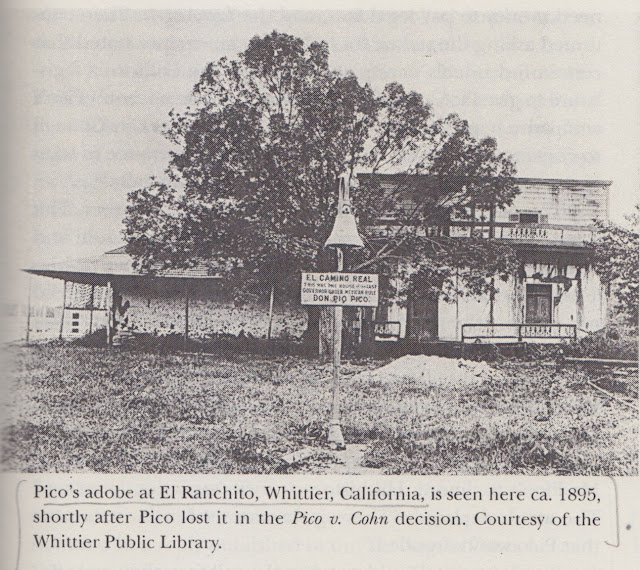
Pio Pico died in 1894.
Pio Pico’s Legacy
In 1893, one year before his death, Pio Pico was invited to attend the massive World’s Columbian Exhibition in Chicago (basically, the World’s Fair), as a representative of the “Old West.” He published his response in the Los Angeles Times: “No, I will not go, for two good reasons. The first is because I am poor, and the second is because I do not intend to go to the big show to be one of the animals on exhibit. If those gringos imagine for a moment that they can take me back there and show me in a side tent at two bits a head they are very much mistaken.”
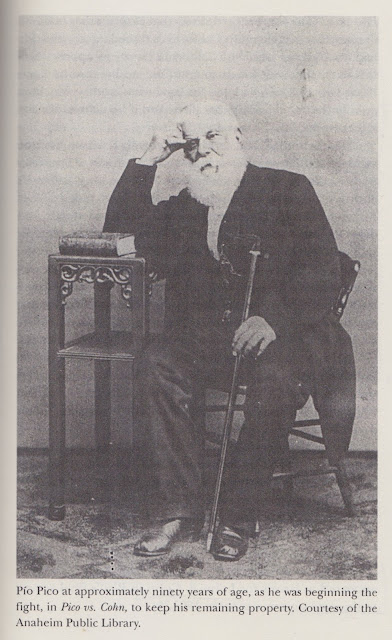
Reflecting on Pio Pico’s legacy, Salomon writes: “Today, as the demographics of Mexican Americans in California soar to new heights, Pio Pico is a historic figure many look up to as a shining and inspirational example of the Mexican past. Pio Pico’s life story reminds us of a unique multicultural legacy in California. Pico’s two hundredth birthday celebration in Los Angeles revealed that he has taken on a new role in California’s history. Today, Cinco de Mayo is a celebration not only of the Mexican past, but also of a Californio past, rich in its Mexican, American Indian, African American, and European roots.”

The Pico House still stands in the historic Plaza on Olvera Street in downtown Los Angeles. -
These Lands Used to Be Mexico
The following is from a work-in-progress about the history of Fullerton. You can support my ongoing research and writing on Patreon.
Any history of a human settlement must begin with “first families.” In the history of Fullerton, this “first family” is often considered to be the Ameriges, the brothers George and Edward, two commodities merchants from Boston who “founded” Fullerton in the year 1887. But this was not really the first family here. The landscape they found was not empty or devoid of people or history. In fact, the Amerige brothers were relative latecomers to this region. Before they arrived, there was another lengthy history.
The true “first families” in this region were Native Americans, specifically the Kizh tribe, who had many settlements in the landscapes that would become Los Angeles and Orange Counties. In 1769, the first Europeans passed through what would become Orange County–it was the expedition of Gaspar de Portola, the Spanish soldier sent to make the first explorations and settlements of California, which was then a part of New Spain. Twelve years later, in 1781, another group of settlers arrived to found the town of Los Angeles. That’s right, Los Angeles was founded in 1781!
Among the settlers on this expedition was a farmer from the Sinaloa region of Mexico named Josef Antonio Ontiveros. Josef’s grandson, Juan Pacifico Ontiveros, would in time become a very important landowner and rancher in the area that would become Orange County. His Rancho San Juan Cajon de Santa Ana included the land that would become Fullerton. And so, in the interest in telling the complete history of this region, I’ve decided to tell some of the story of this first family–the Ontiveros family. The source of this information is a well-researched book called The Ranchos of Don Pacifico Ontiveros by a woman named Virginia Carpenter. Here’s the story of the Ontiveros family…
The Founding of Los Angeles
Los Angeles was founded in the year 1781 by a group of settlers from Mexico. At this time, Spanish settlement in California was pretty sparse, and so the government financed pioneer parties to populate the region, sort of like how the United States would later create Homestead Acts to encourage settlement of its western regions. An important early settlement party of this type was led by Fernando de Rivera y Moncada, Lieutenant Governor of Baja (lower) California. He was commissioned by the government to recruit soldiers and settlers to found a pueblo (town) near Mission San Gabriel.
One of the settlers recruited was a farmer from the Sinaloa region named Josef Antonio Ontiveros, who was 36 years old at the time. Ontiveros was born in Pueblo San Pedro de Chametla (in Sinaloa) in the year 1744. At age 22, he married Ana Maria Carrasco y Birviescas. Of their children, we know they had a boy named Juan Patricio and a girl named Juana de Dios. His wife and children would accompany him on the difficult expedition into California.
Thankfully, the Spanish were pretty good record-keepers, and in the files from this expedition we find a cool description of Josef Ontiveros: “His stature 5 feet 4 inches and 9 lines, his age 36 years, his religion Roman Catholic Apostolic. His characteristics were chestnut colored hair, blue eyes, brown skin, reddish thick eyebrows, curved or hooked nose, a gash in the eyebrow of the right eye, another one above the chin, or beard and another one on the left side of the forehead, a thin beard.”
The expedition to Los Angeles consisted of two parties: one traveling overland, and the other by boat. The Ontiveros family traveled by boat. It took them six months. Along the way, two soldiers deserted and three people died of smallpox. Meanwhile, most of the overland party was massascred by Yuma Indians, including the expedition leader Rivera.
Amazingly, all of the Ontiveros family made it safely to their destination. On September 4, 1781, with the blessing of Governor Felipe de Neve, the settlers officially founded the town of Los Angeles. The full, original name of the town was El Pueblo de Nuestra Senora la Reyna de Los Angeles (The Town of Our Lady, the Queen of the Angels). For a time, Los Angeles was the only town between San Diego and Santa Barbara. Interestingly, however, Josef Ontiveros would not stay there long. The following year, 1782, he was transferred to the Presidio (military fort) of Santa Barbara.Trouble in the Army
My source for all this material, Virginia Carpenter, does not say why Josef Ontiveros was transferred to Santa Barbara shortly after he arrived in Los Angeles, for which he was recruited as a settler/soldier. Perhaps he was just transferred there because he was needed. It also appears that his wife and children may have stayed behind, in Los Angeles and San Gabriel, while the father was away on military duty.
While at Santa Barbara, Ontiveros was arrested as part of a desertion plot, and sent further north, to Monterey, as punishment. Why would Ontiveros desert? Carpenter provides a possible explanation: “In the 1780s desertion became a problem for the army. Because conditions were so miserable (food, clothing, and other rations were sparse), many soldiers made the attempt to return to their homes in Mexico (there was no place else to go), in spite of the fact that it was almost impossible for a man to go alone. Even if he was lucky enough to steal a mule, there were the hundreds of miles of desert to cross and Indians to dodge or fight. If a man did reach Mexico, he had to live in hiding, for to be found was to be returned to the army–and California.” I can’t help but wonder if Josef wanted to return to Sinaloa or to Los Angeles, where his family was.
In either 1787 or 1788, Josef was discharged from military duty and rejoined his family in Los Angeles, where he was given a plot of land and became a shoemaker. Ten years later, in 1798, he died at age 54.
Rise of the Ranchos
In 1784, the governor of California, Pedro Fages, received petitions from three soldiers for land grants for the purpose of raising cattle. These were the first of the famous Spanish Land Grants, the largest of which went to Manuel Nieto, who received the land that would eventually contain the Ontiveros Rancho.
When his father Josef was transferred to Santa Barbara in 1782, nine-year-old Juan Patricio Ontiveros was left with the padres at the San Gabriel Mission. He was confirmed that same year. As soon as he was old enough, he joined the army, and reached the rank of corporal. In 1794, he married Antonia Rodriguez y Noriega, who was 14. This was considered a proper age to marry at the time. Antonia’s parents were both Indians from Sinaloa. The couple had eight children for whom we have records. The eldest son was Juan Pacifico, who will become the most important person in this narrative.
In 1814, when he was 42, Patricio was Mayordomo of the San Juan Capistrano Mission. Then, in 1825, he moved to Rancho Santa Gertruedes, which was owned by the Nieto family. There, he held the position of Encargador de Justicia, which was sort of like the Justice of the Peace. Shortly before he died, in the mid-1830s, Patricio petitioned governor Figueroa numerous times for a land grant, but was ultimately unsuccessful. That task would fall to his son, Juan Pacifico Ontiveros.
Juan Pacifico Ontiveros Becomes a Ranchero
Juan Pacifico Ontiveros, son of Juan Patricio Ontiveros, was born in Los Angeles on September 24th, 1795. In 1814, following in the footsteps of his father and grandfather, he enlisted in the army, and served for 20 years. In 1825, he married Maria Martina Osuna of Santa Barbara. He was 30 and she was 19. The couple had an astonishing thirteen children in their fertile marriage.
In 1835, after his father’s death, Juan Pacifico took up the matter of applying for a land grant. After two years of legal negotiations between Ontiveros, the Nietos family, and the Mexican government, Juan Pacifico was granted the 36,000-acre Rancho San Juan Cajon de Santa Ana, whose boundaries contained the present-day cities of Anaheim, Fullerton, Brea, and Placentia.
Juan Pacifico Ontiveros was granted the 36,000-acre Rancho San Juan Cajon de Santa Ana, whose boundaries contained the present-day cities of Anaheim, Fullerton, Brea, and Placentia. I’d like to include Carpenter’s description of the landscape in those days of the Rancho San Juan Cajon de Santa Ana, as this landscape is almost completely lost in my day:
“The ocean, 20 miles away, could be seen and occasionally heard. Fairly level, there were hills on the northern part and in the east where it included part of Brea Canyon. The soil varied from sandy, the diseno (map) shows a large sand wash through the center, to red clay near the Brea end. It was covered with chapparal (low bushes), mustard and large patches of cactus. The wildlife included snakes, gophers, ground squirrels, rabbits, coyotes, wild cats and mountain lions, quail, ducks and geese during their migrations. Bears and deer stayed in the canyons. There were many, many insects from fleas to ants. Trees were so few that they were used as landmarks, there were sycamores and poplar where there was water, and live oaks in the canyons.”

Juan Pacifico and Maria Ontiveros. Now I would like to quote some fragments of Carpenter’s description of life on the rancho, as this is also a lost way of life in my day: “Families arose about three a.m. prayed and ate breakfast…The boys and young men slept out of doors…As the Indians did all the work, the rancheros had only the management to do…Men talked and gambled and rode over their land–Boys practiced riding and roping skills and played games, while women had much work to do…Older women dressed in black, as there were so many deaths to mourn in the large families…The important things were births and deaths, weddings, everyday and seasonal events and always the church…There were no schools, so few people could read or write…There was hunting, particularly bear hunts; but no fishing, all their sports being on horseback…The father, as head of the family, ruled it. He often arranged his children’s marriages and what they would do…all houses were made of adobe (sun dried bricks)…roofs (were made) of tule reeds and tar until so many were set afire in Indian attacks that the missions began making clay roof tiles, shaping them in wooden molds…everyone, even women, carried their own knives…Juan Pacifico lived quietly on his rancho taking little part in public events.”
Damn Yankees!
Alas, this way of life was not to last long, for already American businessmen had set their sights on southern California markets and real estate. As early as the 1820s, Yankees were immigrating to California. Carpenter writes: “They came for business, a new market. The New England clipper ships built to bring tea and spices from the Orient stopped in California and found that the vast herds of cattle were a source of tallow for candles and for the leather needed by the eastern shoe factories. About the same time a demand for beaver hats in the East brought the trappers, or mountain men, as they were called, overland into the west…Many of the Anglos who came in the late 1820s and 30s stayed and became Mexican citizens so that they could own land; they married Spanish girls and thereby inherited shares in ranchos as well. They opened stores and loaned money on cattle and land at ruinous rates, foreclosing when payments could not be met. The easy-living rancheros knew nothing about Anglo business methods, nor compound interest.”
One of these immigrants was an Italian named Giovani Batiste Leandri (or, as he was called in Mexican California, Juan Bautista Leandry). He moved to Los Angeles in 1827 and opened a store. He prospered as a businessman, became a citizen in 1839, married a Mexican woman named Francesca Uribe, and bought Rancho Los Coyotes from the Nietos. Next, Leandry brought suit against Juan Pacifico Ontiveros over the boundary between their ranchos, and managed to get a valuable water spring. Leandry died in 1843, but more losses were on the horizon for the Ontiveros family.
Between 1846-1848, there was the Mexican American War, which Ulysses S. Grant called “one of the most unjust ever waged by a stronger against a weaker nation. It was an instance of a republic following the bad example of European monarchies, in not considering justice in their desire to acquire additional territory.” This war ended with the Treaty of Guadalupe Hidalgo, in which Mexico was forced to cede half of her country to the United States. This included California, which was admitted to the Union as a free (as opposed to slave) state in 1850.
Conquest by Bureaucracy
In 1849, in the intermediary period between the Treaty of Guadalupe Hidalgo and the Statehood of California, Bernardo Yorba (owner of the neighboring Rancho Canon de Santa Ana) bought an area of the Ontiveros rancho called Canada de la Brea (which included modern day Brea Canyon). Yorba paid $400 for the land, which amounted to about 30 cents per acre. This sale was actually part of a more complex land deal, in which Yorba then traded Canada de la Brea to an Englishman named Isaac Williams, who’d married into a Mexican rancho family, and been given Rancho Santa Ana del Chino. If things start to get confusing at this point, I’m sorry. After the American conquest of California, things got notoriously confusing when it came to land ownership.
Carpenter explains the new and unfortunate situation for rancheros like Ontiveros in the early years after California became a part of the United States, an era which I will call Conquest by Bureaucracy: “The greatest difficulty which the rancheros experienced was to be in the matter of their land titles. The Treaty of Guadalupe Hidalgo guaranteed Mexican citizens possession of their property; but the United States did not consider a declaration of ownership sufficient; there must be official records. A ‘Board of United States Land Commissioners [was] appointed to settle private land claims in California’ and every ranchero was ordered to present proof of his ownership and the location and size of his rancho. This was disastrous for many of them and contributed to the break-up of the rancho system, because of the casual way the grants had been handled and their indefinite boundaries. Few of the rancheros could read or write, so a man’s word had served in business, and as many had lost their papers, most of the claims had to go through the courts, a time-consuming and expensive process…The Land Commission of three men handled over 800 cases between 1852 and 1856.”
Carpenter does a valiant and detailed job of explaining and summarizing the lengthy and frustrating legal battles that Juan Pacifico Ontiveros faced in an effort to hold onto his rancho. I will spare you the details and explain it as simply as possible. In 1854, the United States Land Commission rejected Ontiveros’ claim to the rancho he’d owned for 20 years. He appealed the decision and, in 1856, the Court of Appeals reversed the Land Commission’s decision. But the attorney for the Land Commission didn’t give up. He took the case all the way to the U.S. Supreme court, who in 1857 upheld Ontiveros’ claim.
The End of the Rancho, and the Founding of Anaheim, Placentia, and Fullerton
In 1856, Juan Pacifico Ontiveros purchased another rancho called Tepusquet near Santa Barbara. Within a few years, he would sell off all of his Rancho San Juan Cajon de Santa Ana and move to his new rancho. This period is really interesting because, in this era, we see the birth of the present-day towns of Anaheim, Placentia, and Fullerton.
First, Anaheim. In 1857, Ontiveros sold 1,165 acres of his rancho to a George Hanson, who was employed by a group of Germans in San Francisco who were interesting in forming a colony to raise grapes. These Germans formed the town of Anaheim.
Second, Placentia. In 1863, Pacifico and his wife deeded 3,900 acres of their rancho to their two sons Patricio and Juanito. Family tradition says that these brothers lost the land in a gambling debt to their brother-in-law, Augustus Langenberger. This guy then sold then land to a man named Daniel Kraemer, who was one of the founding members of Placentia.
Third, Fullerton. In 1863, Juan Pacifico sold the lion’s share of his rancho to Abel Stearns, who (at the time) was the largest land owner and cattle baron in Southern California. He paid $6,000 for 30,672 acres. In 1868, beset by financial problems, Stearns and his friend Alfred Robinson, along with businessmen in San Francisco, formed a syndicate called the Stearns Rancho Company. It was from the Stearns Rancho Company that George and Edward Amerige, two merchants from Boston, in conjunction with the Santa Fe Railroad, purchased the land upon which they founded the town of Fullerton in 1887.
Conclusion
For the conclusion of this post, I’d like to quote Virginia Carpenter: “The orange groves and mainly rural life remained until the 1960s when the boom made Orange County the fastest growing county in America reached the area. The five towns grew until their borders touched and the trees were pulled out to make way for houses, apartments, condominiums, business and industry. Stearns Ranchos Company and the Anaheim Union Water Company continued in business until the 1970s.
The price of land has increased ever more than the population which has grown from one family to over 400,000. Juan Pacifico Ontiveros paid nothing for his land; the first purchasers $2 per acre; Langenberger in 1864 only .95 cents per acre; Daniel Kraemer the next year $1.18; McFadden four years later, $10. By 1876 the price had risen to $50; orange groves were hundreds, then thousands of dollars an acre and now the price of an acre is in the hundreds of thousands and lots grow smaller.”
Juan Pacifico Ontiveros died in 1877 on his Rancho Tepusquet. According to the existing records, Pacifico had 88 grandchildren and 103 years elapsed between the birth of the first child and the death of the last one. Thus they lived through California history from its Mexican days to modern times.
-
The Dark Legacy of the California Missions
The following is from a work-in-progress about the history of Fullerton. You can support my ongoing research and writing on Patreon.
In fourth grade I, like every other kid who attends public school in California, had to build a model of a mission. The state-sponsored curriculum taught me that these were sites where kindly Spanish padres and California Indians lived together peacefully and happily.
This was also the impression I got when, as an adult, I visited Mission San Juan Capistrano. There, a nice lady dressed as an “old Californian” told pretty much the same story.
In school, I was also taught that no one knows what happened to the native Californians of Southern California. They, like the wooly mammoths who used to roam these lands, were gone, extinct.
Imagine my surprise, then, when a few years ago, I happened to meet actual, living members of the local tribe (which has historically been called the Gabrieleno, but they prefer the name Kizh). I met the chief (Ernie Salas) and others at a special event at the little paleontology museum at Ralph Clark Park in Fullerton. Speaking to these native Californians, I learned a completely different version of the California mission story.
They described the missions as sites of slavery, disease, brutality, and death. The missions, according to the local natives, were places of horror and trauma.
After meeting and befriending these living native Californians, I became fascinated with this other side of the California mission story. Based upon my research, I made some startling discoveries. While there are plenty of books written about the missions, they seem to be pretty well divided into two categories: “nostalgic” books (which perpetuate the “happy” mission story), and academic books (which tell a darker and more complex story).
At present, there seem to be more books available to the general public of the nostalgic type than the academic type.
Thankfully, this appears to be changing. Quite recently, a new batch of scholarship (and even popular histories) have come out which dive deeply into California history from the native point of view.
Such a book is Elias Castillo’s A Cross of Thorns: The Enslavement of California’s Indians by the Spanish Missions, which came out in 2015.
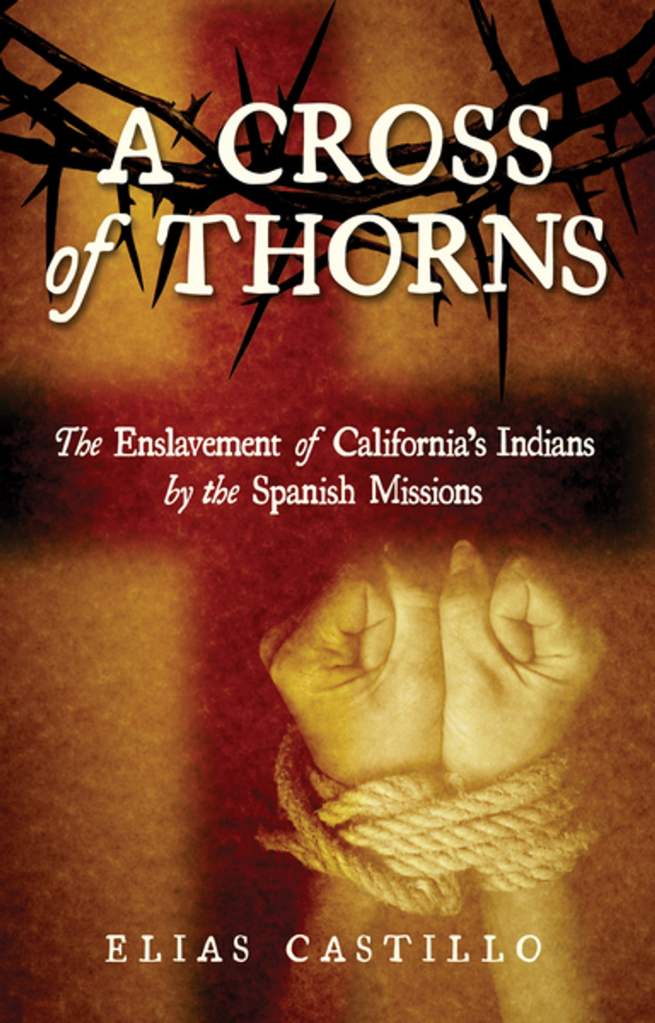
His book, based upon a bedrock of research and primary sources, strives to shine a light on the real story of the missions, and the tragedy they wrought upon the native peoples of California.
In the interest of sharing knowledge and ideas, and to hopefully correct some widespread historical misconceptions, I have decided to present some of the historical evidence Castillo provides.
Some may ask: “Why does this matter? The past is the past. Get over it.” To that, I would respond that it matters very much to living descendants of those who were killed, enslaved, and mistreated. Understanding their stories helps us to better grapple with ourselves as a State and as a society.
It’s also important for people to better understand this because many California tribes (like the Kizh) are still striving for official federal recognition, which will afford them certain benefits and a proper place in our historical understanding.
To that end, I here present some documentary evidence for the tragedy that was the California mission system. These are all primary sources, with a bit of context given for each.
Whipping and Death as “Spiritual Benefit”
On July 31st, 1775, Father Junipero Serra sent a letter to Spanish military commander Fernando Rivera y Moncada, requesting that four Indians who had tried to flee from Mission Carmel be whipped. He also offered to send shackles, in case the commander didn’t have any:
“Two or three whippings which your Lordship may order applied to them on different days may serve, for them and for the rest, for a warning, may be of spiritual benefit to all; and this last is the prime motive of our work. If your Lordship does not have shackles, with your permission they may be sent from here. I think that the punishment should last one month.”
On January 7th, 1780, Serra wrote a letter to then-governor of California Felipe de Neve, defending his practice of whipping the natives:
“That the spiritual fathers [friars] should punish their sons, the Indians, by blows appears to be as old as the conquest of these kingdoms.”
Governor Felipe de Neve envisioned a secular future for the missions, where the Indians would be freed and granted basic human rights. He wrote that the Indians fate was “worse than that of slaves.”
Due to mistreatment, confinement, and widespread diseases for which the natives had no immunity, the mission Indians began to die in huge numbers. Rather than mourn them, however, Serra was happy to see so many newly-baptized souls go to heaven. In a report dated July 24, 1775 to Friar Francisco Pangua, his superior, Serra wrote:
“In the midst of our little troubles, the spiritual side of the missions is developing most happily. In [Mission] San Antonio [de Padua, about 60 miles south of Mission Carmel] there are simultaneously two harvests, at one time, one for wheat, and of a plague among the children, who are dying.”
“A Species of Monkey”
The Franciscan padres generally considered themselves to be culturally, intellectually, and spiritually superior to the native peoples, which tended to provide a justification for mistreatment. Friar Geromino Boscana (stationed at Mission San Juan Capistrano) writes:
“The Indians of California may be compared to a species of monkey; for in naught do they express interest, except in imitating the actions of others, and, particularly in copying the ways of the razon [men of reason] or white men.”
Father Serra’s successor, Friar Fermin, also considered the Indians to be akin to “lower animals.” In 1786, Fermin wrote:
“They satiate themselves today and give little thought to tomorrow…a people without education, without government, religion or respect for authority, and they shamelessly pursue without restraint whatever their brutal appetites suggest to them.”
An Enlightened Point of View
Sometimes, travelers and explorers visited the missions, and their writings provide a unique, first-hand account of the actual conditions. Such was the case with French Navy Captain Jean-Francois de Galaup, Comte de Laperouse, who was the leader of a major scientific expedition. His ships sailed into Monterey Bay on September 14, 1786, and Laperouse describes his shock at seeing the conditions under which the Indians were forced to live. He compares the mission to slave plantations he’d seen in the Caribbean:
“Everything…brought to our recollection a plantation at Santo Domingo or any other West Indian island…We observed with concern that the resemblance is so perfect that we have seen both men and women in irons, and others in stocks. Lastly, the noise of the whip might have struck our ears.”
Laperouse continues, “Women are never whipped in public, but in an enclosed and somewhat distant place that their cries might not excite too lively a compassion, which might cause the men to revolt.”
The men were whipped “exposed to the view of all of their fellow citizens, that their punishment might serve as an example.”
It’s interesting to contrast the worldviews of a French explorer like Laperouse, imbued with the spirit of the Enlightenment and the rights of man, with a Spanish missionary like Serra, still imbued with the ideas of the Middle Ages. Serra was actually a part of the infamous Spanish Inquisition. Laperouse laments the ideas and methods of the Spanish missionaries, writing, “I could wish that the minds of the austere charitable, and religious individuals I have met with in these missions were a little more tinctured with the spirit of philosophy.”
Laperouse and other writers of the time show that violence and brutality toward native peoples wasn’t “just the way things were” or “just how everyone thought back then.” There were people living at the time who believed in the notion of human rights
De Facto Slavery
Writings from the time demonstrate that the California Missions were basically west cost slavery.
Laperouse writes: “The moment an Indian is baptized, the effect is the same as if he had pronounced a vow for life. If he escape to reside with his relations in the independent villages, he is summoned three times to return; if he refuses, the Missionaries apply to the governor, who sends soldiers to seize him in the midst of his family and conduct him to the mission, where he is condemned to receive a certain number of lashes with the whip.”
Overseers called alcaldes were also tasked with capturing, returning, and punishing runaways. Indians were not allowed to leave mission grounds without permission.
American Sherbourne F. Cook, who visited the missions, described women being locked up at night in unsanitary, cramped quarters: “There can be no doubt that the women were packed in tightly, and that the accumulation of filth was unavoidable…it is unbelievable that they (Indians) should not have resented years of being confined and locked in every night in a manner which was so alien to their tradition and nature.”
Cruel and Unusual Punishments
American farmer Hugo Reid, who was sympathetic to the Indians, describes the strange barbarism of a Friar Jose Maria Zalvidea at Mission San Gabriel:
“He was not only severe, but he was, in his chastisements, most cruel. So as not to make a revolting picture, I shall bury acts of barbarity known to me through good authority, by merely saying that he must assuredly have considered whipping as meat and drink to them, for they had it morning, noon, and night.”
Friar Ramon Olbes of Mission Santa Cruz, in an incident recounted by former neophyte (baptized Indian) Lorenzo Asisara, attempted to force a childless Indian couple to have sex in his presence to prove that they had potential to conceive [probably because Indians were dying at alarming rates]. The husband “refused, but they forced him to show them his penis in order to show that he had it in good order.”
Olbes sent the husband to a guard house in shackles. He made the wife enter another room in order to examine her private parts. She resisted him and there was a struggle between the two. Olbes ordered the guards to give her fifty lashes and lock her in the nunnery. He then ordered that a wooden doll be made like a newborn child, and ordered her to present herself in front of the church for nine days. Olbes had the husband shackled and made him wear cattle horns affixed with leather.
Taking Mass at Gunpoint
Ludovik Choris, an artist traveling with a Russian expedition, visited Mission San Francisco in 1816, and described how attendance at church services was compulsory: “All the Indians of both sexes without regard to age, are obliged to go to church and worship…Armed soldiers are stationed at each corner of the church.”
Captain Frederick William Beachey of England’s Royal Navy visited Mission San Jose in 1826, and described how Indians there were rounded up and forced to go to church twice a day:
“Morning and evening Mass are daily performed in the Missions…at which all the converted Indians are obliged to attend…After the bell had done tolling, several [Indian overseers] went round to the huts, to see if all the Indians were at church, and if they found any loitering within them, they exercised with tolerable freedom a long lash with a broad thong at the end of it; a discipline which appeared the more tyrannical as the church was not sufficiently capacious for all the attendants and several sat upon the steps.”
Thus, Indians who chose not to attend church were whipped. Beachley continues, describing a similarly grisly scene inside the church:
“The congregation was arranged on both sides of the building, separated by a wide aisle passing along the centre, in which were stationed several [overseers] with whips, canes, and goads, to preserve silence and maintain order, and…to keep the congregation in the kneeling posture. The goads were better adapted to this purpose than the whips, as they would reach a long way, and inflict a sharp puncture without making any noise. The end of the church was occupied by a guard of soldiers under arms, with fixed bayonets.”
Church services were given in Latin (which the Indians could not understand), and (against the goal of educating them), the official mission policy was, as with slaves, not to teach the Indians to read or write.
In a letter written in 1769 to Father Serra’s close friend Friar Francisco Palou, Spanish Visitor-General Jose de Galvez writes, “I stress my request to your most reverend person that you do not teach the Indians how to write; for I have enough experiences that such major instruction perverts and hastens their ruination.”
Followers of St. Francis Living Like Kings
The friars who founded the California missions were of the Franciscan order, which was founded by St. Francis of Asisi, the famous saint who took a vow of poverty. Like their founder, Franciscans were obliged to take a vow of poverty. However, accounts exist of Franciscans living luxuriously in the missions, while the Indians did not share in the great wealth the vast mission lands amassed.
Pablo Tac, a Luiseno Indian who grew up at Mission San Luis Rey, wrote an account of his experiences and described how the “Father is like a king. He has his pages, alcaldes, majordomos, musicians, soldiers, gardens, ranchos, livestock, horses by he thousands, cows, bulls by the thousand, oxen, mules, asses, twelve thousand lambs, two hundred goats, etc.”
In addition to being religious institutions, the missions also grew to be large commercial enterprises, with hundreds of thousands of acres for crops and livestock, where the fathers amassed great wealth, and often traded with the English and Americans.
Meanwhile, according to Indian Lorenzo Asisara, the friars “were very cruel toward the Indians. They abused them very much. They had bad food, bad clothing. And they made them work like slaves. I was also subject to that cruel life. The Fathers did not practice what they preached.”
Death and Despair
Due to mistreatment, disease, and deplorable conditions, nearly half of the missions’ populations died each year. From 1779 to 1833, the year the missions were effectively dissolved, there were 29,100 births and a staggering 62,600 deaths.
Russian explorer Otto von Kotzebue, who visited mission San Francisco in 1816, wrote that “the uncleanliness in these barracks baffles description, and this is perhaps the cause of great mortality: for of 1,000 Indians at St. Francisco, 300 die every year.”
Because of all this death, combined with the tragedy of being cut off from their culture and traditions, depression and despair took its toll on the mission Indians, as evidenced by accounts from visitors.
British Navy Captain George Vancouver visited Mission San Francisco while exploring the California coast in 1792, and described the demeanor of the Indians: “All the operations and functions both of body and mind appeared to be carried out with a mechanical, lifeless, careless indifference.”
The Russian artist Choris wrote that he never saw an Indian laugh: “They look as though they were interested in nothing.”
Spanish Accounts of Abuses
Some may argue that these outsiders descriptions were motivated by opposition to Catholicism or Spain, but there are ample records in the mission archives themselves which corroborate the picture.
Friar Antonio de la Concepcion Horra, assigned to lead Mission San Miguel in 1798, wrote a letter to the Viceroy of Mexico expressing his dismay at mission life:
“Your Excellency, I would like to inform you of the many abuses the are commonplace in that country. The manner in which the Indians are treated is by far more cruel than anything I have ever read about. For any reason, however insignificant it may be, they are severely and cruelly whipped, placed in shackles, or put in stocks for days one end without receiving even a drop of water.”
The governor of California, Diego de Borica looked into Horra’s complaints and wrote: “Generally, the treatment given the Indians is very harsh. At San Francisco, it even reached the point of cruelty…I also know why they have fled. It is due to the terrible suffering they experienced from punishments and work.”
Fleeing For Their Lives
Due to the misery of mission life, Indians sometimes attempted to escape. For example, between 1769 and 1817, there were 473 documented cases of Indian fugitives from Mission San Gabriel alone.
A group of Saclan and Huichin Indians who had fled Mission San Francisco in 1797 were asked by Spanish officials why they had run away. Here are some of their answers, dutifully recorded by Lieutenant Jose Arguello:
Tiburcio: He testified that after his wife and daughter died, on five separate occasions Father Danti ordered him whipped because he was crying. For these reasons he fled.
Magin: He testified that he left due to his hunger and because they had put him in the stocks when he was sick, on orders from the alcalde.
Malquiedes: He declared that he had no more reason for fleeing that that he went to visit his mother, who was on the other shore.
Liborato: He testified that he left because his mother, two brothers, and three nephews died, all of hunger. So that he would not also die of hunger, he fled.
Timoteo: He declares that the alcalde Luis came to get him while he was feeling ill and whipped him. After that, Father Antonio hit him with a heavy cane. For those reasons, he fled.
Magno: He declared the he had run away because, his son being sick, he took care of him and was therefore unable to go out to work. As a result, he was given no ration and his son died of hunger.
Prospero: He declared that he had gone one night to the lagoon to hunt for ducks for food. For this Father Antonio Danti ordered him stretched out and beaten. Then, the following week he was whipped again for having gone out on paseo (to visit his village). For these reasons he fled.
Russian hunter Vassili Petrovitch Tarakanoff, who was taken prisoner by the Spanish in 1815, recalls witnessing the treatment of Indians who had fled their mission and were recaptured:
“They were bound with rawhide ropes, and some were bleeding from wounds, and some children were tied to their mothers…Some of the runaway men were tied on sticks and beaten with straps. One chief was taken out into the open field, and a young calf which had just died was skinned, and the chief was sewn into the skin while it was yet warm. He was kept tied to a stake all day, but he soon died, and they kept his corpse tied up.”
Rebellion
Aside from running away, another reaction to death and mistreatment at the missions was armed revolt.
Diegueno Indians rebelled and burned down Mission San Diego in 1775. When asked why they had burned the mission, the Indians later said “they wanted to kill the fathers and soldiers in order to live as they did before.”
A female Gabrieleno (Kizh) shaman named Toypurina planned a revolt at Mission San Gabriel in 1785. Unfortunately, the plot was discovered and stopped. At her trial in 1786, Toypurina (who is a hero to the Gabrieleno today, sort of like Joan of Arc), said to her accusers: “I hate the padres and all of you for living here on my native soil, for trespassing upon the land of my forefathers and and despoiling our tribal domains.”
Perhaps the most successful uprising involved Quechan Indians who wiped out a mission and two settlements founded by the Spaniards on the California side of the Colorado River in 1781.
There was also the Great Chumash Uprising of 1824, which involved Indians from three Missions (Santa Ines, Santa Barbara, and La Purisima) taking arms against their Spanish oppressors.
After the Missions
In 1821, Mexico won its independence from Spain. Missions were secularized in the 1830s. The vast lands were supposed to be re-distributed among the Indians, but things didn’t work out that way. Many were cheated out of property, or lands were seized by corrupt officials. Many Indians became ranch hands on Mexican ranchos. Under Mexican, and then American rule, the Indians would continue to suffer in new and traumatic ways.
Reflecting on the legacy of the missions, Friar Mariano Payeras wrote to his superiors in Mexico City in 1820: “I fear that a few years hence on seeing Alta California deserted and depopulated of Indians within a century of its discovery and conquest by the Spaniards, it will be asked where is the numerous heathendom that used to populate it?…even the most pious and kindly of us will answer: the Missionary priests baptized them, administered the sacraments to them, and buried them.”
Between 1769 and 1890, the Native American population declined from an estimated 300,000 to 16,600.
Whitewashing History
Despite this documented record of oppression, disease, cruelty, and death—the California Missions experienced a revival in the late 19th and early 20th century as a way to market oranges, real estate, and a romantic myth of California’s past.
Castillo writes, “The missions, where thousands of Indians remain buried in unmarked mass graves, were resurrected in the 1890s and early 1900s and rebuilt as monuments to a concocted past that featured a loving, cooperative relationship between the friars and the Indians. Many California leaders, either ignorant of the truth or choosing to ignore what happened, joined in this duplicity.”
In his book Orange County: a Personal History, in a chapter entitled “Our Climate is Faultless: Constructing America’s Perpetual Eden” local writer Gustavo Arellano discusses how American businessmen and early 20th century mass media contributed to the myth of a Spanish Mission past that never existed.
On orange crate label art like Charles Chapman’s Old Mission Brand and in films like Douglas Fairbanks’ The Mark of Zorro (and all the Zorro stories that followed), the mission myth was born—ignoring the ugly historical reality.
This myth continues today. “Across California, streets, playgrounds, and even schools have been named after Padre Junipero Serra,” Castillo writes, “Yet Serra is still revered by many in California as a kindly friar who loved and treated the Indians as if they were his children.”
In Sacramento, on the grounds of the state capitol, there is a bronze statue of Serra. In San Francisco a gigantic statue of Serra overlooks the entrance to Golden Gate Park. And in Washington D.C., in the National Statuary Hall of the nation’s Capitol Building, there is a statue of Serra holding a model of a mission in one hand and a large cross in the other. Not to mention the numerous statues of Serra at the missions themselves.
“For decades, the California State Department of Education has required every elementary school in the state to teach fourth grade pupils of the supposed contributions of not only Junipero Serra, but of the missions themselves,” Castillo writes.
In 1988, Pope John Paul II conferred beatification on Father Junipero Serra, a major step toward becoming a saint.
It seems that, as with American history in general, California still has much reckoning to do with its real past.
-
The Expedition of Gaspar de Portola
The following is from a work-in-progress about the history of Fullerton. You can support my ongoing research and writing on Patreon.
For thousands of years, the native Americans who inhabited the Los Angeles basin and North Orange County, including Fullerton, (called the Gabrieleno Band of Mission Indians Kizh Nation, or just Kizh) had no documented interactions with Europeans. Beginning in the 1500s, waves of explorers, conquistadors, settlers, and missionaries would forever alter their way of life.
The first recorded contact between the Kizh and Europeans is the 1542 expedition of Spanish explorer Juan Rodriguez Cabrillo, who led a crew of sailors up the California coast, searching for a waterway across North America.
The next recorded contact happened 60 years later in 1602, with an expedition led by Sebastian Vizcaino, who was seeking a northern harbor for Spanish galleons returning from Manila.
150 years would elapse between the Vizcaino expedition and the next one, which began in 1769, led by Gaspar de Portola, a soldier who had recently been appointed governor of Las Californias, New Spain. The impetus for the expedition was concern by the Spanish crown that English and Russian explorers would encroach on “their” territory (Alta, or upper, California).
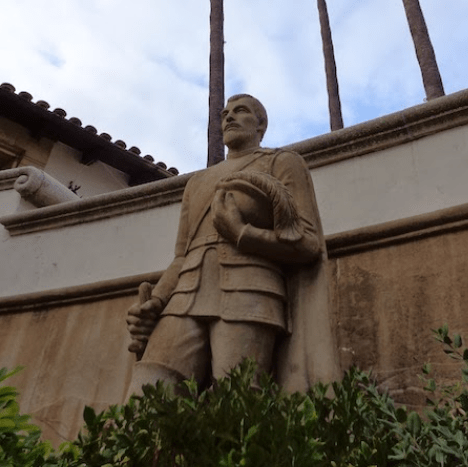
Statue of Gaspar de Portola outside the Bowers Museum in Santa Ana. Photo by the author. The Portola expedition was the first overland attempt at actual colonization of Alta California, not just exploration. Portola was accompanied by soldiers and Franciscan missionaries, including Father Junipero Serra (head of the Franciscan mission to the Californias).
Captain Fernando Rivera y Moncada led an advance group, consisting mainly of soldiers, scouts and engineers. Portolá and Serra followed in a second group with the civilians, livestock and baggage.
Three ships were dispatched to aid the expedition with supplies.
The expedition began on the Baja California peninsula, and went north toward Monterey. Upon arrival in San Diego, Serra stayed, while Portolá and Rivera led a smaller group north.
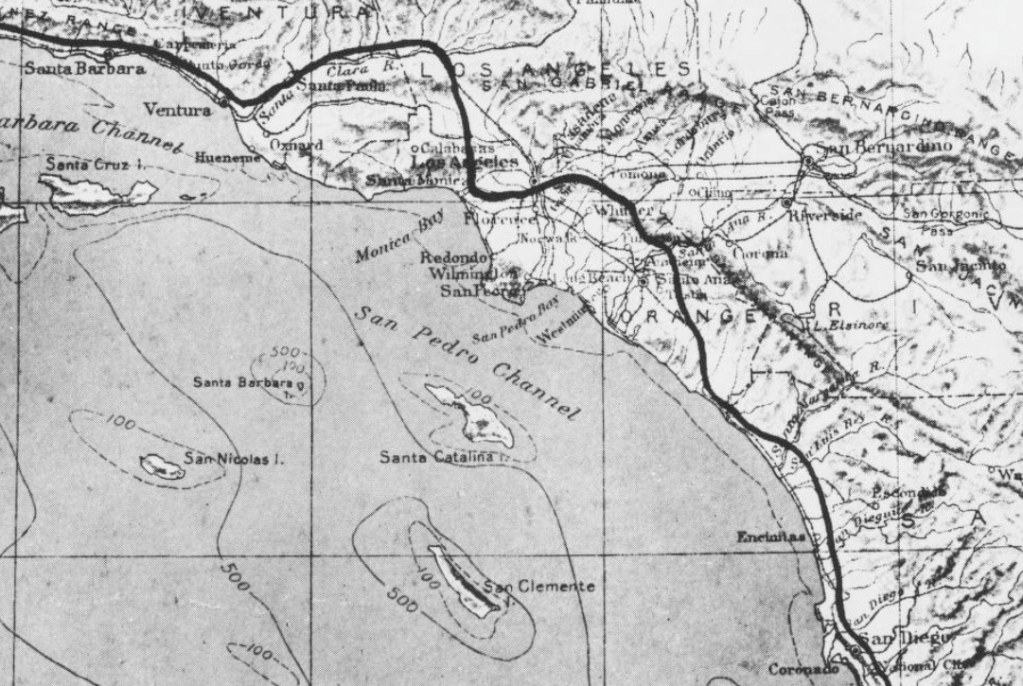
The route of Gaspar de Portola though present-day San Diego, Orange, and Los Angeles counties. Courtesy of California Historical Society via University of Southern California Libraries. Three members of the expedition kept journals: Portola, Miguel Constanso, and Father Juan Crespi.
Below are excerpts from the portion of Portola’s journal (which have survived) as he traveled through present-day Orange County. I have introduced the daily entries with the present day-locations where he traveled.
July 22, 1769: To Christianitos Canyon, which reaches the Pacific at the southern edge of today’s city of San Clemente: “We proceeded for three hours and a half, the entire way through a pleasant country of ranging hillocks. We halted in a gully where there was much pasture and a pool of water. Here there was a village of about twenty natives in which Father Crespi and Father Gomez baptized two dying children.”
July 23: North up Christianitos Canyon, over the hills and down to San Juan Creek (named later for the mission). They followed the creek west to the future location of Mission San Juan Capistrano. The state highway that now follows San Juan Creek in this area is named Ortega Highway after the leader of Portolá’s scouts. On this day, the travelers crossed from today’s San Diego County into Orange County: “We proceeded for four hours. Much pasture and water, and many trees.”
July 24: To Aliso Creek. The neighborhood where the creek exits the hills is now called Portola Hills: “We proceeded for about three hours and a half. We halted in a gully which had much water, pasture, and many trees, where we came upon an Indian village of about fifty persons; they made us a present of much grain and we made them a suitable return. We rested for a day.”
July 26: Short march northwest along the edge of the foothills, to a spring at the northern edge of today’s Irvine, California. From a hill above, the party first sees the broad coastal plain of northwestern Orange County: “We proceeded for three hours on a good road. Scant pasture; no water for the animals, though enough for the men.”
July 27: To Santiago Creek, so named by Crespí: “We proceeded for three hours on a good road. Much pasture and water.”
July 28: To the Santa Ana River, one of the major rivers of southern California. The soldiers of the expedition gave the river the name Santa Ana. A strong earthquake is felt that afternoon; aftershocks are recorded over the next few days: “We proceeded or two hours on a good road and we halted by a stream about eight yards wide and about sixteen inches deep which flowed with great rapidity. Here, at twelve o’clock, we experienced an earthquake of such violence…[text lost]…supplicating Mary Most Holy. It lasted about half as long as an Ave Maria and, about ten minutes later, it was repeated though not so violently. Much pasture and water. Here there was a very large Indian village of about seventy inhabitants, to all appearances very docile.”
July 29: North-northwest to the hills north of modern Fullerton, or possibly a little further north into La Habra: “We proceeded for three hours on a good road. Much pasture, but water sufficient only for the men. Here there was an Indian village of about fifty inhabitants.”
July 30: Leaving Orange County and entering Los Angeles County, the expedition heads north over the pass (La Habra) through the Puente Hills. Today’s North Harbor Boulevard follows the Portolá route over the pass. The march continued northwest to the San Gabriel River, where the party built “a bridge of poles” to cross the miry riverbed. This bridge (La Puente in Crespi’s diary) is remembered in the name of today’s nearby city of La Puente: “We proceeded for four hours on a good road, with the exception of two very steep hills. We halted in a very large valley where there was much pasture and water. Here we had to construct a bridge to cross the gully. I consider this a good place for a mission.”
[Mission San Gabriel would be established in 1771]
July 31: West-northwest to the western end of San Gabriel Valley, near the modern city of Alhambra: “We proceeded for four hours; near the camp we found much water with a great deal of pasture which had grown [so tall] that the animals had to jump in order to get through it. Here we rested [for one day]. We experienced six or seven severe earthquakes. In this valley we discovered, on the south side between two mountains, a spring that flowed like a river, giving evidence of deep soil.”
In a future post, I will include excerpts from the journal of Father Juan Crespi, which are much more detailed. Portola was a to-the-point military man. Crespi was a writer.
-
Archaeological Evidence of Early Inhabitants of Fullerton
The following is from a work-in-progress about the history of Fullerton. You can support my ongoing research and writing on Patreon.
The area which the Kizh (Fullerton’s first inhabitants) inhabited was vast (encompassing the LA basin and North Orange County), and there is archaeological evidence of their habitation and presence in Fullerton.
In Fullerton: a Pictorial History, Bob Ziebell writes: “On November 7, 1939, while excavating for the new City Hall (now the police building at the northwest corner of Commonwealth and Highland) workers were startled to uncover human skeletal remains. The remains–dubbed ‘Fullerton Man’ by the Fullerton Daily News-Tribune–were those of an Indian and were at least a thousand years old, according to John W. Winterbourne, who was then the archaeologist in charge of a museum being developed at Fullerton College. The remains were given to the college for preservation–except for an arm bone, which, in 1941, was placed, along with other artifacts and documents, in the cornerstone of the building.”
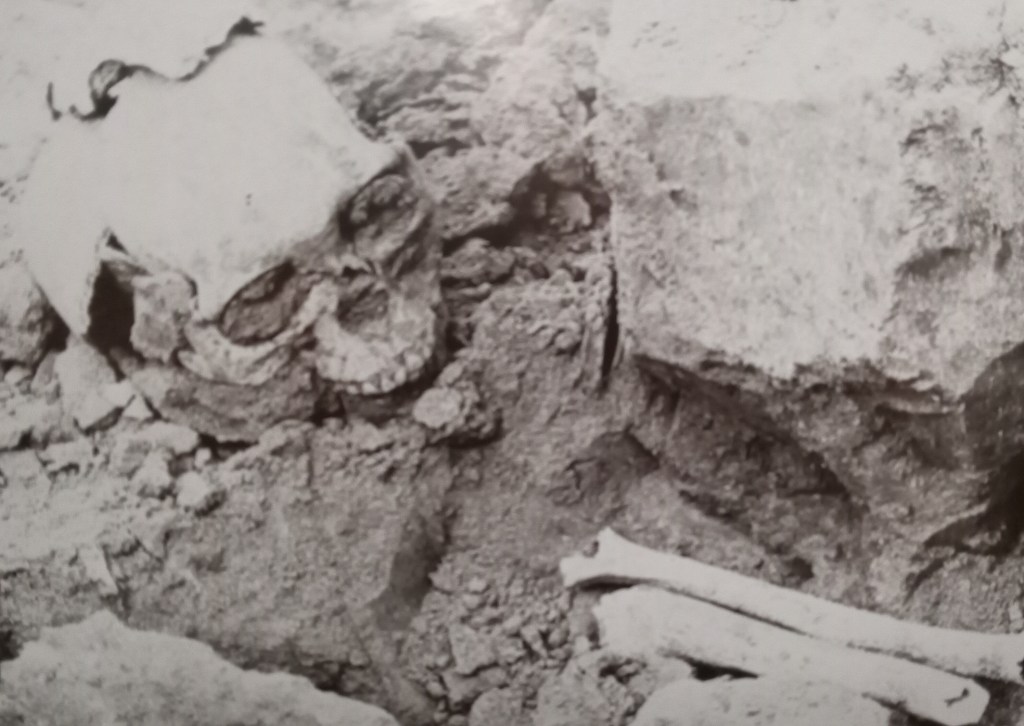
This is a photo of the bones found in 1939, when workers were excavating the site of Fullerton City Hall at the northwest corner of Highland and Commonwealth avenues. Photo courtesy of the Launer Local History Room, Fullerton Public Library. In 1939, the United States Works Progress Administration (WPA) sponsored an archaeological dig of a village site in Fullerton on what was then the Sunny Hills Ranch (a vast Orange Ranch owned by the Bastanchury family). Fullerton College and Fullerton High School jointly participated in the excavation.
The site was just north and west of the present Bastanchury Road–Malvern Avenue intersection. Here’s a map from the study, showing the site area, which is called “Sunny Hills Site No. 1”:
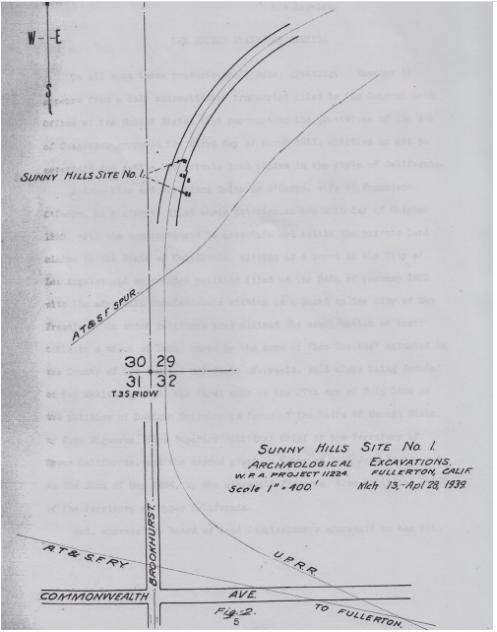
According to Ziebell, “A short time before the excavation began, a Bastanchury Water Company employee had taken soil from the site for use at the Water Plant garden and had removed three skeletons…Debris and fill from the roadbed of a Union Pacific Railroad spur line (still there) had covered a major portion of the camp. Nonetheless, a report on the “dig”–written by Louis Plummer, superintendent of schools, and the same John Winterbourne mentioned in the City Hall find–said a considerable number of stonework artifacts were found, such as manos, metates, and pestles–mill and grinding tools used in the preparation of food.”
Here are workers on the dig site:

During the dig, they uncovered many native American artifacts belonging to the local tribe known as the Kizh (they are often erroneously called Gabrielino or Tongva). Louis Plummer compiled the findings of the study into a book, which is available for view in the Launer Local History room of the Fullerton Public Library. Here are some of the artifacts uncovered in this study:
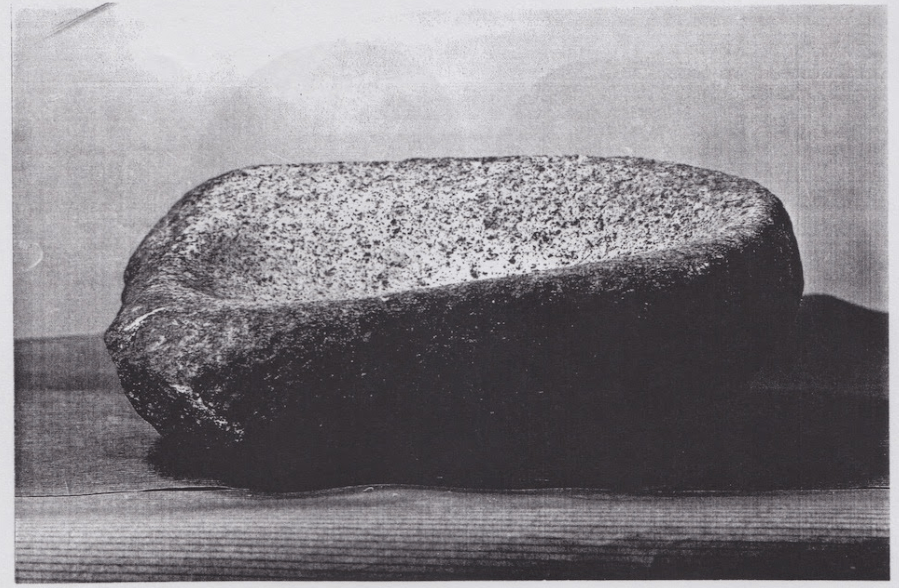
Metate (grinding stone for food preparation). 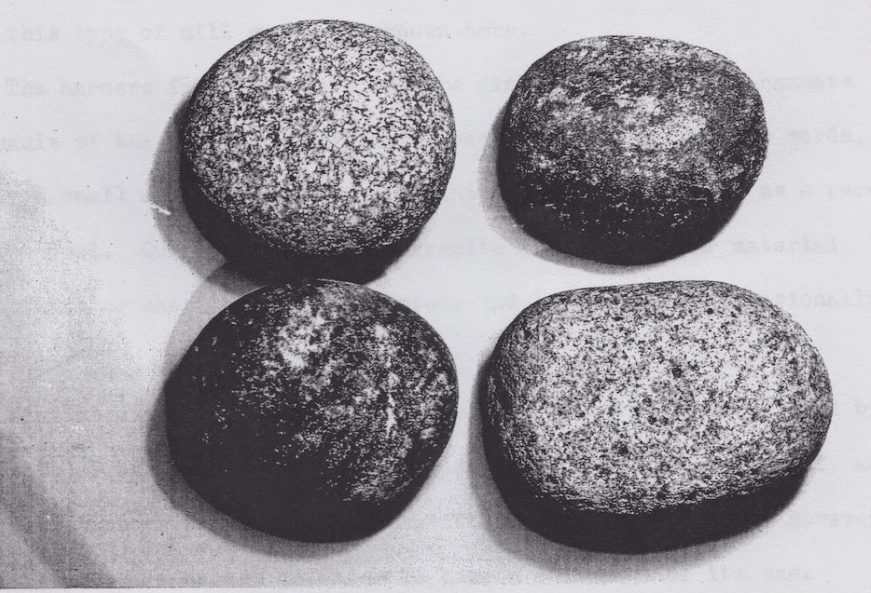
Hand stones for the metate. 
Drawing of bone tools found at the Sunny Hills site. 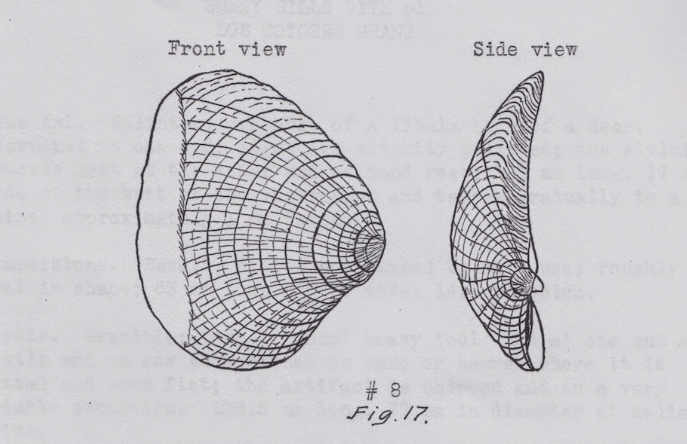
Drawing of shell knives found at Sunny Hills site. Somewhat disturbingly, the archeologists also uncovered a single object of Spanish origin, a metal spear point:
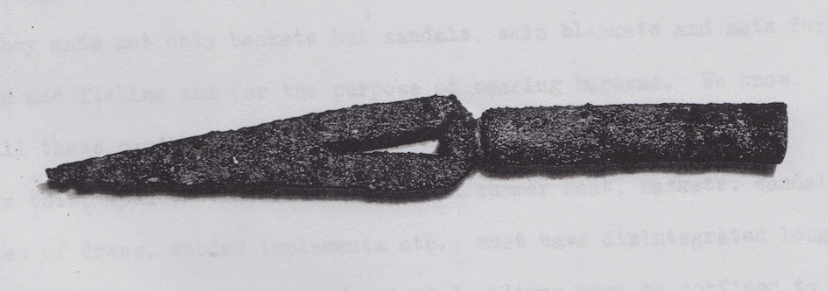
This is disturbing because it was Spain who first began to colonize California, and to force Native Americans to abandon thousands of years of living sustainably, and to instead live as quasi slaves in the Missions.
Another camp was identified to the north and east of the Malvern-Bastanchury site, but the excavators said the land, then part of the Emery Land Company, was planted to a young lemon grove and “cannot be investigated.”
Years later, in 1992, “a construction worker uncovered a skeleton while digging under a sidewalk on Commonwealth Avenue near the municipal airport,” Ziebell writes. “Judy Suchey, forensic anthropologist from California State University, Fullerton, aided in recovering about 95 percent of the skeleton and said it was that of a woman about four feet ten inches tall who was at least eighteen years of age when she died. The remains, she said, were at least four hundred and perhaps a thousand years old. The old Indian’s Gabrielino [Kizh] descendents later reburied the bones near where they had been found.”
-
Environment and Economy
The following is from a work-in-progress about the history of Fullerton. You can support my ongoing research and writing on Patreon.
The source for the following information is an excellent book called The First Angelinos by William McCawley.

The Kizh homeland, McCawley explains, “offered an environment rich in natural resources. This wealth of resources, coupled with an effective technology and a sophisticated system of trade and ritual exchange, resulted in a society that was among the most materially wealthy and culturally sophisticated of the California Indian groups.”
Because the Kizh inhabited such a large area, natural resources varied widely among settlements. There were at least nine distinct habitats, stretching from the mountains to the ocean, each with their own unique natural resources.
The Kizh territory was also at the center of an extensive network of trade with other tribes that stretched eastward to the Colorado River and westward as far as San Nicolas Island. These trading partners included the Cahuilla, Serrano, Luiseno, Chumash, and Mojave tribes.
To facilitate this trade, there would be large inter-tribal gatherings that included feasts, dances, and ritual exchange of shell bead currency. Various tribes and lineages would join together in ceremonial, political, and economic alliances.
Animal Resources
The main natural resources of the Kizh may be divided into three types: animal, plant, and mineral. Animal resources included deer, antelope (a kind of mountain goat), coyote, wolves, foxes, rabbits, squirrels, skunks, birds, snakes, and wildcats.
Animal meat was prepared in a variety of ways, including jerking, roasting, boiling, and baking. Skins and pelts were used for clothing, containers, and blankets.
Other useful tools made from animals including needles, fishhooks, awls, bows, whistles, flutes, and rattles.
According to McCawley, the Kizh were expert hunters, “and their weapons and technology reflected a versatile set of strategies for utilizing animal resources to the best advantage. Large animals were hunted with bow and arrow, while small animals were taken with traps, snares, nets, slings, and throwing sticks.”
Kizh hunters also used ingenious decoy headdresses made from deer heads—to mimic deer and allow them to get close.
Insects often served as a kind of “fast food” and included grasshoppers, larvae of bees, wasps, ants, and beetles.
Among the coastal communities, fish and sea mammals (whales, seals, sea otters) provided excellent sources of food. Shellfish like abalone, oysters, and clams were also Eaten.
In addition to being expert hunters, the Kizh (like their Chumash neighbors to the north) were expert seafarers and fishermen. They built sturdy plank canoes (called a te’aat) which could hold 8-10 people on fishing and sea voyages.
Seafaring was still a risky activity, however, so Kizh mariners “sought aid from the supernatural world to help them in their efforts.” They would carry stone carvings which “may have served as talismans that were used to channel supernatural power from a guardian spirit or dream helper to an individual.”
“These carvings represent sensitive works of art,” McCawley explains, “as well as testaments to the religious beliefs and faith of Gabrielino seafarers.”
Plant Resources
Trees supplied the wood used for building Kizh homes and for manufacturing bows and arrows, spears, harpoons, bowls, platters, dishes, and canoes.
Tule reeds (or bulrushes) were used to make houses, reed canoes, baskets, and various containers. Acorns provided a staple food with a high nutritional value. The Kizh developed techniques to leech out tannic acid and make acorns palatable, allowing them to be ground into a mush or made into cakes.
Acorns were usually collected in the fall in “an intense, cooperative communal effort.”
Other plant foods included: chia seeds, roots, bulbs, wild hyacinth, clover, wild sunflower seeds, cholla cactus seeds, and wild tobacco.
The Kizh were known as expert basketweavers, making baskets that were both useful and artistic. Baskets would be woven with both geometric and realistic designs in three colors: red, green, and black—made from natural pigments.
Mineral Resources
The Kizh homeland also included “a variety of useful minerals…and these played a large role in the development of trade and manufacturing.”
Soapstone was used to make cooking vessels and religious effigies (small statues). Flint was used to make arrowpoints, small drills, and knives. Slate was used in soapstone quarries to make picks, saws, and choppers. Granite was used to make mortars and bowls for grinding.
Crystals were used for religious or ritual implements. Asphaltum (tar) was used as an adhesive, and for waterproofing containers.
“Much of the asphaltum,” McCawley explains, “was collected as it floated ashore from marine seepages, although an alternative source was the tar pools at La Brea.”
Clays were also used to make ceramics, body paint, and soaps.
With so many natural resources and such an advanced system of trade and manufacturing, it’s no wonder that early ethnographer Alfred Kroeber called the Kizh “the wealthiest and most thoughtful of all the Shoshoneans of the State.”
-
Chiefs and Shamans
The following is from a work-in-progress about the history of Fullerton. You can support my ongoing research and writing on Patreon.
Tribal Leadership (The Tomyaar)
The source for the following information is an excellent book called The First Angelinos by William McCawley.
Prior to European contact, the total Kizh population is estimated to be around 5,000 people organized into communities/villages which were usually between 50 and 100 individuals each.
The chief of each village was called a tomyaar, and he was also the head of a family lineage. Tomyaars formed alliances with other villages and tribes (sometimes through marriage) for purpose of trade and peaceful co-existence (shown through ritual exchange of gifts and large inter-tribal celebrations).
According to McCawley, “The tomyaar was the focus of the religious and secular life of the lineage and community, serving as chief administrator, fiscal officer, religious leader, legal arbitrator, and commander-in-chief. Tomyaars were usually 30-35 years in age when elevated to office.”
The tomyaar’s position was hereditary, passing from father to eldest son, though there were sometimes female tomyaars.
One of the most important duties of the tomyaar was to manage the economic affairs of the village, particularly collecting and distributing food. Those who hunted animals and gathered plants and seeds would give part of their bounty to the tomyaar for food reserves. These food stores would be used to feed the poor, and the community in times of shortage. Mismanagement of food stores was a serious offense that could be punished by death.
Another of the tomyaar’s primary duties was to be a leader of trade and relations with other tribes. Good relations were maintained through the ritual exchange of shell beads, which were like currency. There was a vast network of inter-tribal relations with neighbors like the Cahuilla, Serrano, Chumash, Salinans, and other California tribes. These ritual exchanges were a way to prevent conflict and war, and provided avenues for obtaining food in times of shortage (through trade).
In addition to being the political leader of his community, the tomyaar was also a religious leader, managing “the ritual interaction between his lineage or community and the supernatural world.” For example, he would “preserve and maintain the ritual implements stored in the ‘sacred bundle’ (a length of reed matting in which ceremonial objects were wrapped) and to schedule the dates for religious celebrations.”
McCawley explains that “the tomyaar’s prestige and authority derived in large measure from his knowledge of, and access to, supernatural power…As he was descended from a line of leaders, some ability to handle power was inborn.”
He was spiritually connected to the legendary “First Chief ” Wewyoot and the supernatural being Eagle: “In ritual performances the tomyaar often served as an intermediary with the supernatural world by assuming the identity of Eagle. In such performances the tomyaar wore a ceremonial skirt sewn from the feathers of an eagle and performed dances which symbolized a soul’s magical flight into the afterworld” (McCawley).
To show his sacred authority, the tomyaar’s house was built right next to the yovaar (sort of like a temple), which was “the most sacred and powerful location within the community.” He was one of a few people who was allowed to enter the yovaar.
Much of Kizh life involved sacred rituals, and the installation of a new tomyaar was no different. When a new tomyaar was to be installed, there was a large festival in which inhabitants of neighboring tribes and communities were invited.
During the installation ceremony, the new chief’s body was painted black with ash from a charred feather. He was enrobed in a feather skirt and a crown of feathers. He entered the sacred yovaar and began a ceremonial dance, accompanied by singers who chanted to music of turtle shell rattles.
Visiting tribal leaders also joined the dance, and the new tomyaar continued until fatigue overcame him. After the ceremony, the new tomyaar was acknowledged by all, and everyone celebrated with a massive feast/party that lasted three or four days.
Like all good leaders, the tomyaar was not alone. He was assisted in his duties by a Council of Elders, which was composed of other leaders in the community, each of whom had his own important role.

The Shaman
Shamans existed in many ancient and indigenous cultures around the world. According to McCawley, “shamans were an integral part of the political, economic, legal, moral, and religious affairs of the community.” They served as doctor, psychotherapist, philosopher, intellectual, and mediator with the spirit world.”
In Kizh society, shamans could be men or women. An important female shaman was Toypurina who famously attempted a revolt against the Spanish at Mission San Gabriel in 1785.
The most powerful shamans, it was believed, could transform themselves in to animals, especially bears.
There existed, among southern California tribes, shamanic associations which provided “a regional framework or religious and political authority.” The Kizh shamanic association was called the yovaarekem.
Before becoming a shaman, a person received a “Divine Call” in the form of a dream. They then went through a difficult apprenticeship. McCawley explains, “In cultures throughout the world, the shamanic initiation typically involves a series of trances, during which the candidate undergoes ordeals of suffering, death, and rebirth at the hands of supernatural beings.”
Each shaman had a “guardian spirit” which resided in his/her body (usually the heart). A guardian spirit could be an animal, a natural force (like thunder or lightning), a supernatural creature, or a plant.
One of the powers of shamans was “magical flight” in which a shaman would leave their body and commune with other realms for various purposes such as obtaining supernatural help for the community, learning about the universe, leading the souls of the dead to the afterworld, and curing disease.
This magical flight was accomplished through the ingestion of the hallucinogenic plant datura (also called jimson weed), which was also ritualistically used in Asia, Africa, and medieval Europe.
It was common for shamans to carry “power objects” imbued with supernatural force, such as wands, animal skins, plants, minerals (like quartz crystals), charmstones, pipes, and effigies (stones carved in the form of whales, fish, birds, mammals, canoes, and abstract shapes). A large collection of effigies was discovered in 1962 in Santa Monica canyon.
Shamans also had “extensive knowledge of astronomy and cosmology that they used to predict the future and schedule religious festivals” (such as the summer solstice). Kizh society developed solar and lunar calendars as well as star charts.
Shamans were also “responsible for preserving sacred and historical knowledge contained in the oral literature. This knowledge was passed on by word of mouth and memorized by each generation. Certain males were trained from youth as bards, or storytellers, with the ability to memorize long stories and orations and repeat them word-for-word.”
Shamans were also powerful healers. Kizh herbalists used a wide variety of natural resources for curing disease such as yerba de pasmo, chilicote, wild tobacco, chuchupate, saltgrass plant, elder pitch, wild rose, coastal sagebrush, oak bark, datura, and the meat of the mud turtle. Other treatment methods included massage, sweating, rest, hypnosis, surgery, and ritual singing.
For many diseases, an ordinary herbalist was sufficient; however in cases of serious maladies such as “soul loss” a shaman was required to undergo magical flight “to retrieve the lost soul and return it to the owner’s body.”
Because shamans possessed such power, “society had a decidedly ambivalent attitude toward them. Supernatural power could be used for evil as well as good…the abuse of supernatural power could result in severe punishment and even death.”
There exists in Kizh oral literature the story of two brothers who were powerful shamans. A tomyaar at San Gabriel paid them to curse or destroy his enemies. Consequently, an epidemic of disease struck the area and people started dying. When the community learned of the cause, they sent a war party to Catalina Island, where the shamans were hiding. A great battle ensued and the shaman brothers were killed because they had used their power for evil.
-
Early Wildlife of Fullerton
The following is from a work-in-progress about the history of Fullerton. You can support my ongoing research and writing on Patreon.
We learned From Fullerton College geology professor Rick Lozinsky about the geologic history of Fullerton. Next, I would like to discuss some of the natural history of this area–its early plant and animal life.
As Lozinsky pointed out, for most of earth’s history, the lands that would be Fullerton were part of the ocean and its animal life included prehistoric sea creatures–large sharks, dolphins, and other marine life.
The evidence of this can be seen at the Interpretive Center at Ralph Clark Park in Fullerton–a little local treasure of paleontology.
Here are some of the marine fossils and bones that were found when that park was excavated, now on display:


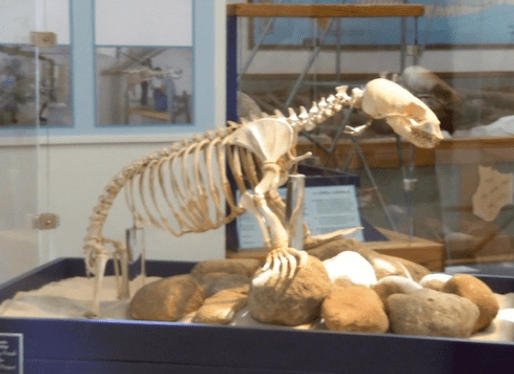
In his book Fullerton: a Pictorial History, Bob Ziebell writes, “It was, perhaps, seven hundred thousand years ago that the earth rose and played host to giant mammoths–larger than the elephants of today–and vicious sabre-toothed cats, and to lions similar to the African lions of today as well as the mountain lions which still inhabit the area, and a rare breed of llama, and camels, very large bison, wolves, coyotes, ancient horses and antelope, weird-looking sloths and tapirs–and the opposums of forty thousand years ago which remain with us today.”
Here are some of the mammal fossils on display at the museum:


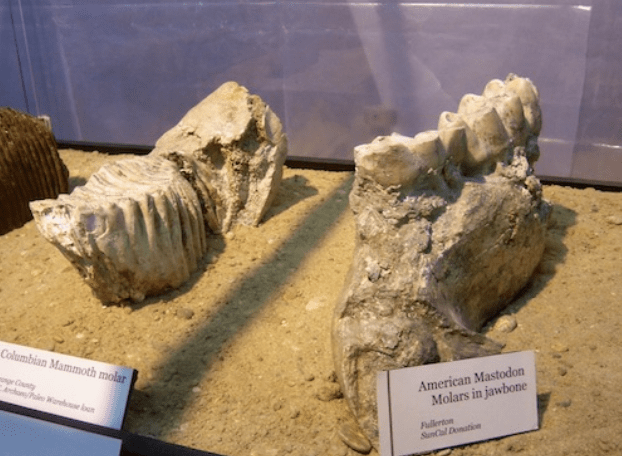
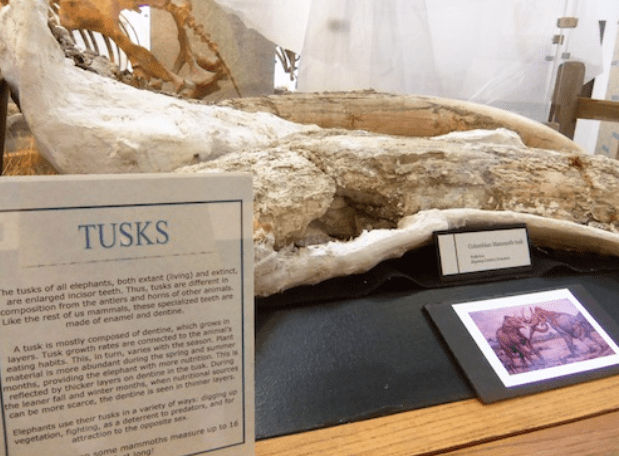

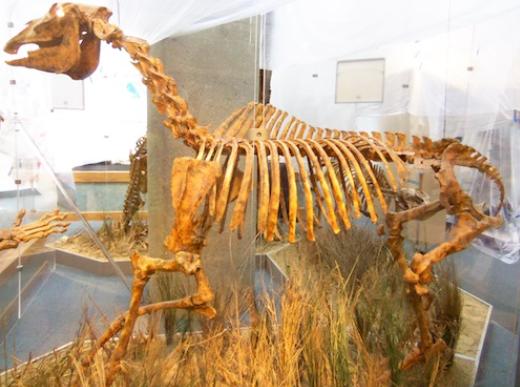
What about the plant life?
Ziebell paints a picture of the landscape the first human inhabitants would have seen, perhaps 15,000 to 20,000 years ago: “They found these lands nurturing grasses, wild mustard and bushes, with some oak woodlands along streams on the plains areas and chaparral as well as gnarled, low-growing broadleaf evergreen plants in the hills…a fertile valley topped by gentle, rolling hills which dip again toward the basin known as the La Habra Valley. The Coyote Hills to the northwest and Puente Hills to the north and northeast, had drained their rich soil across this broad expanse, and a river–the Santa Ana–had often sent its flood waters meandering over the valley floor, depositing life-giving silt and creating the rich alluvium which was to serve these [later] farmers and ranchers so well.”
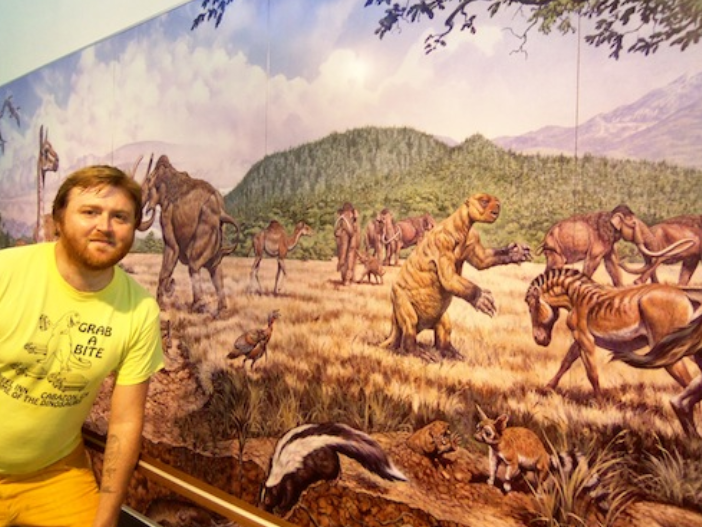
The Interpretive Center at Ralph Clark Park features a mural depicting what the landscape may have looked like around 20,000 years ago. Thus the ancient prehistory of Fullerton’s landscape would lay the groundwork for two of its major industries: oranges and oil.
“The lesson in all this,” Ziebell concludes, “would seem to be that the many changes which have occurred in the 200-plus years since written history of this area began…are miniscule when considered in the greater perspective of the last one million years on life’s landscape.”
-
First Inhabitants
The following is from a work-in-progress about the history of Fullerton. You can support my ongoing research and writing on Patreon.
The tribe that originally occupied North Orange County and Los Angeles has been called different names over the years. Historians often refer to them as Gabrielenos or Gabrielinos, because that’s what the Spanish missionaries (like Father Junipero Serra) called them, after Mission San Gabriel. The Spanish adopted a policy of re-naming California Indian tribes after nearby missions. According to other sources, the local tribe is called the Tongva. But I’ve met members and leaders of the local tribe, and they have told me they prefer the name Kizh (pronounced Keech).
Ostrich Eggs for Breakfast, a history of Fullerton I had to read in third grade, includes this passage: “Sometimes people ask, ‘What happened to the Indians?’ As far as anyone knows, there are no Gabrieleno Indians left in Fullerton.”
While this may be technically true, it implies a great lie: there are no more local native people left anywhere–no more Kizh. I know this is a lie because I’ve actually met the chief of the local tribe. His name was Ernie.
In 2013, I attended a fascinating event at the little Paleontology Museum located inside Ralph Clark Park in Fullerton. The event was about Orange County’s “prehistory,” and (to my astonishment) actual, living Kizh Indians were there, including their chief, Ernie Salas, and tribal historian, Timothy Poyrena-Miguel.
I sat down with Timothy. I didn’t have any agenda or prepared questions.
“Tell me about your people,” I said and, man, did he have a story to tell.
The history of the Kizh people goes back thousands of years. For millennia, they had developed a complex and beautiful culture, which included religion, astronomy, rich and varied cuisine, economy, and social structure. They developed ingenious ways to live sustainably off the land and its natural resources. The name of the tribe, Kizh, comes from the dome-like dwellings they lived in. They had tools, technology, clothing, handicrafts, dances. They were one of two California tribes who mastered boat-building, and traveled along the coast of Southern California.
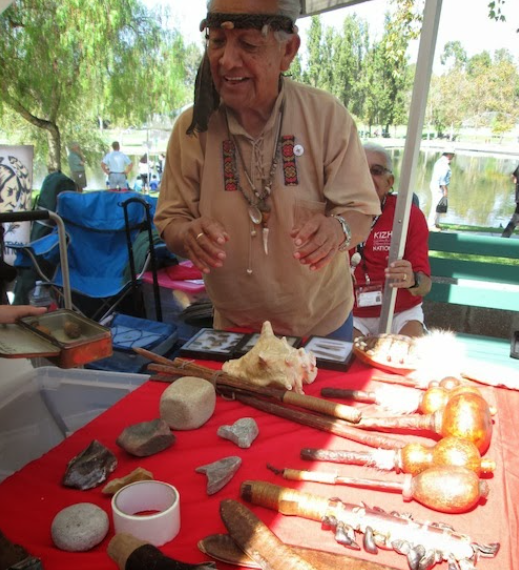
Ernest Perez Teutimez-Salas, chief of the Kizh tribe at Ralph Clark Park in Fullerton in 2013. He passed away in 2021 and his son Andy is now tribal chairman. In the 1700s, Spain began to colonize California, and thus began the long journey of suffering for the Kizh people. Contrary to what we learn in school and on field trips to California Missions, the Spanish were not a benevolent presence in California. The missions they established were like concentration camps, where Indians lived in a state of quasi-slavery, and were made to abandon much of their culture. Violence and disease decimated the local native populations. Kizh women were raped by Spanish soldiers and died of syphilis. Timothy compared Spanish figures like Father Junipero Serra to Nazis, in the way they systematically destroyed native cultures and lives.
Both Timothy and I expressed our frustration that the California Missions are taught to children in public schools as benevolent, even quaint examples of California history, when the truth is much darker.
Things did not improve for Native Americans when Mexico won its independence, nor when the United States conquered California. Under American rule in the 1800s, a policy of “extermination” of native people was pursued. Timothy told me the story of a whole Kizh village rounded up into a valley near where the Rose Bowl is today, and blasted with guns and cannons. Some children managed to escape, and found shelter among Mexican-American families in the San Gabriel area. Children of slain parents were adopted by Mexican-American families, and this is why Many Kizh people today have Spanish/Mexican surnames.
Due to widespread racism, these children feared to identify themselves as Indian, stopped speaking their native language, and learned Spanish or English.
One result of all this suffering and bloodshed was the eradication of the Kizh language. Timothy told me they have some words and songs that were passed down orally, but no one alive today speaks their native language.
As I listened to Timothy tell the story of his people, I felt a heaviness in my chest, a complex mixture of sadness, outrage, and compassion. It is this last bit, compassion, that I hope to evoke with my writings. If we don’t know their history (and most people don’t know Kizh history), we do not feel compassion. But, in listening to their stories, harrowing and horrific as they are, we develop a strong sense of compassion. We pay for the crimes of our ancestors, but we do not have to repeat those crimes. The act of storytelling can be a powerful, healing force. It is my hope that, in listening and sharing stories like this, a new chapter in the Kizh story may open, one of understanding, healing, and reconciliation.
To learn more about this local tribe visit their web site: www.gabrielenoindians.org.
-
The Ground Beneath Our Feet
The following is from a work-in-progress about the history of Fullerton. You can support my ongoing research and writing on Patreon.
Professor Richard (Rick) Lozinsky has taught geology at Fullerton College for the past 30 years. He recently published the third edition of his book Our Backyard Geology, which is about the geology of Orange County (including Fullerton).
I sat down with Lozinsky to learn more about the geologic history of this area and why it matters.
JL: I recently read your book Our Backyard Geology (which is about geology in Orange County), and I found it fascinating. I think it’s important for people to understand the geology of the area where they live. Could you briefly explain the geology of Fullerton?
RL: Here in Fullerton we live on an interesting spot at the edge of the Coyote Hills. There are some active faults in our area, like the Whittier Fault. Because of the faulting, we’re susceptible to earthquake hazards—liquefaction, landslides, fires. In fact, today is the day of the Great Shake-Out [a statewide campus earthquake preparedness drill].
JL: What can you tell me about the geologic history of Fullerton?
RL: Our geology is fairly young. Up until recently [geologically speaking], Orange County was part of the ocean. If you go to places like Ralph Clark Regional Park, you can actually see some of the fossil evidence of when we were part of the ocean, and then afterwards when we were dry land and had giant mammoths, mastodons, and sabre-tooth cats roaming around.
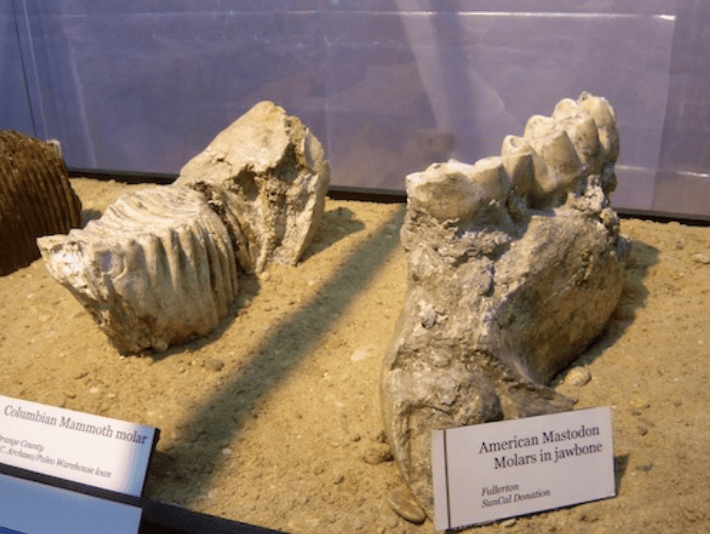
American Mastodon molars on display in the paleontology museum in Ralph Clark Park in Fullerton. JL: How old are the rocks here?
RL: The oldest rocks we have in the Fullerton area are up in the Coyote Hills, and they only go back a few million years. If you go into the Santa Ana Mountains, like Silverado Canyon, you find some rocks that are 180 million years old. But, from a geologic standpoint, that’s still not that old.
JL: Why are the rocks so “young” here?
RL: Basically, because we were mainly ocean, and not a lot of deposition was occurring at that time. But you can go to other areas where there was mountainbuilding. There were actually times when we had exploding volcanoes in the area.
JL: When was that?
RL: About 100-150 million years ago. We had a different kind of plate boundary then, more like Oregon and Washington, and had volcanoes like Mount St. Helens around here.
JL: I find it interesting that here in California, we’re on the Pacific tectonic plate, and basically the rest of the country is on the North American tectonic plate.
RL: I tell my classes that, being west of the San Andreas fault (which is the boundary between the Pacific and North American plates), we’re on an Alaska cruise. We’re slowly, by about an inch a year, heading up toward Alaska.
JL: And that’s also why we’re more susceptible to earthquakes?
RL: Right, if you’re on a plate boundary, you’re going to have more big earthquakes.
JL: What are some of the kinds of rocks and formations that are unique to this area?
RL: A lot of sedimentary rocks: sandstone, shale, conglomerate. There’s a big bend in the San Andreas Fault that formed the San Gabriel and San Bernadino Mountains. That compression creates the rippling of the hills around us, and the LA Basin. We live in a hole that’s about 4-5 miles deep, which is filled full of sediments.
JL: I know that, historically, this was a very oil-rich area. Aside from oranges, oil was the main product of Fullerton and Brea. How does this relate to our local geology?
RL: Brea Canyon is an interesting place, because that’s where the Whittier Fault goes through. The reason the oil wells are there is because the fault is acting as a trapping mechanism. It also has to do with the fact that we used to be part of the ocean. Petroleum is formed when millions of marine organisms settle on the ocean floor, get buried at just the right depth and temperature, and it changes to petroleum.
JL: Aside from just increasing one’s knowledge, why do you think it’s important for people to understand their local geology?
RL: Well, because some people fear where they live. They fear an earthquake, they fear a flood. We have been flooded here before in Fullerton. Back in 1938, we had a major flood, where you couldn’t get to Fullerton College by street because Chapman Ave. was under a couple feet of water—students were coming by canoe. So, I think it’s better to understand your local geologic setting to get an idea of how safe it is, and things you can do to make it safer.
JL: How safe are we?
RL: From an earthquake standpoint, I think overall we’re probably fairly safe if we take precautions. It’s important to stabilize objects where you live because it’s not usually earthquakes that hurt you—it’s things that fall on you. So, if we can stabilize things that would fall on us, we can almost look forward to the next earthquake.
JL: What are some local geology groups or societies?
RL: We have the South Coast Geological Society, which is kind of the Orange County geology group. There’s a National Association of Geoscience Teachers, the far western section, which includes California. There are periodic meetings where we go and hear presentations on research that people are doing locally or internationally.
JL: Are there any current discoveries being made that you find particularly interesting?
RL: They’re trying to develop an Early Warning System for earthquakes here in California, particularly in LA. That’s pretty exciting.
JL: What do you love about geology?
RL: Geology is my life. It’s not just a job. I travel to see geology, not only locally but worldwide. I enjoy taking students out and opening their eyes to geology, particularly outside the classroom because that’s when things really can open up. I’ve been teaching here for close to 30 years, and still enjoy it quite a bit. And my roots are here in Southern California, so kind of fun to see the changes that have happened.

The oldest rocks in Fullerton are in Coyote Hills.
-
Subscribe
Subscribed
Have a WordPress.com account? Log in now.

