-
Early Settlers: The Porter Family
The following is from a work-in-progress about the history of Fullerton. You can support my ongoing research and writing on Patreon.
Benjamin Franklin Porter was born in Tennessee and grew up in Texas. According to biographer Samuel Armor, “He was a plantation holder in that commonwealth [Texas], and was therefore always a man of influence.”
He migrated to the area that would become Fullerton in 1870 on a wagon train. There he bought 40 acres of land on the north side of Orangethrope Avenue, west of Euclid Avenue, where he and his wife raised 15 children.
According to local historian Bob Ziebell, “Fullerton’s first settlers located in an area which was originally known as ‘North Anaheim’ along Orangethrope Avenue, mostly west of Spadra Road (now Harbor) and extending west to what is now Brookhurst. These pioneers of the late 1860s first sent their children to Anaheim schools, and then to Orangethorpe School after that district was organized in 1872.
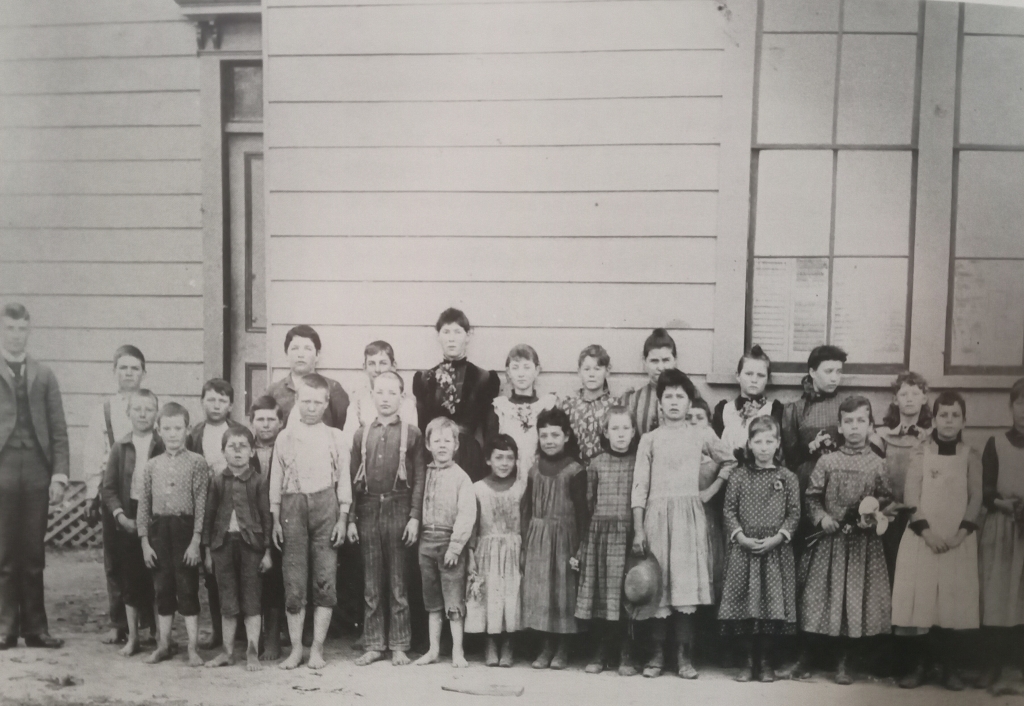
Students outside the wood-sided school Orangethorphe school building, circa 1880. Photo courtesy of Fullerton Public Library Local History Room. Ziebell writes, “On the land next to the Porters, a man named John Kerr built a home in 1882, which was later owned by the Almon Goodwins, then the Greenoughs, and then, from 1919 to 1984, by Benjamin Franklin Porter’s son Rufus, and grandson, Stanley–which is now recognized as the oldest extant house in Fullerton, located at 771 West Orangethorpe Avenue.”
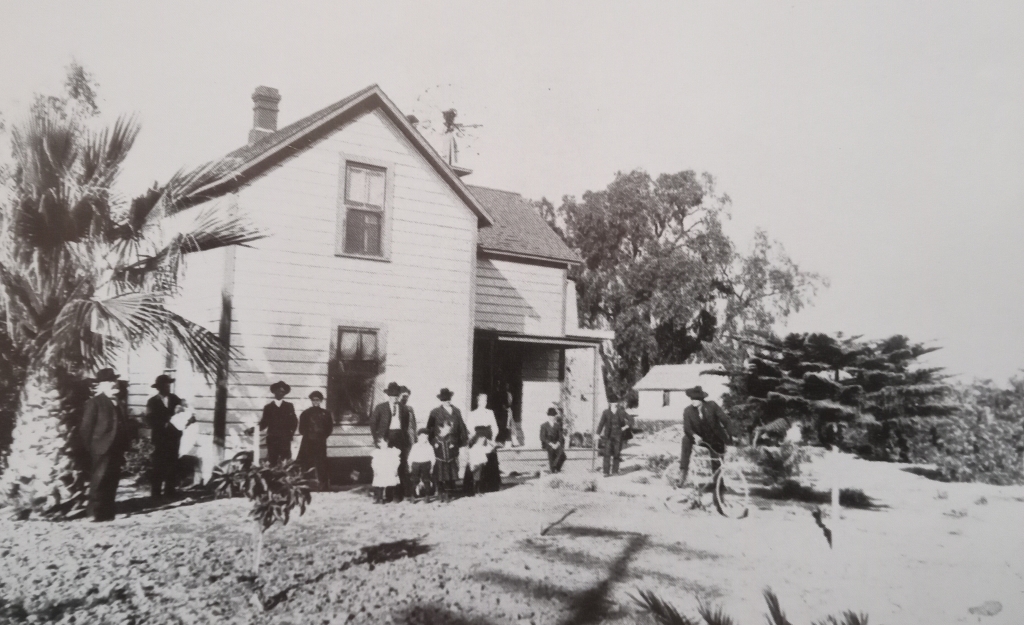
The “Porter House” built in 1882 at 771 West Orangethorpe Ave. Photo courtesy of Fullerton Public Library Local History Room. Porter was very involved in the community. He helped establish the Orangethorpe School in 1872 (before Fullerton was a town), and later Fullerton High School in 1893.
Being a farmer, he helped lead the Anaheim Union Water Company, and “was active in Democratic politics and banking, serving at the time of his death as a director of the Fullerton branch of the Security-First National Trust and Savings Bank,” according to Ziebell.
He died in 1941. His obituary in the Fullerton News-Tribune read, in part “He had been active throughout his life in the development of this district. Its first roads, first high school, irrigation systems and walnut marketing co-operatives all benefitted by his wise and willing counsel.”
B.F. Porter’s son C. George Porter was born in Orangethorpe (now a part of Fullerton), in 1875.
He was married in 1898 to Jane Jennings, who died in 1917 leaving one child, Charles Jr.
C. George continued in the family ranching business, with a Valencia orange grove. He attended Orangethorpe school and later the Los Angeles Business College. Porter branched his businesses out into both oil and real estate in Orange County.
In 1919, C. George married Alta Rose Rhodes. He was a member of the Masonic Lodge of Fullerton and a Democrat.
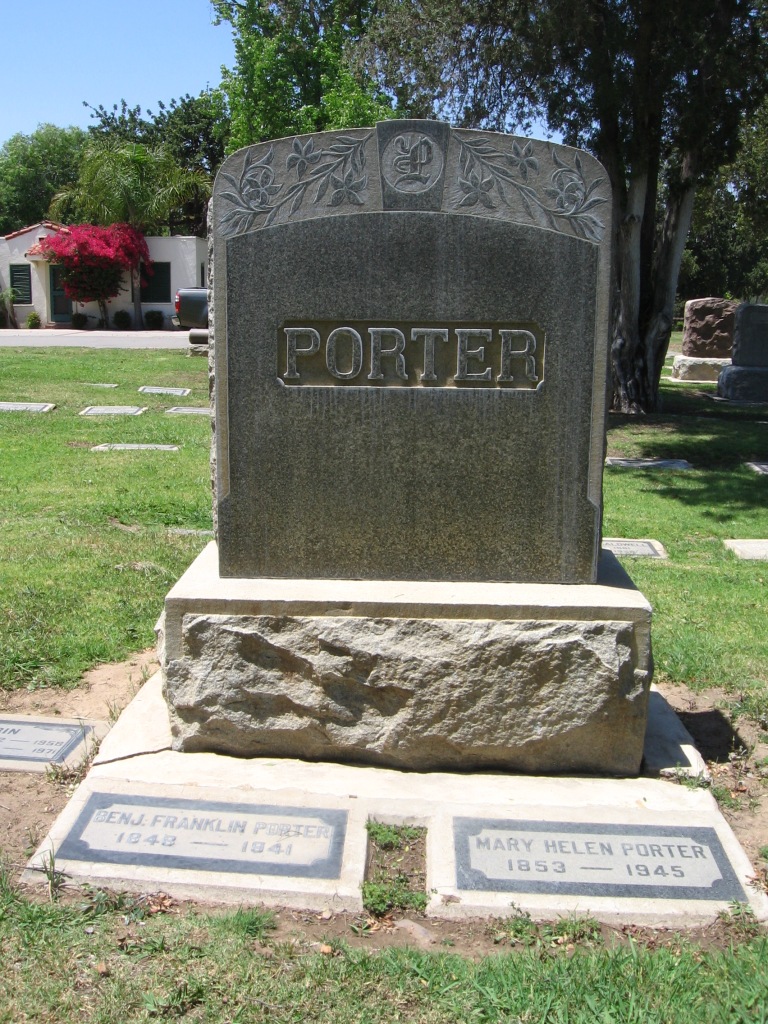
Porter family gravestone in Loma Linda cemetery in Fullerton. -
Early Settlers: Alex Henderson (blacksmith)
The following is from a work-in-progress about the history of Fullerton. You can support my ongoing research and writing on Patreon.
Alex Henderson was born in Scotland in 1866. When he was five years old he immigrated with his parents Peter and Margaret to Ontario, Canada. At age 19 he apprenticed to learn the blacksmith trade.
After working for a while as a blacksmith in Canada, he decided to move to California, based on correspondence with his brother who worked in the Puente oil fields.
In 1892 he moved to Fullerton and purchased a blacksmith business on the 100 block of Spadra Street (now Harbor Blvd). According to local historian Bob Ziebell, this block “was a popular gathering place in the years before the turn of the century.”
Although the building was the first blacksmith shop in town, Henderson was not the first blacksmith in Fullerton.
C.E. Holcomb, who came to Fullerton in 1888 reported that the building was initially located on the east side of Pomona Avenue (behind the present Post Office Building) where, according to Holcomb, “It was operated by two Negroes.”
Holcomb said he, “took work to them when it was necessary and they were good workmen.”
The next owners of the blacksmith shop were Otto Stroebel and Harry Savage, who kept the building on the same site. They sold the place to Alex Henderson who moved it to Spadra.
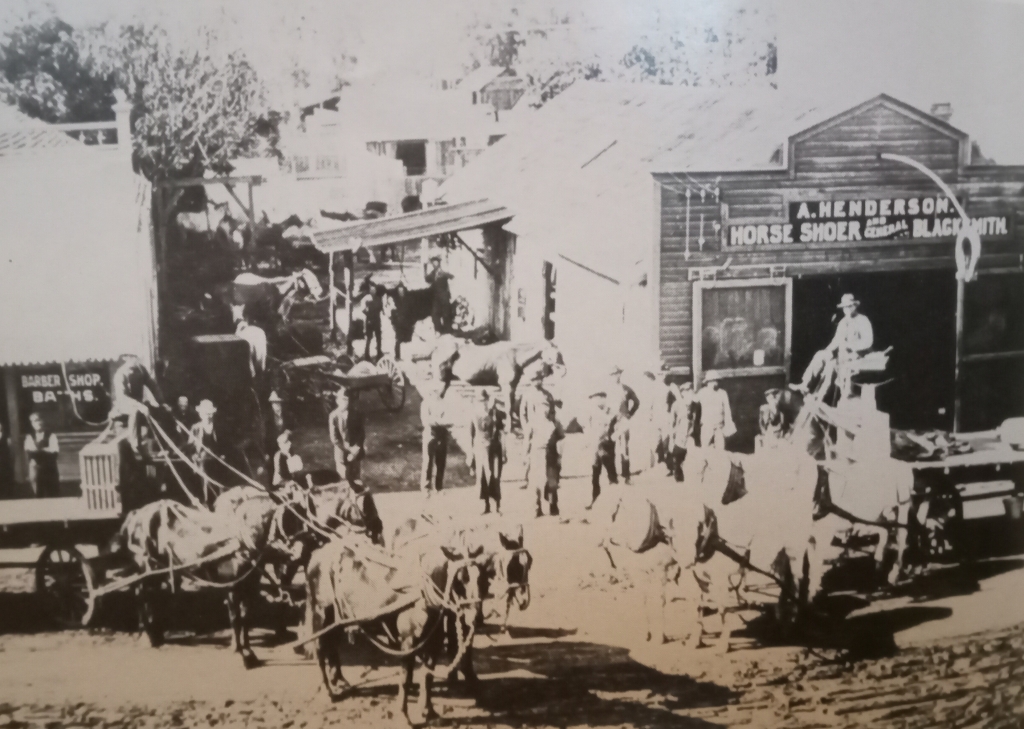
Alex Henderson’s blacksmith shop on the 100 block of South Spadra Road (now Harbor Blvd). Photo courtesy of the Fullerton Public Library Local History Room. 
Interior of Alex Henderson’s blacksmith shop. According to Ziebell, “Here the smithies worked over the forge, hammering horseshoes into the proper shape and shoeing horses. They also built carriage and wagon parts and did carriage painting (note the sign) on the premises.” Photo courtesy of the Fullerton Public Library Local History Room. He was a charter Mason of the Fullerton Lodge, and also served as deputy city marshal under Charles Ruddock.
Henderson’s blacksmith shop was in business for two decades. In 1912 he purchased 18 acres on East Orangethorpe Ave, which he planted with Valencia oranges, and built a home there. When he retired in 1914, he was one of the oldest blacksmiths in Orange County.
He also owned a five-acre walnut grove on South Highland Avenue, and other property in Fullerton.
He married Jessie Watt of Ontario, Canada and they had one child, James. He had two daughters from a previous marriage, Agnes and Edith.
Sources:
History of Orange County, California: with biographical sketches of the leading men and women of the county who have been identified with its earliest growth and development from the early days to the present by Samuel Armor. Los Angeles Historic Record Co, 1921.
Fullerton: a Pictorial History by Bob Ziebell. Donning Company, 1994.
-
Early Settlers: Andrew Rorden
The following is from a work-in-progress about the history of Fullerton. You can support my ongoing research and writing on Patreon.
Andrew Rorden was born on the Island of Fohr in the former duchy of Schleswig-Holstein, now a part of Germany.
In 1872 he immigrated to America and worked for three years for William McFadden in Placentia.
He then worked in Anaheim, learning the wagonmaker’s trade.
In 1879, financial hard times led him to make a trip back back to Germany; and after a year there with his friends, he returned to America.
He worked for three years in quartz mills in Arizona, where he earned enough money to make an initial payment on the ranch of thirty acres on East Chapman Avenue, at Fullerton.
He planted a vineyard, but the blight killed it; and then, in 1886, he began to plant walnuts–an experiment at that time here. By 1921, he had a 14-acre walnut orchard.
His land would eventually become the site of Fullerton College.

Andrew Rorden is shown here inspecting his property in a photo taken in the 1880s. Photo courtesy of the Local History Room of the Fullerton Public Library. He is shown here inspecting the site in a photo taken in the 1880s. Photo courtesy of the Local History Room of the Fullerton Public Library.
He was one of the charter members of the Fullerton-Placentia Walnut Growers Association, and a member of the Placentia Orange Growers Association, and also a shareholder in the Anaheim Union Water Company.
Perhaps because Rorden was German, and during World War I, there was fear/prejudice against German Americans, biographer Samuel Armor felt the need to write, “He has the esteem of all who know him as an honest man, and the good will of all who have followed his patriotic course during the trying days of the World War…he has been loyal to the country, state and county.”
Rorden was married twice. His first wife was Rebecca, who died in Los Angeles in 1912. For his second wife, he married Marie (Togel) Klement of Anaheim, the mother of one daughter, Pauline.
-
Charles Chapman and the Citrus Industry
The following is from a work-in-progress about the history of Fullerton. You can support my ongoing research and writing on Patreon.
Charles C. Chapman was Fullerton’s first mayor, and he has been called “The Father of the Citrus Industry.” He was hugely influential in shaping the early direction of Fullerton. But who was he? Where did he come from? What was he all about?

Charles C. Chapman He wrote his own biography and called it Charles C. Chapman: The Career of a Creative Californian. Streets, schools, and a University were named after him. There is a giant bronze statue of him at Chapman University.
In the Local History Room of the Fullerton Public Library I found a Master’s thesis entitled “Citrus Culture,” by Laura Gray Turner. There is an entire section entitled “Charles C. Chapman: Determined Agriculturalist and Rancher Elite” which tells the fascinating and disturbing story of this man.
Charles Clarke Chapman was born in Macomb, Illinois in 1853, into a culture and family characterized by “a hardy protestantism, fundamental in doctrine, puritanical in tradition, and capitalistic in economic dogma.” These combined values of fundamentalist Christianity and capitalist zeal would drive the future career of Charles C. Chapman.
After a series of economic ventures and failures, Chapman entered the history business in 1876, at age 23. Chapman and his brothers founded Chapman Brothers, Printers and Publishers and they began writing and printing local history books. What sort of history did he write and publish? According to Turner, they were, like much amateur history of the era “celebrations of Anglo-Saxon origins. Individuals accorded grandest adulation in these volumes were the successful businessman, the manufacturer, and especially the hardworking farmer.” These 19th century amateur histories were often informed by what historian John Higham calls “nativist tradition fostered by an attitude of racial superiority.”
This celebration was made manifest by the 1893 “World’s Columbian Exposition” in Chicago, a massive fair “in celebration of the 400th anniversary of Columbus’ voyage.”
This fair lasted six months, attracted some 27 million visitors (about half of the U.S. population) and was spread out over 633 acres. Because of its size, this Exposition “shaped the way the nation saw itself and the world…[it was] a kind of tract, an argument for the superiority of our civilization…It saw itself as American destiny made manifest.”
Charles C. Chapman was intensely involved in this exhibition. He and his brothers, “always ready to seize an opportunity for profit, made plans for the construction of several hostelries [and]…an eight story luxury hotel.” I guess their history business had paid off.
Chapman described the World’s Columbian Exhibition as “the most stupendous and beautiful display ever made of the world’s achievements in art, industry, architecture, soil products, science, religion, and in the whole realm of man’s accomplishments.” Social critic Edward Bellamy, author of the classic Looking Back saw the Exhibition quite differently: “The underlying motive of the whole exhibition, under a sham pretense of patriotism is business, advertising with a view to individual money-making.”
Chapman’s fortunes here were short-lived. In 1893, the United States plunged into an economic depression, in which Chapman lost almost everything. In 1894, his wife died. Turner writes, “Resolutely, Chapman turned his face westward, where now at mid-life he would begin anew.”
One interesting aspect of American history is that the economy has almost collapsed a number of times. With economic downturn come strikes and social unrest. But always, without fail, a wealthy elite manages to reclaim power and “set things right.”
So it was with the great economic crash of 1893. Charles C. Chapman, wealthy publisher and property owner, lost almost everything. So he packed up and headed west from Chicago, seeking new markets. And he found them in the fields of Orange County.
Turner writes, “With characteristic industry, Chapman applied his indefatigable discipline and business savvy to the task of restoring profitability to his newly acquired and rechristened Santa Ysabel Ranch.”
He studied handbooks of citriculture, met regularly with other local growers, and established “contacts among the nation’s financial, commercial, and political power brokers.”
Like most business endeavors, Chapman’s early years as an orange rancher were met with limited success and sometimes outright failure. Pests and disease among the trees proved major obstacles. He experimented with fumigation methods, sometimes using cyanide to kill pests, which for a time was common practice. Cyanide is a deadly poison that kills insects, but isn’t too good for people either.
To sell his oranges, Chapman was a pioneer of clever marketing and branding, relatively new business practices, but ones that would transform American consumer culture in the 20th century.
Drawing upon his advertising and publishing experience, Chapman elevated the orange crate label to an artform which used “vivid symbols and scenes, careful constructs of fact and fantasy, [which] evoked memory and anticipation in a contrived assault upon the senses.”
Chapman was a pioneer of the idea that consumers do not just buy products, they buy ideas, they buy fantasies. And that is what Chapman’s Old Mission and Golden Eagle orange brands created. The images on Chapman’s Old Mission brand labels offered a “sanitized vision of the Spanish past…the mission myth of paternalistic displacement by a superior culture…an Anglo-Saxon approbation of the Spanish mission heritage.” The Old Mission labels featured peaceful padres in a pristine California utopia, a fantasy totally disconnected from California’s real history, which was full of violence, conquest, racism, and oppression.
Conspicuously absent on the Old Mission or Golden Eagle labels were “the ranks of workers whose backs and hands plowed, planted, watered, picked, and packed the fruit on its way to consumers’ lips.” The exploited masses whose labor made the citrus industry profitable (Chinese, Japanese, Mexicans) were not a part of Chapman’s advertising fantasy world.
But it was the unacknowledged labor of these masses who made Chapman the business and political titan he became. It was their backs who bore him into the Mayor’s seat, into the ranks of the Republican power elite, who might have carried him into the White House. Calvin Coolidge and the Republican Party wanted Chapman to be their Vice Presidential candidate in the 1920s, but Chapman declined, preferring instead to reign over his Southern California business and political empire.
On April 7, 1904, two articles were printed side-by-side in the Fullerton Tribune, the local newspaper.
One was an anonymous letter signed “One of the Laborers.” It was basically an appeal to Charles C. Chapman, local orange tycoon, for fair treatment of his workers. This laborer calls the conditions and wages of the workers a “regular outrage” and “slavery.” He ends with this appeal: “We are not permitted to sleep in the house after a hard days work. We are brothers in Christ Jesus, born of one flesh and blood, and we ought to have a tender feeling for all. But after all of that the cold-hearted rancher sends his hired man to the barn to sleep with the living creatures that inhabit therein.”
The second article was called “The Chapman’s Entertain Their Friends and Neighbors,” and describes a lavish dinner party at the three-story, thirteen-room Chapman mansion. The article reads, “the guests were given the opportunity to inspect the beautiful rooms on the first floor, consisting of library, reception hall, music room, dining room, breakfast room and kitchen. The rooms on the second floor were then shown. The guests were then invited to the third story which proved to be a hall strictly in keeping with the rest of the house.”
Here, on one newspaper page, is summed up power relationships in Chapman’s Citrus Industry.
-
The Roots of Inequality: The Citrus Industry Prospered on the Back of Segregated Immigrant Labor
The following is from a work-in-progress about the history of Fullerton. You can support my ongoing research and writing on Patreon.
It’s no secret that Orange County, including Fullerton, was built on oranges. During the first half of the 20th century, the County became a major producer of citrus for both the United States and the world.
Between 1890 and 1960 “citrus produced more wealth than had gold in California history and ranked second only to the oil industry in California’s economy,” according to historian Gilbert Gonzalez.
By 1938, Orange County had 75,000 acres of citrus groves. In Fullerton, the Sunny Hills ranch alone contained over 4,000 acres of orange groves. The Bastanchury family, which owned the ranch, claimed that it was the largest orange grove in the world. This agricultural history is often remembered fondly in local histories, old post cards, and colorful orange crate labels, which can be found at antique stores.
However, there is an aspect of the citrus story that is often left out—the fact that its massive success was made possible on the backs of a segregated Mexican immigrant labor force.
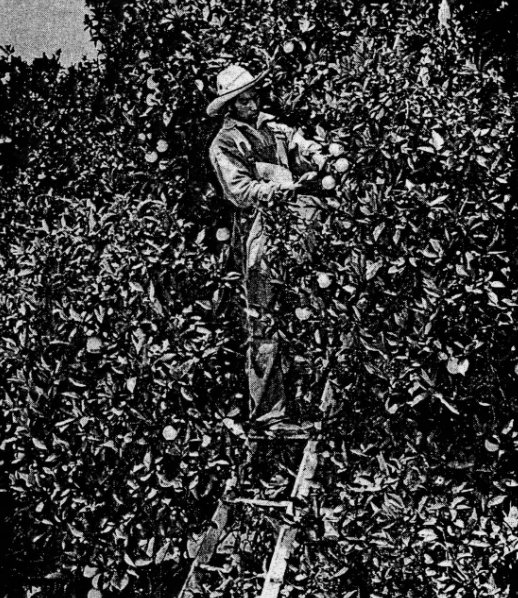
Picking Valencia Oranges on the Harold Hale Ranch, 1943. From Labor and Community. Picking Labor
Perhaps the seminal work written on the subject of Mexican citrus workers in Orange County is Labor and Community: Mexican Citrus Worker Villages in a Southern California County: 1900-1950 by Gilbert G. Gonzalez, professor at UCI.
The history of farm labor in California generally, and Orange County in particular is a history of successive waves of immigrants who were recruited, generally exploited for their labor, and often excluded either through direct deportation or legal pressure.
In the late 19th century, there was widespread employment of Chinese farm labor. Unfortunately, the Chinese Exclusion Act of 1882 cut off this labor supply. Thus, to fill the labor vacuum, Japanese immigrants were recruited for a couple of decades, until they were excluded through various “Alien Land Laws.”
The decline of Japanese farm labor coincided with a sharp rise of Mexican immigrant labor, who were recruited by growers and were fleeing the violence of the Mexican Revolution.
“Fortunately for the citrus grower, acreage expansion occurred simultaneously with the first great Mexican migration to the United States. Nearly 750,000 Mexicans moved north between 1900 and 1930, escaping the violence, destruction, and destitution wrought by the Mexican Revolution of 1910. Indeed, economic development throughout the Southwest proceeded on the availability of Mexican immigrant labor,” Gonzales explains.
Unlike other crops which could be harvested with large machines, oranges had to be harvested by hand, which required an enormous number of workers.
The California Fruit Growers Exchange (a cooperative of orange growers) lobbied congress for an “open border policy” in the early 20th century to fill their labor needs.
Workers were paid more than they could earn in Mexico, but wages were low by American standards.
According to historian Cletus Daniel, “farm employers, with few exceptions, sought to squeeze the last measure of profit out of their businesses by cutting labor costs to the bone.”
While men were employed as orange pickers, women were employed in the ever-growing packinghouses along the railroad tracks of Orange County.
Social Hierarchy
The presence of a large Mexican labor force in the Anglo-dominated towns of Orange County, including Fullerton, led to policies of segregation and second class citizenship for the Mexican workers and their families.
“Mexicans in citrus towns were invariably the pickers and packers; and consequently they were poor, segregated into colonies or villages, and socially ostracized, even though they were economically indispensable to the larger society,” Gonzalez writes. “The class structure in rural areas has generally divided along lines of nationality. At the top, the growers, native-born white; at the bottom, the foreign-born migrants, or his or her children.”
“A lid on the possibility for economic change and social progress tethered the Mexican community to function as cheap labor. Legal restrictive covenants segregating residential zones mirrored the division of labor. In public parks, swimming pools, theaters, restaurants, bars, dance halls, clubs and societies, Mexican immigrants and their families were either systematically excluded or segregated,” Gonzalez writes.
Housing Segregation
Beginning in the 1920s, a pattern of segregated housing was established, separating the orange worker families from the dominant community.
“Mexican houses were often tiny, wooden, adobe, or hollow-brick buildings constructed on the less desirable and often dangerous sections of the association property,” Gonzalez writes.
On the Bastanchury Ranch, six small villages of some 30 families each were scattered about the property.
One of the six settlements, called “Tiajuanita” by residents, was built with “scraps of sheet iron, discarded fence posts and sign-boards, and served by one lone water faucet and a few makeshift privies.”
Another worker camp in Fullerton, called Campo Pomona was located at Balcom and Commonwealth.
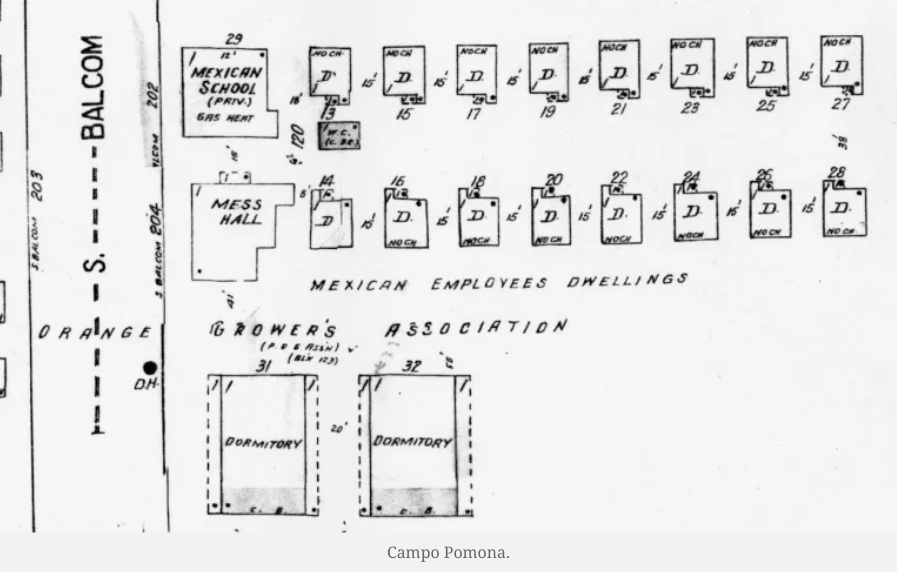
The head of the Fullerton Unified High School “Americanization” Department [charged with educating picker children and adults] stated that the “American neighbors who felt their property had been devaluated [sic] by its close proximity to the Mexicans treated them with humiliating scorn.”
School Segregation
On the camps, there were schools built exclusively for the Mexican children.
“Segregated schooling assumed a pedagogical norm that was to endure into the fifties and parallels in remarkable ways the segregation of African Americans across the United States,” Gonzalez writes. “By the mid-1920s, the segregated schooling process in the county expanded, matured, and solidified, was manifested in fifteen exclusively Mexican schools, together enrolling nearly four thousand pupils. All the Mexican schools except one were located in citrus growing areas of the county…Distinctions between Mexican and Anglo schools included differences in their physical quality.”
There was a school on the Bastanchury Ranch and on Campo Pomona.
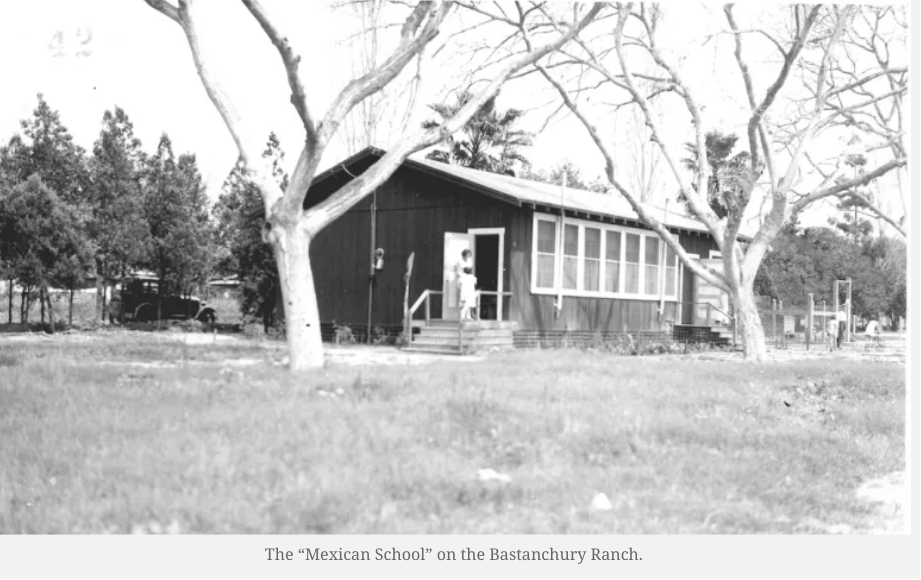
Unlike at the white schools, curriculum at the Mexican school was generally limited to vocational subjects, and junior high was considered the end of schooling for most students, many of whom accompanied their parents in the groves and packinghouses.
One woman who taught at these segregated “Mexican Schools” was Arletta Kelly.
Kelly describes her struggle to convince her colleagues that Mexican students had the same potential as whites.
“Some of my colleagues here would laugh at me and say, ‘Are you a wetback?’” she said.
In addition to educating children, teachers at the “Mexican schools” also taught “Americanization” classes to adults—to assimilate the workers to American society.
“Whereas the Americanization programs in the local villages appear unique, in reality they reflected a generalized expression for the eradication of national cultural differentiation across the United States,” Gonzalez writes.
Under the California Home Teachers Act of 1915, Americanization programs focused on the teaching of English.
Louis E. Plummer, superintendent of the Fullerton High School District, staunchly supported Americanization because in his view the persistence of “Little Italys, Little Chinas, Little Mexicos” stifled the development of a “homogeneous people.” In particular, the failure of Mexicans to live in a “model way” or as “first class citizens,” which was produced by “a hangover of lazy independence” made it imperative that rather than merely learning skills, Mexicans had to learn and live within the fundamental cultural norms of the United States. His perspective summarized much of the Americanization spirit in the larger community during the late 1800s and early 1900s.
“Many a surviving villager resident has not forgotten that in their youth the ‘Anglos never wanted to have anything to do with us except that we pick their oranges.’ Such was the nature of the dominant contours in the Mexican and Anglo social relations in the citrus towns,” Gonzalez writes.
Deportation
During the Great Depression, hostilities against the Mexican workers rose to clamors for deportation.
According to Druzilla Mackey, another teacher in the Mexican camp schools, “The American Community…felt that the jobs done so patiently by Mexicans for so many years should now be given to them. ‘Those’ Mexicans instead of ‘our’ Mexicans should ‘all be shipped right back to Mexico where they belong’…And so, one morning we saw nine train-loads of our dear friends roll away back to the windowless, dirt-floor homes we had taught them to despise.”
What she is referring to is a mass deportation of nearly all of the Mexican workers on the Bastanchury Ranch in the early 1930s. This deportation was part of a much larger deportation effort across the United States, which is described at length in the book Decade of Betrayal: Mexican Repatriation in the 1930s.
“Outside of the community, the Mexican became the scapegoat,” Gonzalez writes. “In 1931 and 1932, local and county governments caught up in the drive across the Untied States to deport Mexicans sought to cut budgets through repatriating Mexicans. Induced through threats of relief cutoff sweetened with an offer of free transportation, about 2,000 left Orange County.” Many were actually American citizens. A few years ago, I had the privilege of interviewing Fullerton resident Manuel Rivas Maturino, who was born on the Bastanchury Ranch, and remembers the experience of “repatriation.”
Local author Gustavo Arellano describes this situation in his 2013 OC Weekly article “The Lost Mexicans of Bastanchury Ranch.”
Village Culture
Despite the hardships of poverty, segregation, and discrimination, the Mexican workers and their families managed to establish a vibrant local culture that included religious and patriotic events, as well as sports.
A major annual celebration was the 16th of September, or Mexican Independence Day, which included a parade, music, and festivities.
Popular community Christmas activities included Las Posadas (a community-wide reenactment of Mary and Joseph’s nine-day journey in search of lodging), and Pastorelas (a morality play depicting the struggle between good and evil, Jesus and the devil).
“Perhaps the most elaborate religious procession occurred on December 12, Dia de la Virgen de Guadalupe, the patroness of Mexico, commemorating the appearance of the Virgin Mary before the Indian boy Juan Diego on a Mexico City hilltop in 1598,” Gonzalez writes.
For these occasions local bands, like Fullerton’s Rancho de los Panchos, and The Joe Raya Orchestra from Placentia would play at different camps.
Baseball was also popular in the camps, and many teams were formed such as the La Habra team Los Juviniles, and the Placentia Merchants.
Unionization and the 1936 Strike
In 1936, nearly 3,000 orange workers went on strike, which highlighted “sharp social divisions and submerged hostilities separating the villagers from the dominant community,” according to Gonzalez.
The strikers organized to demand better wages and working conditions.
Orange County Sheriff Logan Jackson (himself a citrus rancher) “warned the union that he…was prepared to call 500 special deputies into action at a moment’s notice. Sheriff’s deputies and police officers made daily and nightly rounds of the villages, submitting reports to the growers and noting all unusual activities,” Gonzalez explains. “Law enforcement let it be widely known that they planned wholesale arrests of citrus strike agitators who violate technical provisions of the state traffic laws.”
Over the course of the strike, four hundred men and women were arrested.
At its peak, the strike erupted into violence.
“In coordinated forays on July 6, caravans of pickets descended on strike breakers at several locations, charging into the groves, pulling down ladders, upsetting orange boxes, physically routing strike breakers, and engaging in battles with armed deputized foremen and growers…Four hundred police, highway patrol, and sheriffs deputies sped to the conflicts, chasing, clubbing, and arresting strikers in wild melees. As the battle zone quieted, some two hundred unionists were arrested and jailed, 55 cars were confiscated in what the Los Angeles Times described as a ‘miniature civil war,’” Gonzalez writes.
Sheriff Jackson actually issued a “shoot to kill” order for his deputies and declared, “This is no fight between orchardists and pickers…It is a fight between the entire population of Orange County and a bunch of communists.”
Red-baiting was a common practice of the growers, who tried to paint the workers as radicals and communists. The strike ended in mid-July with some wage increases, but no union recognition or bargaining rights.
World War II: The Decline of the Citrus Picker Village, the Rise of the Barrio
The Second World War brought some significant changes for the worker villages of Orange County.
There was a large-scale campaign to again recruit workers from Mexico to fill wartime labor shortages, and thus was born the Bracero Program, which existed from the early 1940s to the 1960s.
These temporary workers did more than complement the existing labor force—they also served to replace it.
“Where it was feasible, citrus ranchers stopped using already resident Mexican villagers as pickers and replaced them with temporary status braceros,” Gonzalez writes. “Once again, associations had found a dependable labor supply to supplant the one that had learned the benefits of organization. Many growers would say that braceros ‘saved the crops,’ however, they might more accurately have said that ‘braceros saved the industry from unionism.’”
Between 1943 and 1958, about 70,000 braceros were transported to Orange County.
Meanwhile, segregation still fragmented the community. But change was coming.
Challenging Segregation
By the mid-1940s, a new political and social consciousness was emerging among the second generation of Mexican Americans—a desire for civil rights, social equality, and the end of segregation.
One manifestation of this was the landmark case Mendez v. Westminster, in which a group of Mexican American parents in Orange County filed a lawsuit arguing that their constitutional rights were violated by segregated schools.
“The Mendez case attracted national attention and is considered a precursor to the 1954 Supreme Court [Brown v. Board of Education] decision overturning the heinous practice of racial segregation,” Gonzalez writes.
Additionally, the 1943 Doss v. Bernal case was a major victory against racially restrictive housing covenants, which had been used for many years to keep non-whites from buying or renting houses in many neighborhoods.
Alex Bernal, a Fullerton homeowner, was sued by his white neighbors, who argued that the Bernals weren’t Caucasian and couldn’t live in the neighborhood.
Bernal’s lawyer argued that Mexican Americans were subject to the equal protection clause of the 14th Amendment, and the courts ruled that the Bernals could stay in their home.
Housing discrimination would become officially illegal in the 1960s, with the Rumford Fair Housing Act.
World War II also expanded job opportunities for Mexican Americans beyond agricultural work, as the area began its transition into a more industrial/suburban economy.
“Urbanization slowly enveloped the villages until they were no longer isolated or semi-isolated rural-like hamlets,” Gonzalez writes. “Grove after grove disappeared, some 75,000 choice acres across the region between 1946-56… Disappearing citrus groves were replaced by mushrooming housing tracts that transformed Orange County into an emerging regional suburbia.”
As the spacial distance between the Mexican communities and the dominant communities shortened, “the urban barrio entered the social stage, assuming the welcoming role formerly played by the citrus worker village,” according to Gonzalez.
Thus, although legally enforced segregation has become illegal, the social dynamics of community fragmentation, in some ways continues today—Fullerton “south of the tracks” is generally lower income/Latino and the hilly northern parts are generally upper income/white and Korean.
These patterns are, in large part, a legacy of the citrus industry.
-
Chinese Farm Labor and Exclusion in 19th Century California
The following is from a work-in-progress about the history of Fullerton. You can support my ongoing research and writing on Patreon.
“From 1882, when the first Chinese Exclusion Act was passed, until about 1930, the history of farm labor in California has revolved around the cleverly manipulated exploitation, by the large growers, of a number of suppressed racial minority groups which were imported to work in the fields.”
–Carey McWilliams, Factories in the Field: The Story of Migratory Farm Labor in California
I’ve recently been featuring a series of portraits of early American settlers in Fullerton, many of whom made their wealth from agriculture–largely citrus and walnuts. The basis of these portraits is Samuel Armor’s massive History of Orange County. However, one problem with this book is that the biographies of local “pioneers” it contains were actually paid for by those being written about or their families. Therefore, there is nothing negative in these bios.
For example, one element that is little discussed in these portraits is who did the actual labor on these farms. Granted, some of the farms were small enough that perhaps the owners did the work. However, the larger farms often relied on immigrant labor.
In 1939, the same year The Grapes of Wrath was published, shattering myths of paradise in California, a non-fiction book was published called Factories in the Field: The Story of Migratory Farm Labor in California, written by a young lawyer/journalist named Carey McWilliams. McWilliams’ book is a carefully researched work of social history.
For today, I’d like to focus on just the section of the book that deals with Chinese immigrant labor.
Between the decades of 1870 and 1890, fruit gradually replaced wheat as the main crop of California. Reasons for this included changes in market conditions, droughts, and high freight rates. While wheat could be harvested mechanically and required less labor, fruit often had to be hand-harvested and required a large labor force.
Enter the Chinese laborer.
The completion of the trans-continental railroad in 1869, which had relied heavily on Chinese labor, created a lot of job-seeking Chinese immigrants. These immigrants were a Godsend for large fruit growers in California, as Chinese laborers would work for very low wages.
According to the California Bureau of Labor, Chinese workers constituted around 80 percent of the agricultural laborers in the state in 1886. Low-paid Chinese labor was a major factor in the early economic success of the California fruit industry.
Large fruit growers faced a problem, however…large-scale and vicious racism against Chinese people in late 19th century America. As early as 1854, a California Supreme Court decision had included Chinese in “a statute which prohibited the testimony of Negroes, mulattos, and Indians, in cases to which white men were parties.” According to Carey McWilliams, “Newspapers had stated as early as 1850 that the Chinese were being murdered with impunity.”
Anti-Chinese clubs sprang up around California starting in the 1860s. Cities like San Francisco passed discriminatory ordinances making it illegal to carry baskets on the sidewalks or for men to grow their hair a certain length. Chinese people were routinely harassed and expelled from their homes and places of work.
This anti-Chinese sentiment became federal law in 1882 with the passage of the Chinese Exclusion Act, which curtailed Chinese immigration to America and made official what was already widely practiced. Chinese were forbidden from becoming U.S. citizens.
The Geary Act of 1892 continued the provisions of the Chinese Exclusion Act and also provided for massive deportation of Chinese from the US. The language of the Geary Act is eerily familiar. It “forced the burden of proving legal residence upon the Chinese, and required that all Chinese laborers register under the act within one year of its passage.”
When these legal measures failed to expel Chinese people as swiftly as people wanted, Californians resorted to vigilante “justice,” as shown by the following examples, as excerpted from McWilliams’ book:
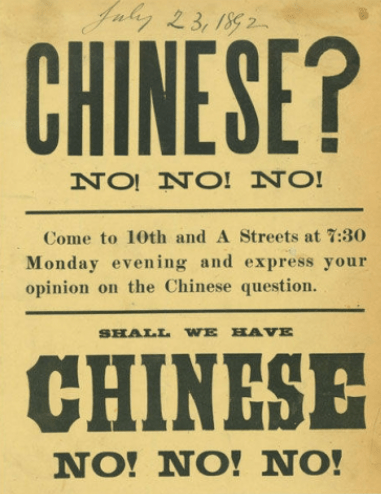
“On August 15 (1893), riots broke out near Fresno: Chinese were driven from the fields and were ‘compelled to make lively runs for Chinatown.’ Chinese labor camps were raided and fired.”
“In Napa Valley, on August 17, a white laborers’ union was formed, and a mass meeting protested the further employment of the Chinese in the prune orchards.”
“In Southern California, at Compton, the Chinese were barricaded in packing sheds where they were forced to sleep for safety, while ‘hoodlums’ raided the fields and drove out the Chinese.”
“On September 3 anti-Chinese raiders swooped down on Redlands’ Chinatown, broke into houses, set afire to several buildings, looted the tills of Chinese merchants, and generally terrorized the Chinese.”
“At Tulare, Visalia, and Fresno, hundreds of white men were busy ‘routing out the Chinese, terrifying them with blows and pistol shots, and driving then to the railroad station and loading them on the train.”
During the years when this anti-Chinese activity was most acute (1893-1894), the United States was in the throes of a major economic depression. During this economic turmoil, Americans sought a scapegoat for their troubles, and found that scapegoat in Chinese workers.
Here in Fullerton, Chinese workers had been a presence since the beginning of the town. Bob Ziebell writes in Fullerton: A Pictorial History, “George Amerige says he installed the town’s first water system ‘employing Chinamen to do the excavation work on the ditches.’”
The Fullerton Tribune newspaper featured a running trend of articles dealing with the topic of Chinese Exclusion, all of which heartily supported it.
On October 7, 1893, Tribune editor Edgar Johnson reported that “Two Chinamen were arrested at Santa Ana Tuesday and taken to Los Angeles to go before Judge Ross on a charge of violating the Geary act by not registering within the time prescribed by law.” On Jan 6 of 1894, Johnson called it a “well-known fact that the Chinese do not make desirable residents in this country.” Edgar Johnson often refers to Chinese people with the racist (but commonly used) term “Chinamen.”
On February 17, 1894, Johnson reported an event that happened in Fullerton. Apparently a mob of 40 locals forced some Chinese workers to leave town. Here’s a screen shot of this article and its opening paragraph:
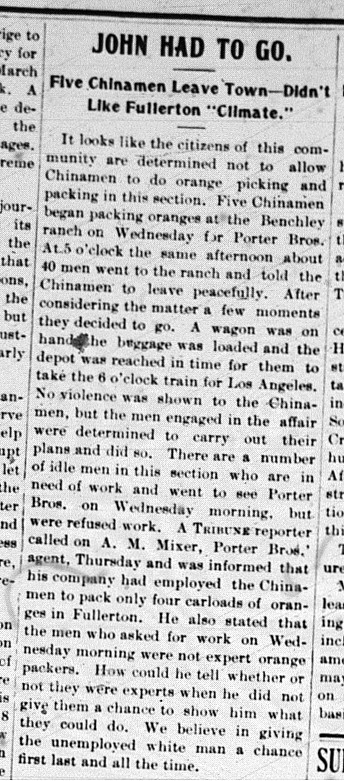
In a CSUF Master’s Thesis entitled “Citrus Culture: The Mentality of the Orange Rancher in Progressive Era North Orange County,” Laura Gray Turner describes conditions for Chinese laborers in the orange groves, which were not ideal. Turner writes, “Six days a week they labored, often sleeping under the trees in the groves…in crude bunkhouses or small shanties…wages were probably about a dollar per day.” Chinese, like other minority groups, were forced to live apart from the dominant/white community. According to Turner, newspaper accounts of the Chinese presence in Orange County “reveal a certain ‘we-they’ mentality and a sense of social superiority exhibited by the white grower elite.”
With increasing anti-Chinese sentiment, Chinese labor was eventually replaced by Japanese labor, which was then replaced by Mexican labor. More on how these immigrant groups were marginalized next time.
-
Early Settlers: Charles E. Ruddock (Town Marshal and OC Sheriff)
The following is from a work-in-progress about the history of Fullerton. You can support my ongoing research and writing on Patreon.
Charles E. Ruddock was born in New York 1864. When he was three years old, his parents moved to Wisconsin and bought a farm. In 1884, Charles married Lila L. Ruddock. They had two children: Ray and Pearl.
In 1896, the Ruddocks came to Fullerton, purchasing 12 acres on W. Wilshire, which they planted with oranges and walnut trees. He built a home on Commonwealth Avenue.
He was a member and stockholder in the Placentia Orange Growers Association, the Fullerton Walnut Growers Association, and the Anaheim Water Company.
He played the violin and cornet and organized the Fullerton Military Band and was its president.
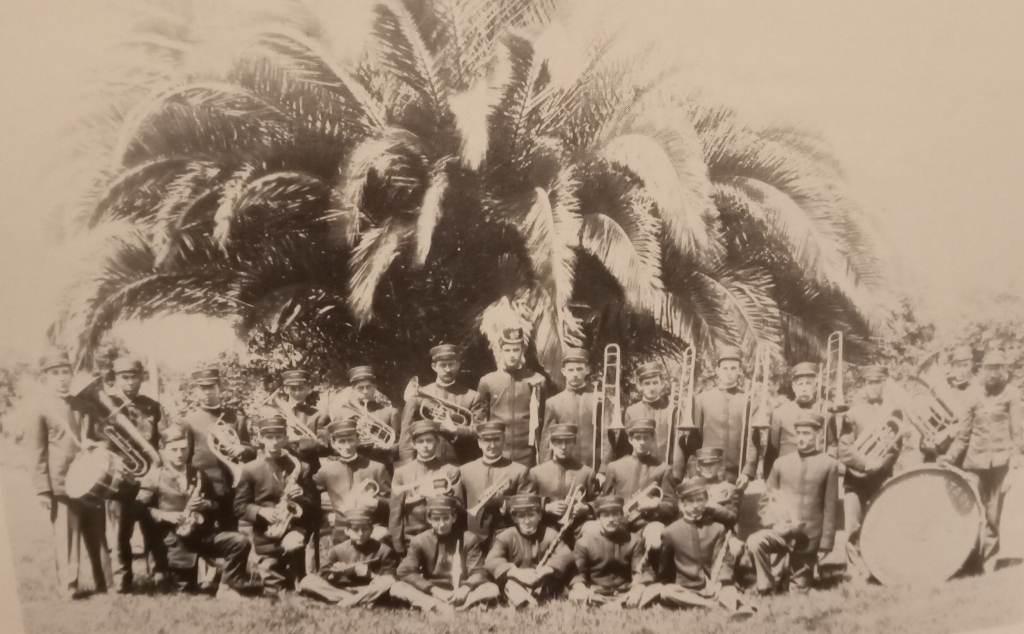
1908 photo of the Fullerton Military Band. Charles Ruddock is fifth from the left in the middle row, holding his cornet. Photo courtesy of the Fullerton Public Library Local History Room. In 1904, he became Fullerton’s second marshal (police chief).
Prior to incorporation, Fullerton’s top lawman was the town constable, the first of whom was A.A. Pendergrast. Following incorporation in 1904, the title became marshal, an elected position. The first marshal elected was W.A. Barnes.
Unfortunately, Barnes overextended himself, as he also served as the street superintendent. He resigned the position of marshal the same year he was elected. Charles E. Ruddock (who had lost the election) was appointed to succeed Barnes in July 1904.
Ruddock was re-elected in 1906 and 1908.

Portrait of Charles E. Ruddock from Samuel Armor’s History of Orange County. In those years, a key social and political issue was prohibition. In 1906, Fullerton voted to ban liquor and saloon licenses–an ordinance that remained in effect until the end of Prohibition.
An article entitled “The Story of the Fullerton Police Department,” on the City of Fullerton web site states: “As can be imagined, being marshal of a ‘dry’ town provided an interesting set of challenges, not the least of which was trying to track down the sources of bootleg liquor that seemed to crop up around town. The problem became of such a concern to the city fathers that they sought the assistance of a Los Angeles detective agency – Sam Browne’s Secret Service – to try to ferret out the source of illegal liquor sales. Sadly, though, Browne’s undercover operatives failed to find any illegal sales, blaming the problem on neighboring Anaheim.”
In 1910, Ruddock was elected sheriff of Orange County, defeating Theo Lacy, the sheriff for whom the Orange County Jail is named, serving a four-year term, from 1911 to 1915.
Ruddock’s term as Sheriff included a sensational manhunt for someone dubbed the “Tomato Springs Bandit,” a drifter who attacked a young Irvine girl, and fled into the hills.
Sheriff Ruddock assembled a large posse to find the assailant. They finally caught up with him at a place called Tomato Springs. In the shootout that followed, Undersheriff Robert Squires was killed along with the Bandit.
While serving as Sheriff, Ruddock lived in Santa Ana. After his term, he moved back to Fullerton, where he died in 1917.
During World War I, Lila Ruddock was very active in Red Cross work. After her husband’s death, she lived in the family bungalow at 211 West Wilshire. She eventually subdivided the remainder of the twelve acres the family owned on West Wilshire for housing.
-
Early Settlers: Edward Atherton (Ostrich Farmer)
The following is from a work-in-progress about the history of Fullerton. You can support my ongoing research and writing on Patreon.
Edward Atherton, farmer and owner of the Fullerton Ostrich Farm in the late 1800s and early 1900s, was born in Capetown, South Africa, in 1860.
In 1886 Atherton came to California to sell ostrich plumes, initially partnering with Col. R.J. (“Diamond Bob”) Northam, an important early settler and a manager of the Stearns Rancho Company.
The ostriches were moved to a ranch owned by Mr. Atherton, who eventually bought out Northam’s share of the company.
The Fullerton Ostrich Farm was located north of Dorothy Lane and east of Acacia Avenue on the property now occupied by Acacia School and St. Juliana’s Catholic Church.
Atherton was cashing in on the ladies’ fashion craze of wearing hats with ostrich plumes.
Atherton began with 47 birds, but these quickly multiplied to between 100 and 200 by 1899, due in part to an incubator that Atherton invented for the large eggs. That year, Orange Coast Magazine dubbed Fullerton “the ostrich capital of the continent.”

Edward Atherton’s ostrich farm. Photo courtesy of the Fullerton Public Library Local History Room. According to Ziebell, the farm was a big tourist attraction, the Knott’s Berry Farm of its day: “Tourists just had to visit the gangly, often ornery, big birds (mature ostriches stood six to eight feet tall and weighed up to four hundred pounds) with the big beautiful plumes so desired by the fashion conscious ladies of the day; even the locals liked to visit.”
Atherton’s ostrich farm was the inspiration for the title of Dora Mae Sim’s book Ostrich Eggs for Breakfast (A History of Fullerton for Boys and Girls). “What the boys liked to do best of all was to feed oranges to the big birds. The ostriches liked oranges to eat. They never chewed them. They swallowed the oranges whole. The boys liked to watch the round oranges go GULP, GULP down the long necks of the ostriches!” Sim writes.
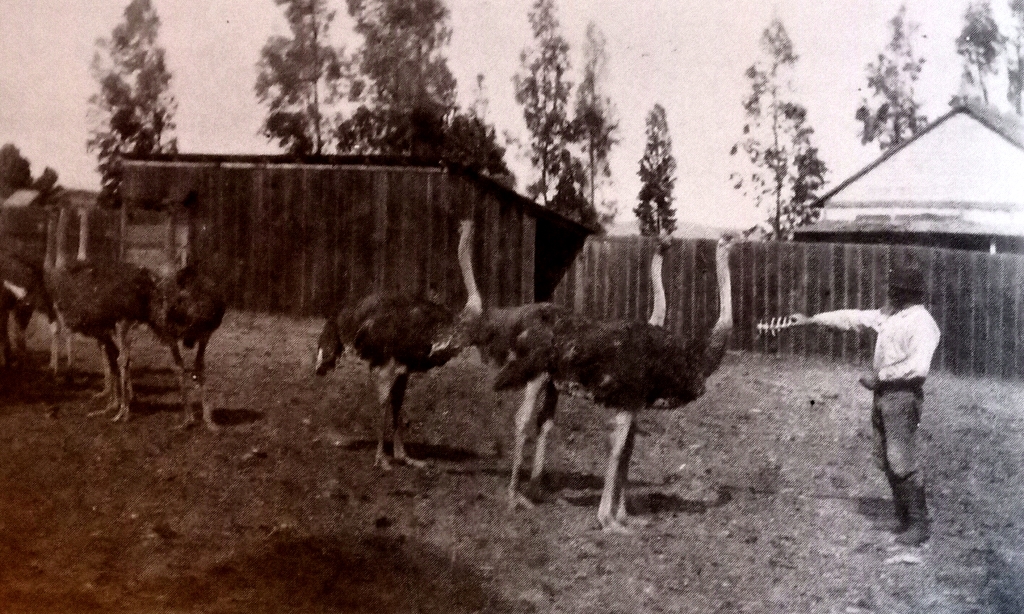
Feeding the ostriches on Atherton’s farm. Photo courtesy of the Fullerton Public Library Local History Room. In an article in the Fullerton Daily News-Tribune, Doris Lee wrote that in the heyday of Atherton’s farm, “In the springtime, a faraway bellowing coming from the foothills of northeast Fullerton would float down into town and children would make their way up through the fields right outside of town…and go visit the source of that sound. It was mating season on Edward Atherton’s ostrich farm, and the sound of some 200 huge birds singing love songs broke the pastoral stillness and echoed down to the city,”
In 1897, Atherton married Miss Carolina J. Sellinger, daughter of John Sellinger, an early local grape grower of Anaheim. They had three children: Malcolm, Miranda, and Dalton.
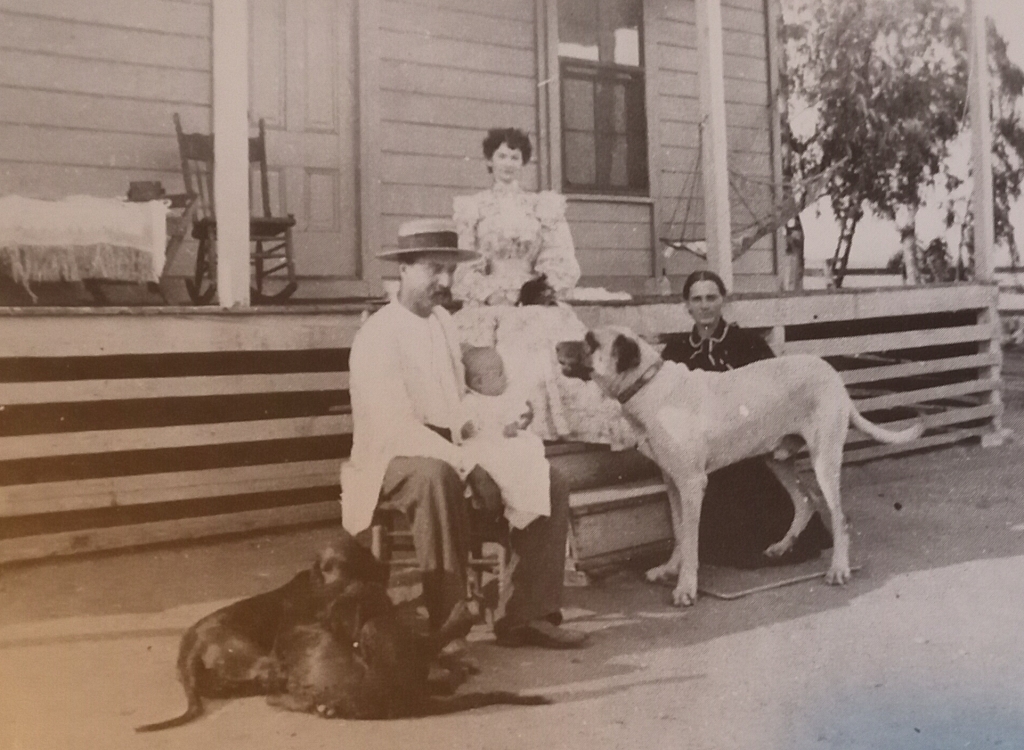
The Edward Atherton home in east Fullerton, circa 1898. Edward holds his son Malcolm. A Mrs. Johnson sits in the middle, and Mrs. Carolina Atherton sits at right. Photo courtesy of the Fullerton Public Library Local History Room. Unfortunately, as with all fashion fads, ostrich feathers eventually went out of style, and Atherton adapted by reducing his birds and focusing on the more reliable crops of oranges and walnuts.
However, Atherton kept about a dozen ostriches on his farm until at least the 1920s, as a tourist attraction.
A hollow ostrich egg from Atherton’s farm is (supposedly) housed at the Fullerton Public Library.
-
Early Settlers: The Benchley Family
The following is from a work-in-progress about the history of Fullerton. You can support my ongoing research and writing on Patreon.
Edward Kellogg (or E.K.) Benchley was born 1854 in San Francisco, California. He married Emma in 1877 in Ventura. They had two sons (William and Frank) and one daughter (Helen). Helen was born in 1878, William was born in 1880, and Frank was born in 1884.
The family moved to Fullerton in 1893 and established a farm and the Benchley Fruit Company. E.K. was elected to the first Fullerton City Council in 1904 and served as the town’s second mayor. E.K. also established the Fullerton Improvement Company, which built a number of buildings in town.
William bought out his father’s interests in the company in 1911.
Frank K. Benchley became one of Fullerton’s most prominent architects, designing many significant structures in Fullerton, including the Muckenthaler Mansion, the California Hotel, the Farmers and Merchants Bank, the second Masonic Temple, his father’s Craftsman style home on Harbor Boulevard, and a well-preserved bungalow court on Pomona Avenue.
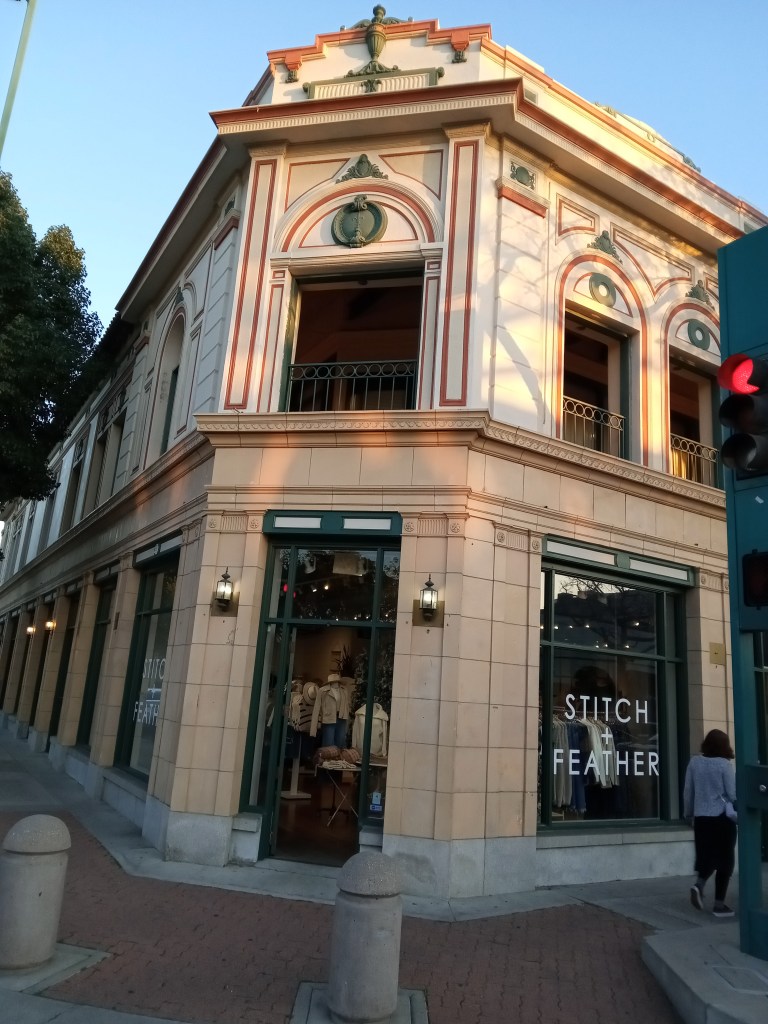
The Landmark Plaza, the first location of the Farmers and Merchants Bank was built in 1904. In 1922, local architect Frank K. Benchley added the Belles Artes embellishments. 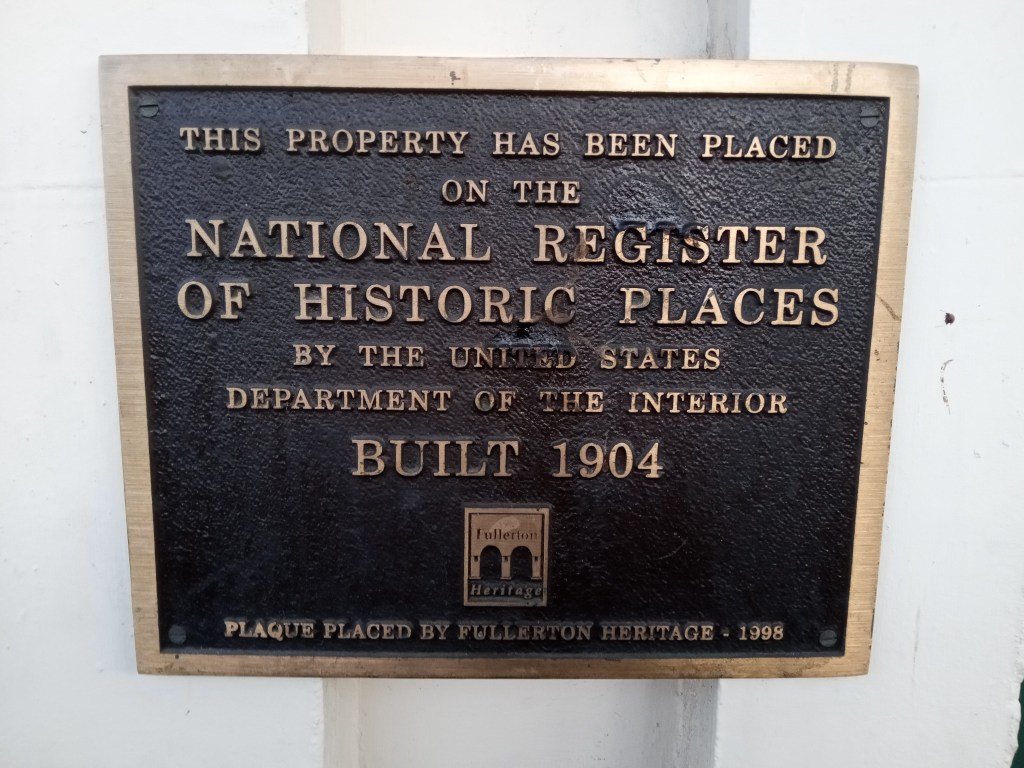
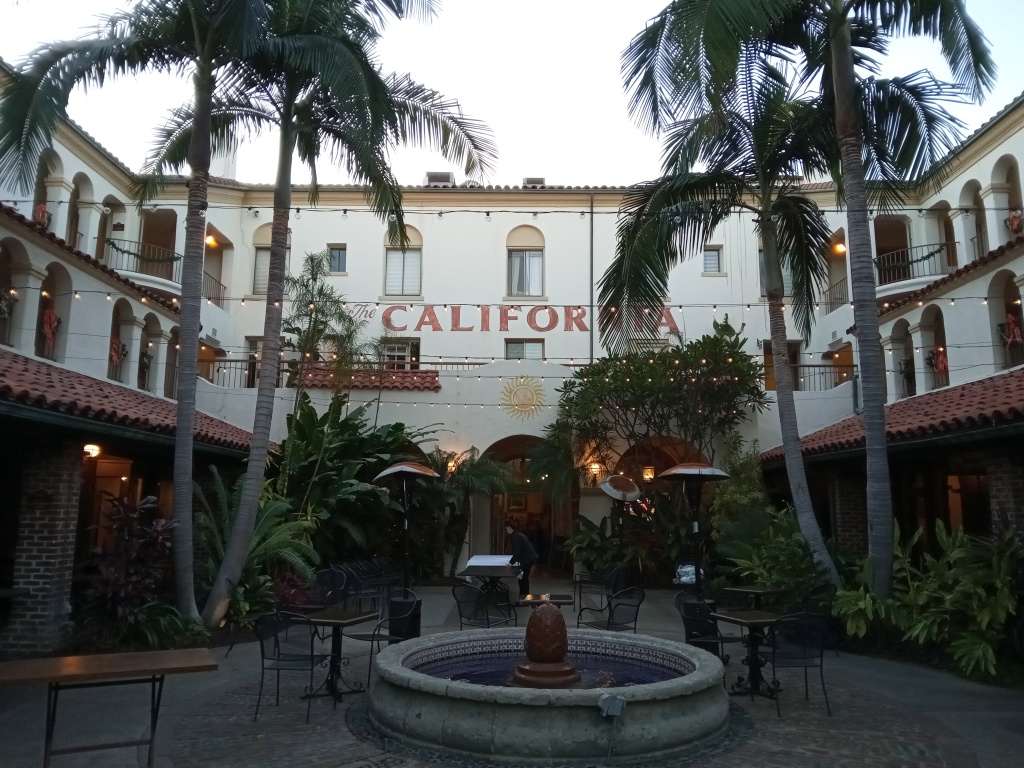
The California Hotel (Villa Del Sol) was designed by Frank K. Benchley in 1922. 

The second Masonic Temple (Springfield Banquet Center) was designed by Frank K. Benchley in 1920; 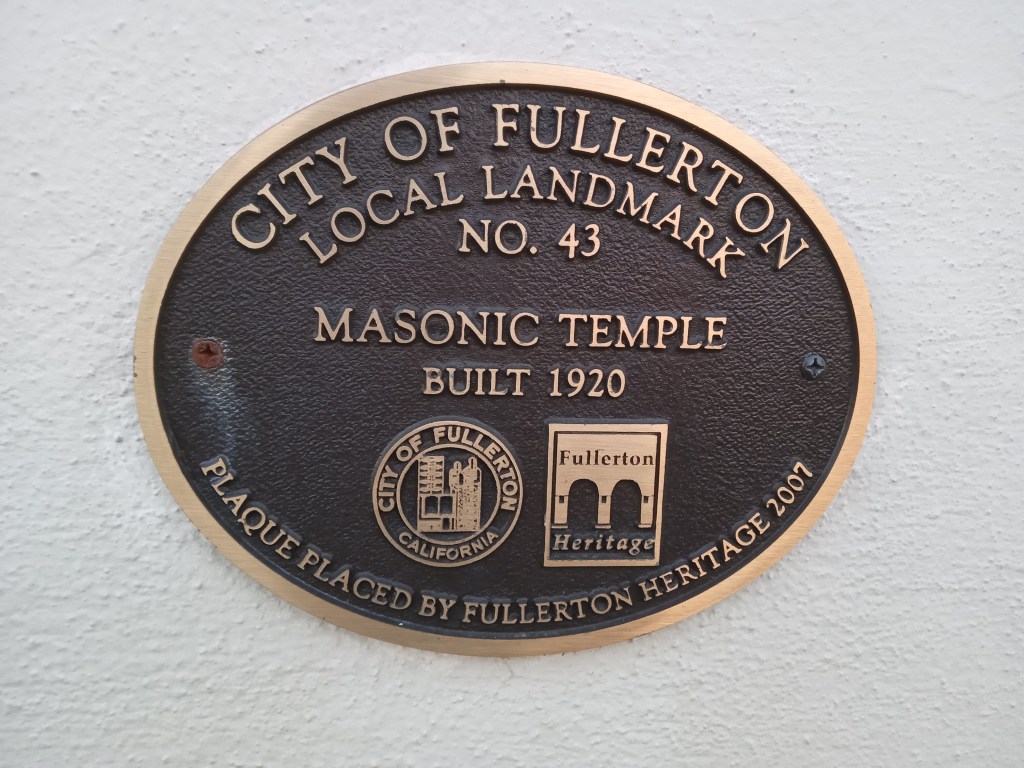
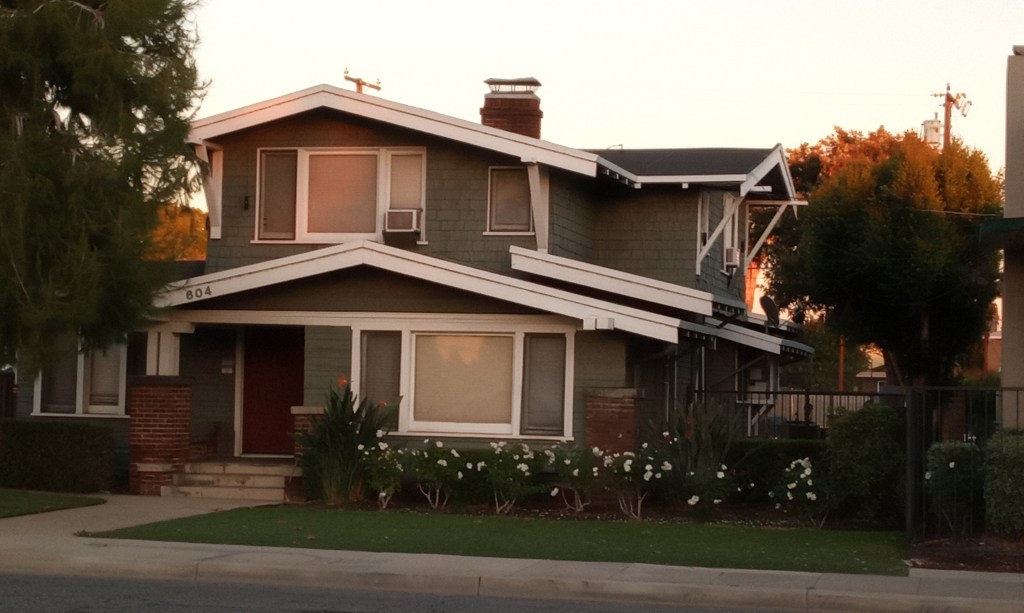
The E.K. Benchley house at 604 Harbor Blvd. 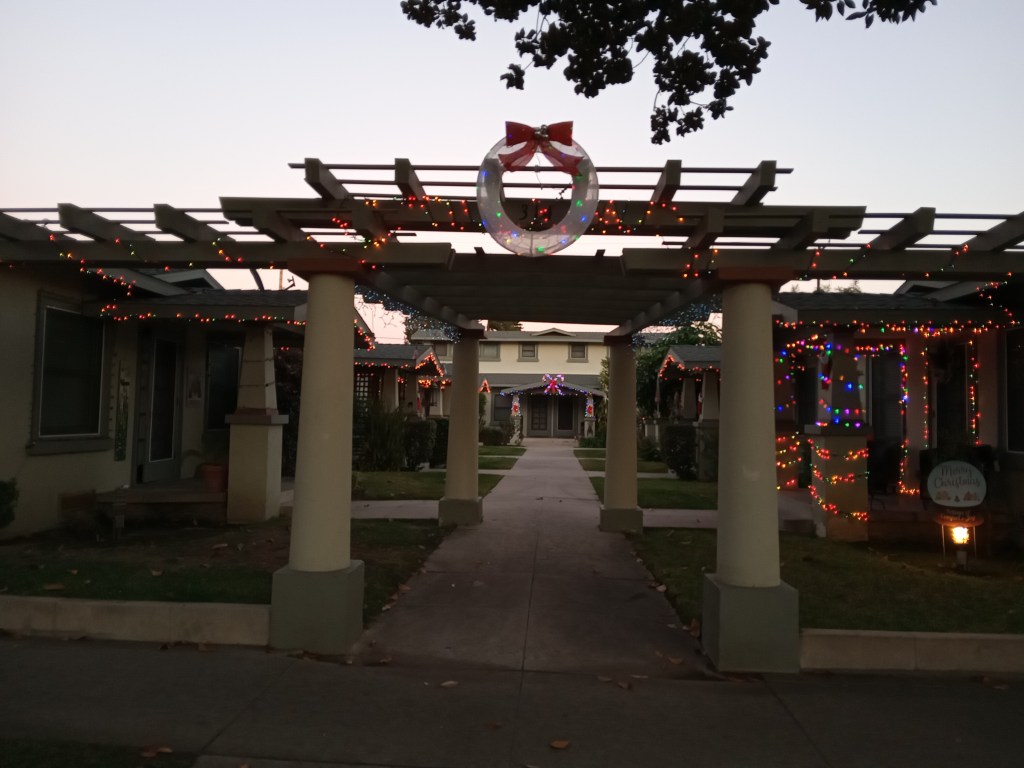
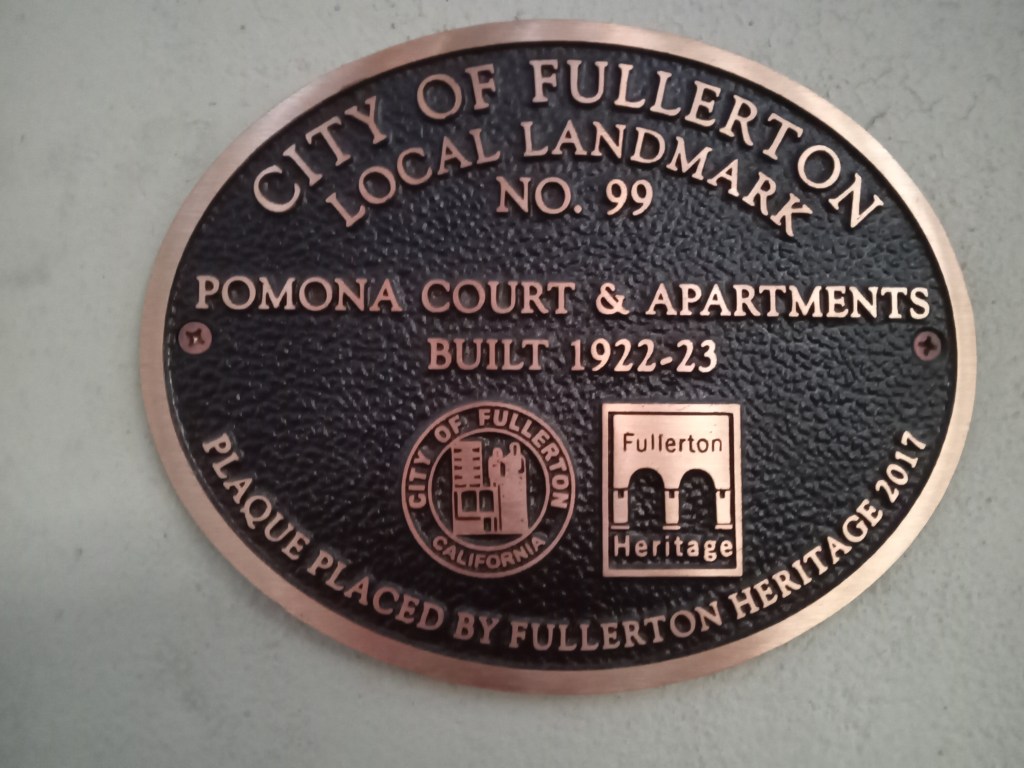
Frank K. Benchley designed the Pomona Court apartments in 1922. William married Belle Jennings in 1920, and they had one son. William enlisted in 1918, during World War I, and spent some time in the officers’ training camp at Camp Gordon in Georgia.
Frank married Ruby Pearl Wagy on 3 April 1906, and had one daughter. He died in 1962, in Los Angeles.
E.K. died in 1924 and is buried at Loma Vista Memorial Park in Fullerton.
William was a member of the Board of Trade of Fullerton, the Masons, the Elks, the Hacienda Country Club, the Fullerton Club and the American Legion.
William died on 5 January 1966, in San Diego at the age of 85.
-
Early Settlers: The Gardiner Family
The following is from a work-in-progress about the history of Fullerton. You can support my ongoing research and writing on Patreon.
Alexander Gardiner was a native of Scotland who immigrated to Tennessee at age 18. He then migrated to California in 1868 with his wife Susan, eventually settling on a ranch in what was then known as the Orangethorpe school district. They had seven children including Jennie (who married Otto des Granges of another pioneer Fullerton family), John R. (later elected to the very first Fullerton City Council) and James (the first deputy constable/police officer) in town.

The Gardiner family pictured at their home on West Orangethorpe Ave. Photo courtesy of the Fullerton Public Library Local History Room Alexander Gardiner helped to establish the Fullerton Walnut Growers Association.
John R. Gardiner was born in 1873. He went to school in the Orangethorpe school district, and worked on his father’s ranch until he was 18, when he moved to Duarte to learn the trade of blacksmithing.
After learning the trade he moved back to Fullerton in 1896, and started a business; however he was not initially successful, and went to work in a variety of jobs (working in oil fields, selling real estate in Los Angeles).
In 1900, tragedy struck the Gardiner family. A flood took the life of James.
John Gardiner, in a 1955 interview, said that his brother went to the rescue of two young girls during the flood. James “immediately swam his horse across the creek to rescue them. By the time he got them to safety he was exhausted and dropped off to sleep without changing to dry clothes. He took sick with pneumonia and was dead four days later.”
John married his wife Louise in 1902 in Fullerton. They had three children: Carroll D., Kenneth R. and Donald William.

Portrait of John R. Gardiner. Photo courtesy of the Fullerton Public Library Local History Room. In 1907 he returned to Fullerton to work as a blacksmith. In 1910 he purchased his employer’s business, which became quite successful.
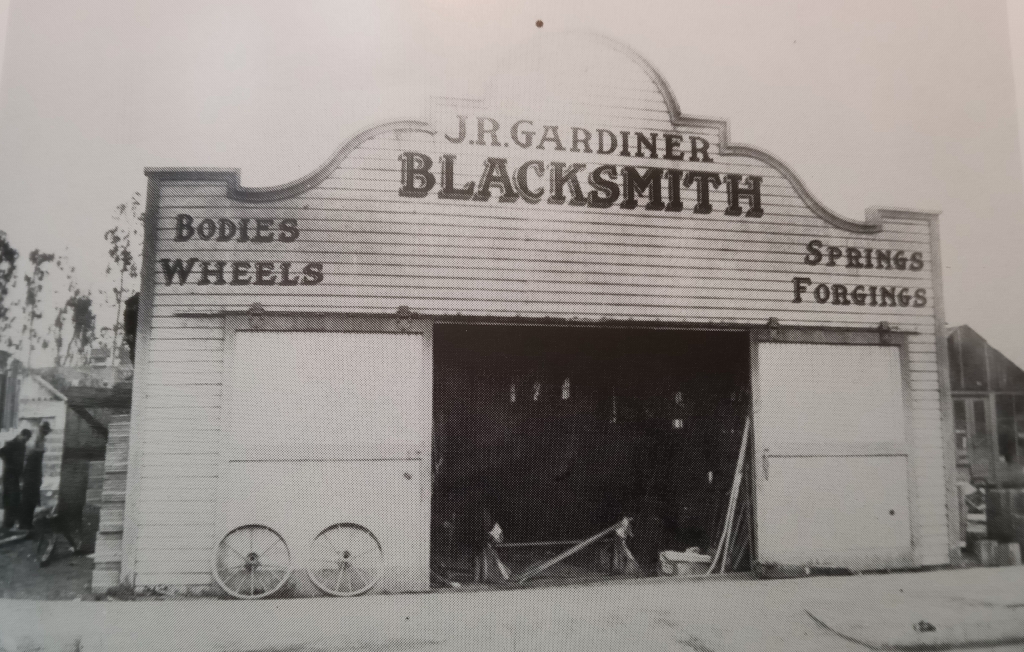
John R. Gardiner’s blacksmith shop on the 100 block of West Commonwealth Ave. Photo Courtesy of the Fullerton Public Library Local History Room. Gardiner eventually expanded his business. He built the new building up around the old wooden frame structure.

John R. Gardiner’s expanded shop on the 100 block of West Commonwealth Ave. Photo Courtesy of the Fullerton Public Library Local History Room. Alexander Gardiner died in 1916, at the age of seventy-eight, and Susan died in 1920.
John served as one of the first trustees (City council members) of Fullerton after the incorporation of the city and he was reelected, serving for three terms. He served eight years as city treasurer.
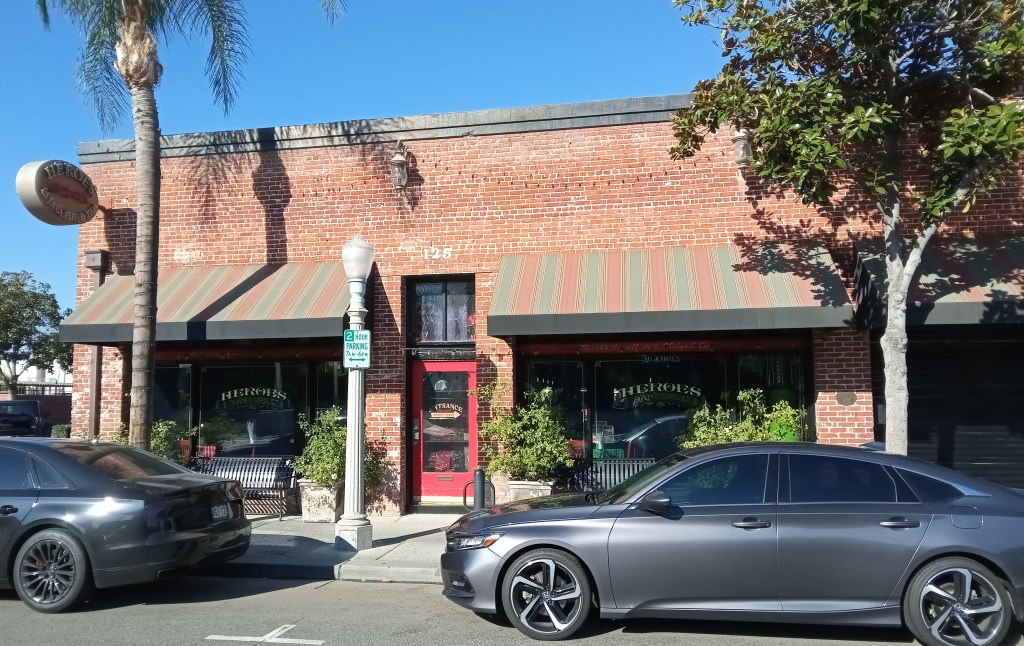
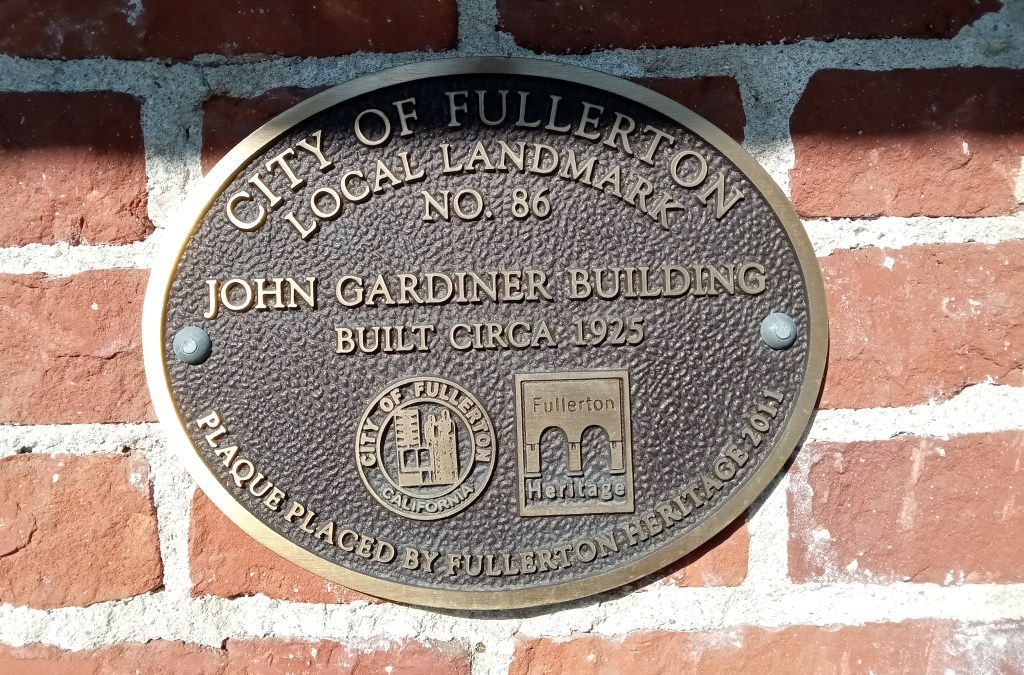
The building which is now occupied by Heroes restaurant/bar in Downtown Fullerton was built by John R. Gardiner. It is listed as a local landmark.
-
Subscribe
Subscribed
Have a WordPress.com account? Log in now.

