-
Come to my Free Local History Lecture!
This Friday, January 6, I’ll be giving a free lecture on the early history of Fullerton High School at ModelMania in Downtown Fullerton as part of their monthly Art Walk event! This will be an interactive lecture with a PowerPoint presentation and brief discussion afterward.
The event will take place from 6 to 9pm. I’ll probably give the talk around 7 or 8.
There will also be an exhibit featuring work by Aimee Aul and other local artists, live music by Brandon Floerke (and guests?), and of course lots of interesting models to check out. Hope to see you there!

-
FUHS Pleiades Yearbooks: 1921-1930
The following is from a work-in-progress about the history of Fullerton. You can support my ongoing research and writing on Patreon.
Lately I’ve been writing a series of posts on the history of Fullerton Union High School. As part of this research, I’ve been looking through the digital archives of the annual FUHS yearbook, called Pleiades, which are available on the Fullerton Public Library web site. Although the high school began in 1893, the first yearbook in the Library’s digital archives is from 1909, and the archives are incomplete.
Looking through these old yearbooks is a window into the styles and attitudes of the past. I previously posted snapshots from the Pleiades from the years 1909-1920.
Here I continue with snapshots from 1921-1930.
1921

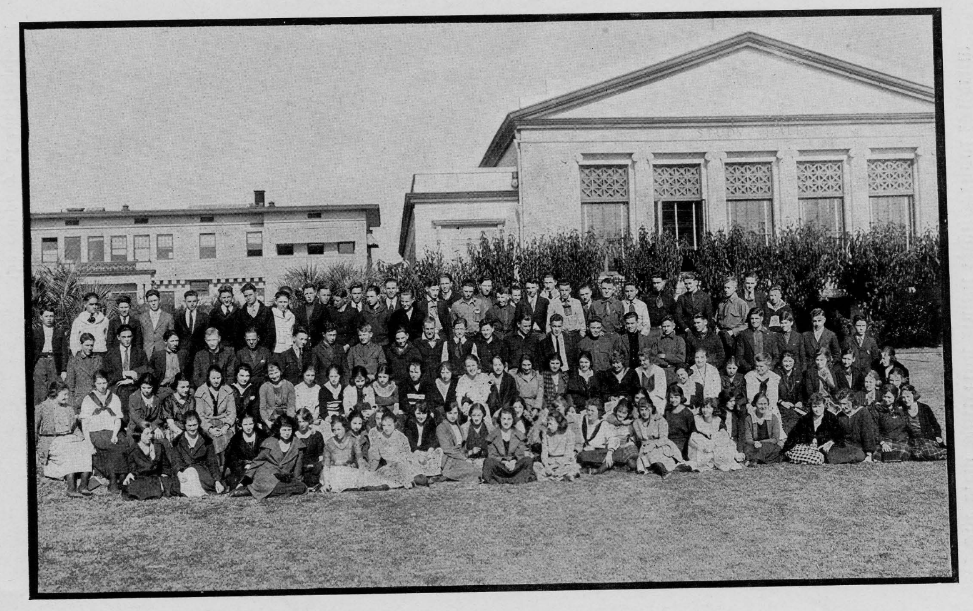
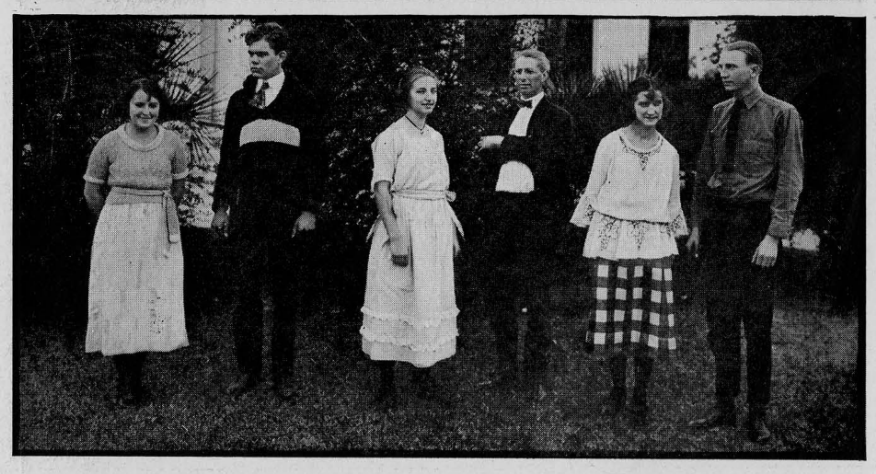
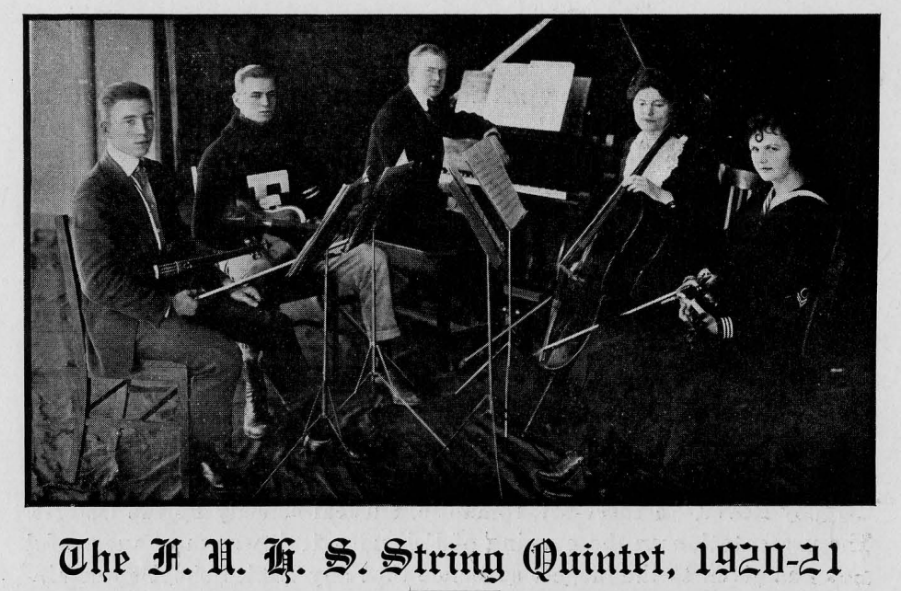
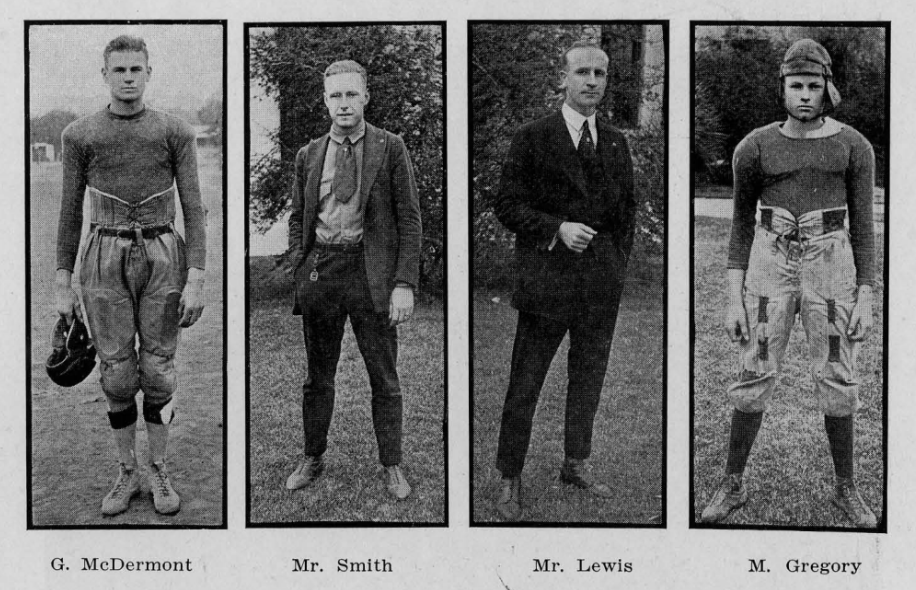
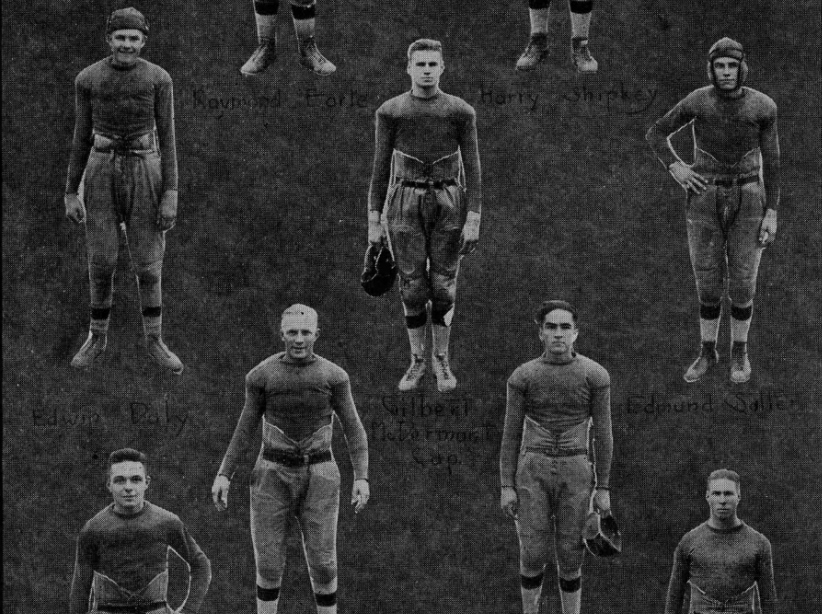

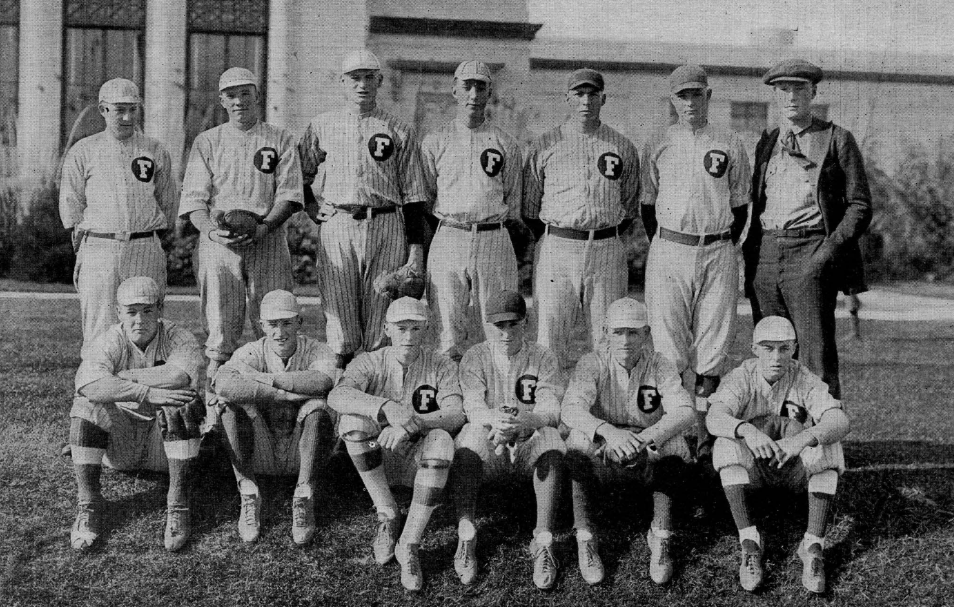

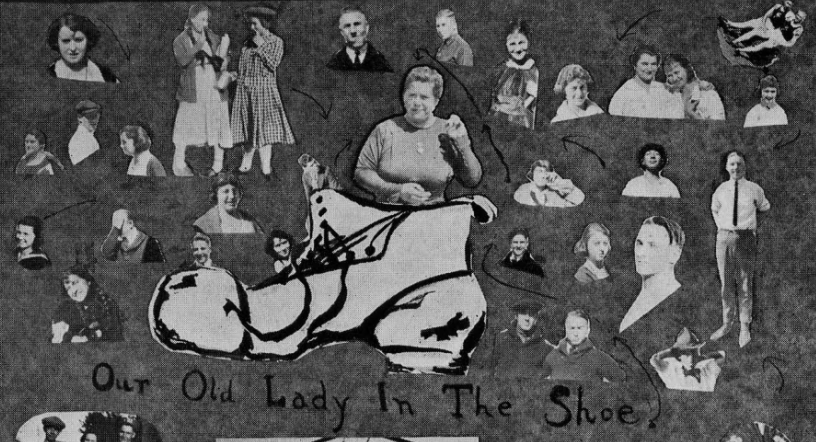
1922


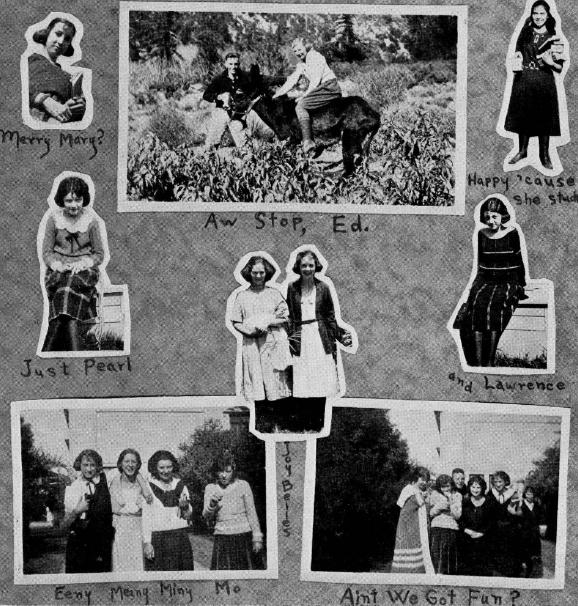
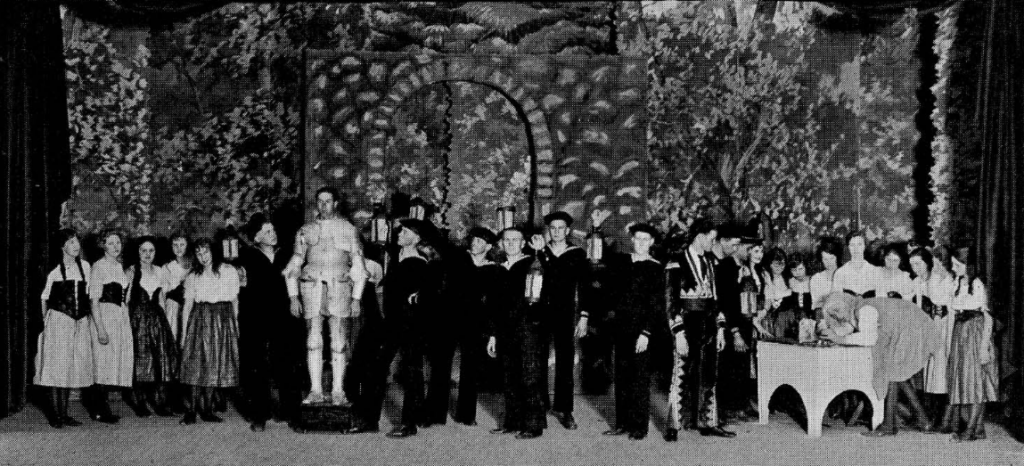
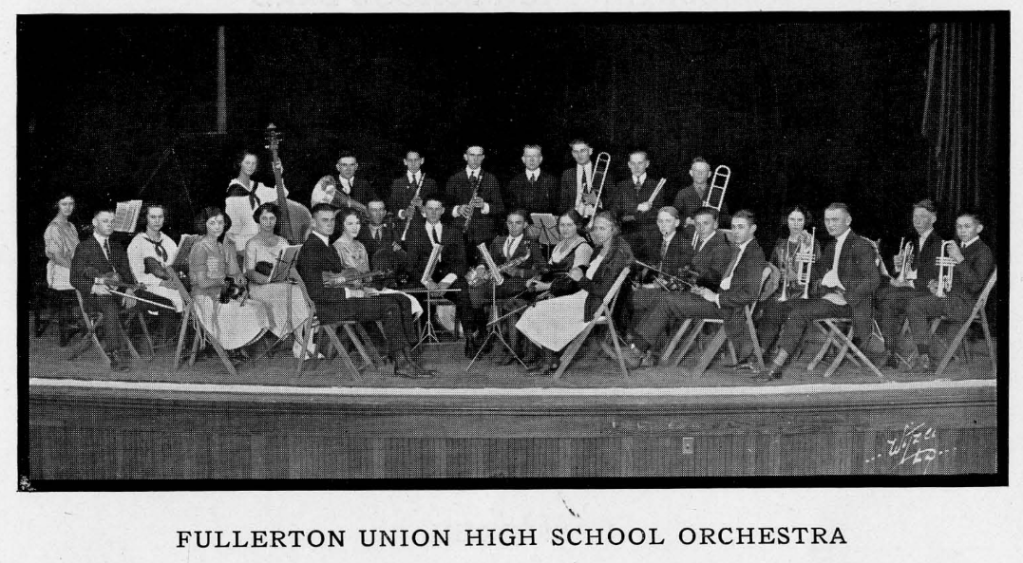
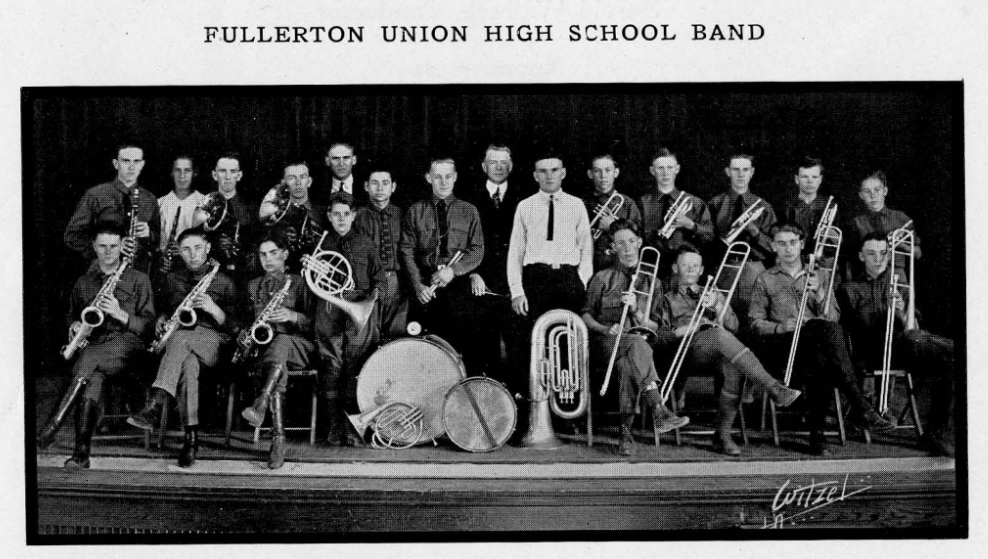


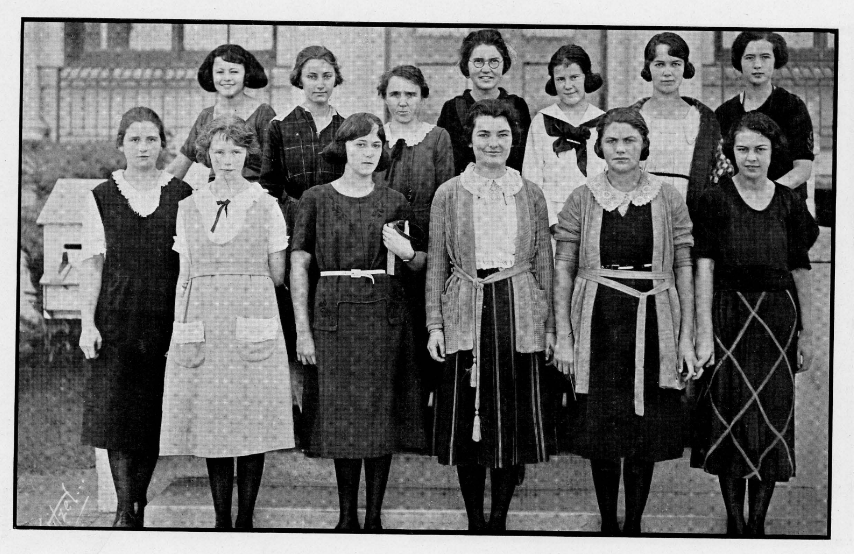

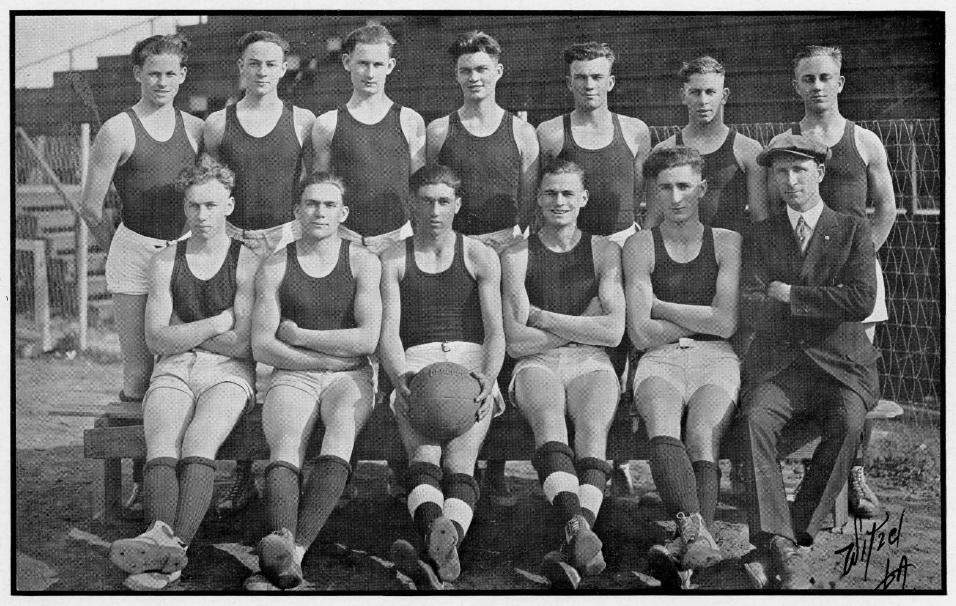
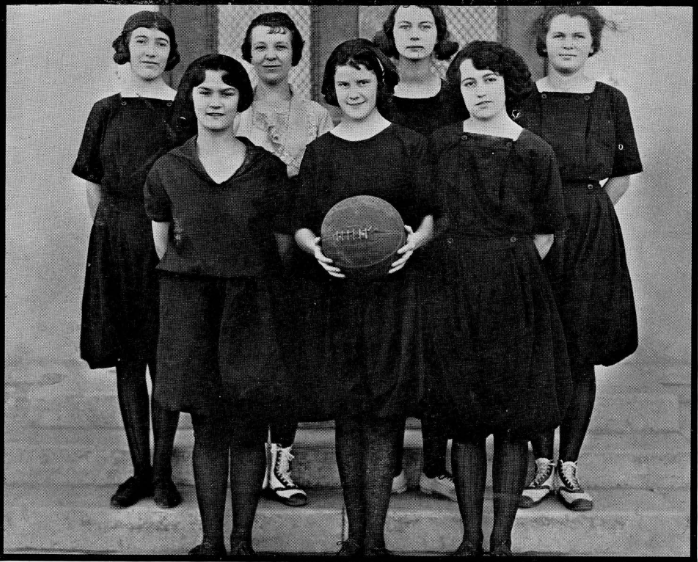
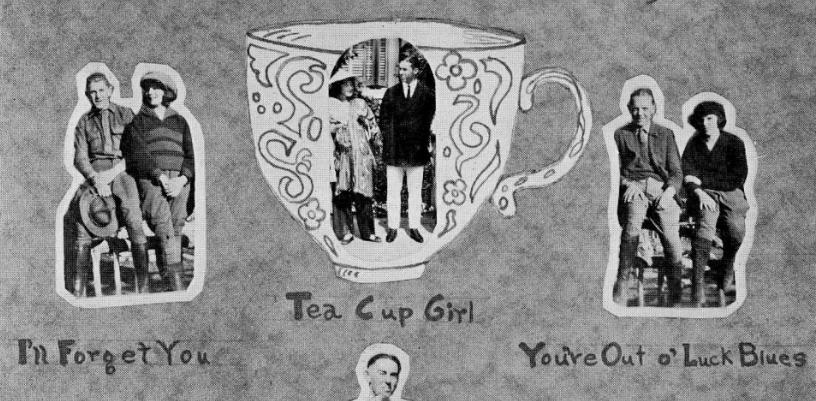
1923
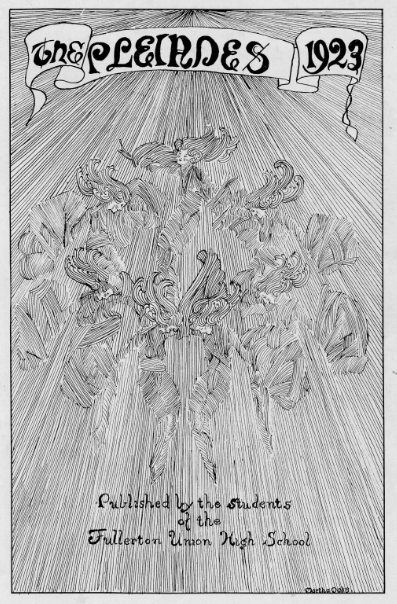


FUHS Board of Trustees, 1923. 
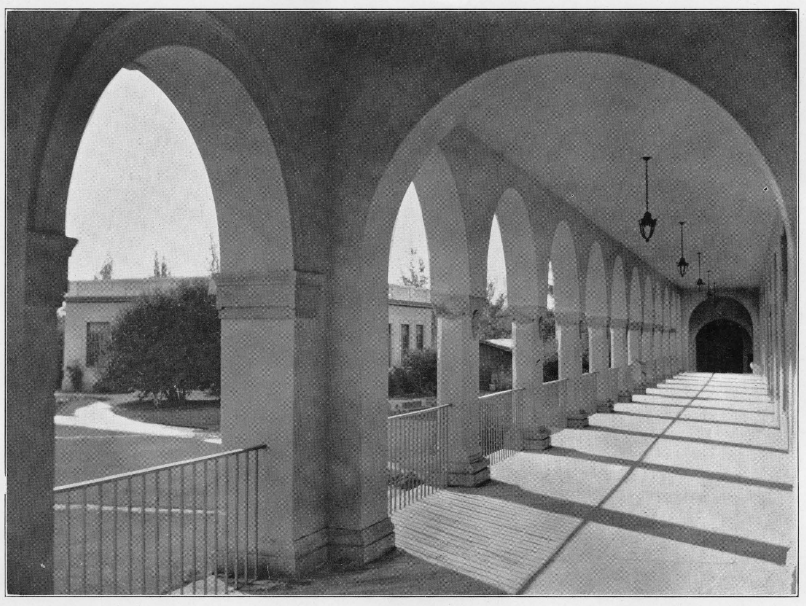
This lovely FUHS building was torn down in the late 1960s. 

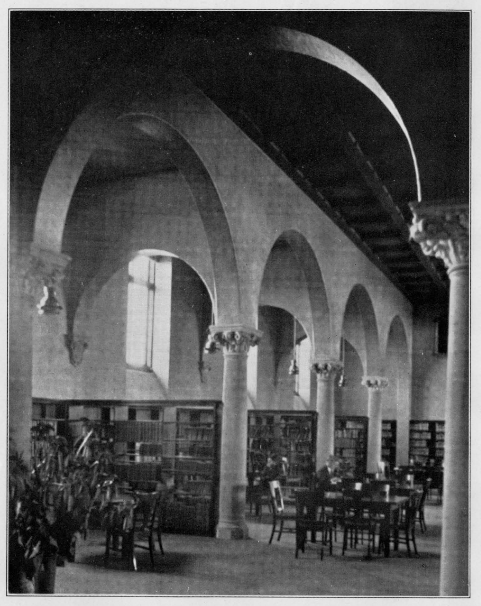
FUHS Library. 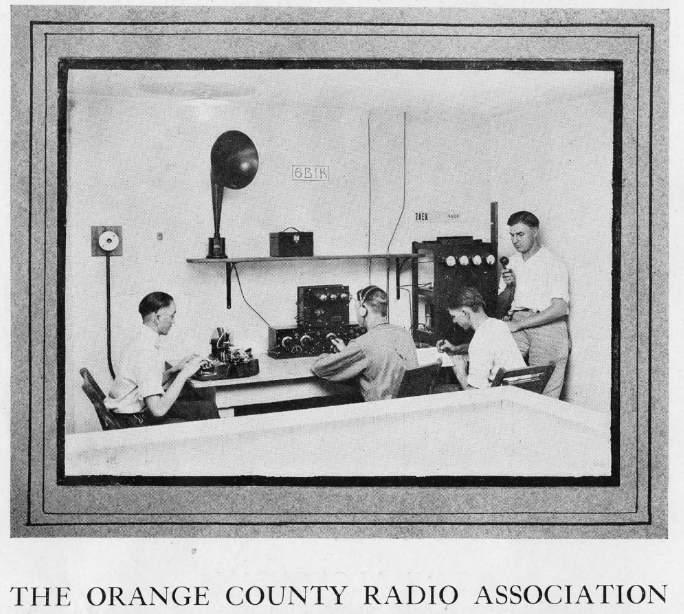

Classes and programs sometimes reinforced culture-bound gender roles.


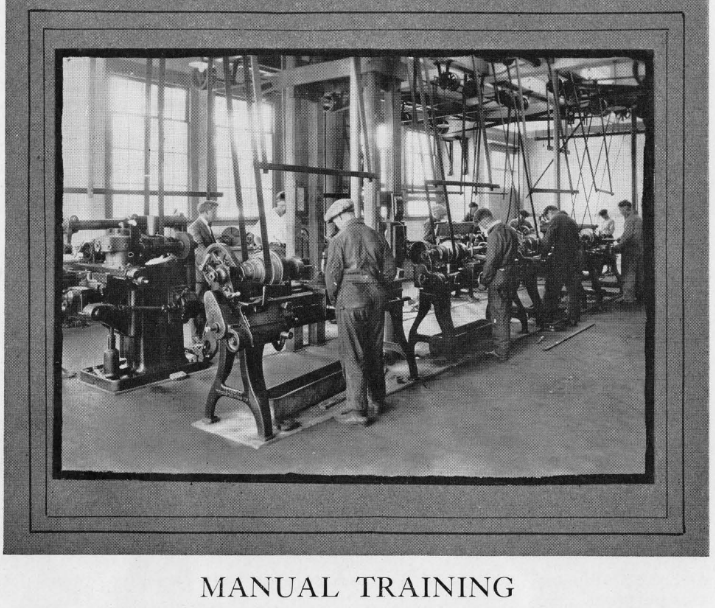
But not always.

This being the 1920s, racism was a fairly pervasive aspect of American society, as shown by this photo of a white student in blackface, reinforcing the harmful stereotype of a “mammy.”

And this photo of a student dressed as “The Jew” on an otherwise seemingly ordinary collage page.

Student Betty Frazee wrote the school song, to be sung to the tune of “Aloha” (however that goes):
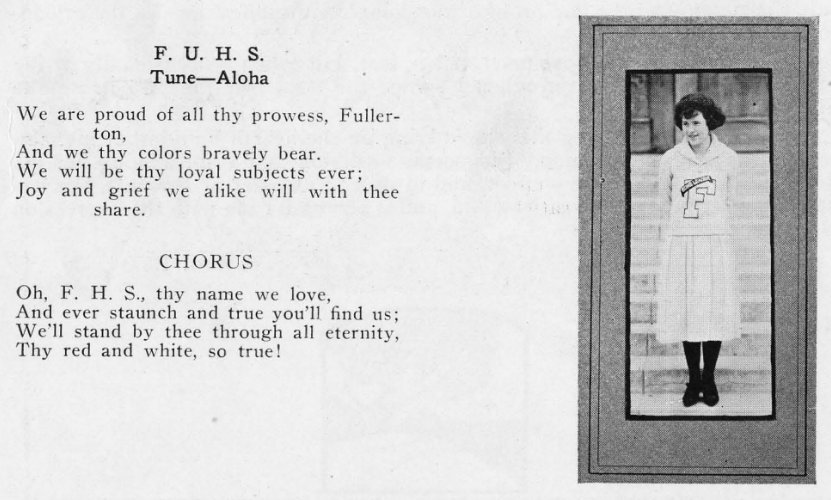
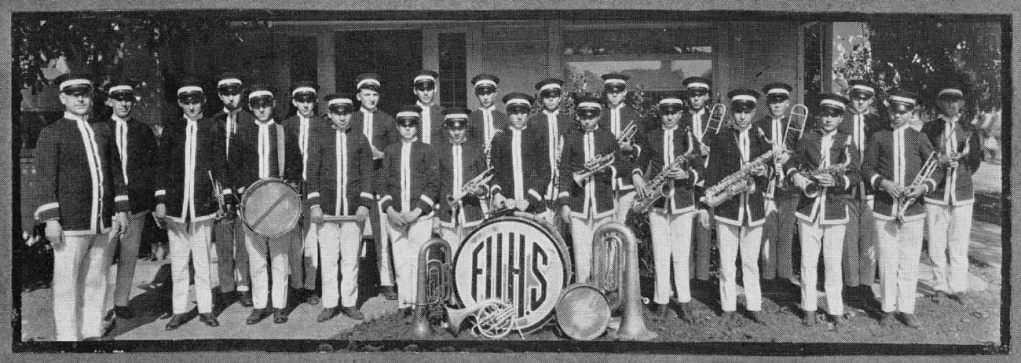

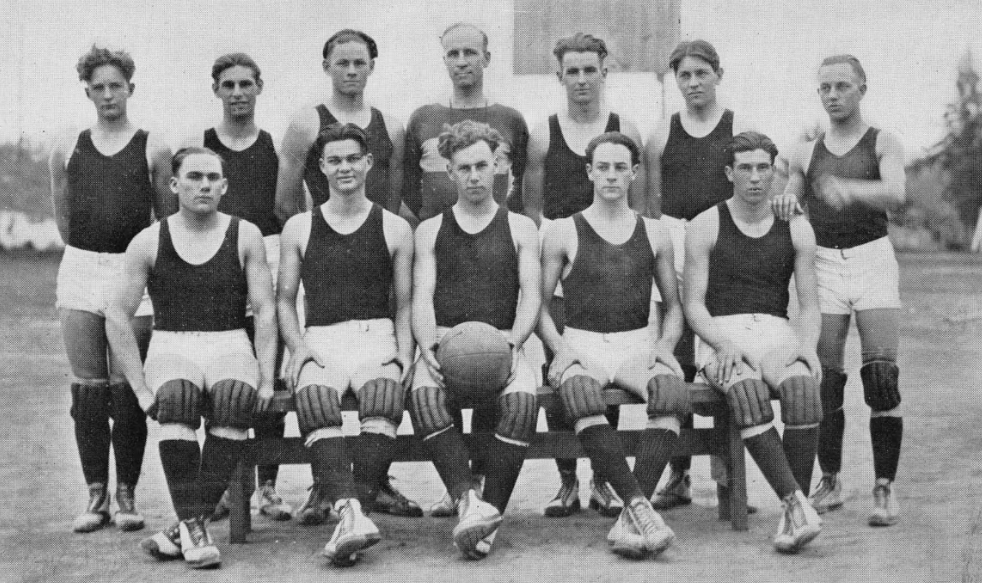


1924
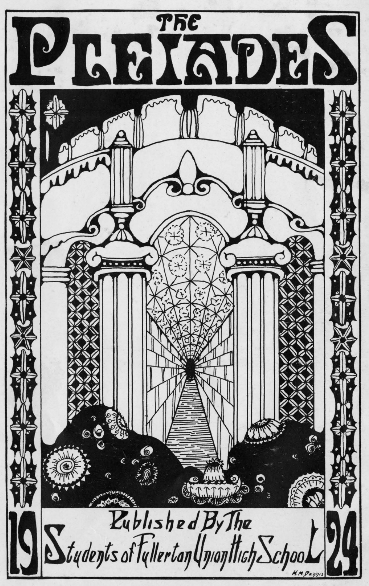
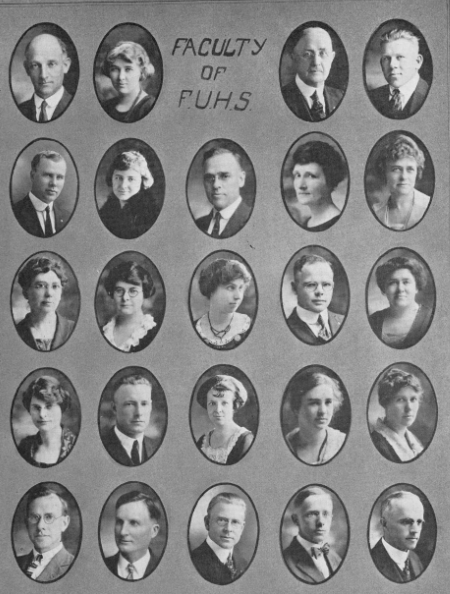
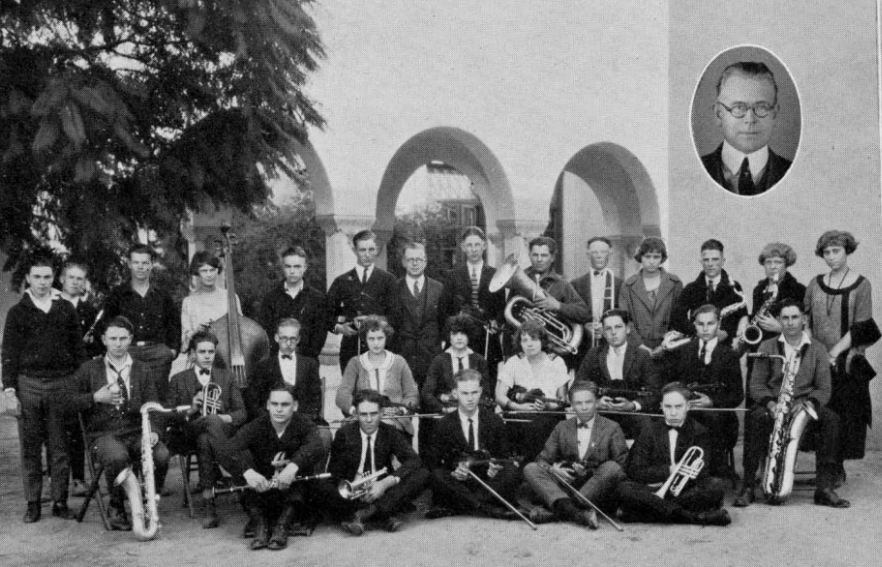
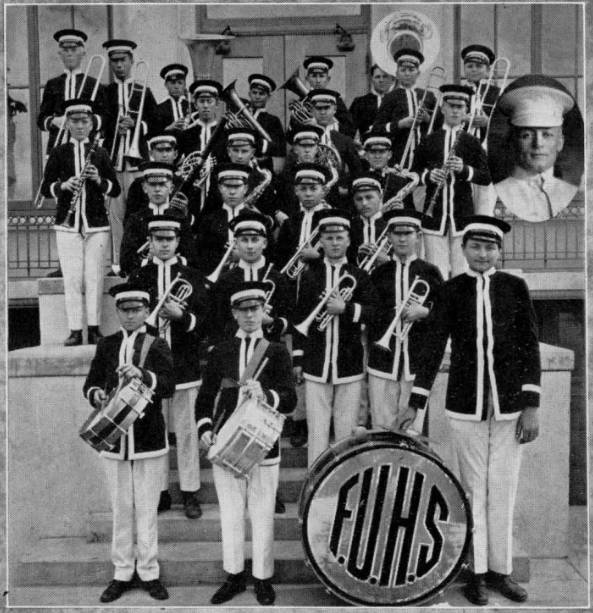
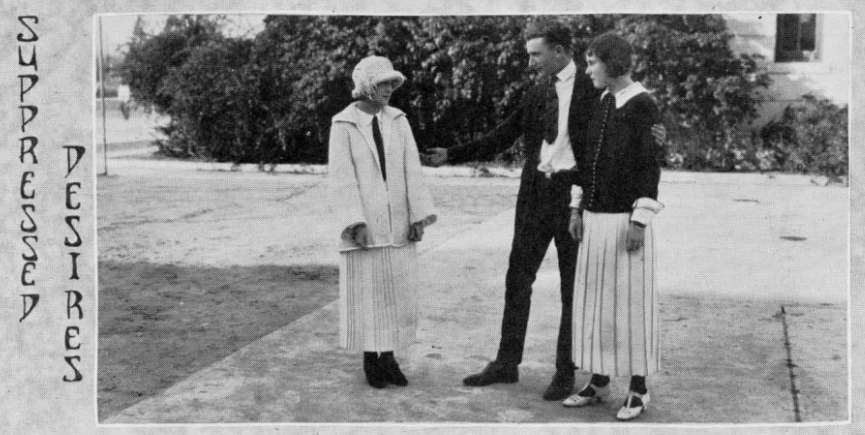
Prior to 1924, Fullerton Union High School did not have the Indian as a mascot. There was no mascot. The 1924 yearbook contains the first reference to FUHS students and faculty as Indians, with a bit of cultural appropriation giving white teachers Indian names, as shown below.

This is, I think, meant to be funny. At this time, conditions for actual living Native Americans were not good. Many of those who had survived the 19th century genocide were attending Indian Boarding Schools, like the nearby Sherman Indian School in Riverside, where much of their culture was being intentionally eradicated. Anyway, here are more yearbook photos…


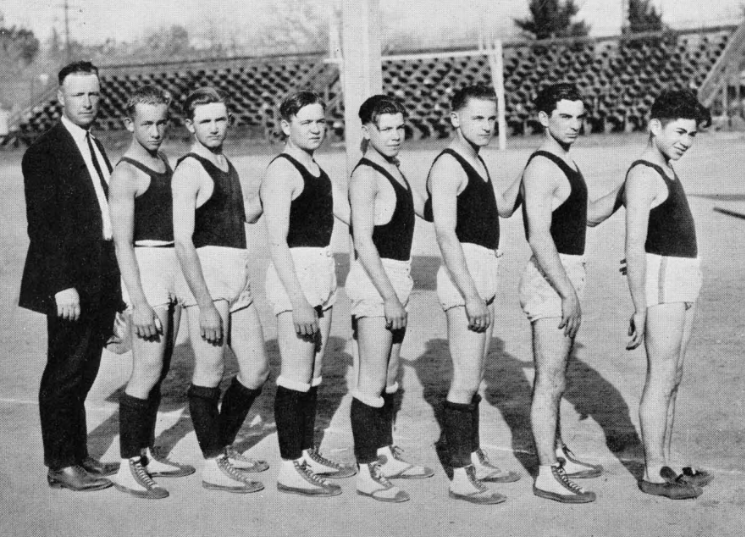
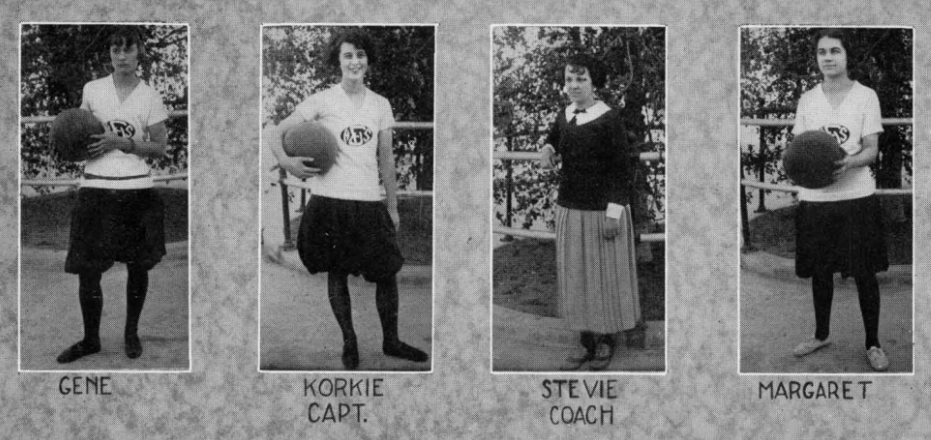
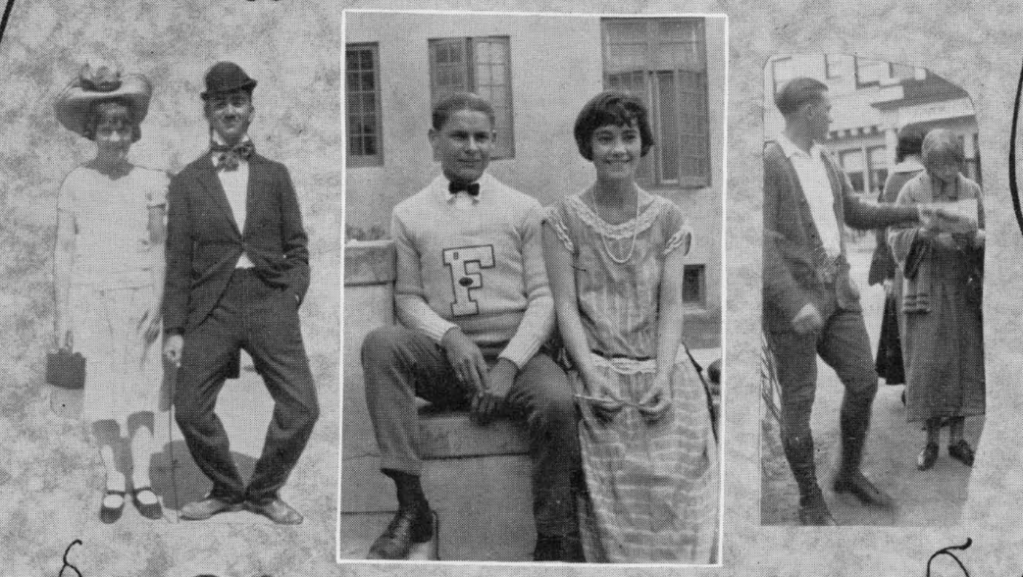
1925
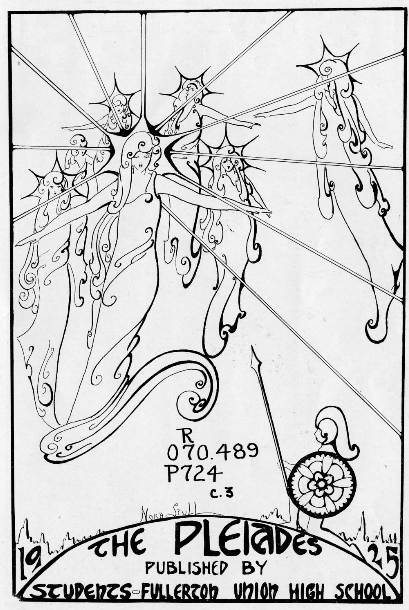
In 1925, the Brea Olinda high school district was formed, so some students from Brea would soon stop attending FUHS.
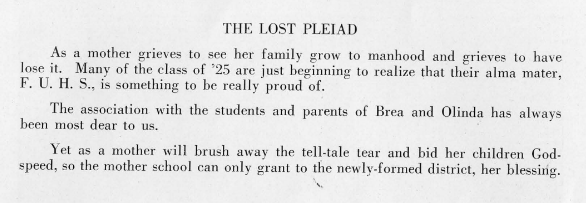

1925 FUHSD trustees. 


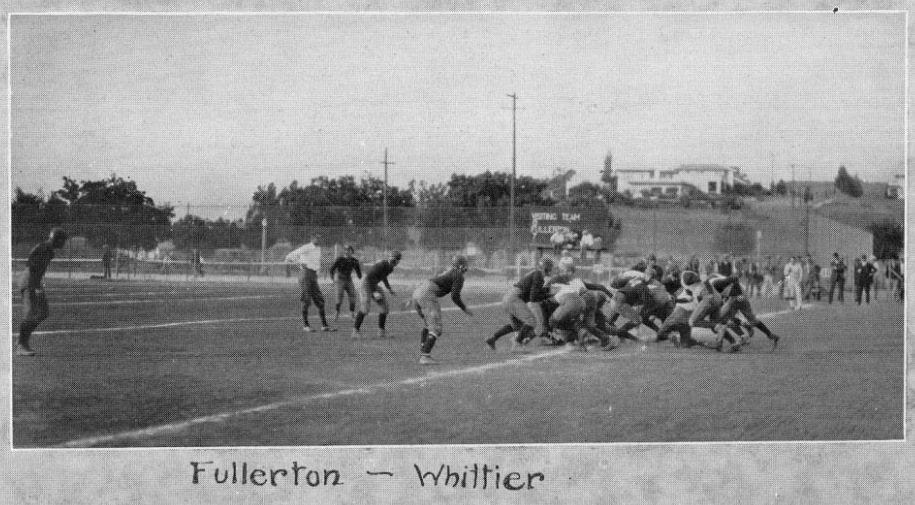
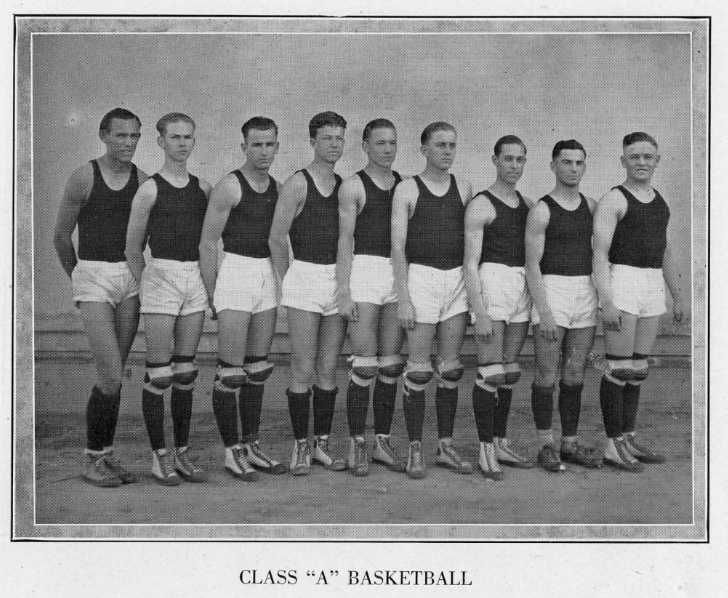


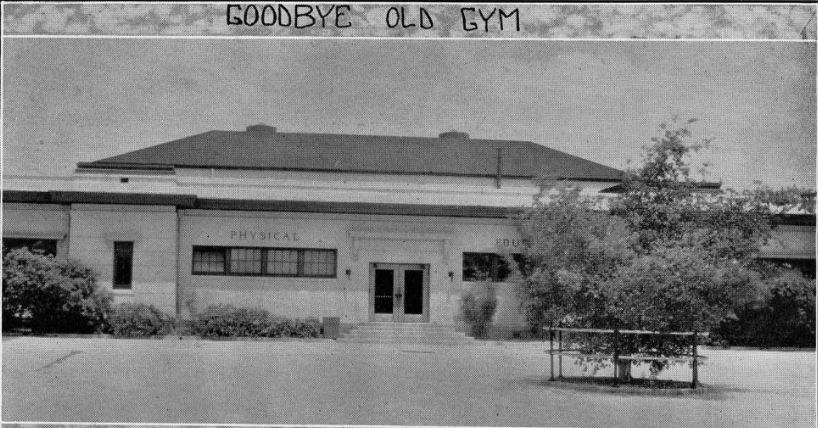
In 1925, a new gym was built.
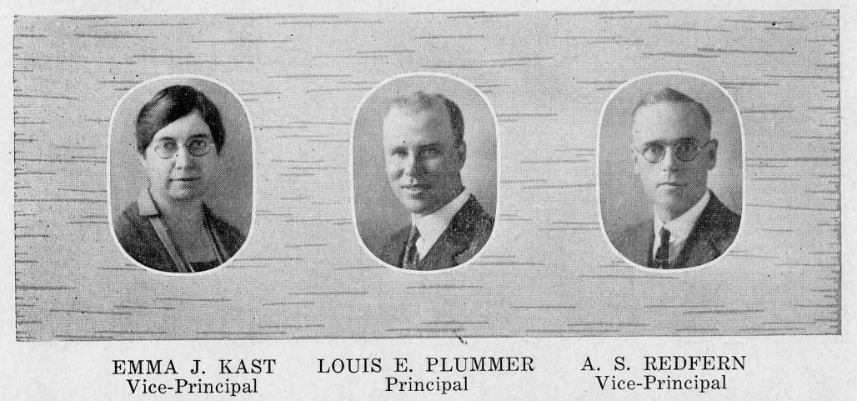
As with previous editions, this year includes students in blackface. The caption for the photo below was the N-word, but I have cropped it out because I don’t want to use that word. It should also be pointed out that in the years 1924-25 the Ku Klux Klan was at the height of its popularity and membership in Orange County, and its members included Louis Plummer, principal of FUHS.

1926
In 1926, the Indian (the new school mascot) is featured prominently throughout the yearbook. This is problematic because it involves cultural appropriation and stereotyping of a people who had experienced a genocide at the hands of Americans. In 1926, conditions for local Native Americans were not good, as many were being sent to Indian Boarding schools like the Sherman Indian School in Riverside. Also, in 1926, the local tribe (Kizh/Gabrieleno) were not even recognized by the State of California or the federal government, despite the fact that they were the original inhabitants of north Orange County and the Los Angeles basin.


The local native American tribe (the Kizh) did not live in teepees. Prior to Spanish colonization, they lived in dome-shaped tule reed houses.
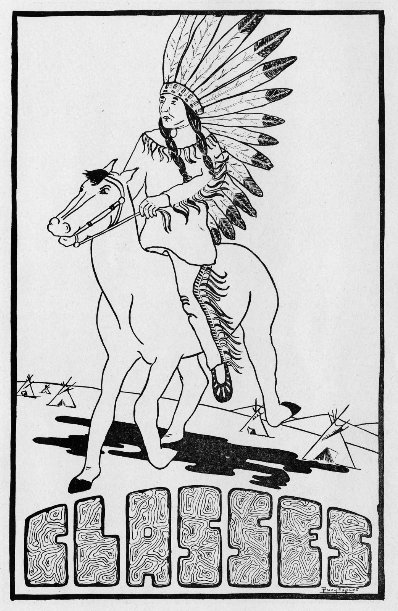
The Kizh also did not ride horses or dress like the guy above. It seems that the term “Indian” was a sort of catch-all that collapsed hundreds of distinct nations and tribes into a singular stereotype.
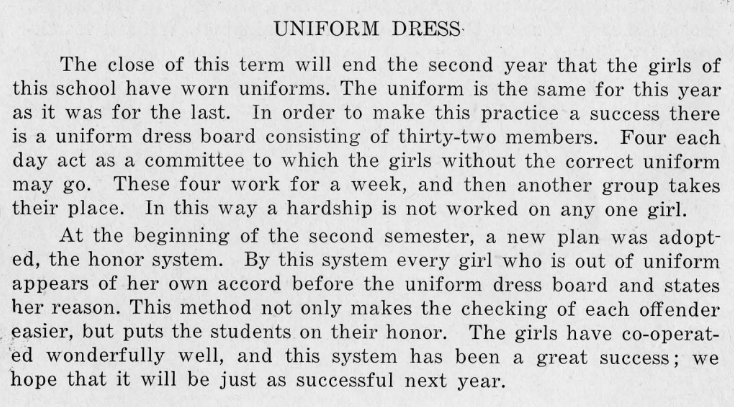
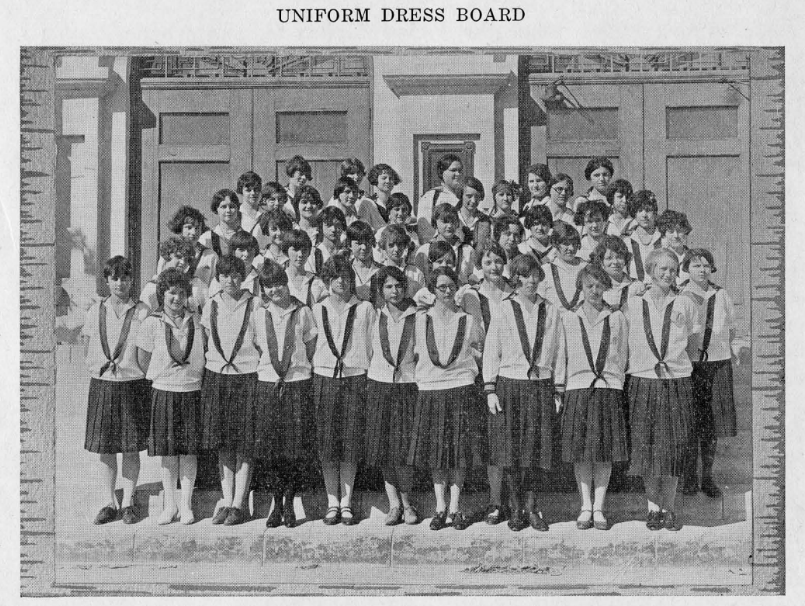
In 1925, FUHS began mandating that girls, but not boys, wear uniforms. Seems a bit sexist and unfair.
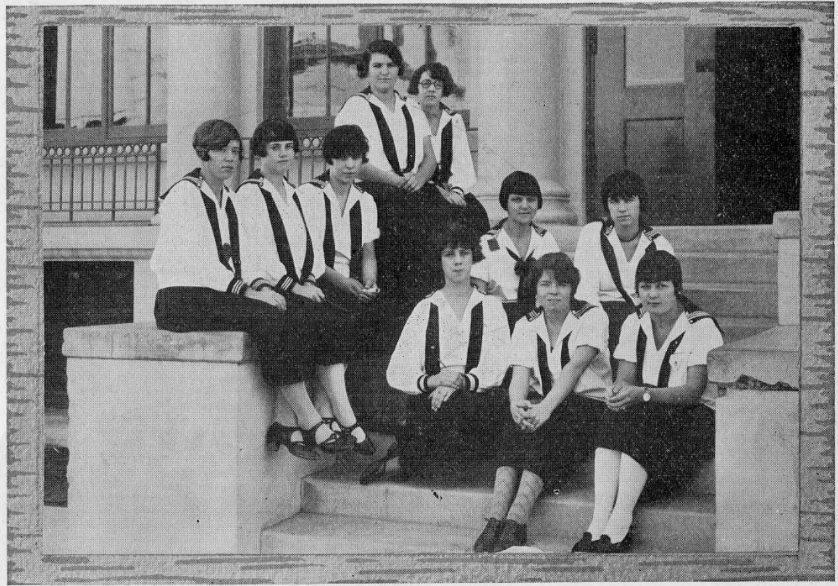
The girls had to dress like this.
Meanwhile, the boys could dress however they wanted.

Here’s an interesting shapshot of the number of graduates from 1910-1922.

The class Vice-President in 1926 was Margaret Yorba, a relative of Jose Antonio Yorba, a soldier (and later landowner) who had accompanied Gaspar de Portola on the first Spanish exploration/conquest of California.

This edition of the yearbook includes a racist poem.
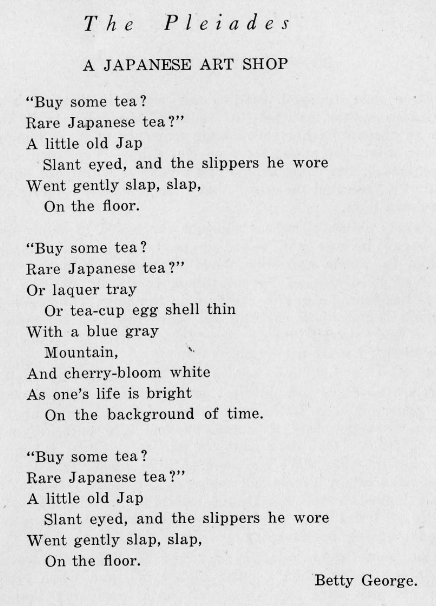
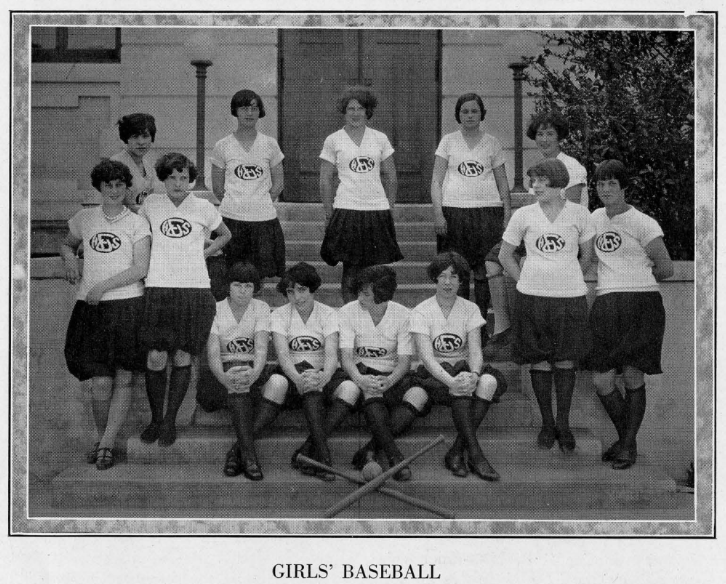
This is all the more problematic because there was at least one Japanese student at FUHS at the time. Her name was Hisako Oba, and she played on the girls baseball team.

Hisako Oba seated front row, second from left. 


The digital archives on the Fullerton Public Library web site are missing the years 1927 and 1928. This is unfortunate because those are the years that Richard Nixon attended FUHS.
1929

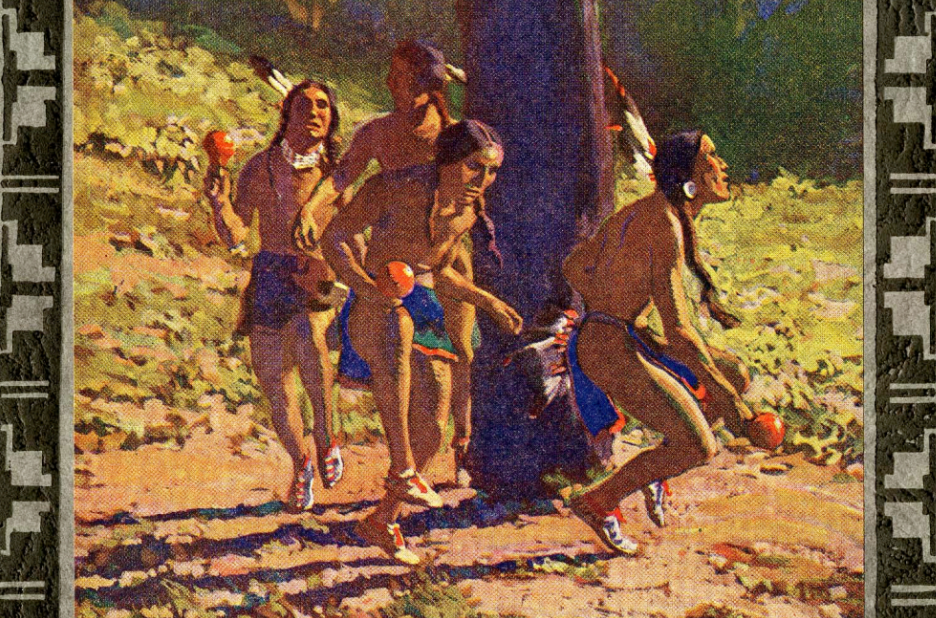
By 1929, the Indian mascot had become an important part of FUHS identity.


The boys varsity club was called the “Redmen.”
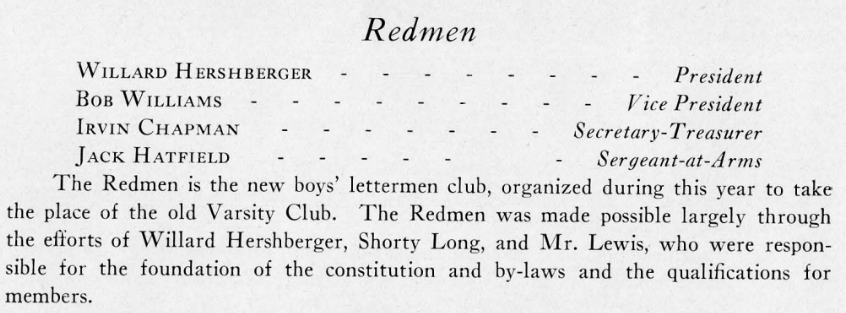
In 1929, construction was underway for the new High School auditorium.


In 1929, the Board of Trustees were S.C. Hartranft, a Mr. Bowen, Mr. Travers, Mr. Bloodgood, and Mr. Prizer. Irvin Chapman, son of orange rancher/tycoon, was class president.
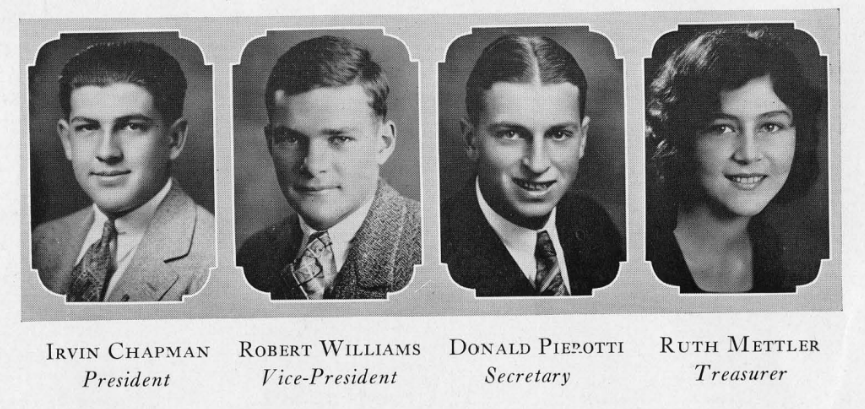
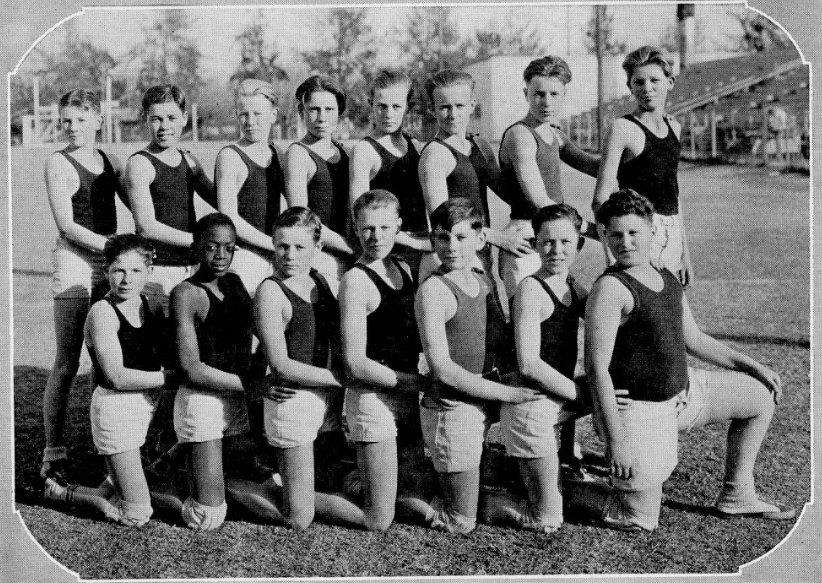
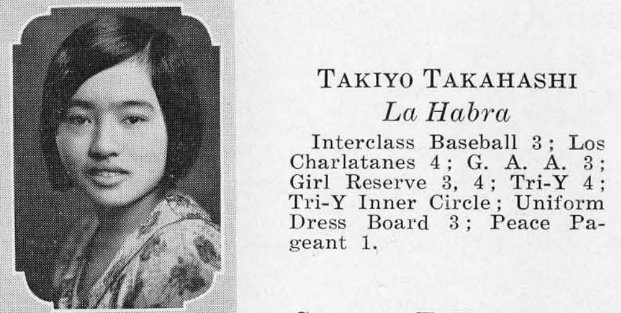
There was, as this time, at least one African American student and a few Japanese students. School segregation in Fullerton at this time did not follow rigid color lines (although housing segregation did), because FUHS was the only high school in town. The segregation we see at this time was between students who attended the “regular” schools and those who attended “Mexican” schools for children of orange pickers.


1930

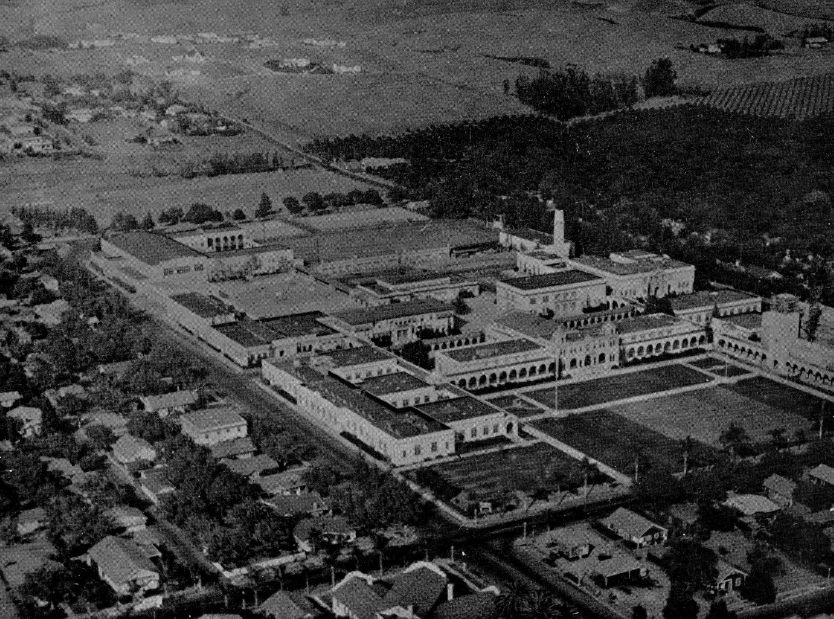
Aerial view of Fullerton Union High School in 1930. Here is what the massive oak that was the freshman tree looked like in 1930.

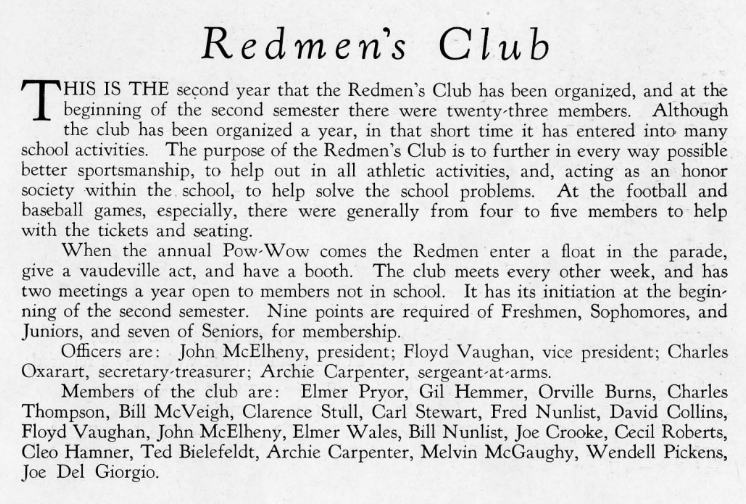
In 1930, FUHS held an annual Pow Wow. This was not a celebration of actual local native Americans. It was a bit of cultural appropriation to bolster school spirit.

Stay tuned for more about the history of FUHS.
-
The “Americanization” Program at Fullerton Union High School
The following is from a work-in-progress about the history of Fullerton. You can support my ongoing research and writing on Patreon.
In his book A History of the Fullerton Union High School and Fullerton Junior College 1893-1943, former superintendent Louis Plummer includes a section entitled “Americanizaton.”

Photo snapshot from 1929 Fullerton High School Pleiades yearbook. Courtesy of the Local History Room of the Fullerton Public Library. What was “Americanization”? Basically, it was a statewide program to send teachers into the segregated Mexican immigrant work camps to teach them how to be “American.”
Under The Home Teacher Act of 1915, the home teacher was “to work in the homes of the pupils, instructing children and adults in matters relating to school attendance and preparation, sanitation, in the English language, in household duties such as purchase, preparation and use of food and of clothing and in the fundamental principles of the American system of government and the rights and duties of citizenship.”
In his book Orange Empire: California and the Fruits of Eden, historian Douglas Caxaux Sackman writes, “The California Commission of Immigration and Housing…believed that the key to creating harmonious labor relations lay in managing the bodies and special experiences of workers. Appealing to economics rather than humanitarianism, [the commission] reasoned that ‘to make a citrus camp pay—to make it produce the desired workers—it is necessary to create an atmosphere that will attract and hold such workers…Housing policy was at bottom a form of social control designed to enhance profits.’”
At this time, most Mexican American workers in Orange County (including Fullerton) lived in segregated housing and attended segregated schools.
In his book Labor and Community: Mexican Citrus Worker Villages in a Southern California County: 1900-1950 Gilbert G. Gonzalez writes, “Mexicans in citrus towns were invariably the pickers and packers; and consequently they were poor, segregated into colonies or villages, and socially ostracized, even though they were economically indispensable to the larger society,” Gonzalez writes.
On the Bastanchury Ranch, six small villages of some 30 families each were scattered about the property. One of the six settlements, called “Tiajuanita” by residents, was built with “scraps of sheet iron, discarded fence posts and sign-boards, and served by one lone water faucet and a few makeshift privies.”
“Segregated schooling assumed a pedagogical norm that was to endure into the fifties and parallels in remarkable ways the segregation of African Americans across the United States,” Gonzalez writes. “Whereas the Americanization programs in the local villages appear unique, in reality they reflected a generalized expression for the eradication of national cultural differentiation across the United States.”
“Americanization” Program in Fullerton
In his history of the high school, Plummer includes a narrative written by Druzilla Mackey, the first of the teachers in the “Americanization” program. I will include here some excerpts from her story:
In the town of Fullerton itself the Placentia Orange Growers’ Association had just completed twenty-four homes for its Mexican employees. This was indeed a ‘model’ colony, beautifully located in a walnut grove, four room houses each with a flush toilet, community showers and wash house with automatic hot water, a large community hall and a home for the teacher. Despite these carefully planned conveniences the Americanization work in this center was the least successful in the department. Probably because:
1.) Instead of giving its Fullerton employees the anticipated opportunity of living in this well-equipped camp, the Orange Growers imported laborers from the Pomona district and installed them in this choice spot. This aroused bitter antagonism among the local group who deridingly gave this colony the name of ‘Campo Pomona.’ Even with all its splendid equipment few of the ‘Town Mexicans’ would come to classes in its community hall or cooperate in its community projects.
2.) The Fullerton colony was built right in the town and American neighbors who felt that their property had been devalued by its close proximity to the Mexicans treated them with humiliating scorn.
3.) The teacher of the group was not employed partly by the Orange Growers’ but wholly by the high school. Partly for this reason in the first years of our work she did not receive the hearty support of the Association.


Campo Pomona during the 1838 flood. Photo courtesy of Fullerton Public Library Local History Room. It was through an invitation to a Mexican party that we first discovered several little known Mexican camps far back in the hills of Bastanchury ranch. It was the policy of this ranch company to allow any Mexican who could find sufficient scraps of sheet iron, discarded fence-posts and sign-boards to build a shelter, to establish himself on the ranch. The largest of these camps, called Little Tia Juana, was pronounced by an artist friend the most bewitching bit of primitive art show had ever seen. “Who,” she said, “but a Mexican could contrive a lovely vine covered patio from rusted bed-springs salvaged from the dump?” As an Americanization worker I was not so much impressed by the rare artistry of this community as by the fact that all of its thirty families must be served by one lone water faucet and a few makeshift privies. And this was only one of six similar colonies scattered over the largest orange ranch in the world. Its owners had the old-world feudalistic attitude toward their farm hands. They felt generous in allowing these squatters to establish homes on their ranch and could not comprehend its danger to the health and morality of the community as a whole.

Mexican School on the Bastanchury Ranch. Photo courtesy of Fullerton Public Library Local History Room. Americanization teachers were always met with a cordial welcome among the Bastanchury Mexicans and during the several years we worked with the Commission of Immigration and Housing to secure better homes most of our classes were conducted in their own hovels. After seven years and, at the last, principally through the good offices of a local pastor, Dr. Graham C. Hunter, the Bastanchury Company built suitable homes for their laborers, provided with plenty of toilets and running water.
With the construction of better homes and a community hall built and equipped by the high school the work on Bastanchury ranch became a genuine success. Classes were welcomed by both men and women and the community hall was much too small to accommodate the audiences which assembled for entertainments and community meetings. Whenever possible these were held out of doors in front of the hall with most of the audience providing its own seats. A vital part of the work became the Mexican benefit lodge with an enthusiasm for education and social betterment. This lodge part of the expense of a well-baby clinic in the colony. Even after the ranch changed ownership and all employees were required to move elsewhere these Mexicans now living in the Alta Vista camp remained enthusiastically clinic-minded.
The Bastanchury group was always the poorest of our Mexicans, the most friendly and also the most idealistic. Their warm friendship was greatly fostered by Mr. and Mrs. Plummer who were not afraid to frequently entertain and be entertained by these most poverty-stricken of our people.
The Mexicans cleaned this out, the high school provided chars and blackboards and with the volunteer assistance of Mrs. Clemence Allec Melton we dispensed English across the restaurant lunch counter three evenings a week to a full house. During the following year, with the assistance of Mr. C.C. Chapman, three local citrus association and the Mexicans themselves, a large community hall was built.
“At the end of ten years’ work our department had five teachers and six active centers of work—then Old Man Depression struck us a knock-down blow.
“In this time of stress and strain the American community no longer spoke of “Our” Mexicans. They no longer considered that no “whiteman” could pick oranges. Instead they felt that the jobs done so patiently by Mexicans for so many years should now be give to them. “Those” Mexicans instead of “Our” Mexicans should “all be shipped right back to Mexico where they belong.” The Americanization centers in which these people had been taught how to buy and make themselves a part of the American community were now used for calling together assemblages in which county welfare workers explained to bewildered audiences that their small jobs would now be taken over by the white men, that they were no longer needed or wanted in the United States. They explained that the Welfare Department no longer had any money to aid them during times of unemployment, but would furnish them a free trip back to Mexico. And so—one morning we saw nine train-loads of our dear friends roll away back to the windowless, dirt-floored homes we had taught them to despise.
“With depression-frightened tax-payers at their heels the high-school authorities were forced to cut the Americanization department to the bone. We kept it going as best we could in the fond hope that prosperity might be hiding around the corner, but evidently it wasn’t and after four years of such low wages as to permit not even a Mexican to support a family they organized a county wide strike among the fruit pickers. Latent antagonisms between the two nation-allies came to fever heat. Deafness prevented my being of any real service at this time so I gave up my work and the high school decided to close the department.
What were its lasting values? Quien sabe.
During the Great Depression, hostilities against the Mexican workers rose to clamors for deportation.
What she is referring to is a mass deportation of nearly all of the Mexican workers on the Bastanchury Ranch in the early 1930s. This deportation was part of a much larger deportation effort across the United States, which is described at length in the book Decade of Betrayal: Mexican Repatriation in the 1930s.
“Outside of the community, the Mexican became the scapegoat,” Gonzalez writes. “In 1931 and 1932, local and county governments caught up in the drive across the Untied States to deport Mexicans sought to cut budgets through repatriating Mexicans. Induced through threats of relief cutoff sweetened with an offer of free transportation, about 2,000 left Orange County.” Many were actually American citizens.
A few years ago, I had the privilege of interviewing Fullerton resident Manuel Rivas Maturino, who was born on the Bastanchury Ranch, and remembers the experience of “repatriation.”
Local author Gustavo Arellano describes this situation in his 2013 OC Weekly article “The Lost Mexicans of Bastanchury Ranch.”
Another teacher in the FUHS Americanization program was Arletta Kelly (born Arletta Klahn). She was interviewed in 1971 for the California State University, Fullerton Oral History Program. Her recollections give tremendous insight into the social context of race relations in Fullerton during this time period. Kelly attended Fullerton Union High School and graduated from Fullerton College, and later worked as a teacher for FUHS for 34 years, from 1921-1954.
She met her husband, Frank Kelly (a Mexican man with an Anglo last name), while working as a teacher on the Pomona Camp, located on South Balcom in Fullerton, near the railroad tracks. “I lived there in the teacher’s house,” she recalled, “I used to teach, of course, mainly Mexican men, but I did have a few Japanese men that would come. I had a few Basque people from Bastanchury Ranch.”
In addition to teaching at the Pomona Camp, Kelly also taught at the Escondido Camp on the Bastanchury Ranch, near the present-day St. Jude Hospital. “Those classes were mainly for women,” she said, “In the daytime, I would go out there maybe twice a week and we’d have a class in English. It was mainly simple English, like things that they would want to buy at the store.”
Kelly also taught children at a public school on the Bastanchury Ranch. “It was a branch of the elementary schools of Fullerton, and it was built down just about where the golf course is now,” she said. Although it served the workers of their groves and packing plants, “there was never any real cooperation with the Bastanchury Company for furnishing schools,” Kelly recalled, “the Placentia Orange Growers Association furnished the building…but the teachers salary was paid by the high school district.”
A common misconception among Anglo society (including teachers) during this time period was that Mexicans were intellectually inferior to whites. Kelly blames prejudice and unfair IQ tests for this misconception. “Our IQ tests were never fair to Mexican students,” she recalled, “It’s like you ask the question, ‘Why type of sweets is mostly favored by our people?…Well the Anglo would probably say apple pie, and the Mexican would say pan dulce.” Kelly describes her struggle to convince fellow colleagues that Mexican students had the same potential as whites. “Some of my colleagues here would laugh at me and say, “Are you a wetback?” she remembered.
In his book Orange Empire: California and the Fruits of Eden, Douglas Caxaux Sackman writes: “Several historians have presented especially illuminating examinations of the Americanization process as negotiated by Mexicanos in the Southwest. What emerges from this new interrogation of Americanization is not a simple top-down program that was either accepted or rejected by those who would be Americanized, but a multi-faceted and constantly evolving struggle over the meaning of immigration, identity, and citizenship. Americanizaton was a contested concept, which is not surprising: after all, the term raised core issues about who and what counted as American.”
-
FUHS Pleiades Yearbooks 1909-1920
The following is from a work-in-progress about the history of Fullerton. You can support my ongoing research and writing on Patreon.
Lately I’ve been writing a series of posts on the history of Fullerton Union High School. As part of this research, I’ve been looking through the digital archives of the annual FUHS yearbook, called Pleiades, which are available on the Fullerton Public Library web site.
Although the high school began in 1893, the first yearbook in the Library’s digital archives is from 1909, and the archives are incomplete.
Looking through these old yearbooks is a window into the styles and attitudes of the past. I present here some snapshots from the Pleiades from the years 1909-1920.
1909

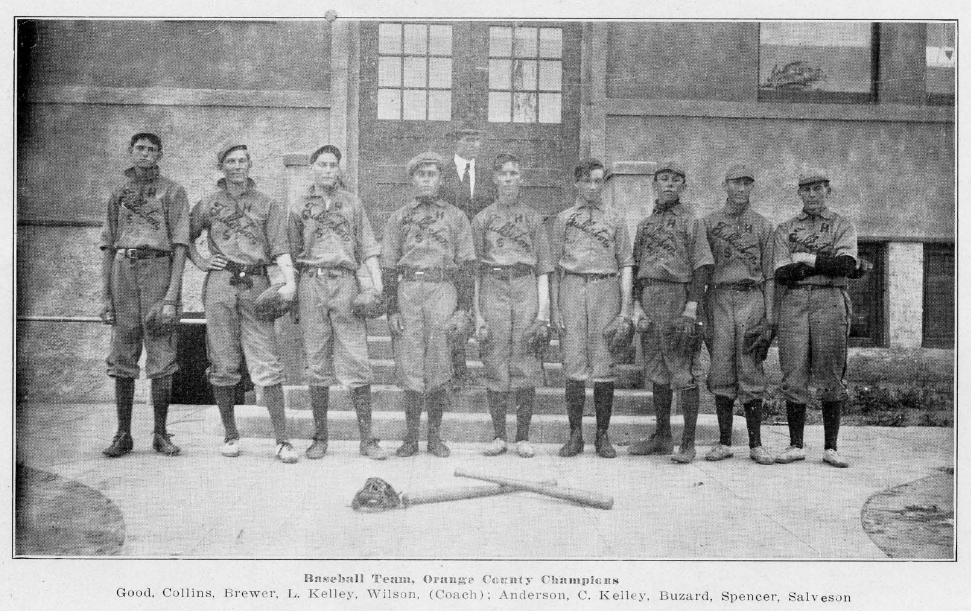

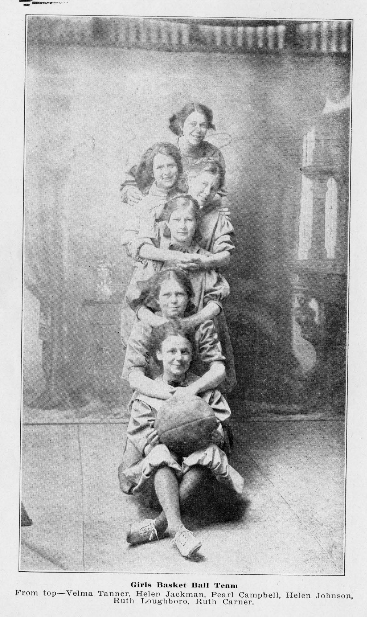


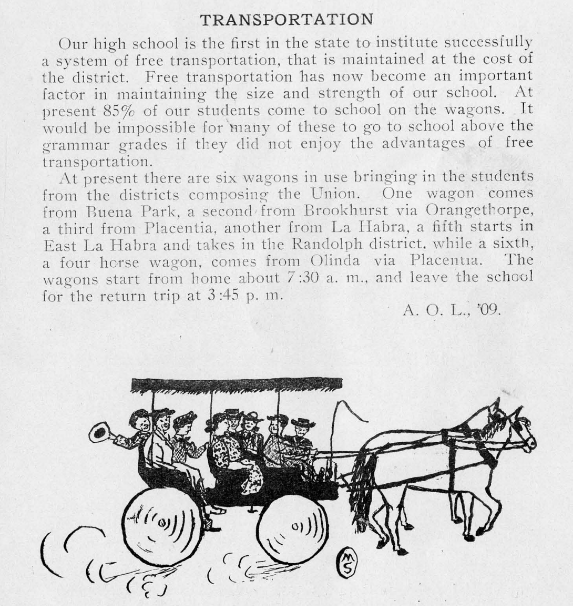

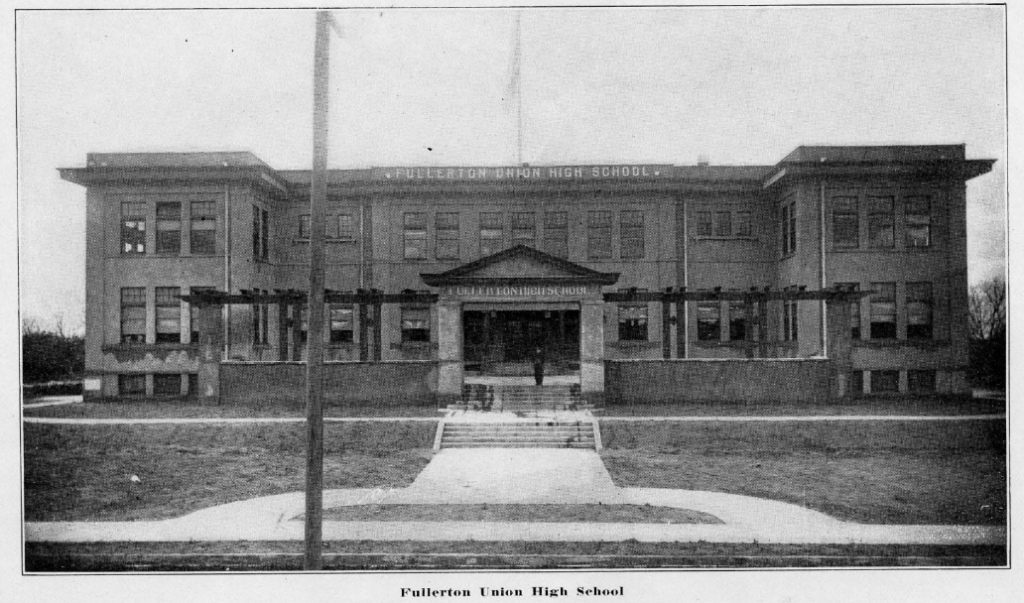
The first Fullerton High School building would burn down in a fire in 1910. 
1910



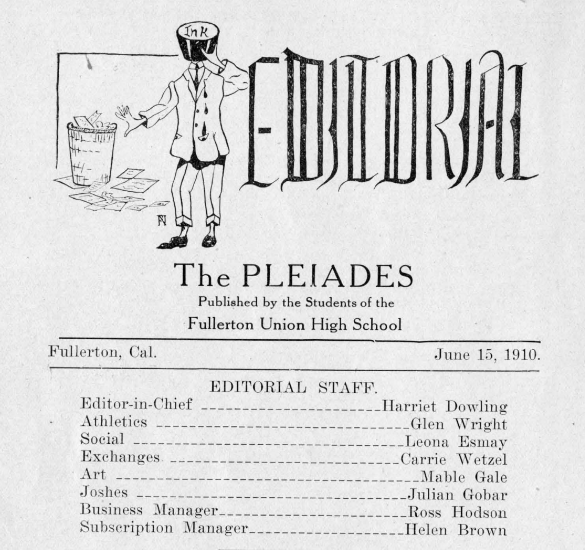
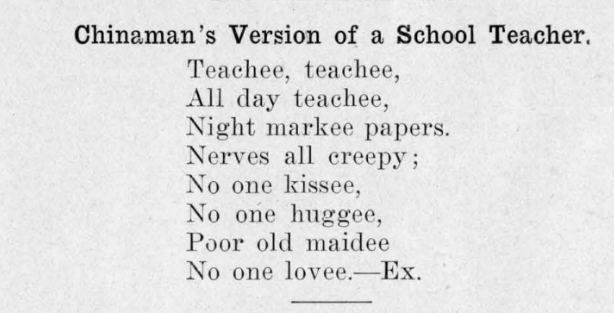
Lest we get feeling too nostalgic about this, this issue of the Pleiades includes a racist anti-Chinese joke and poem:

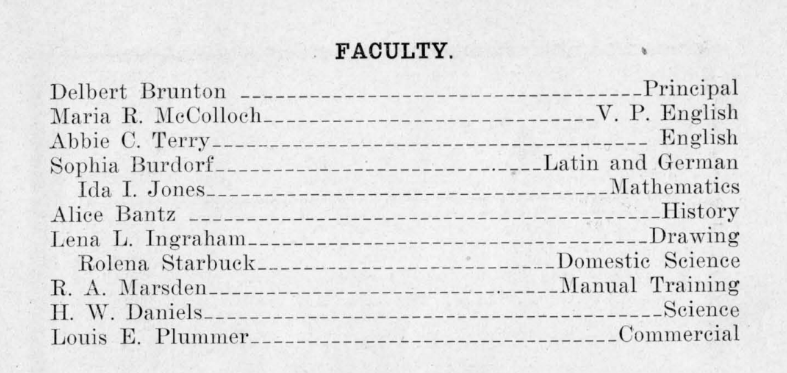
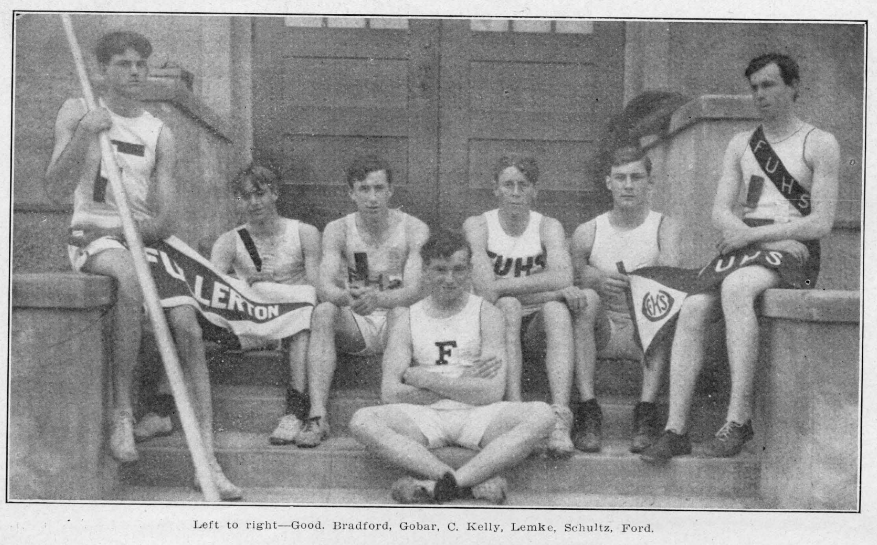


The digital archives are missing the years 1911-1915.
1916






The below photo spread showcasing drama productions appears to feature two “midgets” in blackface.

As the below two photos show, there were African American students at either Fullerton High school or Fullerton Junior College, which shared the same buildings/facilities at this time. Not sure how they felt about “midgets” in blackface, but it speaks to the social/racial climate at the time.
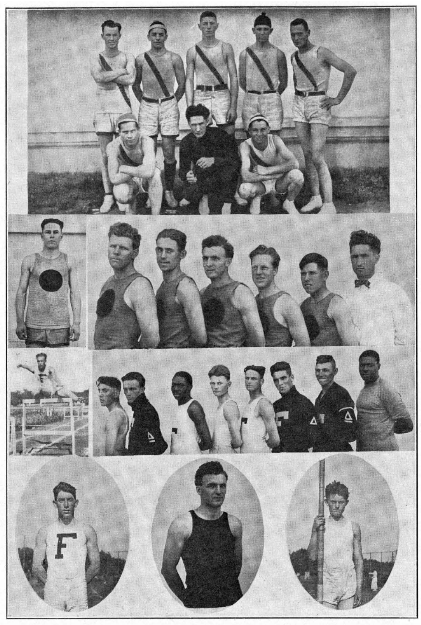


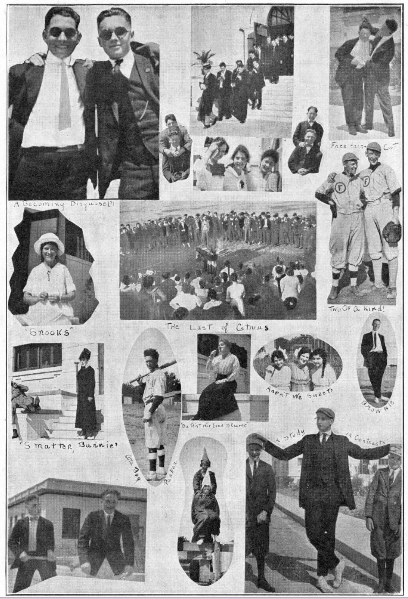
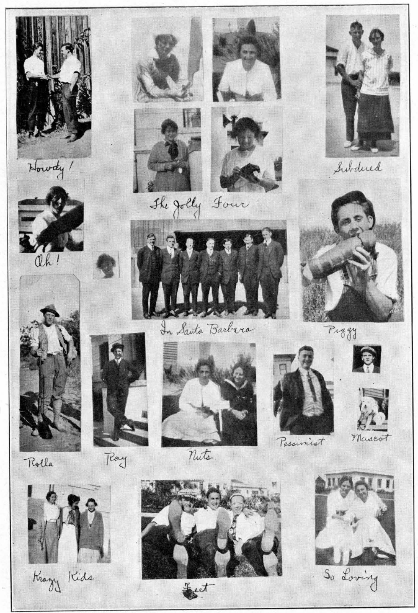
1917

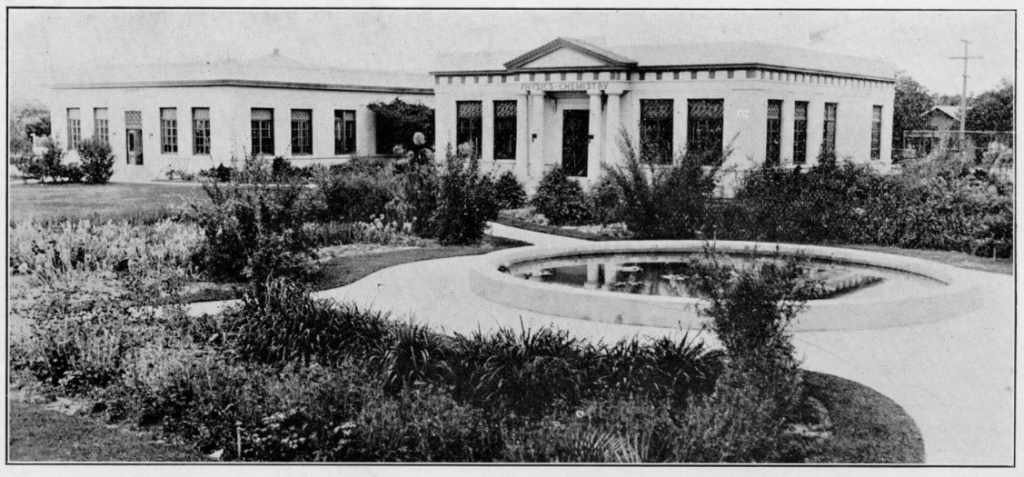


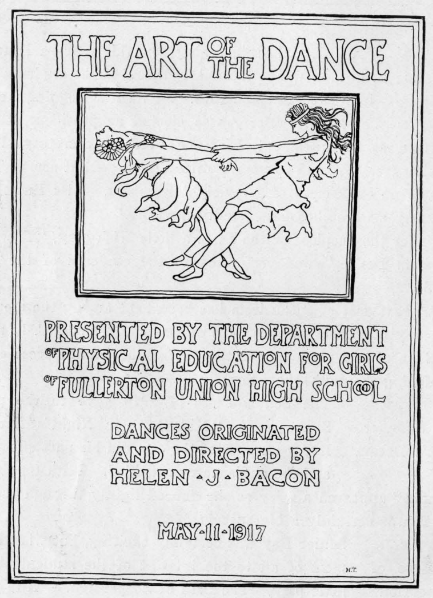
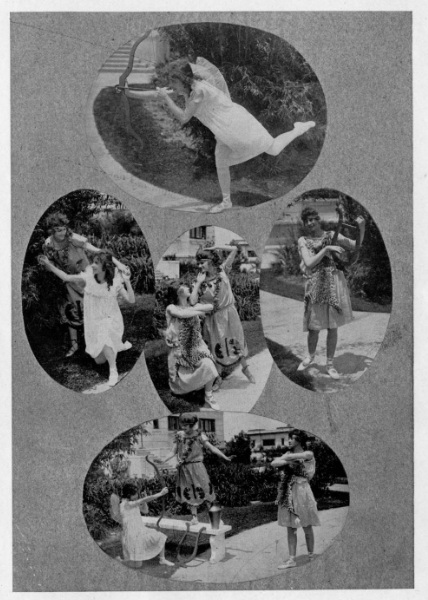
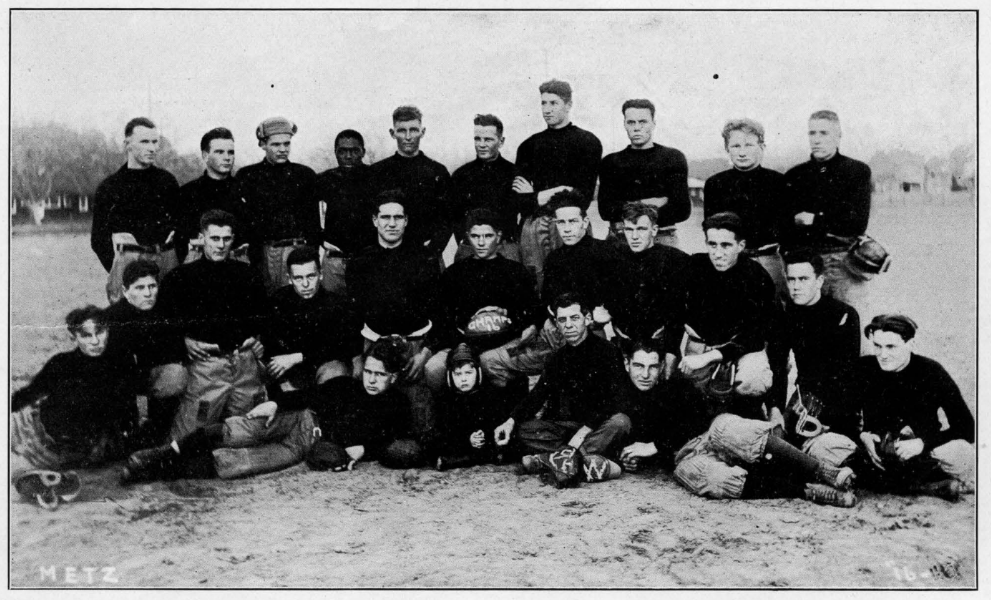
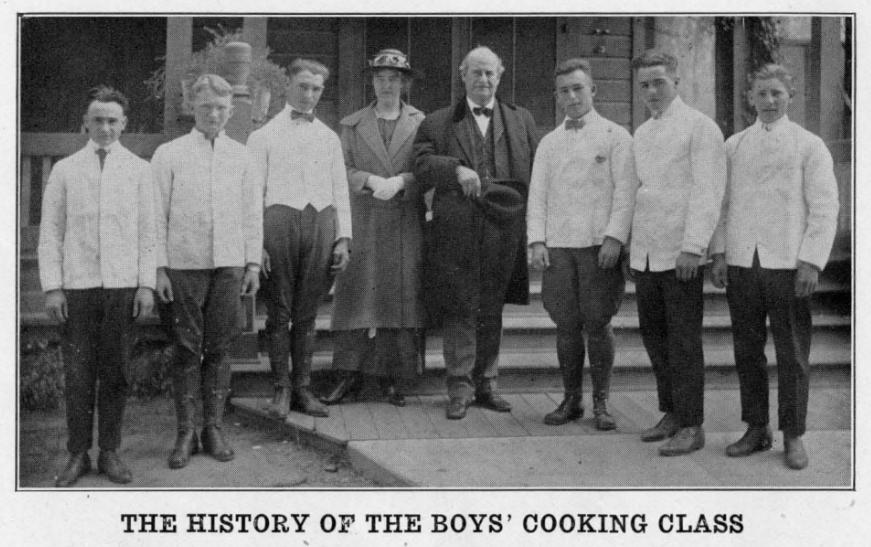
In 1917, during World War I, military drills were added to instruction, and some boys appear in military outfits. Many Fullerton Junior College students and some faculty from the high school and college enlisted.
In his book A History of the Fullerton Union High School and Fullerton Junior College 1893-1943, Louis Plummer, who taught commerce and would become principal and Superintendent gives some interesting commentary on the impact of World War I on the high school, college, and community in general.
“Men enlisted. Those who did not enlist and attempted to secure draft exemption were scorned by their fellows,” he writes. “Freedom and democracy gave way to coercion and intolerance because it was a common feeling that the situation was one that justified the suspension of even these foundation principles of our government in the interests of the successful conduct of the war.”
“In April, 1917, the board of trustees voted in favor of establishing military drill in the schools…For the rank and file of high-school boy and college men, military training was a bore, much less acceptable than the usual program of physical training, including sports. The close of the war removed what the boys felt was the real reason for such drill. In the spring of 1919 interest waned to the vanishing point and the training was considered an unnecessary drudgery. Opposition to the work became so strong that it was discontinued by board action on May 9, and the usual forms of physical education resumed,” Plummer writes.




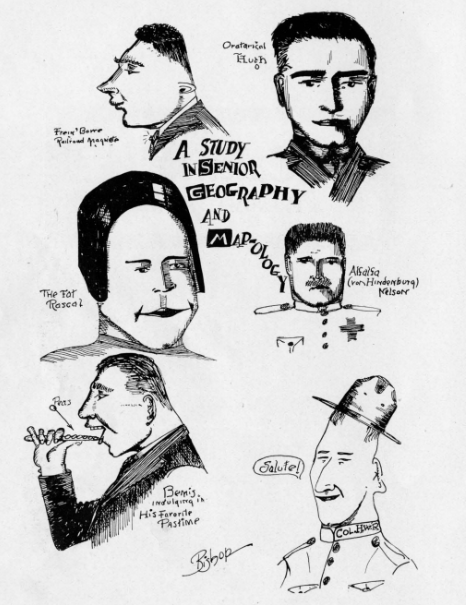

There are no digital archives for 1918-1919.
1920

Louis E. Plummer was Superintendent of Fullerton Union High School in 1920. In 1923, he (along with numerous local residents and leaders, joined the Ku Klux Klan. The primary evidence for this is a 1979 UCLA doctoral dissertation by Christopher Cocoltchos entitled The Invisible Government and the Viable Community: The Ku Klux Klan in Orange County, California During the 1920s.
Plummer is mentioned by name at least two times in this dissertation, stating that he was “a leader a leader in the Myers-led Klan.” Myers refers to the Reverend Leon Myers, who helped organize the KKK in Orange County in the early 1920s.
Elsewhere the dissertation states, “Councilman W.A. Moore, Judge French, and Superintendent of Schools Plummer joined the Klan in the latter part of 1923, and R.A. Mardsen entered in mid-1924. Civic leaders were especially eager to join. Seven of the eighteen councilmen who served on the council between 1918 and 1930 were Klansmen.”
What did it mean for the local high school and college to have a top administrator who was a part of perhaps the most racist group in American history? He was not alone, during the resurgence of the KKK in the 1920s, its membership was in the millions.


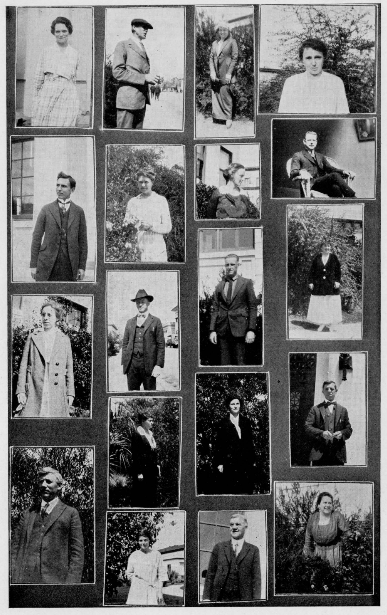

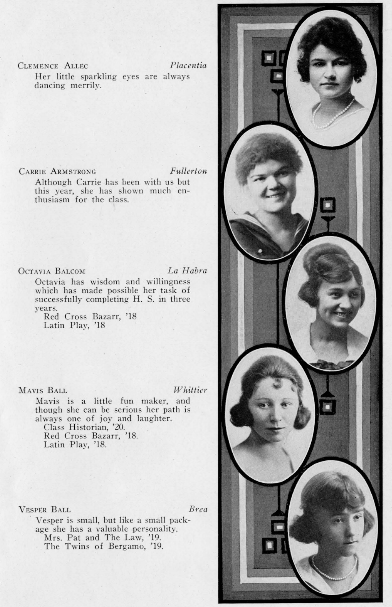
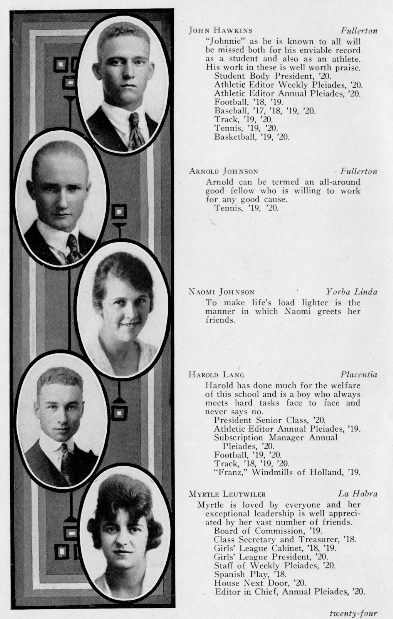


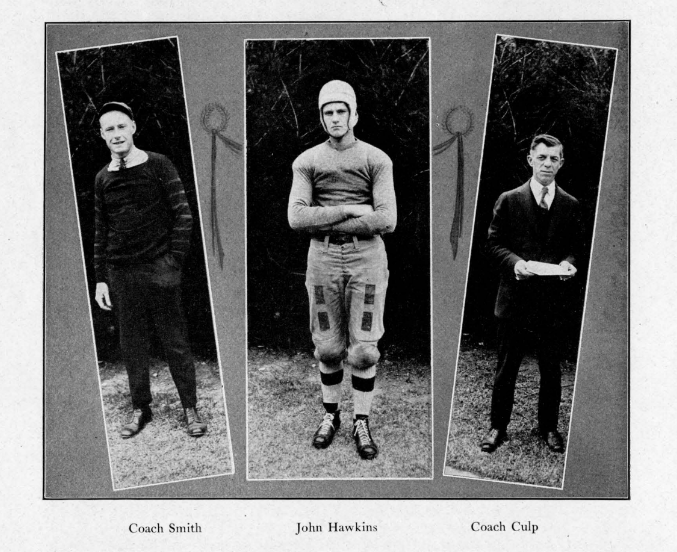
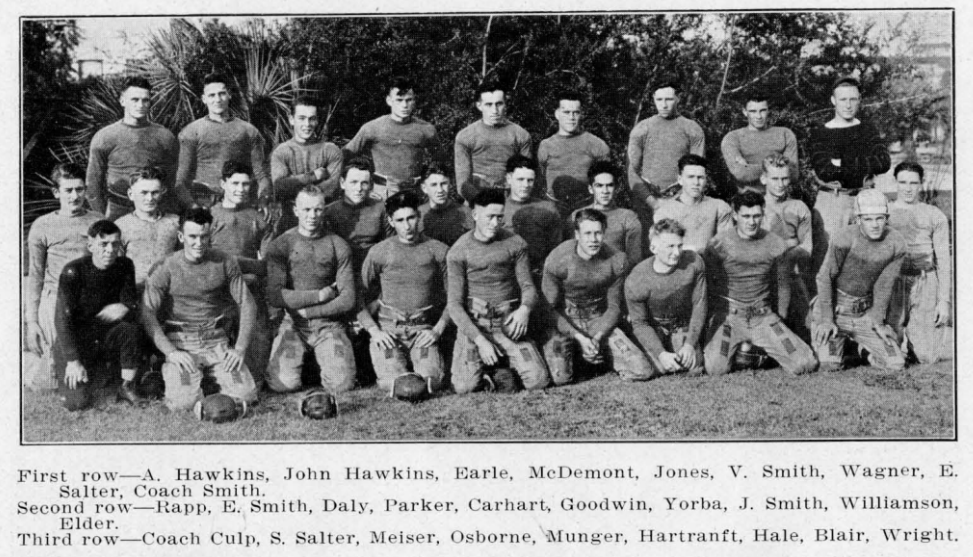


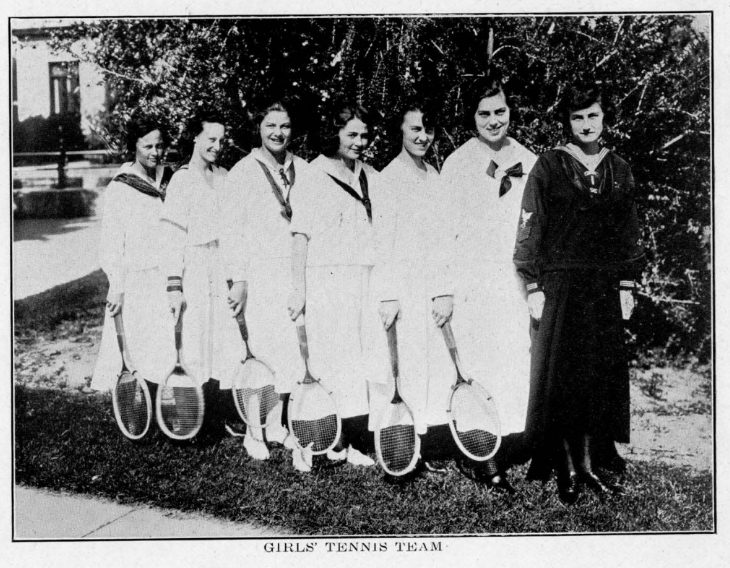


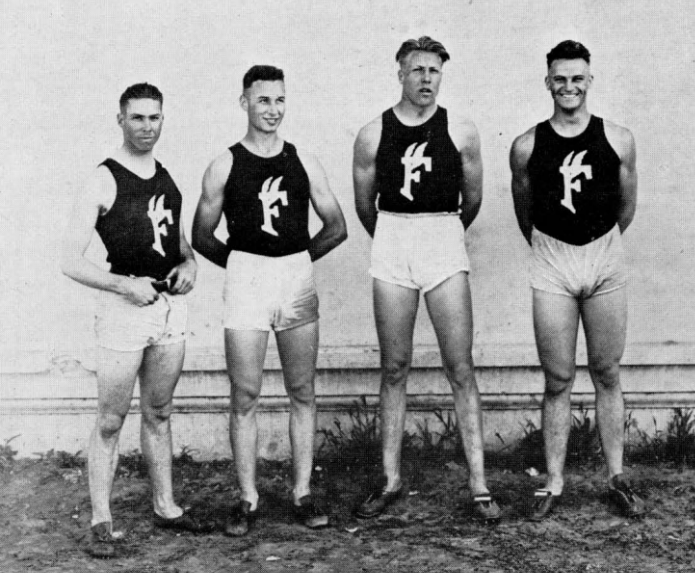
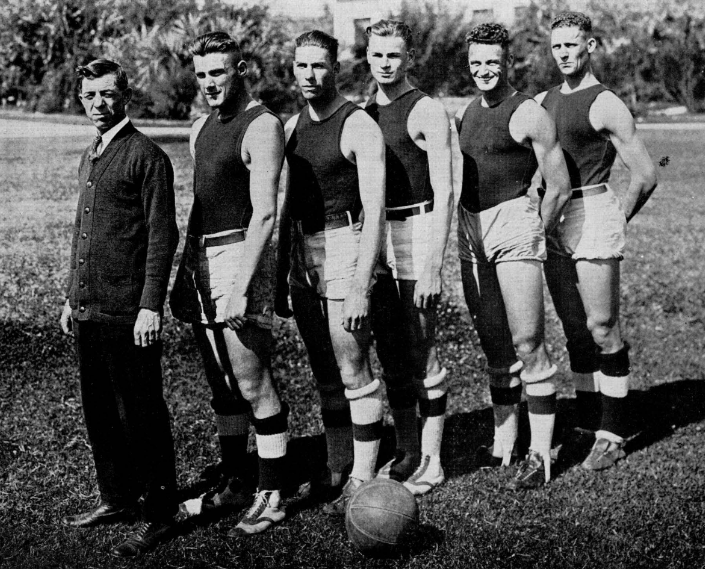
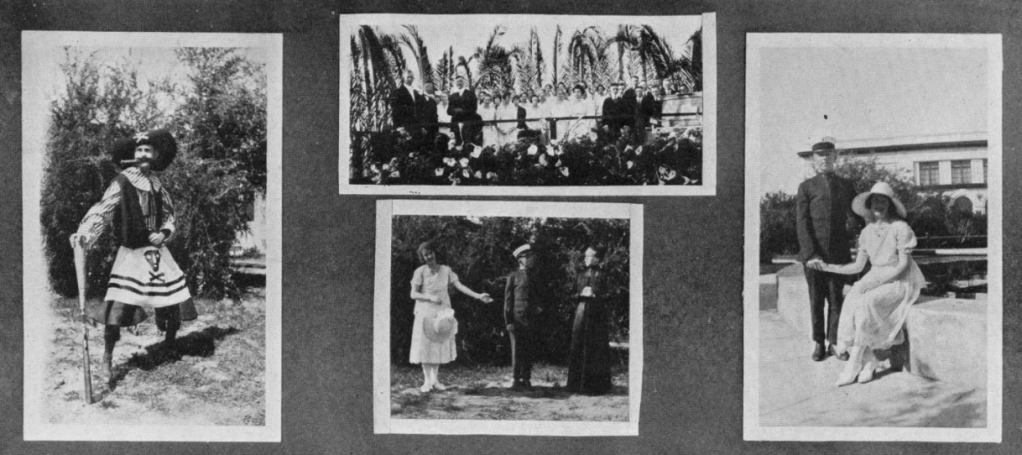
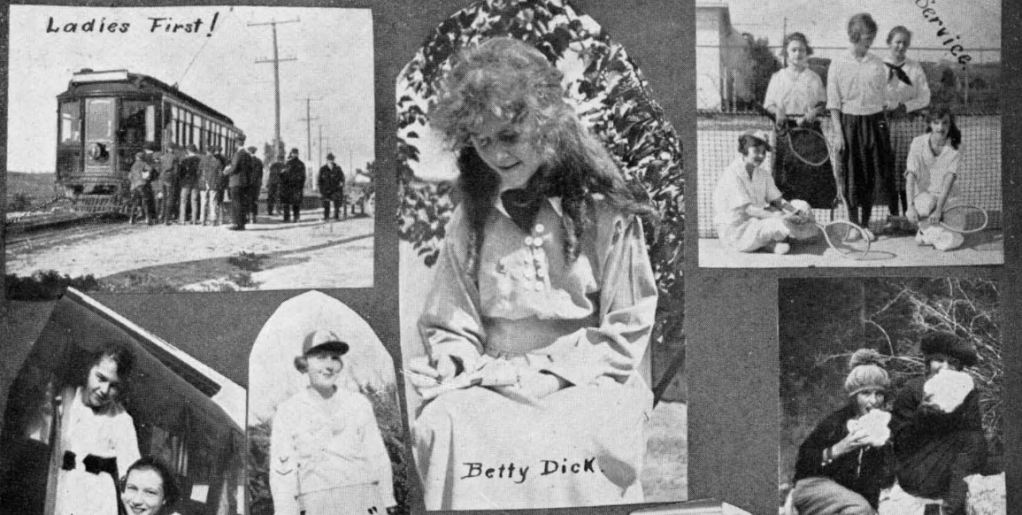

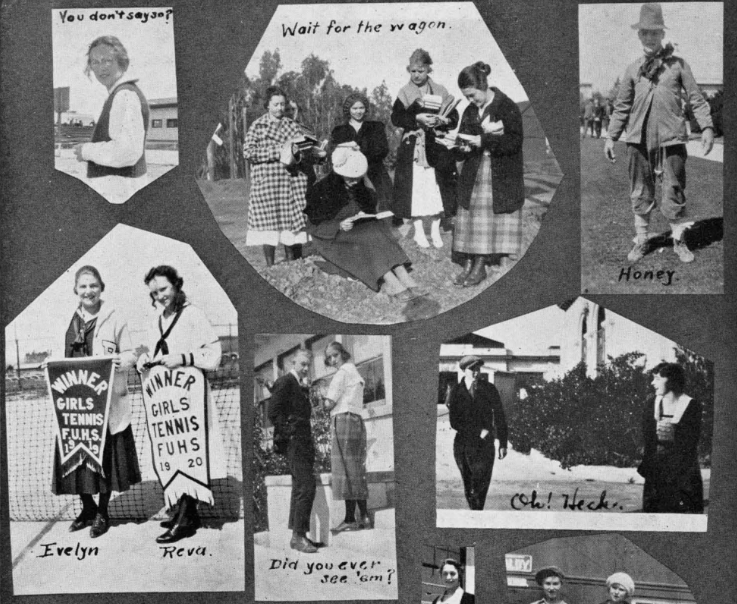
Stay tuned for snapshots from Pleiades yearbooks during the 1920s.
-
Louis Plummer’s History of Fullerton Union High School and Fullerton College (1893-1943): Part II
The following is from a work-in-progress about the history of Fullerton. You can support my ongoing research and writing on Patreon.
Here is Part II of a summary of Louis E. Plummer’s 1949 book A History of the Fullerton Union High School and Fullerton Junior College 1893-1943. Read Part I HERE.
Following the destruction by fire of the original high school building (located on Commonwealth on what is now Amerige Park) in 1910, a new site was chosen on Chapman Avenue, and the school has remained here since then.
In 1912, contracts were let out for six classroom buildings, study hall, auditorium, gymnasium, boiler house, pump house, and garage. A walnut orchard was removed prior to building.
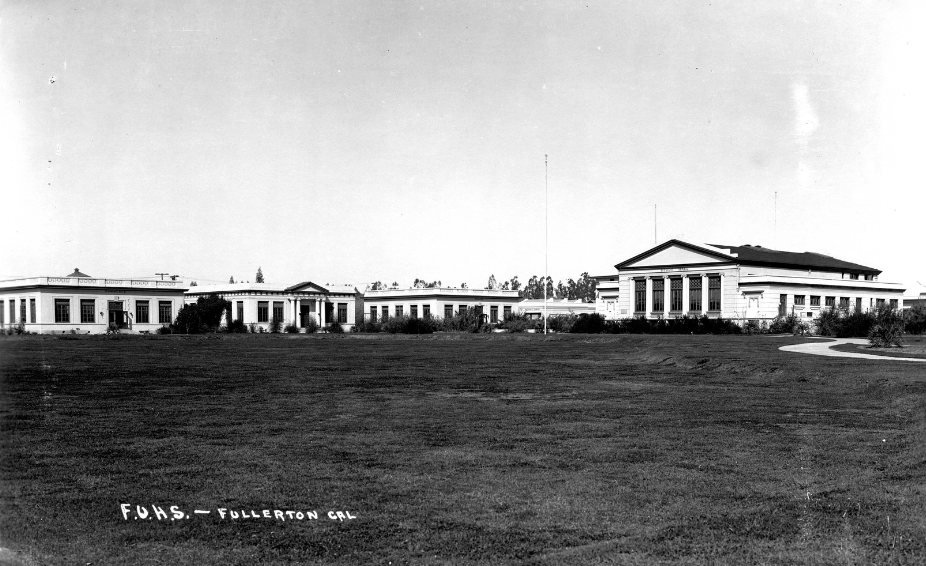
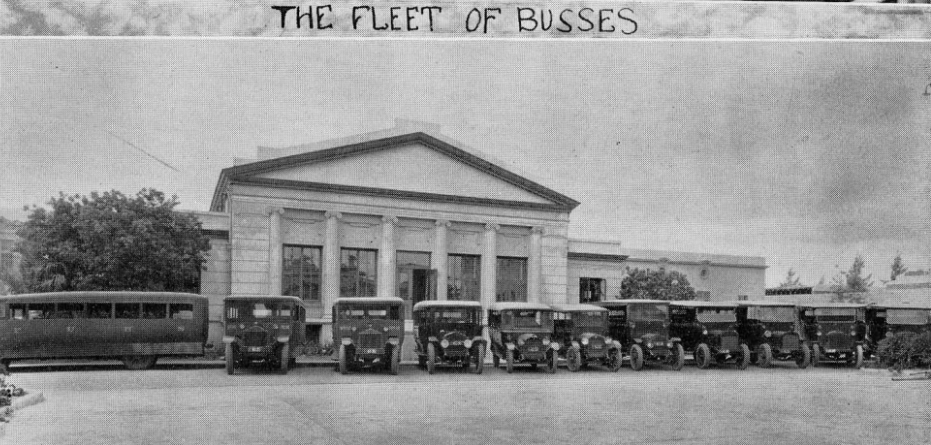
Fullerton Union High School circa 1919. Photo courtesy of the Fullerton Public Library Local History Room. “During the period 1906 to 1916 transportation passed from the horse-and-buggy stage to that of the automobile,” Plummer writes. “Buses were purchased and drivers selected. Hollis Knowlton was chosen as chief driver and mechanic in 1911.”
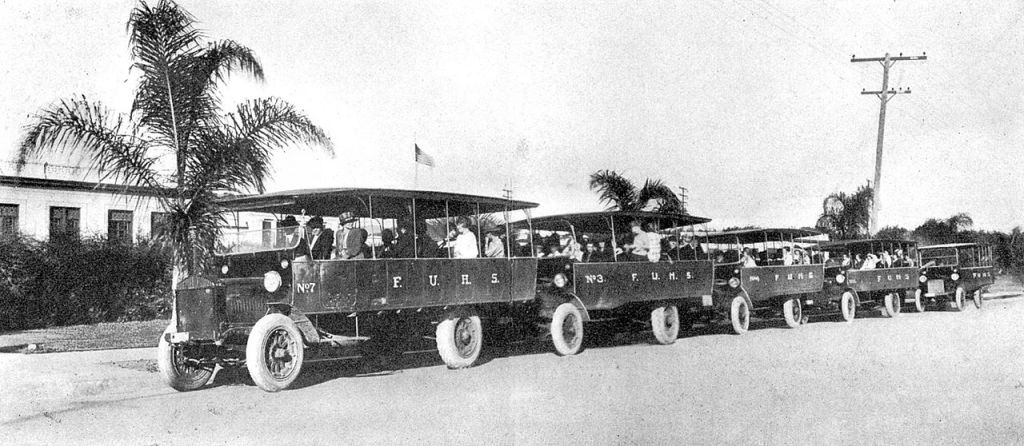
1921 FHUS buses. Photo courtesy of Orange County Archives. As the school grew, new buildings were constructed.
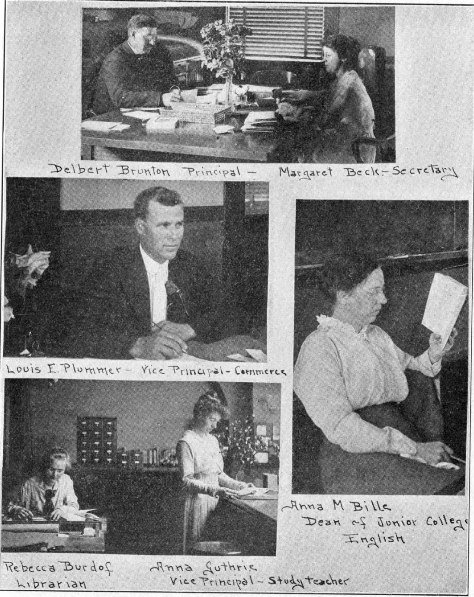
W.R. Carpenter served as principal from 1893 to 1906. Delbert Brunton succeeded Carpenter and served until 1916, when he was succeeded by E.W. Houck.
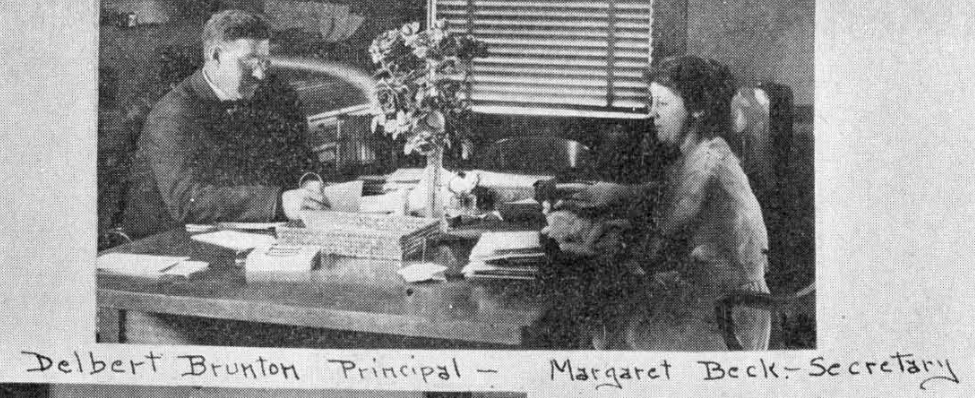
Delbert Brunton was principal from 1906 to 1916. Photo from the 1916 Pleiades yearbook. 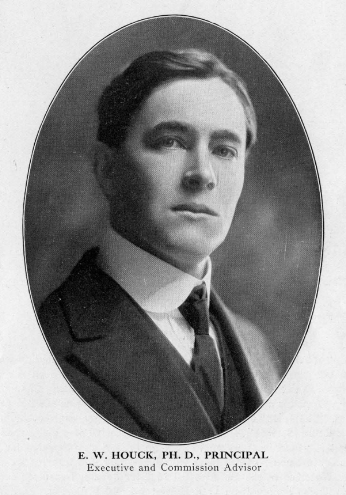
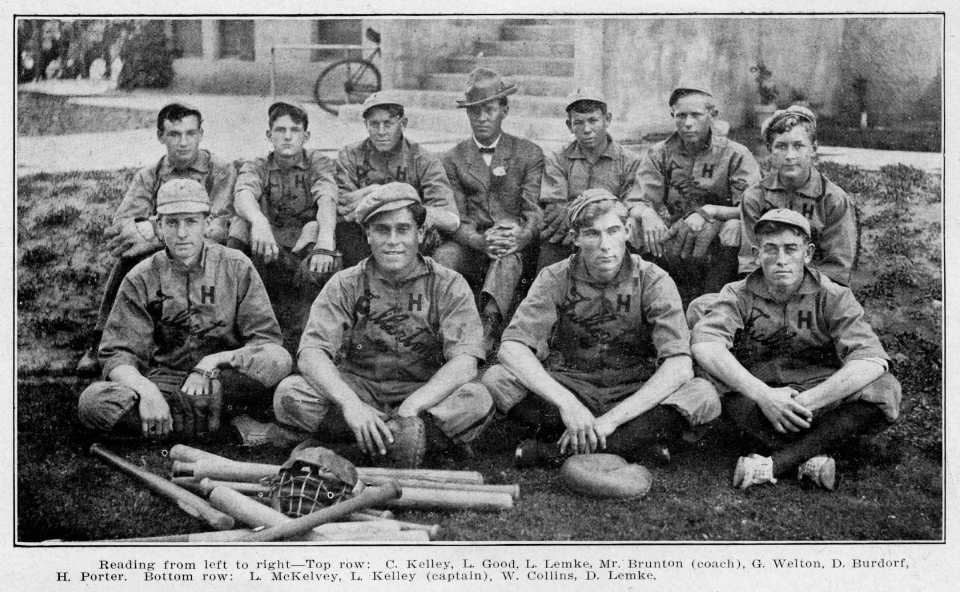
E.W. Houck served as principal from 1916 to 1919. Photo from 1917 Pleaides yearbook. Baseball was most successful as an early sport. The 1905 team included future hall of famer Walter Johnson. Other notable players that attended FUHS included “Arkie” Vaughn, Willard Hershberger, and Gene King, a one armed African American pitcher.
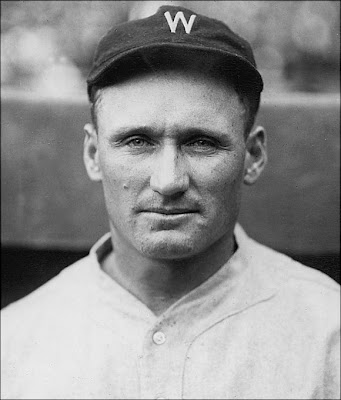
Walter Johnson (“The Big Train”) played for Fullerton Union High School before moving up to the Washington Nationals in 1907, where he was their star pitcher for two decades. The entry of the United States into World War I temporarily put a stop to construction work on the campus, and many students and faculty of Fullerton College enlisted or worked for the war effort in different capacities.
Plummer gives some interesting commentary on the impact of World War I on the high school, college, and community in general.
“Men enlisted. Those who did not enlist and attempted to secure draft exemption were scorned by their fellows,” he writes. “Freedom and democracy gave way to coercion and intolerance because it was a common feeling that the situation was one that justified the suspension of even these foundation principles of our government in the interests of the successful conduct of the war.”
“In April, 1917, the board of trustees voted in favor of establishing military drill in the schools…For the rank and file of high-school boy and college men, military training was a bore, much less acceptable than the usual program of physical training, including sports. The close of the war removed what the boys felt was the real reason for such drill. In the spring of 1919 interest waned to the vanishing point and the training was considered an unnecessary drudgery. Opposition to the work became so strong that it was discontinued by board action on May 9, and the usual forms of physical education resumed,” Plummer writes.
Plummer became principal of the high school and college in 1919, and in 1937 became superintendent.
To be continued…
-
Louis Plummer’s History of Fullerton Union High School and Fullerton College: Part I
The following is from a work-in-progress about the history of Fullerton. You can support my ongoing research and writing on Patreon.
In 1949, Louis E. Plummer, former superintendent of Fullerton High School and Fullerton College, published a book entitled A History of the Fullerton Union High School and Fullerton Junior College 1893-1943.
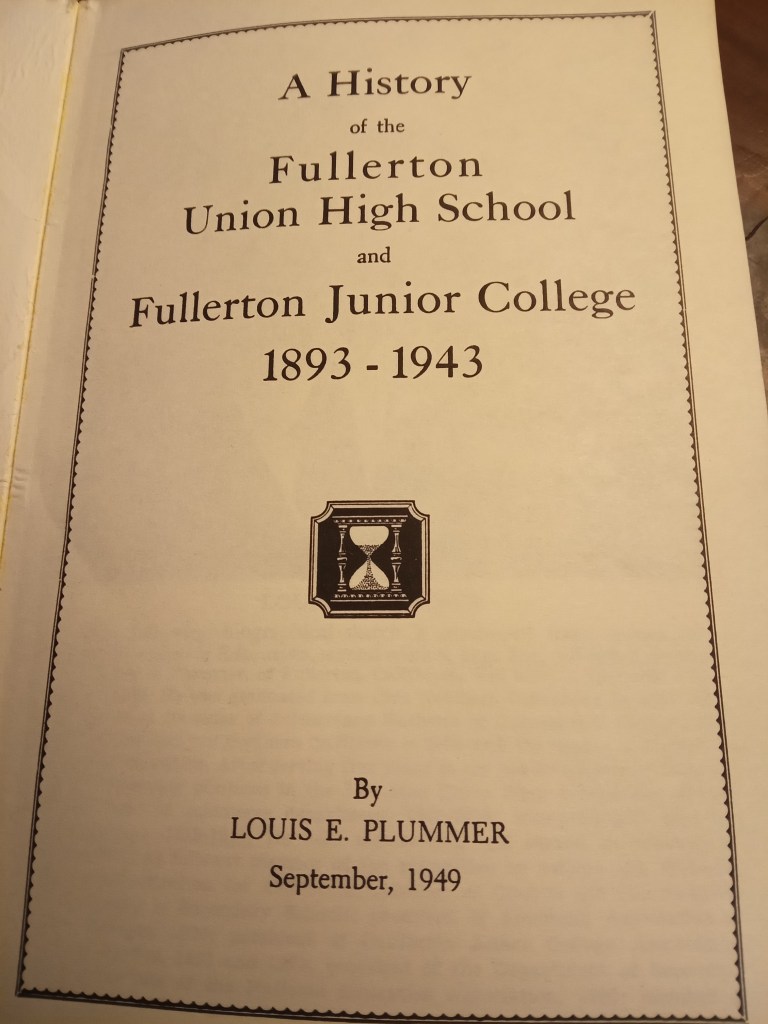
His book is packed with valuable historical facts about the history of our local high school and community college. However, as a historian, I am faced with a bit of a dilemma.

Louis E. Plummer. In 2020, the Fullerton Joint Union High School Board of Trustees voted unanimously to remove Plummer’s name from the high school auditorium which had borne his name for many years amid evidence that Plummer was a member of the Ku Klux Klan in the 1920s.
The Board agenda item read as follows:
“The historical record indicates that Louis Plummer was associated with the Ku Klux Klan. The KKK is known to have engaged in acts of violence and terrorism against minority populations. Louis Plummer’s association was noted in a 1979 doctoral dissertation by Christopher Cocoltchos (UCLA) entitled The Invisible Government and the Viable Community: The Ku Klux Klan in Orange County, California During the 1920s. Cocoltchos wrote, “Plummer was . . . a leader in the Myers-led Klan.” (page 288).
A facility named for someone associated with the KKK is at odds with both Board Policy 0100 (a) Philosophy and Goals and Board Policy 0145: NONDISCRIMINATION (Educational Programs or Activities) “The Fullerton Joint Union High School District shall not discriminate on the basis of race, color, religious background, national origin or ancestry, ethnic group identification, marital or parental status, gender, sex, age, physical or mental disability, gender preference or sexual orientation, or the perception of one or more such characteristics, or economic status in the educational programs or activities which it operates for its students.”
At the time, I was an editor and writer for the Fullerton Observer Newspaper. I wrote an article about the school board’s decision, which occurred in the context of large-scale Black Lives Matter protests.
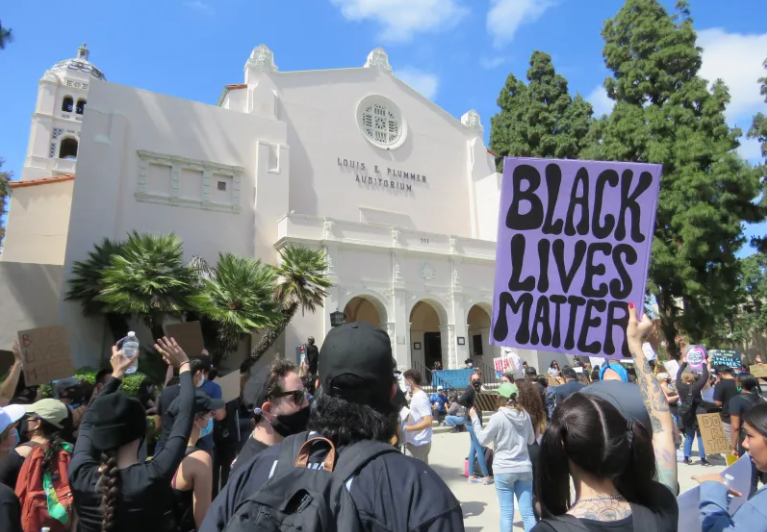
Protesters outside Plummer Auditorium in 2020. Photo by Jesse La Tour. I also read Cocoltchos’ 500-page dissertation and wrote a summary of it for the Observer.
I recently read Plummer’s history of the high school and college, and would like to present here a summary of this interesting history as part of my own local history. I do so with the caveat that Plummer was, evidently, a racist.
“The Fullerton Union High School existed, in embryo within the minds of early settlers years before its recorded birth in 1893,” Plummer writes. “In the summer of 1892 William Starbuck and Alex McDermont canvassed the northern part of Orange County, hoping to transform educational ideas into action. During the spring of 1893 these activities bore fruit in the form of a request to the county superintendent of schools to call an election for the organization of a union high school district.”
An election was held, and voters favored the creation of a new high school. The first trustees were William Starbuck, A.S. Bradford, B.F. Porter, and Dr. D.W. Hasson.
W.R. Carpenter was the first principal. At first, the new high school rented a room on the second floor of the Fullerton elementary school building, located at the corner of Wilshire and Harvard (now Lemon) avenues.
The Fullerton Union High School district first consisted of the territory of the elementary school districts of Buena Park, Fullerton, Orangethorpe, and Placentia.
Fullerton Union High School opened for classes in the fall of 1893 with eight students. Classes taught by Carpenter that year included Latin, physics, algebra, geometry, history, and English.
Adele Tucker joined the faculty in 1895 and taught Latin, English, and history. Helena L. Ingraham joined in 1899 to teach art. German was added in 1903 with Miss H.M. Oehlmann.
According to Thomas McFadden (class of 1896), “…during all the years I attended the Fullerton Union High School I drove back and forth with a horse and cart. All other students had to provide their own transportation.”
Worthington Means, class of 1898, said, “On the back boundary of the school grounds was located what would be a curiosity nowadays, namely, a shed where we could tie our horses.”
In 1908, the school moved to a new building on West Commonwealth.

Fullerton High School building prior to the 1910 fire. Enrollment in the Fullerton Union High School grew from 24 in 1896 to 62 in 1906, when Delbert Brunton became principal of the school.
“During that first summer he [Brunton] spent much of his time upon a bicycle visiting the homes of all eligible students whose names and residences he could learn. The school had not been completely accepted in all parts of the community as a permanent institution. It had added to the tax burden. The need for an educational program above the eighth grade was not universally recognized. Because of these conditions Brunton’s reception was not always cordial and results for the first year were not those for which he had hoped,” Plummer writes.
At the turn of the century, Fullerton was a rapidly-growing community. In 1900 the population was about 2200 inhabitants. By 1910 the population was 4415 and by 1920 it was 5540.
In 1910, tragedy struck.
“During the early morning hours of November 18, 1910 people of the district watched the fire department of Fullerton futilely attempt to fight back flames of unknown origin that consumed their high school building,” Plummer writes. “By daybreak all that was left of it were a few charred timbers, foundation, a tall smokestack, and a little equipment saved from the domestic-science and manual training rooms in the basement.”

FUHS building after its destruction by fire. As the trustees figured out what to do, classes were held in tents and then bungalows.
In 1911, Fullerton voters approved a bond to pay for new buildings.
There was disagreement and debate over the location of the new high school buildings.
“For two months prior to May 11, 1912, the district had owned three high-school sites; the old one on West Commonwealth, the Hilliard tract three fourths of a mile east of town on Chapman avenue, and the newly-purchased Central tract. On May 11, the Hilliard tract was sold to Delbert Brunton and H.W. Daniels. The Central Tract became the new school campus,” Plummer writes.
To be continued…
-
Early Settlers: Abe Pritchard
The following is from a work-in-progress about the history of Fullerton. You can support my ongoing research and writing on Patreon.
Abe Pritchard was born in Quebec, Canada in 1865 to James and Eliza Pritchard, farmers who had ten children.
After his parents died, he continued with the family farm with his brother Robert until 1900, when he moved to Fullerton, where he worked in packing houses.
He worked for the Benchley Fruit Company and in 1905 became manager of the Placentia Orange Growers Association. In 1910 they built a packing house in Placentia and in 1917, built another larger one on East Commonwealth Avenue in Fullerton. Pritchard was manager of both.
In 1905, his first year as manager, the association shipped 135 cars of citrus fruit, and in 1919 the shipment reached 1,280 cars.
He was active in the Fullerton Board of Trade and the Fullerton Club.
In 1912 he married Bertha White, who was born in Austin, Texas. They had three daughters: Carolyn, Marian, and Katherine.

Portrait of Abe Pritchard from Samuel Armor’s History of Orange County. Source:
History of Orange County, California: with biographical sketches of the leading men and women of the county who have been identified with its earliest growth and development from the early days to the present by Samuel Armor. Los Angeles Historic Record Co, 1921.
-
Early Settlers: Danforth C. Cowles (doctor)
The following is from a work-in-progress about the history of Fullerton. You can support my ongoing research and writing on Patreon.
Dr. Danforth C. Cowles was born in Richmond, Virginia in 1875. His father was Dr. Ransom F. Cowles, who served as a surgeon in the Confederate army during the Civil War.
In his early years he drove a mule in coal mines, and eventually worked his way through Virginia Military College, graduating in 1892 as a civil engineer. He worked as an engineer for some large mining companies before going back to school to get his medical degree from the University of Minnesota in 1901.
He worked for two years at Bellevue Hospital in New York, before doing post-graduate work abroad in Edinburgh, Vienna, and Paris. He returned to Minneapolis, where he worked as a doctor for 18 years.
In 1900, Cowles married Ragnhild Sorensen. She died in 1914, leaving him one child, Danforth Jr.
In 1918 he moved to Fullerton where he built up a successful medical practice. That same year he married Anna Hicks, a nurse.
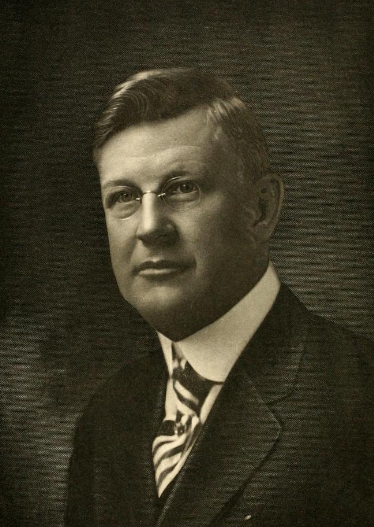
Portrait of Danforth C. Cowles from Samuel Armor’s History of Orange County. Source:
History of Orange County, California: with biographical sketches of the leading men and women of the county who have been identified with its earliest growth and development from the early days to the present by Samuel Armor. Los Angeles Historic Record Co, 1921.
-
Early Settlers: O.V. Knowlton
The following is from a work-in-progress about the history of Fullerton. You can support my ongoing research and writing on Patreon.
O.V. Knowlton was born in Pennsylvania in 1848, the son of Charles and Cornelia Knowlton. When he was only three weeks old his father was murdered. In 1851 his mother took him to Illinois. She died in 1854 and O.V. was left with his uncle.
In 1863 he enlisted in the Illinois Volunteer Cavalry, serving in the Army of the West in the Civil War. In 1865, he fought in a campaign against the plains Indians, helping to build the first stockades across the plains so Butterfield stage coaches could pass through Indian country.
In 1866, he went to work in the oil fields of Pennsylvania, and worked there for seven years. After that, he worked in the building business in Illinois, Kansas, and Nebraska.
In 1886 he moved to California, where he worked in contracting in Anaheim and purchased five acres in Fullerton which he planted with Valencia oranges.
He served as commander of the Southern California Veterans Association, and as state mortuary officer for Orange County for 18 years.
He married, Julia A. Huntington, a teacher. They had five children: Charles, Avis, Kent, Hollis, and Ruth.
Julie passed away In 1901.
He was a Republican. Knowlton passed away in 1928. He is buried at Loma Vista Memorial Park in Fullerton.

Portrait of O.V. Knowlton from Samuel Armor’s History of Orange County. -
Early Settlers: William Thomas Brown
The following is from a work-in-progress about the history of Fullerton. You can support my ongoing research and writing on Patreon.
William Thomas Brown was the first president of the Fullerton Chamber of Commerce and according to biographer Samuel Armor “an early advocate of the most enthusiastic sort of good roads, able to boast with pride that he actively participated in giving Fullerton her fine thoroughfares, renowned as among the best in all the state.”
He was president and general manager of the Brown and Dauser Lumber Company.
He was born in Macon, Georgia in 1852 and attended private schools in Winchester, Texas.
He came to California in 1873, spending his first ten years as agent and operator for the Southern Pacific Railroad Company, and a year as secretary of the Santa Ana Valley Irrigation Company in Orange.
In 1881 he bought a 21-acre ranch between Orange and Santa Ana, where he spent a couple of years farming. He then became a partner in the Anaheim yard of the J.M. Griffith Lumber Company.
In 1899 he established the Brown and Dauser Company and bought the T. S. Grimshaw lumber yard in Fullerton, the oldest yard in town. Besides the Fullerton yard, the Brown and Dauser Company had two other lumber yards, in La Habra and Brea.
“When Fullerton began the agitation for good roads it required much effort and time to persuade many of the taxpayers that better and the best roads were the greatest of assets and after the bonds were voted Mr. Brown was appointed a member of the commission that had charge of the construction, and that finally gave Fullerton pavements such as many larger municipalities do not boast of,” Armor writes.
He was married in 1878 in Wilmington, CA, to Isabella Campbell. She passed away in 1893, leaving six children: Lottie, Catherine, Mabel, Albert, W. Grant, and Helen Brown.
Mr. Brown was married a second time in 1895 to Alice Beaizley.
By 1921, he owned three orange ranches.
He was a Mason in the Fullerton Lodge and a member of the Knights of the Maccabees in Anaheim. He was a Democrat.
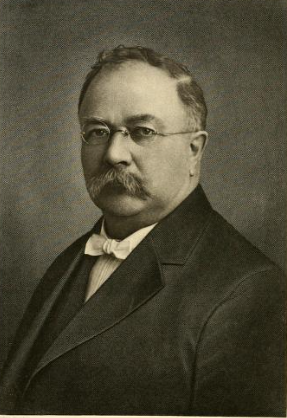
Portrait of William Thomas Brown from Samuel Armor’s History of Orange County.
-
Subscribe
Subscribed
Have a WordPress.com account? Log in now.

