-
Early Settlers: E.C. Miles
The following is from a work-in-progress about the history of Fullerton. You can support my ongoing research and writing on Patreon.
E.C. Miles was born in Keokuk County, Iowa in 1867, the son of Daniel Miles, a farmer who fought in the Civil War for the Union Army.
The oldest of 11 children, Miles was educated at a rural school and later attended a business college in Colorado, after which he worked in the grocery business.
In 1911 he moved to Fullerton, and bought an orange grove, and became secretary and manager of the Fullerton Mutual Orange Association.
He married Alice Richardson in 1892 and they had two children: C. Neal and Bessie.
Fraternally, he was a Mason and a member of the Woodmen of the World. He was also a director of the Farmers and Merchants Bank of Fullerton.
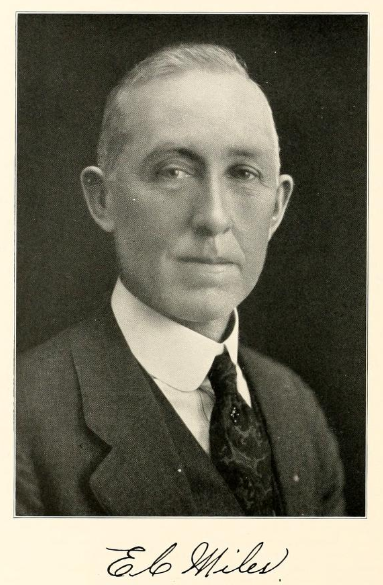
Portrait of E.C. Miles from Samuel Armor’s History of Orange County -
Oral Histories: Hubert C. Ferry
The following is from a work-in-progress about the history of Fullerton. You can support my ongoing research and writing on Patreon.
Hubert C. Ferry worked for the Union Oil Company from 1918-1956, first in Los Angeles, and then in Fullerton. Although his degree was in law, he was something of a renaissance man for the company. He worked “in a supervisorial, managerial, legal, administrative, or official capacity.”
As I read the transcript of a 1975 interview with Ferry for the CSUF Oral History Program, my initial impression of Ferry is that he was a very well-informed, service-oriented man who really believed he was working for a service industry. He said, “Considering the magnitude and hazards involved, the petroleum industry is performing a miraculous service with an outstanding safety record.” I’m not sure he could make that claim today.
But what really strikes me about this interview is how deeply embedded Ferry was, not just in Union Oil, but in the political, municipal, and civic life of Orange County:
He was on the Board of Directors for the Metropolitan Water District of Southern California.
He was on the Advisory Board of St. Jude Hospital.
He was on the Orange County Planning Commission.
He was on the Advisory Committee of the Los Angeles County Air Pollution District.
He was on the Advisory Committee of the State Board of Health.
He was Chairman of the Citizens Advisory Committee to the Orange County Transit District.
He was Chairman of the Committee that financed the building of the current City Hall in Fullerton.
What business does a guy who worked for a major oil company for 38 years have on all these civic and municipal committees? I have to wonder whose interests he was representing on all those committees and boards. I suspect he was representing his employer, Union Oil. It is more than a little disturbing that a guy from an oil company was so deeply embedded in governmental and civic affairs.
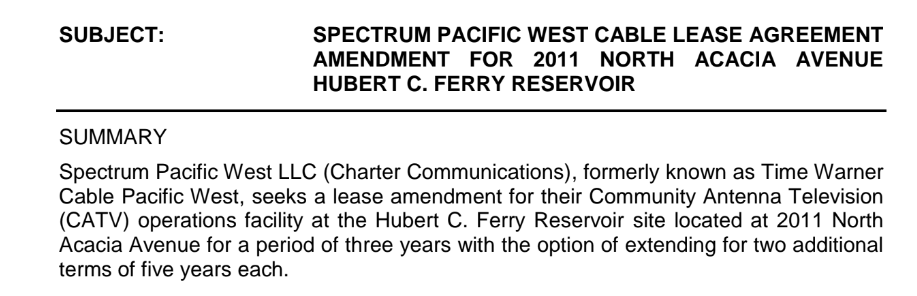
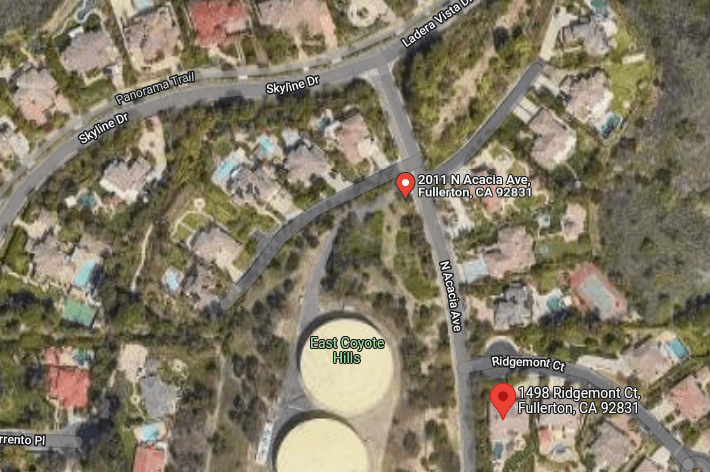
A Google search revealed that there is a Hubert C. Ferry reservoir in Fullerton at 2011 N. Acacia Avenue that is leased to Spectrum cable for their Community Antenna Television (CATV) facility.
-
Early Settlers: John Henry Lang
The following is from a work-in-progress about the history of Fullerton. You can support my ongoing research and writing on Patreon.
John Henry Lang was born in Cape Girardeau County, Missouri in 1882. His father and mother were farmers. He was the seventh of nine children.
He graduated from St. Louis University Medical Department in 1906. He practiced medicine in Centertown, Missouri for five years before moving to Fullerton in 1911.
He worked as a surgeon at the Fullerton Hospital.
In 1906 he married Carrie Blanche Milster. They had three children: Beatrice, Helen, and Howard.
He served as chief examiner of the exemption board for north Orange County during World War I, and as the city health officer.
He was a director of the Standard Bank of Orange County and the Home Builders of Fullerton. He also owned a Valencia orange grove.
He was a Republican, a member of the Board of Trade, the Fullerton Lodge of the Masons, and the Fullerton Club, among other fraternal organizations.

Portrait of John Henry Lang from Samuel Armor’s History of Orange County -
Oral Histories: Elvin Ames
The following is from a work-in-progress about the history of Fullerton. You can support my ongoing research and writing on Patreon.
Elvin Ames, along with numerous local residents, was interviewed for the Cal State Fullerton Center for Oral and Public History. Here are a few things I learned from Ames’ interview.

Photo of Elvin Ames from the 1923 Fullerton High School Pleiades Yearbook courtesy of the Fullerton Public Library Local Histoy Room. Elvin A. Ames was a teacher at Fullerton Union High School during the “roaring 20s.” At this time, there were a bunch of new clothing fads. One was for women to roll the top of their stockings. Apparently the guys on the school board didn’t take too well to new fads, because of “how serious they were in their religious beliefs” (Ames 15).
Ames recalls an incident of a drama teacher getting fired for wearing rolled stockings: “This particular dramatics teacher was taking a group of students up to a play in Los Angeles and she had to step rather high when she got on the train. Her dress slipped up a little bit and showed she had rolled her stockings. One of the board members who was down there to see them off didn’t feel that a teacher should roll her stockings. He proposed that they dismiss her. The board had quite a discussion over it and the discussion continued until the end of the year. They did dismiss her and I felt right at that time that the teachers were dominated too much by the board members. It wasn’t fair to dismiss a good teacher just because of some part of her dress that one board member didn’t like” (15).
High school athletics were also different in the 20s. Ames recalls, “I don’t believe that football was any more important than track meets. I think they were all about the same; they were all considered to be just ordinary physical education. Of course, eventually football became a big money-maker.”
It did indeed. When I went to high school, the football players were the “top dogs.” Crowds of people paid money on Friday nights to watch high school football games. As a track and field runner, I got no respect. Nobody gave a shit about track and field. But it comforts me to know that this wasn’t always the case.
On a less positive note, it turns out that Ames, along with other local leaders and residents like Louis Plummer and Albert “Pete” Hetebrink joined the Ku Klux Klan in the 1920s. Local journalist Gustavo Arellano did a brief profile on him for his 2011 series “OC Pioneers Who Were Klan Members.” Arellano’s series is based on a list of KKK members that is available for viewing at the Anaheim Heritage Center. The copy of the list was provided to the Anaheim Public Library by local historian Leo J. Friis in 1972.
To learn more about the Ku Klux Klan in Fullerton in the 1920s, check out my summary of the 1979 UCLA doctoral dissertation The Invisible Government and the Viable Community: The Ku Klux Klan in Orange County, California During the 1920s by Christopher Cocoltchos.
Elvin Ames died in 1976 and is buried at Loma Vista Memorial Park in Fullerton.

-
Oral Histories: Albert “Pete” Hetebrink
The following is from a work-in-progress about the history of Fullerton. You can support my ongoing research and writing on Patreon.
In 1999, Albert “Pete” Hetebrink was interviewed for the CSUF Center for Oral and Public History. Here’s what I learned from the interview, and a few other sources. Some of this was previously published in an article I wrote for Fullerton College’s Centennial exhibit in 2013.
Albert was born in 1900 in Fullerton, California, the third of seven children. His father, John, was a successful tomato and citrus rancher. In 1914, John Hetebrink built the large mission-style house that still stands on the Fullerton College campus, on the corner of Chapman and Berkeley. At the time, the area was tomato fields. The Hetebrinks owned two 40 acre ranches in the area.

Photos of the Hetebrinks from the interview text in the CSUF Center for Oral and Public History. Before the Hetebrinks moved into the large house on Chapman Ave, they lived in a smaller house near the railroad tracks. He recalls, “The hoboes followed the railroad tracks in those days, and they always stopped in for a meal…[my mother] always had chickens and eggs out there, and she always could mix up a meal for them any time of the day. And she did, as a rule.” Interestingly, the hoboes were one of reasons the family moved. Albert recalls, “We moved over here [on Chapman] because they put a railroad track to Placentia. And the hoboes all followed the railroad track, and they were always begging a meal. So that’s why we moved over here, mainly. It was one of the main reasons, and to get closer to town.”

Photo of Hetebrink House, courtesy of Wikipedia. Albert went by the nickname “Pete.” When asked why, he said, “I had an uncle Albert Hetebrink. He and a Placentia friend of his were out hunting, one behind the other one. His friend was the one in back, and his gun went off and killed Albert…My uncle Dee Dee (Dietrich] couldn’t call me Albert because he knew Albert, and so he called me Pete. That’s how I got my nickname.”
In its early years, Fullerton was a “dry town,” meaning it was hard to get a drink of alcohol anywhere, mainly because those in power (like mayor Charles Chapman) were very religious protestants who were against drinking. Albert recalls, “The people that drank, they liked to go to Anaheim because they were a wet town. Fullerton was more connected to the church, so it was just more natural to be dry.”
Pete spent his early days helping his father on the ranch, hunting, and fishing. He attended Fullerton Union High School and Fullerton Junior College, when the two schools shared a campus. He was a football player, photographer for the annual Torch yearbook, and was elected Student Body President in 1923.
After graduating, Pete began managing his father’s ranch, and changed it from a tomato to a citrus ranch, when oranges became the profitable local crop. On Sundays, the Hetebrink family would often drive their Jackson car to the beach, a full day outing. The Hetebrink House was a popular gathering place for holidays and celebrations.
In 1924, it seems that Pete (along with numerous local leaders like Louis Plummer) was a member of the Ku Klux Klan, which had a fairly large membership in Fullerton. Journalist Gustavo Arellano did a piece on him for his “Profiles in OC Pioneers Who Were Klan Members” for OC Weekly back in 2011.
When asked if they had help on their ranch, people who worked for them, Albert said simply, “Oh yeah, Mexican labor,” but he did not elaborate much on the subject. The interviewer asked a couple times about a man named Juan Castro, a man who had worked on their ranch and lived in a house on the orange grove. Albert had little to say on this subject except, “Oh, he worked. Yeah, he worked on the ranch.” I can’t tell if Albert’s reluctance to discuss his laborers was due to embarrassment or simply a lack of interest, or both. A bit later in the interview, Albert said, “I had Mexicans that lived on the ranch.”
As the citrus industry declined and the Southern California real estate boom began following World War II, Albert eventually sold his ranch to Fullerton College. The Hetebrink House is currently on the National Register of Historic Places.
When asked about the decline of the agriculture industry and the rise of residential, commercial, and industrial development in Fullerton, Albert speculated that it has affected the weather: “To have more houses where it used to be vacant ground, there’s more houses and more heat…we never really had any bad cold weather after that…I think it’s rained less.” Instead of global warming, Albert witnessed local warming.
In response to this, the interviewer observed a trend toward more localized agriculture: “I think people are starting to turn towards raising their own food a little bit more. But you’re an old hand at that, and we have to learn how to do it again.”
Albert died in 2001, at the age of 101.
-
Early Settlers: Christian Anderson
The following is from a work-in-progress about the history of Fullerton. You can support my ongoing research and writing on Patreon.
Christian Anderson was born in Schleswig-Holstein, northern Germany in 1865. He immigrated to America in 1888.
In 1892, he purchased 20 acres of land east of Fullerton. He first planted cabbage, but then in 1894 he began to plant citrus trees.
In 1904, he purchased 12 acres adjoining his property, which he planted with walnuts.
He was a charter member of the Anaheim Union Water Company, and owned stock in a Placentia Bank.
He marketed his oranges through the Placentia Orange Growers Association and his walnuts through the Fullerton-Placentia Walnut Association.
His brother Nels Anderson owned oil wells on his land.
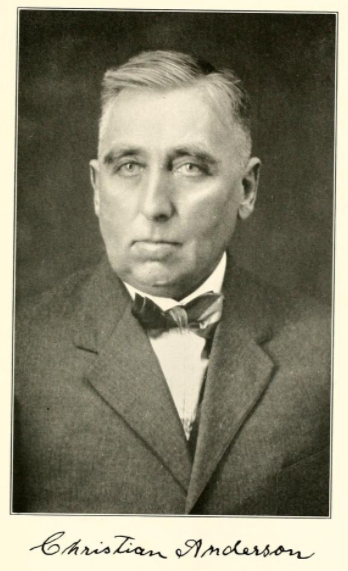
Portrait of Christian Anderson from Samuel Armor’s History of Orange County -
How Fullerton Benefitted from the New Deal
The following is from a work-in-progress about the history of Fullerton. You can support my ongoing research and writing on Patreon.
Yesterday, I wrote about the story of the “Pastoral California” mural on the side of the Fullerton High School Auditorium, which was a Depression-era New Deal art project. Today, I’d like to share a bit more about how Fullerton benefited from the New Deal.
During the Great Depression, president Franklin D. Roosevelt rolled out a series of large-scale relief efforts and began to weave the fabric of a social safety net, some of which still exists today, such as Social Security and the Federal Deposit Insurance Corporation (FDIC).
Roosevelt called it the New Deal. At the time, unemployment had reached 25 percent—the highest in US history so far. Federal programs like the Works Progress Administration (WPA) and the Civilian Conservation Corps (CCC) were created to give people jobs, and to simultaneously build up the country’s infrastructure—new roads, dams, parks, public buildings and more were built.

Works Progress Administration sign at Fullerton College. Photo by the author. The WPA alone gave over 8 million unemployed Americans jobs in its 8-year existence.
These government programs were not just for laborers. Artists, writers, actors, and musicians were also employed by the WPA to give folks not just jobs, but also hope and beauty in difficult times.
Today, nearly a century later, Roosevelt’s New Deal is primarily remembered in history textbooks and school curricula. But there is another way to remember its legacy—by recognizing the New Deal projects that still exist right where we live.
The city of Fullerton was a major recipient of New Deal funding and projects, many of which still exist today and have become some of the most iconic features of our local landscape.
A few years back, a book came out called The New Deal in Orange County California by Charles Epting. This well-researched and comprehensive book was the first of its kind to document all the New Deal projects in Orange County, city-by-city, including Fullerton. I present here what I learned from Epting’s helpful guide, which has deepened my understanding of my hometown and the programs that helped build it up in the worst of times.
As if the Great Depression wasn’t bad enough to endure, Orange Countians also faced three major natural disasters during the 1930s.
First came the devastating Long Beach Earthquake of 1933, which caused over $50 million in damage and killed 120 people throughout the region.
“In some cities every brick building was completely destroyed—city halls, libraries, police stations, post offices, etc,” Epting writes.
Then came the 1938 flood—causing millions more in damage and killing 113 people. The Los Angeles, San Gabriel, and Santa Ana rivers burst their banks and many cities, including Fullerton, were inundated with water.
Here are some historic photos of Fullerton during this flood, taken from the archives of the Fullerton Public Library Local History Room:
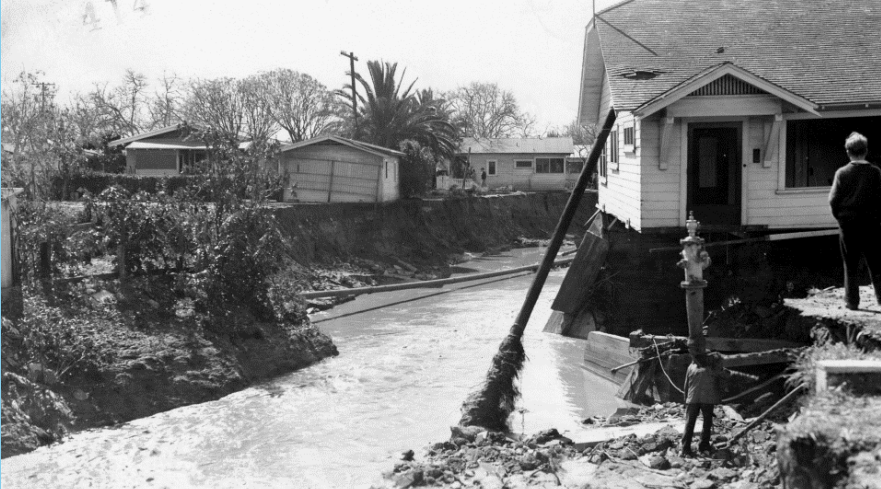
Destruction in Fullerton from 1938 flood. 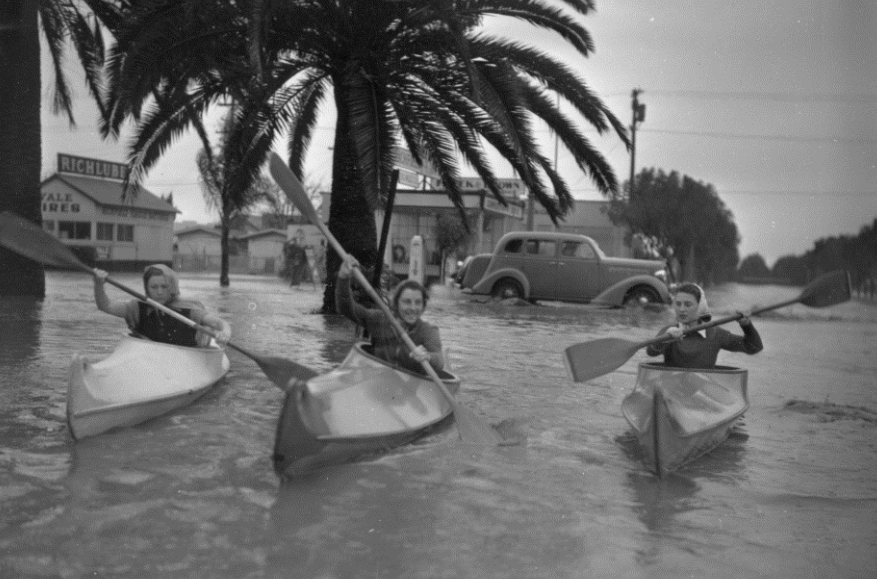
Students kayaking to school in Fullerton during 1938 flood. These floods not only destroyed buildings, they also destroyed acres of crops, which were the economic backbone of the region.
The following year, 1939, another disaster struck—a tropical storm (the only one of its kind to hit OC in the 20th century), which destroyed several piers and coastal buildings.
The 1930s were pretty rough.
“Because of these disasters, nearly every single community in Orange County was profoundly impacted by the New Deal,” Epting writes. “Dozens of schools, city halls, post offices, parks, libraries, and fire stations were built; roadways were improved, and thousands were given jobs.”
Here’s how the New Deal benefitted Fullerton.
“With a population of just over 10,000 in 1930, Fullerton was one of the largest cities in Orange County at the time of the Great Depression. Relief projects were numerous. It is probable that Fullerton received more aid than any other Orange County city,” Epting writes. “What is also unique about Fullerton is that nearly all of its New Deal buildings are still standing and preserved as local landmarks.”
Maple School (244 E Valencia Dr): This school was retrofitted and expanded following the 1933 earthquake. It was partially funded by the Public Works Administration (PWA). It’s an example of Art Deco architecture. Plans were drawn by architect Everett E. Parks.
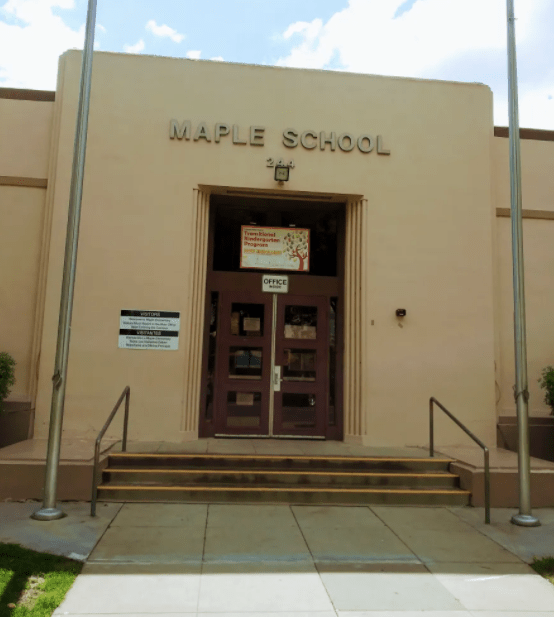
Entrance to Maple School. Photo by the author. Wilshire Junior High School (315 E Wilshire Ave): Originally constructed in 1921, it was reconstructed and expanded during the 1930s with PWA funds. The style is Deco/Greco. Now it’s the School of Continuing Education.

Wilshire School students circa 1930s. Photo courtesy of Fullerton Public Library Local History Room. 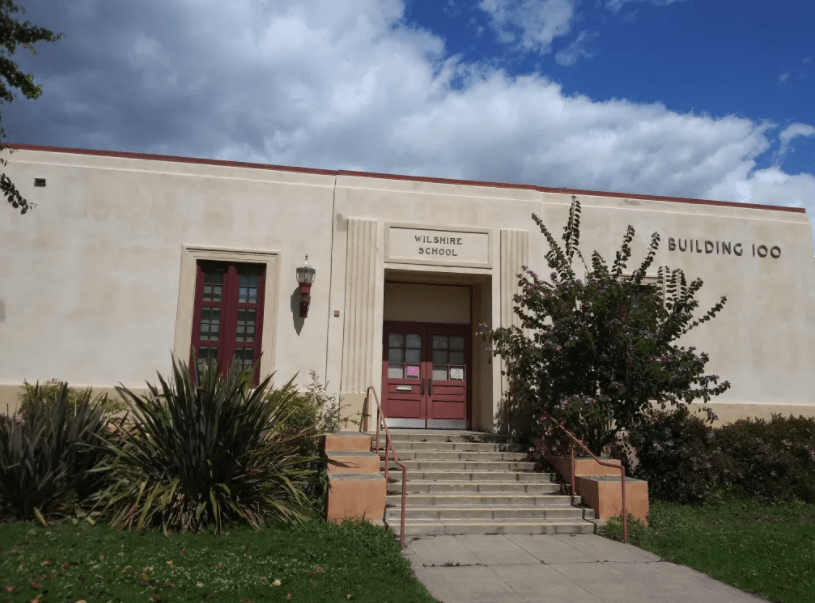
School of Continuing Education today. Photo by the author. “Pastoral California” mural on High School Auditorium (201 E Chapman Ave): Giant fresco painted by Charles Kassler under the Public Works of Art Project in 1934. Spanning 75 feet by 15 feet, the mural is unmatched in size and scope. One of the two largest frescoes commissioned during the New Deal. Click HERE to read more.

Portion of “Pastoral California” mural. Photo by the author. Fullerton College (321 E Chapman Ave): In 1935, Fullerton architect Harry K. Vaughn teamed up with landscape architect Ralph D. Cornell to create a general plan for the new campus, to be partially funded by the WPA and the PWA. The first building was the Commerce Building, next was the Administration and Social Sciences building, then the Technical Trades building.
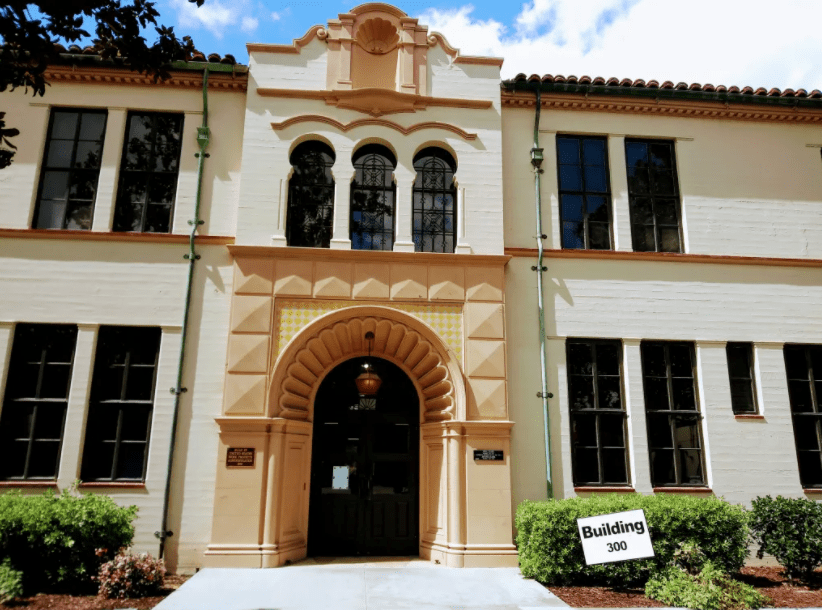
Fullerton College 300 building–a WPA building and the first built on campus. Photo by the author. Fullerton Museum Center (301 N Pomona Ave): Fullerton’s first public library was an Andrew Carnegie-funded library built in 1907. Years of wear (and the 1933 earthquake) necessitated a re-building. In 1941, the Carnegie Library was demolished, and a new library was re-built by WPA workers. The building was dedicated in 1942. A new library (on Commonwealth) was built in 1973, and the Fullerton Museum Center has occupied the building since 1974.

Fullerton Museum Center building. Photo by the author. Post Office (202 E Commonwealth Ave): The first federally-owned building in Fullerton, it was built in 1939 and funded by the Department of the Treasury, and built by crews of local workers. This post office also contains the mural “Orange Pickers” by Paul Julian, funded by the Treasury Department Section of Fine Arts. Paul Julian went on to have a very successful career at the Warner Bros. studios animating Looney Tunes shorts.
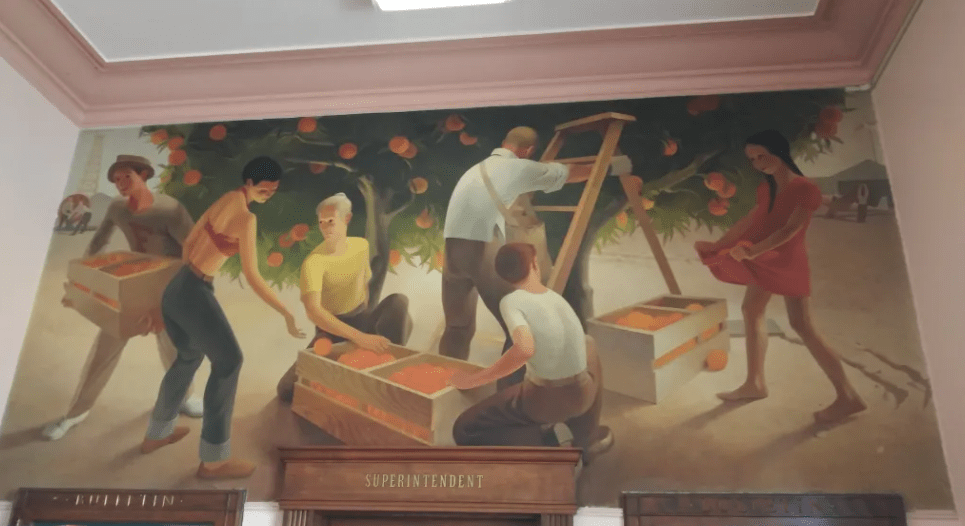
Post Office mural. Photo by the author. Police Station/Former City Hall (237 W Commonwealth Ave): The impressive Spanish Colonial Revival building is now home to Fullerton’s police department. Designed by architect George Stanley Wilson, the building was completed in 1942. One of the most distinctive features of the building is its extensive tile work.

City Hall under construction. Photo courtesy of Fullerton Public Library Local History Room. 
Fullerton Police Station (former City Hall) today. Photo by the author. “The History of California” Mural in the Police Station: A three-part mural for which the WPA’s Federal Art Project commissioned artist Helen Lundeberg to paint in 1941. The mural depicts everything from the landing of Juan Rodriguez Cabrillo in San Diego in 1542 to the birth of the aircraft and movie industries in Los Angeles in roughly chronological order. Here are some photos I recently took of the mural. Unfortunately, you have to make an appointment with the police department to see this public work of art:
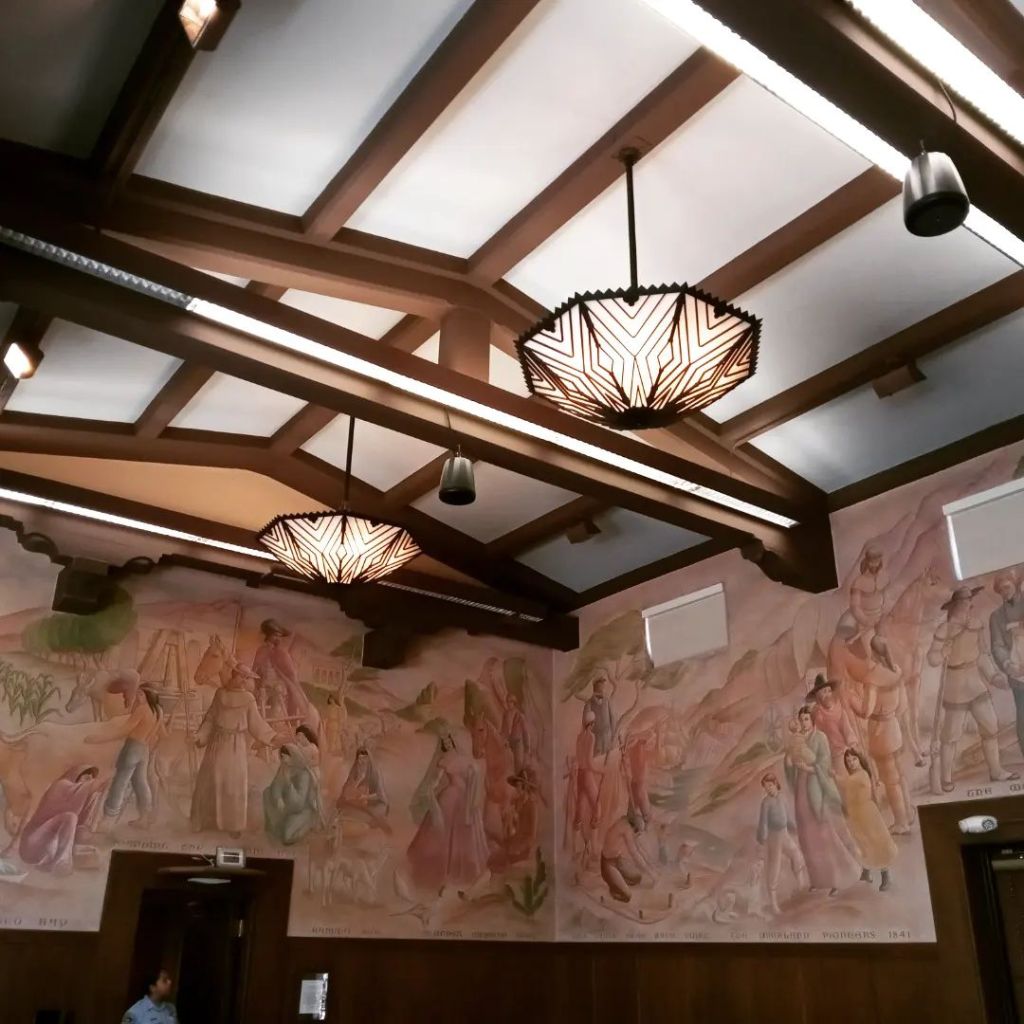
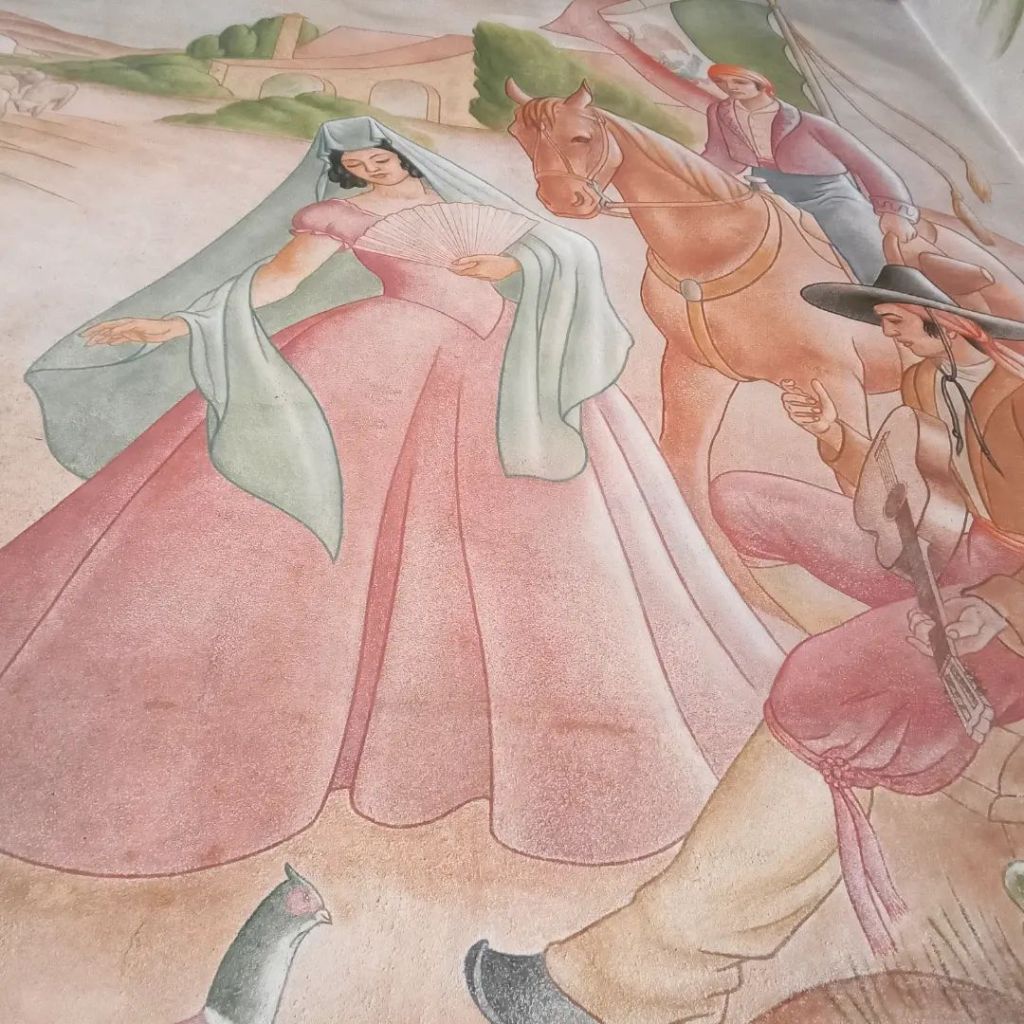


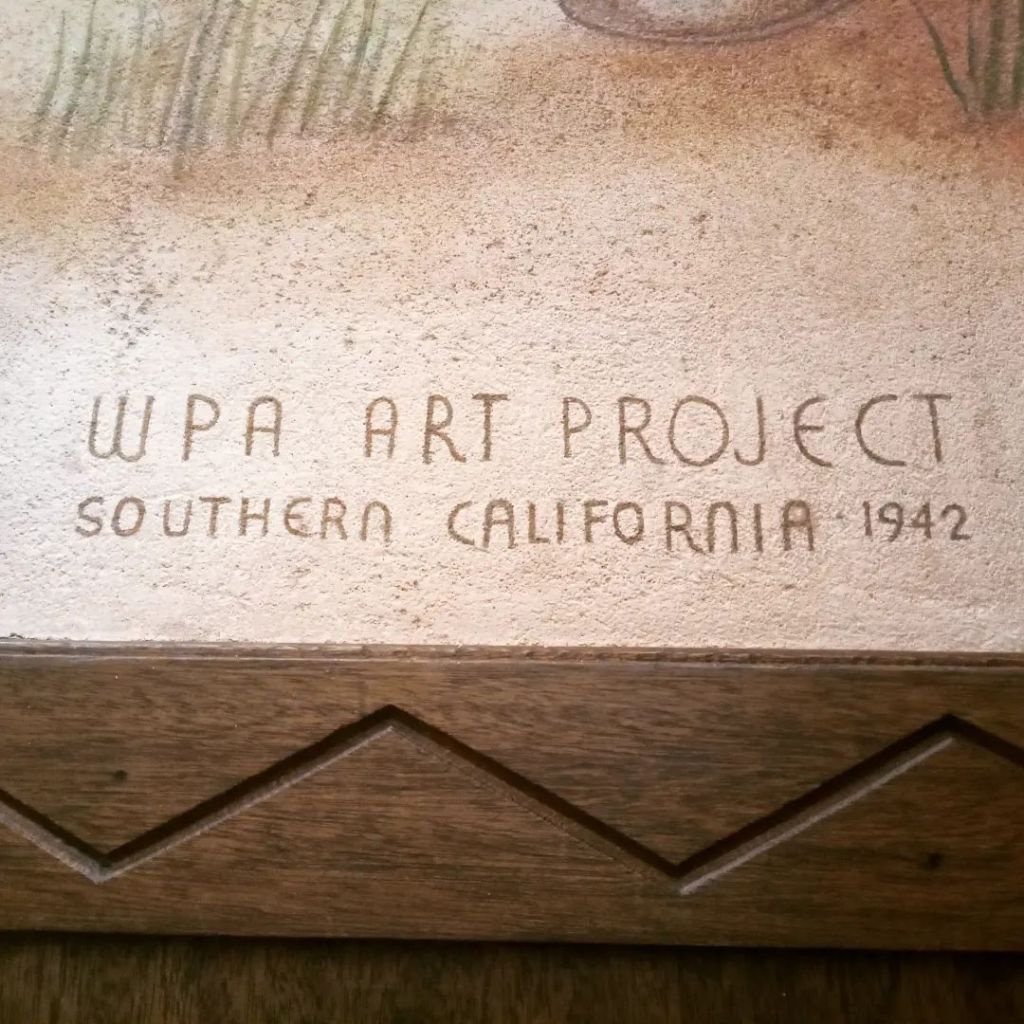
Hillcrest Park (1200 N Harbor Blvd): The amount of work done in Hillcrest Park during the New Deal was staggering, with projects being funded and constructed by the CWA, WPA, RFC, and SERA. Much of Hillcrest Park’s landscaping was done during this era, like the excavation of the “Big Bowl.” Perhaps the most iconic feature of Hillcrest Park is the Depression-era stonework that runs throughout the Park. Today, Hillcrest Park represents the finest example of a WPA-era park in Orange County and has enjoyed federal recognition since 2004, so the structures are safe.
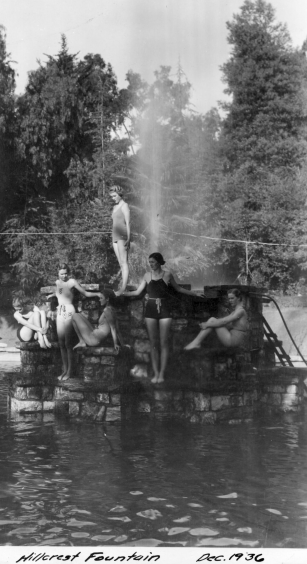
Hillcrest Park Fountain. Photo courtesy of Fullerton Public Library Local History Room. 
Hillcrest Park stonework. Photo by the author. Amerige Park (300 W Commonwealth Ave): A wooden grandstand and stone pilasters were built at the baseball field in 1934. The grandstand was destroyed by a fire in the 1980s, but the flagstone pilasters remain.

Amerige Park baseball game in the 1930s. Photo courtesy of Fullerton Public Library Local History Room. -
“Pastoral California”: The Story of a Mural
The following is from a work-in-progress about the history of Fullerton. You can support my ongoing research and writing on Patreon.
“Pastoral California,” the 75-foot long fresco mural on the side of the Auditorium at Fullerton Union High School was painted in 1934, during the Great Depression, painted over by order of the Board of Trustees in 1939, and restored 58 years later in 1997. The story of this mural, what it depicts, why it was painted over, and finally restored, is one worth reflecting upon.
The first major public art projects in Fullerton were commissioned during the Great Depression by the New Deal, which was created by Franklin D. Roosevelt to put America to work at a time when lots of people needed jobs. The various New Deal programs (including the well-known Works Progress Administration, or WPA) gave over eight million unemployed Americans jobs in its eight-year existence. The City of Fullerton benefited tremendously from the WPA. Many of the buildings at Fullerton College are WPA buildngs. The post office, the Fullerton Museum Center, the Police Station, and the stone structures and paths in Hillcrest Park were all built by New Deal money and unemployed Fullerton residents.
In addition to building projects, the WPA also commissioned murals in cities across America, including Fullerton, in an effort to give people not just jobs, but a sense of hope and beauty in difficult times. Perhaps the most famous of these murals is “Pastoral California,” one of the two largest frescoes commissioned by the WPA.
Charles Kassler, who had studied art at Princeton, traveled extensively, and apprenticed under a fresco painter in France, completed “Pastoral California” in 1934. Kassler had only one hand. He’d lost the other in a high school chemistry accident. He was married to famous Mexican singer Luisa Espinel, who was the aunt of pop superstar Linda Ronstadt.
Kassler clearly did local history research before painting the mural. It depicts a Spanish/Mexican southern California. From the 1700s to 1821, California was controlled by Spain. From 1821 to 1848, it was controlled by Mexico. Around that time, the United States decided it was their “Manifest Destiny” to control California, so they took it through a war of conquest, the Mexican American War. Kassler, however, chose to depict not an Anglo-American California, but a Spanish/Mexican one.
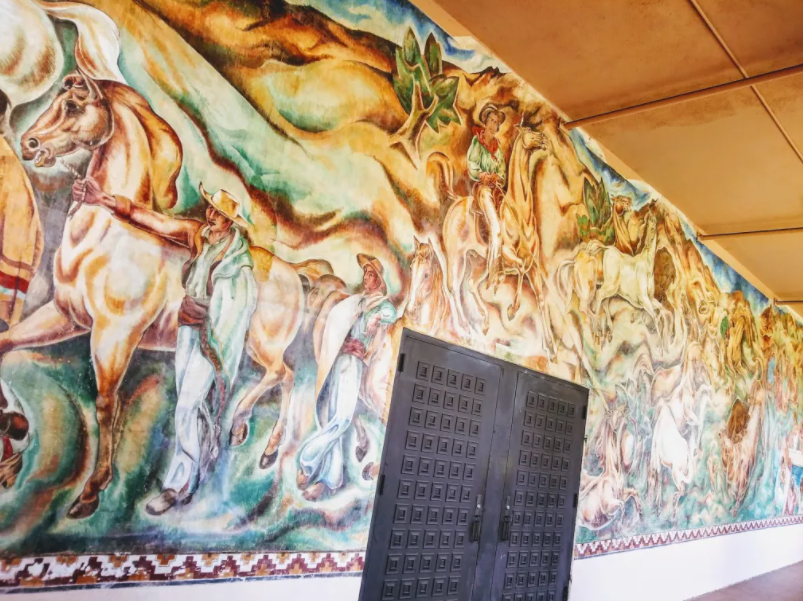
“Pastoral California” mural. Photo by the author. The mural depicts historical figures like Jose Antonio Yorba, a large landowner whom Yorba Linda is named after. In the background is Mission San Juan Capistrano. To the right is Pio Pico, the last Mexican governor of California. Most of the figures are Latinos doing everyday activities: washing clothes, riding horses, eating together.
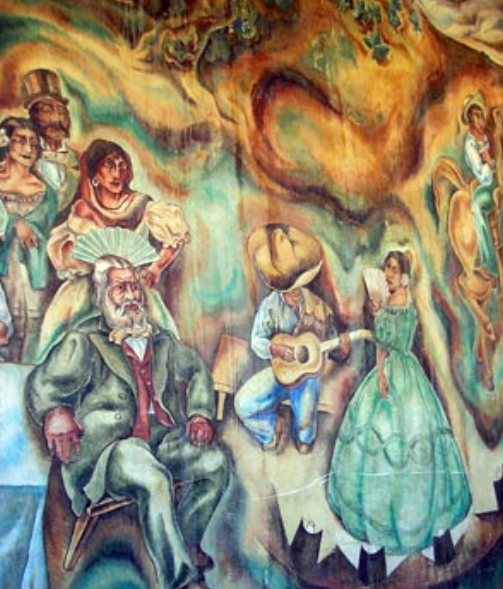
Detail from “Pastoral California” mural depicting Pio Pico, the last governor of Mexican California and famous Californio singer Laura Moya. 1930s LA art critic Merle Armitage praised the mural: “Kassler has adhered not only to the beautiful traditions of pastoral California, but at the same time has also borne in mind the splendid Spanish architecture, and, lastly, created a beautiful fresco of amazing vitality and freshness of viewpoint.”
Dr. H. Lynn Sheller taught English and History at Fullerton College in 1934, at the time “Pastoral California” was painted. “I watched him [Charles Kassler] put the mural up there,” Sheller recalled in an interview for the Fullerton College Oral History Program, “I would visit him day after day as he was working…the feature of a fresco is that the paint is mixed in with the plaster, thus it is supposed to be permanent.”
But not everyone was happy with Kassler’s mural.
An article from August 30, 1939 in the Fullerton News-Tribune entitled “High School Mural Doomed; Paint it Out, Trustees Order” reads:
“Fullerton Union high school’s much discussed and criticized mural which covers the outside west wall of the auditorium received its death sentence at the hands of district trustees last night who ordered the wall paint sprayed to cover the painting.
This mural is approximately 75 feet long by 15 feet high with its huge figures of horses and riders and other human forms depicting early California days has been a mooted [sic] point since its completion several [five] years ago by the artist Kassler as a federal art project.
Most occupants of the high school will shed no tears over the decision of the board; it was indicated today as the lurid colors and somewhat grotesque figures have apparently failed to capture popular fancy.”

1939 article from Fullerton News-Tribune courtesy of the Local History Room of the Fullerton Public Library. C. Stanley Chapman, son of Fullerton’s first mayor, Charles C. Chapman, and a city council man himself, was one of the ones who “shed no tears.” In an interview for the Cal State Fullerton Oral History Program, Chapman said: “The [mural] down there at the school was almost as absurd [as the one in the post office]. They were painted by that WPA business and the painting did not go with the architecture of the school. It was a great relief when they did paint them out. They were not an artistic addition to the building by any means”
The college student interviewing Chapman replied that superintendent Louis Plummer disagreed with this assessment: “Mr. Plummer seemed to think they were nice although he did not say so. He simply quoted a long article from the Los Angeles Times art critic who said they were lovely and truly representative and that the colors were beautiful. Mr. Plummer ends that little discourse by saying, ‘and they were painted over,’ as though he was disappointed.”
Chapman repied, “Oh, yes, the colors were good. But I have forgotten what the theme was.”
The interviewer reminded him, “Mexican entertainment; with the horses, and the children playing.”
Chapman replied, “Oh, yes, Well, the colors were nice. I don’t know. I was never involved in the school board or anything like that.”
Why was the mural painted over? I have heard some speculate that it was because some of the women depicted in the mural had naked, exposed breasts. However, I have seen no evidence that there was any nudity in the mural. In the mural as it exists today, and in every photo I’ve seen, the women are clothed. Some of them have big breasts, but that hardly seems justification for painting over the whole mural.

The allegedly offending women. “It wasn’t until we had a group of trustees in here who were negatively inclined, that it was painted over,” Sheller remembers. When asked why it was painted over, Sheller said, “Some people felt it was vulgar or gross in some way. It simply showed the Mexican women as they were probably attired at that time. They were very bosomy women. I don’t think that we would feel that there was anything wrong with it. I never felt there was.”
But others have a different view, one I believe makes more sense, given the social context of 1930s Fullerton.
“It was too Mexican, that’s why,” speculated Charles Hart, 75, who was a student at the high school and remembers the mural before it was covered up. “The school board didn’t want to leave the impression that this town was anything else but Anglos. Too extreme for them, I guess.”
Hart said this in a 1997 Los Angeles TImes article.
The decision to paint over this mural probably had to do with its subject matter. It celebrated Mexican culture at a time of heightened racism against Mexicans, and when Mexicans lived in segregated communities, attended segregated schools, and were often forcefully and illegally deported back to Mexico during the Great Depression.
I have written about this at some length in an article entitled “The Roots of Inequality: The Citrus Industry Prospered on the Back of Segregated Immigrant Labor.”
“Pastoral California” remained painted over for six decades years until, in 1997 it was restored, thanks to a massive community effort. I was actually attending Fullerton High School at the time. Some of my friends, art students, helped with the restoration. I remember thinking, even then: Why would anyone have painted over something so beautiful?
-
The Early History of Fullerton College
The following is from a work-in-progress about the history of Fullerton. You can support my ongoing research and writing on Patreon.
The main source for this information is Louis E. Plummer book A History of the Fullerton Union High School and Fullerton Junior College 1893-1943.
In 1913, the high school board of trustees approved the formation of a junior college as an extension of the high school. Twenty-six students were in the first class. Earl Dysinger of Fullerton was elected first student body president. Arletta Klahn was elected president of the sophomore class. Delbert Brunton, who was the Fullerton High principal, also headed the new Fullerton Junior College, as it was then called.
“During the school year 1915-1916 the enrollment reached a total of 44, and during 1916-1917 sixty students placed their names on the roll,” Plummer writes. “Then came the World War and a depletion of the ranks of college men. The Fullerton Junior College contributed her share to the armed forces.”
Louis E. Plummer became principal of the high school and Junior College in 1919.
Until 1922 the college was a department of the high school. In 1922 the college was reorganized as an independent junior college district.
In 1934 the Board of Trustees voted to purchase fourteen and one half acres located near the high school.
“The opening of the Civil Works Authority program in 1932 fitted, admirably, into plans for more adequate facilities for both the high school and the college,” Plummer writes. “Federal projects, twenty in number, were undertaken on the premises of the Fullerton Union High School and Junior College between 1933 and 1942. The aim of the Federal government in supporting such work was relief from unemployment.”
The first construction project undertaken on the new college campus consisted of a building to house the commerce department.

The Commerce Building was the first built on the College Campus. This was followed by the Administration and Social Science Building, which was followed by the Technical Trades Building, and the Student Union Building was built in 1938.
Fullerton College is today the oldest continuously operating community college in California.
-
Early Settlers: Charles and Sarah Harvey
The following is from a work-in-progress about the history of Fullerton. You can support my ongoing research and writing on Patreon.
Charles E. Harvey was born in Indiana in 1856. As a young man, he moved to Filmore County, Nebraska, and became foreman of a large ranch for three years. In 1880 he moved to Los Angeles and became a manager for the Continental Oil and Transportation Company for five years. Eventually he moved to Riverside, where he lived for 27 years, and where he developed orange groves.
In 1882, he married Sarah E. Siebenthal, also from Indiana. They had one daughter, Birday Daisy, who married William A. De Moss of Fullerton.
In 1913, he moved to Fullerton, and became special agent for the James F. Jackson Fertilizer Company, which later combined with two other companies to form the Southern California Fertilizer Company.
In 1919 he sold 4,000 cars of fertilizer, his customers being the leading ranchers in the region. The manure was taken from dairy ranches and stables all over Southern California.
He also served as deputy sheriff of Orange County.
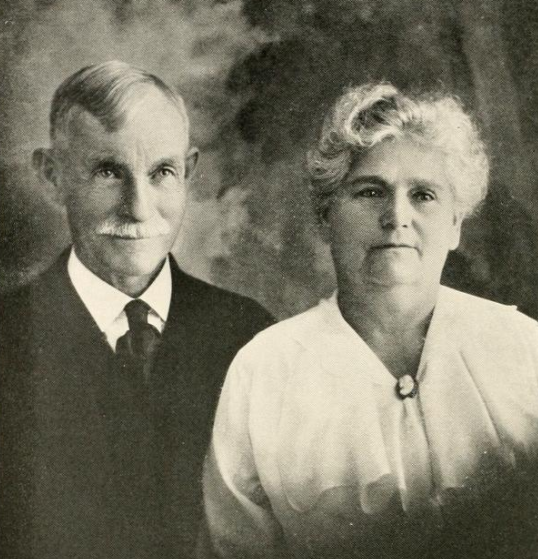
Portrait of Charles and Sarah Harvey from Samuel Armor’s History of Orange County.
-
Subscribe
Subscribed
Have a WordPress.com account? Log in now.

