-
Factories in the Field: The Story of Migratory Farm Labor in California (a book report)
The following is from a work-in-progress about the history of Fullerton. You can support my ongoing research and writing on Patreon.
In my ongoing research into the history of Fullerton, I will occasionally read books that give a broader context for this local history. Such a book is Carey McWilliams’ Factories in the Field: The Story of Migratory Farm Labor in California. Below is a book report on this book:
In the mid-1930s, at the height of the great depression, a novel written by a young John Steinbeck shattered the carefully-constructed myth of California as a “land of sunshine and abundance.” Steinbeck’s The Grapes of Wrath told a gut-wrenching story of migratory farm labor exploited by wealthy land owners.
Around that time, another book came out that is less well-known today, but perhaps equally illuminating. That book is Factories in the Field: The Story of Migratory Farm Labor in California, written by a young lawyer/journalist named Carey McWilliams. First published in 1935, McWilliams’ book is a carefully researched work of social history. Factories in the Field may be read as the research that backs up Steinbeck’s fiction.
Reading Factories in the Field, I was blown away by this largely unknown history. It’s a story of greed, corruption, exploitation, violence, and human struggle. It’s a story that is ongoing, that still affects what we eat and how that food is produced. If we understand our shared past, maybe we might better understand our present.

Land Monopolization
By the time California became a state of the Union, much of its land was already spoken for. By 1870, the powerful railroads held nearly 20,000,000 acres of land. By 1871, 516 men in California owned 8,685,439 acres of land.
“Our system,” said governor Haight, “seems to be mainly framed to facilitate the acquisition of large blocks of land by capitalists or corporations either as donations or at nominal prices.”
According to McWilliams, “The ownership patterns established by force and fraud in the decade from 1860 to 1870 have become fixed; the social structure of the state is, in large part, based upon these patterns. California more than once has been referred to as a colonial empire, and, by and large, the description is accurate.”
After the Gold Rush of the 1850s, landowners in California began to realize the financial potential of agriculture. Contrary to American mythology, the bulk of California farmland did not go to small farmers. Rather, it went to railroad companies, land barons, and corporations, who held enormous influence over elected officials.
According to Walter V. Woehlke, a writer for Sunset Magazine in the 1920s, “Wheat and cattle barons controlled the bulk of the fertile land in large tracts, having acquired their principalities through purchase of the old Spanish grants or though evasion of the laws protecting the public domain.” The result of this situation was “a class of landless tenants and drifting homeless farm laborers.”
In his 1872 travel book, Afoot and Alone, Stephen Powers describes “the notable phonemona of California…the multitude of its tramps, the so-called blanket men. I seldom met less than a dozen or fifteen a day.”
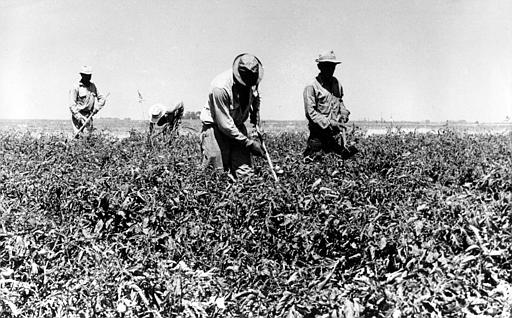
Migrant agricultural workers from Mexico are seen tending to tomato plants at the fields of Dalip Singh Samra ranch, near Hood, Calif., on August 17, 1960. (AP Photo) Henry Miller’s Hobos
When Americans think of “Captains of Industry” we normally think of men like Rockefeller (the oil baron), Carnegie (the steel baron), and Vanderbilt (the railroad baron). We do not normally think of agriculture. But, according to Carey McWilliams, California’s Captains of Industry definitely included agriculturalists or “farm industrialists.” McWilliams titled his book Factories in the Field to emphasize this point.
One of California’s first and most ruthlessly successful farm industrialists was a man named Henry Miller (not the author). A German immigrant, Miller began his career as a butcher and cattle trader in San Francisco. He began acquiring more land through shady deals involving buying out heirs to Spanish land grants, purchasing land “scrip” from U.S. surveyors, bribing local officials, lobbying the state legislature, and making friends with the powerful railroad companies.
By the turn of the century, Miller owned well over a million acres of land and over a million head of cattle. According to McWilliams, “Miller liked to boast that he could ride on horseback from Canada to Mexico and sleep every night in one of his own ranches.”
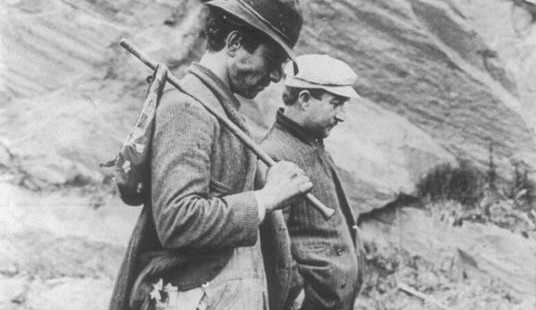
As a result of his land grabs and power, Miller was able to push many small farmers and original settlers off the land. Many of these displaced farmers and settlers became “tramps” and hoboes.” Miller discovered that these hoboes and tramps could be hired for very low wages, as long as they didn’t settle and kept moving along his farm empire. What developed was a route called the “Dirty Plate Route” (hoboes carried their own plates with them). McWilliams calls this “the beginning of migratory farm labor in California.”
Sometimes Miller would pay local constables and sheriffs to round up tramps and hoboes from freight yards, arrest them on vagrancy charges, which they could pay off by working for free on a Miller ranch. Conditions on the ranches were often “lousy and foul.”
H.A. Van Coenen Torchiana, who was once a foreman on one of the Miller ranches wrote, “The whole system was vicious, and bred industrial oppression on a large scale.”
Despite the fact that he was largely responsible for this system of industrial oppression, Miller went to great lengths to create a public image of himself as benevolent: “In the mornings, in Bakersfield, the tramps, who had jumped off the train, would line up in front of the bank when they saw Henry Miller enter. When he emerged from the bank, it would generally be with a large bag of coins–two bit pieces. As Miller shuffled out of the bank, he would hand each man two bits, while he, hat in hand, would murmur, ‘Thank you, Mr. Miller’ or ‘God bless you, sir.’”
Bonanza Farms and Indian Labor
Up until 1860, much of California agriculture was centered around huge cattle farms, perhaps best represented by those of Henry Miller. After 1860, a new crop began to dominate…wheat. 1860-1890 saw the rise of massive wheat farms in California. By 1890, 40,000,000 bushels of wheat were produced in the state, making California the second largest wheat producer in the United States.
Wheat farming was, for a time, profitable for large scale growers like Hugh J. Glenn, but it also exhausted the soil. According to McWilliams, “Within a decade the land barons of the state had seriously undermined the agricultural resources of California. The same feverish frenzy that had characterized mining in California also characterized wheat farming, which was not strictly speaking farming at all, but a variety of mining.”
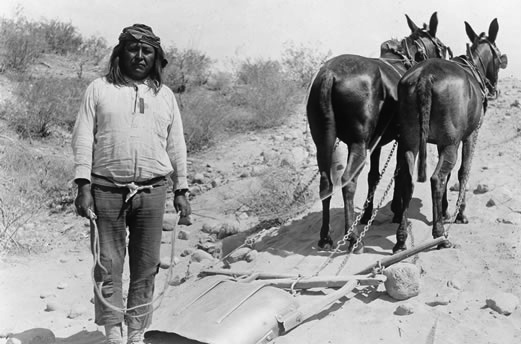
During the heyday of the great wheat farms, the main source of cheap labor was Indians, who had also supplied the bulk of the labor force during the Spanish colonial period. It’s no secret that when Americans took control of California, the Indians were ruthlessly exploited and uprooted.
Charles Loring Brace, a writer who visited California in 1867, expressed the popular U.S. attitude toward Native American laborers during that time period. He describes them as “perhaps the lowest tribe of the human race–they were all disgustingly dirty, and with but little clothing on them, living, in part, on pine seeds, acorns, and grass seeds; a diminishing race.”
It is, of course, ironic that writers like Brace blamed Native Americans for their own “diminishing” and not the Anglo Americans who systematically exploited and killed them.
In her 1884 novel Ramona, writer Helen Hunt Jackson portrays treatment of Native Americans in late 19th century California. A character in the novel, Allesandro, explains how Anglo Americans treated Native Americans: “When they buy the Mexican’s lands, (they) drive the Indians away as if they were dogs; they say we have no right to our lands.”
Polish writer Henryk Sienkiewicz, who visited Southern California in 1876 noted that most of the labor force was Cahuilla Indians from the San Bernadino mountains. According to McWilliams, these Indians were paid “ridiculously low wages, or no wages at all (a bottle of whiskey was one method of payment).”
Chinese Labor
Between the decades of 1870 and 1890, fruit gradually replaced wheat as the main crop of California. Reasons for this included changes in market conditions, droughts, and high freight rates. While wheat could be harvested mechanically and required less labor, fruit often had to be hand-harvested and required a large labor force.
Enter the Chinese laborer.
The completion of the trans-continental railroad in 1869, which had relied heavily on Chinese labor, created a lot of job-seeking Chinese immigrants. These “coolies” were a Godsend for large fruit growers in California, as Chinese laborers would work for very low wages.
According to the California Bureau of Labor, Chinese workers constituted around 80 percent of the agricultural laborers in the state in 1886. Low-paid Chinese labor was a major factor in the early economic success of the California fruit industry.
Large fruit growers faced a problem, however…large-scale and vicious racism against Chinese people in late 19th century America. As early as 1854, a California Supreme Court decision had included Chinese in “a statute which prohibited the testimony of Negroes, mulattos, and Indians, in cases to which white men were parties.” According to McWilliams, “Newspapers had stated as early as 1850 that the Chinese were being murdered with impunity.”
Anti-Chinese clubs sprang up around California starting in the 1860s. Cities like San Francisco passed discriminatory ordinances making it illegal to carry baskets on the sidewalks or for men to grow their hair a certain length. Chinese people were routinely harassed and expelled from their homes and places of work.
This anti-Chinese sentiment became federal law in 1882 with the passage of the Chinese Exclusion Act, which severely curtailed Chinese immigration to America.
The Geary Act of 1892 continued the provisions of the Chinese Exclusion Act and also provided for massive deportation of Chinese from the US. The language of the Geary Act is eerily familiar. It “forced the burden of proving legal residence upon the Chinese, and required that all Chinese laborers register under the act within one year of its passage.”
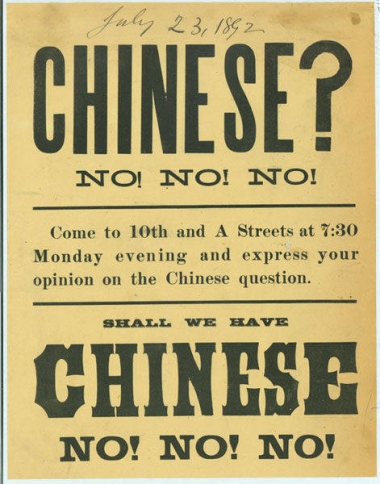
When these legal measures failed to expel Chinese people as swiftly as people wanted, Californians resorted to vigilante “justice”, as shown by the following examples, as excerpted from Factories in the Field:
“On August 15 (1893), riots broke out near Fresno: Chinese were driven from the fields and were ‘compelled to make lively runs for Chinatown.’ Chinese labor camps were raided and fired.”
“In Napa Valley, on August 17, a white laborers’ union was formed, and a mass meeting protested the further employment of the Chinese in the prune orchards.”
“In Southern California, at Compton, the Chinese were barricaded in packing sheds where they were forced to sleep for safety, while ‘hoodlums’ raided the fields and drove out the Chinese.”
“On September 3 anti-Chinese raiders swooped down on Redlands’ Chinatown, broke into houses, set afire to several buildings, looted the tills of Chinese merchants, and generally terrorized the Chinese.”
“At Tulare, Visalia, and Fresno, hundreds of white men were busy ‘routing out the Chinese, terrifying them with blows and pistol shots, and driving then to the railroad station and loading them on the train.”
During the years when this anti-Chinese activity was most acute (1893-1894), the United States was in the throes of a major economic depression. During this economic turmoil, Americans sought a scapegoat for their troubles, and found that scapegoat in Chinese workers.

Japanese Exclusion
After the exclusion of Chinese laborers from California following the Chinese Exclusion Act, the Geary Act, and widespread armed vigilantism, large growers were faced with a dilemma. They could have reconsidered their labor policies and created a more just and fair system. Instead, they began importing another exploitable minority labor force…the Japanese.
Between 1890 and 1910, the number of Japanese people in California rose from 2,039 to 72,156, many of whom worked as agriculture laborers. In 1901, the Industrial Commission on Immigration reported, “In the state of California alone there is today a great army of Japanese coolies, numbering upwards of 20,000. They do not colonize as do the Chinese; they are scattered throughout the state, doing work in the orchards, vineyards, gardens, and hop and sugar beet fields.” By 1909, there were 30,000 Japanese field workers in California.
Apparently, the large growers were as pleased with the Japanese as they were with the Chinese, as a low-paid labor force. J.L. Nagle of the California Fruit Growers Exchange stated, rather bluntly, “The Japs and Chinks just drift–we don’t have to look out for them.” The growers liked a labor force that worked cheap when fruit needed harvesting, and then moved on.
The Japanese brought about innovation in California agriculture. It was they who introduced rice cultivation to the state, a crop which by 1935 brought in around $20,000,000 per year. Some Japanese were able to purchase farms and become growers themselves. George Shima became famous for a time as the “Potato King.”
When Japanese agricultural laborers began to organize and demand higher wages, they were met with racial prejudice and exclusion. In 1920, the Los Angeles Times stated, “Japanese labor is not cheap labor. The little brown traders know how to get as much for their product as the traffic will bear.”
When Japanese immigrants began to purchase and cultivate their own farms, they faced systematic legal discrimination and exclusion. In 1909, John D. Mackenzie, Commissioner of Labor Statistics, stated, “The moment this ambition [land ownership] is exercised, that moment the Japanese ceases to be an ideal laborer.”
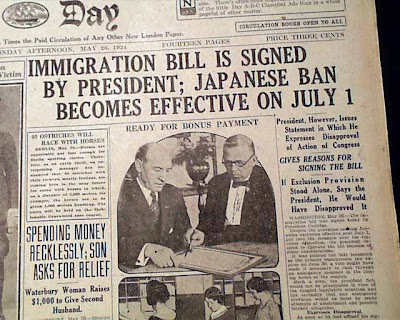
Feuled by widespread anti-Japanese media and hysteria, the California government passed the Alien Land Law of 1913, which prevented Japanese people from owning property. A similar Alien Land Law was passed again in 1920. The Immigration Act of 1924 (aka The Asian Exclusion Act) excluded the Japanese from entering the United States.
Mexican Labor
Around WWI, as Chinese, Japanese, and other “undesirable” immigrant groups were being expelled from California, and many men from California were fighting overseas, large growers looked to Mexican workers “to relieve the labor situation.” Mexican immigrants would remain the dominant low paid labor force for the remainder of the twentieth century, and they remain so today.
By 1920, at least 50 percent of the migratory labor in California was Mexican. In 1926, growers sent lobbyist S. Parker Frisselle to congress “to get us Mexicans and keep them out of our schools and our of our social programs.” Between 1920 and 1930, at least 150,000 Mexicans worked in the fields of California.
Mexican laborers, like the Chinese and Japanese before them, were ideal for growers because they were low-paid and easily deportable, should workers organize for higher wages or better conditions. Carey McWilliams explains, “The general attitude of the growers towards the Mexicans is summarized in a remark made by a ranch foreman to a Mexican: ‘When we want you, we’ll call you; when we don’t—git.’”
When the Great Depression hit in 1929, white Americans began to clamor for the agricultural jobs worked largely by Mexicans. Just as Chinese laborers were deported en masse following the Great Depression of 1893, Mexican laborers were deported en masse during the Depression of the 1930s. McWilliams writes, “Beginning in February, 1931, thousands of Mexicans, many of whom were citizens of the United States, were herded together by the United States and shipped back to Mexico.”
This phenomenon was not limited to California. Hundreds of thousands of Mexicans were illegally deported at this time. This historical reality is described in heartbreaking detail in the book Decade of Betrayal: Mexican Repatriation in the 1930s by scholars Francisco E. Balderrama and Raymond Rodriguez.

Mexican laborers in Southern California often lived in work camps, or “villages” which were segregated from the dominant Anglo community. The definitive scholarly work on this subject is Labor and Community: Mexican Citrus Workers Villages in a Southern California County 1900-1950 by Gilbert Gonzalez. This book describes the Mexican citrus villages of Orange County, which are the roots of current unofficial white/latino segregation in cities like Fullerton and Anaheim.
McWilliams states, “Although the charge is vociferously denied, Mexican and Negro are segregated in the rural schools. Arthur Gleason interviewed the principal of one rural school in 1924. ‘Mexican children,’ she said, ‘will not be admitted to this school. The reason is public sentiment. The trustees will never put those children in here. This school is a white school.’”
It is a significant, though not widely taught, fact that the first public school de-segregation case in the United States was not Brown vs. Board of Education, but Mendez vs. Westminster, which declared racial segregation in Orange County schools to be unconstitutional. Up until 1946, however, it was considered okay.
McWilliams main theme may be summed up with this quote: “From 1882, when the first Chinese Exclusion Act was passed, until about 1930, the history of farm labor in California has revolved around the cleverly manipulated exploitation, by the large growers, of a number of suppressed racial minority groups which were imported to work in the fields.”
-
Suburban Warriors: The Origins of the New American Right (a book report)
The following is from a work-in-progress about the history of Fullerton. You can support my ongoing research and writing on Patreon.
In my ongoing research into the history of Fullerton, I will occasionally read books that give a broader context for this local history. Such a book is Lisa Mcgirr’s Suburban Warriors: The Origins of the New American Right. Below is a book report on this book:
In the second half of the 20th century, Orange County was a very conservative place—home to Richard Nixon and the right-wing John Birch Society—a place known nationally as a hotbed of ultraconservative beliefs and politicians.
This strange history would be of interest only to local folks were it not for the fact that it was here, in sunny OC, that the Republican Party began its rightward shift from the moderate Republicanism of Dwight Eisenhower to the ultimate victory and takeover of a far more conservative variety—a trend that has run its course locally, but has gone national.
In her book Suburban Warriors: The Origins of the New American Right, Harvard historian Lisa McGirr chronicles this important piece of local (and ultimately national) history. Her book offers profound insights worth pondering in these volatile times.
“This book is a history of the conservative movement, using Orange County as the lens through which to explore the social base and ideological waters of one of the most profound transformations of 20th century U.S. politics,” McGirr writes.
Fertile Ground for Conservatism
Right-wing politics were not actually new to Orange County. In the 1920s, there was an active Ku Klux Klan in Anaheim, Fullerton, La Habra, and Brea.
The local rancher elites who pretty much ran things for the first half of the 20th century were, by and large, a conservative bunch.
Back when OC was largely agricultural, “The Associated Farmers of California and the California Farm Bureau, dominated by Southern California membership, allied with reactionary and conservative Republican Party politicians and fostered a staunch conservative ethos,” especially when it came to government regulations and labor issues.
In 1946, Orange Countian Richard Nixon (from Yorba Linda) was elected to congress on a strong “anti-communist” platform. Nixon rose to national prominence during the McCarthy “Red Scare” era as an unabashed Red-Baiter. This would presage things to come.

Congressman Richard Nixon investigating “communists.” How the Cold War Transformed the Local Landscape
It’s difficult to overestimate the impact that the Cold War, and its close cousin the military industrial complex, had on the landscape and politics of Orange County.
By 1950, the U.S. military had a large presence in Orange County, as evidenced by the Santa Ana Army Air Base, a Naval Ammunition Depot at Seal Beach, the US Naval Air Station in Los Alamitos, and the El Toro Marine Corps Air Station.
“The military was thoroughly entrenched by 1950, and the bases provided one of the county’s main sources of income. Thousands of military personnel moved to the area, sparking a boom in housing development,” McGirr writes.
A close auxiliary of the new post-war military presence was the rapid growth of defense industries in the southland, including Orange County. By 1962, 31,000 county residents worked in various defense industry jobs at places like Hughes Aircraft in Fullerton, Autonetics in Anaheim, Ford Aeronautics in Newport, and Nortronics in Anaheim.

The very backbone of the local economy was shifting from agriculture to military and defense industries, fueled by an ever-escalating Cold War arms race.
These new jobs and industries sparked a massive population boom in OC after World War II. The population grew from 130,760 in 1940 to 703,915 by 1960.
The strong military/defense presence in the county fostered a strong conservative ethos, and a particularly vocal “anti-communism.”
The great irony at the heart of this emerging conservative political consensus was that, while many railed against “big government” interference in their lives, the fact is that the region’s booming economy was a product of federal government spending—military and defense contracts. Conservative Orange Countians did not see this contradiction as problematic.
Anti-Communism on the Map!
In the often paranoid Cold War environment that was the early 1960s, vocal “anti-Communist” figures found welcome ears in Orange County.
In 1961, conservative businessman Walter Knott (founder of Knott’s Berry Farm), sponsored a massive School of Anti-Communism at La Palma Park in Anaheim that drew over 7,000 students.
This was just one of numerous anti-communist groups that sprang up in OC in the early 1960s, such as Californians’ Committee to Combat Communism and the John Birch Society (JBS). 38 chapters of the JBS were formed in OC, with an estimated membership of about 5,000.

One local event that sparked a good deal of conservative mobilization was the successful attempt to recall Anaheim School Board trustee Joel Dvorman in 1960. His crime? Hosting a meeting of the American Civil Liberties Union (ACLU).
In local schools and churches, conservative groups would show anti-Communist films like “Communism on the Map” and “Operation Abolition,” and distribute anti-communist literature in “Freedom Forum” book stores.
With the election of John F. Kennedy, a liberal Democrat, in 1960 and the rise of the Civil Rights movement some Orange Countians saw a threat to their vision of the American way of life.
Rufus Pearce, an aerospace engineer who co-founded the Fullerton chapter of the JBS, said, “All these things really indicated to us that there was something rotten in the US government.”
For military and aerospace workers like Pearce, their very livelihood was directly tied to the Cold War.
“Bridge clubs, coffee klatches, and barbecues—all popular in the new suburban communities—provided some of the opportunities for right-wing ideas to spread literally from home to home throughout the county,” McGirr writes.
Among the supporters of the local John Birch Society was the prominent Muckenthaler family.
Orange County for Goldwater (and Property Rights)
The 1964 presidential campaign of “Mister Conservative” Republican Barry Goldwater helped to further galvanize the conservative movement in Orange County.
Goldwater signaled a shift away from the moderate Republicanism of Dwight Eisenhower and (definitely) from the liberalism of John F. Kennedy.
Goldwater’s opposition to Civil Rights legislation, his advocacy of states’ rights and strong anti-communism resonated with many Orange Countians.
According to McGirr, his “support of property rights over civil rights as the ultimate test of freedom resounded among white middle class property holders in a state whose Democrats had recently passed fair housing legislation.”
Also on the California ballot in 1964 was Prop 14, an initiative to overturn the recently-passed Rumford Fair Housing Act, which prevented the sort of housing discrimination that was widespread in California at the time. In fact, it was things like racially restrictive housing covenants that had kept Orange County relatively racially homogenous up to this point.
“The epicenter of Southern California conservatism—Orange County—took the lead in mobilizing the groundswell for Goldwater in 1964,” McGirr writes. “The region from Fullerton to Laguna Beach, Yorba Linda to Irvine was Goldwater country.”
If it had been up to Orange County, Barry Goldwater would have been elected president in 1964. As it turned out, his brand of ultra-conservatism didn’t resound as strongly with the nation as a whole. Goldwater was roundly defeated by Lyndon Johnson.
It would take an aging California actor named Ronald Reagan to soften the hard edges of right wing ideology and bring them to state and national prominence in the years to come.
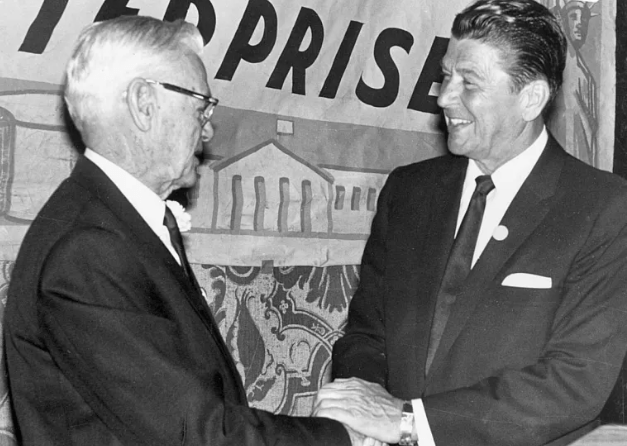
Walter Knott and Ronald Reagan. The Rise of Reagan and Nixon
Just two years after Goldwater’s defeat, Ronald Reagan was elected governor of California, capturing 72% of the vote in Orange County. Two years after that, in 1968, Orange County’s native son Richard Nixon was elected President. Both were Republicans who succeeded by championing a kind of conservative populism.
Also, both were elected at a time when the Democratic Party was being ripped apart from within by the division between moderate/conservative Democrats and the growing New Left, as demonstrated by student protests and civil rights activism.
Stuart Spencer, a campaign manager for Reagan in 1966, said, “It was the first time we came up with the category of ‘white conservative Democrats’…we really went after them.”
In the volatile social climate of the 1960s, concerns over “law and order” pushed some Democrats into the Republican ranks.
There was also the impact of the Orange County Register, which throughout these years was run by staunch conservative/libertarian Raymond Hoiles—this was the main news outlet for many Orange Countians, which also fostered a conservative ethos.
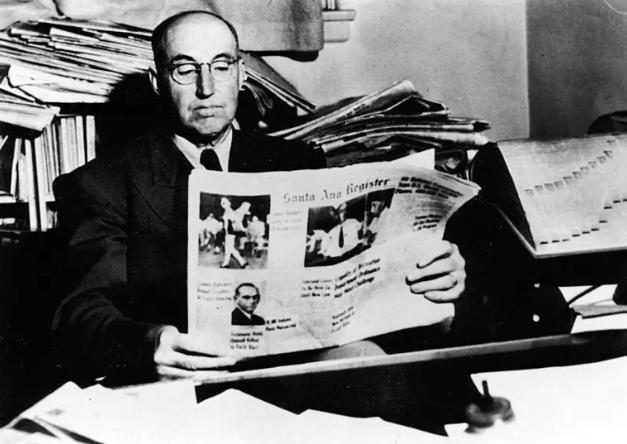
Raymond Hoiles. The Evangelicals
Another factor that contributed to the conservatism of Orange County was the rise of evangelicalism and “mega-churches.”
One reason for the success of these large churches, according to McGirr, was the unique built environment that rapidly emerged in OC after WWII.
“County officials largely left the control of development in private hands,” McGirr writes. “This resulted in a built environment that reinforced privacy, individual property rights, home ownership, and isolation at the expense of public spaces and town centers that could have created a sense of public and community responsibility.”
Searching for community in the socially isolating suburban sprawl, many Orange Countians found this in the large churches that began to grew in the area: “In a privatized, physically isolated landscape, among people who had only recently arrived in their new communities, conservative churches offered a sense of stability and a space for intensive social interaction,” McGirr writes.
“Mega-churches” like Calvary Chapel, Robert Schuller’s Garden Grove Community Church (which later became the Crystal Cathedral), and Melodyland Christian Center, attracted large numbers of social conservatives and preached messages that echoed their concerns over newly-emerging issues like abortion, sex education, and gay rights.

Robert Schuller in the Crystal Cathedral. It was in churches like these that a new constituency began to emerge—evangelicals—who tended to focus on single issue campaigns, like Fullerton State Senator John Briggs, who championed a 1978 proposition that would have allowed public school to fire teachers who were gay.
In the 1970s and 1980s, abortion and gay rights allowed for a marriage of religion and politics that would forge the evangelical movement that remains strong today.
The Reverend Louis Sheldon of Anaheim founded the Traditional Values Coalition, “which went on to become a prominent national organization in the Christian Right’s crusade against gay rights, claiming some 31,000 churches as members.”
The conservative strain of Christianity that grew in Orange County was also a pioneer of what may be called the “prosperity” gospel—the notion that wealth is a sign of God’s favor. As Robert Schuller put it, “You have a God-ordained right to be wealthy. You are a steward of the goods, the golds, the gifts that God has allowed to come into your hands. Having riches is no sin, wealth is no crime. Christ did not praise poverty. The profit motive is not necessarily unChristian.”
This gospel of comforting the comfortable proved very popular locally and nationally, as Schuller’s TV show “The Hour of Power” reached millions weekly.
“Orange County was home to some of the most important ‘megachurches,’ prophecy thinkers, and televangelists of the day. By the 1990s, the Southern California region had the highest concentration of megachurches—large mostly conservative theological churches—in the nation,” McGirr writes.
Conclusion
Conservative politics in Orange County did not just spring up by accident or for no reason. A complex interplay of forces—the Cold War, the military, defense industries, a decentralized built environment, megachurches, and a conservative press—all factored in to make the OC a conservative place.
With the election of Ronald Reagan to the presidency in 1980, the conservative movement had found its champion and standard bearer in the highest office of the land.
His slogan? Make America Great Again.
-
Fullerton Tribune: 1901 Headlines
The following is from a work-in-progress about the history of Fullerton. You can support my ongoing research and writing on Patreon.
The Local History Room of the Fullerton Public Library has microfilm from the Fullerton Tribune newspaper stretching back to 1893. I am in the process of reading over the microfilm, year by year, to get a sense of what was happening in the town over the years. Here are excerpts from some of the articles from 1901.

Local News
Fullerton Votes Against Incorporation
There was a failed vote for Fullerton to incorporate as a city, which would allow for more local control and taxes for things like roads and other infrastructure. Some of those who were against it, like E.K. Benchley, were concerned that it would raise their taxes.

Tribune editor Edgar Johnson was in favor of incorporation, and printed some editorials giving reasons for his point of view.

Evidently, those in the adjacent towns of Orangethorpe and Placentia were (mostly) against Fullerton incorporating.

Fullerton would not officially incorporate until 1904.

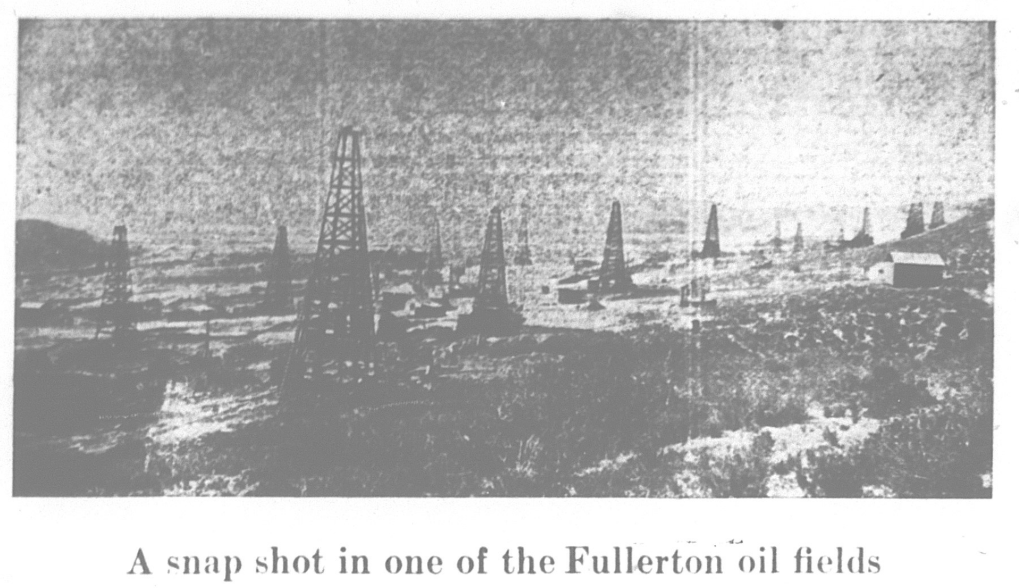
Fullerton Oil Field
In 1901, oil continued to be an important and growing industry, alongside oranges. Most of the oil fields were in the hills of the north part of the town, like Coyote Hills.


When Des Granges Rode the Goat
This funny little poem was printed alongside an article about local farmer Otto Des Granges joining the local Masonic Lodge. In the early 20th century, “riding the goat” was a slang term for joining the Masons–which were quite popular locally.

Orange County’s New Courthouse
In 1901, the Old Orange County Courthouse in Santa Ana was the New Orange County Courthouse.

Local Businesses
Stern & Goodman’s Department store on Spadra (now Harbor) and Commonwealth expanded to a new “annex” building beside it. The Downtown area was growing.


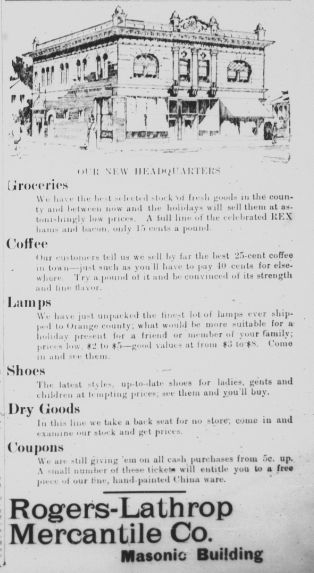
The Rogers Lathrop Mercantile Company was located on the corner of Spadra and Amerige. This building still exists. Actually, I am typing these words in Made Coffee, which is right next to this building.
The orange industry continued to grow. Here’s a photo of a packinghouse.

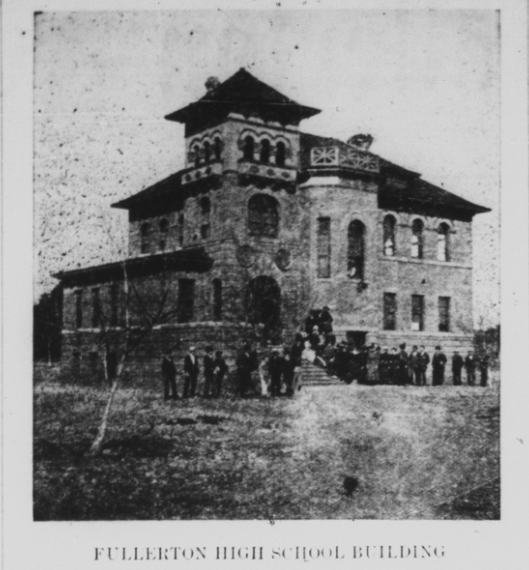
Fullerton High School Building
Here’s a photo of the original Fullerton High School building, which does not exist any more.
Bike Lanes
As the city grew, there was movement for better roads, and also bike lanes.

The Electric Line
The Pacific Electric Line would eventually connect Fullerton with a sprawling public transit system.

Odd Fellows
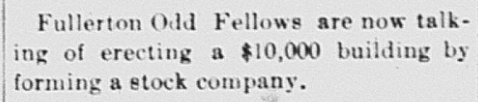
The Odd Fellows were another fraternal organization like the Masons. They eventually built their building on Commonwealth, which still stands today and is one the National Register of Historic Places.
Wilshire’s Socialist Magazine
H. Gaylord Wilshire, who was one of the original investors and builders in Fullerton (Wilshire Ave. is named after him) was a socialist who started a paper that was eventually banned in the United States. Wilshire was known as “the millionaire socialist”–a term full of apparent contradictions.

Constable Pendergrast
Fullerton’s first lawman was constable A.A. Pendergrast, who apparently took ill and sought healing in the hot springs of Riverside.

National and International News
War in the Philippines
In international news, the Philippine-American War continued, which was a consequence of the Spanish-American War.

President McKinley Assasinated
In 1901, president William McKinley was assassinated and succeeded by Theodore Roosevelt.

Farmers on Reciprocity
Local rancher Charles C. Chapman organized a farmer’s club. One of their purposes was to urge congress to pass tariffs and treaties on international imports, to protect their business from competition with foreign growers.

Stay tuned for more headlines from the 1902 Tribune!
-
Oral Histories: Herman Hiltscher
The following is from a work-in-progress about the history of Fullerton. You can support my ongoing research and writing on Patreon.
The Center for Oral and Public History in the Cal State Fullerton Library got started back in the 1960s, and for the past 50 years, students and faculty from the history department there have been conducting oral history interviews with local residents. There are literally thousands of interviews in the archives. Some of them consist of a single interview, and others are bound collections of multiple interviews. These have proven invaluable to my research, and I’ve written several little reports on the ones I’ve read so far. To check out more of my local oral history reports, click HERE.
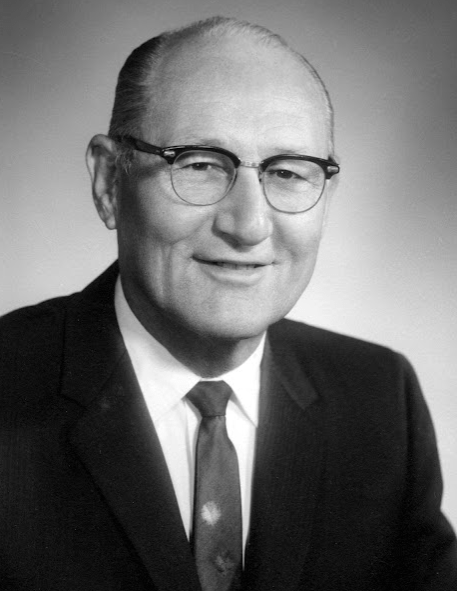
Among these archives is a thick bound collection containing seven interviews with a man named Herman A. Hiltscher, who served as a Fullerton city engineer and administrator from the 1920s until his retirement in 1966. The interviews were conducted between 1968 and 1969, just five years before Hiltscher’s death in 1973. Before reading these interviews, my only knowledge of Herman Hiltscher was that he was one of those infamous Orange Countians who was part of the Ku Klux Klan in the 1920s. OC Weekly editor Gustavo Arellano did a fascinating series entitled “Profiles of OC Pioneers who were in the KKK,” and Hiltscher’s name is on that list. But Herman was more than just a Klansman. The interviews paint a picture of a man who was deeply invested in his community, and his memories provide a fascinating window into Fullerton’s past. And so, without further ado, here’s a brief report on the historical recollections of Herman A. Hiltscher. All photos are courtesy of the Launer Local History Room of the Fullerton Public Library.
Herman A. Hiltscher Parents and Ancestry
Herman’s grandparents were August and Fredricka Hiltscher, who had five sons (Fred, August, Joseph, Max, and John). They left Sternberg, Austria bound for Southern California in 1886. August Hiltscher was a weaver of fine table linens. The family voyaged from Hamburg, Germany to Castle Garden, New York aboard the steamer “Retzia.” After crossing the continental United States, the Hiltschers ended their westward journey in Anaheim, California where they were met by friends and acquaintances. They purchased twenty acres of land at the northeast corner of Orangethorpe and Nicholas (Euclid) Avenues in what would become Fullerton. The Hiltscher Ranch was first planted with ten acres of peaches and apricots and then acres of general farming—corn and livestock. Around the turn of the century, the acreage was converted to walnut trees; and by 1921, it was all valencia oranges.
Herman’s parents, August and Elizabeth, were married in 1899. They had four children—Gertrude, Herman, Elizabeth, and Isabel. At the time of their marriage, August Hiltscher and his brother Joseph owned and operated the Center Market and Sausage Factory located on Commonwealth Avenue, west of Spadra Road (now Harbor Blvd). The butcher shop was in operation from 1898 to 1918, when the Fullerton Hotel was built in its place.
Describing his father’s job, Herman recalls: “He used to have his own slaughter house—they didn’t have wholesale meat suppliers. He’d have to see the farmers and get the beef and hogs and the sheep and so forth, and do his own killing…They called it a slaughterhouse…It was a place there the they gathered the cattle and sheep and so forth, and then they’d kill ‘em and butcher ‘em. And then he did all of that: made all his own sausage and everything.”
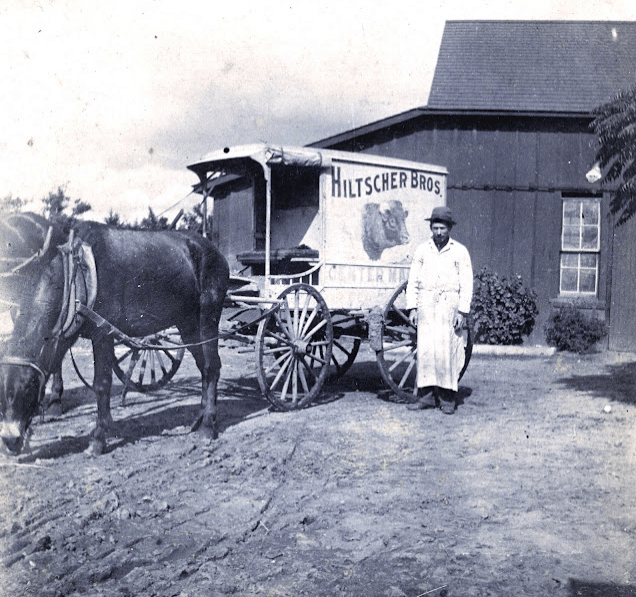
Hiltscher Brothers Meats His uncle John drilled water wells and built the first automobile in Orange County in his machine shop—that had steel wheels. Herman recalls, “He used to drive it on Orangethorpe Avenue and he caused many run-aways of horses. They wanted to throw him in jail at one time.”
The Early Life of Herman Hiltscher
August and Elizabeth Hiltscher’s only son, Herman August, was born 15 October 1901 in the family home on the northeast corner of Highland and Commonwealth Avenues, where Fullerton City Hall is today. As a kid, he delivered meat for his dad. His father, August, was on Fullerton City Council from 1908-1918.
Herman recalls the 1908 fire “which practically burned the whole 100 block on north Spadra from Commonwealth to Amerige…at that time we had a volunteer fire department.”
When he was a child, Fullerton was mostly agricultural, and he remembers swimming in irrigation ditches: “They had a zanjero [sort of like a water police]…and we were more scared of him than anybody else because he didn’t want us to go swimming in the ditch. And of course, we dug a hole and so it was a little deeper, and we were interfering with his irrigation system. So we’d always be looking for him. When somebody would say, here comes the zanjero, well, we’d scatter out in the orange groves like a bunch of quail.”
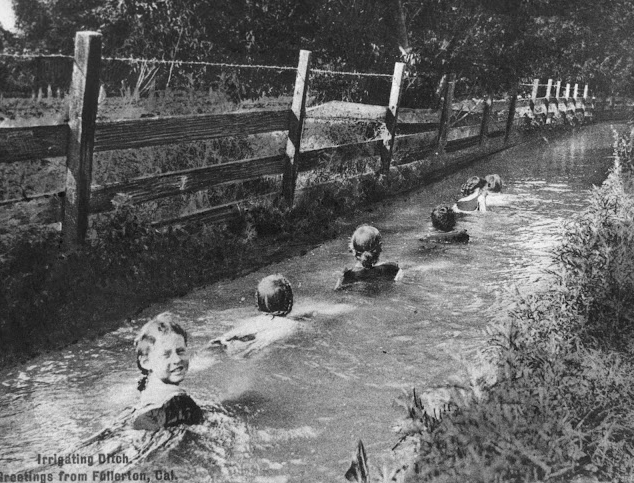
Children swimming in Fullerton irrigation ditch. Hiltscher recalls how, at one point, the Bastanchury family had the largest orange grove in the world–4500 acres!
For recreation, Herman recalls fishing for trout in Trabuco and Silverado canyons, and hunting rabbits. For entertainment, there were church socials, Sunday drives, his grandmother’s victrola, singing together, and going to Otto Evans’ candy store.
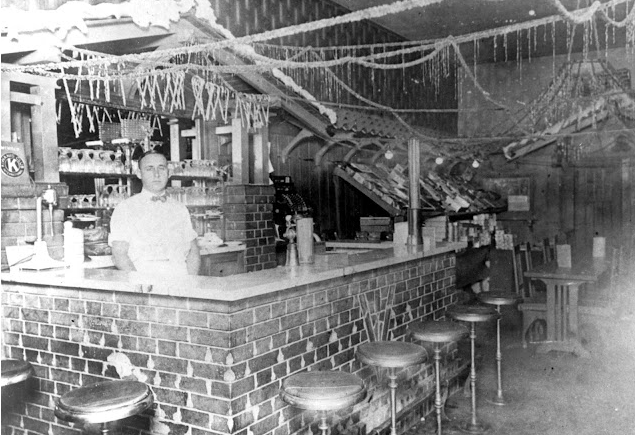
Otto Evans’ Candy Store. “One of the big events of the week,” Herman recalls, “was to come into town in an automobile and park on the street next to the curb, and then do your shopping. Everybody from all around came into town on Saturday and all the business was thriving—that was before we had these shopping centers, you know—that was the only business in town.”
Young Herman completed his primary and secondary education in the Fullerton public school system. He graduated in the class of 1919 from Fullerton Union High School. In high school, Herman got a job at Boege’s Bicycle and Sporting Goods Shop.
Here’s a brief section of one of the interviews with Herman, in which he describes Fullerton as a kind of “Wild West” town:
H: They had to have law and order, you know. They used to come in—the cowboys and all—shoot up the town and get—
S: Cowboys! We had cowboys in Fullerton? Really!
H: Sure. And they would—
S: Do you remember cowboys shooting up the town?
H: I remember cowboys, but I know they used to carry guns when they’d come in.
S: They did!
H: Sure.
S: Now, who are ‘they’? Where were these—?
H: Well, they had the ranches. They’d come from Placentia area and Buena Park and Yorba Linda and La Habra and different places.
S: But why did they carry a gun?
H: I don’t know. Shoot rattlesnakes, maybe.
S: Oh! No, Fullerton really wasn’t that lawless was it?
H: No, it wasn’t that, but then most cowboys, you know—They didn’t all carry guns, but then sometimes—I have seen them.
Saloons in early Fullerton were a controversial thing, just as they are today. Hiltscher recalls how saloons were a target of the Women’s Christian Temperance Union (WCTU), and how drunk driving was even a problem: “Lots of these old ducks would go or there and they’d get drunk. Then they’d get in their horse and buggy, and they’d start off and have a runaway. I remember one time, I don’t know who he was, but he came around the corner of our home at Commonwealth and Highland in his little ole buggy and the thing tipped over. He was drunker than a hoot-owl, and it didn’t hurt him a bit.”
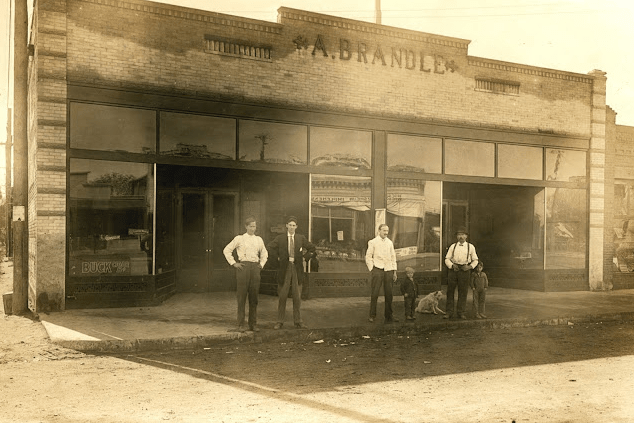
Outside Brandle’s Saloon/Pool Hall. “Fullerton’s always been straight-laced,” Herman remembers, “There wasn’t too much drinking in Fullerton except just, you know, a few.” His Aunt Clara Meiser, the first girl born in Fullerton, was active in the WCTU. To drink, most people went to Anaheim, where they had breweries, wineries, etc. All the old Dutchmen used to go in Brandle’s Saloon across the street from his father’s butcher shop.
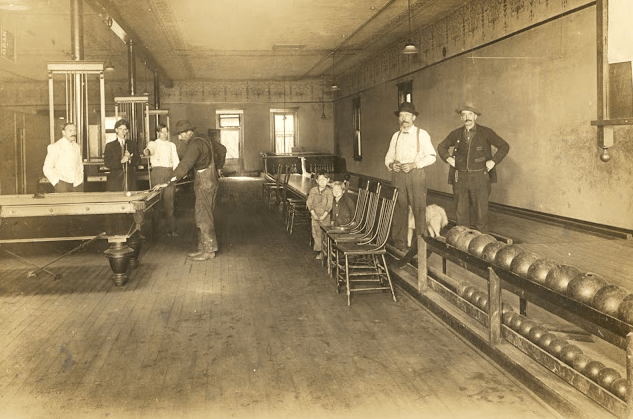
Inside Brandle’s Saloon/Pool Hall. Regarding infrastructure in early Fullerton, Hiltscher remembers that there used to be a “sewer farm” where the Fullerton airport is today. “There was quite a bit of odor there,” he remembers. Early garbage disposal involved collecting “the garbage from the city and some of the other cities around here, and they fed it to the [Bastanchury’s] hogs.” As for water: “in the early days we didn’t have a water system in Fullerton: most of the people had their own wells.”
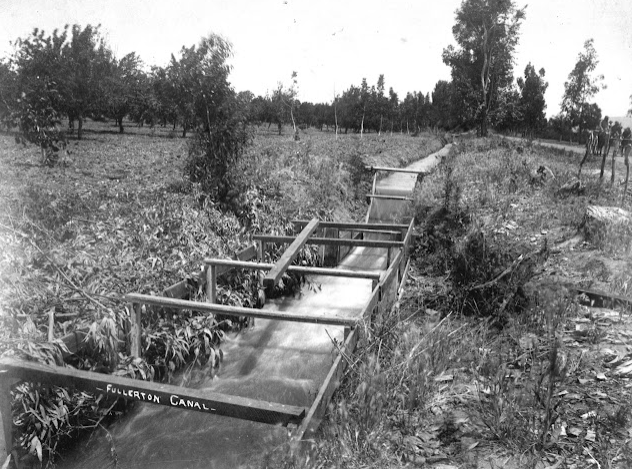
Early Irrigation Ditch in Fullerton. Fullerton in the 1920s
After two years of college, one at U.S.C. and one at U.C. Berkeley, Herman completed his formal training. Over the years, he took special extension courses in engineering and administration. In the summer of 1922, he joined the labor force of the Gallagher Tank Company in the oil fields at Santa Fe Springs, California. Before the end of the year, he had started his forty-five years of service with the city of Fullerton, doing mainly surveying.
In 1924, he married Dorothy King, who was origianlly from Kentucky. In 1920, following the death of both parents, Dorothy moved to Fullerton to live with her aunt Frances Shepherd. Dorothy graduated FUHS in 1922, then attended Fullerton Junior College. After FJC, she was secretary of Southern Counties Gas Company until her marriage to Herman.
Herman and Dorothy had two children: Donald (born 1927) who married Betty Grant of Orange (they have 4 kids), and Ann (born 1929) who married Bruce Royer of Fullerton (they have three kids).
Hiltscher explains how Fullerton has encountered a few “booms” throughout its history. The first was the real estate boom of the 1880s, which resulted in the formation of the town in 1887. Then there was the economic boom of the 1920s, which was an expansion of the citrus industry, the oil industry, and building. Regarding the oil boom: “Some of these people that had these orange groves, you know, just had a medium living. Well, overnight, they were more or less millionaires.” Over time, Standard and Union oil bought out most of the local mineral rights.
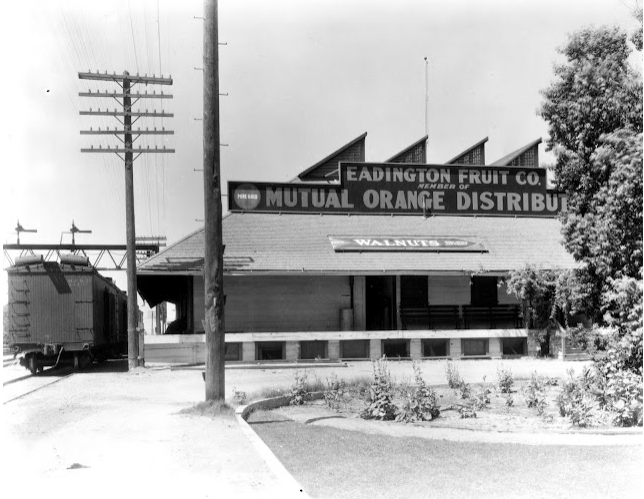
Eadington Fruit Co. Packing House, Fullerton. The packing houses for the booming citrus industry were mostly along Walnut, east and west of Spadra (Harbor). “And you know, funny thing,” Herman said, “I believe every packing house in Fullerton has burned down..some of the biggest fires that we had in Fullerton were those packing houses.”
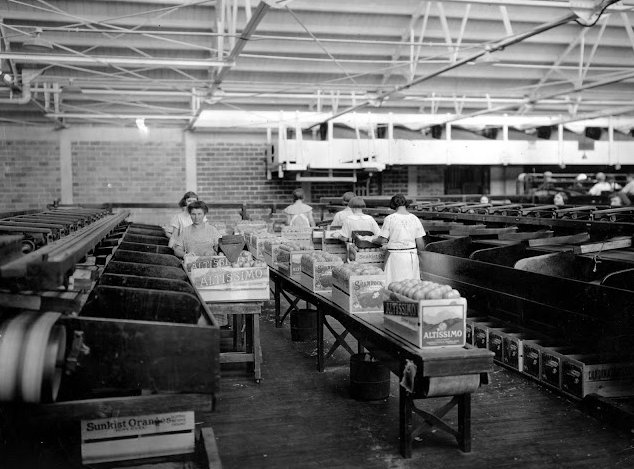
Orange Packing House Interior. Because he was both a city engineer and then city administrator, Hiltscher had a lot to say about water use in Fullerton. He explains how Fullerton was one of the original 13 cities that joined the Metropolitan Water District in 1928, the entity that secured water from Colorado River for the growth and expansion of Southern California.
When asked why Fullerton joined the MWD, Hiltscher explained “It was just looking ahead. Our only source of water was well water, and you could see that the level was dropping each year as more development came in. The ranchers were using part of the Santa Ana river for water all all these cities springing up and growing and all. And we knew about Mulholland going up into the Owens Valley to bring water into Los Angeles, and he was one of the leaders on this, too. So they had this bond issue and then they—I guess they were the original thirteen cities and they all approved it: Santa Ana, Anaheim, Fullerton, Los Angeles, Pasadena, etc.”
Fullerton During the Great Depression
In 1930, Mr. Hiltscher obtained his Registered Engineer’s license from the State of California and moved into the office of the City Engineer. He became Fullerton’s City Engineer and Street Superintendent in 1932, and remained in this capacity until 1952 when the newly created office of City Administrator was formed at which time he was appointed to fulfill his duties.
Herman recalls the devastating 1933 earthquake which “was one of the worst that we ever had and I’ve witnessed many of them. But Long Beach was hit the hardest. So the people just flocked here by the hundreds or thousands and they pitched their tents in Hillcrest Park…We still have the effects of that; they condemned most of the schools.”
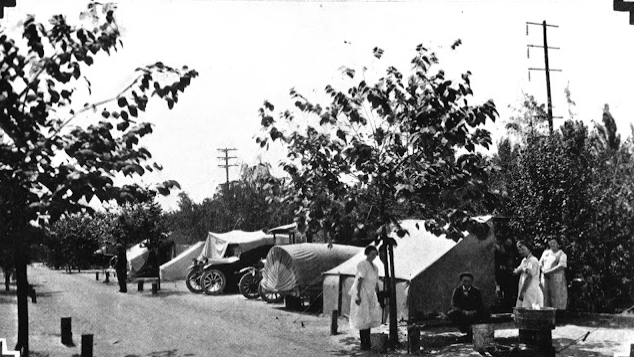
Auto/Tent Camp in Hillcrest Park, 1930s. One of the most significant local engineering problems during Hiltscher’s tenure with the city was flood control. He remembers how ”During heavy rains, why, they’d wash through the City uncontrolled, and for years we had heavy damage the would bring the silt from the hills and deposit it in the lowland. We used to spend most of our winter months fighting the flooding conditions in Fullerton—it was terrible.”
He remembers the devastating 1938 flood, the worst in local history: “I think seventy-five people were drowned…It was right after that we started lining these channels and protecting for floods.”
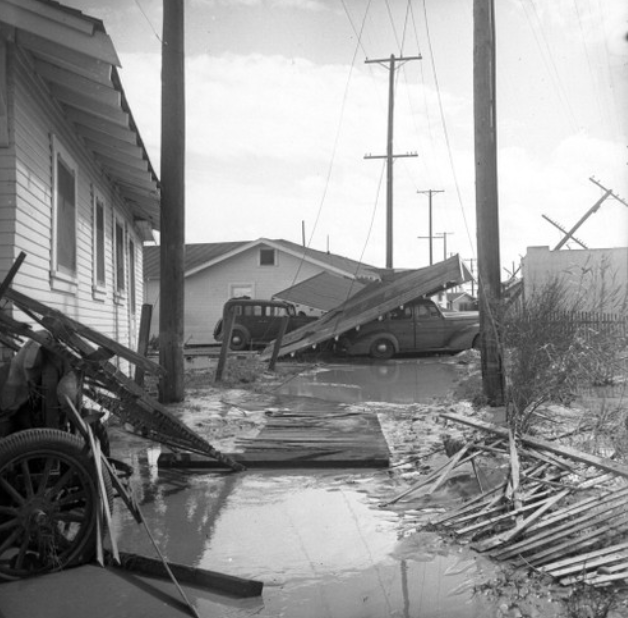
The 1938 Flood. Ironically, it was during the Great Depression that most of Fullerton’s massive flood control projects were built, as part of FDR’s New Deal: “It was during and right after the Depression—from ’33 to ’42—who we had relief labor, we started to try and control the channels by lining them. Break Creek Channel was lined and east Fullerton Creek Channel was lined with concrete. And then two dams (Fullerton and Brea) were built…That was the salvation to the city on flooding.”
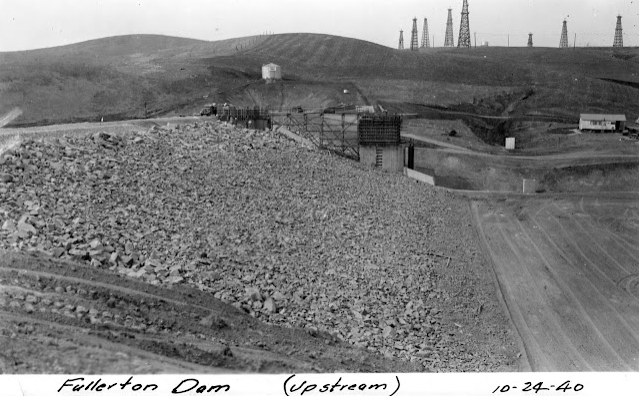
Building the Fullerton Dam (1940). As City Engineer, Herman supervised many of the WPA projects. He recalls supervising 800 local workers to do public works—cleaning out storm channels, renovating Hillcrest Park, planting trees along Harbor, building the baseball field and grandstand at Amerige Park. Local buildings built with WPA money include City Hall (now police station), Fullerton College, the Library (now Fullerton Museum Center), and others.
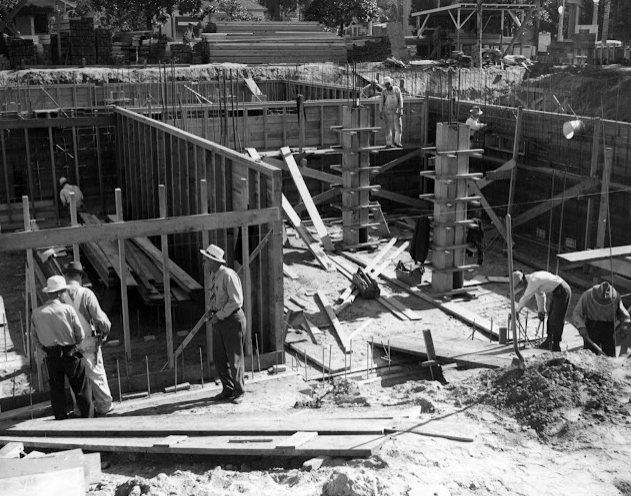
Local WPA Workers Building the Fullerton Library (Now the Museum Center) A funny thing, Herman recalls, was that every one of the Councilmen during the Great Depression was a Republican, which did not incline them to take federal assistance money, like the WPA provided. But, whatever their political philosophy, the fact remains that Fullerton benefitted tremendously from the Democrat FDR’s social programs. Herman’s theory on WPA money was this: “My theory was that if they were going to hand it out to every city in the United States, we might as well get our share of it: that was really what we used to say. We had people right here in Fullerton that needed work and if we didn’t provide projects for them here, they’d have to go someplace else.”
Herman recalls the financial hard times of the Depression: “We even had to give twenty-five percent of our salaries to just help these people without jobs. And people that we knew! because there weren’t any jobs; there wasn’t anything. Then the banks closed and I think my folks owned around $8000 on this home and ranch and everything, and they couldn’t borrow anything so they just lost the whole works. I mean, it was just that critical. Many others were the same way.” After his parents lost their hotel and orange grove during the Great Depression, his father went to work for Alpha Beta as a butcher.
One of the more unfortunate events of the Great Depression in Fullerton was the fact that nearly all of the Mexican labor force on the Bastanchury Ranch was deported, as part of a “repatriation” effort, because white people supposedly wanted their jobs. Gustavo Arellano has written an excellent article on this called “The Lost Mexicans of the Bastanchury Ranch” which I helped him research. Here are Hiltscher’s recollections of this sad event:
S: Do you remember the Ranch School up on the Bastanchury Ranch in the late ‘20s and early ‘30s? Where they had a school for Mexican workers?
H: Oh! Yes. It was over here on Euclid, a little this side of where the Rider’s Arena is. There was a big Mexican camp there and they worked on the Ranch. And this was what threw us off. In 1930, we had 10,882 people and in 1940 we had 10,300 and something; and we finally found out that the reason for the population loss was because we lost the workers up there.
S: Were they citizens? Were these Mexican laborers American citizens?
H: I don’t know where they were or not. I don’t think they had wet-backs then.
S: I wasn’t thinking of illegal entry, particularly, but—
H: Yes, I think they were. We counted them as part of our population.
S: You did. That’s interesting. Was there more than one camp?
H: They had a camp down here on Balcom and then they had another—well, the camp’s still there off of Raymond Avenue where the citrus workers lived. I don’t know whether they still bring them in. You see, the citrus is more or less going out of this whole area.
S: There wasn’t enough labor for citrus available in Fullerton and Orange County? Is this why they st up Mexican labor?
H: Well, no. You couldn’t get the local people to pick oranges…You see, there was a lot of citrus around here.
In the 1930s, the Bastanchury Ranch school was moved to the Ford School, and became a soup kitchen, organized by the school district. Mrs. Hiltscher worked there.
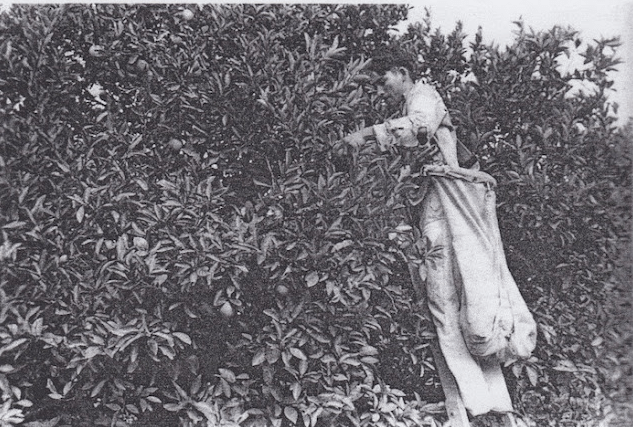
Citrus Worker, 1930s. Fullerton and the Post-War “Boom”
After World War II, Fullerton (and pretty much all of Southern California) experienced a massive housing and population “boom.” This was the “baby boom” and a period of great financial prosperity in the United States. This boom involved lots of housing and industrial development of this area. As agriculture was declining, Fullerton needed a new tax base, Hiltscher explained: “That’s one reason why we can keep our tax rate down is the revenue you get from all these industries.”
When asked, “What was the basis for the selection of industry? What specifically was the city after?” Herman replied, “We were after good clean industry that didn’t pollute the air or the streams or cause us any trouble with our sewer systems or anything like that.”
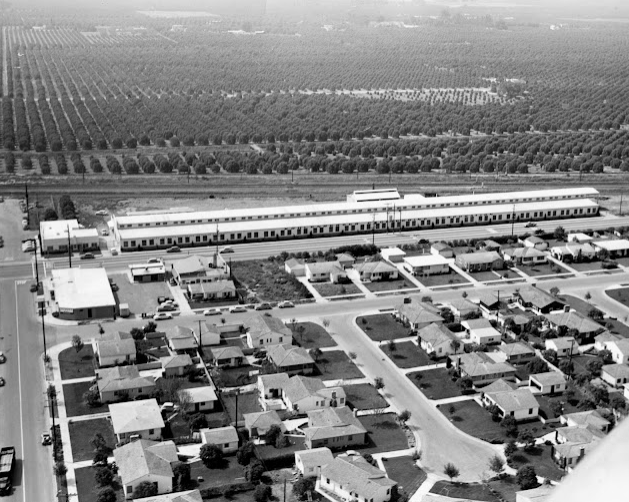
Aerial View of Kohlenberger Factory, one of the first in Fullerton. The main dude who was responsible for wooing industry to Fullerton in the 1950s was a guy named Bob Clark. “We’d send Bob [Clark] back East to contact industrialists that were talking about coming to California,” Hiltscher recalls, “Plus he’d go to LA to meet industrialists and railroad people. Bob got property owners to sell our to various industries.
Ironically, the main opponent of these industries was the Fullerton Chamber of Commerce. “They thought maybe it might hurt the City,” Hiltscher remembers, “in getting obnoxious industries in the city.” Some of the post-war industries in Fullerton included: Kimberly Clark (paper and other products), Beckman Coulter (medical instruments), Hughes Aircraft, Rheem (water heaters), and Hunt foods.
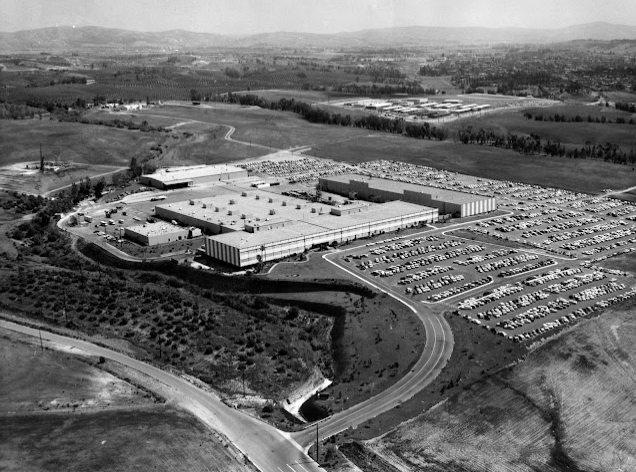
Aerial View of Hughes Aircraft Plant in Fullerton. On the industrial development of Fullerton after World War II, Herman said: “Fullerton from its incorporation was known as a city of fine homes and schools and churches. We didn’t stress industry or commercial too much…And this went on for years until 1952 when Anaheim started to build factories right at our southern border. We could see that they were getting industry right next to us. So we decided that if we could get some good clean industries that wouldn’t affect the purpose or the environment of the city, why, it would be good for the city. We’d figured out that one acre of industry, as far as revenue for the city and schools and all, was about four times more productive than residential development.”
Around this time, a conflict emerged between Fullerton and Anaheim regarding the boundary between the two cities. After a lengthy legal battle, the final decision was handled at a somewhat secret meeting between four dudes: the mayor and city manager of Fullerton (Tom Eadington and Herman Hiltscher) and the mayor and city manager of Anaheim (Charlie Pearson and Keith Murdock). The meeting took place at Orangethorpe school, and the line was decided at its current position near the 91 Freeway.
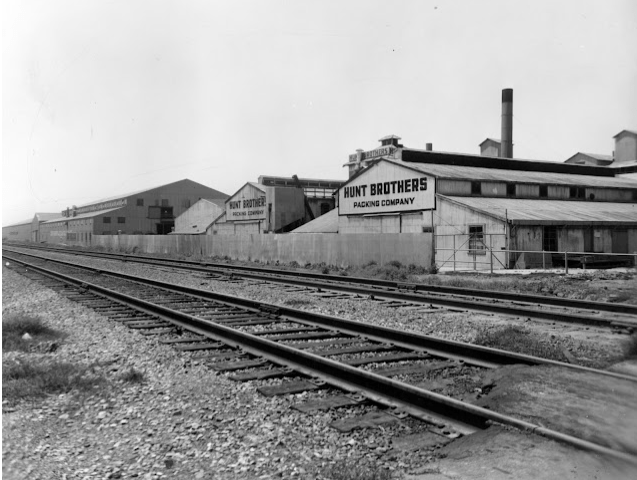
Hunt Foods. During that early post-war boom, Fullerton almost got Walt Disney to build Disneyland here, but then the 5 freeway was built, which made Anaheim the more desirable location. Fullerton also almost got UCLA and Westmont Colleges. Ultimately, however, we ended up with California State University, Fullerton.
These interviews were conducted in 1968-69, when there were actually anti-war demonstrations going on at Cal State Fullerton and Fullerton College. Here’s what Hiltscher had to say about that: “If they don’t get too many demonstrations over there and start burning everything down, why, it’ll be an asset.”
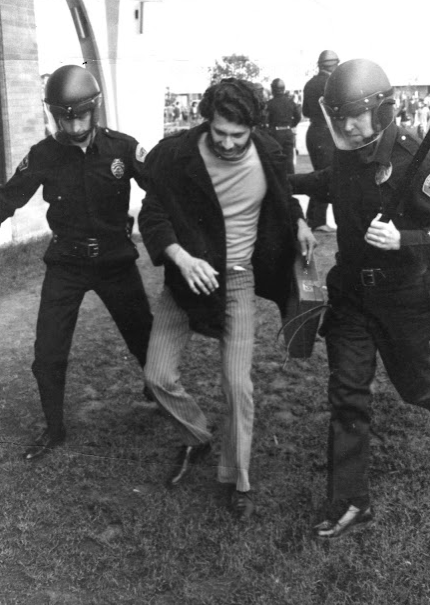
Student protester at CSUF being arrested. Looking to the future, Hiltscher saw traffic as an emerging problem, as the area became more developed and populated. “I see a traffic problem on every street in Southern California in ten years,” he said, “I predict that in five years from now, the people won’t be able to go frontwards, backwards, or sideways on freeways and side streets.” It’s ironic that the things that made Fullerton prosper (good roads) was now causing severe traffic problems.”
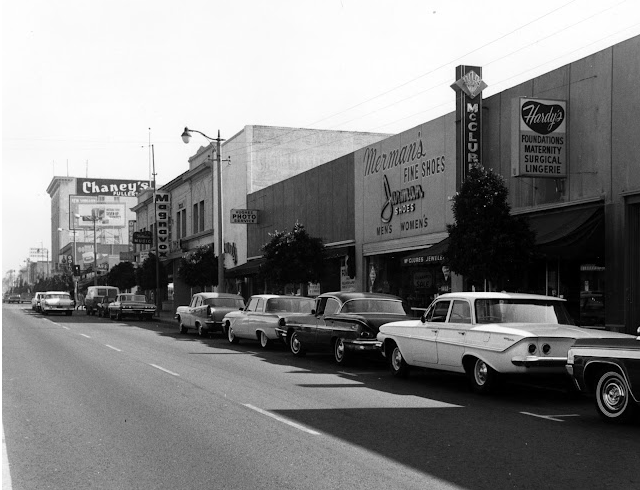
Looking North on Harbor Blvd, Downtown Fullerton, early 1960s. Herman Hiltscher’s Thoughts on What Makes a Good City
The last part of the interview consisted questions about Herman Hiltscher’s philosophies on Fullerton and what makes a good city. Since he worked for the city for most of his life, his insights are instructive.
On early Fullerton..
“Every city has certain characteristics and I think the first City Councilers, the old timers that founded the City, more or less established the personality of the City. For instance, Mr. Chapman, who was the first mayor, was a very religious man. It was a city of mostly agriculture—we then had the revenue from the oil in the hills—and churches. And Anaheim was just the opposite of Fullerton…the ones that wanted their beer—they had to go to Anaheim every weekend and haul it over here.”
Comparing early Fullerton to more recent times…
“They (early city leaders) didn’t have too much time to plan ahead then like they do now…They were trying to take care of the bare necessities: to get water, and get a sewer system, and get streets…Now cities are all built up and you have all this planning and everything. Now, they’ll spend more time in planning and maybe some of the cultural things. They never thought anything like that then: they were just trying to get everybody out of the mud and get some water. Just the main basic things to exist.”
On the legacy of the WPA on Fullerton…
“That’s probably when we started thinking ahead. We thought ahead on our public buildings: we built that City Hall which will last for hundreds of years—the original one. And we were thinking of the many floods we’d had and all this, so we were planning ahead on the physical part. And we knew that you couldn’t build things helter-skelter—it had to be in some kind of order—and I think that’s when the planning first started, way back there.”
What is your concept of a city?…
“I think that a city should be designed and planned in such a way that you serve all the people adequately and at a minimum of cost…one of the main objectives is to see that you have a good clean city without corruption that you find in some of the Eastern cities. You don’t find so much corruption in the cities in California…I don’t believe that we’ve ever had any recalls or anything in the City Council or any officials…
On the ideal size of Fullerton…
“I think to have a well balanced city, to have a good place to live and raise your family, and to enjoy and taken advantage of some of the cultural things that we have here, we shouldn’t have over, oh, 85,000. It’ll probably be more than that. It’ll probably get up to a hundred. When you get over 100,000, why, the businessmen will probably encourage this all the time because when you get more people they have more business and all this. But I think Fullerton is an ideal size city right now (78,000 people). Of course, we still have some land to be developed and we’ll have more people, but I don’t think it’s going to be a better place to live.”
On downtown Fullerton…
“I don’t think that’s too good a place for people to live in the heart of a city. I think that if you confine that to, well, financial institutions, savings and loan, banks, and commercial-insurance firms and more or less commercial high rise buildings, you might be able to salvage it.”
On the problems of the future…
“I don’t think the problems of the future are going to be physical. The problems will be more culturally inclined, I think: that is, getting along with people and trying to develop our relationship between the government units and the people so you can get things done…it’s going to be human relations—trying to get along with people will be the big problem…I mean, now its hard to get them to understand what government wants and what the people want.”
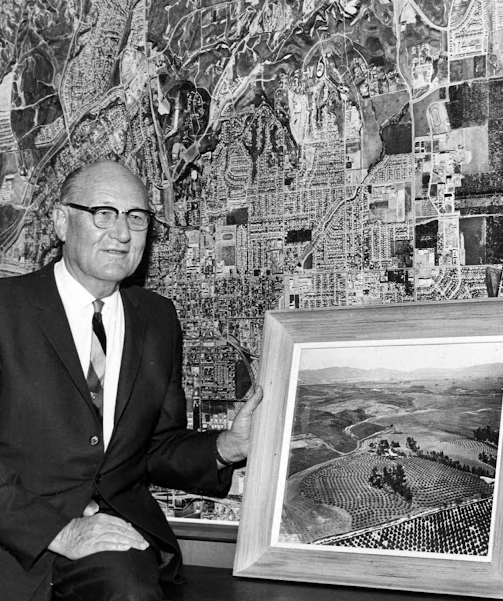
Herman A. Hiltscher, Fullerton City Engineer. Today, Hiltcher Trail is named after Herman Hiltscher.
-
Oral Histories: Gordon Melgren (College Teacher/Administrator)
The following is from a work-in-progress about the history of Fullerton. You can support my ongoing research and writing on Patreon.
Gordon Melgren was interviewed by Anne Riley for the Fullerton College Oral History Program in 1977. Melgren had retired that year after 31 years with the college. He taught history and political science, and was the first person to hold the position of Dean of Instruction, a position he held from 1955 to 1962. Here is a summary with some highlights from that interview:
Gordon Melgren was born in Chicago. His parents died when he was very young so he grew up with his grandparents in northeastern Kansas. He graduated from KU, and worked as a schoolteacher before he “did what many mid-westerners did in the late thirties,” and moved to the west coast, eventually settling in California.
During World War II, he enlisted and served in the European Theater for nearly four years.
After the war, in 1946, he got a job at Fullerton College, teaching history and government. He was hired by Dr. William Boyce.
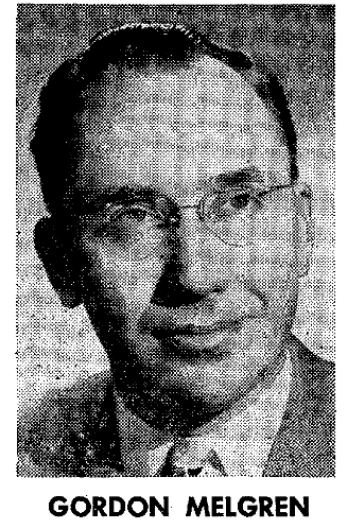
Photo from the Hornet Newspaper digital archives of the Fullerton Public Library. After the war, Melgren said, “The GIs just streamed in…virtually doubling the enrollment…Then came the Korean War, and the enrollment dropped again.”

Veterans housing being built on the north end of Fullerton College campus in 1946. From the Weekly Torch student newspaper. “The really big growth didn’t come until after the Korean War,” Melgren said, “when in addition there was this big onslaught in the population movement into California…[and] the change from a small, almost family-like, local institution to one serving a much larger area with lots of out-of-state students.”
Melgren became dean of instruction in 1955; he he describes the years 1955 to 1962 as “the years of the most fantastic growth from the standpoint of the building program and the student growth, ending with a student body in ‘62 of over eight thousand daytime students…In those years we were bringing in new teachers at the rate of 20 and 30 a year.”
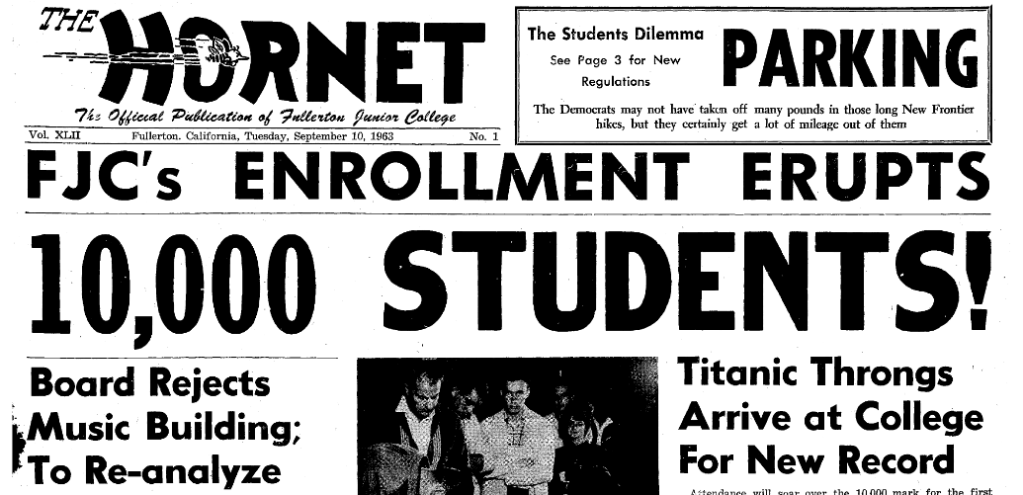
Fullerton College’s enrollment increased dramatically in the 1950s and 1960s, prompting the hiring of new teachers and the construction of new buildings. Image courtesy of the Fullerton College Library online archives. In these years, the city of Fullerton was experiencing a massive population boom, and the landscape was changing from agricultural to more urban and industrial. The new industries created a big demand for an educated workforce.
“The press for manpower in those years, unless you lived through it, you couldn’t believe it,” he said. “There were shortages of teachers, and shortages of engineers, and shortages of doctors. We had an exploding population, and more than that, we had a demand for more health equipment, more sophisticated industrial equipment and even gadgetry. It’s an era in American history we’ll have a hard time to duplicate, if we ever do.”
Melgren recalls how in the 1950s and 1960s, during the McCarthy era and Cold War there was an ultra-conservatism that was felt even on the college campuses.
“You only need to go back to the magazines and the literature of the time. The John Birch Society to start with,” he said. “Their hate Russia feelings and their big campaign of anti-communism, even on this campus, and the textbook censorship that was attempted.”
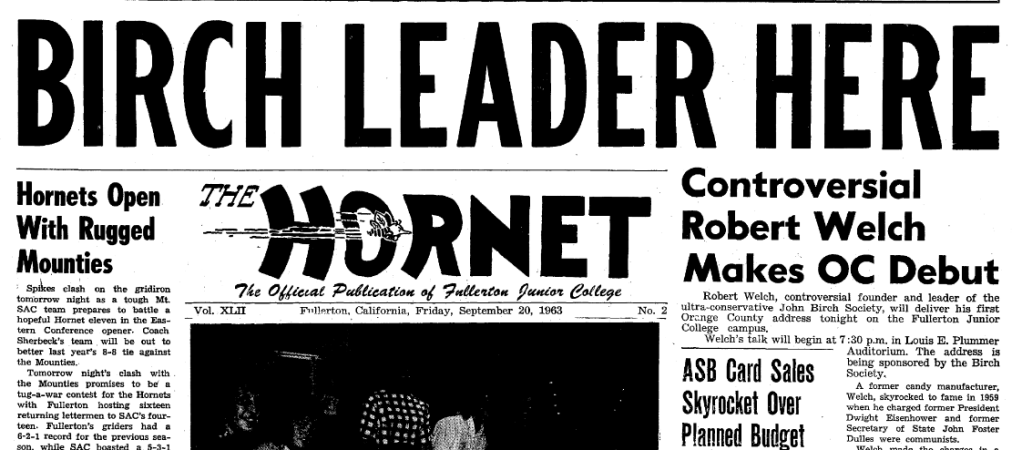
Ultra conservative figures like Robert Welch, founder of the John Bitch Society, spoke at the Fullerton Auditorium. Image courtesy of the Fullerton College online archives. He recalls how Fred Schwarz spoke to large crowds at the Fullerton High School auditorium for his Christian Anti-communist crusade.
“[Schwarz] got the students dismissed to go to hear his rabid rabble-rousing,” Melgren recalls. “Here at the college Dr. Sheller and I resisted dismissing classes, but I was powerless to say that students couldn’t go. So we had a number leave the class on one or two occasions when Dr. Schwarz was here.”
Melgren said that this reactionary feeling was “in the grade schools too. Citizens here in Orange County joined, including the county superintendent of schools at the time…This, of course, was the image of Orange County as the bulwark of ultra-conservatism.”
Melgren attributes this conservatism or “Orange County Syndrome” to the attitudes of the early farmers: “[The] community itself was still so grounded in the fundamental conservatism of New England and the German traditions.”
The conservatism, he said, was as “a protective reaction which will change as the population mix changes, labor unions move in, and the young who grew up in the sixties mature.”
But then he asks the question, after the conservative beliefs of the older generation pass, “Where will be the base of stability? Where will be the traditions that guarantee that the thing is going to hang together and mean something?”
Melgren was at Fullerton College through the turbulent 1960s, recalling “the confusion and disruption we have had over the years, even including the worst of the middle and late sixties, which was aggravated by the Vietnam War and the so called generation gap.”
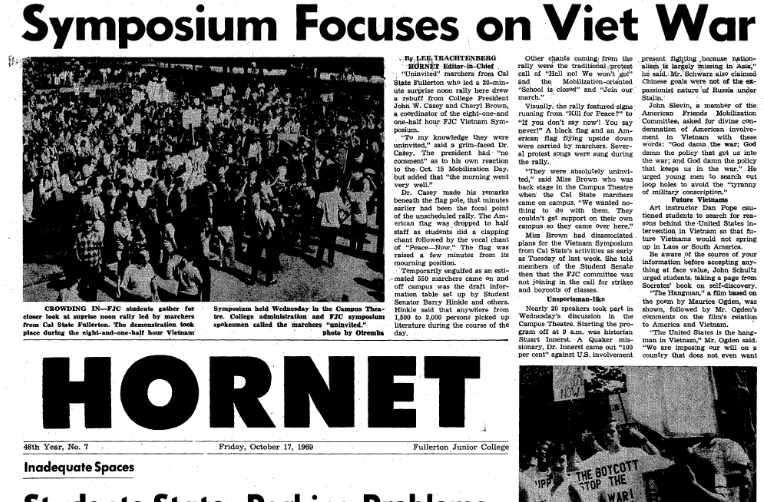
Image courtesy of Fullerton College online archives. While Fullerton College did not experience the same student activism as other colleges of the time, there were protests against the Vietnam war and for civil rights at both the Junior College and at Cal State Fullerton. There was [briefly] an underground “anti-establishment newspaper called The Black Flag” that “raised eyebrows.”
When asked if there were “minority problems,” Melgren said: “Oh, there were no minorities, other than the Spanish, and this was the day of the bracero, so they were out of sight, out of mind, as nothing. Looking back at it now, it doesn’t look very good, but if you could know it, it wasn’t on the scale that it was to become. It was probably more like the better aspects of feudalism.”
He is describing the situation of Mexican and Mexican-American farmworkers in Fullerton, which I have written about in some detail HERE.
Melgren remembers “a big wooden barracks camp along the railroad tracks just west of Raymond” for Mexican farmworkers.
Melgren contrasts the affluence and opportunities of the postwar generation with the situation in the late 1970s: “The day is gone, it’s long gone, when we could think of the college experience as four years away from home in which you’re carefully nurtured, almost like the equivalent of an elitist class, our substitute for the royalty as it were. You can’t maintain that, and it’s been eroding…we oversold college as a meal ticket, as a means to status. Now it’s so common that it can’t be that anymore. We’re training far more people for these status positions of doctor, lawyer, than we can possibly use. Probably, in the immediate future education will have a rough road. There will be a big disillusionment on the part of the people thinking that it didn’t deliver…I think the educational problems were hard at the time I was active, they will be considered a snap in comparison to what’s coming.”
-
Oral Histories: Howard Crooke
The following is from a work-in-progress about the history of Fullerton. You can support my ongoing research and writing on Patreon.
Howard Crooke, a long time Fullerton resident, was Interviewed by Ellis Delameter for the CSUF Oral History Program in 1975. Here’s a summary of that interview, along with some historic photos.
Crooke was born in Odon, Indiana in 1905. Around 1921, he moved to Fullerton where he had two brothers. He graduated from Fullerton High School in 1923.

Howard Crooke’s senior photo from 1923 FUHS Pleiades. Photo courtesy of the Fullerton Public Library Local History Room. He went to Fullerton Junior College one year, and then USC where he studied electrical engineering. After graduation, he worked a number of jobs, including for Southern California Edison’s Big Creek project, and for the Griffith Paving Company.
He was married in 1929.
The Flood of 1938
Crooke’s recollections of the devastating 1938 flood are worth including here:
As the water came down the Santa Ana River, it carried lots of debris and built a debris dam in the upper portion of the Santa Ana Canyon. Then when the water that was building up behind this dam cut loose, it all came down in a rush…the river broke out to the north and came down where the Old Santa Ana River channel used to be. It went southwest through what is now La Palma park in Anaheim. Then the river went down within about five or six miles of the ocean and just fanned out in the lowlands…It sure raised havoc around the county.
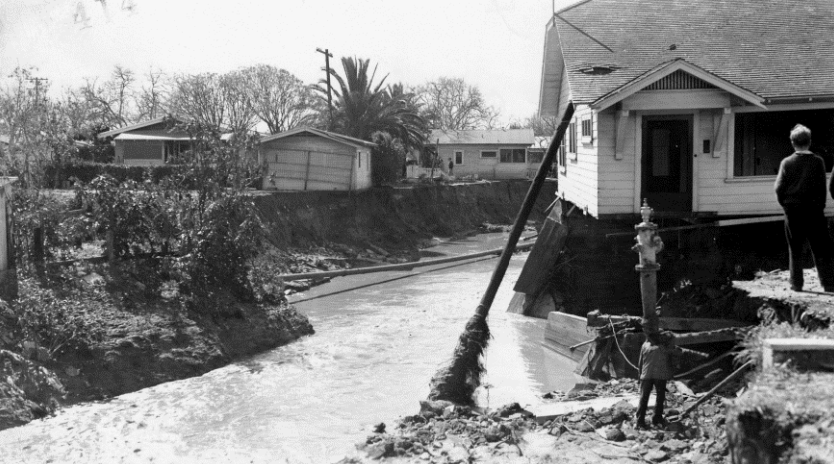
Damage in Fullerton from the 1938 flood. Photo courtesy of the Fullerton Public Library Local History Room. Sometime during the night of the flood, I heard quite a noise. Later, I found out that the noise was created by some fifty thousand barrel oil tanks that had broken loose in Atwood and were bobbing down Orangethorpe Avenue in the water. Of course, the oil was probably gone out of them, as they had ruptured. There was a lot of oil in the orchards and there was deep sand and silt deposits in some of them. They had to dig the trees out.
There were quite a few people killed in the flood. I have forgotten how many, somewhere between 20 and 40, but we finally got the mess cleaned up.
The water went through the southerly portion of Fullerton…I went to my brother’s house…we had to wade in water about three feet deep to get to the house…
The northern part of Anaheim got it very bad. It put many people out of business. Some automobile dealers had cars under water and full of sand. Many of them did not survive the financial loss…
Orange County’s German Prisoner of War Camp
During World War II, Crooke worked as manager of the German Prisoner of War Camp in Garden Grove. Here are his recollections of that experience:
In 1941 Orange County was one of the largest citrus producing counties in California…During World War II there was a heavy demand from the military for manpower and support help…The farmers were in difficult straits and a demand for farm workers had developed…
We had many German war prisoners here in this country…We needed some of this help in Orange County…I was asked by Citrus Growers, Incorporated to handle the camp and the manpower in the German prisoner of war camp. We had about 700 of them, 75 GIs, and 3 officers. We had to build the camp to house them. Uncle Sam paid the citrus growers one percent of the value of the camp per month, while it was occupied by the prisoners of war. We had these boys one season and part of the next so we didn’t get much salvage of our investment in the camp. The camp had a heavy chain fence around it, with barbed wire on top and machine gun towers on diagonal corners. We broke these men up, 600 of them, into 20 crews of 30 men each. Each crew had to have a picking foreman and an armed guard with it…
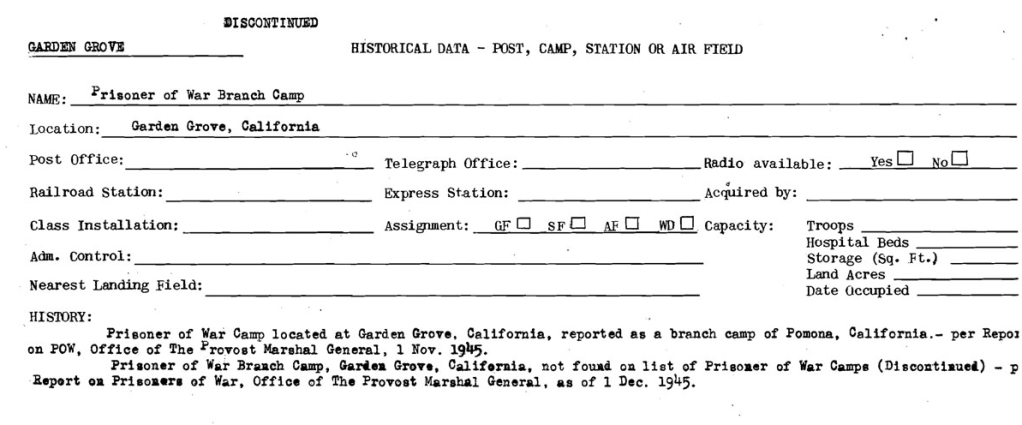
Historical record of the German prisoner of war camp in Garden Grove. Image courtesy of www.militarymuseum.org. After the war, Crooke managed a citrus packinghouse in Garden Grove and became active in the Associated Chamber of Commerce [of Orange County], and became president in 1952.
In this role, he worked with local leaders to develop a countywide sanitation system, and to improve the County’s flood control system.
In 1953, he became manager of the Orange County Water District at a time of explosive growth in Orange County–the beginning of urbanization and industrialization, and the decline of agriculture.
“The water situation was to me the most vital and important of all,” Crooke recalls. “We were already experiencing growth. We knew we had a limited water supply of water.”
In order to increase revenues for Orange County’s water supply, Crooke helped to establish a “pump” tax, which was opposed by some farmers, but ultimately passed.
Securing Orange County’s water supply also meant legal action against water companies and users who were drawing from the Santa Ana watershed further upstream, above Prado Dam, in Riverside and San Bernadino counties.

Water passing through Prado Dam on its way to Orange County. Photo courtesy of Orange County Water District. A legal action was brought against these upstream water users and went to trial in 1956. The trial lasted 114 trial days and involved so many lawyers that “We used almost a whole floor of rooms at the California Hotel.”
The case ended [somewhat] favorably for OCWD.
The story of water use in Orange County is a long and complicated one. For further reading, I recommend “A History of Orange County Water District.”
Howard Crooke retired in 1968.
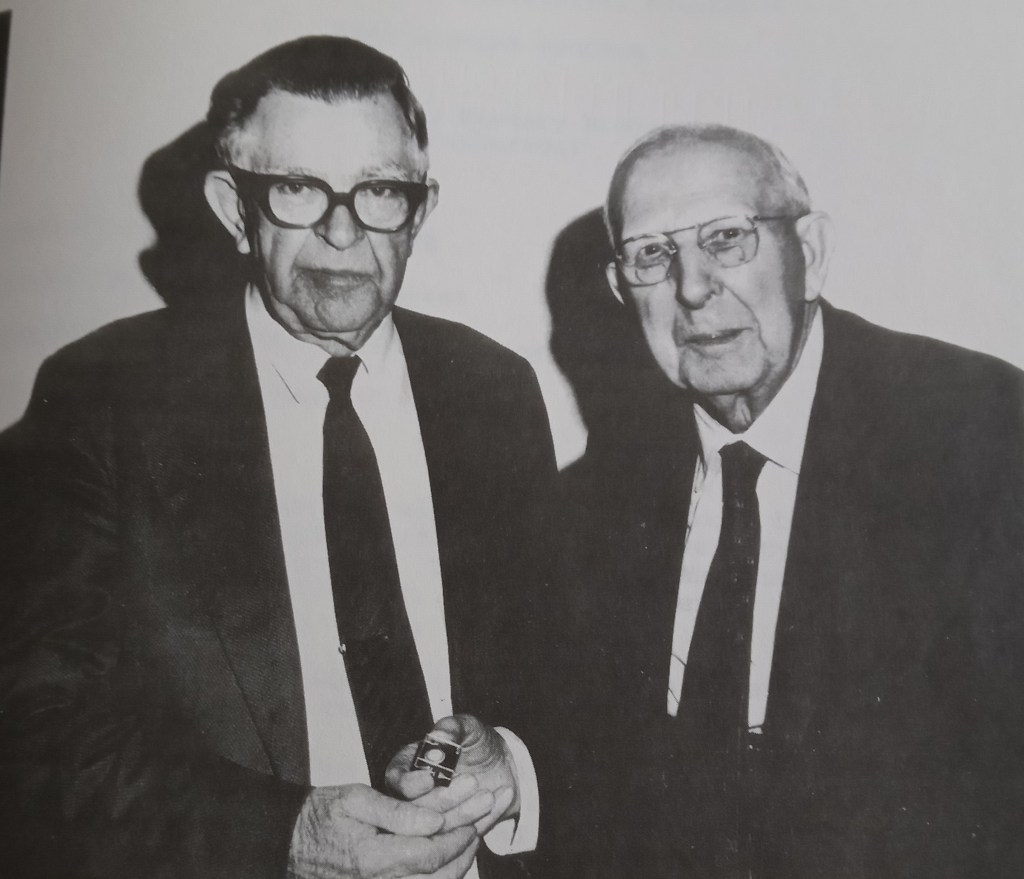
Howard Crooke (left) with Joseph Jensen of the Metropolitan Water District. Photo courtesy of CSUF Center for Oral and Public History -
Fullerton Tribune Headlines: 1899
The following is from a work-in-progress about the history of Fullerton. You can support my ongoing research and writing on Patreon.
The Local History Room of the Fullerton Public Library has microfilm from the Fullerton Tribune newspaper stretching back to 1893. I am in the process of skimming over the microfilm, year by year, to get a sense of what was happening in the town over the years. Here are some local headlines from the year 1899.
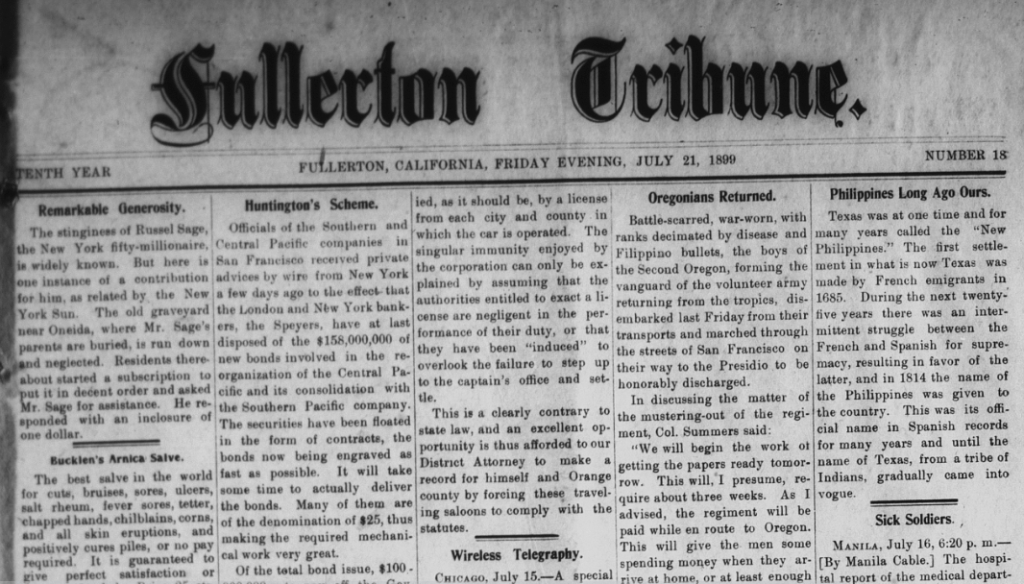
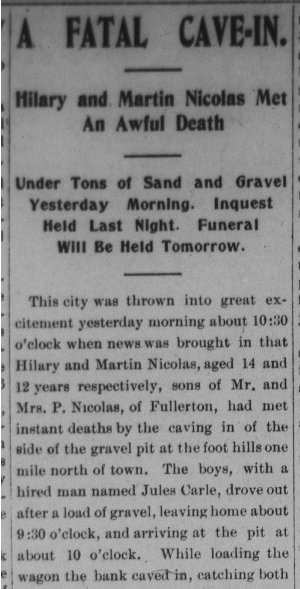
A Fatal Cave-In
Two sons of Pierre Nicolas, an early rancher in Fullerton, died tragically in a gravel pit cave-in.
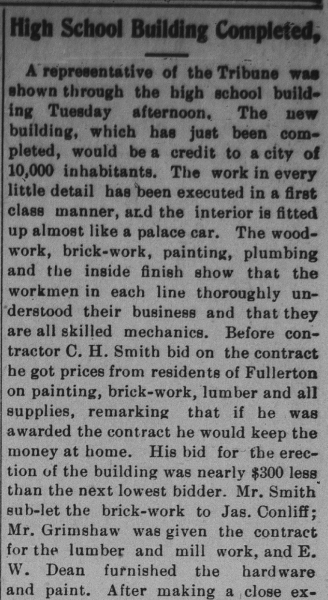
High School Building Completed
Fullerton’s first high school building was completed in 1899. The high school would move to a new building in 1910, which would burn down about a year after it was built. To learn more about the history of Fullerton High School, read my summary of Louis Plummer’s history.
Below, faculty and students stand outside Fullerton’s first high school building at the northwest corner of Wilshire and Lawrence avenues. When the new high school was built, this building was used by the elementary school district. It was torn down in 1913.
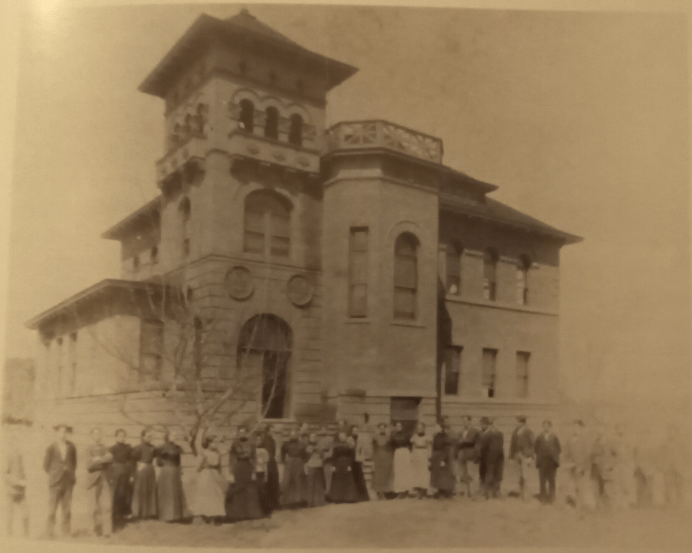
Photo courtesy of the Local History Room of the Fullerton Public Library. The New Oil Wells
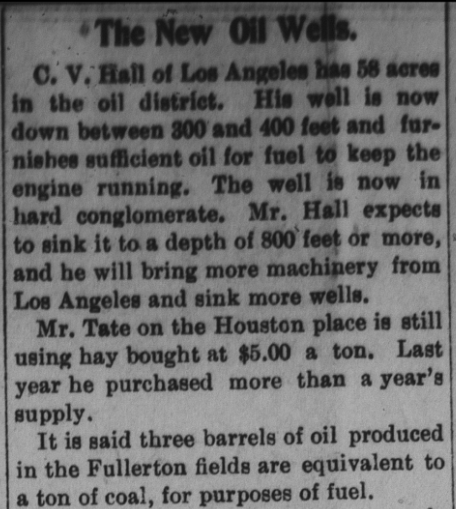
At the turn of the century, Fullerton was becoming an oil-producing area.

Fruit Grower’s Bank
The Fruit Grower’s Bank was Fullerton’s first bank, established in 1895.

Jumped in a Reservoir
Lillie HIndes, whose father started a vegeterian/spiritualist commune in Placentia, committed suicide.

Found Dead This Morning

Davis, Drown, and Linebarger
One of the owners of the Davis, Drown, and Linebarger Livery Stable was Dallison Smith Linebarger, who later served as an Orange County Supervisor for ten years.

Agreement of Water Companies
In 1899, the two main water companies drawing water from the Santa Ana River were the Anaheim Union Water Company and the Santa Ana Valley Irrigation Company. To read more about local water issues at this time, check out my post called Fullerton Water Wars.

The Plain Blackmailer
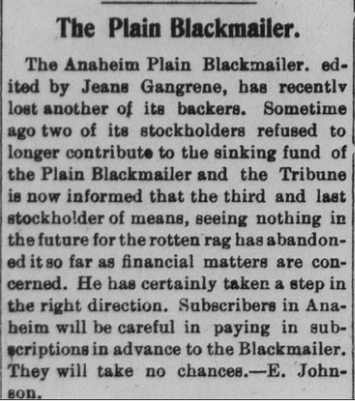
There were two newspapers in Anaheim–the Gazette and the Plain Dealer. Apparently, Tribune editor Edgar Johnson took issue with the Plain Dealer.

Fullerton Ostrich Farm
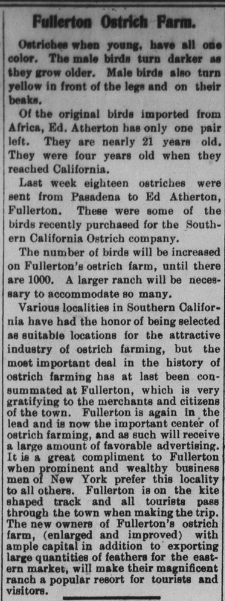
Fullerton’s ostrich farm, which was started by Edward Atherton, was sold to new owners; however, Atherton stayed on as manager.
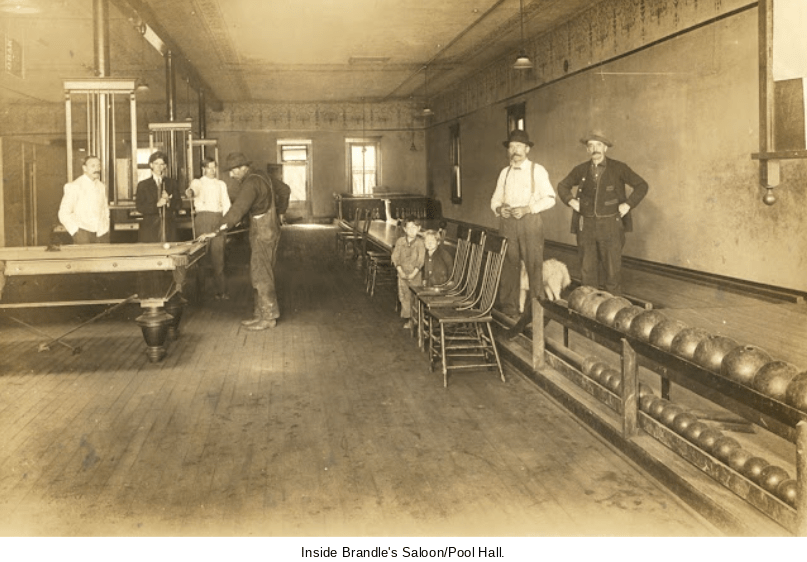
Brandle Saloon
Saloons had been (mostly) banned in Fullerton, except for one that had obtained a county license, the Brandle hotel/saloon, which still was encountering some problems. To read more about the fight over saloons in early Fullerton read my post Fullerton in 1894: The Fight Over Saloons.


War in the Philippines
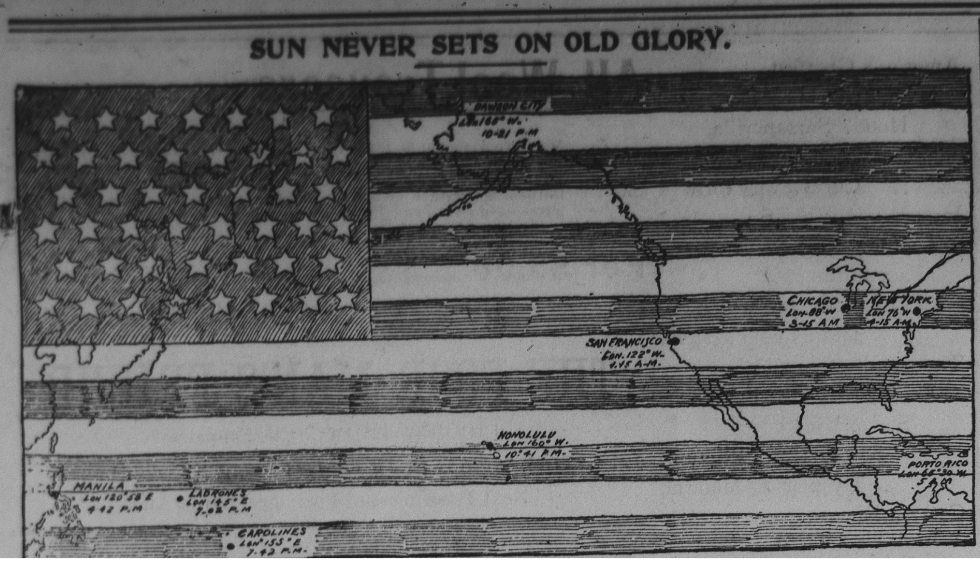
In international news, the Spanish-American War took place in 1898, which resulted in the United States obtaining Spanish colonies like the Philippines. This prompted another war with Americans fighting Filipinos.

Sun Never Sets on Old Glory
The Spanish American War was part of American imperialism, as shown by this somewhat disturbing image in the Tribune.
Views on Patriotism
Locally, school children were writing essays on patriotism.

-
Fullerton College Weekly Torch Newspapers: 1926-1928
The following is from a work-in-progress about the history of Fullerton. You can support my ongoing research and writing on Patreon.
The Fullerton College web site contains digital archives of the Weekly Torch (now called The Hornet), Fullerton College’s newspaper, stretching all the way back to 1923. As part of my research into local history, I’ve begun going through these archives, year-by-year, because newspapers are information-rich sources of local history. Below are some articles and ads from the years 1926-1928, with a bit context…

Betty Miller is Tunnel Heroine
This story tells of a group of students who got stuck in the tunnels under Fullerton High School/Fullerton College, and were ultimately rescued. Fullerton Observer columnist Emerson Little did a great story on the tunnels last year.
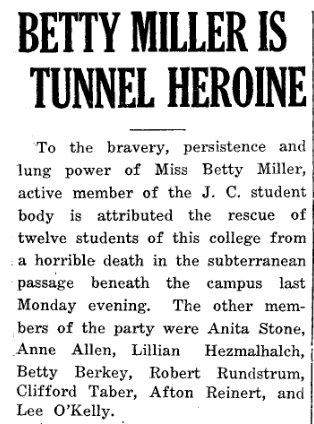
Here is the full text of the article:
To the bravery, persistence, and lung power of Miss Betty Miller, active member of the J. C. student body is attributed the rescue of twelve students of this college from a horrible death in the subterranean passage beneath the campus last Monday evening. The other members of the party were Anita Stone, Anne Allen, Lillian Hezmalhalch, Betty Berkey, Robert Rundstrum, Clifford Taber, Afton Reinert, and Lee O’Kelly.
At 7:22 Monday evening, Mr. Neal Harlow, returning on an errand to the engine room, was startled to hear blood-curdling screams issuing from the direction of the underground tunnel that leads from the engine room and circles for two miles in the earth beneath the J C.campus. Supposing from the nature of the screams that some animal had lost itself in the passage, he quickly opened the door and whistled.
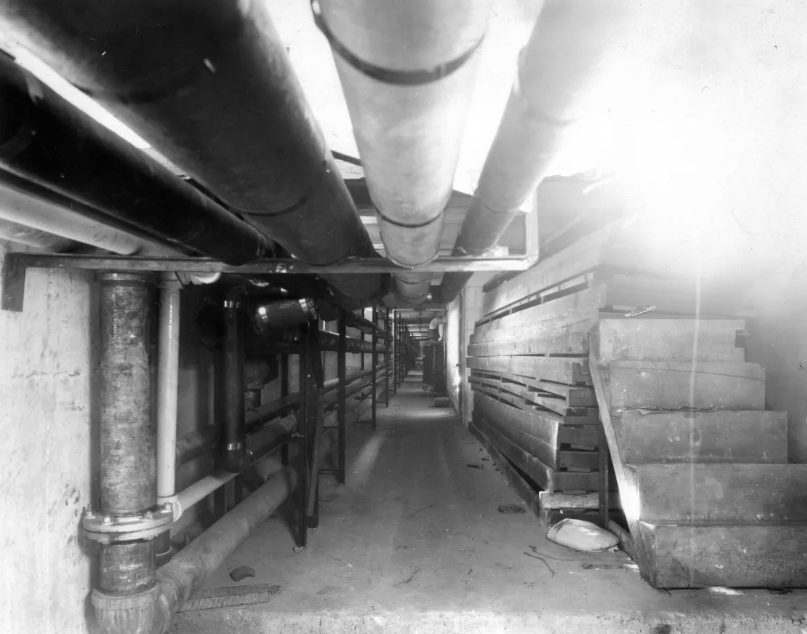
1941 photograph of the tunnels underneath Fullerton College, courtesy of the Fullerton Public Library Local History Room. The screams continued, and after listening for a few seconds, Mr. Harlow was horrified to distinguish something that sounded like “’help.” Realizing that humans were trapped within the tunnel, he hastily formed a searching party, and a thrilling man hunt was launched. The increasing volume of the scream assured the party that it was on the right track as it pressed further into the narrow, dark subterranean hallway.
After fifteen and two-thirds minutes the searchers came upon the unfortunate students huddled, exhausted on the floor of the tunnel, their clothing torn, faces scratched, and hair disheveled, a a result of their long struggle to escape. The valiant Betty Miller was the only one whose lungs were still active.
She leaned against the wall, her hand clutching her side in her now famous manner, screaming persistently.
As the rescuers appeared, she gave one last scream, and fell at their feet in hysterics. The other members were so over-come that they were unable to give coherent accounts of the near-tragedy.
“Without Betty, we should have been lost,” exclaimed Lee O’Kelly, hysterically drying his eyes. “This is the last clean handkerchief I have with me”, he exclaimed tearfully.
At that moment Robert Rundstrum revived from a faint to beg for a comb, explaining mournfully that he had used his in a vain attempt to dig an opening in the top of the tunnel. “And now it’s all filled with dirt,” he added. Mr. Rundstrom this proved himself the hero of the day.
An application is being made for a Carnegie medal to be presented to Miss Miller.
Programs and Films at the Mission Court [later called Fox] Theater
Chapman’s Alician Court Theater was built in 1925 by C. Stanley Chapman, son of Fullerton’s first mayor Charles C. Chapman, and it went through many name changes over the years, including the Mission Court Theater, before it became the Fox Theater, which is currently being restored by the Fox Theater Foundation. This new Hollywood style movie palace was a popular spot for college kids, and so the theater advertised in the local college newspaper. This is a cool window into when theaters like this included both motion pictures and live vaudeville shows.


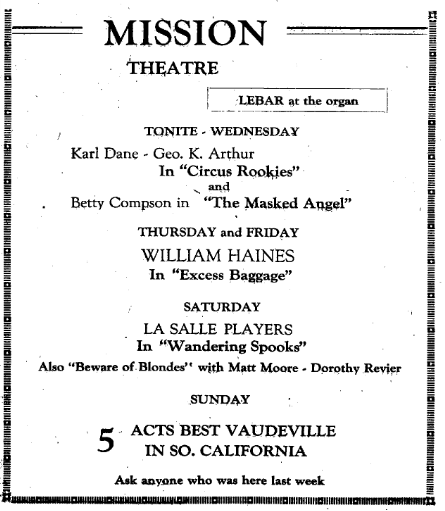
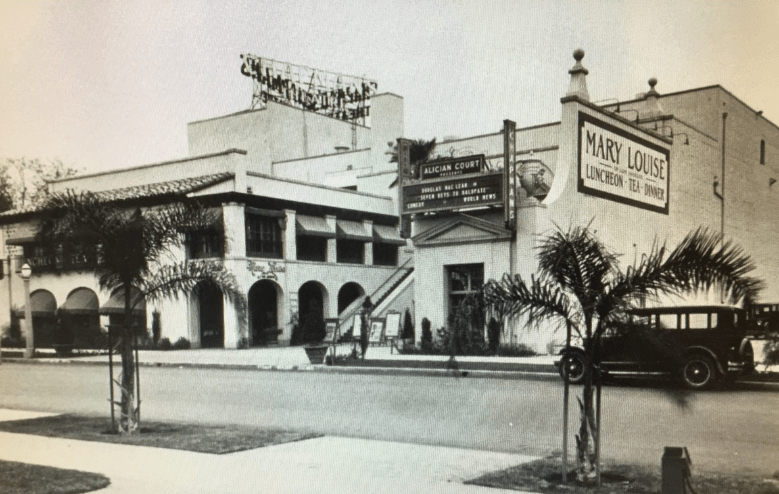
Alician Court Theater, built in 1925. Photo courtesy of Fullerton Public Library Local History Room. Ten years since World War I

The Scorcher
The Torch put out an annual satirical issue called The Scorcher or The Weekly Scorch.
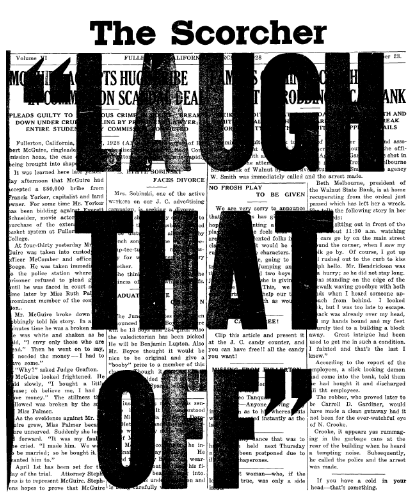

Fullerton J.C. Has Beautiful Library

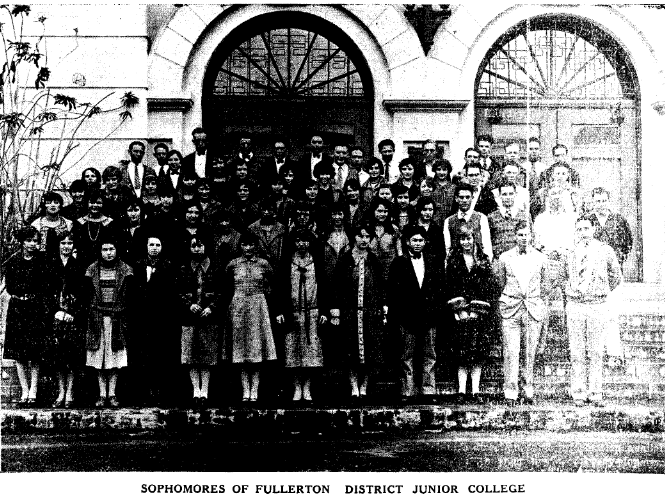
$200,000 Vote Cast for H.S. Auditorium
Funding was secured for the building of the High School Auditorium, which in the 1960s was called Plummer Auditorium. In 2020, the “Plummer” name was removed due to Louis Plummer’s alleged association with the Ku Klux Klan in the 1920s, when there was a large and active local KKK.
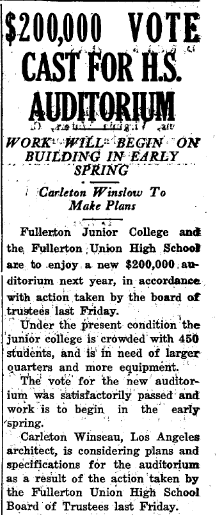
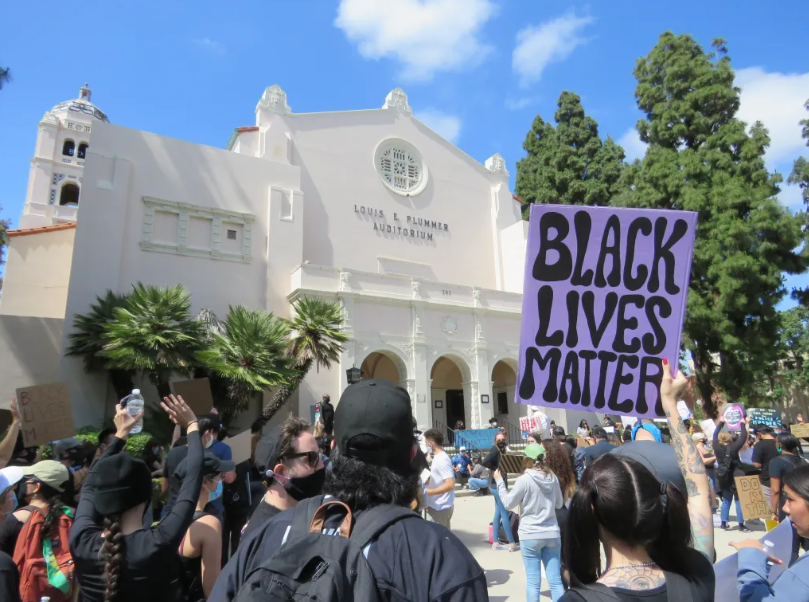
Protesters gather in 2020 outside Plummer Auditorium urging the High School Board to remove the name. Photo by Jesse La Tour. It wasn’t until 1935 that Fullerton College began to get its own campus. Prior to this, it shared a campus with Fullerton Union High School.

Fifty-Five in Graduating Class
The graduating class of Fullerton Junior College in 1927 was 55 students.


Americanization Department in Novel Program
In the 1920s and early 30s, there was an “Americanization” program, which involved sending local teachers into the segregated Mexican work camps around town.

Fun local advertisements…

The Chapman-Wicket Co. was a department store on the ground floor of the Chapman Building, which was co-owned by Charles C. Chapman.

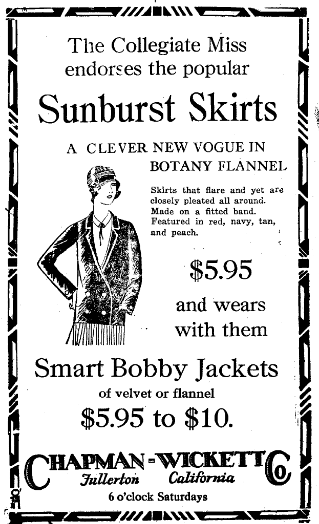

The Chapman Building. Photo courtesy of the Fullerton Public Library Local History Room. 
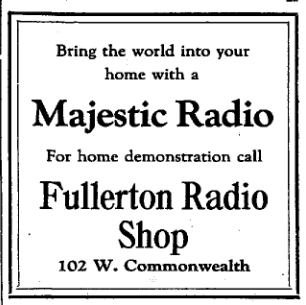
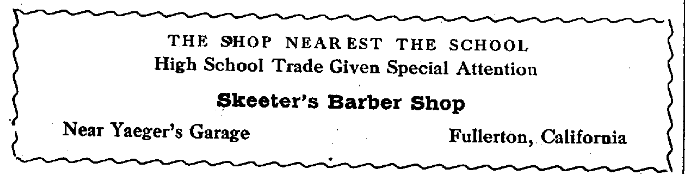
The Sanitary Laundry was located where the Magoski Arts Colony used to be located on Santa Fe.

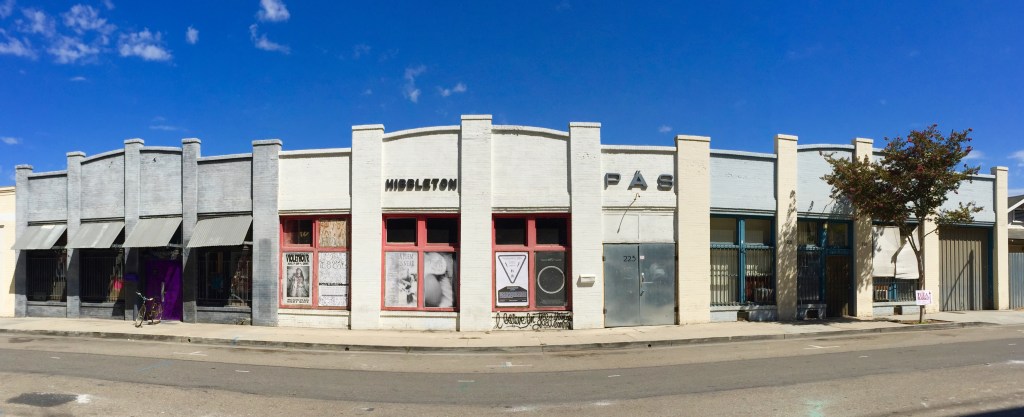
Photo of Magoski Arts Colony circa 2010. Dan O’Hanlon was a local businessman who had a cross burned on his front lawn by the Ku Klux Klan because he spoke out during a 1924 Klan rally at Amerige Park.

-
Fullerton Tribune Headlines: 1898
The following is from a work-in-progress about the history of Fullerton. You can support my ongoing research and writing on Patreon.
The Local History Room of the Fullerton Public Library has microfilm from the Fullerton Tribune newspaper stretching back to 1893. I am in the process of skimming over the microfilm, year by year, to get a sense of what was happening in the town over the years. Here are some local headlines from the year 1898.
Spanish-American War
The major national (and local) news item of 1898 was the Spanish-American War, which the Tribune glamorized with the fanciest layouts seen to date, as shown below.
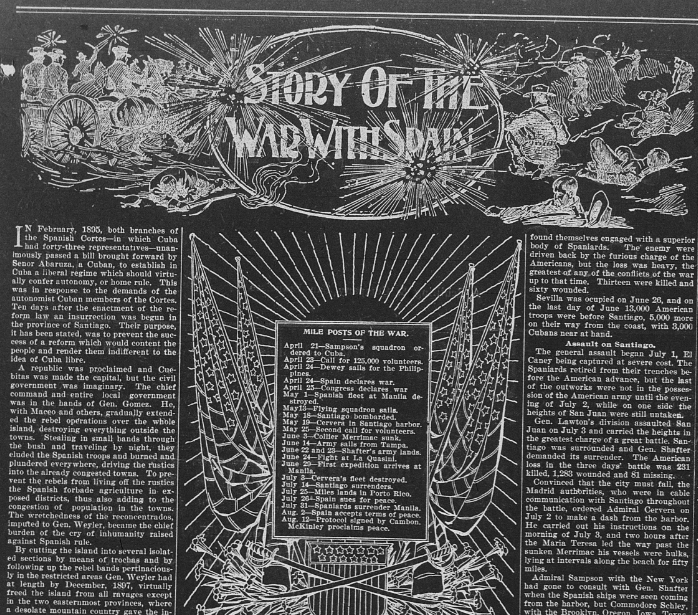
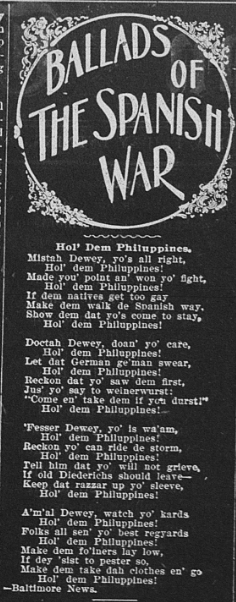
This was the beginning of the age of U.S. imperialism, and part of impetus for the Spanish-American War was U.S. support of Cuban rebels against Spanish rule. Whether or not the Cubans fared better under American influence after the war is a matter of debate.
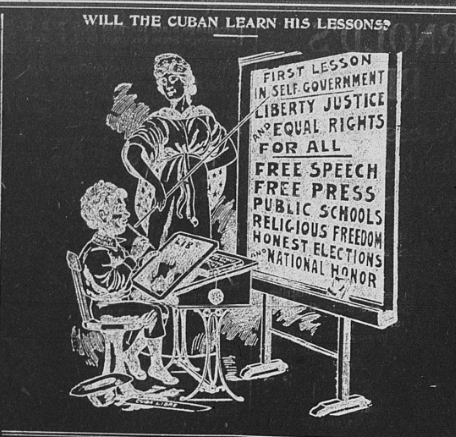
Home Guard Meets
The Spanish-American War, like all American wars, prompted a surge of ultra-patriotism throughout the United States. Locally, this took the form of the formation of a Home Guard and the erection of a giant flagpole.
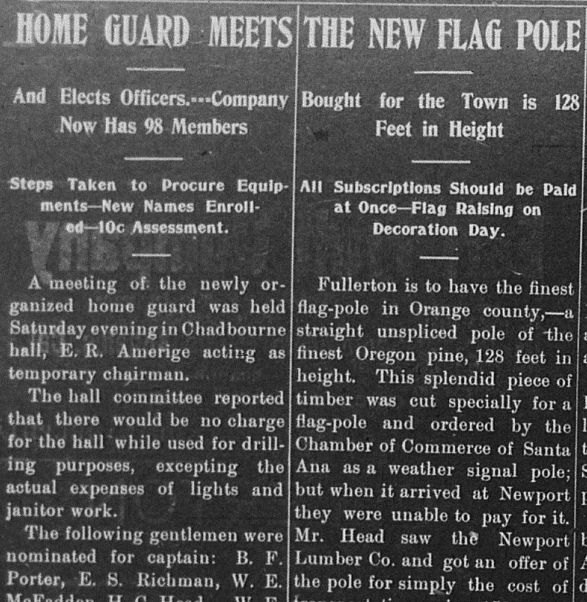
The Home Guard drew from prominent members of the community. Here’s (most of) the text of the article:
A meeting of the newly-organized home guard was held Saturday evening in Chadbourne hall, E.R. Amerige acting as temporary chairman.
The hall committee reported there would be no charge for the hall while used for drilling purposes, excepting the actual expenses of lights and janitor work.
The following gentlemen were nominated for captain: B.F. Porter, E.S. Richman, W.E. McFadden, H.C. Head. W.E. McFadden moved to elect Mr. Richman by acclamation. Motion prevailed.
H.C. Head and B.F. Porter were nominated for first lieutenant and on motion the former was elected by acclamation.
E.R. Amerige was also elected second lieutenant by acclamation.
The following committee was appointed to take the necessary steps to procure arms and other equipments: Edgar Johnson, H.C. Head, O. des Granges, W.E. McFadden, W.R. Carpenter.
Drs. Clark and Rich were unanimously chosen as surgeons of the home guard and the house fairly went wild when C.E. Holcomb was declared to be the choice of every member for chaplain of the new organization…
The band and A. McDermont were tendered a vote of thanks for the free use of their halls, and H.C. Head was added to the flag-pole committee, after which the meeting adjourned.
Even advertisers like Hood’s Sasparilla took advantage of the swell of patriotism.

In a somewhat disturbing article, Tribune editor Edgar Johnson argued that one benefit of the war was that Americans were learning more about the world.
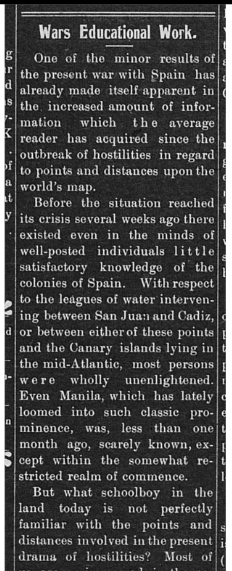
Even school children were roped into supporting the war.
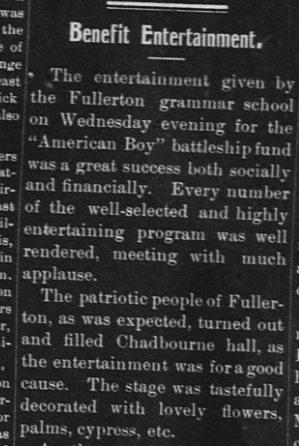
The United States won the Spanish-American War, resulting in new American colonies (like the Phillippines), and this provided new business opportunities for enterprising Americans.
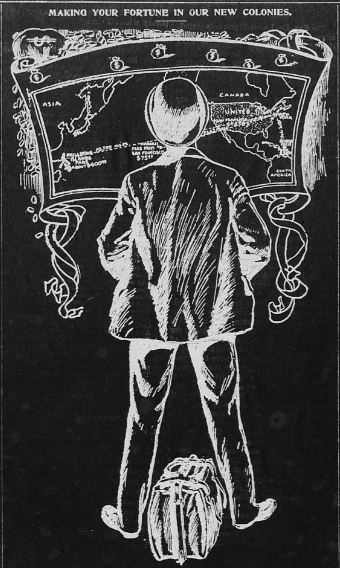
A Disastrous Fire
In other local news, there was a massive fire that destroyed some buildings downtown, including part of Stern & Goodman’s store, which was the main store downtown at this time.

Here is the full text of the article:
A raging fire broke out here early Monday morning and destroyed several thousand dollars worth of property before the flames could be controlled.
The fire started from the explosion of a gasoline tank in a small building between the Pacific Billiard parlor and Stern & Goodman’s store, first burning the small building and then the billiard parlor, after which the flames soon reached a large warehouse owned by Stern & Goodman, and the harness shop owned by Ed Culmer. Few of the goods in the warehouse were saved; most of the harness stock and the billiard tables were saved. The harness and leather stock was greatly damaged.
Stern & Goodmans department store, which, with the stock was worth over $50,000, was saved after hard work by at least 100 men and women. Most of the entire stock of goods were removed from the building being scattered all over the streets. The Anaheim fire department arrived in time to do some good work. The buildings across the street were saved. The billiard room building, warehouse, oil storage building and harness shop building were burned to the ground. The loss is fully $5,000, probably more. The Southern California railway had tank cars and apparatus on the road from Los Angeles, but they were stopped at Rivera, as the fire was under control by the Santa Fe’s fire apparatus had reached that station on a special train. The freight train which passed Fullerton just as the fire broke out was ordered back from Orange by Agent Davis who feared that the depot and freight cares on the sidetracks would be destroyed.
Arthur Porter was in the tank house when the explosion occurred and was severely burned. Mrs. Denkle who helped to remove the goods from Messrs. Stern & Goodman’s building overheated herself and fainted, but soon recovered. Several persons were slightly burned.
At the time of the fire there was not a drop of water in the town tank but a bucket brigade was organized at once and was soon carrying water from the large storage tank on Commonwealth avenue, about 200 yards from the burning buildings. The fire extinguishers owned by 5 or 6 residents were also used to good advantage in bringing the raging flames under control.
The large warehouse in the rear of the north room of Stern & Goodman’s store being covered with corrugated iron did not burn. The south side of this building was badly scorched and was ablaze once or twice but it was saved by hard work. Had it went up in smoke the Sansimena block and Stern and Goodman’s department store would have burned to the ground which would have increased the loss $25,000. Two hogs and about 150 chickens belonging to Stern & Goodman were burned. After the Anaheim fire company and the residents of Fullerton had dome so much good work Stern & Goodman served refreshments to all, extending many thanks to the good people who had so ably assisted them.
The intense heat when Mr. Conrad’s building was burning caused the large plate glass window in the Brandle hotel front to break into more than a dozen pieces.
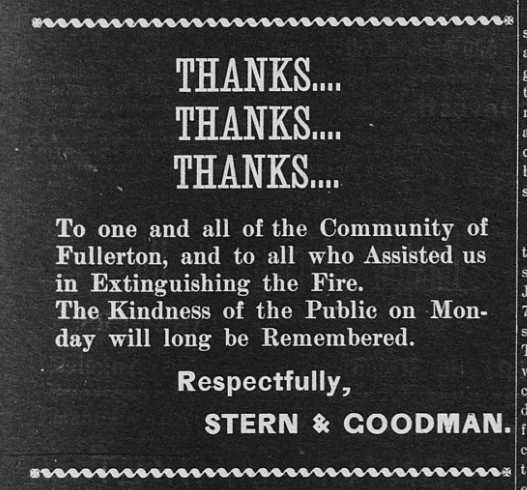
Death of Ernest Brown
There were some deaths, including the grisly death of a Mr. Ernest Browning, a local rancher.
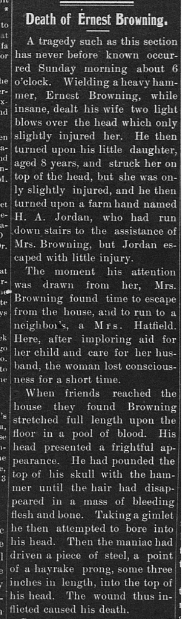
Death of Mr. Stone
Jerome B. Stone, an early settler of Fullerton, died.
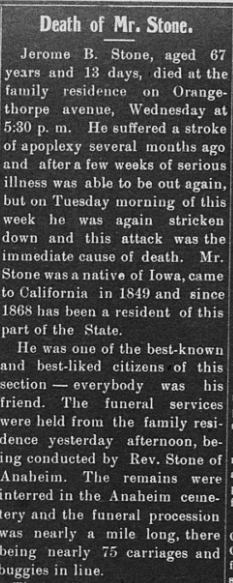
A Sudden Death
Carolina Dierksen, owner of a controversial saloon/hotel in Fullerton, died.
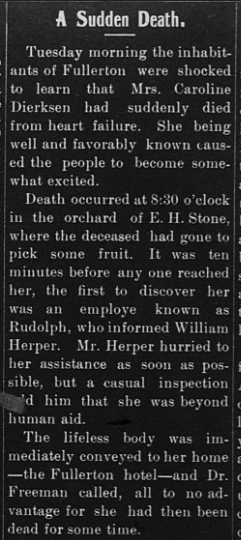
Election Returns
1898 was also an election year.
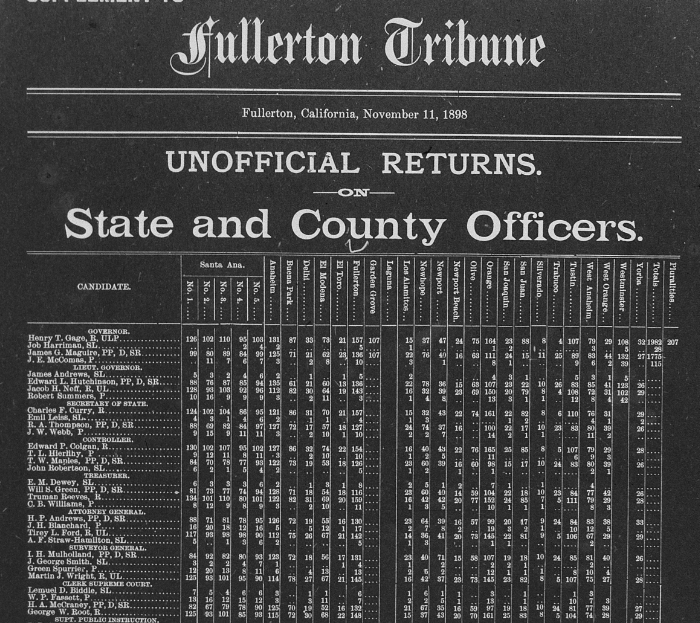
-
Oral Histories: Mary Laura Campbell (Librarian)
The following is from a work-in-progress about the history of Fullerton. You can support my ongoing research and writing on Patreon.
Mary Laura Campbell, a long time Fullerton Librarian, was interviewed in 1972 for the CSUF Oral History Program by Shirley E. Stephenson. Here are some excerpts from that interview, along with some historic photos.

Charter Members of Professional Business Women: Elma Ames and Carrie Adams (standing left to right) and Mary Campbell (seated). Photo courtesy of CSUF Center for Oral and Public History. I was born in South Dakota in 1896 and my people brought me out here at the age of eight months…
I went through the local schools here…which included the old red brick schoolhouse at the corner of what is Wilshire and Lemon now and through the high school which was then located at West Commonwealth where Amerige Park is now.
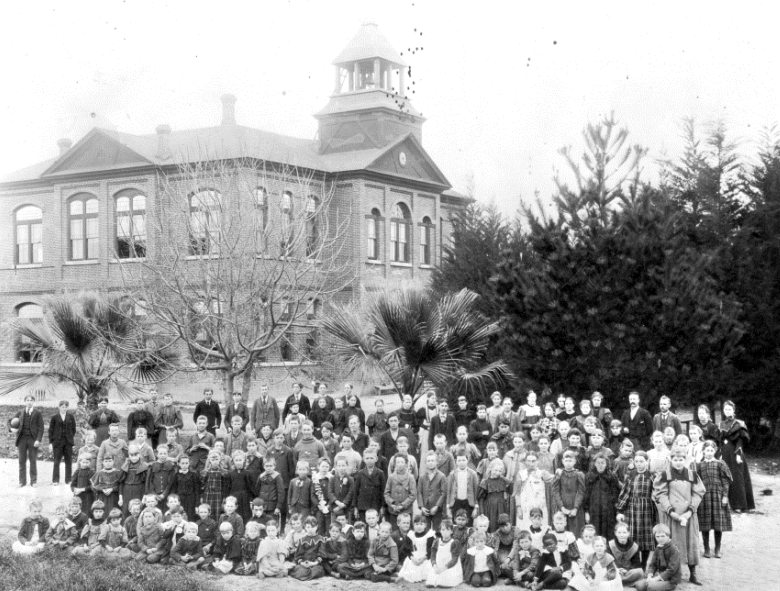
Fullerton’s original red brick school house, at the corner of Wilshire and Lemon, no longer exists. Photo courtesy of the Fullerton Public Library Local History Room. I was there about a year, when that high school burned down.

Fullerton’s original high school building, located on what is now Amerige Park, burned down just one year after it was built, in 1911. Photo courtesy of Fullerton Public Library Local History Room. 
Finally, they got one started on East Chapman and I continued there. I was going to junior college and living across the street from what was to be the location of the Carnegie Library–this was on north Pomona. My father bought property between Wilshire and Whiting and he built some houses there.

Fullerton Carnegie Library (built 1907) at the site of the current Fullerton Museum Center. Photo courtesy of Fullerton Public Library Local History Room. In 1907, when Andrew Carnegie made the gift of ten thousand dollars for the library building, this corner opposite our home was chosen for the site. They built this library which looked something like a mission. It was stucco and had a tile roof and the shape was a little bit like some of the missions. It was dedicated in 1907, and I was in and out of the library from then on. I was very crazy about books and made really good use of it…

Inside original Fullerton Carnegie Library. Photo courtesy of Fullerton Public Library Local History Room. My going into library work was by what I think you might call osmosis because I lived so close and I was there so much. I was going to junior college when this chance came to go into the library. I needed a job and they would give you six months training in those days. So I worked there and I liked it very much. I worked for free for six months and then I believe I got twenty dollars a month, which gives you some idea of salaries in those times. Miss Minnie Maxwell, the first librarian was the librarian then. She was a former schoolteacher and a very, very fine person…
There was a room for children in this new building but not a very big room…I think there were about a thousand books perhaps. The children were reading the stories about Betty Wales. Betty Wales, Freshman and so on through the Bachelor of Arts and Betty Wales in Europe. The LIttle Colonel stories by Annie Fellows Johnson were also popular. The boys were reading adventure stories, of course, and the Boy Mechanic Volume 1, Volume 2, and the American Boy…
Over the years I took special courses in the Los Angeles Library School…I had the Management of Children’s Room, Supervision of Children’s Rooms, and Cataloguing.
Was this still in the Carnegie Library?
We were still in the Carnegie Library building but we soon outgrew this library and they decided to build a little separate building for the children. It was next door, just west of the Carnegie building, on the same property and it was quite an attractive little building…
The people decided that a new library was needed so that it was all under one roof. For two years we had to be downtown in an old garage building at the corner of Chapman and Harbor, which was then called Spadra. After two years there in that barnlike building, the new building the corner of Wilshire and Pomona were ready and we moved in there. I think it was about 1941…Our librarian at that time was Miss Carrie Sheppard and when Book Week came around, which came in November, she liked to have it celebrated in a big way…

Dedication of the WPA-built Fullerton Public Library, 1941. It is now the Fullerton Museum Center. Photo courtesy of WPA archives. One thing the Children’s Department did was to bring authors or illustrators of famous books to the library. We had such people as Leo Politi, the famous illustrator…He not only talked to us, but he painted a picture right then and there and we had it framed and hung in the library. It was a picture of Mexican children, and a little burro…Besides Mr. Politi, we had Clancy Holling and Mr. and Mrs. Conrad Buff, Margaret Leighton, and Maud Lovelace…We also had the marionettes each time. There was a company in Fullerton, the Thompson marionettes…so that was the closing event of the week…

During these years I think I was making the nucleus for a collection of historical books about children’s literature…I remember we had the facsimile, The New England Primer, and some Kate Greenways and some Chatterboxes and things like that. That was the beginning of the Mary Laura Campbell Book Collection which Mrs. Johnson really pushed and carried on. It’s to credit and it now has about one hundred books I think. She has even traveled in Europe and purchased books which have gone into that collection. I’m very proud of it and very thankful to to her for this…
Then we had an ostrich egg. Fullerton had an ostrich farm here in the early days, not far from here. It’s where Acacia School is located. The Athertons bought ostriches here and kept them for several years to exhibit and I suppose hoping to get the benefit of the feathers. Well, somehow the library got one of these eggs and it’s well preserved now. Mrs. Sim, who takes groups of children through the library and teachers them library lessons says she couldn’t get along without the ostrich egg.

Ostrich egg on display at Fullerton Public Library. Photo by Jesse La Tour. We also made arrangements with the school for the library to service the elementary schools…they remodeled two old buses and they were used to go from school to school. That was the beginning of the bookmobile.

Fullerton Public Library Bookmobile in 1970. Photo courtesy of Fullerton Public Library. What schools did you service?
Maple School was one. Ford School. Raymond School. I think they were the first and then Valencia Park was a little later.

Ford School in Fullerton was torn down. Photo courtesy of Fullerton Public Library Local History Room. I retired in 1959…The children’s room is now carried on by Mrs. Carolyn Johnson. She’s called Supervisor of Children’s Work and is now planning a new department in the big new library on West Commonwealth.

Fullerton Public Library today. Photo courtesy of Fullerton Library Foundation.
-
Subscribe
Subscribed
Have a WordPress.com account? Log in now.

