-
Oral Histories: Betty Oba Masukawa
The following is from a work-in-progress about the history of Fullerton. You can support my ongoing research and writing on Patreon.
During World War II, thousands of Japanese Americans were forcibly removed from their homes and placed in “internment” (i.e. concentration) camps because of the United States’ fear of Japanese spies. One such Japanese American was Betty Oba Masukawa, who was born and raised in Fullerton. In an interview for the CSUF Oral History Program, she recalls her experiences during WWII. I am amazed at the matter-of-fact way she recalls her experiences, and the fact that, years later, she is able to laugh about it:
CSUF: You mentioned evacuation. What was your major concern at the beginning of the war?
Betty: Honestly, I didn’t think anything of it, because I was born here. I didn’t pay any attention to any of the rumors, until it was really happening.
CSUF: How were you told about the evacuation?
Betty: It was in the newspaper.
CSUF: And what were your feelings at the time that you found out about the evacuation?
Betty: If we had to evacuate, we had to evacuate (laughter).
CSUF: What sorts of provisions did you make?
Betty: You mean our home?
CSUF: Yes.
Betty: The mayor of Fullerton, William Hale and his son Harold took care of all our things. We gave him power of attorney and he took care of our ranch; we had a ranch at that time. Well, it was my parents’ ranch. He took care of all our personal belongings for us, so we had no worry.
CSUF: Was he a friend of your family?
Betty: Yes, a very good friend. The whole family was very good. My personal things he took to his house, and he stored it up in his room, which he didn’t have to; he could have just put it in the garage. But, no, he put it in his house, and really took very good care.
CSUF: Where were you then sent?
Betty: We were sent to Poston, Arizona.

Construction of barracks in Poston, Arizona. CSUF: From Fullerton?
Betty: From the Anaheim train station. We were the last family to go from Orange County.
CSUF: Were you notified in some way that you were to…
Betty: Yes. At that time my daughter…We were supposed to go at a certain time, a certain date. But we could not make it, because my daughter had chicken pox or measles, one of the two. So we asked if we could wait and be the last ones to go. So they were very kind and let us wait so I wouldn’t have to leave her at the Orange County Hospital, by herself and then we’d be gone. So they let us stay ten more days, anyway.
CSUF: And you went on the train?
Betty: Yes.
CSUF: What were you able to take with you?
Betty: Just your personal belongings. One suitcase. But I told the Army fellows that, “I have a child, and I have to have more than one suitcase.” So they passed it. I got to take more…We took a trunk then. But they said, “Don’t tell everybody that you’re taking a trunk.” (laughter)
CSUF: And what was it like when you arrived in Arizona?
Betty: Terrible.
Betty’s husband (Mas): It was hot and dusty. Rattlesnakes all over.
Betty: If it wasn’t rattlesnakes, it was scorpions.
CSUF: What was the physical building that you lived in at Poston like?
Betty: Like barracks, a lot of cracks in it, you know, so the dust could go through.
CSUF: Oh dear. What time of year was that?
Betty: In May. A really hot time. It was really hot.
CSUF: You were in a barracks with how many people?
Betty: Well, each barrack had four rooms; it was all partitioned. We had the font, and it was a larger one. The dust blows, and everything gets dusty inside. You can just have tears, you know. But gradually, we were getting mail orders, like Sears or Montgomery Ward, to make it look more like a home. Eventually they gave us linoleum for the floor, which is very good. Or course, we had to buy all our window shades and things like that. And dinner sets, also, because sometimes we’d go to the mess hall and bring the food home to eat.
CSUF: What was your occupation while you were there?
Mas: She worked at the beauty shop.
Betty: To begin with, I knew the police chief; he was from Anaheim. He (Kiyoshi Shigekawa] asked me if I’d like a job. So he gave me a job as police matron. That’s a laugh, isn’t it? (laughter) So I was in the police department for a while, and then I got into the beauty work. They had classes. I met the two girls; there were only two girls who had a license. They were leaving for Chicago. Eventually everybody could go out from the camp, you know. So they went to Chicago, and I took over as head of the beauty shop in Poston.
CSUF: Had you ever done anything like that before?
Betty: No. But since they were licensed girls, they showed me everything…
CSUF: And what about your husband? What was he doing?
Mas: I was in the police department.
Betty: He took care of the baggage.
CSUF: Of the people that were coming in?
Mas: Coming in and going out.
CSUF: So your little girl was how old when you went to Poston?
Betty: Four years old. There was a class in front of our barracks, so she went to school there.
CSUF: Was there a social life going on in camp?
Betty: Yes. There were dances.
Mas: Outdoor baseball.
Betty: Outdoor theater.
CSUF: Do you have any special memories about that period of time?
Betty: Well, a group of friends would come over to our apartment, and we’d play cards and stuff for the evening. That’s about all we could do in the evening.
CSUF: And how long were you in Poston?
Betty: Three and a half years.
-
Orange County History @ The Bowers Museum
The following is from a work-in-progress about the history of Fullerton. You can support my ongoing research and writing on Patreon.

The Bowers Museum is one of the premier local repositories for artifacts of Orange County history, all the way from native Americans, through Spanish colonization and the missions, to Mexican rule, to American conquest. There are photographs, clothing, and other objects of historical importance. Visiting the museum a few years ago, I began in the room dedicated to the native tribes of southern California, Orange County’s original inhabitants.

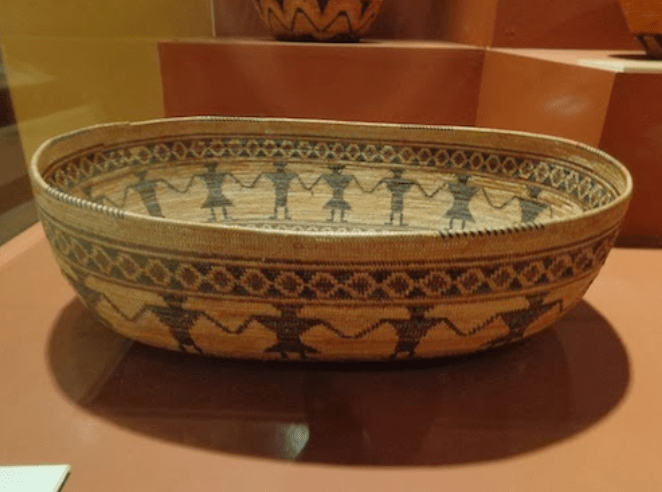
The tribe which inhabited this area were known as the Kizh. The tribe is often erroneously called the Tongva, or Gabrielinos. But I met the chief of the tribe, Ernie Salas, and he assured me that they are called the Kizh, so that is what I will call them. The Kizh were expert basket weavers, and the museum contains some lovely examples of this. This one was my favorite:
The Kizh lived in this area for thousands of years, quite sustainably. But then, beginning in the 1700s, waves of conquest would permanently (and tragically) disrupt and alter their lives. The next exhibit room documents this sad history: From Spanish colonization to American conquest.
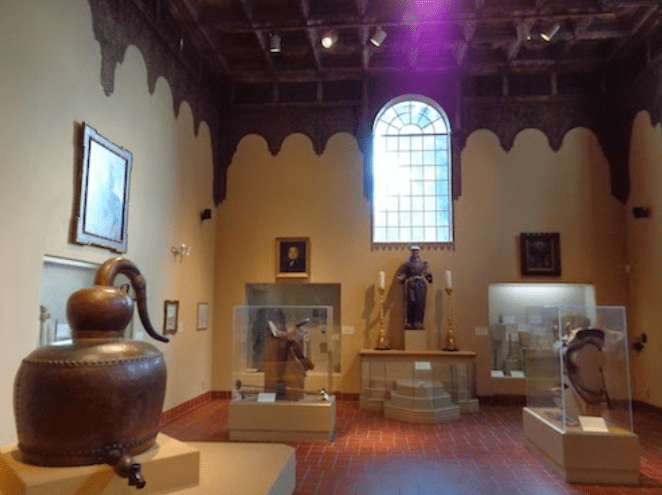
Here’s a timeline of this history (with pictures and explanations):
1769: Father Junipero Serra (a Spanish Franciscan) arrives and founds the first Mission, San Diego de Alcala. Serra goes on to found many missions in California, which seek to convert the “heathen savages” and teach them the “superior” ways of European civilization.

1770: Gaspar de Portola, the Spanish soldier sent by the King of Spain to colonize California, leads a company of troops up California to Monterey, claiming the land for Spain (The land did not, in fact, belong to Spain). Here’s a statue of Portola on the grounds of the Bowers Museum. He looks to be in a conquering mood.

1771: Mission San Gabriel is founded. Despite the romanticized portrayal of the missions we learn in fourth grade, the California Missions were basically slavery for native Americans. They were absolutely awful, and succeeded mainly in decimating the local tribes, like the Kizh, and eradicating a culture and language that had existed for thousands of years. One result of the missions is that the Kizh language is completely gone. No one alive today speaks it.
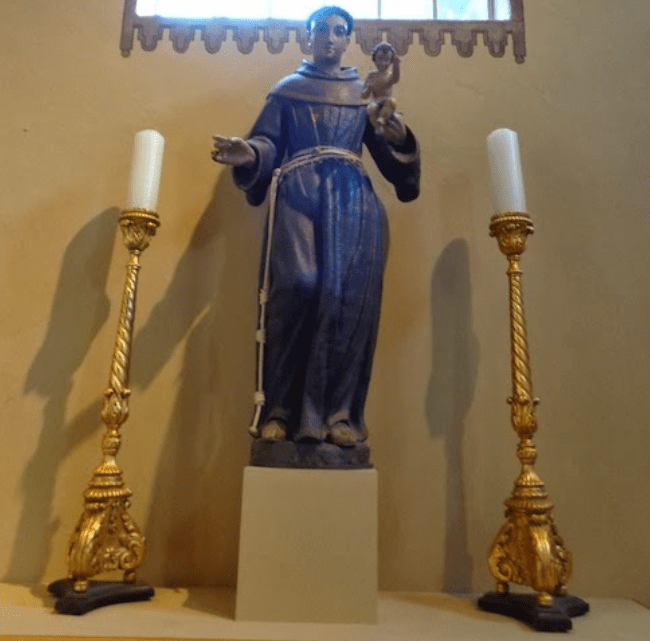
1776: Mission San Juan Capistrano, another institution of slavery and cultural desolation, is established.
1781: Pueblo of Los Angeles is founded as a farming community by a group of settlers from the Sinaloa and Sonora regions of Mexico.
1806: Jose Antonio Yorba, a soldier who served under Gaspar de Portola, is granted a Spanish land grant which encompasses large portions of present-day Orange County. The land had been taken from the Kizh people by this point. His son, Bernardo Yorba (whom Yorba Linda is named after) would continue to manage the large family estate. Here’s a portrait of Bernardo Yorba (Dig those mutton chops!):

1812: The San Juan Capistrano Mission church is destroyed by an earthquake.
1821: Mexico wins its independence from Spain. Alta California becomes a Mexican province. Here’s a photograph of Governor Pio Pico, the last Mexican governor of California, with some family members. Pio Pico was half black. See, California has a pretty progressive history (sort of).

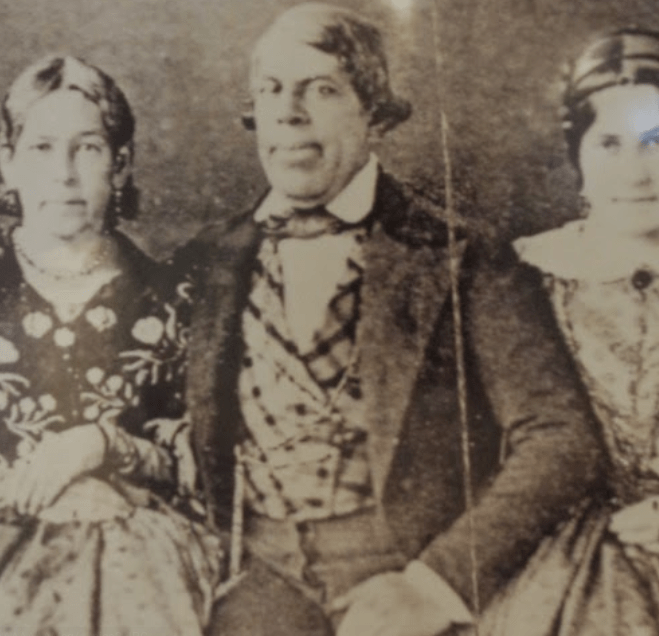
1833: John Forster arrives in California. He was a Yankee who applied for Mexican citizenship, became catholic, changed his name to Juan, and married governor Pio Pico’s sister Ysidora. Pico gave Forster huge land grants around present day San Juan Capistrano. And how did Forster repay his brother-in-law? By assisting the Americans in the Mexican-American War, which resulted in Mexico losing California.

1834: The California Missions are “secularized” (Meaning they no longer belong to the Catholic church). Who do they belong to? Well, “Juan” Forster got Mission San Juan Capistrano and started calling himself Don Juan Capistrano.
1847: General Andres Pico, brother of Pio Pico, surrenders California to the Americans at the Treaty of Cahuenga in Los Angeles, after a bloody two-year armed struggle. California will soon become part of the United States.
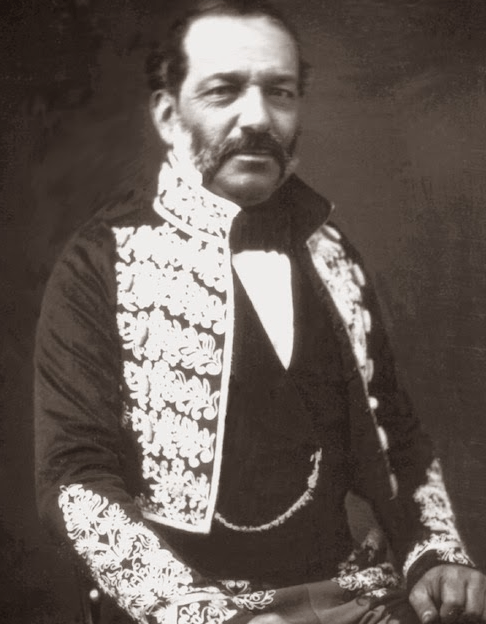
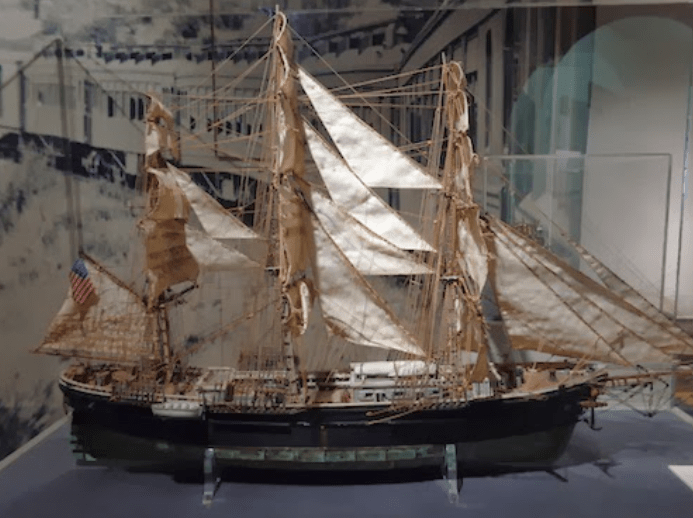
Interestingly, the Bowers does not have much about the post-Mexican California. There is a small display called “The American Migration into the Golden State” and it has models of a sailing ship, a train, and a stage coach. I’m sure there is more to the story than that. But that’s another post…
-
The Limits of Desegregation: A Story of Maple School
The following is from a work-in-progress about the history of Fullerton. You can support my ongoing research and writing on Patreon.
In 1896, Homer Plessy, who was 1/8th black, entered a whites-only railroad car in New Orleans and was arrested. The Supreme Court ruled in Plessy v. Ferguson that the doctrine of “Separate but equal” was constitutional; as long as equal facilities were provided for different races, it was “fair.” Justice John Marshall Harlan was the one dissenting vote and wrote, “The Constitution is colorblind.”
This “separate but equal” doctrine stood for 50 years until in the case of Brown v. Board of Education in 1954, the Supreme Court overturned the Plessy decision saying, “Separate is inherently unequal.” In the majority opinion, they quoted Justice Harlan.
In the late 1960s and early 1970s, a significant chapter of Fullerton’s civil rights story centered around how to desegregate Maple Elementary School, which was 98% Latino and Black at the time.
Officially, segregation of African American students in California was outlawed by the State Supreme Court in 1890, and the segregation of Mexican-American students succumbed to a legal challenge by a group of parents in Orange County in the case Mendez v. Westminster in 1947. And in 1954, the Brown decision case declared that the “separate but equal” doctrine was unconstitutional.
However, while de jure (legal) segregation was made illegal, de facto (in practice) segregation remained. Neighborhoods were still separated by patterns of historic housing discrimination–so schools remained segregated.
The integration plan many districts came up with was to bus students to schools outside their (de facto segregated) neighborhoods.
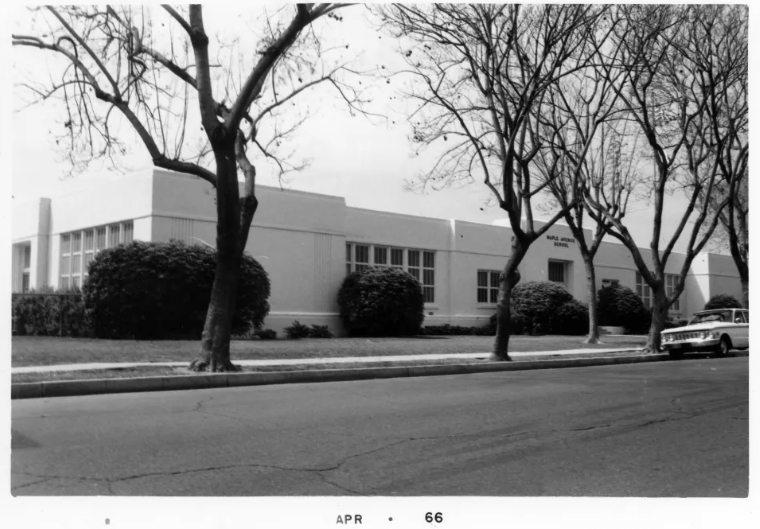
Maple School in 1966. Photo courtesy of the Local History Room of the Fullerton Public Library. While many in the north were ideologically opposed to segregated schools, many white parents were also opposed to having their kids bused from their neighborhood schools to schools in black and Latino neighborhoods.
Thus it was often the case that, in order to comply with desegregation orders, districts would adopt one-way busing, in which they would bus black and Latino kids to majority white schools, but not bus white kids to majority black and Latino schools.
A fairer, but often dismissed, proposal was two-way busing, in which the busing would be reciprocal—with some white kids going to majority black and Latino Schools, and some black and Latino kids going to majority white schools.
In his 2016 book Why Busing Failed: Race, Media, and the National Resistance to School Desegregation, historian Matthew F. Delmont chronicles this oft-forgotten aspect of the American Civil Rights story—when millions of Americans decided the limits of desegregation.

A few examples:
• New York: In March 1964, over 10,000 white parents walked from the Board of Education building in Brooklyn to city hall in Manhattan to protest against integration of New York City schools. They hoped to persuade the school board to abandon a school pairing plan that called for students to be transferred between predominantly black and Puerto Rican schools and white schools.
• Chicago: In 1967, superintendent Redmond proposed a plan to bus 5,000 black and white students between the South Shore and Austin areas. After white protests, this two-way plan was discarded in favor of a one-way plan.
• Boston: In 1966, Boston implemented a one-way busing program called METCO. Suburban communities welcomed a small number of black students from Boston city schools through the METCO program, but opposed two-way “busing” (that is, sending suburban kids to Boston city schools and vice versa).
In March 1972, President Richard Nixon delivered a nationally-televised speech in which he called on Congress to enact a moratorium on orders mandating that school districts use busing of students to achieve school desegregation.
While Brown v. Board of Education may have established the legal mandate that “separate but equal” schools are unconstitutional, actual implementation of integrating schools took much longer and in some places never really happened.
Two important court cases in California in 1963, Crawford v. Los Angeles School Board and Jackson v. Pasadena City School District prompted the State Board of Education to adopt an advisory policy “declaring that any school whose enrollment of minority students differed by more than 15% from the percentage of students in the district as a whole would be considered racially imbalanced and would require the school district to take corrective action.”
As a result of these cases and State orders, Fullerton began the process of desegregating Maple School.

Bobby Melendez at Acacia School in 1967. Photo courtesy of Bobby Melendez. Fullerton resident Roberto “Bobby” Melendez was among the first students to be bused from Maple to one of eight other schools to begin the desegregation process during the 1966-67 school year when 5th and 6th graders were bused. Bobby was going into sixth grade. He, along with a number of friends from Maple, was bused to Acacia school.
“I think we were more of a curiosity to the kids that were there because they were like social distancing from us,” Melendez said in an interview with the Fullerton Observer. “They were kind of looking at us with some surprise.”
Fortunately, he knew some boys from Acacia from playing East Fullerton Little League, like his friend Kevin Barlow.
“So we went up to Kevin and his friends during recess and said, ‘Lets play some football.’ So we all played that day…It was the browns against the whites,” Melendez said.
When the bell rang, Kevin walked up to Bobby and said, “Tomorrow I’ll be on your team.”
Thus began the integration of Acacia school—not with federal troops, but with a game of schoolyard football.
“I think that set the stage,” Melendez said. “We became very good friends. I got to stay over at some of the houses of some of my new friends that I met.”
Bobby was fortunate in having a group that bonded over sports. While at Acacia, he remembers noticing a difference in the quality of the books and facilities between Maple and Acacia.
Fullerton resident Mary Perkins, who is African American, said that her son and daughter were also among the first students to be bused from Maple for integration. They too were bused to Acacia.
“When my son was at Acacia, he was the only black student in the whole student body,” Mary said in an interview with the Observer. “My daughter [one grade behind her brother] did have one other girl there [who was] African American. They were not kind to them, you know. They told them, ‘My mother says I have to be nice to you because you’re poor.’ That kind of stuff.”
Mary and her husband Gil moved to Fullerton in 1960 with their two children.
“We were looking for a place for the kids to go to school where they could get all their education in one place, so we decided on Fullerton,” Mary said.
While Fullerton “the Education City” offered many educational opportunities, housing options were limited for African Americans at that time.
“We looked for a house in a lot of places, but they [realtors] would only show us two tracts when we were looking for a house. One was here [on Truslow] and one was in Placentia,” Mary said.
Gil Perkins involved himself in fair housing and often spoke at City Council meetings on behalf of his neighborhood.
As 1970 rolled around, all 12 Orange County school districts were ordered by the State to rectify their racially imbalanced enrollments. Although the Fullerton School District had begun busing 5th and 6th graders out of the Maple neighborhood for the past few years, the State ordered that Maple could not have more than a 30% minority enrollment.
Maple at the time had a 98% Latino and black enrollment.
The LA Times wrote, “Although Maple School is the only one in Fullerton identified as imbalanced, it has perhaps the most seriously lopsided classrooms in all of Orange County.”
A Human Relations Advisory Committee was formed in 1971 to develop integration plans for Maple. They all involved voluntary two-way busing.
Judith Kaluzny was part of this committee, which developed three integration plans, all of which called for voluntary two-way busing of students between Maple and other schools, and keeping Maple open. Unfortunately, according to Kaluzny, the administration was determined to close Maple school.
“Our plans were summarily dismissed,” Kaluzny remembers. “We were supposed to have eliminated segregation in our elementary schools by eliminating the segregated school.”
After basically discarding the plans created by the Human Relations Committee, the FSD administration then created its own desegregation plans, which involved closing down Maple entirely. All involved one-way busing of kids out of the Maple neighborhood.
Dr. Richard Ramirez, who grew up in the Maple neighborhood, was a sociology professor at Fullerton College in 1972. He got involved with the Maple Community group because he felt that the families in the neighborhood were not being treated fairly by the school administration and the community at large.
“The burden of busing was put on just one segment of the community—those that had the least collective voice,” Ramirez said. “The Board did not reflect that segment of the community.”

January 1972 Fullerton News Tribune article, courtesy of the Local History Room of the Fullerton public library. Ramirez was instrumental in helping formulate the Maple Community’s own desegregation plan, which called for two-way busing and other measures to achieve equity.
Part of his role was to meet with parents in north Fullerton to better understand their concerns.
“I’d say we had 10 to 15 different small family group meetings with them,” Ramirez said. “The common theme that came out of our discussions with them was they were fearful for their kids because they would be going into the ‘barrio,’ the ‘ghetto.’”
The other main concern of the largely white parents of north Fullerton was the quality of education at Maple.
“Those were the two consistent themes—fear and anxiety as far as the quality of education at Maple, and the simple fact that they just didn’t want their kids to mix with the brown kids,” Ramirez said.
At a crowded school board meeting in January 1972, Ramirez and the Maple community presented their plan for desegregation, which involved keeping Maple open and implementing two-way busing between north and south Fullerton.
Among the numerous speakers at that meeting was Florine Yoder who said she represented the residents of north Fullerton. According to the Fullerton News Tribune, which chronicled many of these meetings for posterity, “Yoder told the board that if minorities wanted to attend a desegregated school, they must accept the responsibilities of desegregation, including busing and attending a school out of their neighborhood.”
Evidently, the responsibility of desegregation did not extend to those predominantly white families in north Fullerton.
“We do not want our children bused and we want to retain schools in our own neighborhoods,” Yoder told the board.
Reflecting on those meetings, Ramirez said, “It was really a question of fairness. If indeed we have to follow this federal law, then every family, every child should be able to give the same level of responsibility.”
The following week, 200 Fullerton residents showed up at another school board meeting to discuss the seven different desegregation plans—three from the Human Relations Committee, three from the administration, and one from the Maple Community.
“We want meaningful education, not useless transportation,” said Layton R. Buckner, spokesman for the Concerned Parents and Citizens of Sunset Lane School [in north Fullerton]. “We feel it is wiser to spend money on teachers, books, and special programs than on buses and bus drivers.”
Some Latinos, like Larry Labrado, were also against busing.
“Chicanos don’t want to go to your schools,” he said. “We want better education at our school.”
The News-Tribune reported, “Any discussion of the specifics of the seven plans was lost in the attacks on busing and the laws that require desegregation.”
In February 1972, over 500 people packed into Wilshire Auditorium to voice their opinions on the question of Maple School. At the meeting, police in riot gear were on hand to ensure an orderly proceeding.
After lively public debate, the School Board voted 3-2 to adopt a desegregation plan that closed Maple School and called for the busing of all children from the Maple neighborhood to eight other schools.
Board members Alvin M. Berlowe, Nancy Fix, and Steward L. Johnson voted in favor. Board president Robert F. Rube and Lloyd G. Carnahan voted against.
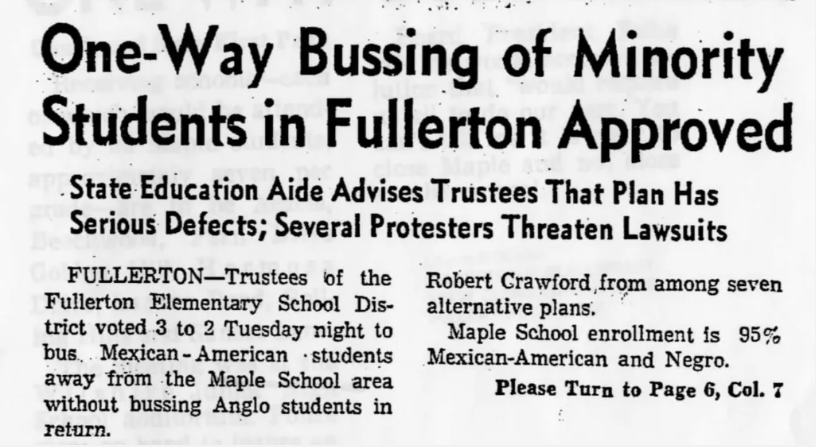
February 1972 article in the Fullerton News Tribune. Courtesy of the Local History Room of the Fullerton Public Library. As was documented in the Fullerton News-Tribune, Board President Rube said, “You can’t tell me it’s right to close Maple and not close other schools.”
“The inequity of placing the main burden of desegregation on the minority community was a common theme during the hour and 20 minute discussion period preceding the vote,” according to the News-Tribune.
“Why are we putting on the backs of the minority the responsibility of integrating the schools?” asked Bruce Johnson. He called for a “new advisory committee that will not be disbanded until an equitable and just solution is found.”
Upon completion of the vote, Barney Schur, consultant in intergroup relations for the California Department of Education said, “You are going to have a problem with it [one-way busing]. It is viewed as unconstitutional by the courts.”
According to the News-Tribune, “Upon hearing the vote, several representatives of the largely Chicano Maple community threatened lawsuits on the basis of discrimination.”
Lopez v. Trustees of the Fullerton Elementary School District
Following the February 1972 school board decision to close Maple school, families from the neighborhood filed a lawsuit against the District, alleging that the desegregation plan violated the Equal Protection clause of the 14th Amendment to the US Constitution as well as State desegregation laws.
The lawsuit called the closing of Maple School and the one-way busing plan “invidious discrimination” that “imposes the entire burden of desegregation on minority students.”
The lawsuit had the support of the Mexican American Legal Defense Fund, the Orange County Legal Aid Society, the Western Center of Law and Poverty, and the federal office of Economic Opportunity.
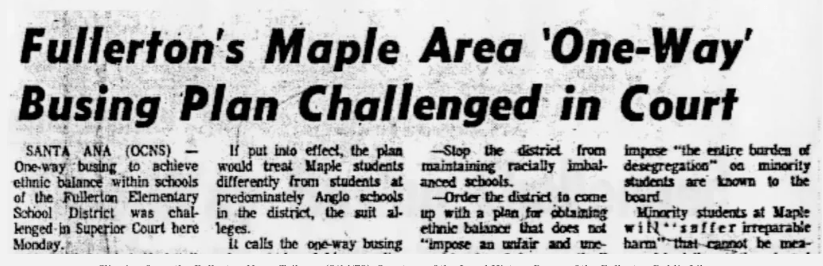
Clipping from the Fullerton News-Tribune (3/14/72). Courtesy of the Local History Room of the Fullerton Public Library. Lopez v. Trustees of the Fullerton Elementary School District was filed on behalf of “all Spanish surnamed and Negro students attending Maple School.”
During the trial, which took place in late June and early July 1972, Orange County Superior Court Judge William C. Speirs asked, “Is one-way busing the best way to comply with the law? Or is it just a means of avoiding two-way busing?”
Morris Schneider, a consultant in intergroup relations for the State Department of Education “testified that one-directional busing away from closed schools, rather than reciprocal busing, is being done in Redlands, Palm Springs, Corona, Riverside, and San Bernardino,” according to the LA Times.
Schneider said the Fullerton school board’s plan “meets the requirements of the law.”
Under cross-examination by Joe Ortega from the Mexican American Legal Defense Fund, “Schneider admitted that only Mexican American and Negro schools have been closed in districts where it has been necessary to adopt plans for achieving ethnic balance,” according to the LA Times.
“Isn’t it true, Mr. Schneider, that to your knowledge only Chicano and Black schools have been closed and their students forced to participate in one-way busing?” Ortega asked.
“Yes, as far as I know, that is true,” Schneider said.
Fullerton School District Superintendent Robert Crawford also acknowledged that two-way busing “is not prohibitively costly,” which contradicted statements that were often made at school board meetings when presenting the various integration plans.
On July 3, 1972, Judge Speirs upheld the Fullerton School District’s plan to close Maple School and bus all the children from the neighborhood to other schools in the district.
“Judge Speirs ruled that busing students from Maple School, with 85% Mexican American and 10% Black enrollment, without busing students from predominantly Anglo schools is ‘not racially discriminatory,’” according to the July 4, 1972 LA Times.

Clipping from the Los Angeles Times (7/4/72). Courtesy of the Local History room of the Fullerton Public Library. “Attorney Joe Ortega of the Mexican American Legal Defense Fund said some members of the Chicano community ‘will be very bitter,’ and ‘some will do their best to live with it and get their children to schools,” according to the LA Times.
Thus, beginning in September 1972, Maple School was closed as an elementary school and all its students were bused to other schools in the district.
According to the Fullerton News-Tribune, “The Maple School will house an expanded preschool, a community cultural center, and will be the site of a Community Open School, an alternative mini school this fall on a pilot basis.”
Reflecting on the impact of closing Maple School, long time Fullerton resident Vivien Jaramillo told The Observer in an interview, “It splits you up so much out of your element that you don’t have any tight bonds with anybody in the neighborhood because they’re all going different places. That part was kind of a bummer, and it was still affecting my kids when they were growing up.”
Retired Fullerton College sociology professor Richard Ramirez, who was involved in formulating the Maple Community’s own desegregation plan (which was not adopted), told The Observer in an interview, “It’s best categorized as institutional racism.”
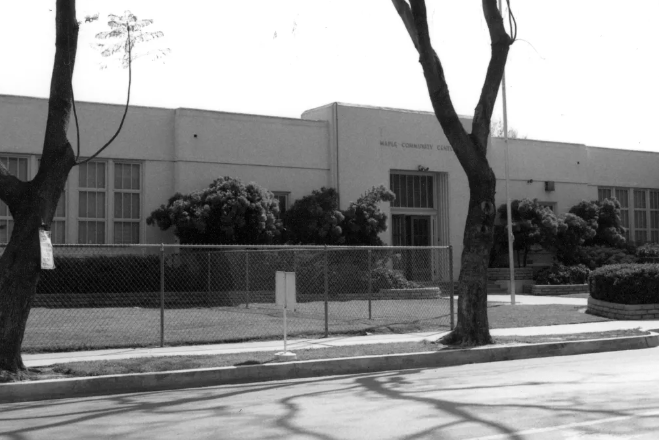
Maple School circa 1972. Photo courtesy of the Fullerton Public Library. Proposition 21 (The Wakefield Amendment)
In 1972, the same year that the Fullerton School District Board of Trustees voted to close Maple School and bus all of its students to other schools for the purpose of desegregation, voters in California passed Proposition 21, which banned school districts from using race to assign students to schools for desegregation.
In his book Racial Propositions: Ballot Initiatives and the Making of Postwar California, historian Daniel Martinez Hosang writes that the sponsor of Prop 21, Floyd Wakefield, was “a fiery conservative from the Los Angeles suburb of South Gate…[who] railed against the yoke of ‘forced integration’ and sounded a thinly-veiled call to defend white rights and ‘freedom of association.’”

Prop 21 passed with a 63% majority in 1972.
Following its passage, the NAACP and the ACLU filed lawsuits to overturn the measure and in 1975, “the State Supreme Court found that it violated the state and federal constitutions and involved the “state in racial discrimination.”
Hosang writes that although Prop 21 was only in effect for two years, it “did have a chilling effect on many local school desegregation efforts. In early 1974, the State census revealed that 192,000 more students attended segregated schools in comparison to 5 years earlier.”
Because Maple had been closed prior to the passage of Prop 21, it remained closed for 25 years.
Although Maple was closed as a k-6 elementary school in 1972, it remained open as a preschool, a community center, and a newly-created experimental “Community Open School.”
Judith Kaluzny, who had been on the Human Relations Committee that had developed integration plans for Maple that were dismissed by the District, was instrumental in establishing the Community Open School at Maple, which opened in fall of 1972.
“Arriving at Maple School with my VW busload of kids that first day of school, I was abashed,” Kaluzny remembers. “Mothers were standing on curbs waiting with their children to be bused to other neighborhood schools, while I and others were busing our children to their neighborhood school [Maple]. What a nasty choice the District had handed us. And I think they did so in order to keep us liberals busy and away from participating in the political consequences of closing Maple School.”
The Maple Game
The following year (1973), local civil rights activists Ralph Kennedy (who would go on to co-found The Fullerton Observer in 1978) and Kay Wickett hosted two seminars at the local YWCA to play what they called “The Maple Game.”
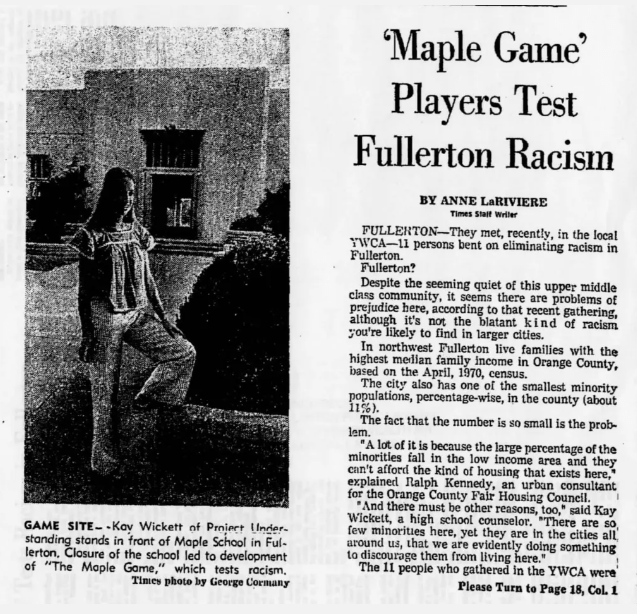
Clipping from the Los Angeles Times (1973). The seminars were a part of the national Project Understanding formed in 1969—a group of churches with the goal of eliminating racism, which they defined as “anything which works to the advantage of whites and the same time to the disadvantage of ethnic minorities, whether it’s intentional or unintentional, conscious or unconscious, personal or institutional,” Wicket told the LA Times.
In the Maple Game, attendees took on the roles of different people and groups involved in the Maple desegregation controversy.
Some were members of the Maple Neighborhood Council advocating for two-way busing, others were members of The Concerned Parents and Citizens of Sunset Lane School, still others were members of the School Board and administration.
“When [the game] was all over, a member of the ‘elementary school administration’ had been fired for stating the root of the problem lies in the institutional racism that exists within the teaching system,” the LA Times reported in an article called “Maple Game Tests Fullerton Racism.”
The article begins, “Despite the seeming quiet of this upper middle class community, it seems there are problems of prejudice here, according to that recent gathering, although it is not the blatant kind of racism you’re likely to find in larger cities.”
The purpose of this role-playing game, according to Kennedy, “was to raise individuals’ levels of consciousness about the frustrations involved in solving a problem like the desegregation of the Maple School, problems that end up exposing hidden nerve endings, tapping concealed emotions about the existence or nonexistence of prejudice.”
“Nobody’s Complaining”
Even though Prop 21 was declared unconstitutional in 1975, it still erased the State’s integration guidelines and thus had a lasting impact.
A 1977 LA Times article entitled “Integration in County: Nobody’s Complaining” gives a bleak assessment of Orange County School desegregation efforts at that time.
“Information on the current status of integration in the county’s schools cannot be obtained from the local chapters of the League of Women Voters, the NAACP, or the Orange County Human Relations Commission,” the article states.
“In any case, neither the State nor the federal government has staff enough to monitor the status of school integration very closely,” the LA Times states. “At the State Department of Education, the task of counseling school districts on desegregation has been relegated to one man—Ted Neff of the State Bureau of Intergroup Relations.”
“Now that the Bureau’s role is purely advisory,” Neff said. “It is hardly ever consulted by school districts.”
By the late 1970s, local, state, and federal governments had largely abandoned active measures to desegregate schools.
In 1979, another ballot measure in California (Prop 1) would sound the death knell of school integration in the Golden State.
Prop 1: The Robbins Amendment
Part 3 of this series addressed Prop 21, which passed in 1972 and sought to end the practice of busing kids to desegregate schools in California. Prop 21 was championed by a fiery conservative from Los Angeles named Floyd Wakefield who railed against the yoke of “forced integration.”
Although a majority of voters favored it, Prop 21 was declared unconstitutional in 1975 (it violated the equal protection clause of the 14th amendment), but it did have a chilling effect on state desegregation efforts.
Wakefield’s successor in the fight against busing to achieve desegregation was, interestingly, not another conservative Republican, but a liberal Democrat from the San Fernando Valley named Alan Robbins. Robbins had supported the Equal Rights Amendment (for women) and supported the United Farm Workers.
Robbins learned from the legal shortcomings of Prop 21 and carefully crafted an initiative in 1979 (Prop 1) that would stand up to constitutional and legal challenges. The Robbins Amendment, like the Wakefield Amendment, sought to end mandatory busing of students to achieve integration in California.
“The Robbins Amendment sought to amend the California State Equal Protection Clause by stating that as long as the US Supreme Court interpreted the 14th Amendment as only prohibiting de jure (legally mandated, as opposed to de facto—in practice—segregation), California courts would have to do the same,” historian Daniel Martinez Hosang writes.
“Calls among busing opponents for the protection of ‘majority rights’ quickly waned in favor of arguments that represented the interests of ‘all children,’” Hosang writes.

Bumper stickers by Californians Against Forced Busing in support of the Robbins Amendment (Prop 1), 1979. From the Files of the Bustop Campaign. But the burden of desegregation did not fall equally on “all children.”
Both Prop 21 in 1972 and Prop 1 in 1979 are significant to the Maple School story because they give the broader context of widespread opposition to busing kids as a means to achieve school integration, and the disproportionate impact this had on students of color.
Because Maple school had been closed, students from that predominantly Latino and Black neighborhood continued to be bused.
The 1972 Maple “solution” reflected a wider state and national trend in the 1970s in which busing was either abandoned, outlawed, or (as with Maple) the burden was placed entirely on the minority community.
“Thus the debate over busing in the late 1970s was primarily a debate over whether white students could be compelled to participate in desegregation programs, or whether that burden would fall exclusively on nonwhite students,” Hosang writes.
In his book Why Busing Failed, historian Matthew Delmont discusses how the busing debate was often framed in ways that downplayed the civil rights/constitutionality of the issue.
“White parents and politicians framed their resistance to school desegregation in terms of ‘busing’ and ‘neighborhood schools.’ This rhetorical shift allowed them to support white schools and white neighborhoods without using explicitly racist language,” Delmont writes.
Ultimately, Prop 1 passed by a large majority. Like Prop 21, it was challenged on legal grounds as unconstitutional. Unlike Prop 21, it held up to legal challenge. Its appeal made it all the way to the U.S. Supreme Court in 1982, where the court voted 8-1 to uphold its constitutionality.
The lone dissenting vote was Justice Thurgood Marshall, who wrote in his dissent, “The fact that California attempts to cloak its discrimination in the mantle of the 14th Amendment does not alter this result.”
“The Supreme Court ruling was a death knell for mandatory desegregation programs throughout the state,” Hosang writes. “The end of mandatory desegregation meant that the burden of busing had fallen almost exclusively on students of color.”
For example, “by 1980, Black students in California would be more likely to attend a segregated school than in any state in the South except Mississippi,” Hosang writes.
These continuing patterns of segregation, now given legal support, continue to today.
“Twenty-five years after the passage of the Robbins Amendment, patterns of racial isolation and segregation were at all-time highs,” Hosang writes.
Fighting for the Maple Community Center
After its closure in 1972, Maple Elementary School became the Maple Community Center (MCC), housing a preschool, Headstart, a daycare, and an experimental Community Open School.
Every five years or so, the Maple area residents had to fight to keep even these programs. In 1978, the Fullerton School District first considered closing the MCC, but ultimately decided against it.

News clipping courtesy of the Local History Room of the Fullerton Public Library. In 1983, the District again proposed closing the MCC, citing a budget deficit. The Board of Trustees initially considered closing either Orangethorpe, Commonwealth, or Hermosa Drive Schools, but shied away from closing any of these after outcry from parents.
“Whenever financial problems come up, they [trustees] talk about closing Maple—we’re always picked on,” Martha Rodriguez (a Maple parent) told the Fullerton News-Tribune.
Faced with the possible closure of the MCC, parents and advocates attended FSD Board meetings in great numbers in February and March of 1983. They also organized a letter-writing campaign to board members and the district.
One particularly eloquent letter was submitted by Brig Owens, an African American NFL player who grew up in the Maple neighborhood.
In his letter to then District Superintendent Duncan Johnson, Owens called the MCC “an extremely necessary facility. This decision not only will affect the children and lives of their families, but it will affect the community as a whole,” Owens wrote. “Too often in the face of progress we lose sight of the true needs of our community and families…I realize tough decisions have to be made and there are no easy answers but let us not sacrifice these programs that are for the betterment of the community.” (Fullerton News Tribune, 1983).
At a Fullerton School District Board meeting in March 1983, around 175 Maple neighborhood residents showed up wearing “Keep Maple Open” buttons.
As reported in the News-Tribune, “Thuc Nguyen, a mother of a child in pre-school at the Center and a full-time volunteer there, broke down in tears at one point in her speech to trustees.”
“How can I explain to my son how Maple won’t be there for him?” Ms. Nguyen said. “I am a single parent of two pre-school children. I don’t think my children can handle another breakup.”
As a result of the parents’ organizing, the Board did not close the MCC in 1983.

Preschool teacher Sylvia Quezada a with a student. The Maple Community Center operated a preschool after the elementary school was closed. Photo from the Fullerton Observer archives. The Maple Alumni Committee
In 1983, Bobby Melendez, Vivien “Kitty’ Jaramillo and others from the Maple neighborhood decided to organize an annual get-together for families in the neighborhood whose kids had been or were being bused to schools outside the neighborhood.
This group eventually became the Maple Alumni Committee.
“We started in 1983 to get together for picnics, just to keep ourselves together, so our children could know each other, so we could just bond one time a year,” Melendez said in an interview with The Observer.
One consequence of closing Maple School was to cut off the normal inter-familial ties that come with having a school in your neighborhood.
“The school would have served that function but as we were all in the waning years of having gone to Maple School, having the experience of being bused out together, I think that kind of galvanized our relationship together—having that similar experience,” Melendez said. “So that alumni committee organized dances, and the dances became fundraisers for Maple School.”
By the late 1980s, the prospect of re-opening Maple as an elementary school would become the subject of much discussion and debate.
‘White Flight’
Throughout the 1980s and 1990s the percentage of ethnic minority students (mainly Latino and Asian) in the Fullerton School District rose steadily, mirroring statewide and national trends.
“1982 minority student enrollment was 38%, up 4% from last year and more than three times what it was 15 years ago,” states a 1984 article in the Fullerton Observer.
This steady influx of Latinos and Asians created a few key challenges for the district: the need for more bilingual education, exacerbation of de facto segregation, and white backlash.
A 1987 Fullerton Observer article entitled “Concerned Parent Charges ‘White Flight’ at Richman” quotes a parent of a student at Richman elementary saying, “One of my son’s friends told him that the reason he was transferring out of Richman was ‘there were too many Mexicans there.’”
The article describes how some white parents were removing their children from Richman, a south Fullerton school with a high Latino enrollment, complaining about bilingual classes and a perceived lowering of educational quality.
“Expectations seem to be lower,” said one parent, who chose to have her two children transferred out of Richman. “My two boys were beginning to feel bad about themselves and showing prejudice, which I don’t like; so we decided to take them out. We have to take care of our own.”
By 1988, Richman was the new Maple, with a nearly 80% minority population. Also in 1988 the first ever Latina was elected to the FSD Board of Trustees, Anita Varela.
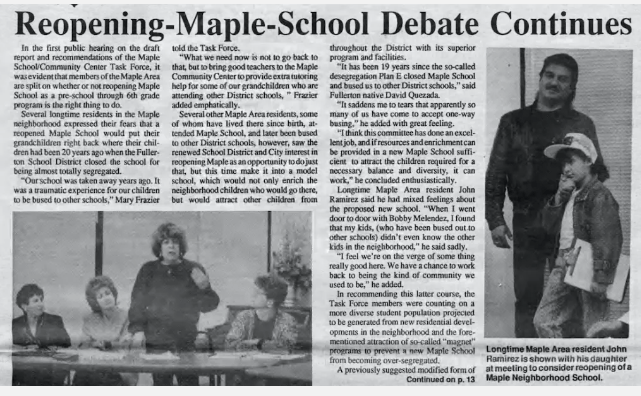
1989 Fullerton Observer newspaper clipping. Re-Opening Maple Elementary?
In 1988, an ad hoc District Advisory Committee was formed to study these changing demographic trends, as well as overcrowding in some schools. The committee ultimately recommended reopening Maple as an elementary school. The merits of this recommendation were debated in a series of community meetings.
“I think (re-opening Maple) is probably going to be one of the greatest days for our community,” Bobby Melendez said. “I think it’s going to have a positive effect on our community because it’s a rallying point of the community, the focal point of the community.”

1989 Fullerton Observer newspaper clipping. Trustee Fred Mason and others, while not opposed to re-opening Maple, expressed concern that doing so could re-create a segregated school, due to neighborhood demographics.
“We’ll be segregated again; we haven’t learned anything in 20 years,”
Maple resident Gil Perkins said.
The chair of the committee, Ellen Ballard, said that the priority of the committee was quality education and language instruction rather than correcting “ethnic imbalance.”
Trustee Anita Varela, while not opposed to re-opening Maple, pointed out that “the District had not been serving the interests of Limited English Proficiency (LEP) students throughout the city in its existing programs, and wasn’t prepared for the challenge of a linguistically-segregated school.”
“I would like to see Maple reopened with bilingual teachers and a bilingual principal,” Maple area parent Terry Garcia said. “But first the school would have to be fixed up and the neighborhood parents involved in the reopening before, during, and after.”
A Magnet School?
In 1989, the Fullerton City Council appointed another “Task Force” committee to study and make recommendations about re-opening Maple. During these meetings, one point of discussion was (again) whether re-opening Maple would re-create a segregated school.
One recommendation was to re-open Maple as a “magnet” school—to create such unique and strong educational programs that students from around the City would be drawn to Maple.
Ultimately, this second committee also recommended re-opening Maple as an elementary school. When the committee presented its recommendations in a series of community meetings in 1990, the same debate about whether re-opening Maple would re-create a segregated school continued.
A March 1990 article in the Fullerton Observer states, “Several longtime residents in the Maple neighborhood expressed their fears that a re-opened Maple School would put their grandchildren right back where their children had been 20 years ago when the
Fullerton School District closed the school for being almost totally segregated.”
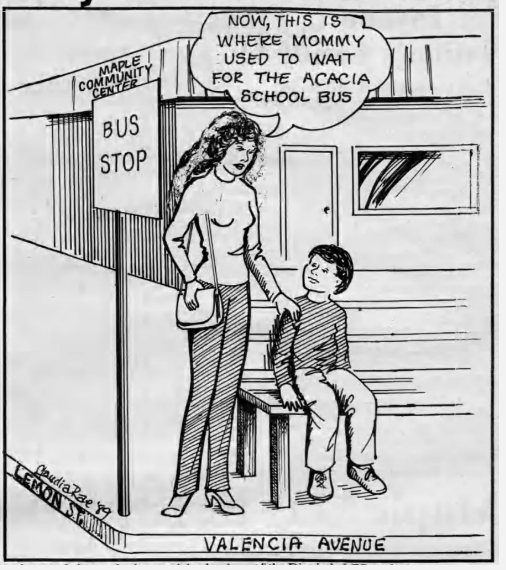
Comic from a 1989 issue of the Fullerton Observer newspaper. Those in favor of re-opening Maple expressed hope in the possibility of a “magnet” school that would draw diverse students and achieve integration.
“I think this committee has done an excellent job, and if resources and enrichment can be provided in a new Maple school sufficient to attract the children required for a necessary balance and diversity, it can work,” said David Quezada.
An editorial published in the June 1990 issue of the Fullerton Observer expressed doubts about the feasibility of this option: “We are not aware of any examples where magnet schools located in minority neighborhoods have been successful in drawing enough Anglo students to achieve an integrated student body.”
Unfortunately, this editorial would prove prophetic. In 2020, 24 years after Maple was re-opened in 1996, the demographics were virtually identical to 1972, when the school was closed.
But in 1990, a cautious optimism prevailed. The Fullerton School Board accepted the recommendations of both committees and hired a consultant to develop a plan to re-open Maple Elementary School.
It would be six more years before the first kindergarten classes began at Maple.
To be continued…
-
Oral Histories: Wilson Phelps
The following is from a work-in-progress about the history of Fullerton. You can support my ongoing research and writing on Patreon.
As part of my ongoing research on Fullerton history, I have been reading various Oral Histories conducted by The Center for Oral and Public History at Cal State Fullerton. I read an interview with local resident Wilson Phelps, who was a banker/rancher/property owner in Fullerton. The interview was conducted in 1998 at Morningside Retirement community. Here’s what I learned from the interview.
Wilson Phelps was born in 1909 in Los Angeles. His father, John Phelps, was a tireless businessman. He owned several banks, a wholesale grocery, a paint factory, lots of land…and an orange ranch in Fullerton. The Phelps ranch was located at the corner of Orangethrope and Spadra (now Harbor Blvd)–where the Target shopping center is today. The ranch stretched for several acres between Fullerton and Anaheim.
Though they lived in Los Angeles, Phelps remembers taking the train to Fullerton to visit the ranch during the summers: “We had turkeys and chickens and rabbits and all the rest of it. It was great for kids. We had an old pump house with a windmill, and we had to pump our own water at the ranch. There was no city water.” Wilson’s father was also president of the Orangethorpe Packinghouse, located near the railroad tracks, where oranges were packed and loaded onto freight cars for shipment east.
After high school, Phelps got his undergraduate degree at Stanford, then moved to Boston and got a law degree from Harvard. During summer breaks, he would work in one of his father’s banks, or as a bookkeeper at the Orangethorpe Packinghouse.
He practiced law for two years in Los Angeles, but didn’t like it much, and ended up moving to Anaheim to run his father’s Southern County Bank. He recalls the difficulty of the Great Depression years on the banking industry: “That was tough going because the banks had all closed during a holiday, and some reopened and some didn’t. The Southern County was able to reopen. Originally, before the break in 1929, there had been four banks in Anaheim, but it ended up that there were only two, the Bank of America and the Southern County Bank.” One effect of the Great Depression, it seems, was the loss of small community banks, and the emergence of large banking conglomerates, like Bank of America.
Phelps remembers the devastating flood of 1938, which hit Anaheim and Fullerton: “The water broke through the dam, I guess, and roared down through the center of Anaheim and came in all the buildings. And a lot of these old buildings had basements which were flooded, merchandise of course all ruined. It came into the bank vault. We had about three inches of muddy water in the bank vault and over the whole floor. It was a horrible, smelly mess to clean up.”
During World War II, Phelps was not drafted, nor did he volunteer because, he says, “My father said I was essential to his bank, and that was an essential business.”
Phelps’ father died in 1947 and he took over many of his fathers banks and other businesses. After World War II, Los Angeles and Orange County entered a period of rapid transformation from agriculture to urban/suburbanization. The task fell to Wilson to begin subdividing his family’s vast land holdings, and this caused him to have a nervous breakdown. This was, according to Phelps, “the time that Orange County started to explode in population. Form then on, it just went gangbusters.”
In the early 1950s, Phelps and his family bought a house in the affluent hills of Fullerton, and he became sort of a recluse: “That was a period that I was sort of in a rundown physical condition and just didn’t want to see people. I had so many people at me at various times that I wanted to be more or less secluded. And I suppose that was part of my problem of a breakdown.” He began to accumulate properties in less developed areas, to get away from the rapidly-changing landscape of Fullerton. He bought property on the Colorado River, a beach house in Balboa, and a large property in Temecula.
In 1964, Phelps entered into a deal with Montgomery Ward’s department stores, and turned his family ranch into a massive shopping center. This is now the Target shopping center at the corner of Harbor and Orangethorpe. Phelps called this deal a “bonanza”.
After his retirement, Phelps traveled a lot, and went on to establish a scholarship foundation through Fullerton College: The Wilson Phelps Foundation. At the time of the interview, he (and a lot of other Fullerton ‘old timers’) was living at Morningside, and skeptical about the future of the area. “I don’t think I’d really enjoy being here fifty years from now,” he said, “Too many people.”

Wilson and his wife Jackie. -
A Brief History of the ModelMania Building
The following is from a work-in-progress about the history of Fullerton. You can support my ongoing research and writing on Patreon.
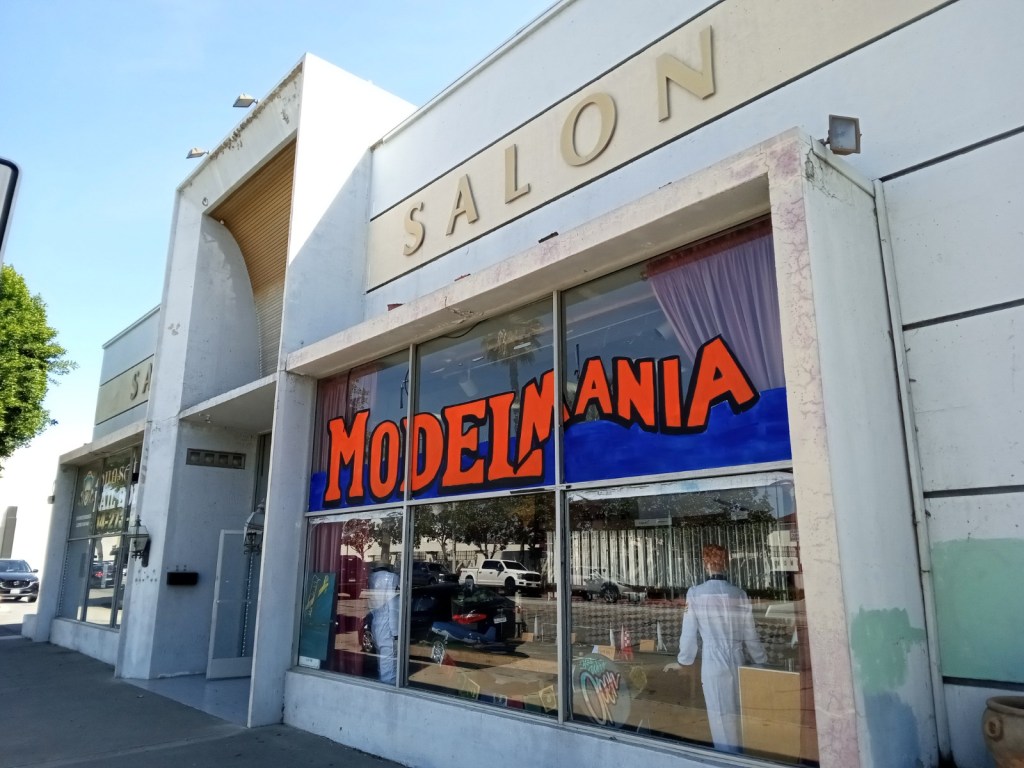
At the April 7 Downtown Fullerton Art Walk at ModelMania, I gave a brief presentation on the history of the ModelMania building. For those of you who missed the talk, here’s what I shared.
The site of the ModelMania building at 232 W. Commonwealth Ave. was within lot 30 of the Amerige Brothers’ original townsite map, as shown below:

Here is lot 30:
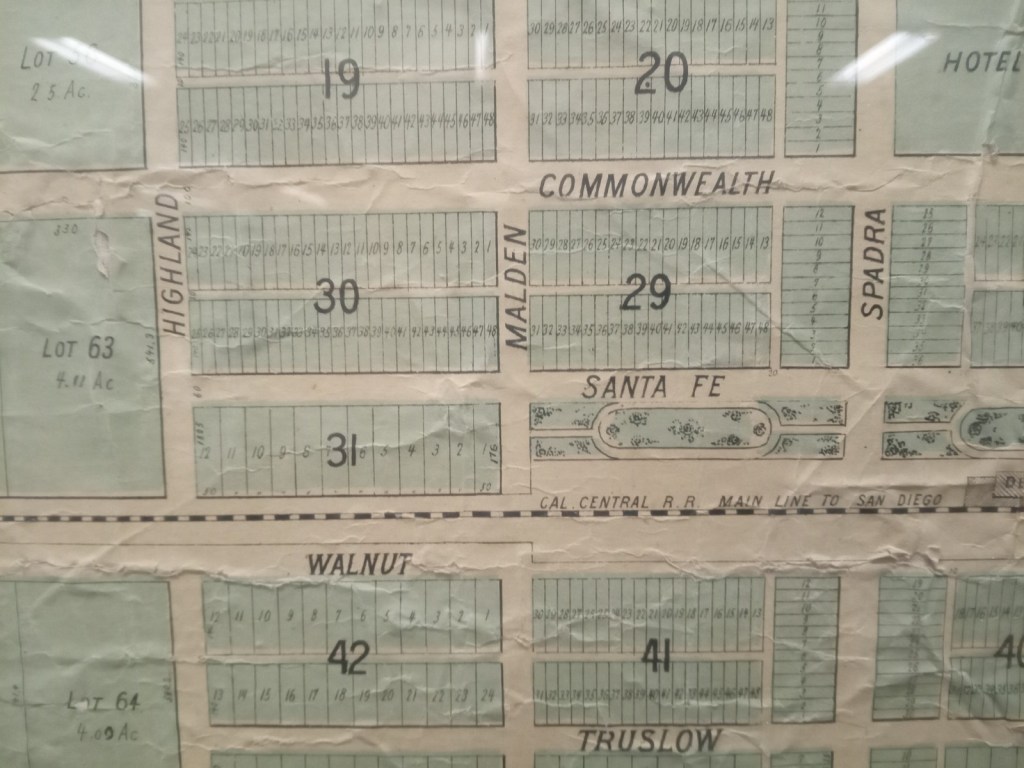
These lots were sold to settlers, and the first buildings constructed on this lot were homes. According to Local History Librarian Cheri Pape, one of these early houses was likely owned by Fullerton Tribune editor Edgar Johnson. Here is a 1911 tract map showing houses where the building is today:
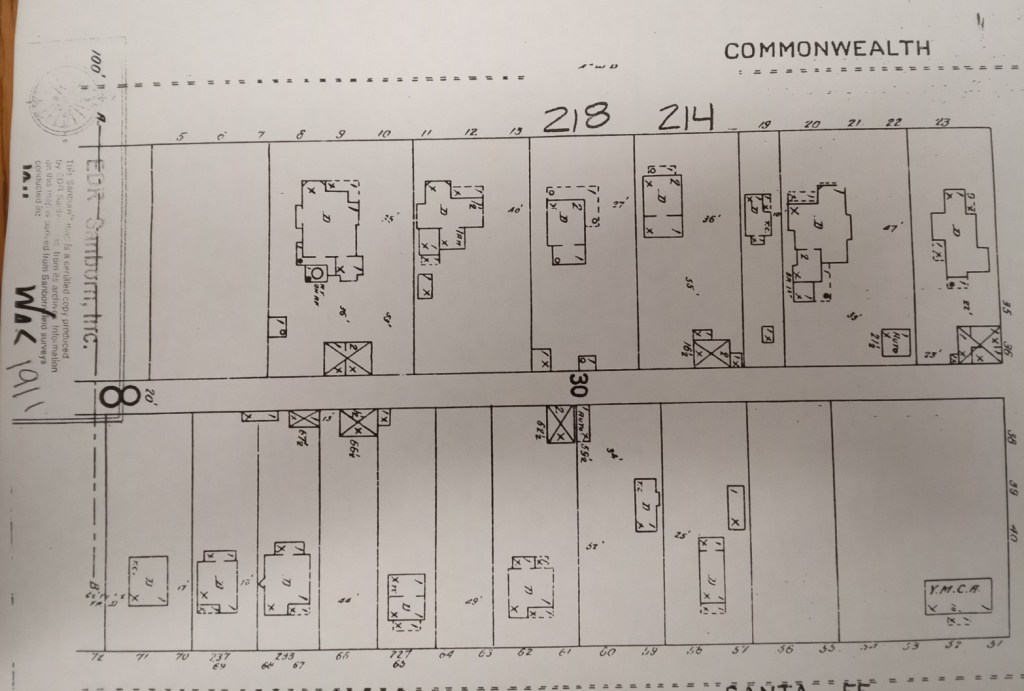
Eventually, the houses were demolished to make room for businesses. In 1948, Southern California Edison built an office building at 232 W. Commonwealth. This would later be the ModelMania building.

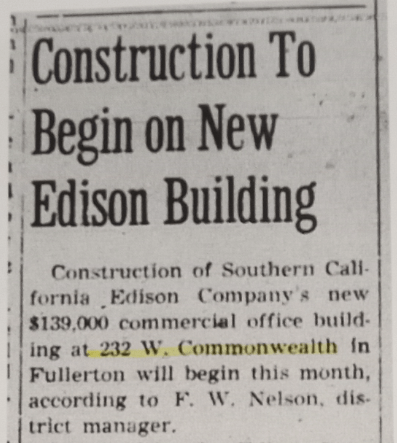
1948 clipping from the Fullerton News-Tribune. Part of the reason for Edison building this was the post-war population boom required an expansion of electric services in this area (and throughout southern California).
Edison stayed in the building for nearly two decades, after which time they acquired a larger property at Brookhurst and Valencia–property which they still own and use.
From 1975 to 1978, the building housed the North Orange County Mental Health Service.

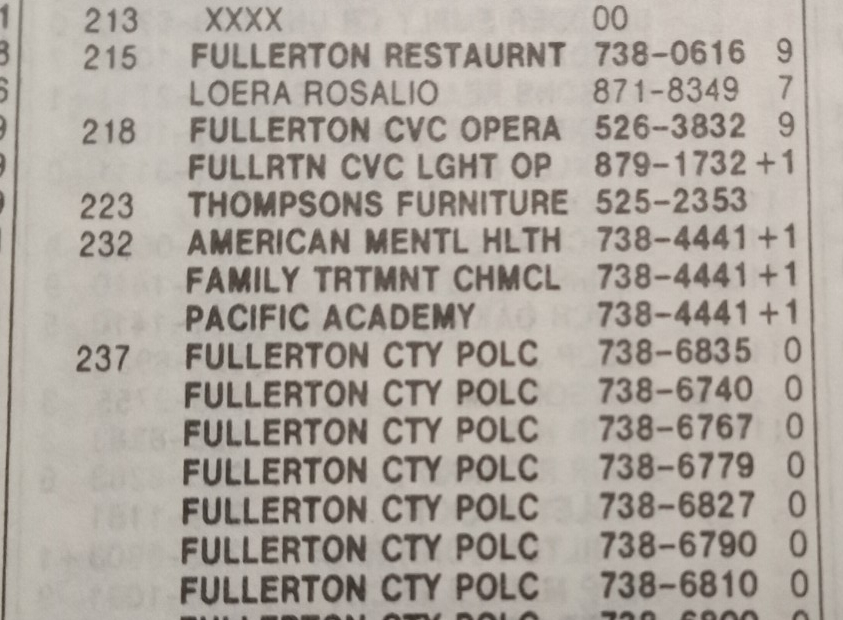
From 1981-1985, it was used by American Mental Health Family Treatment [Chemical?] and something called Pacific Academy.
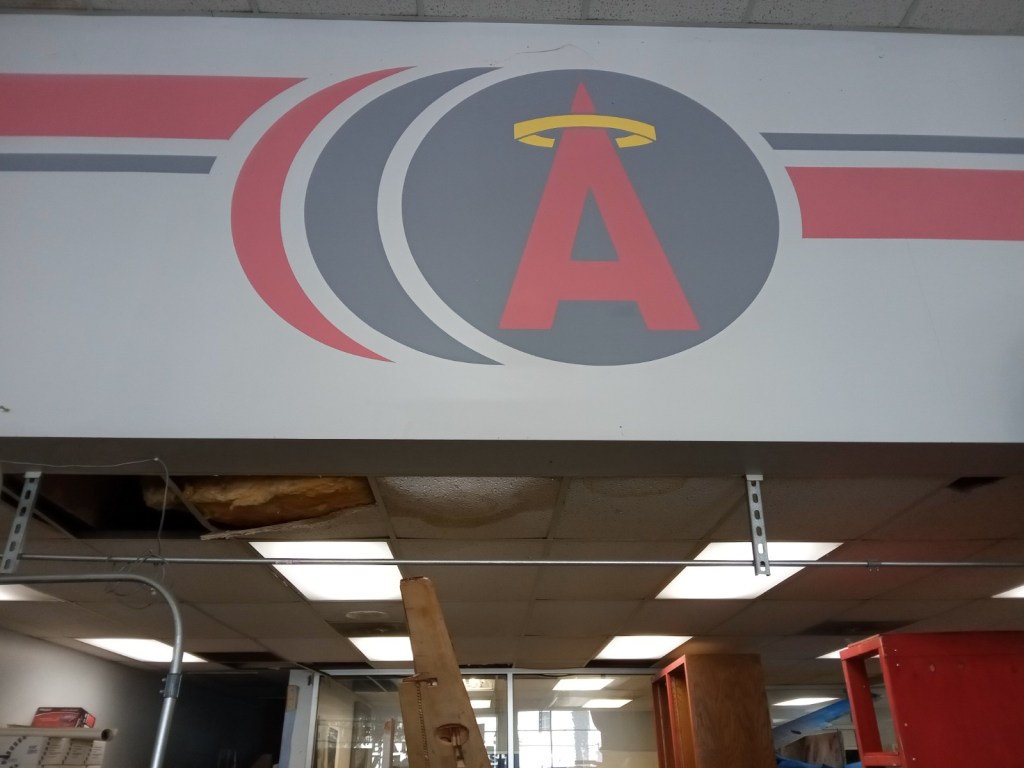
From 1987 to 1992, it was a car dealership called Stadium Pontiac. The paintings of Angels and Rams logos are still there, along with the Pontiac logo above the inside entrance.
In 1993, the property was acquired by Pete Magoski, who moved his hobby shop Bargains Galore/ModelMania from its original location in La Habra into the building. According to Pete’s son Mike, they got the building in a land swap because the City of La Habra was clearing out the area where the shop was originally located to build a senior center.
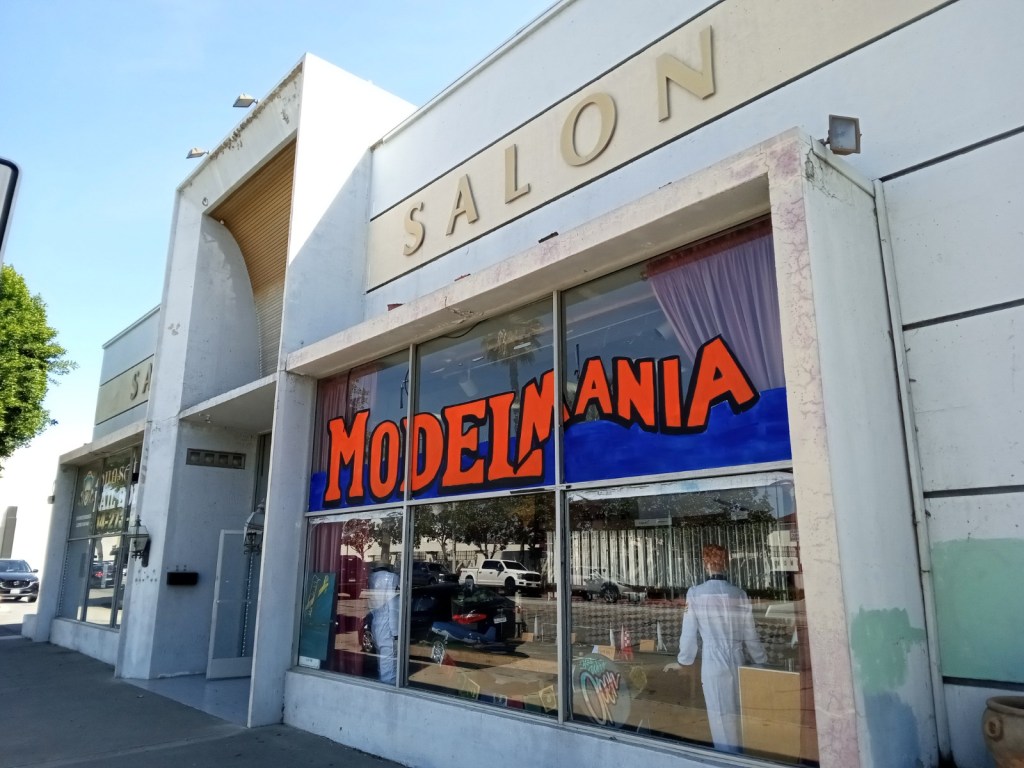
ModelMania was not open very often, but it housed (and continues to house) a large and unique collection of model airplanes, ships, cars, and more.
In addition to the model shop, Pete and his friend Vic (both retired aerospace engineers who had worked on Apollo missions and space shuttles) used the building as headquarters for their aerospace consulting business, North American Aerospace–where they continued to work on various aerospace projects.
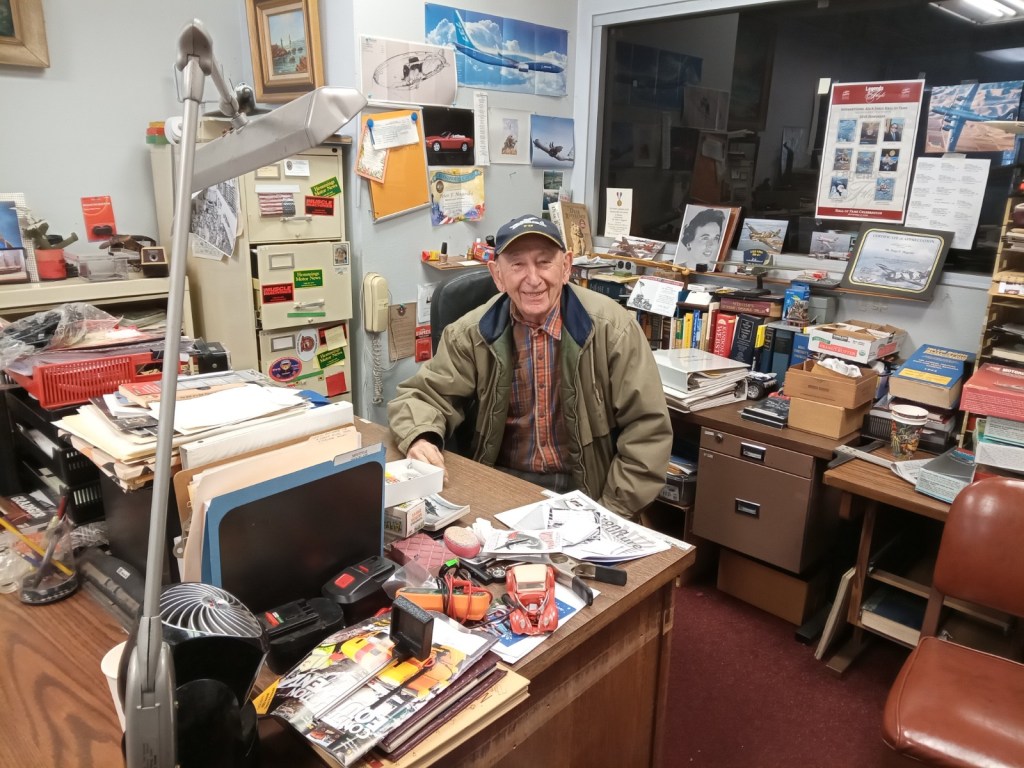
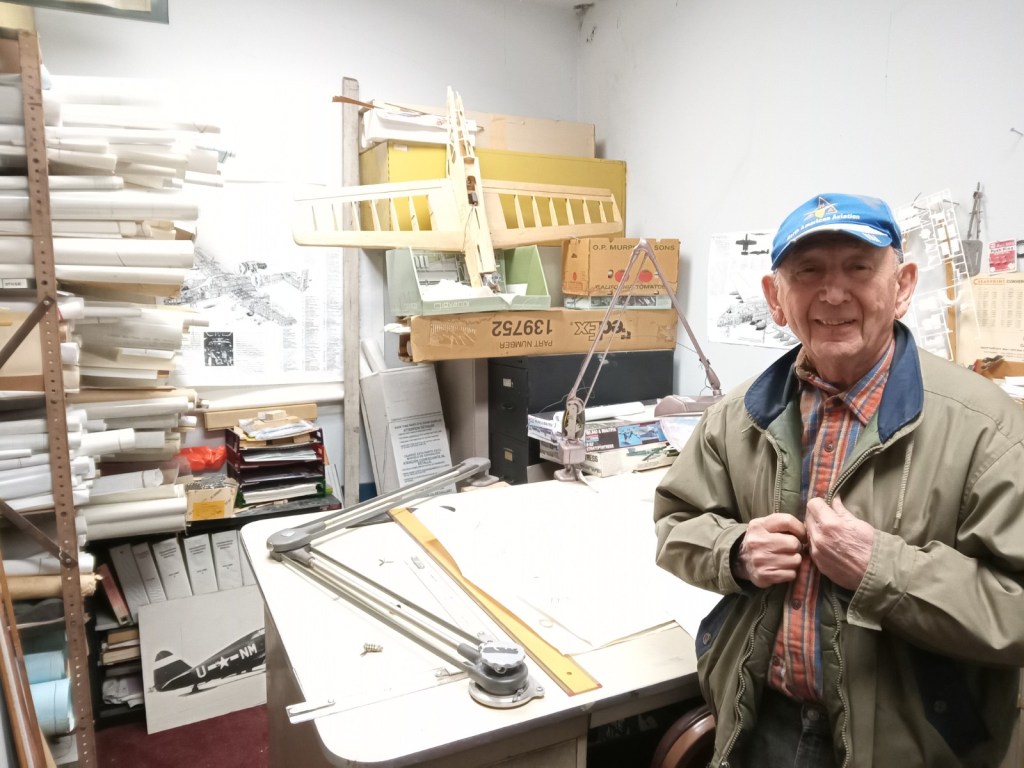
Though he is now fully retired, Pete still has his office and drafting table in ModelMania.
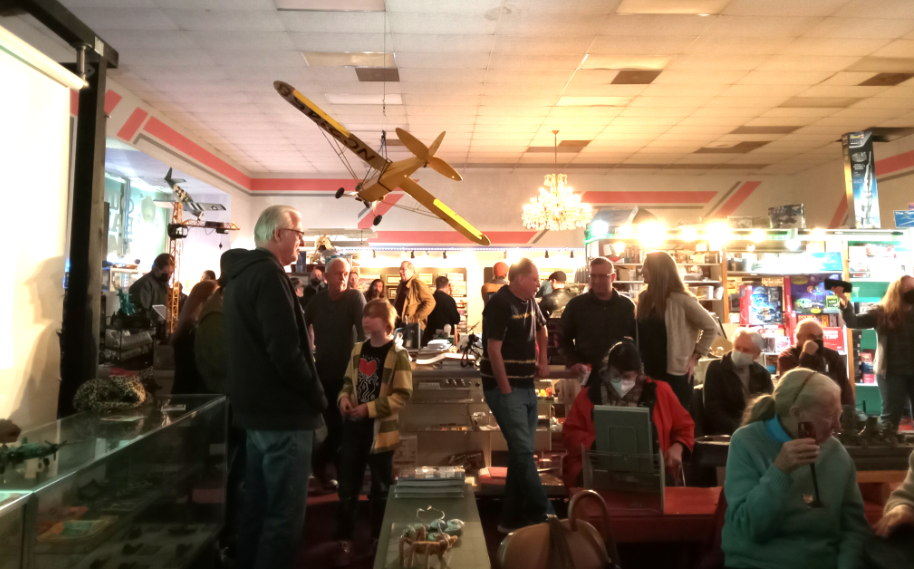
Over the past couple of years, Mike Magoski and Emily Heller have cleaned up the place and re-opened ModelMania four days a week as not just a model shop, but also an art and music destination. It is one of the venues in the re-emerging Downtown Fullerton Art Walk.
-
Oral Histories: Blanche Elder Hale
The following is from a work-in-progress about the history of Fullerton. You can support my ongoing research and writing on Patreon.
Blanch Elder Hale was interviewed by Jackie Malone in 1980 for the Fullerton College Oral History Program. She came to California with her family in 1908 when she was ten years old. Her father, George Elder, was to work in the oil fields in Olinda, a community east of Brea which no longer exists. In the interview, Hale talks about her family and their life on the Stearns Lease in Olinda, about going to school in Fullerton, and later working in the Union Oil company field office.
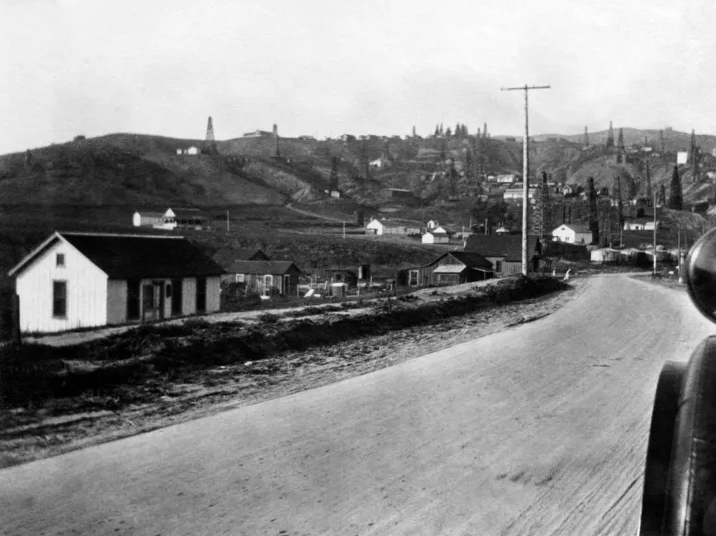
The town of Olinda circa 1915. Photo courtesy of The Homestead Museum Hale was born in Alvy, West Virginia in 1899. The family moved to California in 1908 after her father’s store burned down.
“Fullerton was a small town then, not very large. The business district was only about two or three streets along Spadra, from Commonwealth to about Wilshire,” she said. “To get to Olinda from Fullerton my dad rented a two-seat buggy with two horses from Marcos Andrade who had a livery stable in Fullerton and one in Olinda.”
In 1909 the family moved to Olinda onto the Stearns lease, which was owned by the Union Oil Company and her dad worked there for Union Oil.
The Stearns lease “was several thousands of acres. The Stearns camp was about half way to Brea. At the camp they had a boarding house and bunk houses for the single men,” Hale recalls.
She was the oldest of five children with four brothers: Ray, Carl, Paul, and Burl.
Union Oil had the practice of allowing workers to build their own houses on the property, “So my dad and mom walked the hills up there until they found this one spot where there was just one house about a block away and they chose that spot.”
In addition to the oil fields, Hale remembers, “We used to have all these beautiful groves. It was a beautiful drive to Fullerton, and the road was only two lanes.”
She remembers when “We had a lot of Basque people around here…The Bastanchurys…There was another family named Hualde that lived on Lambert Road between the Stearns shop and Brea Boulevard where the Randolph School was. They raised sheep. The Union Oil Company would lease those hills for them to run their sheep on.
On their home they kept animals like horses, cows, chickens, a dog, and cats. They also grew much of their own food. On the Santa Fe Lease, there was a Methodist Episcopal Church, branch of the Stern-Goodman general store, and a barbershop.
The Pacific Electric Red Car ran through Brea and she recalls taking it to Los Angeles.
She remembers buying vegetables from the vegeterian/spirituaist commune in Placentia: “They intermarried, and so some of them were a little off here and there. But dad and mom would go there and buy the most beautiful plums and prunes.”
Her grammar school was located in the middle of what is now Carbon Canyon Regional Park. The school moved to Brea when they built the dam.
She attended Fullerton High School, starting in 1915, taking a bus each day from Olinda. Roy Hale, who would years later become her husband, drove the school bus. When she first attended high school, the principal was Delbert Brunton, and then Louis Plummer.
In high school, she played basketball and tennis. She remembers the football rivalry between Fullerton and Santa Ana high schools. At that time, there was an African American football star named Hazel Smith.
“I think he was the only black person who went to school,” she remembers. Due to racist housing politics, there were not many African Americans in Fullerton, and they lived south of the train tracks.
Once a week, there would be an assembly at the high school with a notable speaker. She remembers seeing Helen Keller and Anne Sullivan, and governor Hiram Johnson.
She remembers how, around World War I, the oil workers formed a union for better pay and working conditions.
“A long time ago it wasn’t so good as it was after 1919, because some of the men worked twelve hours a day. In about 1916 or ‘17 when we got into World War I the men started forming company unions,” she said. “At that time they reduced the hours from twelve to eight for everybody and also gave them a raise in pay.”
Baseball was popular in Olinda: “We used to go to those ball games when they were playing in Olinda or in Brea. My brother Burl worked for Shell Oil Company and he was catcher for the Shell Oil Team.”
During the flu epidemic of 1918, her dad was the first influenza patient in the Fullerton Hospital, which was on Wilshire.
“When they took my dad in, they didn’t think he would live,” she remembers. “They had one section of the hospital just for the flu patients…my dad survived…A lot of people died in Olinda and every place around here…most every home [was affected by the flu]. My whole family got the flu. Everybody was in bed.”
She recalls how in the 1920s, there was more growth in the downtown area. She recalls buying her first car from William Wickersheim. Her dad bought his frost car Sitton’s auto.
After she graduated from high school, she (like the rest of her brothers) went to work for Union Oil in 1920, in the office.
In the days before national prohibition, Fullerton was a “dry” town, and Anaheim was not: “They had a dance hall over there. I never did get to go there, but my brothers used to go and dance there.”
When she attended Fullerton High School, and for years, the Board of Trustees wouldn’t allow students to dance at the high school function. To dance, young people would go to Anaheim.
Her second husband was Roy Hale, of the locally prominent Hale family.
Roy’s dad, Harris H. Hale, came to California in 1887 or ‘88 along with his brother William “Billy” Hale. They became orange ranchers.
“Billy Hale’s house is still standing on Chapman Avenue,” she said. “It’s the two story building on the north side of Chapman Ave. between Acacia and State College Boulevard. It’s a Montessori school now.”
Her uncle J.S. “Bub” Elder, served a councilman after they moved to Fullerton in the early 20s. Billy Hale served as mayor. Her husband’s cousin, Harold Hale, served on the Fullerton High School district board of trustees.
From 1928 to 1953, Blanche lived in Los Angeles. She worked for Preferred Theaters Corporation until 1972, when she retired.
Today, although the town of Olinda no longer exists, there is an Olinda Oil Museum in Brea, which chronicles some of this history.
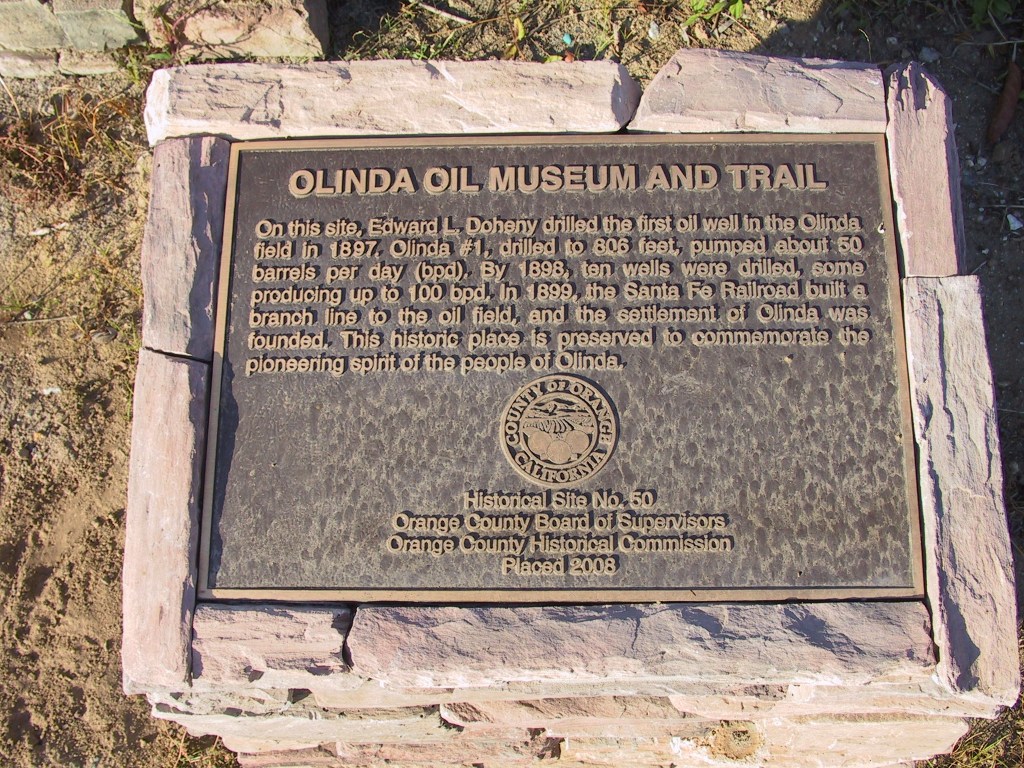
Olinda Oil Museum and Trail Marker. -
Oral Histories: Florence Arnold (artist/community organizer)
The following is from a work-in-progress about the history of Fullerton. You can support my ongoing research and writing on Patreon.
“All the yesterdays, no matter how good they were, how bad, they are plowed under; there is nothing we can do about it. They are gone and forgotten. Tomorrow is the great hope. But today we have in our hands, squeeze it like an orange, get all the juice out, enjoy it, savor it–each day as we go. That is all we have.”
–Florence Millner Arnold
Florence Millner Arnold (aka “Flossie”) was a local hero of Fullerton culture. She was a music teacher for much of her career. In the 1950s, she started painting and became actively involved in the arts, a passion that would consume the rest of her life. Her list of cultural contributions to the city of Fullerton is staggering: She became president of the Orange County Art Association, was a member of the American-European Cultural Exchange, co-founder and chairman of the annual “Night in Fullerton” (which she started in 1966), a member of the City of Fullerton Cultural and Fine Arts Commission, chairman of the Bicentenniel Committee for Art in Public Places for the city of Fullerton, president of the Muckenthaler Cultural Center Annual “Florence Arnold Children’s Art Scholarships Exhibition,” and president of the CSUF Art Alliance. Needless to say, she received numerous awards and accolades, including, on her 85th birthday the city of Fullerton presented her with the “Key to Our Hearts.”

Florence Arnold, Co-Founder of “A Night in Fullerton” She also became a celebrated artist in her own right, whose work was featured in the Los Angeles Institute of Contemporary Art, Art Week Magazine, and in the Archives of American Art in the Smithsonian Institute.
From 1985-1987, a student at Cal State Fullerton interviewed her several times for the CSUF Oral History Project. These interviews were transcribed and published in an 85-page volume, which is available at the CSUF Center for Oral and Public History. Reading the story of this extraordinary woman’s life, I wish I knew her.
Flossie was born in Reno, Nevada in 1900 to a miner and a farm girl from Missouri, both of whom had a profound impact on her life. She recalls, “Mother always had a project she was fighting for. First, it was votes for women. Then she wanted playgrounds for the schools. She organized the first PTA in Reno so that they could have swings and slides on the playground. Then mother became a militant suffragette in 1914, 1915, and 1916. All the great women that were promoting the cause came through and stopped in Reno…Ann Martin and the other great women who stopped there, would come to the house and have dinner and we would talk. Then out into the street we would go. I remember carrying my little flag that said ‘Votes for Women’ on it…The women would stand and try to gather a crowd, and the men would heckle them.”
Her father, George, was a miner by profession, but a poet at heart. Flossie recalls, “He was a poet. All of the letters he ever wrote to me as a little girl were written in poetry. I can remember, growing up, he would read to us every evening, Dickens, the classics, and all the stories that he thought we ought to know…so I was well-versed in lots of literature just from father reading to us.”
Recalling her parents, she said, “I think that those two people, those two strong human beings were certainly influential in my life, this father who was a poet, a dreamer with literature and music very much a part of him; and mother who played the very down to earth realist who held things together.”
As a young woman, she took a vacation to Mendocino (near San Francisco) to visit a friend. Here she met the boy who would become her husband, Archie: “When we were going down to Mendocino, we passed a lumber mill. There were two fellows out at the end of a boom stick where the scraps were kept, and they were waving their little sailor hats at us. Dorothy said, ‘Those are two punks from Anaheim, and it’s the only thing we have to entertain us this summer. There’s no one else in this town of Mendocino.’ So that night when we went to the movies in the back of the drug store (where each night they would show a movie) sure enough, there were the two boys, Waldo and Archie, in back of us. They kept, of course, making all the noises that boys do and, I think, Archie hit me once. He tried to see how near he could get without hitting me, but, nevertheless, those two pesky boys were there.”
Florence took a job teaching music in Sacramento: “I didn’t know anything about teaching. My experience in teaching had been six weeks in a second grade and a semester of harmony in the Oakland high school. And I was really ignorant, making it up minute by minute. Every twenty minutes, they would send in another class…I didn’t know if it was going to be a second grade, or a fourth grade, or a first grade. I would open those music books, and we just winged it. I don’t know to this day how I did it. When I think back on it, it was a miracle.”
Flossie and Archie got married and moved to Fullerton, near where Archie’s family was from. Flossie began teaching music in Placentia in the 1920s, a fascinating time in the history of Orange County, a time when there was an active Ku Klux Klan. She recalls: “You couldn’t get a job in Fullerton if you were a Catholic.” Also, at that time, schools were segregated into “white” schools and “Mexican” schools. “We had three Mexican schools in Placentia,” she remembers.
As a teacher, Flossie was an innovator, often doing things different from standard practice. When she went to teach in Placentia, she remembers, “They had a superintendent who was just pathetic. He was afraid of everything, and all he knew was to make people march and to keep a tight hold on everything. He thought the place would go to pieces if he let go with his strict regimen that he had.”
By contrast, Flossie made it her mission “to show other people how good they were, how great they were. I would take the youngsters and show them that they could do it. This became my ambition or my fun in life…sometimes, children don’t have an opportunity to show how great they are. They are circumscribed with rules and regulations, and somebody is there with a whistle over them or with a time clock…I think so many teachers miss the point. They think the subject matter is the important thing or the answer, rather than turning it around and saying, ‘Let’s take the child first.’”
In treating her students with sincere interest and respect, she taught them to do the same: “They recognized that, well, she is almost human and, maybe, she is a friend…Many teachers get bored too fast. They don’t know the fun of creating. And living is creating.”
Flossie and Archie had a daughter, Adrienne, in 1932. Because of her teaching job, Flossie decided to seek a “nanny” of sorts to look after he daughter. She was referred by a friend to Ida Irwin, an African American woman (one of very few living in Fullerton both then and now) who lived in Truslow, on the “other side of the tracks,” one of the few places where minorities could get housing in Fullerton in those days, because of racist housing covenants. The story of Flossie and Ida’s relationship is very beautiful and is worth quoting at some length:
“I never had been around a black person in my life. The only black person I had ever seen was the porter on a pullman train. We saw them frequently traveling from San Francisco to Reno, but I had never been around a black person. In Reno there weren’t any. There were Italians but no black people. I had never touched a black person. I had never been that near to them. But I was desperate, of course, wanting to find someone to come and live in the house with me.
So I went to meet Ida Irwin. I went down to East Truslow one night and went to the door and knocked. This bevy of black children, all five of them, answered the door. I said, ‘Could I speak to your aunt?’ It was a very touchy situation because I was not sure of my base at all. I was just petrified, really, because I didn’t know who these people were. I was so afraid that I would do something wrong, that I would be at fault. I didn’t know the protocol, how you approach these people. But, anyway, I talked to Ida Irwin and asked her if she would like to come and live with me for awhile or stay while I was teaching and be there at night when Adrienne came home. So with all those little black faces around, Ida said, “Well, we will try it.” I really believed that she wouldn’t even speak to me. I was the one in trial, not Ida.
So she came to live with us. One of the greatest experiences of my life was to know that great woman. She was a marvelous person. She was a Christian Scientist which I thought was very interesting. She read her Bible, her Science and Health every day. She was so regal and so beautiful, and I kept walking around her. Of course, I was just afraid that I would say something wrong or do the wrong thing. So one day just a few days after she had been there and we were in the kitchen, I said, ‘Ida, can I put my arms around you and touch you and hold you?’ And she said, ‘Yes.’ And I hugged her and I kissed her, and I hugged this great beautiful woman. I can’t tell you how beautiful she was. She was just an elegant human being and to have her accept me was just one of the most elegant things that has ever happened in my life. She was willing to come into my home and take care of that little girl and see that she was cared for when I wasn’t home. Ida was my joy and my life.
Ida and I, of course, would discuss the affairs of the world, and this was long before the march in Georgia and Dr. King. We knew the war was coming. You knew it. Everybody could feel it. And I used to say to Ida, ‘Now remember, Ida. I’m with you. You are going to take care of me when this holocaust comes.’ And she would say, ‘Yes, I’ll take care of you.’ I was the one that needed help…I lived through that period. I experienced what many people read about. We knew about black people and other people, but to have that experience in my home was very interesting. I could bridge that gap in civilization, you might say, in my lifetime.”
In 1950, an unlikely experience pushed Flossie’s life in a new direction. She recalls: “Adrienne was in high school and I was taking her down to summer school at Fullerton High School. As I was walking down the hall, Arla Smith, an art teacher, saw me and grabbed me by the arm. She said, ‘Come in and sit down. I need twenty people to keep this class going this summer. Of course, I don’t have enough people, so just sit there.’ Being an accommodating person, I sat down; and she gave me a brush or a pencil and some paper. Everybody was doing watercolors. People were sketching, and they would sit on the lawn and sketch those arches, the houses and the trees. It was amazing to me. There were teenagers in the class and middle-aged people. I was fifty years old.”
Florence quickly discovered a passion for painting, and joined together with a group of other local artists, and started taking “art trips”: “We would meet on Saturdays, pool our cars, and go all over this county. We would go down to Laguna, to the brick yards out in Orange, any industrial site that we could find, and out to Hunt’s. We just went every place to sketch and to do those watercolors.”
After a career of teaching music, a generally social activity, painting allowed Flossie to tap into her more solitary self: “Being a gregarious person, I like to be where there are people. People, I think, are my thing. If I have a forte, it is people. I really enjoy people more than anything in the world. I like to be in crowds. I like to be in the classroom. I like to be where there is action and people doing things. That is one thing I enjoy more than anything. But painting is a lonesome thing. It is a oneness. You are all by yourself. You see, when you are teaching music, you are in front of everybody, and you are making it work. Painting is off in a corner by yourself. There is just no one there. You have to feel that oneness, and you have to get that oneness together. That was a strange thing for me to do because, all my life, I had been the action one, in front of an audience or in front of a roomful of children. Crowds are what stimulate me. But here, I would be off in a little corner all by myself, hour after hour, painting. It took me a little while to understand that was what I was going to do.”

Artwork by Florence Arnold. Early on in her career, she was given a valuable piece of advice from an art teacher. She asked him, “Do I have any talent?” He replied, “I wouldn’t know talent if I met it in the middle of the street. But you have persistence.”
Flossie took to painting with the same gusto and passion that she had taken to music and to teaching. To her, music and art and teaching were all connected: “My painting is a direct outgrowth of all the things I’ve ever done. Everything is grist to your mill. It’s a continuation of living…painting is marvelous, and music is marvelous. There is no end to the enjoyment that I have in both. I couldn’t live without music. I don’t want to. I don’t plan to. I don’t want to live without color. I don’t want to live without art. But, mostly, I don’t want to live without people. People are the most elegant things in this world, the give and the take and the fun of communicating, comes from people. And art is a means of communicating, the same as music. With literature and words, we communicate with one another. It ends up person to person, knowing somebody and being able to talk to them.”
Flossie began showing her paintings around California, in gallery and museum exhibits, and even had a series of art shows in Italy.
With her newfound passion for art, Flossie began a mission to bring arts and culture to north Orange County, a culturally desolate place at that time. She describes organizing the Orange County Art Association in the early 1950s: “We didn’t have any art in this end of the county. Laguna always had some art going on at their museum, but the northern part of Orange County really had no viable outlet for artists.”
Then, as now, it was a challenge to convince the more conservative people of north Orange County to accept contemporary art. Flossie recalls: “That was when there was the transition of people thinking about contemporary things. Orange County was very traditional and very conservative, especially in north Orange County…People were doing red barns or those green trees; you better believe they were hard customers to convince because they were not going to relinquish their ideas and their ideals and the way a painting should look…There was a battle royale over that.”

Eventually, through persistence and strength of personality, Flossie succeeded in starting the Orange County Art Association. She also helped to found the “Night in Fullerton” event in 1966, to help promote and showcase local art and culture. She recalls: “We had to think of all the disciplines: music, dance, and theater. So we went to the schools to see what they had. Of course, we had a university. They had an art department and a drama department, and the Fullerton College certainly had all those things. Then there was the Muckenthaler which had just been presented to the city…what should we do about it? We thought that when we opened the Muckenthaler, it would be nice to have a cultural event. We organized all the various places and had them put their best foot forward, calling it ‘A Night in Fullerton.’”
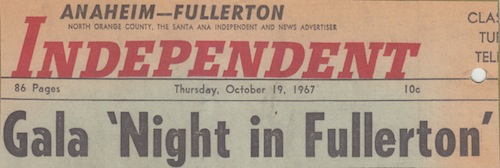
Flossie created a committee to organize and promote the event, and even went door to door to raise money for it. At first, according to Flossie, “the city didn’t pay for anything. This was a community project.” Eventually, the city got on board and helped with some of the costs. Flossie saw a need in her community and worked hard to fill it: “Why not be a cultural community if we can promote culture?” she recalled, “I’d like it, when people think of Fullerton, they could come here and find something good to look at, good music to hear, and a good dance to see and enjoy.”
For the rest of her life, Flossie worked hard to help build a real arts community in Fullerton, founding the CSUF Art Alliance, and showing her work at venues all over town, even well into her 80s. Because she was such a magnetic and well-loved figure, her birthdays were huge community events, with city officials and organizations getting involved. For her 85th birthday, the City of Fullerton presented her with the “Key to Our Hearts.”

Florence Arnold in 1980. -
H. Gaylord Wilshire: The Millionaire Socialist
The following is from a work-in-progress about the history of Fullerton. You can support my ongoing research and writing on Patreon.
I’ve recently been reading Kevin Starr’s excellent book Inventing the Dream: California Through the Progressive Era (the second in an epic seven-volume history of California), and came across a section on a colorful character named Henry Gaylord Wilshire, who was one of the initial developers of Fullerton. He partnered with the Amerige brothers to establish the town, and Wilshire Ave. is named after him. Although he owned an orange ranch here, Wilshire did not confine his activities to Fullerton. He made his millions in real estate and other Southern California business ventures; however, he was mainly known for being one of the most outspoken Socialists of his era. Though in the minority politically, he was not alone in his political views.
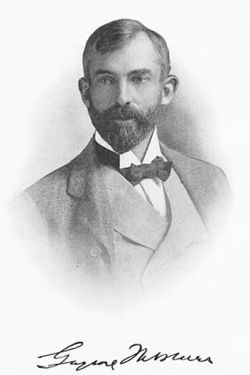
H. Gaylord Wilshire from his book Socialism Inevitable (1907). “Turn-of-the-century California sustained an active Socialist minority whose disgust with the excess and corruption of the corporate hold on California politics fed directly into the Progressive reforms,” Starr writes.
It was Socialists like Wilshire who “helped make non-threatening, even respectable, such notions as the public ownership of utilities, prison and hospital reform, social welfare, public housing, workmen’s compensation, and other social programs eventually enacted by the Progressives.”
The publication of Edward Bellamy’s utopian novel Looking Backward: 2000-1887 inspired the formation of [socialist] Nationalist Clubs throughout the United States. The California Nationalist Club formed in Los Angeles in 1889. By 1900, there were 62 local Nationalist Clubs in California alone.
“Composed mainly of middle-class intellectuals,” Starr writes, “the Nationalist movement, so the Overland Monthly reported in June 1890, ‘put a silk hat on socialism’ by making socialist ideas acceptable to ‘people connected with literature and the professions.’”
H. Gaylord Wilshire, president of the Fullerton and Anaheim Nationalist clubs, ran for congress as a Socialist in both 1890 and 1900.
“In his [Wilshire’s] eccentricities and solid accomplishments, his paradoxical entrepreneurism, his flirtation with quackery and his sound, even prophetic, notions of social reform,” Starr writes, “no Socialist Californian could have better exemplified the paradoxes of Socialism, Southern Californian style, than this young Fullerton rancher-entrepreneur.”
Wilshire was born in 1861 in Cincinnati to a wealthy banker. He dropped out of Harvard and after failing in a business venture moved to California where “he pursued two seemingly contradictory ambitions–success and socialism (to which he converted in 1887),” according to Starr.
He and his brother made a lot of money in the Southern California land boom of the 1880s.
“The brothers Wilshire, helped along by some family money, speculated in Los Angeles, Santa Monica, Pasadena, Long Beach (they bought up the shorefront), and Orange County real estate, making money in each instance,” Starr writes. “Settling on a ranch near the city of Fullerton, where he helped to develop, Wilshire had transformed himself by 1890, the year the Nationalists nominated him for Congress, into a wealthy rancher-entrepreneur, growing walnuts and citrus on his property and pioneering the introduction of the grapefruit.”
Wilshire Boulevard in Los Angeles is named for the brothers Wilshire.
“H. Gaylord Wilshire (as he signed himself) was a promoter and a visionary in the style of Abbot Kinney of Venice and a number of other Southern California eccentrics of this era: a visionary, and perhaps something of a quack, the Wizard of Oz behind the green curtain,” Starr writes. “Wilshire’s promotion of Socialism occurred on the same flamboyant level as his sale of stock or his pioneering billboard advertising in Los Angeles in the early 1900s.”
After losing the congressional election in 1890, he moved briefly to New York (where he ran and lost an election for state attorney general) and then to London, where he met and befriended his hero George Bernard Shaw.
He returned to Los Angeles in the late 1890s, and ran once again for Congress in 1900, again as a Socialist, and got four thousand votes, “the largest single vote thus cast for a Socialist candidate in the United States—but still not enough to get him into Congress.”
Ultimately, it was not as an elected official that Wilshire would leave his mark, but rather as a journalist and publisher.
He founded the Weekly Nationalist magazine in Los Angeles in 1889 before launching the socialist magazine the Challenge (a title he later changed to Wilshire’s Magazine).
The Challenge was eventually banned from the United States mail for being subversive. To get around the ban, Wilshire moved the magazine to Toronto, from which, by international agreement, it could be mailed into the United States.
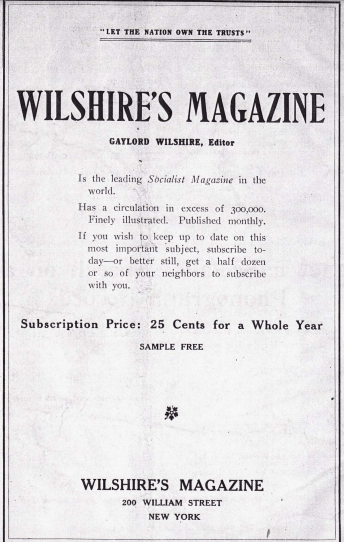
“Wilshire built the circulation of Wilshire’s Magazine to an impressive 425,000 copies per issue,” Starr writes. “During the Progressive Era, Wilshire’s Magazine was the most influential Socialist journal in the United States, and its subsidiary publishing house, the Wilshire Book Company (which also sponsored a Socialist Book Club), introduced a wide variety of Socialist authors, European and American, to American audiences.”
Wilshire personally wrote quite a bit of Wilshire’s Magazine in essays in which he “scolded capitalism and the trusts roundly and argued for the socialist alternative.”
Wilshire advocated a type of Fabian socialism (inspired by his friend George Bernard Shaw) which was nonviolent, nonrevolutionary, and non-Marxist.
“From the vantage point of today, a half century after the New Deal, it is difficult to understand why Wilshire’s Magazine was ever considered dangerous enough to be banished from the mails,” Starr writes. “Rejecting a Marxist theory of revolution and class struggle, the Fabians believed that modern industrial societies, unless repressed, would naturally evolve into more cooperative, socialized economic structures. As a writer and platform performer, Wilshire argued for the nationalization of railroads and utilities, the municipal ownership of water, gas, electricity, telephones, and streetcar service, women’s suffrage, public reclamation projects to put the unemployed to work, an eight-hour day, an end to child labor, free public schools (to include hot lunches and textbooks), unemployment insurance, a social security system, a national public highway trust—and other, similar ideas, few of them (with the exception of the nationalization of heavy industry) outside the mainstream of liberal social thought through Progressivism and the New Deal.”
Other notable California socialists of this time period included poet Edwin Markham and novelist Jack London. Markham wrote a famous socialist poem entitled “the Man With the Hoe” and London published a socialist novel, The Iron Heel.
“Wilshire’s broadly conceived, humanistic Socialism—nonviolent, nonrevolutinary, interdenominationally assimilative, nurtured on Fabianism and edging into Social Democracy—was typical of much of the upper-middle-class Socialism of Southern California,” Starr writes. “This sensibility, in turn, nurtured a species of pre-Progressivism at the turn of the century.”
A book about Wilshire’s life was published in 2012 entitled Henry Gaylord Wilshire: the Millionaire Socialist by Lou Rosen.
-
Fullerton Tribune: 1902
The following is from a work-in-progress about the history of Fullerton. You can support my ongoing research and writing on Patreon.
The Local History Room of the Fullerton Public Library has microfilm from the Fullerton Tribune newspaper stretching back to 1893. I am in the process of reading over the microfilm, year by year, to get a sense of what was happening in the town over the years. Here’s what what happening in town in the year 1902. To read earlier years of news archives click HERE.
Prohibition
The sale of liquor remained (mostly) illegal in Fullerton, following an 1894 county ordinance. Fullerton had not yet incorporated as a town–that wouldn’t happen until 1904–and prohibition would remain a big local issue. There was an active Women’s Christian Temperance Union and an Anti-Saloon League, and they involved themselves in county politics.
In 1902, a Jo Smith of Fullerton was arrested, charged, and found guilty of violating the county liquor ordinance by selling liquor.
Perhaps adding some fuel to the fire of the liquor question occurred when attendees of a temperance meeting of the State Anti-Saloon League at the Fullerton Methodist church were interrupted by screams. Apparently, a Mr. J.J. Grogan had returned home intoxicated and attempted to burn down his house. See clipping below…
Politics
1902 was an election year. The total population of Fullerton was around 1,000, and there were 360 registered voters. Women could not yet vote, unfortunately. That wouldn’t happen until 1912 in California and nationally in 1920 with the passage of the 19th amendment.
Some Fullerton notables ran for county and state offices.
Dallison Smith Linebarger, a Democrat who owned a livery [horse] business in town was elected to represent District 3 on the Orange County Board of Supervisors. He defeated fellow Democrat B.F. Porter (a Fullerton rancher) in the primary, and Republican William “Billy” Hale (also a rancher) in the general election. He would be re-elected and serve until 1912.
Town co-founder Edward R. Amerige, a Republican, was elected to the California State Assembly. He would serve two terms.
Meanwhile, another town co-founder H. Gaylord Wilshire, a noted socialist, had his magazine the Challenge banned from the U.S. mail. He ended up changing the name of the magazine to Wilshire’s Magazine and shipping them out of Canada, to get around the ban. Wilshire is a fascinating figure and I plan to write more about him soon.
Culture/Social Life
Fraternal organizations were a big part of the social life of Fullerton. At the turn of the century, around 6 million Americans were part of fraternal organizations. The most prominent of these were the Masons, whose members included Dr. George Clark, William Berkenstock, William McFadden, A.A. Pendergrast, Otto Des Granges, and other prominent community members.
Another fraternal order, The Odd Fellows, had members who included William Goodwin, Edgar Johnson, Edward Magee, August Hiltscher, W. Schumacher, James Conliff, and others.
In addition to regular meetings, the various organizations would host large social events, such as the New Years event described below, hosted by the local chapter of the Foresters of America, even though there were no forests in Fullerton.
Mask Ball Last Night
The grand mask ball given by the Foresters of America last night was one of the most sociable and successful events of that character ever witnessed in Fullerton. There were numerous costly and fancy costumes and a jolly crowd was present, making the evening very pleasant and enjoyable.
Masks were removed at 11 o’clock, followed by much laughter and many surprises. Supper was served at the Fullerton Hotel about midnight after which dancing was resumed and continued until an early hour this morning. When the new year set in ad midnight there were many hearty congratulations on all sides and Wm. Schumacher in Uncle Sam’s attire wished the party a “Happy New Year” on behalf of the order. Music was furnished by the Drake-McEachran orchestra and was very satisfactory to all.
Deaths
The Tribune chronicled illnesses and deaths of residents. William “Big Bill” McFadden, died at age 62.
Originally a schoolteacher, McFadden came to California in 1864, and served as Superintendent of Schools in Santa Ana. In 1869, he became a pioneer of citrus farming and was the second orange rancher in Placentia. He helped organize the Southern California Fruit Exchange, the Fruit Growers Bank, which then became the First National Bank of Fullerton, the Anaheim Union Water Company (on which he served as president and as a director). McFadden was a prominent figure in the local Democratic Party and was a representative from Orange County at the national Democratic convention of 1900.
The pallbearers at his funeral were Edward R. Amerige, Alex Henderson, Richard Melrose, Elmer Ford, Henry Lotz, and A.S. Bradford. The local bank and other stores closed for his funeral. He is buried in the Anaheim Cemetery.
In the oil fields north of Fullerton, a tragedy occurred when a 10-year old boy named Knowlton Lick accidentally shot a 5-year old boy named W.J. Robertson.
A man named Jose Juan Cabrillas was murdered by Jose Urivey over a dispute involving a 5-cent oil can. Alcohol may have also been involved.
J.S. Wallace, a civil war veteran who had lived in Fullerton for 12 years, died of typhoid fever at age 72.
A.L. Rogers, a zanjero (basically a water police who guarded irrigation ditches and enforced water allocations) for the Anaheim Union Water Company, died of “lung fever” [pneumonia?] after being exposed to a rainstorm while on duty. He was 40.
Anna Schaller, a 15-year-old who was heartbroken and distraught because her parents disapproved of her lover (who had recently left town), committed suicide by drinking poison.

Diseases like smallpox were a concern, and the Tribune tells of a few cases in Fullerton, even though a vaccine existed. When patients were discovered to have smallpox they had to go quarantine themselves in a tent in the hills north of town until they recovered. Alternatively, they could have just gotten vaccinated.
A fight between two neighboring ranchers, W.R. Carpenter and Ed Kraemer, almost ended in a death when Carpenter allegedly trespassed (armed) onto Kraemer’s property. This resulted in a fight. Though no one was hurt, Carpenter was charged with assault with a deadly weapon (he was armed), but was not convicted.
Business
Local businessmen organized a Board of Trade in 1902 whose directors included Jacob Stern (co-owner of Stern & Goodman general store), William Brown, T.B. Van Alstyne, E.W. Dean, and V. Tresslar. Among the first matters taken up by the Board was securing electric lighting downtown, protecting the town against fires (the Fullerton Fire Department would not be organized until 1908), improving sidewalks and roads, and devising “a system of keeping tabs on any dead beats who may reside in the county or come this way…for mutual protection of our business men.”
A Chamber of Commerce was also formed, which seems a bit redundant with the Board of Trade. Its officers included Charles C. Chapman, Edward Amerige, and other prominent businessmen.
The First National Bank of Fullerton (formerly the Fruit Growers Bank) has as its directors B.G. Balcom, A. Barrows, A. McDermont, Jacob Stern, Erwin Barr, and Charles C. Chapman.
Agriculture
Along with oil, agriculture (mostly citrus and walnuts) was the big business in Fullerton. The most successful grower in 1902 was Charles C. Chapman, whose Old Mission brand Valencia oranges fetched the highest prices. Chapman’s ranch encompassed 300 acres. In 1901, he shipped 130 carloads of oranges.
Describing the citrus business of Fullerton, Tribune editor Edgar Johnson writes, “It is the heaviest shipping point in Orange County, excepting Santa Ana. A distance of nearly half a mile along the railroad is taken up by seven large packing houses, several warehouses.
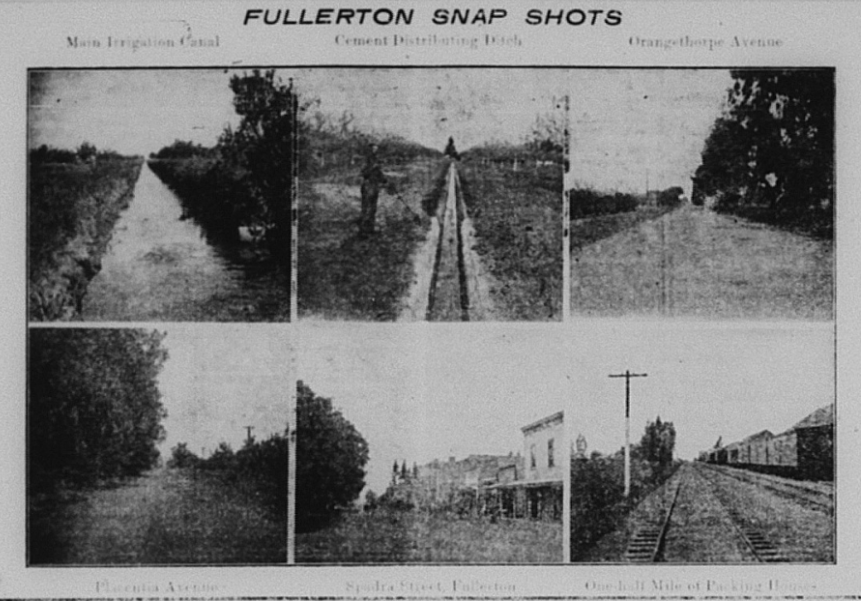
Water
In order to make this agricultural economy thrive, water had to be obtained and regulated. The company which oversaw allocation of water from the Santa Ana River and all the major irrigation channels in north Orange County was the Anaheim Union Water Company, who sometimes had legal fights with water companies to the South who also drew from the Santa Ana River, such as the Santa Ana Valley Irrigation Company.
These were private companies whose Board of Directors tended to be owners of large, local ranches. Water rights (also called riparian rights) were a really big deal—water is life, and profits for farmers. Around 1901, these two water companies met together to bring legal action against a Mr. Fuller, “the Riverside county land-grabber” to prevent his taking water from the Santa Ana River. This would be one of many ongoing legal battles over local water rights.
In the meetings of the AUWC, there was discussion of purchasing the water rights of James Irvine, the man whose descendants founded the Irvine Company, which now owns the city of Irvine. In those early days, “maintaining an accurate division of the water [was] difficult if not impossible to devise.”
The local climate was also not conducive to a steady supply of water, specifically from the Santa Ana River. The AUWC concluded: “The conditions of our climate are such that it is impossible to determine ahead when the water can be turned out of the ditch for any definite time, without danger of loss to our irrigators.” New sources of water would be needed to irrigate the growing fields of Orange County.
Meanwhile, the Anaheim Union Water Company and the Santa Ana Valley Irrigation Company cut a deal to share water rights. Mr. Sherwood, a sometimes AUWC Board Member who liked to write lengthy articles in the Tribune criticizing those who disagreed with him, took issue with the deal. To which Samuel Armor of the Santa Ana Valley Irrigation Company replied: “G.W. Sherwood seems to be afflicted with a diarrhea of words accompanied by a costiveness of ideas. For two years or more he has been filling the papers west of the river with misrepresentations and insinuations against the S.A.V.I. Co. until his followers have come to believe the the people on this side are equipped with hoofs and horns and forked tails.” To which Sherwood replied: “I have always taken pleasure in setting Armor right, when he gets tangled up in the mazes of his own alleged erudition…With regard to the proposed division of water, Armor’s premises are false and his conclusions are wrong.”
To read more about the complexities and controversies over water in early Fullerton and Orange County, check out my series entitled “Fullerton Water Wars.”
For municipal purposes, Fullerton constructed a town waterworks which was used primarily for downtown businesses and in case of fires. The waterworks drew from a large well.
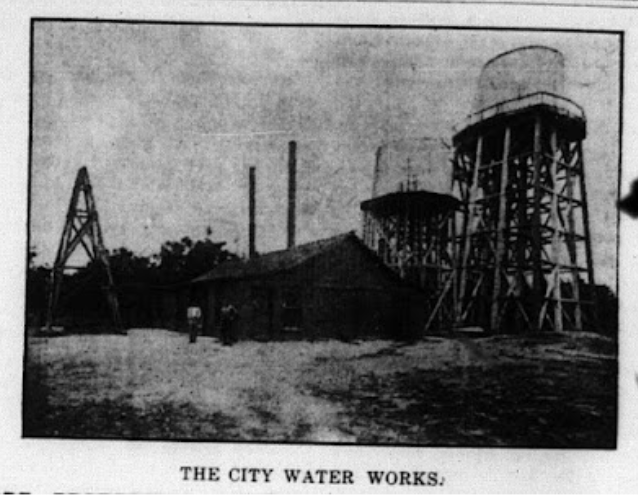
Oil!
In addition to agriculture, oil was a big business in Fullerton in 1902. The large oil fields were in the north part of town, and were among the most active in the state of California at the time. A growing number of companies, big and small, were drilling, piping, and selling oil. These companies included: Associated Oil Company, Menges Oil Company, The Graham-Loftus Oil Company (who had a 75,000-barrel reservoir on their lease), Fullerton Consolidated Oil Company, Iowa Oil Company, Puente Crude, the Liberty Oil Company, Columbia Oil Company, Union Oil Company, the Santa Fe Railroad Company (which produced oil for its trains), and Standard Oil Company. The companies would either purchase or lease the land for drilling purposes.
The Union Oil Company alone was piping 30,000 barrels a month from its Fullerton fields to San Pedro Harbor, where it was shipped north for refining.
Occasionally, a “gusher” would come in, or catch fire. A single well could produce thousands of barrels a day.
At this time, before people knew about things like global warming, local oil production was viewed with excitement, as it meant dollars, jobs, etc. When a new gusher came in, folks could hear and see it for miles around, and would sometimes gather to watch it spout the black gold into the air.
Education
In 1902, Fullerton had a grammar school and a high school, with an enrollment in the hundreds. Neither of these buildings exist today.
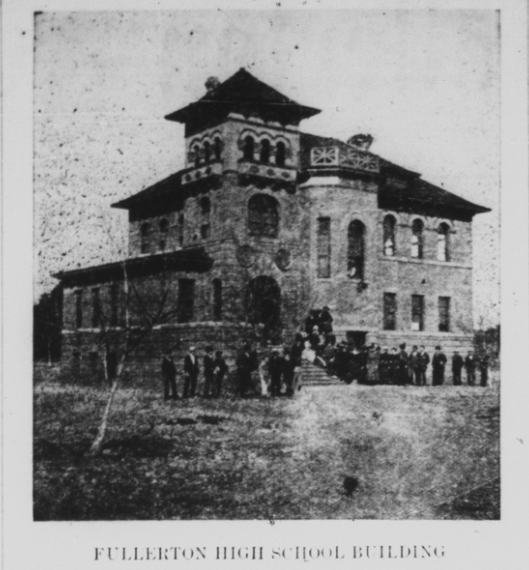
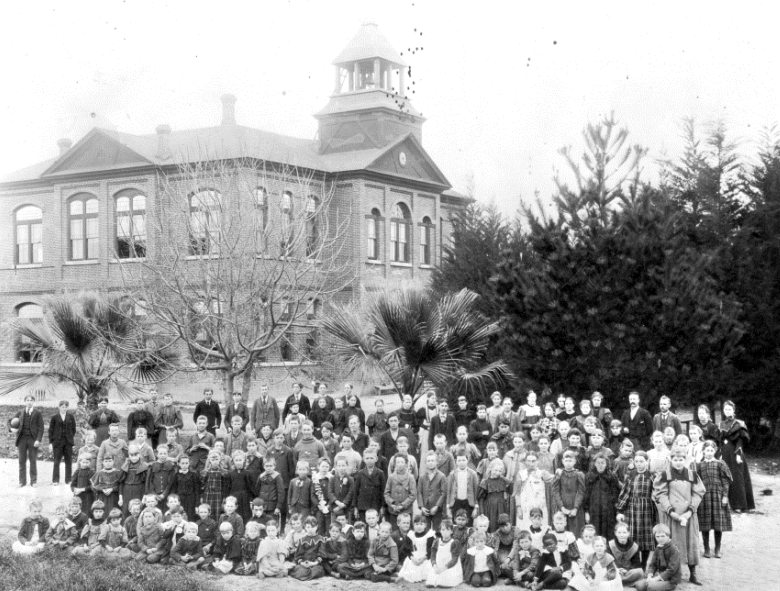
Fullerton Grammar School, courtesy of Fullerton Public Library Local History Room. Progress!
Communications technology, particularly the telephone, was advancing. New telephone lines were being built to connect residents with each other and the outside world.

Advances in sound recording made it possible for people to listen to music in their homes.
Religion
By 1902, there were at least three churches in town, all Christian. A Baptist Church, a Presbyterian Church, and an M.E [Methodist Episcopal?] church. In addition to fraternal organizations and schools, churches allowed for social interaction among the townspeople.
Miscellaneous
There was a collision between a horse and carriage and a railroad “wrecking car” that severely injured the driver, Robert Carpenter.
Joseph Goodman, co-owner of Stern & Goodman store downtown married Therese Straus of San Francisco.
There was a major fire that burned hundreds of acres of grain and hay on the Bastanchury Ranch property.

There was a female mail carrier named Cora Vail who served the rural route through the hills north of Fullerton.
National and International News
The United States is a settler-colonialist society. These are terms that folks don’t use much today, but they were widely used in the late 19th and even early 20th century. Railroad companies had campaigns to induce easterners “to colonize the west.”
Though less common after the advent of the transcontinental railroad, “prairie schooners” were still “filling up the west.”

Unfortunately, this meant continuing to take land from Native Americans, who were experiencing a cultural and physical genocide as a direct consequence of United States expansion.
-
Oral Histories: Dr. Mabel Myers
The following is from a work-in-progress about the history of Fullerton. You can support my ongoing research and writing on Patreon.
Dr. Mabel Myers was interviewed by Anne Riley for the Fullerton College Oral History Program in 1975. Myers attended Fullerton College, graduating in 1919. She returned to the college in 1926 and taught science, geology, and nursing courses, until 1946 when she went to San Diego State University to teach. While teaching at Fullerton College she organized the geology club, which became known as the Prospector’s Club.
Two major topics in the interview are the activities of the Geology Club, and a major administrative shake-up that led to Louis Plummer and other faculty either being fired or resigning around 1940.
On the Geology Club…
Myers started the Geology Club in 1933 with eight students. They would go on field trips to areas to inspect the rocks, fossils, and Indian artifacts.
Some of their findings were donated to the school, along with a scrapbook that Myers kept. Below are some photos from the scrapbook, courtesy of the Fullerton College online archives:

Dr. Mabel Myers with Geology Club students in 1933. 
Photograph with 9 of the people who went on the geology class trip of Oct. 28, 1933 in front of a car at the Tourmaline mines at Pala. Myers is at the far right. 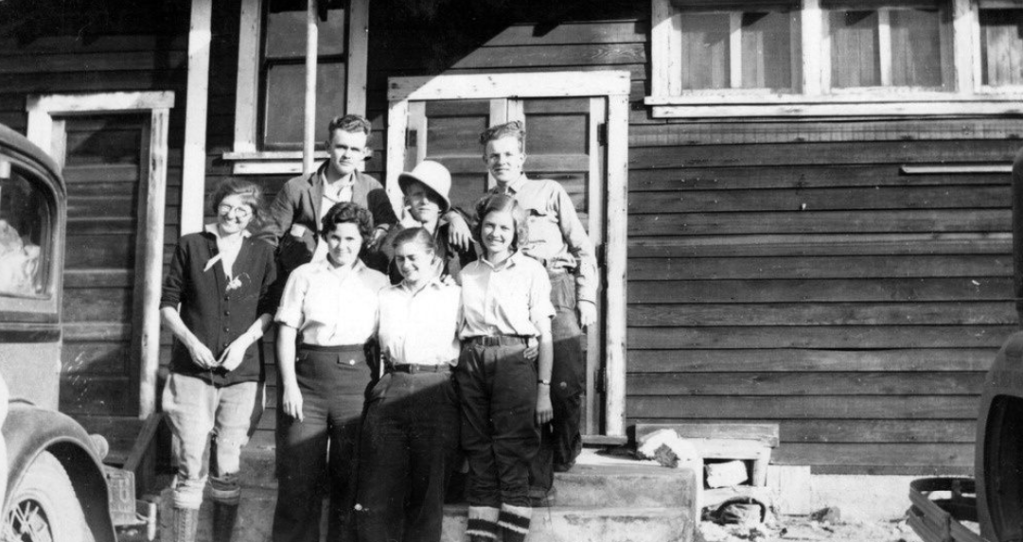
Photograph in front of a schoolhouse with teacher Mabel Myers (at left) and 6 of the people who went on the trip to Aguanga, Mesa Grande, Borrego and Warners on December 26-29, 1933. (Frances Holt took the picture) 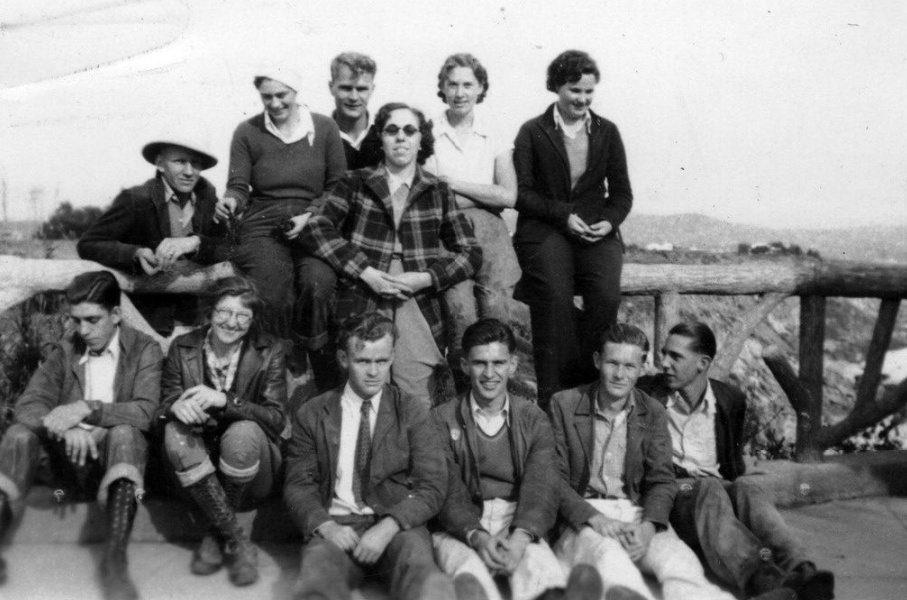
Photograph of teacher Mabel Myers and 11 students and/or guests who went on the Geology Club trip to Corona Del Mar in 1934. They are on an overlook platform high in the mountains. 
Photograph of teacher Mabel Myers holding a box [of food] in front of natural rock collections while on the Geology Club trip to Ensenada April 28-29, 1934. 
Fullerton College Geology Club trip to Barstow, Mitchell Caverns, and Amboy, 1935. Mabel Myers and female student. On the administrative shake-up…
Myers doesn’t give a full explanation of what went on; however, she says that it was Harold Hale, a prominent local rancher and school board member who, for unknown reasons [possibly a grudge], “was the one who did his best to get rid of Plummer, and also [William] Boyce.”
Prior to Plummer leaving, he was “put over in another little office while [Frederick] Chemberlen [a new superintendent] took over.”
Myers remembers that “We weren’t supposed to…even talk to Mr. Plummer.”
Although she is careful not to criticize Plummer too much, Myers states that his administrative style was one that required a kind of subservience and loyalty.
“There was quite a bit of feeling on the part of some, that, as much as they thought of Mr. Plummer, they felt that…he resented anything on the part of teachers which would sound as if they didn’t feel he should be the representative,” Myers said. “Superintendents in that day and age were that paternal kind…He said to me one time, ‘Mabel, I didn’t think that you would go to the Board. I didn’t think you would treat me that way.’ And I just was so surprised I couldn’t believe it.”
According to Myers, although it “was really an awful experience…it does show…that gradually the ones most concerned in any organization, like a group of teachers, should have something to do with it. Should have some way to make contact other than, ‘Papa, can I do this?’”
Eventually, the teachers organized into the Secondary Teachers Organization to advocate for their interests before the Board. Myers was its first president.
-
Subscribe
Subscribed
Have a WordPress.com account? Log in now.

