-
Free Lecture: News Stories of Early Fullerton!
I’ll be giving a free lecture this Friday, May 5 at ModelMania during the Downtown Fullerton Art Walk. The subject of my talk will be “News Stories of Early Fullerton.” The Local History Room of the Fullerton Public Library has microfilm from the Fullerton Tribune newspaper stretching back to 1893. I am in the process of reading over the microfilm, year by year, to get a sense of what was happening in the town over the years. I’ll be presenting some top local stories from the years 1894-1904. My talk will begin around 8pm.
Also at ModelMania, don’t miss the latest art exhibit, “Transmutations” featuring work by Magin Jaz Magoski and Michael Magoski. There will also be live music by 10 by Two featuring Pete Colby and Bob Aul. And, of course, models, models, models. ModelMania is located at 232 W. Commonwealth Ave. in Downtown Fullerton.

-
Fullerton Tribune Headlines: 1904
The following is from a work-in-progress about the history of Fullerton. You can support my ongoing research and writing on Patreon.
The Local History Room of the Fullerton Public Library has microfilm from the Fullerton Tribune newspaper stretching back to 1893. I am in the process of reading over the microfilm, year by year, to get a sense of what was happening in the town over the years. Here are excerpts from some of the articles from 1904.
Click HERE to read highlights from previous years.
Incorporation
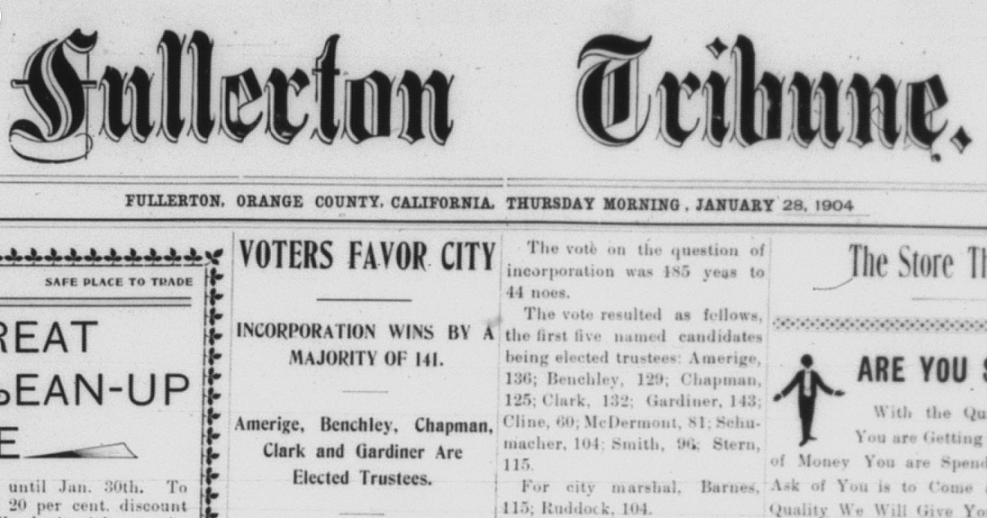
Perhaps the most significant event of 1904 was incorporation. Residents voted to establish Fullerton as a city, complete with a Board of Trustees and taxation powers. The first Board of Trustees (now called City Council) was Edward Amerige, E.K. Benchley, Charles Chapman, George Clark, and John Gardiner.
Additionally, W.A. Barnes was elected city marshal, George Ruddock was elected City Clerk, and J.E. Ford was elected city treasurer.
Prohibition
Easily the most divisive local issue in 1904 was prohibition–whether or not to allow saloons in town. Saloons had been essentially banned since 1894 (based on an ordinance passed by the County Board of Supervisors). But now that Fullerton had its own Board of Trustees, the liquor question was re-opened. The Board of Trustees decided to put the question to a town vote as part of a larger city election.
In the newspapers leading up to the election, the Tribune printed editorials for and against prohibition, as shown below.

Ultimately, a majority of residents voted to allow saloons downtown.

New City Laws/Civic Improvements
The newly-established Board of Trustees began to pass a series of ordinances. They established a fire protection district, a board of health, franchises with telephone, gas, and electric companies, built new sidewalks, and made street improvements.
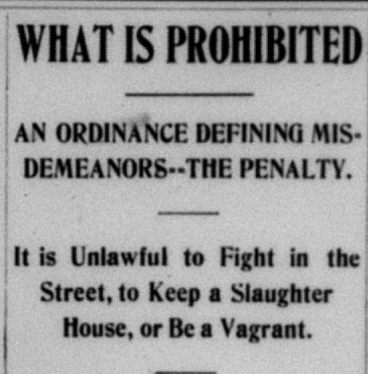
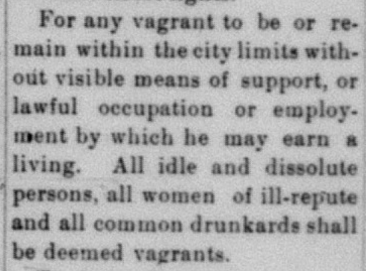
They also passed ordinances prohibiting some things in town, most of which make sense–no fighting in the streets, etc. But some of the town prohibitions seem quite harsh, such as bans on vagrancy and cross-dressing.

There was some conflict over the appointment of a postmaster for Fullerton. This was a position appointed by local congressman Daniels. Although a petition with 500 signatures advocated the appointment of Cora Vail, Congressman Daniels appointed Vivian Tresslar (a man), allegedly at the request of Mayor Chapman.
“Captain Daniels has announced that he will absolutely refuse to recommend the appointment of any woman for the position,” the Tribune stated.
Tresslar was also the hand-picked editor of the Tribune’s rival newspaper, the Fullerton News–which was bankrolled by Mayor Chapman.
Oranges!
A major industry of early Fullerton was oranges. One unique feature of the citrus industry was the fact that growers would pool their resources to market and ship their product. There was some debate at this time over the value of a “union” of this type.
Another article in the Tribune written by “one of the laborers” urged the workers to form a union of another kind–a worker’s union.

Here is the full text of the above (right) article:
The Tribune has received a communication signed “One of the Laborers,” which advocates increased pay for ranch laborers in this section and their organization into a union to attain that object.
The communication, addressed “To Whom it May Concern,” begins by stating that the American laborers in the Placentia district have a grievance in regard to their monthly pay. The writer says that the workers want a reasonable price for their day’s work, and cites the action of the Ventura laborers who organized a union, and decided not to work for less than $30 a month. The advantage of a union is then urged, and the local workers are called upon to organize for the purpose of getting their “price.” The communication declares that they now get 95 cents a day, which is denounced as a “regular outrage.” The warning is made that the workers will not stand for this “slavery any longer than the present time.”
After commenting that the hired man is “looked down on, snarled at,” the communication states that he is often forced to sleep in the barn, and concludes as follows:
“Boys, what do you think of that? We are not permitted to sleep in the house after a hard day’s work. We are brothers in Christ Jesus, born of one flesh and blood, and we ought to have a tender feeling for all. But after all of that the cold-hearted rancher sends his hired man to the barn to sleep with the living creatures that inhabit therein.”
On the same page as the above article was another entitled “The Chapmans Entertain Their Friends and Neighbors”:
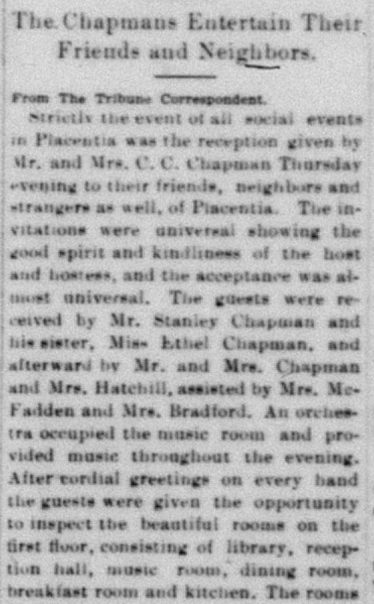
Here is the full text of that article:
Strictly the event of all social events in Placentia was the reception given by Mr. and Mrs. C.C. Chapman Thursday evening to their friends, neighbors, and strangers as well, of Placentia. The invitations were universal showing the good spirit and kindliness of the host and hostess, and the acceptance was almost universal. The guests were received by Mr. Stanley Chapman and his sister, Miss Ethel Chapman, and afterward by Mr. and Mrs. Chapman and Mrs. Hatchill, assisted by Mrs. McFadden and Mrs. Bradford. An orchestra occupied the music room and provided music throughout the evening. After cordial greetings on every hand the guests were given the opportunity to inspect the beautiful rooms on the first floor, consisting of library, reception hall, music room, dining room, breakfast room and kitchen. The rooms on the second floor were then shown. The guests were then invited to the third story which proved to be a hall strictly in keepinig with the rest of the house. Here the guests were seated and most thoroughly enjoyed an entertainment.
Dainty refreshments were served in the breakfast room and then after a littel longer social intercourse and a last lingering look the guests bade their host and hostess and family good night.
The above contrast between the situation of the workers and the lavish mansion of Chapman, the mayor and wealthiest orange grower, speaks to the social divisions of the day.
Oil!
The other major industry in Fullerton was oil. One ongoing issue was a conflict between the local Puente Oil Company and the mega-corporation Standard Oil. Apparently, Standard was using some shady tactics to undercut their local rival.
In 1911, the U.S. Supreme Court would order the breakup of Standard Oil because it was an “illegal monopoly.” Many of today’s major oil companies are descendants of Standard, including ExxonMobil, Chevron, and BP.

Inside the Tribune Building
To commemorate its 15th anniversary, the Fullerton Tribune published a brief history of the paper, and included some photos of the inside and outside of the newspaper’s building.
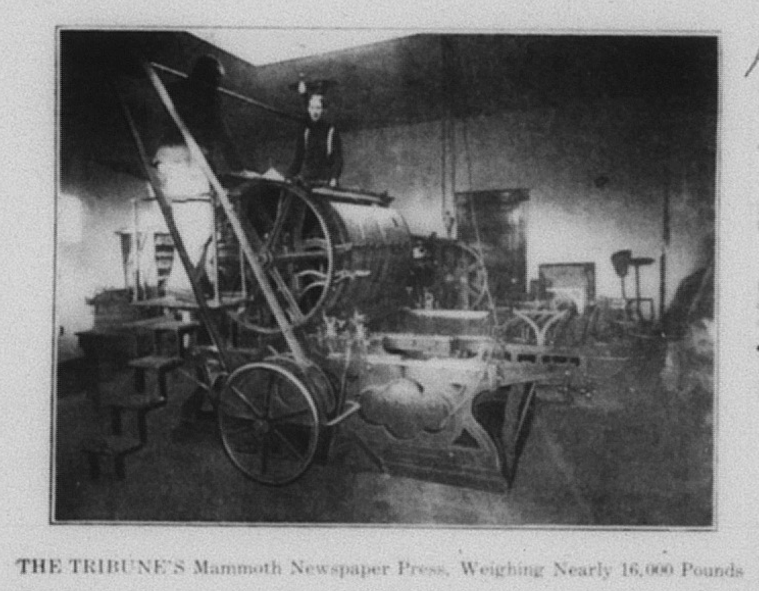

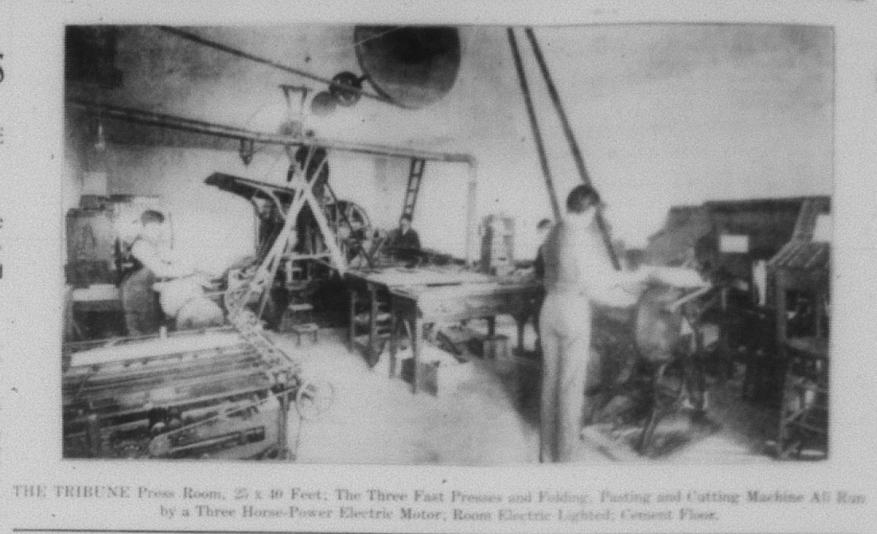
Water
Because Fullerton was a growing agricultural area, obtaining a regular water supply was extremely important. At this time, much of the water supply came from the Santa Ana river and underground wells. The vastness of the underground aquifer was not well understood. The company which controlled the water of the Santa Ana river in north Orange County was the Anaheim Union Water Company.

Miscellaneous
And here are a few random/miscellaneous clippings from the 1904 Tribune:

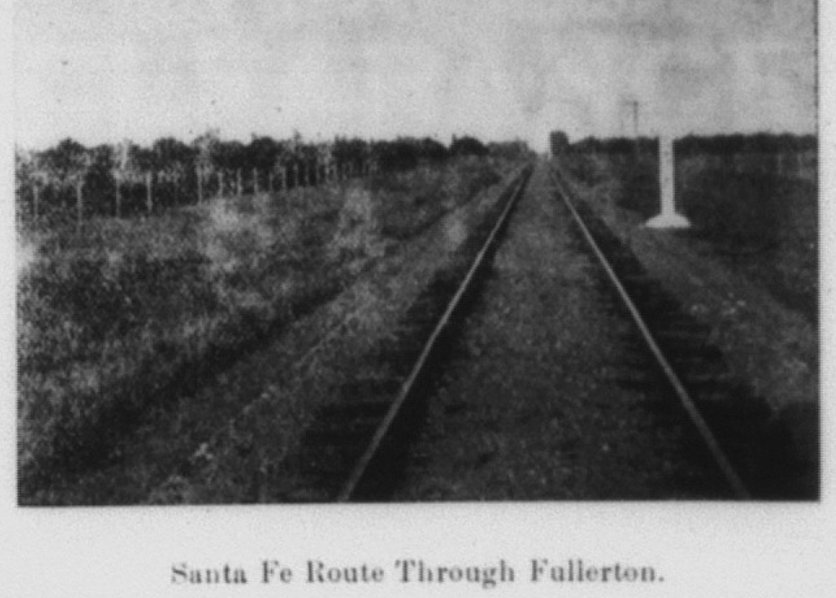


Stay tuned for headlines from 1905!
-
Remembering the 1970 Student Strike at CSUF

The following is from a work-in-progress about the history of Fullerton. You can support my ongoing research and writing on Patreon.
In the Spring semester of 1970, in the midst of the Vietnam War and growing student movements across the country, a minor revolution happened locally involving thousands of student protesters, riot police, violence, the takeover of two college buildings, and much resistance against policies that young people found intolerable.
Thankfully, the story of this entire episode is preserved for posterity in two books: How to Kill a College by Cy Epstein (a professor who witnessed and participated in the events), and The People vs. Ronald Reagan, a photo book created by students who took pictures of the events. The following report and photos are primarily from these sources.

The Reagan Hecklers
The revolution began with two words, that most common of English expletives, “Fuck you!”
The year was 1970 and Ronald Reagan was governor of California. On Monday, February 9, the first day of the Spring semester, governor Reagan came to speak to a crowd of about 5,000 students in the CSUF gym.
Many students were unhappy with Reagan, not just because of his association with the conservative establishment, but for a more practical reason—Reagan was proposing to cut the budget of higher education and start charging tuition. This was in direct contradiction to the original vision and plan for the CSU system, which was established as tuition-free public education. Many folks of the “baby boom” generation who attended CSUF paid virtually no tuition. Reagan, and those who came after him, sought to change that.

And so, when Reagan began his speech, he was almost immediately interrupted by a loud and clear student voice from the audience—the aforementioned expletive.
The gipper continued his speech, which was occasionally interrupted by more student voices, shouting more expletives.
At the conclusion of his speech, Reagan bellowed his response to the student hecklers into the microphone, “Shut up!”
Free Bruce and Dave!
The following week, two students, David McKowiak and Bruce Church, were charged by the Dean of Students with “disrupting an academic convocation.” That evening, Bruce and (later) Dave were arrested by the Fullerton Police from their homes and booked in the Fullerton jail. They were charged with having violated a brand new California law: “disturbing the peace and quiet by loud and unusual noise…and by the use of vulgar, profane, and indecent language in the presence of women and children.”
Two days later, about 35 students of the newly-formed Student Mobilization Committee confronted CSUF President Langsdorf in his office. Langsdorf defended the university and the police’s actions.
That Friday, students organized a rally in the quad that drew around 2,000, on behalf of Bruce and Dave. After the rally, about 40 students conducted a “sit-in” protest in Langsdorf’s office.
The following Wednesday, another rally outside the Library drew another 2,000 students, who denounced the charges against Bruce and Dave. After the rally, 500-600 students flooded the officers of the administration building for another “sit in.” They taped butcher paper to the walls and wrote slogans like “Free Bruce and Dave!” and “Time for the Revolution.”
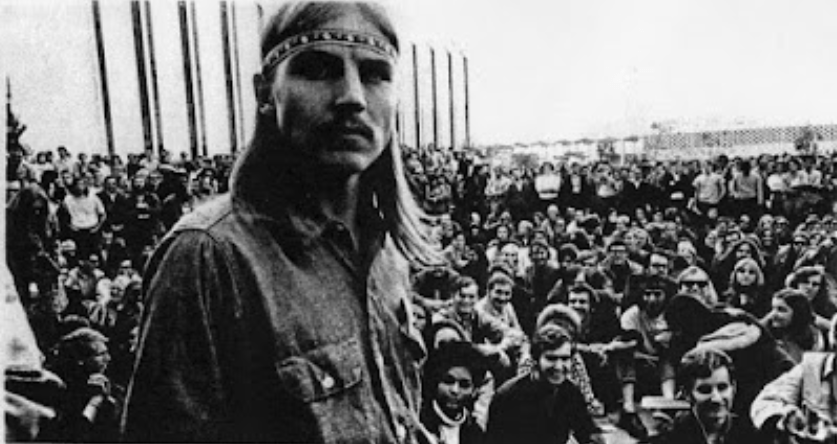
Around 11pm that night, with students still occupying the building, the Fullerton Police Tac Squad arrived, and the students fled. According to Epstein: “The police marched the length of the corridor, batons chest high, and came to a halt at the other end. Then, vivid in their black uniforms and plastic face shields, they stood at attention for 20 minutes in the empty neon-lighted, paper-littered hallway.”

The next day, Langsdorf again defended the college and the police’s actions before an assembly of about 5,000 students. Immediately after, hundreds of students re-occupied the administration building in protest. Later that evening, CSUF’s Chief Security officer Russell Keely arrived with copies of an administrative restraining order against the students. Out on bail, Bruce Church approached Keely and poured a half gallon of milk down the front of his shirt, soaking the restraining orders.
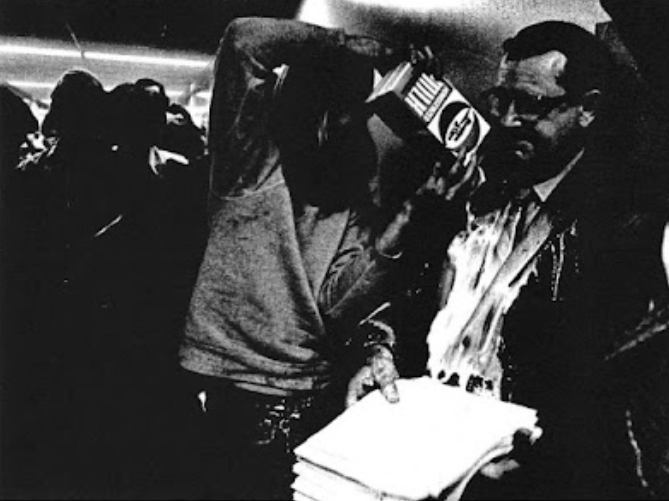
Again, the Fullerton Tac Squad arrived to shut down the sit in: “Again, they were armed for students with shotguns and rifles…The squad went through a routine of bringing their weapons from rest to dead level; this sent squeals of terror and delight through the students…[who] screamed and ran like hell.”
Clashes with Police
The college “administrative hearing” against Bruce and Dave was scheduled for March 3. To deal with the growing number of student protesters, “the Fullerton police had arranged to borrow about 225 officers from other jurisdictions…a helicopter was also borrowed for the occasion,” Epstein writes.
Shortly after the hearing began in the Humanities Building, students flooded into the chambers and eventually shut down the proceedings. As the hearing officers were escorted out of the building, around 100 police officers made a formation behind the building. Captain King of the FPD read a “dispersal order” through a bullhorn. The students moved toward the quad and were met by hundreds more who were just getting out of their classes. Police started to make arrests, and there followed a series of violent clashes:
“What began as individual scuffles…snowballed into mass choreography…Some of the officers battered savagely with their batons, contributing to the cries or acts of outrage from the students…Several people in the crowd had picked up clods of dirt or pebbles and were pelting the police. It was reported that two students, jumping in and out among the others, threw oranges at the police,” Epstein writes.
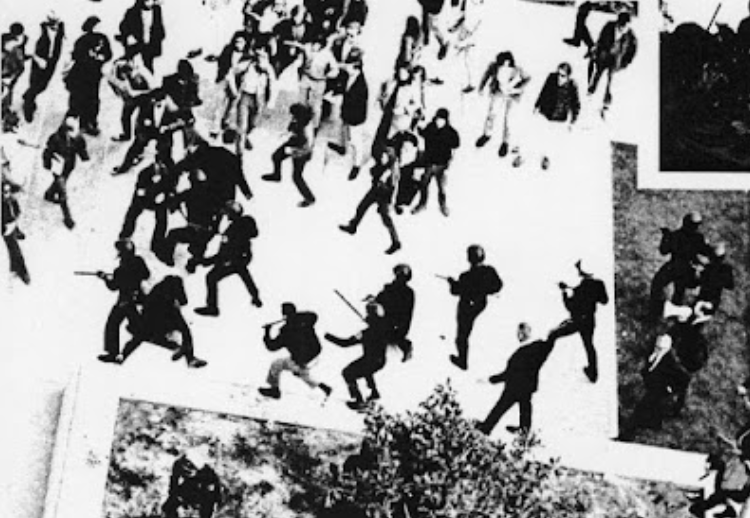
Professor Stu Silvers, the faculty advisor to the CSUF Students for a Democratic Society attempted to intervene on behalf of the students by speaking with Captain King and Vice President Don Shields. Instead, officers beat and arrested Silvers. This prompted more clashes and arrests.
Another professor, Hans Leder, got a bullhorn and encouraged the students to sit down, attempting to pacify the situation.
“Perhaps they won’t kick us out of the quad if it’s a classroom,” Leder said, and proceeded to give an impromptu lecture on such topics as “The Possibility of the Police Baton as a Phallic Symbol.”
Eventually, with the students calmed (and entertained) by Leder, the police backed down and left campus, to wild student cheers.
In total, 19 people were arrested that day.
The “Fullerton 19”
When the “Fullerton 19” were released on bail from the Fullerton jail, they were greeted and applauded by a group of friends, family, and supporters.
Not everyone shared these feelings. Local newspapers and television had reported on the clash between students and police, and there followed a flurry of letters to newspapers, the college, as well as Professors Silvers and Epstein (who had also been arrested): “These ranged from praise for having called the police to scoldings for letting ’sick people’ and commies teach and learn at Cal State, to vigilante warnings that further action will be taken if the president ‘does not clean up this mess,’” Epstein explains,
This was the height of the Cold War in conservative Orange County, after all.
If nothing else, the response to the events revealed a great political divide between the older, more conservative generation, and the new, more progressive, generation of students.
A student-produced newsletter called “What’s Going On?” summed up many of the students’ point of view:
“We have been accused of many things. Some students and citizens have indignantly charged us with disruption. But there is something odd about that, for we too are angry about disruption. We are angry about the disruption of the lives of hundreds of thousands of Vietnamese by the bombs, napalm, and guns of this country. We are angry at the daily disruption of the lives of black and brown peoples in America, north and south. Are we inconsistent, then, when we heckle a representative of that establishment responsible for wreaking such havoc through the world?”
Each of the “Fullerton 19” were charged with 4-7 violations of the California penal code. No charges were filed against the police.
The college “judiciary hearing” against Bruce and Dave happened on March 19. Dave boycotted the hearing. Both students were found guilty of disrupting Reagan’s speech, but were later cleared by an appellate board.
Strike for Peace
The protests to free Bruce and Dave helped to forge an alliance of students who continued to organize events and protests throughout the semester.
Then there was the Kent State and Jackson State Massacres, in which National Guardsmen shot and killed unarmed students protesting Nixon’s recent invasion of Cambodia, and the escalation of the Vietnam War.
After Kent State, 500 colleges and universities across the country were temporarily shut down, including CSUF.
In response, about 500 students occupied the Music, Speech, and Drama building, protesting the Vietnam War, Reagan’s policies, and Kent State. Outside the building, a large sign was placed declaring a “Strike for Peace!”
Inside, the ticket booth and foyer were converted into communications and information centers, where students were able to keep up with what was happening on other campuses. The rehearsal room became The People’s Kitchen, the “green room” became The People’s Lounge, classrooms became People’s Bedrooms, and the showers became The People’s Showers.
Inside the theater, student organizers formed committees and discussed plans of action, organized events and even rock concerts. The theater became a place of lively, sometimes angry debate between students, professors, and community members.
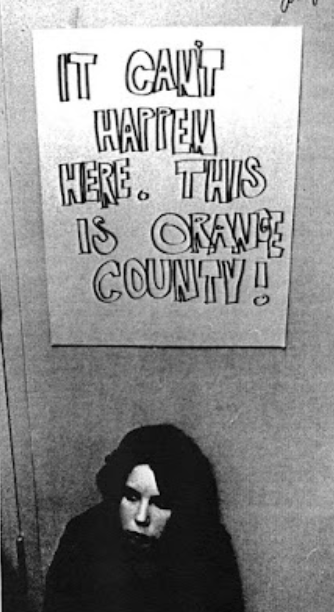
Perhaps wanting to avoid another violent clash, President Langsdorf (at first) allowed the students to remain in the building. He issued a memo stating, “While I do not personally believe a student strike is a useful method of influencing national policy, it can be a peaceful expression of dissent appropriate to the American tradition. No one will force students to attend classes if they choose not to do so, and I would urge that no one be penalized academically solely for acting in accordance with his conscience.”
The conservative Register newspaper did its part to portray the students strikers as dangerous delinquents, running headlines like “Student Radicals on Pot.” This is not to say that pot and other drugs were not consumed during the strike–they were, Epstein explains. This was 1970, after all.
Ten days into the strike, with the university having re-opened, president Langsdorf convinced the students to re-locate to a semi-permanent building in another part of campus for a “peace headquarters.”
Local State Assemblymember John Briggs (who would later become infamous for authoring the 1978 Briggs Initiative which sought to force public schools in California to fire teachers who were gay) sought to make political hay of the student unrest by demanding that President Langsdorf remove the striking students from campus altogether.
On the last day of the semester, in the same gym where governor Reagan’s speech had sparked all the unrest of that Spring, Briggs organized a meeting of a newly-formed group called the Society Over Sedition (SOS). Briggs gave a speech denouncing the student strikers and even President Langsdorf for being too soft on them.
“Dr. Langsdorf knows that this is a radical, revolutionary strike group, an organized conspiracy extending throughout the United States to foment revolution in this country, shut down out colleges, and overthrow our government,” Briggs declared. His supporters cheered. Students booed.
Late that night, someone threw what was evidently a molotov cocktail at the new “peace headquarters.” Students fled. The fire gutted the building. The strike was over, for the time being.
Conclusions
Epstein, who actually did time in the Orange County jail for his actions in support of the student strikers, offers some concluding thoughts on the whole ordeal:
“Intellectual vitality has contributed to the unrest on the campus. It is a skeptical generation, a questioning generation, one that balks at an order but responds to a reason. We would like to rest comfortably in the notion that the students are the unknowing dupes of professional manipulators; after all, isn’t youth easily led? I have found, on the contrary, that students have trouble manipulating even one another…
“We are not dealing with an alien country longing to destroy us. We are dealing with our own youth, raised in the I’m from Missouri tradition which is part of our democratic heritage. ‘I’m a voter, show me why I should vote for you. I’m a student; show me why I should give up a fight.’ Even if the students were bent on destruction alone, repression is no answer. The pages of history are studded with the spiritual and material death of repressive regimes.”
In retrospect, the student strikers were generally correct in their assessment of the Vietnam War, the invasion of Cambodia, the repression of protest, and the disastrous economic impact of ever-rising tuition.
Perhaps, in our current context of extreme political/generational polarization, the best approach is to listen to the voices of the youth. They are, after all, our future.
-
Oral Histories: Jewel Plummer Cobb
The following is from a work-in-progress about the history of Fullerton. You can support my ongoing research and writing on Patreon.
“Be kind, everyone is fighting a hard battle.”
–Jewel Plummer Cobb
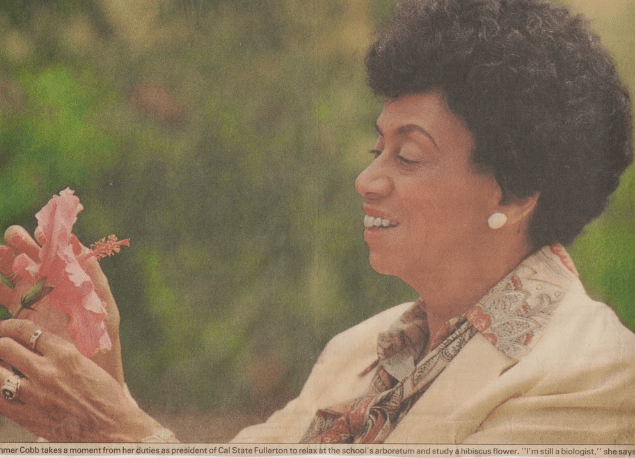
In an age when young people tend to idolize celebrities, and ignore those making real contributions to the world, it is refreshing to hear about people like Jewel Plummer Cobb. She was the third president of Cal State University, Fullerton (1981-1990), and the first black female to be president of a University in the western United States. In 1990, shortly before her retirement, Cobb sat down with CSUF history professor Lawrence deGraaf for a series of interviews about her life. The interviews, which are available in the Center for Oral and Public History at the Pollack Library, are a testament to a life fully lived, and incredible obstacles overcome. What follows is my summation of Cobb’s life, based on these interviews. All images are courtesy of the Launer Local History Room of the Fullerton Public Library.
Jewel Plummer was born in 1924 in Chicago, Iliinois. Her great grandfather, Adam Francis Plummer, was a slave who worked on a plantation outside of Washington D.C., and kept a handwritten journal of his life, which is now in the Smithsonian Institution. Adam’s daughter, Nellie Arnold Plummer, wrote a book in 1927 called Out of the Depths, or The Triumph of the Cross, documenting the family history both during and after slavery.
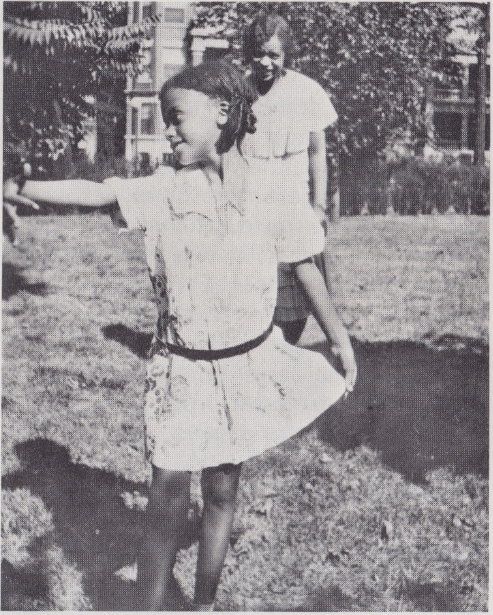
Jewel as a little girl in Chicago, with her mother in the background. Cobb recalls growing up in a highly segregated Chicago. Schools, restaurants, and public facilities were all segregated. “You couldn’t go downtown to eat in a restaurant,” she says, “it was law.” Her high school was mixed, but “Blacks and whites stayed apart outside of high school.” When she graduated from high school, she remembers, “we had two separate high school proms because black students were not allowed to go to the hotels in Chicago, and thus to a prom anywhere.”
Jewel’s father was a doctor (who was only allowed to serve black clients). He was the main inspiration for her decision to study science. It was in high school that she discovered her love for biology: “My second year in high school was when I decided that I loved biology because I had a teacher—Miss Hyman was her name—and the things we did in the class were very exciting using the microscope. It was the first time I ever used a microscope, and I found that wonderful to be able to see things through it that I could not see ordinarily. That was fascinating. And I took five years of science in high school.”
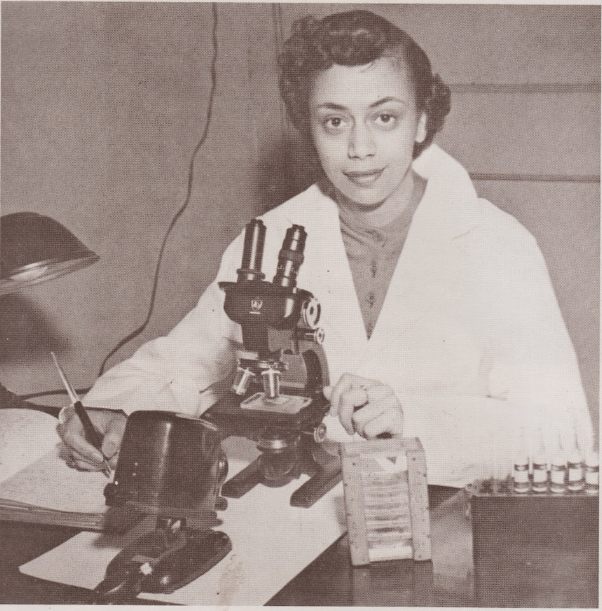
Jewel as a young scientist at Harlem Hospital. After high school, Cobb attended the University of Michigan in 1942. She recalls, “At Michigan, when I was there in 1941-1942, there were something like 200 black students, a big population. Seventy-five percent of them were form the South, and they were in medical school or law school or theology school or college. Particularly those from the South were there because their states would not allow them to go to their own medical schools or law schools.” Despite this, Cobb still experienced segregation, racism, and sexism: “Black students could not go to the local beer tavern, Pretzel Bell, where everyone went after football games, because they wouldn’t serve blacks. Also, we couldn’t go downtown to any of the restaurants or to get a haircut or a beauty parlor or whatever, for the same reason: the shops wouldn’t serve us. And then Men’s Union Building was off limits to women….I’m not kidding you. Michigan was sexist and racist.”
Unsatisfied with these and other elements, Cobb finally said, “Oh, to heck with this. This is just ridiculous,” and transferred to Talladega College in Alabama, which was a black college. Alabama, being in the deep south, was not without serious racial problems. She recalls, “We had known before we got there that the Ku Klux Klan had burned a cross on the campus the year before.” She recalls going to a segregated “black” restaurant in Birmingham with a white professor and his wife, who were “arrested and taken to jail for eating in a black restaurant, a violation of the city sanitary code, because the sanitary code stated that blacks and whites, when eating in a public restaurant, must be divided form one another by a six-foot curtain or wall, for sanitation purposes.”
She also remembers having to stay “in a terrible, flea-bitten old hotel, because that’s all we as blacks had access to,” and having to sit “in the back of the bus because that’s where we, as blacks, had to sit.” Once in the town of Talladega, a waitress told her, “We don’t serve niggers here.”
Cobb graduated with a B.A. in biology in 1945 from Talladega, and W.E.B. DuBois was her graduation speaker. Cobb initially was denied a fellowship for graduate study in biology at NYU because of her race. However, following a personal interview, she was granted the fellowship. In New York, there was serious housing discrimination against African Americans: “Blacks could not get apartments in Greenwich Village, so I lived Uptown, in Harlem.” It was at NYU that Cobb found her area of specialty, which was cell biology. She received her M.S. degree from NYU in 1947 and her Ph.D. degree in cell physiology in 1950. At the time, she recalls, the faculty at NYU was “all white.”
In 1949 she was appointed an independent investigator at Woods Hole Marine Biological Laboratory. Following the receipt of her Ph.D. from NYU, Cobb held post-doctoral positions at the Harlem Hospital Cancer Research Foundation, Columbia University, and the National Cancer Institute. Her research included work on the relationship between melanin and skin damage, and on the effects of hormones, ultraviolet light, and chemotherapy agents on cell division. Cobb discovered that methotrexate was effective in the treatment of certain skin cancers, lung cancers, and childhood leukemia. This drug continues to be used in chemotherapy to treat a wide range of cancers, and in lower doses to treat a number of autoimmune diseases.
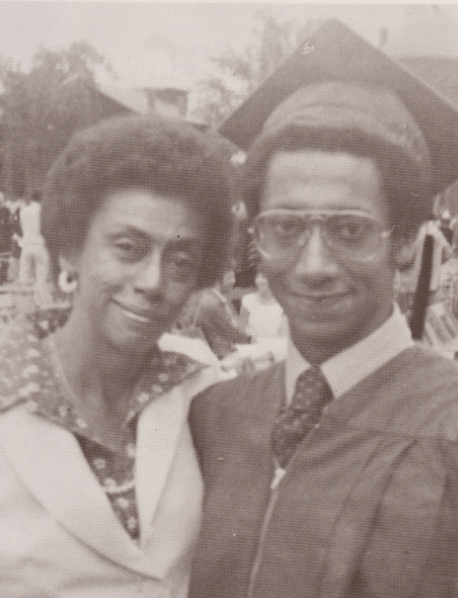
Dr. Cobb at her son’s college graduation. Cobb directed the tissue culture laboratory at the University of Illinois from 1952 to 1954, where she was the first black woman faculty at that school, a pattern that would continue throughout her life, breaking new ground not just as a scientist, but as a black woman. She continued her research work as a faculty member at NYU from 1956 to 1960, and at Sarah Lawrence College from 1960 to 1969. She remembers the Civil Rights and the feminist movements of the 1960s. Her husband participated in the March on Washington in 1963. Cobb was fully occupied as a professor and cutting edge researcher during these years, so she did not involver herself in politics or activism. “As far as the women’s movement goes,” she says, “I was living a feminist life by example.”
In her career as a scientist, Cobb collaborated with numerous other researchers, including noted oncologist Jane C. Wright. In recognition of her research achievements, Cobb was elected to the Institute of Medicine of the National Academy of Sciences in 1974. She was a member of the National Science Board from 1974 to 1980. She published dozens of articles in academic journals on topics ranging from cancer, to the role of women and minorities in higher education and the sciences.
Cobb began her career in academic administration in 1969 at Connecticut College, where she served as Dean of Arts and Sciences and professor of zoology until 1976. As an administrator, Cobb worked hard to increase the amount of women and minorities attending college: “I was interested in developing the human potential that exists for individuals who had been socialized to believe that they couldn’t do something. That is by far the most important thing, to change the attitude or the young women or minorities, period, to overcome the socialization factors that existed, the negative social factors. And also, in so doing, you contribute to the positive contributions they make as human beings.”
Cobb remembers, during the 1970s, as an administrator in Connecticut, witnessing student protests on campus over the U.S. bombing of Cambodia, and the Vietnam War in general: “I came here in 1969, and we closed the campus for the Cambodian incident in 1970 and 1971.” This student activism on campus led to more student involvement and input: “We began to have a more involved student organization awareness of what went on in the curriculum and more of a role to play in the matters of the campus than had been possible before.”
In 1976 she became the first African American Dean of Douglass College at Rutgers University, where she also was a professor of biological sciences. As a Dean, she followed the philosophy that “You have to be a visionary and not just a manager.” In the 1970s, Cobb received numerous awards and accolades: outstanding alumna by the United Negro College Fund, the NYU Woman of Achievement Award, and many others.
In 1981, she was appointed President of California State University, Fullerton, as the first black woman president of a University in the western United States. She recalls this experience: “I felt that I was a stranger in their midst, so to speak, both administration and faulty, because I was a woman, I was black, and I was from the East.” Her impressions before coming to Orange County were: “It was John Birch Society territory. The John Birch Society had just finished doing something down in the south part of the county. I knew that Richard M. Nixon had been around here and Reagan. I knew that it was a very conservative county. People hastened to tell me that.” She recalls her first year as president in this way: “I have likened it to walking through a forest where there are lovely trees, nice flowers and, all of a sudden, you step on a land mine.” When Cobb was president at CSUF, there was an Affirmative Action office, which sought to recruit minorities and women, but the Affirmative Action program was eliminated in the 1990s by a ballot initiative sponsored by conservative groups.

As president, she was a visionary, encouraging a greater focus on women’s and ethnic studies. She remembers, “when I came to Cal State Fullerton, I asked about the library’s holdings for women’s studies. It was practically nonexistent. There was nothing here, hardly, in women’s history. Then, when I looked at the history department, it had zero or maybe one female. It was a shock to me to imagine that that existed.” She found “a distressing scene at this campus.”
She was also startled to find, at Cal State Fullerton, “a greater emphasis on the part of students on career-oriented courses (like business) and a corresponding decline of liberal arts.” At Douglass and Sarah Lawrence, the following majors did not exist: business, physical education, or criminal justice. In the interview, Cobb lamented this trend away from liberal arts education at CSUF, and explained the importance of it: “What is the real reason for going to college? It’s an individual enrichment…I do not think the curriculum should be vocational, but should be a liberal arts curriculum as much as possible…Our students graduating now are going to be world citizens.”

When Cobb came to CSUF, there was no student housing, no dormitories on campus. She worked to obtain funds for the construction of the first student residences on the campus. This student apartment complex has since been named in her honor. Cobb’s presidency at Cal State Fullerton was notable for her success in obtaining funds for the construction of several new buildings on the campus. These included the Engineering Building, and the Computer Science Building constructed with state funds and the Ruby Gerontology Center, which was the first building on the campus constructed entirely with private donations. In addition, much of the planning for the Science Laboratory Center, now Dan Black Hall, was done while Cobb was president.
She retired in 1990, at the age of 66. Following her retirement from the presidency at Cal State Fullerton, Cobb was named CSU Trustee Professor at Cal State Los Angeles. In this position for several years she led a number of efforts to encourage minority middle school and high school students to pursue careers in science, technology, and engineering. She also was named to the Caltech Board of Trustees, and currently is a Life Trustee at Caltech.
Speaking of how she managed, as an African American woman, to accomplish so much in her life, Cobb says, “The bias and the prejudice that exists, and it’s happened to me and does now exist—energizes me rather than immobilizes me. To the degrees that young or old or whatever people can use that as a stimulus rather than as a barrier, the better off they are.”
Dr. Cobb in the Fullerton Arboretum. -
Oral Histories: George Mickle
The following is from a work-in-progress about the history of Fullerton. You can support my ongoing research and writing on Patreon.
In 1978, George Mickle was interviewed by Anne Riley for the Fullerton College Oral History Program. Mickle was a groundskeeper for Fullerton Union High School and Fullerton College from 1926 until 1941. Here are some highlights from the interview.
George Mickle graduated in 1926 from Anaheim High School, and attended Fullerton College from 1926-1928.
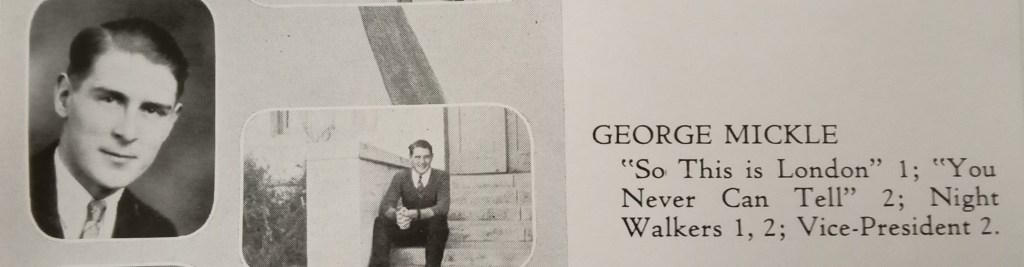
George Mickle in the 1928 Fullerton College Yearbook. Photo courtesy of Fullerton College Library Archives. He was raised by an aunt and uncle, and his uncle was hired to take over as chief engineer of the heating department at the high school and junior college. So they moved to Fullerton. At that time the school furnished the chief engineer a house right on campus.
When Mickle was a student, Fullerton College shared a campus with the high school, where there was a single building known as the the Junior College building in the center of the high school campus.
He was vice president of the drama club, called the Night Walkers.
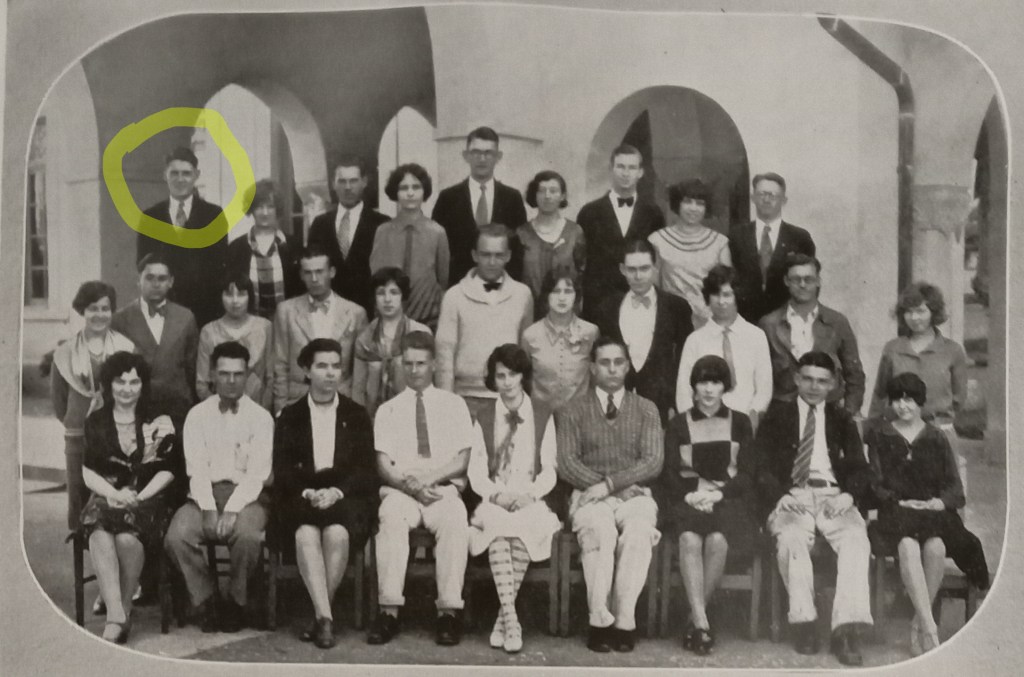
Fullerton College drama club photo with vice president George Mickle circled in highlighter, from the Fullerton College Yearbook. Photo courtesy of Fullerton College Library Archives. Fullerton College had its own school bank run by a Mr. L.O. Culp who taught banking and business courses.

Students in Fullerton College Bank, 1937. Photo courtesy of Fullerton College Library archives. Mickle remembers that a girl named Collie Bode designed the Hornet emblem in 1926 as part of a contest, and won $50.
Because he worked as a groundskeeper, Mickle was well acquainted with the tunnels running under campus.
“Underneath every building on the high school and junior college campus, at that time, were tunnels coming from the heating plant,” he said. “That was my first job to go down at five o’clock every morning and go though all the tunnels and turn on air conditioning in the summer and heat in the winter time. There were big fans, all under the whole campus. All the pipes were down there, but there was plenty of room to walk.”
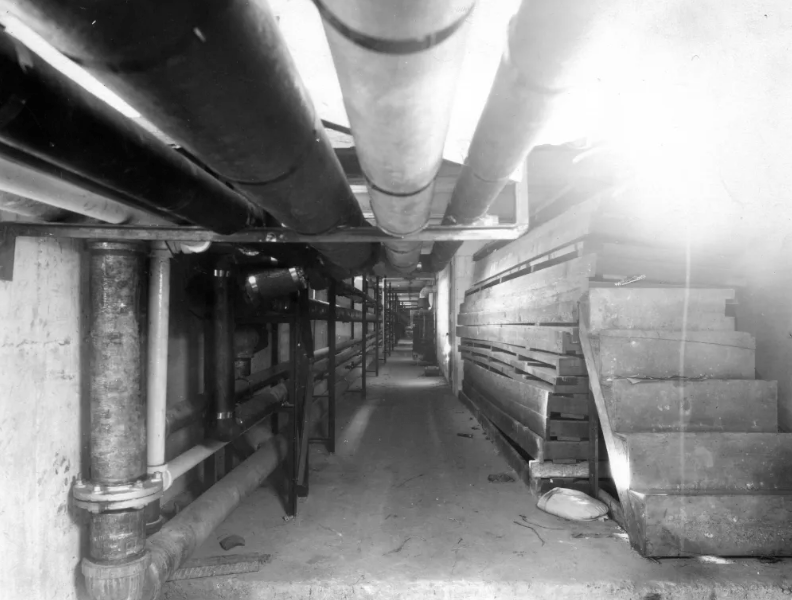
Tunnels under Fullerton High School. Photo courtesy of Fullerton Public Library Local History Room. He said that Fullerton has always been “very much of a baseball city [and has] turned out some big league players” such as Arky Vaughn, Willard Hershberger, and Walter Johnson.
Every year, he remembers, Fullerton used to have a Jacaranda Festival, when all the Jacaranda trees were in bloom.
He remembers the annual Thanksgiving Day football game between Fullerton and its rival Santa Ana, which always drew a huge crowd and would sometimes get rowdy.

Fullerton College football game, 1931. Photo courtesy of Fullerton College Library Archives. 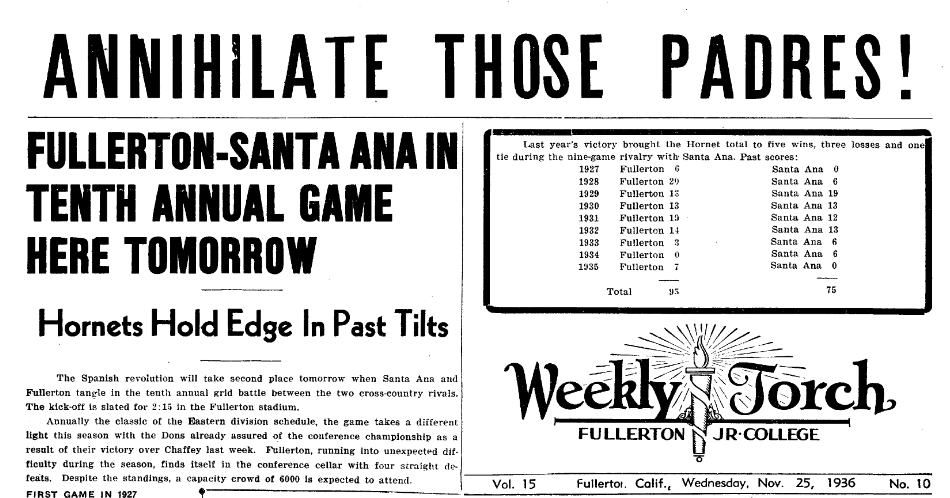
Clipping from 1936 Fullerton College newspaper. Courtesy of Fullerton College Library archives. “After every game the people, the roughnecks, would rush out on the field and start a fight and pull down the goal posts,” he remembers.
In 1933, when the college acquired its own property for a campus (a walnut and orange grove) he helped remove the stumps of walnut and orange trees to clear the land.
1933 was also the year of a major earthquake.
During the Depression, the school Board tried to cut costs by having no junior college or high school athletics in order to cut costs.
“The students all marched downtown in protest, and they decided to continue the athletics,” he said.
Although the Depression was hard times, it was also a period of growth for the college, thanks to the Works Progress Administration and other government programs.
It was WPA labor and funding that built the “new” stadium for the high school and college, and for the first buildings of the new college campus–the Commerce Building (1935), the Administration Building (1936), and the Trades building (1938)–all of these buildings still stand.
Mickle remembers working with those employed by the WPA, most of when were local.
“Some of them worked only two days a week, some would work three days, depending on the size of their family,” he said. “Workers were mainly from around here. Quite a few of these WPA and SERA and so forth were from out in the Placentia area and were Mexican Americans.”
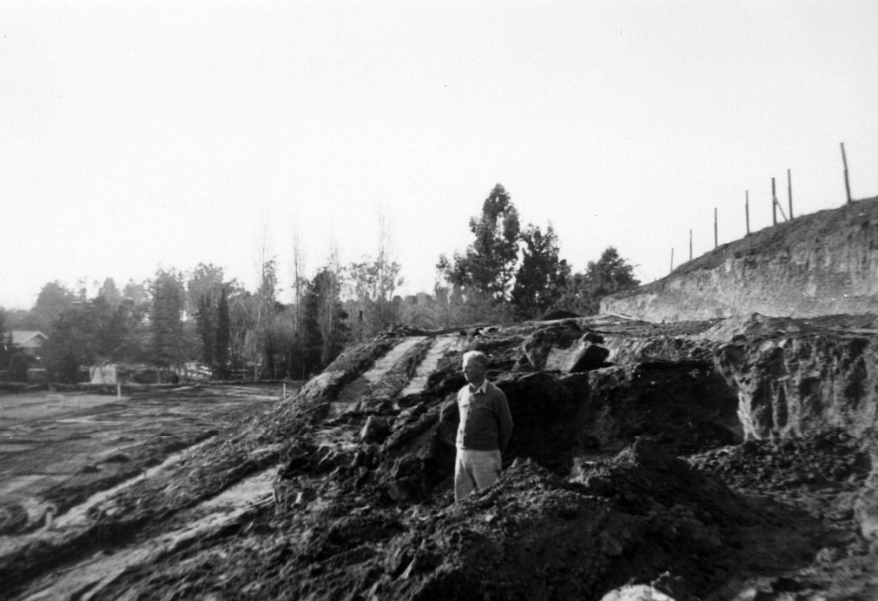
Above and below: Grading the land and building the fist Fullerton College building. Photos courtesy of Fullerton College Library Archives. 

He remembers when the “Pastoral California” mural was painted on the side of the high school auditorium, and when it was painted over.
Why the mural was painted over remains a subject of debate among local historians. Some have said it was painted over because the school board thought the figures depicted were “vulgar” or “grotesque” and some have said that the mural was “too Mexican” for the all white school board.
Mickle gives his own reason: “They finally had to take that one off of the auditorium because the kids doctored it up too much!”
He doesn’t say how the students “doctored” up the mural, but I know some complained at the time that the women in the mural were too bosomy. Perhaps the students “doctored” it to emphasize, or enhance this feature. The mystery continues.
Mickle remembers when the Pacific Electric tracks came through campus.
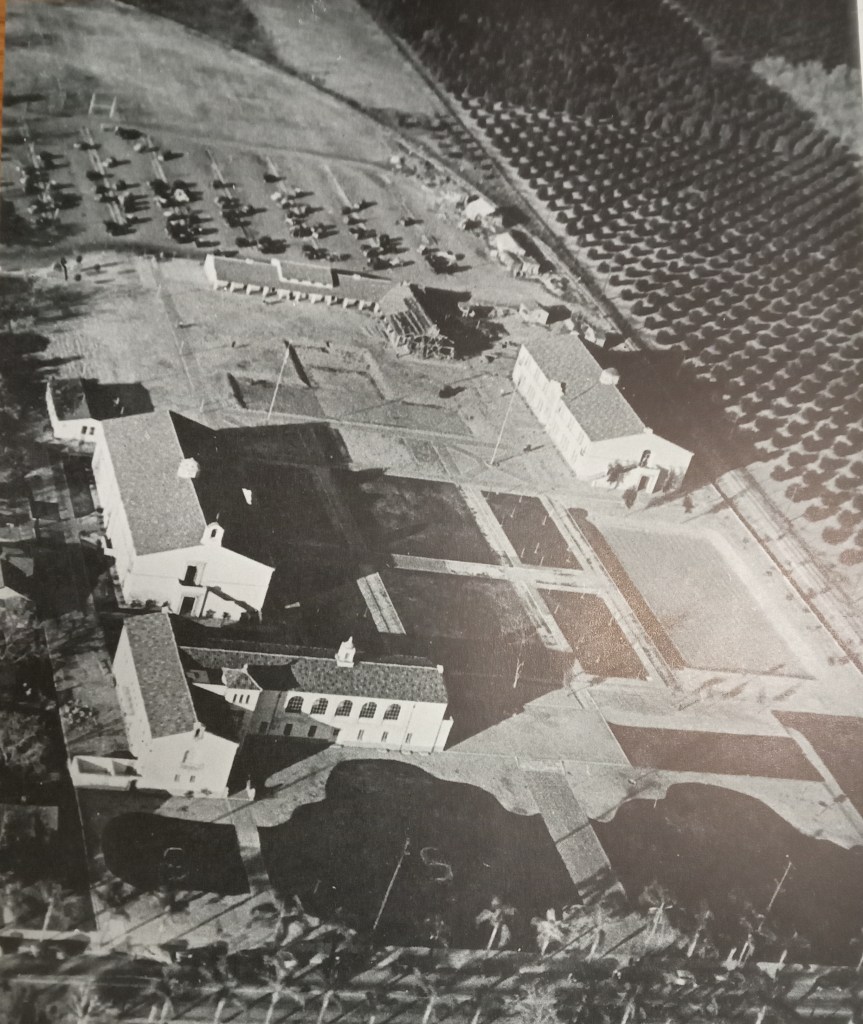
Pacific Electric tracks running along east side of Fullerton College campus, late 1930s or early 1940s. Photo courtesy of Fullerton College archives. In 1938 school was closed due to a massive flood, when the Santa Ana river went over its banks.

Fullerton College Kayak Club during the 1938 flood. Photo courtesy of the Fullerton College Library Archives. During World War II, Mickle went to work for a Navy shipyard. After the war, he took a job with Johnson’s Fullerton Motor Parts.
-
Oral Histories: Charlotte “Polly” Gobar Snyder
The following is from a work-in-progress about the history of Fullerton. You can support my ongoing research and writing on Patreon.
Charlotte “Polly” Gobar Snyder was interviewed in 1981 for the Fullerton College Oral History Program. Here are some highlights from this interview.
She was born in Durand, Wisconsin around 1899. Her father was Dr. Frank Joseph Gobar. Her grandfather had been a doctor in the Civil War.
In 1901, the family moved to Trask, Oregon where they lived on a farm on a timber claim and had a small hotel.
In 1906, the family moved to Fullerton. They stayed with their friends the Blybacks while they got established.
She had seven siblings, all of whom graduated from Fullerton High School.
At first the family lived at 224 West Amerige in a small two bedroom house (it’s now the parking lot of the police department). Her father had his doctor’s office in the front bedroom. Eventually, they moved to 361 West Commonwealth, where the public library is today.
Fullerton was young, with about 1725 people.
Her father was a surgeon for the Santa Fe railroad company in the early years. He would travel to the oil fields in Olinda and Brea Canyon before there was a town of Brea. He was one of the first ones to have an automobile in town and, according to Snyder, the first one in Fullerton to have an electric washing machine.
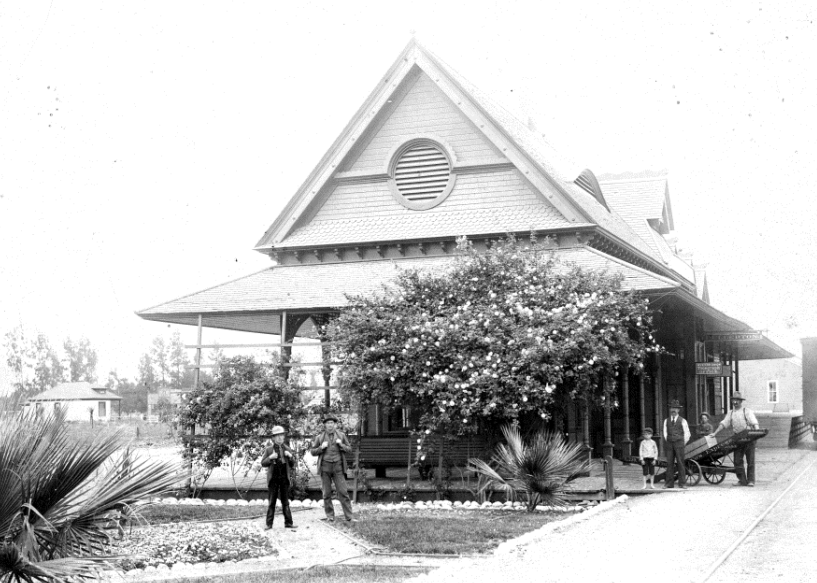
Fullerton depot, 1906. Photo courtesy of Fullerton Public Library Local History Room. On her family’s property, there was “a big red barn at the Amerige end…with three large pepper trees close at hand. We had two cows for awhile and some chickens and pigeons. Part of the barn at the west end near Short Street [now Library Ln.] was converted into a garage for the new Kissel Kar. It was red, without a top, two seats in front and two in back. Formerly Papa had had a Rio and a Tourist automobile. The car was for Papa’s use to see his patients in Fullerton, Brea Canyon, Olinda, and La Habra.”
“The plateau north of downtown was owned by the Bastanchury family, Basques from Spain,” she remembers. “There were other Basque families here, and a great number of German families, as well as others. The Basques ran sheep on their thousand acres at one time…When my brother in 1927 built his home up on West Valley View on the six hundred block, across the road there were orchards that were part of the Bastanchury Ranch. We used to roam those hills and pick wild flowers and have picnics out there.”
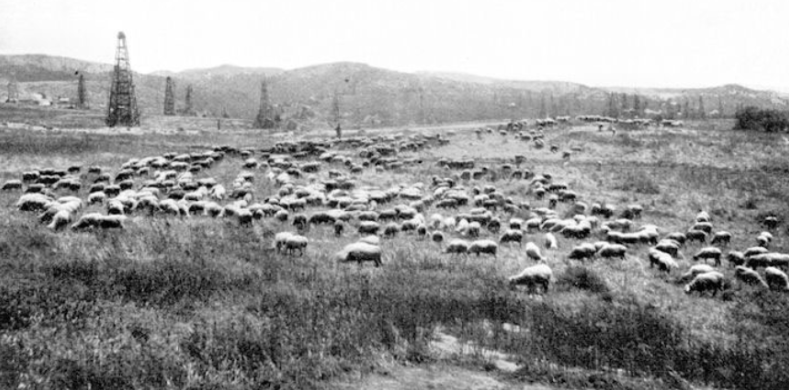
Sheep and oil wells on the Bastanchury Ranch. Photo courtesy of the Fullerton Public Library Local History Room. She started second grade at the red brick grammar school—at the corner of Wilshire and Lemon, where the School of Continuing Education is today. Over on Lawrence and Wilshire (where a Fullerton College parking lot is today) was the high school, also a red brick building.

Fullerton’s first grammar school at the corner of Wilshire and Lemon. Photo courtesy of the Fullerton Public Library Local History Room. A new high school was built in 1908 on West Commonwealth (where Amerige Park is now), but it burned down in 1910. She remembers seeing the building burn: “I watched from our home across the way at 361 West Commonwealth. My three older brothers were in the fire brigade and were trying to save the building. They did save the Polytechnic Building, which was separate from the main building, and later it was moved to the present location over on East Chapman.”

Fullerton’s second high school before and after it burned down (see below). Photo courtesy of Fullerton Public Library Local History Room. 
After the high school burned down, the new high (and current) high school was built on Chapman Ave. Delbert Brunton was the first principal of the high school.
Before the high school was built, the land was orchards.
“There were orchards on the north side of Chapman. There were orchards east of Balcom on the east side of town. And orchards came up to Highland Avenue at Wilshire, and north of there,” she remembers. “To the south there were orchards right below Maple, which is Valencia drive now. We were surrounded by orchards, oranges, and walnuts.”
Living near downtown Fullerton, Snyder remembers the butcher, August Hiltscher, a grocery store owned by Lynn Cline, a bakery where the bus depot is now on East Commmonwealth owned by the Engmanns.
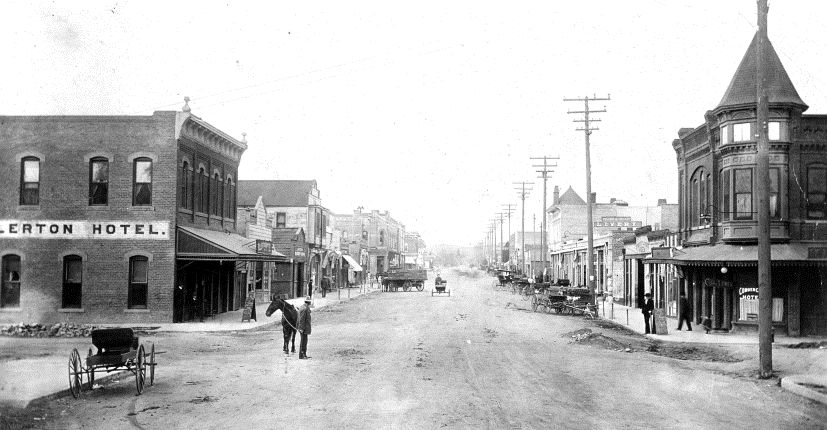
Harbor Blvd. looking south, 1913. Photo courtesy of Fullerton Public Library Local History Room. She remembers a fire in downtown Fullerton in 1908 that burned Cline’s grocery. Her brothers were in the volunteer fire department, and helped to put out the fire.
At that time, the town had a water tank west of where Villa del Sol is now, which provided water for downtown Fullerton.
For home entertainment, her brother Dave would play the piano.
Dorothy Lane, she remembers, was named for Dorothy Gage of the Gage family that lived out there when it was all orchards. Dorothy’s cousin, Ruth Dunham, married Roy Hale, “one of the Hale boys of the Placentia Hales, we called them. There were Fullerton Hales, Bill Hale’s family, and then there were Ray and Roy of the Placentia Hales.”
Other prominent families she remembers include the Knowltons (who lived at Wilshire and Acacia), the Hetebrinks, who lived in the house that still stands at the corner of Chapman and Berkeley (They had a large basement where they would host parties), the Sheppards (Carrie was the city librarian for many years), and the Dysingers.
She remembers Louis Plummer, who started as a commerce teacher and then became principal and superintendent. She babysat for Plummer’s children.
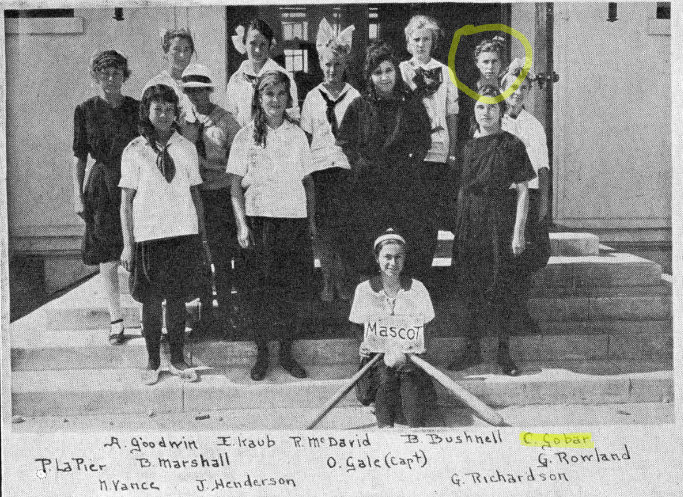
1916 photo from FUHS Pleiades yearbook showing girls baseball team. Charlotte Gobar is highlighted. She graduated from Fullerton High School in 1918. She remembers Jessamyn West, who became a famous writer, who graduated in 1919.
She remembers the Pacific Electric “red cars” that once connected Fullerton to a vast passenger rail network.
After she graduated, she attended Fullerton Junior College, got married, and worked for the city from 1922 to 1929, for Mr. Hezmalhalch in the City Clerk’s office.
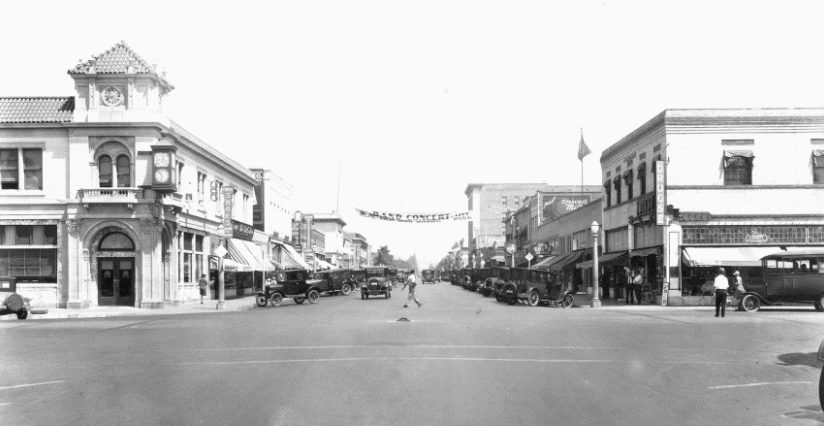
Corner of Harbor and Commonwealth looking north, 1920s. Photo courtesy of Fullerton Public Library Local History Room. She married and had a family of three children. Her family moved for a while to Bakersfield, where her husband died in 1940. In 1942, she moved with her children back to Fullerton and worked for the water department in the newly built City Hall building, which is now the police station.

Fullerton’s “new” city hall (1941). Photo courtesy of the Fullerton Public Library Local History Room. She attended the First Presbyterian Church in Fullerton. Dr. William Boyce and Dr. and Mrs. Lynn Sheller (of Fullerton College) belonged to her church.
Her children all graduated from Fullerton High School (Wilma in 1947, Fred in 1951, and Ned in 1954).
To read more summaries of oral histories click HERE.
-
Fullerton Tribune: 1903 Headlines
The following is from a work-in-progress about the history of Fullerton. You can support my ongoing research and writing on Patreon.
The Local History Room of the Fullerton Public Library has microfilm from the Fullerton Tribune newspaper stretching back to 1893. I am in the process of reading over the microfilm, year by year, to get a sense of what was happening in the town over the years. Here are excerpts from some of the articles from 1903.
Click HERE to read highlights from previous years.
Fullerton’s Progress
Toward the end of 1903, town co-founder Edward Amerige wrote an article describing the progress Fullerton had made up to this point. Here is the text of his article, along with some historic photos.
Fullerton, the youngest town in Orange County, has made most remarkable progress and growth during the year 1903, and is rapidly approaching the position as the second town in population in Orange County. Fullerton has already the proud distinction of being the largest shipping point in Orange County and the third or fourth position as regards shipments in Southern California. The Santa Fe railroad was compelled to put in an extra siding of 2000 feet in length the past year to accommodate the rapidly growing business of the town.
Fullerton ships annually large numbers of cars of oranges, estimated to be over 850 for the coming season; also hundreds of carloads of walnuts, grain, wool, hay, cabbage, potatoes, both white and sweet, hundreds of boxes of winter asparagus to the Chicago and eastern markets; besides large quantities of dried fruit, poultry and eggs. The country surrounding Fullerton is capable of producing the greatest diversity of products of any location in the state and is far famed for the extra quality of its oranges and fruits. C.C. Chapman, owner of the Santa Isabella ranchos and Orange groves, holds the highest record for prices obtained for oranges in the United States–$15.05 per box, besides being the largest individual grower and shipper of oranges in California. The soil and climatic conditions are such that this section is particularly adapted to the growing of the Valencia orange, the crop being harvested from May until as late as November, thereby being the latest and earliest oranges on the market, and securing the best possible prices.
Notwithstanding that over 75 new houses and buildings were erected in the town in 1903, there is not an empty store or cottage to be had here. At the present time a great number of houses are in process of construction and houses are taken as fast as they are completed.
The new Fullerton Hospital, completed last August, is an up-to-date establishment and the best institution of its kind in Southern California. An efficient corps of nurses are in attendance at all times, so that patients of this hospital receive the best attention and care, which has already made the reputation of this hospital as one of the best.
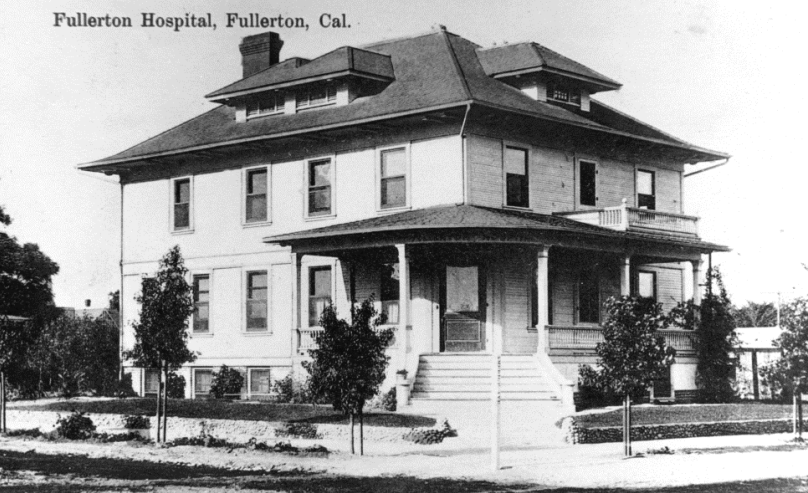
Fullerton’s first hospital. Photo courtesy of the Fullerton Public Library Local History Room. Fullerton’s telephone exchange is one of the largest suburban exchanges in Southern California, outside the large cities, there being 200 subscribers, and the number is steadily increasing.
Fullerton’s mail service is as satisfactory as can be found in much larger places, there being several mails daily each way, besides the starting point of numerous rural delivery routes in northern Orange County. The salary of the postmaster has been increased twice during.
The products of the country are packed and handled in the nine large packing and warehouses adjoining the Santa Fe Railroad, which are all located in the central part of the town. Several new warehouses will have to be built to accommodate the increasing shipping business.
School facilities are of the very best, consisting of a six-room grammar school (graded) and as fine a high school as can be found anywhere. Both buildings are of brick and are large and commodious.
Fullerton’s first grammar school. Photo courtesy of the Fullerton Public Library Local History Roon. That Fullerton is a moral and progressive town is evidenced by the three fine church edifices here, namely, the Methodist, Baptist, and the Presbyterian, which are all liberally and largely supported.
The latest and most important move made during the year is the proposed incorporation of the town. If Fullerton succeeds in establishing a city government within the bounds already petitioned for, and on which an election will be held some time in February next, she will have placed herself on the map of Orange County as the second city in size and population and territory, and from that date whe will commence a growth that will eclipse all her former efforts. The year 1904 will see the dawn of a new era for Fullerton, eclipsing all her previous great records. Altogether the future is resplendent with roseate hues for the new city of the foothills, “Fullerton.”
Incorporation
A major local issue in 1903 was the question of incorporating the town, which would allow it to have its own government and taxation powers. Tribune editor Edgar Johnson wrote some editorials in favor of incorporation.
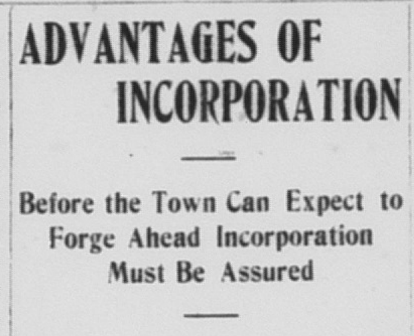
In the article above, Johnson writes: “A half-dozen men cannot lead a blind cow when all are pulling in different directions, and a town cannot advance when the people are divided into factions over minor questions, and are eternally at cross-purposes…The only question that seriously menaces the success of the question seems to be that of prohibition. Those estimable citizens who favor the suppression and annihilation of the saloon are fearful that the success of incorporation would abrogate the county prohibition law, and place the beast of intemperance in their very midst.”
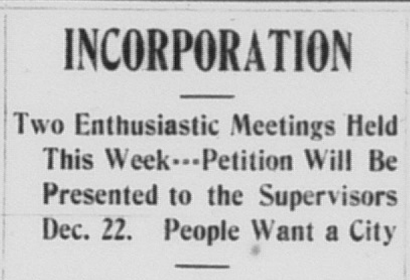
Toward the end of 1903, town leaders began to hold meetings in favor of incorporation. Those in favor included E.K. Benchley (“he believed such a move would be a success; it would give us good roads, increased values, clean streets and sidewalks”), Charles C. Chapman, and Edward Amerige. There was opposition from Orangethorpe residents like B.F. Skinner, who were opposed to increased taxation).
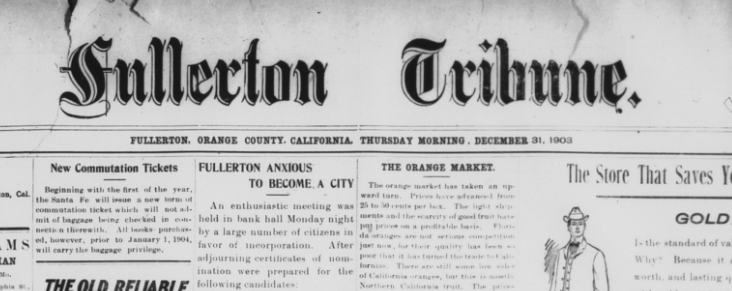
On December 31, a meeting was held to officially propose an election for incorporation. The following nominations were made:
For trustees, P.A. Scumacher, C.C. Chapman, John Gardiner, E.R. Amerige, G.C. Clark, E.K. Benchley, A. McDermont, T.W. Cline, A.V. Smith, Jacob Stern. The five receiving the highest vote will be elected trustees.
For city marshal, C.E. Ruddock, W.A. Barnes; for city clerk, G.A. Ruddock; for treasurer, J.E. Ford.
No nominations were made for assessor or tax collector as they county officials will act in that capacity.

Fullerton would vote to officially incorporate in 1904. Stay tuned for my highlights from 1904 Tribune headlines.
Temperance
An equally pressing issue in 1903 was the question of whether Fullerton would allow saloons in town. Saloons had been banned in Fullerton by county ordinance. One result of incorporation was that the newly elected city trustees could either allow or ban saloons. Those opposed to saloons included members of the Women’s Christian Temperance Union (WCTU), some local pastors, and the Anti-Saloon League.
Famous prohibitionist Carrie Nation passed through Fullerton and was interviewed by Tribune editor Edgar Johnson.
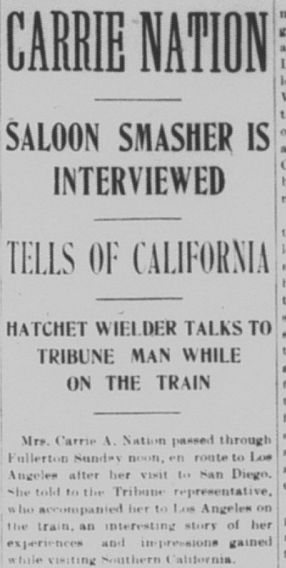
There was a highly publicized trial against a J.A. Kellerman who was accused of serving liquor in Fullerton as part of a Nationalist Club meeting. He was ultimately not convicted, as there was a hung jury.

Some local citizens petitioned the county supervisors to pass an ordinance outlawing drunkenness in town.

Oranges
Fullerton’s orange industry continued to grow.
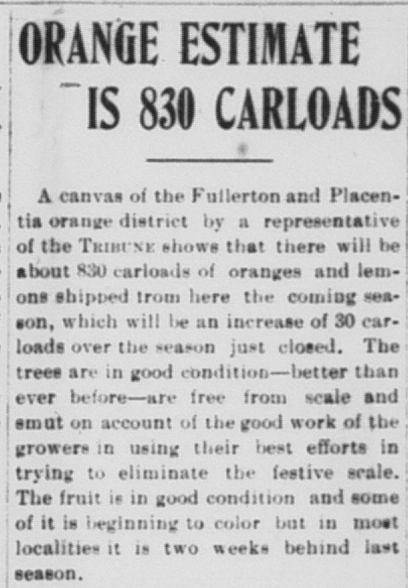
By the early 20th century, the orange industry was not functioning by the ordinary rules of capitalism and competition. Instead, the growers, shippers, and marketers were pooling their resources through Fruit Exchanges to eliminate the lower prices caused by competition.
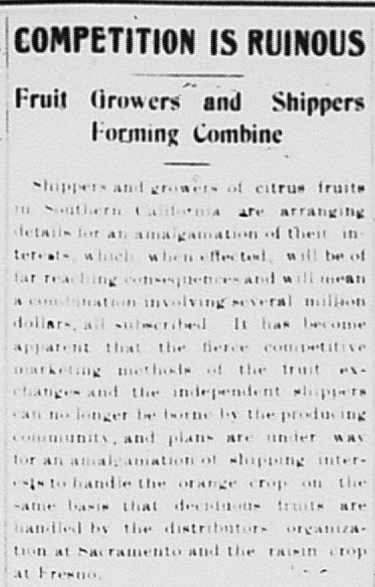
Here is the full text of the above article:
Shippers and growers of citrus fruits in Southern California are arranging details for an amalgamation of their interests which when effected, will be of far-reaching consequences and will mean a combination involving several million dollars, all subscribed. It has become apparent that the fierce competitive marketing methods of the fruit exchanges and the independent shippers can no longer be borne by the producing community, and plans are under way for an amalgamation of shipping interests to handle the orange crop on the same basis that the deciduous fruits are handled by the distributor organization at Sacramento and the raisin crop at Fresno.
In this amalgamation the fruit exchanges and the independent shippers are to participate, irrespective of past differences, and the fierce competitive battle for supremacy in selling markets is likely to be replaced by a well-organized central sales agency, through which all independent and all exchange fruit will be marketed by a single board of control. Details of this organization are nearly completed. The general groundwork of the amalgamation has been the subject of a score of special conferences held in Los Angeles during the last three weeks.
President A.H. Naftzger of the Southern California Fruit Exchange, acting by authority of these organized interests, has been in consultation several weeks with prominent independent shippers, and a working basis upon which all of these competitive factions will be amalgamated is the probably outcome.
Scope of work to be undertaken by the new organization, if it reaches final accomplishment, assumes to control marketing from the packing house to the jobber, eliminates various organization expenses, and stops the ruinous cutting of prices by competitive selling…Names of all the leading fruit shipping houses as well as the fruit exchanges collectively and separately have been definitely connected with the deal and its consummation may be looked for in the next few days.
Since the above was put in type the agreement between all parties has been made and provides that the Southern California Fruit Exchange shall permanently control 50 percent of the stock of the California Fruit Agency, that local exchanges shall be represented on the Board of Directors, in like matter as they are now represented on the directorate of the Southern California Fruit Exchange, and that the independent shippers shall be represented according their interests. These shippers include the Earl Fruit Company, the Fay Fruit Company, Ruddock, French & Co., Gregory Co., Spruance Fruit Co., Moulton & Greene, West American, Patte & Lett and three smaller concerns, and the fruit exchanges.
Oil!
Fullerton’s other big and growing business in 1903 was oil. An article below by Johnson gives a history of oil production in the Fullerton district:

Some seventeen years ago the first oil well ever drilled in Southern California was put down in Fullerton by the Puente Oil company on its own lease–today one of the best producers of high gravity oil in the state. For many years work on this lease went on quietly until 1893 a contract was made with the China Beet Sugar company for 80,000 barrels of oil the first year.
Since then output from this field has greatly increased. A 4-inch pipe line was at once laid from the wells to Chino, a distance of 15 miles. Oil was then worth from 75 cents to $1 a barrel but the same gravity oil from the Puente company’s lease now is worth $1.75 a barrel, as it runs up to as high as 37 degrees, gravity and most all of it is now sold for refining purposes.
The cost of drilling and equipping a well here or anywhere in California, while greater that in the eastern fields, is about uniform in all the California territory. It is estimated at from $2500 up for an average well of from 800 to 1200 feet. The wages here vary slightly, but as a tule they are about 20 percent higher than in the east.
The next oil field, which proved to be a heavy producer, was opened in the Fullerton field in the Santa Fe railroad company on its own territory, an extensive tract northeast of town, and about five miles east of the Puente company’s wells.
The Santa Fe had a large production within a year or tow after it became development work here, and for many years consumed all the oil from its Fullerton fields, and more, too, but the past two years it has been selling a good portion of its immense output for refining purposes at $1.75 a barrel, and purchasing a lot of cheap oil in Bakersfield for its engines, as low gravity oil from that field, mixed with some of the Fullerton oil, gives just as good satisfaction as oil of a much higher gravity. The Santa Fe has new over 30 wells, all good producers, on the pump here.
Soon after the Santa Fe had its work well under way, the Graham & Loftus company entered the field on an adjoining lease, and that company has since cleaned up something like $300,000 in profits during the past few years. This company opened up some of the best spouters in the Fullerton field, some of them going as high as 3,000 barrels a day. This company is now pumping a large number of wells, getting high gravity oil from all of them.
Then followed the Columbia oil company, the Fullerton Consolidated company, the Fullerton Oil Company, the Olinda Oil company all of which are in successful operation–and a number of smaller companies near the Santa Fe wells.
The next territory opened in the Fullerton field was in the Brea canyon hills, directly north of Fullerton, and about half way between the Puente Oil company and Santa Fe company leases, by the Brea Oil company and the Union Oil company. The Brea Canyon oil company opened up the biggest gusher ever tapped in any Fullerton territory, one of its gushers for a short time spouting at the rate of 24,000 barrels a day. One of the gushers on this company’s lease has paid net $142,000 during the past ten months, and it is believed this is the most wonderful well ever opened in any California field.

The Union Oil company has also been very successful with its wells in this canyon, and, like the Brea canyon company, has a large number of wells on the pump. The Union company has just installed a rotary drill which has a capacity of 3000 feet in depth, and the company is now going after very high gravity oil with the new rotary drill which is operated by two experts from the Pennsylvania fields.
A goodly part of the Fullerton oil is conveyed to San Pedro by the Union Oil company’s 4-inch pipe line, a distance of 30 miles, and from that point the Union company ships to San Francisco for refining an other purposes. The Union is the heaviest purchaser of oil in the Fullerton field, though the Santa Fe is still buying large quantities of oil here, in addition to its own output, on account of its ten-year contract with one of two companies not having expired, and which will yet run about three years. The Santa Fe moves its oil out, also the product of other companies, by a branch railroad built direct to the wells from its main line.
On account of so much of the Fullerton oil being refined and of the increasing output on the railroads and for oiling public highways there is a very strong demand here for every barrel of oil that can be produced, and the market price is now higher than ever before in the history of the Fullerton field.
There is much development work going on in the entire Fullerton field 24 hours every day, and there are…
The Fullerton field is now producing monthly nearly 125,000 barrels of oil, almost all of which is high gravity and it is believed the output will run up to between 175,000 and 200,000 barrels monthly within the next year.
At this time, as noted above, a number of oil companies, large and small, were drilling in the Fullerton fields. Over time, these would be consolidated or merged into larger companies.
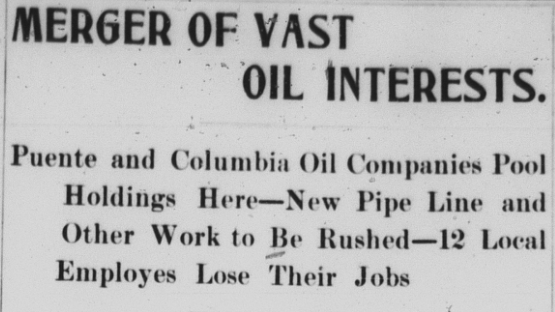
There was, in the minds of some Californians at this time, a distrust of large corporations and trusts, as shown by the avertisement below:

Town Amenities
As the town grew, so did town amenities, like a free Reading Room (a library would be built in 1907), a new telegraph office (in the office of Tribune editor Johnson), and a new hospital.

Homelessness
Edgar Johnson’s attitude toward the homeless was particularly harsh, and not that different from the attitudes of some today. Below are a couple article headlines followed by the full text of the articles.

Orange County Constables are having considerable trouble with hobos who infest its towns. Constable Llewellyn of Anaheim has been particularly active of late in making arrests.
Nearly every day from one to a dozen of these vagrants stop in that town, but they are promptly warned to get out of the limits, under penalty of arrest. Most of them take heed and disappear, but some of the more persistent remain in the face of a threatened arrest. Several of these have been given sentences of from 30 to 90 days on the Santa Ana chain gang. A few of the sentenced ones have proved to be ex-convicts or fugitives who were waned to answer criminal charges in other California towns.
One tramp arrested at Anaheim had served all but one day of his sentence when he was identified as a burglar wanted in Ventura county. After a trial there, he was sentenced to seven years imprisonment at San Quentin.
Anaheim is not alone in being bothered by these wanderers. They abound in Fullerton and vicinity in almost as great an extent as in Anaheim. The experience with some of those arrested in the town down the road is evidence that these tramps are not only an obnoxious but in some cases a dangerous element in the country.
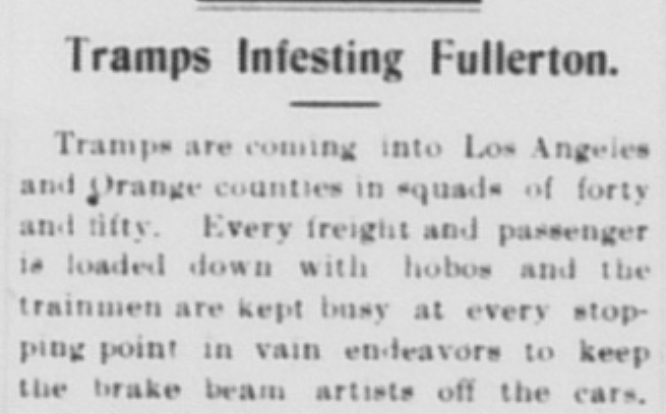
Tramps are coming into Los Angeles and Orange counties in squads of forty and fifty. Every freight and passenger is loaded down with hobos and the trainmen are kept busy at every stopping point in vain endeavors to keep the brake beam artists off the cars.
Friday and Saturday exactly thirty eight tramps were ditched at Newhall.
Twelve were arrested and the other twenty-six were ordered to move on, which they refused to do until they got ready. Railroad men running on the Coast and San Juaquin divisions of the Southern Pacific railroad report that tramps have been coming into Los Angeles in increasing numbers since the rainy season began north of San Jose and Fresno. A number of these Weary Willies have floated into Fullerton the past two weeks but they have been floated our or sent to jail by the local officers. They should be watched and given to understand that they must hove on as the “City of Fullerton” can struggle along without them. In the meantime keep your back doors locked.
Water
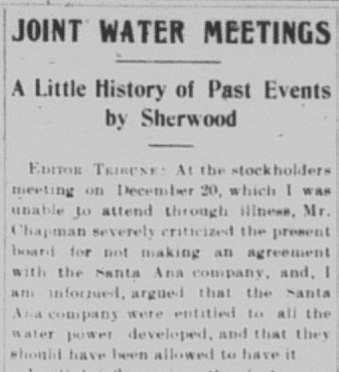
The main local water entity in 1903 was the Anaheim Union Water Company (AUWC). They had water rights to (some of) the Santa Ana River, and shared these rights with other companies like the Santa Ana Valley Irrigation Company. These were private companies whose Board of Directors tended to be owners of large, local ranches. Water rights (also called riparian rights) were a really big deal—water is life, and profits for farmers. Around 1901, these two water companies met together to bring legal action against a Mr. Fuller, “the Riverside county land-grabber” to prevent his taking water from the Santa Ana River. This would be one of many ongoing legal battles over local water rights.
In the meetings of the AUWC, there was discussion of purchasing the water rights of James Irvine, the man whose descendants founded the Irvine Company, which now owns the city of Irvine. In those early days, “maintaining an accurate division of the water [was] difficult if not impossible to devise.”
Like any political entity vested with power, the AUWC was occasionally hostile to journalists who were critical of its policies. In 1903, the Board of Directors passed a resolution excluding reporters from their meetings. Shortly thereafter, the Tribune got word that an important report had been suppressed, to which Tribune editor Johnson replied: “The best way would be to permit the reporters to attend the meetings, then the reports and proceedings would not be suppressed.”
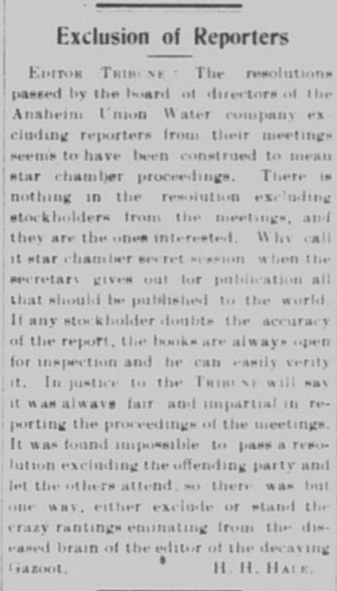
Meanwhile, the Anaheim Union Water Company and the Santa Ana Valley Irrigation Company cut a deal to share water rights. Mr. Sherwood, a sometimes Board Member who liked to write lengthy articles in the Tribune criticizing the AUWC, took issue with the deal. To which Samuel Armor of the Santa Ana Valley Irrigation Company replied: “G.W. Sherwood seems to be afflicted with a diarrhea of words accompanied by a costiveness of ideas. For two years or more he has been filling the papers west of the river with misrepresentations and insinuations against the S.A.V.I. Co. until his followers have come to believe the the people on this side are equipped with hoofs and horns and forked tails.” To which Sherwood replied: “I have always taken pleasure in setting Armor right, when he gets tangled up in the mazes of his own alleged erudition…With regard to the proposed division of water, Armor’s premises are false and his conclusions are wrong.”
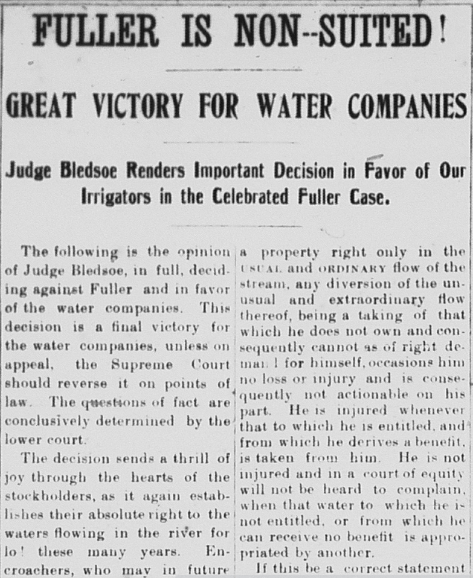
Meanwhile, Fuller, the “Riverside land-grabber” lost in court. An article gleefully proclaiming FULLER IS NON-SUITED! stated: “The decision sends a thrill of joy through the hearts of the stockholders, as it again establishes their absolute right to the waters flowing in the [Santa Ana] River for lo! these many years. Encroachers, who may in the future attempt to divert the water from its natural course, will please take warning. The decision further cements our rights to the life-giving fluid.”
Other News
Edward R. Amerige, who was Fullerton’s representative on the California State Assembly, was advocating for splitting northern and southern California into two states. This, or course, did not happen.

Long time rancher Theo Staley passed away at age 63.

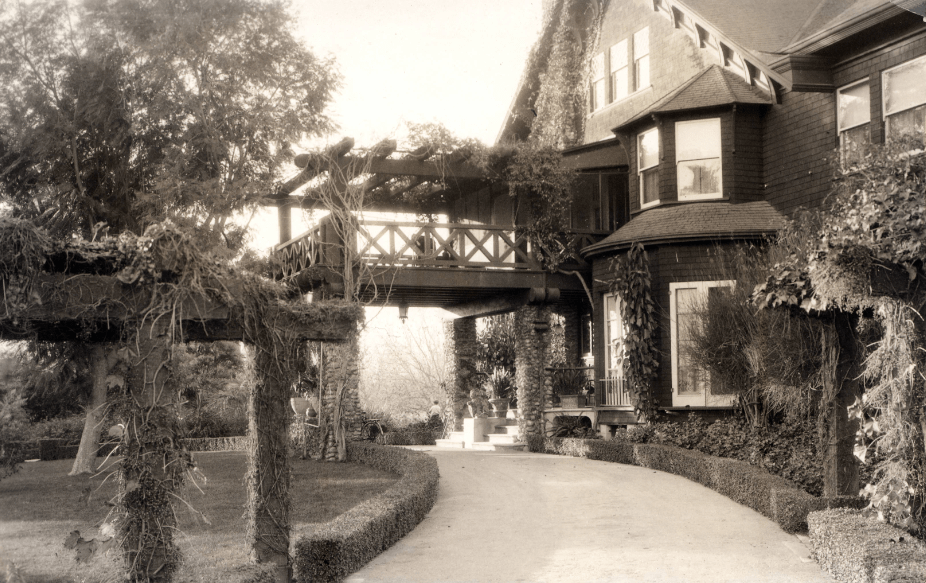
The Bastanchurys built a new home for themselves.
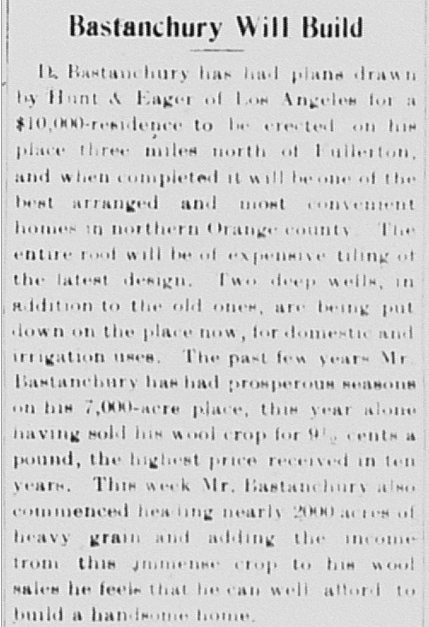
Stay tuned for headlines from 1904!
-
Oral Histories: Orla Jencks
The following is from a work-in-progress about the history of Fullerton. You can support my ongoing research and writing on Patreon.
Orla Jencks was interviewed in 1971 by Anne Riley for the Fullerton College Oral History Program. Here are some highlights from this interview, along with some historic photos of things he mentions.
He was born in South Dakota around 1895. In 1913 he moved with his parents to Fullerton, and was enrolled in Fullerton High School. He was one of the first to attend high school in its third (and current) location.
The population of the town was about 2,500 people.
He lived on the 700 block of West Commonwealth, on a small orange ranch.
He remembers the first high school principal, Delbert Brunton as well as the principals that followed–Louis Plummer and Mr. Redfern.
Jencks became good friends with Plummer and the manual training teacher R.A. Mardsen–he remembers playing tennis and fishing with them.
He describes a one-handed African-American pitcher on the high school team.
“Of course, we had no such thing as race relations and we had a one-armed colored boy and he could pitch the baseball like nobody’s business,” he said. “He could really throw. He wasn’t a large fellow…Some fellow would think ‘A one-handed pitcher, he can’t do anything.’ He’d just smile at them, you know, and fire one through and he’d fan them like nobody’s business.”
As a young man Jencks worked on the Chapman ranch, which was on the east side of Fullerton and stretched into Placentia. Chapman’s ranch was adjacent to Edward Atherton’s ostrich farm, and Jencks remembers:
“On real hot afternoons I’d have to stop and let the team rest just a little bit. So I’d grab a few oranges off and throw them over in the pasture, and the ostriches would come trotting over and they’d pick them up and have about three of them in their throat, one here and one going down. You could see them gliding down.”
The Chapman Ranch house was near the corner of State College Blvd and Commonwealth.
Chapman Ranch house near the corner of State College and Commonwealth Ave. Photo courtesy of Chapman University Library archives. After graduation, he attended Fullerton Junior College when it was still in its infancy and shared a campus with the high school. His class of 1917 had 54 students.
“And as soon as I graduated from high school, World War I was waiting for me,” he remembers. “it was conscription then, and I just didn’t want to go in the Army. I didn’t like the Army. So, I tried for the Navy and finally got in. I was over in the European area during the war.”
Eventually, after the war, he went to work for Standard Oil and stayed with them for 32 years. Later he served as a director and chairman of the board for the Fullerton Savings and Loan.
He remembers how, when drilling for oil, they would find clam shells and other sea fossils because millions of years ago “all of this country at one time was sea bed. The bottom of the sea.”
He remembers the Santa Ana River before it was channelized.
“From Anaheim to Santa Ana was nothing but a sand road, no bridges,” he remembers. “You had to have a team of horses to get you across the river down there. You couldn’t go across when there was water in it because the quick sand might get you, so we’d go down there when it was dry.”
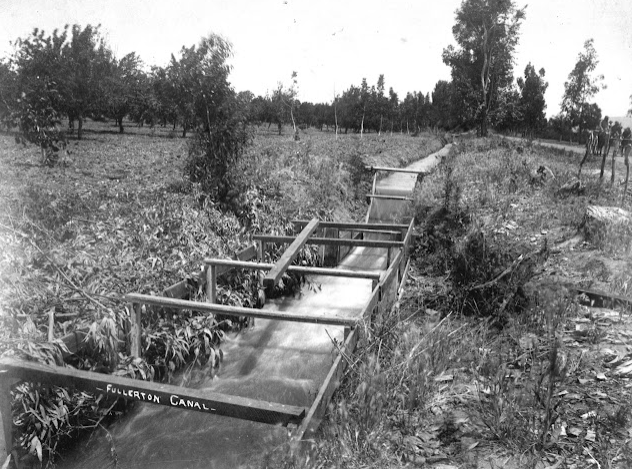
Early irrigation ditch. Photo courtesy of the Fullerton Public Library Local History Room. The Anaheim Union Water Company would allocate water from the Santa Ana river for farm irrigation and domestic uses. Further up the river, the water went to the Santa Ana Valley Irrigation Company.
“They’d let the water out in ditches all through and clear down on…[to] West Commonwealth about a mile or two,” he said.
Jencks discusses automobile races that would pass through Fullerton.
“They used to have cross-country races, automobile races from Los Angeles to Phoenix. And that was in the days when Barney Oldfield was a race driver, and he used to come through Fullerton, to go down to Blythe to get across the Colorado River to go across the sane hills to get to Phoenix. And he’d come through Fullerton and he had, now we’d call it, a pretty crude car, but it made a lot of noise,” he said. “He’d come down the Bastanchury Hill, and of course, he had a little steam coming down the hill, and he’d have it wide open going through Fullerton and nobody could be on the streets. And when he’d hit the Santa Fe tracks his car would just lift off the ground, and finally it’d come back down and it was very spectacular watching him! We’d never seen anything like that, because everything we had was about like Model T Ford.”

Early race car driver Barney Oldfield. Photo courtesy of the Los Angeles Library digital collection. In addition to the Bastanchurys, he remembers another Basque family, the Arroues, who had about 400 acres of land between here and Brea.
He remembers Stern and Goodman, who ran the general store in town.
“The ranchers would bring in their grain to them and they would buy it from them and if they didn’t have enough grain to pay for this year’s expenses, Stern or Goodman would give them the money. Just word of mouth–and when the year came around, they’d bring their hay and grain in,” he said. “That’s the way life went with them. They didn’t have to really use money. Just a little paper work, that was the way it was. Of course, that helped the country build here because the banks were so small that they couldn’t finance all of these ranchers around there that had to have help.”
Jencks also gives extensive information about the Bordurf family.
Henry A. Burdorf left Germany in 1868 for America. When he arrived in New York he heard that work was plentiful in California and arranged to make the trip. He traveled by boat to the Isthmus of Panama and then by mule across the Isthmus...After working in San Francisco for a year or two, he heard of a German settlement in Anaheim. He decided to come south to see the area. After working for two or three years he decided to buy some land. With two friends for neighbors, he bought one hundred acres of land on East Orangethorpe Avenue...
It was hard to make a living at dry farming, and Mr. Burdorf was instrumental in bringing water from the Santa Ana River. It was later known as the Anaheim Union Water Company.
After the families began to grow it was necessary to build a school. Mr. Burdorf was a member of the first school board, and they built the first school house at the corner of Wilshire and Harvard, known as the Old Red Brick School.
As time went on the family grew until there were nine children in the family and their names were Henry, Marie, Sophia, Dorotny, Anne, Diedrich, Rebecca, Augusta, and Eleanor. All of the children went to school in the grade and high schools of Fullerton.
-
Photographs (Then and Now): Harbor and Commonwealth 1889/2023
The following is from a work-in-progress about the history of Fullerton. You can support my ongoing research and writing on Patreon.
For this series of posts, I will find a historic photo of Fullerton and then juxtapose it with a photo of the same subject matter today, from approximately the same angle.
For this first post, I begin with one of the first photos taken of Fullerton, the corner of Spadra (now Harbor) and Commonwealth Avenue, taken in 1889 (below). Left to right, the buildings are: The Chadbourne Building (a social hall with some businesses), The St. George Hotel (which no longer exists), and Stern and Goodman’s (a general store).

Below is the corner today. Left to right, the buildings are: Salon Technique, Mickey’s Irish Pub, and Cha2O, a Vietnamese restaurant that is now closed.

-
Oral Histories: Anthony Ondaro
The following is from a work-in-progress about the history of Fullerton. You can support my ongoing research and writing on Patreon.
Anthony Ondaro (of Brea) was interviewed in 1971 by Sonia Eagle Dias for the CSUF Oral History program. Here’s what I learned from reading this interview, with some historical context provided by the excellent web site Basques in California.
Ondaro was born in 1897 Elantxobe, in the Basque country of Spain. He immigrated to the United States in 1908 when he was 11 years old. After spending some time in Washington state, Ondaro came to work on the Bastanchury Ranch in Fullerton, mostly driving mule teams.
After he got married, he moved for a while to Corona, but then came back to the ranch in 1926, when the Bastanchurys were expanding their citrus planting into what would become the largest orange grove in the world.
The ranch had a boardinghouse, where a lot of men lived, as well as worker camps throughout, each with a foreman. The foreman would get a house and some acres on the property.
There were American, Basque, French, Spanish, and Mexican workers on the ranch, although the vast majority of the workers were Mexican.
When Ondaro worked on the ranch, the majority of the plowing, digging, and irrigating work was done without tractors–with mule and horse teams.

Bastanchury Ranch (date unknown). Photo courtesy of the Fullerton Public Library Local History Room. Ondaro remembers three large Mexican picker camps–one where the Fullerton Golf Course, one by Laguna Lake, and “another one down by the lower part of the ranch, close to the Santa Fe Railroad.”
When asked what the Mexican camps were like, Ondaro said, “mostly it was little houses built by themselves.”
He remembers that the Mexicans in the camps used to celebrate the sixteenth of September (Mexican Independence Day) and Cinco de Mayo with fiestas and dancing.
There was a Mexican school on the Bastanchury ranch where teachers taught for the Americanization program.
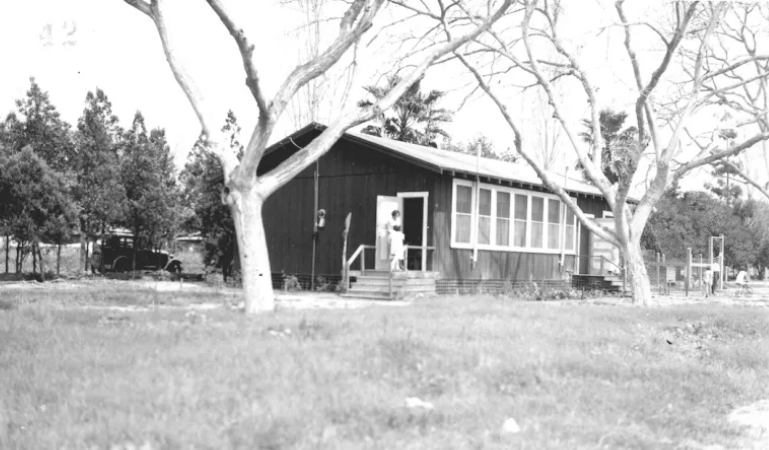
Mexican school on the Bastanchury Ranch. Photo courtesy of the Fullerton Public Library Local History Room. Click HERE to read more about Mexican citrus worker villages in Fullerton and Orange County.
Wine and recreation…
Even during Prohibition, the Bastanchurys used to make their own wine in large barrels.
“Prohibition days…They never bothered us, long as you made it for your own use, they never bothered you,” Ondaro remembers.
The Basques of southern California used to gather for picnics and handball games at the Bastanchury ranch.
“Older people, they used to have a great, big table, with sort of a ramada, with palm leaves on top,” Ondaro remembers. “They used to sit there and play cards all afternoon, drink wine or drink beer.”
On getting screwed over oil…
Ondaro remembers a significant lawsuit that the Bastanchurys filed against an oil company. Apparently, the company drilled a well that showed oil, but then covered it up and lied to the Bastanchurys about the find. Convinced the land was not worth much, the family sold.
“They told them there was no oil there but the oil was there,” he remembers. “The drillers and the roustabouts, the guys that worked in the well, they knew there was oil there.”
Gaston Bastanchury got the men who had worked the well to testify that there was oil. And he won the case.
Unfortunately, even though they won the lawsuit, they still got the short end of the stick because they took a cash settlement, instead of getting royalties on mineral rights.
The story is told in more detail in an article from the web site Basques in California:
In 1903, the Murphy Oil Company leased the West Coyote Hills lands from the Bastanchury Ranch to dig for oil. One year of excavations found them hot mineral water at 3,000 feet. As one of the oil workers later confessed, they found an oil well at 3,200 feet but covered it up. In 1905, Murphy bought off from Domingo Bastanchury more than 2,200 acres in the surroundings of La Habra, at $25 an acre. Allegedly, Murphy assured Domingo before the acquisition, that those lands held no oil. Time later, the Los Coyotes Hills area became South California’s largest oil field.
As soon as the Bastanchurys understood it had all been a swindle, they sued Murphy Oil Company for several million dollars. The family was only compensated $1.2 million dollars, and most of it went to attorney fees. Time would show that, sadly, the Bastanchurys further were shortchanged by the settlement: if they had instead asked for royalties on the oil fields that had multiplied around them, they would have generated a larger profit. Probably, the Bastanchury family would have been in better shape then, when the Great Depression hit in 1929.
Ondaro remembers an old foreman named Jean Bacay telling him that when he used to herd sheep, there were occasional oil deposits on the ground and sheep would sometimes get stuck in them.
He told me many a time, he said, “Look now.” He says, “Gold in the ground and we used to cuss it everytime we looked at it because we used to lose a sheep or two every once in a while there.”
St. Mary’s Church…
According to Ondaro, Mrs. Bastanchury gave the money and the property to build the original St. Mary’s Catholic church in Fullerton. He says they actually named the church after her, as her name was Maria (Mary).
In 1923 or 24, the church property was sold, and new property was purchased, which is the present location of the church. Mrs. Bastanchury was not happy.

Maria Bastanchury. From Samuel Armor’s History of Orange County. On the expansion into citrus…
The family patriarch Domingo Bastanchury first established the ranch in the mid to late 1800s for sheep grazing. Domingo passed away in 1909 and the management of the ranch fell to his wife and sons.

Domingo Bastanchury from Samuel Armor’s History of Orange County. Sheep grazing on the Bastanchury Ranch, early 20th century. Photo courtesy of Orange County Archives. From Basques in California:
The Bastanchurys started their citrus orchards on their 2,500-acre estate in 1914. In 1926, their citrus venture expanded when the Bastanchury Ranch Company leased 2,000 acres from the Union Oil Company. While the trees were still young, they grew tomatoes in between rows. Rather than being next to each other, the orchards were spreaded out from the La Habra Heights to Fullerton-Brea, all the way to Olinda.
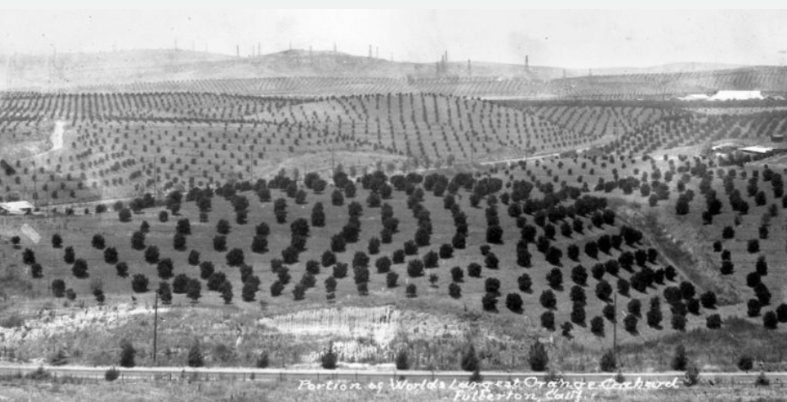
The Bastanchury Ranch was at one time considered the largest orange grove in the world. Photo courtesy of Fullerton Public Library Local History Room. The Bastanchury Ranch leased another 500 acres from Times Mirror Company in the east part of Salton Sea in Imperial County, to grow oranges and lemons. By 1933, the ranch owned a total of 5,000 acres’ worth of citrus and tomato orchards. It was the world’s largest orange grove owned by a single proprietor.
The Bastanchurys had their own packinghouses, and the railroad ran lines directly to into the ranch.
They also established their own brand, Basque brand, which fetched premium prices.

Unfortunately. According to Ondaro, the Great Depression proved disastrous to the Bastanchurys.
“They had a lot of fruit but it didn’t bring any money…There was no return,” Ondaro remembers.
Unable to honor their debts and agreements with Union Oil and the Times Mirror Company, the ranch went into bankruptcy.
“I was a foreman at the time and then after 1932 is when the trustee and bankruptcy came in. There was a man appointed by the court. He was in charge of it.”
1932 was also the year that nearly all of the Mexican workers on the ranch were “repatriated.”
The Bastanchury sons got almost nothing in the bankruptcy, although Mrs. Bastanchury managed to hold onto a smaller ranch.
On the Bastanchury sons…
Ondaro has interesting memories of the four Bastanchury sons: Dominic, Gaston, Joe, and Johnny.
After the bankruptcy, Gaston moved to Nebraska, where he worked as a mining engineer.
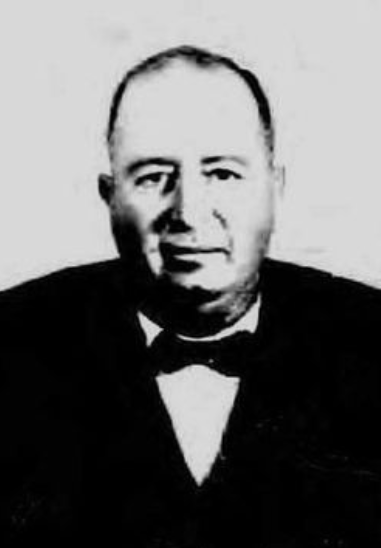
Gaston Bastanchury. Photo courtesy of http://www.findagrave.com According to Ondaro, Johnny “was the most worthless guy of all of them…The only thing he used to do is just go to Paris and France and spend fifty thousand, a hundred thousand dollars whenever he pleased. He had a family, a nice family, too. A real nice wife…But he’d just go with all the women around this way and that way. I mean, the guy didn’t have no purpose in life.”
Joe “used to drink quite a bit” but he “did more than Johnny.” Joe was married to Juanita, who was also interviewed about her recollections of the Bastanchury Ranch.
Dominic, the eldest, had four hundred acres of his own where he raised hogs and walnuts.
According to Ondaro, Dominic was an illegitimate child of Maria and a manager of the Union Bank in Los Angeles.
“The manger of the Union Bank was the one that really was the father of Domingo [Dominic]…while she was in school.”
On the decline of citrus…
Ondaro discusses factors that led to the decline of citrus, including a disease called quick decline, and the subdivisions that went in after the population/housing boom after World War II.
Today, the Bastanchurys are remembered in Fullerton by Bastanchury Road, Bastanchury Park, and Basque Ave.

-
Subscribe
Subscribed
Have a WordPress.com account? Log in now.

