-
Fullerton College Weekly Torch: 1929
The following is from a work-in-progress about the history of Fullerton. You can support my ongoing research and writing on Patreon.
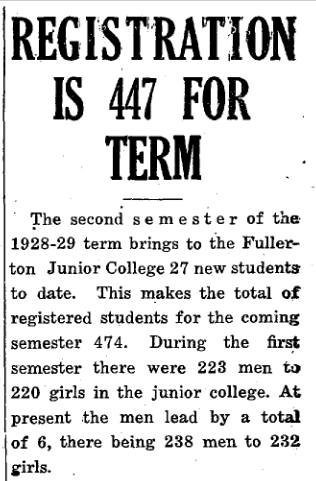
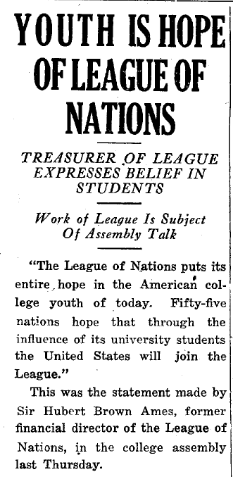
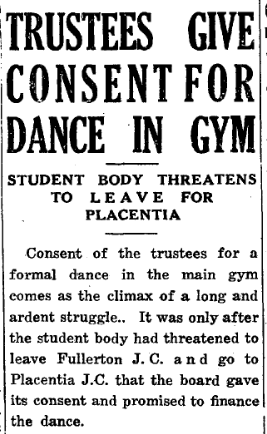
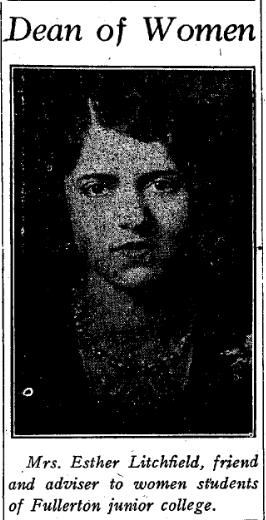
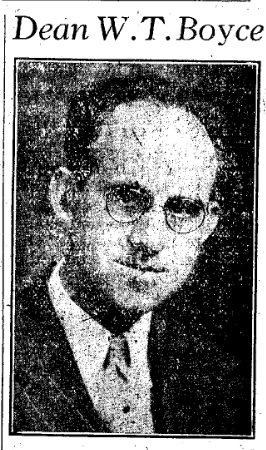
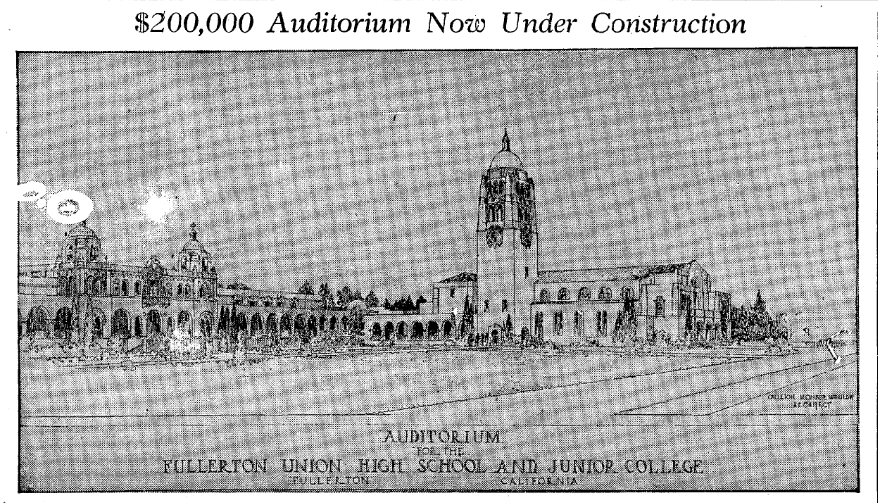
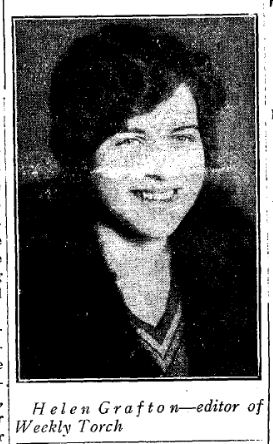
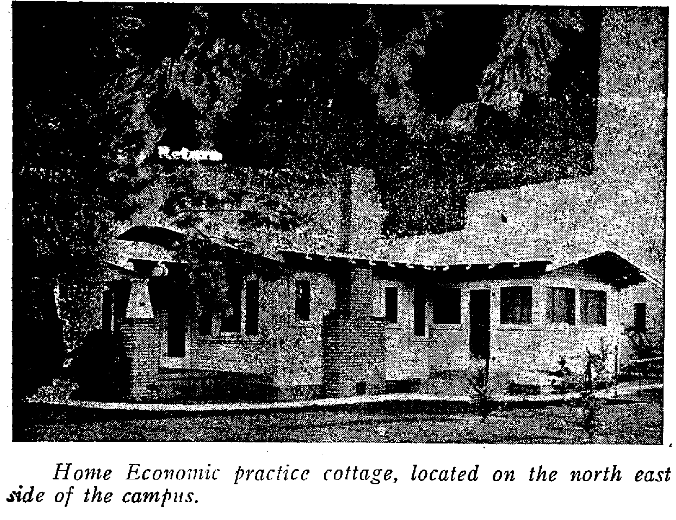
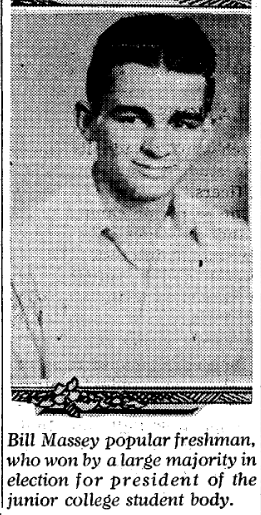
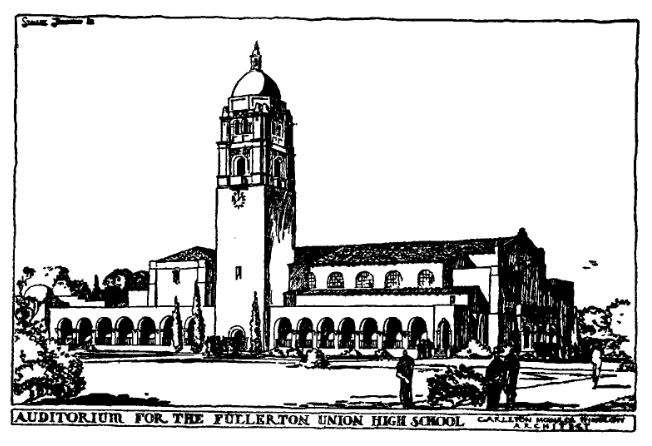
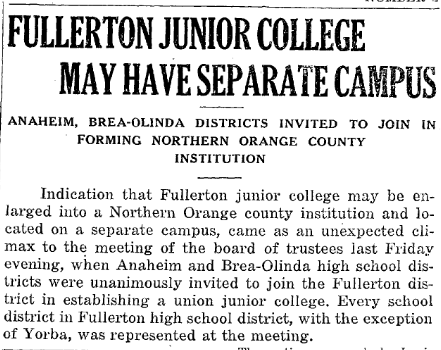
Fullerton College’s weekly newspaper was called The Torch. The college library has digital archives of the Torch going back to 1923 (the college was founded in 1913). Here are some clippings from 1929:

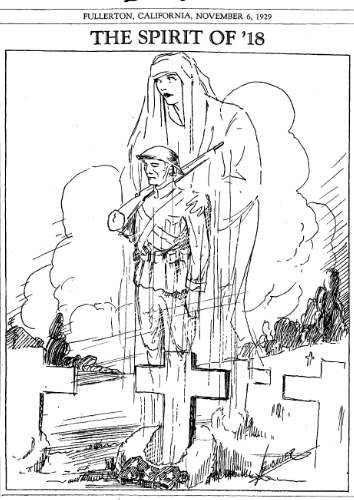
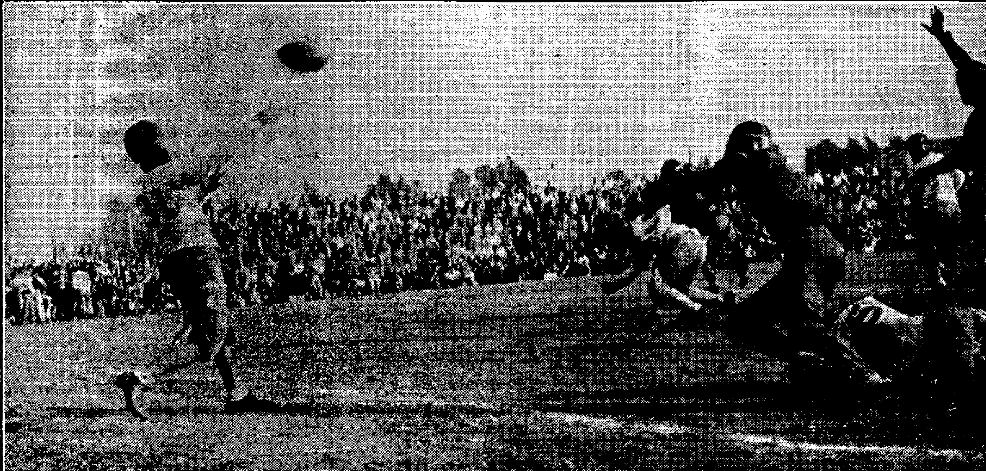
-
Oral Histories: Lulu Launer
The following is from a work-in-progress about the history of Fullerton. You can support my ongoing research and writing on Patreon.
Lulu Launer was a school teacher in Fullerton for many years. Her husband, Albert Launer, served as the city attorney of Fullerton, and had a law practice in town. The Launer Local History Room of the Fullerton Public Library is named after the Launers, as they were very active in the community. According to the Library’s web site, “The Local History Room opened its doors in 1973 thanks to a $3500 donation from Lulu Launer as a tribute to her late husband Albert’s many years of community service.” The Local History Room has been an invaluable resource for my own local history research.

The Launer Local History Room at the Fullerton Public Library is named for Albert and Lulu Launer. Lulu Launer was interviewed in 1970 by Kathleen B. Heil for the Cal State Fullerton Oral History Program. Below are some interesting things I learned from the interview:
Lulu grew up in Los Angeles around the turn of 19th and 20th centuries. As a young woman, she took a teaching job in La Habra. John G. Launer, Albert’s father, was the clerk of the school board.
“I had to go to the Launer house to sign my contract,” Lulu remembers. “There was a young man on the porch when I signed my contract. We really didn’t become sweethearts at all until I resigned in La Habra and was teaching in Los Angeles, where Albert was at law school.”
The two were married in 1915. Not long after, they moved to Brea, where they lived for three years before moving to Fullerton.
They had three children. While her kids were young, Lulu took a break from teaching and didn’t resume until World War II, when there was a teacher shortage.
During the War, she also served as president of the North Orange County chapter of the Red Cross.
“We had a strong central organization here in Fullerton,” she said. “It was here that we did most of the sewing and the rolling of bandages. We sent millions of bandages out.”
Both Lulu and her husband Albert were very involved in clubs and civic activities in Fullerton and Orange County.
“I’m a real joiner,” Lulu said.
She was a member of the Fullerton Ebell Club, the League of Women Voters, the United Nations, the Methodist Church, the Audubon Society, the Orange County Historical Society, and the YWCA.
At the time of the interview, Lulu was actively involved in a local chapter of a United Nations organization. She volunteered a lot of time helping raise money for various United Nations programs like UNICEF, The World Health Organization, and the International Labor Organization. At the time of the interview, she was busy planning for events and workshops celebrating the 25th anniversary of the United Nations. The theme of these events was “What can the United Nations do more effectively towards establishing and maintaining peace in the world?”
At this time (1970), the United Nations was viewed with skepticism, fear, and hostility by the conservative media and groups of Orange County. In her interview, Mrs. Launer elaborated on the powerful conservative climate of Orange County, and the difficulties it created for her work for the United Nations. When asked, “How do you feel about the conservatism of Orange County? Is it something that came into the county from the very beginning?” Launer replied:
“Yes, yes, I would think so. They [Fullerton’s first residents] were a rural group who came here and they were very conservative in their thinking. I think the newspapers have probably had a lot of influence on it with the ultraconservative Santa Ana Register (now the Orange County Register)…Where the source of their information is, I just don’t know. They get hold of the wildest rumors and statements about the Communists, in particular. They see an imaginary army marching on them. They think they’re going to lose all their rights, their property and everything else. They don’t check the source of their information.”
Launer continued, “Even this year in Tustin, I think it was the school board that sent word that there was to be no mention or instruction in any way, shape or form about the United Nations in the Tustin schools. Well, now, are they ostriches that are just putting their heads in the sand?”
Some right-wing groups at this time tried to equate the United Nations with communism. In an effort to counter the misinformation that was being circulated, the Orange County Chapter of the United Nations opened a book store in downtown Santa Ana (at 2204 North Main Street) to distribute their literature.
Unfortunately, not everyone was happy with the United Nations book store.
“This summer we had our first real problems,” Launer said. “On six consecutive weekends vandals broke the glass window…they did not break the windows anyplace else around there.”
Launer discusses the Freedom Center at the CSUF library, a special collection of materials on both right wing and left wing political groups both locally and nationally.
“You would be surprised at the organizations that are in this,” Launer said. “There are hate groups. They hate everything it seems, as well as the U.N., of course. That is one of the big ones.”
Despite the obstacles, Launer sounded determined and passionate about educating people and getting them involved in global issues like poverty, education, and social justice. She said, “In Orange County…we feel that every member that we get is a victory for the United Nations because it is only people of character who will stand up and say, ‘I believe in the United Nations, and that is our hope for peace.’ You have to get people with a certain amount of bravery to stand up and be counted and try to help. It is not fashionable in Orange County to be a member, but it is becoming more acceptable than it used to be.”
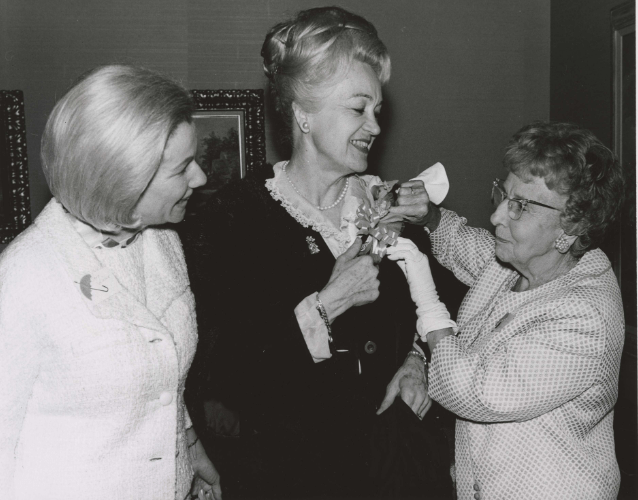
Mrs. Lulu Launer pins a corsage on former U.S. Treasury Secretary Ivy Baker Priest, 1960s. Photo courtesy of University of Utah Marriot Library. -
Fullerton Tribune Headlines: 1907
The following is from a work-in-progress about the history of Fullerton. You can support my ongoing research and writing on Patreon.
The Local History Room of the Fullerton Public Library has microfilm from the Fullerton Tribune newspaper stretching back to 1893. I am in the process of reading over the microfilm, year by year, to get a sense of what was happening in the town over the years. Below are some news stories from 1907.
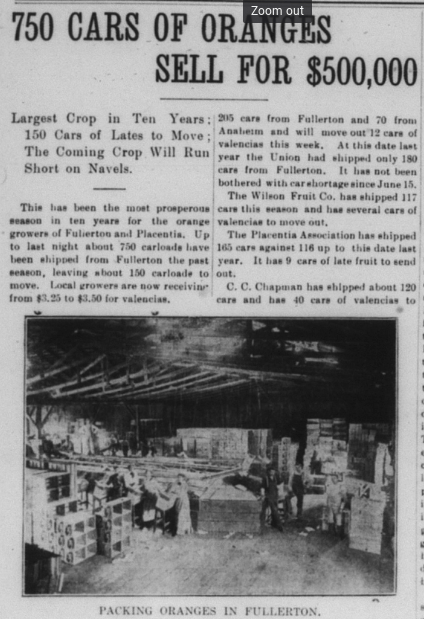
In 1907, according to an article entitled “Prosperous Fullerton,” the town had a population of 3,000, two banks, a new high school, four churches, and growers shipped 1,000 cars of oranges, 100 cars of walnuts, 300 cars of cabbages, and 200 cars of other farm products.
In 1907, the Tribune got a new linotype machine.

Racism
A disturbing article called “Japs Still in Town,” describes how a committee sought (apparently unsuccessfully) to run some Japanese people out of town, presumably because they were Japanese.

Here are a couple paragraphs from the article:
Sunday afternoon a number of young men about town decided to go to the house where five or six Japanese reside at a late hour Sunday night with the intention of driving them out of town. Frank Claudina overheard the conversation of two or three of the brave lads and offered to pay the whole bunch $5 a head and also pay their fines if arrested, if they would go to the house and manage to get even one Jap out of the city. They did not take Frank’s offer, but declared that they would make good and hustle the foreigners out of town that very night.
A Tribune reporter decided to go within one hundred yards or so of the field of battle to witness the round-up…The Japs are still in the house and may be there for some time.
Orange County’s First Lynching
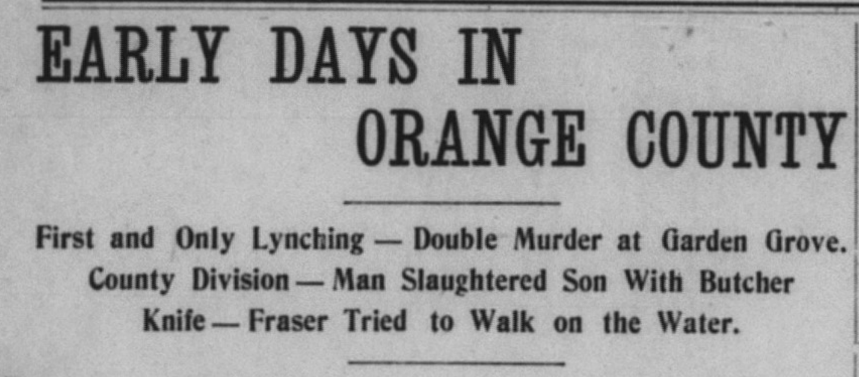
A front page feature titled “Early Days in Orange County” tells the story of Orange County’s first (and only) lynching, as told below:
Back in 1892 William McKelvey, a brother of Sid McKelvey of Fullerton and son of Mrs. McKelvey, also of Fullerton, was a foreman on Madame Modjeska’s ranch in this county, and a number of men were at work under him, including one named Torres, an Indian. The road-tax collector informed Madame Modjeska’s husband, that uncless the employees paid their road-tax, he would garnish their wages. Count Bozenta paid the poll-tax of the employee, and requested McKelvey to hold back $2.00 from each of the men when paying them off on Saturday night. Torres refused to pay his poll-tax, knocked Mr. McKelvey down with a pick-handle, and then stabbed him to death. Torres was arrested, being captured in San Diego County while trying to escape, and was placed in the small jail at Santa Ana. About a week after this cold-blooded murder had been committed, a crowd approached the little jail one night at midnight, all wearing masks. They demanded the keys from the night-watchman; he refused to give them up; within a few minutes the outer door, and the door leading to the cell were battered down, and a rope placed around Torres’ neck. He was so badly frightened he could hardly stand; he was pulled from the jail by force, led to the center of the city and the end of the rope was thrown over the first cross-arm of the telegraph pole at the corner of Fourth and Sycamore streets in front of Turner’s shoe store. The murderer was drawn up until his feet were about four feet from the ground, and the body was left there until after day-light next morning.
After first satisfying themselves that Torres was dead, the lynchers disappeared, and it is said many of them are still residing in Orange County today, some being well known businessmen. It is said Torres was unconscious when drawn up by the rope, it having been drawn so tight around his neck that he was strangled before the corner was reached. A doctor and another Santa Ana business man came along the street just at day-light, saw the body swinging just over their heads, and they almost tumbled over with fright. This was Orange County’s first and only lynching.
Click HERE for a more complete version of this story.
Water
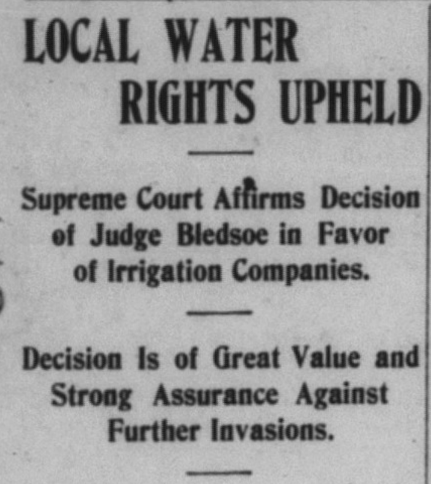
In water news, a seven year-long lawsuit upheld the water rights of the two Orange County companies, the Anaheim Union Water Company and the Santa Ana Valley Irrigation Company against a Riverside rancher named Fuller.
Fullerton rancher Charles Chapman was criticized by the Tribune (and apparently his neighbors) for changing the course of a waterway to protect his crops from flooding, meanwhile causing other ranchers properties to experience flooding during a recent storm.

New Library
Fullerton’s first real library, built with funding by industrialist Andrew Carnegie, was completed at a cost of over $10,000. The Library was on the site where the Fullerton Museum Center is today.

Below is a photo of the Carnegie Library taken a few years later:

Suicides
Fullerton resident L.E. Myers shot himself.

Bertha Luxembourger, brother of William “Big Bill” McFadden (who had died a couple years prior), tried to kill herself by jumping in front of a train, after her husband of four months left her. Amazingly, she survived.

Oil!
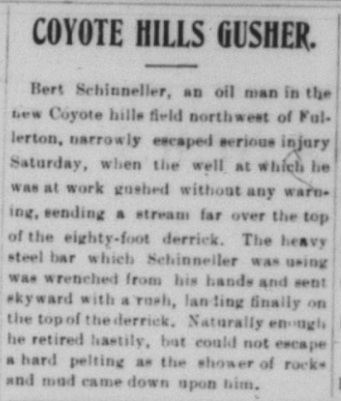
Many articles in 1907 were about the gushing oil fields north of Fullerton, including in Coyote Hills. Below are a few examples:


Agriculture
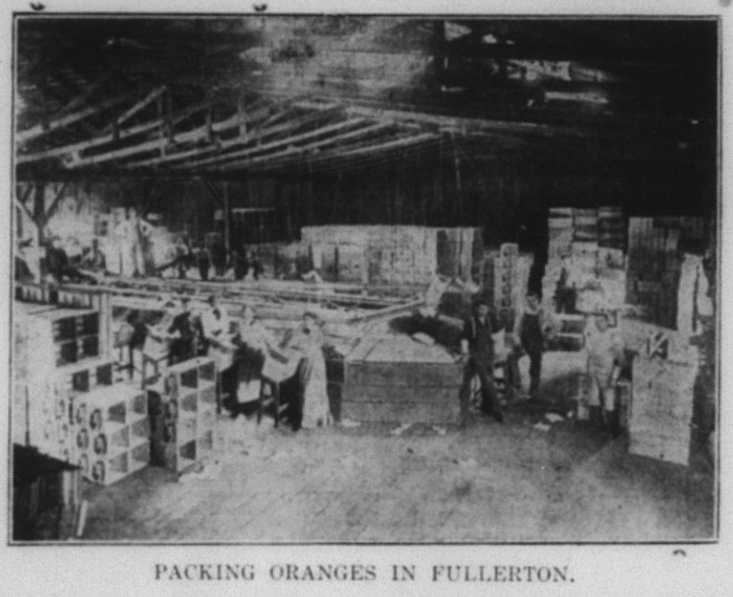
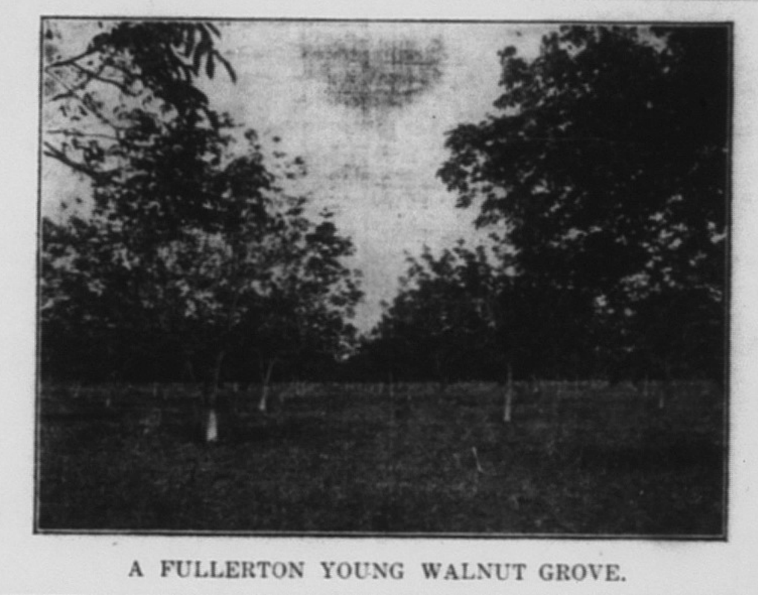
The orange and walnut industries continued to prosper.
Roads
The city trustees put before the voters an $80,000 bond, mostly to be used for road improvements. Tribune editor Edgar Johnson was against the bonds, and as he often did, he wrote front page “articles” that were actually opinion pieces against the bonds. I suppose, in this era of journalism, there wasn’t much separation between news and opinion. I suppose not much has changed.
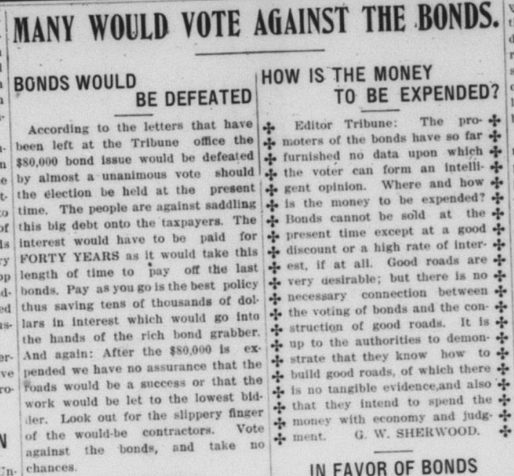


Ultimately, the bonds were roundly defeated. Fullerton would have to fund its road improvements some other way. The more things change, the more they stay the same.

The St. George Hotel
The large St. George Hotel, one of Fullerton’s first buildings, got a new owner. This building (near the northeast corner of Harbor and Commonwealth) has since been torn down.

Culture
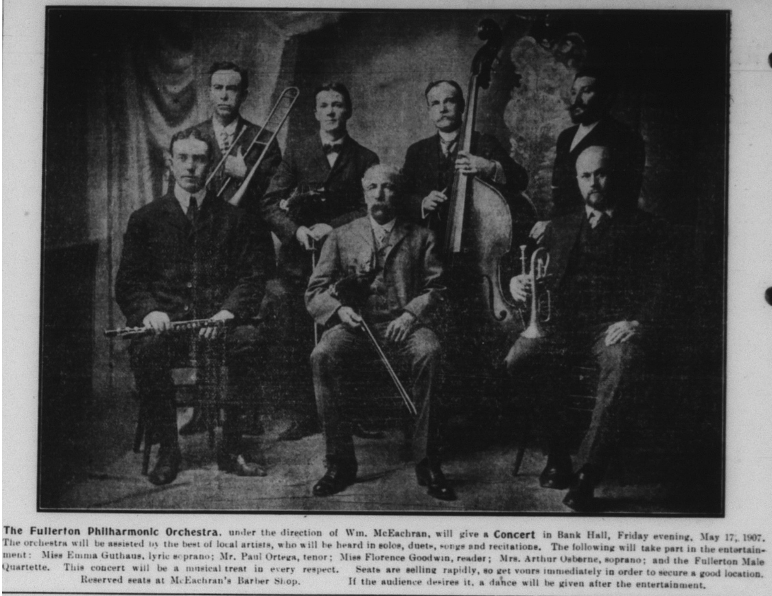
Fullerton had its own small orchestra, led by William McEachran.
Sports
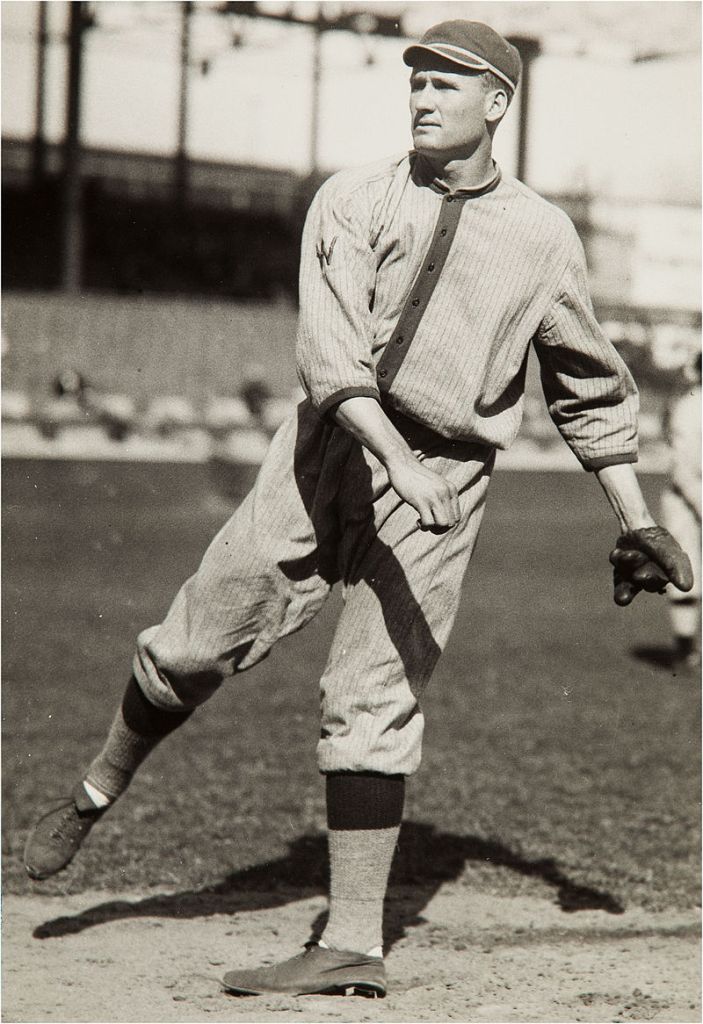
Walter Johnson, a future Hall of Famer, had been a pitcher at Fullerton High School. He went on to play for the Washington Senators, and became a source of pride for Fullertonians.

Here is a photo of Walter Johnson, taken by photographer Charles Conlon, circa 1910.
Click HERE to read highlights from previous years.
-
Early Settlers: Jacob Stern (General Store/Real Estate owner)
The following is from a work-in-progress about the history of Fullerton. You can support my ongoing research and writing on Patreon.
There are two shows on Netflix right now called “Selling Sunset” and “Selling the OC” which follow the activities and drama of the Oppenheim Group as they sell upscale SoCal real estate. The two owners of the company are Jason and Brett Oppenheim, who are the great great grandsons of Jacob Stern, who had a unique connection to Fullerton.
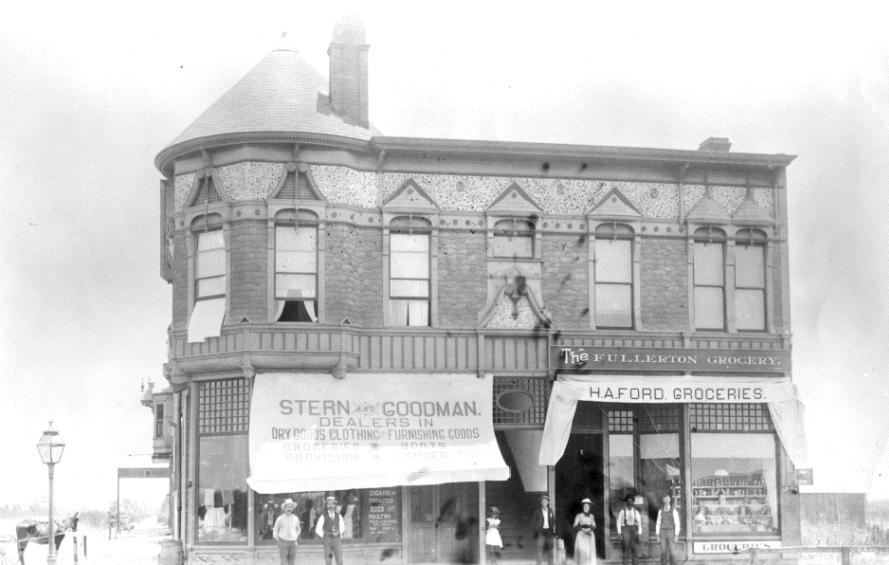
Stern and Goodman Store at the southeast corner of Spadra (Harbor) and Commonwealth in 1890. Photo courtesy of the Fullerton Public Library Local History Room. Stern opened the Stern & Goodman mercantile company in 1889, one of the first businesses in town, and he became a major landowner in southern California, including Hollywood–at one time owning over 20,000 acres of prime real estate. It was on the Stern property near Hollywood and Vine that the first feature length motion picture was filmed by Cecil B. DeMille for what would become Paramount Studios.
The following bio of Jacob Stern is taken from John McGroarty’s book From the Mountains to the Sea: a History of Los Angeles, the journal Western States Jewish History (Vol XV, No. 4 July 1983, and Vol. XLIV, No. ¾ Spring/Summer 2012,), and the web site Hollywood Heritage.
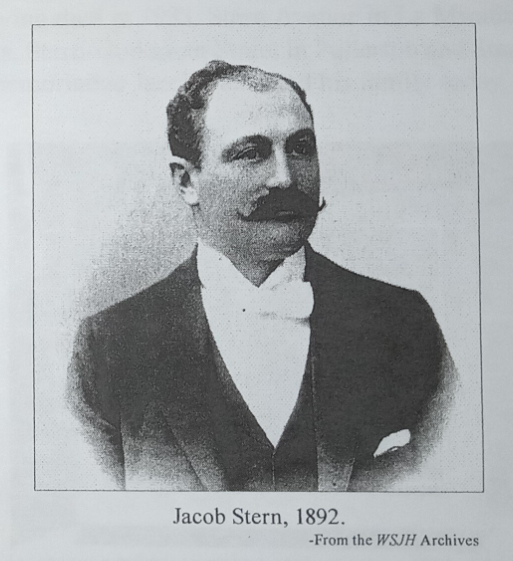
Jacob Stern was born in Saxony, Germany, September 20, 1859, to Marcus and Rosetta (Goodman) Stern. His father was a dealer in hops and cattle. Until age 20, Stern worked on the family farm.
In 1884 he emigrated to the United States, landing first in New York, and then Cleveland, Ohio. For about five years he worked for the wholesale clothing house of Lehman, Richman & Company at Cleveland.
In 1889, he came to the newly-formed town of Fullerton, California with his cousin Joseph Goodman, and they opened the Stern & Goodman general store at the southeast corner of Spadra (now Harbor) and Commonwealth Avenue.
They sold clothing, furniture, farm equipment, livestock, wagons, carriages, and more. Eventually the store expanded into a chain of five outlets: Fullerton, Olinda, Yorba Linda, Placentia, and Brea. It was one of California’s first chain stores.
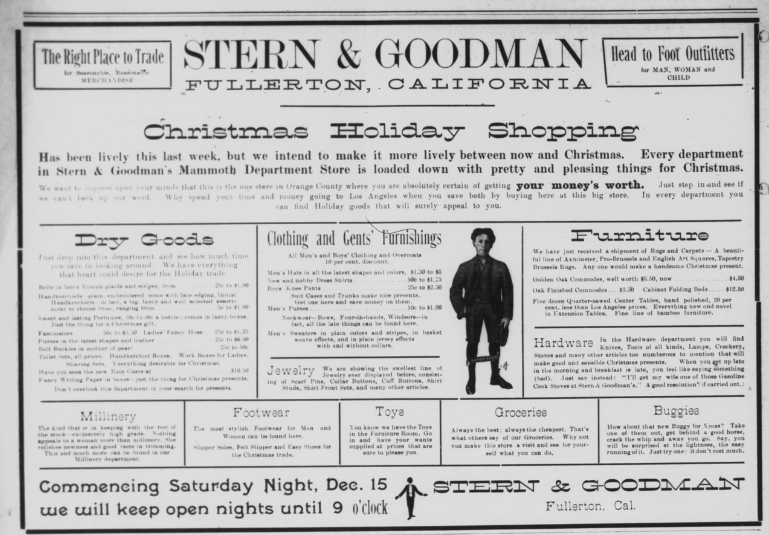
1907 Stern & Goodman advertisement in the Fullerton Tribune newspaper. Courtesy of the Fullerton Public Library Local History Room. In addition to being a retailer, the store operated sort of like a bank for farmers. According to Western States Jewish History: “Stern and Goodman loaned the Orange County farmers seed and farm supplies each year, settling up their accounts when the crops came in. In times of crop failure, the farmers were carried for another year or longer.”
It was estimated that three-fourths of the hay and grain business of Orange County was handled by Stern.
In 1891 in Los Angeles Stern married Sarah Laventhal, daughter of Elias Laventhal, a pioneer settler in Los Angeles County.
Sarah’s father Elias Laventhal had arrived in Los Angeles in 1854 and “was one of a group of men who organized the Hebrew Benevolent Society of Los Angeles, the first Jewish group of what was to become the second largest Jewish community in America.” (WSJH)
The Sterns had four children: Harold, Elza, Helen, and Eugene. For a number of years the family lived in Fullerton, but in 1904, they bought the large Colonel Northam home in Hollywood, at the corner of Vine Street and Hollywood Boulevard which McGroarty described as “one of the show places of the beautiful Hollywood District.”
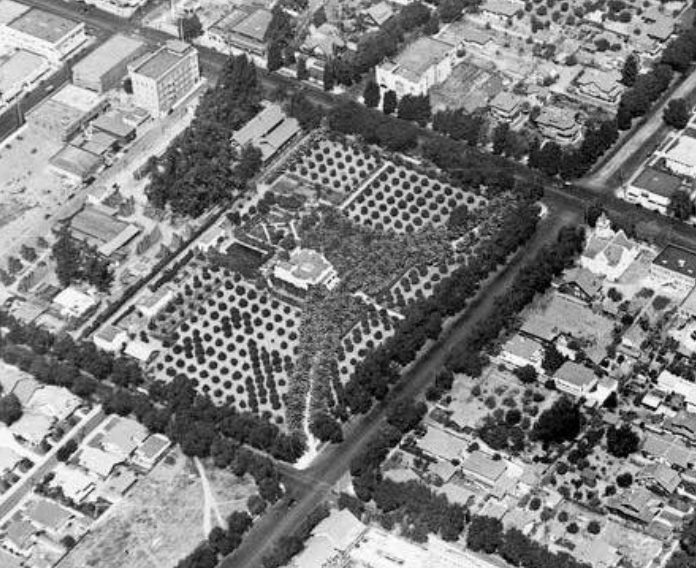
Aerial view of Jacob Stern’s residence at Hollywood and Vine in 1920. Photo courtesy of Los Angeles Relics. Below are some postcards of the Stern residence in Hollywood, called Casa de Las Palmas, courtesy of Hollywood Heritage:
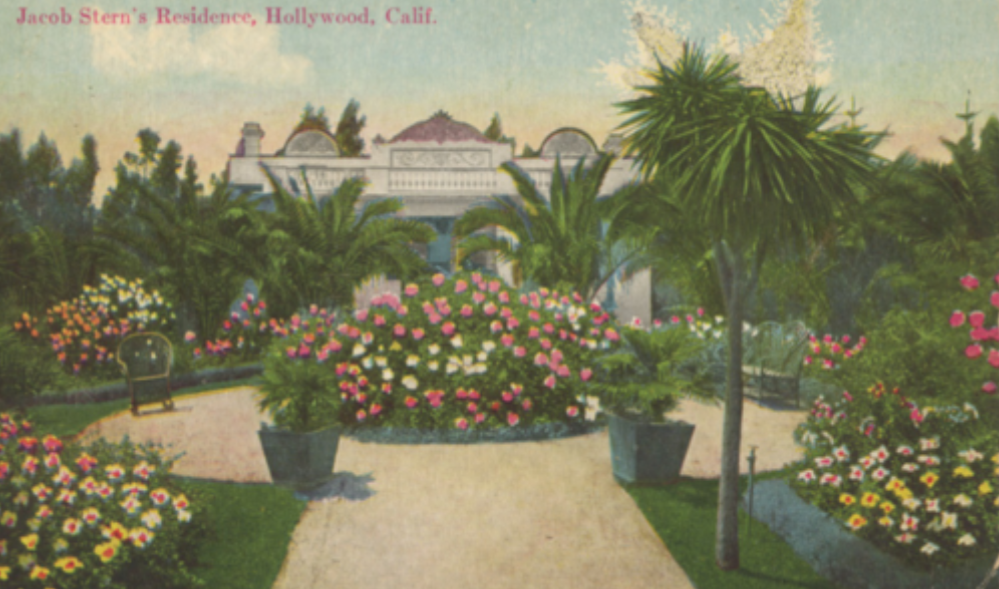
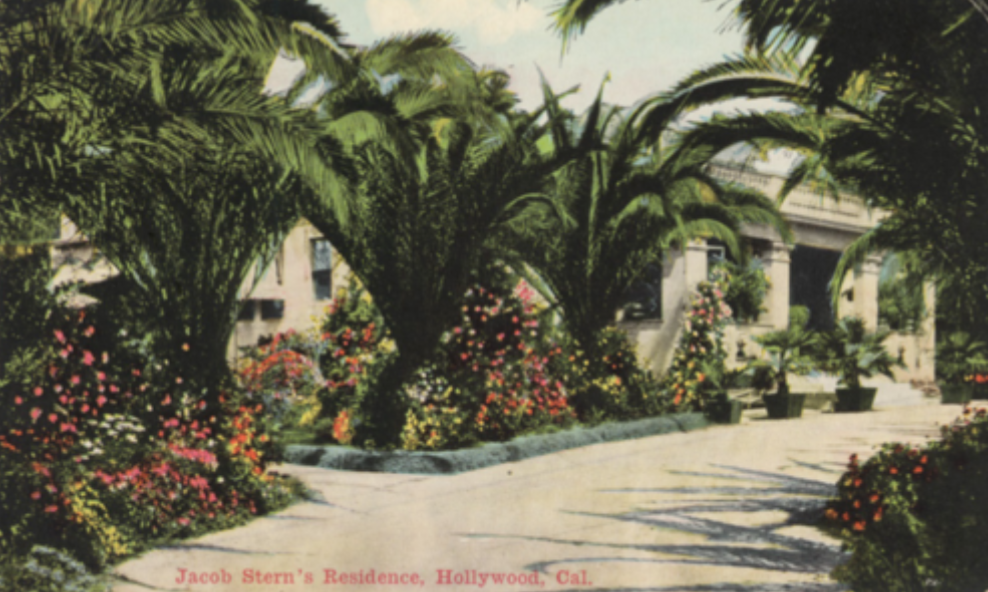
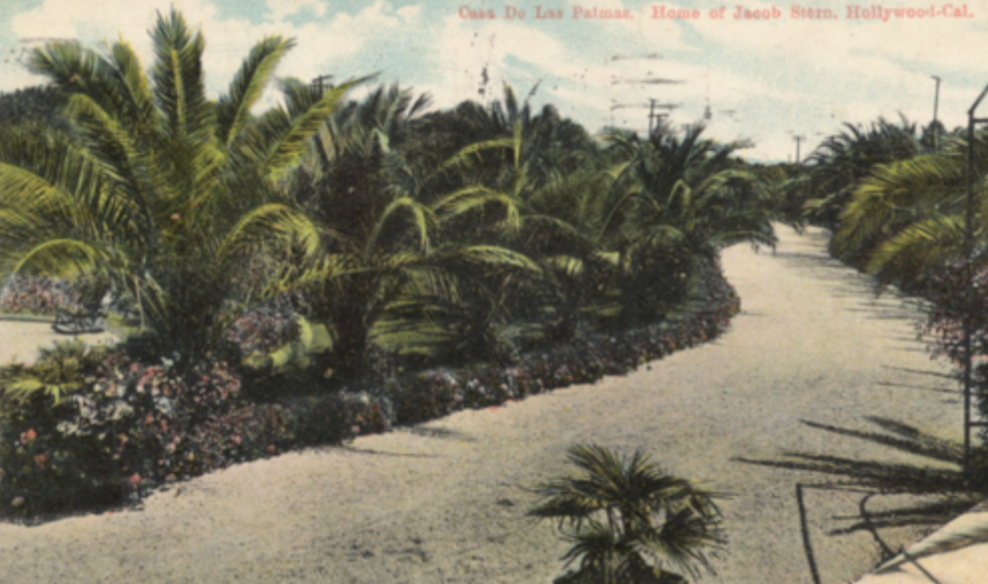
In 1904 Mr. Stern opened his real estate office in the Pacific Electric Building in Los Angeles.
The Stern Realty Company incorporated in 1911 and specialized in residential, agricultural, and oil lands mostly in Los Angeles and Orange County.

Jacob Stern, circa 1911. Photo courtesy of Hollywood Heritage. Stern eventually became one of the largest landowners and wealthiest businessmen in southern California, owning more than 20,000 acres of land.
“The great extent of his present interests cannot be confined to any one building or even a single county of California,” McGroarty wrote in 1921. “It is said that Mr. Stern owns land in nearly every county of California.”
Stern & Goodman sold their stock of goods at their Fullerton store in 1918, but still retained ownership of the block.
In 1912, Stern leased two-acres of his property at Vine and Selma, which contained his barn, to the Lasky Feature Play Company, which became Paramount Studios.
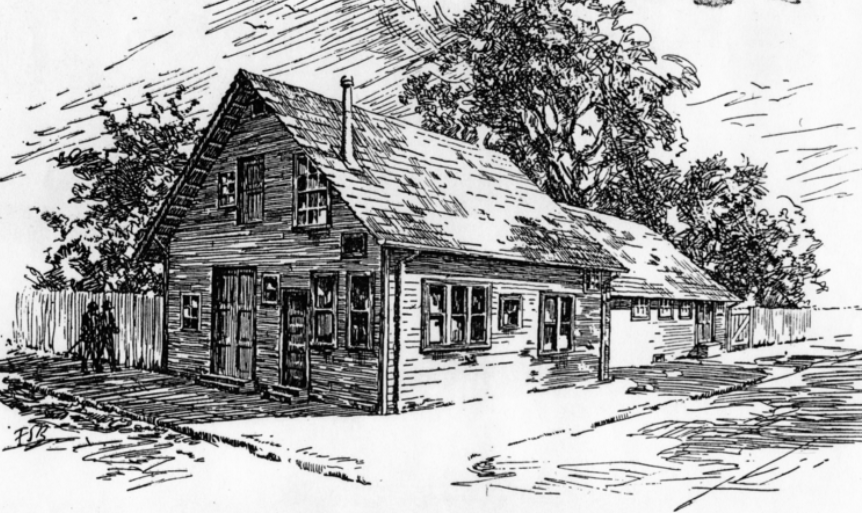
Sketch of Stern barn, circa 1912. Courtesy of Hollywood Heritage. According to Western States Jewish History, “It was in the Stern barn that Cecil B. DeMille, Samuel Goldwyn and Jesse Lasky made the first feature-length motion picture, ‘The Sqaw Man.’ The budget for that film, made in 1913, was $15,000…In December, 1956, a California Registered Landmark plaque, No. 554, was placed on the barn, titled ‘Hollywood’s First Major Film Company Studio.’”
In 1925, with southern California growing rapidly, Stern built the Hollywood Plaza Hotel on his property.
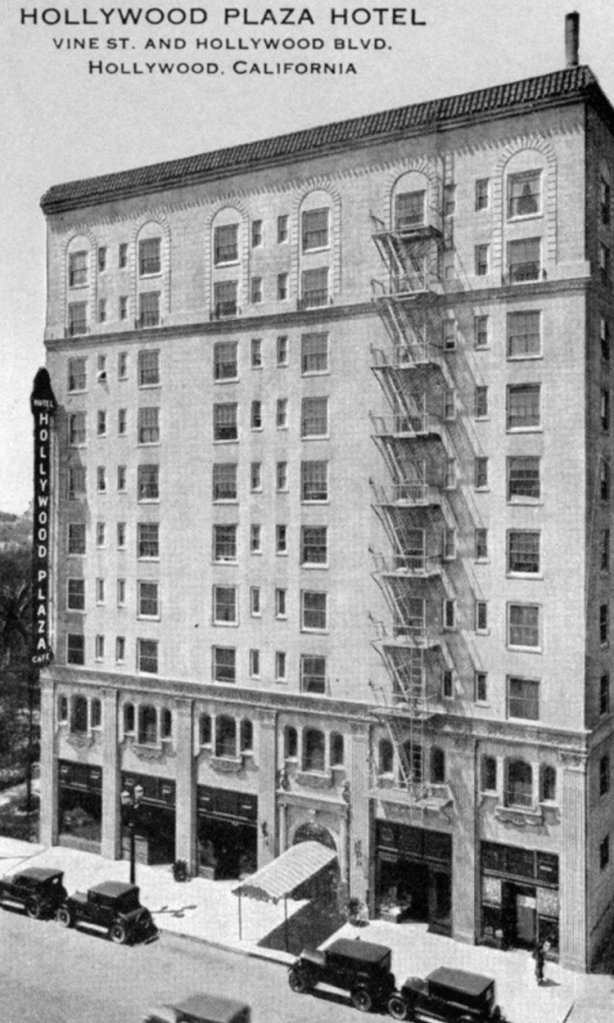
1927 postcard of Hollywood Plaza Hotel, courtesy of Hollywood Heritage. According to Hollywood Heritage: “In the early years of Hollywood, the hotel became the home of many stars looking for a place to live while filming or performing on radio at one of the nearby studios. Legendary stars like Marilyn Monroe, Doris Day, Jackie Gleason, Betty Davis, and even Frank Sinatra all stayed at or frequented the hotel.”
Stern lived at his home on Hollywood and Vine until 1930, when he moved to the Holmby Hills area of Los Angeles.
Jacob Stern died in 1934, just a year after his wife passed.
Many streets and even some monuments still bear his name, such as Stern Avenue in La Mirada, Stern Avenue in Van Nuys, Stern-Goodman Street in Fullerton and Stern’s Park in Los Alamitos.
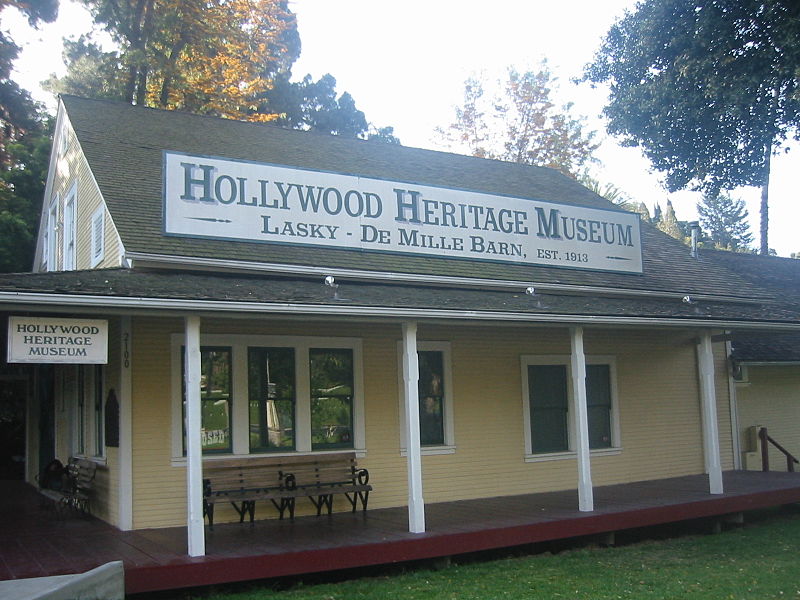
Perhaps most notably, the barn which Stern leased for the first motion picture has since become the Hollywood Heritage Museum, and is located at 2100 N Highland Ave, Los Angeles, across from the Hollywood Bowl. According to Wikipedia, “The Museum features archival photographs from the silent era of motion pictures, movie props, historic documents and other movie related memorabilia. Also featured are historic photographs and postcards of the streets, buildings and residences of Hollywood during its golden age. Special events entitled ‘Evenings at the Barn’ are open to the public and regularly programmed including speakers, screenings and/or slideshows with a focus toward Hollywood’s early history.”
-
Fullerton Tribune: 1906 Headlines
The following is from a work-in-progress about the history of Fullerton. You can support my ongoing research and writing on Patreon.
The Local History Room of the Fullerton Public Library has microfilm from the Fullerton Tribune newspaper stretching back to 1893. I am in the process of reading over the microfilm, year by year, to get a sense of what was happening in the town over the years. Here are news stories from 1906.
Click HERE to read highlights from previous years.
Prohibition
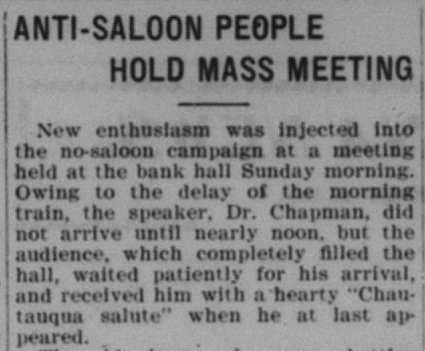
In 1904, the year Fullerton incorporated, the town’s residents (who were quite divided over whether to prohibit saloons), voted to allow them. Two years later, in 1906, the town voted to outlaw them.
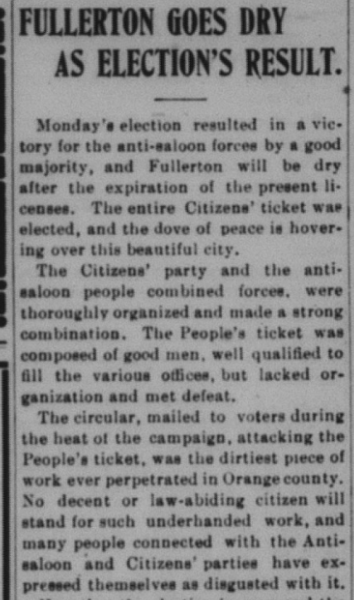
This was the result of years of organizing by the Women’s Christian Temperance Union and the Anti-Saloon League.
Local Government & Politics
As mentioned above, 1906 was an election year, and Tribune editor Edgar Johnson clearly had his favorite candidates. Prior to the election, he ran articles/editorials that advocated for what he called “The People’s Ticket,” which included City Trustee candidates E.R. Amerige, R.T. Davies, and L.P. Drake.

This was in contrast to what Johnson called “The One-Man Power Ticket.” That one man was Charles C. Chapman, whom Johnson had taken to calling the town “Czar” and “The Great I Am.”
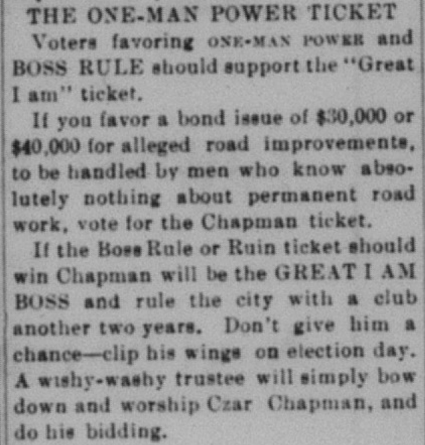
Unfortunately for “the people,” the Chapman ticket swept the race. Chapman, for some reason, was not up for re-election–perhaps he had a four year seat.
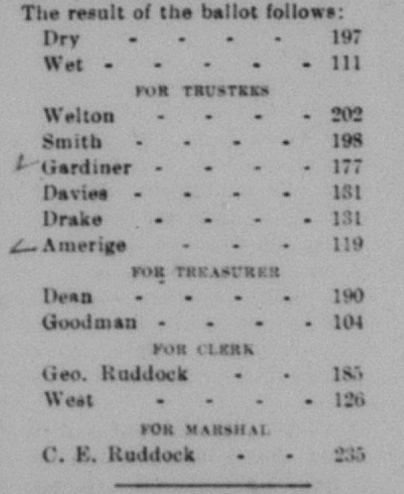
Town co-founder Edward Amerige, who was a part of the “People’s Ticket” wrote a letter to the Tribune after the election condemning dirty political tactics of his opponents. His words show that not much has changed in over a hundred years:
I desire to say a few words in your paper regarding the anonymous letter which was sent through the mails during the recent election. Such a contemptible, sneaking, lying and cowardly act is hardly worth replying to through the medium of newspapers. The proper place to answer such a blackmailing and malicious letter is through the criminal courts and should information be secured as to the authorship of this libelous letter such an action will be commenced. The men and parties who would stoop to such despicable means of trying to influence voters would stoop to anything to carry their ends, and are a dangerous and undesirable element in any community. Several of the parties who are mixed up in this disgraceful attempt to besmirch decent men are supposed to be respectable citizens, but when they resort to such methods and are so cowardly as not to dare sign what they write, they are worse than a coyote that roams in the dark. Fairness is one of the cardinal virtues, and one that every honest man should support and believe in. I know from personal knowledge that a great many voters of the All Citizens’ party condemn this method of securing votes, and are not at all in sympathy with such low methods. Some people attribute to me some of the articles which have appeared in different newspapers regarding Mr. Chapman. I have never written any article in relations to that gentleman; there are other people who do not agree with his political methods than I. The newspapers that publish such are responsible and are willing to stand by what they print or write.
–E.R. Amerige
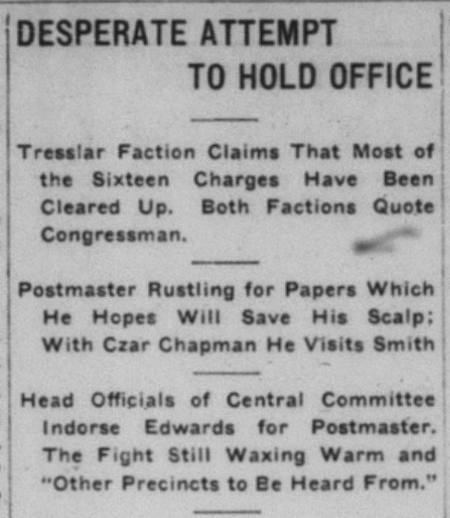
Interestingly, the town postmaster Vivian Tresslar, who was also the man Chapman hired to edit the Fullerton News, was in hot water for alleged legal violations.
Oil!
Although it’s not very evident today, Fullerton at the turn of the century was a very oil-rich region, and numerous wells were being drilled in the hills north of town.

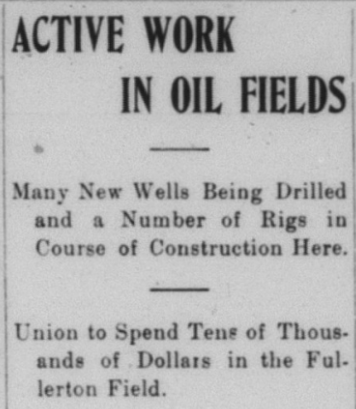
Among the numerous oil interests active in the Fullerton fields was the Murphy Oil Company, who actually screwed the Bastanchury family out of oil they were entitled to.
The story is told in more detail in an article from the web site Basques in California:
“In 1903, the Murphy Oil Company leased the West Coyote Hills lands from the Bastanchury Ranch to dig for oil. One year of excavations found them hot mineral water at 3,000 feet. As one of the oil workers later confessed, they found an oil well at 3,200 feet but covered it up. In 1905, Murphy bought off from Domingo Bastanchury more than 2,200 acres in the surroundings of La Habra, at $25 an acre. Allegedly, Murphy assured Domingo before the acquisition, that those lands held no oil. Time later, the Los Coyotes Hills area became South California’s largest oil field.”


In the oil industry, as in other industries, the larger companies (like Standard Oil) used their power to try crush local competition (like Puente Oil).

Water
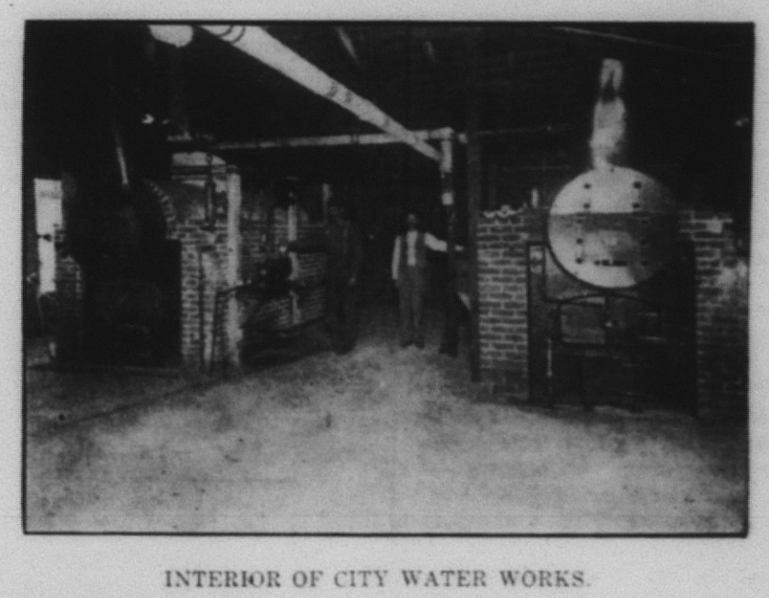
Perhaps the most contentious local water issue of 1906 was the question of whether the city would buy the town’s privately-owned Water Works (a pumping and storage plant) from its owners, the Adams-Philips Co. This issue created much public debate over the economic and philosophical merits of public vs. private ownership of utilities, a debate that feels relevant today. Prior to the election, it appeared that the majority of the citizens of Fullerton favored city ownership of the water works.

Ultimately, however, the issue went to a vote and was defeated. Tribune editor Johnson mused: “with the present plant owned by millionaires and in operation…the longer a city delays in acquiring public utilities, the more expensive becomes the undertaking.”
A group calling itself the Citizens Protective Association organized much of the opposition to the water bond issue.

Electric Power
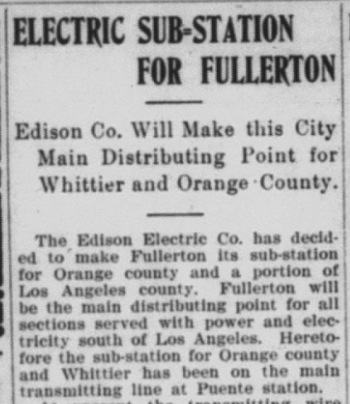
The Edison Co. built an electric sub-station in Fullerton that made the town the main distributing point for Whittier and Orange County.
Death
Fullerton pioneer rancher Henry Hetebrink died. His son John would later build that big old house (now vacant) on the Fullerton College campus, at the corner of Chapman and Berkeley.

Education
Voters approved the site for a new high school building to be built on Commonwealth Avenue, where Amerige Park is today. The community was outgrowing the first brick high school building on Lawrence Ave. near Lemon.

San Francisco Earthquake
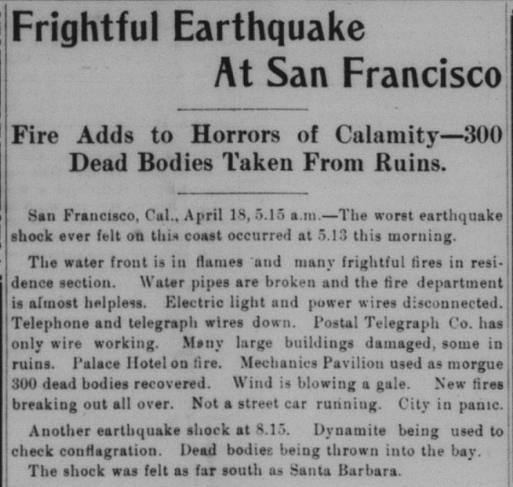
1906 was the year of the great San Francisco earthquake. More than 3,000 people died, and over 80% of the city was destroyed. The event is remembered as the deadliest earthquake in the history of the United States.
Placentia Vegetarians
A Tribune correspondent visited the strange vegetarian colony/commune in Placentia. I plan to write more about them in the near future. In the meantime, check out a brief history HERE.

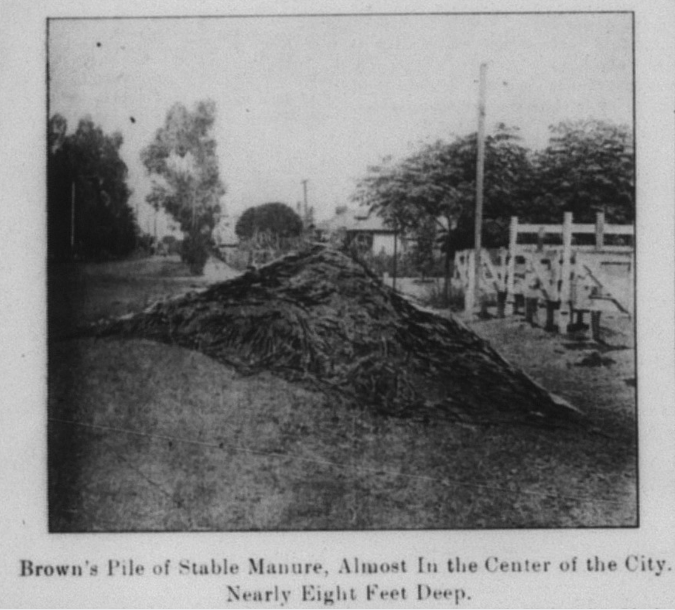
Brown’s Pile of Stable Manure
A Mr. Brown was ordered to remove his massive pile of manure from the center of town.
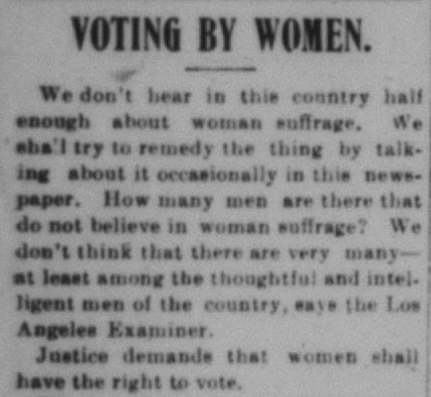
Voting by Women
Women could not vote in 1906. The 19th Amendment would not pass until 1920. In the meantime, some editorials appear in the Tribune on the question of women’s suffrage.
-
Fullerton Tribune: 1905 Headlines
The following is from a work-in-progress about the history of Fullerton. You can support my ongoing research and writing on Patreon.
The Local History Room of the Fullerton Public Library has microfilm from the Fullerton Tribune newspaper stretching back to 1893. I am in the process of reading over the microfilm, year by year, to get a sense of what was happening in the town over the years. Here are excerpts from some of the articles from 1905.
Click HERE to read highlights from previous years.
The Fullerton “Snooze”
Tribune editor Edgar Johnson spends considerable space ruthlessly attacking a competing newspaper in town, the Fullerton News, which was evidently funded by mayor/orange grower Charles C. Chapman because he didn’t like the coverage he was getting in the Tribune. The Fullerton News, edited by a man named Vivian Tresslar, was often mocked by Johnson. When Chapman sought to end the city’s contract with the Tribune to publish official notices and give the contract to the News, Johnson called him “Czar Chapman,” an epithet he would use numerous times.
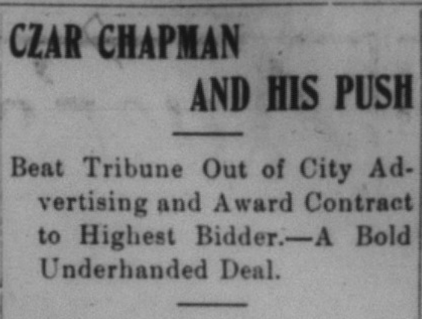
Here are some of the numerous clippings related to Johnson’s mini print war against the Fullerton News:


Prohibition
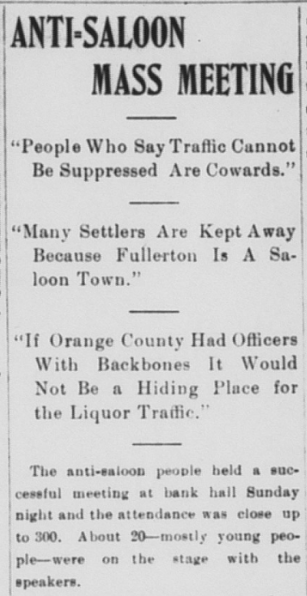
Although a majority of Fullerton residents had voted in favor of allowing saloons in town, the issue continued to divide the community, with the Women’s Christian Temperance Union and Anti-Saloon League still holding regular gatherings.
Death
Tragedy struck the Fullerton community when a four-year-old little girl named Esther Schultz burned to death in a barn fire.

The Pacific Electric
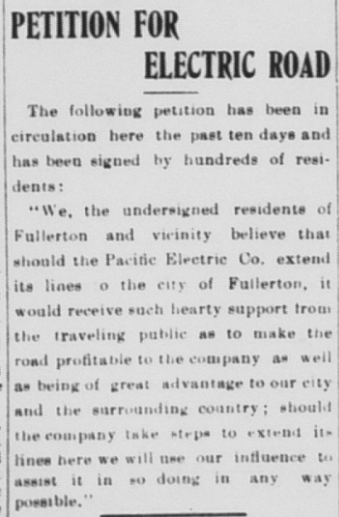
Fullerton leaders and residents wanted the sprawling Pacific Electric passenger rail service to extend to Fullerton.
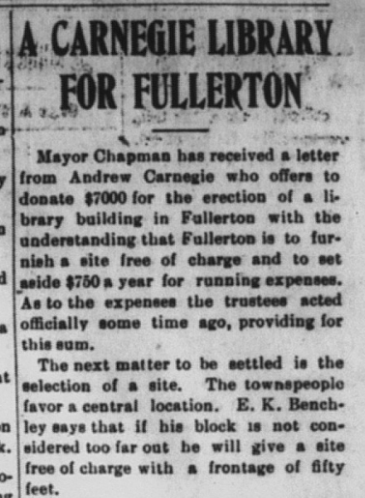
Carnegie Library
Fullerton would receive funding for a new library courtesy of industrialist Andrew Carnegie, who funded numerous libraries around the United States.
Water
As Southern California agriculture grew, securing water became an increasingly urgent issue–some advocated taking water from faraway regions (like the Owens Valley), while others sought to exploit the large (but not well understood) underground aquifers.

Socialist Meeting
Although the minority, socialists were active in Southern California at the turn of the century. Perhaps the most prominent among them was Fullerton’s own Henry Gaylord Wilshire.

Stay tuned for headlines from 1906!
-
Orange County Vietnam Veterans Against the War
The following is from a work-in-progress about the history of Fullerton. You can support my ongoing research and writing on Patreon.
Orange County has long had a well-deserved reputation as a bastian of right-wing conservatism. In the 1960s and early 1970s, the John Birch Society had a strong influence in shaping the consensus of the county. In a paper entitled “Turmoil and Change: An Interim Report on the Politics of Orange County, California, 1945-1979, Charles L. Beaman and Michael Jones write: “More militant and doctrinaire conservatives filled the vacuum left by the withdrawal of moderates. They were more vocally patriotic and anti-Communist, and generally affiliated themselves with the John Birch Society. Their activities at times elicited national press coverage, and helped to create the County’s reputation for being a politically “kooky” bastian of ultra-conservatism.”
In the early 1970s however, with the Vietnam War in full force, there emerged a group of returning Vietnam War veterans who sought to challenge the values of their region, and to shine a light on the real-world consequences of America’s policy in Southeast Asia. Speaking of the Orange County Vietnam Veterans Against the War (VVAW), Anna Acker, author of Coming Home to Orange County: A History of the Vietnam Veterans Against the War (a 2005 CSUF Master’s Thesis), writes, “Their voices and memories challenge the myth of Orange County’s predominant conservative image. Moreover, their stories demonstrate the cracking of the Cold War consensus, and illustrate that the war in Vietnam was based on anti-communist ideology that ultimately proved to be bankrupt.”
In addition to war protests, these OC veterans sought to bring healing to those who suffered from America’s war. They “provided a healing community for veterans, contributed to the research of Post-Traumatic Stress Disorder (originally called Post-Vietnam disorder), advocated for the rights of minorities, promoted women’s rights and condemned sexism.”
By 1967, approximately 500,000 Americans were stationed in Vietnam, and the average age of the soldier was nineteen. Just like today, many of the troops (about 80 percent) came from economically disadvantaged areas, young men who saw military service as a way to advance their lot in life, and perhaps go to college. In his book Working-Class War: American Combat Soldiers and Vietnam, Christian Appy quotes a soldier: “Where were the sons of all the big shots who supported the war? Not in my platoon. Our guys’ people were workers…If war was so important, why didn’t our leaders put everyone’s son in there, why only us?”
Others who joined the war were motivated by a sense of patriotism inherited from their fathers, who had fought in WWII. Veteran Ron Kovic, author of Born on the Fourth of July writes, “We had our plastic Mattie Mattel Sub-Machine guns and we played guns in the woods. We tried to emulate our fathers who fought in WWII. We tried to act like the generation before us who had won the victory…We tried to believe we were John Wayne and I think then when we went to Vietnam we had that myth, that John Wayne myth in our minds and it was to be sadly shattered by the reality of our experience there.”
Calixto Cabrera, a Vietnam Veteran who settled in Orange County after his service, was one of those whose reality was shattered by his experiences. “As far as things that bothered me, there was the attacks on some villages and accidentally killing little old ladies and little old men. That is the kind of stuff that I carried around for a long period of time.”
Mike Beanan was similarly traumatized by the attacks on civilians he was ordered to comply with in Vietnam. “We’re here to collect people and get some information from them. We’re not here to butcher people,” he recalled, “I looked at my bandana and I realized it was all covered with blood, and I puked and I wanted to cry and…I just couldn’t do any of that…and at that time I decided–that this was a bunch of shit.”
Soldiers in Vietnam were not the only ones who became increasingly disgusted with the American policy in Vietnam, with its increased escalation and casualties. Massive protests erupted across college campuses and cities in America. These protests came to a head in 1970, when the National Guard was called in to quell protests at Kent State University in Ohio. There, four unarmed student protestors were shot and killed by employees of their own government. The reaction to this violent attempt to suppress free speech and protest spread across the whole nation, and even reached Orange County.
Acker writes “Orange County student activists united in rage and animosity against the tragedy of Kent State. The eruptions at universities throughout the country were unprecedented in American history as three hundred and fifty schools nationwide went on strike. Orange County’s California State University, Fullerton, “bore striking similarity to events on university campuses across the nation where student radicals and law enforcement clashed.” Navy veteran Dan Kelly (who would join the Orange County VVAW) recalled how the movement began, and the students at CSUF rallied in desperation to stop the war.”
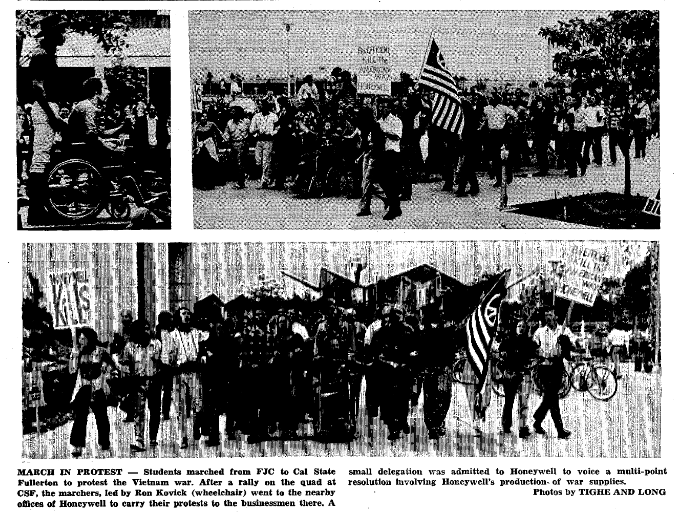
Clipping from May 5, 1972 Fullerton College Hornet newspaper. Courtesy of Fullerton College online archives. Returning veterans like Dan Kelly, deeply traumatized by their involvement in what they perceived to be an unjust war, were not met with the welcome reception that their WWII fathers received. Acker writes, “Kelly enrolled at Fullerton Junior College…It was hardly a month after moving into the college dorms when he was eating in the cafeteria where four students surrounded him and began screaming that he was a ‘baby killer.’ The students’ harsh insults were more than he could bear. ‘I was hysterical for eight or ten hours.’ Kelly remembered.”
Orange County Vietnam veterans like Calixto Cabrera, Dan Kelly, Bill Unger, and Bill Hager turned their rage and trauma into positive social action, helping to found the Orange County chapter of the VVAW, which organized protests, newsletters, “rap groups,” and services for veterans trying to find their way back into society. Cabrera participated in a “medal throwing” ceremony in Washington, in which veterans threw their medals of (dis)honor back at the White House. He recalls, “It was great politics. Once again focusing the eye of the nation that the veterans are so disenchanted that even these medals that the government holds so high and honorable that they give you for valor, were nothing more than pieces of tin we threw at the White House…We are the guys that went over there and did the job and came back and said what we did was wrong.”
The actions of the VVAW, both nationally and locally, played a significant role in shifting public opinion. These were not “privileged college hippies” but real American veterans who had changed their minds about a war that would ultimately prove morally bankrupt and unwinnable.
The OC VVAW also directed their protests locally, to the “Western White House” (aka Casa Pacifica) of Orange County’s native son, president Richard M. Nixon. Acker writes: “On April 2, 1973, three hundred antiwar protestors marched down Avenida Del Presidente to a tightly secured perimeter of the Western White House in San Clemente, California. Along the outer limits of the property–surrounded by a riot squad of police and their guard dogs–a barricade of concerned FBI agents prepared for any unwarranted activity by the demonstrators. The demonstration, sponsored by Vietnam Veterans Against the War, was one of hundreds planned by the organization that the Nixon administration had closely monitored since its formation in 1967.”
Vietnam Veteran Butch Findley, who joined the OC VVAW in 1973, felt that the county’s strong conservative history made the formation of a dissent group all the more important. “Nixon’s reelection committee was right there in Newport Beach,” he recalled, “And that is why it was so important that Orange County have a strong organization.”
Bill Hager, a Vietnam veteran who returned to San Clemente to attend Saddleback College, ended his career in the military when he was asked to teach riot control classes for the college campuses. As he met with other OC veterans like Unger, Cabrera, and Kelly, he began to become increasingly involved with the anti-war movement. In 1972, Hager led hundreds of VVAWers on a 3,000 mile trek across America called “The Last Patrol.” Their destination was the Republican National Convention in Miami, where they intended to speak out against the war. Writer Hunter S. Thompson called these veterans “golems, come back to haunt us.” When Hager and the Last Patrol arrived in Miami, they were met by around a thousand Florida National Guardsmen. The veterans wanted to be allowed into the convention. Three were allowed in, including Ron Kovic, who was spat upon and thrown from his wheelchair.
The OC VVAW also participated in the Long Beach Veteran’s Day Parade, alongside local groups like the Veterans of Foreign Wars, the American Legion, and the John Birch Society. At first, parade officials said the VVAW could not participate. They took the issue to court and were granted a permit. Ultimately, they were forced to march behind the street sweepers at the end of the parade. Acker writes, “Their appearance behind the street sweepers personified America’s hidden shame.”
In addition to protests, the OC VVAW sought to challenge military recruitment efforts on college campuses: “When military recruiters visited the college campuses, VVAW set up tables next to them to persuade potential enlistees to seek other career options and distributed fliers on the Irvine campus, which advocated for direct student action to terminate the ROTC program.”
After interviewing dozens of Orange County Vietnam Veterans Against the War, local historian Anna Acker wrote: “In the Orange County chapter’s short but influential existence, these antiwar veterans rapped, demonstrated, studied, and sought to influence the political process. In a community known for its conservative political leanings, the VVAW ‘hit the Nixonettes’ on the college campuses to enlighten students on the immorality of the war.”
“In the middle of that conservative bastion, you had little environmental movements, little women’s movements, the antiwar movement, worker’s rights movements, and student activism,” said Cabrera, “It is good for people to find that things have gone on there, that it is not one color, one blend or one slant on anything.”
-
Kids of the Black Hole: Punk in Southern California
The following is from a work-in-progress about the history of Fullerton. You can support my ongoing research and writing on Patreon.

In the book Kids of the Black Hole: Punk Rock in Postsuburban California, Dewar Macleod writes, “For those whose eyes and ears were open, who were waiting for something to happen in a world where nothing was happening, punk rock offered an alternative, as music, as vision, as culture. From 1977 through the 1980s, punk rock spoke to more and more young people throughout Southern California, embodying their experiences, shaping their identities. They craved a personal connection to the their music and a music that could express their sense of the world.”

Punk was not born in Los Angeles, however. It arrived first from New York (from The Ramones) via London (from The Sex Pistols), but it spread quickly in Southern California. Early LA bands like The Germs, The Weirdos, and The Dickies adopted the styles and attitudes of British and East Coast punks and quickly created their own scene, though the DIY (do-it-yourself) ethos, starting their own record labels (like Bomp!), booking their own shows at divey clubs (like The Masque), and spreading the punk gospel through zines (like Slash).
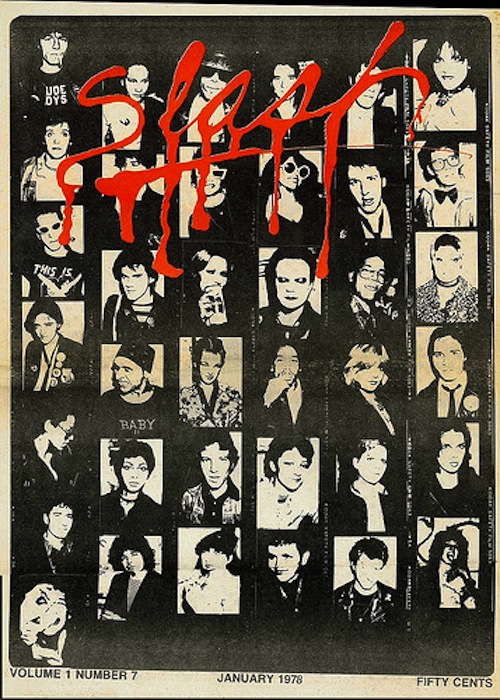
Punk music was, in part, a reaction to the blandness of the music business in the 70s. In a 1977 issue of Flipside zine, one of The Weirdos said, “There’s so much shit that the industry’s produced. Just listen to the radio and it all sounds pretty much the same. For me and the guys in the band, it’s more a revolt against all this boring shit. Even with all the stuff that’s out, the radio still does the same thing. There’s nothing fresh–nothing new. All the industry does is take a lot of money and make something real slick–over and over again.”
According to Greg Shaw, founder of Bomp! records, “The best culture is one that involves everybody, it’s participatory…You are not a passive consumer.” Punk was created by the people, for the people. It was raw, sometimes angry, and sincere. “Punk was like when you first discover folk art as some wonderful thing,” KK Barrett of the Screamers remembered, “All of a sudden you like the mistakes, the handicraft of it, the personal naiveté.” Sociologist Stephen Duncombe defines DIY as “at once a critique of the dominant mode of passive consumer culture and something far more important: the active creation of an alternative culture.”
Interestingly, punk was not a strictly urban (LA, NY) phenomenon. In Southern California, it quickly began to infiltrate the suburbs of Orange County with bands like The Adolescents, Social Distortion, and The Middle Class. By the 1970s, suburbs that were once “bedroom communities” serving larger metropolitan areas, began to transform into “post-suburbia”–self-sufficient, mixed-use regions of housing, factories, offices, shops, and services. Macleod writes, “Just as the U.S. census of 1890 declared the western frontier closed, the census of 1970 declared the closing of another frontier: the ‘crabgrass frontier.’”

Eddie of the OC band Eddie and the Subtitles described Orange County in the 1970s as “an unbelievable, mindless, sexless, funless monster that should be permanently shut down.” The “post-suburban” towns of Orange County began to spawn their own unique brand of punks, who were “now fully ‘postmodern youth,’ whose alienation resulted from the corporate-controlled media and consumer environments [which] increasingly supplanted the home, family, school, and workplace as sites for socialization.”
Macleod explains, “Young people in post-suburbia were now not simply consumers, but…an active participant in the shopping spectacle. For these young people, the shopping mall is not merely an economic space where exchanges take place but a symbolic social space for everyone to come alive in and a pervasive metaphor for life. This condition affected youth throughout society, not merely ‘delinquents’ or members of subcultures. All youth–especially in post-suburbia–were increasingly hailed, identified, and self-identified as isolated, fragmented, individual consumers.”
In his essay “Inside Exopolis: Scenes from Orange County” sociologist Edward W. Soja describes the region’s “creatively erosive postmodern geographies…where everyday life is thematically spin doctored and consciousness itself comes in prepackaged forms.” Macleod explains how “the car, the mall, the office park, and tract home replaced the street as the sites for everyday life. What was historically new by the 1970s was the destruction of public space, and the accompanying commodification of private space.” Politics came to be dominated by massive faceless development companies like “the Irvine Company, which held almost complete control over the political, economic, and social development of the region in the post-war period.”
Politically, Orange County was very conservative, spawning such punk-hated politicians as Richard Nixon and Ronald Reagan. The Lincoln Club, the “good old boys” Republican bankrollers, were firmly entrenched in Orange County, and helped get Reagan elected. Hand in hand with the conservative politics went mega-churches like Costa Mesa’s Crystal Cathedral and the Trinity Broadcasting Network.
Because of the economic and social value of real estate in Orange County, the politics in the OC were “increasingly centered around issues of homeowner self-defense.”
Given such artificial, “creatively erosive”, isolated, conservative, self-centered environments as Orange County cities, is it any wonder that young people would seek to rebel and create their own, creatively vibrant communities?
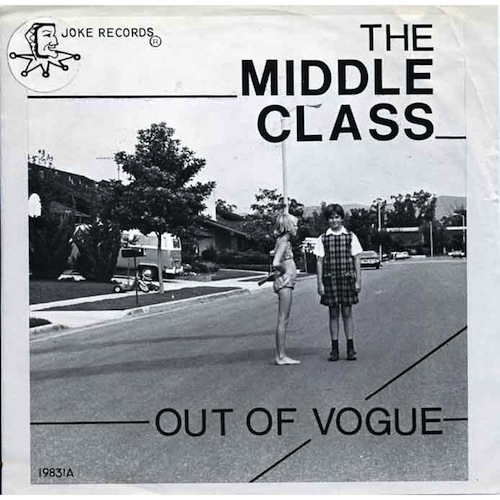
There is an entire section of the book Kids of the Black Hole devoted to the band The Middle Class, and I will quote it verbatim, because it’s good:
“The Middle Class–three brothers (ages fifteen, seventeen, and twenty-one) and a friend from Santa Ana and Fullerton down in Orange County–had ventured the two-hour drive into the Hollywood scene as early as 1978, when they went to Brendan Mullen hoping for a gig at the Masque and almost got laughed all the way home. “Having been advised to cut their hair and punk-out their dress, they were summarily dismissed to the suburbs, presumably to pass into a well-deserved obscurity,” one zine writer observed. “However, fate intervened in the form of Hector of the Zeros who booked them as opening support for a show featuring The Controllers and The Germs and, after that, for the next six months, they played support to many of the local Holllywood scene bands.’ After their first show at Larchmont Hall in April, where the crowd ‘stood in a semi-circle and nobody moved,’ they gigged regularly as the token ‘suburban’ band. Slash referred to their first show in a column titled “The ‘Hey, You Mean They Got Punks in Those Places??’ Dept.” Noting the blasé reaction and blank stares The Middle Class received, Slash commented, ‘sometimes them scene-making punx are worse than the fuckin’ Spanish Inquisition!” and asked the prescient question, ‘Will the next New Wave come from the great Wasteland?’ (This was at a time when the term ‘new wave’ had not yet been rejected by punks.)
The Hollywood scene accepted the Middle Class, at least to some extent. But even when some of their members moved into the Canterbury (apartments in LA–a sort of punk commune), they did not lose their identity as a ‘suburban’ band, and the insider crowd did not quite know what to do with them. Taking the stage looking ‘like a bunch of rampaging Scientologists,’ they defied all fashion and music conventions even at a moment when conventions were not so rigidly set within punk. By the summer of 1978, they were making converts, as this Slash review attests: ‘These guys looked normal. Like writing a paper in the library normal. How come they sounded like twisted metal air raids and dynamite fumes? I was shocked. If you look like that, you’re not supposed to sound like that. Yet it was obvious: the mob was pogoing with genuine furor, the aggression meter was in the red zone, this was certified punk fever grade triple-A beware of imitations. I’ve seen fast bands, but these unknowns run with the best.” The reviewer concluded, “And that curly-haired singer should, according to basic laws of physics, end up with his vocal chords tied in a knot after 5 minutes.” Another Slash reviewer the following month described their shows as “intense, teeth-gritting affairs that leave the participant dazed, stunned, even irritated.” The reviewer noted the ‘chaos and confusion’ that resulted from ‘the incitable nature of their strange, assaulting music coupled with the growing number of their unpredictably rabid fans.’ The cumulative effect was ‘not unlike kissing a semi at full speed.’
The Middle Class never brought their own crowd of fans and followers with them to Hollywood, but they never completely left their post-suburban home, either. Like traditional bohemians, and like other LA punks, they made the trip into the city to enact their art. But they did not reinvent themselves completely in the process. They didn’t change their names, and they didn’t change their dress. The cover of their record ‘Out of Vogue’–a diatribe against mass culture–depicts a mundane Southern California suburban scene: two young girls stand in the middle of a street, surrounded and almost dwarfed by the still life of a housing tract with Big Wheels, a basketball backboard, and a Volkswagen bus in a driveway. The cover scene depicted not only their roots, but their continuing daily reality as ‘the MIddle Class’ and they returned to these images throughout their career. As a post suburban band, the Middle Class redefined the aesthetics of punk, both musically and visually.”
Members of The Middle Class started booking shows at The Galaxy in Fullerton, a roller rink turned punk venue. Other Orange County bands followed the lead of these suburban pioneers, formed bands, and started playing a new variety of punk invented by The Middle Class–hardcore. As the name suggests, the music was especially aggressive form of punk, often raging against the cultural and political wasteland that was 1970s and 80s Orange County.
Out of Hermosa Beach came Black Flag, who helped establish The Church (literally an old church building) as a haven for punks to rehearse, play shows, and live. An early bass player from Black Flag described one of their early practices:
“BANG!! the drummer started smashing out a fast trashy straight 4 pattern and the wiry little singer started bellowing around wildly and Greg’s body lurched forward as he underwent a remarkable transition from Jeckyl to Hyde. His head shook, eyes flashed and teeth bared maniacally as he began to grind thick chords out of a guitar that in the shadowy light could have been mistaken for a chainsaw. Within seconds it was over. Jeckyl calmly stepped out of his Hyde as if stepping out of a routine nightmare.”
In true DIY fashion, Black Flag eschewed the record industry and formed their own label, SST Records.
Macleod writes, “New punk bands emerged in droves, and while many of them merely played the 1-2-3-4 sound of the Ramones as fast as they could, others introduced interesting variations, combining diverse influences and sounds. Over the next couple of years bands from around the South Bay and inland Orange County came to play parties in Huntington Beach–new bands like the Circle Jerks, Red Cross, the Adolescents, Agent Orange, and Social Distortion, in addition to the Middle Class and Black Flag. Eventually a couple of key clubs began to book hardcore shows in post suburbia: the Cuckoo’s Nest in Costa Mesa and the Fleetwood in Redondo Beach.”

Mike Ness of Social Distortion made his Fullerton apartment into a haven for local punks, which was immortalized by the Adolescents song “Kids of the Black Hole.”
Out of Hermosa Beach came The Descencents, whose music offered an ironic commentary, like the song “Suburban Home”:
I want to be stereotyped
I want to be classified
I wanna be a clone
I want a suburban home
I wanna be masochistic
I wanna be a statistic
I don’t want no hippie pad
I want a house just like mom and dad
In many ways, the punks succeeded in creating something new and distinct from the cultural norms they had inherited. Through music, zines, and communal spaces, “punks created a dispersed, yet interconnected mass subculture.”
-
God Save The Beard!: Part 2
The following is from a work-in-progress about the history of Fullerton. You can support my ongoing research and writing on Patreon.
Here is part two of a story about an obscenity trial held in Fullerton City Hall in 1967. Part 1 introduces this fascinating episode in local history in which ultra-conservative politicians like John Schmitz (a member of the John Birch Society) called a special senate hearing after a performance of an experimental play called The Beard, by Beat generation poet and playwright Michael McClure. The Beard is a about a fictional encounter in heaven between Billy the Kid and Jean Harlow, which culminates in a simulated act of oral sex (not actual oral sex). At that time, “oral copulation” was a felony in the state of California.
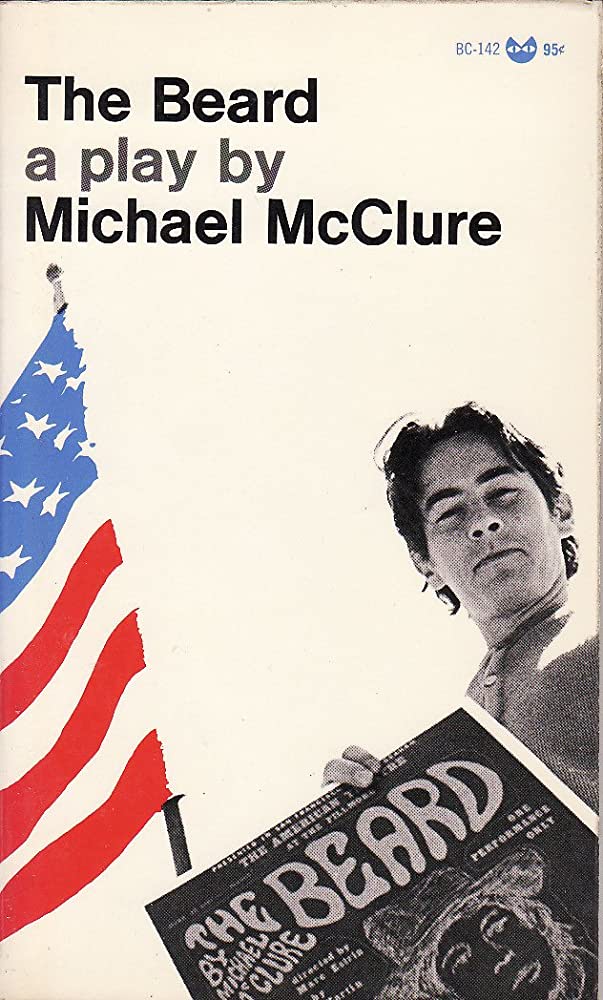
Although the showing of The Beard was a private performance, some members of the local press got word of it, and got in, and ran headlines like “Lewd, Smut-Ridden Play Given at Cal State Fullerton.” This issue caught the attention of conservative local politicians. Historian Lawrence de Graaf writes, “Seizing an opportunity for publicity in an upcoming election year, politicians from Orange County joined the attacks.” A Special Senate Committee on Pornographic Plays was created and they subpoenaed the director Terry Gordon, the actors, his professor Edwin Duerr, CSUF president William Langsdorf, and many others.
The entire transcript of these hearings was recorded and published by the Senate of California. I found a copy of it in a special exhibit on “Banned and Challenged Books” in the CSUF library. Below are continued excerpts from the trial:
[Terry Gordon, the director of The Beard, takes the stand]
Senator Richardson: Mr. Gordon, what were the other plays that you directed?
Mr. Gordon: The Dutchman, and The Madness of Lady Bright.
Senator Richardson: What was that play about?
Mr. Gordon: Basically the plot is concerned with a homosexual who is a very lonely man in his old age, and towards the end of the play…he goes insane because of his problems that he has had in the past with his family, society, acting upon him, problems imposed upon him.
…
[Dr. James Young, head of the Drama Department, takes the stand]
Senator Richardson: There’s another play that I see you are going to be putting on soon that I am rather curious about. It’s called The Knack. May I read from the Titan Times, which is a publication, I believe. It says:
“Seduction is the knack of ‘The Knack,’ an eccentric comedy in three acts by Ann Jellicoe, which comes sliding in on a splendid blaze of nonsense Friday, Saturday, and Sunday…A genuinely comic play of antics and random images, ‘The Knack’ centers on the gentle art of getting girls.” What do they mean exactly by “getting girls”?
Dr. Young: I talked to the student who put this particular article in the paper and asked about even the pictures which were superimposed thereto, and he said, “Oh, come on, Dr. Young, this is the way we advertise. You see it in the paper all the time, don’t you?” And I said, “Well, yes you do, but don’t you think we could have overlooked it at the present time?” And he said “No.”
Chairman: I want to commend Dr. Young for his honesty.
Senator Richardson: May I go on: “…the gentle art of getting girls. In a London rooming house, three dissimilar young bachelors exercise their charm on a bewildered, apparently innocent young girl from the country. Tolen is arrogant, hard, a sexual Fascist. Colin is shy, fumbling, and earnest. Tom is witty, cool, tart, and very humane. Into their lives comes seventeen-year-old Nancy Jones, a young fawn of maddening innocence.”
Dr. Young: It’s a rather old theme.
Senator Schmitz: May I ask what a sexual Fascist is?
…
[Paul Omar Stilwell, a campus custodian who found a ticket to The Beard in the parking lot and attended it, takes the stand]
Chairman: Do you have anything to add to the testimony we have already heard? Would you sit down, please?
Mr. Stilwell: I sure can’t see why anybody would put on a play like that, whether it’s free or be charged for or anything else. Sex is sex, but I don’t think it should be put in those respects. I think it’s a disgrace to the school and to the people that had anything to do with it and also to the City of Fullerton. And anything like that, I can’t see it.
…
[Dr. Stuart Silvers, professor of philosophy, takes the stand]
Senator Schmitz: Dr. Silvers, do you think the hangup on sex, as I believe Dr. Duerr described, the fact that some people are a little, well, shall I put it mildly, squeamish about this type of thing; is that the problem or is the problem the fact that people are getting a little too liberal with sex?
Dr. Silvers: I don’t know whether squeamishness at all is an issue. I would say there are any number of events that take place on all college campuses which are, in my opinion, as provocative , but since this one is sexually provocative, it has generated this type of response.
Senator Schmitz: Well, you see, I also teach philosophy, or used to, before going into the legislature. There are two opinions here: One, of course, is that certain things are right and certain things are wrong. The other thing is the relativist’s opinion who feels that the absolutist is a disease; the absolutist feels that the relativist is the disease. Which is your point of view?
Dr. Silvers: I subscribe to none of those oversimplified remarks, philosophically.
…
[Jane Arthur, a student who played the female lead in The Dutchman, another play directed by Terry Gordon, takes the stand]
Chairman: Do you have anything you wish to convey to the committee in connection with what you learned from having been in [The Dutchman]…I assume there was some educational value?
Ms. Arthur: It was done two years ago; however, I do remember the experience that I received from doing that play, as I am sure does most of the audience, my mother included. It was a very moving play. It has a great deal to say about society, about the viciousness of the conflict between the negroes and the whites, and it was brought out, not with the language intended to titillate, but intended rather to expose the viciousness of this particular person that I play.
…
Senator Richardson: The Supreme Court of the United States discussed a book by John Cleland in the October term, October 1965, and there is a quote in there by Alexander Pope which I think is rather interesting and I would like to have it entered into the record. It’s called “Monster Vice”:
Vice is a monster so frightful mean
As to be hated only to be seen.
Yet seen too oft, familiar with her face,
We first endure, pity, and then embrace
I thought it was a rather interesting quote and I would like to enter it into the record and also I would like to move that the full text of the play The Beard and also the full text of the other one we discussed, The Dutchman, be entered into the record and the excerpts from the Free Press we discussed.
…
[Dr. Miles McCarthy, Dean of Medicine and Science, takes the stand and makes this statement]:
Dr. McCarthy: My name is Miles D. McCarthy. I am before you today as a representative of the California State College at Fullerton Faculty Council and the Chairman of the Committee on Academic Freedom and Ethics. The committee recommended to the Faculty Council and Council approved the following statement:
We, the faculty of California State College at Fullerton, have a common concern, cause and purpose with the community at large; namely, the operation of an institution to discover, analyze and disseminate knowledge, and to educate our youth. The fundamental method, or tool, used in this process is freedom of intellectual inquiry. While it has been often challenged, such freedom has repeatedly been upheld as a method which is absolutely necessary to the pursuit of knowledge. Therefore, in consideration of our obligation to society, we, the faculty of California State College at Fullerton, reaffirm our determination to encourage the free pursuit of learning, and to seek and state the truth as we see it concerning ideas, art forms, issues and controversies within the framework of law. The responsibility to assure, insofar as possible, peaceful demonstrations and assemblies when ideas clash and contend is also recognized. As responsible scholars, we pledge our energies to the enrichment of society. As a fulfillment of our pledge, academic freedom is the single most important condition we require of society…It must be recognized that seeking the truth is sometimes hazardous but that all avenues of approach are meritorious as are all pieces however small and awkward in completing a puzzle.
Senator Richardson: And this group and organization you are talking about of teachers, professors, et cetera, they should have the final word?
Dr. McCarthy: I believe that in order to maintain the kind of institution that you and I want, they must have.
Senator Richardson: If my understanding of a dictatorship is correct, those who have the final word on all situations, thus comprise that sort of a group; is that not correct?
Dr. McCarthy: Say that again?
Senator Richardson: What I am trying to say is that all the characteristics that I have ever known of a dictatorship is when a few people have the final say so on anything.
Dr. McCarthy: That is exactly what I hope will not occur. In Russia, as you may remember, they were prohibited by law from examining genetics…
Senator Richardson: But this is the point I am trying to make: People of the United States of America and the State of California decide by representative government what should happen. That’s the free system. That’s my understanding.
Dr. McCarthy: Right.
Senator Richardson: What I gathered from your testimony is that you are saying that a small group of people in the state, numerically, and the educators and the professors have a right and should have a right to have the final decision. Now, that isn’t the mass of people in this state, in my opinion. Do you see my point?
Dr. McCarthy: Yes, I see your point, but it seems to me that what I want, and what I hope you want also is that we, as tax-supported institutions, have a very real challenge and also a very real purpose in examining everything from as objective a point of view as we can…
Senator Richardson: But you said that you thought the professors should have the last decision.
Dr. McCarthy: Not just one, but the body…
Senator Richardson: In other words, the oligarchies…
Dr. McCarthy: The oli-who?
Senator Richardson: I do believe the power of this state still rests within the people and to their elected officials.
Dr. McCarthy: That’s correct.
Senator Richardson: And they have a great deal to say about what happens in the state college system. I do not believe that the sole and final decision rests with the instructors only.
Dr. McCarthy: Well, that’s probably not a very fair statement to make. I would say that if this be the case, perhaps maybe the people should run the institutions and not seek professional help.
…
[Dr. David Malone, an English professor, takes the stand]
Chairman: If you would be seated there, your background…perhaps you could tell us.
Dr. Malone: Yes, sir. I am professor of comparative literature and chairman of the English department at the University of Southern California. By way of explaining possible relevance, my being here, I regularly teach courses in European drama. I have been asked by the district attorney’s office in Los Angeles County and Orange County to testify as an expert witness in pornography trials.
Chairman: We have asked the witnesses here to confine their testimony to about five minutes.
Dr. Malone: Yes. All of the issues in this case are at the very center of my own professional life…It seems to me that in yesterday’s questions and answers that three essential issues have been a concern of these hearings: First whether or not the plays, which predictably would offend many people, such as The Dutchess [sic] and The Beard, should be used in college instruction. Second, whether or not responsibility for academic decisions is properly placed and exercised at Cat State Fullerton. And third, whether or not in public institutions the institutions should not act in accordance with the will of the taxpayers who are paying the bills. You’ve all heard a great deal of testimony about The Beard and The Dutchess and whether or not they should be included in the instructional program. I would argue that their inclusion as performances in classes in play directing was justified. There is no way of knowing whether a play is any good or not unless it’s put on. It’s possible to depict all kinds of offensive things tastefully on the stage. Sexual intercourse is depicted in the movies constantly, and frequently with considerable taste.
Senator Richardson: Mr. Malone, what do you think would happen on the Southern California campus if you put on the play The Beard?
Dr. Malone: There would be great public outcry.
Senator Richardson: Do you think you would lose your job?
Dr. Malone: No.
Senator Walsh: Mr. Malone, I would like to ask you as an expert witness…
Senator Richardson: First of all, I would like to bring up…I don’t know if he’s really qualified as an expert witness…
Senator Walsh: These pictures were introduced yesterday, and I’d like to know your opinion as to whether or not, as a pornographic expert, these pictures would be classified as pornography.
Dr. Malone: In my opinion, no.
Senator Walsh: Would you say they were more or less art?
Dr. Malone: I can identify it as the ending of The Beard…
Senator Walsh: What act is assumed in that, answer me that!
Dr. Malone: It assumes an act of cunnilingus.
Senator Richardson: Dr. Malone, would you consider that a pornographic act in that picture?
Dr. Malone: If the act were the actual act, it would obviously be a felony.
Senator Richardson: I’m asking if you believe that is act of pornography if called as a witness on it. It’s my understanding that experts have opinions.
Dr. Malone: This is a picture, not an act. Now, the act itself, I would have to see staged. I do not believe those pictures are pornographic.
Senator Richardson: You do not believe those pictures are pornographic?
Dr. Malone: No.
Senator Walsh: Using the inserts or the excerpts and fact summaries of both plays, The Dutchess and The Beard..
Dr. Malone: Yes, sir.
Senator Walsh: Would you call the terminology used in these plays, in the scripts, would you call this a superior form of education?
Dr. Malone: No, sir, I would not. I might point out that all of those statements are taken out of context.
Senator Walsh: Do you feel that academic responsibility was properly exercised?
Dr. Malone: Yes sir, I most certainly do.
…
[James Clancy, an attorney, is called to the stand]
Senator Richardson: Mr. Clancy, would you give us your background, please?
Mr. Clancy: I am an attorney, licensed to practice in California. I have been interested in the obscenity field for approximately 10 years. I was special prosecutor in a charge of a special section looking into the pornographic situation in Los Angeles County during the year 1964. i have been Assistant City Attorney of Burbank for five years. I have participated in approximately 10 amicus briefs in the United States Supreme Court, 26 of them in this last term, and I have written several documentaries or commentaries on laws of obscenity.
Senator Richardson: You are recognized by William McKesson’s office as an authority in the field of pornography because he has employed you in that line of work?
Mr. Clancy: Yes, I was a special counsel.
Senator Richardson: Would you mind giving your statement on what your opinions are relative to The Beard? Do you believe that it would be considered as tending toward pornography or a proper subject for a state college to present?
Mr. Clancy: Yes, I’ve read The Beard and it is my personal opinion that it is an obscene play, and it’s also my personal opinion that it fits within the California definition of obscenity. I base this upon a recent California case, Landau vs. Fording, involving a similar situation up at California at Berkeley campus. There, Mr. Landau wanted to show a film which was known as Un Chant D’Amor. This was a 26-minute, what they would call an underground film. He was told that if he did show it, he would be prosecuted. Thereupon, he went into the Superior Court in Alameda County, and after a full trial in which many experts testified, Judge Phillips held the matter to be hardcore pornography and enjoined its showing. I, in connection with preparing this documentary filmstrip, the clerk of the court showed me this 26-minute film, and I would strongly recommend that the senators in this investigation take a look at it as it is a matter of record in the superior court in Alameda County. It is nowhere near the offensiveness of The Beard…
…Of course, this goes back to the year 1716, the basis of the obscenity crime and the purpose of it is to exclude from public showing those types of conduct which are regarded as private. This is what our civilization, based on our Judeo-Christian norms, requires, or the majority requires…
…People say you can never drive it back to what it was before, but the same situation existed in the 1700s, and strangely enough, the result of the reaction was to drive society in the other direction toward Puritanism…You’ve got the same situation today, but unfortunately there are very few Alexander Popes to speak out against playwrights who are pushing the line…
…
[Dr. George Forest, assistant professor of drama at Cal State Fullerton, is called to the stand]
Dr. Forest: Throughout the testimony, there has been an assumption that somehow political freedom and the ability of the public to manifest its rights politically has something to do with the educational process in general. I think this is an awfully murky area for many people, but I think we have to face the fact that people are going to be offended no matter what we do in the college system. There are people who last spring came around to me personally, outside the school, who objected to our teaching the theory of evolution. There are people I know who object to the use of live nude models in the art department. There are people who object to teaching of the anthropological proof or disproof of the existence of God, who object to reading Chaucer…
…
[Henry S. Samuels, a resident of Fullerton, president of a group called the Fullerton Improvement Association takes the stand]
Mr. Samuels: I have children, one which is graduating from high school this June, that I expect to go to this college. I have two more within the next three years, and I must state that under terms of types of programs of The Beard and The Dutchman, I would not want any of my children associated with this college…
…
[President Langsdorf is called again to the stand]
President Langsdorf: May I make one statement for the record? I have been a member of the board of the Chamber of Commerce of Fullerton for some several years, and I have never heard of Mr. Samuels or the greater Fullerton Improvement Association.
[Applause from audience]
Chairman: First of all, the audience will confine their applause to something reasonable. Would you rather be excluded, ladies and gentlemen? I have the sergeant and staff here ready to do it. Take your choice.
…
Senator Richardson: Do you believe that a play like this, The Beard, is corrupting to the youth?
President Langsdorf: Is simulated sex any worse than simulated murder? We see that portrayed before young people, before children on television every night, and I assume that this is part of the background and culture of our society that regards sex as somehow evil, whether its normal or abnormal. So, philosophically and logically, it’s hard to understand this, even though my own background revolts at something like this.
…
Senator Walsh: As far as I’m concerned, the fish smells from the head and I can’t seem to find the head around here…
…
President Langsdorf: I think it is the function of higher education to investigate and challenge everything. I think that which is valid would stand up. I think the primary authority of the professor is not the indoctrination of the student, but to educate the student to look and examine and use logical means to determine what is truth, the search for truth…the one thing that the college should insist on is intellectual honesty.
…
[Dr. Duerr is called to the stand again]
Senator Schmitz: I called you up because we had TV time together last night and I wanted some more.
Dr. Duerr: I didn’t see that.
Senator Schmitz: Seriously, Dr. Duerr, how many hours per week do you teach?
Dr. Duerr: I think I teach about 13 to 14.2 or something like that.
…
Senator Schmitz: You indicated there is a difference between an experimental play and one that you put on for public consumption?
Dr. Duerr: Many of the experimental ones are open to the public. All of them could be.
Senator Schmitz: The one you showed last week…what was that production?
Dr. Duerr: The Swamp Dwellers.
Senator Schmitz: Was that an experimental play?
Dr. Duerr: That was put on directly in class.
Senator Schmitz: One thing that struck me, and I say this in all seriousness, have any of these experimental plays ever had a theme other than sex?
Dr. Duerr: Other than sex?
Senator Schmitz: Yes, I mean, all of them that we have talked about here so far have had sex as the theme.
Dr. Duerr: Well, that was your choice, wasn’t it?
Senator Schmitz: I didn’t bring up the title for this discussion.
Senator Schmitz: We asked the director what plays be produced and Senator Richardson said that the only one that didn’t seem to have sex was Shakespeare, and he said that Shakespeare had sex too.
Dr. Duerr: Senator Richardson was in error because the Moliere play was not a sex play.
Senator Schmitz: Excuse me
Dr. Duerr: The Moliere play was not a sex play, so he was wrong.
Senator Richardson: Then I stand corrected.
Dr. Duerr: I am saying that you can call everything sex plays.
Senator Schmitz: Not Walt Disney.
Dr. Duerr: Sometimes it seems to me, after listening for a couple of days, that you are not investigating a state college, but you are investigating drama.
…
Former CSUF history professor Lawrence de Graaf writes:
“At the end of the hearings, the committee issued a public statement calling for the dismissal of Duerr and Young from the Cal State Fullerton faculty. If such action was not taken, the committee would offer legislation requiring the dismissals. The senators introduced 10 legislative proposals in April 1968, ‘aimed at calming campus turbulence and upholding moral standards,’ through internal control of the Board of Trustees and the college president. Senator Schmitz warned budget cuts to higher education could emerge as one means to handle ‘flagrant moral corruption and revolutionary violence planned and carried out behind the cloak of academic freedom.’ The California State College Academic Senate call for for defeat of the proposals, which could ‘lead to a trend toward autocratic, dictatorial control of College Trustees and every student and faculty activity on campus.’ Although several of the bills introduced by [the committee] passed in the senate, all died in the State Assembly.
Dr. Young later reflected on the episode, “Academic freedom is perhaps stronger here for having been tested.”
Here’s a little bio on Senator John G. Schmitz, taken from the Arlington National Cemetery web site. He is buried there.

John G. Schmitz. Schmitz first made the headlines in 1962 while stationed at El Toro as a Marine officer teaching other Marines about the dangers of Communism. Using nothing more than the sheer authority of his voice, he disarmed an assailant who was stabbing a woman by the roadside near the Marine Corps base. Although the woman died, Schmitz’s reputation as a hero–and the roots of his political career–were made.
The next time his picture was on the front page was in 1964 as Orange County’s newest Republican state senator, a position to which he was reelected in 1966. By then, Schmitz had attracted the support of such wealthy conservatives as fast-food magnate Carl Karcher, sporting goods heir Willard Voit and San Juan Capistrano rancher Tom Rogers. So when the county’s longtime conservative Rep. James B. Utt died and local Republicans needed a successor, Schmitz–by then a national director of the ultraconservative John Birch Society — was a natural choice. Using such slogans as “When you’re out of Schmitz, you’re out of gear,” a parody of a well-known Schlitz beer commercial, the Wisconsin native who had grown up scrubbing beer vats won easy election in 1970 and moved his family to Washington.
Schmitz soon established himself as one of the country’s most right-wing and outspoken congressmen and just as quickly enraged his most famous constituent, part-time San Clemente resident President Richard Nixon. Of Nixon’s historic visit to China, Schmitz, whose political hero was Sen. Joseph McCarthy and who considered the visit a sellout, quipped, “I have no objection to President Nixon going to China. I just object to his coming back.” The congressman’s fellow Birchers laughed, but the president was not amused. By election day, neither was Schmitz, who lost his seat to a more moderate candidate. But his political career was far from over. In 1972, after Alabama Gov. George Wallace was seriously wounded when shot by a would-be assassin while campaigning for president, Schmitz was drafted by Wallace’s American Independent Party to run against Nixon. He collected more than a million votes but lost much of his longtime Orange County support.
“He was operating on a higher level of politics than any of us had the guts for,” recalled former Schmitz campaign treasurer Tom Rogers. “His philosophy was unbending, even for his fellow Republicans, and he never doubted his own abilities and was never humble . . . until it was too late.”
In 1978, Schmitz won a second state Senate seat, representing Newport Beach as a Republican. By then, though, caustic remarks about Jews (“Jews are like everybody else, only more so”), Latinos (“I may not be Hispanic, but I’m close. I’m Catholic with a mustache”) and blacks (“Martin Luther King is a notorious liar”) had grown so outrageous that he was beginning to lose the support of even the John Birch Society, which eventually dumped him. He also got into trouble with feminist attorney Gloria Allred after criticizing her support of abortion rights by calling her a “slick, butch lawyeress.” A lawsuit she filed resulted in a $20,000 judgment against him and a public apology. Schmitz drew fire as well by issuing a press release referring to the audience at a series of hearings he chaired on abortion as consisting of “hard, Jewish and (arguably) female faces.”
But the scandal that ultimately brought his downfall was the 1982 revelation that the politician who so loudly espoused family values also had a secret life that included a pregnant mistress and a 15-month-old son. “It was an unimaginable shock,” Santa Ana lobbyist and former Schmitz aide Randy Smith later told The Times. “It was simply unbelievable.”
When Schmitz’s mistress, a 43-year-old German immigrant, was charged with neglecting their son, the former congressman stepped forward to defend her and to identify himself as the father. Although the neglect case was eventually dropped, the damage to Schmitz’s political career was permanent.
Schmitz moved back to Washington, where he purchased a house once owned by McCarthy, and worked part time at Political Americana, a memorabilia store in Union Station.
But there was to be yet another scandal involving his family. In 1997, Schmitz’s 35-year-old daughter, Mary Kay LeTourneau, a teacher in Washington state at the time, was convicted of carrying on a sexual relationship with a 13-year-old student whose child she ultimately bore. LeTourneau, married and the mother of four children when she became pregnant by the boy, served a six-month jail sentence in 1997 after pleading guilty to second-degree child rape. After her release on probation, she became pregnant by the teen a second time, drawing a seven-year prison term.
Among his publications is the book Stranger in the Arena: the Anatomy of an Amoral Decade, 1964 to 1974 (1974).
Two of his children remain involved in politics. His son Joseph E. Schmitz was former inspector general of the US Department of Defense and a former executive with Blackwater, the controversial private military contractor. His son John Patrick Schmitz was former deputy counsel to President George Bush and clerked with former Supreme Court Justice Antonin Scalia.
Schmitz died in 2001.
-
God Save The Beard! (part 1)
The following is from a work-in-progress about the history of Fullerton. You can support my ongoing research and writing on Patreon.
In 1967, amid the turmoil of the Civil Rights movement, the anti-war movement, and all the other social and cultural turbulence facing America, a battle for academic freedom was waged in Fullerton City Hall.
The conflict began when a 24-year old graduate student at Cal State Fullerton, Terry Gordon, directed and put on a play by Michael McClure called The Beard. Michael McClure, an iconic figure in the Beat Generation, wrote numerous poems, plays, and novels that dealt with the social realities and problems of 20th century America. The Beard is a about a fictional encounter in heaven between Billy the Kid and Jean Harlow, which culminates in a simulated act of oral sex (not actual oral sex). At that time, “oral copulation” was a felony in the state of California.
Although the showing of The Beard was a private performance, some members of the local press got word of it, and got in, and ran headlines like “Lewd, Smut-Ridden Play Given at Cal State Fullerton.” This issue caught the attention of conservative local politicians. Historian Lawrence de Graaf writes, “Seizing an opportunity for publicity in an upcoming election year, politicians from Orange County joined the attacks.” A “Special Senate Committee on Pornographic Plays” was created and they subpoenaed Terry Gordon, his professor Edwin Duerr, CSUF president Langsdorf, and many others.
The proceedings took place in the fall of 1967 in Fullerton City Hall. The investigating senators included John G. Schmitz, a member of the John Birch Society, a group famous for opposing civil rights legislation and for their anti-communist zeal. The entire transcript of these hearings was recorded and published by the Senate of California. I found a copy of it in a special exhibit on “Banned and Challenged Books” in the CSUF library.
I felt like I was reading the script of a brilliant legal thriller. It reminded me a little of the play “Inherit the Wind” about the Scopes Monkey Trial of 1925, which was also about academic freedom. I don’t have the time or patience to reproduce the entire transcript here (its about 200 pages), but here are some excerpts. Don’t worry, this intense story has a happy ending. I am seriously considering writing a play about this whole thing.
Anyway, it’s fall 1967 in Fullerton, CA. The sun is shining, the wind is blowing, oral copulation is a felony, and people have gathered at City Hall to determine the future of academic freedom at a public university…
The Chairman: The first witness will be Mr. William Drake, editor of the Yorba Linda Star. Would you care to tell us generally what you saw when you witnessed the production of The Beard at the Fullerton College [at that time CSUF was called California State College at Fullerton]?
Mr. Drake: We witnessed the entire play, the dirty four-letter words, and with the final conclusion of the oral sex act. And we were, of course, very disappointed that we had witnessed this thing in a tax-supported school…
Senator Kennick: Mr Drake, did you say you witnessed an abnormal sex act at the play?
Mr. Drake: I witnessed the sex act as presented in the play.
Senator Kennick: Were they not simulated?
Mr. Drake: They could be and they could not be…
Senator Richardson: [Reading] It says, “moving upward, and went absolutely as far as he could go…Her body was moving, etc, and she was making quite a bit of moaning noises,” it states here. And indicated possible sexual enjoyment and eventually the achievement of sexual climax, etc…boy, this is rough stuff to read. Is this what transpired?
Mr. Drake: Yes.
…
Chairman: I would like to call an eyewitness requested by the college, Mr. Charles Leonard Ford [Charles Leonard Ford had taught drama at Santa Ana College for 12 years]
Senator Kennick: From your point of view, what is accomplished by the production of the play? You say it has some value?
Charles Ford: Well, the play is really not much different than many other plays that are on the public market at this point.
Senator Kennick: Well can we distinguish between the public market and a tax-supported campus before we start?
Charles Ford: I don’t think there is a difference, Senator. It seems to me that the college is also part of the public. It’s part of the world.
…
[CSU Chancellor Glenn S. Dumke takes the stand]
Senator Richardson: If they [students and teachers putting on experimental theater] are a tiny minority, why can’t the intelligent majority like yourself and the other people get rid of them?
Chancellor Dumke: Well, one of the problems we face in academics, I think, is the same problem that people face out on the streets and in the cities. We do have constitutional protections. We do have academic due process.
Senator Schmitz: I would not like to take the action that I think we are being force into. [He is suggesting removing state funding from the college]
…
[Dr. Roger Dittman, professor of Civics, is called to the stand]
Chairman: Did you have a presentation to make?
Dr. Dittman: Nothing formally. I would just like to speak extemporaneously about what I saw…during the play, which I thought, first of all, was very well performed. The play gives you quite a lot to think about.
Senator Richardson: What did it give you to think about?
Dr. Dittman: I think there are several things that the play meant…I was reminded of Dante’s Divine Comedy.
Senator Richardson: What part of the play reminded you of Dante’s Divine Comedy?
Dr. Dittman: The play took place in heaven.
Senator Richardson: It did?
Senator Schmitz: Dr. Dittman, does this connote heaven to you? Did it give this impression to you?
Dr. Dittman: Well, let’s say it connotes heaven more closely than harp strumming does.
Senator Schmitz: My analogy would be to a stag party or a Tiajuana exhibition, it came a lot closer, but you and I viewed it differently. I didn’t see it, I just read the book. And I suppose you can read into those things all you want but my question was, I was just curious about the button you’re wearing there. I can’t read it.
Dr. Dittman: It says I’m registered to vote. I’m registered in the Peace and Freedom Party.
Senator Richardson: Do you believe that there are things that should not be shown on campus?
Dr. Dittman: Well, I think our greatest feelings are in the things we don’t say. As a matter of fact, I think these hearings are probably having that kind of effect.
Senator Richardson: What should’t we say on the campus?
Dr. Dittman: Well, I think we shouldn’t say things that compel people to immediate action before they can think. I think all other kinds of speech should be allowed. If people can reflect on what has been said, so they have some opportunity to evaluate and make their own decision based upon accumulation of a wide exposure of ideas and opinions, I think all these kinds of speeches which do not require immediate action should be…
Senator Richardson: In other words, doctor, you are saying that anything goes, pretty much?
Dr. Dittman: Yes, I think that’s what our Constitution means.
Senator Richardson: Might I ask, is there any type of sex act that is put into a play you would think improper to show on a college tax-supported campus?
Dr. Dittman: Well, what I consider to be obscene is not sex, but violence, killing, napalm.
Senator Richardson: Or senate investigations?
Dr. Dittman: But sex, I think, should be considered to be rather an expression of affection and a more healthy attitude toward sex.
Senator Schmitz: Are you saying in a long way that there is no possible sex act which should be excluded from a play on a college campus?
Dr. Dittman: As society’s mores change, things which are capable of being presented will change. And we are undergoing some kind of moral revolution in this country. There’s a generation gap which is probably being manifested here.
…
[Wayne Devorak, who played the role of Billy the Kid, is called to the stand.]
Senator Richardson: I think we could agree that there was a great deal of what would be referred to properly today as vulgarity…in the play itself. Does this add substantially to the mood of the play, or what was it for?
Mr. Devorak: This is one of the points of the play because playwrights don’t use language, you know, just off the top of their heads. This language was necessary to the development of the characters because it’s a part of their problem as people.
Senator Richardson: You say these characters are extremely vulgar characters?
Mr. Devorak: Yes, they are.
Senator Richardson: As an actor, were you trying to portray a very vulgar character?
Mr. Devorak: I was trying to project a human being with a definite conflict.
…
[Marion Stanek, who played the role of Jean Harlow, is called to the stand]
Senator Kennick: Do you have a feeling that you might have been misled by people much older than you are who should have portrayed much better judgement than we could expect from you?
Ms. Stanek: No.
Senator Kennick: You think that their judgement was very fine in leading you into this part?
Ms. Stanek: They didn’t lead me into the part. I willingly accepted.
Senator Kennick: They suggested that you accept?
Ms. Stanek: No.
Senator Kennick: They prepared the vehicle for you to accept?
Ms. Stanek: No, no, they didn’t. I willingly accepted to do the role.
Senator Kennick: You don’t think you were ill advised?
Ms. Stanek: No, I do not.
Senator Richardson: Miss Stanek, you stated that there were sociological and psychological things to be gained from this particular play. Could you clarify that a bit? In what manner? How?
Ms. Stanek: I can tell you how I approached the play as the character Harlow. Our society has put Harlow as a sex symbol type of thing, a woman who lives in a fantasy world. We started off, Billy the Kid and Harlow, as two equals, and he was trying to get me to go to him or that I should try to get him to come to me. It’s the same little game that is found in dating with boys and girls. The girl is trying to not do anything that the man says and she goes through all the tricks of a woman of femininity, emotion, crying, flirting, arguing, to get him to come to her, emasculating the man, in other words.
Senator Richardson: Do you think that this could be projected without the use of the language or do you feel that the language is a very important part of it?
Ms. Stanek: The language is [important] because I know for a fact that Harlow did use this language, and it’s used because when she does use it, it’s the only way, a masculine way for her to get at the man. And he, whenever he used the language, she stopped talking because he was breaking her down. He was getting on her level and she didn’t want that.
Senator Richardson: Well, do you think it could have, well, no, I’ll discontinue that line of questioning.
…
[President Langsdorf is called to the stand, and he delivers the following statement]:
President Langsdorf: The responsible conduct of higher education is not an easy thing. It requires exploration of ideas of all sorts, many very unpopular and sometimes risky for the faculty who do so. Yet our free society’s life and future depend on such continued challenging and testing. This is called academic freedom; it has constitutional protection. To limit the right to explore and challenge would soon erode all our freedoms.
[Applause from audience]
…
[Edwin Duerr, the drama teacher who approved the play, takes the stand]
Senator Schmitz: Mr. Duerr, what educational value did you feel this play was going to bring forth?
Mr. Duerr: The primary benefit from doing The Beard is to do a different kind of play, a poetic play. To do the kind of play that is in the mainstream of American drama, not a 1910 play. Those are the values.
Senator Schmitz: What is your definition of mainstream?
Mr. Duerr: Well, I would say the plays that are being done in the theater in this country and this world are mainstream.
Senator Schmitz: Would it include plays that have had the police close them up and then are being appealed in court and so forth?
Mr. Duerr: Yes.
Senator Schmitz: This would be part of the mainstream?
Mr. Duerr: Yes. These are being written today by men living today writing about today’s problems.
…
Senator Schmitz: Mr. Duerr, would you like to run a political campaign against me making this the only issue?
Mr. Duerr: I’d have to think about it.
Senator Schmitz: I’d love to have it.
Mr. Duerr: I’d have to think about it.
Senator Schmitz: I would love to have that. I would love to have this as the only issue in running for reelection. You see, you don’t have to run for reelection.
Mr. Duerr: I run for reelection in a sense every year.
…
Senator Kennick: Most of us are ordinary people. When we get in proximity to plays of this sort, it’s like getting close to fantasyland over here. We don’t quite know where we are. Would you tell me what the benefits of the play are? What would you have said to me if you wanted me to attend this play? How would you explain the value?
Mr. Duerr: I think I would say it is saying, and this is only my interpretation, that somehow, and this hearing may be a demonstration of this fact, that we have an obsession with sex. Our society has an obsession with sex. And I think some of us who are over 24 are more obsessed with it than the students. Do you follow me, sir? And this is what this man is trying to say: Let’s not make sex guilty. It is a normal, human act like eating or swimming. In other words, what hangup does America have with sex? I think, in the long run, I could do more to end dropouts, to end all these things that are happening, if people could face these things and not make them guilty. That’s what the playwright is trying to do.
Senator Kennick: If the community had knowledge that you were putting on this play, the newspaper had announced it and the newspaper had run a couple of paragraphs with the dialogue, do you think the community might have been upset?
Mr. Duerr: I’m not sure that being upset is wrong. Plays should upset people. That’s one of the prerogatives of a play, one of the rights of a play, to shake people up.
Senator Kennick: You fellows live in a world that is a strange one to me.
Mr. Duerr: We live in today’s world only.
Senator Kennick: It’s a very, very strange world.
Mr. Duerr: It’s today’s world.
Senator Kennick: I’m not sure of anything after talking to you educators.
Mr. Duerr: You said you don’t know much about drama.
Senator Kennick: I don’t.
Mr. Duerr: And yet you’re making judgements about drama.
Senator Kennick: I don’t know anything about drama, but I know a certain amount of dirt when I see it.
Mr. Duerr: Well that could be in the mind of the beholder.
Senator Kennick: Could be. Do you think your judgement in this matter was strictly good?
Mr. Duerr: I’ll rest my 40 years experience on my judgement in this case.
Senator Kennick: I’ve fought for your salary increases for 10 years. I’m not too sure I’m right.
Mr. Duerr: If we in the college have to have our plays picked for us…
Senator Kennick: No one’s saying that.
Mr. Duerr: You’re implying that. If you don’t like it…
Senator Kennick: No one’s implying any such thing.
Mr. Duerr: I don’t know what you mean.
Senator Kennick: We all recognize green or yellow…at least we should.
Mr. Duerr: This is not that simple.
Senator Kennick: You’ve made it that unsimple, that’s an absolute cinch.
Mr. Duerr: I didn’t make it. It just isn’t simple.
Senator Richardson: Do you know that oral copulation in the state of California is a felony?
-
Subscribe
Subscribed
Have a WordPress.com account? Log in now.

