-
Oral Histories: Stanley Porter
The following is from a work-in-progress about the history of Fullerton. You can support my ongoing research and writing on Patreon.
Stanley Porter was interviewed by Dee Larson in 1986 for the CSUF Oral History Program.

High School Senior Portrait of Stanley Porter from the 1935 Fullerton Union High School Pleiades Yearbook. Courtesy of Fullerton Public Library Local History Room. His grandfather Benjamin Franklin Porter was born in Tennessee, moved to Texas as a young man, and in 1870 came out west to California on one of the last wagon trains.
The family eventually settled in the Orangethorpe district just north of Anaheim, before the town of Fullerton was founded. A number of pioneer families settled in Orangethorpe, such as the Loverings, the Gardiners, the Royers, the Spencers, and the Skinners.
Some of these families’ houses still stand and are now officially designated Local Landmarks.
The Porter’s first house was located on a 40-acre farm on what is now the 600 block of W. Orangethorpe.
Benjamin Franklin Porter grew walnuts and later oranges. He and his wife Mary had 15 children and lived in the Orangethorpe District for the rest of their lives.
One of their children was named Rufus, who got married in 1910 and purchased property across the street from his parents where Woodcrest Park and school is today. Rufus built a nice home near what today is the corner of Richman and Orangethorpe.
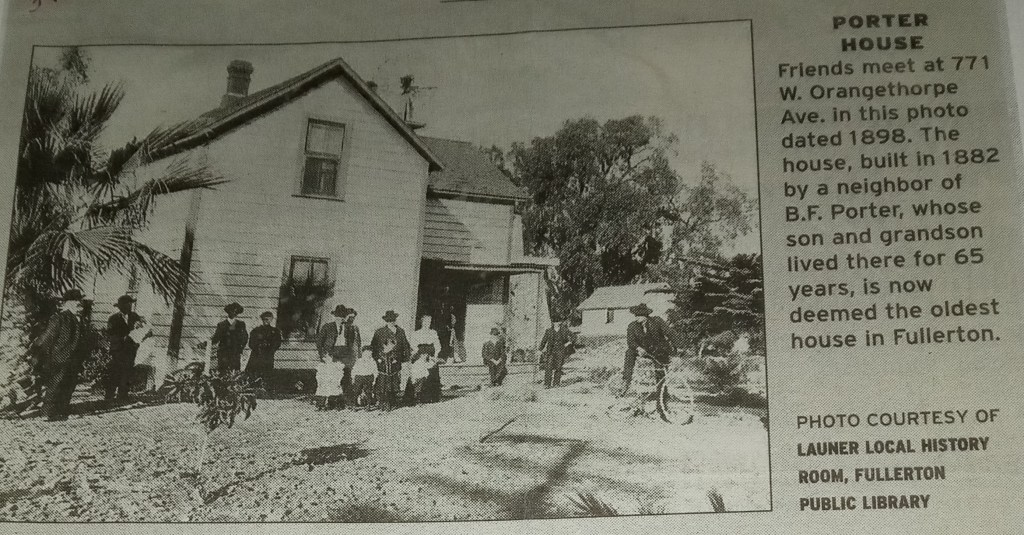
Rufus’s son Stanley was born in 1917. When he was still a baby, the family moved into a house at 771 W Orangethorpe, with twenty acres of walnuts and oranges adjacent to Benjamin Franklin’s property on the north side of Orangethorpe. That house was built in 1882 and is still standing. It is the oldest extant house in Fullerton.
“The walnuts were harvested by Mexican families who came and camped there during the season,” Porter remembers. “I can still remember very plainly the horses drawing the wagon loads of nuts in big sacks, which weighed about a hundred pounds apiece.”
Eventually, the walnut crops were killed by a pest called the husk fly, and were replaced by oranges.
For water, the Porters had their own well. They also had a windmill. To irrigate their crops, they purchased water from the Anaheim Union Water Company.
Before they had electricity, the family would go to the ice house on Walnut to purchase 50-lb. blocks of ice for their ice box.
Electricity came to the Orangethorpe area in the 1920s.
The Orangethorpe community had its own school, which Stanley attended (like his father before him) for grades 1-8.

Students outside old Orangethorpe School, circa 1880. Photo courtesy of Fullerton Public Library Local History Room. Porter remembers the first movie theater in town, the Rialto theater on Spadra [Harbor]. He also remembers the building of the Chapman Alician Court Theater, which later became the Fox, which featured both movies and live vaudeville shows.
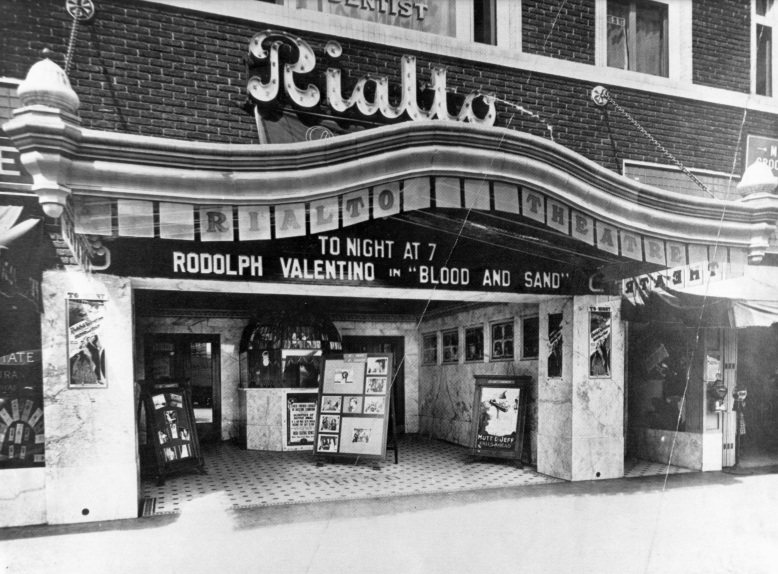
Rialto Theater at 219 N. Spadra (Harbor) circa 1922. Photo courtesy of Fullerton Public Library Local History Room. He recalls seeing silent movies as well as the first talkies, such as Al Jolson’s The Jazz Singer.
Speaking in 1986, Porter expressed regret that the theater had fallen into disrepair and the original murals had been painted over.
“They covered up those magnificent murals with paint,” Porter said. “I think Fullerton has a thing against murals, they’ve covered up the ones on the high school.”
He witnessed the painting of the “Pastoral California” mural on the side of the high school auditorium., which was also painted over in 1939.
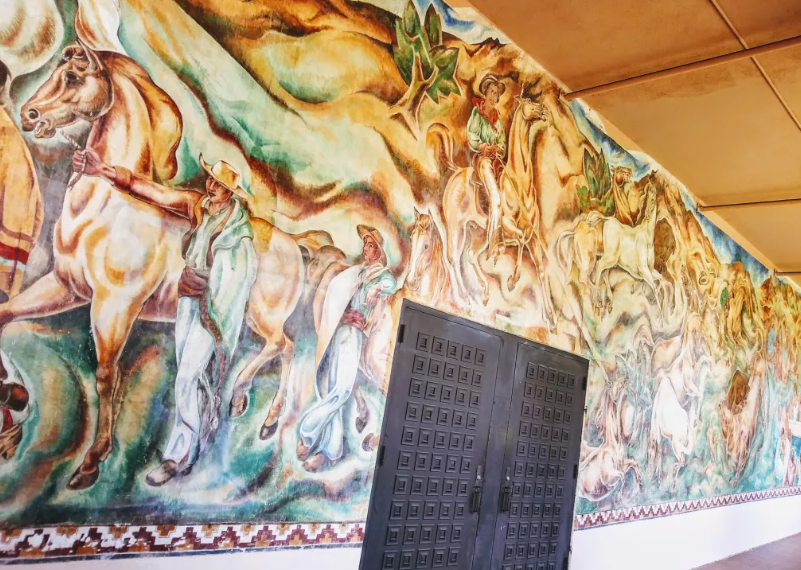
“Pastoral California” mural on the side of Fullerton High School auditorium. Photo by the author. “I vividly recall the mural on the side of the high school auditorium, which is one of my pet peeves when they finally painted it over. I remember watching him [Charles Kassler, the artist] paint that,” Porter remembers. “it was a mural, or a fresco. And, was very representative of the life in early California, and it showed the Indian women washing in those stone troughs which are still around at some of the missions…And there were the horsemen. Beautiful horses. This man was very good at horses. As a matter of fact, he painted some of the museums at the LA County Library.
Porter graduated from Fullerton Union High School in 1935. Among his classmates was John Raitt, the famous singer.
He remembers the big Long Beach earthquake of 1933.
“My father was down in his walnut orchard. He said the trees actually just swayed like it was in the wind,” he said. “In Long Beach, of course, there were lots of brick buildings, and many of them were destroyed…The Orangethorpe School auditorium was damaged.”
He remembers the 1938 flood.
“My sister’s husband-to-be lived in Anaheim, on the north side of town where the water came through very strongly,” he said. “Anaheim was quite badly hurt by that. Over in this little section of town called La Jolla, over here east, it just practically demolished that. It was a Mexican community mostly, and small houses. And many of those they say they just never did find the people that lived in those places.”
He went to Fullerton College, where he studied ceramics under Glen Lukens, a very well known artist who eventually taught at USC.
As a young man, Porter worked at Hoppey Hardware, which was right next to the Stein-Strauss store on the southeast corner of Harbor and Commonwealth.
“At that time this was a very rural community, there was nothing out around the surrounding areas like there is now. You went into town if you wanted to go the drugstore or the grocery store, or anything else. Things were more centrally situated than they are today,” Porter said. “On Saturday nights, everybody went downtown shopping. It was like the malls now, you know. It was a sociable thing.”

Harbor and Commonwealth, 1920s. Photo courtesy of Fullerton Public Library Local History Room. He remembers the big parades that would occur in town, such as the Armistice Day (now called Veteran’s Day) parade.
“We had very good parades. Much better, I’m sorry to say, than we have now,” Porter said. “We used to have parades with the high school. We always had parades for the football season.”
He remembers other popular stores downtown, such as the Chapman-Wickett department store (in the Chapman building), and Dean’s Hardware.
Porter’s mother worked in the telephone exchange office downtown as one of the first switchboard operators.
Regarding African Americans in Fullerton, Porter said, “there were very few black families in Fullerton, even up until the wartime.” He remembers two families, the Berkeleys (who lived in the Orangethorpe district) and the Goodwins, who lived in the Truslow area.
Ruby Berkeley married a Goodwin and became a famous author and activist.
“Her name was Ruby Berkeley Goodwin,” Porter said. “She was one of the first activists for better relations between the races, or I would say better conditions for the black people…she was very well known…she spoke a lot at club meetings, the women’s clubs and things like that.”
After graduating from Fullerton College, Porter went to Chenard Art Institute and studied interior design and ceramics.
After working at a bank in Los Angeles, he opened a ceramic business, and also taught for seven years, adult education ceramics and other related craft, such jewelry enameling.
Porter lived in the house at 771 W. Commonwealth for 64 years before selling it. It is now an addiction recovery center.
He says that after World War II, in the 1950s, “things really started changing” as farmers began selling off their acreage for housing and business developments.
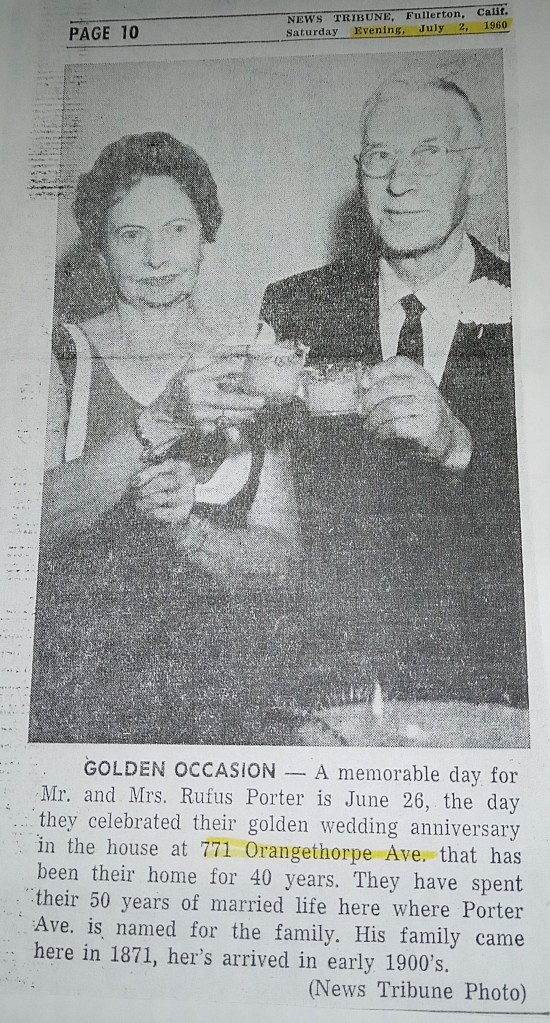
Stanley’s parents celebrated their golden wedding anniversary in 1960. Photo courtesy of Fullerton Public Library Local History Room. “My grandfather’s property was one of the first ones that was sold. Then we did later,” he said.
-
Oral Histories: Jennie Reyes (Restaurant Owner)
The following is from a work-in-progress about the history of Fullerton. You can support my ongoing research and writing on Patreon.
Jennie Reyes and her husband John owned a Mexican restaurant called La Perla on Truslow Avenue in Fullerton (in what she called the barrio) for nearly thirty years, from the 1940s to the 1970s. Reyes was interviewed in 1975 for the CSUF Oral History Program. Below is what I learned from reading the interview, which chronicles a time when Mexican immigrants in Fullerton were mostly segregated south of the tracks and many lived in citrus work camps. Though she experienced hardship in her life, Reyes’ story is an inspiring one. La Perla was an important community hub that was unfortunately demolished to make way for an underpass on Lemon St. in 1975.

Photo courtesy of CSUF Center for Oral and Public History. Early Life
Her parents immigrated from Mexico from the state of Guanajuato and settled in the Casa Blanca barrio in Riverside around 1917. Her parents had nine children, all born in Riverside, but only three lived long enough to be married. The rest of them died when they were small.
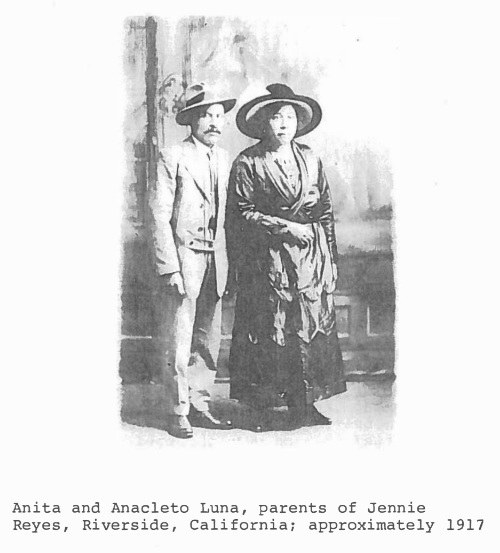
Photo courtesy of CSUF Center for Oral and Public History. “In those days there were so many diseases: whooping cough, measles and all that sort of thing…We struggled and we worked,” Reyes said. “We were very poor.”
Jennie started working in a packinghouse at age thirteen.
“In those days, they weren’t so very strict about sending their children to school, especially with the Mexican people. Let’s face it, it was in Casa Blanca…I don’t think they cared whether we went to school or not.”
“In those days it was very hard for us to get anything done and to be accepted in any kind of work [other than agriculture],” Reyes said. “Let’s face it, there in Casa Blanca there were nothing but Mexican, Japanese and a few Italian people at that time.”
Reyes recalls experiencing segregation and prejudice in Riverside.
“If you would go to the show–they had one theater in Riverside–there was a place for you [Mexicans]. You couldn’t sit where everybody else did, where all the Anglos would go. We had a section where we had to sit if we wanted to go to the show,” Reyes said. “As far as jobs, there were no jobs for the Mexican people, not even as a clerk in the store, not even that. All we would do is work in packinghouses, pick tomatoes in the fields, pick walnuts, pick prunes, pick cucumbers, strawberries and blackberries.”
“Because we knew that we were not wanted in other jobs so we just segregated ourselves to what we could do, where they could accept us,” Reyes said.
Her father got a job as contractor, bringing Mexican workers from Casa Blanca to El Monte to pick walnuts. Eventually the family bought a lot in El Monte, where her father built a home.
“We used to have the relatives come and stay with us and they would put their tents up in the backyard. From there we could go to work,” Reyes said.
Reyes’ family then moved back to Riverside, purchasing a house in Casa Blanca. The family would travel north to the town of Hillsborough to pick prunes when they were in season.
“The first year we worked for them they let us camp in a big barn. It was so big you could put five little tents inside. Those were our living quarters during the prune picking,” Reyes said. “After they got to know us better, they let us into their home and we used their washing machine, which we never used at home because we didn’t own one.”
When she was 13, her parents separated “and things were a little harder.”
“I had two brothers…I was the mother of them,” Reyes said. “I stayed with my father and my ‘children.’ I called them my children because they were my two brothers and I took care of them until they got married.”
Life in Fullerton/La Perla
When she lived in Riverside, Reyes used to come to work during the orange season in Placentia and Fullerton in packinghouses. Her future husband John used to make boxes in the packinghouse right next to hers.
“That’s where I met him, there in the packinghouse,” Reyes said.
John and Jennie were married in Riverside in the early 1940s.

Photo courtesy of CSUF Center for Oral and Public History. A friend of John’s was in the business of delivering merchandise to different restaurants and he heard about a restaurant that was for sale in Fullerton’s barrio on Truslow, so the newly-married couple bought it. They moved in the little room in the back of the restaurant.
“The people we bought the restaurant from…cheated us,” Reyes said. “They asked a high price for it and they were supposed to leave a lot of things there which they didn’t.”
Despite this, the couple worked hard to build a successful Mexican restaurant.

Photo courtesy of CSUF Center for Oral and Public History. “The menus and all the food that I prepared there, I just tried to prepare everything like I would at home, and some of the recipes from my mother that she had taught me to cook,” Reyes said.
Her husband also continued to work making boxes for a packinghouse in Placentia and then after that he went to work for the Mississippi Glass Company.
She remembers when Saint Mary’s church burned down: “It was a shock because we went to mass and here was the church burned down. Then we used to go to mass there at the Boy’s Club.”
Reyes remembers serving a large clientele of Mexican farm workers, and she would help them send money and letters back to their families in Mexico.
“Every Monday I used to spend about four hours at the bank to make all those money orders and to get the money orders ready to send, and to register their letters and all that,” she said.
She would also help translate for Mexican workers.
“They couldn’t speak English. They didn’t know where to go to, who to go to, who was going to take advantage of them, who was going to be honest to them,” she said. “If I would go to town shopping and I’d see somebody there, and some of them didn’t know English they’d say, ‘Could you interpret for me?’ I’d say, Sure. I was always glad to do it for them.”
There were at this time Mexican work camps in Fullerton.
“The Eadington Company had a small camp there across the street from where we had our restaurant in which they accommodated their sixty workers. In fact we had them as boarders in our restaurant for one year,” she remembers. “I had to get up at two and three o’clock in the morning and make three hundred sixty flour tortillas to fix their lunches and than at six o’clock we would give them breakfast and they would leave for work and take their lunches and then they would come home in the evening at five o’clock or five-thirty to have their dinner and they would leave.”
Her children all graduated from high school.
Eventually the family moved into a house at 315 South Lemon, near their restaurant.

Photo courtesy of CSUF Center for Oral and Public History. The restaurant became a popular gathering place, not just for Mexican workers, but for all kinds of people in town.
“We had a wonderful clientele. Doctors, people from offices would go there; nurses from Saint Jude’s; people from the Motor Vehicle Department. They used to come every Friday from Autonetics,” said said. “It was like a family thing.”
“Even though it was a barrio, I was happy there. We were happy,” Reyes said.
The Death of John
Eventually her husband John got sick with Osler-Weber-Rendu’s disease, a rare blood disease that prevented him from working and required that he get regular blood transfusions and sometimes spend weeks at the hospital.
The family struggled to pay for John’s care on their income from the restaurant. During those difficult thirteen years, the community helped out a lot, such as the Sisters of St. Joseph of Orange who provided service and medication for Mr. Reyes at nearby St. Jude Hospital and never sent a bill.
A 1970 article in the catholic publication The Tidings told the Reyes’ story shortly before Johnny died.
“This is a Mexican love story. It takes place here at La Perla, a little restaurant in this town’s old barrio. It ls the story of John Reyes – a man kept alive for 11 years by much love and two pints of blood each week,” the article stated. “La Perla, at Truslow and Lemon Sts., is next door to the Reyes’ old frame house. It is where Jenny has worked 12 hours a day – for years, to support John and their four daughters, Mary, Margaret, Martha and Helen.”
John passed away on August 15, 1970.
The Restaurant and Family Home are Demolished to Make Way for an Underpass
A 1975 Fullerton News Tribune article entitled “Progress Uproots a Family” stated that the city of Fullerton used eminent domain to condemn the site of La Perla and the Reyes house, along with other neighbors “to make way for an underpass on Lemon Street at the railroad tracks.”
“I just can’t go see my house being torn down,” said Mardie De La Torre, one of Reyes’ four daughters. “That house and the restaurant represent the blood, sweat and tears of my entire family…’People don’t realize what it is like being forced to leave the home where you have lived all your life,” she said.
Reyes remembers, “It hurt us so much when we were moved out of there…because of the underpass. Don’t get me wrong. I don’t want to be selfish; I believe in the betterment of the town and everything…but I don’t believe it was a fair price.”
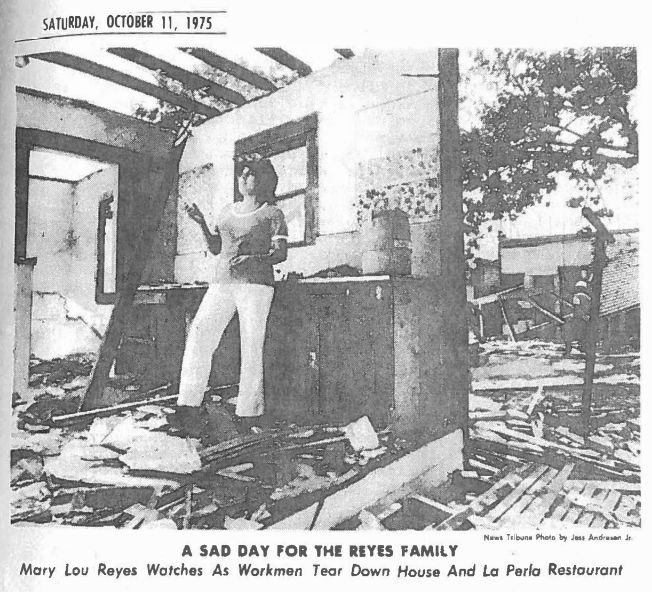
Photo courtesy of CSUF Center for Oral and Public History. Other small businesses that catered to the barrio residents, such as Negrete Market, were also torn down.
“What I think makes it so bad is that some of the people from that area are very poor. Some of them have a car, you know, but some of them don’t and it makes it hard for them to go to the shopping centers,” Reyes said. “It’s going to help the traffic but how is it going to help all those people in that area?”
City Attorney Kerry Fox defended the city’s position. “We follow the law, we don’t set the law,” he said. “Whether the laws are fair – that’s not my business.”
“They think about the betterment of the city, of the town, [but] they don’t stop to think of the sacrifice some people will have to go through,” Reyes said. “The barrio, especially there where the Mexican people live, all the other people who were there moved out to better homes and left all the poor people there with no help.”
With the destruction of their home and business, the Reyes family relocated to Placentia, which is where Jennie was living when she gave the interview in 1975.
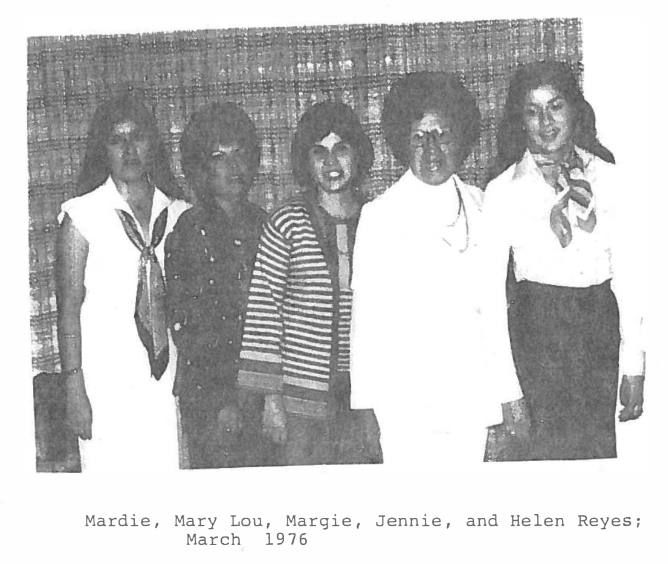
Photo courtesy of CSUF Center for Oral and Public History. -
A Brief History of the Hughes Plant in Fullerton
The following is from a work-in-progress about the history of Fullerton. You can support my ongoing research and writing on Patreon.
“It was built on 350 acres in the gently sloping hills of the city’s northwest corner. With its broad lawns and stands of towering trees, the sprawling Hughes Aircraft aerospace complex looks more like a college campus than an industrial outpost of the Cold War.”
–Los Angeles Times, 1994
The post World War II boom in Fullerton saw acres of orange groves turn into housing subdivisions, shopping centers, and industrial businesses such as Hunt Foods, Kohlenberger Engineering, Rheem Automotive, Arcadia Metal Products, Sylvania Electric, Standard Products, F.E. Olds Co. and others.
The biggest of the post-war industrial employers in Fullerton was Hughes Aircraft Co. which established a large plant in Fullerton in 1957 on over 400 acres near Sunny Hills. For much of its history, the main output of the plant was components of ground radar systems for the the U.S. and foreign militaries.
In the decade that Hughes opened in Fullerton, the city’s population quadrupled, rising from 13,958 in 1950 to 56,180 in 1960.

From the Fullerton News-Tribune, 1959. Courtesy of the Local History Room of the Fullerton Public Library. By 1960, Hughes’ Ground Systems Group in Fullerton was working 26 military contracts worth more than $200,000,000 and had 6,000 employees. Hughes had become Fullerton’s largest employer, offering good paying jobs to scientists, engineers, and other employees.
While the company mainly focused on developing radar systems, it was also a pioneer in computer technology, developing the H-330 computer, which was in the early 1960s “the most powerful militarized general purpose computer ever developed.”
While the company’s major clients were the United States and allied nations’ militaries, they also developed technologies that allowed large oil companies like Shell drill in the ocean’s depths.
During the Cold War, Hughes’ offered powerful tools for countries to detect and prevent missile attacks.

Fullerton News-Tribune, 1963. Courtesy of the Local History Room of the Fullerton Public Library. Nicholas E. Begovich, a Hughes executive in the 1960s, said that the company’s systems “range in size from small, mobile air defense units to modular systems that cobweb across thousands of square miles to guide the air defense of a country–or a continent.”
In 1965, Hughes won a contract with NATO “to build a giant air defense network extending from Norway to Turkey.” The following year, the company won air defense contracts with Belgium, the Netherlands, West Germany, and Switzerland.

Fullerton News-Tribune, 1965. Courtesy of the Local History Room of the Fullerton Public Library. As the Vietnam War escalated, Hughes provided a number of products to assist the U.S. military, including portable “Manpack” combat radios.
By 1968, Hughes-Fullerton was selling over $1 billion in products annually.
While Hughes-Fullerton saw some cutbacks in the 1970s, the election of Ronald Reagan in 1980 proved a boom for the company, as he increased the United States defense budget.
By 1985, employment at the Fullerton plant reached a peak of 15,000 people. Hughes-Fullerton was providing air defense systems for 25 countries. That same year, Hughes was acquired by General Motors for over $5 billion.
In 1988, while on the campaign trail, George Bush visited the Hughes plant in Fullerton, where he criticized his presidential opponents Michael Dukakis and Jesse Jackson “for their lack of support for certain defense projects.”

Brea Star-Progress, 1988. Courtesy of the Local History Room of the Fullerton Public Library. Also in 1988, Hughes faced a bit of a public relations fiasco, when it was reported that the captain of the USS Vincennes was using Hughes radar equipment when he fired a missile that downed an Iranian jetliner, killing 290 civilians.
In 1989, the Berlin Wall fell and the Soviet Union began to break up, signaling the end of the Cold War and an uncertain future for defense contractors like Hughes, which had benefited from large defense budgets.
In 1992, Hughes-Fullerton welcomed a large contingent of military personnel from Saudi Arabia.
“Hughes Aircraft Co. is preparing for the arrival of up to 1,600 Saudi Arabian military personnel, the largest single delegation to seek training at the company’s Ground Systems Group,” the News-Tribune reported. “Training foreign military officers is nothing new for Hughes. The company has weapons systems in 22 nations. Visiting foreign-military personnel can be found at the company’s Fullerton site on any given day.”
By 1992, Hughes’ Fullerton workforce had shrunk to about 6,800, and the company unveiled a plan to transform 150 acres of its Fullerton property for a new housing development. The company was downsizing because of shrinking defense budgets.
Also in 1992, Hughes was ordered to pay a $3.9-million fine to settle allegations that it defrauded the government on several contracts to build shipboard defense systems.
And then in 1994 came the fateful news that the Fullerton Hughes plant would close.

Los Angeles Times, 1994. Courtesy of the Local History Room of the Fullerton Public Library. When the announcement came, workers in the Fullerton Plant were working on a $1 billion contract from Saudi Arabia for an air defense system called the “Peace Shield.”
“It’s an early air warning and tracking system for countries that share borders with their enemies and is on schedule to be delivered to Saudi Arabia by early 1996,” the OC Register reported. “Closing Fullerton would almost certainly mean slowing the project. That, in turn, could wipe out an on-time delivery bonus worth about $50 million and sour Saudi Arabia’s neighbors from buying Peace Shields of their own.”
The closure of the Hughes plant had a significant impact on the City of Fullerton.
“At stake are 6,800 jobs in Fullerton–more than 10 percent of the city’s work force, the dreams of countless families, the future of local businesses and the very fabric of a town that has grown up with its largest employer since Hughes opened in 1957,” the OC Register reported. “Hughes is intertwined with Fullerton. The company contributes to Cal State Fullerton’s engineering department and to the city tax base. Employees patronize businesses, join civic groups and lead city government. Robert Singer, a Fullerton Joint Union High School District board member, works at Hughes. Mayor A.B. “Buck” Catlin used to.”

Los Angeles Times, 1994. Courtesy of the Local History Room of the Fullerton Public Library. The plant closure would cost the city $735,000 a year in tax revenue, as well as lost business for smaller businesses that catered to Hughes employees.
“The formula is that for every manufacturing job, it creates three to four jobs to support that,” said Ed Paul, Fullerton’s revenue manager. “You see it in the restaurants, car-repair shops and dry cleaners.”
When the plant closed, many Hughes employees were laid off, and many were transferred to other facilities in Long Beach and El Segundo. About 700 workers stayed on in a much smaller facility.
“While sizable, the plant closure is only the most recent to hit Orange County since the end of the Cold War,” the LA Times reported. “It follows a nerve-racking series of layoffs that have slashed tens of thousands of jobs from payrolls in a county that once was awash in defense dollars and now finds itself hit hard by the nation’s effort to cut military spending.”
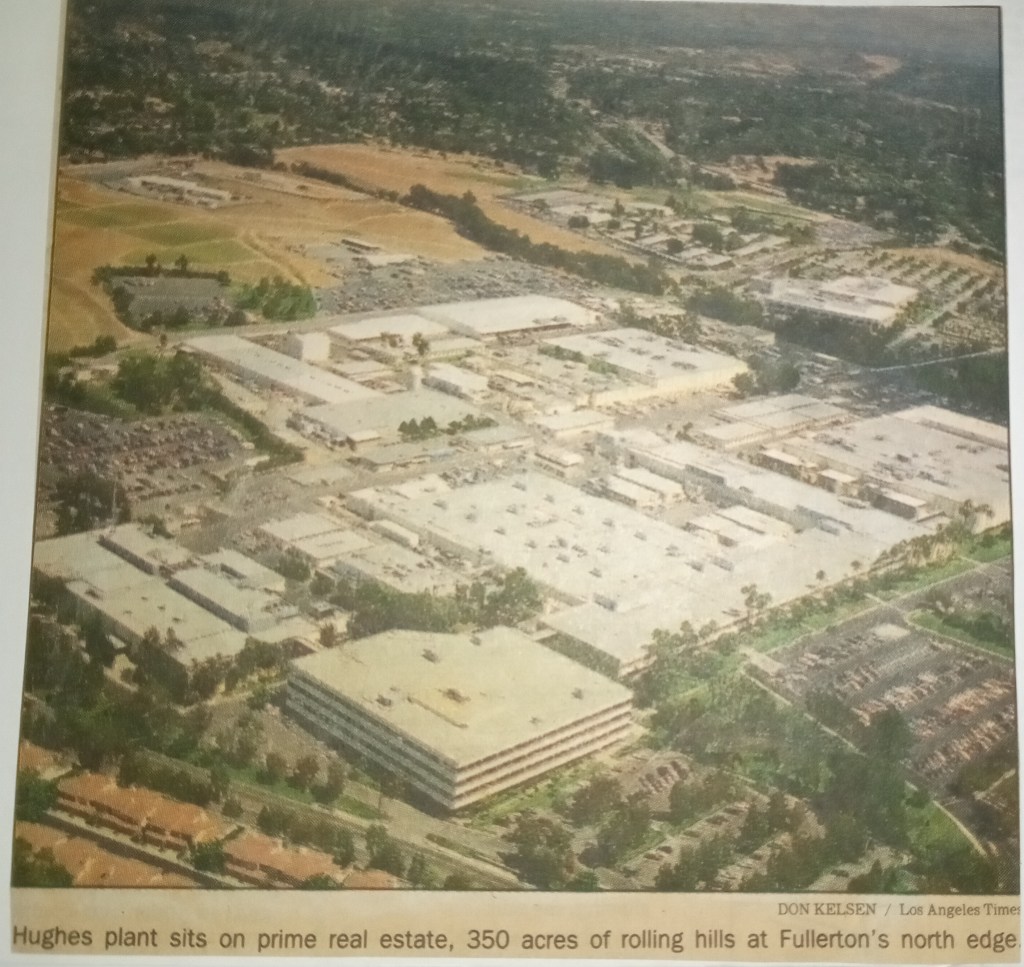
Los Angeles Times, 1994. Courtesy of Fullerton Public Library Local History Room. Hughes sold its sprawling land holdings to real estate developers, who eventually developed what is now Amerige Heights–a sprawling shopping center surrounded by housing.
“The role of Hughes Aircraft in Fullerton is part of the larger story of the aerospace industry in shaping Orange County in the post-World War II years, a time that saw the county evolve from an agricultural backwater to develop a factory-driven economy in which aerospace for years was the cornerstone,” the LA Times reported in 1994.
“We were the air defense system for the free world,” says Begovich.
A 1994 LA Times columnist wrote, “The Cold War was a perilous time for the nation, but ironically it fueled prosperity in the spread of defense-related industries and in the spawning of an optimistic way of American life–especially in the suburbs that surround Los Angeles.”
-
The Boom of the 1880s in Southern California
The following is from a work-in-progress about the history of Fullerton. You can support my ongoing research and writing on Patreon.
“This is an era of town building in Southern California, and it is proper that it should be so, for the people are coming to us from the East and from the North and from beyond the sea, and from this great multitude whose faces are turned with longing eyes toward this summer land and who will want homes among us, we must provide places.”
–Pasadena Daily Union, 1887
The City of Fullerton was founded in the year 1887. This was a crucial year in the history of Southern California, as it was the peak of a massive land and population boom.
In the span of just two years (1887 to 1889), over sixty new towns were established in Southern California and an estimated 2,000,000 new people arrived in the region. It is estimated that the value of real estate transactions for the year 1887 alone was over $200,000,000.
I recently finished reading Dr. Glenn Dumke’s book The Boom of the Eighties in Southern California which deals with this time period. In the interest of understanding the wider context of what occurred locally, I present here a summary of what I learned from this book as well as a chapter from Carey McWilliams’ book Southern California: an Island on the Land entitled “Years of the Boom.”

According to Dumke, there were at least three main causes of the boom–agricultural expansion, a rate war between rail companies, and extensive advertising and publicity by those seeking to profit from the boom. I’ll address each of these separately before going into how the boom affected different areas of Southern California, including Fullerton.
The 1880s were, of course, not the first population boom in California. There was the Gold Rush of 1849, followed by a series of lesser booms, as the formerly Mexican province transitioned into an American state, and the large ranchos began to be subdivided into smaller farms.
“Agricultural development brought prosperity, prosperity brought fame, and fame attracted new settlers,” Dumke writes. “Of all the causes of the boom, agricultural expansion was the most substantial and constituted a foundation solid enough to withstand the blow of the collapse.”
The Railroad Rate War of 1886
A more immediate cause of the boom was a rate war between the Southern Pacific and the Santa Fe railroads, which took place in 1886.
“The reduction of fares to unheard-of levels stimulated the migration of hordes of people who would otherwise have confined their interest in California to reading about it,” Dumke writes.
In the mid-1880s, the Southern Pacific (SP) railroad was an extremely powerful economic and political force in California. The owners of the SP were known as the “Big Four” or “The Associates”: Leland Stanford, Collis P. Huntington, Mark Hopkins Jr., and Charles Crocker. These guys were good at heading off competition for the lucrative freight and passenger rail services to, from, and within California.
However, in 1885, the competing Santa Fe Railroad completed a route to Los Angeles, bought up some local rail lines, and aimed to take the Southern Pacific head on.
“The completion of the Santa Fe line in 1886 was the spark that ignited the real estate explosion of the ‘eighties,” McWilliams writes. “Previously the passenger rate from Missouri Valley points to Southern California had been approximately $125. But the rate promptly dropped to $100, when the Santa Fe entered California, and continued to fall as each line undercut the other. On March 6, 1887, the Southern Pacific met the Santa Fe rate of $12. In a matter of hours, the rate dropped to $8, then to $6, then to $4. By noon on March 6, the Santa Fe was advertising a rate of $1 per passenger.”
“The result of this war,” wrote a local historian, “was to precipitate such a flow of migration, such an avalanche rushing madly to Southern California as I believe has no parallel.”
According to Dumke, “The Southern Pacific’s arrival increased Los Angeles’ population one hundred percent, and the ensuing arrival of the Santa Fe increased it 500 percent.”
Advertising Southern California
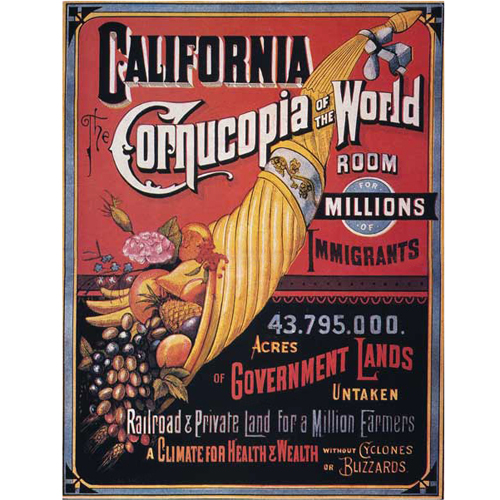
American land company poster, later 19th century, encouraging immigrants to come to California, the ‘cornucopia of the world’, with ‘room for millions’ and ‘a climate for health and wealth’. Another basic cause of the boom was the extensive advertising and publicity campaign which carried information about southern California to all parts of the world.
This advertising took many forms ranging from railroad propaganda to newspaper stories and ads to letters from residents writing to their friends and families extolling the Golden State.
“Much of the publicity was financed by railroads, primarily the Southern Pacific, for two main purposes: to sell their own [government] granted land, and to induce a large population, whose future business and travel would be profitable, to settle along their lines,” Dumke writes.
The railroads would employ agents and writers “expounding the glories of the West.”
Some of these writers and their works include Jerome Madden (author of California: It’s Attractions for the Invalid, Tourist, Capitalist, and Homeseeker), and Charles Nordhoff whose California for Health, Pleasure, and Residence, was given “more credit for sending people to California than anything else ever written about the section.”
In addition to the railroad companies, local chambers of commerce, boards of trade, and realty syndicates helped promote the land boom.
“These four types of publicity–descriptive accounts, railroad propaganda, newspaper and local agency material, and, finally, the work of enthusiastic residents–combined to make Southern California perhaps the best-advertised portion of the country during the third quarter of the 19th century,” Dumke writes.
The Boom in Los Angeles
While the boom of the 1880s spread throughout Southern California, its epicenter was Los Angeles.
According to McWilliams, at the peak of the boom, “More than two thousand real estate agents paced the streets of Los Angeles, seizing lapels and filling the balmy air with windy verbiage. Business blocks sprang up like toadstools, and residences sprawled far beyond earlier city limits. Railroads, formerly sluggish, suddenly traced for themselves with lizard-like speed a complex network of trackage.”
Some of the land promotion took on a carnivalesque aspect.
“Men stood excitedly in line for days at a time in order to get first choice of lots in a new subdivision. Flag-draped trains hauled flatcars jammed with enthusiastic prospects to undeveloped tracts far from centers of settlement. Exuberant auction sales, accompanied by brass bands and free lunches, helped sell $100,000,000 of Southern California real estate during the boom’s peak year,” McWilliams writes. “Unscrupulous promoters with empty pockets and frayed trousers bought on margin and found themselves quickly rolling in wealth, while old landowners who scoffed at the excitement were eventually sucked into the maelstrom and reduced to poverty. Empty fields and riverbeds and tracts of worthless desert land were platted solemnly into twenty-five foot lots–and sold.”
Dumke writes, “The year 1887 was the kaleidoscopic peak or boom excitement for all of southern California. When 1886 saw an influx of thousands of tourists and immigrants…the spring of the next year brought with it…the arrival of tens of thousands, who crowded the trains overflowing and loudly demanded a place to stay and spend their money. The population of Los Angeles was estimated to have increased from 11,000 to 80,000 during the boom years, and most of the increment undoubtedly came in 1887. Inhibitions and conservatism vanished. The gold was there for the taking, and aggressive noisiness carried the day.”
Some Los Angeles county towns that were created during the boom include Hollywood, Inglewood, Santa Monica, San Pedro, Catalina Island/Avalon, Alhambra, Pasadena, Glendale, Burbank, San Fernando, Pomona, and more.
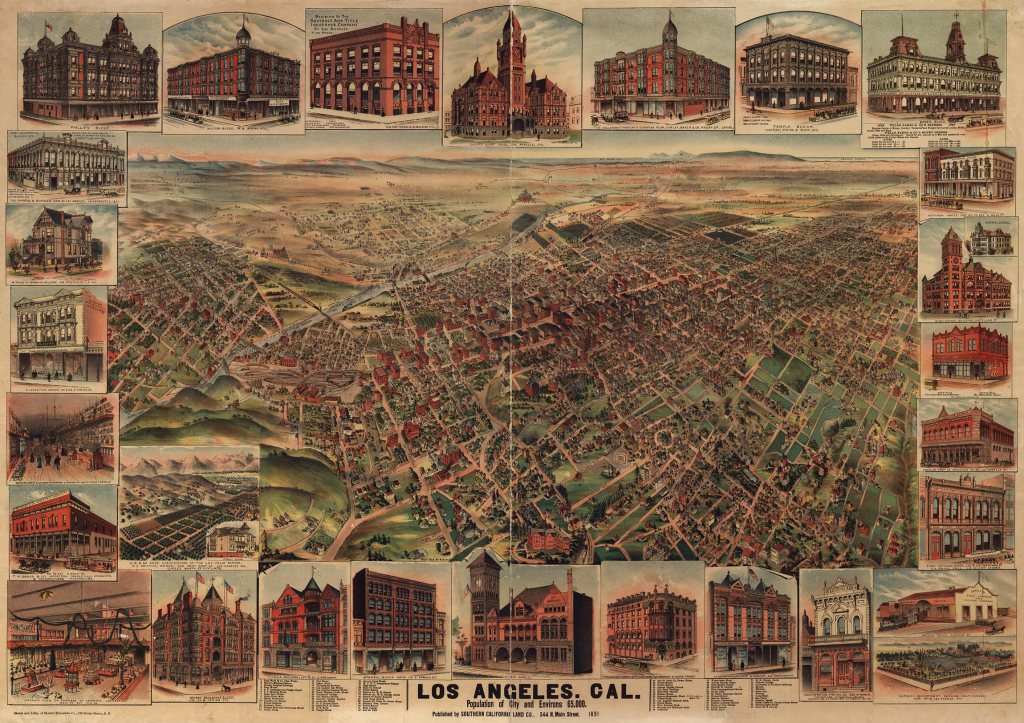
Map of Los Angeles, 1891. The Boom in Orange County
“Perhaps the greatest effect the boom had on the Santa Ana Valley was to inspire the formation of a new county–the present Orange County,” Dumke writes.
Orange County, which would break away from Los Angeles County in 1889, saw much subdivision and town-founding during the boom.
“The largest community [in Orange County] laid out during boom years–was Fullerton,” Dumke writes. “This prosperous city was platted by the Pacific Land and Improvement Company in 1887. The heads of the organization were the Amerige brothers, Edward and George, who sold out a grain business in Boston to establish a town on 430 acres of land north of Santa Ana…While the Santa Fe greatly encouraged the Amerige project, the town was never able to take full advantage of the railway’s arrival, for the first train did not come until the fall of 1888, when the flurry was in its decline. Under the circumstances, the community experienced a rather slow growth and has seen most of its expansion in more recent years, thanks largely to near-by oil fields and Valencia oranges groves.”

The End of the Boom
“Despite hopeful prognostications and repeated assurances by both buyers and sellers that the boom had come to stay, the spring of 1888 witnessed a rapid decline in land values and in buying enthusiasm,” Dumke writes.
“It should be noted, however, that while the boom had collapsed, it had left a substantial deposit of wealth and population,” McWilliams writes.
Los Angeles increased in population from 6,000 in 1870 to 50,000 by 1890.
This increase in population and growth of new towns led to more churches, theaters, meeting halls, newspapers, schools, railroads, and more.
Ghost Towns
Of course, not all towns laid out during the boom survived.
“Of more than one hundred towns platted from 1884 to 1888 in Los Angeles County, sixty two no longer exist except as stunted country corners,” Dumke wrote in 1944. Of course, subsequent development and later booms would see more of the land developed and more towns formed.
Here are some of the Southern California boom towns that failed: La Bollona, Rosecrans, Waterloo, Ramona, Chicago Park, Gladstone, Rockdale, Ivanhoe, Dundee, Maynard, Lordsburg, Piedmont, St. James, Carlton, Richfield, and Fairview.
Impacts of the Boom
“The boom brought people to California in ever increasing numbers, and they themselves were the foundation for a greater economic structure. It enlarged transportation facilities and municipal development, settled hitherto barren areas, completed the breakup of the ranchos, and was largely responsible for southern California’s modern publicity-consciousness,” Dumke writes.
The increase in population and expansion of farms as a result of the boom led to many improvements in irrigation and access to water.
“Twelve irrigation companies were organized during the boom years 1886-88, and the remainder were started largely by the stimulus given their respective areas through boom settlement,” Dumke writes.
The boom was also an impetus for education.
“Out of the boom came a number of educational institutions, well in advance of the actual settlement of the region, such as the University of Southern California, the Chaffee College of Agriculture at Ontario, Occidental College in Los Angeles, the state Normal School (now UCLA), St. Vincent’s College (now Loyola University), Whittier College, La Verne College, and Redlands University,” Mc Williams writes.
Here are some other Southern California cities that owe their beginnings to the boom: San Dimas, Ontario, Upland, Claremont, Chino, Rialto, Fontana, Redlands, Hemet, Oceanside, Encinitas, La Jolla, and Escondito.
-
Hawaiian Punch Started in Fullerton!
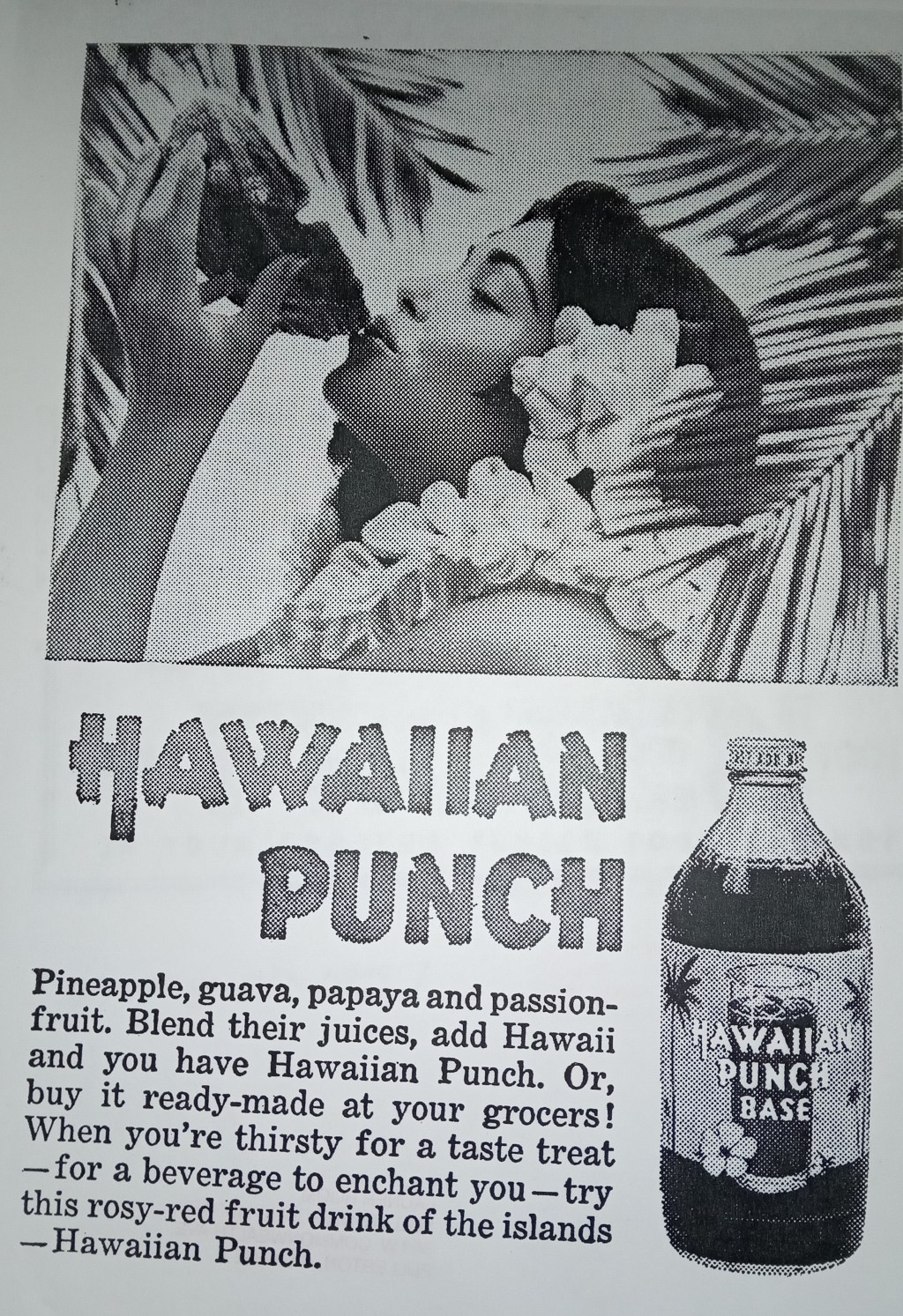
The following is from a work-in-progress about the history of Fullerton. You can support my ongoing research and writing on Patreon.
Like most medium-sized American cities, Fullerton has spawned a few companies over the years that have risen to national prominence and become household names. Fender Guitars is probably the most well-known. But a close second is Hawaiian Punch.
Hawaiian Punch was originally created as a drink base for juice stands and also as an ice cream flavoring in the early to mid 1930s by A.W. Leo in a converted garage in Fullerton at 120 W. Amerige. Leo’s company was called Pacific Citrus Products.
There has been some debate/confusion as to where Hawaiian Punch was actually created. A 2007 Orange County Register article tells of a Tom Jones of Fullerton, who placed a plaque on his garage at 1321 Frances Ave. stating that the formula for Hawaiian Punch was created in his garage in 1934.

However, according to records in the Fullerton History Room of the Fullerton Public Library, A.W. Leo did not live there in 1934. He moved there in 1936.
While Wikipedia states that “Leo’s Hawaiian Punch was created as an ice cream topping syrup in 1934 by A.W. Leo, Tom Yeats, and Ralph Harrison in a converted garage in Fullerton, California,” it appears that this “garage” was not a residential garage, but rather a converted auto garage.
In a 1968 interview for the CSUF Oral History Program, Rueben Paul Hughes, former president of Pacific Citrus Products, said, “The predecessor for Pacific Hawaiian Products was Pacific Citrus Products. The original plant was located at 120 W. Amerige in a former garage. The plant slowly expanded from there.”
In the 1920s, prior to Leo moving into his business at 120 W. Amerige, it was owned by Wickersheim Implement company, which sold cars and almost certainly had a garage.
It is thus much more likely that the “garage” where Hawaiian Punch was created was at the 120 W. Amerige site, which eventually was expanded into their first plant. Today, this is the parking lot of Ace Hardware.

1947 photograph of Pacific Citrus Products at 120 W. Amerige Ave in their newly-expanded plant, likely from a smaller former converted auto garage. In Leo’s laboratory, he concocted various “fruit juices and extracts to perfect formulae for sherbet bases, flavoring extracts and hot weather drinks.”
By 1940, the company had expanded to sell throughout the United States.
In addition to Hawaiian Punch, the company manufactured bar mixers, fruit concentrates, crushed fruits, citrus oils, sherbert bases, fountain syrups, extracts, emulsions, and specialty flavors.
Hughes worked his way up in the company from the warehouse to eventually becoming president and co-owner in 1946.
Hawaiian Punch originally was made from real fruit juices.
“We bought the pineapples from Hawaii and our basket fruit juice used to come from Oceanside,” Hughes said. “Any other fruits, we bought from various packers, the apricot and the peach puree, we bought from packing plants.”
At this time, Fullerton, and much of the surrounding area, was mostly agriculture.
While it was popular as a wholesale juice and ice cream concentrate, it eventually became more popular as a pre-mixed juice sold directly to customers.
“ln 1949, we decided to mix it for them, so to speak, into a ready to drink product in the big 46 ounce juice can,” Hughes said, “This was probably the smartest thing we ever did.”
Hawaiian Punch began to be shipped outside of California, first to midwest markets, and then all over the country.
And then in 1950, tragedy struck.

According to a 1950 Fullerton News Tribune article, “An early morning fire, believed to be the worst in the history of the city and probably the worst in Northern Orange County, totally destroyed an automobile agency and garage, a citrus products plant, a 58-room hotel, and damaged a hardware store…Destroyed were the McCoy and Mills Ford agency and garage at 125 W. Commonwealth, and the Pacific Products plant across the alley at 120 W. Amerige avenue.”
Unofficial estimates placed the damage at over half a million dollars.
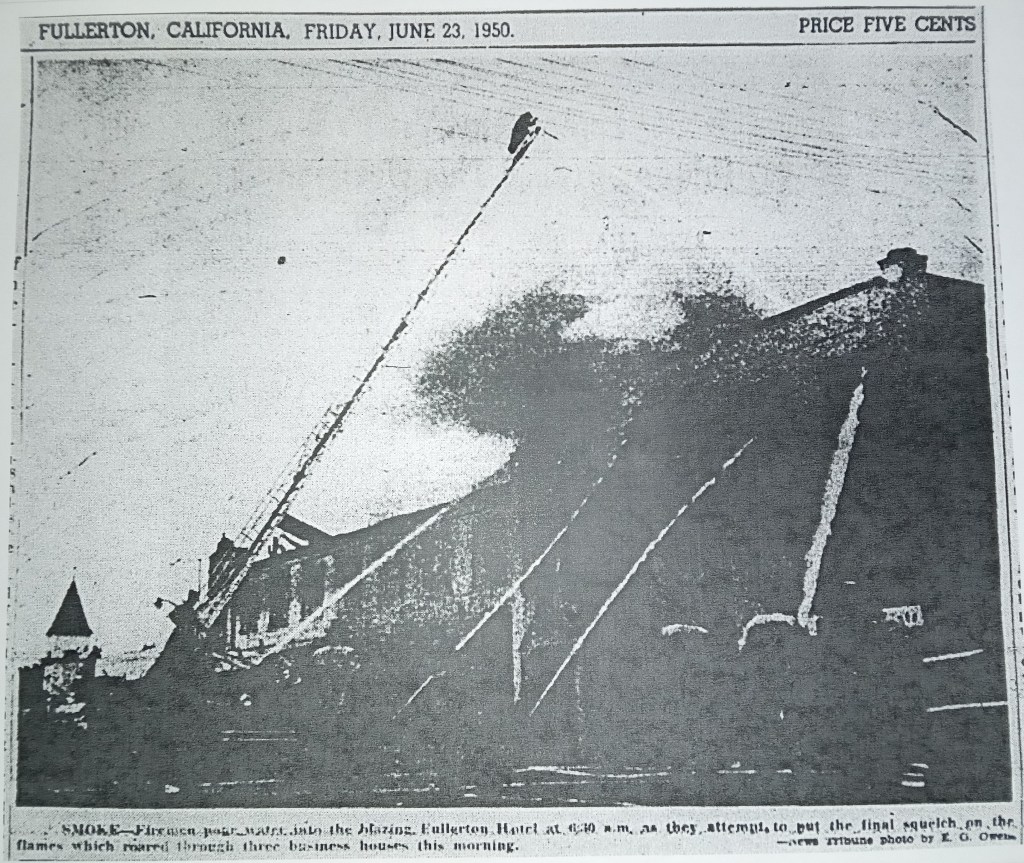
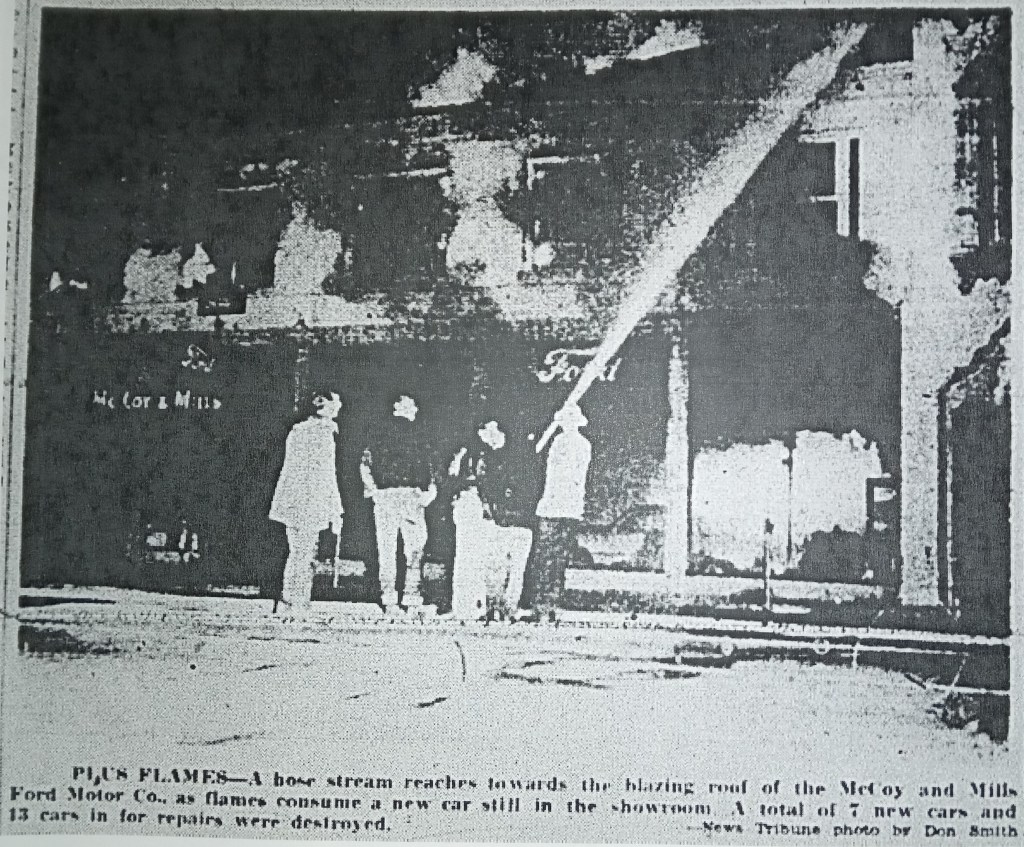

Aerial photo showing devastation of the 1950 fire. “The juice plant went up in a hurry as citrus oils and alcohol caught fire and an early morning breeze fanned the flames,” the Tribune stated. “As the citrus plant burned and bottles and cans exploded, syrup concentrate ran ankle deep in the gutters. The smell of scorched syrup filled the air.”
After this tragedy, the company temporarily moved into the Chapman packinghouse before building a much larger new plant at 336 E. Santa Fe Avenue, made out of concrete and steel, not wood. It was also located along the railroad tracks, which was better for shipping purposes.
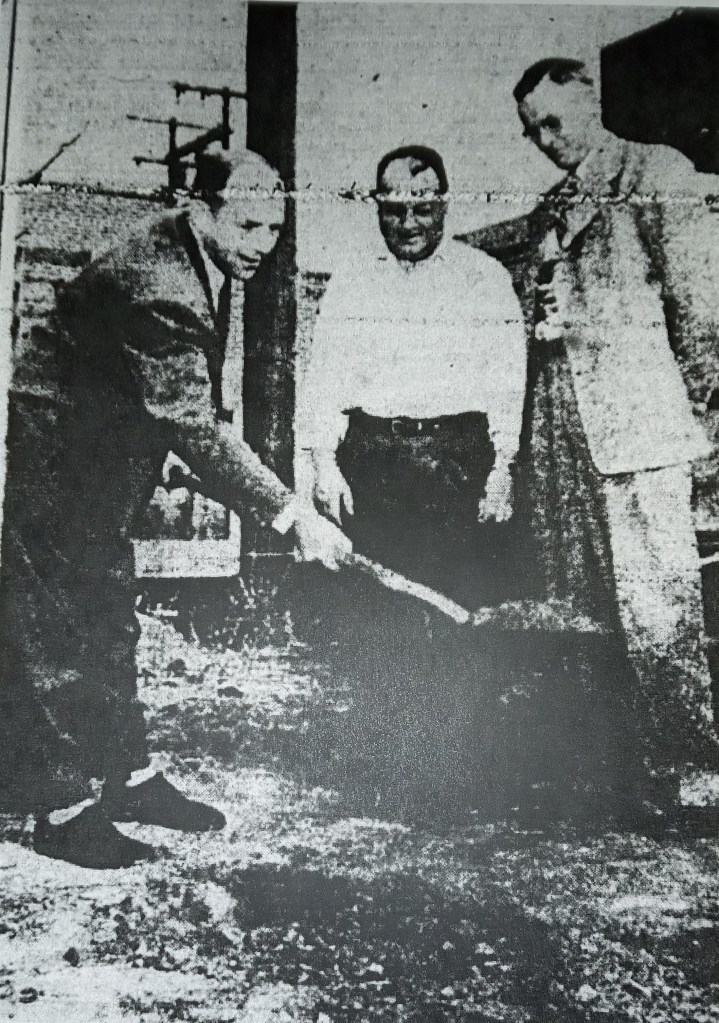
R.P. Hughes, president of Pacific Citrus Products, tosses first shovelful of dirt to officially break ground for the company’s new $250,000 plant on Santa Fe avenue. Standing by to take their turns are Ralph F. Harrison, vice president and Merrill Gregory. 
The new plant at 336 E. Santa Fe Ave. This plant is now the Citrea Apartments. When they built this new apartment complex in 2019, a local artist painted a series of Hawaiian Punch murals facing the train tracks.

By the 1950s, Hawaiian Punch was a national brand advertised in newspapers, television, radio, and magazines. It had become a multi-million dollar company.
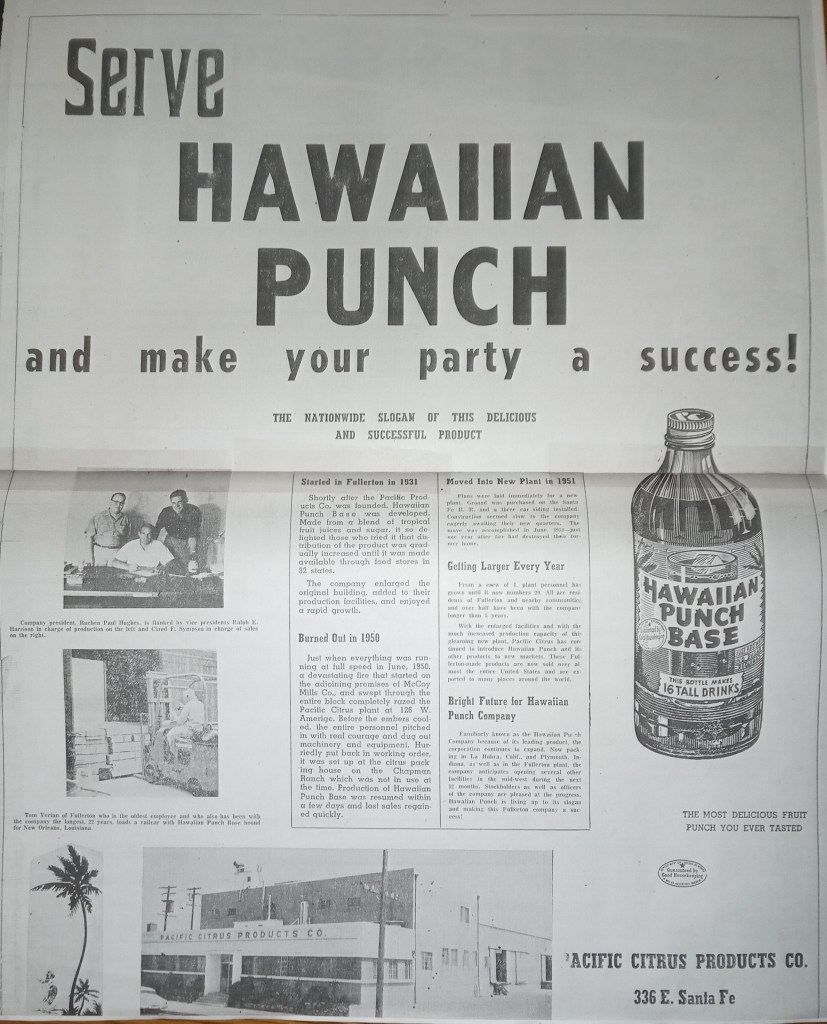
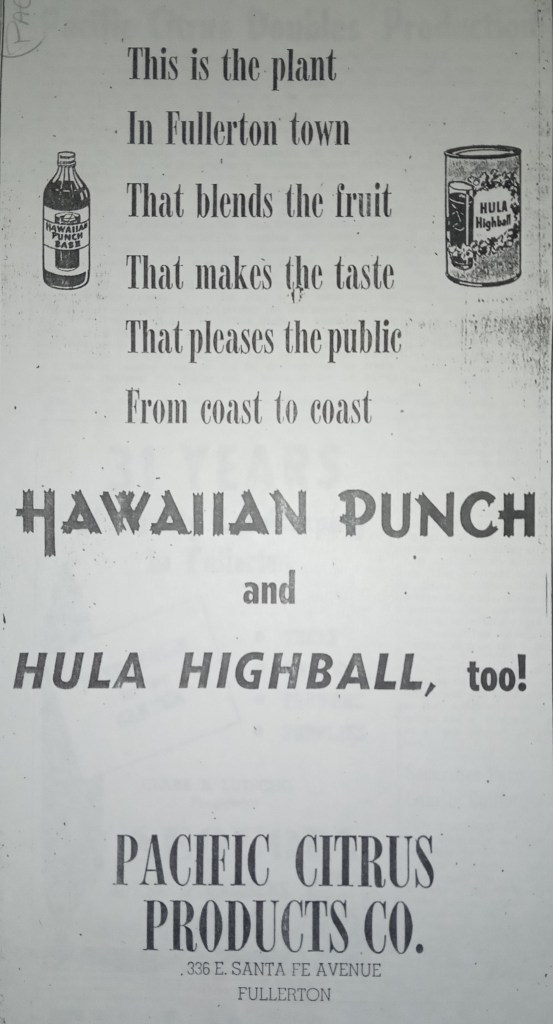
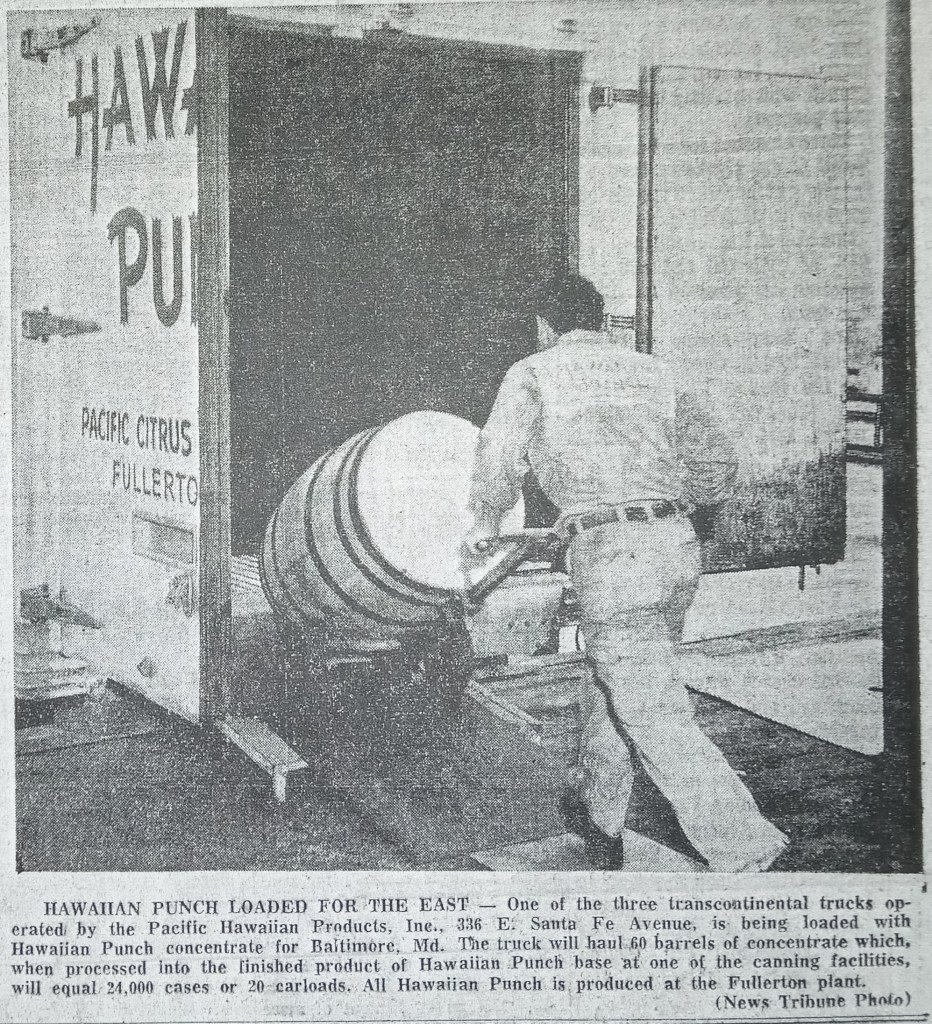
Because of the overwhelming success of Hawaiian Punch, the company was re-named Pacific Hawaiian Products.
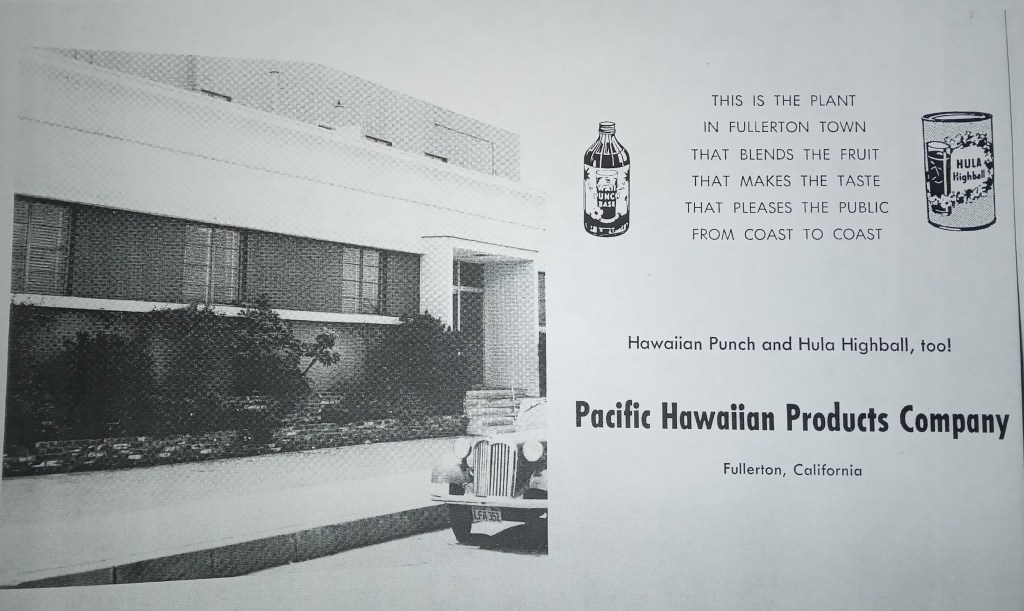

In 1960, Pacific Hawaiian Products moved into a new 5-acre, 63,000 square foot headquarters, production and warehousing building at Acacia and Ross Aves. It was now the largest producer of real fruit juice punch in the country.
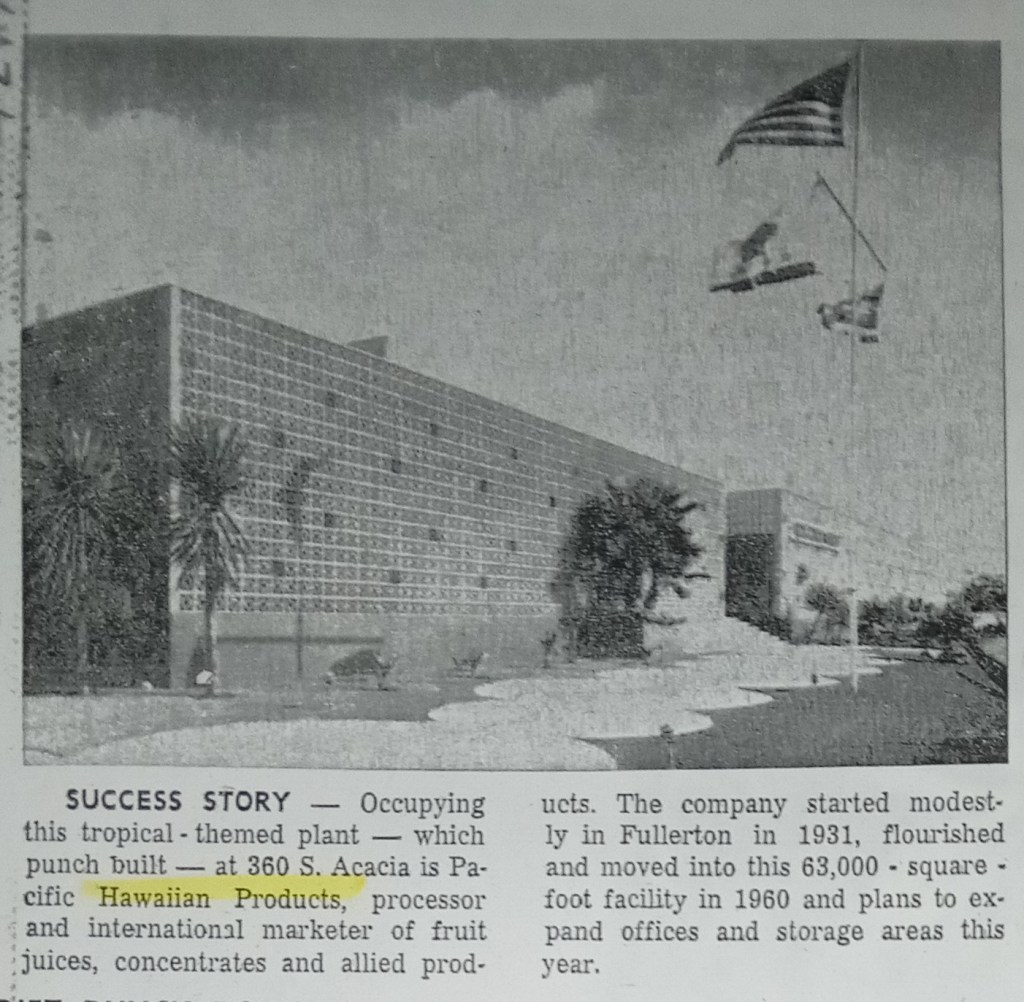

Hughes, the company’s president also became the president of the Fullerton Chamber of Commerce.
By the early 1960s, Hawaiian Punch was not only sold in grocery stores around the country, but was also available throughout the world, including on U.S. military bases.
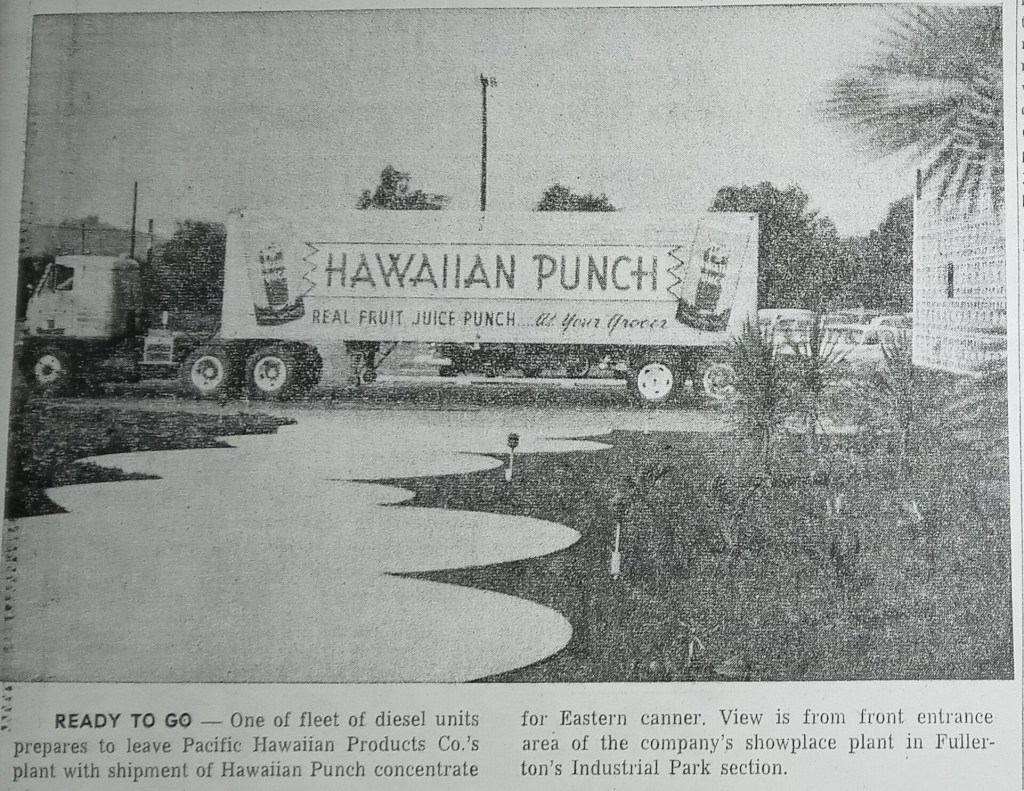
In 1961, the Atherton-Privett ad agency created a 20-second commercial to advertise Hawaiian Punch drink, which introduced the world to Punchy, the popular mascot.
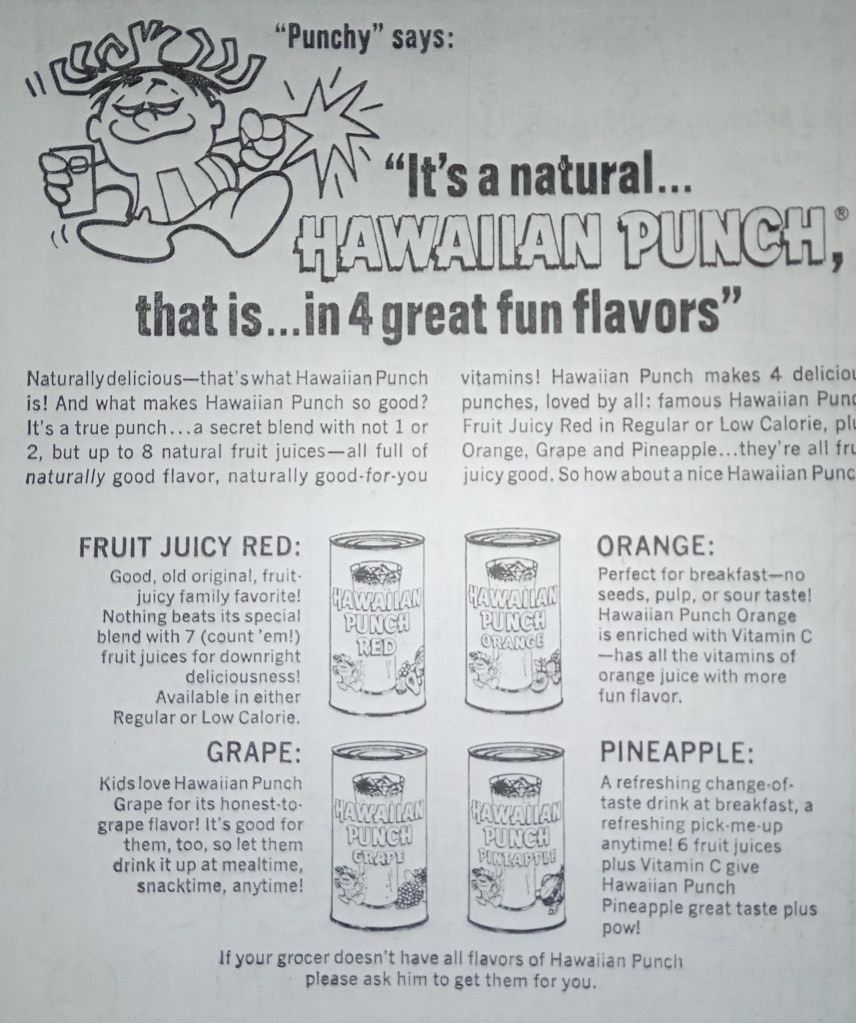
“Hey! How ’bout a nice Hawaiian Punch?” Punchy asked another man.
“Sure,” was the response.
Punchy proceeded to punch the man in the face. Artist Martin Mandelblatt is credited with the creation of Punchy.

In 1963, the company was acquired by R.J. Reynolds, the tobacco company, as part of their entrance into the food and beverage industry.


By 1967, Hawaiian Punch was sold in 230,000 grocery stores and was the best-selling fruit punch in the world.
In 1978, a disgruntled employee vandalized the company headquarters.
A 1978 Fullerton News-Tribune article entitled “Hawaiian Punch Plant Custodian Questioned About Monday Damages” reported:
An 18-year-old local man has been detained by police for questioning in connection with the extensive vandalism committed at the RJR Foods (Hawaiian Punch) plant at 360 S. Acacia Ave. Monday night.
Held since yesterday in the city jail pending further investigation and the filing of formal complaints is Jesse Le Tyree, Jr., a custodian at the plant. He was booked on charges of felony vandalism and suspicion of burglary.
Vandalism at the plant included destruction of vending machines, overturned office desks and file cabinets, plants uprooted and thrown into offices, files scattered all over the floor, and a forklift rammed into numerous 52-gallon barrels of syrup concentrate, allowing the syrup to spread across the warehouse floor.
The syrup loss alone was valued at in excess of $10,000.
Okay, here I must interject. It’s a little weird that this disgruntled employee had a name that was very similar to mine. However, I was born in 1979, so it was not me, I swear.
In 1978, RJR began to employ television personalities Donny and Marie Osmond as Hawaiian Punch advertising spokespeople.
In 1981, RJ Reynolds transferred Hawaiian Punch to another of its major food subsidiaries, Del Monte.
In 1990 Proctor and Gambled acquired Hawaiian Punch.
In 1992, a clever presidential promotion campaign targeted children ages 6 to 13 with Punchy as the favored candidate (“No one else has the punch”).
In 1999, Cadbury Schwepps, which became a subsidiary of Kraft Foods, acquired Hawaiian Punch.
Today, Hawaiian Punch is operated by the Dr. Pepper Snapple Group.
-
Fullerton’s Two Competing Newspapers: 1909
The following is from a work-in-progress about the history of Fullerton. You can support my ongoing research and writing on Patreon.
The Local History Room of the Fullerton Public Library has microfilm from two Fullerton newspapers, the Fullerton Tribune and the Fullerton News. The oldest of these is the Tribune, founded in 1893 by Edgar Johnson. The Fullerton News was founded around 1905, and was funded by wealthy orange grower/Fullerton’s first mayor Charles Chapman, perhaps because he didn’t like the coverage and criticism he was getting from Johnson in the Tribune.
Thus far, I have been focusing my attention on the Tribune, creating a mini year-by-year archive of top stories. However, when I reached the year 1909, it appeared that the Tribune microfilm was missing, so I asked Local History Room archivist Cheri Pape if I could look at the Fullerton News microfilm instead. Cheri warned me that this paper was much more of a business booster than Johnson’s so I was both apprehensive and curious to see how its coverage style differed from the Tribune’s.
Cheri was certainly correct in that the News was much more business/booster oriented, almost like an extension of the chamber of commerce and the personal interests of Mr. Chapman, its financial backer.
Some of the front page “news” stories are blatant puff pieces about Mr. Chapman and his sprawling orange ranch. Below are a few excerpts:
“He comes of that sturdy American ancestry which has ever in past times of peril been the salvation, and must in like times to come, be the hope of this country.”
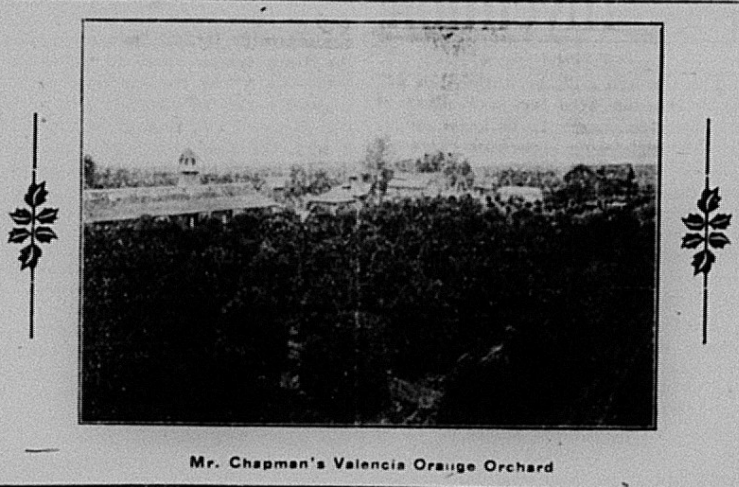
“Under Mr. Chapman’s ownership and management, this property has become the most famous orange ranch in the world, as well as one of the largest…Indeed, the Santa Ysabel is a model, perfect in every detail as an orange ranch and home, and one in seeking to describe it with justice would be forced to use language seemingly superlative to one who has not viewed it for himself. From the beautiful and elegantly appointed family residence to the cement flumes, ditches, and pipe lines no intelligent effort or expense has been spared, no opportunity neglected to bring everything as near perfection as lies within the power of human hand and mind.”
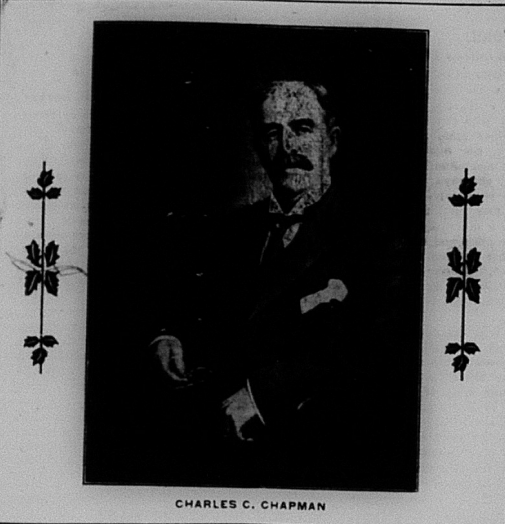
“It is to Mr. Chapman’s liberality that the Christian church of Fullerton is indebted for the cozy, attractive house of worship it now occupies. A well known religious periodical in speaking of him recently said: “This religion of his is not of the ‘holier than thou,’ sanctimonious sort, but the honest, rugged, straightforward kind that never parades itself, yet everywhere wins the respect of the world.”
[Okay, here I must interject. His faith is the kind that never parades itself? The newspaper he was bankrolling ran a front page “article” extolling the virtues of Mr. Chapman.]
“Mr. Chapman resides at his beautiful, though unostentatious, home; busy with material affairs, hospitality and good deeds.“
[His “unostentatious” house had 13 rooms.]
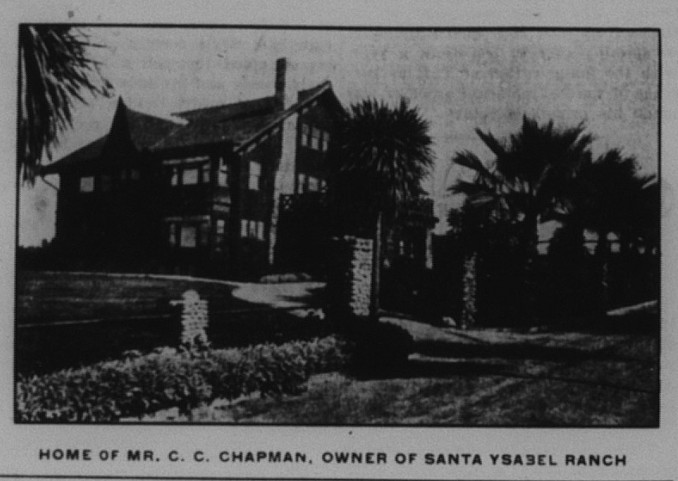
“He has been justly termed ‘The Orange King of the World,’ and this he does not resent.
Okay, enough Chapman fluff. Thankfully, Cheri was able to locate the 1909 Tribune microfilm. From here on out, I’ll just present top news stories from both newspapers, organized by topic.
Prohibition
The residents of Fullerton narrowly voted in 1909 to ban liquor licenses in town, thus making Fullerton a “dry” town.
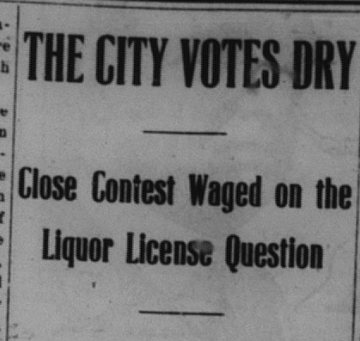
The Tribune article on this (below) states that there was overt voter suppression of Mexican voters: “A number of Mexicans who, it is believed, were anxious to vote for license, were challenged, frightened, and not allowed to vote, on the grounds that they could not read, etc.”

Religion
The Fullerton Episcopal Methodist church was constructed and dedicated. The building still stands today, and is a church called Cornerstone International Christian Church.

Crime

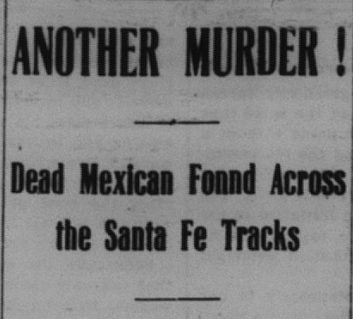
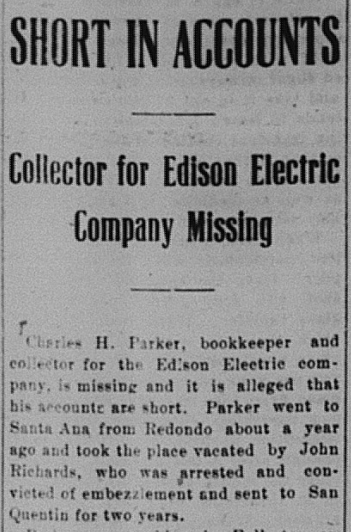
Land Development
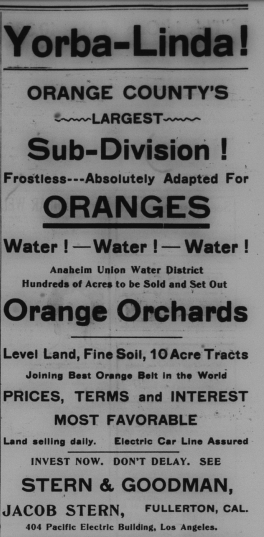
Jacob Stern, co-owner of the large Stern & Goodman general store in downtown Fullerton, was also increasingly invested in southern California real estate, including Yorba-Linda.
Culture


Fullerton celebrated the fourth of July on July 3 with a grand program featuring the Fullerton Military Band.
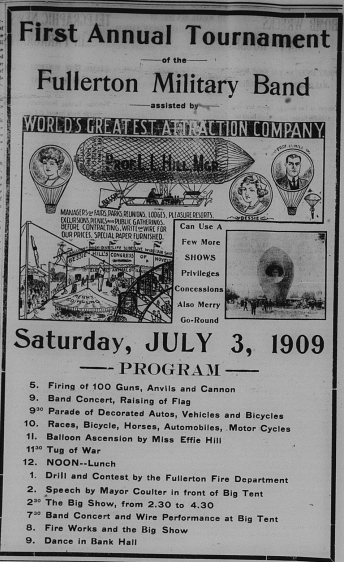
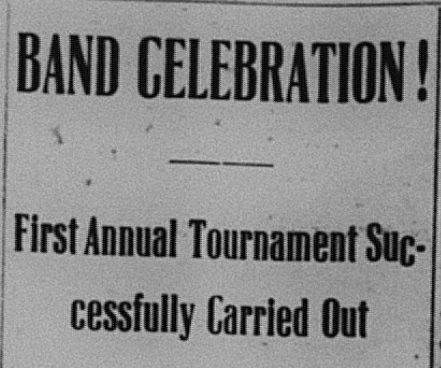
“The glorious Fourth was celebrated in Fullerton on Saturday, July 3, with much noise and enthusiasm. The streets were crowded with people when the band concert began, shortly after 9 o’clock. The national colors were raised while the band played the “Star Spangled Banner” and other patriotic airs, and following the concert was the parade of decorated automobiles…“

Politics
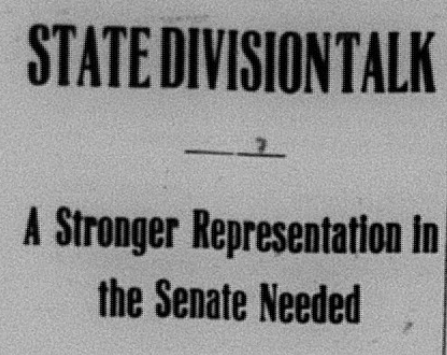
In California politics, the perennial question of division of the state into north and south was discussed.
Oil!
The oil fields in the hills north of Fullerton continued to increase their extraction.
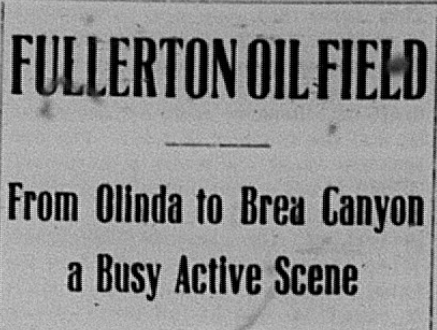
“The Fullerton field from Olinda to Brea Canyon presents an extremely busy appearance,” the News stated. “As far as the eye can reach, new derricks rear their heads. Lumber and rigging are hauled in large quantities and the largest force in the history of the field is employed.”
Oil Companies operating in Fullerton in 1909 included the Graham-Loftus Oil Company, The Santa Fe, Fullerton Oil Company, Olinda Oil Company, Puente, Brea Canyon Company, Union Oil.


Fire
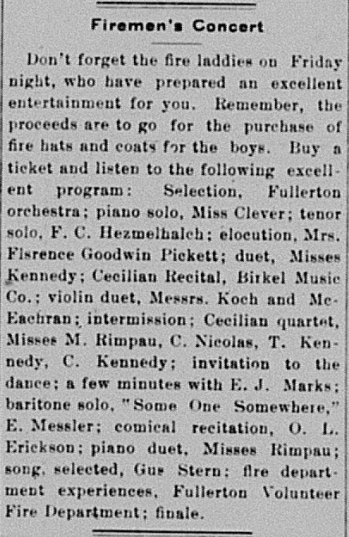
In 1908, following a a large fire downtown, Fullerton organized its first volunteer fire department. In 1909, there was a benefit concert to raise funds for the fledgling fire department.
Transportation
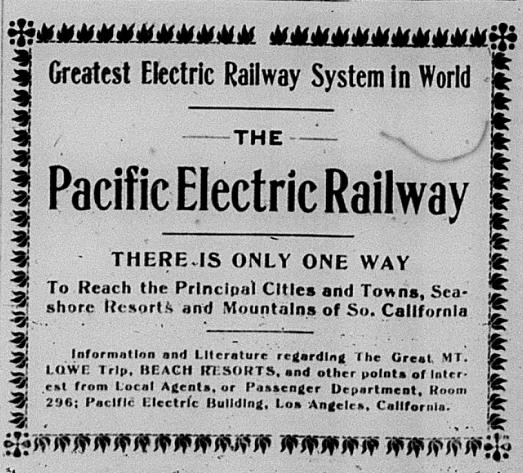
In 1909, the two main modes of travel were trains and automobiles. Fullerton had a train station. At this time, the Pacific Electric Railway, a sprawling interurban rail system that would eventually be dismantled, had not yet reached Fullerton.
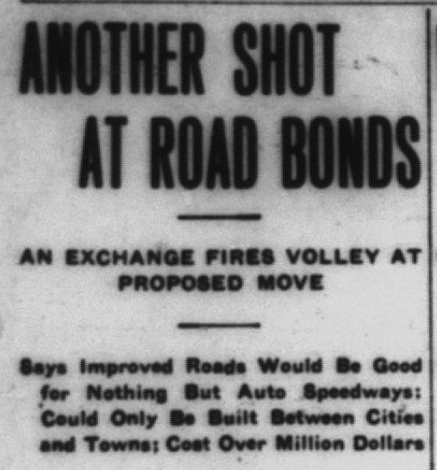
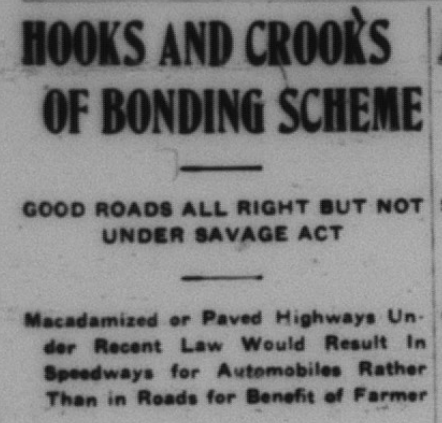
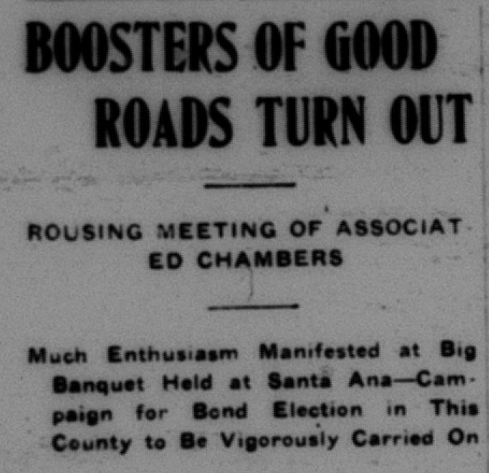
At the county level, local leaders were promoting the idea of floating bonds for improved roads. A couple years prior, a road bond issue was defeated by voters in Fullerton.
Lillian Yeager of Fullerton worked at Forster’s garage, and would eventually open her own auto garage and dealership.

Sports
Deaths
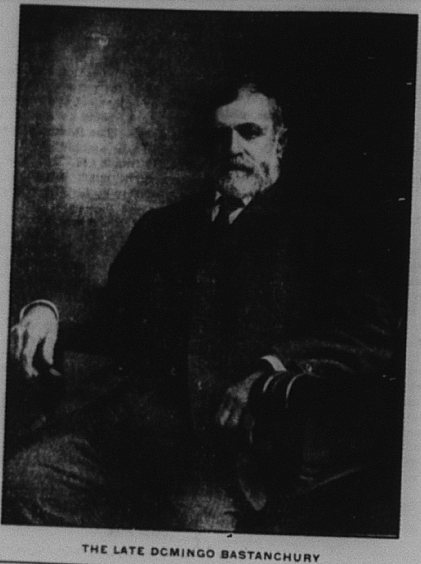
Pioneer Fullerton resident Domingo Bastanchury passed away.

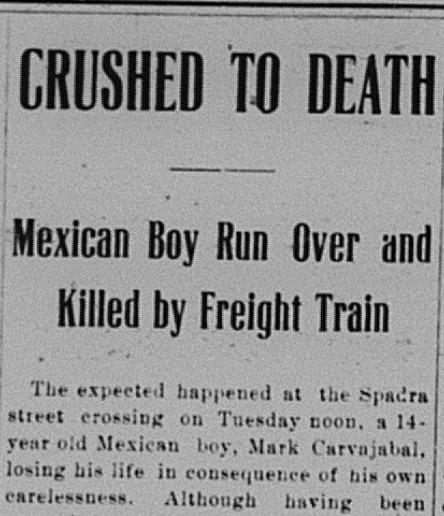
A Mexican boy was run over and killed by a freight train.
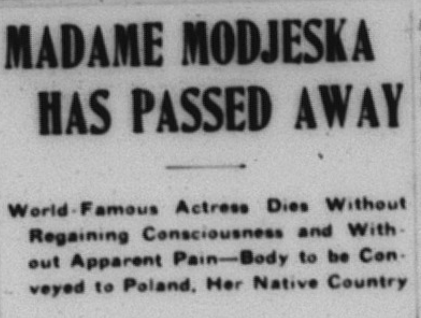
World famous actress Madame Helena Modjeska passed away.
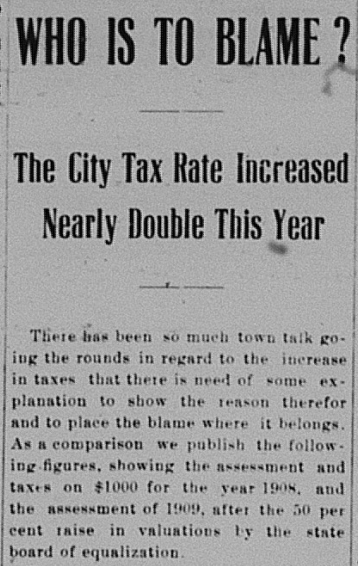
Taxes
Anti-Japanese Racism
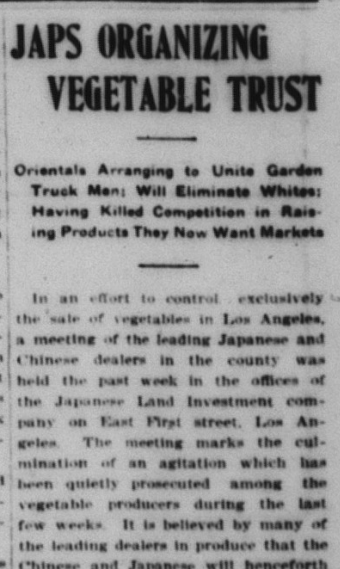
At this time, there was increasing agitation against Japanese people in California, which would ultimately culminate in the 1913 Alien Land Law which severely curtailed the ability of Japanese Americans to lease and own property. The root of the agitation, aside from racism, was competition with Japanese produce growers.

“The Associated Chambers of Commerce of Orange County is going on record against Japanese immigration, against encouraging the Japanese to settle in Orange County, and against the sending of Orange County literature to the Orient,” the above article states.
Women’s Suffrage
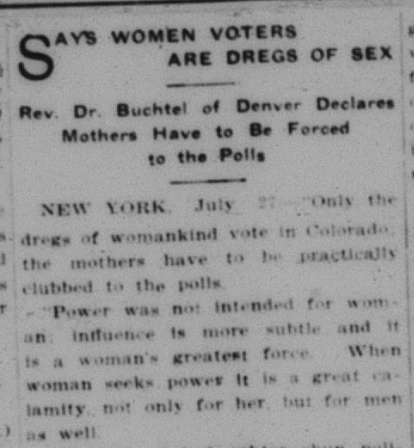
In 1909, women could not vote. Suffrage would not come until the passage of the 19th Amendment in 1920. Prior to this, however, some states began allowing women to vote. This, of course, was not always accepted, as shown by the following article from the Tribune.
Professor Carpenter and Mrs. French: the Saga Continues
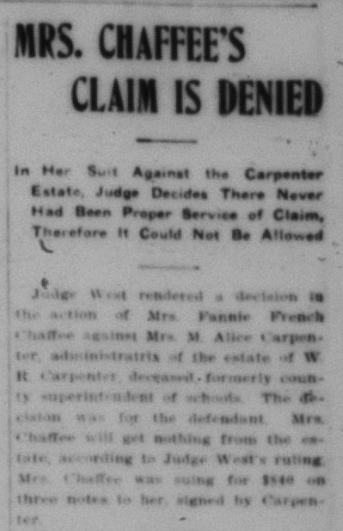
At the end of 1908, a minor scandal was revealed following reports of the death of a Mr. Carpenter, former principal of Fullerton High School, who apparently married a Mrs. French Chaffee (widow of a local Baptist minister) at sea when he was also married to another woman. Mrs. French sued Carpenter’s first wife for money that she claimed she had loaned to her “husband.” Ultimately, French Chaffee’s claim was denied in court.

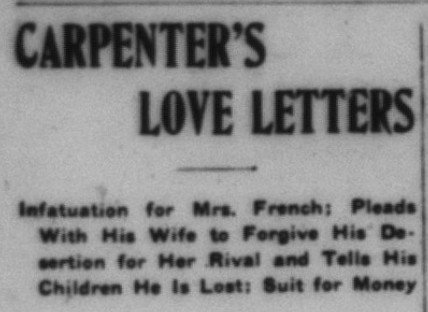
Meanwhile, the Tribune got its hands on some steamy love letters written by Carpenter to French Chaffee, and published some of them.

Carpenter and French. Water
In 1908, the Anaheim Union Water Company completed the Yorba reservoir. Unfortunately, it leaked.

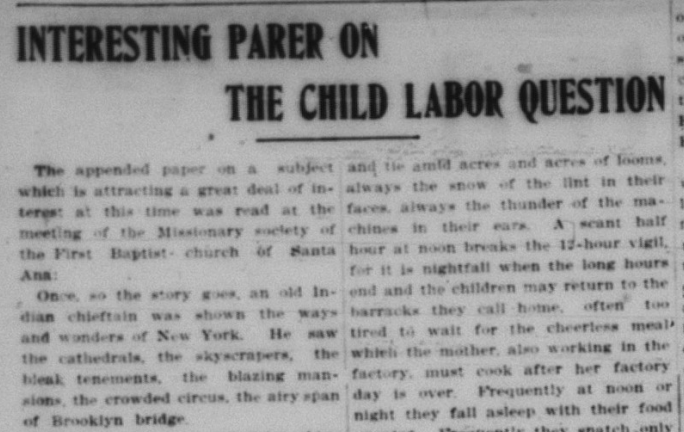
Child Labor
In 1909, child labor was still a question to be discussed in the United States.
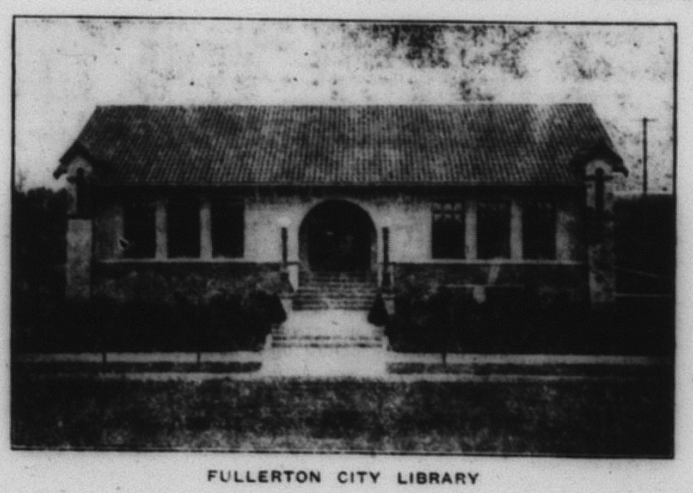
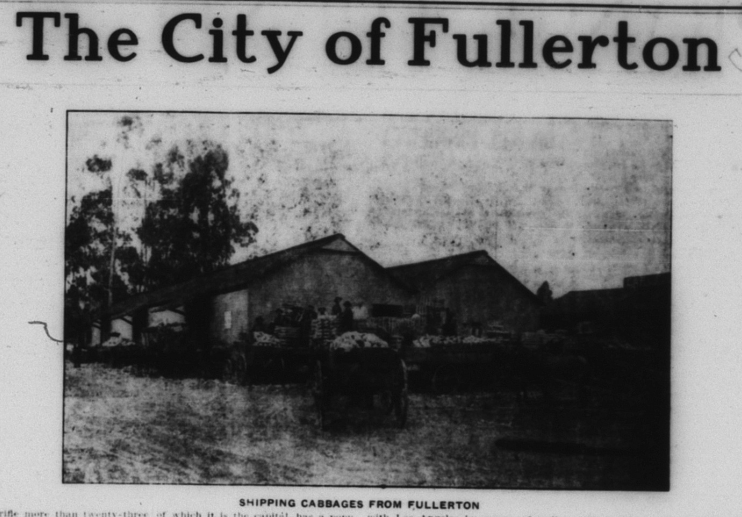
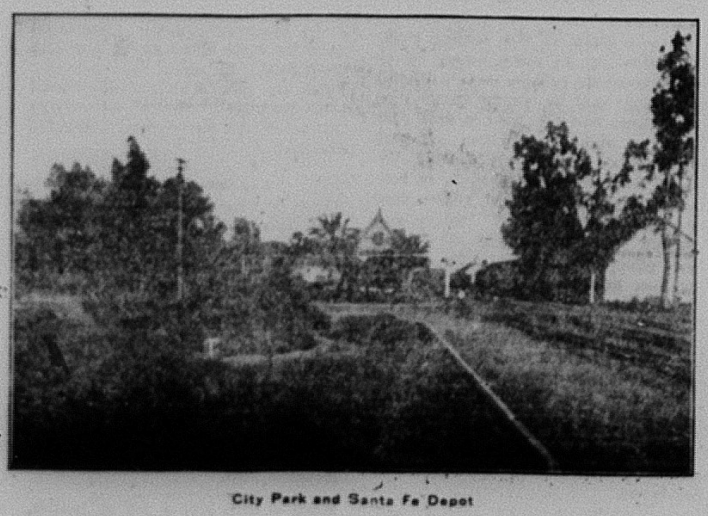
Scenes from Fullerton
The 1909 papers include some cool photos from around town.

Stay tuned for more headlines from 1910!
-
Fullerton Newspaper Headlines: 1908
The following is from a work-in-progress about the history of Fullerton. You can support my ongoing research and writing on Patreon.
The Local History Room of the Fullerton Public Library has microfilm from the Fullerton Tribune newspaper stretching back to 1893. I am in the process of reading over the microfilm, year by year, to get a sense of what was happening in the town over the years. Below are some news stories from 1908.
The Orange County Tribune
For a brief period starting in 1908, the Fullerton Tribune became the Orange County Tribune, perhaps to increase circulation and advertising.

Anti-Japanese Racism
In a trend disturbingly similar to the anti-Chinese activities of the late 19th century which culminated in the Chinese Exclusion Acts of 1882 and 1892, an alarming anti-Japanese sentiment was emerging in 1908, which would ultimately culminate in the 1913 Alien Land Law in California, which severely restricted the ability of Japanese (and other Asian immigrants) from owning or leasing land.
By the turn of the 20th century, Japanese farmers and farm labor had replaced much of the Chinese labor that was curtailed by the Chinese Exclusion Acts. Dredging up the same arguments used to justify Chinese Exclusion (essentially, “they’re taking our jobs and doing better at business than we are”) white Californians agitated for excluding Japanese immigrants as well.
This anti-Japanese sentiment found expression in the pages of the Orange County Tribune, as shown by the following articles:

Below is the full text of the above article:
While there has been no open declaration of hostilities there is war between the Japs and the whites of southern California.
It is an industrial war and test of business acumen and working efficiency.
The Jap now clashes with the white, whether it be as a producer and shipper of vegetables, as a wage earner in the garden or orchard or as a laborer in other lines. This competition is becoming so strong that in some sections civic organizations are said to be preparing to appeal to the citrus growers and packers to employ none but Americans, says the Los Angeles Express.
Having more than held their own with American laborers in certain lines the Japs have advanced a step in their industrial aspirations.
The Nipponese may not possess any great inventive genius, but they have not overlooked the co-operative methods of fruit and vegetable men. With a large acreage of farming land under their control they are preparing to adopt, and in some cases have adopted the co-operative marketing method of the Americans. Already they are doing their own marketing of berries, while preparations are being made for a similar disposition of the celery and other vegetables produced by them. In line with this they have special marketing agents in San Francisco, Portland, and Mexico. Another will be placed in Seattle and later one in Japan.
“We already have co-operative fruit associations at Santa Ana, Newmark, Tropico and other points,” said Kats Baba [sic], secretary of the Japanese association of Los Angeles. “Later we expect to do our own marketing of fruits and vegetables independent of the American shippers.”
Many of the Chinese vegetable vendors here, who formerly depended upon their fellow countrymen for their supply, are now depending upon the association of Japanese ranchers for their supply, according to Baba.
Regardless of persistent reports to the effect that there are serious differences between the Japanese vegetable ranchers and the owners of the land, and that the former claim they are being discriminated against by the shippers, he smiles and declares that nothing of the kind has reached his ears. And then he gives assurance that such trouble could at best be of only short duration as the Japanese will soon be doing their own marketing.
“Now that there are more American laborers available,” said A.B. Woodford, general manager of the California Fruit Growers Exchange, “the tendency will be to give them preference, I think.”
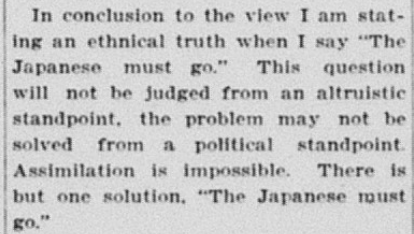
Tribune editor Edgar Johnson, who supported the Chinese Exclusion Act, also seems to support some sort of Japanese exclusion. He re-prints an article by a Mr. Robbins, which argues that “The Japanese Must Go.” Below are some excerpts:


In the next issue of the Tribune, Johnson printed another article, arguing against Japanese exclusion. However, even this article showed racism against Japanese people.


Another article below describes local efforts to “drive out the Japanese.”

The question of Japanese exclusion was also being discussed at the national level with a Congressman Hayes introducing a bill “providing for the exclusion of the Japanese from this country, except certain favored classes.”
“As a matter of fact,” the article states, “the bill provides for excluding not only Japanese…but all orientals of the less desirable classes in other countries than Japan and China.”
“There is no doubt where the Pacific Coast stands on this question of Oriental immigration,” the article continues. “All of the western members met together recently and agreed to support the Hayes bill, or at least the principles in general which it advocates.”
Politics
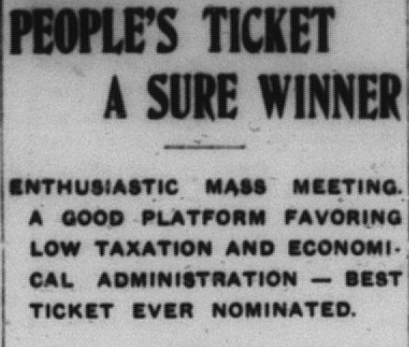
1908 was an election year. The City Council election pitted the “All Citizens’ Ticket” against “The Peoples’ Ticket.” Tribune editor Johnson clearly favored “The Peoples’ Ticket, and they (mostly) won.
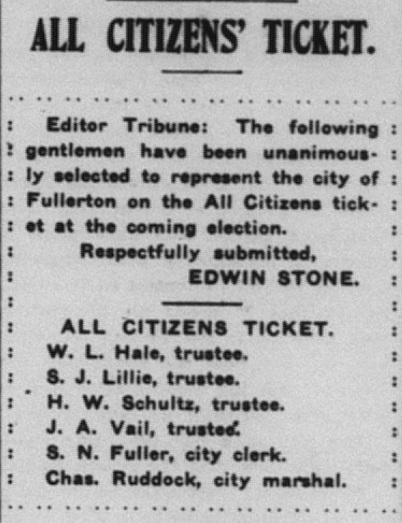

The newly elected trustees (council members) were: Will Coulter, August Hiltscher, J.H. Clever, and William Crowther. The treasurer was W.R. Collis, the clerk was W.P. Scobie, and the Marshal was Charles Ruddock. Coulter was chosen as Chairman, or Mayor.
Former trustee Chapman was not happy with the election’s result and had some harsh words for his political opponents. Editor Edgar Johnson, no fan of Chapman, responded with some choice words of his own.

In national political news, socialist candidate for president Eugene V. Debs stopped in Santa Ana to give a speech.

Another presidential candidate was Eugene W. Chafin, running on the Prohibition ticket.

Ultimately, Republican William Howard Taft won the election.

Taxes
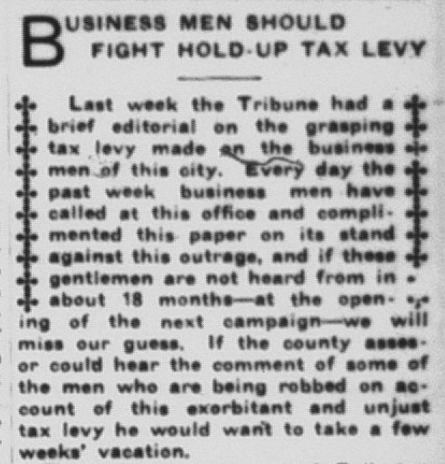
City Trustees passed an ordinance levying a tax on businesses, which editor Johnson (and presumably business owners) took issue with.

Water
In water news, the Anaheim Union Water company completed the Yorba Reservoir, (later known as Yorba Linda Lakebed Park). The reservoir was located near Lakeview Avenue in Yorba Linda.
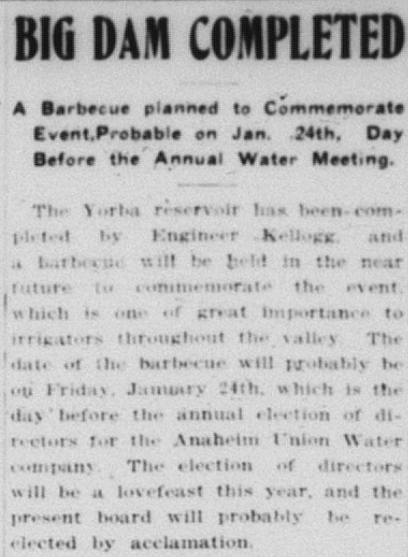
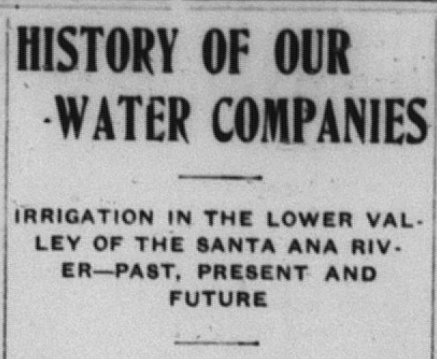
The 1908 Tribune included a five-part history of irrigation in Orange County. I have written about this topic elsewhere.
Prohibition
In 1908 there continued to be much local and national agitation for prohibition by groups like the Women’s Christian Temperance Union (WCTU).
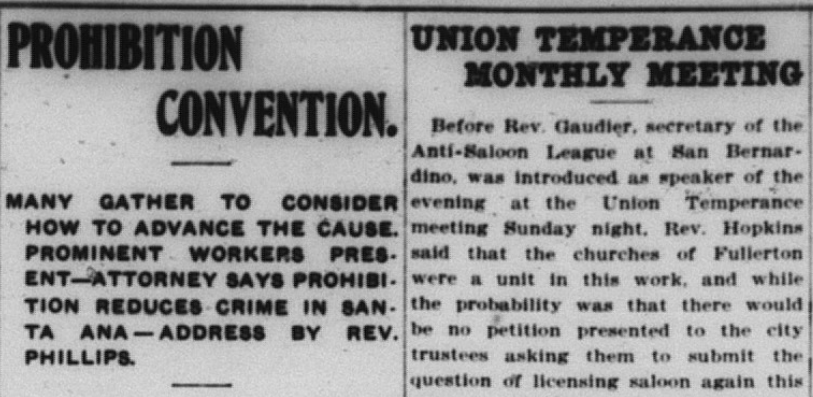

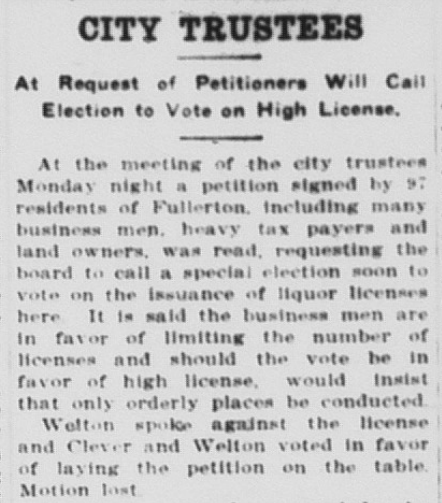
Fullerton often flip flopped between allowing and banning saloons. In 1908, a group of petitioners asked the city trustees to call for an election on banning liquor licenses. This election would take place in 1909. Stay tuned!
Crime
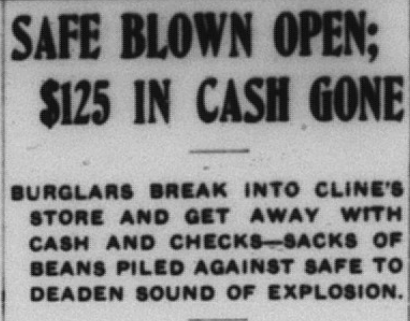
Below are a couple major crimes that took place in downtown Fullerton:

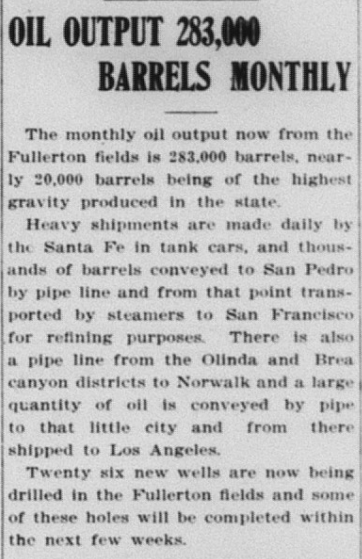
Oil!
The oil fields north of town continued to produce large quantities of oil.
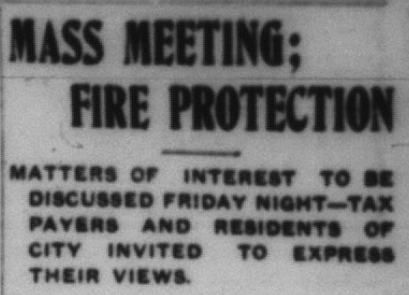
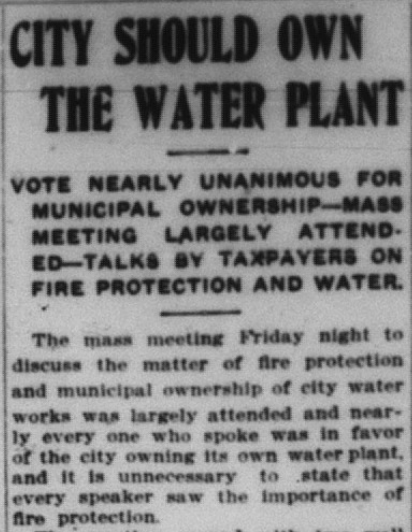
Fire
A large fire destroyed three buildings downtown.

This fire prompted the citizens of Fullerton to organize the first volunteer fire department, to raise money for fire protection, and to consider municipal ownership of the waterworks downtown.


The Scandal of Professor Carpenter and Mrs. French
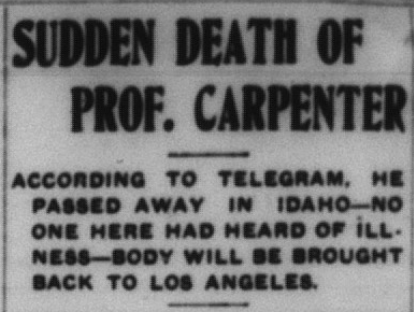
A seemingly normal article about the sudden death of W.R. Carpenter, former Fullerton High School principal ended up revealing a scandalous story about how Carpenter left his wife for the widow of the local Baptist minister.
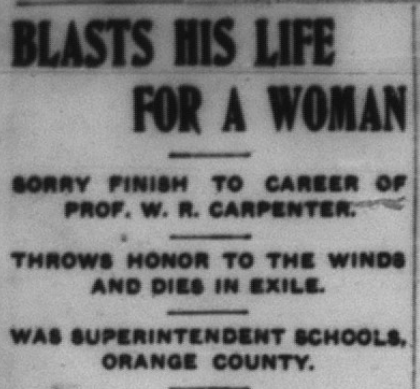
Here are some excerpts from the above article:
Death has freed W.R. Carpenter, former superintendent of Orange County, from the enthrallment of a woman for whose sake he gave up wife, children, an honorable career, and his good name. March 3 Carpenter sent his resignation to the board of supervisors at Santa Ana and he and his family left town. But while the wife, daughter, and son went to Los Angeles the man himself journeyed to Mountain View, Idaho, where he was joined by a Mrs. French, widow of a former Baptist minister of Fullerton, says the Los Angeles Times.
…Now, after less than two months with the other woman, his corpse lies in the morgue of Overholtzer & Mills, death being due to spotted fever.
Before becoming the county superintendent of schools in Orange County, Carpenter was for 14 years principal of the Fullerton high school. He was considered a square, straight man of unusual attainments and commanding ability…
In the early days of his principalship he met Mrs. Fannie French, who was the wife of the Baptist minister at Fullerton.
After the minister died, the affair began.

According to Mrs. French, she and Carpenter were married at sea, and he did not tell her that he was still married to his wife. After Carpenter’s death, Fannie French sued Carpenter’s former wife for $1850 that she apparently loaned him when he was alive.

Agriculture
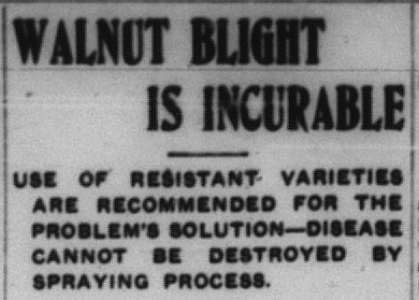
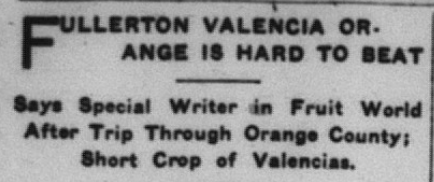
Oranges and walnuts were the main crops of Fullerton, although apparently the walnut crops were experiencing a blight.
Education
In 1908, Fullerton’s new high school building opened where Amerige Park is now. Unfortunately, this building would burn down in 1910.


Miscellaneous
And here are a few miscellaneous articles and clippings from 1908 that I found interesting.
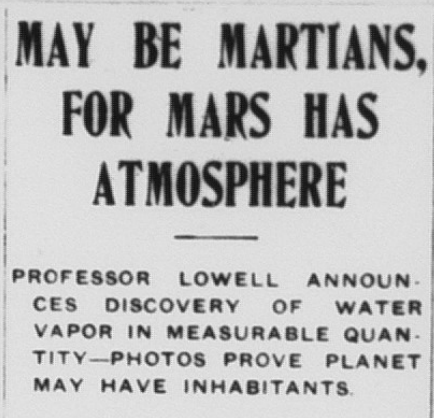


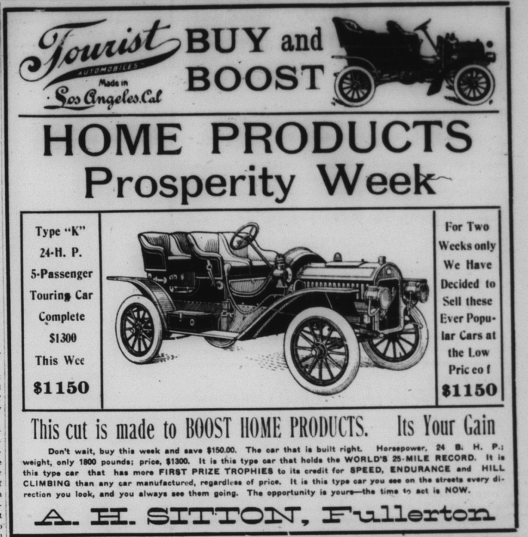

Stay tuned for 1909 headlines!
-
Some Challenges with Writing Local History
The following is from a work-in-progress about the history of Fullerton. You can support my ongoing research and writing on Patreon.
Although I created www.fullertonhistory.com just last year, I have actually been researching and writing about the history of Fullerton since 2010. It started as an occasional hobby for my old blog, continued as I was editor of the Fullerton Observer newspaper, and now it’s become a fairly regular thing. I try to post at least a couple of times a week.
As I’ve begun to take the project of writing a local history book more seriously, I’ve encountered a few challenges that I don’t really have answers for, so I thought I’d write about them.
The first concerns newspaper archives. The most comprehensive of these are the microfilm archives of the Fullerton Tribune, which stretch back to 1893. In order to write a comprehensive history, I’ve felt compelled to dive into these systematically, year-by-year. One challenge is that, due to budget cuts to the Fullerton Public Library, the Local History Room, which used to be open every day until 5pm is now only open from 11am-1pm Monday through Thursday, and there is only one microfilm machine. The other challenge is: how much of the newspaper archives do I need to read to get a complete enough picture of the town’s history? Thus far, I’ve sort of been scanning the archives for interesting headlines, and then creating a year-by-year mini archive of notable stories. However, I sometimes have the sense that, by not reading the entirety of every newspaper, I am perhaps missing out on things. I suppose I don’t have the patience to read every word of every paper, so this is an issue I think about often, and I’m not sure what the best approach is.
Another minor challenge with the newspaper archives is the occasional bias of the newspaper’s editor; however, this is pretty easy to spot.
Another challenge stems from one of my other main sources of information on local history–the extensive oral history archives in the CSUF Center for Oral and Public History. I’ve been slowly reading over these and creating another mini archive of summaries of these. The challenges with these interviews are twofold–the sheer number of interviews that exist, and what to include from these interviews in my history. This brings me to another challenge. Each person’s life is interesting and, as time goes on, Fullerton’s population has grown, increasing the number of potential interview subjects. Hundreds of thousands of people have lived in Fullerton over the years and who’s to say which people are important enough to interview and include in my history? I have only conducted a few interviews myself (I’m still making my way through the archives), but this is another challenge I often think about.
When I tell people I’m researching and writing a history of the town of Fullerton, one reaction sometimes is: why pick such a narrow topic? Why not Orange County history, or California history? It’s a point well taken, but the truth is, the more I dive into the newspaper and interview archives, I’m actually overwhelmed with the breadth of my topic.
I suppose a final challenge, something I often ask myself is: who cares? Why does this even matter? Why devote so much time to this project? I don’t always have a great answer to this question, except to say that the topic interests me, and I don’t really know of anyone else doing it as comprehensively as I’m attempting to do it. Sure, there already exist some good books about Fullerton’s history, the most comprehensive of which is Bob Ziebell’s Fullerton: a Pictorial History. However, as much as I appreciate Ziebell’s work, I think I can do something much more comprehensive.
I don’t really have answers to these questions and challenges. I just thought I’d share them with you. For now, I’ll keep diving into the newspaper archives, the interview archives, and other sources I can find. I hope you enjoy following my process.

-
The Origins of the “Happy California Mission” Myth
The following is from a work-in-progress about the history of Fullerton. You can support my ongoing research and writing on Patreon.
Earlier this week, I posted a report on a chapter entitled “The Indian in the Closet” from Carey McWilliams excellent 1946 history Southern California: an Island on the Land. This chapter seeks to destroy the popular myth that the indigenous peoples of Southern California were treated kindly in the Missions of the 1700s and 1800s. Instead, the picture that emerges from the historical record is one of mistreatment and alarming population collapse among the native people.
So how is it that, for decades, elementary school children and visitors to the Missions were told this “happy mission” story, which is so at odds with the unpleasant truth?
In another chapter entitled “The Growth of a Legend,” McWilliams charts the origin of the “happy mission” myth.
McWilliams pinpoints the origin to one woman, a New England romance writer named Helen Hunt Jackson, whose 1884 novel Ramona became a national sensation and prompted an American fascination with the Missions and California’s Spanish past.

Jackson was born in 1830 in Amherst, Massachusetts. According to McWilliams, she “became a successful writer of trite romances and sentimental poems unlike those written by her friend and neighbor, Emily Dickinson.”
At a Boston tea party, Jackson first became interested in native Americans, particularly their mistreatment. She published a book entitled A Century of Dishonor in 1880, which, as the title suggests, sought to highlight the mistreatment of native Americans.
Jackson then visited Southern California, where she became fascinated by the Missions.
However, according to McWilliams, “Her knowledge of California and of the Mission Indians was essentially that of the tourist and casual visitor. Although she did prepare a valuable report on the Mission Indians based on a field trip that she made with Abbot Kinney of Los Angeles, most of her material about Indians was second-hand and consisted, for the greater part, of odds and ends of gossip, folk tales, and Mission-inspired allegories of one kind or another.”
It was these visits to Southern California that inspired Jackson to write Ramona, “the first novel written about the region, which became, after its publication in 1884, one of the most widely read American novels of the time. It was this novel which firmly established the Mission legend in Southern California.”
While the book was well-intentioned–seeking to generate sympathy for the plight of the native people of California, its romantic evocation of the Spanish past (particular the Franciscan padres, and the Spanish dons) instead served as a driver of tourism and real estate in the region, rather than a genuine engagement with the real history or present circumstances of Southern California native people.
“The book was perfectly timed…to coincide with the great invasion of homeseekers and tourists to the region,” McWilliams writes. “Beginning about 1887, a Ramona production, of fantastic proportions, began to be organized in the region.”
In the late 1880s, there was a huge real estate boom in Southern California, for which the Ramona myth and all it evoked served as a big draw.
Allow me a lengthy quote from McWilliams”
“Picture postcards, by the tens of thousands, were published showing ‘the school attended by Ramona,’ ‘the original of Ramona,’ ‘the place where Ramona was married,’ and various shots of the ‘Ramona country.’…it was not long before the scenic postcards depicting the Ramona Country had come to embrace all of Southern California. In the ‘eighties, the Southern Pacific tourist and excursion trains regularly stopped at Camulos, so that the wide-eyed Bostonians, guidebooks in hand, might detrain, visit the rancho, and bounce up and down on ‘the bed in which Ramona slept.’ Thousands of Ramona baskets, plaques, pincushions, pillows, and souvenirs of all sorts were sold in every curio shop in Los Angeles. Few tourists left the region without having purchased a little replica of the ‘bells that rang when Ramona was married.’…A bibliography of the newspaper stories, magazine articles, and pamphlets written about some aspect of the Ramona legend would fill a volume. Four husky volumes of Ramonana appeared in Southern California: The Real Ramona (1900), by D.A. Hufford; Through Ramona’s Country (1908), the official, classic document, by George Wharton James; Ramona’s Homeland (1914), by Margaret V. Allen; and The True Story of Ramona (1914), by C.C. Davis and W.A. Anderson.

Due to its immense popularity, Ramona was also adapted into a highly successful play, at least three motion pictures, and numerous annual pageants, especially the one in Hemet, which is still performed to this day.
As part of this renewed interest, writer Charles Fletcher Lummis formed an Association for the Preservation of the Missions (which later became the Landmarks Club).
Beginning in 1902, Frank Miller began to build the enormous Mission Inn in Riverside, which prompted a revival of Mission architecture. It was at the Mission Inn that writer John Steven McGroarty wrote his famous Mission Play, which premiered at San Gabriel in 1912 and was seen by millions over the years.
This romanticized depiction of the past created a kind of dual identity for the native people of Southern California–the noble Indian of the novel, plays, films, and pageants vs. the actual, flesh and blood Native Americans who were still present in the region.
“The region accepted the charming Ramona, as a folk-figure, but completely rejected the Indians still living in the area,” McWilliams writes. “A government report of 1920 indicated that 90% of the residents of the sections in which Indians still live in Southern California were wholly ignorant about their Indian neighbors and that deep local prejudice against them still prevailed.”
-
The Devastating Impact of Colonization and Conquest on the Native People of Southern California
The following is from a work-in-progress about the history of Fullerton. You can support my ongoing research and writing on Patreon.
As part of my research into the history of Fullerton, I occasionally read books about broader California history, to give appropriate context for what occurred locally. I’m currently reading Carey McWilliams’ excellent 1946 book Southern California: an Island on the Land. McWilliams writes the kind of history that resonates with me, with a particular interest in questioning popular myths, and exposing unpleasant but vital aspects of history. I have previously published a book report on McWilliams’ devastating book Factories in the Field: the History of Migratory Farm Labor in California which sought to expose the oppressive and often racist history of how California’s field workers have been treated.
In Southern California: an Island on the Land, McWilliams includes a chapter entitled “The Indian in the Closet” which seeks to destroy popular myths and expose the unpleasant truth of how southern California’s indigenous people fared under Spanish, Mexican, and American rule. Granted, the book was published in 1946, and much additional scholarship has been done since then, but his chapter is nonetheless filled with excellent (and often disturbing) historical facts. Therefore, I have decided to write a mini-report on this chapter, which quotes liberally from McWilliams.
The Myth of the “Happy Missions”
How did it come to pass that, for decades, elementary school children and visitors to the 21 California Missions were told a story of a pleasant and benevolent relationship between the native Californians and the Franciscan padres like Father Junipero Serra?
McWilliams actually includes a separate chapter entitled “The Growth of a Legend” which tells the tale of how, in the late 19th and early 20th century, a Mission myth was created and perpetuated by American writers like Helen Hunt Jackson, John Steven McGroarty, George Wharton James, and Charles Flecther Lummis.
“With a boldness more comic than brazen, the synthetic past has been kept alive by innumerable pageants, fiestas, and outdoor enactments of one kind or another, by the restoration of the Missions; and by the establishment of such curious spectacles as Olvera Street in the Old Plaza section of Los Angeles,” McWilliams writes.
I plan to write more on this, but suffice it to say that this happy story was a myth created not by Indians or Spaniards, but by Americans as “part of a grandiose real-estate ballyhoo” and as a way for Americans living in a place that had undergone rapid social transformation to create a comforting past.
“Before explaining how this legend came into existence it might be well to take a look at the facts,” McWilliams writes.
The Indigenous Peoples of Southern California
Many of the cities of Southern California are actually built upon native village sites.
“The reason is a simple one,” McWilliams writes, “the Indians chose the most favored spot with a sure knowledge born of long experience in the region. He sought fresh water, a scarce commodity in early days; a smooth shoreline; and abundant vegetation. The Indian village of Yang-na became Los Angeles; Sibag-na is now San Gabriel; while Santa Ana is located on the site of the Indian village of Hutucg-na.
Prior to Spanish colonization of California, it is estimated that there were at least 130,000 Indians in California, although this figure has been placed as high as 700,000. Even at the low estimate, California had about 16% of the indigenous population of the United States by comparison with 5% of its land area, thus making California perhaps the most densely populated area of what became the United States.
The indigenous peoples of Southern California comprised several tribal groups, who from north to south are:
–The Chumash, occupying three of the Santa Barbara or Channel Islands, and the coastal region of Santa Barbara.
–The Serrano located in the San Bernardino Mountains and the lowlands of the San Bernardino Valley.
–The Gabrieleno, which have also been called Tongva, but the tribal members I’ve met prefer the name Kizh, occupied Los Angeles County, half of Orange County (including Fullerton), and two of the Channel Islands (Santa Catalina and San Clemente).
–The Juaneno (although they prefer the name Acjachemen) who live south of what is known as Aliso Creek and north of the Las Pulgas Canyon in what are now the southern areas of Orange County and the northwestern areas of San Diego County.
–The Luiseno who prefer the name Payómkawichum, live in the present-day southern part of Los Angeles County to the northern part of San Diego County, and inland 30 miles.
–The Cahuilla who live in the inland basin between the San Bernardino Mountains and Mt. San Jacinto.
–The Digueno, who prefer the name Kumeyaay live in a territory bounded on the west by the ocean, on the north by the country of the Luiseno and the Cahuilla.
Beginning with San Diego in 1769, Missions were established on all the tribal lands of these peoples.
The Effects of Missionization
Spanish colonization of California began in 1769, with the establishment of Missions, pueblos (towns), and presidios (military forts). This led to an alarming population collapse for the native people of Southern California.
“From a total of 30,000 in 1769, the number of Indians in Southern California declined to approximately 1,250 by 1910,” McWilliams writes, “the survival of Indians was in inverse ratio to their contact with the Missions. So far as the Indian was concerned, contact with the Missions meant death.”
Allow me to include a lengthy quote from McWilliams:
“With the best theological intentions in the world, the Franciscan padres eliminated Indians with the effectiveness of Nazis operating concentration camps. From 1776 to 1834, they baptized 4,404 Indians in the Mission San Juan Capistrano and buried 3,227…In not a single Mission did the number of Indian births equal the number of Indian deaths. During the entire period of Mission rule, from 1769 to 1834, the Franciscans baptized 53,600 adult Indians and buried 37,000. The mortality rates were so high that the Missions were constantly dependent upon new conversions to maintain the neophyte population which never, at any period, exceeded the peak figure of 20,300, reached in 1805. So far as the Indians were concerned, the chain of Missions along the coast might best be described as a series of picturesque charnel houses. For it was the Mission experience, rather than any contact with Spanish culture, that produced this frightful toll of Indian life.”
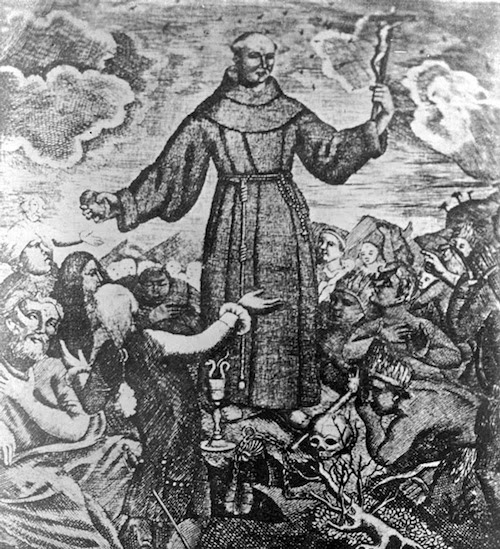
What led to this calamitous population decline? One result of removing indigenous people from their tribal lifeways and herding them into cramped Mission compounds was a devastating spread of disease for which the people had no natural immunity.
“From 1769 to 1833, 29,100 Indian births were recorded in the Missions of California, and 62,000 deaths, the excess of deaths over births being 33,500,” McWilliams writes. “Of this decline, Dr. Sherburne F. Cook estimates that 15,250 or 45% of of the population decrease was caused by disease. Two epidemics of the measles, one in 1806 and the other in 1828, took a heavy toll of neophyte lives. Within the first decade of Mission rule, syphilis appeared throughout the province. Despite the injunctions of officers and priests, the scrofulous Spanish soldiery spread the disease among both the gentile and neophyte Indian women.”
In the Missions, “the sanitation was wretched and the diet inadequate. From 1776 to 1825, there was only one qualified physician in all Alta California.”
“Once the Indians were assembled in large numbers in the Missions, they had to be strictly regimented and the problem of discipline immediately became a serious one,” McWilliams writes. “From the moment of conversion, the neophyte became a slave; he belonged thereafter to the particular Mission.”
As disease decimated native populations, their treatment in the missions accelerated their physical and cultural decline.
“If the Indian would not work,” writes C.D. Willard, “he was starved and flogged. If he ran away he was pursued and brought back.”
“If a neophyte deserted from one Mission to another, he was immediately arrested, flogged, and kept in irons until he could be returned to the Mission to which he belonged, where, on arrival, he was again flogged,” writes McWilliams.
Contrary to the popular mission myth of kindly padres, the historical record paints a far more disturbing picture.
“Numerous instances were recorded of floggings of fifty to a hundred lashes. Fetters, shackles, and the stocks were commonly used as disciplinary measures,” McWilliams writes. “Referring to Father Zalvida of the Mission San Gabriel, Hugo Reid wrote that ‘he must assuredly have considered whipping as meat and drink to the Indians, for they had it morning, noon, and night.’”
Because of this mistreatment, many native people tried to escape the Missions. In response, “large-scale military expeditions had to be organized to round up the escaped neophytes.”
Regarding their diet, “the neophytes were kept in a state of chronic undernourishment in order to retard the tendency to fugitism.” According to Cook, “the Indians as a whole lived continuously on the verge of clinical deficiency.” The work-day was from six in the morning until almost sunset.
The native people resisted this devastation through occasional revolt, attempted escapes, and increased rates of abortion and infanticide.
“So prevalent was the practice of abortion,” McWilliams writes, “that miscarriages were punished as criminal offenses. The penalty prescribed by Father Zalvida for the Indian woman who had suffered a miscarriage consisted in ‘shaving the head, flogging for fifteen subsequent days, iron on the feet for three months, and having the appear every Sunday in church, on the steps leading up to the altar, with a hideous painted wooden child in her arms.’”
The Missions also failed in achieving the theoretical goal of “educating” the native peoples.
“The padres,” wrote J.M. Guinn, “were opposed to educating the natives for the same reason that southern slaveholders were opposed to educating the Negro, namely, that an ignorant people were more easily kept in subjection.”
The effect of the imposition of Catholic Christianity on the native people was a cultural genocide–an alaming decline in indigenous beliefs and practices.
From the Franciscan point of view, as Dr. Cook points out, it was “vitally necessary to extirpate those individual beliefs and tribal customs which in any way whatever conflicted with the Christian religion.”
Alfred Robinson wrote that “it is not unusual to see numbers of Indians driven along by the alcaldes, and under the whip’s lash forced to the very door of the sanctuary.”
To read more about the dark side of the California Missions, check out my book report on Elias Castillo’s book A Cross of Thorns: The Enslavement of California’s Indians by the Spanish Missions.
Secularization of the Missions (1834-1843)
Beginning in 1813 and continuing through the 1830s was the process of secularization of the Missions–that is, transferring them from church to civil government rule. This also coincided with the independence of Mexico from Spain. Beginning in 1821, California was no longer a part of Spain, but rather a province of Mexico.
“Under the Spanish scheme of colonization, the Missions were never intended as permanent settlements. As originally planned, each Mission was to be converted into a civil community within a decade after its establishment, by which time, so it was reasoned, the tutelage of the Indians would have been completed,” McWilliams writes. “The Franciscans did not hold title to the Mission lands as grants from the Crown; they merely enjoyed a right of use and occupancy at the pleasure of the government. Theoretically they were trustees for the Indian neophytes, upon whom title to the Mission lands and properties was eventually to devolve.”
Unfortunately the plan to turn Mission lands over to the Native peoples never really materialized.
“By 1834, however, the Missions had become too exceedingly rich, their lands and holdings being valued at $78,000,000,” McWilliams writes. “At the peak of its activities, the Mission San Gabriel, for example, operated 17 extensive ranchos and owned 3,000 Indians, 105,000 head of cattle, 20,000 horses, and 40,000 sheep. The pressure to plunder these estates soon became much stronger than the capacity or willingness of the weak Mexican government to enforce the secularization decrees. As a consequence, the laudable scheme of secularization degenerated into a mad scramble to loot the Missions. Faced with the possibility of war with the United States, Governor Micheltorana ordered the disposal of the remaining Mission properties in 1844, by which time all semblance of adherence to the plan of secularization had been abandoned.”
Thus began the “rancho” period of Southern California history, when the land was no longer controlled by the church, but rather by an elite group of people who were granted large tracts of land which became sprawling ranchos.
“From 1769 to 1822, the Spanish had made only about twenty large land grants in the province, but, in the period from 1833 to 1846, over 500 large grants were handed out,” McWilliams writes. “As the threat of American intervention became increasingly imminent, the provincial governors showered their favorites with princely grants. Many of these large land grants were carved out of properties expropriated from the Missions or from the ranches operated by the Missions. In many cases, they were stocked with horses, sheep, and cattle purchased from the Missions or simply appropriated at the time of secularization.”
Under the Mexican “rancho” system, the native peoples continued to work primarily as a labor force, but in a slightly different way. The labor system of the ranchos was essentially the hacienda system of Mexico.
“Paid a fathom of black, red, and white glass beads for a season’s work, these Indian peons were, as Don Juan Bandini said, ‘the working arms which made it possible to carry out agricultural and other projects and to provide necessities.’”
“During the period of secularization, the Indian population of California declined from 83,000 to 72,000, a decline of about 700 a year by comparison with a decline of about 900 a year during the Mission period,” McWilliams writes.
The American Conquest
From 1846 to 1848, the United States waged an expansionist war against the Republic of Mexico, which resulted in the U.S. acquiring nearly half of Mexico, including California.
“While much of the damage to Indian life had been caused prior to the American conquest, still the relative impact of Anglo settlement was about three times as severe as that of Spanish and Mexican settlement,” McWilliams writes. “At the time of the conquest, there were still about 72,000 Indians in California, including the remnants of the neophyte or Mission Indians. By 1865 the total had been reduced to 23,000, and by 1880 to 15,000.”
“Indian life,” wrote Stephen Powers in a government report of 1877, “burst into air by the suddenness and fierceness of the attack…Never before in history has a people been swept away with such terrible swiftness.”
“American settlers came to California with two centuries of Indian warfare behind them. The Indian had no rights the white man was bound to respect. If the Americans had a policy, it was to extirpate Indian culture, not to transform it,” McWilliams writes.
The American settlers “drove the Indians from their fisheries and acorn groves, destroying the supply of fish by muddying and polluting the rivers and creeks, and, in raids on Indian villages, destroyed food supplies which had been laboriously accumulated,” McWilliams writes.
In addition to gold, the Americans wanted land and would often use physical violence against the native population. “In less than two years after its establishment, the new state of California had incurred an indebtedness of over one million dollars in fighting Indians. It is estimated that, in about a hundred Indian ‘affairs,’ or raids, some 15,000 Indians were killed in the period from 1848 to 1865.”
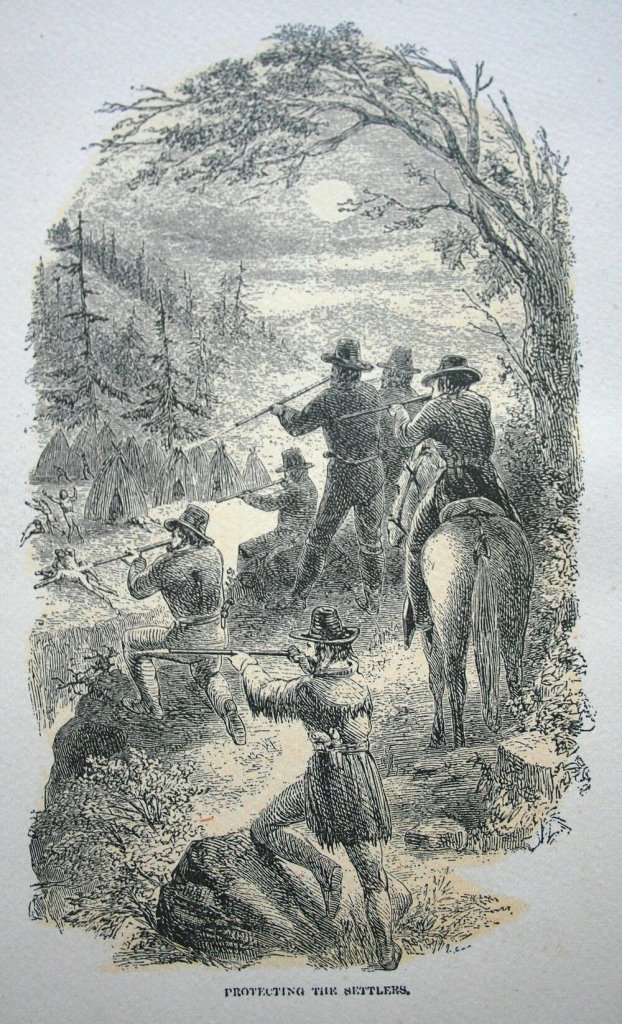
After California became a U.S. state, laws were enacted which essentially kept the native population at the lowest rung of society. Native people were not allowed to testify in court, they could be declared “vagrants” on the petition of a white person, and a law “established a system of ‘indentured apprentices,’ under which minors, with the ‘consent’ of their parents, might be farmed out as apprentices for a term of years.”
“An Indian could be shot for any minor infraction of the white code, such as speaking out of turn, getting in the way, or demanding payment of wages,” McWilliams writes. “The indentured apprentice law merely rationalized the old Spanish custom of kidnapping Indian children as peons. Between 1852 and 1867, Dr. Cook estimates that 4,000 Indian children were taken from their parents and apprenticed to various employers under this statute.”
To read more about how native Californians fared under American rule, check out my article “The California Native American Genocide.”
-
Subscribe
Subscribed
Have a WordPress.com account? Log in now.

