-
Oral Histories: C. Stanley Chapman
The following is from a work-in-progress about the history of Fullerton. You can support my ongoing research and writing on Patreon.
C. Stanley Chapman, son of Fullerton’s first mayor Charles Chapman, was interviewed in 1976 for the California State University Fullerton Oral History Program by Nita June Busby. Here are some excerpts from that interview, along with some historic photos. I have also included a bit of commentary to clarify or give context.
We became connected with Fullerton in 1894, although we did not move down here to live until 1898. We acquired the property for our first grove in 1894…So we have been connected with the city for a goodly number of years.
To tell you what the town was like when we came here, it was an ordinary village. It was, of course, on the railroad and it was a shipping point for, strangely enough, asparagus and walnuts–there were many walnuts. As an orange shipping place, it had no particular standing at all. I suppose you are aware that the name “Orange County” was not from the orange industry. It was named by A.B. Chapman and Glassell who founded the city of Orange and named it after Orange, Virginia, I think.
When we first came here, I was quite young. We had come from Chicago. The actuating reason was my mother’s health. She only lived a very few months after we came here.

Charles C. Chapman with his daughter Ethel and son Stanley, ca. 1905. Photo courtesy of Chapman University archives. Father had been in a great number of activities in Illinois including a very considerable operation of publishing county histories…He had a very limited education; in fact, he never did actually get beyond the fourth or fifth grade, but he was a man who educated himself by his association with others. He became exceedingly well read and a very fine public speaker.
We came out here in the Spring of 1894 and a year or so later built a small cottage on our Fullerton property which was two miles east of the center of town on what is now State College Boulevard. It was then Cypress Avenue and we lived in that little cottage until 1903 when we built a very substantial three-story house, with some beautiful formal gardens and an arrangement of buildings which misled many people who came out to think they were in a separate community.
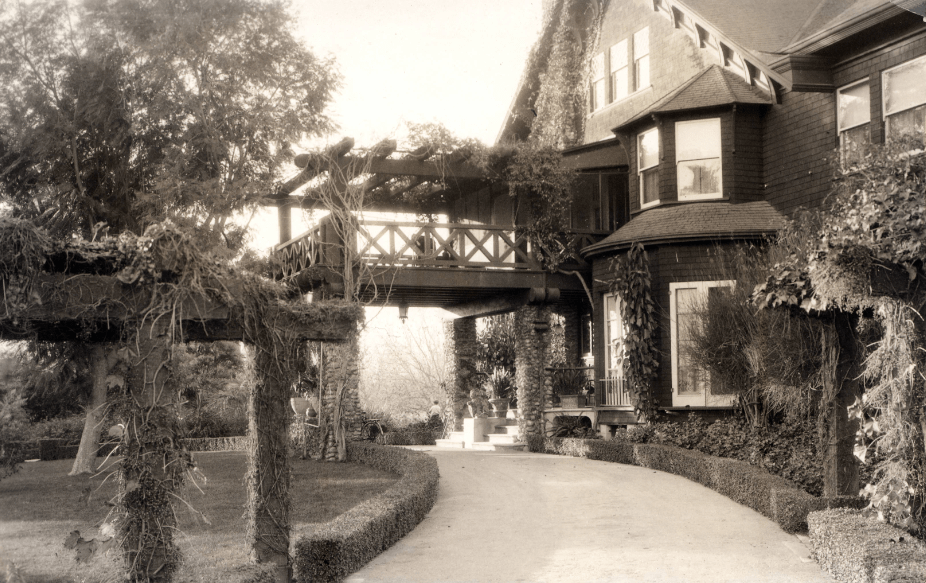
Chapman house in Fullerton, 1930s. Photo courtesy of Chapman University archives. Father’s acquaintance with oranges up to that time had been only when he had been in Florida and had seen some growing. When we came to the grove, among many varieties which were there, were twelve rows of variety the neighbors all said should be budded because they did not get ripe in time to ship. So he watched them and said, “Why don’t you hold them on the tree?” They said, “Oh, you mustn’t do that because they have to get off the tree by June at least.” Well, he had come from the East where he knew that certain times of the year there were no oranges at all. So he did hold them, and then, in September of 1895, he shipped the first carload of Valencias that had ever been shipped into New York. They were an immediate success and he was known universally as the “father of the Valencia orange industry.”
Orange County turned out to be ideally climatically placed for that orange and it became the universal planting.
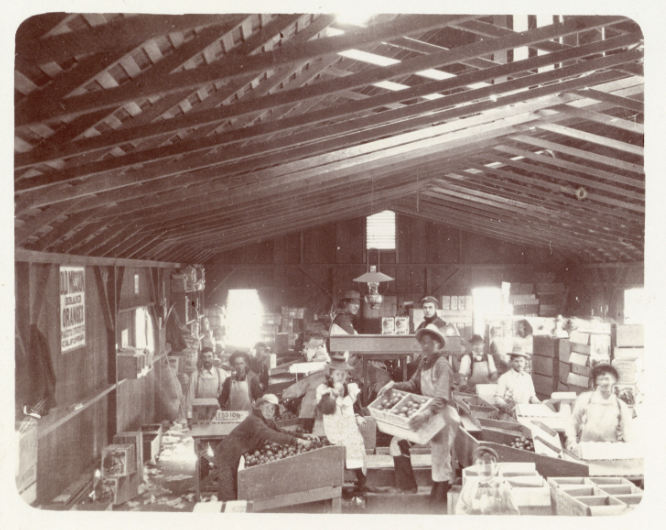
Old Mission citrus packers, circa 1901. Photo courtesy of Chapman University archives. We had over fifty-five acres of walnuts–Placentia was the beginning of the walnut industry and the Placentia Perfection is still the choice walnut of the whole industry although it has all moved up north. This land down here became too valuable for that kind of crop.
Fullerton itself was a small community. There were, I think, about four or five stores and about that many saloons. On the main street there were not even any sidewalks. The haulage was all by wagon and team. It was a very familiar site to see a four horse team pulling a big hay load down through the middle of town.
There were three or four types of stores. Stern and Goodman had their big department store on the corner where Stein and Strauss came later, where the Fullerton Hardware store is now.

Stern and Goodman’s store at Spadra (Harbor) and Commonwealth, circa 1890. Photo courtesy of Fullerton Public Library Local History Room. The Balcom Bank was across the street where the Security Bank is now. In the middle of that block was the Greater Gem Pharmacy of Mr. Starbuck.
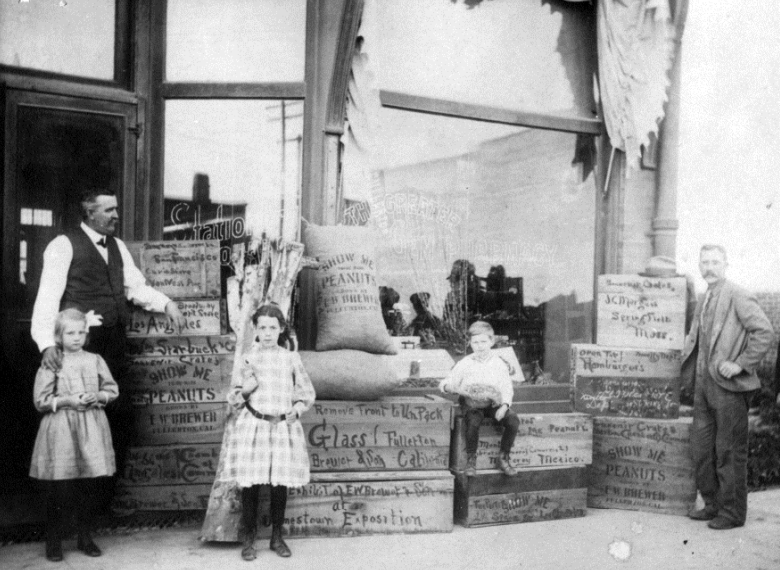
Gem Pharmacy, 1890s. Photo courtesy of Fullerton Public Library Local History Room. That was the place where the telephone exchange was. At that time there were, I think, five telephones. We had one of them. You never had to use a number; you just rang up and said, “Sophie, get me Mr. Dean.” Dean had the hardware store. There was a clothing store on the east side. On the southeast corner was the ice-cream fountain Mr. Ford had. In the middle of that block was the blacksmith shop.
So it was a real community and everybody knew everybody else. It was a very pleasant place to live.
Father was interested in progress, of course, and he was active in the incorporation of the town and became its first mayor.
There was a hotel on the northeast corner of Commonwealth and Harbor–Harbor used to be known as Spadra Road. It was the main road, the old stage road over the hills to the town and station of Spadra so that’s where it got its name.

St. George Hotel, 1888. Photo courtesy of Fullerton Public Library Local History Room. That big hotel [The St. George Hotel] was one of a series that had been built by the railroad in 1883. They had this big drive for people to come out here and they gave free passes to travelers. There was one in Anaheim, one in Olive, one in Santa Fe Springs. All became great places for the kids to play in, in later years. The Ameriges had the one here in Fullerton.
The first move of the new city council was to put in sidewalks. There was a great deal of opposition to it until they saw the first set put in on the first block on Spadra and then, of course, everybody wanted them. It was in 1910 or 1911 that the first paving was done in the main block.
The activity of the community was all agriculturally directed and it wasn’t until along in the fifties that industry began.
The high school was on the northwest block of Wilshire and Balcom and the grammar school was on Wilshire, where the junior high [now the School of Continuing Education] is still located. Fullerton High School was the center of seven school districts. Ours was the largest graduating class up to 1905. We had thirteen members and were the first ones to publish an annual…We called it the Lucky Thirteen…There were thirteen of us and about four or five teachers. We had strict discipline.
I came down to high school in 1901. The high school had just received an athletic field due to the fact that for some unknown reason a whole grove of walnut trees fell down one night and it turned out to be a nice place for a baseball field. How it happened, nobody ever knew (laughter)…
Our senior year we had quite a pitcher who came down from Olinda named Walter Johnson, who turned out to be something pretty good…
I feel that one of the greatest educations that can be given to any child is discipline and the fact that the world is not going to take care of him when he gets out…
I never saw that second high school. I was away at college when it was built. They said it was a very nice school but it burned just about a year later…

Fullerton High School, circa 1910. This building burned down. Photo courtesy of Fullerton Public Library Local History Room. You mentioned some of the businesses–Stern and Goodman and the blacksmith shop. Did they have lots of businesses? It was a small town.
There was the Hiltscher Brothers’ machine shop and butcher shop. They had the only refrigeration in town from their machine shop…
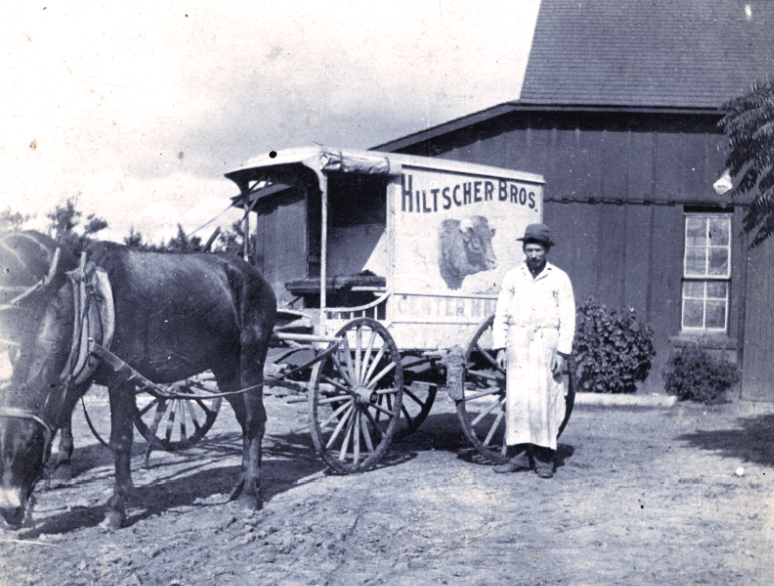
Hiltscher Meats, circa 1890s. Photo courtesy of Fullerton Public Library Local History Room. One thing I am curious about is: were there any Mexicans or Chinese, or whatever around at the time that Fullerton was beginning? Where did our barrios come from, our own Fullerton barrio down around Truslow?
The barrio came in much later. I wouldn’t know what year. Nobody thought of it as being a barrio. On our own ranch we had housing for our own employees. We had about twenty or thirty full-time employees, teamsters and irrigators, and we had a place over on the hill across Placentia Avenue where we had a little village for them…homes, multiple homes, single homes for them to live in. When we first came, we had a bunkhouse for the teamsters, dining room and all. They lived there and ate their meals. Then, of course, we had our own crew that did our picking and our own packinghouse. The girls came in from their homes. But there was no development in that area as far as housing was concerned. The downtown residential portion was almost nonexistent. Have you talked to Lillian Yeager?
No.
She lived right downtown and one of my earliest recollections of her is standing up on a box so she could turn the crank on the first gasoline pump the town had.
Did her family own the place?
Yes, that was their home there right across the street from the church, the Christian church for which Father built the first little chapel. They moved the chapel over to Union avenue.
Was it the only church at the time?
Oh, no. There was the Baptist church, the Methodist church, and the Presbyterian church which was down on Highland and Commonwealth. Those three were the only churches here. The Catholic church was in Anaheim.
Would you tell me a little about the law enforcement?
Charley Ruddock was the chief of police in town. He was not the first constable, I’m sure, but he was the first one I remember. He went on to become Orange County sheriff. The police force was never very big…
What did people do for entertainment in the early days?
Until the first theater came in–my wife’s father had the first motion picture theater in Fullerton, that would have been along about 1915 or 1916–up to that time we made our own entertainment…We had parties and picnics. To have fun, it was not necessary to have mechanical equipment…we used to have nice high school parties and grammar school shows…Very few people had cars and the roads were not fit to go anywhere if you did…I remember starting out to go hunting in the Santa Ana Canyon with the little one cylinder car…
Could we talk about the orange ranch and packinghouse?
Our property in the east of town was owned by the Placentia Orchard Company when we acquired it and the company is still in existence. It was incorporated in 1892 so it is probably one of the oldest in the state. We still maintain that corporation.
Most of the growers belonged to associations and to the Fruit Growers’ Exchange which was organized a bit later. The growers’ associations formed the exchange.
A lot of people think Sunkist is a brand; it is only a quality mark.
When father first started to ship, the growers said, “Don’t use the same label twice because the people will remember and they won’t want to buy the fruit.” In those days, the fruit was all shipped in wooden boxes. He said, “Well, why don’t you make a label they will like?” They said. “You can’t do that.” But he and his brother, Frank, who had started out in Covina, had always been impressed with the old missions and they looked for a label that would display it. They started the “Old Mission” brand. For thirty in the New York market, that Old Mission brand brought the highest price…That was the first quality brand label, as I said, before Sunkist came into being as a quality mark.
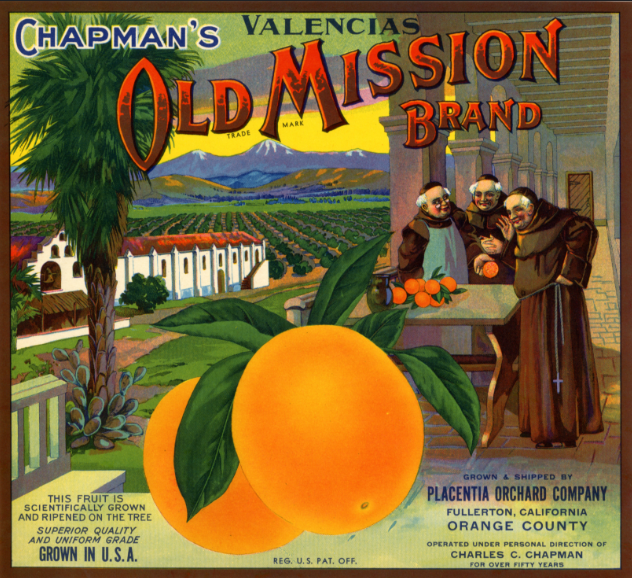
Crate label for Old Mission Brand oranges circa 1920. Photo courtesy of Chapman University Archives. Each packinghouse and each association had its own brand but they have to pass a certain quality for the Sunkist mark. Father was given credit for that, too, in the citrus business.
It was amazing, after he had been here for only a short time, he was going around to “citrus institutes” telling people how to grow and sell oranges. He became quite an authority.
Could we talk about water? I would think that citrus fruit would take a lot of water. Where did the water come from?
Water in this area comes from the Santa Ana River. The water is divided between the Anaheim Union Water Company and the Santa Ana Valley Irrigation Company. It was years ago that it was divided. Father was always on the Anaheim Union Board. There were some wells, but most of this area was all developed by the Santa Ana River water…
So much water was later taken up here from wells that the artesian flow stopped. The “saltwater barrier” gave way and the salt water moved in. But, water was no problem in those early days. The river furnished everything that was needed up here.
Please talk some more about your family: your mother and sister and so forth.
Well, as I said, Mother died. My sister was the queen of the first Orange County Fair. She married Dr. William Wickett.
Tell me more about the medical services in the town.
When we came, there were two doctors, Dr. Freeman, a general practitioner who was our doctor and Dr. Rich who was the surgeon. Dr. Rich had the fist Oldsmobile in the town. In those days the doctors came to your house. There was no such thing as going to a doctor’s office…Dr. Clark came in later. His home was taken out to the university.
Can you talk about Atherton’s Ostrich Farm?
We always felt the ostriches were a novelty for them and as far as I know they did not commercially operate. All our relationship with the ostriches was when once in a while we would take a bag of oranges up and throw them over the fence and watch them. They would swallow the oranges whole and you could see them going down around their necks. So that was our only contact…

Atherton’s ostrich farm. Photo courtesy of Fullerton Public Library Local History Room. Your list of topics here mentions the Bastanchury Ranch. The Bastanchurys were one of the large group of Basque people who came here in the very early days. I do no know if you are familiar with them. Many of the families are still here.
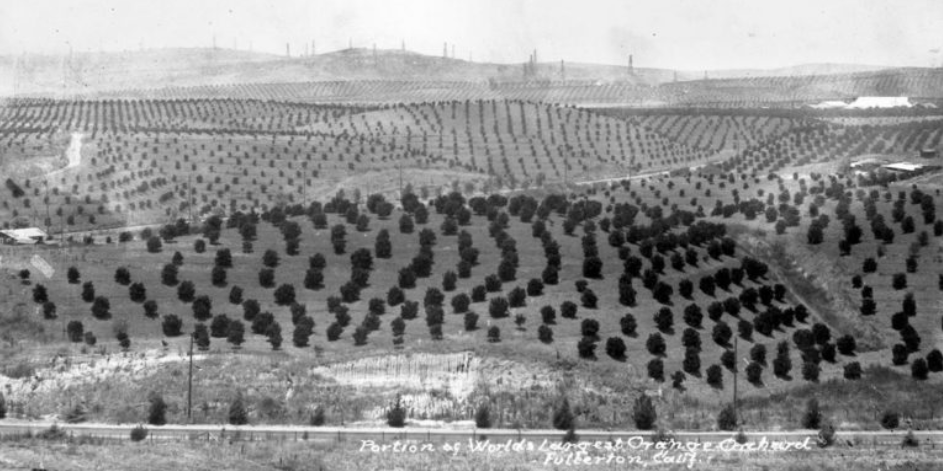
Bastanchury Ranch. Photo courtesy of Fullerton Public Library Local History Room. The Bastanchury Ranch was the largest. They had about three thousand acres and they ran a lot of sheep on their property in the early days.
I was never well-acquainted with any of them as much as I was with Gaston who was one of the sons. I remember going out to the ranch in the old days where they had sheep and going into the dining place where the men were all around this long table. They would pass around great loaves of bread. Each man would cut off a slice. They had wine in leather bottles that they passed along. There was a quill in the end of the bottle. They would squeeze this into their mouths without ever touching the quill at all. It was a great novelty for me.
Subsequently, when Gaston formed the Bastanchury Ranch Company, they set out the whole thing in citrus and it was just too much. They also set out the Union Oil Company land across from what is now Harbor Boulevard. In raising some of his money, he had sold bonds. The bond-holders took the ranch over under the name of “Sunny Hills.” It was really a very tragic thing because if it had been done a little at a time, it could have been a tremendously successful operation…
With the thirties came the Depression. In relation to the citrus business, it was remarkable. In 1930 we got one of the highest prices we ever received for oranges: $3.10 a box on the tree. In 1931, we got $.86; 1932, $.64; 1933, $.54. All that time, of course, the operation had to be kept going. It was a terrible thing. It represented a terrible monetary loss. It took many years to recover. That same year, came the earthquake.
Were there soup kitchens?
One of the things Alice was instrumental in was a kitchen at the Ford School. At that time we had a meat plant over in Anaheim and we supplied the bones and meat to make the soup. Molly Thatcher, who just recently was named “Woman of the Year” by the Business and Professional Women, was the principal. She was determined that no child would know whether the others were paying for their meals or not. So she established a “token” system. The parents, if they could, would buy tickets for their children so that no one would now. For many of the children it was the only hot meal they were getting…
When I built the theater [the Fox Theater, originally called Chapman’s Alician Court Theater], my aunt, Mrs. Dolla Harris, who had established a great reputation in Los Angeles with tearooms, under the name of Mary Louise, put a tearoom in the building that was a beautiful place.
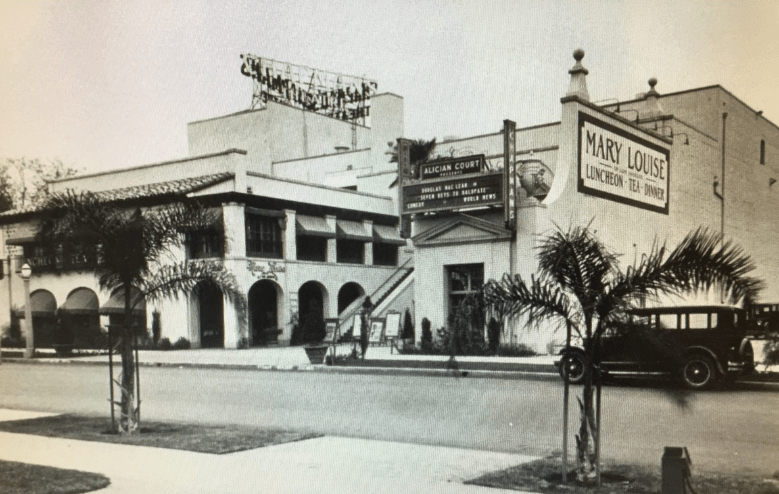
Chapman’s Alician Court Theater, 1925. Photo courtesy of Fox Theater Foundation. In the old days music for the movies used to be a great kick. They had the player piano with two sets of rolls. They would run the picture and set the rolls to go with the scenes…My sister-in-law, Mrs. Winifred Semans, was a high school teacher for years at the Fullerton High School. She played the piano at the theater first and then Alice took it over. Then when we went into the big movie house, we had a beautiful pipe organ. It was really a gorgeous thing, with an echo organ on the roof.
On the walls–and I’ve often just about cried about this–on each side, there were three great big arches, and on each side a set of beautiful murals depicting early California, Portola’s landing and all that on both sides…beautiful. When the Fox Movie people bought it, they got in a hurry and went in there and put white paint over the whole thing. The murals were on canvas. I would have paid ten thousand dollars for them but they painted them over with just white paint. Those beautiful murals.
Who did the murals? Where did they come from?
I forget who painted them. They were done in Los Angeles. They were on canvas. They could have been removed. I would have gladly taken them over to Chapman College. They would have been gorgeous over there. They were really beautiful sets of historical California.
So progress destroys. I’ve often thought that progress is the worst thing that can happen to anybody or any place. It seems like it moves with a hand that is intent only on the greatest return right now. It neer thinks about fifty years from now. What will they think of this modern trend in buildings? They used to be beautiful. Now they’re just straight up and down.
Now mention the Fullerton library…I think that is without question the ugliest building I have ever seen.
I think everybody has read Fountainhead, that book by Ayn Rand where the hero takes all the facades off and makes everything plain. I think all architects read that so there is no more rococo or embellishmments of any kind. It is a shame.
Father built that five story building [the Chapman building] that was just ahead of the town a bit, too. The store, the first one was too good and the second was too poor.

Chapman Building, 1920s. Photo courtesy of Fullerton Public Library Local History Room. In 1937 there were two physical disasters. One was a big freeze and the other was a flood [the flood was actually in 1938]…The Santa Ana River broke over its banks and came back into its old bed, right down what we called the “sand wash,” and went right down into the Mexican village of La Jolla…The American Legion…one of our activities was disaster relief.
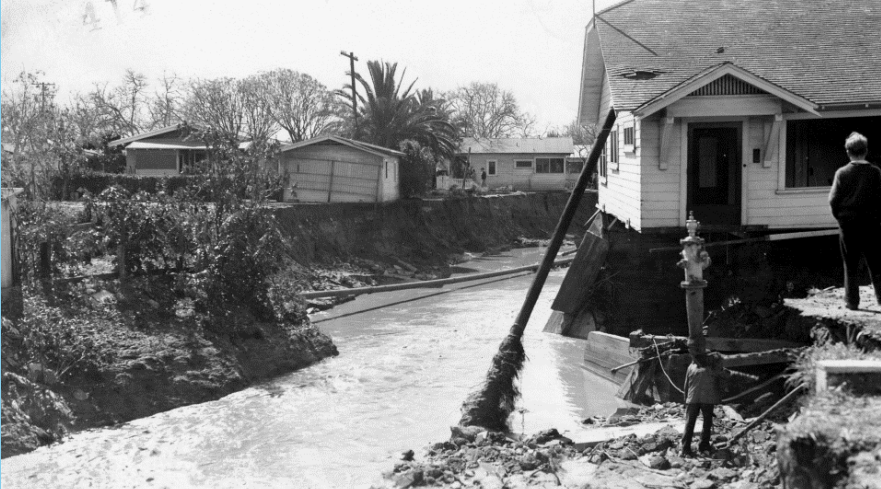
1938 flood. Photo courtesy of Fullerton Public Library Local History Room. When we went out in the truck along Atwood Road, you could hear the people calling for help across the great rushing river. It was just a mad torrent. The whole river went through. The next day, when it had eased, we went through the water in the truck and picked up a lot of people and took them up to the Fullerton Legion Hall.
The Legion Auxillary ladies were all up there. Alice took a lot of baby bottles and nipples and milk and so on. I think we had about 165 people living in the Legion Hall for white a long time. I remember I was wading across the river, looking around and I found this little girl’s body. It was a terrible thing.
Do you suppose it could happen again?
No, the Prado Dam has been put in since then. That flood was before there was any dam at all on the river or any control of any kind. So it will never happen again…

Charles C. Chapman, Ethel Chapman Wickett and C. Stanley Chapman at birthday picnic for Charles C. Chapman at Orange County Park, California, July 2, 1937. Photo courtesy of Chapman University Archives. What did that frost do to the orange groves?
It was not anywhere near the killer that the 1913 frost was. That was the bad one…
Did the Masons start to be a big force in the thirties? When was the Masonic Hall built?
The temple was built in 1920. The old temple was down on the corner of Amerige and what is now Harbor…The lodge was chartered in 1890…it was quite an influential organization because many of the prominent men belonged to it…

Masonic Temple (now Springfield Banquet Center). Photo by Jesse La Tour. Is it more social and service oriented?
Yes. It is an organization of men who are devoted to the improvement of themselves and society, the schools and the things that are for the benefit for all mankind, but it absolutely never engages in any political activity of any sort.
I can see then that it was just the exact opposite of the Ku Klux Klan. Was it ever very large in Fullerton?
Oh, for heavens sake, no. The John Birch Society was more important than that. I never knew anybody that belonged to the Ku Klux Klan. I don’t think it was ever anything here.
[Note: There was an active Ku Klux Klan in Fullerton in the 1920s that included many prominent citizens.]

1924 newspaper advertisement for a KKK rally in Fullerton that reportedly drew thousands. From the Fullerton Tribune microfilm. We had no racial problems here whatsoever. As for the Mexican population, well, they located by themselves but there was never any racial problem. The association in the old days was a very delightful one with the Mexican people because the older ones were the most gracious and lovely people you could imagine. We never felt that they were working for us. We were all just working together. The association was always delightful. One boy, Joe Martinez, who is in the hospital now, has been with us for fifty years. He lost one of his feet here years ago, but he kept on working…
[Note: Relations between Mexican Americans and the larger white community were not as rosy as Chapman relates. There was active segregation and discrimination. Click HERE to read more.]
Our employees are getting fewer and fewer…John Reyna, a truck driver who is up at our Yucaipa property now and is getting up toward his sixties was born on the ranch…
There was never any racial problem in the old days and the idea of a barrio or anything like that just did not exist. They were more comfortable living together. As I said in the other interview, on our ranch we had our own housing for them.
There was never any need for the Ku Klux Klan to come in and ruin everything, like they did in Anaheim?
No. In the schools there were never any pressures.
Did the Mexicans go to the same schools as everybody else?
Oh, sure. Of course, in the olden days, there was no parochial school in Fullerton. The only Catholic church was over in Anaheim. There was never a need for forced integration or forced anything of the kind. It was a natural association.
[Note: There were at least two “Mexican” schools in Fullerton: one on the Bastanchury Ranch and one at a Mexican work camp at Balcom and Pomona.]
Were they allowed to use the swimming pools and the movies and everything else, then, too?
Oh, sure.
[Note: According to an oral history interview by Jessie Corona de Montoya, Mexicans were often excluded from the public pool in Fullerton.]
There were only a few Negro families and they were very high in the estimation of the community. There was this poet, she was just tops. Her name was Ruby Goodwin. Her people were most highly respected. There was never any feeling of difference between us.
[Note: According to numerous Black residents interviewed for the book A Different Shade of Orange: Voices of Orange County, California Black Pioneers, there was in fact housing discrimination in Fullerton. Warren Bussey, an African American man who moved to Fullerton in the early 1950s, said “We [blacks] were only living on two blocks [he lived on Truslow as well]…Living in California at that time, it was more prejudiced than it was in Texas.”]
Were the people proud of the Fullerton High School football team?
There was great support for them.
Do you remember the mural at the high school that the WPA artist painted? Why did they paint that out?
I don’t know. They put one in the Post Office titled “Picking Oranges.” How anybody ever imagined such a thing! Have you ever seen them pick oranges? Men have a bag over their shoulders with the bottom that drops out to lower the front into the box. This picture showed women up on ladders picking oranges without clippers and throwing them at the box. It is the stupidest thing. Anybody who would try it would break his back or his neck. The one down there at the school was almost as absurd. They were painted by that WPA business and the painting did not go with the architecture of the school. It was a great relief when they did paint them out. They were not an artistic addition to the building by any means.

“Pastoral California” mural on the side of the Fullerton High School Auditorium. Photo by Jesse La Tour. Can we talk about the politics in the thirties on the national level now?
Yes, we had that big blow up with the Bull Moose Party and Hiram Johnson here in California and the Southern Pacific Railroad and Teddy Roosevelt with his Bull Moose.
My father was always very active in the Republican Party and he was very much opposed to the Bull Moose Party. In fact, at that time, he actually considered running for the Legislature, or the State Senate, just to hold the party from the Progressives. He always called it the G.O.P., the Grand Old Party, and he was always very active in it; not wanting an office, but wanting the Republicans to be kept in office. He was a conservative and he was very active in getting the tariff on oranges and lemons that made the whole industry possible. He made many trips to Washington. On one of the trips, Herbert Hoover invited him for lunch.
The foreign producers had the advantage of cheap labor and their freight was actually cheaper to ship than it would be from California by rail. So, ti became evident that if the orange industry was to survive, there had to be some protection. And it began to mean a lot to a lot of people as the industry and planting grew. Father made several visits to Washington to work on various congressmen and senators and so forth until they did get–I think it was a cent a pound on oranges and on lemons. Of course, the lemon market was completely in the hands of the foreign producers. When this tariff was established, it immediately gave us a chance to compete because it would make up for the difference in cost and freight and so on. They even got the Democratic Congressmen to support them even though their great rule was “free trade.”
Actually the life of the industry was protection from foreign growers…Several times in the course of the next fifteen years we had to defend this thing. The Democrats wanted to take it off.
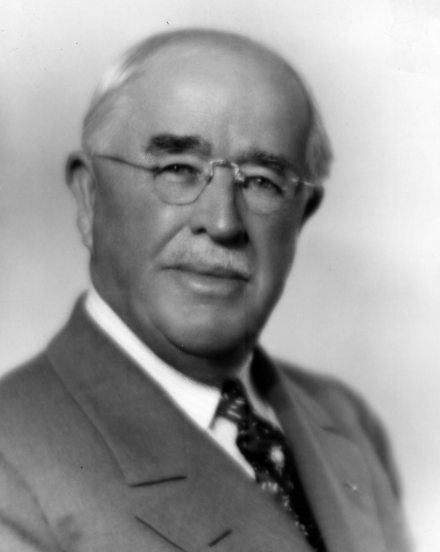
Charles Chapman, 1942. Photo courtesy of Chapman University archives. That was one reason Father was always a Republican. He believed in the protection of American industry. “Buy American for the Americans.”
When was the tariff put in?
I think the first one was along in about 1905.
Being as Fullerton didn’t encourage saloons, did Prohibition make a difference?
Father was a great Prohibitionist and one of the things about the incorporation of the city was his desire to control or get rid of the saloons. The city got fifty dollars a year, I think, from each saloon. Some felt that if they put them out, they would not be able to carry on the city. So he said, “I’ll make up any deficit.” So they put them out. He never had to pay a nickel. The business and everything jumped in the town. Orange County was never involved in the grape business to any extent. The big vineyards were up near San Bernadino.
There were no “blind tigers”–places where people could get illegal alcohol in Fullerton?
I doubt it very much because Anaheim had always been the Mecca. They had the Germans in the first place; they had their wineries, and they had grapes over there, and they had their saloons and everything. It got to be the custom: if anybody wanted anything, he went to Anaheim, and I presume there were places over there. It never became a factor of any moment that I ever heard of in Fullerton. There was plenty just across the “sandwash.”
There’s one little sidelight that might be of interest about the citrus topic, and that is the decline of the citrus industry. For a number of years, we had noticed that along the highway the trees didn’t do well. We all thought it was the dust or something like that. Then it began to be evident that it was the exhaust from the automobiles. As that increased, the damage increased.
Then there was a very tragic and important thing. Have I ever said anything about sour stock or sweet stock? Trees on sour stock were subject to a good many more diseases than trees on sweet stock. From 1916 on, about 85 percent of all plantings were on sour stock. Then, in Brazil, the industry was destroyed by “quick decline.” Then there was an infestation of quick decline up in Glendora…there was no starch in the tree. So this was the “quick decline.”
…And it meant that all of this planting, which was eighty five percent on sour stock, was doomed. There was nothing you could do about it. And this kept spreading, and all they could do was to dig out the tree and burn it. They found it was a virus carried by a little wasp that pierced the leaf…
The land began to get more valuable for other things, but it was a tragedy. If we had stated with the sweet roots, these other diseases were secondary in damage. But, of course, the smog would have gotten them.
-
Fullerton Tribune Headlines: 1896-97

The following is from a work-in-progress about the history of Fullerton. You can support my ongoing research and writing on Patreon.
The Local History Room of the Fullerton Public Library has microfilm from the Fullerton Tribune newspaper stretching back to 1893. I am in the process of skimming over the microfilm, year by year, to get a sense of what was happening in the town over the years. Here are some local headlines from the years 1896 and 1897.
Note: The lines in the articles are lines and cracks in the microfilm, which was produced over 50 years ago, and was meant to last 50 years. Thankfully, there are plans to digitize the microfilm. Unfortunately, some of it has become unreadable.
1896
The Water Fight
In this letter to the Tribune, town co-founder Edward Amerige criticizes the directors of the Anaheim Union Water Company (AUWC) for using company funds to create cement irrigation ditches around their own properties. The AUWC was the main supplier of water from the Santa Ana River for north Orange County. It was owned by stockholders and run by a board of directors who included W.F. Botsford, William “Big Bill” McFadden, W. Crowther, and F.G. Ryan.

Hetebrink-Edwardson Marriage
In a town as small as Fullerton, marriages were big news. Below is an announcement of the marriage of John Hetebrink and Carrie S. Edwardson. The Hetebrinks were prominent Fullerton ranchers.

Sudden Death
The below article tells of the sudden death (possibly by suicide) of a Mrs. Lavina Anderson, a housekeeper in Placentia.

The Chadbourne Failure
This article tells of the bankruptcy of Forrest S. Chadbourne, a furniture dealer in San Francisco. The connection to Fullerton, I think, is that the Chadbourne building (at the northwest corner of Harbor and Commonwealth, since destroyed) was a popular gathering spot for local events in town. I suspect that it was built or owned by Mr. Chadbourne.

Farmer’s Institute to Meet at Fullerton
The Farmers’ Institute, a group of academics studying modern methods of agriculture, came to Fullerton to present recent findings.

1897
The New Oil Wells
On the hills of north Fullerton, new oil wells were being developed. In addition to oranges, oil would become a big business in Fullerton in the first half of the 20th century. There are still some wells today.

Edward L. Doheny, the oil tycoon, drilled some wells north of Fullerton for the Southern California Railway Company.
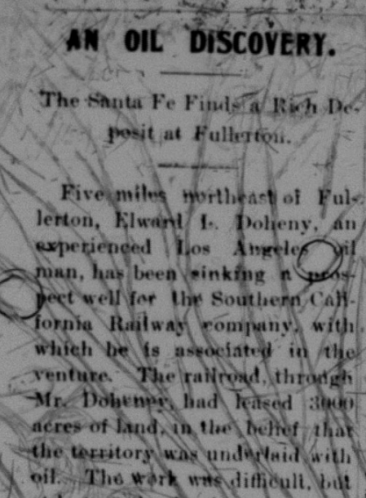
Atherton-Selinger Wedding
Fullerton’s eccentric ostrich farmer, Edward Atherton, married Carolina J. Sellinger of Anaheim.

At the County Seat: Suicidal Mania Epidemic in Santa Ana
This somewhat sensationalized story tells of more suicides in Santa Ana.
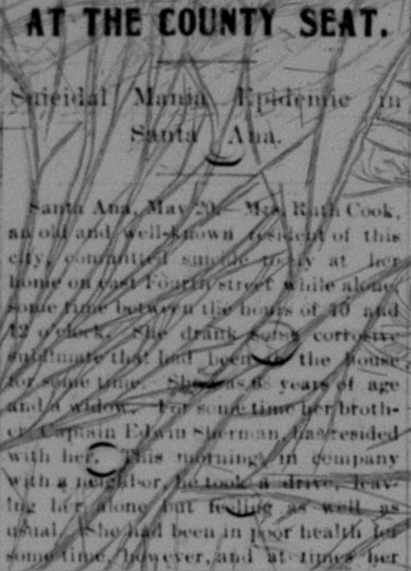
Illegal Act Exposed
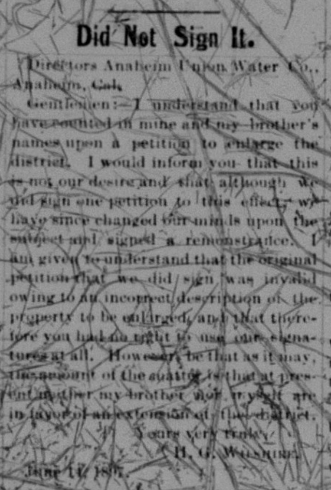
This article describes more shady shenanigans of the board of directors of the Anaheim Union Water Company, particularly over the issue of expanding the territory of the company. Perhaps there was an inherent conflict of interest to have the owners of large ranches on the board of the company that provides irrigation.

Town co-founder H. Gaylord Wilshire (the “millionaire socialist”) wrote a letter to the Water Company Directors asking to take his name off a petition regarding enlarging the company’s acreage.
Fullerton: Mid Orange and Walnut Groves: A Solid Town Built Since the Boom and Growing Rapidly at Present Shipments
The July 3, 1897 issue of the Tribune includes a front page article re-printed from the Los Angeles Herald that gives an interesting overall portrait of Fullerton at that time. I have re-typed the entire article below.

Where southern skies, blue as Saxon eyes, bend o’er the emerald expanse of orchard, field and vine, where the…breath of roses, orange blooms, fragrant walnut groves, sweet smelling alfalfa, lemons and olives weight the air, almost in the shadow of Puente hills, which break the northern blasts, and where ocean breezes freshen every fruit and flower–in a valley rich beyond compare–nestles the picturesque, bustling, growing town of Fullerton. Here all nature smiles in this paradise of loveliness. Tropic trees shade the vernal lawns and the meadows are…with growths of grasses, fattening and sweet while the honey bee may gather its store from December to December. It lies in the midst of a veritable land of sunshine and flowers.
In a good many things Fullerton is different from other towns. Here no high hopes born of the boom lie buried beneath the wrecks stretched along the receding shore of prosperity. No citizen points to vacant blocks and tells the stranger of “boom times” or with a sigh and lament bemoans the passing of prosperity. These things are not here. Where they exist their causes antedate Fullerton. It is not the child of the boom.
It was not until 1888 that it was decided to build a town where Fullerton is located. At that time a large body of land was secured and the town laid out. The original purchase comprised a tract of 430 acres. It takes its name from Mr. George Fullerton, who was a director of the Santa Fe. The voting district now covers about thirty-six square miles and contains fully 1500 people. The rapid growth of Fullerton has made in the past few years is not surpassed by any locality in the state. The annual shipment of produce from the six large packing and warehouses in Fullerton has so increased from but a beginning in the year 1888 that now, by actual railroad statistics, it exceeds that of any other point south of the Southern California metropolis.
This year upward of a thousand carloads of hay grain will be shipped from Fullerton. Two hundred carloads of oranges have already been shipped, with about eight or ten more to be forwarded. Thirty carloads of cabbage, ten of lemons, twenty-four carloads of wool, and about sixty carloads of walnuts were shipped the past season.
As the area brought under cultivation for the growing of all these products is being constantly expanded the shipments will increase in the future as rapidly as in the past. Hundreds of young walnut and lemon orchards are just coming into bearing which next season will materially swell the output. Five fruit packing and forwarding firms operate at Fullerton, where some of them maintain the largest and best equipped establishments of any in Southern California. Such is the nature of the soil and the climate here that shipments of products from Fullerton continue throughout every month of the year. This accounts in a great measure for the great prosperity of the place. There is no period of dullness here, no season of inactivity. Garden truck of every kind, potatoes, beets, onions, berries, etc. grow rapidly and plentifully, finding a eager and profitable market. Tomatoes, a most tender plant, grow and are shipped from Fullerton the entire season of summer and winter.
The soil of the extensive back country, or land lying around Fullerton, including the productive Placentia, La Habra, and Orangethorpe districts contiguous thereto is a rich sandy loam of great depth, varying from ten to sixteen feet, and on account of sub-irrigation, grain can be raised without water. There are over over 8000 acres of this land in barley this season.
In its capacity for production it is the most varied and at the same time the richest body of land in Southern California. In the foothills a few miles back of town are some forty oil wells which are producing an abundant and constant stream of oil of good quality, which adds much business to the town. Recently oil has been developed just outside the town, the Santa Fe railroad company having sunk one well from which they obtain…sixty barrels per day, and are boring others in the same locality.
The growing of walnuts is one of the most profitable pursuits in and around Fullerton…being peculiarly well adapted for their successful production. Most of the immense crop of walnuts in the district is handled and marketed by the Walnut Growers’ association, an organization started in 1893 and which has been the most successful and with the most satisfactorily managed association in Southern California.
The orange groves about Fullerton are considered the best in the state. This seems a broad assertion to make but as a matter of fact the navel varieties grown in the district command always the top prices.
Fullerton is a delightful place in which to live. The environment is charming. Being twenty-three miles south of Los Angeles and only fourteen miles from the seashore and six miles from the mountain foothills at an elevation of 200 feet above sea level it receives the benefit of the ocean breezes, which ameliorate and regulate the temperature, making it cool in summer and warm in winter. Malaria and epidemics are unknown in Fullerton, and the oldest farmers in the vicinity say the district embraces the largest area of frostless belt known in the state.
On arriving in Fullerton a visitor there for the first time will be surprised at the many good, substantial business blocks have been erected. One will soon find, too, that these imposing structures were not built on speculation. All are occupied from cellar to garret and were built to meet the actual and pressing needs of business. Hundreds of beautiful homes have been built in and around Fullerton within the past few years, and many more are in course of erection. Last year thirty-eight new cottages were put up by the thrifty and contented home-builders of the town.
The citizens are highly intelligent and moral in character, and take deep interest in educational matters. There are three excellent schools in the district, with spacious and comfortable buildings for exercises. One of the only two high schools of Orange county is located at Fullerton. The high school district comprises Fullerton, Placentia, Buena Park, Orangethorpe, and La Habra. There are five teachers. W.R. Carpenter is principal and Miss A. Tucker assistant.
Fullerton is on the through line of the Santa Fe and the sea shore line of the same road, which gives frequent and splendid train service.
The rapid growth of Fullerton is indicated by the fact that at the election two years ago the district cast only 198 votes, and at the last election 300 votes were cast.
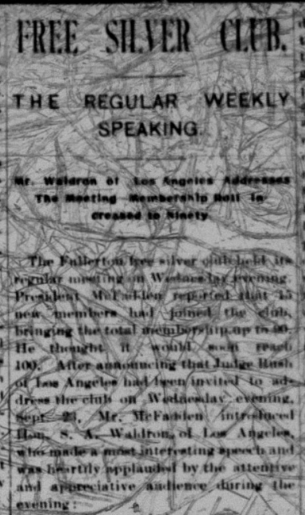
Free Silver Club
Fullerton had formed a Free Silver Club, which sought to expand American monetary policy to include silver, not just the gold standard.
Henderson/Faulkner Marriage
Town blacksmith Alex Henderson was married to Agnes Faulkner.

For some reason, C.B. Huggans thought it was a good idea to take out a full page ad for ginger ale.

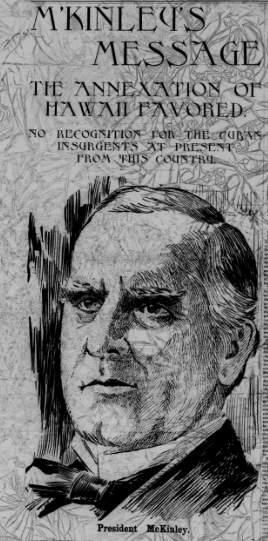
McKinley on the Annexation of Hawaii
In national news, President McKinley gave a message in favor of the annexation of Hawaii.
Stay tuned for more headlines from the Fullerton Tribune as I continue my journey through the microfilm!
-
George Esmay (railroad agent/banker/mechanic)
The following is from a work-in-progress about the history of Fullerton. You can support my ongoing research and writing on Patreon.
George Esmay was born in Jackson County, Iowa in 1859. As a young man he worked as a carpenter, then became a railroad operator.
In 1883, he married Ettie May Garlick, whose father James had been active in organizing the underground railroad.
George and Ettie had five children.
In 1907 he moved out west and became cashier of the Atchison, Topeka and Santa Fe Railroad in Fullerton.
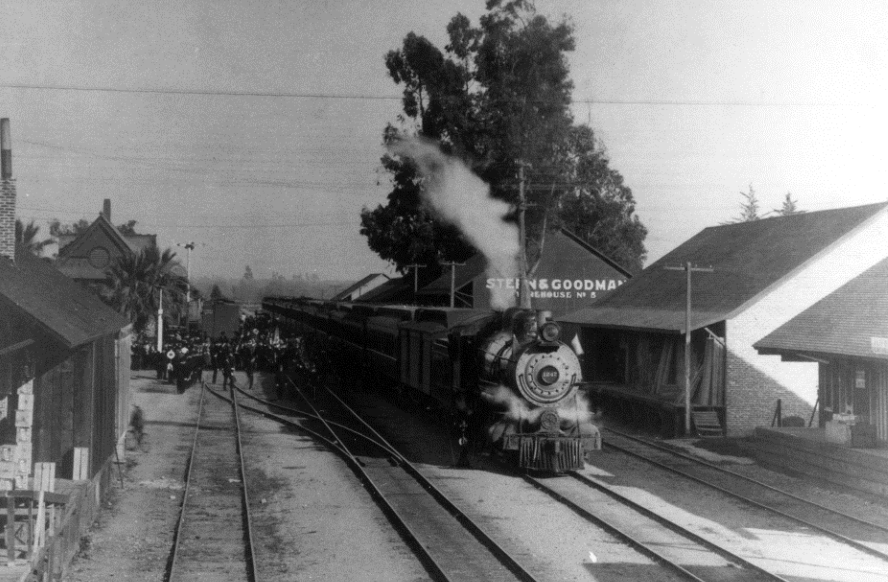
Fullerton train depot, 1911. Photo courtesy of Fullerton Public Library Local History Room. In 1913 he accepted a position at the Farmers and Merchants National Bank of Fullerton.
In the 1920s he also worked as a foreman/mechanic for Lillian Yeager, who owned a car dealership/mechanic business in Fullerton.

1921 newspaper advertisement for Lillian Yeager’s garage, showing George Esmay as a garage foreman. Photo courtesy of Fullerton Heritage. Esmay was a member of the Modern Woodmen of America, a Republican, and a bugler of the Home Guards at Fullerton from 1916 to 1919.
Source:
History of Orange County, California: with biographical sketches of the leading men and women of the county who have been identified with its earliest growth and development from the early days to the present by Samuel Armor. Los Angeles Historic Record Co, 1921.
-
Arthur R. Marsom: Developer/Builder
The following is from a work-in-progress about the history of Fullerton. You can support my ongoing research and writing on Patreon.
Arthur R. Marsom was born in Detroit, Michigan in 1871. As a young man he learned the trade of carriage painter.
In 1898, he moved to California and worked as a contractor building houses in Los Angeles. In 1903 he opened a store selling interior decorating materials–paint, draperies, tapestries, pottery, etc. He expanded his business into real estate as well.
In 1910 he moved to Fullerton and continued developing buildings and homes. He built the first apartment building in Fullerton, called The Marwood on Spadra [Harbor Blvd.]. It has since been torn down.

Marwood Apartments circa 1920s. Photo courtesy of Fullerton Public Library Local History Room. He built his home at 441 East Commonwealth Avenue.
He married Marie Warrington in 1893 in Detroit, Michigan. They had three children: Earl, Ivy, and Blanche.
Marsom was a Republican, a Catholic, a member of the Knights of Columbus, and a member of the Fullerton Board of Trade.
-
Early Settlers: Harvey B. Royer (railroad machinist/rancher)
The following is from a work-in-progress about the history of Fullerton. You can support my ongoing research and writing on Patreon.
“An expert machinist who has proven himself to be a successful rancher is Harvey B. Royer,” biographer Samuel Armor wrote in 1921, “one of the dependable employees of the Santa Fe Railroad since 1909 and now also farming along the Romneya Drive, to the southwest of Fullerton.”
Royer was born in Lockhaven, Pennsylvania in 1871. His father was Franklin Royer, who owned a number of a lumber mills.
Harvey worked in his father’s mills until a fire destroyed one of them. In 1895, he married Rosie Schwenk. They had three children: Ruth, Merril, and Le Roy.
In 1900, Harvey moved to Johnstown, Pennsylvania and worked as a machinist for the Cambria Steel Company.
In 1909 Royer moved to California to work as a machinist for the Santa Fe Railroad Company, working on locomotives.

Fullerton’s original train depot, 1906. Photo courtesy of the Fullerton Public Library Local History Room. In 1912, he bought 12 acres in Orangethorpe on Romneya Dr., and built a home on the ranch.
“When he bought the land, it was a barley field, and he himself set out the ten acres to valencia oranges,” Armor writes. “He has his own private pumping plant and so supplies what water he needs for irrigation. His products in fruit he markets through the Stewart Fruit Company of Anaheim.”
During World War I, Merrill enlisted as a military engineer. Before he could leave for Europe, he was shot during target practice, but made a full recovery. After the war he married Rose Livingston and worked for the Santa Fe railroad in San Bernardino.
LeRoy Royer also enlisted during World War I and served in the motor transport service in France, and was stationed at such places as Tours, La Rouchelle, Nantes, and St. Nazaire.
In 1919, LeRoy returned to the United States and was honorably discharged. He attended Fullerton high school and helped his father on the ranch.
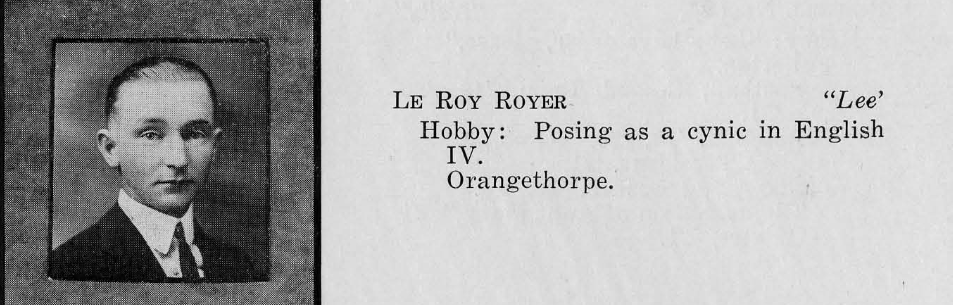
1921 FUHS yearbook photo of LeRoy Royer. Photo courtesy of the Fullerton Public Library Local History Room. -
Early Settlers: Albert H. Sitton (auto mechanic/dealer)
The following is from a work-in-progress about the history of Fullerton. You can support my ongoing research and writing on Patreon.
“The development of the automobile industry has led to the creation of various related enterprises, among them being that of the modern garage; and these enterprises have called for the brains, experience and aggressive initiative of thousands known in other fields as successful men of affairs,” biographer Samuel Armor wrote in 1921. “One such man is Albert H. Sitton, proprietor of Sitton’s Garage.”
Sitton was born in Downey, CA in 1878 to Brice and Nannie Sitton. The younger of two children, Albert attended public schools in Orange County and then worked in the bicycle business in Santa Ana.
In 1900, he moved to Fullerton and continued to repair bicycles for a couple of years before going into business for himself in the new automobile industry.
“It was only a step, and a very natural one, to work into automobile repairs and sales; and now, with northern Orange County as his field, he is the wide-awake agent for the Overland and Willys-Knight,” Armor wrote. “Self-made in more respects than one, with his own hand at the helm, Mr. Sitton has been so successful that he needs to employ ten men.”
Sitton’s garage was one of Fullerton’s earliest car dealerships. It was first located just south of the post office on Spadra [Harbor], and then expanded, as the article below explains.
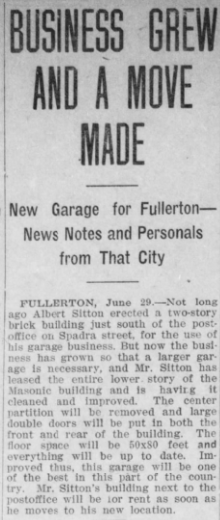
1907 clipping from Santa Ana Register. 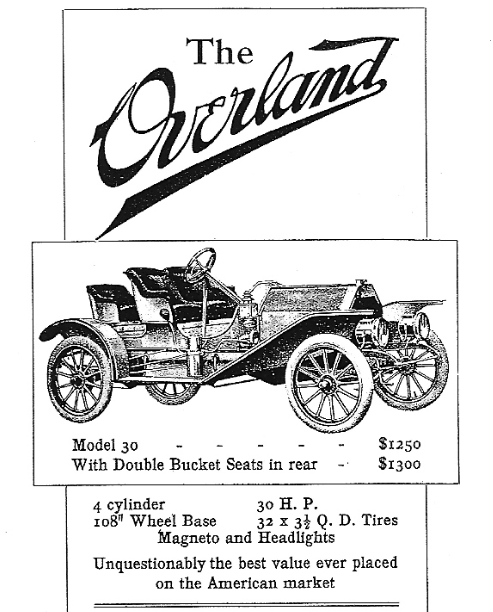
In 1902, Albert married Rose B. Rogers in Fullerton. They had one son, Arthur.

Albert and Rose Sitton, 1902. Photo courtesy of Santa Ana Public Library. Albert was a Republican in party politics. He served with Company L of the Seventh California Regiment in the Spanish-American War. He was a school board member for 12 years and served one four-year term on City Council.
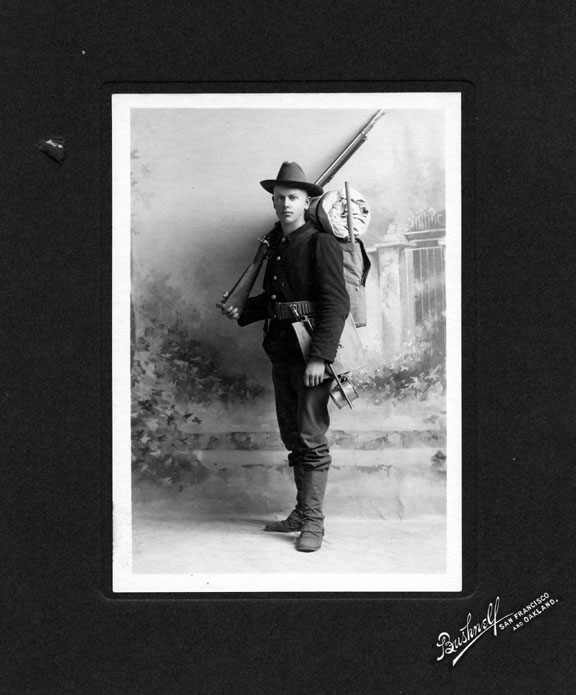
Albert Sitton in a Spanish-American War uniform. Photo courtesy of Santa Ana Public Library. Sitton pioneered the automobile industry in northern Orange County, and was honored in 1959 by having the County’s first juvenile facility (the Albert Sitton Home) named after him.
Albert Sitton passed away in 1967.
-
Early Settlers: Edwin Till (rancher)
The following is from a work-in-progress about the history of Fullerton. You can support my ongoing research and writing on Patreon.
Edwin Till was born in London, England in 1856, the son of Edwin and Eliza Till.
In 1884 he married Adelaide Wyatt in London. They had two sons: Fredric and James.
The family immigrated to the United States and settled in Philadelphia, opening a dry goods store.
“From Philadelphia he went to Chicago, and from Chicago to New York; and in each of these places he conducted a dry goods store for a year,” biographer Samuel Armor wrote in 1921. “When he returned to Philadelphia it was to resume the selling of dry goods, and in that city and field he continued until 1894, when he sold out and came to California.”
In 1892, he returned to England to witness the coronation of King Edward.
He lived in the town of Latin, near Los Angeles, for six years,
In 1900, he purchased a 10-acre ranch in Orangethorpe, just south of Fullerton, which he planted with oranges.
Adelaide Till was one of the organizers of the Parent-Teachers’ Association of the Orangethorpe school district.
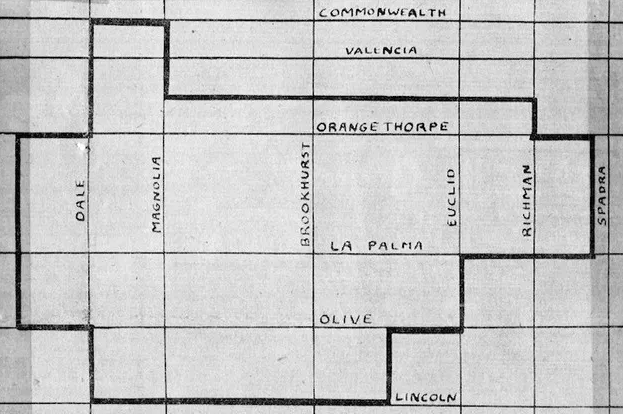
Original townsite map of Orangethorpe. To learn more about the town of Orangethorpe, check out Terry Galvin’s excellent article HERE.
-
Oral Histories: Juanita Ferraris on the Bastanchury Family
The following is from a work-in-progress about the history of Fullerton. You can support my ongoing research and writing on Patreon.
Juanita Ferraris’ grandfather was Domingo Bastanchury, a Basque rancher who was one of the first settlers on the land that would become Fullerton. The extensive Bastanchury Ranch was, at its height, one of the largest orange groves in the world. In 1968, Ferraris was interviewed for the CSUF Oral History program. In this interview, she provides memories and insights about the Bastanchury family and the land they owned. Here are some highlights from that interview, along with some historic photos…
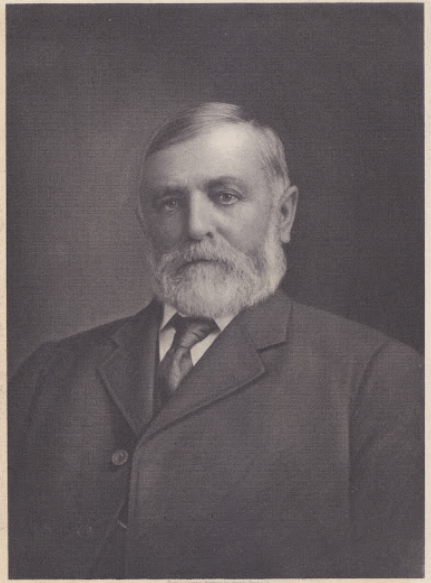
Portrait of Domingo Bastanchury from Samuel Armor’s History of Orange County. On her grandfather, Domingo Bastanchury…
Domingo Bastanchury…settled in the northern part of Orange County…northwest of the present location of the State College…Directly on the route of El Camino Real which is now called Harbor Blvd.
He was born in France in 1838. As a young man at the age of 20, he decided that life in Europe was not what he wanted. He was trained to herd sheep [and was] an excellent fisherman…the area in which he was born was hilly, rocky, most of the time rainy and the grounds were only plotted maybe for an acre or an acre and a half…
And that was not enough for a young man with a great ambition, so he decided that he would like to come to the United States because he had heard there was an abundance of wealth…He couldn’t read nor write so his friends induced him to come by working his way through on a ship since he was a seaman as well as a sheepman.
He came around the horn. It took him six months and all he did was to put the sails up and down. He had a tremendous amount of strength. He was a man of small stature—around 5’6”…blonde hair and blue eyed.
So he landed in San Francisco…in the International Quarters…where all the foreigners would gather, was a Basque clan that gathered…from there he worked as a fisherman on Fisherman’s Wharf in order to gain some money which was something like less than a dollar a day. And then his sheepmen; he was introduced to some of them that were prospering at that time, that the ideal place for him to come would be the Southern California area, which he did. And I don’t know whether he came on foot or the train or by horseback but I have an idea that he came through on a covered wagon horse and buggy type because he was looking for land.
He came further down past Los Angeles into this dry country as they called it and it was strictly Indians…he toured all that through San Juan Capistrano, the hills here, the barren hills of what is now the Standard Oil Company and all that and decided that he liked the rolling type of hill because the grazing was abundant in certain areas…
When he first came here he worked for another rancher, did he not?
That Grandmother was never very clear on. She told me he had accumulated enough money in San Francisco to acquire around 6,000 to 8,000 acres. At this time they ran $5 an acre…there isn’t a record here as to how he gained all this land. And from whom he bought this land.
But anyhow he gathered all this ground and then decided to have Grandma Maria Oxarart…in [France], to come over and help him out, which she did.
She was born on March the 15th, 1850 so you can see there is an age difference in Grandmother and Grandfather and she arrived in San Francisco in 1873. By that time he had already acquired this land here in the Northern part of Orange County…There was a 12 year difference in age between Grandmother and Grandfather.

Portrait of Maria Bastanchury from Samuel Armor’s History of Orange County. Where did he acquire the sheep that he grazed here?
Well, that I don’t know either…you know the Basque are clannish people to begin with and if one is starting off they will loan x amount of herds in order to breed…
Were there other Basque families in the area when he settled here?
Yes, there were some in the Northern part, near what is now La Habra Heights. There were some families—and Lucky Baldwin was one of his greatest competitors and a man that worked with him on this sheep business.
So they settled right here on what is now the Fullerton Golf Course, directly east of Harbor Blvd. and south of the Union Pacific line that runs under Harbor. In the little knolls there. This is where they first started off.
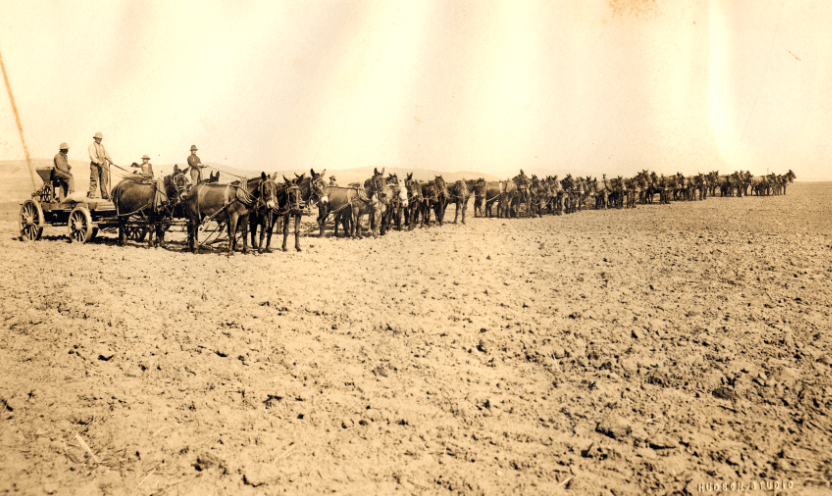
Bastanchury Ranch (date unknown). Photo courtesy of the Fullerton Public Library Local History Room. They had five sons. But one died in infancy and the oldest one was Dominic, he was born in Anaheim. And Fernando, that was the one that was born in Los Angeles and that’s the one that passed away. He was born in 1883. Gaston Bastanchury was born in Anaheim and Joseph [Juanita’s father] was born in Anaheim and John was born on the ranch.
Grandmother’s education was mainly in the nine to ten months that Grandfather had her go to this orphanage conducted by the Sisters of Charity in Los Angeles and that’s where she learned to read and write and do embroidery, hand craft work.
Your Grandfather never did learn to speak English or write?
No, he couldn’t. All his markings in any of the legal papers were done by an “x” or Grandmother did it for him with her initials.
Grandmother used to say that they didn’t have many neighbors. They were the only white people but they had an awful lot of Indians. Awful lot.
Ever any problems develop with the Indians?
Yes, she said that she was scared to death because she came from a country that she had never saw a colored person. And so when she landed in San Francisco, she saw these dark people and didn’t know who they were because they were not educated as to who were dark and where they came from. And then when she came to Southern California as a bride, why that was just too much for her because the Indians were entirely different from the colored. They were more in the savage. They used to stop and trade horses because they used to do the delivery of mail between San Francisco and San Diego.
The Indians?
Grandfather was very fond of the Indians and the Indians were fond of him because he was a great one to feed them. He used to feed them by—oh heavens—they spent three days wining, practically dancing. They’d do all these warwhoops and Grandma couldn’t understand what—she would hide…she was scared of them.
[Grandmother] said that they would have money in gold coins. And this is how they used to pay their sheepmen and they paid them once a month…the gold coin that we are not allowed to have unless we’re coin collectors…sometimes they’d have as many as a hundred depending on how many people they needed to herd the sheep.
What would you say was the largest number of sheep they ever had here at one time?
I was told that it was somewhere—anywhere between 8,000 to 10,000.
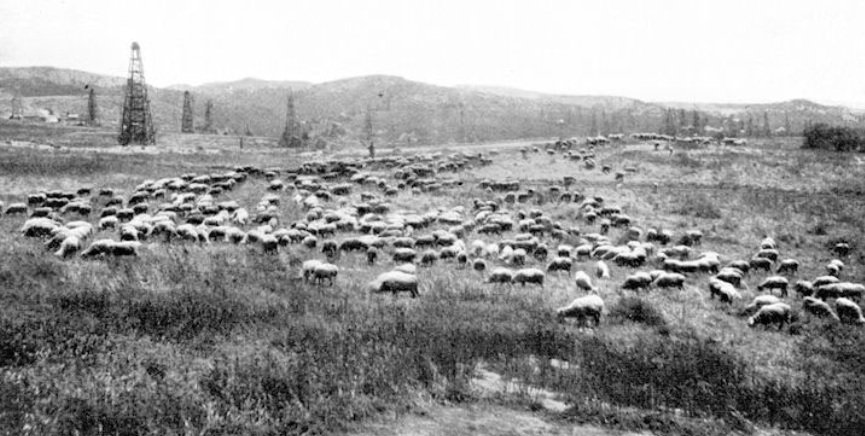
Sheep grazing on the Bastanchury Ranch, early 20th century. Photo courtesy of Orange County Archives. They were raising these sheep primarily for the wool?
Wool…right.
You mentioned something about having to drive the sheep up to San Francisco?
Yes, Grandmother said that originally this is what Grandfather did. He drove them up. I don’t know how long a time it took to go but I imagine it to be a month or so herding these sheep because there wasn’t any direct route that they followed, you see…LA was in its infancy.
Did they keep permanent quarters on the ranch for the help?
Yes.
How big a crew would you say they usually maintained?
In Grandfather’s time they maintained…oh Grandmother used to say several hundred. Not families, these were mostly men, Basque men, imported from Europe that did the herding of the sheep and then of course they had the Indians do the laborious type of work.
What tribe of Indians were these?
Good Lord, I don’t know. The kind that was around the Missions—San Juan, San Luis Rey, and San Diego Missions, that type of an Indian was here.
Oh, they drank a lot of wine. Of course, they made their own wine you see. They imported the grapes from the Escondido area…so wine was no problem and, I mean, it was like water.
They raised some vegetables and things on the ranch themselves, didn’t they?
Yes, they had. This is where the Indians came to raise corn and all that. Because the house was situated by a natural stream and it is still there…this is the same stream that the family used to get mushrooms, watercress, and drinking water, and it was a natural stream [part of the golf course]. During the summer months it would dry up and they would have to get their water source elsewhere. This was before they had plumbing in the place.
The Bastanchury Ranch was at one time considered the largest orange grove in the world. Photo courtesy of Fullerton Public Library Local History Room. What kind of trip did it entail to go into Los Angeles to buy supplies?
Well, it took a horse and buggy, the whole day, complete. And then they would stay at a French Basque Hotel and maybe spend three or four days and then come back.
What part of town would you say that would be in?
Olvera street. In that old Plaza, near the Plaza. They had rooming houses, French people had hotel boarding room type of homes…Grandma owned some property there, too. She had some rooming houses and then tore it down in the early 20s to make parking lots out of them.
So around that area there were a great many French settlements, and all the Basque people would gather there. If they had any dentistry or any doctoring, this is where they would go.
Where were your father and his brothers born?
They were born in Anaheim because the facilities were…Fullerton wasn’t Fullerton when they settled. They didn’t have a thing. Anaheim was established because the German people settled in Anaheim.
That is from the Vineyard Society?
Right! And so everything that they purchased came from Anaheim. Grandfather decided when the boys were small and ready for school that they couldn’t go back and forth, so he rented a place which is now the city park of Anaheim, on the corner of Sycamore and Lemon streets…It was a two story home and the boys went to school at Saint Catherine’s Military School which is now on Harbor…Gaston Bastanchury was born in 1884 and attended St. Catherine’s in the early primary years of education. Joseph, my father, was born in 1887 and was baptized in Saint Boniface.
Grandmother also had a place in Los Angeles where she would stay with the children while they were receiving their education.
When your family bought the property here, in what is now Orange County, was the land at that time officially deeded? Was it possible to get a deed for the property? Or did you just mark it off and live on in?
I imagine it was counted in the amount of lineal feet. You know how they used to do it, put a fence up and this is mine…Eventually it was surveyed and deeded.
When the boys took over and Grandfather passed away in 1909 the boys had already received their schooling and Gaston had graduated from the Colorado School of Mines and took his graduate work at Columbia University.
All of the boys, when they were young, what kind of language did they use at home?
They all spoke Basque. In school they learned English. They also spoke Spanish and French…My father spoke Spanish, Basque, and English, and I had uncles who spoke French. But mostly Spanish and Basque and English.
Where was the main residence for your grandfather located at?
It was east of Harbor Boulevard and south of the Union Pacific tracks and north of the existing Municipal Golf Course…it was a single structure with an adobe front. That was the beginning. In 1906 Grandmother decided that she didn’t want to live in the low lands—it was too hot in the summer, so Grandfather said, “then pick out a site and build yourself a house. And this is when she built the 2-story home. Which is now Las Palmas, right at the dead end between Harbor Blvd. and Puente…that was torn down in 1953. Progress…
How long had it been after your family had been here before they found that sheep herding wasn’t adequate due to the climatic conditions?
They started in 1910 considering changing the picture from sheep herding into citrus groves. The boys, particularly Gaston Bastanchury, was very well acquainted with the geological effects of the ground and the terrain…he took a section of the ranch and started it [around] 1910.
This is where they started an artesian well in the area?
They had water, yes. And they would only plant the areas where they could derive water. It’s now known as Laguna Lake, that was a man made lake but a water well was right along side of that lake…they had to use boosters, and they built the tank which is now on the Southwest side of…the tank is still existing.
Is it still in use?
It is at the end of the West Las Palmas Drive, way at the top and that was our source of water and this is from the Laguna Lake they would pump it up to…and we called that area Red Tank Hill…that was used for both irrigation and domestic…we also instituted water pumps around the ranch. This central sector comprised about 2600 acres which border Brea, La Habra, Fullerton, and Buena Park.
Was it your father that instituted the citrus?
No, it wasn’t. Well, the boys were incorporated, called The Bastanchury Ranch Company—three brothers were involved—Gaston, Joseph, and John…What happened was that when Grandfather passed away, Grandmother was left with all this kind of land. So the eldest got 500 acres, the other three boys got an equivalent and incorporated theirs, called the Bastanchury Ranch Company.
I understand that after they started, they were the largest individual citrus growers in the world.
Right, right because they developed 3000 acres into citrus groves.
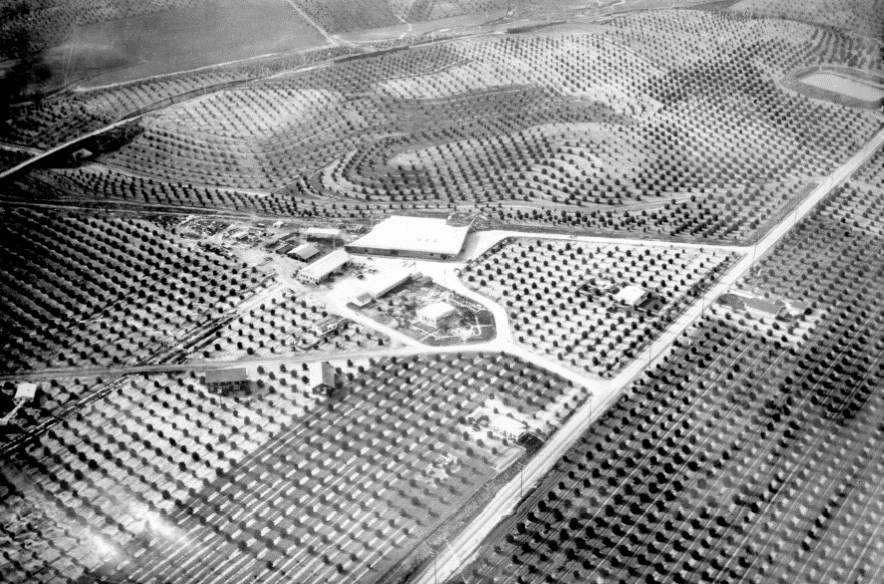
Aerial photo of Bastanchury Ranch. Photo courtesy of Fullerton Public Library Local History Room. And you had a horticulturalist from Japan come in to develop the property?
Yes, the contour planning was done by a Japanese engineer and it was contoured. One of the first contour planning in the nation at that time…the reason was to conserve water because the contour planning conserved the top soil as well as the trees. It gave them a broad root system.
While they were developing the citrus, what did they do, gradually phase out the sheep?
Yes, that’s what they did…they raised lemons, oranges and grapefruit…walnuts…they did very well in the walnut industry, too.
How did your father happen to meet your mother?
My mother came with an old family that had extensive acreage in San Juan Capistrano behind the Mission…they all had to go to Los Angeles to get their medical and dentistry done…[My mother] stayed in this hotel that had a rooming house for Basque people and she met my [paternal] grandmother through a mutual friend, who said she was one of the wealthiest Basque ladies in the county, in Southern California…Grandmother liked mother…so she wanted her as a maid. My grandmother always had maids.
And so then she came to live at her house?
Yes, and then this is when there were four boys in that family, so you can imagine what happened, but my father won out.
And where did they build their home? On what property?
They built right across from the existing St. Jude’s where the automobile club is, about 100 yards right in back of it [on the corner of Harbor and Valencia Mesa]…That’s the home we were all born in, then from 1921 we were progressing so fast that they had to build their packing houses for the citrus. We had to move our house, and our present home is on East Las Palmas, still existing, a two-story home.
What are some of the recollections you have of the early citrus packing houses and the other operations they had?
Oh, I used to have a lot of fun as a kid. I really did…we had a full life, what with horses and boats on the lake and packing houses and using the rollers or slides and things of that nature.
When you were young, were the Indians still working on the ranch here for the family?
Well, not as extensively as it was in the time of Grandfather Bastanchury, but we had some that were from the old families whose fathers had worked for Grandfather Bastanchury and the boys maintained them as, oh, they made foremen out of them..
Were there any Mexican laborers being used at that time?
Yes, the family had two spots, and they housed 500 families in both spots. Built their little homes. It was a city of their own. One was called Mexicali and the other was called Tijuana and the cacti is still existing on this. If you go up here on north Euclid, to the west of Euclid Road, you will still see the cacti that the Mexicans planted around their homestead–it was just like a neat little city. I can’t tell you how many houses there were, but I know this, that they had their own store where they could buy their corn meal and all that sort of thing and the streets were lined up just like a little city with their little fences and their flowers. They were great for that.
Were there schools on the property or did they go to school in Fullerton?
Yes, they had teachers come in to teach.
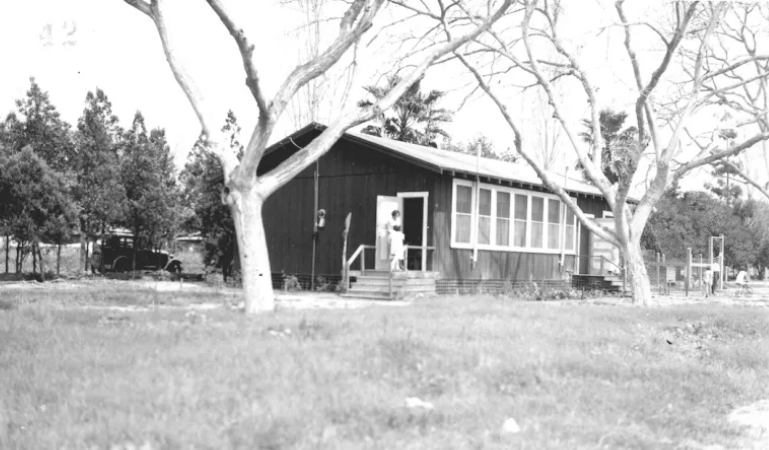
“Mexican” school on the Bastanchury Ranch. Photo courtesy of Fullerton Public Library Local History Room. In the early or the late 1920s they put a cannery in because they also went into tomato planting…it was primarily citrus. They had three packing houses, one of the lemon house, orange house and then the cannery, the tomato which later was converted to Model Market and now it is torn down, where Mayfair Market is now [1968]. Then the original packing house, they had square dancing up here until recent years.
Can you recall any significant changes in the area from the time you were raised on the Bastanchury property to the present time?
I have seen the high rises coming right on the border here…in 1931 or so the Real Estate Convention was held in Los Angeles and apparently part of their itinerary was to come out…they came out to the ranch and I happened to be home from school…I was very anxious to hear what my uncle Gaston was going to speak to them about because here was this huge ranch with nothing but orange trees, the packing houses, and only the foreman’s house and the workmen’s area, but that was enough, we didn’t have anything else on the ranch, so I remember there was a huge crowd and I can very distinctly remember what he said, that the future of Northern Orange County was colossal because at that same time UCLA had not been established in West Los Angeles. They were seeking an area to establish a school, the University regents were and great consideration was given toward Northern Orange County for educating.
Would it have been on the Bastanchury property?
It would have been on the Bastanchury property. And this convention came along at the same time and he predicted at that time that in 40 years North Orange County…no one would recognize because of the development that was going to happen, the development of homes and industry…
Then you, like the other families in the area, lost the biggest share of the property during the Depression?
The depression, because at that time they had already overextended themselves. They had acquired another 3,000 acres that they were developing into citrus in which at that time it was only a year or two growth which was non-productive, so they had to borrow money and you know when you borrow money, this is what…You got to pay it back or otherwise you lose the whole thing.
Did the same situation happen with the other big ranchers and growers in the area? Did they have the same problem?
Well, I mean some, yes. They probably struggled just like the rest of us but they still maintained it…the Bastanchury debt was greater than most because of the extensive acreage they had…And, of course, he gave up some of the acreage which turned out to be a multibillion dollar area, where Standard Oil is now, and the reason for that was that he couldn’t raise sheep. They wouldn’t graze up there and he didn’t think it was worth anything because not even a weed would…but it was worth very much in that black gold in the bottom.
I believe you told me that your Grandmother lived to be 90 years old and she saw some changes.
Yes, she saw the first development of Sunny Hills area in the East Las Palmas. She saw the three houses being built. As she called them, the cracker boxes, because she was in this sturdy house, and they developed them so fast that she said one time she would go by and they had the foundation, the next thing the roof was on.
I understand that your Grandmother and your family made several contributions to the area, didn’t they, as far as land was concerned.
Yes, she did it here through the Catholic church, I know, in Fullerton. She contributed the lot to build the church on [St. Mary’s Catholic Church].
-
Oral Histories: Elma Ames (Librarian)
The following is from a work-in-progress about the history of Fullerton. You can support my ongoing research and writing on Patreon.
Elma Ames, a long time librarian of Fullerton, was interviewed in 1972 by Shirley E. Stephenson for the Community History Project of the CSUF Oral History Program. Here are some excerpts from that interview, along with some photos to accompany her recollections.

Charter Members of Professional Business Women: Elma Ames and Carrie Adams (standing left to right) and Mary Campbell (seated). Photo courtesy of CSUF Center for Oral and Public History. I was born in the little town of Silverton, Oregon…I came here when I was about 19 or 20 years old (1910)…my father had friends here who owned property, some orange groves. We were here a month and I did not like it at all. There was no pavement anyplace in town and the dust was four or five inches thick all over the roads.
The only thing I liked was the Carnegie Library and I spent a great deal of my time there. Miss Minnie Maxwell, who was the head librarian at the time, asked me if I would like to try working there.

Fullerton Carnegie Library (built 1907) at the site of the current Fullerton Museum Center. Photo courtesy of Fullerton Public Library Local History Room. Ames moved briefly back to Oregon, and then returned to Fullerton for good.
We drove from our hometown of Silverton, Oregon to Fullerton. There were about four or five miles of paved road all the way from Portland, Oregon to Los Angeles. We had to open gates in two or three different places going through the farms. We went through what they call “wood roads” in the Siskiyou Mountains…It took us two weeks to get down here.
In the Siskiyous they got stuck on railroad tracks. A carload of sailors helped to move their car.
When we were traveling through the Siskiyous, we met two men who were mapping the road for the first Travel Blue Book that was printed.
When I got back to Fullerton, Miss Maxwell asked me if I would like to go back to work…By that time, Miss Mary Campbell was there so I went back.
Did your father own an orange grove here?
Yes. We lived right on East Orangethorpe and owned our grove, right across from [Rancho] La Paz [a mobile home park]. My brother is living now in a mobile home in [Rancho] La Paz. We owned a grove right across the street and we lived there about 42 years.
My father loved the grove. It sounds kind of cruel to say, but I really was glad that he went before he saw the country all torn up the way it was, because he felt that I had it safe living on the grove all my life…The house was torn down and everything is gone.
It was a wonderful life because Orangethorpe was a dead-end road when we first went there and had hardly any traffic on it. The neighbors were all very friendly and we had such good times together. Neighbors were different in those days. They were really neighbors and did things for each other.
Both of them on our side of the road came from Germany. They were really old pioneers. Miss Burdorf’s people that I spoke of–they bought this place and raised wheat on it and hauled it down to Seal Beach where they had a harbor…then he put in grapes but they were blighted or something. After that, I believe he put in oranges as there were oranges when we came. Everything was oranges. The whole country was oranges when we moved there.
Now we can’t find many orange groves.
No. Isn’t that a pity? The ground was wonderful. It was the old Santa Ana River bed. The Santa Ana River came right through the north end of Anaheim in those days. When we first came here, there was a bridge you had to cross to get over to Anaheim. There wasn’t much water running in it then.
Recollections of the 1933 earthquake…
I was holding it [a book] out to [a patron] when it seemed the whole building exploded. I was still holding the book and saw all five men make a break for the door. Miss Sheppard was native-born and had been through earthquakes before. She told me to go and stand in the doorway, but not to go outside.

Inside original Fullerton Carnegie Library. Photo courtesy of Fullerton Public Library Local History Room. The noise was terrific…[after] when we were allowed to go upstairs, there was a copy of the magazine Science opened to an article, “Earthquake Etiquette.”
In 1937 Fullerton celebrated its golden anniversary…[they collected pictures and stories of old pioneer families]…We were dressed in old costumes and worked in them during the week.

Miss Carrie Sheppard took a great interest in book week when she was there…they had different outstanding authors…Ethel Jacobson…we always had this one big evening when we served tea and refreshments…another speaker was Meredith Wilson…and Richard Armour.
Recollections of the 1938 flood…
One time a dam broke and caused a flood. When the dam broke the water ran straight down the old channel through Anaheim instead of going out through the new channel that they had been building. A number of people were drowned. It was really a horrible experience. When it broke, a neighbor called us about three o’clock in the morning and told us the water was coming down Orangethorpe. My father had had a stroke by that time.
I went out back and I could hear the rush of the water. It was just like thunder and it really frightened me. But when I went in, I told my father what some of the neighbors had told me. My father said, “Now, it won’t bother us. Don’t worry.” But it did come and ran in the driveway; it didn’t harm anything for us.
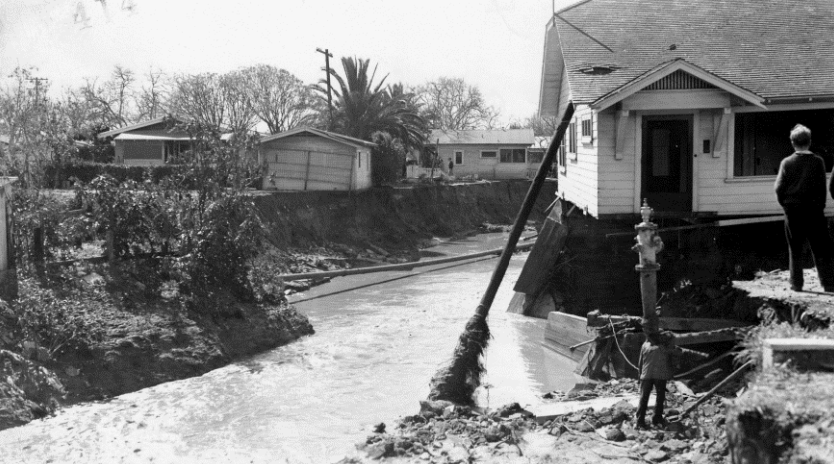
1938 flood in Fullerton. Photo courtesy of Fullerton Library Local History Room. My brother lived down in Fullerton and the south end of Fullerton was flooded. They had a lovely new home there and so many of their things were ruined. Water was four or five inches deep in the living room. They had to almost swim to get out. I called my brother up and told him at three o’clock in the morning that Father said to get out, to come right up here because that was the safest place. But he had to stop and shave and while he was shaving, the water came in. He had not believed that my father was right. Three or four of them got together and held each other until they got to a large house had an upstairs. It was one of the first homes for older people here in town and it was just filled with older people. They had to carry those people upstairs because the water was coming in. I don’t believe they had any deaths in Fullerton, but they did in Anaheim.
Did it reach the library?
No. We didn’t have any trouble at all. It only hit the part of the town on the other side of the tracks. My brother didn’t get to go back into his home for a number of days. The basement was full and it came up into the house, about four or five inches of water all through the house.
Were you in the area during the Depression? Were you already in the library?
I was already in the library then but I don’t remember too much about the Depression. I do think it affected us some because I remember I was paying the taxes on the ranch because my father didn’t get enough money from the north to make things go. I was quite proud of the fact that I could help.
During Roosevelt’s administration were they any projects started in the library?
The library was built by the WPA. We had one board member, Ben Carey, a good democrat, who was the one who was really instrumental in getting this grant to the library. That was the way we got our new library through the WPA. Other than that, I don’t remember much about the Depression.

Dedication of the WPA-built Fullerton Public Library, 1941. It is now the Fullerton Museum Center. Photo courtesy of WPA archives. It was really a beautiful building when it was first built, but the air conditioning wasn’t good.
On living with Mary Campbell…
After my mother had a stroke, I retired. Miss Sheppard came to me after Mother passed away and asked me if I wouldn’t come back to the library…I went back about three times, so I don’t remember much about my retirement.
Both Miss Campbell’s and my people were gone and one day we decided that we would share a home. She came out to the ranch and moved in with me. We were together out there for six years. Then Miss Campbell wanted an interest in a home of her own and so she said, “Why don’t we buy one together?” We bought one over on Malvern and lived there ten years. We have been sharing a home for over twenty years and we worked together for twenty-five years and we worked together for twenty-five years, so we know each other pretty well.
Mary and I had a number of short trips. One thing that was interesting was that we both belonged to the United Nations Association of Orange County and the one in New York…We went to the tenth anniversary [of the UN] in San Francisco…really, it was the most exciting week in my life, attending that tenth anniversary of the UN.
Mary and I were charter members of the Business and Professional Women’s Club.
I’ll be 82 next month; I live in the past a lot. I had a very happy life. Although I was ill a lot of the time, it didn’t affect my having a good time.
-
The Fullerton Tribune: 1895 Edition!
The following is from a work-in-progress about the history of Fullerton. You can support my ongoing research and writing on Patreon.
My latest research has taken me to the microfilm archives at the Local History Room of the Fullerton Public Library, in which I am reading, year by year, the archives of the local newspaper, The Fullerton Tribune. I have just finished reading the papers from 1895, and here’s what was happening both nationally and locally in 1895…
United States News…
They Keep Coming!

The Silver Standard?

How Quickly The White City Fades
The “New Woman”


Cycling Craze!

Standard Oil Monopoly

Trouble in Hawaii

California News…
“The Crime of the Century“
Hangings in California

Bank Robber Barnes!

Governor Budd Inaugurated

Fullerton News…
A New Bank in Town…
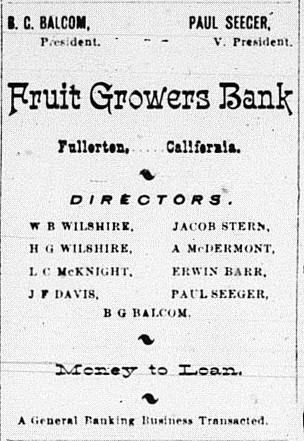


Water Problems


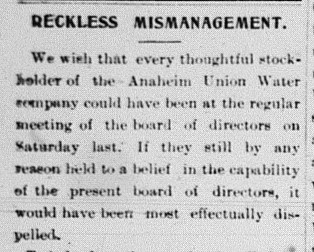
The Growers Organize

Chamber of Commerce Organized


Oil!

Temperance Movement Comes to Fullerton
She Wants to Vote
Shoe Maker Steps on Rusty Nail, Dies
Stay tuned for highlights from the 1896 Tribune!
-
Subscribe
Subscribed
Have a WordPress.com account? Log in now.

