-
H. Lynn Sheller: Former Fullerton College President
The following is from a work-in-progress about the history of Fullerton. You can support my ongoing research and writing on Patreon.
Dr. H. Lynn Sheller first came to Fullerton to teach English in the high school in 1927. He began teaching in the College in 1933. During the forties he served as a college counselor, later taking over the duties of college Registrar. When Dr. William Boyce, the College’s first president, retired in 1950, Dr. Sheller was selected to be his successor. He served as the second president of the College through the period of its greatest growth, the 1950s and 1960s. He retired in 1969.

Portrait of Dr. H. Lynn Sheller hanging in the Fullerton College Library. He was interviewed in 1971 by Anne Riley for the Fullerton College Oral History Program. Here are some excerpts from that interview.
I was born in Melrose township of Grundy County, Iowa, on a farm in 1904…240 acres with a fairly large house on it.
I went to Manchester College in North Manchester, Indiana…In college I majored in English and French and had what you’d call a broad liberal arts education.
The year I graduated from college I applied for teaching positions in Indiana, Michigan, Wisconsin, the Ohio area, and got a unanimous turn-down…So when I didn’t get a job, I decided to follow a girl out to California. I had met Mary Gilbert in college in 1923, and we became engaged in 1926…I found it easy to follow Mary to Los Angeles, where her home was.
In September 1926, I entered the University of Southern California as a graduate student. I took a year of graduate work, then applied again for a teaching position and was hired to teach English, speech, and journalism at Fullerton Union High School. Mary and I were married in August of that year, 1927. The best thing I ever did in my life was to marry this girl.
Fullerton had a school system that was famous throughout the country. Fullerton Union High School was said to have a national reputation for excellence. Louis Plummer was the superintendent, and he hired me. [Louis Plummer, it should be noted, was evidently a member of the Ku Klux Klan in the 1920s.]
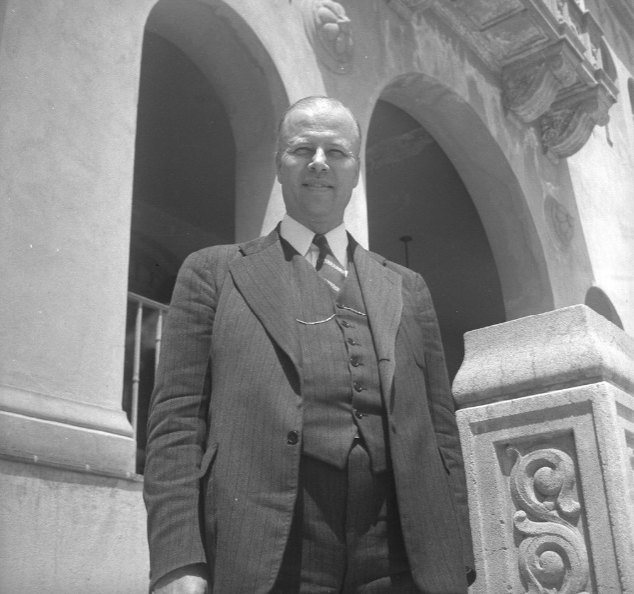
Superintendent Louis Plummer, 1937. Photo courtesy of Fullerton College Library archives. Fullerton was a small town at that time, about ten thousand, I think. Nearly all the distance between here and Los Angeles was orange groves at that time…It was beautiful, and everywhere the fragrance of orange blossoms in March and April—lovely beyond description. Fullerton was a small community in which it wasn’t too hard to get acquainted.
I taught English and Speech and advised for the Weekly Pleiades. Then in 1933 I began teaching some at Fullerton Junior College and gradually moved over entirely to college teaching. At that time the High School and the College were both on one campus, and their classes were conducted in the same buildings, though there was one building called the college building.
The process of separation from the high school was a little like the separation of one amoeba into two. It was a slow gradual process. I think it was in 1934 that the Board of Trustees first decided that maybe some day we would have as many as a thousand students in the college and we ought to put it on a separate campus. At that time they bought fourteen acres on the east side of what was then Harvard Street, now Lemon. It was a walnut grove owned by the Sheppards.
A Master Plan was drawn up for a fourteen-acre campus, the size of the future college campus. This was during the Depression years, and it took some courage on the part of the Board of Trustees to buy that property and to start planning a college.
The first building was completed, I believe, in 1936. Then it was called the Commerce building; now it is called the Business Education Building…The government paid over a third of the planning and construction costs.
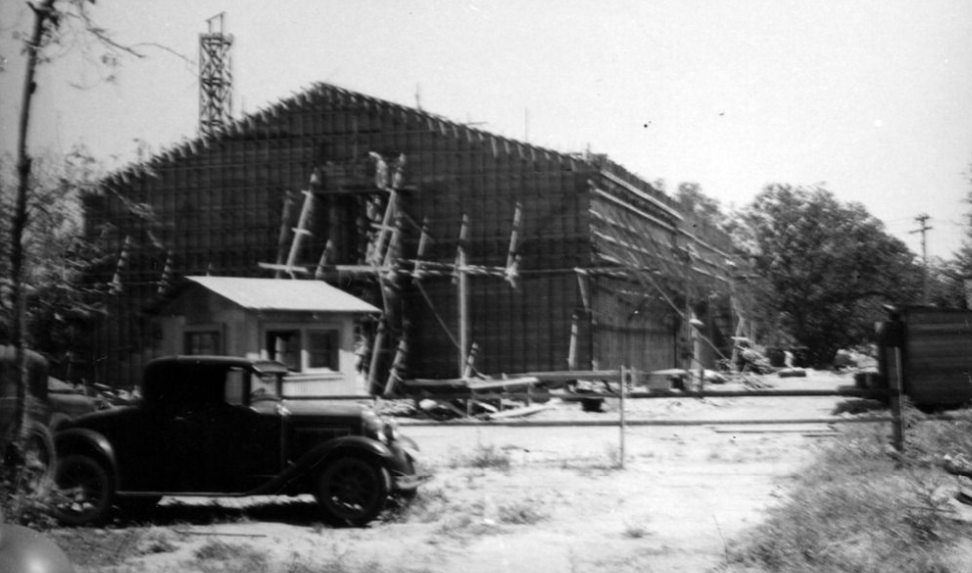
Commerce Building (the first building on the college campus) under construction, 1936. Photo courtesy of Fullerton College Library Archives. 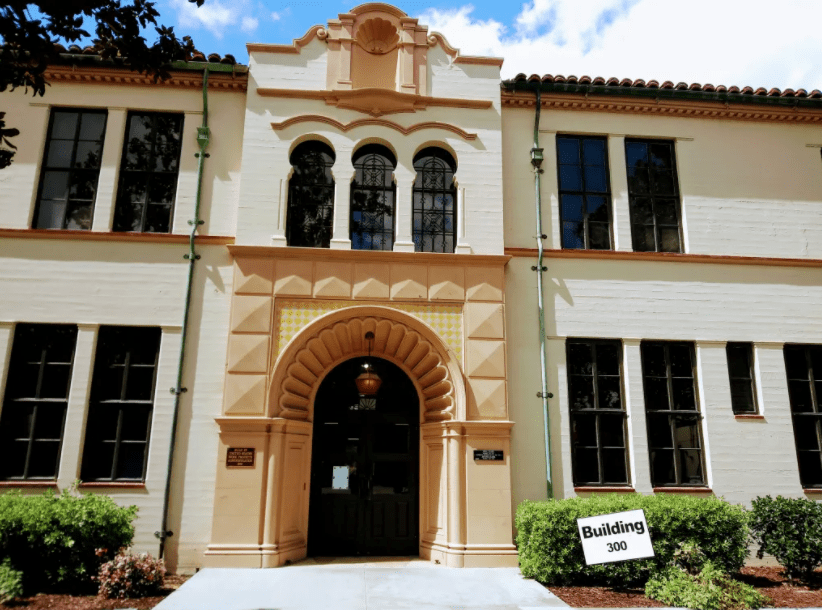
Fullerton College Commerce Building today. Who was the artist who painted the mural on the [high school] auditorium?
His name was Kassler. It was a fresco on the west wall. I watched him put the fresco up there. I would visit him day after day as he was working. Of course you know that the feature of a fresco is that the paint is mixed with the plaster, thus it is supposed to be permanent and not peel or wear off. The fresco covered the west side of the auditorium from approximately the stage door to the south exit on the west side. It depicted early Spanish life in this area–the recreational activities, the social life, women washing clothes together, the community life of people of that time, also Governor Pico and some other personalities.

“Pastoral California” mural on the Fullerton High School auditorium. How long was the mural allowed to stay before people started complaining about it?
There were very few people who complained about it. There was a little bit of vandalism, a little bit of scratching of it, you know, additions to it and so on. But it wasn’t until we had a group of trustees in here who were negatively inclined, that it was painted over. The whole story of that Board of Trustees really ought to be told sometime, but it’s the kind of story you don’t ordinarily tell, I guess. Plummer didn’t include it in his history; he was too much of a gentleman.

1939 Fullerton News-Tribune article on the painting over of the “Pastoral California” mural. Courtesy of Fullerton Public Library Local History Room. Was the mural insulting? Vulgar?
Some people felt it was vulgar or gross in some way. It simply showed the Mexican women as they were probably attired at that time. They were very bosomy women. I don’t think that we would feel that there was anything wrong with it. I never felt there was.
I recall that in the early 1940s Mr. Plummer was having trouble with a recalcitrant Board of Trustees. The Board was trying to take it upon itself the responsibility of interviewing every teacher, instead of letting the superintendent do it, as they should have done.
Mr. Plummer did have a loyal group of teachers, but always there’s somebody who creeps in, as at the Round Table. There’s a malcontent somewhere. He had his problems with a teacher whom he tried to discipline. Of course, the teacher didn’t take it well, and his trouble began with that.
Mr. Plummer also introduced some excellent vocational training in the high school. The high school had a print shop, a foundry, and an excellent machine shop. These were beyond the ordinary facilities you would fiend in a high school at that time. There was even a time in the early 20s when we had oil drilling technology, taught by Alexander Anderson.
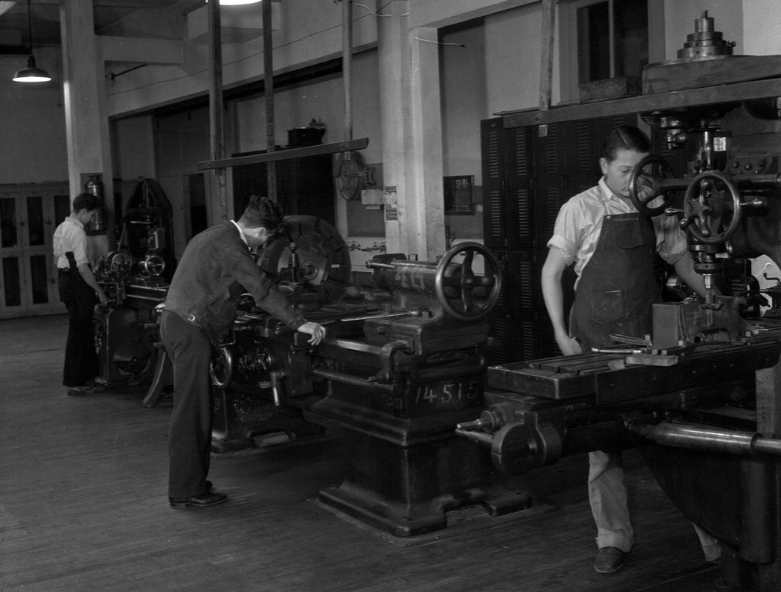
Fullerton College Students working in machine shop. Photo courtesy of Fullerton College Library archives. 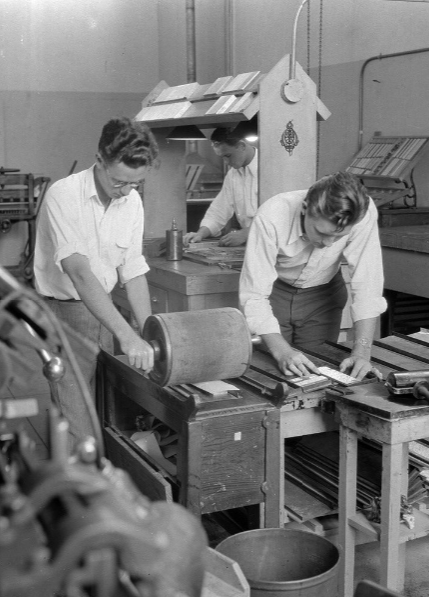
Fullerton College students in print shop class, 1932. Photo courtesy of Fullerton College Library achives. The head of the vocational department–R.A. Mardsen…he had his boys building kayaks.
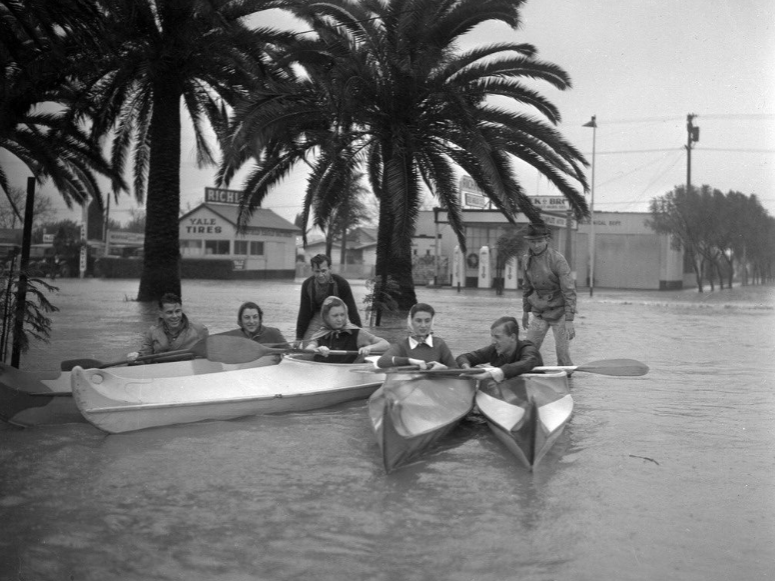
Fullerton College kayak club during 1938 flood. Photo courtesy of Fullerton College Library archives. The business education…was under the leadership of L.O. Culp.
Was Fullerton a school or town that was rather strict in its ideas or dress codes or in questions of manners and they way people had to act?
Well, I think probably no more than other schools at that time. They were stricter in requirements than now. I think it developed out of the feeling that teachers ought to be admirable people whom students could emulate. They felt that teachers should be of fine character. In fact that goes right along with what I said about Mr. Plummer. I said that he felt that character was the first thing to look for in a teacher.
How about teachers smoking? The students, of course, couldn’t, could they?
No. The application at that time, I think, asked whether the applicant used tobacco or alcohol. They did not expect teachers to smoke. They felt teachers could not tell students that it was bad to smoke and use alcohol if they themselves went ahead and did it.
Turkey Day was a Thanksgiving Day football game which was traditional between Fullerton Junior College and Santa Ana Junior College…It was generally the high point of the season for these two schools. I believe it was about 1938 that we began choosing a Turkey Day Queen.
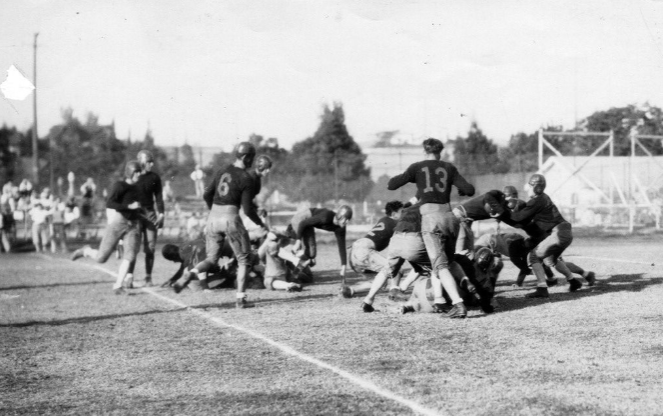
Fullerton College football game, 1931 or 32. Photo courtesy of Fullerton College Library archives. Didn’t the college own a cabin in the mountains that students might use?
Yes, it did. I don’t think that the cabin was primarily recreational, however. It was used more for Life Sciences expeditions. Mr. Harwood Tracy, one of our Life Science teachers at that time, and Mabel Myers, who was another, took students up there.
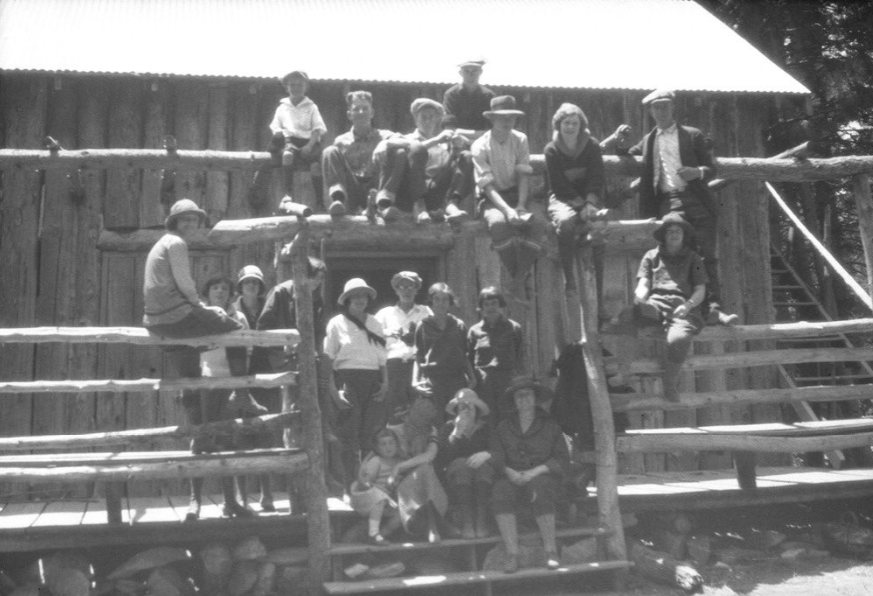
Fullerton College students at mountain cabin, 1923. Photo courtesy of Fullerton College Library archives. In discussing the history of the school we got as far as about 1941; will you continue?
Well, in the late thirties, a group of trustees came into the majority who were not friendly toward the administration of district, so in 1940 they brought in a man named Frederick Chemberlen to take the place of Mr. Plummer who, though he still held the title of Superintendent, was relegated to a subordinate role.
Before long the head of the college, Dr. Boyce was relieved of his position. Esther Hatch, the Dean of Women, was thrown out of her position, and Logan Wheatley, who was Dean of Men, lost his position. L.O. Culp, head of the Business Education Department, also lost his position. Actually, I believe he was first relieved of his position as head of the department, and then he resigned and left the school entirely.
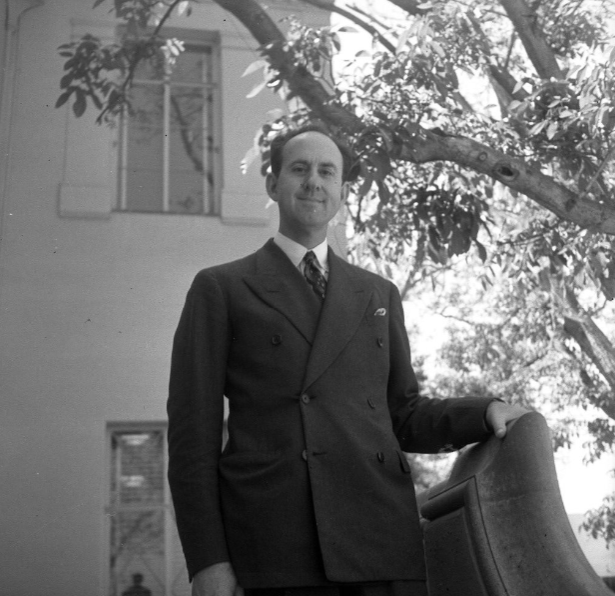
William T. Boyce, 1937. Photo courtesy of Fullerton College Library archives. These people were leaders and highly respected in the community, and as a result of their displacement the college and high school were thrown into a period of turmoil and suspicion from which they didn’t recover for a number of years. Then, in 1942, some of the reactionary members of the Board were replaced by others who opposed the reaction that had occurred from the time of Mr. Chemberlen’s arrival. So, in 1943 Chemberlen resigned under pressure, and the Board proceeded to restore Dr. Boyce to the position of Director of the college and Mrs. Hatch to the position of Dean of Women. Logan Wheatley was back in favor again, though I don’t think he went directly into the position of Dean of Men. They were not able to restore Mr. Culp because he had left the scene. Once more, however, at least the Board had a constructive attitude and the school was on its way to try to recover from the tragedy it had experienced for the preceding three or four years.
The community must have voted for these members of the reactionary Board. Did the community have these reactionary feelings too?
I don’t think that it was a general attitude in the community. The actions of the reactionary Board were probably inspired mostly by a couple of misguided teachers, and I think the Board was too willing to believe the things that it was told. Some of the things they did were done simply because the Board was misled. That’t not all, but part at least.
As for the community, there’s always a little negativism in any group of people. I’m not prepared to say exactly the source of the negativism which developed during the latter part of the 1930’s. Putting these people into office was partly due to the political efforts of some teachers. Apparently, they had willing followers in the members of the Board. All this probably sounds very evasive and circuitous, which is it. I haven’t been very specific, but I don’t feel this is the time or place where it’s possible to be as specific as one might like to be. There probably should be a time, sooner or later, for the detailed particulars of this period from the late thirties to about 1943. I don’t believe that I can put it on tape at this point.
Did the problem with this reactionary board have more to do with personalities, or with ideological differences?
I don’t think there were ideological differences that amounted to anything. I might add this. The members of the new Board who restored the Fullerton High School and the Fullerton Junior College to a sound educational frame were Colin Baker, Ross Hodson, Halbert Graham, Fred Dukes, and Carl Wolfe.
Was there anything of major importance going on in your career while all this was going on? Did you change jobs?
No. This was during World War II, part of it, and I was teaching and comparatively unnoticed at the time. I think that the way in which I got myself noticed was that I was openly loyal to Mr. Plummer at a time when teachers felt that they had to avoid him. I made it a point to associate with him, go bowling with him, and to let it be known that I was openly supporting him. So, at that time I think I was not looked on with favor, but nobody did anything overtly at the time.
In 1949 I also served as Acting Dean of Men.
With the return of the veterans after World War II, we brought in barracks from the air base in Santa Ana to use as classrooms and living quarter for the veterans.

Veterans Adviser station, 1954. Photo courtesy of Fullerton College Library archives. One of the buildings was situated just west and north of the present Business Education Building. It was used for diesel engine and, I believe, air conditioning instruction. Harry Des Granges taught in that building at the time. Then there were two or three buildings which were situated north of what is now the shop building. Originally, we had a hangar at the north end of that building which was used for construction in aeronautics. Just north of that building where we now have the auto shop were other barrack buildings which were used for electronics and drafting. Then, there were still others, quite a group of them, which were situated on top of the hill, just east of the present district administration building. If you look there, you will see it’s terraced. One of the buildings still remains there as a storage place. Those buildings were used as residences for veterans.
Did you notice any difference in these men coming back and the students you had been teaching?
Yes. I did. I had those men in class, and they were some of the best students I ever had. When they came back from World War II, they were more mature and had a purpose in coming to school. They were more earnest. As a group they were probably the best students we ever had.
You were Registrar for approximately two years. Then in 1950 you were chosen to be President. When you started out in the position, did you have any particular objectives in mind, things you thought should be accomplished?
I think that naturally one wants to continue the growth and improvement that has characterized the system over the years…
We had a very broad program of technical education for women, for instance. Vocational nursing was one of the programs which were inaugurated, also our X-ray technician program. The cosmetology program was one which was here about the beginning of the 1940s…
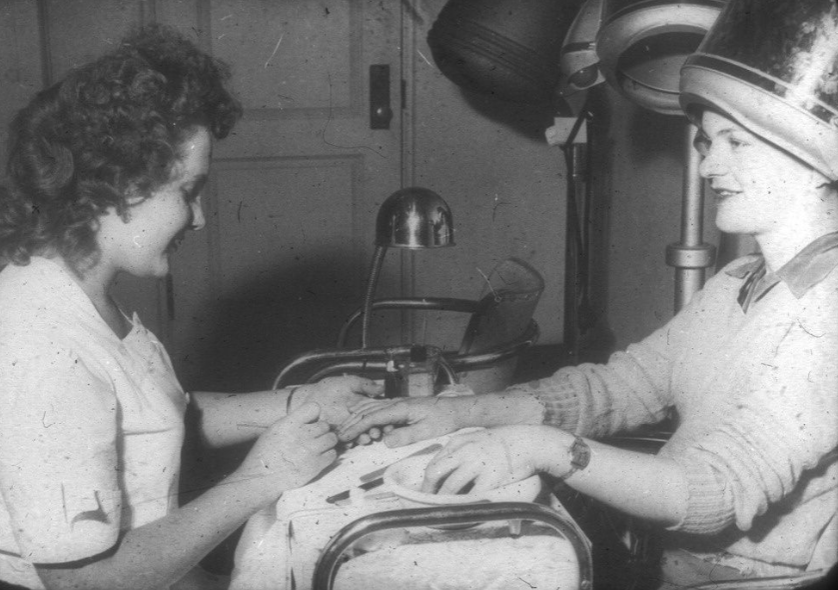
Student in cosmetology class, 1948. Photo courtesy of Fullerton College Library archives. As for men, we had a good selection of programs in existence before I came. The electronics program was strong, and the printing program was one of the two best in the state. We had a good agriculture program, and we always have had outstanding lists of offerings in business education.
We branched out into work experience whereby students took mornings in college and afternoons in some industrial plant.
Beyond the meeting the needs of the students, we had the aim of separating our facilities completely from those of the high school, getting the college all moved onto one campus, which was a long and rather painful process at times.
Originally, when the junior college moved to the east side of what was then Harvard and bought fifteen acres from the Sheppards for the college, it was bought with high school money…So it was part of the high school and not junior college property, even though there was a junior college district legally separate from the high school at the time. The junior college district began back in 1922 and was a separate legal entity from that time on, but still it didn’t own this property that was bought.
Was there a reason?
The reason was that when it was purchased in 1934, in Depression times, the junior college enrollment was not great and some people thought that there might be a possibility that the junior college wouldn’t even survive.
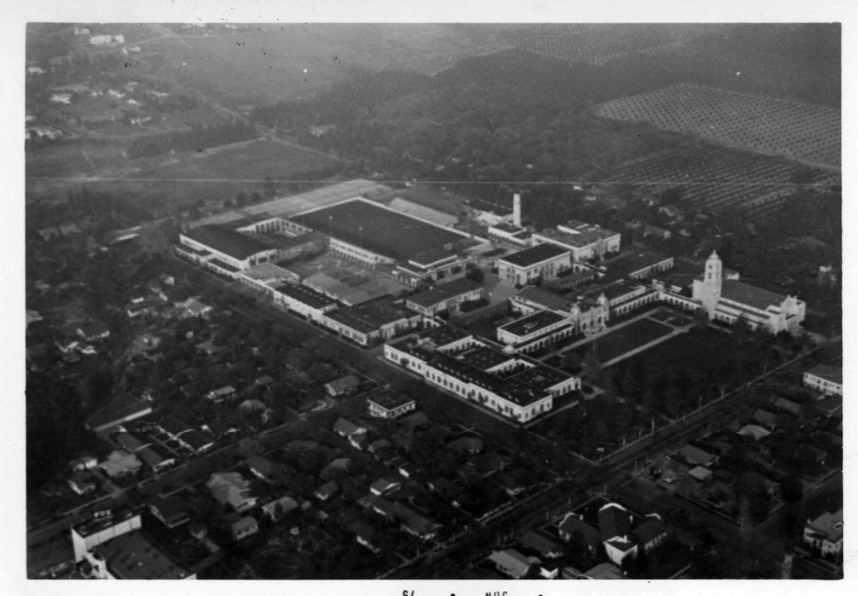
Aerial view of Fullerton High School campus in 1934, prior to construction of the first College building. We needed to acquire property of our own…just a natural desire to be independent and have our own separate identity.
It took from 1937 to 1966 to effect the complete change.
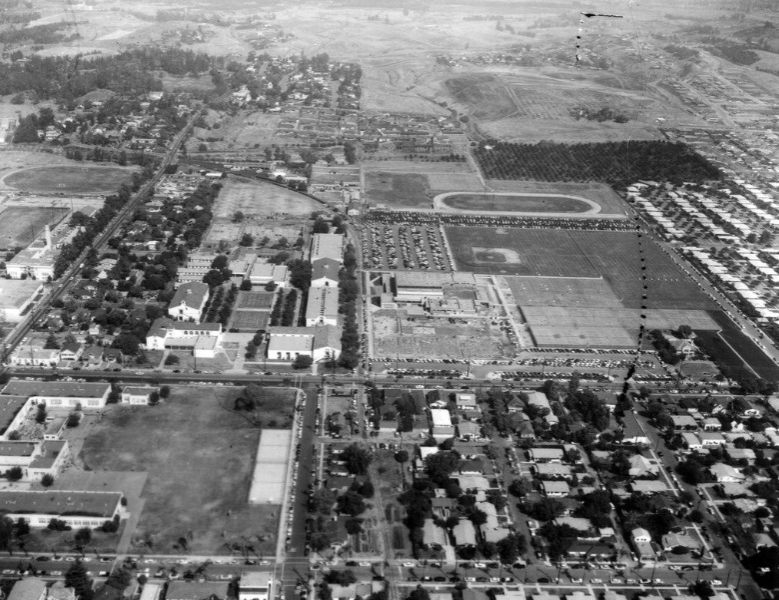
Aerial view of Fullerton College, 1957. Photo courtesy of Fullerton College Library archives. Then in 1958 came the addition of the Counseling Center to the Administration Building…The cafeteria was completed in 1958 and the two-story Technical Education building in 1959. The Home Economics and Fine Arts building in 1959 and the Auto Shop in 1960. The agriculture facility was completed in 1961.
Could you tell me about the Fullerton Junior College Foundation?
It was started in 1959…It was my idea.
It is an independent foundation and not subject to the college. Board members: William Boyce, Dr. John Casey, Walter Chaffee, Joe W. Johnston, Wanda McGraw, Arval Morris, Lorraine Plummer, Wallace Runcitel, Dr. Osborne Wheeler.
The purpose…was to establish an organization for administration of funds bequeathed or donated for educational benefit of students and former students of the junior college.
In 1959, the first two gifts which came to us were a gift of $500 from Jessamyn West for the creation of the Creative writing awards fund.
Can you talk about your philosophy of education?
I believe in the dignity and worth of every person, in the right of every person to realize his potential and to receive help in realizing this potential in the public schools. This is important not only for the individual himself, but for our society as a means of self-preservation. So, I believe in free public education through the four-year college program for all who will profit by it, both for the sake of the individual and the welfare of society. I think we can afford it but we seem to spend our money for other things.
We have emphasized facts too much…Helping students interpret, evaluate, appreciate, and use fats is more difficult…When we try to teach for implication and interpretation and application, it’s difficult to measure students’ growth and the success of our teaching. Nevertheless, we must do it.
The teacher has to be excited himself. That’s the first thing…The teachers need to have a genuine personal interest in their students.
The great teacher is not just interested in and conversant with his own little field of instruction but with the whole spectrum of life. This manifests itself in wide reading and concerns, a sense of humor, patience, tolerance, and a wisdom about priorities.
Freedom of mind and imagination…spontaneous flow of ideas among the members of the class without fear of ridicule or error.
“He cannot lead where he will not go, and he cannot teach what he does not know.”
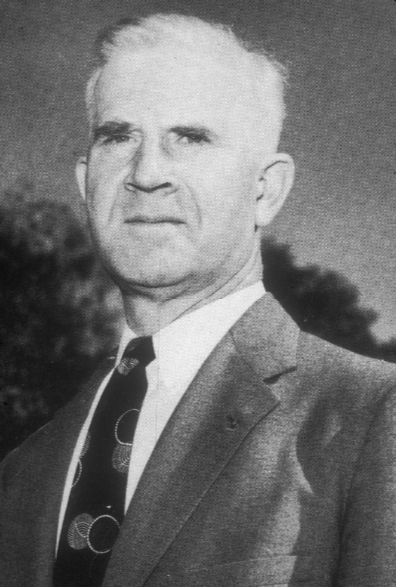
Dr. H. Lynn Sheller, 1960. Photo courtesy of Fullerton Public Library archives. -
Fullerton in 1894: The Fight Over Saloons

The following is from a work-in-progress about the history of Fullerton. You can support my ongoing research and writing on Patreon.
The Local History Room of the Fullerton Public Library has microfilm from the Fullerton Tribune newspaper stretching back to 1893. I am in the process of reading over the microfilm, year by year, to get a sense of what was happening in the town over the years.

Screen shot of the Fullerton Tribune front page in 1894. Courtesy of the Fullerton Public Library Local History Room. A big issue in Fullerton in 1894 was the presence of saloons and the sale of liquor. There were a few saloons in town, at least two of which were regular advertisers in the Tribune: Dierksen House (operated by a Mrs. C. Dierksen) and Nicolas House (operated by a J. Grimaud).

As the year progressed, the saloons in town became the target of two local prohibition groups–the Women’s Christian Temperance Union (WCTU) and the Law and Order League. The liquor question would create serious divisions in the town. Things started peacefully enough:
February 3: It is reported that the local WCTU will ask our merchants and saloon keepers to sign an agreement to close their business houses on Sunday.
In 1894, Fullerton was not yet incorporated as a town, so the main governing political body was the county Board of Supervisors. In April, anti-saloon people circulated a petition which they presented to the Supervisors in hopes of getting them to pass an ordinance outlawing saloons in Fullerton. At the same time, saloon owners circulated their own petition.
April 28: The anti-saloon petition has been signed by 93 voters, making a majority in Fullerton precinct. The petition will be presented to the supervisors a week from next Monday. The saloon men have been circulating a petition during the week and have got about 70 voters to sign it. It is reported that a number of voters signed both petitions, one favoring and the other opposing saloons.
The Supervisors passed an ordinance of questionable legality, as this April article explains:
The saloon men of this county consulted a prominent Los Angeles lawyer this week in regard to the legality of the ordinance passed by the board of supervisors a few days ago compelling the saloon-keepers to remove all chairs, card, billiard, and pool tables and have nothing whatever for people to sit on. The saloon men are not at all pleased with this ordinance, hence the move to have it declared illegal or unconstitutional. If their legal advisor says he can knock out the ordinance, then they will make a test case of it.
In early May, the Supervisors took further action:
May 12: At the special meeting of the supervisors on Tuesday the board decided that there was a majority of voters on the anti-saloon petition and therefore refused to grant a saloon license for Fullerton precinct and it now looks like Fullerton will be a prohibition town for a year at least. The board refused to recognize the petition in favor of the saloons, and there is some talk of the saloon men contesting the matter. The people on both sides have been worked up over this question, and hard feelings over the matter will exist for months. It is reported the saloon men in Anaheim are rejoicing as they expect to get a good share of the saloon patronage from this precinct.
Following this decision, saloon owners took humorous action:
May 19: The ex-saloon keepers have posted the following notices on their public water troughs: “No prohibitionists allowed to water here.”
Tribune editor Edgar Johnson was usually outspoken about where he stood on most issues, however, he remained quite neutral on the liquor question.
On May 26, he wrote, “Hard feelings continue to exist between the saloon and anti-saloon people and it will be sometime before all of our citizens work together again for the best interest of the town and community. These local fights are a bad thing, and do much towards keeping the town from advancing to the front rank.”

Some prominent local residents took it upon themselves to rid the town of saloons by creating a Law and Order League, whose main goal was “the enforcement of law, and the preservation of order in all lawful means, and more especially the suppression of the unlawful sale of liquor in our midst.”
In June, Johnson wrote, “The war between the saloon and anti-saloon people continues and will undoubtedly do the town more harm than any local question that has ever come before our citizens.”
Things evidently got so heated that something as innocuous as a local school board election divided the town on the saloon question, and the Law and Order League brought out Orange County Sheriff Theo Lacy to keep the peace, as the article below explains:
An election was held in Fullerton yesterday between the hours of 1 and 5 o’clock to elect two trustees for this district. The fight seemed to be mostly between the saloon and anti-saloon people, and was a warm one while it lasted. There is a deputy sheriff and deputy constable in this district, but the Law and Order league wanted to see that everything passed off quietly and had Sheriff Lacy here to see that order prevailed. Now is it possible that we cannot hold a district election without a sheriff present. Had there not been an officer within 20 miles of Fullerton yesterday afternoon the election would have passed off just as quietly as it did. The idea of calling in officers to keep peace while we hold an election to select school trustees is is a disgrace to the town and to all people who live in the school district. To go to this uncalled for trouble does no good, but only makes matters worse. When we hold another local election why not have the Anaheim military company present? What say you, voters?
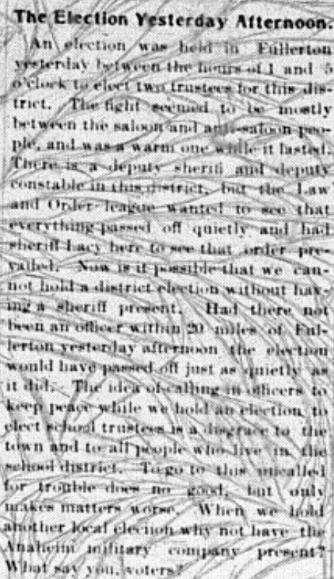
By the way, S.F. Daniels and E.R. Amerige defeated H. Burdorf and P.A. Schumacher in the election. “There were 100 votes cast, being the largest number ever in Fullerton,” Johnson reports.
The Santa Ana Blade newspaper commented on the Law and Order League: “Some of the people of Fullerton have organized a law and order league to enforce the recent order of the supervisors closing the saloons. In a law abiding community, such an organization should be as superfluous as a vigilante committee, and it only becomes necessary when the sheriff fails in his duty.”
Meanwhile, the saloon owners won a legal victory as a Judge Towner ruled against the legality of the Supervisor’s anti-saloon ordinance.
On June 16, Johnson reported:
“It is understood that the Fullerton saloon keepers will go before the board of supervisors next Monday and ask that licenses be issued to them on the ground that they have already qualified and that the ordinance is mandatory on the board in accordance with the recent decision of Judge Towner. No doubt another ordinance imposing restrictions on the liquor trade will be prepared and presented to the board.”
However, the anti-saloon people were apparently successful in getting another ordinance passed.
On July 7, the Tribune reported, “The law and order league had all of the Fullerton saloonkeepers, O. Jensen, J. Grimaud, and P. Golter, arrested this week on a charge of selling liquor without a license. The cases will probably come up for a hearing next week.”
And on July 21, the following reports appear in the Tribune:
It is reported that every man that has sold a glass of liquor in Fullerton since May 1, will be arrested.
O.M. Skinner and Mrs. Paul Golter arrested this week on a charge of selling liquor without a license. Why did not Skinner wait until Mrs. Golter’s husband recovered from his sickness? Why not have Golter’s two little children arrested too? There is nothing gained by taking advantage.
The Tribune does not believe that Rev. J. M. French did the right thing when he swore to a complaint charging Paul Golter with selling liquor without a license when he (Golter) was in bed sick. Mr. Golter is a poor man and has a family to support. Rev. French knows that if the papers had been served Mr. Golter would have been thrown in jail unless he could have given good and sufficient bonds for his appearance before a Justice. Mr. Golter has been very sick for some time and for several days was not able to walk. One or two doctors know this to be a fact. Why couldn’t Mr. French have waited until he got up from his bed before trying to have the papers served. We are not waging war for the saloon keepers; have tried to steer clear of the fight on both sides, but don’t like to see one man take advantage or try to impose upon another. If a majority of bona fide voters in this or any other district do not want saloons we believe they should be closed. The saloon men claim there was not a majority of qualified electors on the petition presented to the supervisors asking them not to issue a liquor license in this district and therefore keep the saloons open. We are anxious to see this fight settled at an early date, as it is doing the town much injury.
On August 4 the Tribune reported:
O. Schumacher, C.B. Huggans, and O. Jensen were tried at Anaheim this week on charges of selling liquor without a license. Several hours were taken up in the election of a jury.
Oliver Shumacher, who kept Huggans’ saloon a few days, was tried first.
M.H. Dunn swore that the defendant sold beer to W. Lowe and F. Donnelley in the presence of the witness. Donnelley said he had drunk at the saloon and possibly might have been root beer. He could not remember what day he was in the saloon and he was not very clear as for what happened while he was there. C.B. Huggans testified the remember the time and occasion when Donnelly and Lowe were in the saloon and drank and swore it was not beer they had.
After argument the case was given to the jury, who after a short time acquitted the defendant.
The first case being disposed of, the court at once began the second of the series, that of the People vs. O. Jensen, the defendant being charged with the same offense as was Mr. Schumacher in the first case. Jensen was promptly acquitted as was also C.B. Huggans, the third defendant, in less than five minutes, when court adjourned until Thursday.
There has been great rejoicing among the saloon men and their friends over the victory won.
The case against Mrs. Golter was tried Thursday afternoon but the jury disagreed. J. Grimaud will probably have a hearing next week.
Apparently, things did not go well for Grimaud, as the Tribune reported later that J. Grimaud’s saloon fixtures were sold.
By October, saloon owner C.M. Huggans had evidently also closed shop and “moved up to the oil wells this week, where he has accepted a position with the company.”
1894 was an election year, so Prohibition became not just a social, but a political issue. There were state and local conventions.
After the election, Johnson reported, “With one exception the next board of supervisors will be anti-saloon.”
-
Otto Evans: Candy Store Owner
The following is from a work-in-progress about the history of Fullerton. You can support my ongoing research and writing on Patreon.
On December 22, 1977, a little more than three months before he died, Otto Evans, who owned a candy store in downtown Fullerton for nearly 40 years, was interviewed by C. Dean McComber. In a brief preface to the interview, McComber writes, “The elderly are not always treated with the respect they are given in other countries. I hope I have created an interview that shows that an 85 year old man did have a greater knowledge because he lived a full life. He was full of wisdom, love, and caring traits everyone admired. We can all learn something from a man named Otto.” Below are some excerpts from this interview.
I am originally from Missouri and moved to Fullerton in 1913. My parents and I put up a store at Amerige and Harbor [Spadra] in those days and I ran that from 1913 to 1940.

Inside Otto Evans’ candy shop, 1914. Photo courtesy of the Fullerton Public Library Local History Room. When I was running the confectionary, I used to put the game scores on the window and there would be two or three hundred people looking at the scores until midnight. There was not television or radio in those days. I’d call into the Los Angeles Times or the L.A. Examiner and get the scores of whoever was playing and put them on the windows in whitewash.
In those days…there was a big rivalry between Anaheim High School and Fullerton High School, Santa Ana Junior College and Fullerton Junior College…they’d come through town after their games and throw tomatoes at those windows with the scores on them.

Photo of a local gathering outside Otto Evans’ candy shop, 1932. Photo courtesy of Fullerton College Library archives. Thanksgiving Day games between Santa Ana Junior College and Fullerton Junior College drew the crowds. Our old stadium was just packed. People were standing all around it. As many people standing in the field as there were in the stands. They drew crowds!
They used to have parades in town; Armistice Day (something they don’t have any more) was a big thing.
When I sold my cafe in 1945–Fullerton and Anaheim–10,000 people; now we’ve grown to 100,000, and Anaheim 200,000.
Inside the store those days high school kids would come in, great big football players, professors and preachers…it was the meeting place for everybody in town.
The El Camino Real bell that you find going from mission to mission I had in front of my store, and it’s still there.
The Athertons used to come in my store all the time. They had a big home with cages outside for ostriches about where the church–St. Juliana’s–is. They raised ostriches as a hobby I guess, but I suppose they sold some too. It was one of the attractions of Fullerton.

Edward Atherton’s ostrich farm. Photo courtesy of Fullerton Public Library Local History Room. The Bastanchurys used to drive down the street in front of my store and put their horses or mules out in front and get a drink. There weren’t automobiles like there is today, so you’d just put the horses outside…The Bastanchury’s had a ranch of a about a couple thousand acres. Every bit of Sunny Hills was all the Bastanchury’s.
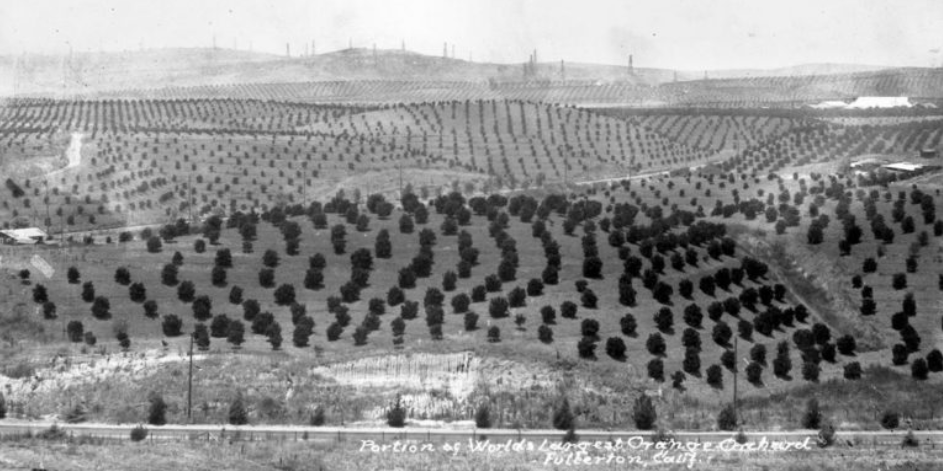
Bastanchury Ranch, circa 1930s. One day Louie Plummer [principal and superintendent of Fullerton High School] and Wally Mardsen came down to my store in the morning and saw all these hobos inside. Those bums would stay in the packing houses or boxcars and come up Harbor and you could smell them from across the street. I’d get them in my store and get a bunch of beans and hot water to make the beans thin and I’d get some bread for them. Louie Plummer and Wally Mardsen asked, “What are these men doing in here, how did they get in here?” I said, “I called them in. Fed them. I do that every morning.” First thing I did before a customer even came in.

Advertisement from the Fullerton College Weekly Torch newspaper, 1924. I’ve been a charter member of Kiwanis since 1921 and was president in 1931.
What are some of the accomplishments that Kiwanis have done that you feel were most important?
We built a home for a little lady whose husband was killed at the Santa Fe railroad (down off Harbor and the railroad crossing) and she was raising a family of about four or five children, which we practically put through school.
We put wading pools and swimming pools in for the city. We went down to the Boy’s Club building and painted the whole thing.
I started a Salvation Army Board…I put Molly Thatcher on, she was head of the grammar school, I put Bob Ward and Louise Johnson on, she was in PTA, and all your lady organizations, and Chuck Davis, and Bob White, over at the police department, and Dr. Pettis.
Then I started ringing the bell on my own. I just got these little ol’ bells and a tripod and a kettle and went down to the Post Office–Commonwealth and Pomona–for the first 20 days. Not one person on the board would come down. A couple of Union Oil men who stayed at the California Hotel would relieve me, and then my wife would come down and relieve me for lunch. I’d stand down there 8:30 in the morning to 5 o’clock that first year. The second year I did the same thing. Pretty soon everyone wanted to help me. The third, fourth, and fifth year, my goodness sakes alive, it began to spread out, with the churches, a few little industries, and a few others. That took the responsibility off my shoulders.
I’d say for 12 to 15 years, since we’ve had the four post offices, we’ve had a hundred agencies help ring the bells.
Are you still in charge of the salvation bell ringing?
Yes, I am, but I try every year to give the job to someone else, but I always seem to end up in charge of it.
Were you in World War I?
I was in the Navy on the U.S. Seattle as a gunner for a year and then got a discharge. [During the war he got a young man named Bob Timmons to run the store.]
How did the Depression affect you?
With me running a store, meat and everything was scarce. To keep the store open, I’d go to the grocery stores and get as much meat as I could get. Candy, sugar, everything was scarce.
Did you have any problems with the Ku Klux Klan back then?
A man that was in one of my clubs, Dan O’Hanlon, went down to the City Hall where they were having a gathering. He got up and told them that he didn’t believe in them and how wrong they were. It never got really organized, but at one time it was in the schools, churches and everything. You were either for it or against it, but it finally petered out.
Was politics always a big issue in Fullerton?
Always has been, and always will be…some of the best citizens have been hurt in school politics, Orange County politics, national politics. I’ve got a birthday card from Pat and Richard Nixon, and here they are living in San Clemente by themselves…They both used to go to school around here.
I’ve got cards from Babe Ruth and from governors, a lot of people. Babe Ruth and Walter Johnson used to play baseball out at Brea.
We’ve had many good citizens; take Mr. C.C. Chapman. My wife worked as a private secretary for Mr. Chapman for all his business life in Fullerton.
Down by the Santa Fe railroad track they had a Mexican camp to pick oranges. They had maybe three or four hundred Mexicans here to pick oranges. You couldn’t have got them picked otherwise because local people just wouldn’t get in there and pick the oranges.
We had thirteen packing houses here and they were all thriving, but now there’s only one packing house in town. The whole situation has changed and life has changed.
We’ve had floods come through here. [During the 1938 flood] the water came down through Anaheim. Dr. Nelson and his wife Ruth came up here and stated a week with us because of the damage.
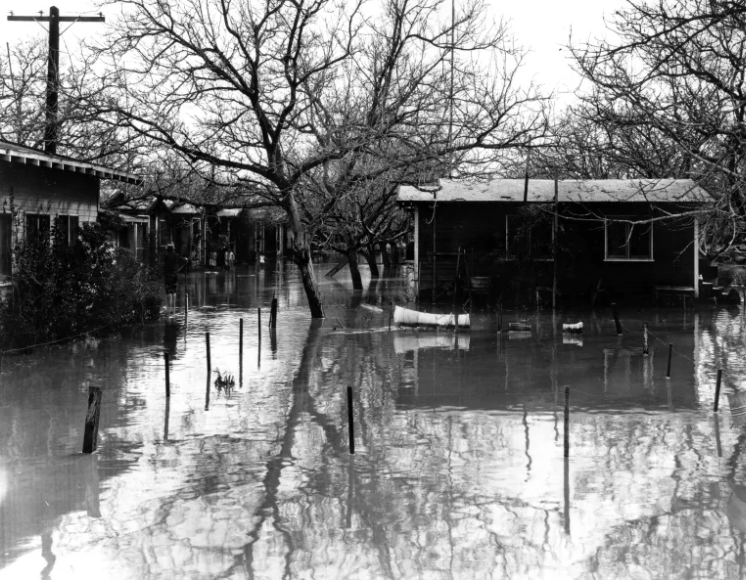
Campo Pomona (Mexican citrus work camp) in Fullerton during the 1938 flood. Photo courtesy of the Fullerton Public Library Local History Room. I was always a Legionnaire since World War I, so the Legionnaires got trucks and hauled people to safety. We took them to dry spots, like churches and clubs until the water receded.
We had some big packing house fires. We had a lot of bums come through Fullerton so the fires were probably started from cigarettes.
That Long Beach earthquake of 1933, my goodness sakes alive, shook me right out of my store. I jumped over my fountain and went out in the street. It didn’t shake any of our buildings down though, but in Long Beach they lost a lot of lives.
I had a car accident the 28th of June, 1976. They took me to the St.Jude Hospital, and my shoulder and five of my ribs cracked. It took a while getting over it, but I got hundreds of cards from everybody in town. The News Tribune wrote a card that said, “Get well soon, you’re needed.”
-
The Spencer Family: Citrus Ranchers
The following is from a work-in-progress about the history of Fullerton. You can support my ongoing research and writing on Patreon.
Clarence S. Spencer was born in Chariton, Iowa, in 1881 to Thomas and Mary A. Spencer. His father was both a physician and a druggist.
In 1888, the family moved out west to the town of Orangethorpe (next to Fullerton) and purchased 20 acres of apricots and walnuts. Dr. Spencer eventually planted oranges and lemons. In 1891, Dr. Spencer died.
In 1916, Clarence Spencer married Annie Irene Thomas, a native of Texas. Her grandparents were plantation owners. Clarence and Annie had one child, Gladys.
The Spencer family eventually owned 80 acres. Clarence purchased five for himself, where he built a beautiful home that still stands today at 1400 W. Orangethorpe Ave.
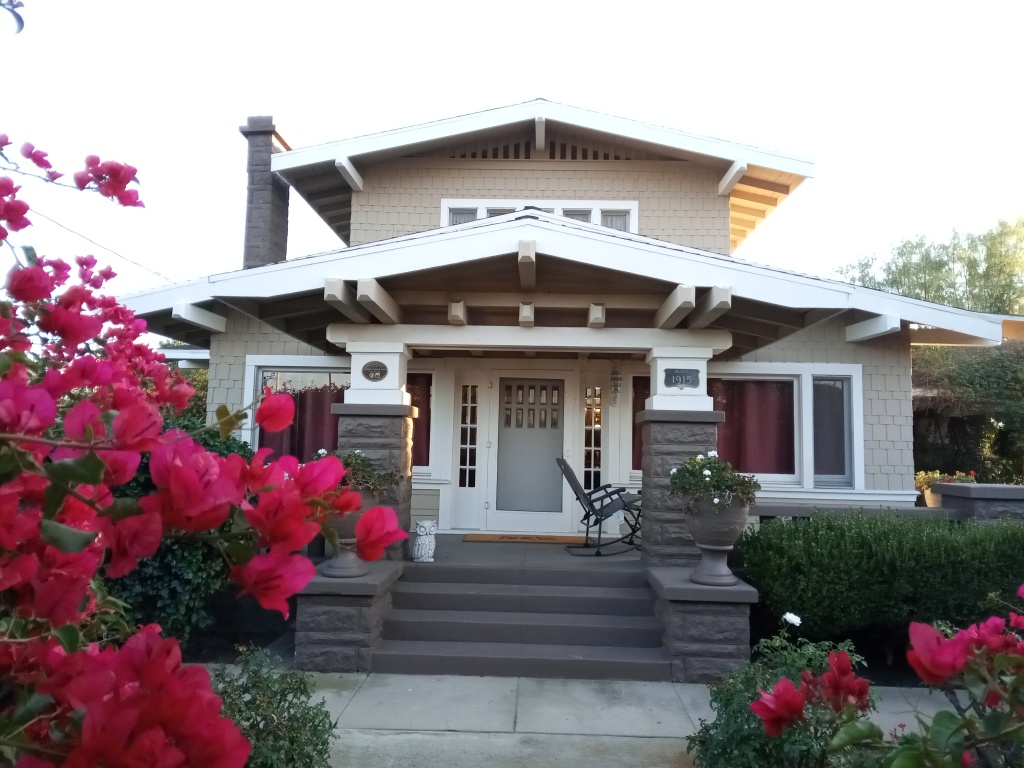
The Clarence M. Spencer house at 1440 W. Orangethorpe Ave. is an official local landmark. Clarence was a delegate to the Republican County Convention in 1912 and he was a stockholder in the Fullerton Citrus Orchards, and also in the Fullerton Leasing Company, handling oil leases.
“A leader in Republican county politics, and the owner of an exceptionally fruitful and attractive grove of oranges,” biographer Samuel Armor wrote in 1921, “Clarence S. Spencer is not only influential in citrus fruit circles, but he is also one of the path-breakers in the fast-developing oil industry.”
Fraternally, he was a member of the Knights of Pythias Lodge in Anaheim.
Source:
History of Orange County, California: with biographical sketches of the leading men and women of the county who have been identified with its earliest growth and development from the early days to the present by Samuel Armor. Los Angeles Historic Record Co, 1921.
-
Fullerton College in 1925
The following is from a work-in-progress about the history of Fullerton. You can support my ongoing research and writing on Patreon.
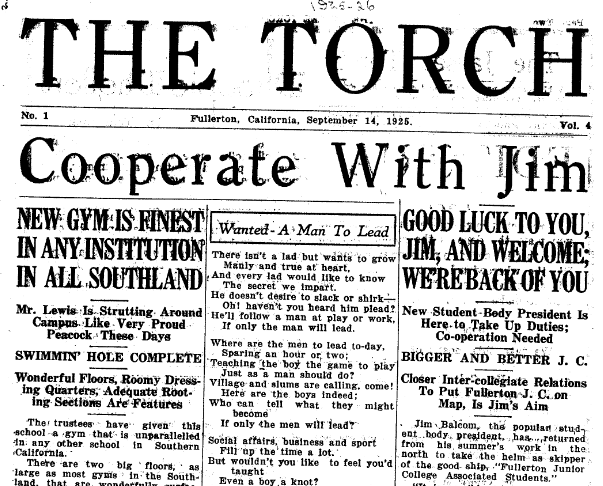
Lately, I’ve been going through the digital archives of Fullerton College’s student newspaper, the Torch. The Fullerton College library web site contains digital issues of the Torch going back to 1923.
So far I’ve included highlights from the years 1923 and 1924. Below are some excerpts from the 1925 Torch, along with some historic photos.
In 1925, Fullerton Junior College, as it was then called, shared facilities with Fullerton High School. Obviously, there was a lot more going on at the Junior College than I am presenting here, but here are some interesting tidbits that stood out to me.
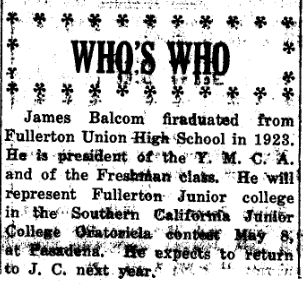
James Balcom, whose family Balcom Ave. is named, was a notable student in 1925. The Fox Theater, which was originally called the Chapman Alician Court Theater, and a bit later the Mission Theater, was built in 1925.
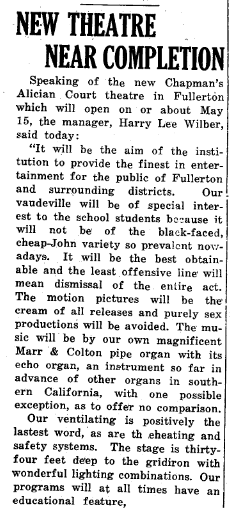

Photo courtesy of the Fox Theater Foundation. In 1925, a new gym was built on the Fullerton High School campus that was also used by Fullerton Junior College.
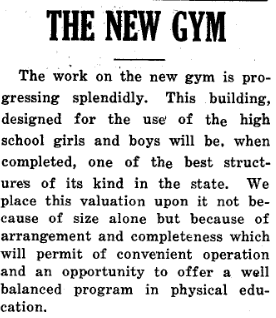
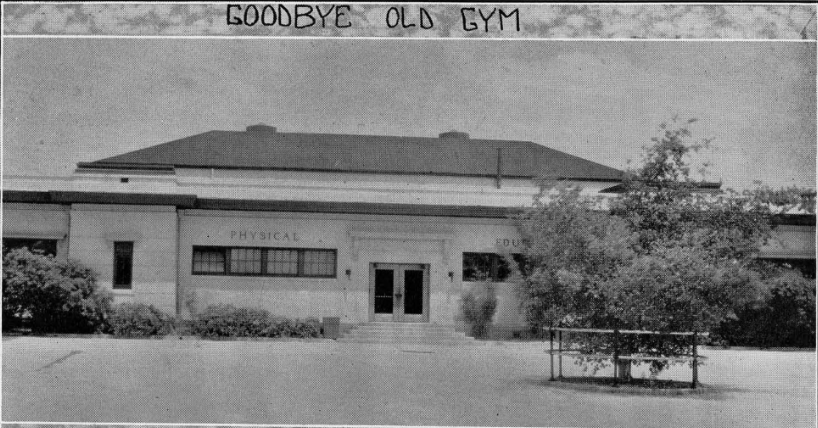
Photo from the 1925 Pleiades yearbook of the old gym. 
Interior of the “new” FUHS gym, which was condemned and torn down in 2020. In 1925, Fullerton Junior College had 140 students.

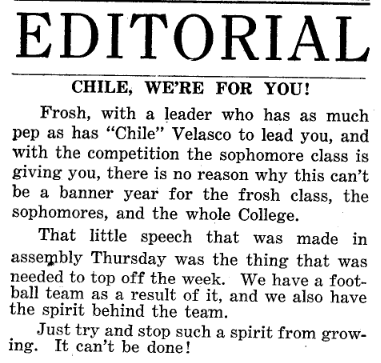
In 1925, a notable student was Louis “Chile” Velasco, one of the few Mexican American students at Fullerton Junior College. I would like to learn more about Velasco. But that’s for another post.
And here is a photo from the Fullerton College Library digital archives from 1925 showing students in a home economics class.

Stay tuned for highlights from the 1926 Weekly Torch newspaper!
-
The Jaysee Torch: 1924
The following is from a work-in-progress about the history of Fullerton. You can support my ongoing research and writing on Patreon.
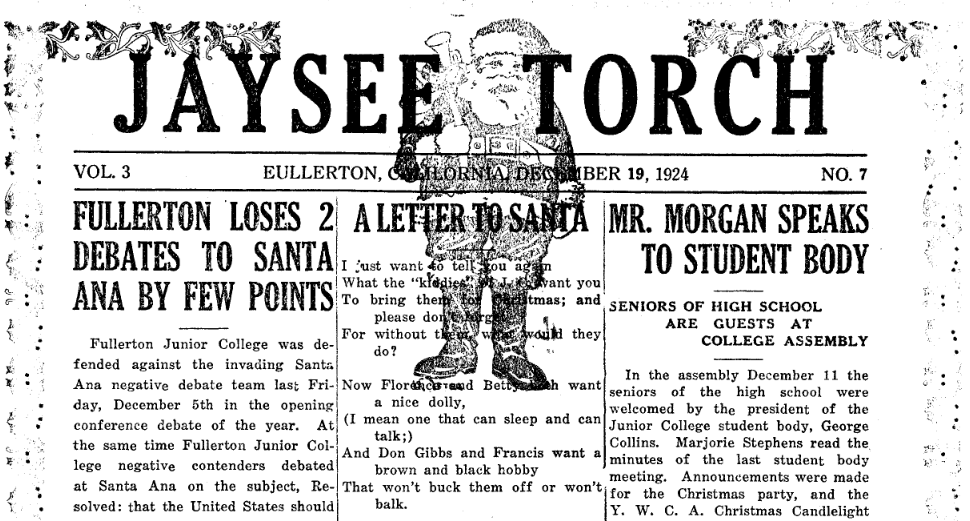
The Fullerton College web site contains digital archives of the Weekly Torch [also called the Jaysee Torch], Fullerton College’s newspaper, stretching all the way back to 1923–when the college shared grounds with Fullerton High School.
As part of my research into local history, I’ve begun going through these archives, year-by-year, because newspapers are information-rich sources of local history.
Below are screen shots from the paper in 1924.
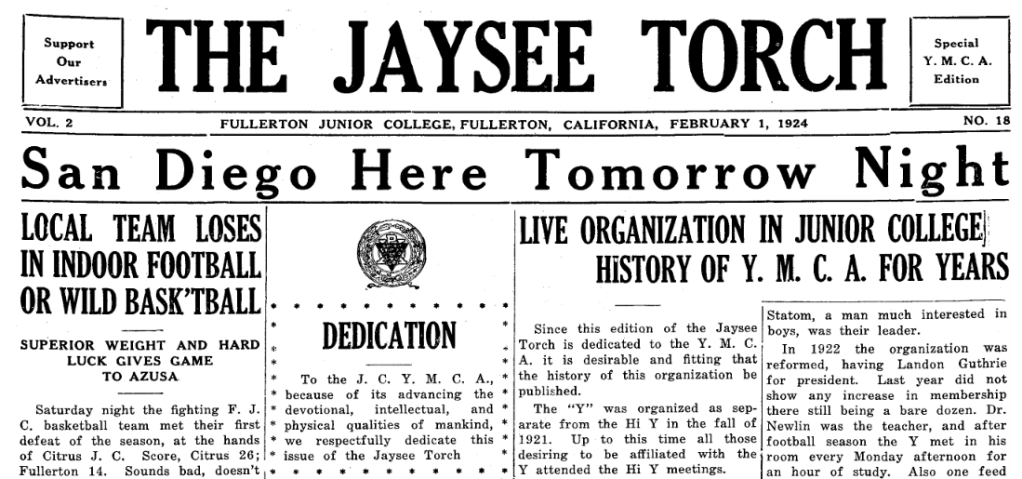
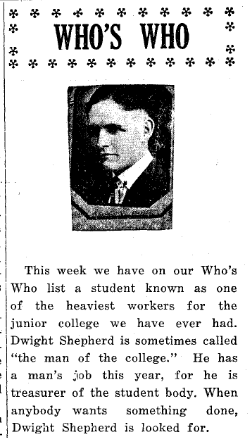
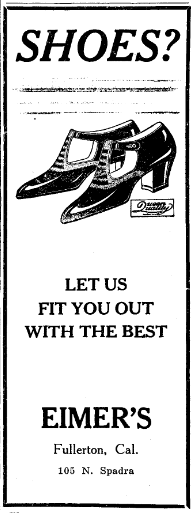
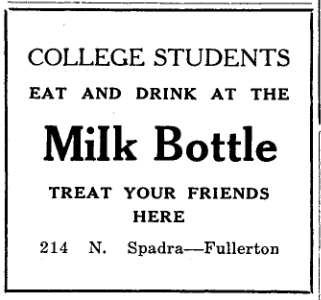
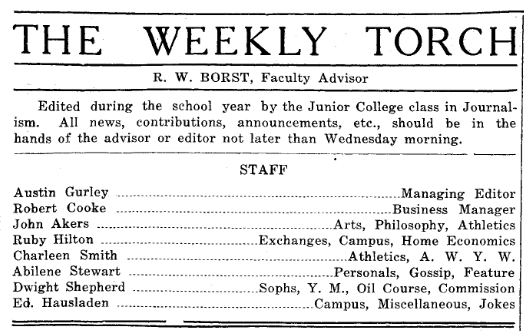
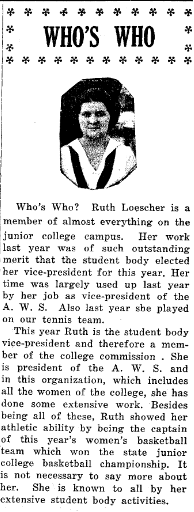
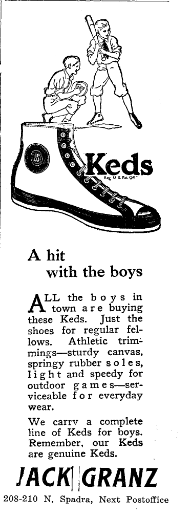
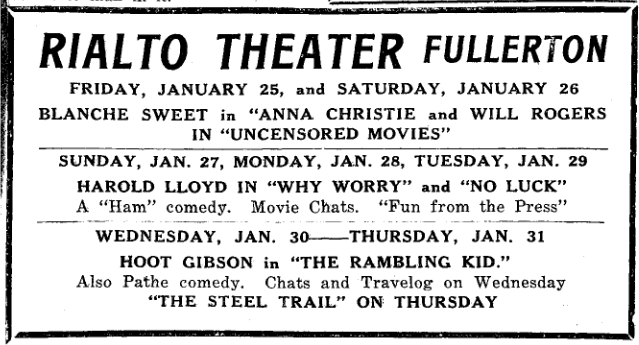
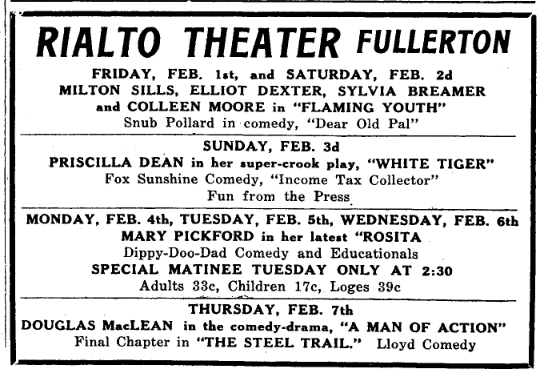
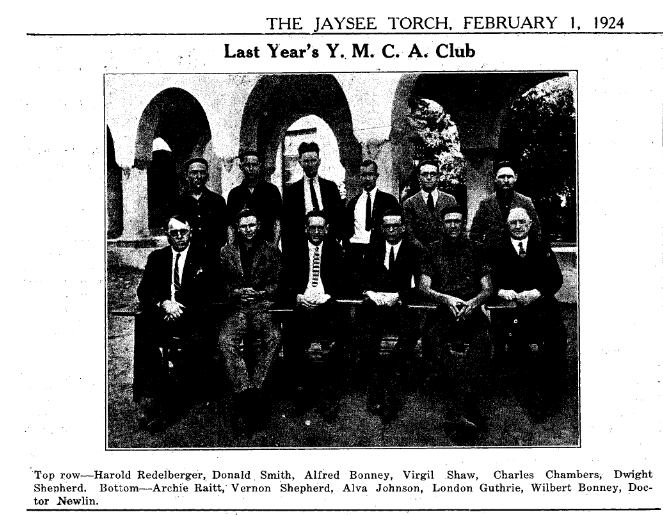


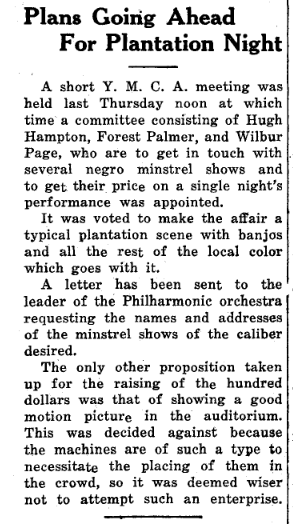
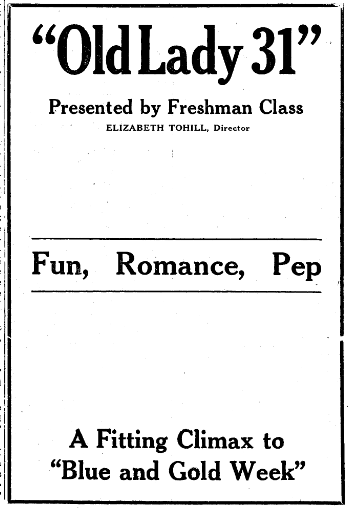
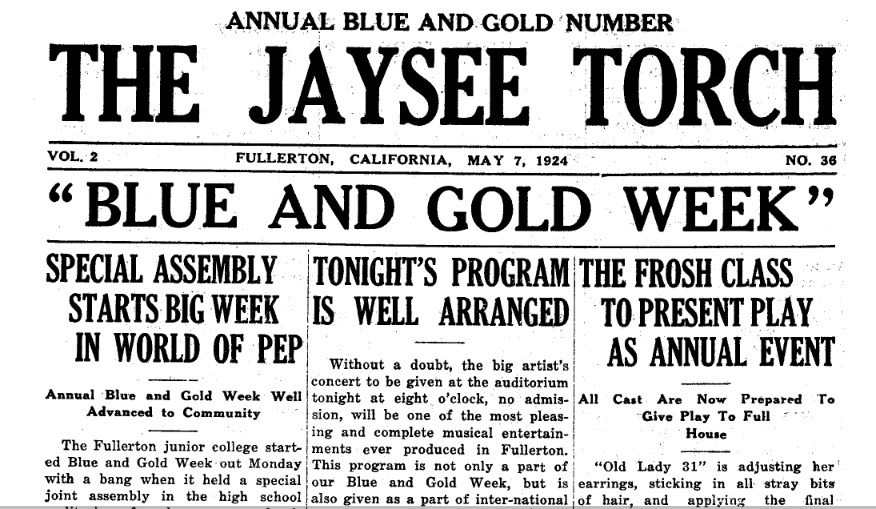
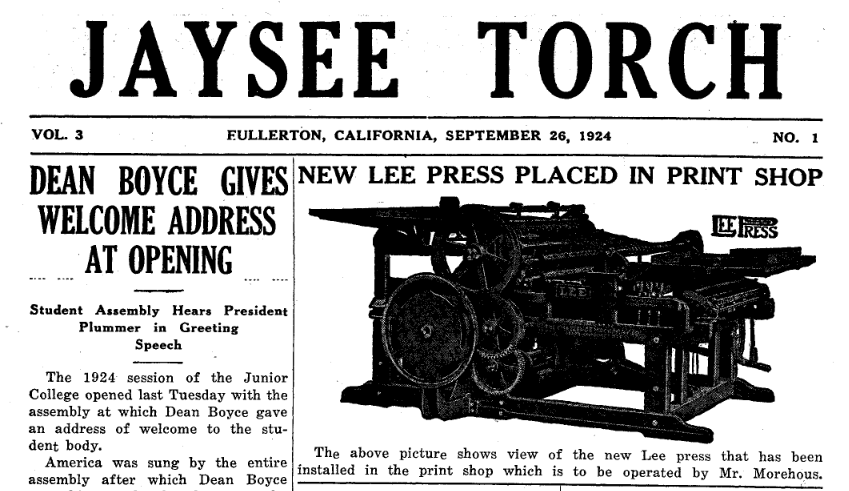
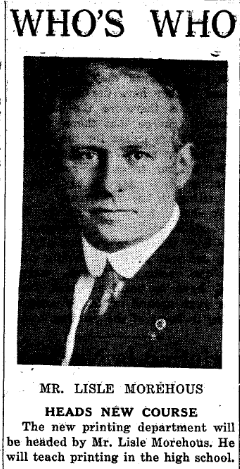
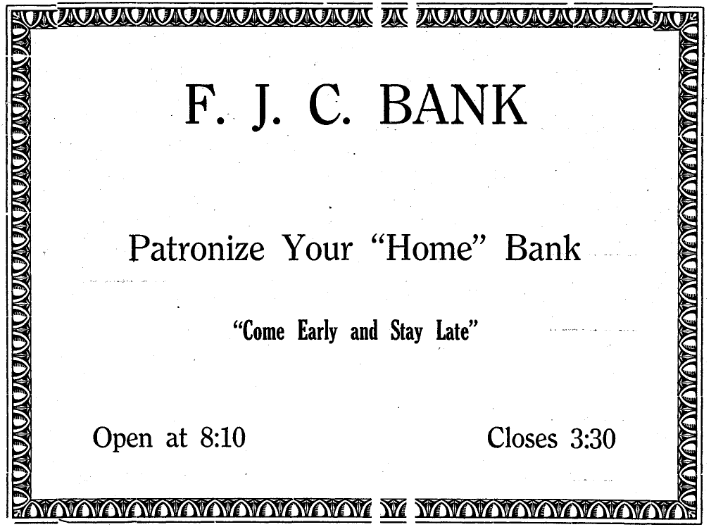
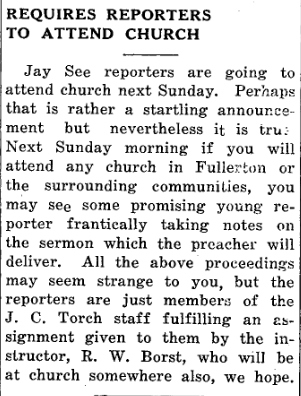

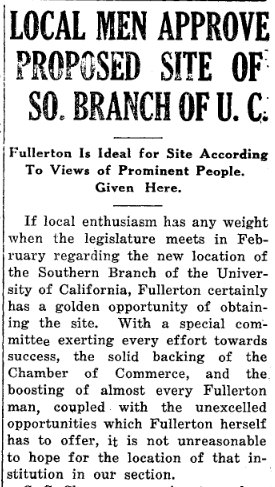
Stay tuned for highlights from 1925!
-
Oral Histories: Margaret O’Hanlon
The following is from a work-in-progress about the history of Fullerton. You can support my ongoing research and writing on Patreon.
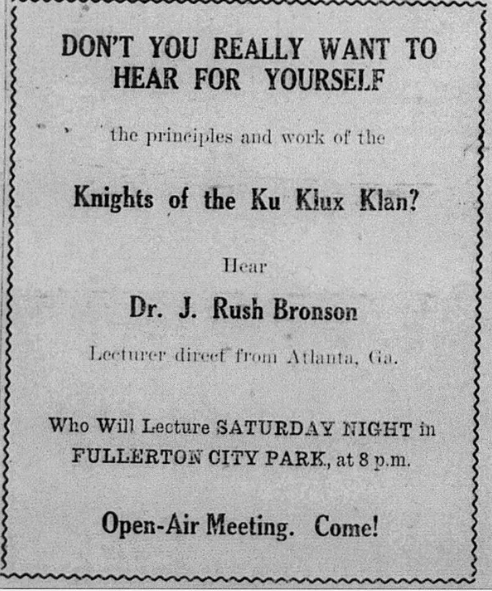
The following is an excerpt from an interview for the Fullerton Community History Project with former Fullerton resident Margaret O’Hanlon. The interview was conducted and recorded by Anne Riley in 1971. Margaret’s husband, Dan O’Hanlon, was a prominent figure in early Fullerton. He was a charter member of the Kiwanis Club, the Elks club, the first president of the Fullerton Realty Board, and an insurance agent. Margaret recalls a conflict between her husband and the Ku Klux Klan in Fullerton in 1923:
Margaret O’Hanlon (MO): Then, of course, you have heard about this business with the KKK [Ku Klux Klan].
Anne Riley (AR): I read about that. Can you tell me something about it?
MO: Yes, you know they came really from Anaheim, I think. I don’t think they’re local people very much, but there was one night they came into the park and there was a bandstand in the park in those days.
Source: Fullerton News-Tribune. AR: This would be what, Amerige Park now?
MO: Yes. It was 1923 and they held forth getting very bitter about we Catholics. And, of course, Dan was a very religious man and he thinks a great deal of his faith which I do, too. And this fellow was damning the pope and so on and so Dan could not stand it, so he called him a liar. And the police came and they thought, they said he was disturbing the peace. Well, there wasn’t any peace to disturb because they were getting quite strong. They had put patches of paint across the main street and K something. I don’t know what they were. I don’t know if I should be telling you this but it was all in the paper.
AR: It was something you could probably read up on.
MO: Well, if you got all the papers it would be a load of papers that it would be in. I think we have some of the papers around here, still. And of course they searched him (chuckles). They got some keys and I think a pair of rosary beads in his pocket, a crucifix or something like that was all they found. Someone said, Oh, he had a gun, and he didn’t have a gun. He never brought a gun from England at all and never had a gun. And so anyway, Mr. Launer who was a friend of his, he belonged to the Kiwanis club then, and Mr. Launer came and kept them at the police station for a little while, not over night. I was waiting at home. I knew he was there over at the park; the park was crowded you know. They were strangers, they weren’t Fullerton people that were crowded around and they were all dressed in their…
AR: Their hood?
MO: It was scary, you know?
AR: Did they carry torches?
MO: I don’t remember the torches.
AR: I see pictures of them.
MO: But they were in their uniforms, whatever you call them. Yes, they were. They were beginning to be quite strong, and anyway, the police just held Dan for an hour or two. Mrs. Rothermal, they used to have a butcher store on Harbor, she called me up and she said, “Do you know where Dan is?” I knew he’d been to the park , and it was late. It was eleven o’clock. And she told me where he was but then he came home.
AR: You must have been upset.
MO: Mr. Launer…Oh, I don’t know about being upset. He just knew it was the thing he had to do. He just couldn’t stand it. He’s not that type of person. [Dan was] some person that he thought a great deal of blasted and not truthfully either.
AR: Tell me now, was the only thing that the Klan was against at the time Catholics?
MO: Well, they’re against black people, too, I think.
AR: Jews and blacks and catholics.
MO: Yes, they’re against Jews.
AR: Of course, Fullerton didn’t have many black people at that time.
MO: There was just one family, I think, when we came; they were kind of nice people really. They lived on Wilshire when I remember them first. I think they moved away…
Unnamed Person (UP): Somebody called up Father Murphy, threatened to burn the church down and put KKK on the side of it.
AR: That was the same night as this?
UP: Around the same time, I think.
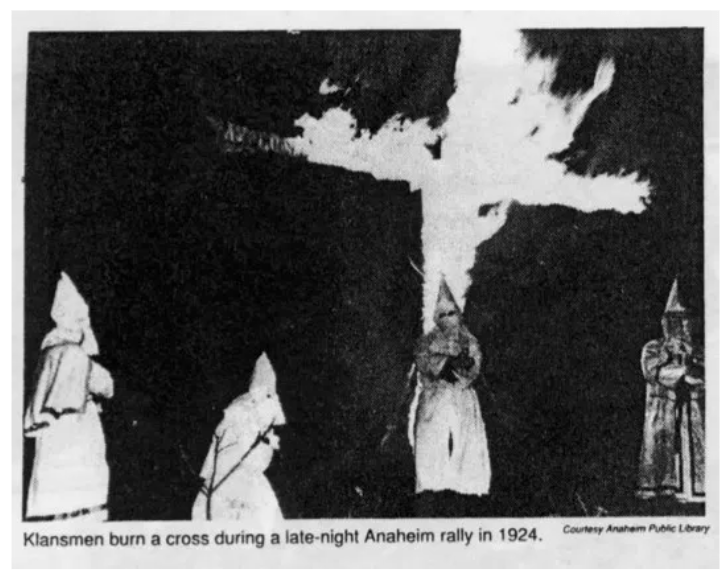
MO: Yes. Well, this is what I remember. After that you see on the couple of days afterwards, I think it was the next night or very early in the morning, they burned their crosses in front of our house in the middle of the night. It scared me to death.
AR: Oh, it would have.
MO: And I don’t know who, but I heard a couple of shots that went off and that waked me. Dan wanted to go out and I said, “No don’t,” and I said “Just stay indoors.” So in the morning before it was light, I went out and moved this burnt cross and threw it out. And then they had plastered this K across Harbor, great big things across Harbor. But you know, we never heard of them again, not in Fullerton. Never after that in Fullerton…They just couldn’t stand it…
-
Ernest S. Gregory: Homebuilder/Developer
The following is from a work-in-progress about the history of Fullerton. You can support my ongoing research and writing on Patreon.
Ernest Gregory was born in 1881 in Chesterfield County, Virginia and raised on a farm. At age 19 he moved to Fullerton, where he learned carpentry with contractor C.H. Smith. He also studied at Throop Polytechnic Institute at Pasadena, and took a course in the International Correspondence School in Scranton, PA., in mathematics and drafting, for which he received a diploma.
After two years in Fullerton he moved to Los Angeles and became foreman of one of the largest building companies in that city. During these years he used to make short visits to Fullerton, where he built three or four houses a year. In 1919 he moved back to Fullerton, where he continued to build homes.
“Mr. Gregory caters to the middle class of people who want to own their own homes,” biographer Samuel Armor wrote in 1921. “He purchases lots, draws his own plans, endeavors to make each one a little different from the others, builds bungalows and sells them on the installment plan.
In 1919 he built 30 bungalows, and in 1920 he averaged one home a week.
“Among the artistic work he has done may be mentioned some of the homes at Ramona, and homes in the Home Builders and Victoria Square tracts,” Armor writes. “A prominent banker at Fullerton recently said that E.S. Gregory had done more to upbuild the city of Fullerton the past two years than any other man in the place. The conception of Mr. Gregory’s bungalows are especially artistic, and they sell readily, many of them having added charm by reason of their situation among the orange and walnut orchards.
Gregory married Laura E. Gage, a native of Kansas, and they had two children, Esther and Ellsworth.
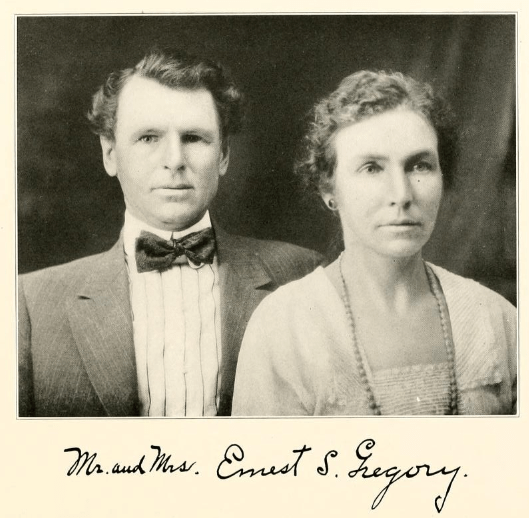
Portrait of Ernest S. Gregory from Samuel Armor’s History of Orange County Source:
History of Orange County, California: with biographical sketches of the leading men and women of the county who have been identified with its earliest growth and development from the early days to the present by Samuel Armor. Los Angeles Historic Record Co, 1921.
-
FJC Weekly Torch: 1923
The following is from a work-in-progress about the history of Fullerton. You can support my ongoing research and writing on Patreon.
The Fullerton College web site contains digital archives of the Weekly Torch, Fullerton College’s newspaper, stretching all the way back to 1923–when the college shared grounds with Fullerton High School.
As part of my research into local history, I’ve begun going through these archives, year-by-year, because newspapers are information-rich sources of local history.
Below are screen shots from articles in 1923, with a bit of occasional context and commentary.
2/16/23
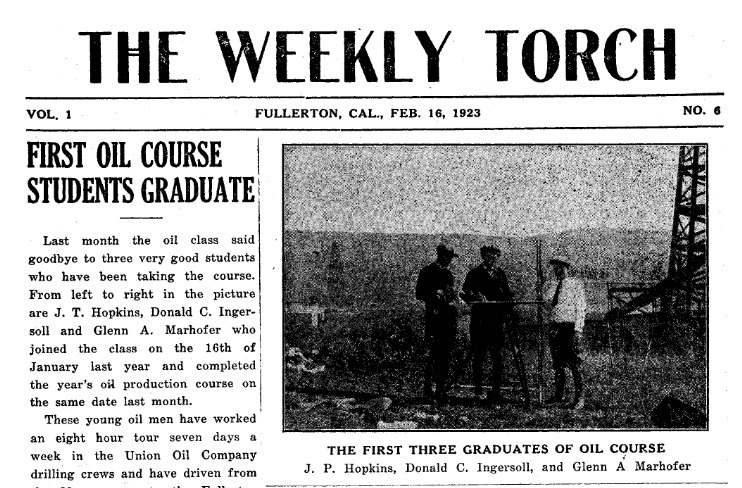
2/23/23
It’s interesting that one of the sports teams Fullerton Junior College played in 1923 was the Sherman Indian School, an Indian boarding school in Riverside. Indian Boarding schools have a sad history in America.
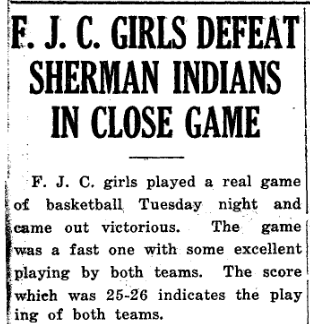
3/9/23
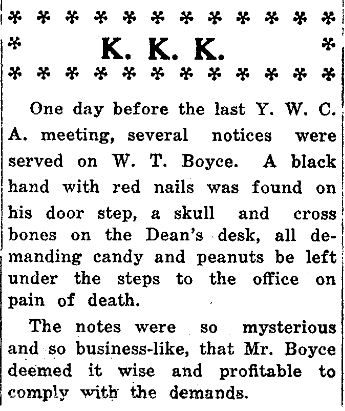
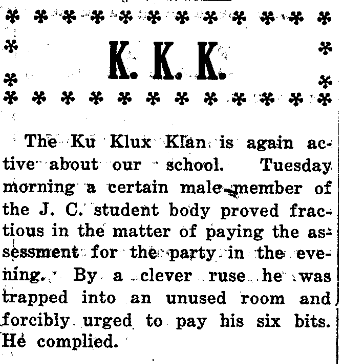
The article below is both disturbing and mysterious. We know that there was an active Ku Klux Klan in Fullerton in 1923 and that Superintendent Louis Plummer joined. And yet the activities described in the article are just weird. Apparently someone associated with the KKK left “a black hand with red nails, a skull and cross bones on the Dean’s desk, all demanding candy and peanuts be left under the steps to the office on pain of death.”
Was it possible that the KKK was considered another campus “prank” group?
In 1923, Fullerton Junior College was part of Fullerton Union HIgh School, and the high school had an Americanization program, which involved sending teachers into the segregated Mexican citrus work camps. To read more about this, click HERE.
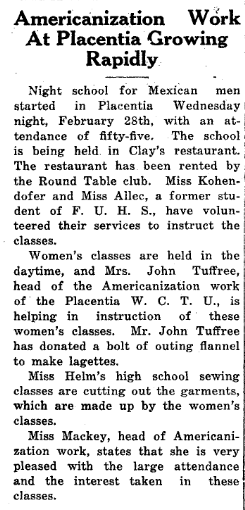
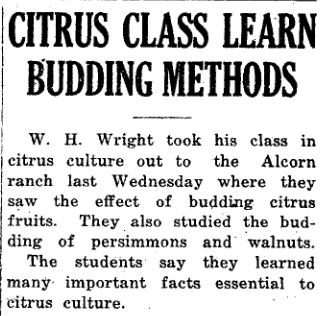
3/23/23

4/13/23
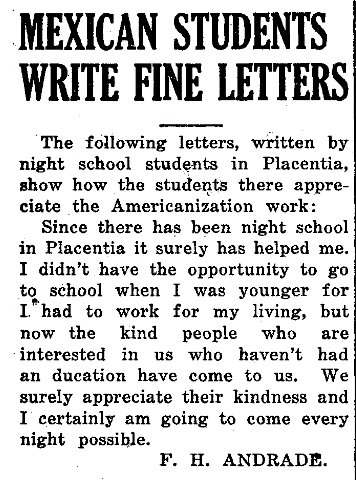
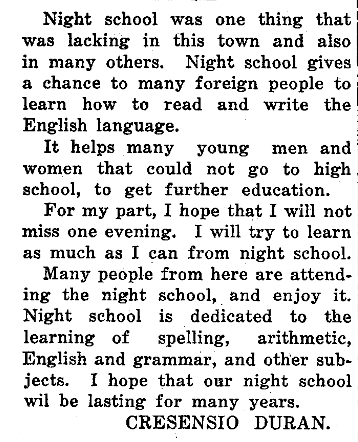
4/20/23
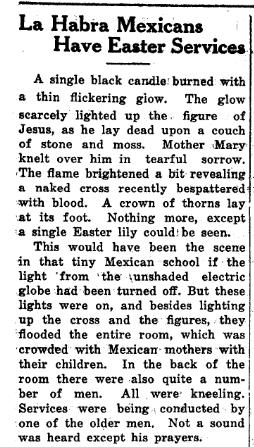
5/4/23
5/25/23
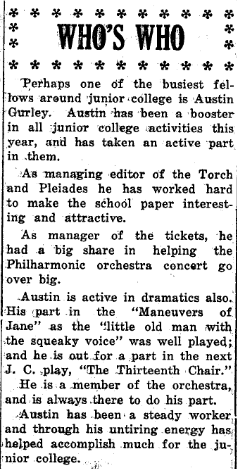
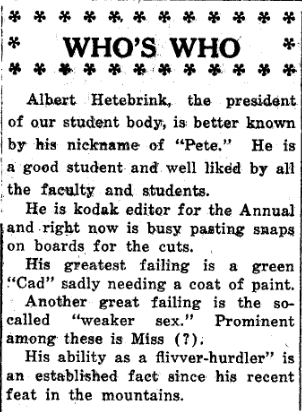
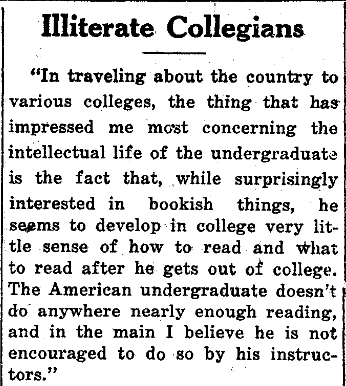
Albert “Pete” Hetebrink was student body president and also, evidently, a member of the Ku Klux Klan.
6/8/23
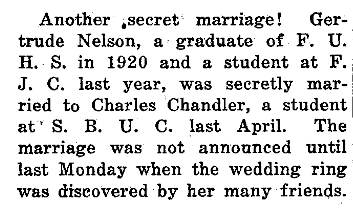
6/15/23
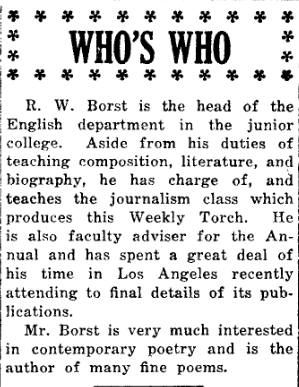
9/14/23
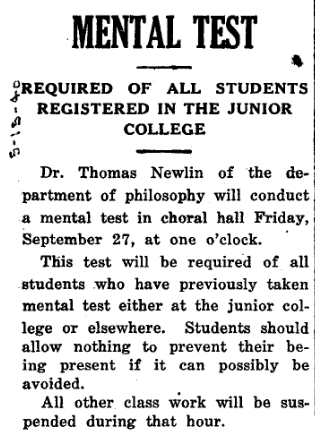
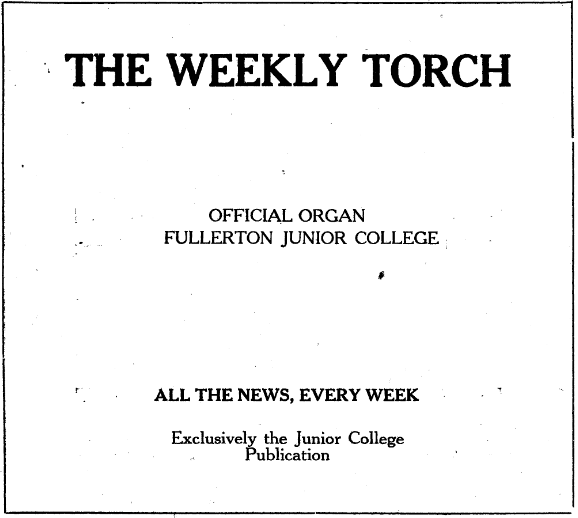
9/21/23
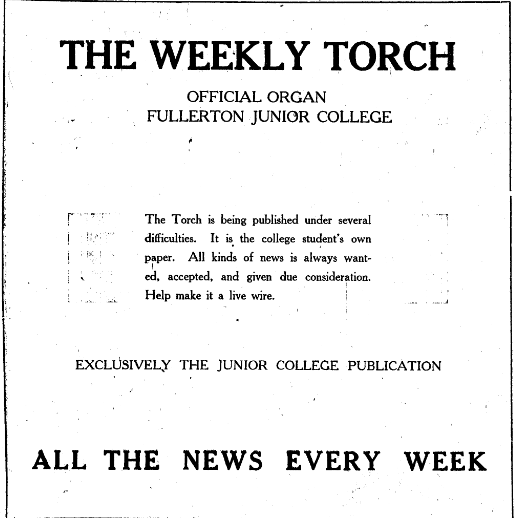
9/28/23
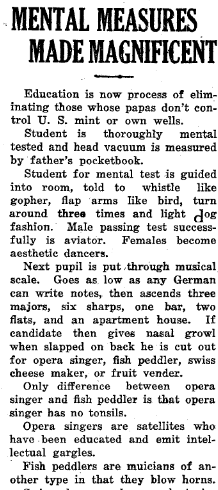
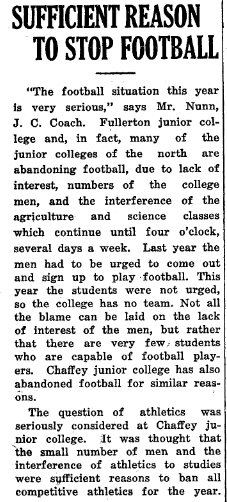
10/12/23
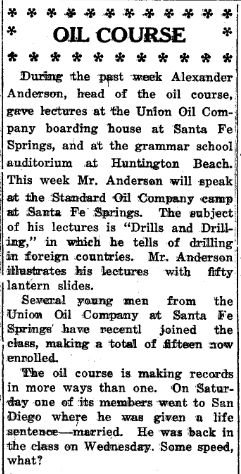
11/16/23
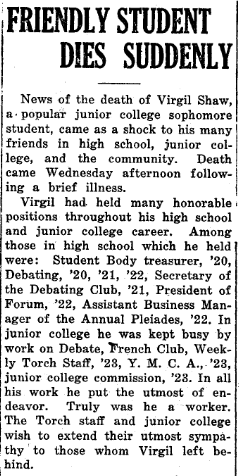
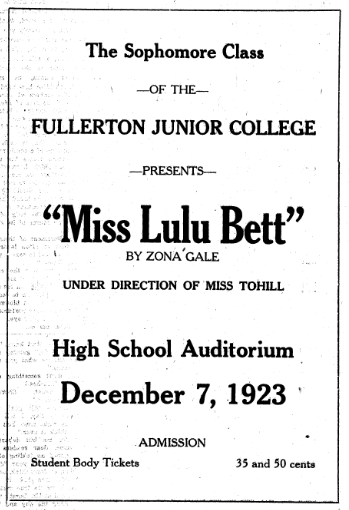
12/7/1923

Stay tuned for highlights from the Weekly Torch in 1924!
-
Tom Pappas: World War I Veteran and Confectionary Store Owner
The following is from a work-in-progress about the history of Fullerton. You can support my ongoing research and writing on Patreon.
“If the details of the life of Tom Pappas, proprietor of the Chateau Thierry cafe and confectionery, at 116 N. Spadra Street [now Harbor Blvd.], Fullerton, were written, it would make as interesting reading as a tale of fiction,” biographer Samuel Armor wrote in 1921, “A hero of the famous battle of Chateau Thierry in the late World War, he named his place of business at Fullerton in honor of that memorable battlefield.”
Tom Pappas was born in 1884 in Athens, Greece. When he was only eight years old, he began selling papers on the streets.
In 1906, when he was 22 years old, he immigrated to the United States and worked as a news vender on the streets of Chicago. Later, he and his brother William opened three confectionery stores.
In 1913, Tom sold his share in the confectionary business and moved to Whittier, California where he opened a confectionery store.
In 1916 he moved to Fullerton and bought out a cigar store, which he operated until the US entered World War I, at which time he sold his business and enlisted in the 144th Field Artillery (the Grizzly Regiment).
However, when he arrived at Camp Kearny, he was discharged because he was not an American citizen. Determined to fight, he returned to Orange County and got his citizen’s papers, after which he rejoined his regiment at Camp Kearny.
He was sent overseas to France, where he joined the 13th Field Artillery, Fourth Division, and fought on four different battle fronts, serving as a gunner. He fought at St. Mihiel, Lorraine, Chateau Thierry, and the Argonne.
“He was gassed at Chateau Thierry, and being rescued from the field he was in the field hospital three weeks and then rejoined his regiment, being in active service until the armistice, when he was again taken ill from the former effects of being gassed and was compelled to remain in the hospital for six months,” Armor writes.
After the war, he returned to Fullerton and purchased a confectionery store, which he named the Chateau Thierry cafe and confectionery. It became a popular store downtown.
He also invested in several local oil companies.
Like many businessmen of his day, Pappas was a member of the Fullerton Board of Trade. He was a member of the Anaheim Elks Lodge, and a charter member of the American Legion Post 142, which is still active today, organizing the popular Memorial Day event.

Portrait of Tom Pappas from Samuel Armor’s History of Orange County Source:
History of Orange County, California: with biographical sketches of the leading men and women of the county who have been identified with its earliest growth and development from the early days to the present by Samuel Armor. Los Angeles Historic Record Co, 1921.
-
Subscribe
Subscribed
Have a WordPress.com account? Log in now.

