-
News Headlines: 1983
The following is from a work-in-progress about the history of Fullerton. You can support my ongoing research and writing on Patreon.
The Fullerton Observer newspaper was formed in 1978 by Ralph and Natalie Kennedy and friends to provide a more progressive counterbalance to the more conservative Fullerton News-Tribune and Orange County Register. The Fullerton Public Library has digital archives of the Observer stretching back to 1979. Here are some top news stories from 1983.
Development
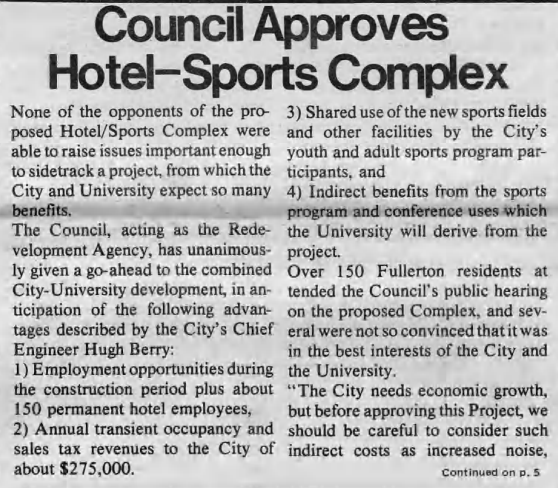
City Council approved a deal with CSUF to use redevelopment funds to help build a sports complex.
Housing
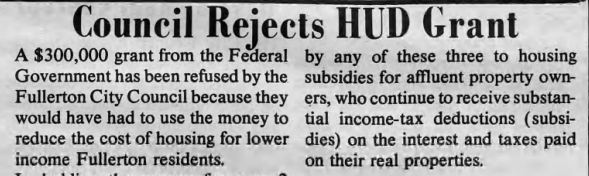
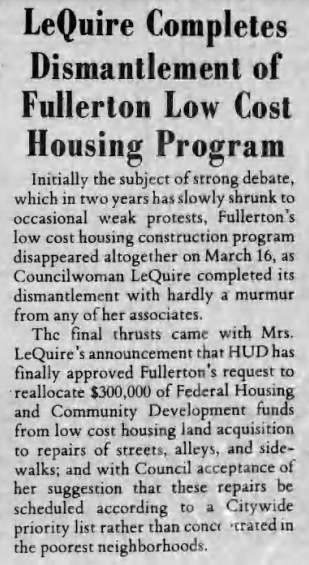
On the question of affordable housing, the conservative majority on City Council had a pretty bad record, turning down federal money for affordable housing, or re-allocating it to other purposes. But at some point Buck Catlin flipped and supported the use of county bonds for affordable housing.


Meanwhile, the county Board of Supervisors dismantled their inclusionary housing program, which previously required new housing developments to set aside 10% of the units as affordable.

Budget
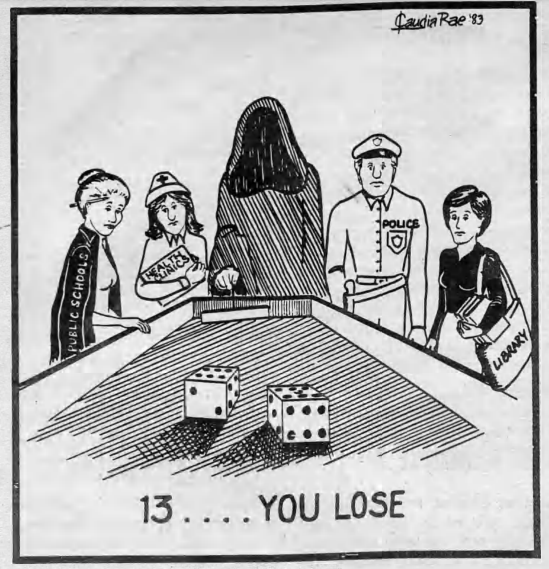
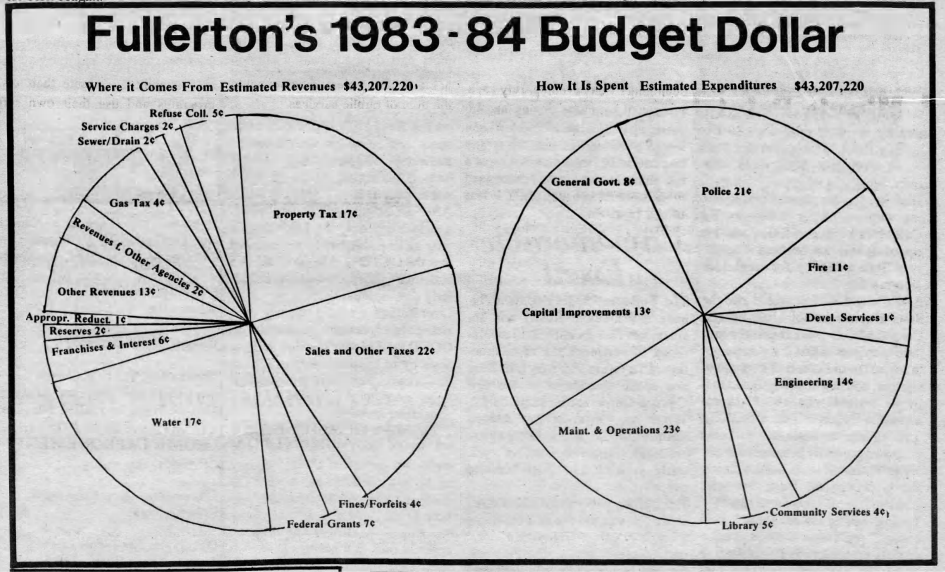
The City Budget was still recovering from the fallout of Proposition 13.
Education
Local school districts also faced budget cuts as a result of the decreased property tax revenues caused by Prop 13.

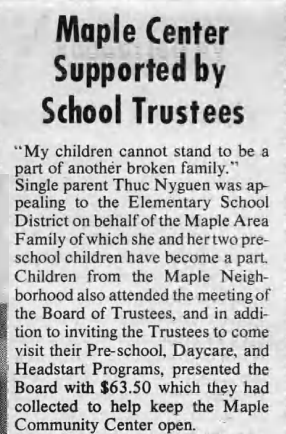
Amidst this decline of revenues, there was talk of closing the Maple Community Center, which served the largely Latino/lower income residents of south Fullerton. As a result of community pushback, the Maple Center was not closed.
Transportation
Fullerton’s bus terminal was built where it still stands today.

At this time, Fullerton bicyclists, including Observer editor Ralph Kennedy, were politically active on behalf of bike transportation.

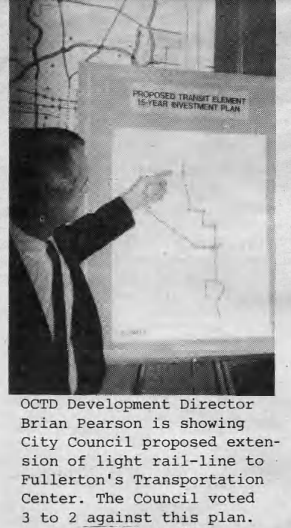
City Council voted against the extension of a light rail train to the City’s transportation center.
Culture
The City hosted a Fullerton Gold Rush Days Parade.

In the 1980s, Downtown Fullerton had a few cool book stores, including Mugwumps and Aladdin Books.

Open Space
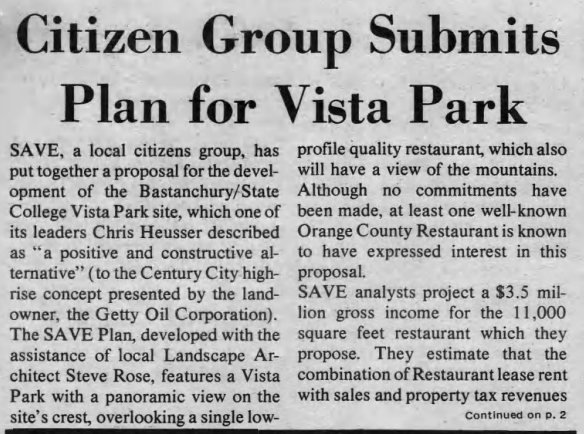
At this time, Fullerton had its share of activists pushing for the preservation of open space, such as the Vista Park at the corner of State College and Bastanchury and West Coyote Hills. In both cases, these involved lands owned by oil companies.


Religion
The marriage of the Republican Party and Evangelical/fundamentalist Christianity began to really take off in the 1980s with the emergence of figures like Jerry Falwell, whose group Moral Majority sought to implement socially conservative policies, like opposing homosexuality and abortion. Fullerton congressman William Dannemeyer, who famously opposed gay rights, spoke at the first annual Fullerton Mayor’s Prayer Breakfast, at which he laid out his ultra-conservative agenda. The Prayer Breakfast still happens every year.

Downtown
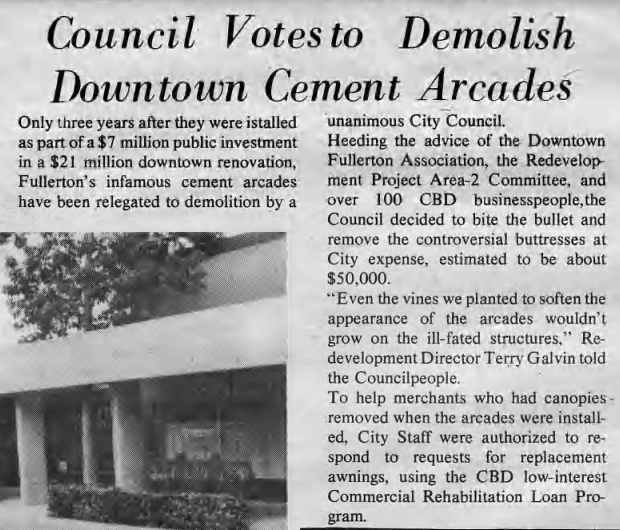
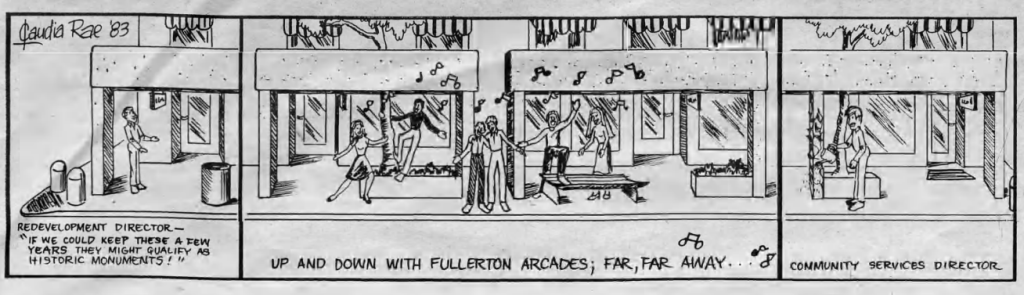
In 1980, Fullerton City Council spent several million dollars of Redevelopment dollars on big ugly cement “arcades” downtown, which were universally scorned. Three years later, they voted to tear them down. How many affordable housing units could have been built with those millions?

-
News Headlines: 1982
The following is from a work-in-progress about the history of Fullerton. You can support my ongoing research and writing on Patreon.
The Fullerton Observer newspaper was formed in 1978 by Ralph and Natalie Kennedy and friends to provide a more progressive counterbalance to the more conservative Fullerton News-Tribune and Orange County Register. The Fullerton Public Library has digital archives of the Observer stretching back to 1979, although the first few years are quite limited. Because of this, I will begin in 1982 with a summary of top news stories.
Local Politics
1982 was a mid-term election year. Molly McClanahan and Buck Catlin were elected, joining Duane Winters, Dick Ackerman, and Linda LeQuire on council. At this time, and for most of Fullerton’s history up to this point, City Council was dominated by white male conservative Republicans. The only somewhat progressive voice on council at this time was McClanahan.
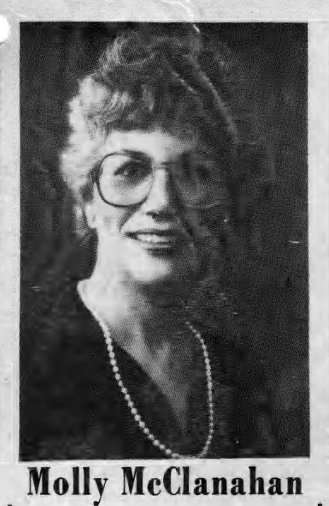
Fullerton incorporated as a city in 1904. By 1982 it had elected four women to council in 78 years–Frances Wood, Sue Tsuda, Molly McClanahan, and Linda LeQuire. It had elected only one minority–Louis Velasco.
Despite this, or perhaps because of this, the council majority opposed an initiative to bring more women and minorities into city government.

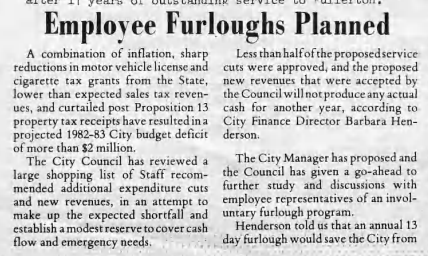
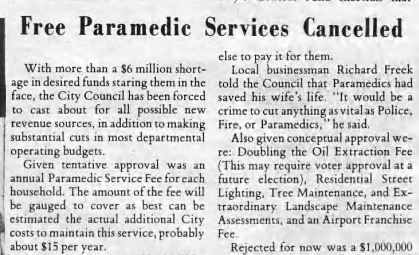
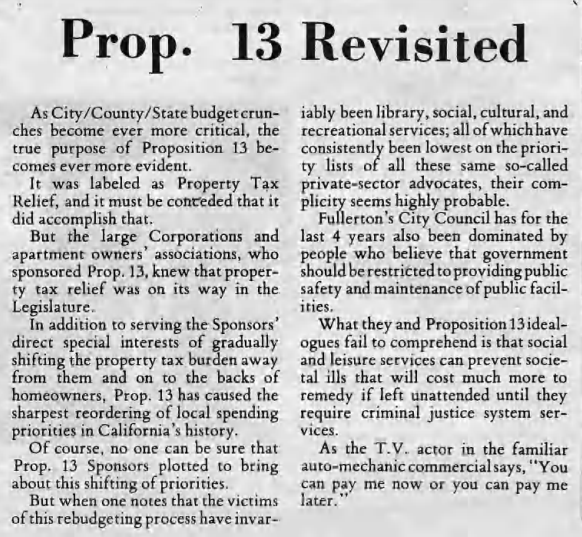
As a result of the relatively new Prop 13 (and other factors), Fullerton was facing a budget shortfall. On the chopping block were the usual suspects–human services, library services, etc. The police department, as usual, emerged relatively unscathed, probably because they have a powerful union that contributes to political campaigns.

Development
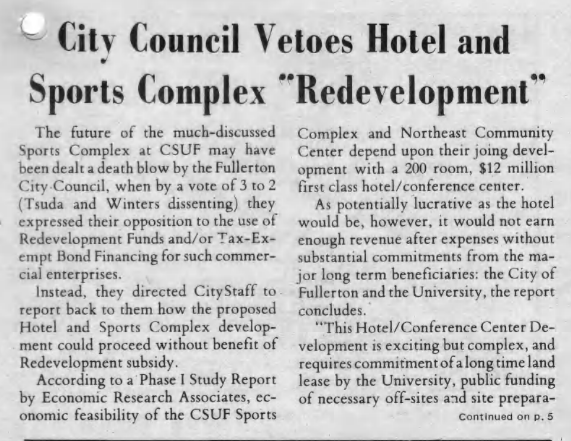
Back in the 1980s, Fullerton (and all cities in California) had something called a Redevelopment Agency–a pool of funding for community related development projects. At this time, the City was in talks with Cal State Fullerton to use redevelopment money to help the college to build various sports facilities and a hotel. In 1982, this project faced some setbacks, but it would ultimately be approved.
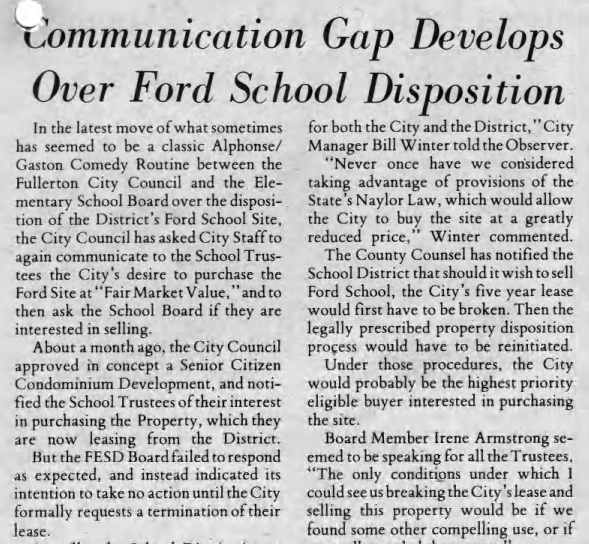
The school district would eventually sell the lands of the former Ford School to the city for a park and development of a senior housing complex.
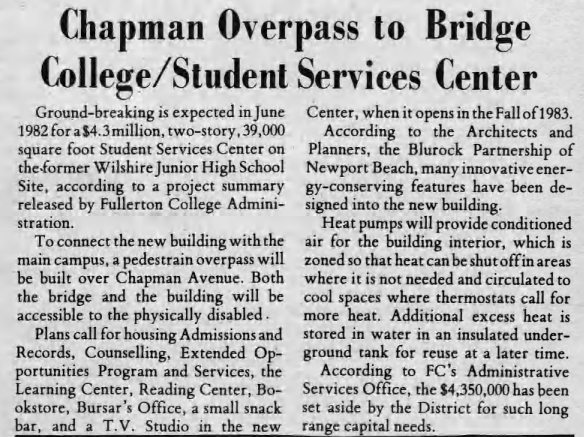
The (somewhat) iconic Fullerton College bridge over Chapman was built.
Environment
In environmental news, the city was in talks with Chevron over saving some land in Coyote Hills for a nature park. This fight would continue for decades, and is still ongoing, although some areas have been saved.

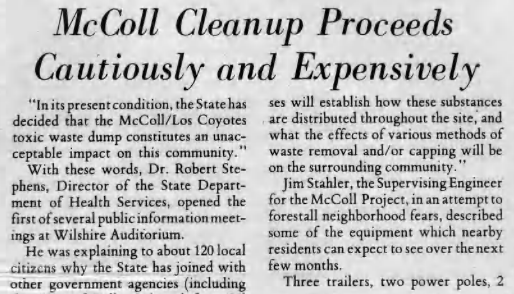
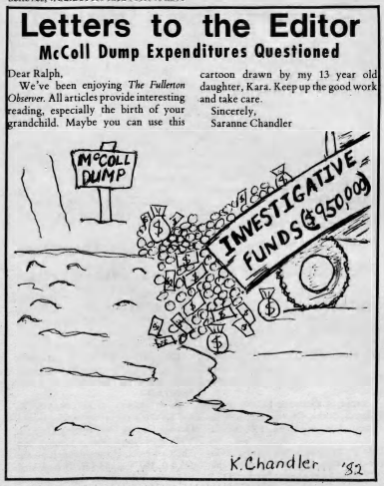
Various government agencies were deciding what to do about the toxic McColl dump site in northwest Fullerton, which was Fullerton’s first Superfund site.
Student Protests
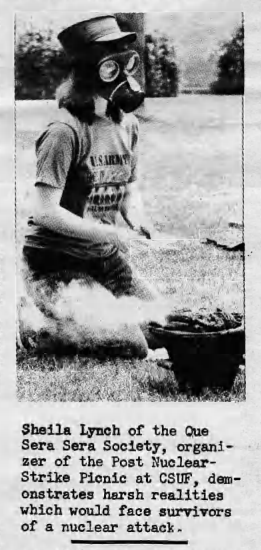
CSUF students protested the proliferation of nuclear weapons. This was the Reagan era and the Cold War was ramping up in intensity again.
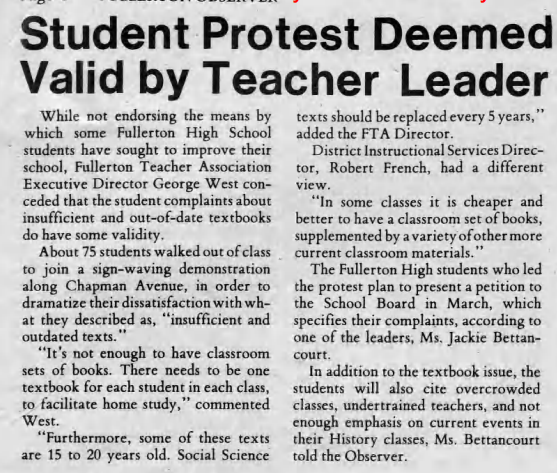
Meanwhile, Fullerton High School students protested for updated textbooks.
Culture
Downtown Fullerton in the 1980s was not the bar/club scene that it is today. It was sleepy, and a bit grungy. Despite this, there was culture. Along with the local punk scene, there were a handful of cool bookstores, like Mugwumps.

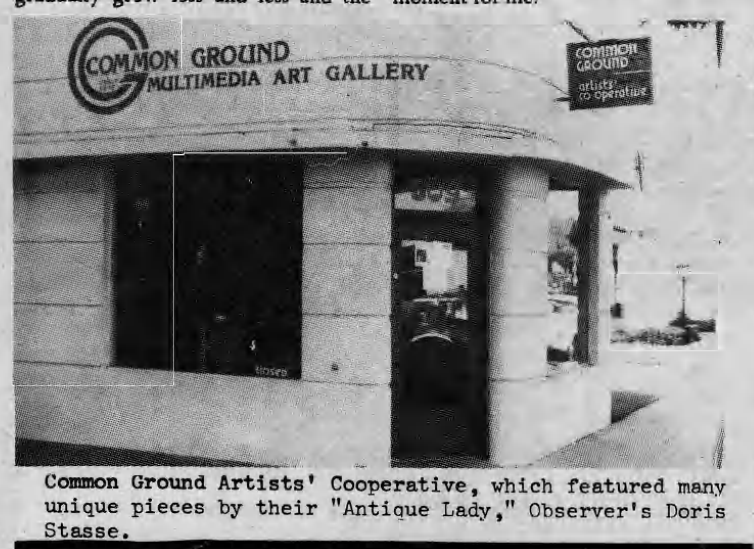
In the small art deco building across the street from the Fox Theater, there was an art gallery called Common Ground.
The major annual cultural event in Fullerton was “A Night in Fullerton”–a multi-venue night of art, music, drama, and dance that started back in the 1960s.

Housing
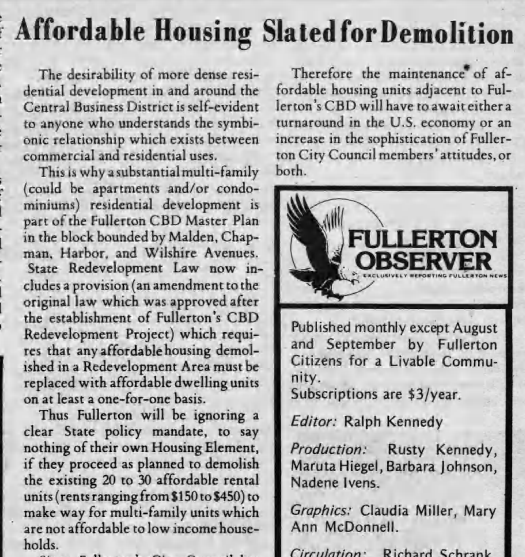
The ever-present problem of affordable (or unaffordable) housing was not helped by the conservative council majority, who consistently voted against affordable housing programs.

Stay tuned for news articles from 1983!
-
Oral Histories: Dick Ackerman (Mayor/State Legislator)
The following is from a work-in-progress about the history of Fullerton. You can support my ongoing research and writing on Patreon.
Richard “Dick” Ackerman was interviewed in 2018 by Abby Waldrop for the CSUF Oral History Program “Orange County Politics Project.” Here is a summary of what I learned from this interview.

Dick Ackerman. Ackerman was born in Long Beach in 1942, his parents having moved out west from Iowa. His father got a good-paying job at Douglas Aircraft, at a time when aerospace was booming in California. He grew up with “very traditional values.” When he was in elementary school, his parents moved to Lakewood, one of the first post-war master planned communities in the United States. For an excellent (and poetic) reflection on the origin and meaning of Lakewood, I recommend D.J. Waldie’s book Holy Land: a Suburban Memoir.
He attended Bellflower High School, then Long Beach State for two years, graduated from UC Berkeley in 1964, and then law school at Hastings. He found that his political views did not align with the liberal students and activists of the Berkeley area.
It was in law school that he started to develop some political feelings. His best friend Bill was active in the Republican party, so after he graduated he helped to work on some Republican campaigns.
The first campaign he worked on was for “a controversial person named John Schmitz, who ran for Congress.” Schmitz was a far-right politician who was kicked out of the far-right John Birch Society for “extremist rhetoric.”
Ackerman and his friend were in charge of Schmitz’s sign crew. “Our job was to go and take down the other person’s signs and put up his sign,” an act which is illegal.
Schmitz lost that election, but was subsequently elected to the state legislature.
“He’s had a checkered past (laughs) since then,” Ackerman said.
In law school Dick met his wife, Linda. They had three children.
After law school, he got a job at a law firm in Fullerton, where he would spend the next several decades of his life.
In Fullerton, he became president of the Chamber of Commerce.
“Back at that time, our opinion was City Council was sort of anti-business. They were making it harder for business to survive,” he said. “So we decided to start up a PAC (political action committee)…we ran a couple of candidates…got them both elected. Then we were hurting for a candidate the next time, and somebody said, ‘Why don’t you do it?’ And I said, ‘Okay.’ So I did it.”
He was elected to City Council in 1980, and served for 12 years, including two years as mayor.
“I wanted to make the city more business friendly,” he said. “City budgets are always lean because they depend on the state for a lot of their money. The only place you can really control some of your destiny is sales tax. So my goal was to bring in more sales tax.”
He was on council when the city brought in Price Club (later called Costco), which brought in a lot of sales tax revenue, while (arguably) pushing out smaller businesses.
“Some people don’t like the retail stores,” he admitted. “It does put more of an impact on the smaller shops, the mom and pop shops. But the trend was sort of toward the big box even back then.”
Back in the 1980s, Republicans were the majority on city council.
While he was on council the City partnered with CSUF to bring the Marriot Hotel on the CSUF campus.
Using redevelopment money, the city paid all the cost for the football stadium, the baseball stadium, the softball stadium, and the tennis courts in exchange for the city getting use of the university fields when they weren’t using them. The college then used the revenue from the hotel to eventually repay the city what they put in for the investment.
“The only funny thing back then—and I took a little heat—was right after we put the football stadium up, they [CSUF] dropped football a couple of years after that,” he said.
He served on the President’s Advisory Committee under several CSUF presidents, including Donald Shields, Jewel Plummer Cobb, Milton Gordon, and Millie [Garcia].
When the State Assembly instituted term limits, long time Republican incumbent Ross Johnson termed out, opening the way for Ackerman to run for the seat, and win, 1995.
His goals in the state legislature were similar to those when he served on city council: “Most of my stuff was business oriented. California, as you may or may not know, is still very bad for business.”
However, unlike on city council, where he was always in the majority, Republicans had become the minority in the state legislature. The change of California from a red to a blue state in the 1990s is a fascinating subject.
“With the exception of one year, I was always in the minority party, but you still do the fight, try and do things, and you have some success,” he said.
For some of the years, however, California had a Republican governor, with Pete Wilson in the 1990s, and Arnold Schwartznegger in the 00s.
He remembers meeting with Schwarzenegger in his smoking tent. “I think he was very strong on business issues. He was more liberal than the Republicans on a lot of other issues.”
In 2000, Ackerman elected to the State Senate, and eventually became the Senate Minority Leader, the highest ranking Republican in the legislature.
California faced a couple recessions in the early to mid 2000s. When Gray Davis was recalled, the budget was “a mess” and the state was 25 billion in debt, so both Republicans and Democrats passed a bond issue to cover the debt.
“The most important vote you’re going to have every year is the budget vote, all of the policy things, and what gets funded, and what doesn’t is in the budget,” he said.
Ackerman termed out of the state legislature in 2008. Regarding term limits, he said, “I think it’s a very bad idea…you’ve got first term people behind the head of Appropriations or head of Budget and they have no background whatsoever.”
He spoke of the importance of reaching across the aisle and working with Democrats.
“I’m a very friendly type person,” he said. “I can get along with people, and some people are more fire brands. They are always attacking people. If you attack people, you’re not going to get anything done. You have to talk to them. I always had good relations with the Democrats, so it wasn’t a problem.”
Although the state at large was turning more blue, back when he was in the state legislature, his districts were still considered safe Republican districts.
After leaving the state legislature, Ackerman went to work in government relations, aka lobbying.
“A lot of it just has to do with relationships and knowing people—and knowing people both Republicans and Democrats,” he said. “I could call up the Speaker, call up the Pro Tem and they take my call…It helps me help clients when they need to talk to somebody about an issue.”
When asked what sort of advice he would give someone who wants to get involved in politics, he said, “First probably work in somebody’s campaign to see if you like it…pick somebody you agree with philosophically…And then run for a local office. Run for school board, or run for city council because those are smaller versions of what you’re going to get at the next level, and see if you like it.”
Ackerman spoke of his philosophy of government, which informed his positions on bills that came up in the legislature.
“Is this going to expand government or constrict government?…Generally, I’m for smaller government. Is it going to be anti-freedom or pro-freedom? Is it going to give people more opportunities or less opportunities? I don’t want to be telling people what to do on everything…I’m against Big Brother. We’ve got too much Big Brotherism going around.”
He spoke of the importance of a baseline of shared facts when making important decisions, either as a legislator or a voter.
“Generally, if you give people the facts and they get the issues and it’s not fake news or altered news on one side or the other…people make the right decisions,” he said. “Verify your source. Find out what the source of your information is, because I think a lot of times they’re making decisions in which they may not have the right facts.”
He said that, currently, the Republican Party in California is not in a good position. He attributes this decline, among other things, to a loss of good middle class jobs.
“My conclusion is we’ve lost the middle class,” he said. “Back in the seventies and eighties we had a gigantic middle class, with manufacturing, engineering, aerospace. Most of those type of companies have gone and those people in that middle are also gone.”
Nationally, he thought, the situation is brighter for Republicans.
“If you take away New York and California, the rest of the nation is pretty normal,” he said. “So I think nationally the Republican Party is okay. Statewide, I think unless something really severe happens, I don’t think we’re going to be gaining much power in California.”
-
Oral Histories: Sue Tsuda (City Councilmember)
The following is from a work-in-progress about the history of Fullerton. You can support my ongoing research and writing on Patreon.
Sue Tsuda was interviewed by Scherly Virgill in 2016 for a CSUF Oral History Program project entitled “Women, Politics, and Activism since Suffrage.” Here is a brief bio of Tsuda, based on this interview.
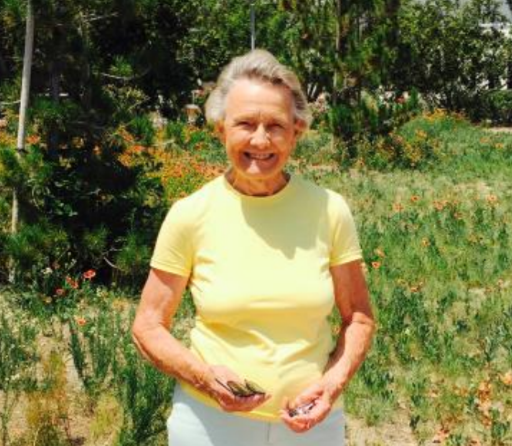
Sue Tsuda, 2016. She was born in Clinton, Illinois in 1936 to Ruth Edwards and Virgil Hoff. Her dad worked for the Illinois Central Railroad as a machinist. She had one brother, Virgil Hoff.
When she was growing up, her dad served on the school board, and her mom was active in the League of Women Voters. The whole family was interested in politics. When she was 16 and had gotten her drivers license, she was driving voters to the polls in their rural county.
After high school, she got a scholarship to go to the University of Illinois, where she met her husband. They married in June of 1955 and had three children: Ken, Kesa, and Naomi.
When she was a freshman in college, she got involved in civil rights by picketing the barbers in Champagne-Urbana, Illinois who “would not cut the hair of black students…they said the reason was they didn’t know how to cut Negro hair.” She says they weren’t physically attacked, but were verbally attacked.
Before getting a job at the Hughes plant in Fullerton, her husband was reluctant to move to California “because there was too much prejudice against Japanese.” But, drawn by the good pay, the family moved out west.
Sue graduated from CSUF in 1978 with a degree in political science. She then got a masters in public administration from Cal State Long Beach.
While living in Orange County, she (like her mother) got involved in the League of Women Voters.
She liked working for the League because she “they were an organization that provides a great deal of information that’s valid and not biased.”
Part of her involvement in the League included going to city council and planning commission meetings as an observer. She served as head of a League committee on education and helped put together a report entitled The State’s Role in Education. She also served on the state board of the League.
When the Kent State massacre happened in 1970, she went to Washington D.C. with the League and helped marching students to write and file petitions to the government.
“One of the more moving experiences of my life was to be on the steps at the Lincoln Memorial when they (student protesters) were there,” she recalls. “A crowd of young people dismayed at their government.”
While working with the League, she befriended Molly McClanahan, who would later be elected to City Council.
She worked on the 1972 campaign for Frances Wood, the first woman elected to city council.
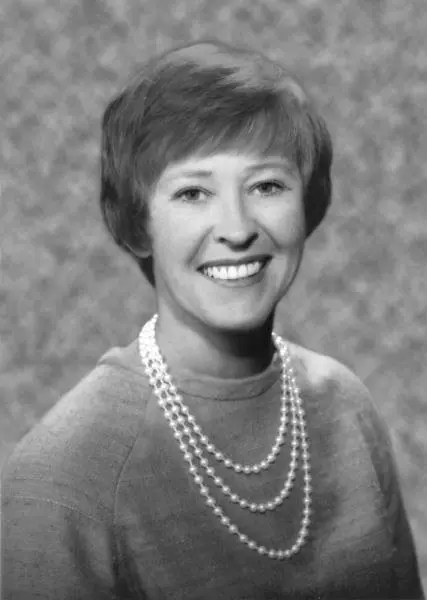
Frances Wood “Frances was a real kick in the head,” she recalls. “She had a marvelous but unconventional sense of humor, and was friends with everybody. She found something to like in everyone that she met. I really loved her a great deal.”
Sue got a job working for the county of Orange, then for the city of Westminster as an administrative assistant. She also served as chair of the Fullerton planning commission and as chair of the school board.
In 1978, she ran for City Council and was elected. Because she didn’t have a lot of money, “Some of my friends who were on the campaign committee arranged teas. And people opened their homes and invited their friends and I went and made my presentation to them. We did that all over town.” Her kids’ friends helped by knocking on doors for her campaign.
During her campaign, the biggest state and local issue was Proposition 13, which restricted increases in property taxes.
“I campaigned vigorously against it, telling people what was going to happen,” she recalls. “And it came to pass unhappily. Now cities and towns are more reliant on state government for funding than they used to be.”
One of the biggest challenges she faced while on council was the decreased city revenue as a result of the passage of Prop 13.
“We used to slurry seal the streets in Fullerton every three years. After Prop 13, it slipped to every seven years,” she said. “There were things in terms of routine maintenance that were pushed back that needed to be done.”
Prior to the passage of Prop 13, the League of Women Voters got the Council to add five cents to property taxes, to support the Library; however, “After Prop 13 you couldn’t do that anymore,” she said.
She also faced opposition from the conservative Republican council majority, who retaliated by not letting her serve as mayor when the time came.
“They wouldn’t let me do it. I was never mayor,” she said. “Served four years on the council. Usually it’s a rotating seat.”
Another big issue in the 1970s was school integration. In 1972, the Fullerton School Board voted to close Maple School because it was a de facto segregated school, with a 98% Black and Latino enrollment.
“We were trying to figure out the best way of integrating them. It involved busing, which was not happy. We didn’t want to do that because it disrupted kids and bus schedules and all of that,” Tsuda recalls. “We managed to get the school integrated. But we had to take the kids out of their neighborhood. The real key is to desegregate the neighborhoods.”
To read more about the Maple desegregation story, check out my recently-published article “The Limits of Desegregation: a Story of Maple School.”
Tsuda said that feminism, to her, means “that women have equal rights and equal opportunities as everybody else.”
When asked about the makeup of the League of Women Voters in the 1970s, she said, “In Fullerton it was all white women. All middle or upper class, I’d say. People who had the time to indulge.”
Tsuda left Fullerton in 1982 to take a job in Yucca Valley.
When asked what advice she would give to young women who want to be involved in politics, she said, “Start at the bottom. Get involved where it’s easiest, and most important to you personally to get involved…go to school board meetings and Planning Commission meetings and participate in organizations locally that support the community. Make yourself informed on what’s going on.”
When asked how she felt about Donald Trump, who was running for president in 2016, she said, “I think he would be a disaster.”
-
Photographs Then & Now: Linebarger House/Downtown Plaza Park
The following is from a work-in-progress about the history of Fullerton. You can support my ongoing research and writing on Patreon.
For this series, I compare a historic photo of Fullerton with a contemporary one from approximately the same angle. The first photo below is of a Craftsman-style bungalow house built by Dallison Smith Linebarger at the southwest corner of Pomona and Wilshire around 1911. Linebarger moved to Fullerton in 1899, just two years after the town was founded. He owned a livery business and then a citrus ranch. He also served for ten years on the Orange County Board of Supervisors. The house was demolished in 1981 when the Wilshire public parking structure was built. The lot was later developed into a downtown park to complement the plaza, which is shown in the second photo.

Linebarger house, 1911. 
Downtown Plaza Park, 2024. -
Photographs Then & Now: Gas Company Building/Parking Lot
The following is from a work-in-progress about the history of Fullerton. You can support my ongoing research and writing on Patreon.
For this series, I compare a historic photo of Fullerton with a contemporary one from approximately the same angle. The first photo below is of the Southern Counties Gas Company building on Wilshire Avenue next to the Chapman building in the 1920s. The second photo is of a small parking lot today where the gas company building once stood.

Southern Counties Gas Company building, 1920s. 
Site of former Gas Company building, 2024. -
Early Settlers: Dr. George Clark
The following is from a work-in-progress about the history of Fullerton. You can support my ongoing research and writing on Patreon.
This mini-biography is based on various articles appearing in the Fullerton News-Tribune from 1893-1944.
Dr. George C. Clark was born in Chambersburg, Ohio in 1863. After completing his studies in homeopathic medicine at Hahnemann Medical College in Chicago in 1884, he worked in private practice in Danville, Ill, and Morris County, Kansas. He also served as house surgeon for the Santa Fe Railroad in New Mexico.
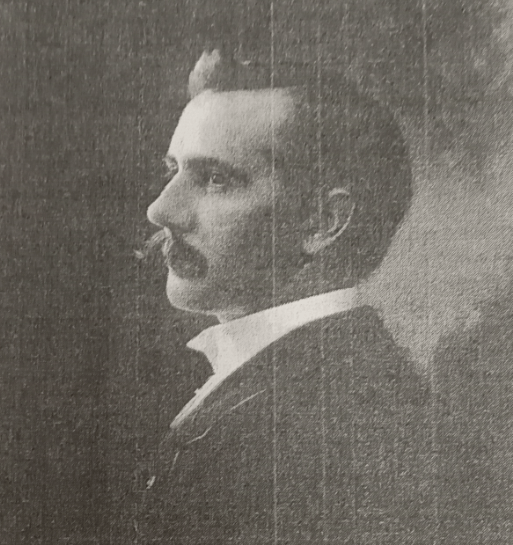
Dr. George C. Clark. Photo courtesy of the Fullerton Public Library Local History Room. In 1891, he moved to Fullerton, and opened a medical practice. He charged $1 for house calls, 50 cents for office visits and $5 for baby deliveries ($7.50 if “difficult”).
His first office was in the Chadbourne Building at the northwest corner of Spadra (now Harbor) and Commonwealth. Between patients, he played the flute, prompting Fullerton Tribune editor Edgar Johnson, his downstairs neighbor, to write in his newspaper: “If any of our readers have an idea that they could write a brilliant and brainy editorial in our sanctum, with Dr. Clark with his flute right over head tooting ‘Down Went McGinty’ to the tune of the ‘Dead March,’ they are welcome to it.”
In 1894, he married Edith Johnson of Norwalk, and built a house at the corner of Harvard Avenue (now Lemon Street) and Amerige Avenue. The house also served as his medical office. Edith raised pigeons and rabbits in pens beside their house.
“The house hummed with visitors, music and activity,” according to the Tribune.
That same year, Clark was elected county coroner.
“His activities in the county took him from Capistrano to Whittier in the days when the horse and buggy was the best available means of transportation,” the Tribune states.
Clark was very active in Fullerton’s civic life. A Republican, he was elected to the school board and to Fullerton’s first City Council (then the Board of Trustees) in 1904. He served as president of the city’s Board of Health.
“George and Edith Clark enjoyed a busy social life,” the Tribune states. He joined Fullerton’s first Chamber of Commerce, served on the Board of Directors of Fullerton’s first hospital, and was a member of numerous fraternal organizations, including the Independent Order of Foresters, the Fraternal Aid Association, and the Masonic Lodge. He played his flute in the Fullerton Orchestra, mainly at ice cream socials.
He was a member of the first telephone exchange in Fullerton, which was installed by William Starbuck in his drug store.
In 1903, he gave up his horses and bought one of the first automobiles in town.
While on City Council, Clark “became embroiled in a political controversy over the proposed incorporation of Fullerton as a municipality. The issue was muddied by a battle between prohibitionists (drys) and their opponents (wets), and it was not until 1904 that the incorporation finally was approved. Dr. Clark was among those elected Fullerton’s first trustees Charles Chapman was named its first mayor. With saloon licensing still an issue, Clark voted first with the wets, then the drys, until in April the following year the sale of liquor was approved in the city.”
The first city council got to work laying out the first sidewalks, purchasing a sprinkling machine to water down the dusty unpaved roads, establishing lighting for city streets, and installing the city’s first bicycle path on Chapman Avenue.
George and Edith had three children: George DeWitt (born 1896), Eudolpha (1899), and Joshua Martin (1901).
Dr. Clark and his family left Fullerton in 1905, but returned six years later and the family settled in a different home on North Spadra. Clark joined the medical firm of Johnston, Beebe, Clark, Davis and, later, Wickett.
In the 1920s, the Clarks again moved away from Fullerton, returned for a while in the 1930s, before retiring to their beach home in Balboa.
Around 1940, Dr. Clark retired after almost 60 years in the medical profession. He succumbed to heart disease on Sept. 3, 1948 at the age of 85.
According to the Tribune, “The doctor’s legacy lives on in the form of Heritage House at the Fullerton Arboretum on the Cal State Fullerton campus…The house was moved to the arboretum, where it was authentically restored and furnished and dedicated in May of 1976.”
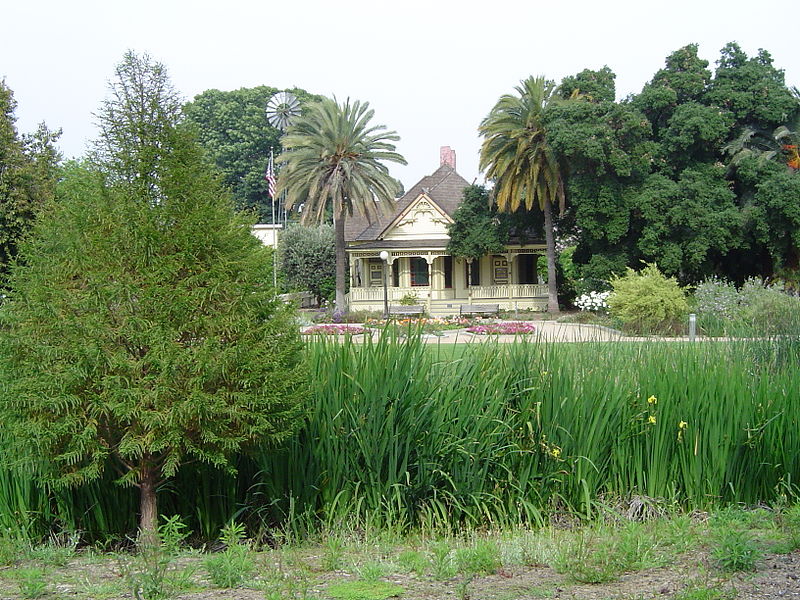
Heritage House at the Fullerton Arboretum. -
1926 News Headlines
The following is from a work-in-progress about the history of Fullerton. You can support my ongoing research and writing on Patreon.
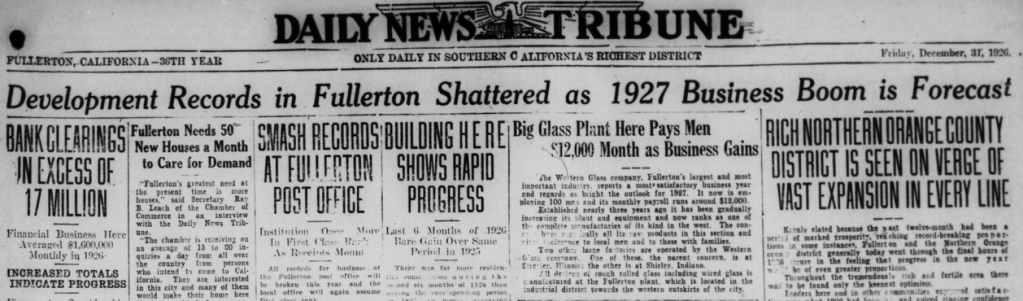
The Local History Room of the Fullerton Public Library has microfilm from the Fullerton Tribune newspaper stretching back to 1893. I am in the process of reading over the microfilm, year by year, to get a sense of what was happening in the town over the years, and creating a mini archive. Below are some news stories from 1926.
In 1926, the Fullerton Tribune bought the town’s competing newspaper, the Fullerton News, to become the Fullerton News-Tribune.

In national news, Republicans controlled both houses of congress and the presidency, under Calvin Coolidge. Infamous con-man Charles Ponzi was convicted of defrauding investors, wealthy Native Americans in Oklahoma were being murdered for their oil lands, Major League Baseball faced a huge scandal when Ty Cobb and Tris Speaker were accused of fixing and betting on games, and famous evangelist Aimee Temple McPherson disappeared and then re-appeared under mysterious circumstances.
In international news, fascists under Benito Mussolini had gained control of Italy, Theodoros Pangalos declared himself dictator in Greece, the army of Chinese warlord Zhang Zuolin captured Beijing, the Cristero War broke out in Mexico, the United States intervened to end the Nicaraguan Civil War, and Gertrude Ederle became the first woman to swim the English Channel.
Growth
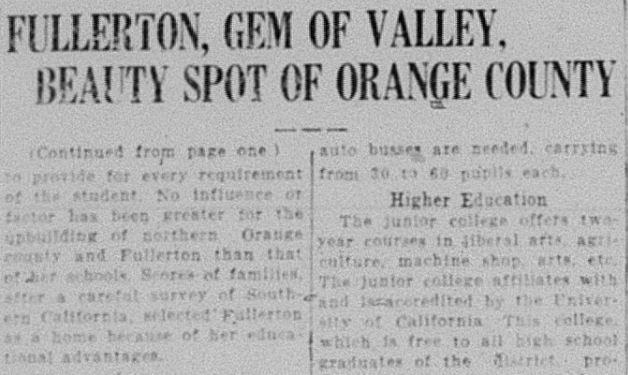
Fullerton continued to grow relatively rapidly. In 1926, the city comprised an area of 19 square miles, had a population of 11,250, 20 miles of paved streets, 17 miles of sewage lines, 35 miles of water mains, one fire station, three parks, 10 public schools, three banks, nine churches, one hospital, two theaters, 1676 telephones, and 16 manufacturing and packing plants.
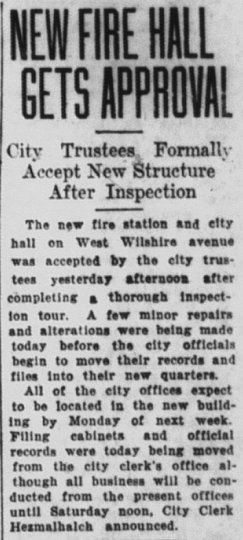
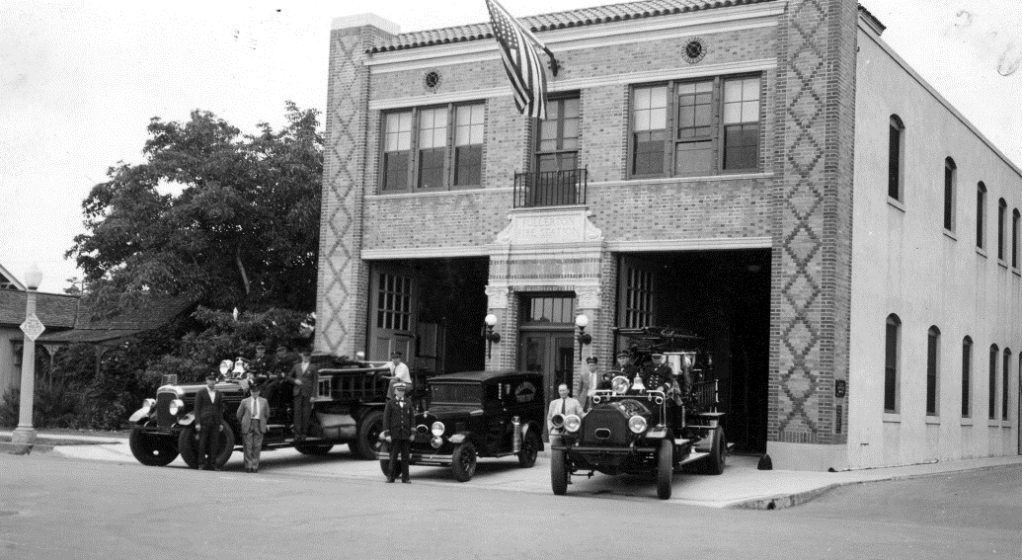
A new fire hall on west Wilshire Avenue was built. It stood on what is now Half Off Books in the Wilshire Promenade building.
The Bastanchury Ranch laid out plans for massive citrus and tomato orchards.
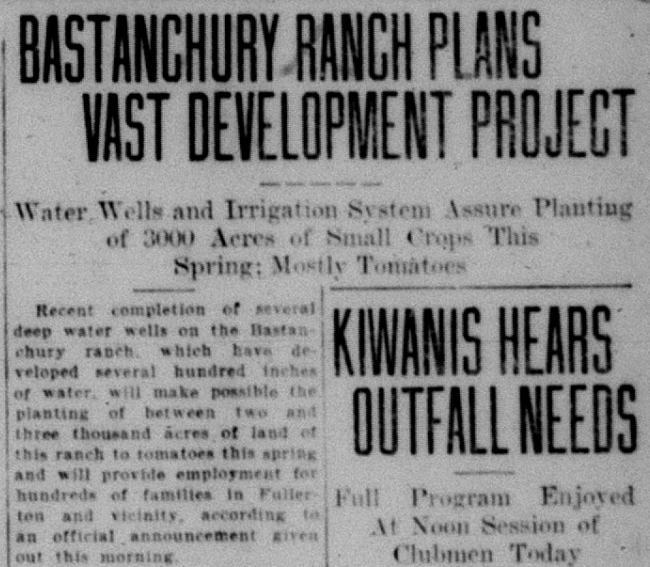

In business news, Alpha Beta market opened downtown at the southwest corner of Wilshire and Spadra (now Harbor).


The Orange County Ice Company opened a new plant at the corner of Truslow and Harvard (now Lemon).

New housing subdivisions were built, most of them with racially restrictive covenants that prevented non-whites from living there.

In regional infrastructure news, a bond was placed before the voters of Orange County to improve Newport Harbor, to make it a major shipping point, but the bond failed.

Plans were in the works to build a dam on the Colorado River that would generate power and divert water to Southern California.

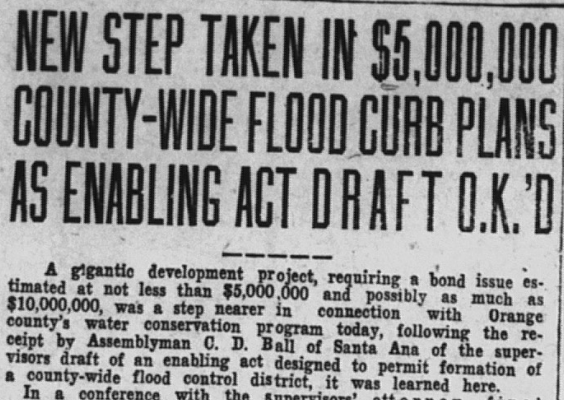
Plans were also in the works for a county-wide flood control plan. This would ultimately result in the concrete channelization of the Santa Ana river.
Politics
In local politics, J.S. Elder and Bert Annin were elected to the City Council.
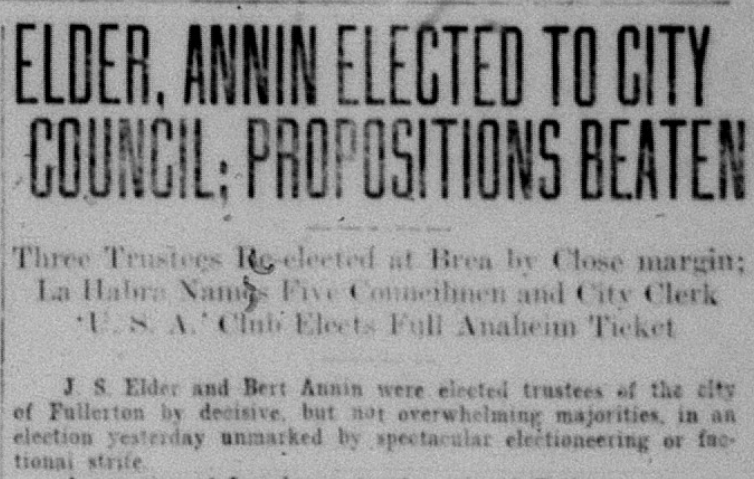
Harry Crooke was again chosen as Mayor.

Less than a year into his tenure, Elder resigned and Emmanuel Smith was appointed to replace him.

William A. Goodwin was elected town constable.
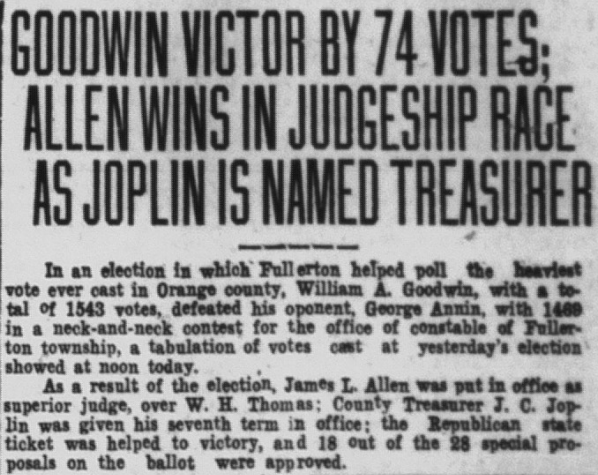
In La Habra, things got heated during the local election, resulting in a police officer getting shot.

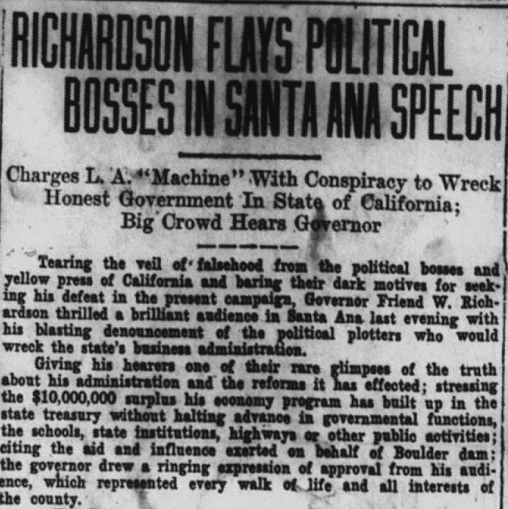
Republican Clement C. Young defeated fellow Republican Friend Richardson for his party’s nomination for governor, and then defeated Democrat Justus S. Wardell in the general election.

Richardson came to Orange County, and gave a speech in which he “flayed political bosses.”
The Great Oil Fire
Perhaps the biggest news story of 1926 was the great Brea Oil Fire.

Lightning struck two 500,000 barrel underground oil reserves of the Union Oil Company a half mile west of Brea, creating a huge blast and igniting a massive oil fire.
“Plate glass windows in Brea stores were shattered by this blast which was felt slightly in Fullerton,” the Tribune reported. “Flames shot 500 feet in the air as the lightning struck eyewitnesses declared and burning fragments of the wooden roofs which covered the reservoirs were blown directly over the town of Brea by a strong westerly wind.”
Four hundred men were rushed to the scene to try to put out the fire and remove oil from the reservoirs. The fire threatened to spread to 10 other large tanks in the field.
Dikes were erected to halt the spread of the oil fire.
“Huge clouds of smoke billowed into the air throughout the day attracting thousands of persons from surrounding districts,” the Tribune wrote. “Brea fire department apparatus has been called out to protect homes near the scene of the flames and Union oil workers are moving out of their houses on the lease surrounding the tank farm as a precautionary measure.”
And then, the next day, a fourth tank caught fire.
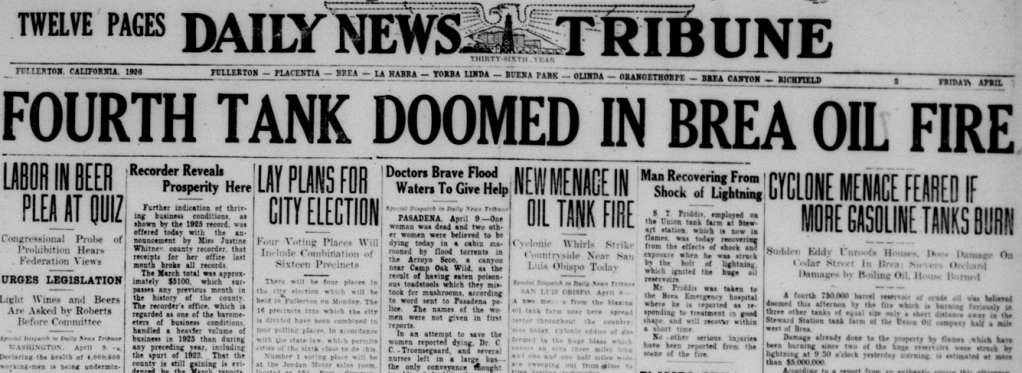
Damage was estimated at over $5,000,000.
Fire fighters from Long Beach and Wilmington were rushed to the fire, “and workers from practically every oil field and oil company in Southern California were aiding the fight.”


To make matters worse, a cyclone struck sections of Brea causing more damage.

Finally, after a couple days of burning, the fire was gotten under control.

Prohibition
In 1926, Prohibition was in full effect, and local law enforcement struggled to control bootlegging.
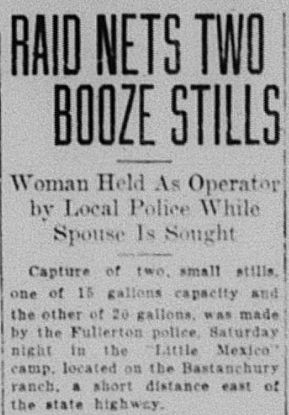
The Fullerton police department held a public “booze pouring” event in which they dumped out hundreds of gallons of illegal booze they had seized.
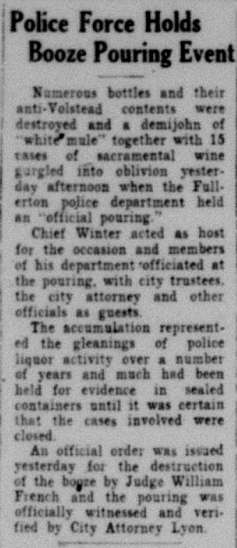
And then, something embarrassing happened. Some Fullerton police officers were accused by another officer of stealing wine from the department’s stock of seized liquor for personal use.
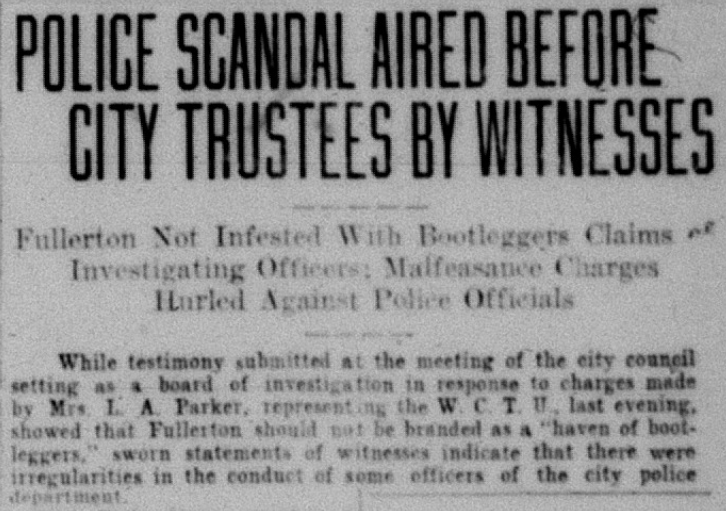

After a few public hearings before City Council, the accused officers denied any wrongdoing and were not convicted of any crimes. The whole ordeal, however, caused a shake-up in the department, in which some officers were forced to resign.

Adding to the embarrassment, Fullerton City Councilmember Emmanuel Smith and beloved football coach “Shorty” Smith were both arrested and fined on liquor charges. Neither lost their jobs.

Culture and Entertainment
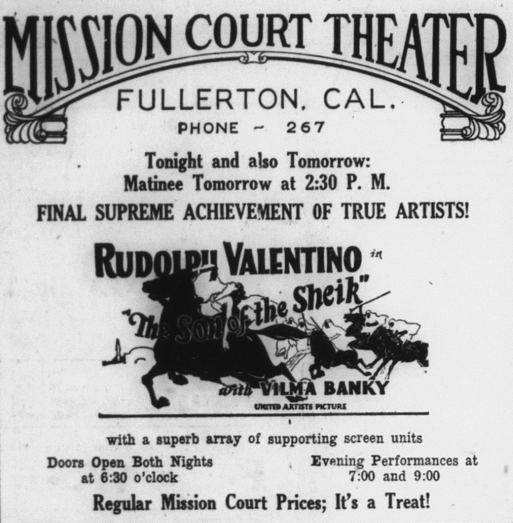
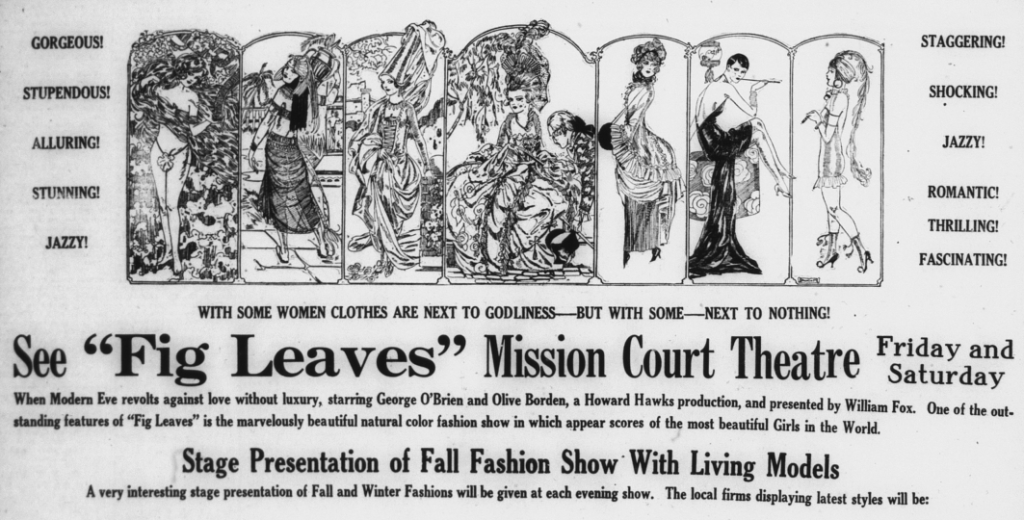
In the previous year, 1925, Chapman’s Alician Court Theater (later to be known as the Fox Theater) opened with great fanfare. In 1926, the theater’s name changed to the Mission Court Theater.

Transportation
Plans were in the works to convert the City’s sewer farm on the west side of town into a municipal airport.

Education
In education news, a few articles appeared extolling the virtues of the Fullerton Union High School “Americanization” program, in which Mexican American children and adults who lived in segregated work camps were taught English and various aspects of American citizenship.

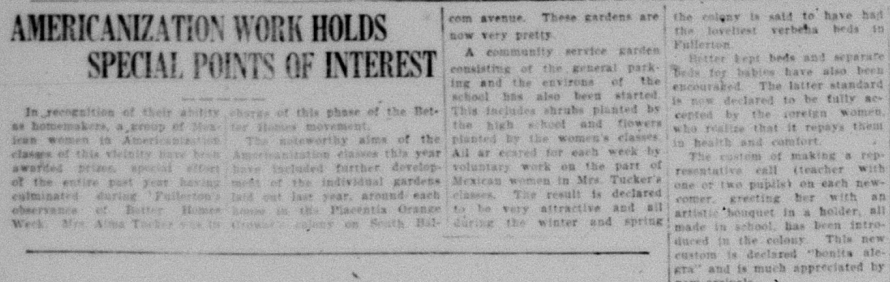

Occasionally students of the Americanization program showcased their progress to the community at large.
At one of these ceremonies, master of ceremonies, Crescencio Duran “distinguished himself by announcing every number in clear, well chosen English,” the Tribune reported. “Members of beginning English classes dramatized the various processes of buying and selling, while pupils in advanced English classes read original essays on Lincoln, Washington, Benjamin Franklin, and Roosevelt. They had also two excellent papers on thrift, accompanied by a dramatization of how to open a savings account in English.”
To read more about the social and educational segregation of Mexican Americans at this time, check out my article “The Roots of Inequality: The Citrus Industry Prospered on the Back of a Segregated Immigrant Workforce.”
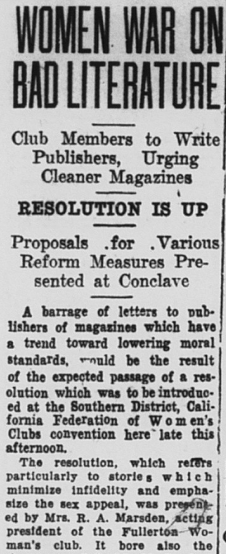
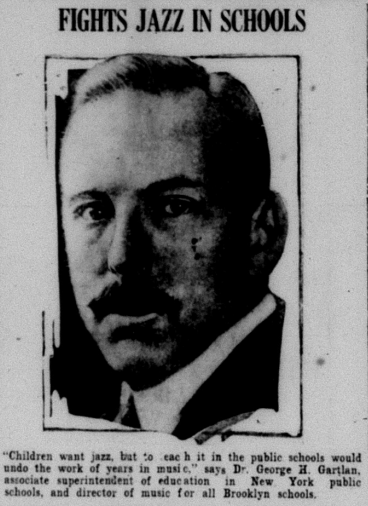
The 1920s were a time of rapid social and cultural change, and some feared the influence of “evil” things like jazz and certain types of literature and sought to ban them.
Agriculture
Along with oil, citrus was the other big industry in Fullerton and surrounding environs.

Sports
In sports news, there was a popular “indoor” baseball league that played its games on the field next to Ford Grammar School, now Ford Park.

The mascot of Fullerton High School was, and is, the Indian. In more recent years, this has proved controversial, as native American groups over the years have tried to get the district to change the mascot, arguing that it is offensive. Despite the fact that activists have been unsuccessful in changing the name, I too find it offensive, especially considering the fact that in 1926, the Fullerton Indians were regularly called the “redskins.”

Racism
In other racism news, despite facing national controversy in their peak year of 1925, the Ku Klux Klan was still a formidable force in American society. The Ku Klux Klan may be seen as the progenitors of today’s movement of Christian nationalism.

Healthcare
In the category of “the more things change, the more they stay the same,” the subject of mandatory vaccination proved controversial.


History
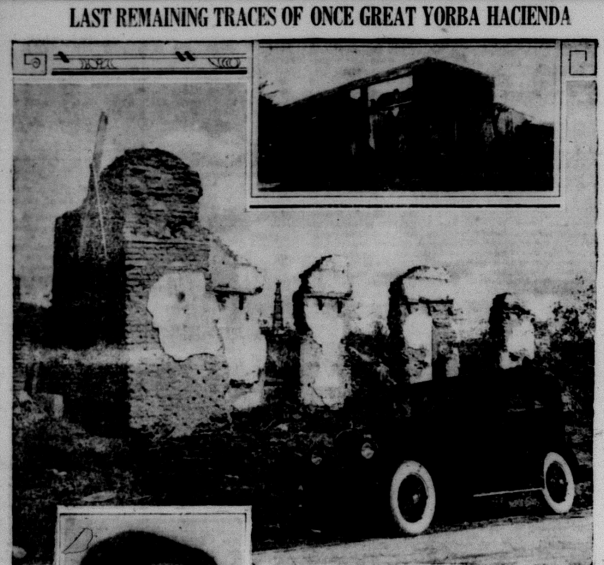
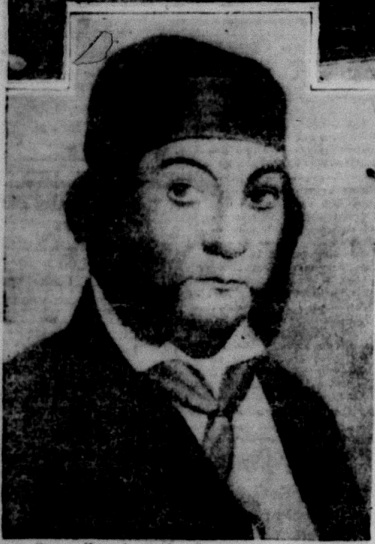
In local history news, the old Yorba adobe in the Santa Ana canyon was destroyed to make room for a barley field. This was done at the direction of property owner Samuel Kraemer, who was married to Angelina Yorba, a descendant of the Yorba family, one of the oldest families in California, who owned a huge Spanish/Mexican land grant prior to the American conquest of California.

“One by one the visible links with the early days of California are being broken and the chain of picturesque adobe homes with their quaint architecture and delightful atmosphere of the days when the land was in its primitive charm, is fast disintegrating into the dust from which it was made,” the Tribune stated.
Miscellaneous
Here are a few miscellaneous articles from 1926:

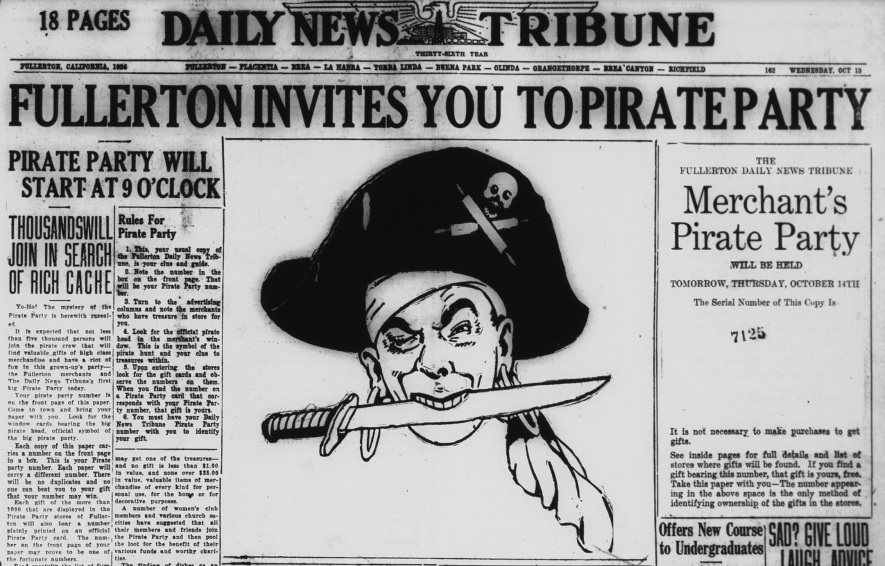


Death
In death news, Jennie Des Granges, wife of pioneer Otto Des Granges, passed away.

A native of Tennessee, Jennie came to Fullerton area in 1869. She was the oldest daughter of James Gardiner, another Fullerton pioneer. Their children were Paul Des Granges and Marie Brewer. Her brothers were John R. Gardiner, Lilburn Gardiner, Frank Gardiner, and W.A. Gardiner.
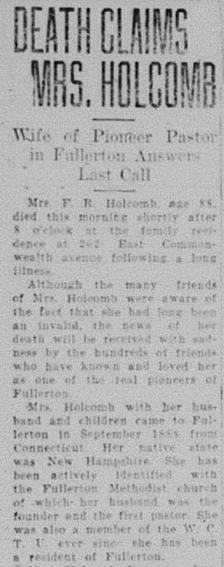
The wife of pioneer Fullerton pastor F.R. Holcomb passed away.
Orange County Superior Judge Judge Z.B. West passed away.

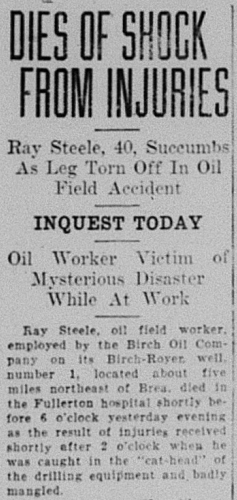
Ray Steele, a local oil workers, died of shock after his leg was torn off in an accident.
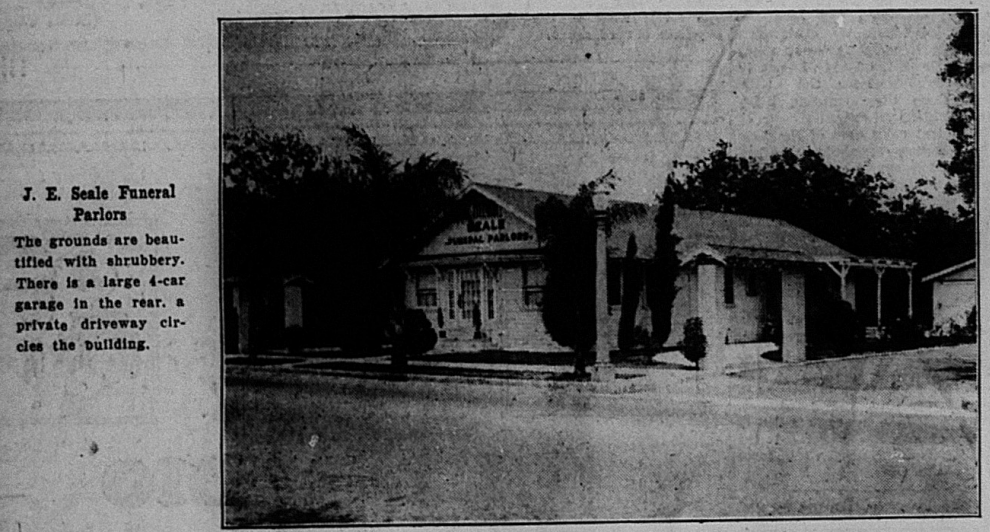
Here is a photo of the Fullerton funeral parlor of J.E. Seale at 137 E. Chapman Ave.
Stay tuned for news articles from 1927!
-
Dallison Smith Linebarger: Livery Stable owner, OC Supervisor
The following is from a work-in-progress about the history of Fullerton. You can support my ongoing research and writing on Patreon.
Dallison Smith Linebarger was born in Oregon in 1862. When he was a child his family moved to California, and he was raised in Ventura County.
In 1899 he moved to Fullerton, and bought the livery stable of Thomas Jennings. With two partners he established the business under the name of Davis, Drown and Linebarger.
They also owned a stable at Olinda where they provided horse teams for the oil fields, hauling derricks and machinery.
According to biographer Samuel Armor, “Mr. Linebarger was general manager of the concern, which was conducted on an unusually large scale, using fifty head of horses, a large bus, and all the necessary equipment for the success of such an establishment.”
He was also a rancher, raising stock and grain in Los Angeles and Orange counties, also owning an orange grove.
In 1910, he sold out his interest in the livery business to devote his time to his 70-acre citrus ranch, which was between Fullerton and Brea.
Linebarger served for ten years as an Orange County supervisor, He was a Democrat in a strong Republican district.
“During his term of office the good roads movement was started, and many of the beautiful boulevards which have made Orange County famous were begun by the sale of bonds,” Armor writes.
He was married in 1882 to Ellen Stone. They had six children.
Linebarger was a member of the Fullerton Lodge of Odd Fellows.
Below is a photo of the Linebarger house. Located at the southwest corner of Pomona and Wilshire, this large Craftsman-style bungalow was built sometime around 1911. In 1917 he sold the house to Harold Walberg, head of the music departments at Fullerton High School and Fullerton Junior College, and director of the Orange County Symphony Orchestra. The City purchased the property, and the house was demolished in 1981 when the Wilshire public parking structure was built. The lot was developed into a downtown park to complement the plaza.

Linebarger House. Photo courtesy of the Fullerton Public Library Local History Room. Source:
History of Orange County, California: with biographical sketches of the leading men and women of the county who have been identified with its earliest growth and development from the early days to the present by Samuel Armor. Los Angeles Historic Record Co, 1921.
-
Oral Histories: Murvin Breest (bus driver)
The following is from a work-in-progress about the history of Fullerton. You can support my ongoing research and writing on Patreon.
“Disaster is rarely as pervasive as it seems from recorded accounts. The fact of being on the record makes it appear continuous and ubiquitous whereas it is more likely to have been sporadic both in time and place.”
–Barbara W. Tuchman, A Distant Mirror: The Calamitous 14th Century (1978)
In researching and writing about local history, I have tended to focus on large social, political, and cultural problems. One might get the impression from my writings that the history of Fullerton was full of conflict and calamity. However, as historian Barbara Tuchman reminds us, there were ordinary, good, decent, even boring things happening right alongside the bad stuff. The “ordinary” does not often make the news or make it into history books, because it is not sensational. But real life is full of ordinary things: people going to work, eating with their families, taking vacations, buying houses, playing basketball. I feel I would be doing an injustice to history if I did not at least discuss some of the more ordinary aspects of the history of this town.
I was reminded of this as I read an interview conducted in 1978 with a man named Murvin Breest, who lived most of his life in Fullerton. Murvin led a simple, quiet life. Reading his recollections and reflections, I was reminded that a simple life is not necessarily an insignificant one.
Murvin Breest was born in Stillwater, Minnesota in 1905. His father was a conductor for the Pacific Electric railroad, and was transferred to Fullerton in 1918, when Murvin was in the seventh grade. Murvin’s father would let him ride on the trains sometimes. “I would sit up on his seat and toot the whistle, and things like that,” he recalls, “I really got a kick out of that.”
Because of his lack of interest in school, Murvin flunked his freshman year of high school. “I liked the outdoors,” he said, “and had heard about the spiders and things you have around here, so I spent my first year playing hooky, and consequently I flunked.” It took him five years to graduate high school.
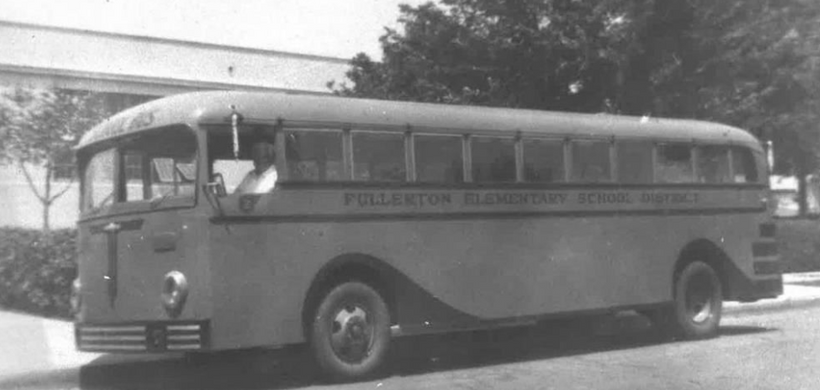
Like many folks of the “Builder Generation,” Murvin took pride in building and fixing things. “I didn’t go to the Junior College,” he said, “I went to work.” His view of work was very different from people of my generation. When asked what his favorite kind of work was, he replied, “Well, it didn’t matter, just so I could work and get some money. I wasn’t particular. I’d take any kind of menial job.” From this statement, one might get the impression that Murvin did not enjoy his jobs, but he clearly did, based on the enthusiasm and pride with which he described his work, first as a mechanic/electrician for McCoy Mills Ford on Commonwealth in Fullerton, and then as a repairman and bus driver for the Fullerton School District. He spoke of the bus garage as “my garage.” He said, “I helped them design it in a way. I told them what we needed, and how big it should be.” Murvin also helped organize the Orange County Bus Rodeo, which was a training/recreation event for potential bus drivers, held at the Los Alamitos race track. “We won our share of trophys,” he said.
He recalls with fondness his years as a bus driver: “I got the biggest kick out of the little kindergarten kids. They’d see me in the mirror…and, if I’d smile, why, they would smile. I’d toot the horn, and they’d look up at me…Some of them, if you went a foot past the place where they were supposed to get off, why, they’d cry, and think they weren’t going to get off at the right place.” His way of calming down restless or troublesome kids was to tell them jokes from a joke book he kept on hand.
Murvin did not get married until he was 35. He met his wife Edith at church: “Edith came out from New York, and she went to the Christian Church, and I got acquainted with her. The Lord told me she was the one I was going to marry, and I thought, ‘Well, I don’t know.’ Then, one day I came along, and she had her car stuck in the street by the Christian Church and she couldn’t get it started. So, I helped her get it started, and she was so nice about it and everything, and one thing led to another, and pretty soon we started dating.”
Edith turned down Murvin’s first proposal. But one night as they were dancing in Balboa, Edith said, “I’ll take you up on the proposition you made me.” Murvin recalls, “I couldn’t figure out what she was saying, because usually when someone says no to me, I take no for an answer.” He asked her, “You don’t mean when I proposed to you, do you?” She said, “Yes I do.” They were engaged, and got married in 1941.
Even after his retirement, Murvin still worked on a lot of building and fixing projects, much like my grandfather Glenn. He helped a friend build a cabin in Canada. He built an addition to his house on Fern Drive. He built a workshop for himself in his back yard. He took care of his father when he was in declining health, and repaired wheelchairs for the rest home where his father stayed.
Toward the end of the interview, the interviewer said to Murvin, “It sounds like you have had a pretty interesting life with all your different jobs.”
“Yes, well you could get that from just about everyone,” he replied.
-
Subscribe
Subscribed
Have a WordPress.com account? Log in now.

