-
Headlines: 1993

The following is from a work-in-progress about the history of Fullerton. You can support my ongoing research and writing on Patreon.
The Fullerton Observer newspaper was formed in 1978 by Ralph and Natalie Kennedy and friends to provide a more progressive counterbalance to the more conservative Fullerton News-Tribune and Orange County Register. The Fullerton Public Library has digital archives of the Observer stretching back to 1979. I am in the process of reading over each year and creating a mini-archive. Here are some top news stories from 1993.
Budget Woes, the Utility Tax, and a Recall
In 1993, Fullerton was represented on City Council by Mayor Molly McClanahan (a moderate Democrat), and councilmembers Julie Sa, Don Bankhead, Chris Norby, and “Buck” Catlin (all Republicans). Although, technically, city council is a non-partisan office.
Facing a budget deficit of over $4 million, City Council voted 3-2 to make $2 million in budget cuts, or about 71 positions. To make up the rest of the deficit, at two highly contentious meetings with hours of public comment, a divided council proposed a 3% utility tax, but later lowered it to 2%.
The first meeting took place In the Fullerton College Campus Theater and drew nearly 700 city residents.
The tax would be placed on businesses and residents for telephone, electric, cable TV, and water services. It had exemptions for low-income families, and placed a cap of $10,000 per utility per year charged to businesses.
“Led by organized opposition of the Fullerton Chamber of Commerce, which described the utility measure in literature circulated in the city and handed out before the meeting, as ‘the largest tax increase in Fullerton history!!,’ and a ‘cash cow scheme,’ many speakers argued for ‘farming out’ many directly operated city services to private operators,” the Observer reported.

At the second public meeting, Council voted 3-2 to approve a lower 2% tax. Following this vote, McClanahan, Catlin, Bankhead, and City clerk Anne York became the targets of a recall effort, to vote them out of office.

Local attorney Joanne El Kareh and former Chamber of Commerce president Tom O’Neill sued the city, arguing that council acted illegally when it voted 3-2 to approve the utility tax. They claimed that [state] Proposition 62 requires a two-thirds, or 4-1, vote of the city council to impose a utility user’s tax.
City attorney Kerry Fox disagreed, stating, “So long as the levy of a utility user tax is for general fund purposes it (like all other excise taxes) is not subject to [a two-thirds vote at an] election under Proposition 62.”
Meanwhile, the recall campaign was in full effect.
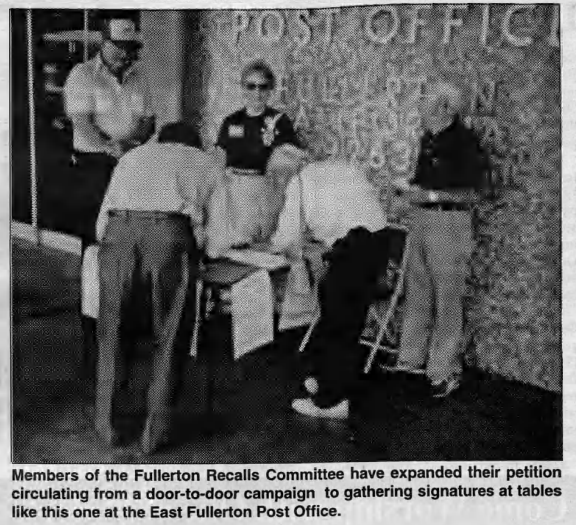
Should the recall effort gather the required number of signatures, an election would take place in 1994. Stay tuned!
The Honor Roll Murder, Tagging, and a New Sheriff in Town
In 1993, one of the grisliest murders in local history took place, when five Sunny Hills High School students brutally killed Orange High School student Stuart Tay.
The killers were Robert Chien-Nan Chan, Kirn Young Kim, Abraham Acosta, Mun Bong Kang, and Charles Bae Choe of Fullerton. They were all convicted or pleaded guilty.
The Orange County Register called it the “Honor Roll Murder” because most of the killers were high-achieving students who planned to attend elite universities.
The shocking crime prompted a meeting of students and parents at the Sunny Hills High School gym.

“No one could come up with a plausible explanation of what caused the tragic occurrence…[or] how such a tragedy could happen in upper middle class families with high achieving, apparently model students headed for prestigious universities and professional careers,” the Observer reported.
Stay tuned for more on this case.
In 1993, I was a 7th grader at Ladera Vista Jr. High. What was popular among young teens in 1993? Super Nintendo/Sega Genesis, baggy pants, Air Jordan sneakers, oversized Looney Tunes t-shirts, and (for some) tagging. Tagging was a form of graffiti in which young people would sort of emulate the more hardcore gang graffiti by writing their “tagger” names on public property. I never participated in tagging, probably because I couldn’t come up with a cool tagger name and because I was just generally not one of the “cool kids.” I was more of a nerd. Still am.
Granted, there were definitely actual gangs in Fullerton in the early 1990s (most notably Fullerton Tokers Town and Baker Street), but the tagging trend was popular among lots of wannabes as well.
Anyway, this proliferation of graffiti prompted outraged and angry community meetings.
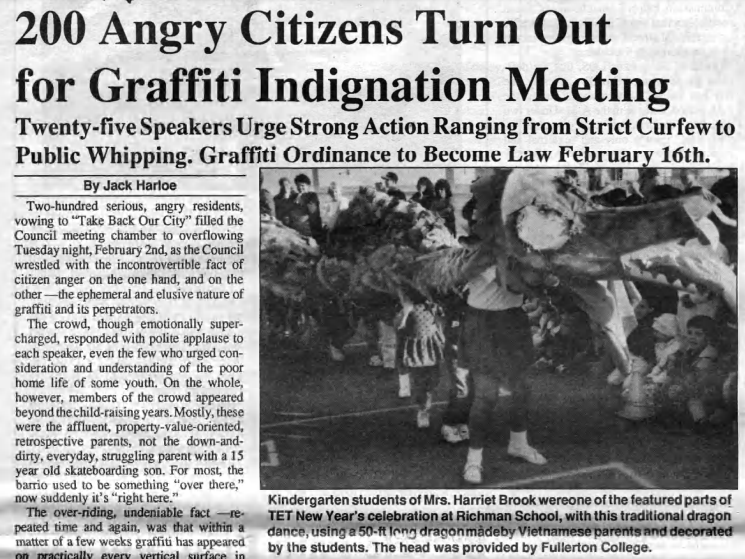
All of this outrage prompted the City Council to pass an “urgent” anti-graffiti ordinance with stiffer penalties than had previously existed, like 6 months in jail and/or $1,000 fine. The new ordinance made it unlawful for anyone under 18 to have in their possession a “graffiti implement” while on public or private property, unless it was school-required.
In 1993, a new Police Chief took the reins named Pat McKinley.

McKinley was a 29-year veteran of LAPD who joined the force just in time for the 1965 Watts Riots and took his new position just after the 1992 LA Riots.
Legally Forced to Act, Fullerton Takes Hopeful Steps Toward Affordable Housing
As my recent posts have chronicled, throughout the 1980s and 1990s, Fullerton City Council was very reluctant to fund or even approve affordable housing projects in town, even though the City received federal housing dollars and was required to set aside a certain percentage of property tax for this purpose.
The reasons for this reluctance (or outright refusal) were twofold: 1.) Some city councilmembers were ideologically opposed to using government funds for housing (preferring instead to subsidize things like shopping centers and sports complexes) and 2.) Angry neighbors showed up to council meetings to speak against low income housing projects in their neighborhoods, fearing it would bring all sorts of problems.

Like the City, the Fullerton School District was having budget issues and proposed to fill this gap by selling off surplus properties to affordable housing developers.
Some comments from concerned neighbors:
“Affordable housing is not the School District’s responsibility, but the City’s.”
“Why does it have to be in the backyard of our schools?”
“We don’t need any more low income housing in this corner of Fullerton.”
The City’s lack of affordable housing eventually prompted a lawsuit brought by two citizens that resulted in a settlement requiring the city to develop an affordable housing plan and allocate money for its implementation.

A newly created Affordable Housing Committee recommended spending about $3.5 million in federal and local funds for three affordable housing projects. Whether these projects would actually get built is another question. Stay tuned.
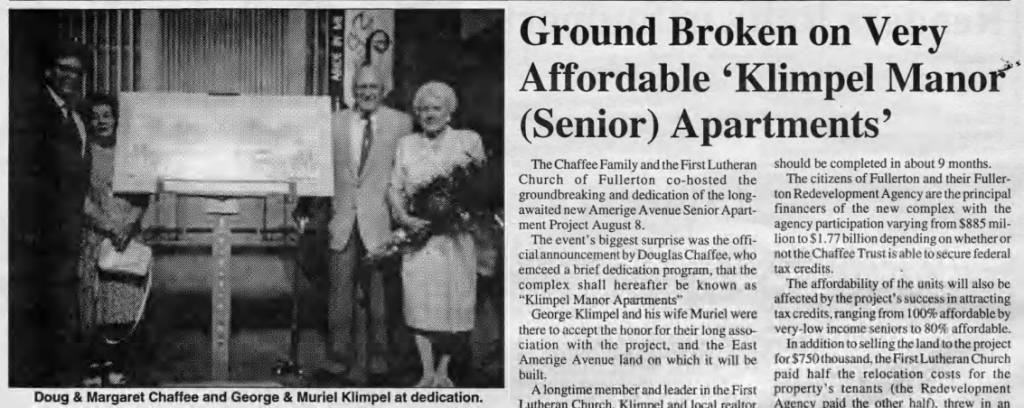
Additionally, a new affordable housing project for seniors, called Klimpel Manor, partly owned by the Chaffee family, and mostly financed by the City, was actually being built.
Housing discrimination was, unfortunately, still a thing in 1993.
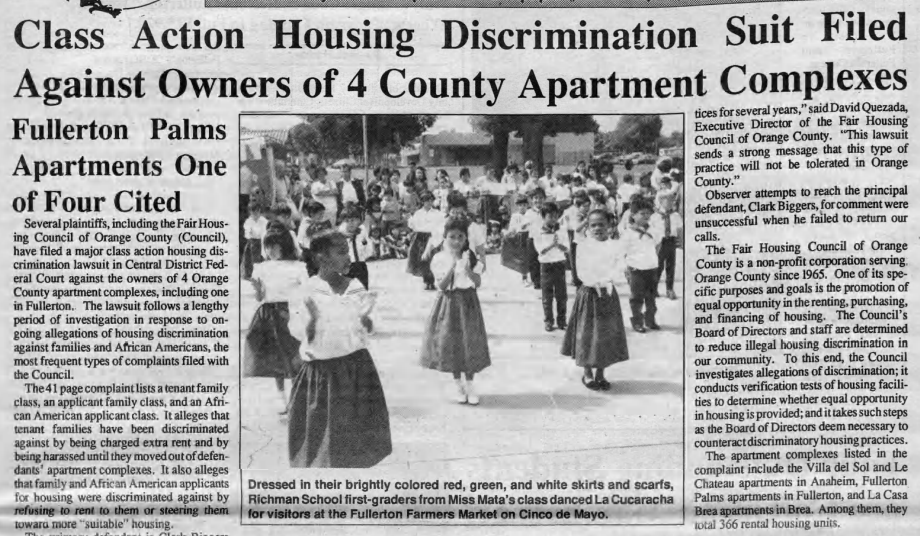
Several plaintiffs, including the Fair Housing Council of Orange County, filed a class action housing discrimination lawsuit against the owners of 4 Orange County apartment complexes, including one in Fullerton.
“The lawsuit follows a lengthy period of investigation in response to ongoing allegations of housing discrimination against families and African Americans, the most frequent types of complaints filed with the Council,” the Observer reported. “It also alleges that family and African American applicants for housing were discriminated against by refusing to rent to them or steering them toward more ‘suitable’ housing.”
The apartment complexes listed in the complaint included the Fullerton Palms.
Homelessness
An obvious result of a lack of affordable housing was homelessness. To meet (some of) this need, the New Vista family shelter opened in 1986, helping seven families at a time with transitional housing.

How Fullerton Spent (Some of) its Redevelopment Dollars
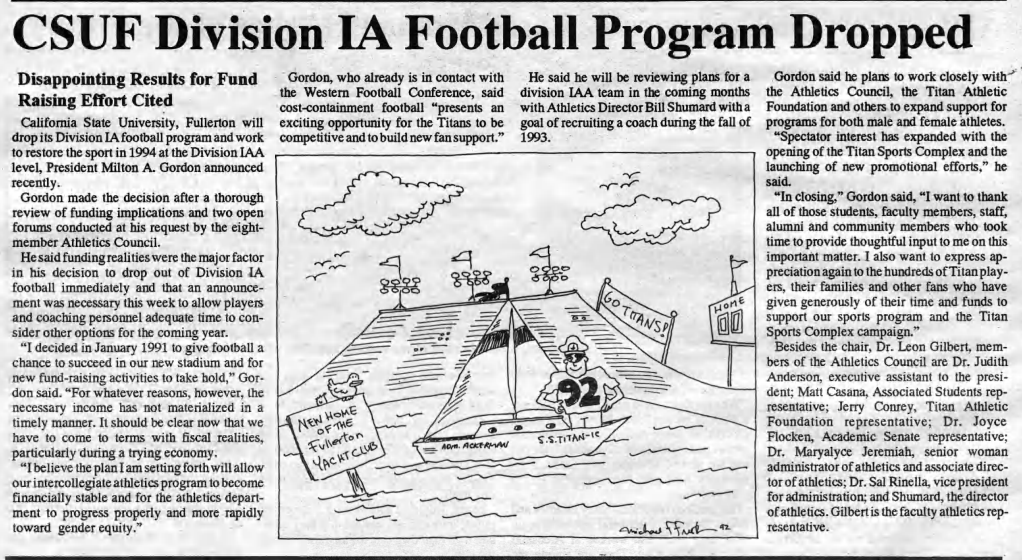
The City of Fullerton had spent millions of redevelopment dollars to build a sports complex at CSUF, partially for the college’s football team. And then, CSUF dropped football.
The City also helped finance Knowlwood Restaurant (now Crawfish Cave) on the site of the former Melody Inn, a 100-year old building that burned down in 1989.

“Altogether, the net cost to the city of the two phases of development [Knowlwood and another building at the corner of Harbor and Commonwealth] will amount to $510,365,” the Observer reported.
Bicycle Users Get a Break
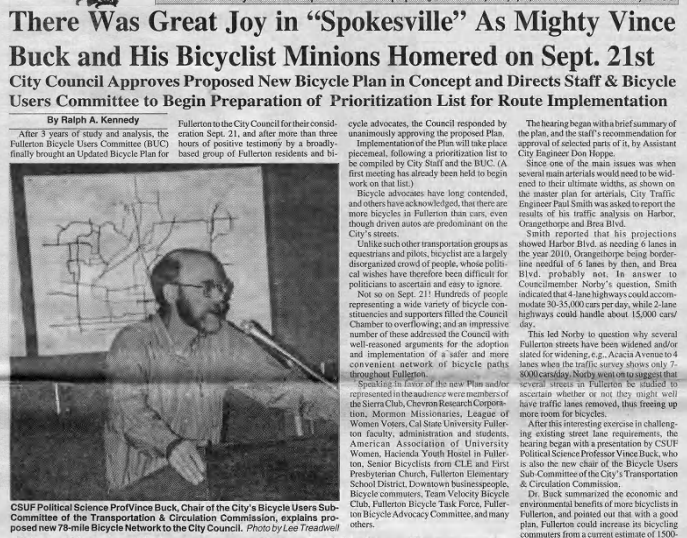
Fullerton (and Southern California in general) was a very car-centric place in the 1990s. Bicycle users sought to make the place more bike-friendly, first by establishing a Bicycle Users Subcommittee, and then by creating a bicycle master plan for the city.
The plan sought to include 20.7 miles of Class I (off-road) bicycle routes, 40.2 miles of class II (on-road, signed and striped) routes, and 16.5 miles of Class III (signed only) routes.
Dr. Vince Buck, longtime member of the Bicycle Users Subcommittee, “argued strongly for approving the full plan so that Fullerton would have a chance of increasing its number of bicycle-commuters from an estimated 1-2% of the work force to an achievable objective of 10-12%. Such an increase would make a substantial contribution to clean air in this area, he indicated.”
Unfortunately, the Planning Commission voted against the plan.

“It took a year for the Bicycle Users Subcommittee of the city Transportation and Circulation Commission to come up with recommended commuter bike routes through Fullerton, but only three hours for the Planning Commission to agree 6-1 that bicycles don’t belong in Fullerton’s future,” the Observer reported.
Assistant city engineer Don Hoppe…stressed that “there is no funding available to implement any of these routes, and the Bicycle Users Subcommittee does not have a priority list.”
“Southern California is a motorized world. The [State] Vehicle Code has done a pretty good job integrating pedestrians, bicycles, motorcycles and cars,” he said.
But then, hope was rekindled as City Council approved the proposed plan after many people showed up to advocate on its behalf. Whether the city would actually implement the plan was another question.
In other transportation news, the plan to redevelop the Fullerton Train Station was going off the rails.

Educational Inequality and Student Protests
Meanwhile, plans were rolling along to re-open Maple Elementary School, which had been closed in 1972 for being a de facto segregated school.

The plan was to open one grade per year until it was a fully-functioning K-6 school again. The City was spending $500,000 in redevelopment funds to refurbish the old school, built in 1924.
Maple had become segregated as a direct result of historic housing discrimination and segregation, which for decades kept Mexicans and African Americans south of the tracks. Even though, by 1990, overt housing discrimination was illegal, it still existed (see above story about the class action lawsuit) and it left a legacy of a city divided along ethnic/economic lines.
This legacy perpetuated itself in all kinds of ways, including school attendance boundaries. The School Board approved an attendance boundary change which sent Valencia Park elementary school grads to Nicolas Junior High (south of the tracks) and Fern Drive grads to Parks Junior High (north of the tracks).
One board member expressed reservations about the decision “to send the 6th graders to the junior high school nearest to their homes, while further concentrating poorer and ethnic minority children at the lower scoring Nicolas Junior High School.”
The Fullerton Elementary Teachers Association (FETA) was against boundary change.
“According to recent studies, heterogeneous grouping of students including ability, academic achievements, parental support and involvement, and ethnicity has been the most successful in ensuring the greatest academic growth in all students,” a FETA statement read. “In this time more than ever before, people must open their eyes and begin to bridge the differences between us. Decisions like this beget divisiveness and lack of understanding o f each other. We implore you to make your decision based upon the long term benefits for all children.”
Another way this historic inequality perpetuated itself was the ability of higher income parents to give gifts and donations to their kids’ schools.
“We don’t like to say no to gifts, but we also don’t like to exacerbate inequities in educational opportunities between the schools,” commented Trustee Elena Reyes Jones.
“…it is the policy of the Board of Trustees to discourage all gifts which may directly or indirectly impair the Board of Trustees’ commitment to providing equal educational opportunities to the students of the District.”
Meanwhile, local high school and college students took to the streets on September 16 (Mexican Independence Day) for a march organized by the student ground MEChA seeking: 1) A Chicano Studies Major, 2) 50% hiring floor for people of color, 3) More emphasis on all ethnic and gender studies, 4) More ESL classes, and 5) No ethnic group be excluded from challenging a class.
Around 300 college and local high school students marched down Chapman Avenue to Harbor Blvd., where they met with Fullerton police, who at first attempted to block them, but then chose to block traffic, allowing the march to continue down Harbor.
Police again confronted the marchers at Valencia and Harbor, where “the students broke ranks and ran through and around the police cordon and through the Price Club parking lot onto Lemon Street, where they headed back toward the FC campus.”
The students and police again clashed at the Lemon underpass, which is adorned with Chicano murals. When students refused to be blocked, violence broke out. Officers used pepper spray and batons on uncooperative protesters.
Four adults and two juveniles were arrested.
After the march, when asked if the college would accede to the students’ demands, Richard DeVecchio, vice president of student development and services, said, “We will not be intimidated. More meetings and fewer demonstrations would be fruitful.”
Students also protested tuition hikes at Fullerton College.

Of Toxic Waste and Endangered Birds
In the ongoing saga of the McColl toxic waste dump in northwest Fullerton, the Environmental Protection Agency (EPA) finally, after years of study and delays, chose a plan to deal with the waste.

Ultimately, they chose not to remove or destroy the over 200,000 tons of waste, as originally planned. Instead, the solution was basically to solidify some of the oil waste, build walls around it, cap it, and then monitor forever to see whether it was leeching into the groundwater (it was).
This was the solution the oil companies responsible for the waste had been lobbying for.
Today, the McColl site is part of the Los Coyotes golf course. Driving by, you would have no idea it’s there.
In other environmental protection news, United States Fish and Wildlife Service listed the California gnatcatcher (bird) as a “threatened” species due to development in Southern California of its natural habitat, coastal sage scrub.
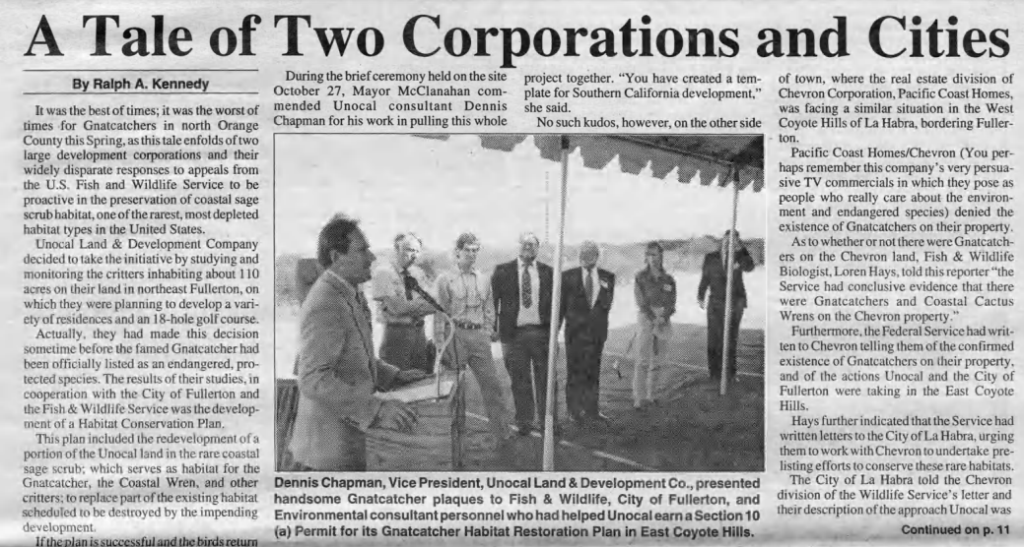
Upon hearing this announcement, the Unocal company, which planned to develop east Coyote hills with housing and a golf course began studying and monitoring gnatcatchers on about 110 acres of their land and developed a Habitat Conservation Plan.
Chevron, which owned west Coyote Hills, took a different approach: “Chevron’s response was to destroy about 100 acres of the rare habitat, just prior to the March announcement by Interior Secretary Bruce Babbitt that the Gnatcatcher had been officially listed as endangered.”
Culture and Community
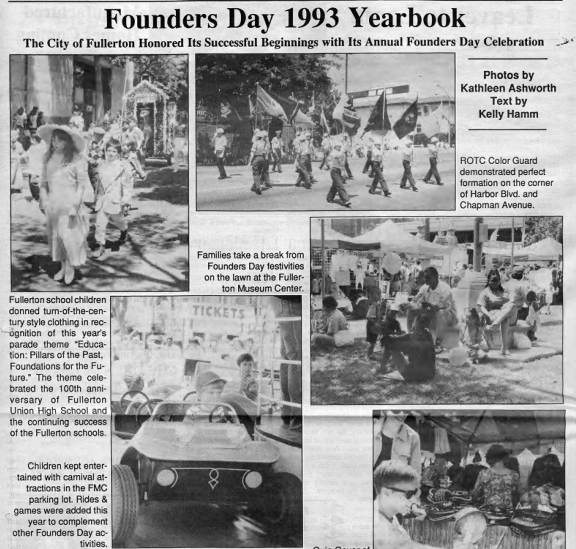
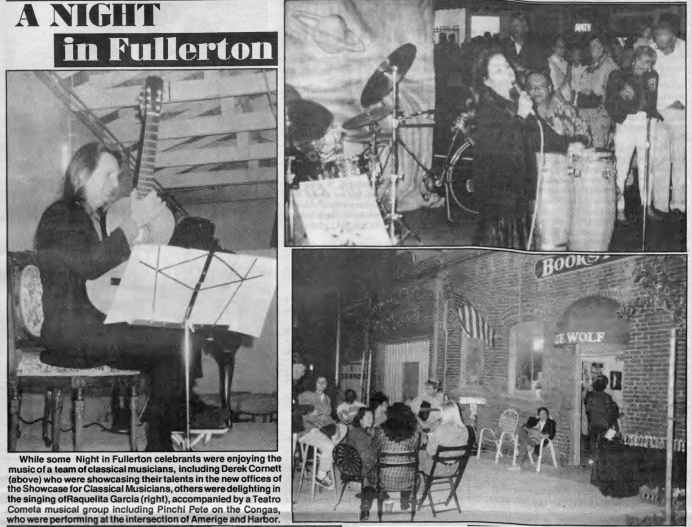
Community and cultural events included the First Night (New Years) Celebration, the Downtown Market, A Night in Fullerton, and the annual Founder’s Day Parade.

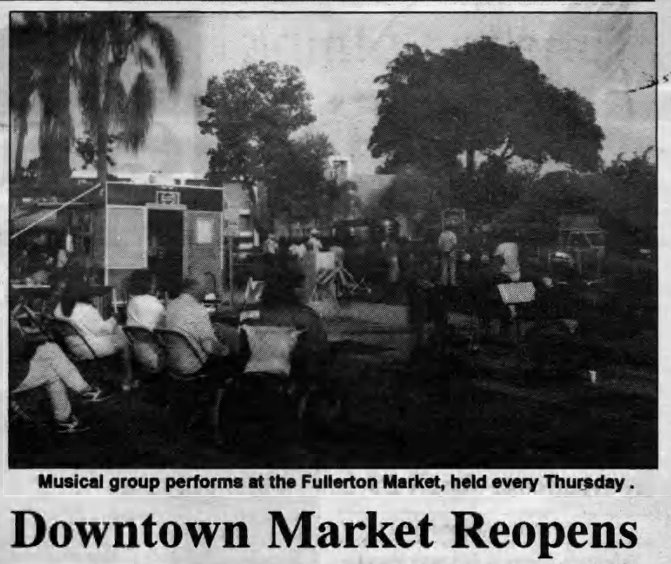
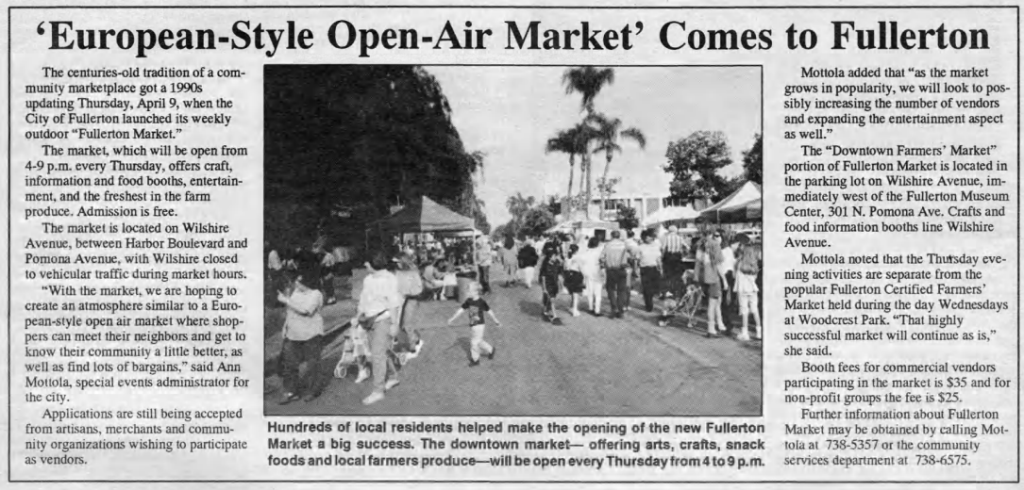
“The market creates a sense of community. It provides a weekly destination for people to meet and promotes Fullerton for those outside the area,” said Ann Mottola, Special Events Coordinator for the city. Local vendors, farmers and artists gather near the Fullerton Museum Center to sell their goods and interact with patrons.
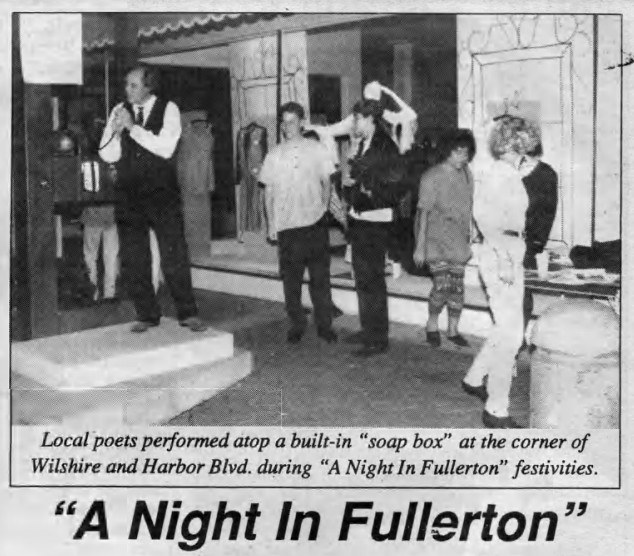
“The local arts community joined talents recently to present a free night of dance, music, drama, and art during the 29th annual A Night in Fullerton,” the Observer reported. “Nearly 30,000 persons traveled to 14 locations throughout the city to survey an eclectic evening of performances ranging from barbershop quartets to water-color demonstrations to classical and contemporary ballet.”
Deaths
Leon (Jack) Owens, a longtime resident of Fullerton, died of a heart attack at age 60. The Owens are a prominent family in Fullerton, with roots stretching back decades. In honor of Leon, his family established the Leon Owens Foundation, whose purpose is to provide scholarships for needy FUHS and Fullerton College students.

Duane Winters, who served on Fullerton City Council for 28 years, beginning in 1956, died at age 85 of natural causes. The baseball field at Amerige Park is now known as Duane Winters Field.

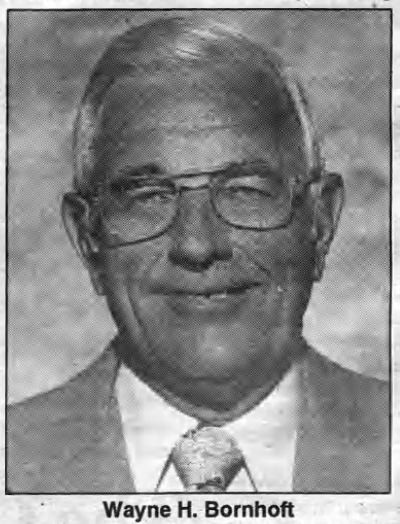
Wayne H. Bomhoft, retired chief of the Fullerton Police Department and former Mayor of the City of Fullerton, died of cancer at age 76. In 1957, Bomhoft was hired as chief of the Fullerton Police Department, replacing Ernest Gamer. Following his retirement from the police department in 1977, he won a seat on the Fullerton City Council in 1978, and served as mayor in 1980 and 1981.
Bill Calhoun, who ran a shoe shine stand on South Malden for 22 years, died of cancer at age 62. According to the Observer, “The stand had become a familiar site to all manner of clientele and passers-by since 1970, when Bill took over the small Malden Avenue stand from a Mr. Haywood Holden.”

Stay tuned for headlines from 1994.
-
Headlines: 1992
The following is from a work-in-progress about the history of Fullerton. You can support my ongoing research and writing on Patreon.
The Fullerton Observer newspaper was formed in 1978 by Ralph and Natalie Kennedy and friends to provide a more progressive counterbalance to the more conservative Fullerton News-Tribune and Orange County Register. The Fullerton Public Library has digital archives of the Observer stretching back to 1979. I am in the process of reading over each year and creating a mini-archive. Here are some top news stories from 1992.
Politics
1992 was an election year. Democrat Bill Clinton defeated Republican George Bush and independent Ross Perot. Locally, Republican Ed Royce defeated Democrat city councilmember Molly McClanahan for congress.
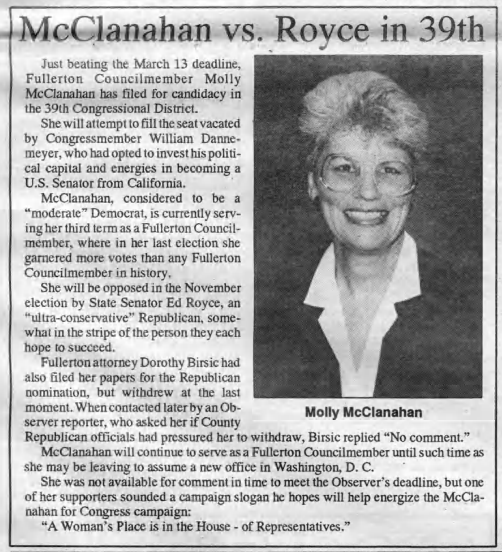
Several candidates ran for three open seats on Fullerton City Council. The Observer endorsed Jan Flory, Don Bankhead, and Chris Norby.
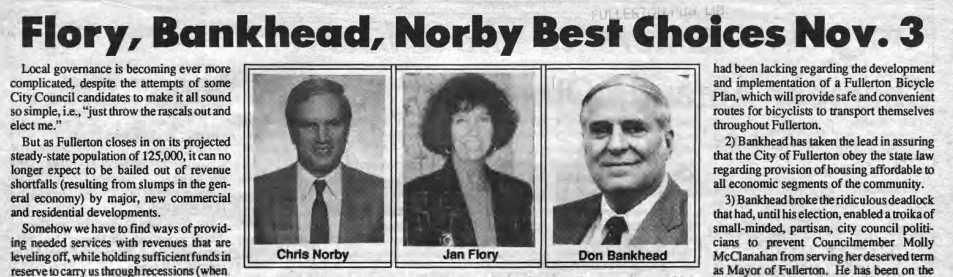
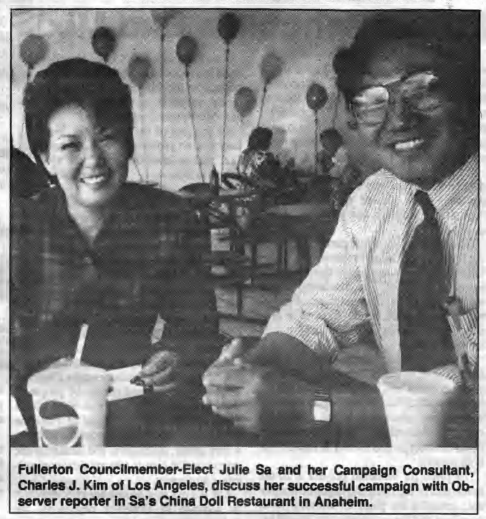
Norby and Bankhead were elected, but Julie Sa defeated Flory.

Sa was the first Asian American to serve on City Council. She was born in Korea of Chinese parents, and had lived in Fullerton for the past 17 years. She was a business owner and a member of the Chamber of Commerce.
Culture
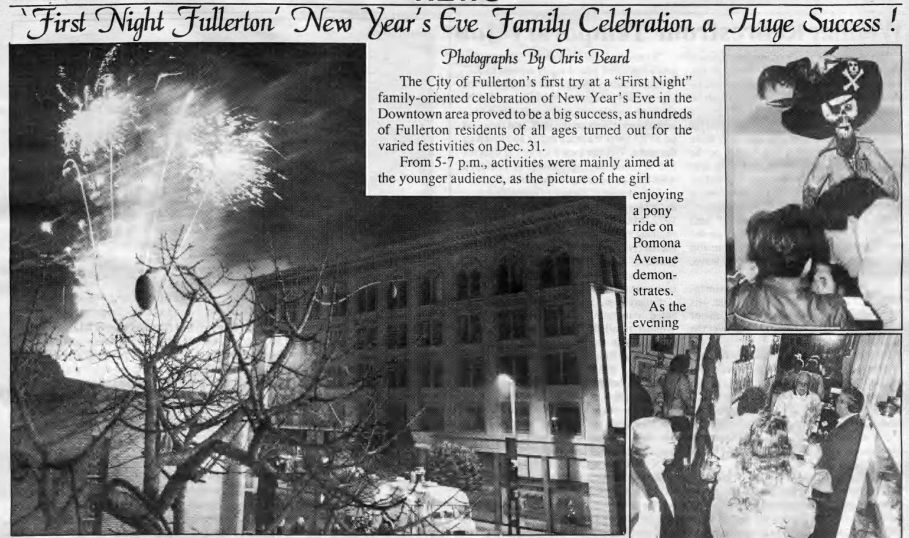
Cultural events included the citywide arts event “A Night in Fullerton” and the New Years celebration “First Night Fullerton.”

The Downtown Fullerton Market opened along Wilshire Avenue by the Fullerton Museum Center.
The Downtown Plaza had not yet been created, but it was envisioned.

“The combination of a thriving Thursday Market and a reopened Fox Fullerton Theatre will help each other and the rest of Downtown Fullerton, and would be nicely complemented by a Gazebo/band stand as depicted by Observer artist Claudia Rae in the drawing on this page,” the Observer reported. “It would be another way o f bringing the community together, an objective that now more than ever is one worth pursuing with diligence.”
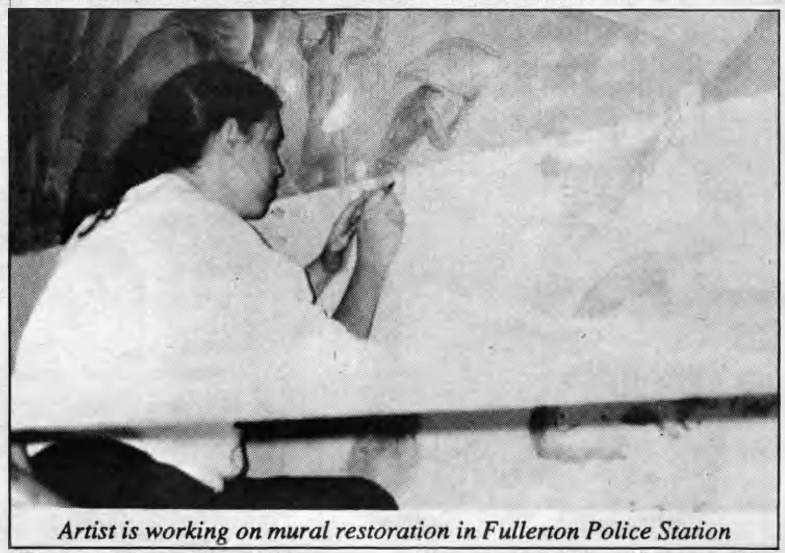
The City had contracted with an art conservation company to restore the WPA-era mural “The History of California” in the “mural” room of the Fullerton Police Station, which was originally City Hall.

The mural was painted by Helen Lundeberg in 1942, when the police station building opened. The large, three-wall mural depicts “major Spanish, Mexican and U.S. heroes of California history,” Observer local historian Warren Bowen writes. “Cabrillo is there, Serra, Portola, Stockton, Fremont, and assorted native Americans. Mission activities, exploration, agricultural and industrial development are there, even a glimpse of the movie industry.”
In other historic restoration news, plans were underway to restore the Spanish colonial revival style Santa Fe Depot train depot, to be done by the Bushala Brothers, Inc.

“City Council, acting also as city redevelopment agency, gave the green light to the Bushalas to add a jazz club to the plans for the refurbished station,” the Observer reported.
Unfortunately, to my knowledge, the jazz club/restaurant never materialized.
Environment
In the ongoing saga of the McColl toxic waste Superfund site, the EPA was nearing its decision on what to do about the waste, and it looked like this would include either cleaning up or capping the waste.
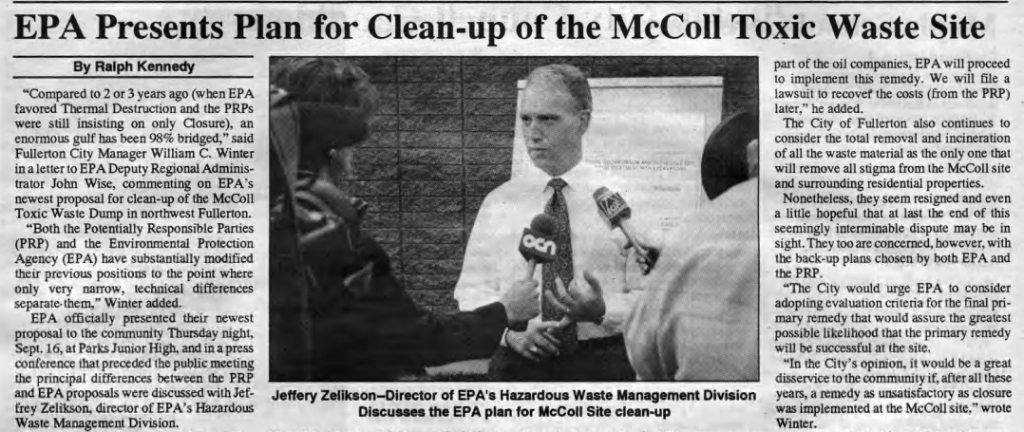
“Both groups now are advocating on-site, in-place treatment of the waste, but they differ on how total and complicated that treatment should be,” the Observer reported.
“We know that the public has become frustrated and disillusioned with the repeated starts and stops that have plagued the cleanup of this site,” said an EPA representative. “This is why, in addition to our new primary system, we have also proposed the cap contingency plan.”
Meanwhile, the City of Fullerton preferred EPA’s original plan of “removal and incineration of all the waste material as the only one that will remove all stigma from the McColl site and surrounding residential properties.”
The EPA would ultimately cap the waste, leaving it on site. But that would not happen for another six years.
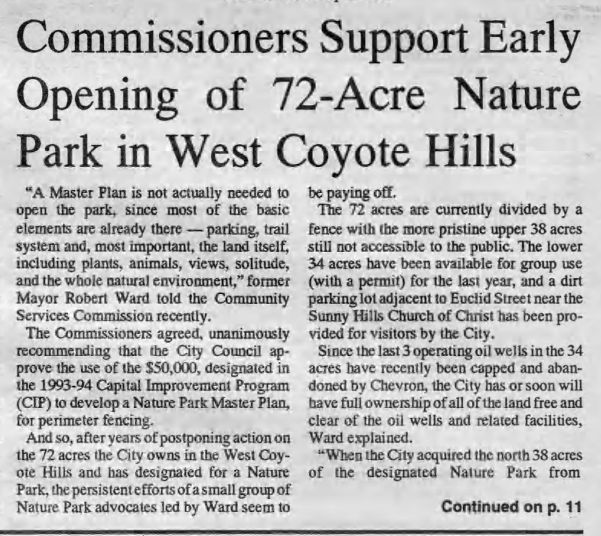
On a more positive note, the Planning Commission recommended that the City use $50,000 to develop a Nature Park Master Plan, for perimeter fencing of what is now the Robert Ward Nature Preserve in Coyote Hills. This area would not fully open until 2023–about 30 years later.
Housing
Throughout the 1980s and 90s, the Observer reported on how the City of Fullerton failed to provide adequate affordable housing.

“In terms of the quantity of affordable housing produced, Fullerton ranks in the lowest quartile of all California communities. In the last 10 years the city has done nothing to facilitate development of affordable rental units to very low income households,” the Observer reported.
Two local residents took it upon themselves to sue the city because it had failed to allocate resources toward affordable housing.

“A suit filed by two Fullerton homeowners, Nadene Ivens and Roy Kobayashi, challenging the validity of the Plan for Redevelopment Area 4 has been settled, and promises to result in expenditures for low and moderate income housing of $14,662,000 by fiscal year 1998-99,” the Observer reported. “Perhaps the most significant feature of the stipulated agreement was the targeting of 50% of the assisted units for households whose incomes are below 45% of median income (approximately $23,500).”
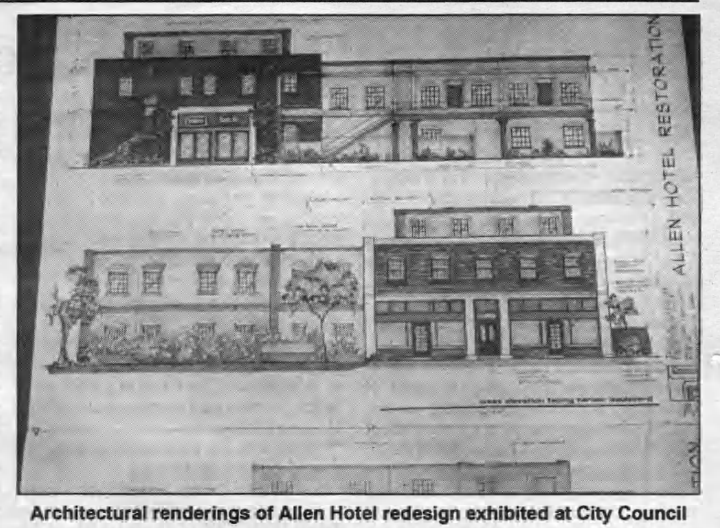
On a potentially more positive note, the City had approved the conversion of the historic Allen Hotel into a 16-unit low income housing project.
Hughes Aircraft, at one time one of the largest employers in Fullerton, was downsizing and planned to convert some of its surplus property into housing.

“NIMBYism is alive and well in Fullerton, as evidenced by the comments of citizens who attended an August 6 meeting called by Hughes Electronics Inc. at which they introduced to the community their preliminary plans for the development of about 150 acres of their (now surplus) industrial land in northwest Fullerton,” the Observer reported. “Other hostile comments were directed against the 10 acres set aside for apartments: Hughes Planning Consultant Mike Russell was asked if the City had mandated any “low & moderate income housing” for the area; to which the answer was “No.” A follow up comment indicated that “apartments are not appropriate in this part of the city. They should be confined to the downtown area.” The audience signified some approval o f this kind o f NIMBYism with scattered applause.”
Homelessness
An obvious result of a lack of affordable housing was homelessness. Fullerton had one year-round shelter for families, run by Fullerton Interfaith Emergency Services (now Pathways of Hope), and during cold months, the National Guard Armory served as a shelter as well.

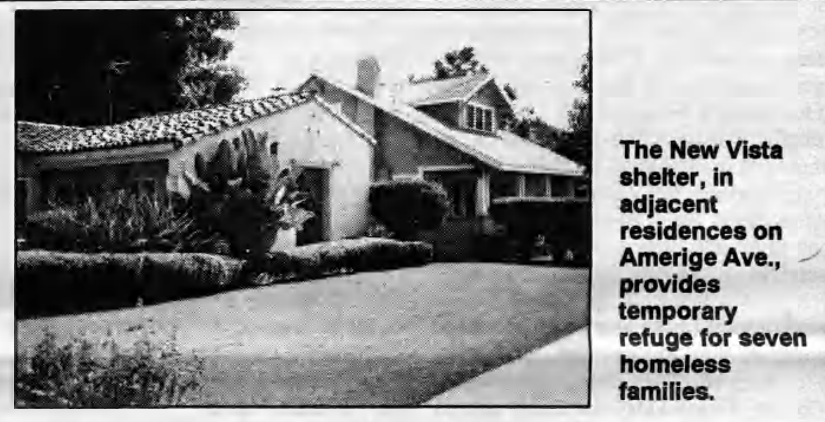
In 1992, Fullerton passed an ordinance which prohibited camping “in any public area.”
“Fullerton City Ordinance 2808 will make life a lot harder for some Fullerton residents,” the Observer reported.
This anti-camping ordinance was briefly halted in 2018 by the Martin v. Boise court case, but that was overturned by a recent Supreme Court decision, City of Grants Pass v. Johnson.
Education
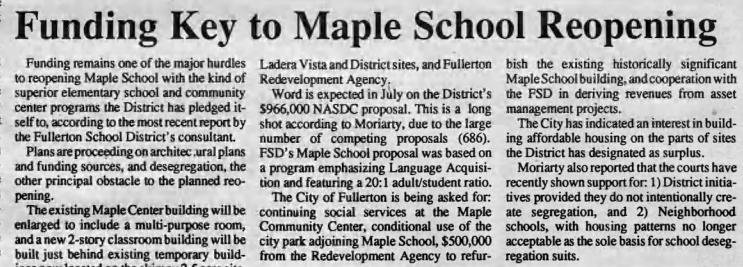
Plans were in the works to re-open Maple Elementary School, which had been closed in 1972 for being a de facto segregated school.
“Pointing out the irony the Board was considering reopening Maple as a segregated campus on the eve of Martin Luther King’s birthday, Fred Mason urged the Trustees to reconsider this possibility and to obey the law,” the Observer reported. “Mason quoted Maple Area resident Gil Perkins, who had served with him on the Maple Task Force, ‘Segregation was wrong in 1954; segregation was wrong in 1971; and segregation is wrong today.’”
Another hurdle to re-opening Maple was funding.
Transportation
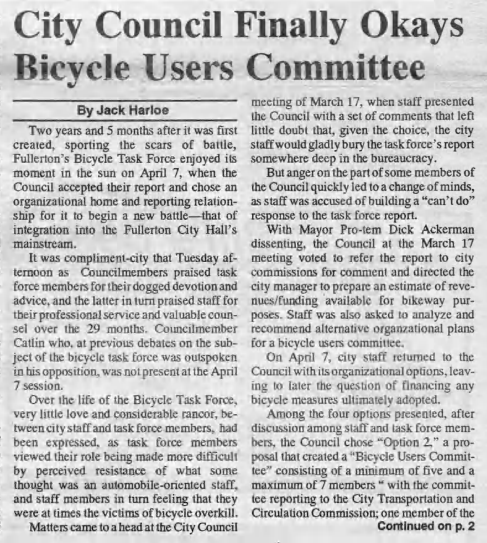
In transportation news, City Council finally approved a Bicycle Users Subcommittee, tasked with advocating for the needs of bicyclists.
Miscellaneous
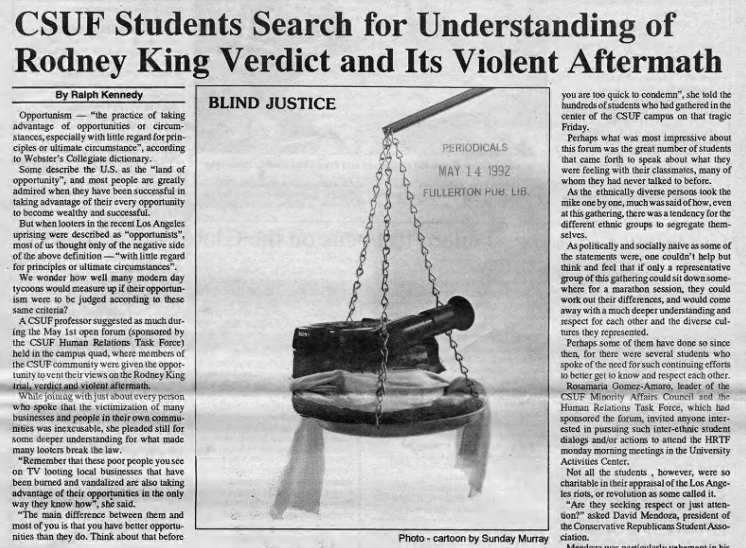
In 1992, an all-white jury acquitted the officers involved in the infamous Rodney King beating, which sparked the LA riots.
Those who grew up in Fullerton may remember the big cement slides at Gilman Park. These were a blast, but also kind of dangerous and a liability for the city. A city commission recommended that the slides be taken out.

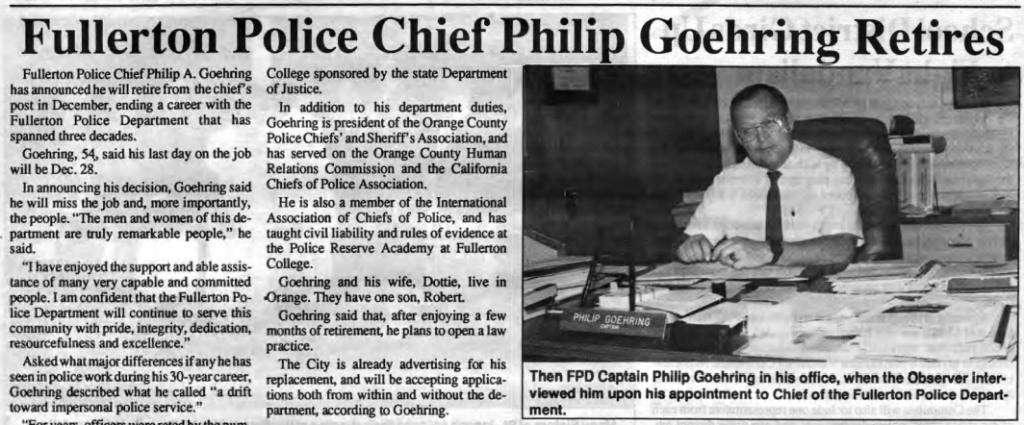
Fullerton Police Chief Philip Goehring retired at age 54. Must be nice.
And the world’s tallest man came to Fullerton to advocate against drugs and for nutritious lunches.

Deaths
Former City Councilmember Louis “Red” Reinhardt died of a heart attack at his home in Fullerton at age 87. Here’s a bit from his obit.
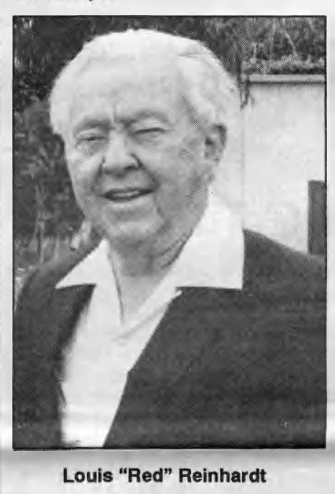
“Born in Germany, and once interned in a concentration camp in Siberia, Reinhardt and his wife Anna came to Fullerton from Michigan in 1947. His first business in town was a gas station, which he later sold to start the NuArt Neon sign-making business which still survives today at its same location. Red was very active in the First Lutheran Church, the Fullerton Senior Multi-Purpose Center— where a room was named after him, and in local politics, serving on the Fullerton City Council from 1966 to 1972. He had, through the years, been a strong supporter and worker in the campaigns of State Senator John Briggs, Senator John Seymour, and Congress member William Dannemeyer.”
Fullerton High School student Angel Gonzalez was shot and killed near the high school in what was allegedly a gang-related shooting.
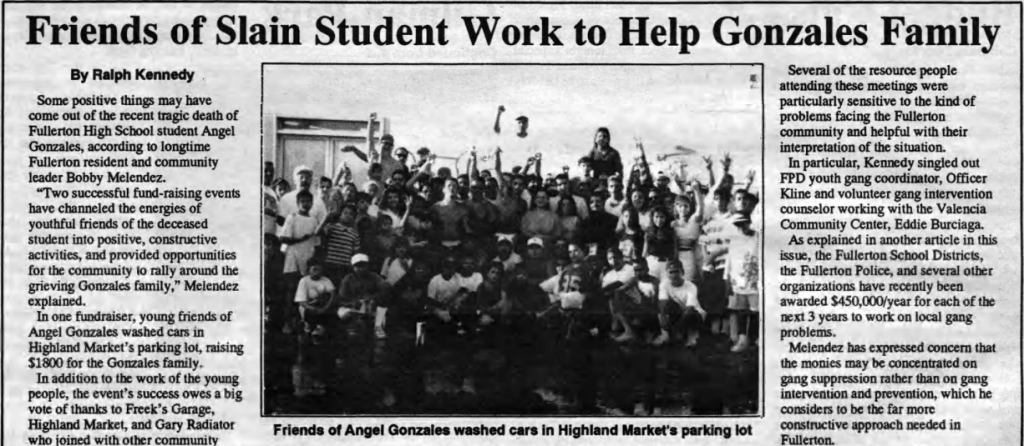
Community members held fundraising events for Gonzalez’ family.
Stay tuned for headlines from 1993!
-
Headlines: 1991
The following is from a work-in-progress about the history of Fullerton. You can support my ongoing research and writing on Patreon.
The Fullerton Observer newspaper was formed in 1978 by Ralph and Natalie Kennedy and friends to provide a more progressive counterbalance to the more conservative Fullerton News-Tribune and Orange County Register. The Fullerton Public Library has digital archives of the Observer stretching back to 1979. I am in the process of reading over each year and creating a mini-archive. Here are some top news stories from 1991.
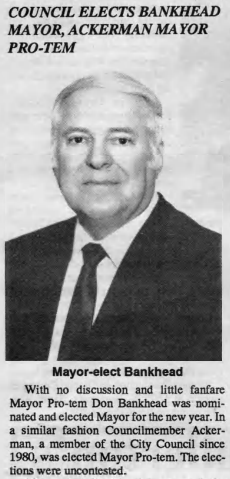
In 1991, Don Bankhead was chosen as Mayor and Dick Ackerman became Mayor Pro-Tem.
Housing & Homelessness
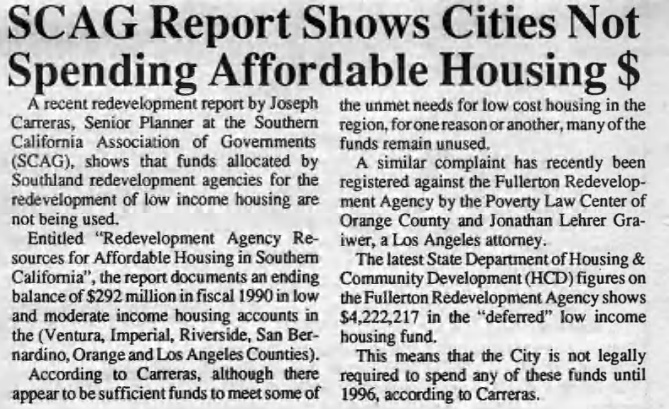
Throughout the 1980s and 1990s, the City Council generally preferred not to use city redevelopment funds for affordable housing.
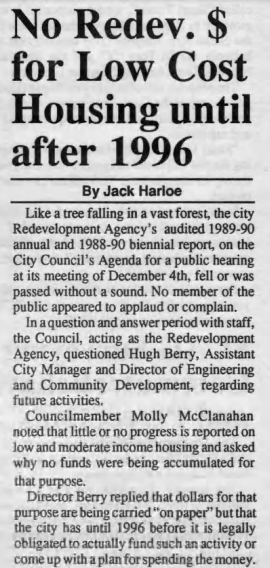
If not housing, what was the City spending its redevelopment money on? Why, a $10 million dollar sports complex, for one.

But then a (sort of minor) bright spot. Council approved a 10-unit affordable housing project–converting the former Allen hotel into low-cost housing.
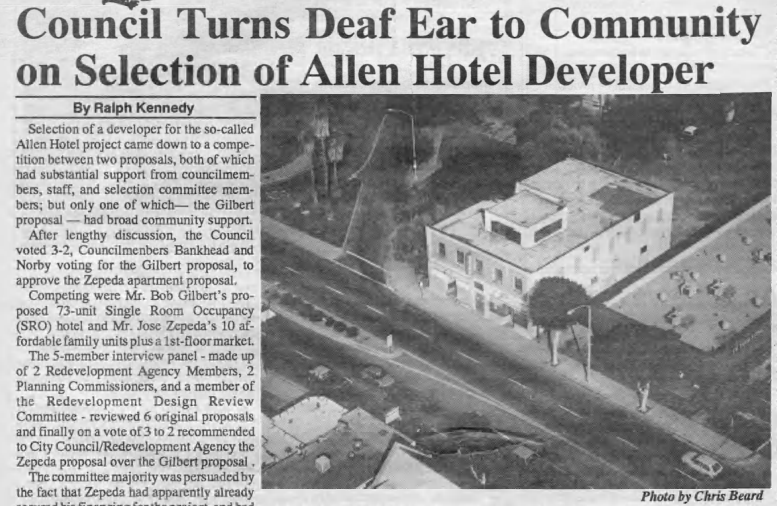
Unfortunately, instead of approving a 73-unit project, council instead preferred a 10-unit project, thus making a very tiny dent in the problem.
Two Fullerton residents took it upon themselves to sue the city for its lack of affordable housing.

“Two longtime Fullerton homeowners, Nadene Ivens and Roy Kobayashi, have filed suit in Orange County Superior Court against the City of Fullerton and its Redevelopment Agency, challenging their right to establish Redevelopment Project Area 4, until such time as they get their low-income-housing affairs in order,” the Observer reported.
“I have been watching and waiting for the city to use their state mandated set-aside funds, generated from prior redevelopment areas, for low income housing. I was upset when the City’s Redevelopment Agency, Project Area 3, committed so much money to build a football stadium for CSUF,” Ivens said. “Then, when Project Area 4 was designed only to assist auto dealerships, I determined that I must take some action to make the city conform to the requirements of State law. Beyond the law I feel there is a moral obligation to provide affordable housing in Fullerton which is as least as great as any obligation to build football stadiums or subsidize private business.”
Most of the housing approved by City Council was “market rate” (i.e. not affordable to many people).

Council voted 4-1 to approve revisions to the city’s General Plan thus implementing UNOCAL’s plan for 20 years of development in the 380 acre area bounded by State College Boulevard, Bastanchury Road, Brea Boulevard, and Ladera Vista/Skyline Drive.
The growing affordable housing problem was, unfortunately, not unique to Fullerton.
Homelessness
An obvious result of the lack of affordable housing was an increase in homelessness, another issue which council was reluctant to deal with.

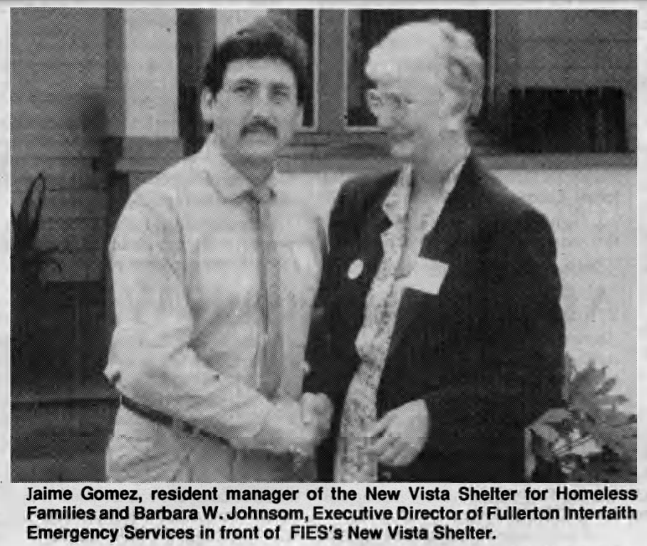
A group called Fullerton Interfaith Emergency Services (now Pathways of Hope) was doing its part by providing food, shelter, and other services to the local poor and homeless–although this was of course not sufficient to fully deal with the problem.
According to FIES director Barbara W. Johnson, the estimated number of homeless people in Orange County was 10,000 in 1991, “one half of whom are estimated to be children with an average age of 5 years old.”
In an interview with the Observer, Johnson talked about the rapid increase of homeless people starting in the late 1970s.
“The number one reason is lack of affordable housing,” she said. “And number two is that income has not kept up with the cost of housing.”
She also mentioned “the release of many patients from state mental institutions, patients who today comprise part of the 10,000 homeless.”
FIES ran the city’s only year-round homeless shelter, called New Vista, which opened in 1986. By 1991, they were able to provide temporary shelter for about 48 families a year. But this was a temporary, not a permanent, solution.
FIES also ran a food distribution center in the low-income Maple neighborhood.
Meanwhile, a conservative City Council majority was doing its part to ignore the problem. Council rejected a proposal by city staff and local advocates (like Barbara Johnson) to hold a series of workshops, to better understand and develop solutions to homelessness.
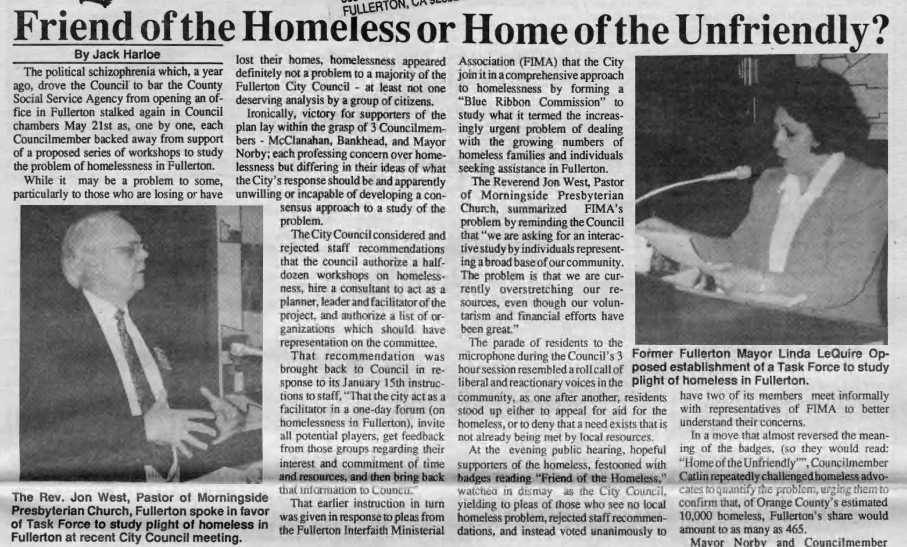
“Councilmember Catlin repeatedly challenged homeless advocates to quantify the problem, urging them to confirm that, of Orange County’s estimated 10,000 homeless, Fullerton’s share would amount to as many as 465,” the Observer stated. “Mayor Norby and Councilmember Bankhead noted that their own research on the problem produced small figures, such as 25 homeless, visible during a typical evening.”
Driving around town is not the best way accurately quantify the problem. As elected officials, Catlin, Bankhead, and Norby almost certainly had access to more accurate data.
Education
Back in 1972, facing state desegregation mandates, the Fullerton School District voted to close Maple School because it was a de facto segregated school, and bus all of its (majority Latino) students to other schools in the district.
The Maple neighborhood and school were initially segregated because of overt housing discrimination starting in the 1920s (such as racially restrictive housing covenants that prevented non-whites from purchasing properties outside certain areas). By the time housing discrimination became illegal in the 1960s, the neighborhood was mostly Latino, some with ties still to Mexico, so new immigrants tended to settle there as well.
By the early 1990s, facing overcrowding schools, the district was considering re-opening Maple. They hired a consultant to study the problem and give a recommendation. A major concern was whether re-opening Maple would re-create a segregated school, as the neighborhood demographics [mostly Latino] were virtually unchanged since the early 1970s.
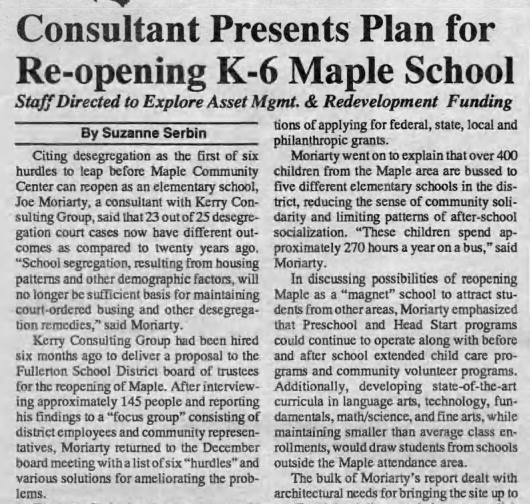
“Citing desegregation as the first of six hurdles to leap before Maple Community Center can reopen as an elementary school, Joe Moriarty, a consultant with Kerry Consulting Group, said that 23 out of 25 desegregation court cases now have different outcomes as compared to twenty years ago,” the Observer reported. “‘School segregation, resulting from housing patterns and other demographic factors, will no longer be sufficient basis for maintaining court-ordered busing and other desegregation remedies,’ said Moriarty.”
One idea to prevent re-segregation was to make Maple a “magnet” school, with such unique and outstanding programs that white parents from the north part of the city would want to send their children there.
School Board trustees were skeptical.
“Trustee Anita Varela said she agreed with the statement that Maple would probably never emerge as an integrated school if it were designated a ‘magnet;’ however she was willing to sacrifice integration in order to give the Maple community a stronger sense of pride and relationship,” the Observer reported.
In retrospect, these trustees’ concerns would prove correct. Today, Maple School is still over 90% Latino.
The only way to fundamentally deal with de facto school segregation is to deal with historic housing segregation and poverty.
An interview with Captain Lee Devore of the Fullerton Police Department about a program called Operation Clean Up gives a bit of context about a low income (largely Latino) neighborhood around Maple.
DeVore described an area with a large percentage of people living in overcrowded and substandard housing.
“Sometimes you have two families living in one apartment for economic reasons,” DeVore said. “Then there are some units that are occupied by 10, 12, 15 single guys.”
Poverty and overcrowded housing led to an increase in crime. The area had over 100 times the number of police calls than other areas of the city.
According to DeVore, the two biggest concerns of the area were fear of deportation (the area has many immigrants) and high rents. Part of the blame lay with landlords (or slumlords) who charged these high rents and did not keep their properties up to code.
“If you talk to the people that live there, they’re good people,” DeVore concluded. “They’re mostly families and people that are here trying to get ahead in life, and come from areas where there wasn’t really a chance. They want to make it, and given a little bit of help, I think they can.”
When Maple School closed in 1972, the buildings became the Maple Community Center, which became home to a host of social services for low income families over the years, including a mobile health clinic, food distribution, ESL classes for adults, Head Start (a federally funded program which provides early childhood education, meals, and parent education for low income families), a preschool, a day care, and more.
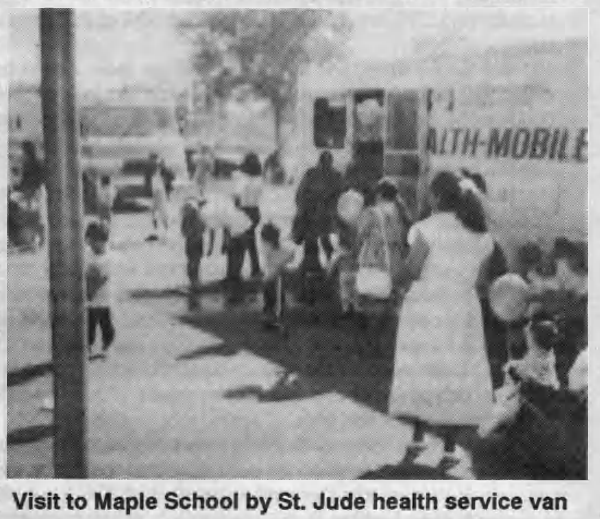
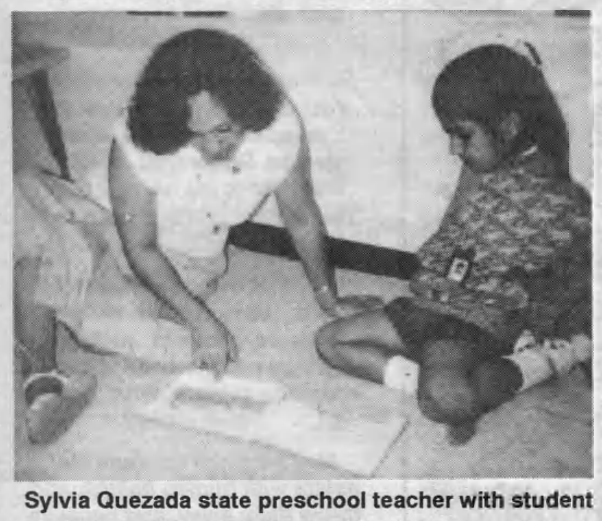
Another issue facing immigrant students were low test scores and the need for bilingual education.

While the Maple neighborhood in south Fullerton was dealing with those issues, Sunny Hills High School in northwest Fullerton was dealing with an influx of immigrants from another part of the world…Korea.
Starting in the 1980s, many Korean immigrants began to settle in Fullerton.
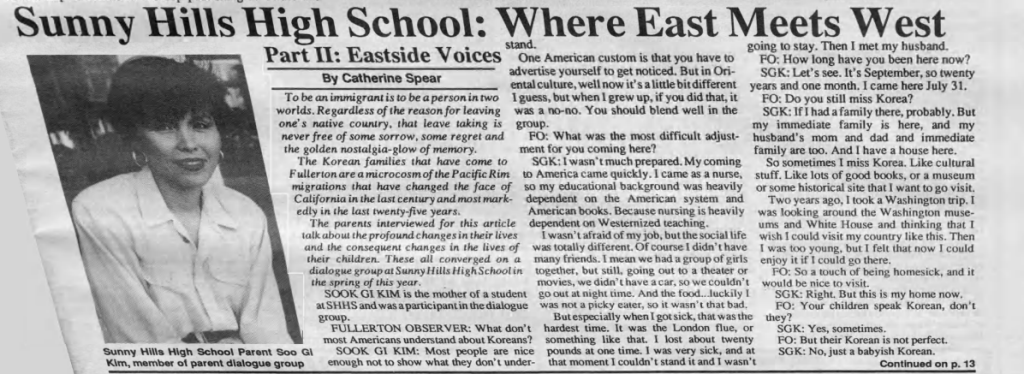
“In the last ten years, Sunny Hills High School has undergone a dramatic transformation from a school that was virtually 100% white upper middle class to a shrinking majority of 52% caucasian students,” the Observer reported. “The bulk of the 48% minority students is Asian (36% of whom are Korean), but also includes groups as diverse as Hispanic, AfroAmerican, Indian, Egyptian, Chinese and Malaysian.”
Prompted by tensions between white and Asian students, the Orange County Human Relations Commission led a series of workshops to address these issues.
“Since we come from other countries, lots of times we feel like we are strangers,” Sook Gi Kim told the Observer. “Maybe from your point of view, we are invading your country. From our point of view we are strangers. We learn that we are (all) human beings and share the same philosophies, just that the expression is a little bit different, because we grew up differently. So don’t be afraid. Be a little bit brave.”
Young Lee, the mother of a SHHS student, said, “My first feeling when I went on campus was that there was segregation.”
Another parent of a biracial student said that his son, “feels that there is a lot of segregation there, that there is voluntary segregation. That is, white students hang around with whites and Korean students tend to hang around with other Koreans. He’s not totally comfortable with that, but he accepts it as the way things are there.”
“To live in two worlds. That is the task of every immigrant,” said another parent. “To see one’s children become the product of an alien culture. That is the burden of every immigrant parent. But that is how worlds and cultures assimilate. These are the growing pains.”
Racism
Immigration has always been a fundamental aspect of American culture and society. However, over the decades, waves of immigrants from different parts of the world have often triggered backlash and discrimination from longer-settled Americans. Unfortunately, in the 1990s, anti-immigrant sentiment would reach fever pitch with things like Proposition 187 in California.
Perhaps to give a bit of background/context on this, local historian Warren Bowen wrote a piece for the Observer about the Ku Klux Klan in Fullerton in the 1920s.

It was in the mid-1920s, exactly 100 years ago, that the Ku Klux Klan was the most popular it had ever been in American history, with a national membership in the millions, and a presence all over the United States, including Fullerton.
“The Klan took the position that it was the only hope for America and its values, among which it listed native American [white, not indigenous] birth, Protestantism, etc. It opposed new immigration, particularly of Oriental and Mexican people. It opposed the Roman Catholic Church, Judaism, and such social trends as the theory of evolution, pacifism, and birth control,” Bowen writes.
The leader of the local Klan, which reached a membership of over 1,200, was Reverend Leon Myers of the First Christian Church of Anaheim.
“School leaders saw erosion of social values while the skilled workers faction sought protection of their jobs from encroachment by immigrants,” Bowen writes. “Merchants who were sympathetic displayed American flags in certain locations in the stores as a sign of support….One of the greatest concerns of the KKK was law and order.”
In addition to holding scary rallies and burning crosses, the Klan also sought to oppose “a special housing section into town for the purpose of housing Mexican workers and their families for agricultural and railroad work.”
This was during Prohibition, so the Klan made a big deal about illegal booze coming in from Mexico.
For a while, the Ku Klux Klan had real power in Fullerton.
“Among the strong supporters of the Klan were men like Roy Davis, later the fire chief, Louis Plummer, and R. A. Marsden of the school system, and prominent civic leaders like Albert Stuelke, William Starbuck, and O.M. Thompson,” Bowen writes.
Other civic leaders like C.C. Chapman and Albert Launer strongly opposed the Klan. Eventually, the Klan died down, but many of its core beliefs have stubbornly stuck around, such as Christian nationalism, white supremacy, racism, and anti-immigrant views.
Fast-forwarding back to 1991, four skinheads were arrested for beating up some Asian youths at Gilman park in Fullerton after harassing a Black family at Tri-City park.
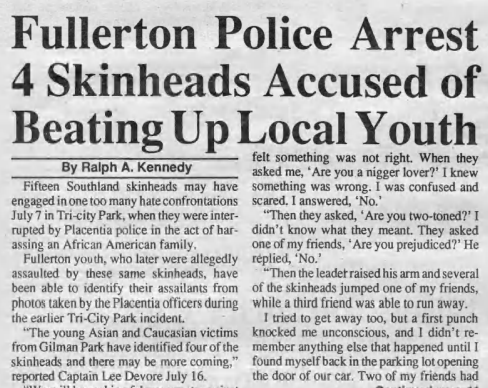
“Fifteen Southland skinheads may have engaged in one too many hate confrontations July 7 in Tri-city Park, when they were interrupted by Placentia police in the act of harassing an African American family,” the Observer wrote. “Fullerton youth, who later were allegedly assaulted by these same skinheads, have been able to identify their assailants from photos taken by the Placenta officers during the earlier Tri-City Park incident.”
In 1991, the U.S. was at war with Iraq (the Persian Gulf War), and unfortunately anti-Arab sentiment was on the rise.
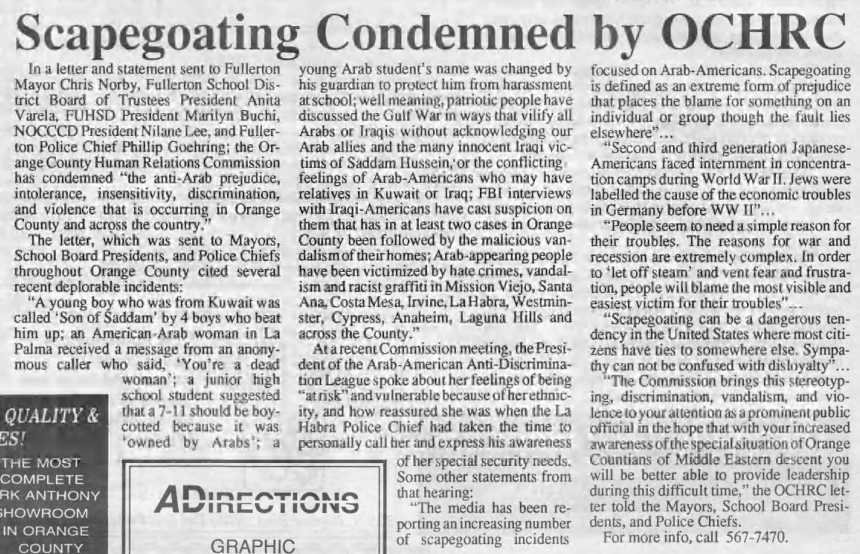
One of the only groups around with the expressed mission to document hate crimes and try to build bridges of understanding between different groups was the Orange County Human Relations Commission (OCHRC).
The OCHRC condemned “the anti-Arab prejudice, intolerance, insensitivity, discrimination, and violence that is occurring in Orange County and across the country.”
“A young boy who was from Kuwait was called ‘Son of Saddam’ by 4 boys who beat him up, an American-Arab woman in La Palma received a message from an anonymous caller who said, ‘You’re a dead woman’; a junior high school student suggested that a 7-11 should be boycotted because it was ‘owned by Arabs’; a young Arab student’s name was changed by his guardian to protect him from harassment at school,” the Observer reported. “Well meaning, patriotic people have discussed the Gulf War in ways that vilify all Arabs or Iraqis…Arab-appearing people have been victimized by hate crimes, vandalism and racist graffiti in Mission Viejo, Santa Ana, Costa Mesa, Irvine, La Habra, Westminster, Cypress, Anaheim, Laguna Hills and across the County.”
Unfortunately, the Orange County Board of Supervisors voted that same year to cut funding for the OCHRC.
“Perhaps most important of all has been the role played by the OCHRC as intermediary between members of various members of the community and their local police departments to develop better understanding and respect between these diverse members of the community,” the Observer wrote.
Environment
In the ongoing saga of the McColl toxic waste dump in west Fullerton, the EPA announced more delays in the cleanup. Toxic chemicals from oil waste had been leeching into the groundwater since the 1940s. What was another few years?
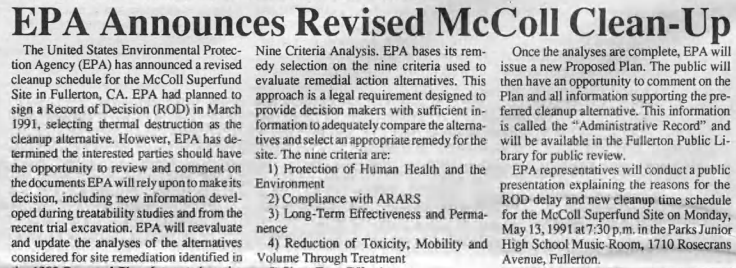
The EPA at first had chosen as its preferred solution to burn the toxic waste, but then said it wanted to give interested parties time to consider alternatives.
Meanwhile, neighbors who lived around the toxic site were losing their patience with the EPA’s plan, and were starting to come around to the oil companies’ plan to “cap” the waste–leaving it where it is.
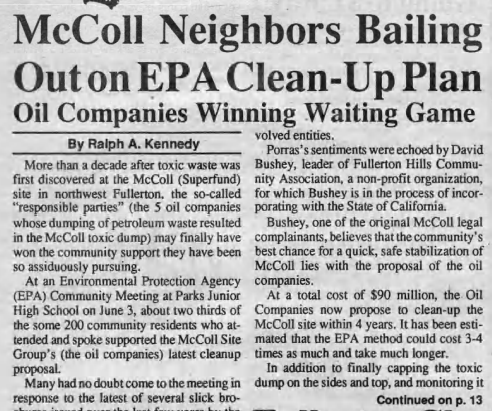
“More than a decade after toxic waste was first discovered at the McColl (Superfund) site in northwest Fullerton, the so-called “responsible parties” (the 5 oil companies whose dumping of petroleum waste resulted in the McColl toxic dump) may finally have won the community support they have been so assiduously pursuing,” the Observer reported.
At a Community Meeting at Parks Junior High, about two thirds of the some 200 community residents who attended and spoke supported the McColl Site Group’s (the oil companies) latest cleanup proposal.
“Many had no doubt come to the meeting in response to the latest of several slick brochures issued over the last few years by the McColl Site Group (the five oil companies responsible for the McColl toxic dump), this one entitled ‘How Much Longer Should Fullerton Wait?,’” the Observer reported. “At a total cost of $90 million, the Oil Companies now propose to clean-up the McColl site within 4 years. It has been estimated that the EPA method could cost 3-4 times as much and take much longer.”

“I firmly believe the time has run out for the agencies,” said Betty Porras, until recently the principal spokesperson for the residents surrounding the McColl site, and consistently a supporter of the EPA preferred cleanup method – thermal destruction (burning the waste).
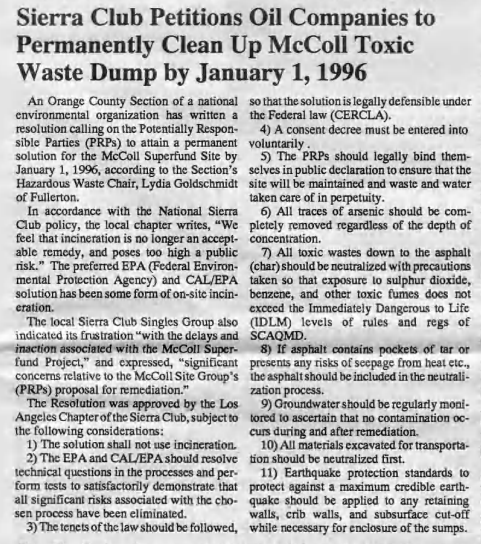
The Sierra Club implored the oil companies responsible for the waste to clean it up by 1996, that is, within the next five years. It would take longer.
Meanwhile, the Observer reported on another nearby toxic waste site, courtesy of the Hughes aircraft plant (which is now the Amerige Heights shopping center and housing development).

“Subterranean seepage of trichloroethylene (TCE), a volatile, carcinogenic, organic compound, from a former Hughes Aircraft Co. underground tank on N. Gilbert Avenue could pose a threat to Fullerton’s water supply,” the Observer reported. “Since half of the City’s water comes from its own wells, the toxic plume, which has already spread at least a half mile out to a depth of 210 feet, does represent a serious contamination threat to Fullerton’s drinking water, which is being drawn from aquifers at depths as shallow as 435 feet.”
Testing showed TCE concentrates of up to 150,000 parts/billion when the state allowed concentration for potable water was 5 parts per billion.
The plume was about a half mile from the nearest water well.
Hughes was in the process of drilling testing wells to best determine how to clean up the contamination. They said it would take about two years. Stay tuned.
In slightly more positive environmental news, plans were in the works to open parts of 72 acres of land in Coyote Hills for public enjoyment.

“The area is currently divided into two major sections by a chain link fence, the upper 34 acres, on which the former owners, Chevron Inc., are in the process of discontinuing oil extraction operations and subsequent clean-up; and the lower portion which is free and now to be available for limited uses by designated organizations,” the Observer reported. “Longtime advocate and defender of the West Coyote Hills Nature Park, former Fullerton Mayor Robert E. Ward…said he looks forward to the time when the upper, northernmost portion of the designated nature area will also be accessible to nature groups.”
“It is the more ecologically interesting section,” he said. “But it will probably take up to 6 months before Chevron will complete capping its wells and cleaning up the waste and debris,” Ward conjectured. In the meantime, limited use of the southernmost section of the Nature Park for nature outings will serve as an introduction to the emergence of this newest, incomparable recreation resource in the City of Fullerton.
The 72-acre area would eventually be named the Robert Ward Nature Preserve, and it would take another 30 years for it to be fully opened to the public. It opened in 2021, and the trails are amazing! For more about the rest of West Coyote Hills, check out www.coyotehills.org.
One special thing about Coyote Hills is that it is home to a threatened species of bird, the California gnatcatcher. In 1991, the state was still considering whether to declare it a protected species.
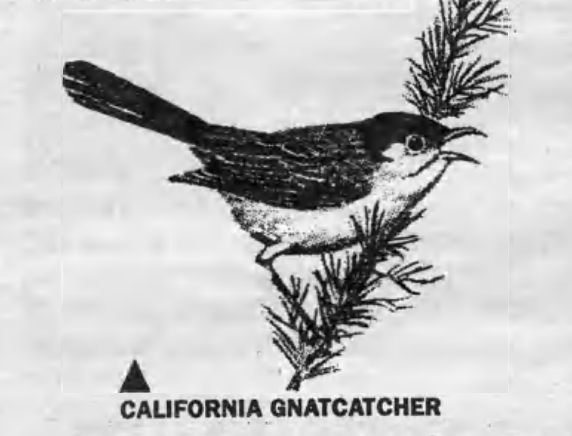
“The tiny sedentary blue-gray bird is restricted to the coastal sage scrub vegetation at lower elevations in Orange, Riverside and San Diego counties,” the Observer reported. “Areas in both the east and west Coyote Hills, Fullerton’s last remaining open space, contain breeding pairs of the bird. Proponents for the petition claim the numbers of California Gnatcatchers has declined greatly with the rapid development in all three counties.”
In park news, did you know that the area around the Summit House restaurant at the corner of Bastanchury and State College is actually a city park? If you were confused, that might be because the city approved a sign that played up the restaurant, rather than the park.
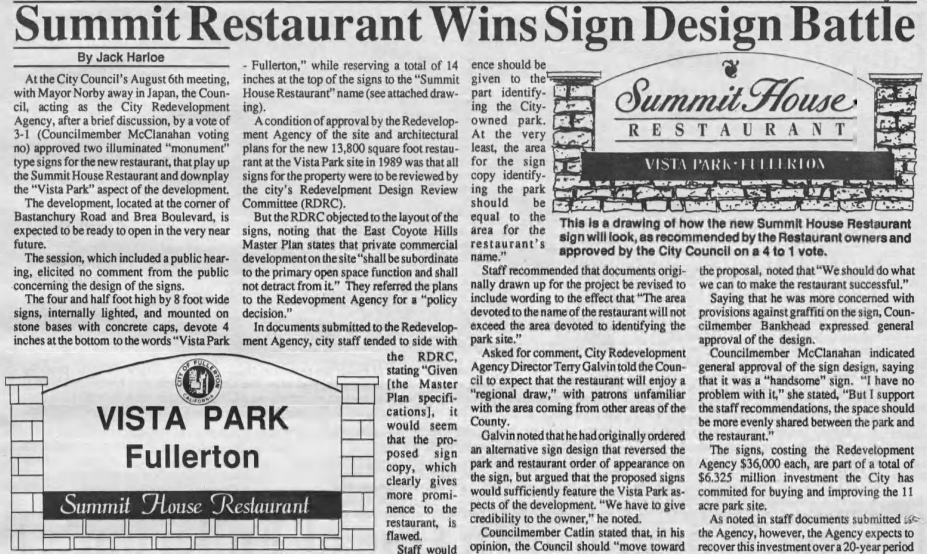
“City Council approved two illuminated ‘monument’ type signs for the new restaurant, that play up the Summit House Restaurant and downplay the ‘Vista Park’ aspect of the development,” the Observer stated.
This despite the fact that the Redevelopment Design Review Committee (RDRC) had objected to the layout of the signs, noting that “a greater presence should be given to the part identifying the City-owned park.”
The signs, which cost the City’s Redevelopment Agency $36,000 each, “were part of a total of $6.3 million investment the City committed for buying and improving the 11 acre park site.”
Culture
As I write this post, I’m struck by a common theme–local residents having to wait a really long time for things in Fullerton–things like access to Coyote Hills, or for a toxic waste dump to be cleaned up, or for the Fox Theater to re-open. In 1991, plans to refurbish and reopen the Fox were again delayed.
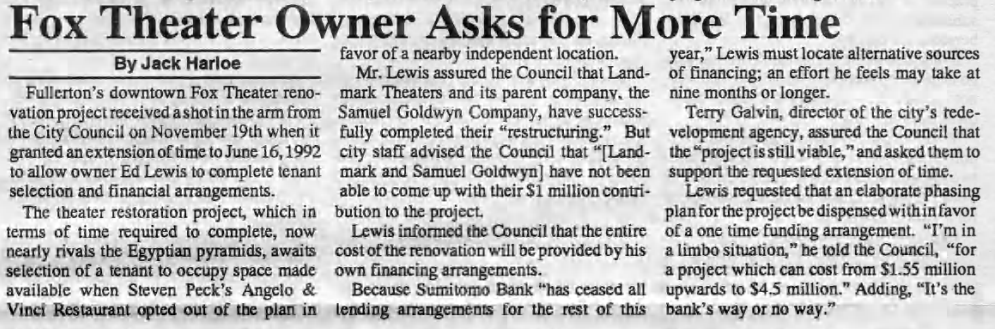
“Fullerton’s downtown Fox Theater renovation project received a shot in the arm from the City Council on November 19th when it granted an extension of time to June 16,1992 to allow owner Ed Lewis to complete tenant selection and financial arrangements,” the Observer reported.
“I’m in a limbo situation,” he told the Council, “for a project which can cost from $1.55 million upwards to $4.5 million.”
Meanwhile, the building that once housed Fullerton’s other historic theater (the Rialto) was being renovated, albeit not as a theater.
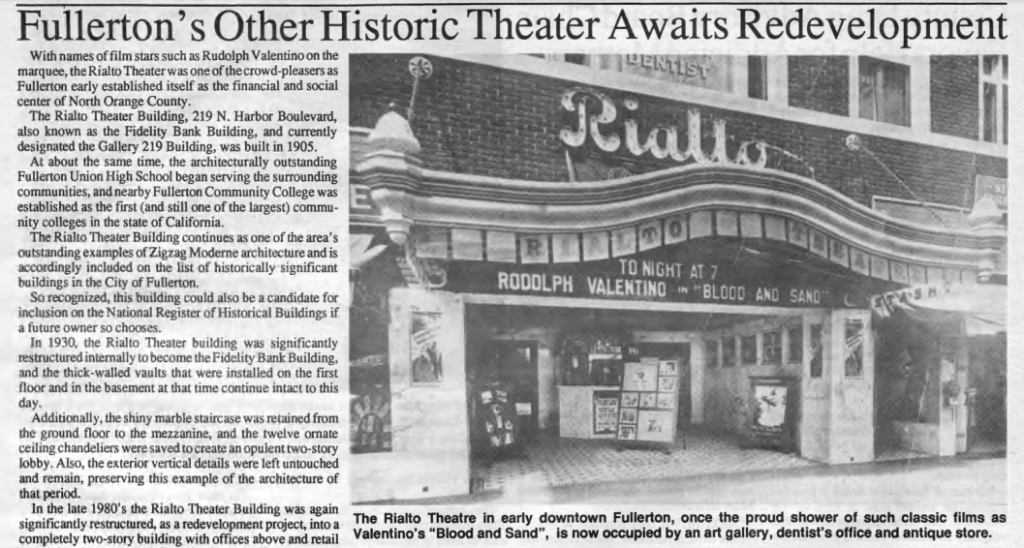
Built in 1905, the Rialto Theater Building (219 N. Harbor Boulevard) was an example of the Art Deco style Zigzag Moderne. In 1930, the Rialto Theater building was significantly restructured internally to become the Fidelity Bank Building.
In the late 1980’s the Rialto Theater Building was again remodeled, as a redevelopment project.
Another historic theater in Fullerton which remains and is (in my opinion) underutilized is the Wilshire Auditorium. In 1991, old silent films were shown there.
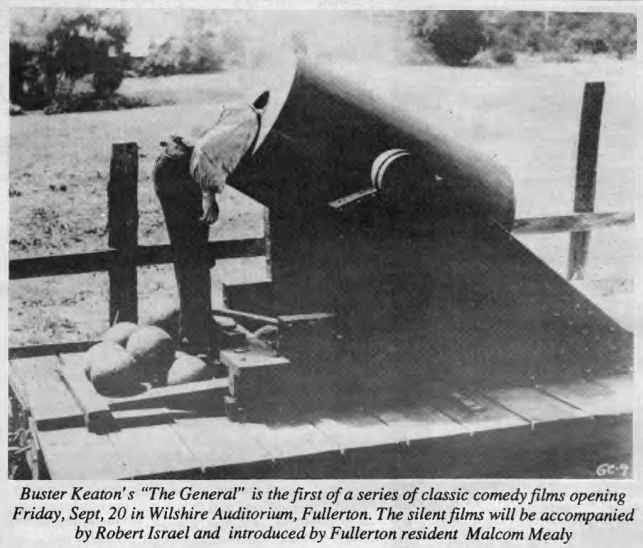
In the 1980s and early 1990s, there were a handful of art galleries downtown, such as Watermark Press Gallery.

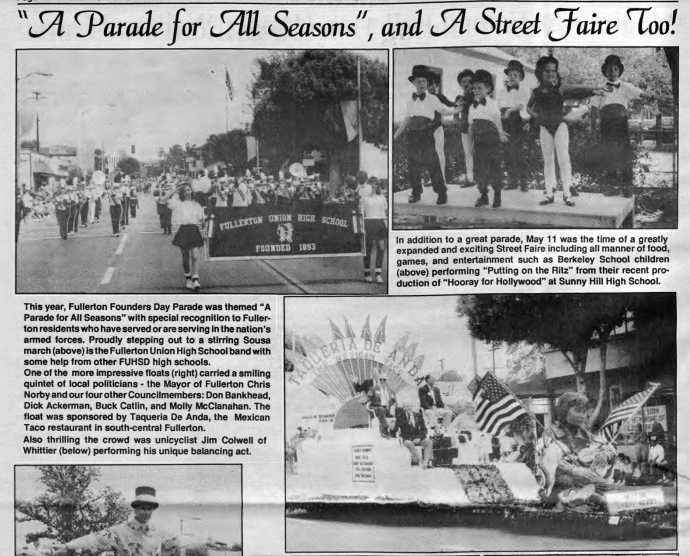
Other cultural events in 1991 included the annual “A Night in Fullerton” and the Founder’s Day Parade.
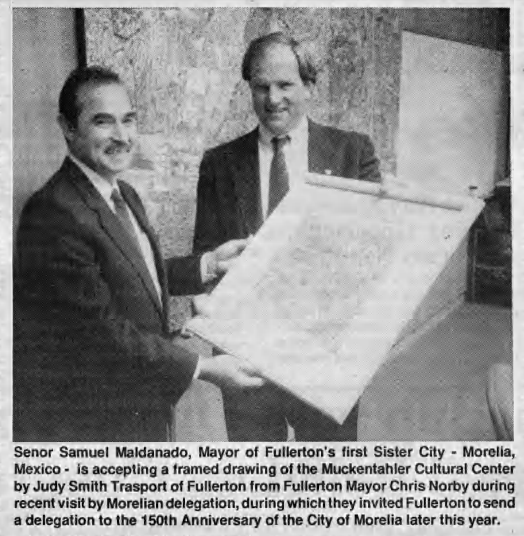
Fullerton has long had a sister city program, encouraging cultural exchange.
Transportation
In transportation news, the City continued its policy of ignoring the needs of bicyclists.
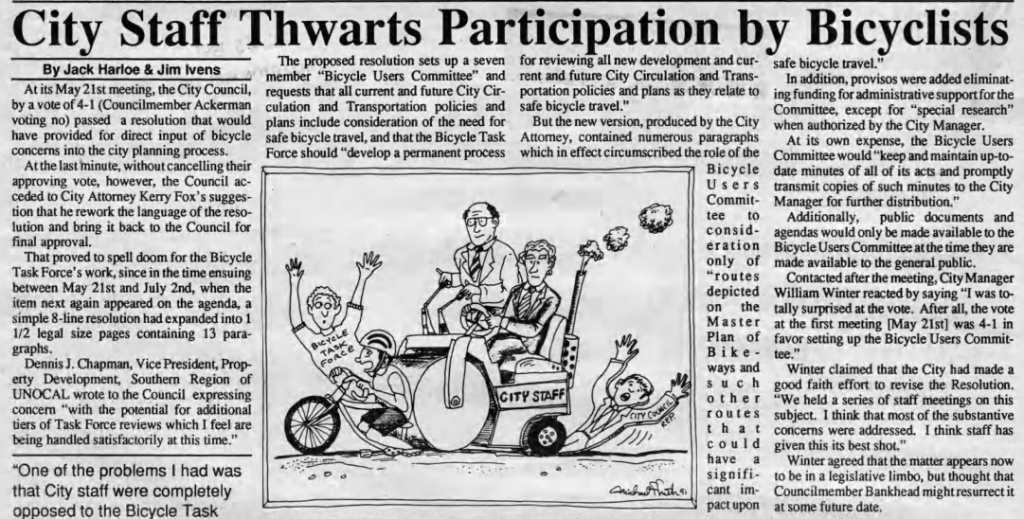
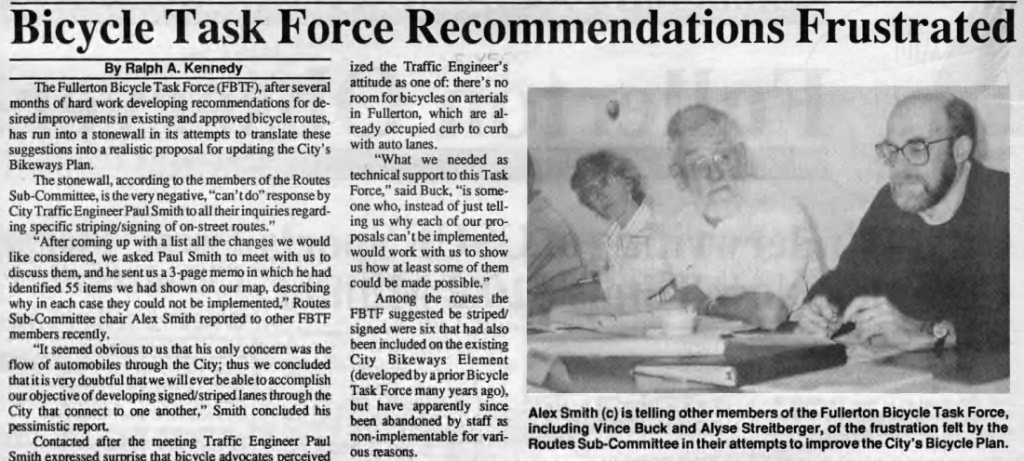
Measure M, a countywide measure for transportation improvements had passed the previous year and improvements were being proposed, many of them to benefit cars.

Protecting the Vulnerable
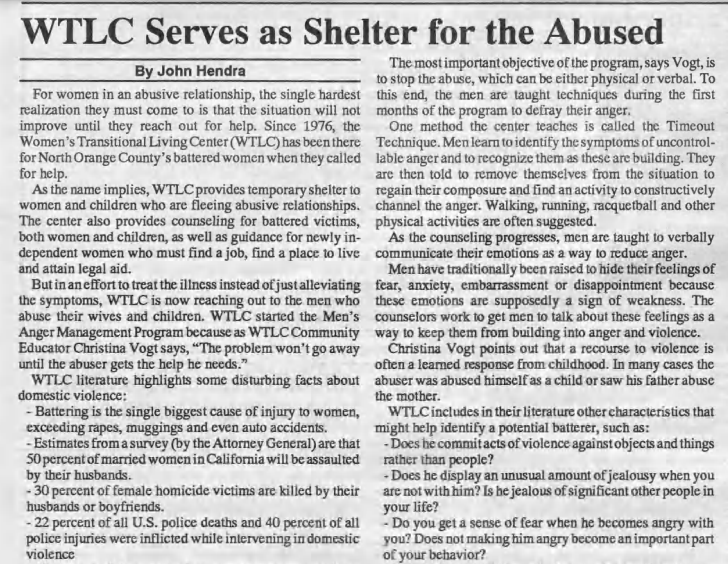
Two groups doing work to protect abused women and children in Fullerton were the Women’s Transitional Living Center (now called Radiant Futures) and Crittenton Services. Both still exist today.

National and International News
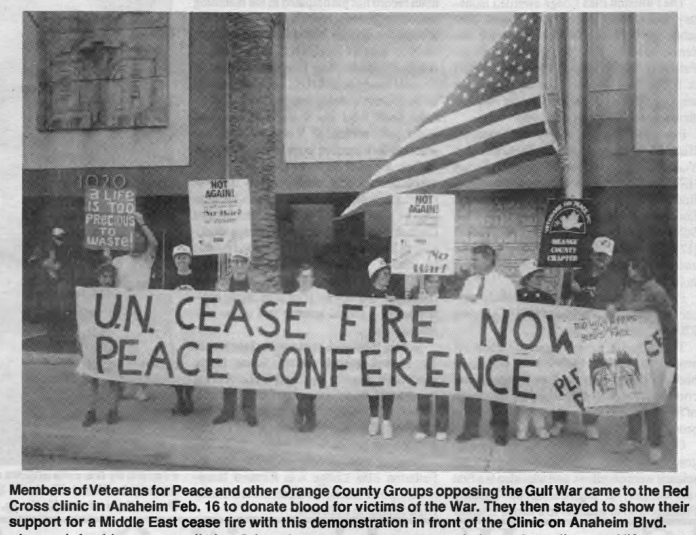
As mentioned earlier, in 1991, the US was at war with Iraq, and some protested it.
The Observer interviewed Jennifer Olmsted of Fullerton, a Ph.D. candidate in Economics at the University of California who, for her doctoral dissertation, researched the connections between education, employment and migration among Palestinians in Israeli Occupied Territories. Her insights below feel quite relevant today.
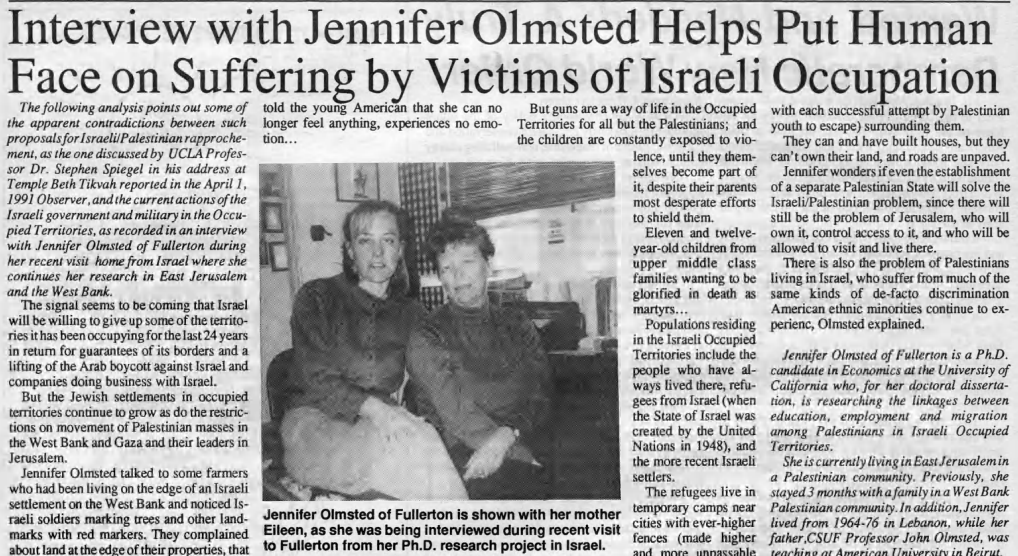
“Jewish settlements in occupied territories continue to grow as do the restrictions on movement of Palestinian masses in the West Bank and Gaza and their leaders in Jerusalem.
“Palestinian children in the Occupied West Bank and Gaza territories have been suffering closed schools for years, as the Israeli military claims that they are centers for political opposition, according to Olmsted.
“The refugees live in temporary camps near cities with ever-higher fences (made higher and more unpassable with each successful attempt by Palestinian youth to escape) surrounding them.
The world was pressuring South Africa to end its apartheid regime, as shown by a Fullerton Museum Center exhibit.

Miscellaneous
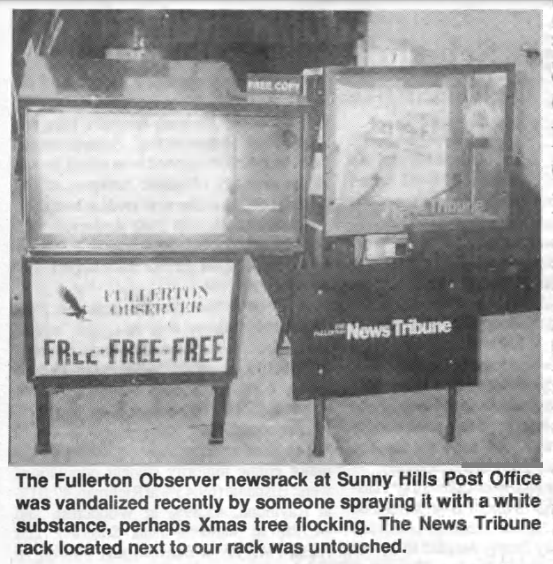
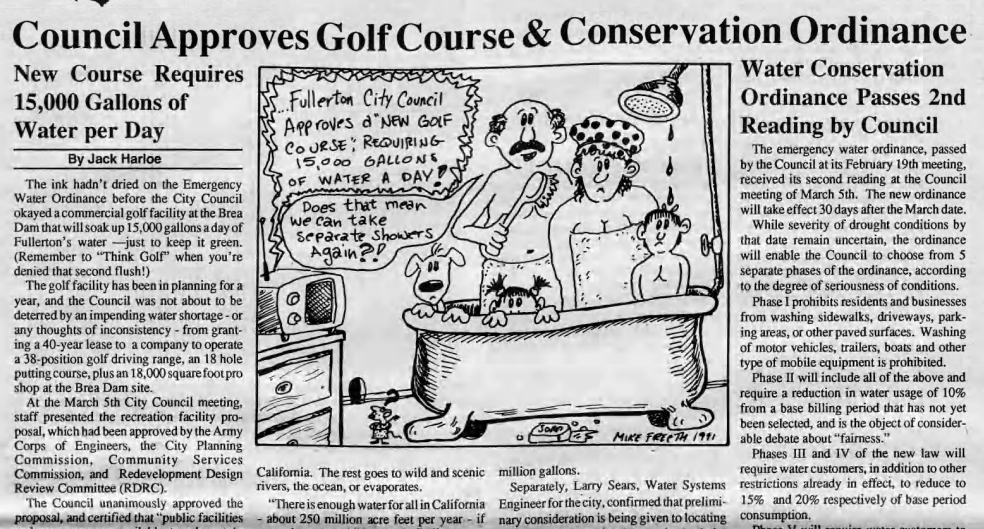
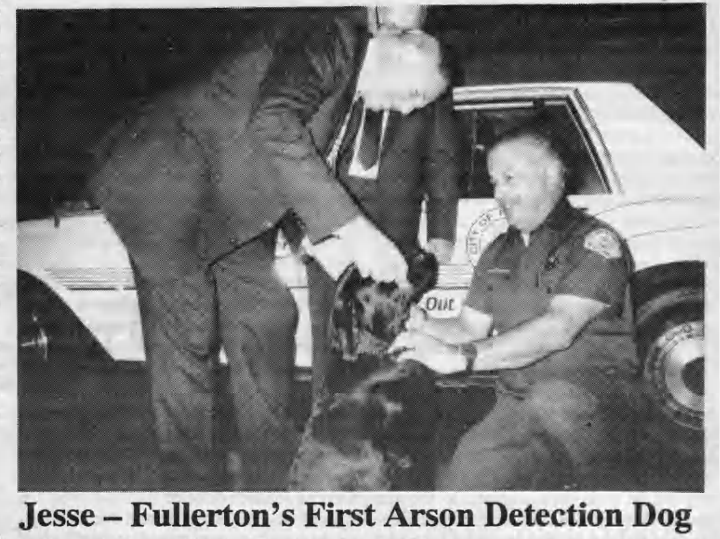
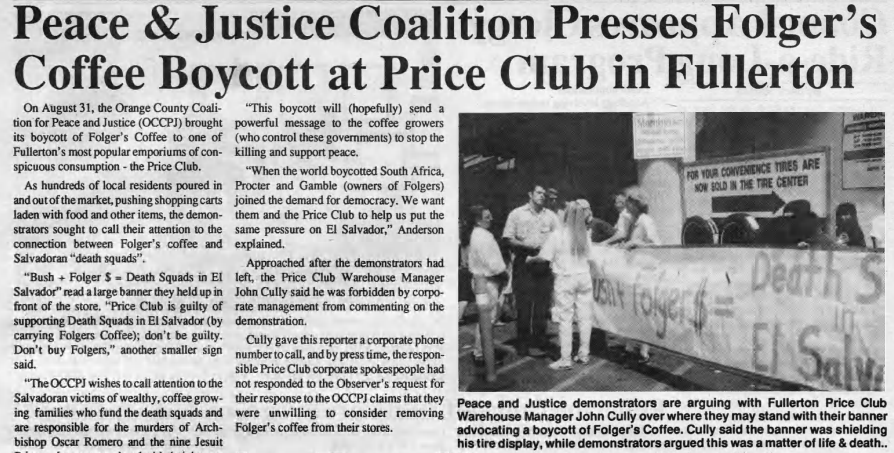
Below are a few interesting miscellaneous articles from 1991:

Observer founder and editor Ralph Kennedy had a heart attack, but he was okay.

Deaths
Candelaria (Candy) Garcia died at age 73.

An active member of her community, Garcia was President of the Latin Y-Wives (YWCA), the only club in the U.S. when it was formed, geared exclusively towards Hispanic women and their needs.
She was a member and leader in the Guadalupanas at St. Mary’s Church, with services directed towards recent immigrants.
She was a member of the Maple Action Committee (MAC), “a neighborhood organization which was principally involved in improving the relations between the residents of Fullerton’s Maple Area and the Fullerton Police Department.”
History
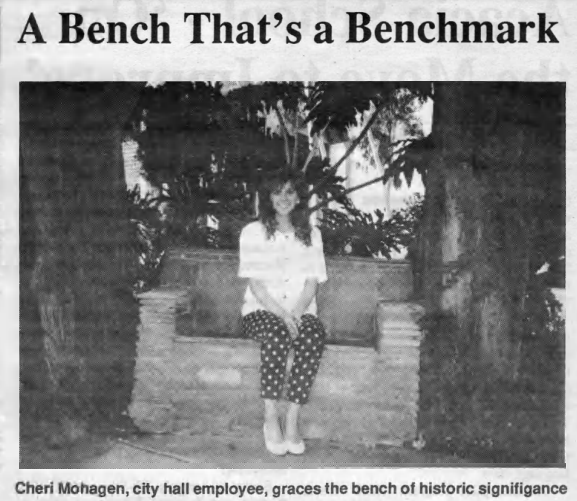
A local history article delved into the mystery of who built the little flagstone bench nestled between two Cypress trees near City Hall. Here are some excerpts:
Librarian Evelyn Cadman, who oversees the Fullerton Public Library’s collection of Fullerton historical documents, said the earliest recorded owner of the property was Herbert A. Ford, who moved his family to the area in 1884, and built the family home on the land.
In 1889, Ford opened one of the first grocery stores in town. Given the fact the trees flanking the bench were planted by the Fords, it’s plausible to assume the family also built the bench, “especially since flagstones were indigenous to this area, and were a ready source of building material,” Mrs. Cadman said.
However, no conclusive evidence has been found linking the Fords with the bench. From the Fords, the search for the builder of the bench jumps ahead 40-something years to the 1940s and a second contender—E J. Steen, a local physician whose practice was in an office building on the former Ford property.
“One long-time resident told me that Dr. Steen may have built the bench,” Mrs. Cadman said. Steen later moved his practice up on North Harbor Boulevard, where he opened the Seventh Day Adventist Hospital. That building would later became the old Fullerton Community Hospital, and is now part of Florence Crittenden Services.
It’s here that the search for the mystery bench builder ends—at least in terms of historical facts known now.
The next time you visit City Hall, stop by the little stone bench and rest a spell. Chances are, in the comforting shade of the towering Cypress trees, you’ll find your thoughts drifting to a gentler time when people made time to just sit and visit with one another, and even an unassuming little stone bench could offer a window on a rapidly changing world.

Another history article tells of local community Christmas celebrations in the 1940s and 1950s.
One of the signals for the beginning of the season was when the Fullerton merchants’ association put up the downtown decorations over Harbor Blvd and on the lamp poles, always after Thanksgiving. Then there was the announcement of the annual Christmas decoration contest. Families who wanted to participate spent lots of time on it. There were big prizes, up to $25 for the best displays.
Sometimes family or neighborhood people would don costumes and be in a pantomime manger and shepherd scene on the lawn. The schools had Christmas concerts and plays which weren’t just attended by doting grandparents and aunties. These were community events, attended by hundreds.
Fullerton Union High School and Fullerton Jr. College (now Fullerton College) had a series of four Christmas presentations, so scheduled that a kid could be in or see all four during his or her high school career. The Auditorium (now Plummer Auditorium) was packed for this show.
In the late 1940s the Fullerton Kiwanis Club began an outdoor pageant in Hillcrest Park. The Kiwanians and their family members who took part would have a small flock of sheep, a couple of burros, a cow and the like in the work area of the park above the old duck pond.
Participants worked on a schedule so the “cast” differed from one night to the next. That gave lots of people a chance to help out, but it meant a different crew of shepherds each evening.
The community loved it. The performance, complete with manger scene, was originally fairly lengthy but after a couple of years people would come from miles around to view it, and the traffic on Harbor was jammed. Some would parallel park and stay quite a while so the show was shortened by turning out the lights every so often, allowing a new audience to see it.
The same cars which stopped to see the pageant put on by the Kiwanians would then drive through the park (not closed at night) and then up or down Harvard Ave. (now Lemon St.) to see the decorated lighted trees on the west side of the street. Many of the large trees are still there. Then, as likely as not, a carload of wide-eyed children would get to see the various homes which were decorated, paying special attention to those which had won the first, second and third prizes in the Chamber of Commerce home decorating contest. You always took visiting relatives from Iowa around to see.
Stay tuned for headlines from 1992!
-
Headlines: 1990

The following is from a work-in-progress about the history of Fullerton. You can support my ongoing research and writing on Patreon.
The Fullerton Observer newspaper was formed in 1978 by Ralph and Natalie Kennedy and friends to provide a more progressive counterbalance to the more conservative Fullerton News-Tribune and Orange County Register. The Fullerton Public Library has digital archives of the Observer stretching back to 1979. Here are some top news stories from 1990.
Culture
The City of Fullerton was planning to spend around $5 million to help Fox Theater owner Edward Lewis re-open the historic theater as a “triplex cinema,” to be operated by Landmark Enterprises, showing “first run cameo films, foreign films and other artistically distinguished pictures to Fullerton.” Built in 1925, the Fox Theater closed in 1987.

But Angelos and Vinci’s owner Stephen Peck and theater owner Lewis were taking a while to reach an agreement about how the restaurant would operate during the extensive renovations.

The total cost of the project had grown to about $7.3 million, with Landmark and Lewis agreeing to spend about $1.5 million to restore lavish Italian murals in the theater, and the City spending $4.7 million in redevelopment funds “to purchase and raze homes behind the theater, relocate occupants, and build a 200-space parking structure on the space thus made available.”
Residents would have to wait longer, much longer, for the Fox to re-open. Thirty-four years later, they are still waiting.
In another loss of a local movie house, the Wilshire Theater (which showed independent and foreign films), was going to be converted into an apartment building.

On a more positive note, A Night in Fullerton was still going relatively strong.
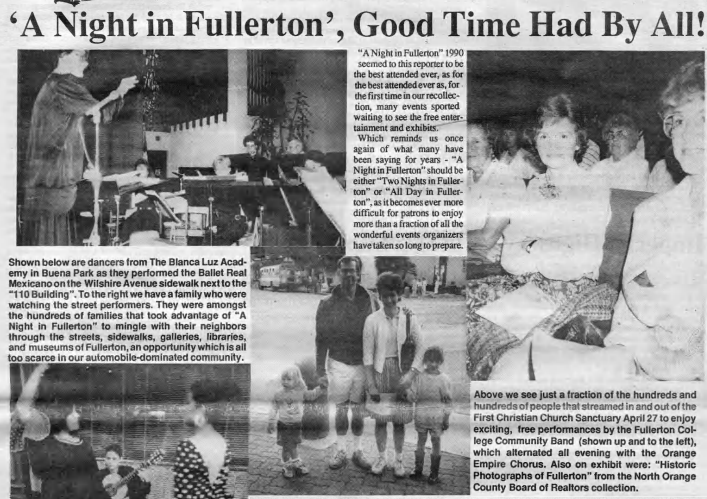
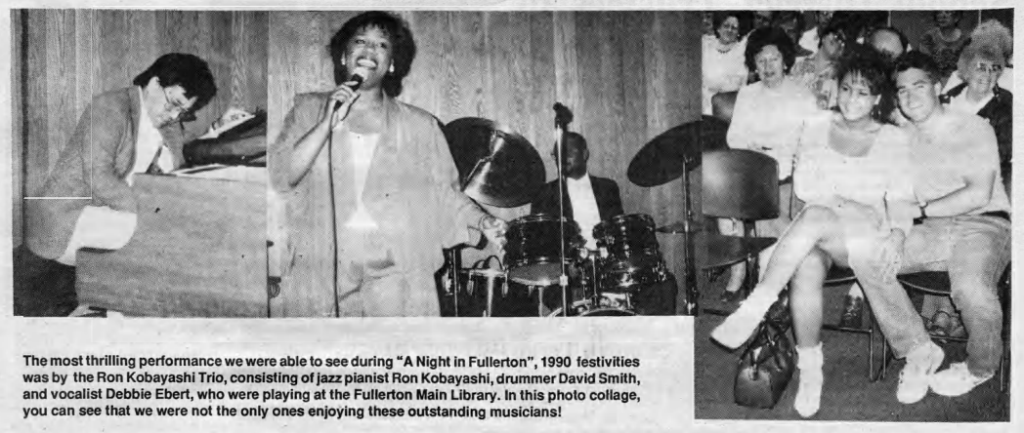
And the City celebrated its annual Founder’s Day Parade.


An art exhibit at The Muckenthaler Cultural Center drew controversy when some parents expressed their disapproval of their children seeing two art pieces on a field trip there.
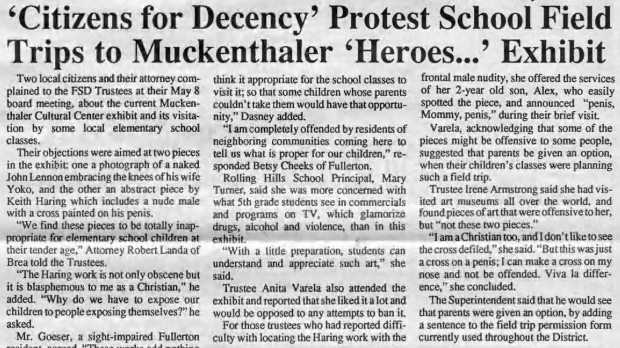
One was a photograph of a naked John Lennon embracing the knees of his wife Yoko Ono, and the other an abstract piece by Keith Haring which included a nude male with a cross painted on his penis.
“We find these pieces to be totally inappropriate for elementary school children at their tender age,” Attorney Robert Landa of Brea told the Trustees. “The Haring work is not only obscene but it is blasphemous to me as a Christian.”
For many years, from the 1970s to the 1990s, there was an annual “Lively Arts Festival” at Hillcrest Park.

Education
The debate over whether and how to re-open Maple School continued.

“It was evident that members of the Maple Area are split on whether or not reopening Maple School as a pre-school through 6th grade program is the right thing to do,” the Observer reported. “Several longtime residents in the Maple neighborhood expressed their fears that a reopened Maple School would put their grandchildren right back where their children had been 20 years ago when the Fullerton School District closed the school for being almost totally segregated.”
A Maple Task Force was created to study the issue and make recommendations. Ultimately, their idea was to reopen Maple as a “magnet school” offering special programs that would draw students from across the district, so as to prevent the school being majority Latino and thus de facto segregated.
However, an Observer editorial stated, “As much as we would like to believe this, we are not aware of any examples where magnet schools located in minority neighborhoods have been successful in drawing enough Anglo student to achieve an integrated student body.
The school district hired a professional consultant to help develop a Maple Reopening Plan
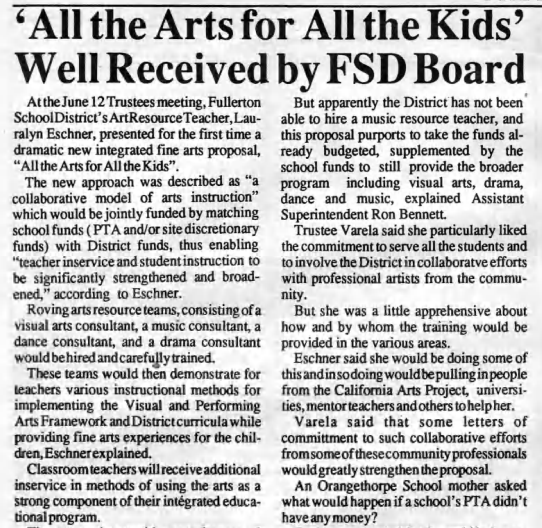
All the Arts for All the Kids, a popular and innovate program to provide arts instruction in local schools, was first proposed in 1990 by its long time director Lauralyn Eschner.
Following the retirement of Jewel Plummer Cobb, Milton Gordon began his tenure as president of CSUF.


Fullerton City Librarian Carolyn Johnson, who worked for the library for nearly 50 years, retired.

“Carolyn Johnson started work in the old Fullerton Public Library on Pomona Avenue, now the Fullerton Museum Center,” the Observer stated. “Then, Fullerton was a community of 11,000 persons; as Johnson nears retirement, the population has grown to 112,000. In 1959, Johnson was named coordinator of children’s services for the library, and was appointed City Librarian in 1981…Of her many accomplishments, Johnson takes particular pride in her role in designing the Children’s Room of the Main Library, which was built in 1973.”
To replace her, Al Milo was promoted.

McColl Toxic Dump…The Saga Continues
In the ongoing saga of the McColl Toxic Waste Superfund Site, the EPA announced that groundwater sampling from monitoring wells near the site found the toxic chemical tetrahydrothiophene (THT). The EPA concluded that the THT was moving through the soils into the groundwater from waste at the McColl site.
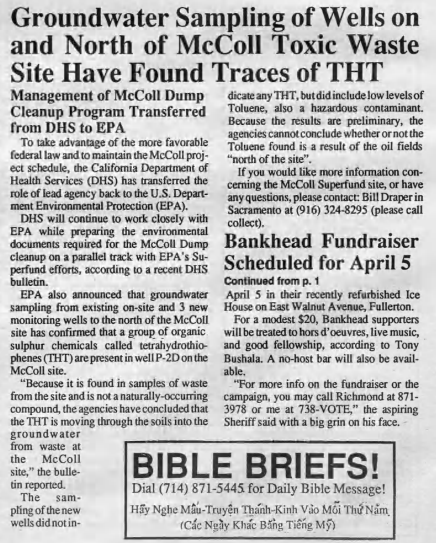
The solution proposed by the oil companies responsible for the waste was to “cap” and monitor the site, leaving the waste buried there indefinitely–with some walls around (but not underneath) the 200,000 cubic yards of sludge.
Both the EPA and the local community rejected this plan.
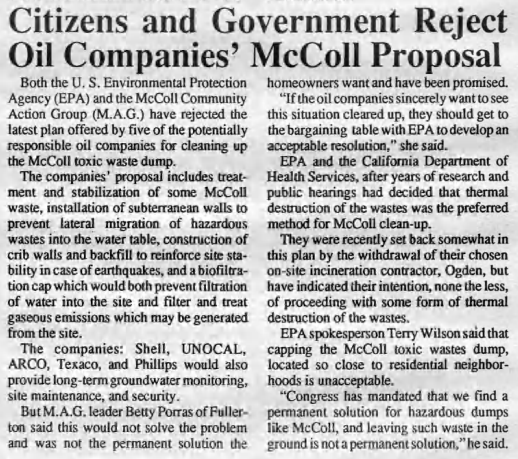
EPA spokesperson Terry Wilson said that capping the McColl toxic wastes dump was unacceptable. “Congress has mandated that we find a permanent solution for hazardous dumps like McColl, and leaving such waste in the ground is not a permanent solution,” he said.
The preferred plan by the EPA and the California Department of Health Services, after years of research and public hearings, was to burn the waste either on-site or elsewhere. These plans, unfortunately, were delayed when the company doing burn tests quit the job.
Meanwhile, the oil companies were doing their best to win over public opinion to their preferred “solution” by holding neighborhood meetings.
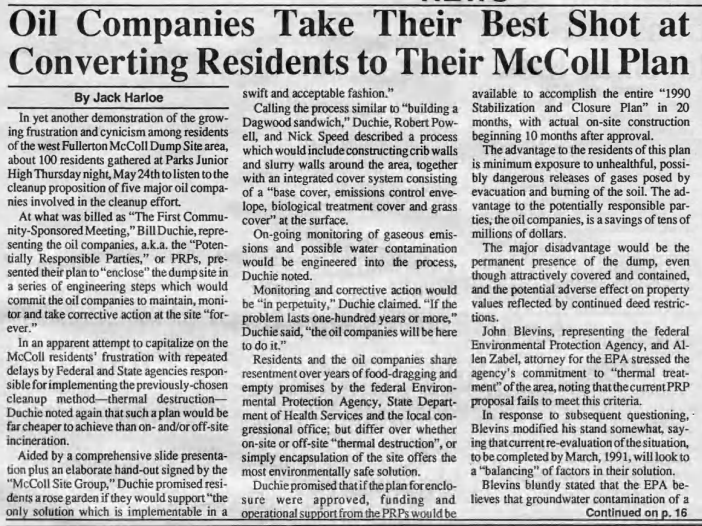
“In an apparent attempt to capitalize on the McColl residents’ frustration with repeated delays by Federal and State agencies responsible for implementing the previously-chosen cleanup method—thermal destruction— Bill Duchie [representing the oil companies] noted again that such a plan [capping the site] would be far cheaper to achieve than on- and/or off-site incineration,” the Observer reported.
“In a free-form and lively discussion following testimony of the ‘experts,’ residents of the McColl area appeared divided between the permanent enclosure plan and thermal treatment,” the Observer stated. “Distrust of both EPA and the oil companies was voiced, with an underlying tone of despair among residents that, after years of fighting, they appear no closer to a solution now than when the problem first became apparent.”
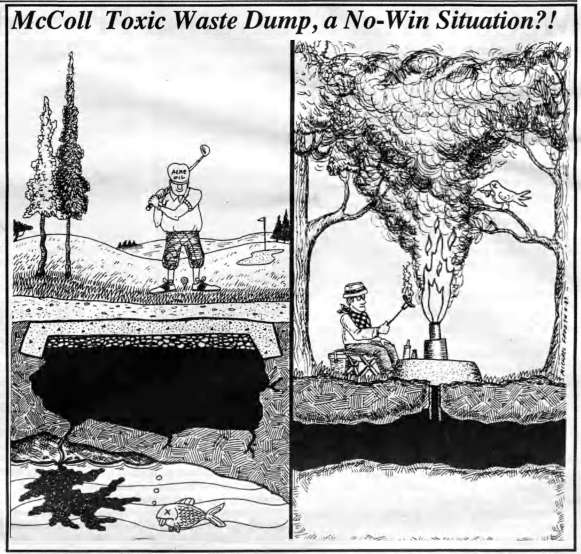
Later in the year, the EPA and DHS invited to public to a “Visitor’s Day” at the Superfund site to learn about a trial excavation (removal) of the waste.

To Spray or not to Spray?
As some Fullertonians worried about toxic chemicals underground, others worried about toxic chemicals being sprayed from the sky–specifically the pesticide malathion, used by government agencies to control the fruit fly population.

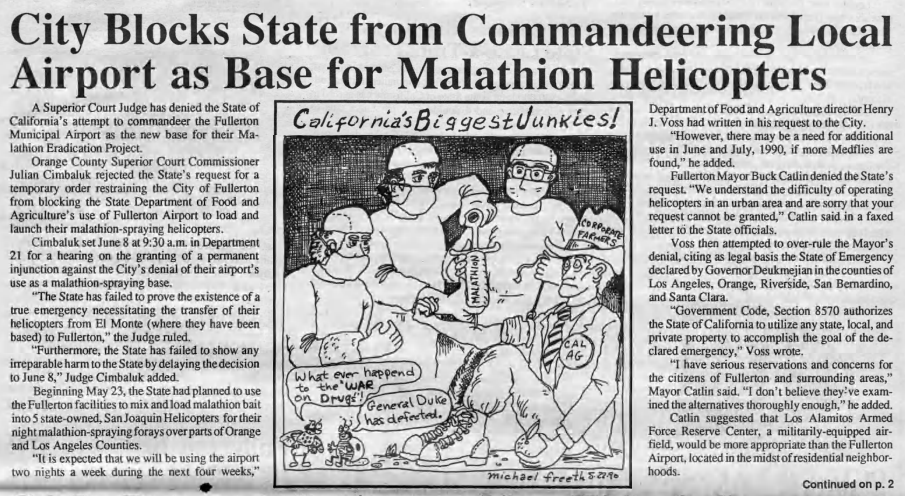
A number of articles, letters, and cartoons appeared in the Observer, mostly protesting the spraying of malathion, citing negative human health effects.

State Senator John Seymour wrote a couple of letters to the Observer, defending the spraying of malathion.
“I have not found any concrete evidence which leads me to believe that the spraying of Malathion in the dosages proposed presents a health risk to our citizens,” Seymour wrote. “And, since this method of control has proved to be most effective in eradicating the Med Fly, I am comfortable with the decision that the Department of Food and Agriculture has made to stop the spread of this pest which has the potential of inflicting serious economic and environmental damage within our county and throughout the state.”
Facing concerned residents, City Council held a hearing on malathion spraying, and ultimately voted to prevent the state from using our local airport for malathion helicopters.
Housing & Homelessness
Today, California and the nation are facing an undeniable housing crisis. For long-time homeowners with low or no mortgages, it may be easy to ignore the struggle of renters or those trying to get into the market. In 2024, the median home price in Orange County is $1.1 million. This means you have to make $349,000 a year to afford a home. The median income in Orange County is about $45,000.
How did we get here? What is the cause? Put simply, as with all commodities, price is governed by laws of supply and demand. California since the 1970s has experienced an intensifying housing shortage, as fewer housing units have been built than people entering the state, thus driving up cost. Simple.
Throughout most of its existence, the Fullerton City Council was dominated by conservatives who consistently refused to support affordable housing.

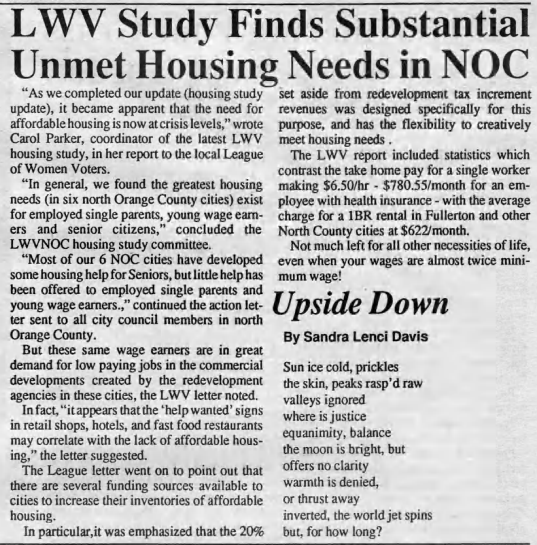
But liberals were also to blame. If high housing costs are created by a shortage of housing, the most obvious solution is to build more housing. In Fullerton, a standard liberal position is to support affordable (i.e. government subsidized) housing, while generally opposing market-rate, private sector housing, despite the fact that the vast majority of people do not live in “affordable” housing.
One example in 1990 was the local opposition to a development on East Coyote Hills of 112 condominium/townhouses and 111 single family homes.
Former mayor Bob Ward, an early advocate for “open space” such as West Coyote Hills, opposed the project, saying that the developer had “made no real attempt to meet the Greenbelt Concept of the General Plan.”
Facing such opposition, the Planning Commission sent the project back to the developer with the instruction that he reduce the number of housing units.

Ultimately, the conservative majority city council approved the project, but not before much opposition from neighbors who wanted fewer housing units built.
An editorial in the Observer stated, “Most of those who testified at the March 6th Council meeting opposed the development as being too crowded, too dense, and too severe in its grading.”
Both liberals and conservatives are also guilty of opposing new housing on the grounds that it would disrupt the “character” of their neighborhoods.
This situation is, of course, not unique to Fullerton. It is the story of the escalating housing crisis in California and the United States.
Meanwhile, Fullerton’s homeless shelter, run by Fullerton Interfaith Emergency Services (now Pathways of Hope) expanded to try to help the increasing unhoused population.
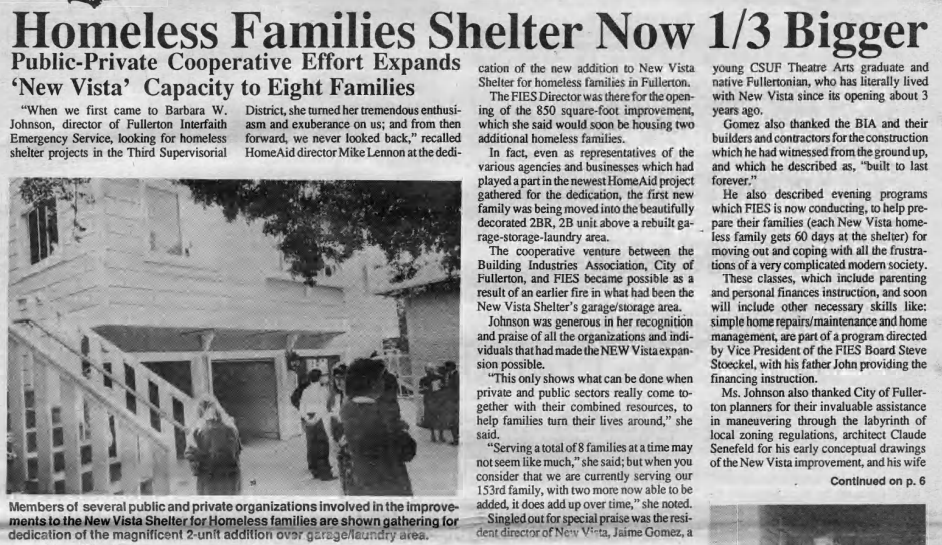
“Serving a total of 8 families at a time may not seem like much,” Barbara Johnson, director of FIES said. “But when you consider that we are currently serving our 153rd family, with two more now able to be added, it does add up over time.”
Another new program was created called Project HOPE, which aimed to help provide jobs for the homeless. Interestingly, the city of Fullerton recently created a separate program called Project HOPE.

Transportation
Fullerton established a Bicycle Task Force to study and advocate for improved bicycle accessibility.

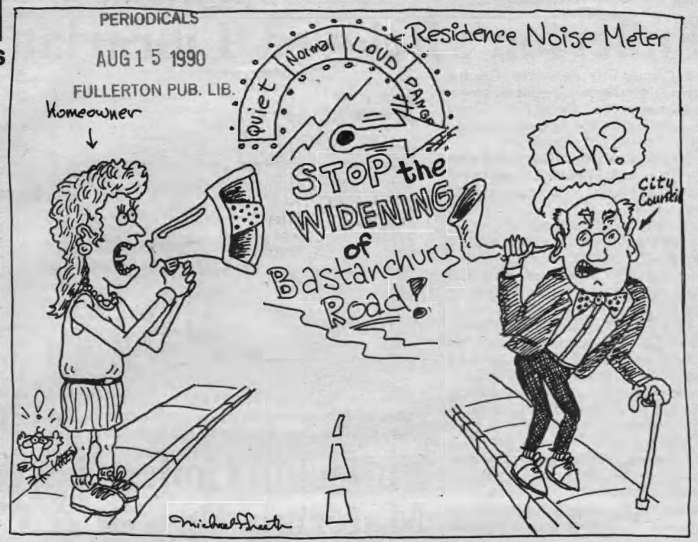
Local residents attempted unsuccessfully to stop the widening of Bastanchury Road.
In public transit news, there was interest in establishing a local monorail system. This, of course, never happened.

In 1990, commuter train service to Los Angeles was established. This would eventually become the Metrolink.
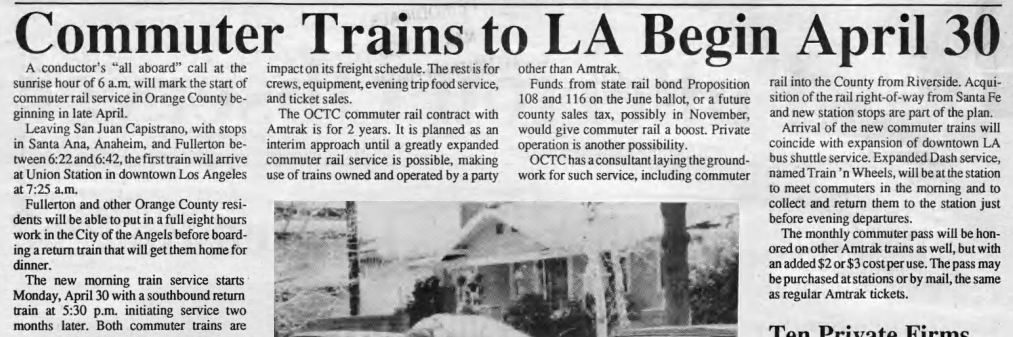
The city was in the process of improving its train platform and creating a pedestrian overpass, which was ultimately built.
Showdown at the City Council Corral
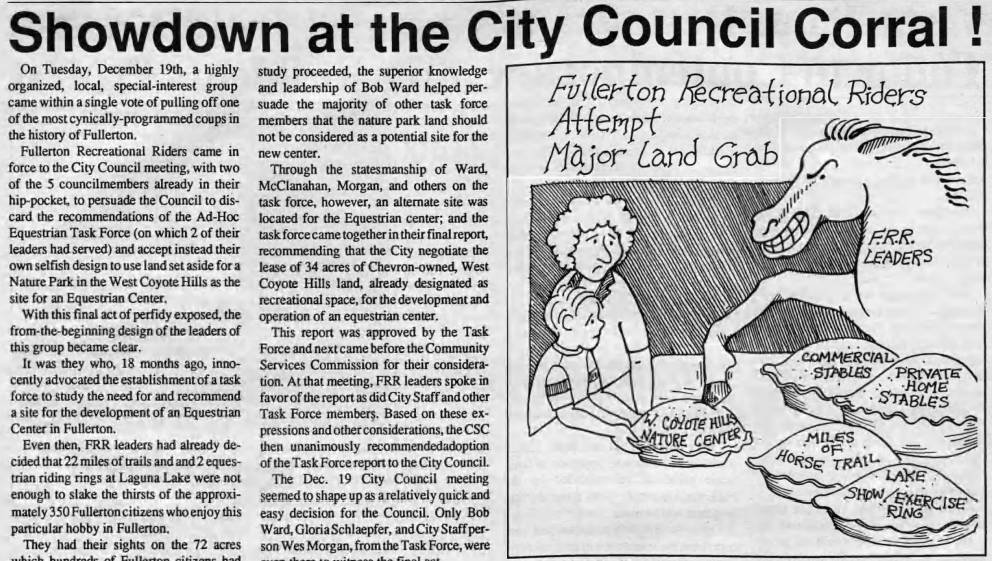
The Fullerton Recreational Riders attempted to take over City-owned land in Coyote Hills that is now part of the Robert E. Ward Nature Preserve, facing off against local environmentalists who wanted the land as an educational open space. Ultimately, the riders lost; however, they still have quite a good equestrian facility across Euclid near Laguna Lake.
Downtown
Rather than using funds to build needed affordable housing, the City of Fullerton’s Redevelopment Agency (which no longer exists) allocated funds to help replace the 100-year old building at the southeast corner of Harbor and Commonwealth that was destroyed by a fire in 1989.

The Council, in its alternate role of City Redevelopment Agency, authorized the City to execute an exclusive 90-day agreement with the Stein/Nicholas family, owners of the property, and the developer, the J. Ray Construction Company.
Strangely, a proliferation of antique businesses downtown was seen as something that would “spark rebirth.” I’m not knocking antique stores, but they are not exactly signs of economic revitalization.

Racism/Bigotry
Facing a recent spate of hate crimes, the FPC began to track and investigate these incidents.


These hate crimes included “the distribution and posting of anti-Semitic and racist literature, and the harassing, threatening phone calls, which seem to be the principal tactic of groups variously referring to themselves as skinheads, White Aryan Resistance, etc.”
“To get a handle on such crimes and groups, the FPD has for about the last year been assigning a special “hate crime” code to any reported crime that could conceivably have any connection to such behavior,” the Observer reported.
Law Enforcement
Recently-elected City Councilmember Don Bankhead, a former Fullerton Police Captain, planned to run for Orange County sheriff, after a scandal surrounding the most recent sheriff Brad Gates, and the publication of an expose book entitled The Twisted Badge, about the negative influence of politics in law enforcement.
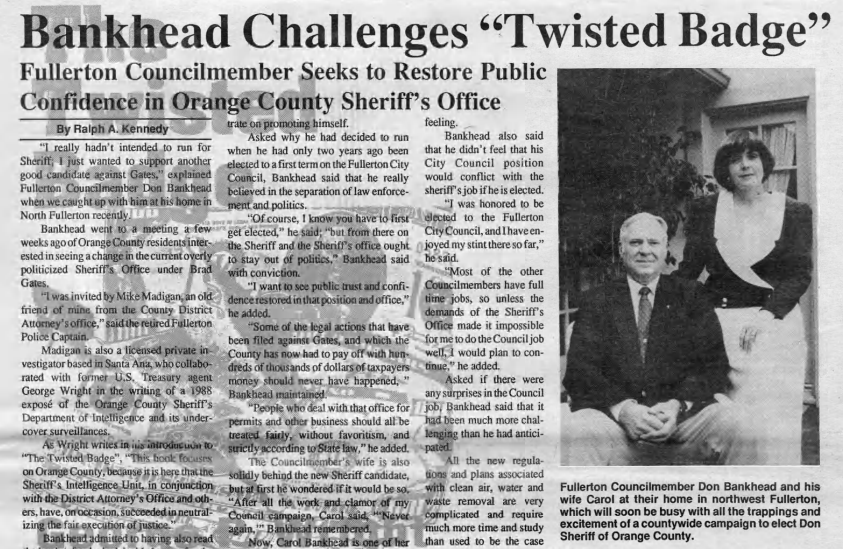
“Some of the legal actions that have been filed against Gates, and which the County has now had to pay off with hundreds of thousands of dollars of taxpayers money should never have happened,” Bankhead said.
Bankhead was hoping to raise money for his campaign at an upcoming “fundraiser the Bushala Brothers Inc. of Fullerton have scheduled for April 5 in their recently refurbished Ice House on East Walnut Avenue, Fullerton. For a modest $20, Bankhead supporters will be treated to hors d’oeuvres, live music, and good fellowship, according to Tony Bushala.”
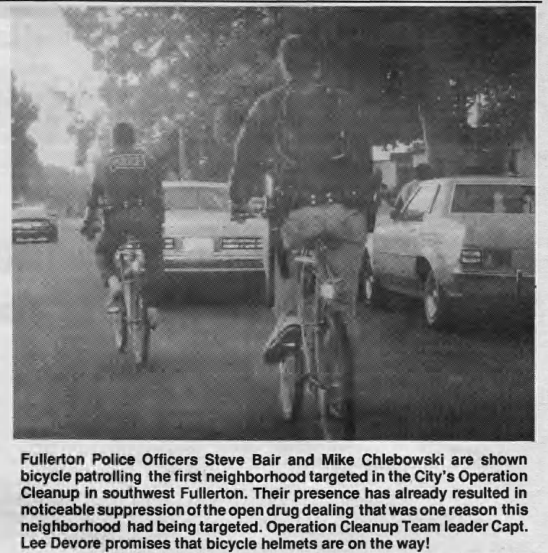
In 1990, Fullerton had bike cops.
Miscellaneous
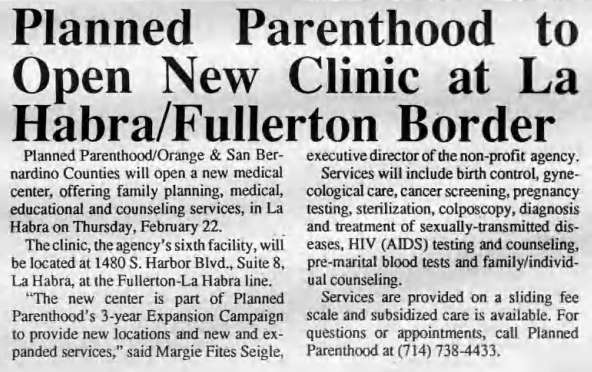
Here are some miscellaneous clippings from the Observer in 1990:



National and International News
Farmworker labor leader Cesar Chavez came to CSUF to encourage consumers to boycott table grapes until growers stopped using certain pesticides that were harmful to farm workers.

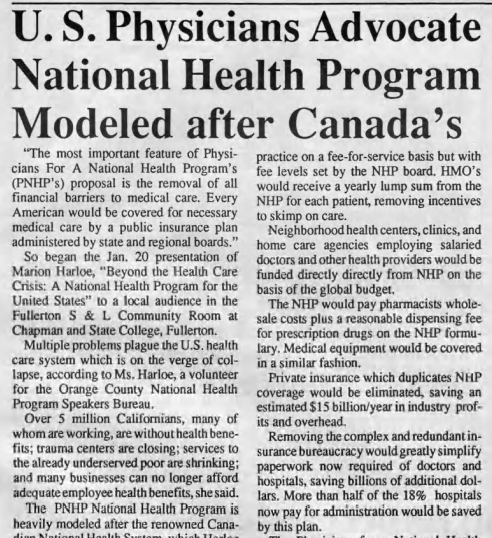
Some American doctors were advocating for universal health care in America.
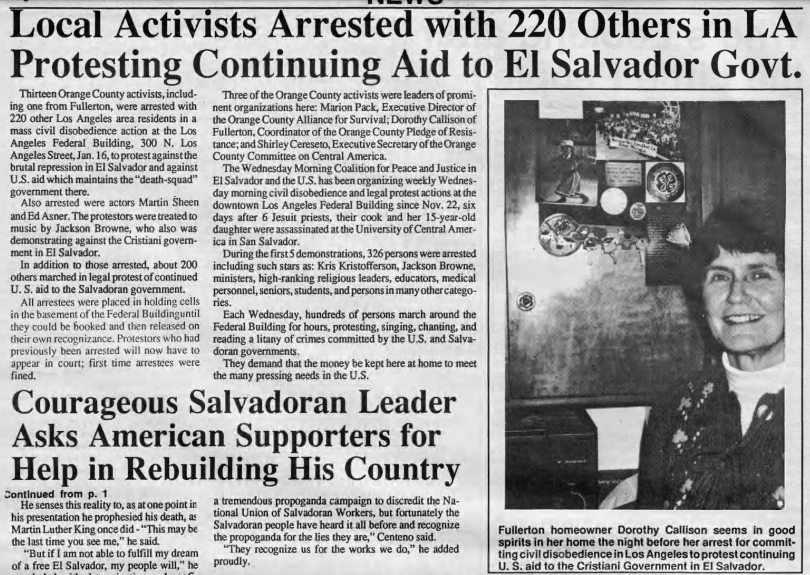
Locals protested the US government’s support of the brutal regime in El Salvador.
By the middle of 1990, the first phase of the Persian Gulf War (Operation Desert Shield) was underway. As with the Iraq War in 2003, the Persian Gulf War was seen by some as being about protecting the interests of US oil companies (not democracy), as the graphic below suggests.

Deaths
And here are some notable local deaths from 1990:

Dorothy Anderson died at age 69.
“Dorothy Anderson’s life as an activist for peace and justice began in 1964 when she became a member of ‘Another Mother for Peace’- their son Donald, was in the Air Force in Vietnam,” the Observer stated. “She followed that by getting heavily involved in her first ever political campaign – McGovern for President – in 1968…Then came her north Orange County leadership of Common Cause and most recently her charter involvement in the formation of the ‘Beyond War’ movement in 1983.”
In addition to its large conservative evangelical churches like EV Free, Fullerton has also had a number of mainline protestant churches that were much more politically liberal, such as Dorothy’s church, the Congregational Church.
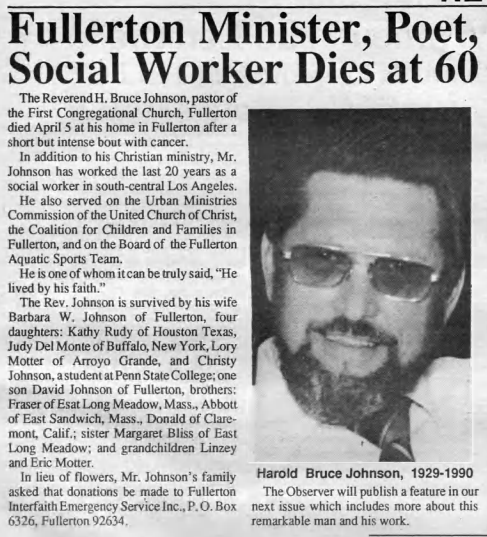
The Reverend H. Bruce Johnson, pastor of the First Congregational Church, Fullerton died.
“In addition to his Christian ministry, Mr. Johnson has worked the last 20 years as a social worker in south-central Los Angeles. He also served on the Urban Ministries Commission of the United Church of Christ, the Coalition for Children and Families in Fullerton, and on the Board of the Fullerton Aquatic Sports Team,” the Observer stated.
Johnson was survived by his wife Barbara W. Johnson, who was involved with Fullerton Interfaith Emergency Services, which ran the city’s homeless shelter.

Dr. Russell D. Parks died at age 82. Dr. Parks, after whom Parks Junior High School was named. He first served the Fullerton School District in 1938, when he was hired as the principal of Maple School.
He left the FSD in 1944 to become Asst. Superintendent of the Orange County Department of Education. When he returned to the FSD in 1945, he then served 25 years as its Superintendent.

Fullerton Police Department undercover narcotic detective Tommy De La Rosa was fatally wounded during an undercover narcotic transaction in Downey.
There is now a street in Fullerton named after De La Rosa.
Stay tuned for headlines from 1991!
-
Headlines: 1989
The following is from a work-in-progress about the history of Fullerton. You can support my ongoing research and writing on Patreon.
The Fullerton Observer newspaper was formed in 1978 by Ralph and Natalie Kennedy and friends to provide a more progressive counterbalance to the more conservative Fullerton News-Tribune and Orange County Register. The Fullerton Public Library has digital archives of the Observer stretching back to 1979. Here are some top news stories from 1989.
Local Politics
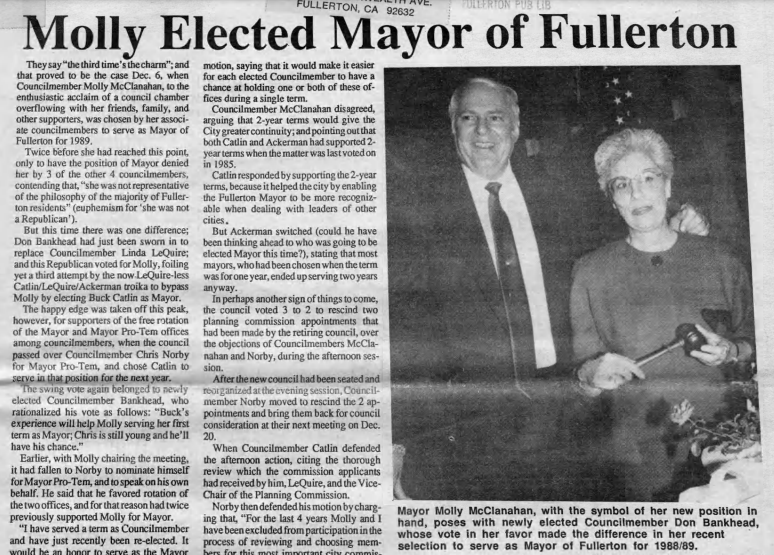
Molly McClanahan, the lone liberal on Council, was finally chosen as mayor.
Housing
Fullerton City Council’s Redevelopment Agency had a very poor track record of supporting affordable housing.
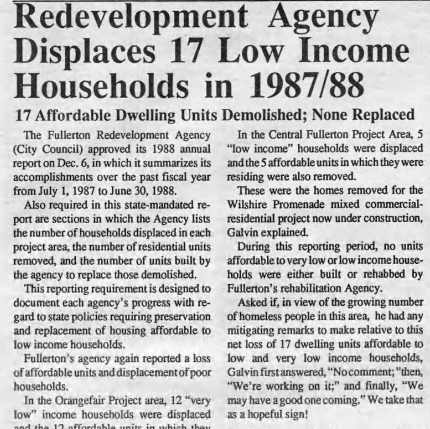
“Fullerton’s agency reported a loss of affordable units and displacement of 17 poor households,” the Observer stated. “During this reporting period, no units affordable to very low or low income households were either built or rehabbed by the agency.”
Fullerton’s Housing Element was out of compliance with state standards, particularly regarding affordable housing.

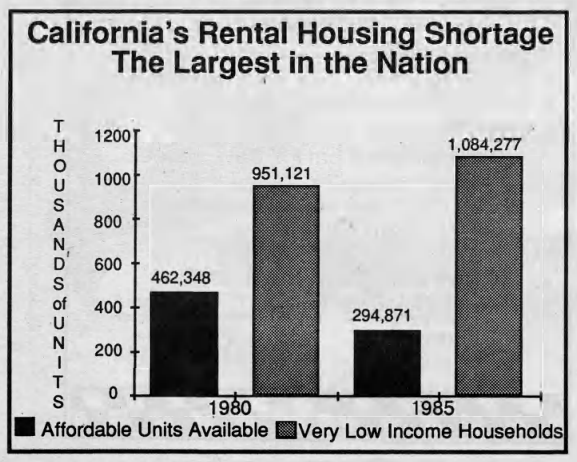
Meanwhile, California’s affordable housing shortage was getting worse.
Cities’ lack of affordable housing directly led to an increase in homelessness.
“A May 1987 survey of 444 California cities, conducted by the League of California Cities, found that over the past five years the number of homeless increased in 49% of our cities,” the Observer stated. “Homelessness is the most visible and pernicious sign of a larger affordable housing crisis that makes it difficult for the elderly, the handicapped, young families and many other Californians to obtain decent, affordable housing.”
This low prioritization of affordable housing was also happening at the national level during the Reagan administration.
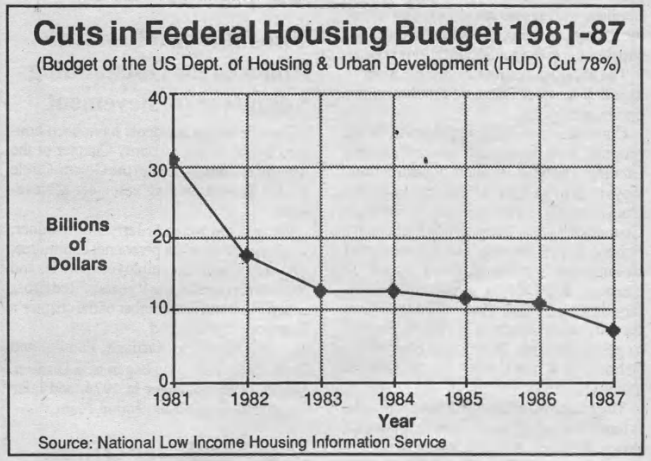
“In six years, 1981-87, the federal Department of Housing and Urban Development (HUD), previously a key player in providing affordable housing, sustained budget cuts totaling over 78%,” the Observer stated. “The number of new federally assisted units has plummeted from above 200,000 per year to about 25,000, and annual appropriations for HUD have shrunk from 4 percent of the total federal budget to less than .01 percent for the current fiscal year.”
Instead of providing shelter and affordable housing, county officials responded to a homeless encampment along the Santa Ana River trail by making the area “uninhabitable with large, heavy rocks on the ground and space under the bridge…closed with cement.”
There were an estimated 10,000 homeless people in Orange County – but only about 600 shelter beds.
Meanwhile, local nonprofit Fullerton Interfaith Emergency Services (now Pathways of Hope) expanded their shelter to help meet a fraction of the need.
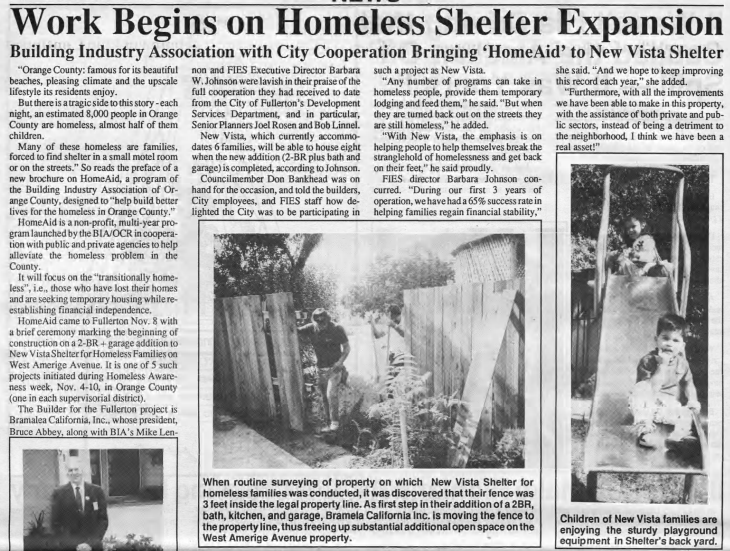
The National Guard Armory in West Fullerton also served as a temporary shelter during cold weather months. It was staffed by local volunteers.

Also, Council approved (but did not fund) a shelter for up to 20 homeless, mentally ill women in downtown Fullerton, to be run by Western Youth Services.
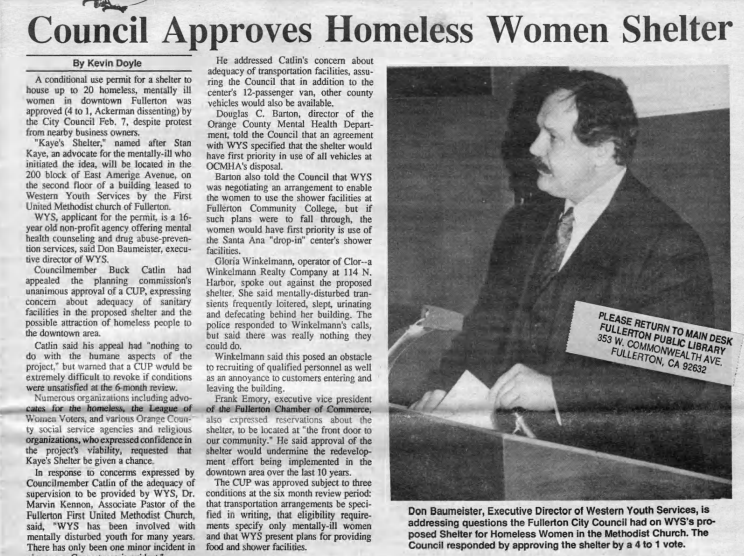
Councilmember Dick Ackerman, along with the local Chamber of Commerce were against allowing the shelter.
City Council also assisted the Southern California College of Optometry and a developer in their attempts to obtain low cost financing from the County for an East Fullerton apartment project, which will reserve 20% of its units for “very-low” income households.

And a young developer named Tony Bushala, who would later become a major player in local politics, was seeking approval of a major multi-family residential development called Fullerton Towne Terrace on the 100/200 blocks of East Truslow.

Bushala was asking the City/Redevelopment Agency for an investment in the project of about $2.5 million.
The Bushalas claimed that they were planning to include between 10 and 20% of the apartments at rents which are affordable to very-low income households. Stay tuned for how that all worked out.
Bushala also made a deal to renovate the old Train Station, adding a cafe and other amenities, including “a bronze statue of George H. Fullerton.” The renovation happened, but where is the bronze statue, Tony?!
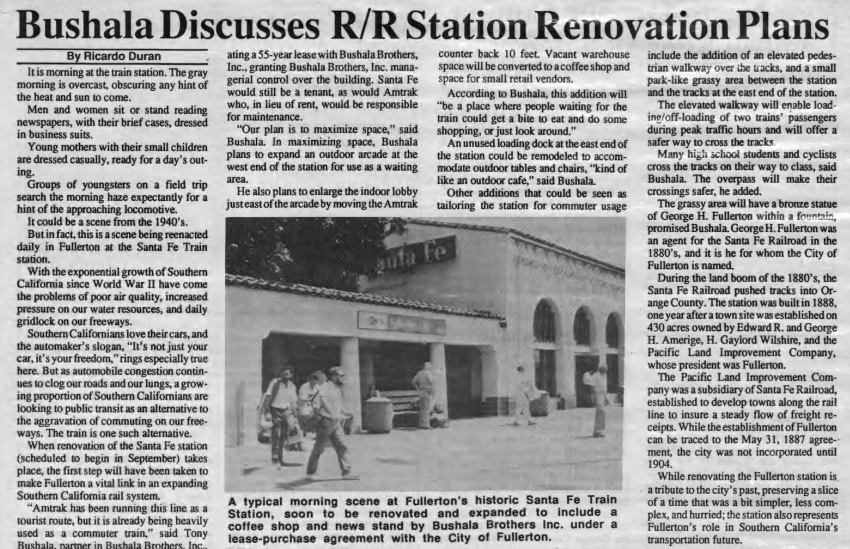
Redevelopment
Rather than use redevelopment funds on affordable housing, the conservative city council majority preferred to use these funds on other things, like a massive sports complex at Cal State Fullerton.

Fullerton Rejects Welfare Office
Continuing their denial of poor people in their midst, city planners and council also denied a permit for a county welfare office to locate in Fullerton.

“Mr. Ralph Nielsen…expressed the well-known not-in-my-backyard [NIMBY] sentiment when he said, ‘This is a great use but the wrong place,’” the Observer stated.
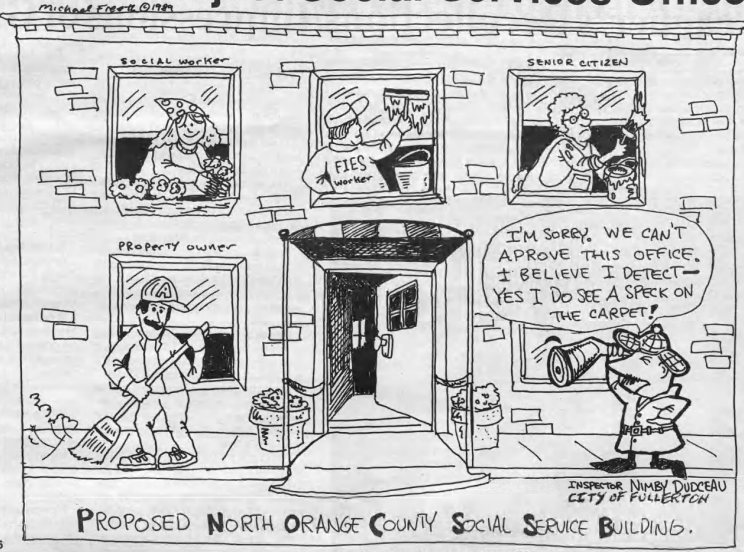
The Ongoing McColl Toxic Waste Dump Saga
On the subject of unwanted things, we turn now to the ongoing saga of the toxic McColl Superfund Dump site in West Fullerton. This was an area next to what is now Ralph Clark Park where oil companies had dumped their waste in the 1940s–81 Olympic-sized swimming pools of toxic waste. The area had been declared a Superfund site. Federal and state regulators were working with the oil companies and the community to come up with the best solution to protect local health, groundwater, etc. Unfortunately, this process was very slow, taking years to complete.
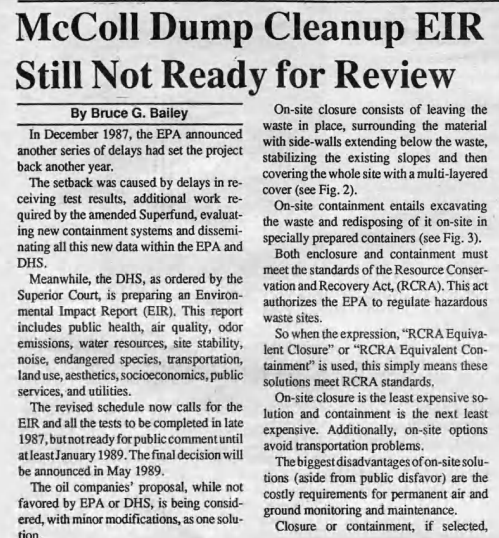
Proposed solutions for the McColl waste were either to cover it up or to destroy it (either on site or somewhere else).

EPA and DHS announced that they favored burning the toxic waste. This, however, posed additional problems like: Could the stuff be safely burned? Would the smoke create another toxic problem for the neighborhood? As usual, more tests needed to be done.
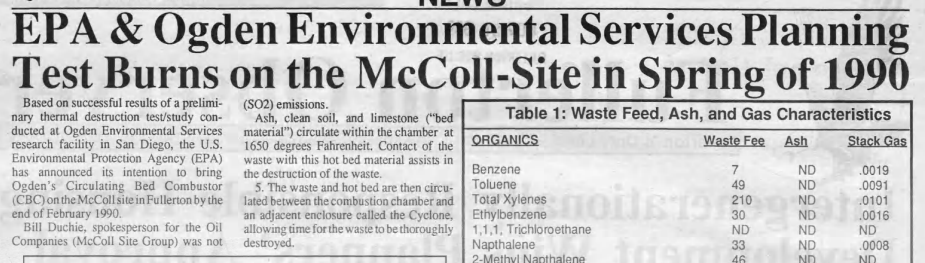
The oil companies responsible for the dumping and waste preferred to “cap” the site, rather than burn it, mainly because it was a lot cheaper.

Unfortunately, leaving the waste in place increased the likelihood that it could contaminate the local aquifer and groundwater. “John Blevins, a member of the EPA’s hazardous waste division, said recent tests indicated McColl contaminants have seeped into the aquifer,” the Observer stated. “However, he said that drinking water has not been contaminated.”
Betty Porras, a neighborhood leader, expressed a cautious optimism about the incineration option, writing: “For over a decade now, we have been asking the agencies to clean up McColl. Now, they say they have identified a viable option, and I believe that the least we can do for our own sakes is to give them an opportunity to prove it.”
On-site incineration tests were planned for early 1990.
Education
Back in 1972, facing desegregation orders, the Fullerton School District had closed its predominantly-Latino Maple School in south Fullerton and bussed all its students to other schools in north Fullerton. Their solution to segregation was to close the segregated school. This unfair solution was by no means the only option.
Fast forward to 1989 and the district was facing overcrowding in schools and was therefore considering re-opening Maple, thus potentially re-creating a segregated school as the demographics of the Maple neighborhood were virtually unchanged since the 1960s.
A committee formed to study this issue recommended re-opening Maple.
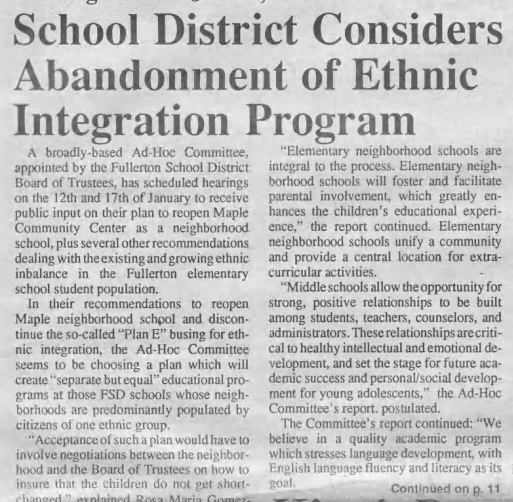
“In their recommendations to reopen Maple neighborhood school and discontinue busing for ethnic integration, the Committee seems to be choosing a plan which will create ‘separate but equal’ educational programs,” the Observer stated. “Asked how reopening Maple School would relieve ethnic segregation, committee chair Ellen Ballard said that after much discussion and study, the committee had concluded, that providing quality programs at every school was better than moving children around to achieve ethnic balance.”

“Persuaded by the Hispanic members of the Committee and Maple Area residents with whom they met over the last few months, the Ad-Hoc Committee came to the conclusion that it was now more important to restore a neighborhood school to the Maple area than to continue busing their children to other neighborhoods’ schools in order to maintain a level of ethnic integration,” the Observer stated.
Racism
Here are a couple of local instances of racism in 1989:


Disasters
In local disaster news, Tony’s Melody Inn in downtown Fullerton (located in a historic building near the corner of Harbor and Commonwealth), burned to the ground.
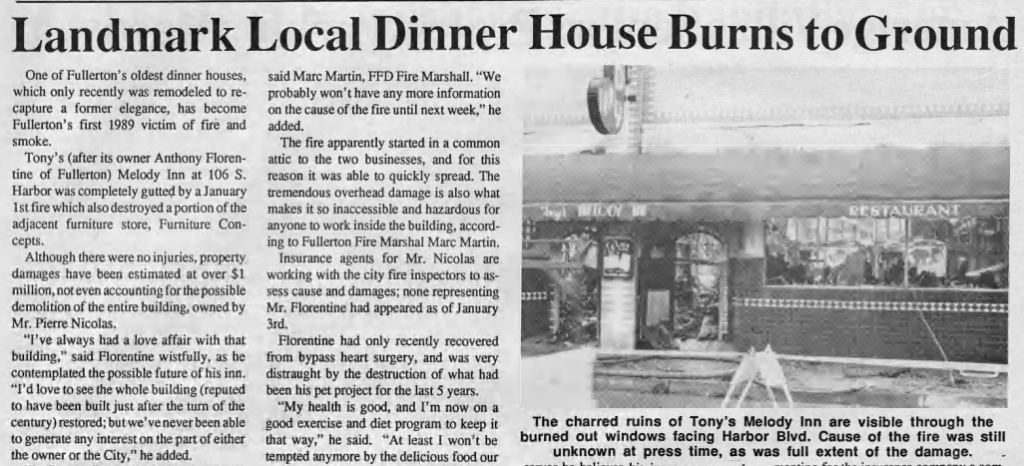
No one was injured in the fire, but the loss of such an historic building was tragic. The building was owned by Pierre Nicolas, whose family were early settlers in the area. The tenant was Anthony Florentine, who would go on to establish Florentine’s Tuscany Club downtown, which is now Mickey’s Irish Pub.
In recent years, a Youtube video was posted featuring Pete Schindler (an associate of Florentine), who says he helped Florentine intentionally burn the building down for the insurance money.
Another fire broke out at Richman School. Thankfully, no one was hurt.
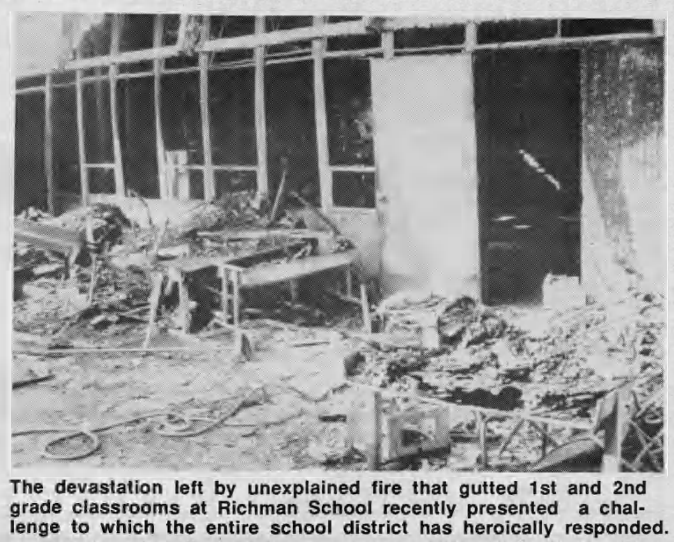
Culture
The historic Fox Theater, which closed in 1987, languished in “bureaucratic limbo” where it would continue to languish for decades.
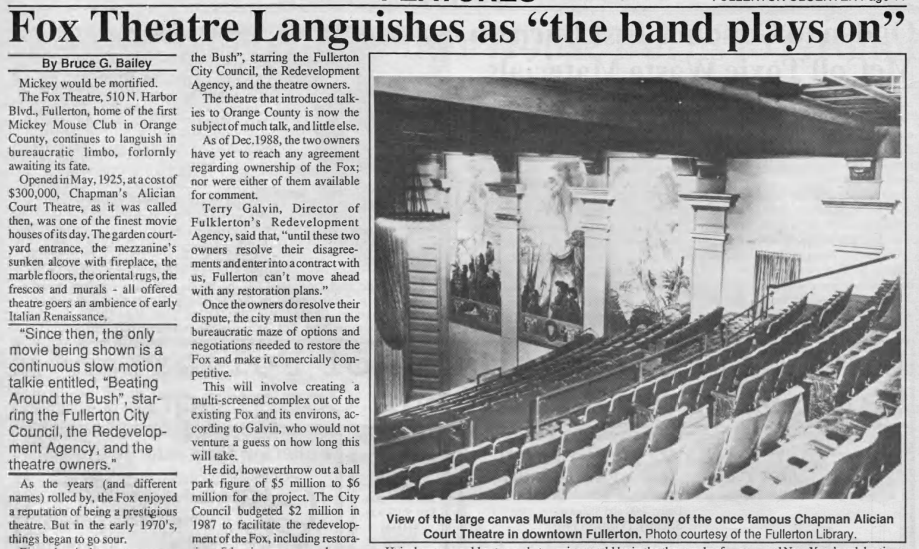
“The Fox Theatre continues to languish in bureaucratic limbo, forlornly awaiting its fate,” The Observer stated. “The only movie being shown is a continuous slow motion talkie entitled, ‘Beating Around the Bush,’ starring the Fullerton City Council, the Redevelopment Agency, and the theatre owners.”
The theatre that introduced talkies to Orange County is now the subject of much talk, and little else.
The City Council budgeted $2 million in 1987 to facilitate the redevelopment of the Fox, including restoration of the six canvas murals, although nothing much was happening on that.
Local historian Warren Bowen wrote a brief history of Hillcrest Park.
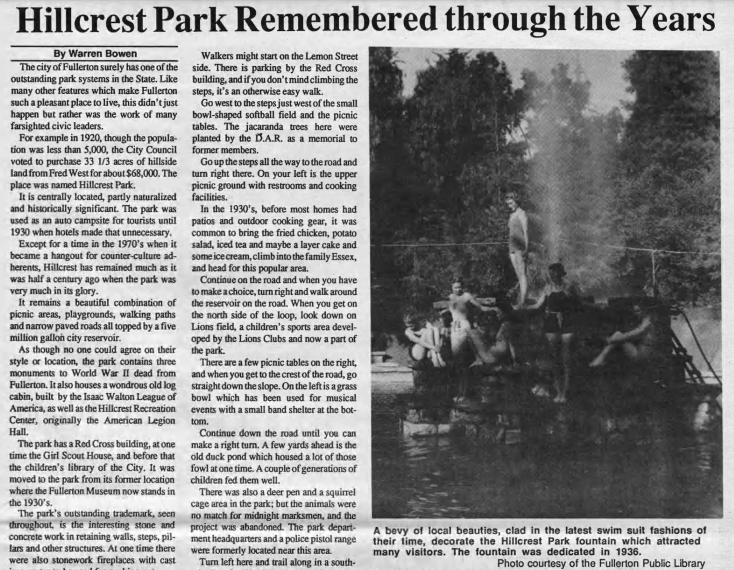
Here are a few excerpts from Bowen’s piece:
“In 1920, though the population was less than 5,000, the City Council voted to purchase 33 acres of hillside land from Fred West for about $68,000. The place was named Hillcrest Park.
“The park was used as an auto campsite for tourists until 1930 when hotels made that unnecessary. Except for a time in the 1970’s when it became a hangout for counter-culture adherents, Hillcrest has remained much as it was half a century ago when the park was very much in its glory.
“The park contains three monuments to World War II dead from Fullerton, a wondrous old log cabin, built by the Isaac Walton League of America, as well as the Hillcrest Recreation Center, originally the American Legion Hall. The park has a Red Cross building, at one time the Girl Scout House, and before that the children’s library of the City. It was moved to the park from its former location where the Fullerton Museum now stands in the 1930’s.
“This stone work was a WPA project in the 1930’s. The workers came from locally unemployed men.
“There was also a deer pen and a squirrel cage area in the park; but the animals were no match for midnight marksmen, and the project was abandoned. The park department headquarters and a police pistol range were formerly located near this area.
“The lawn in front is the site of the annual lively arts festival.”
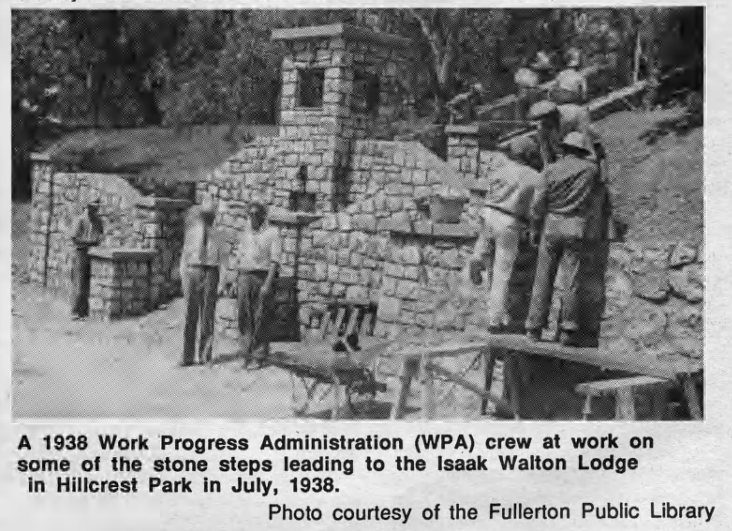
To commemorate the renovation of the baseball field in Amerige Park, Bowen wrote a piece on this slice of local baseball history, where minor league teams used to play, especially in the 1930s.

“Probably the favorite Coast League club to train here was the Portland Beavers… [who] stayed at the Fullerton Hotel, Malden and Wilshire, and ate their meals at Kibel’s Cafe or Hughes’ Restaurant, sometimes sneaking in a lunch at the Brown Mug,” Bowen wrote. “The Beavers charged 40 cents to get into the exhibition games when the Indians or Angels were bussed into town. Weekday games would draw a few over a hundred fans but on Sundays the place was full. Fullerton continued to be a Mecca for aspiring minor leaguers.”
Another popular cultural event was the annual “A Night in Fullerton,” during which numerous arts venues would showcase local creativity. This event, which started in the 1960s, continued until 2009, when it was succeeded by the monthly Downtown Fullerton Art Walk. The Art Walk was largely decimated by the COVID-19 pandemic, although a handful of art venues still exist downtown.
Another popular cultural event in 1989 that no longer exists today was the Founder’s Day Parade.
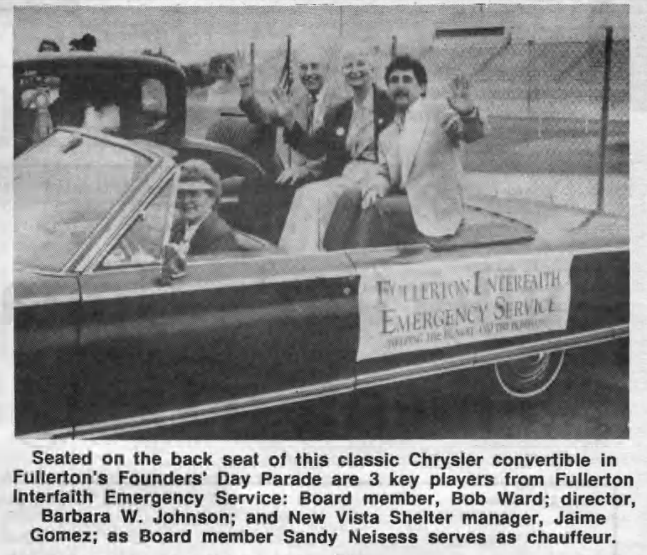
A young woman named Terri Wright opened a small arts store called “Get Lost” downtown across the street from the Fox Theater. She commissioned three local artists to paint murals on the front of her store.
“We got a lot of compliments on this decor from people who participated in the recent Downtown Dinner and Art Walk sponsored by the Fullerton Museum Center,” Wright told the Observer. “But then the City stepped in and declared our murals not to be art but grafitti.”
Fullerton Redevelopment Director Terry Galvin told the landlord and Wright that the murals had no historical value and would have to be painted over.
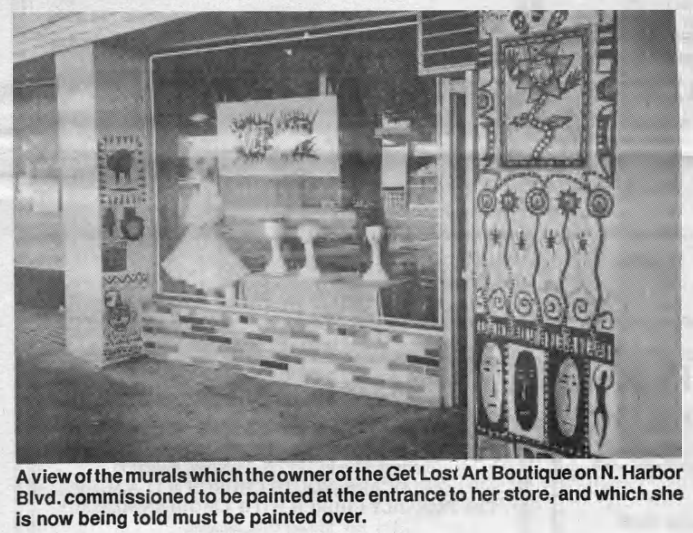
Fullerton has a sister city program which is meant to encourage cultural exchange with other communities around the world.

Transportation
Orange County voters debated whether to pass Measure M, a 30-year one half cent sales tax increase to fund transportation improvements. Ultimately, the measure passed.

“Orange County is facing a massive traffic crisis and passage of Measure M will put us on the road to a solution,” Republican OC Supervisor Bruce Nestande wrote in an opinion piece arguing for passage of the measure. “Since 1966, only two miles of new freeway have been built and only six miles of existing freeway have been widened. During this time Orange County’s population has soared nearly 78% and more than one million more cars have been added to our streets and freeways.”
Guns
In 1989 (unlike today) mass shootings were a relatively rare occurrence, so the nation was shocked when a gunman shot and killed five students and wounded 32 others at Cleveland Elementary School in Stockton, California.
Back then, lawmakers responded to the tragedy with legislation to ban assault weapons. In California, this took the form of the Roberti–Roos Assault Weapons Control Act of 1989, which stood until 2021, when it was overturned by a judge as unconstitutional.
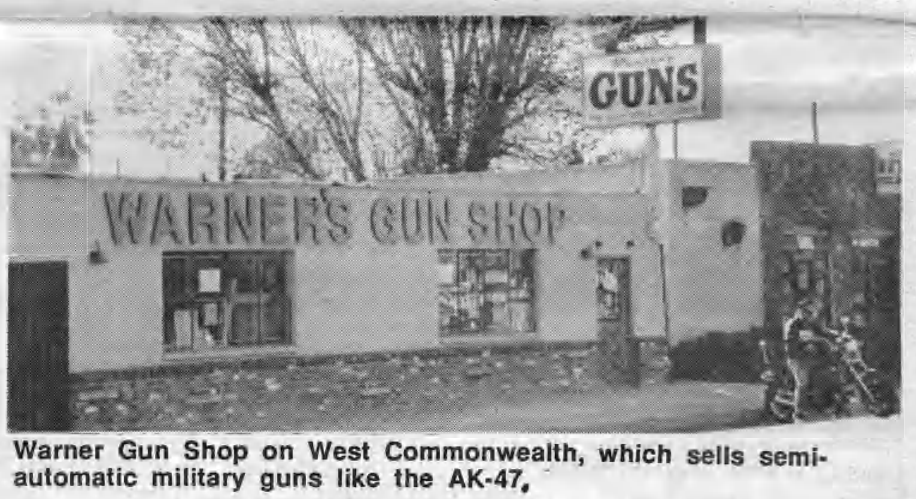
“Two Fullerton gun dealers disagree with the legislators,” the Observer wrote. “An employee of Warner’s Gun Shop, 1108 W. Commonwealth Ave., said banning the sale of weapons like the AK-47 will not solve the problem of criminals or mentally ill people getting these guns.”
“A lot of people like shooting military guns,” he said. The AK-47 is much cheaper than the American made version; the AR-15, made by Colt, costs about three times that of the Chinese AK-47, which costs about $350.”
George Di Leo, owner of The Gunsight, 1712 N. Placentia Avenue, had a different view. “I never have and never will carry guns such as the AK-47,” he said. They are ‘paramilitary’ weapons, not sport guns,” he added. “I do carry many fine semiautomatic rifles and shotguns, however,” he said.
Activism/Protests
Friends of the United Farmworkers picketed Ralphs grocery store, urging them to stop carrying grapes that were grown with pesticides.
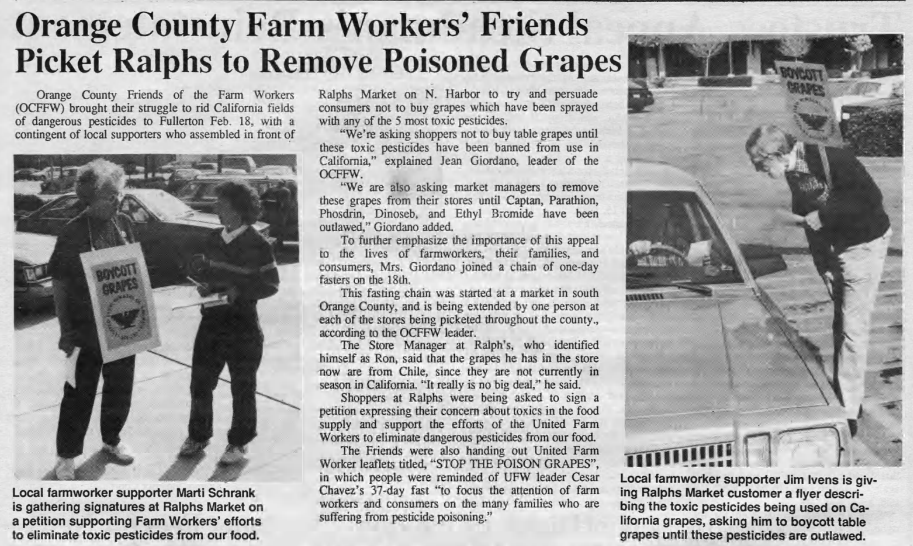
Fullerton resident Dorothy Callison was arrested while protesting the Winter Conference (an annual gathering of arms dealers) at the El Toro Marine Corps base.
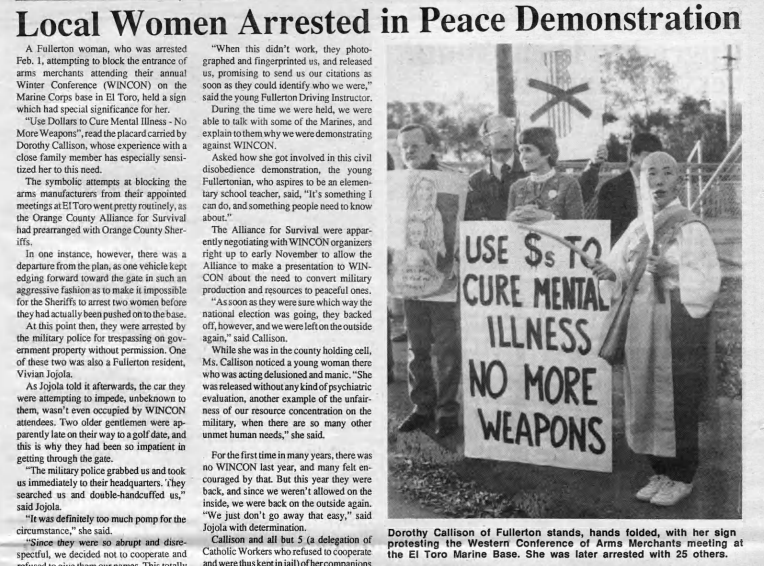
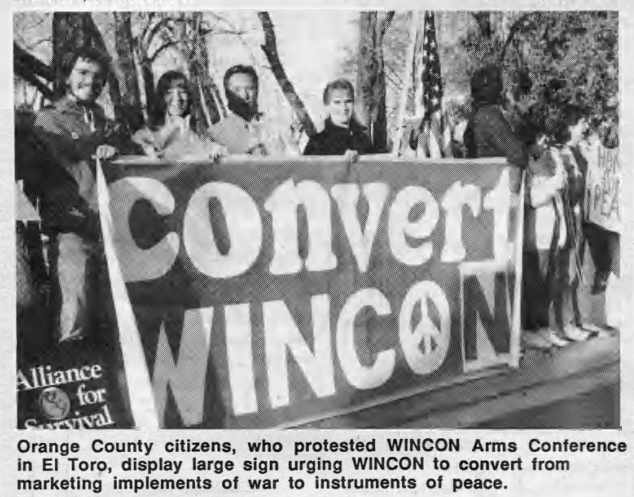
Those for and against abortion rights made their voices heard at the office of local state assemblymember Ross Johnson. This was in response to the Supreme Court decision Webster v. Reproductive Health Services, which a upheld a Missouri law that imposed restrictions on the use of state funds, facilities, and employees in performing, assisting with, or counseling an abortion.
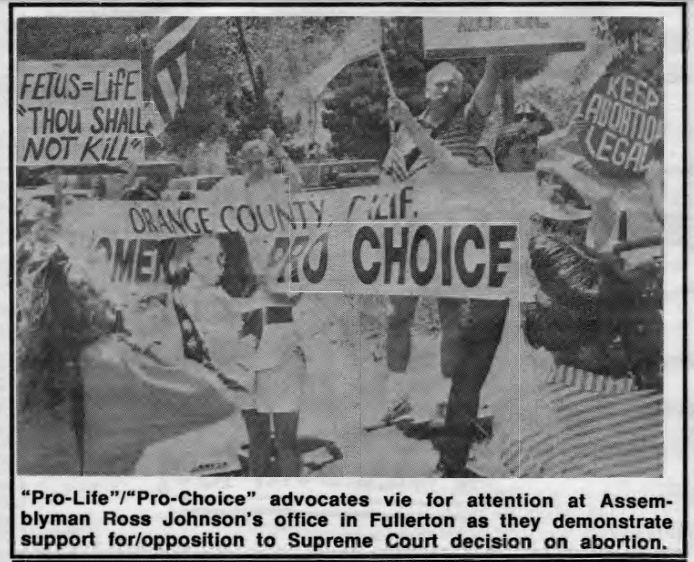
LGBTQ Rights
In 1989, Fullerton was represented by ultra conservative congressman William Dannemeyer, a vocal opponent of gay rights.
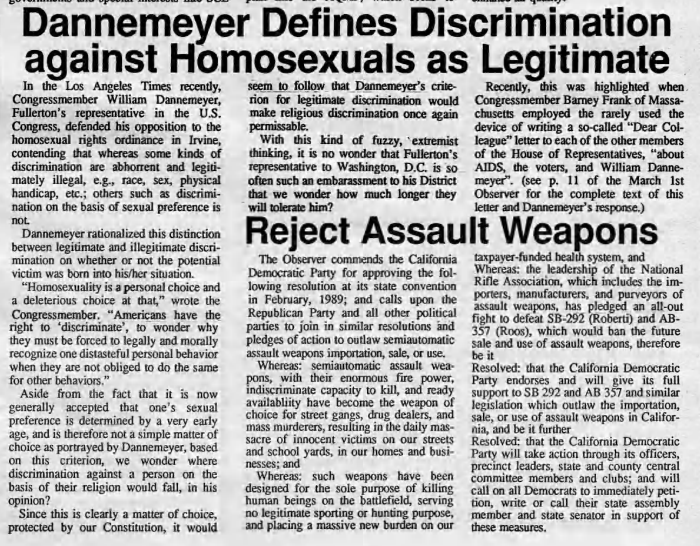
Here are some excerpts from an Observer article on this:
“Congressmember William Dannemeyer, Fullerton’s representative in the U.S. Congress, defended his opposition to the homosexual rights ordinance in Irvine, contending that whereas some kinds of discrimination are abhorrent and legitimately illegal, e.g., race, sex, physical handicap, etc.; others such as discrimination on the basis of sexual preference is not.
“Dannemeyer rationalized this distinction between legitimate and illegitimate discrimination on whether or not the potential victim was bom into his/her situation. “Homosexuality is a personal choice and a deleterious choice at that,” wrote the Congressmember. “Americans have the right to ‘discriminate’, to wonder why they must be forced to legally and morally recognize one distasteful personal behavior when they are not obliged to do the same for other behaviors.”
“Aside from the fact that it is now generally accepted that one’s sexual preference is determined by a very early age, and is therefore not a simple matter of choice as portrayed by Dannemeyer, based on this criterion, we wonder where discrimination against a person on the basis of their religion would fall, in his opinion? Since this is clearly a matter of choice, protected by our Constitution, it would seem to follow that Dannemeyer’s criterion for legitimate discrimination would make religious discrimination once again permissible.”
National and International News
In national news, the massive Exxon Valdez oil spill occurred, causing much environmental damage. A clever op-ed in the Observer by Greenpeace pointed out the way in which most Americans are complicit in such tragedies as a result of our reliance on fossil fuels.
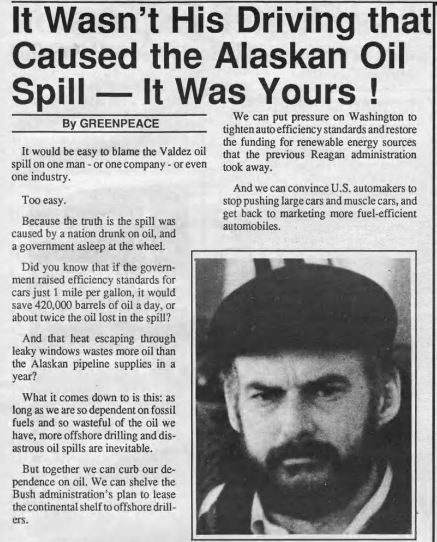
In international news, the Tianamen Square Protests and Massacre happened in China, resulting in the deaths of protestors and severe government crackdown on dissent.

Miscellaneous
Here are a few miscellaneous articles from 1989:
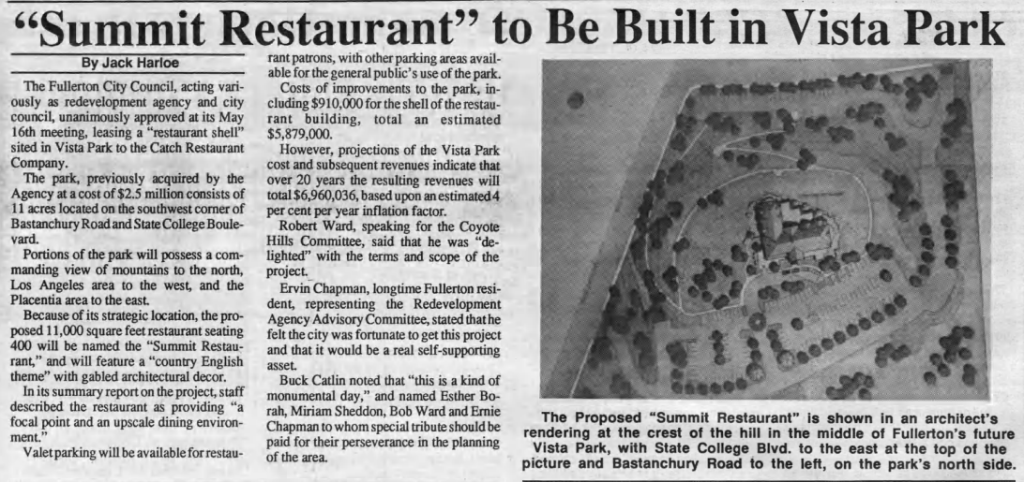
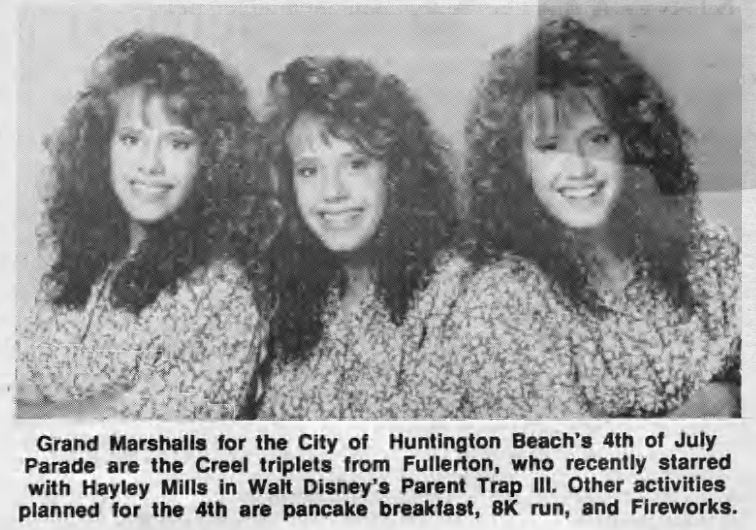

“Dr. Jewel Plummer Cobb, 65, who as president has guided the advancement of California State University, Fullerton since October 1981, announced today (Oct. 26) that she plans to retire July 31, 1990,” the Observer stated. “Known for her promotion of the advancement of women in science and activities on behalf of minorities, the 65-year-old cell physiologist was dean of Douglass College and professor of biological sciences at Rutgers, The State University of New Jersey, for five years before joining Cal State Fullerton.”
Deaths
Below are a few notable local deaths. A few excerpts from the Observer follows each.

“Former Fullerton Councilmember and Orange County Supervisor Ralph Diedrich died December 23 at age 64 in San Diego.
“From his election to the Board of Supervisors in 1973 until he resigned in 1979, Diedrich, known in county political circles as “Big D”, was the most influential political figure in Orange County.
“Although his political career ended ignominiously in 1979 when he was convicted of soliciting a bribe and hiding a campaign contribution, Diedrich left another kind of imprint on Fullerton and Orange County which could only be envied by some of his most persistent detractors.
“In 1973, when the Federal government started sharing millions of dollars in federal revenues with local governments, Diedrich was instrumental in getting the county to accept a unique and precedent-setting distribution formula of 25% for social programs, 25% for parks and recreation, and 50 % for other county expenses.

“Roxie Lee Owens of Fullerton died January 19 at age 74 at the Anaheim Memorial Hospital…A resident of Fullerton since 1943, Mrs. Owens and her husband Alfred Lee Owens raised 13 children.
“Perhaps the most famous of Roxie and Alfred’s children several of whom were well known local athletes, is Brig Owens, All-Pro wide receiver for the Washington Redskins. Roxie Lee Owens is survived by: her husband of 60 years, Alfred Lee, daughters: Dorothy Whitehurst and Larence Jeffries of Fullerton, Shirley McClanahan of Corona, and Audrey Mae Gardner of Dallas; sons Leon, David, and Alfred – all of Fullerton – Brig of Virginia, Ted and Marvin of Walnut, and Jessie of Arrowhead; 23 grandchildren and 2 great-grandchildren. Mrs. Owens was preceded in death by daughters Lamerie and Louise.”
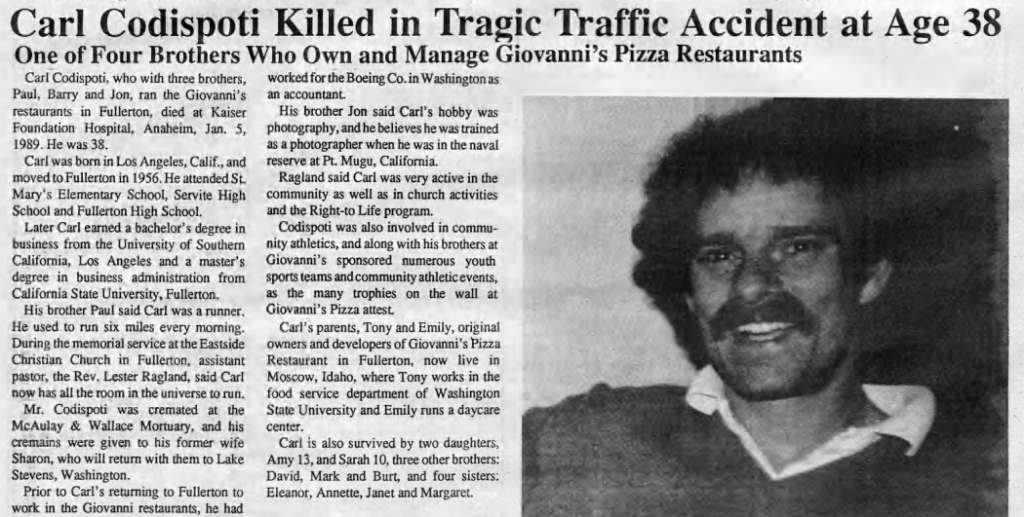
“Carl Codispoti, who with three brothers, Paul, Barry and Jon, ran the Giovanni’s restaurants in Fullerton, died at Kaiser Foundation Hospital, Anaheim, Jan. 5, 1989. He was 38…Prior to Carl’s returning to Fullerton to work in the Giovanni restaurants, he had worked for the Boeing Co. in Washington as an accountant.”
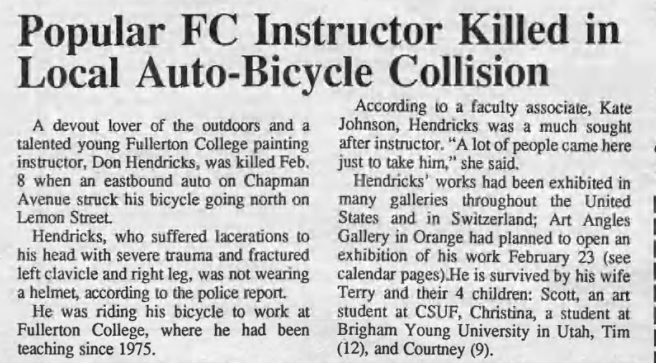
“A devout lover of the outdoors and a talented young Fullerton College painting instructor, Don Hendricks, was killed Feb. 8 when an eastbound auto on Chapman Avenue struck his bicycle going north on Lemon street…Hendricks was a much sought after instructor…Hendricks’ works had been exhibited in many galleries throughout the United States and Switzerland.”
Don’s son Tim is a famous tattoo artist and owns Classic Tattoo in downtown Fullerton.
-
Headlines: 1988
The following is from a work-in-progress about the history of Fullerton. You can support my ongoing research and writing on Patreon.
The Fullerton Observer newspaper was formed in 1978 by Ralph and Natalie Kennedy and friends to provide a more progressive counterbalance to the more conservative Fullerton News-Tribune and Orange County Register. The Fullerton Public Library has digital archives of the Observer stretching back to 1979. Here are some top news stories from 1988.
What to do with 10,000 Truckloads of Toxic Waste?: The McColl Dump Site

The state Department of Health Services and the Federal Environmental Protection Agency gave a presentation to local residents and leaders about an interim plan to deal with the toxic materials at the McColl dump site (Fullerton’s first Superfund site), including a gas collection and treatment system, a special gas-and-liquid-impervious plastic liner, and a soil cover.
The oil companies had submitted a proposal to construct a $12.5 million containment system including a cap, as both an interim treatment and a final solution. This was rejected by the EPA as an interim action, but was under consideration as a permanent remedy.
The Observer ran a three-part series on the history of the McColl dump site.

Between the years 1942 and 1946, oil refinery waste was dumped on a section of the old Emery Ranch in northwest Fullerton, owned by Eli S. McColl. The toxic waste contained sulfuric acid, benzene, hydrogen polymers, nitrogen salts and sulfonic acid. Twelve dump pits (or sumps) ranged in size from 8-30 feet deep and 100-350 feet across.
The amount of waste and contaminated soil at the dump site is around 200,000 cubic yards, or enough to fill 81 olympic-sized swimming pools.
In 1951 McColl covered some of the sumps with drilling mud, mainly to reduce the foul odors. Until the mid 1960s, the site became a place of general dumping of trash and debris.
In the 1960s, The Los Coyotes Country Club covered some of the sumps to develop a golf course.
The first housing development next to the dump site opened in 1968. By 1980 residential development surrounded the site. Toxic waste notwithstanding, this was prime real estate.
However, by the late 1970s, residents began to complain of headaches, eye irritations, and breathing problems. This prompted the California Department of Health Services (DHS) and the Environmental Protection Agency (EPA) to study the site in collaboration with a number of oil companies who were potentially liable for the dumping.
The saga of the McColl dump site corresponds in interesting ways with the rise of environmental protection in the United States. The EPA is a relatively recent phenomenon in American history, created in 1970. The Superfund program to deal with large contaminated sites got started in 1980.
By 1982, over 70 hazardous waste dumps were identified within California, and the McColl site was at the top of the list due to its high potential cleanup costs and impact on public health.
The newly-created Superfund program (created under liberal, environmentally conscious Jimmy Carter) faced numerous political and legal hurdles under the presidency of conservative Ronald Reagan, who preferred to cut, rather than increase, government regulatory agencies. The agency also sometimes came into conflict or disagreement with California’s DHS, not to mention litigation from the responsible parties themselves, the oil companies, who wanted to limit their liability.
The result of all this was delay after delay in what to do to clean up the site. However, by 1984, all parties had reached a tentative agreement to remove the toxic materials elsewhere. But where?
Two lucky locales were chosen to receive our muck–the Casmalia Resources facility in Santa Barbara County and the Petroleum Waste Inc. facility near Buttonwillow in Kern County. It was to be the largest toxic cleanup program in California’s history.
However, when Santa Barbarans got word of the plan to bring 10,000 truckloads of toxic waste into their fair county, they (understandably) were not happy.
In 1985, the City and County of Santa Barbara filed suit to block the transportation of McColl waste. Kern County followed suit.
More and more delays.
In 1981, 141 families filed suit against the City of Fullerton, the development companies that built their neighborhoods, and six oil companies, claiming that the developers and the City knew of the site dangers. The oil companies involved include Shell, ARCO, Texaco, Unocal, Phillips Petroleum, Chevron, and McAuley Oil.
The oil companies, developers, and the City ended up settling with the majority of neighbors, paying out a combined $12 million. Interestingly, the judge chosen to oversee settlement payments was Joseph Wapner of “People’s Court” Fame.
Meanwhile, as state and federal agencies figured out what to do with the toxic waste, local neighbors formed a group called the McColl Dump Community Action Group (MAC), with about 100 members.
Aside from health concerns, the neighbors were concerned about the impact of a Superfund site on their property values.
As delays continued, MAC co-chairperson Betty Porras said, “10 years is long enough. We were promised a cleanup—not a coverup!”
The lawsuits by Santa Barbara and Kern counties prompted the need to create an Environmental Impact Report, which led to more delays.
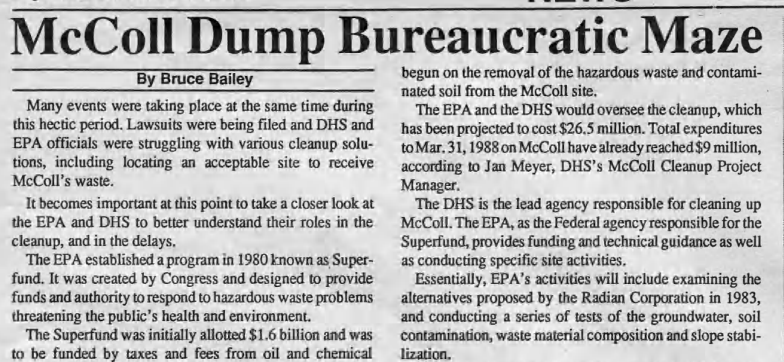
By 1988, the EIR was postponed. Stay tuned for more on the McColl saga.
An article entitled “Little Known Facts on Toxic Waste in Fullerton and Orange County” put the McColl situation in perspective.
In 1986, Fullerton generated 4,269 tons of hazardous waste. Anaheim, though, was much worse, with 39,677 tons, according to state and county data.
“Fullerton’s McColl dump is one of 10 so-called ‘Superfund Sites’ in Orange County, although its estimated 200,000 tons of hazardous waste is again dwarfed by the amounts present in county 3 military installations: 2,500,000 tons at the El Toro Marine Corps Air Station, 1,250,000 tons at the Seal Beach Naval Weapons Station, and 625,000 tons at the Tustin Marine Corps Air Station in Tustin.”
The top two generators of Toxic Waste in Fullerton were the Kimberly-Clark Corporation (1061 tons) and Hughes Aircraft Co. (806 tons).
Local Politics
1988 was an election year. Below are the candidates who ran for City Council.
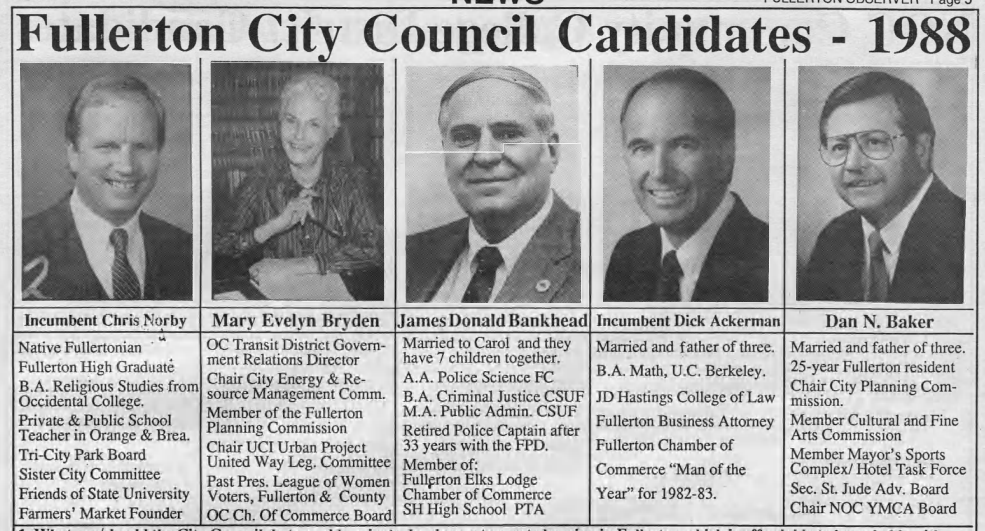
Incumbents Chris Norby and Dick Ackerman were re-elected along with newcomer Don Bankhead, a former police captain.
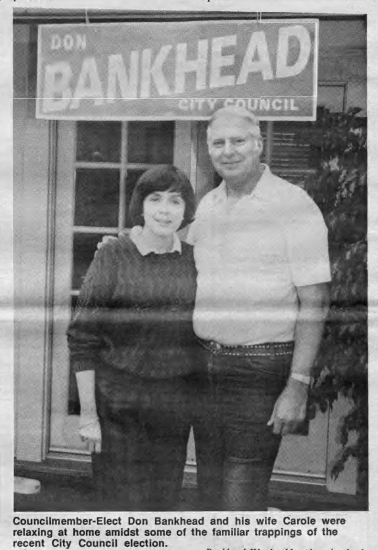
Here is the annual budget, which the council approved.

Housing
The conservative council majority continued to refuse to use redevelopment funds for affordable housing, despite (unenforceable) state mandates that it do so.
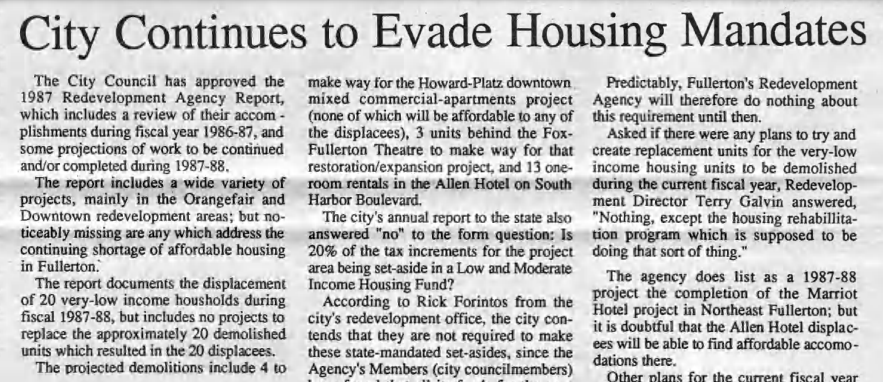

California cities are required to produce a Housing Element as part of the general plan. An Observer article describes how the City regularly refused to comply with the state’s recommendations, particularly those regarding affordable housing.

The Observer asked each Councilmember give their view of the City of Fullerton’s responsibility in the area of housing. All but Molly McClanahan (and, sort of, Buck Catlin) were ideologically opposed to using government funds for affordable housing. They preferred to let the “free market” somehow handle things, while using redevelopment funds to subsidize private market rate developments (see below).
Richard Ackerman: “I do not favor such measures as subsidized housing or inclusionary zoning, which overly impact the free market system. Government should not be directly involved, except through their adoption of a General Plan, which designates their best ideas for land uses and densities based on topography, and the expedition of building processes, charging fees which are commensurate with the costs of the services provided.”
Chris Norby: “We should allow the private sector to build needed housing with as few restrictions as possible. I do not favor the use of any city funds for housing.”
Buck Catlin: “I think the City should be involved in providing housing for the people who are employed here, especially the industries that support us, and especially for the middle management people in those industries.”
Linda LeQuire: “I think the City should promote a variety of housing types, but I have never favored government for housing, except for seniors…There is enough employment for anyone who wants to work and have a good standard of living. Temporary help may be needed in some cases, but this is not the responsibility of local government.”
Molly McClanahan: “While Fullerton has done much to preserve our older housing stock through low interest loans, there is a need for more affordable housing. Opportunities exist for the public and private sectors to work cooperatively; county funds are available to be leveraged with private development money. I support using some redevelopment monies for housing.”
Homelessness
Meanwhile, local nonprofit Fullerton Interfaith Emergency Services (now called Pathways of Hope) was doing its part by running the town’s only homeless shelter.
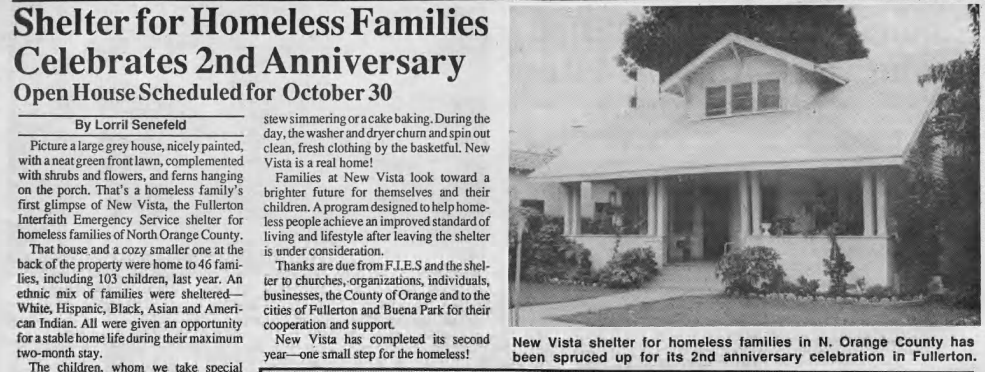
Education
In 1978, California voters passed Proposition 13, which severely capped property tax increases, thus limiting local funding for things like education.
A report entitled “Proposition 13, Ten Years Later” assessed the impact of Proposition 13 has had on all levels of California government.
“The report confirmed that the primary impact of Prop. 13 on school governments has been an erosion of local control, as larger and larger percentages of the total school funding has shifted to the state,” the Observer stated. “Statewide, districts received 42% of their funding from the State prior to Prop. 13. Since 1978, this number has increased to 85 to 90%. This has put school districts at the mercy of the Legislature and the Administration, regardless of their community’s desire to supplement the funds available for public schools…Schools have been forced to resort to such tactics as swap meets and bingo games to fund programs which are not specifically provided for by the State funding.”

Statistics released by the district showed that Richman and Woodcrest schools had 79.4% and 63.4% minority students respectively, making them de facto segregated schools, while Rolling Hills school had only 18%.
While in the 1960s and 1970s, this prompted the district to take corrective action, by the 1980s, there was little political will to do anything about de facto segregated schools.
Development/Redevelopment
While City Council refused to use its significant Redevelopment funds to subsidize affordable housing on the philosophical grounds that it didn’t want to interfere with the free market, Council preferred to use those funds to interfere in other markets by subsidizing things like market-rate housing, parking structures, and a Sports Complex, as the clippings below illustrate.
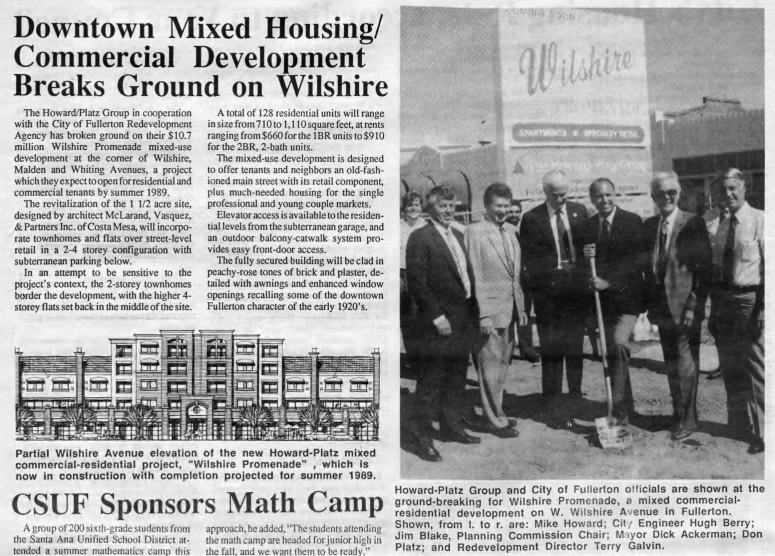


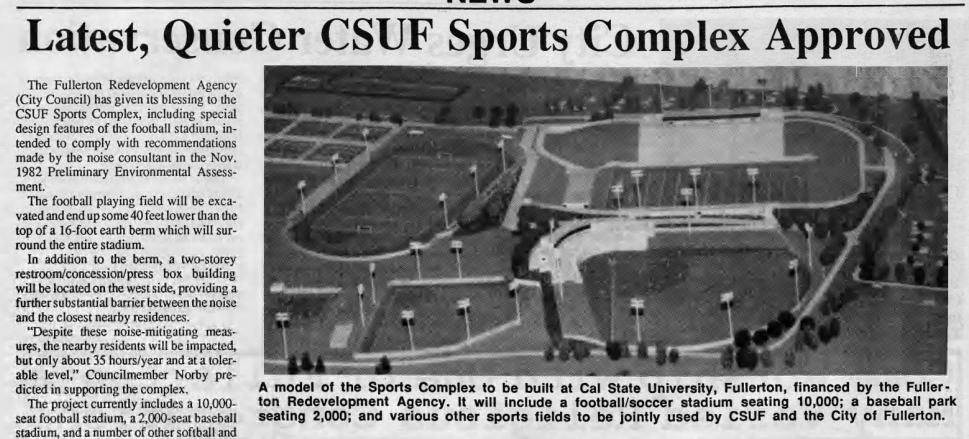
The Fullerton Redevelopment Agency (City Council) approved funding for the CSUF Sports Complex, which included a 10,000- seat football stadium, a 2,000-seat baseball stadium, and a number of other softball and multi-purpose fields plus the lighting for all these fields.
Racism/Bigotry
Unfortunately, a number of incidents of racism/bigotry were documented in 1988.
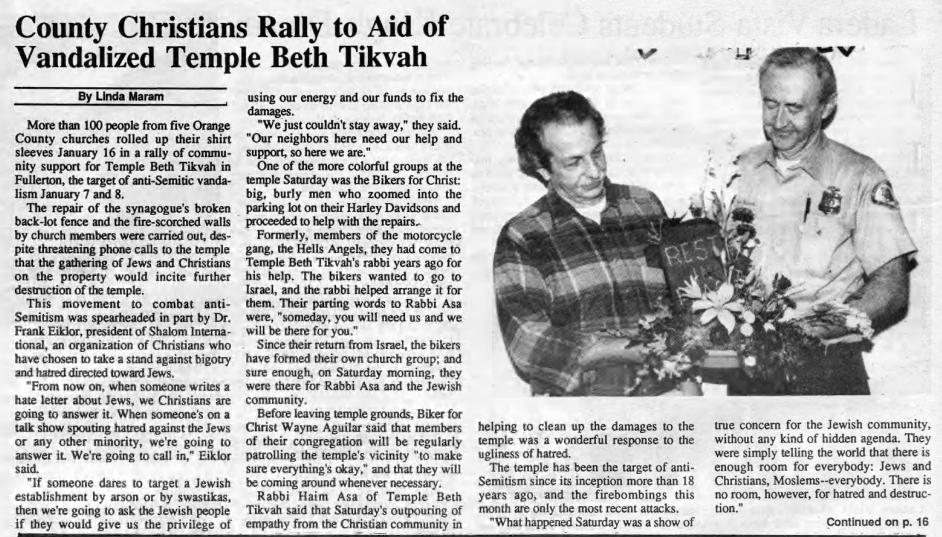
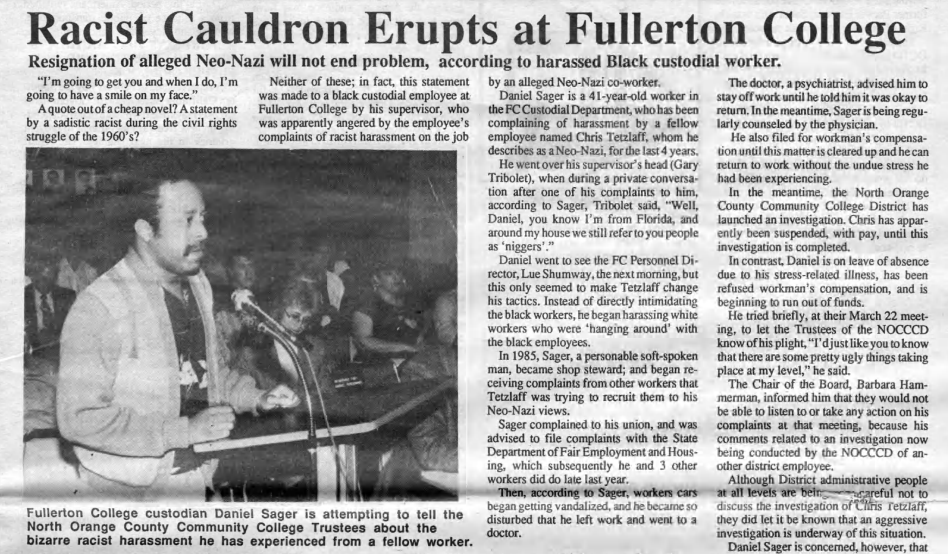


Stickers from the hate group White Aryan Race (WAR) were found stuck on lampposts outside the Thrifty Drug store in Yorba Linda.
“According to their area coordinator, Eric Thompson, the White Aryan Resistance is an umbrella group for many like-minded groups, such as the National Socialist Party, Identity Christians, Klu Klux Klan, etc,” the Observer wrote.
Thompson said, “We are willing to die for future generations of white children. We feel obligated to nature to keep our racial/cultural strain pure and uncontaminated.”
Culture
The Chapman family, as the Muckenthalers had done before them, wanted to donate their ranch house for public use of some kind.
Local Chicano muralist Emigdio Vasquez painted a new mural on the Lemon underpass, facing Maple School. The other Lemon murals had been painted in 1978 as a response by the community to widespread grafitti in the neighborhood. Local youths helped to paint the murals.
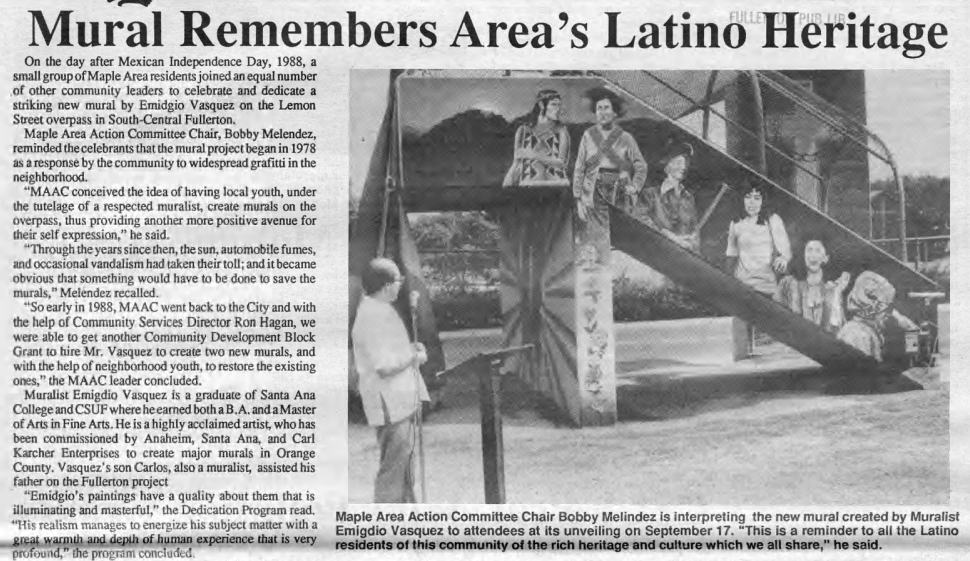
Vasquez painted numerous murals around Orange County, mostly representing the Latino community.
The new mural depicts “the Latino woman from her Aztec roots in Mexico, through her role as a soldier in the war for Mexican Independence, as ‘Rosita the Riveter’ in World War II, to her role as “La Chicana” in the 1960’s, in her emerging modem position as a professional who can have a family and a career outside the home,” the Observer stated.
The City held its annual Founder’s Day Parade.
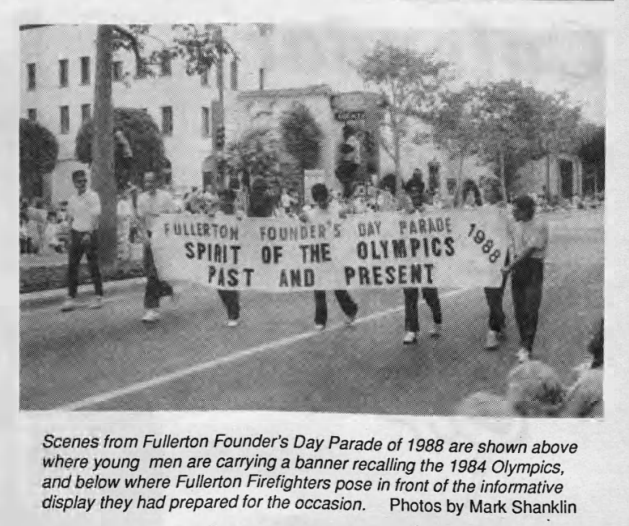
In 1988, “The Purple People Eater” (featuring Little Richard) was filmed in Fullerton by Sunny Hills alumna Linda Shayne.


Facing opposition from residents, city council denied a permit for a burlesque/cabaret theater.

Health Care
To assist with health care for lower income residents in south Fullerton, St. Jude unveiled a Mobile Health Services Van.
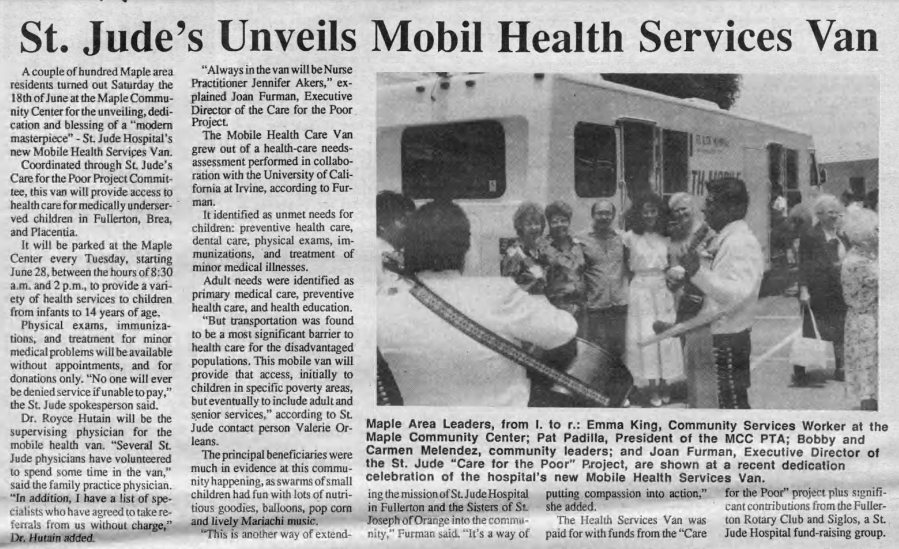
AIDS was a big concern in 1988.


National/International Issues
National and International issues included the US involvement in Central America and Apartheid in South Africa.


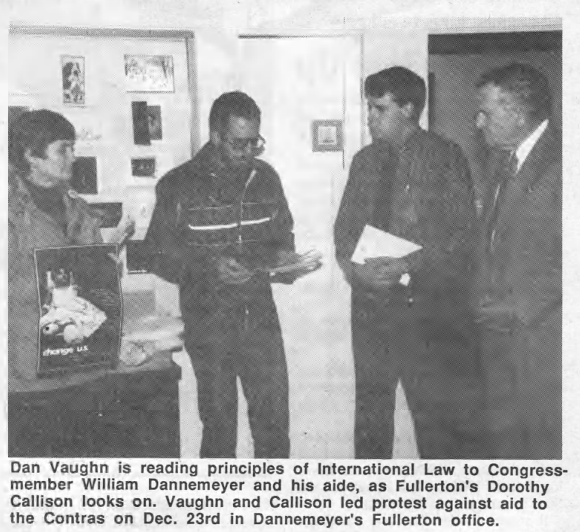
Immigration
In 1988, the Republican position on illegal immigration was very different than it is today, so much so that, following the lead of Ronald Reagan, the City Council (with four out of five members being Republicans) issued an Amnesty proclamation.

Transportation
The Observer continued its crusade for better public transit and bicycle infrastructure–for environmental and health reasons.


Drugs
Nancy Reagan’s “Just Say No” solution to underage drug use was very popular and largely ineffective.

Fullerton Prehistory
A new little paleontological museum opened in Ralph B. Clark Regional Park, which features fossils and bones excavated when the park was created–showing evidence of Fullerton’s prehistory. These artifacts included, for example, evidence of ice age creatures like mastodons, sabre-toothed cats, and giant sloths.
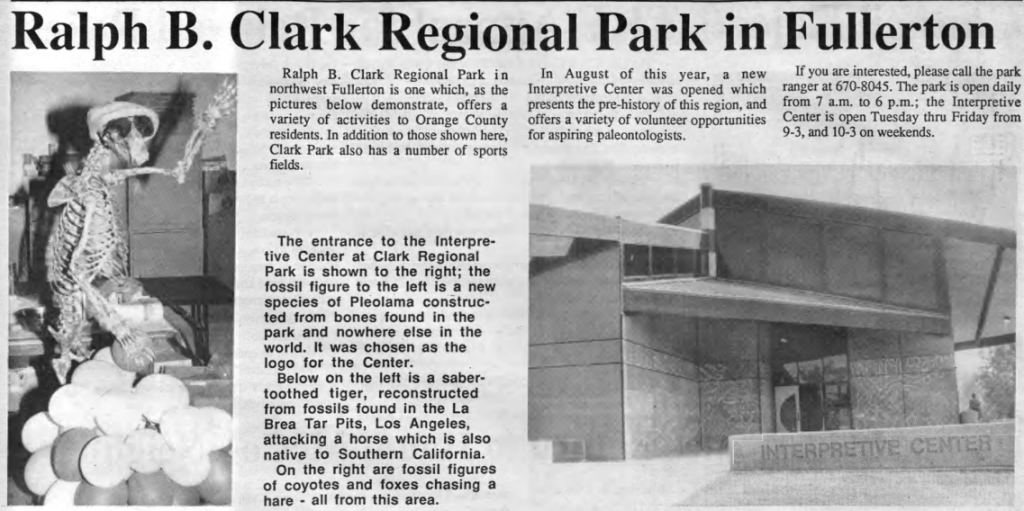

Deaths

Prominent local lawyer and citizen Walter Chaffee died. After serving in World War II, Chaffee opened a law practice in Fullerton, partnering with former city attorney Albert Launer. In 1952, Chaffee served as the City Attorney. In 1956, Governor Pat Brown appointed Chaffee to served as a judge at the North Orange County Municipal Court.
In a predominantly Republican area, Chaffee was an active Democrat, serving as chair of the Orange County Democratic Central Committee in 1962.
“It was during this period when he made one of his most important contributions to Fullerton and surrounding communities. During the 50s, the John Birch Society and the Christian Anti-Communist Crusade were becoming very active in North Orange County. Most people were intimidated by their aggressive and accusatory campaigns and rhetoric,” the Observer states. “Walt and a small group of likeminded patriots publicly challenged these demigods, and were successful in preventing their attempts to take over the local Fullerton school boards. At one point, according to Walt’s longtime friend Don Butka, the John Birch Society sued Chaffee for $1 million for things the so-called ‘secret six,’ as Walt and his protectors of the constitution were dubbed by the Santa Ana Register, had said about their extremist adversaries. As Butka remembers it, however, the suit was dismissed by the judge when the defendants produced a variety of information to prove true the statements they were accused of having fabricated.”
Chaffee also helped organize the North Orange County Hospital Building Association, which was instrumental in securing the site and promoting the hospital now known as St. Jude.
Chaffee’s son is former Fullerton Councilmemer and current OC Supervisor Doug Chaffee.
-
Headlines: 1987
The following is from a work-in-progress about the history of Fullerton. You can support my ongoing research and writing on Patreon.
The Fullerton Observer newspaper was formed in 1978 by Ralph and Natalie Kennedy and friends to provide a more progressive counterbalance to the more conservative Fullerton News-Tribune and Orange County Register. The Fullerton Public Library has digital archives of the Observer stretching back to 1979. Here are some top news stories from 1987.
Culture
The historic Fox Theater in downtown Fullerton, built in 1925, sadly closed its doors.

A proposal to build an IMAX theater at the downtown Fullerton Museum Plaza fell through.

On a more positive note, Fullerton held its annual “Night in Fullerton” event.
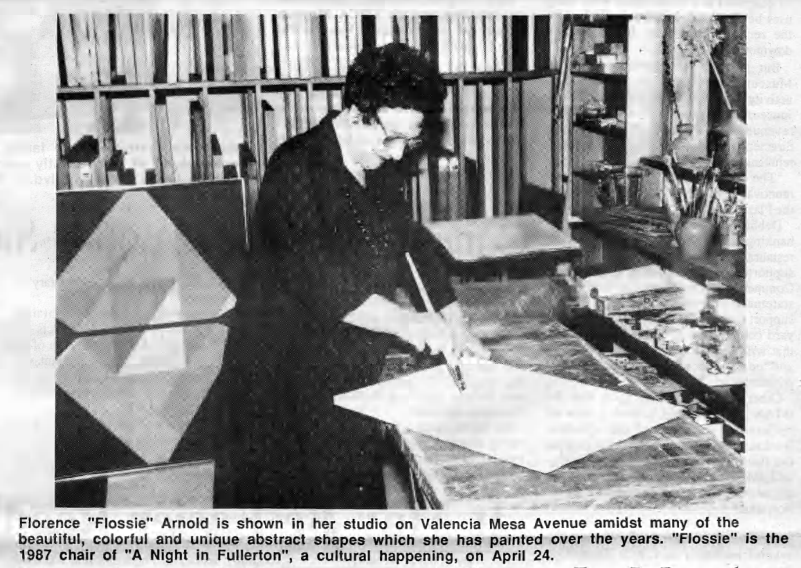
The Observer includes a nice feature on local artist Florence Arnold, who was one of the original organizers of A Night in Fullerton back in the 1960s.
“It was her desire to give the public, both children and adults, a broad-base exposure to the arts through the festival atmosphere,” the Observer states. “The annual program has since grown into a popular attraction on the Southland art scene, and last year alone drew more than 10,000 visitors.”

Participating venues in A Night in Fullerton included: Patrick’s Music, Eileen Kremen Gallery, the Muckenthaler Cultural Center, John Thomas Gallery, Enfant Terrible Gallery, Hunt Branch Library, Fullerton Public Library, City Hall, Cal State Fullerton, Pacific Christian College, Fullerton College, Plummer Auditorium, First Christian Church, The Edge Gallery, Gallery 57, and Zarbano Gallery.
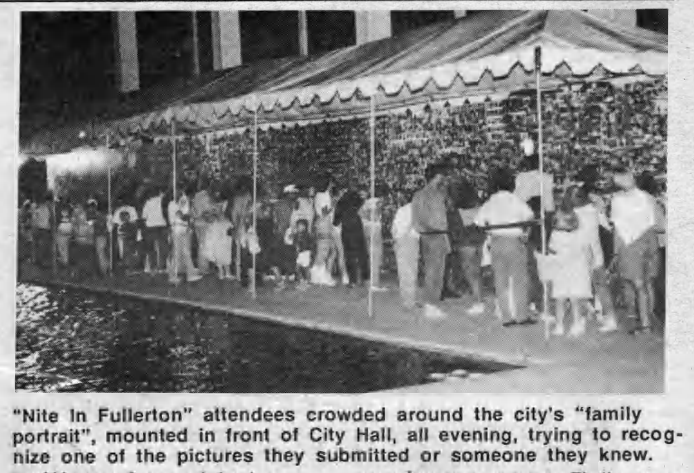
The Observer featured an excellent and in-depth article on the ups and downs of Downtown Fullerton’s art scene.
From 1969- 1977, several artists rented studio (and in some cases, living) space in the Chapman building downtown, which had previously been a department store.
A 1977 flyer tells of the “110 WILSHIRE SHOW” featuring work by these artists, showing “the grinning, bearded, antic residents of what local artist Scott Fitzgerald now affectionately dubs, ‘the artists’ dormitory.’”

Other downtown cultural spots in the 1970s included Rutabegorz, “replete with Egyptian frescoes, candlelight, and bad poetry,” the Eileen Kremen and Common Ground galleries, the 309 Malden gallery and Michael Haile’s “Art Directives” which were in the same building that housed, among other things, the Wilshire Theatre, which was sadly destroyed to make room for boring apartments.
At the Wilshire Theater, “on a good night you could catch a film adaptation of such novels as Thomas Mann’s Death in Venice or James Joyce’s (x-rated) Ulysses.”
“Originally a swimming pool, the Wilshire Theatre arranged its seating from shallow to deep end…The theatre was flanked on the west side by a long narrow, windowless hall, overhung by a frosted skylight. Michael Haile (former 110 Wilshire resident) rented this space, painted it a scrupulous white, and proceeded to show the work of his peers.”
By the 1980s, other galleries popped up, such as Enfant Terrible, the Edge, Mary Zarbano, Vision Art, and John Thomas galleries.
In addition to galleries, downtown Fullerton in the 1980s had a handful of independent bookstores, such as the Book Bazaar, Lorson’s [children’s] Books, Book Harbor, Aladdin Books, and the Blue Wolf, which was run by Melissa Mack in “the downstairs storage space of her studio apartment in the alley behind the Mulberry Street restaurant.” There she would host poetry readings.

Another annual cultural event was the Founder’s Day Parade.
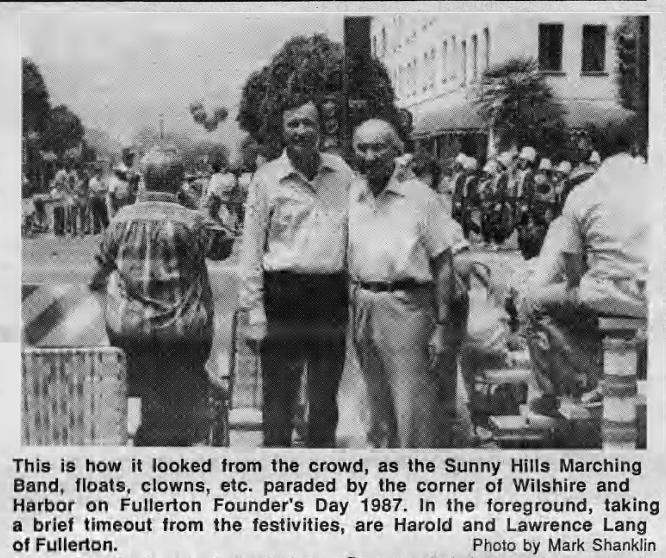
Environment
The oil companies who had caused the toxic McColl Superfund site proposed as a solution to cover up, rather than remove, the toxic materials.

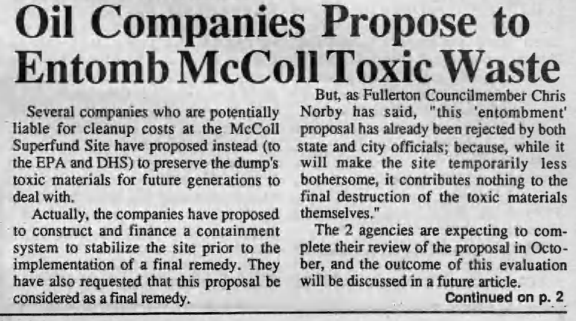
“Several companies who are potentially liable for cleanup costs at the McColl Superfund Site have proposed instead (to the EPA and DHS) to preserve the dump’s toxic materials for future generations to deal with,” the Observer stated. “Actually, the companies have proposed to construct and finance a containment system to stabilize the site prior to the implementation of a final remedy. They have also requested that this proposal be considered as a final remedy.”
Councilmember Chris Norby said that this ‘entombment’ proposal had been rejected by both state and city officials; because, “while it will make the site temporarily less bothersome, it contributes nothing to the final destruction of the toxic materials themselves.”
Ultimately, unfortunately for future generations, this proposal was accepted by state and federal authorities.
The oil companies who submitted the proposal were Shell Oil Company, ARCO, Texaco, Unocal and Phillips Petroleum. The estimated cost of “capping” the toxic materials was $12.5 million.
Presidential candidate Al Gore visited the site and gave a speech calling the proposal “Totally outrageous.”
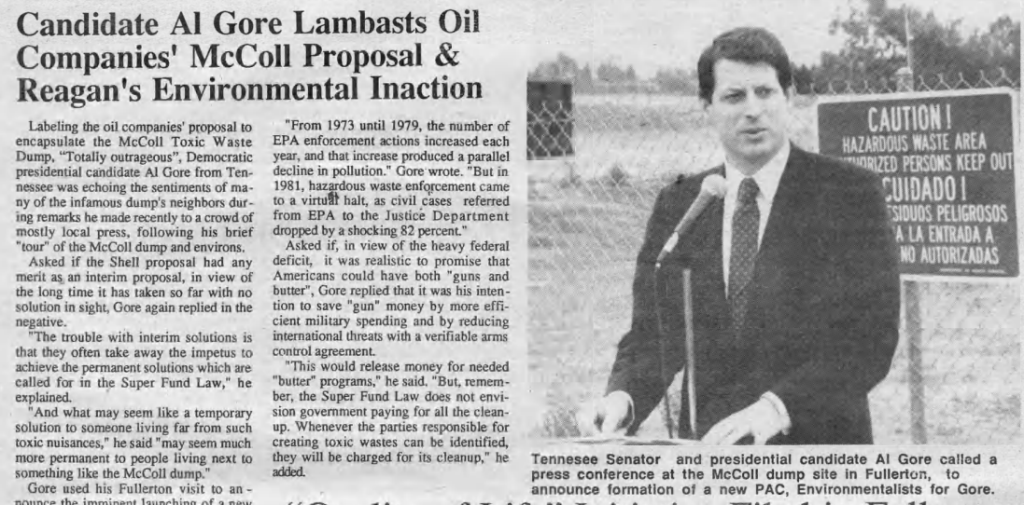
“What may seem like a temporary solution to someone living far from such toxic nuisances,” he said “may seem much more permanent to people living next to something like the McColl dump,” Gore said. “I will guarantee the appointment of an EPA Administrator who will vigorously pursue the cleanup of toxic waste dumps like McColl all across the country.”
Gore took the opportunity to criticize the EPA under President Reagan.
“From 1973 until 1979, the number of EPA enforcement actions increased each year, and that increase produced a parallel decline in pollution,” Gore said. “But in 1981 [when Reagan came to power], hazardous waste enforcement came to a virtual halt, as civil cases referred from EPA to the Justice Department dropped by a shocking 82 percent.”
Housing
In housing news, the conservative city council majority continued to refuse to use redevelopment funds for affordable housing.

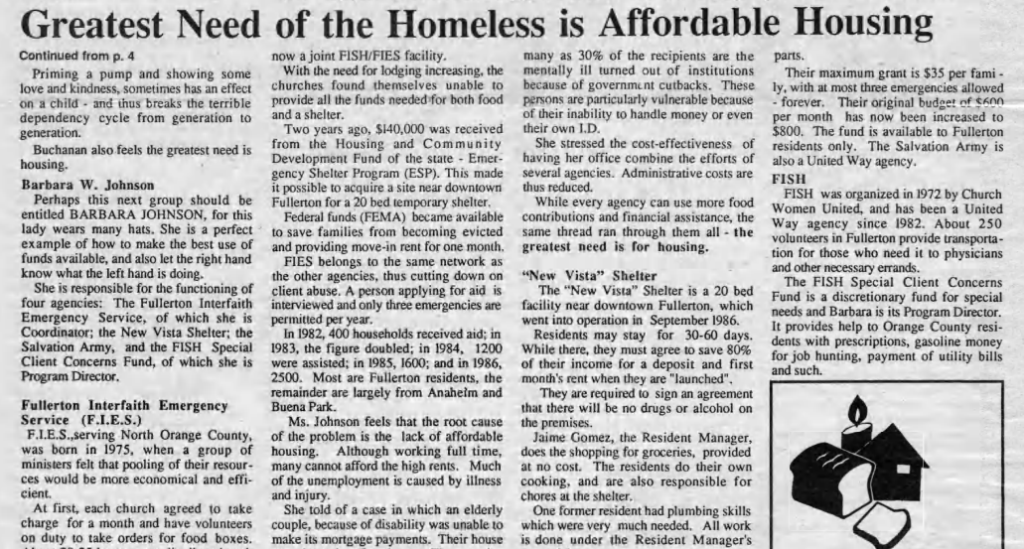
Racism/Bigotry
While housing discrimination was technically illegal, it still existed in the 1980s. The Fair Housing Council would hear complaints of racial discrimination in housing, and send Black and white “tester” renters or buyers to investigate.
A local Black man named Moses Hall chronicled his experience of being denied housing based on his race, while the white “tester” was offered the apartment.
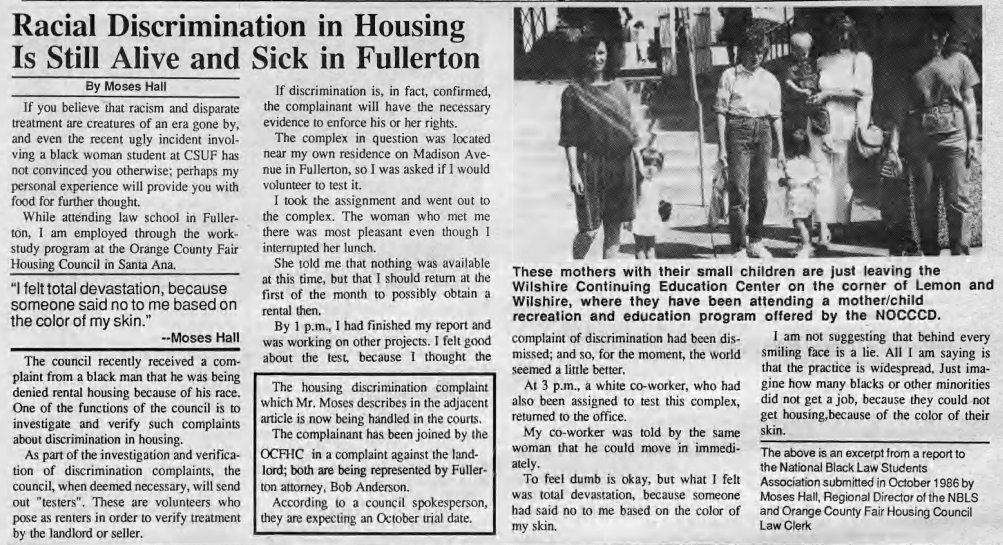
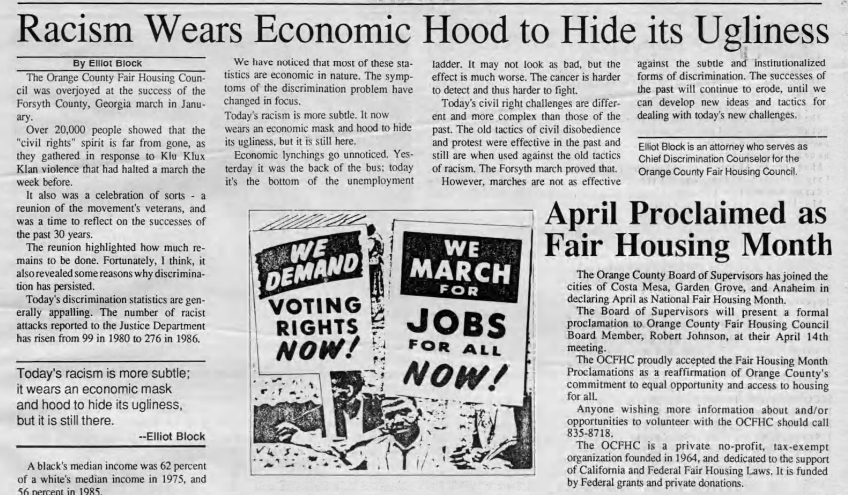
A Korean church and a Jewish Temple in Fullerton were vandalized by local racists.
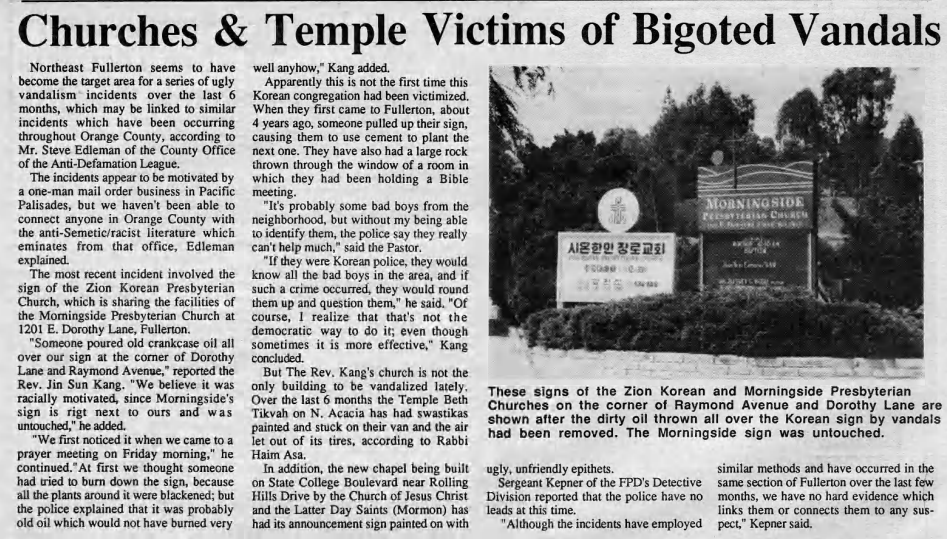

AIDS
In the 1980s, AIDS had become a national crisis, prompting a local forum and the Fullerton School District to adopt AIDS curriculum.

In the 1980s, Fullerton was represented in Congress by arch conservative William Dannemeyer, a vocal opponent of gay rights who made many offensive and homophobic statements during his tenure.
Fullerton College hosted a debate between Dannemeyer and Werner Kuhn, director of the local Gay and Lesbian Community Services Center, on ways to deal with AIDS.

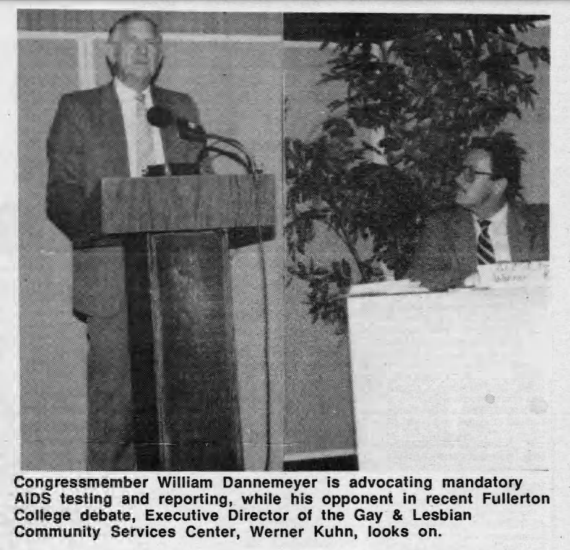
The Observer had pretty good political cartoonists in the 80s. The one below pokes fun at the hypocrisy of Congressmembers like Dannemeyer who consistently voted against funding for AIDS research and counseling.
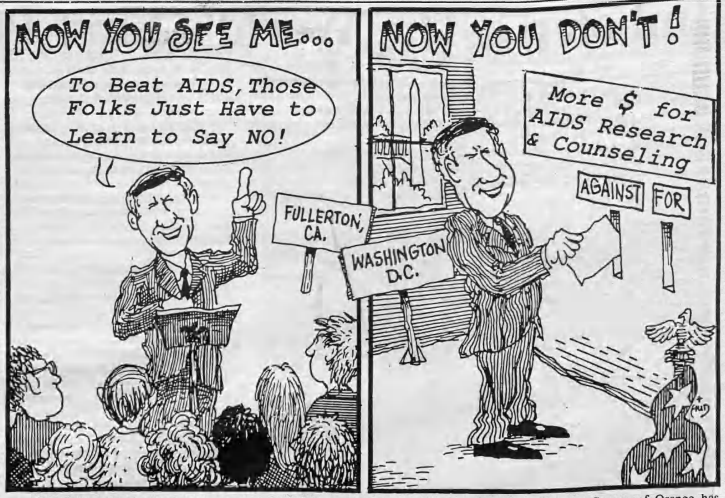
The 1987 Earthquake
In 1987, the Whittier Narrows Earthquake rocked Fullerton and surrounding areas. I vividly remember this quake, as I had recently moved to Fullerton. I was seven years old.
Education
Anita Varela and John Bedell were elected to the Elemetary School Board.
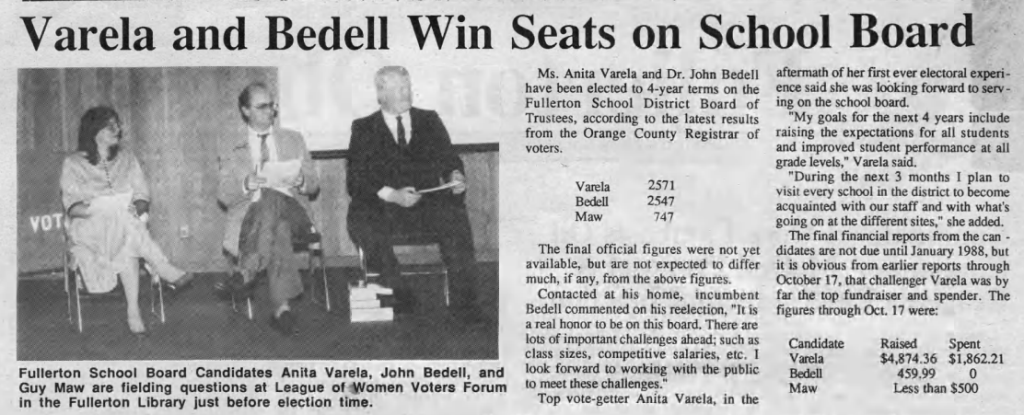
Adequate school funding was a point of debate between liberals and conservatives. In 1987, California’s governor was Republican George Deukmejian.
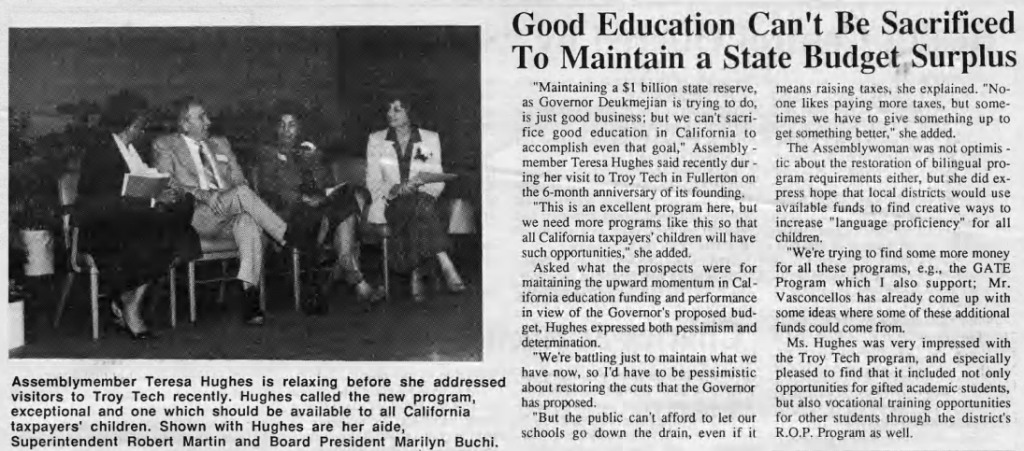
In the 1980s, Nancy Reagan’s solution to drug use was to “Just Say No.” This was a bit reductive and simplistic.
Facing state desegregation orders in 1972, the Fullerton School Board voted to close Maple School in south Fullerton and bus all of its mostly Latino and Black students to other schools. By the mid-1980s, nearby Richman School (also south of the tracks) was experiencing the same “white flight” that had contributed to Maple’s segregated status.
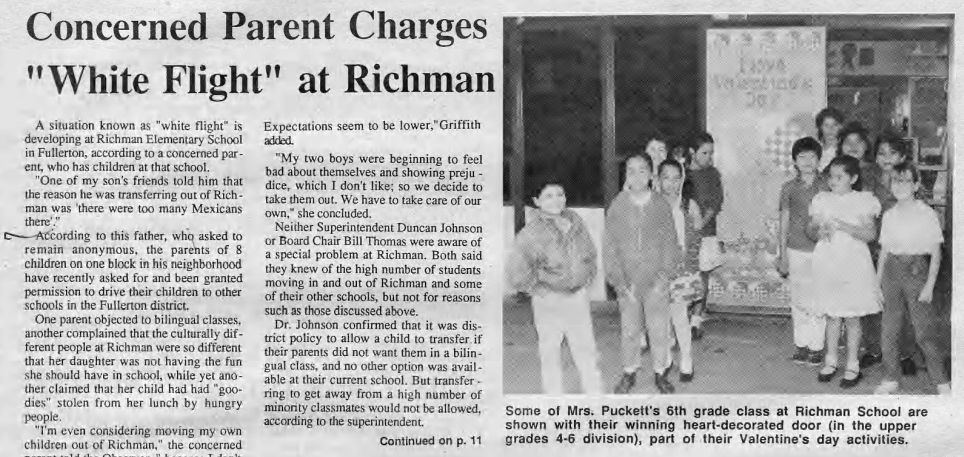
When Maple School was closed, it became a community center that housed a preschool for local families. In 1987, the preschool was facing cuts, and Maple parents organized to fight them.

Fullerton Public Library had a Bookmobile that served Fullerton children.
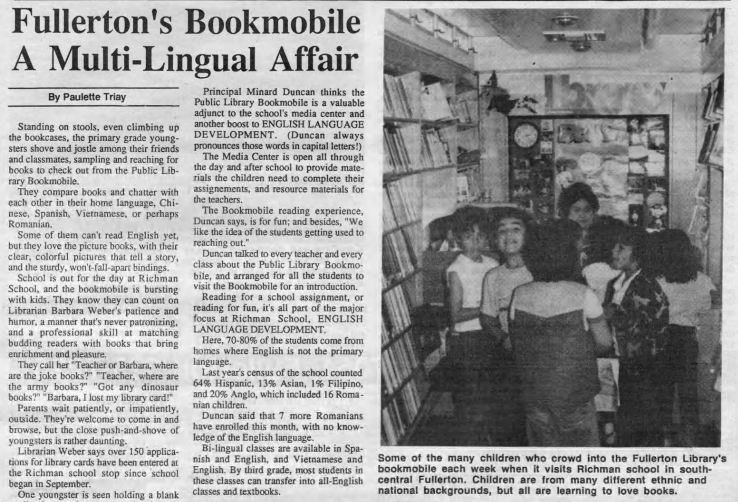
Fullerton College came under fire for having entrance exams that excluded those who needed remedial help.
Meanwhile, CSUF fraternities and sororities were being cited under Fullerton’s newly created Conditional Use Permit ordinance. They fought back with protests at City Hall.

Local Activism & Protests
The Fullerton Observer, being a progressive publication, has always done a good job of spotlighting local activists and protesters, as the following stories demonstrate.


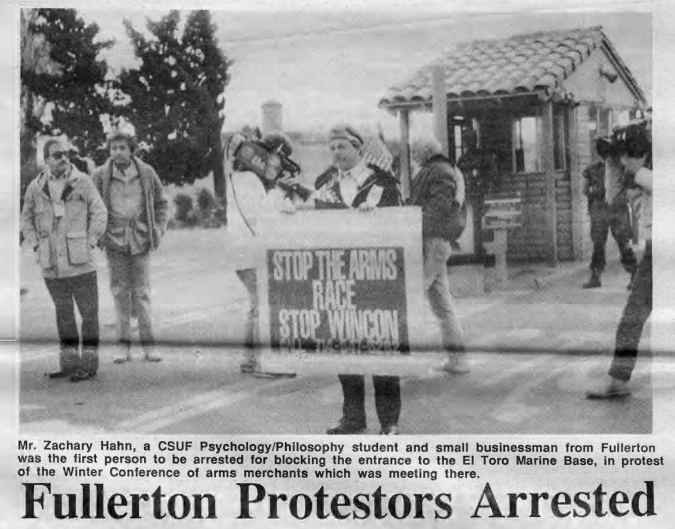
Law & Order
Following the departure of Martin Garibedian, captain Philip Goering was promoted to be the new Police Chief.
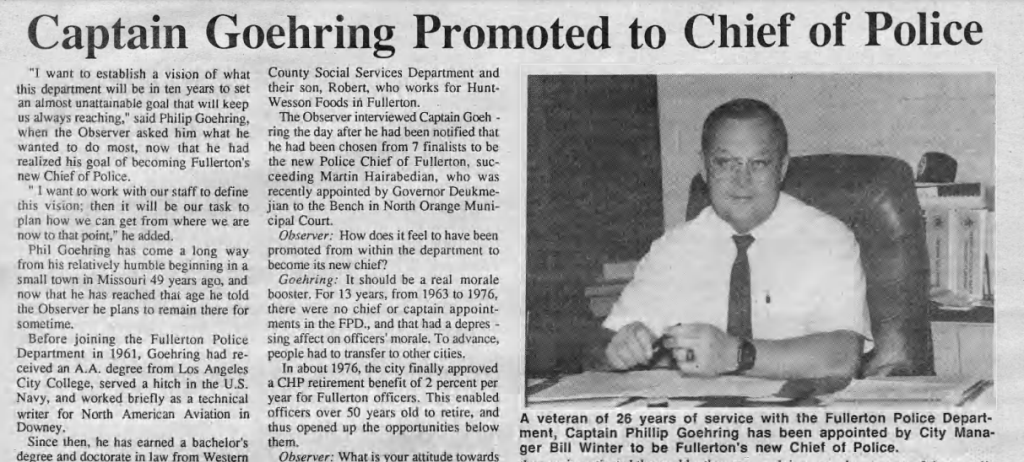
Local Champion
US Swimming Champion Janet Evans, who grew up swimming in Fullerton, was featured in the Observer. Today, the sports complex at Independence Park is named after Evans.
History
1987 was the hundred-year anniversary of the founding of Fullerton, as well as the two hundred year anniversary of the U.S. Constitution. To commemorate these, the city held a celebration.

Local historian Warren Bowen wrote a few articles about various aspects of Fullerton’s history.
Part of the centennial celebration involved the restoration of the WPA mural in the police station (formerly City Hall). Bowen took this opportunity to write a brief history of City Hall.
When City Hall was built in 1941, it contained not only the police department and City jail but also the water, engineering, building and welfare offices; and those of the elected treasurer and clerk; the justice of the peace; and, of course, the City Council.
Bowen also included an article about the popularity of baseball in Fullerton in the 1930s.
Famous baseball players from Fullerton included Walter Johnson, (Washington Senators’ pitcher), Willard Hershberger (Cincinnati Reds catcher), Bus Callan (N.Y. Giants catcher), Arky Vaughan (Pittsburg Pirates shortstop), Del Crandall (Milwaukee Braves catcher), and Steve Busby (K.C. Athletics catcher).
“In the heyday of Arky, and the despair of the depression years, baseball was…the local great escape,” Bowen writes.
John Francis “Pep” Lemon was a popular and influential local coach and baseball booster.
“He was a one man recreation department when no one thought to call it that,” Bowen writes. “His domain was the ball park at Commonwealth (now Amerige Park) at Malden and W. Commonwealth Avenues.”
The ball park is now known as Duane Winters Field in honor of the long time City Councilmember.
In the 1930s, Amerige Park was “in many ways, a community center with daytime baseball and evening softball leagues.” Girls softball was very popular there during WWII.
Fullerton’s local baseball team was known as the Fullerton Merchants and (later) the Fullerton Firemen. Players were recruited by Lemon and included high school and junior college players, oil field workers, police officers, firefighters, the local pharmacist, and others who loved the game.
Players for these popular Sunday afternoon games included Bucky Walters, Vern Wilkinson, Roe White, Pershing “Puss” Hodgson, Del Jones, Bud Dawson, Otto Brandle, Clifford Perry, Lou and Wade Blose, Wee Willie Jones, “Frenchy” Loumagne and Dick Joyce as well as Pep Lemon himself who frequently caught the games.
“Each Saturday the local newspaper would set forth the expected lineup, and then recap the game on Monday for those who couldn’t make it,” Bowen writes. “The Firemen were part of a league which also featured teams from Collbom Brokers, 20th Century Fox Films, Standard Oil, Cuccio Winery, RKO Radio and the Chili Bowl.”
“It was a place to see and be seen,” Bowen writes. “Families often attended….The games started about 1:00 p.m. You paid 25 cents for an adult admission…You brought an old blanket to soften the wooden, backless benches, and lots of those were army blankets which the vets of WWI were trying to wear out.
Bowen also includes a story about when Fullerton celebrated its 50th anniversary in 1937 with a massive pageant that drew thousands.
Here are some excerpts from the article:
“The event was an all-community effort, which included a queen contest and coronation ball, dedication of plaques by the DAR and others, renaming of Commonwealth Park as Amerige Park, a childrens’ play day at the park, historical exhibits, a ladies card party in the high school gym, a banquet by the 20-30 club; all topped off by three performances of a pageant, with a cast of over 1000, portraying the development of the area. “The Conquest of the Years” featured details of the early Spanish explorations and settlement through growth of the citrus and oil industries of the 20th century.
“So momentous was the event that the local schools were closed for an entire day and businesses from 1pm Mayor Harry Maxwell and co-founder George Amerige took part in the park rededication, which was followed by a childrens’ play day and two baseball games, one of these featuring the Fullerton Jr. College Hornets vs. Long Beach Jr. College.
“In observance of the event, the Daily News Tribune published the largest edition of a newspaper in the history of the County with feature stories about local people and businesses and over 300 advertisements.
“Flags and bunting were being hung in Fullerton, while 33 candidates for Queen (later to swell to 52) sold tickets to the pageant and gathered in votes. As the campaign heated up, it became a two way race between Mrs. Pearl McAulay Phillips and Miss Mary Catherine Morgan; the young matron vs. the student. In the final analysis Mrs. Phillips carried the day, and Morgan was “Miss Columbia.”
“The pageant shaped up under the direction of Miss Hazel Anderson, an imported director from Ohio. Dozens of local business people accepted roles, and students from the high school were enlisted by the hundreds. The simulated wedding of Don Bernardo Yorba and his bride was a part of the event with a younger Bernardo Yorba in the role, and Rosemary Kraemer, also a direct descendant of the Yorbas, as the bride. Other segments showed the Ameriges, a group of Basque sheepherders, an early hotel dance, music, oxcarts, stage coaches and the like. Over 10,000 people attended the performances at the high school stadium.”
-
Headlines: 1986
The following is from a work-in-progress about the history of Fullerton. You can support my ongoing research and writing on Patreon.
The Fullerton Observer newspaper was formed in 1978 by Ralph and Natalie Kennedy and friends to provide a more progressive counterbalance to the more conservative Fullerton News-Tribune and Orange County Register. The Fullerton Public Library has digital archives of the Observer stretching back to 1979. Here are some top news stories from 1986.
Local Politics
1986 was a midterm election, and incumbents Buck Catlin and Molly McClanahan were re-elected to City Council.

For the second time, the conservative council majority passed over moderate/liberal Molly McClanahan to serve as mayor, a position that (in theory) is supposed to rotate among councilmembers based on seniority. In practice, the position often goes to whoever can get three votes.
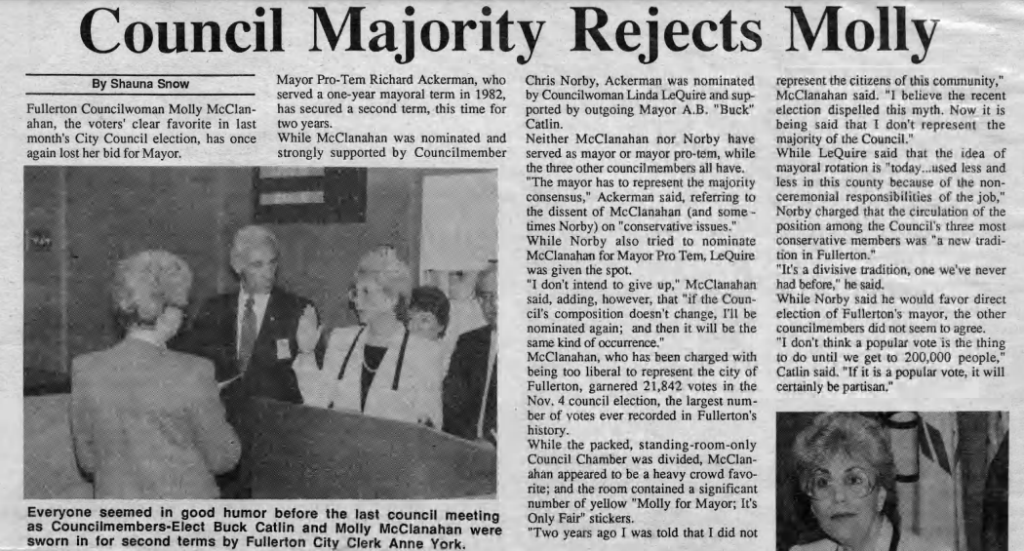

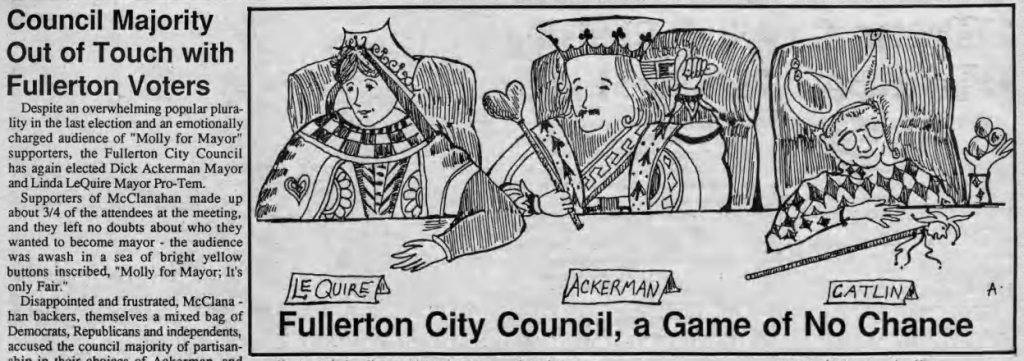
Republican state legislator Ed Davis accused arch conservative William Dannemeyer of hatred and bigotry for his statements against gay rights, particularly in the midst of the AIDS crisis.

Dannemeyer doubled down on the homophobia in a response letter to Davis in which he wrote, “I make no apology for my support for the heterosexual lifestyle which is the only one condoned in the basis for our JudeoChristian culture, the Bible. The fact is that God created us to be one man with one woman; Adam and Eve, not Adam and Steve.”
Budget
Here is the breakdown of the city budget for 1986/87. I note the relatively smaller percentage going to police and fire compared to today. What happened?

Housing and Homelessness
For years, the conservative council majority refused to use public funds for affordable housing.
The council voted against using a relatively small amount of federal funds to support a local homeless shelter.

In 1986, Fullerton and other communities across the country participated in the “Hands Across America” event for the homeless and hungry. The Observer included a cartoon pointing out the hypocrisy of the council supporting this, while not allocating funds for a homeless shelter or affordable housing.

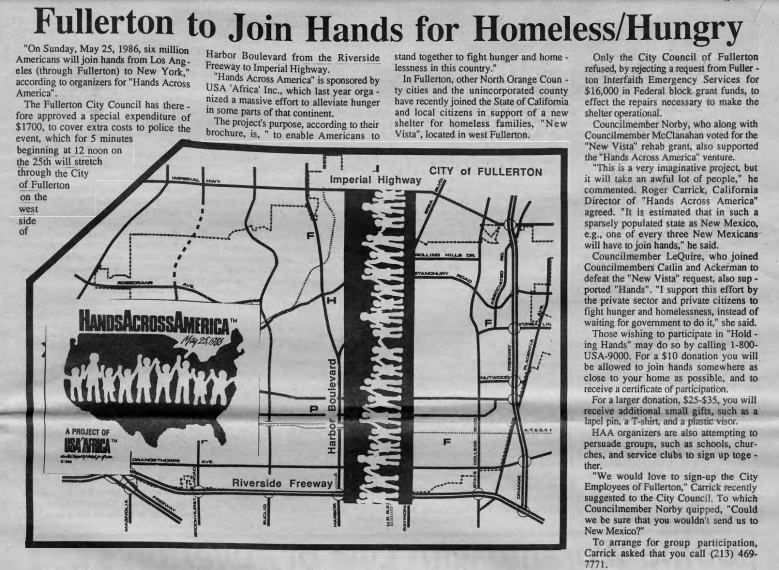


But then, facing push back from the community and some public shaming from the Observer, council reversed its decision on the shelter.

Local non-profit Fullerton Interfaith Emergency Services (now Pathways of Hope) opened the city’s first homeless shelter, with 12 to 20 beds for homeless families.


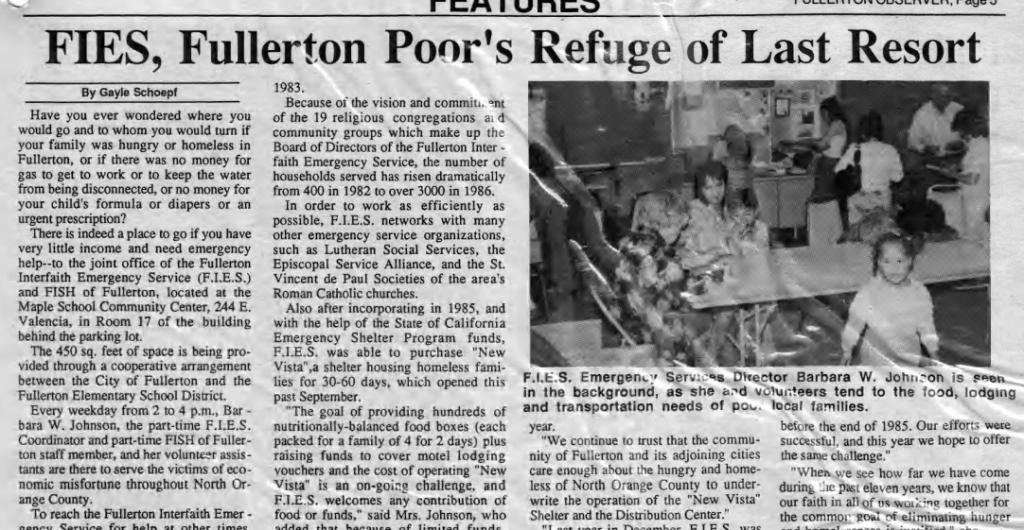
Redevelopment
Instead of using redevelopment funds for affordable housing, the council majority preferred to use the funds to subsidize large private business developments, including restaurants, parking structures, a hotel, theaters (see below), and market rate (I.e. unaffordable) housing.


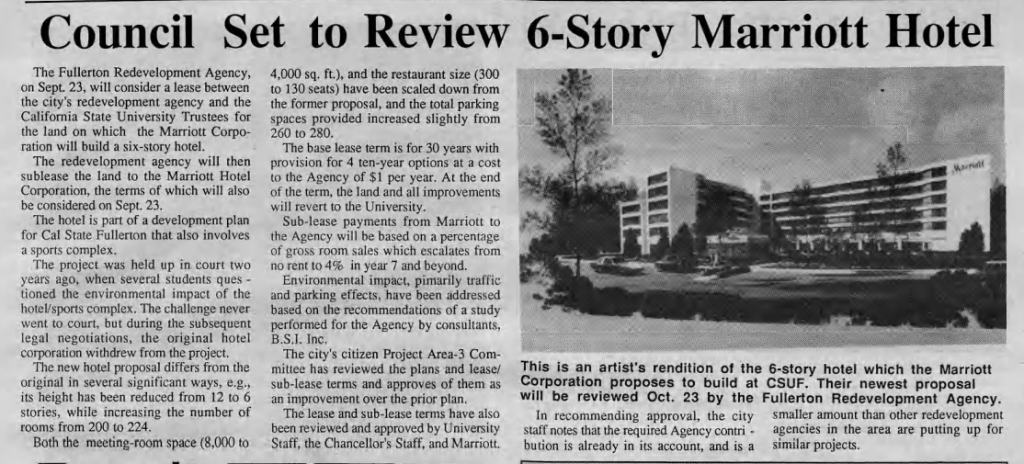


Downtown
In the 1980s, downtown Fullerton was relatively sleepy. An Observer article compared Fullerton’s downtown with Whittier’s, which was more popular and pedestrian friendly at the time.


Culture
Plans were in the works to develop an IMAX theater at the Museum Plaza, subsidized by redevelopment funds. These plans ultimately fell through.

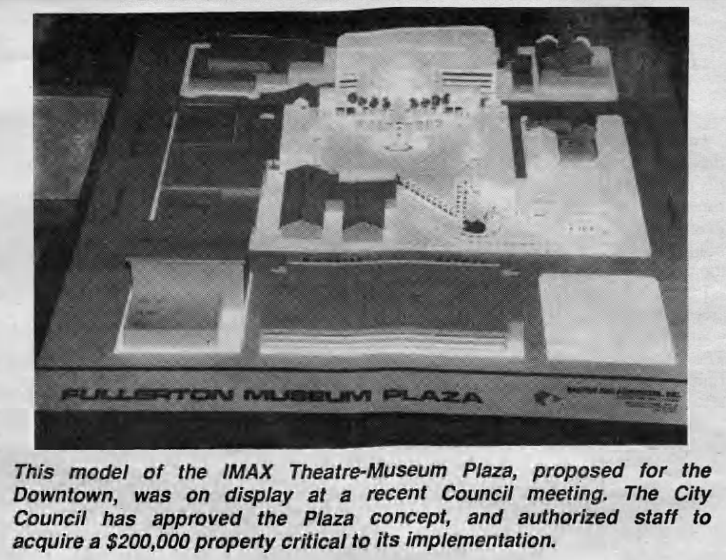
A major annual cultural event was A Night in Fullerton, which got started back in the 1960s.
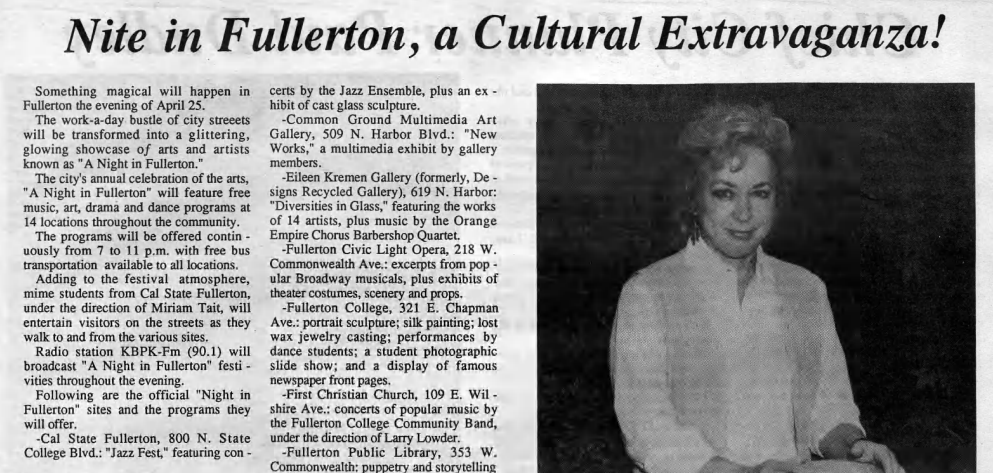
The City also celebrated an annual Founder’s Day Parade.

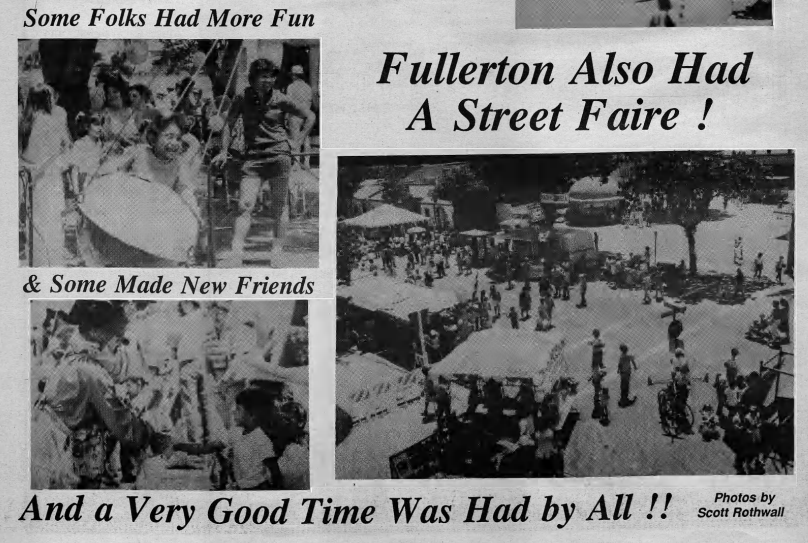
There were also a handful of cool art galleries downtown in the 1980s.
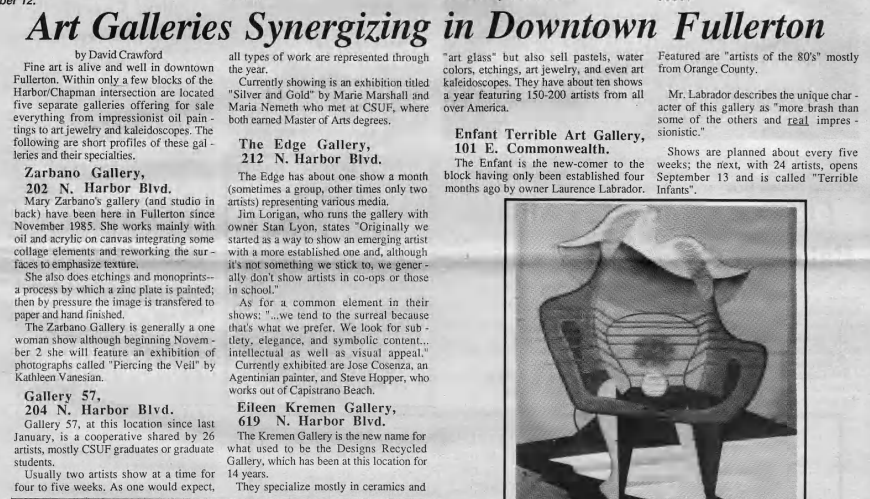


Unfortunately, one of those galleries, Common Ground, closed. Having co-owned an art gallery in Downtown Fullerton myself, I know how difficult it can be to keep it financially sustainable.

In historic public art news, council approved funding to restore the large WPA-era mural “The History of California” in the police station, formerly City Hall.
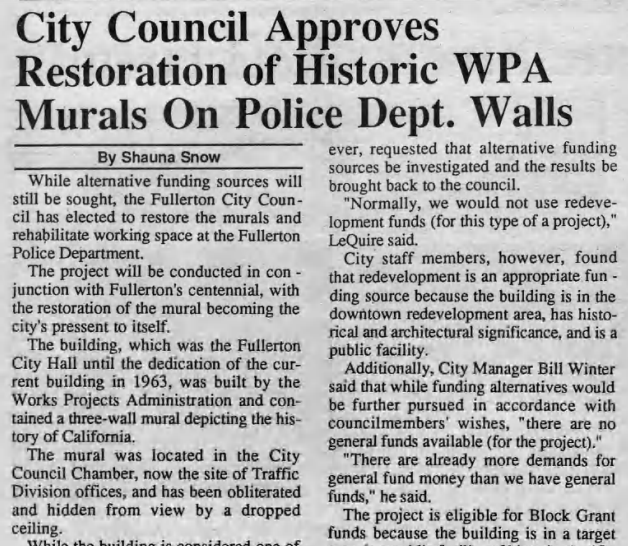
A Lively Music/Arts Festival was held at Hillcrest Park.

In popular entertainment news, the city used $2 million of redevelopment funds to subsidize the development of the new AMC Theater.
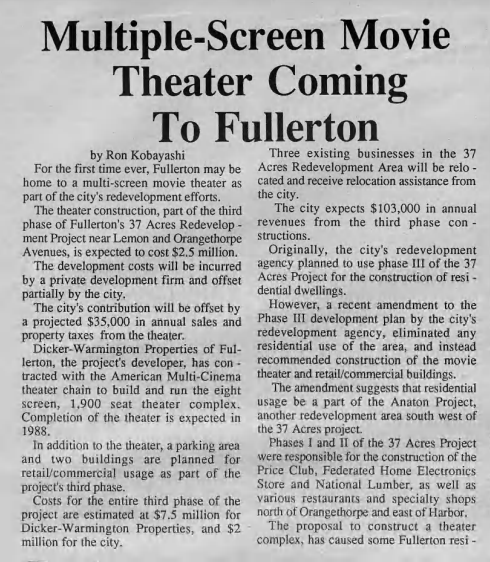
Education
Still facing budget shortfalls that were (partially) attributed to the passage of Prop 13 back in 1978 (which severely limited property tax revenue), the state of California started allocating a portion of the Lottery money for schools.

Meanwhile, the number of school counselors had been cut.
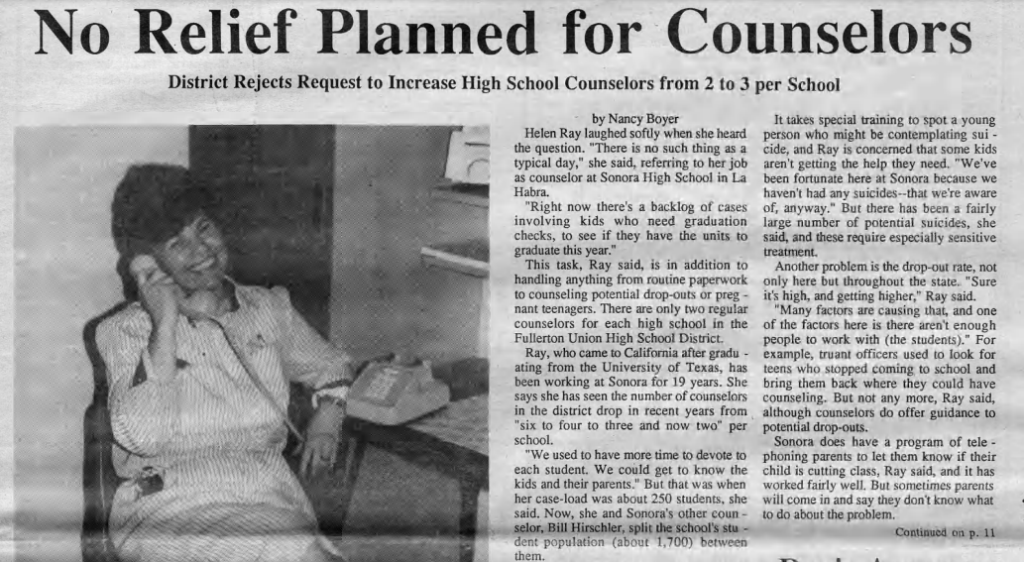
Some controversy arose at Cal State Fullerton as students protested against former Ku Klux Klan leader Tom Metzger taping his show “Race and Reason” on the campus.
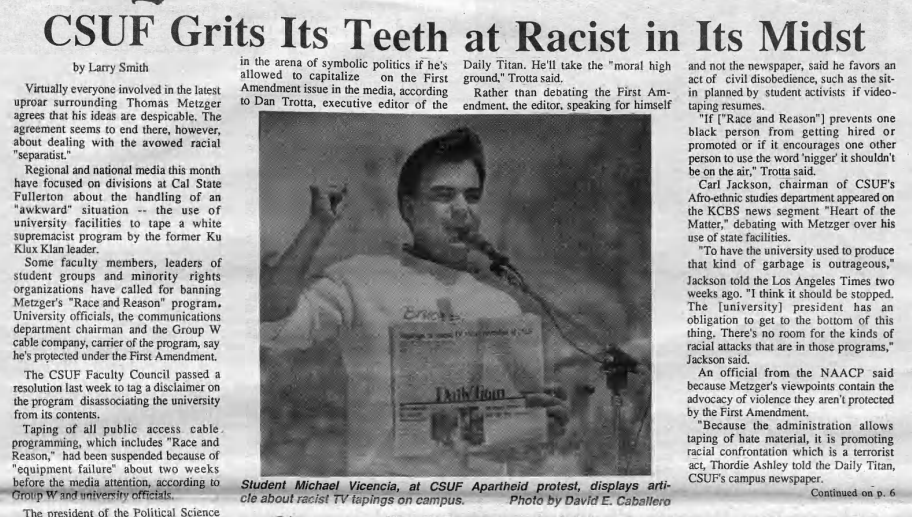
In related news, CSUF students also protested against apartheid in South Africa, urging an economic boycott of the country.

Californians voted to pass Proposition 63, which made English the “official language” of the state, ignoring the huge number of Latinos (and other ethnic groups) here plus the fact that California used to be part of Mexico. It was exclusionary policies like this that led to California flipping from red to blue (Republican to Democrat majority) in the late 1990s.
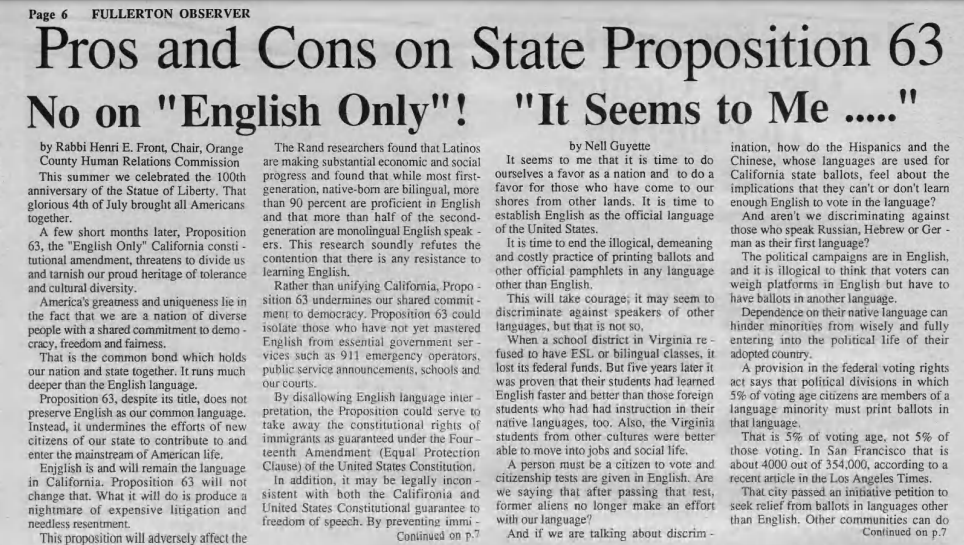
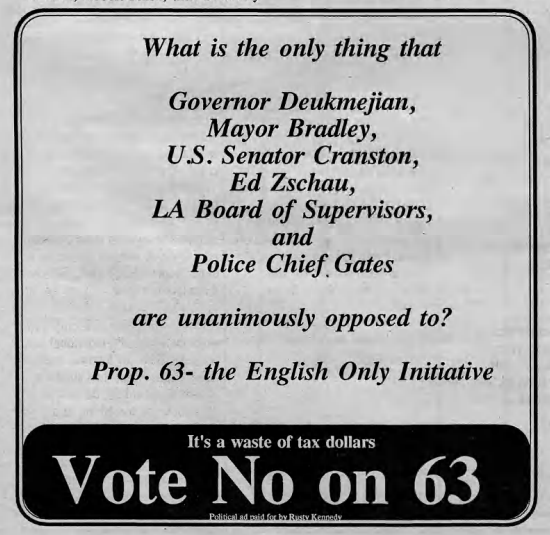
Transportation
From its beginning, the Observer was an advocate of improving the city’s bicycle infrastructure, and improving public transit–for both individual health, environmental, and financial reasons. Local leaders were not always receptive to these ideas. Orange County was, and remains, a very car-centric place, although it doesn’t have to be.
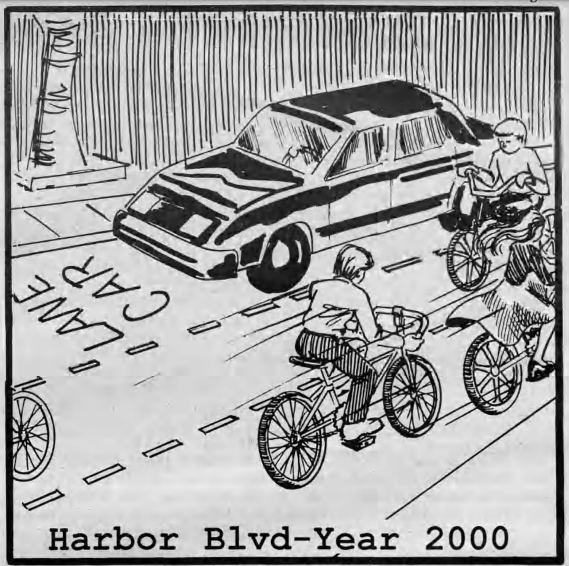
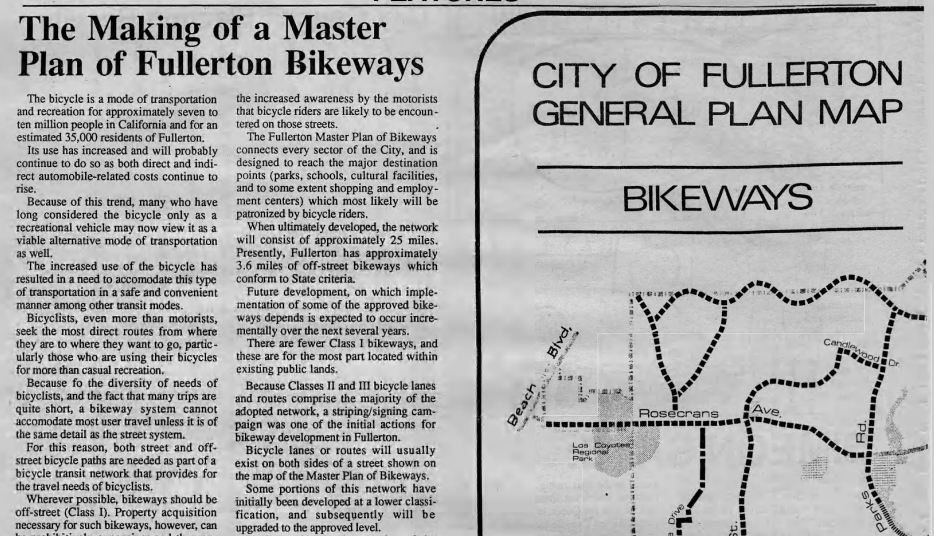

Environment
In other environment news, Fullerton settled a lawsuit brought by local residents as a result of the toxic McColl dump site, the City’s first Superfund site.
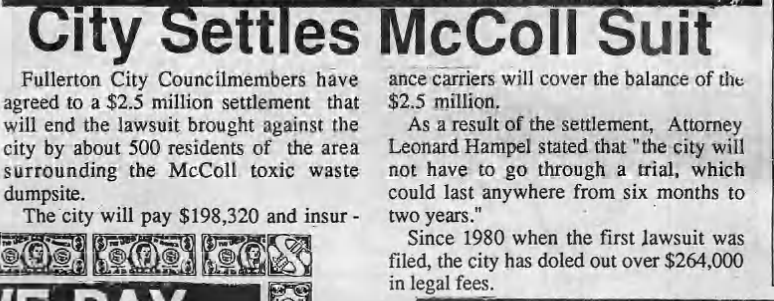
Religion
Both locally and nationally, more people went to church in the 1980s, as shown by the numerous advertisements for local churches in each issue of the Observer (as well as Gallup poll data).

Labor
Workers at the Laura Scudder’s plant in Fullerton went on strike to preserve their benefits, which the company was planning to cut. Union membership declined in the 1980s, in part as a result of president Reagan’s anti-union policies.
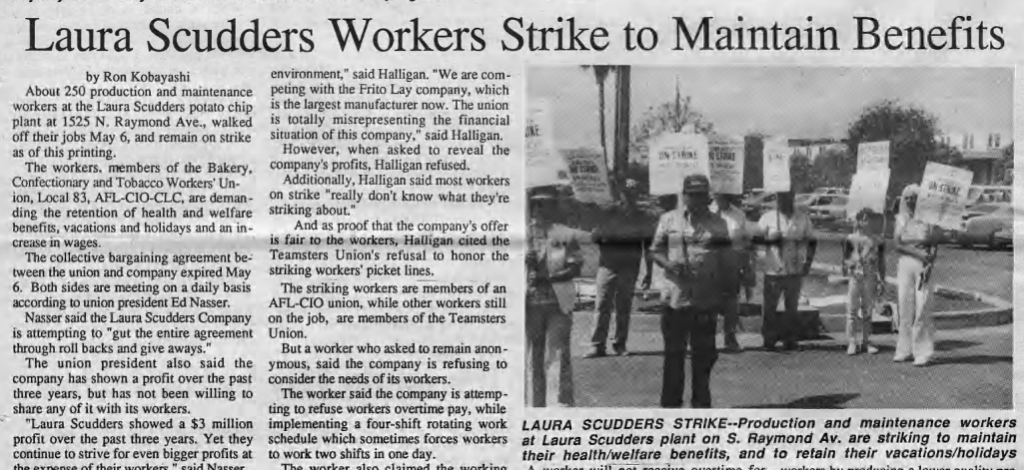
National and International News
A national tragedy occurred on January 28, 1986 when the Challenger space shuttle exploded shortly after launch, killing all seven crew members. This disaster also dealt a serious blow to the Space Shuttle program.

In other space news, President Reagan proposed his Strategic Defense Initiative (or “Star Wars”) program, a space-based program to defend against nuclear attack from the Soviet Union. The program was ultimately deemed unfeasible.
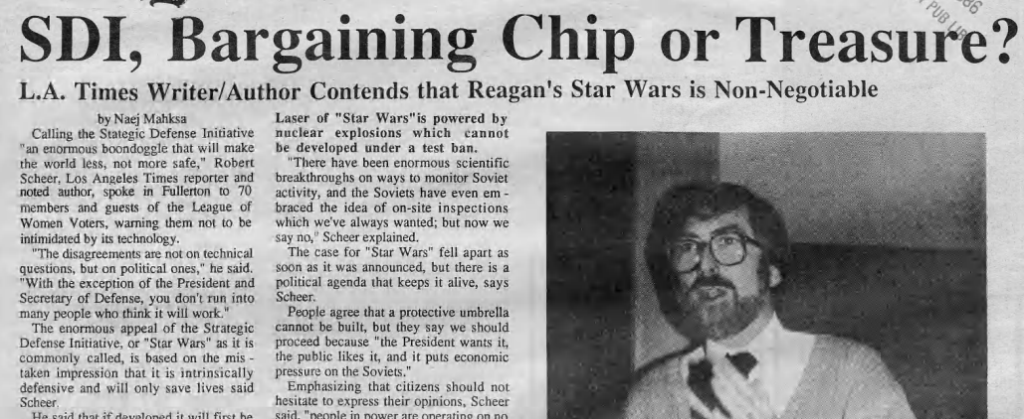
Local residents protested the United States’ involvement in the Civil War in Nicaragua. This would ultimately involve the Iran-Contra scandal that hurt, but did not end, the Reagan presidency.
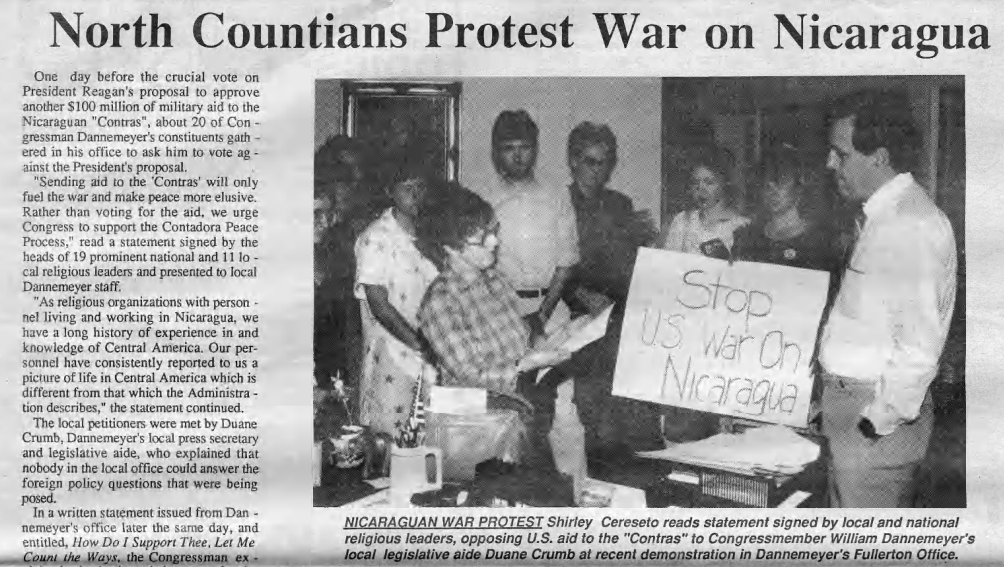
Miscellaneous
Here are a few miscellaneous articles of interest from 1986:


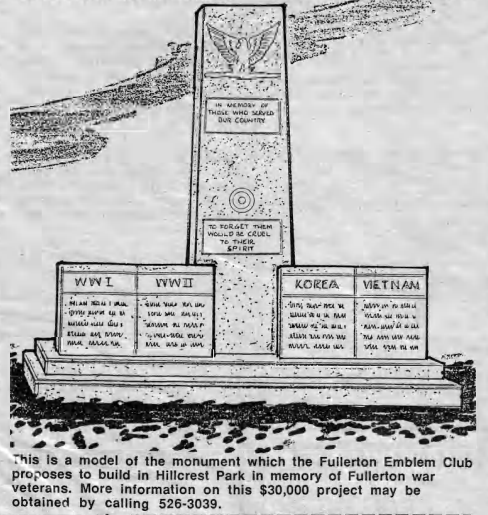
Deaths
Popular local swimming and water polo coach Jimmy Smith died.
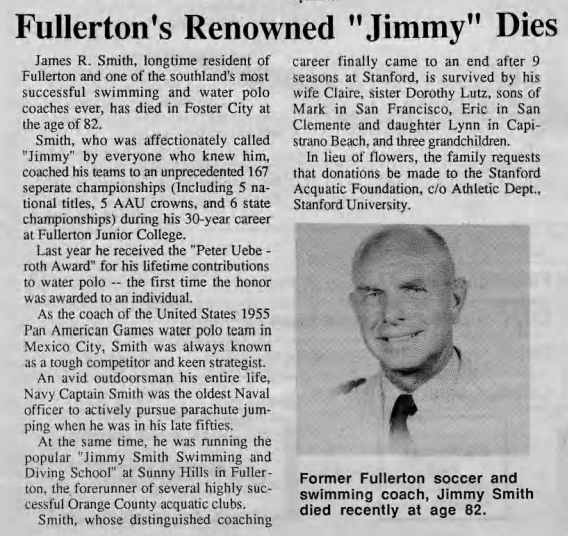
A toddler named Allison McClennen was tragically killed after being struck by a car.
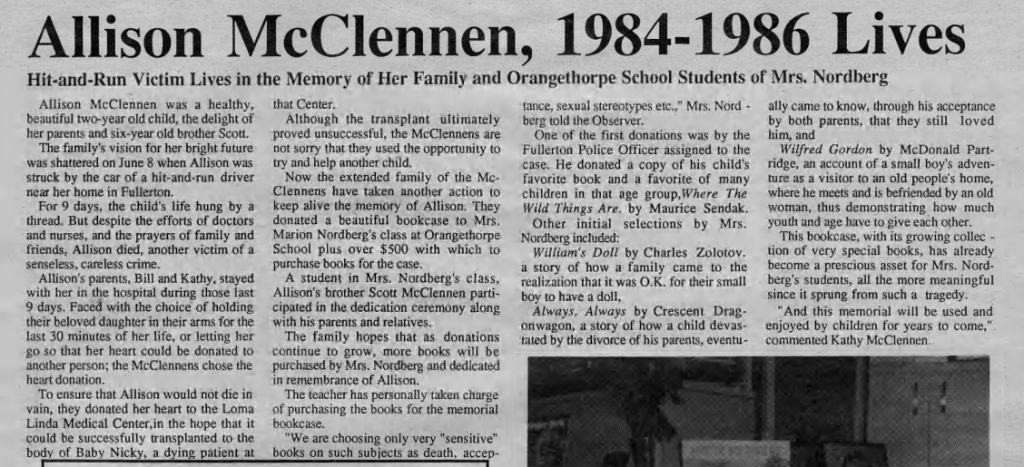
-
Headlines: 1985
The following is from a work-in-progress about the history of Fullerton. You can support my ongoing research and writing on Patreon.
The Fullerton Observer newspaper was formed in 1978 by Ralph and Natalie Kennedy and friends to provide a more progressive counterbalance to the more conservative Fullerton News-Tribune and Orange County Register. The Fullerton Public Library has digital archives of the Observer stretching back to 1979. Here are some top news stories from 1985.

Local Politics
In 1985, the Fullerton City Council was Dick Ackerman, Buck Catlin, Linda LeQuire, Molly McClanahan, and Chris Norby.
Once again, the conservative majority passed over the regular rotation to deny Molly McClanahan the chance to serve as mayor.

In congress, Fullerton was represented by arch conservative William Dannemeyer, who was a vocal opponent of gay rights.
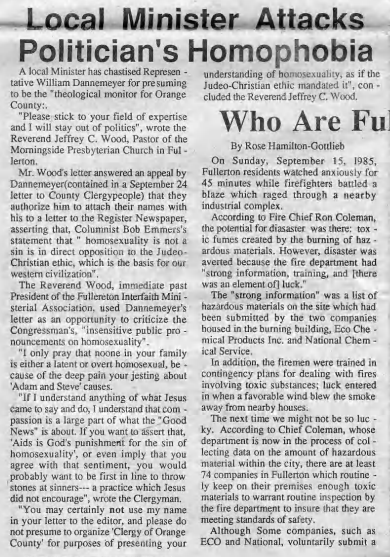
Housing and Homelessness
For years, the conservative city council majority opposed using government subsidies for affordable housing.

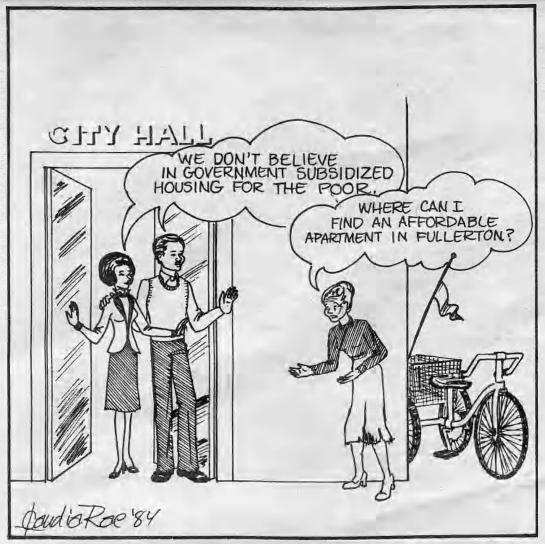
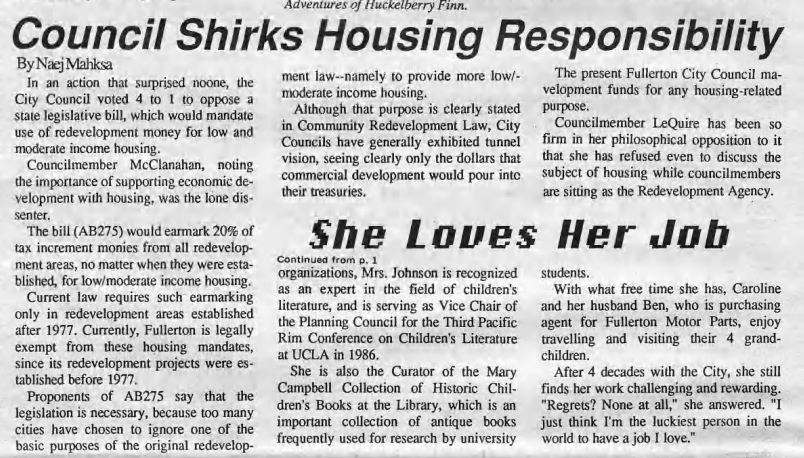
This had the predictable effect of exacerbating Fullerton’s homeless problem, and thus the need for local shelters. Here, again, the council majority was reluctant to offer help.
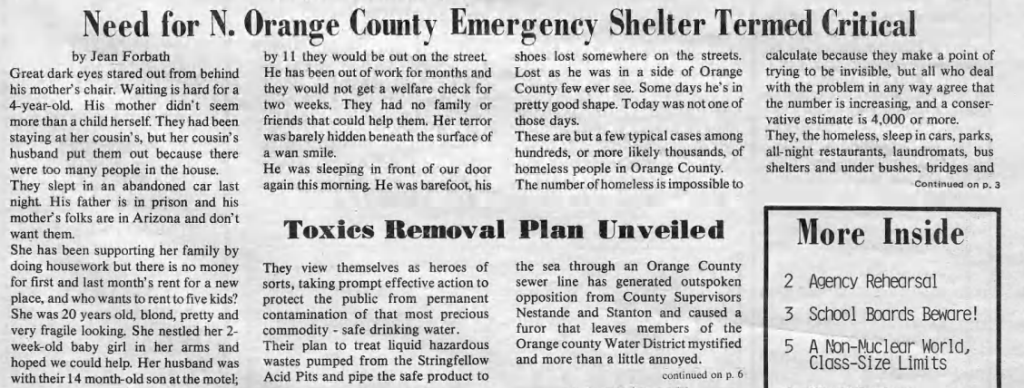
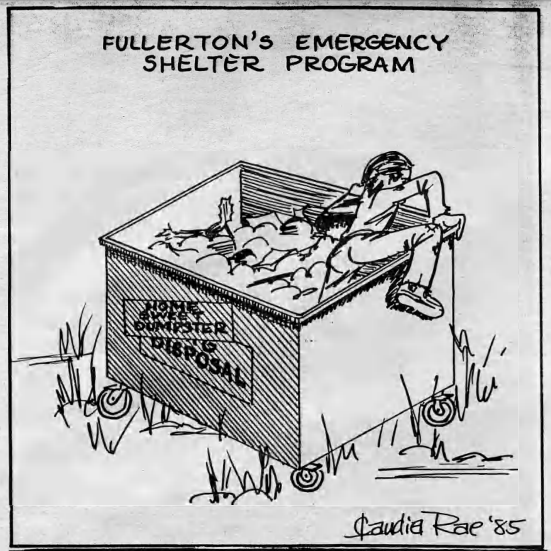
Despite City Council’s reluctance to deal with homelessness, other local leaders sought to step in to fill the need, creating the first of many regional Homeless Task Forces.
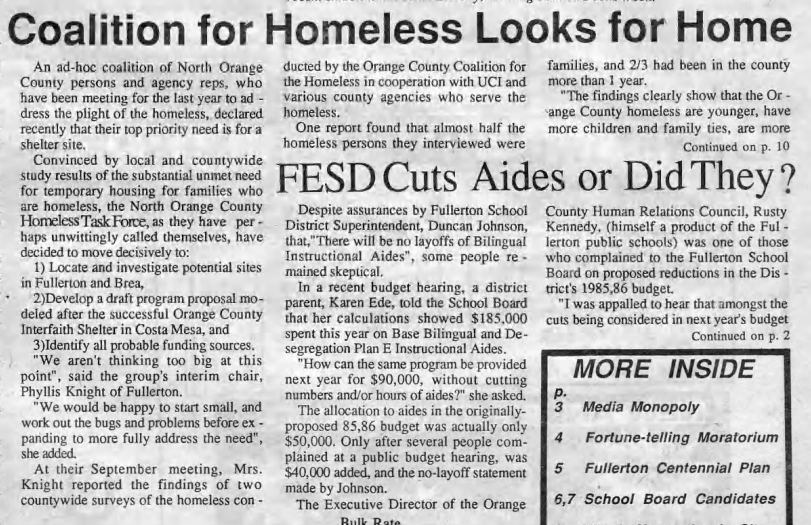
Fullerton Interfaith Emergency Services (now called Pathways of Hope) was seeking to refurbish an old house into the City’s first shelter.
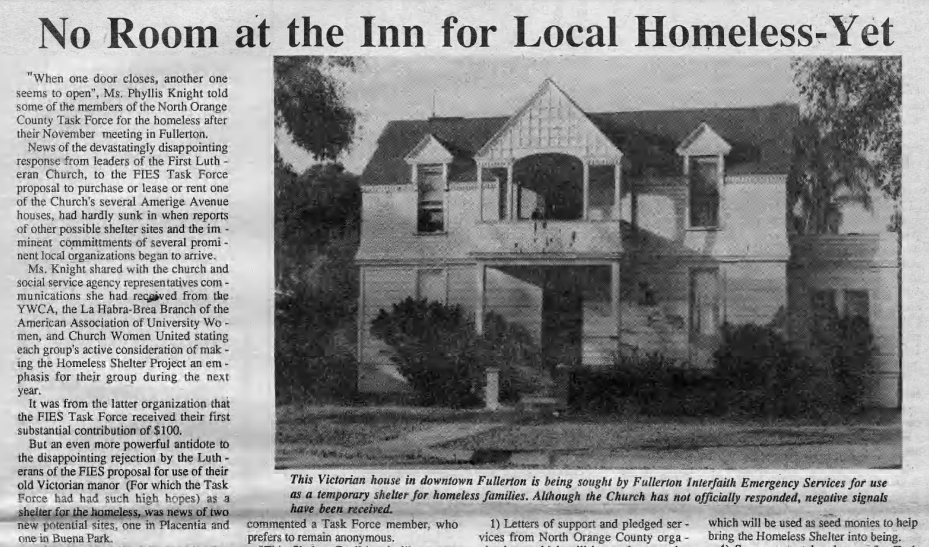
Redevelopment
Back in the 80s, Fullerton had a Redevelopment Agency which had funding to “halt blight or conditions that may lead to blight, and to enhance the economic climate of cities.” While cities had the authority and mandate to use at least some of redevelopment funds for construction of much-needed affordable housing, the council preferred to use it for things like parking structures, rehabilitating shopping centers, parking lots, and sports complexes.
Councilman Dick Ackerman, who served for twelve years, said he was “strongly opposed to governmentally subsidized housing for low-income people.”
“Not everyone can live here in Fullerton, and we shouldn’t expect government to make it happen,” Ackerman said. “We shouldn’t tinker with the natural flow of free enterprise.”
Meanwhile, Ackerman and the council majority preferred to tinker with other markets by using redevelopment money “to reimburse private developers of the Orangefair [mall] project area.”
Here, the local reflects the national. During the Reagan era, government subsidies for the poor were cut, while big corporations got tax cuts and subsidies.
The City of Fullerton’s Redevelopment Agency also had the power of “eminent domain”–meaning it could take over a private property owner’s land, as long as they were paid a “fair market value.” In a blow to local history, council approved the demolition of the original Fender Guitar factory to make way for a parking structure.
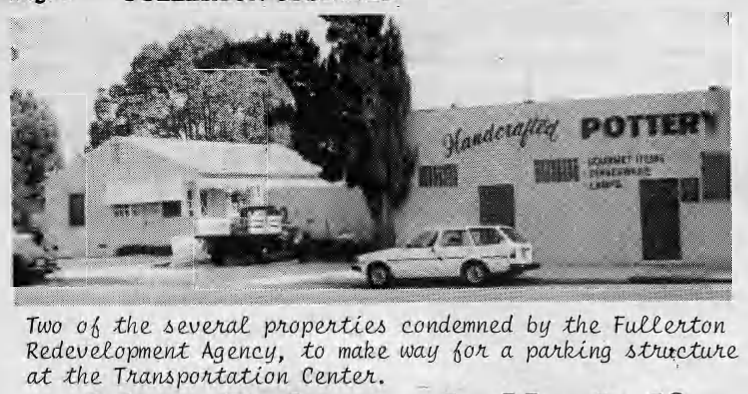
Culture
For a number of years, Fullerton held an annual Founder’s Day Parade and Street Faire.
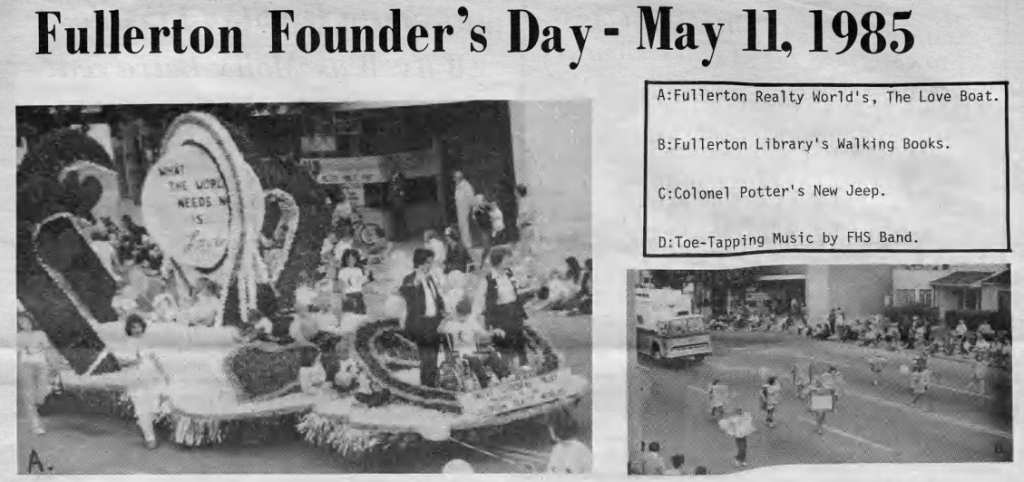
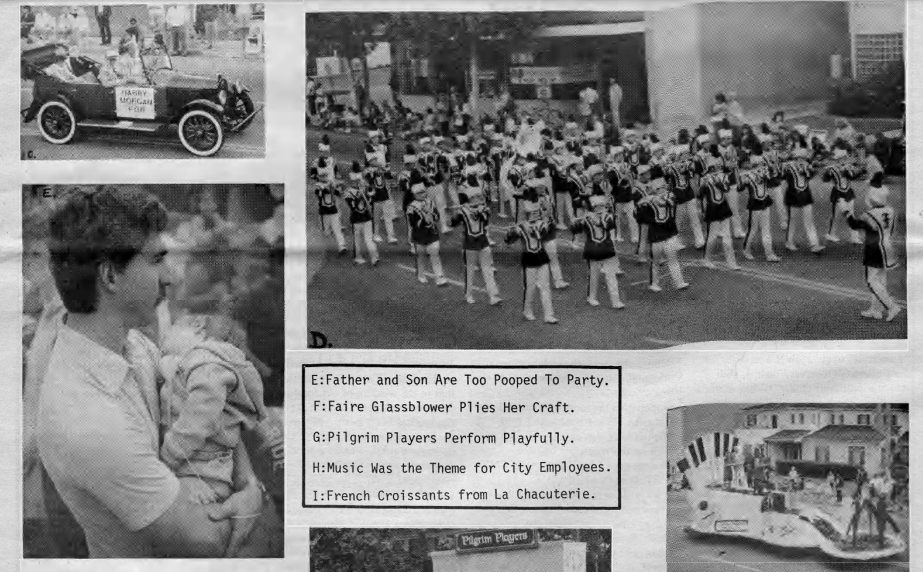
The Fullerton Museum Center was at first denied redevelopment funding, but then got some.
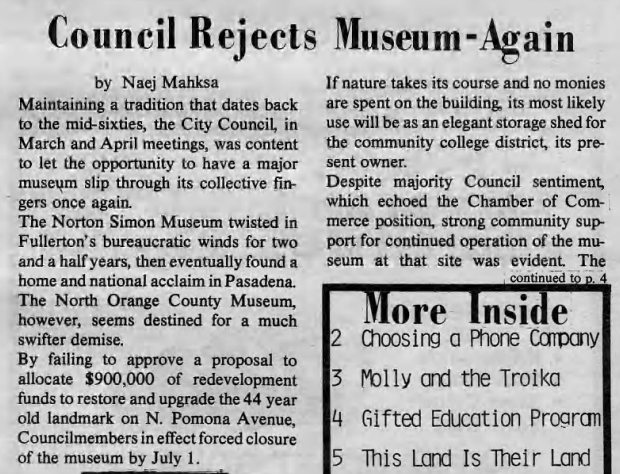

In the 1980s, downtown Fullerton had a number of book stores and art galleries.



Business
Mulberry Street Ristorante, one of the longest-running and most popular spots downtown, was opened by the Bevins family.
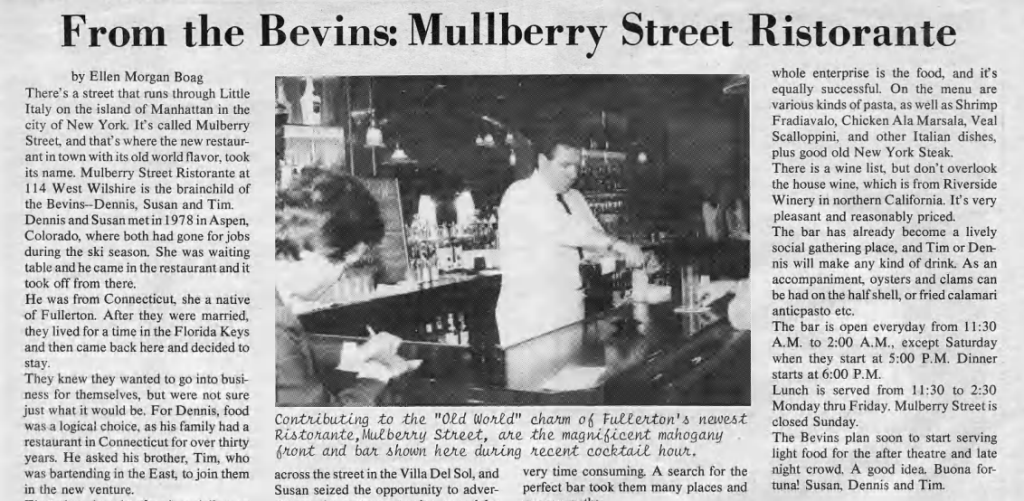
Environment
In environment news, some residents were alarmed by the decision to run toxic waste through the local sewer system.
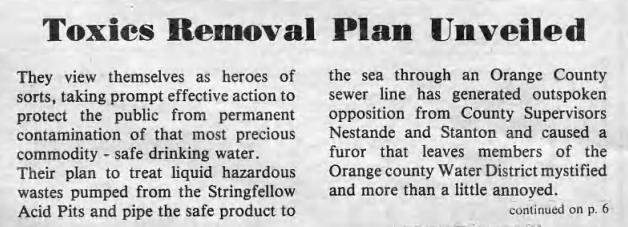

And plans were still being formulated to deal with Fullerton’s first Superfund site, the McColl dump site.

Transportation
In keeping with its progressive values, the Observer had many articles advocating for bicycles, pedestrians, and better public transit.

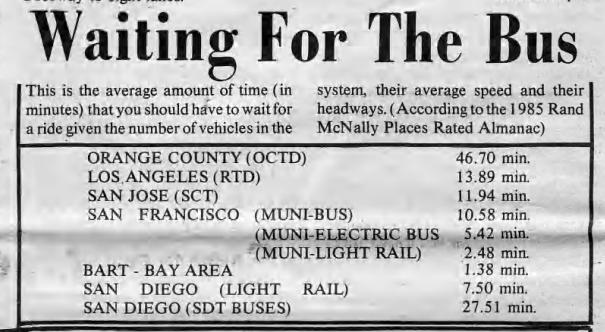
Education
In 1985, new members were elected to the High School and Elementary School Boards.


International Issues
Some international issues in 1985 were nuclear proliferation in the context of the Cold War, the revolution in Nicaragua (which the U.S. involved itself in), and apartheid in South Africa.
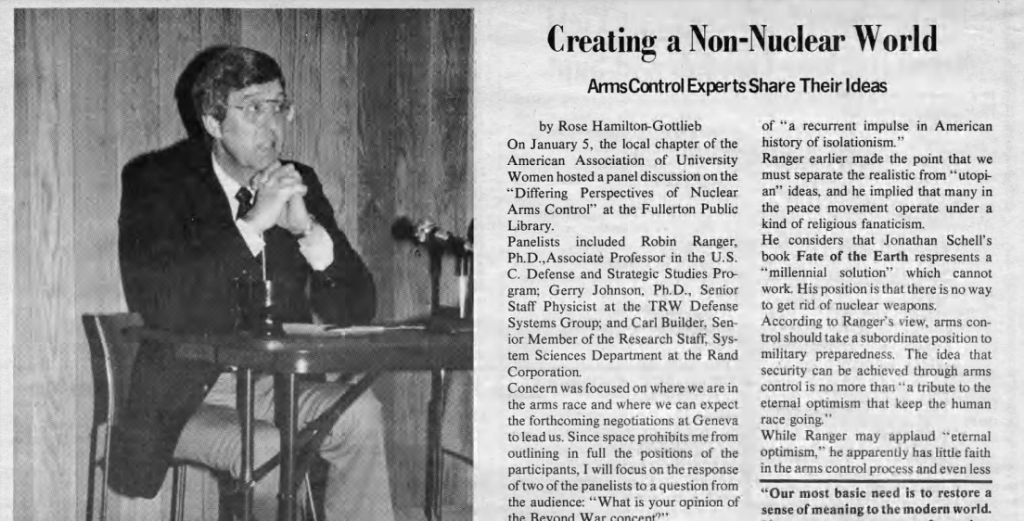

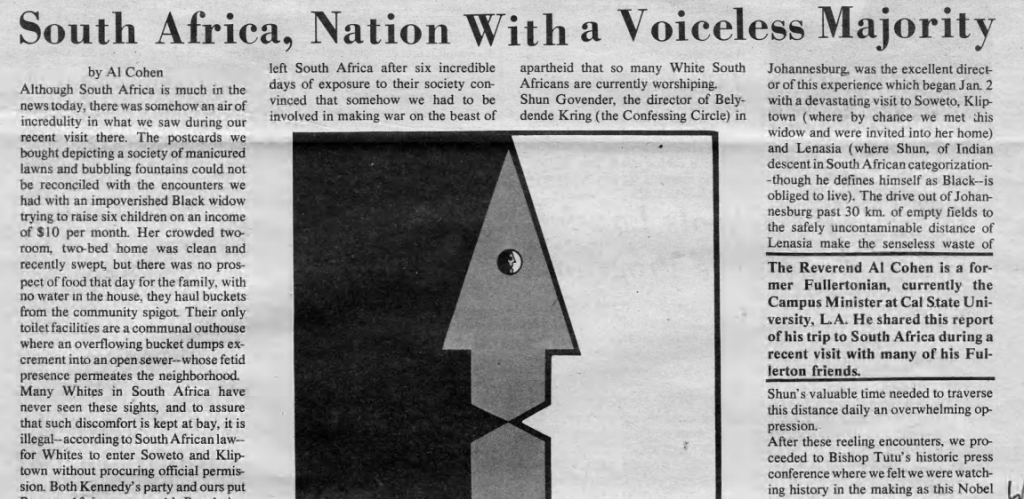
Immigration
While illegal immigration was not quite the hot-button issue it is today, it was a growing concern. Interestingly, it was the Republican president Reagan who signed a significant Amnesty law for undocumented immigrants in 1986. The Republican party seems to have moved away from that approach.
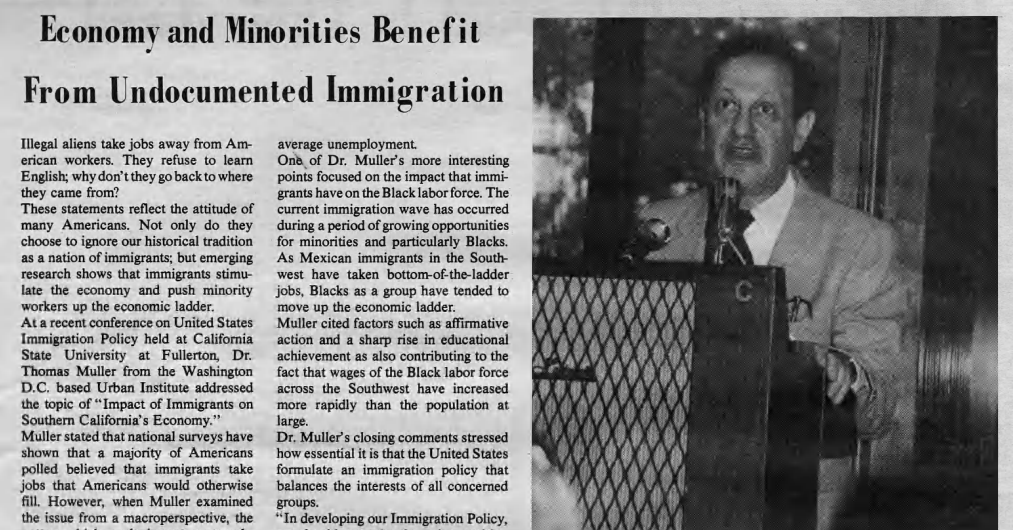
Labor
In labor news, workers urged the public to boycott Alpha Beta grocery stores in solidarity with the United Farm Workers.

United Farmworker leader Cesar Chavez came to Fullerton to plead the case for better treatment of farmworkers, and even wrote a letter to the Observer on the topic.

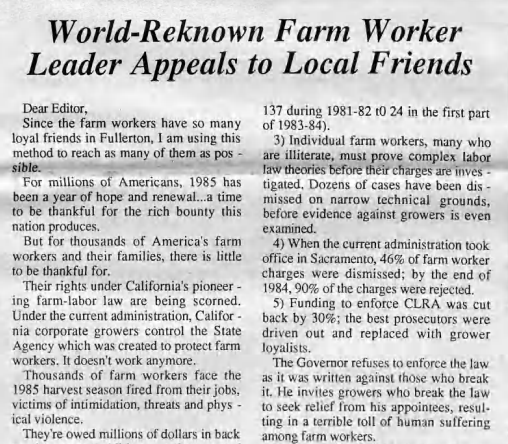
Crime
In 1984, CSUF physics professor Edward Cooperman was killed in his office by Vietnamese student Lam Van Minh, allegedly as a result of Cooperman’s efforts to assist the communist government in Vietnam. Some believed that it was an assassination with possible CIA involvement.

Prosecutors argued that Minh shot Cooperman in his office in cold blood.
The trial against Minh took place in 1985, and resulted in a hung jury, and therefore a mistrial. Assistant District Attorney Mel Jensen said he would be refiling a new set of charges against Minh.
-
Headlines: 1984
The following is from a work-in-progress about the history of Fullerton. You can support my ongoing research and writing on Patreon.
The Fullerton Observer newspaper was formed in 1978 by Ralph and Natalie Kennedy and friends to provide a more progressive counterbalance to the more conservative Fullerton News-Tribune and Orange County Register. The Fullerton Public Library has digital archives of the Observer stretching back to 1979. Here are some top news stories from 1984.
Transportation
Bicycle advocates faced opposition from the Transportation and Circulation Commission. It would be a while before the establishment of the Bicycle Users Subcommittee.

Meanwhile, in an effort to curb air pollution, the state of California instituted a comprehensive Smog check program for cars.

Education
The Fullerton Public Library used to have a Bookmobile that would bring books to local schools and neighborhoods.
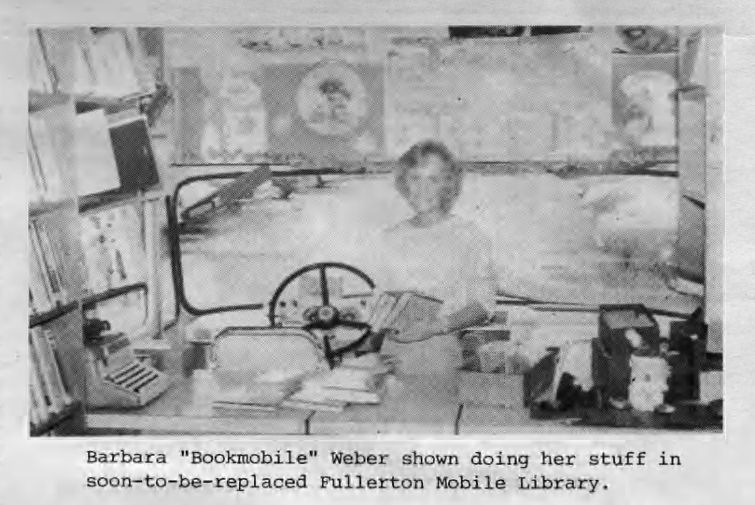
The School Board voted to close the Community Open School, an experimental form of education begun 11 year earlier.
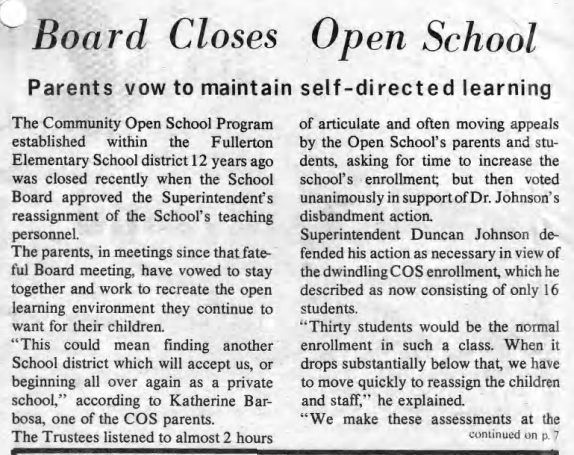
Local Politics
1984 was an election year, and the Observer carried much coverage of the local City Council race, pointing out which candidates were given large contributions from business and developer interests. Generally, the Observer did not support candidates that were heavily subsidized by developers and big business, preferring more independent candidates.


The Observer endorsed three candidates:

Republicans Dick Ackerman and Linda LeQuire were re-elected, and newcomer Chris Norby was elected to replace the outgoing Duane Winters, who had served on City Council for 27 years.
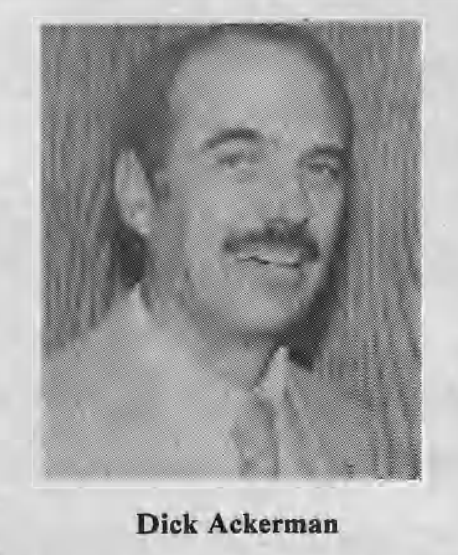
In recognition of Winters’ service, the city named the sports field in Amerige Park (across the street from City Hall) in honor of the long-serving councilmember.

Moderate/liberal Molly McClanahan was passed over as Vice-Mayor by the conservative majority, even though it was her turn in the rotation, a pattern that happened occasionally over the years, and continues to today.
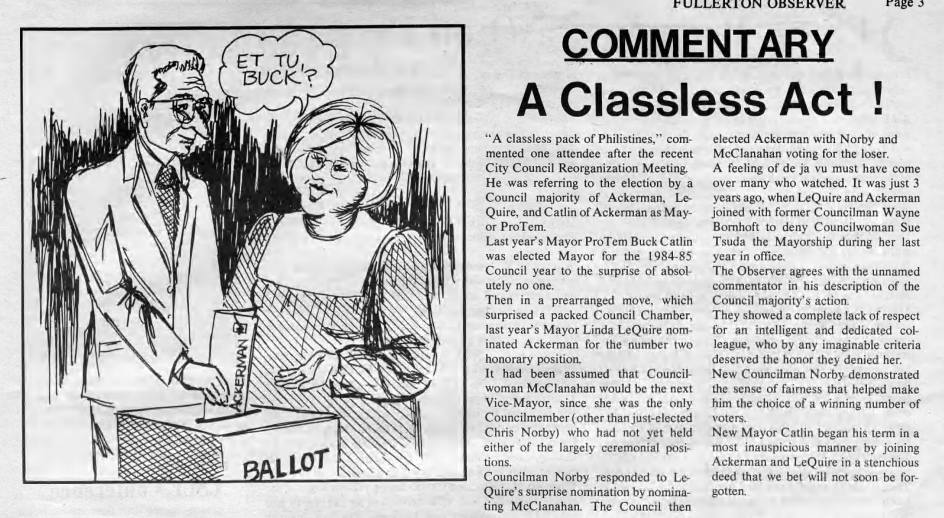
Former Mayor Bob Ward, an advocate for Coyote Hills open space, challenged arch-conservative William Dannemeyer for congress. He lost.

After the passage of Prop 13 placed severe limits on property tax increases, city council sought to fill the budget shortfall with a sales tax increase, which was roundly rejected by voters.
Student Activism
The CSUF campus used to have a pub that served beer (it has since been removed). Students boycotted Coors beer for the company’s anti-union and allegedly racist positions.

Housing
The conservative city council majority consistently voted down affordable housing measures. This, combined with a Reagan administration that was cutting federal government subsidies for affordable housing, exacerbated the growing problem of housing unaffordability and, ultimately, homelessness.
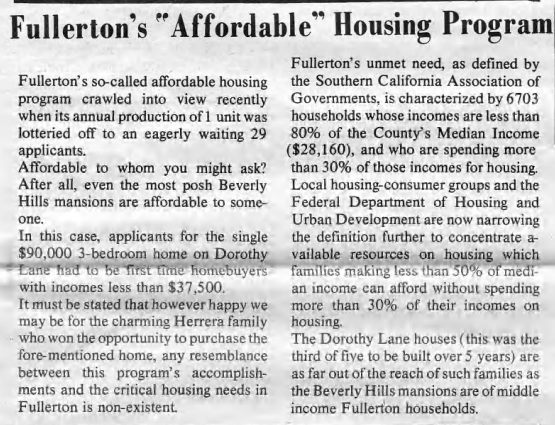

The Strange Killing of Professor Cooperman
CSUF physics professor Edward Cooperman was killed in his office by a Vietnamese student, allegedly as a result of Cooperman’s efforts to assist the communist government in Vietnam.

Some believed that it was an assassination.
Stay tuned for headlines from 1985!
-
Subscribe
Subscribed
Have a WordPress.com account? Log in now.

