-
Fullerton in 1934

The following is from a work-in-progress about the history of Fullerton. You can support my ongoing research and writing on Patreon.
The Local History Room of the Fullerton Public Library has microfilm from the Fullerton Daily News-Tribune newspaper stretching back to 1893. I am in the process of reading over the microfilm, year by year, to get a sense of what was happening in the town over the years, and creating a mini archive. Below are some news stories from 1934.
The New Deal
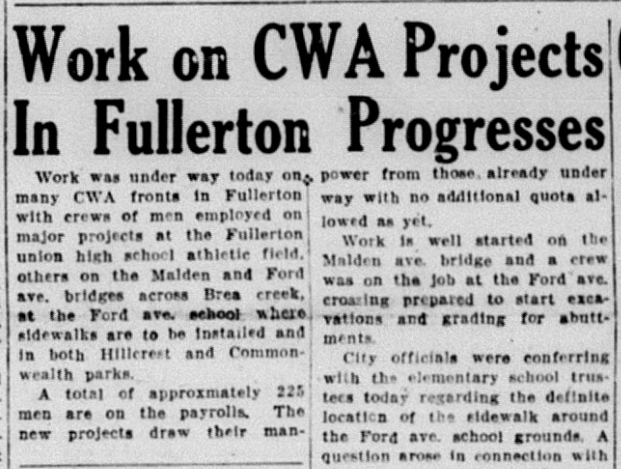
In 1934, the Great Depression was still in full swing, and president Franklin D. Roosevelt’s New Deal programs were being enacted, some of which involved federal spending on local projects.
Strike!
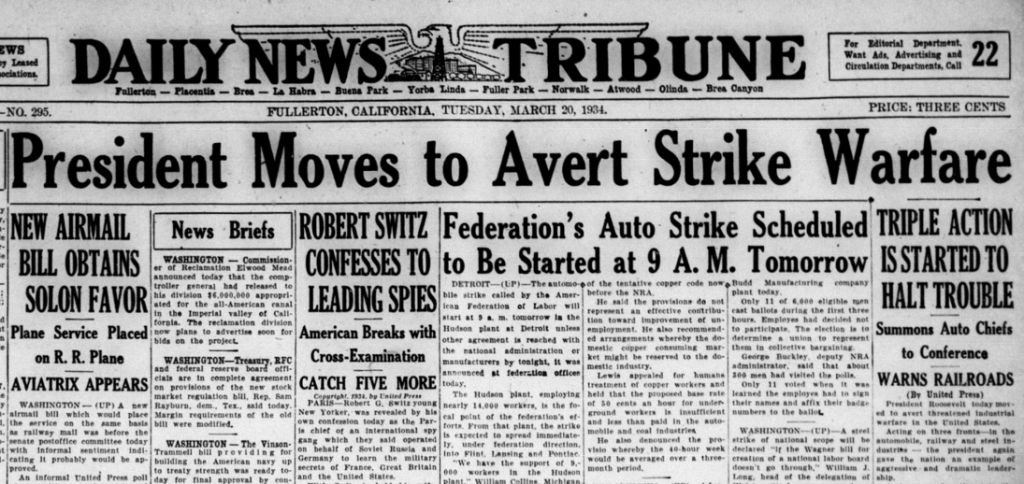
The 1930s were filled with labor strikes across the country. In the book Endangered Dreams: The Great Depression in California, historian Kevin Starr writes, “Between January 1933 and June 1939, more than ninety thousand harvest, packaging, and canning workers went out on some 170-odd strikes.
That was just agriculture. Major strikes in other industries, such as the 1934 West Coast waterfront strike, rocked California’s major coastal cities.

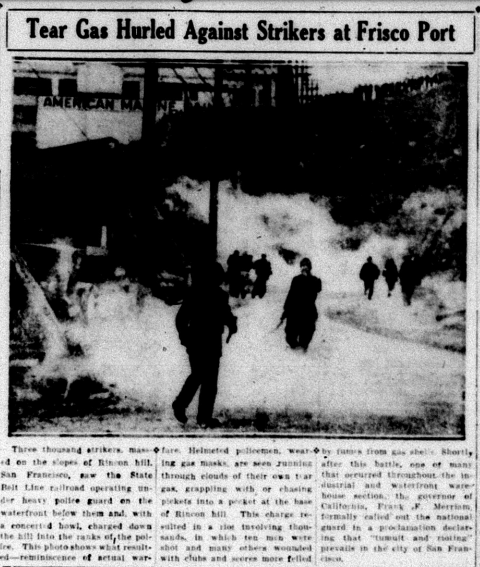
These strikes were massive and sometimes erupted into violent street fights between strikers and police.
Late in 1934, streetcar workers in Los Angeles went on strike.
Closer to home, dairy workers in Orange County went on strike.

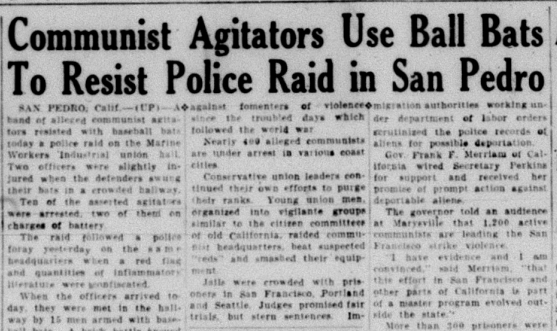
Those organizing labor strikes were often accused of being communists.

“Warning to citrus growers that they might expect communistic activities in this district as soon as the valencia season opens and methods of combating the agitation was given by H.O. Easton, packinghouse manager, at the regular meeting of the chamber of commerce here yesterday,” the Tribune reported.
Easton argued that local cities should pass anti-picketing ordinances (Fullerton already had one).
“He told citrus growers that they should impress upon workers they hire that any agitation is the work of communists attempting to start trouble among men employed in this district,” the Tribune reported.
Special guards were requested to protect packinghouses.
The truth is that most rank-and-file workers were not communists. They just wanted better working conditions. However, some of the organizers were, in fact, communists.
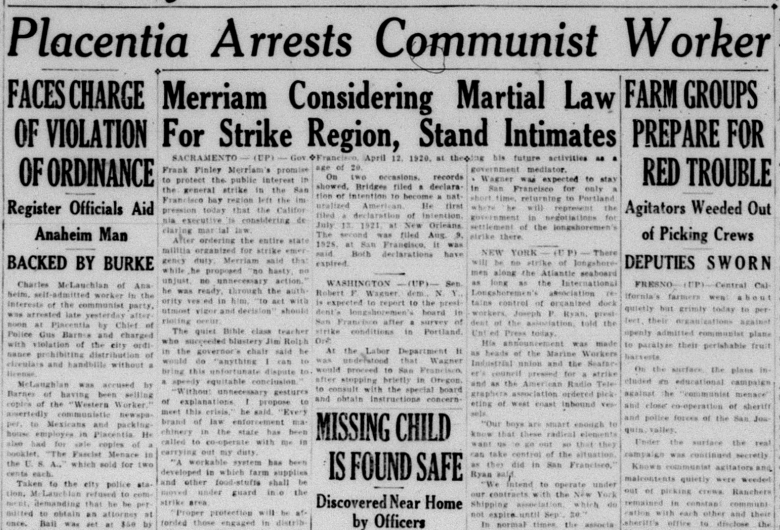
“Charles McLauchlan of Anaheim, self-admitted worker in the interests of the communist party, was arrested late yesterday afternoon at Placentia by Chief of Police Gus Barnes and charged with violation of the city ordinance prohibiting distribution of circulars and handbills without a license,” the Tribune reported.
McLauchlan was accused of selling copies of the Western Worker, a labor newspaper, to Mexican citrus workers in Placentia. He was also selling copies of a booklet, The Fascist Menace in the U.S.A.
If the strike organizers were sometimes communists, the growers and the legal system that sided with them often acted like fascists, cracking down hard on those trying to organize to better their lot.
Upton Sinclair’s EPIC Run for Governor
In the midst of these economic hard times and labor agitation, noted author and socialist Upton Sinclair ran for governor of California. Sinclair, most famous for his 1905 novel The Jungle, which portrayed the filthy and inhumane conditions of the meatpacking industry, had spent his life writing numerous books highlighting various injustices and corruption in American life.
Sinclair had moved to Southern California in 1916 and, in addition to writing, also involved himself in politics, running for congress twice (in 1920 and 1922) as a Socialist. He founded California’s chapter of the American Civil Liberties Union (ACLU).
In 1934, he decided to run for governor of the Golden State, this time as a Democrat. He won the party’s nomination and faced off against Republican Frank Merriam. Sinclair’s program was called End Poverty in California (or, EPIC). He wrote a pamphlet called I, Governor of California, and How I Ended Poverty, which laid out his plans and was widely distributed.
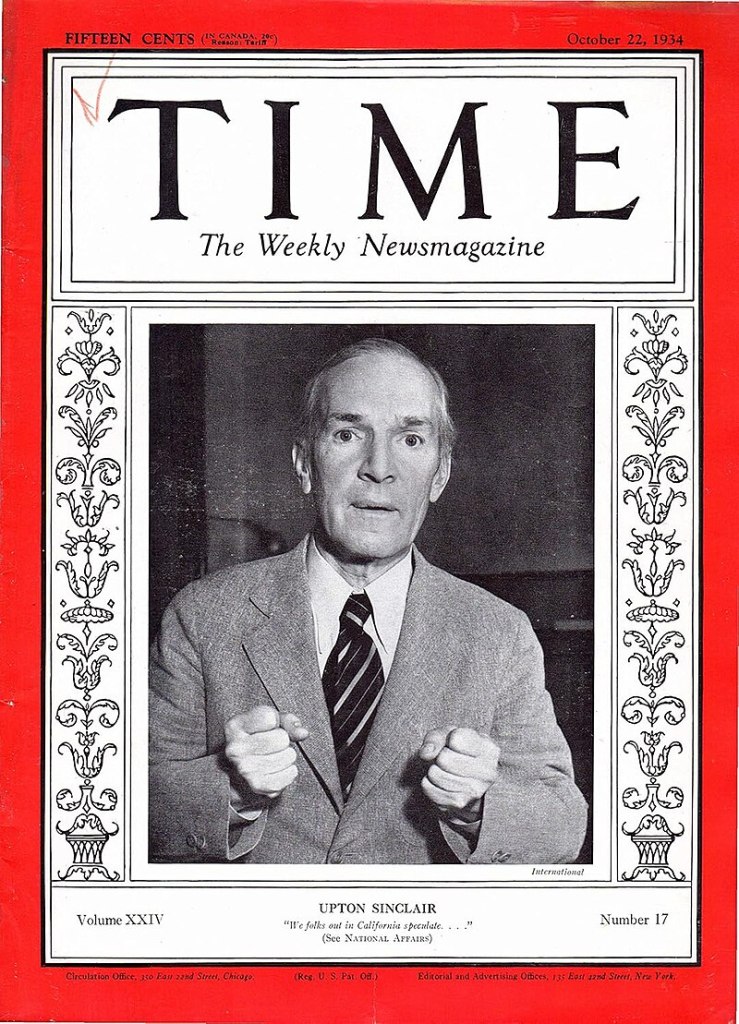
Upton Sinclair on the cover of Time magazine in 1934. During the campaign, Sinclair came to Fullerton and spoke before a crowd of over 1,200 in the FUHS auditorium.

Today, Sinclair sounds a lot like Bernie Sanders.
“The trouble in America,” Sinclair began, “is that privilege entrenched itself in government and society and brought a condition where two percent of the people control 50 percent of the wealth. Wall Street tricks to control American finance by piling up wealth on one side and beating down wealth on the other made bums of twenty or thirty million people…”
Sinclair was particularly outraged with the practice of large agricultural interests destroying “surplus” crops to keep prices up.
“Limitation of production or the destruction of food or other wealth while millions of people are in need is the very apex of economic insanity,” Sinclair said.
This practice of destroying food for the benefit of big business while people starve is what gave the title to John Steinbeck’s 1939 novel The Grapes of Wrath, about farmworkers in California during the Great Depression:
“There is a crime here that goes beyond denunciation. There is a sorrow here that weeping cannot symbolize. There is a failure here that topples all our success. The fertile earth, the straight tree rows, the sturdy trunks, and the ripe fruit. And children dying of pellagra must die because a profit cannot be taken from an orange. And coroners must fill in the certificate- died of malnutrition- because the food must rot, must be forced to rot. The people come with nets to fish for potatoes in the river, and the guards hold them back; they come in rattling cars to get the dumped oranges, but the kerosene is sprayed. And they stand still and watch the potatoes float by, listen to the screaming pigs being killed in a ditch and covered with quick-lime, watch the mountains of oranges slop down to a putrefying ooze; and in the eyes of the people there is the failure; and in the eyes of the hungry there is a growing wrath. In the souls of the people the grapes of wrath are filling and growing heavy, growing heavy for the vintage.”
The backbone of Sinclair’s plan of ending poverty in California involved giving unemployed workers access to the means of production and letting them produce for themselves.
“The program…will offer land colonies and factories to the unemployed and a distributing system where the people can buy necessities at cost and thereby eliminate the middle man,” Sinclair said. “It will make production for and equal to consumption because the unemployed will produce for themselves only and will make the million in the state now leaning on charity self-supporting.”
The EPIC plan also called for a remedy to economic inequality through a revised and graduated tax system, with higher taxes on the wealthy.
Sinclair was clearly on the side of the workers. Meanwhile, the Republican Frank Merriam was on the side of business.

As is documented in his book I, Candidate for Governor, and How I Got Licked, despite his popularity, Sinclair faced formidable opposition from big business and mainstream media (including Hollywood), who ran a well-funded smear campaign against him.
The Fullerton Daily News-Tribune ran numerous articles and editorials portraying Sinclair as a dangerous radical who would bring ruin to California.
The editorial below attempts to paint Sinclair as an enemy of the church because of statements he made in his 1927 book The Profits of Religion, which was a criticism of how individuals and churches have perverted and used religion to make money. His book, which actually speaks very highly of Jesus Christ, offered valid (and unfortunately still relevant) criticisms of the marriage of capitalism and Christianity.

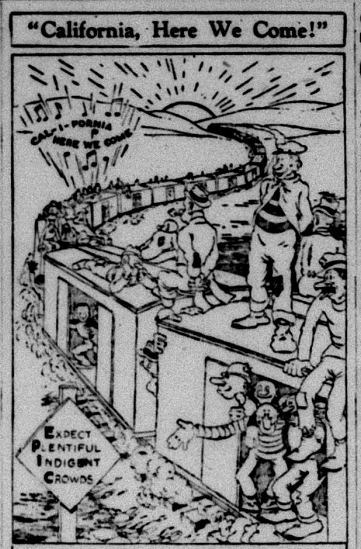
The cartoon below makes the argument that Sinclair’s programs to assist the poor and unemployed will make California a magnet for homeless and desperate people, with a sign parodying EPIC which reads: Expect Plentiful Indigent Crowds. Sound familiar? This sounds like the way Fox News talks about California today.
The California Real Estate association, unsurprisingly, came out against Sinclair.

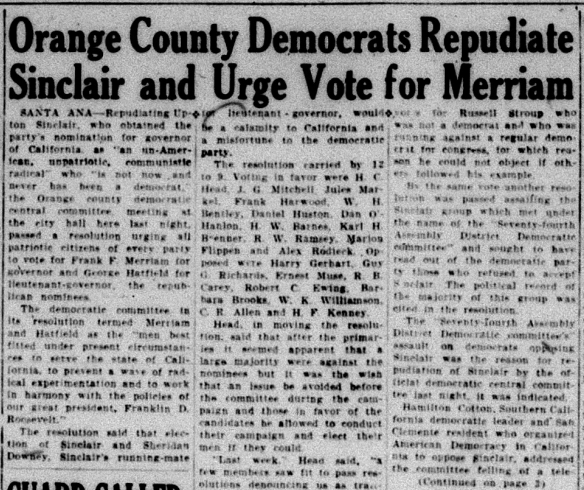
As did the Orange County Democratic party (just like the national Democratic Party did with Bernie Sanders in 2016).
Meanwhile, local leaders organized a parade in Merriam’s honor.
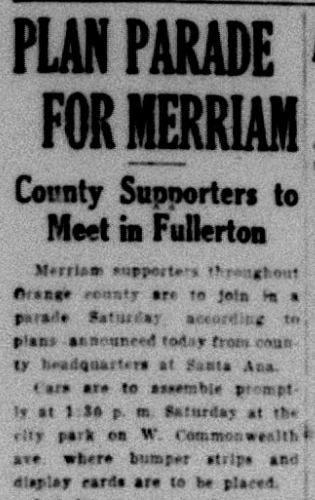
And the Tribune published numerous articles which painted Merriam in a very positive light.
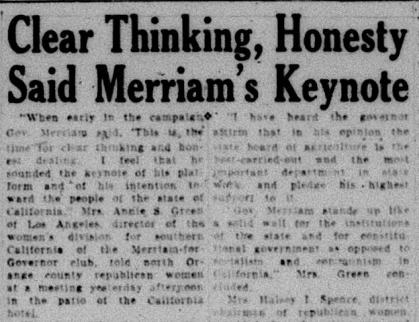
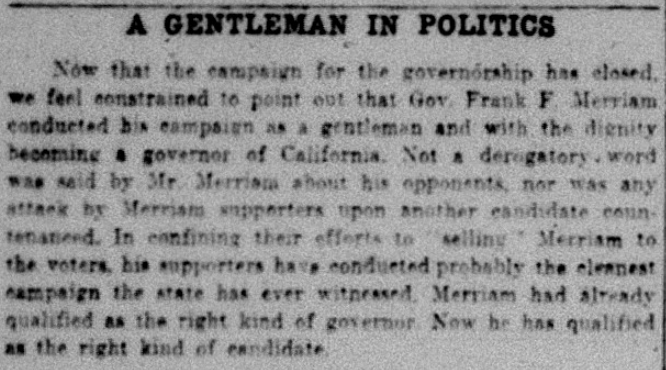
Ultimately, Merriam defeated Sinclair. Poverty would, unfortunately, not end.
Local Politics
In local political news, Harry Maxwell and George Lillie were elected to Fullerton City Council. Both were local businessmen and orange growers.
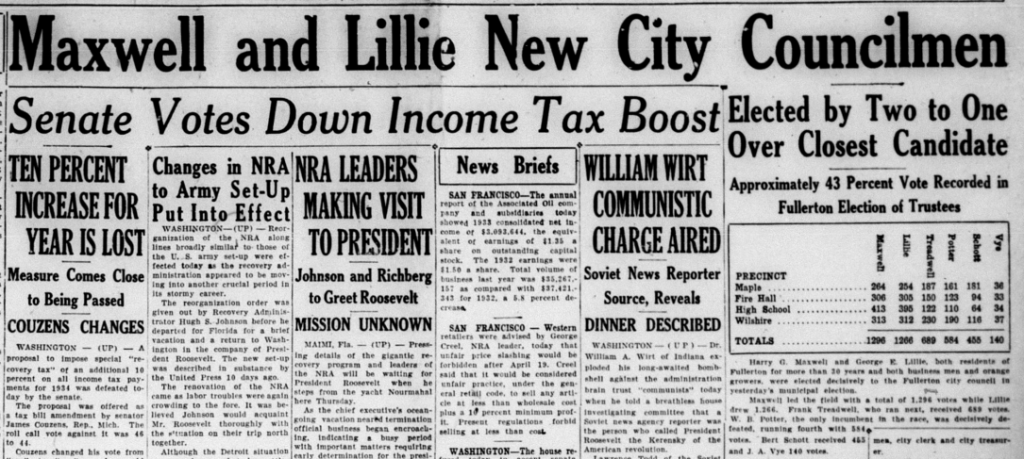
Below are photos of Harry Maxwell and George Lillie:


William “Billy” Hale was again chosen as Mayor.

William Hale. In the races for District Attorney and Orange County Sheriff, Red-baiting was a common mudslinging tactic.
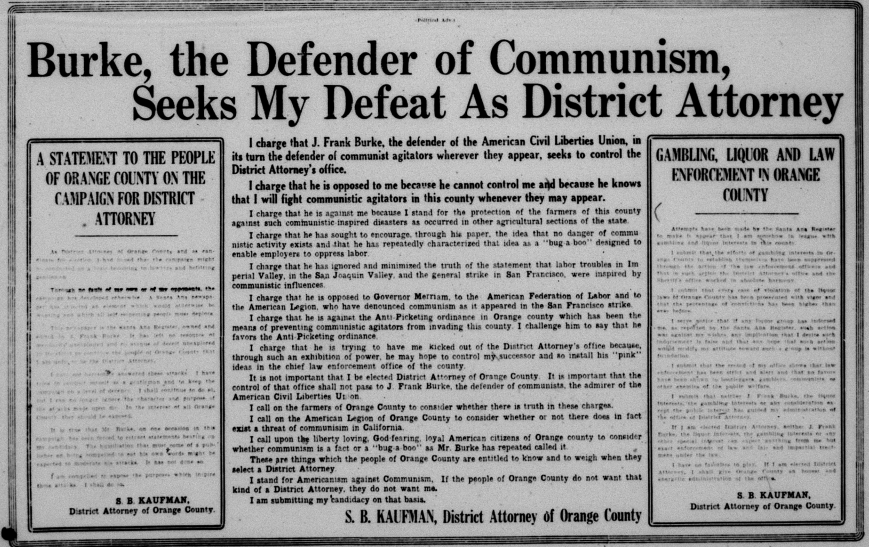
A campaign ad for OC Sheriff Logan Jackson stated: “Sheriff Jackson was ready for the agitator here and he didn’t get in. He was nipped, and nipped hard…Should trouble-makers try again to gain foothold here, Sheriff Jackson will again be ready for them…The milk strike and other threatened disturbances of that period, with disruption of the citrus industry next in view, would have cost our farmers countless thousands of dollars.”
Like his counterparts throughout California, Logan Jackson would use these “hard” tactics against striking orange workers in 1936. Read more about that HERE.
Ted Craig of Brea was made speaker of the California State Assembly.
Culture and Entertainment
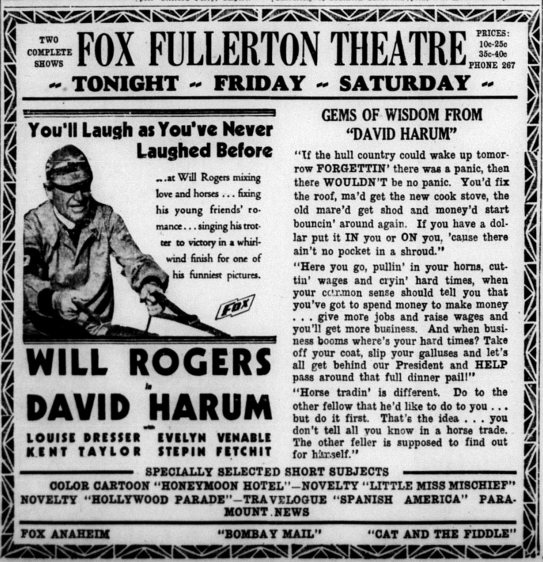
For culture and entertainment, Fullertonians went to see movies at the Fox Theater.

The iconic “Pastoral California” mural on the side of Plummer Auditorium was painted by Charles Kassler as a federal art project. Sadly, it would be painted over in 1939, and then restored in 1997. To learn more about the story of that mural, check out my article HERE.


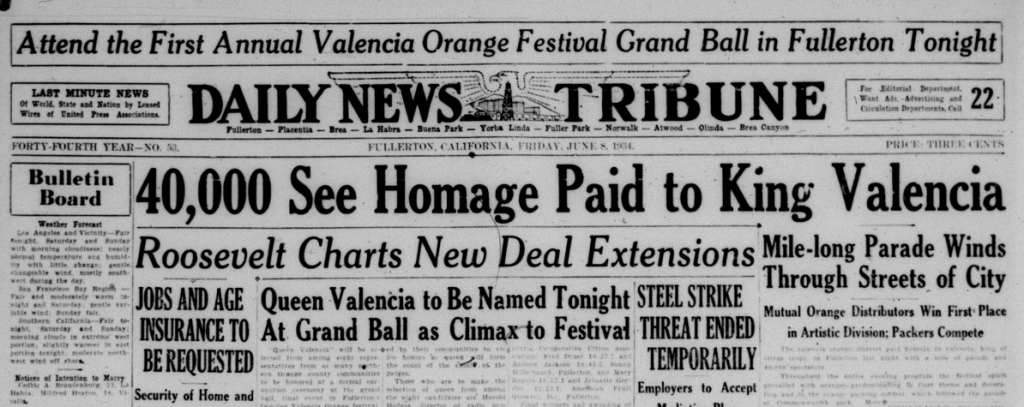
Fullerton celebrated a Valencia Orange Festival, which drew 40,000 attendees.

Sports
Locals celebrated hometown baseball star Willard Hershberger.
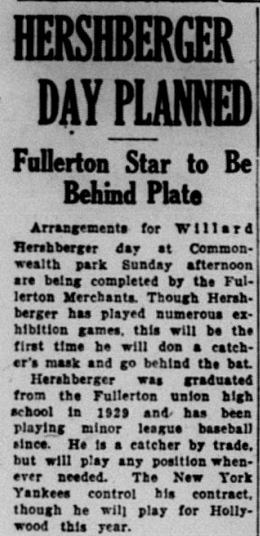
Baseball was very popular locally. Games at Commonwealth (now Amerige) Park drew lots of spectators. “Pep” Lemon was in charge of the Fullerton Merchants team.

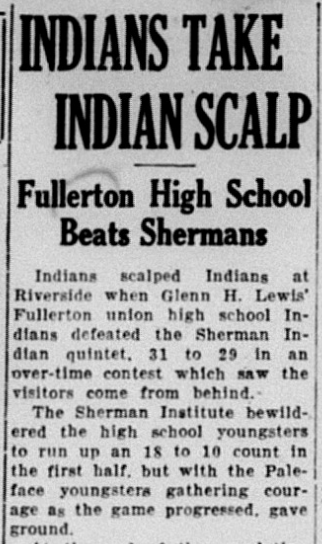
The Fullerton Union High School Indians sometimes played against the Sherman Indian High School (an actual Indian Boarding School) from Riverside, leading to sometimes offensive headlines.
Fullerton used to have a country club with a golf course.

Natural Disasters
During the 1930s, southern California experienced a few natural disasters: the 1933 Long Beach earthquake, the 1938 flood, and another flood in 1934.
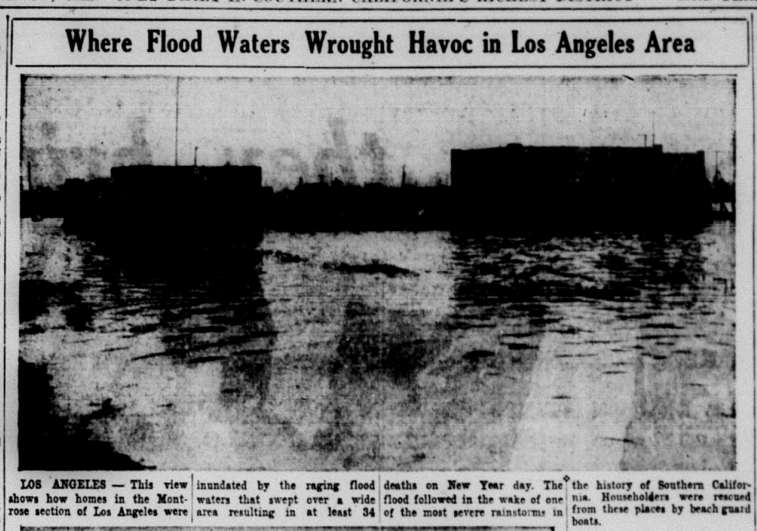
These floods are the reason why all the major rivers that flow through Los Angeles and Orange Counties are now concrete channels.
Housing
In 1934, a four-bedroom house atop a hill in Fullerton sold for $4000. In today’s dollars that would be about $94,000.
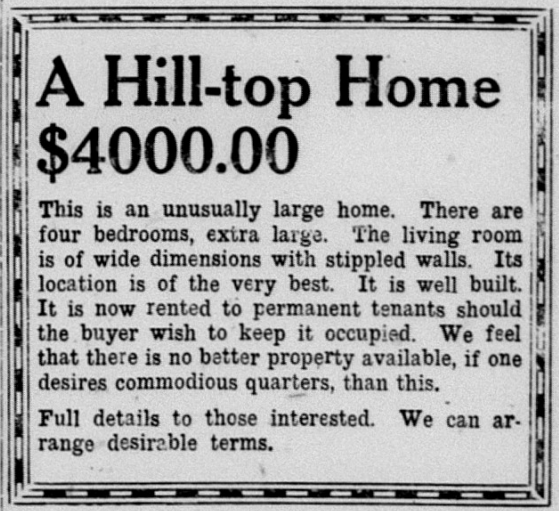
In the 1920s, Fullerton experienced a housing boom, with numerous new subdivisions being built. With the advent of the Great Depression, much new construction stopped, leading to a housing shortage.

To help with the housing situation, the New Deal established entitles like the Federal Housing Administration (FHA), which offered affordable home loans and other assistance to homeowners and home buyers. Given today’s housing crisis, lawmakers would do well to study the New Deal housing laws and reforms.

Leaded Gasoline
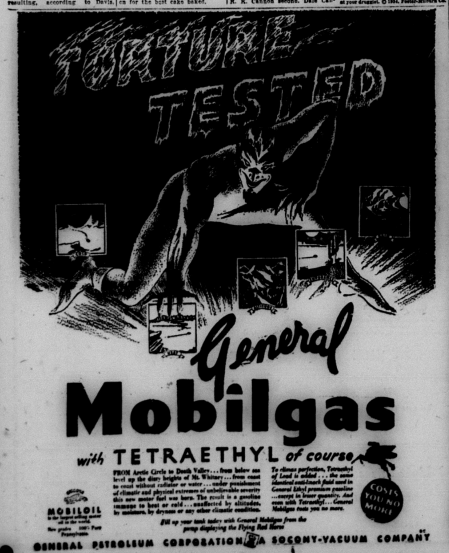
Starting in the 1920s, a compound called TEL was added to gasoline to improve performance. Unfortunately, it was discovered in the 1950s that this lead compound caused major health and environmental damage. It would ultimately be phased out, but not for decades. In 1934, gas companies celebrated the wonders of this toxic chemical.


Fashion
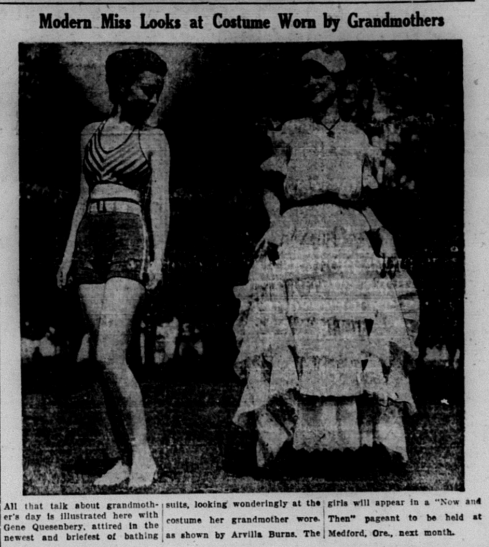
Education
The old high school building on Wilshire and Lemon (formerly called Harvard Ave.) was torn down and eventually replaced with the buildings that would make up Wilshire Junior High, and then the School of Continuing Education.

Death
Jacob Stern, co-owner of the first general store in town (Stern & Goodman), died. He became a very wealthy businessman and owned lots of real estate in southern California.

Edward Atherton, the famous Fullerton ostrich farmer, died.
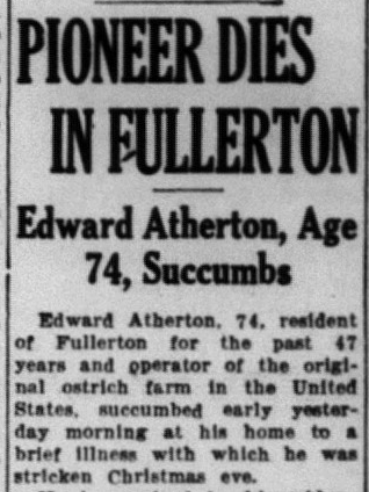
Stay tuned for top stories from 1935!
-
Fullerton in 1933
The following is from a work-in-progress about the history of Fullerton. You can support my ongoing research and writing on Patreon.
The Local History Room of the Fullerton Public Library has microfilm from the Fullerton Daily News-Tribune newspaper stretching back to 1893. I am in the process of reading over the microfilm, year by year, to get a sense of what was happening in the town over the years, and creating a mini archive. Below are some news stories from 1933.
The 1933 Long Beach Earthquake

The disastrous Long Beach earthquake killed over 130 people, injured thousands, and caused tens of millions in property damage.
Some refugees from the earthquake took up temporary residence in their cars at Hillcrest Park and at the American Legion hall therein, where they were provided food and shelter by local volunteers and the Red Cross. The Izaak Walton Lodge was also opened to those who had fled the quake.
“Fullerton American Legion members continued to feed more than 100 persons at each meal at the Legion hall,” the Tribune reported. “Many of this group are lodged in Fullerton homes or camping in the park and are nearly without funds, their homes demolished or unsafe for occupancy in Long Beach, Compton, Bellflower and other points.”
Mrs. Clarence Spencer on W. Orangethorpe took in 27 quake refugees.
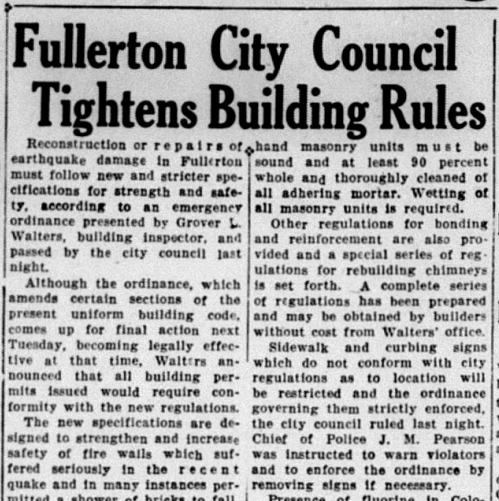
Most Fullerton buildings escaped damage, although a chimney fell at the California Hotel, crashing through the roof of the cafe kitchen and half filling it with bricks and shattered building materials. Thankfully, no one was there at the time. The Wilshire Elementary school also experienced some minor damage, although it was declared structurally sound.
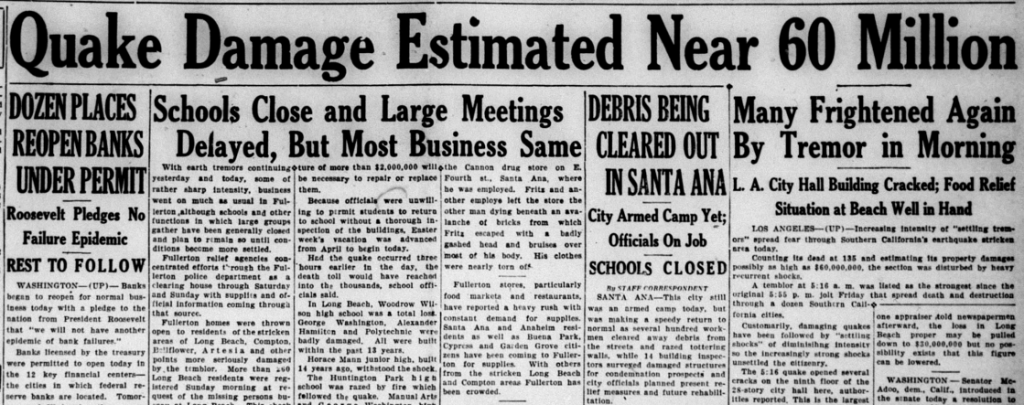
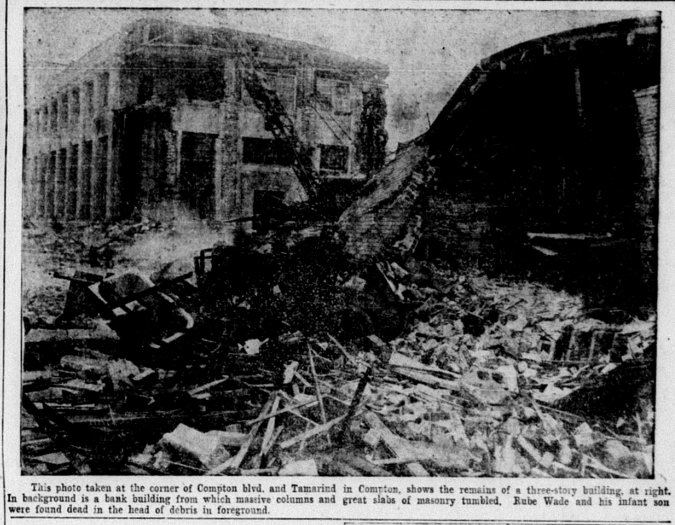

As a result of the earthquake, many cities including Fullerton passed stricter building codes.
Roosevelt’s New Deal
Democrat Franklin Delano Roosevelt was elected in 1932. His first 100 days of office in 1933 were filled with sweeping legislation aimed at combating the Great Depression. The idea of a president enacting major policy within their first 100 days began with FDR.
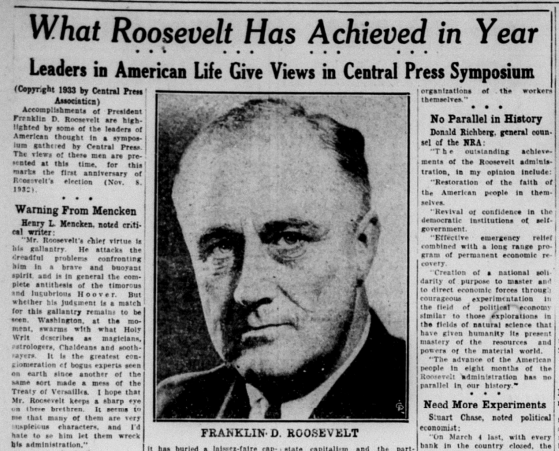
Roosevelt’s overall program was called the New Deal. Laws passed in 1933 sought to stabilize major aspects of the economy, such as banking (the Glass-Stegall Act and the creation of the FDIC), agriculture (Agricultural Adjustment Act and Farm Credit Act), and others (National Industrial Recovery Act). Other laws sought to provide government jobs for the unemployed by creating the Civilian Conservation Corps and the Federal Emergency Relief Administration (later called the Works Progress Administration).
The Reconstruction Finance Corporation provided funding for jobs for local unemployed men to improve public works.
“One hundred men were assigned to Hillcrest Park this morning,” the Tribune reported, “where they will work under direction of Harry Byerrum, park superintendent. Forty-five more men were at work under direction of Leo Fallert, road foreman, in clearing water courses and improving the waterway northwest of Buena Park.”

Unemployed Fullerton resident George Buxton joined the Civilian Conservation Corps and was stationed at Camp Radford in the San Bernardino mountains.
His company built fire breaks and roads in the mountains.
During his time there, he stayed in a cabin with other CCC members and by his own account, he was well fed and enjoyed the work, as well as the amenities of the camp, including a swimming pool, recreation hall, community singing, interdenominational church on Sunday, a small baseball field, volley ball court, putting course and horse shoe pits.
For his work, he was paid $30 a month, with $25 sent to his family.
Although many of Roosevelt’s policies and programs received some opposition, perhaps the most controversial was the National Recovery Act (NRA), which placed numerous regulations on business with the aim of improving wages and stabilizing prices. Businesses that participated in the NRA proudly displayed a blue eagle poster. Many Fullerton businesses participated.
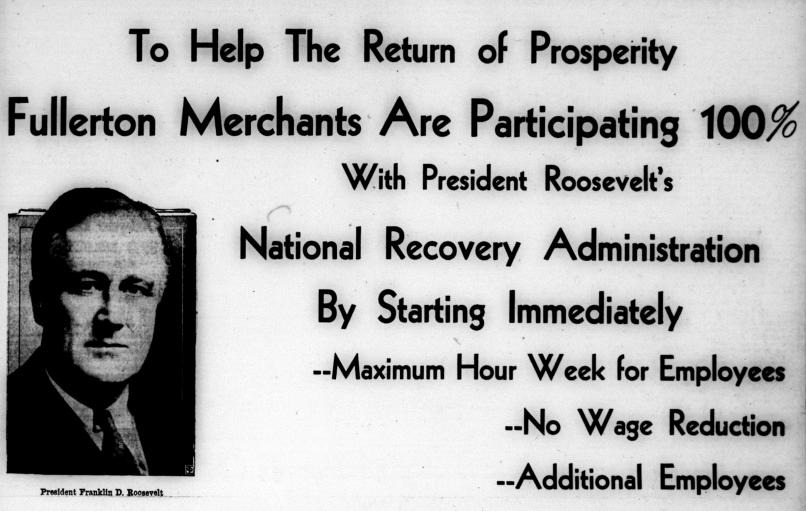
Local leaders even organized a parade to encourage employers to participate in the NRA program.
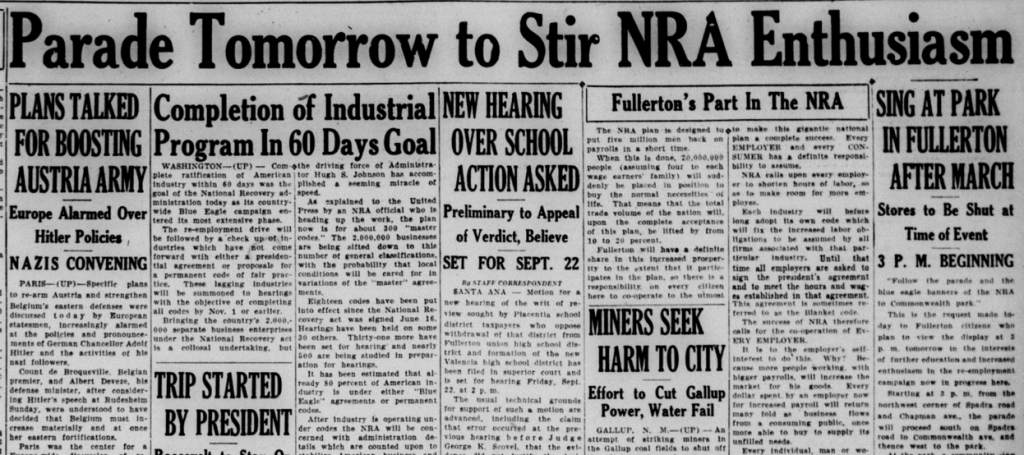
The parade down Spadra (now Harbor) was led by a police car with Congressman Sam Collins, civic leaders, and officials of the NRA participating.
Civil war, Spanish American War and World War veterans marched together with Boy Scouts, Girl Scouts, Girl Reserves and other similar groups
The parade ended at Commonwealth Park, where there was community singing and speakers explaining the NRA program.
Larger industries like coal and the U.S. Chamber of Commerce opposed the NRA. It eventually succumbed to legal challenge and was replaced by other New Deal programs.
One impact of the New Deal was to greatly increase the number of federal employees.
Local Depression Relief Efforts
In addition to increased funding and support from the federal and state governments, local groups also sought to help those facing unemployment, poverty, and hunger caused by the Depression.
Prohibition Ends!
Prohibition on alcohol, which had begun in 1920 with the passage of the 18th Amendment, was repealed in 1933 with the passage of the 21st Amendment. President Roosevelt famously said, “What America needs now is a drink.”

Even prior to the repeal, congress passed a law permitting the sale of beer with an alcohol content of 3.2 or less.
Things played out a bit contentiously in Orange County. After the passage of the Beer law, the OC District Attorney declared alcohol still illegal under a county ordinance.

“Orange county remains bone dry, regardless of the new beer bill passed by congress, District Attorney S.B. Kaufman declared in a formal opinion today,” the Tribune reported. “The county still had a dry ordinance and because the new beer law allowed for local control…Meanwhile, LA county board of supervisors repealed their local ordinance, thus allowing beer.”
The battle between “wet” and “dry” supporters played out locally, as Fullerton City Council considered rescinding its dry ordinance. City Council declined to take a position on the contentious matter, instead putting it to a vote of the people, who decided they needed a drink.
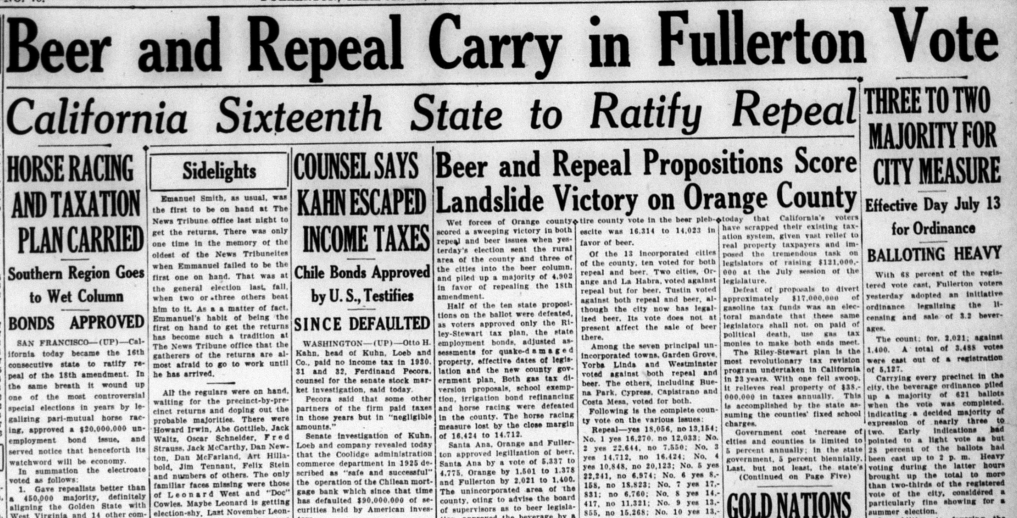
In short order, some Fullerton businesses began selling beer.

And with the passage of the 21st amendment, Prohibition was over.

Agriculture and Mexican Deportation
As a result of the Depression, the Bastanchury family lost control of their vast orange ranch, and it went into receivership.

Under its new owners, all of the Mexican workers on the ranch were deported.
“All of the Mexican camps on the ranch have been eliminated and all American labor is being used with 28 houses on the ranch now filled with regular employees, nearly all of whom have been continuously on the payroll since last April,” the Tribune reported.
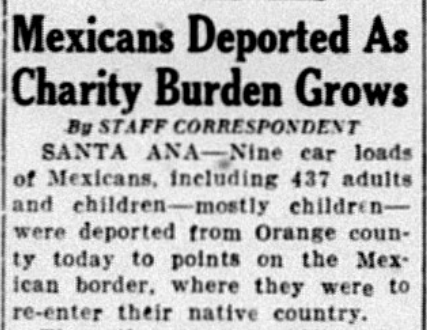
“Nine carloads of Mexicans, including 437 adults and children–mostly children–were deported from Orange county today to points on the Mexican border, where they were to re-enter their native country,” the Tribune reported.
The majority of those deported were likely from the Bastanchury Ranch. The deportation was seen as a way to provide jobs for white workers, and to reduce county welfare costs.
“Thus the county welfare department unburdened itself to an appreciable extent of a “relief” load. The trainload has been living on charity in this county and their deportation represents “relief” to the taxpayers, according to Byron Curry, county welfare director,” the Tribune reported. “One car-load will be sent to Nogales, opposite Notales, Arizona. The other eight car-loads will be sent to Juarez, opposite El Paso, Texas. The cost of deportation, $12 per fare for adults, $6 for children over 5 years of age and no charge for children under that age, is far less than maintaining the group in the county Curry pointed out.”
The figure of nine trainloads from the Bastanchury Ranch is corroborated by a narrative written by Druzilla Mackey, a teacher in the Americanization program at Fullerton Union High School, published in Louis Plummer’s history of the High School:
“In this time of stress and strain the American community no longer spoke of ‘Our’ Mexicans. They no longer considered that no ‘whiteman’ could pick oranges. Instead they felt that the jobs done so patiently by Mexicans for so many years should now be give to them. ‘Those’ Mexicans instead of ‘Our’ Mexicans should ‘all be shipped right back to Mexico where they belong.’ The Americanization centers in which these people had been taught how to buy and make themselves a part of the American community were now used for calling together assemblages in which county welfare workers explained to bewildered audiences that their small jobs would now be taken over by the white men, that they were no longer needed or wanted in the United States. They explained that the Welfare Department no longer had any money to aid them during times of unemployment, but would furnish them a free trip back to Mexico. And so—one morning we saw nine train-loads of our dear friends roll away back to the windowless, dirt-floored homes we had taught them to despise.
This mass deportation was part of a larger mass deportation of Mexicans in the United States during the Great Depression, which is chronicled in the book Decade of Betrayal: Mexican Repatriation During the 1930s by Francisco E. Balderrama and Raymond Rodriguez.
Water
In 1933, the Orange County Water District was created.
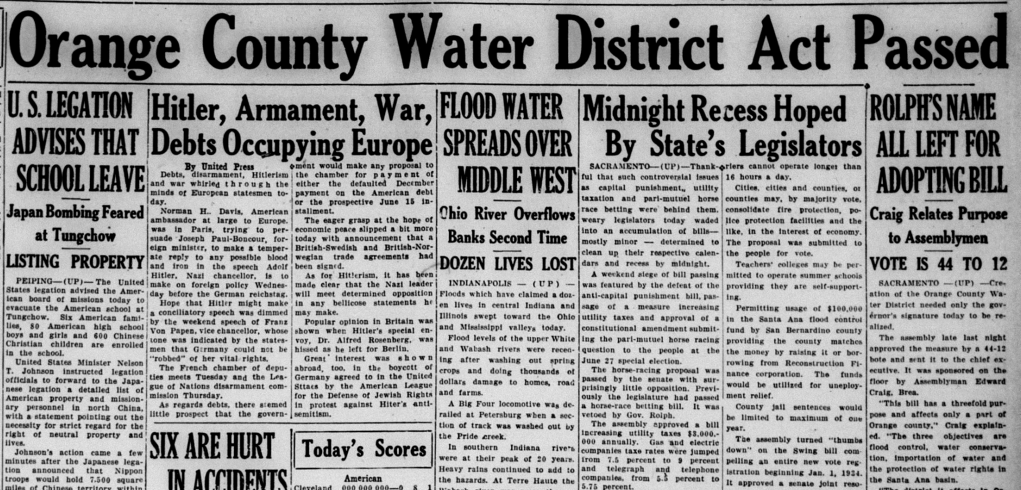
“This bill has a threefold purpose and affects only a part of Orange County,” State Assemblymember Ted Craig explained. “The three objectives are flood control, water conservation, importation of water and the protection of water rights in the Santa Ana basin.”
“The future of the district depends solely upon the underground supply of water, which has been receding for the past 25 years. With the formation of this district the three objectives can be carried out,” the Tribune reported.
Fascism Abroad and at Home
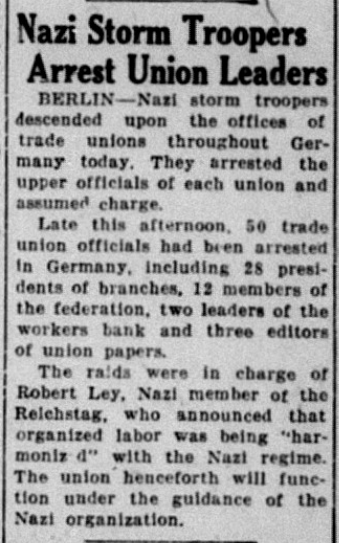
In Germany, Adolph Hitler and his Nazis continued to consolidate power.

The Reichstag fire, which burned down Germany’s Parliament building, was blamed on communists, gave a pretext for Hitler to crack down on his political opponents and seize power.
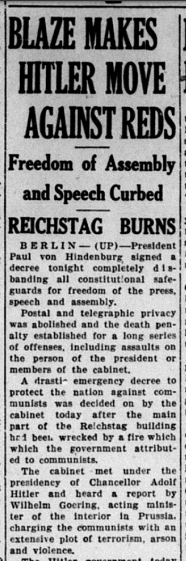

Hitler was applauded by the entire assembly when he said: “Treason against the people must be exterminated with barbarous ruthlessness.”
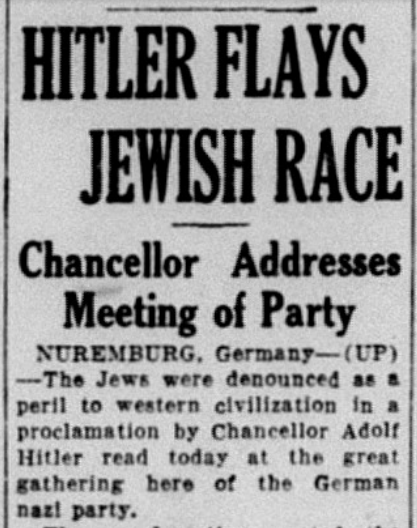
Hitler was also cracking down on Jews.

In Berlin, iron-clad discipline was enforced among the brown-shirted Nazis who closed Jewish stores and stood guard to prevent customers from entering.

“What happens to Germany with regard to Hitlerism will determine what happens to the whole European government in the next 15 or 20 years,” Rabbi Herman Lissauer of Los Angeles asserted in his address on “Germany, Hitler, and race Relations” last evening at the final spring dinner meeting of the Fullerton International Relations council in First Methodist Episcopal church banquet hall.
“A group has come into power in Germany which has put an end to the German republic, stripped Germany of her last vestige of honor, self-respect and dignity in the eyes of the rest of the world,” Rabbi Lissauer said.
“In Germany today, the whole power of the country is in the hands of a small group of people…Hitler has set about crushing out all minority factions excepting the Catholics, whom he has striven to ingratiate. His interest has centered on the Jews. The German people under his leadership have turned like wolves against the Jews who have lived and labored in Germany for 900 years and are an integral part of Germany. You have only to read the press of the nations of the world to see what atrocities have been committed against the Jews.
“It would be impossible to achieve the Hitler ideal, a race 100 percent German without amending theology to divest it of the very essence of Christianity. The only true racial fact is that each individual is one in a family among the other families of the world, and that each person must strive to raise the standard of human excellency among men.”
Under Hitler, Germany quit the League of Nations.

Albert Einstein, who was Jewish, moved to the United States to flee persecution and to accept a position at Princeton University.

Fascism at Home
Fascism wasn’t confined to Europe. In America, a fascist group called the Khaki Shirts was led by a man named Art. J. Smith.

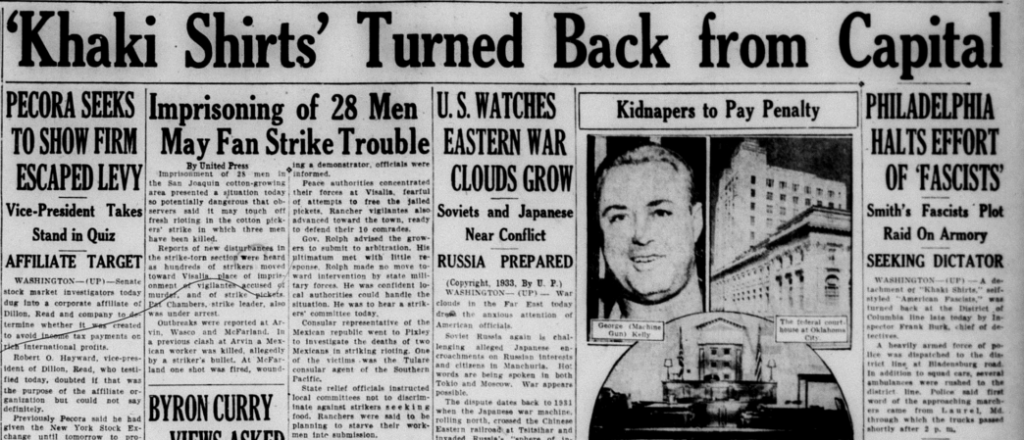
“We are a group of citizens who are fed up and disgusted,” Smith said. “We are an American Fascist organization. We are going to put a dictator over the United States. But we are not for revolution. We have 6,000,000 men now and we will have 10,000,000 by July. Our organization started only 13 months ago in California–and look at us now.”
In reality, the Khaki Shirts had less than 25,000 members.
When asked why the Khaki Shirts carried clubs and gas pipes, Smith responded, “For protection against Communists.”
Labor vs. Capital
Throughout the 1930s, many labor strikes occurred.

Mrs. Reba Crawford Splivalo, state director of social welfare, told an audience of around 300 in the high school auditorium: “I see in the sky the signs of rebellion. I am not crying ‘wolf, wolf.’ I am giving a warning. If the present economic situation is to survive the needs of the underprivileged must be met. Capital and labor must find a common meeting ground.”

Local Politics
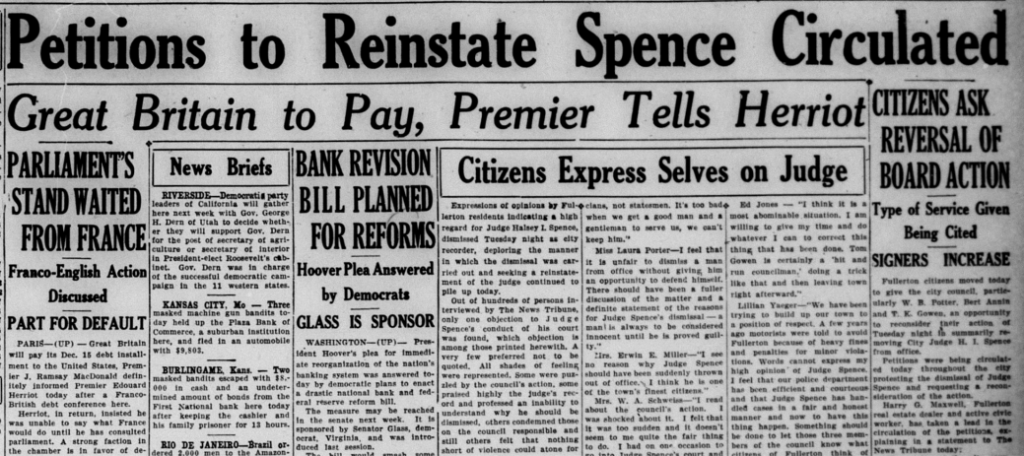
In local political news, many citizens were outraged when a City Council majority dismissed judge Halsey Spence, without initially giving a reason. Citizens get together a petition with over 1,600 names calling for the reinstatement of the apparently popular judge. At first, the council majority dismissed the petition. It was only after the threat of a recall against the council majority that they started to listen.


Crime
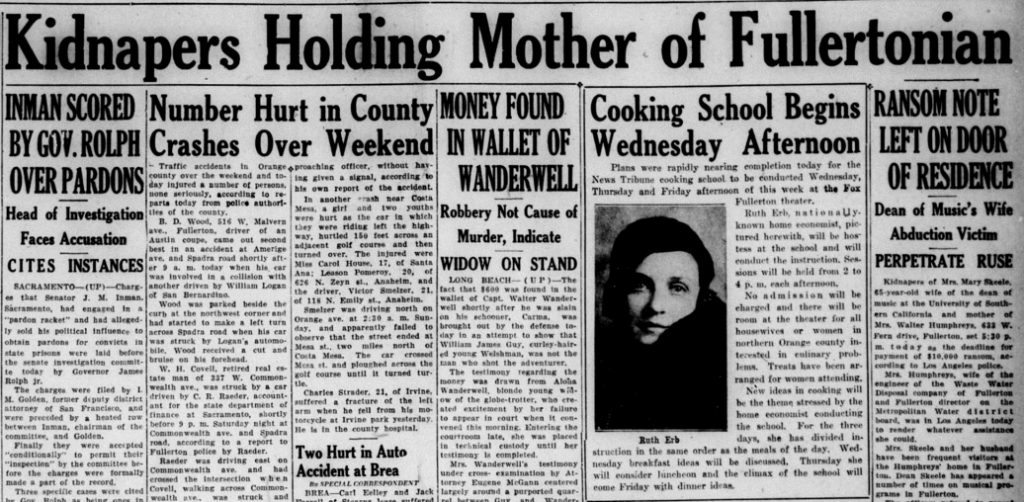
In crime news, a spate of kidnapping of wealthy people and holding them for ransom spread throughout the United States.
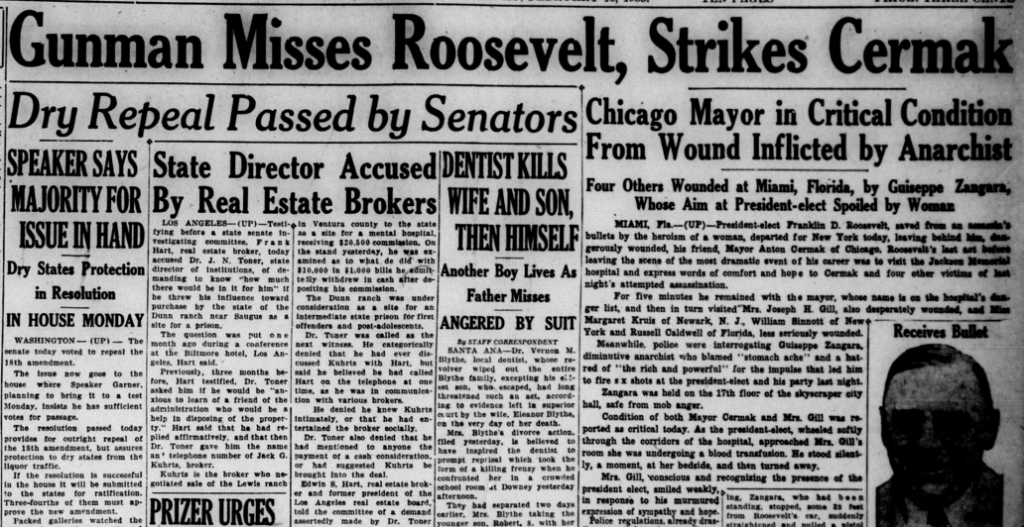
There was at least one attempted assassination of President Roosevelt.
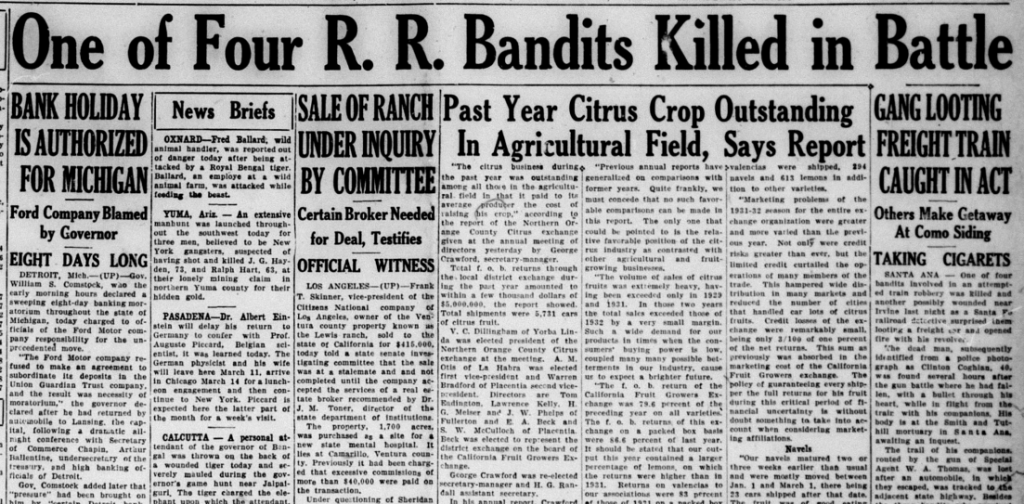
There were railroad robberies.
A group of Filipino farm workers couldn’t pay for their food at a rooming house. A fight ensued, and one of the laborers stabbed the owner of the boarding house.

“Fullerton police halted a miniature Philippine insurrection and incipient race riot shortly before noon today with the arrest of S. Sonico, 30, charged with suspicion of assault with a deadly weapon on Nesario Daza, 35, Mexican, who with his wife operates a lodging house on E. Truslow ave,” the Tribune reported. “More than 15 Filipino laborers were rounded up in the investigation, but only Sonico was held by police, although officers were drawn into the argument between friends of Daza and one group of Filipinos in regard to their proposed departure for Bakersfield with an unpaid board bill.”
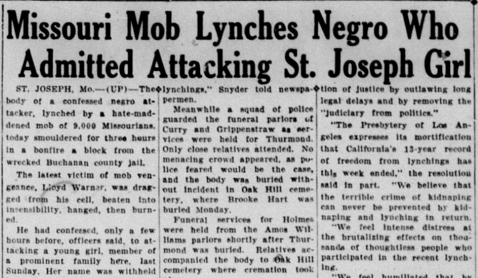
Unfortunately, lynching of African Americans was still a relatively common occurrence in 1933.

Sports
In sports news, Fullertonian Arky Vaughn was making waves in the Major Leagues.

There was a local baseball league which played games at what is now Amerige Park. The teams seem to have been somewhat segregated.
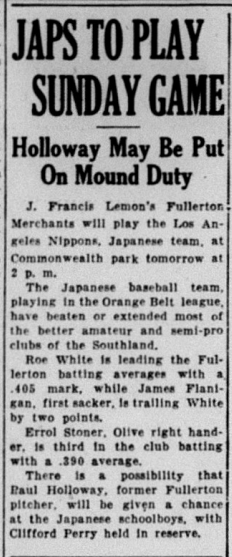
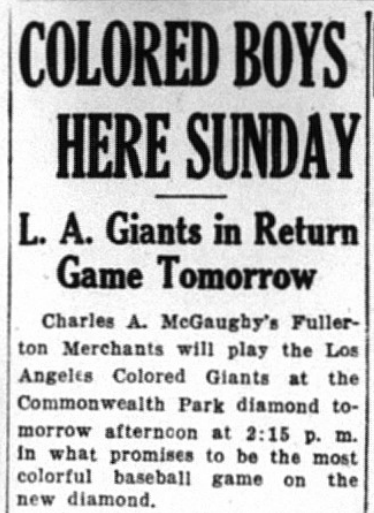
Fullerton had a swimming pool at the northwest corner of Malden and Wilshire, which is now an apartment complex.


Deaths
A number of local pioneers passed away in 1933.

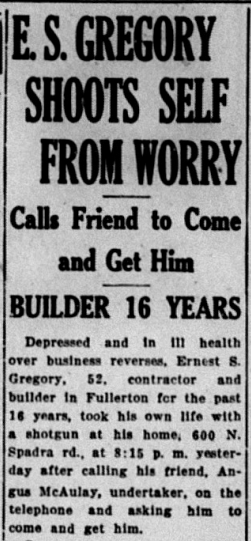
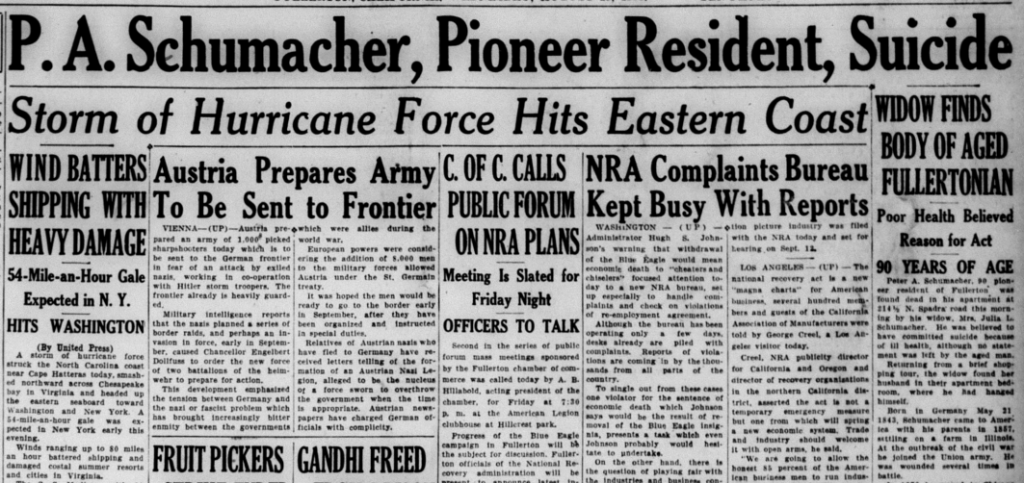
“Peter A. Schumacher, 90, pioneer resident of Fullerton, was found dead in his apartment at 214 ½ N. Spadra road this morning by his widow, Mrs. Julia L. Schumacher. He was believed to have committed suicide because of ill health, although no statement was left by the aged man. Returning from a brief shopping tour, the widow found her husband in their apartment bedroom, where he had hanged himself,” the Tribune reported.
Born in Germany May 21, 1843, Schumacher came to America with his parents in 1857. He fought for the Union Army in the Civil War, during which he was wounded.
In 1887, the year Fullerton was founded, he opened the Orange County nursery in town. He later entered into the real estate and insurance business. He built a notable building on the 200 block of N. Harbor, where he lived and died.
His son Roy Schumacher was the first child to be born in Fullerton.
In a nice tribute, the Tribune stated: “Pete” Schumacher was almost an institution in Fullerton. For almost half a century his name and person have been known to the men, women, and children of the community. In later years his cane and basket were familiar features of the downtown scene. His presence on the city streets, talking and visiting, was an established part of the local picture. To have him disappear from the daily round is like having an accustomed landmark taken from our view.”
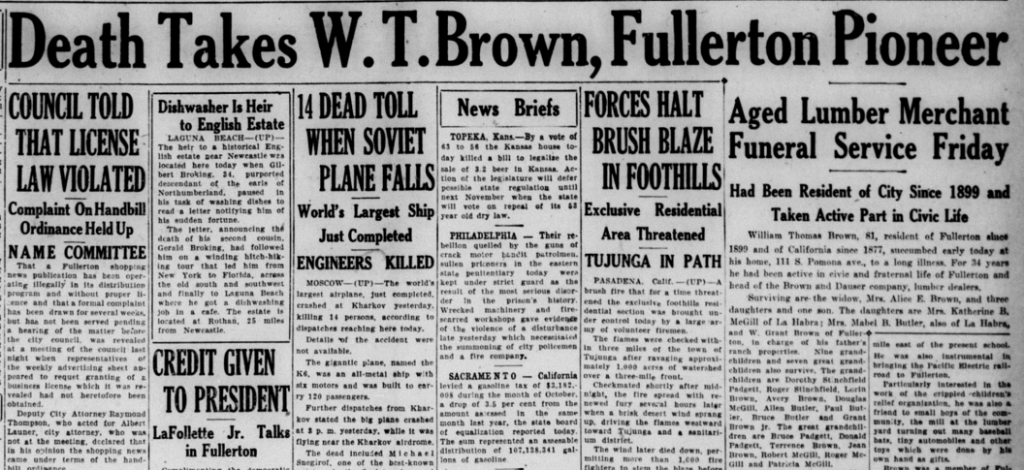
William Thomas Brown, 81, a resident of Fullerton since 1899 died at his home at 111 S. Pomona ave. For 34 years he was active in the civic and fraternal life of Fullerton and was head of the Brown and Dauser lumber company, which was the successor to the Grimshaw Lumber company.
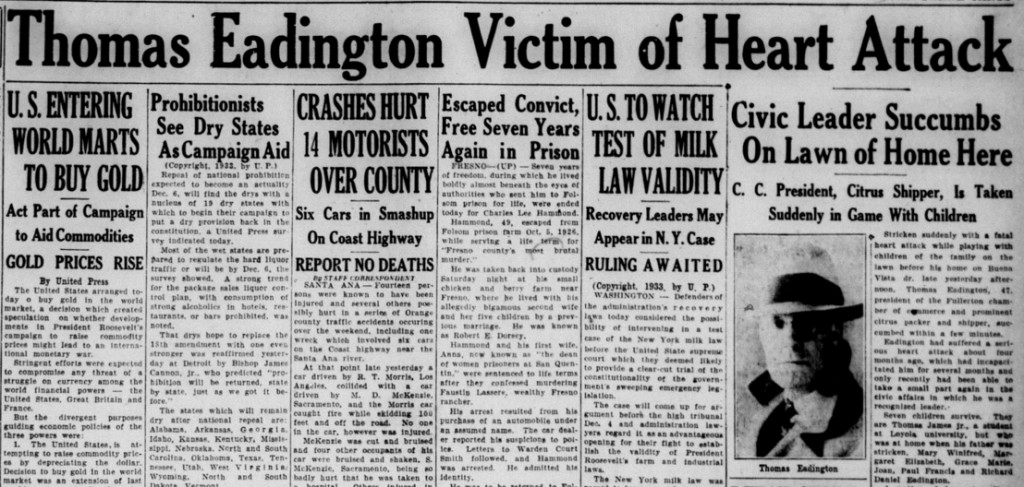
Thomas Eadington, 47, president of the Fullerton chamber of commerce and prominent citrus packer and shipper, died of a heart attack.
A native of Lancaster, England, Eadington came to the United States in 1911. After working for the Benchley Fruit company, he established the Eadington Fruit company in 1921, operating his own packing houses.
Stay tuned for top stories from 1934!
-
Fullerton in 1932

The following is from a work-in-progress about the history of Fullerton. You can support my ongoing research and writing on Patreon.
The Local History Room of the Fullerton Public Library has microfilm from the Fullerton Daily News-Tribune newspaper stretching back to 1893. I am in the process of reading over the microfilm, year by year, to get a sense of what was happening in the town over the years, and creating a mini archive. Below are some news stories from 1932.
International News
Internationally, fascism was on the rise in Germany, with Hitler’s Nazi party gaining a majority of seats in the Reichstag (Germany’s Parliament).
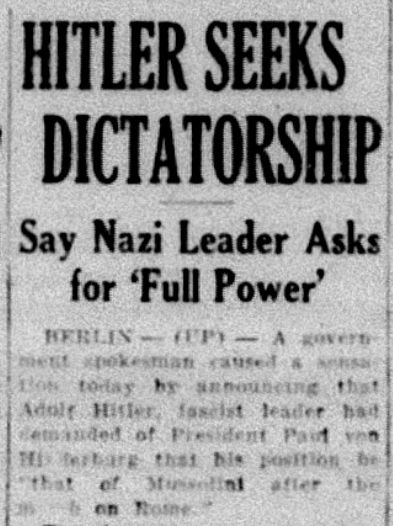
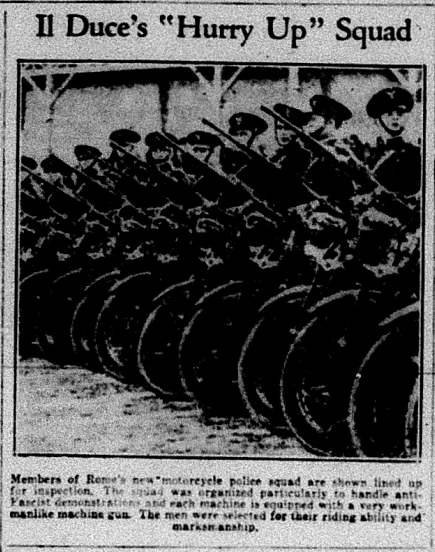
In Italy, the fascist Benito Mussolini had been in power since the 1920s.
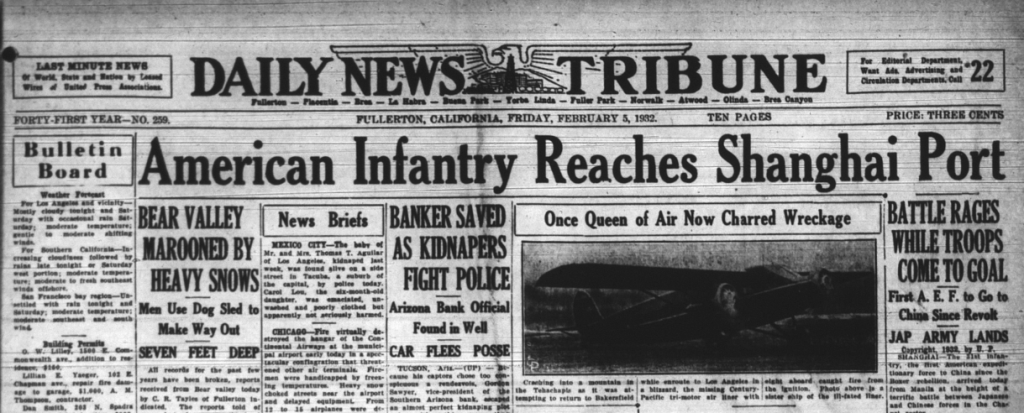
In Asia, fighting between China and Japan in the international district of Shanghai in the so-called January 28 Incident prompted United States and European military involvement in brokering a peace deal. This was largely to protect American and European economic interests in China.

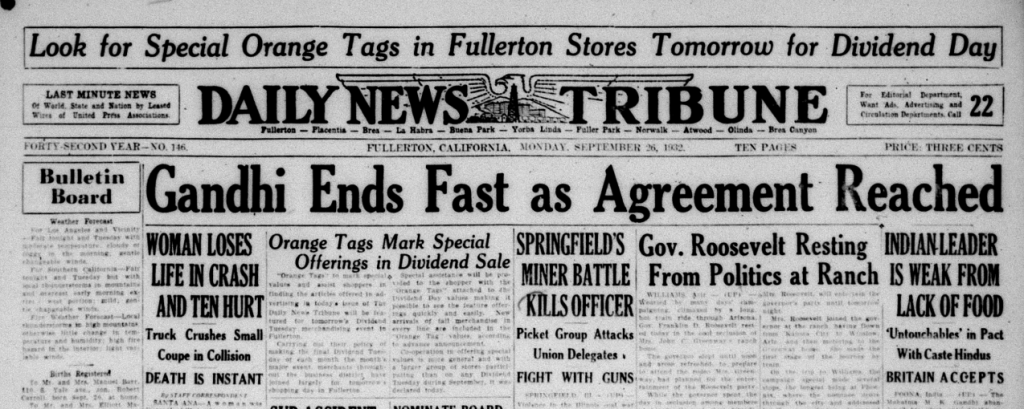
In India, Mahatma Gandhi ended a hunger strike in his long quest for independence from Great Britain.
National News
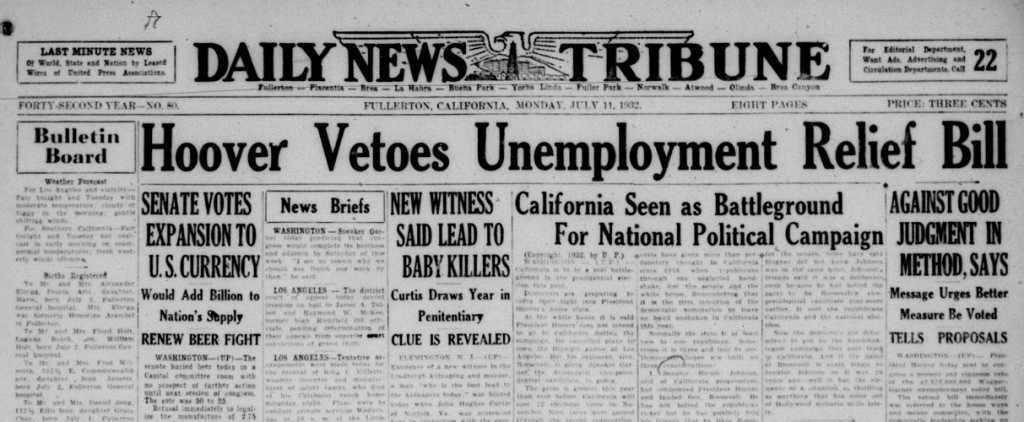
The biggest national news story was the election of Democrat Franklin Delano Roosevelt. He defeated Republican Herbert Hoover in a landslide victory.
California, which had long been a Republican state, went blue for the first time in years, although a majority of Fullertonians voted for Hoover.
The election was seen as a national repudiation of Hoover’s failure to improve the economic conditions of the Great Depression.
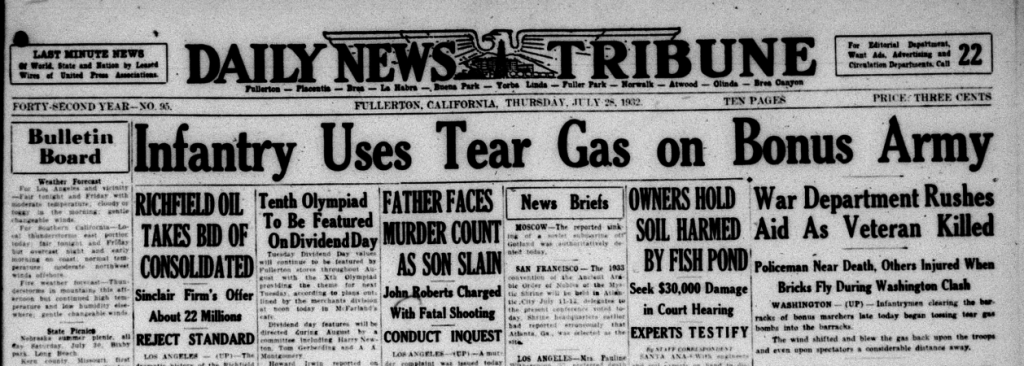
One major debacle of the Hoover administration was his use of military forces to clear a large encampment of tens of thousands of World War I veterans and their families who had marched to Washington DC, called the Bonus Army, who sought early cash redemption of their service bonus certificates.
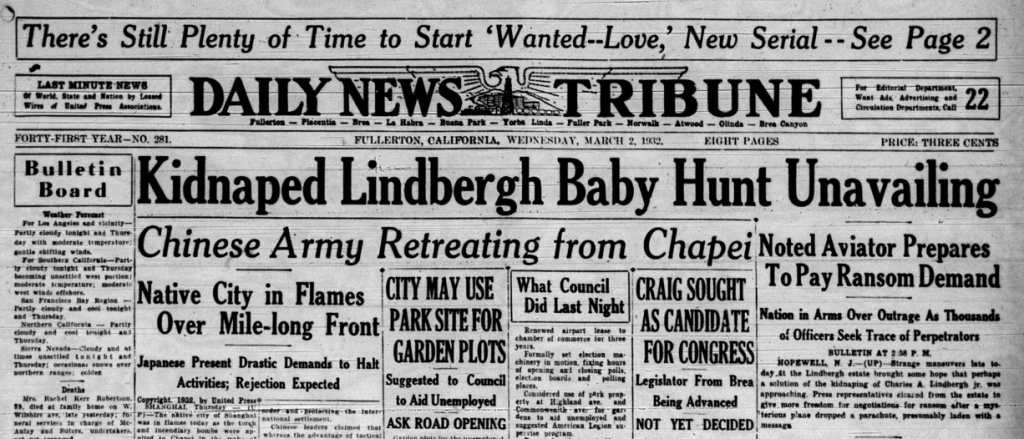
In more sensationalistic news, the baby of famed American aviator Charles Lindberg, was kidnapped.
Depression
Roosevelt would not take office until 1933, and so the federal New Deal programs aimed at helping the millions of unemployed, as well as unemployment insurance and social security, did not yet exist. Thus, local municipalities with their limited budgets (which had taken a hit from declining property values caused by the Depression) were largely left to fend for themselves to tackle widespread unemployment and poverty.
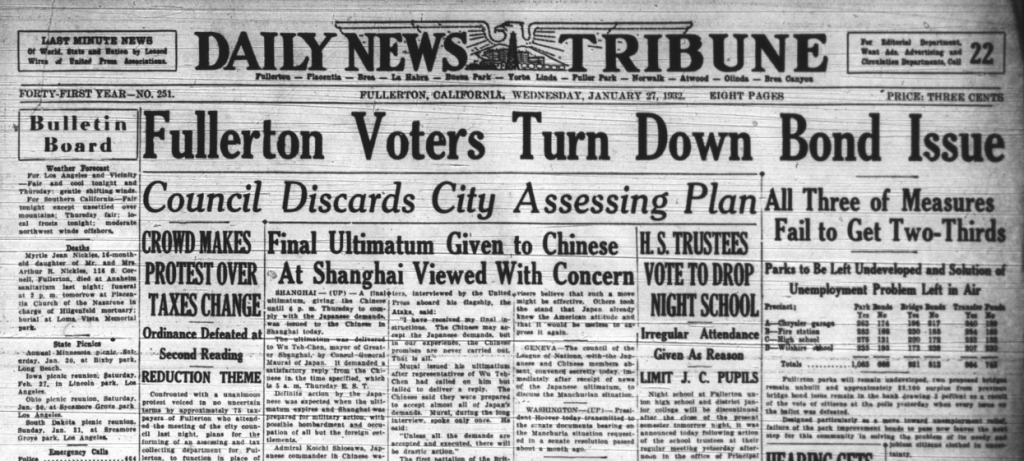
To address local unemployment, the city council put a bond measure on the ballot to raise money to provide jobs in developing local parks and bridges. Unfortunately, voters turned down the bond.

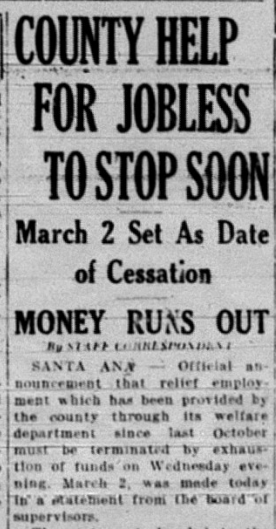
County programs for the unemployed also faced diminishing funds.
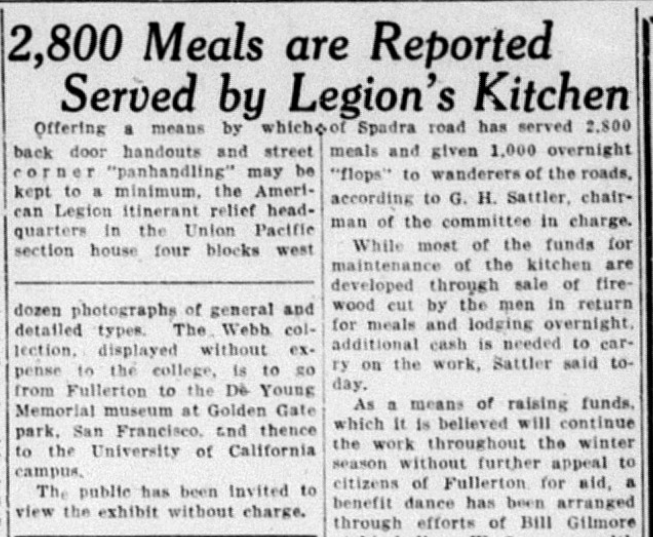
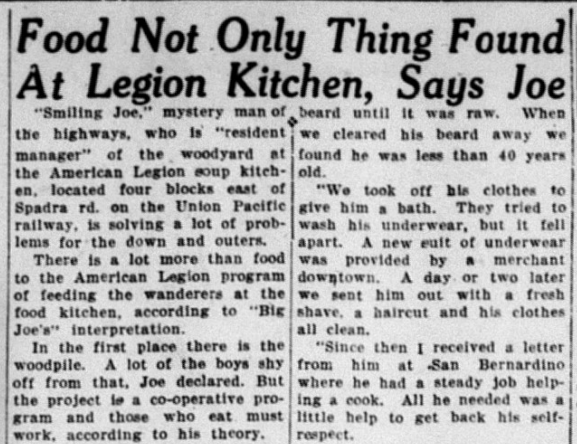
Thus, help for the homeless, unemployed, and hungry fell upon local groups like the American Legion, who operated a soup kitchen which offered food and (limited) lodging.
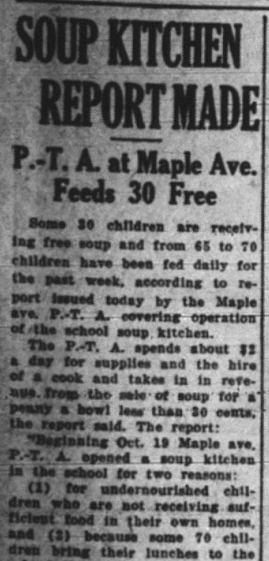
Another soup kitchen was operated by the Maple School PTA.
Tragedy Befalls the Bastanchury Ranch
The Great Depression proved disastrous for the Bastanchury family, owners of “the largest orange grove in the world.” Unable to pay their debts, the Bastanchury Ranch went into receivership, and lost most of their property.

This was a tragedy not just for the Bastanchury family, but also for the hundreds of Mexican citrus workers who lived in camps scattered across the ranch, who in 1933 would be subject to a mass deportation/repatriation.
This connects to a larger story about Mexican deportation and repatriation during the Great Depression which is told in the book Decade of Betrayal: Mexican Repatriation in the 1930s. As has unfortunately happened throughout American history, from the Chinese Exclusion Act to today, times of economic downturn have sparked scapegoating and calls for deportation of immigrants, both documented and undocumented.
The mass deportation of Bastanchury Ranch workers would not happen until March of 1933, but the forces of deportation and repatriation were already happening, as the article below explains:

“Cautioning his audience against signing papers or notes not fully understood, Raymond Thompson, Fullerton attorney, explained simple fundamentals of law last night at a meeting of the Mexican labor union of Tia Juana camp on the Bastanchury ranch.
Thompson’s discussion was translated into Spanish by Lucas Lucio of Santa Ana, recently appointed Mexican vice-consul of Orange county and county director of Mexican repatriation.
Legal procedure in regard to installment buying, mortgage payments and foreclosures and claiming of unpaid wages was explained by Thompson. The Mexicans asked questions on particular problems and three were discussed.
At the close of Thompson’s talk, Mrs. Lucille ward, Americanization teacher, introduced Lucio, who spoke on the work of repatriation and deportation of Mexicans to Mexico. While urging that Mexican citizens who still retain property or homes in their native country apply for repatriation, Lucio advised those who are employed in the county to remain here. Describing an impoverished Mexico with serious unemployment problems, Lucio stated that already of the 7,000 Mexican citizens resident in Orange county 2,000 have returned home since last August. Of these, three percent went by deportation and the rest voluntarily. It is expected that about 700 more Mexicans will return to Mexico this year before the repatriation movement stops.“
It was believed that deporting Mexican workers would give more jobs to white workers.
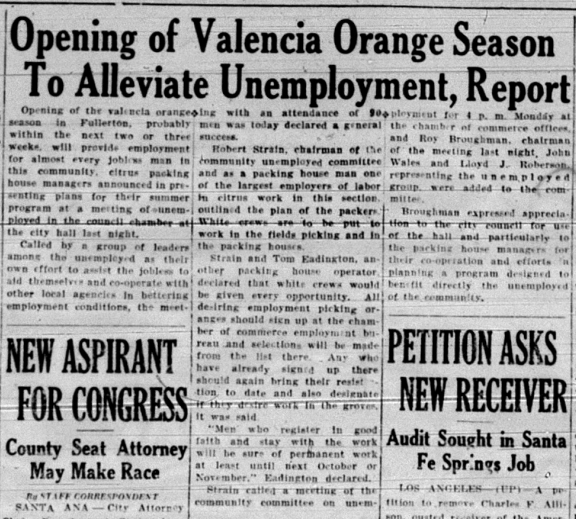
“Robert Strain and Tom Eadington, another packing house operator, declared that white crews would be given every opportunity,” the Tribune reported.
The Tribune published a couple articles which described life on the Mexican citrus camps, which I will reprint in their entirety below. Note to reader: These articles (while valuable historical documents) paint a much rosier picture of life in the camps than was the reality. For a more honest assessment of Mexican citrus camps at this time, check out my summary of historian Gilbert Gonzalez’s important work on this topic, Labor and Community: Mexican Citrus Worker Villages in a Southern California County 1900-1950.
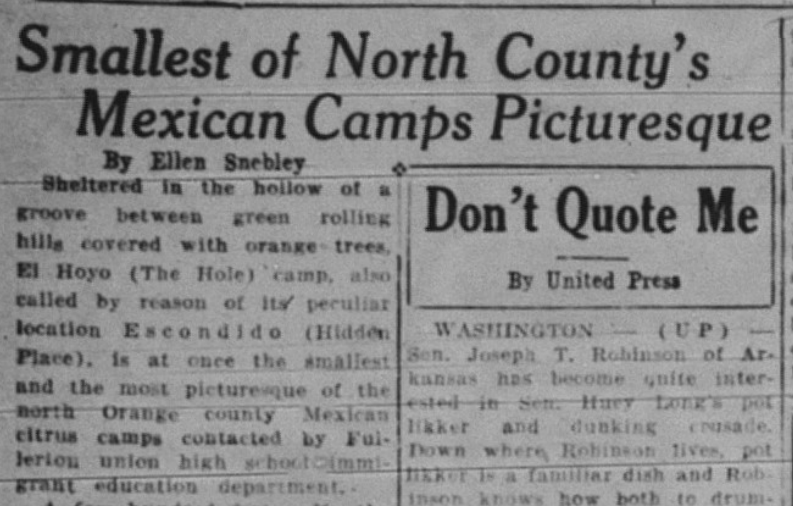
“Sheltered in the hollow of a groove between green rolling hills covered with orange trees, El Hoyo (The Hole) camp, also called by reason of its peculiar location Escondido (Hidden Place), is at once the smallest and most picturesque of the north Orange county Mexican citrus camps contacted by Fullerton union high school immigrant education department.
A few hundred feet off the traveled path of state highway 101, a little dirt road takes a sudden circuitous, steeply downward course, and below in hilltops are the seven frail cottages composing Escondido. A half-dry creek bed meanders through the camp and provides countless flies. Touches distinctly foreign are provided by the lean cow tethered on a green slope, and by the motley array of bed springs, galvanized tin, logs and boards which go together to make up the houses.
Last week, joy permeated the Mexican families, because employment had been give all but two of the men. In one household, however, a family including a young woman with her two sons, her sister, a mother and step-father–not to mention the lean cow–are subsisting on $2 a week earned by the young woman, who works two 12-hour days doing washing, scrubbing, cleaning and general housework at the Dominic Bastanchury home. The cow provides milk which is pressed, patted, and dried into cheeses to be eaten whole or grated into tortilla “frijoles.”
In each small house of unfinished brown boards is the lean-to kitchen with its pan-dotted walls. Unlike the homes of the larger, more affluent Mexican camps nearby, the Escondido houses have few conveniences. Un-modern wood burning stoves of heaviest iron are used. The Mexican mother, surrounded by her two to 10 young ever-hungry children, will stand untiringly beside the stove, and patting and rolling thin rounds of flour-water and lard dough, will fling it on the stove top to bake into tortillas. Instead of bread, the tortilla at Escondido is the main fare, and eaten with water-cress and beans seasoned with chili-garlic sauce from a molcajete bowl, provides breakfast, luncheon and dinner.
A novel dish favorite with the Mexicans is boiled cactus. Paring off the prickly pear outer skin of the large, flat-leaved cacti, the housewife will dice and boil in salt water the inside portion, which tastes like green peas or beans.
In the absence of remunerative work, the men have spent their time since bankruptcy of Bastanchury company, by whom they are employed, in farming on small ground patches. To their village come each week a bread man from Corona, a meat man from Santa Ana, a Syrian bread merchant and a Los Angeles traveling grocer. Credit is extended in present conditions until work is obtained by the men.
Escondido was depleted in population recently by the return to Mexico of one of its families.
Twice a week Mrs. Lucille Ward, Americanization teacher, visits the little brown schoolhouse and teaches children and grown-ups alike the elementary principles of sanitation and education. Donna Felipe, who cleans and keeps neat the schoolhouse, is ancient in years and a grandmother to six boys and two girls, yet she displays an Americanized active thought, and discusses such current topics as birth control and the tenure law!
After a trip through the flower-bordered small houses, the return job takes one past a veritable picture book scene of slender eucalyptus and weeping willow in which is set a tall brown house overhung with climbing roses. Showers of yellow and deep pink flowers fling themselves over the shingled roof in undisciplined color. Shaded by the willow leaves, the garden is filled with roses and small plants of beauty–but there is an air or desolation. Donna Maria, well-loved Mexican housewife and “favorite” of the Americanization workers, died last summer and her home is left to her husband, who works on the ranch. Now left to bloom unaided, the garden was formerly a marvel of orderliness and the house exemplary of meticulous tidiness. Miss Druzilla Mackey, director, Mrs. Arletta Klahn Kelly, former teacher of the camp, and Mrs. Ward all have words of sorrow for the hospitable Donna Maria, prize pupil of “la escuela.”
In the main, Americanization is well accepted and its teachings to a degree are followed by the residents of the tiny hidden village.
Click HERE for more about the local Americanization program.
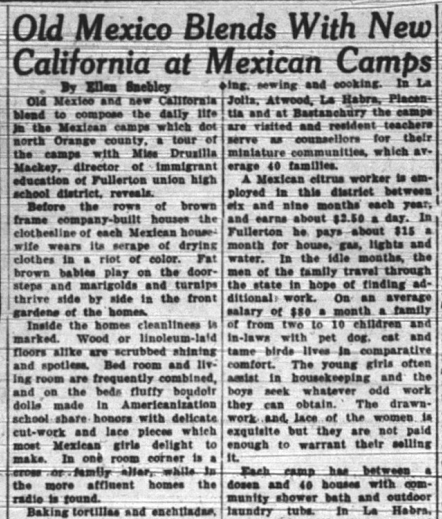
“Old Mexico and new California blend to compose the daily life in the Mexican camps which dot north Orange county, a tour of the camps with Miss Druzilla Mackey, director of immigrant education of Fullerton union high school district, reveals.
Before the rows of brown frame company-built houses the clothesline of each Mexican housewife wears its serape of drying clothes in a riot of color. Fat brown babies play on the doorsteps and marigolds and turnips thrive side-by-side in the front gardens of the homes.
Inside the home cleanliness is marked. Wood or linoleum-laid floors alone are scrubbed shining and spotless. Bed room and living room are frequently combined, and on the beds fluffy boudoir dolls made in Americanization school share honors with delicate cut-work and lace pieces which most Mexican girls delight to make. In one room corner is a cross or family altar, while in the more affluent homes the radio is found.
Baking tortillas and enchiladas, washing and cleaning occupy the time of the Mexican mother. While she retains the language and dress characteristics of her motherland, her daughters are products of public schools and wear the waved hairdress and modern garments of the American girl.
Monthly a trained nurse and physician visits the camps to hold a clinic. The Mexican bambino (baby) is dressed in shirts heavy with crocheting and hemmed in handmade lace. The young mothers anxiously request and put into effect suggestions as to sanitary care for their children, which are seldom ailing.
Miss Mackey, Mrs. Carmen Adams and Mrs. Anna Roy visit Pomona camp in Fullerton each week to instruct the residents in elementary English, housekeeping, sewing, and cooking. In La Jolla, Atwood, La Habra, Placencia, and at Bastanchury the camps serve as counsellors for their miniature communities which average 40 families.
A Mexican citrus worker is employed in this district between six and nine months each year, and earns about $2.50 a day. In Fullerton he pays about $15 a month for house, gas, lights, and water. In the idle months, the men of the family travel through the state in hope of finding additional work. On an average salary of $80 a month a family of from two to 10 children and in-laws with pet dog, cat and tame birds lives in comparative comfort. The young girls often assist in housekeeping and the boys seek whatever odd work they can obtain. The drawn-work and lace of the women in exquisite but they are not paid enough to warrant their selling it.
Each camp has between a dozen and 40 houses with community shower, bath, and outdoor laundry tubs. In La Habra, first rural camp and organized 10 years ago, the most affluent Mexicans are to be found. At La Jolla, a group of cement workers, citrus and general workers selected an unrestricted space of land and built their homes. Here is a typical Mexican community. Each house has its fence to keep the neighbors’ chickens away from the garden.
Except for church holidays and occasional wedding fiestas, there is little social life in the camps except for “school days” when the entire feminine population turns out to study household arts and learn hand crafts.
At present, lodges are popular and in the community halls hang charters of labor unions and social orders. In the past year, cement work has been so scarce that several families now contemplate returning to Mexico to take up homestead lands.
Boys of the colonies seldom complete high school and since minors are forbidden citrus work in this district, they spend their time playing rebote, or Mexican handball, and working wherever they can. The young girls and their mothers work on dresses, linens, and quilts. They throng the community building to spend their time sewing and studying. In Placentia, a young Mexican girls club is being organized under direction of Miss Rose Camers, resident teacher, by Fullerton, Placentia, and La Jolla girls. The 60 families in the La Habra camp are advised by Mrs. Jessie Hayden. They live in homes scattered over a hill and are distinctly separate from the independent homeowners of a neighboring hill. A substantial colony is in Atwood, and at Bastanchury several groups of families constitute the general camp, which is managed by Mrs. Lucille Ward. At Placentia, community gardening is a current project.
Education in opinion of Miss Mackey is a serious problem for the Mexicans. Scarcity of space at home, and the distance of the library or school are obstacles to education. Each member of a family is needed as a breadwinner and many difficulties beset the path of the young Mexican who aspires to more than a grammar school education.
An education attained, the student has still to face a racial prejudice in the business and professional world, she says. Unless parents and children are eager to undertake the struggle for higher education, it is not forced on them, since the odds are so great against success.
The state, county, local school system and the citrus associations combine to maintain Americanization schools and resident teachers. In addition to visiting teachers, Miss Macke makes frequent visits to each colony to note progress and assist in teaching.
Mrs. Arletta Klahn Kelly assists in work at Pomona colony, where she was until recently in charge. In recent years of depression, when other activities have been curtailed, the citrus industry still contributes to the camp work.“
Politics
In local political news, Billy Hale, Ted Concoran, and Thomas Gowen were elected to the City Council.
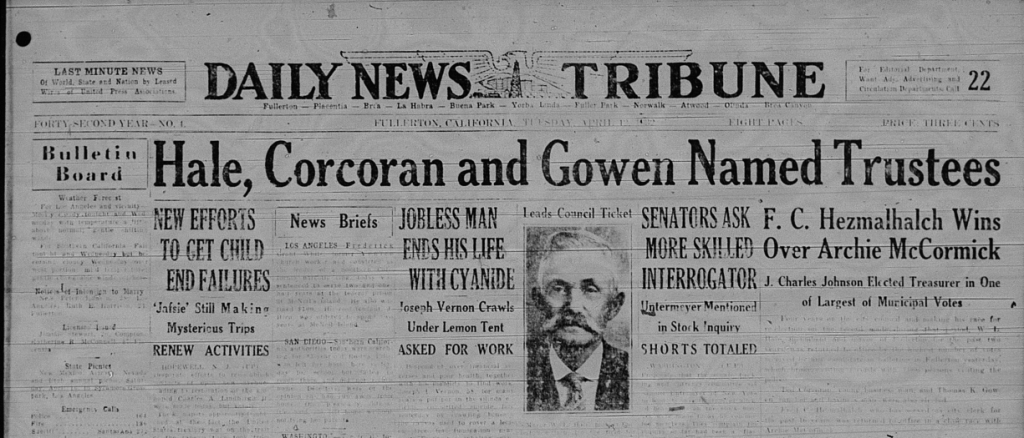
A local crisis occurred when a new council majority chose to dismiss local judge Halsey Spence, which prompted massive community backlash, and a petition to reinstate him. Stay tuned for more on this in 1933.
Education
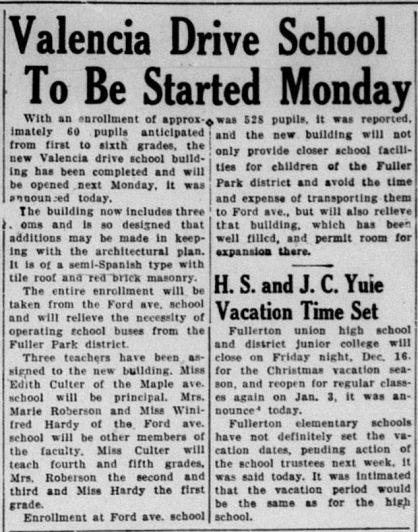
In education news, Valencia Drive school was built.
Prohibition
Prohibition, which was enacted in 1919 with the ratification of the 18th amendment, was nearing its end. It would be repealed in 1933 by the 21st amendment. Prior to that, the Wright Act, which provided state enforcement of prohibition, was repealed by voters.
Fullerton, being Fullerton, kept its local ordinances making alcohol illegal.
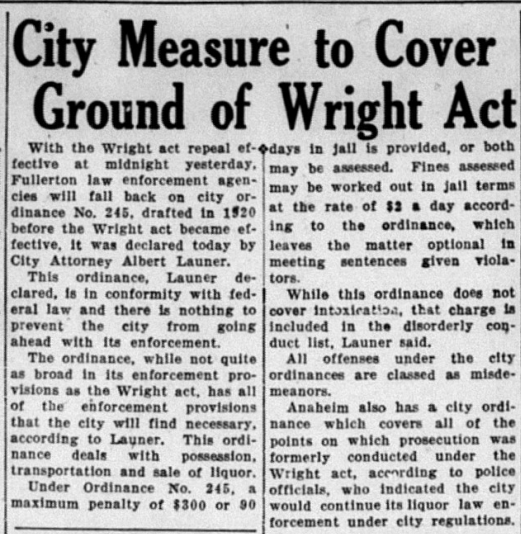
This is pretty much what Fullerton did in 2016 after California voters legalized recreational cannabis, making dispensaries still illegal. Dispensaries are still illegal in Fullerton.
Crime
Local crime mainly involved robberies and burglaries, which is not surprising given the unemployment and poverty created by the Great Depression.
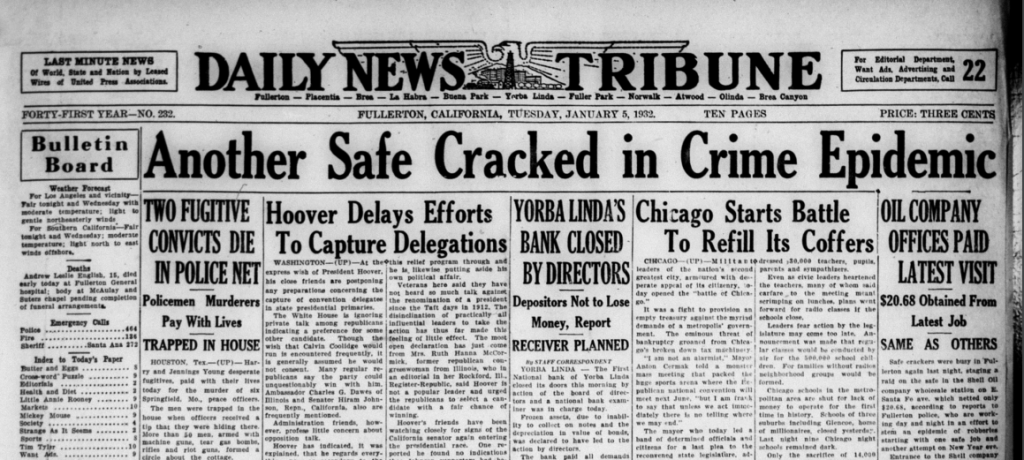
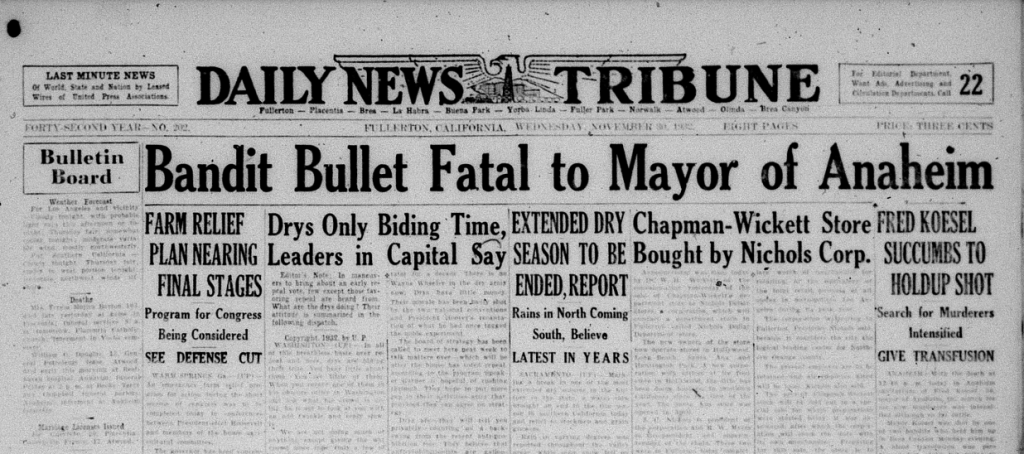
In Anaheim, the Mayor was murdered.
Culture and Entertainment
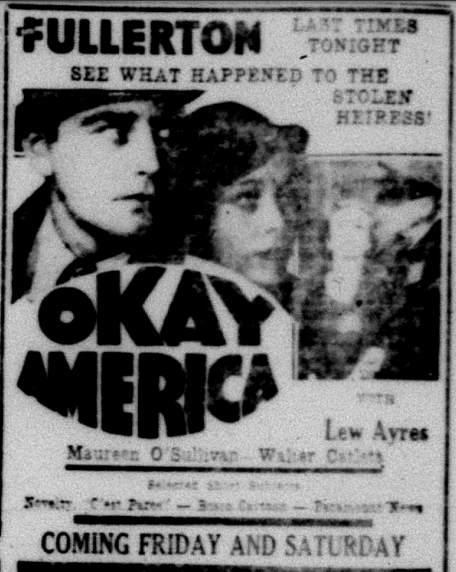
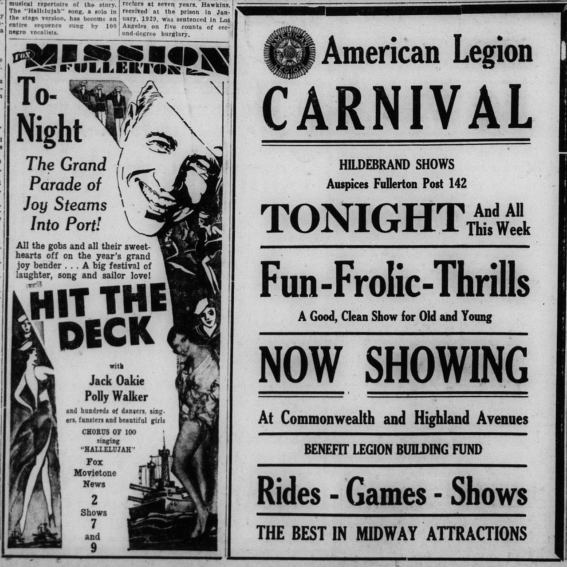
For entertainment and escape from their troubles, Fullertonians went to movies at the Fox Theater.


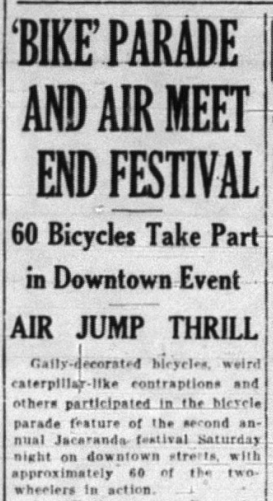
Fullerton hosted an annual Jacaranda festival, which included a bike parade and an air show.

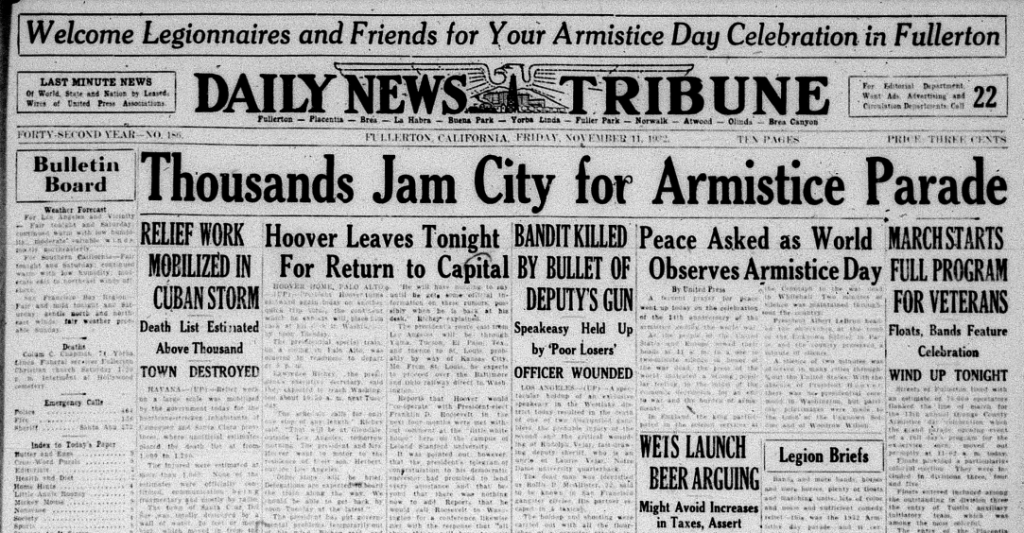
Thousands attended a massive Armistice Day parade.

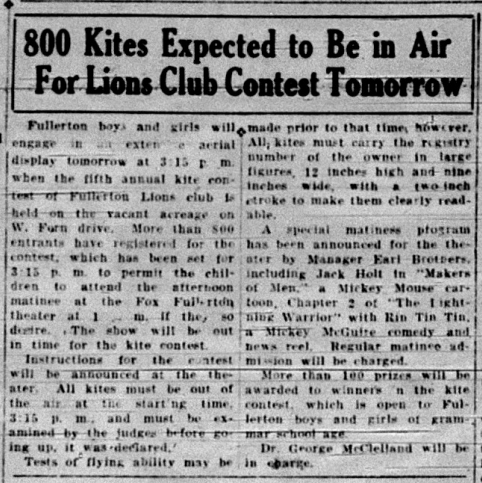
There was a kite contest.
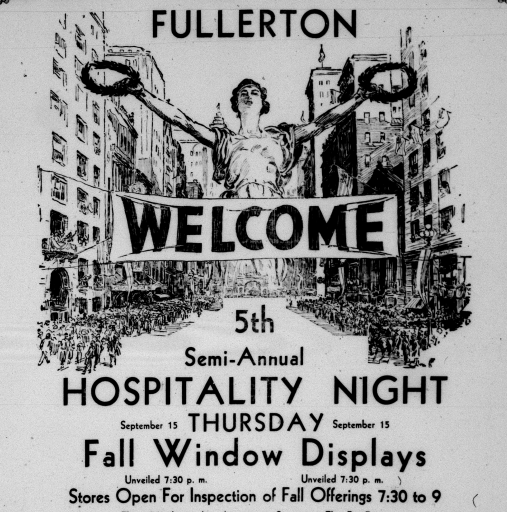
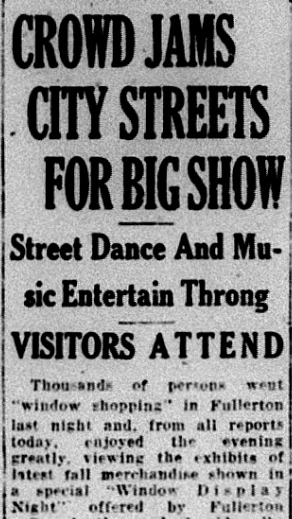
Downtown businesses created elaborate window displays for an annual “Hospitality Night.”
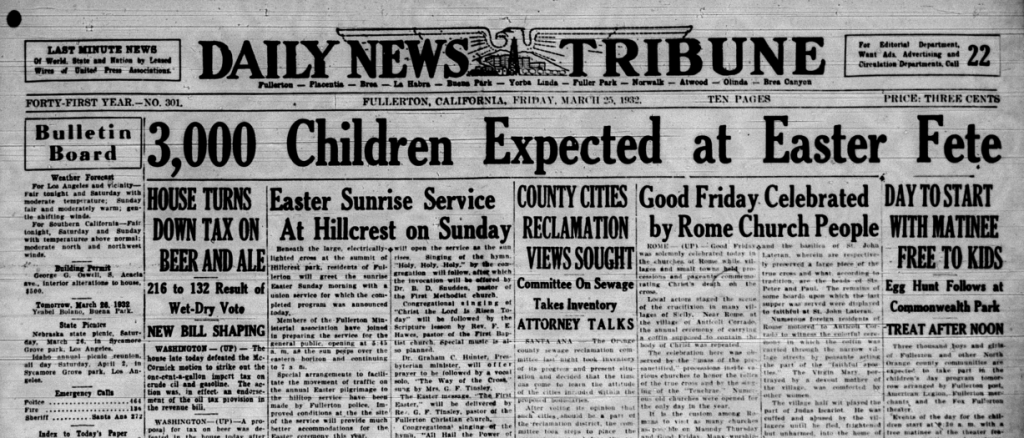
An Easter event at Hillcrest Park drew thousands.
And there used to be something called Golden Rule Week, which I think should be more widely celebrated.

Sports
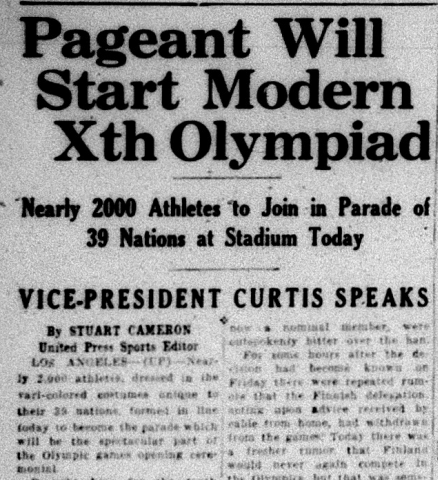
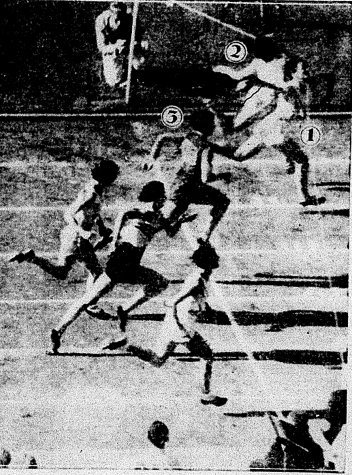
Los Angeles hosted the Olympics in 1932.
Fashion

Miscellaneous
And here are some miscellaneous clippings from 1932:

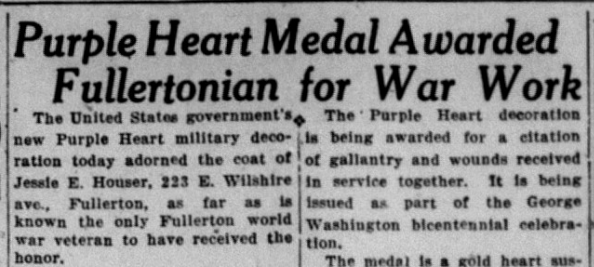
The above article describes how World War I veteran Jessie E. Houser was awarded the Purple Heart: “He was wounded July 19, 1918 at the battle of Soissons Chateau-Thiery while a member of Company 1, 26th infantry, First Division. He received a machine gun bullet in the leg. His citation for gallantry came when he was one of a part of three that captured a machine gun nest and brought back 13 prisoners. Houser also volunteered on a detail to bring machine gun ammunition to the front under heavy barrage fire…Houser, who came to Fullerton after the war, is a member of Fullerton post 2073, Veterans of Foreign Wars.”
Stay tuned for top stories from 1933!
-
Fullerton in 1931
The following is from a work-in-progress about the history of Fullerton. You can support my ongoing research and writing on Patreon.
The Local History Room of the Fullerton Public Library has microfilm from the Fullerton Daily News-Tribune newspaper stretching back to 1893. I am in the process of reading over the microfilm, year by year, to get a sense of what was happening in the town over the years, and creating a mini archive. Below are some news stories from 1931.
Fascism on the Rise in Europe
Before getting into what was happening locally, I’d like to give a bit of context of what was happening internationally, as overseas developments would eventually involve the United States.
Perhaps most ominously, fascism was on the rise in Europe, with Mussolini having taken power in Italy, and Hitler consolidating power in Germany. The post-World War I economic devastation faced by Germany led directly to the rise of extremist political movements, like fascism.
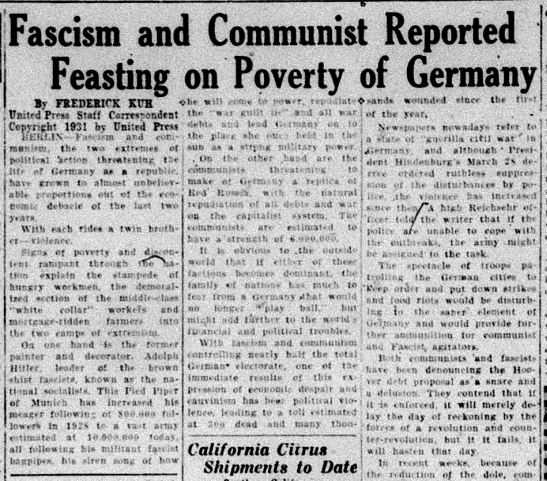

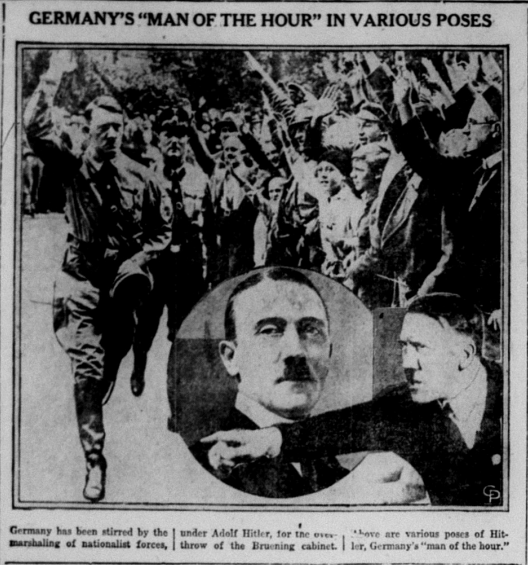
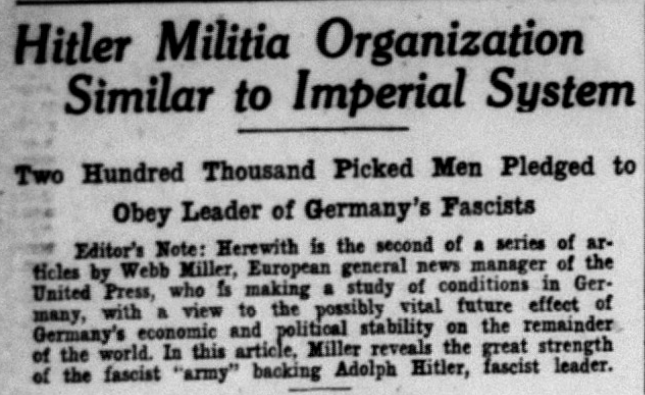
It’s interesting to note that, prior to World War II (when Italy and Germany were adversaries of the United States), not all Americans saw fascism as a bad thing. This is illustrated in a talk given to a Women’s Club in Brea.
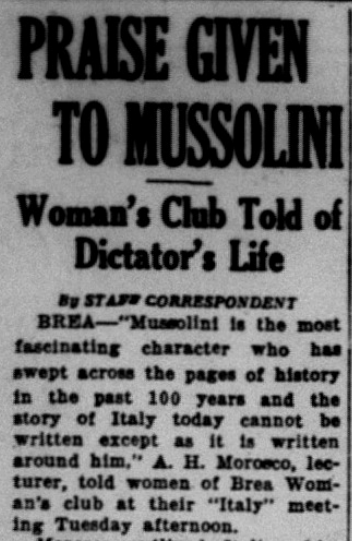
“Mussolini is an absolute dictator, a benevolent despot, which is pronounced by many to be the best form of government in the world,” the speaker concluded.
On the other end of the political spectrum, communism had taken hold in Soviet Russia.

US Intervention in Central and South America
Following the Spanish-American War in 1898, the United States entered a phase of imperial expansion into countries like the Philippines and throughout Latin America. Backed by the U.S. military, the United States intervened in countries like Nicaragua, Honduras, Cuba, and Panama, largely to protect American business interests, although that was not usually the reason given by politicians and the press.
Read more about the U.S. intervention in Honduras, Nicaragua, Cuba, and Panama during the “Banana Wars” HERE.


Smedley Butler, a Marine who involved himself in many of these interventions, later became an outspoken critic, writing in his book War is a Racket:
“I spent 33 years and four months in active military service and during that period I spent most of my time as a high class muscle man for Big Business, for Wall Street and the bankers. In short, I was a racketeer, a gangster for capitalism. I helped make Mexico and especially Tampico safe for American oil interests in 1914. I helped make Haiti and Cuba a decent place for the National City Bank boys to collect revenues in. I helped in the raping of half a dozen Central American republics for the benefit of Wall Street. I helped purify Nicaragua for the International Banking House of Brown Brothers in 1902-1912. I brought light to the Dominican Republic for the American sugar interests in 1916. I helped make Honduras right for the American fruit companies in 1903. In China in 1927 I helped see to it that Standard Oil went on its way unmolested. Looking back on it, I might have given Al Capone a few hints. The best he could do was to operate his racket in three districts. I operated on three continents.”
I’ve recently been reading a book entitled Gangsters of Capitalism: Smedley Butler, the Marines, and the Making and Breaking of America’s Empire by Jonathan M. Katz, which describes the age of American imperialism and its lingering effects today. For example, some of the migration crisis stemming from Latin America today has its roots directly in US intervention.
Great Depression/Unemployment
Back at home, the most significant problem facing Fullerton in 1931 was the Great Depression.

Republican Herbert Hoover was president, and so the New Deal programs created under Franklin D. Roosevelt did not yet exist. FDR would be elected in 1932.


With little or no help from the federal government, local communities were forced to create their own solutions to the poverty, hunger, and unemployment caused by the Depression.
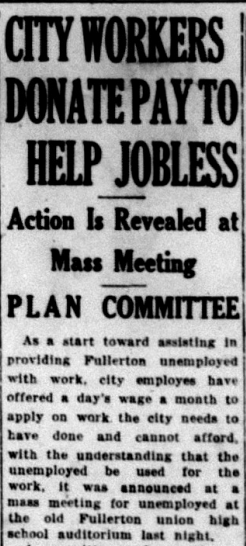
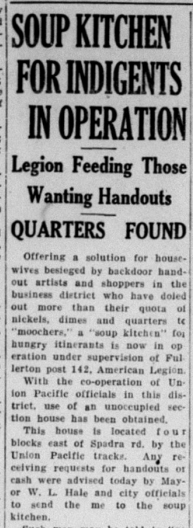
This took the form of both large and small-scale efforts, like city workers and teachers donating some of their pay to help the unemployed, food and clothing drives, church efforts, soup kitchens, and more.


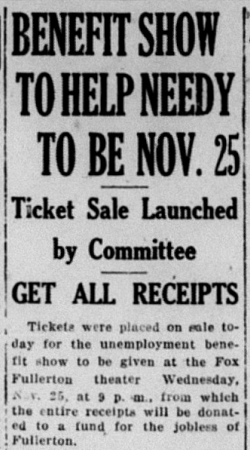

City Council placed a bond issue on the ballot that would authorize funds to pay unemployed locals to do work on city parks.
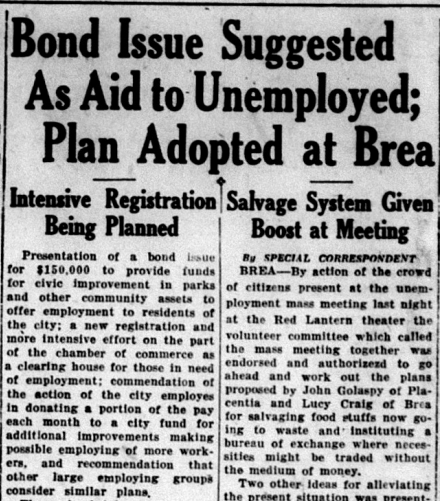
This issue would be on the ballot in early 1932.
Meanwhile, others sought larger-scale changes.

Culture and Entertainment
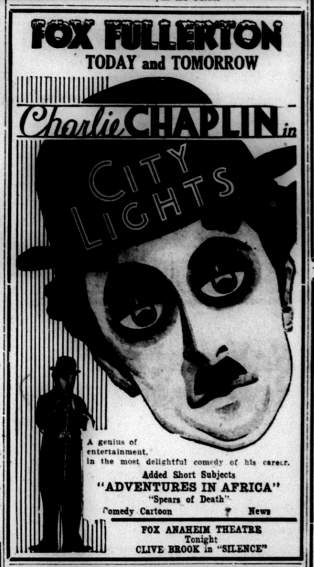
To escape the troubles of life, folks went to movies at the Fox Theater:

Fullerton’s First Jacaranda Festival
In 1931, Fullerton hosted its first Jacaranda Festival, showing off the purple flowers of the trees that still line Jacaranda Dr. and other streets.

The Festival included a pageant at the high school with a cast of 300.
King Citrus
Due to over-expansion in the 1920s followed by the Great Depression, the Bastanchury Ranch (called the largest orange grove in the world), couldn’t pay its debts and went into receivership.
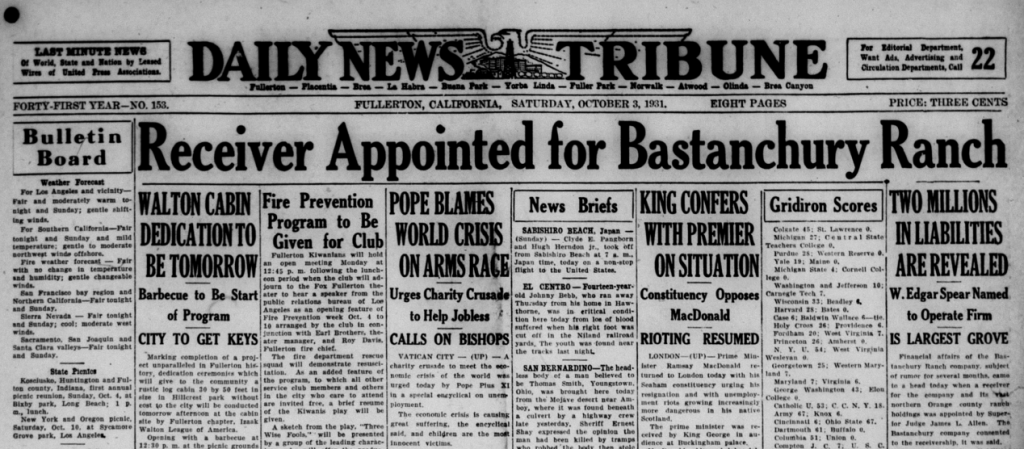
“It was revealed that liabilities of nearly $2,00,000 rest against the 2,600-acre ranch. W. Edgar Spear of Los Angeles was appointed receiver upon complaint of the Consolidated Securities company of that city,” the News-Tribune reported.
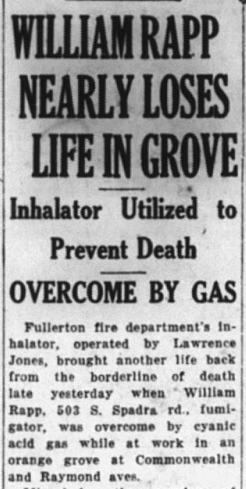
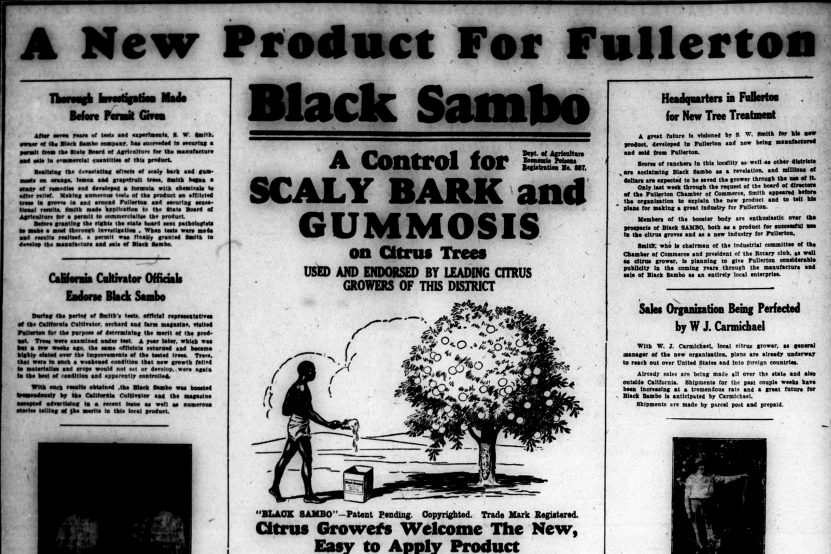
Aside from a slumping market, another problem facing growers was a disease called red scale. A common method to kill the disease was to fumigate trees with cyanide gas, a dangerous process that sometimes killed workers.

Thankfully, a new (perhaps safer) product was created with the unfortunate name Black Sambo.
Immigration
With unemployment on the rise, immigrants (as always) made a convenient scapegoat and there were calls to restrict immigration.

In 1931, the Mexican immigrant population of Fullerton lived mostly in segregated work camps or neighborhoods and sent their children to segregated “Americanization” schools.

Water
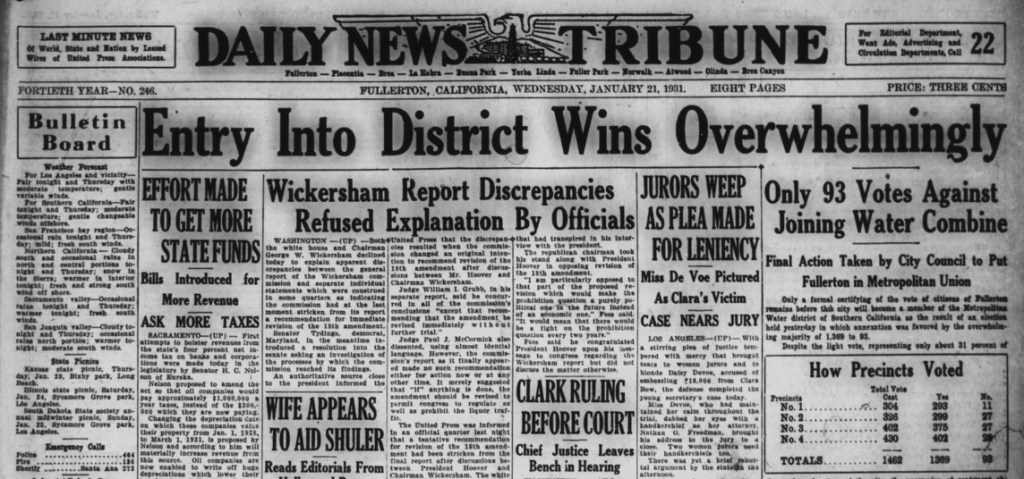
Fullerton residents voted to enter the Metropolitan Water District, which would give the city access to water from the Colorado River via aqueduct.
Crime
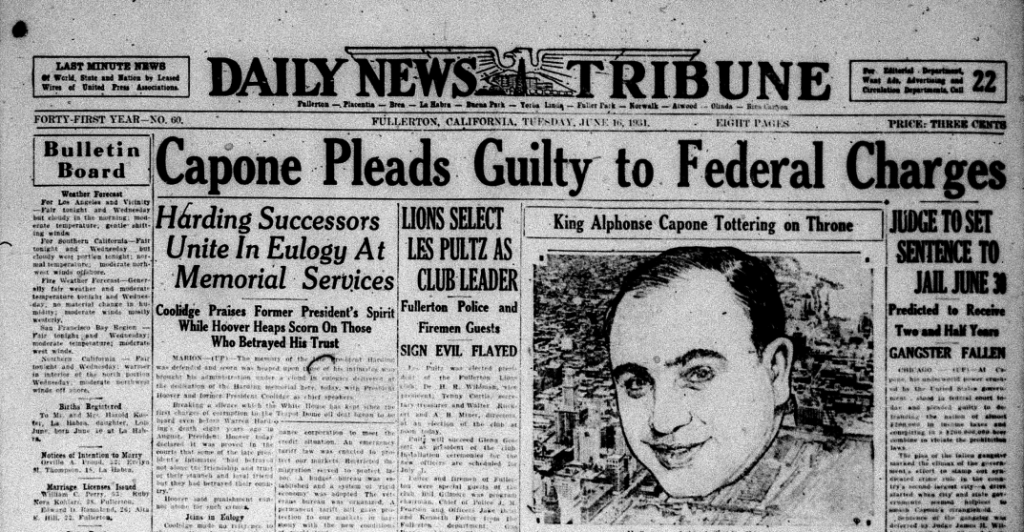
In national crime news, gangster Al Capone pleaded guilty to federal charges.
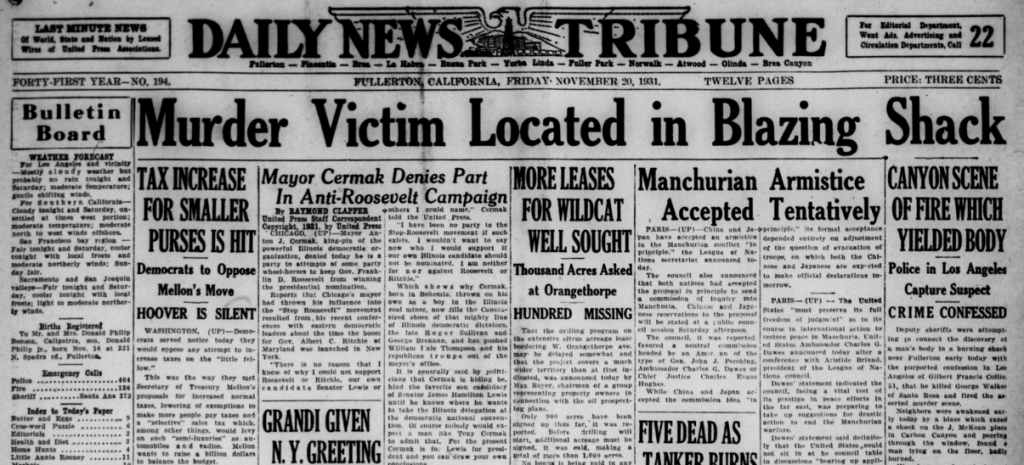
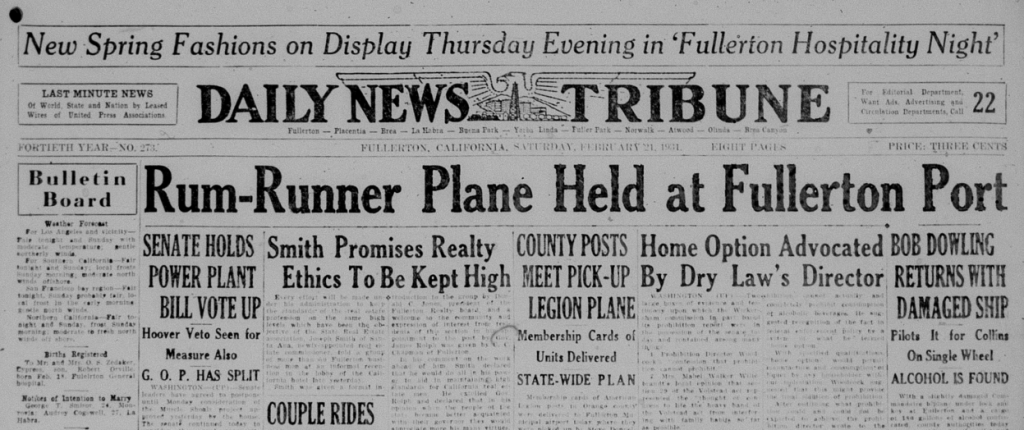
Locally, a Brea bank was robbed, a man was murdered, and a rum-runner airplane was held at the Fullerton Airport.

Transportation
The Airport also hosted a big air meet.

Thousands turned out to celebrate the widening of Spadra (now Harbor) Blvd.

Deaths
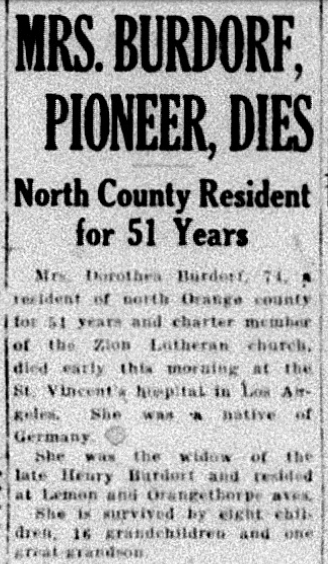
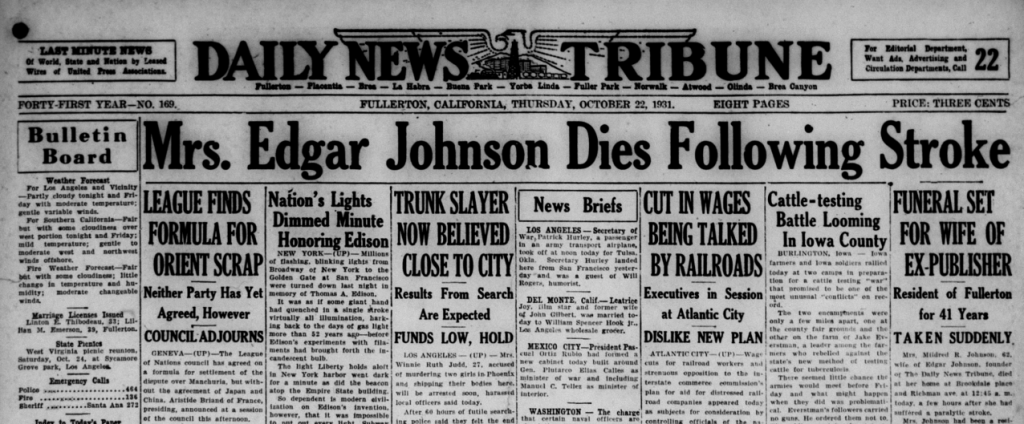
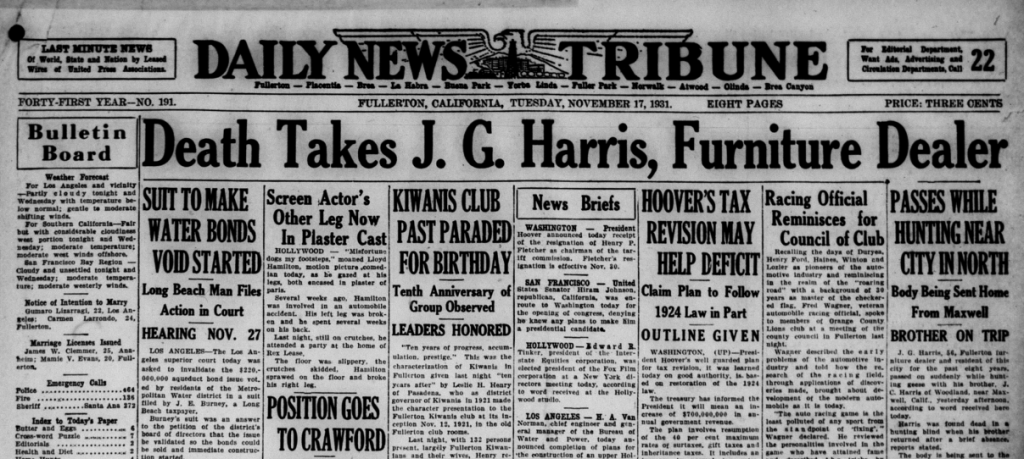
The following local people died: Dorothea Burdorf, City Councilman Oscar Adelbert Kreighbaum, Mildred Johnson (the wife of Fullerton News-Tribune founder Edgar Johnson), furniture store owner J.G. Harris, and drug store owner G.W. Finch.


Stay tuned for top news stories from 1932!
-
Fullerton in 1930

The following is from a work-in-progress about the history of Fullerton. You can support my ongoing research and writing on Patreon.
The Local History Room of the Fullerton Public Library has microfilm from the Fullerton Daily News-Tribune newspaper stretching back to 1893. I am in the process of reading over the microfilm, year by year, to get a sense of what was happening in the town over the years, and creating a mini archive. Below are some news stories from 1930.
According to census figures, Fullerton’s population in 1930 was 10,860.
Impacts of The Great Depression
In 1929, the U.S. stock market crashed, sparking the Great Depression. Impacts could be seen locally, with a visibly increasing number of unemployed and homeless people, with some even seeking to sleep in jail.
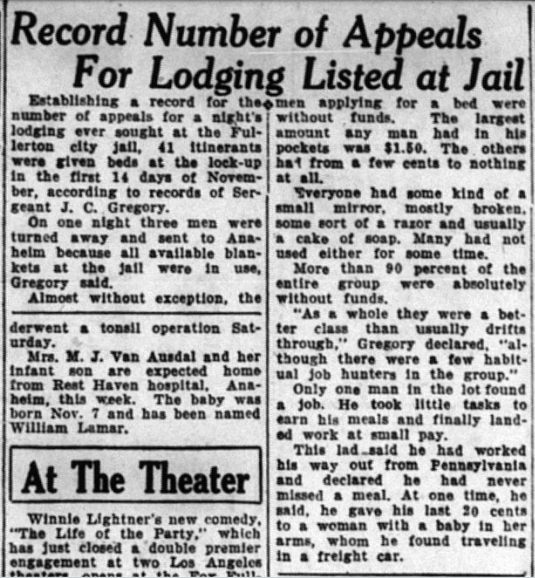
In 1930, there was no such thing as unemployment insurance, and Franklin Delano Roosevelt would not be elected for another two years, so the New Deal programs did not exist.
Local communities were thus forced to fend for themselves. In Fullerton, the Chamber of Commerce sought (with limited success) to help get people jobs.
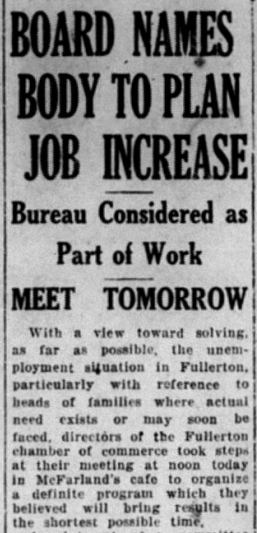
And ads in the newspaper encouraged people to buy more stuff (with what money?) as a solution to unemployment.

Then, as now, there was a serious stigma on being unemployed. A local pastor sought to diminish this by explaining that there were larger, structural reasons for unemployment. It wasn’t just a matter of personal laziness.

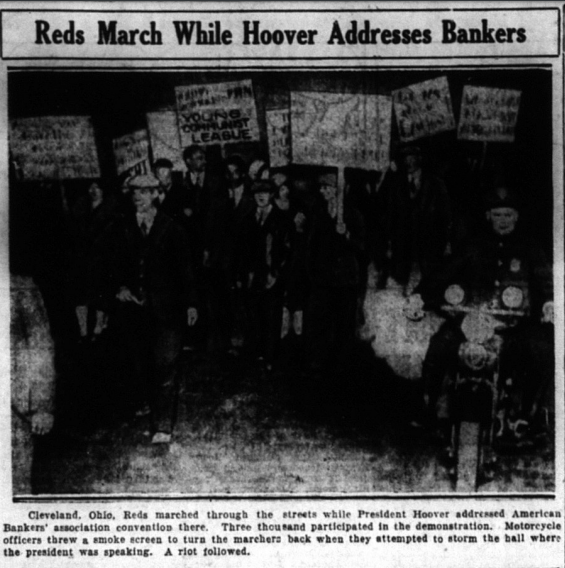
As the Depression worsened, there were increasingly radical and widespread labor strikes and demonstrations, both locally and across the nation. Some [though certainly not all] of these strikes and demonstrations were organized by socialists and communists. Some Americans saw the Depression as a failure of capitalism, and sought to try different economic systems.
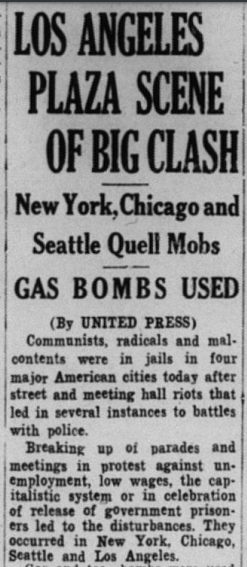
Law enforcement often responded to these labor strikes with [sometimes lethal] violence.

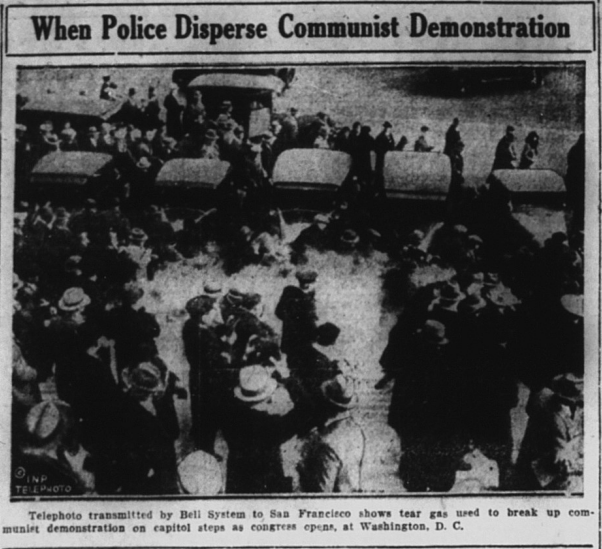
President Herbert Hoover, a Republican, doubled down on capitalism as the solution. He thought stimulating business, not providing directly for human need, was the answer.

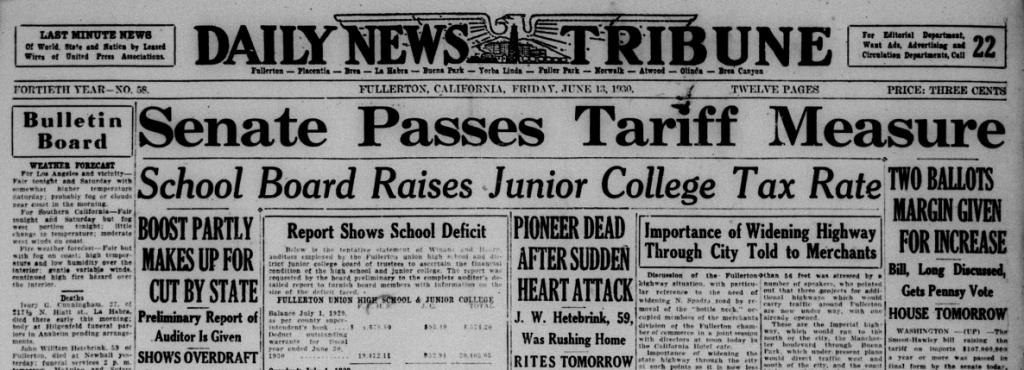
He signed a protectionist tariff, The Smoot-Hawley Bill, which (predictably) sparked retaliation from other countries and actually worsened the Depression, causing prices to rise on many goods.
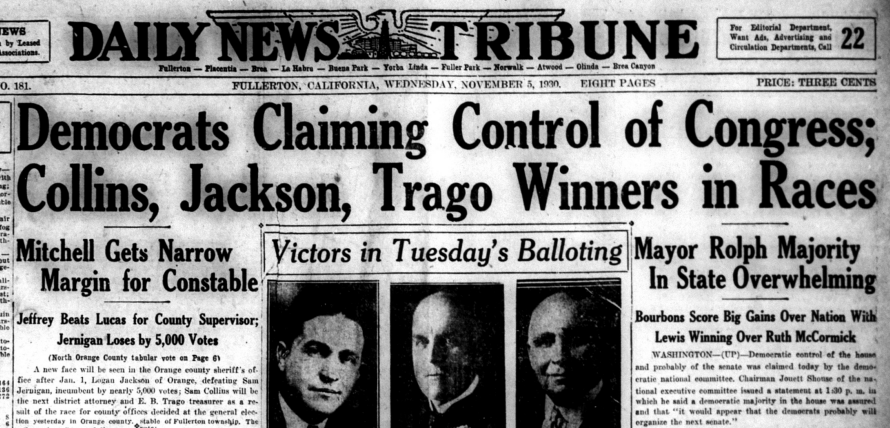
In the midterm election of 1930, Democrats gained a number of seats in congress.
And a third, more left-wing, party [the Farmer Labor Party] gained some support.

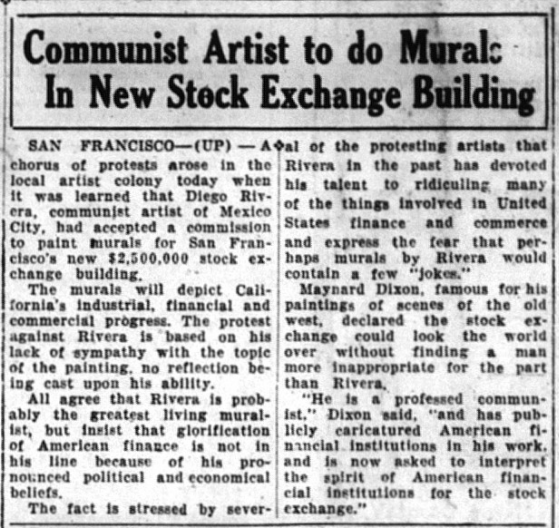
In a fairly perfect expression of the spirit of the times, Mexican artist Diego Rivera (a communist) was hired to paint a large mural in the San Francisco stock exchange building. Is his mural a condemnation or celebration of industrial capitalism? You decide.

Anti-Immigrant Sentiment Rising
Throughout U.S. history, tough economic times have sparked strong anti-immigrant movements that have sometimes had devastating consequences. This happened during the Great Depression, with increasing calls to prioritize “white” over “foreign-born” labor.

“Petitions were circulated in Fullerton Saturday afternoon protesting employment of unnaturalized foreign-born workers on any public improvement project while white labor is available,” the Tribune reported. “The petitions, circulated by R. J. Simpson of Costa Mesa, president of the Orange County labor association, will be presented to the board of supervisors and to the city councils of all the cities in the county.”
“Contractors have tended to employ unnaturalized Mexican labor to the exclusion of white labor, according to the petitions. This is because they will work cheaper and stand more, Simpson says. A mass meeting of working men will be held Friday night at Birch park in Santa Ana, Simpson said, to formulate further protests,” the Tribune continued.
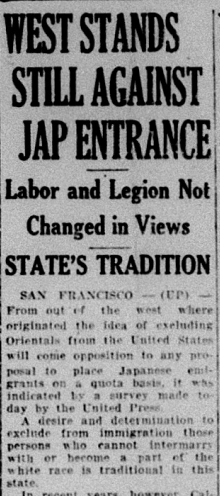
Politicians got on the anti-immigration train and supported measures to restrict it.

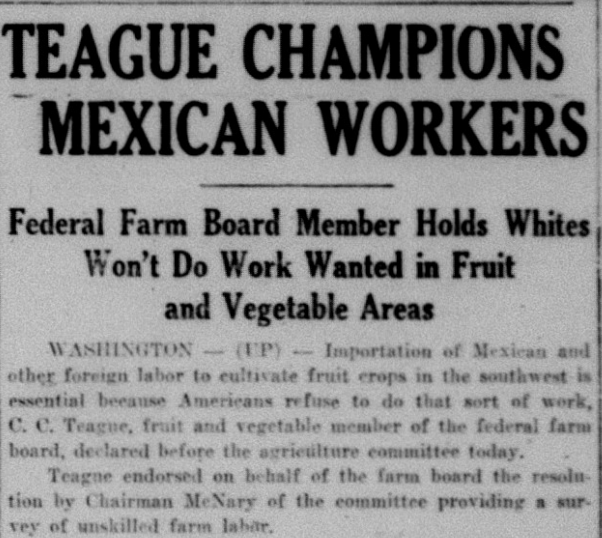
Some large agricultural interests opposed immigration restriction, and supported allowing Mexican immigrants to continue working in the fields.
The anti-immigrant voices would grow louder as the Depression wore on, leading to one of the largest mass deportations in American history, primarily of Mexican-Americans, many of whom were actually citizens. This sad chapter of local and national history is chronicled in the book Decade of Betrayal: Mexican Repatriation in the 1930s by Francisco E. Balderrama and Raymond Rodriguez.
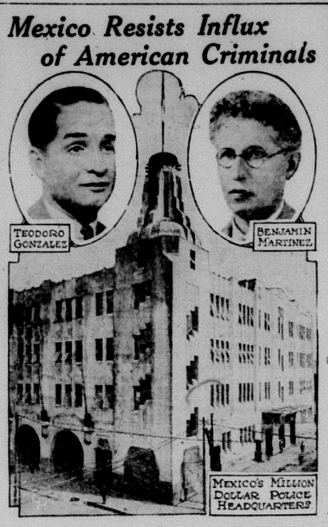
Meanwhile, in a kind of funny inversion of the current immigration discourse, Mexico was concerned about American criminals coming into their country.
Fascism Rising
If the domestic situation was tense, the international scene was worse. Perhaps most ominously, fascism was on the rise in Germany under the leadership of Adolph Hitler. Mussolini had already taken power in Italy.

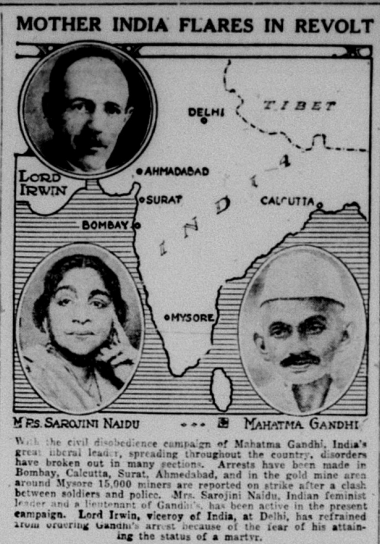
And in the old colonies of Europe, the global south, revolt was brewing.
Race Relations
Back at home, African Americans continued to live under conditions of racism and terror. The pages of the Tribune document numerous lynchings (none of them local, thankfully). 1930 was squarely in the middle of the Jim Crow era, when African Americans were systematically segregated from white people in housing, education, public facilities, and more.

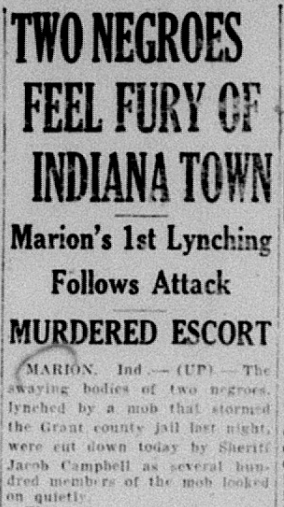
Although there weren’t very many African Americans living in Fullerton, they were barred from renting or purchasing homes in most neighborhoods by racially restrictive housing covenants.
And yet, in the pages of the Tribune, a couple articles appear describing programs at the local Methodist church whose goal was to improve race relations.

The above article describes a dinner program at the church which featured a speech by E. Leslie Banks, African American editor of Flask magazine, entitled “Come, Let us Reason Together.” The program also featured dramatic readings.
Another article describes a second meeting at the Methodist church of the Fullerton International Relations council with featured speaker W.T. Boyce of Fullerton College.

“He [Boyce] said the meeting last night was one of friendship with the idea of creating more harmonious relations between the negro race and the white race.”
The program also featured dramatic readings, singing of Negro spirituals, and another talk by Leslie Banks with the topic “Peace on Earth, Goodwill Toward Men.”
In Fullerton, by far the main ethnic minority were Mexicans, who worked in the citrus fields and packinghouses. These workers lived under a kind of paternalistic system that provided housing and limited education in segregated communities.
Druzilla Mackey, a teacher in the “Americanization” program that brought educational programs to the Mexican work camps, would occasionally give a talk about the progress of her work.

New Construction
Although the Great Depression would severely slow down the housing boom of the 1920s, the 1930s did see the construction of many significant public and business buildings.
The impressive new high school auditorium was completed.
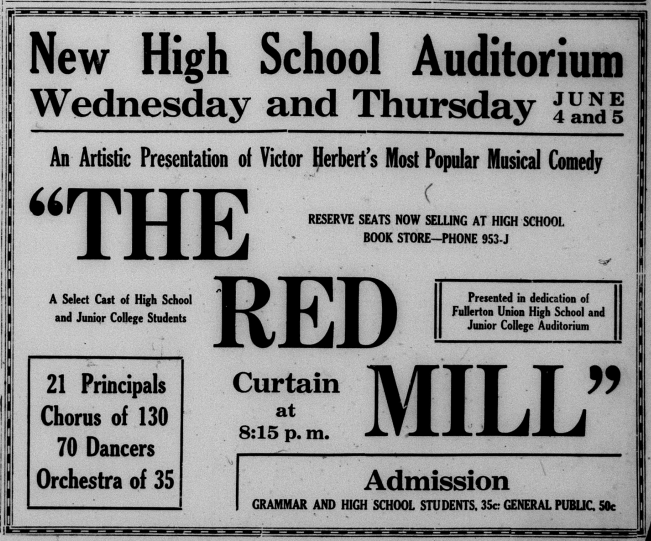
The old Santa Fe train depot was torn down and replaced with a much larger and more modern one–which still exists today and is on the National Register of Historic Places.
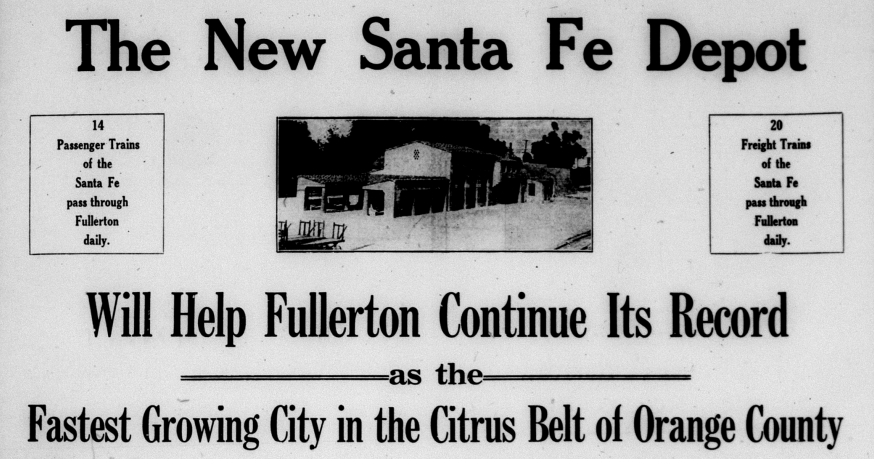

A new service station opened at Spadra (Harbor) and Whiting. Today, it is a Citibank.

And plans were in the works for a “Mexican” church on E. Santa Fe, between Pomona and Harvard (now Lemon).

Local Politics
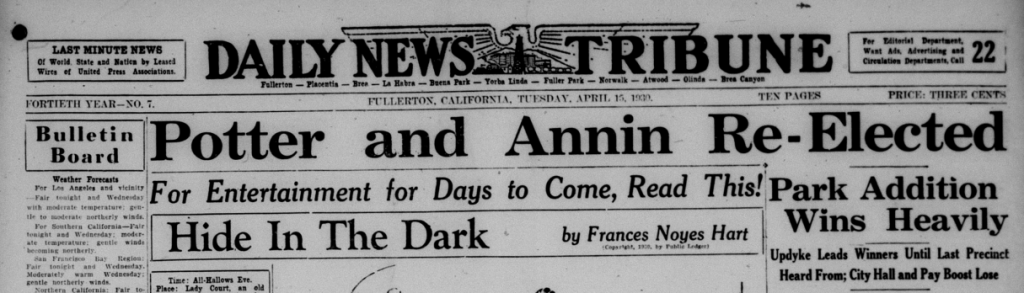
1930 was a midterm election year. William Potter and Bert Annin were re-elected to city council. Billy Hale was chosen as Mayor.

Below are photos of each Fullerton City Councilmember in 1930 (taken from a variety of sources including the Fullerton Public Library Local History Room and clippings from the Tribune).
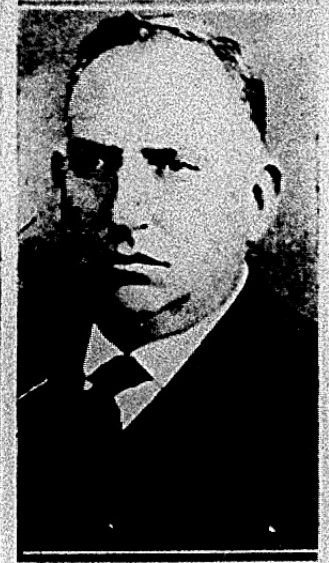
Bert Annin 
J.S. Elder 
William “Billy” Hale 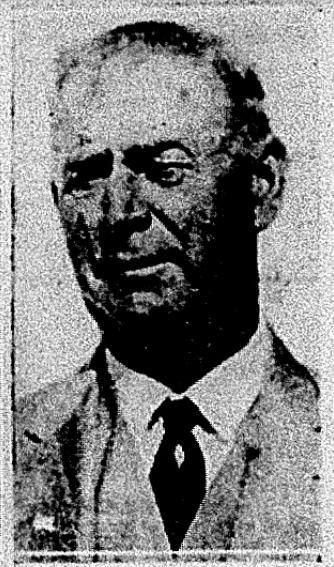
O.A. Kreighbaum 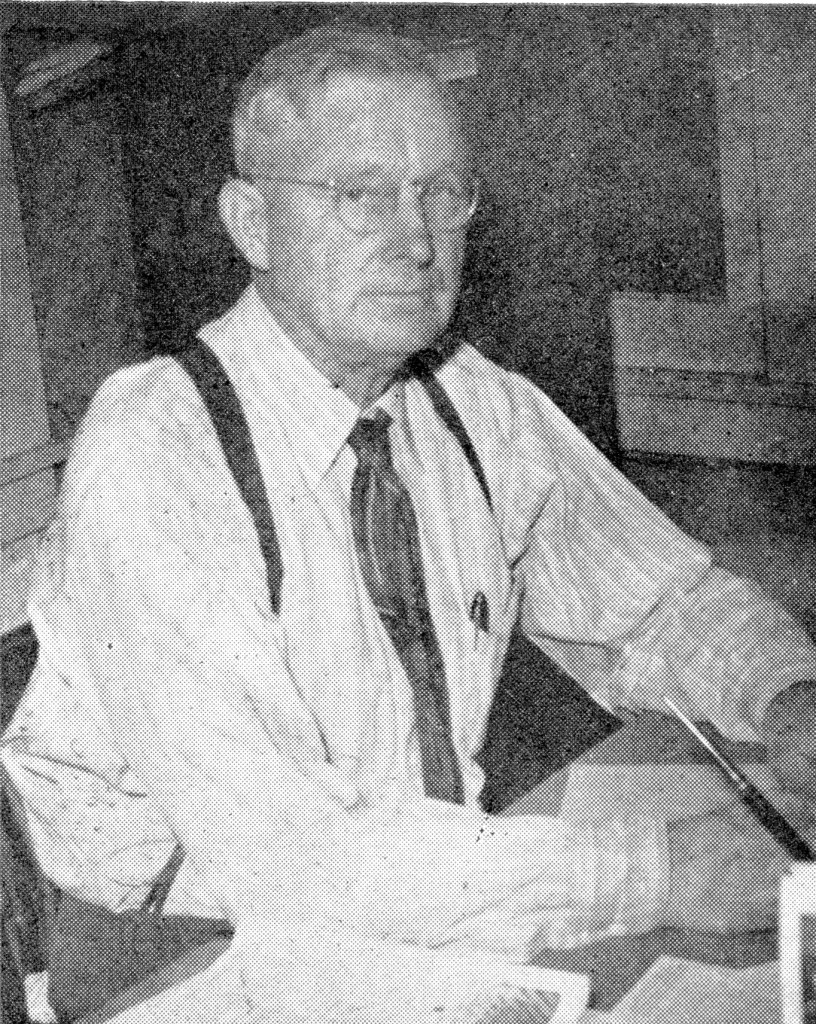
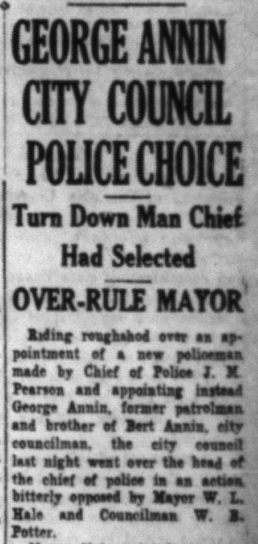
William Potter In a bit of nepotism that probably wouldn’t fly today, Bert Annin’s brother George was chosen as police chief.
Logan Jackson was elected county sheriff.

Republican James Rolph was elected governor of California.
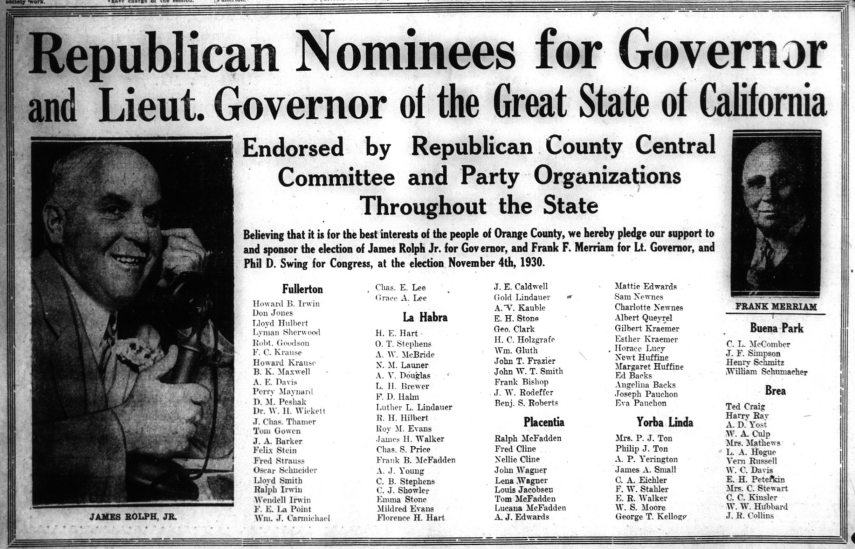
At this time, Fullerton had a solid Republican majority. This would change as the Depression worsened and Democrat Franklin Delano Roosevelt offered hope for a New Deal.
Culture and Entertainment
Sadly, in 1930, the Rialto Theater (Fullerton’s first movie theater) closed, and was replaced by the First National Trust and Savings Bank.
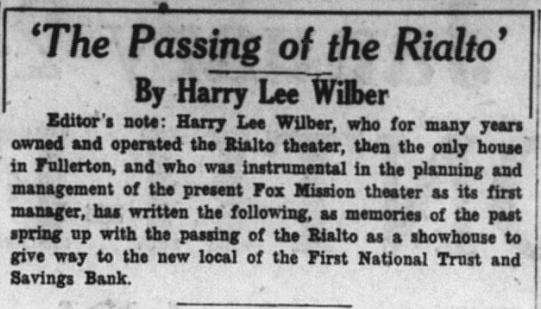

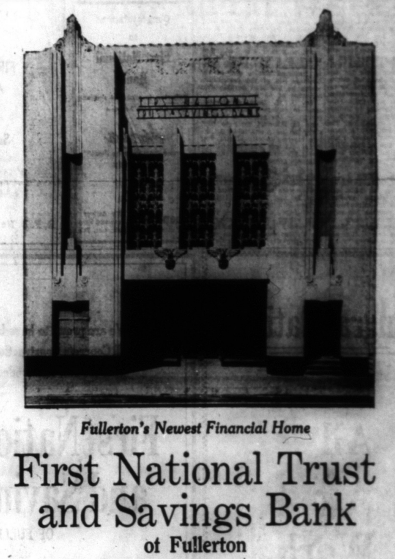
Thankfully, the Fox Theater was there to provide locals with cinematic entertainment. It even got a remodel.

Unfortunately, minstrelsy and blackface remained popular in 1930 in films like Al Jolson’s “Big Boy” and the white actors known as Two Black Crows.


In 1930, there was a Fox Theater in Fullerton and one in Anaheim. They would advertise their films in the News-Tribune.
While the Fox Theater in Fullerton still stands, the Anaheim Fox Theater was unfortunately torn down in 1979 along with many of that city’s other historic buildings. This was called “redevelopment.”
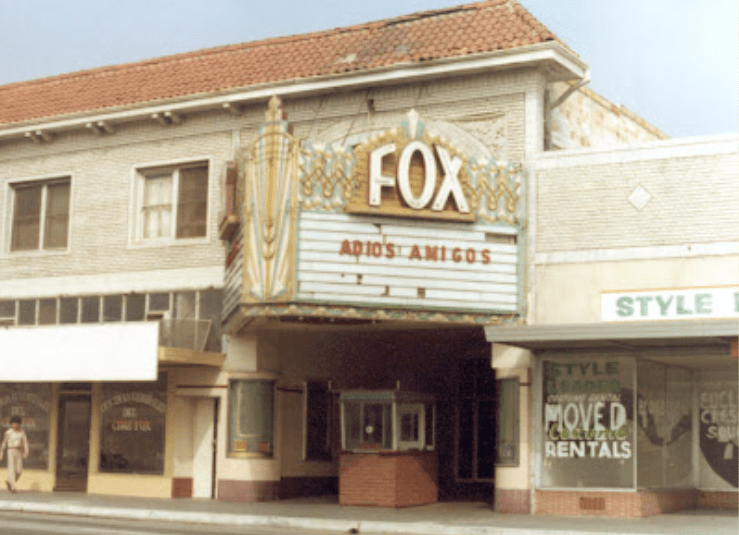
Anaheim’s Fox Theater just prior to being demolished. Photo by Dave Mason. 
Anaheim’s Fox Theater rubble. Photo by Dave Mason. The film “Hells Angels” featuring daring airplane stunts and produced by Howard Hughes, was filmed at the Fullerton Airport.


In true Footloose fashion, the High School Board of Trustees denied dancing at a high school event.

Here are some other cultural events that took place in Fullerton in 1930:

In 1930 television did not exist, so the preferred in-home entertainment was radio. And record players.

Famous ceramicist Glenn Lukens taught at Fullerton Union High School.

Sports
There was a night time baseball league which played games at what is now Ford park.

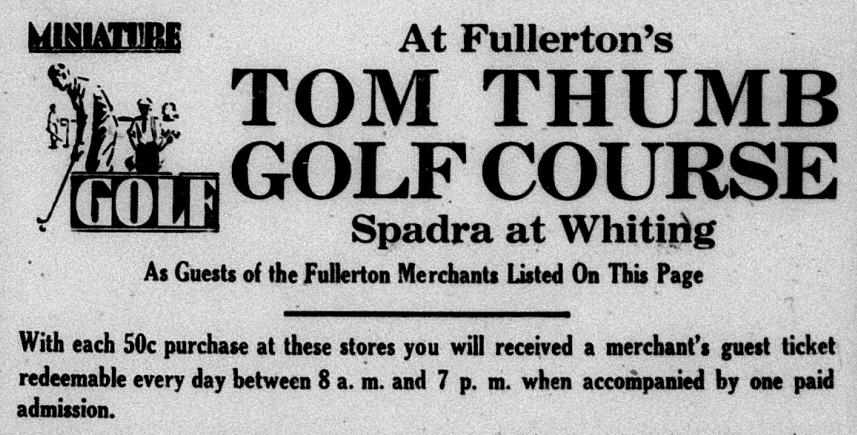
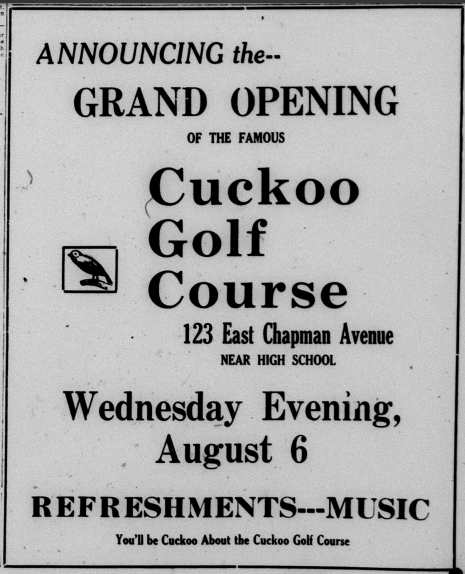
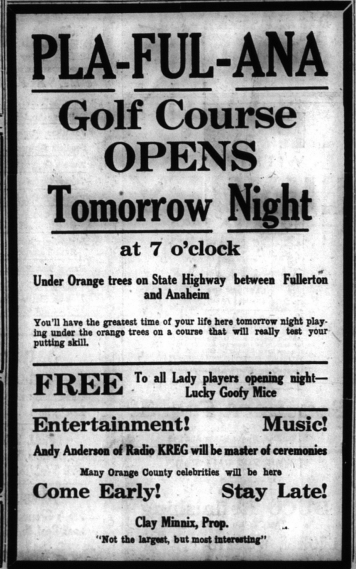
Golfing, both regular and miniature was popular locally, with the following courses:
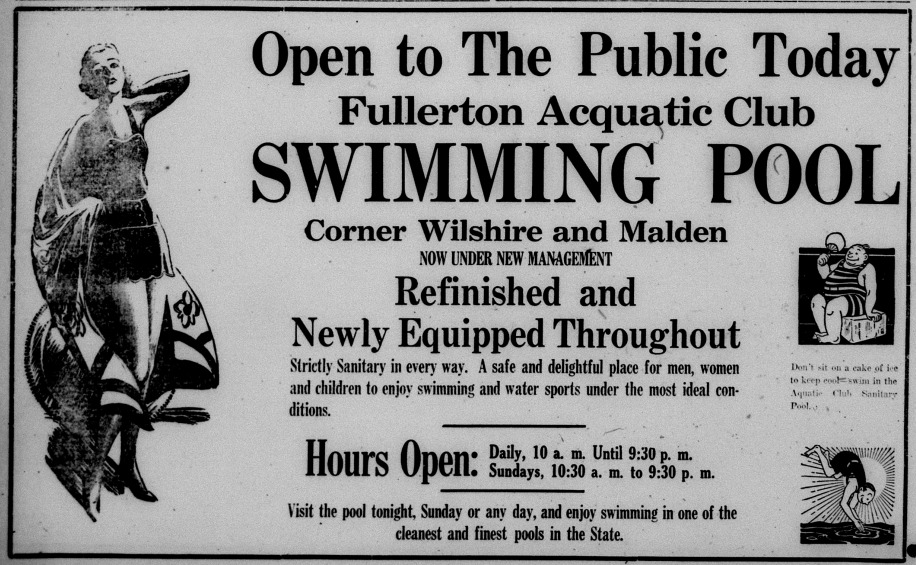
Swimming, both recreational and competitive, was also popular.

And for Thanksgiving, the area was still rural enough to host a turkey shoot.

Agriculture
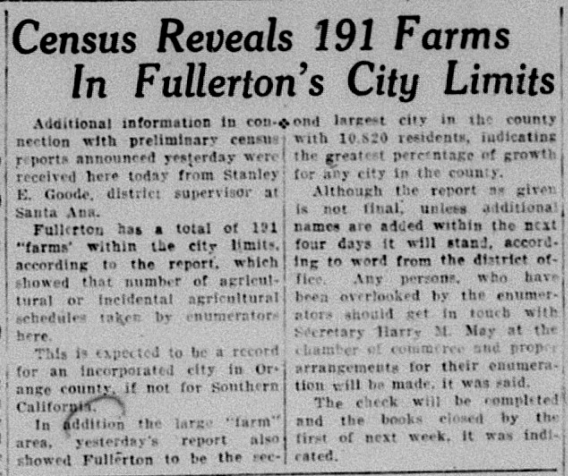
Speaking of rural, Fullerton had a lot of farmland in 1930.
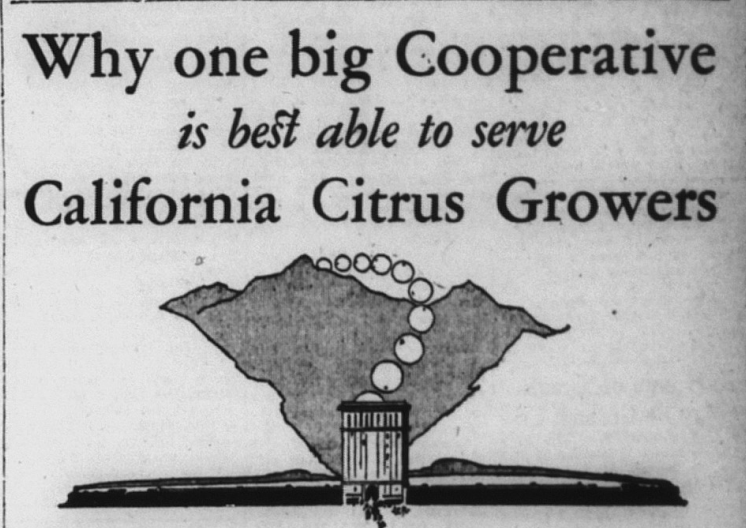
Most of the citrus growers in the area sold and marketed their fruit through Sunkist, a co-operative fruit growers exchange.
Water
In a semi-arid climate like Fullerton, ensuring a regular supply of water for crops, businesses, and residents, was important. Fullerton joined the Metropolitan Water District, which brought water from the Colorado River here.
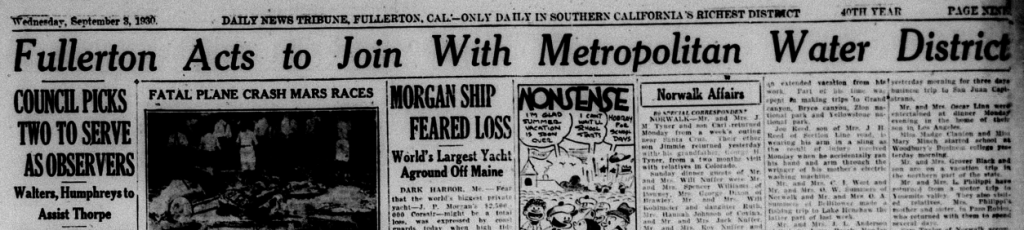

In 1929, residents voted down a bond issue to build dams along the Santa Ana River to recharge the local aquifer and to prevent flooding. However, the issue wasn’t going away.

Oil!
In addition to citrus, oil remained a major industry in the area. The hills of north Fullerton, extending to Brea were once covered with oil derricks pumping away.
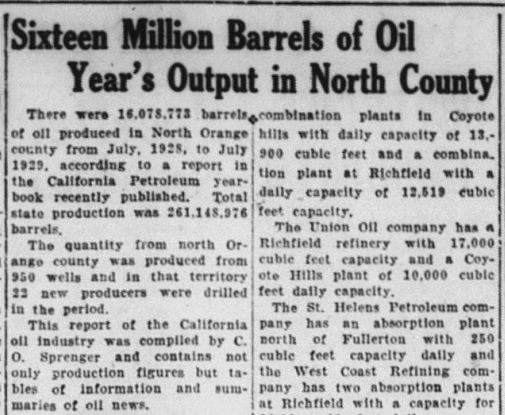
Leaded Gasoline
From the 1920s to as late as the 1990s, a lead compound called tetraethyllead (TEC) was added to gasoline to improve performance. Unfortunately, the exhaust from all this lead would poison the environment for decades.

Bad Advertising
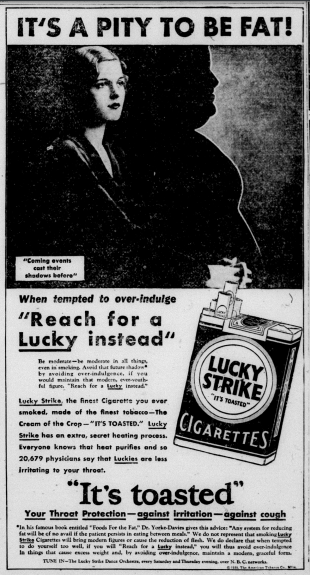
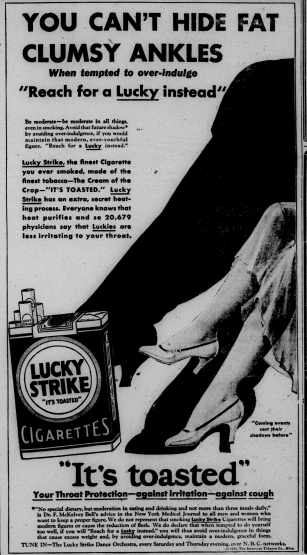
Speaking of poison, each issue of the News-Tribune contained large advertisements for cigarettes. Some of these ads were targeted at women, suggesting that smoking was a good way to avoid becoming fat.
Deaths
Reverend Reuben Francis Holcomb, who moved to Fullerton one year after it was founded (1888) and established the first Methodist church in town, died.

Here’s a bit from his obituary:
Coming to Fullerton in 1888, an ordained minister of the Methodist Episcopa church, Rev. Holcomb preached in Fullerton, Anaheim and Garden Grove. He was the organizer of the first Methodist church in Fullerton.
In addition to his active church and religious work, Rev. Holcomb has been connected with the development of the citrus industry and has been active in financial affairs of the city as a director of the First National Bank and the Fullerton Savings Bank of Fullerton for many years. When these two banks were merged into what is now the Security-First National Bank of Los Angeles, he served on the advisory board of directors until about two years ago.
Rev. Holcomb was born in 1841 in Windham, Ohio. He was the son of Chester Rueben Holcomb and Adeline Spencer Holcomb, natives of Connecticut. One sister, Mrs. Addie B. Jarvis of Burlington, Iowa, survives.
Moving with his parents to Muscatine, Iowa in 1844, he lived there until 1879 when he entered the ministry of the Methodist Episcopal church. He was a member of the Iowa conference of the M.E. church until 1888 when he moved to Fullerton, where he made his home from that time.
In 1866, Rev. Holcomb married Annie Love Johnson at Bellevue, Michigan. Three children were born, all of whom survive. They are C.E. Holcomb of Fullerton, Mrs. Mary Case of Orange and Mrs. Annie Gardiner of Roscoe, California. His first wife died in 1876.
In 1877 he was married to Mrs. Elizabeth A, Shepard at Muscatine, Iowa, who died in Fullerton in 1926.
Rev. Holcomb made his home on a ranch on W. Commonwealth Ave, until about 16 years ago whe he moved to 202 E. Commonwealth ave, where he has lived since.
Holcomb is buried at Loma Vista cemetery.
Pioneer rancher John Hetebrink also died.

Stay tuned for headlines from 1931!
-
Fullerton in 1929
The following is from a work-in-progress about the history of Fullerton. You can support my ongoing research and writing on Patreon.
The Local History Room of the Fullerton Public Library has microfilm from the Fullerton Daily News-Tribune newspaper stretching back to 1893. I am in the process of reading over the microfilm, year by year, to get a sense of what was happening in the town over the years, and creating a mini archive. Below are some news stories from 1929.
In 1929, the News-Tribune got a new editor/publisher named Walter Kee Maxwell, who took over from the paper’s founder and long time editor Edgar Johnson.
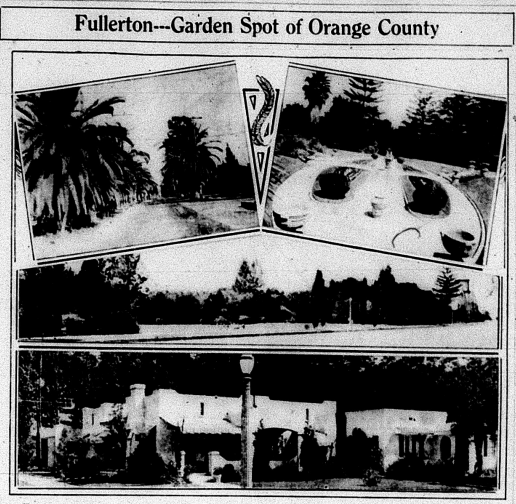
Fullerton’s population was estimated at 12,804. The Tribune called the City the “Garden Spot of Orange County”

National News
In national news, Herbert Hoover was inaugurated as President, and the infamous stock market crash occurred, sparking the Great Depression.

Water
Locally, there was a big political fight over a ballot measure to issue bonds for construction of a series of dams on the Santa Ana river, as a flood control measure.
For weeks leading up to the election, well-funded groups ran advertisements making their cases for and against the bonds.

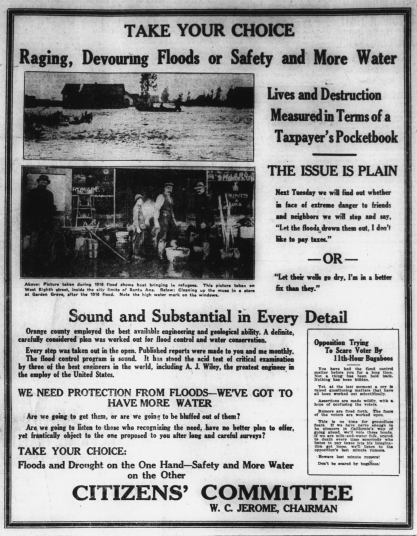
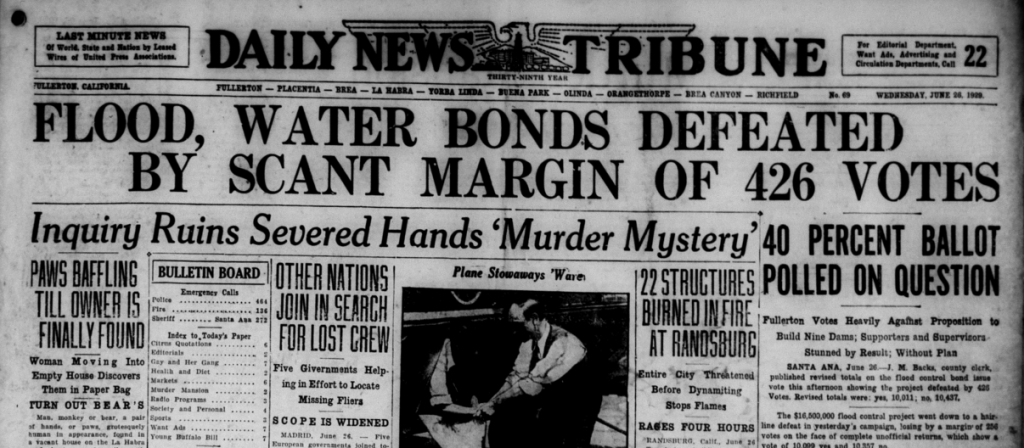
Ultimately, the bonds were narrowly defeated. Major flood control measures would have to wait until another major flood made them seem more urgent.
Transportation
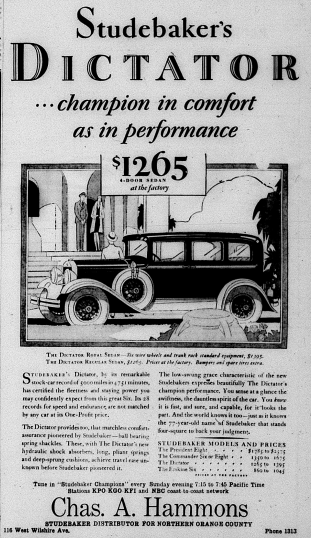
Downtown Fullerton boasted a number of automobile dealerships:

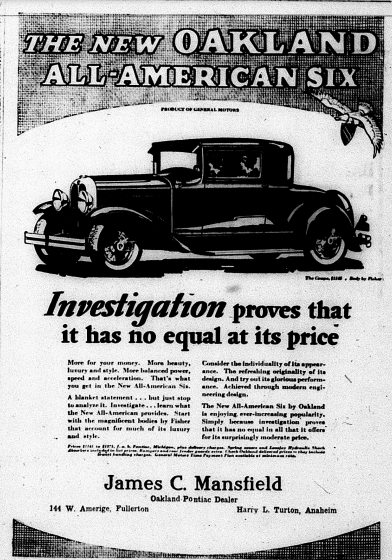
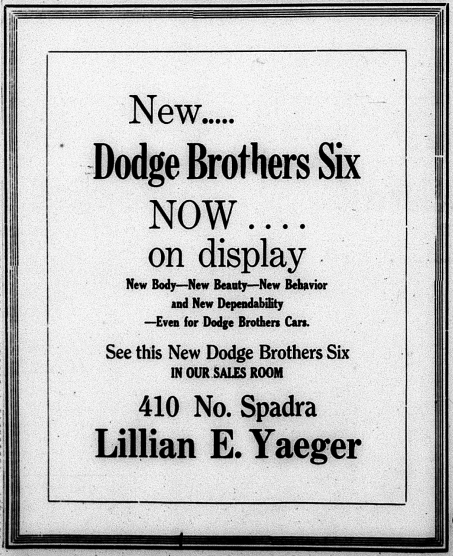
The Firestone building was built next to the Fox Theater for Roy J. Lyon’s tire and car service.

In those freewheeling days before there were many car safety laws, auto accidents tended to be more frequent and fatal.

The Fullerton Airport hosted a grand aviation celebration.
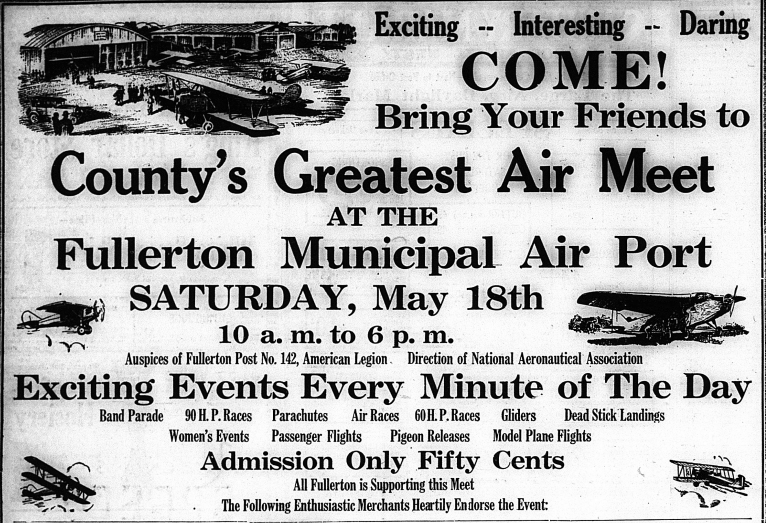
An airplane manufacturer set up shop here.

Culture and Entertainment
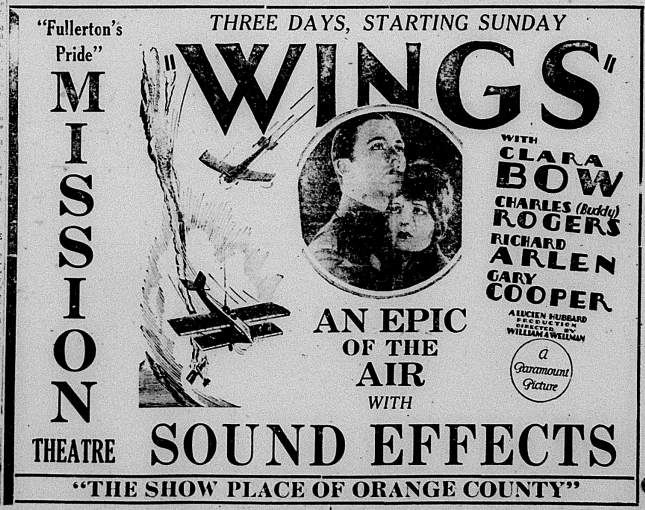
The Fox Theater (also called the Mission Theater) continued to host star-studded movie premieres. This was the early era of “talkies.”

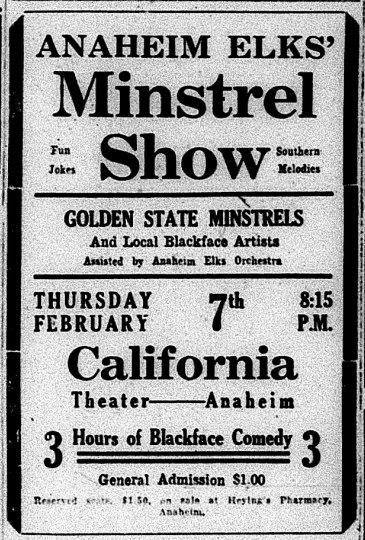
Unfortunately, in 1929, a popular form of entertainment was the “minstrel show” which featured white actors in blackface, reinforcing harmful stereotypes of African Americans. Below are advertisements for a film at the Fox Theater featuring the Two Black Crows, popular blackface performers, as well as a big Minstrel show sponsored by the Anaheim Elks Club.

Sports
In sports news, local baseball star Willard Hershberger was drafted into major leagues by the Washington Senators.

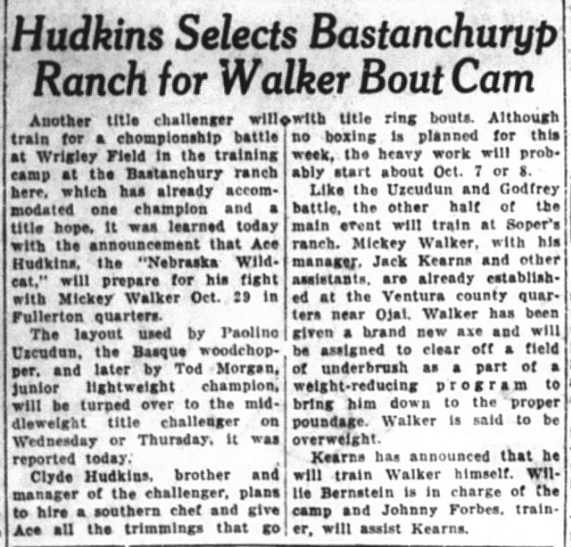
Professional boxers like Paulino Uzcudun and Ace Hudkins trained on the Bastanchury Ranch.
New Construction
New construction continued, with new housing tracts, business buildings, and churches being planned and constructed.

The Fullerton High School Auditorium would be built in 1930. 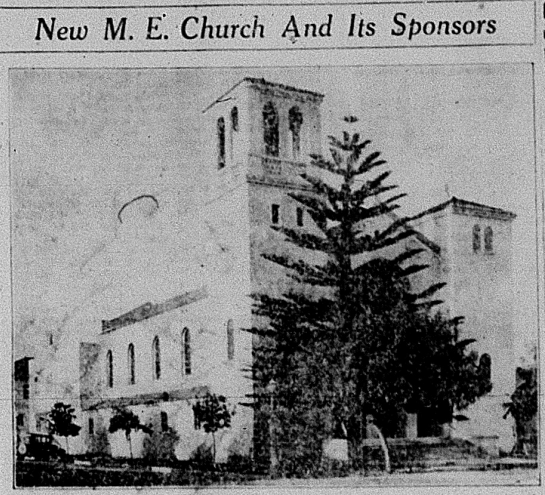

The new Santa Fe train station would be built in 1930. 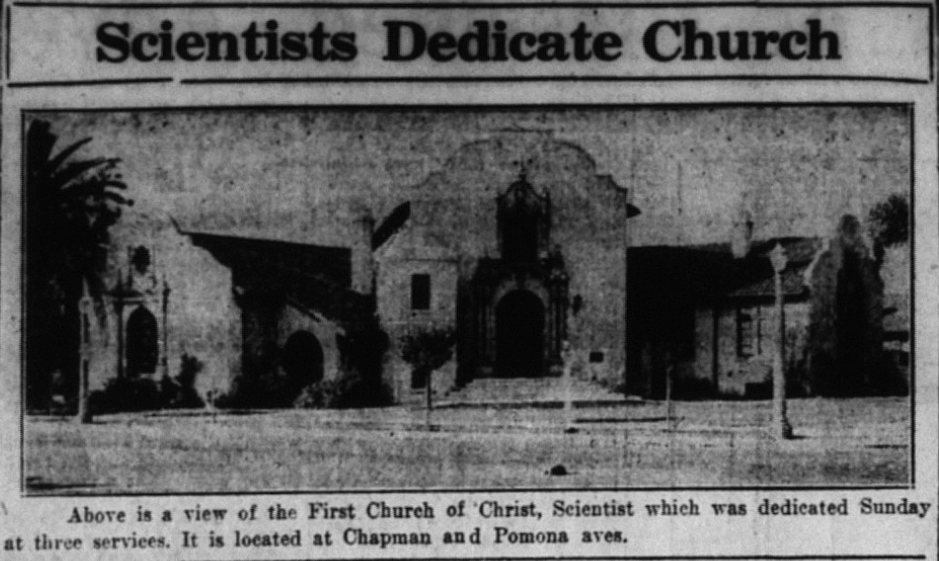

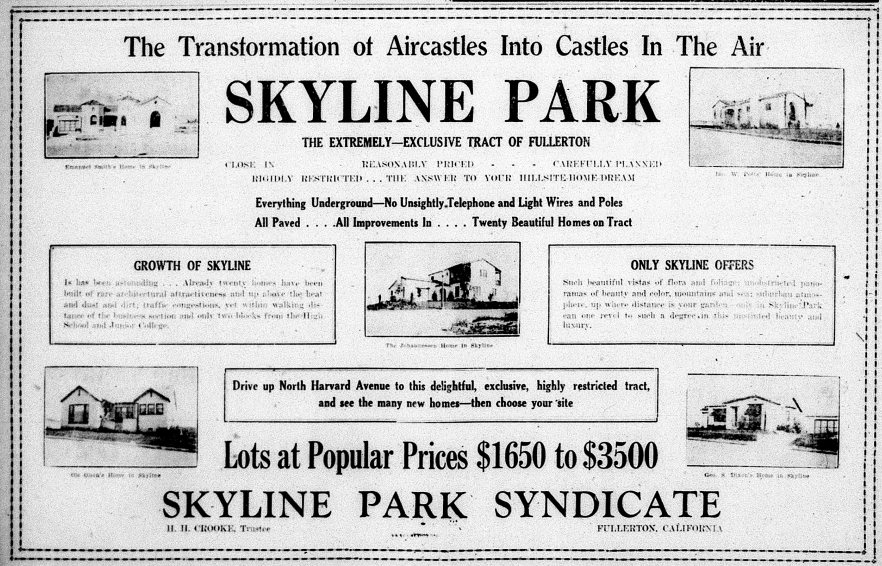
The city annexed 40 acres of land called Lansdowne on the west side of town.

The iconic Dewella apartments were built.

Fire
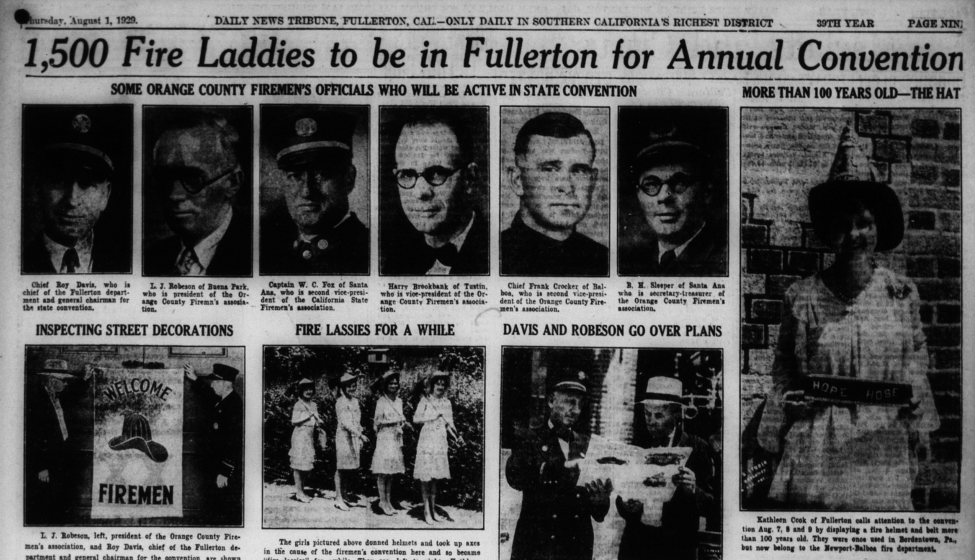
Fullerton hosted an annual convention of fire fighters.
And a massive wildfire blazed across the hills of Olinda (now Brea).

Immigration
The majority of new immigrants to Fullerton were Mexican farm workers, who lived in segregated work camps or “colonias” and had a kind of second-class citizenship. Some of the reasons why Mexicans were the dominant labor force were laws that excluded Asians (like the Chinese Exclusion Act and the Johnson-Reed Act of 1924), and political violence and instability in Mexico, with the Mexican Revolution–causing Mexicans to flee north to relative safety.
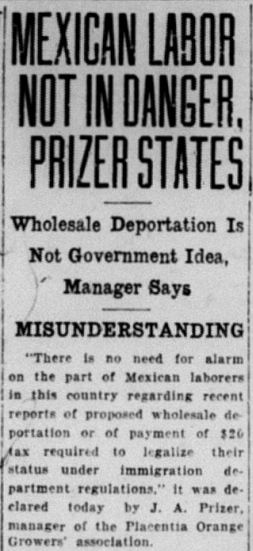
As part of a recurring pattern in American history, there were clamors to restrict and deport Mexican immigrants. The article below, from 1929, says that rumors of mass deportations were unfounded. This would change in the early 1930s, as the Great Depression worsened and already vulnerable immigrants became convenient scapegoats, sparking one of the largest mass deportations in American history.
Deaths
George Fullerton, whom the City of Fullerton was named after, died.

Other notable deaths included John F. Hiltscher and Jacob Yeager.
Miscellaneous
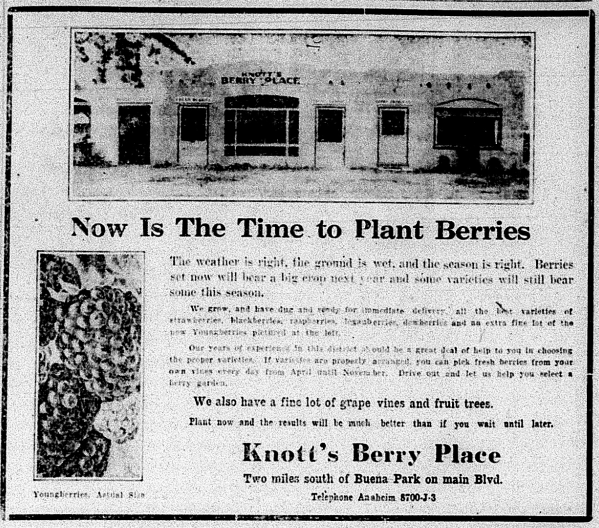
Below are a few clippings on miscellaneous topics of interest.


Stay tuned for top stories from 1930!
-
Fullerton in 1928
The following is from a work-in-progress about the history of Fullerton. You can support my ongoing research and writing on Patreon.
The Local History Room of the Fullerton Public Library has microfilm from the Fullerton Tribune newspaper stretching back to 1893. I am in the process of reading over the microfilm, year by year, to get a sense of what was happening in the town over the years, and creating a mini archive. Below are some news stories from 1928.
When Republicans Dominated Orange County
Republican Herbert Hoover was elected president, defeating Democrat candidate Al Smith.

Back in 1928, Orange County was largely Republican. In Orange County, Hoover got 30,100 votes, while Smith got only 7,597. Hoover received 2,966 votes in Fullerton while Smith only got 542.
In the City Council election, voters chose William Hale, R.S. Elder, and O.H. Kreighbaum. Bert Annin, who was not up for election, was chosen as Mayor.
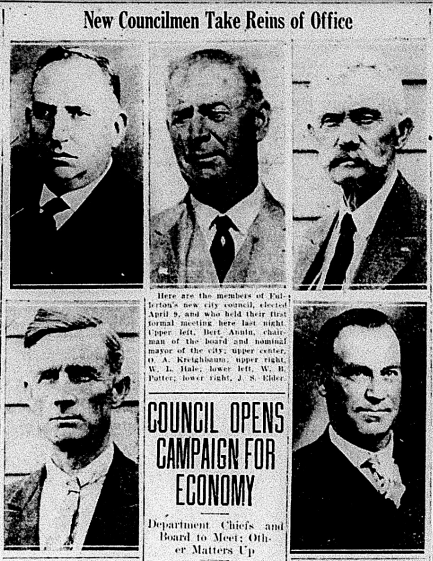
The St. Francis Dam Tragedy
In 1928, one of the greatest disasters in California history occurred, when the St. Francis Dam broke. Although this occurred in Los Angeles county, its devastating impact in terms of loss of life was felt across the region.

Water
Water issues were at the forefront of local leaders’ minds. There was talk of how to prevent the Santa Ana River from flooding again.
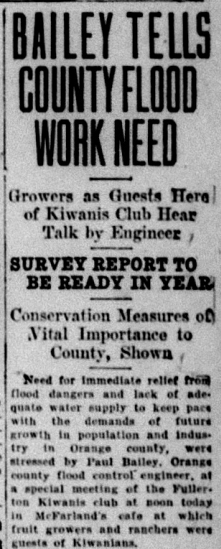
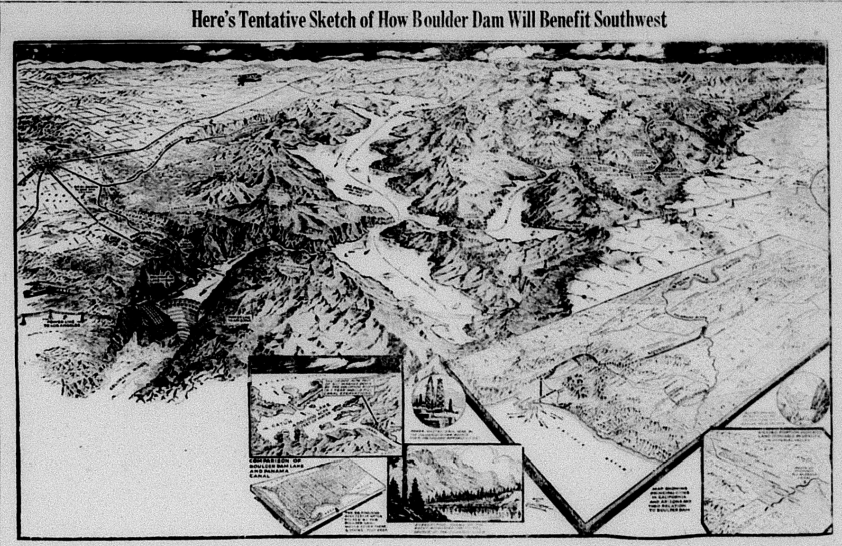
There was also a big political fight about building the Boulder Dam, which was supported by California agricultural and civic boosters. This would ultimately bring lots of water to the southland, including Fullerton.
King Citrus
Back in 1928, Fullerton and surrounding areas was largely agricultural, and citrus was king. The citrus industry operated in a unique way, with growers both co-operating and competing under the California Fruit Growers Exchange, also known as Sunkist.

Here’s a description of how the system worked:
One fundamental reason for the great success of the California Fruit Grower’s Exchange lies in the fact that its plan of operation effectively combines the constructive features of both competition and co-operation.
Under the Exchange system, all growers compete to produce the highest quality of fruit. The highest returns in any Exchange association go to growers who produce the most fruit per acre, or who have the largest percentage of their crops sorted into the higher-priced top grades.
Likewise each local association competes with the other 201 associations within the exchange. But the rivalry is in operating efficiency. The association that packs and handles its fruit better, builds a following for its labels and wins premiums for its gains.
Every Exchange grower and association has the maximum incentive for efficiency in management, economy in operation, and skill in method. Through this constructive competition the rewards of success automatically go to the winners in the form of higher returns.
But when the lid is nailed on a box of Exchange fruit, competition ceases and co-operation begins. The problem is then to systematically distribute all the California crop to all the markets. The real competition is not among Exchange growers and associations. It is between California lemons and Italian lemons, California oranges or grapefruit and Florida oranges or grapefruit, citrus fruits against other fruits, fruits against other foods.

In this common task Exchange growers and associations stand shoulder to shoulder.
Orderly distribution is possible only when the marketing is directed by a central organization that has all the facts about supply and demand everywhere. Marketing through unrelated agencies, each acting independently, inevitably leads to the over or under-supply of some or all markets. Sales competition within the industry can only result in lowering prices.
The achievement of the Exchange in successfully marketing the fruit of its 11,000 growers lies in the fact that it handles 75 percent of the yield.
As the percent of the crop marketed efficiency of the organization has steadily improved.
The most beneficial single thing that could happen to the California citrus industry would be to have every carload of California oranges, lemons and grapefruit marked through the California Fruit Growers Exchange.

Then there would be as much competition for quality among California growers and associations as though the Exchange did not exist.
But there would be 100 percent cooperation in perfecting the systematic distribution of the entire crop to the markets of the world…and increased returns for every grower.

What the exchange is…
The California Fruit Growers Exchange is a non-profit organization of 11,000 California citrus fruit growers, producing about 75% of the California citrus crop, operated by and for them on a cooperative basis. Its object is to develop the national and international market for California oranges, lemons, and grapefruit by continuous advertising, and to provide a marketing organization that will sell the fruit of its members most advantageously, and at least expense. Receipts from sales, less only actual costs of operation, are returned to the growers. Applications are received through all of the Exchange’s 201 local packing associations.
Another major aspect of the citrus industry was labor. Most of the picking of the fruit was done by migrant Mexican labor.
As they are today, these migrants were sometimes the target of politicians.

“Restriction of Mexican and other Central and South American immigration into the United States on a quota basis was urged by Rep. John C. Box, Democrat, Texas, author of a bill for this purpose, before the house immigration committee today,” the Tribune reported. “The country was being flooded with an oversupply of cheap labor which not only was driving out native white and colored labor in the west and southwest but also was spreading northward, Box said.”
“If I had but one reason for urging this bill it would be to protect the American farmer from a system of peasantry,” Box declared.
“Henry Deward read a statement from the immigration restriction league, Boston, urging passage of the measure and also warning that Mexican labor is spreading to other parts of the country,” the Tribune reported. “Chairman Albert Johnson of the committee said he had ‘hundreds of letters from prominent people not only in the west but all over the country,’ endorsed the proposed restriction.”
But not everyone wanted Mexican exclusion. Large growers from the southwest still relied largely on Mexican migrant labor, and some American diplomats felt such restrictions would negatively impact international relations.

Growth
Fullerton continued to experience a building and population boom throughout the 1920s. In 1928, it was the largest city in North Orange County, with an estimated population of 12,000.
New housing subdivisions continued to be built. Unfortunately, most of these had racially restrictive housing covenants, which prevented non-white people from purchasing or renting property there.


3000 students graduated from Fullerton Union High School.

Additionally, plans were in the works for a new high school auditorium.
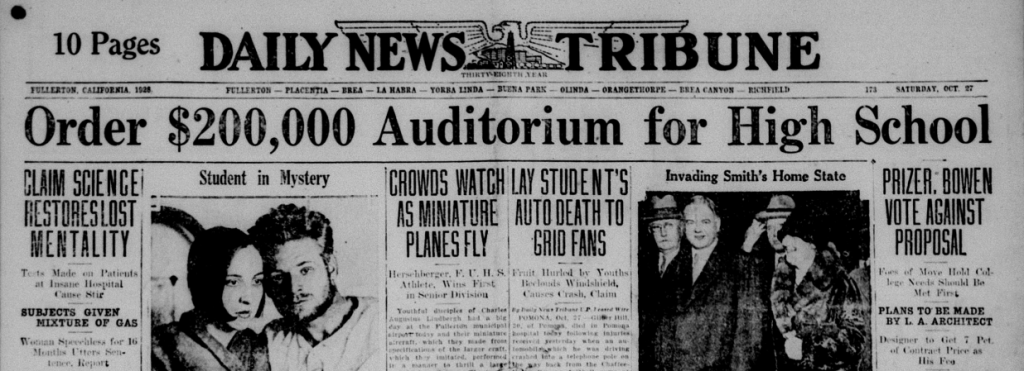

The Methodist church also broke ground on a new building.
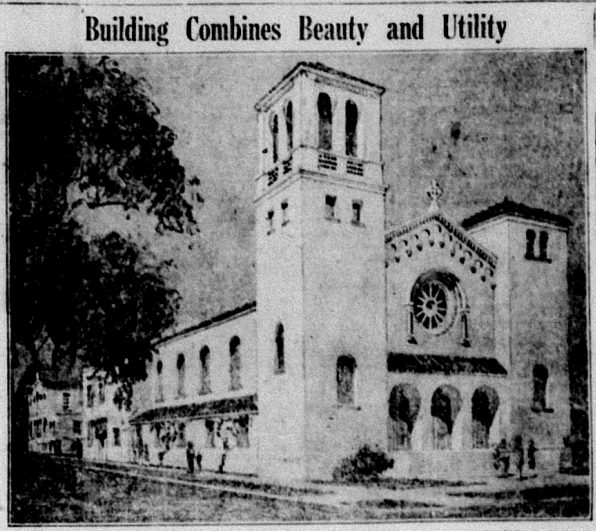
Crime
Among the various crimes reported in the Tribune, one stood out to me, because it happened right around where I live, which is in former railroad worker housing near the corner of Santa Fe and Highland. A man was murdered in one of the housing units. Was it mine? The Tribune doesn’t say. But perhaps this qualifies my residence for a stop on the Fullerton Ghost Tour.
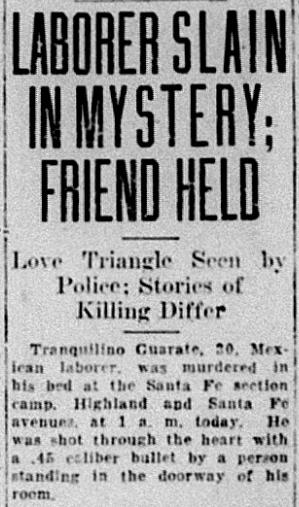
In 1928, Prohibition on liquor was in full effect, so there are many stories about people being arrested for booze.

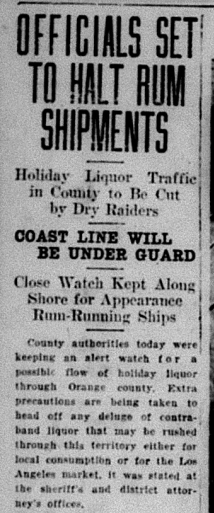
Hollywood Stars Come to Fullerton
A major center for culture and entertainment was the Mission Court (later called the Fox) Theater. This local movie palace hosted several “Preview” screenings of major Hollywood films, where the stars would be in attendance, such as Harold Lloyd, Dolores Del Rio, and more. It must have been exciting to attend these star-studded events.
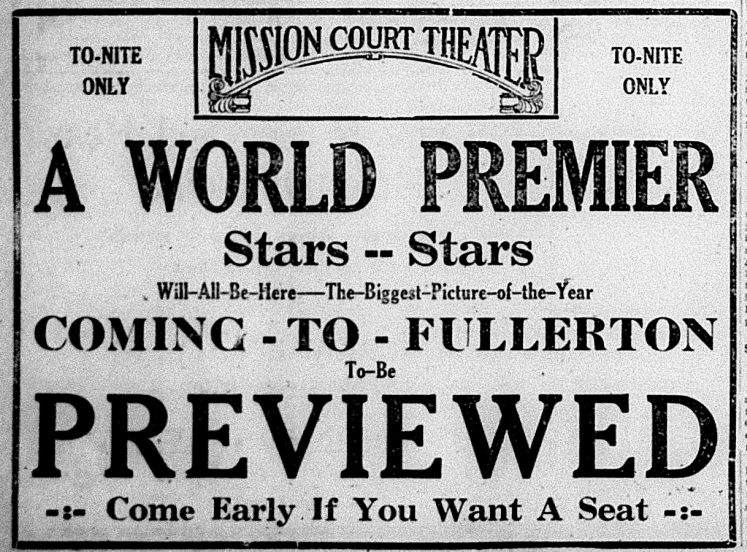


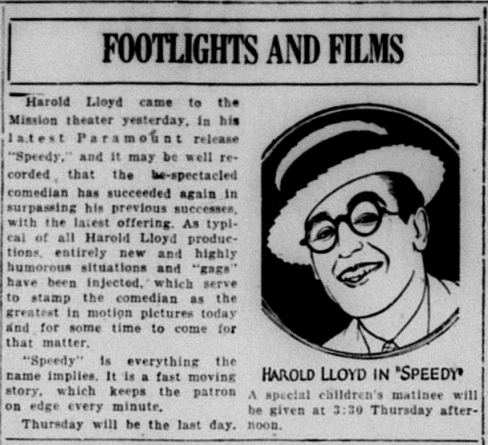
In the 1920s, Fullerton was home not only to a lovely movie palace, but also to a major movie director, Lois Weber–a pioneer female director.
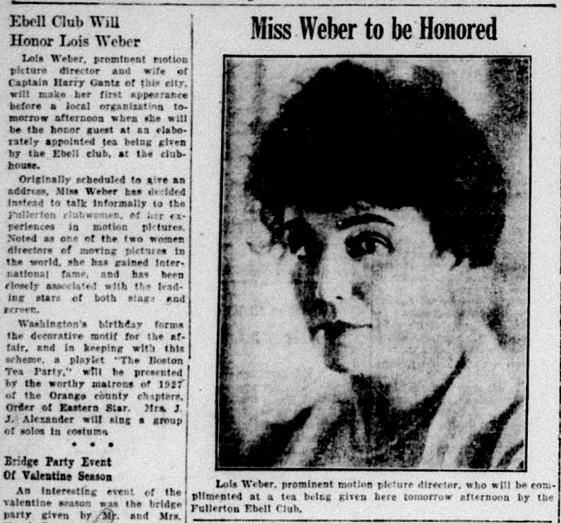
Here are ads for other cultural events in Fullerton in 1928:
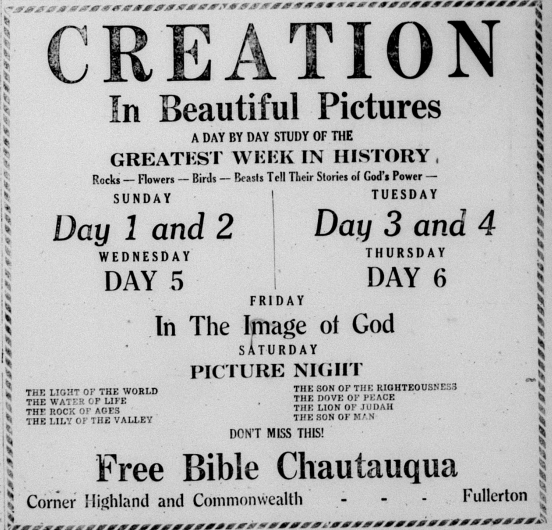

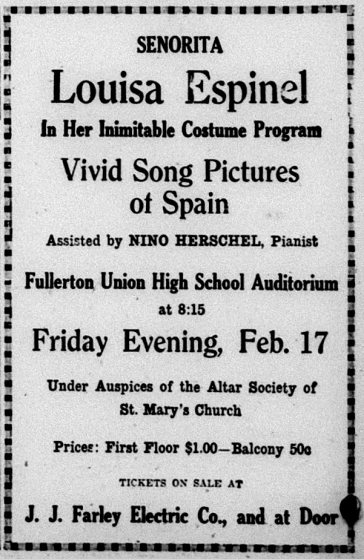
Sports
Gaston Bastanchury, owner of the sprawling Bastanchury Ranch in the hills of north Fullerton, wanted to build an enormous venue to host a boxing match between world champion Jack Dempsey and Basque boxer Paulino Uzcudun. Unfortunately, this never came to fruition.


Fullerton Union High School’s mascot was, and remains, the Indian, which (in my view) is a problematic example of cultural appropriation. Nicknames for the team in 1928 included the “Red Men,” and the school would host “Pow Wows” featuring non-native people dressing up as Indians. These “Pow Wows” were still happening as late as the 1990s, when I attended high school there.

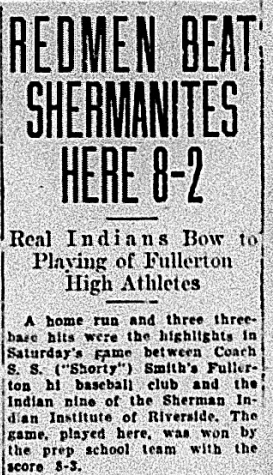
Planes, Trains, and Automobiles
In 1928, the Fullerton Airport was brand new.
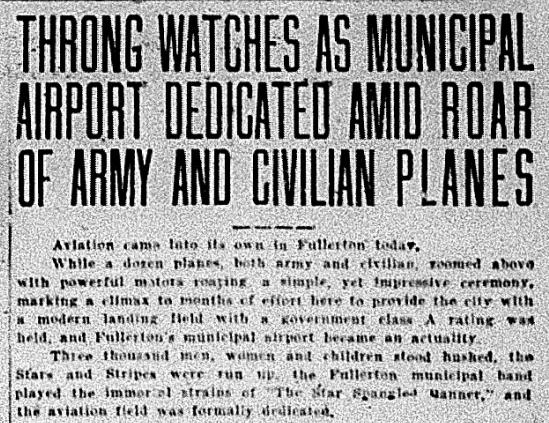
The sprawling Pacific Electric passenger rail service was the largest interurban rail network in the world.
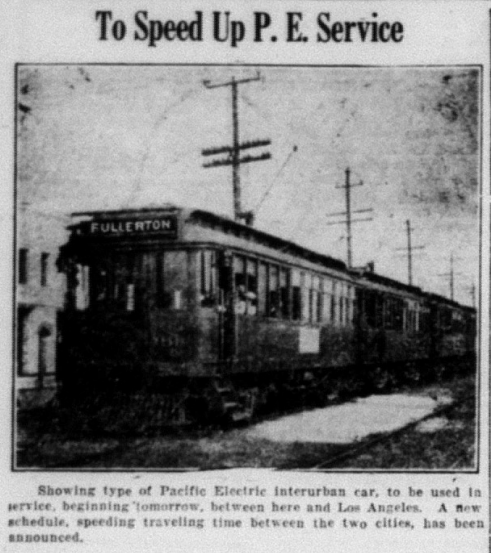
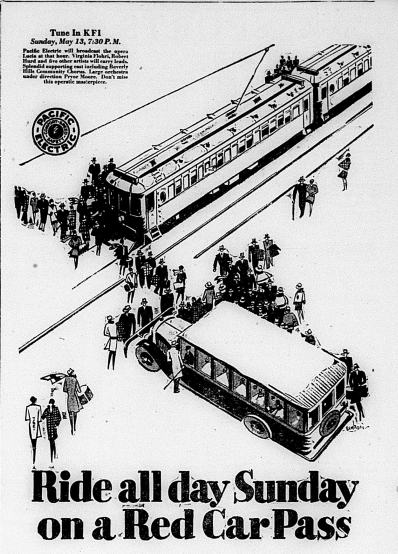
Cars were also quite popular, and more roads were being paved.
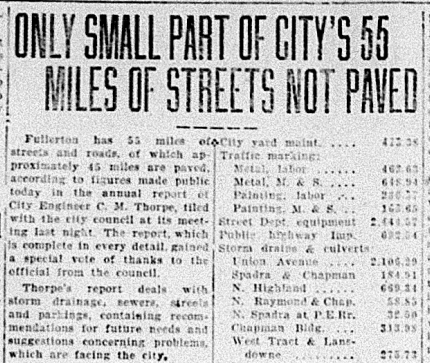
Oil!
In addition to citrus, another major export of Fullerton was oil. According to the chart below, Fullerton oil fields had 491 wells producing nearly 900,000 barrels.

Stay tuned for top stories from 1929!
-
Fullerton in 1927
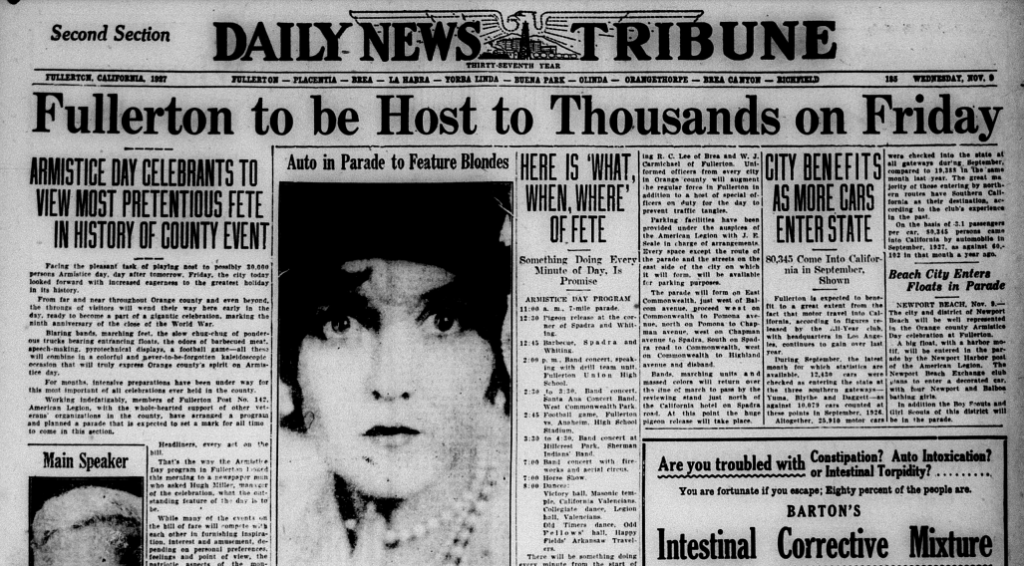
The following is from a work-in-progress about the history of Fullerton. You can support my ongoing research and writing on Patreon.
The Local History Room of the Fullerton Public Library has microfilm from the Fullerton Tribune newspaper stretching back to 1893. I am in the process of reading over the microfilm, year by year, to get a sense of what was happening in the town over the years, and creating a mini archive. Below are some news stories from 1927.
In international news, civil wars rocked the countries of Mexico, Nicaragua, and China, which the United States involved itself in to protect its economic interests, including a total occupation of Nicaragua. Benito Mussolini and his fascists were in power in Italy. Germany was admitted into the League of Nations.
In national news, aviator Charles Lindberg became an American hero by making the first nonstop flight from New York to Paris. He was greeted by adoring throngs after his return home. Protests erupted in New York against the execution of Italian anarchists Nicola Sacco and Bartolomeo Vanzetti for murders they may not have committed.
Growth
Throughout the 1920s, Fullerton experienced a building and population boom. According to the Tribune, Fullerton’s population was around 11,250.

The Odd Fellows Temple was constructed, which remains an impressive building downtown.

Amid great fanfare, the Chapman Building (the tallest building in town) received a new tenant, Ministers Department Store.
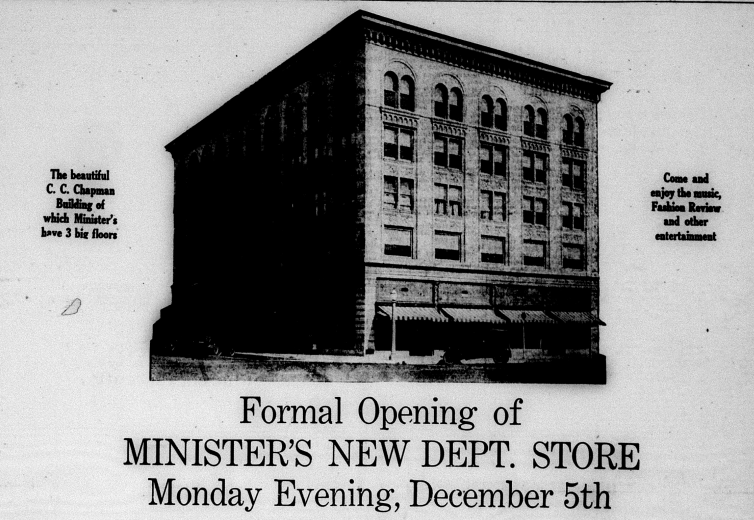
Housing
New subdivisions were being built, mostly radiating outward from downtown. Unfortunately, many of these had racially restrictive housing covenants that prevented non-white people from purchasing or renting property in these neighborhoods.

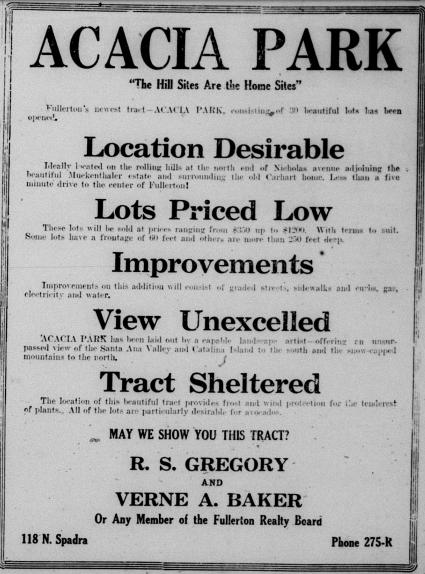
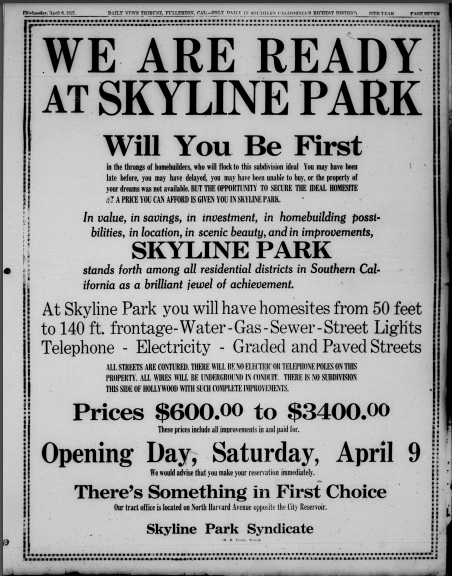
The Chamber of Commerce sponsored construction of a “model house” that would serve as inspiration for new home builders.
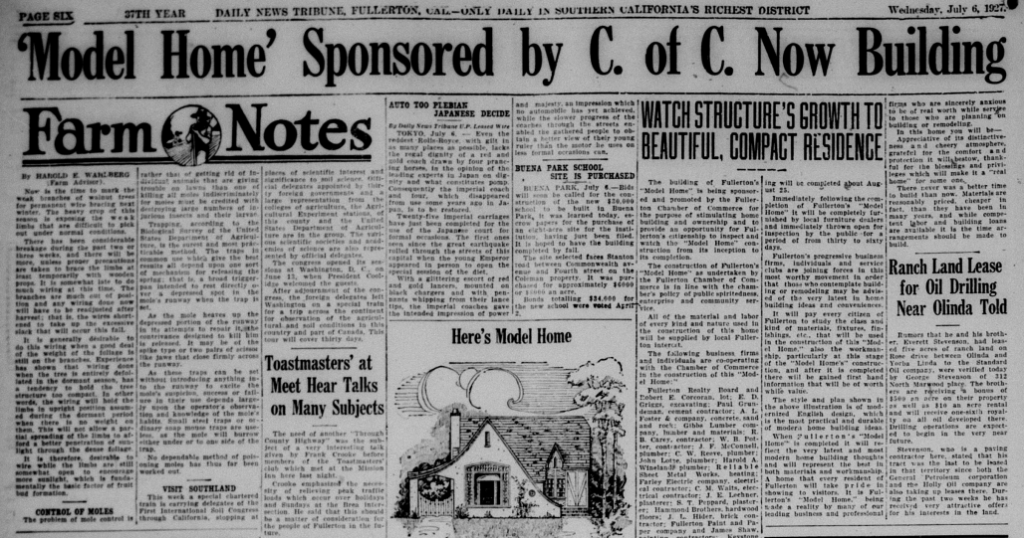
Segregation
In addition to the racially restrictive housing covenants, another form of institutional racism involved the segregation of the town’s Mexican migrant farm workers and their families–many of whom lived in housing and went to schools that were segregated from the larger community.

Agriculture
Although new buildings and housing subdivisions were going up downtown, Fullerton in the 1920s was still a largely “rural” city, with vast acres of citrus and other crops.
Fullerton was in what was called the “citrus belt” of California. Large regional orange shows celebrated the area’s most profitable crop:
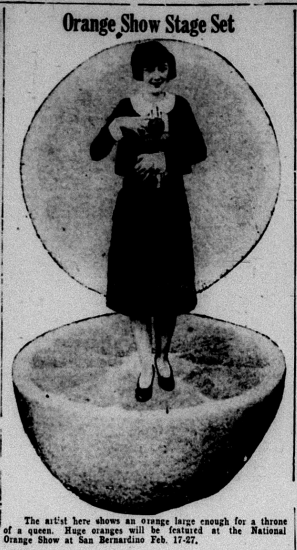
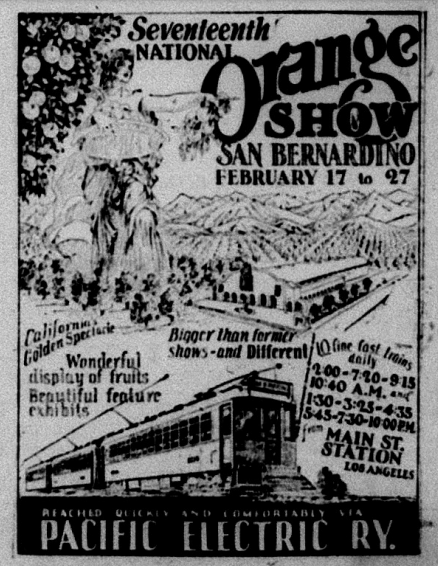

At one orange show, citrus workers competed in a “World’s Championship Packing Contest” and a girl from Fullerton won!
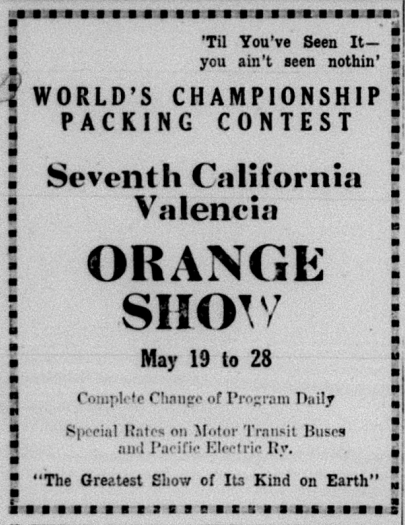

The Orange County Fair, which still happens annually, is a testament to Orange County’s agricultural past, even though those days are long gone, having given way to urbanization and development.
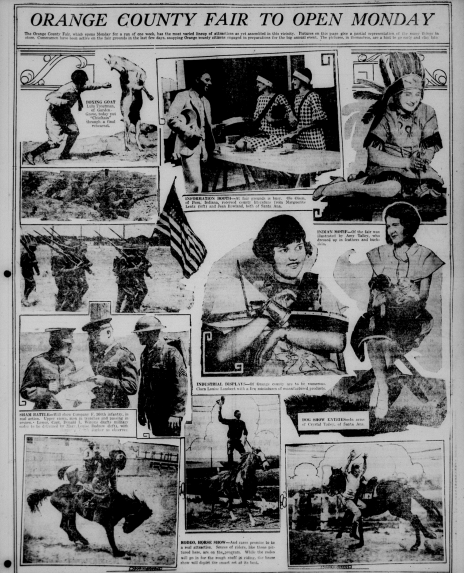
Oil!
In addition to agriculture, the other big industry in Fullerton in 1927 was oil, a commodity that was central to industrial America, and Fullerton’s oil fields were contributing more than their fair share.
Unfortunately, industrialization came with a cost in the form of pollution and (as folks would later understand), climate change.

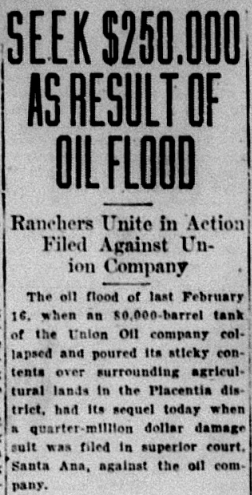
Culture and Entertainment
As a testament to its status as a growing city, Fullerton hosted a massive regional Armistice Day parade that drew thousands.

The Mission Court Theater (later called the Fox Theater) had been built in 1925, and became a big draw for movie goers and fans of live vaudeville shows.


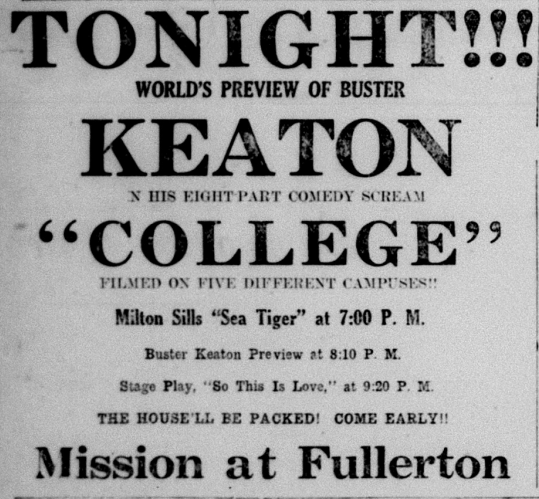
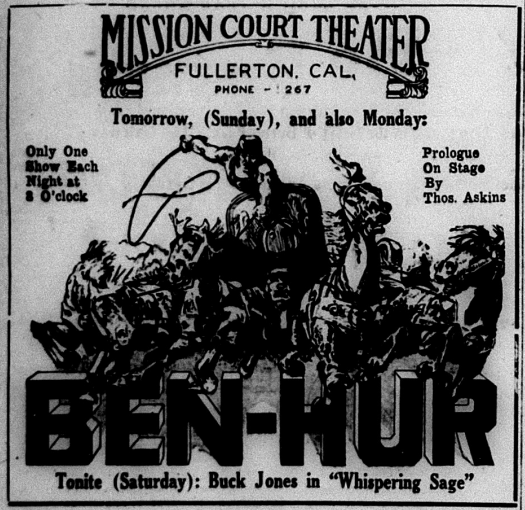
Not only was Fullerton home to a first class movie palace, it was also home to a significant movie director named Lois Weber.

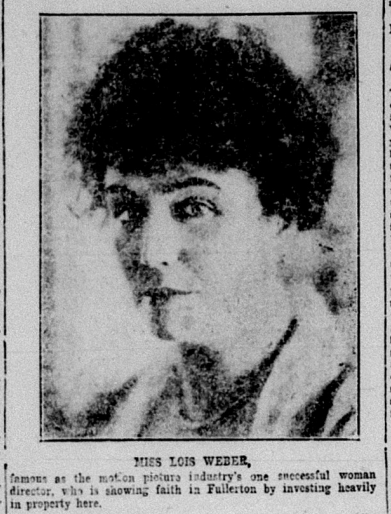
Occasionally Weber and her husband Harry Gantz would host parties at their El Dorado ranch in Fullerton, and invite top Hollywood figures.
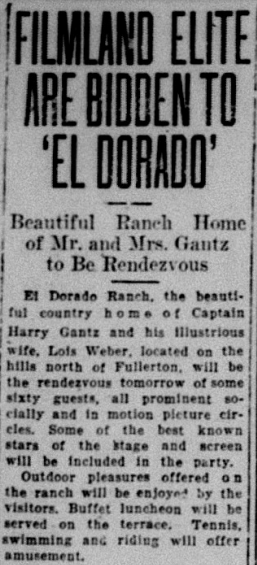
Crime
An article published in early 1927 gives some crime stats from the previous year. The majority of the arrests were for booze [this was during Prohibition] or “vagrancy” (homelessness?).
The report lists three suicides, three auto fatalities, 22 arrested for disturbing the peace, four for battery, four for disorderly conduct, 21 for drunkenness, one for operating a still, 21 for possession of intoxicating liquor. 198 car accidents, 47 arrested for vagrancy.
Sometimes the perpetrators of crimes would be given names by the media, such as the Praying Sisters (bank fraudsters who sought a more lenient sentence by showing their piety), the Chloroform Burglar (who knocked people out with chloroform before burglarizing their houses), and The Fox (a murderer who killed a girl in Los Angeles and went on the run, sparking a massive manhunt).
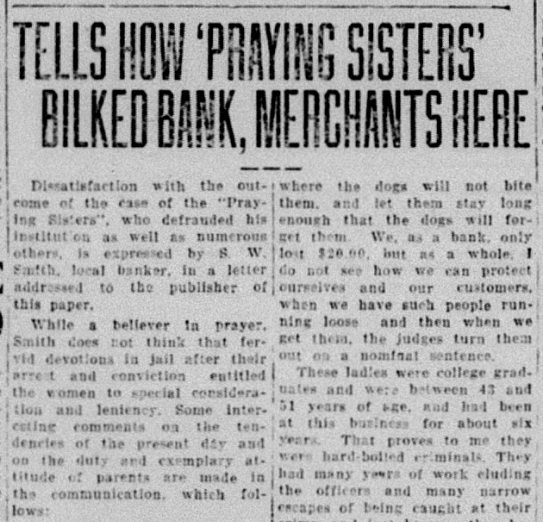

In 1927, a county Grand Jury probe raised ethical and legal questions about top law enforcement officials. Some were accused of being in cahoots with bootleggers. A big rally at what is now Amerige Park in Fullerton called for a recall of OC Sheriff Sam Jernigan for his alleged improprieties.
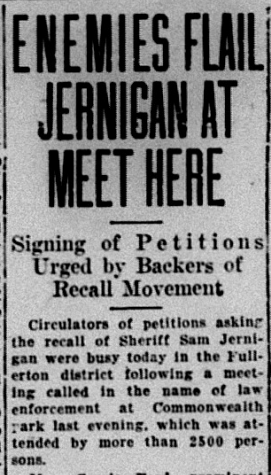
The meeting was presided over by Carrie Ford, a prominent leader in the Women’s Christian Temperance Union (WCTU).
Because, at this time, the Ku Klux Klan was a big supporter of Prohibition, some felt that the effort to oust Jernigan was a KKK plot. This rumor was dispelled by “attendees [who] said it was not a KKK plot.”
According to the Tribune, one attendee “challenged any members of the Ku Klux Klan to stand up and show themselves. About 20 men arose in response. The speaker then pointed out that more that 90 percent of the persons are the meeting were not of the Klan.”
This is fascinating to me because it shows that the KKK was still a conspicuous presence in local affairs, even after its popularity began to wane after 1925.
Natural Disasters
In 1927 a big fire broke out on the back of the Chapman building, drawing hundreds of spectators. Thankfully, the building survived.
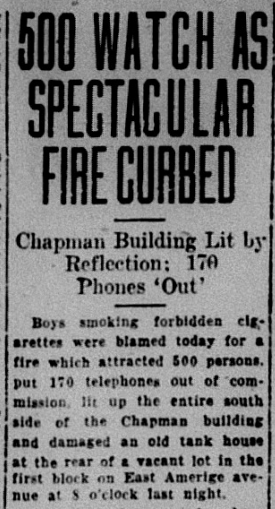
A much more damaging natural disaster occurred when heavy rains caused the Santa Ana River to flood its banks.

The flood disproportionately affected the homes of Mexican Americans who lived on the south side of town.
“The houses of many Mexican families on the south side between Spadra road and Lawrence avenues, were reported to be under water and uninhabitable and arrangements were being made by Mrs. Mae Reeve, city treasurer, for their accommodation. She will welcome offers of help,” the Tribune reported. “As a matter of precaution, the Placentia Growers’ association today moved about forty Mexicans form its camp on Balcom avenue, to the packing houses where they have been made comfortable.”

This prompted local efforts to deal with the flood and its aftermath.

The flooding also caused oil to pour onto farmlands.

At the regional level, plans were discussed to curb future floods by damming and channelizing the Santa Ana River.

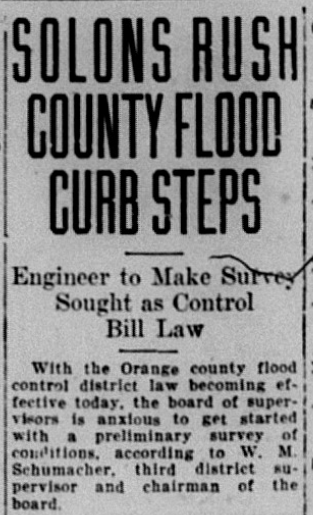
Meanwhile, wealthy residents were encouraged to “Buy a Lot Today, High Above the Flood.”

Water Wars
Those familiar with the movie “Chinatown” may be familiar with the California Water Wars that broke out when LA officials used dishonest means to buy up land in the Owens Valley and then build an aqueduct that drew water from those farmers to the growing metropolis of Los Angeles.
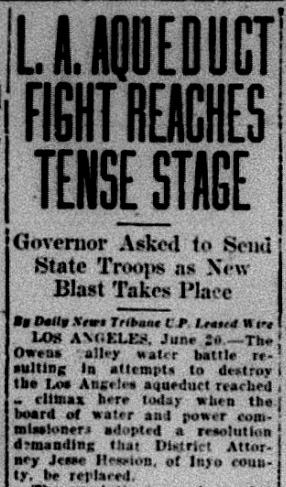
“A state of virtual warfare existed in the hills bordering Owens valley today while officials here debated measures to curb dynamite attacks upon the Los Angeles aqueduct by bands of armed marauders in Inyo county,” the Tribune reported. “Along the 265-mile waterway stretching from the mountain lakes to the city of Los Angeles, through desert wastes and across barren foothills, powerful army flashlights gleamed last night. Meanwhile, the aqueduct guard had been strengthened by the addition of a squad of ex-service men, armed with machine guns and orders to shoot to kill in an effort to prevent another destructive sortie against the city’s main water supply, built at a cost of $44,000,000.”
Meanwhile state growers and politicians were pushing for the creation of Boulder Dam (now called Hoover Dam) which would bring additional waters from the Colorado River.

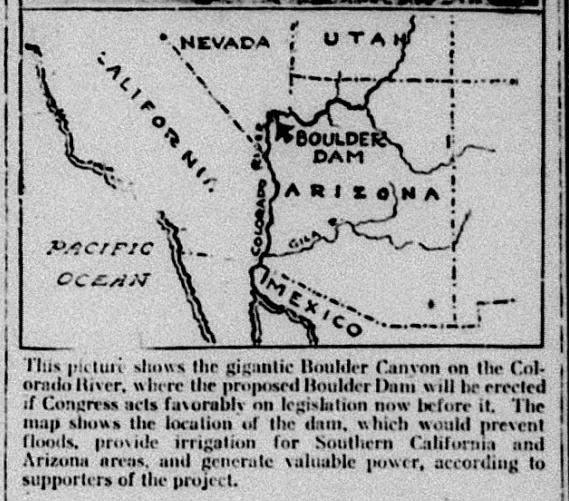
This is of interest to Fullerton because our city was one of the founding members of the Metropolitan Water District (created in 1928), so (to this day) some of our water comes from the Colorado River, although a larger portion comes from local groundwater sources managed by the Orange County Water District, which would be created in 1933.
Sports
Sporting events were popular forms of entertainment and local pride. High School football and baseball games were often well-attended. Fullerton Union High School’s mascot was (and remains) the Indian, although the Tribune often used even more offensive names for the team.

A popular City baseball league played on the field next to Ford School.

Bowling was a popular sport at the bowling alley downtown.
The high school pool (or plunge) was a popular swimming spot during summers.

Transportation
In 1927, automobiles were becoming increasingly popular, and more roads were being built and paved. Some of the funding came from a state gas tax.
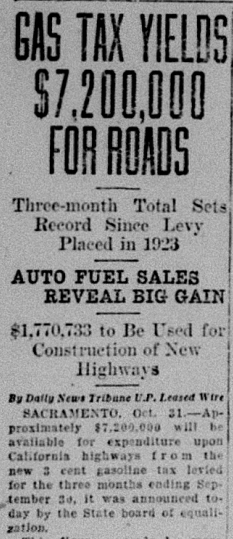
However, rail travel infrastructure was vast. The sprawling Pacific Electric (“Red Cars”) rail network was called the largest interurban rail system in the world.

Airport
Formerly a “sewer farm,” the Fullerton Airport began to take shape in 1927, with locals volunteering to help clear the land.
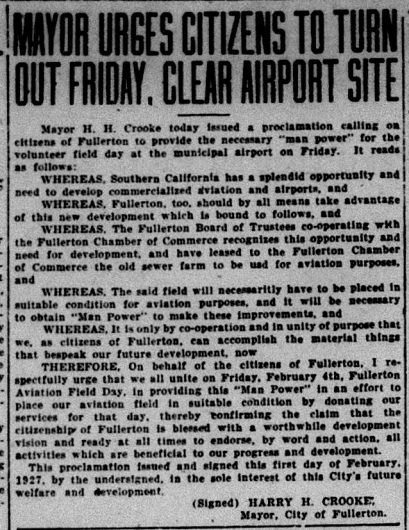

County News
Orange County was growing, with the establishment of Dana Point and San Clemente.
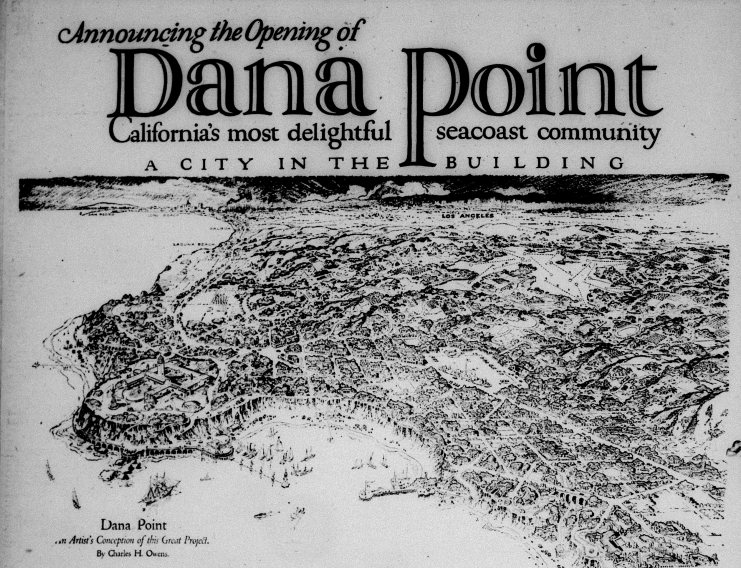

Fashion
The 1920s were an exciting time for fashion. Here are a few clippings of clothing that women could purchase in downtown stores.

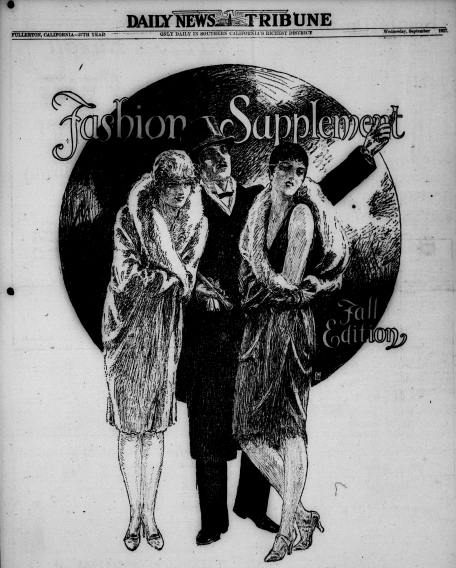
Gender
In the 1920s, real strides were made for womens’ rights, with the passage of the 19th Amendment (granting women the right to vote), and “Jazz Age” fads challenged some traditional gender roles. However, some clippings from the 1927 Tribune suggest the presence of more conservative ideas about what is (and is not) acceptable for women.
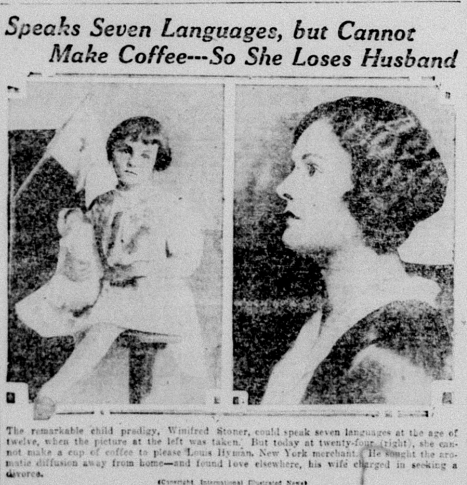

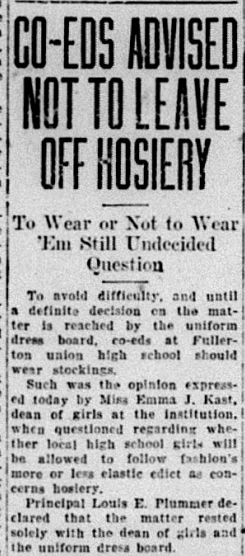
Eugenics
In the first decades of the 20th century, the pseudoscience called eugenics was very popular among thought leaders. This theory held that, because there was a hierarchy of races and people, only those with “good genes” (basically of northern European stock) ought to be encouraged to reproduce. An article called “Birth Control Foe of Beauty is Claim” expressed eugenic ideas:
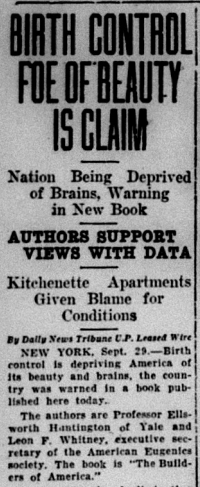
“To balance the large families of so-called inferior groups and the small families among the so-called better classes, the authors recommended that control of birth be legalized to keep down the numbers in the former group,” the article states.
“Such is Life” Cartoons
In 1927, the Tribune ran a cartoon called “Such is Life” which sometimes had a darkly funny tone.

Deaths
Notable 1927 deaths include rail magnate Henry Huntington and early Fullerton developer H. Gaylord Wilshire, among others.
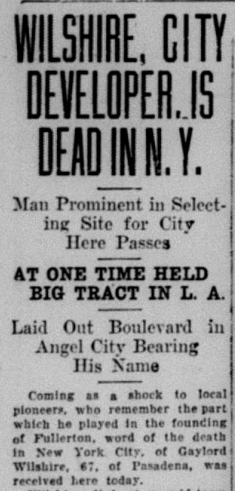


Stay tuned for headlines from 1928!
-
Headlines: 1995
The following is from a work-in-progress about the history of Fullerton. You can support my ongoing research and writing on Patreon.
The Fullerton Observer newspaper was formed in 1978 by Ralph and Natalie Kennedy and friends to provide a more progressive counterbalance to the more conservative Fullerton News-Tribune and Orange County Register. The Fullerton Public Library has digital archives of the Observer stretching back to 1979. I am in the process of reading over each year and creating a mini-archive. Here are some top news stories from 1995.
The Great OC Bankruptcy & Other Budget Woes
In 1994, the county government of Orange County filed for bankruptcy following bad, risky investments. The county lost $1.7 billion, which trickled down to school districts and cities, including Fullerton.
“The loss of principal and expected interest to these County funds has forced a 41% cut to the budget that County money was responsible for,” the Observer reported.
Some “small government” Republicans and Libertarians sought to embrace the opportunity to get the county to drastically cut its staff and services.
Other groups, like the League of Women Voters, urged another solution than massive cuts.
“Surely there must be a better way to balance our budget and make up for the large deficit caused by the investment debacle than to lay off thousands of county employees, city employees, employees of agencies and companies dependent on the County,” one speaker at the above-mentioned rally said.
At risk were things like the Fullerton School District’s Social Services program.
“The Social Services unit in the Fullerton School District is an example of an endangered program whose services are absolutely vital to the schools and families of the district,” an opinion piece in the Observer stated.
Ultimately, the OC Board of Supervisors voted to place a half-cent sales tax increase in the ballot to stem the budgetary bleeding. It was called Measure R. Did it pass? Stay tuned for my notes from 1996!
In Fullerton, fiscal matters were made worse by the fact that a newly elected council (following a recall) had voted to repeal the city’s utility tax. Even before the bankruptcy, the city was facing a $2 million budget shortfall.
The Council voted 3-2 to repeal the utility tax (Councilmembers Flory and Bankhead voting no). The repeal is effective February 28, 1995.
A financial advisory committee was not in favor of repealing the tax.

A committee report noted that “there is no way the city can replace the “windfall” of $2.1 million that would have been realized if the tax had been allowed to continue to its sunset date of October 1, 1995.”
Instead, Fullerton plugged the budgetary hole with redevelopment funds (which no longer exist) and by selling city-owned property for a housing development.
The Observer ran a piece on how recent budget cuts had affected the quality of life of the city.
The city’s work force had been reduced since 1991-92 by about 25% (214.1 positions). Library hours were reduced. The Fullerton Museum Center lost about 29% of its annual allocation.
Streets will be getting patched more often and resurfaced less. Tree trimming, which used to done on demand, was reduced to every 4 years, except where city is notified a safety problem exists.
Street-sweepers eliminated alleys from their schedule. The annual Lively Arts Festival in Hillcrest Park and the annual Founders Day Parade and Street Fair were cancelled.
The number of firefighters on trucks was reduced by one and the Police Department lost 32.5 positions.
The McColl Toxic Waste Dump to be Capped
Regarding Fullerton’s first Superfund site, the McColl Toxic Dump site, 200,000 tons of oil waste under the northern part of what is now the Los Coyotes Golf Course, the oil companies responsible for the environmental degradation lobbied hard for the cheapest solution, capping the site and leaving the waste in place. The EPA had earlier proposed using chemicals to solidify the waste so it would be less likely to seep into the local groundwater aquifer.
“With distribution of a slick and persuasive, 8-page, “Community Action Report”, the McColl Site Group (responsible oil companies) have thrown their anti-SMS (Soft Material Solidification) hat into the ring,” the Observer reported. “The two goals of SMS are: to neutralize the waste, and to solidify it sufficiently to prevent migration.”
Eventually, the EPA chose the oil companies’ preferred solution, capping the waste.

The EPA claimed that “The impact of the in-place solidification remedy (odors and time) were so great as to render this remedy invalid.”
“Furthermore EPA’s budget is being cut by about 35% this next year, and that may also have been a factor,” the Observer reported.
By this point, most residents were in favor of the quickest solution, as the problem had been dragged out for many years.
Here’s a description of the remedy that was ultimately selected, and this is what remains today:
“The new recommended remedy calls for the McColl Site Group (MSG) the oil companies responsible for the original contamination, to design and build a multilayer, impermeable cap that will provide an approximately 7 1/2 foot thick protective cover over McColl. The cap will prevent water from getting into the waste and emissions from escaping into the atmosphere. Underground walls will also be installed to minimize movement of water into the waste or migration of the contaminants outward. Retaining walls will be placed on the slopes to provide stability and strength to the natural contours o f the site. A monitoring system to detect future migration of the waste to adjacent areas will also be installed.”
The Struggle for Affordable Housing
Throughout the 1980s, a conservative majority Fullerton City Council regularly refused to use Redevelopment funds to support the construction of affordable housing, despite state mandates that it do so. Then a few local citizens sued the city and won, forcing the city to approve a number of affordable housing projects in 1994. But the conservative element remained.

Council voted 3-2, with Councilmembers Bankhead and Flory opposed, to reject a staff recommendation to approve funds to rehabilitate about 14 run-down apartments in an area of the city which the last few years had been deteriorating.
There was also a newly proposed state law SB-1257 (Costa) which would void vacancy controls in local ordinances, and void rent controls on single-family units, duplexes and condominiums.
Unfortunately, this bill passed. It remains in effect today.
But all was not lost. Ground was broken on an affordable housing project called East Chapman Villas.
“It wasn’t easy, but the very low income families who will eventually occupy the 27 affordable apartments known as East Chapman Villas, will surely be testimony that it was well worth it!” the Observer reported. “There are always those who will oppose such an affordable housing developments, but the Fullerton congregations that helped found FIHDC have rallied behind each phase of the project; and it was this consistent community support plus the expertise of an excellent Development Team assembled by FIHDC that has brought us to this day of dedication.”
Transportation Center Improvements
Improvements were made to the Fullerton Train station.

However, there was some tension the city and Bushala Bros. over rehabilitation of the 1930 Fullerton Train Station.

The station was described as “Water stained and full of holes.”
“The city has nine yards of correspondence with the Bushalas trying to convince them there’s a problem, but no real response, according to city redevelopment director Gary Chalupsky,” the Observer reported. “The director also has an album full of large colored photographs, taken by a city consultant, depicting what he terms unacceptable conditions.”
The Bushala Bros. maintained they “have lavished loving care on the building in an effort to ‘refurbish’ it while preserving its historic appearance.”
Nonetheless, a big dedication ceremony took place of the recently-refurbished transit center.

“Fullerton Heritage will place National Register designation plaques on the Santa Fe and Union Pacific depots, and the City of Fullerton will dedicate the recent improvements at the Transportation Center, including the south passenger platform and a pedestrian bridge linking the new platform with the historic Santa Fe depot.” the Observer stated. “The Union Pacific depot, moved from the northwest corner of Harbor Boulevard and Truslow Avenue to its current location in 1980, is now home to the Old Spaghetti Factory Restaurant. The Santa Fe depot, one of the Southland’s oldest railroad stations still in service, serves an estimated 900 Amtrak and Metrolink passengers daily; more than 50 passenger and freight trains stop or pass through the station daily. The building was recently restored to National Historic Register standards by Bushala Brothers, Inc. of Fullerton.”
Norby and Ackerman Seek Higher Office
Councilmember Chris Norby announced his candidacy for the seat held by District 3 Orange County Supervisor Gaddi Vasquez.

“Norby joins practically every other politician in the county, including the man he hopes to succeed, Gaddi Vasquez, in reciting the litany ‘No New Taxes,’” the Observer reported. “A major part of his campaign platform is taken up with the buzzwords of ‘selling assets, contracting, privatizing, and divesting, and welfare reform, urging the county to cease spending [on welfare] $70 million in annual county funds.’”
Former Fullerton Mayor Richard “Dick” Ackerman announced his intention to run for the State Assembly in the 72nd District seat currently held by Ross Johnson.
Maple Gets a Facelift
Hundreds of people from throughout Fullerton gathered at the Maple Community Center for a ribbon cutting ceremony and open house celebrating the recent renovation of the historical building.

In a collaborative effort between the City of Fullerton and the Fullerton School District, the Maple Center received a $500,000 face-lift, made possible by Fullerton Redevelopment funds.
The Maple Center, formerly Maple Elementary School, included Head Start, State Preschool, Child Care, and food distribution by Fullerton Interfaith Emergency Services.
“I only wish we could have been celebrating the reopening of Maple School as a full K-6 elementary school,” said one attendee. Maple was scheduled to slowly re-open one grade a year, starting in 1996.
The Attack on Affirmative Action
Affirmative Action programs nationwide were under attack “as opportunistic politicians seek to gain favor with forces who throughout the program’s history have refused to accept it as one way to help set right two hundred years of inhumane exploitation of black Americans in the United States.”
Pete Wilson supported a new State Initiative outlawing all affirmative action employment and education programs related to state institutions.
Meanwhile, Fullerton heard from the Civil Rights Division of the United States Department of Justice detailed what the city must do to achieve “general injunctive relief” regarding affirmative action programs.
The DOJ “alleged that between January 1, 1986 and December 31, 1993, the City hired approximately 86 entry-level Police Officers, of whom one was Black, five were Hispanic and four were Asian, and hired approximately 19 Firefighters of whom none were Black, Hispanic or Asian.”
Punk at the Ice House
The historic Fullerton Ice House, owned by the Bushala Bros., had its conditional use permit revoked after a series of rowdy “alternative music” concerts.
“The relatively large scale events put on by Culture Shock have resulted in an increasing number of calls for police intervention. During such an event on Feb. 10, 1995, the FPD reported a major incident involving the beating and stabbing of two persons outside the Ice House building,” the Observer reported, also describing “A Feb. incident in which apparently some ‘skin heads’ waited outside the Ice House for a young concertgoer who was wearing an offensive (to them) Jimmy Hendricks t-shirt.”
Later, council approved the re-opening the Ice House without the alternative/punk concerts.
More Fox Theater Delays
In the ongoing depressing saga of the delayed Fox Theater re-opening, Council voted to delay the construction of a parking structure.

By this time, the Fox Theater owner had “applied for a permit to demolish the Fox Fullerton.”
Fullerton’s Korean Population Grows
In the 1990s, Fullerton’s Korean population began to grow, making up 47 percent of the Sunny Hills High School student body.

Senior Helen Oh said, “In Korea, it is very hard to go to college. I came to America about six years ago because my parents wanted me to have a better chance of going to a college.”
“In the classified section of Korean-language newspapers in Koreatown, Los Angeles, Korean-Americans find advertisements for Sunny Hills, they offer places to board Korean-American students who want to attend Sunny Hills High School (SHHS),” the Observer reported.
Restoring the High School Auditorium Mural
Efforts began to restore the beautiful 15-by-70- foot mural on the west side of Plummer Auditorium, depicting California pastoral scenes and painted in 1934 by artist Charles Kassler.

The mural had been painted over by order of the High School Board of Trustees in 1939.
“Members of Fullerton’s Cultural and Fine Arts Commission are planning to appeal to the City Council at its Nov. 16 meeting to take a step toward restoration of the mural,” the Observer reported.

Deaths
James D. Henley died from a stroke.

Henley “lead the controversial Fair Housing effort in Fullerton in the 1960s, to his more recent crusades through the pages of the Fullerton Observer on behalf of an affordable, universal national health care plan – Jim Henley was always able to challenge his contemporaries in nonthreatening, non-judgmental ways,” the Observer reported.

Dr. Miles McCarthy of Fullerton, former acting president of Cal State University, Fullerton and a popular founding faculty member, died.
“Dr. McCarthy came to CSUF in 1959 as one of five founding faculty members. A biology professor, he was named Outstanding Professor in 1965 for both the Fullerton campus and the entire Cal State system, the first of only four CSUF faculty members ever so honored. McCarthy served as acting president for 9 months in 1981, following the resignation of Dr. L. Donald Shields, whom he had recruited as a young chemistry professor, and who had left CSUF for the presidency of Southern Methodist University,” the Observer reported. “McCarthy, who was not a candidate for the permanent post, stepped down in October when Dr. Jewel Plummer Cobb was named president.”
A building was erected in 1963 as the University’s first permanent structure, and its interior was designed by McCarthy to serve the multiple functions needed at the time – from classrooms and laboratories to library and administrative offices.

“An attorney and California Probate Referee, Ms. Lee was born Nov. 11, 1935 in Malvern, Arkansas, but had lived in California since the early 1960s,” the Observer reported. “She helped organize and lead a teachers’ union at Troy High School. Ms. Lee was also a member of the Democratic Foundation of Orange County, the Orange County Trial Lawyers Association, the American Civil Liberties Union, the National Organization for Women, and the League of Women Voters.”
-
Headlines: 1994
The following is from a work-in-progress about the history of Fullerton. You can support my ongoing research and writing on Patreon.
The Fullerton Observer newspaper was formed in 1978 by Ralph and Natalie Kennedy and friends to provide a more progressive counterbalance to the more conservative Fullerton News-Tribune and Orange County Register. The Fullerton Public Library has digital archives of the Observer stretching back to 1979. I am in the process of reading over each year and creating a mini-archive. Here are some top news stories from 1994.
The 1994 Recall Election
By far the biggest local news story of 1994 was the recall of three City Councilmembers: Buck Catlin, Molly McClanahan, and Don Bankhead. What was their crime? Facing a budget deficit, they voted for a 2% utility tax.

Nine former mayors of Fullerton expressed their opposition to the recall efforts: Richard C. Ackerman, Robert Ward, Francis Wood, Robert Root, Jerry Christie, Burton Herbst, Howard Cornwell, William Kroeger and Irving C. Chapman.
The Recall Campaign was a coalition of (mostly) Republicans and Libertarians who were generally against taxes and wanted a much smaller city government, including current city council member Bruce Whitaker. They published a list of 31 policy points which sought not only to repeal the utility tax, but to make other cuts and increase transparency for city government, like broadcasting City Council meetings (which Council was already considering).
The liberal-leaning Fullerton Observer came out clearly against the recall election with numerous editorials and a series of positive profiles of the three candidates facing recall, as well as officially endorsing candidates.
When given the choice, people in general like to vote against taxes, so ultimately, the recall was (sort of) successful.

All three councilmembers were recalled.
But then things get a bit complicated. Refilling the three council seats was achieved through both a special and a general election.
In the special election, Catlin and McClanahan’s seats would be filled for three weeks, until the general election November 8, for which the two Special Election winners would have to refile and compete with other possible candidates again.
The successful candidate for Bankhead’s unexpired 2 year term would not be required to run in the November election, serving out the full two years of remaining time in Bankhead’s seat.
Even though he was recalled, Bankhead was allowed to run for council in the general election.
Lots of folks showed up to run in both the special and general elections.

Some, like David Jerome, ran a humorous campaign for one of the three-week terms between the special and general election with the slogan, “He’ll Keep the Chair Warm.”
Others, like Jacob Spaargaren, ran ads that accused the former City Council of being Soviet-style socialists. Catlin and Bankhead were Republicans, and McClanahan was a moderate Democrat.
1994 saw the beginning of Jan Flory’s long political career, as she ran for office in the recall election, although she did not agree with the recall. She was endorsed by the Observer. Flory is currently running for City Council again.

In the special election, Peter Godfrey won the two-year seat. He wouldn’t have to run in the general election. Jan Flory and Conrad DeWitte won the three-week seats. They would have to run again in the general.
Ultimately, Flory and Bankhead won the general election, much to the recallers’ chagrin.

But it was not a total loss for the recall proponents. Taking the hint from voters, the newly-configured City Council voted to repeal the Utility Tax in the three weeks between the special and general elections, a brief window when they had a majority. Flory was the lone dissenter.
How they would fill the budget deficit was uncertain. And to make matters worse, the County of Orange was facing an embarrassing bankruptcy.

“Distracted by increasing signs of fiscal crisis in the county government the councilmembers voted 5-0 to defer a second reading of the tax repeal ordinance until its next regular meeting Dec. 20th,” the Observer reported. Stay tuned.
Hughes Leaves Town
Since 1957, Hughes aircraft had been one of the top employers in Fullerton. In 1994, they (mostly) closed their large plant. Check out my brief history of Hughes in Fullerton HERE.

“Hughes has announced that, as part of a cost-cutting consolidation, most of their Fullerton plant will be closed. Currently, 6,800 are employed at the plant; most of these employees will be relocated to Hughes facilities in El Segundo and Long Beach,” the Observer reported. “Seven hundred employees in a Systems Integration Group will remain in two leased buildings, with no current plans to change their location, according to Hughes Media Manager, Richard Dore.”
Some Progress on Affordable Housing
According to a 1987 state law, the city of Fullerton was required to set aside and spend 20% of its tax revenue dollars for affordable housing. But for years the city opted not to allocate monies for affordable housing. This prompted local residents to sue the city and under the terms of a settlement agreement, the City began actually approving and funding a number of affordable housing projects, such as the following:
-Single Room Occupancy development (City Lights) in downtown Fullerton at 224 E. Commonwealth between Pomona and Lemon.
-108 new family apartments at 4119 W. Valencia Dr.
-Allen Hotel rehabilitation project for 16 family apartments.
-59-unit Amerige Manor apartment project for low-income seniors.
-27-unit affordable housing family apartment complex on East Chapman Avenue.
Sometimes, however, facing neighborhood opposition, council rejected affordable housing proposals.
“A proposal to build a small, 15-unit town-house style apartment complex for low and very low income families on North Harbor Blvd was shot down by the city council on August 2 after an angry outpouring of objections from area residents,” the Observer reported.
Education
Funding problems continued to plague efforts to re-open Maple Elementary school, which was closed in 1972 for being segregated. To read about the Maple desegregation story, check out my article HERE.


Trustees approved a plan to open kindergarten classes at Maple in 1995, and (hopefully) more grades each year until it was a fully-functioning K-6 school.

On the subject of educational equity, school board trustees struggled with what to do with parent donations to specific elementary schools.

Schools in wealthier neighborhoods like Parks Jr. High were able to raise $265,091, while schools in poorer areas like Woodcrest raised $2,889.
“Board members Reyes Jones and Gomez-Amaro have raised questions at recent board meetings about the difficulty such disparities present to the School Board with its responsibility to provide equal educational opportunities for all students across the District,” the Observer reported.
Eventually, the trustees decided on a two-pronged approach allowing individual schools to continue with their efforts to raise funds for their schools, while at the same time establishing a District Educational Foundation to raise funds to help schools that have been unable to raise sufficient funds.
Environment
As a result of a state law, the city finally began a recycling program.
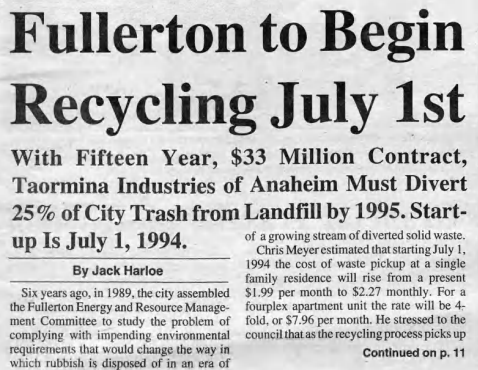
Transportation
The Bicycle Users Sub-Committee presented a ranked series of bicycle routes to be implemented as part of Fullerton’s new Bicycle Plan. This was the result of years of activism on the part of those advocating for an improved bicycle infrastructure for the City.

However, angry neighbors around Valencia Mesa were able to successfully lobby against a planned bike route in their area. NIMBYism wasn’t just about housing, it seems.

Immigration
As it is today, immigration was a hot-button political issue in 1994, especially in California. Facing an economic downturn, some chose to make political hay by blaming and scapegoating undocumented immigrants. This took the form of Proposition 187, which sought to deny education and all social services, except emergency medical help, to undocumented immigrants.
Prop 187 would have required all government agencies— including local police, hospitals, and schools — and all licensed medical professionals to determine the residential status of everyone who they “suspect” of being in this country illegally and then report those persons to the Immigration and Naturalization Service (INS). Prop. 187 would deny education and health care to more than 400,000 children and adults.

Ultimately, Prop 187 passed but was declared unconstitutional. It also had the unintended consequence of inspiring a generation of Latino activists, voters, and politicians. This, combined with demographic changes, contributed to the near demise of the Republican Party in California.

Deaths

Artist and educator Florence “Flossie” Millner Arnold died at 93. Back in 1964, Arnold spearheaded the effort to create the annual arts and culture event “A Night in Fullerton,” which lasted for 45 years.
To read more about Arnold, check out my summary of her oral history HERE.
Evelyn Bauman died at age 75. She too was involved in many important community groups, including: YWCA Nursery School, Children’s League, Fullerton Friends of Music, Art Alliance, Friends of Fullerton Arboretum, Habitat for Humanity, El Dorado Ranch Preservation Committee, and the CSUF Women’s Studies Program Council.
Stay tuned for headlines from 1995!
-
Subscribe
Subscribed
Have a WordPress.com account? Log in now.

