-
Fullerton in 1941

The following is from a work-in-progress about the history of Fullerton. You can support my ongoing research and writing on Patreon.
The Local History Room of the Fullerton Public Library has microfilm from the Fullerton Daily News-Tribune newspaper stretching back to 1893. I am in the process of reading over the microfilm, year by year, to get a sense of what was happening in the town over the years, and creating a mini archive. Below are some news stories from 1941.
The United States Enters World War II
By far, the biggest news story of 1941 was the Japanese attack on Pearl Harbor, and the United States entry into World War II.
In national news, Franklin D. Roosevelt was inaugurated for an unprecedented third term.

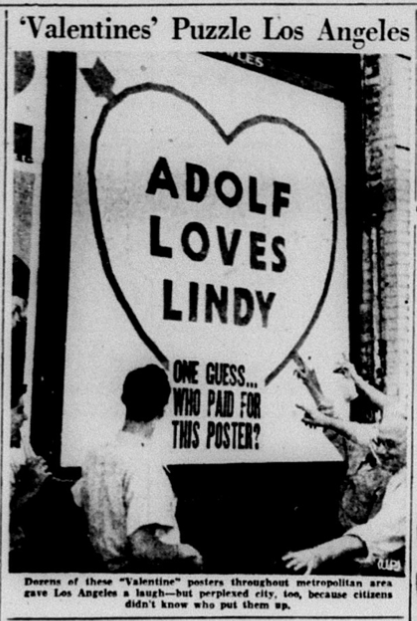
Prior to the United States entry into World War II, there was the first “America First” movement. This was an isolationist movement that wanted the US to stay out of the war, and sometimes flirted with fascism. Charles Lindberg, once a national hero of aviation, was a prominent spokesman of the first “America First” movement, which prompted reactions like this:
War Comes Home
In 1940, the United States had instituted a draft to beef up its military in the event of entry into the war. Some young Fullertonians went off to war.
Locally, Fullerton residents did their part for the war effort by buying defense savings stamps.

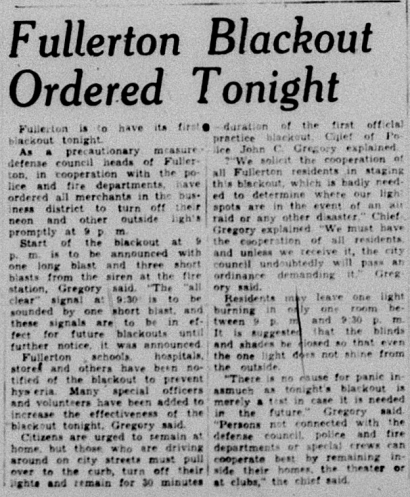
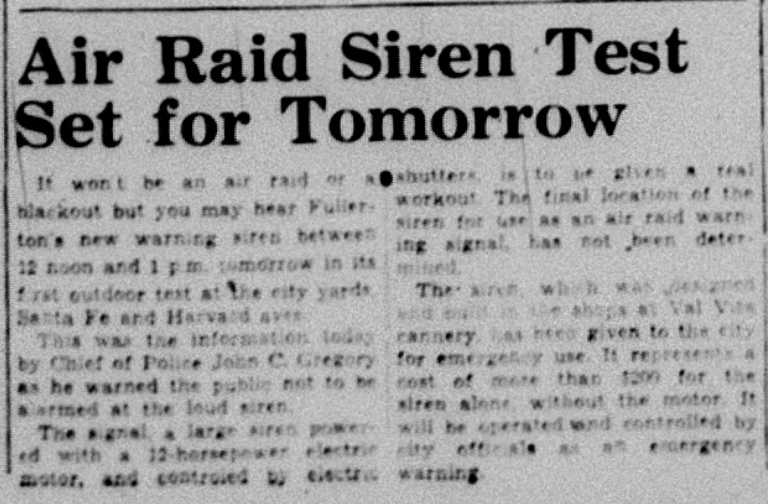
Preparations for blackouts (in the event of an air raid) were made.
Japanese Internment
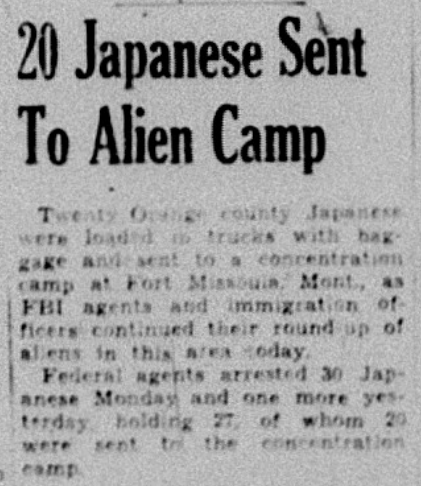
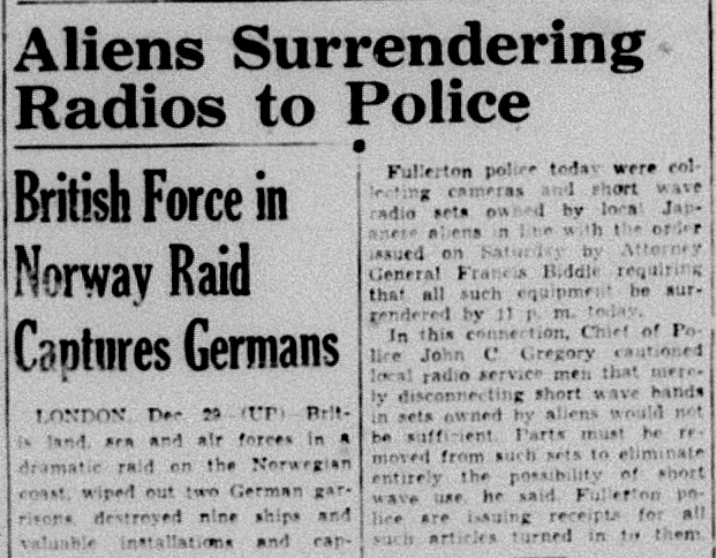
Although president Roosevelt would not sign Executive Order 9066 until 1942, prompting the internment/incarceration of Japanese Americans on the west coast, some Japanese Americans were taken by the FBI and sent to camps in 1941, including some living here in Orange County.

A New City Hall
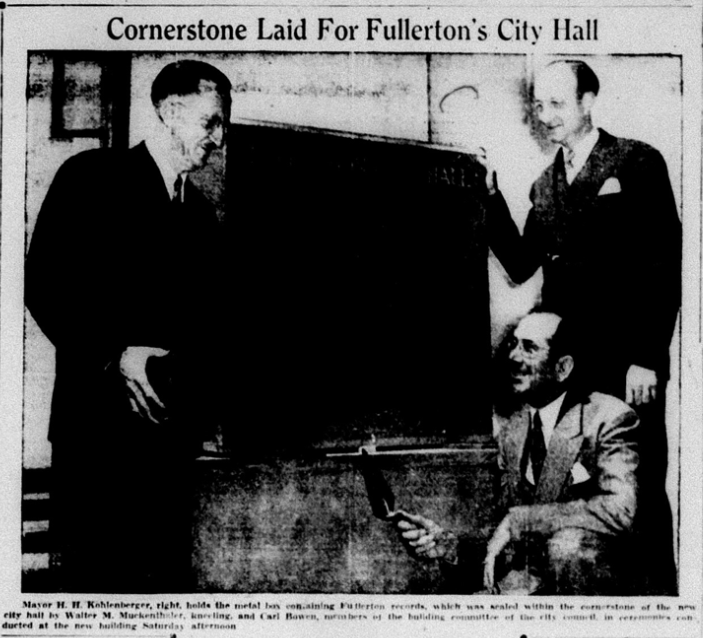
In 1941, Fullerton finally completed construction of City Hall at the corner of Highland and Commonwealth. The building now serves as the police station.

The building was designed by architect by G. Stanley Wilson, and was funded by the WPA, a New Deal federal program.
In addition to housing various city government offices, the building also was home to the Chamber of Commerce, the local welfare department, the police department, and the city jail.
The City Council chambers were also used as a court room for use by the city judge or justice of the peace.
Armistice Day Parade
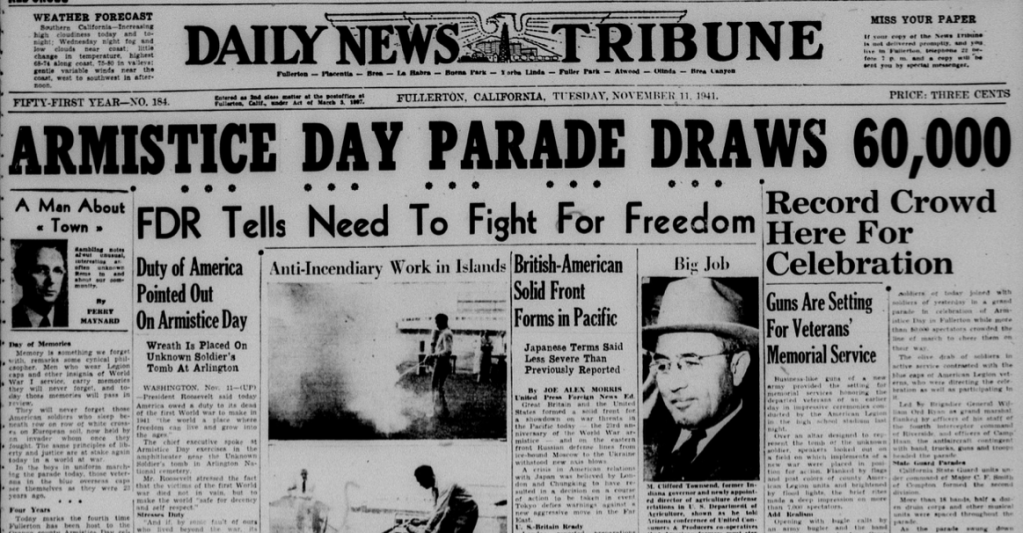
Fullerton hosted an Armistice Day parade that drew around 60,000 people.
Val Vita
One of Fullerton’s biggest industries in 1941 was Val Vita Foods, located on 35 acres on the west side of town. It was owned by Norton Simon, and would eventually become Hunt Foods.

“Established in 1932 with an annual output of 20,000 cases, Val Vita Food Products, Inc. has grown into the largest cannery west of the Mississippi, and now produces 2,000,000 cases of 50 different products,” the News-Tribune reported.
Val Vita canned all sorts of foods, from tomatoes to orange juice, to spinach.
It was the largest cannery in the west.
With the US entry into World War II, Val Vita got a contract to provide canned goods for the Army.

Interestingly, there were a number of industrial strikes in 1941, including at Val Vita.

As the war went on, strikes were seen as unpatriotic.
Housing
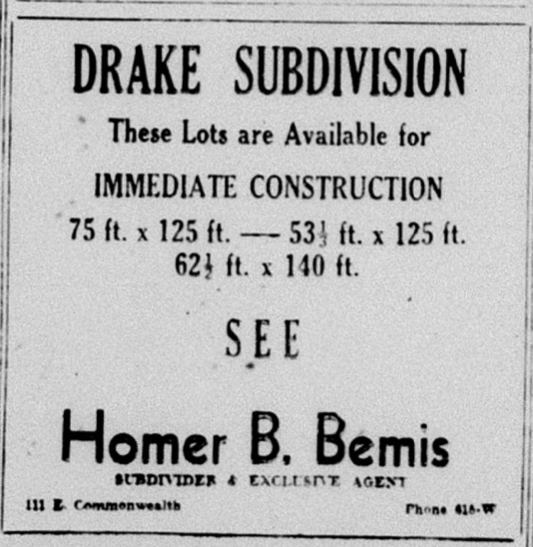
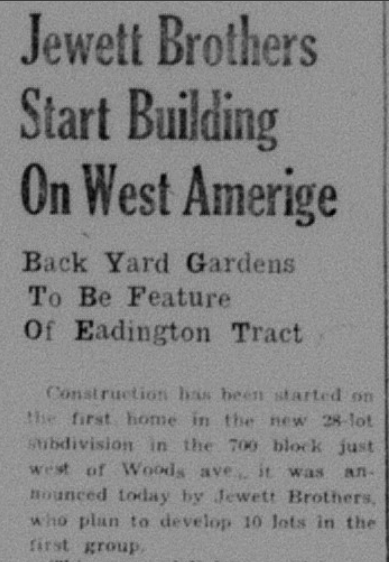
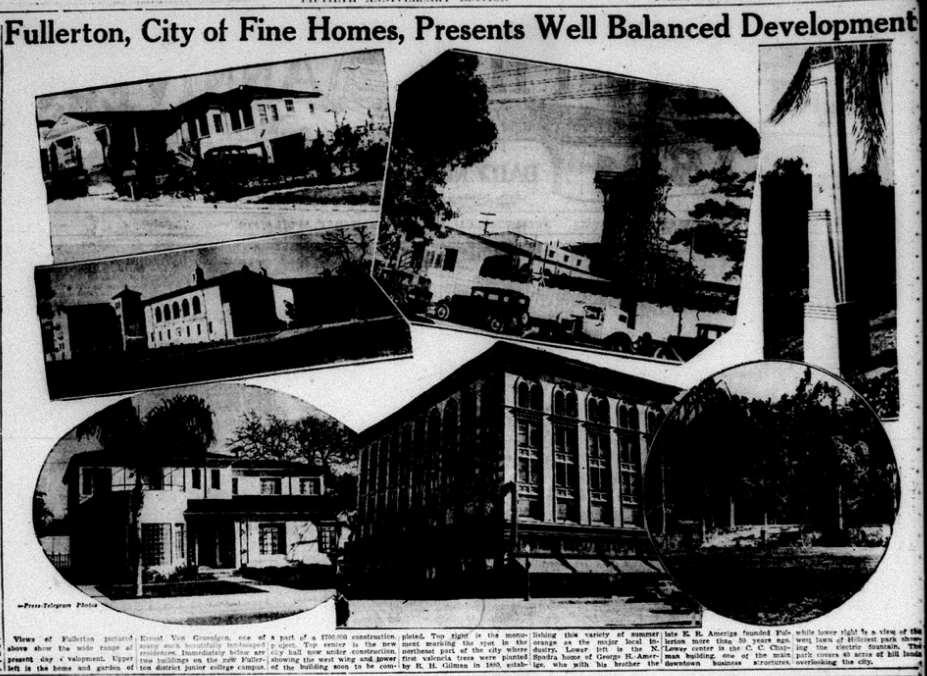
New housing subdivisions continued to be built. Although construction of new housing has slowed somewhat during the Great Depression, housing would explode after the War.
Spring Training at Amerige Park
In 1941, the baseball field at Amerige Park was a popular spot to see professional teams compete in Spring Training games.
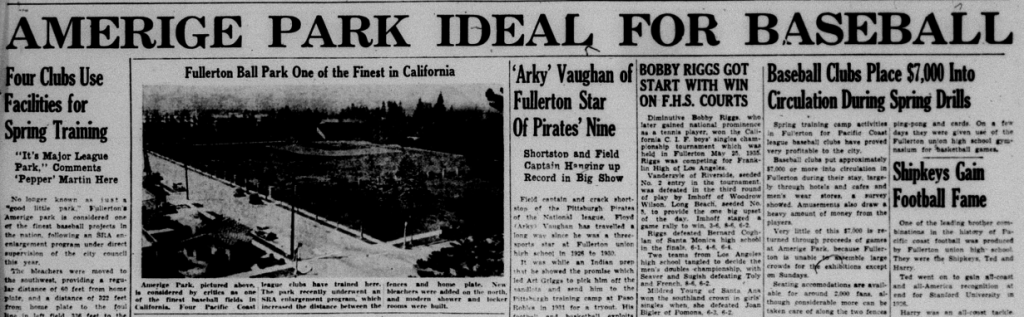
The field was used by the Hollywood Stars, which became the San Diego Padres for two seasons, followed by the Portland Beavers, then the Sacramento Solons.
“You have a major league park here,” Solons manager Pepper Martin told the News-Tribune.
Local teams also used the field, including the Fullerton Firemen.
There is a new book out called Spring Training in Fullerton, which is all about this interesting subject.
Water
Fullerton’s two large dams (the Fullerton Dam and the Brea Dam) were completed in 1941, as part of a larger countywide flood control program.

The dams were built by the U.S. Army Corps of Engineers.
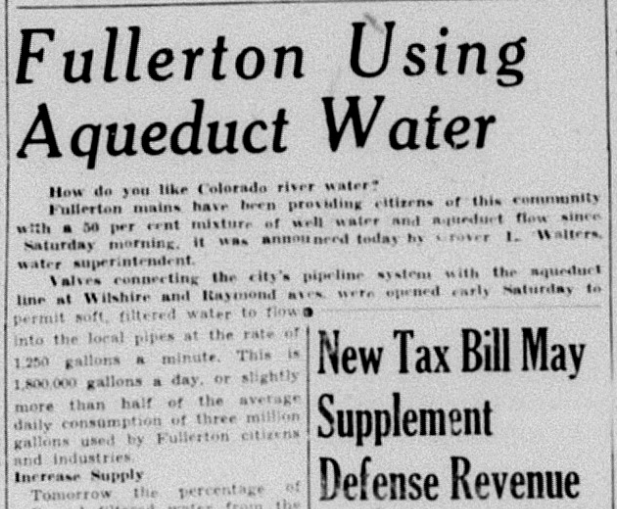
In 1941, Fullerton (being a member of the Metropolitan Water District) began to receive water from the Colorado River, courtesy of the Colorado River Aqueduct.
Death
Pioneer Fullerton pharmacist William Starbuck passed away at age 76.
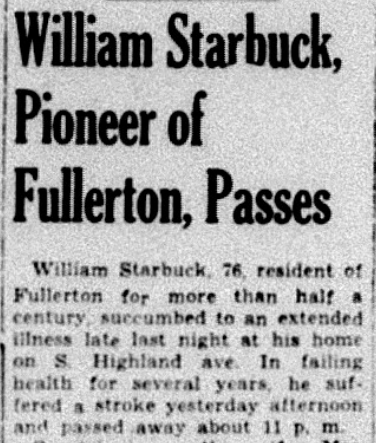
Starbuck opened the first drug store in Fullerton in November of 1888. He also built and operated the first telephone system in town, in his drug store. His Gem Pharmacy also housed Fullerton’s first library.
Starbuck helped to organize the Fullerton high school district, and served as a trustee for 15 years. He also helped organize the first community hospital. He was also allegedly a member of the Ku Klux Klan in the 1920, when the group had a sizable membership among local residents.
One of the Bastanchury sons, Joseph Francis, died.

Pioneer rancher Benjamin Franklin Porter died.

Born in Tennessee in 1849, he came to the area that would become Fullerton before the town was founded, settling in what became known as the Orangethorpe district.
In addition to ranching, he served for many years as a road engineer, having surveyed and built many of the main roads in the county.
He helped organize the California Walnut Growers Association, serving as a charter member of the board of directors for 25 years. He also served as president of the local walnut association.
He also helped to organize the Anaheim Union Water company, a precursor to the Orange County Water District, serving for many years as a director.
He too was instrumental in forming the Fullerton union high school district, serving on the board. He was also a director of the Security First national Trust and Savings Bank, Fullerton branch.
He and his wife Mary had 12 children, 19 grandchildren and 16 great grandchildren.
He is buried in Loma Vista cemetery.
Long recognized as Fullerton’s oldest resident, “Uncle WIllie” Addams died at the ripe old age of 103.
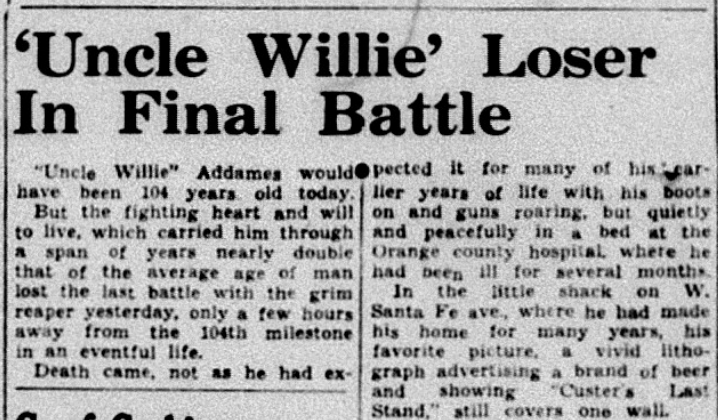
He lived in a little shack on W. Santa Fe ave,
According to the News-Tribune, “Little is known of Uncle Willie’s past, except that which he chose to tell.” And he told a lot of tales.
He said he was born on a sailing vessel owned and operated by his parents out of New York while it was anchored in the West Indies.
“In his earlier days he followed the sea and in 1852 made a trip by sailing vessel around Cape Horn to San Francisco…On this trip he made a journey by horseback through much of California…While in New Orleans as а young man, with his ship stranded, he was persuaded to join the Confederate army during the civil war and was wounded by a rifle ball in the Battle of Lookout Mountain. After the war, he came out west and joined Indian scouts. He spoke in familiar terms of Jim Bridger, famous Indian scout, of Wild Bill Hickok, Wyatt Earp and other famous characters of the early west, but his favorite of all was the notorious Billy the Kid…Uncle Willie told often the story of being with the scouts and troops who arrived too late Ito aid General Custer and found only massacre left by the Siouх at Little Big Horn.
Whether any of this is true or not, who knows, but what a story!
Funeral director Angus McAulay passed away at age 55.
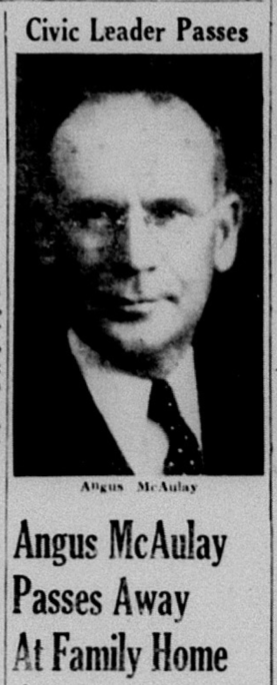
He came to Fullerton in 1914 to establish a funeral business–which still exists today–McAulay & Wallace.
Stay tuned for top news stories from 1942.
-
Fullerton in 1940
The following is from a work-in-progress about the history of Fullerton. You can support my ongoing research and writing on Patreon.
The Local History Room of the Fullerton Public Library has microfilm from the Fullerton Daily News-Tribune newspaper stretching back to 1893. I am in the process of reading over the microfilm, year by year, to get a sense of what was happening in the town over the years, and creating a mini archive. Below are some news stories from 1940.
World War II
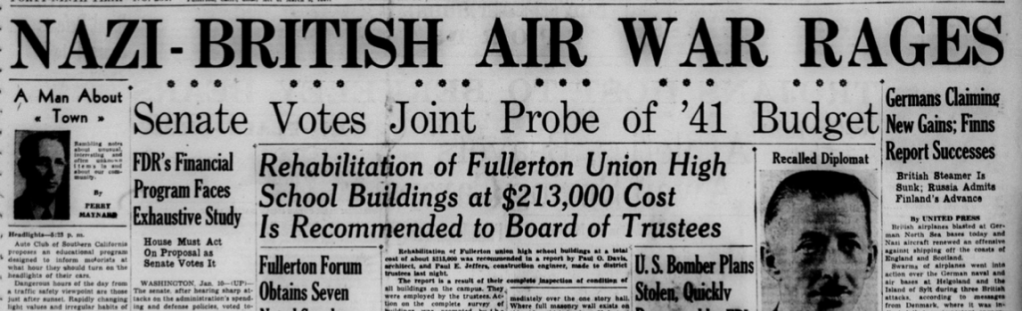
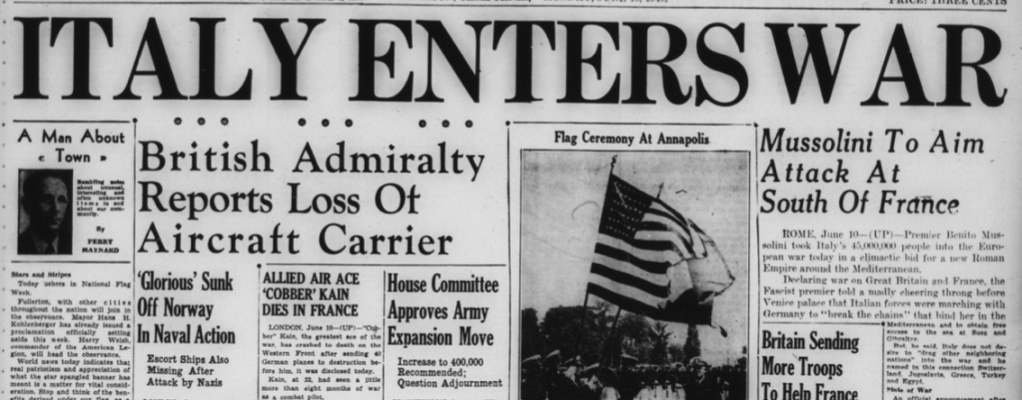
World War II raged in Europe as England and France battled Germany, Italy entered the war, and the United States felt increasing pressure to join the fight.

The Draft
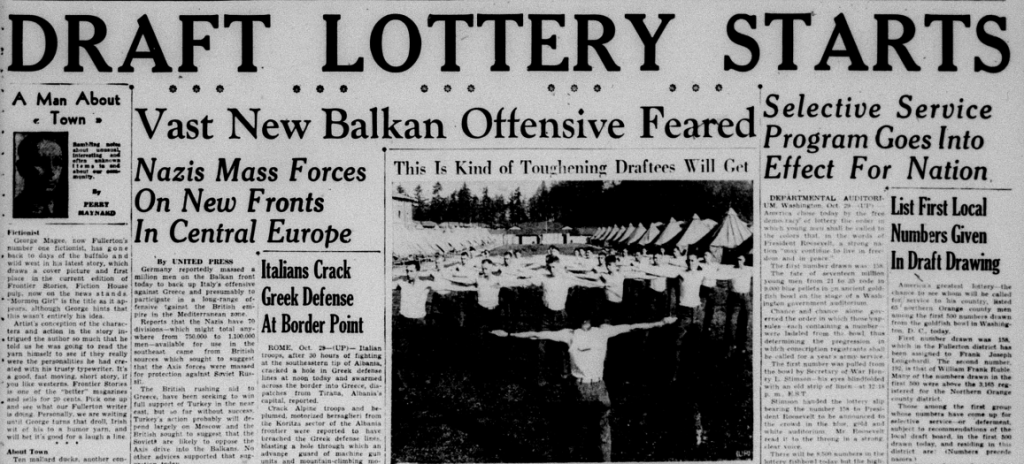
Although the United States would not officially enter the war until December 1941, following the Japanese attack on Pearl Harbor, the country began to prepare for what seemed like the inevitable. President Roosevelt signed a law instituting a draft to build up the US armed forces, and the US continued to beef up its air and naval power.
National News
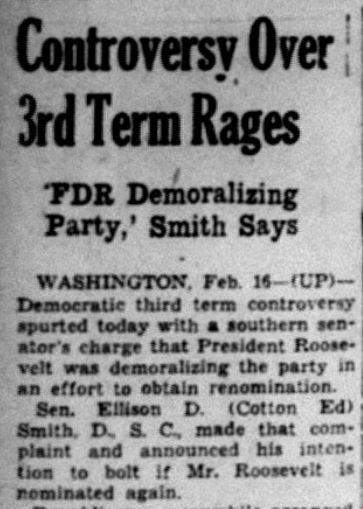
1940 was an election year, and president Roosevelt ran (and won) a third term, defeating Republican Wendell Wilkie. This was the first time a US president ran for a third term. In 1947, Congress approved the 22nd Amendment, which bars presidents from serving more than two terms.
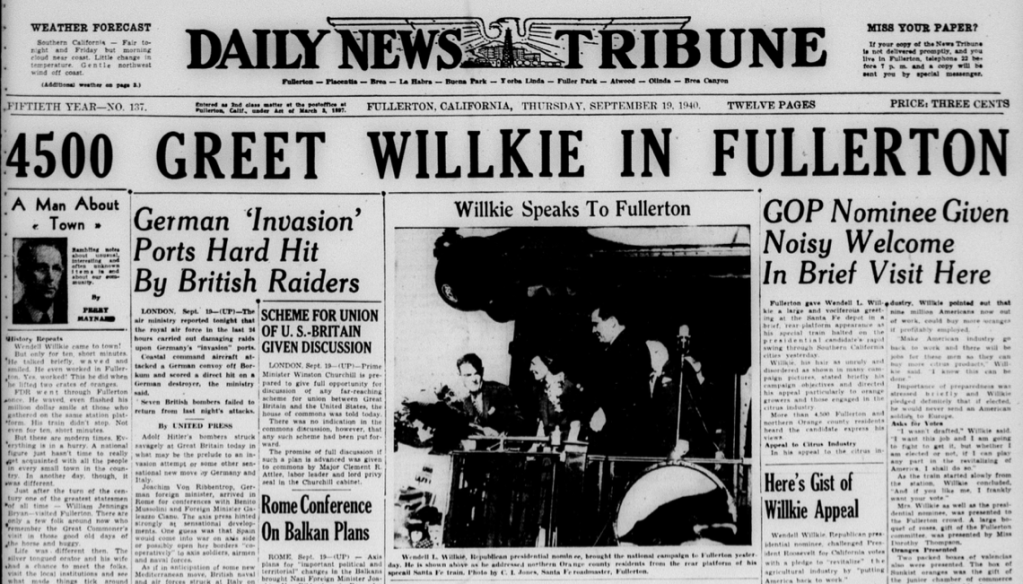
During the election, Republican candidate Wilkie made a brief train stop in Fullerton, where he greeted a large crowd.
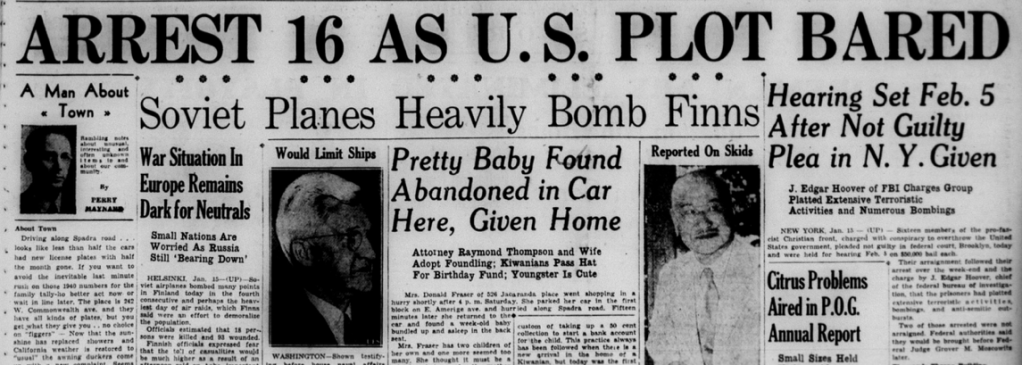
In 1940, a right-wing plot to overthrow the government, organized by a group called the Christian Front, was thwarted. This fascinating story is told in Rachel Maddow’s excellent podcast Ultra.
Local Politics
The 1940 City Council race was a contentious one, with large ads run in the News-Tribune claiming that Val-Vita foods, a large Fullerton corporation, was trying to gain undue influence by running one of its executives, Stroller White.

There were essentially two “tickets” of three candidates each running against each other. On one ticket was William Carmichael, Harry Maxwell, and Stroller White. They attacked their opponents by claiming that the police chief would be fired if they were not elected.

The other ticket was William Montague, Walter Muckenthaler, and Hans Kohlenberger. Ultimately, this ticket was elected.
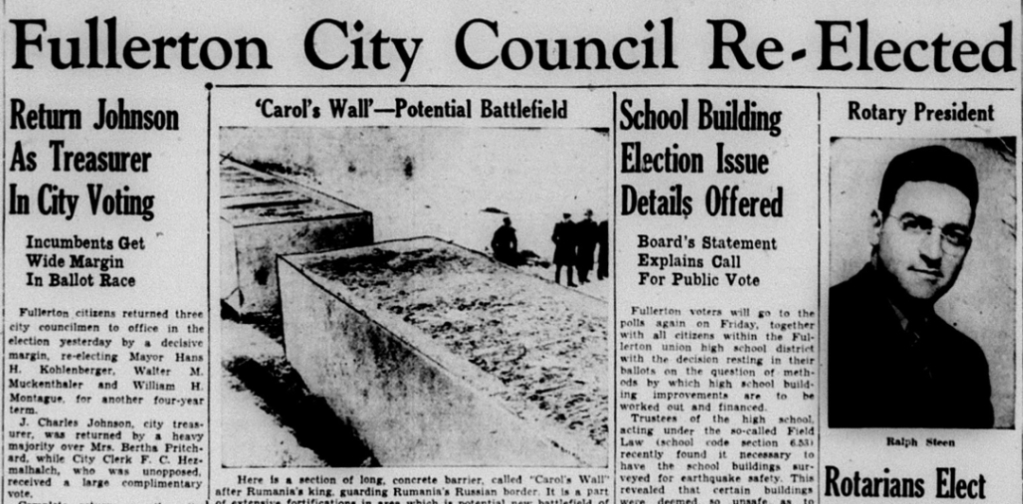
Businessman Hans Kohlenberger was selected as Mayor.
Education
In a major shake-up, long-time Fullerton High School and Junior College Superintendent Louis Plummer decided leave the position.
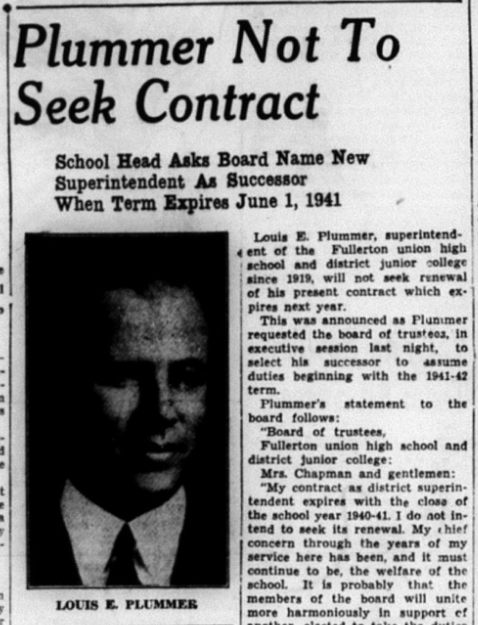
Plummer first came to Fullerton Union High School in 1909. He helped organize Fullerton Junior College in 1913, and served as superintendent since 1919. Though no specifics were given, it seems clear that there was tension between Plummer and the Board of Trustees.
“My chief concern through the years of my service here has been, and it must continue to be, the welfare of the school,” Plummer wrote in a letter to the Board. “It is probably that the members of the board will unite harmoniously in support of another, elected to take the duties of this office, than they would in carrying out any program I might propose.”
As further evidence that there was tension between the Board and the administration, fifteen teachers were also released.

Plummer’s replacement was F.T. Chemberlen.
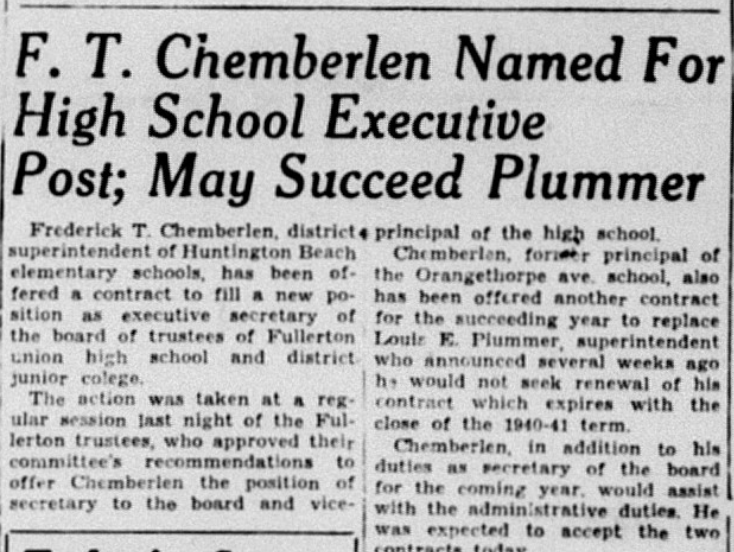
In other news, FUHS’s old auditorium was condemned.
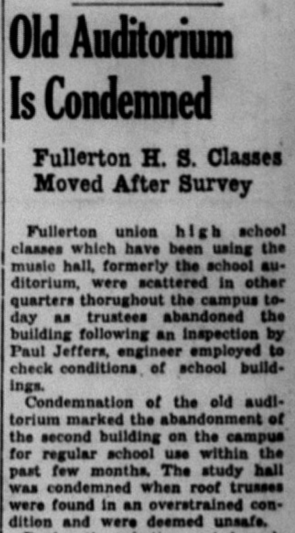
With the rise in international tensions, a military training was begun at the High School.

New Deal Projects
Fullerton continued to benefit from various New Deal programs, including construction of a new library on the site of the original Carnegie Library (built in 1907). The Library built in 1940 is now the Fullerton Museum Center.
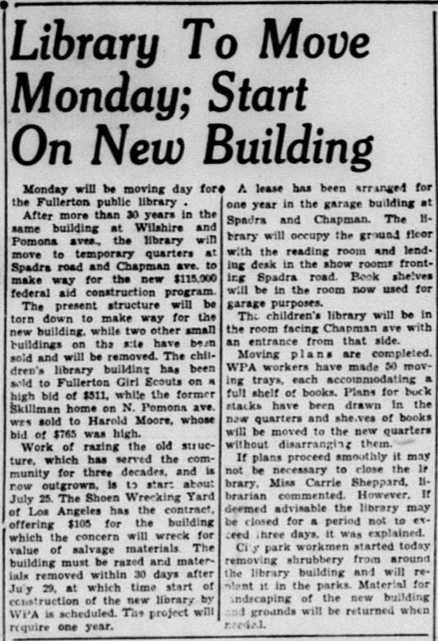
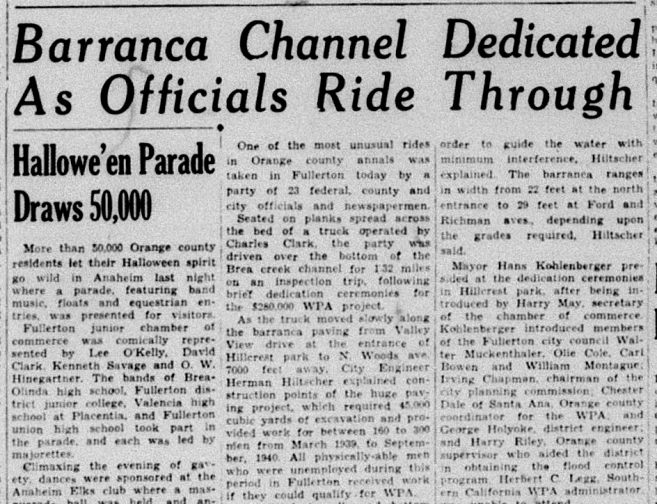
Other public works projects underway in 1940 included flood control measures like construction of the Brea and Fullerton dams and paving of barrancas.
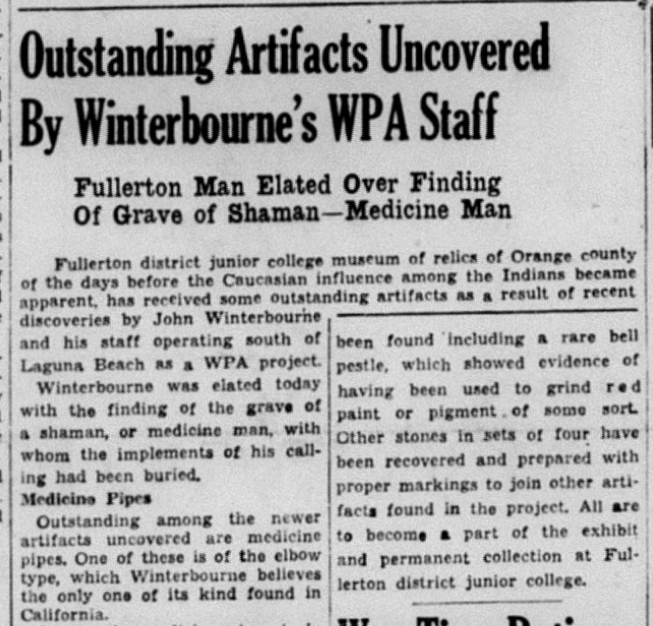
In addition to public works projects, the WPA also sponsored things like archeological digs, including one in Orange County that uncovered Native American artifacts.
Downtown Fire
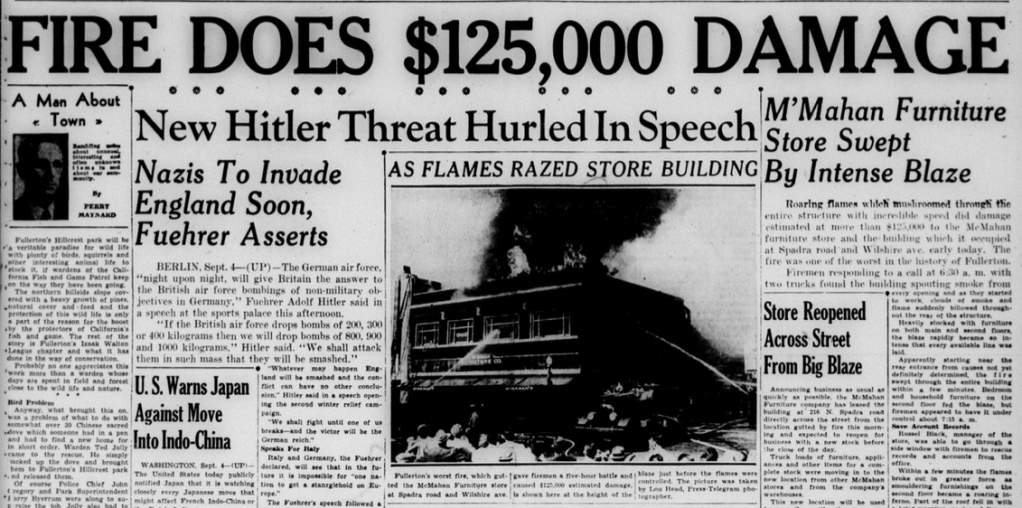
A massive fire destroyed much of the McMahan furniture store near the corner of Wilshire and Spadra (Harbor).
Culture and Social Life
In 1940, social clubs were popular in Fullerton, including Rotary, Kiwanis, Lions, Business and Professional Women’s Club, Fullerton Junior Chamber of Commerce, American Legion, 20-30 club, Ebell Club, YMCA, YWCA, Masons, Odd Fellows, and more.
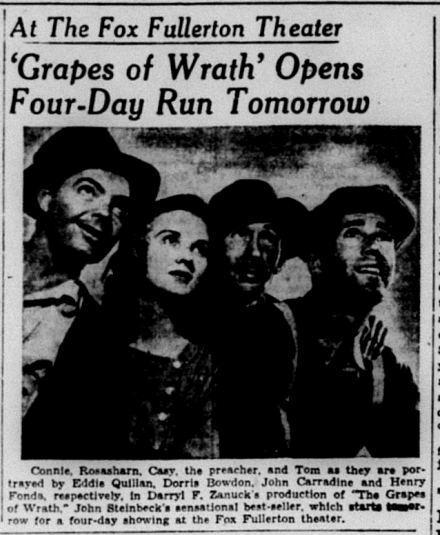
For entertainment, Fullertonians went to see movies at the Fox Theater.


Housing
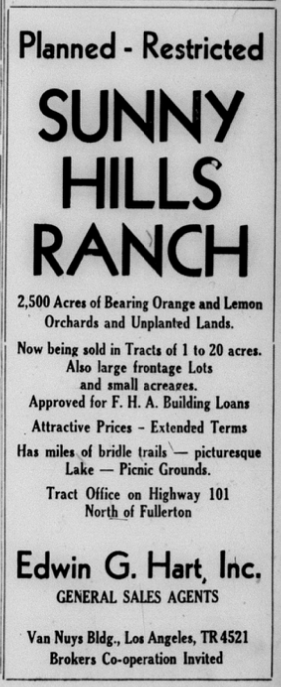
The sprawling Sunny Hills Ranch, formerly part of the Bastanchury Ranch, was partly subdivided into residential housing. Unfortunately, the properties had racially restrictive housing covenants.
Agriculture
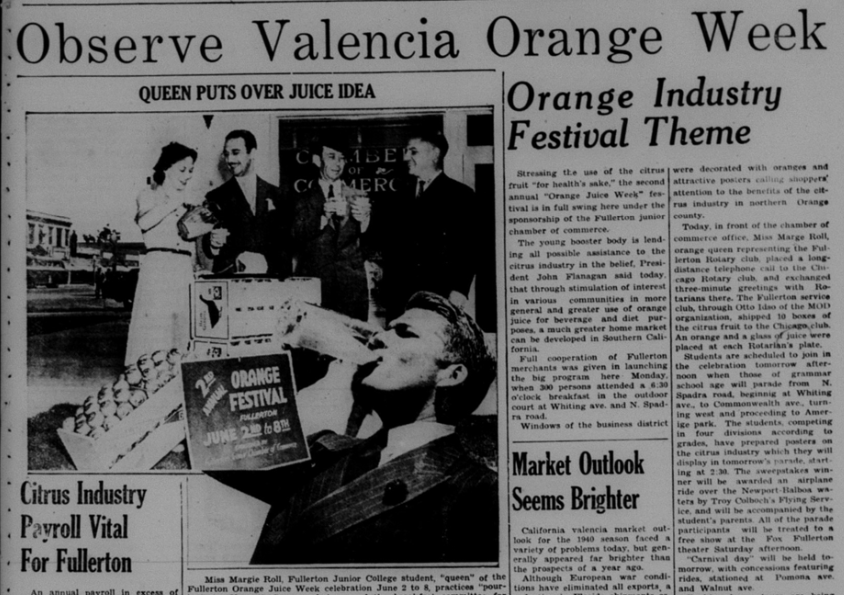
Fullerton celebrated Valencia Orange Week and urged people to drink more orange juice.
Slow Population Growth
The 1940 US census found that population growth in Fullerton had slowed significantly during the Great Depression, with a population of about 11,200.
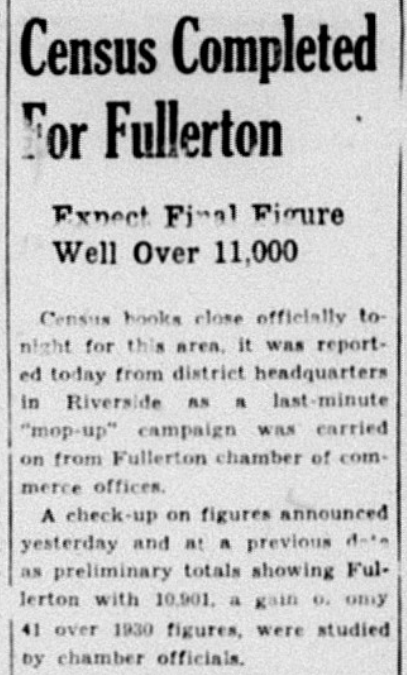
“Discussion of population changes brought out the fact that elementary school registration is nearly 600 below the total of 1930,” the News-Tribune reported. “It also was pointed out that two large Mexican colonies which once flourished on the former Bastanchury ranch, no longer exist and that occupants do not live in Fullerton.”
Sports
In sports news, famous baseball manager Connie Mack came to Fullerton, as the Philadelphia Althletics played the Portland Beavers at Amerige Park.

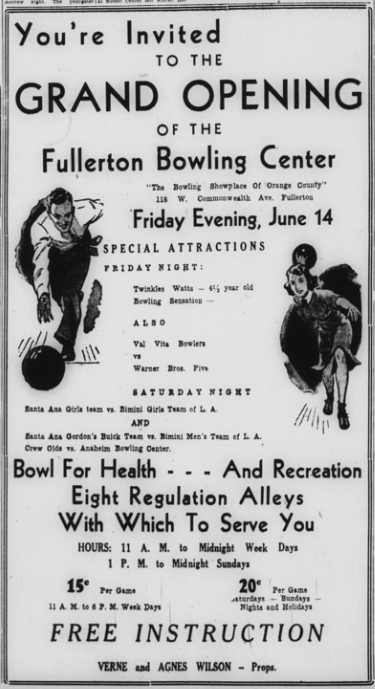
A new bowling alley opened downtown.
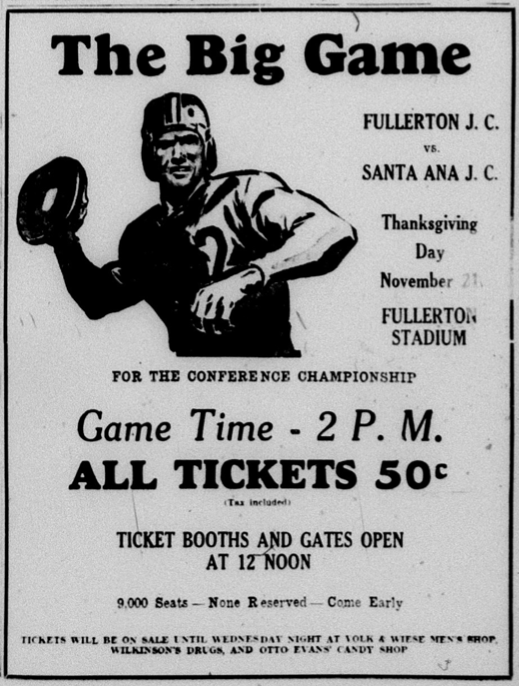
Like baseball, local football games were quite popular.
Belle Benchley, Famous Zookeeper
Belle Benchley, who was the first woman elected to the Fullerton School Board, went on to become a famous zookeeper and author in San Diego.

Deaths
Former Fullerton city marshal and justice of the peace William French died at his home 533 W. Commonwealth Ave, at age 79.
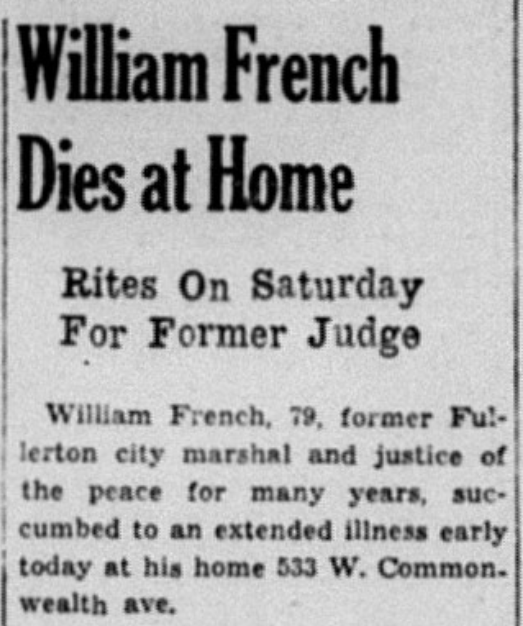
Born in 1861 in Indiana, French came to Fullerton in 1901. He was employed as city marshal in 1912, succeeding Rod Stone, and held that office until 1918, when he was made city judge and justice of the peace. He served in this capacity until he retired in 1926.
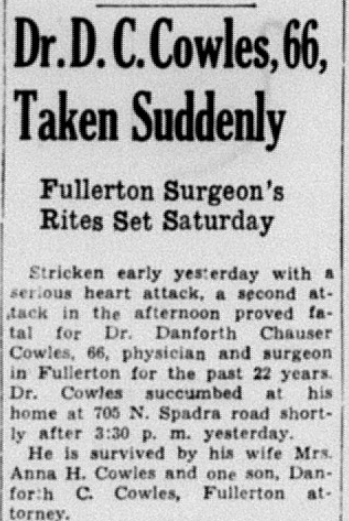
Dr. Danforth C. Cowles died suddenly. He had recently lost a race for State Assembly.

Stay tuned for top news stories from 1941!
-
Fullerton in 1939
The following is from a work-in-progress about the history of Fullerton. You can support my ongoing research and writing on Patreon.
The Local History Room of the Fullerton Public Library has microfilm from the Fullerton Daily News-Tribune newspaper stretching back to 1893. I am in the process of reading over the microfilm, year by year, to get a sense of what was happening in the town over the years, and creating a mini archive. Below are some news stories from 1939.
New Publisher for the News-Tribune
A new owner/publisher took over the Fullerton News-Tribune, Edgar F. Elfstrom. He was the third owner/publisher of the local paper.

International News
In international news, war had broken out in Europe as Hitler invaded Czechoslovakia and Poland, prompting England to declare war on Germany.
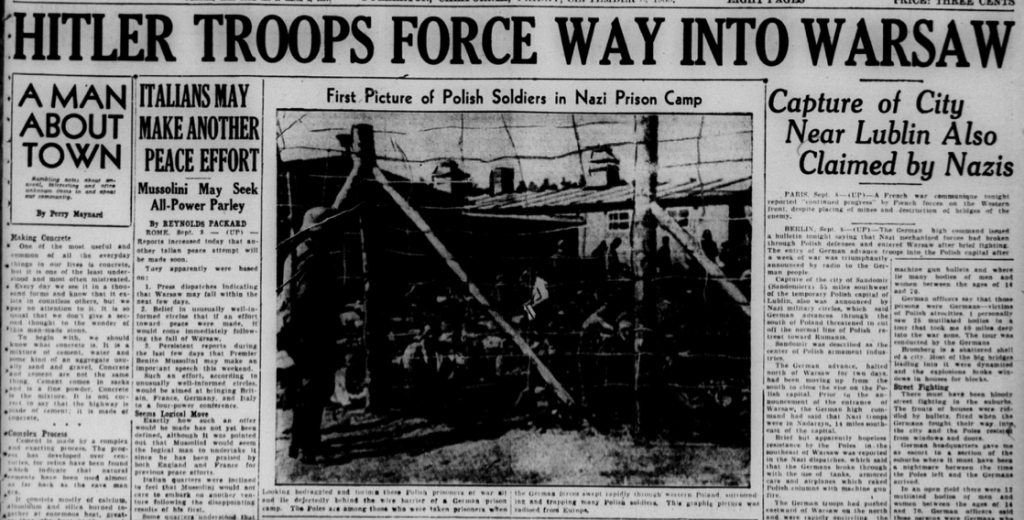
Fascism had taken hold in Germany (under Hitler), Italy (under Mussolini), and Spain (under Franco).

Meanwhile, here in Fullerton, German prince Kurt B. Lippe spoke at a community meeting defending Naziism and Hitler.
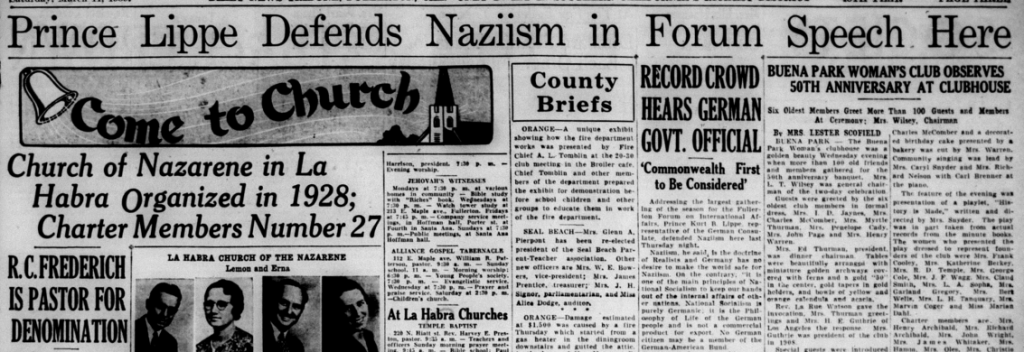
Prince Lippe gave a fairly succinct description of fascism:
“In Germany today the aim of national socialism is the welfare of the commonwealth and to this end all must be subordinated. Our leader is supreme and is answerable only to the German people. Our government makes no room for impeachment of our leader,” he said. “We have never believed in a rule by a majority or by a parliamentary system. We believe that nothing can replace personality; that all the great achievements are the result of the individual’s brain–the result of the man.”
And then he made two astonishingly false claims about the aims of Nazi Gemany: “It is one of the main principles of National Socialism to keep our hands out of the internal affairs of other nations,” and “The speaker prophesied that it will be Hitler and Mussolini who will finally give to the Jewish people a home of their own.”
National News
Despite what was happening in Europe, the United States government, under the leadership of Franklin D. Roosevelt, remained neutral.

Meanwhile, Jews attempting to flee Nazi terrorism were encountering difficulties entering the United States because of our restrictive immigration laws, as shown by the tragic situation of the ship MS St. Louis, carrying Jewish refugees fleeing Nazi Germany, which was turned away from Cuba, the United States, and Canada, and forced to return to Europe. Many of the passengers later perished in the Holocaust.

California News
In California news, Democratic governor Culbert Olson finally pardoned labor leader/activist Tom Mooney, who was convicted of a bombing in 1916 that was likely based on falsified evidence and perjured testimony.

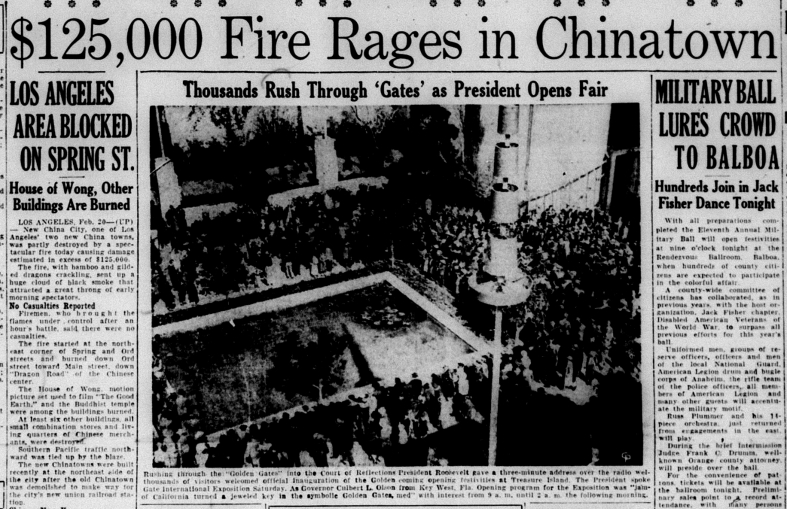
A tragic fire in Los Angeles destroyed a large part of the newly-constructed Chinatown, which had been built to replace the original Chinatown, which was torn down to build Union Station.
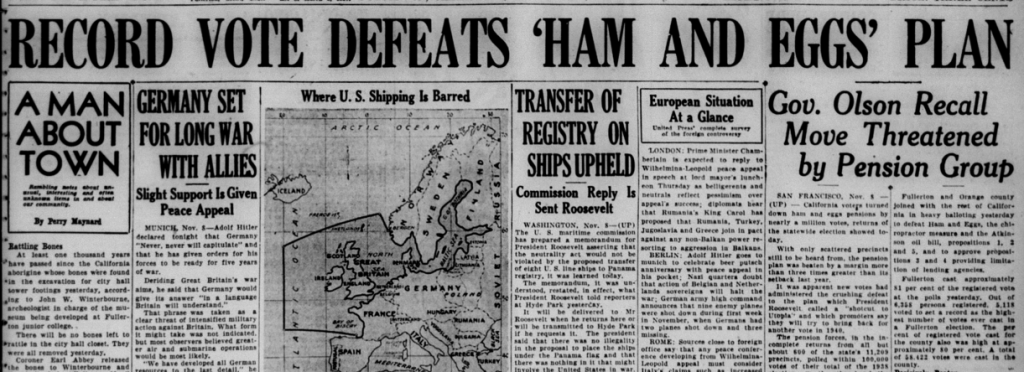
Voters turned down the so-called “Ham and Eggs” proposal, a state old age pension plan.
Local Politics
Businessman Hans Kohlenberger was chosen as Mayor for 1939.

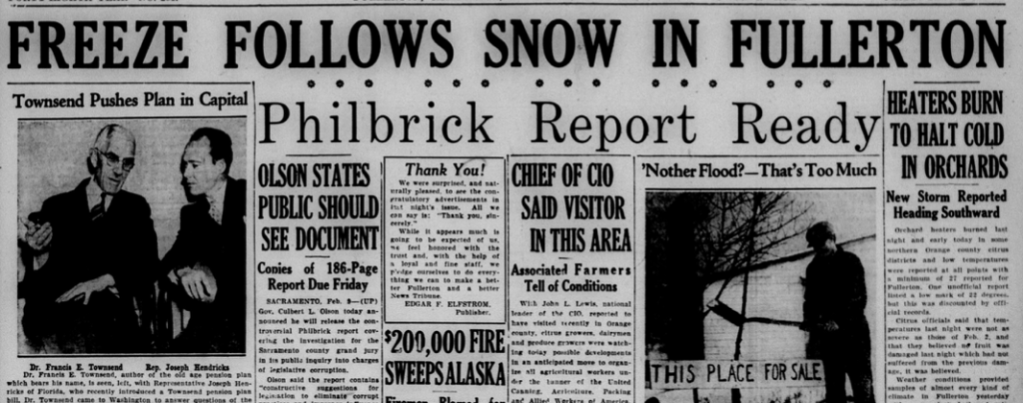
Snow in Fullerton!
There was a rare snowfall in Fullerton.
Housing
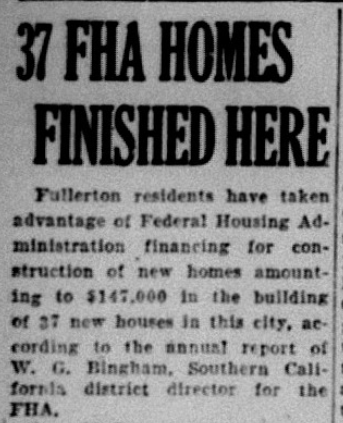
Part of Roosevelt’s New Deal was the creation of the Federal Housing Administration, with the aim of providing government-insured low-cost loans to make housing more affordable to more Americans.
The process of transforming some of the former Bastanchury Ranch, the Sunny Hills ranch into housing, began.

New Deal Projects
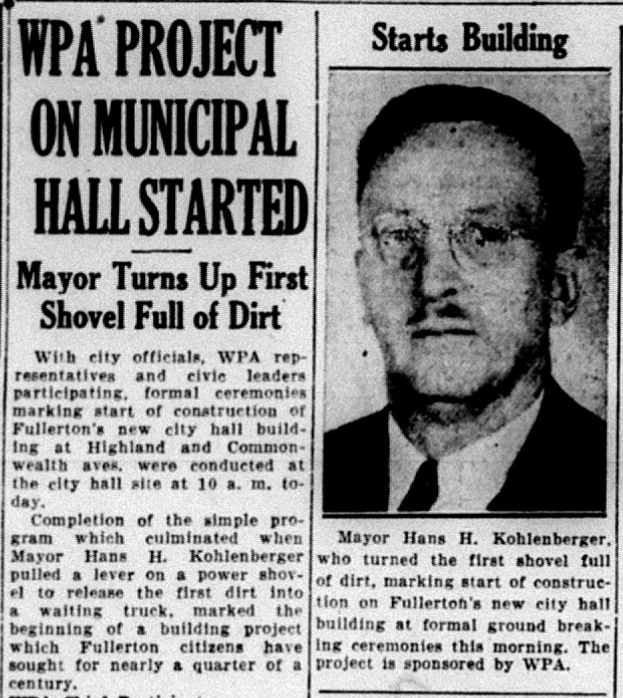
Fullerton benefited tremendously from Roosevelt’s New Deal in the form of federally-funded projects including: flood control dams and paving of barrancas, construction of a post office, City Hall, improvements to Hillcrest Park, and more. To learn more about how the New Deal benefited Fullerton, read my article HERE.
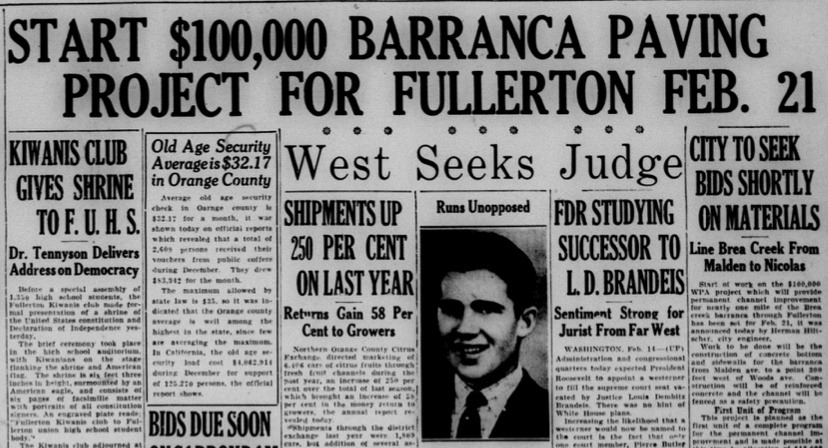
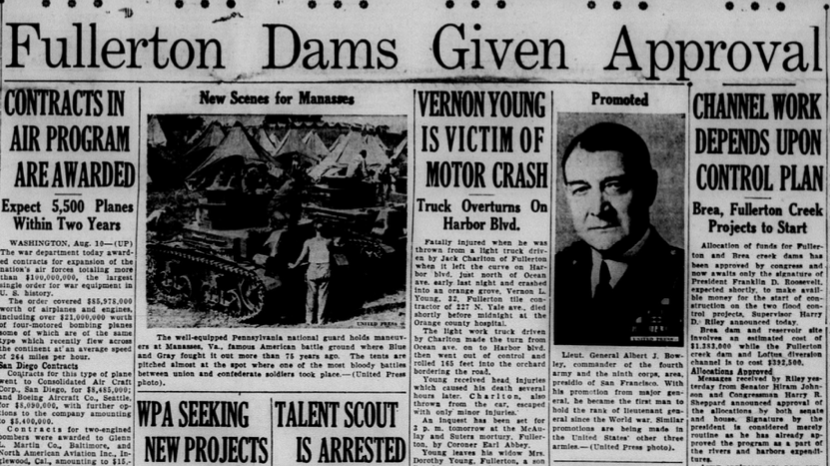

The City Hall project was controversial, with several petitioners opposing the construction of the building, however ultimately the issue went to voters, who approved it. The original City Hall is now the Fullerton Police Station.
The Tragic Whitewashing of the Pastoral California Mural
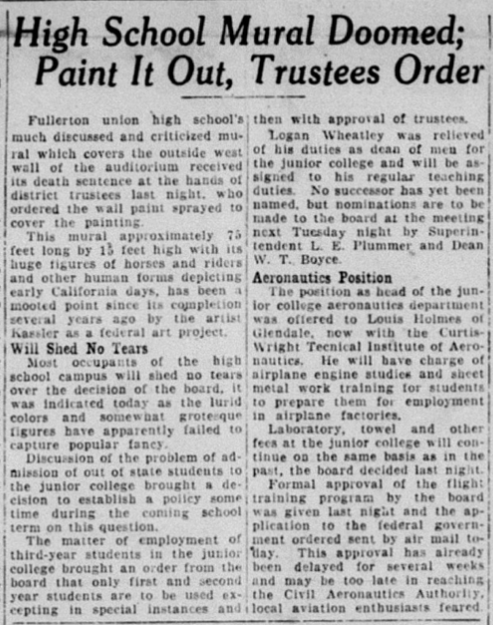
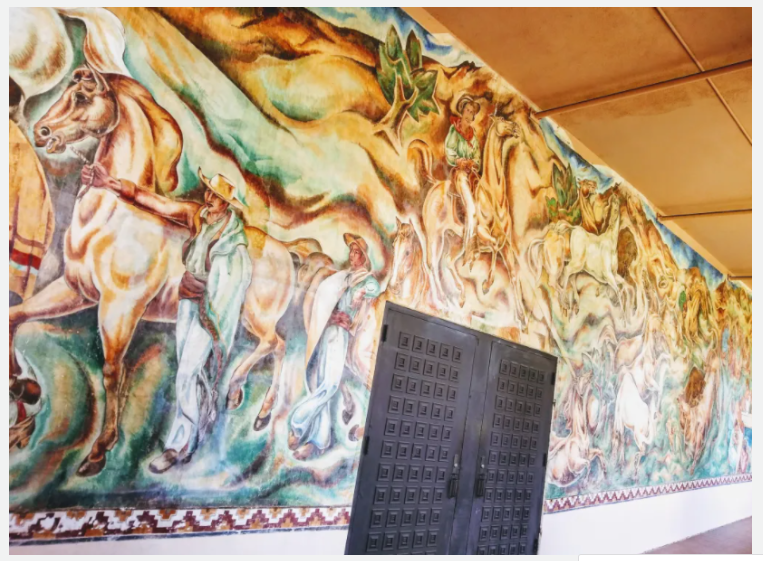
In a tragedy of local history the high school Board of Trustees voted to paint over the 75-foot long fresco mural “Pastoral California,” a WPA-funded art project on the western wall of the high school auditorium. For more about this, read my article on the topic HERE.
Agriculture
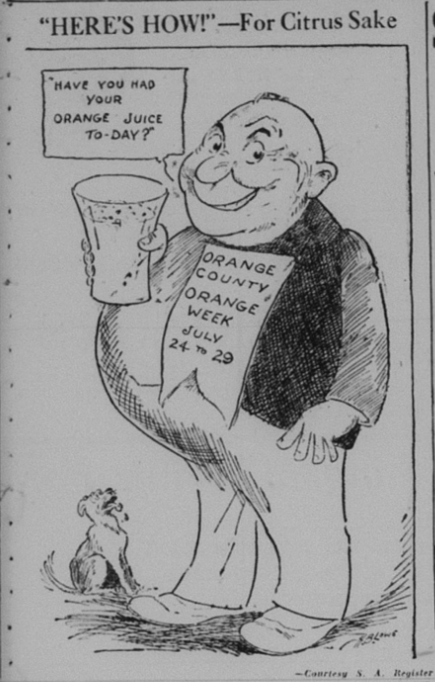
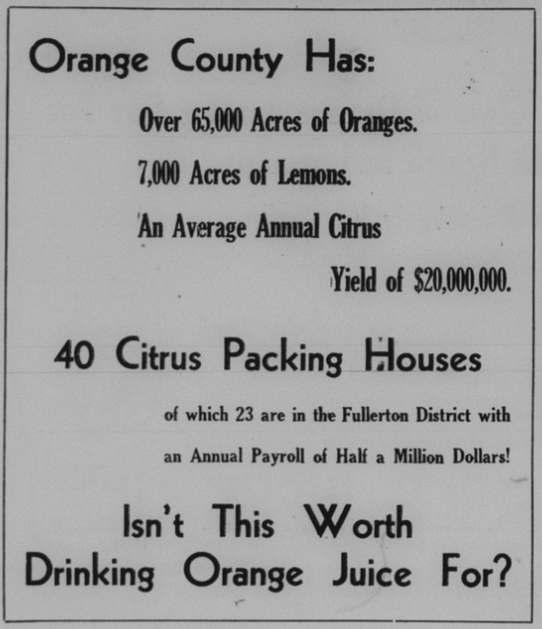
In an effort to boost the local citrus industry, local growers sponsored a drive to get people to drink more orange juice.

Sports
In the 1930s, baseball games at Amerige Park were hugely popular local events. The Portland Beavers came down to play spring training games here.

Local baseball star Willard Hershberger came to town to play a game.

Culture and Entertainment
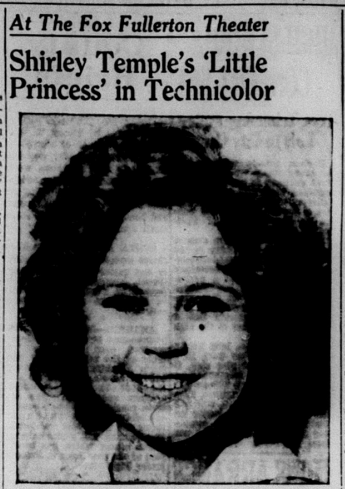
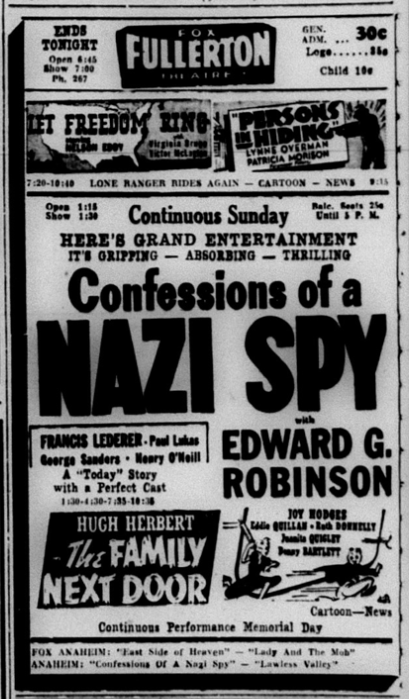
For culture and entertainment, locals went to see the latest movies at the Fox Theater.

Young artist Stanley Porter, of the pioneering Porter family, opened an art studio on his family’s ranch. He had studied under famous ceramicist Glen Lukens, who taught at Fullerton College.
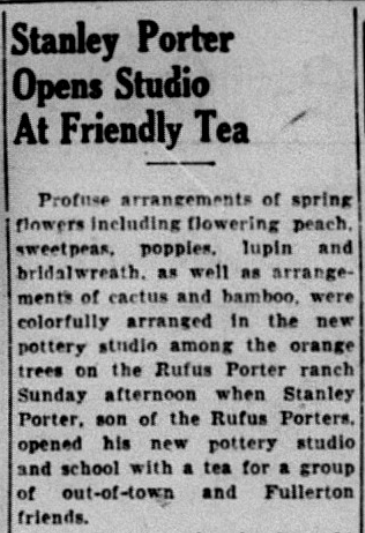
Porter, 21, studied ceramics at the Chouinard Art school in Los Angeles and with Glen Lukens when the latter was ceramics instructor at Fullerton Junior College. Illustrations and other artwork were on display. He plans to hold classes.
In related news, Stanley’s grandparents, Mr. and Mrs. B.F. Porter celebrated their 70th wedding anniversary.
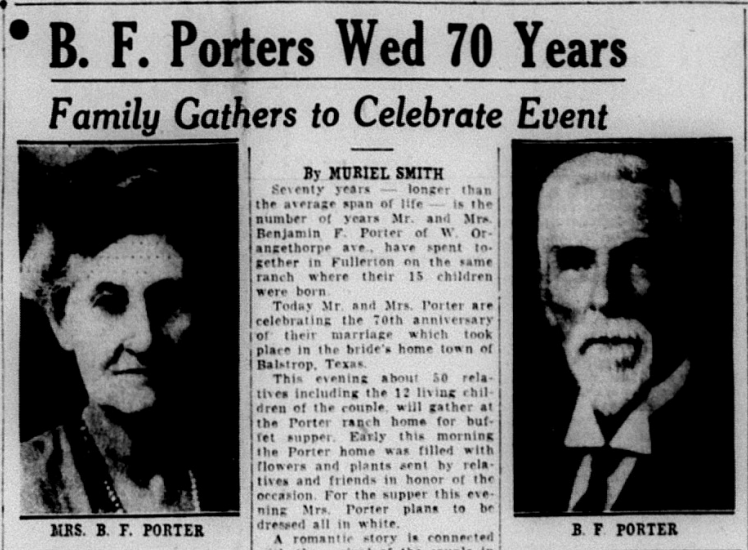
The Porters were pioneers of the Orangethorpe district, having settled in the area in 1869, 20 years before the town of Fullerton was founded. They came west from Texas on a wagon train.
Deaths
Fullerton banker Fred Krause died.

Born in Iowa, Krause became a Congregational minister and remained in the ministry until 1903. He then went into banking in Alaska and Washington state. He came to California and from 1912 to 1917 was president and cashier of the Anaheim National bank.
In 1918 he became president of the First National bank of Fullerton, originally established in 1895 as the Fruit Growers bank, and later a branch of the Security First National bank of Los Angeles, of which he became a vicе president.
He was a Mason and served as president of the Fullerton Chamber of Commerce and the Rotary Club.
Stay tuned for top stories from 1940!
-
Fullerton in 1938

The following is from a work-in-progress about the history of Fullerton. You can support my ongoing research and writing on Patreon.
The Local History Room of the Fullerton Public Library has microfilm from the Fullerton Daily News-Tribune newspaper stretching back to 1893. I am in the process of reading over the microfilm, year by year, to get a sense of what was happening in the town over the years, and creating a mini archive. Below are some news stories from 1938.
Fascism Abroad, and at Home
Fascist dictator Adolf Hitler had firmly consolidated power in Germany, and he was starting to embark on a campaign of military conquest that would soon engulf all of Europe. He began by invading and then annexing the neighboring country of Austria, and then part of Czechoslovakia.
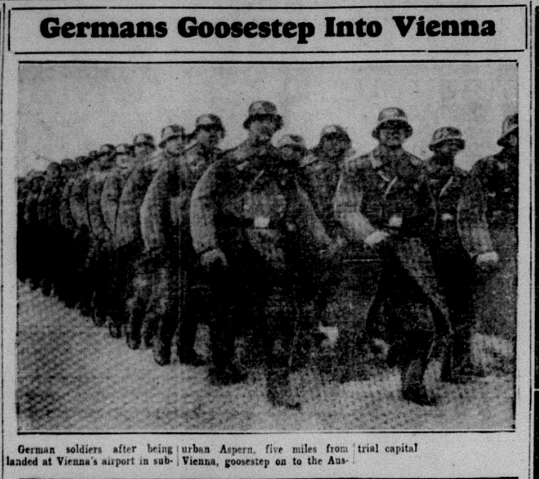
The Nazis brought their vicious brand of antisemitism and persecution of Jews to the countries they invaded.

Here at home, there were American fascists who sympathized with Nazi Germany. They were called the German American Bund.
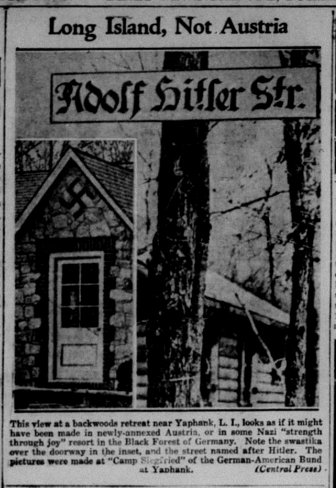
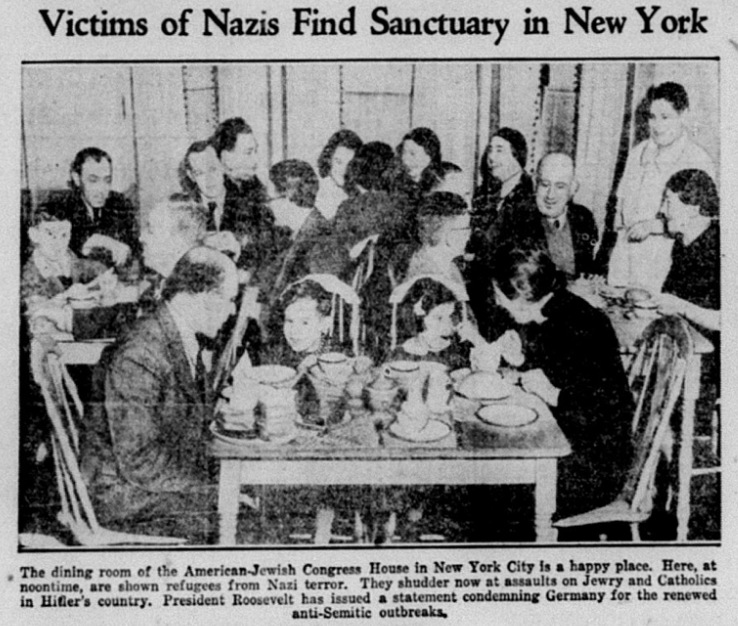
Some Jews who managed to escape Nazi Germany took refuge in other countries, including the United States. However, U.S. immigration law made it difficult for many Jews to come to America.
The Flood of 1938
By far, the most significant local event of 1938 was a massive flood. Following severe rainstorms, the Santa Ana river overflowed its banks and caused widespread damage, killing over 50 people.
“Water extended over an area of 30,000 square miles in Southern California’s rich agricultural districts today after the worst rainstorm and flood in a quarter of a century,” the News-Tribune reported.
Property damage was estimated at $10,000,000, and thousands were marooned by flood waters.
“Tragedy and desolation followed in the wake of an eight foot wall of water which swept through the banks of the Santa Ana river at the Yorba bridge to submerge Atwood [Placentia], La Jolla Camp, Anaheim and the south side of Fullerton,” the News-Tribune reported. “Water which swept houses, oil tanks and all obstructions aside swept down on Atwood and down Orangethorpe ave. forcing residents in many sections to take to their rooftops in a cold early morning rain while rescuers fought to save them from their dangerous quarters.”
The flood waters extended all the way to downtown Fullerton.
Local relief efforts were spearheaded by the Red Cross, local police and firefighters, and the American Legion. Shelters were set up in Hillcrest Park and St. Mary’s church for flood refugees.
Tragically, many of the victims of the flood were Mexican Americans living in citrus camps of south Fullerton, north Anaheim, and Placentia.
“Seven bodies were reported recovered at Atwood this morning. according to Chief of Police Gus Barnes at Placentia,” the News-Tribune reported. “Rescue workers with motorboats, rowboats and lifelines attempted to cross the river to the shattered cottages in which several hundred Mexican agricultural workers made their homes.”
The floods damaged or destroyed hundreds of homes, bridges, barrancas, and other infrastructure.
Flood Control
The 1938 flood was particularly tragic because county residents had twice voted down flood control bonds that might have minimized the damage. In 1937, following a smaller flood, voters approved the bond, but it was too late.
“Last year’s floods undoubtedly were a strong factor in the large vote given fro the Orange county flood control bonds. If there were any doubts as to the wisdom of the verdict, the floods of the past few days would resolve it,” the News-Tribune editorialized.
State and Local Politics
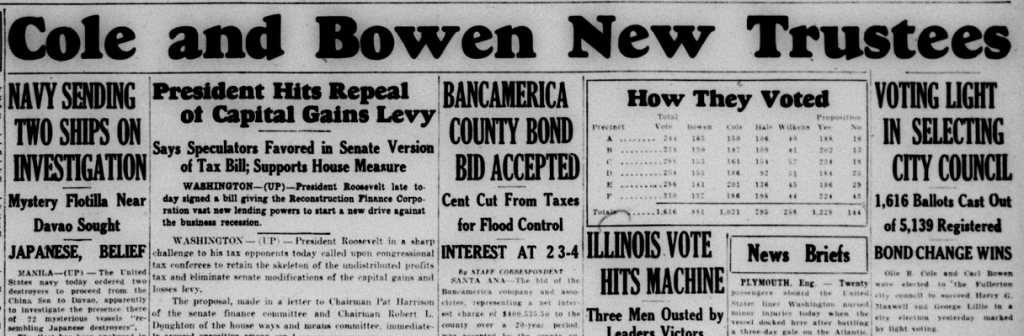
Olie Cole and Carl Bowen were elected to Fullerton City Council.
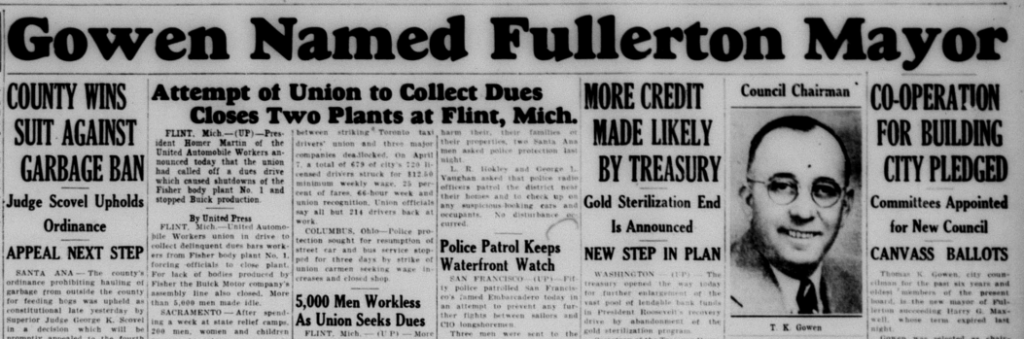
Thomas Gowen was named Fullerton’s mayor for 1938.
In state politics, Democrat Colbert Olson was elected governor. This was significant because he was the first Democrat governor of California in decades. He rode the wave of Roosevelt New Deal politics, which were increasingly popular during the Great Depression.

Sports
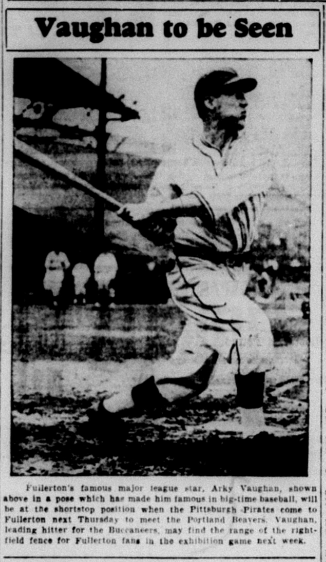
Hometown hero Arky Vaughn, a professional baseball player, played a special benefit game at Amerige Park. He hit a home run!
New Deal Projects
The Great Depression was still in full effect, and the federal Works Progress Administration continued to provide funding for public works projects in Fullerton (built by local unemployed men), including a new building at Fullerton College and a new library, to replace the old Carnegie Library (now the Fullerton Museum Center).
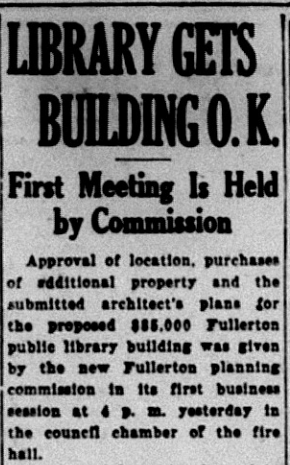
Building an official City Hall was a contentious issue, with plans made and then scrapped to build it next to the California Hotel (now Villa Del Sol), and at Amerige Park.
However, the project got renewed energy with WPA funding, and a new plan to build it on the northeast corner of Highland and Commonwealth avenues (the Fullerton Police Station today).
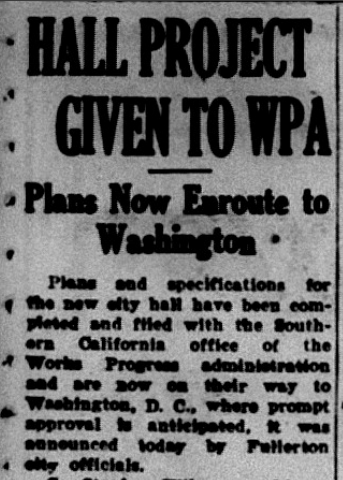
Some local residents still sought to block the project, even circulating a petition to prevent it.

However, ultimately, the petition failed to gather enough signatures.
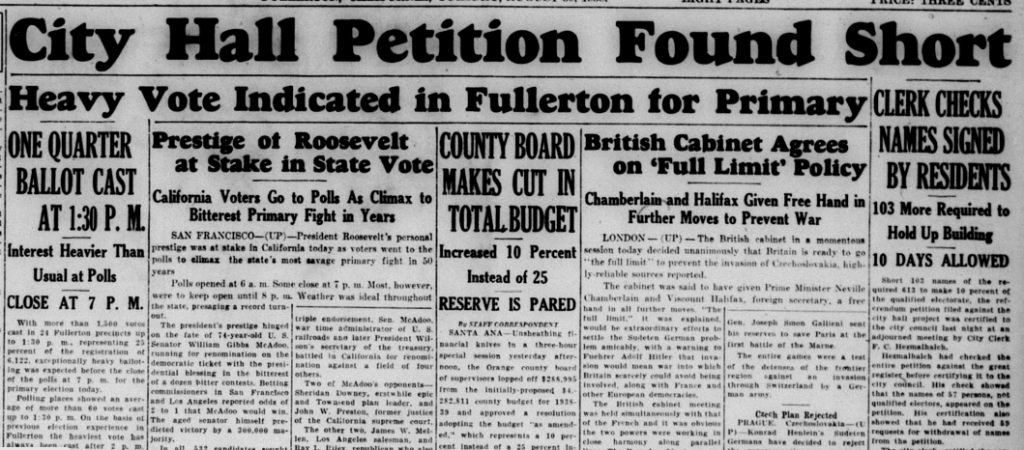
The City Hall project was finally moving forward.
Deaths
Paul J. Nicolas, son of pioneer rancher Pierre Nicolas, died.
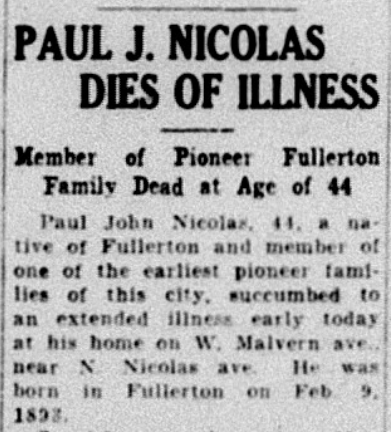
Former mayor Bert Annin died.

In addition to his activities as a veteran citrus grower of Fullerton, Annin was a director of the First National Trust and Savings bank, a director of the Anaheim Union Water Company, and had served as a city councilman and for two years as mayor of the city of Fullerton. He was an active member of Fullerton Odd Fellows lodge and of Fullerton Rebekah lodge.
Miscellaneous
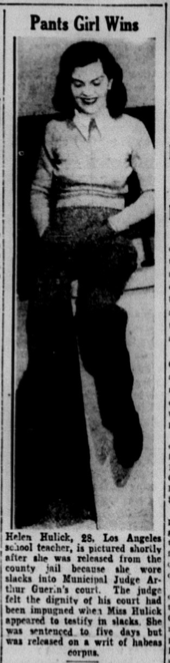
And here are a couple of fun miscellaneous articles from 1938:

Stay tuned for more stories from 1939!
-
Fullerton in 1937
The following is from a work-in-progress about the history of Fullerton. You can support my ongoing research and writing on Patreon.
The Local History Room of the Fullerton Public Library has microfilm from the Fullerton Daily News-Tribune newspaper stretching back to 1893. I am in the process of reading over the microfilm, year by year, to get a sense of what was happening in the town over the years, and creating a mini archive. Below are some news stories from 1937.
National and International News
Fascism continued to gain strength in Europe, mostly in Germany (under Adolf Hitler) and Italy (under Benito Mussolini), threatening democratic countries.

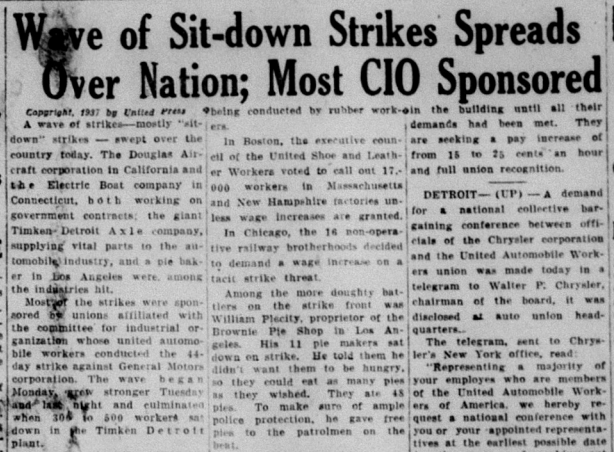
In the midst of the Great Depression, a major wave of labor strikes occurred throughout the country.
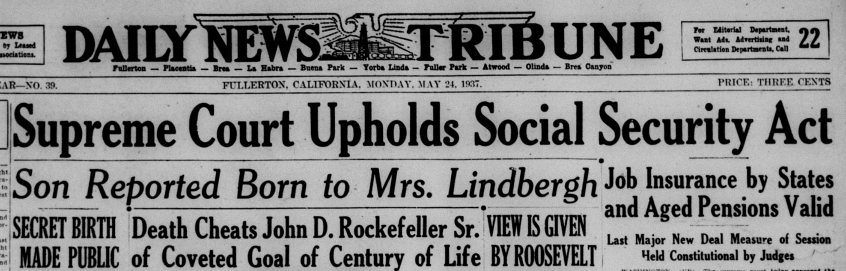
The US Supreme Court upheld the constitutionality of the Social Security Act.
Depression Relief Efforts
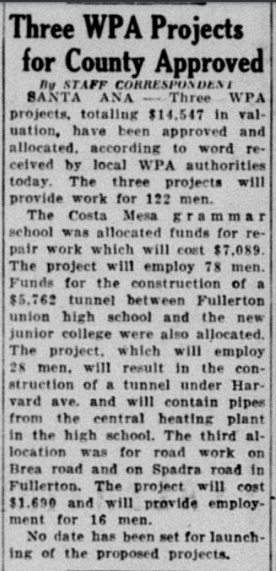
The Great Depression was still in effect. Federal relief programs like the Works Progress Administration (WPA) gave public works jobs to unemployed locals. One such project in 1937 was construction of the famous underground tunnels connecting Fullerton High School and Fullerton College. To learn more about all the WPA projects that benefited Fullerton, check out my article HERE.
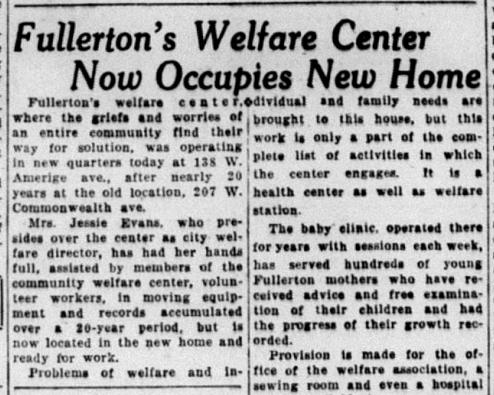
Fullerton also established a new Welfare Center to assist the poor and unemployed.
Local Politics
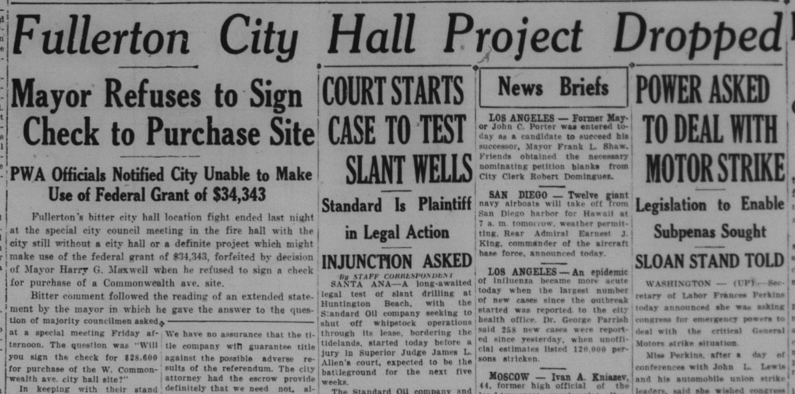
Disputes over the location of a new Fullerton City Hall led to Council dropping the proposal (for now).
The first woman, Sidney Chapman, was elected to the High School Board of Trustees.

Arts & Culture
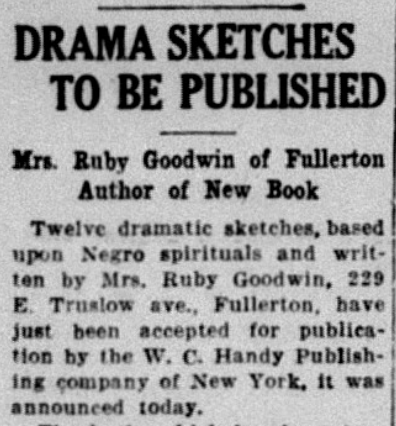
African American Fullerton author Ruby Berkley Goodwin published a book of dramatic sketches based upon Negro spirituals, in collaboration with composer William Grant Still, whose “Afro-American Symphony” was the first to be published by an African American.
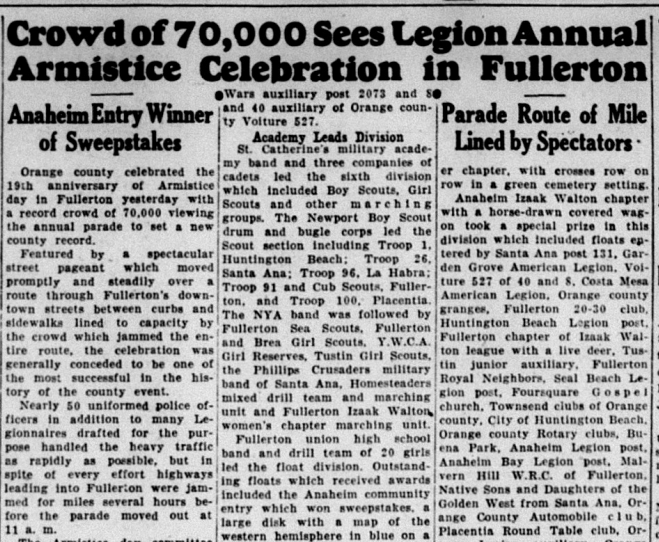
70,000 visitors came to see a massive Armistice Day parade through downtown Fullerton.
Agriculture
A cold spell led to frost that damaged the city’s citrus crop.

Maria Bastanchury, widow of pioneer rancher Domingo Bastanchury, was in a legal battle with the Times Mirror Company, over a mortgage on the sprawling ranch, which had gone into receivership and possible bankruptcy.

Flood Control
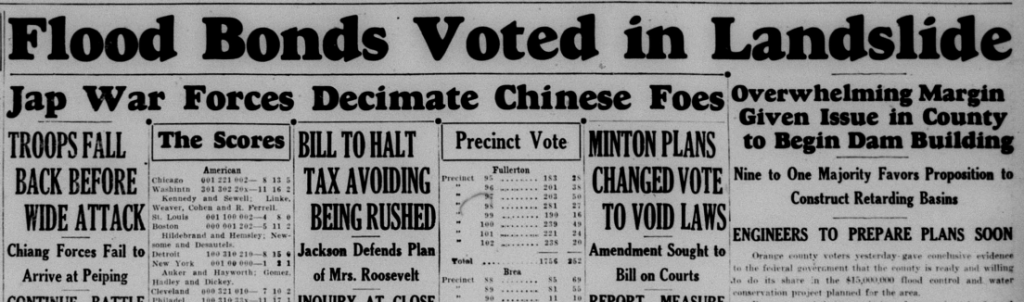
Another flood led to yet another attempt to pass a countywide flood control bond, which voters hard turned down at least twice.
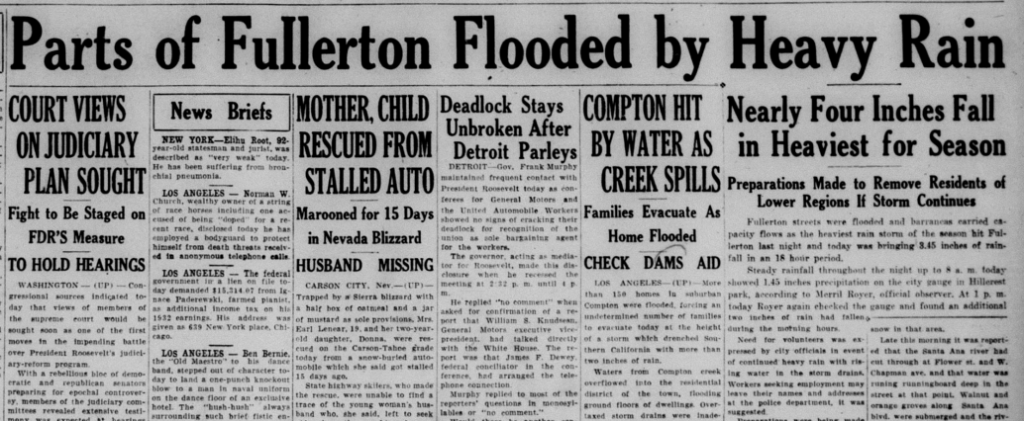
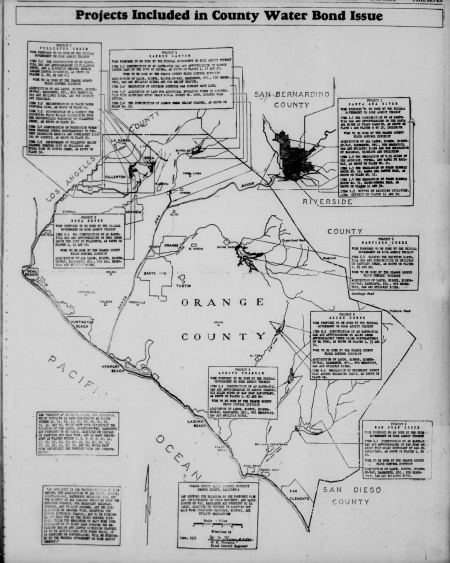
This time the bond issue finally did pass. Plans were drawn to erect dams and channelize flood control channels, including Brea and Fullerton Creeks. But was it too late? The 1938 flood was coming. Would the dams be built in time? Would they be enough? Stay tuned!
Labor Strikes
Workers in the Mississippie Glass Plant in Fullerton went on strike, demanding better pay and working conditions.
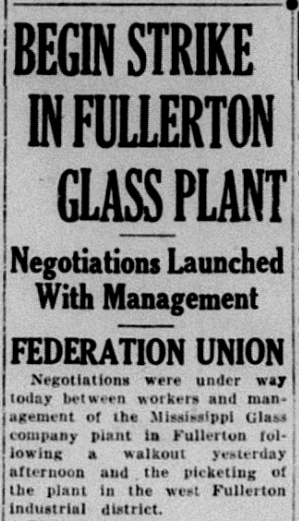
Eventually an agreement was reached with management, ending the strike.
Sports
Baseball games at Commonwealth (now Amerige) Park were hugely popular. The Portland Beavers did their spring training there.

City Celebrates 50 Years
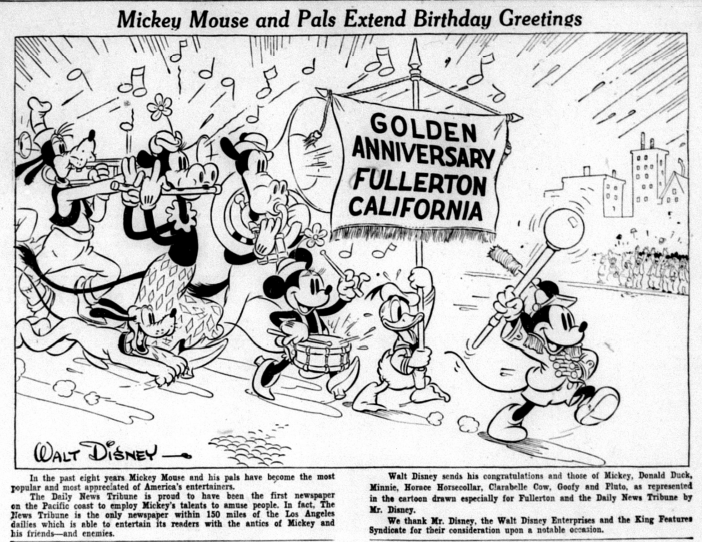
Fullerton celebrated its 50-year anniversary with a huge three-day program, including “a colorful historical pageant including a cast of approximately 1,000 residents” which took place in the FUHS stadium and auditorium.

In addition to the pageant and baseball games, there was a coronation ball for the Golden Jubilee queen and “Miss Columbia,” Pearl McAulay Phillips and Mary Catherine Morgan.
The pageant, called “Conquest of the Years” featured scenes from local history, from Native Americans to the expedition of Don Gaspar de Portola, Spanish/Mexican hacienda days, Basque sheepherders, the appearance of town founders the Amerige brothers, to the first buildings, schools, and churches built.
“Conquest” feels like an appropriate sentiment for how Americans at this time saw their place in history. They were the latest proud beneficiaries of a series of conquests. Today, some Americans view this aspect of our history with ambivalence, perhaps not wanting to highlight the “conquest” part. But that is, unfortunately, the best way to describe how we came into possession of so much land, which had other owners before us.
A special 60-page issue of the News-Tribune featured several in-depth articles about the City’s history.

Deaths
Dallison “Dolly” Linebarger, a resident of Fullerton for nearly 40 years, died at his home at 333 E. Amerige ave.
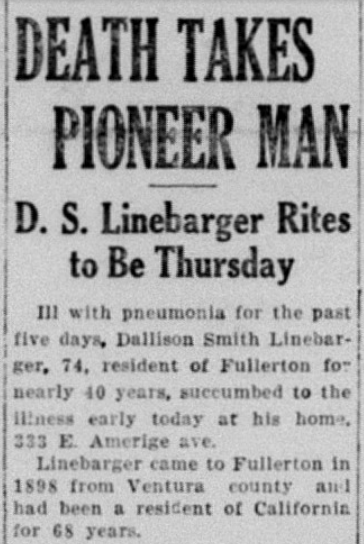
Linebarger came to Fullerton in 1898 from Ventura county and opened a livery stable. He was the first county supervisor from Fullerton, a position he held for 10 years. He was a founding member of Fullerton Odd Fellows lodge.

Joseph P. Des Granges died at age 80 from suicide.
Joseph’s father Otto des Granges, a native of Prussia, came to Fullerton in 1873, before the town was founded, and purchased 80 acres of land bounded by what is now State College and Acacia Avenue on the east and west and by Chapman Avenue and Commonwealth Avenue on the north and south. The property was devoted first to general farming and later to walnut and orange production.
Joseph was instrumental in setting up Anaheim’s modern electric light system, and setting up a grist mill in that town. He was considered an authority on weather conditions.
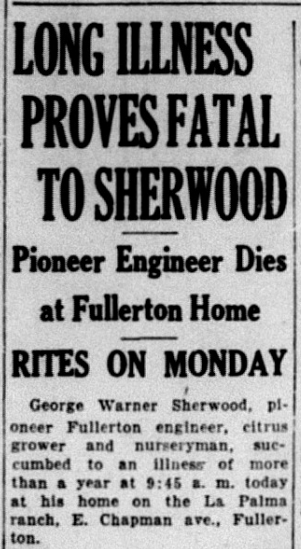
George W. Sherwood, pioneer Fullerton engineer and citrus grower, died.
Born in New York in 1862, Sherwood embarked on a storied career after graduating from college–as a railroad engineer in Oregon, teacher in Hawaii, engineer for the Nicaragua Canal Construction company, among other interesting posts.
He moved to California in 1891, by way of Panama, and acquired citrus and walnut properties in Fullerton, where he lived until his death.
Sherwood was a director and engineer of the Anaheim Union Water company for 20 years before resigning in 1920. He was a member of several societies, including the American Society of Civil Engineers, the Tri-counties Reforestation committee, and was a charter member of the prestigious Jonathan club of Los Angeles.
Stay tuned for more news from 1938!
-
Local Notables: Dan O’Hanlon
The following is from a work-in-progress about the history of Fullerton. You can support my ongoing research and writing on Patreon.
In a dark time in local history, businessman Dan O’Hanlon spoke out against the forces of white supremacy and religious intolerance. With a simple proclamation of “Liar!” at a Klan rally 1924, he challenged the KKK, and likely gave others the courage to do so.

Dan O’Hanlon was born in England in 1887. During World War I, He served in the British army, at the front for nearly two and half years.
He married his wife Margaret (an American) in England and, after the War, they moved briefly to Nebraska before coming to Fullerton in 1920 at the request of his brother-in-law, Tom Eadington, who worked in the local citrus industry.
He slowly built up an insurance, accounting, and realty business. Meanwhile, he and his wife had seven children: Margaret, Daniel, John, Eileen, Mary, Thomas, Kathleen, Marjoria, and Larry.
He was a civic-minded businessman, serving as secretary of the local Kiwanis Club, director of the Chamber of Commerce, secretary of the Orange County Democratic Central committee, and president of the Holy Name society at St. Mary’s Catholic Church.
In 1924, when he was 37 years old, O’Hanlon found himself in the eye of a storm as the Ku Klux Klan was amassing lots of members, power, and popularity locally.
In 1924, the Ku Klux Klan was experiencing a massive resurgence, with an estimated 5 million members, even outside the South. It became a major force in politics.

In Anaheim, four KKK members were elected to City Council. In Fullerton, many prominent leaders joined the hooded order. The Klan painted a large “KIGY” (Klan I Greet You) sign over Spadra (now Harbor) in Fullerton.
According to the Fullerton News-Tribune, “there is a membership of from 2500 to 3000 [Klan members] in this territory.”
Crosses were burned on the hills above town. Ku Klux Klan rallies drawing thousands took place throughout Orange County in 1924, including at least two large meetings at what is now Amerige Park, across the street from City Hall.

1924 advertisement for KKK rally in Fullerton from the Fullerton News-Tribune. Perhaps out of curiosity, Dan O’Hanlon attended one such rally.
O’Hanlon, who was Catholic, was unhappy with the Klan speaker’s denunciations of catholicism, so he shouted “Liar!” during the speech.
This led to cries of “get that guy” and “where is a tar bucket?” from different parts of the crowd. O’Hanlon was taken by police officers, for his own safety, and booked him briefly at the city jail. He was released later that night, and according to an oral history interview with O’Hanlon’s wife Margaret, a cross was burned on their lawn that night.
“They burned their crosses in front of our house in the middle of the night. It scared me to death,” Margaret said. “I heard a couple of shots that went off and that waked me. Dan wanted to go out and I said, ‘No don’t,’ and I said ‘Just stay indoors.’ So in the morning before it was light, I went out and moved this burnt cross and threw it out.”
It was because of local residents like O’Hanlon, who spoke up against the Klan, that its popularity began to wane. Not long after O’Hanlon called out the rally speaker, the Rotary Club issued a public denunciation of the Klan.
To read more about the Ku Klux Klan in Orange County, including the individuals and groups that resisted, read my article HERE.

-
George Amerige on the Founding and Early Growth of Fullerton
The following is from a work-in-progress about the history of Fullerton. You can support my ongoing research and writing on Patreon.
In 1937, Fullerton celebrated its “Golden Jubilee” 50th anniversary with a three-day event featuring a massive historical pageant play, displays of historical artifacts and photos, and other social events. The Fullerton News-Tribune (which usually ran about eight pages), released a massive 60-page edition featuring an impressive array of articles profiling notable local figures and institutions. One of those articles was written by 82-year-old George Amerige, co-founder of Fullerton. Here is Amerige’s article, along with some historic photos courtesy of the Fullerton Public Library.
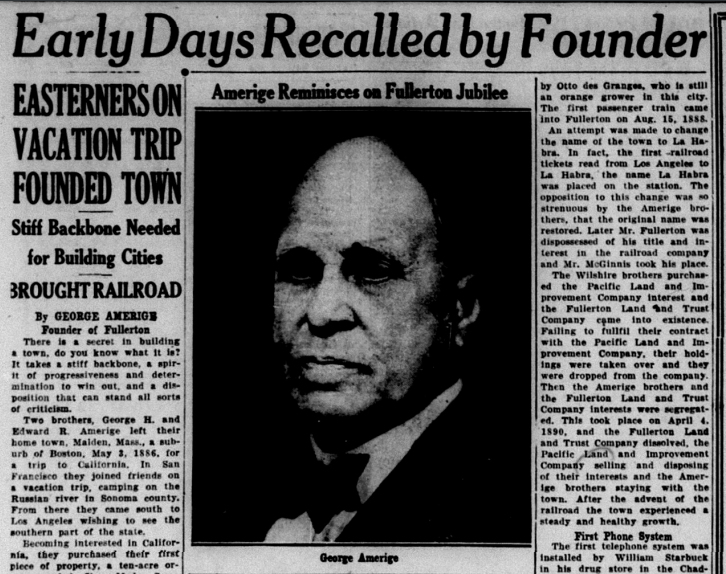
There is a secret in building a town, do you know what it is? It takes a stiff backbone, a spirit of progressiveness and determination to win out, and a disposition that can stand all sorts of criticism.
Two brothers, George H. and Edward R. Amerige left their home town, Malden, Mass, a suburb of Boston, May 3, 1886, for a trip to California. In San Francisco they joined friends on a vacation trip, camping on the Russian River in Sonoma county. From there they came south to Los Angeles wishing to see the southern part of the state.
Becoming interested in California, they purchased their first piece of property, a ten-acre orange ranch in Sierra Madre. Some friends form the east visited them there and persuaded them to rent this ranch home for the winter. The Amerige brothers then came to the coast for the duck shooting, which they had been informed was good. They made their headquarters at the Planters hotel in Anaheim, going down into the Westminster marshes to hunt.
Decided to Stay
This visit to the coast convinced them of the possibilities of this section of the country, so they went back to Sierra Madre, sold their ranch, and with their horses and bird dogs came back to Anaheim to stay, establishing a real estate office in the Albers building.
Driving out from Anaheim in all directions to shoot quail and dove, they became interested in what is now the Fullerton district, and conceived and formulated a plan to start a town, thinking here, of all they places they had examined, would be the location for a successful and permanent municipality.
They negotiated for 390 acres of land from the Miles brothers, bought 20 actress from Joseph Franz, to square out the townsite they had in mind. When they learned that the California Central Railroad company, a subsidiary of the Santa Fe railroad, would soon build a line from Los Angeles to San Diego, passing through Orange County, then a part of Los Angeles county, the Amerige brothers waited on George H. Fullerton who, at that time, was president of the Pacific Land and Improvement Company and also the “right-of-way” man for the railroad, who informed them that several surveys had been made, but none of them would take in their tract of land. By offering him a right-of-way thorough their land and an interest in the town-site, they prevailed upon him to change the survey to bring the railroad through their land and south into Anaheim.
May 14, 1887
Upon receipt of all deeds and titles to their land on May 14, 1887, they proceeded to form a closed stock company, consisting of the Amerge brothers, the Pacific Land and Improvement Company and the Wilshire brothers, who paid a bonus to come into the company. Up to this time much of the land had been rented by the Amerige brothers to a Frenchman named Morat for sheep grazing.

H. Gaylord Wilshire. The services of Frank Olmstead of Los Angeles were obtained to survey and plat the town-site. On July 5, 1887, the first stake was driven in a field of mustard at what is now the northeast corner of Commonwealth ave. and Spadra rd, in Hotel Block 21 by Edward R. Amerige. The building of the town and the selling of lots was on. The clearing of the land and grading the streets was done by the Fuller brothers, of the Pioneer Transfer Company, Los Angeles.
Then came discussion of a name for the town. It was urged that it be called Amerige for the Founders, but they did not wish this and suggested that it be named Fullerton. Then the Amerige brothers named the streets.

Spadra (now Harbor) and Commonwealth, 1889. Photo courtesy of the Fullerton Public Library Local History Room. Streets Named
Malden ave. and Highland ave. were selected for the town and street on which they were born, Amerige ave. for their family name, Commonwealth ave. for one of the finest avenues in Boston, Harvard for the college, Wilshire for the Wilshire brothers, Truslow for the general ticket agent of the Santa Fe Railroad, Northam ave. for Bob Northam, who at that time was agent for the Stearns Rancho Company, of which the town-site was part and parcel at one time. This avenue was later changed to Chapman. Whiting was named for Dwight Whiting owner of the El Toro Ranch, who was a friend of the brothers.
The first building was built by the Amerige brothers, on lot 8 block 29 for an office. Here they lived and transacted all their business of selling lots. This building is now in the Commonwealth city park, placed there by the historical section of the Ebell club.

The Amerige Brothers’ original real estate office is still there at Amerige Park. The first residence was built by George Amerige on lots 1 and 2 block 22, the corner of Amerige and Harvard aves. George Amerige also installed the first water system, employing Chinamen to do the excavation work on the ditches. Hooker Bros. supplied the water pipes and made the connections. The first well was drilled by Padderatz Bros. on Block 7 on Sept 26, 1887. The first water was raised by an old-fashioned hot air engine and later by a windmill.
First Building
The first building of any importance was the St. George Hotel, built in Hotel Block 21. This block has never been surveyed into lots. The hotel consisted of 65 rooms, construction of which was started Aug. 20, 1887, and finished Feb 28, 1888. The architects were Calkin and Haas and the contractor W.H. McKillian. The building alone cost $54,000 and the furnishings $15,000. The lumber was bought through W.T. Brown, who at that time was agent for the Griffith Lumber Company of Anaheim. Brown later established a lumber yard and planing mill in Fullerton which is now known as the Brown and Dauser Lumber Company.

St. George Hotel (Northeast corner of Spadra/Harbor and Commonwealth), 1890s. Photo courtesy of the Fullerton Public Library Local History Room. The first managers of the hotel were the Laidigs. They came from the Yosemite valley to Anaheim where George Amerige met them with a bus, as their family consisted of eleven children and two dogs.
The building owned by the Amerige brothers was sold in 1918 by George Amerige to the Whiting-Meade Wrecking Company for $1,300 and was razed to make room for business blocks which he later built.
Beazley Postmaster
The next building was built by H. Gaylord Wilshire on lots 25 and 26–at the corner of Commonwealth ave. and Spadra rd. Here the first grocery store was opened by Howell and Ford. This was also where the first postoffice was located with E.E. Beazley as the first postmaster. This was afterward the home of the first general department store, established by Stern and Goodman, who bought out the grocery store.

Stern & Goodman (Southeast corner of Spadra (Harbor) and Commonwealth), 1889. Photo courtesy of the Fullerton Public Library Local History Room. The next building was put up by Shindler, Schumacher and Grimshaw on lots 22, 23, and 24 block 28. These lots were given to them with the understanding they would build on them. Here the first drug store was established by William Starbuck, the first meat market by G.A. Brunswicker, and the first furniture store and undertaking parlor by a Mr. Brown.
In the second story of this building was held the first religious services, and a church organized with thirteen members, by Rev. F.R. Holcomb. He also officiated at the first wedding in town.
Chadbourne Block
The next building to be built was the Chadbourne block on lots 1,2,3 and 4 in block 20. These lots were also given with the understanding that buildings were to be put up on them. The contractor left town in the night with the buildings unfinished and hills unpaid, so George Amerige, who was bondsman for him, paid the bills and finished the building. This building was built for stores and a bank, with a public hall in the second story, and later became the home of the first bank established in Fullerton, which came into existence largely through the efforts of E.R. Amerige.
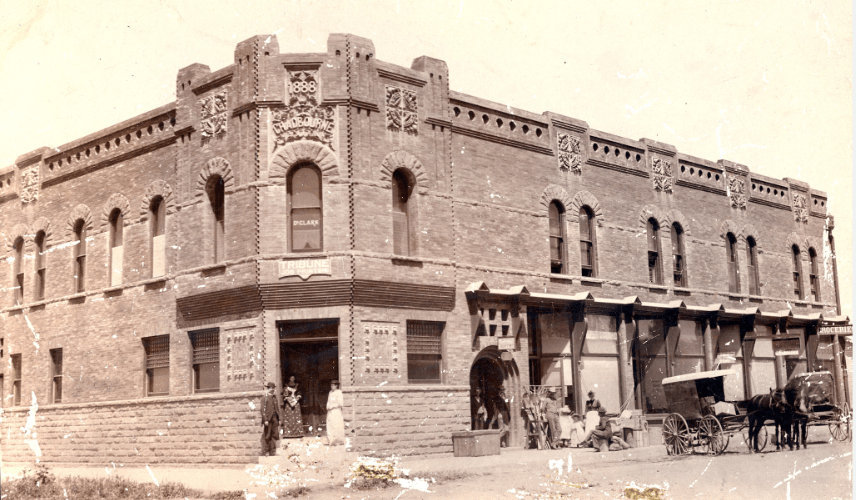
Chadbourne Building (Northwest corner of Spadra/Harbor and Commonwealth), circa 1890. Photo courtesy of Fullerton Public Library Local History Room. The first lumber yard to come to Fullerton was the Russel Lumber Company.
Canning Factory
In March 1888, a canning factory was built and operated by the Joslyn brothers.
The first livery stable was established by Jonathon Kraemer, in February, 1888, who was also building a cottage at the time. This was a very necessary asset to a town, as these were the “horse and buggy days” and the railroad had not yet reached Fullerton.

Downtown Fullerton, circa 1890. Photo courtesy of the Fullerton Public Library Local History Room. The first school was held in a little old wooden building on W. Commonwealth ave. in block 44. The teacher was Edwin Clark, whose daughter Norma was the first girl baby born in Fullerton. Roy Fullerton Schumacher, son of P.A. Schumacher was the first child born in Fullerton, April 7, 1888.
The first grade school was built on E. Wilshire ave. The first church building was erected at the corner of Wilshire and Pomona aves on lot 19-20 block 15 in 1889 with George Irwin as pastor.
The Amerige brothers had the first real estate office and insurance business.
Dr. George C. Clark was the first physician in Fullerton and is still practicing, with an office on Whiting ave.
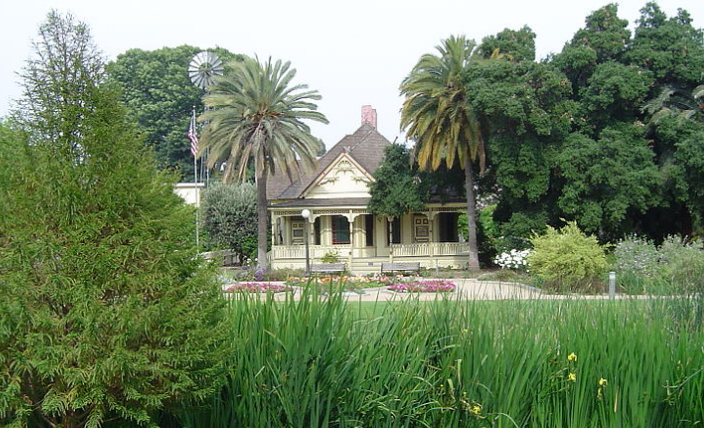
The Heritage House in the Fullerton Arboretum was once owned by Dr. George Clark, the first physician in town. Street Lighting
The first street lighting system was installed in 1887. It consisted of a wooden lamp post and a coal oil lamp presented by the street lighter of Anaheim to George H. Amerige, who brought it on his shoulder from Anaheim to Fullerton, walking all the way, and he installed it at the southeast corner of Commonwealth ave. and Spadra rd.
The first newspaper, a weekly called “The New Era,” was published by Mr. Field in 1888. This was first printed in Anaheim, but because of an interest held by George H. Amerige, it was later moved to Fullerton. About the same time the “Fullerton Star,” edited and published by Clark Hagaboon came to town. The first issue of this paper is now in the possession of George Amerige. These papers soon went out of existence and later Edgar Johnson started a weekly Tribune which was soon changed to a daily paper. This paper is now being published under the name of the Fullerton News-Tribune, one of the best papers in Orange County, and is owned and published by W. Kee Maxwell.
First Train
Fullerton did not receive any natural benefit from the boom, for, before the advent of the railroad, the boom was over. The railroad was delayed by heavy storms which made transportation a problem. Lumber for the depot was hauled from San Pedro by Otto des Granges, who is still an orange grower in this city. The first passenger train came into Fullerton on Aug. 15, 1888.
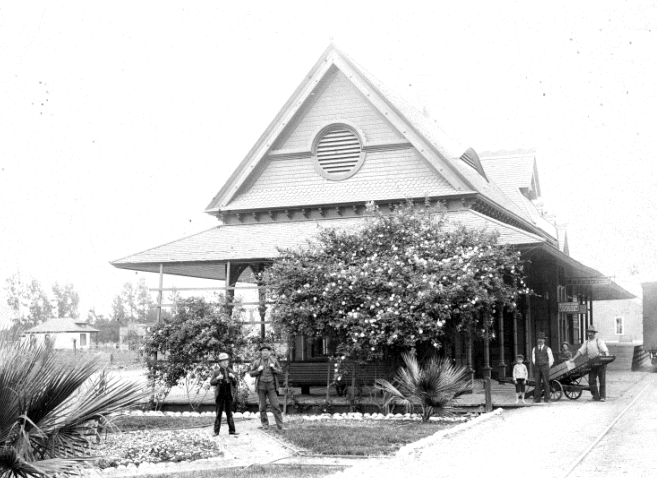
Fullerton Train Depot, 1906. Photo courtesy of the Fullerton Public Library Local History Room. An attempt was made to change the name of the town to La Habra. In fact, the first railroad tickets read from Los Angeles to La Habra, the name La Habra was placed on the station. The opposition to this change was so strenuous by the Amerige brothers, that the original name was restored. Later Mr. Fullerton was dispossessed of his title and interest in the railroad company and Mr. McGinnis took his place.
The Wilshire brothers purchased the Pacific Land and Improvement Company interest and the Fullerton Land and Trust Company came into existence. Failing to fulfill their contract with the Pacific Land and Improvement Company, their holdings were taken over and they were dropped from the company. Then the Amerige brothers and the Fullerton Land and Trust Company interests were segregated. This took place on April 4, 1890, and the Fullerton Land and Trust Company dissolved, the Pacific Land and Improvement Company selling and disposing of their interests and the Amerige brothers staying with the town. After the advent of the railroad the town experienced a steady and healthy growth.
First Phone System
The first telephone system was installed by William Starbuck in his drug store in the Chadbourne block. The first blacksmith shop was established by A. Pendergrast, the first restaurant was opened by Mrs. Dierkson, and P.A. Schumacher was the first nurseryman. George Case had the first plumbing shop and the first hardware store was established by Buchanan and Lelpe.
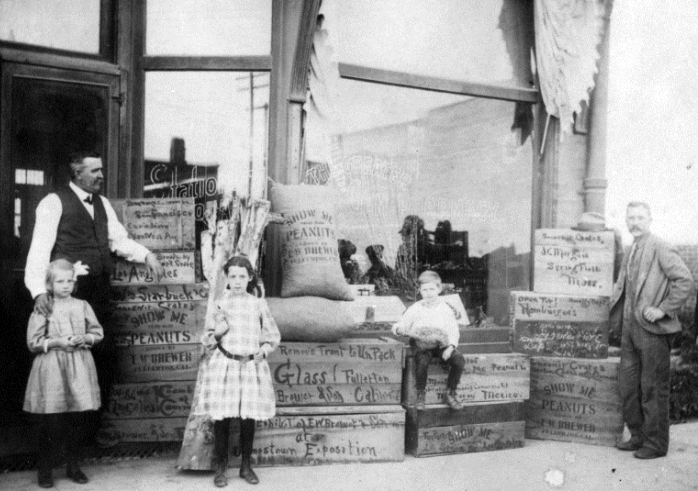
William Starbuck (at left) outside his Gem Pharmacy. Photo courtesy of the Fullerton Public Library Local History Room. Through the efforts of E.R. Amerige, Wm. McFadden, Dr. George C. Clark, Arthur Staley and others, a Masonic lodge was organized and a building erected on the corner of Amerige ave. Spadra rd. in block 17.
To the loyalty and support of many whose names are not mentioned here, we owe, to a great extent, the wonderful progress and growth of our town. Only a few of our original townspeople remain, as many of moved away and some have passed on.
Incorporated in 1904
Fullerton was enlarged and incorporated as a sixth class city July 15, 1904, and embraced 18 square miles, with a population of 3,000 people at this time.
The first trustees to be elected were E.R. Amerige, Dr. George C. Clark, J.R. Gardiner, E.K. Benchley and C.C. Chapman. Mr. Chapman was elected president of the board.

Charles C. Chapman, Fullerton’s first mayor. At the present time the population is 13,000. Fullerton now owns its own water plant, has a fine lighting system, its out-fall sewer to the sea and the best of paved streets. There are many packing houses and other industries. Fullerton has many fine buildings, good hotels, a fine library, theater, a beautiful clubhouse and all the lodges and societies are represented. There are three banks: the Security First National and F.C. Krause manager, the Bank of America with Harry Smith manager, and the First National Trust and Savings bank with Harry Williams manager.
It has the best of transportation facilities with three railroads and a bus line entering the city. Is it any wonder we are proud of this beautiful city and the wonderful growth it has made!
E.R. Amerige Death
E.R. Amerige, one of the brothers who founded this city, passed away May 3, 1915, after serving is city as one of the first trustees, and on the school board. He was president of the Anaheim Union Water Company in 1893, and was elected assemblyman for this district in 1903 and again in 1905. He was a Mason and Knight Templar.
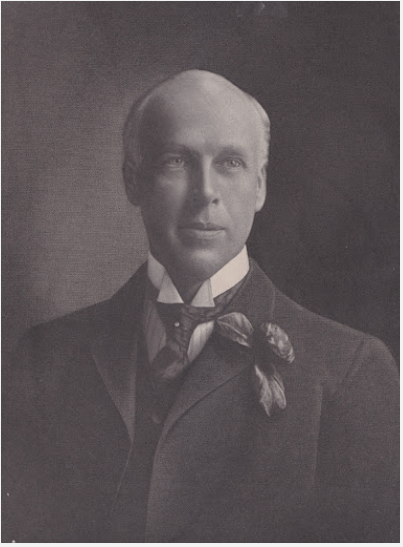
Edward R. Amerige. George H. Amerige is still living and active at the age of 82, still working and making improvements.
He is the nephew and namesake of George Amerige who came to San Francisco in 1849, who in 1850 owned and operated a printing establishment. He introduced the first steam power press into San Francisco and at one time nearly all the newspapers issued in that city were printed in his office.
I have had to leave out many interesting instances, not knowing where to end. I am placing original contracts, deeds, and many early interesting pictures on exhibition at the D.A.R. headquarters, 109 E. Commonwealth ave.
We celebrate our “Golden Jubilee,” the 50th anniversary of the founding of Fullerton on May 14, 1937.
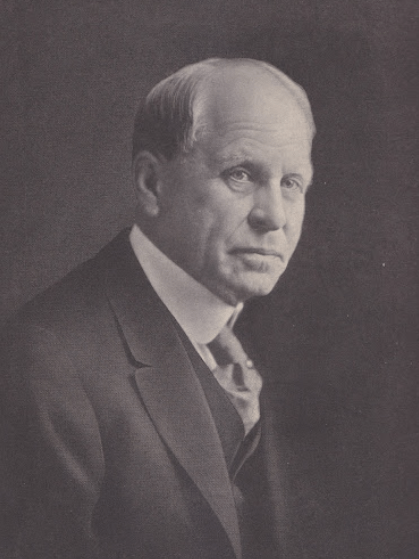
George H. Amerige. -
Early Settlers: William Starbuck
The following is from a work-in-progress about the history of Fullerton. You can support my ongoing research and writing on Patreon.
In 1937, Fullerton celebrated its “Golden Jubilee” 50th anniversary with a three-day event featuring a massive historical pageant play, displays of historical artifacts and photos, and other social events. The Fullerton News-Tribune (which usually ran about eight pages), released a massive 60-page edition featuring an impressive array of articles profiling notable local figures and institutions. One person featured was William Starbuck, Fullerton’s first druggist, librarian, first telephone company representative, first high school trustee, first undertaker, and probably more. Here’s a bit more about Starbuck.

William Starbuck (at left) outside his Gem Pharmacy circa 1900. Photo courtesy of the Fullerton Public Library Local History Room. Mr. and Mrs. William Starbuck opened a drug store in Fullerton in the 1890s, just after the town of Fullerton was founded.
Because there were so few other stores here at that time, the Starbucks sold many other items besides drugs, including school books, Christmas toys, and much more.
“The Starbucks had the first soda fountain here and were amused at seeing school children waiting to touch the ice, inasmuch as many of them never before had seen ice,” the News-Tribune states.
The Starbucks started the first library in Fullerton, located in the back room of their drug store, with couches for guests to sit on and read.
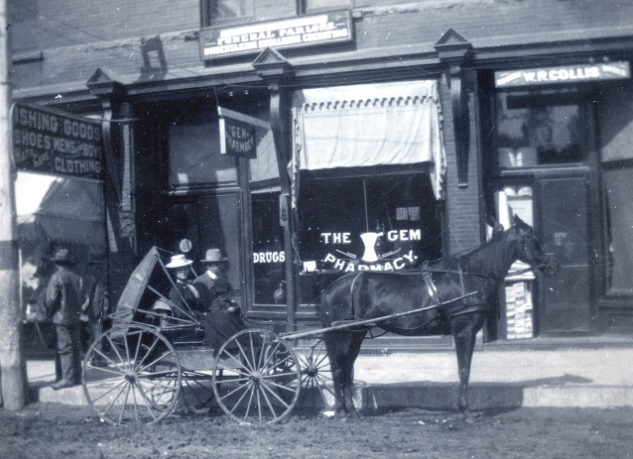
Horse and buggy outside the Gem Pharmacy, circa 1890s. Photo courtesy of the Fullerton Public Library Local History Room. Starbuck managed the first telephone system in Fullerton and under his management, the system grew to include Placentia, Yorba Linda, Brea, La Habra, and Buena Park.
Starbuck was also instrumental in the formation of Fullerton Union High School, and served as a high school trustee for 15 years.
Starbuck established the first undertaking business in the city after taking an embalming course in Los Angeles.
He was also involved in establishing Fullerton’s first hospital.
Unfortunately, there was a darker side of William Starbuck. In the 1920s, he (along with many local notables) was involved with the Ku Klux Klan.
In 2011, OC Weekly editor Gustavo Arellano wrote a piece on Starbuck as part of his series “Profiles in OC Pioneers Who Were Klansmen.”
“The druggist also helped lead the efforts to protest Mexicans moving into Fullerton, sat on a school board that created Mexican-only schools, and played a prominent role in an episode involving the Klan, corruption, and city officials,” Arellano wrote.
Click HERE to read that piece.
In 1937, Mr. and Mrs. Starbuck were retired and living on their ranch at S. Highland and at Maple avenues.
The Gem Pharmacy was located approximately where Kentro Greek restaurant on the 100 block of East Commonwealth is today.
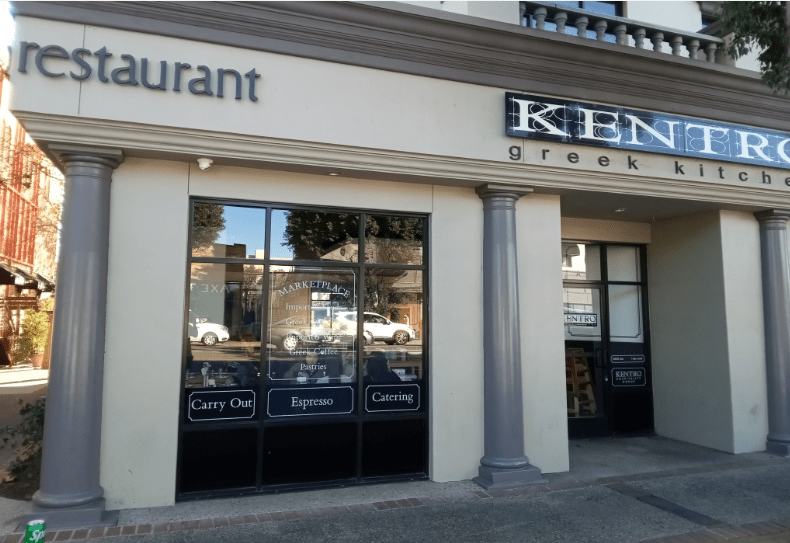
Kentro Greek Kitchen, 2024. Photo by the author. -
Fullerton in 1936
The following is from a work-in-progress about the history of Fullerton. You can support my ongoing research and writing on Patreon.
The Local History Room of the Fullerton Public Library has microfilm from the Fullerton Daily News-Tribune newspaper stretching back to 1893. I am in the process of reading over the microfilm, year by year, to get a sense of what was happening in the town over the years, and creating a mini archive. Below are some news stories from 1936.
National and International News
Fascism was becoming more firmly entrenched in Europe, with Adolf Hitler in Germany, Benito Mussolini in Italy, and the nationalist forces of Francisco Franco in Spain. Germany hosted the Olympics, at which American runner Jesse Owens famously won three gold medals, challenging Hitler’s notions of Aryan racial superiority. Franklin D. Roosevelt was elected to a second term as U.S. president in a true landslide victory.

Thanks in part to Roosevelt’s New Deal policies which sought to help Americans suffering through the Great Depression, nearly all states had a Democratic majority.

The New Deal established things like social security to provide a safety net for citizens. It was an unprecedented attempt to use the federal government to help Americans.
“When human distress reaches the point that government assistance is necessary, government up to the limit of its local, its state and its federal resources must and does act,” Roosevelt said in a 1936 speech.
Not everyone was happy with the New Deal. Big business oligarchs and conservative Republicans, as today, fought against federal programs to help the poor, with some calling it socialism or communism.
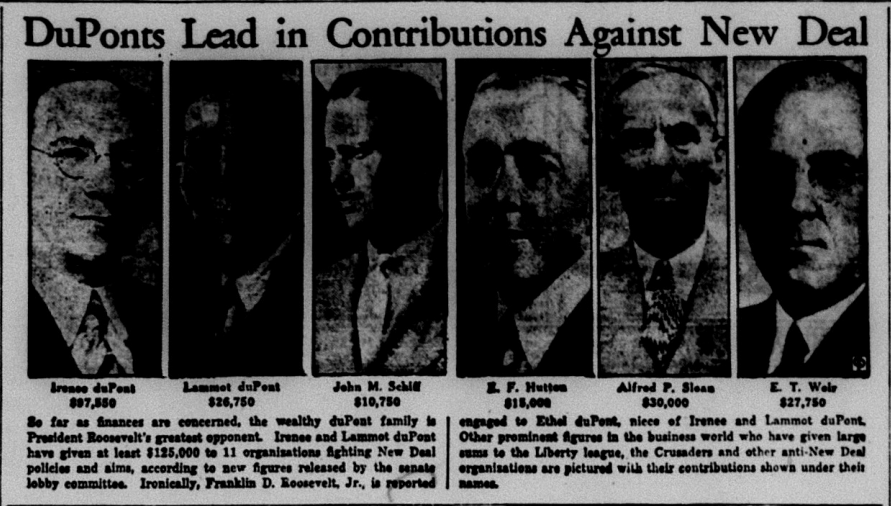


Local New Deal Projects
Fullerton benefited greatly from the New Deal. Some of the City’s most iconic and historic buildings were constructed by local residents using federal relief dollars. Projects completed in 1936 included improvements at Hillcrest Park (including the fountain), and the first building on the Fullerton College campus, the Commerce Building.
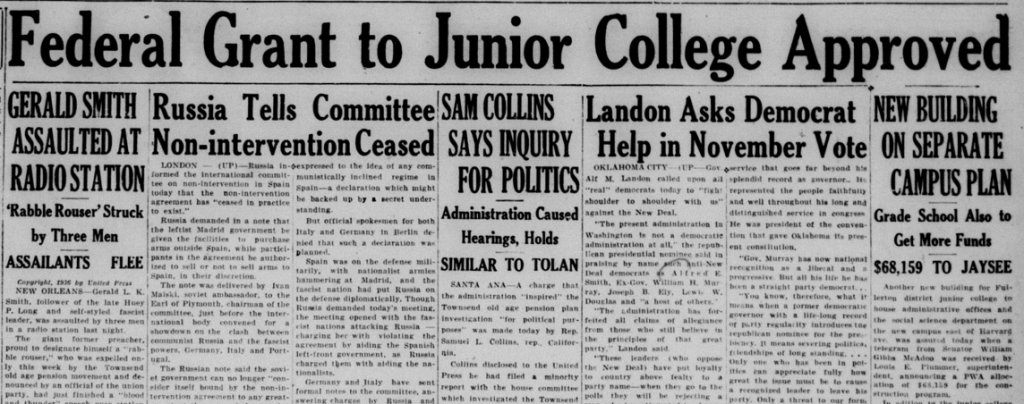

Whither City Hall?
Another project that received federal funds was the construction of City Hall.

Unfortunately, there was disagreement among City Council members regarding where to build the structure. Some wanted it to be built next to the California Hotel (now the Villa Del Sol), while others wanted it built at Commonwealth Park (now Amerige Park).
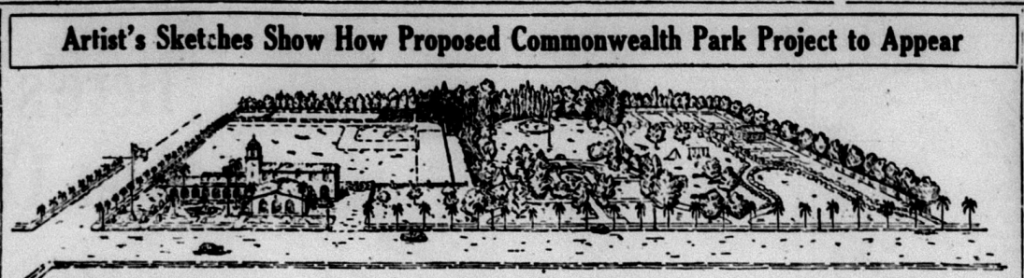
With City Council unable to agree on the Commonwealth site, the issue went to voters, who voted down that location.
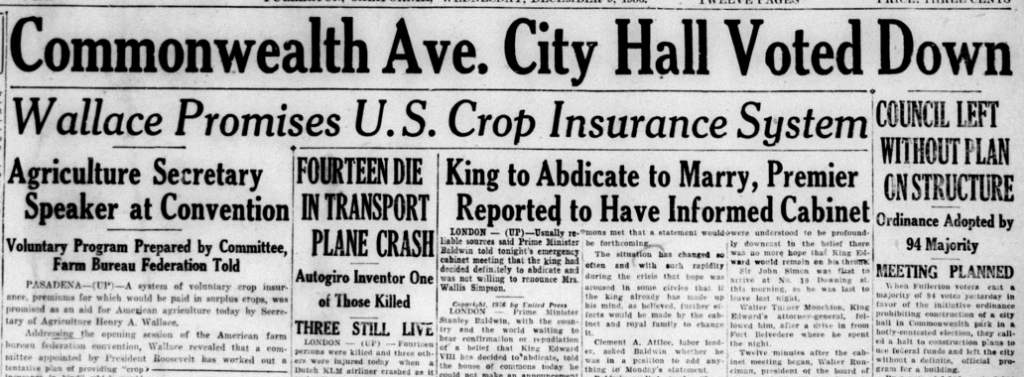
Because of all this disagreement, City Hall would not be built for another five years.
LA Police Seek to Keep Out the Poor
The financial troubles of the Great Depression led to a big increase in homelessness and poverty. The Los Angeles Police department took the extreme (and illegal) action of sending officers to the California border with neighboring states to block “Indigent Alien Transients” (aka, the poor) from entering California.

This led to widespread condemnation and ultimately legal action to prevent the movement of humans seeking to better their lot.
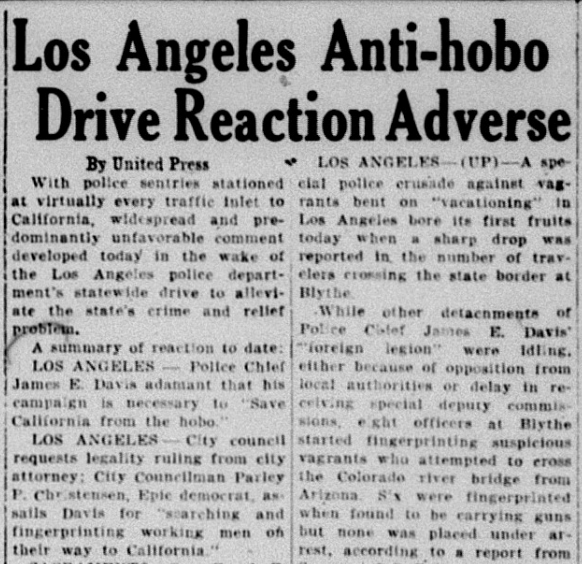

Actions such as this represent what historian Kevin Starr called fascist tendencies in Depression-era California.
“For a month at least, the entrepots of California, north, south, and central, seemed more like the border checkpoints of fascist Europe than those of an American state,” Starr writes in Endangered Dreams: The Great Depression in California.
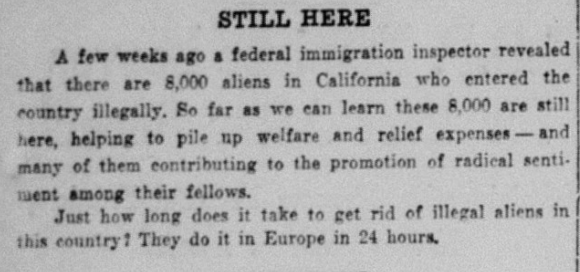
Efforts to keep out the poor also extended to Mexican immigrants. As has unfortunately happened throughout American history, hard times made immigrants convenient scapegoats for demagogues. In 1933, hundreds of Mexican farmworkers had been deported from Orange County.
The News-Tribune published editorials decrying the presence of “illegal aliens” and their supposed burden on taxpayers, despite the fact that Mexican farmworkers in particular were a foundation of the local economy.
The Murder of Francisco Gomez
Tensions between the Mexican community and the more affluent (and politically powerful) white community were inflamed when the dead body of 16-year old Francisco Gomez was found in a vacant lot in Placentia. The body had a .32 caliber bullet hole through the hip.
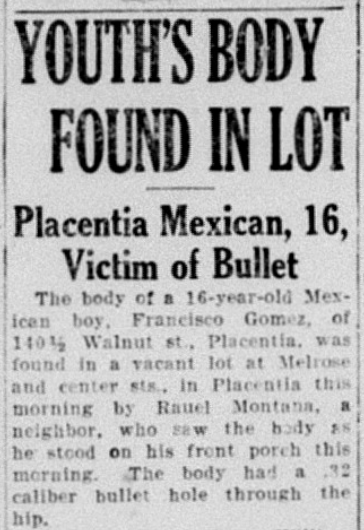
It was quickly learned that William Kraemer, of the wealthy Kraemer family, had shot Gomez whom he claimed was a “peeping Tom” outside the window of his home.
Kraemer was not convicted of any crime.

Hundreds of Mexican supporters of Gomez showed up at the courthouse to express their outrage.
The Citrus Strike
Throughout the 1930s, large scale labor strikes occurred throughout the United States, including in California. In 1936, the Mexican farmworkers of Orange County went on strike.
In his 1972 USC doctoral dissertation entitled The Orange County Citrus Stikes of 1935-1936: The Forgotten People in Revolt. Louis Reccow called it, “the largest and most violent citrus strike of the depression.”
Most of the Mexican pickers in Orange County lived in colonies, or “colonias,” which were segregated from the larger community.

In March strike leaders sent the growers of Orange County two lists of demands calling for better pay and working conditions as well as union recognition–demands which the growers ignored.
On June 11, as many as 2,500 workers went on strike.
The Fullerton News-Tribune characterized the strike leaders as outside agitators and communists. Police officers were organized to “protect” those who wanted to work from “threats of agitators.”
Sheriff Logan Jackson deputized hundreds of men. The American Legion and Veterans of Foreign Wars pledged their assistance to police and the growers.
During the strike, pickers who did not participate were escorted to work by armed guards.
“Police, deputy sheriffs and specially recruited deputies of police, sheriff and constables were in the field this morning keeping a constant watch for appearance of agitators,” the News-Tribune reported.
Scab crews and white students were hired to pick the oranges.
“From Placentia high school and Fullerton district junior college, scores of youths went today to orchards to take the place of the strikers,” the News-Tribune reported.
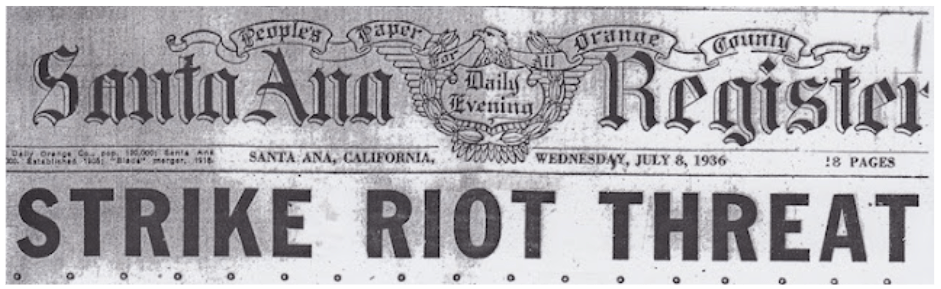
The first instance of “violence” occurred in Anaheim when striker Virginia Torres bit a police officer on the arm.
“Two hundred angry Mexican women spurned on the citrus picker’s strike today as the first riot call of the strike sent a score of officers into Anaheim early this morning to quell a disturbance led by the women,” the News-Tribune reported.
Torres and others were arrested.
Elsewhere, in Brea, strikers were arrested on flimsy grounds ranging from traffic violations to trespassing.
Charles McLaughlan, Orange county communist candidate for congress, was arrested on trespassing charges in the Mexican worker camp on Balcom in Fullerton. While the vast majority of strikers were not communist, there were some communists involved in the labor movement during the Great Depression.
Not long after McLauchlan’s arrest, some striking orange pickers were evicted from their homes in the worker’s camp.
Conflict between strikers, scabs, and law enforcement sometimes flared into violence.
“During the month of July (1936), northern Orange County experienced a kind of civil war,” Reccow writes. “Increased picketing, violence, armed deputies by the score, vigilante attacks, mass arrests and trials, shoot-to-kill orders, calls for State interference, along with California State Federation of Labor and federal government involvement–all contributed to the situation.”
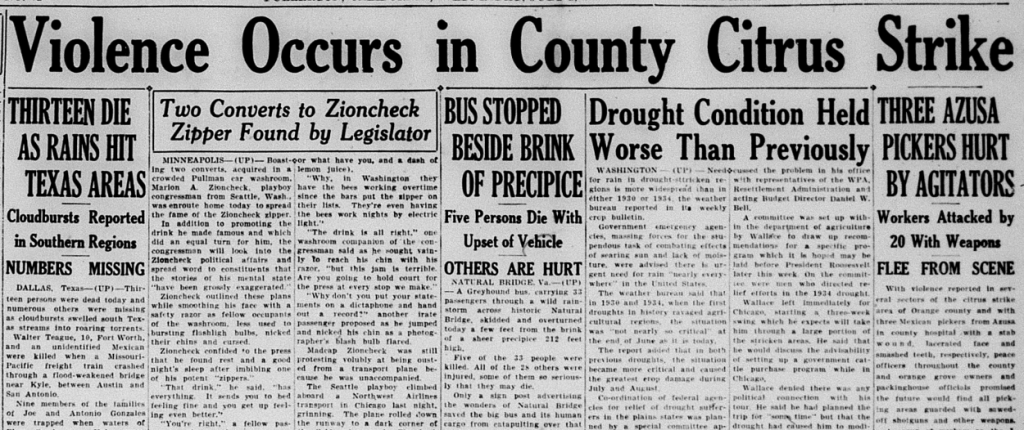
“With violence reported in several sectors of the citrus strike area of Orange county and with three Mexican pickers from Azusa in county hospital with a stab wound, lacerated face and smashed teeth, respectively, peace officers throughout the county and orange grove owners and packinghouse officials promised the future would find all picking areas guarded with sawed off shotguns and other weapons,” the News-Tribune reported.
“All Orange country was under heavy guard today as Sheriff Logan Jackson, following yesterday’s violence, began deputizing 170 additional special deputies to protect every picking crew and packinghouse in the county,” the News-Tribune reported.
The increased police presence did little to quell the conflict. In one day at the height of the strike, 159 Mexican strikers were arrested on charges of “rioting.”
As conflict and occasional violence continued, Sheriff Jackson issued a “Shoot to Kill” order to his men.
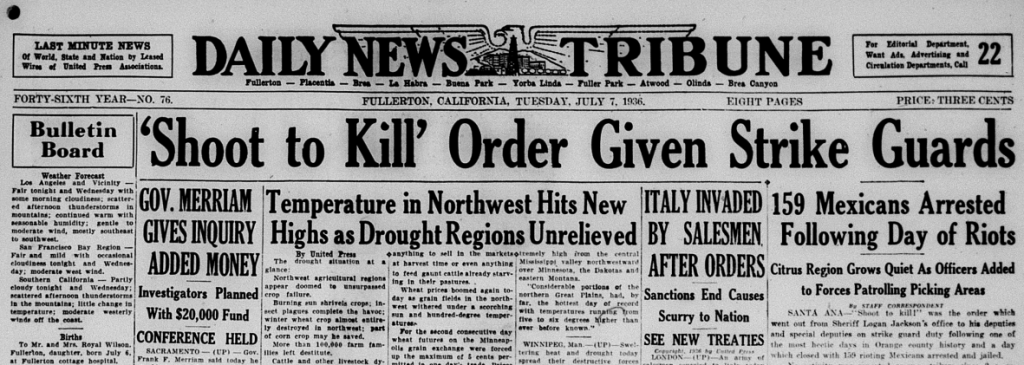
“New special deputies were being added rapidly to the sheriff’s office staff, which numbers 300 to 400 now, and 20 more California highway patrol officers were rushed here today from Los Angeles county to be added to 35 or 40 already on duty,” the News-Tribune reported.
In La Habra, 40 or 50 families were evicted from their homes on ranch property for participating in the strike.
In the conflict, the strikers had weapons like rocks and clubs. The police had tear gas guns, hand grenades, rifles, and shotguns.
Sometimes the police would arrest and jail Mexicans before any crime occurred.
“A strange parade it was from Placentia ave, at Pointsettia, near Anaheim, yesterday afternoon as California highway patrolmen and the sheriff intercepted 19 carloads of Mexicans, more than 100 in all, who said they were going to Orange for a meeting,” the News-Tribune reported. “The parade, enlarged by five more carloads intercepted in a neighboring road, ended at the jail.”
On July 8 the 119 Mexicans arrested on rioting charges were arraigned in the open courtyard behind the Fullerton courthouse under heavy guard from state highway patrol officers and deputy sheriffs armed with sub-machine guns and sawed off shotguns.
A couple weeks later this large group was again transported to Fullerton.
“The Odd Fellows Temple, selected by law officials as the site of the hearing for security reasons, soon resembled an armed fortress. Men armed with submachine guns, riot guns, revolvers, and clubs guarded all exits and entrances,” the News-Tribune reported.
Part of the reason the strike continued was because of the growers’ insistence that the strike was not a result of legitimate grievances, but rather part of some nefarious communist plot.
“Dr. W.H. Wickett of Fullerton, a member of the publicity committee of the growers organization, said today that the growers have definitely learned that the strike is not a walkout merely for the betterment of pickers but is directed and abetted by communist headquarters for the purpose of fomenting strife in the interests of communism,” the News-Tribune reported.
In fact, the workers’ demands, which were publicly sent to the growers well before the strike, had nothing to do with communism, and everything to do with improving pay and working conditions.
Whether growers like Wickett actually believed the strikers represented a communist threat or they were simply seeking to tarnish the strikers so as to avoid having to treat their workers better, is hard to say.
It wasn’t just the police who sought to disrupt and end the strikers’ activities. Vigilante activity also occurred.
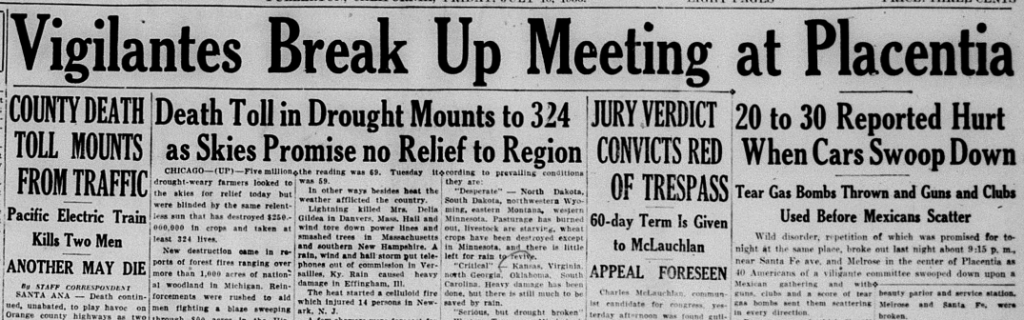
“Wild disorder, repetition of which was promised for tonight at the same place, broke out last night about 9:15pm, near Santa Fe ave. and Melrose in the center of Placentia as 40 Americans of a vigilante committee swooped down upon a Mexican gathering and with guns, clubs and a score of tear gas bombs sent them scattering in ever direction,” the News-Tribune reported. “Reports…stated 20 to 30 Mexicans and a few of the white men were injured, cars were smashed and other damage done. Several Mexicans among the group, who had gathered on the Luis Varcas handball court for a meeting told officers they definitely recognized ‘Stuart Strathman as the supposed leader of the raid.’”
Strathman was a leading representative of the growers and packinghouses, with an office at the Chamber of Commerce.
No arrests or charges were made against any of the vigilantes.
Eventually, an agreement between the strikers and growers was reached–insuring higher wages and a few other benefits, but not union recognition.

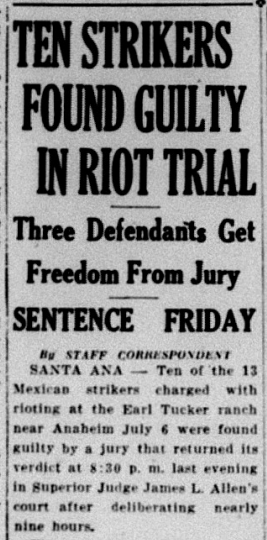
Charges against all but 13 of the strikers charged with rioting were dismissed. Of those, 10 were found guilty and faced fines and imprisonment.
Reflecting on the strike, Reccow writes, “The strike offers a classic study in the use of anti-strike tactics: the deputizing of hundreds of growers, blacklisting, the eviction of workers from company homes, the cries that agitators and communists were responsible for the strike, vigilante attacks, the strict enforcement of an anti-picketing ordinance, the jailing of large numbers of strikers and the deportation of alien Mexican workers.”
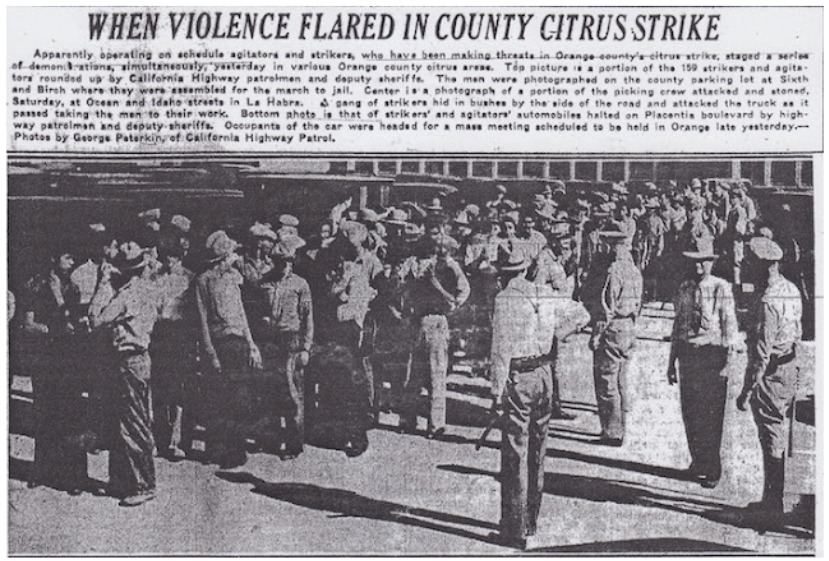
Journalist Carey McWilliams wrote, “No one who has visited a rural county in California under these circumstances will deny the reality of the terror that exists. It is no exaggeration to describe this state of affairs as fascism in practice.”

Illustration from “Gunkist Oranges” by Carey McWilliams. Pacific Weekly, 20 July 1936. Local Politics
In local politics, Hans Kohlenberger, Walter Muckenthaler, and Thomas Gowen were elected to Fullerton City Council.
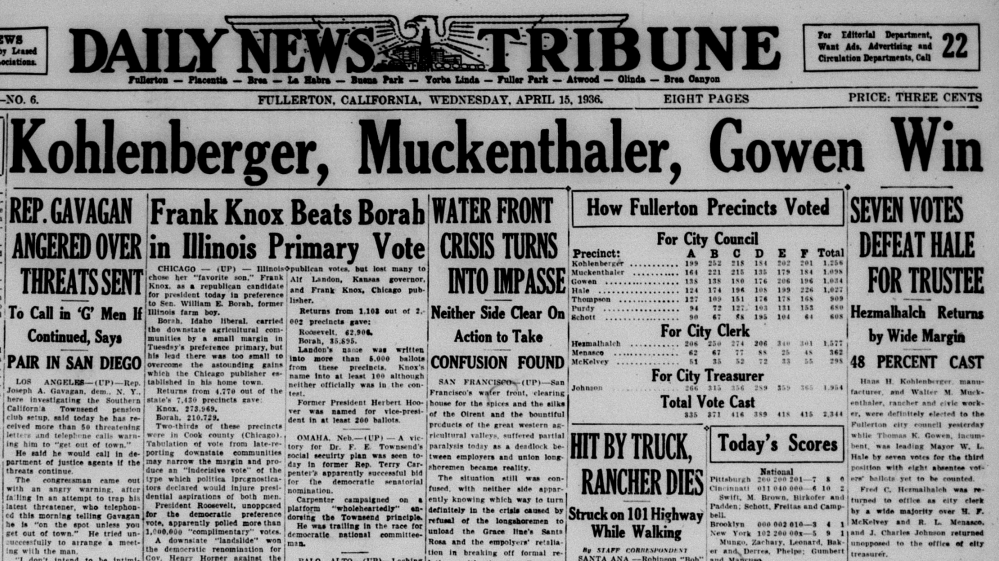
Harry Maxwell was chosen as mayor.

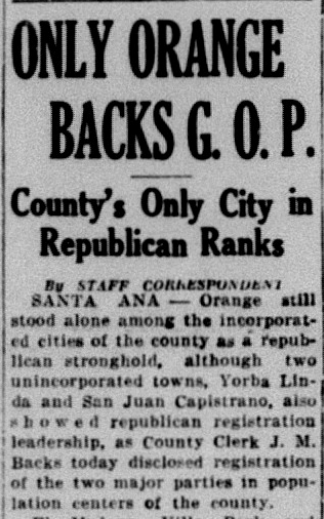
At this time, during the Great Depression, Democrats held a voting majority in all Orange County cities except Orange.
Culture and Entertainment
Two Fullertonians were listed in the annual Who’s Who in Art publication: Helena Dunlap and Lucile Bernice Hinkle. Fullertonian John Raitt was beginning his career as a singer.

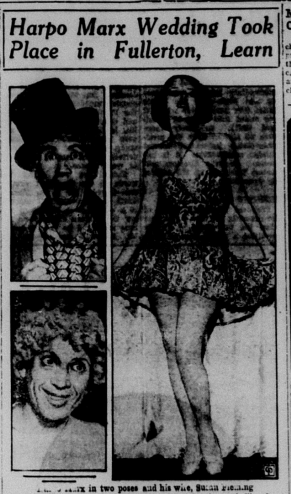
Harpo Marx of the Marx Brothers married Alva Fleming in Fullerton.
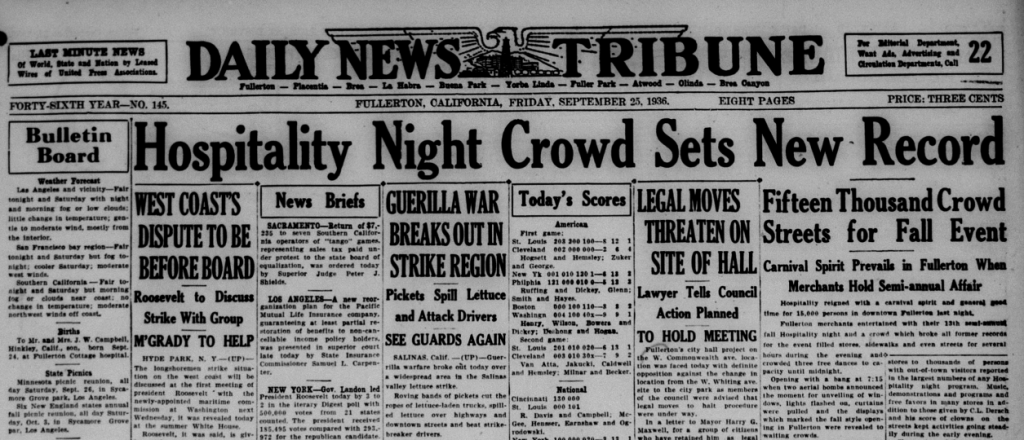
Fullerton held its annual “Hospitality Night” which drew thousands to downtown to see elaborate store window displays, clowns, musical performances, and more.
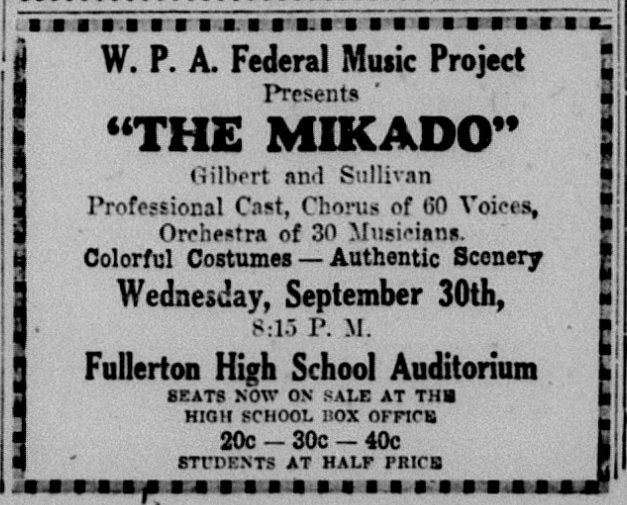
In addition to funding public works and building projects, the WPA also funded arts projects, like plays and murals. The News-Tribune called these “Literary Boondoggles.”
The News-Tribune featured a few comic strips including Mickey Mouse and Tim Tyler’s Flying Luck, both of which included some occasionally disturbing panels:

Sports
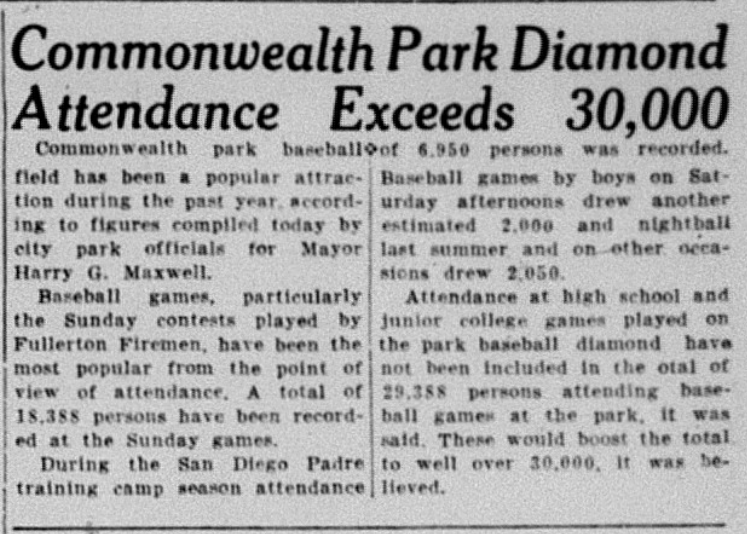
Baseball at Commonwealth (now called Amerige) Park was extremely popular.
Deaths
Fullerton pioneer Andrew Rorden passed away.
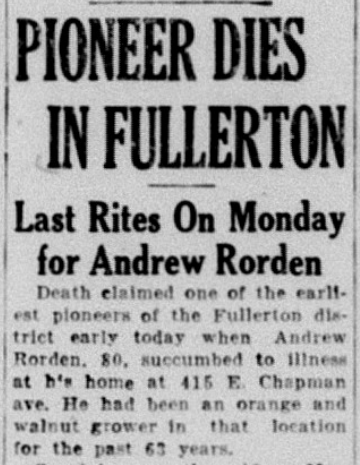
Rorder, a native of Germany was born in 1866 on the Island of Fohr, off Prussia. He came to the United States and to Fullerton in 1873 before the town was founded. He was a rancher.
Stay tuned for top news stories from 1937!
-
Fullerton in 1935

The following is from a work-in-progress about the history of Fullerton. You can support my ongoing research and writing on Patreon.
The Local History Room of the Fullerton Public Library has microfilm from the Fullerton Daily News-Tribune newspaper stretching back to 1893. I am in the process of reading over the microfilm, year by year, to get a sense of what was happening in the town over the years, and creating a mini archive. Below are some news stories from 1935.
Fullerton Benefits from the New Deal
While Fullertonians were struggling through The Great Depression, President Franklin D. Roosevelt’s New Deal programs were giving local unemployed folks jobs and a chance to build up the City’s public works infrastructure.
In 1935, both state and federal relief money was being used to improve Hillcrest and Commonwealth parks, the Fullerton Airport, streets, bridges, schools, and local water courses.
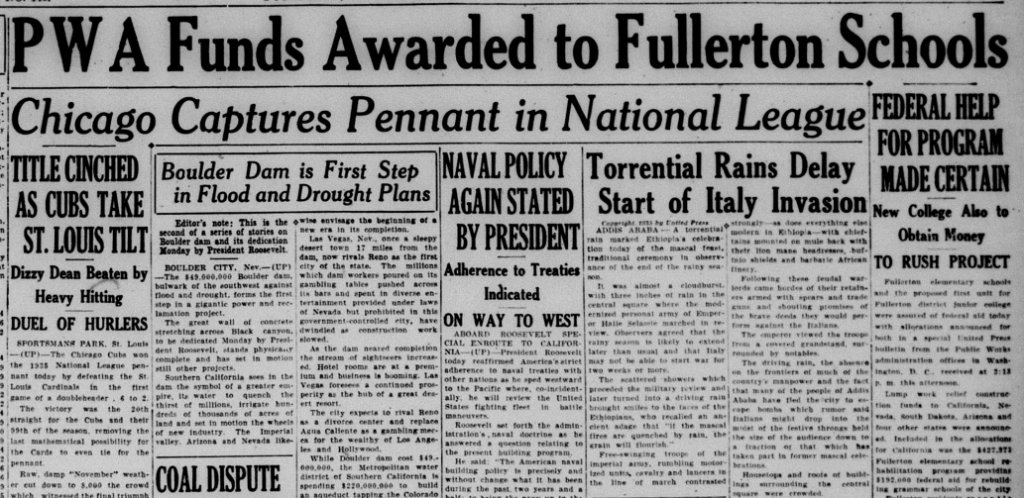
Federal funds were used to build the first Fullerton College buildings, Wilshire Junior High (now the School of Continuing Education), and to remodel and expand Maple School.
Flood Control
Over six million dollars of federal funds (around $138 million today) were planned for a large scale Orange County flood control plan–to build the Prado Dam, as well as channelize much of the Santa Ana river.

These federal dollars were contingent on local voters approving a bond measure to supplement the federal relief funds.
A well-funded opposition campaign which called the bonds a waste of taxpayer dollars resulted in the bond issue, and therefore the federal relief dollars, being lost.
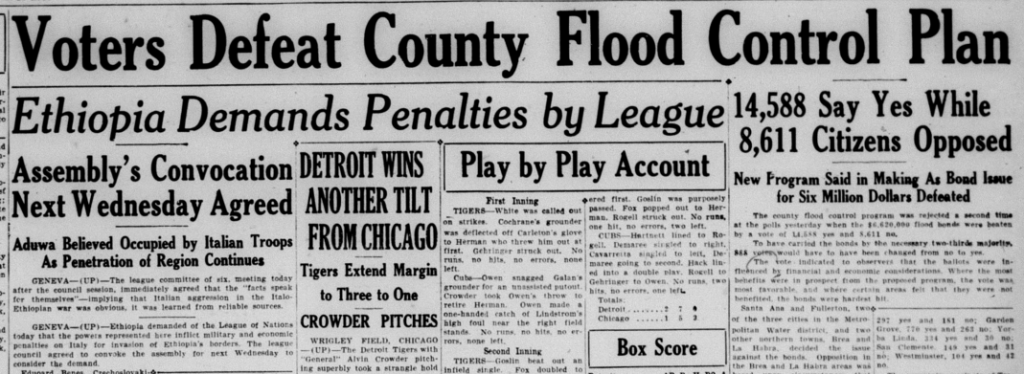
Voters actually had two chances to approve the bonds, but they voted them down twice.
Unfortunately, because the flood control measures were not passed, a few years later the 1938 flood would devastate local communities. It would take a natural disaster for people to understand the need to invest in this infrastructure.
King Citrus
In 1935, oranges were the main industry of Fullerton.
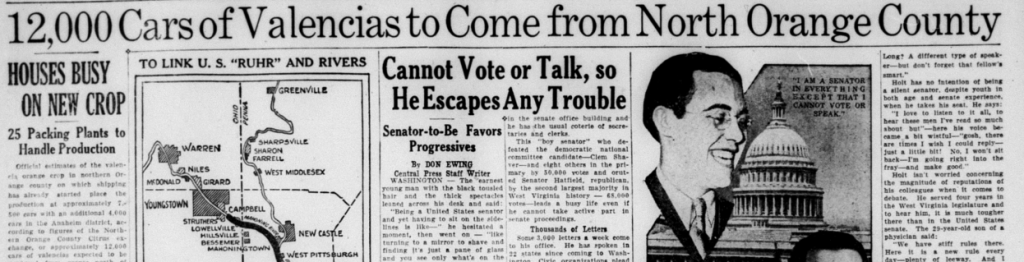
Locals celebrated the orange industry with a big Valencia Orange Festival that drew around 30,000 people.

In 1932, as part of a larger mass deportation effort, nine trainloads of Mexican workers and their families were deported from the Bastanchury Ranch in Fullerton. These mass deportations led to predictable scarcity of labor.

There was talk of strike among the remaining Mexican workers, to improve pay and working conditions.

Ricardo G. Hill, Mexican consul at Los Angeles, addressed a crowd of 2,500 Mexican workers in Anaheim, urging them not to strike, and to wait until next picking season to attempt to form a union. Earlier in the day, Hill had met with local packinghouse managers who “said they would not recognize the rights of the Mexican pickers to organize and demand a minimum wage of $2.25 a day and that managers threatened to import Filipino workers to Orange County to do the work, if necessary.”
It’s ironic, though not surprising, that growers and packinghouse managers opposed worker efforts to organize for better wages and working conditions because organizing for a better return was exactly what the growers and packinghouses did. They pooled their resources in the form of the California Fruit Growers Exchange (or Sunkist) to fix prices and make the most money.
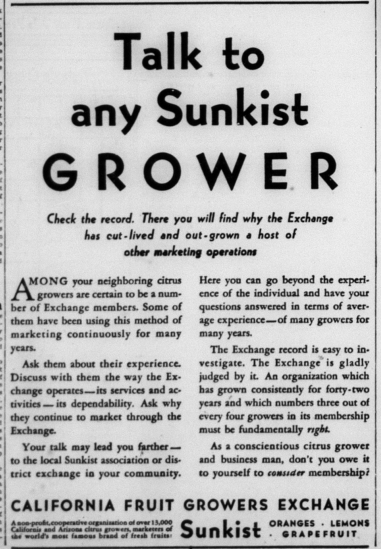
Meanwhile, plans were made by workers for a countywide organization effort in 1936. Stay tuned.
Dr. Coltrin and the Illegal Abortion
In 1935 abortion was illegal. Those seeking reproductive care had to either resort to “back room” abortions or to find a doctor who would risk being charged for a crime.
Fullerton doctor Francis Coltrin was arrested and charged with second degree murder and for performing an abortion after a 16 year-old girl named Charlotte Valentine died during a failed abortion.
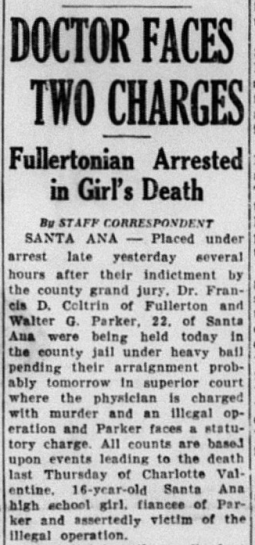
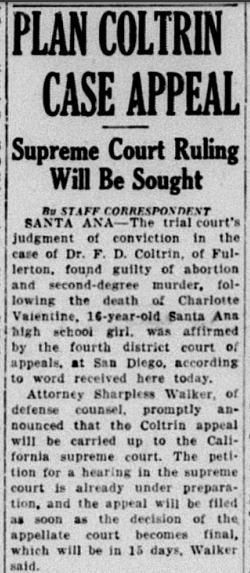
Coltrin was tried and found guilty at a jury trial of both charges. He appealed his case, and it went all the way to the California Supreme Court, where the conviction was upheld.
Culture and Entertainment
Locals got some excitement when the baseball movie “Alibi Ike” starring Joe E. Brown was filmed at Commonwealth Park.

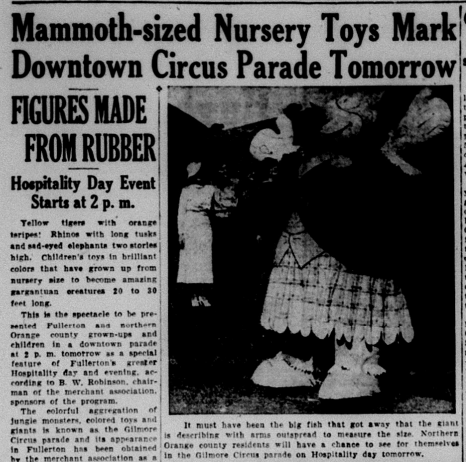
Another big, entertaining event was a Hospitality Day parade, featuring large, oversized toys, kind of like the Macy’s Day parade.
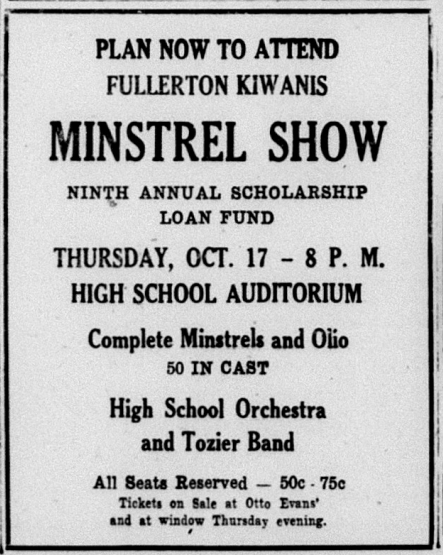
Unfortunately, a popular form of entertainment in the 1930s was the minstrel show, featuring white performers in blackface perpetuating harmful stereotypes of African Americans. Some of these took place locally.
Sports
Commonwealth Park hosted regular minor league baseball games that drew lots of fans. Fullerton baseball star Arky Vaughn won the award for best hitter in the major leagues.

Housing
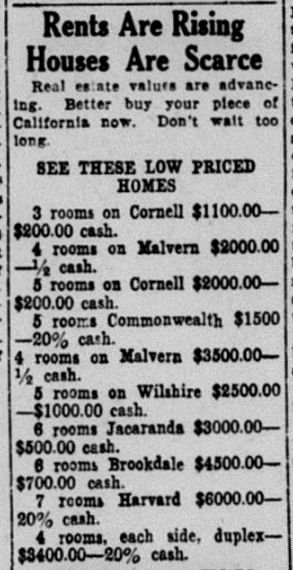
During the Depression, construction of new housing slowed, creating a housing shortage, which led to higher rents and home prices.
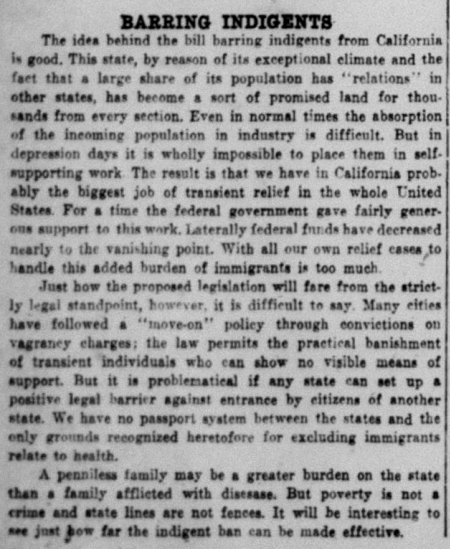
Hard economic times also led to an increase in homelessness. Some Californians sought to “solve” this problem by actually barring poor people from California.
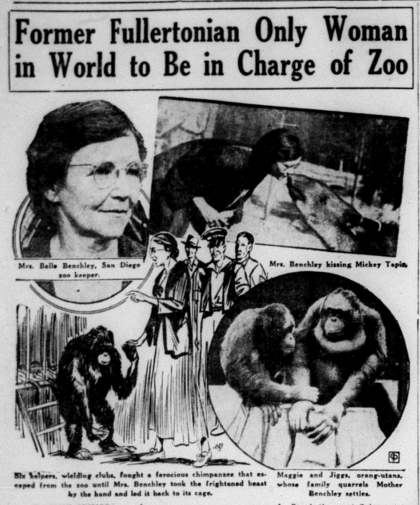
Belle Benchley, Pioneering Woman Zookeeper
Former Fullertonian Belle Benchley got a shout-out for being a pioneering zookeeper in San Diego.
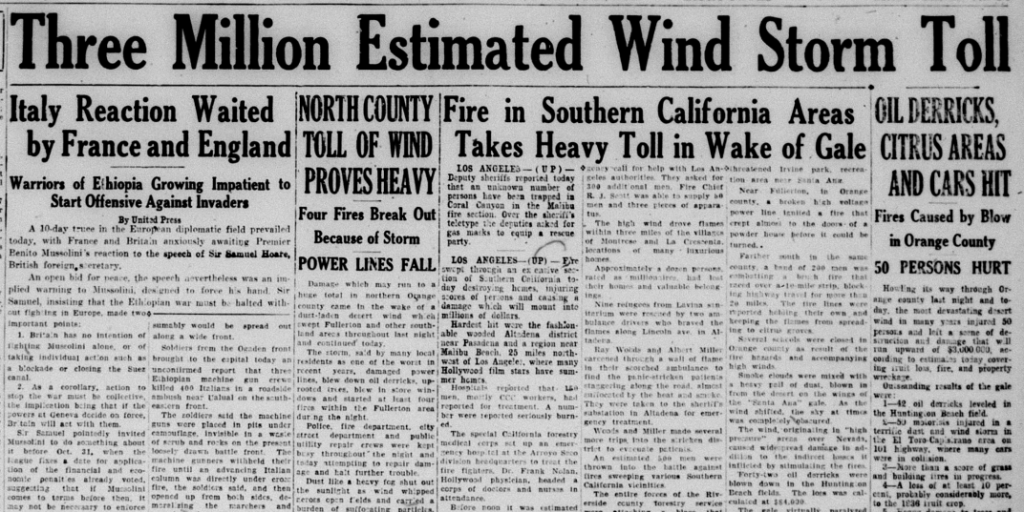
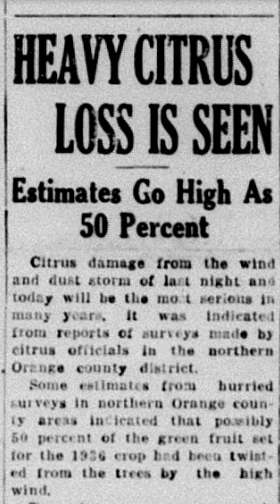
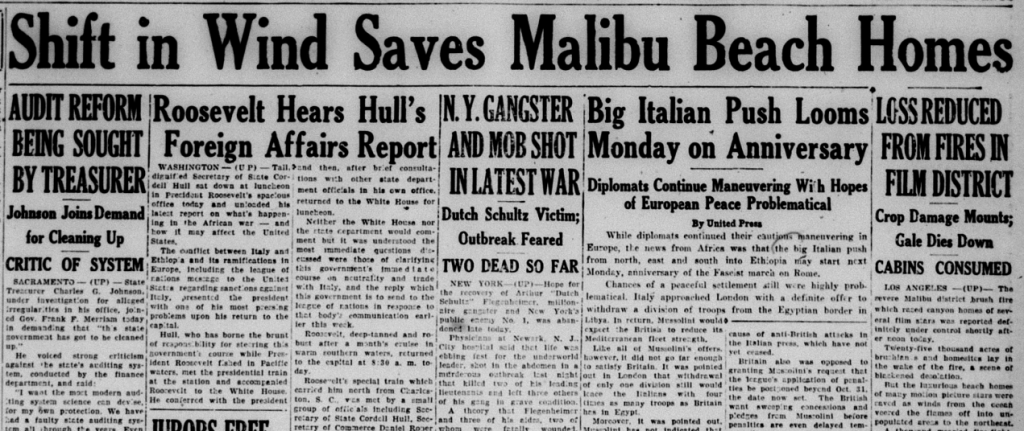
Santa Ana Winds Bring Wildfires
Powerful Santa Ana winds wrought heavy damage and sparked wildfires.
Deaths
A prisoner hung himself in the Fullerton jail.

Edgar Johnson, who founded the Fullerton News-Tribune, died.
He died of heart disease in his room at the California hotel.
Born in Ashville, N.C. in 1868, “Johnson came to California in 1887 and first started in the newspaper business in Santa Ana, later going to Westminster and from there to Fullerton about 1894 where he remained as publisher of The News-Tribune until its sale to the present publishers in 1929,” the Tribune reported.
In Anaheim, another pioneer newspaper editor, Henry Kuchel (founder of the Anaheim Gazette) passed away.

Stay tuned for headlines from 1936!
-
Subscribe
Subscribed
Have a WordPress.com account? Log in now.

