-
World War II, Post-War Growth, and Civil Rights Gains: Fullerton in the 1940s
The following is from a work-in-progress about the history of Fullerton. You can support my ongoing research and writing on Patreon.
The Local History Room of the Fullerton Public Library has microfilm from the Fullerton Daily News-Tribune newspaper stretching back to 1893. I am in the process of reading over the microfilm, year by year, to get a sense of what was happening in the town over the years, and creating a mini archive. Here is a compilation of stories from the 1940s.
World War II
After the 1941 attack on Pearl Harbor, the United States finally entered World War II, which had already been raging for two years. Many young Fullertonians went off to war.
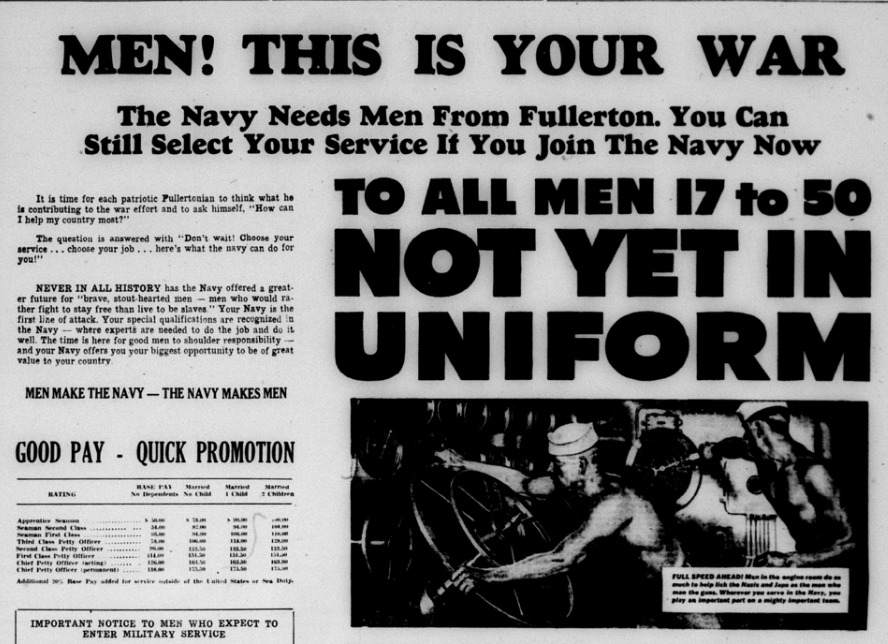
“Many tears rolled down the cheeks of proud mothers and fathers who saw their sons and other relatives off to induction stations,” the News-Tribune reported in 1942. “Fullerton citizens quickly adjusted themselves to the war…every phase of Civilian Defense was organized quickly here…Red Cross activities boomed…War bonds sales went over with a smashing success, the quota being topped every month in Fullerton…Tire rationing, food stamp, auto use stamp and other new regulations brought on by the war were met without confusion here…’Let’s Knock Out the Axis’ seemed to be the the theme of the city’s efforts throughout the year.”
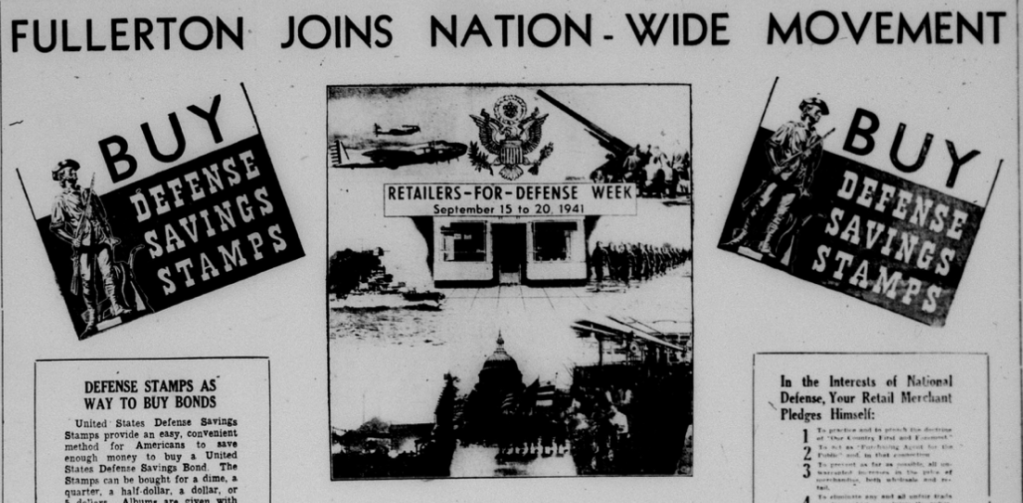
Prior to World War II, the United States didn’t have nearly the big military it does today, so people had to pitch in by buying war bonds and participating in salvage drives to beef up the war machine.
Everyone had a job, from air raid wardens, to a home guard, to a civilian defense council, to auxiliary police, and more.
“Deep in the sub-basement of the city hall, surrounded by heavy reinforced concrete, in what is generally conceded the most adequate bomb-proof shelter in Fullerton, the control center of the civilian defense council meets each week,” the News-Tribune reported.
Just as World War II was the catalyst for greatly increasing the size of the U.S. military, the war also prompted a huge increase in war-related industries like aerospace, shipbuilding, and weapons manufacture. Many of these new defense industries were located in California.
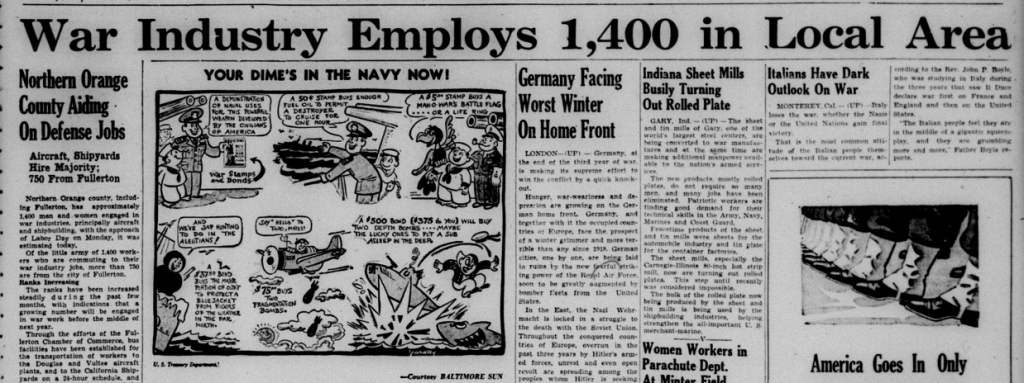
“Northern Orange county, including Fullerton, has approximately 1.400 men and women engaged in war industries, principally aircraft and shipbuilding,” the News-Tribune reported. “Of the little army of 1,400 workers who are commuting to their war industry jobs, more than 750 are from the city of Fullerton.”
Val Vita Food Products (later called Hunt Foods) in Fullerton had a contract to supply the military with canned goods.
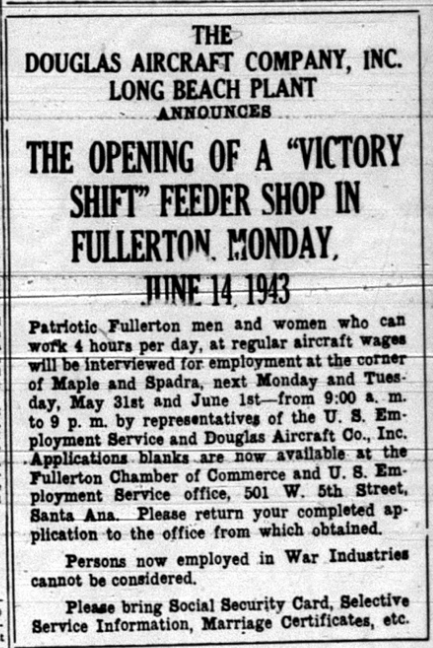
Douglas Aircraft opened a “feeder” shop in Fullerton for local workers to assemble airplane and other parts.
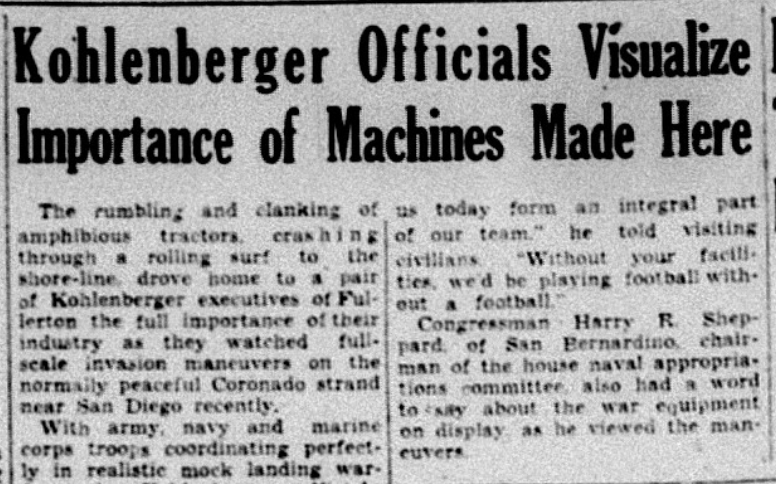
Local industries, like Kohlenberger Engineering and Hunt Foods produced products for the war. Kohlenberger built transimission systems for Amphibious Landing Craft, like the kind used in the invasion of Normandy on D-day.
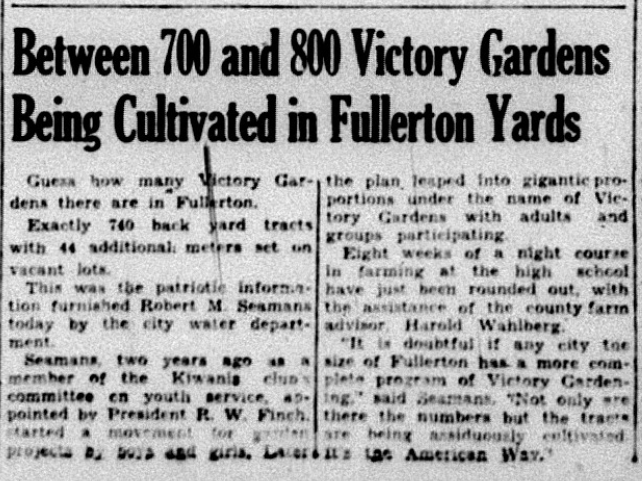
Another way to contribute to the war effort was by growing your own food in a “Victory Garden,” so more foodstuffs could be sent overseas.
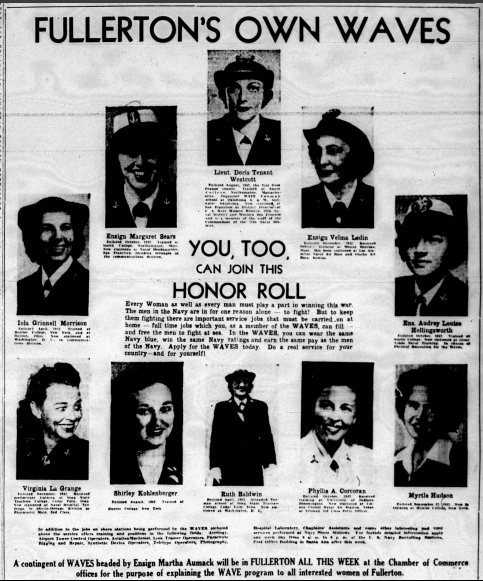
World War II opened up many new opportunities for women, who were recruited to work in local war industries, and to serve in WAVES (Women Accepted for Volunteer Emergency Service) as a women’s branch of the Naval Reserve.
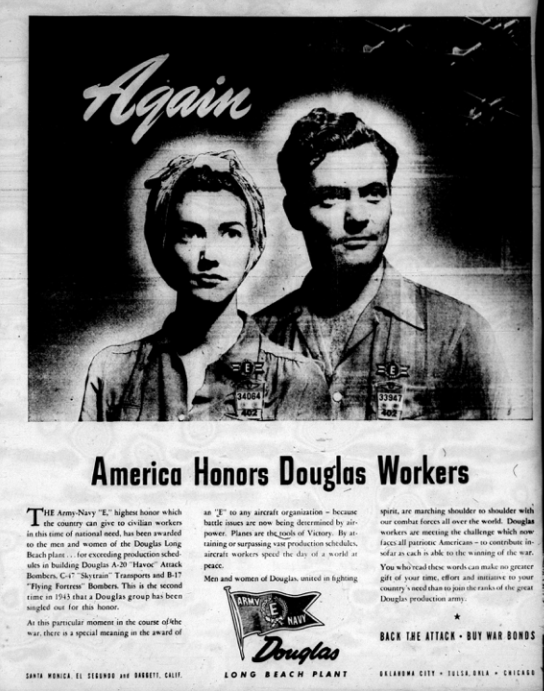
The following article from 1943 gives a good sense of the changing ideas about gender roles that World War II brought about.
“The thing that surprises everyone is that Fullerton residents who never before have done any such kind of work are building intricate wiring assemblies for Flying Fortresses and C-47 transport planes. And they are doing the work well!
Naturally, the average housewife looks puzzled when, for the first time in her life, she faces the problem of using a soldering iron.
“Why I’ll never be able to learn how to use that thing,” she usually says.
There’s an answer that has yet to fail. The plant instructor smiles at the perplexed pupil and replies:
“If our boys from Fullerton can learn to fire machine guns and jump in parachutes, surely we can learn to run this little old soldering iron.”
And within a week or so, the new pupil has taken a place on the production line, doing vitally needed work which boosts America’s war efforts.
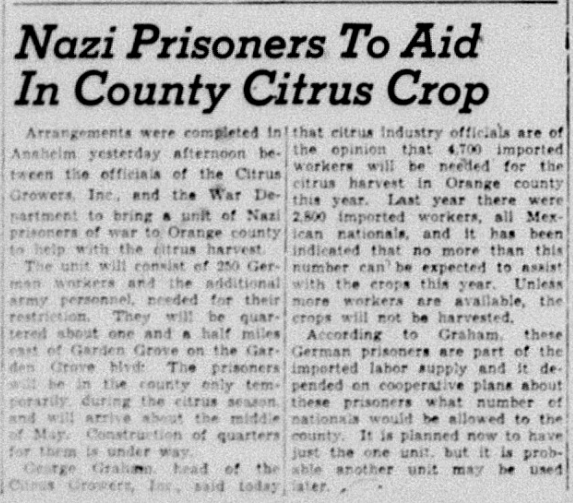
During World War II, Nazi war prisoners were taken to camps (including one in Garden Grove) and “hired” out to lower growers.
Japanese Incarceration
In 1942, President Roosevelt signed Executive Order 9066, ordering all “enemy aliens” to be removed from their homes and ultimately sent to incarceration/concentration camps for the duration of the war.
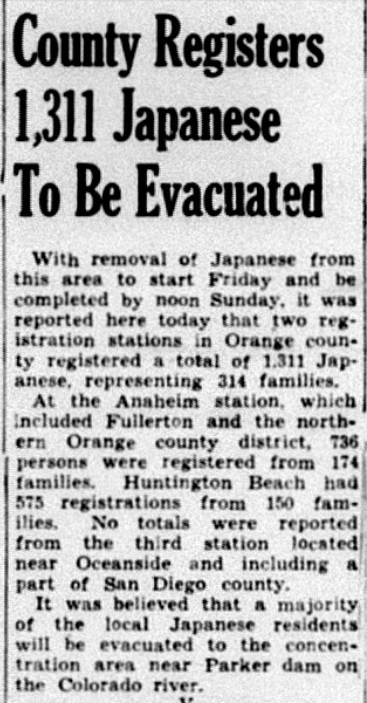
Over 120,000 Americans of Japanese ancestry, many of whom were American citizens, were detained and removed without due process, merely because they looked like the “enemy.” It was one of the most shameful episodes in modern American history.
“Three civilian exclusion orders which will evacuate Japanese and enemy aliens from Orange county and a small section of northern San Diego county were issued late Saturday by Lieut Gen. J.L. DeWitt,” the News-Tribune reported. “This order will mean that all Japanese still remaining in Fullerton and Orange county areas will be evacuated by next Sunday noon.”
This local order affected about 700 people, including some living in Fullerton. Formal placards containing the notices were posted throughout the area by soldiers. Ultimately, over 1,300 Japanese Americans were taken away from their homes in Orange County.
While direct blame for this injustice is usually placed at the feet of President Roosevelt, it’s important to note that Japanese exclusion/incarceration was a very popular idea and was merely the outward manifestation of long-standing racism against Japanese-Americans. Quotes from the News-Tribune in 1942 show that state and local leaders across the political spectrum supported Japanese incarceration:
“The League of California Cities asked President Roosevelt to order immediate evacuation of all Japanese, American-born as well as alien from the western combat zone.”
“Federal, state and county authorities in Los Angeles began an investigation which may result in seizure of Japanese-owned property.”
“California congressmen and other public officials have advocated removal of all aliens from the state, instead of merely moving them back from the defense zone.”
“The Orange County grand jury recommended to the board of supervisors today that all Japanese, German, and Italian aliens and their children be removed from Orange County.”
“For weeks the West Coast, through city councils and city officials, patriotic organizations and civic groups, has been demanding all Japanese be removed from the coast as a safeguard against fifth column sabotage and invasion threats.”
Sometimes people were given warning, other times they were just rounded up without notice.
The closest Japanese incarceration camp in California was Manzanar, built in the Owens Valley, but this was not the only one. Prior to being sent to these camps, some local Japanese Americans were sent to the Santa Anita race track and other temporary facilities, which were converted into a temporary relocation center.
One such Japanese American was Betty Oba Masukawa, who was born and raised in Fullerton. In an interview for the CSUF Oral History Program, she recalls her experiences during WWII. I am amazed at the matter-of-fact way she recalls her experiences, and the fact that, years later, she is able to laugh about it:
CSUF: You mentioned evacuation. What was your major concern at the beginning of the war?
Betty: Honestly, I didn’t think anything of it, because I was born here. I didn’t pay any attention to any of the rumors, until it was really happening.
CSUF: How were you told about the evacuation?
Betty: It was in the newspaper.
CSUF: And what were your feelings at the time that you found out about the evacuation?
Betty: If we had to evacuate, we had to evacuate (laughter).
CSUF: What sorts of provisions did you make?
Betty: You mean our home?
CSUF: Yes.
Betty: The mayor of Fullerton, William Hale and his son Harold took care of all our things. We gave him power of attorney and he took care of our ranch; we had a ranch at that time. Well, it was my parents’ ranch. He took care of all our personal belongings for us, so we had no worry.
CSUF: Was he a friend of your family?
Betty: Yes, a very good friend. The whole family was very good. My personal things he took to his house, and he stored it up in his room, which he didn’t have to; he could have just put it in the garage. But, no, he put it in his house, and really took very good care.
CSUF: Where were you then sent?
Betty: We were sent to Poston, Arizona.
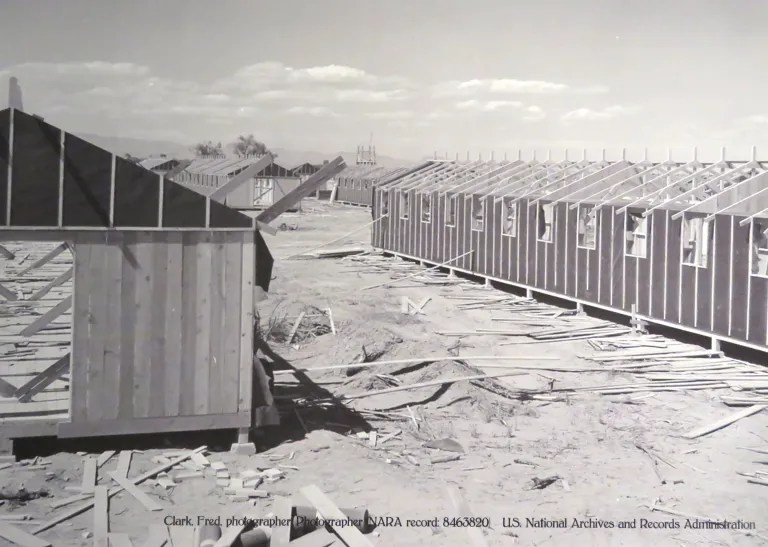
Poston Internment Camp. CSUF: From Fullerton?
Betty: From the Anaheim train station. We were the last family to go from Orange County.
CSUF: And you went on the train?
Betty: Yes.
CSUF: And what was it like when you arrived in Arizona?
Betty: Terrible.
Betty’s husband (Mas): It was hot and dusty. Rattlesnakes all over.
Betty: If it wasn’t rattlesnakes, it was scorpions.
CSUF: What was the physical building that you lived in at Poston like?
Betty: Like barracks, a lot of cracks in it, you know, so the dust could go through.
CSUF: Oh dear. What time of year was that?
Betty: In May. A really hot time. It was really hot.
CSUF: You were in a barracks with how many people?
Betty: Well, each barrack had four rooms; it was all partitioned. We had the font, and it was a larger one. The dust blows, and everything gets dusty inside. You can just have tears, you know.
CSUF: So your little girl was how old when you went to Poston?
Betty: Four years old. There was a class in front of our barracks, so she went to school there.
CSUF: Was there a social life going on in camp?
Betty: Yes. There were dances.
Mas: Outdoor baseball.
Betty: Outdoor theater.
CSUF: Do you have any special memories about that period of time?
Betty: Well, a group of friends would come over to our apartment, and we’d play cards and stuff for the evening. That’s about all we could do in the evening.
CSUF: And how long were you in Poston?
Betty: Three and a half years.
Education
In 1940, in a major shake-up, long-time Fullerton High School and Junior College Superintendent Louis Plummer decided to leave the position. Plummer first came to Fullerton Union High School in 1909. He helped organize Fullerton Junior College in 1913, and served as superintendent since 1919. Though no specifics were given, it seems clear that there was tension between Plummer and the Board of Trustees.
“My chief concern through the years of my service here has been, and it must continue to be, the welfare of the school,” Plummer wrote in a letter to the Board. “It is probably that the members of the board will unite harmoniously in support of another, elected to take the duties of this office, than they would in carrying out any program I might propose.”
As further evidence that there was tension between the Board and the administration, fifteen teachers were also released. Plummer’s replacement was F.T. Chemberlen.
In other 1940 news, FUHS’s old auditorium was condemned. With the rise in international tensions, a military training program was begun at the High School.
Superintendent Frederick Chemberlen, who had been hired to replace Louis Plummer, resigned and was replaced by William T. Boyce in 1943, and Stanley Warburton in 1945.
In 1945, segregation of Mexican students from their white peers was being challenged in Orange County in a case that would eventually become Mendez et al v. Westminster.
In the early 20th century, local school districts created separate “Mexican” schools.
“By the mid-1920s there were 15 such schools in Orange County, all but one located in the citrus-growing area that would be involved in Mendez v. Westminster,” Phillipa Strum writes in Mendez v. Westminster: School Desegregation and Mexican American Rights, “by 1931 more than 80 percent of all California school districts with a significant number of Mexican (non-American citizen) and Mexican-American students were segregated, usually through the careful drawing of school zone boundaries by school boards that had been pressured by Anglo residents. The ostensible rationale for the separate schools was the children’s lack of proficiency in English.”

These schools were often of lower quality, both in facilities and materials provided. They “were usually built of wood, while the ‘white’ schools were made out of brick or block masonry…Books and other equipment were castoffs from the ‘white’ schools.”
Many of the “Mexican” schools had shorter hours so that children could join their parents in the fields.
Because of these factors, “Many students had to repeat grades, and they dropped out of school as soon as they could.”
Many Mexican schools, including those in Fullerton, had “Americanization” programs that focused on basic English, math, sanitation, and citizenship. Girls were trained to do housework.
“School boards throughout the state operated on the assumption that segregating what were viewed as the underachieving Mexican-American students was a good thing,” Strum writes. “By 1934, more than 4,000 pupils in Orange County–25 percent of the county’s total student enrollment–were Mexican or Mexican-American. Seventy percent of the county’s students with Spanish surnames were registered in the 15 Orange County elementary schools that had 100 percent Mexican enrollment.”
Unlike elementary schools, high schools in Orange County were, for the most part, integrated. For example, Isabel Martinez graduated from Fullerton High School in 1931, the first Mexican-American to graduate from FUHS.
During World War II between 300,000-500,000 Mexican American men served in the armed forces. This experience of fighting against fascism abroad instilled in many Mexican-Americans a determination to fight for their rights here at home.
One Mexican-American veteran said, “We’d just been at war. We didn’t like it when we came home and found out we’d risked our lives, but now we weren’t treated equally, and that our children wouldn’t be getting as good an education as the white student was going to be getting.”
Gonzalo Mendez was born in Mexico in 1913. He and his family migrated north in the 1920s, settling in Westminster, California. He married his wife Felicitas (an American citizen born in Puerto Rico) in 1935. They opened the Arizona Cafe in a Mexican barrio of Santa Ana.
In 1943, Gonzalo and Felicitas leased a 40-acre asparagus farm from the Munemitsus, a Japanese-American family who had been “relocated” to an internment camp. The Mendez’s traveled to the Arizona internment camp to meet the Munemitsus, who agreed to lease their farm.
There is an excellent children’s book about the friendship between Sylvia Mendez and Aki Munemitsu called Sylvia & Aki.

The Mendezes and their relatives the Vidaurris worked the farm. Meanwhile, Gonzalo became a naturalized citizen.
In 1945, Soleldad Vidaurri went to the Westminster Main School to enroll her two daughters–Alice and Virginia–and her niece and two nephews–Sylvia Mendez, Gonzalo Mendez Jr., and Jerome Mendez–in their neighborhood public school, Westminster Main Elementary School.
“The Vidaurri girls were light-skinned. The Mendez children, however, were visibly darker and, to the teacher, their last name was all too clearly Mexican. They would have to be taken to the “Mexican” [Hoover Elementary] school a few blocks away,” Strum writes.
“We were too dark,” Gonzalo Jr. later recalled.
Carey McWilliams, who wrote a history of Mexican Americans, described the Anglo Westminster school as “handsomely equipped” with “green lawns and shrubs” whereas the “Mexican” Hoover School had “meager equipment [that] matches the inelegance of its surroundings.”
Gonzalo, the father of Sylvia, Gonzalo Jr, and Jerome did not want his children to go to the “Mexican” school, especially because Westminster Main was closer to their house.
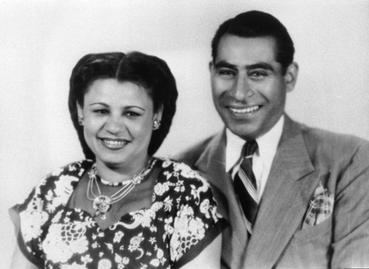
Felicitas Mendez and Gonzalo Mendez “Gonzalo went to the Westminster school the day after his children were turned away and spoke to the principal, but his children were still not permitted to register. The following day he went to the Westminster School Board, where he was equally unsuccessful. Eventually he went to the Orange County school board, again to no avail,” Strum writes.
Henry Rivera, who worked for the Mendezes, told Gonzalo about lawyer David C. Marcus, who had worked for the Mexican consulates in Los Angeles and San Diego.
Marcus, the son of immigrants himself, had experienced anti-Semitism in his life. He was married to Maria Yrma Davila, a Mexican immigrant.
The Mendezes joined with other families in Garden Grove, Santa Ana, and El Modena and brought a class action suit against the four school districts, their superintendents, and all the members of the school boards on behalf of “some 5,000 persons of Mexican and Latin descent,” all of them citizens and residents of the four districts.
The petitioners were Mendez and his children Sylvia, Gonzalo Jr, and Jerome; William Guzman and his son Billy; Frank Palomino and his children Arthur and Sally; Thomas Estrada and his children Clara, Roberto, Francisco, Sylvia, Daniel, and Evalina; and Lorenzo Ramirez and his sons Ignacio, Silverio, and Jose.
Marcus argued that the segregation of Mexican students deprived them of their federal right to equal treatment by the state, as guaranteed by the Fourteenth Amendment. He also argued that Orange County was violating California law which at the time allowed segregation only of Asian and Indian children. Mexicans were considered “white.”
Marcus used the wording “Mexican or Latin descent or extraction” rather than “race.”
In 1945, segregation on the basis of race was officially legal–this was before Brown v. Board of Education.
The case was assigned to Judge Paul J. McCormick.
The lawyers for the school districts argued that the segregation of Mexican-American students was appropriate and for their benefit because the children “were unfamiliar with and unable to speak the English language” when they began school.
Their responses sometimes relied on stereotypes of Mexican-Americans.
The Garden Grove response stated that “a large percentage of said persons [Mexican-Americans] residing in said communities have not been instructed in or are familiar with the proper rules of personal hygiene.”
They also argued that segregation was merely the result of where the students lived, often in segregated neighborhoods.
The thrust of the district’s defense was “that the segregation was based on lack of language proficiency rather than ethnicity.”
Early in the trial, Marcus showed that the Mendez children spoke English.
As the trial began, Judge McCormick stated, “The claim here is that they have just taken the Mexican people, their children, en masse, and drawn a line around where they live and said to them, ‘Now you have to go to a school in this place here. You can’t go to a school here where the others who aren’t of this origin go.’
He quoted from Meyer v. Nebraska: “The protection of the Constitution extends to those who speak other languages as well as to those born with English on the tongue.”
Manuela Ochoa was the first witness on the stand, stating that her children had been denied entry to Lincoln school.
“Marcus wanted to attack segregation itself, and to do so, he first had to demonstrate that the school districts were systematically segregating the students on the basis of ethnicity, without reference to their language or other academic abilities,” Strum writes. “That would knock out the districts’ claim of language facility as the basis for the separation. As Mrs. Ochoa indicated, the children were given no tests before being assigned to ‘Mexican’ schools.”
Garden Grove superintendent James L. Kent, who had written his master’s thesis (called “Segregation of Mexican School Children in Southern California”) argued that all “Mexican” students should be segregated.
“He believed Mexicans constituted a separate and nonwhite race,” Strum writes. “He wrote that Mexicans were ‘an alien race that should be segregated socially’ and this had been accomplished in Southern California ‘by designating certain sections where they might live and restricting these sections to them…Segregation into separate schools seems to be the ideal situation for both parties concerned.’”
Marcus, who had read Kent’s thesis, sought to show the court that Kent’s views, “were based on racism rather than on legitimate pedagogic considerations.”
Kent admitted that there was no special training of the teachers at the “Mexican schools,” and that the teachers there did not speak Spanish. He “admitted that the Garden Grove District intentionally segregated its Mexican American students, regardless of their English proficiency.”
Kent also, stunningly, “admitted that he believed Mexican children were inferior to white children in their educational ability, and that he did not believe Mexican children were white.”
Kent stated that the Mexican child, on average, “is lower intellectually than the child of Anglo-Saxon descent.”
Marcus asked Santa Ana Superintendent of Schools Frank Henderson how the district determined which children were Mexican American.
“By their names,” Henderson replied.
Felicitas Mendez testified: “We always tell our children they are Americans, and I feel I am an American myself, and so is my husband, and we thought that they shouldn’t be segregated like that, they shouldn’t be treated the way they are . So we thought we were doing the right thing and just asking for the right thing to put our children together with the rest of the children there.”
Professor Ralph L. Beals, chair of the Department of Anthropology at the University of UCLA testified that “Segregation defeats the purpose of teaching English, certainly, to the Spanish-speaking child.”

Beals said that segregation also impeded “the assimilation of the child to American customs and ways…a feeling of antagonism is built up in children, when they are segregated in this fashion…The disadvantage of segregation, it would seem to me, would come primarily from the reinforcing of stereotypes of inferiority-superiority, which exists in the population as a whole. The advantages [of desegregation], properly handled, would come, then, in the breaking down of those stereotypes and in the broadening of understanding of people of different cultural background and the understanding of different cultures.”
Judge McCormick asked what would happen if children with varying degrees of facility in English were mixed together. Wouldn’t that be better, in terms of Americanization, than segregation? Yes, Beals replied, “with regard to the Americanization program, the mixed group would become much more rapidly aware of the main trends in American life.”
Marcus’ closing statement was powerful: “Of what avail is our theory of democracy if the principles of equal rights, of equal protection and equal obligations are not practiced…of what avail are the thousands upon thousands of lives of Mexican-Americans who sacrificed their all for their country in this great ‘War of Freedom’ if freedom of education denies the equality of all?”
Judge McCormick handed down his opinion on February 18, 1946, seven months after the trial ended. The verdict was a resounding victory–one that upheld all the plaintiffs’ arguments–segregation violated the state’s own laws.
“The equal protection of the laws pertaining to the public school system in California,” he wrote, “is not provided by furnishing in separate schools the same technical facilities, text books and courses of instruction to children of Mexican ancestry that are available to the other public school children regardless of their ancestry.”
Their actions, he concluded, reflected “a clear purpose to arbitrarily discriminate against the pupils of Mexican ancestry and to deny them the equal protection of the laws.”
He wrote that Mexican-Americans as a group were protected by the Fourteenth Amendment and could not legitimately be discriminated against.
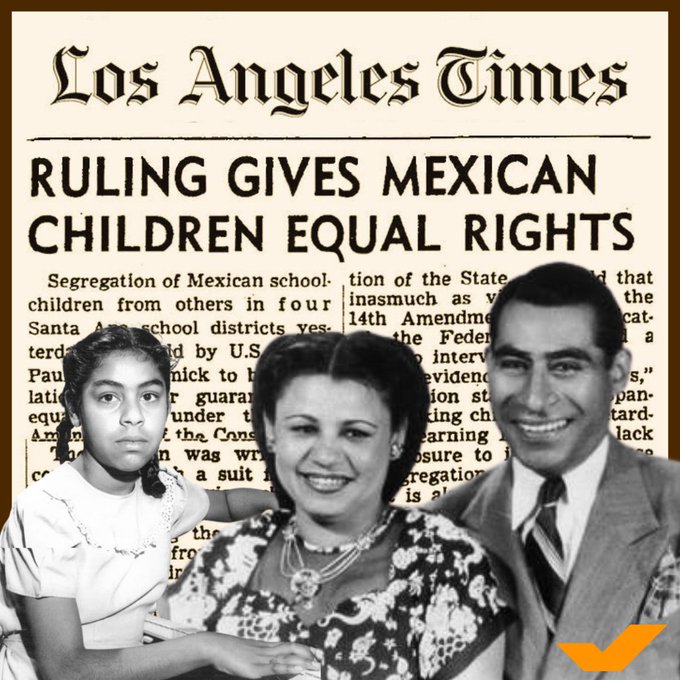
The four school districts appealed the decision.
Strum writes that the Mendez decision “had a marked impact on local Mexican-American organizing efforts.” In Ontario, Mexican-American protests led the town to desegregate its Grove School. Similar protests took place in Riverside.
“In Pomona, a group of 50 young Mexican-Americans, most off them WWII veterans, created a Unity League to help organize against discrimination and to push the candidacies of Mexican-americans running for office,” Strum writes.
The case also caused a strong reaction in the legal community.
The NAACP, the American Jewish Congress (AJC), the Japanese American Citizens League (JACL), and the national office of the ACLU all supported the case at the appeals level with amicus briefs.
Robert Carter of the NAACP later said of his amicus brief, “I used it as a trial run for Brown.”
Robert W. Kenney, attorney general of California, submitted an amicus brief in support of the Mendez decision.
The Appeals court upheld McCormick’s decision that the school districts had violated California law. The districts would have to desegregate or carry their appeal to the US Supreme Court.
The school districts did not appeal the Ninth Circuit’s decision to the US Supreme Court.
“Because the case had been decided on the basis of California law rather than the Fourteenth Amendment, the case carried legal weight only in California,” Strum writes. “It had a substantial impact nonetheless.”
In 1947 the California state legislature passed a bill ending segregation based on race, repealing laws permitting the segregation of Indian and Asian children.
The Orange County school districts more or less complied with the ruling.
“Anglo parents in El Modena, however, continued to resist desegregation. Many transferred their children to other districts; later, they managed to have part of the district itself transferred to the nearby, all-white Tustin district,” Strum writes.
“The case got the Mendez children and other Mexican-American children in California the education that enabled so many of them to become lawyers, judges, doctors, nurses, teachers, and legislators,” Strum writes. “For them, Mendez made the American dream reality.”
When the war ended, the Munemitsu family returned to Westminster, and got their farm back from the Mendez family, as agreed.
The three Mendez children went to school at Westminster Man, which now housed all the district’s children in grades one through four.
“Sylvia went on to college and became a registered pediatric nurse. Jerome joined the armed forces and served as a Green Beret for many years; Gonzalo Jr became a master carpenter,” Strum writes.
Sylvia Mendez dedicated herself to educating the public about the case.
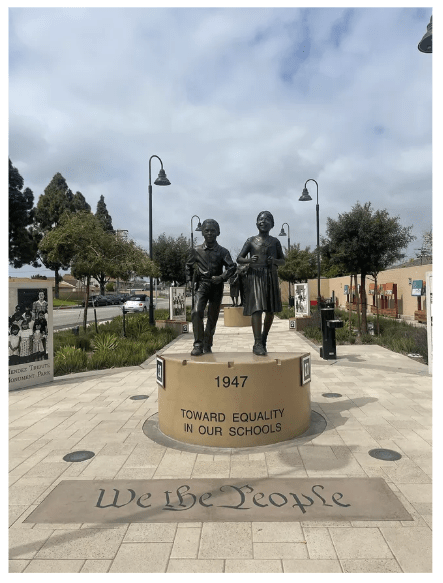
In 2007, the US Postal Service issued a stamp entitled “Mendez v. Westminster 1947: Toward Equality in Our Schools.”

Strum acknowledges that the struggle for school desegregation has not always been linear, noting the persistent fact of de facto segregation due to historic housing patterns: “As of the first decade of the 21st century, the majority of Mexican-Americans–like far too many African American students–were in [de facto] segregated urban schools.”
Gary Orfield and Chungmei Lee of UCLA’s Civil Rights Project reported that in 2006-2007, “Latino students across the country attended schools in which more than half the students were Latino. Ninety percent of Latino students in California were in such schools; 50 percent of them went to schools where Latinos made up 90 percent of the student body.”
In 2008 the California legislature passed a bill mandating the teaching of Mendez as part of the state’s social studies curriculum. Governor Schwartzenegger vetoed it.
There is a park and trail in Westminster dedicated to Mendez v. Westminster.
To accommodate the population growth, new schools were constructed. In 1949, Fullerton opened Valencia Park school. New schools and expansion of existing schools were often paid for with bonds.
Housing and Civil Rights
While large swaths of former orange groves were being removed to make way for buildings, the citrus industry was still a notable presence in Fullerton, and would remain so through the 1960s.
The war created a shortage of farm labor. This led to the establishment of the Bracero Program in 1942, in which thousands of Mexican men were recruited to work in agriculture and other vital industries. Local high school students were also enlisted to work in local agriculture.
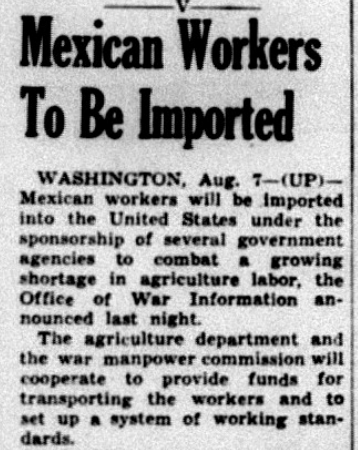
Most of the Mexican men who came to pick oranges and other crops in Orange County lived in segregated camps that were built for them. One of the camps was located near downtown Fullerton, at Balcom and Commonwealth avenues. This became known as Campo Pomona.
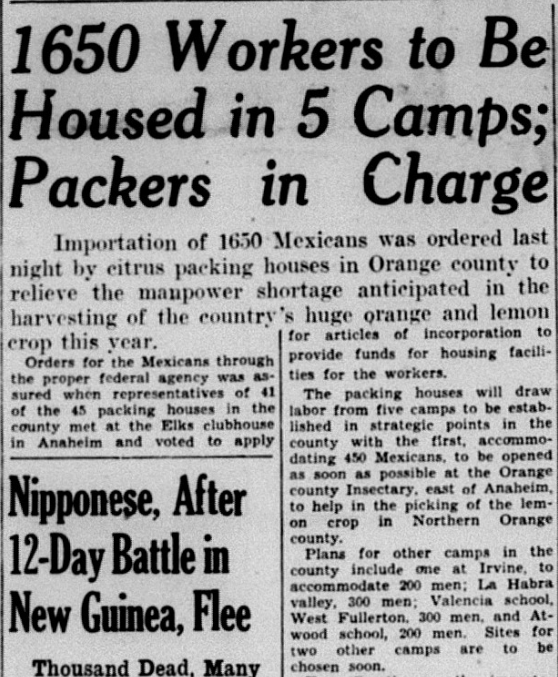
“The Mexican nationals are in America as essential war workers and deserve to be treated as such. They may be recognized by the white badges they wear, with large black numbers below the letters “C.G.” These men are here to work and are inclined to cause no trouble,” the News-Tribune reported in 1943. “It is to the men’s advantage to live in the camps which have been provided for them. In fact, the county health department rightly insists upon this.”
An article in the News-Tribune expressed local concerns about the new arrivals: “Will the Mexican nationals remain in Orange county permanently? No! They are here by special contract and will return to Mexico at the expiration of that contract.”
The following 1943 article gives a good summation of the Bracero Program in Orange County:
Mexico’s contribution to the war effort in Orange County is now in full sway with the arrival of over 2,000 Mexican national “war workers” to aid in the harvesting of the county’s huge citrus crop.
This information was learned at a luncheon held at the new Mexican camp on S. Balcom St., in Fullerton yesterday when city and county officials and representatives of service clubs and growers gathered as guests of the Placentia Orange Growers Association to obtain facts regarding the new Mexican labor and for a tour of the camps in northern Orange county.
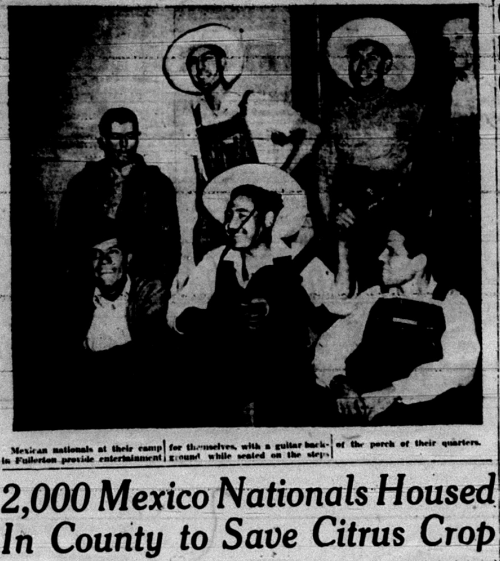
Realizing that the draft and the defense plants had taken a large portion of the available labor formerly employed in the harvesting of over 35,000 carloads of fruit in the county, the industry looked to the Mexican government for help. Under a contract entered into between the Citrus Growers Inc, representing 99 percent of the industry of the county, and federal agency handling the importation of Mexican nationals arrangements were completed early this-year to bring the 2,000 Mexican workers into the county.
Housed in seven camps in strategic sections of the county, these Mexicans are assigned to various packinghouses for the picking of the fruit. The largest of the camps, which were visited bv the group yesterday, are the Imperial camp, located south of La Habra, where 450 are housed and the camp south of Anaheim where 435 are being cared for.
The other camps in the northern section of the county are the Fullerton camp, accommodating 100 men and the Atwood school (in Placentia) where 25 are being housed.
The large presence of of Mexicans in Fullerton was sometimes protested by white residents. During the Bracero Program, some citrus growers sought to supplement their workforce with undocumented immigrants.
A 1946 census showed that, while Fullerton’s population was 12,173, there were only 96 Black people living in the city. Orange County has historically had a very low Black population due to housing (and other forms of) discrimination.
In a 1946 student essay, African-American student Robert Goodwin (son of famous Fullerton author Ruby Berkeley Goodwin), described the specific type of housing discrimination Black people faced in Fullerton at this time:
“Many people in Fullerton do not know that there are only certain sections where Negroes and Mexicans can live. This is due to the fact that years ago when Fullerton was first being settled, real estate men found out that they got lower prices for the property where Mexicans lived; so they enacted a law called the Restrictive Covenant. This forced the Negroes and Mexicans into one small section. This condition has caused many deaths in Fullerton because it forces large and small families to live in houses that are run down, badly roofed, and badly lighted. Such conditions are play grounds for Tuburculosis and other diseases.
“At present we have two drives on. One is to feed the starving children of the world and the other is to clothe and house them. We are taught that “Charity begins at home.” Such should be the case in Fullerton. “Restrictive Covenants” have been in effect too long. It’s time the people of Fullerton stopped talking about equality and started practicing it. When I was small I used to wonder about our “Pledge of Allegiance to the Flag.” When I’d get to the part, “With Liberty and Justice for All,” I knew that part of the pledge didn’t apply to me.
“Let us of Fullerton strive to do better. Let’s make the future Mexican an Negro children of Fullerton know that the “Pledge of Allegiance to our Flag,” isn’t just a bunch of fancy words: but that it is their guarantee of equal rights in the country that their fathers along with their white brothers fought for.”
Many Mexican Americans at this time did not live in regular neighborhoods, but rather in segregated citrus camps, or colonias, and white people did not not want these anywhere near their neighborhoods.
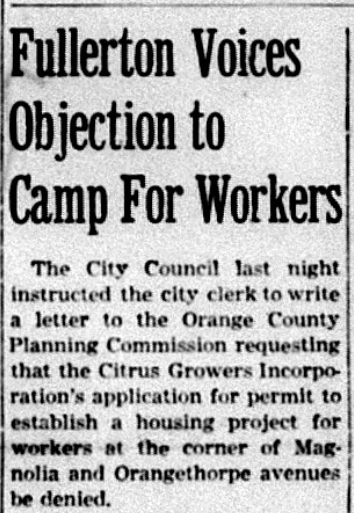
In 1946, when a new colonia was planned for the west side of town (at Orangethorpe and Magnolia), local white residents successfully blocked its construction.
“A group of property owners appeared before the council and presented a petition signed by 148 property owners and renters in that neighborhood voicing their objections,” the News-Tribune reported. “Objections raised were that since the neighborhood was fully developed as a residential district, the establishment of the camp would diminish the value of the residential area; that the quality of the usual people in such camps was not satisfactory and would create unwelcome problems.”
George A. Graham, manager of Citrus Growers, Inc., the company attempting to build the camp, argued that it “was the only site large enough and that there may be need for 3000 workers for next season who needed a place to live.”
After hearing the residents’ objections, Fullerton City Council, and then the Orange County Planning Commission, denied approval of the proposed camp.
Today, when Americans think about the term “segregation” they are probably thinking about the South–where segregation was loudly and publicly enforced until it became officially illegal (though unofficially still practiced) through various court cases and Civil Rights legislation.
Many Americans are probably not as aware that housing and school segregation actually extended far beyond the south and affected every part of the United States. In the North and out West, segregation was kept quieter, but it was pervasive.
By the 1920s, the most common method for enforcing residential segregation was something called “racially restrictive covenants.” These were agreements on the deeds of housing that prevented non-whites from renting or purchasing those homes. These covenants were standard practice among developers and realtors all over the US including in Fullerton.
Because of these covenants, for the first half of the 20th century, most neighborhoods in Fullerton were off-limits to people who weren’t white. Mexican-Americans, by far the largest minority group, were confined to agricultural work camps or carefully proscribed “barrios.”
However, in 1943, a Mexican American family in Fullerton–Alex and Esther Bernal–challenged this widespread practice, and won. The legal case was called Doss v. Bernal.
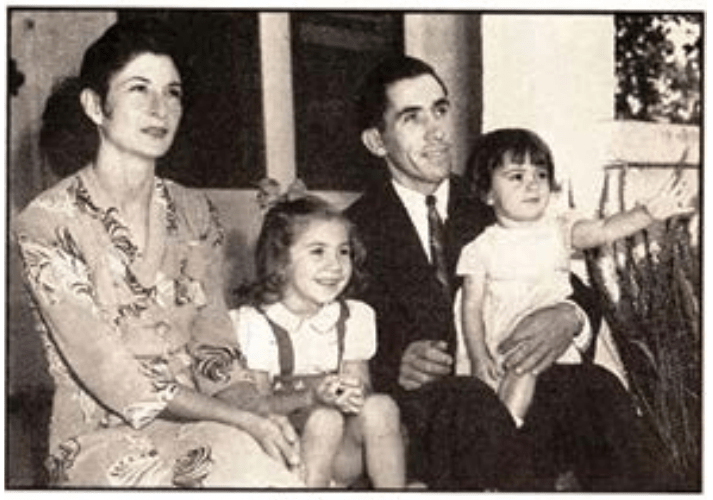
The Bernal family, 1943. Photo courtesy of Time magazine. “Doss v. Bernal successfully challenged the residential segregation of Mexican Americans in Orange County, resulting in one of the earliest legal victories against racial housing covenants in the United States,” Robert Chao Romero and Luis Fernandez write in “Doss v. Bernal: Ending Mexican Apartheid in Orange County.”
This case preceded by five years the more well-known (at least among civil rights lawyers) Shelly v. Kraemer (1948), a Supreme Court case which declared racially restrictive covenants legally unenforceable.
Born in Corona, Alex Bernal was raised in Fullerton’s Truslow barrio. He married Esther Munoz De Anda in 1937 and the couple had two children, Irene and Maria Teresa. Alex worked as a produce truck driver. To accommodate their growing family, the Bernals decided to purchase a white stucco home at 200 E. Ash in a neighborhood called the Sunnyside Addition, near but outside the Truslow barrio.
Unbeknownst to the Bernals, this house, like all the others in the Sunnyside Addition, had a racially restrictive covenant which stated “That no portion of the said property shall at any time be used, leased, owned or occupied by any Mexicans or persons other than of the Caucasian race.”
Despite this restriction, the owners Joe and Velda Johnson sold the property to the Bernals, and the family moved into their new home–happily following their American dream.
“For many Mexican Americans, suburban homeownership symbolized a chance towards upward mobility,” Shannon Anderson writes in Remembering the Bernals: Untangling the Relationship Between Race, Space, and Public Memory in Fullerton, California. “Additionally, suburbanization allowed Mexican Americans to stake their claim to permanent American identity in defiance of the stereotype that all people of Mexican descent were migratory, temporary residents.”
But their white neighbors were not so happy.
“Within a week of living on East Ash Avenue, the Bernals returned home one evening to find that someone had broken into their new home and thrown all their possessions into the street,” Anderson writes. “In a separate incident, Esther answered the door to a man who described himself as an officer of the law. In a ‘vulgar manner,’ he told Esther that she and Alex should move out of their new house because the white residents didn’t want Mexicans living in their neighborhood.”
When this harassment failed to get the Bernals to move, all the neighbors signed a petition saying they wanted the Bernals out. When that didn’t work, some of their neighbors (the Dosses, Shrunks, and Hobsons) filed a lawsuit in the OC Superior Court “on behalf of a majority of all the other lot owners” of the Sunnyside Addition requesting legal enforcement of the racially restrictive housing covenant.
The neighbor’s legal complaint is a clear expression of the racist social attitudes of the time:
“The permitting of Mexicans and other races to live in and to use and occupy the residence buildings in said tract, would necessitate coming in contact with said other races, including Mexicans in a social and neighborhood manner, and that if said race and Mexican Residential use and restriction in said tract of land is broken, other Mexicans and persons of other races will soon move in and occupy residences in said Restricted residential district, and that the value of said residential property therein will be greatly depreciated…and for further reasons that such breach of said restrictions and conditions will greatly lower the social living standard.”
After being served this legal complaint, the Bernals still refused to leave. Instead, they hired lawyer David Marcus to defend their rights. Marcus, a Jewish lawyer who was married to a Mexican woman, would go on to represent Orange County Mexican American families fighting school segregation in the landmark 1947 case Mendez et al v. Westminster.
The first judge assigned to the Bernal’s case, Justice Morrison of Orange County, tried to issue a ruling against the Bernals before the case even went to trial. Marcus successfully petitioned to have an outside judge, Albert F. Ross, brought all the way down from Shasta County in northern California to hear the case.
The Doss v. Bernal trial took place in late August, 1943 in the Old Orange County courthouse in Santa Ana.
One of the central points of contention in the trial was whether the Bernals, and by extension all Mexican Americans, were “white.” Race is, of course, a social construct, not a biologically meaningful concept. It was meaningful insofar as it could be weaponized to exclude people like the Bernals. The plaintiffs’ lawyer Gus Hagenstein tried to prove that Mexican Americans were a part of a distinct race (not white), and Marcus argued that the Bernals should be classified as white. Both sides brought in anthropologists to try to sort this out.
One anthropologist explained that there were three types of races: European, Negroid, and Mongoloid, and that because the Bernals were neither Negroid or Mongoloid, they were more akin to European, and therefore white.
This whole discussion of race ends up sounding pretty silly in retrospect, but it did have repercussions because, according to this “race” argument–covenants that excluded African Americans and Asians could still be considered valid.
Hagenstein also claimed that the presence of Mexican-Americans in suburban neighborhoods would do “irreparable damage” to property values. He brought in real estate professionals, including former Fullerton Mayor Harry Crooke, to attest to this. Marcus sought to refute harmful stereotypes of Mexican Americans in an attempt to show that the Bernals were respectable people who would not be a detriment to their neighbors or bring down property values.
When you really drill down into the logic behind these covenants, they turn out to be based mostly on fear, scientifically dubious ideas about race, and negative stereotypes. What they were mostly about was preserving white supremacy.
The arguments in the Bernal case that would have the most lasting significance had to do with Constitutional rights.
“Marcus cited the Fifth and Fourteenth Amendments of the United States Constitution, which maintain that no one can be ‘deprived of life, liberty or property without due process of law.’ Unbeknownst to Marcus, this would be the first time that these amendments were successfully invoked in a lawsuit regarding racialized housing discrimination, beginning a trend in subsequent civil rights cases,” Anderson writes.
It was not lost on Marcus that this trial was taking place during World War II, when the United States was fighting against the racist and fascist Nazi Germany in defense of liberty and democracy. Some local Mexican American soldiers even attended the trial in a show of support for the Bernal family.
After a four-day trial, Judge Ross ruled in favor of the Bernals, declaring the racially restrictive covenant “null and void.” He further stated that such covenants were “injurious to the public good and society; violative of the fundamental form and concepts of democratic principles.” He agreed that the covenant violated the 5th and 14th amendment to the U.S. Constitution.
Despite the historic importance of this ruling, it’s interesting that the local press (the Fullerton News-Tribune) barely mentioned the case, devoting just two small articles to it. Neither the Orange County Register nor the Los Angeles Times even mentioned the case.
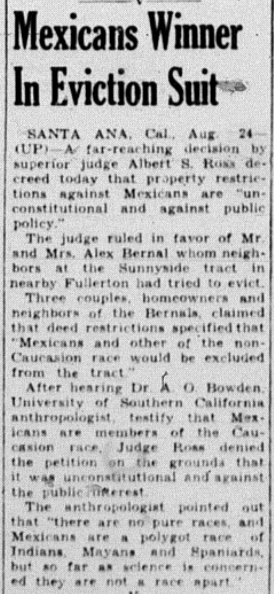
But other news outlets were paying attention. The Bernals got their picture in Time magazine, along with a story about their legal victory, and were even featured in the radio program “March of Time.”
An African American newspaper in Los Angeles, the California Eagle, featured the Bernal story prominently on the front page with headlines like “Race Property Bars Held Illegal!” and “Santa Ana Judge Says Restrictions No Good!”
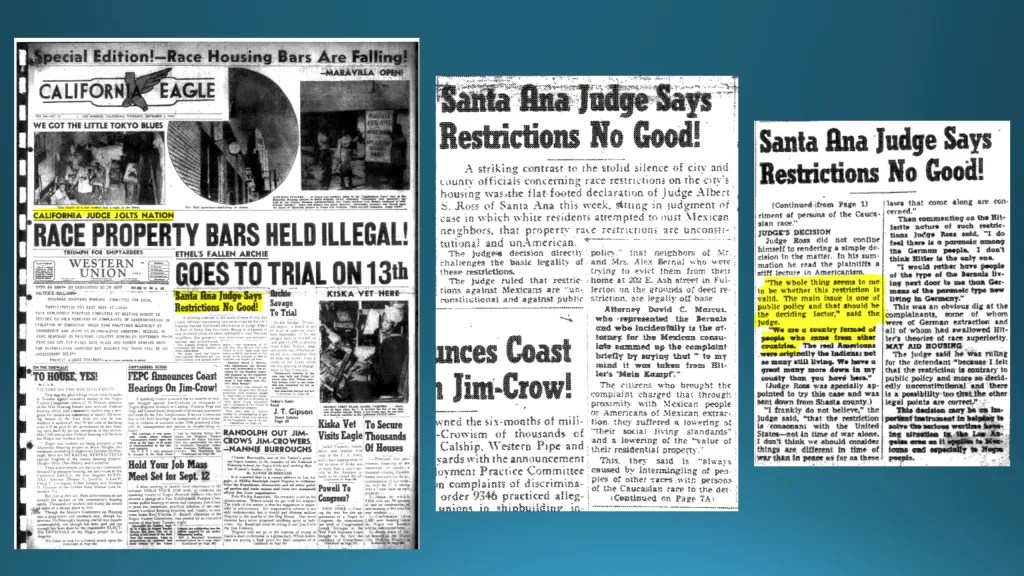
Mexican Consul Manuel Aguilar was also paying attention, stating: “We consider any restriction on the rights of Mexicans to live where they please against the Good Neighbor Policy and against the Constitution of the United States.”
Interestingly, “One of the most detailed accounts of the Bernals’ trial comes from the San Antonio, Spanish-language newspaper, La Prensa,” Anderson writes. “Running on multiple pages, ‘Decision en Favor de Una Familia Mexicana Que Reside en Fullerton, California’ details the legal proceedings, including additional statements from Marcus and quotes from Ross’s ruling and subsequent lecture.”
Doss v. Bernal set legal precedent that would eventually lead to the 1948 Supreme Court case Shelley v. Kraemer, which ruled that racially restrictive covenants were legally unenforceable.
But it would be wrong to conclude that Doss v. Bernal ended housing discrimination and segregation in Fullerton or elsewhere.
“Although the outcome of Doss v. Bernal set legal precedent in determining that Mexican Americans are white and racialized housing covenants are unconstitutional, this ruling was not widely enforced in Orange County,” Anderson writes. “Rather, residential space would remain racialized within the region, with instances of racialized housing discrimination against nonwhite individuals cropping up in the decades to come.”
The fact of lingering housing discrimination is perhaps best represented by the fact that in 1964 (21 years after Doss v. Bernal), a majority of California voters passed Proposition 14, which sought to overturn the state’s Rumford Fair Housing Act. This action was later declared unconstitutional, but it sent a strong signal that a majority of white property owners were just fine with housing discrimination.
In a case of history repeating itself, Alex and Esther’s daughter Irene experienced housing discrimination in the 1960s “when she tried to rent an apartment in Fullerton and was refused by the landlord,” Anderson writes. “However, her husband, who was white, had no problem when he applied to rent out the same apartment.”
And although they won, the case was also devastating for the Bernal family.
“Alex and Esther no longer felt safe in their home…the Bernals were concerned that their newfound exposure would result in additional, ramped-up harassment,” Anderson writes. “Thus, the Bernals never got the chance to live in the home that they fought so hard for. Instead, the family of four moved into Alex’s parents’ house. After all that happened, the Bernals ended up back on Truslow Avenue—Fullerton’s segregated barrio designated for residents of color.”
Two years after the trial, Esther Bernal died of cancer at age 29. The stress of the trial likely exacerbated her declining health.
For a while after the trial, the Bernals received dozens of letters of support from all over the United States.
But as time went on, the thing that disappeared in Fullerton was not housing segregation, but public memory of the Doss v. Bernal case.
The case is not mentioned in the two “official” Fullerton history books: Ostrich Eggs for Breakfast by Dora Mae Sim and Fullerton: A Pictorial History by Bob Ziebell.
Even Alex Bernal himself seemed to want to forget, rarely discussing the case, and putting all the letters, clippings, and court files into a box and storing it away for decades.
For nearly 70 years, the Doss v. Bernal case fell out of public memory, sort of like the Pastoral California mural on the side off the high school auditorium, which had been painted over for nearly 60 years.
It was not until 2010 that an intrepid reporter for OC Weekly named Gustavo Arellano and a CSUF grad student named Luis Fernandez re-discovered the story and brought it back into public memory.
In a remarkable piece of local history reporting, Arellano’s “Mi Casa Es Mi Casa: How Fullerton produce-truck driver Alex Bernal helped change the course of American civil rights” re-introduced Orange County to Doss v. Bernal.
For his article, Arellano interviewed Bernal family members, pored through Alex’s box of old letters and files, and unearthed old news stories about the case.
Fernandez would go on to co-author an excellent 2012 article for UCLA’s Chicano Studies Research Center, entitled “Doss v. Bernal: Ending Mexican Apartheid in Orange County.”
The story of Doss v. Bernal was featured in a 2022 book entitled A People’s Guide to Orange County by Gustavo Arellano, Elaine Lewinnek, and Thuy Vo Dang.
In 2023, CSUF graduate student Shannon Anderson wrote a Master’s thesis entitled Remembering the Bernals: Untangling the Relationship Between Race, Space, and Public Memory in Fullerton, California. Her study highlights omissions in previous narratives, like the role of Esther Bernal in purchasing the house, and her deposition during the trial.
That same year, the Orange County Hispanic Bar Association (OCHBA) hosted a live reenactment of the Doss v. Bernal trial.
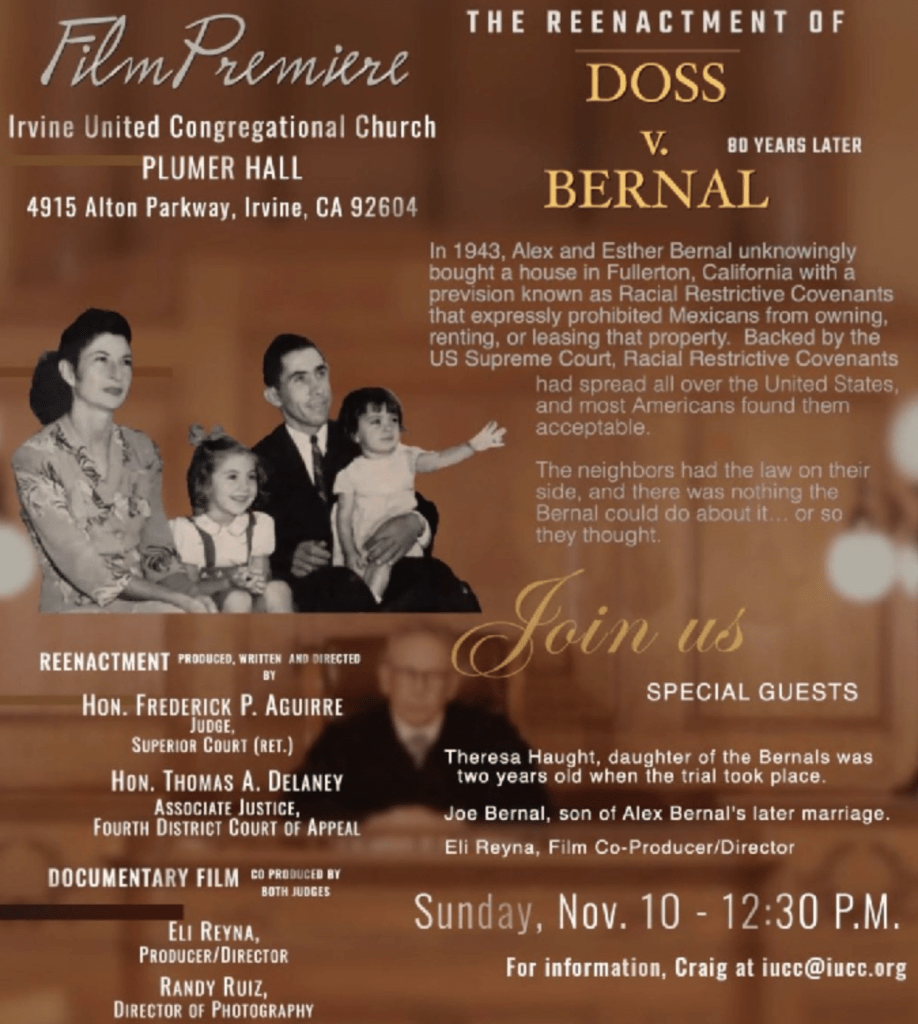
Anderson describes how in some cases, popular retellings have oversimplified the Bernal story into one of total victory, of having ended housing discrimination and segregation.
A 2023 article in the Fullerton Observer, reporting on the reenactment of the trial, was titled “A Reenactment of the 1943 Historical Trial that ended housing discrimination.”
“The issue with this is that the Bernals’ trial did not immediately put an end to housing discrimination. Although the case set legal precedent that would eventually go on to influence Supreme Court cases, racist housing practices would not be solved, but rather reified over the decades,” Anderson writes. “Also, the Bernal family suffered immensely from their experience with racialized exclusion.”
The problem with seeing the Bernal’s story as one of total victory is that it may prevent us from understanding how housing discrimination still persists.
“Perpetuating the idea that segregation is an issue of the past when it still exists, just in a different form, allows contemporary forms of racialized housing segregation to continue to operate without objection,” Anderson writes. “While racial segregation is no longer enforced on an institutional or legal level, de facto segregation continues to be upheld through longstanding cultural ideas, economic inequality, and social practices.”
A stark expression of this is the racial wealth gap. In 2019, the average income of a Caucasian household in the U.S. was about $188,200, while the average income of a Mexican-American household was $36,100. This gap dictates which neighborhoods Mexican-Americans and people of color can live in.
Rather than seeing Doss v. Bernal as something that ended housing discrimination and segregation, it is more accurate to see the case as part of a decades-long struggle of chipping away at the enduring effects of white supremacy.
There have been two attempts to commemorate the Bernal house as a historically significant property under the Mills Act, in 2010 and 2020, but both attempts were unsuccessful.
“Commemoration of the site would require Fullerton to come to terms with its shameful, racist past,” Anderson writes.
Growth and the Post-War Boom
The 1940 US census found that population growth in Fullerton had slowed significantly during the Great Depression, with a population of about 11,200.
“Discussion of population changes brought out the fact that elementary school registration is nearly 600 below the total of 1930,” the News-Tribune reported. “It also was pointed out that two large Mexican colonies which once flourished on the former Bastanchury ranch, no longer exist and that occupants do not live in Fullerton.”
Fullerton’s two large dams (the Fullerton Dam and the Brea Dam) were completed in 1941, as part of a larger countywide flood control program.
The dams were built by the U.S. Army Corps of Engineers.
In 1941, Fullerton (being a member of the Metropolitan Water District) began to receive water from the Colorado River, courtesy of the Colorado River Aqueduct.
The post-war period has been rightly called the “Boom Years.” Fullerton grew quickly. It was a perfect location to build a suburban middle class lifestyle. By 1946, Fullerton’s population was a little over 12,000, with room to grow.
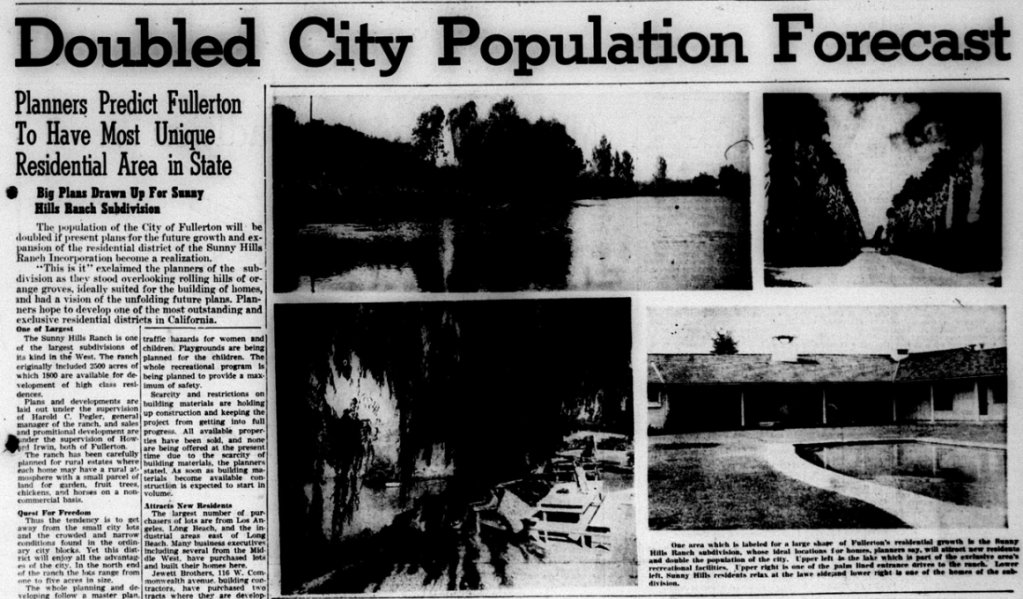
“Large, previously undeveloped areas are being subdivided and plans call for the erection of houses at the rate of city blocks at a time. In addition to lesser buildings programs on W. Wilshire and W. Amerige avenues, Jewett Brothers are preparing a tract on N. Basque ave for construction of 78 homes for sale to war veterans,” the News-Tribune reported in 1946. “In the northern hills of Fullerton is one of the largest subdivisions of its kind in the entire west. Eighteen hundred acres of the Sunny Hills Ranch in this are area available for development of residences. According to planners of this subdivision of rolling hills and orange groves, it will make up one of the most exclusive residential areas in California and will attract new citizens to the extent of doubling the population of the city of Fullerton.”
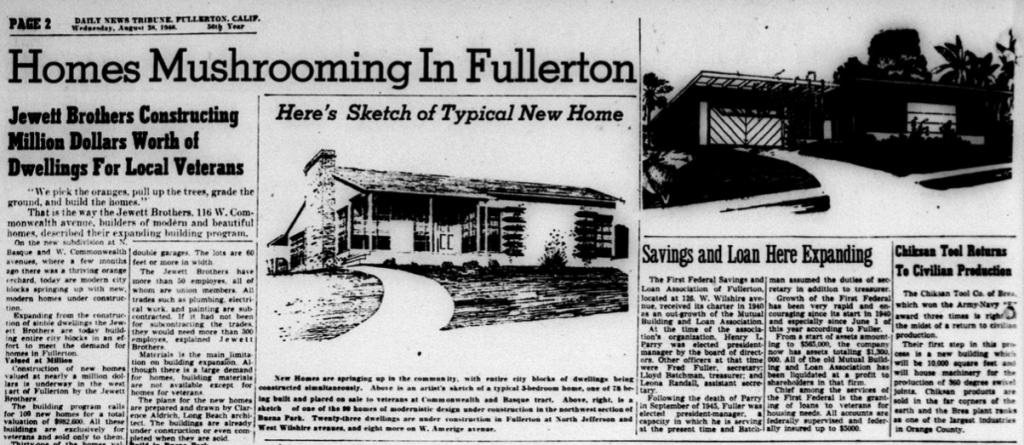
To accommodate this growth, the city also spent a lot of money expanding the city’s infrastructure, including roads and sewers.
In 1941, Fullerton finally completed construction of City Hall at the corner of Highland and Commonwealth. The building now serves as the police station.
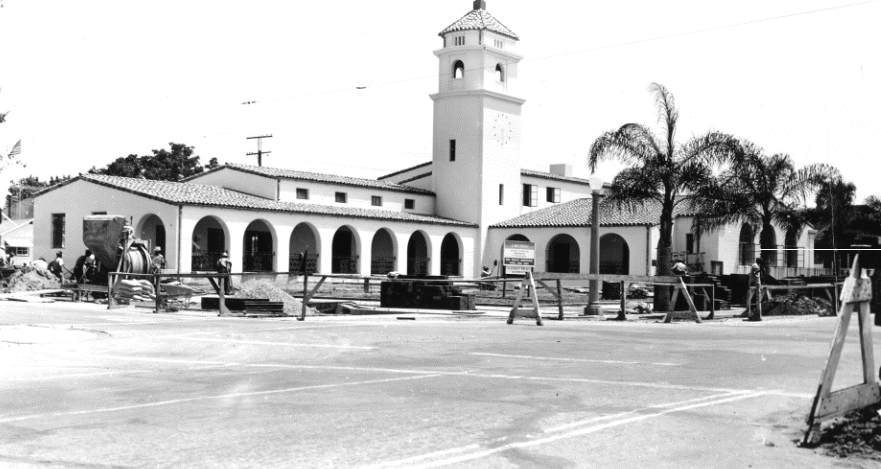
The building was designed by architect by G. Stanley Wilson, and was funded by the WPA, a New Deal federal program.
In addition to housing various city government offices, the building also was home to the Chamber of Commerce, the local welfare department, the police department, and the city jail.
The City Council chambers were also used as a court room for use by the city judge or justice of the peace.
“Most outstanding of city projects to be undertaken is street development, calling for an expenditure of nearly $1,000,000 within the next 10 years,” the News-Tribune stated in 1946. “Under the program being considered the city will build new streets, widen, resurface, and improve existing arterials.”
Fullerton continued to benefit from various New Deal programs, including construction of a new library on the site of the original Carnegie Library (built in 1907). The Library, built in 1940, is now the Fullerton Museum Center. Other public works projects underway in 1940 included flood control measures like construction of the Brea and Fullerton dams and paving of barrancas.
In 1940, the sprawling Sunny Hills Ranch, formerly part of the Bastanchury Ranch, was partly subdivided into residential housing. Unfortunately, the properties had racially restrictive housing covenants.
For those thousands of GIs who were eventually discharged, a new problem emerged—a housing crisis. There was not enough housing for all the vets, and it much of it was too expensive. Both federal and local governments responded by building lots of new housing and establishing programs like the GI Bill that made is affordable for vets to get home loans and go back to college.
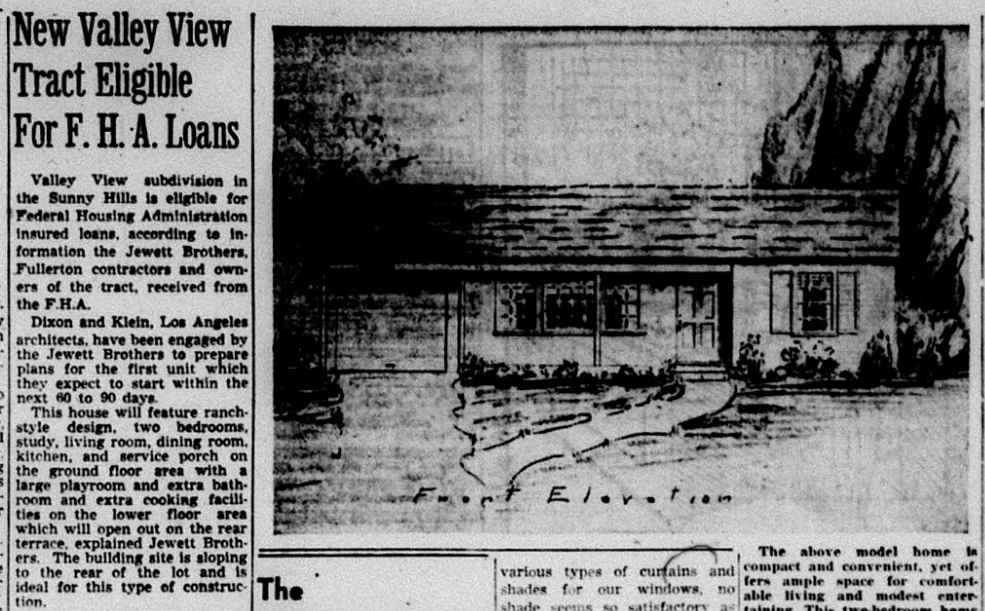
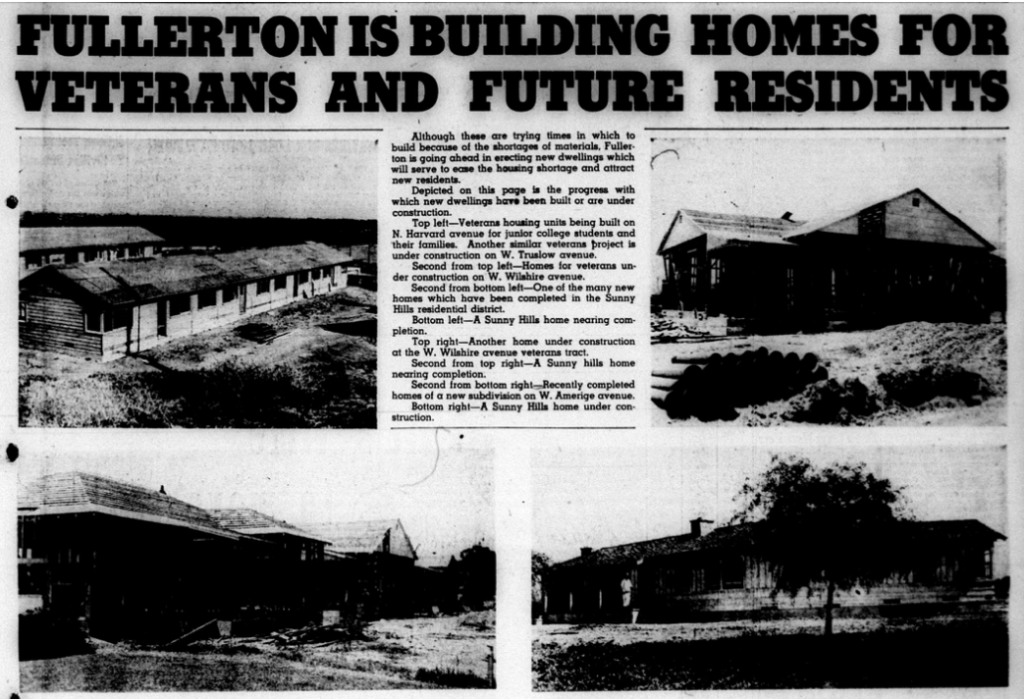
Here in Fullerton, homebuilding increased dramatically after the war, and some of the new homes were explicitly for veterans, such as the 25-unit College View adjacent to Fullerton College.
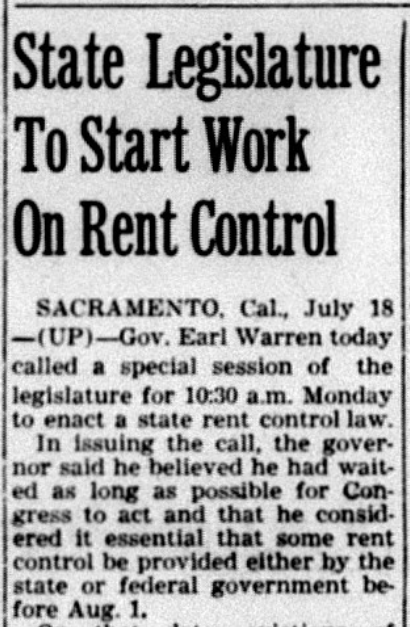
Because housing production and affordability was a national and local priority, both federal and state governments had some form of rent control.
As both Fullerton and Anaheim grew, annexation fights began between the two cities to incorporate land between the two cities. The first salvo of this fight occurred when Anaheim city officials convened a special Saturday session in 1948 to annex a 60-foot strip close to the south border of Fullerton.
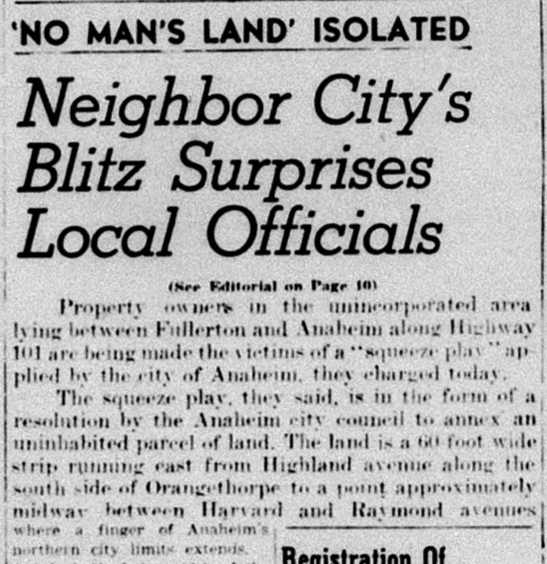
In an editorial called “Skulduggery in Anaheim,” the Fullerton News-Tribune reported:
“When a city council finds it necessary to meet in special session on a Saturday, it is either a case of dire emergency or some kind of skulduggery. Anaheim’s city council met in special session last Saturday.
The business before the council consisted of passing a resolution to annex a strip of land 60 feet wide along the south side of Orangethorpe from Highland avenue to a point approximately midway between Harvard [Lemon] and Raymond avenue where a finger of Anaheim’s north city limits extends.
That a city council would hold a special session to pass a resolution to annex a piece of land which seemingly has no immediate bearing o the welfare of Anaheim, such action can hardly be called a “dire emergency.” That leaves only one category under which it can fall: skulduggery!
One need only to study a few of the facts behind the action by the Anaheim council to understand why it went to the trouble of a special Saturday session.
The area along Highway 101 between Fullerton and Anaheim is unincorporated. Its growth and development in recent years have made it obvious that it will some day become a part of some municipality, which would mean either Fullerton or Anaheim. An area of this nature needs the advantages that any city offers: fire and police protection, trash and garbage collection, sewer and water facilities.
Sentiment for becoming part of a municipality has run high in recent years, and especially more since a Metropolitan Water District edict forbids any new users outside the city limits. This ruling checks and futurity development of property in this unincorporated area until it becomes. Part of one city or another.
On September 11 of this year property owners took legal steps for becoming part of Fullerton by filing a notice of intention to circulate a petition relative to annexation of the territory. With enough signatures to the petition the matter could be put to the vote of the people of the area concerned. The people could choose between remaining unincorporated (with a chance of later joining Anaheim) or joining with Fullerton. Property owners who are working to initiate the petition say that the vote would be overwhelmingly for Fullerton.
It is no secret that Anaheim has coveted this territory. It would stand to lose by letting the people express their desires at the ballot box. With the handwriting on the wall, there was only one course for Anaheim to follow: throw up a legal roadblock between the territory and the Fullerton city limits by annexing a piece of land between the two.
It is reminiscent of Hitler’s tactics in instituting his famous “JA” and “neon” ballots during European plebiscites.
Fullerton officials sought to head-off this land-grab by meeting with Anaheim officials, but their efforts came to naught.
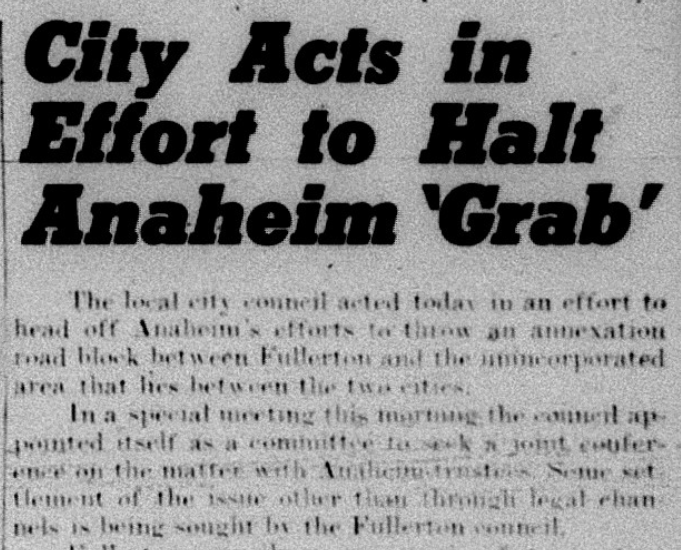
It would fall to property owners to sue Anaheim over the annexation move, which they won. But the fight was not over.
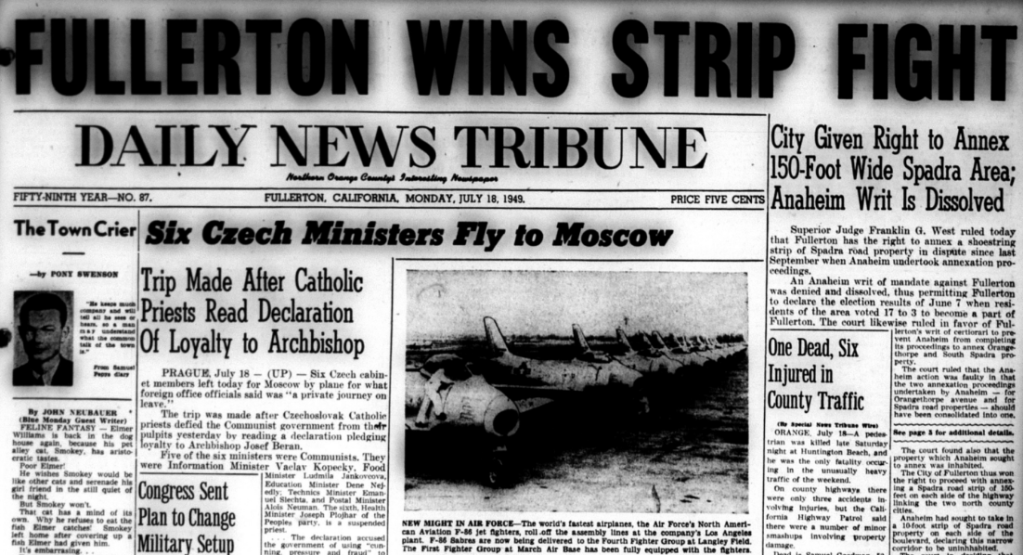
The second biggest local news story of 1949 was the annexation fight between Fullerton and Anaheim over a strip of “no man’s land” that once separated the two towns. At stake was future tax dollars from housing and industrial development. After much legal maneuvering, court fights, resident protests, and council meetings, Fullerton won the fight over the coveted land.
The Labor Strikes of 1945-46
Amid all the jubilation and relief following the end of World War II, some of the largest labor strikes in American history swept major industries like cars, oil, motion pictures, coal, steel, canning, and more. Hundreds of thousands of workers struck–with many of them gaining the kind of strong union powers (like collective bargaining for better wages, benefits, and working conditions) that helped build America’s post-war blue collar middle class.
Both the Fullerton News-Tribune and local business elites tended to portray strikers negatively, sometimes associating strikers or unions with communism.
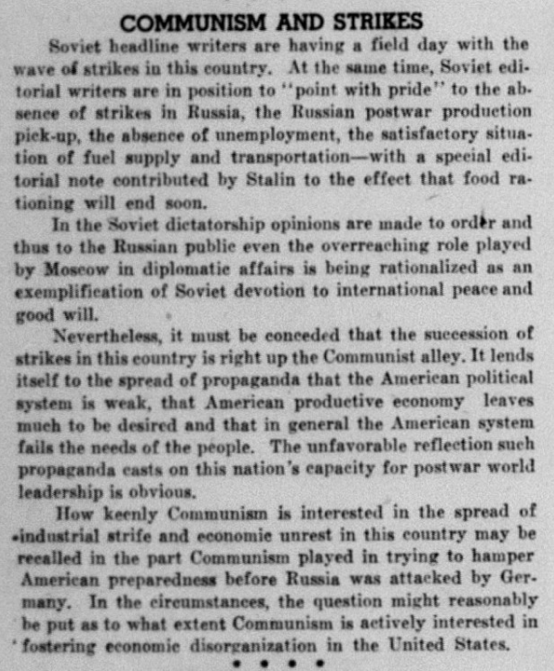
Powerful business interests, like the Associated Farmers and and Employers Industrial Relations Council, who had spent the depression colluding with government to suppress strikes and labor movements, did their part to paint the strikers as dangerous, lawless radicals and communists.
The labor troubles reached Fullerton, with over 400 workers at Hunt Bros. going on strike in 1946. The strikes affected Fullerton in other ways by (briefly) stopping the postal service, travel, and shipping of goods.
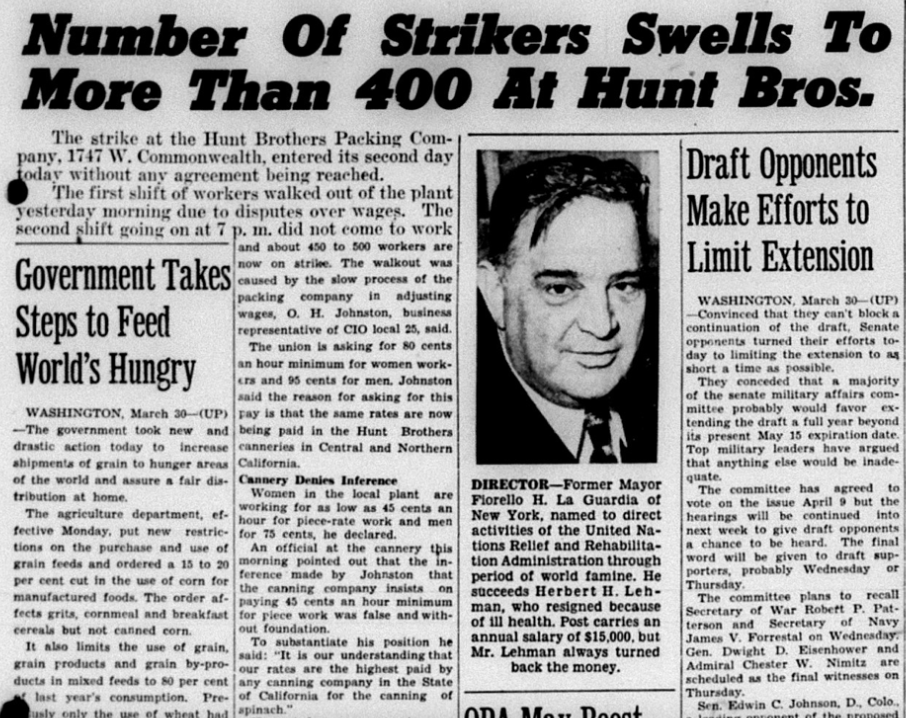
“The processing of oranges in Fullerton has been stopped at some plants and greatly retarded in others due to the railroad strike,” the News-Tribune reported in 1946. “The California Fruit Distributors have stopped picking and packing until arrangement can be made to receive oranges in trucks…There is not much danger of losing the crop as the oranges are not too ripe yet.”
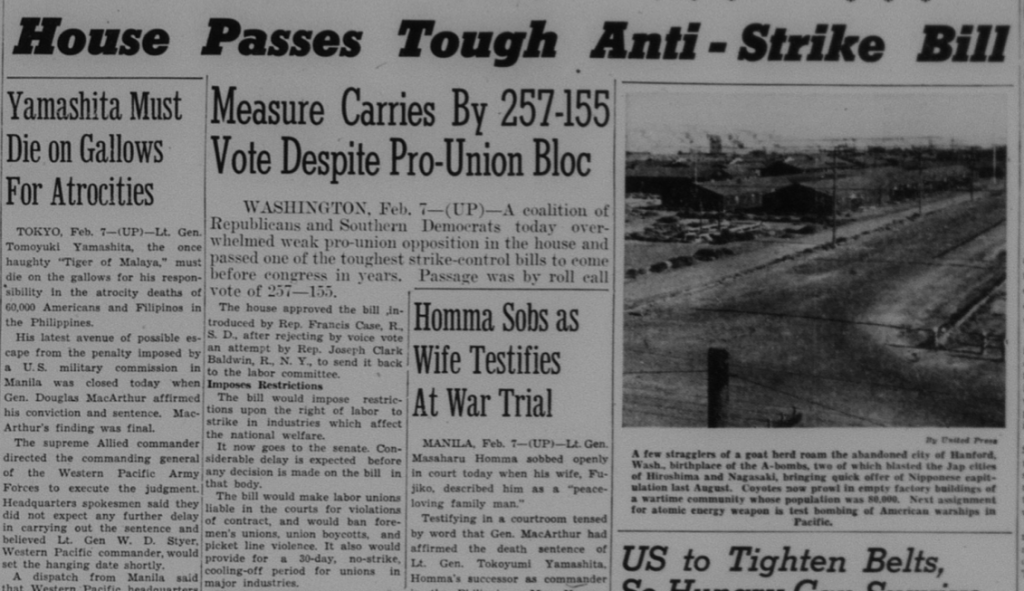
The strikes affected peoples’ ability to buy certain foods, like meat. In response, congress passed a “tough” anti-strike bill, the Taft-Hartley Act.
The Cold War
In 1945, the Axis powers surrendered, and the Allies won the War.
Fullertonians decided to honor the war dead with a memorial in Hillcrest Park, listing the 54 names of those Fullertonians who died, inscribed on a huge sequoia tree cross section.
Perhaps the thorniest post-war question was what to do now that the atomic bomb existed–a weapon that could theoretically destroy the world. On a more positive note, congress passed the GI Bill in 1944, which provided veterans with financial aid for housing, education, and more.
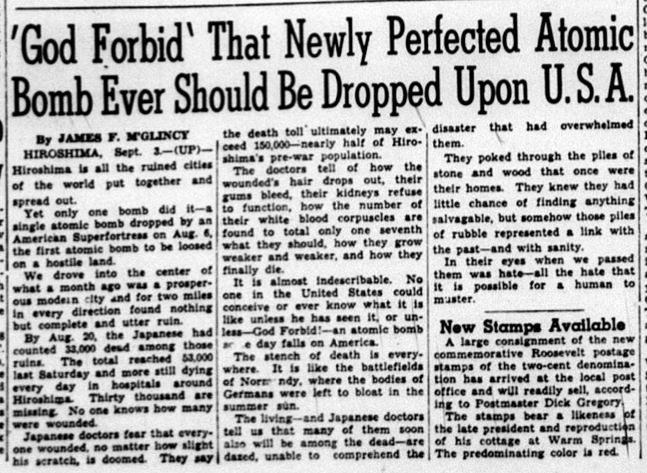
The first frosts of the Cold War were being felt between the capitalist west and large communist countries like Russia and (eventually) China, despite the fact that these were our allies during the War. The existence of the atomic bomb, and Russia’s attempts to create one for itself, exacerbated these tensions.
This tension between the US and Russia would also spark increased espionage and paranoia which in the US would eventually become the Red Scare.
Defeated Axis powers Germany and Japan were occupied by Allied powers to ensure they would demilitarize and follow the political path the Allies wanted them to follow.
Both German and Japanese war criminals were tried and executed.
Just as World War I caused the end of old empires like the Ottoman Empire, the end of World War II brought about the beginning of decolonization of European empires like the British and Spanish. India, a former British colony, would achieve independence in 1947.
While European colonial empires were losing some of their power and global reach, the post World War II era saw a rise in the United States’ international military and economic presence around the world. This did not usually take the form of overt colonization (which was becoming out of fashion), but rather took the form of military bases, plus increased US business and political presence globally. Some might call this a new kind of empire.
A young Republican congressman from Yorba Linda named Richard Nixon (who attended Fullerton High School) was making a name for himself by fanning the flames of anti-communism.
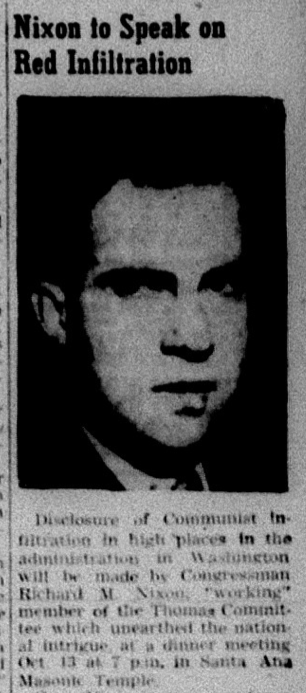
“Disclosure of Communist infiltration in high places in the administration in Washington will be made by Congressman Richard M. Nixon, “working” member of the Thomas Committee which unearthed the national intrigue, at a dinner meeting Oct. 13 at 7pm in Santa Ana Masonic Temple,” the News-Tribune reported. “The committee will resume hearings in Washington later and its probe will be largely on the findings Nixon makes. It will mark the first public appearance at which Capt. Nixon has talked in Orange County, although he was guest Oct. 1 of the Chamber of Commerce at Yorba Linda, his home town, where he attended school as a boy. The meeting is to be under the sponsorship of the Orange County Republican Assembly, now headed by Roscoe G. Hewitt of Santa Ana, who recently succeeded Hilmer Lodge of Fullerton as president.”
Local Politics
President Franklin D. Roosevelt was elected to an unprecedented four terms in office. He died in 1945 during his fourth term, and Harry S. Truman took office. In 1947, Congress approved the 22nd Amendment, which bars presidents from serving more than two terms.
During the 1940 election, Republican candidate Wendell Wilkie made a brief train stop in Fullerton, where he greeted a large crowd.
Those who ran and were elected to City Council throughout the 1940s were all white businessmen who tended to be fairly conservative politically. Here’s a breakdown of who was elected during this period and what line of business they were in:
1940: William Montague, Walter Muckenthaler, and Hans Kohlenberger.
1942: Alfred Beazley, Carl Bowen, Hans Kohlenberger (mayor), William Montague, and Walter Muckenthaler.
1944: Verne Wilkinson, William Montague, and Hans Kohlenberger. Montague, an orange rancher, was selected as Mayor.
1946: Homer Bemis and Irvin C. Chapman (son of Fullerton’s first mayor and powerful citrus grower Charles C. Chapman) were elected to city council in 1946. Bemis was “engaged in real estate, building, brokerage, and development,” according to the News-Tribune. “In the past four years he has been actively engaged in the construction of homes, having built more than 100 homes within this period, with his associates.” Chapman, of course, helped manage the citrus and business empire his father built. Local drug store owner Verne Wilkinson was chosen as mayor.
In 1947, Sam Collins (from Fullerton) was chosen to be Speaker of the California State Assembly. Collins was a very influential politician in Sacramento. He remains the longest-serving Republican Speaker in history.
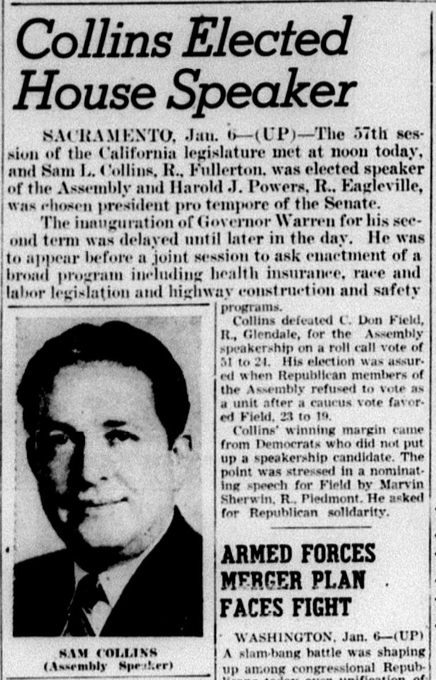
In 1948, Verne Wilkinson, Hugh Warden, and Thomas Eadington were elected to City Council. Irvin “Ernie” Chapman, son of Fullerton’s first mayor Charles C. Chapman, was chosen as mayor.
Culture and Social Life
In 1940, social clubs were popular in Fullerton, including Rotary, Kiwanis, Lions, Business and Professional Women’s Club, Fullerton Junior Chamber of Commerce, American Legion, 20-30 club, Ebell Club, YMCA, YWCA, Masons, Odd Fellows, and more.
For entertainment, Fullertonians went to see movies at the Fox Theater.
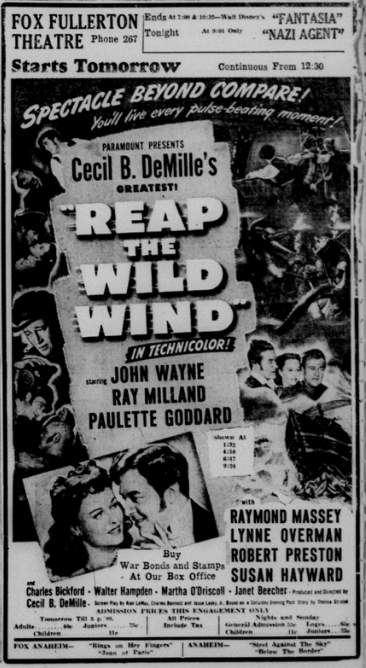
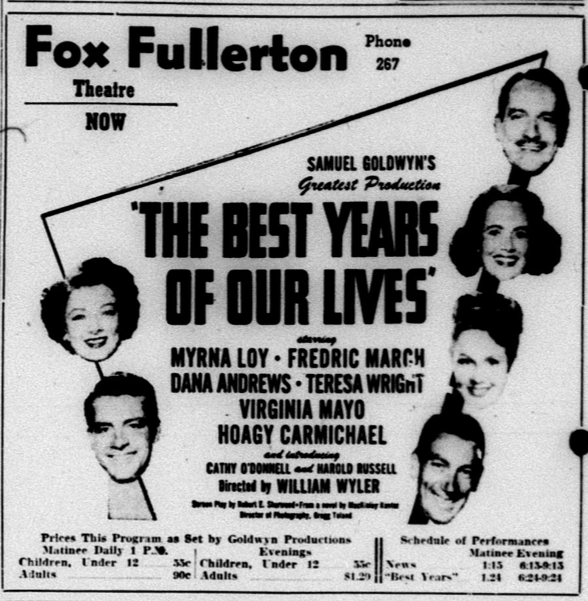
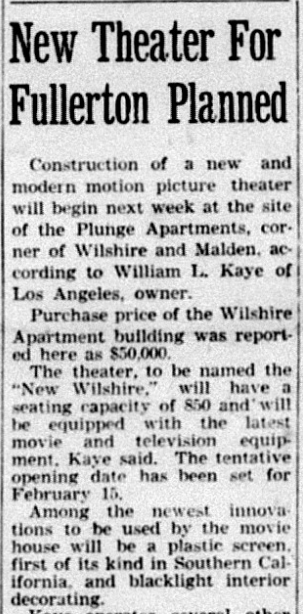
In 1947, a new theater was built—the Wilshire Theater, which has its own interesting history. This eventually was replaced by apartments.
Leo Fender, who had a popular radio repair shop in town, was beginning to design and manufacture electric Fender guitars, although his ads in the local newspaper focused on radios and records.

Throughout the 1940s, minor league baseball teams from the Pacific Coast League played games at Amerige Park–like the Portland Beavers, the Los Angeles Angels, the Hollywood Stars, and the Sacramento Solons. Local teams also used the field, including the Fullerton Firemen.
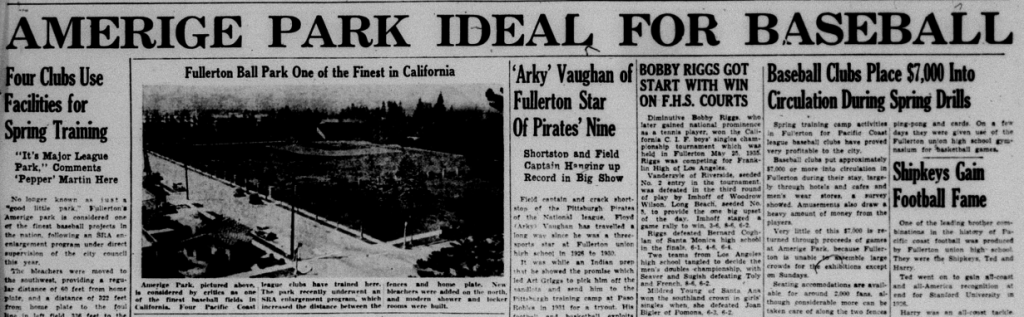
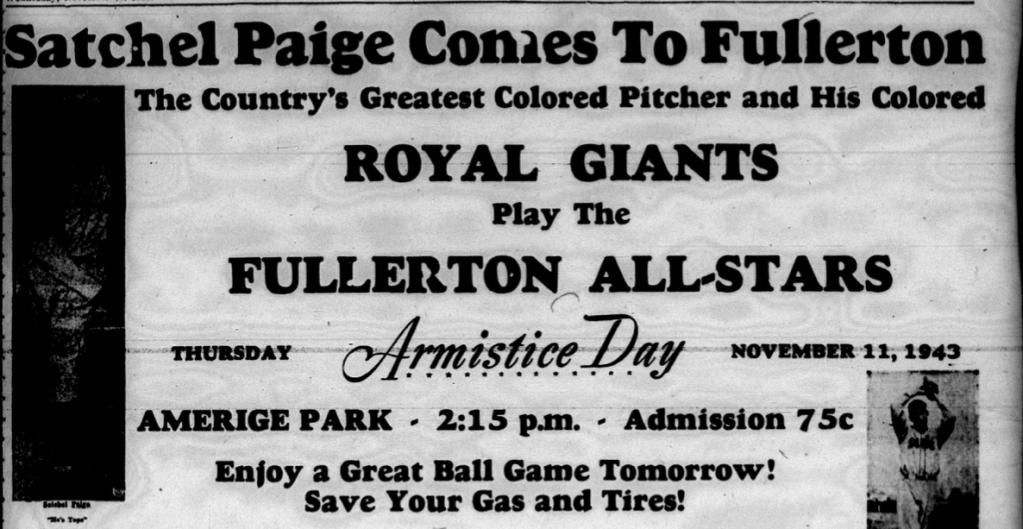
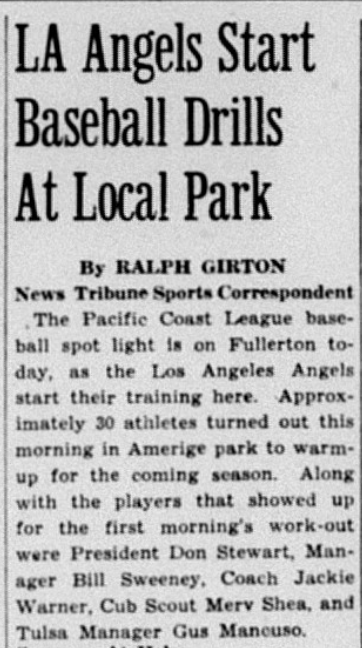
I’m currently reading a newly published book called Spring Training in Fullerton, which is all about this subject. Stay tuned!
Local Pilots Set World Endurance Record
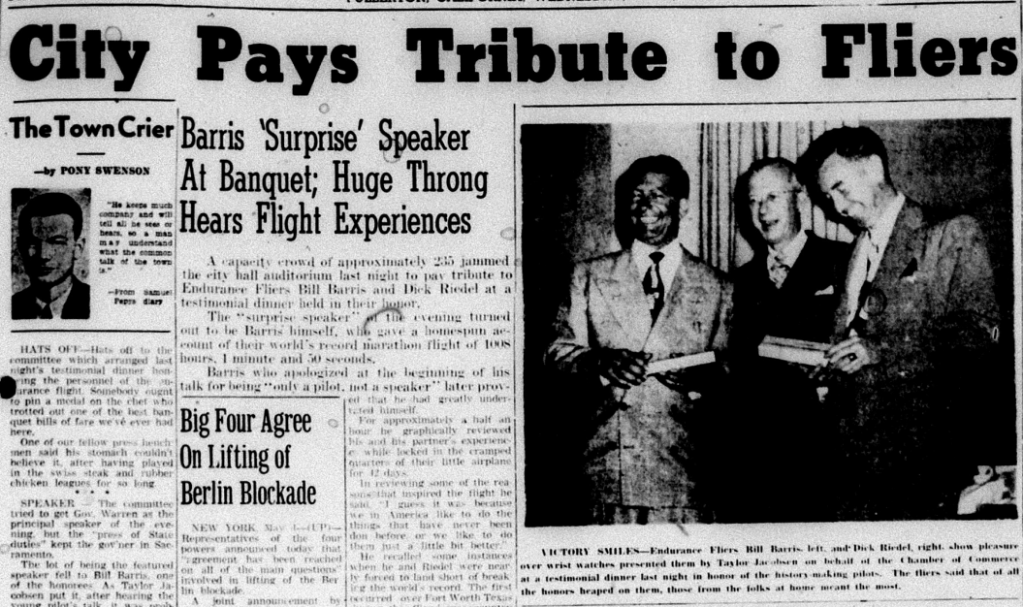
Perhaps the biggest local news event of 1949 was the flight endurance record set by local pilots Dick Reidel and Bill Barris who flew their plane the Sunkist Lady for 1008 hours.
-
Mendez v. Westminster: School Desegregation and Mexican American Rights: a Book Report
The following is from a work-in-progress about the history of Fullerton. You can support my ongoing research and writing on Patreon.
As part of my research into Fullerton history, I like to read books about local and California history to help give broader context for what was happening here. I just finished reading a book called Mendez v. Westminster: School Desegregation and Mexican American Rights by Philippa Strum, which is about a landmark court case in Orange County which held that segregation of Mexican-American children into separate schools was illegal. This case, which was decided in 1947, preceded the more well-known Brown v. Board of Education case by seven years.

Mexican-Americans in California
Mexicans have lived in California for hundreds of years. In fact, prior to the Mexican-American War (1846-48), California (and much of the Southwest) was part of Mexico. Spanish was spoken here before English was.
After California became a U.S. state in 1850, Mexican-Americans continued to live here and to migrate north from Mexico, seeking jobs and opportunity.
“Labor agents recruited workers in Mexico and arranged transportation to the United States for them,” Strum writes. “By the mid-1920s, Mexican workers constituted the bulk of farm laborers throughout the citrus groves of southern California.”
Mexican immigrants and Mexican-Americans often faced housing, educational, and social discrimination and segregation in California, and they were often paid lower wages than their Anglo counterparts.
“Mexican Americans were not chosen for juries. They were not welcome in places of public accommodation such as movie theaters and swimming pools–or, if they were permitted in, they were restricted to the balconies of the movie houses and special “Mexican days” at the pools. Restrictive covenants prevented them from moving into better “white” neighborhoods,” Strum writes. “Many of them settled in poorer neighborhoods–colonias–next to citrus groves or vegetable fields. The Mexican farm laborers who lived on the outskirts of Anglo towns in Orange County in the 1930s found themselves in neighborhoods that for the most part lacked sewers, gas for cooking and heating, paved streets, or sidewalks.”
Nonetheless, Mexican-Americans formed strong and dynamic communities. For more on this, check out my book report on Gilbert Gonzalez’s book Labor and Community: Mexican Citrus Workers Villages in a Southern California County, 1900-1950.
When the Great Depression hit, Mexican-Americans were often scapegoated as taking jobs from white workers, and the Hoover administration began a mass deportation program in 1931.
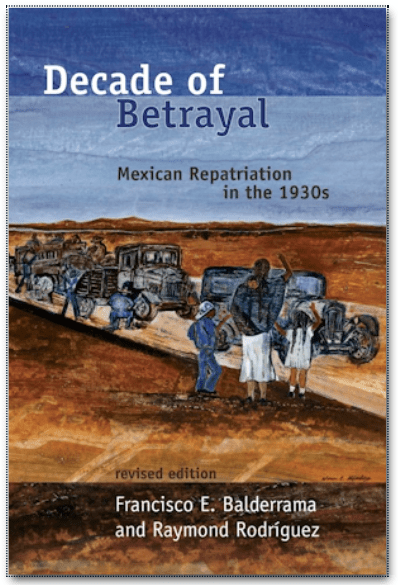
“An estimated one-third of the entire American Mexican population, comprising more than 500,000 people, left voluntarily or otherwise, even though perhaps 60 percent of them were American citizens. In 1930 at least 2,000 ‘Mexicans’ were repatriated from Orange County alone,” Strum writes.
School Segregation, Southwest-Style
In the early 20th century, local school districts created separate “Mexican” schools.
“By the mid-1920s there were 15 such schools in Orange County, all but one located in the citrus-growing area that would be involved in Mendez v. Westminster,” Strum writes, “by 1931 more than 80 percent of all California school districts with a significant number of Mexican (non-American citizen) and Mexican-American students were segregated, usually through the careful drawing of school zone boundaries by school boards that had been pressured by Anglo residents. The ostensible rationale for the separate schools was the children’s lack of proficiency in English.”
These schools were often of lower quality, both in facilities and materials provided. They “were usually built of wood, while the ‘white’ schools were made out of brick or block masonry…Books and other equipment were castoffs from the ‘white’ schools.”
Many of the “Mexican” schools had shorter hours so that children could join their parents in the fields.
Because of these factors, “Many students had to repeat grades, and they dropped out of school as soon as they could.”
Many Mexican schools, including those in Fullerton, had “Americanization” programs that focused on basic English, math, sanitation, and citizenship. Girls were trained to do housework.
“School boards throughout the state operated on the assumption that segregating what were viewed as the underachieving Mexican-American students was a good thing,” Strum writes. “By 1934, more than 4,000 pupils in Orange County–25 percent of the county’s total student enrollment–were Mexican or Mexican-American. Seventy percent of the county’s students with Spanish surnames were registered in the 15 Orange County elementary schools that had 100 percent Mexican enrollment.”
Unlike elementary schools, high schools in Orange County were, for the most part, integrated. For example, Isabel Martinez graduated from Fullerton High School in 1931, the first Mexican-American to graduate from FUHS.
The Times They are ‘A Changin’
During World War II between 300,000-500,000 Mexican American men served in the armed forces. This experience of fighting against fascism abroad instilled in many Mexican-Americans a determination to fight for their rights here at home.
One Mexican-American veteran said, “We’d just been at war. We didn’t like it when we came home and found out we’d risked our lives, but now we weren’t treated equally, and that our children wouldn’t be getting as good an education as the white student was going to be getting.”
A group of veterans in Santa Ana created the Latin American Organization (LAO), to combat school segregation. The cultural climate was changing.
Gonzalo Mendez was born in Mexico in 1913. He and his family migrated north in the 1920s, settling in Westminster, California. He married his wife Felicitas (an American citizen born in Puerto Rico) in 1935. They opened the Arizona Cafe in a Mexican barrio of Santa Ana.
In 1943, Gonzalo and Felicitas leased a 40-acre asparagus farm from the Munemitsus, a Japanese-American family who had been “relocated” to an internment camp. The Mendez’s traveled to the Arizona internment camp to meet the Munemitsus, who agreed to lease their farm.
There is an excellent children’s book about the friendship between Sylvia Mendez and Aki Munemitsu called Sylvia & Aki.

The Mendezes and their relatives the Vidaurris worked the farm. Meanwhile, Gonzalo became a naturalized citizen.
In 1945, Soleldad Vidaurri went to the Westminster Main School to enroll her two daughters–Alice and Virginia–and her niece and two nephews–Sylvia Mendez, Gonzalo Mendez Jr., and Jerome Mendez–in their neighborhood public school, Westminster Main Elementary School.
“The Vidaurri girls were light-skinned. The Mendez children, however, were visibly darker and, to the teacher, their last name was all too clearly Mexican. They would have to be taken to the “Mexican” [Hoover Elementary] school a few blocks away,” Strum writes.
“We were too dark,” Gonzalo Jr. later recalled.
Carey McWilliams, who wrote a history of Mexican Americans, described the Anglo Westminster school as “handsomely equipped” with “green lawns and shrubs” whereas the “Mexican” Hoover School had “meager equipment [that] matches the inelegance of its surroundings.”
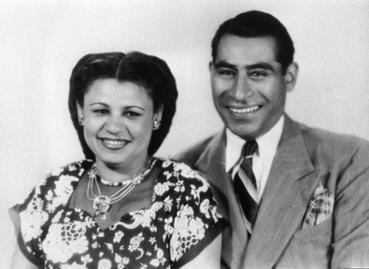
Felicitas Mendez and Gonzalo Mendez Gonzalo, the father of Sylvia, Gonzalo Jr, and Jerome did not want his children to go to the “Mexican” school, especially because Westminster Main was closer to their house.
“Gonzalo went to the Westminster school the day after his children were turned away and spoke to the principal, but his children were still not permitted to register. The following day he went to the Westminster School Board, where he was equally unsuccessful. Eventually he went to the Orange County school board, again to no avail,” Strum writes.
Henry Rivera, who worked for the Mendezes, told Gonzalo about lawyer David C. Marcus, who had worked for the Mexican consulates in Los Angeles and San Diego.
Marcus, the son of immigrants himself, had experienced anti-Semitism in his life. He was married to Maria Yrma Davila, a Mexican immigrant.
The Mendezes joined with other families in Garden Grove, Santa Ana, and El Modena and brought a class action suit against the four school districts, their superintendents, and all the members of the school boards on behalf of “some 5,000 persons of Mexican and Latin descent,” all of them citizens and residents of the four districts.
The petitioners were Mendez and his children Sylvia, Gonzalo Jr, and Jerome; William Guzman and his son Billy; Frank Palomino and his children Arthur and Sally; Thomas Estrada and his children Clara, Roberto, Francisco, Sylvia, Daniel, and Evalina; and Lorenzo Ramirez and his sons Ignacio, Silverio, and Jose.
Marcus argued that the segregation of Mexican students deprived them of their federal right to equal treatment by the state, as guaranteed by the Fourteenth Amendment. He also argued that Orange County was violating California law which at the time allowed segregation only of Asian and Indian children. Mexicans were considered “white.”
Marcus used the wording “Mexican or Latin descent or extraction” rather than “race.”
In 1945, segregation on the basis of race was officially legal–this was before Brown v. Board of Education.
The case was assigned to Judge Paul J. McCormick.
The lawyers for the school districts argued that the segregation of Mexican-American students was appropriate and for their benefit because the children “were unfamiliar with and unable to speak the English language” when they began school.
Their responses sometimes relied on stereotypes of Mexican-Americans.
The Garden Grove response stated that “a large percentage of said persons [Mexican-Americans] residing in said communities have not been instructed in or are familiar with the proper rules of personal hygiene.”
They also argued that segregation was merely the result of where the students lived, often in segregated neighborhoods.
The thrust of the district’s defense was “that the segregation was based on lack of language proficiency rather than ethnicity.”
The Trial Begins
Early in the trial, Marcus showed that the Mendez children spoke English.
As the trial began, Judge McCormick stated, “The claim here is that they have just taken the Mexican people, their children, en masse, and drawn a line around where they live and said to them, ‘Now you have to go to a school in this place here. You can’t go to a school here where the others who aren’t of this origin go.’
He quoted from Meyer v. Nebraska: “The protection of the Constitution extends to those who speak other languages as well as to those born with English on the tongue.”
Manuela Ochoa was the first witness on the stand, stating that her children had been denied entry to Lincoln school.
“Marcus wanted to attack segregation itself, and to do so, he first had to demonstrate that the school districts were systematically segregating the students on the basis of ethnicity, without reference to their language or other academic abilities,” Strum writes. “That would knock out the districts’ claim of language facility as the basis for the separation. As Mrs. Ochoa indicated, the children were given no tests before being assigned to ‘Mexican’ schools.”
Garden Grove superintendent James L. Kent, who had written his master’s thesis (called “Segregation of Mexican School Children in Southern California”) argued that all “Mexican” students should be segregated.
“He believed Mexicans constituted a separate and nonwhite race,” Strum writes. “He wrote that Mexicans were ‘an alien race that should be segregated socially’ and this had been accomplished in Southern California ‘by designating certain sections where they might live and restricting these sections to them…Segregation into separate schools seems to be the ideal situation for both parties concerned.’”
Marcus, who had read Kent’s thesis, sought to show the court that Kent’s views, “were based on racism rather than on legitimate pedagogic considerations.”
Kent admitted that there was no special training of the teachers at the “Mexican schools,” and that the teachers there did not speak Spanish. He “admitted that the Garden Grove District intentionally segregated its Mexican American students, regardless of their English proficiency.”
Kent also, stunningly, “admitted that he believed Mexican children were inferior to white children in their educational ability, and that he did not believe Mexican children were white.”
Kent stated that the Mexican child, on average, “is lower intellectually than the child of Anglo-Saxon descent.”
Marcus asked Santa Ana Superintendent of Schools Frank Henderson how the district determined which children were Mexican American.
“By their names,” Henderson replied.
Felicitas Mendez testified: “We always tell our children they are Americans, and I feel I am an American myself, and so is my husband, and we thought that they shouldn’t be segregated like that, they shouldn’t be treated the way they are . So we thought we were doing the right thing and just asking for the right thing to put our children together with the rest of the children there.”
Professor Ralph L. Beals, chair of the Department of Anthropology at the University of UCLA testified that “Segregation defeats the purpose of teaching English, certainly, to the Spanish-speaking child.”
Beals said that segregation also impeded “the assimilation of the child to American customs and ways…a feeling of antagonism is built up in children, when they are segregated in this fashion…The disadvantage of segregation, it would seem to me, would come primarily from the reinforcing of stereotypes of inferiority-superiority, which exists in the population as a whole. The advantages [of desegregation], properly handled, would come, then, in the breaking down of those stereotypes and in the broadening of understanding of people of different cultural background and the understanding of different cultures.”
Judge McCormick asked what would happen if children with varying degrees of facility in English were mixed together. Wouldn’t that be better, in terms of Americanization, than segregation? Yes, Beals replied, “with regard to the Americanization program, the mixed group would become much more rapidly aware of the main trends in American life.”
Marcus’ closing statement was powerful: “Of what avail is our theory of democracy if the principles of equal rights, of equal protection and equal obligations are not practiced…of what avail are the thousands upon thousands of lives of Mexican-Americans who sacrificed their all for their country in this great ‘War of Freedom’ if freedom of education denies the equality of all?”
Judge McCormick handed down his opinion on February 18, 1946, seven months after the trial ended. The verdict was a resounding victory–one that upheld all the plaintiffs’ arguments–segregation violated the state’s own laws.
“The equal protection of the laws pertaining to the public school system in California,” he wrote, “is not provided by furnishing in separate schools the same technical facilities, text books and courses of instruction to children of Mexican ancestry that are available to the other public school children regardless of their ancestry.”
Their actions, he concluded, reflected “a clear purpose to arbitrarily discriminate against the pupils of Mexican ancestry and to deny them the equal protection of the laws.”
He wrote that Mexican-Americans as a group were protected by the Fourteenth Amendment and could not legitimately be discriminated against.
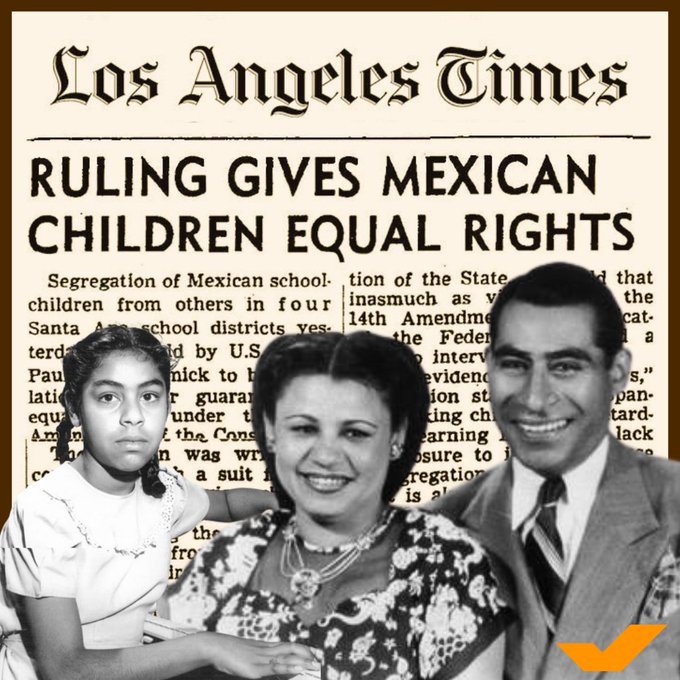
From the Court of Appeals to the State Legislature
The four school districts appealed the decision.
Strum writes that the Mendez decision “had a marked impact on local Mexican-American organizing efforts.” In Ontario, Mexican-American protests led the town to desegregate its Grove School. Similar protests took place in Riverside.
“In Pomona, a group of 50 young Mexican-Americans, most off them WWII veterans, created a Unity League to help organize against discrimination and to push the candidacies of Mexican-americans running for office,” Strum writes.
The case also caused a strong reaction in the legal community.
The NAACP, the American Jewish Congress (AJC), the Japanese American Citizens League (JACL), and the national office of the ACLU all supported the case at the appeals level with amicus briefs.
Robert Carter of the NAACP later said of his amicus brief, “I used it as a trial run for Brown.”
Robert W. Kenney, attorney general of California, submitted an amicus brief in support of the Mendez decision.
The Appeals court upheld McCormick’s decision that the school districts had violated California law. The districts would have to desegregate or carry their appeal to the US Supreme Court.
The school districts did not appeal the Ninth Circuit’s decision to the US Supreme Court.
“Because the case had been decided on the basis of California law rather than the Fourteenth Amendment, the case carried legal weight only in California,” Strum writes. “It had a substantial impact nonetheless.”
In 1947 the California state legislature passed a bill ending segregation based on race, repealing laws permitting the segregation of Indian and Asian children.
The Orange County school districts more or less complied with the ruling.
“Anglo parents in El Modena, however, continued to resist desegregation. Many transferred their children to other districts; later, they managed to have part of the district itself transferred to the nearby, all-white Tustin district,” Strum writes.
Conclusion
“The case got the Mendez children and other Mexican-American children in California the education that enabled so many of them to become lawyers, judges, doctors, nurses, teachers, and legislators,” Strum writes. “For them, Mendez made the American dream reality.”
When the war ended, the Munemitsu family returned to Westminster, and got their farm back from the Mendez family, as agreed.
The three Mendez children went to school at Westminster Man, which now housed all the district’s children in grades one through four.
“Sylvia went on to college and became a registered pediatric nurse. Jerome joined the armed forces and served as a Green Beret for many years; Gonzalo Jr became a master carpenter,” Strum writes.
Sylvia Mendez dedicated herself to educating the public about the case.
In 2007, the US Postal Service issued a stamp entitled “Mendez v. Westminster 1947: Toward Equality in Our Schools.”

Strum acknowledges that the struggle for school desegregation has not always been linear, noting the persistent fact of de facto segregation due to historic housing patterns: “As of the first decade of the 21st century, the majority of Mexican-Americans–like far too many African American students–were in [de facto] segregated urban schools.”
Gary Orfield and Chungmei Lee of UCLA’s Civil Rights Project reported that in 2006-2007, “Latino students across the country attended schools in which more than half the students were Latino. Ninety percent of Latino students in California were in such schools; 50 percent of them went to schools where Latinos made up 90 percent of the student body.”
In 2008 the California legislature passed a bill mandating the teaching of Mendez as part of the state’s social studies curriculum. Governor Schwartzenegger vetoed it.
There is a park and trail in Westminster dedicated to Mendez v. Westminster.
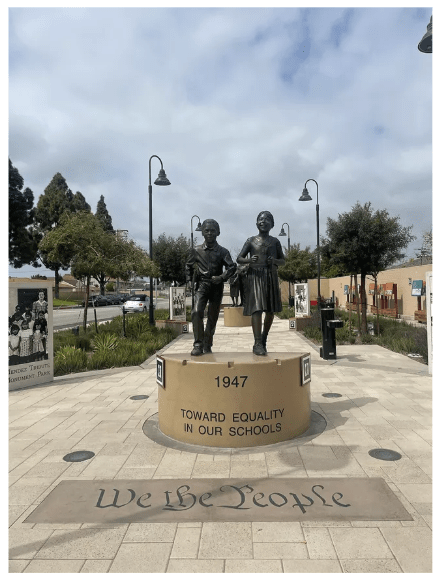
“The tale of what these people accomplished begins on land owned by Japanese-Americans and leased by Mexican-Americans. As it unfolds, the nation’s largest African-American civil rights organization becomes involved, and so do associations of Jewish-Americans and Japanese-Americans. It is not a melting pot story, but more like a kaleidoscope,” Strum writes.
-
The Cold War, Industrial Growth, and the Rise of Suburbia: Fullerton in 1955
The following is from a work-in-progress about the history of Fullerton. You can support my ongoing research and writing on Patreon.
The Local History Room of the Fullerton Public Library has microfilm from the Fullerton Daily News-Tribune newspaper stretching back to 1893. I am in the process of reading over the microfilm, year by year, to get a sense of what was happening in the town over the years, and creating a mini archive. Below are some news stories from 1955.
The Cold War
In international news, the most persistent story had to do with the escalating Cold War between the United States and the Soviet Union.
The fear of atomic war prompted local governments to establish “civil defense” programs, “duck and cover” atomic drills in schools, and even construction of some bomb shelters.
Local schools and other organizations would sometimes host speakers on “Anti-Communism” including Fred Schwarz.
Public Health
In the early to mid-1950s, polio was a major public health concern. Americans were relieved when it was announced that a scientist named Jonas Salk had developed a vaccine for this childhood disease.
In other health news, the long-awaited construction of St. Jude hospital began–a much larger facility than Fullerton’s older hospitals.
Growth
Throughout the 1950s, Fullerton experienced phenomenal growth and hundreds of acres of orange groves were plowed under and replaced by housing tracts, shopping centers, and industrial parks. Fullerton also annexed hundreds of acres of surrounding unincorporated land.
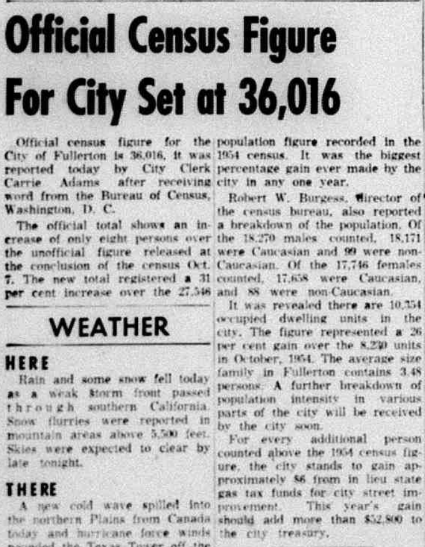
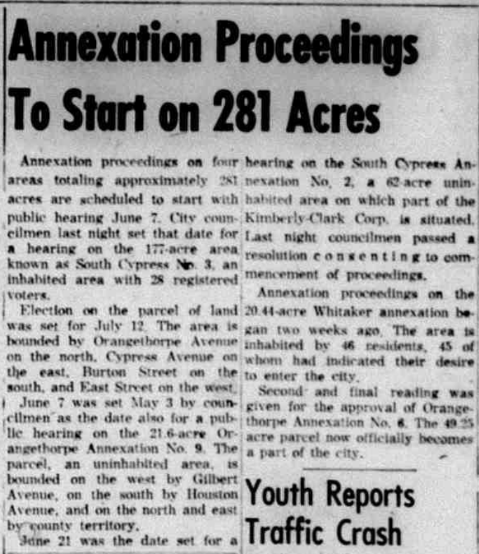
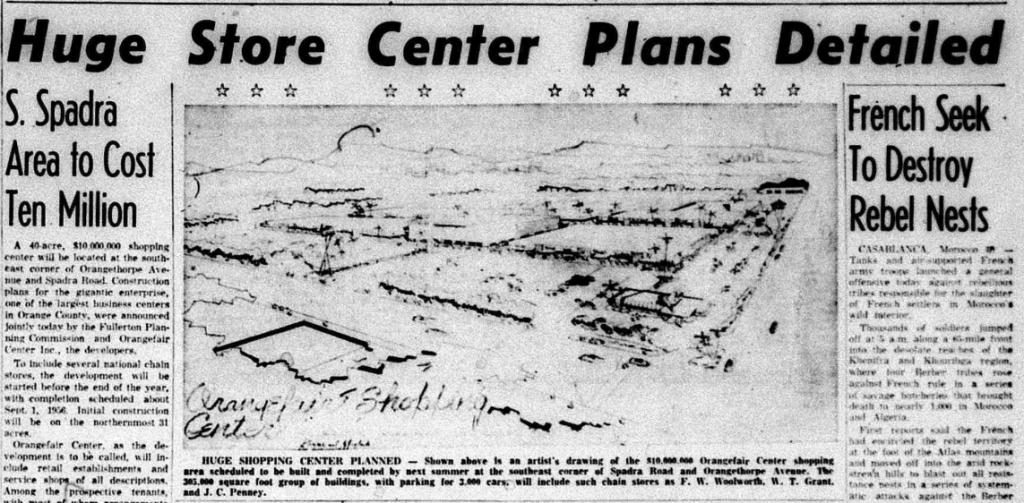
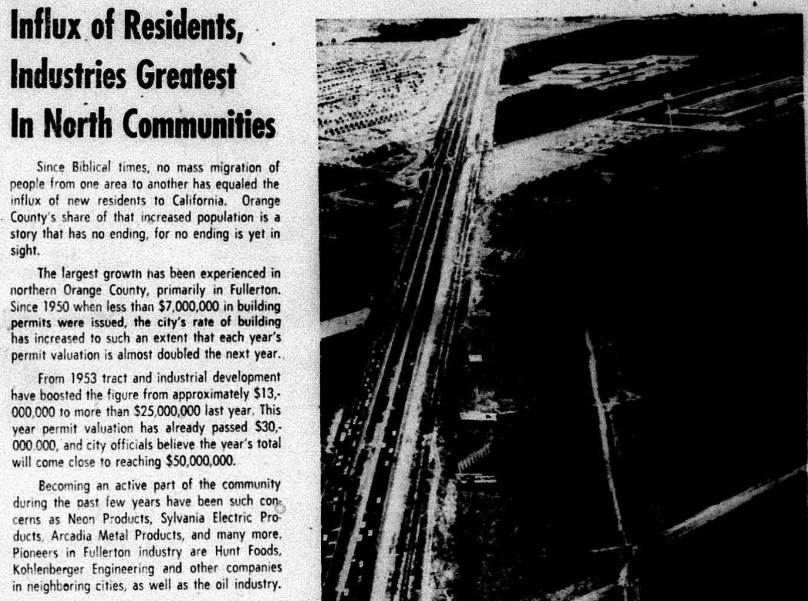
Housing
Many new housing subdivisions were built. According to one news report, 27 homes were being built each weekday in 1955.
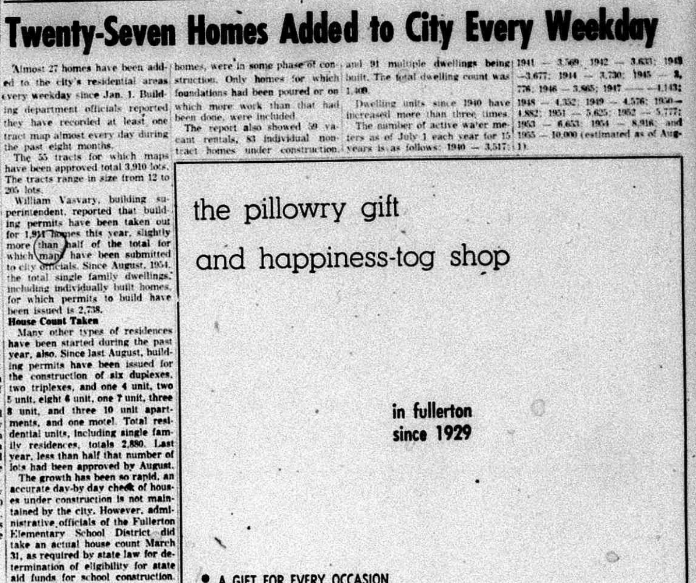
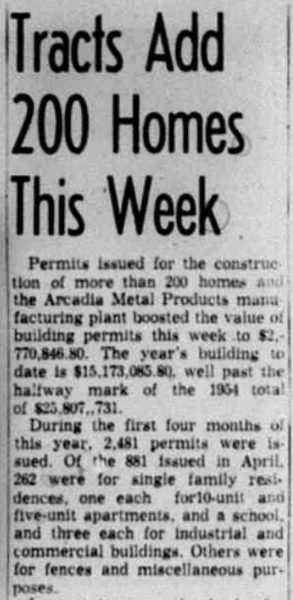
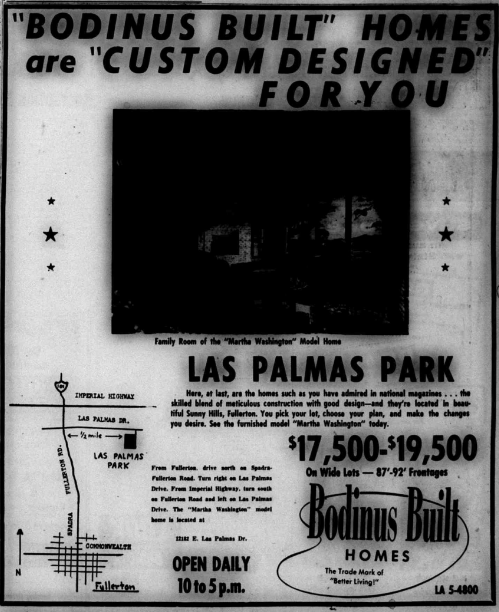
Meanwhile, some housing was being torn down, such as a veteran’s community near Fullerton College.
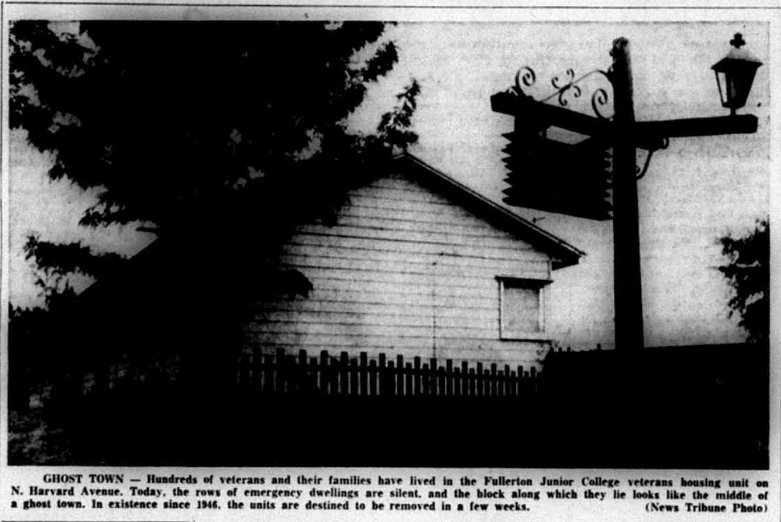
Housing was also a contentious issue on the civil rights front. Back in 1947, Fullerton residents Alex and Esther Bernal had successfully defended their rights to purchase a home in a subdivision with racially restrictive covenants.
In nearby Garden Grove, a former olympian and doctor named Sammy Lee was refused purchase of a home due to racial restrictions.
After support from some notable community members, he was ultimately able to purchase the home.
Industry
In addition to housing, Fullerton was also experiencing rapid growth in its industrial zones, with new factories being built in 1955 by companies such as Arcadia Metal Products, Neon Products, Kimberly-Clark, American Electronics, Ador Corp, Rheem Automotive, and more.
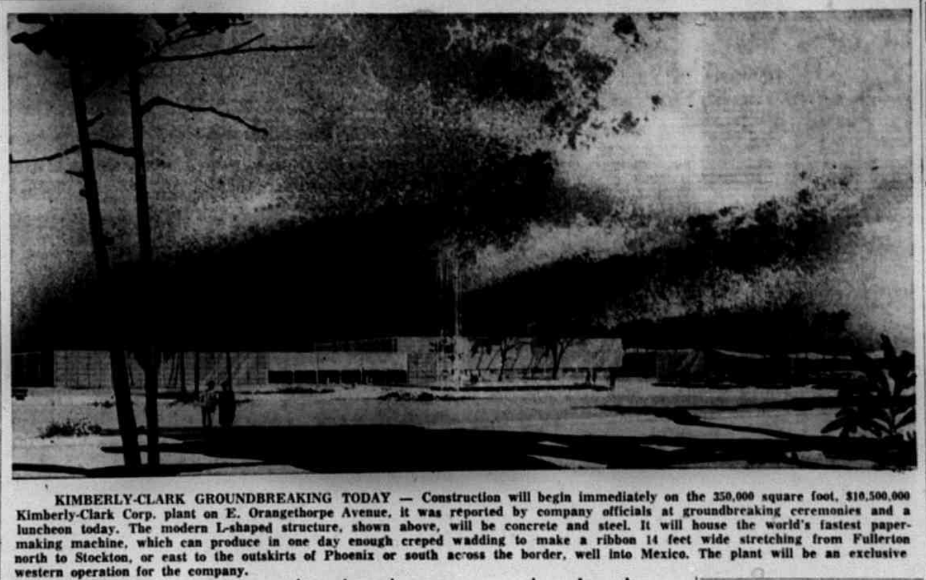
Large industries that already existed in Fullerton expanded their facilities, like Hunt Foods, Pacific Hawaiian Products, and others.
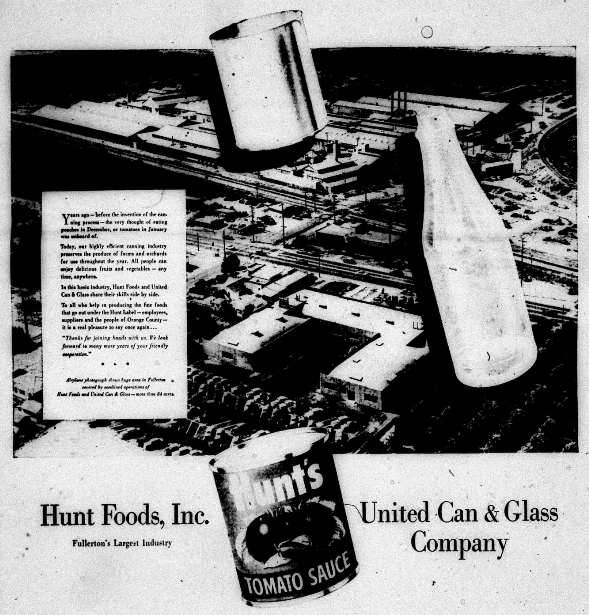
One unfortunate legacy of all this industrial development was pollution. It appears that was not on the radar of the businesses and local leaders at the time.
The authors of the book Fullerton: The Boom Years write, “While the air and space industry and other manufacturing industries were a driving force in the extraordinary postwar economic expansion of Fullerton, these companies left the city with a legacy of pollution, including the contamination of groundwater with toxic chemicals, heavy metals and persistent carcinogens, as well as soil degradation.”
This legacy lives with us today, for example, in the form of the North Basin Superfund Site.
Education
As Fullerton’s population grew, so did the need for more classrooms. Nicolas School opened, and Fullerton College expanded its footprint.
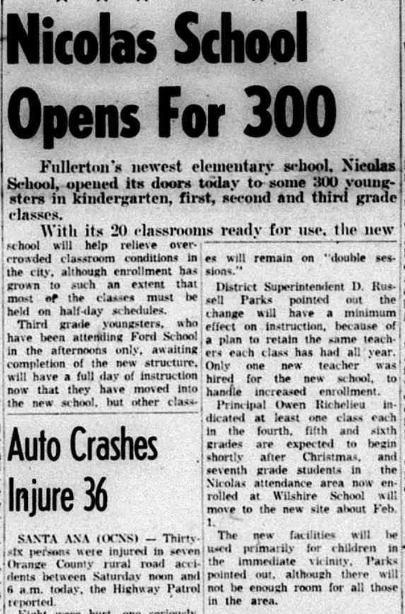
Transportation
The population increase prompted the need for increased transportation infrastructure. New freeways were planned and constructed, including the 91 freeway.
One unfortunate effect of this was the abandonment and destruction of Buena Park’s historic downtown.
As with the rise in industry, the increase in automobiles caused pollution in the form of smog.
Water
As Fullerton grew, so did its demand for water, which sometimes created problems.
Culture and Entertainment
By far, the biggest entertainment news was the completion of Disneyland in nearby Anaheim.
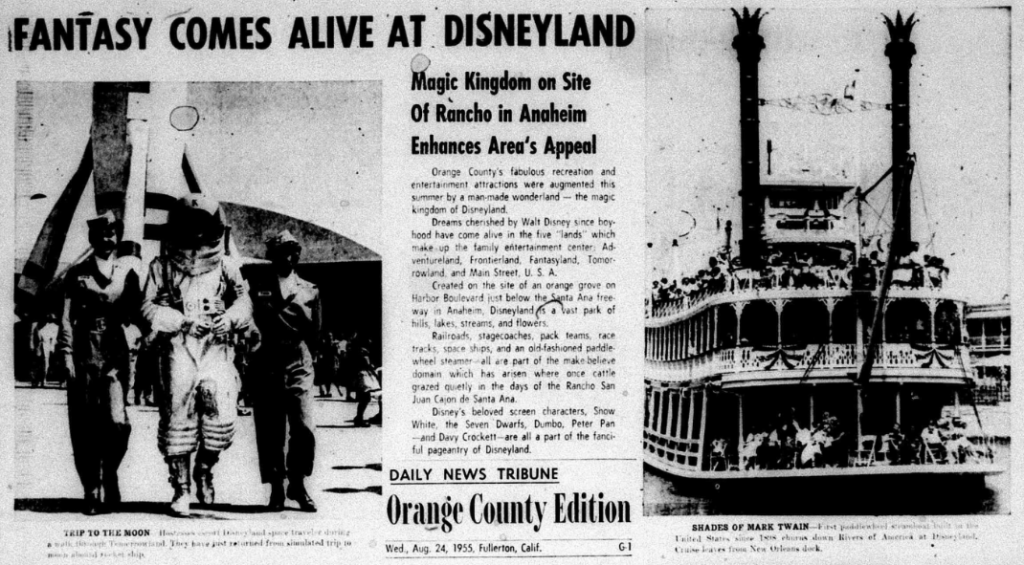
The Fox Theater in Fullerton got a new owner and a facelift. It re-opened with a gala premiere featuring some Hollywood stars.
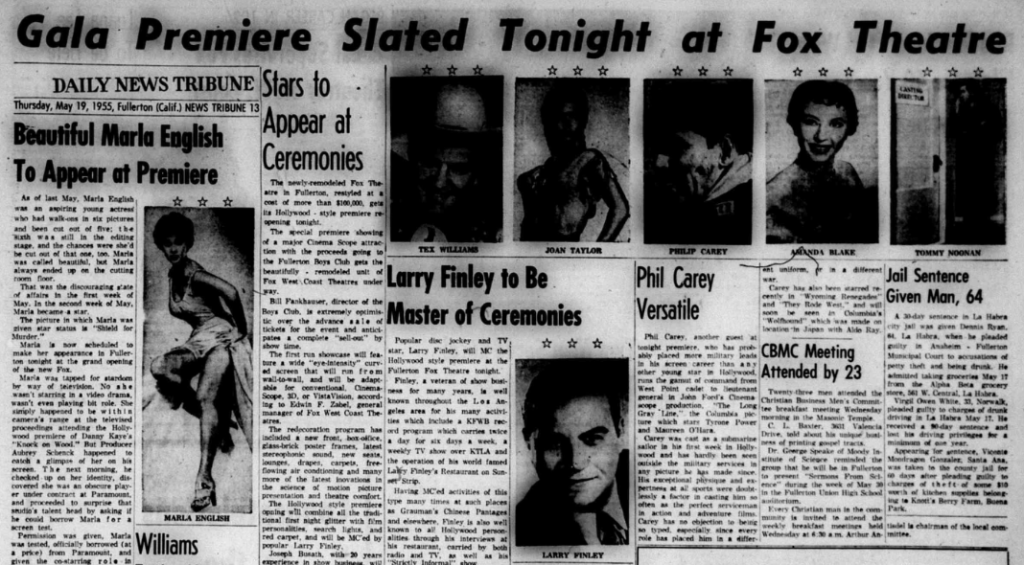
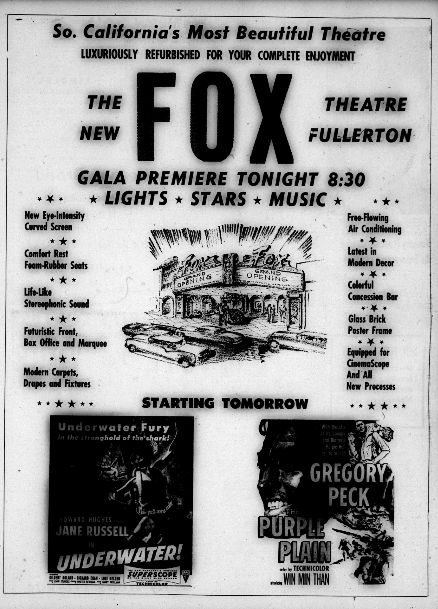
In the world of popular music, Fender Guitars was putting Fullerton the map with its factory on Raymond Ave. creating the instruments that would come to define rock and roll.
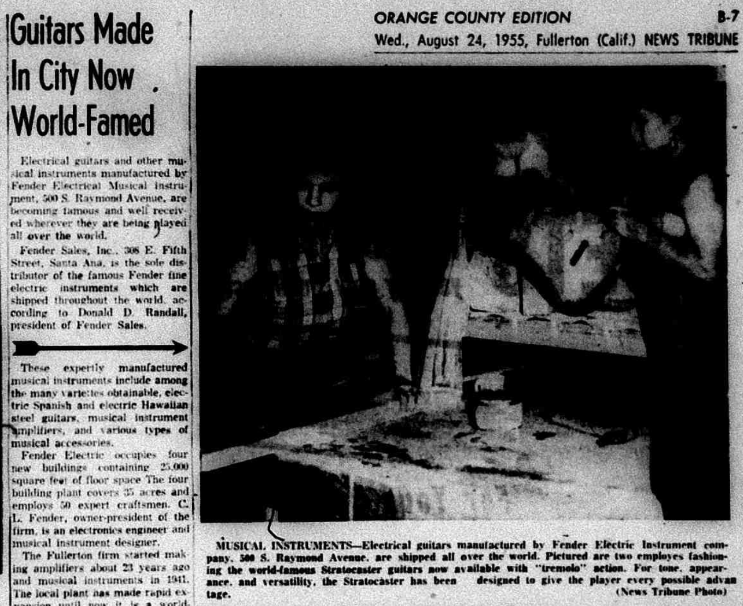
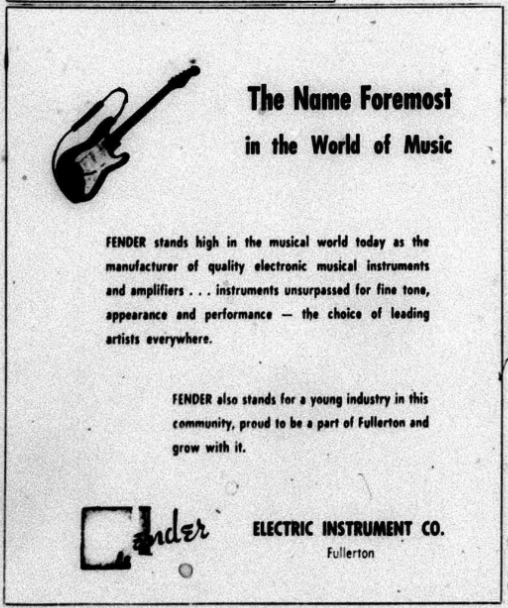
Religion
Fullerton (and Orange County in general) was a hotbed in the rise of evangelical Christianity in the 1950s. Robert Schuler, who would go on to establish the Crystal Cathedral started his “Drive-In Church”.
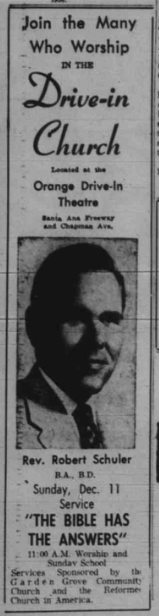
And notable evangelists like Oral Roberts came to preach here to large crowds.
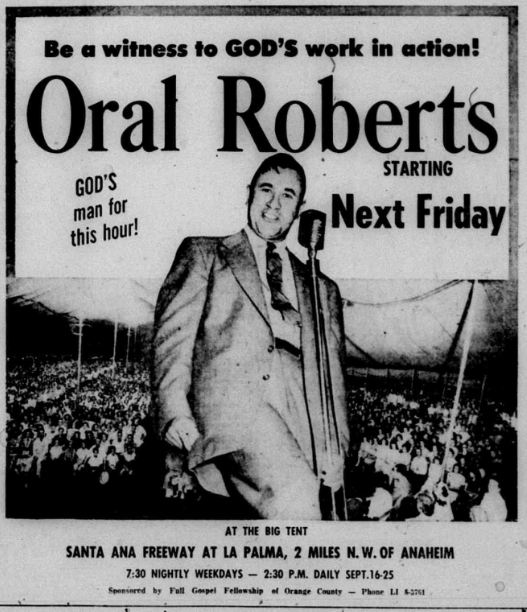
Local Notables
Here are a few local notable people who lived in Fullerton, as highlighted by the News-Tribune:
John J. Hopkins, builder of the world’s first atomic sub.
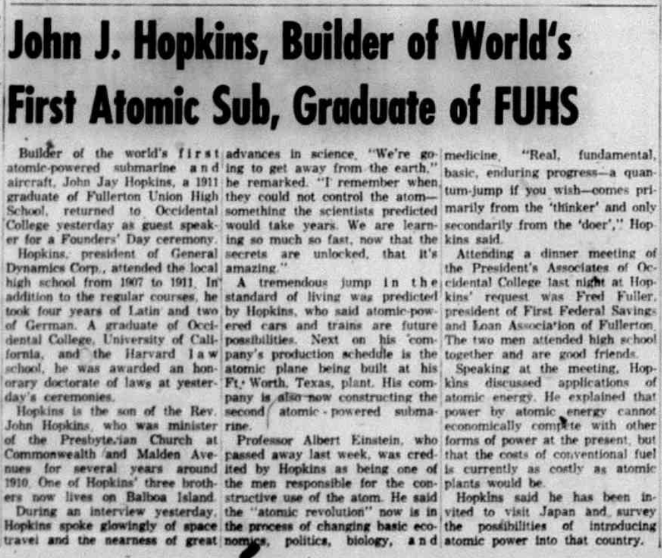
Verneur Pratt, who perfected a microfilm process.
African-American poet Ruby Berkeley-Goodwin.
Poet Ethel Jacobson.
Former Fullerton State Assembly member Sam Collins was acquitted of bribery charges after a much publicized trial.
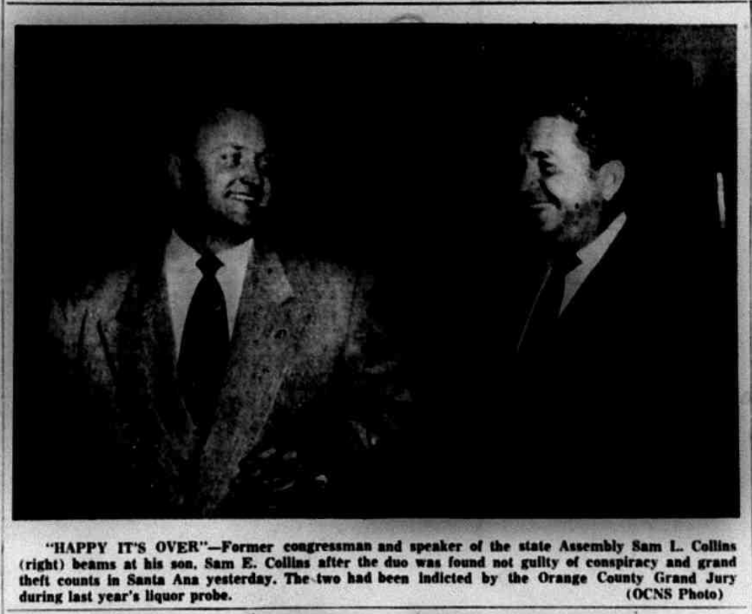
Sports
Baseball games at Amerige Park were popular.
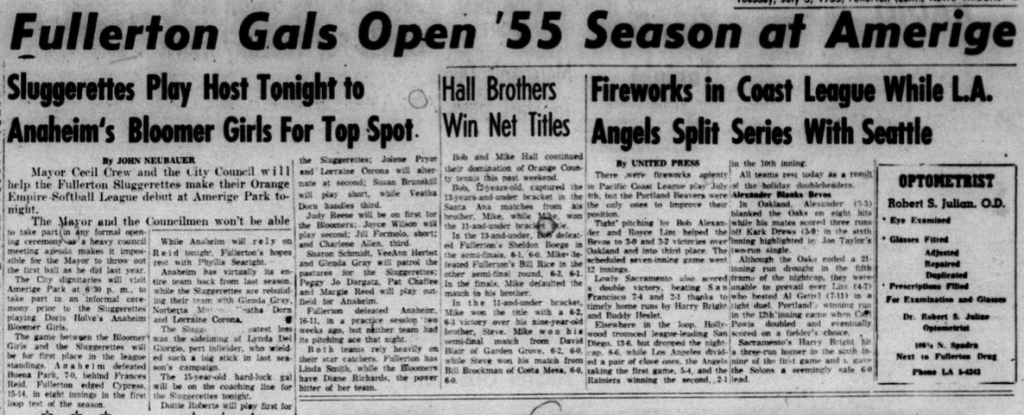
Deaths
Fullerton pioneer Otto Des Granges died.
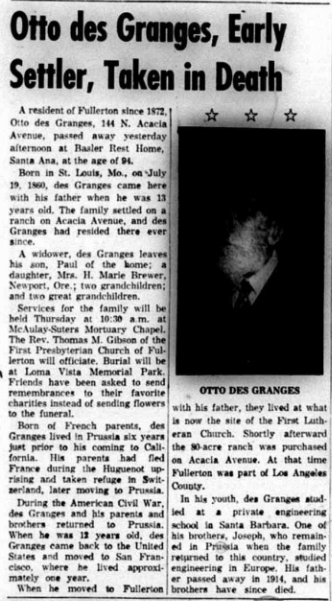
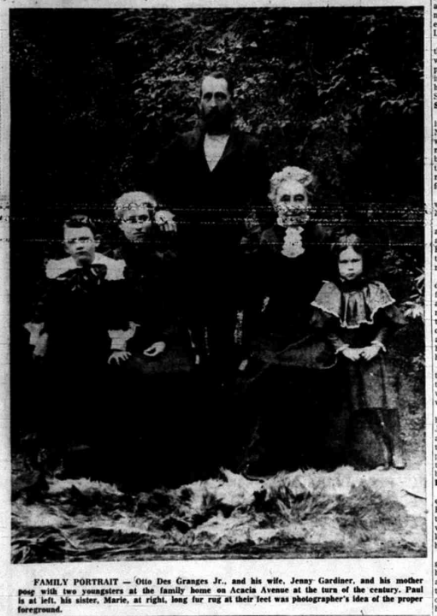
Stay tuned for more stories from 1956!
-
Fullerton in 1954
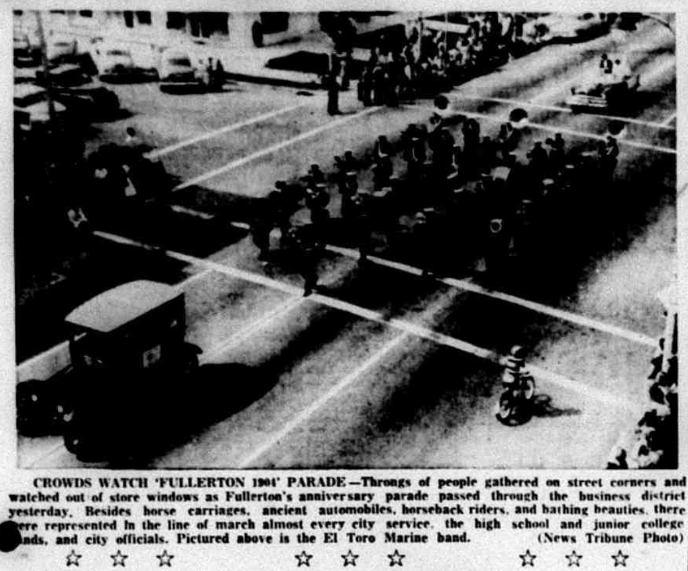
The following is from a work-in-progress about the history of Fullerton. You can support my ongoing research and writing on Patreon.
The Local History Room of the Fullerton Public Library has microfilm from the Fullerton Daily News-Tribune newspaper stretching back to 1893. I am in the process of reading over the microfilm, year by year, to get a sense of what was happening in the town over the years, and creating a mini archive. Below are some news stories from 1954.
National and International News
In national and international news, the Cold War arms race was escalating, with America testing increasingly devastating nuclear weapons, like the Hydrogen bomb.

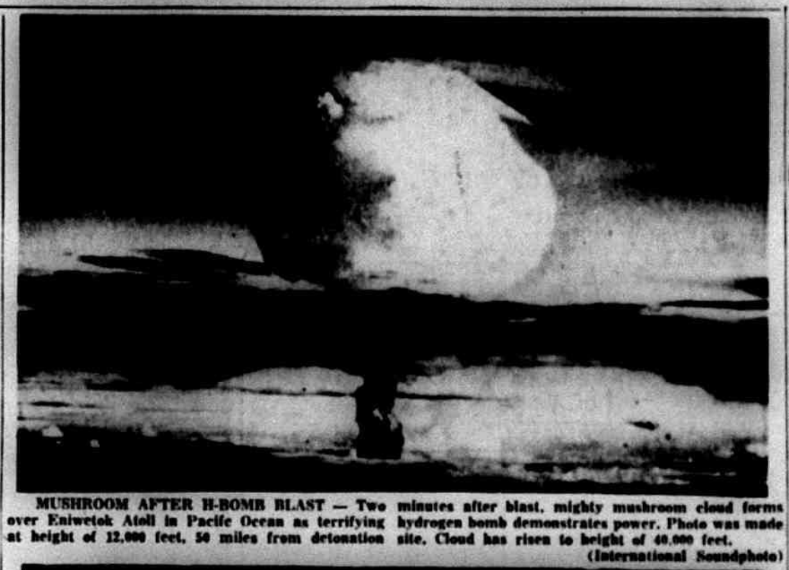
This prompted a national fear of/preparation for atomic war.
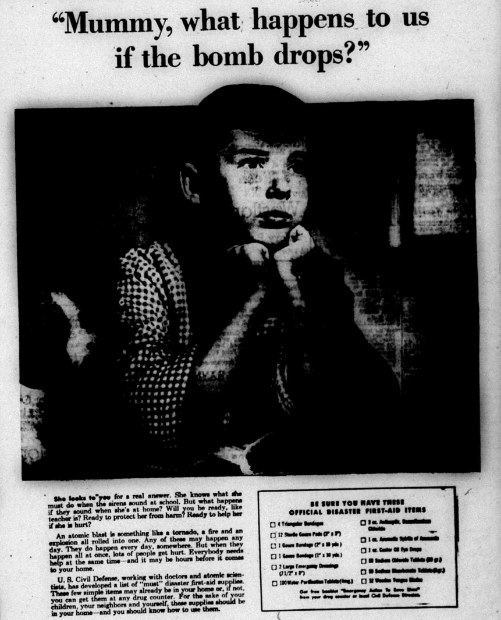
Senator Joseph McCarthy’s Red Scare campaign, accusing many people of being secret communists, encountered its first major pushback after McCarthy started going after U.S. Army officials. The Army-McCarthy hearings signaled the end of McCarthy’s popularity and influence.
In 1954, the U.S. Supreme Court decided the famous Brown v. Board of Education case, declaring school segregation unconstitutional.
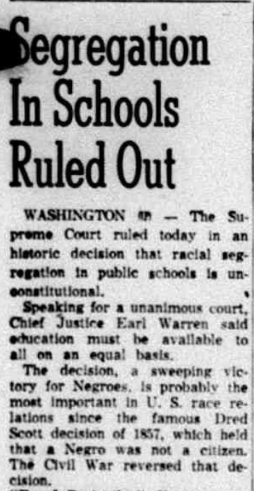
Immigration
In 1954, the Eisenhower administration undertook a massive deportation program called Operation Wetback. This took place throughout the Southwest, including here in Fullerton. At that time, the Fullerton Police department often cooperated directly with federal immigration officials.
Throughout 1954, the Fullerton News-Tribune contained numerous articles about immigration raids and arrests. Back then, even the newspapers used the racial slur “wetback” to refer to undocumented immigrants. Below are a few such clippings from the News-Tribune.
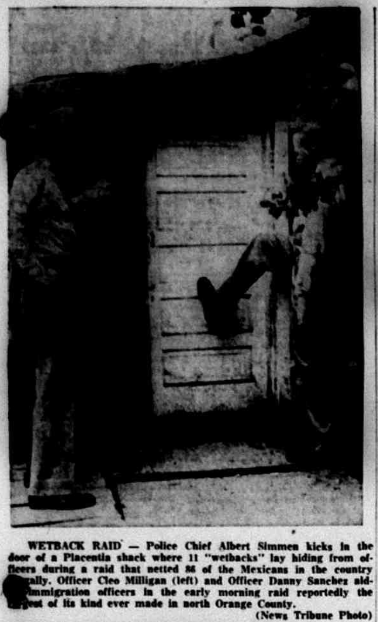
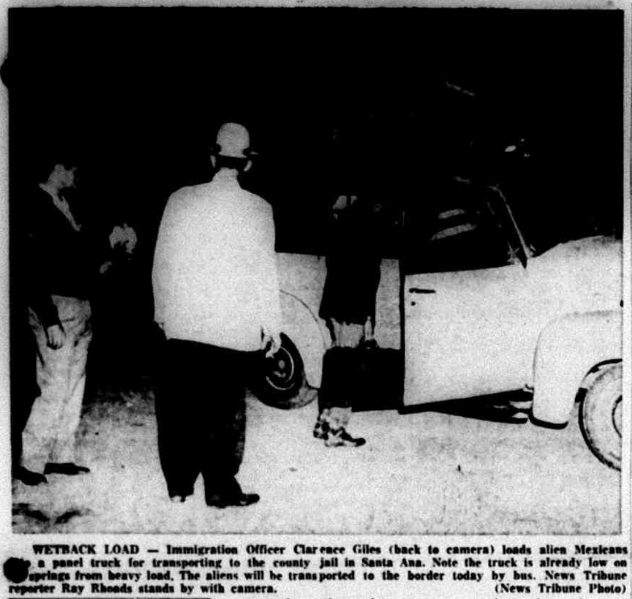
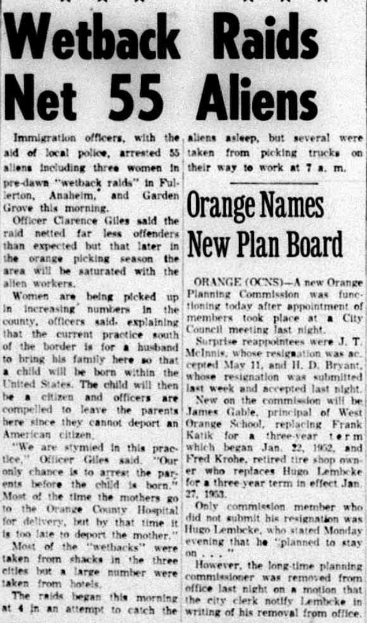
Operation Wetback was officially launched in June, 1954. Unfortunately, the microfilm archives are missing the months of June, July, and August of that year. So, I decided to pay a visit to the Anaheim Heritage Center to look at microfilm from their newspaper of record from that era, the Anaheim Bulletin. Here are a few articles I found there:
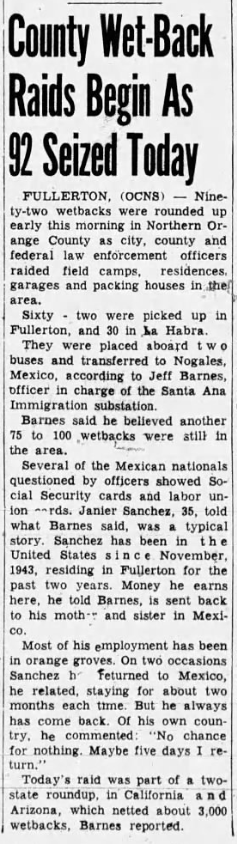
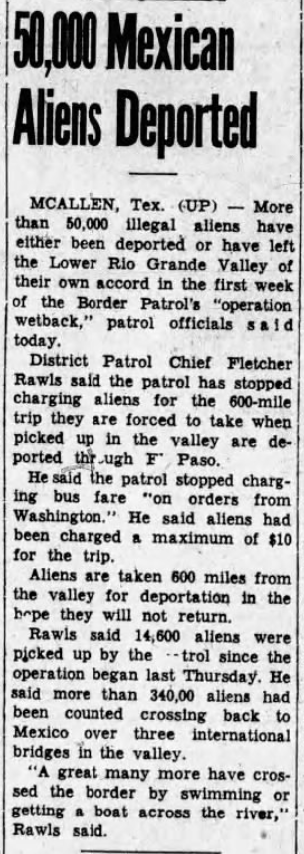
The Anaheim Bulletin contains an article entitled “More Mexicans to be Recruited for Farm Work” which tells of a plan to recruit “legal” immigrants to replace the “illegal” ones. The truth is that there was already a widespread farm labor recruitment program in place at this time (the Bracero Program), and the majority of growers preferred to hire illegal workers because there were no legal protections for such workers. Nevertheless, the full brunt of punishment fell on the workers, not the growers, for a highly problematic immigration system.
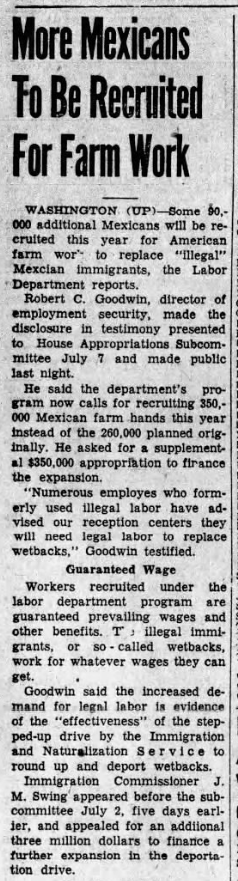
In a move symbolic of the times, US Immigration Service abandoned Ellis Island.
At this time, many Mexican-Americans in Orange County lived in segregated barrios or “colonias” (labor camps). The News-Tribune features an article about a woman who had started a small church in a Mexican camp on Imperial Highway.
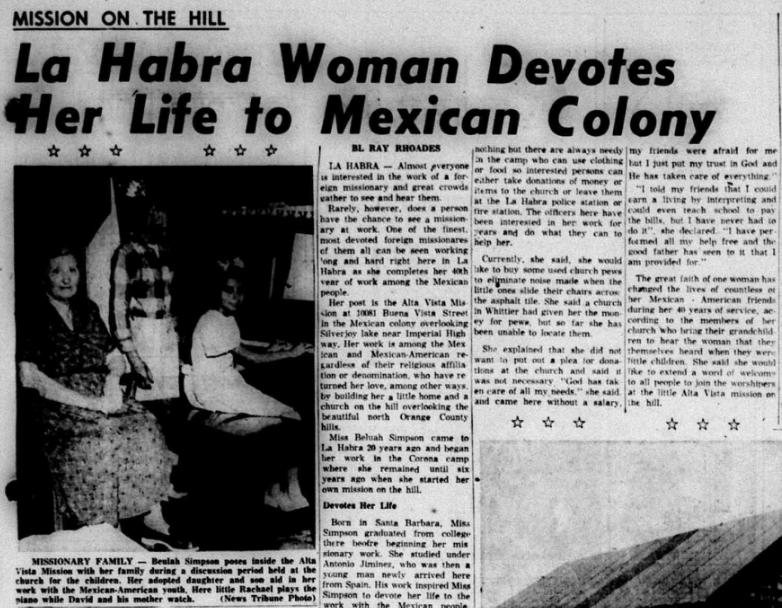
“Her post is the Alta Vista Mission at 10081 Buena Vista Street in the Mexican colony overlooking Silverjoy lake near Imperial Highway. Her work is among the Mexican and Mexican-American regardless of their religious affiliation denomination, who have returned her love, among other ways, by building her a little home and a church on the hill overlooking the beautiful north Orange County hills,” the News-Tribune reported. “Miss Beluah Simpson came to La Habra 20 years ago and began her work in the Corona camp where she remained until six years ago when she started her own mission on the hill.”
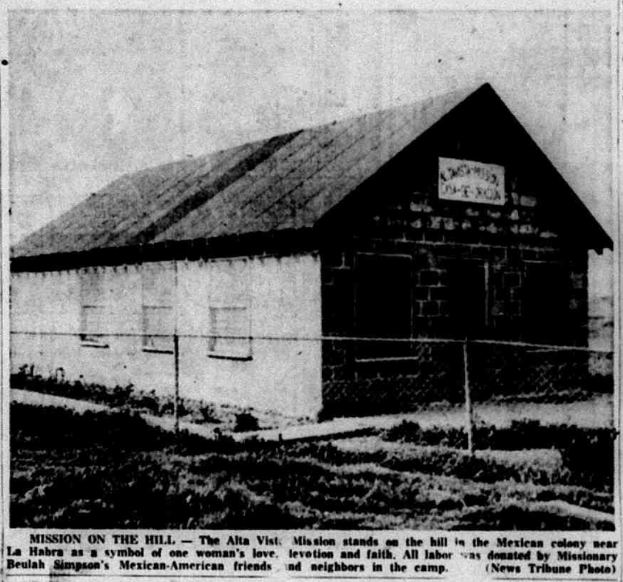
Government and Politics
In 1954, Fullerton City Council was Howard Cornwell, Cecil Crew (mayor), William Kroeger, Phillip Twombly, and Hugh Warden.
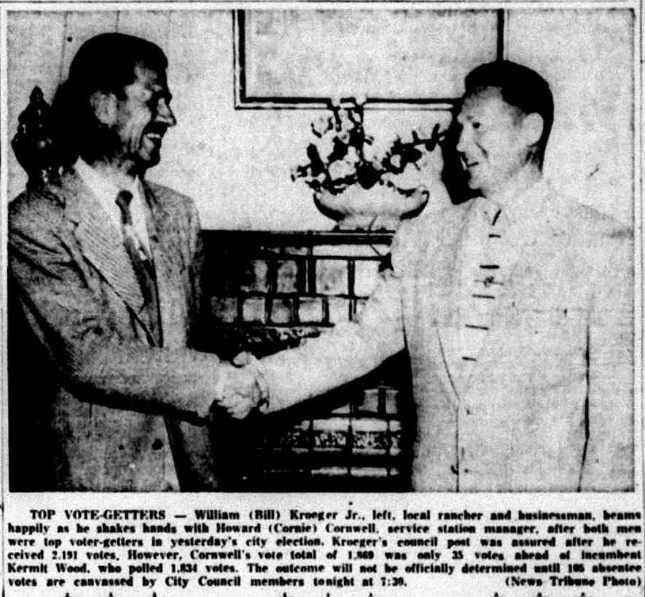
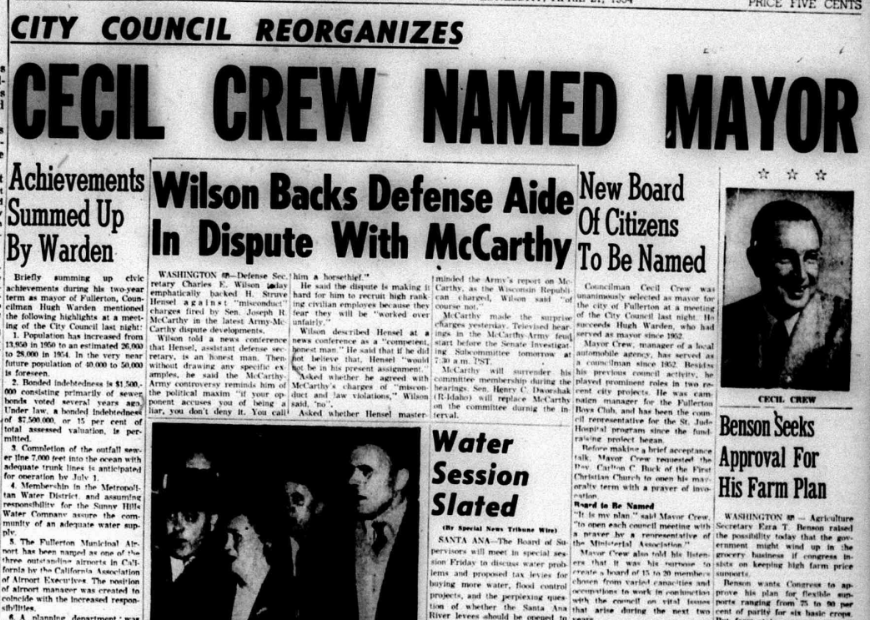
Fullerton Park Superintendent (and alleged former Klansman) Harry Byerrum retired and was replaced by “Pep” Lemon. There is a park in Fullerton named after Byerrum.
“What consisted of a four-acre Commonwealth Park (now Amerige Park) back in 1923, when Byerrum was hired as a laborer, is now a municipal network of 14 parks covering an area of about 100 acres. What once consisted of two employees, has grown to a park department staff of 18 persons,” the News-Tribune reported.
And here are some other local politicians elected to office in 1954.
Sam Collins on Trial for Corruption
Former California State Assemblymember Sam Collins, a Republican from Fullerton, was indicted and stood trial for allegedly accepting bribes to get his friend a liquor license in Buena Park. His son (also named Sam Collins) was also indicted.
The Collinses were tried on three charges: conspiracy to commit the crime of asking of receiving bribes by public officers, conspiracy to commit grand theft, and grand theft. They were accused of taking $7,500 from George Underwood of Buena Park in order to acquire a liquor license.
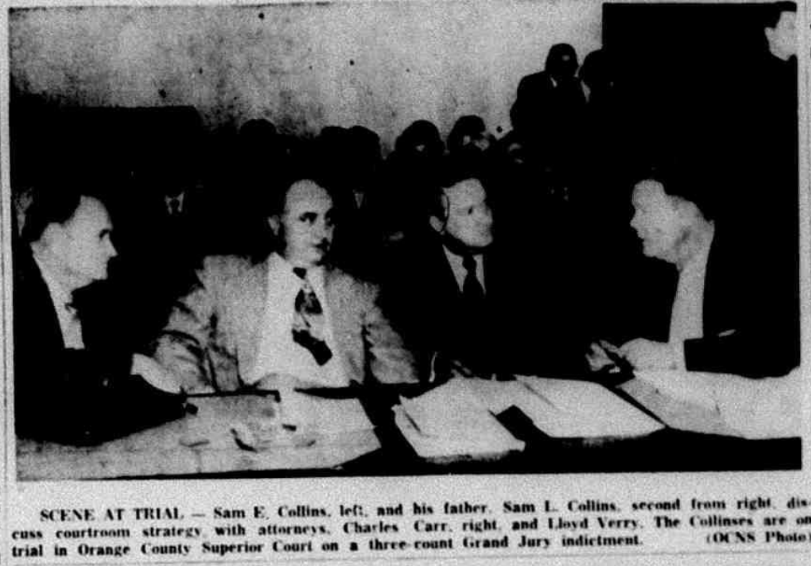
The first Collins trial ended with a hung jury.
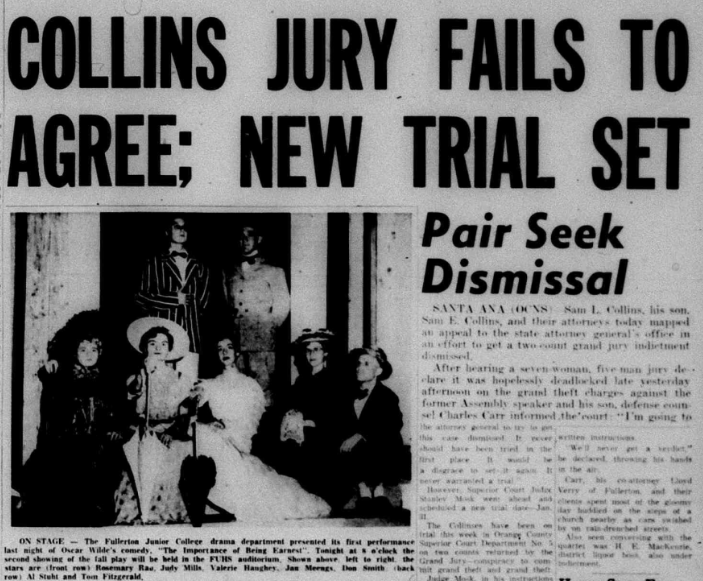
It was possible they may not have to stand for another trial. Stay tuned!
Growth
Throughout the 1950s, Fullerton was experiencing dramatic growth. In 1954, the city’s population was over 27,000.
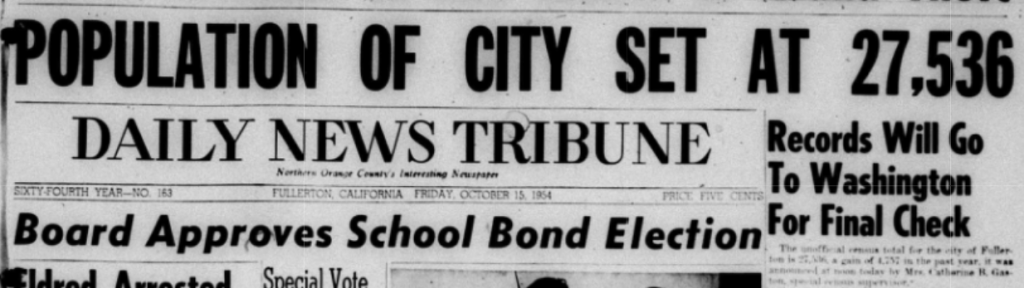
New shopping centers were approved and constructed.
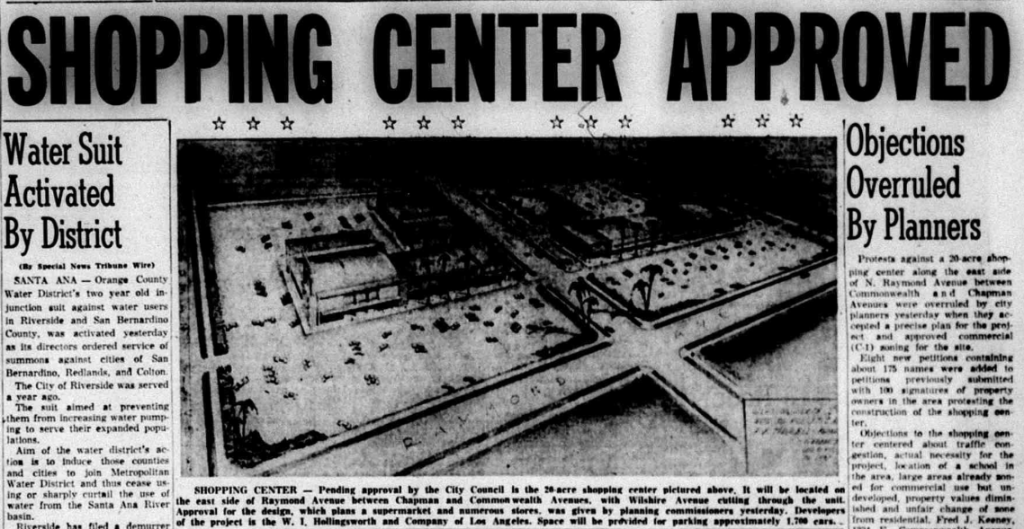
New industrial plants opened up shop in specially zoned areas–mostly on the south side of town, with the major exception of the large Beckman Instruments plant on the north side near the La Habra border.
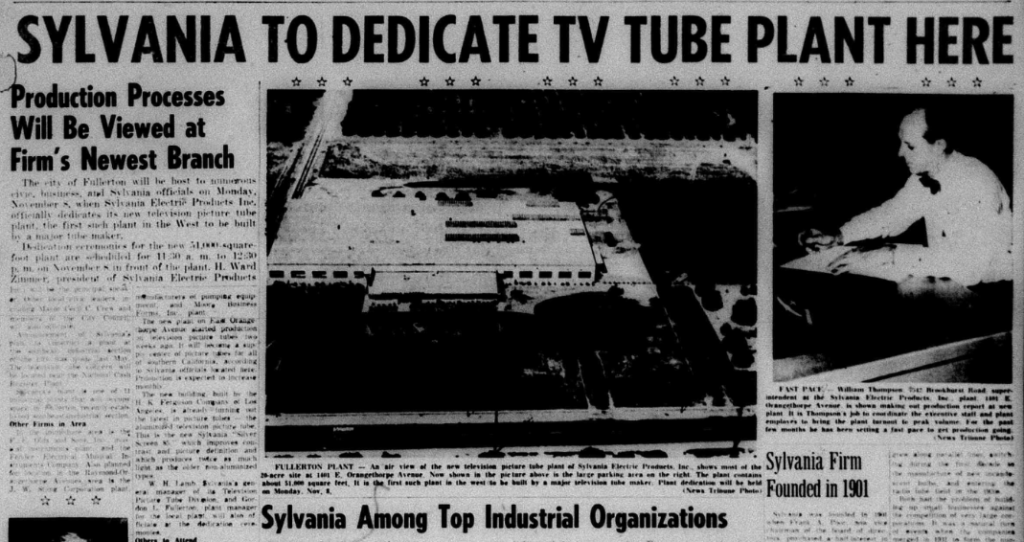
As the population grew, so did the need for a larger hospital. Fundraising efforts were underway for St. Jude.
One unfortunate by-product of growth in southern California was smog.
Governor Goodwin Knight asked the oil companies to close their refineries as the state grappled with the smog problem.
The oil companies said, “No.”
Housing
Throughout the 1950s, thousands of acres of orange groves were plowed under to make way for shopping centers, industrial plants, and sprawling housing subdivisions.
Perhaps most symbolic of this transformation was the subdivision of the Chapman Ranch.
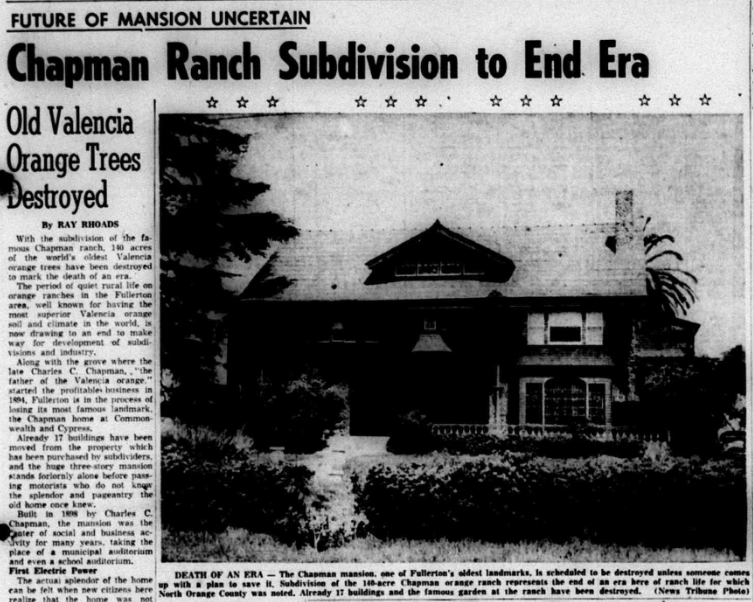
“With the subdivision of the famous Chapman ranch, 150 acres of the world’s oldest Valencia orange trees have been destroyed to mark the death of an era,” the News-Tribune reported. “The period of quiet rural life on orange ranches in the Fullerton area, well known for having the most superior Valencia orange soil and climate in the world, is now drawing to an end to make way for development of subdivisions and industry.”
Charles C. Chapman, “the father of the Valencia orange” and Fullerton’s first mayor, got into the orange business in 1894 and became one of the wealthiest and most successful local growers.
There was a question of what would happen to the stately Chapman mansion, built in 1898–once a center for social and cultural gatherings.
“Even though the death of the old landmark stirs deep regret in all long-time citizens here, so far all attempts to keep the house intact have failed. No one can find an answer to the question, “What to do with an 11-bedroom mansion?” Suggestions of turning it into a museum and park have been looked on with favor, but the question has arisen: who would finance such a venture?” the News-Tribune asked.
Famous mid-century modernist architect Joseph Eichler contributed to post-war Fullerton suburbanization.
On their web site, Fullerton Heritage writes:
“In 1955, Eichler, a merchandising wizard, convinced his two principal architects, A. Quincy Jones and Frederick E. Emmons, to appear on the “House That Home Built” segment of the NBC Home television show that came on daily after the Today Show from 1954 to 1957. On the nationally syndicated show, co-hosted by Hugh Downs and Arlene Francis, Jones and Emmons offered to create house plans for any developer who could come up with $200. The plans were designs that Jones and Emmons had created earlier for Eichler. The local building firm of Pardee-Phillips took up the challenge and constructed over 300 Eichler homes, naming the tracts the Fullerton Grove development. Advertised as the “Forever House” model, the aluminum, glass, steel, and masonry dwellings sold from $12,950 to $19,500 for the deluxe model, requiring a $1,250 to $2,000 down payment (with little or no down payment for veterans).
The architects offered seven floor plans for the three- and four-bedroom, two-bath homes that featured floor-to-ceiling fireplaces and glass walls, color coordinated kitchens and bathrooms, birch cabinets, sliding glass doors, and an electronic weather control system. Advertising extolled the “Dream Kitchen of Tomorrow” that contained 14 major built-in items. The homes were noted for their simple, plain façades, few windows, flat roofs, and carports situated front and center. A unique touch was orange trees in the front and backyards, a tribute to Fullerton’s agricultural past. The Fullerton Grove development quickly sold out.
Fullerton was not the only city to benefit from the television offer of Jones and Emmons. Local builders in the cities of Cleveland, Chicago, Denver, San Francisco, and Kansas City also constructed similarly styled Eichler homes.”
Numerous advertisements appear in the Fullerton News-Tribune for homes in newly-built subdivisions. What strikes me is how affordable these homes were. This was partly because of federally-backed loans and “no money” down offers for veterans.
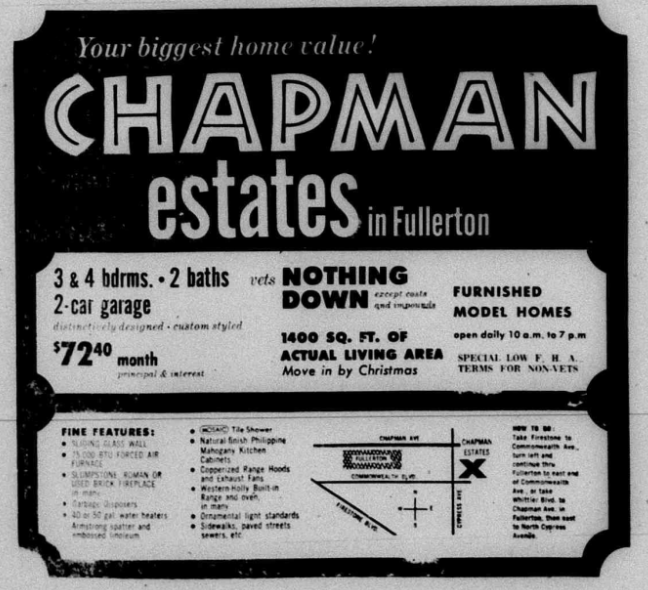
Culture and Entertainment
For culture and entertainment, Fullertonians went to movies at the Fox Theater. Westerns were quite popular, often presenting a sanitized vision of American westward expansion that valorized white settlers, stereotyped Native Americans, and ignored or downplayed the genocide that was the endgame of Manifest Destiny.
Fullerton was home to at least two famous female authors: Ruby Berkeley Goodwin and Ethel Jacobsen, who would sometimes share their works at local gatherings.
Something new and exciting was coming to Anaheim next door: Disneyland!
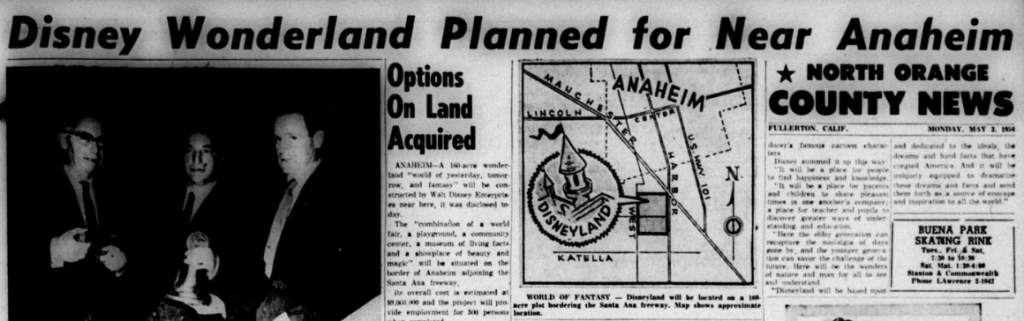
Fullerton celebrated the 50th anniversary of its incorporation as a city with a Community Parade and other events which focused on what life was like in 1904.
Some Businesses
Here are advertisements for some of the businesses that existed in Fullerton in 1954, with a particular focus on restaurants.
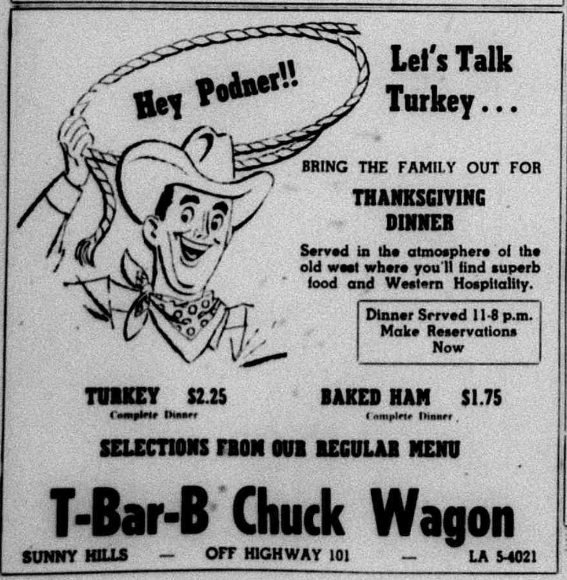
Sports
In the 1950s, the minor league baseball team the Los Angeles Angels played games at Amerige Park in Fullerton.
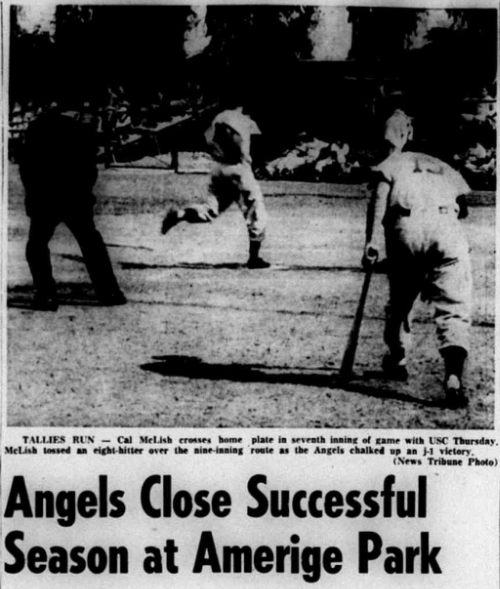
Hometown hero Del Crandall was making Fullertonians proud as catcher for the Milwaukee Braves.
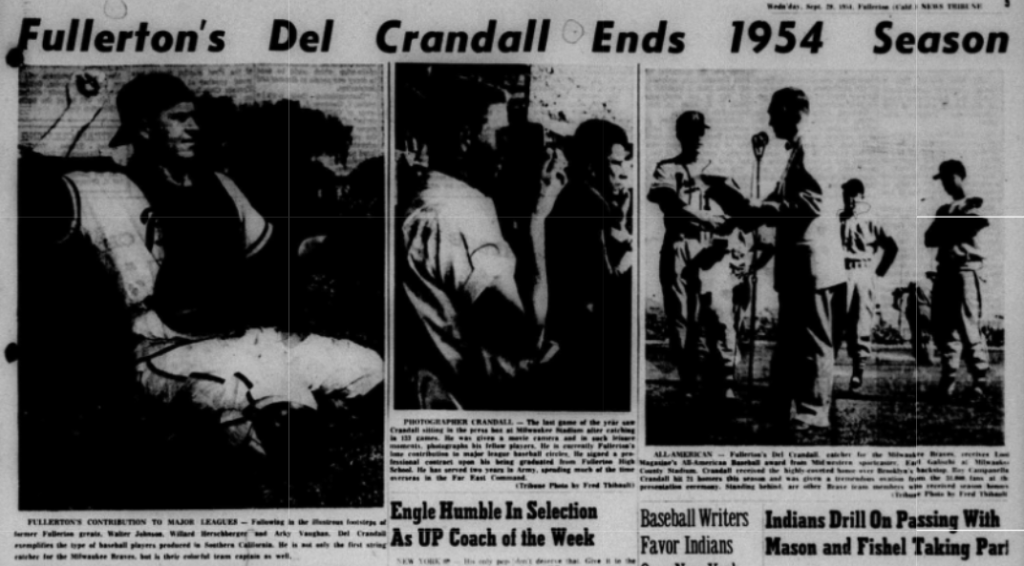
Annexation
In the early 1950s, there were several disputes between Fullerton and surrounding cities over annexation of unincorporated land. In 1954, a judge ruled in favor of La Habra’s claim against Fullerton and Brea for a large stretch of land north of Fullerton. Below is another clipping from the Anaheim Bulletin:
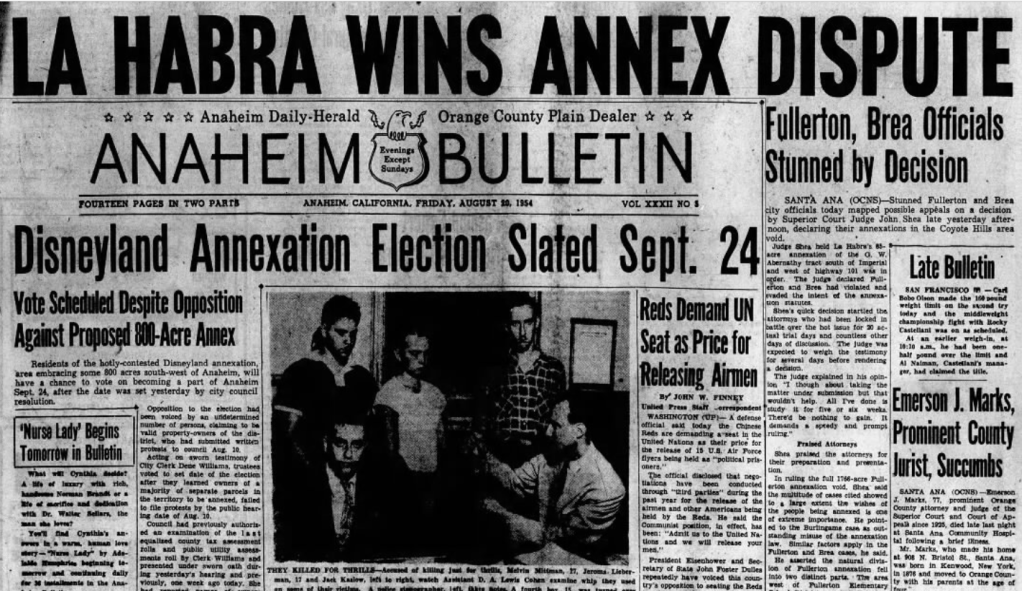
Fire
Fullerton suffered the worst fire in its history as a mighty blaze destroyed several packinghouses along the railroad tracks.
History
An anniversary issue of the News-Tribune contained photos of some notable long-time Fullerton residents who were still alive like Grace McDermont Ford, Mrs. Chapman, Otto Des Granges, Annette Amerige, C.E. Holcomb, and O.M. Thompson,
Stay tuned for top stories from 1955!
-
Fullerton in 1953
The following is from a work-in-progress about the history of Fullerton. You can support my ongoing research and writing on Patreon.
The Local History Room of the Fullerton Public Library has microfilm from the Fullerton Daily News-Tribune newspaper stretching back to 1893. I am in the process of reading over the microfilm, year by year, to get a sense of what was happening in the town over the years, and creating a mini archive. Below are some news stories from 1953.
National and International News
In international news, the Korean War ended with the country just as divided as when the conflict began. Several POWs were released, including some from Fullerton.
Soviet leader Joseph Stalin died, and after a power struggle, Nikita Khruschev became the leader of the USSR.
The prime minister of Iran, Mohammad Mossadegh, was ousted in a CIA-backed coup that would see the re-installation of the Shah who was much more friendly to western oil interests.
Former California governor Earl Warren was named Chief Justice of the US Supreme Court. The Warren court would make a number of landmark civil rights decisions, such as Brown v. Board of Education (1954).
Immigration
In 1953, raids and crackdowns against undocumented immigrants were increasingly common. Today, supporters of this kind of activity like to avoid racialized language–instead saying that such efforts are about following the law, etc. But in 1953, proponents were much more straightforward. The Eisenhower mass deportation program of 1954-55 was called “Operation Wetback.” It did not solve the problem of illegal immigration because it did not focus on root causes. What it did do was terrorize and violate the rights of many folks, including many American citizens–the vast majority of whom were workers who had been recruited by American businesses that preferred undocumented workers.
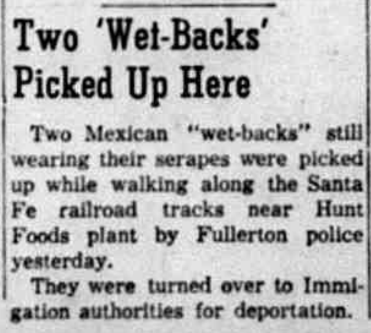
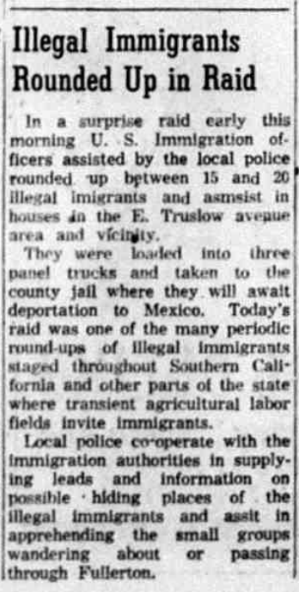
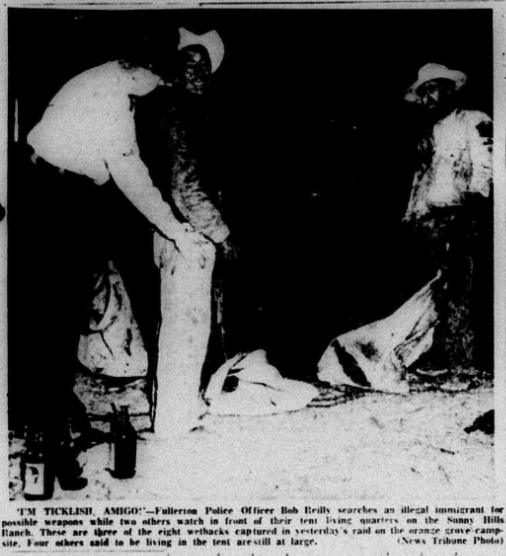
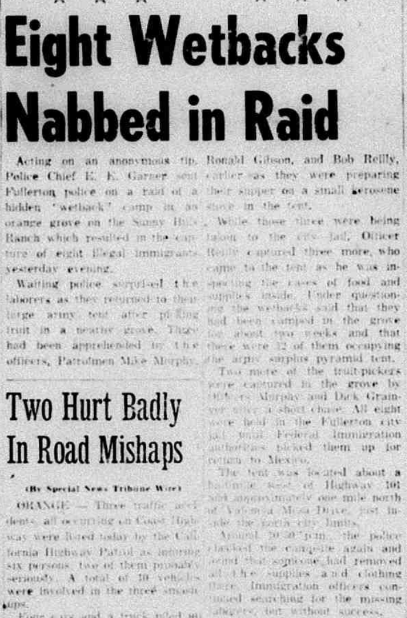
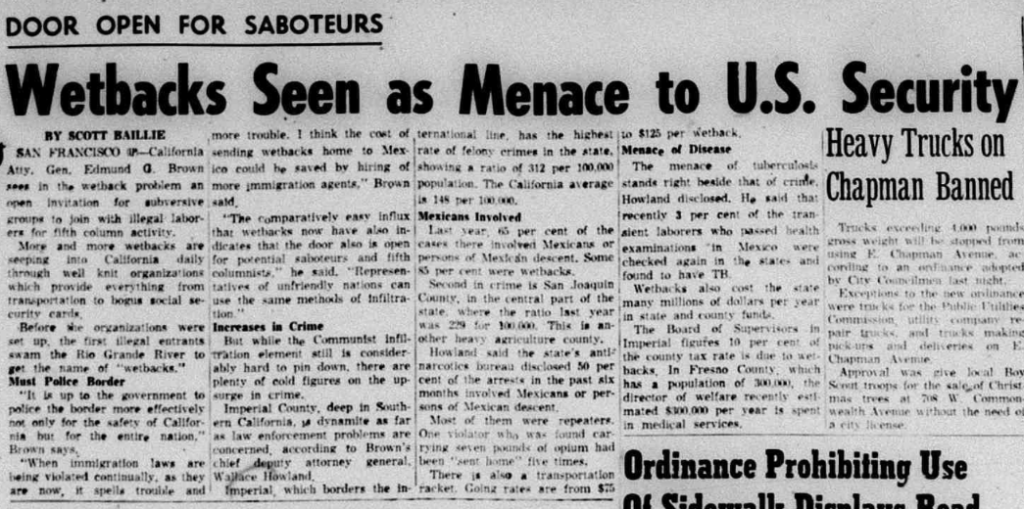
In 1953, police shot and killed a Mexican man named Juan Pena Diaz.
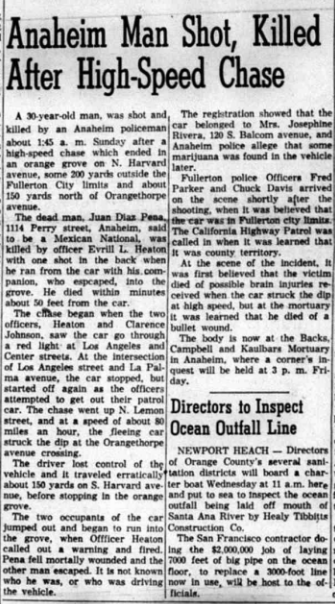
Growth
Fullerton continued its phenomenal postwar growth, with new shopping centers, housing subdivisions, industry, and schools replacing orange groves.
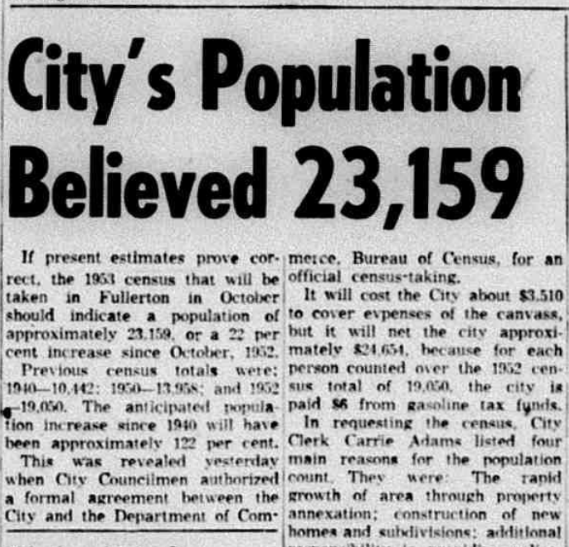
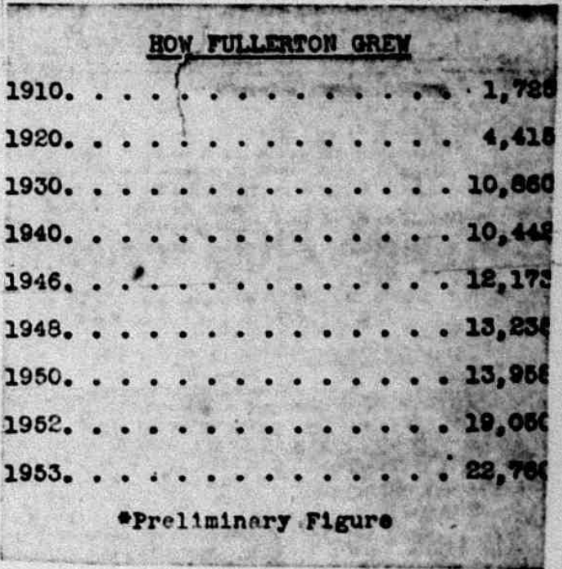
Housing
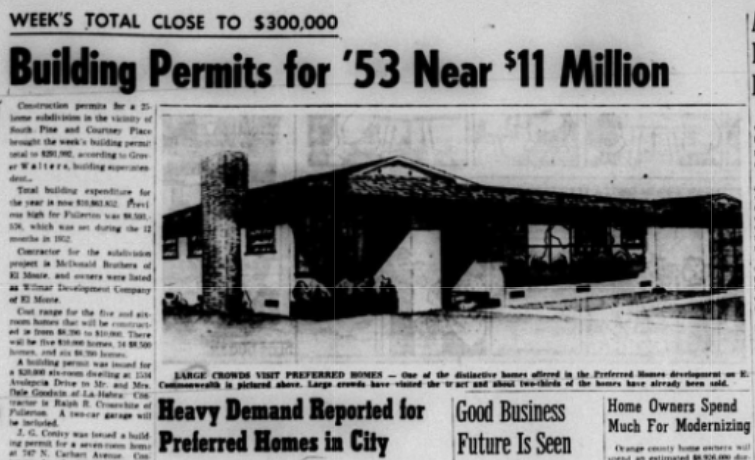
Many orange groves were replaced by new housing subdivisions, including the 140-acre Chapman Ranch.
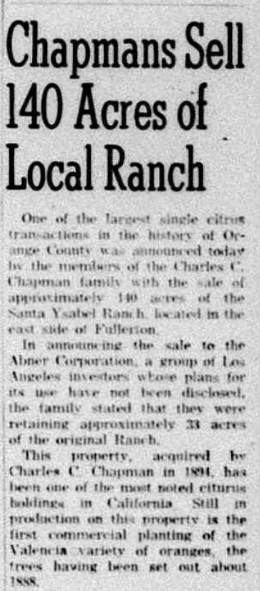
Housing was much more affordable in the 1950s.
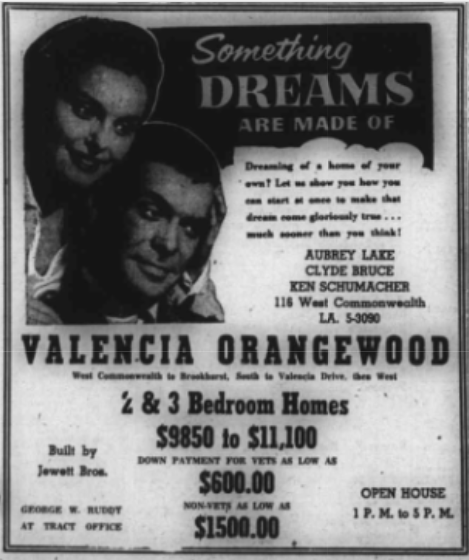
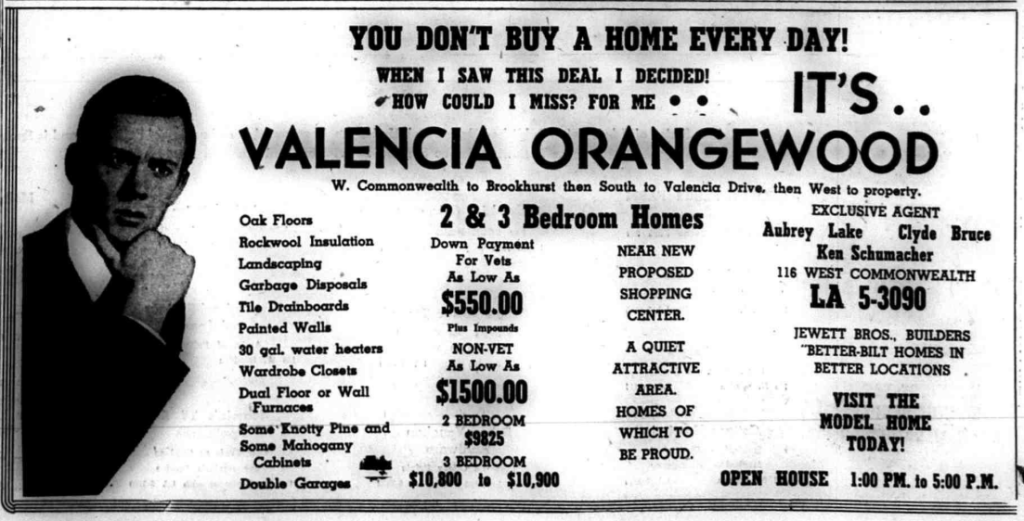
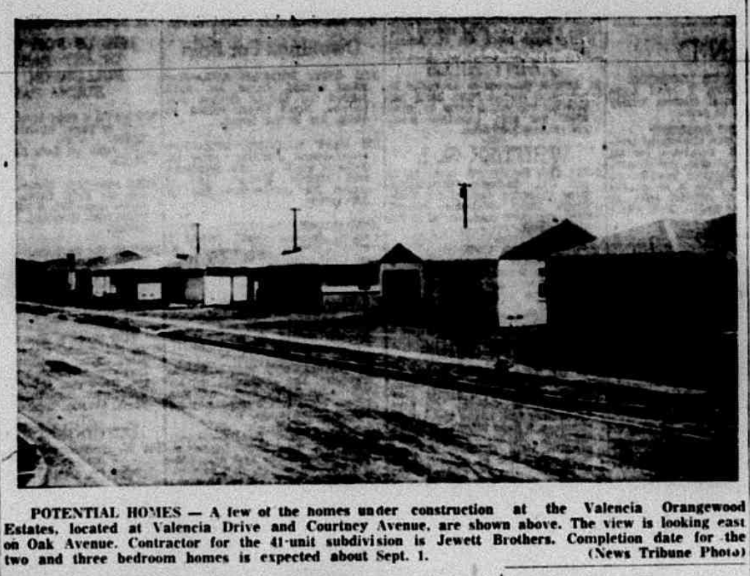
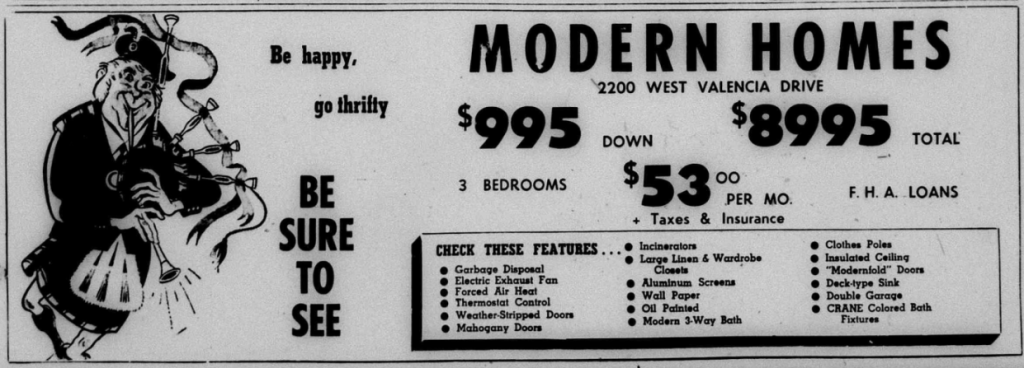
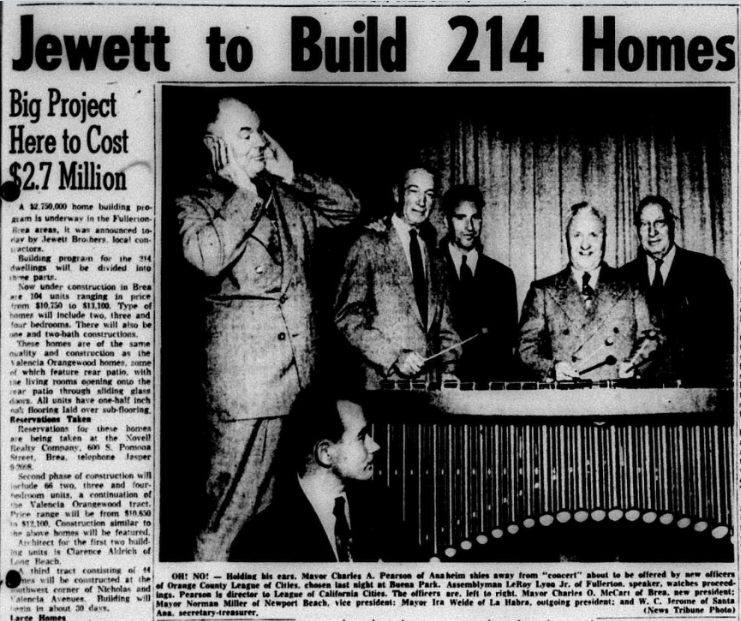
The preferred type of housing in Fullerton was the single-family home. Trailer parks and multi-family apartments were frowned upon and often denied approval.
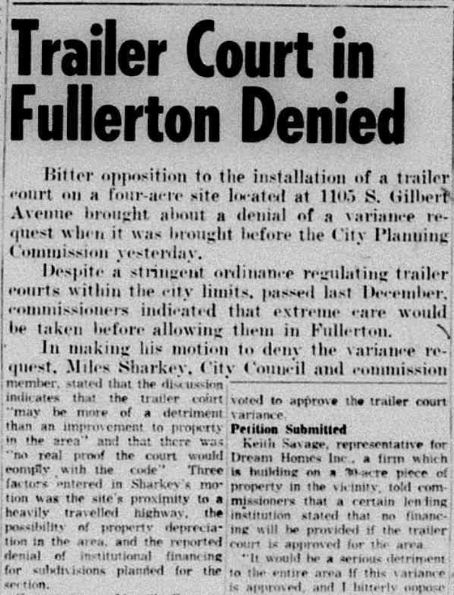
Industry
New industries located in Fullerton including the following:
Beckman Instruments,
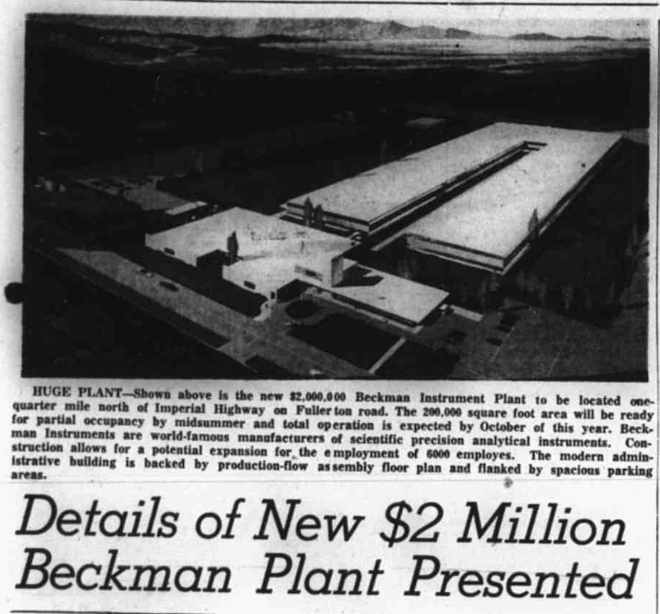
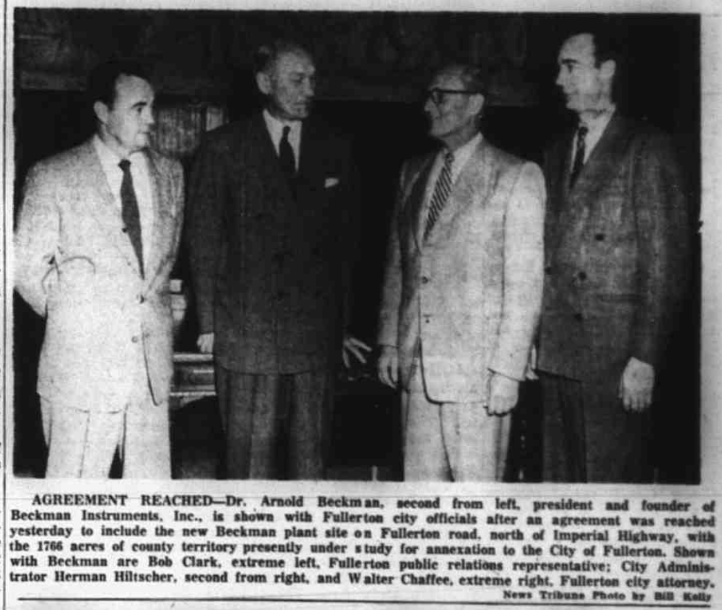
“The entire plant,” said Beckman, “has been planned to harmonize with the natural beauty of the area.” Much of the original orange grove will be maintained and additional landscaping will be in keeping with the established suburban atmosphere.”
Sylvania Electric Products,

National Cash Register,
F.E. Olds,
Fender Instruments,
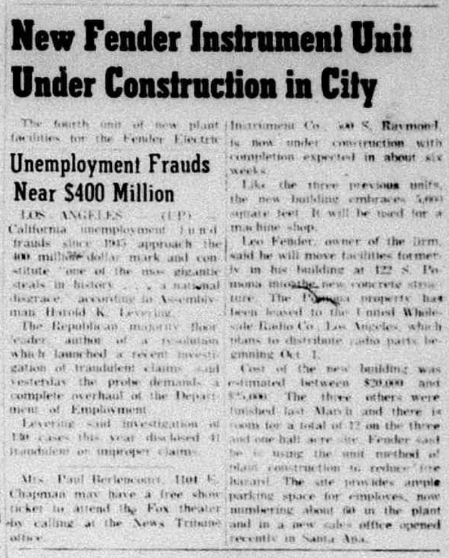
US Motors,
In labor news, employees of Edison went on strike.
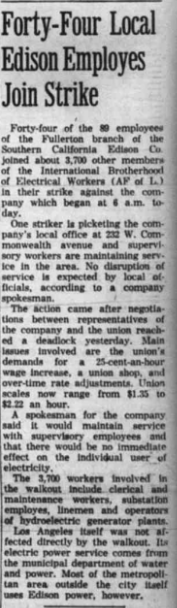
Edison responded by advertising a reward for information leading to the arrest of strikers who broke the law.
Part of Edison’s concern was perhaps justified, as someone blew up some Edison towers in Chino.
Edison then went on to sue the Edison workers’ union.
The citrus industry, although it was in decline, still existed.
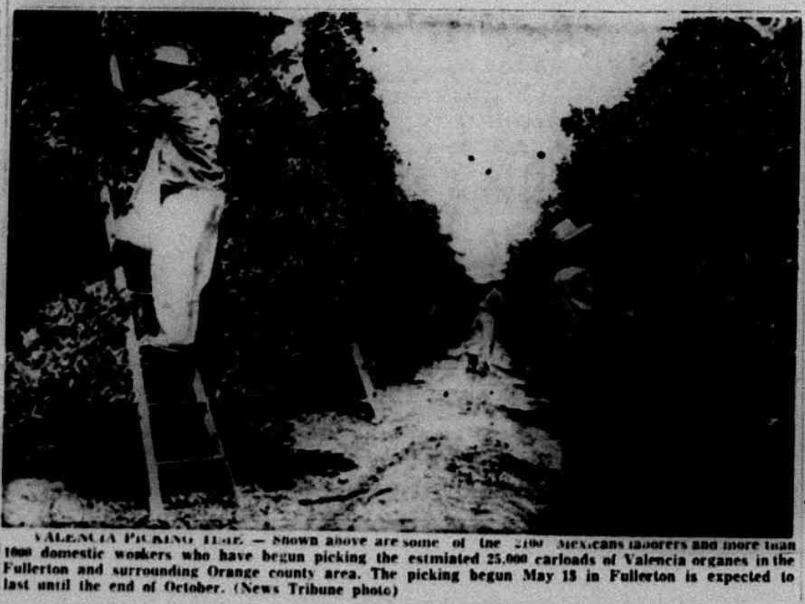
Education
Fullerton’s growth involved the building of new schools opening, including Raymond Avenue Elementary School.
Fullerton Union High School’s mascot was the Indians. This included embarrassing cultural appropriation that involved “Pow Wow” events.
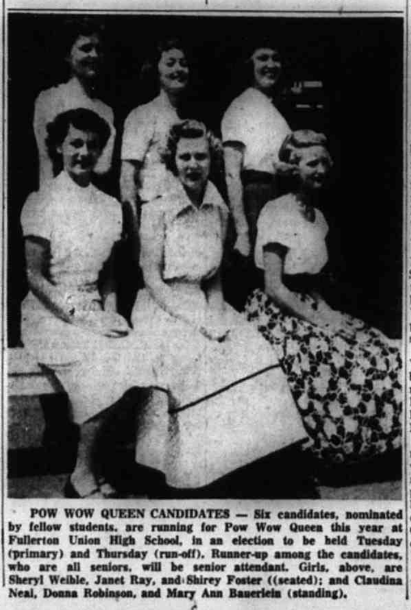
The News-Tribune often referred to FUHS sports teams not as the Indians but as the much more offensive “Redskins”.
In the context of the Cold War, teachers had to take oaths that they were not communists.
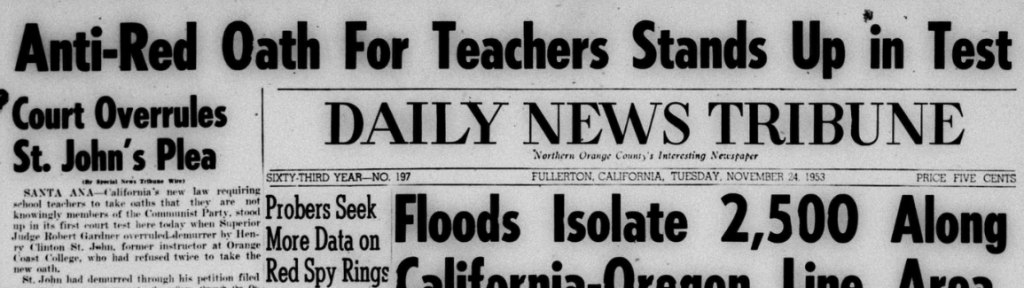
Annexation Fights
Part of Fullerton’s growth involved fights with other local cities over annexation of unincorporated land, specifically Brea and La Habra.
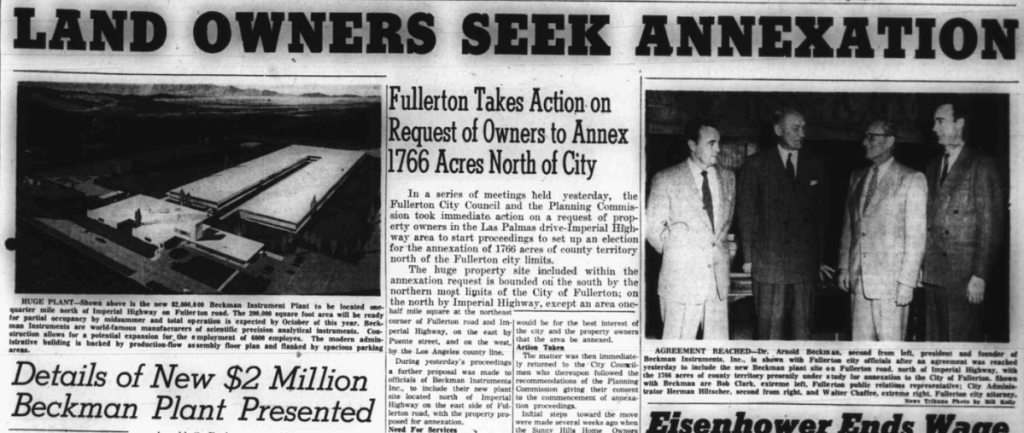
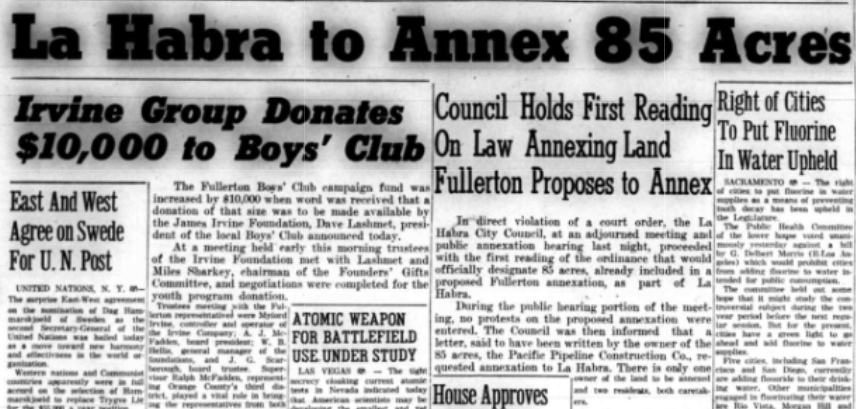
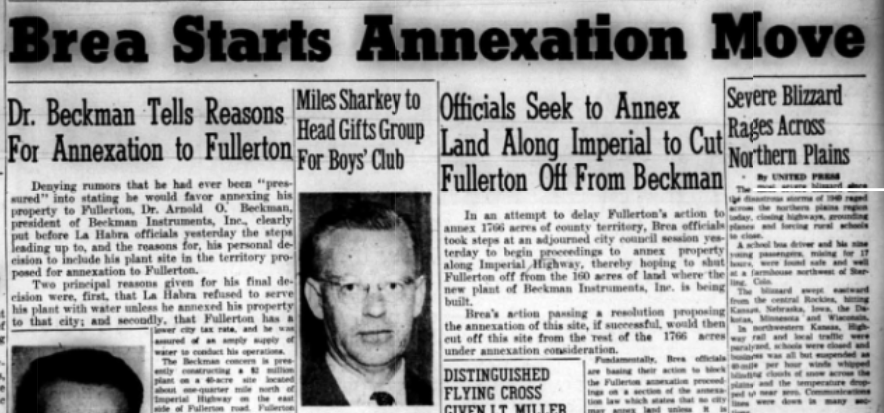
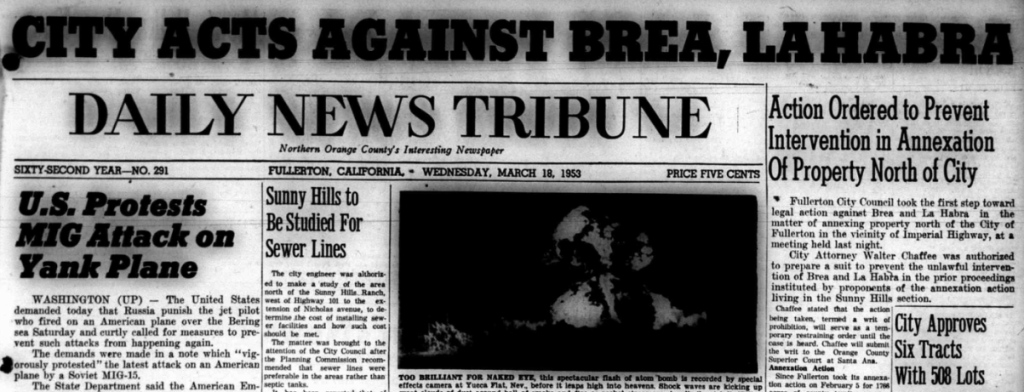
The issue ultimately went to court (stay tuned)!
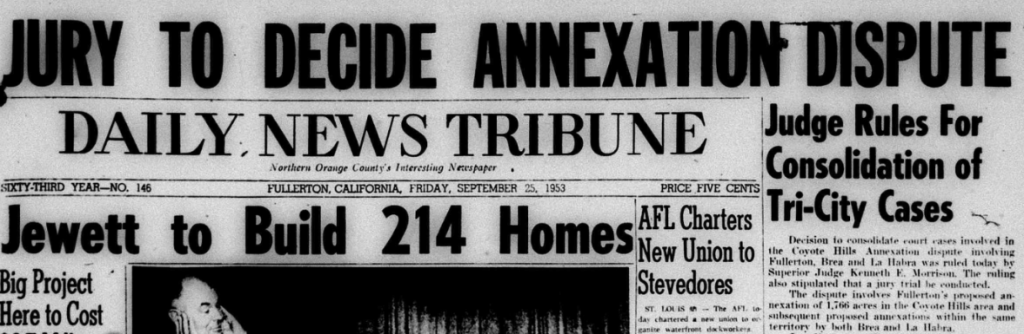
The Origin of St. Jude Hospital
Fullerton’s growth meant that its old hospital was inadequate to meet the needs of a rapidly growing community.
It was decided that a new, much larger, hospital needed to be built, and so local groups worked to acquire the land on the former Sunny Hills Ranch that would eventually become St. Jude Hospital.
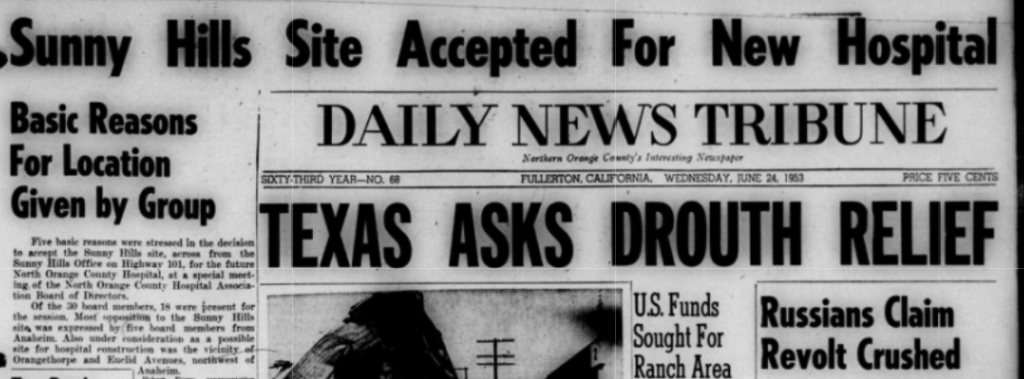
Thus began a massive local fundraising drive for the construction of St. Jude.
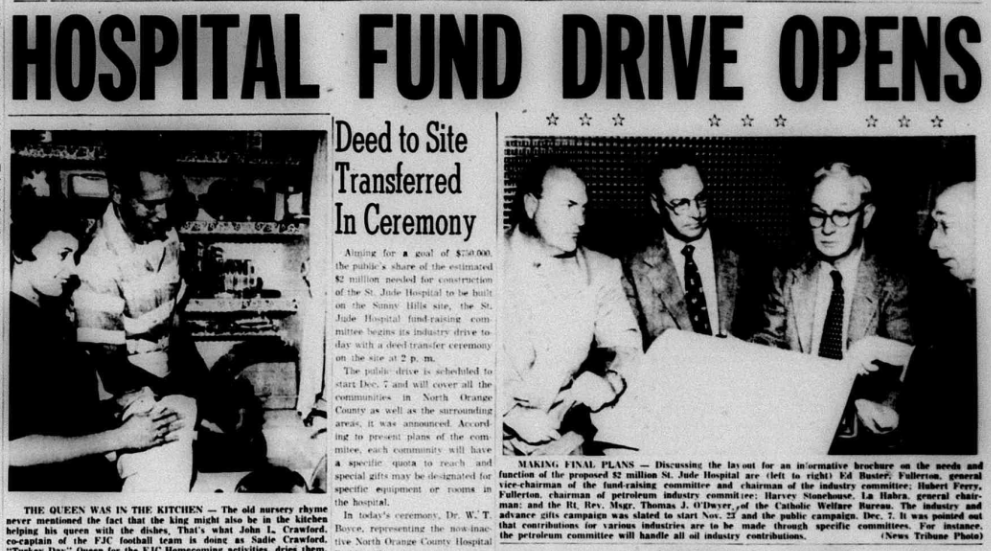
Transportation
In the first half of the 20th century, Southern California had the largest inter-urban rail system in the world–the Pacific Electric “Red Cars.” In 1953, a new corporate conglomerate purchased the financially ailing Pacific Electric, and eventually dismantled this rail system.
The future of Southern California would not be trains, but cars! The future was freeways!
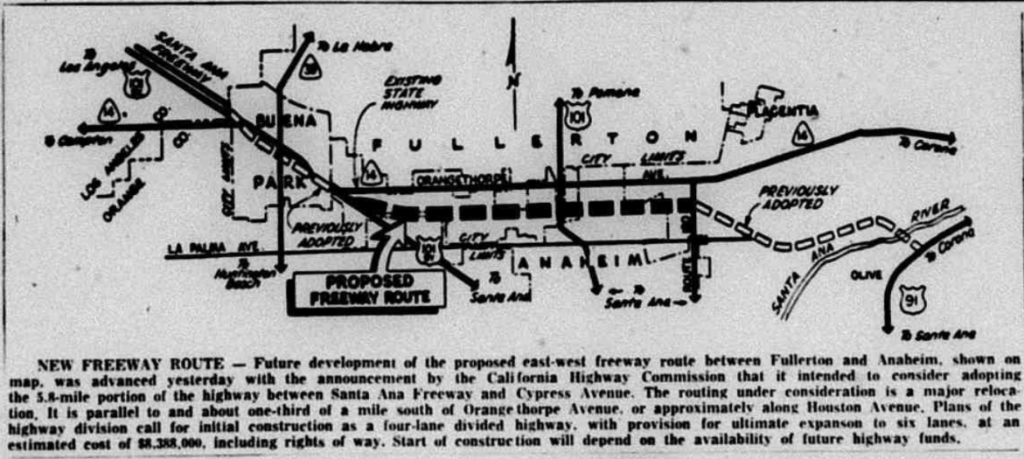
The decline of the Red Cars, a tragedy in my opinion, is part of the plot of the 1989 film “Who Framed Roger Rabbit?”
Government and Politics
In 1953, Fullerton made a major change in its system of governance by creating the position of City Administrator (now called City Manager). This unelected bureaucrat would now (arguably) have as much power to create policy as the former City Council.
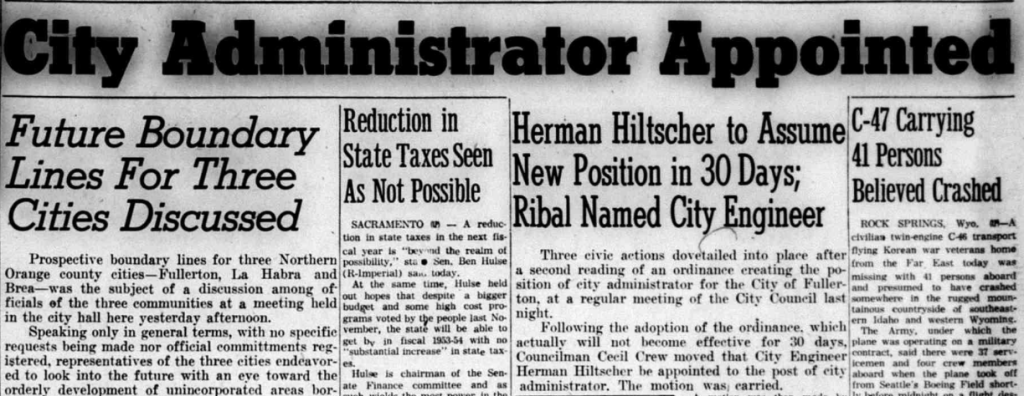
Fullerton’s first City Administrator was alleged former Klansman Herman Hiltscher.
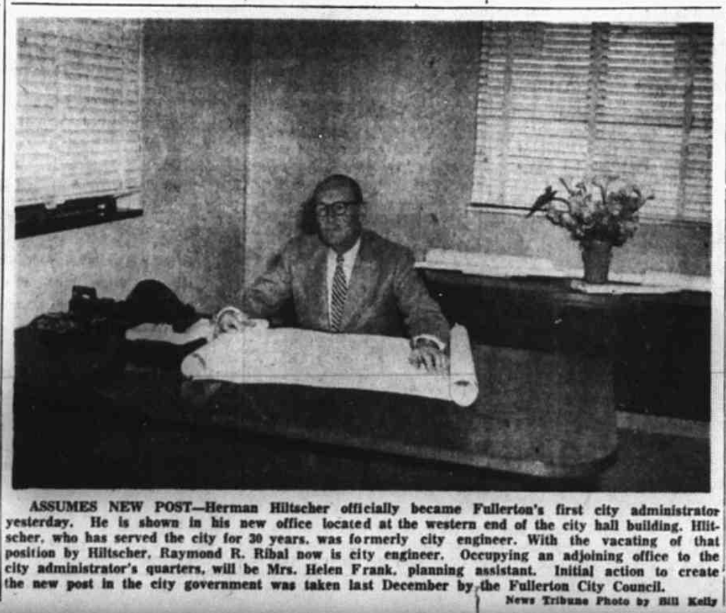
City Councilman Miles Sharkey (manager of the Sunny Hills Ranch company, who had been appointed, not elected) resigned because he no longer lived within the city limits of Fullerton and perhaps because he stood to gain financially by a proposed annexation of land north of Fullerton. The person who was appointed to replace him was Phillip Twombly.
Twombly, whose family moved to Fullerton in 1893, was the manager of Golden Citrus Juices, Inc. He had previously served as president of the Placentia Farm Bureau and director of the Orange County Farm Bureau.
Phillip Twombly is a fascinating figure because he would allegedly become involved in the JFK assasination.
Culture and Entertainment
For culture and entertainment, Fullertonians attended an annual Community Fair.
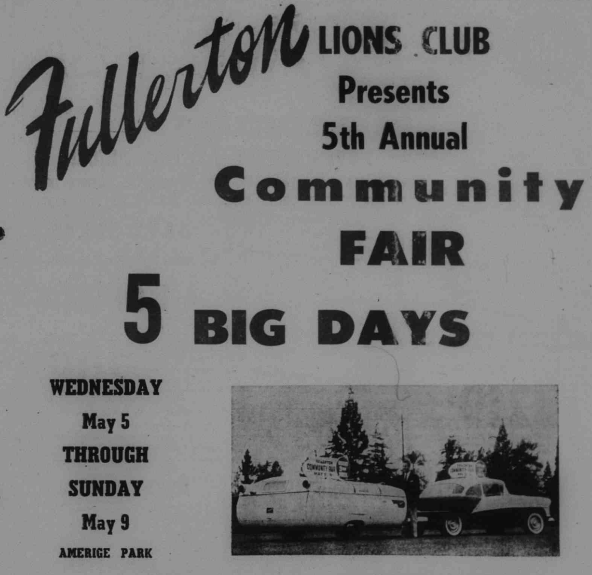
The annual high school Homecoming was a large community event.
Local African American poet Ruby Berkeley Goodwin was honored.
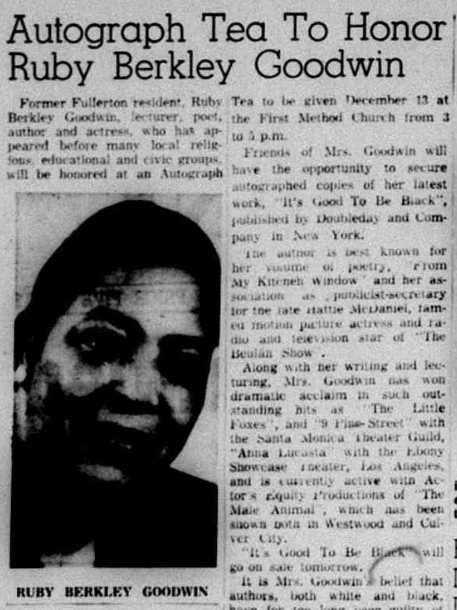
And Fullerton hosted an annual Arkansas reunion.
Miscellaneous
Fullerton’s City Judge since 1948, local business man since 1920 Gurman Hoppe retired. Hoppe came to Fullerton in 1912 and worked for the Stern and Goodman department store. In 1927 he went into business for himself, running Hoppe’s Hardware store at 104 and 106 S. Spadra road.
Cena Young was appointed as the first woman judge in a local court.
Over 1000 people gathered to greet the ruler of Greece when his train stopped briefly in Fullerton.
Deaths
Local drug store owner Jess Hardy died.
Long time resident Dr. F.H. Gobar died.
Stay tuned for top news stories from 1954!
-
Doss v. Bernal: Fighting Housing Segregation in Fullerton
The following is from a work-in-progress about the history of Fullerton. You can support my ongoing research and writing on Patreon.
Today, when Americans think about the term “segregation” they are probably thinking about the South–where segregation was loudly and publicly enforced until it became officially illegal (though unofficially still practiced) through various court cases and Civil Rights legislation.
Many Americans are probably not as aware that housing and school segregation actually extended far beyond the south and affected every part of the United States. In the North and out West, segregation was kept quieter, but it was pervasive.
By the 1920s, the most common method for enforcing residential segregation was something called “racially restrictive covenants.” These were agreements on the deeds of housing that prevented non-whites from renting or purchasing those homes. These covenants were standard practice among developers and realtors all over the US including in Fullerton, California–the subject of my research.
Because of these covenants, for the first half of the 20th century, most neighborhoods in Fullerton were off-limits to people who weren’t white. Mexican-Americans, by far the largest minority group, were confined to agricultural work camps or carefully proscribed “barrios.”
However, in 1943, a Mexican American family in Fullerton–Alex and Esther Bernal–challenged this widespread practice, and won. The legal case was called Doss v. Bernal.
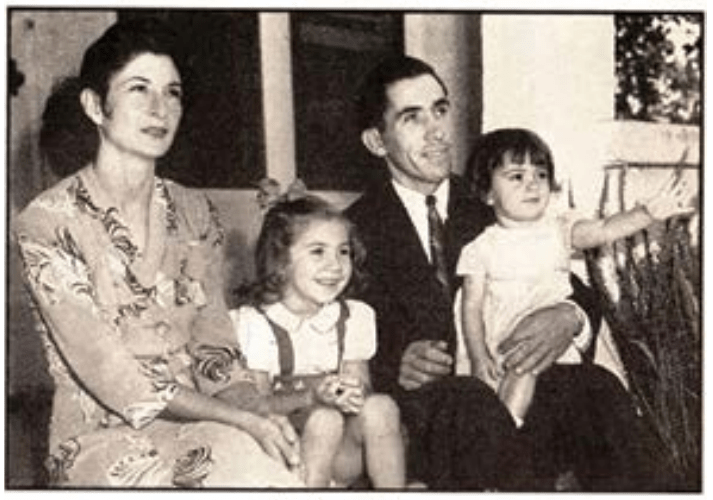
The Bernal family, 1943. Photo courtesy of Time magazine. “Doss v. Bernal successfully challenged the residential segregation of Mexican Americans in Orange County, resulting in one of the earliest legal victories against racial housing covenants in the United States,” Robert Chao Romero and Luis Fernandez write in “Doss v. Bernal: Ending Mexican Apartheid in Orange County.”
This case preceded by five years the more well-known (at least among civil rights lawyers) Shelly v. Kraemer (1948), a Supreme Court case which declared racially restrictive covenants legally unenforceable.
Born in Corona, Alex Bernal was raised in Fullerton’s Truslow barrio. He married Esther Munoz De Anda in 1937 and the couple had two children, Irene and Maria Teresa. Alex worked as a produce truck driver. To accommodate their growing family, the Bernals decided to purchase a white stucco home at 200 E. Ash in a neighborhood called the Sunnyside Addition, near but outside the Truslow barrio.
Unbeknownst to the Bernals, this house, like all the others in the Sunnyside Addition, had a racially restrictive covenant which stated “That no portion of the said property shall at any time be used, leased, owned or occupied by any Mexicans or persons other than of the Caucasian race.”
Despite this restriction, the owners Joe and Velda Johnson sold the property to the Bernals, and the family moved into their new home–happily following their American dream.
“For many Mexican Americans, suburban homeownership symbolized a chance towards upward mobility,” Shannon Anderson writes in Remembering the Bernals: Untangling the Relationship Between Race, Space, and Public Memory in Fullerton, California. “Additionally, suburbanization allowed Mexican Americans to stake their claim to permanent American identity in defiance of the stereotype that all people of Mexican descent were migratory, temporary residents.”
But their white neighbors were not so happy.
“Within a week of living on East Ash Avenue, the Bernals returned home one evening to find that someone had broken into their new home and thrown all their possessions into the street,” Anderson writes. “In a separate incident, Esther answered the door to a man who described himself as an officer of the law. In a ‘vulgar manner,’ he told Esther that she and Alex should move out of their new house because the white residents didn’t want Mexicans living in their neighborhood.”
When this harassment failed to get the Bernals to move, all the neighbors signed a petition saying they wanted the Bernals out. When that didn’t work, some of their neighbors (the Dosses, Shrunks, and Hobsons) filed a lawsuit in the OC Superior Court “on behalf of a majority of all the other lot owners” of the Sunnyside Addition requesting legal enforcement of the racially restrictive housing covenant.
The neighbor’s legal complaint is a clear expression of the racist social attitudes of the time:
“The permitting of Mexicans and other races to live in and to use and occupy the residence buildings in said tract, would necessitate coming in contact with said other races, including Mexicans in a social and neighborhood manner, and that if said race and Mexican Residential use and restriction in said tract of land is broken, other Mexicans and persons of other races will soon move in and occupy residences in said Restricted residential district, and that the value of said residential property therein will be greatly depreciated…and for further reasons that such breach of said restrictions and conditions will greatly lower the social living standard.”
After being served this legal complaint, the Bernals still refused to leave. Instead, they hired lawyer David Marcus to defend their rights. Marcus, a Jewish lawyer who was married to a Mexican woman, would go on to represent Orange County Mexican American families fighting school segregation in the landmark 1947 case Mendez et al v. Westminster.
The first judge assigned to the Bernal’s case, Justice Morrison of Orange County, tried to issue a ruling against the Bernals before the case even went to trial. Marcus successfully petitioned to have an outside judge, Albert F. Ross, brought all the way down from Shasta County in northern California to hear the case.
The Doss v. Bernal trial took place in late August, 1943 in the Old Orange County courthouse in Santa Ana.
One of the central points of contention in the trial was whether the Bernals, and by extension all Mexican Americans, were “white.” Race is, of course, a social construct, not a biologically meaningful concept. It was meaningful insofar as it could be weaponized to exclude people like the Bernals. The plaintiffs’ lawyer Gus Hagenstein tried to prove that Mexican Americans were a part of a distinct race (not white), and Marcus argued that the Bernals should be classified as white. Both sides brought in anthropologists to try to sort this out.
One anthropologist explained that there were three types of races: European, Negroid, and Mongoloid, and that because the Bernals were neither Negroid or Mongoloid, they were more akin to European, and therefore white.
This whole discussion of race ends up sounding pretty silly in retrospect, but it did have repercussions because, according to this “race” argument–covenants that excluded African Americans and Asians could still be considered valid.
Hagenstein also claimed that the presence of Mexican-Americans in suburban neighborhoods would do “irreparable damage” to property values. He brought in real estate professionals, including former Fullerton Mayor Harry Crooke, to attest to this. Marcus sought to refute harmful stereotypes of Mexican Americans in an attempt to show that the Bernals were respectable people who would not be a detriment to their neighbors or bring down property values.
When you really drill down into the logic behind these covenants, they turn out to be based mostly on fear, scientifically dubious ideas about race, and negative stereotypes. What they were mostly about was preserving white supremacy.
The arguments in the Bernal case that would have the most lasting significance had to do with Constitutional rights.
“Marcus cited the Fifth and Fourteenth Amendments of the United States Constitution, which maintain that no one can be ‘deprived of life, liberty or property without due process of law.’ Unbeknownst to Marcus, this would be the first time that these amendments were successfully invoked in a lawsuit regarding racialized housing discrimination, beginning a trend in subsequent civil rights cases,” Anderson writes.
It was not lost on Marcus that this trial was taking place during World War II, when the United States was fighting against the racist and fascist Nazi Germany in defense of liberty and democracy. Some local Mexican American soldiers even attended the trial in a show of support for the Bernal family.
After a four-day trial, Judge Ross ruled in favor of the Bernals, declaring the racially restrictive covenant “null and void.” He further stated that such covenants were “injurious to the public good and society; violative of the fundamental form and concepts of democratic principles.” He agreed that the covenant violated the 5th and 14th amendment to the U.S. Constitution.
Despite the historic importance of this ruling, it’s interesting that the local press (the Fullerton News-Tribune) barely mentioned the case, devoting just two small articles to it. Neither the Orange County Register nor the Los Angeles Times even mentioned the case.
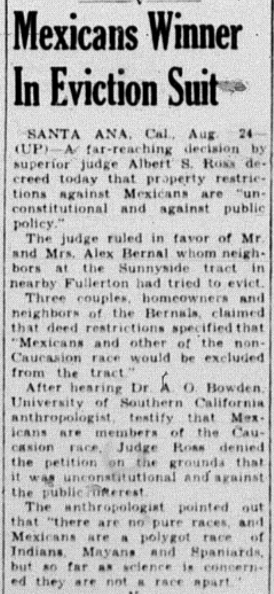
One of two small articles on Doss v. Bernal published in the Fullerton News-Tribune. But other news outlets were paying attention. The Bernals got their picture in Time magazine, along with a story about their legal victory, and were even featured in the radio program “March of Time.”
An African American newspaper in Los Angeles, the California Eagle, featured the Bernal story prominently on the front page with headlines like “Race Property Bars Held Illegal!” and “Santa Ana Judge Says Restrictions No Good!”

California Eagle headlines from 1943. Mexican Consul Manuel Aguilar was also paying attention, stating: “We consider any restriction on the rights of Mexicans to live where they please against the Good Neighbor Policy and against the Constitution of the United States.”
Interestingly, “One of the most detailed accounts of the Bernals’ trial comes from the San Antonio, Spanish-language newspaper, La Prensa,” Anderson writes. “Running on multiple pages, ‘Decision en Favor de Una Familia Mexicana Que Reside en Fullerton, California’ details the legal proceedings, including additional statements from Marcus and quotes from Ross’s ruling and subsequent lecture.”
Doss v. Bernal set legal precedent that would eventually lead to the 1948 Supreme Court case Shelley v. Kraemer, which ruled that racially restrictive covenants were legally unenforceable.
But it would be wrong to conclude that Doss v. Bernal ended housing discrimination and segregation in Fullerton or elsewhere.
“Although the outcome of Doss v. Bernal set legal precedent in determining that Mexican Americans are white and racialized housing covenants are unconstitutional, this ruling was not widely enforced in Orange County,” Anderson writes. “Rather, residential space would remain racialized within the region, with instances of racialized housing discrimination against nonwhite individuals cropping up in the decades to come.”
The fact of lingering housing discrimination is perhaps best represented by the fact that in 1964 (21 years after Doss v. Bernal), a majority of California voters passed Proposition 14, which sought to overturn the state’s Rumford Fair Housing Act. This action was later declared unconstitutional, but it sent a strong signal that a majority of white property owners were just fine with housing discrimination.
In a case of history repeating itself, Alex and Esther’s daughter Irene experienced housing discrimination in the 1960s “when she tried to rent an apartment in Fullerton and was refused by the landlord,” Anderson writes. “However, her husband, who was white, had no problem when he applied to rent out the same apartment.”
And although they won, the case was also devastating for the Bernal family.
“Alex and Esther no longer felt safe in their home…the Bernals were concerned that their newfound exposure would result in additional, ramped-up harassment,” Anderson writes. “Thus, the Bernals never got the chance to live in the home that they fought so hard for. Instead, the family of four moved into Alex’s parents’ house. After all that happened, the Bernals ended up back on Truslow Avenue—Fullerton’s segregated barrio designated for residents of color.”
Two years after the trial, Esther Bernal died of cancer at age 29. The stress of the trial likely exacerbated her declining health.
For a while after the trial, the Bernals received dozens of letters of support from all over the United States.
But as time went on, the thing that disappeared in Fullerton was not housing segregation, but public memory of the Doss v. Bernal case.
The case is not mentioned in the two “official” Fullerton history books: Ostrich Eggs for Breakfast by Dora Mae Sim and Fullerton: A Pictorial History by Bob Ziebell.
Even Alex Bernal himself seemed to want to forget, rarely discussing the case, and putting all the letters, clippings, and court files into a box and storing it away for decades.
For nearly 70 years, the Doss v. Bernal case fell out of public memory, sort of like the Pastoral California mural on the side off the high school auditorium, which had been painted over for nearly 60 years.
It was not until 2010 that an intrepid reporter for OC Weekly named Gustavo Arellano and a CSUF grad student named Luis Fernandez re-discovered the story and brought it back into public memory.
In a remarkable piece of local history reporting, Arellano’s “Mi Casa Es Mi Casa: How Fullerton produce-truck driver Alex Bernal helped change the course of American civil rights” re-introduced Orange County to Doss v. Bernal.
For his article, Arellano interviewed Bernal family members, pored through Alex’s box of old letters and files, and unearthed old news stories about the case.
Fernandez would go on to co-author an excellent 2012 article for UCLA’s Chicano Studies Research Center, entitled “Doss v. Bernal: Ending Mexican Apartheid in Orange County.”
The story of Doss v. Bernal was featured in a 2022 book entitled A People’s Guide to Orange County by Gustavo Arellano, Elaine Lewinnek, and Thuy Vo Dang.
In 2023, CSUF graduate student Shannon Anderson wrote a Master’s thesis entitled Remembering the Bernals: Untangling the Relationship Between Race, Space, and Public Memory in Fullerton, California. Her study highlights omissions in previous narratives, like the role of Esther Bernal in purchasing the house, and her deposition during the trial.
That same year, the Orange County Hispanic Bar Association (OCHBA) hosted a live reenactment of the Doss v. Bernal trial.
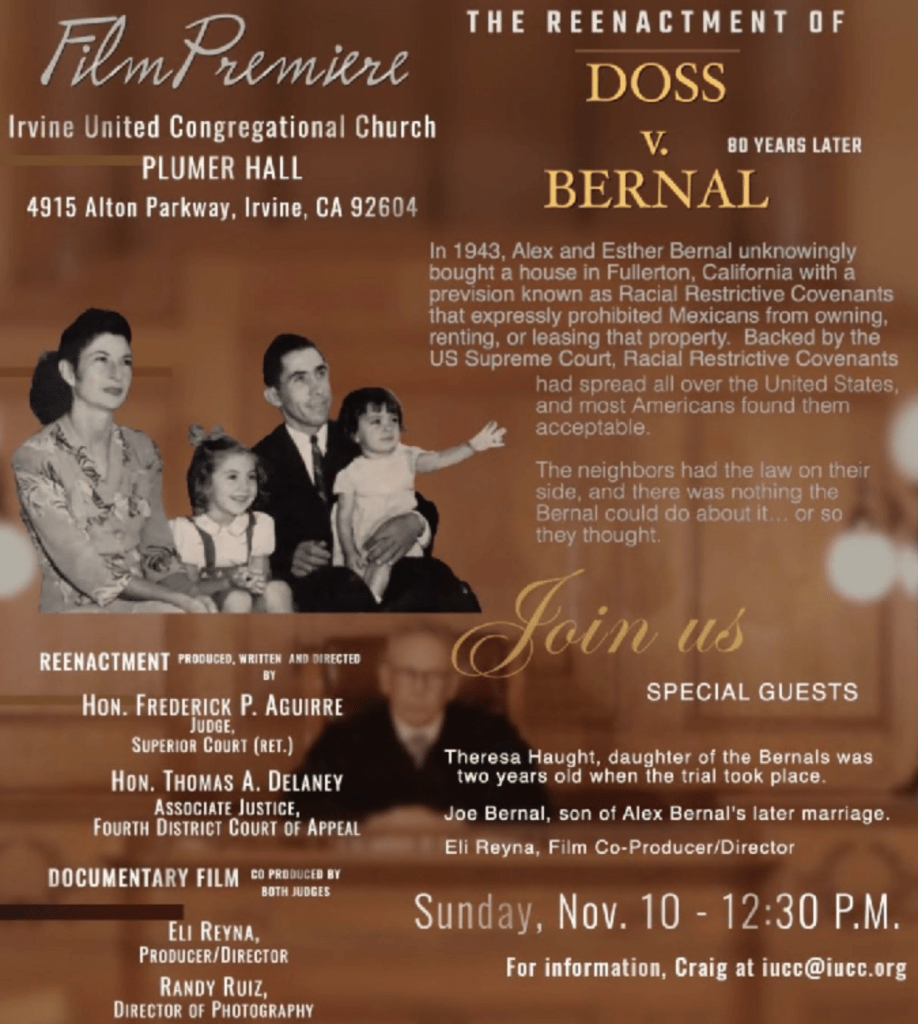
Anderson describes how in some cases, popular retellings have oversimplified the Bernal story into one of total victory, of having ended housing discrimination and segregation.
A 2023 article in the Fullerton Observer, reporting on the reenactment of the trial, was titled “A Reenactment of the 1943 Historical Trial that ended housing discrimination.”
“The issue with this is that the Bernals’ trial did not immediately put an end to housing discrimination. Although the case set legal precedent that would eventually go on to influence Supreme Court cases, racist housing practices would not be solved, but rather reified over the decades,” Anderson writes. “Also, the Bernal family suffered immensely from their experience with racialized exclusion.”
The problem with seeing the Bernal’s story as one of total victory is that it may prevent us from understanding how housing discrimination still persists.
“Perpetuating the idea that segregation is an issue of the past when it still exists, just in a different form, allows contemporary forms of racialized housing segregation to continue to operate without objection,” Anderson writes. “While racial segregation is no longer enforced on an institutional or legal level, de facto segregation continues to be upheld through longstanding cultural ideas, economic inequality, and social practices.”
A stark expression of this is the racial wealth gap. In 2019, the average income of a Caucasian household in the U.S. was about $188,200, while the average income of a Mexican American household was $36,100. This gap dictates which neighborhoods Mexican Americans and people of color can live in.
Rather than seeing Doss v. Bernal as something that ended housing discrimination and segregation, it is more accurate to see the case as part of a decades-long struggle of chipping away at the enduring effects of white supremacy.
There have been two attempts to commemorate the Bernal house as a historically significant property under the Mills Act, in 2010 and 2020, but both attempts were unsuccessful.
“Commemoration of the site would require Fullerton to come to terms with its shameful, racist past,” Anderson writes.
Sources:
“Mi Casa Es Mi Casa: How Fullerton produce-truck driver Alex Bernal helped change the course of American civil rights” by Gustavo Arellano, OC Weekly, 2010.
“Doss v. Bernal: Ending Mexican Apertheid in Orange County” by Robert Chao Romero and Luis Fernando Fernandez published by the UCLA Chicano Studies Research Center in 2012.
Remembering the Bernals: Untangling the Relationship Between Race, Space, and Public Memory in Fullerton, California. CSUF Master’s Thesis by Shannon Anderson, 2023.
A People’s Guide to Orange County. Lewinnek, Elaine, Gustavo Arellano, and Thuy Vo Dang. Oakland, California: University of California Press, 2022.
-
Fullerton in 1952
The following is from a work-in-progress about the history of Fullerton. You can support my ongoing research and writing on Patreon.
The Local History Room of the Fullerton Public Library has microfilm from the Fullerton Daily News-Tribune newspaper stretching back to 1893. I am in the process of reading over the microfilm, year by year, to get a sense of what was happening in the town over the years, and creating a mini archive. Below are some news stories from 1952.
In international news, the Korean War raged on. Some local boys were drafted to fight, and sometimes die, in this early Cold War conflict.


The British Empire was still a thing.

The US Congress passed the McCarran-Walter Immigration Bill, which modified but still kept the racist restrictions that were first codified in the 1924 Johnson-Reed Act, and added new grounds for restricting and deporting immigrants who were thought to be “subversive”–this was in the context of the Cold War Red Scare.

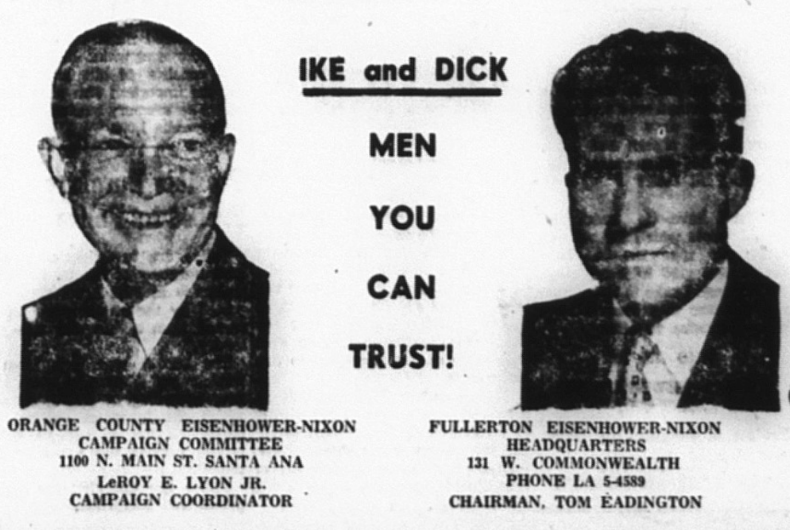
Dwight D. Eisenhower was elected president, and his Vice President was local boy Richard Nixon, who was born in Yorba Linda and attended Fullerton High School.
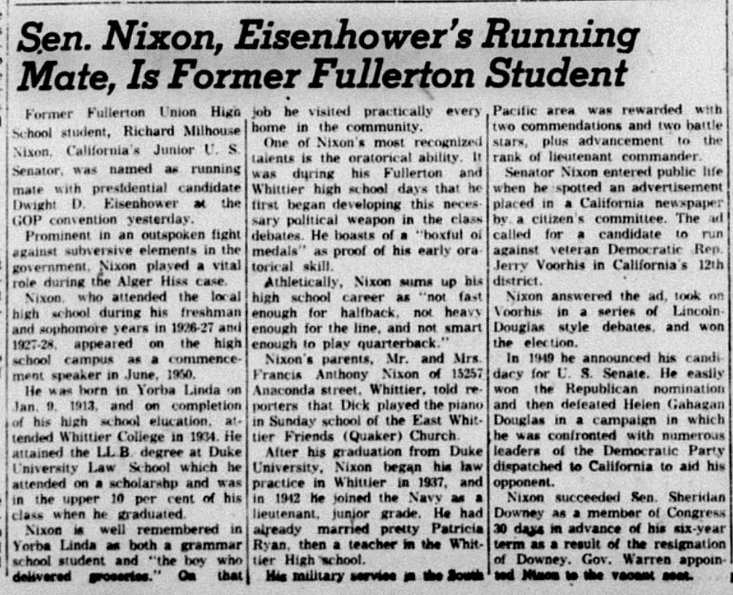
While Nixon is mostly remembered for the Watergate scandal, he first rose to power as a McCarthy-style Red Scarer. He was a member of the House Un-American Activities Committee, and famously investigated alleged communist spy Alger Hiss.
While running for Vice-President, Nixon held a number of campaign rallies in Orange County.
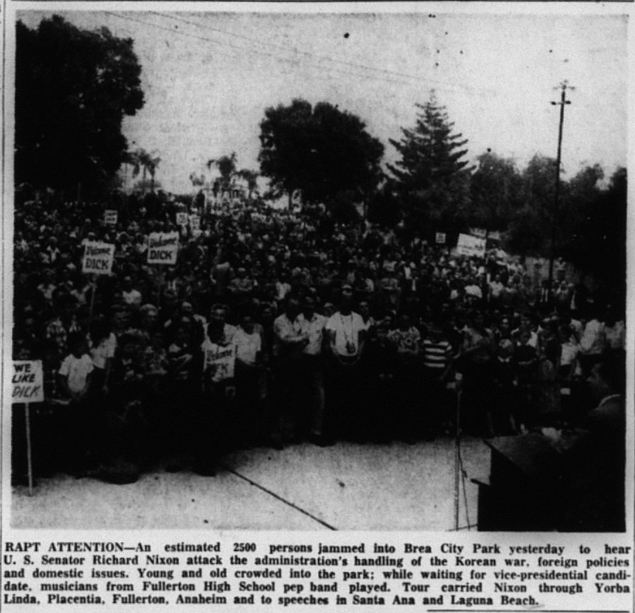
Six weeks before the 1952 presidential election, it was reported that Nixon had received between $16,000 and $18,000 (approximately $220,000 in 2025 dollars) not in campaign contributions, but directly from a fund bankrolled by a group of 76 wealthy Californians.
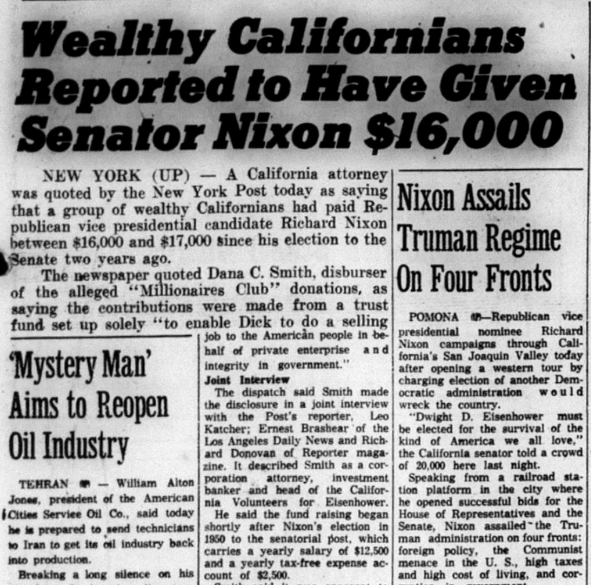
Dana C. Smith, disburser of the alleged “Millionaires Club” donations, told the New York Post that the contributions were made from a trust fund set up solely “to enable Dick to do a selling job to the American people in behalf of private enterprise and integrity in government.”
While Nixon called the story a “smear” from his opponents, he didn’t deny the fund, and this led to accusations of corruption. It was a major scandal.

Nixon said that, by taking the private funds, he was “saving you taxpayers money.”
Eisenhower and Nixon’s Democratic opponent Adlai Stevenson said the questions that arose were: “Who gave the money, was it given to influence the Senator’s position on public questions: and have any laws been violated?”
This was particularly embarrassing to the Eisenhower campaign, which was railing against “corruption” in government.
For a while, it was uncertain if Nixon would remain on the Eisenhower ticket. But then the Republican National Committee paid $75,000 (nearly a million dollars today) for a 30-minute televised speech by Nixon on September 23, 1952 in which he defended himself. This became known as the “Checkers Speech.”
The “Checkers Speech” (which you can watch HERE) is particularly infuriating because it’s an early example of a politician using an emotional appeal to a televised audience of around 60 million Americans to evade real accountability.
In the speech, Nixon claimed to give a full accounting of his personal finances, but what he actually did was give the impression that he was a public servant of modest means. He said that one gift he received was a cocker spaniel dog which his daughters named Checkers and that they were going to keep the gift.
What Nixon did NOT do was name the 76 wealthy Californians who had contributed to the fund, which would have enabled any reporter to have investigated whether he used his power as a congressman to benefit them. The full list of donors has never been made public.
And yet, somehow, the “Checkers Speech” worked.

Some notable Fullertonians told the Fullerton News-Tribune that they felt his speech had exonerated the candidate (it had not).
R.S. Gregory said, “Nixon is absolutely all right. He made a clear statement of his affairs. I think he is in the right.”
Verne Wilkinson said, “The speech was outstanding. He certainly redeemed himself, in fact, in my opinion he was above reproach in the first place.”
H.H. Kohlenberger said, “It was an excellent presentation which, in my opinion gained many votes for Nixon, and which was unprecedented in political history.”
And so, rhetoric won over substance, and Eisenhower and Nixon won.
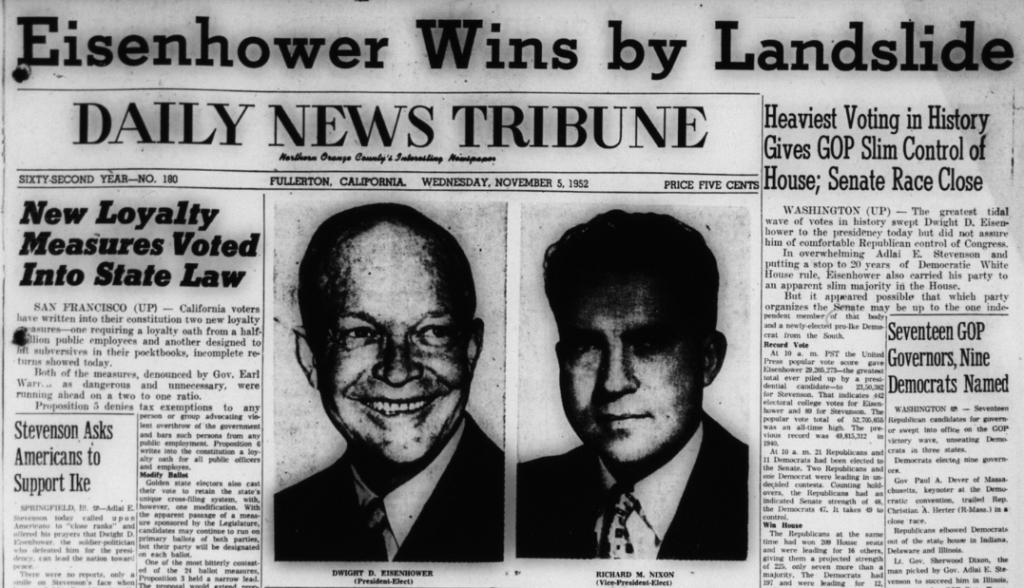
Local Politics and Government
In local political news, Cecil Crew (car dealership owner), Hugh Warden (a roofing contractor), and Jack Dutton (owner of a salvage business) were elected to City Council. Warden was named mayor.
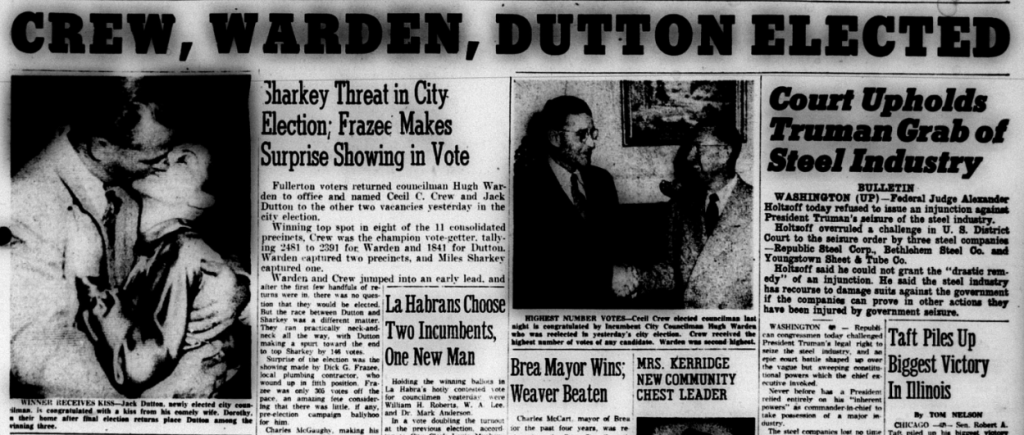
Not long after the election, Jack Adams (who had been elected previously) resigned from council, and Irvin Chapman (son of citrus grower Charles Chapman) was appointed to fill his seat.
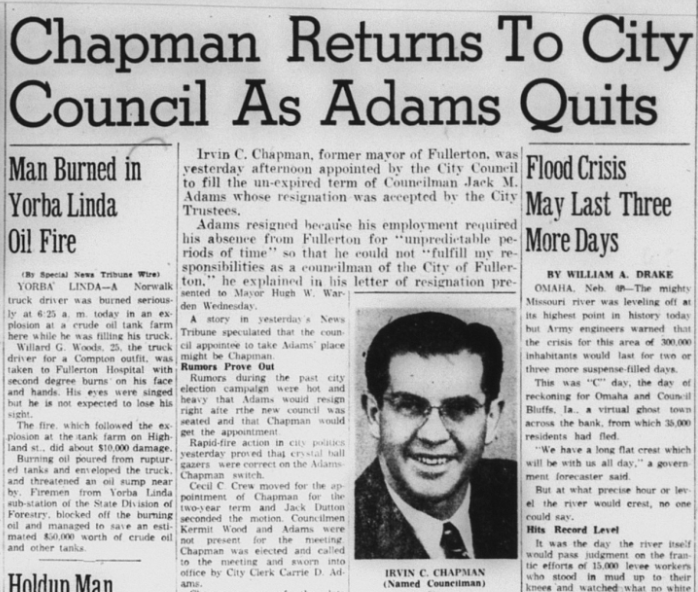
This prompted protests from some Fullertonians, who argued that Chapman had lost the last time he ran for council, and should therefore not be appointed.
“I believe the voters showed two years ago, beyond all doubt, that they did not want Chapman on the City Council!” a reader wrote in a letter to the editor of the Fullerton News-Tribune. “I believe it is a little-disputed fact that the incumbent always has the edge in an election, yet two generally unknown men came in ahead of the then-incumbent Irvin Chapman. There are going to be a lot of very unhappy voters if he is permitted to sneak in the back door after that had showed him out the front—they thought!”
Councilmember Kermit Wood strongly objected to Chapman’s appointment.
“With the help of his cohorts, the mayor has held the back door open for another councilman of his choosing,” Wood said. “No consideration has been given the voters of Fullerton. I charge that the action taken by the three councilmen is unethical and dictatorial and not in the best interests of the people of Fullerton…Such is the fiber of dictatorship and communism. Never in the annals of Fullerton has this flagrant disrespect for the right of the people and for decency and fairness been equaled.”
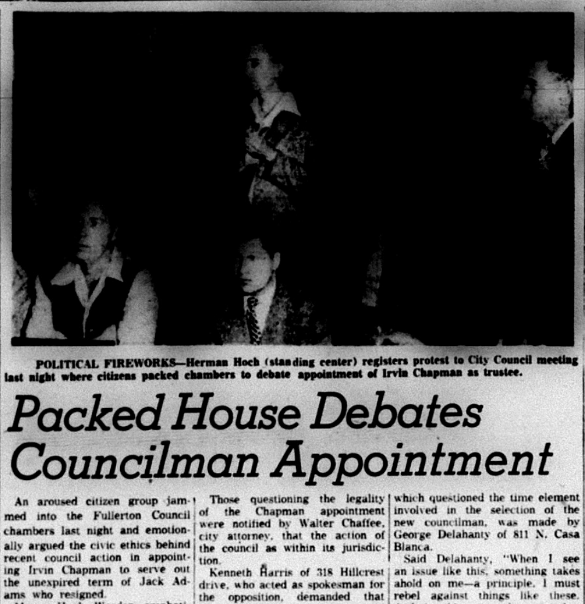
Lots of folks showed up to a City Council meeting urging that Chapman not be appointed. However, their pleas were unsuccessful. He was appointed.
“Kenneth Harris acted as spokesman of the opposition and demanded that Mayor Warden rescind the council action, backing up his demand with a petition signed by approximately 300 persons,” the News-Tribune reported.
Not long after this, newly elected councilman Jack Dutton also resigned, and was replaced by Miles Sharkey, manager of the vast Sunny Hills Ranch property.

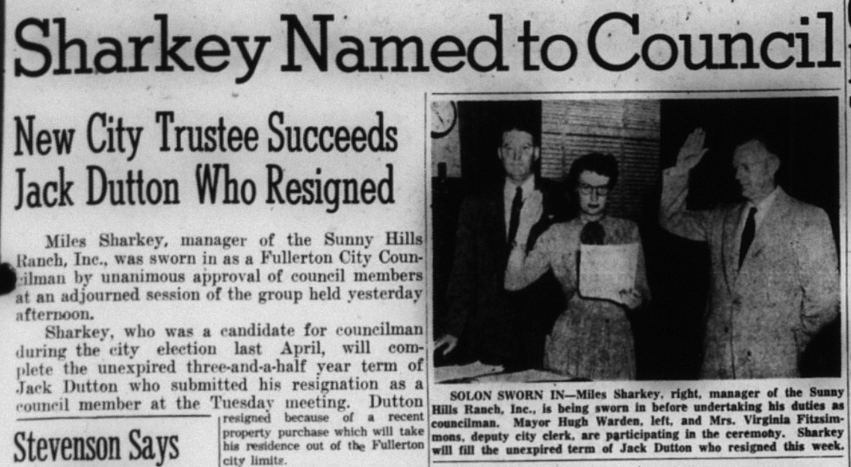
Thus, two of the three elected representatives were replaced by appointed ones–owners or managers of valuable large tracts of land. This did not bode well for truly democratic representation.
In another somewhat anti-democratic move, the new Council considered fundamentally changing the structure of local government by creating a new position of City Administrator (now called City Manager). This would be another appointed position. They chose long time city employee (and alleged former Klansman) Herman Hiltscher.
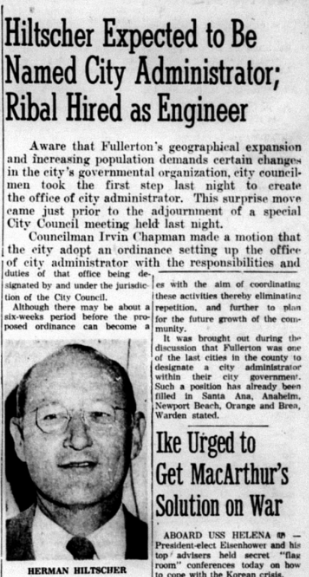
The stated reason for the change was that City Councilmembers did not have the time to oversee such a large and growing city, and thus required a full-time administrator. This makes sense in theory, but in practice it raised questions about true democratic governance for cities.
One of the few academic books focusing on Orange County is Postsuburban California: The Transformation of Orange County Since World War II. This book contains various articles written by historians and social scientists.
In a chapter entitled “Intraclass Conflicts and the Politics of a Fragmented Region,” UCI historian Spencer Olin describes the implications of a move to a Council-Manager system: “By the mid-1960s, then, several marked changes in political structures and practices had occurred that clearly favored the interests of a certain class segment, first of regional capitalists and next of owners of national and international corporations…an increased depoliticization of the municipal administration had taken place through the imposition of the council-manager system and the move away from elected officials toward appointed ones.”
This change happened in a number of Orange County cities in the mid-20th century, and it is currently the dominant model for many cities.
Olin continues: “If we carefully analyze the political forces behind such changes in municipal (city) government, while at the same time paying attention to underlying economic developments, we can uncover the antidemocratic implications of suburban policies…We can see, for example, that important areas of public authority were removed from the control of locally elected officials and were taken over by relatively autonomous and distant governmental agencies largely insulated from the political process.”
It is notable that the very year Fullerton sought to impose the Council-Manager system, two elected City Councilmen resigned and were replaced by unelected appointees who were just the sort of “regional capitalists” Olin describes: Irvin Chapman (of the wealthy, landowning Chapman family), and Miles Sharkey (manager of the vast Sunny Hills properties).
Land use decisions by the City Administrator and the newly-configured council would stand to benefit large landowners, especially as the city was undergoing a transformation from agriculture to suburban, commercial, and industrial development.
Even before he became City Administrator, Hiltscher was city engineer. According to the News-Tribune, “All recent subdividing throughout the community has been controlled by standards set by the engineering office under Hiltscher’s management, which has brought Fullerton to be known as ‘The City of Beautiful Homes.’”
In the “City of Beautiful Homes” those who owned (or managed) a lot of land stood to make a fortune. Two of these men were Chapman and Sharkey.
Others elected in 1952 included Leroy Lyon, John Murdy, and Ralph McFadden.

The Red Scare
As the Cold War ramped up, so did the Red Scare. Richard Nixon’s anti-communist activities was part of what made him popular locally among a generally conservative community.

Fullerton local William Wheeler took part in the House Un-American Activities Committee probe of suspected communists.
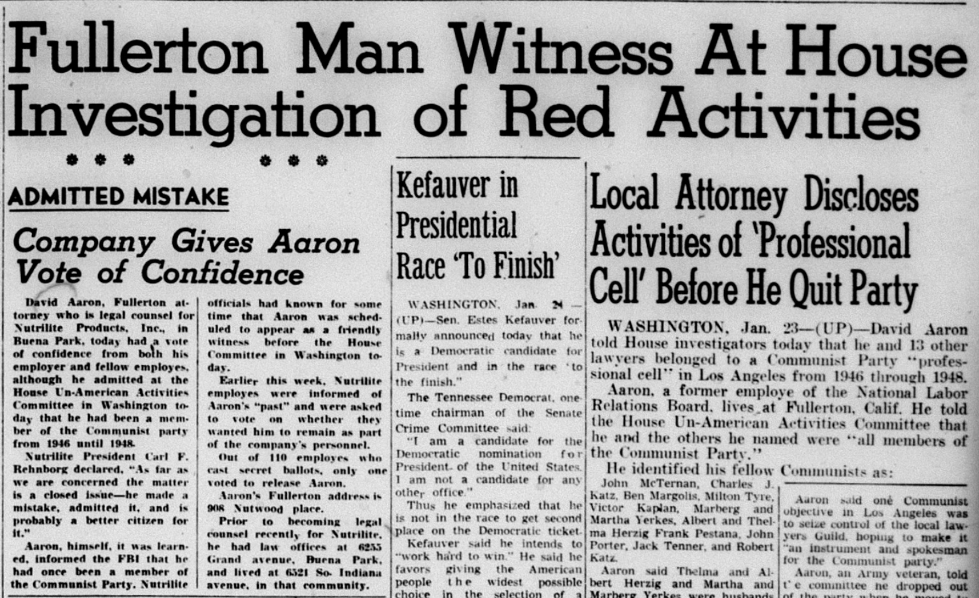
A Fullerton lawyer named David Aaron testified that he had been a communist in the late 1940s while serving on the National Labor Relations Board.
“Aaron said he joined the party in 1946 when his NLRB job ended after two or three months,” the News-Tribune reported. “His contact with persons engaged in labor disputes before the board, Aaron said, caused him to decide ‘there must be something wrong with the economic system when all these things were happening.’”
One problem with the “Red Scare” was that it tended to silence legitimate critiques of the inequalities created by the capitalist system. It served to cement capitalism as the only allowable economic system in American discourse.
The Red Scare also weirdly associated homosexuality with communism, and many gay people were persecuted and lost their jobs.
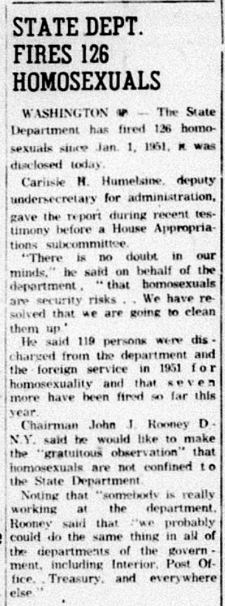
Anti-communist crusaders like Fred Schwarz combined Christianity and conservative politics to paint the conflict between capitalism and communism as one of good vs. evil.

Probably the biggest real danger during the Cold War was the existence of atomic bombs. The US had developed the hydrogen bomb, which was many times more powerful than the bombs dropped on Hiroshima and Nagasaki during World War II.

The Russians were also developing atomic bombs in a perilous arms race. This prompted local programs like “Operation Skywatch” in which regular citizens would watch the skies for Russian bombers.

Growth
Fullerton continued its phenomenal post-war growth.
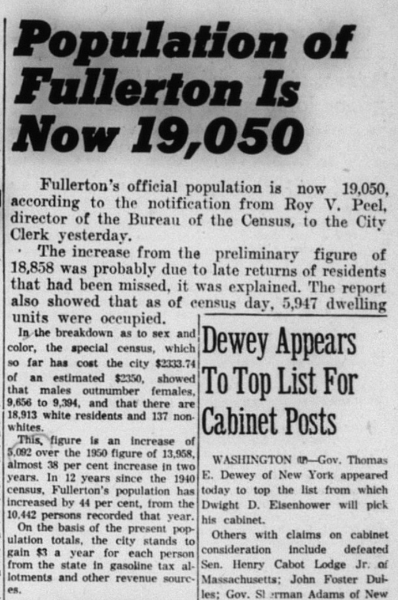

As Fullerton grew, many new housing subdivisions were being built.

The preferred type of housing in Fullerton was the single family home. Residents and local leaders, as they are today, were generally opposed to low-income housing, apartments, and trailer parks.
For example, the city voted to remove the low-cost veteran’s housing near Fullerton College, and on Truslow.
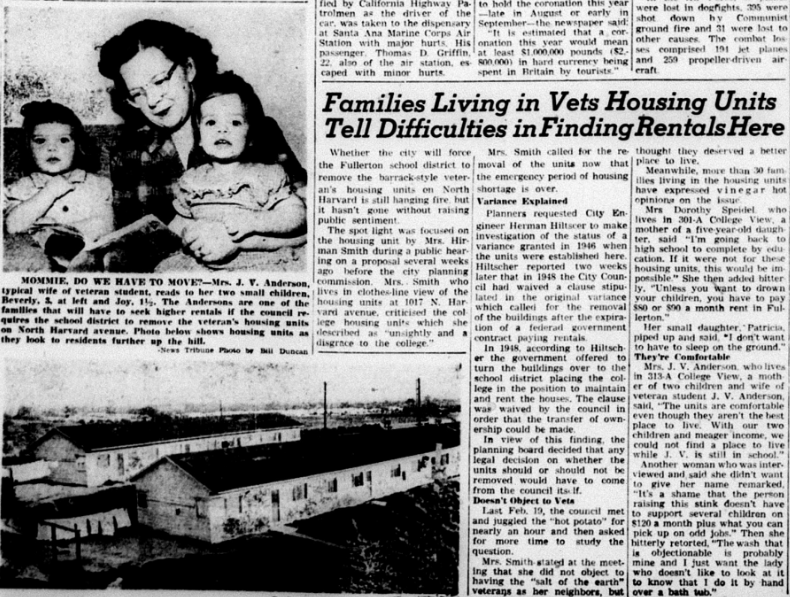

“City Planning Commission yesterday recommended that Fullerton high school and junior college district remove the veteran’s housing from North Harvard avenue on or before July 1, 1954,” the News-Tribune reported. “Two housing foes, one who called the establishment of the housing units ‘strictly a socialist measure,’ were present at the hearing to voice objections to the housing units being located on North Harvard avenue.”
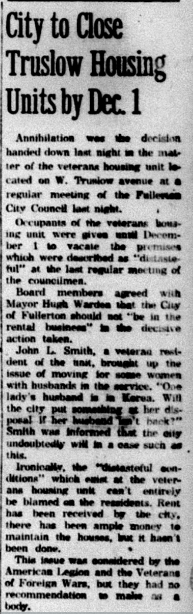
Local realtors lobbied hard against any kind of “public housing.”
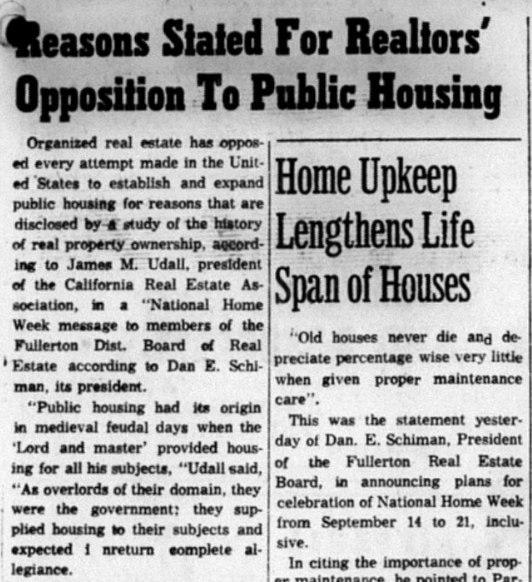
Some residents and neighbors were even opposed to allowing more dense housing like apartments.

And the City Council adopted a strict trailer park ordinance.
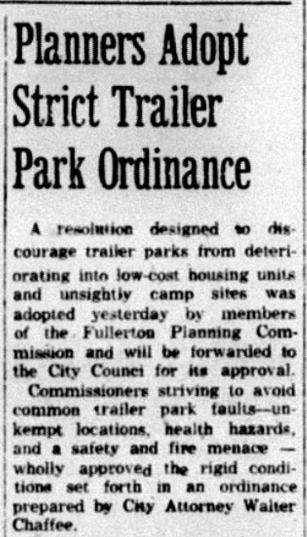
Building lower-cost housing was at odds with realtors, developers, and homeowners’ desire to maximize their property value–to the detriment of those less well off. This sentiment remains today, and has undoubtedly contributed to the present housing affordability crisis.
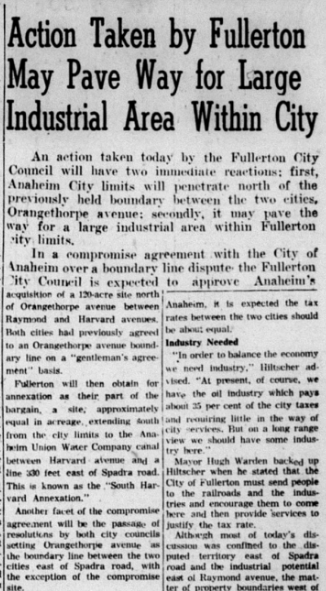
Along with increased residential development, Fullerton also saw increased industrial development as well. Northrop Aircraft built a large plant on Orangethorpe.

Beckman Instruments was planning to build a large facility just north of the city limits.

Hunt Foods in west Fullerton expanded their facilities.

In 1952, Hunt Foods, owned by Norton Simon, was the fourth largest company selling canned goods in the United States, with 12 facilities and an annual sales of over $60,000,000 (worth ten times that in 2025 dollars).
Part of what made Hunt’s successful was the power of acquisitions and branding. Simon would acquire smaller food canning companies and then bring them under the Hunt’s label.
The citrus industry was still large in the 1950s. The California Fruit Growers Exchange officially changed its name to Sunkist.
Oil was also still big business in Orange County, and offshore drilling was a new and controversial thing.
As the population grew, so did the need for new and larger schools.

Fullerton College purchased more land to expand its facilities.

As both Fullerton and Anaheim sought to expand, they agreed on a new boundary line separating the two towns.

Culture and Entertainment
For culture and entertainment, Fullertonians went to movies at the Fox Theater.

The city held a massive fair that drew thousands.


In the 1950s, it was a very popular thing to crown a “queen” for many community events. I think it had something to do with reinforcing normative gender roles.



Another popular fun spot was Knott’s Berry Farm and Ghost Town, which was not quite the theme park it is today, but still probably a good time.

Crime
The highest profile local crime of 1952 was the murder of Ruby Ann Payne by William Rupp.
He was captured and arrested in a Brea Cafe, tried, and sentenced to death.
In less heinous crime news, the infamous “pants burglar” was finally captured.
Sports
Professional baseball teams like the Portland Beavers continued to train and play games at Amerige Park.

Here are a few more Fullerton sports stars:


Death
Pioneer rancher August Hiltscher passed away.

Stay tuned for top news stories from 1953!
-
Fullerton in the 1930s

The following is from a work-in-progress about the history of Fullerton. You can support my ongoing research and writing on Patreon.
The Great Depression, Natural Disasters, and How the New Deal Benefited Fullerton
Following the stock market crash of 1929, the most significant problem facing Fullerton was the Great Depression.
Local groups like the American Legion operated a soup kitchen which offered food and (limited) lodging. Another soup kitchen was operated by the Maple School PTA.
In 1932, Democrat Franklin Delano Roosevelt defeated Republican Herbert Hoover in a landslide victory, becoming President of the United States. California, which had long been a Republican state, went blue for the first time in years, although a majority of Fullertonians voted for Hoover. The election was seen as a national repudiation of Hoover’s failure to improve the economic conditions of the Great Depression.
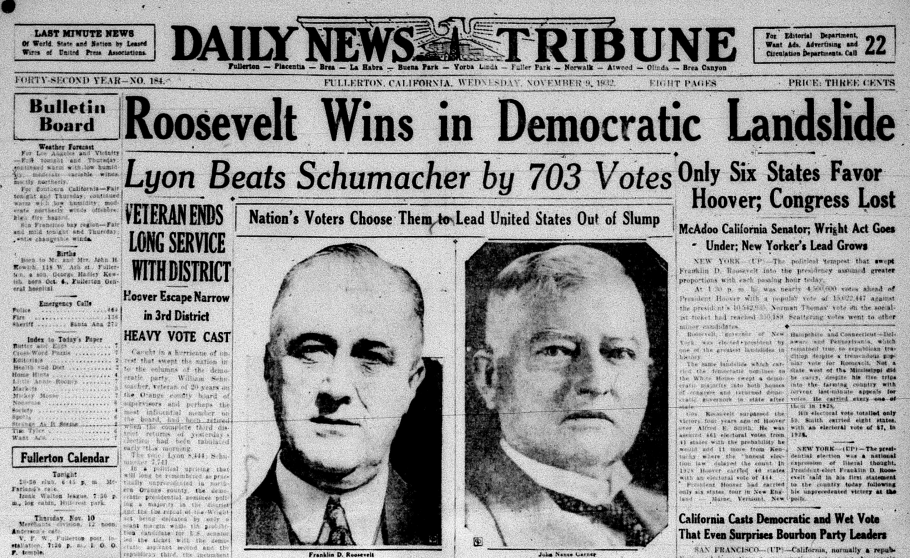
Fullerton Daily News-Tribune, 1932. Roosevelt’s first 100 days of office in 1933 were filled with sweeping legislation aimed at combating the Great Depression.
Roosevelt called it the New Deal. At the time, unemployment had reached 25 percent—the highest in US history so far. Federal programs like the Works Progress Administration (WPA) and the Civilian Conservation Corps (CCC) were created to give people jobs, and to simultaneously build up the country’s infrastructure—new roads, dams, parks, public buildings and more were built.

Works Progress Administration sign at Fullerton College. Photo by the author. The WPA alone gave over 8 million unemployed Americans jobs in its 8-year existence.
These government programs were not just for laborers. Artists, writers, actors, and musicians were also employed by the WPA to give folks not just jobs, but also hope and beauty in difficult times.
Today, nearly a century later, Roosevelt’s New Deal is primarily remembered in history textbooks and school curricula. But there is another way to remember its legacy—by recognizing the New Deal projects that still exist right where we live.
The city of Fullerton was a major recipient of New Deal funding and projects, many of which still exist today and have become some of the most iconic features of our local landscape. But first, a bit of context.
As if the Great Depression wasn’t hard enough to endure, Fullertonians also faced two major natural disasters during the 1930s.
First came the devastating Long Beach Earthquake of 1933, which caused over $50 million in damage and killed 120 people throughout the region, injured thousands, and caused tens of millions in property damage.

Fullerton Daily News-Tribune, 1933. Some refugees from the earthquake took up temporary residence in their cars at Hillcrest Park and at the American Legion hall, where they were provided food and shelter by local volunteers and the Red Cross. The Izaak Walton Lodge was also opened to those who had fled the quake.
“Fullerton American Legion members continued to feed more than 100 persons at each meal at the Legion hall,” the News-Tribune reported. “Many of this group are lodged in Fullerton homes or camping in the park and are nearly without funds, their homes demolished or unsafe for occupancy in Long Beach, Compton, Bellflower and other points.”
Mrs. Clarence Spencer on W. Orangethorpe took in 27 quake refugees.
Most Fullerton buildings escaped damage, although a chimney fell at the California Hotel, crashing through the roof of the cafe kitchen and half filling it with bricks and shattered building materials. Thankfully, no one was there at the time. The old elementary school on Wilshire and Lawrence (now a parking lot) also experienced some damage, causing it ultimately to be condemned.
Then came the 1938 flood.
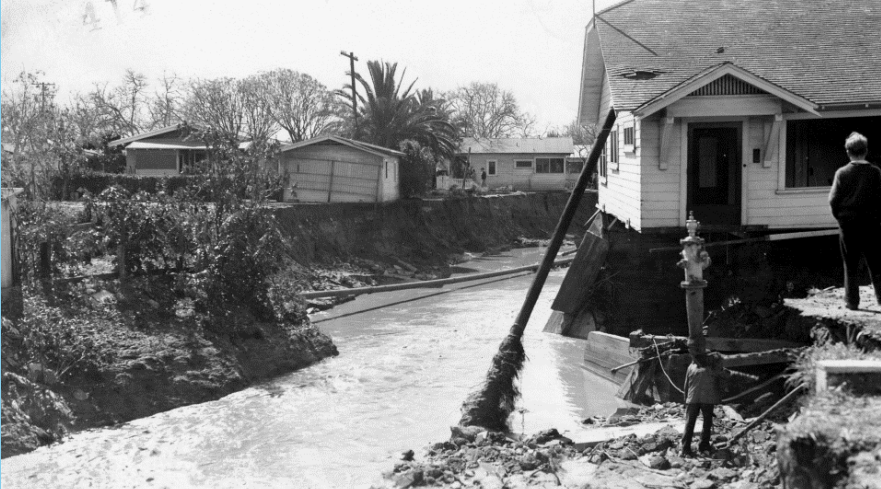
Destruction in Fullerton from 1938 flood. The story of the flood is all the more tragic because local residents had twice voted down bonds that would have allowed for flood control infrastructure.
In 1931, Fullerton residents voted to enter the Metropolitan Water District, which would give the city access to water from the Colorado River via aqueduct. In 1933, the Orange County Water District was created.
In 1935, over six million dollars of federal funds (around $138 million today) were planned for a large scale Orange County flood control plan–to build the Prado Dam, as well as channelize much of the Santa Ana river. These federal dollars were contingent on local voters approving a bond measure to supplement the federal relief funds.
A well-funded opposition campaign which called the bonds a waste of taxpayer dollars resulted in the bond issue, and therefore the federal relief dollars, being lost. Voters actually had two chances to approve the bonds, but they voted them down twice.
Unfortunately, because the flood control measures were not passed, a few years later the 1938 flood would devastate local communities. It would take a natural disaster for people to understand the need to invest in this infrastructure.
In 1938, following severe rainstorms, the Santa Ana river overflowed its banks and caused widespread damage, killing over 50 people.
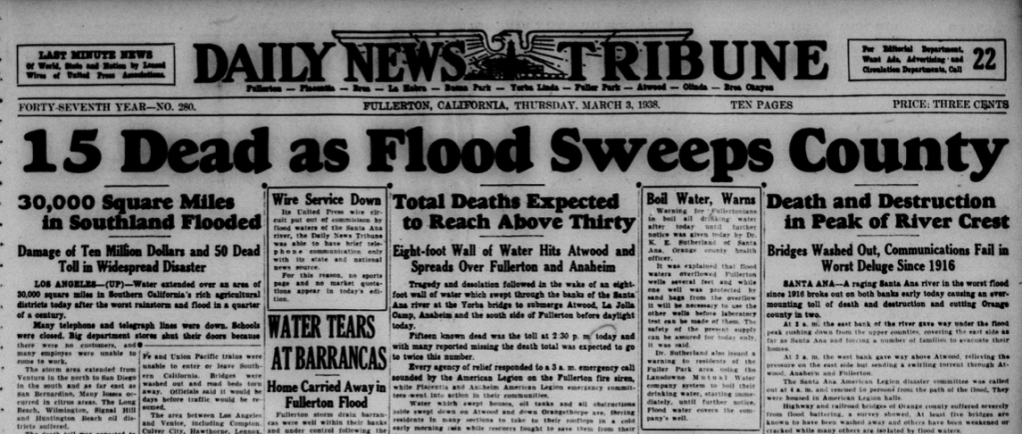
Fullerton Daily News-Tribune, 1938. “Water extended over an area of 30,000 square miles in Southern California’s rich agricultural districts today after the worst rainstorm and flood in a quarter of a century,” the News-Tribune reported.
Property damage was estimated at $10,000,000, and thousands were marooned by flood waters.
“Tragedy and desolation followed in the wake of an eight foot wall of water which swept through the banks of the Santa Ana river at the Yorba bridge to submerge Atwood [Placentia], La Jolla Camp, Anaheim and the south side of Fullerton,” the News-Tribune reported. “Water which swept houses, oil tanks and all obstructions aside swept down on Atwood and down Orangethorpe ave. forcing residents in many sections to take to their rooftops in a cold early morning rain while rescuers fought to save them from their dangerous quarters.”
The flood waters extended all the way to downtown Fullerton.
Local relief efforts were spearheaded by the Red Cross, local police and firefighters, and the American Legion. Shelters were set up in Hillcrest Park and St. Mary’s church for flood refugees.
Tragically, many of the victims of the flood were Mexican Americans living in citrus camps of south Fullerton, north Anaheim, and Placentia.
“Seven bodies were reported recovered at Atwood this morning. according to Chief of Police Gus Barnes at Placentia,” the News-Tribune reported. “Rescue workers with motorboats, rowboats and lifelines attempted to cross the river to the shattered cottages in which several hundred Mexican agricultural workers made their homes.”
The floods damaged or destroyed hundreds of homes, bridges, barrancas, and other infrastructure.
The 1930s were pretty rough.
“Because of these disasters, nearly every single community in Orange County was profoundly impacted by the New Deal,” Charles Epting writes in The New Deal in Orange County. “Dozens of schools, city halls, post offices, parks, libraries, and fire stations were built; roadways were improved, and thousands were given jobs.”
Out of the tragedies of the 1930s, here’s how the New Deal benefited Fullerton.
“With a population of just over 10,000 in 1930, Fullerton was one of the largest cities in Orange County at the time of the Great Depression. Relief projects were numerous. It is probable that Fullerton received more aid than any other Orange County city,” Epting writes. “What is also unique about Fullerton is that nearly all of its New Deal buildings are still standing and preserved as local landmarks.”
Maple School (244 E Valencia Dr): This school was retrofitted and expanded following the 1933 earthquake. It was partially funded by the Public Works Administration (PWA). It’s an example of Art Deco architecture. Plans were drawn by architect Everett E. Parks.
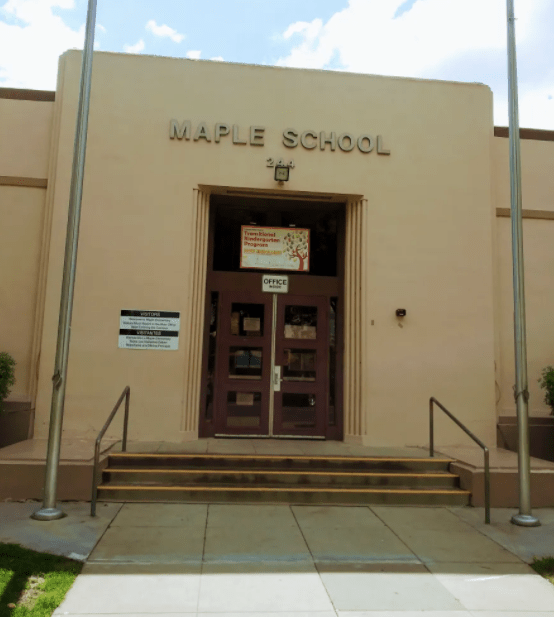
Entrance to Maple School. Photo by the author. Wilshire Junior High School (315 E Wilshire Ave): Originally constructed in 1921, it was reconstructed and expanded during the 1930s with PWA funds. The style is Deco/Greco. Now it’s the School of Continuing Education.

Wilshire School students circa 1930s. Photo courtesy of Fullerton Public Library Local History Room. 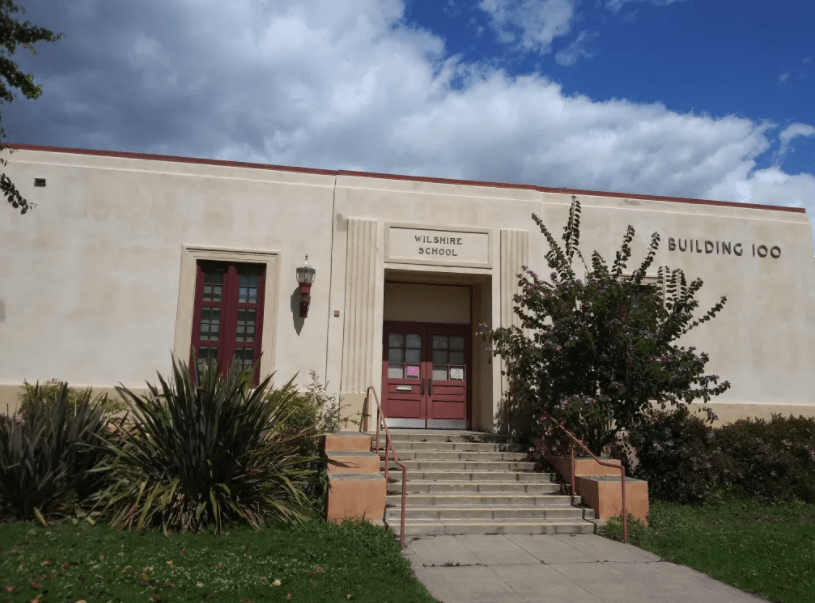
School of Continuing Education today. Photo by the author. “Pastoral California” mural on High School Auditorium (201 E Chapman Ave): Giant fresco painted by Charles Kassler under the Public Works of Art Project in 1934. Spanning 75 feet by 15 feet, the mural is unmatched in size and scope. One of the two largest frescoes commissioned during the New Deal. More on this later.

Portion of “Pastoral California” mural. Photo by the author. Fullerton College (321 E Chapman Ave): In 1935, Fullerton architect Harry K. Vaughn teamed up with landscape architect Ralph D. Cornell to create a general plan for the new campus, to be partially funded by the WPA and the PWA. The first building was the Commerce Building, next was the Administration and Social Sciences building, then the Technical Trades building.
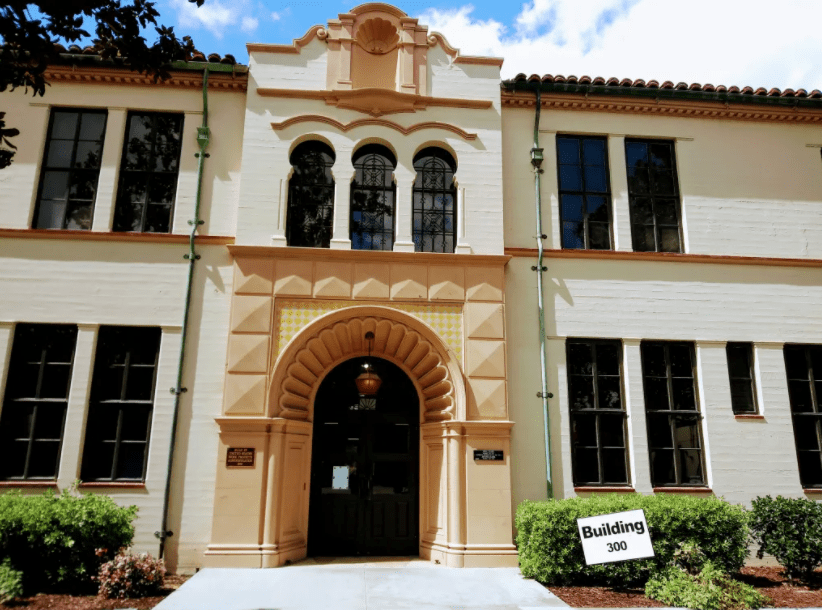
Fullerton College 300 building–a WPA building and the first built on campus. Photo by the author. Fullerton Museum Center (301 N Pomona Ave): Fullerton’s first public library was an Andrew Carnegie-funded library built in 1907. Years of wear (and the 1933 earthquake) necessitated a re-building. In 1941, the Carnegie Library was demolished, and a new library was re-built by WPA workers. The building was dedicated in 1942. A new library (on Commonwealth) was built in 1973, and the Fullerton Museum Center has occupied the building since 1974.

Fullerton Museum Center building. Photo by the author. Post Office (202 E Commonwealth Ave): The first federally-owned building in Fullerton, it was built in 1939 and funded by the Department of the Treasury, and built by crews of local workers. This post office also contains the mural “Orange Pickers” by Paul Julian, funded by the Treasury Department Section of Fine Arts. Paul Julian went on to have a very successful career at the Warner Bros. studios animating Looney Tunes shorts.
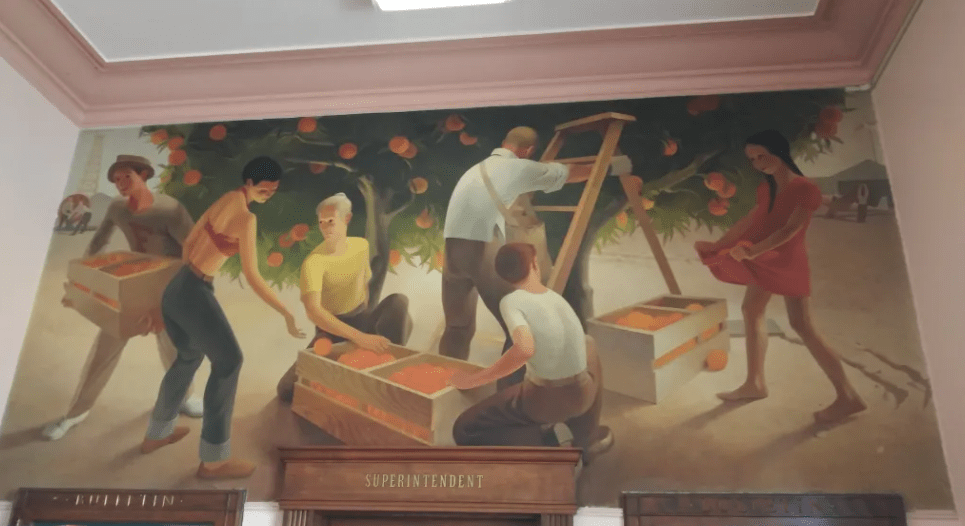
Post Office mural. Photo by the author. Police Station/Former City Hall (237 W Commonwealth Ave): The impressive Spanish Colonial Revival building is now home to Fullerton’s police department. Designed by architect George Stanley Wilson, the building was completed in 1942. One of the most distinctive features of the building is its extensive tile work.

City Hall under construction. Photo courtesy of Fullerton Public Library Local History Room. 
Fullerton Police Station (former City Hall) today. Photo by the author. “The History of California” Mural in the Police Station: A three-part mural for which the WPA’s Federal Art Project commissioned artist Helen Lundeberg to paint in 1941. The mural depicts everything from the landing of Juan Rodriguez Cabrillo in San Diego in 1542 to the birth of the aircraft and movie industries in Los Angeles in roughly chronological order. Here are some photos I recently took of the mural. Unfortunately, you have to make an appointment with the police department to see this public work of art:
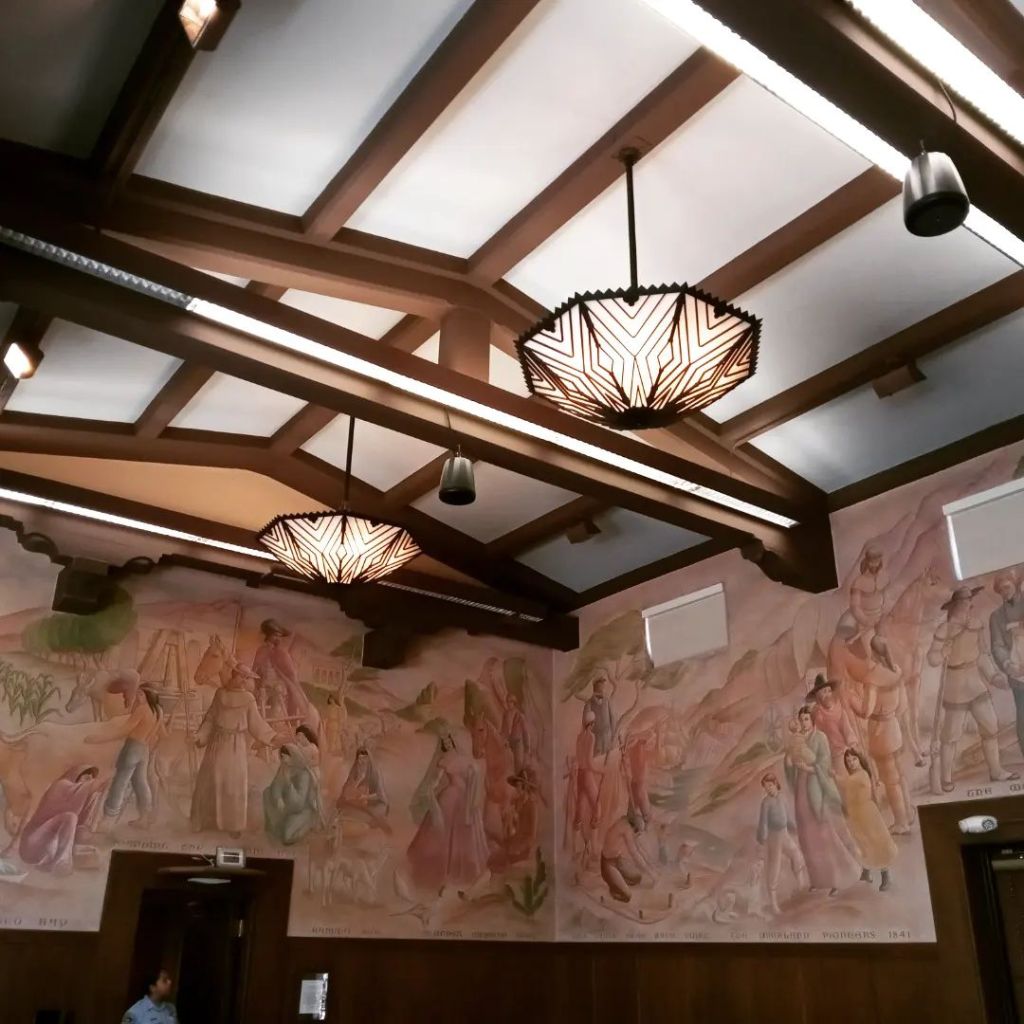
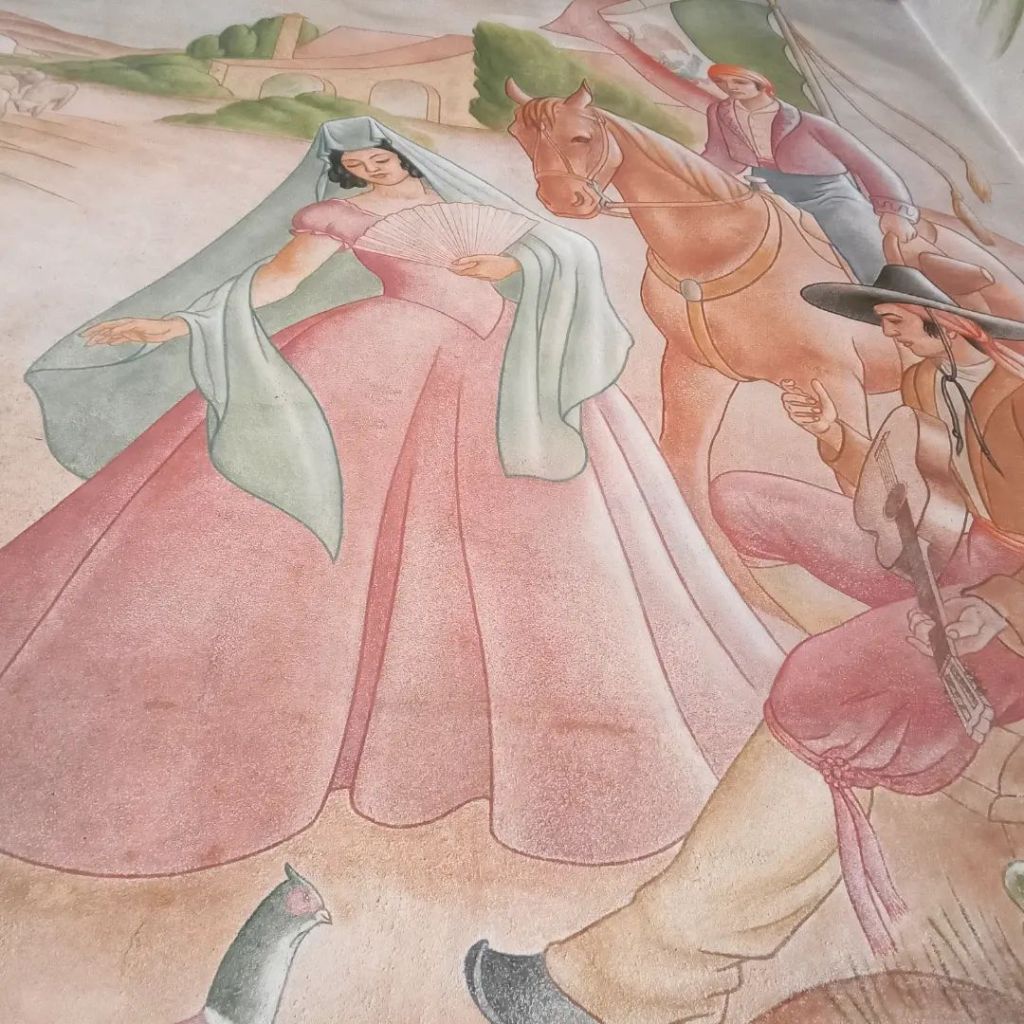


Hillcrest Park (1200 N Harbor Blvd): The amount of work done in Hillcrest Park during the New Deal was staggering, with projects being funded and constructed by the CWA, WPA, RFC, and SERA. Much of Hillcrest Park’s landscaping was done during this era, like the excavation of the “Big Bowl.” Perhaps the most iconic feature of Hillcrest Park is the Depression-era stonework that runs throughout the Park. Today, Hillcrest Park represents the finest example of a WPA-era park in Orange County and has enjoyed federal recognition since 2004, so the structures are safe.
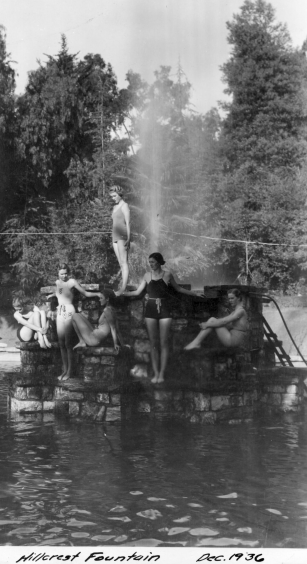
Hillcrest Park Fountain. Photo courtesy of Fullerton Public Library Local History Room. 
Hillcrest Park stonework. Photo by the author. Amerige Park (300 W Commonwealth Ave): A wooden grandstand and stone pilasters were built at the baseball field in 1934. The grandstand was destroyed by a fire in the 1980s, but the flagstone pilasters remain.

Amerige Park baseball game in the 1930s. Photo courtesy of Fullerton Public Library Local History Room. Pastoral California: The Story of a Mural
“Pastoral California,” the 75-foot long fresco mural on the side of the Auditorium at Fullerton Union High School was painted in 1934, during the Great Depression, painted over by order of the Board of Trustees in 1939, and restored 58 years later in 1997. The story of this mural, what it depicts, why it was painted over, and finally restored, is one worth reflecting upon.
In addition to building projects, the WPA also commissioned murals in cities across America, including Fullerton, in an effort to give people not just jobs, but a sense of hope and beauty in difficult times. Perhaps the most famous of these murals is “Pastoral California,” one of the two largest frescoes commissioned by the WPA.
Charles Kassler, who had studied art at Princeton, traveled extensively, and apprenticed under a fresco painter in France, completed “Pastoral California” in 1934. Kassler had only one hand. He’d lost the other in a high school chemistry accident. He was married to famous Mexican singer Luisa Espinel, who was the aunt of pop superstar Linda Ronstadt.
Kassler clearly did local history research before painting the mural. It depicts a Spanish/Mexican southern California. From the 1700s to 1821, California was controlled by Spain. From 1821 to 1848, it was controlled by Mexico. Around that time, the United States decided it was their “Manifest Destiny” to control California, so they took it through a war of conquest, the Mexican American War. Kassler, however, chose to depict not an Anglo-American California, but a Spanish/Mexican one.
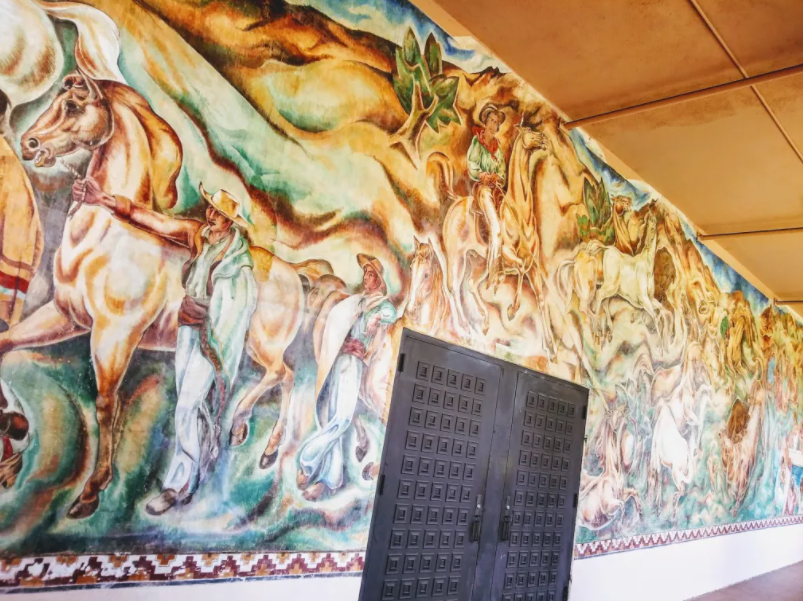
“Pastoral California” mural. Photo by the author. The mural depicts historical figures like Jose Antonio Yorba, a large landowner whom Yorba Linda is named after. In the background is Mission San Juan Capistrano. To the right is Pio Pico, the last Mexican governor of California. Most of the figures are Latinos doing everyday activities: washing clothes, riding horses, eating together.
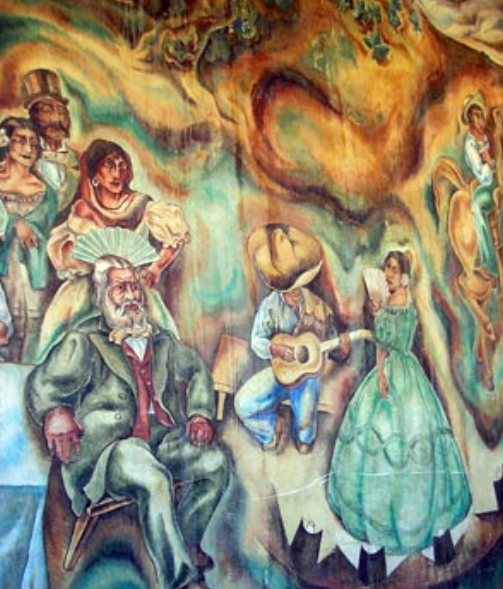
Detail from “Pastoral California” mural depicting Pio Pico, the last governor of Mexican California and famous Californio singer Laura Moya. 1930s LA art critic Merle Armitage praised the mural: “Kassler has adhered not only to the beautiful traditions of pastoral California, but at the same time has also borne in mind the splendid Spanish architecture, and, lastly, created a beautiful fresco of amazing vitality and freshness of viewpoint.”
Dr. H. Lynn Sheller taught English and History at Fullerton College in 1934, at the time “Pastoral California” was painted. “I watched him [Charles Kassler] put the mural up there,” Sheller recalled in an interview for the Fullerton College Oral History Program, “I would visit him day after day as he was working…the feature of a fresco is that the paint is mixed in with the plaster, thus it is supposed to be permanent.”
But not everyone was happy with Kassler’s mural.
An article from August 30, 1939 in the Fullerton News-Tribune entitled “High School Mural Doomed; Paint it Out, Trustees Order” reads:
“Fullerton Union high school’s much discussed and criticized mural which covers the outside west wall of the auditorium received its death sentence at the hands of district trustees last night who ordered the wall paint sprayed to cover the painting.
This mural is approximately 75 feet long by 15 feet high with its huge figures of horses and riders and other human forms depicting early California days has been a mooted [sic] point since its completion several [five] years ago by the artist Kassler as a federal art project.
Most occupants of the high school will shed no tears over the decision of the board; it was indicated today as the lurid colors and somewhat grotesque figures have apparently failed to capture popular fancy.”

1939 article from Fullerton News-Tribune courtesy of the Local History Room of the Fullerton Public Library. C. Stanley Chapman, son of Fullerton’s first mayor, Charles C. Chapman, and a city council man himself, was one of the ones who “shed no tears.” In an interview for the Cal State Fullerton Oral History Program, Chapman said: “The [mural] down there at the school was almost as absurd [as the one in the post office]. They were painted by that WPA business and the painting did not go with the architecture of the school. It was a great relief when they did paint them out. They were not an artistic addition to the building by any means”
The college student interviewing Chapman replied that superintendent Louis Plummer disagreed with this assessment: “Mr. Plummer seemed to think they were nice although he did not say so. He simply quoted a long article from the Los Angeles Times art critic who said they were lovely and truly representative and that the colors were beautiful. Mr. Plummer ends that little discourse by saying, ‘and they were painted over,’ as though he was disappointed.”
Chapman repied, “Oh, yes, the colors were good. But I have forgotten what the theme was.”
The interviewer reminded him, “Mexican entertainment; with the horses, and the children playing.”
Chapman replied, “Oh, yes, Well, the colors were nice. I don’t know. I was never involved in the school board or anything like that.”
Why was the mural painted over? I have heard some speculate that it was because some of the women depicted in the mural had naked, exposed breasts. However, I have seen no evidence that there was any nudity in the mural. In the mural as it exists today, and in every photo I’ve seen, the women are clothed. Some of them have big breasts, but that hardly seems justification for painting over the whole mural.

The allegedly offending women. “It wasn’t until we had a group of trustees in here who were negatively inclined, that it was painted over,” Sheller remembers. When asked why it was painted over, Sheller said, “Some people felt it was vulgar or gross in some way. It simply showed the Mexican women as they were probably attired at that time. They were very bosomy women. I don’t think that we would feel that there was anything wrong with it. I never felt there was.”
But others have a different view, one I believe makes more sense, given the social context of 1930s Fullerton.
“It was too Mexican, that’s why,” speculated Charles Hart, 75, who was a student at the high school and remembers the mural before it was covered up. “The school board didn’t want to leave the impression that this town was anything else but Anglos. Too extreme for them, I guess.”
Hart said this in a 1997 Los Angeles TImes article.
The decision to paint over this mural probably had to do with its subject matter. It celebrated Mexican culture at a time of heightened racism against Mexicans, and when Mexicans lived in segregated communities, attended segregated schools, and were often forcefully and illegally deported back to Mexico during the Great Depression.
I have written about this at some length in an article entitled “The Roots of Inequality: The Citrus Industry Prospered on the Back of Segregated Immigrant Labor.”
“Pastoral California” remained painted over for six decades years until, in 1997 it was restored, thanks to a massive community effort. I was actually attending Fullerton High School at the time. Some of my friends, art students, helped with the restoration. I remember thinking, even then: Why would anyone have painted over something so beautiful?
A Tale of Two Cities
In the 1920s, Fullerton experienced a housing boom, with numerous new subdivisions being built. With the advent of the Great Depression, much new construction stopped, leading to a housing shortage.
To help with the housing situation, the New Deal established entities like the Federal Housing Administration (FHA), which offered affordable home loans and other assistance to homeowners and home buyers.
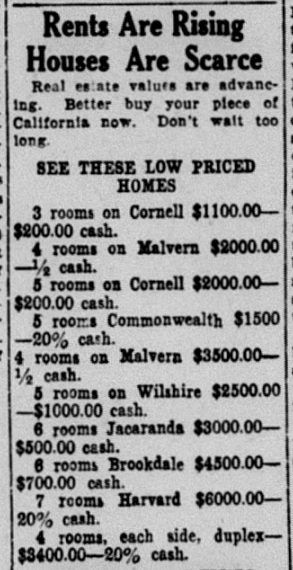
Fullerton Daily News-Tribune, 1932. In the 1930s, Fullerton was really a “Tale of Two Cities” divided along racial lines. Most neighborhoods had racially restrictive housing covenants that prevented non-whites from renting our purchasing property.
There was really only one relatively small neighborhood–the Truslow/Valencia neighborhood where Latinos and African Americans could purchase homes.
The majority of Latinos living in Fullerton in the 1930s lived in citrus work camps. There was one near downtown at Balcom and Pomona (Campo Pomona), another one near Valencia Ave., and then there were several “colonias” (little communities) on the Bastanchury Ranch (that is, until the mass deportation of 1933).
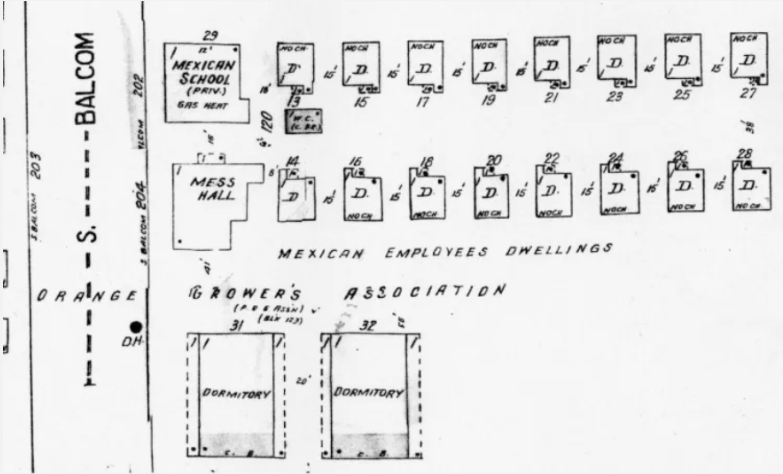
Campo Pomona. The presence of a large Mexican labor force in the Anglo-dominated towns of Orange County, including Fullerton, led to policies of segregation and second class citizenship for the Mexican workers and their families.
“Mexicans in citrus towns were invariably the pickers and packers; and consequently they were poor, segregated into colonies or villages, and socially ostracized, even though they were economically indispensable to the larger society,” historian Gilbert Gonzalez writes in Labor and Community: Mexican Citrus Worker Villages in a Southern California County, 1900-1950. “The class structure in rural areas has generally divided along lines of nationality. At the top, the growers, native-born white; at the bottom, the foreign-born migrants, or his or her children.”
Segregation and structural inequality also extended to education. In the camps, there were schools built exclusively for the Mexican children.
“Segregated schooling assumed a pedagogical norm that was to endure into the fifties and parallels in remarkable ways the segregation of African Americans across the United States,” Gonzalez writes. “By the mid-1920s, the segregated schooling process in the county expanded, matured, and solidified, was manifested in fifteen exclusively Mexican schools [throughout Orange County], together enrolling nearly four thousand pupils. All the Mexican schools except one were located in citrus growing areas of the county…Distinctions between Mexican and Anglo schools included differences in their physical quality.”
There were at least two “Mexican Schools” in Fullerton–one on the Bastanchury Ranch and another in Campo Pomona.
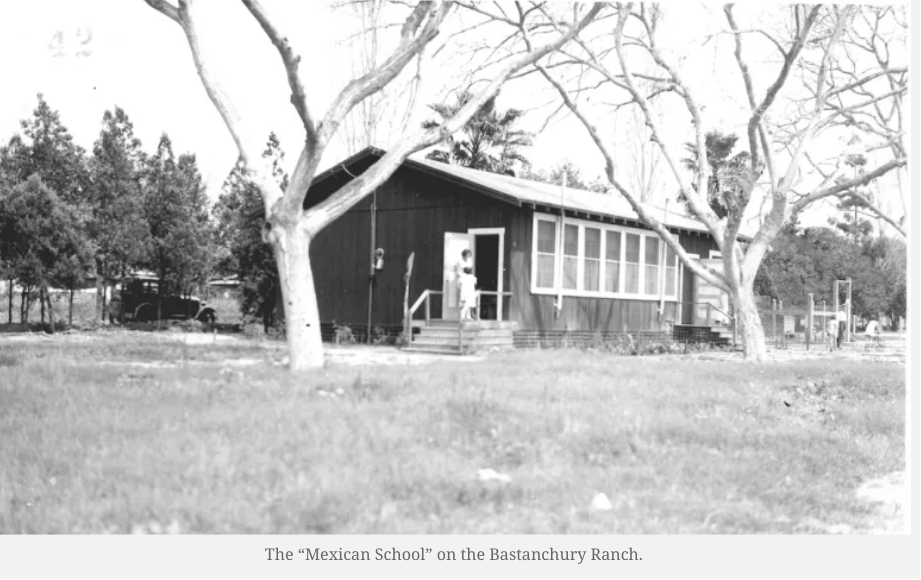

Fullerton Grammar School at Wilshire and Lawrence, which no longer exists. Notice the difference in quality with the Mexican School. Unlike at the white schools, curriculum at the Mexican schools were generally limited to vocational subjects, and junior high was considered the end of schooling for most students, many of whom accompanied their parents in the groves and packinghouses.
One woman who taught at these segregated “Mexican Schools” was Arletta Kelly. In an interview for the CSUF Oral History Program, Kelly described her struggle to convince her colleagues that Mexican students had the same potential as whites.
“Some of my colleagues here would laugh at me and say, ‘Are you a wetback?’” she said.
In addition to educating children, teachers at the “Mexican schools” also taught “Americanization” classes to adults—to assimilate the workers to American society.
“Whereas the Americanization programs in the local villages appear unique, in reality they reflected a generalized expression for the eradication of national cultural differentiation across the United States,” Gonzalez writes.
Under the California Home Teachers Act of 1915, Americanization programs focused on the teaching of English.
Louis E. Plummer, superintendent of the Fullerton High School District, staunchly supported Americanization because in his view the persistence of “Little Italys, Little Chinas, Little Mexicos” stifled the development of a “homogeneous people.” In particular, the failure of Mexicans to live in a “model way” or as “first class citizens,” which was produced by “a hangover of lazy independence” made it imperative that rather than merely learning skills, Mexicans had to learn and live within the fundamental cultural norms of the United States. His perspective summarized much of the Americanization spirit in the larger community during the late 1800s and early 1900s.
“Many a surviving villager resident has not forgotten that in their youth the ‘Anglos never wanted to have anything to do with us except that we pick their oranges.’ Such was the nature of the dominant contours in the Mexican and Anglo social relations in the citrus towns,” Gonzalez writes.
Mass Deportation of Mexican Immigrants
With unemployment on the rise during the Great Depression, immigrants (as always) made a convenient scapegoat and there were calls to restrict immigration.
The Great Depression proved disastrous for the Bastanchury family, owners of “the largest orange grove in the world.” Unable to pay their debts, the Bastanchury Ranch went into receivership, and lost most of their property.
According to Druzilla Mackey, a teacher in the Mexican camp schools, “The American Community…felt that the jobs done so patiently by Mexicans for so many years should now be given to them. ‘Those’ Mexicans instead of ‘our’ Mexicans should ‘all be shipped right back to Mexico where they belong’…And so, one morning we saw nine train-loads of our dear friends roll away back to the windowless, dirt-floor homes we had taught them to despise.”

Fullerton Daily News-Tribune, 1933. What she is referring to is a mass deportation of nearly all of the Mexican workers on the Bastanchury Ranch in the early 1930s. This deportation was part of a much larger deportation effort across the United States, which is described at length in the book Decade of Betrayal: Mexican Repatriation in the 1930s.
“Outside of the community, the Mexican became the scapegoat,” Gonzalez writes. “In 1931 and 1932, local and county governments caught up in the drive across the Untied States to deport Mexicans sought to cut budgets through repatriating Mexicans. Induced through threats of relief cutoff sweetened with an offer of free transportation, about 2,000 left Orange County.”
Many of those deported were actually American citizens. A few years ago, I had the privilege of interviewing Fullerton resident Manuel Rivas Maturino, who was born on the Bastanchury Ranch, and remembers the experience of “repatriation.”
“All of the Mexican camps on the ranch have been eliminated and all American labor is being used with 28 houses on the ranch now filled with regular employees, nearly all of whom have been continuously on the payroll since last April,” the News-Tribune reported in 1933. “Nine carloads of Mexicans, including 437 adults and children–mostly children–were deported from Orange county today to points on the Mexican border, where they were to re-enter their native country.”
Despite these mass deportations, local growers realized that they needed Mexican workers to harvest the orange crop, and so continued to utilize the labor of immigrants.
The 1936 Citrus War
Throughout the 1930s, many labor strikes occurred throughout California. Mrs. Reba Crawford Splivalo, state director of social welfare, told an audience of around 300 in the Fullerton high school auditorium in 1933: “I see in the sky the signs of rebellion. I am not crying ‘wolf, wolf.’ I am giving a warning. If the present economic situation is to survive the needs of the underprivileged must be met. Capital and labor must find a common meeting ground.”
In his book Endangered Dreams: The Great Depression in California, historian Kevin Starr writes, “Between January 1933 and June 1939, more than ninety thousand harvest, packaging, and canning workers went out on some 170-odd strikes.”
That was just agriculture. Major strikes in other industries, such as the 1934 West Coast waterfront strike, rocked California’s major coastal cities.
These strikes were massive and sometimes erupted into violent street fights between strikers and police. Late in 1934, streetcar workers in Los Angeles went on strike. Closer to home, dairy workers in Orange County went on strike.
Those organizing labor strikes were often accused of being communists.
In 1936, the sleepy agricultural towns of Orange County, including Fullerton, saw a labor strike unprecedented in its intensity–revealing long-simmering tensions.
Santa Ana Register, 1936. “Warning to citrus growers that they might expect communistic activities in this district as soon as the valencia season opens and methods of combating the agitation was given by H.O. Easton, packinghouse manager, at the regular meeting of the chamber of commerce here yesterday,” the News-Tribune reported in 1935.
Easton argued that local cities should pass anti-picketing ordinances (Fullerton already had one).
“He told citrus growers that they should impress upon workers they hire that any agitation is the work of communists attempting to start trouble among men employed in this district,” the News-Tribune reported.
Special guards were requested to protect packinghouses.
The truth is that most rank-and-file workers were not communists. They just wanted better working conditions. However, some of the organizers were, in fact, communists.
“Charles McLauchlan of Anaheim, self-admitted worker in the interests of the communist party, was arrested late yesterday afternoon at Placentia by Chief of Police Gus Barnes and charged with violation of the city ordinance prohibiting distribution of circulars and handbills without a license,” the News-Tribune reported.
McLauchlan was accused of selling copies of the Western Worker, a labor newspaper, to Mexican citrus workers in Placentia. He was also selling copies of a booklet, The Fascist Menace in the U.S.A.
If the strike organizers were sometimes communists, the growers and the legal system that sided with them often acted like fascists, cracking down hard on those trying to organize to better their lot.
In 1935, there was talk of strike among the remaining Mexican workers, to improve pay and working conditions.
Ricardo G. Hill, Mexican consul at Los Angeles, addressed a crowd of 2,500 Mexican workers in Anaheim, urging them not to strike, and to wait until next picking season to attempt to form a union. Earlier in the day, Hill had met with local packinghouse managers who “said they would not recognize the rights of the Mexican pickers to organize and demand a minimum wage of $2.25 a day and that managers threatened to import Filipino workers to Orange County to do the work, if necessary.”
It’s ironic, though not surprising, that growers and packinghouse managers opposed worker efforts to organize for better wages and working conditions because organizing for a better return was exactly what the growers and packinghouses did. They pooled their resources in the form of the California Fruit Growers Exchange (or Sunkist) to fix prices and make the most money.
In his 1972 USC doctoral dissertation entitled The Orange County Citrus Strikes of 1935-1936: The Forgotten People in Revolt, Louis Reccow called it, “the largest and most violent citrus strike of the depression.”
In March strike leaders sent the growers of Orange County two lists of demands calling for better pay and working conditions as well as union recognition–demands which the growers ignored.
On June 11, as many as 2,500 workers went on strike.
The Fullerton News-Tribune characterized the strike leaders as outside agitators and communists. Police officers were organized to “protect” those who wanted to work from “threats of agitators.”
Sheriff Logan Jackson deputized hundreds of men. The American Legion and Veterans of Foreign Wars pledged their assistance to police and the growers.
During the strike, pickers who did not participate were escorted to work by armed guards.
“Police, deputy sheriffs and specially recruited deputies of police, sheriff and constables were in the field this morning keeping a constant watch for appearance of agitators,” the News-Tribune reported.
“Scab” crews and white students were hired to pick the oranges.
“From Placentia high school and Fullerton district junior college, scores of youths went today to orchards to take the place of the strikers,” the News-Tribune reported.
The first instance of “violence” occurred in Anaheim when striker Virginia Torres bit a police officer on the arm.
“Two hundred angry Mexican women spurned on the citrus picker’s strike today as the first riot call of the strike sent a score of officers into Anaheim early this morning to quell a disturbance led by the women,” the News-Tribune reported.
Torres and others were arrested.
Elsewhere, in Brea, strikers were arrested on flimsy grounds ranging from traffic violations to trespassing.
Charles McLaughlan was arrested on trespassing charges in the Mexican worker camp on Balcom in Fullerton. Not long after McLauchlan’s arrest, some striking orange pickers were evicted from their homes in the worker’s camp.
Conflict between strikers, scabs, and law enforcement sometimes flared into violence.
“During the month of July [1936], northern Orange County experienced a kind of civil war,” Reccow writes. “Increased picketing, violence, armed deputies by the score, vigilante attacks, mass arrests and trials, shoot-to-kill orders, calls for State interference, along with California State Federation of Labor and federal government involvement–all contributed to the situation.”
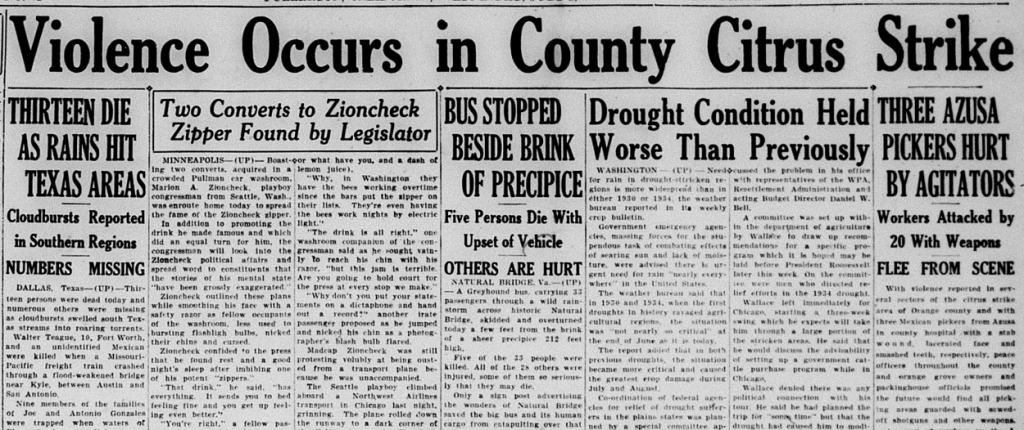
Fullerton Daily News-Tribune, 1936. “With violence reported in several sectors of the citrus strike area of Orange county and with three Mexican pickers from Azusa in county hospital with a stab wound, lacerated face and smashed teeth, respectively, peace officers throughout the county and orange grove owners and packinghouse officials promised the future would find all picking areas guarded with sawed off shotguns and other weapons,” the News-Tribune reported.
“All Orange country was under heavy guard today as Sheriff Logan Jackson, following yesterday’s violence, began deputizing 170 additional special deputies to protect every picking crew and packinghouse in the county,” the News-Tribune reported.
The increased police presence did little to quell the conflict. In one day at the height of the strike, 159 Mexican strikers were arrested on charges of “rioting.”
As conflict and occasional violence continued, Sheriff Jackson issued a “Shoot to Kill” order to his men.
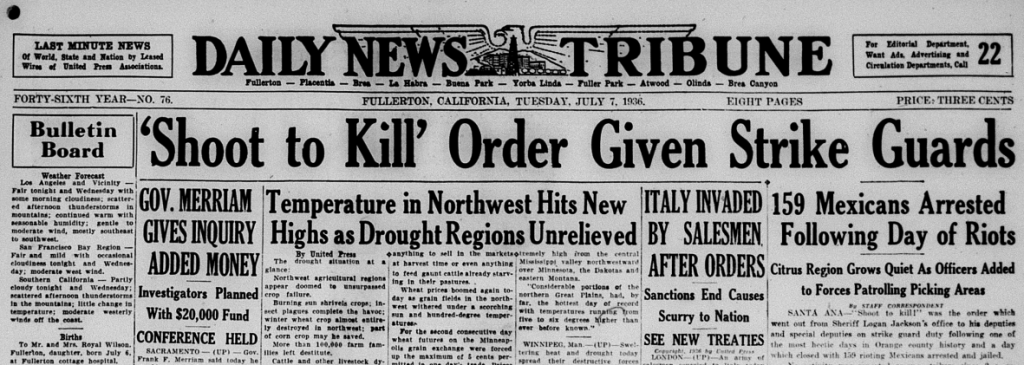
Fullerton Daily News-Tribune, 1936 “New special deputies were being added rapidly to the sheriff’s office staff, which numbers 300 to 400 now, and 20 more California highway patrol officers were rushed here today from Los Angeles county to be added to 35 or 40 already on duty,” the News-Tribune reported.
In La Habra, 40 or 50 families were evicted from their homes on ranch property for participating in the strike.
In the conflict, the strikers had weapons like rocks and clubs. The police had tear gas guns, hand grenades, rifles, and shotguns.
Sometimes the police would arrest and jail Mexicans before any crime occurred.
“A strange parade it was from Placentia ave, at Pointsettia, near Anaheim, yesterday afternoon as California highway patrolmen and the sheriff intercepted 19 carloads of Mexicans, more than 100 in all, who said they were going to Orange for a meeting,” the News-Tribune reported. “The parade, enlarged by five more carloads intercepted in a neighboring road, ended at the jail.”
On July 8 the 119 Mexicans arrested on rioting charges were arraigned in the open courtyard behind the Fullerton courthouse under heavy guard from state highway patrol officers and deputy sheriffs armed with sub-machine guns and sawed off shotguns.
A couple weeks later this large group was again transported to Fullerton.
“The Odd Fellows Temple, selected by law officials as the site of the hearing for security reasons, soon resembled an armed fortress. Men armed with submachine guns, riot guns, revolvers, and clubs guarded all exits and entrances,” the News-Tribune reported.
Part of the reason the strike continued was because of the growers’ insistence that the strike was not a result of legitimate grievances, but rather part of some nefarious communist plot.
“Dr. W.H. Wickett of Fullerton, a member of the publicity committee of the growers organization, said today that the growers have definitely learned that the strike is not a walkout merely for the betterment of pickers but is directed and abetted by communist headquarters for the purpose of fomenting strife in the interests of communism,” the News-Tribune reported.
In fact, the workers’ demands, which were publicly sent to the growers well before the strike, had nothing to do with communism, and everything to do with improving pay and working conditions.
Whether growers like Wickett actually believed the strikers represented a communist threat or they were simply seeking to tarnish the strikers so as to avoid having to treat their workers better, is hard to say.
It wasn’t just the police who sought to disrupt and end the strikers’ activities. Vigilante activity also occurred.
“Wild disorder, repetition of which was promised for tonight at the same place, broke out last night about 9:15pm, near Santa Fe ave. and Melrose in the center of Placentia as 40 Americans of a vigilante committee swooped down upon a Mexican gathering and with guns, clubs and a score of tear gas bombs sent them scattering in ever direction,” the News-Tribune reported. “Reports…stated 20 to 30 Mexicans and a few of the white men were injured, cars were smashed and other damage done. Several Mexicans among the group, who had gathered on the Luis Varcas handball court for a meeting told officers they definitely recognized ‘Stuart Strathman as the supposed leader of the raid.’”
Strathman was a leading representative of the growers and packinghouses, with an office at the Chamber of Commerce.
No arrests or charges were made against any of the vigilantes.
Eventually, an agreement between the strikers and growers was reached–insuring higher wages and a few other benefits, but not union recognition.
Charges against all but 13 of the strikers charged with rioting were dismissed. Of those, 10 were found guilty and faced fines and imprisonment.
Reflecting on the strike, Reccow writes, “The strike offers a classic study in the use of anti-strike tactics: the deputizing of hundreds of growers, blacklisting, the eviction of workers from company homes, the cries that agitators and communists were responsible for the strike, vigilante attacks, the strict enforcement of an anti-picketing ordinance, the jailing of large numbers of strikers and the deportation of alien Mexican workers.”
Journalist Carey McWilliams wrote, “No one who has visited a rural county in California under these circumstances will deny the reality of the terror that exists. It is no exaggeration to describe this state of affairs as fascism in practice.”
Illustration for Carey McWilliams’ article “Gunkist Oranges” A Socialist for Governor?!
In the midst of economic hard times and labor agitation, noted author and socialist Upton Sinclair ran for governor of California. Sinclair, most famous for his 1905 novel The Jungle, which portrayed the filthy and inhumane conditions of the meatpacking industry, had spent his life writing numerous books highlighting various injustices and corruption in American life.
Sinclair had moved to Southern California in 1916 and, in addition to writing, also involved himself in politics, running for congress twice (in 1920 and 1922) as a Socialist. He founded California’s chapter of the American Civil Liberties Union (ACLU).
In 1934, he decided to run for governor of the Golden State, this time as a Democrat. He won the party’s nomination and faced off against Republican Frank Merriam. Sinclair’s program was called End Poverty in California (or, EPIC). He wrote a pamphlet called I, Governor of California, and How I Ended Poverty, which laid out his plans and was widely distributed.
During the campaign, Sinclair came to Fullerton and spoke before a crowd of over 1,200 in the FUHS auditorium. Today, Sinclair sounds a lot like Bernie Sanders.
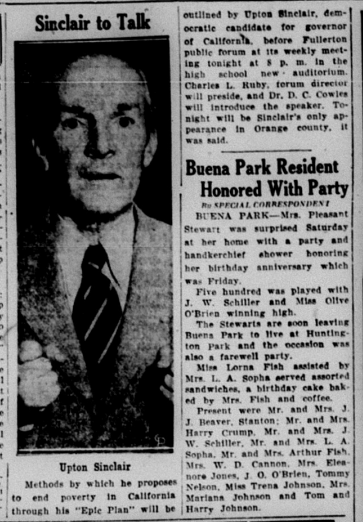
Fullerton Daily News-Tribune, 1934 “The trouble in America,” Sinclair began, “is that privilege entrenched itself in government and society and brought a condition where two percent of the people control 50 percent of the wealth. Wall Street tricks to control American finance by piling up wealth on one side and beating down wealth on the other made bums of twenty or thirty million people…”
Sinclair was particularly outraged with the practice of large agricultural interests destroying “surplus” crops to keep prices up.
“Limitation of production or the destruction of food or other wealth while millions of people are in need is the very apex of economic insanity,” Sinclair said.
This practice of destroying food for the benefit of big business while people starve is what gave the title to John Steinbeck’s 1939 novel The Grapes of Wrath, about farmworkers in California during the Great Depression:
“There is a crime here that goes beyond denunciation. There is a sorrow here that weeping cannot symbolize. There is a failure here that topples all our success. The fertile earth, the straight tree rows, the sturdy trunks, and the ripe fruit. And children dying of pellagra must die because a profit cannot be taken from an orange. And coroners must fill in the certificate- died of malnutrition- because the food must rot, must be forced to rot. The people come with nets to fish for potatoes in the river, and the guards hold them back; they come in rattling cars to get the dumped oranges, but the kerosene is sprayed. And they stand still and watch the potatoes float by, listen to the screaming pigs being killed in a ditch and covered with quick-lime, watch the mountains of oranges slop down to a putrefying ooze; and in the eyes of the people there is the failure; and in the eyes of the hungry there is a growing wrath. In the souls of the people the grapes of wrath are filling and growing heavy, growing heavy for the vintage.”
The backbone of Sinclair’s plan of ending poverty in California involved giving unemployed workers access to the means of production and letting them produce for themselves.
“The program…will offer land colonies and factories to the unemployed and a distributing system where the people can buy necessities at cost and thereby eliminate the middle man,” Sinclair said. “It will make production for and equal to consumption because the unemployed will produce for themselves only and will make the million in the state now leaning on charity self-supporting.”
The EPIC plan also called for a remedy to economic inequality through a revised and graduated tax system, with higher taxes on the wealthy.
Sinclair was clearly on the side of the workers. Meanwhile, the Republican Frank Merriam was on the side of business.
As is documented in his book I, Candidate for Governor, and How I Got Licked, despite his popularity, Sinclair faced formidable opposition from big business and mainstream media (including Hollywood), who ran a well-funded smear campaign against him.
The Fullerton Daily News-Tribune ran numerous articles and editorials portraying Sinclair as a dangerous radical who would bring ruin to California.
The California Real Estate association, unsurprisingly, came out against Sinclair, as did the Orange County Democratic party (just like the national Democratic Party did with Bernie Sanders in 2016).
Meanwhile, local leaders organized a parade in Merriam’s honor. And the Tribune published numerous articles which painted Merriam in a very positive light. Ultimately, Merriam defeated Sinclair. Poverty would, unfortunately, not end.
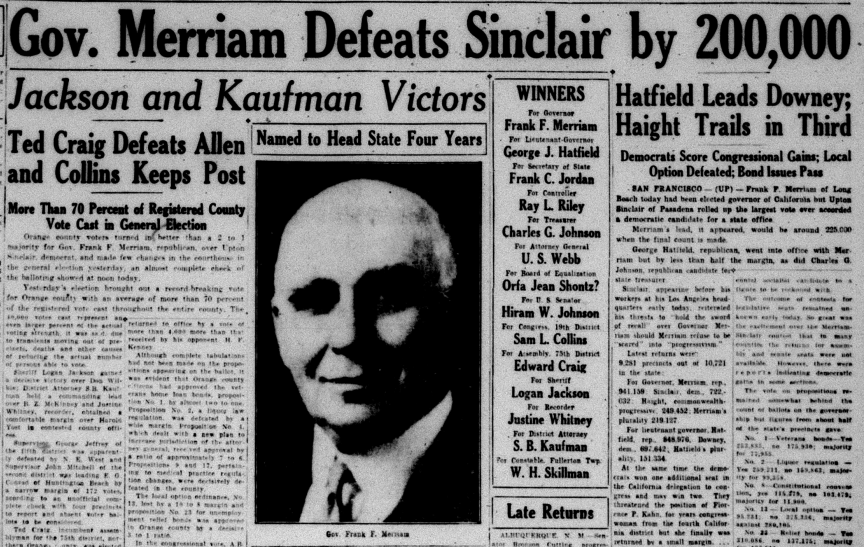
Fullerton Daily News-Tribune, 1934. Those elected to Fullerton City Council throughout the 1930s were wealthy, white businessmen who tended to favor the status quo over any radical program proposed by Sinclair.
They were Billy Hale (orange grower), Ted Concoran (paper company owner), Thomas Gowen (rancher), Harry Maxwell (real estate developer), George Lillie (orange grower), Hans Kohlenberger (factory owner), Walter Muckenthaler (orange grower), Olie Cole, Carl Bowen, and William Montague.
It would be decades until a woman or person of color was elected to Fullerton City Council.
What Fullerton Needs Now is a Drink
Prohibition, which was enacted in 1919 with the ratification of the 18th amendment, was nearing its end. It would be repealed in 1933 by the 21st amendment. Prior to that, the Wright Act, which provided state enforcement of prohibition, was repealed by voters. Fullerton, being Fullerton, kept its local ordinances making alcohol illegal.
Even prior to the repeal, congress passed a law permitting the sale of beer with an alcohol content of 3.2 or less.
Things played out a bit contentiously in Orange County. After the passage of the Beer law, the OC District Attorney declared alcohol still illegal under a county ordinance.
“Orange county remains bone dry, regardless of the new beer bill passed by congress, District Attorney S.B. Kaufman declared in a formal opinion today,” the News-Tribune reported. “The county still had a dry ordinance and because the new beer law allowed for local control…Meanwhile, LA county board of supervisors repealed their local ordinance, thus allowing beer.”
The battle between “wet” and “dry” supporters played out locally, as Fullerton City Council considered rescinding its dry ordinance. City Council declined to take a position on the contentious matter, instead putting it to a vote of the people, who decided they needed a drink.
In short order, some Fullerton businesses began selling beer.

Fullerton Daily News-Tribune ad. And with the passage of the 21st amendment, Prohibition was over.
Entertainment and Sports
To escape the troubles of life, folks went to movies at the Fox Theater.
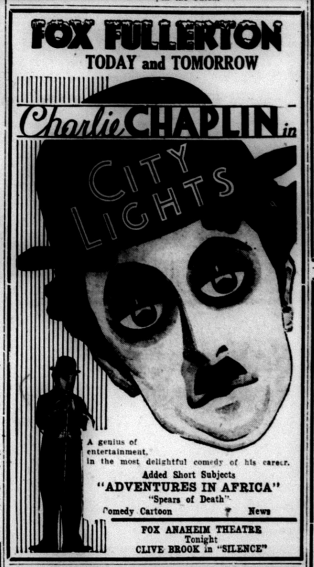
Fullerton Daily News-Tribune, 1931. In 1931, Fullerton hosted its first Jacaranda Festival, showing off the purple flowers of the trees that still line Jacaranda Dr. and other streets. The Festival included a pageant at the high school with a cast of 300.

Fullerton Daily News-Tribune, 1932. In 1934, Fullerton celebrated a Valencia Orange Festival, which drew 40,000 attendees.
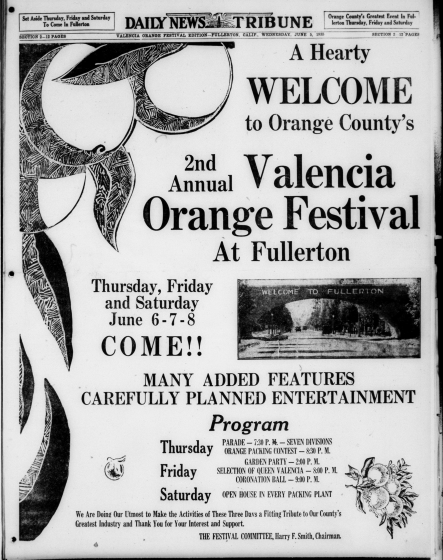
Fullerton Daily News-Tribune, 1934. Locals got some excitement in 1935 when the baseball movie “Alibi Ike” starring Joe E. Brown was filmed at Commonwealth Park.
Baseball games at Commonwealth (now Amerige) Park were hugely popular. The Portland Beavers did their spring training there.
In 1937, African American Fullerton author Ruby Berkley Goodwin published a book of dramatic sketches based upon Negro spirituals, in collaboration with composer William Grant Still, whose “Afro-American Symphony” was the first to be published by an African American.
In 1938, hometown hero Arky Vaughn, a professional baseball player, played a special benefit game at Amerige Park. He hit a home run!
Fullerton celebrated its 50-year anniversary with a huge three-day program, including “a colorful historical pageant including a cast of approximately 1,000 residents” which took place in the FUHS stadium and auditorium.

Fullerton Daily News-Tribune, 1937. In addition to the pageant and baseball games, there was a coronation ball for the Golden Jubilee queen and “Miss Columbia,” Pearl McAulay Phillips and Mary Catherine Morgan.
The pageant, called “Conquest of the Years” featured scenes from local history, from Native Americans to the expedition of Don Gaspar de Portola, Spanish/Mexican hacienda days, Basque sheepherders, the appearance of town founders the Amerige brothers, to the first buildings, schools, and churches built.
“Conquest” feels like an appropriate sentiment for how Americans at this time saw their place in history. They were the latest proud beneficiaries of a series of conquests. Today, some Americans view this aspect of our history with ambivalence, perhaps not wanting to highlight the “conquest” part. But that is, unfortunately, the best way to describe how the US came into possession of so much land, which had previous owners.
Social clubs were popular in Fullerton, including Rotary, Kiwanis, Lions, Business and Professional Women’s Club, Fullerton Junior Chamber of Commerce, American Legion, 20-30 club, Ebell Club, YMCA, YWCA, Masons, Odd Fellows, and more.
Stay tuned for my next installment “Fullerton in the 1940s!”
-
Fullerton in 1951
The following is from a work-in-progress about the history of Fullerton. You can support my ongoing research and writing on Patreon.
The Local History Room of the Fullerton Public Library has microfilm from the Fullerton Daily News-Tribune newspaper stretching back to 1893. I am in the process of reading over the microfilm, year by year, to get a sense of what was happening in the town over the years, and creating a mini archive. Below are some news stories from 1951.
The Korean War
In international news, the Korean War raged. This was both a civil war between north and south and a proxy war between the capitalist west and communist east. The tragedy of the Korean War was that the line separating north and south (the 38th parallel) remained unchanged before and after the war. Millions died for a line that never moved. Thankfully, the United States learned the lesson of the Korean War, and never got into another unwinnable war based on Cold War ideology. Just kidding. We did the Vietnam War.

Some young men from Fullerton fought, and died, in the Korean War.
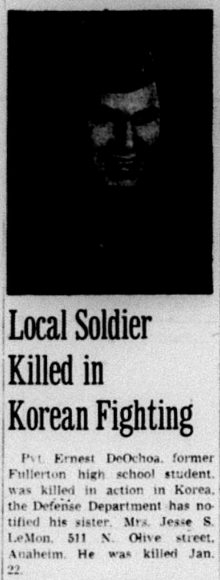
A new business plant was established in Fullerton that made tank ordinances. This would be one of a number of defense industries that sprung up in Fullerton and surrounding areas during and after World War II. President Eisenhower would later call this the Military Industrial Complex.
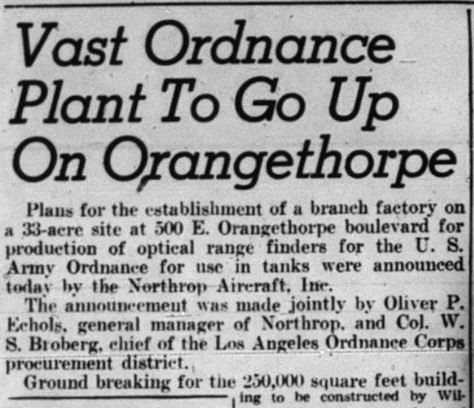
The Cold War
Cold War tensions escalated between the United States and the Soviet Union, leading to fears of atomic war.
The Atomic Energy Commission began conducting bomb tests in the Nevada desert.
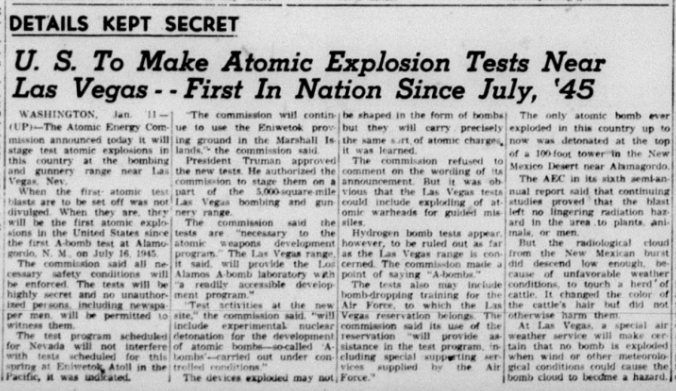
These atomic tests, unfortunately, spread fallout to communities “downwind” of the blasts in Nevada and surrounding areas, and as far away as New York–leading to increased cancer rates across huge swaths of America and the world. We never experienced atomic war, but we felt the impact of testing fallout. This is explored in the 2023 documentary Downwind. Thankfully, we have learned the lessons of history, and political leaders today are committed to a ban on nuclear testing. Just kidding. President Trump recently announced that he wants to resume nuclear testing.
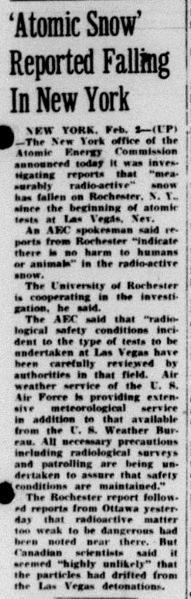
Here in Fullerton, fears of atomic war led to the establishment of a Civil Defense, as well as the construction of bomb shelters and “duck and cover” drills for local students.
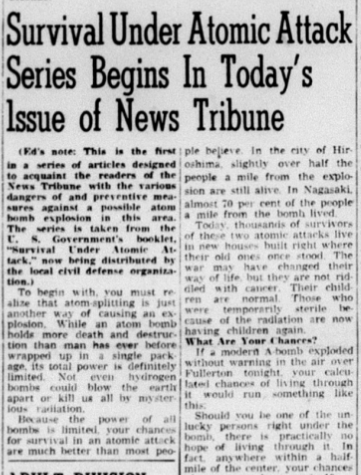
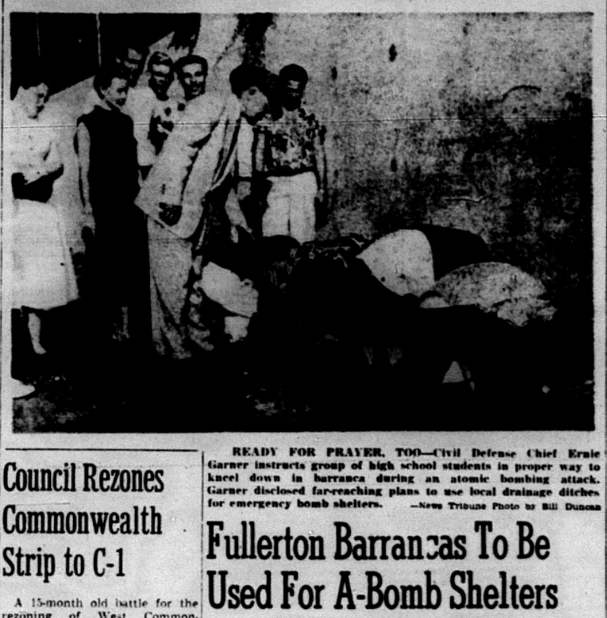
The Cold War also led to a heightened fear of communists and communist thought in America, which manifested in the “Red Scare.” Thankfully, we have learned the lesson of history, and American political leaders no longer engage in “Red Scare” tactics. Just kidding. Republicans recently lost their minds over Zohran Mamdani, mayor-elect of New York.
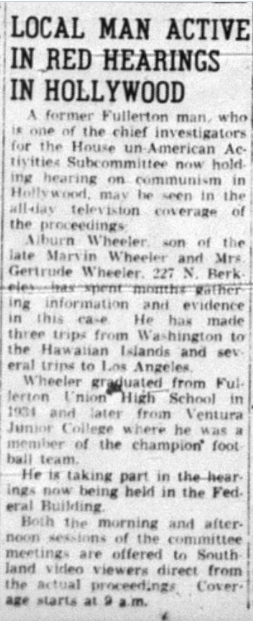
Growth
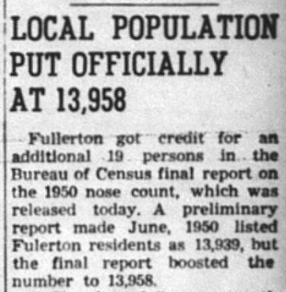
On a somewhat more positive note, Fullerton continued to experience extraordinary growth following World War II. This was a time when the U.S. government invested heavily in home ownership and growing the middle class, in the form of FHA loans and no-down payment options for veterans. Thankfully, the U.S. government is just as committed today to making home ownership accessible to all Americans. Just kidding. The average home in Fullerton today costs over a million dollars.

New subdivisions sprang up like mushrooms on former orange groves.
“Primarily an agriculture and residential area, Fullerton and its surrounding territories have undergone one of the greatest building splurges in the history of Southern California,” the News-Tribune reported. “While not in the same class with the Lakewood district of Long Beach, the area has seen a tripling of population figures since 1940 with a corresponding leap in the number of homes…A total of 1226 dwelling permits were issued in Fullerton alone during the banner year [1950], 713 of which were for single family residences, both in tracts and for individuals.”
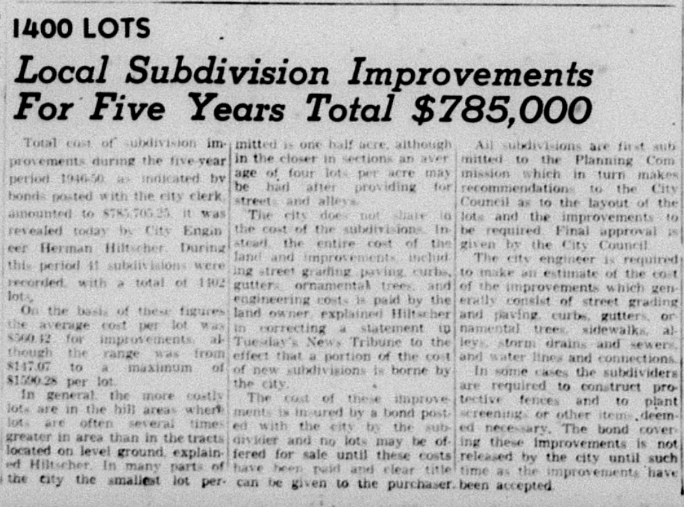
New shopping centers and businesses sprung up to serve the growing population.

New developments were advertised in the pages of the Fullerton News-Tribune.
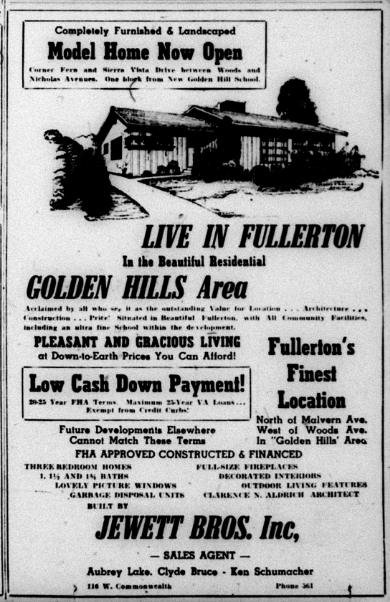
Education
As Fullerton added hundreds of new homes and families, new schools were built to accommodate the children of the new arrivals.
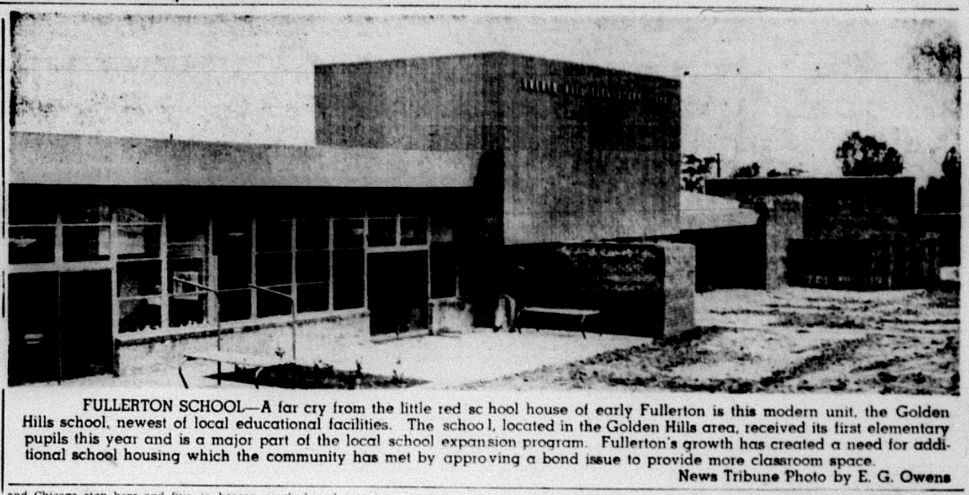
Fullerton High School was expanded with new buildings.

There was talk of naming the high school auditorium (built in 1930) after former principal/superintendent Louis Plummer, who was allegedly a member of the Ku Klux Klan in the 1920s, as were many local leaders.
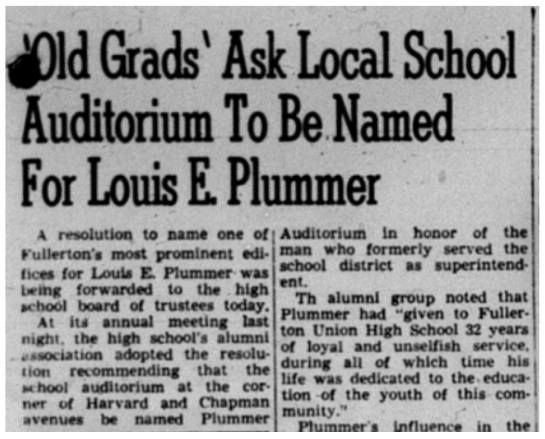
While the elementary and high schools were growing, Fullerton College suffered a drop in enrollment due to the Korean War.

A million dollar school bond issue failed. New residents wanted new schools, but not an increased tax burden.
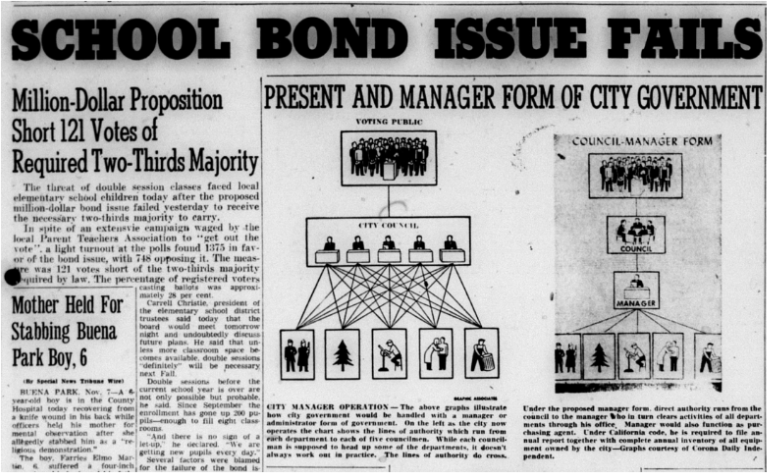
Annexation Fight with Anaheim
As both Fullerton and Anaheim grew, there was an annexation fight between the two cities over a strip of land in south Fullerton and north Anaheim. Fullerton ultimately won the fight.

Law and Order
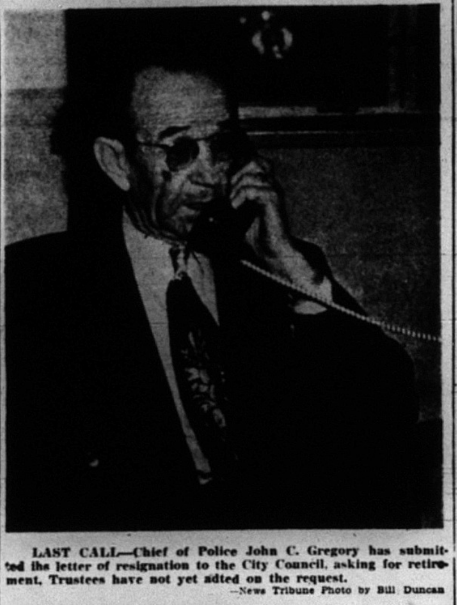
Fullerton police chief John C. Gregory retired after 25 years with the force.

He was replaced by Ernie Garner.

The biggest local crime was the kidnapping, sexual assault, and murder of 10-year-old Patricia Hull by country singer Henry Ford McCracken in Buena Park. The crime and trial captured the attention of Orange County and beyond.
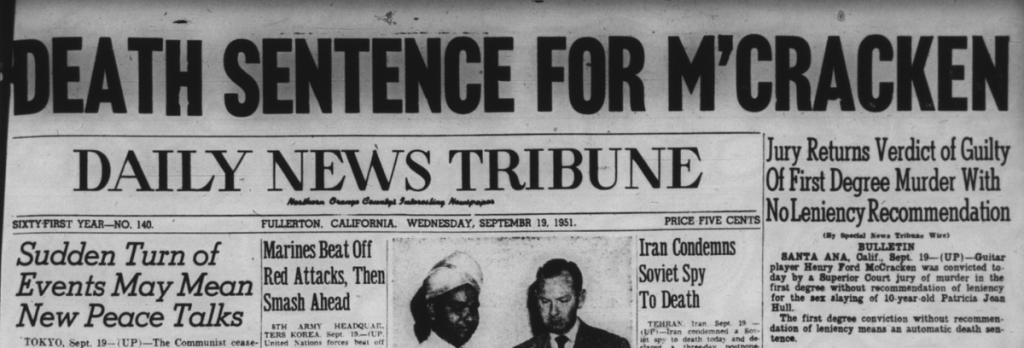
A less grisly, and more comical, criminal in 1951 was the so-called “pants burglar.”
In the 1950s, narcotics were becoming more of a national and local issue.

Local Residents Protest Mexican Citrus Work Camp
While many orange groves were being plowed under for housing development, the citrus industry was still a major aspect off the local economy in 1951. These two things (housing and the citrus industry) came into conflict when a labor camp was proposed to house 1000 Mexican citrus workers.
“Although several residents of Fullerton have filed protests with the city after learning of the plan, there is actually nothing that can be done by the city to prevent the move, City Engineer Herman Hiltscher said today, since the area is zoned for industry,” the News-Tribune reported.
A representative of the local orange growers association said that the county’s citrus ranchers face a “very definite crisis” in the matter of getting enough labor for their Valencia harvest, scheduled to begin within five or six weeks.
“He pointed out the 12 labor camps now in use, including the largest one near Anaheim, house only 2000 men and said that “this isn’t enough for the job.” The organization was denied use of a 17-acre parcel near the Orange County hospital by a 4-3 vote of the county supervisors recently,” the News-Tribune reported.
Local residents proposed to file an injunction against the construction of the camp.
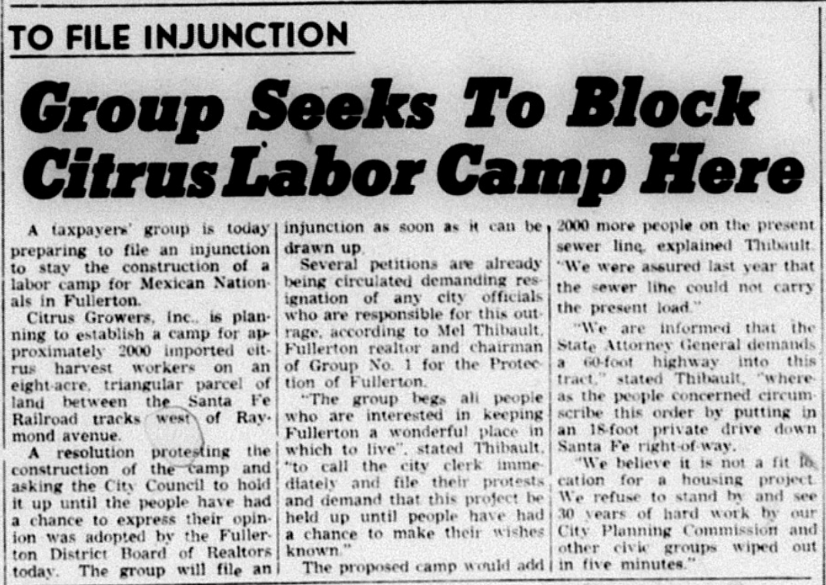
“Citrus Growers already have 12 camps in Orange County. Two camps for workers are in Fullerton, one on E. Truslow avenue for 75 persons and one on S. Balcom for 150 workers,” the News-Tribune reported.
In a series of public meetings, some local residents spoke against the citrus camp.

“I came here from the East seven years ago and after considering many fine suburbs of Los Angeles chose Fullerton in which to buy a home and plant my roots because it was free of riff raff and seemed to take pride in its beautiful streets and homes,” Anne Hoyal said.
“We do not want to live within a stone throw of such a place, no matter how ultra modern their buildings and facilities are. Imagine directing some friend to our brand new home–”Oh–it’s just over there by the labor camp.” Why don’t some of the people, who are in favor of it, build it near their lovely ranch house,” Mrs. Warren T. Johnson said.
Mel Thibault, leader of the recall campaign, said that he had 2,000 signatures to a petition asking the City Council to halt the construction of the camp until the citizens could be heard.
“I didn’t say that I didn’t like Mexicans,” Mel Thibault said. “On the contrary, I said I loved them. I stated that I didn’t want the labor camp here because it would possibly bring an undesirable class of people into the City of Fullerton.”
A local group paid for ads in the News-Tribune against the proposed camp. The issue of the proposed camp pitted the old guard of citrus growers against the newer moneyed interests in the form of housing developers and property owners.

Ultimately, council approved the camp, having no legal ability to block its construction. After approving the citrus camp, three city council members faced a potential recall.
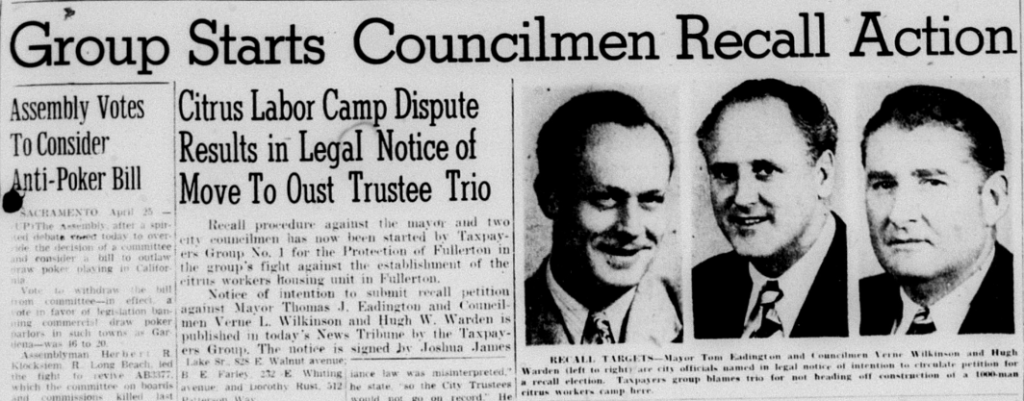
“Motion to circulate a petition for the recall of the mayor and two councilmen was approved by the taxpayers Group which held a protest meeting in the Civic Auditorium last night just prior to appearing before the City Council,” the News-Tribune reported. “The recall petition will be against Mayor Thomas J. Eadington and Councilmen High W. Warden and Verne L. Wilkinson. Thibault charged the trio with “apparent negligence and inefficiency” in permitting the labor camp to be located in Fullerton. Jack Adams and Kermit Wood protested the location of the camp here in a meeting.”
For all the talk about protecting taxpayers, at the root of opposition to the citrus camp was (at least in part) pervasive racism against Mexicans in the 1950s. The following strange article appeared in the News-Tribune:
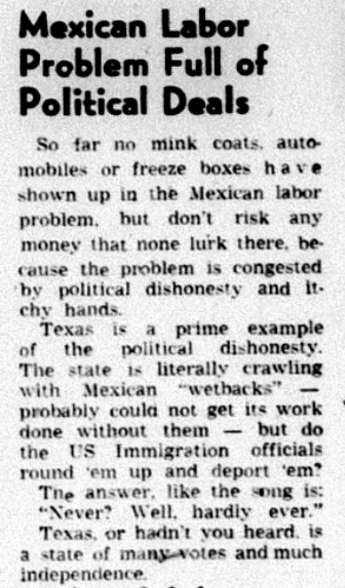
“The social slobsisters–pardon us, sobsisters–who weep over the “wetbacks” could render a real service if they would stand for official energy and honesty in deporting “Wetbacks” from both factories and farms and support the legal commonsense plan of bringing Mexican workers in under contract, and sending them back home when their contracts expire,” an article in the News-Tribune stated.
Meanwhile, the camp was built. The president of Mexico actually sent some famous musicians and officials to entertain and encourage the workers, who undoubtedly did not feel welcome in Fullerton.
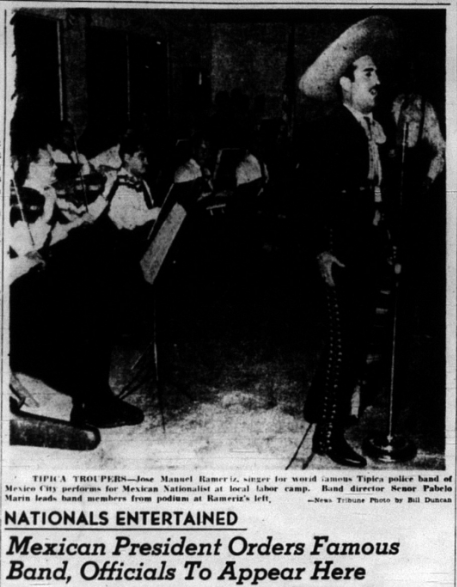
Thankfully, racism and scapegoating of Mexican immigrants is a thing of the past in America. Just kidding. It is, tragically, alive and well.
Businesses
Here are a few of the major businesses that existed in Fullerton in 1951, including Harris Drug Store, Red Reinhardt Service Station, Robinson’s Market, Fender Electrical Musical Instruments Co, McCoy Mills Ford, McMahan’s Furniture, Pacific Citrus Products (which made Hawaiian Punch), and Sears & Roebuck.

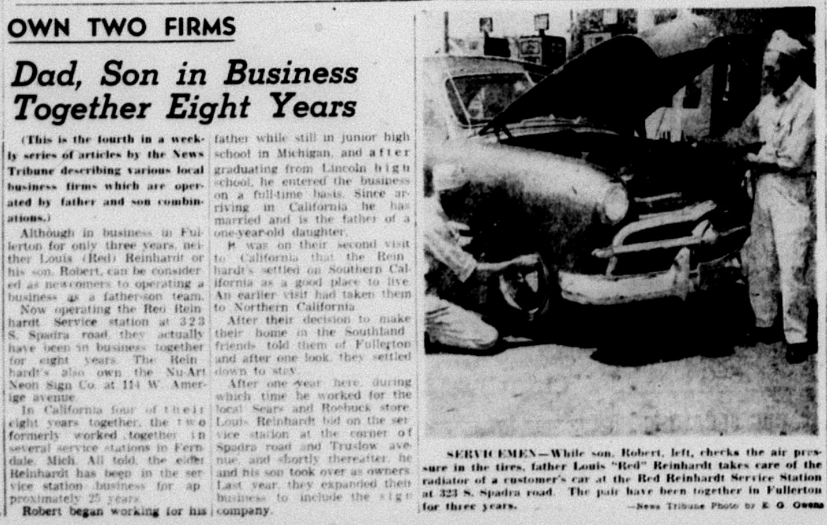

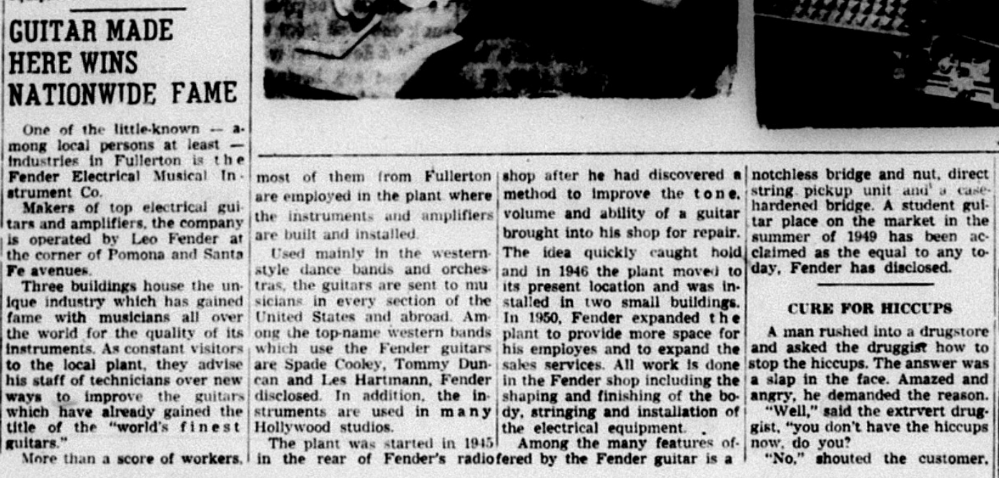
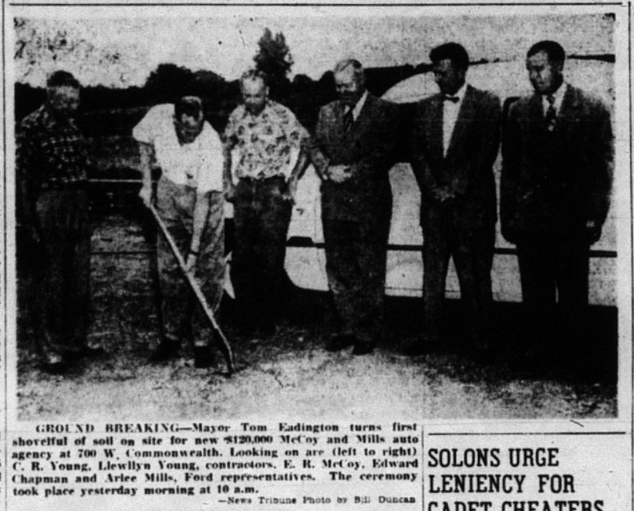

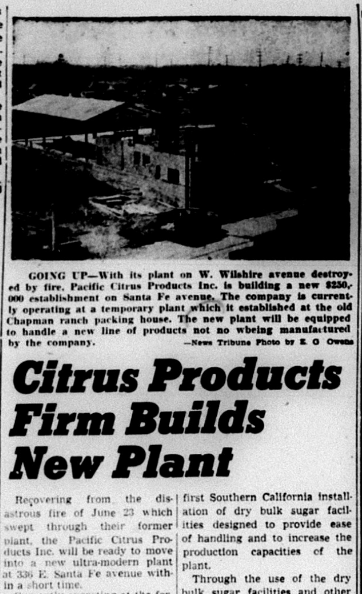

Sadly, the town’s old lumber mill was torn down. Progress, I suppose.

Culture and Entertainment
For culture and entertainment, Fullertonians went to see movies at the Fox Theater and the Wilshire Theater.
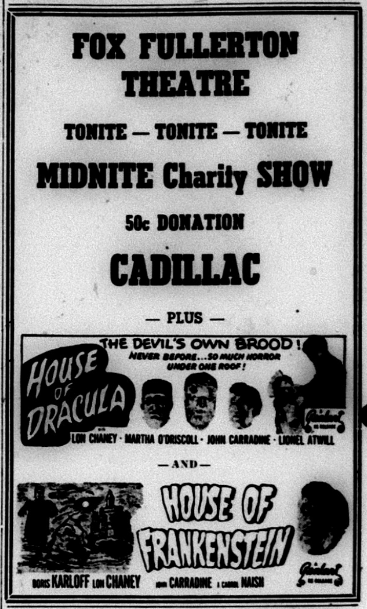
Just down the road in Buena Park, Knott’s Berry Farm was attracting visitors to its old west Ghost Town.
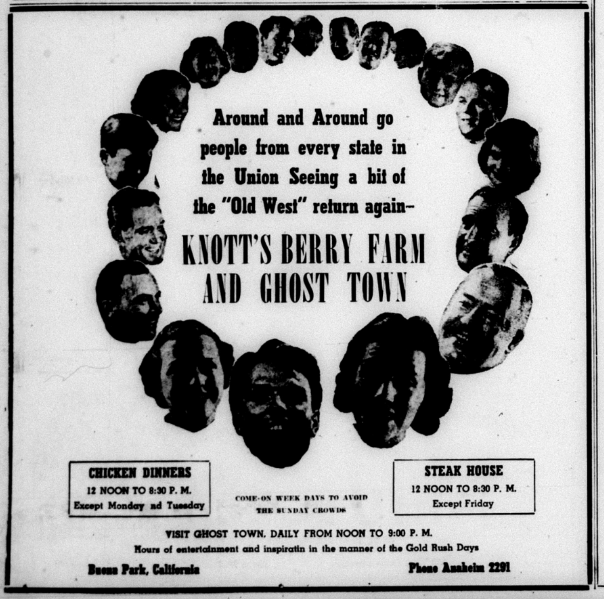
Fullerton hosted a huge Community Fair.
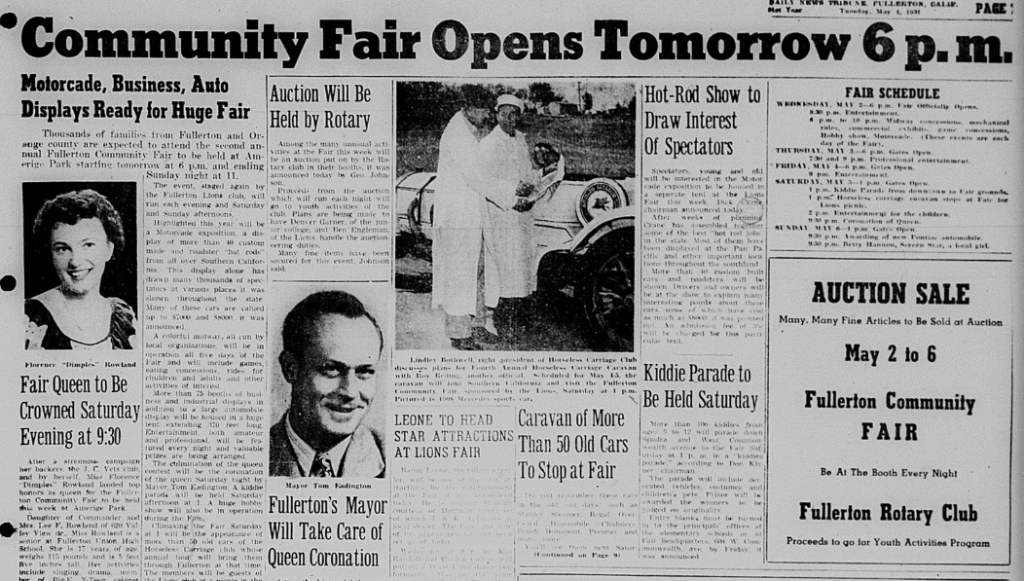
One popular aspect of local culture in the 1950s was the crowning of “Queens” for various events–the community fair, Homecoming, etc.

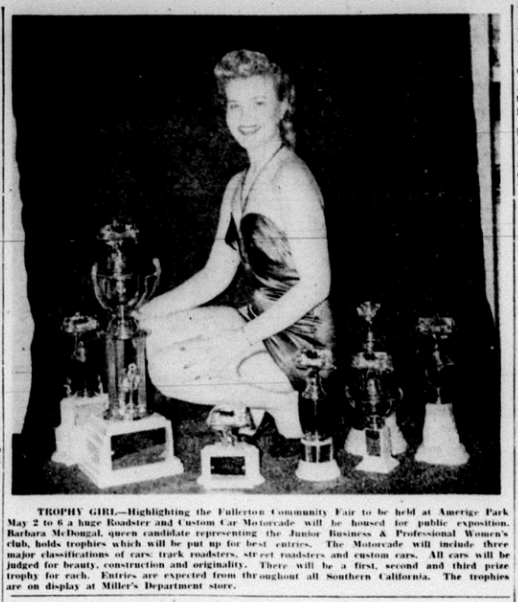
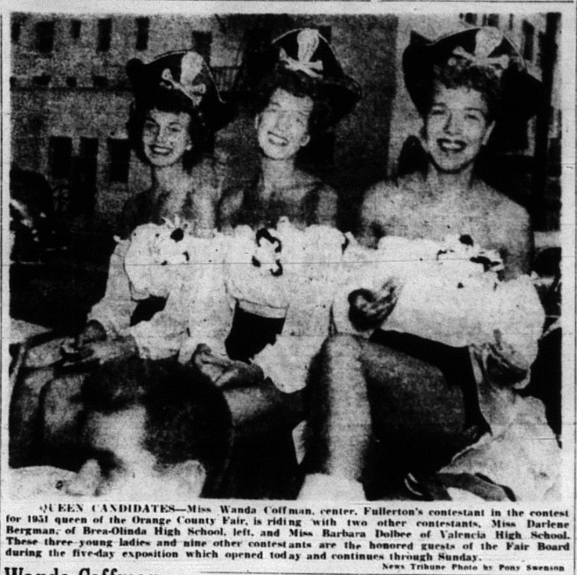
A popular swimming spot was the “plunge” at Fullerton High School.
Residents of the Princeton Circle area set up elaborate Christmas decorations. They still do this today in the form of the “Sparkle Ball” neighborhood.

Deaths
Justice of the Peace Halsey Spence died.

And Maude Plummer, wife of former high school superintendent Louis Plummer, was killed.
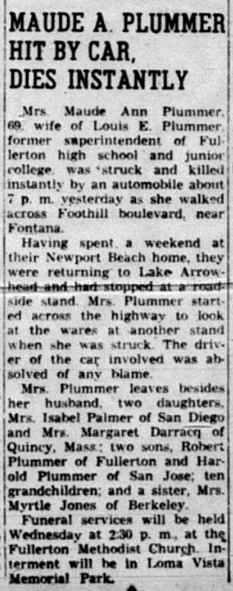
Stay tuned for top news stories from 1952!
-
A History of the Fullerton Police Department

The following is from a work-in-progress about the history of Fullerton. You can support my ongoing research and writing on Patreon.
Introduction
As part of my research into Fullerton history, I have created a number of mini-histories that will eventually be integrated into a larger narrative. Some mini-histories I’ve written so far cover such local topics as Hawaiian Punch, Hughes Aircraft, Cal State Fullerton, Maple School, and more.
I have recently completed writing a history of the Fullerton Police Department. The first source I read was an official history of the department published in 2002 by the Fullerton Police Officers Association. While this gives a broadly accurate narrative and includes lots of useful facts and notable people, it leaves out anything negative about the department. I have sought to supplement this history with news articles I obtained in the Local History Room of the Fullerton Public Library, and others online. Another excellent source of information was a memoir written by former Fullerton police officer Phil T. O’Brien called Bullets, Badges, and Bullshit. O’Brien, who worked for the FPD from 1961 to the early 1990s, offers some useful color to a story that might otherwise feel kind of dry.
My hope is that, by synthesizing these diverse sources, I am able to give a more well-rounded picture of the department over the years. This history is, of course, incomplete, but I’ve tried to include as much information as I could find.
Early Days
In the latter half of the 19th century, prior to the formation of the town of Fullerton in 1887, the area was sparsely inhabited by a few farming families. Anaheim had a town constable, but there was no regular law enforcement presence in the area that would become Fullerton. Crime was limited to the occasional “bandit” roaming the area between Los Angeles and San Diego.
“The only law enforcement for the area was the LA County Sheriff’s office out of downtown Los Angeles,” according to FPD’s official history. “The new settlement of Fullerton was a one-day ride on horseback for the assigned lone deputy.”
For a few years after Fullerton was founded in 1887, there was no law enforcement. Saloons and rowdiness downtown created the push for some police presence.
“A number of roughs, hailing from everywhere, make it a point to come to Fullerton every Sunday, and after imbibing a library quantity of tarantula juice proceed to paint the town a bright, brilliant, carmine tint,” the Fullerton Tribune reported in 1893. “They do this with the knowledge that we have no peace officer in this section, and accordingly they have no fear of arrest. We need a constable and a justice of the peace. Anaheim, a small village a few miles south of here, has two of each.”
Eventually, A.A. Pendergrast was appointed as the town’s first constable. Pendergrast, taking ill with rheumatism, was replaced by James Gardiner, son of pioneer farmer Alex Gardiner. Tragically, James died of pneumonia after risking his life to save a young girl during a flood in 1900. He was replaced by Oliver S. Schumacher.
In 1904, Fullerton incorporated as a city, creating an official government. The first elected town marshal was W.A. Barnes. However, he resigned that same year, overwhelmed by the workload which (at that time) included supervising all roadwork and being on duty from 7am to midnight.
City Council appointed orange and walnut grower Charles E. Ruddock to finish the term for which Barnes was elected. Ruddock was re-elected in 1906. That same year, Fullerton residents voted to go “dry”—and outlaw saloons in town, which had been (and would continue to be) a point of contention and fierce debate.

Charles E. Ruddock Ruddock was re-elected in 1908. He expanded the department by appointing four deputies. He “retired” in 1910, and ran (successfully) for Orange County sheriff in 1914.
In 1910, Roderick D. Stone was elected town marshal. He left in 1912 and was replaced by William French, who would eventually become a local judge. It was during French’s term that the title of “marshal” as changed to “chief of police.” William French allegedly joined the Ku Klux Klan in the 1920s, along with many other cops and local leaders.
In 1914, Fullerton police got their first official uniforms.
Vernon “Shorty” Myers was elected police chief in 1918. That year, the first motor cops hit the streets, riding Indian motorcycles. In 1919, a new city jail was built.
The 1920s
Arthur Eeles became police chief in 1922. A former Deputy OC Sheriff, Eells had been a sharpshooter with the 364th Infantry during World War I, surviving a mustard gas attack in France.
In 1925, Eeles was asked to resign following a local controversy involving Ku Klux Klan members conducting their own vigilante raid on suspected bootleggers. Eeles was thought to be in league with the Klan.
In the mid-1920s, the Ku Klux Klan had a large presence in Orange County, including Fullerton. Their members included police officers, city council members, judges, teachers—white protestant men from all walks of life, including many prominent community leaders.
A new chief, O.W. Wilson, replaced Eeles. An academic as well as a law man, Wilson would later go on to become a well-respected pioneer in policing, teaching at Harvard and serving as police chief of Chicago.
But he didn’t last long in Fullerton and left the same year he began. He was replaced by Thomas K. Winters, who served for two years, being replaced by James M. Pearson in 1927, who would serve for 13 years.

In those early decades, police chief turnover was quite high, likely a result of the chief having to run for re-election every two years. It appears that some time during Pearson’s term, the police chief went from an elected position to one appointed by city hall because he was the first in a series of longer-tenured chiefs.
During the 1920s, Prohibition was in full effect, and local law enforcement struggled to control bootlegging.
The Fullerton police department occasionally held a public “booze pouring” events in which they dumped out hundreds of gallons of illegal booze they had seized.
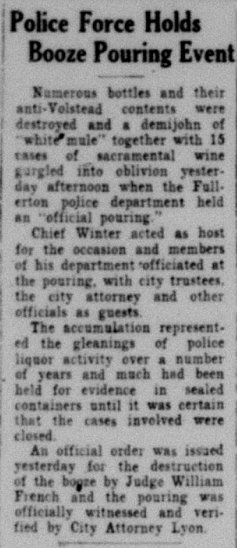
Fullerton News-Tribune, 1926. And then, in 1926, something embarrassing happened. Some Fullerton police officers were accused by another officer of stealing wine from the department’s stock of seized liquor for personal use.
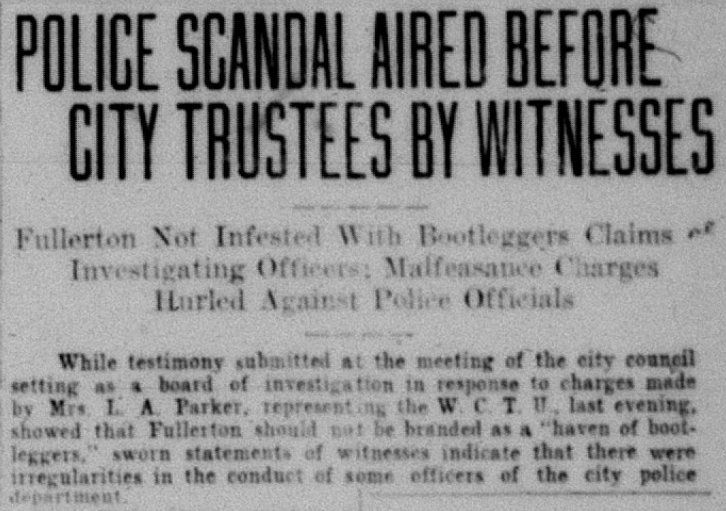
Fullerton News-Tribune, 1926. After a few public hearings before City Council, the accused officers denied any wrongdoing and were not convicted of any crimes. The whole ordeal, however, caused a shake-up in the department, in which some officers were forced to resign.
Adding to the embarrassment, Fullerton City Councilmember Emmanuel Smith and beloved football coach “Shorty” Smith were both arrested and fined on liquor charges. Neither lost their jobs.
By 1929 the force was made up of eight men: Kenneth Foster, Frank Moore, RC Mills, SR Mills, JH Trezise, John Gregory, Jake Deist, Ernest Garner, and Chief Pearson.
Prior to radios and walkie-talkies, communications between the police station and officers on duty was conducted by a series of call boxes and lights atop tall buildings downtown—sort of like the Bat signal.
The 1930s
In the 1930s, the Fullerton Police Building and jail was located at 123 W. Wilshire Ave, just behind the fire station. It had three rooms—the chief’s office, the report dest, and the jail cell which had eight bunks.
In 1936, Fullerton Night School began offering a special course for police officers.
That same year, thousands of local Mexican citrus workers went on strike. Hundreds of law enforcement (including sheriff deputies and those from surrounding cities) battled with the strikers in what was the most intense labor conflict in Orange County history.

Fullerton News-Tribune, 1936. The FPD made local headlines in 1937 when Ernie Garner arrested two bank robbers who were on the run, although it was mostly just luck. One of the robbers fell asleep at the wheel and crashed the car right in front of Garner a block from the police station.

Officer Ernest Garner (center) poses with two bank robbers. Photo courtesy of the Fullerton Public Library Local History Room. According to the official FPD history, “In the 1930s, the majority of calls was for drunks, fights, and citrus-related thefts. The patrolmen spent most of his day interacting with the downtown merchants as this was the hub of activity for the small town.”
The 1940s
Chief Pearson retired in 1940 and was replaced by John C. Gregory, who modernized the department with a record-keeping system modeled after the FBI’s.
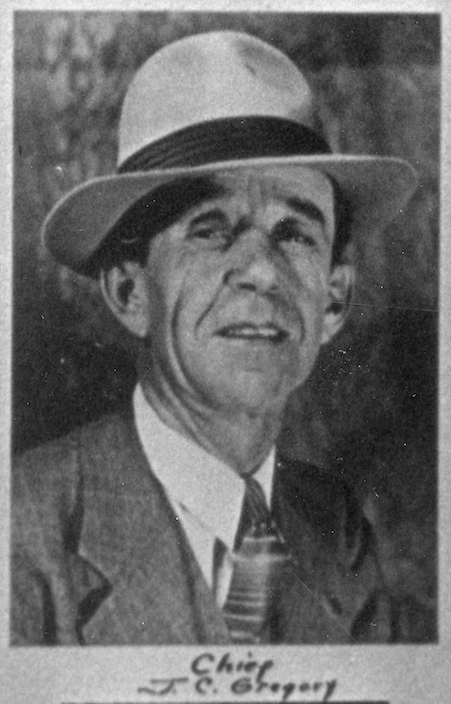
During World War II, the city established a Police Officer Reserve Corps, air raid wardens, a home guard, and a civil defense council.
After the war, Fullerton entered a period of rapid growth, necessitating more police officers.
“In the 1940s, the type of calls for service changed dramatically. Crime became more frequent as did the instance of violence. The calls for service started to include robberies and burglaries,” according to the official police history. “Traffic accidents were also on the rise with the influx of the population. The small justice court which was held in the city council chambers was outgrowing the facility. The municipal court system was set up to relieve the pressure of the individual justice courts throughout the county.”
In 1941, Fullerton celebrated the completion of a brand new city hall on W. Commonwealth and Highland Ave. The Spanish-style WPA building also housed the police department. Today, it is completely occupied by the police.

Photo courtesy of the Fullerton Public Library Local History Room. The 1950s
In 1951, police chief John Gregory retired and was replaced by Ernest E. Garner, who had served in the police department since 1928. The department had 21 employees.
Chief Ernest Garner poses with the Fullerton Police Department, 1950s. Photo courtesy of the Fullerton Public Library Local History Room. In the 1950s, as the city continued to grow, the first police radio cars were put into service.
In 1955, the Fullerton Police Benefit Association (a sort of proto-union) was formed to give services to officers, including loans, insurance, and to promote social activities.
Chief Garner retired in 1957 and was replaced by Wayne Bornhoft, who would serve for many years and leave an indelible mark on the department. Today, the Fullerton Police Station is named in his honor.
Bornhoft was instrumental in establishing the Fullerton Police Training School in 1960. He served as President of the California Peace Officers Association, and was appointed by governor Reagan to the California Council on Criminal Justice.
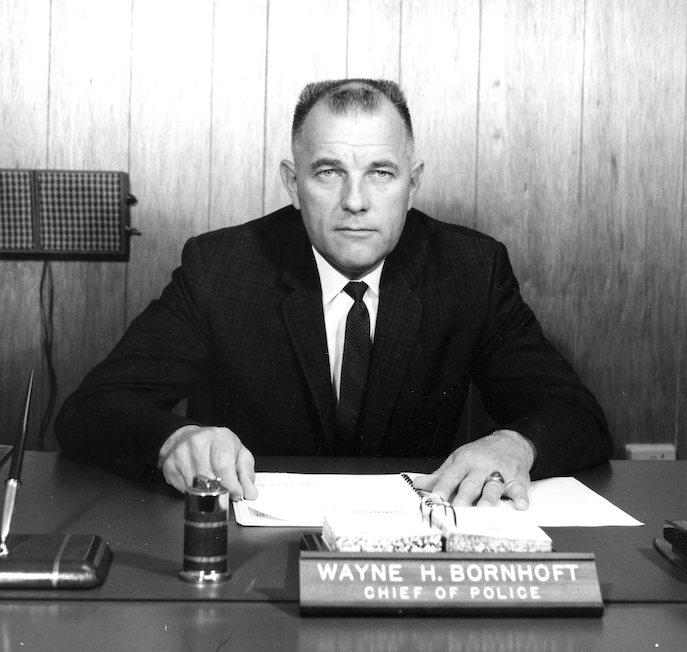
Chief Wayne Bornhoft. Photo courtesy of the Fullerton Public Library Local History Room. According to O’Brien, Chief Bornhoft “never left any doubt in anyone’s mind was to who was in charge of the Fullerton Police Department. He was an authoritarian figure who ruled with an iron fist.”
Fullerton hired its first female police officer, Geraldine K. Gregory, in 1959. She worked in the Investigation Division in cases involving juveniles and women.

Geraldine K. Gregory, Fullerton’s first female police officer. Photo courtesy of the Fullerton Public Library Local History Room. That same year, 1959, the Fullerton Police Training Academy was formed.
The 1960s
In the 1960s, the Fullerton Police Benevolent Association became more like a real union, with its president being the chief negotiator with the city regarding salaries, benefits, and working conditions.
In response to concern over increased recreational drug use, the FPD established a narcotics bureau in 1967. Ironically, according to officer O’Brien, the drugs of choice for Fullerton Police were alcohol and steroids.
Fulleton in the 1960s was a pretty conservative town. Officer O’Brien, who was hired in 1961, reflected the conservative establishment’s disdain for the hippie and counterculture of the era.
“Long hair on a male soon became a reason for a shakedown,” O’Brien writes. “Probable cause for a car stop, a pedestrian check, or a pat-down search for drugs or weapons was often listed in reports as simply, longhair.”
O’Brien gives a fascinating account of clashes between police and hippies in the late 1960s at Hillcrest Park, which had become a popular gathering place for young people, rock concerts, and recreational drug use.
“The bowl area became a gathering place for dirt-bag hippies and dopers,” O’Brien writes. “They soon began homesteading the park and made it such an undesirable place that families could no longer go there. We would run them out and make arrests whenever possible, but the situation continued to worsen, and the numbers of troublemakers grew.
Eventually, City Council passed ordinances to close the park at night, prohibit camping, sleeping, and/or “protracted lounging.”
Here’s O’Brien’s account of a final confrontation between the police and the hippies in 1969 at Hillcrest Park:
“More and more dirt-bags poured into the park from all over the state. They began to refer to it as ‘The People’s Park.’
The situation came to a head one day after the news media had advertised far and wide, that on that day the Fullerton Police Department SED Squad [a precursor to SWAT] was closing down the park and would arrest anyone who failed to leave. The less than desirable inhabitants of the park looked upon this declaration as the ultimate challenge. The publicity attracted literally thousands, including newspaper reporters and television crews. Also present were the Mayor, the Police Chief, the Fire Chief, and several fire rigs, paramedics, ambulances and even a few civil rights groups.
We embarked on the task of routing this mob out of the park. They were in the trees, in the bushes, and had homesteaded every conceivable bit of space…It turned into a snipe hunt, and was soon a matter of officers in terms of two or three going after the most flagrant violators.
We were stormed with rocks, bottles, bricks, metal pipes, etc…The battle that day went on for hours, and extended out of the park, through a residential area, and south of Lemon Ave not the Fullerton College campus. A new line was established at Lemon and Berkeley to keep people from filtering back up into the park.”
Eventually, the “People’s Park” was cleared of “dirtbag hippies.”
Another confrontation between the youth and the police occurred at CSUF in the Spring of 1970, when an appearance by Governor Ronald Reagan sparked a series of student protests that drew thousands, lasted for weeks, and involved the occupation of campus buildings.

Fullerton police SED squad at CSUF, 1970. “During this same period of unrest throughout the nation, many agencies began to form and train special riot control squads,” O’Brien writes. “Fullerton was among the first, if not the first in Orange County to form what was called the Special Enforcement Detail (SED)—it was a forerunner to SWAT.”
O’Brien was on the original SED squad sent in to quell the CSUF protests.
“When we arrived on campus there was a crowd of about 2,000 people,” O’Brien writes. “During the exchange that took place after we moved into the crowd, several officers were injured, but none seriously. A number of students and other participants were also injured.”
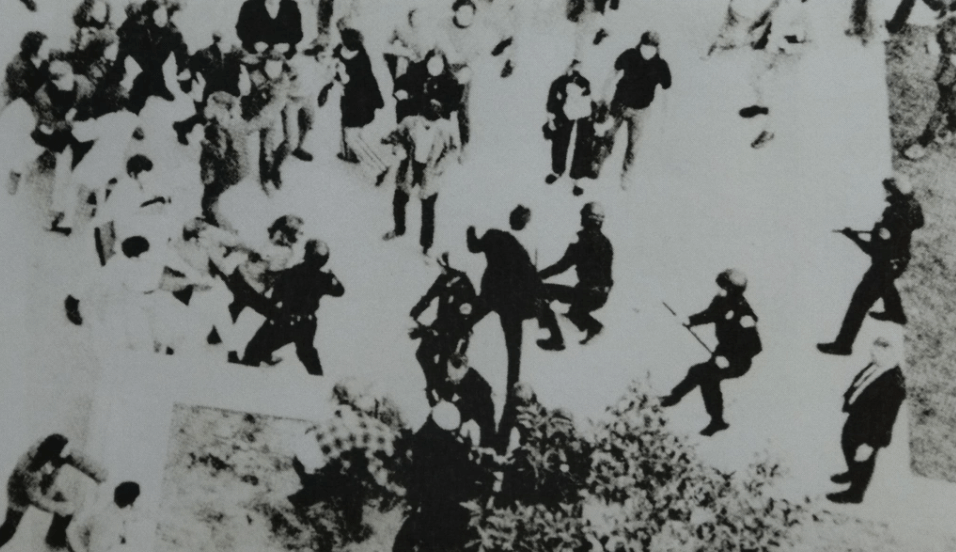
Police and students clash at CSUF, 1970. Click HERE to read more about the 1970 student protests at CSUF.
As a member of the SED squad, O’Brien was also called in to quell such countercultural events as a hippie festival at Disneyland (including the legendary “Pot Day on Tom Sawyer’s Island”), and the massive 1970 Laguna Rock Festival.
The 1970s
The Department established a “community relations bureau” in 1971, which eventually included the D.A.R.E program instructors, School Resource Officers (SROs), and the Neighborhood Watch program.
In 1974, the department was expanded with a $1.4 million building.
Chief Bornhoft encountered some controversy when he ordered the investigation of an alleged bribery attempt from a housing developer and a City Councilmember, which prompted the council member to try to get the chief fired.
“I have no apologies to make to anyone,” Bornhoft said of the investigation. “That’s the way government should function. There should be checks and balances. I don’t believe that just because an official is an elected official and he is possibly involved in a criminal offense, I can walk away from it and let someone else do it. I feel it is my responsibility to investigate it.”
According to a 1977 LA Times article, Bornhoft’s reign “has been marked by controversy. A sizable segment of the community has supported Bornhoft, seeing him as a conservative, iron-willed, law-and-order chief. His supporters contend that the streets have been safe and the crime rate has held at a modest level. Others however contend that Bornhoft was not sensitive to the problems of minorities and unable or unwilling to communicate with the people.”
Bornhoft retired in 1977, and was replaced by Martin Hairebedian, a 23-year veteran of the LAPD.
Chief Martin Hairabedian was fond of leisure suits. By the 1970s, the Fullerton Police Officers Association was becoming a more powerful union which negotiated with the city for higher pay, benefits, and working conditions.
“In 1979 the association fought for and won a 30% single year increase,” according to the FPOA history. “The members not only walked the picket line in front of city hall but they also rallied the business community.”
The 1980s
In 1983 the FPBA changed the name to the current Fullerton Police Officers Association.
When Martin Hairabedian retired in 1987, Philip Goehring became chief of police. He had worked for the department since 1961. He got a law degree in the 1970s and taught police science courses at Fullerton College.
“The department had a bad reputation in the community,” Goehring said upon taking over the department. There had been 75 citizen complaints registered against officers the year he arrived.

Chief Philip Goehring. While he was chief, Goehring created the first written policy manual and oversaw automation of police records.
The 1990s
In 1990, tragedy struck the Fullerton Police Department when undercover officer Tommy De La Rosa was killed in Downey in a drug bust gone bad.
Thousands attended De La Rosa’s funeral and years later a street was named in his honor.
Thousands attended the funeral for slain FPD officer Tommy De La Rosa. Photo courtesy of the Fullerton Public Library Local History Room. During the 1992 LA riots, some FPD officers were sent to assist the LAPD and the National Guard. Ironically, the LA Riots began because an all-white jury acquitted the LAPD officers who were caught on tape brutally beating Rodney King.
In 1991, Chief Goering became engulfed in controversy when it was revealed that he had written a letter to the District Attorney on behalf of his friend’s son, who had been convicted on a drug charge.
“With the memory of Tommy de La Rosa, a popular Fullerton narcotics detective murdered in an ambush this past summer in Downey still fresh in their minds, Goering’s rank and file officers were outraged when the letters became known,” the Fullerton News-Tribune reported.
Despite an official apology, Goering’s officers had begun to lose faith in him, and he retired in 1992.
In the early 1990s, the Fullerton Police Department created a program called “Operation Clean-Up” which was (initially) focused on improving quality of life in a few Latino-heavy neighborhoods in south Fullerton that were experiencing the impact of local gangs.

Initially, the program involved sending officers on mountain bikes into the neighborhoods to attempt to build a better rapport with the community. This was an attempt at “community policing.”
Lieutenant Tom Bashan told the Fullerton News-Tribune, “When I first started [police work], it was ‘we against them.’ That attitude is gone. You get to know who the people are, you know most things about them, you start developing other ways of handling people besides strict enforcement.”
The program seemed off to a good start, even winning a Governor’s Award.
In 1993, Pat McKinley, a 29-year veteran of the Los Angeles police Department, was chosen to become Fullerton’s next Chief of Police.
Chief Pat McKinley. Photo courtesy of the Fullerton Public Library Local History Room. McKinley had been involved in the formation of the LAPD’s SWAT squad, which was the first in the nation. It was created following the 1965 Watts Riots and was an important step in militarizing the police, and ramping up aggressive policing tactics.
It was under the leadership of Pat McKinley that the community policing activity of “Operation Cleanup” took a much more aggressive turn.
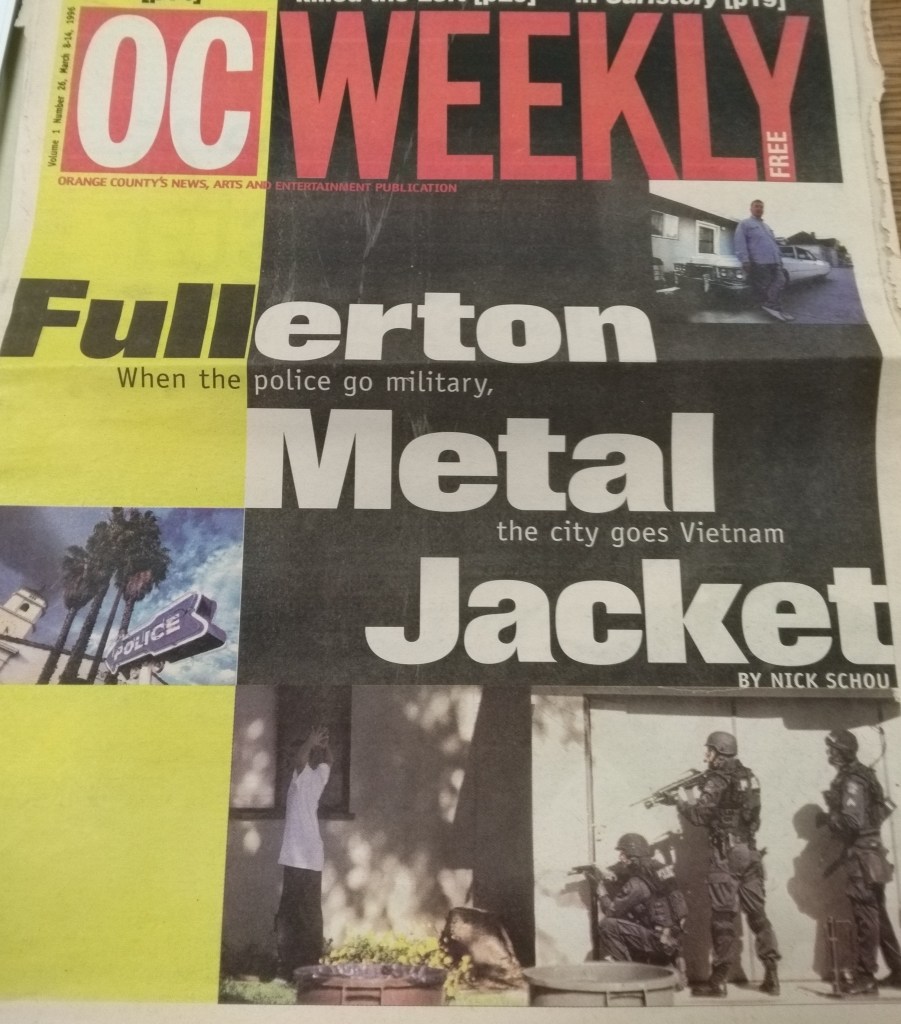
The Fullerton Police department conducted an aggressive “sweep” of over 33 homes in the Maple area of South Fullerton, breaking down doors of suspected “drug dealers” and terrorizing families.
Reporting for the OC Weekly, Nick Schou wrote that the department “adopted operations reminiscent of Vietnam: an occupying army bent on separating the ‘bad guys’ from the ‘responsible’ population it claims to protect—and, at the same time, using brutal tactics that tend to punish both groups in equal measure.”

Image courtesy of the Fullerton Observer. Following the sweep, McKinley faced a room full of angry residents at a meeting at the Senior Center.
An elderly Mr. Alberto Sambrano said, “I have lived here since 1939 and I have never seen anything like this before, the way they treated my 70-year-old wife. They destroyed my garage, a dresser in the house and a tool shed. We were treated like animals. They handcuffed my grandson Jonathan Navarro, who has never been in trouble. They took a gun my dad had given me 50 years ago.”
“Officer #1037 pulled my disabled brother up from his hospital bed and threw him on his wheel chair,” Gloria Hernandez told the chief.
Maple area resident Bobby Melendez said, “Use of stormtrooper tactics by the police and physically & verbally abusing people in their homes is not a minor matter.”
Charges of excessive force also occurred when heavy-handed police tactics were used against mostly Latino students from Fullerton College and local high schools during a protest.
“More than 20 students suffered slight injuries when Fullerton police, assisted by officers from several neighboring cities, used pepper spray and arrested six people, ending a rally and march of about 300 students who were demanding more Latino educators and more Chicano studies in schools,” the LA Times reported.

Los Angeles Times, 1993. Apparently the protest, which had started at Fullerton College, turned into a March through Fullerton streets, and ended with a clash with police near Lemon street.
“One of the girls in front of me was hit with a baton and it hit me on the side,” Grace Ruiz, a 15-year-old high school student said. “The police didn’t need to hit us with their batons or spray us with pepper spray.”
In 1994, the Fullerton Police Officer’s Association (the police union) started a Political Action Committee to funnel money to City Council Candidates they felt would support their interests, and occasionally oppose candidates they did not want. This PAC remains an important source of campaign contributions.
The 2000s
In 2000, the FPOA-PAC endorsed Chris Norby and Mike Cleseri for City Council. They were rewarded with a new contract that brought about the “3% at 50 retirement package” and a significant pay increase. In 2000, the FPD got a new a new high-tech crime lab.
In 2002, the FPOA-PAC supported Don Bankhead, Leland Wilson, and Shawn Nelson for City Council. They all were elected.

In the early 2000s, a new subculture caught the attention of the FPD–rave culture.
“Hours after 250 undercover narcotics officers finished an intense Rave Parties seminar at Fullerton City Hall last Friday, local police found signs of the Hollywood club culture at a local nightclub and high school dance,” the Fullerton News-Tribune reported.
“This is one scary culture,” said Fullerton Police Sgt. Joe Klein, president of the Region V chapter of the California Narcotics Officers Association, sponsors of the two-day workshops.
Apparently, Fullerton club In Cahoots came under fire for hosting rave nights.
Following 9/11, the North Orange County Regional SWAT team was organized.

In 2004, the Fullerton Police Department got a $12 million renovation.
Chief McKinley retired in 2008, and was replaced in 2009 by Michael F. Sellers.
“I have always told my officers that we have three jobs,” Sellers said. “Our first step is to save lives. When lives are not at stake, our next job is to protect life. When that’s not an issue, our job is to help improve the quality of life for our citizens, and that is done through community-oriented policing.”
At the time of his hiring, Sellers taught classes in ethics, leadership and community-oriented policing at Fullerton College.

The 2010s
In 2011, Sellers’ ethics and leadership were put to the test when six Fullerton police officers were caught on video brutally beating a homeless man named Kelly Thomas to death.
Kelly Thomas in better times (left) and after beating by FPD (right). Local residents began to flood City Council chambers and organize weekly protests outside the police department, demanding accountability for the killing of Thomas.
Justice for Kelly Thomas protest, 2011. What did Sellers do? He went on disability leave one month after Thomas’ death, and then retired.

Capt. Kevin Hamilton was selected to serve as acting chief, and then he retired.
Two officers, Jay Cicinelli and Joe Wolfe, faced criminal charges over the death of Thomas, and the department faced three internal investigations by a special consultant. Both Cicinelli and Wolfe were ultimately acquitted, sparking one of the largest protests in Fullerton history.
Also, as a result of their perceived lack of leadership after the death of Thomas, three City Council members, including former Chief Pat McKinley, were recalled by the voters.
Dan Hughes, a 28-year veteran of the department, was appointed Police Chief in 2013.

Although the Kelly Thomas case was the highest profile incident of police brutality in the 2010s, there were others, such as the cases of Veth Mam and Edward Miguel Quinonez, both off whom were attacked by officer Kenton Hampton, who was also involved (but not indicted) in the Kelly Thomas case.
Officer Albert Rincon was accused of sexually assaulting several women in the back of his cruiser. And in 2012, corporal Vincent Mater was found guilty of destroying evidence after a man committed suicide in his cell at the Fullerton Police Department.
Dan Hughes retired early in 2016 after allegations that he gave special treatment to former City Manager Joe Felz, who drunkenly crashed his car into a tree after an election-night party and then attempted to flee the scene.
Hughes was hired as VP of security at Disneyland. The District Attorney filed a felony charge against former police Sergeant Rodger Jeffrey Corbett for falsifying a police report about the Felz incident.
Hughes’ replacement as chief was David Hendricks who (not long after being hired) got into hot water after drunkenly assaulting an EMT outside a concert in Irvine in 2018. He was charged and pled guilty.

Hendricks was released and replaced by Robert Dunn.

The 2020s
In 2020, Fullerton Police Officer Jonathan Ferrell shot and killed resident Hector Hernandez. This sparked years of protest by Hernandez’s family and community members. Although the DA declined to file charges against Ferrell, the city paid out an $8.6 million settlement to Hernandez’s family. This indicates a pattern in which officers who kill people in the line of duty rarely face criminal consequences, but sometimes (if there is enough public outcry) the city (aka the taxpayers) will pay out millions to the family of the deceased.
Photo courtesy of the Fullerton Observer. Also in 2020, following the death of George Floyd, there were large-scale protests and rallies for justice and police reform, including here in Fullerton.
Photo courtesy of the Fullerton Observer. In 2021, the Fullerton Police Department collaborated with other local agencies to create Project HOPE, with the purpose of doing more proactive outreach to the local homeless community. This program still exists today.
Because of a general lack of an adequate social safety net for the homeless, the job often falls to the police to deal with a social problem that they are ill-equipped to deal with. Sometimes the police collaborate with social service agencies (as with Project HOPE), and other times the police are asked to be strict enforcers–clearing homeless camps, arresting the homeless, and sometimes (as in the cases of Kelly Thomas and Jose Luis Naranjo Cortez, brutalizing them).
In 2023, Chief Dunn left the department and Capitan Jon Radus became Fullerton Police Chief.

Jon Radus. Photo courtesy of the Fullerton Public Library Local History Room. That same year, the Police Department started using a drone to monitor Downtown Fullerton and other areas.
In 2024, Fullerton police killed Alejandro Campos Rios outside a McDonalds. This prompted more protests.
This year (2025), Fullerton Police killed a young man named Pedro Garcia. Another homeless man, Jose Luis Naranjo Cortez, died in Lemon Park after an encounter with the police.
Although it may seem like there have been more police killings since 2020, this is more likely the result of recent California state laws that require mandatory public reporting of in-custody deaths. It is likely that, in previous decades, many in-custody deaths were not made known to the public.
The Fullerton Police Department does a fair amount of community outreach/public relations events like the annual National Night Out.
The local police union, the Fullerton Police Officers Association remains active in local politics, using their Political Action Committee to support and/or oppose candidates, often successfully. This has allowed the police budget to remain much more stable than other city employees who have had to weather much steeper cuts.
-
Subscribe
Subscribed
Have a WordPress.com account? Log in now.

