-
Fullerton in 1950

The following is from a work-in-progress about the history of Fullerton. You can support my ongoing research and writing on Patreon.
The Local History Room of the Fullerton Public Library has microfilm from the Fullerton Daily News-Tribune newspaper stretching back to 1893. I am in the process of reading over the microfilm, year by year, to get a sense of what was happening in the town over the years, and creating a mini archive. Below are some news stories from 1950.
In 1950, Fullerton’s population was 13,939, and would continue to rise rapidly over the next two decades.
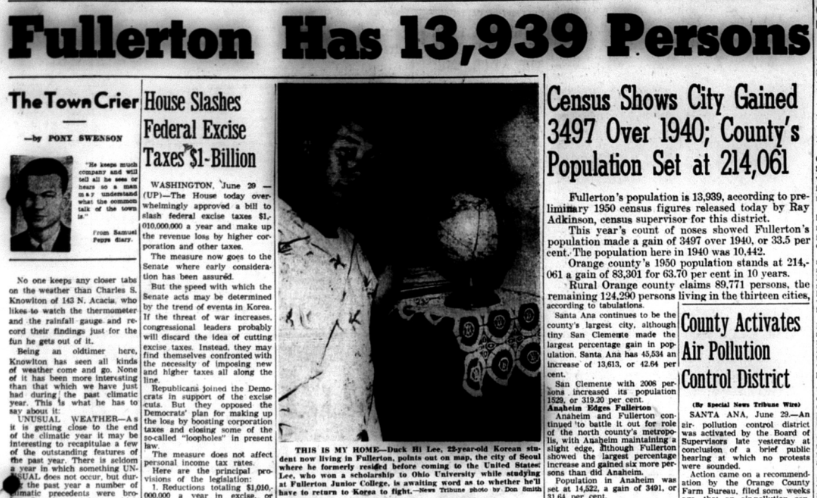
The Korean War
In international news, the Korean War was playing out as both a civil war between north and south, and as a proxy war between the communist east and the capitalist west in the context of the Cold War.
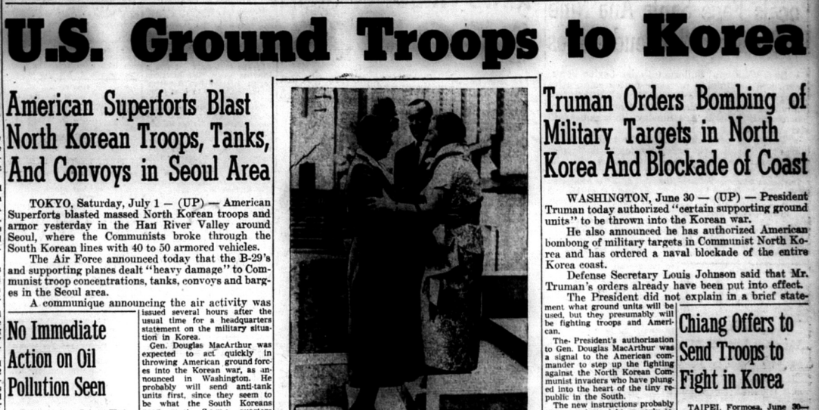
The Red Scare
On the homefront, Senator Joseph McCarthy was terrorizing American liberals and progressives by accusing many people of being communists, usually on the flimsiest of evidence.
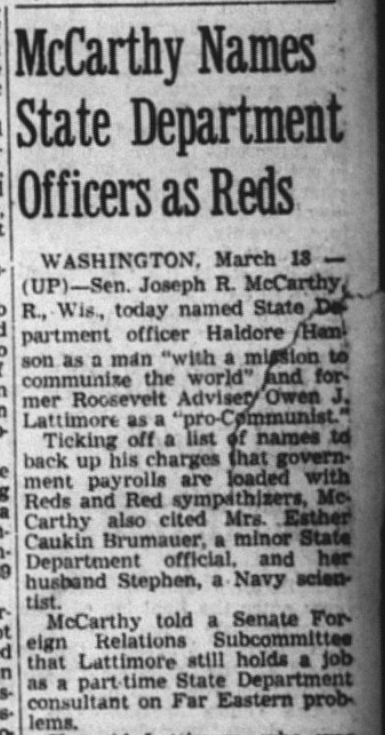
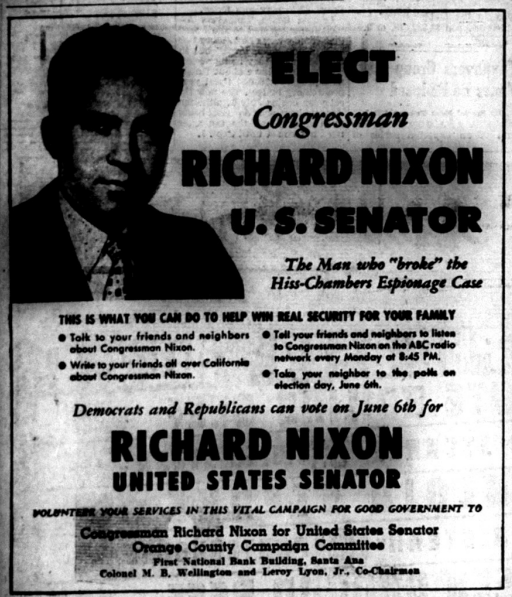
Richard Nixon (who was from Yorba Linda and had attended Fullerton Union High School) had been elected to Congress and was doing his part to fan the flames of the Red Scare. Fullerton in 1950 was a much more conservative place than it is today.
Being a local figure who was also running for Senate, Nixon made many appearances in Fullerton in 1950, including speaking at the FUHS commencement.
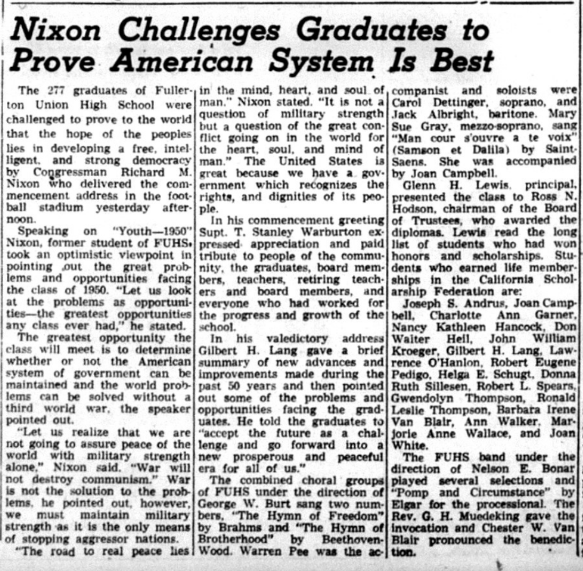
More Local Politics
In 1950, four men ran for two Fullerton City Council seats. They were:
Irvin “Ernie” Chapman, wealthy rancher, son of Fullerton’s first mayor/Valencia orange king Charles C. Chapman.

Homer Bemis, a general contractor.

Kermit Wood. Not sure what he did for a living, but he was likely a business owner and he ran on a platform of opposing a new business license ordinance.

Jack Adams, a former public relations man for Lockheed Martin, who also opposed the business license ordinance.

Ultimately, Adams and Wood upset the incumbents Chapman and Bemis–likely because of their opposition to the business license ordinance.

Thomas Eadington, fruit grower, was named Mayor.

Fires!
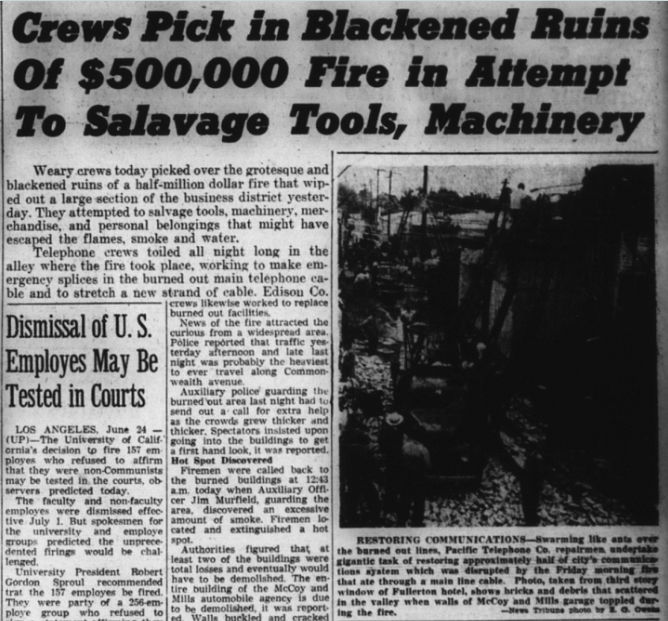
Probably the biggest and most tragic news story of 1950 was a massive fire that destroyed three major buildings downtown in the 100 block of West Commonwealth–the McCoy Mills Ford Agency, Pacific Citrus Products (famous for making Hawaiian Punch), and the old Fullerton Hotel. The damage was estimated at $500,000. Only one person was injured.
“An early morning fire, believed to be the worst in the history of the city, and probably the worst in Northern Orange County, totally destroyed an automobile agency, a citrus products plant, a 58-room hotel, and damaged a hardware store,” the News-Tribune reported.
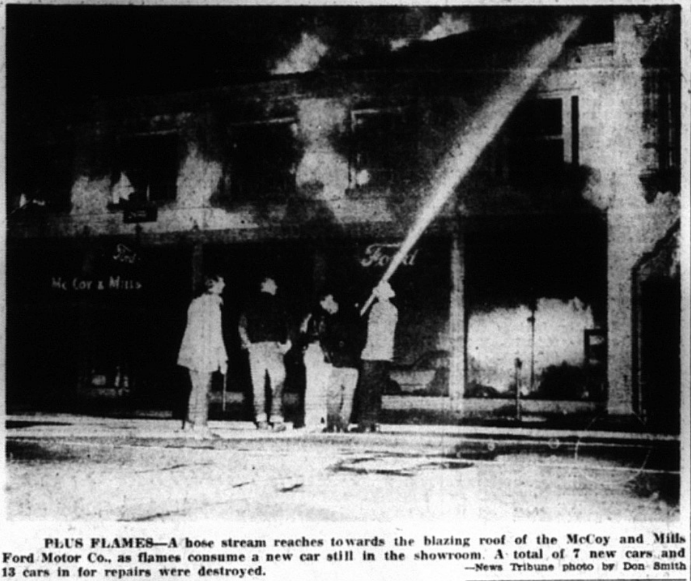
It was believed the fire began at the Ford Agency before spreading to Pacific Citrus Products.
“The juice plant went up in a hurry as citrus oils and alcohol caught fire and an early morning breeze fanned the flames,” the News-Tribune reported. “As the citrus plant burned and bottles and cans exploded, syrup concentrate ran ankle deep in the gutters. The smell of scorched syrup filled the air.”

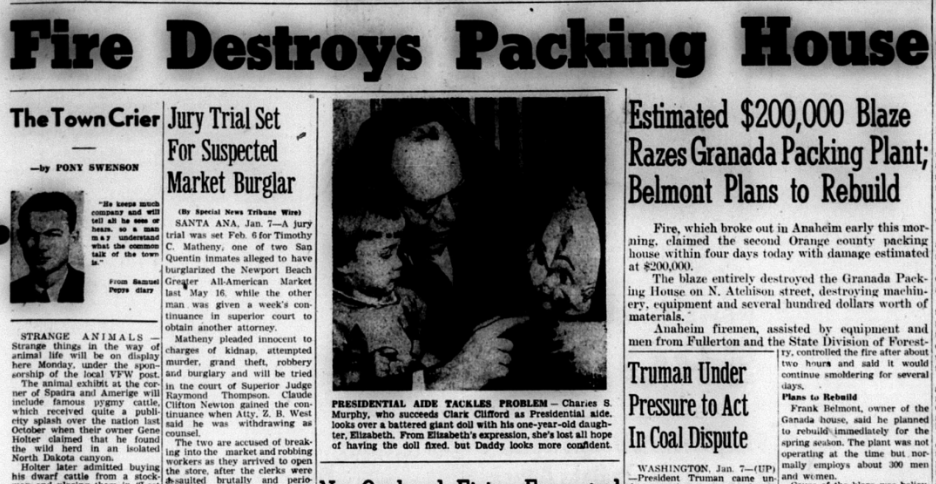
This was not the only fire in 1950. Another one destroyed a packing house.
Can a House be Built in Three Days?
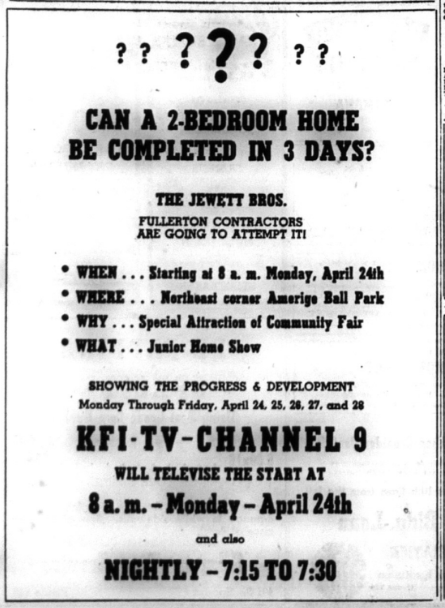
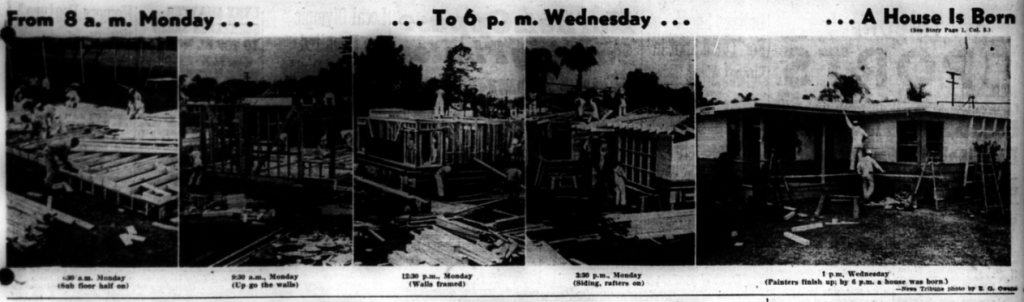
Fullerton continued to experience rapid growth, as many new housing subdivisions provided affordable homes. To demonstrate to the world that Fullerton was growing fast, local developers the Jewett Brothers hosted a big PR event in which workers built a whole house in three days.
A By-Product of Growth…Smog
Fullerton Goes to the Movies
For culture and entertainment, Fullertonians went to the Fox Theater, which celebrated its 25th anniversary in 1950.


The Fullerton News-Tribune includes an article about two men, Kenneth A. Rogers and Richard L. Martin, who worked at the Fox Theater since it opened. Rogers was superintendent of maintenance, Martin was the projectionist.
“Few, if any, of the large crowd that packed the theater on opening night know that a fire took place in the basement during the performance,” the News-Tribune reported. “Paint used used to color lights caught fire and the blaze set off the automatic sprinkling system. All available personnel were pressed into duty, bailing out the water which was seeping into the wardrobe trunks of a vaudeville troupe. C. Stanley Chapman, president of the company that operated the theater, Rogers recaslls, stood in two inches of water with the others trying to head off the flood.”
The article explains how, in the late 1920s, the theater became a favorite place for Hollywood previews.
“Among movie stars who attended previews of their pictures here were Douglas Fairbanks, Mary Pickford, Sally Eilers, Harold Lloyd, Victor McLaglen, Buster Keaton, Colleen Moore, Janet Gaynor, Charles Farrell, and Edmund Lowe,” the News-Tribune reported.
The first movie shown at the theater was Tom Mix in “Dick Turpin,” (an English period piece) which was a flop.
Both Rogers and Martin got their jobs because they worked at the old Rialto Theater downtown. When Harry Wilbur left the Rialto to manage the new theater, he took the two men with him.
The other theater in town was the Wilshire Theater.

Cultural Appropriation
Fullerton Union High School hosted its annual “Pow Wow.”

Yass Queens!
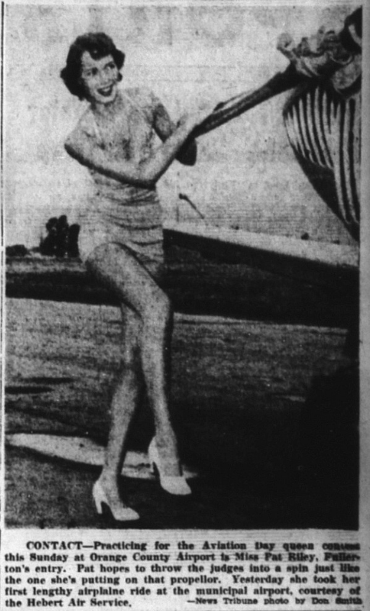
In the 1950s, Fullerton loved to crown queens for various public events.


The Midwest in SoCal
Fullerton hosted an “Arkansas Day” picnic on the Fourth of July that drew thousands.

New Schools
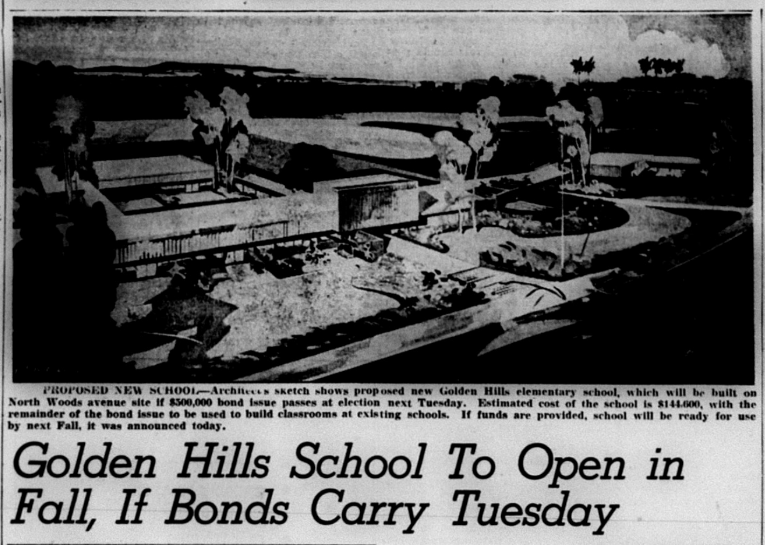
In education news, Golden Hills Elementary School was planned, to be built with bonds approved by the voters. Many new schools were built in the 1950s and 1960s as the area grew in population.
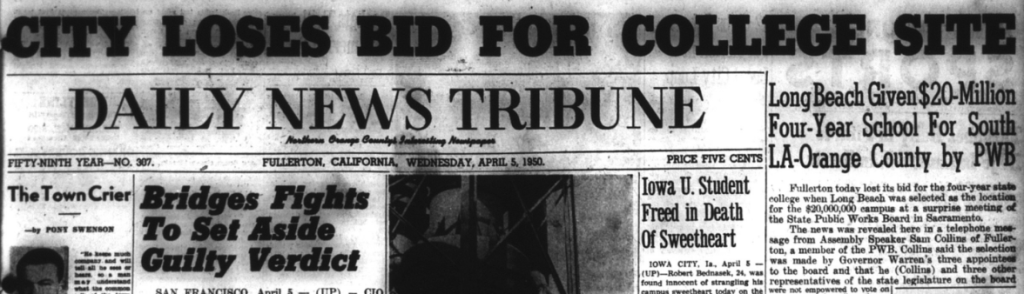
Fullerton put in a bid to be home to a new state college. Unfortunately, they lost out to Long Beach. It would be another decade before CSUF came to Fullerton.
Dr. H. Lynn Sheller succeeded William Boyce as head of Fullerton College.

The Big League Comes to Amerige Park
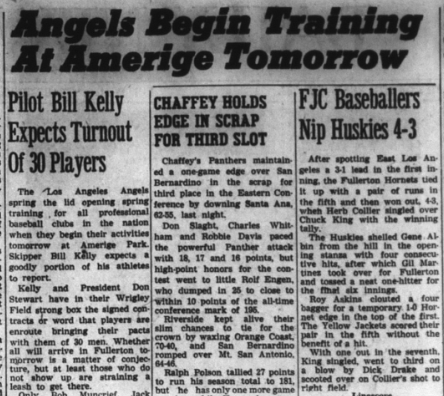
The Los Angeles Angels trained at Amerige Park in Fullerton.
Citrus Industry
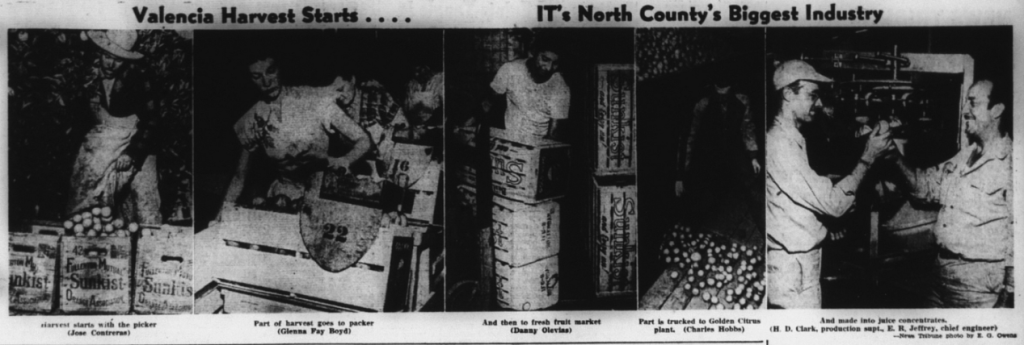
Although some orange groves were being plowed under for housing subdivisions, the citrus industry was still quite large in Fullerton and surrounding areas.
Stay tuned for top news stories from 1951!
-
Thomas K. Gowen: a life
The following is from a work-in-progress about the history of Fullerton. You can support my ongoing research and writing on Patreon.
Last week, I was in the Local History Room of the Fullerton Public Library browsing the shelves and came across a self-published autobiography of Thomas “Tommy” K. Gowen, who was an early rancher in Fullerton.

Thomas K. Gowen I had a personal connection to this person, as I grew up attending the First Evangelical Free Church of Fullerton, which Gowen also attended with his second wife Connie. As a young boy, I knew Connie Gowen–she was a well-loved elderly woman. Sadly, Tommy had died before I had the chance to meet him.
I read with great interest the story of Tommy’s life. Here is a summary of what I learned.
Gowen’s ancestors came to America in the 1550s from England, Scotland, and Wales, seeking religious freedom and to help establish a British colony.
His great grandfather James Gowen (“Uncle Jimmy”) was born in 1784. Uncle Jimmy settled near Lynchburg, Tennessee where started a farm. The adjoining farm was owned by none other than Davy Crockett!
Uncle Jimmy, being a Southern planter in the early 1800s, owned slaves. He fought in the War of 1812 under General Andrew Jackson in New Orleans.
Thomas K. Gowen was born in 1893 in Tennessee. Sadly, his father died of pneumonia four days before he was born, at age 30. Tommy grew up in a small farmhouse with his mother in Tennessee until he was 18. From age 12, he worked on local farms, including the Crockett farm.
Although he had limited schooling, “With the libraries of my two uncles at my disposal, I would sit up until midnight reading all kinds of books, learning more, I think, than the average college graduate,” Tommy writes
When Tommy was 20, he moved to Bakersfield and enrolled in Kern County High School and Junior College, living with his uncle Ben. He studied scientific farming.
“I got a job with the Kern Island Irrigation Company as a zanquero, delivering water to the Chinese gardeners, through the main ditches surrounding the city,” he writes.
When he arrived, most of the land was used for cattle grazing. It was here that he met and married Florence Burkett in 1915. The young couple briefly moved back to Tennessee, where their son Harlan was born.
After moving back to California, Tommy’s father-in-law, a relatively wealthy rancher, offered them a twenty acre orange grove in Fullerton.
In 1917, Tommy rode a horse-drawn wagon down to his new ranch in Fullerton. The family moved into a small farmhouse.
In 1919, Tommy took a job with the Union Oil Company, “working on the drilling derricks from midnight until 8am. In the daytime I would take care of sixty-five acres of oranges for my neighbors,” he writes. That year, their second son, Kenneth, was born.
It was while working for Union Oil that Tommy befriended Frank Nixon (Richard’s father): “In 1918 Frank Nixon (Dick’s father) and I became good friends. We went to work for the Union Oil Company of California and worked side by side for three years, then kept in contact with each other from time to time thereafter until he died in 1960.”
The family eventually moved into a house at 233 W. Santa Fe.
In 1921, he got into the fertilizer business. He traded his orange grove with Maxium Smith for a two-story house in Anaheim and 160 acres of desert land 12 miles west of Lancaster, where he planted barley.
In 1925 he bought a ten-acre orange grove on the south side of Valencia Dr, east of Brookhurst. Their son Kenneth, who had hemophilia, died of internal injuries after a kid pushed him off the bleachers at Ford School.
In 1928, they built a home at 1600 W. Valencia Dr. In 1932, Gowen was elected to Fullerton City Council. In 1936, he went to bat for his friend Walter Muckenthaler to be elected to city council.
“They said a Catholic had never served on the council and one could never be elected. I told them we had never had a Walter Muckenthaler run for the council, either,” he writes. “I went to twelve Protestant ministers in town and asked for their cooperation. They agreed to help. I think I oversold Walter; he got more votes than I!”
During Gowen and Muckenthaler’s tenure on City Council, they acquired WPA funds to build City Hall (now the police station). This was a controversial move, as other prominent businessmen wanted the city hall to be built on Spadra next to the California Hotel, instead of on Commonwealth, where it was built.
Gowen and Muckenthaler were also instrumental in getting more WPA funds to build the new library on Wilshire and Pomona, which is now the Fullerton Museum Center.
In the early 1930s, Tommy befriended Dr. John E. Brown, who was a leading evangelist of his day.
“In 1931 [Brown] sent his front man, Mr. C.A. Virgil, to Fullerton to build a temporary tabernacle on a vacant lot behind the Masonic Temple,” Gowen writes. “It had a capacity of 3,000 and was full every night for the three weeks he was there.”
Gowen was elected to be on the board of John Brown University to represent California. There he met Jesse H. Jones, who was chairman of the board. They enrolled Harlan at John Brown University in Arkansas.
Jones was a multi-millionaire who owned most of the skyscrapers in Houston, Fort Worth, and some in New York. He funded John Brown University. He was appointed by Herbert Hoover to be Chairman of the Reconstruction Finance Board, and was secretary of Commerce under Franklin D. Roosevelt.
Jones asked Gowen to help promote John Brown University, booking Dr. Brown to speak at 52 of the largest Rotary Clubs in the nation. There he met with many of the leading businessmen of America.
“Dr. Brown came to California and offered me the position of general manager of all the university’s holdings on the west coast: Brown Military Academy, the Brown School for Girls at Glendora, Radio Station KGER, twelve apartment complexes, and the Hotel Huntington in Long Beach,” Gowen writes.
In 1940, his wife Florence died.
Eventually, “Due to some of the financial practices of the administration of the school, Mr. Jones withdrew his support and I resigned from the organization, and reverted to being a farmer.”
In 1940, his fortunes considerably improved from when he first moved to Fullerton, Gowen “leased 110 acres of Valencia oranges in the Santa Fe Springs district from Standard Oil Company and others, and 700 acres of hay, grain and pasture land from Union Oil Company and Stern Realty Company from Fullerton to Brea, and from Brea to La Habra…With some partners, we leased 167 acres of Valencia oranges in front of Loma Vista Cemetery.”
After the death of his wife, he fell in love with his secretary Connie and they were married, they sold their home on West Valencia Drive and bought a two-story home on the southwest corner of Chapman and Balcom. They bought 160 acres on what is now Skyline Drive along with other property owners in what was known as the Skyline Syndicate. The area was subdivided into luxury homes. They moved into a home at 1701 Skyline Drive.
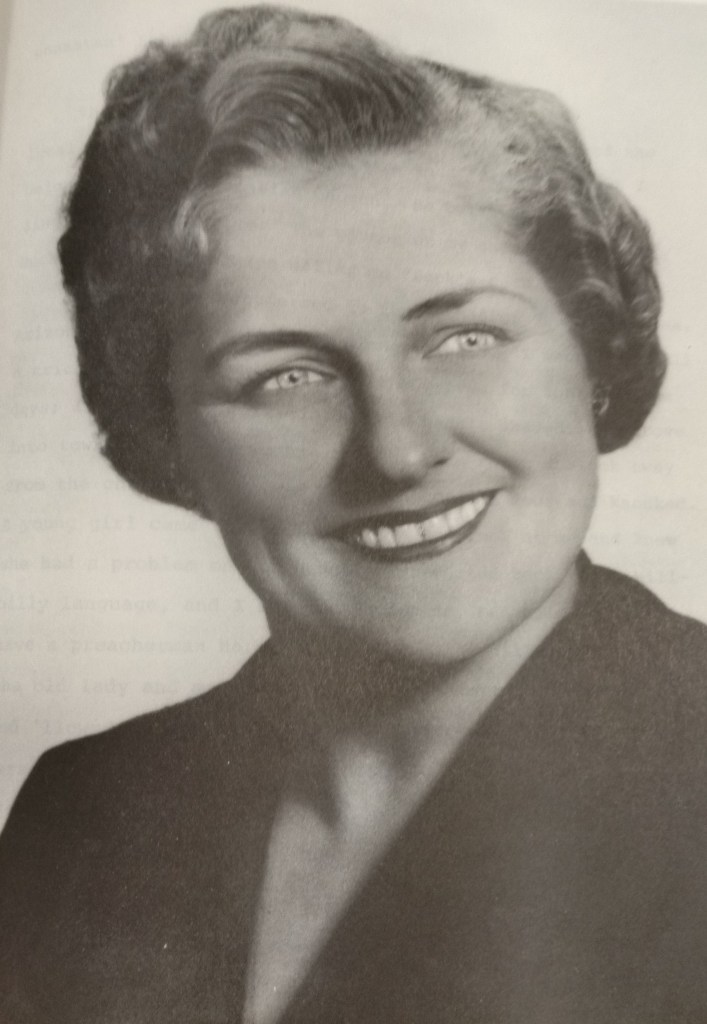
Connie Gowen. Now a wealthy rancher, Gowen befriended Walter Knott, who was a fellow advocate of Republican politicians.
In 1946, Tommy and Connie had their first child, Nancy. Their son, Tom Jr. was born in 1947. Sadly, Harlan (Tommy’s son from his first marriage) died in 1948. He was also a hemophiliac.
Gowen, now a gentleman rancher, part of the local landed gentry, acquired orange groves in Yuma, Arizona along with his friend California State Senator John Murdy.
In the early 1940s, he bought 165 purebred Hereford heifers from the Hearst ranch and ran them on land he rented north of Fullerton, and on his own land.
“Our whole family enjoyed having cattle running the two miles from what is now Longview Drive and Brea Boulevard to Rolling Hills and State College Blvd,” Gowen writes.
In 1947 he bought 47 acres of dead lemon trees, the piece that lies between Rolling Hills and Bastanchury Road, east of Brea Blvd. “We kept it about eight years and sold it to Ward and Harrington for a subdivision, helping the Fullerton Elementary School District obtain the site for Rolling Hills School,” Gowen writes.
He was instrumental in helping Chapman College (founded by local rancher Charles Chapman) move from Los Angeles to the site of the former Orange High School. Gowen served on the board of Chapman College until it became “too liberal.”
“Liberal professors refused to take the loyalty oath and the majority of the board let them get away with it,” so Gowen resigned.
In the 1950s, Gowen was the campaign manager for Republican John Murdy, who was elected to the California State Setate in 1956 and 1960.
“[Murdy] had 1,000 acres of land between Huntington Beach and Westminster on which he grew lima beans. Later on he became president of the California Lima Bean Growers Association, president of Hoag Memorial Hospital, a member of the Irvine Foundation Board, and many other worthwhile activities,” Gowen writes. “In 1952 some southern Orange County business men drafted John to run for the state senate…I was asked to be his campaign manager.”
Gowen was also instrumental in getting the state legislature to locate CSUF in Fullerton.
Gowen was an early supporter of Richard Nixon in his first presidential run in 1960. Tommy visited and had lunch with Richard Nixon at the capitol when he was vice president.
“During the presidential campaign in 1960, Mr. Knott hosted a big old fashioned Republican rally at the [Gowen] farm. The main speaker was Richard Nixon,” he writes.
In a letter to his daughter Nancy, Gowen describes Nixon’s famous “Southern strategy” to get conservative Southern Democrats to switch the Republican Party: “Dick had to have a vice president acceptable to Strom Thurman, the only man who could throw the south to the Republican party.”
Tommy visited and had lunch with Richard Nixon at the capitol when he was vice president.
Gowen wrote his memoir in 1975, shortly after the Watergate scandal and the resignation of Richard Nixon. Of this he wrote: “Having known the Nixon family personally for 56 years makes this tragedy a double shock for me.”
-
Fullerton in 1949
The following is from a work-in-progress about the history of Fullerton. You can support my ongoing research and writing on Patreon.
The Local History Room of the Fullerton Public Library has microfilm from the Fullerton Daily News-Tribune newspaper stretching back to 1893. I am in the process of reading over the microfilm, year by year, to get a sense of what was happening in the town over the years, and creating a mini archive. Below are some news stories from 1949.
National and World News
In world news, the Russians tested their first atomic bomb–a pivotal event in the Cold War.

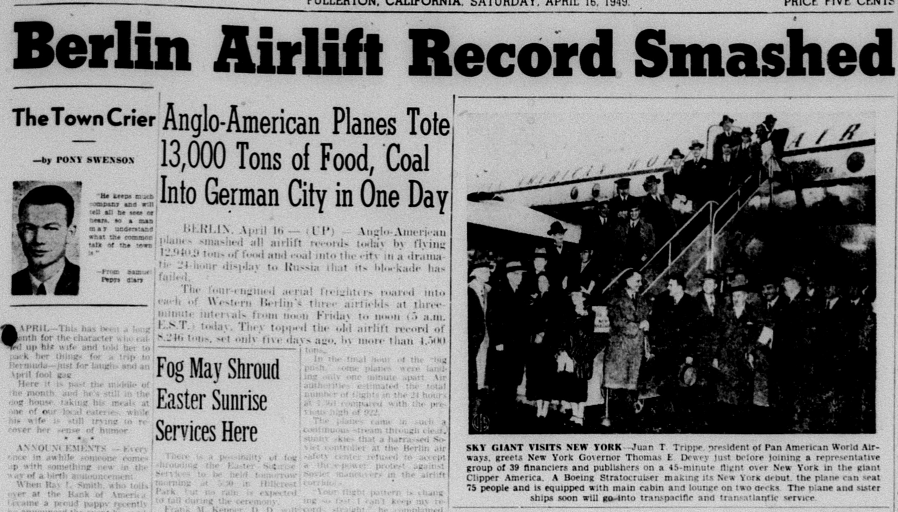
American planes were dropping food and aid into Russian-blockaded Berlin as part of the famous Berlin airlift.
The “Red Scare” was increasing in intensity, as famous Hollywood actors (including Frank Sinatra, Orson Welles, Charlie Chaplin, and Gregory Peck) were charged with being communists (they were not).

Although mass shootings are generally seen as a 21st century phenomenon, there was a mass shooting in Camden, New Jersey when a “Bible-carrying war veteran described as a near religious fanatic” shot and killed 12 people.

Local Pilots Set World Endurance Record
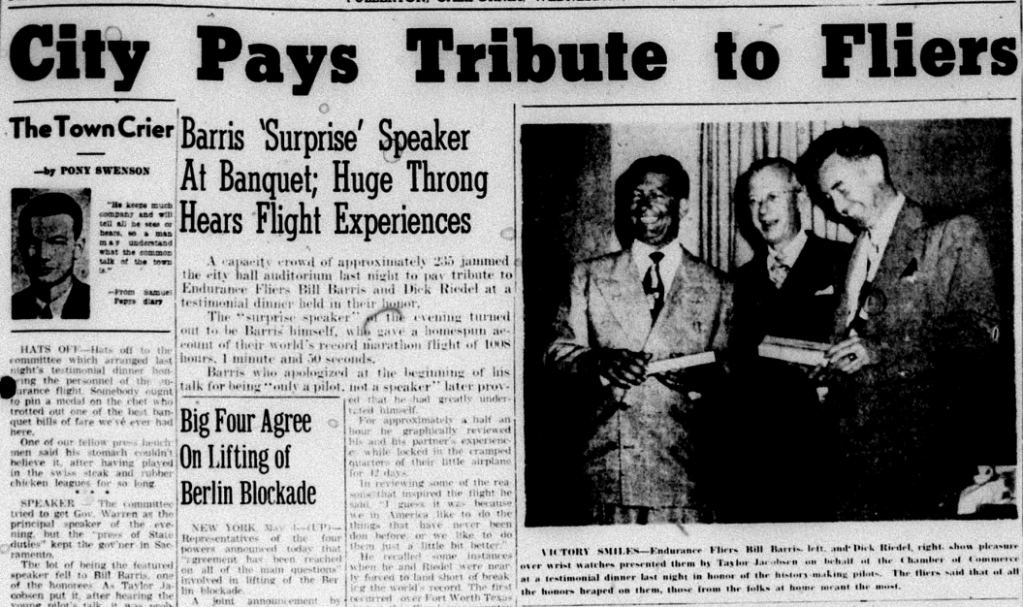
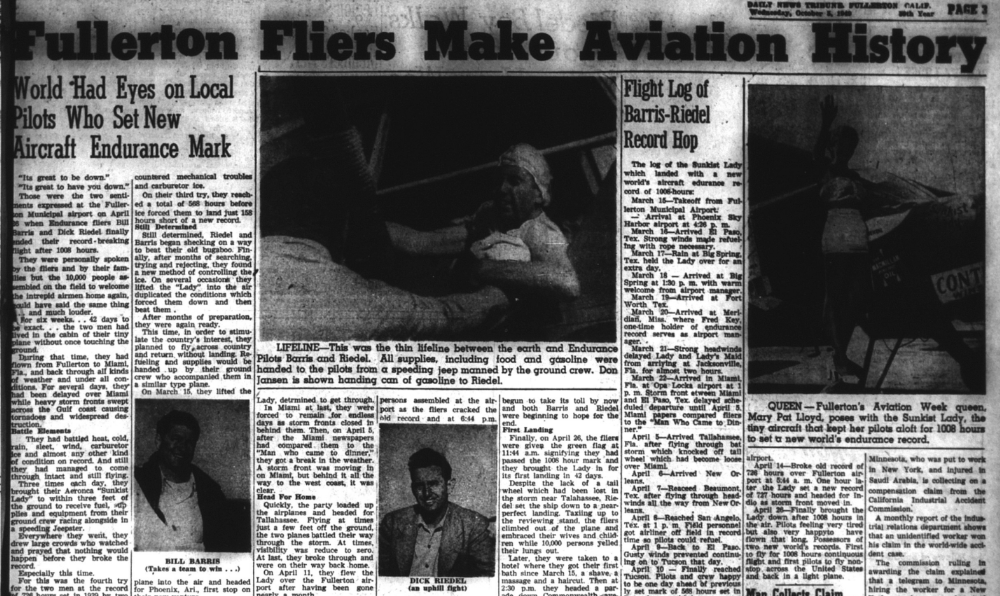
Perhaps the biggest local news event of 1949 was the flight endurance record set by local pilots Dick Reidel and Bill Barris who flew their plane the Sunkist Lady for 1008 hours.

Annexation Fight with Anaheim
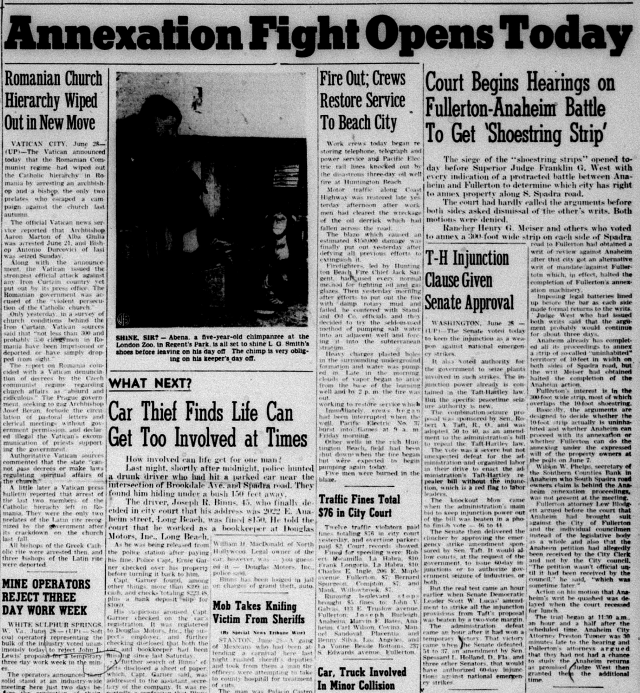
The second biggest local news story of 1949 was an annexation fight between Fullerton and Anaheim over a strip of “no man’s land” that once separated the two towns. At stake was future tax dollars from housing and industrial development. After much legal maneuvering, court fights, resident protests, and council meetings, Fullerton won the fight over the coveted land.

Housing
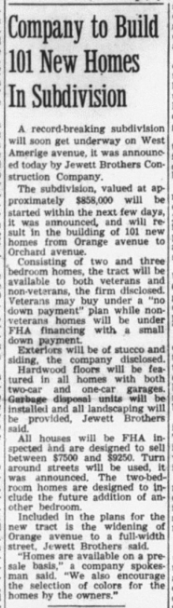
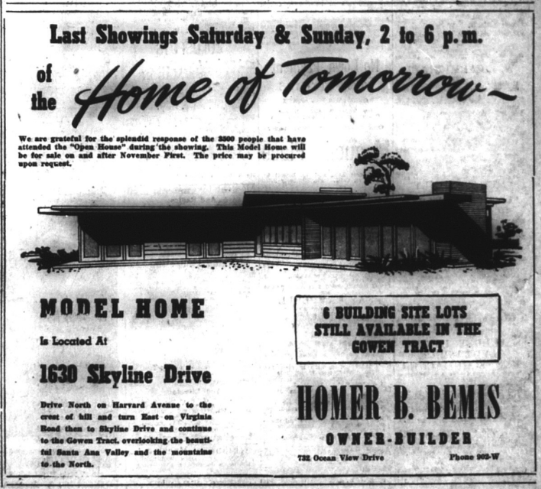
After World War II, Fullerton entered a period of rapid growth, as housing subdivisions replaced orange and walnut groves.
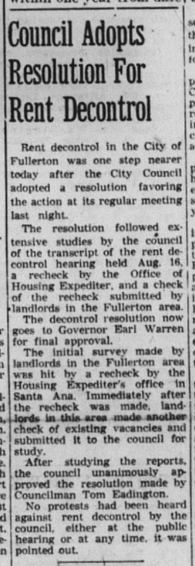
Another notable housing issue in 1949 was the end of wartime era rent controls, which had been put in place to protect renters during a period of a housing shortage. Landlords were keen to end rent control, and they were successful.

Education
To accommodate the population growth, new schools were constructed. In 1949, Fullerton opened Valencia Park school.

New schools and expansion of existing schools were often paid for with bonds.

Infrastructure
As Orange County grew, new infrastructure was needed, including an expanded sewer system, paid for with a bond measure.

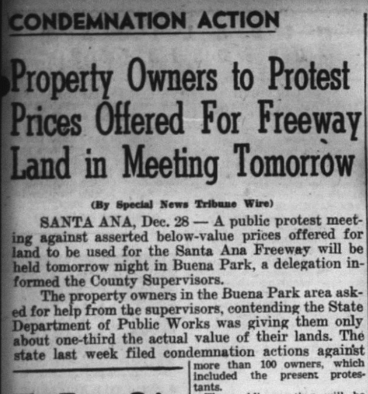
The 1940s and 1950s saw the dawn of freeways in Southern California which required using eminent domain to acquire land from property owners.
Culture and Entertainment
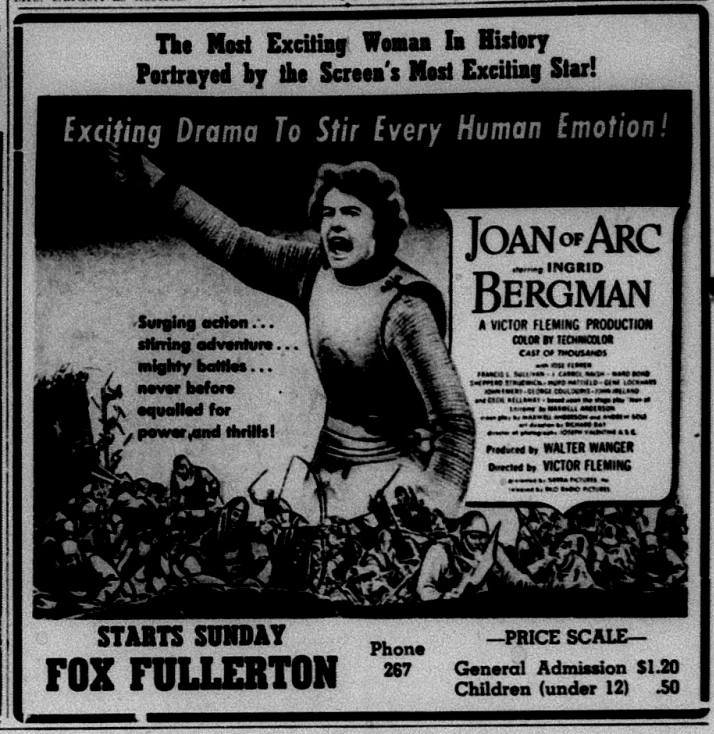
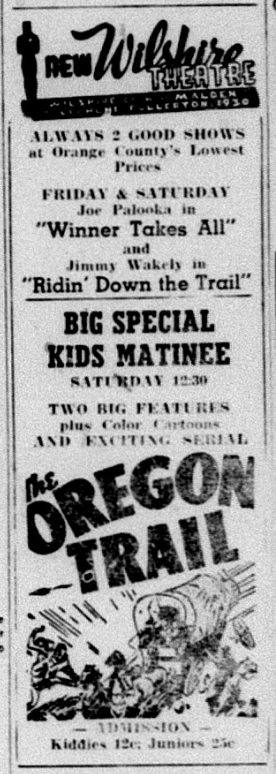
For culture and entertainment, Fullertonians went to see movies at the Fox Theater (which still exists) and the Wilshire Theater (which is now an apartment building).
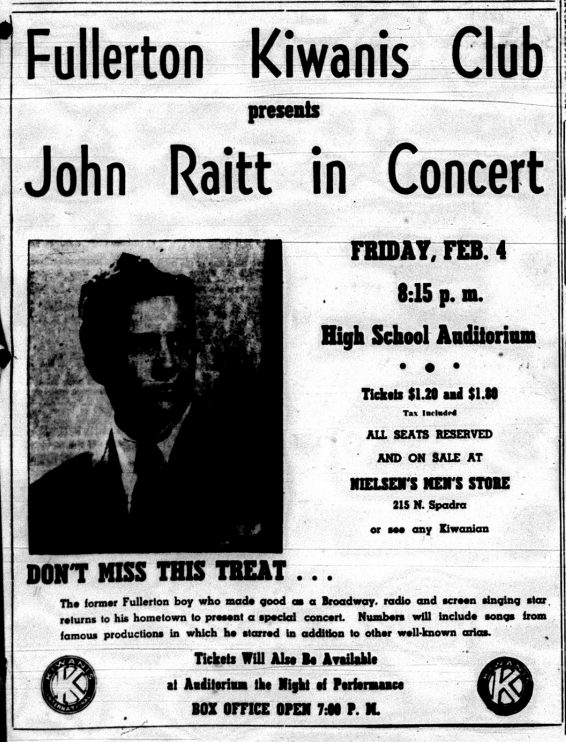
Famous Broadway singer John Raitt, who was from Fullerton, returned to his hometown for a special concert.
Fullerton hosted a Fall Festival that drew thousands.

Sports
In sports news, professional baseball teams would play games at Amerige Park.

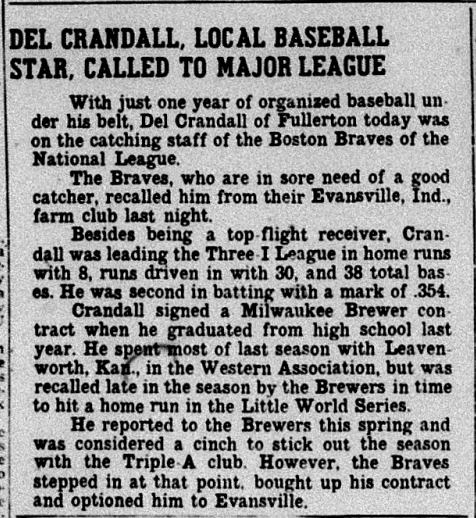
Hometown hero Del Crandall entered the big leagues.
Business
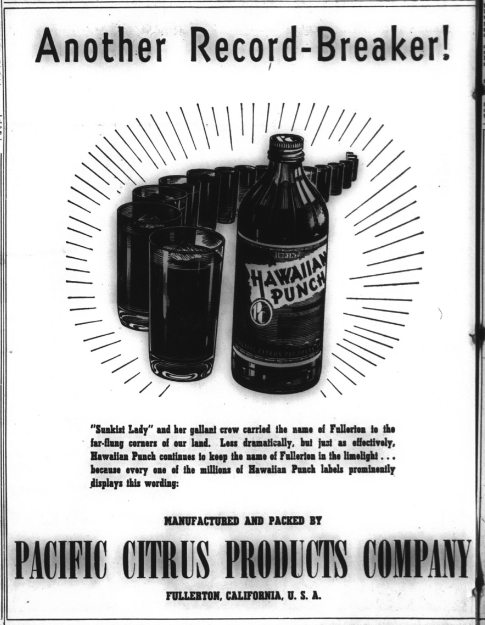
The pages of the Fullerton News-Tribune contain advertisements for some notable local brands that started in Fullerton and went on to be big national brands, including Hawaiian Punch.
Social Life
There were numerous social clubs in Fullerton in 1949, some of which still exist.

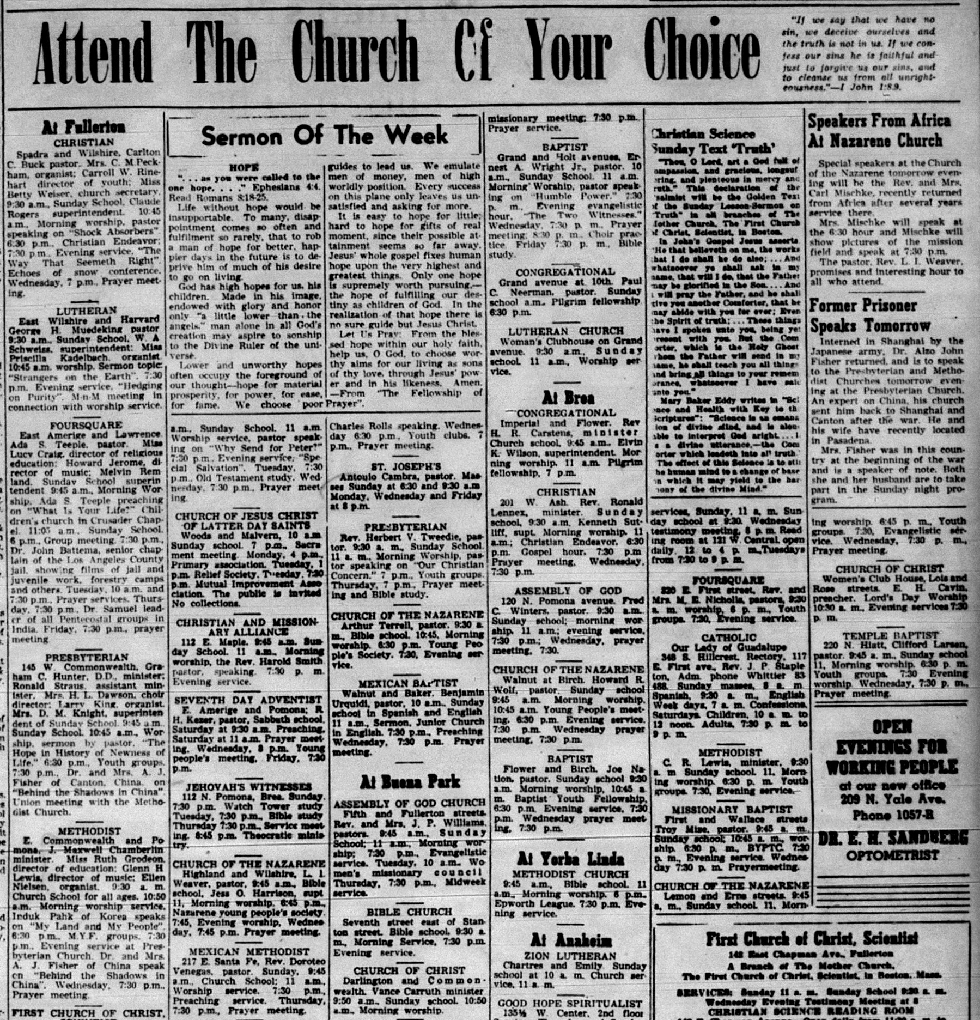
Church was also an important part of community life.
Snow Falls in Fullerton
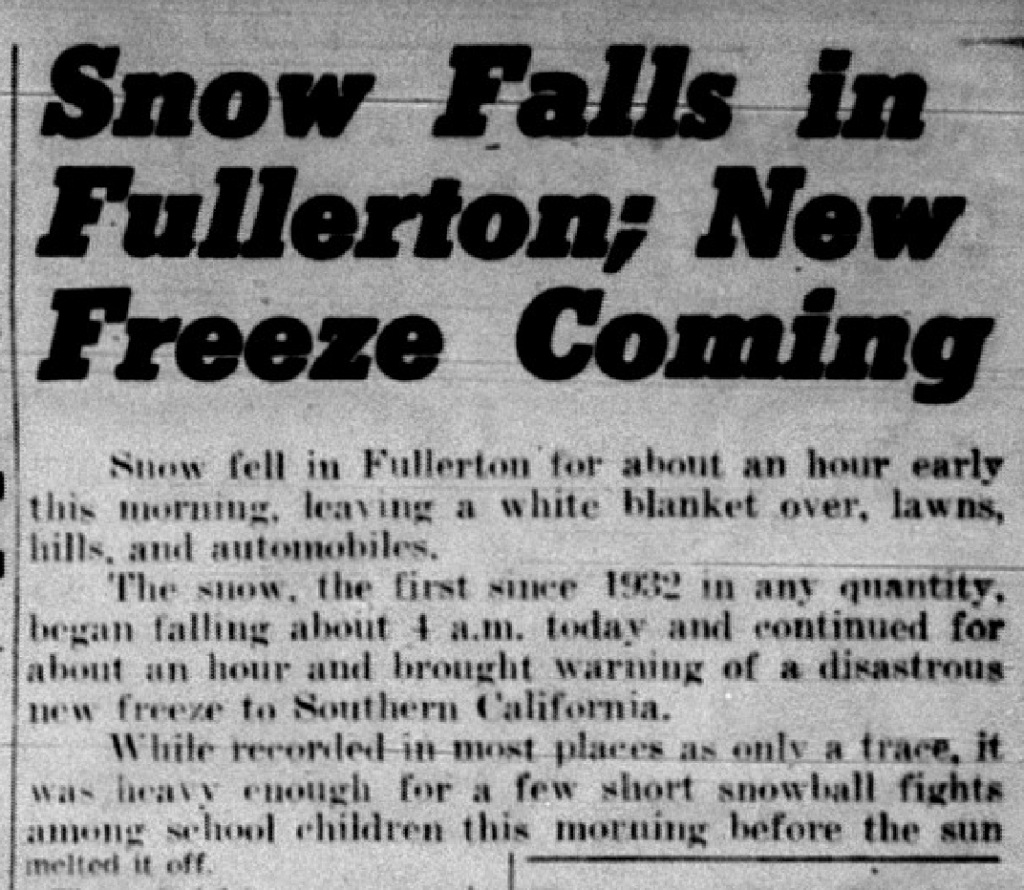
A rare snowfall occurred in Fullerton in 1949.
Deaths
Beloved Fullerton College coach Arthur Nunn died.


Stay tuned for news stories from 1950!
-
Walter Muckenthaler: a life
The following is from a work-in-progress about the history of Fullerton. You can support my ongoing research and writing on Patreon.
This year, the Muckenthaler Cultural Center is celebrating its centennial. Exactly 100 years ago, in 1925, Walter and Adella Muckenthaler built their dream mansion atop a hill in north Fullerton. Forty years later, in 1965, the family gifted their stately home and the grounds around it to the city of Fullerton to be used as a Cultural Center. And since then, the Muckenthaler Cultural Center has been offering the public art exhibits, musical performances, classes, plays, and more.
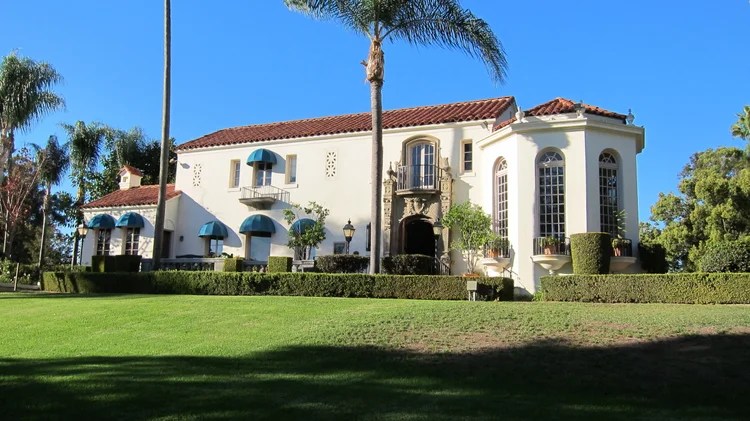
As part of the centennial, the Electric Company Theater will be offering a unique immersive theatrical experience which utilizes the whole interior of the Muckenthaler Mansion and brings guests into the world of mid-1920s Fullerton, complete with real local historical figures, including Walter and Adella Muckenthaler.
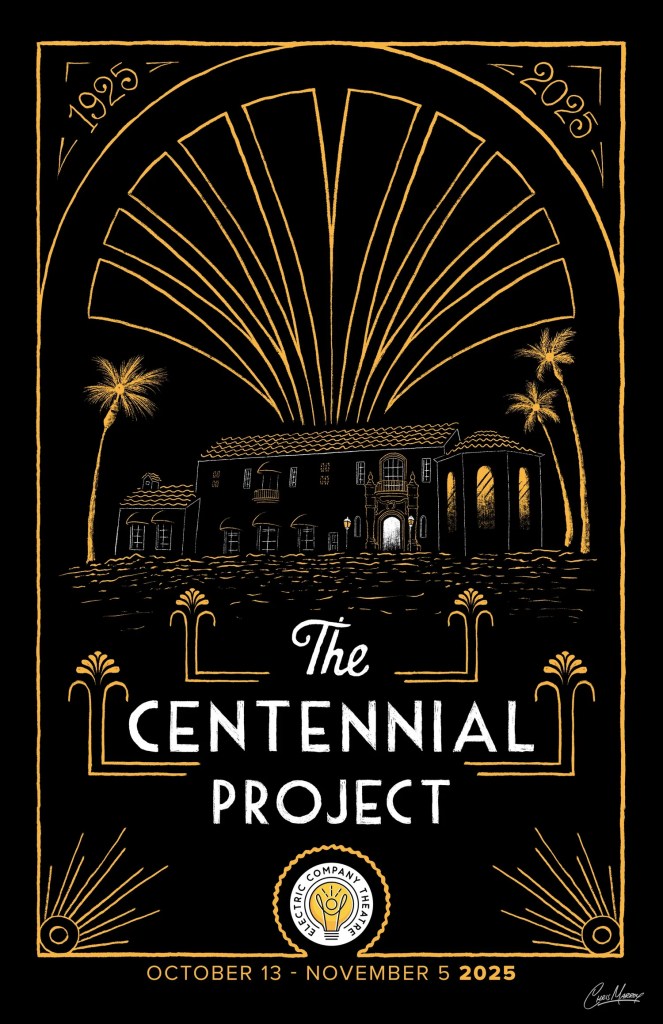
Last week, the directors of the Electric Company Theater invited me to give a brief talk about what Fullerton was like in the mid-1920s, to get their patrons excited about the centennial production.
The whole experience has made me curious to learn more about the Muckenthaler family, and so I was delighted to discover in the local history room of the Fullerton Public Library a biography of Walter, which was written by Keith Terry. Because the family commissioned the biography, it is perhaps a bit of a hagiography. Nonetheless, it provides a fascinating window into this local family–their history and legacy.
I present here a book report on some things I learned from Walter’s biography.
The German Muggenthalers
Walter’s grandparents, Martin and Elizabeth Muggenthaler, immigrated from Germany to the United States in 1854. Their name was changed to Muckenthaler by a port official in Belgium.
“They must have heard of the tempting offers of land that American railroads promoted all over Europe at that time,” Terry writes. “Undoubtedly, Martin’s desire for cheap land in the American Midwest tugged at this imagination and motivated his immigration to the new frontier.”
After landing in New York, Martin and Elizabeth took a train west to Minnesota, where they acquired land and farmed for 17 years.
Walter’s father Albert was born in 1862, during the Civil War. He was Martin and Elizabeth’s sixth child.
After the Civil War, the US government opened up more lands out west for homesteaders. This was, of course, former Native American land. The Muckenthalers took their family to Kansas where they purchased 400 acres from a railroad company, near the famous Oregon Trail.
Martin and some fellow Germans laid out the town of Newbury, Kansas. He helped build the first schoolhouse, the Sacred Heart Chapel, and donated land for the town cemetery.
Albert Goes West
When he was 20 years old, Albert Muckenthaler wanted to try his fortune out west, so he and a friend traveled by train to the German town of Anaheim, California.
At that time, in the mid-1800s, Anaheim was a grape-growing area, so Albert and his friend worked in the vineyards, then as carpenters helping to expand the Planters Hotel.
Albert and his friend explored the California coast, from San Diego to San Francisco before returning to their families in Kansas.
Back in Kansas, Albert married Augusta Ebert in 1889. They purchased a farm in the town of Paxico, where they raised wheat, pigs, cattle, and chickens.
Albert and Augusta had a son, Walter Muckenthaler in 1894.
“Walter lived the rich, full life of a typical Kansas farm boy,” Terry writes.
Eventually, Albert felt the desire to return to Anaheim, so in 1909 the family headed west.
The Anaheim they encountered in 1909 was quite different from the one Albert had visited as a young man. A blight had wiped out the grape vineyards. Following a period of economic disaster, the local farms had shifted to growing walnuts and oranges.
Albert bought ten acres where he planted a small orange grove and built a large house for the family. In addition to growing oranges, they raised a small herd of cows and started selling milk and butter to the community.
Walter Comes of Age
Walter attended Anaheim high school on Lincoln Avenue. He took an interest in the arts and drama, acting in school plays.
Walter’s parents bought the Boston Bakery in downtown, where Walter worked while in school.
After graduation in 1916, Walter had saved enough money to attend the University of California at Berkeley, where he planned to study architecture. Unfortunately, he lacked the money to stay more than one year. So he returned to Anaheim just as the US was entering World War I.
He enlisted in the Navy, but was discharged because of a heart murmur. After working in the family bakery for a while, Walter got a job as a civil engineer for the Santa Fe Railroad.
Walter and Adella
In 1918, Walter married Adella Kraemer, whom he had known since high school.
Adella came from money. Her father, Samuel Kraemer, owned much of what is now Placentia. His vast lands included citrus and walnut groves, as well as cattle and oil wells. Her mother was Agelina Yorba whose grandfather Bernardo Yorba was a Spanish “don” whose large land grant included the present city of Yorba Linda.
“Both Walter and Adella enjoyed frequenting the popular night spots, cafes and restaurants where they always hoped to catch a glimpse of some famous silent film idol. They especially liked to go to Nat Goodwin’s Cafe on the Santa Monica Pier,” Terry writes. “On different occasions, Walter and Adella saw Charlie Chaplin, Douglas Fairbanks, Herbert Marshall, the two Barrymore brothers, Gloria Swanson, Anita Stewart, the Talmade sisters, and many others.”
Walter and Adella moved into a small apartment in Fullerton.
Walter’s job as an engineer for the Santa Fe railroad kept him away from home for weeks at a time. So his wealthy and influential father-in-law Samuel Kraemer put in a good word with Fullerton’s city engineer Herman Hiltscher, and landed Walter a job as a city surveyor.
In 1922, Walter and Adella had their only child, Harold.
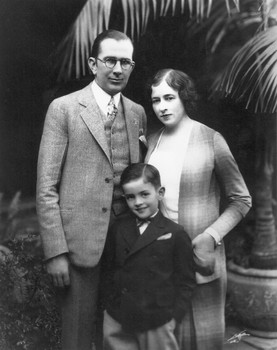
The young couple’s fortunes changed dramatically when Samuel Kraemer’s land yielded a number of oil gushers, which he had leased to Standard Oil.
“Samuel Kraemer leased out his mineral rights to Standard Oil of California, then watched in fascination the thousands of barrels of oil his land yielded up that first year,” Terry writes. “He decided to share his newly discovered wealth with all his children. Each one received interest in the oil leases and Walter and Adella began receiving regular royalties from their inherited leases.”
It was these oil royalties that provided the capital for Walter and Adella to purchase eighty acres of land along Euclid, between Commonwealth and Malvern. There they got into the Valencia orange business and it was there, atop a hill, that they built their stately mansion in 1925.
The Muckenthaler Home
Walter hired local architect Frank K. Benchley to design their stately home, built in the Mediterranean style. Benchley had designed a number of iconic Fullerton buildings, including the California Hotel (now the Villa Del Sol).\
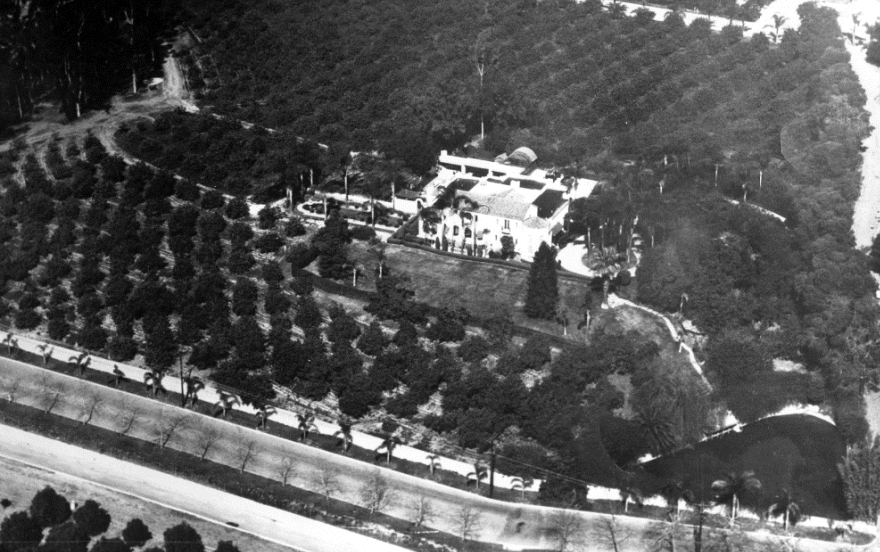
The Muckenthaler mansion took six months to complete at a cost of $34,000 (which is approximately $630,000 in 2025 dollars, not enough to purchase a modest single family home today).
“Standing on the cast stone balcony off the upstairs bedroom, Walter and Adella could see, on a clear day, all the way to Catalina island,” Terry writes.
Walter’s friend Clark B. Lutschg designed the architectural landscaping around the mansion.
Fullerton City Councilman
At the urging of his fellow orange rancher friend Tommy Gowen, Walter ran for city council in 1936.
At first, the local elite were skeptical of Walter because he was Catholic in a (mostly) Protestant town. But Gowen went to bat for Walter and he was the first catholic elected to Fullerton city council.

“At that time, council met in the upstairs room of the makeshift city hall–located just off the main street behind the California Hotel on Wilshire,” Terry writes. “The building served as a combination police station, fire house, city clerk’s office and water works office.”
It was during Walter’s tenure on City Coucil that the City obtained WPA (New Deal) funds to build the City Hall on Highland and Commonwealth avenues (which is now the police station), built in 1940.
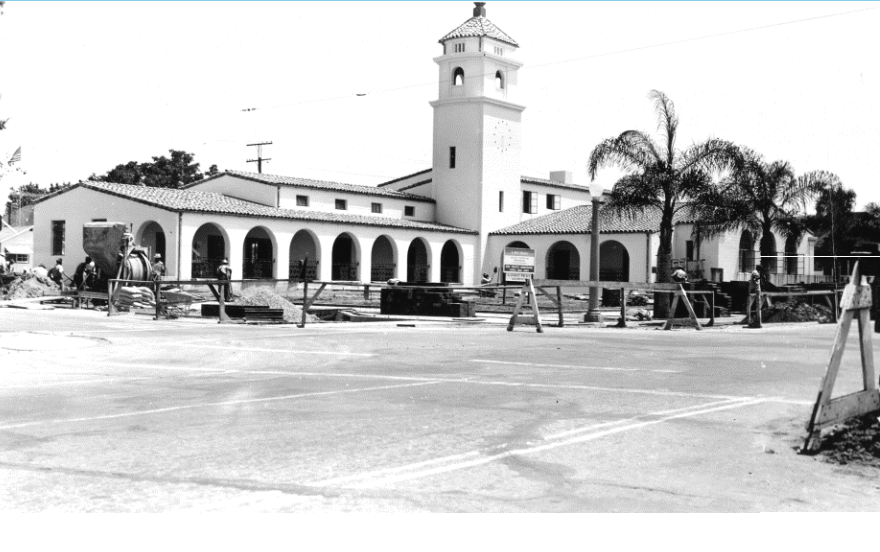
The 1938 flood hit Fullerton during Walter’s tenure on council.
“The small dams located at the top of Santa Ana Canyon gave and disaster struck with a mighty torrent of water that rushed through the mouth of the canyon and spread out over the towns and farms of Orange County sweeping everything in its wake,” Terry writes. “At Atwood, located in present day Placentia, the little homes were lifted off their foundations and carried downstream like small boats. In Fullerton the dams burst making Harbor into an asphalt riverbed.”
After the flood “Walter was determined that Fullerton should never have to suffer again the terrible deluge it had just experienced.”
Walter helped obtain federal funding to create a cement lined barranca and construct a new dam above Harbor.
The War Years
In 1942, America entered World War II. That year, Walter decided not to run again for city council, and instead got himself appointed to the Planning Commission.
In the late 1930s Walter hired a Japanese gardener. In 1942, this gardener was arrested by federal agents who claimed he was a foreign agent and taken to an internment camp.
Harold Muckenthaler joined the Navy and served during the War.
After the war, Harold and his wife Shirley had two daughters.
In the 1940s, “Walter had expanded his interests to include citrus farms in both Ventura and Home Gardens near Corona,” Terry writes. “He bought a four story business building on Fourth and Broadway in Santa Ana.”
The Declining Years
In the early 50s, Walter’s health began to decline, and he was diagnosed with leukemia. He transferred most of his affairs to his son Harold.
“There were the numerous boards of director to transfer and the ranches and holdings Walter had acquired through the years,” Terry writes. “Harold and been well trained by his father and knew many of the prominent men who served with his father on large corporations.”
During the 1950s, according to Harvard historian Lisa McGirr, the Muckenthaler family were associated with the right wing John Birch Society.
Walter died in 1958. Seven years later, Adella and Harold would donate the Mucketnaler mansion to the city of Fullerton to be used as a cultural center.
-
Fullerton in 1948
The following is from a work-in-progress about the history of Fullerton. You can support my ongoing research and writing on Patreon.
The Local History Room of the Fullerton Public Library has microfilm from the Fullerton Daily News-Tribune newspaper stretching back to 1893. I am in the process of reading over the microfilm, year by year, to get a sense of what was happening in the town over the years, and creating a mini archive. Below are some news stories from 1948.
Growth
In 1948 Fullerton had a population of 13,235, and its population would continue to grow in the coming decades.
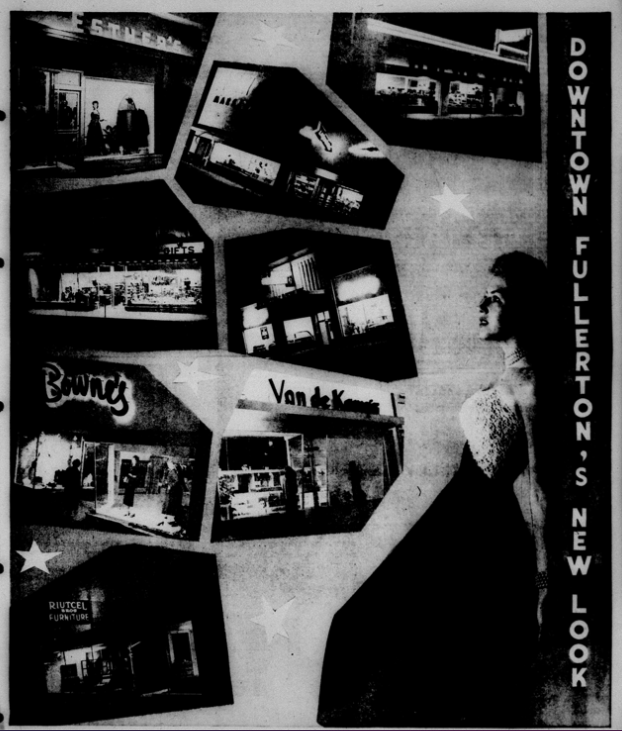
Following World War II, Fullerton experienced a period of rapid growth, as new housing subdivisions, schools, shopping centers, and industrial parks replaced orange groves.
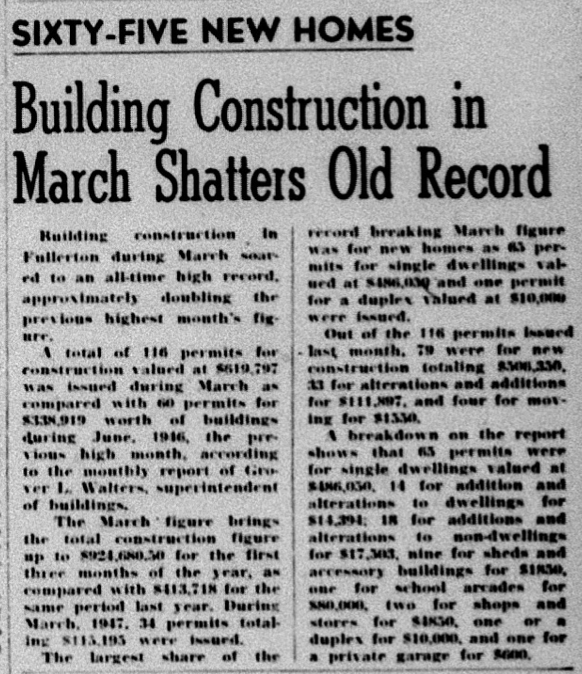

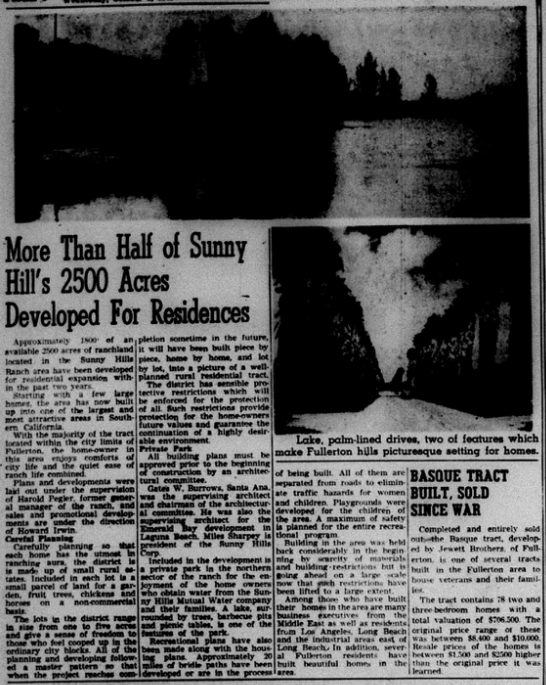
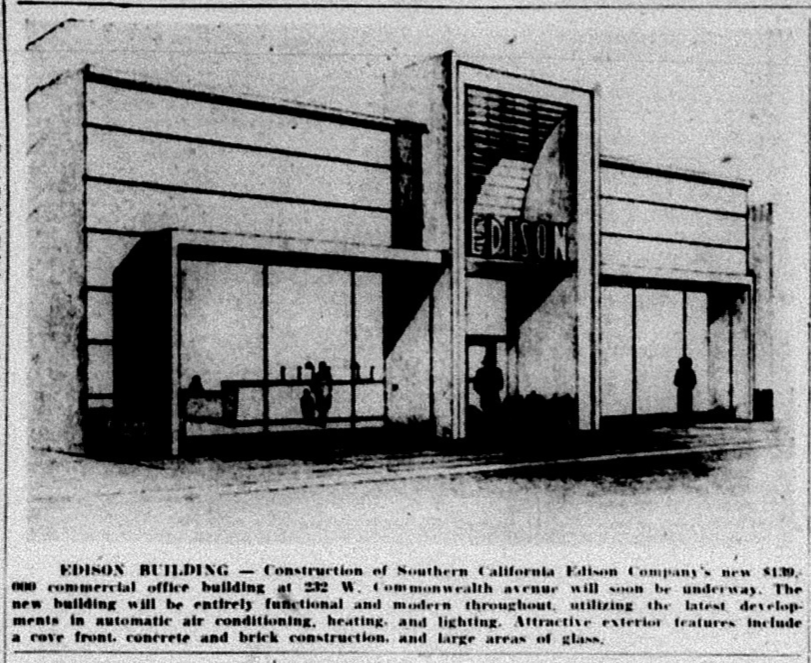
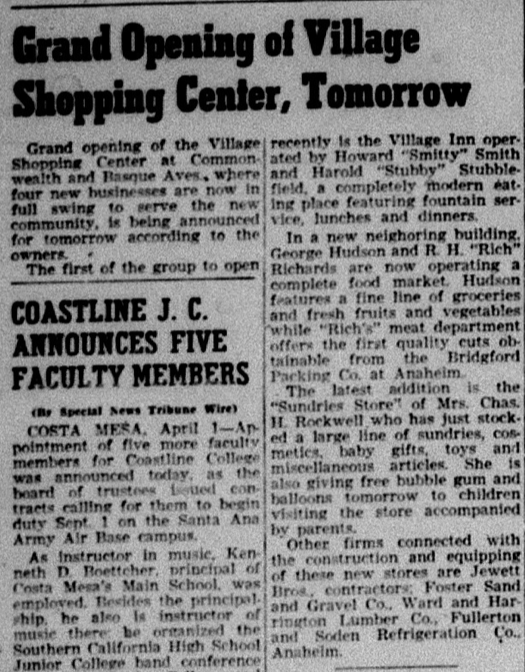
In addition to new housing subdivisions, new buildings popped up as well.
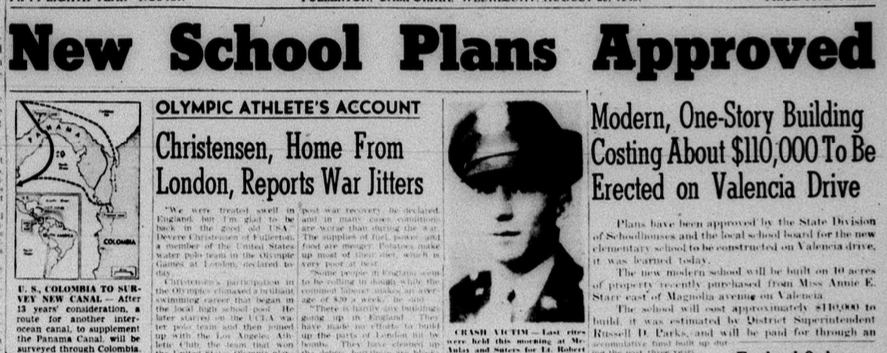
To accommodate the population influx, a new school (Valencia Park) was planned. This would be the first of many new schools built after World War II.
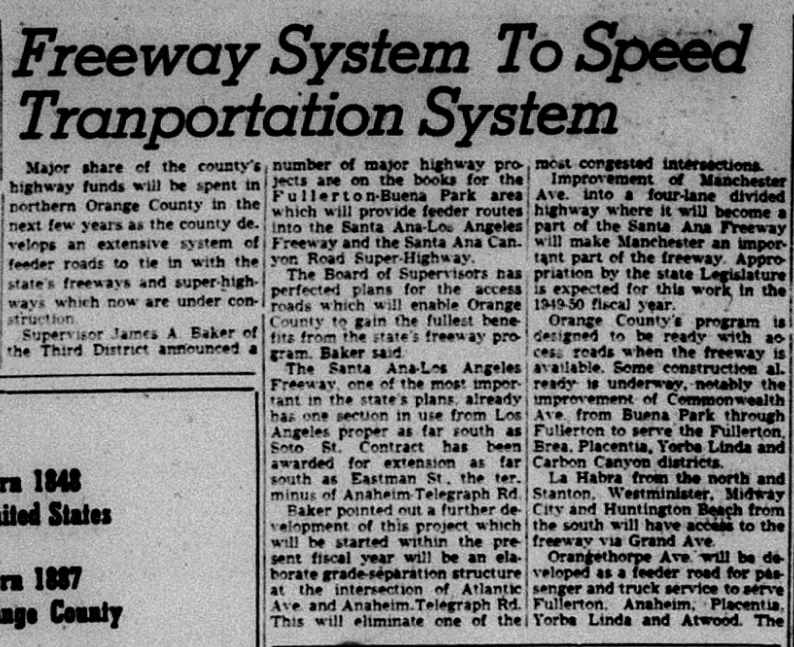
To accommodate the increased population, and traffic, freeways were constructed.
Businesses
Here are some prominent businesses of Fullerton in 1948:
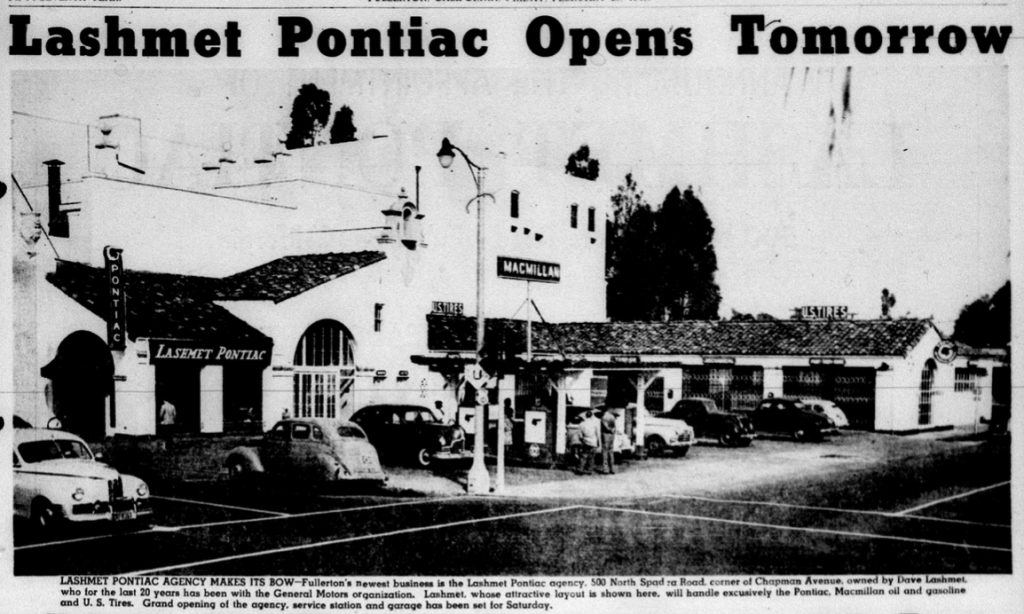
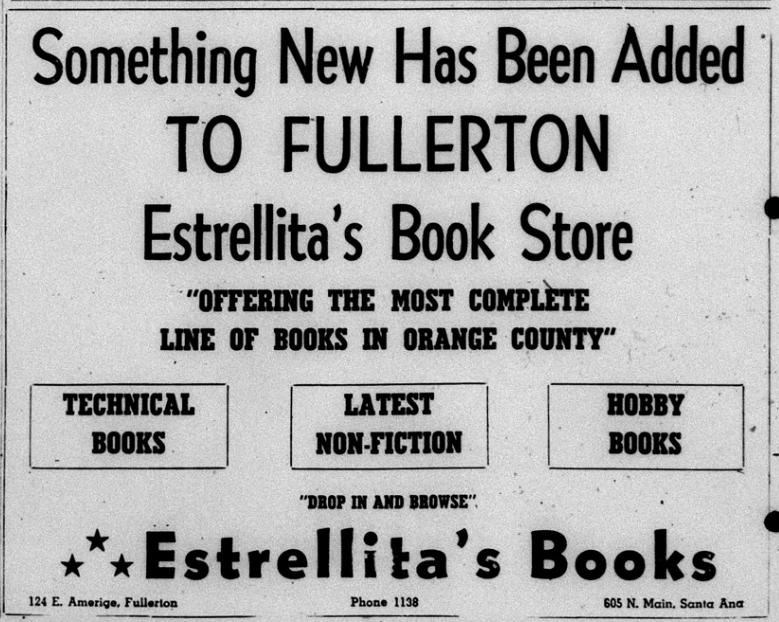
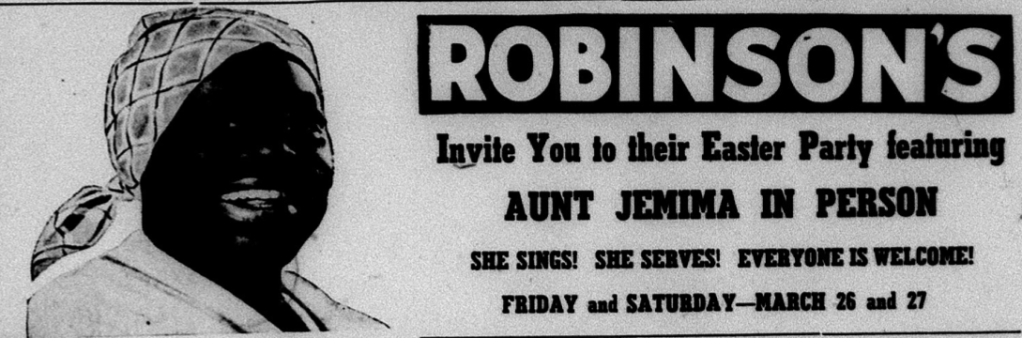

Hawaiian Punch was created in Fullerton!

Norton Simon’s Hunt Foods was a major local employer.

A fast food entrepreneur named Carl Karcher established his first permanent restaurant between Fullerton and Anaheim:
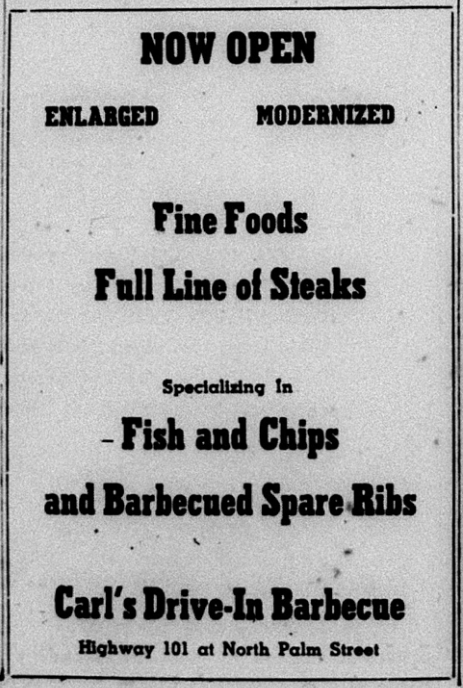
Annexation Fight with Anaheim
As both Fullerton and Anaheim grew, annexation fights began between the two cities to incorporate land between the two cities. The first salvo of this fight occurred when Anaheim city officials convened a special Saturday session to annex a 60-foot strip close to the south border of Fullerton.
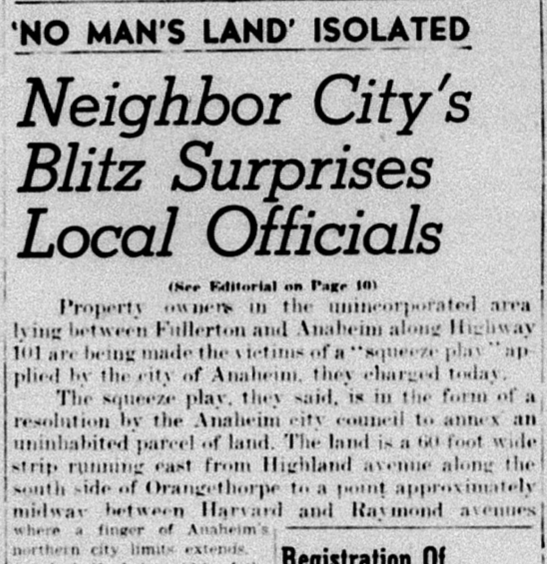
In an editorial called “Skulduggery in Anaheim,” the Fullerton News-Tribune reported:
“When a city council finds it necessary to meet in special session on a Saturday, it is either a case of dire emergency or some kind of skulduggery. Anaheim’s city council met in special session last Saturday.
The business before the council consisted of passing a resolution to annex a strip of land 60 feet wide along the south side of Orangethorpe from Highland avenue to a point approximately midway between Harvard [Lemon] and Raymond avenue where a finger of Anaheim’s north city limits extends.
That a city council would hold a special session to pass a resolution to annex a piece of land which seemingly has no immediate bearing o the welfare of Anaheim, such action can hardly be called a “dire emergency.” That leaves only one category under which it can fall: skulduggery!
One need only to study a few of the facts behind the action by the Anaheim council to understand why it went to the trouble of a special Saturday session.
The area along Highway 101 between Fullerton and Anaheim is unincorporated. Its growth and development in recent years have made it obvious that it will some day become a part of some municipality, which would mean either Fullerton or Anaheim. An area of this nature needs the advantages that any city offers: fire and police protection, trash and garbage collection, sewer and water facilities.
Sentiment for becoming part of a municipality has run high in recent years, and especially more since a Metropolitan Water District edict forbids any new users outside the city limits. This ruling checks and futurity development of property in this unincorporated area until it becomes. Part of one city or another.
On September 11 of this year property owners took legal steps for becoming part of Fullerton by filing a notice of intention to circulate a petition relative to annexation of the territory. With enough signatures to the petition the matter could be put to the vote of the people of the area concerned. The people could choose between remaining unincorporated (with a chance of later joining Anaheim) or joining with Fullerton. Property owners who are working to initiate the petition say that the vote would be overwhelmingly for Fullerton.
It is no secret that Anaheim has coveted this territory. It would stand to lose by letting the people express their desires at the ballot box. With the handwriting on the wall, there was only one course for Anaheim to follow: throw up a legal roadblock between the territory and the Fullerton city limits by annexing a piece of land between the two.
It is reminiscent of Hitler’s tactics in instituting his famous “JA” and “neon” ballots during European plebiscites.
Fullerton officials sought to head-off this land-grab by meeting with Anaheim officials, but their efforts came to naught.

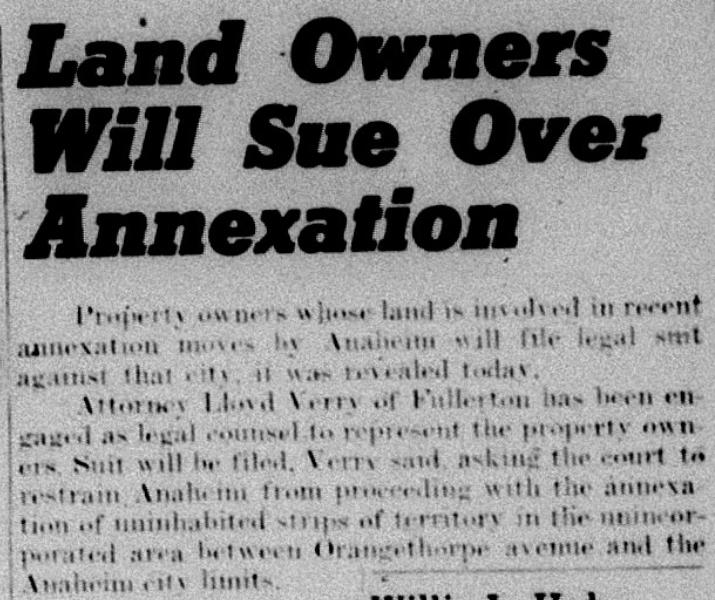
It would fall to property owners to sue Anaheim over the annexation move, which they won. But the fight was not over.

Politics
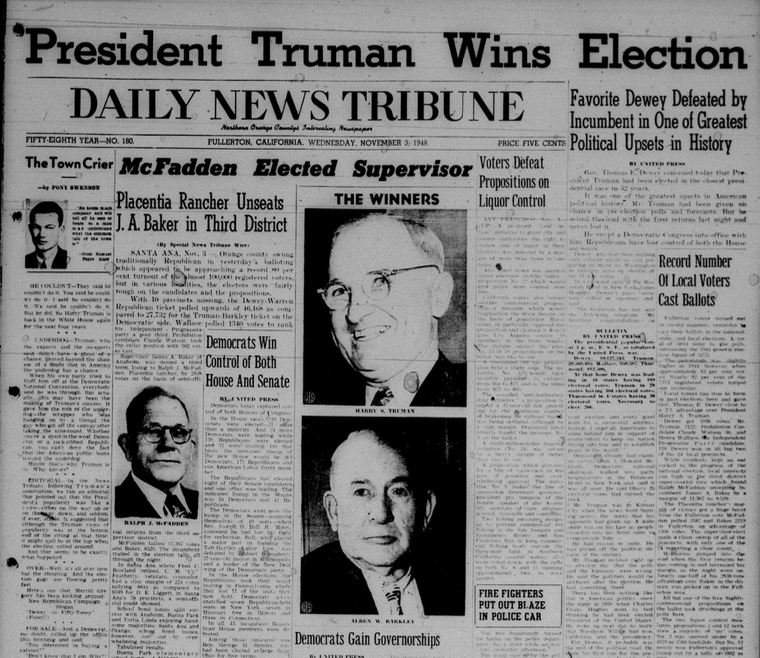
Harry S. Truman, a Democrat, won the 1948 presidential election.
Locally, Verne Wilkinson, Hugh Warden, and Thomas Eadington were elected to City Council.

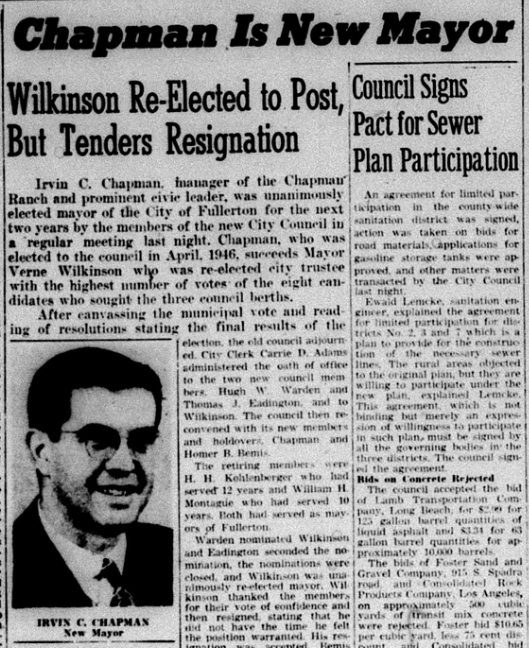
Irvin “Ernie” Chapman, son of Fullerton’s first mayor Charles C. Chapman, was chosen as mayor.
Here are some other local officials who were elected:

A young Republican congressman from Yorba Linda named Richard Nixon (who attended Fullerton High School) was making a name for himself by fanning the flames of anti-communism.

“Disclosure of Communist infiltration in high places in the administration in Washington will be made by Congressman Richard M. Nixon, “working” member of the Thomas Committee which unearthed the national intrigue, at a dinner meeting Oct. 13 at 7pm in Santa Ana Masonic Temple,” the News-Tribune reported. “The committee will resume hearings in Washington later and its probe will be largely on the findings Nixon makes. It will mark the first public appearance at which Capt. Nixon has talked in Orange County, although he was guest Oct. 1 of the Chamber of Commerce at Yorba Linda, his home town, where he attended school as a boy. The meeting is to be under the sponsorship of the Orange County Republican Assembly, now headed by Roscoe G. Hewitt of Santa Ana, who recently succeeded Hilmer Lodge of Fullerton as president.”
Agriculture & Immigration
Although Fullerton was in the process of transformation from agriculture to housing and industry, the citrus industry was still alive and well in 1948.

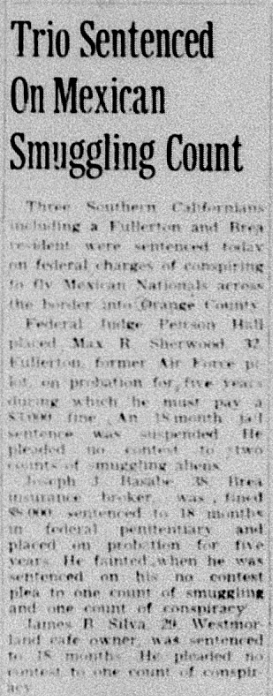
Most of the citrus workers were Mexican, many of whom were recruited to work in local fields by the Bracero Program. The large presence of of Mexicans in Fullerton was sometimes protested by white residents.
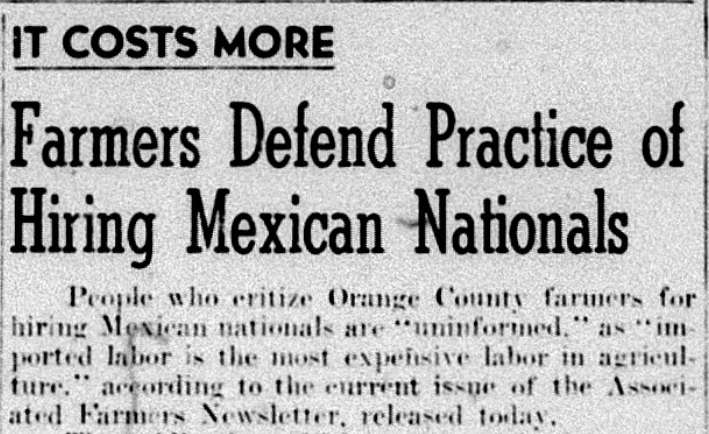
During the Bracero Program, some citrus growers sought to supplement their workforce with undocumented immigrants.
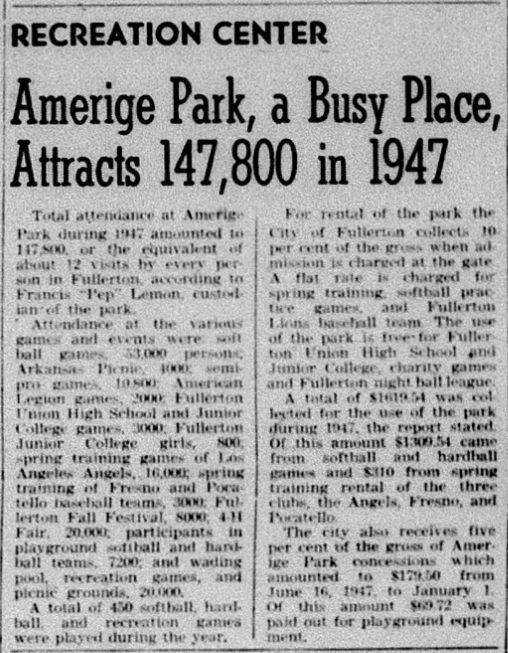
Sports
In sports news, local professional and amateur baseball teams played games at Amerige Park.
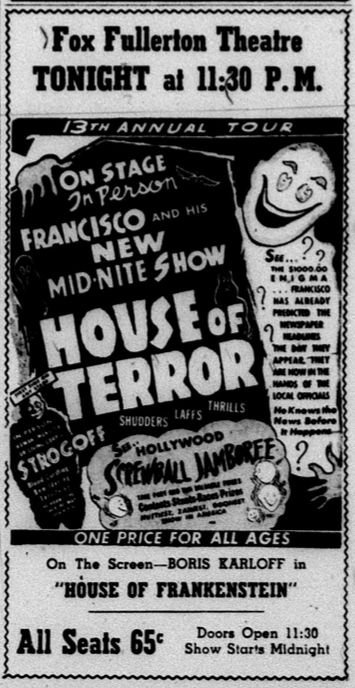
Culture and Entertainment
For culture and entertainment, Fullertonians went to movies at the Fox Theater and the newly-built Wilshire Theater.
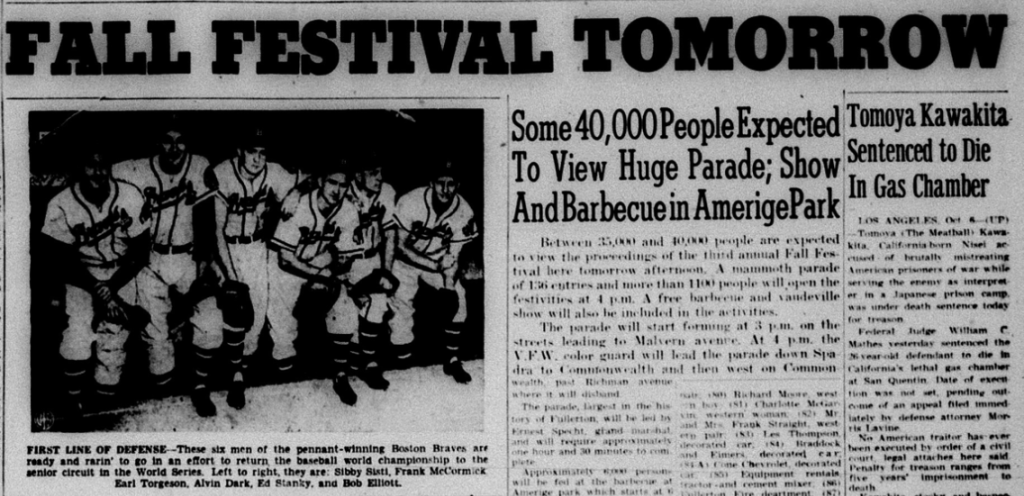
Fullerton also hosted a Fall Festival that drew thousands.
War Memorial
After voting down a bond measure to build a large War Memorial community center next to Amerige Park, Fullertonians decided to honor the war dead in a more modest gesture, a memorial listing the 54 names of those who died at Hillcrest Park, inscribed on a huge sequoia tree cross section.

Crime
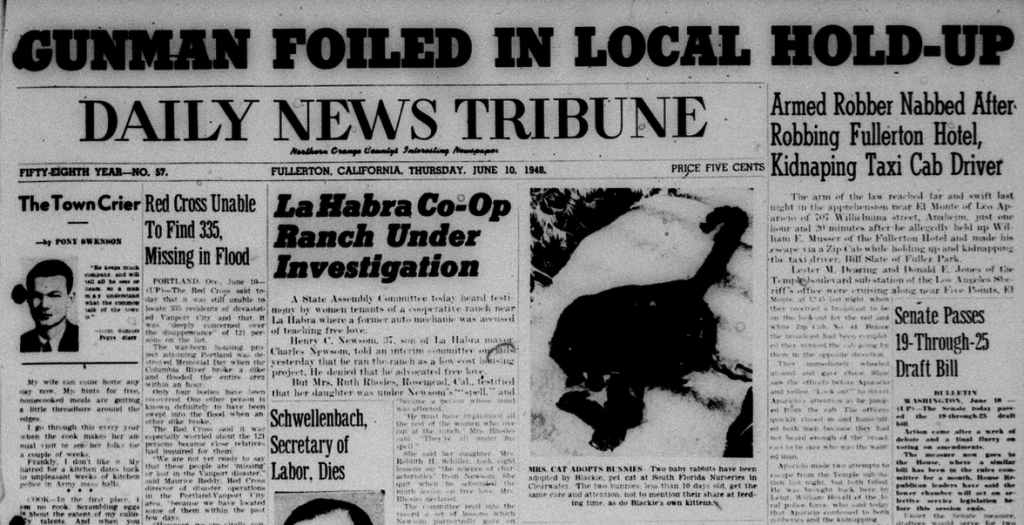
In crime news, a gunman was arrested following a holdup downtown.
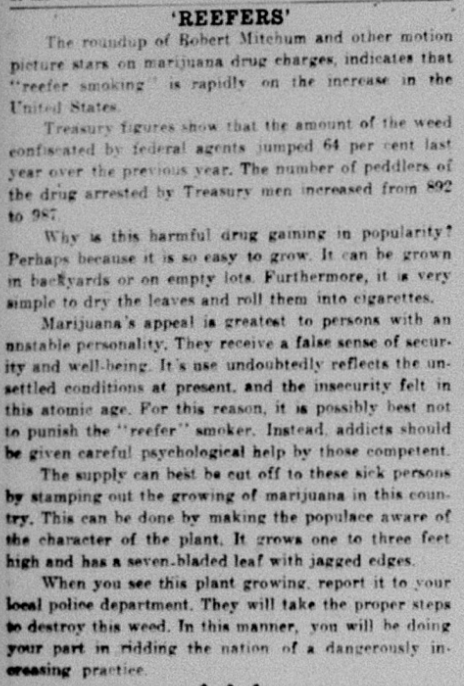
And a “new” drug called Marijuana (aka cannabis) was becoming popular.

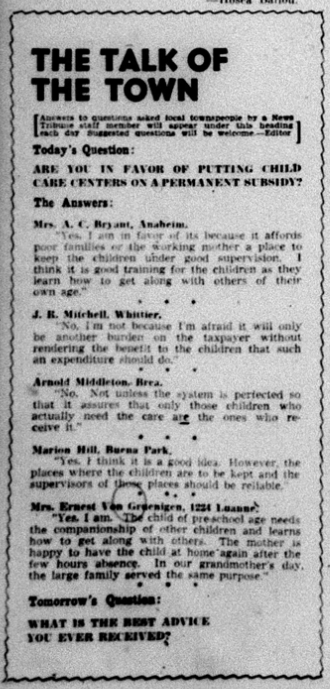
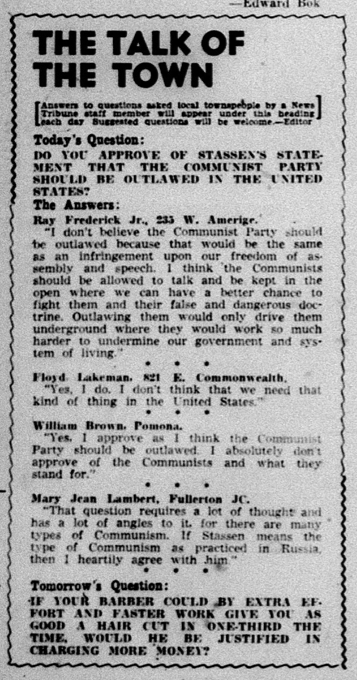
Talk of the Town
The Fullerton News-Tribune had a section called “Talk of the Town” in which local residents were asked to give their opinions on a variety of social issues. Here is a sampling:

Celebrating European Conquest
An annual event celebrating the expedition of Gaspar de Portola was held annually in Southern California.

“Entry of the first white man, Gaspar de Portola, into this area will be portrayed at a joint Anaheim-Fullerton ceremony to welcome 54 horsemen who are riding from San Diego to San Francisco along the same trail the famous Spaniard followed in 1760,” the News-Tribune reported.
Deaths
The following people died in 1948:
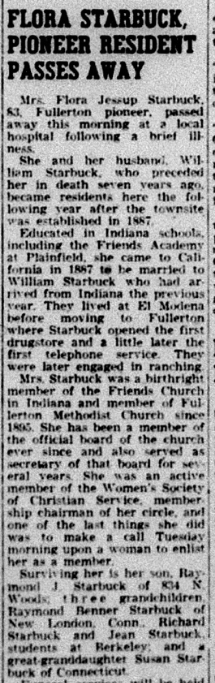
Flora Starbuck, wife of pioneer druggist William Starbuck.
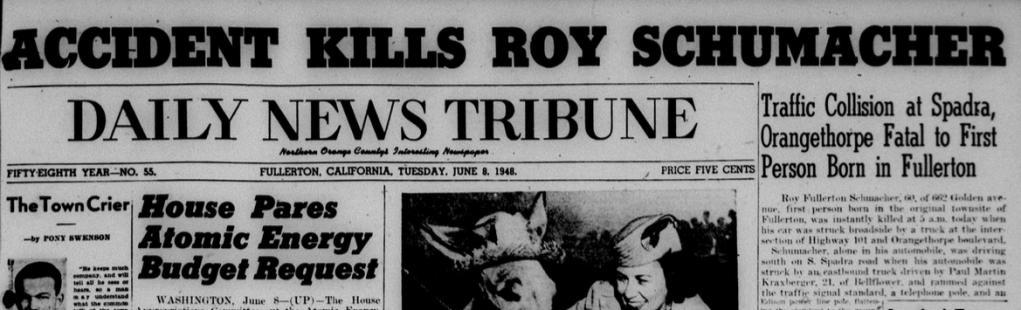
Roy Schumacher, the first child to be born in Fullerton.
Dr. George C. Clark, Fullerton’s first doctor.

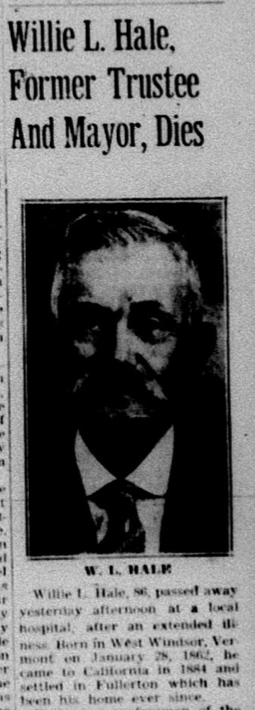
William Hale, early City Councilmember.
Stay tuned for more stories from 1949!
-
Fullerton in 1947
The following is from a work-in-progress about the history of Fullerton. You can support my ongoing research and writing on Patreon.
The Local History Room of the Fullerton Public Library has microfilm from the Fullerton Daily News-Tribune newspaper stretching back to 1893. I am in the process of reading over the microfilm, year by year, to get a sense of what was happening in the town over the years, and creating a mini archive. Below are some news stories from 1947.
In 1947, Fullerton celebrated its 60th anniversary.

But before getting into what was happening locally, here’s a bit of context about what was happening in the world in 1947, with clippings from the Fullerton Daily News-Tribune, and how these larger events trickled down to affect things here.
Rebuilding Europe
During World War II, much of Europe had been devastated by bombing and other forms of death and destruction. In 1947, the US was developing aid plans for European countries that would ultimately culminate in the 1948 Marshall Plan.

While beneficial to Europe, the Marshall Plan also helped to establish US economic and military hegemony after the war—with lots of US. bases around the world and trade deals that were favorable to the US. I’m currently reading an excellent book called How to Hide an Empire: A History of the Greater Untied States by Daniel Immerwahr, which goes into this in greater detail.
The increasingly globalized trade and US military presence after World War II would benefit a number of local companies, including Hughes Aircraft (which opened a plant in Fullerton in 1957 and was for a time the city’s largest employer).
The Military-Industrial Complex
World War II saw a massive mobilization and expansion of the American war industry. Thousands and thousands of airplanes, bombs, jeeps, tanks, ships, and more were built by private, for-profit companies, and paid for with American tax dollars. When the war ended, it seemed like the days of huge government contracts were over.
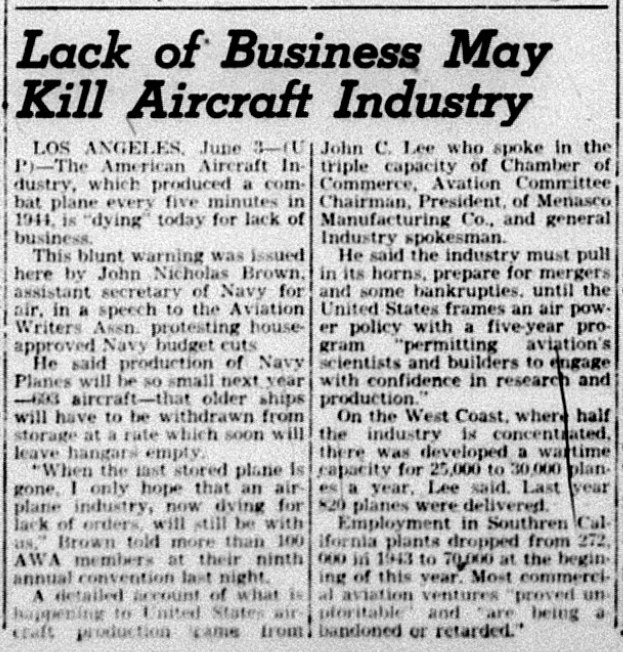
Thankfully, the escalating Cold War would allow these contracts to continue.
Industrialists Howard Hughes and Henry Kaiser were accused of using questionable means to acquire large government contracts.

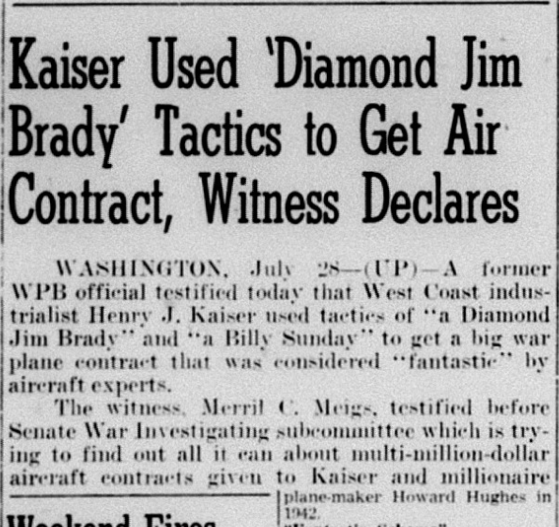
This cozy relationship between war profiteers and the government would be given a name by outgoing president Dwight D. Eisenhower…the military-industrial complex. In his farewell address, he said:
“We have been compelled to create a permanent armaments industry of vast proportions. . . . This conjunction of an immense military establishment and a large arms industry is new in the American experience. . . .Yet we must not fail to comprehend its grave implications. . . . In the councils of government, we must guard against the acquisition of unwarranted influence, whether sought or unsought, by the military-industrial complex. The potential for the disastrous rise of misplaced power exists and will persist.”
Red Scare
During World War II, Russia was a US ally. Without Stalin’s Red Army, Hitler might not have been defeated. Many more Russian troops died fighting Nazis on the eastern front than American troops on the western front.
After the war, relations between communist Russia and capitalist United States began to sour. The countries clashed in the United Nations, and on various foreign policy matters. These clashes would ultimately lead to the Cold War and a sometimes paranoid “anti-Communist” push both within the United States and in US foreign policy. This would culminate in the Truman Doctrine abroad and the Red Scare at home.

One of the folks who really fanned the anti-communist flames was FBI director J. Edgar Hoover.


Closer to home, there were hearings regarding so-called communists in Hollywood.
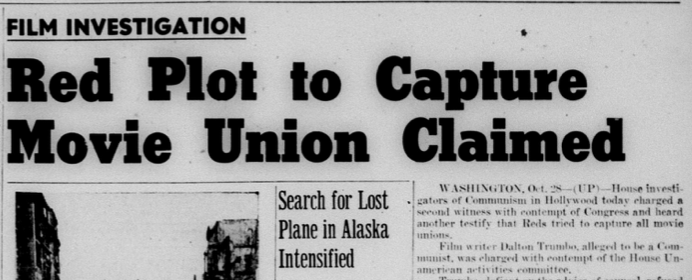
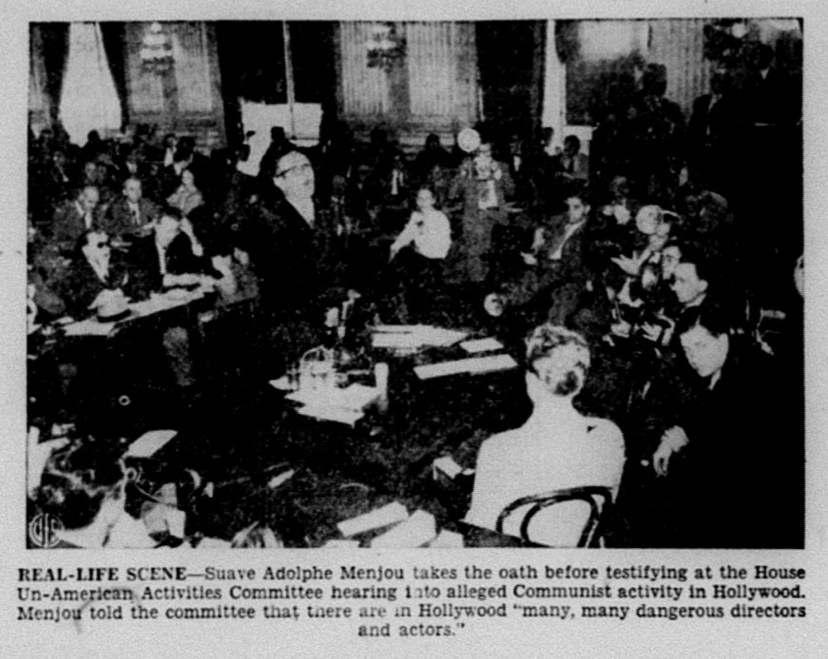
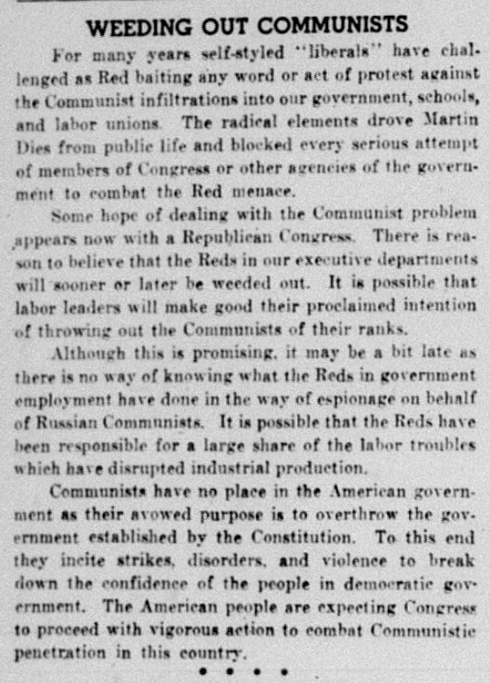
Fullertonians at this time, being a pretty conservative group, tended to fear communists. Here’s a little editorial by the editor of the Fullerton Daily News-Tribune published in 1947.
Also in the News…Palestine
After the war, nationalist movements in former European colonies led to independence in places like India. In 1947, the country that would become Israel was called Palestine and it was controlled by Britain in a quasi-colonial “mandate” system. At this time, the Zionist (nationalist) movement was in full force, trying to establish the state of Israel, which would be accomplished in 1948, at great cost to Arab Palestinians. In 1947, the British left the Palestine matter to the newly-formed United Nations, which created a Special Committee on Palestine.
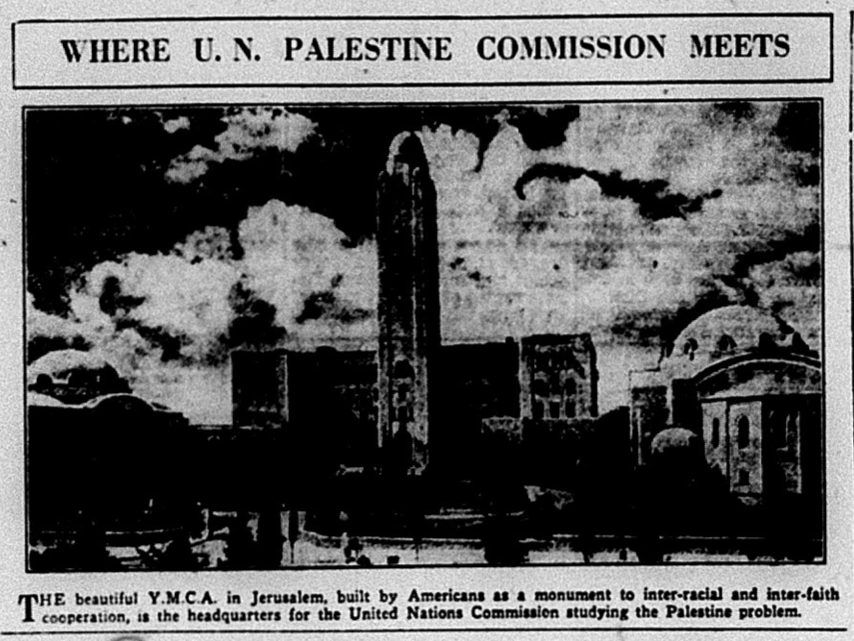
“In August 1947 the committee issued both a majority and a minority report. The majority report called for the termination of the mandate and the partition of Palestine between Arab and Jewish communities with the stipulation that the two communities be united in an economic union,” James L. Gelvin writes in The Israel Palestine Conflict: a History.
The US supported the partition plan, much to the chagrin of Palestinians, who were not keen on losing big swaths of their country.
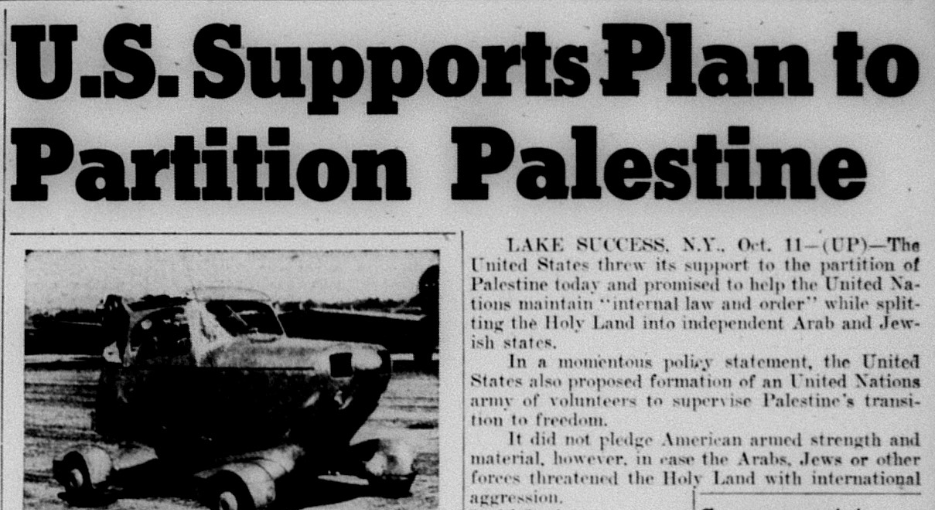
War was on the horizon. Stay tuned for more on this in my 1948 post. In the meantime, check out my brief history of the Israel-Palestine conflict HERE.
Housing
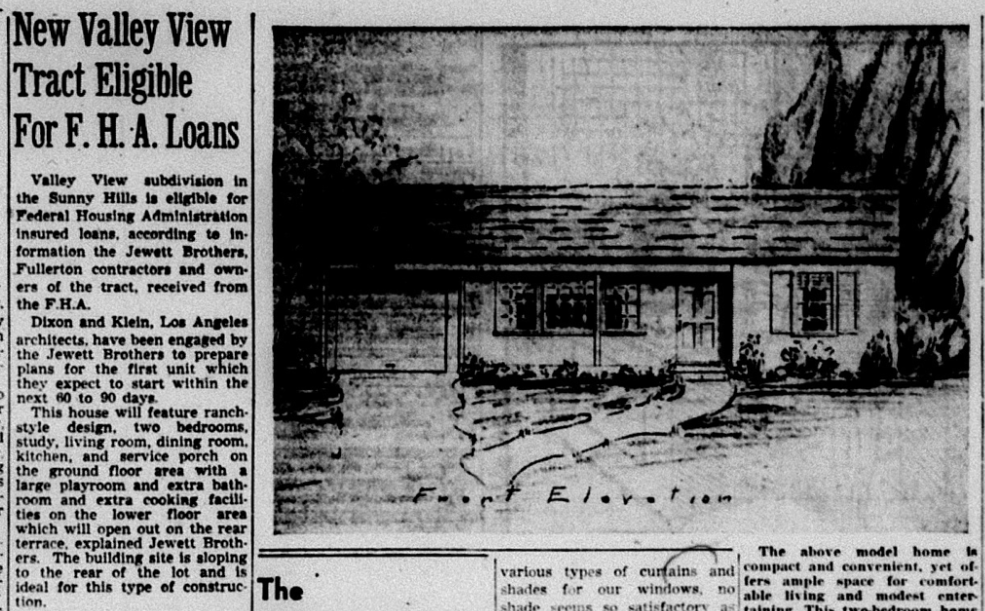
I recently posted a report on the book Fullerton: The Boom Years, which is about the City’s extraordinary growth after World War II. That book details how, after the war, orange groves were replaced by new housing subdivisions, schools, shopping centers, and industry.

Culture and Entertainment
For culture and entertainment, Fullertonians went to movies at the Fox Theater.

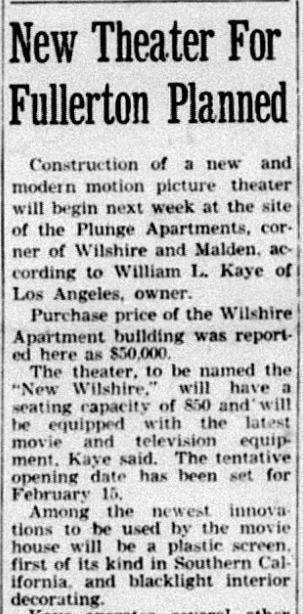
And a new theater was built—the Wilshire Theater, which has its own interesting history. This eventually was replaced by apartments.
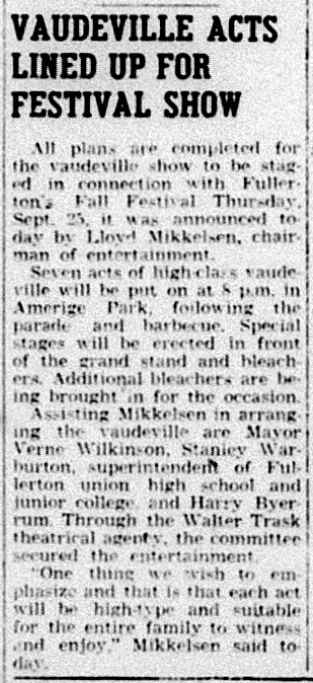
Fullerton celebrated a Fall Festival, which drew thousands.

Leo Fender, who had a popular radio repair shop in town, was beginning to design and manufacture electric Fender guitars, although his ads in the local newspaper focused on radios and records.

Sports
In the 1940s, Major League Baseball teams would sometimes play games at Amerige Park in Fullerton, drawing huge crowds.


Infrastructure
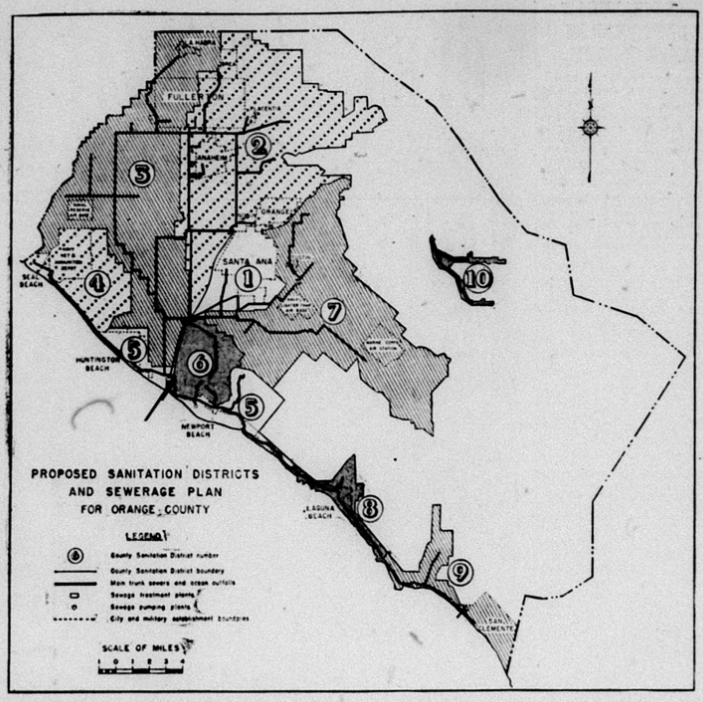
As Southern California grew after the War, new infrastructure was needed, including increased sewer capacity.
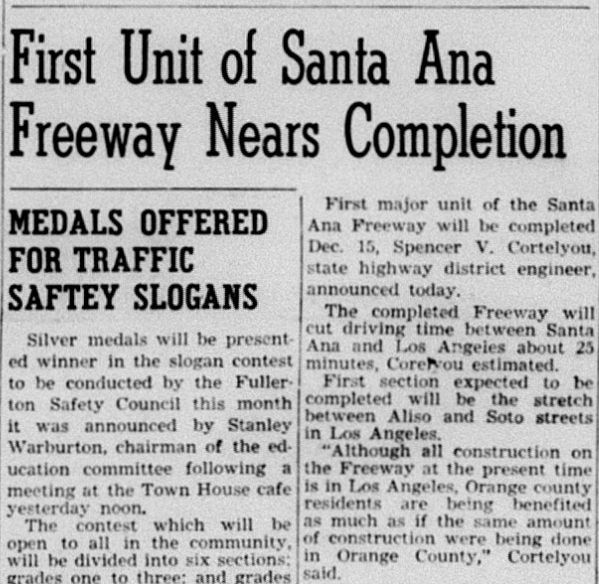
And something new was born after the War which would become an iconic part of the Southern California landscape—freeways!
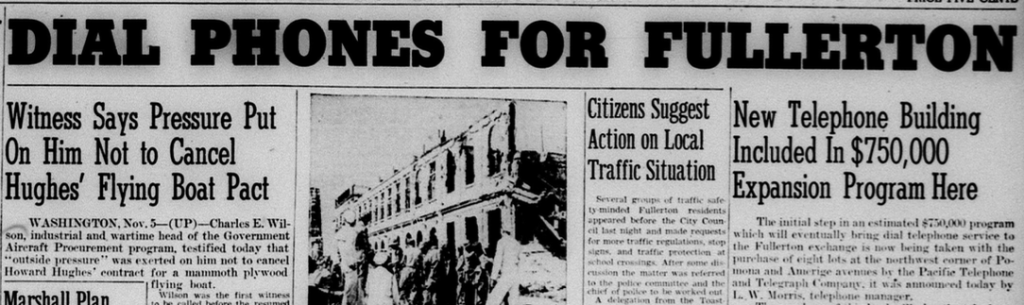
Technological advancement saw old “crank” telephones replaced by dial phones.
Politics
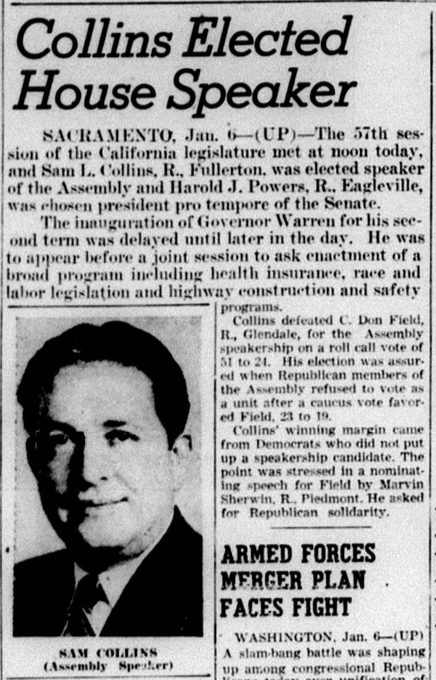
Sam Collins (from Fullerton) was chosen to be Speaker of the California State Assembly. Collins was a very influential politician in Sacramento. He remains the longest-serving Republican Speaker in history.
Fullerton Gets National Guard Armory
A National Guard Armory was established in Fullerton in 1947. Eventually, this building would be used as a cold-weather shelter for the homeless.

Flying Saucers!
1947 was the year of the famous Roswell Incident in New Mexico. It turns out that there were many flying saucer sightings that year.

Deaths
Fullerton co-founder George Amerige died.

Local pioneer Edmund Beasley also died.

The bodies of some soldiers killed in the War were returned home to be buried in Fullerton.

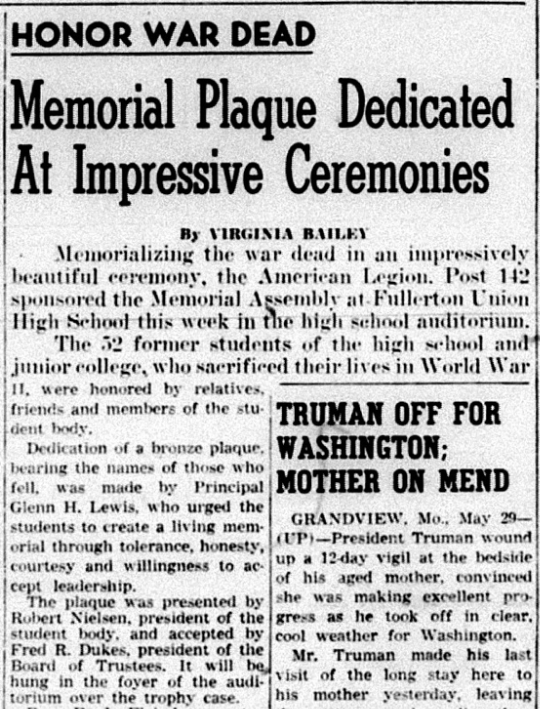
A memorial plaque, honoring former students who died in the War, was dedicated in the high school auditorium.
Stay tuned for top stories from 1948!
-
Fullerton: The Boom Years (a book report)

The following is from a work-in-progress about the history of Fullerton. You can support my ongoing research and writing on Patreon.
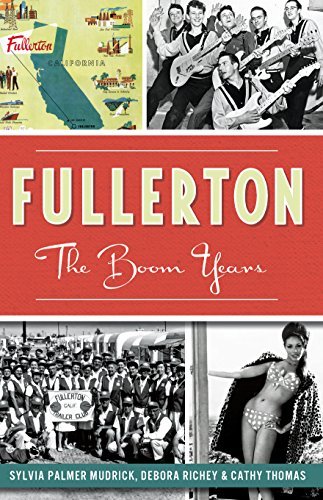
As part of my research into Fullerton history, I’ve just finished reading an excellent book called Fullerton: The Boom Years by Sylvia Palmer Mudrick, Debora Richey, and Cathy Thomas. The book vividly chronicles Fullerton’s extraordinary growth after World War II, as orange groves gave way to housing subdivisions, shopping centers, schools, and industry.
I present here a book report on some interesting things I learned.
Like much of Southern California, Fullerton experienced rapid growth and development after World War II. The population grew from 10,442 in 1940 to 85,987 in 1970.
Housing
Housing restrictions and shortages created by the Great Depression and the War led to a massive pent-up demand. And after the War, the floodgates opened.
Thanks to the GI Bill, returning servicemen were able to purchase affordable homes and pursue nearly free higher education. Housing developers couldn’t keep up with demand, but they sure tried. Development after development replaced orange and lemon groves.
Photo shows orange groves juxtaposed with industry (Kohlenberger Engineering) and housing subdivisions (1948). Photo courtesy of the Fullerton Public Library Local History Room. “By August 1955, twenty-seven homes were being added to the city’s residential neighborhoods each weekday,” the authors write. “In 1955 alone, the city approved fifty-five new tracts for a total of 3,910 lots.”
Many of Fullerton’s older housing subdivisions (those built in the 1920s and 1930s) had racially restrictive covenants that barred nonwhites from occupying or owning property. This is what created segregated neighborhoods—with Mexicans and African-Americans unable to buy or rent homes outside carefully proscribed neighborhoods.
But in 1943, Fullerton resident Alex Bernal successfully challenged these racial housing covenants. When he and his wife bought a small home at 200 East Ash Avenue with a restrictive covenant, fifty white neighbors signed a petition asking Bernals to move. When that didn’t work, they filed an injunction against the Bernals.
The case went to trial, and the Bernals won, with Judge Albert R. Ross ruling that the Bernals could stay in their home. Doss et al v. Bernal was one of the earliest legal victories against racial housing covenants in the nation.
Although this type of housing discrimination became nationally illegal in 1948, it didn’t totally end, as is chronicled in the book A Different Shade or Orange: Voices of Orange County, California Black Pioneers.
Education
With the housing and population boom came the need for new schools to accommodate the children of the “Baby boom.”
“From January 1951 to January 1961 alone, three hundred new elementary school classrooms were added as the student population rose from 1,969 to 11,626,” the authors write. “From 1949 to 1966, the Fullerton Elementary School District constructed almost one school per year.”
Between 1945 and 1970 the Elementary School District grew from four to twenty-one schools.
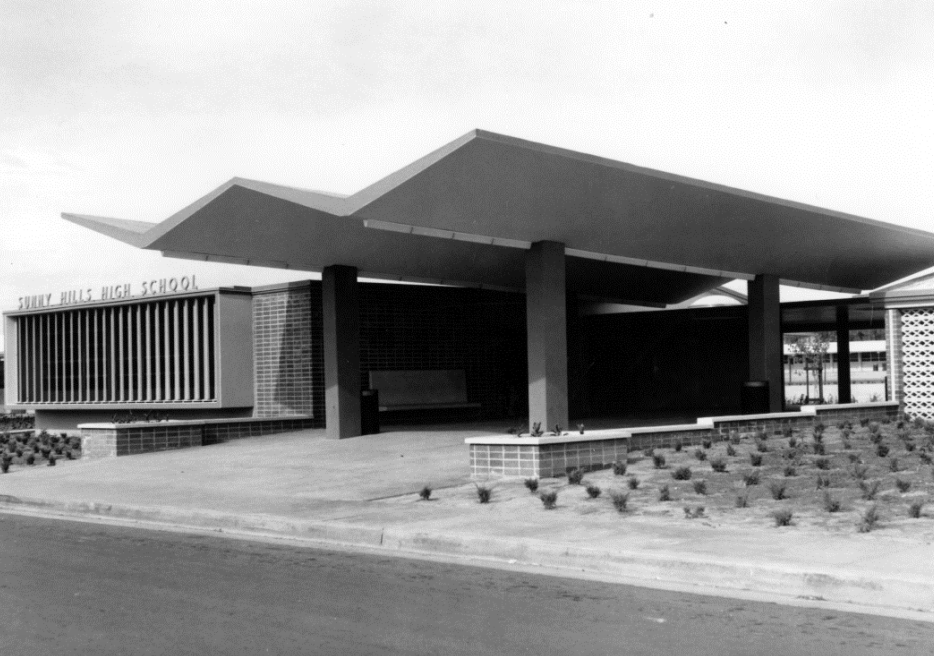
Sunny Hills High School (1960). Photo courtesy of the Fullerton Public Library Local History Room. The only remaining pre-war schools in Fullerton are Maple School, Fullerton Union High School, and Fullerton College. Every other school in Fullerton that exists today was build after World War II. And each of these older schools was significantly expanded after the war.
CSUF opened in 1959 on over 200 acres of former orange groves in east Fullerton, and eventually expanded into the massive campus it is today—one of the largest in the CSU system.
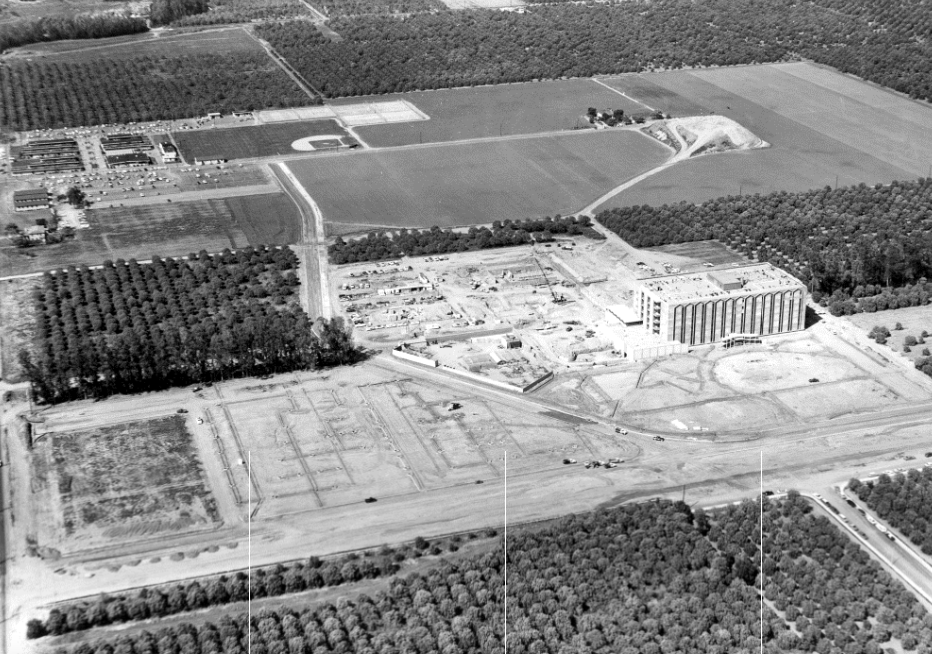
CSUF in 1963. Photo courtesy of the Fullerton Public Library Local History Room. The GI Bill and the Master Plan for Higher Education in California made college nearly tuition free during the 1960s and 70s.
The end of World War II brought the Cold War, as tensions mounted between the U.S. and the Soviet Union. The fear of communism led to “Red Scare” policies like school teachers and administrators having to sign loyalty oaths and schoolchildren doing “Duck and Cover” drills, as if getting under a desk would save someone from a nuclear blast.
The local newspaper ran a five-part series on “Survival under Atomic Attack.” Bomb shelters were built, and thousands of pounds of survival supplies were hidden in the tunnels under Fullerton High School.
Protest and Change
Although Fullerton was a pretty conservative place, the Civil Rights and Anti-War movements of the 1960s and 70s still had an impact here, mostly on the campuses of Fullerton College and CSUF, and at Hillcrest Park.
In the late 60s and early 70s, students would often gather at the Hillcrest Park “bowl” on Sundays “to protest the war, make speeches, and play rock music,” often to the chagrin of the residents who lived near the park.
In May 1969, following residents’ complaints, police moved in to clear the park of “approximately 300 rock and bottle-throwing students,” the authors write. “A total of twenty-two arrests were made, and two officers were injured. In a later incident, rioting crowds armed with rocks and bottles attacked officers attempting to close the park…As a result of that incident, the city council, at the urging or Chief Bornhoft and Parks and Recreation Director Jim Cowie, voted to close Hillcrest Park on Sundays.”
Following this, the local chapter of the Students for a Democratic Society (SDS) organized a protest at Amerige Park and city hall.
“Protests—led by a group of Fullerton College students that called itself the Hillcrest Liberation Front—continued at various spots around the city through the remainder of 1969 and into 1970. After several months, the council temporarily lifted the ban, and on April 25, 1971, a rock concert attended by an estimated 2,500 people was held in the Hillcrest Park bowl. Eleven arrests were made for primarily drug-related offenses, but officers deemed the event mostly peaceful.”
A visit from conservative governor Ronald Reagan to CSUF in 1970 sparked months of protests and even the occupation of at least one building on campus.
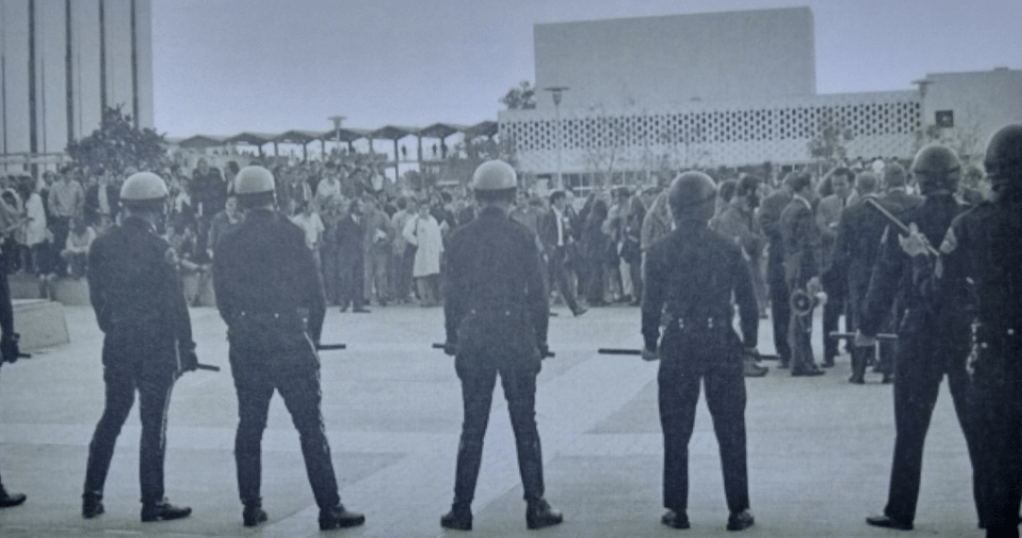
Students stand off with Fullerton police at CSUF (1970). Photo courtesy of the Fullerton Public Library Local History Room. “The usually quiet commuter campus became the site of mass unrest and violent events that continued throughout the spring semester in, with protesters occupying the administrative wing of the Letters and Science Building,” the authors write.
In 1972, antiwar activist Ron Kovic led local students on a protest march to the corporate offices of Honeywell Inc, a defense contractor.
That same year, the local school board voted to close Maple school because it was determined to be a segregated school. Read more about that story HERE.
Business and Industry
Although the postwar years saw the gradual decline of the once-sprawling orange groves, the citrus industry still remained through the 1960s, and workers were still needed for the harvests. The Bracero Program brought thousands of Mexican workers north to work the fields of California.
As had happened a few times throughout its history, white residents opposed the construction of housing for the Mexican workers in Fullerton. In the early 1950s, a proposed citrus labor camp in southeast Fullerton led to a recall campaign against the council members who supported it. Although the recall ultimately failed, it highlighted lingering and widespread prejudice against Mexicans.
Some of the larger industrial businesses that built plants in Fullerton in the postwar years included: Beckman Instruments, Kimberly-Clark, Sylvania Electrical Products, and Hughes Aircraft.
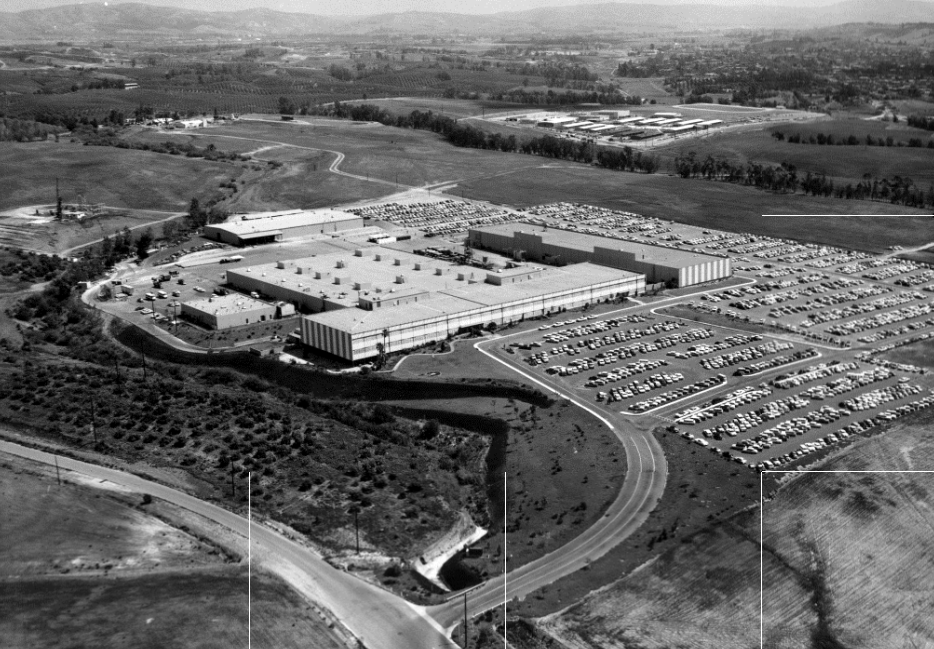
Hughes site in 1964. Photo courtesy of the Fullerton Public Library Local History Room. 
Beckman Instruments, 1950s. Photo courtesy of the Fullerton Public Library Local History Room. Some businesses that existed before the war (like Kohlenberger Engineering, Pacific Hawaiian Products, Hunt Foods and Industries, and Fender Musical Instruments) saw major expansion of their facilities.
But industry had a dark side, too.
“While the air and space industry and other manufacturing industries were a driving force in the extraordinary postwar economic expansion of Fullerton, these companies left the city with a legacy of pollution, including the contamination of groundwater with toxic chemicals, heavy metals and persistent carcinogens, as well as soil degradation,” the authors write.
One of the more egregious polluters in Fullerton was Raybestos-Manhattan Inc., which at one time was the second-largest manufacturer of asbestos-containing products in the US.
Another source of pollution was the McColl dump site, a 22-acre site next to what is now Ralph Clark Park, which was used for disposal of refinery waste during and after World War II. In 1982, after residents complained of odors and health problems, the EPA placed McColl on its superfund list, and some remediation steps eventually taken (it was “capped”).
On the retail front, the postwar years saw the introduction of more “big box” department stores like Montgomery Ward, JCPenney, and Sears, which tended to have a negative impact on the smaller “mom and pop” stores downtown.
In 1958, the Orangefair Shopping Center opened at the southeast corner of Harbor Boulevard and Orangethorpe.
Postwar prosperity also saw an increase in leisure-oriented businesses like Carter Bowl, Merilark Roller Rink, Cinderella Dance Studio, the Checkered Flag Mini-Raceway, and golf courses.
Local cocktail lounges included the Melody Inn, Happy Chaps Bar, 2J’s, and The Mill.
Politics and Government
For much of Fullerton’s history, its elected city council members were conservative white males. In fact, every city council member from 1904 (when the city was incorporated) to 1970 was a white male. Click HERE for a full list.

New Fullerton City Hall (1963). Photo courtesy of the Fullerton Public Library Local History Room. But the civil rights and women’s movements brought an increased push for diversity. The first female council member and mayor was Frances Wood (elected in 1970). The first person of color on the city council was Louis Velasquez (elected in 1976).
Arts and Culture
The Boom Years gives mini-profiles of a number of notable people who came to prominence in the arts after World War II. Here are some of them. Click their names to read more.
Ruby Berkeley Goodwin (author).
Ethel Jacobsen (poet).
Philip K. Dick (science fiction writer).
Betty Lou Nichols (ceramic artist).
Lewis Sorensen (dollmaker).
Florence Millner Arnold (artist).
The Hunt Branch Library, a gift of Norton Simon’s Hunt Foods and Industries Foundation, opened in 1962. It was designed by renowned architect William L. Pereira.
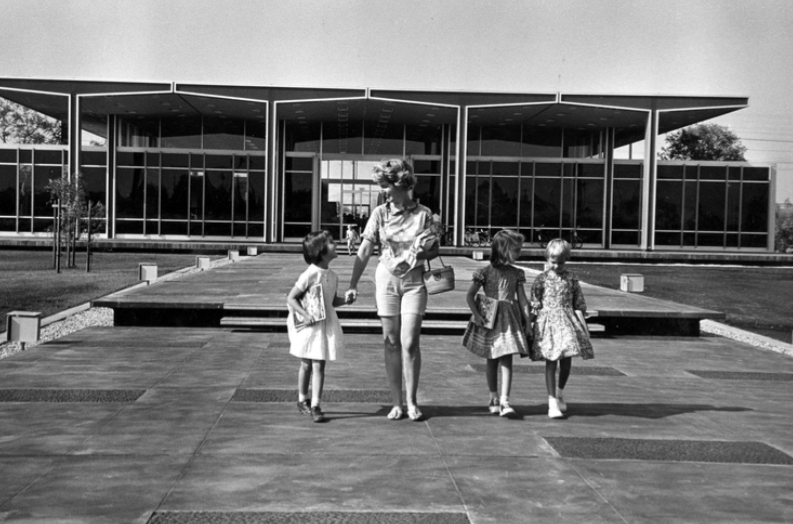
Hunt Branch Library, 1960s. “Perhaps one of the city’s greatest missed opportunities occurred in 1964, when the Hunt Foods and Industries Foundation, a project of millionaire industrialist and philanthropist Norton Simon, announced that it was willing to donate $500,000 to the city for construction of a museum to house Simon’s renowned art collection,” the authors write. “however, negotiations with the city fell through.” Simon took his collection to Pasadena, opening the Norton Simon museum there in 1972.
Fullerton’s contributions to post-war popular music include Fender Guitars, the Rhythm Room (a popular spot for Chicano rock bands), and (a bit later) significant early punk bands like Social Distortion and the Adolescents.
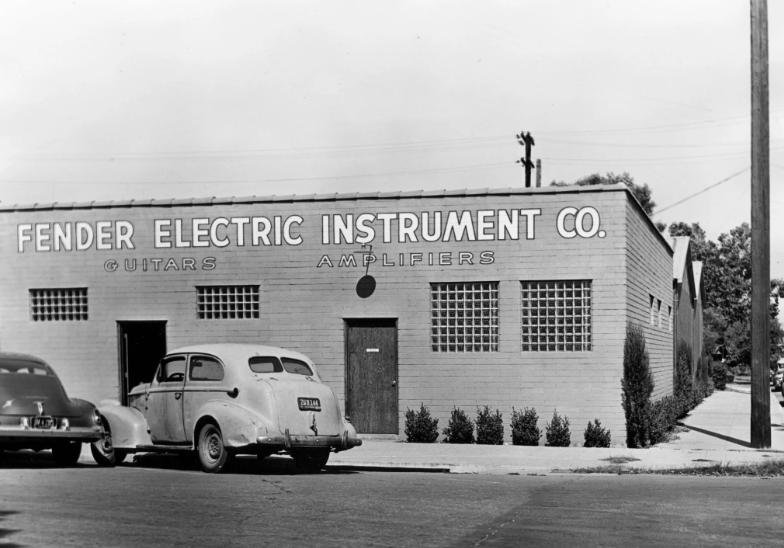
Fender Electric Instrument Co., circa 1950. Photo courtesy of the Fullerton Public Library Local History Room. Interestingly, the punks of the late 1970s and early 1980s were often rebelling against the clean-cut suburban landscapes their parents had created and enjoyed.
Other Notable Events
1949: Local pilots Bill Harris and Dick Riedel set a world endurance flight record in their airplane Sunkist Lady.
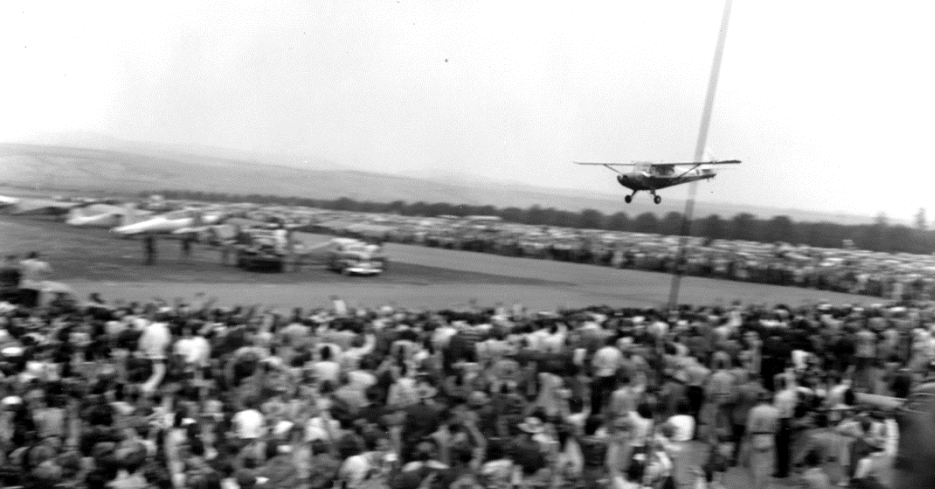
Sunkist Lady at Fullerton Airport (1949). Photo courtesy of the Fullerton Public Library Local History Room. 1950: A fire destroyed a large portion of the 100 block of West Commonwealth, including the McCoy and Mills car lot.
1957: St. Jude Hospital opened.
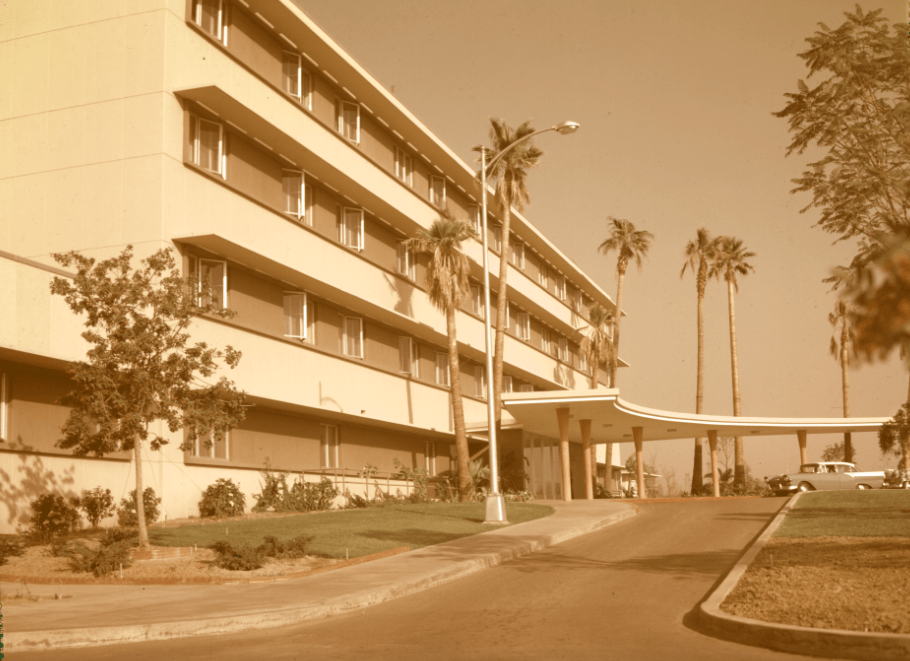
St. Jude Hospital, 1960s. Photo courtesy of the Fullerton Public Library Local History Room. 1963: A new City Hall opened.
1973: A new Public Library opened.
You can purchase a copy of Fullerton: The Boom Years HERE.
-
Fullerton in 1946
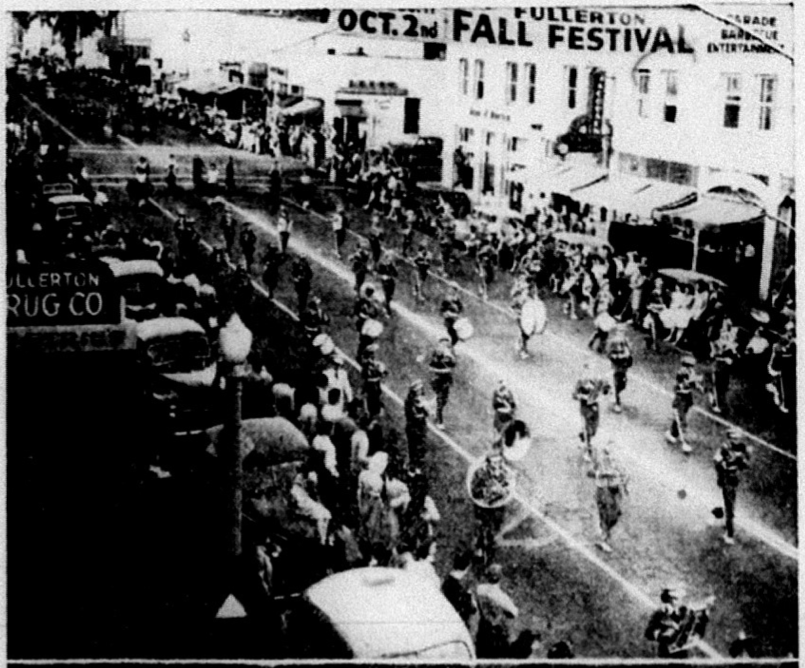
The following is from a work-in-progress about the history of Fullerton. You can support my ongoing research and writing on Patreon.
Post-War International News
World War II had ended the previous year, and the first frosts of the Cold War were being felt between the capitalist west and large communist countries like Russia and (eventually) China, despite the fact that these were our allies during the War. The existence of the atomic bomb, and Russia’s attempts to create one for itself, exacerbated these tensions.
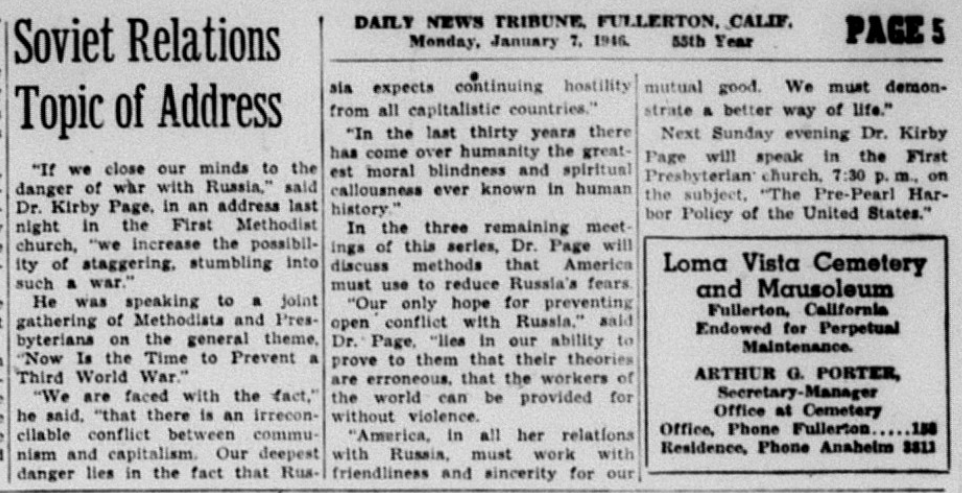
This tension between the US and Russia would also spark increased espionage and paranoia which in the US would eventually become the Red Scare.

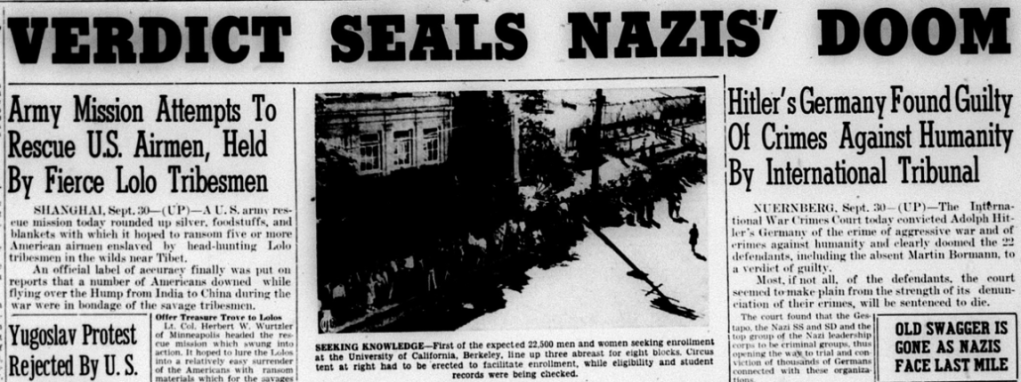
Defeated Axis powers Germany and Japan were occupied by Allied powers to ensure they would demilitarize and follow the political path the Allies wanted them to follow.

Both German and Japanese war criminals were tried and executed.
Just as World War I caused the end of old empires like the Ottoman Empire, the end of World War II brought about the beginning of decolonization of European empires like the British and Spanish. India, a former British colony, would achieve independence in 1947.
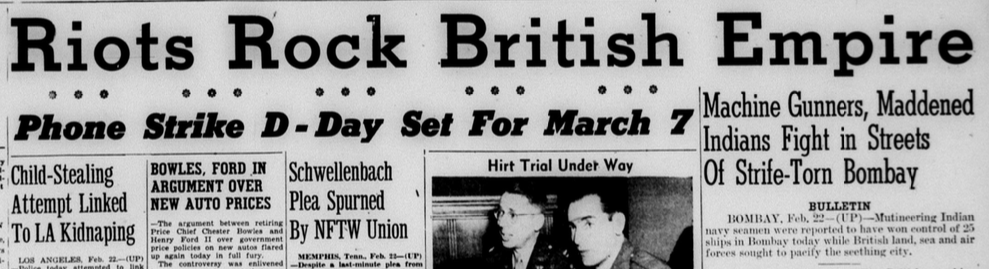
Conflict over the Holy Land would result in outright war between Israel (which would become a state in 1948) and Palestine. Also, the British were still present there, as a legacy of colonialism.

Fascism was not totally defeated in World War II. In Spain, Francisco Franco’s authoritarian regime would continue for decades.
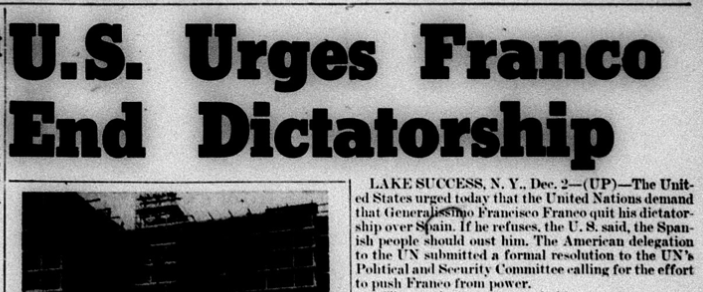
Here, President Truman states the American post-war position.

Veterans Issues
Having won the war, American soldiers were eager to return home and resume their civilian lives. Many GIs protested delays in their discharge as the US was hesitant to remove occupation forces in places like Germany and Japan.

While European colonial empires were losing some of their power and global reach, the post World War II era saw a rise in the United States’ international military and economic presence around the world. This did not usually take the form of overt colonization (which was becoming out of fashion), but rather took the form of military bases, plus increased US business and political presence globally. Some might call this a new kind of empire.
For those thousands of GIs who were eventually discharged, a new problem emerged—a housing crisis. There was not enough housing for all the vets, and it much of it was too expensive. Both federal and local governments responded by building lots of new housing and establishing programs like the GI Bill that made is affordable for vets to get home loans and go back to college.
Here in Fullerton, homebuilding increased dramatically after the war, and some of the new homes were explicitly for veterans, such as the 25-unit College View adjacent to Fullerton College.
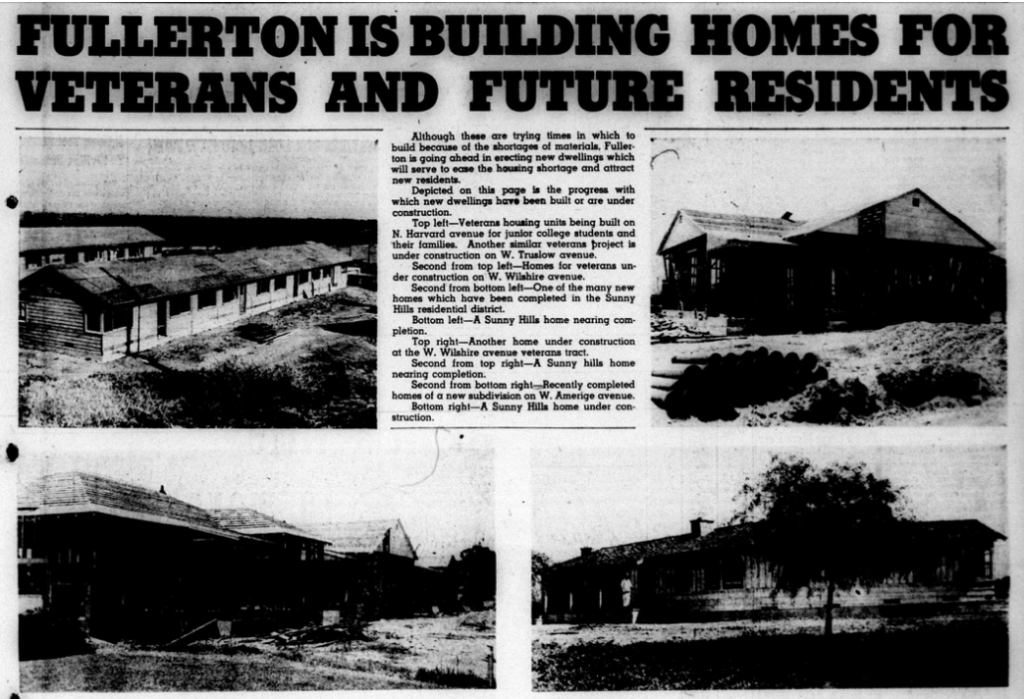
Because housing production and affordability was a national and local priority, both federal and state governments had some form of rent control.


Both veterans and those who died in the War were honored with memorials. The Isaac Walton League planted a number of redwood trees as a “Living Memorial.”
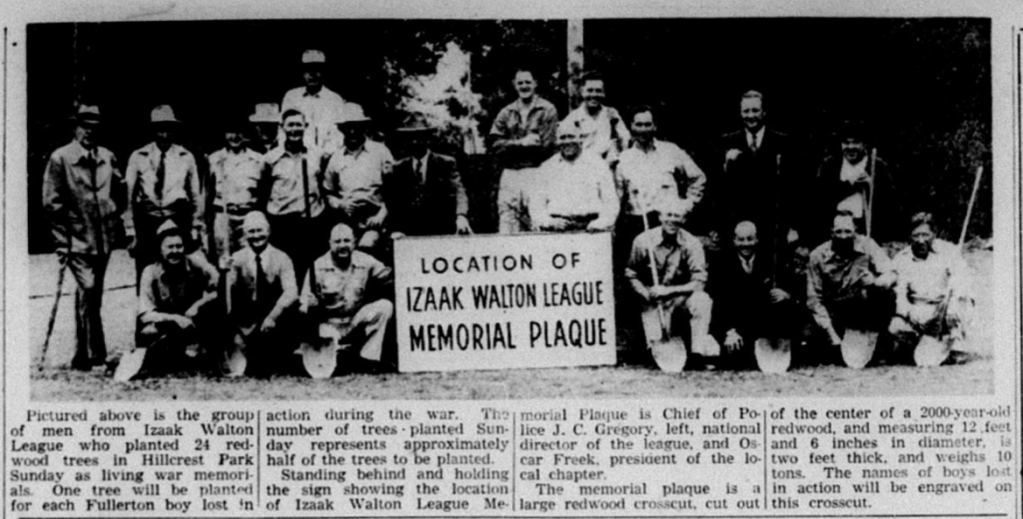

The Boom Years
The post-war period has been rightly called the “Boom Years.” Fullerton grew quickly. It was a perfect location to build a suburban middle class lifestyle. By 1946, Fullerton’s population was a little over 12,000, with room to grow.
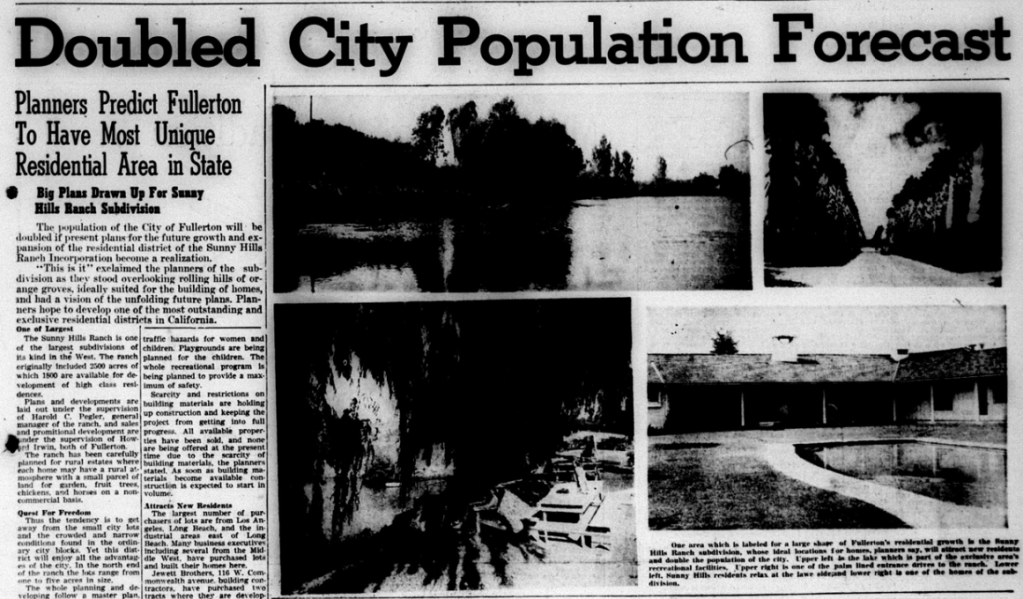

“Large, previously undeveloped areas are being subdivided and plans call for the erection of houses at the rate of city blocks at a time. In addition to lesser buildings programs on W. Wilshire and W. Amerige avenues, Jewett Brothers are preparing a tract on N. Basque ave for construction of 78 homes for sale to war veterans,” the News-Tribune reported. “In the northern hills of Fullerton is one of the largest subdivisions of its kind in the entire west. Eighteen hundred acres of the Sunny Hills Ranch in this are area available for development of residences. According to planners of this subdivision of rolling hills and orange groves, it will make up one of the most exclusive residential areas in California and will attract new citizens to the extent of doubling the population of the city of Fullerton.”
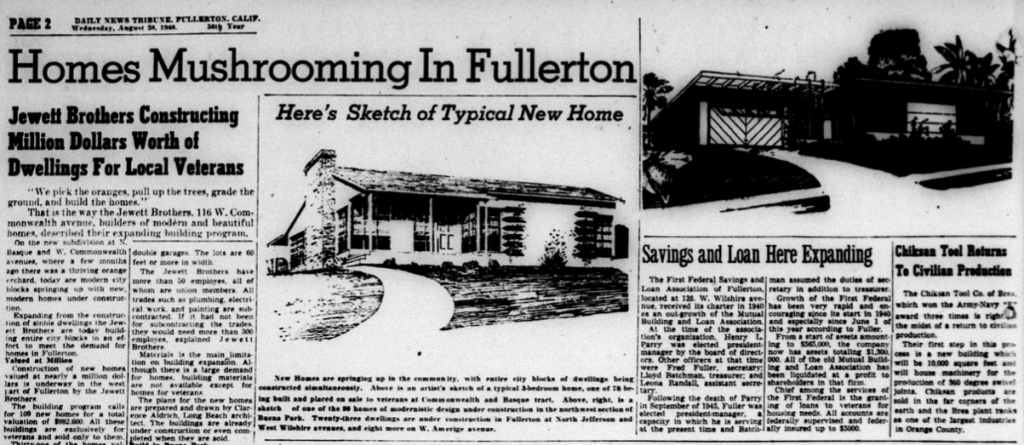
To accommodate this growth, the city also spent a lot of money expanding the city’s infrastructure, including roads and sewers.

“Most outstanding of city projects to be undertaken is street development, calling for an expenditure of nearly $1,000,000 within the next 10 years,” the News-Tribune states. “Under the program being considered the city will build new streets, widen, resurface, and improve existing arterials.”
Plans were drawn up for a large recreation complex next to Amerige Park (where the Community Center is today), although it appears these plans never materialized.
In addition to lots of new homes, Fullerton was also expanding its industrial base, with growing manufacturing firms here like Kohlenberger Engineering, Pacific Citrus Products (which made Hawaiian Punch!), and Hunt Brothers.
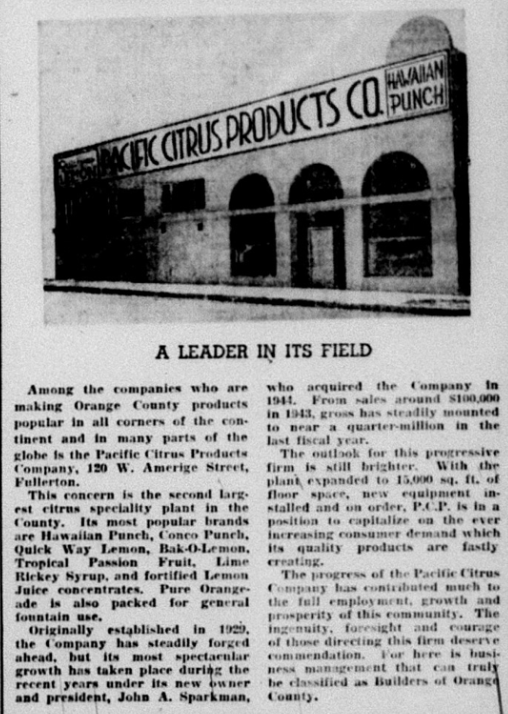
While large swaths of former orange groves were being removed to make way for buildings, the citrus industry was still a notable presence in Fullerton, and would remain so through the 1960s.

One problem of growth was the need to acquire more water. Stay tuned for more on this.
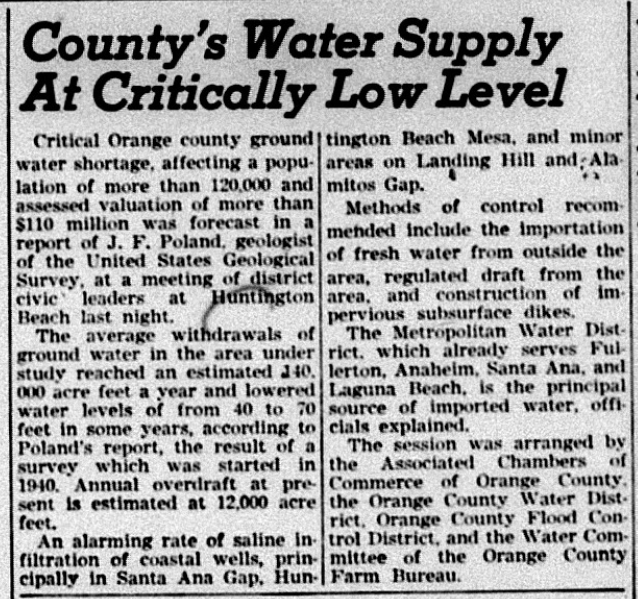
Fullerton’s health care needs were outgrowing its old hospital, and so the Sister’s of St. Joseph proposed construction of a new, larger hospital near Fullerton College.

However, the NIMBY forces were strong, and some nearby property owners objected to the proposed hospital location.

Eventually, City Council approved an alternate location for the hospital. Stay tuned for more on this.
In transportation news, City Council approved parking meters downtown.

Labor Strikes
The immediate post-war years (1945-46) saw a massive wave of labor strikes rock the country, sometimes shutting down entire industries, prompting government intervention, and occasional rioting.
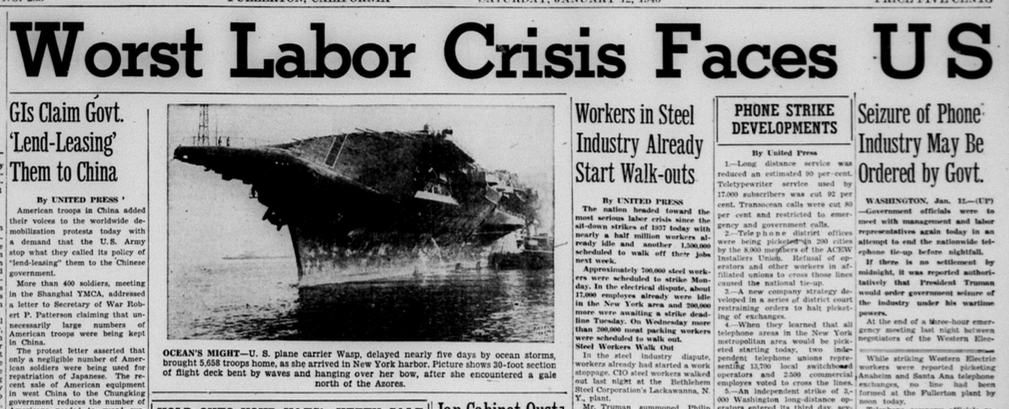
Industries that saw large-scale strikes included railroads, coal, steel, meat, postal workers, and more.
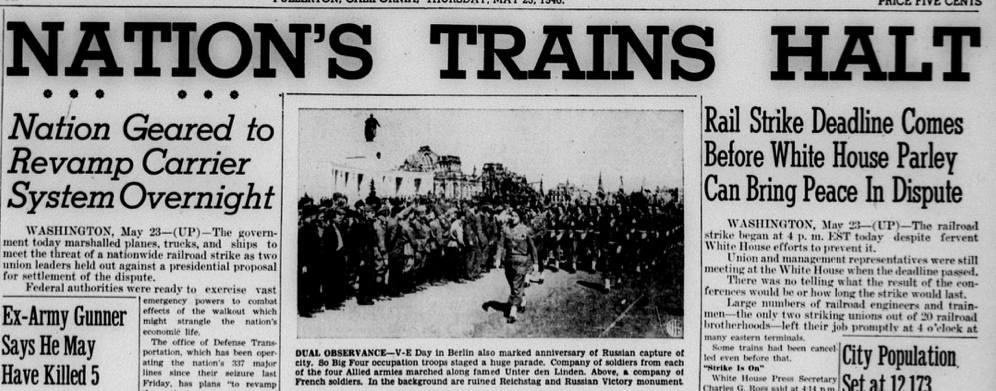
Both the Fullerton News-Tribune and local business elites tended to portray strikers negatively, sometimes associating strikers or unions with communism.

Powerful business interests, like the Associated Farmers and and Employers Industrial Relations Council, who had spent the depression colluding with government to suppress strikes and labor movements, did their part to paint the strikers as dangerous, lawless radicals and communists.

The labor troubles reached Fullerton, with over 400 workers at Hunt Bros. going on strike.

The strikes affected Fullerton in other ways by (briefly) stopping the postal service, travel, and shipping of goods.
“The processing of oranges in Fullerton has been stopped at some plants and greatly retarded in others due to the railroad strike,” the News-Tribune reported. “The California Fruit Distributors have stopped picking and packing until arrangement can be made to receive oranges in trucks…There is not much danger of losing the crop as the oranges are not too ripe yet.”
The strikes affected peoples’ ability to buy certain foods, like meat.

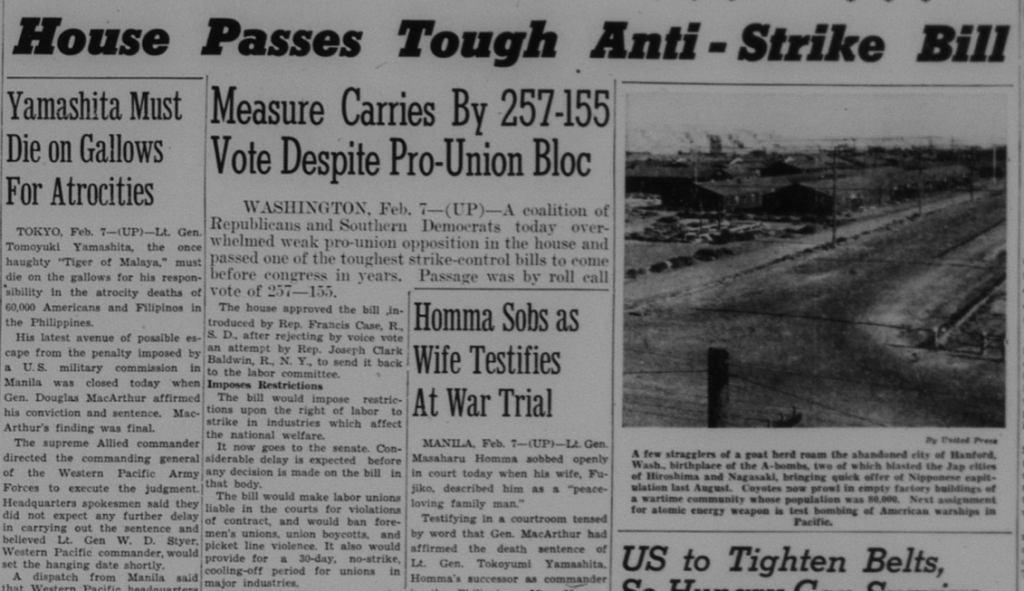
In response, congress passed a “tough” anti-strike bill, the Taft-Hartley Act.
Civil Rights
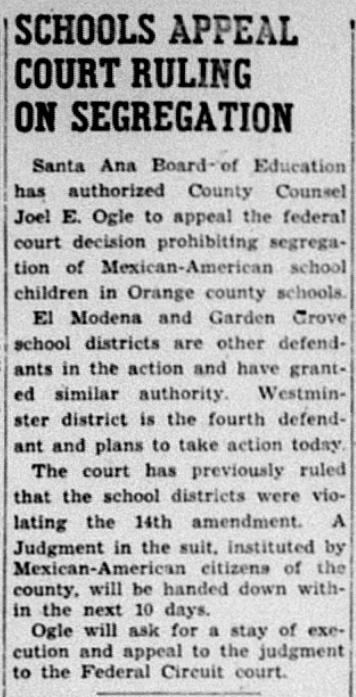
Speaking of constitutionality, a very important civil rights case was playing out in 1946—Mendez et al v. Westminster—in which a group of Mexican American parents sued a local school district for segregating Mexicans and whites. The case was an important local step in ending school segregation.

A recent census showed that, while Fullerton’s population was 12,173, there were only 96 Black people living in the city. Orange County has historically had a very low Black population due to housing (and other forms of) discrimination.
In a student essay, African-American student Robert Goodwin (son of famous Fullerton author Ruby Berkeley Goodwin), described the specific type of housing discrimination Black people faced in Fullerton at this time:
“Many people in Fullerton do not know that there are only certain sections where Negroes and Mexicans can live. This is due to the fact that years ago when Fullerton was first being settled, real estate men found out that they got lower prices for the property where Mexicans lived; so they enacted a law called the Restrictive Covenant. This forced the Negroes and Mexicans into one small section. This condition has caused many deaths in Fullerton because it forces large and small families to live in houses that are run down, badly roofed, and badly lighted. Such conditions are play grounds for Tuburculosis and other diseases.
“At present we have two drives on. One is to feed the starving children of the world and the other is to clothe and house them. We are taught that “Charity begins at home.” Such should be the case in Fullerton. “Restrictive Covenants” have been in effect too long. It’s time the people of Fullerton stopped talking about equality and started practicing it. When I was small I used to wonder about our “Pledge of Allegiance to the Flag.” When I’d get to the part, “With Liberty and Justice for All,” I knew that part of the pledge didn’t apply to me.
“Let us of Fullerton strive to do better. Let’s make the future Mexican an Negro children of Fullerton know that the “Pledge of Allegiance to our Flag,” isn’t just a bunch of fancy words: but that it is their guarantee of equal rights in the country that their fathers along with their white brothers fought for.”
Many Mexican Americans at this time did not live in regular neighborhoods, but rather in segregated citrus camps, or colonias, and white people did not not want these anywhere near their neighborhoods.
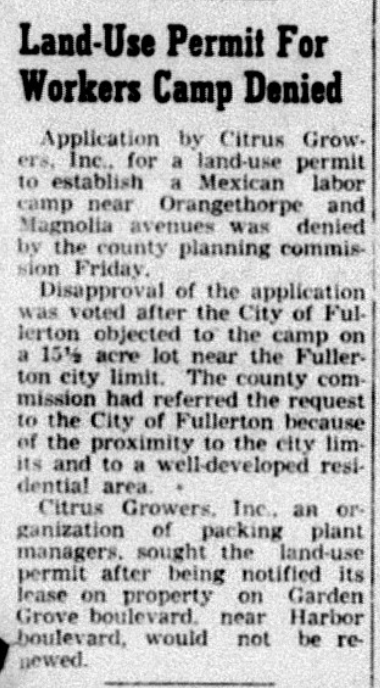
In 1946, when a new colonia was planned for the west side of town (at Orangethorpe and Magnolia), local white residents successfully blocked its construction.

“A group of property owners appeared before the council and presented a petition signed by 148 property owners and renters in that neighborhood voicing their objections,” the News-Tribune reported. “Objections raised were that since the neighborhood was fully developed as a residential district, the establishment of the camp would diminish the value of the residential area; that the quality of the usual people in such camps was not satisfactory and would create unwelcome problems.”
George A. Graham, manager of Citrus Growers, Inc., the company attempting to build the camp, argued that it “was the only site large enough and that there may be need for 3000 workers for next season who needed a place to live.”
After hearing the residents’ objections, Fullerton City Council, and then the Orange County Planning Commission, denied approval of the proposed camp.
Meanwhile, the Ku Klux Klan (which had a sizable local membership in the mid-1920s) was again raising its ugly head in Southern California.
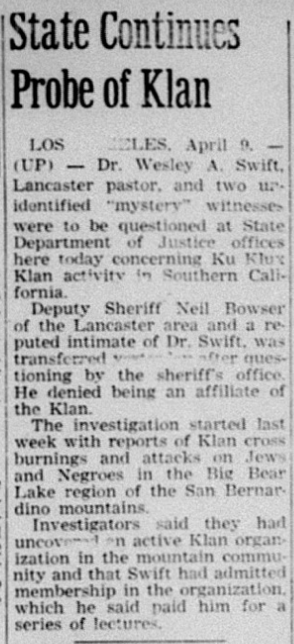
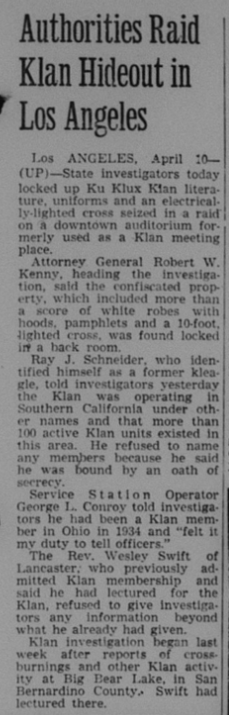

Here are some excerpts from the above articles:
“The burning of a cross the the lawn of a USC Jewish fraternity and the destroying of a sacred scroll in a synagogue across town, on whose walls were penciled two swastikas were being investigated today by police.
“The incidents were the latest outbursts involving racial prejudice in Southern California, where reported revival of the Ku Klux Klan is under investigation by the state.
“The flaming cross was discovered on the lawn of Zeta Beta Tau at 2:15am today by Stanley Schlessinger, a member of the fraternity. The letters “KKK” were painted in black on the front of the house, and kerosene had been used to etch the same letters in the lawn. Firemen were called to extinguish the blazes.
“Rabbi Max Nussbaum reported to Hollywood police that the sacred Hebrew Torah scroll, a handwritten document on rare parchment, was torn from its holy ark at Temple Israel and ripped to pieces. A section of it was stolen.
“Across the wall in the hallway where the torn pieces were left was scrawled the German words “Der Juden parasite” (the Jewish parasite). Two swastikas were drawn on the wall.
“Over the weekend, firemen also were called to fight a field fire that had been set by a fiery cross at Hill Drive and Eagle Rock boulevard.
“Police are seeking to determine whether the Klan is behind recent demonstrations.
“The City Council was asked to investigate the burning of a cross May 13 on the lawn of Mr. and Mrs. H.G. Hickerson, negro couple who have been fighting restrictions on real estate that prohibit negroes from living in a section of southwest Los Angeles.
“Officers have blamed the Klan for burning a cross in the downtown district of Palm Springs last month. Investigators from Kenny’s office have reported “progress” in their probe to determine responsibility.
When a local civil rights group met in Santa Ana to protest lynching of Black people, they were labeled as “communists” or “dupes” of communists by the very same George A. Graham, representing the powerful Associated Farmers group.
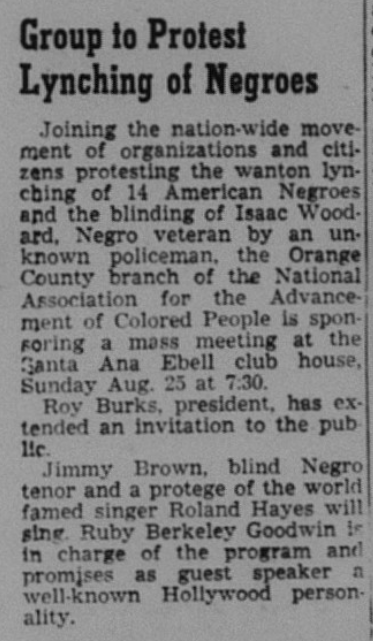
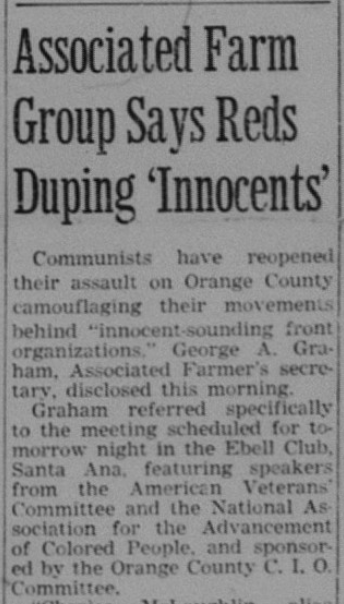
“Communists have reopened their assault on Orange County camouflaging their movements behind “innocent-sounding front organizations,” George A. Graham, Associated Farmer’s secretary, disclosed this morning,” the News-Tribune reported. “Graham referred specifically to the meeting scheduled for tomorrow night in the Ebell Club, Santa Ana, featuring speakers from the American Veterans’ Committee and the National Association for the Advancement of Colored People, and sponsored by the C.I.O. Committee.”
The NAACP is “notoriously pink,” Graham charged, “and the American Veterans’ Committee also is regarded with suspicion because of certain definite left-wing tendencies.”
Graham aid his organization which “combats and exposes subversive activities,” is principally interested in “protecting citizens from smearing their own reputations by innocently associating with Communist groups.”
As can be seen, there was real opposition to civil rights progress at this time. It should be noted that Martin Luther King Jr. was smeared as a communist by his opponents. In the context of the Cold War, it was an effective (if dishonest) tactic.
Politics
In local political news, Homer Bemis and Irvin C. Chapman (son of Fullerton’s first mayor and powerful citrus grower Charles C. Chapman) were elected to city council in 1946.
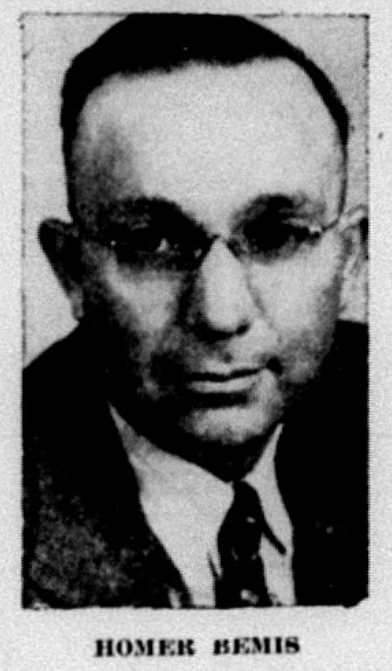
Bemis was “engaged in real estate, building, brokerage, and development,” according to the News-Tribune. “In the past four years he has been actively engaged in the construction of homes, having built more than 100 homes within this period, with his associates.”
Chapman, of course, helped manage the citrus and business empire his father built.

Local drug store owner Verne Wilkinson was chosen as mayor.
In other political news, James Musick was elected as Orange County Sheriff, and Sam Collins (who had previously served in Congress) was elected to represent Fullerton (and surrounding areas) in the State Assembly.

Sports
In sports news, local professional teams would train and play games at Amerige Park.


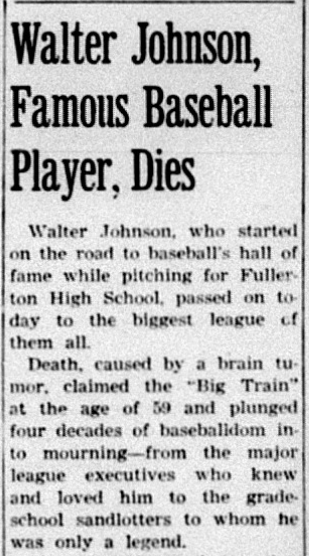
Local baseball legend Walter Johnson died.
Culture and Entertainment
For culture and entertainment, Fullertonians went to see movies at the Fox Theater.

Bowling was also popular downtown.

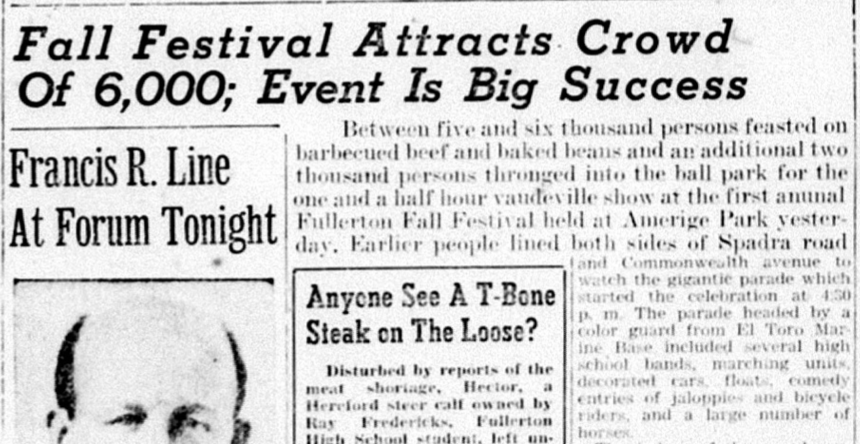
Fullerton hosted a Fall Festival that drew thousands.
Accidents and Tragedies
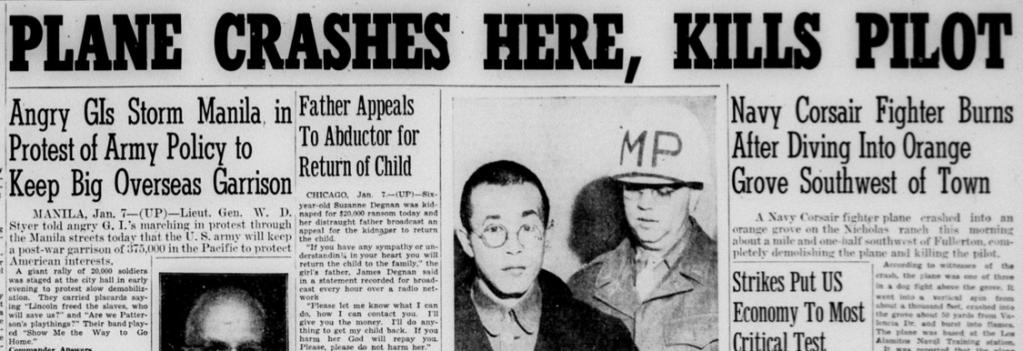
Below are some local accidents and tragedies that occurred in Fullerton in 1946:
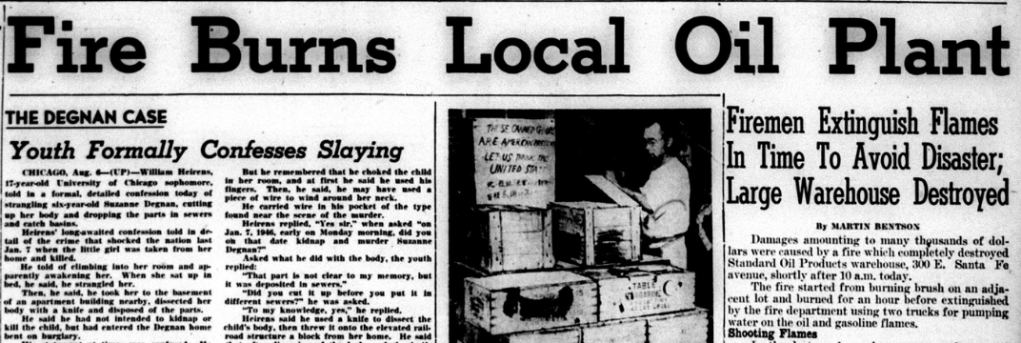
There appears a story about oil waste dumping by an E.A. McColl of Long Beach in Fullerton. Decades later, this would be determined to be a Superfund Site–a site of large-scale toxic pollution.

Deaths
Local baseball legend Walter Johnson died.
Harry Lee Wilber, Fullerton’s beloved “Man About Town” columnist and managing editor of the News-Tribune, died.

Wilbur began his career as a journalist in Denver, then moved to Los Angeles where he worked for the LA Times. In 1917, he moved to Fullerton and switched careers by opening the Rialto Theater, Fullerton’s first movie theater.
In 1925 he was hired by the Chapman family to manager what became known as the Fox Theater. His daughter Alice had married C. Stanley Chapman.
After he retired from the movie business, he returned to journalism, writing a popular column in the News-Tribune called “Man About Town.”
“Harry Lee was more than just a columnist,” the News-Tribune reported. “He was a brilliant desk man, who could take a story, put a lively twist to it, write a sparkling headline, and present it to the reader in an interesting manner. He usually wrote his daily column between breaks in his laborious editing routine.”

Dr. Frank Gobar, who practiced in Fullerton from 1906 to 1939, died.
“Dr. Gobar saw Fullerton grow from a village with two dirt roads intersecting at Spadra and Commonwealth avenues to a ‘modern city’,” the News-Tribune reported. “Many of the babies he brought into this world are now grown and active in civic and community affairs here.”
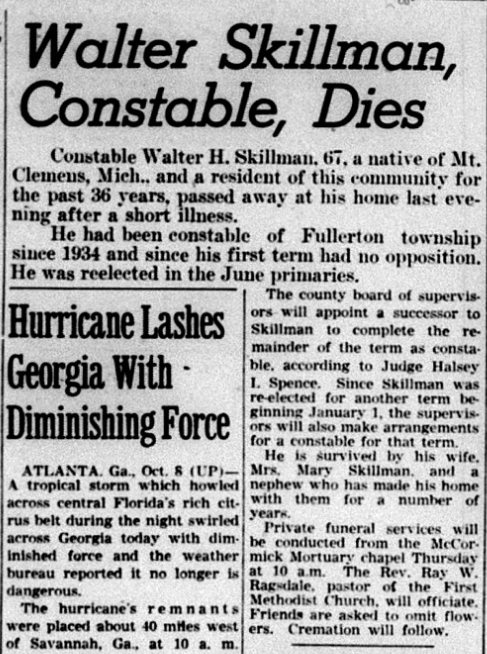
Local constable Walter Skillman died.
Early settler Bernard Arroues, a notable Basque immigrant, died.

Miscellaneous
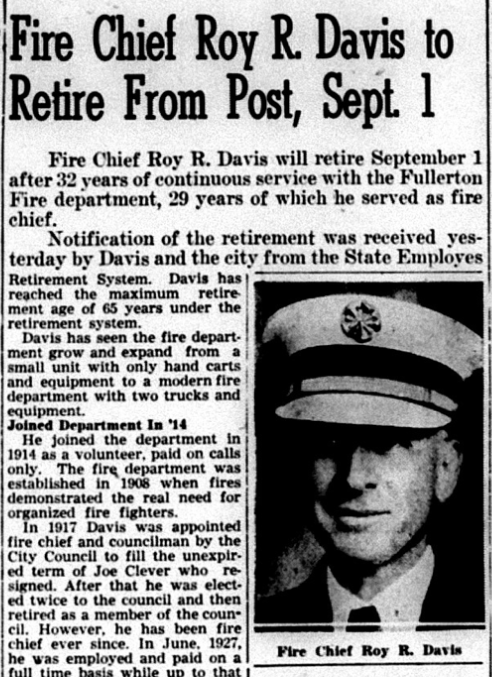
Long time Fullerton Fire Chief Roy R. Davis retired 32 years of service with the Fullerton Fire Department.
Here’s a brief history of the Fullerton Fire Department and Davis’ tenure there:
He joined the department in 1914 as a volunteer, paid on calls only. The fire department was established in 1908 when fires demonstrated the real need for organized fire fighters.
In 1917 Davis was appointed fire chief and councilman by the City Council to fill the unexpired term of Joe Clever who resigned. After that he was elected twice to the council and then retired as a member of the council. However, he has been fire chief ever since. In June 1927, he was employed and paid on a full time basis while up to that time he had only been paid on calls.
The fire department sponsored a bond issue drive in 1914 for $5000 to puchrase a modern fire truck. The issue carried and the truck was ordered and arrived early in 1915.
After the fire department purchased the first truck it was housed in the Albert Sitton garage where the Volk & Wiese store is now located. Later the department was housed where the McMahon Furniture company is now and then moved to 127 W. Amerige avenue before moving to its present location on 123 W. Wilshire avenue. The present fire hall was built in 1926, part of which was used by the city officials and served as a temporary city hall.
In July 1924 the second fire truck was purchased. Both trucks are still in operation.
Davis first made a trip to Pasadena and Orange in June, 1909. He was married at Pasadena in August 1909, and he and his wife took a trip to Seattle and took the norther route to Nebraska, their former home.
In March 1910, they came to Fullerton and settled here. His foiks also came out here at that time. His father W.R. Davis, and brother-in-law C.S. Orton, built the Fullerton Ice company which is now the Crystal Ice company under different ownership. Davis was associated with his father in the ice business.
Charles O. Potter was named the new Fire Chief.

Stay tuned for top stories from 1947!
-
A Brief History of CSUF

The following is from a work-in-progress about the history of Fullerton. You can support my ongoing research and writing on Patreon.
California State University, Fullerton played a very significant role in my early adulthood. I got my B.A. in English there in 2004, and then went on to get a M.A. in English in 2007. That same year, I began my college teaching career. I taught English composition at CSUF for about ten years as an adjunct faculty. Being adjunct, I also taught at other local colleges, including Fullerton College and (briefly) Santa Ana College.
As a student, and then as faculty, I had mixed feelings about CSUF. There were things about it that I loved. I (mostly) had great professors. I enjoyed the Arboretum, the outdoor concerts. I loved the Library (until it started getting rid of its book collections in favor of computers). But there were things that kind of bugged me too—the steadily rising tuition, the low pay of adjunct faculty in comparison to full-timers, the construction of things like a multi-million dollar fitness center while student fees were increasing, the multi-year closing of the Library in the 2010s, etc. I left CSUF around 2017 to pursue a stint in local journalism.
Around 2008, retired history professor Lawrence de Graaf published a surprisingly in-depth history entitled The Fullerton Way: 50 Years of Memories at California State University, Fullerton. De Graaf had taught at CSUF almost from the beginning and his insights are extremely valuable.
As part of my larger research and writing about Fullerton history, I present here summary of De Graaf’s book.
The genesis of what would become CSUF was the passage of Assembly bill 4 in 1957, establishing a four-year state college in Orange County.
The chosen site in east Fullerton was (like much of Orange County) orange groves. The state began acquiring the land in 1959.

The land that would become CSUF, circa 1957. “Thus began the transformation of acres of oranges into one of the largest institutions of higher education in the nation,” de Graaf writes.
Fullerton, and Orange County in general, was experiencing a period of rapid growth following World War II, as orange groves gave way to housing subdivisions, schools, shopping centers, and industrial parks. The passage of the GI Bill created a large number of potential college students.
In 1959, William B. Langsdorf was named the first president of what was initially called Orange County State College.

William B. Langsdorf. As the state acquired land, the Fullerton High School District allowed the new administrators to use the second floor of an old (condemned) building on the Fullerton High School campus.
The first college “campus” was a building at the newly-built Sunny Hills High School, on the other side of town. It was here, in 1959, that the college offered its first classes. Later that year, faculty and administrative offices moved to an old farmhouse (the Mahr house) on the site of what would become CSUF.
In 1960, as it continued to acquire more land and funding for permanent buildings, the college built temporary buildings and bought four wooden barracks from nearby March Air Force Base.
In 1960, the state adopted the Master Plan for Higher Education in California, a very important document that established the roles of community colleges, state colleges (CSUs), and Universities (UCs). Perhaps the most significant aspect of the Master Plan was that it promised “tuition free” higher education in California. And for a couple decades, it (mostly) kept this promise. Those who attended CSUF in the 1960s and 1970s paid minimal student fees. This would unfortunately change starting in the 1980s, but more on that later.
“Funding increases reflect a period in which higher education remained a relatively high priority in state spending. The Cold War and the Space Race focused public attention on the need for teachers and well-trained students, and federal programs like the National Defense Education Act began to supplement state financing of higher education. During this period (early 1960s) the budget for all state colleges more than doubled,” de Graaf writes. “Through the 1960s, state colleges boasted that they offered ‘tuition-free’ education, not a fully true assertion. Each college charged a material and services fee of $33 per semester for full-time students; non-residents were charged $90. Students and faculty paid parking fees, and there were small fees for admission and registration.
In 1963, the first permanent classroom building was completed—the Letters and Science Building, which was later named McCarthy Hall, after early professor/administrator Miles McCarthy. This was followed by the Music, Speech, and Drama building, which opened in 1964.
The school nickname, the Titans, was chosen in 1959 by students.
In 1962, a strange event put the college on the map—the nation’s first intercollegiate elephant race, a goofy event dreamed up by students.

“On Friday, May 11, 12 elephants with malhouts (riders) and trainers, most of them in Indian garb, lined up as if the event was the culmination of months of careful planning. Cars lined up for miles along the few narrow roads serving the campus. By the time the race started, 10,000 spectators stood along Dumbo Downs and 89 reporters assured nationwide coverage,” de Graaf writes. “Most of the elephants never completed the course, some refusing to run at all. Harvard was declared the winner. Stories of the race appeared in Newsweek, Time, and Sports Illustrated.”
Following this, the elephant was adopted as the school mascot.
A need for student housing became apparent when the basketball coach brought several Black athletes from Detroit to play at the college.
“During the 1960s, most Orange county communities essentially excluded blacks, save for a substantial community in Santa Ana and smaller ones in Fullerton and Tustin, near the El Toro Marine base…Consequently, these students found it impossible to rent accommodations,” de Graaf writes. “Continued hostility from the local population posed a significant obstacle for black students. Housing remained virtually impossible to obtain. One early black student made 108 applications before the 109th gained him the right to lease an apartment. Three other black students found an Anaheim woman willing to rent to them, only to have a mob of white neighbors pressure her into canceling the deal. Most black students either used Orthrys Hall [an early dorm] or made long commutes from places outside Orange County. Police posed another problem, stopping black students to inquire what they were doing on campus or in North Orange County…One sign of community attitudes came in 1965 when the first campus pastor, Rev. Al Cohen and his wife adopted a racially mixed child. The community complained to campus officials about this arrangement, and after months of threatening phone calls, the Cohens gave up their child for re-adoption and subsequently left the campus.”
CSUF began in the context of the Cold War, and the politics of the time affected the college, “epitomized by declaring the science building a nuclear fallout shelter as well as by the suspicion that Communists or their sympathizers lurked within America’s government and schools. One of the most vocal proponents of this idea was the John Birch Society, and one of its biggest areas of influence included Orange County.”
During this time, all professors had to sign loyalty oaths, and “President Langsdorf issued an order forbidding Communist speakers on campus. This act roused occasional debate and some editorials in the Daily Titan,” de Graaf explains.
In the 1960s, Orange county was still an overwhelmingly white area, and Latinos were not yet attending college in large numbers. In 1967, the college had only five black students and similarly small numbers of Native Americans, Asian Americans, and Latinos.
In 1967, a battle for academic freedom was waged in Fullerton, following a graduate student production of Michael McClure’s controversial play “The Beard” at CSUF.
CSF theatre students sat in the audience at the State Senate hearing at Fullerton City Hall on The Beard: Marian Stanck, female star of the production, Terry Gordon (hand to face), director of the play, unidentified female, and Wayne Dvorak, male star. “Staging a play notorious for graphic language and a simulated sex act in conservative Orange County was daring particularly following court cases against its production in 1966. Given unauthorized tickets to the private performance, reporters from local newspapers sparked a maelstrom of media scrutiny. The ensuring legal battle between the CSF academic community and a group of conservative state senators resulted in a Senate investigation and hearing. The incident became a cause celebre for academic freedom,” De Graaf writes. “Senator John G. Schmitz, a John Birch Society member, warned budget cuts to higher education could emerge as one means to handle ‘flagrant moral corruption and revolutionary violence planned and carried out behind the cloak of academic freedom.’”
To read more about The Beard episode, check out my report HERE.
Ronald Reagan was elected governor in 1966 and immediately ordered budget cuts for universities.
“To accommodate new students, the campus set up 18 trailers. Since this building crisis coincided with Governor Reagan’s repeated efforts to cut state expenditures, many at CSF deemed him responsible for such makeshift quarters. Consequently, the temporary offices were dubbed ‘Ronald Reagan Hall,’” de Graaf writes.
It was the Reagan administration who proposed increasing student fees.
“Ironically, the invitation to Governor Ronald Reagan to give his first address as governor at a public campus in California served as the catalyst for the turmoil of spring 1970,” de Graaf writes.
Reagan gave a speech in the campus gym, during which some students heckled him. College officials brought disciplinary action against two of the hecklers, Bruce Church and Dave MacKowiak, and the police filed criminal charges against them.
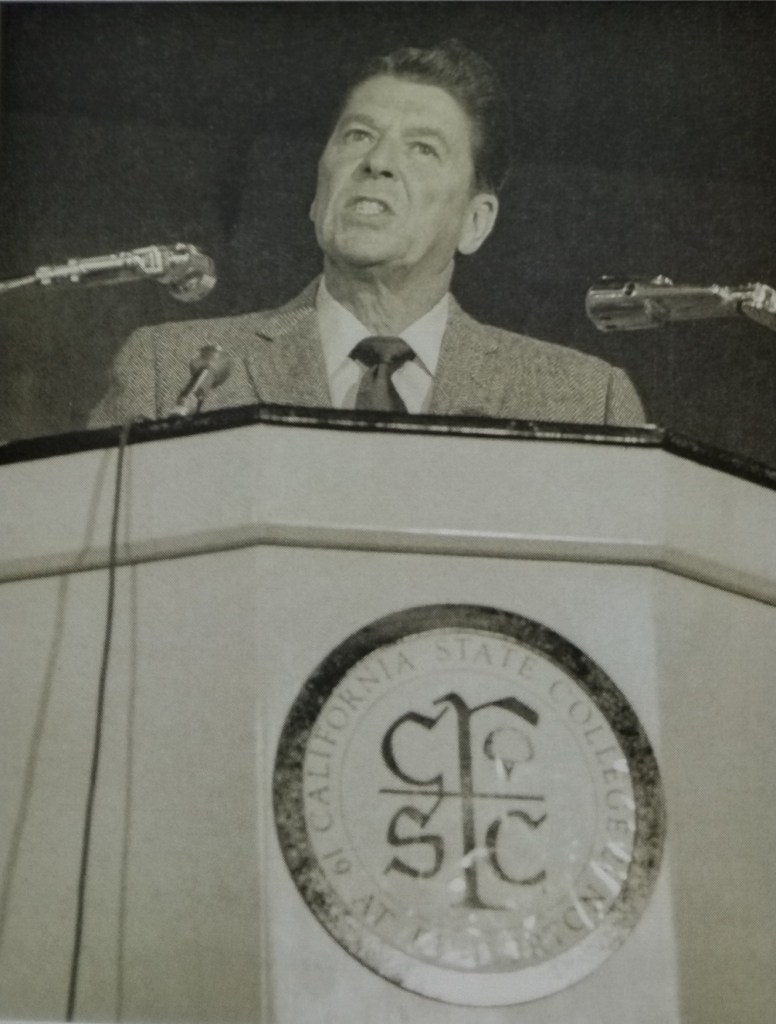
Governor Reagan speaking at a convocation in the CSF Gym, February 1970. A handful of the large audience heckled Reagan, and efforts to punish them launched a spring of protests. Students held a rally in the quad to “Free Dave and Bruce” demanding that the school and the police drop charges against the students. When Langsdorf refused, hundreds of students staged a sit-in in the Letters and Science building and Langsdorf’s outer office. These students were forcibly removed by police in riot gear.

Protesters sitting in the hallway of the first floor of the Letters & Science Building, in front of President Langsdorf’s office. They demanded charges be dropped against students who had heckled Reagan. These sit-ins occurred sporadically through February and even occupied Langsdorf’s office. When the Student Faculty Judicial Board tried to hold disciplinary hearings on Bruce and Dave, students broke in and disrupted the proceedings. Vice President Shields called Fullerton for police assistance.
Around 90 officers responded: “Police began arresting those who stayed in the quad and charged into groups with clubs. In a few minutes, some faculty managed to get between students and police. Professor Hans Leder declared the whole Quad an impromptu class, soon after which Shields convinced the police to leave. The number of students arrested for heckling or the events on March 3 grew to 37. Daily meetings on the quad and displays of banners continued through March and into April,” de Graaf writes.
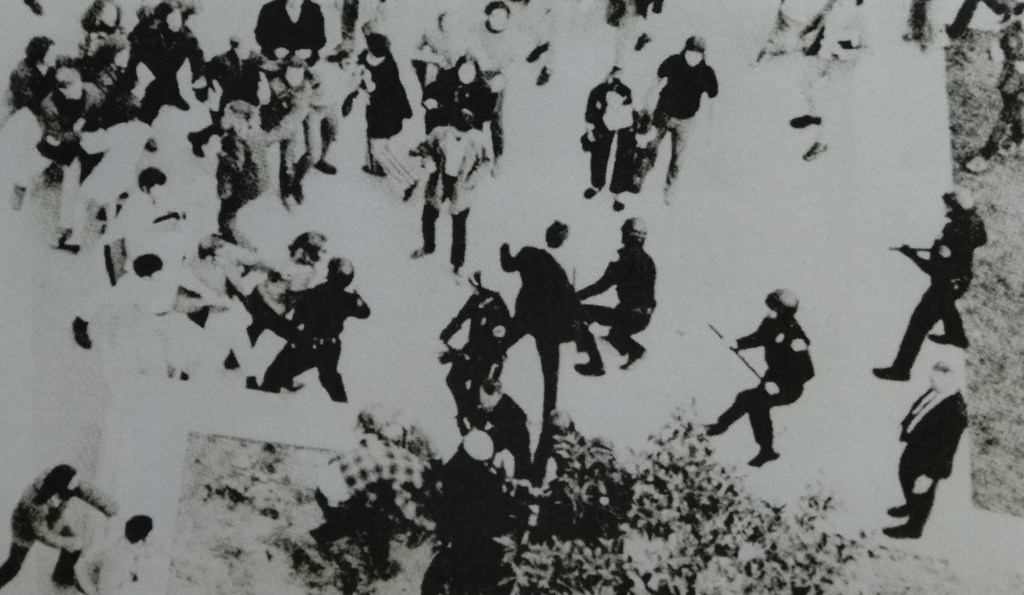
Fullerton police beating students in the Quad, March 3, 1970. The protests were given added intensity by the Kent State massacre, as well as the war in Vietnam. Students occupied the Performing Arts Building.
This sparked a reaction by local conservatives, who organized a group called Save Our Society (SOS), which was supported by Fullerton State Assemlyman John Briggs. After an SOS meeting on campus in May, someone burned one of the temporary buildings next to the one used by student protesters.
As the summer began, the protests died down, with some students arrested and given jail time or campus discipline.
For a more comprehensive account of the 1970 student protests, check out my report HERE.
Conservative groups also sometimes protested on campus, such as in 1972, when professor Angela Davis was invited to speak at CSUF, and in 1977, when Vietnamese anti-Communists “demonstrated against the showing of a Cuban documentary, assaulting the professor showing the film.”
The many campus groups and clubs highlighted the diverse background and political ideas of students—ranging from the Jesus Movement to the Black Student Union to MEChA to a Gay Student Union.
By the end of the 1970s, women comprised 52 percent of students. During that decade, a Women’s Center and a Women’s Studies Program were created.
William Langsdorf resigned in October 1970, and Dr. Donald Shields became the new president.
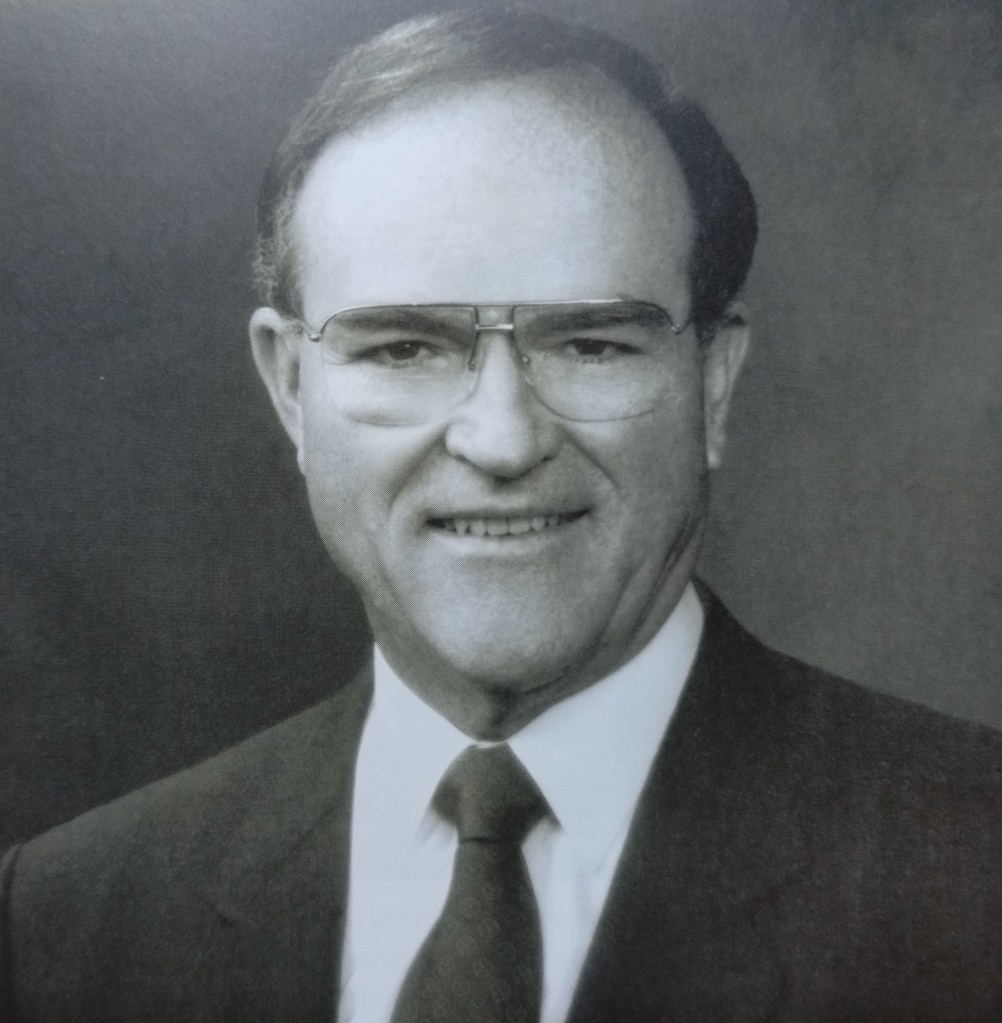
Donald Shields. CSUF officially became a university in 1972.
In 1978, the CSUs set up systemwide Student Affirmative Action Program to encourage minority enrollment.
“The state budget for higher education tightened steadily through the early 1970s,” de Graaf writes. “State funds were further constricted in the wake of Proposition 13, which reduced the education budget.”
Two major cost-saving measures were increasing student fees, and hiring more part-time faculty (who were paid less than full-timers, and received few benefits).
Faculty unions were established at the end of the 1970s.
In 1976, a mass shooting occurred at Cal State Fullerton. It was “one of the worst massacres at an American university until the shooting at Virginia Tech in 2007.”
The shooter was Edward Charles Allaway, a mentally disturbed custodian who, on the morning of July 12, 1976, entered the basement of the Library armed with a .22-caliber rifle and he killed six people: Paul Herzberg, Bruce Jacobsen, Seth Fessenden, Frank Teplansky, Debbie Paulsen, and Douglas Karges. He then walked to the first floor, where he shot and wounded Maynard Hoffman. Library assistant Stephen Becker and Librarian Donald Keran tried to wrestle the gun from Allaway, but he fatally shot Becker and wounded Keran before leaving the library and driving away.
“The whole rampage lasted five minutes, leaving seven people dead and two wounded,” de Graaf writes. “Later that day, Allaway phoned police to report his location and gave himself up.”
Allaway was tried, found guilty of murder, and sentenced to life in prison. He escaped the death penalty because some on the jury found him insane. Later he was moved to Patton Mental Hospital in San Bernardino.
Tragically, “Two more people soon lost their lives as an indirect result of Allaway’s shooting,” de Graaf writes. “Shortly after the trial, his sister, Shirley Sabo, fatally shot herself in guilt and sorrow over the tragedy. Earlier, on April 1, 1977, Richard Drapkin, another staff member who had worked with several of the victims, jumped from the Humanities Building to his death.”
In 1978 CSUF planted seven trees on campus (for each of the victims), establishing a Memorial Grove.

CSUF Memorial Grove. Student fees were steadily growing. By 1980, a full-time student paid $250 per semester in fees, not to mention the cost of housing, which nearly doubled in the 1970s. To offset this, federal financial aid in the form of Pell Grants, the Middle Income Assistance Act (1978), and Federal student loans were expanded.
Mens baseball and women’s gymnastics won national championships in the late 70s. Football was less successful: “Black players walked off the team in 1974, charging Coach Yoder and Stoner with discrimination.”
As a result of local fundraising, student activism, and community support, the Fullerton Arboretum broke ground on campus in 1977, and opened in 1979.
Facing a budget deficit, “Governor Jerry Brown issued an executive order to ‘unallot’ two percent of the budget for the CSU and UC, and Chancellor Dumke ordered a freeze on CSU purchases, hiring, and promotions.” This was followed by another round of student fee hikes.
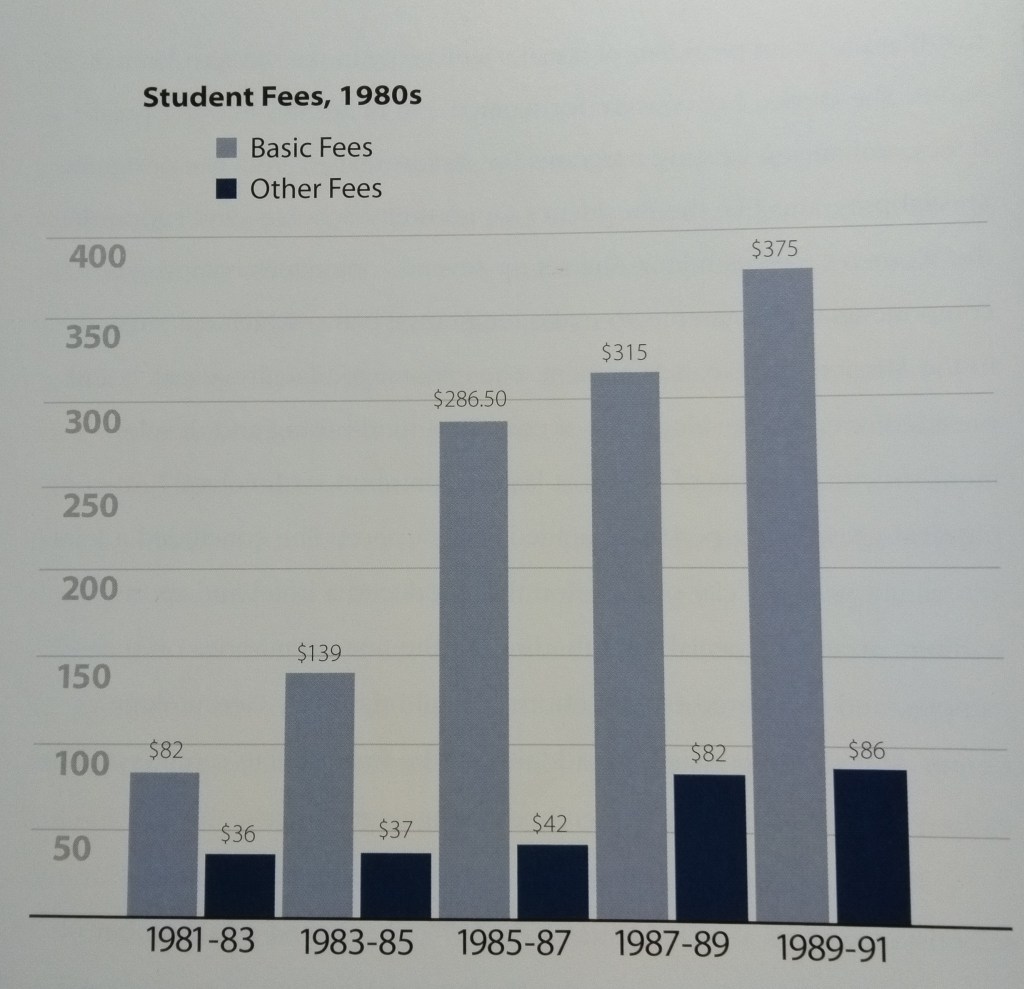
In 1981, Jewel Plummer Cobb was chosen as president of CSUF, the first African American woman to become president of a university on the west coast.
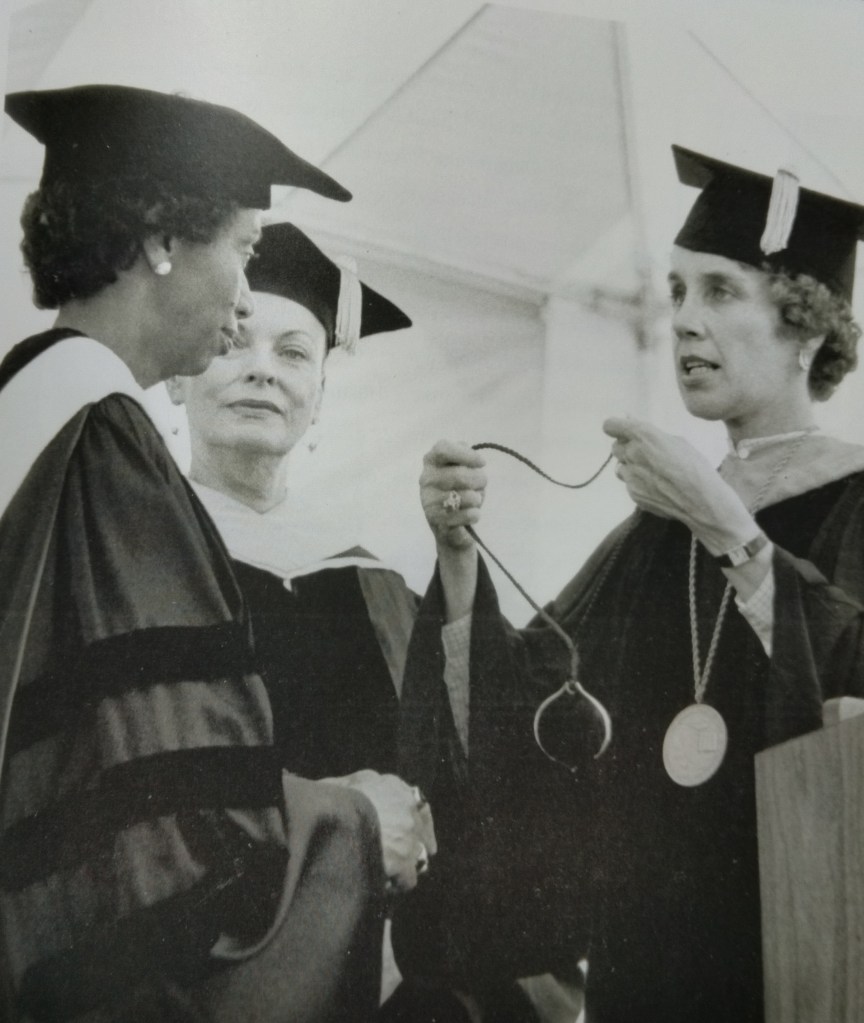
Jewel Plummer Cobb. “Along with her scientific research and teaching, Cobb was a pioneer in opening racial and gender opportunities. She helped further physical growth in a period of limited state support,” de Graaf writes. “It surprised many that a county with a reputation as one of the most conservative in the state made such a bold choice of president.”

CSUF, 1981. Facing budget shortfalls, CSUF sought creative ways to finance new construction. In 1983, the university entered into an agreement the city of Fullerton redevelopment agency and to finance a sports stadium for the football team, with extra income from allowing a hotel to be built on campus.
A student group organized to oppose the project, criticizing “the university’s partnership with a privately owned corporation, the impact of such a large private facility so close to the college, and the use of Redevelopment Agency funds for a corporate venture.”
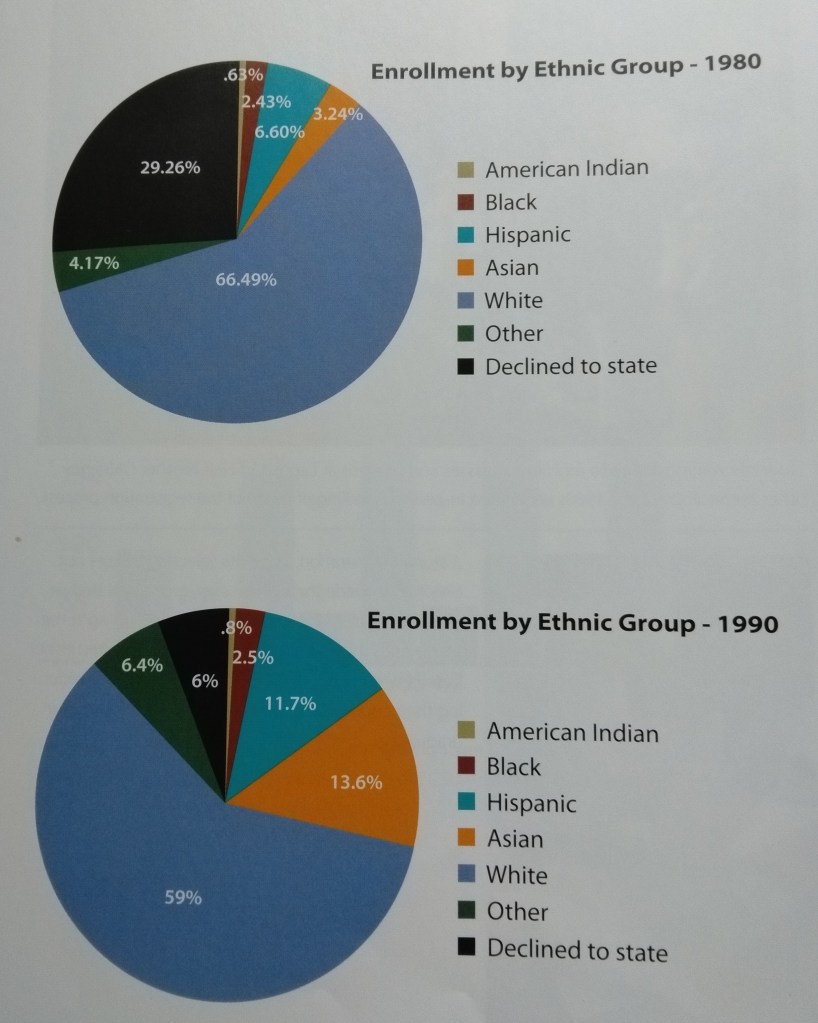
The hotel opened in 1989, and the sports stadium opened in 1992. Ironically, that same year CSUF cancelled its football program.
In the early 1980s, CSUF made agreements with local cable companies to provide local public access television.
Unfortunately, in 1986 it was revealed that for nearly two years, staff had allowed Tom Metzger, “an advocate of white supremacy and a former Ku Klux Klan member, to produce a program “Race and Reason” that advocated racial separatism and included anti-Semitic content,” de Graaf writes.
This prompted protests from the Anti-Defamation League and students from the Coalition Against Apartheid and Other Human Rights Violations, who demanded that the university shut this program down. President Cobb said that the principle of free speech protected Metzger’s program, but then one of the cable companies ended its agreement with the university, ending the program.
The Titan Channel continued broadcasting other programs through the rest of the 1980s.
In 1986-87 funds from the state lottery began to be allocated to the CSU, partly offsetting periods of budget cuts.
In 1990, Milton A. Gordon became President of CSUF.
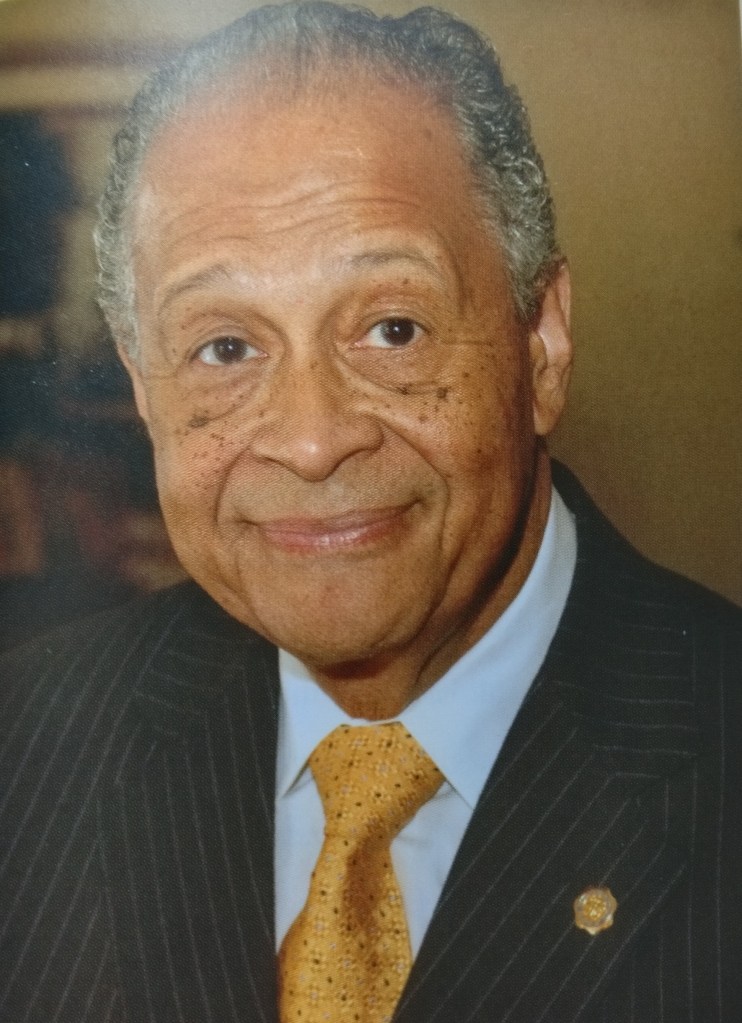
Milton A. Gordon. Gordon “would devote a great deal of energy to establishing relations with local corporations and increasing the success of CSUF in raising funds from private parties to offset years of cuts in state funding,” de Graaf writes.
“In the early 1990s, the Board of Trustees adopted a goal of each campus raising at least 10 percent of its state general fund appropriation from private sources,” de Graaf writes. “This practice grew to the point that the university was essentially selling rooms and in some cases seats at fixed prices to any contributor able to pay that amount to get his or her name on it.”
The early 1990s brought another recession with the decline of the aerospace industry, with local Hughes Aircraft closing in 1994.
As had by now become a pattern, the state offset budget woes by increasing student fees, as if the recession somehow did not affect students or their families.
State university fees were $390 a semester by 1990, and rose to $792 by 1994.
Meanwhile, a university study exploded the four-year degree myth, finding that “Of freshmen who entered CSUF in 1995-97, fewer than 10 percent completed a B.A./B.S. in four years…This completion rate was a sobering indication of how an institution at which over three fourths of the students held outside jobs different from traditional ideals,” de Graaf writes.
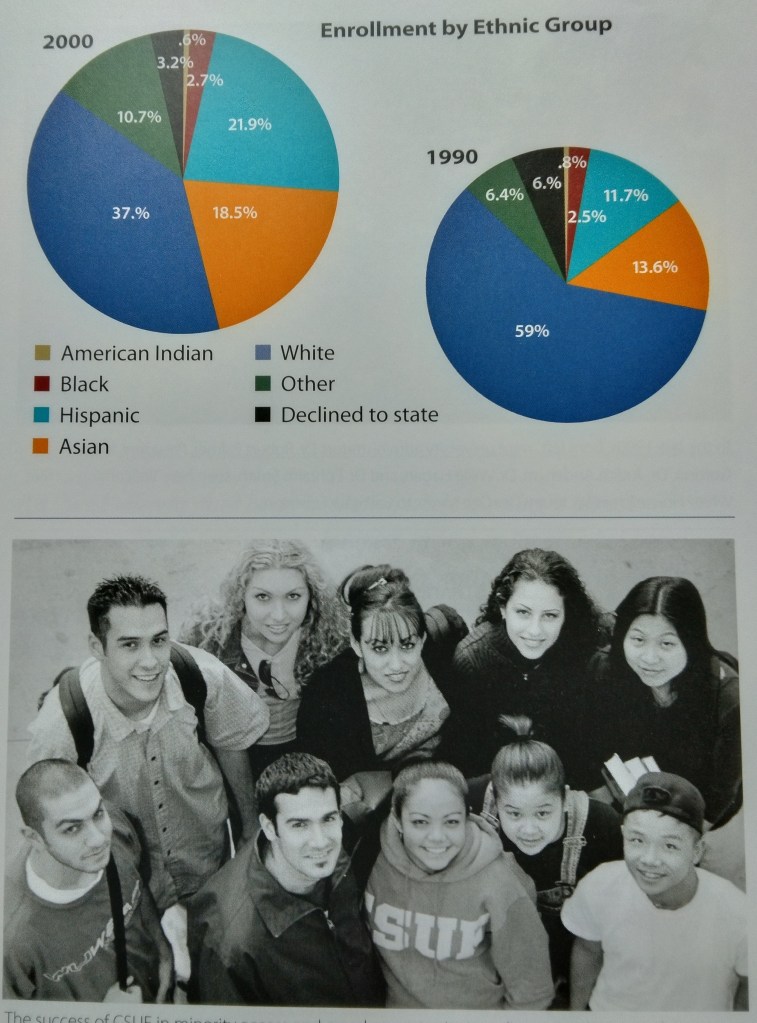
By 1999, CSUFs 839 part time faculty (who were paid significantly less) outnumbered full-timers.
“Concerns involved the growing gap in compensation and working conditions between the two groups and demands for faculty to assess their teaching effectiveness and incorporate new technologies into instruction,” de Graaf writes. “Could people paid only for instruction time be expected to keep pace?”
Office space was often shared between several part-timers in a single room.
“The years 2000-2008 were ones in which the economy of California fluctuated between boom and crisis, while revealing structural weaknesses that defied political repair,” de Graaf writes. “Governor [Gray] Davis cut the CSS budget by $131 million, but then allocated a portion of that to cover enrollment growth. From 2002 to 2005, the CSU saw its budget reduced by $522 million.”
In the early 2000s, the state budget gave $3 billion to state universities and $9.9 billion to state prisons.
By 2003, student fees had risen to $786 a semester for full-time undergraduate students.
“In the ensuing two years, they went up to $1,260 with parking and Associated Student fees on top of that,” de Graaf writes. “By 2006, undergraduates were paying $2,520 a year, graduates $3,102. These fee hikes provided nearly half of the total funding for the CSU during the early-mid 2000s.”
CSUF had come long way from the “tuition-free” higher education promised in 1961.
The university continued to rely on private donations from corporations and wealthy individuals, and then named buildings after these donors, such as the Steven G. Mihaylo (owner of Crexendo Business Solutions) Business Building, Dan Black (nutritional supplement businessman) Hall, and the Joseph A.W. Clayes III (real estate/avocado investor) Performing Arts Center.
“By the mid-2000s, the College of Business an Economics was the largest such college accredited in California, the third largest in the United States,” de Graaf writes.
By 2004, CSUF employed over 1,000 part-time faculty, compared to 366 full-time faculty.
A bright spot in all of this was the Titan baseball team, who went to the college world series in 2001 and 2003, and won in 2004.
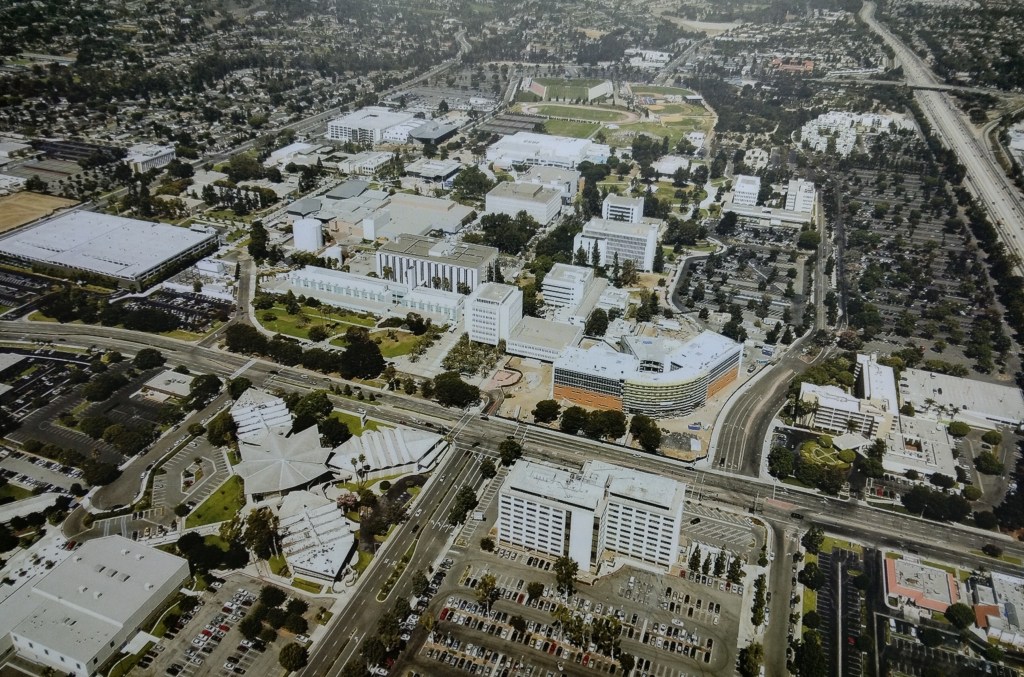
By 2008, CSUF had more than 37,000 students: “This growing enrollment reflected the increasing ethnic diversity of the region, with over half of the students at Cal State Fullerton being persons of color by 2008.”

De Graaf’s history ends in 2008, and I will end with a few closing quotes from the author:
“It is only when one steps back to the earliest years of Cal State Fullerton to look over its 50 years that the full extent of these changes is realized. The most obvious changes were the sheer growth of the campus: from orange groves with three residences to a densely built cluster of about 25 mostly multi-story buildings; from 452 students to 37,000; from a graduating class of five to one of nearly 10,000; from one degree and major to more than 100.”
“Much of this growth occurred for the same reason that the college was mandated in 1957–Orange County itself continued growing throughout this period. The transformation from orange groves to suburban sprawl had already underway for a decade before Orange County State Collge came on the scene, so in physical growth as well as population, CSUF essentially reflected ongoing trends.”
“Cal State Fullerton was more of a catalyst in some of the most dramatic and less predictable changes in the campus and county. One was in the demography. Into the 1960s, Orange County was overwhelmingly white in population and notorious for its hostility to blacks and indifference to other minorities. That people of color would constitute over have of CSUF’s enrollment and that two of its four formally appointed presidents would be African-American represent a remarkable shift in social attitudes as well as population trends. By having a positive attitude toward ethnic diversity from its beginnings and an array of programs to promote groups historically underrepresented in higher education to come to its campus, Cal State Fullerton played a significant role in the amazing ethnic transformation of Orange County.”
As of 2025, CSUF’s annual tuition is $7,470 for in-state students and $20,070 for out-of-state students.
-
Fullerton in Deep Time
The following is from a work-in-progress about the history of Fullerton. You can support my ongoing research and writing on Patreon.
“The earth is over 4 billion years old, but the oldest rocks in the county are less than 200 million years old. Thus, the geologic history recorded in the rocks found in Orange County only covers about 5% of the entire earth history! But, an amazing variety of changes to the landscape has occurred in that relatively short span of geologic time. We shifted plate boundary types, evolved through changing climates and organisms, emerged from the sea, and witnessed mountains to grow over a mile high!”
–Richard Lozinsky, Our Backyard Geology in Orange County, California

The oldest rocks in Fullerton are in Coyote Hills. Not being a geologist, I rely upon the work of geologists to tell the story of Fullerton in time scales that are much larger and harder for humans to comprehend. We measure our lifetimes in decades. Geologists measure the Earth’s history in ages, eras, and epochs spanning millions of years.
Thankfully, I was guided on this journey by Fullerton College professor Richard Lozinsky, whose Earth Science class I took back around 2001. I found his class fascinating, as he used the rocks and landscapes of Orange County to teach us about geology concepts. We took field trips to places like Coyote Hills and Dana Point to learn about the stories rocks had to tell. A while back, I interviewed professor Lozinsky. You can read that HERE.
Recently, I re-read Lozinsky’s excellent book Our Backyard Geology in Orange County, California and so I present here a much simplified version of the local geologic story. For the sake of clarity (and my own comprehension), I am leaving out many technical terms and details.
About 200 million years ago, the supercontinent known as Pangea began breaking up into smaller plates. One of these new plates, the North American, began drifting westward.
About 29 million years ago, the North American Plate made contact with the Pacific Plate, and the two began a lateral (up-down movement) with the Pacific Plate moving upward. This created coastal depressions such as the Los Angeles Basin.
“Lands surrounding the basin began to emerge from the ocean forming a new coastline along the rising San Gabriel and Santa Ana Mountains. These new lands were relatively low lying and probably enjoyed a subtropical climate with rainfall amounts of 30-40 inches,” Lozinsky writes.
The marine life of the Los Angeles basin (like plankton) eventually died and formed the rich oil deposits that were discovered millions of years later.
“The ocean began its final retreat from the Orange County area about 5 million years ago when the convergence between the North American and Pacific plates intensified,” Lozinsky writes.
The San Andreas Fault Zone (SAFZ) formed at this time, and the Santa Ana river began to flow across the coastal zone, carrying sediment.
“By 1 million years ago,” Lozinsky writes, “the hills and mountains had almost reached their current elevations, defining the basin to look more like it does today. During the Pleistocene, the climate of the area was cooler and the landscape was grassland as indicated from the La Habra and Los Coyotes Formations. Here, sabre-tooth cat, giant ground sloth, dire wolf, horse, camel, bison, mammoth and mastodon roamed the region to eventually become extinct also.”
An excellent place to learn about this period is the Interpretive Center in Ralph B. Clark Regional Park, which contains fossils recovered locally of the above mentioned extinct creatures.

Ancient Mastodon molars on display at the Ralph B. Clark Park Interpretive Center. Over the next several thousand years, sea levels rose and fell as glaciers rose and melted.
“The present-day Orange County coastline was established about 10,000 years ago with the end of the Pleistocene. The earliest humans to visit our county probably came along the coast where food was more abundant,” Lozinsky writes.
Professor Lozinsky gives a glimpse into the future: “In the future, our coastline will slowly change as worldwide sea levels increase due to the melting of the polar ice caps and locally due to tectonic activity. Orange County will continue on its northwestward cruise towards Alaska as the Pacific Plate shifts with each earthquake that occurs along the SAFZ (San Andreas Fault Zone).”
-
Subscribe
Subscribed
Have a WordPress.com account? Log in now.

