-
Fullerton in 2004
The following is from a work-in-progress about the history of Fullerton. You can support my ongoing research and writing on Patreon.
The Fullerton Observer newspaper was formed in 1978 by Ralph and Natalie Kennedy and friends to provide a more progressive counterbalance to the more conservative Fullerton News-Tribune and Orange County Register. Back then, Orange County (including Fullerton) was dominated by Republicans, and the Observer crew were definitely in the minority. The Fullerton Public Library has digital archives of the Observer stretching back to 1979. I am in the process of reading over these archives and creating a year-by-year summary of top stories. Here are some top stories from 2004.
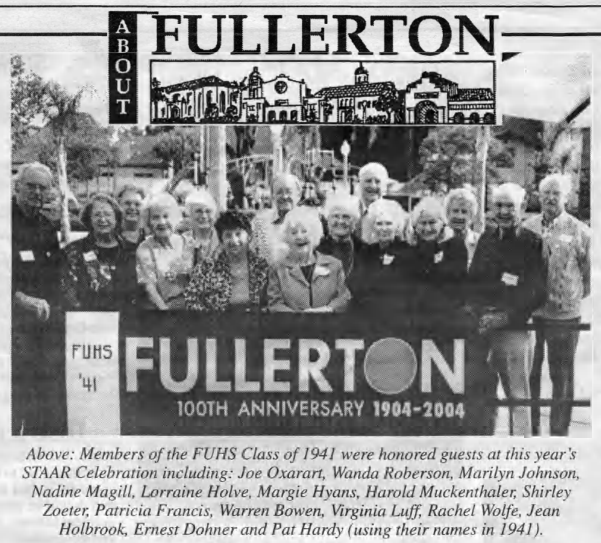
In 2004, Fullerton celebrated 100 years of incorporation as a city, although the town was founded in 1887.
Bush Re-Elected and The Iraq War Ramps Up
In national and international news, America was embroiled in the Iraq War, which, in retrospect, was not our finest hour.
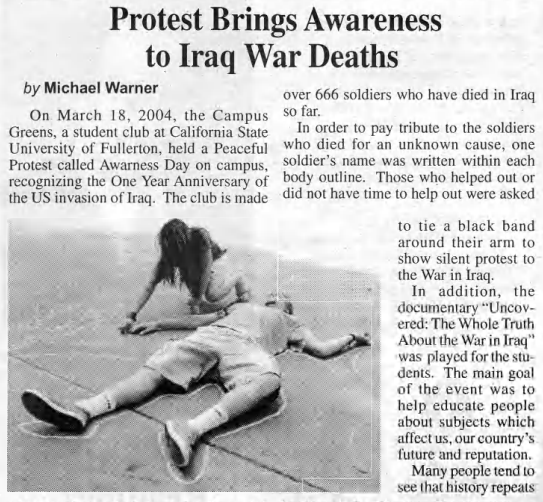
Republican George W. Bush was re-elected as president.
“Seldom has a president faced so many challenging issues, many of his own making, and George Bush seems inclined to make all of them worse,” Observer political commentator Vince Buck wrote. “The Iraq situation has no acceptable solution, which will put further pressure on this limited president to which he may not react well.”
The Governator
In 2004, California’s governor was Hollywood actor/bodybuilder/Republican Arnold Schwarzenegger. One thing the “Governator” did was to veto a bill that would have raised the minimum wage in California by $5.00. Minimum wage at that time was $6.75 an hour.
According to Center for Continuing Study of the California Economy director Stephen Levy “even if the raise in wages was enacted immediately, it would still leave minimum wage lower, adjusted for inflation, than it was in 1970.” Thanks, Arnie!
Local Politics
For most of its history, Fullerton City Council was dominated by Republicans. However, in 2004, a female Latina Democrat named Sharon Quirk was elected.
Quirk, along with fellow Democrat Doug Chaffee, was endorsed by a newly created political group called Neighbors United for Fullerton (NUFF).
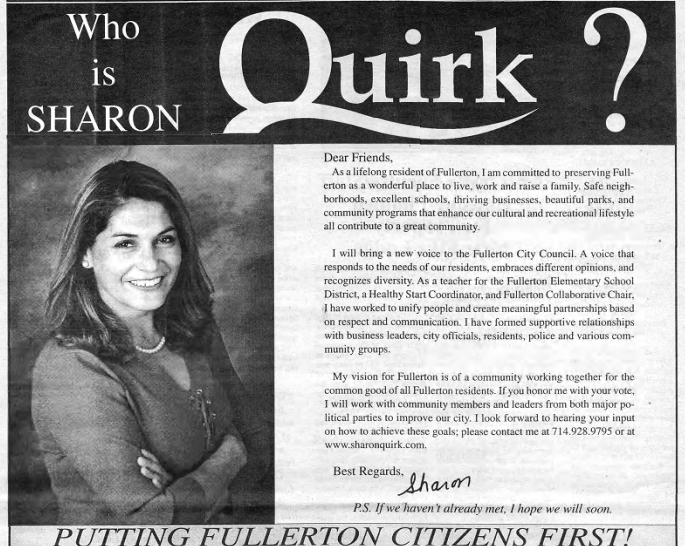
Important issues in the 2004 race were preserving Coyote Hills and the Fox Theater, $150 million in deferred infrastructure repairs, concerns about the density of development, and rowdiness in the downtown area.
Perhaps in direct contrast to NUFF was another newly-created political action committee called Friends for Fullerton’s Future, which was created with the sole purpose, according to their filing statement, “To Oppose Candidate Doug Chaffee.”
Who were Friends for Fullerton’s Future? In 2004, the organization consisted of one man, George Bushala Jr, a contributor to the campaign of incumbent Republican Shawn Nelson.
The other two City Council winners in 2004 were Nelson and Richard “Dick” Jones.
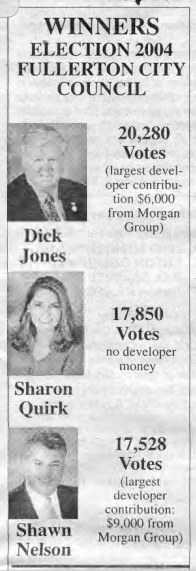
According to the Observer, Nelson “ran a campaign notable for its reliance on out-of-town and developer money. Much of the negative campaigning in this election was associated with Nelson supporters.”
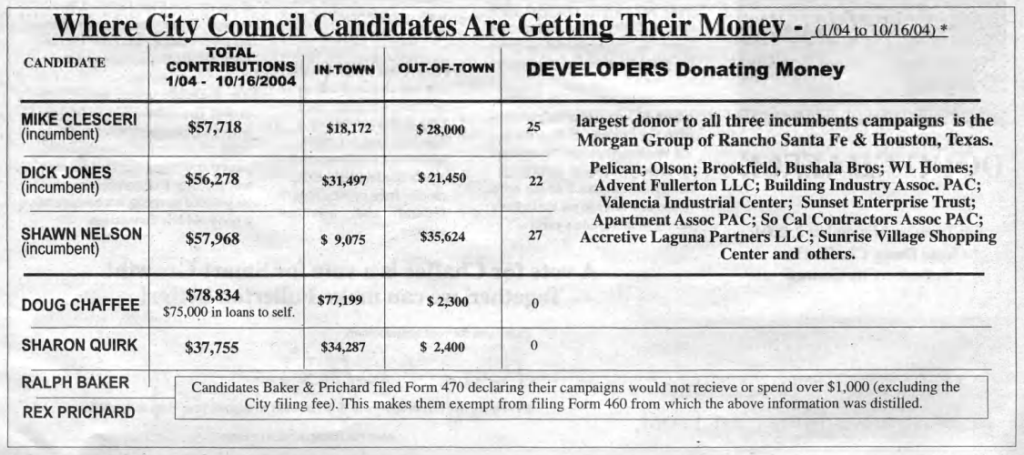
Despite spending a large amount of his own money, Doug Chaffee was roundly defeated. He was, according to the Observer, “the target of the most scurrilous barrage of negative material Fullerton has seen. The source of this material was an organization called Friends For Fullerton’s Future, whose sole purpose was to attack him.”
One of the main attacks against Chaffee was that he was supportive of “high density development” because he owned a 59-unit senior housing unit on Amerige.
Today, Friends for Fullerton’s Future is the name of a blog associated with Tony Bushala (George Jr.’s brother) and friends that continues to regularly criticize (mostly) Democratic City Council members as well as comment on city council doings from (mostly) libertarian perspective with a “take no prisoners” style. Because the blog is associated with a prominent property owner who spends a lot on local political campaigns, it is hard sometimes to determine whether blog’s purpose is genuine discourse or self-interest. Perhaps both.
Aside from local developers and property owners like the Bushalas, a major player in City Council politics were the police and fire unions, which spent thousands supporting their preferred candidates.
“The police and fire unions have been playing a high risk game in recent years in an effort to create a Council that will provide them with generous benefits,” Buck wrote. “The result this time should serve as a warning. They did not support the top vote-getters.”
Pollution
In 2004, Fullerton continued to have to deal with the lingering effects of industrial pollution, such as the former site of a manufactured gas site owned by Sempra Gas located at 144 W. Walnut Ave, on the new Paseo (Union Pacific) Park on Truslow Ave.
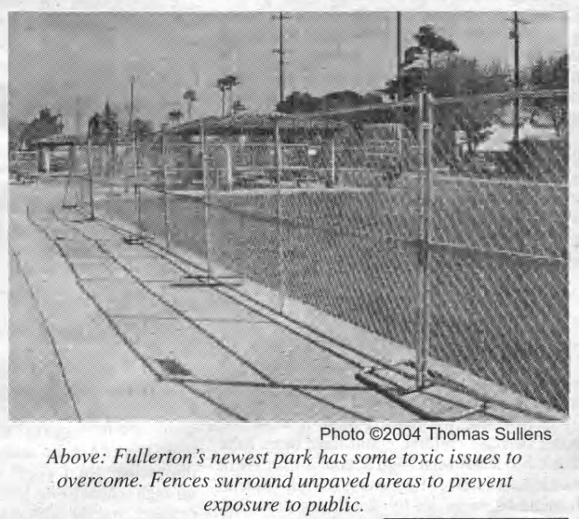
The Gas Company would have to remove about 3000 tons of soil that was contaminated with bad stuff like polycyclic aromatic hydrocarbons (PAHs), PCE, benzene and other toxins.
One wonders how the City could build a park without knowing that it was contaminated.
Another site of industrial pollution was the former Hughes Plant in west Fullerton, which was being developed into a housing and commercial center called Amerige Heights.
“The effects of years of disposing of pollutants at the former Hughes/ Raytheon site on Malvern, continues in the form of persistent 1,1- DCE, other VOCs and 1,4-dioxane still leaking into the drinking water aquifer underlying the property,” the Observer reported.
Art & Culture
Efforts were underway to raise enough money to save the Fox Theater from the wrecking ball. As a November deadline approached, the Fox Historic Theater Foundation had raised around $500,000 from community members.
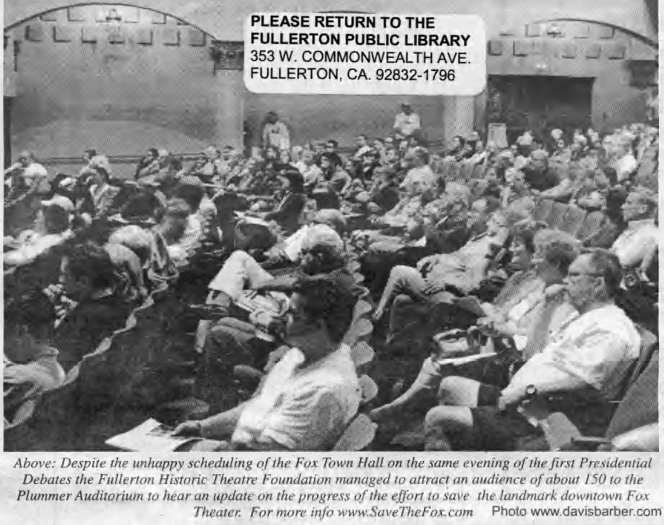
Fullerton’s Redevelopment Agency approved a $ 1.65 million “challenge” grant to the Fullerton Historic Theatre Foundation for the purchase of the Fox Theatre. This was about half of the funds necessary to purchase the theater.
Property developer the Morgan Group had the option to purchase the theater from its owner, Ed Lewis. They wanted to tear it down and build apartments. The Morgan Group had given campaign money to City Council members Mike Cleseri ($11,500), Shawn Nelson ($9,000), and Dick Jones ($6,000). These three voted against the loan proposal.
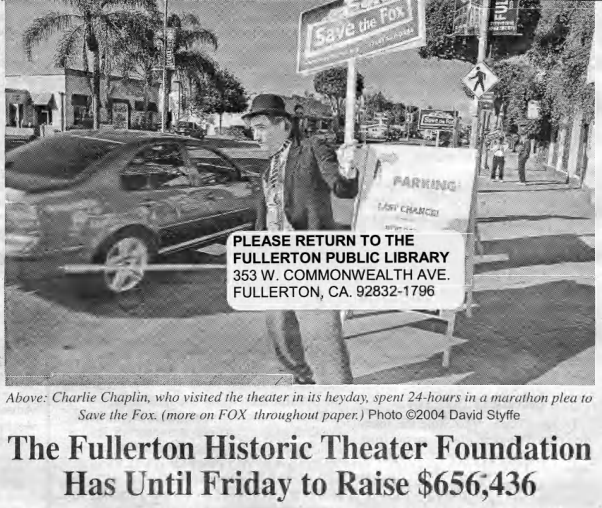
And then, at the eleventh hour, an anonymous donor gave the Fox Theater Foundation the $1 million that was needed to purchase the theater and save it from destruction.
Some of the people who were involved in these early efforts to save the Fox included Chuck Estes, Tom Dalton, Jane Reifer, Todd Huffman, and Richard Odle.
The Downtown “Renaissance”
In the early 2000s, Downtown Fullerton was experiencing a “renaissance” of sorts, with new businesses popping up in what had formerly been a pretty sleepy area.
Some of these businesses were arts-focused, like West End Gallery and Steamers Jazz Club.
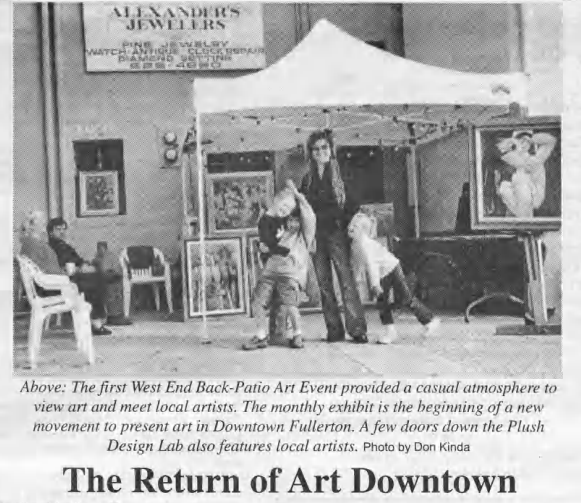
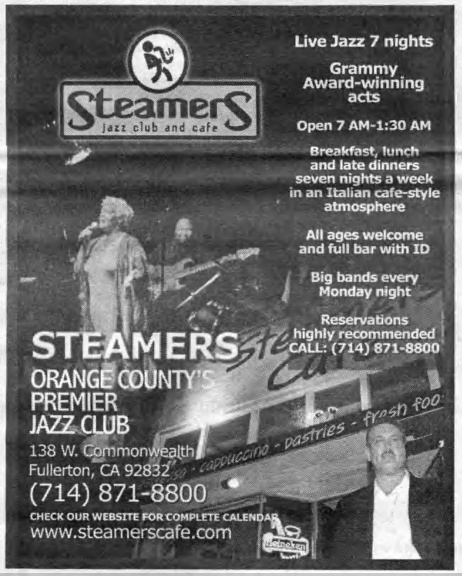
But this “renaissance” was not all galleries and jazz clubs. It also included a number of bars and nightclubs that brought some unwanted activity.
“The Fullerton Police Department continues to work with the downtown restaurant bars to thwart the fights that occur at closing time,” the Observer reported. “Several large fights have occurred in April including one on April 20th on Amerige involving an uncooperative crowd of over 100 people that took the entire ‘Watch’ to clear…Surrounding retail businesses have reported broken glass, vomit, cigarette butts, other trash and rattling of doors setting off false burglar alarms.”
Sometimes the blame for this rowdy late-night activity took on a racist tone.
The City Planning department ordered Revolucion cantina to remove its outdoor patio, citing rowdy activity, although police logs showed far fewer incidents at that location than surrounding bars like Back Alley and Rock ‘n Taco. The patrons of Revolucion were largely Latino. At one public meeting, city council member Mike Cleseri implied that the downtown fights were gang-related, a claim immediately denied by the police department.
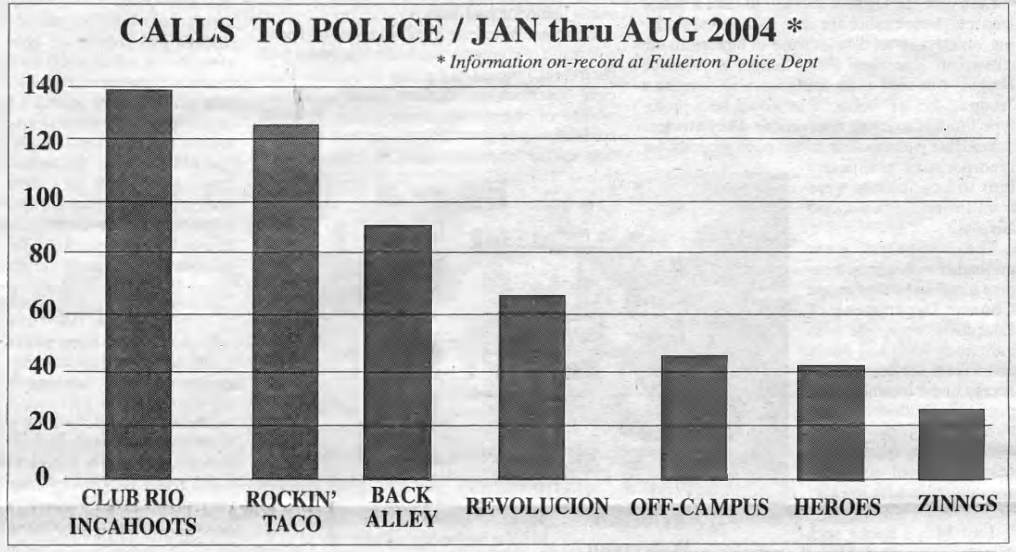
In 2004, I moved into an apartment in the heart of Downtown Fullerton, atop Mulberry St. Ristorante. I can attest that, at that time, the downtown bar scene was pretty wild, especially on the weekends. Being 24 at the time, I didn’t really mind the lively nighttime activity. But I remember many nights, standing on my patio around 2am when the bars let out, and watching the mayhem below, including several fights.
The story of how and why city officials approved so many bars and nightclubs in such a condensed area will be explored in a future post.
Housing & Development
By the early 2000s, much of Fullerton was built out with housing tracts, shopping centers, and some industry. To accommodate new residents, more and higher density housing had to be built. At least that was the thinking at the time.
The aforementioned Bushala Brothers had, over the years, acquired lots of property around the railroad tracks, and were trying to develop these into housing. They tried, and failed, to get a massive apartment project approved in 1989. In 2004, they were back with a proposed 120-unit condo project. The Bushalas were partnering with developers the Olson Company to build the project.
This project, which seemed relatively uncontroversial, would eventually be built. However, another more controversial project was in the planning stages.
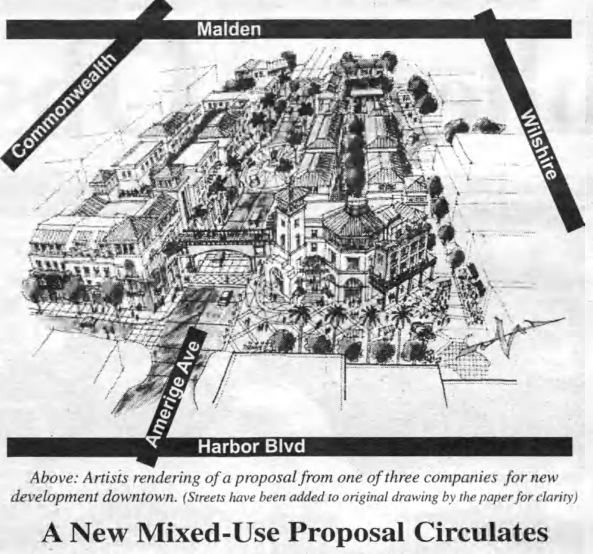
The City requested proposals from companies interested in building a mixed-use development on the downtown parking lots between Harbor and Malden and Wilshire and Commonwealth.
And proposals they did receive, such as one from Pelican Properties to develop both sides of Amerige with 160 homes plus restaurants, retail, office and live/work space, and a parking garage.
This project would eventually become the controversial Amerige Court, which was ultimately voted down by Council. Stay tuned for more on that.
Early on in this process, some downtown businesses expressed concern about parking and noise from the proposed new development.
In an effort to “clean-up” a low-income Latino neighborhood around Maple School, the City ramped up its code enforcement with an aggressive program called the Neighborhood Enhancement Project–handing out hundreds of code violation citations.
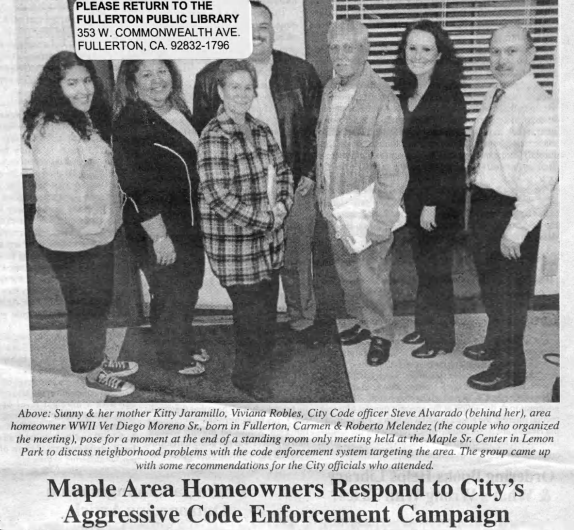
These aggressive tactics were reminiscent of the aggressive neighborhood sweeps conducted in the 1990s, in which (in the name of public safety), police ransacked dozens of homes.
Just as they had back then, the community responded by organizing. Over 150 homeowners from the Maple Area met with City staff to understand why they were being targeted so aggressively.
Neighborhood leader Bobby Melendez said that while the program may have some merit, “the process is not sensitive to homeowners who are senior citizens on fixed incomes and families with low incomes” and added that “neighborhood improvement is the responsibility of both homeowners and the City…If the City is citing homeowners to fix code violations, the City must also take actions to improve neighborhood streets, trim trees and clean up the Lemon Street (Santa Fe Railroad) Underpass.”
The residents made it clear that neighborhood improvement was a two-way street.
The City offered grants to help residents with needed repairs, but there was an obvious disconnect between residents and the city, as “the 13 residents that have signed up are still waiting for lengthy paperwork to be completed or inspections to take place, hampered further because the City has no inspector on duty.”
Homelessness
With housing costs quite high in Fullerton, homelessness continued to be a problem.
Fullerton has always had a kind of patchwork solution to homelessness, involving the city, the police, local churches, and nonprofits.
During cold months, the National Guard Armory in west Fullerton was used as an emergency shelter in which people experiencing homelessness could get a meal and a foam cot on a hard floor to sleep on.
“Shelters like the Fullerton Armory can alleviate suffering during the winter months, and perhaps even save lives,” the Observer reported. “But they are not the answer to homelessness.”
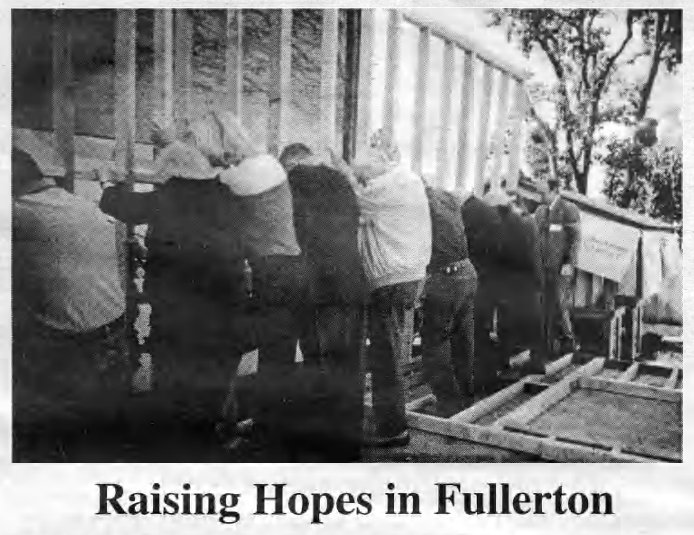
Local nonprofit Fullerton Interfaith Emergency Services (now called Pathways of Hope) was in the process of expanding their New Vista Shelter, which offered longer-term transitional housing for families experiencing homelessness.
Over 40 local building and supply companies donated products and services to help build the new housing.
Saving Coyote Hills
As the need for more housing became acute, it had to be balanced with a desire of local residents to preserve some local open space and access to nature.
Nowhere did this struggle play out more acutely than in the fight to preserve Coyote Hills from development by Chevron and its housing subsidiary Pacific Coast Homes. The plan was to build 760 homes and a shopping center on part of the 510-acre property, which was a coastal sage scrub habitat that contained numerous native plants and animal life, including the threatened California gnatcatcher bird.
“The Fullerton City Council and staff are taking all the comments from the community and from the Friends’ of Coyote Hills legal and biology experts into consideration before making a decision involving the last parcel of natural open space within city limits,” the Observer reported. “In the meantime, the Friends are researching funding sources to purchase the land as a park and nature preserve, as well as continuing with their efforts to increase public awareness of this treasure in Fullerton’s own back yard.”
Coyote Hills would become an increasingly important political issue.
Public Transit vs. OC’s Car Culture
As Orange County continued to grow in density, it also became more congested with traffic. One proposed solution to this was the construction of a light rail called Centerline, to be funded with Measure M funds obtained by a sales tax approved 1990.
Due to opposition from some quarters, the Orange County Transportation Authority (OCTA) shortened the proposed route by about half, from John Wayne Airport to the Civic Center in Santa Ana. The original Centerline route stretched from Fullerton to Irvine.
OC Supervisor Chris Norby (who had previously served on Fullerton City Council) voted against the project, stating that he felt the $900 million cost was too high for only 12,000 to 15,000 daily riders, which was the initial ridership forecast for the project.
Metrolink was started in 1994, with Measure M funds,
Norby argued that “CenterLine could well become a fiscal black hole, diverting precious transportation dollars that could benefit the whole county.”
Instead, Norby supported Metrolink, which was established in 1994 with measure M dollars.
Meanwhile, a survey conducted by CSUF and the OC Business Council, found that 69% of Orange County residents supported the 9.3- mile light-rail starter segment of the Centerline project.
Wealthier areas like Yorba Linda were less likely to support public transit.
“A $7.75 million Metrolink rail station planned for Yorba Linda since 1991 was recently rejected by unanimous vote of the city council, citing concerns of noise and traffic that it would bring to the area,” the Observer reported.
Most of the estimated 300 critics who turned out for the city council meeting belong to a group called Yorba Linda Residents Against the Metrolink Station.
As an occasional public transit user myself, I have noticed that there is definitely a social class element to users of public transit vs. drivers of cars in Orange County.
If some Orange Countians were against public transit, some were also against making the roads safer for bicycles.
In Fullerton, a Bicycle User’s Subcommittee had been established to recommend more bike-friendly policies.
According to long-time BUSC member Vince Buck, prior to the creation of the committee, “opportunities for improving the quality of life in Fullerton by encouraging non-motorized transportation were not being developed. The traffic staff and the T& CC were not interested–indeed were hostile–and would not address bicycle safety issues. They largely viewed bicycles as an impediment to traffic flow, rather than as an important contribution to the quality of life in Fullerton, an attitude that has not substantially changed.”
Fullerton, and Orange County in general, has for decades been a “car culture.”
Grocery Store Worker Strike
Back in 2003, thousands of local grocery workers went on strike against proposed pay and benefit cuts.
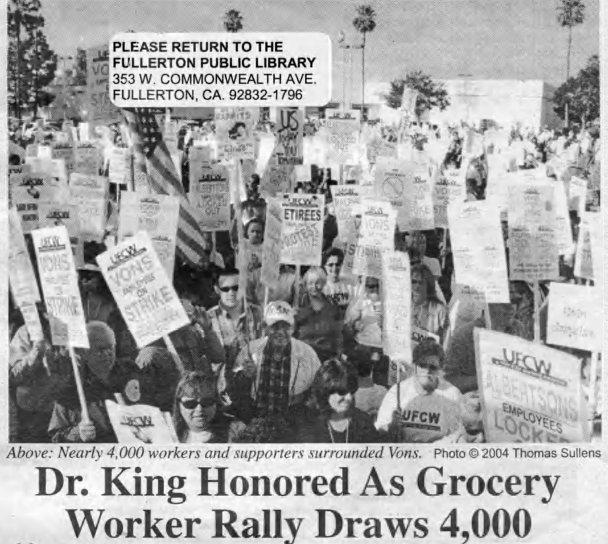
“Marking the 100th day of the grocery workers strike a huge rally drew nearly 4,000 citizens to the Vons on Chapman in Garden Grove on Saturday January 17th,” the Observer reported.
The Strike affected 13,000 United Food & Commercial Workers union members and their families in Orange County.
The strike lasted five months, resulting in a new contract between union representatives. and Safeway (Vons & Pavilions), Kroger (Ralphs), Albertsons and federal mediator, Peter Hurtgen.
The new agreement protected the wages and benefits of current workers, but kind of screwed over new hires, who would receive lower pay and reduced benefits.
Was this a win for the grocery workers? Observer columnist Jon Dobrer didn’t think so.
“Yes, they preserved their wage caps but allowed a two-tiered system, where new hires can be brought in at a lower salary and with fewer benefits,” Dobrer wrote.
Same-Sex Marriage
In 2004, same-sex marriage was illegal in California. For a brief window between February and March, San Francisco mayor Gavin Newsom began issuing same-sex marriage licenses in what came to be known as the “Winter of Love.” Unfortunately, the California Supreme Court invalidated these. Same-sex marriage would not be legalized in California until 2013.
In Fullerton, Rick Herrera and Randy Baxter, authors of the “Life Partners” column in the Observer, “committed their lives to each other before 90 friends and family, in a Holy Union Ceremony at the Spring Field Banquet Center on Sunday, March 28th,” the Observer reported.
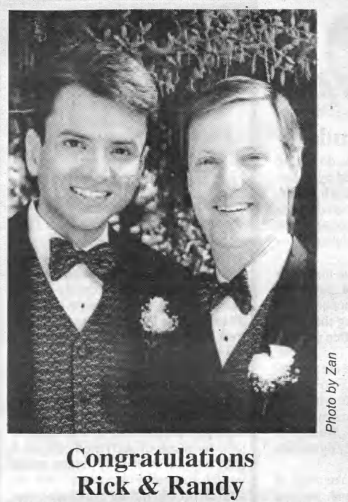
The ceremony was officiated by Pastor William R. Prickett of Dallas, Texas (an ordained Southern Baptist minister and longtime friend of Randy’s through the gay Christian group Evangelicals Concerned With Reconciliation).
Education
Fullerton celebrated the grand opening of its newest elementary school, Robert C. Fisler School, the first new school in 32 years. The new school had a theme of “Science and Technology.”
Fisler is located in the newly-built Amerige Heights development area and was named after retired Fullerton educator and longtime Fullerton School District Boardmember Robert “Bob” Fisler.
Fullerton has long struggled with the issue of educational equity between the more affluent schools in the north part of the city and the lower-income schools in the south.
Fisler was a brand new school in a new area with expensive homes and all of its students got laptops.
“Why not have Woodcrest or Richman become the “Science & Technology” school?” Observer education reporter Jan Youngman wondered. “And why should only Fisler have laptops for each student?”
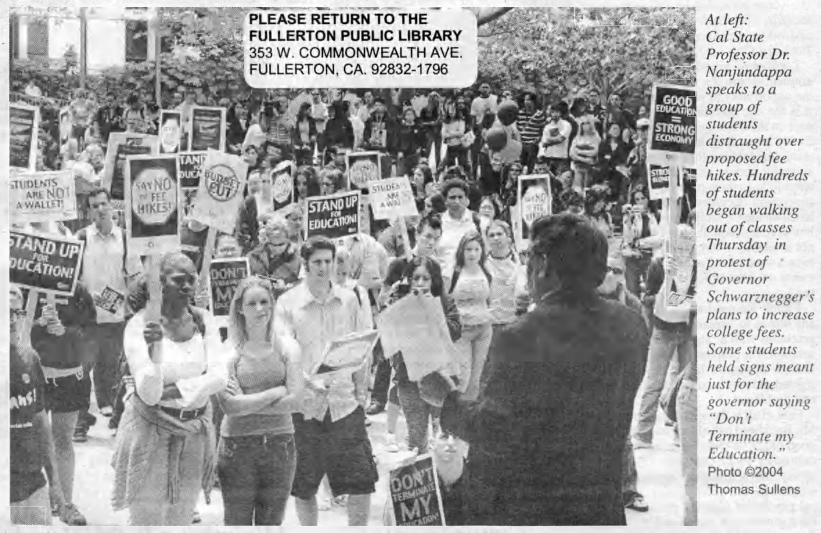
Over 600 Cal State Fullerton students walked out of classes in 2004 to protest Governor Schwarzenegger’s proposed additional budget cut of the CSU system.
“Protestors say balancing the state budget by raising student fees will cause many students, already on the financial edge, to drop out,” the Observer reported.
It’s interesting to note that the original vision for the CSU system, as laid out in the 1960 Master Plan for Higher Education in California, was that these public institutions be tuition-free.
Those who attended CSUF in the 1960s and 70s paid virtually no tuition. That vision would be abandoned, especially starting in the 1980s.
Old Bob
Old Bob, the large snapping turtle who lived at Laguna Lake for decades, was an attraction at the Fullerton Arboretum’s “Green Scene” plant sale. Bob had to be evacuated from Laguna Lake while it was being renovated.
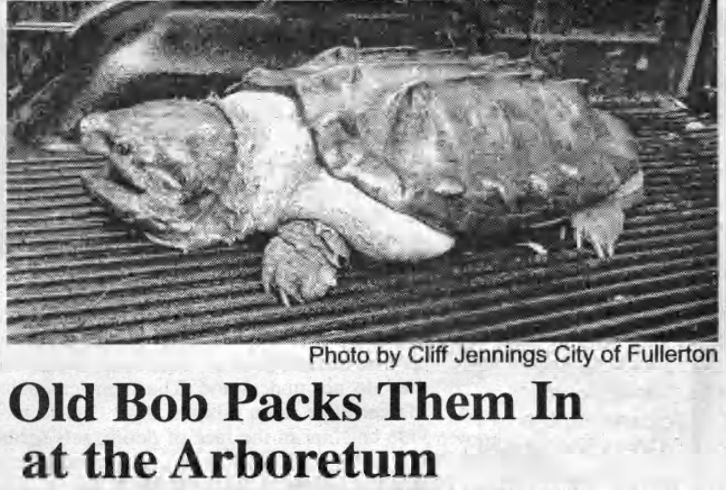
Sometimes called “The legend of Laguna Lake,” Old Bob’s ultimate destination was unknown. There was a petition to get him a home at the Santa Ana Zoo.
Deaths
Longtime Fullerton resident William “Bill” Kroeger died at his home in Borrego Springs.
Bill was born in Fullerton in 1902. His grandfather, Henry, was an early developer of North Orange County and the second mayor of Anaheim. Bill graduated from high school in Fullerton in 1921.
Bill worked in the citrus industry on his family’s ranch, and then for the Corcoran Paper Company, starting as a truck driver, moving into sales and becoming a partner.
He served on the planning commission and was elected to city council in 1954, serving as mayor from 1956 to 1958.
Stay tuned for top stories from 2005!
-
Fullerton in 2003: The Iraq War, the Grocery Workers Strike, Arnold Schwarzenegger is Elected Governor, Etc.
The following is from a work-in-progress about the history of Fullerton. You can support my ongoing research and writing on Patreon.
The Fullerton Observer newspaper was formed in 1978 by Ralph and Natalie Kennedy and friends to provide a more progressive counterbalance to the more conservative Fullerton News-Tribune and Orange County Register. Back then, Orange County (including Fullerton) was dominated by Republicans, and the Observer crew were definitely in the minority. The Fullerton Public Library has digital archives of the Observer stretching back to 1979. I am in the process of reading over these archives and creating a year-by-year summary of top stories. Here are some top stories from 2003.
The Iraq War
It’s interesting to write about history that I remember. In 2003, I was living in Fullerton. I was 23 years old. Having grown up in a somewhat conservative evangelical environment (in Fullerton), I remember being generally supportive of the Iraq War. At the time, I bought into the official Bush/Cheney narrative that Saddam Hussein was a murderous dictator who had weapons of mass destruction and was somehow connected to Al-Qaeda and terrorism.
With the hindsight of history, I know now that Saddam Hussein was a murderous dictator, but he did not have weapons of mass destruction and he was not connected to Al-Qaeda. Saddam was a secular leader. Al-Qaeda were religious fundamentalists. Such nuance was, I think, lost on many Americans, like me at the time.
It feels appropriate to think about the lead-up to 2003 American invasion of Iraq, because (as of this writing) America is currently involved in a new war against another middle eastern country, Iran. The rationale given by the Trump administration, nebulous as it has been, echoes many of the rationales given about the Iraq War. Iran, we were told, was a threat to the United States. I do not believe that is the case, as it was not the case with Iraq. Today, I am (I hope) more skeptical of claims made by political leaders.
In 2003, Fullerton was a more Republican place than it is today. So it has been fascinating to read the Fullerton Observer’s coverage of the leadup to the Iraq War in 2003. The Observer, being a generally liberal publication, tended to focus on protests against the war and reasons why it was a misguided endeavour. I’m sure this coverage angered many Fullertonians at the time. In hindsight, I think the Observer was generally correct.
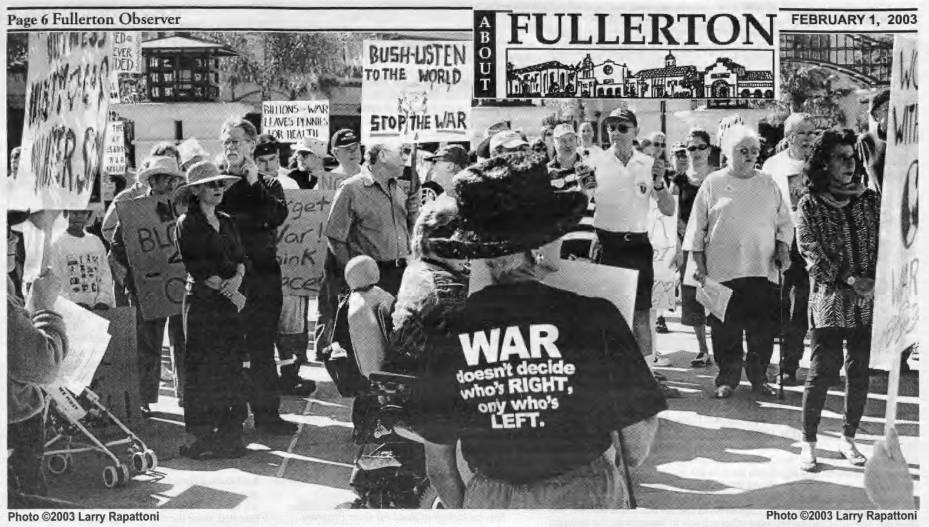
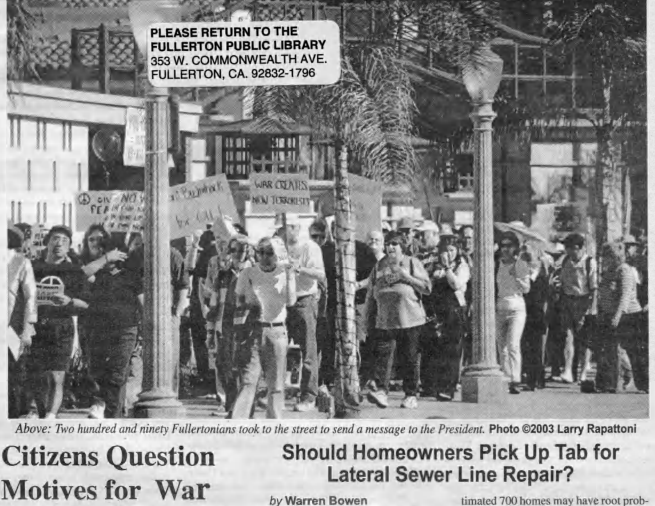
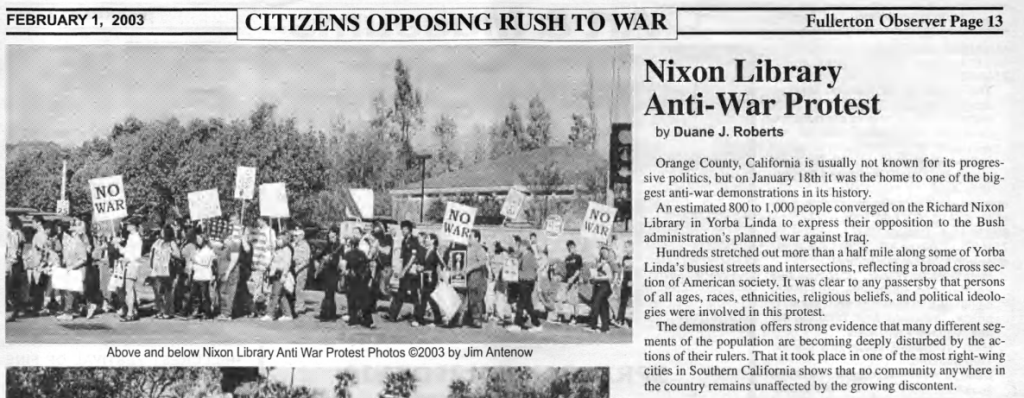
In early 2003, prior to the invasion of Iraq, “290 Fullertonians took to the streets to question the rush to war,” the Observer reported. “The event was sparked by neighbors Dorian Hunter and Sally Zivitz who invited other concerned citizens to join them at the Downtown Plaza at noon.”
“We hope this puts Fullerton on the map as having some citizens who want to stand up for their beliefs. It was a good demonstration of the right to free speech, the freedom to assemble and question our governments motives for war. Thanks to all of the participants it was a great day!” said Dorian Hunter.
A resolution opposing the Iraq War was presented to Fullerton City Council, which was dominated by Republicans. Unsurprisingly, Council opposed the resolution.
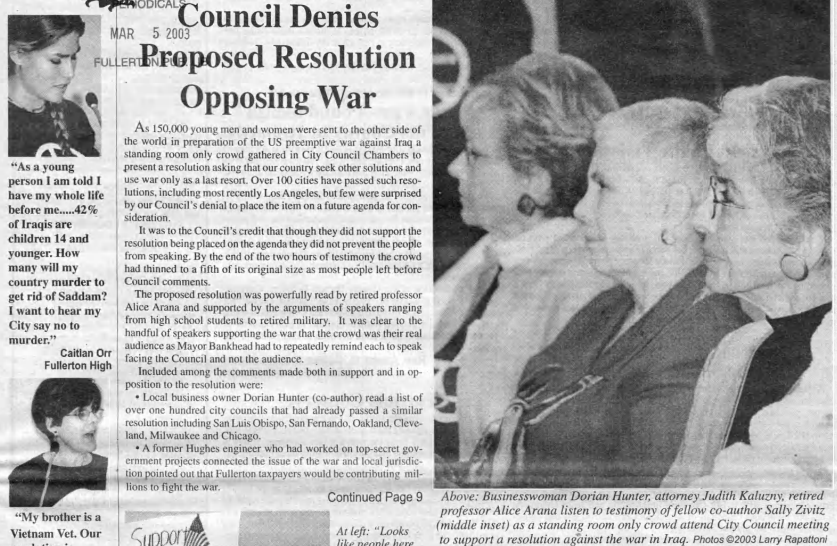
“As 150,000 young men and women were sent to the other side of the world in preparation of the US preemptive war against Iraq a standing room only crowd gathered in City Council Chambers to present a resolution asking that our country seek other solutions and use war only as a last resort,” the Observer reported. “Over 100 cities have passed such resolutions, including most recently Los Angeles, but few were surprised by our Council’s denial to place the item on a future agenda for consideration.”
“It was discouraging to listen to the reasons offered by our Councilmen for their opposition to the anti-war resolution,” Vince Buck wrote. “Councilman Jones stated that many of the arguments offered during the evening were based on ‘erroneous information, emotions, and misinformation.’ The Council itself demonstrated that it was subject to the same weakness.”
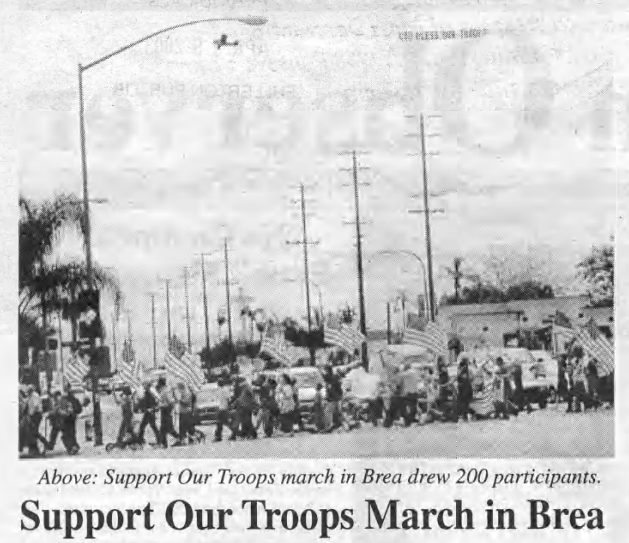
Not everyone was against the war, of course. In fact, lots of people in Orange County supported it. There were weekly flag-waving events in downtown Brea in support of the war, for example.
The Patriot Act and The Security State
A special event in Fullerton involved a discussion of the infamous PATRIOT Act, which allowed increased government surveillance of US citizens. It was a debate of sorts between FBI agent Louis Flores and ACLU representative Stephen Rhode.
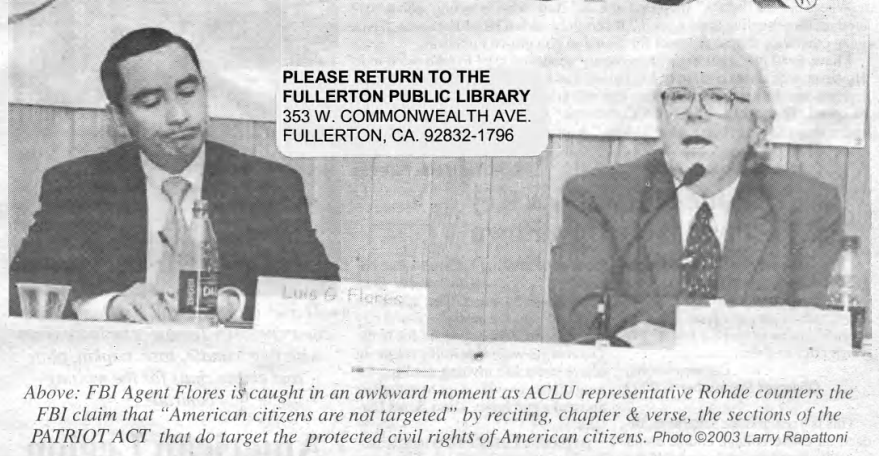
“Flores stated that the public should have no concern about the Bureau snooping into our buying or reading habits, because they don’t have time to monitor millions of people,” the Observer reported. “We should consider the FBI like our friendly local policeman who helps us when our home is broken into.”
Meanwhile Rohde, “expressed the hope that we may find a way to be both safe and free. He also reminded the audience that the struggle between power and civil rights is not a new problem in America…Rohde reviewed some of the historical precedents in which the USA has overreacted to threats by clamping down on civil rights” such as the internment of Japanese Americans during World War II.
Pollution
In industrial pollution news, the oil companies responsible for creating Fullerton’s first Superfund site, the McColl Dump Site, were now given responsibility for monitoring the site’s pollution. What could go wrong?
In other industrial pollution news, further clean-up of the former Hughes Aircraft site (now Amerige Heights Shopping Center and housing development) was needed.
“The last groundwater monitoring tests completed before construction began in 2000 showed that 1,1- DCE and 1,4- dioxane had reached the regional drinking water aquifer underlying the property,” the Observer reported. “The chemical has recently shown up in tests of the nearest drinking water well located at the Fullerton Airport which has been temporarily shut down. The report states that hazardous waste, substances or constituents have migrated or may migrate from the Facility into the environment through air, soil, and groundwater.”
And in other industrial pollution news, “A neighborhood bordering the new Paseo Park currently under construction on Truslow in Fullerton also lies in the pathway of possible problems related to the removal of toxins from a former gas manufacturing site at 144 W. Walnut, owned by Sempra Energy.”
“The site has been found to contain a series of chemicals called Polycyclic Aromatic Hydrocarbons (PAHs). Some of the chemicals at the site have been found to be of the cancer-causing variety,” the Observer reported. “Following its mandate to protect the public, the California EPA Department of Toxic Substance Control has accepted Sempra Energy’s voluntary plan to remove the top five feet of soil from the entire site…The site is set to become a city parking lot for the new Paseo Park being constructed on Truslow…No testing within the new park boundaries has been done although it does lie just south of the factory and may have offered an attractive dumping ground at one time.”
What could go wrong? Stay tuned.
Saving Coyote Hills
The Friends of Coyote Hills was trying to save Fullerton’s last largest natural open space from development.
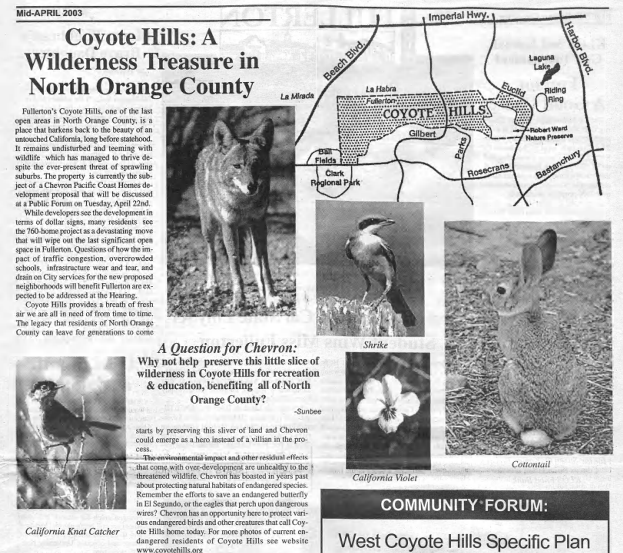
Meanwhile, “Chevron’s Pacific Coast Homes (PCH), applicant for the West Coyote Hills development, is launching an expensive advertisement and PR blitz to try to influence public support and win the support of Fullerton’s planning commission and city council. This is evident in their attendance of many events of late, the launching of a website, and the mass mailing of a newsletter,” the Observer reported. “The Fullerton community beware. Behind all this is a PR firm, Laer Pierce and Associates (LP&A), that specializes in helping developers win community and government support through slick advertising and other tricks of the trade.”
The Friends of Coyote Hills were critical of the Chevron proposal of 760 homes to be built on West Coyote Hills: “They have cited concerns of water quality and supply, traffic, overcrowding of schools, long-term economic burden for residents, and the destruction of a valuable natural habitat for a federally endangered species, the California gnatcatcher.”
“Instead of developing the property with more homes, The Friends of Coyote Hills propose a 510-acre public nature park and reserve that can be enjoyed in perpetuity by all,” the Observer reported.
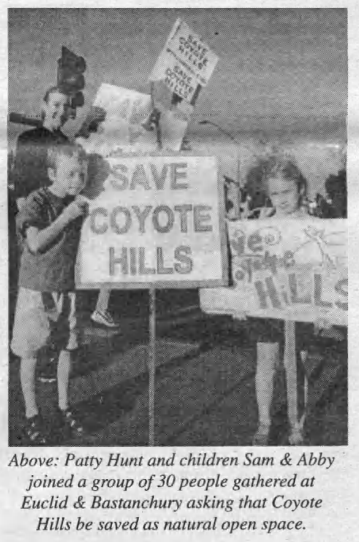
According to Chevron’s web site, “Protecting the earth’s natural resources is as important to ChevronTexaco as providing the energy sources so essential to improving our quality of life. Beyond meeting the world’s energy needs, our goal is to be recognized and admired everywhere for having a record of environmental excellence.”
The Observer took Chevron’s claims of “environmental excellence” to task, pointing out decades of industrial pollution: “The US Environmental Protection Agency considers Chevron a PRP for 49 hazardous waste Superfund sites (including, along with other oil companies, the McColl Dump Superfund Site here in Fullerton adjacent to West Coyote Hills),”
In an article for the Observer, Angela Chen Lindstrom of the Friends of Coyote Hills questioned the Environmental Impact Report created by Chevron.
“Chevron’s consultants are performing the analysis and drafting the report, and then turning it over to the city for review and approval. The quality of the independent analysis is questionable,” Lindstrom wrote. “There is much at stake here. Though the lines between for-profit and public agencies have been blurred, it’s not hard to see who stands to gain the most from the development of West Coyote Hills. Times are good for Chevron.”
“To date, less than three acres of the 510-acre site has been cleaned-up. The report states that there was probably a sump (area where oil waste is dumped) related to each oil well on the property. There were over 400 oil wells,” the Observer reported.
A community meeting on Chevron’s proposal for West Coyote Hills drew a large crowd of around 400 interested residents.
“Many faces here are the same ones that attended the hearings on Amerige Heights where the City stood by as the developer presented us with pretty pictures of tree lined pedestrian friendly streets and darling houses,” Dede Ginter said. “Instead we got less than 5% green space, discount stores, cramped streets and houses within spitting distance of each other. My neighbor asked me if I thought we could trust Chevron. That is not the question, the question is can we trust our own City. No one is listening.”
Saving the Fox Theater
Fullerton Heritage, the group responsible for gathering petitions of 12,000 individuals interested in saving the Fox Theater, handed over responsibilities for saving the Fox to the newly formed Fullerton Historic Theatre Foundation.
“Created by a group of concerned citizens nearly two years ago, the Fullerton Historic Theatre Foundation was formed specifically to achieve the acquisition, stabilization, restoration and reactivation of Chapman’s Alician Court Theatre; now known as the Fox,” the Observer reported. “It has sponsored a series of public presentations aimed at educating the community about the artistic, architectural, historical and economic values of the unique structure. The Foundation, which has created a sophisticated business plan for the restoration and eventual operation of the theatre and its related properties, has also formed alliances with regional and national organizations and individuals prominent in historical restoration issues.”
In other arts & culture news, a new business called Plush Design Lab opened downtown at 207 N. Harbor Blvd.
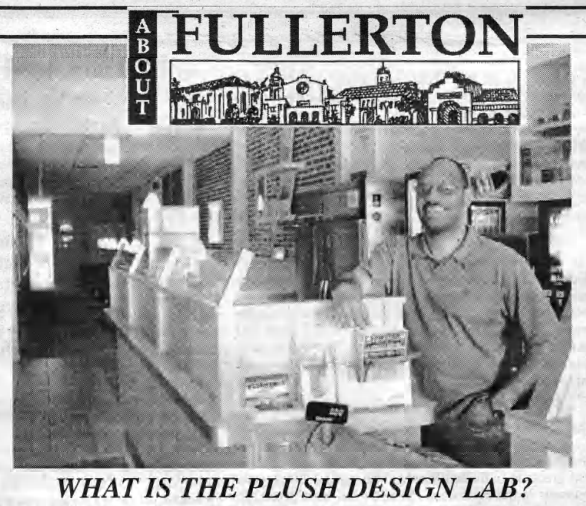
“The European style Internet cafe features Italian sodas, coffees, teas, Bobas, softdrinks, various energy drinks, desserts & snacks in a cool, contemporary high-tech environment,” the Observer reported. “The space promises to be popular with CalState & Fullerton College students, artists, writers, actors, musicians, hi-techs and anyone looking for a non-alcoholic alternative gathering place. Poetry jams are already taking place as well as open mic nights and soon the Plush will host art shows.”
A new mural next to Rutabegorz in a new downtown park next to the Museum Plaza was painted with the guidance of Fullerton artist Katherine England.

“Thirty students with representatives from each of Fullerton’s high schools worked on the colorful and bold design inspired by the art of Peter Max,” the Observer reported. “The new park located on land that was once considered for parking or yet another office building, adds a refreshing green space to downtown Fullerton.”
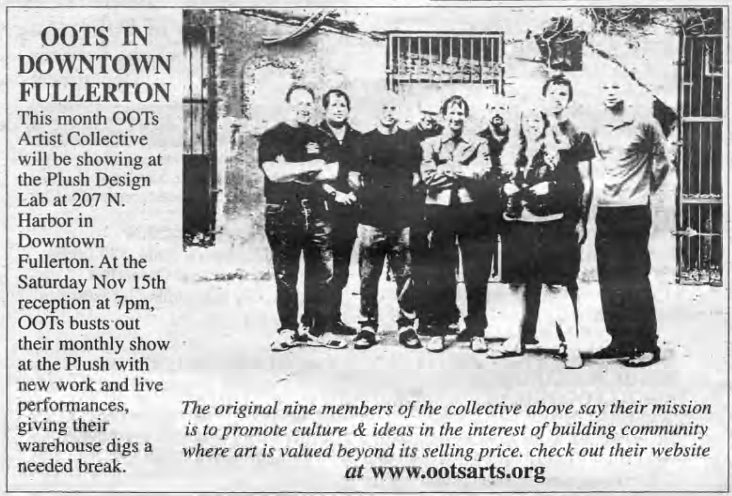
And and arts collective called OOTS began organizing art shows in Fullerton.
Transportation
In transportation news, a proposed light rail train called the Centerline was facing push back from some quarters.
“Following a 3.5 hour period of testimony from 75 members of the public, including the Mayor of Fullerton, Councilman Dick Jones, and 7 other Fullertonians, the Board spent about one hour of discussion before reaching a 9 to 2 vote in favor of continuing the Centerline Project,” the Observer reported. “Public comments were so overwhelmingly in favor of continuing the project that it is difficult to understand how the two “No” votes were possible.”
Chris Norby, former Fullerton Councilman, recently elected to the Orange County Board of Supervisors, voted against the majority.
“According to very recent survey findings from Cal State Fullerton’s Center for Public Policy, in partnership with the Orange County Business Council, some 55% of Orange County residents would – if the question were put before them today – vote in favor of building the light rail line, as proposed, from Santa Ana to John Wayne Airport,” the Observer reported.
Ray Young, professor of geography at CSUF, author of Commuting in Orange County, a report published by the Cal State Fullerton Center for Demographic Research (December 2002) wrote, “It is noteworthy that the public is more receptive to a light rail future than to bus system expansion. That may be linked to the prospect of greater speed as well as the novelty of a rail starter line, linking major activity nodes and job centers in the county.”
The light rail concept was approved as part of measure M funding initiative in 1990, a process that led to substantial freeway widenings and bus line improvements.
The Infamous Florentine Sidewalk Incursion
In 2003, Downtown Fullerton was experiencing a “renaissance” of sorts, with more restaurant/bars opening up, transforming a once sleepy downtown into a popular drinking/party destination.
In the midst of this, the Florentine family, owner of a proposed bar on the northeast corner of Harbor and Commonwealth, did a questionable thing by encroaching on a sidewalk with a built-out concrete patio with support from city bureaucrats.
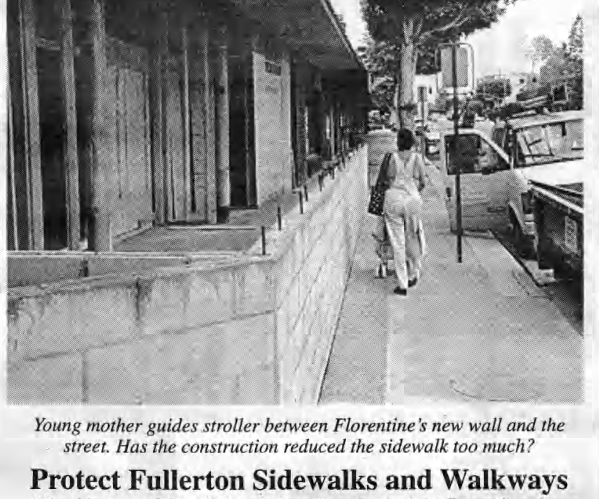
“Approval to build a 6-inch high patio that later turned out to include a 4-foot high concrete block wall enclosing a wide swath of city sidewalk on Commonwealth at Harbor in downtown Fullerton was given to “Intimate Inns of California, Inc., doing business as Florentine’s Downtown Bar and Grill,” unanimous City Council vote May 6, 2003,” the Observer reported.
Although a sign and two trees were removed for the construction and the sidewalk was reduced from 12-feet to 6-feet wide, Florentine’s application was not sent to the Planning Commission for discussion.
“The Agenda information sheet No. 14, presented to Councilmembers, the public and the press, failed to include diagrams, figures, or even a description of the concrete block wall running down the middle of the sidewalk,” the Observer reported. “Instead Council was shown an artist’s rendering which was not made available for publication and was not included in the Agenda backup information.”
Asked why the issue did not come before the Redevelopment Design Review Committee for review, City Manager Chris Meyer said “The RDRC has no political power but acts only as an advisory body to the City Council.”
“The sidewalk [should] be returned to its 12 ft. width and that the two trees removed be replanted to provide shade,” the Observer stated.
Meanwhile, Cameron Irons, president of the Downtown Fullerton Restaurant Association argued that the encroachment was a net win for Fullerton.
“Tony and Joe Florentine have been longtime business owners in our beautiful Downtown. They put their money and their efforts into creating a business in an area that had been woefully neglected by the city for many years,” Irons wrote. “The current renaissance in the downtown area is occurring for many reasons, one of which is the dedication and hard work of our Downtown restaurant owners. If those who complain about the Florentine’s patio feel that a wide sidewalk is more important than the increased success of a local business they only have to move a few blocks North to Brea where those city leaders have chosen to bulldoze historic areas so that restaurant patios can exist with wide sidewalks.”
Local Politics
In California politics, Democratic governor Gray Davis was recalled and Republican movie star/body builder Arnold Schwarzenegger was elected to replace him. Oh, California.
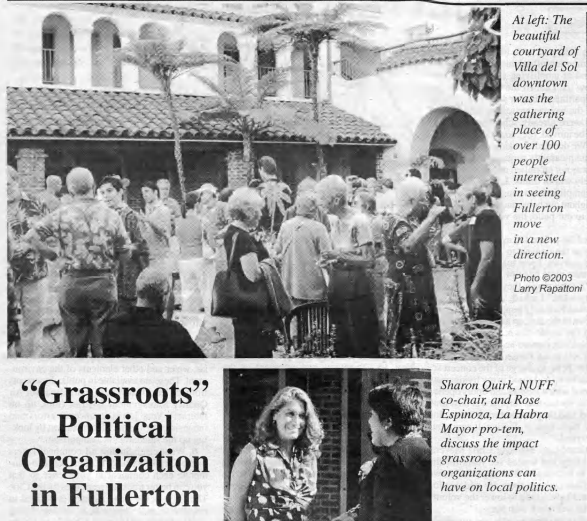
Closer to home, a new political advocacy group called Neighbors United for Fullerton (NUFF) was formed. This group sought to elect liberal candidates.
The Grocery Store Workers Strike
When large grocery store chains sought to cut workers’ wages, thousands of workers went on strike throughout Southern California, including Fullerton.
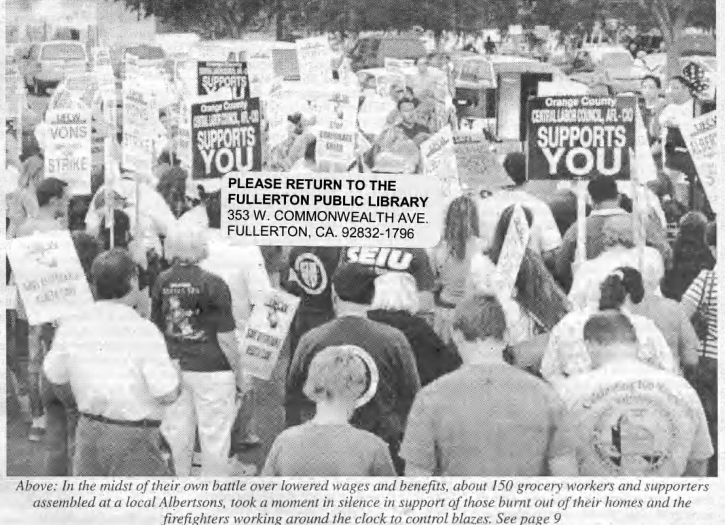
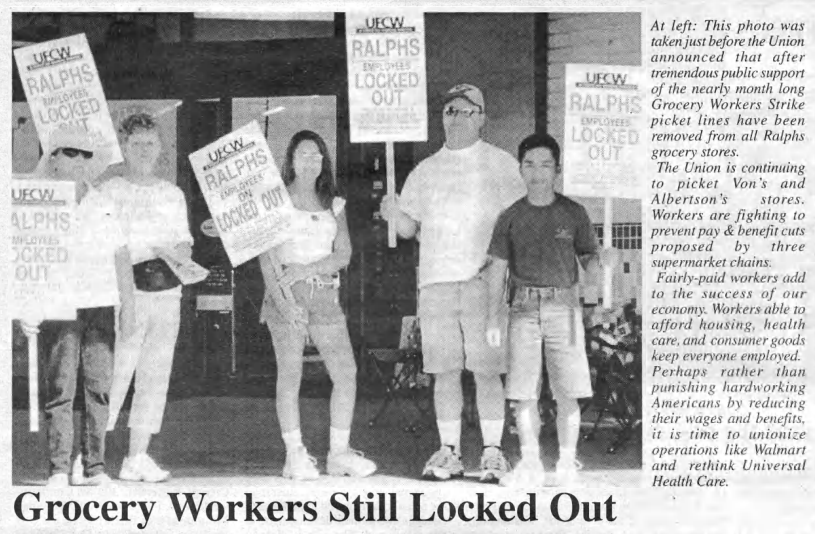
“When the United Food and Commercial Workers Union called the strike against Vons and Pavilions, both owned by Safeway, grocery chains owned by Albertson’s and Ralph’s locked out their workers even though they were not part of the strike,” the Observer reported. “Now picket lines have been placed at all 859 markets and customers are finding alternative places to shop.”
“Over 2000 marched from Albertson’s headquarters to the Albertson’s on Raymond in Fullerton,” the Observer reported. “The parking lot in front of the store served as a gathering place for workers, their families, members of supporting unions and other supporters of the 2-month long workers strike against grocery chains attempting to cut wages and benefits.”
Housing and Homelessness
A new housing unit for homeless families, called New Vista, broke ground in Fullerton, to be built and run by Fullerton Interfaith Emergency Services, now called Pathways of Hope.
The new units will be important in attacking the “plague of homelessness which afflicts Orange County,” said FIES President Jerry Brown. Between 26,000 and 30,000 people are homeless every night in Orange County.
Education
“Since 1985, the Fullerton School District has supported the D.A.R.E. Program and established a great relationship with the Fullerton Police Department,” the Observer reported. “This year’s DARE Officer Tony Cicciarelli teaches once a week for 10 weeks at 22 school sites in Fullerton.”
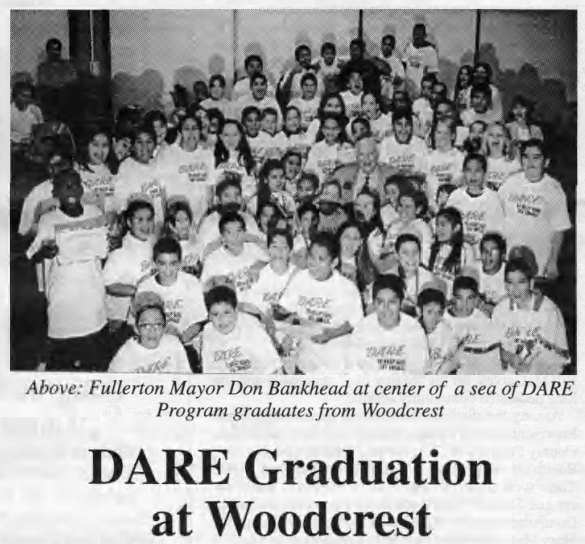
Based on numerous studies, the D.A.R.E. program was ineffective.
Deaths
CSUF professor Willis McNelly passed away.
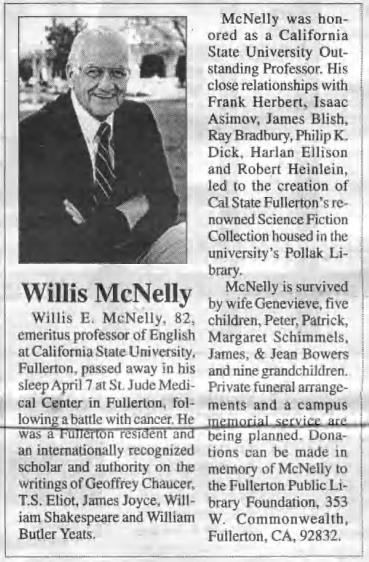
“His close relationships with Frank Herbert, Isaac Asimov, James Blish, Ray Bradbury, Philip K. Dick, Harlan Ellison and Robert Heinlein, led to the creation of Cal State Fullerton’s renowned Science Fiction Collection housed in the university’s Poliak Library,” the Observer reported.
Stay tuned for top stories from 2004!
-
Fullerton in 2002: Indian Mascot Debate, Saving Coyote Hills & the Fox, Industrial Pollution, and Republicans Still Rule
The following is from a work-in-progress about the history of Fullerton. You can support my ongoing research and writing on Patreon.
The Fullerton Observer newspaper was formed in 1978 by Ralph and Natalie Kennedy and friends to provide a more progressive counterbalance to the more conservative Fullerton News-Tribune and Orange County Register. Back then, Orange County (including Fullerton) was dominated by Republicans, and the Observer crew were definitely in the minority. The Fullerton Public Library has digital archives of the Observer stretching back to 1979. I am in the process of reading over these archives and creating a year-by-year summary of top stories. Here are some top stories from 2002.
Hate Crimes on the Rise After 9/11
“This year hate crimes and incidents show an increase of 33% compared to last year,” the Observer reported. “This increase has disproportionately affected the Middle Eastern and Muslim communities who faced the brunt of irrational and hateful attacks in the wake of the September 11, 2001 tragedy on the East Coast.”
International Law? U.S. Says ‘No Thanks’!
“Despite strong opposition from the Bush Administration, the International Criminal Court became a reality on July 1st,” the Observer reported. “The World Court will try cases of genocide, war crimes, and crimes against humanity that the accused person’s home government has refused to try in a reasonable manner. Sixty-nine countries including all European allies, have ratified the treaty so far. ‘Justice will be strengthened and accountability will be reinforced,’ said Richard Dicker head of the-International Justice Program at Human Rights Watch.”
The Fullerton Indian Mascot Debate
Residents, students, school administrators, and Native American activists were debating whether the Fullerton Union High School Indian mascot was offensive and should be replaced.
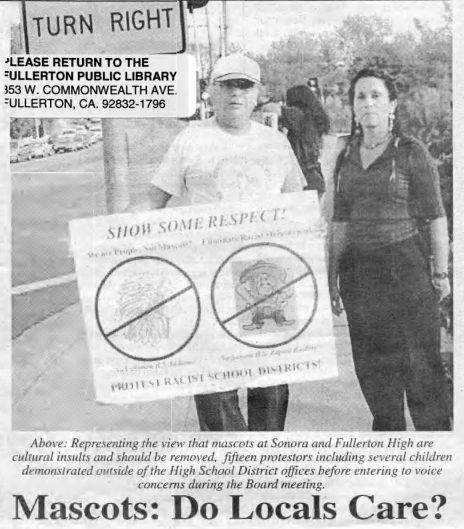
“The use of Native American mascots by educational institutions has come under increasing fire by civil rights groups and American Indians as the latter try to achieve equal status as an identifiable ethnic group within American society,” the Observer reported. “In spite of the goodwill of many Americans and Fullertonians, many individuals resist change and continue their ignorant ways. Such is the case with the Fullerton Joint Union High School District…Native American mascots perpetuate inappropriate, inaccurate, and harmful understandings of living people, their cultures, and their histories. These mascots reduce and belittle living Native Americans to a series of cliches and racist stereotypes overshadowing the complexities of Native American experiences and identities.”
“Native American mascots are constructed from the imaginations of the dominant society and as such are perceived as racist inventions by the Native American community,” anthropology professor E. Sky Scott wrote in the Observer. “Much of the stereotyping of Native Americans is used as a foundation upon which many Americans build their glorified national identity…These are symbols of dominance and superiority and expose feelings of entitlement not only to native land and resources but also to religious and cultural identities.”
Meanwhile, some older Fullertonians supported keeping the Indian mascot.
“FUHS should be proud to have the Indian as a representative of their school. It was an Indian who befriended the first settlers to this country. They gave thanks to God on the first Thanksgiving in Plymouth, Massachusetts many years ago. If you would like to change the use of Indian representing FUHS, perhaps you should take a step further and eliminate Thanksgiving,” FUHS alumni Bill Case wrote.
Meanwhile the US Commission on Civil Rights called for an end to the use of Native American images and team names by non-Native schools.
Fullerton Union High School (FUHS) officials conducted a meeting between themselves, selected students, and four speakers regarding the mascot.
School administrators were reluctant to make any changes.
“High School District Superintendent Escalante believes that Fullerton citizens don’t really care about the issue,” the Observer reported. “I get 20 letters in support of keeping the mascots to every one asking that they be removed,” he said at a Board meeting.
Boardmember Marilyn Buchi agreed, “Most of the protestors are from outside of the community. It’s not really an issue here. Changes are being made though at a slower pace than what the opposing groups want.”
Indeed, it would take another two decades for FUHS to change its mascot, as a result of a state law. As of 2026, the mascot is the Red Hawks.
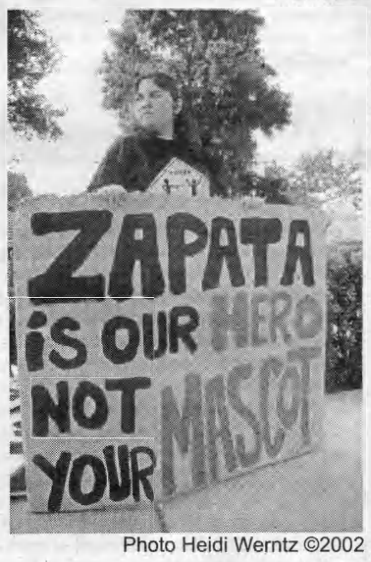
Some also felt that the Sonora High School “Raider” mascot, a depiction of Mexican revolutionary leader Emiliano Zapata, was also a disrespectful caricature and should be replaced.
Saving Coyote Hills: Oil vs. Soil
Facing a development proposal from Chevron, the Friends of Coyote Hills was working to preserve the 510 acres as open space.
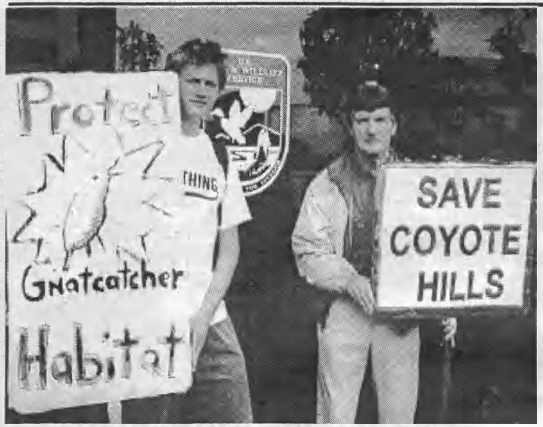
“My responsibility is to provide value to the shareholders of ChevronTexaco, while serving the company and community in an appropriate and balanced manner,” a representative of Chevron wrote to the Observer. “I believe our proposed development plan accomplishes this.”
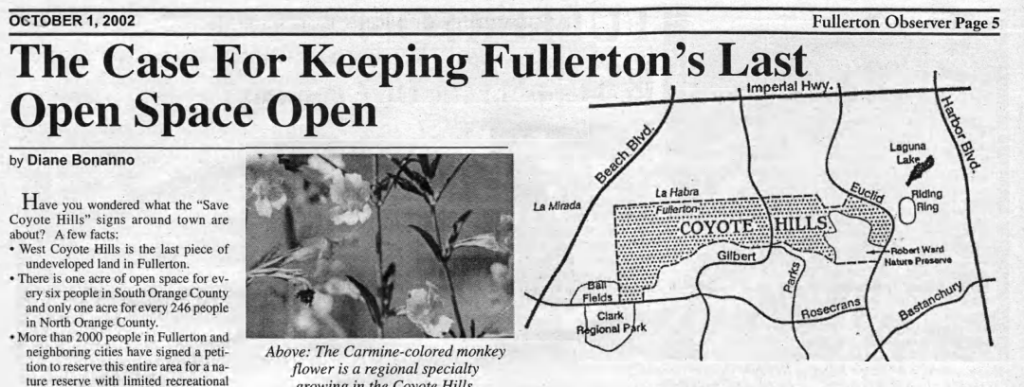
Chevron’s plan included housing development and preservation of about half of the open space; however, this figure was not entirely accurate.
“The developer disclosed that the ‘preserved 280 acres’ will be cleared of all ‘non-native plants, including trees,’ and there was not a concise plan to manage wildlife while the land is being ‘cleared’ i.e. bulldozed. In essence it sounds like most open space will be bulldozed and revegetated,” Kathleen Shanfield wrote in the Observer.
Meanwhile, a new Vista Park opened in East Coyote hills.
“The City’s newest park (Mountain View Park) is located at the northwest corner of State College Boulevard and Bastanchury Road,” the Observer reported. “The two-acre park offers sweeping views of Orange County and parts of Los Angeles County. Amenities include meandering walkways, picnic tables and benches, extensive landscaping, drinking fountain, safety lighting and on-site parking. The facilities are accessible to all. The cost of the park project was approximately $1-million with funding coming from developer fees paid by Van Daele Communities, which is constructing a development just west of the park.”
Still Saving the Fox
Fullerton’s other decades-long preservation effort, saving the historic Fox Theater, also continued.
“The Fullerton Historic Theatre Foundation has been meeting biweekly since last September in an attempt to understand and, we hope, alter the present status of the Fox Fullerton Theatre,” Chuck Estes wrote. “We are evolving new strategies to move the situation forward toward the theatre’s eventual restoration. Our vision for the Fox is a multi-use facility incorporating film, live theatre, concerts, community events and meetings.”
According to architectural historian Alfred Willis, “The Fox Fullerton Theatre is one of the finest surviving buildings designed by Raymond Kennedy, one of the most original architects in Los Angeles in the 1920’s. Kennedy worked for the prominent construction firm of Meyer & Holler whose designers perfected an innovative type of theatrical house: the courtyard theatre, in which an atmospherically decorated forecourt took the place of an interior lobby. Unfortunately, not many of them survive, and the Fox Fullerton is the ONLY survivor themed in Kennedy’s own favorite style, the Italian Baroque.”
What was needed to save the Fox, as well as Coyote Hills, was money, and lots of it. A Fox Historic Theater Foundation was created to receive donations.
Arts & Culture
In 2002, Fullerton was still hosting an annual arts and culture event called “A Night in Fullerton,” a tradition that stretched back to 1964.
“A Night in Fullerton is the city’s annual celebration of the Arts, featuring an evening of free music, art, drama and dance programs at numerous locations throughout the community,” the Observer reported. “The late artist Florence Arnold and other citizens began the celebration years ago. The festival attracts thousands of people each year at the many venues.”
The Observer includes a feature on one of the most unique restaurants in town–El Fortin, which serves authentic Mexican food from Oaxaca, with its various rich moles, huge handmade tortillas, fried crickets, and unique cheese.
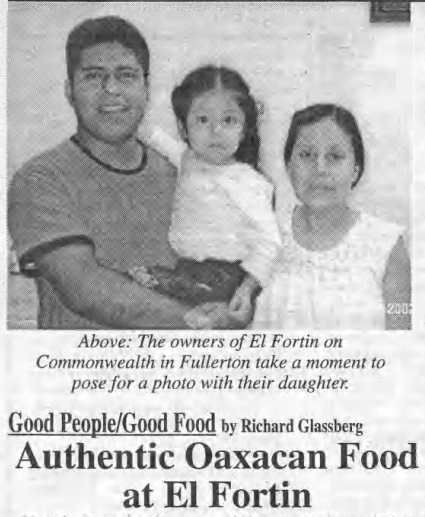
El Fortin is located at 700 East Commonwealth Avenue.
No Room at the School
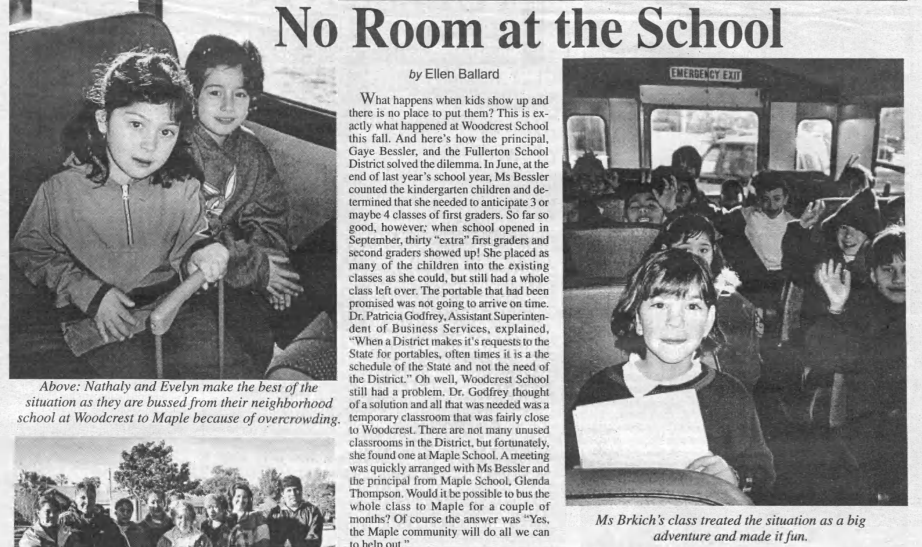
Some schools in Fullerton were feeling the impacts of increasing enrollment.
“The children of the baby-boomers have arrived, and “Tidal Wave II,” (the nickname CSU administrators have given them) are swamping the California State University System, and especially the Fullerton campus,” the Observer reported. “During the 1990s enrollment increased enormously systemwide, where it rose some 19% from about 320,000 students to more than 380,000. Cal State Fullerton, with a 30% growth rate since 1994, has experienced an even more significant expansion of its student population. That translates to some 8000 more students and a current enrollment of about 30,000.”
Accommodating the influx of college students meant an increasing reliance on lower-paid, part-time (adjunct) instructors.
“According to the faculty union, the California Faculty Association (CFA), between 1995 and 2001, tenure-track faculty positions grew by an anemic 2.27% while non-tenure track positions rose by 119.44%,” the Observer reported. “Moreover, these “part-timers” are increasingly becoming permanent fixtures on campus, rather than temporary instructors, and that trend will intensify with the new tentative contract between the CFA and the CSU administration.”
Meanwhile, those underpaid part-timers had formed a union, and were fighting for better pay, benefits, and working conditions.
“Presently, part-time faculty at Fullerton and Cypress Colleges make less than 50% of what full-timers receive for teaching the same class,” the Observer reported.
Industrial Pollution: The Gift That Keeps on Taking
Reading over local newspapers from the 1950s, I note how local leaders often spoke enthusiastically about new industrial plants locating in Fullerton because of the economic benefit. Five decades later, Fullertonians were having to deal with a consequence of industrial activity–pollution.
Oil companies were ordered to pay for cleanup costs of Fullerton’s first Superfund site–the McColl dump site where refinery waste had been dumped back in the 1940s and 50s, polluting the soil and groundwater.
“The court ruled that the oil companies are responsible and must pay for the nearly $100 million dollar clean up costs of the McColl Dump Site,” the Observer reported. “The companies argued that because the dumping was a byproduct of the production of jet fuel for the US military during WWII that the government should be held responsible. The court ruled that the oil companies were responsible for the clean-up costs.”
According to the Observer, “In the 1950s the waste sumps were ‘capped’ by the oil companies to allow for residential development nearby, even though approximately 100,000 cubic yards of hazardous waste remained. The effort to clean-up McColl Dump was a long, citizen-driven battle dating from 1978 when nearby residents began reporting illnesses and bad smells oozing from the site.”
Another site of pollution was a former Manufactured Gas Plant site located at 144 W. Walnut, owned by Sempra Energy, which in 2002 was in the process of being cleaned up.
“Tests have shown high levels of ten chemicals, seven of which are probable human carcinogens within the first five feet below ground surface, with the highest readings at one foot below ground,” the Observer reported. “As a result the company has proposed removing the top five feet. The Department of Toxic Substance Control is awaiting the submission of a work plan from Sempra.”
And a third site of industrial pollution was the former Hughes Aircraft facility in west Fullerton.
“The most recent tests in April 2002 of MW-16 and P-7 have shown that contamination is continuing to be a problem at the site, probably due to NAPL in the soil creating an ongoing source of chemical leaching into the perched zone and then into the aquifer,” the Observer reported. “This situation has been going on for over a year since clean-up efforts were halted for construction of Amerige Heights Shopping Center. No restart of remediation has been ordered by the DTSC because Raytheon is still on a “voluntary” clean-up plan but that could change at some point if Raytheon is seen as non-cooperative.”
Despite a breakdown of communication between Raytheon and and California EPA’s Department of Toxic Substance Control, construction of housing was occurring.
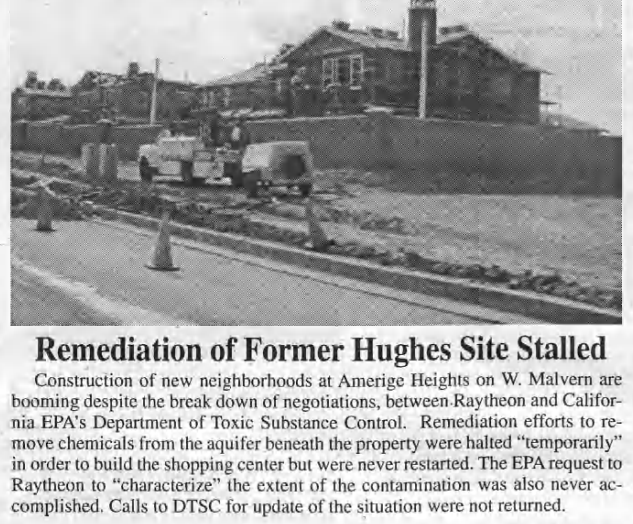
“Remediation efforts to remove chemicals from the aquifer beneath the property were halted ‘temporarily’ in order to build the shopping center but were never restarted,” the Observer reported. “The EPA request to Raytheon to ‘characterize’ the extent of the contamination was also never accomplished.”
Eventually, the California EPA Department of Toxic Substance Control (DTSC) requested that deed restrictions on the site “include a statement that would allow access by the DTSC for future remediation and added ‘Deed restrictions prohibiting the extraction and/or use of contaminated groundwater from the site will be imposed on the entire property.’”
Meanwhile, Fullerton School District Board unanimously approved the purchase of a new school site at Amerige Heights. This school would eventually be called Fisler Elementary School.
Public Transit in the OC: The Little Engine That Couldn’t
A proposed light rail connecting Irvine to Santa Ana got approval from the Federal Transit Administration (FTA).
“With almost 500,000 people residing 2 miles or less from the proposed alignment, we think the light rail can be a major success in providing mobility for central Orange County,” said OCTA CEO Art Leahy.
“Meanwhile a group of critics is working to place an initiative on the November ballot to stop the Centerline,” the Observer reported. “This group seems to have adopted the belief that transportation funding for anything other than roads is a big mistake.”
The Centerline would eventually be abandoned.
Local Politics: Republicans Only, Please
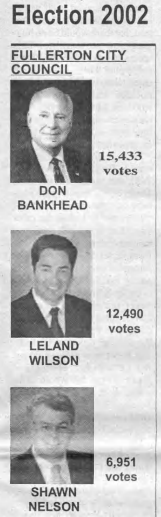
In 2002, Don Bankhead, Shawn Nelson, and Mike Cleseri were elected to City Council. They were all white male Republicans.
Cleseri defeated incumbent Democrat Jan Flory by running a negative campaign against her.
“He created a villainous, tax-raising, congestion-creating Flory and then ran as the Anti-Flory,” Vince Buck wrote in the Observer. “This dichotomy was wrong on both accounts. The criteria he used to paint Flory as evil was misleading, if not patently false; and there is no evidence to suggest that Wilson will be any different from Flory on those issues.”
One of Wilson’s campaign mailers claimed that Flory was against strong anti-prostitution laws, implying she was for prostitution.
The candidates supported by the police and fire unions, who spent nearly $40,000 on the election, all won.
In Memoriam
Long time Fullertonian Ada-Jane Greening passed away. Greening was involved in a lot of community groups in Fullerton.
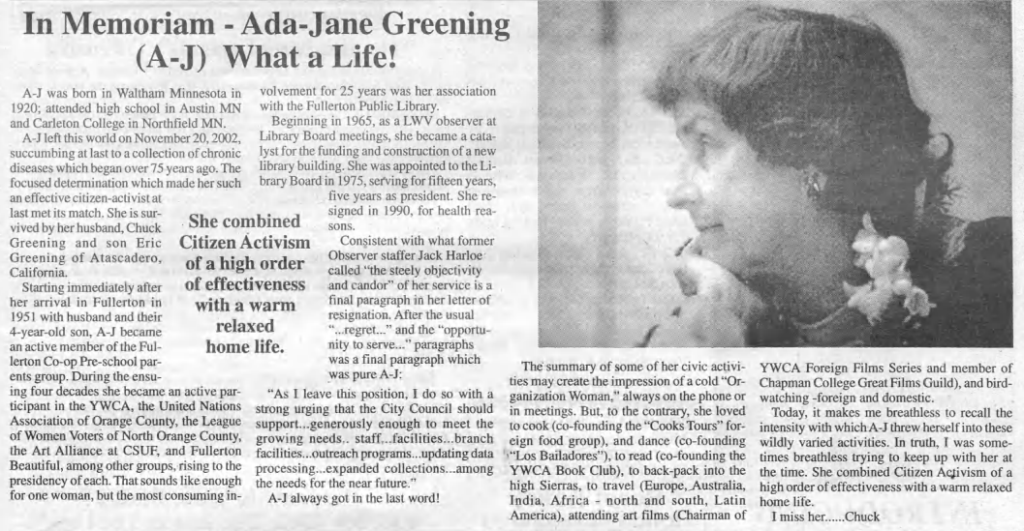
“Starting immediately after her arrival in Fullerton in 1951 with husband and their 4-year-old son, A-J became an active member of the Fullerton Co-op Pre-school parents group,” her obituary stated. “During the ensuing four decades she became an active participant in the YWCA, the United Nations Association of Orange County, the League of Women Voters of North Orange County, the Art Alliance at CSUF, and Fullerton Beautiful, among other groups, rising to the presidency of each…The most consuming involvement for 25 years was her association with the Fullerton Public Library. Beginning in 1965, as a LWV observer at Library Board meetings, she became a catalyst for the funding and construction of a new library building. She was appointed to the Library Board in 1975, serving for fifteen years, five years as president. She resigned in 1990, for health reasons.”
William B. Langsdorf, founding president of California State University, Fullerton, died at his home in Corona del Mar. He was 93.
“Langsdorf served as president of Cal State Fullerton from 1959 to 1970, during the time the 225-acre campus was transformed from a vast orange grove into one of the most populous campuses in the California State University system,” his obituary stated. “Mirroring the explosive growth of Orange County, enrollment grew from 452 students to more than 15,000 during his presidency.”
Stay tuned for top stories from 2003!
-
Fullerton in 2001: 9/11, Energy Crisis, Light Rail Fail, Housing & Homelessness, Saving the Fox & Coyote Hills, Indian Mascot Debate, Etc.
The following is from a work-in-progress about the history of Fullerton. You can support my ongoing research and writing on Patreon.
9/11
The biggest national news story of 2001 was the terrorist attack of 9/11.
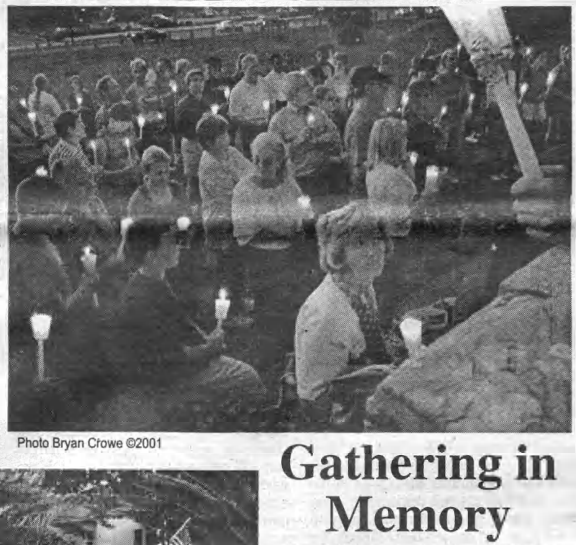
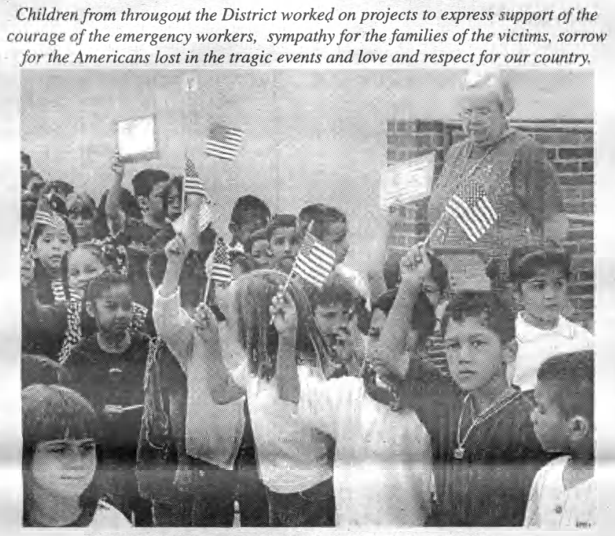
“Over 100 locals gathered on Friday, September 14th at the Hillcrest Park flagpole for a candlelight vigil in memory of those killed in the September 11th attacks,” the Observer reported.
Observer writers offered some fairly nuanced assessments of the meaning of the attack, and what our response might be.
“The major question posed by these events is how can a liberal, democratic state such as ours, contend with the threat of terrorism while maintaining our own commitment to justice and democratic ideals?” one writer wrote.
“We’re flirting with a world war between Islam and the West. And guess what: that’s Bin Laden’s program,” wrote Tamim Ansary. “That’s exactly what he wants. In the end the west would win, whatever that would mean, but the war would last for years and millions would die, not just theirs but ours. Who has the belly for that? Bin Laden does. Anyone else?”
The California Energy Crisis
California’s experiment in energy deregulation was proving to be a complete disaster, resulting in an energy crisis that saw prices go up, not down, and rolling blackouts throughout the state.
In response, the state legislature approved a massive bailout of Edison. Not everyone was happy.
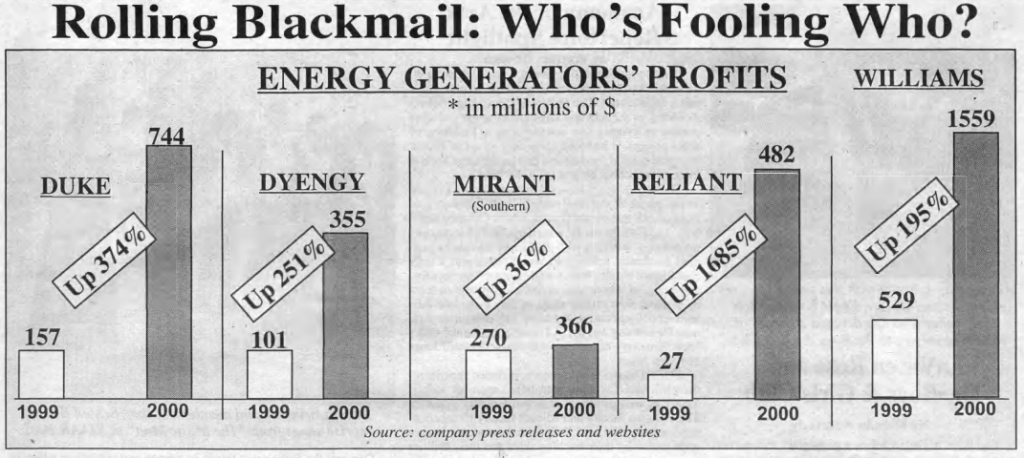
“Edison pushed deregulation and reaped its rewards while sticking all the risks on the residential and small business ratepayers,” Harvey Rosenfield, President of The Foundation for Taxpayer and Consumer Rights, said.
The City of Fullerton implemented a number of measures designed to help curb electrical usage in City facilities and programs.
“After the utilities profited from the deregulation scheme, the private power generators began, last summer, to price gouge and achieved unprecedented earnings,” the Observer reported. “Throughout the deregulation debacle, however, consumers have received no benefits, despite the statutory promise of a 20% rate reduction in the 1996 legislation. Indeed, as a result of deregulation consumers have suffered through the state’s first rolling blackouts since World War II and the largest rate increases in California history.”
Light Rail Fail
Meanwhile, a proposed light rail system stretching from Irvine to Fullerton called CenterLine continued to hit political snags. In the 1990s, Orange County politics was still dominated by conservative Republicans who felt the role of government should be as small as possible. This meant minimal public investment in things like public transit, housing, etc.
The preferred solution to most things was the private sector, deregulation, etc. See above energy crisis for how well that worked out with electricity.
OCTA put the project on hold. “Unfortunately, the voices of the critics and NIMBYs were heard louder than the supporters, which prompted the shelving,” the Observer reported.
“All we’re doing is putting band aids on bleeding arteries,” said David Fleming, a former transportation commissioner, “freeway projects are just a band-aid on gridlock.”
Meanwhile, a local group called Transit Advocates of Orange County was organized to support the Centerline and other public transit projects.
The mayors of Irvine, Santa Ana, and Costa Mesa thought the Centerline could be re-worked on a smaller scale, and supported more “study.”
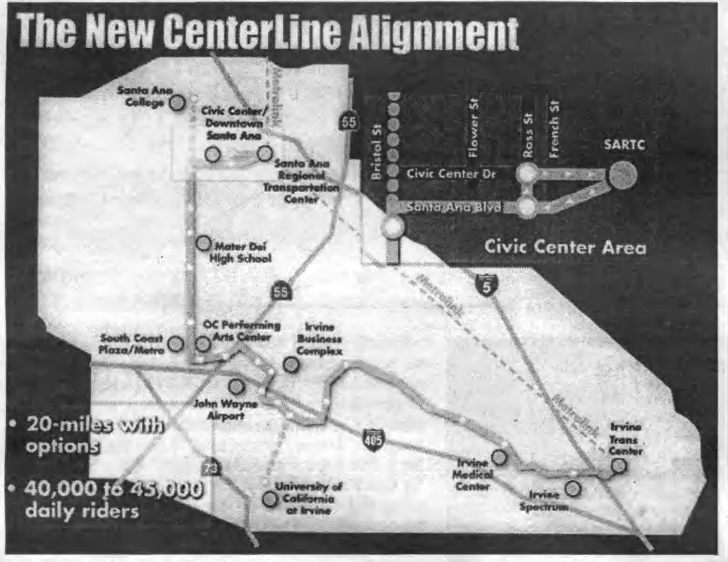
“The original concept of the Centerline called for a 27-mile, $2.3-billion line from Fullerton to Irvine, a concept that collapsed for lack of support from some of the cities along the line,” the Observer reported. “The shortened version is proposed to cover approximately 20 miles at a cost of $ 1.4-billion, to run from the Irvine Transportation Center to the Santa Ana Transportation Center serving the Irvine Spectrum, medical center, business complexes, John Wayne Airport and South Coast Plaza.”
This, too, would ultimately die. This is, in part, why public transit in Orange County is so shitty–why it can take an hour and a half to get to the beach from Fullerton, on a bus.
A Slow-Gestating Housing Crisis
By the 1990s, Fullerton was becoming more and more built out, and housing production had slowed significantly. Those with single family homes were often determined to maintain the “character” of their neighborhoods, even if that meant preventing newer, higher density construction of housing. This led to a predictable shortage, and ever escalating housing prices. This, combined with political leaders unwilling to invest in affordable housing, and you get the slow-gestating housing crisis that we have today.
“Fullerton’s December 2000 Draft Housing Report proves a strong need for very-low and moderate housing. At the same time the report indicated that housing for upper income families dominated new construction and is expected to continue to dominate housing objectives through year 2005,” the Observer reported. “It appears that no new homes for those earning less than $55,700 per year are planned for Fullerton.”
Listening to homeowner interests, City Council voted unanimously “to join in a lawsuit launched by Southern California Association of Governments (SCAG) against the Department of Housing and Community Development” to block state-suggested affordable housing goals.
Homelessness
A predictable consequence of escalating housing costs was the persistent problem of homelessness.
“According to a recent County survey, there are more than 18,000 homeless in Orange County on any given night,” the Observer reported.
“Statistics show that 65% of Orange County’s homeless work. With escalating rents, many individuals and families have literally been priced out of the housing market.”
In 2001 there were 52 shelters in OC providing 2,374 homeless beds.
“Fullerton Interfaith Emergency Services (FIES) indicates it is turning away an average of 70 homeless persons per day,” the Observer reported. “Based on information from shelter providers, there is a need for at least 70 additional beds in Fullerton.”
During the cold weather months, the National Guard Armory in Fullerton was used as a homeless shelter, although guests there were subject to pretty strict rules, and were bussed out of the area early in the morning.
Pollution on the Former Hughes Site?
Despite concerns of lingering industrial pollution on the former Hughes Aircraft site in Fullerton, city council unanimously approved a massive housing/commercial development that today is called Amerige Heights. The Observer continued to report on findings of pollution on the site.
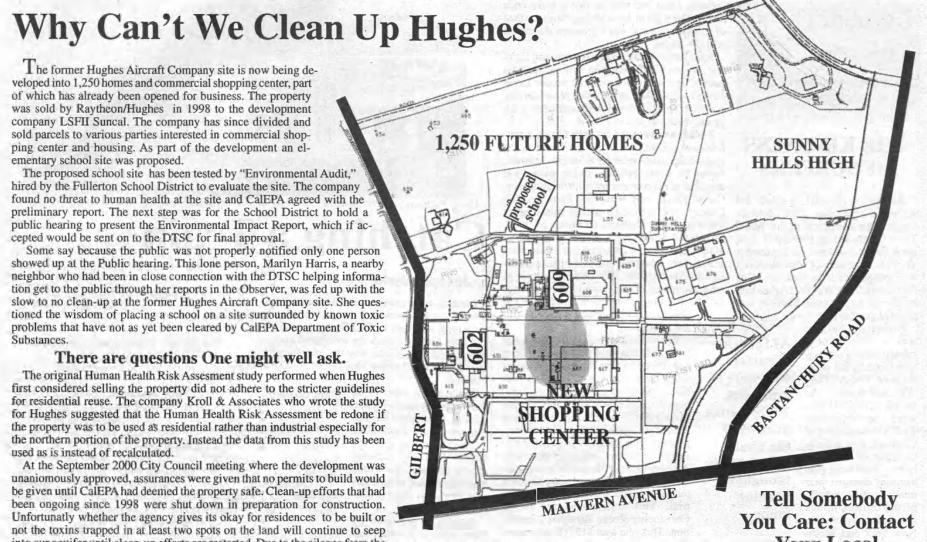
“As pressure from the developer LSF II Suncal and the 20-billion dollar Raytheon company, continues to push forward construction of the ‘Amerige Heights’ housing and commercial project the CalEPA Department of Toxic Substances Control has released several reports indicating further investigation and remediation of the property is needed. The Regional Water Quality Control Board has concurred with the CalEPA conclusions,” the Observer reported. “Unfortunately both companies are resisting further investigation of the contaminate source.”
Meanwhile the California EPA Department of Toxic Substances Control approved a preliminary environmental report on a proposed Amerige Heights Elementary School site located on the former Hughes Aircraft Company property on Malvern. Today, this is called Fisler Elementary School
“The company tested for various substances that plague other parts of the property and found that the 10-acre site held no threat to human health,” the Observer reported. “DTSC determined that no further environmental investigation or cleanup of the parcel is required.”
A treatment system failure resulted in over 5-million gallons of water “with 55-parts-per-billion of TCE being accidentally injected into the aquifer June 2001. The allowed limit for this chemical in drinking water is 5-parts-per-billion.”
Raytheon was fined a paltry $3000 fine for violating TCE limits required in its waste discharge agreement at 651 N Gilbert Street in Fullerton.
Tres Sheep & Saving the Fox
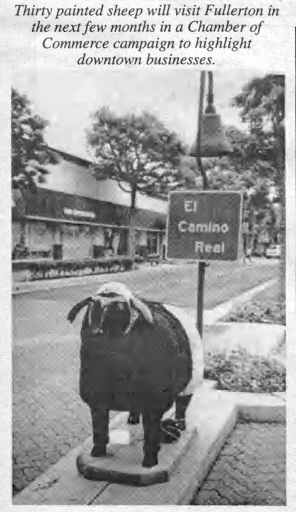
The Fullerton Chamber of Commerce launched a PR campaign to get 50 artists to paint large sheep that would be displayed downtown. Why sheep? Because one of Fullerton’s earliest residents, Domingo Bastanchury, was a sheep rancher before he got into citrus.

“Each Sheep, Ewe or Lamb will be decorated, titled and entertain Fullertonians and visitors through April when the entire herd will be sold one by one at auction,” the Observer reported.
The saga to save the historic Fox Theater downtown from demolition and re-open it as a theater continued.
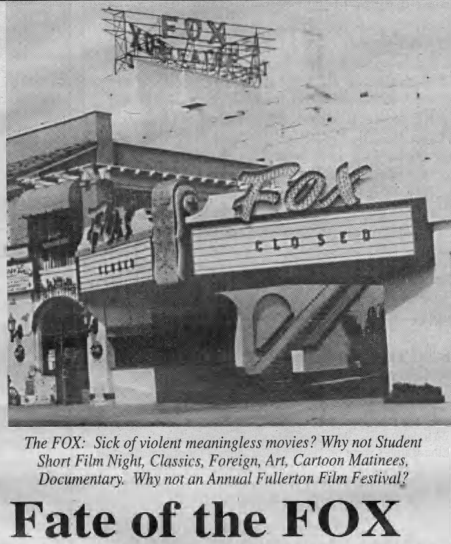
At a Downtown Business Association meeting Mayor Richard Jones was asked by a business woman, “About the Fox, anything happening there?” “Nothing, unless you people start a fire and burn it down,” the mayor replied. “And you,” nodding to the fire department chief, “should have a flat tire on the way there,” he advised. “We need to start over from scratch.”
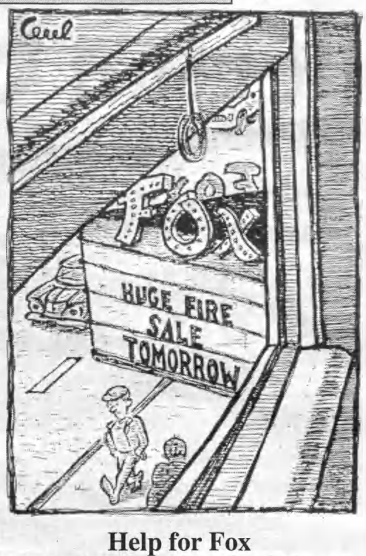
“The City of Fullerton continues to take no responsibility for saving the Fox Theater, except that it has refused absentee owner Ed Lewis’s repeated requests for a demolition permit,” the Observer reported. “Citizens have signed petitions, but have not taken steps to establish a foundation to preserve the Fox, as citizens have done for the Balboa Theater in Newport Beach, and the Egyptian.”
Incensed by the callous remarks of Mayor Jones, Fullerton resident Chuck Estes began to get the ball rolling to start a nonprofit foundation to save the Fox. This would eventually become the Fox Theater Foundation.
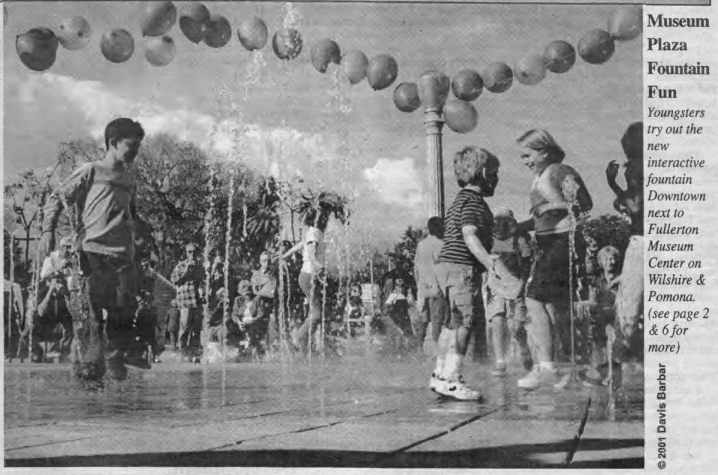
A fountain in the Downtown Plaza opened.
Fullerton legend Leo Fender was honored with an exhibit at the Fullerton Museum Center.
“Fender, who perfected the electric guitar which led to the musical revolution still reverberating around the world today is the focus of “A Shower of Brilliance: Leo Fender and His Electric Guitar,” the Observer reported
A mural, sponsored by CUFFS and the Fullerton Museum, was painted on the side of the Wilshire Parking Structure facing the Fullerton Museum Plaza.
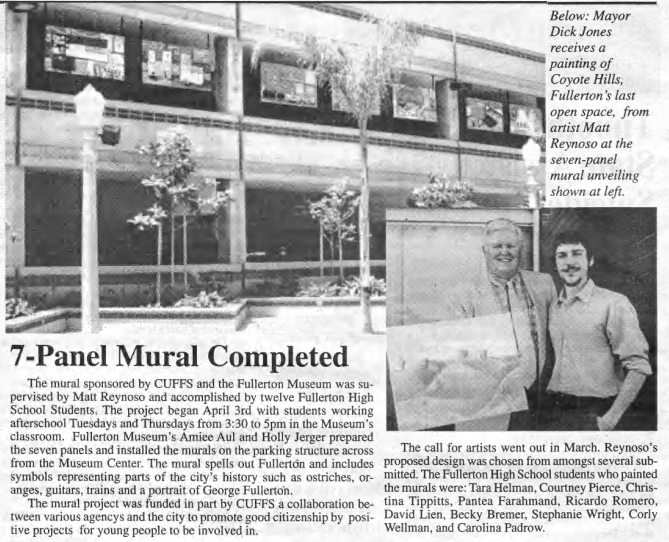
The mural was designed and supervised by Matt Reynoso with the help of Fullerton High School students.
“The mural spells out Fullerton and includes symbols representing parts of the city’s history such as ostriches, oranges, guitars, trains and a portrait of George Fullerton,” the Observer reported.
Meanwhile, on the other side of Downtown, on west Santa Fe, a possible Renaissance was occurring with the conversion of industrial buildings into restaurants/bars like Heroes and the Continental Room.
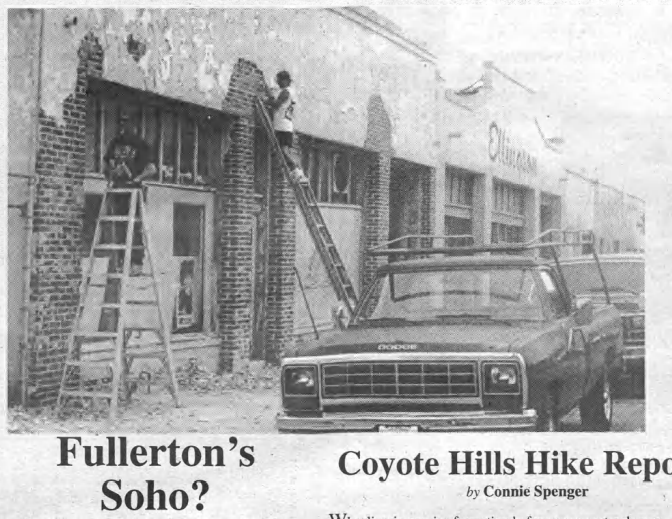
“West Santa Fe Avenue bordering the railroad tracks is going through some renovations including a soon-to-be-opened “Frank Sinatra” style bar called the Continental which has been under construction for the last year by owners of the Hub Cafe,” the Observer reported. “Presently the two block street is home to the Commonwealth Upholstery Shop, Elingson Aircraft Parts, Donald Duck Orange Juice Factory, a roofing company and a bunch of art studios. Wouldn’t it be fun if part of the plan included affordable warehouse style studios that would attract artists?”
In the early 2000s, downtown Fullerton underwent a fairly radical transformation from a quaint/sleepy one dominated by antique shops and vintage stores to one dominated by bars and nightclubs. While some welcomed (and sought to profit from) the change, others were not so thrilled.
Al Bushala, of the wealthy local Bushala family, wanted to create a dance club at 205-207 N. Harbor Blvd. that would be open from 4pm to 4am.
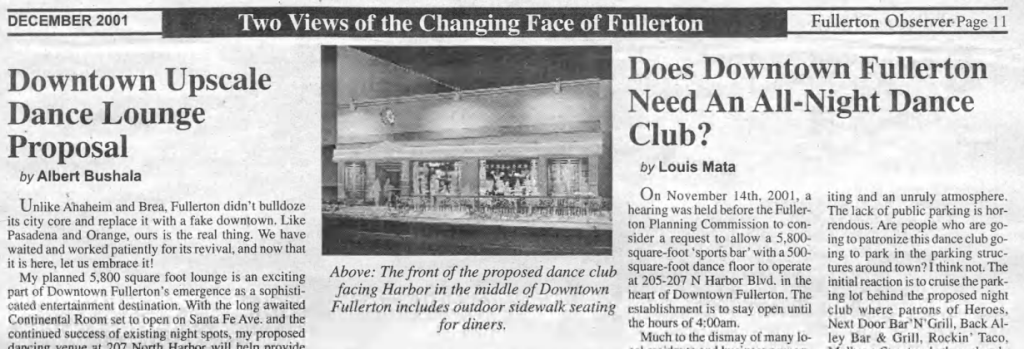
“My planned 5,800 square foot lounge is an exciting part of Downtown Fullerton’s emergence as a sophisticated entertainment destination. My proposed dancing venue at 207 North Harbor will help provide the synergy needed for a true downtown revival,” Bushala wrote in the Observer.
In a counter-argument piece, another writer questioned the approval of the dance club.
“An appeal was filed on November 21 along with 20 letters from local residents and business owners opposing the matter,” the writer wrote. “Take a close look at what has become of Downtown Fullerton over the past few years. The proliferation of drinking establishments has brought about vandalism, graffiti, public urination, vomiting and an unruly atmosphere…This quaint, charming and family friendly area is in severe danger of becoming a seedy district with bars, adult-oriented shops and the like. It is important to preserve the integrity of Downtown Fullerton by rejecting the proposed night club.”
Saving Coyote Hills
Like the saga to save the Fox Theater, the saga to save Coyote Hills from development has been a decades-long struggle.
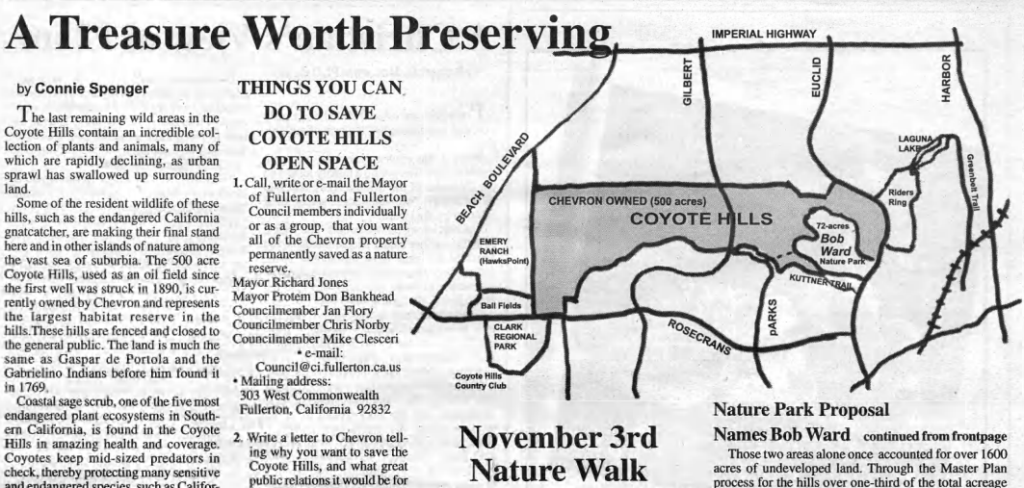
“Considered the last open space in Fullerton, the Coyote Hills property was oil well territory but is now home to many types of rare critters and plants including endangered species such as the California gnatcatcher,” the Observer reported.
The Friends of Coyote Hills, the group which has worked for decades to save Coyote Hills began hosting walking tours of a small part of the property open to the public.
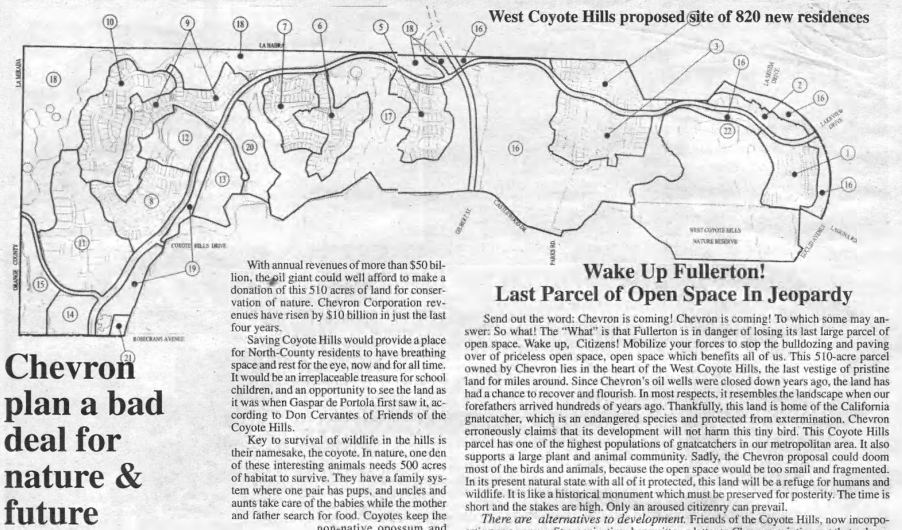
Meanwhile, the owner of Coyote Hills, Chevron, was proposing a large development there.
“A plan to put 810 dwelling units in west Coyote Hills is a bad deal for nature and for the future, says naturalist Shawn Bert of Friends of Coyote Hills,” the Observer reported. “With annual revenues of more than $50 billion, the oil giant could well afford to make a donation of this 510 acres of land for conservation of nature. The canary in the coal mine is the California gnatcatcher. The proposed development would wipe out most of this endangered songbird on the 510 acres.”
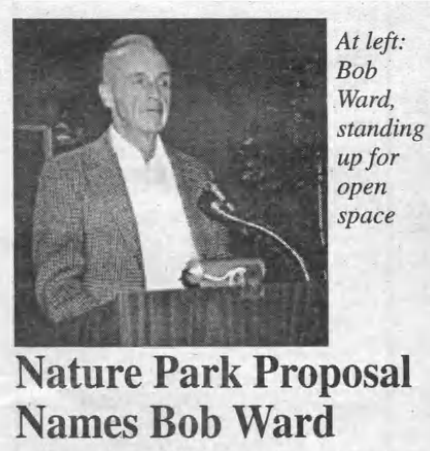
Meanwhile, City Council voted to name a city-owned 72-acre parcel of Coyote Hills the Robert E. Ward Nature Preserve. Robert Ward was a former mayor who worked to preserve the land back in the 1970s.
Education
In education news, adjunct (part-time) faculty at Fullerton and Cypress colleges had created a union and were fighting to improve their pay and to receive health benefits.
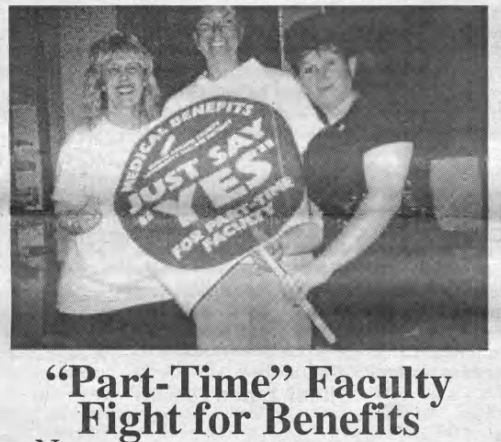
“Part time teachers are paid $39 per hour while full time teachers are at $71 with full benefits for teaching the same class. Part-time faculty are not compensated for office hours and do not receive any medical benefits,” the Observer reported. “These and other grievances were aired recently in an on-going protest by part-time faculty angered by the district’s refusal to grant “part-timers,” who hold the same academic credentials and teaching responsibilities as their full-time counterparts, adequate pay and benefits.
Maple School celebrated its full re-opening as a K-6 elementary school.
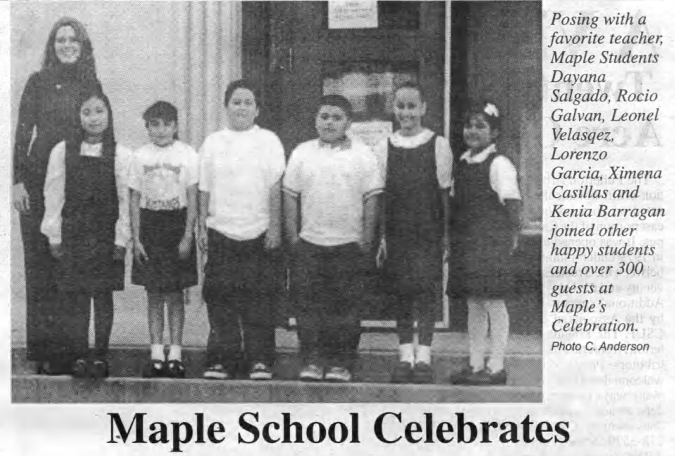
The majority-Latino Maple school was closed in 1972 as part of a desegregation plan. It partially re-opened in 1996 and fully re-opened in 2001.
To read a history of Maple School check out my article entitled “The Limits of Desegregation: a Story of Maple School.”
The Fullerton High School Mascot Debate
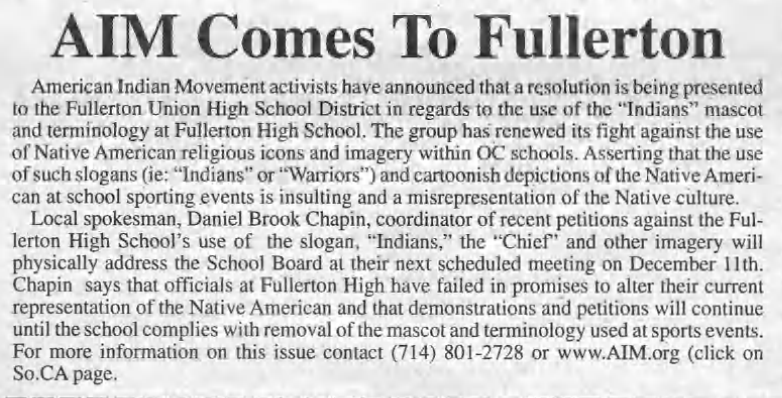
“American Indian Movement activists have announced that a resolution is being presented to the Fullerton Union High School District in regards to the use of the “Indians” mascot and terminology at Fullerton High School,” the Observer reported. “Asserting that the use of such slogans (ie: “Indians” or “Warriors”) and cartoonish depictions of the Native American at school sporting events is insulting and a misrepresentation of the Native culture. Local spokesman, Daniel Brook Chapin says that officials at Fullerton High have failed in promises to alter their current representation of the Native American and that demonstrations and petitions will continue until the school complies with removal of the mascot and terminology used at sports events.
The Indian mascot endured until this year, when the school was compelled by state law to change it. The new mascot is the Red Hawks.
Sage by the Side of the Road
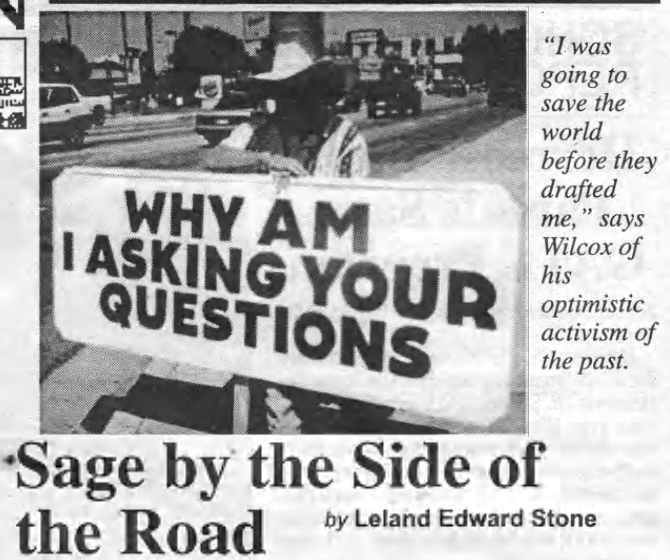
In 2001, I remember there was this guy who would post up for days at major intersections with large signs with very cryptic messages. Here’s a photo of him with one of his signs.
Stay tuned for top stories from 2002!
-
California’s History of Discriminatory Ballot Measures
The following is from a work-in-progress about the history of Fullerton. You can support my ongoing research and writing on Patreon.
In his book Racial Propositions: Ballot Initiatives and the Making of Postwar California scholar Daniel Martinez HoSang presents a realistic and unglamorized portrait of the messy struggle for civil rights in California through the lens of ballot initiatives. Today, California is seen as a liberal stronghold, but it wasn’t always that way.
One of the main insights of the book is to dispel the myth that California “figured out” and “fixed” social injustices and inequality back in the 1960s. A closer look at California’s schools and communities reveals lingering social, housing, employment, and educational segregation and inequality.
HoSang also demonstrates how, in the post-Civil Rights era, the language of “colorblindness” has been used by politicians to squash efforts at undoing the harmful legacy of discriminatory policies and to maintain the status quo.
HoSang’s book is helping me to peel back the layers of the onion and really try to understand how we got where we are, and how things might be different.

Prop 11 and the Struggle for Fair Employment
In 1946, Californians voted on Proposition 11, which sought to create a state Fair Employment Practices Commission (FEPC), which would officially ban discrimination based on race, religion, color, or national origin in the workplace. It was inspired by President Roosevelt’s Fair Employment Practices Commission, which was created at the outset of World War II.
At the time, employment discrimination was widespread in California. Hosang writes, “At the time, California’s burgeoning defense industry, from the sprawling Kaiser shipyards along the San Francisco Bay to the massive Lockheed airplane factories in Los Angeles County, routinely consigned black and Mexican American workers to the lowest paid jobs, if they hired them at all.”
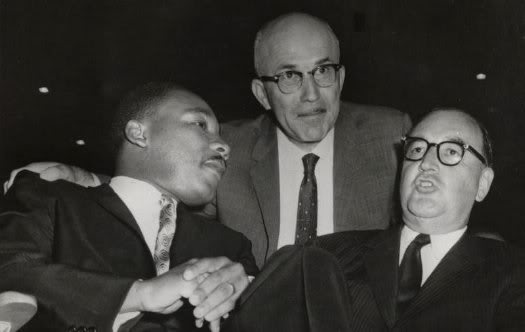
Martin Luther King Jr, Augustus Hawkins, and Pat Brown. The champion of Prop 11 was Assemblyman Augustus Hawkins, who at the time was the only African American in the California state assembly (he was very light-skinned). Other groups lent their support: The NAACP, the Urban League, the American Council on Race Relations, the California Federation for Civic Unity, as well as union organizations like the CIO.
Those opposed to Prop 11 included Frank Doherty, former president of the Los Angeles Chamber of Commerce, as well as powerful agricultural lobbyists who had relied on cheap immigrant labor for decades. The ballot argument against Prop 11 stated that “certain minority racial groups are the most efficient agricultural labor.”
Another tactic to defeat Prop 11 was red-baiting. Doherty called it a “communist-inspired scheme.”
But the chief argument of those opposed to Prop 11 was one that would resonate in future civil rights debates, that discrimination was an individual choice which could not be “coerced” by legislation. A Los Angeles Times editorial explained, “Admirable as it might be if race and religious prejudice ceased to exist, The Times does not believe that the disappearance of either can be helped by compulsion…prejudices by their very nature are matters of emotion rather than logic or reason.”
This argument, clothed in the language of individual rights, has proved a powerful one against large-scale civil rights legislation in California and elsewhere.
Ultimately, Prop 11 was “crushed on election day, capturing less than 30 percent of the vote.” The FEPC would not be created until 1959, with the passage of the passage of the California Fair Employment Practices Act of the state legislature.
The 1946 defeat of Prop 11 led one historian to write, “The public was definitely not ready for fair employment.”
Prop 14 and the Struggle for Fair Housing
“Men hate each other because they fear, they fear because they do not know one another, and they do not know one another because they are separated.”
–Martin Luther King Jr, speaking in Los Angeles at a 1964 anti-prop 14 rally
In 1963, the California State Legislature passed the Rumford Fair Housing Act, which sought to address widespread housing discrimination and segregation in California. For years, non-whites had been excluded from buying or renting property in many neighborhoods across California by racially restrictive housing covenants, which were created and enforced by realtors and homeowners associations, because non-whites were perceived to drive down property values.
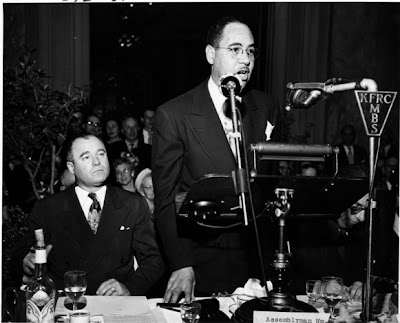
Assemblyman William Byron Rumford According to HoSang, “Bodies like the Southwest Realty Board in Los Angeles formed ‘race restrictions committees’ to organize homeowners to maintain racial restrictions, publicizing their success in the California Real Estate Association magazine.” It was racist housing covenants that created the widespread housing segregation across cities in California, even in my own hometown of Fullerton.
To address this social problem/injustice, California legislators William Byron Rumford, with the support of others like Augustus Hawkins and Jesse Unruh, introduced the Fair Housing Bill, which sought to make racially restrictive housing covenants illegal. The bill passed in 1963.
In response, the National Association for Real Estate Boards and the California Real Estate Associaion mobilized their 45,000 members and 171 local realty boards to get a proposition on the ballot to overturn the Fair Housing Act. A 1964 advertisement in the Oakland Tribune spelled out their argument:
“RUMFORD ACT FORCED HOUSING”
COMMITTEE FOR HOME PROTECTION
“In September 1963, the Rumford Act became state law. Heretofore, a man’s home was his castle. The Rumford Act makes a man’s home subject to the whims of a politically appointed State Board…The politically appointed Commission can FORCE you to sell or rent your home to an individual NOT OF YOUR CHOICE. Most people believe that a man has the right to sell, rent, or lease his property to whomever he wishes; consequently they OPPOSE the Rumford Act…VOLUNTEERS NEEDED TO CIRCULATE PETITIONS.”
The realtors and their supporters were successful in getting Prop 14 on the 1964 ballot, and thus began a widely public debate over the issue of fair housing in California. Both sides used the language of “rights.” Those opposed to Prop 14 spoke of the rights of non-whites to rent or purchase property. Those in favor of Prop 14 spoke of property owners’ rights to choose whom to sell or rent to.
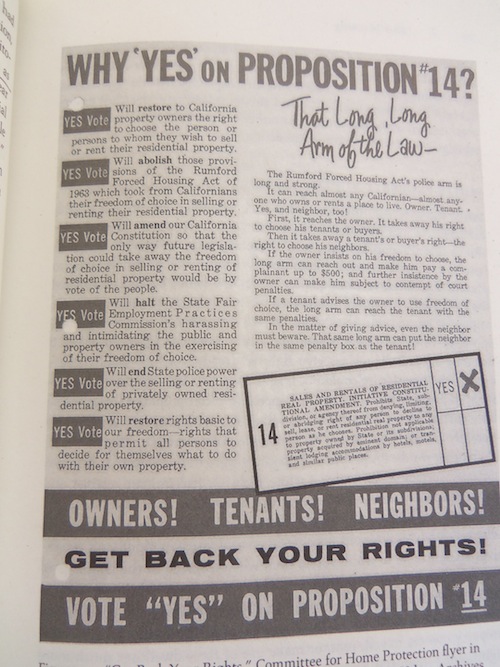
“Get Back Your Rights,” Committee for Home Protection flyer in favor of Proposition 14, 1964. Courtesy of Max Mont Papers, Urban Archives Center, Oviatt Library, California State University, Northridge. Many heavy-hitters in the Civil Rights Movement (which was in full force in 1964) weighed in on the issue. Martin Luther King Jr. spoke at an anti-14 rally in Los Angeles, stating, “Men hate each other because they fear, they fear because they do not know one another, and they do not know one another because they are separated.”
Ultimately, Prop 14 passed by a margin of 65 to 35 percent, striking down the Fair Housing Act. According to Lucien Haas, the press secretary appointed by governor Pat Brown to work on the anti-14 campaign, “Proposition 14 shattered [the myth] for me,” as he realized, “My God, we’re facing racism in the state of California.”
In 1966, the California Supreme Court ruled in Mulkey vs. Reitman that Prop 14 was unconstitutional. One realtor who ultimately changed his mind about Prop 14 stated, “The right we are giving up is the right to discriminate on the basis of race. Is that a right we want to bat for? I don’t think this is a thing we should do a lot of breast-beating about. It is not a laudable right in the first place.” Another inquired, “I wonder if we are not in favor of this type of legislation because we are men of property and men who have not ever been discriminated against?”

“Don’t Legalize Hate,” Californians against Proposition 14 flyer, 1964. The image on this brochure was also featured on billboards across the state. Courtesy of Max Mont Papers, Urban Archives Center, Oviatt Library, California State University, Northridge. Even though Prop 14 was ultimately struck down, it made clear the fact that California was deeply divided about the issue of housing integration, and remains so today. Today, despite what we tell our elves about civil rights progress, there remains widespread de facto housing segregation in many California cities, a legacy of both institutional and individual racism.
Prop 21 and the Struggle for School De-Segregation in California
In 1972, Californians voted on a ballot measure which seriously undermined school desegregation efforts. At the time, in the Los Angeles Unified School District, 95 percent of black students and 80 percent of white students were enrolled in highly segregated schools. The impetus for Prop 21 was the 1970 Crawford v. Los Angeles court case which “found the state’s largest school district [Los Angeles] to be deliberately segregated and ordered the [school] board to devise a far-reaching desegregation plan.” Soon after, the Bagley Act passed, which “formally established school desegregation as a policy goal of the state [of California].”
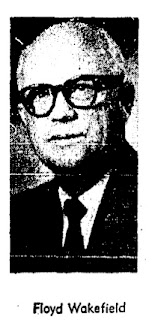
Proposition 21 (or the Wakefield Amendment), which sought to overturn the Bagley Act, was championed by a conservative Republican named Floyd Wakefield who “railed against the yoke of ‘forced integration.’” Wakefield represented the city of South Gate, “a working class city of fifty-seven thousand residents that, through the use of racial covenants and other restrictive practices, remained deeply segregated well into the 1960s. I recently read about South Gate in Luis Rodriguez’s memoir Always Running:
“One day my mother asked Rano and me to go to the grocery store. We decided to go across the railroad tracks into South Gate. In those days, South Gate was an Anglo neighborhood, filled with the families of workers from the auto plant, and other nearby industry. Like Lynwood or Huntington Park, it was forbidden territory for the people of Watts.
My brother insisted we go. I don’t know what possessed him, but then I never did. It was useless to argue; he’d force me anyway. He was nine then, I was six. So without ceremony, we started over the tracks, climbing over discarded market carts and tore-up sofas, across Alameda Street, into South Gate: all-white, all-American.
We entered the first small corner grocery store we found. Everything was cool at first. We bought some bread, milk, soup cans and candy. We each walked out with with a bag filled with food. We barely got a few feet, though, when five teenagers on bikes approached. We tried not to pay attention and proceeded to our side of the tracks. But the youths pulled up in front of us. While two of them stood nearby on their bikes, three of them jumped off theirs and walked over to us.
“What do we got here?” one of the boys said. “Spics to order–maybe with some beans?”
He pushed me to the ground; the groceries splattered onto the asphalt. I felt melted gum and chips of broken beer bottle on my lips and cheek. Then somebody picked me up and held me while the others seized my brother, tossed his groceries out, and pounded on him. They punched him in the face, in the stomach, then his face again, cutting his lip, causing him to vomit.
I remember the shrill, maddening laughter of one of the kids on a bike, this laughing like a raven’s wail, a harsh wind’s shriek, a laugh that I would hear in countless beatings thereafter. I watched the others take turns on my brother, this terror of a brother, and he doubled over, had blood and spew on his shirt, and tears down his face. I wanted to do something, but they held me and I just looked on, as every strike against Rano opened me up inside.
They finally let my brother go and he slid to the ground, like a rotten banana squeezed out of his peeling. They threw us back over the tracks. In the sunset I could see the Watts Towers, shimmers of 70,000 pieces of broken bottles, sea shells, ceramic and metal on spiraling points puncturing the heavens, with reflected back the rays of a falling sun. My brother and I then picked ourselves up, saw the teenagers take off, still laughing, still talking about those stupid greasers who dared to cross over to South Gate.”
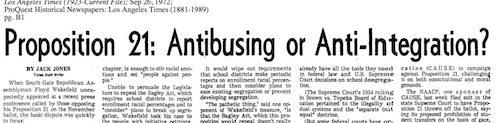
Wakefield argued that “forced busing” and other desegregation efforts would infringe on people’s freedom of choice. Hosang describes a story board for a “Yes on 21” campaign commercial: “The storyboard showed a terrified young white girl being forced to board a school bus as her mother stood by helplessly, explaining, ‘The government says you and your little friends can’t go to school anymore in the neighborhood, honey.’ The girl’s forlorn and bewildered response, ‘Aren’t we people too?’ implicitly set the rights of white viewers–the ‘we’–against a racialized other receiving unwarranted advantages from, as the ad described, ‘that old government.’ The storyboard’s concluding panel, ‘Restore Freedom of Choice,’ was again explicitly racialized, for such a ‘freedom’ was only available to white parents–minority students assigned to inferior and segregated schools had no such choice.”
Many of the groups who sought to defeat prop 21 were the same who had rallied (unsuccessfully) against Prop 14, just eight years earlier: the NAACP, the ACLU, the California Teachers Association, the State Federation of Labor, the League of Women Voters, and several faith-based organizations.
Ultimately, Prop 21 passed by a wide margin: 63 percent of the vote. As with Proposition 14 (which overturned fair housing legislation) and Prop 11(which denied fair employment), Prop 21 demonstrated the fact that the struggle for Civil Rights was far from over in California. Schools would remain essentially segregated.
In 1975, the state supreme court overturned Prop 21, stating that it “involved the state in racial discrimination.” Though it was overturned, Prop 21 left a legacy of segregation, one which would be upheld in 1979 by Prop 1. Hosang describes the “chilling” legacy:
“Though it was only in effect for two years, Proposition 21 did have a chilling effect on many local school desegregation efforts. The Inglewood and Pasadena school boards immediately attempted to appeal their own desegregation orders, and in cities such as Whittier and Santa Ana planned desegregation measures were never put into effect. At the same time, the state auditor began monitoring whether school districts were complying with Proposition 21’s mandates. One state education official observed that ‘things have come to a dead halt in the area of desegregation since Proposition 21 passed…we have lost ground.’ Indeed, in early 1974, the state census revealed that 192,000 more students attended segregated schools in comparison to five years earlier.”
Floyd Wakefield’s political career ended shortly after Prop 21 passed, when his state assembly district was eliminated due to redistricting. In 1974, he moved to Anaheim to run in the newly-created 70th district, which included Anaheim, Brea, and Yorba Linda. Wakefield stated in an LA Times article that north Orange County was “the area most compatible with his own philosophies.” Ultimately, he lost the Republican primary, and his tenure in politics was over.
Hosang describes the decline of Floyd Wakefield, and what it suggests about the changing nature of Southern California politics at the time:
“The decline of Wakefield’s eight-year career in the state assembly paralleled important transformations in the political landscape of Southern California during the 1970s. Wakefield never tempered his ardent conservative postures. In the last months of his final term in the assembly, he sought to qualify a ballot measure to rescind the California Legislature’s 1972 ratification of the Equal Rights Act and sat at the head table of a John Birch Society political banquet where founder Robert Welch called for President Nixon’s impeachment. But Wakefield could no longer count on a constituency in South Gate to reliably support such appeals. The white working-class residents that a decade earlier had rallied behind Wakefield’s defense of Proposition 14 and segregated South Gate High School were rapidly abandoning the inner suburbs south of Los Angeles for new residential developments in the San Fernando Valley and Orange County. Wakefield was no innocent bystander in this retreat. By insisting that cities such as South Gate could never prosper if they became racially integrated, he implicitly endorsed the exodus of white residents that ultimately led to his own political demise. Wakefield’s uncompromising assertion of white rights anchored in the white working-class suburbs of South Los Angeles would give way to a more subtle and sophisticated defense racial inequality and segregation centered in the burgeoning San Fernando Valley.”
These are not all the propositions HoSang chronicles in his book. In a future post, I will discuss his analysis of anti-immigrant propositions in the 1990s (like Prop 187), propositions banning affirmative action (the OG DEI), and propositions banning bilingual education. Understanding the political ideology behind these propositions helps us better understand current movements to roll back civil rights gains.
-
Fullerton in the Year 2000: Industrial Pollution, (Un)Affordable Housing, Public Employees Organize, Etc.
The following is from a work-in-progress about the history of Fullerton. You can support my ongoing research and writing on Patreon.
The Fullerton Observer newspaper was formed in 1978 by Ralph and Natalie Kennedy and friends to provide a more progressive counterbalance to the more conservative Fullerton News-Tribune and Orange County Register. Back then, Orange County (including Fullerton) was dominated by Republicans, and the Observer crew were definitely in the minority. The Fullerton Public Library has digital archives of the Observer stretching back to 1979. I am in the process of reading over these archives and creating a year-by-year summary of top stories. Here are some top stories from the year 2000.
Despite Y2K worries of worldwide computer-induced chaos, Fullertonians rang in the new millennium without a hitch. The world spun on, computers still worked, and hopes were high.
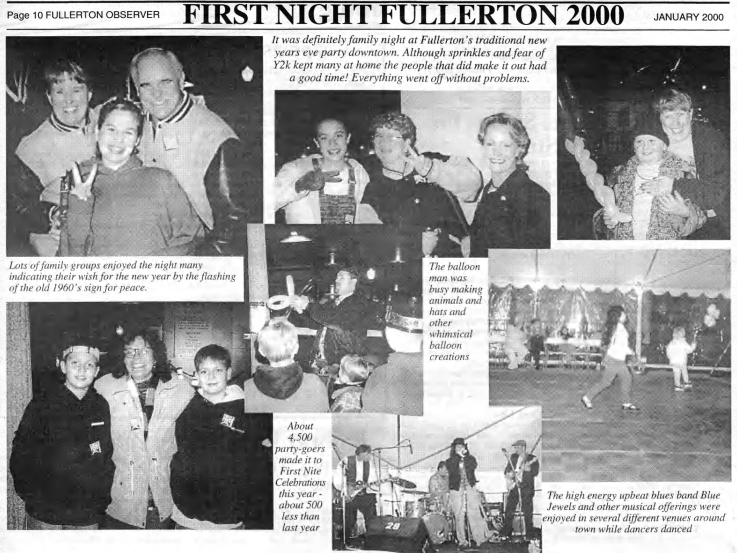
2000 was also the year of the crazy voting/election fiasco in the contest between George W. Bush and Al Gore for president. For months after the election there remained no clear winner. Problems with voting machines in Florida prompted demands for recounts, political shenanigans ensued, and ultimately the U.S. Supreme Court chose the next U.S. president–George “Dubya” Bush. Not a great precedent.
Pollution on the Former Hughes Site?
Perhaps the biggest local story, at least in the pages of the Fullerton Observer, was the presence of toxic industrial pollution on the site of the large former Hughes Aircraft facility in west Fullerton, which had closed down in 1994. The owners, including Raytheon, were seeking to convert much of the land into a large housing and commercial development plus an elementary school. Today, that development is called Amerige Heights.
Residents raised concerns about soil and water contamination from Hughes’ decades-long industrial activities, which could potentially pose human health risks, especially if homes and a school were built on the land.
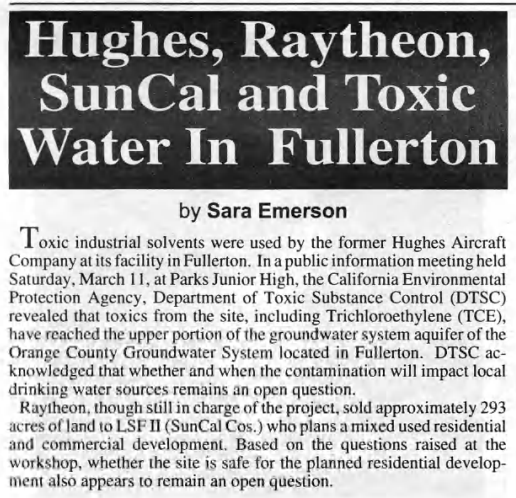
“The California Environmental Protection Agency, Department of Toxic Substance Control (DTSC) revealed that toxics from the site, including Trichloroethylene (TCE), have reached the upper portion of the groundwater system aquifer of the Orange County Groundwater System located in Fullerton,” the Observer reported. “DTSC acknowledged that whether and when the contamination will impact local drinking water sources remains an open question.”
Raytheon insisted that they were complying with all environmental laws and, ultimately, that the land was safe for humans. Raytheon had sold nearly 300 acres of the former Hughes property to a developer called SunCal. Although Raytheon had conducted an analysis in 1997 showing that the area was safe for humans, The Observer and many local residents believed that more testing and possible clean-up was needed before the site was deemed safe for human habitation.
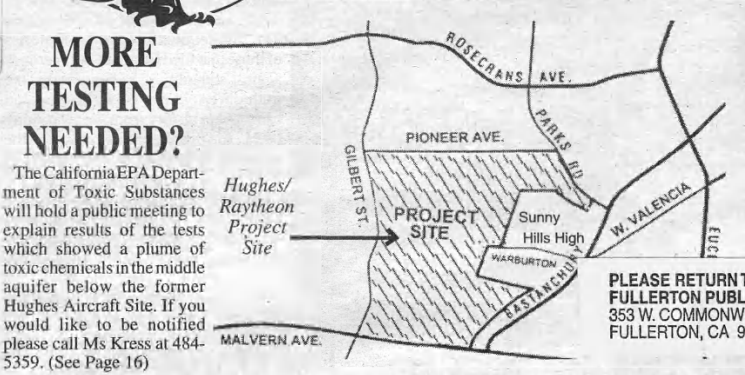
The Observer pointed to more recent testing showing that harmful contaminants were, in fact, present in the soil and water. “The results represent the highest concentration of 1,1-DCE that I have ever seen,” Will Rowe, an EPA Geologist, said.
After the Observer published a series of articles pointing out findings of more recent testing, as well as anonymous tips from former Hughes employees, SunCal sent a series of letters demanding corrections, retractions of certain statements, and even threatened a libel lawsuit against the paper.
The Observer responded to each of SunCal’s concerns, sometimes making corrections, but more often countering their claims with additional information and questions.
I’ll admit, the amount of data in some of these articles is a bit daunting. Not being an environmental scientist, I feel sort of unqualified in determining who is actually correct in these exchanges between the Observer and SunCal.
“Clearly the Observer has an agenda,” the developer’s lawyers chided, “That agenda is to disparage Hughes, Raytheon, LSF II Fullerton, LLC and those involved in the environmental remediation process taking place at the Hughes Raytheon site.”
Sharon Kennedy, the Observer’s editor replied: “The paper seeks the truth in every instance. We happily make corrections whenever errors are pointed out.”
Despite being a small newspaper with an all-volunteer staff, the Observer did an impressive job of poring through voluminous environmental reports on the property–stuff not exactly written to keep the reader engaged, documents so technical and boring that most people would probably not bother to read them unless they had to. But Sharon read them, and did her best to report on pollution still present on the land, and what further testing and cleanup was warranted. Did the Observer get some details wrong? Probably. But I think the effort, time, and care she put in were admirable, and did some good in prompting additional testing by the EPA.
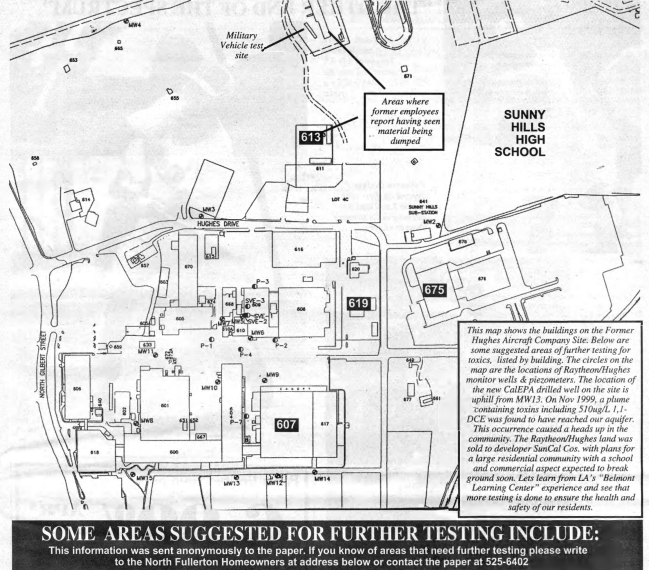
Meanwhile, the Observer published letters from local residents who lived near the former Hughes site and had lost family members young to brain cancer.
“Over the years, Wendy maintained contact with her fellow classmates from Sunny Hills and began to compile a list. The list included the names of students who attended Sunny Hills between 1966 and 1970 who developed brain tumors approximately 10 years after graduation. Listed are the names of 17 alumni who died and 4 who survived,” the Observer reported.
Some public meetings were held on the project. It seems the developer had assembled a dream team called the Suncal Leadership Club which included local elected officials like Dick Ackerman and Ed Royce who were enlisted to support the project.
When the project came before City Council, it was unanimously approved.
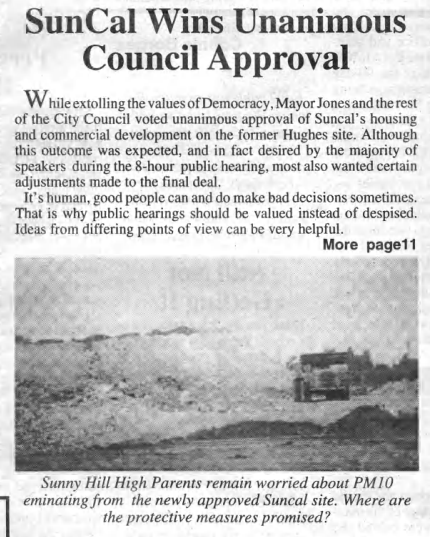
“While extolling the values of Democracy, Mayor Jones and the rest of the City Council voted unanimous approval of Suncal’s housing and commercial development on the former Hughes site,” the Observer reported. “Although this outcome was expected, and in fact desired by the majority of speakers during the 8-hour public hearing, most also wanted certain adjustments made to the final deal. Nearly everyone on all sides of the issue mentioned the need for the environmental situation both present and future to be addressed.”
Local Politics
In the 2000 local election, Chris Norby, Dick Jones, and Mike Clesceri were elected to City Council. All were Republicans.
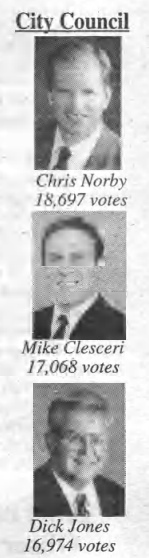
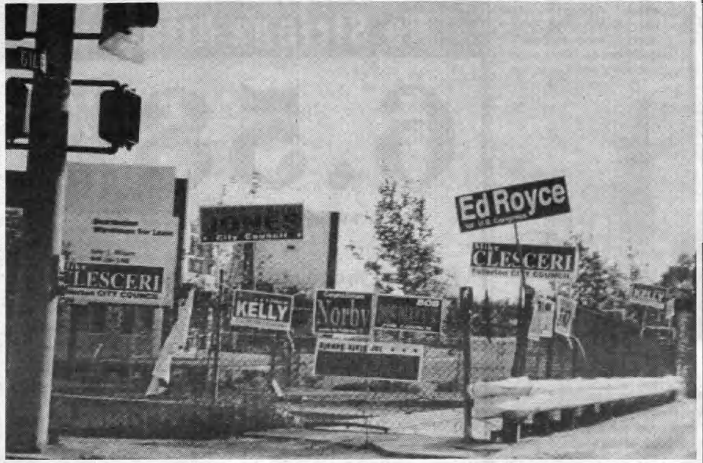
As usual, there was drama when it came to selecting a Mayor.
“Bridges were burned, laundry was washed in public, and lessons were learned. Flory learned that getting along with your colleagues is no guarantee of reciprocity. Jones learned the dangers of going back on a commitment. Several people learned that deals are never final,” the Observer reported.
Housing
Throughout the 1980s and 1990s, Fullerton’s conservative/Republican City Council majorities were generally opposed to building affordable housing projects, even (or perhaps especially) when the money came from the federal government.
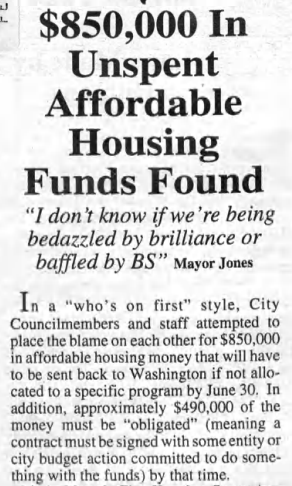
“City Councilmembers and staff attempted to place the blame on each other for $850,000 in affordable housing money that will have to be sent back to Washington if not allocated to a specific program by June 30,” the Observer reported.
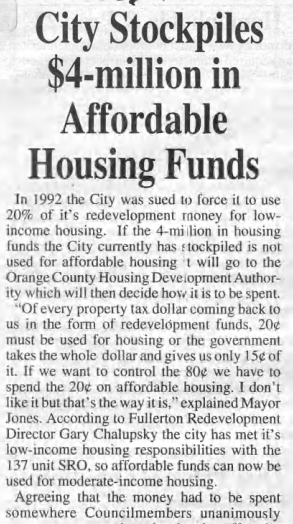
“In 1992, the City was sued to force it to use 20% of its redevelopment money for low income housing,” the Observer reported. “If the 4-million in housing funds the City currently has stockpiled is not used for affordable housing it will go to the Orange County Housing Development Authority which will then decide how it is to be spent.”
In addition to refusing to spend federal affordable housing dollars, City Council also joined a lawsuit against a local Fair Housing Foundation.
The need for affordable housing was acute, as demonstrated by the long waiting lists for existing affordable housing projects, like the East Fullerton Villas.

“The East Fullerton Villas affordable complex was dedicated in 1997 and has had a 100-family waiting list ever since,” the Observer reported.
During the cold weather months, the National Guard Armory was used as a homeless shelter, but the program had restrictions meant to keep Fullerton’s homeless out of sight during daylight hours.
“In a move both stunning in its heartlessness and ironic in this holiday season, Fullerton Police have ordered the Armory Homeless Shelter not to accept walk-ins or people who drive or bike to the shelter,” the Observer reported. “The homeless are to be picked up by bus at the outskirts of town, delivered to the shelter in the evening, and bused back to the city limits in the morning.”
Local Teachers Organize
Local elementary school teachers organized and picketed in front of the district office for better pay and working conditions.
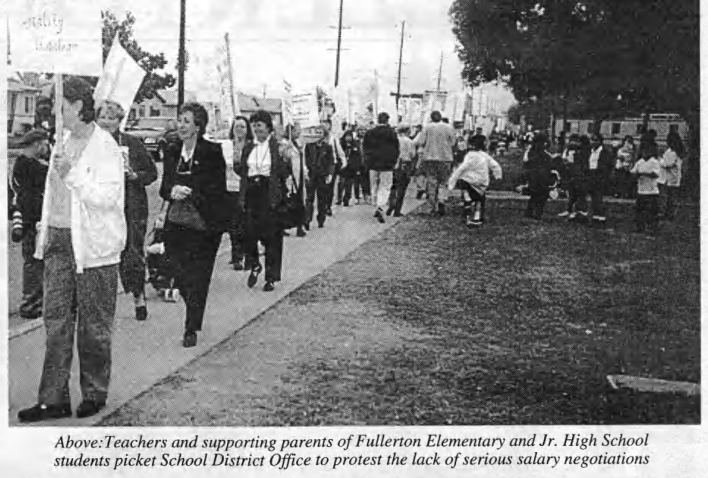
And adjunct (part-time) faculty at Fullerton College organized into their own union called Adjunct Faculty United.

“Part-time faculty make up two-thirds of all faculty in the North Orange County Community College District and are paid only thirty-two percent of what full time faculty receive class for class. In addition, unlike their full time counterparts, part-time faculty receive no health insurance and have no rehire rights,” a representative of AdFac told the Observer. “Many part-time faculty are forced to teach at three or even four colleges to try to make a living.”
In other education news, students from Columbine High School in Colorado spoke to Fullerton High School students about preventing the kind of mass shooting tragedy that occurred at their school in 1999.
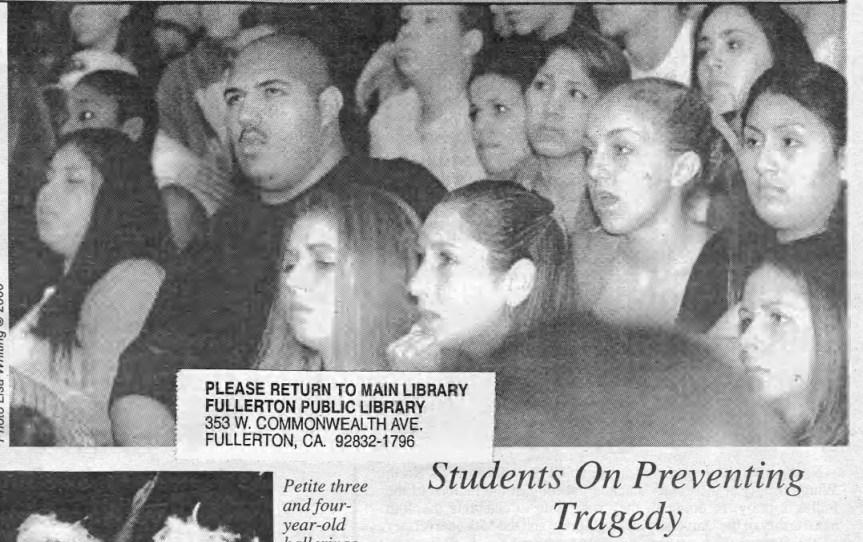
Sadly, as we all know, the number of mass shootings has increased dramatically since Columbine.
Postal Workers Fight for Their Rights
Local teachers were not the only ones fighting to improve their working conditions. A group of local postal workers filed formal complaints against and called for a full investigation of Postmaster Timothy Bomersback.
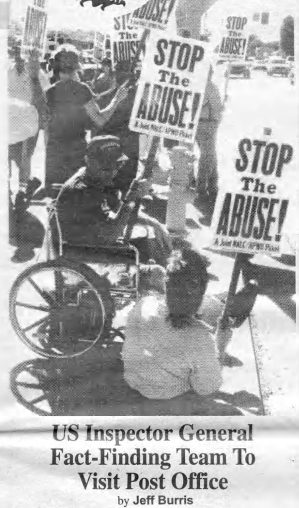
“Complaints accuse Bomersback and members of his management team with harassing, threatening, and intimidating employees through language and action, forcing workers to work off the clock in order to finish routes and discrimination against females and gay employees,” the Observer reported. “Over 100 current and former Fullerton postal workers and supporters picketed the Fullerton main office lining both sides of Chapman Avenue,. hey formed a gauntlet of neon signs that read ‘The Postmaster Must Go’ and ‘Stop The Abuse.’”
And in other public employee news, under a newly-passed California law, Fullerton firefighters gained the right to arbitration in labor disputes with the City.
Culture and Entertainment
The Fullerton Public Library underwent a massive remodel.
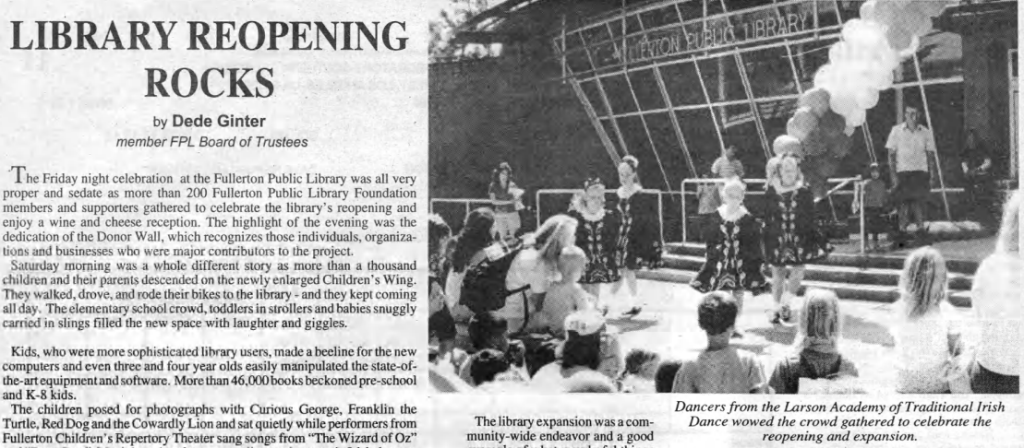
The City Planted a “Friendship Tree” at city hall as part its sister city program with Morelia, Mexico.
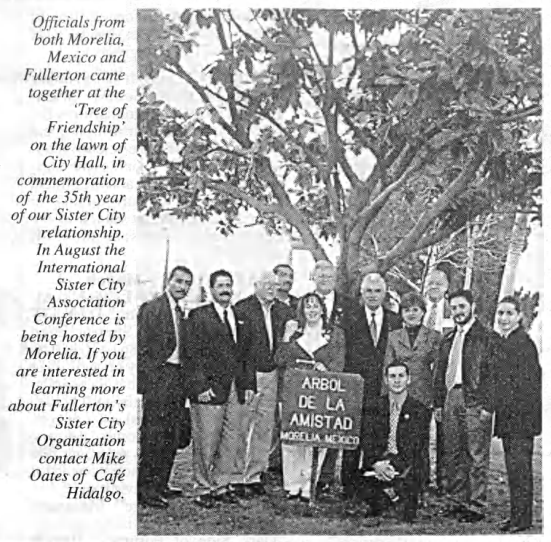
Fullerton built its first skate park at Independence Park.
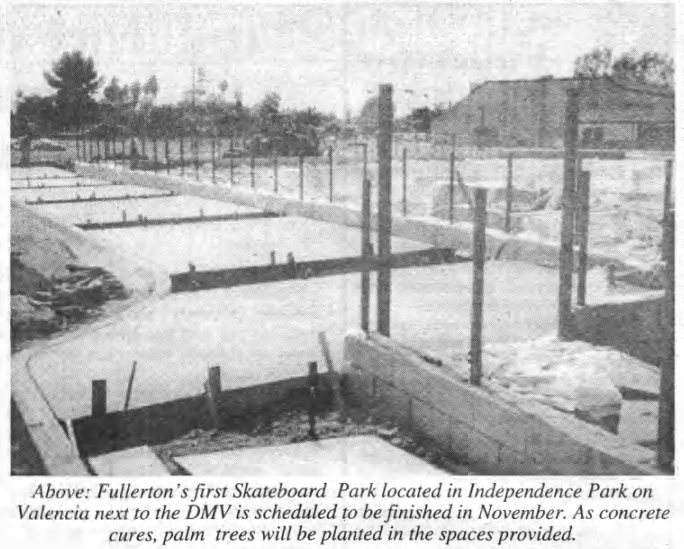
Protecting the Arboretum
As has happened a few times throughout its history, CSUF administrators wanted to pave over part of the Fullerton Arboretum to make way for more parking.
“Three point five acres of Fullerton Arboretum will be paved over for a ‘temporary’ parking lot holding 320 automobiles if the Facilities Management Department has its way,” the Observer reported. “That space is now marked for a Mediterranean garden in the Arboretum general plan…At a recent meeting, 75 people expressed opposition to the paving, and no one from the public spoke in favor.”
CSUF President Milton Gordon sought to increase influence over the Arboretum Commission by appointing three members directly who were in favor of the parking lot.
“At a September meeting of the Fullerton Arboretum Commission held at the Arboretum’s Oak Hall, dozens of citizens, Arboretum supporters, CSUF employees and environmentalists vigorously objected to a proposal to turn a currently undeveloped portion of the Arboretum grounds into a ‘temporary’ parking lot for the University,” the Observer reported.
Eventually, the University administration caved to the Arboretum supporters and put the parking lot plan on hold.
Transportation
In transportation news, plans for a new light rail train system in Orange County called Centerline were faltering.
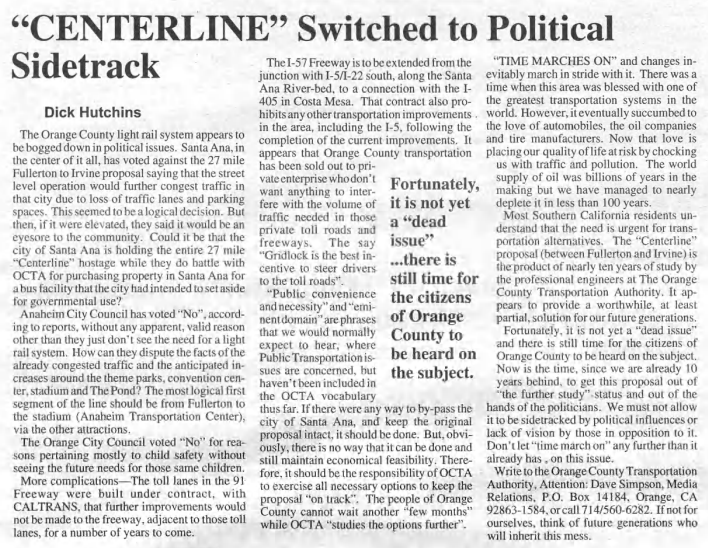
The cities of Santa Ana, Anaheim, and Orange voted against the Centerline. Fullerton city leaders were also not too thrilled about the project.
“Critics of a light rail system insist that it is a waste of time and money on a technology that no one will use. The proof that they are ignoring facts is reflected in the continued increase in ridership on the Metro-Link trains,” the Observer reported. “Also ignored is the fact Orange County) already have mass transit systems in operation and are reporting them to be successful. Whether or not the critics (lovers of freeways) want to admit it, support for an Orange County mass transit system is overwhelming. People just do not want to continue building more freeways (or toll roads).”
But the plan was not (yet) dead: “OCTA Board of Directors has made development of the Centerline corridor a priority, saying that its construction was promised during the passage of Measure M,” the Observer reported. “The unveiling of the revised lightrail plan showed the route is mostly elevated between Fullerton and Irvine and snakes among the county’s key commercial and entertainment centers, avoiding the street-level running which critics had opposed for traffic congestion and safety reasons.”
Deaths
Fullerton’s first elected female City Councilmember Frances Wood died.
She served on the Park and Recreation Commission and in 1970 was the first woman to be elected to Fullerton City Council…Frances was the driving force behind the Independence Park facility and pool and the new library was constructed during her tenure in office.
“She believed strongly in women serving on public boards and commissions,” the Observer reported. “She was a role model and mentor for women wanting to enter public life, and encouraged their entry. Many were from her Southwest Fullerton neighborhood, where she was one of the founders of a volunteer program for children.”
The Activity Building at Independence Park was named in Wood’s honor.
Local businessman and photographer Chris Beard died. Beard ran the very cool Wilshire Theater, which sadly is no more. He also owned a photography business/gallery downtown, and wrote a regular column in the Observer called “The Last Boulevardier.”

“He was loved by his family and he built a business in this town that was an extension of the community that he loved so passionately,” the Observer reported. Many Fullertonians attended his memorial service.
Stay tuned for top local stories from 2001!
-
Gay Rights Opposed, the Failed Light Rail, the New Ellis Island, and Saving the Fox: Fullerton in 1999
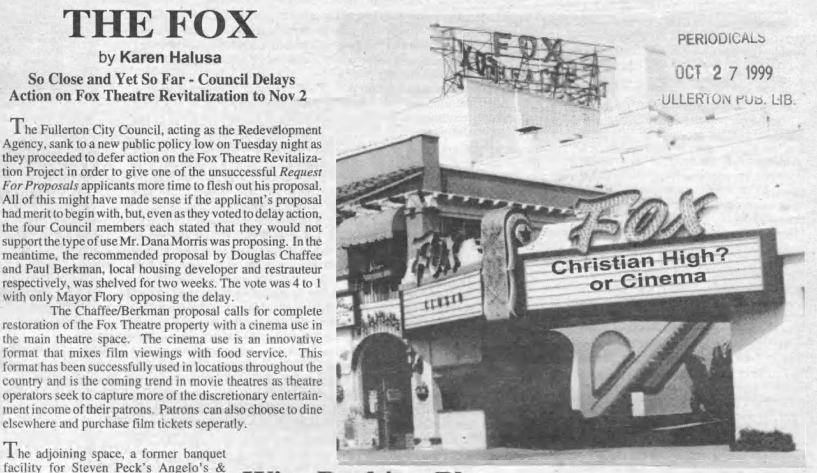
The following is from a work-in-progress about the history of Fullerton. You can support my ongoing research and writing on Patreon.
The Fullerton Observer newspaper was formed in 1978 by Ralph and Natalie Kennedy and friends to provide a more progressive counterbalance to the more conservative Fullerton News-Tribune and Orange County Register. Back then, Orange County (including Fullerton) was dominated by Republicans, and the Observer crew were definitely in the minority. The Fullerton Public Library has digital archives of the Observer stretching back to 1979. I am in the process of reading over these archives and creating a year-by-year summary of top stories. Here are some top stories from 1999.
Fullerton School Board Opposes LGBT Anti-Discrimination Bill
In 1999, some California legislators drafted Assembly Bill 222, “The Dignity for All Students Act” which sought to amend the Educational Code to include “sexual orientation” actual or perceived to the list of protected rights.
“This bill requires the administration of each public school and campus to ensure that programs and activities are free from discrimination based on sexual orientation, as they now must on the bases of race, ethnicity, religion, age, sex, color, and physical and mental disability,” the Observer reported. “Discrimination would be prohibited in interscholastic athletics, admissions, and financial aid.”
In 1998 a national survey found that there had been a 34 percent increase in anti-gay violence at public schools and colleges.
The conservative Orange County Board of Education voted 3-2 to pass a resolution opposing AB222.
In an action indicative of the political climate of Fullerton in the 1990s, the Fullerton School Board also voted to pass a resolution to oppose the bill.
“Materials [were] circulated to the board with extremely inflammatory language defining ‘sexual orientation’ as including ‘bestiality, pedophilia, necrophilia, sado-masochism and/or any other sexual habits, practices, predilections or compulsions,’” the Observer reported. “This five page document filled with homophobic scare tactics and misrepresentations is a perfect example of why the law it is railing against is needed.”
Another document given to Board members was entitled “Oppose the Homosexual Assault on Schoolchildren, Parents, Persons of Conscience, and the Institution of Marriage.”
Local Republican State Assemblymember Dick Ackerman submitted a letter to the Board opposing the bill.
Ultimately, Assembly Bill 222 did not pass.
The School Board member who submitted the resolution opposing AB 222 was an outspoken conservative named Kim Guth. She also objected to a proposal inviting Latino singer Jose Luis Orozco to perform at Richman School, which had a large Latino population.
“[Guth] stated that she strongly objected to this since the students should only be taught in English and this is in violation of that law,” the Observer reported. “Trustee Fisler defended the program, stating that the District has always encouraged children to learn folk songs from other countries.”
Ultimately the Board approved the Orozco performance, and it was a huge hit with the students.
A plan was approved to expand the facilities at Maple School, which had re-opened in 1996 after being closed for over 20 years in the context of local desegregation efforts.
On the subject of school desegregation, Fullerton resident Sylvia Mendez was honored. Back in the 1940s, her parents had fought successfully against segregation of Mexican-American students in Orange County in the landmark case Mendez v. Westminster.
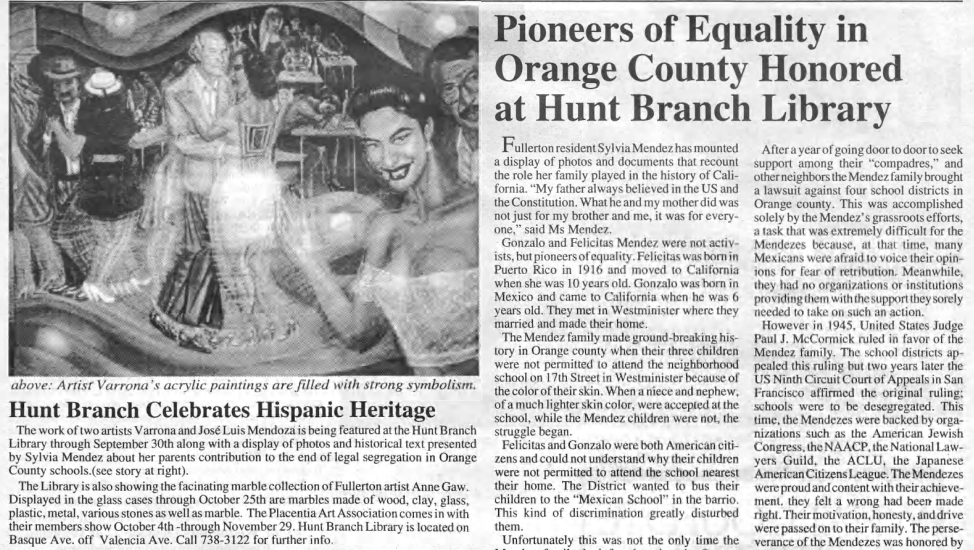
In other civil rights news, Rosa Parks visited nearby Friendship Baptist Church, in part because her Godson, Curtis Dean was a member there.
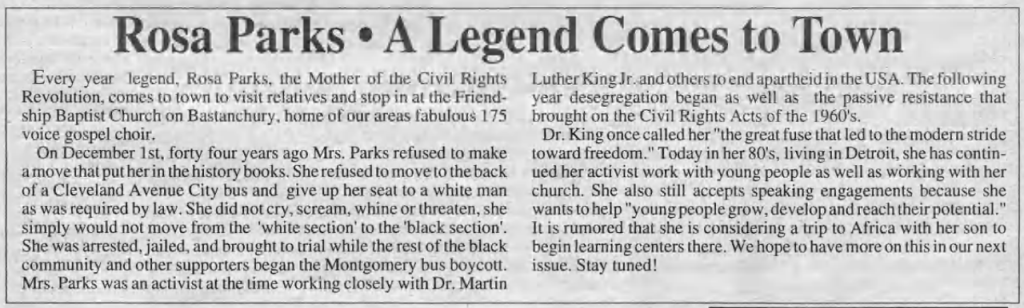
The Observer includes an article about a statewide education funding crisis.
“California was once noted for the quality of its educational system, being ranked in the top three states for years. In the latest year for which figures are available, California has plummeted to the bottom 3 or 4 or worse,” the Observer reported. “The biggest, and most long-lasting hit was Proposition 13, in 1978. That issue sailed to victory at the vanguard of a national tax revolt. Very little public debate was brought to bear on the “unintended consequences.”
A major effect of Prop 13 was that it shifted the burden for funding public education from local taxpayers to the State, which led to top-down mandates that were not always to the benefit of local districts.
Adjunct (part-time) instructors at Fullerton College began to organize against an unfair two-tier system of pay and benefits.
“Many part-timers are in fact full-time instructors, but are required to commute to two and three different campuses because employment policies restrict the number of classes they can teach in any one college district,” the Observer reported. “The system maintains the fiction that they are part-time temporary workers in order to justify low pay and administrative savings.”
In 1998, North OC Community College District part-time instructors opened an office in downtown Fullerton, and would eventually create their own union, Adjunct Faculty United.
Dr. Vera Martinez, who was removed as Fullerton College President in 1998 after the faculty’s nearly unanimous vote of no confidence in her, filed a $3 million defamation claim against the North Orange County Community College District (NOCCCD).
Martinez alleged in her claim that during her tenure as president, certain administrators and faculty members “communicated orally and in writing, on an ongoing basis, with malice, false and derogatory information about [her] job performance, skill level, conduct, honesty, integrity and other aspects of her personal character.”
“Disagreements between Martinez and the Faculty Senate over such matters as the interpretation of the Shared Governance Law and her refusal to adhere to long-standing curriculum procedures led to the Senate’s decision to conduct the no confidence vote,” the Observer reported.
The Future of Rail in OC
In 1999 there was discussion of a proposed new light rail system in Orange County called “The Center Line,” which would run from Fullerton to Irvine. Some of the funding would come from Measure M, approved by voters in 1990, which “promised a program of balanced transportation improvements, including an advanced rail transit system.”
The Orange County Grand Jury produced a negative report on the Centerline, suggesting that the light rail system “would not be a cost efficient solution to traffic congestion, air pollution and other urban problems.”
“The ‘cost-effectiveness’ of Urban Light Rail systems criticized by the Jury was characterized by OCTA as not supported by evidence,” the Observer reported. “In fact, many ‘disinterested experts’ will testify that light rail has provided positive benefits for many communities, has encouraged development, and has increased property values. In fact, light rail has been so successful that 191 cities are currently vying for federal funding to construct rail systems.”
“The inference that light rail can only be deemed successful when it convinces the majority of automobile drivers to leave their cars in favor of public transit ignores the thousands of people who depend on public transit as their sole source of transportation,” the Observer reported. “Seniors, disabled, students and visitors are dependent on public transportation and they are a growing sector of the County’s population. With annual ridership in the last four years jumping from 43-million to over 57-million expected this year, buses are currently experiencing capacity problems on many routes and simply adding buses to congested local roads will not solve traffic problems.”
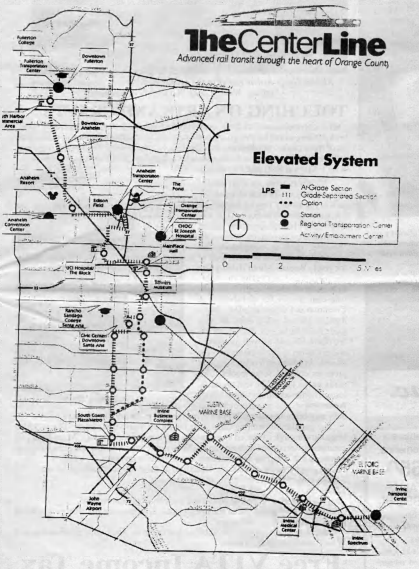
“OCTA has succumbed to the protests of Santa Ana and has now shortened the proposed line to be built between Costa Mesa and Irvine, completely eliminating the north segment from near South Coast Plaza to Fullerton,” the Observer reported. “This was apparently brought about by opposition to the rail line’s sharing of streets along the route that would result in loss of traffic lanes and parking spaces…However, this proposal eliminates Anaheim, with it’s theme parks; convention center; The Pond and Anaheim Stadium, as well as the route into Fullerton for connection to Metrolink and Amtrak’s Southwest Chief and San Diegans. This is the heart of the entire system and without it The Centerline becomes the line to nowhere that the critics had accused it of being from the start.”
The Observer pointed out that “More than $5-Billion from Measure M is already being invested in freeway expansion, street and road improvements and to increase bus service by 50%. However, those improvements alone will not be sufficient to meet the forthcoming demands and prevent the traffic congestion that is projected.”
Supervisor Tom Wilson, who chaired the OCTA board, said “When you look at a traffic study like that you see that what traffic is today, that’s what it was yesterday. Do we want it to be like that tomorrow?…We need to find some other mode of transportation other than pouring concrete and making another lane that will be congested as soon as it opens.”
When the light rail plan came before City Council, it specified that the light rail tracks be elevated within Fullerton, essentially killing the proposal within Fullerton.
“OCTA responded…with a decision to halve the route, citing strong opposition. It said that it was ‘no longer fruitful’ to plan the entire length from Irvine up to Fullerton,” the Observer reported. “The Council’s action has effectively killed the chance for rail service in the north at the very time that growth in this portion of the County is forecasted to increase by 2020 at a rate that will result in 55% of the County’s population, and 60% of its jobs to be in the north part of the County.”
Ultimately, the Center Line would not be built.
That same year, there was also a proposed statewide highspeed rail that would run from San Diego to two northern terminals, San Francisco and Sacramento.
California created a new agency called the California High-Speed Rail Authority to develop a plan to study and possibly implement this project.
In 1999, Fullerton hosted its popular Railroad Days around the train station.
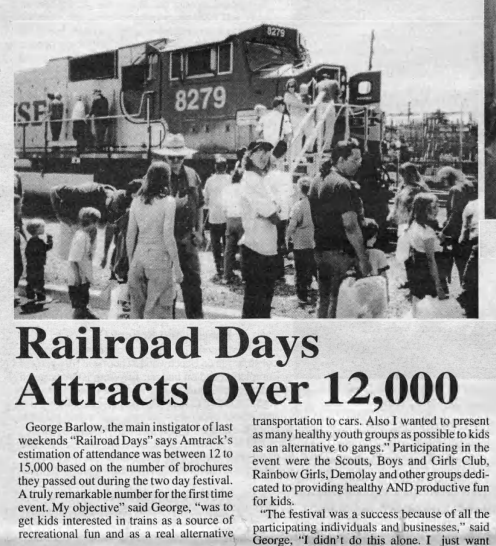
Arts and Culture
In 1999, Fullerton still celebrated its annual arts festival called “A Night in Fullerton.”
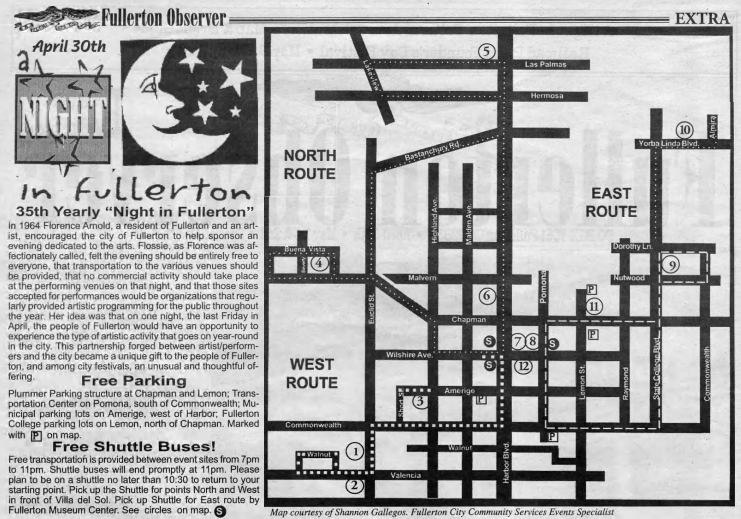
Back in 1999, Fullerton still had a Redevelopment Agency, and it was negotiating with the Fox Theater’s owner, a Mr. Lewis, in an effort to obtain an option on the Fox Theater complex.
Councilmember Dick Jones was opposed to the plan, saying, “The ugly theater is a liability. It would be just as nice to restore Fullerton to orange grove days, but impractical. I have a hunch we won’t go ahead with it as a theater, and I can’t support it.”
“City Redevelopment Director Gary Chalupsky said that the Agency had been in contact with about 60 prospective investors, all with differing plans for the theater and commercial property,” the Observer reported. “In order to get the best price and attract the most qualified investor with a plan that realistically looks at long term support of the theater, the Agency is moving ahead on marketing plans.”
Local preservation group Fullerton Heritage had circulated a petition that as signed by over 12,000 people who were in support of renovating and re-opening the Fox.
Doug Chaffee and Paul Berkman, local housing developer and restaurateur respectively, submitted a proposal to restore the Fox theater and open surrounding buildings for restaurants and other businesses, and build a senior housing project near the Fox. This proposal was supported by Fullerton Heritage.
“Financing for the project would come from an investment of $1 million of developer equity as well as a commercial loan from Fullerton Community Bank of $2 million,” the Observer reported. “Redevelopment Agency assistance of approximately $3 million in loans and land write-downs also was requested.”
Meanwhile, council received another proposal by Morris Productions to convert the Fox into a youth theatre academy with a possible church and Christian high school.
At the time, Morris operated a youth theatre company out of nearby Biola University.
Meanwhile, the Fox was still owned by a Mr. Ed Lewis.
Eventually, Morris dropped his proposal and City Council voted to enter into negotiations with Chaffee and Berkman.
Stay tuned for more on the Fox Theater saga.
The Observer includes a fun profile of George’s Hamburgers, a Fullerton institution.
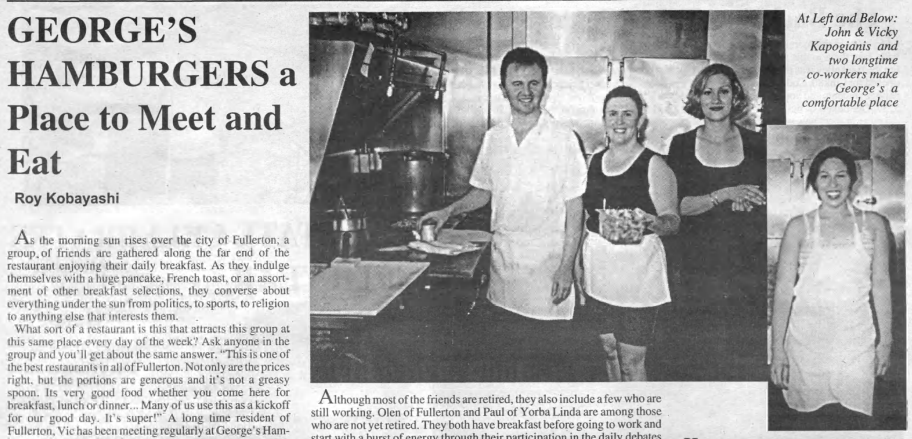
George’s is located at 815 W. Commonwealth, and has been owned and operated by John V. Kapogianis since 1981. He had acquired it from his brother-in-law George Papaspyropoulos–the namesake of “George’s.”
The small but mighty George’s remains a very popular spot, especially on weekend mornings. I recommend their breakfast burrito.
Immigration
Professor Donna L. Friess gave a presentation called “Southern California is the new Ellis Island.” In Orange County in 1999, one out of four residents was foreign-born.
She said the study revealed that immigrants to Southern California suffer a greater level of discrimination than most native-born residents might suspect, “From the sample of native-born residents, it appears that the main area of difficulty for citizens interacting with immigrants is the language.”
She spoke in favor of more education in intercultural communication: “If we can teach each other and look at the world through each others’ eyes, we can make very positive changes.”
Housing
The massive Hughes Aircraft facility in west Fullerton had closed down and 1994, and its owners were planning to build a massive housing/commercial space on the site.
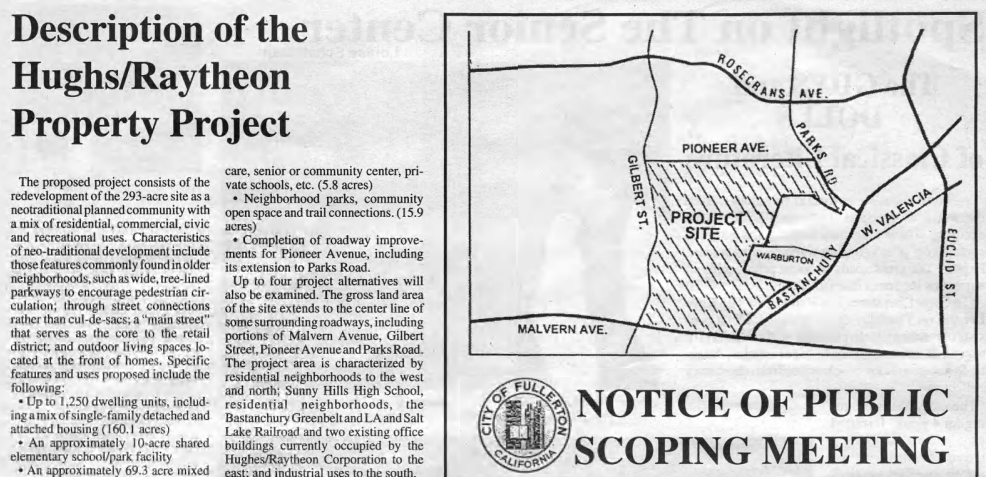
“The proposed project consists of the redevelopment of the 293-acre site as a neotraditional planned community with a mix of residential, commercial, civic and recreational uses,” the Observer reported.
This development would come to be known as Amerige Heights.
Local real estate owners the Bushala Brothers were got council to re-zone some of their land near the train tracks into to allow for high-density (apartment) use.
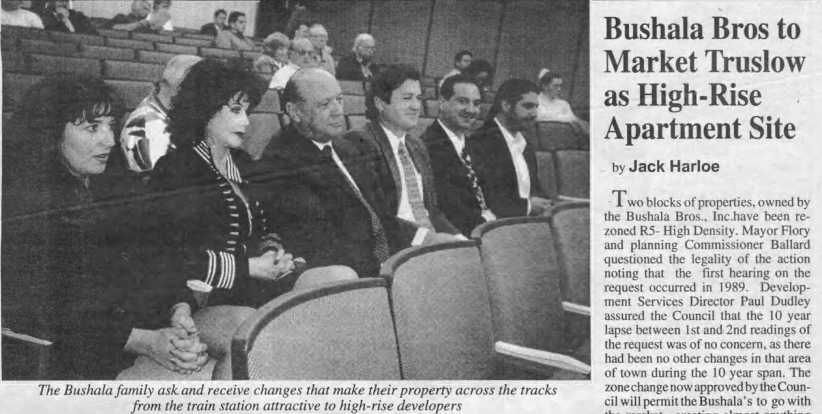
Claudia Casillas, a local resident of the area said, “I would like to speak for the parents of Maple School. We are very concerned about the proposal for R-5 zoning for the Bushalla project. We are concerned about the impact of a high density project on our community and on our school…Please consider approving only R-3 zoning for this project.”
Law and Order
At the request of Fullerton’s police chief Pat McKinley, Council approved use of State funding to purchase 16 modern automatic rifles with laser sighting, and the necessary ammunition.
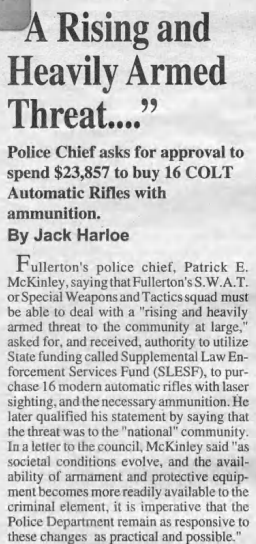
He said that Fullerton’s S. W. A.T. or Special Weapons and Tactics squad must be able to deal with a “rising and heavily armed threat to the community at large.”
In a letter to the council, McKinley wrote, “as societal conditions evolve, and the availability of armament and protective equipment becomes more readily available to the criminal element, it is imperative that the Police Department remain as responsive to these changes as practical and possible.”
Deaths
Paul Codispoti, owner of the popular Giovanni’s Pizza in Fullerton died of cancer at age 49.
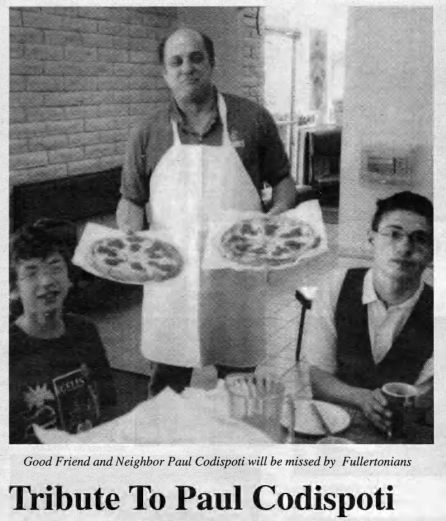
“Many a youth sports team had “the Pizza Man,” as Paul was affectionately called, to thank for both financial support and lots of free pizza,” the Observer reported. “Fullerton’s elementary and high schools, the Boys and Girls Club, and Fullerton Public Library also benefited from Paul’s generosity over the years.”
Paul had no health insurance and was facing mounting medical bills, “so the people who loved him chipped in to help in a big way. Aluminum can drives, benefit spaghetti dinners, and several other fundraising efforts netted over $10,000 to help offset the costs of his treatments.”
Paul had owned Giovanni’s Pizza since 1981, but his connection to the popular restaurant on Williamson Ave. went back further than that. It had been owned and operated by his father Tony since 1958, and at one time or another, all eleven Codispoti children helped their father at the restaurant.
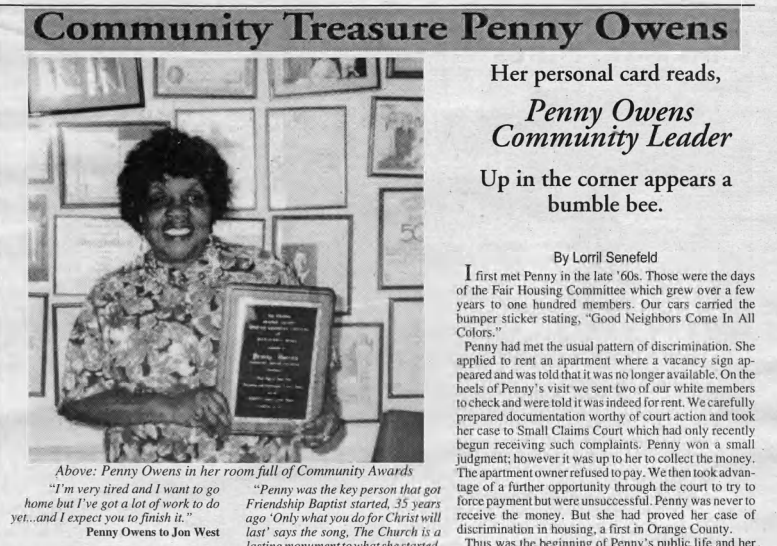
Local civil rights activist Penny Owens passed away.
“I first met Penny in the late ’60s,” an Observer wrote in a tribute. “Those were the days of the Fair Housing Committee which grew over a few years to one hundred members. Our cars carried the bumper sticker stating, ‘Good Neighbors Come In All Colors.’”
Penny, being African American, had experienced housing discrimination.
“She applied to rent an apartment where a vacancy sign appeared and was told that it was no longer available. On the heels of Penny’s visit we sent two of our white members to check and were told it was indeed for rent. We carefully prepared documentation worthy of court action and took her case to Small Claims Court which had only recently begun receiving such complaints,” the Observer reported. “Penny won a small judgment; however it was up to her to collect the money. The apartment owner refused to pay…But she had proved her case of discrimination in housing, a first in Orange County. Thus was the beginning of Penny’s public life and her unswerving dedication to the pursuit of justice for herself and others.”
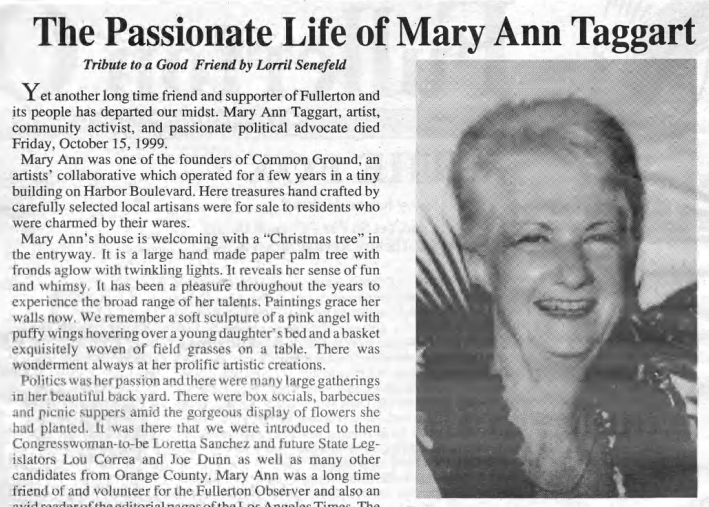
Artist and community activist Mary Ann Taggart died. She was one of the founders of Common Ground, an artists’ collaborative which operated for a few years in a small building on Harbor Boulevard.
According to the Observer, “She single-handedly built the membership of the Democrats of North Orange County from a handful of folk to a filled, sometimes standing room only capacity today.”
Stay tuned for stories from 2000!
-
Republicans Still Dominate Local Politics, Affordable Housing Falls on Faith Community, Saving Coyote Hills, Residents Win Against ConAgra, and Observer Editor Ralph Kennedy Dies: Fullerton in 1998
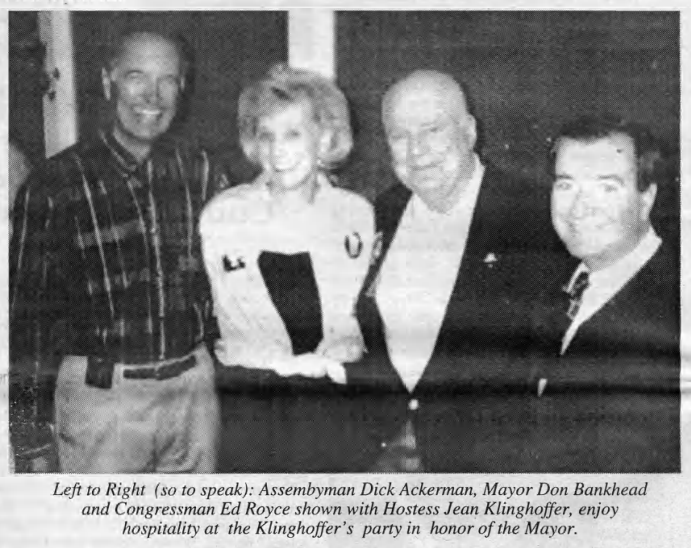
The following is from a work-in-progress about the history of Fullerton. You can support my ongoing research and writing on Patreon.
The Fullerton Observer newspaper was formed in 1978 by Ralph and Natalie Kennedy and friends to provide a more progressive counterbalance to the more conservative Fullerton News-Tribune and Orange County Register. Back then, Orange County (including Fullerton) was dominated by Republicans, and the Observer crew were definitely in the minority. The Fullerton Public Library has digital archives of the Observer stretching back to 1979. I am in the process of reading over these archives and creating a year-by-year summary of top stories. Here are some top stories from 1998.
Fullerton Still Dominated by Republicans
Don Bankhead and Jan Flory were re-elected to Fullerton City Council. Flory remained the only Democrat on this historically conservative body.
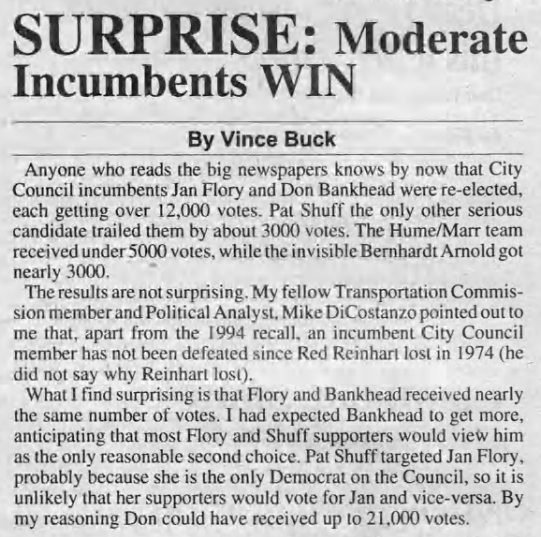
At both the state and federal levels, Fullerton remained represented by Republicans–Dick Ackerman in the State Assembly and Ed Royce in the House of Representatives.
Affordable Housing Needs Fall on Faith Community
As the 1990s wore on, the issue of housing unaffordability was becoming more acute. Gone were the halcyon days (for some) of the 1950s, when it seemed almost anyone (who was white) could afford a single-family home, thanks to a buyer’s market, a booming postwar economy, and generous federal housing programs dating back to the New Deal.
Fullerton’s conservative City Council majority were generally opposed to approving affordable housing projects.
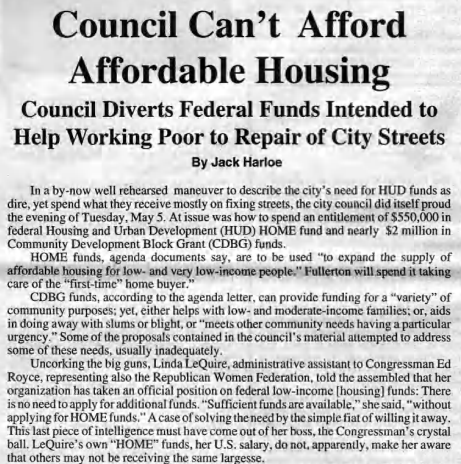
Each year, Fullerton gets federal funds that are generally meant to support local affordable housing programs. These are called HOME funds and CDBG funds. In 1998, Fullerton got $550,000 in HOME funds and nearly $2 million in CDBG funds.
City Council chose to use these funds in ways that didn’t expand the city’s supply of affordable housing. Instead, they chose to use HOME funds for a first-time homebuyer program and CDBG funds for (mostly) infrastructure improvement.
Thus, it would (mostly) fall to local non-profits and faith communities to get affordable housing projects built.
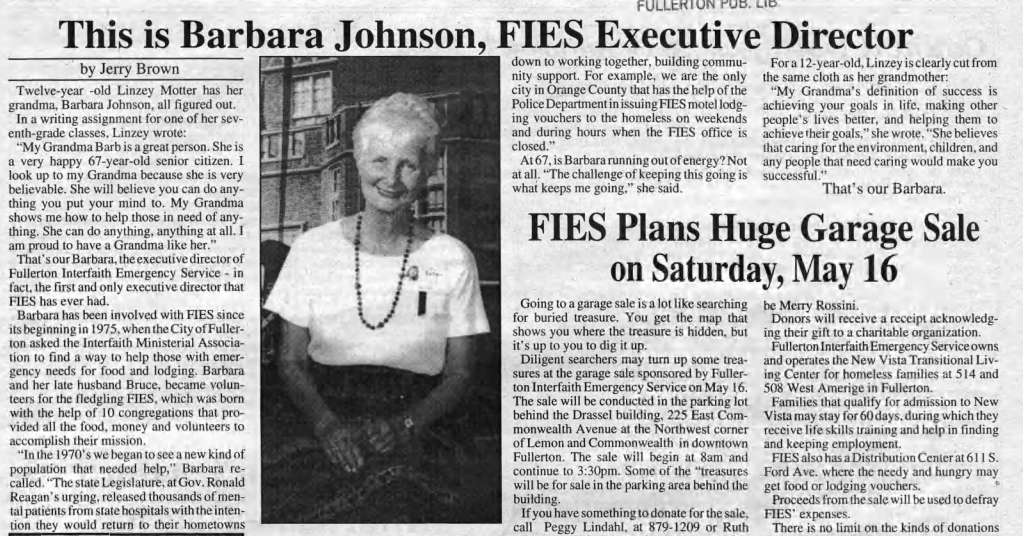
The Observer includes a profile of Barbara Johnson, executive director of Fullerton Interfaith Emergency Services (Now called Pathways of Hope), a local nonprofit that started in 1975, when the city asked local churches to find a way to help those with emergency needs, particularly housing and food assistance.
“In the 1970’s we began to see a new kind of population that needed help,” Barbara recalled. “The state Legislature, at Gov. Ronald Reagan’s urging, released thousands of mental patients from state hospitals with the intention they would return to their home towns and get care and treatment in a setting where they would have support of their families.” Things didn’t exactly work out that way.
The social safety net that was stitched together during the New Deal began to fray in the 1980s.
“The cost of housing just went out of sight,” Barbara said. “Families could no longer feed, clothe, house and educate their children.”
In 1986, FIES received a grant of $ 140,000 from the State of California and bought two homes at 514 West Amerige to house five homeless families in temporary transitional housing, called New Vista.
“Over the years we were able to pull together many elements in the community to help meet the growing needs. It was a total community-wide effort,” she said. “The model that we have created is well known for the diversity of support that we have and how we reach out to the private and government sectors to meet social needs.”
By 1998, New Vista wasn’t the only affordable housing facility in town. There were the East Fullerton Villas, and City Lights downtown. Council initially voted down the City Lights project, but reversed course when the city faced citizen support and legal pressure.
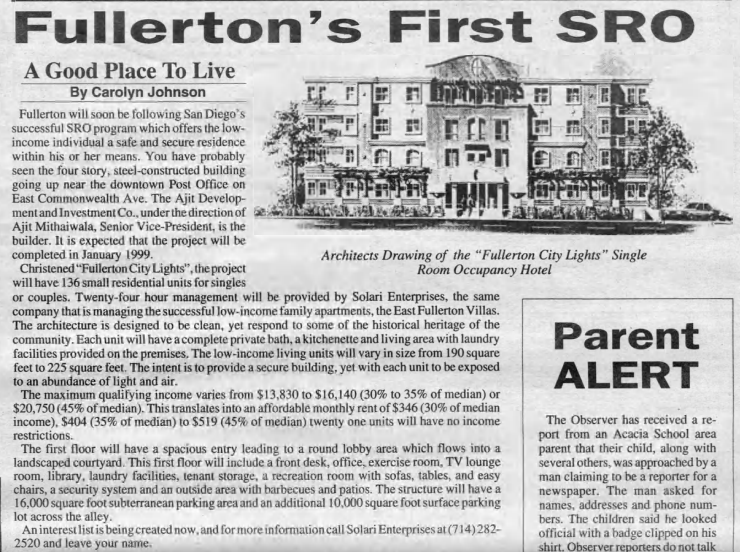
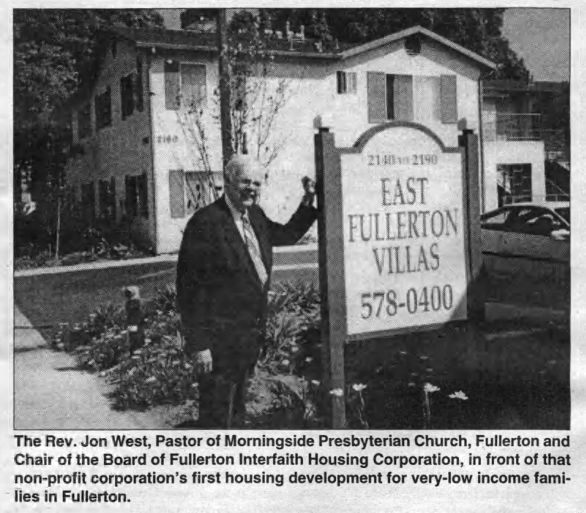
In 1998, the Heritage House in the Fullerton Arboretum was placed on the National Register of Historic Places. The house belonged to Dr. George C. Clark, an early Fullerton doctor.
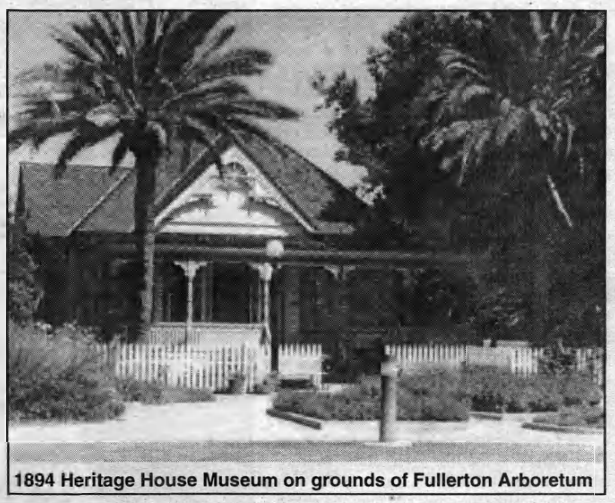
“Docents annually show hundreds of elementary school children through the house and office as part of their study of California history,” the Observer reported.
The Decades-Long Struggle to Save Coyote Hills
Since the 1970s, there has been a concerted citizen effort to save a 510-acre open space in northwest Fullerton called Coyote Hills. It is owned by Chevron and their housing subsidiary Pacific Coast Homes and since oil production ceased these companies have wanted to develop the land into housing and commercial space.
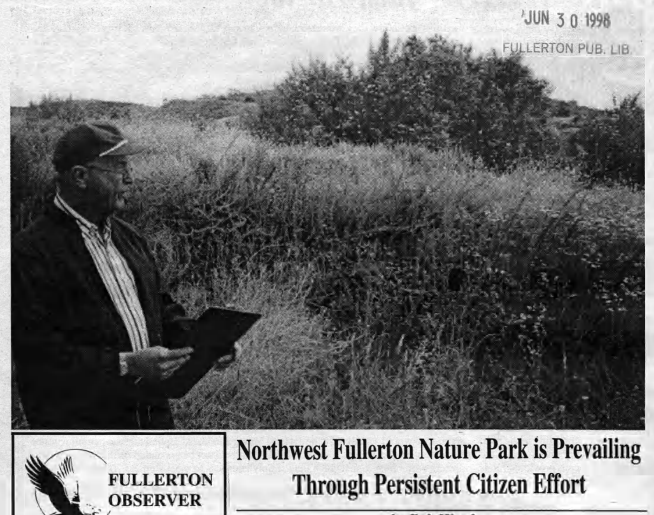
Back in the 70s, Fullerton City Councilmember Robert Ward, along with other local activists sought to preserve a large part of the land as open space.
Under Ward’s leadership, the city negotiated a plan to save much of the land, and allow for some development. The 1977 Master Plan for the West Coyote Hills was created, setting aside about one third of the land for open space.
In 1983, the City acquired 72 acres of open space. This would eventually become the Robert Ward Nature Preserve, which today contains miles of beautiful trails and a glimpse into what the land looked like before it was developed.
By 1998, things had stalled. The Nature Preserve was still not open to the public, and Chevron was moving forward with its development plans.
“Fourteen years have elapsed since the City acquired this hidden treasure. Sadly, the dream of the Nature Park has not yet been fully realized,” Ward wrote in a 1998 Observer article. “Severe cutbacks in funds available for parks and recreation and limitations imposed by closing out oil operations have put access to the Nature Park on hold. But things are moving toward fruition with Chevron’s pending development of their remaining land which will remove the chief obstacles. We are also blessed that another adjoining parcel will be set aside in its natural state as Gnatcatcher habitat so that something like 150 acres altogether will be preserved. Hopes are high that soon the people of Fullerton will have the opportunity to experience this hidden treasure first hand.”
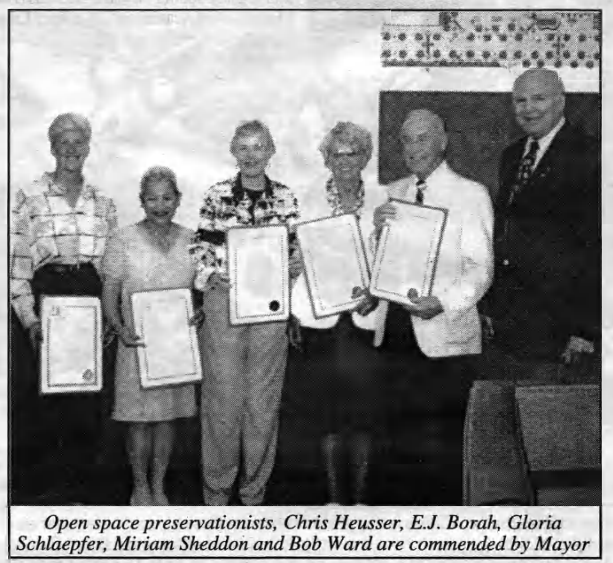
Ward was also the catalyst for an 11-acre Vista Park surrounding the Summit House restaurant, an 8-acre panorama nature preserve, and 30 miles of public trails.
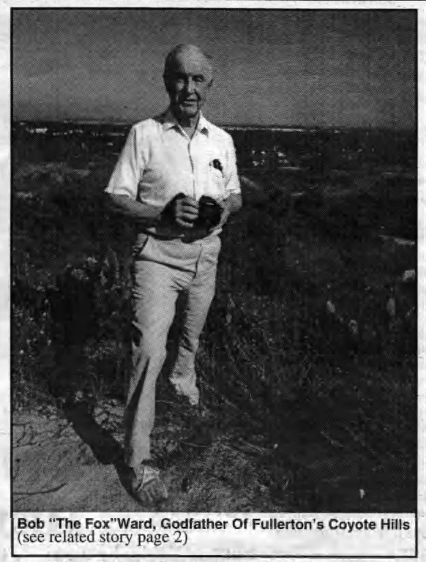
Within a few years, the Friends of Coyote Hills would form with the goal of acquiring all 510 remaining acres of West Coyote Hills. Additional land has been acquired, but not all of it. The struggle continues.
Culture and Entertainment
In 1998, the City of Fullerton agreed to pay 100% of the maintenance costs of the Muckenthaler Cultural Center. That city support would eventually end. Today, the Muck, like the Fullerton Museum Center, is self-funded.
The Observer features an article on an Orange County Mural Tour hosted by the Mural Conservancy of Los Angeles. The tour included four Fullerton murals.
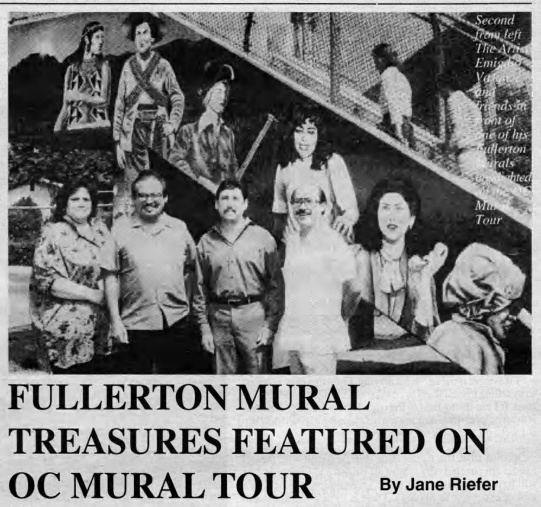
The first was Charles Kassler’s recently restored WPA-funded “Pastoral California” on the western wall of the Fullerton High School Auditorium. Check out a more complete history of that mural HERE.
The second was the Helen Lundeberg’s 1942 WPA-funded mural called “History of the Development of Southern California,” originally painted when the building was Fullerton’s City Hall. Today it is located inside the Fullerton Police Department.
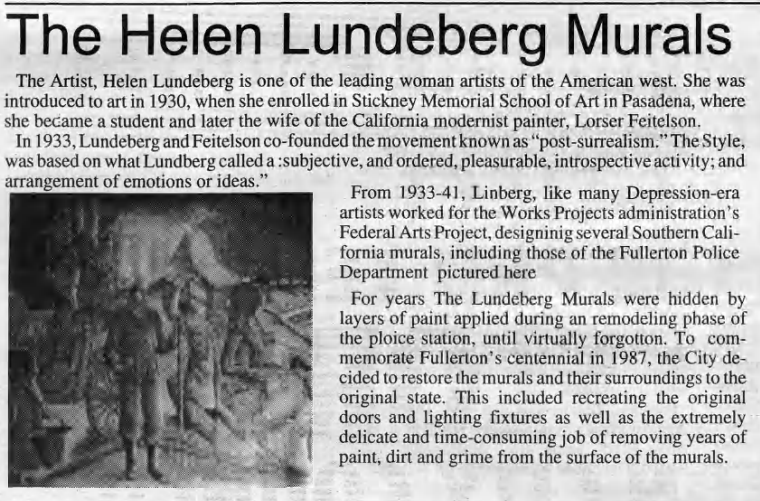
The third of the WPA murals was Paul Julian’s “Orange Pickers” at the Commonwealth Post Office, painted in 1942.
The last Fullerton mural on the tour was Chicano artist Emigdio Vasquez’s “Children of the World,” painted in 1994.
The Observer did a profile of Steven Peck, the eccentric founder of Angelo’s and Vinci’s Ristorante, a long time Fullerton institution that sadly closed in recent years.
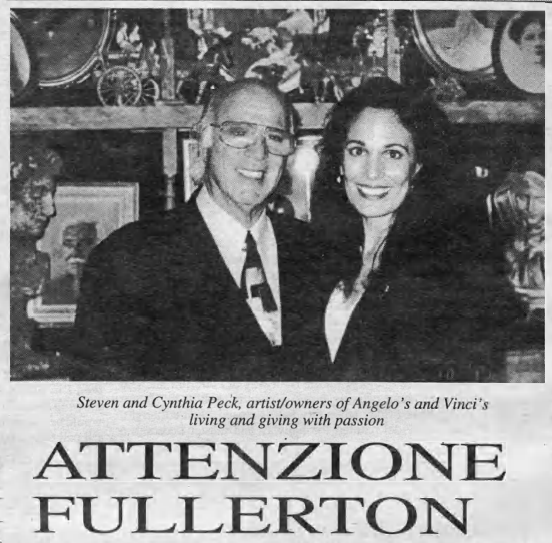
Peck was a “dancer, movie star, teacher, writer, chef, philanthropist, restaurateur, and raconteur.”
He originally came to Fullerton in 1971, establishing a dance studio in the historic Fox building, and eventually a restaurant.
When his lease ran out in 1992, he moved next door “to a-building that had served as a farmers’ market in the early 1900’s.”
“The popular eatery encompasses over 20,000 square feet divided among several rooms,” the Observer reported. “Walking into Angelo’s and Vinci’s is a bit like entering a fairyland. Strings of tiny lights illuminate stained glass and statues, ornate mirrors, cherubs and porcelain masks adorn the walls, ceramic trapeze artists hang from the ceiling of the main dining room, and ceramic jesters (reputed to act like guardian angels) watch over doorways.”
The restaurant was a maximalist tribute to Italian culture and Peck’s own family history.
“Nowhere is that more evident than in the main dining room. Decorated to capture the essence of an Italian town square, the room includes La Stride di Nonne (the Street of the Grandparents) and the Love Altar,” the Observer reported. “The former is a dedication to family members who immigrated to this country and worked at trades they had perfected in Italy. Diners will see a fruit store, a wedding dress boutique, a deli, an inn, and a wine shop The Altar showcases treasured photos from both sides of the family.”
Also included in Angelo’s and Vinci’s were posters from movies Peck had acted in, photos taken with celebrities, and tributes to Fellini, Gershwin, and Nino Rota, who composed the music for the Godfather movies.
In 1998, Downtown Fullerton was home to a world-class jazz club called Steamers, which has sadly since closed.
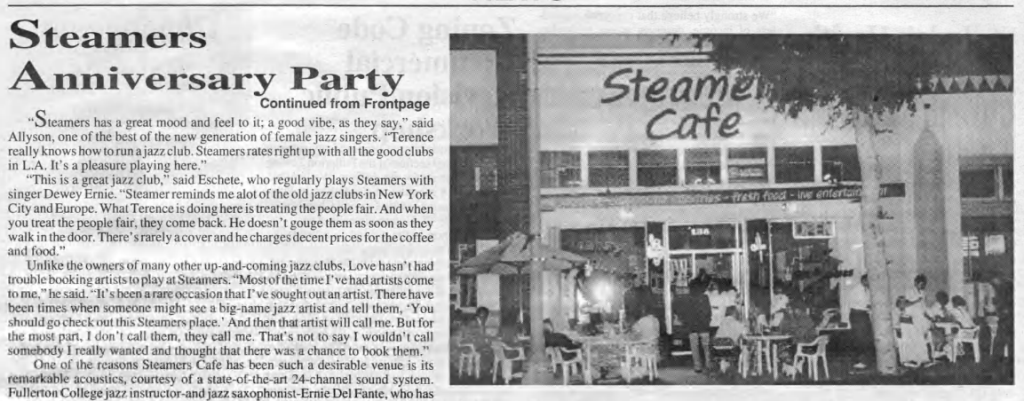
The Observer also contains a profile of Lauralyn Eschner, who founded All the Arts for All the Kids, a nonprofit arts program that still exists today.
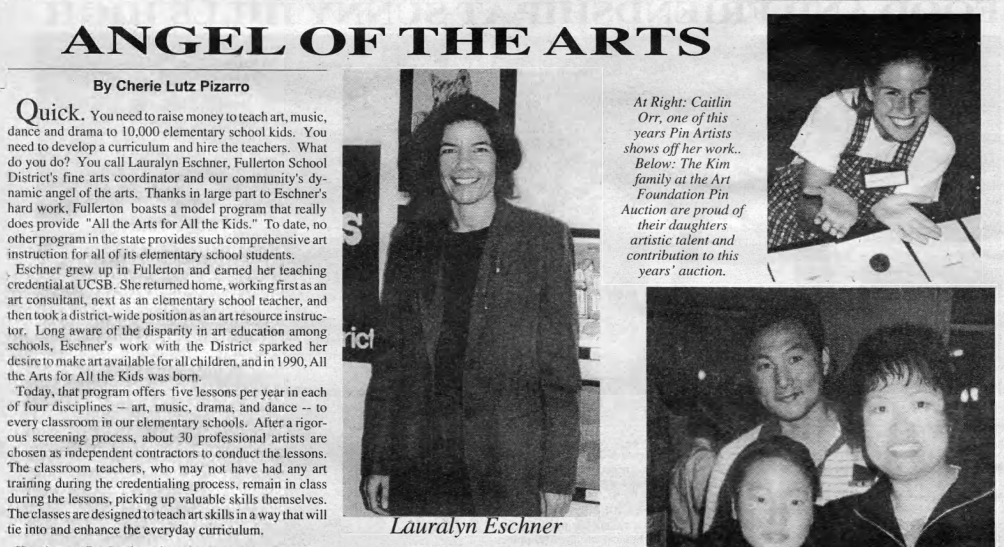
Residents Win Against ConAgra
Fullerton faced a proposal by industrial giant ConAgra to build a massive flour mill on the west side of town very near to residential neighborhoods.
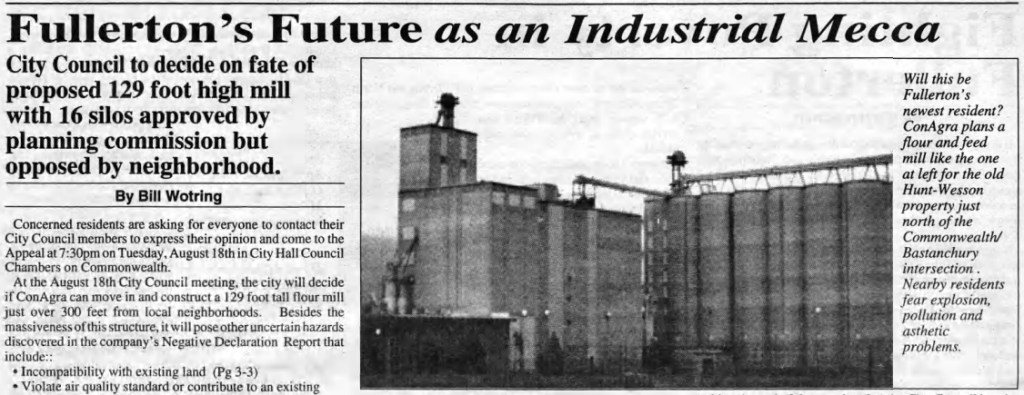
The Observer included a number of articles arguing against the mill, and numerous residents organized to protest its approval.
The Observer reported: “Besides the massiveness of this structure, it will pose other uncertain hazards discovered in the company’s Negative Declaration Report.” These included air quality pollutants, objectionable odors, water quality concerns, risk of accidental explosion, and many other public health hazards.
Hundreds of citizens signed a petition opposing the flour mill and flooded the Planning Commission and City Council chambers to voice their opposition.
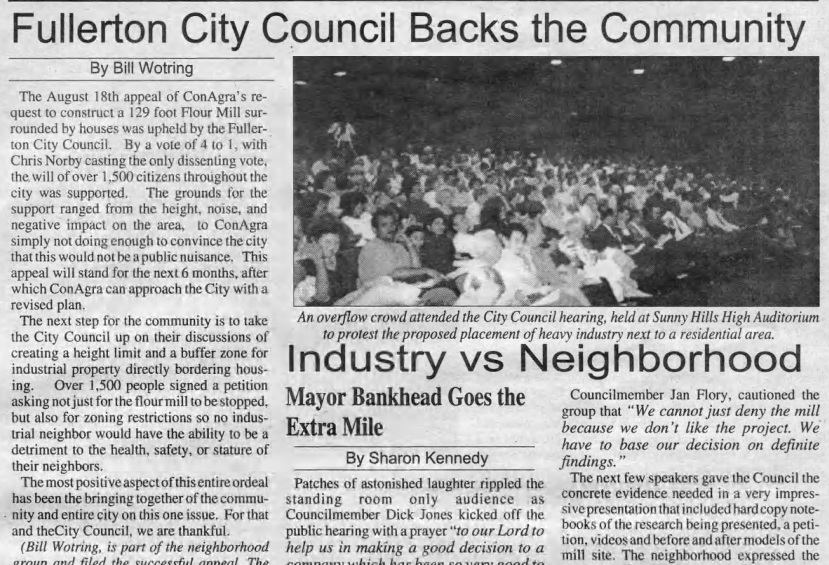
The community activism had a positive result. City Council voted 4-1 (Norby, no) to deny the construction of the flour mill.
California’s Calamitous Experiment in Electricity Deregulation
In 1996, California legislators passed Assembly Bill 1890 with the goal of deregulating electricity in the Golden State. While this was promoted as an effort to provide more consumer choice and “free market” competition, it led to a calamitous electricity crisis by 2000-2001.
But in 1998, hopes were still high that deregulation was the way to go.
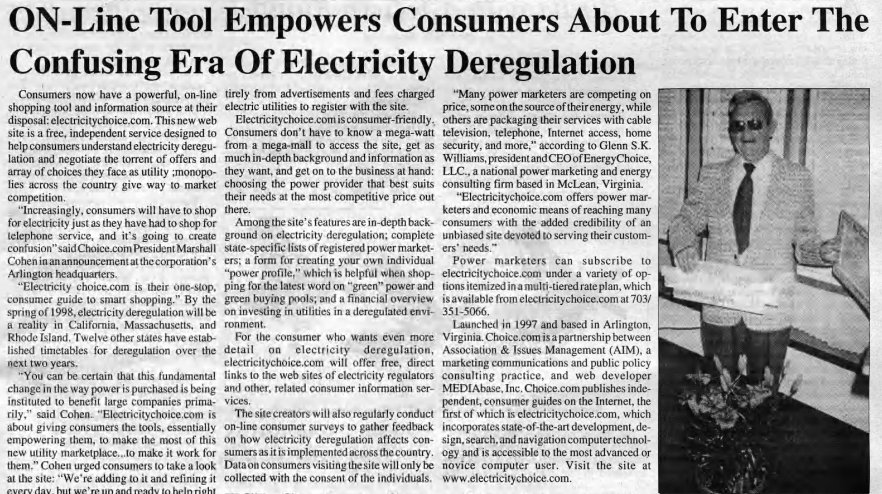
Best Downtown?
In 1998, Fullerton got an award for Best Downtown Area. I was a high school student at the time, and I respectfully disagree that Downtown Fullerton was great in the 90s. While it had some cool spots and historic buildings, it was still a pretty sleepy and boring place.
Education
In 1998, plans were afoot to re-open Beechwood School.
And Fullerton College faculty passed a vote of “no confidence” of its current president Martinez.
Human Relations
Fullerton Observer editor Ralph Kennedy had a son named Rusty, who became the director of an organization called Orange County Human Relations (now called Groundswell), which sought to fight against racism and bigotry in Orange County. In 1998, Rusty wrote an article in which he discusses his observations and experiences with historic racism in Fullerton.
Rusty recalls the John Birch Society (once big in OC) “and the hate they directed at my family and others. He remembers “the hostility generated by the real estate industry at my parents for supporting the Rumford Fair Housing act which outlawed housing discrimination based on race.”
“I remember that our schools were segregated and the predominately Latino and Black Maple School seemed to get the least resources and was finally closed rather than forcing white students to integrate it,” Rusty writes. “I remember the chilly reception that Rev Jim Carrington of predominately Black Friendship Baptist Church got when he raised issues of discrimination at the City Council meetings of the day; and I remember the animosity directed at Cesar Chavez and the United Farm Workers for invading our comfortable suburb with the grape boycott.”
He describes the Fullerton neighborhood he grew up in where “almost everybody was like me, we were the middle class baby boomers in a suburb largely developed by white flight from Los Angeles.”
Rusty points out local advancements made in housing and school integration: “Today my street has old and young, Korean and Latino, different types of families and is characterized by the fact that 3 out of the 8 homes on my end of the block have ethnically mixed families. What was a predominately white suburban bedroom community has grown into a diverse urban area where a majority of our K-12 school students are ethnic minorities and over 50 languages are spoken in our homes.”
He also points out work that still needed to be done.
“How many of our schools place all of the limited English speaking kids in the same classroom with a teacher from whose class the informed parents have already pulled their kids?” he writes. “How many of our involved parents and leaders have focused only on our own children’s needs rather than the needs of ALL children? How many of the special efforts to involve parents of children bused out of their neighborhoods have been scrapped?”
He is talking about persistent de facto housing and school segregation, which I have described in my article on the history of Maple School desegregation efforts.
Observer Editor Ralph Kennedy Dies
In 1998, the Fullerton Observer celebrated its 20-year anniversary.
Tragically, that same year, Observer co-founder and editor Ralph Kennedy died of pancreatic cancer.
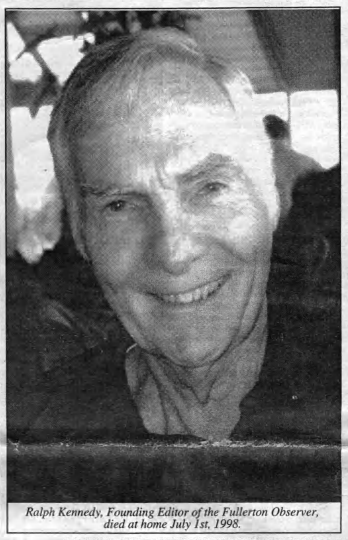
Chris Beard, who had a longtime column in the Observer called “The Last Boulevardier” wrote a touching tribute to Ralph. Sadly, Beard also died from pancreatic cancer.
“This is why the world needs Ralph Kennedy,” Beard (who was politically conservative) wrote. “A man driven to right the wrongs that we should be ashamed to admit exist. A true champion of the cause of mankind. After serving our nation in the military, and working for a living until retirement, Ralph chose the absolute most improbable, insane career imaginable. Publish and edit a liberal newspaper in a town so conservative that its people would routinely re-elect a homophobic congressman by landslide margins just because the shingle hanging outside of his office read Republican. But Ralph pulled it off…Ralph Kennedy was the embodiment of giving and goodness and awareness in our city and we have gained insight into the side of the good because of his energy. I know I am a better person because I knew him.”
After Ralph died, he passed the reins of the Observer to his daughter Sharon, who would helm the paper for another 20 plus years. Today, the Observer continues under the editorship of Sharon’s daughter Saskia–a third generation Kennedy Observer.
Stay tuned for top news stories from 1999!
-
(Un)affordable Housing, Campaign Finance Fail, a Mural Restored: Fullerton in 1997
The following is from a work-in-progress about the history of Fullerton. You can support my ongoing research and writing on Patreon.
The Fullerton Observer newspaper was formed in 1978 by Ralph and Natalie Kennedy and friends to provide a more progressive counterbalance to the more conservative Fullerton News-Tribune and Orange County Register. Back then, Orange County (including Fullerton) was dominated by Republicans, and the Observer crew were definitely in the minority. The Fullerton Public Library has digital archives of the Observer stretching back to 1979. I am in the process of reading over these archives and creating a year-by-year summary of top stories. Here are some top stories from 1997.
Government and Politics
In 1997, Fullerton City Council was made up of four Republicans (Don Bankhead, F. Richard Jones, Chris Norby [mayor], Julie Sa, and one Democrat (Jan Flory).
In 1996, California voters passed Prop 208, which sought to limit campaign contributions to local candidates to $250 per individual. The measure sought to curb undue influence of wealthy donors on politicians.

Unfortunately, the Proposition was declared unconstitutional and never went into effect. Fullerton has never imposed contribution limits; however state law sets the ceiling at $5,900. Local elections continue to be affected by the influence of large donors–developers, police and fire unions, etc.
In 1997, City Council faced off against the Firefighter union over pay and working conditions.
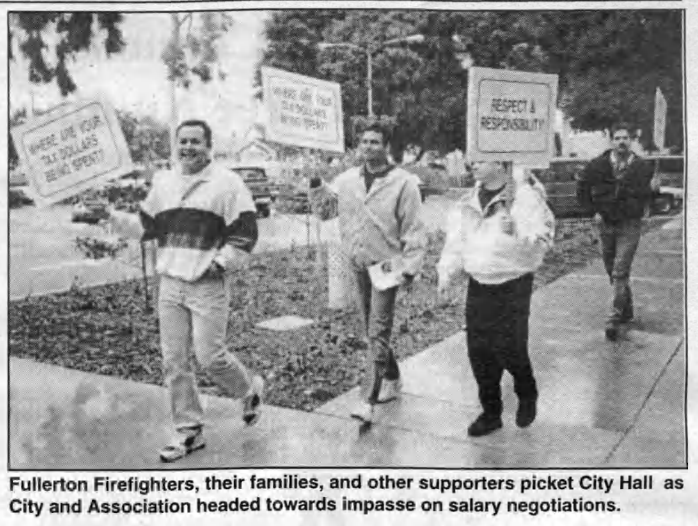
And the city settled a lawsuit alleging that it had discriminated against minorities in hiring of firefighters.
Orange County politics had long been dominated by Republicans; however in 1996, a Latina Democrat named Loretta Sanchez got herself elected to congress, perhaps signalling changing voter demographics.
Culture and Entertainment
There was talk of building a community Plaza next to the Fullerton Museum Center, something that would eventually happen.
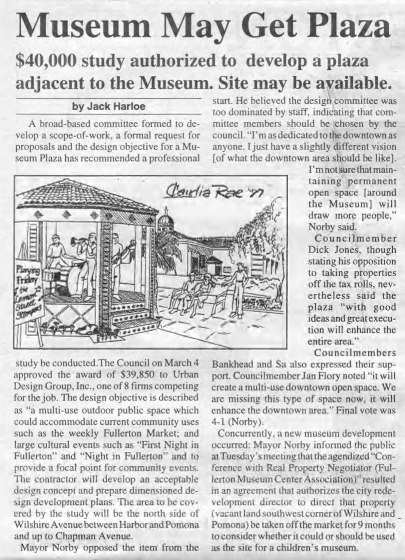
The Fox Theater in Fullerton had been closed down since 1987; however there was talk of restoring it, somehow.
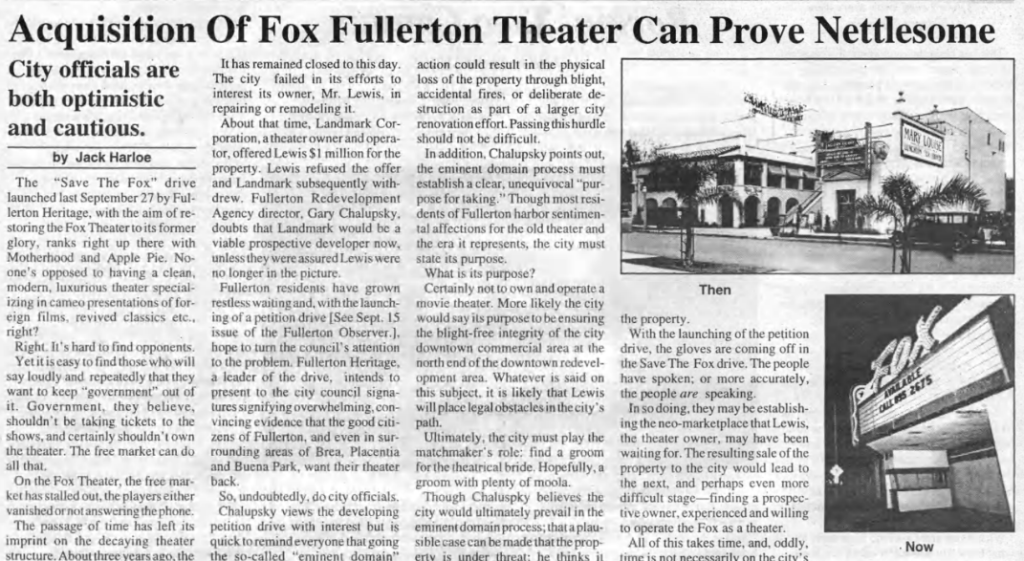
In 1997, Fullerton still celebrated “A Night in Fullerton”–an annual community arts celebration.
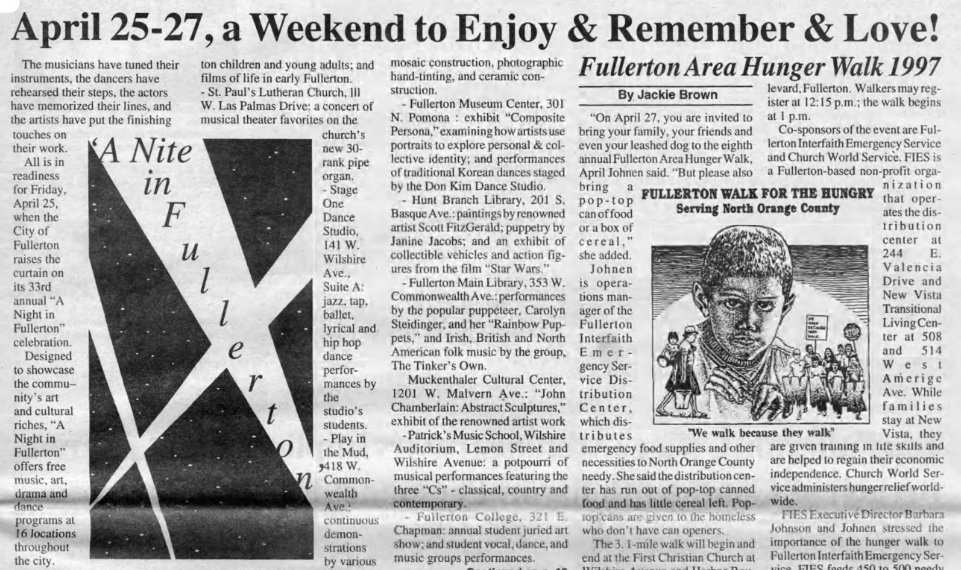
Fullerton residents joined together and restored the “Pastoral California” mural on the side of the high school auditorium, which had been painted over for nearly 60 years.

“After years of investigation and planning the Kassler painting is about to be restored,” the Observer reported. “Its blankets of five or more coats of wall paint will be removed by a chemical process and then the fresco will be restored in an authentic fashion by Conserv Art Associates, Duane Chartier and Susanne Friend…The current work is being financed by a combination of private contributions, City of Fullerton Redevelopment Agency money and the Calif. Heritage Fund.”
Fullerton High School art students also helped with the restoration.
Housing
Fullerton City Council, being dominated by conservative Republicans, was reluctant to support government-subsidized affordable housing, despite the growing need, and even when the projects involved federal (not city) money. This issue came to a head in 1997 over a proposed Single Room Occupancy (SRO) affordable housing project planned for downtown Fullerton.
At first, the conservatives on council voted the project down. This led to pushback from the progressive Fullerton Observer, and other supporters of affordable housing.
Eventually, perhaps because of the pushback, as well as legal pressure, council approved the project.
William J. Davis, attorney for the developer, “cited extensive case law, Federal Civil Rights statutes and California state law surrounding political actions affecting Federal and state housing, particularly where minority groups are involved and the actions of public officials reveal an animus toward such minorities,” the Observer reported. “Davis quoted Councilmember Dick Jones’ comments regarding hotel guests possible use of a nearby methadone clinic, alleging that the remarks could indicate an ‘anti-handicap bias,’ and that other remarks by Jones indicated, he said, a desire to “cordon off’ hotel clients and other working poor to ‘one section of the city.’”
In this case, City Council grudgingly approved the project, despite their reservations about approving housing for poor people. Today, the project still stands–it is called City Lights.
When it came to allocating federal HUD funds, the conservative majority preferred to allocate the least amount possible toward affordable housing.
Council also sought to tighten eligibility requirements for those who could access Fullerton’s affordable housing, with some suggesting that non-citizens were getting this benefit, although there was no evidence that this was happening.
A resident named Patricia Shuff “told the city council that the city programs are vulnerable to fraud— fraudulent social security cards, fraudulent drivers licenses, fraudulent birth certificates,” the Observer reported.
“And I don’t think the program should be available to persons who don’t speak English,” she said.
Councilmember Don Bankhead said, “I fully agree we shouldn’t give money to illegal aliens, but there is no evidence we ever have.”
With regard to affordable housing, the Council’s conservatives seemed to believe that the “free market” would sort things out, although they had no problem placing numerous restrictions on what types of housing could be built where.
But perhaps things were softening (a little). An affordable housing project called East Fullerton Villas opened.
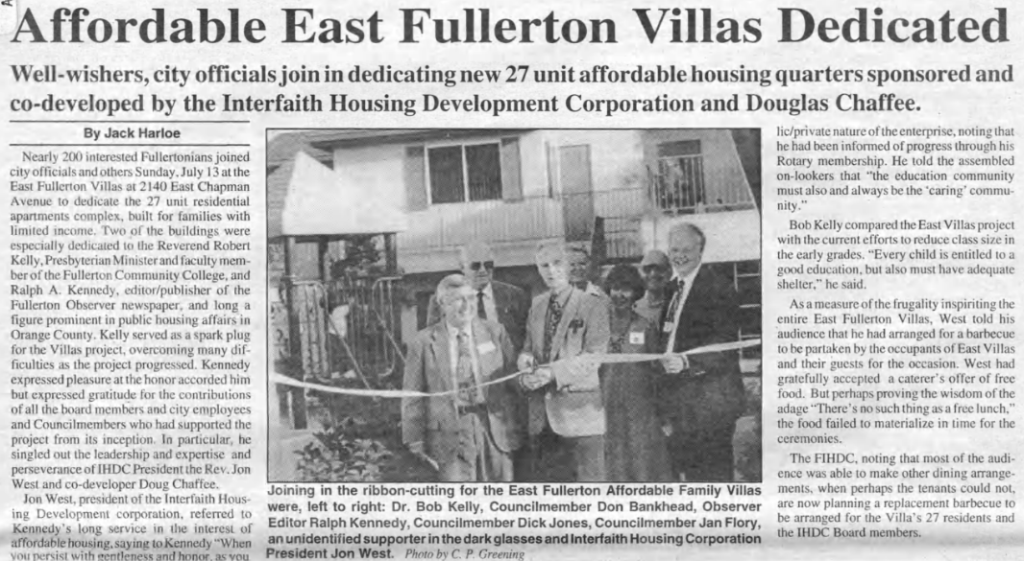
One of Fullerton’s best organizations (in my opinion) is Fullerton Interfaith Emergency Services (FIES), which is now called Pathways of Hope. They provide affordable and transitional housing, and they operate a distribution center where they offer free food and clothes to the poor.
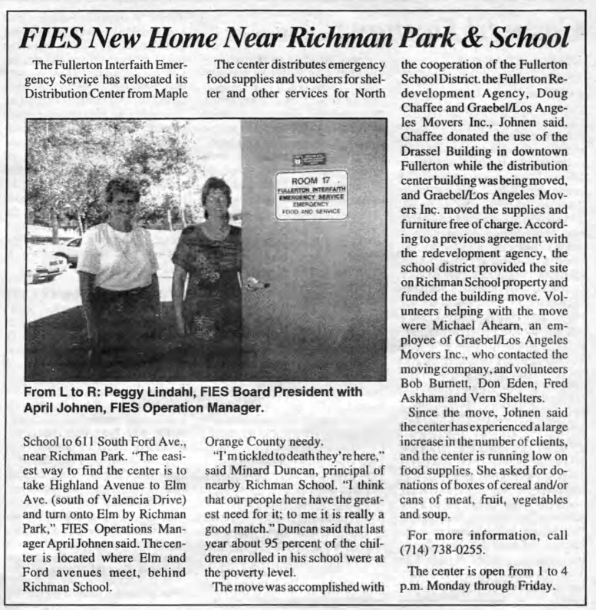
In 1997, as is the case today, Fullerton had its share of people experiencing homelessness. Although there was no year-round shelter, the National Guard Armory opened its doors during cold weather months for the homeless (unless the National Guard needed the space).
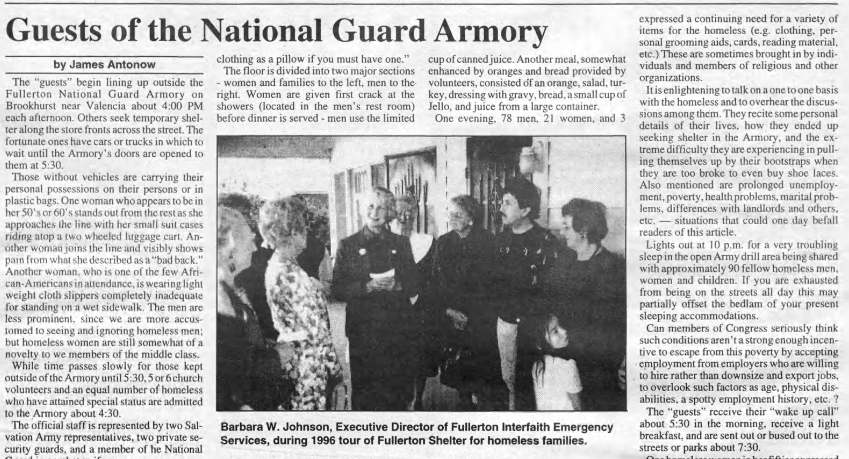
In 1997, the old Hetebrink House (that creepy mansion next to Fullerton College on Berkeley and Chapman) was added to the National Register of Historic Places. Albert Hetebrink, the house’s occupant at the time, was allegedly a member of the Ku Klux Klan in the 1920s. Bad vibes.
Street Vendors Banned
In another assault on the “free market” City Council sought to ban street vendors.
Transportation
A big part of why Orange County has such shitty public transit is that local politicians for years refused to invest in this. In 1997, Fullerton City Council did not support a study to determine the feasibility of a light rail train. It would not be built.
Fullerton City Council, being Republicans, rejected a proposed Electric Vehicle, Clear Air Plan.
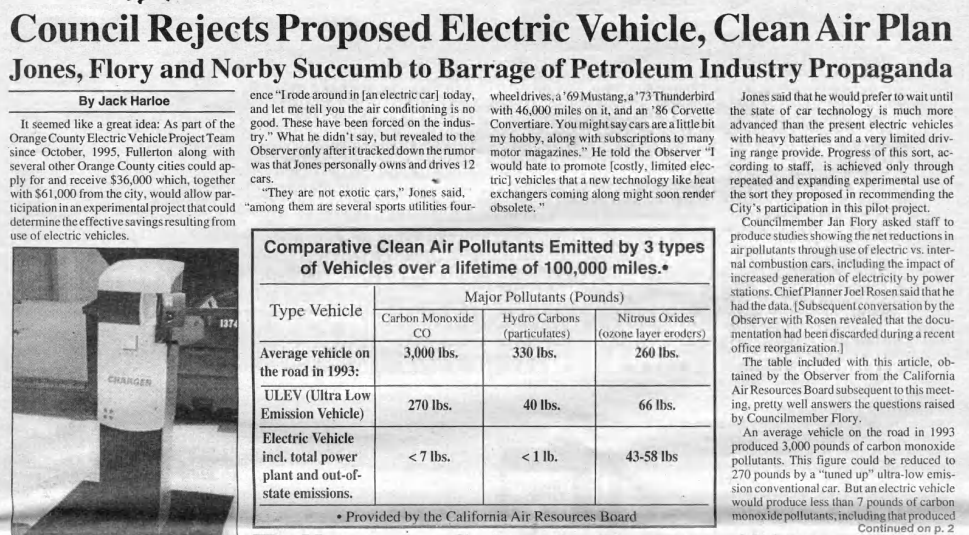
Library
The Hunt Branch Library, gifted to the City by Norton Simon in 1962, celebrated its 35th Anniversary.
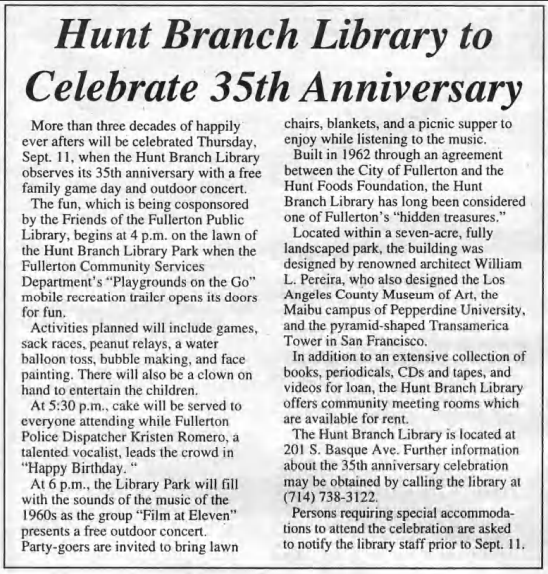
An agreement was made to acquire land and build a third branch library in north Fullerton along Bastanchury. Sadly, this branch would never come to fruition.
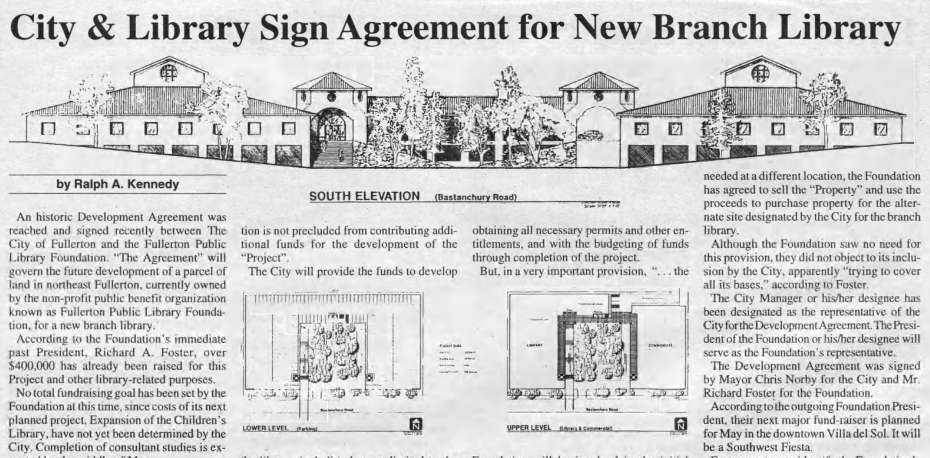
Education
Meanwhile, Fullerton’s Maple School had re-opened in 1996 after having been closed for over two decades.
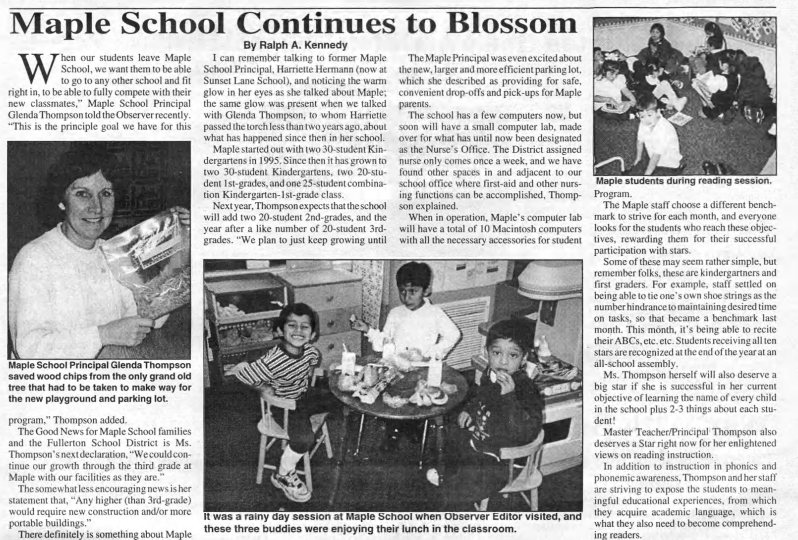
St. Jude
The St. Jude medical complex expanded by adding a large Pavilion across the street from the main hospital–displacing the old Dal Rae restaurant.
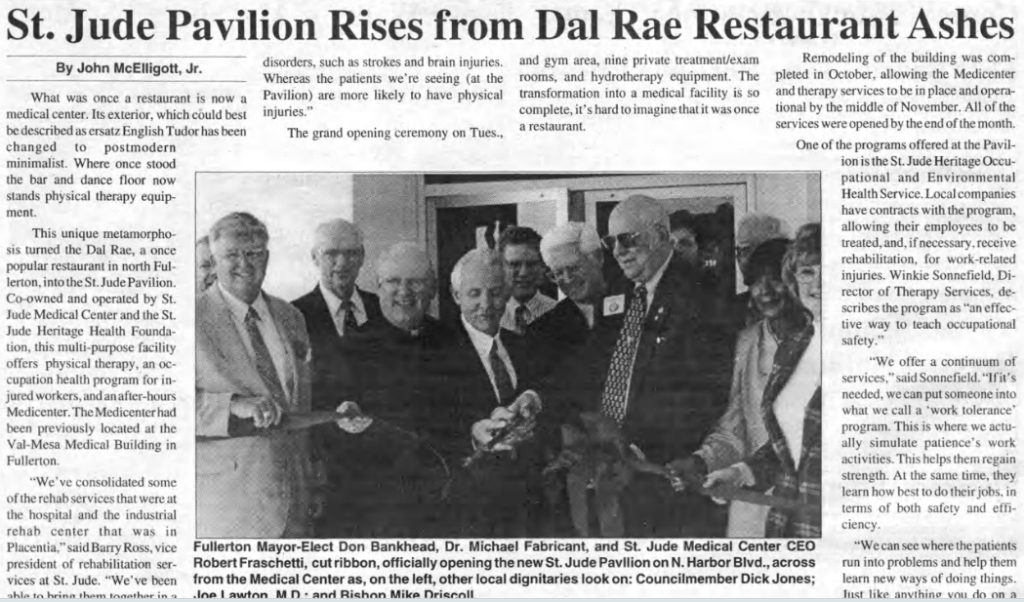
Police
The Fullerton Police Department got a new SWAT vehicle.
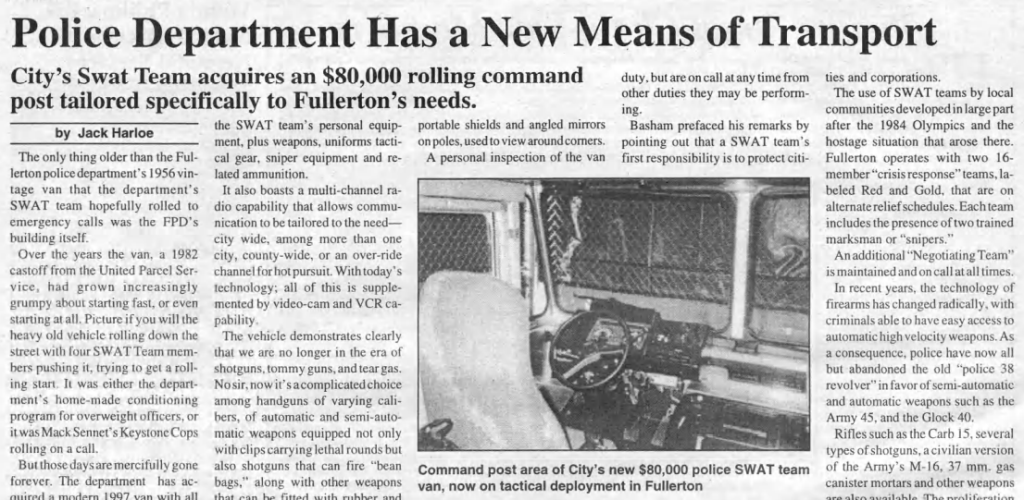
Observer
In 1996, longtime Fullerton Observer editor Ralph Kennedy was diagnosed with pancreatic cancer. He would pass away in 1998. In 1997, a number of local and civic organizations honored Kennedy for his service to the community.
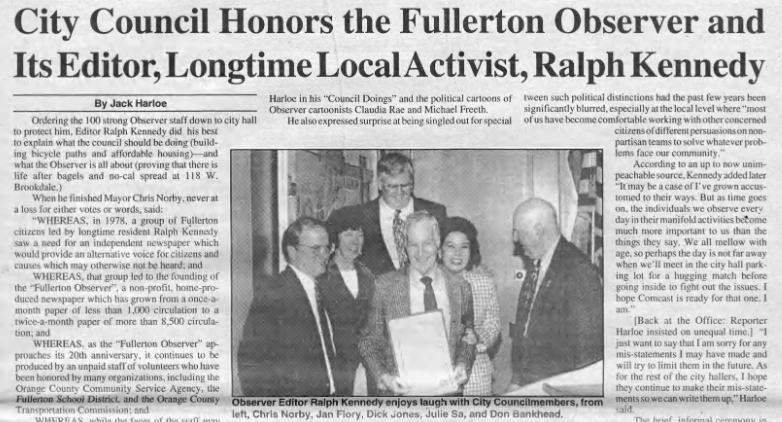
Ralph’s daughter Sharon, an artist who would eventually take over the paper, returned to town from northern California.
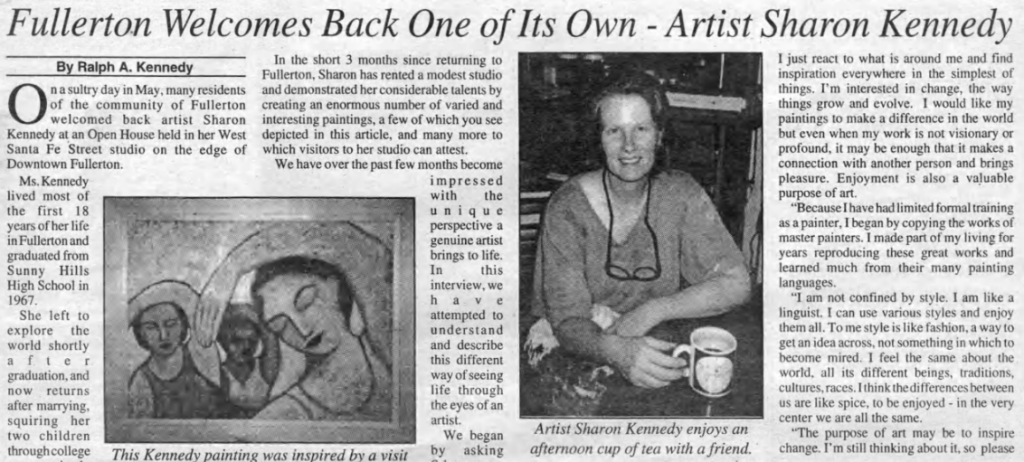
Stay tuned for stories from 1998!
-
When Republicans Ruled: Fullerton in 1996
The following is from a work-in-progress about the history of Fullerton. You can support my ongoing research and writing on Patreon.
The Fullerton Observer newspaper was formed in 1978 by Ralph and Natalie Kennedy and friends to provide a more progressive counterbalance to the more conservative Fullerton News-Tribune and Orange County Register. Back then, Orange County (including Fullerton) was dominated by Republicans, and the Observer crew were definitely in the minority. The Fullerton Public Library has digital archives of the Observer stretching back to 1979. I am in the process of reading over these archives and creating a year-by-year summary of top stories. Here are some top stories from 1996.
Government and Politics
In the 1990s, Fullerton was still a fairly conservative place. In 1996, City Council was made up of four Republicans (Don Bankhead, Peter Godfrey, Chris Norby [mayor], and Julie Sa). The lone Democrat on council was Jan Flory. Just two years prior, in 1994, Flory had faced a Howard Jarvis-style tax revolt over a proposed utilities tax, and was recalled. She was, however, reelected shortly thereafter, and remained a force in local politics through at least 2016. Republican Richard “Dick” Jones was elected in 1996, and would replace Godfrey in 1997.
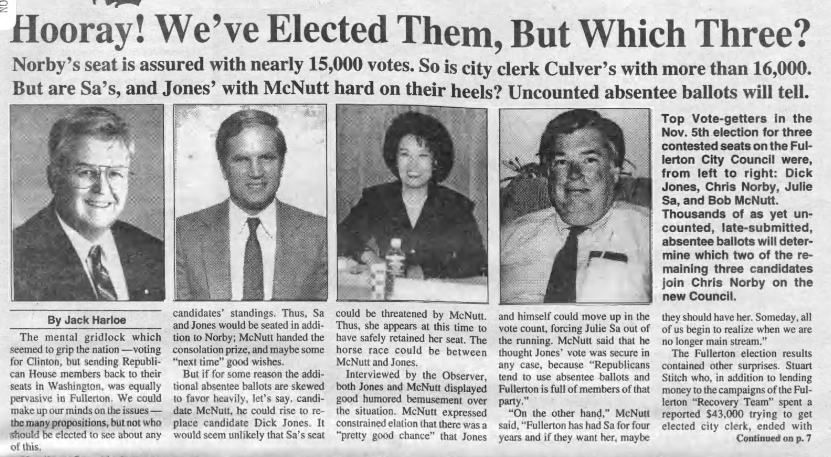
Both Jones and Bankhead, along with Pat McKinley (see below) would be recalled in 2012 in the aftermath of the murder of Kelly Thomas.
The Observer’s editor Ralph Kennedy and many of its writers were Democrats, so they tended to include articles that were critical of the Council’s conservatives.
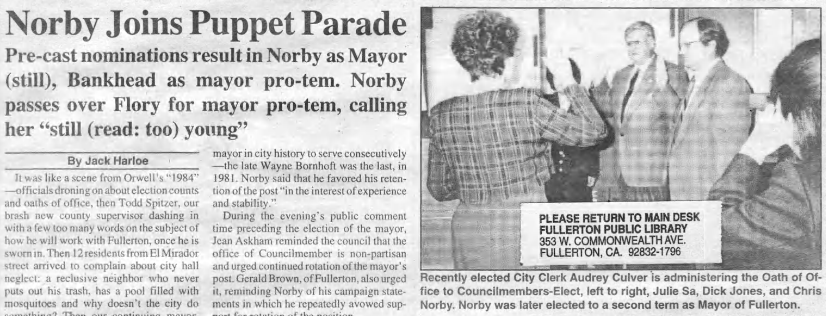
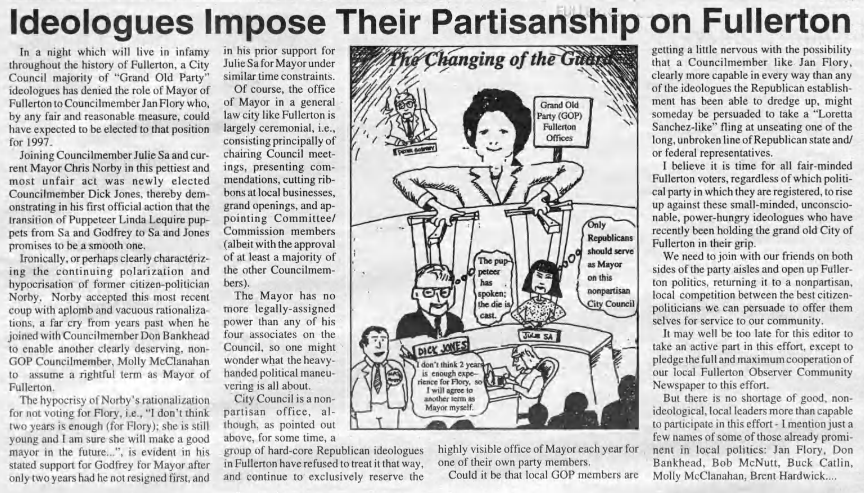
In Congress, Fullerton was represented by Ed Royce, who was a fairly typical 90s Republican.
Law and Order
In 1996, Fullerton’s Police Chief was Pat McKinley, who was hired in 1993 after a 29-year career with the LAPD. McKinley had been involved in the formation of the LAPD’s SWAT squad, which was the first in the nation. It was created following the 1965 Watts Riots and was an important step in militarizing the police, and ramping up aggressive policing tactics.
It was under the leadership of Pat McKinley that the community policing activity of “Operation Cleanup” in Fullerton’s Latino-heavy Maple area took a much more aggressive turn.
In 1996, The Fullerton Police department conducted an aggressive “sweep” of over 33 homes in the Maple area of South Fullerton, breaking down doors of suspected “drug dealers” and terrorizing families.
Reporting for the OC Weekly, Nick Schou wrote that the department “adopted operations reminiscent of Vietnam: an occupying army bent on separating the ‘bad guys’ from the ‘responsible’ population it claims to protect—and, at the same time, using brutal tactics that tend to punish both groups in equal measure.”
Following the sweep, McKinley faced a room full of angry residents at a meeting at the Senior Center.
An elderly Mr. Alberto Sambrano said, “I have lived here since 1939 and I have never seen anything like this before, the way they treated my 70-year-old wife. They destroyed my garage, a dresser in the house and a tool shed. We were treated like animals. They handcuffed my grandson Jonathan Navarro, who has never been in trouble. They took a gun my dad had given me 50 years ago.”
“Officer #1037 pulled my disabled brother up from his hospital bed and threw him on his wheel chair,” Gloria Hernandez told the chief.
Maple area resident Bobby Melendez said, “Use of stormtrooper tactics by the police and physically & verbally abusing people in their homes is not a minor matter.”
Education
In 1996, Fullerton’s Maple School re-opened after being closed since 1972 as part of an effort to de-segregate Fullerton schools. I have written a fairly comprehensive account of the story of Maple school and its desegregation efforts HERE.
Efforts to desegregate Fullerton schools were hampered by historic housing segregation, leading to disparate test scores between the more affluent and white schools of the north part of the city and the more low-income and Latino schools of the southside.
Meanwhile, conservative elements on the Fullerton School Board were pushing for a “fundamental” school at Pacific Drive.
Culture and Entertainment
In 1935, artist Charles Kassler painted the large “Pastoral California” mural on the western wall of the Fullerton High School Auditorium, formerly called Plummer Auditorium. The “Plummer” name was removed in 2020 following revelations that the auditorium’s namesake Louis Plummer was associated with the Ku Klux Klan in the 1920s, when he was Fullerton High School Superintendent.
The mural was a WPA-funded public art project. The result was one of the two largest frescoes commissioned by the WPA, a 75 foot long by 15 feet high depiction of a pre-American California. The mural depicts historical figures like Jose Antonio Yorba, a large landowner whom Yorba Linda is named after. In the background is Mission San Juan Capistrano. To the right is Pio Pico, the last Mexican governor of California. Most of the figures are Latinos doing everyday activities: washing clothes, riding horses, eating together.
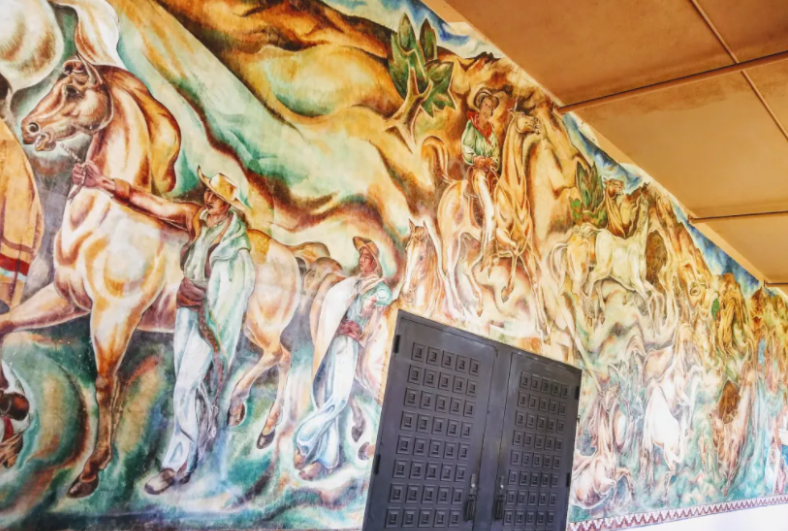
1930s LA art critic Merle Armitage praised the mural: “Kassler has adhered not only to the beautiful traditions of pastoral California, but at the same time has also borne in mind the splendid Spanish architecture, and, lastly, created a beautiful fresco of amazing vitality and freshness of viewpoint.”
But not everyone was happy with Kassler’s mural. In 1939, the High School Board of Trustees voted to paint over the mural. Why did they do this?
“It was too Mexican, that’s why,” Charles Hart told the LA Times. Hart was a student at the high school and remembers the mural before it was covered up. “The school board didn’t want to leave the impression that this town was anything else but Anglos. Too extreme for them, I guess.”
However, in 1996, a campaign was afoot to restore the mural.
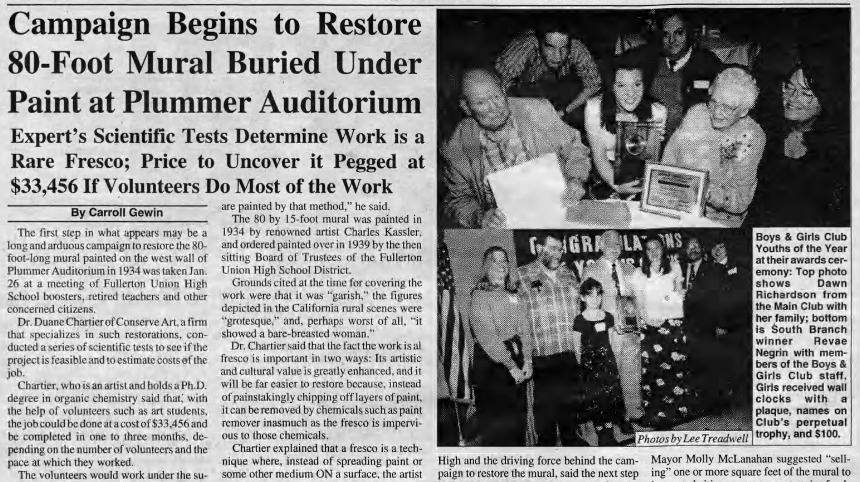
In 1997 the mural would be restored, thanks to a massive community effort. I was actually attending Fullerton High School at the time. Some of my friends, art students, helped with the restoration. I remember thinking, even then: Why would anyone have painted over something so beautiful?
I have written a fairly in-depth history of “Pastoral California” HERE.
In 1964, “A Night in Fullerton” was conceived when local artist Florence Arnold wanted to create a cultural event to show Norton Simon (owner of Fullerton’s Hunt foods) that we were an art community. Norton Simon was a well-known collector of fine art, and he had offered to gift the city a world-class art museum. He built the Hunt Branch Library as a proposed site. Sadly, due to disagreements with the Fullerton City Council, Simon would take his work-class art collection elsewhere, to Pasadena in 1972.
I have written a history of “A Night in Fullerton” which you can read HERE. Despite the devastating loss of the Norton Simon Museum, Fullerton continued with “A Night in Fullerton” until 2009.
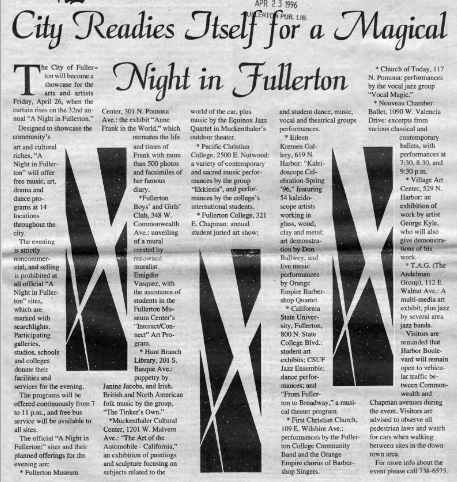
Housing
By the 1990s, housing in Fullerton had become increasingly unaffordable to working class people. A continuing theme starting at least in the 1980s was the question of whether the city would support federal and state-funded affordable housing projects. Mostly, in those days of Republican domination, the answer was a resounding “no”.
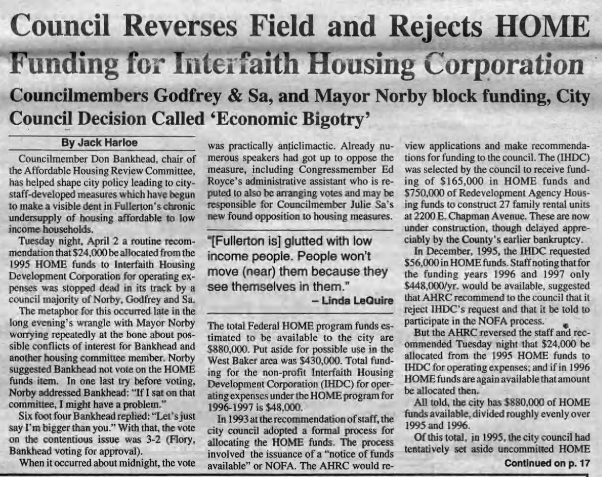
Civil Rights (or Wrongs)
In 1996, Californian voters passed Proposition 209, which ended affirmative action programs in the state. California’s governor was Pete Wilson (a Republican) and the Republican Party was still a force to be reckoned with.
Prop 209 was called the California Civil Rights Initiative, and it used the language of civil rights to argue against programs aimed at aiding formerly underrepresented minorities. It was the original anti-woke, anti-DEI initiative.
The Observer reported on protests and argued against Prop 209.
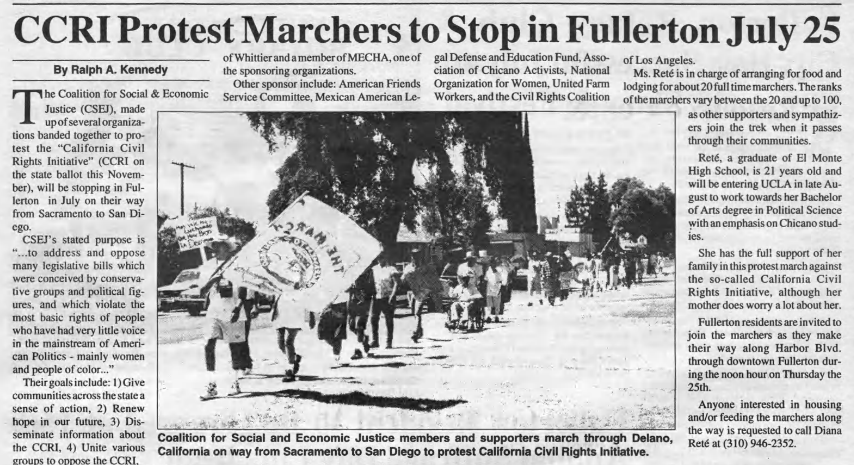
Ralph Kennedy Diagnosed with Cancer
In 1996, longtime Observer editor Ralph Kennedy was diagnosed with pancreatic cancer.
Ralph passed away in 1998, and his daughter Sharon Kennedy took over as editor of the Observer.
Stay tuned for top news stories from 1997.
-
Subscribe
Subscribed
Have a WordPress.com account? Log in now.

