-
News Headlines: 1918
The following is from a work-in-progress about the history of Fullerton. You can support my ongoing research and writing on Patreon.
The Local History Room of the Fullerton Public Library has microfilm from the Fullerton Tribune newspaper (which became the Orange County Tribune in 1908) stretching back to 1893. I am in the process of reading over the microfilm, year by year, to get a sense of what was happening in the town over the years, and creating a mini archive. Below are some news stories from 1918.
Goodbye, Old St. George Hotel

The St. George Hotel. Photo courtesy of the Fullerton Public Library Local History Room. The Shay Hotel, originally called the St. George Hotel, was one of the first buildings in town at the corner of Spadra (Harbor) and Commonwealth. Sadly, in 1918, it was torn down.
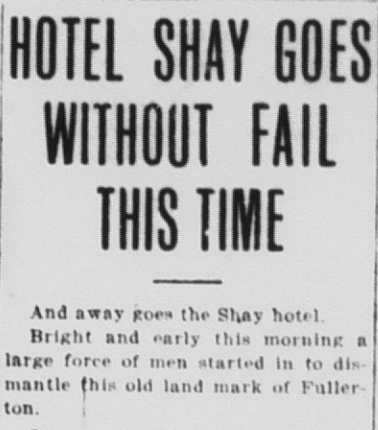
“Bright and early this morning a large force of men started in to dismantle this old land mark of Fullerton,” the above article states. “George Amerige, the proprietor, has sold the building to the Whiting Wrecking Company of Los Angeles for wrecking purposes and the work of razing the old structure has started. Big signs with white background and black lettering have been plastered all over the exterior of the building which read “Watch It Go.”
The Bastanchury Lawsuit
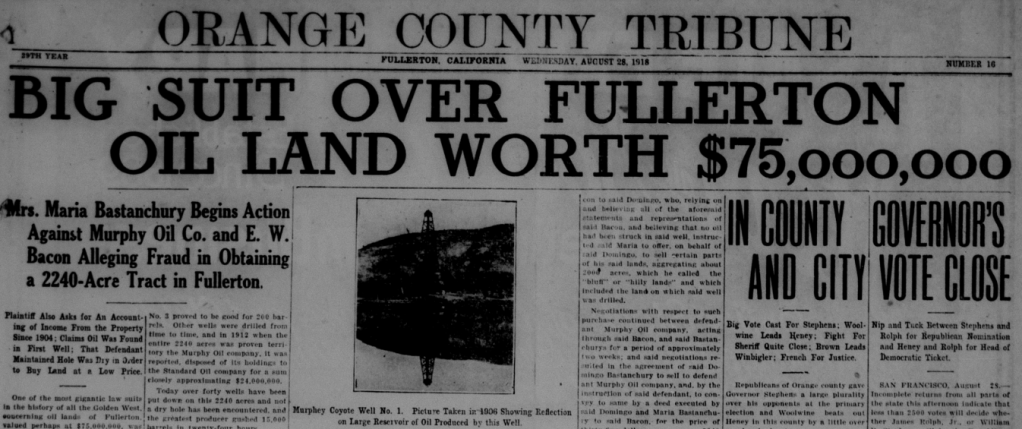
The pioneering Bastanchury family sued the Murphy Oil company for defrauding them of millions of oil dollars.
Back in 1903, Simon J. Murphy secured a lease of a couple thousand acres to search for oil. He told Domingo Bastanchury that he found no oil, and yet still convinced the old man to sell him the land for $35 an acre. He paid Bastanchury $79,000 for the land.
About a month after purchasing the land, the newly-formed Murphy Oil Company sunk a well that was a 3,000-barrel a day gusher. Many other oil-producing wells were subsequently sunk on the land.
In 1912, the Murphy Oil Company sold its oil holdings to the Standard Oil Company for around $24,000,000.
Meanwhile, Domingo Bastanchury died, and his lands fell to his widow and sons.
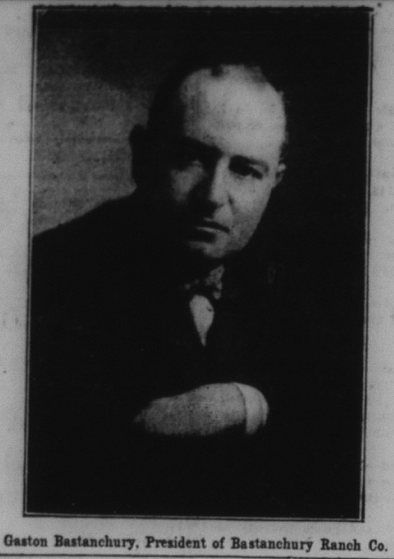
In 1917, former workers of Murphy Oil told Domingo’s son Gaston that they had actually discovered oil prior to the purchase of the land, and Murphy lied to Domingo about this fact.
The Bastanchury heirs sued Murphy for recovery of funds from the millions of barrels of oil that had been extracted over the past fourteen years, alleging that the property was obtained by fraud.
The “Spanish” Flu Epidemic
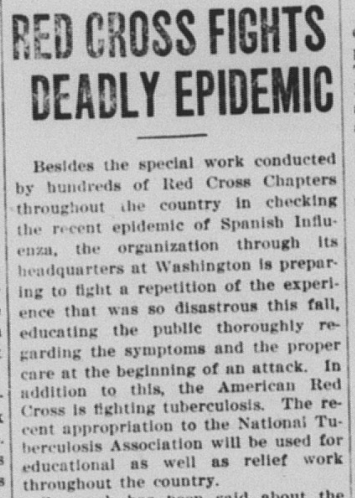
In 1918, a deadly flu epidemic spread across the world, including the United States. Though it likely did not actually originate in Spain, it became known as the Spanish Flu. Hospitals were filled to capacity, and lots of people died, including here in Fullerton.



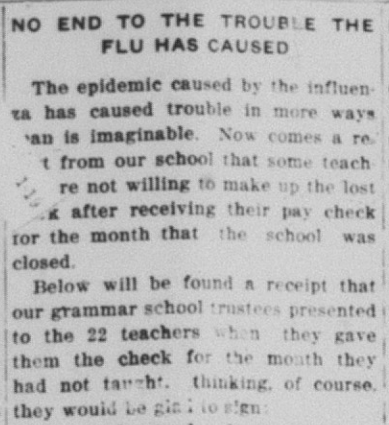

Just as during the COVID-19 pandemic, mask-wearing was encouraged.
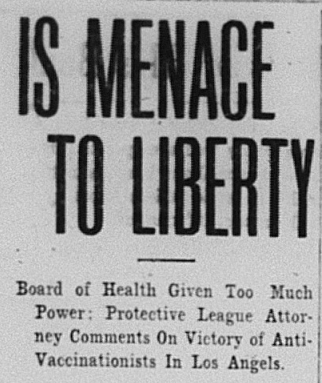
Also, just like during the COVID-19 pandemic, people feared that enforced vaccinations were “a menace to liberty.”
The above article, which is actually about smallpox vaccination, but presumably also included influenza vaccination, states, “Marshall Stimson, attorney for the Public School Protective League, in a statement commenting on the victory of opponents to enforced vaccination in Judge Wellborn’s court in Los Angeles, asserted that the proceedings showed that the tendency of boards of health to arrogate more and more power was constituting a serious menace to individual liberty.”
World War I
Meanwhile, World War I raged in Europe. Many local boys had been drafted, sent off to training camp, and then to war.
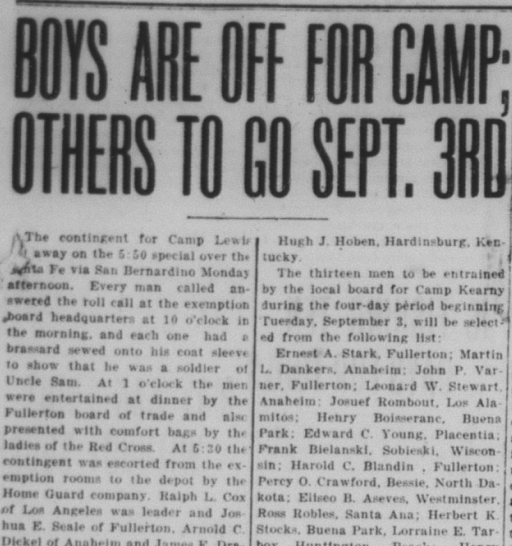
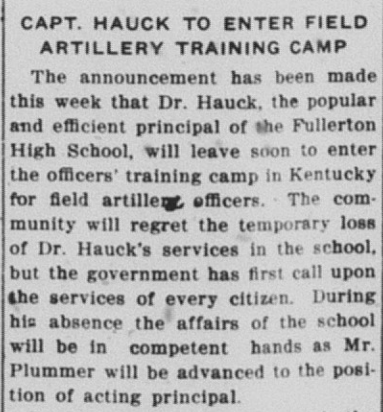
High School principal E.W. Hauck enlisted, or was drafted.

E.W. Hauck Hunting Draft Dodgers
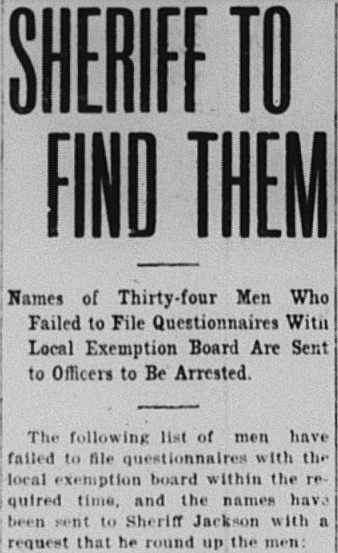
Draft dodgers were shamed in the pages of the Tribune, and were hunted and arrested by law enforcement.

Germans in America Must Register
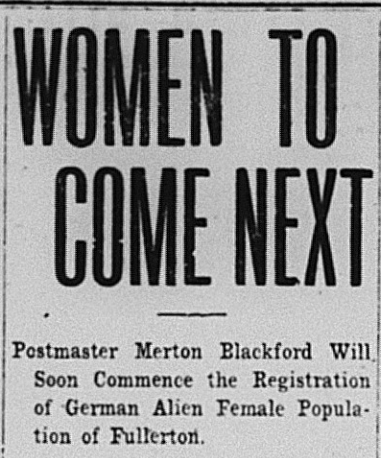
Unnaturalized Germans over the age of 14 living in the United States had to register with the postmaster.
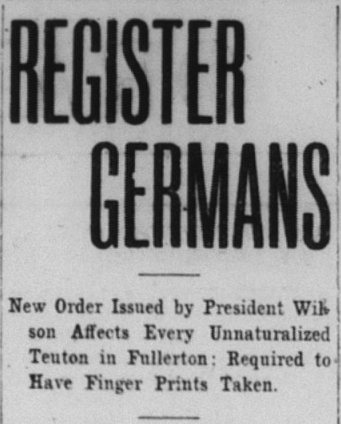
“The order coming from President Wilson, affects every unnaturalized German in the United States and a number in this city will be affected by the order,” the above article states. “The order requires every German citizen to make our four affidavits setting forth his age, residence business, friends, habits, and many other important subjects…After once being registered the German may not move from his place of residence without the approval of the postmaster, who will record the new residence. The finger prints of each man will be taken by the police and kept as a part of the identification. In cities more than 5,000 the chief of police will be required to register the Germans.”
Propaganda Posters/Ads
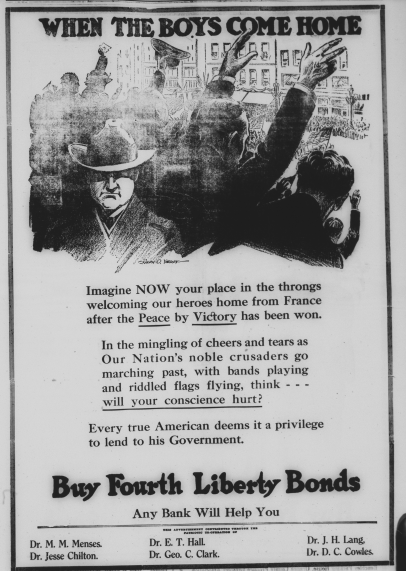
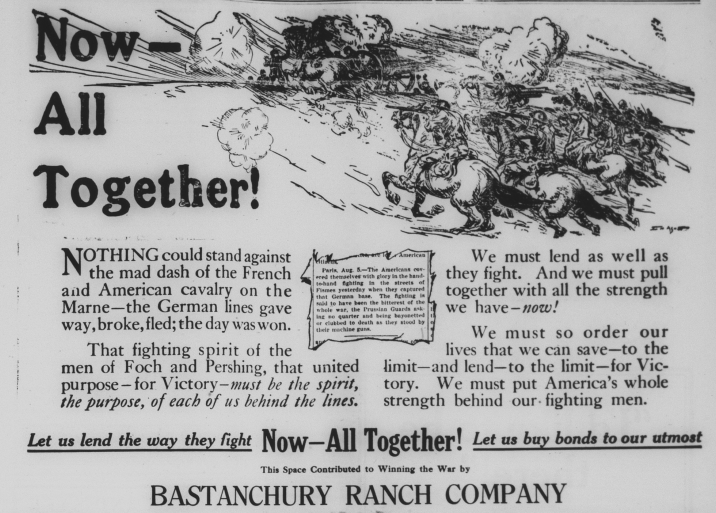
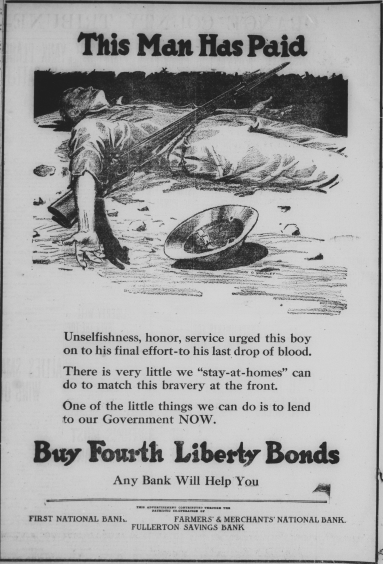
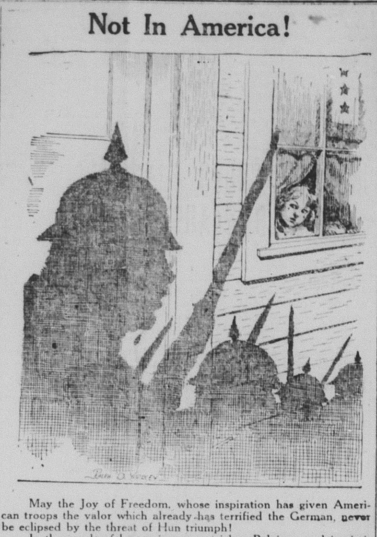
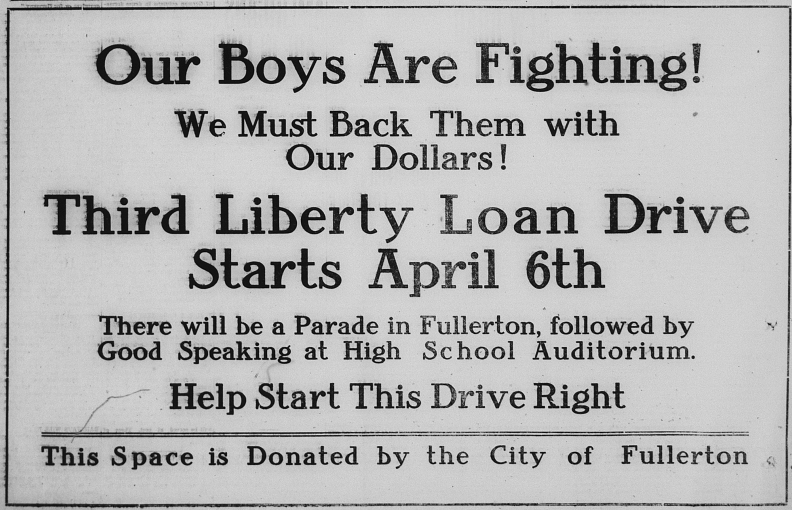
The pages of both Fullerton newspapers, the Tribune and the News included large propaganda advertisements for Liberty loans and bonds. Here are some of them:







Liberty Day
Fullerton celebrated Liberty Day.

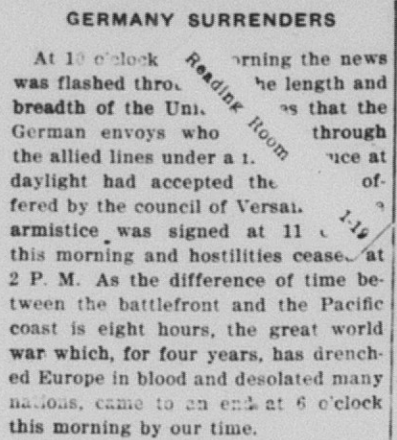
Germany Surrenders
Finally, Germany surrendered, essentially ending the war. This event, it seems, deserved a bigger headline.
Transportation
In transportation news, the Pacific Electric passenger rail service began in Fullerton.

In the first half of the 20th century, it was an open question whether southern California would be a rail-based or car-based culture. Ultimately, cars won. The Pacific Electric would be dismantled in the 1950s.

Politics
Voter registration numbers showed that Orange County in 1918 was a predominantly Republican region. It would remain so until around 2018.
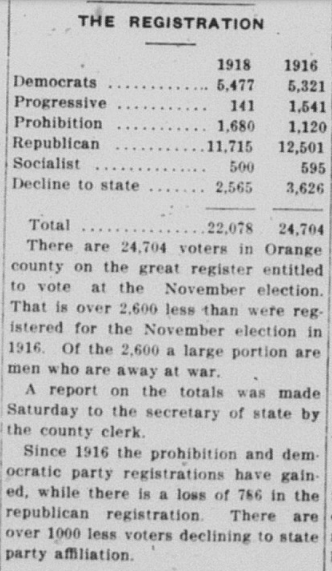
In the 1918 city council election, R.R. Davis, Robert Strain, and Perry Woodward won.

Tribune editor Edgar Johnson criticized the low voter turnout.
“Out of a total of over 1,260 electors only 425 managed to saunter to the polls of the three city precincts and cast ballots for the men who will govern the city for the next two years,” Johnson wrote. “This indicates that there was precious little interest in the election by some 825 electors.”

Mayor Carhart was chosen to serve another term as mayor, although he didn’t really want to. The process of mayoral rotation continues to be a problematic one today.
“Mayor Carhart has been selected to again be president of the board of city trustees for a term of two years, notwithstanding the fact that he insisted that the honors should be passed around among the members,” the Tribune stated. “He claims it has been the custom in Fullerton to change every two years; but that had no weight with the new board and there being no other nominations, City Clerk Hezmelhach out the question, and Mayor Carhart was declared the unanimous choice for the highest office in the gift of the city.”

At the state level, voters defeated Proposition 19, which had something to do with property taxes. Don’t fuck with Californians’ property taxes.
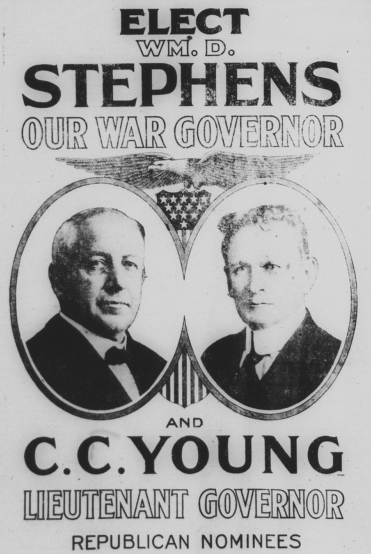
William D. Stephens was re-elected as Governor.
Citrus News
With some wartime labor shortages, there were special provisions to bring in Mexican farm labor, but not Chinese Labor, which Californians were not keen on.

“Last year Mexicans were brought here to help in the sugar beet harvest. This was done through a resolution of congress allowing the immigration department to make that kind of an importation, and in the regulations those bringing in the Mexicans were under bond to return them to the border,” the above article states. “This does not apply to Chinese labor. It is my firm opinion that efforts to get the bars lowered so that Chinese can come in will not be successful. Whatever the qualifications of the Chinese as a laborer may be, I don’t believe there is any possibility of getting congress to alow the Chinese to be brought in even temporarily.”
Local orange tycoon Charles C. Chapman urged his fellow citrus men to oppose “free trade” in favor of protectionist tariffs. Milton Friedman would be sad.

Entertainment
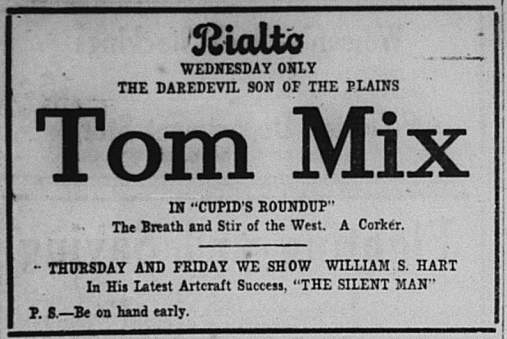
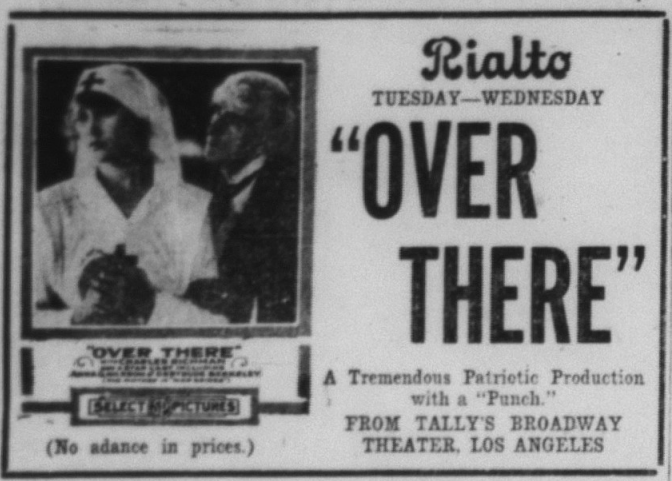
For entertainment, Fullertonians went to the Rialto Theater at 219 N. Spadra (now Harbor). This was Fullerton’s premier movie house before the Fox, which would come in 1925.

The Tribune ran ads for features shown at the Rialto. Here are some:

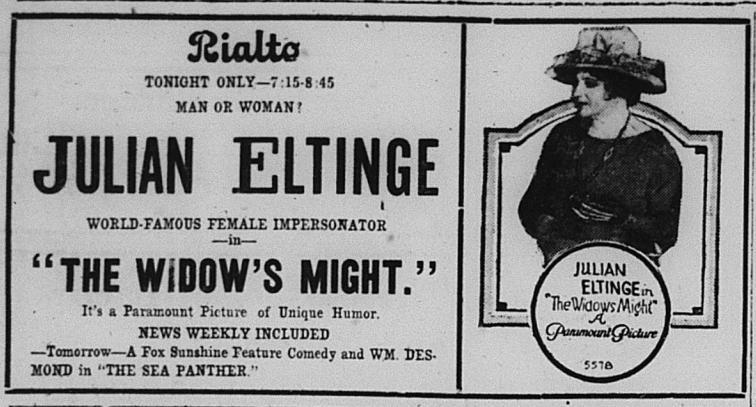

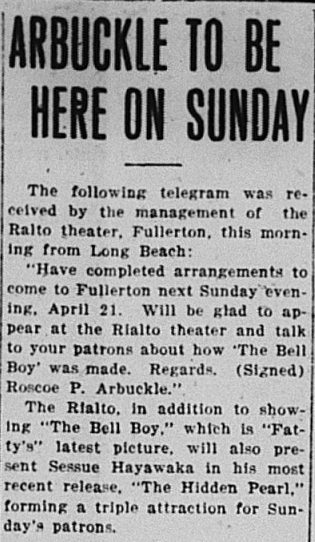
Popular entertainer Roscoe “Fatty” Arbuckle made a special appearence at The Rialto.
Another form of popular entertainment at this time was the traveling Chautauqua show, which came through town.

Law and Order
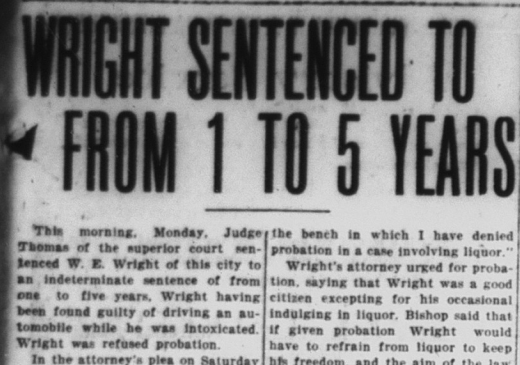
In crime news, a local man named W. E. Wright drunkenly drove his car through a patriotic event, injuring four people. He was found guilty and sentenced to from 1 to 5 years.

In hate crime news, someone threw a rock at the Japanese Consul.

Prohibition
The first salvo in what would become national prohibition was fired in 1919.

Death
A man named Charles E. Vogele committed suicide in the back of his home at 214 W. Wilshire Ave. Perhaps this residence could be a new addition to the Fullerton Haunted Walking Tours.

-
Photographs: Then and Now (Harbor and Santa Fe)
The following is from a work-in-progress about the history of Fullerton. You can support my ongoing research and writing on Patreon.
For this series, I compare a historic photo of Fullerton with a contemporary one from approximately the same angle. Below are two photographs looking north on Harbor from Santa Fe Avenue, one from the 1890s, and one from 2023.

Looking north on Spadra (now called Harbor Blvd.) from Santa Fe, 1890s. Photo courtesy of the Fullerton Public Library Local History Room. 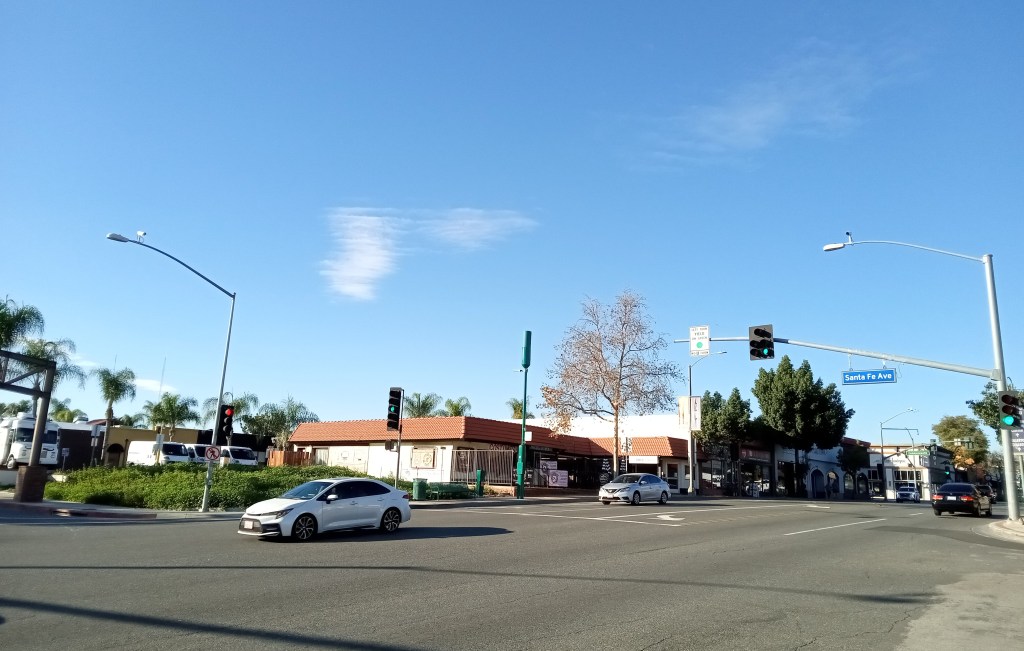
Looking north on Harbor from Santa Fe Ave., 2023. Photo by the author. -
Photographs: Then and Now (Rialto Theater)
The following is from a work-in-progress about the history of Fullerton. You can support my ongoing research and writing on Patreon.
For this series, I compare a historic photo of Fullerton with a contemporary one from approximately the same angle. Below are two photographs of 219 N. Spadra (now called Harbor) Blvd.–one of the Rialto Theater, which ran from 1917 to 1927 and showed silent films and vaudeville shows, and one of an office business today.
Rialto Theater, 1920s. Photo courtesy of the Fullerton Public Library Local History Room. 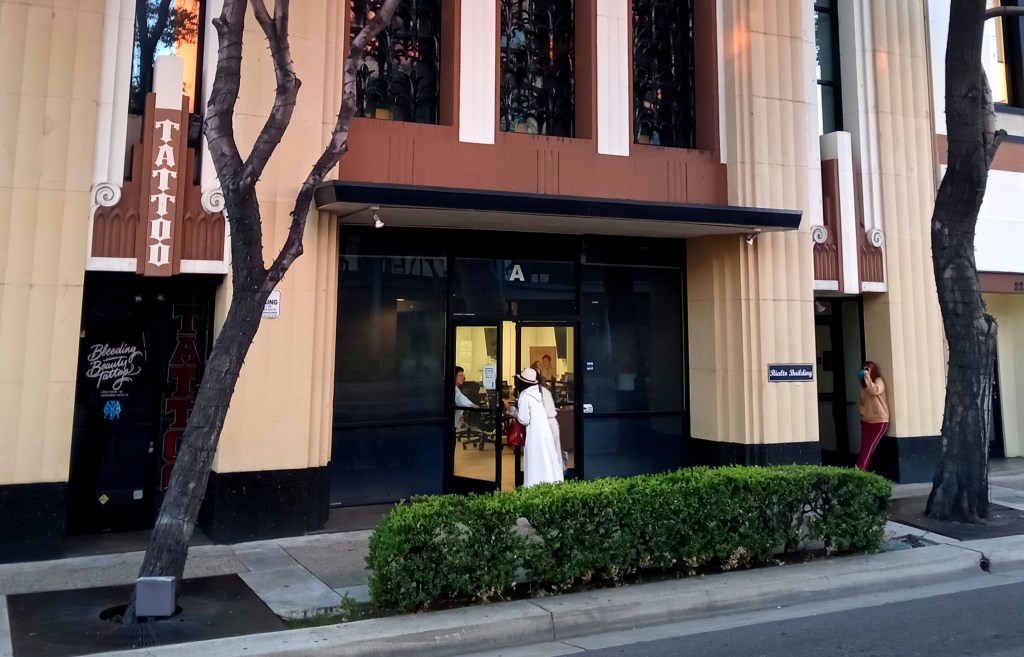
Rialto Building, 2023. Photo by the author. -
Photographs: Then and Now (Spadra/Harbor)
The following is from a work-in-progress about the history of Fullerton. You can support my ongoing research and writing on Patreon.
For this series, I compare a historic photo of Fullerton with a contemporary one from approximately the same angle. Below are two photographs looking north on Harbor Blvd. toward Wilshire Ave.–one from the 1920s and one from 2023.
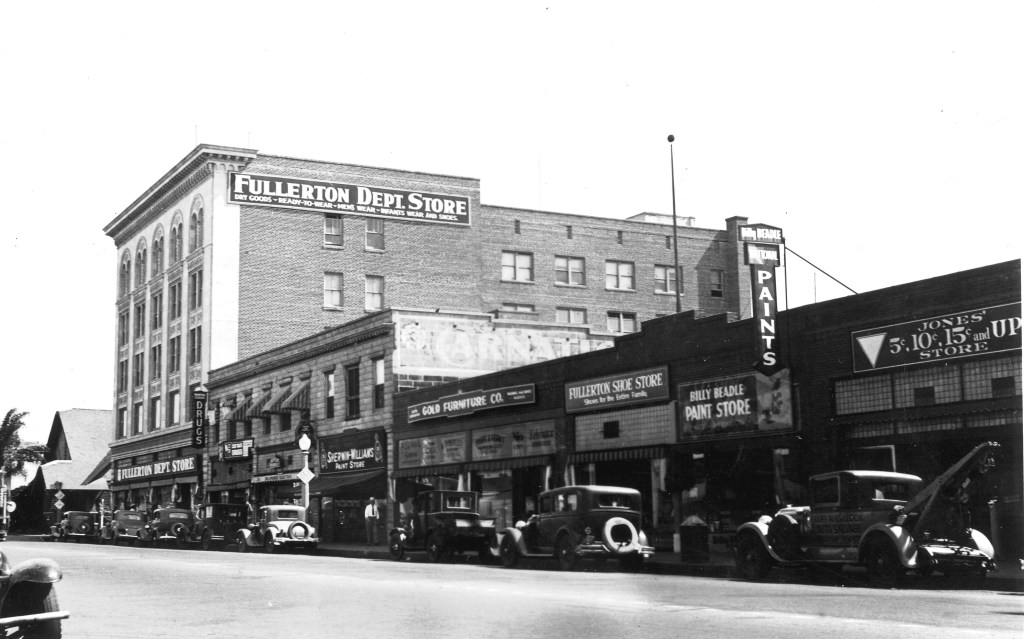
Looking north on Spadra (now called Harbor), 1920s. Photo courtesy of the Fullerton Public Library Local History Room. 
Looking north on Harbor Blvd. toward Wilshire Ave., 2023. Photo by the author. -
Photographs: Then and Now (East Wilshire Ave.)
The following is from a work-in-progress about the history of Fullerton. You can support my ongoing research and writing on Patreon.
For this series, I compare a historic photo of Fullerton with a contemporary one from approximately the same angle. Below are two photographs looking west on Wishire Ave. toward Harbor Blvd., showing the back of the Chapman Building–one from the 1920s, and one from 2023.
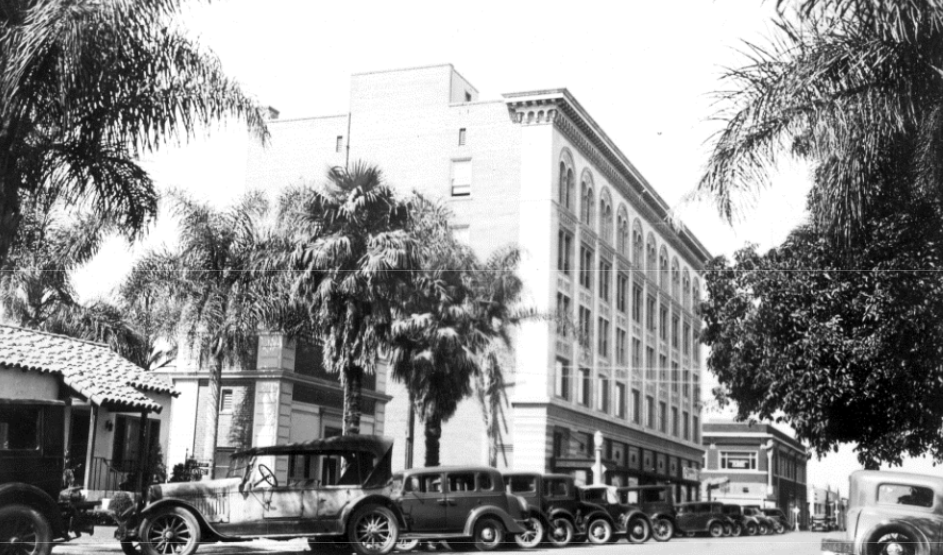
Looking west on Wishire Ave. toward Spadra/Harbor, 1920s. Photo courtesy of the Fullerton Public Library Local History Room. 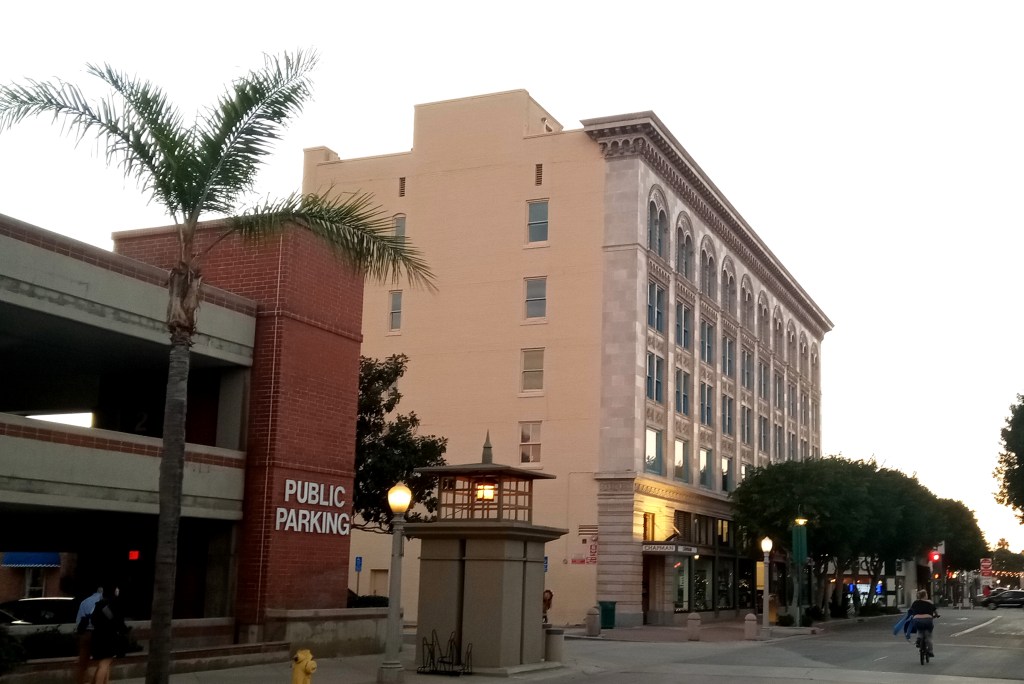
Looking west on Wishire Ave. toward Harbor, 2023. Photo by the author. -
Photographs: Then and Now (Fox Theater)
The following is from a work-in-progress about the history of Fullerton. You can support my ongoing research and writing on Patreon.
For this series, I compare a historic photo of Fullerton with a contemporary one from approximately the same angle. Below are two photographs of what is now called the Fox Theater–one from 1926 (when it was called The Mission Theater), and one from 2023. When the Fox opened in 1925, it was called Chapman’s Alician Court Theatre. The following year, the named changed to the Mission Theater. The venue would change names five times before becoming the Fox Theater. To learn more about the Fox Theater and restoration efforts, visit www.foxfullerton.org.
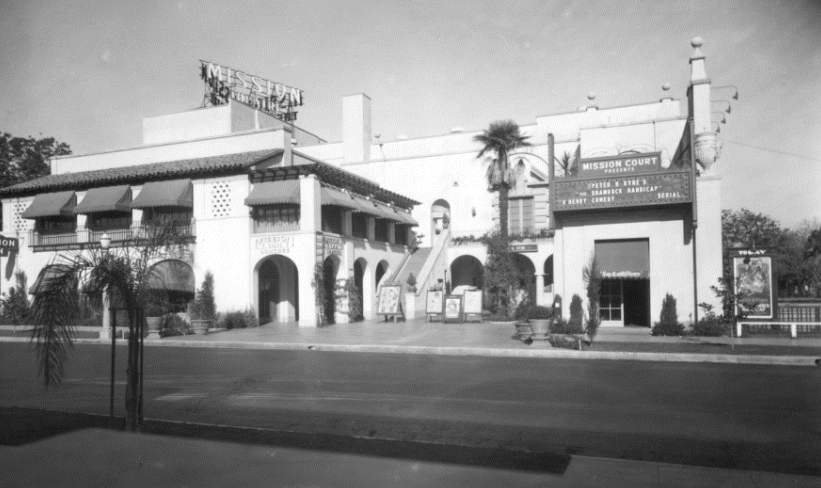
Mission Theater, 1926. Photo courtesy of the Fullerton Public Library Local History Room. 
Fox Theater, 2023. Photo by the author. -
Photographs: Then and Now (Edison Building/ModelMania)
The following is from a work-in-progress about the history of Fullerton. You can support my ongoing research and writing on Patreon.
For this series, I compare a historic photo of Fullerton with a contemporary one from approximately the same angle. Below are two photographs of 232 W. Commonwealth Ave.–one from shortly after it was built in 1948 as offices for the Edison Company, and one from 2023, as it is now ModelMania, a hobby shop. To learn more about the history of the building, check out my mini-history.
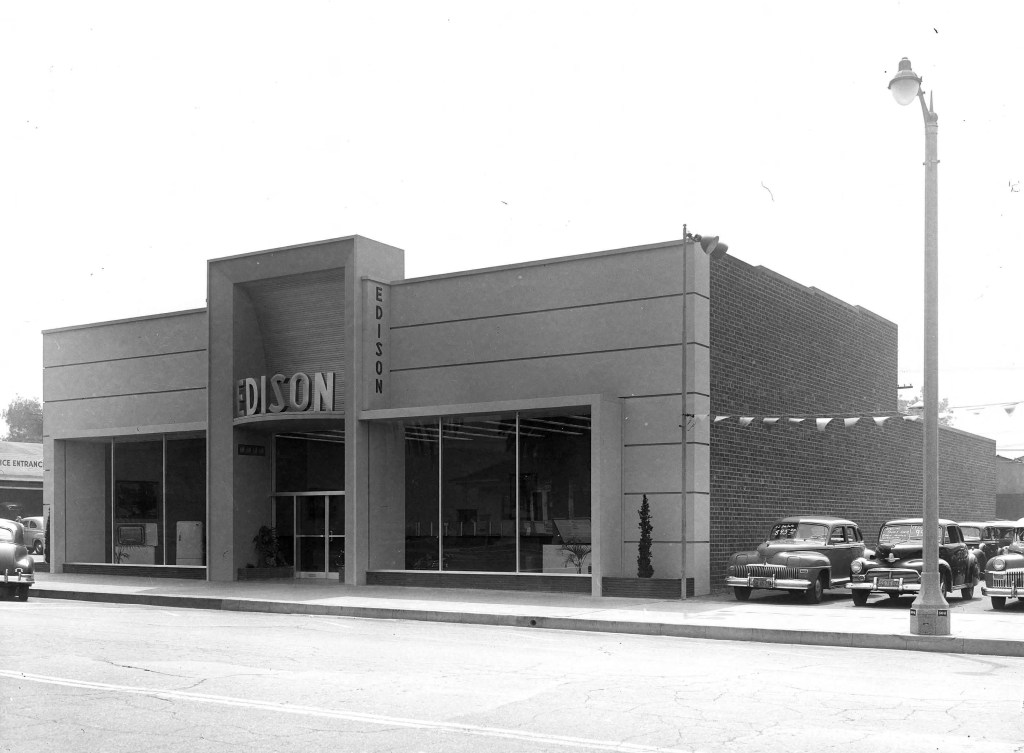
Edison Building at 232 W. Commonwealth Ave., circa 1948. Photo courtesy of the Fullerton Public Library Local History Room. 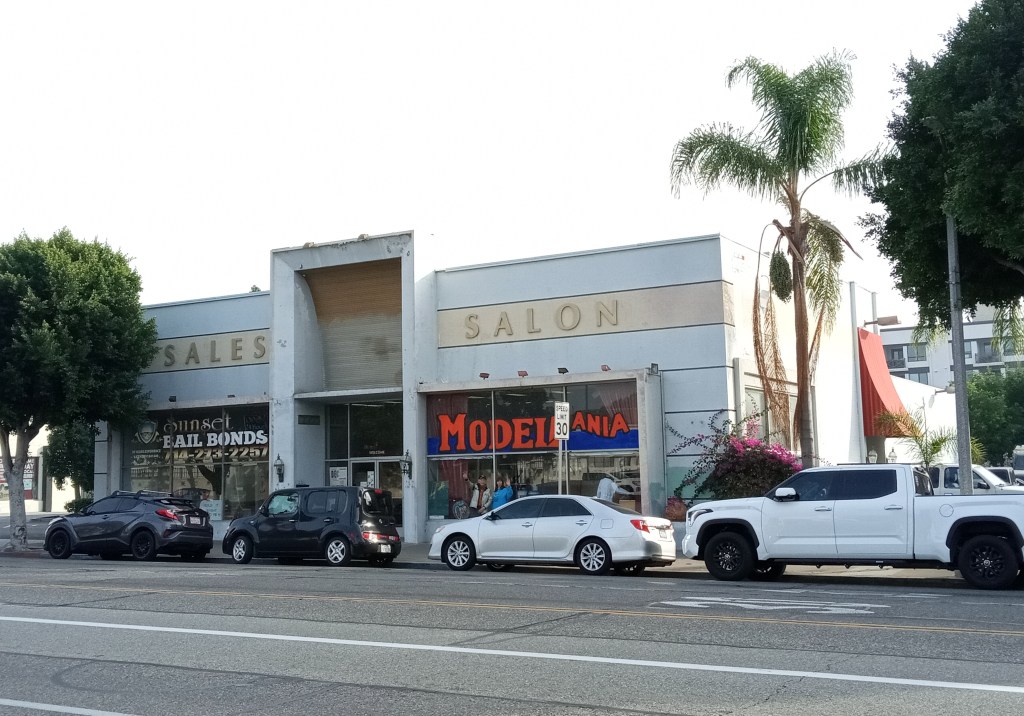
ModelMania hobby shop at 232 W. Commonwealth Ave., 2023. Photo by the author. -
News Headlines: 1917
The following is from a work-in-progress about the history of Fullerton. You can support my ongoing research and writing on Patreon.
The Local History Room of the Fullerton Public Library has microfilm from the Fullerton Tribune newspaper (which became the Orange County Tribune in 1908) stretching back to 1893. I am in the process of reading over the microfilm, year by year, to get a sense of what was happening in the town over the years, and creating a mini archive. Below are some news stories from 1917.
World War I
The biggest news event of 1917 was the United States’ entry into World War I. Upon this announcement, local residents formed a Home Guard, and the high school formed a military company.
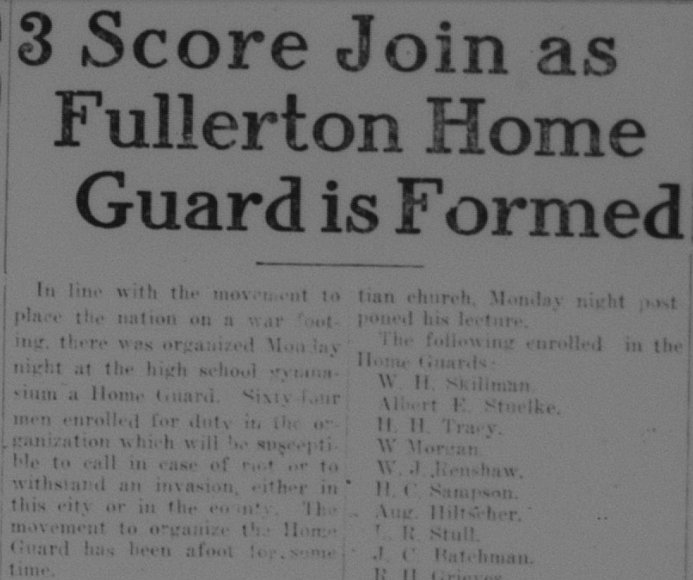

The above article states: “Determined to contribute their part in the preparedness movement of the nation, high school students have launched a movement that Friday resulted in the formation of a high school military company. The company will start drilling Tuesday.
“Between 140 and 150 boys will take part in the military tactics. They will be detailed into squads and drilled by members of the student body and faculty who have had military experience.
“[They will be] under the supervision of E.W. Hauck, Mr. French, and L.O. Culp. All of the latter have had considerable military experience.”
The Draft
The U.S. government instituted a draft to obtain soldiers for the American military. Eligible adults aged 21-30 had to register.
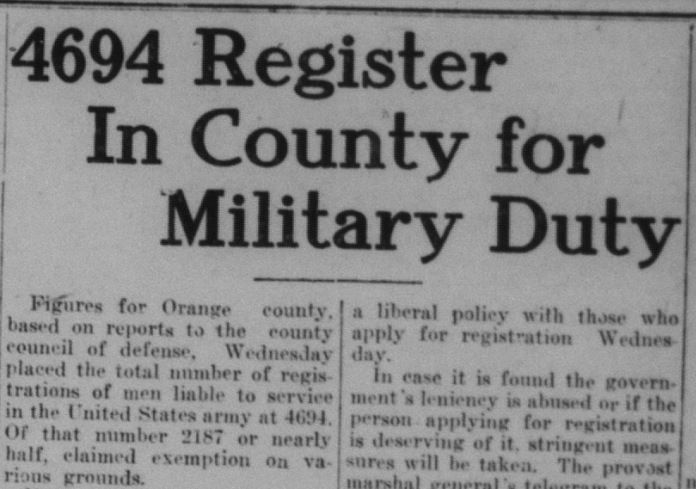
4694 Orange Countians registered for military duty. Of that number 2187 or nearly half claimed exemption of various grounds. 385 people registered in Fullerton.
The above article states: “Natural born citizens who registered Tuesday over the county numbered 3605, aliens 1050, alien enemies 21, and negroes 18…The precinct at the city hall led the county for number of men registered. The large registration there was due to the registering of several score Mexicans employed by the Pacific Electric, who are camped in the norther outskirts of the city. The total number registered at the city hall was 142.
“Only one instance where Mexicans were suspected of seeking to evade registration came to the attention of police Tuesday. After the polls had closed Tuesday night, Deputy Sheriff Murillo came on two Mexicans in a local pool room. Failing to recognize them as having been among the number who did register, Murillo asked them how old they were.
“Each answered he was 21 and the officer then asked them whether they had registered. Both said they had not and added they were 18 years old instead of 21. A few minutes later they slipped out of the pool room.
“Scrutiny should be made of each case [of persons who fail to register] to determine whether punitive action is required.”
Charles C. Chapman was local draft board chairman.

Shaming ‘Draft Slackers’
The Fullerton Tribune actively sought to shame those “slackers” who did not register for the draft, printing the names of those required to register, and those who were caught not registering.
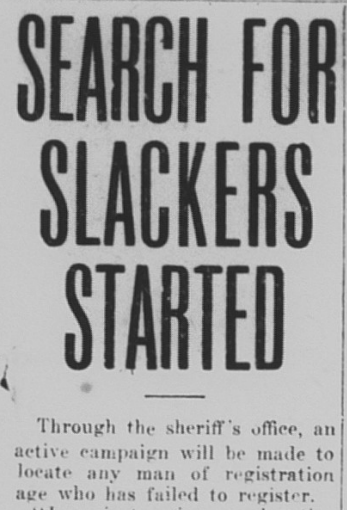
The above article states: “Through the sheriff’s office, an active campaign will be made to locate any man or registration age who has failed to register.
“I am instructing my deputies to make careful investigations,” said Sheriff Jackson. “Under the law an officer can demand of any person of registration age that he show his certificate, and if the man is not registered he is to be arrested and prosecuted. The carrying on this investigation is our plainn duty under the law and we intend to do our duty thoroughly. Any person who has information concerning any man who has dodged registration ought to give information to that effect to my office at once. Any person who has such information and fails to give it to the authorities is not doing his duty.“
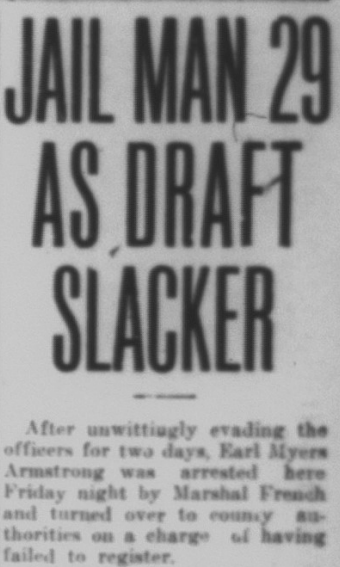

Liberty Bonds
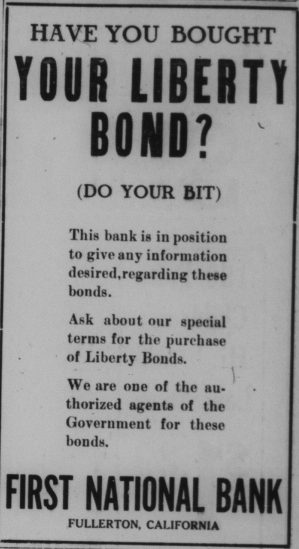
There were local Liberty Bond drives, to raise money for the war effort.

Patriotic Rally, etc.
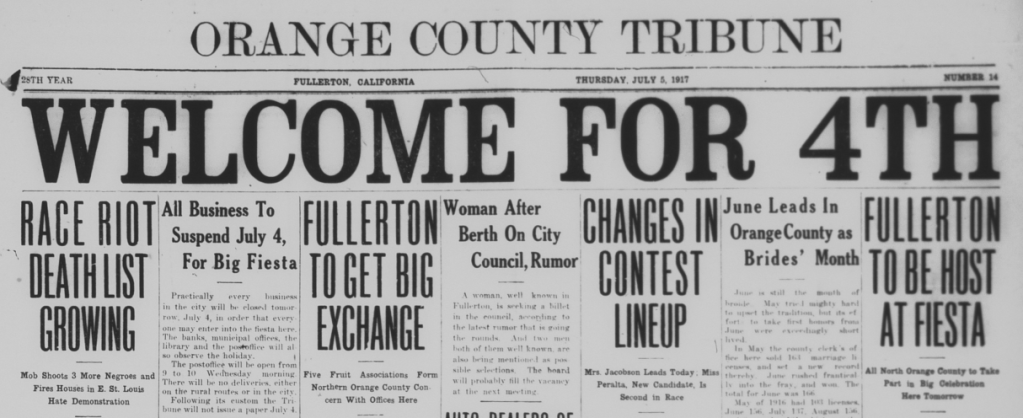
Patriotism was in the air, manifesting in rallies, Red Cross drives, and a massive fourth of July celebration.


U.S. Troops Arrive in France


Going to the Front
Two local young men, Fred Strauss and Nels Nelson, registered for the draft. According to an oral history interview with Strauss conducted decades later, he explained what prompted him to enlist.
“We went there to Los Angeles and had a lot of beer. Finally, after we had had enough beer and we got to feeling pretty good, I said to my pal, ‘Let’s go and enlist and join the Army.’ And he said, ‘Okay, we’ll go.” So they enlisted.
The Fullerton Tribune has quite a different take on these events.

The above article states: “Here is true, unadulterated patriotism, and it deserves the highest possible praise.
“Fred Strauss, a native of Germany, and Nels A. Nelson, a native of Sweden, both prominent and trusted employees of the Stern & Goodman Mercantile company’s big department store, have enlisted in the noted “Grizzlies,” 144th regiment, light artillery, and will leave for San Diego on Wednesday evening.
“These boys are both of draft age and are registered, but neither would be called until at least the second draft. But that does not concern them. They both became naturalized at the earliest possible date and are imbued with the spirit of democracy. Strauss has been in the United States thirteen years and Nelson eight years. They appreciate the freedom and opportunities of America and propose to uphold them to the best of their ability and strength, even to opposing the kaiser and the king of Sweden. There is only one country for them, and that is the glorious United States of America.
“Here is to you, boys, and may you come back to Fullerton with all the glory that is possible for two men to gain at the front.
“Fullerton is justly proud of such men who are citizens not by chance but loyal ones, and that by choice.”
Drunkenness or patriotism?
A Vocal Minority Against the War
Amidst all the patriotic fever, one local group took a public stand against the war–the local Socialist Party.

The above article states, in part: “At a meeting of the Santa Ana branch of the Socialist party, the following resolution was passed:
…we protest against plunging our country into war.”
Secretary Mrs. E.W. Hardy stated, “We Socialists are against war. We believe that all wars have been in favor of the master class. Out of a war no good can come to the working class, whose lives will be sacrificed…A war would be of no value to the poorer people of this country. Big interests that deal in war munitions would profit.”
Labor Issues
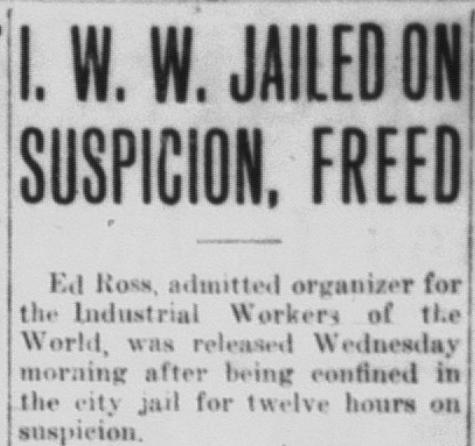
On the home front, there were some labor strikes and the Industrial Workers of the World (I.W.W.) were active, and faced confrontations with the local police.

The above article states: “Cowed by the guns of the police, sixteen I.W.W.’s were captured here Thursday night after repeatedly defying the crew of a Santa Fe train who attempted to drive them from the cars. Ten of the I.W.W.’s were marched to the depot, where they were held under armed guard till Sheriff Jackson and deputies arrived from Santa Ana. Six more I.W.W.’s were captured later and they were driven from town.
“Shortly before 8 o’clock Thursday night word was received from Los Angeles at the Santa Fe depot in Fullerton that I.W.W.’s had taken possession of an east bound freight train that was due here a few minutes after 8. Deputy Sheriff Murillo was quickly called and he immediately sent word to Marshal French. The latter responded at once and a few minutes later the two were joined by Deputy Marshal Woodford.”
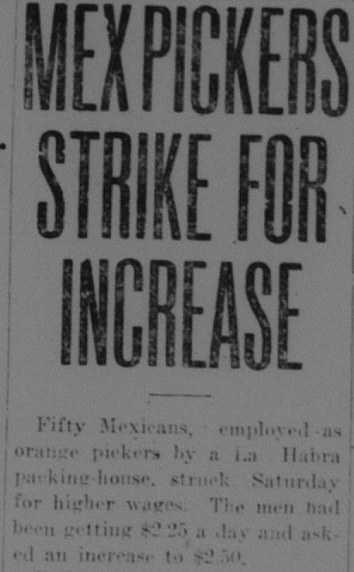
Local Mexican pickers went on strike.
This prompted some growers to import “Negro” labor from Los Angeles.
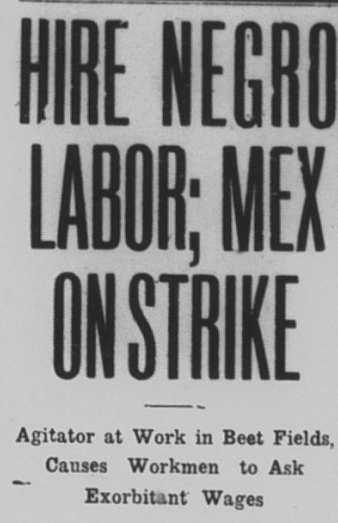
The above article states: “Negroes are being imported in to Orange County in relieve the labor situation developing through the refusal of Mexicans to take contract jobs or to work for less than $3 or $4 day. Twenty-five were brought into the beet fields Tuesday afternoon from Los Angeles and agents of the sugar factories and farmers, are now in Los Angeles securing more.”
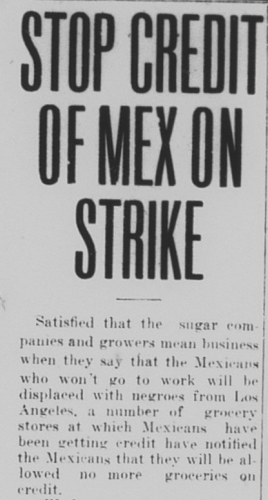
As a kind of punishment to the striking Mexican workers, some local merchants stopped allowing Mexican strikers to purchase food on credit.
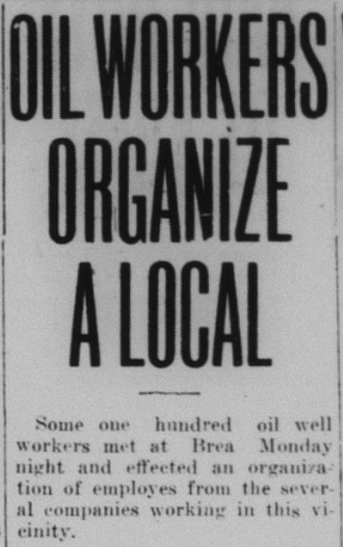
Meanwhile, local oil workers organized a union, also seeking better wages.
Transportation
In transportation news, Fullerton finally got a Pacific Electric passenger train line to pass through the town. The Pacific Electric “red cars” would become, by the 1920s, the largest interurban rail system in the United States. The whole system would unfortunately be dismantled in the 1950s, as southern California became firmly entrenched as a “car culture.”

Homelessness
In the category of “the more things change, the more they stay the same,” local authorities shut down a homeless encampment near the train depot.

The above article states: “Officers early Wednesday evening raided a hobo camp east of the depot and sent thirteen tramps out of town with instructions not to return. The raid was made by Marshal French and Deputy Sheriff Murillo.
“Reports reaching Marshal French said the tramps had established a camp near the wye made by the branching of the Santa Fe to Richfield. The spot is favorite site for a camp with bums, a permanent camp having been established there last year despite daily raids by the police.
“When the two officers arrived at the camp Wednesday night the thirteen occupants were stretched about a camp fire, some of them lying down and others engaged in cooking supper.”
“None offered resistance when the officers searched them for arms. All of them were without weapons and most of them had no money.
“According to their story to the police they were on their way to San Diego, where they expected to find work in the kelp beds.
“Most of the crowd were young men and all of them were shabbily dressed. The oldest man in the camp, bent and grizzled, gave his age as 62 and told the police he did not know where he was going.
“The camp raided Wednesday night is the first that has been established by hoboes this year, according to Marshal French.”
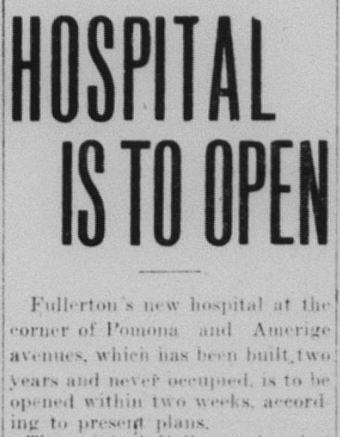
New Hospital
Fullerton’s “new” hospital opened at the northeast corner of Amerige and Pomona. The building still exists.

Entertainment
For entertainment, Fullertonians went to the Rialto Theater at 219 N. Spadra (now called Harbor Blvd.) downtown.
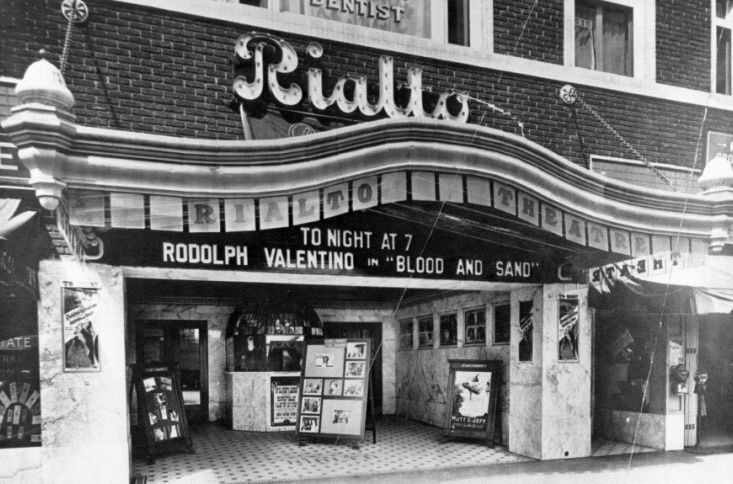
Rialto Theater. Photo courtesy of the Fullerton Public Library Local History Room. 
Rialto Theater/Alpha Beta Market at southwest corner of Spadra (Harbor) and Wilshire Ave. Photo courtesy of the Fullerton Public Library Local History Room. Here are some advertisements for some of the silent movies shown at the Rialto in 1917.

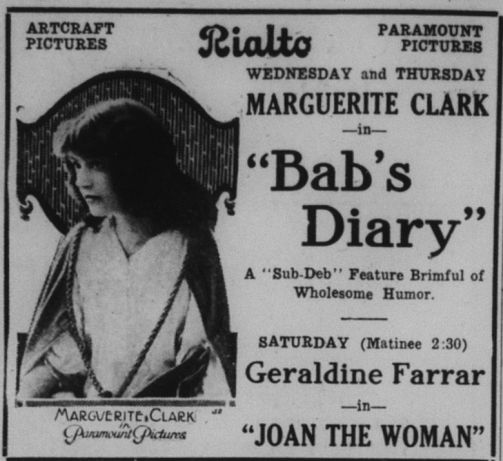


The Rialto Theater featured a talented musician named Winifred Wilbur, who played multiple instruments that accompanied the films.

In a more racist vein, there was in the Tribune an advertisement for the Geo. Primrose All White Minstrel Show, presumably featuring white people in black face.

Popular politician and failed presidential candidate William Jennings Bryan spoke at the Fullerton High School auditorium.

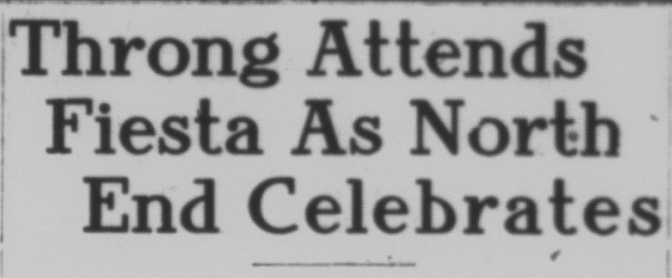
Fullerton hosted a popular “fiesta” that drew thousands.
High School principal E.W. Hauck gave a pro-war speech in which he said: “We are in this war to make it impossible for the outrages in Belgium and Servia to be repeated, we are in the war to make it impossible again for warring nations to interfere with the shipping of neutral nations, we are in the war to make it impossible again to impose the will of the strong upon the weak, we are fighting for the principle that a people must be free to determine its own form of government. No longer must might be right for nothing is right but right and this must be written in blood.”
Prohibition
Prohibition was very much in vogue locally.
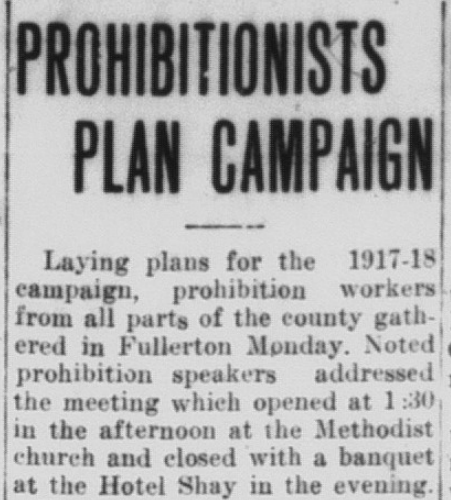
The above article states: “Laying plans for the 1917-18 campaign, prohibition workers from all parts of the county gathered in Fullerton Monday. Noted prohibition speakers addressed the meeting which opened at 1:30 in the afternoon at the Methodist church and closed with a banquet at the Hotel Shay in the evening.”
Brea News
The oil town of Brea voted to incorporate.

Oil!
Oil was big business locally, in the fields of north Fullerton and Brea.


The above article states: “At the opening of the year 1916 the daily production of all wells in the field totaled 35,273 barrels. The production has been steadily increasing during the year until the daily production in round numbers is 55,000 barrels. The production for the past year will run close to 18,000,000 barrels.”
Citrus
The other main industry was, of course, citrus, which was also booming.

The Bastanchury Ranch was named “the largest citrus orchard in the world.”

Politics
In local politics, city councilmember J.M. Clever resigned from city council. “My own affairs claimed so much of my attention I could not give the time that was needed to do my work on the council as it should be done,” he told The Tribune.
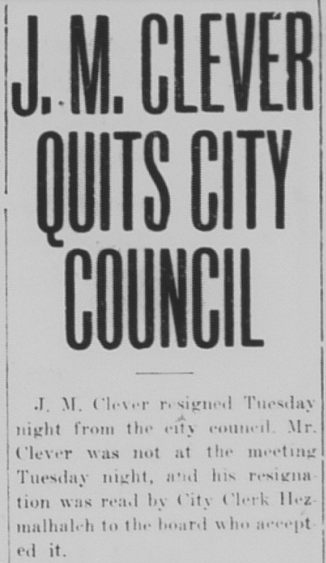
In his place, Roy R. Davis was appointed.

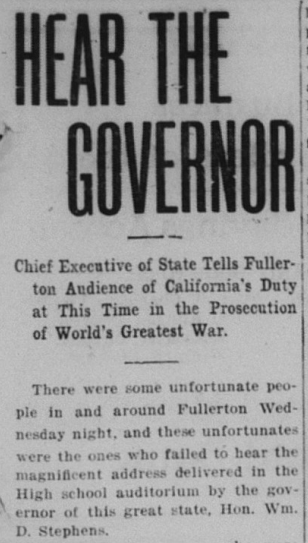
In state news, governor William D. Stephens survived an assassination attempt in Sacramento.

After surviving assassination, Stephens spoke in Fullerton.
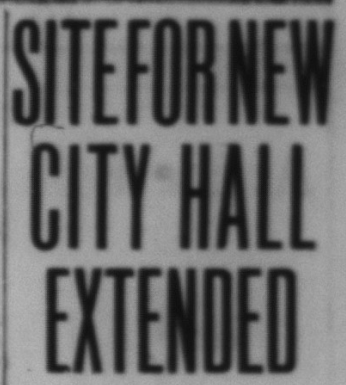
Plans were being made for a new City Hall site on land between Wilshire and Whiting, along Spadra (now called Harbor).
Curfew
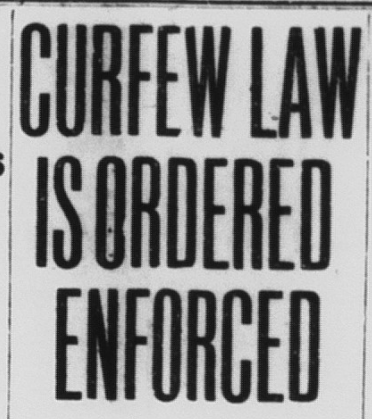
City council ordered that the City’s curfew law, requiring those under 17 to be home by 8:30pm, be enforced.
“The curfew will be sounded by the fire bell,” the above article states. “The law applies to persons under 17 years of age. The ordinance will not apply to those, under the age limit, who are on their way home after the curfew hour, but only to those loitering about the streets, according to Marshal French.”
Sports
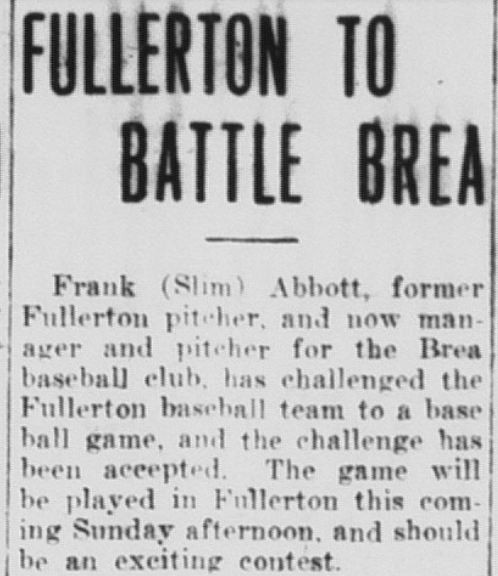
Baseball was very popular locally, with games played at what is now Amerige Park, across the street from City Hall.
Racism
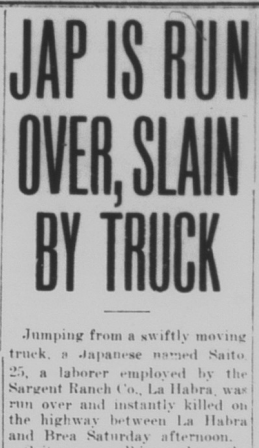
Racism was quite pervasive, and the editor of the Tribune (Edgar Johnson) was not immune. He ran headlines with racial slurs like “chink” and “Jap” as shown below.

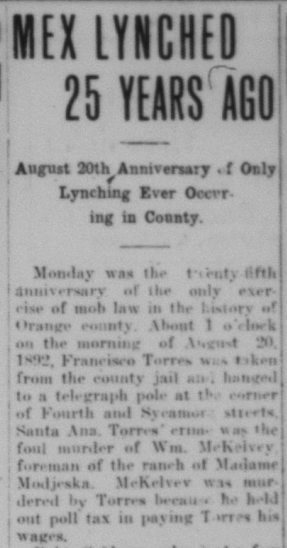
Johnson also ran an article about the 25th anniversary of the [supposedly] only lynching in Orange County, of a Mexican man named Francisco Torres.
Death
Charles E. Ruddock, former Fullerton marshal and Orange County sheriff, died.
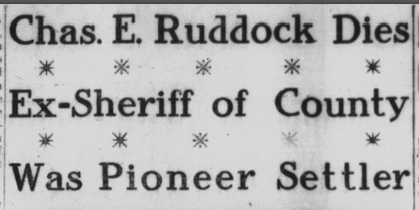

The above article states: “Ruddock was born in Chemano county, New York making him almost 53 years of age at the time of his death…He and his family came to Fullerton from Wisconsin in 1897 and since have made their home here. Serving a trifle more than two years as a city marshal of Fullerton, Ruddock also served as county sheriff from 1910 to 1914.
Mr. Ruddock was a Mason, having been initiated in both the Scottish and York rites, he was a Knight Templar, a Noble of the Mystic Shrine, and a member of the L.O.O.F., the K. of P. and the L.P.O.E.”
-
Photographs: Then and Now (City Hall/Police Station Sunken Patio)
The following is from a work-in-progress about the history of Fullerton. You can support my ongoing research and writing on Patreon.
For this series, I compare a historic photo of Fullerton with a contemporary one from approximately the same angle. Below are two photographs of the sunken patio of what was originally City Hall at the northeast corner of Commonwealth and Highland Avenues–one of the patio being built in 1940 as a WPA project, and the other from 2023. The building is now the Fullerton Police Station.

Photo courtesy of the Fullerton Public Library Local History Room. 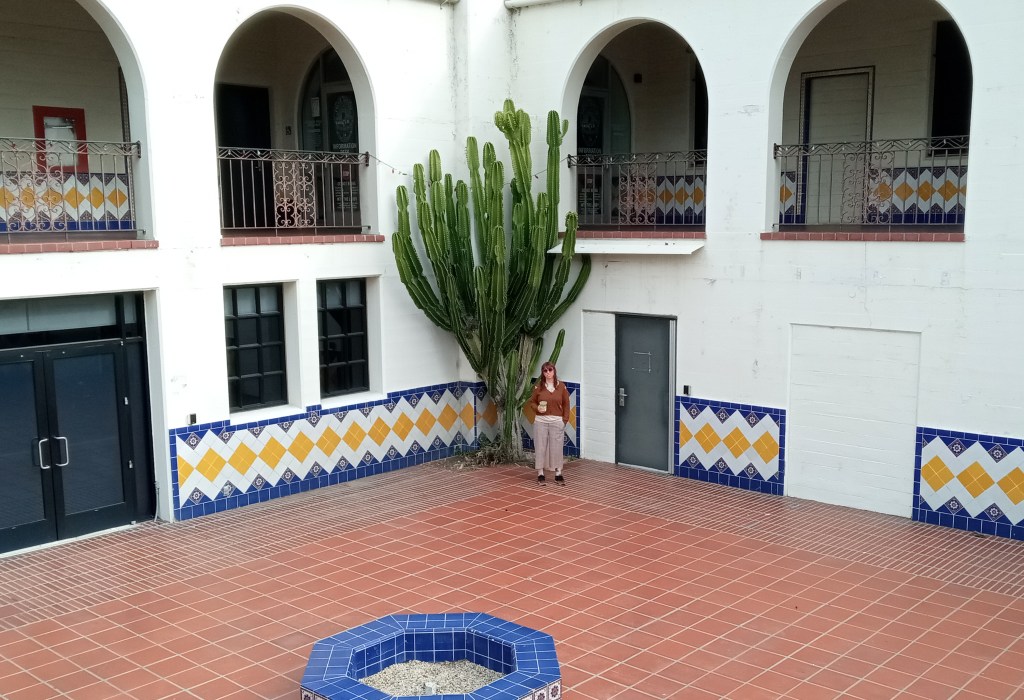
Police Station patio, 2023. Photo by the author. -
Photographs: Then and Now (Original City Hall/Police Station)
The following is from a work-in-progress about the history of Fullerton. You can support my ongoing research and writing on Patreon.
For this series, I compare a historic photo of Fullerton with a contemporary one from approximately the same angle. Below are two photographs of the northeast corner of Commonwealth and Highland Avenues–one of houses from the 1930s and the other of what was once City Hall (built in 1941) and is now the Police Station, from 2023.
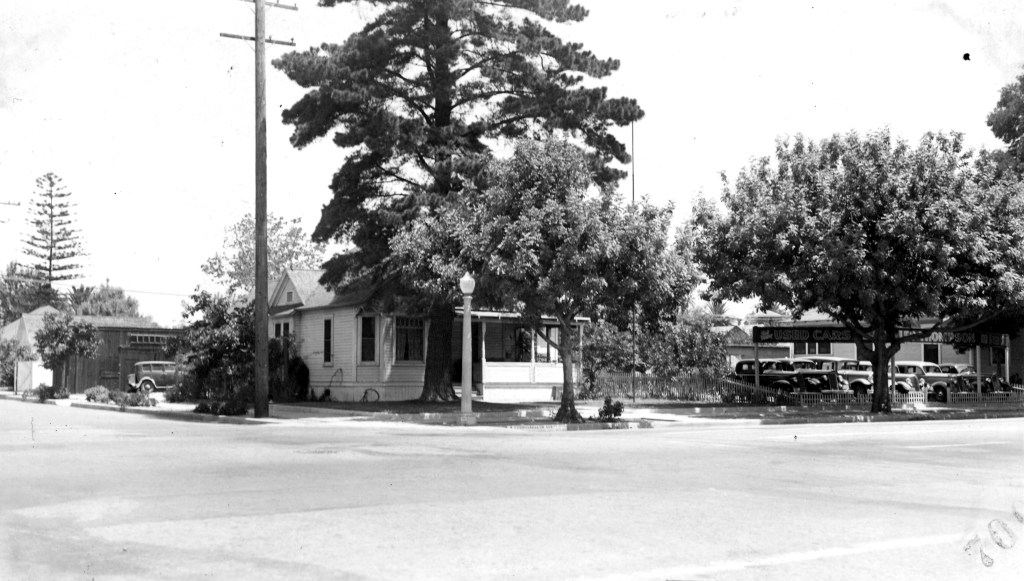
Northeast corner of Commonwealth and Highland, circa 1930s. Photo courtesy of the Fullerton Public Library Local History Room. 
Fullerton Police Station (originally City Hall), 2023. Photo by the author.
-
Subscribe
Subscribed
Have a WordPress.com account? Log in now.

