-
Oral Histories: Juanita Hawkins
The following is from a work-in-progress about the history of Fullerton. You can support my ongoing research and writing on Patreon.
Juanita Hawkins was interviewed in 1973 by Kamila Hardy for the CSUF Oral History Program. Here are some things I learned from her recollections about her family and Fullerton:
Hawkins (whose maiden name was Frazee) moved to Fullerton from Kansas with her family in 1920, for her father’s health. Her parents were Myrtle and George Frazee. Her sister was Mary Louise and her brother was Dick Frazee. They first lived on the corner of Pomona and East Truslow, and then to 141 West Wilshire, where the Wilshire Promenade apartments are today.
According to Hawkins, “things were booming” at the time. This was the second big boom in Southern California–the first being in the 1880s, the second in the 1920s, and the third after World War II.
Her father was a plumber and then he went into contracting and did lots of work because there were many homes being built at that time.
She remembers that some of her neighbors at the time were Black, including “a Negro lady named Lollie Smith,” and the Roscoe family, who owned a livery stable in town. This is fascinating because I was under the impression that Blacks and Mexicans were not allowed to purchase or rent homes “north of the tracks” until civil rights laws passed, decades later. It seems that there were exceptions to this pattern, as shown by Hawkins’ childhood neighbors around Wilshire and Malden in the 1920s.
Although they lived basically downtown, it was still “predominantly orange groves all around us and walnut trees.”
In 1924, the family moved to around what is now the 800 block of West Commonwealth.

West Commonwealth Ave. in 1925. Photo courtesy of the Fullerton Public Library Local History Room. Hawkins was eight when she came to California, in the fourth grade. She remembers the old red brick school house on the corner of East Wilshire and Lemon.
She married her husband Jim Hawkins in 1931. They moved around a lot in the early years of their marriage, mainly for financial reasons (it was the Great Depression).
They lived for a a while on a farm on Ball Road in Anaheim, where they raised the pigs, turkeys, and chickens. One notable thing about this property was that it contained the original boysenberry plants that Rudy Boysen and Walter Knott created for Knott’s Berry Farm.
During World War II, Jim worked in shipyards and the family moved into the family house on Commonwealth.
In 1954, the family moved to Buena Vista Drive, near the Muckenthaler mansion.

Muckenthaler Mansion, 1920s. Photo courtesy of the Fullerton Public Library Local History Room. “The Muckenthalers got their money from oranges, because they owned that whole area up in there at one time,” Hawkins recalls. “They owned as far down as where the Lucky Market [now Stater Bros.] is on the corner of Euclid and Chapman Avenue.”
She remembers the 1933 earthquake.
“I heard this grumbling, it sounded like a whole fleet of trucks, heavy heavy trucks and the ground tremering just a little bit, and I could hear this dog howling and then just all of a sudden it was waves, besides the shakes, it was just actual like walking over waves,” she said.
She also remembers the 1938 flood. At the time, they were living on Ball Road in Anaheim.
“I looked out the window of the front door and the water had raised from the street level up to the second step of the porch and we had five steps up to our house,” she said. “It was just like a raging river. Our chickens and our turkeys, the ones that couldn’t fly up, and our poor old cow she came floating along and finally her rope hooked on to something and she was standing there with her head up trying to keep her head out of water…All of Anaheim was under water. People were on their roofs.”
After the war, Jim worked for Union Oil. Juanita worked for a glass company.
Juanita and Jim’s first four children died either in infancy or early childhood. They then adopted a boy named Norman who lived into adulthood. They had one daughter, Judy, who lived into adulthood.
-
Oral Histories: Dona Odom (Hotel proprietor)
The following is from a work-in-progress about the history of Fullerton. You can support my ongoing research and writing on Patreon.
Dona Odom was interviewed in 1970 by Kathleen Hall for the CSUF Oral History Program. Here are some things I learned from this interview:
Odom came to Fullerton from Kansas with her mother (a Mrs. M. Shay), and her siblings in 1913.
“Mother’s two sisters were living in Los Angeles,” Odom remembers. “I guess they must have been here in 1890 and they must have encouraged mama to come.”
For two years, her mother ran the Santa Fe Hotel and a snack shop near the train depot.
“My sister married shortly after we came out here,” Odom said. “A young man she was going with worked as a telegraph operator with the railroad and he was transferred out here.”
About a month after arriving in Fullerton, her brother was blinded in a dynamite accident.
In 1915, her mother took over management of the oldest hotel in town. Built in 1887 by town founders the Amerige brothers at the corner of Spadra (Harbor) and Commonwealth, it was originally called the St. George hotel. The hotel had different names over the years: the Midland, the Pinson, and ultimately the Shay Hotel (after Dona’s mother).

St. George Hotel, which later became the Shay Hotel. They served meals for 25 cents.
“I waited on the tables and Mama did the cooking and she had a lady to
help her in the kitchen. Then we all got in and washed the dishes afterwards,” Odom said. “My mother was a wonderful cook.”
She remembers when the city was first paving North Spadra (Harbor) from the Masonic Temple to “up over the hill, why we had to get up at 4am in the morning as the workers had to get up and be at work at 5 in the morning. Many of them boarded with us.”
She remembers, when they took over the hotel it had about 40 rooms, and was painted green on the outside. The hotel had a large lobby with “a great big pot-bellied stove.” It had bannisters “that you loved to slide down as a child.” There was only one bathroom upstairs, and another downstairs, so guests had to share.
The hotel was two and a half stories, and was set back quite a ways from the street. They could host banquets that seated about 75 people.
In addition to overnight guests, the hotel also had long-term boarders.
“We had quite a number of regular boarders,” Odom remembers. “There was an old carpenter who gave me [a] pedestal. There were a lot of fellows who worked in the oil fields.”
She remembers guests gathering in the lobby to play cards and visit.
“It was a friendly type place,” she said.
They had an ice box and would get their ice from “the old ice place down on Truslow off of Amerige.”
They would get their meat from Hiltscher’s Meat Market.
She remembers William Jennings Bryan staying at the hotel in 1917 for the Chautauqua Circuit.
“I always admired him,” Odom said. “You know one thing, he ran more times for the Presidency than any other…But yet he was never President.”
Among other notable guests was “a group of Negro singers on the Chautauqua Circuit.”
“You know I can’t remember how it worked out because it used to
be that no one would sleep in a bed that a Negro had slept in,” she said. “As I remember these men were very grand looking, I am pretty sure that they stayed overnight. It was probably one or two nights because that was
the length of the Chautauqua meetings usually.”
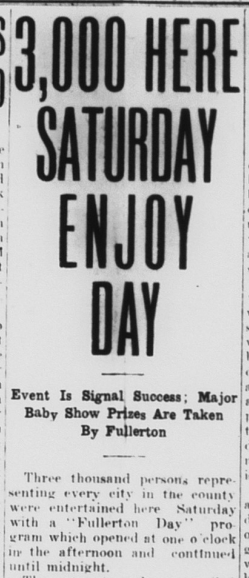
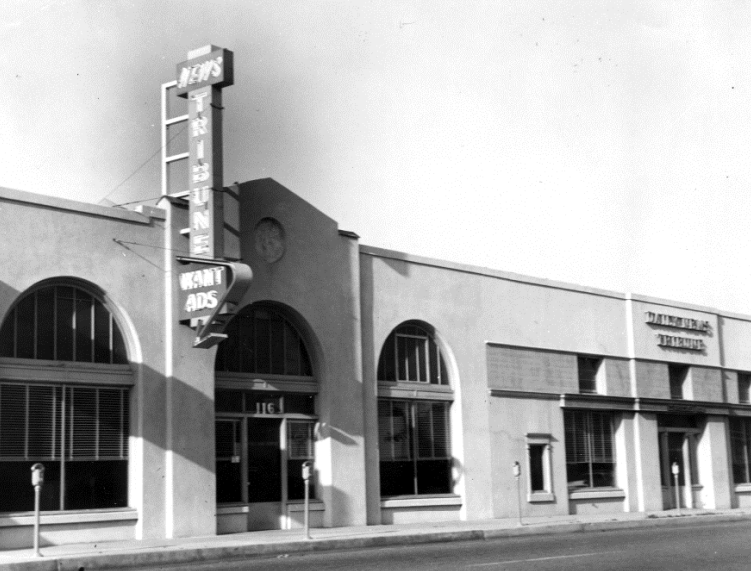
Odom won a car in a contest from the local newspaper, the Fullerton Tribune, for selling the most subscriptions.
Even though many people were driving cars, the hotel still had old hitching posts outside for horses.
In those days, Fullerton was a fairly quiet town, what Odom called “a home community.” Anaheim, on the other hand, “had a number of saloons and was pretty lively.”
In 1917 there was an earthquake which damaged the chimneys of the hotel, causing it to be condemned as unsafe. According to Odom, there were already plans in place “to expand the business area also and the hotel had to go.”
In 1918, the Shay Hotel, one of the oldest buildings in town, was torn down.
-
Oral Histories: Robert Clark (Industrial Coordinator)
The following is from a work-in-progress about the history of Fullerton. You can support my ongoing research and writing on Patreon.
Robert “Bob” Clark was an orange rancher who worked for the city of Fullerton to bring industry in the early 1950s. He later served on the board of the Orange County Water District. Bob was interviewed by B.E. Schmidt in 1970 and 1971 for the CSUF Oral History Program. Here are some things I learned from these interviews.
The Town of Orangethorpe
Bob Clark’s wife was Helen Olgar, who was from a pioneer family in the Orangethorpe District. The town of Orangethorpe, which no longer exists, was a 6.25 square mile area that encompasses parts of what is now south Fullerton, north Anaheim, and Buena Park.
Some of the first farmers in the area settled in Orangethorpe, even before the town of Fullerton was created.

Boundaries of the Town of Orangethorpe. Photo courtesy of Fullerton Public Library Local History Room. In a 2018 article for the Fullerton Observer, Terry Galvin wrote, “Well into the 1950s, Orangethorpe consisted primarily of ranch homes surrounded by grove upon grove of orange, lemon, and walnut trees. Farmers and ranchers in Orangethorpe formed a tight- knit community, and many important Fullerton families—the Royers, Gardiners, Spencers, and Hiltschers— came from the Orangethorpe district. The most famous individual born in Orangethorpe was guitar legend Leo Fender (1909-1991), who attended the Orangethorpe School.”
The Olgar’s family farm was on Brookhurst and Orangethorpe. The town of Orangethorpe had their own school and district and Helen’s father served on the school board board.
According to Galvin, the residents of Orangethorpe voted to incorporate in 1921 as a city “in order to prevent being annexed by Fullerton and to stop a planned sewage farm from being built by Fullerton. In 1923, a sewer line running from Fullerton to the ocean was planned, ending the sewer farm threat, so on December 31, 1923, the residents of Orangethorpe voted to unincorporate. However, the sewer farm was ultimately implemented by Fullerton because the sewer line to the ocean was never built. The sewer farm was abandoned by 1926, and ultimately became the site of the Fullerton Municipal Airport in 1927.”
Bob’s father-in-law was a leading citizen who had organized the Orangethorpe School District and incorporation back in the 1920s to prevent the sewer farm from being placed near his property.
Bob and Helen met in Los Angeles and were married in Santa Barbara. For a while they lived in Los Angeles, and Bob worked as a “special effects man” for movies. Eventually, they moved back to Orangethorpe and got into orange ranching on land the family owned.
Bob served on the Orangethorpe school board in 1949, at a time when the area was experiencing rapid growth and transformation from orange groves to housing subdivisions, and commercial and industrial centers.
Annexation of Orangethorpe
As the cities of Anaheim and Fullerton began to grow and subdivide in the post-World War II years, they each sought to annex Orangethorpe.
“The City of Anaheim learned that Fullerton was subdividing and moving to the west,” Clark remembers. “Anaheim took kind of a spider web strip annexation out through La Plama and expanded it across our ranch and my wife’s folks’ ranch and others.”
The Orangethorpe farmers opposed the annexation, so community leaders organized a sit-down with Anaheim Mayor Charles Pearson and administrator Keith Murdock and Fullerton Mayor Tom Eadington and city engineer Herman Hiltscher.
“We just asked them to come and sit down at the Orangethorpe School House and try to discuss, in a gentlemanly fashion, what was a rational, logical subdivision of the lands, and what each city could do” to serve the landowners with services like water and sewer,” Clark said.
Eventually the cities agreed on a demarcation line that was around what would become the 91 freeway.
According to Galvin, “In 1954, the school district was divided between Fullerton and Anaheim, and the entire Orangethorpe area was eventually divided and annexed to Anaheim, Fullerton, and Buena Park, although a few pockets of unincorporated county territory remained for many years.”
Fullerton vs. Anaheim
Clark remembers that in the early days, Fullerton and Anaheim were very different towns.
“Anaheim…was a swingin’ town. And Fullerton was a very churchy/WCTU [Women’s Christian Temperance Union] town,” Clark said. “On Commonwealth for years, they had several fountains with the little marble plaque dedicated by the WCTU. It said. ‘Drink water’…people would go over to shop in Anaheim…they’d buy their groceries and their can of molasses for the week and then get their can of beer from over at Anaheim because the brewery was there. And sit around and watch each other get haircuts–this was the excitement in those days.”
Post-War Industrial Development
As the tax revenue from the oil fields and orange groves were declining, city leaders approached Bob Clark about attracting industries to Fullerton.
“Anyone with foresight could see that the orange groves were going to give way to housing subdivisions and industry,” Clark said. “Plus the groves were suffering from quick decline. I was the youngest grower, I guess, except for the Eadington family, in the whole valley. There just weren’t any children interested in groves. Well, you couldn’t…make the groves pay.”

Kohlenberger plant. Photo courtesy of Fullerton Public Library Local History Room. Clark became “industrial coordinator” for Fullerton in 1953.
As an orange grower himself, he went to talk to other growers about selling their property for industrial development.
“I could go out there with a country boy approach as an orange grower and talk to them about what do you think about the disposal of your property,” Clark said. “Of course most of them were conscious that the west side was getting subdivisions. And most of the orange growers were getting old, I mean, they’d been in business fifty, sixty years and they were worried about who’s going to take over; our children aren’t interested in raising citrus, the market’s going to pot, our costs are skyrocketing, the tax assessor is making it impossible to raise citrus on these expensive lands. And I would sooth them with the fact that, well, this should be a consolation to you; if the value is growing each year, you’re making more money than you are out of raising crops on the land by just holding your property until you can find a higher and better use for it, and it seems to me that industrial property–industrial land would be the highest and best use in this market since you’re getting $2500 for subdivision land and you can get as much as $4,000 to $4,500 for industrial property to begin with.”
Clark identified the area east of Harbor, between Lemon and Placentia for industrial development.
“Once we put out plants like the National Cash Register and the Moore Business Forms and the first Sylvania plant which were beautiful…plants set back with nice gardens and so on, it was an example that set the pace and people began to go along with the program,” Clark said.

Sylvania Electric plant. Photo courtesy of Fullerton Public Library Local History Room. One of the big enticements to industrial businesses was the fact that they had rail access for shipping their product.
He got Kimberly Clark (paper products) and Rheem Manufacturing Company to locate in Fullerton.
He recalled a story about having lunch with Jack Kimberly, and him striking a deal with the railroad in a very Mad Men way: “So Jack Kimbrerly was here and we were having lunch and he said, well, I know that ole buzzard Gurley [from the rairoad company], and I have an idea he’s back at the Athletic Club having a drink about now. And he said, let’s try to get him on the phone and let’s get this thing resolved…and they, of course, it was hi, Jack; hi, Fred, what’s the big hang up…So I got a telegram that stated, you can have anything you want, buster, signed Fred Gurley.”
Other industries he got to locate in Fullerton included: American Meter Company, Arcadia Metal Products, U.S. Motors, and of course, Beckman Instruments.

Beckman Instruments Plant. Photo courtesy of the Fullerton Public Library Local History Room. Fullerton eventually annexed the land that included the Beckman Plant.
“I had to go up on the hills along with Walt Chaffee, the city attorney, and talk to various groups of people–property owners–about the benefits of coming into Fullerton,” Clark remembers.
He remembers getting pushback from the La Habra city attorney Harld McCabe: “Hissing Harold, we called him. Because all McCabe wanted to do, of course, was earn a fee and get some property he had up on Spadra over into La Habra where he could control it–with the La Habra planning commission who were a whole lot more amenable to him…Anyway these things happen: men all have different ideas as to how something develops and mostly…based on whether they make a profit out of it. This is understandable, the name of the game.”
With increased industry in Fullerton, some companies began to work with public schools for vocational training.
“Dr. Beckman donated equipment to local schools for vocational training…to try to make these people of some value when they hit the street after graduation,” Clark recalls. “This was to be permeated down into the shop level where the kids in an auto shop didn’t just come out learning how to bang a few dents out of a fender, but learning how to be a certified welder, or how to operate a punch press…or some of the more technical equipment than they get in the average high school or junior college…it seemed like a great way to employ our youth.”
Although Hughes Aircraft came into Fullerton in 1957, after Bob left Fullerton, he remembers meeting Howard Hughes.
“I met Howard Hughes in the Board of Director’s room quite casually,” Clark said. “He flew in when we were discussing the final phases of the purchase of the land and just ducked his head in the door looking father shoddy in golfer sweater and sloppy pants and just addressed his remarks to Dr. Highland: oh, you’re working on that Fullerton thing, Pat, huh…And Hughes didn’t shake hands: he just nodded the introduction and with a grimace rather than a smile and walked out of the room.”

Hughes Plant. Photo courtesy of Fullerton Public Library Local History Room. One other selling point to potential industrialists was the fact that Fullerton had an airport.
“The Hughes people wouldn’t have located here unless they could have had an airport,” Clark said. “They’re very air-minded people and have their own helicopters and…planes…many of the industries used the airport.”
Clark ended his employment with Fullerton in 1956, after three years. He went to work for United California Bank with their industrial business accounts.
St. Jude Hospital
Clark recalls the early establishment and development of St. Jude Hospital in Fullerton.
He remembers that “The [catholic] sisters were pushed around when they first came here…they first had a site out on some property below Chapman’s land on Pioneer and State College. And they were unsuccessful in getting zoning…they were given a slap in the face and turned out.”
“We decided one day that the only way to get a hospital in here is first to use the catholic sisters because they’ve got half a million dollars they could put into it; two, use the industries in north Orange County because they are going to be responsible for the bulk of donations from private sources…the other third was to come from state funds…” Clark remembers.
With all the residential and industrial growth in post war Fullerton, “We had a terrible shortage of hospital beds. What with all the growth going on, it looked like we were really going to be in trouble.”
So Clark and a doctor named Fernandez organized a luncheon at the Greenbriar Inn and invited all the local captains of industry–Arnold Beckman, Hubert Ferry (Union Oil), and representatives of other companies like Sylvania. They donated some funds for the hospital.
“We got the site up by the Fullerton Dam from a private owner, Miles Sharkey, the Sunny Hills Ranch owned that parcel, And he gave it to them at a real nominal fee,” Clark remembers.
Water
When Clark went to work for the city of Fullerton, he was aware of the problem of reduced groundwater.
“It came to us quite closely because we had owned two commercial wells and several domestic wells on our land in the west Anaheim area. And we, of course, could see the water table dropping away from our pumps,” he said. “I was very conscious of it and so was everyone that came in here, like Kimberly Clark and Sylvania…realized that they couldn’t depend entirely on wells, that they would have to have a secondary source of water because the basin was slipping away, and there was no opportunity to replenish it except during wet years when they have excessive runoff up in the mountains.”
In 1954, the Orange County District (OCWD) began importing water from the Metropolitan Water District (largely Colorado River Water) and putting it back into the groundwater basin to replenish it.
Clark was appointed to the Board of Directors of the OCWD in 1967 or 1968.
In 1971, when he was interviewed, he talked about future OCWD projects: a desalination plant (which has never materialized), and a wastewater reclamation plant, which does now exist.
Legacy
One unfortunate consequence of bringing industry to Fullerton was a legacy of pollution, specifically groundwater contamination. As a direct result of manufacturing in the southern industrial area of Fullerton and north Anaheim, Fullerton now has a Superfund site called the North Basin Contamination, a 5-mile plume of industrial solvents that threaten local groundwater. Here is a map of the plume.

To learn more about the North Basin Contamination site, visit its EPA page HERE.
-
Oral Histories: Raymond Thompson (Judge)
The following is from a work-in-progress about the history of Fullerton. You can support my ongoing research and writing on Patreon.
Raymond Thompson, a former city attorney of Fullerton and a Superior Court Judge, was interviewed twice, in 1968 and 1975, for the CSUF Oral History Program. Here are some things I learned from these interviews.

Judge Raymond Thompson. Photo courtesy of Wikimedia Commons. He was born in Sioux City, Iowa. His family moved to Fullerton in 1911 when he was six years old. His parents were Orvin and Margaret Thompson. He had three sisters: Helen, Janet, and Dorothy.
The population of Fullerton was approximately 1,700 when they first arrived.
His father, who had been a locomotive engineer, decided to get into the automobile business. After taking a course in automobile mechanics at the trade school in Los Angeles, he learned of a garage business that was for sale here in Fullerton that was owned by Lillian Yeager.

Lillian Yeager in 1924. Photo courtesy of Fullerton Heritage. “She was the female ‘garagist’ [which was] quite a novelty in those days. She would get under the cars and work and swear, and everything else just like a man, working as a mechanic and carrying on the business,” Thompson recalls. “My father and Mr. Dreyer bought this business which was located at the corner of Spadra and Amerige–the building’s still standing intact. I think there’s a furniture store there now.”
In addition to the garage, the family sold Overland cars, and then Buicks.
According to Thompson, the first automobile in town was owned by William “Billy” Hale, who was a pioneer orange grower and mayor of Fullerton. The car was a 1902 model Saint Louis.
“In those days, we used to have big Fourth of July local events with races of all kinds. Among other things there was an automobile race,” Thompson remembers. “Stock car races started at Commonwealth and Spadra [Harbor], went east to Acacia, north on Acacia to Chapman, back on Chapman to Spadra, and then south on Spadra to the point of beginning.”
In 1912 the first streets were paved in Fullerton–Spadra from Chapman to Santa Fe and then a block east of each of the intervening streets, Commonwealth, Wilshire, Amerige, and Santa Fe.
His father’s garage “was like an old-fashioned country store. You could get anything and everything that related to the automobile. It took the place of the service station. They came there to fill their gas tanks, get oil, and have their cars greased. We had a shop with two or three mechanics that did complete overhauls, repairs of all kinds, washed cars, rented cars with or without a driver, retread and vulcanize tires, the whole bit. It was a fairly big enterprise actually, and very versatile.”
Thompson remembers the old Atherton ostrich farm.

Atherton Ostrich Farm. Photo courtesy of Fullerton Public Library Local History Room. “That was quite an institution here in Fullerton,” he said. “The Athertons who were sort of characters had this ostrich farm. They raised them for feathers.”
A few years after arriving in town, his parents bought a lot on what was then North Spadra, on the corner of Spadra and Brookdale. The lot cost $450 and the house, to build, was $2,500. At first there were all walnut groves in back of the house, then Brookdale was built through the grove and frame homes were built. The family lived there for many years before selling the house in the 1950s.
In those early days, the town was able to build good schools, in part, because of the revenue from local oil production and citrus groves.
“So much of the economy was dependent on the orange industry,” he said. “Not only the growers, but the merchants, the people with the garages, the bankers, and everyone else were all largely dependent on citrus.”
He remembers how, in those days, “we could always look out and see the mountains…The word smog was not in the vocabulary at that time.”
He remembers the old Stern and Goodman general store, which became the Stein and Strauss store. This was one of the first buildings in Fullerton, at the corner of Spadra (Harbor) and Commonwealth.

Stern and Goodman Store at the southeast corner of Spadra (Harbor) and Commonwealth in 1890. Photo courtesy of the Fullerton Public Library Local History Room. “They had groceries, dry goods, farm implements and they dealt in hay and grain…You could get anything from a needle to a threshing machine,” he said. “The farmers…would come all the way from as far as Puente, north, and as far as El Toro, south. Some of them would come just once a year with their big wagon and their team…Stern and Goodman carried these farmers until the next crop came, maybe for a year. If there would be a crop failure, maybe they would have to carry them another year. It was a real big operation, and quite picturesque.”
The owners of the store were two Jewish men who had come from Germany, They had a branch store in Olinda, and another in Yorba Linda.
By loaning products to farmers, Jacob Stern eventually acquired a lot of land, should the farmers default.
“[Stern Realty] had land all over Southern California,” he said.
He remembers the Benchley family, who “were very colorful people, rather sophisticated for a little town like Fullerton. The old gentleman, maybe in his early seventies, always dressed just as sportily as any young man in town, in fact, more so. He’d buy his clothes in expensive stores in Los Angeles or San Francisco, and he smoked cigarettes. Oh, gosh, in those days that really raised eyebrows! They mingled with the high society in Los Angeles…But he was a good citizen and contributed a great deal to the upbuilding of the community.”
He remembers the oil fields north of town–the company town of Olinda, and how oil magnate Edward Doheney first struck oil there.
“There were many wells being drilled and many men coming to work in the oil fields. The oil companies put up barracks and boardinghouses, so there was a bunch of rough, single guys, oil drillers, what they called roughnecks. It was something like an old-fashioned mining community with a pretty rough and ready, reckless bunch of men like you would expect in any sort of a situation where there were mostly a bunch of vigorous young men…and then later on, the oil companies built lots of homes for their workers and lots of families lived all through the hills around Olinda and then over between Olinda and Brea. Brea was a similar community.

Fullerton oil fields, 1909. Photo courtesy of the Orange County Tribune. There was lots of oil, and many people worked in the oil fields, drillers, pumpers, and so forth. I remember Olinda was kind of a boomtown. Lots of single men were working there, and it was a pretty dangerous occupation before they had taken so many safety measures in industry. I remember quite a few times seeing the cars serving as ambulances roaring through town with their horns going, bringing some injured worker to the hospital. Then it had a little bit of the aspect of a wide open mining town, but workers would mainly go to Anaheim.
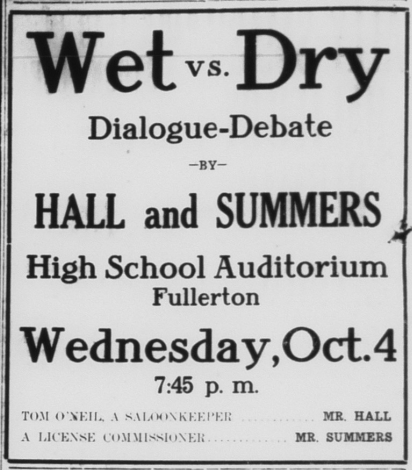
Anaheim was a “wet” town, where you could buy liquor, and Fullerton was a “dry” town, “so on Saturday night Anaheim would be the place to go.”
As for leisure activities, he remembers that “nice people didn’t go to the pool hall. That was more for the “roughs” and the guys that came in off the farms on Saturday night and that sort of thing.”
He remembers there were dances: We’d go down to Balboa, to the old Pavilion for dances, and…the picture shows and confectionary shops. We’d go in and get a big ice-cream soda or an ice-cream sundae.
He remembers taking his shotgun and trudging over the hills to the Bastanchury Ranch to hunt rabbits.
Thompson attended the original red brick Fullerton Grammar School (on Wilshire and Pomona, which no longer exists).
He graduated from Fullerton Union High School in 1922. The current high school was actually the third school high school location. The first was at Wilshire and Lawrence (now a Fullerton College parking lot), the second was where Amerige Park is now located. This one burned down, and then in 1911, the high school moved to the present location on Chapman.
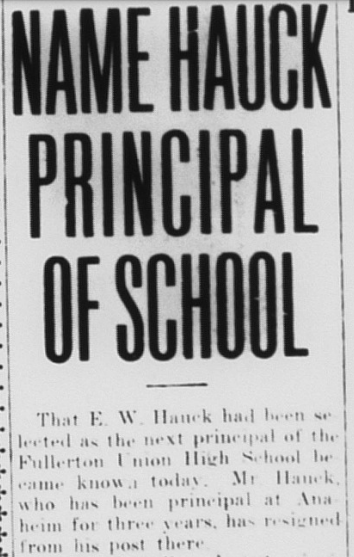
His recollections of principal Louis E. Plummer were that he was “something of a disciplinarian so that he was a bit austere. He was respected, but there wasn’t quite the affectionate feeling that a warmer person would have inspired.”

Louis E. Plummer. His first year in high school, during World War I, they had military training.
“I remember we drilled, marched, had our uniforms, and our wooden rifles,” Thomson said.
During World War I, he remembers “the boys going away, but even then it was kind of a big adventure. I remember seeing them in uniforms, down at the depot taking the train. Lots of young men I knew, like Fred Strauss and Raymond Smith, Mickey Ford, and the Sherwood boys, Raymond Starbuck, just lots of them, and Dr. William Wickett, Sr.”
Football was an important school activity, “especially to beat Santa Ana.”
During Prohibition, he remembers that bootleggers used to smuggle liquor along the Orange County coast.
“Lots of it got in, and I remember that some of the old-time sheriffs, reputedly, were tolerant of the bootleggers and the smugglers, even cooperated to a certain extent or looked the other way. Liquor was available in Orange County. There were stills out in the hills and mountains. The Basque people traditionally have their wine and their brandy, and they never recognized prohibition. They still grew their grapes and made their wine and their brandy,” he recalls.
Thompson has distinct memories of the Ku Klux Klan in Fullerton in the 1920s: “There were a lot of good people who had been longtime friends, Catholics and Protestants, and a lot of prejudice and feeling was triggered. There was a Ku-Klux Klan organization. Of course, the Catholics and Jews were very bitter toward the Klansmen…the communities, Fullerton and Anaheim got pretty well lined up. The Masonic Protestant Ku-Klux Klan was the real far-out fringe of those groups, as against the Catholics and the Jews on the other side. I remember the bitterness and it entered into the municipal elections. It was pretty bitter.”

1924 newspaper advertisement for a KKK rally in Fullerton that reportedly drew thousands. From the Fullerton Tribune microfilm. He remembers that W. J. Carmichael had a cross burned on his lawn although Carmichael was not Jewish and was not Catholic.
Dan O’Hanlon, an Irish catholic who was opposed to the Klan, also had a cross burned on his lawn.
Thompson remembers that the issue of Prohibition was a big one for the Klan.
“The Klan favored Prohibition, so maybe that was partly in the background,” he said. “It kind of dissipated over the years. The people settled down and forgot about it. The old friendships were renewed and I don’t think people pay much attention to it anymore.”
He remembers the Bastanchury family, who were Basque sheepherders who had about 6,000 acres. The family got involved in oil and oranges.

Bastanchury Ranch. Photo courtesy of Fullerton Public Library Local History Room. “They started the largest orange grove in the world,” he remembers. “They had 3,000 acres, planted in oranges, up where the Sunny Hills area is now. They were very picturesque people. They were gay, they had their big fiestas and their barbecues, lots of fun and rather easy going, improvident sometimes, and they went under about 1929. Unfortunately, the Bastanchury boys all died poor.”
Unfortunately, the Bastanchurys got screwed over oil.
“[The] Murphy [oil company] leased the property for oil, then drilled a well and found oil, but came back and told the Bastanchurys–the old man was perhaps illiterate, at least had very little education–that there was no oil, plugged up the well, then later came back and said that there were some clay deposits that he [Murphy] was interested in. He bought this 3,000 acres for about $60 an acre. Then ten or twelve years later, after the younger generation, the sons, had been to college and realized how the family had perhaps been defrauded, filed a suit for $72 million. Because of the time element and the problem of waiting so long, they settled it for $1.2 million.”
With the money from this settlement, the Bastanchury sons planted orange groves. Unfortunately, they overextended “and then came 1929 and the Depression.”
After high school, Thompson spent one year at Fullerton Junior College, then went to USC, where he got his law degree. After graduating from USC in 1927, he practiced law in Fullerton. For a time he had a law practice with Mr. Albert Launer.
Thompson remembers the Great Depression.
“Money was scarce and farmers and orange growers couldn’t pay their mortgages. There were foreclosures and after a while moratoriums came along that gave them some relief,” he said. “I remember the banks were closed for awhile. You couldn’t write a check against your account. There was hardly any money.”
He remembers the 1933 Long Beach earthquake.
“I recall people coming into the area from Long Beach driving through Fullerton, driving up on the hills and spending the night in their cars. Many of the people here stayed out all night in their cars and in their yards,” he remembers. “It really shook and you could see the earth wave and the orange trees shake back and forth, like the waves of the ocean. We had a lot of damage in our Fullerton schools.”
He served as city attorney for five years from 1937 until he was appointed by Governor Warren in 1944 to the Superior Court.
Reflecting on the growth of Fullerton, Thompson said, “Our beautiful community is a thing of the past. It is now subdivisions, factories, smog, freeways, and congestion. Of course, what it would have been otherwise is another question. If we had not progressed and had severe economic problems, we might be more unhappy than we are now. A lot of people made a lot of money. The orange growers who sold out, sold at high prices and the ones that invested wisely and saved some of it are in pretty good shape.”
-
News Headlines: 1915
The following is from a work-in-progress about the history of Fullerton. You can support my ongoing research and writing on Patreon.
The Local History Room of the Fullerton Public Library has microfilm from the Fullerton Tribune newspaper (which became the Orange County Tribune in 1908) stretching back to 1893. I am in the process of reading over the microfilm, year by year, to get a sense of what was happening in the town over the years, and creating a mini archive. Below are some news stories from 1915.
Education
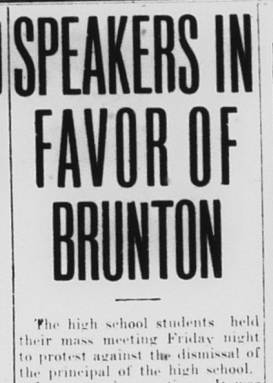
The election of high school board trustees was a contentious one, with a slate of candidates favoring principal Delbert Brunton, and others opposing him. Ultimately, the Brunton supporters won. They were L.R. Steward, O.A. Kreighbaum, and Allen Craig. Billy Hale, who opposed Brunton, was narrowly defeated by two votes.


The Tribune printed photographs of the high school auditorium and manual arts buildings. The current (larger) high school auditorium would not be built until 1930. Do the buildings below still exist today?


With World War I raging in Europe, there was discussion and debate about requiring military training in high school.


Neighboring Cities
The newly-formed oil town of Brea was considering incorporation, which would give it a city council with taxation powers. Brea would incorporate in 1917.

Deaths
Fullerton co-founder Edward R. Amerige, who had served on City Council and in the California State Assembly, passed away.


A massive train accident/explosion in the nearby town of Yorba prompted the largest headline in the history of the Tribune.

Government and Politics
Progressive California governor Hiram Johnson outlined his priorities for more state reforms.

A resident named Frank Claudina drew up a petition to recall Mayor Gregory and councilmember Anin; however, it appears that this effort never went anywhere.

In 1914, California repealed its poll tax.

Fullerton’s representative in Congress was Democrat William Kettner, whose district included Orange, Imperial, Inyo, Mono, Riverside, San Barnardino, and San Diego counties.

Arts & Leisure
Fullerton was developing a City Park, although I’m not sure where. The articles on the subject do not say. I will be sure to consult the Fullerton Public Library local history room.


Before the Fox Theater was built in 1925, there was the Fullerton Theater on (Spadra) Harbor Blvd. (which later was called the Rialto Theater). The Tribune included lots of ads for movies they were showing. In 1915, director D.W. Griffith released a movie called “The Clansman” (later called “The Birth of a Nation“), which was a landmark in filmmaking techniques, and arguably the first “blockbuster.” Unfortunately, the movie was also deeply racist, as it portrayed the Ku Klux Klan as American heroes. The Fullerton Theater showed this movie.

This movie is credited with sparking a revival of the KKK not just in the south, but throughout the United States. By the 1920s, there would be an active Ku Klux Klan in Fullerton.


Crime
In one of the Mexican work camps on the Bastanchury Ranch, there was a large fight in which three were injured.

A Brea man killed his neighbor with a shotgun.

The OC Sheriff was attempting to crack down on “marihuana.”

Agriculture
Congressman William Kettner was in favor of a higher tariff on foreign agricultural products to protect American growers.

Racism
Lynching of African Americans was still happening in America.

Comics
In 1915, the first comic strip appeared in the Orange County Tribune:

Women’s Suffrage
Although California residents passed a ballot measure granting women the right to vote in 1911, the 19th Amendment (granting women across America the right to vote) would not pass until 1920. In 1915, president Woodrow Wilson expressed his support for women’s suffrage.

World War I
The big news of 1915 was World War I, which was raging in Europe, causing hundreds of thousands of deaths. Here are some headlines related to the so-called Great War.


Although the US would not officially enter the war until 1917, the country began to build up its armed forces, particularly its navy.


There was even talk of creating a draft, should the US need to raise a larger army.

Homelessness
Meanwhile, back at home, county officers were planning a war on the homeless.

Mexican Revolution
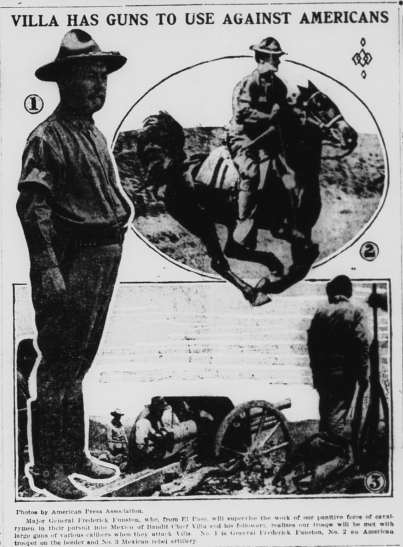
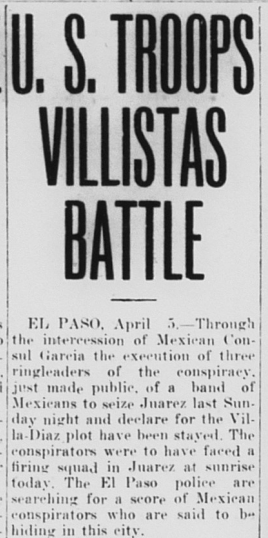
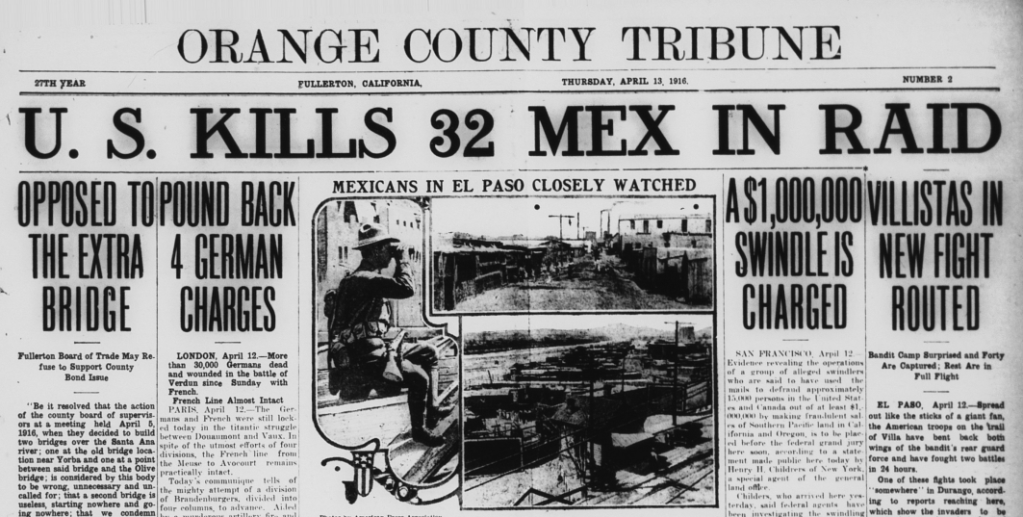
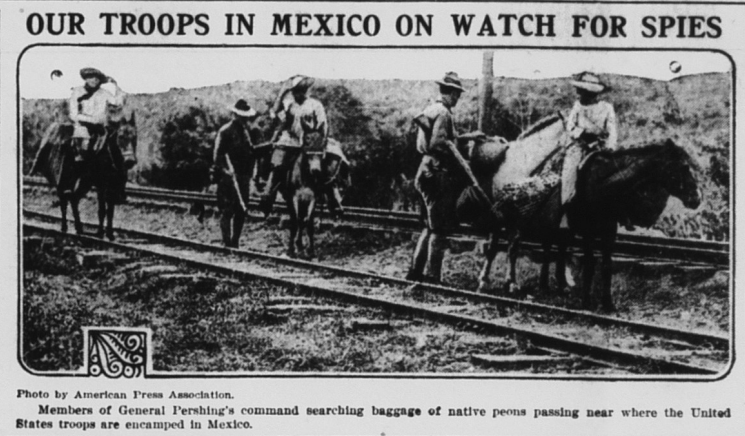
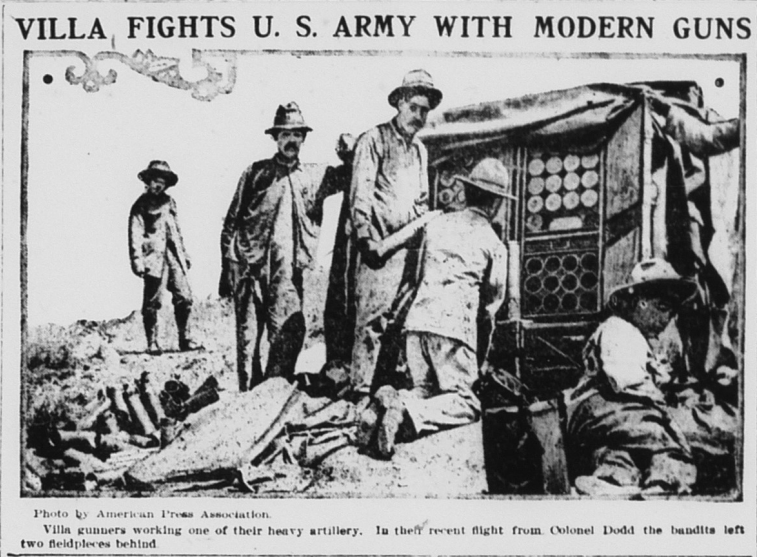
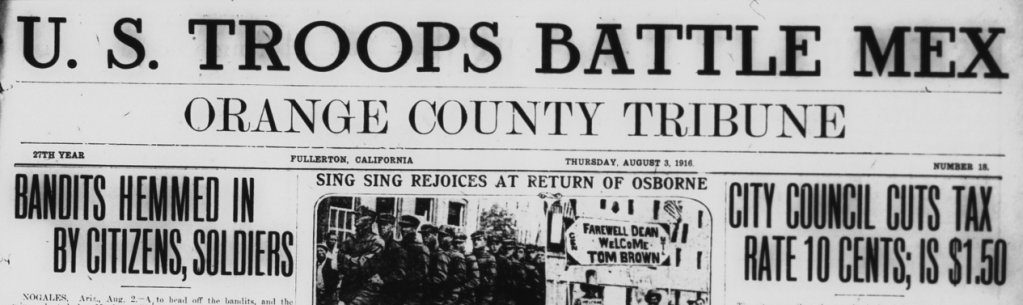
South of the border, the Mexican Revolution raged, prompting the US to tighten border security.


Technology

Miscellaneous

Stay tuned for articles from 1916.
-
News Headlines: 1914
The following is from a work-in-progress about the history of Fullerton. You can support my ongoing research and writing on Patreon.
The Local History Room of the Fullerton Public Library has microfilm from the Fullerton Tribune newspaper stretching back to 1893. I am in the process of reading over the microfilm, year by year, to get a sense of what was happening in the town over the years, and creating a mini archive. Below are some news stories from 1914.
Fullerton’s population was growing fast, reaching 4,000 people.

Education
Enrollment at Fullerton Union High School was 243 pupils.

Here’s a photo of the 1914 high school graduating class:

In 1914, the principal of FUHS was Delbert Brunton, and teachers were chosen by the Board of Trustees.

A new grammar school was built.

For the first time, in 1914, California history was taught at a university.

Government and Politics
George Anin, R.S. Gregory, August Hiltscher, and E. Livingstone were elected to the City Board of Trustees (now called City Council).

Gregory, a local real estate broker, was chosen as Chairman of the Board (Mayor).

Charles C. Chapman, orange rancher and Fullerton’s first mayor, considered running for governor. He did not ultimately run.

Fullerton City Attorney E.J. Marks ran for Orange County District Attorney.

In the early 20th century, there was a small but active Socialist Party in California. They sometimes held meetings in Fullerton. They were in favor of government ownership of utilities, the 8-hour work day, and other reforms.

Progressive Governor Hiram Johnson made a stop in Fullerton, running for re-election. He was introduced by high school principal Delbert Brunton, and gave a speech about progressive reforms created under his administration.

“When we assumed control in 1911,” Johnson said, “the S.P. [Southern Pacific railroad] company regulated the state; now, the state regulates the company…We have been endeavoring during these four years to provide the weapons with which the electorate may defend itself in case the corporations should ever again get control of state affairs. You have these weapons in the initiative and referendum…I say to you that government has a higher purpose than to make men richer. Its chief concern should be the social welfare–to place in the system of laws the hearts and conscience of the people…The reduction in rates for freight, electricity and phone service made by the railroad commission during this administration will mean a saving of over $7,000,000 per year to patrons of these public utilities. In view of these figures, I ask you, does it pay to own your own government?”
Johnson was re-elected governor.

Deaths
Jose Antonio Yorba, a descendant of the pioneering Yorba family of Orange County, passed away.

The local funeral home was McAulay and Copp, located at 103 South Spadra (Harbor Blvd.)

Loma Vista Memorial Park, Fullerton’s first cemetery was established. It remains Fullerton’s only cemetery, and many early pioneers are buried there.

B.G. Balcom, pioneering Fullerton banker, died. Balcom Avenue is named after him.

Arts & Entertainment
Before the Fox was built in 1925, Fullerton’s first movie theater was called the Fullerton Theater, and later the Rialto Theater. It was located at 219 N. Spadra (Harbor Blvd). The proprietor was R.A. Speicher. Here are some ads for shows at the theater:


Another big attraction was Helen Keller, who “spoke” at the High School Auditorium through her helper Mrs. Macy.


Labor
There was a proposition on the 1914 ballot (evidently put there by socialists) to establish an 8-hour work day. It’s something we take for granted today, but it was a radical idea back then. It was opposed by powerful business interests, and ultimately failed to pass.

Here is a difficult to read political cartoon denouncing the 8-hour law as “the Socialist plan for California agriculture.”

Oil!
Fullerton continued to be a major oil-producing area.


A number of lawsuits were filed against A. Otis Birch, owner of the Birch Oil Company by landowners who felt they were cheated out of oil profits on their land.

Meanwhile, two large oil conglomerates were dominating the industry–Standard Oil and Royal Dutch Shell.

Women’s Issues
Members of the California High School Teachers Association were agitating for equal pay for women and men.

Local Women’s Clubs held a convention in Los Angeles, at which they passed resolutions denouncing militarism, and in support of conservation and environmental protection.


Newspaper
In 1914, the weekly Orange County Tribune started printing the Fullerton Daily Tribune and got a new printing press to accomodate the increased circulation.


Transportation & Infrastructure
While the city or county paid for road improvements, business owners were responsible for paving the sidewalks outside their stores downtown.

Fullerton voters approved bonds for the fire department but voted down bonds for road improvement. What else is new?

Fire Department
In 1908 following a big fire downtown, Fullerton created its first volunteer fire department. In 1914, they approved bonds for a fire truck and named officers. J.M. Clever was chosen as chief.

Miscellaneous
Pioneer ranchers the Hetebrinks planned a large home which still stands today at the corner of Chapman and Berkeley.

Eugenics
In the early 20th century, there was an emerging pseudo-science called eugenics which was the basis for racist beliefs and practices, such as laws which prevented interracial marriage.

A Dr. Webber gave a talk in Riverside. Here are some excerpts:


Anti-Japanese Sentiment
Speaking of racism, in 1914, California had laws on the books which outlawed interracial marriage. The Tribune printed an article which pointed out that some Japanese people in California had married white Americans. Given the widespread anti-Japanese sentiment at the time, this article was likely meant to provoke outrage, rather than sympathy. Interracial marriage, which was outlawed since California became a state in 1850, would remain illegal in California until the 1948 court case Perez v. Sharp.

In 1913, California passed the racist Alien Land Law, which prevented certain Asians from owning or leasing property long-term. Some citizens protested.

Mexican Revolution
South of the border, the Mexican Revolution raged.

The Revolution turned out to be bad news for lots of American businessmen who had oil, mining, and other interests in Mexico, and who enjoyed a cozy/corrupt relationship with the Diaz administration.
An article entitled “Has Mexico Right to Hate Some Americans” paints a pretty negative picture of how Americans treated their Mexican workers.

Here are some excerpts from this disturbing article:
Do Mexicans hate Americans? They do; millions of them do. And during the past two months in Mexico I have learned why so many Mexican Indians wish to kill or abuse American mine managers and planters. I have heard, first hand, from Americans, more than one terrible story of how they abused their Mexican employees. Those stories have been told to me in a boasting spirit. In the days when Diaz ruled with his iron hand, Americans, as a rule, treated their Mexican workmen as the most cruel slave owners of the Old South treated their black slaves.
“I’ve ridden into a bunch of them and mowed them down with a machete as if they were dogs,” one American told me. “It was the only way to treat them. Now and then some of them would get drunk on my ranch in Tampico. I found the best way to do was to ride in amongst them with a big knife and slash right and left as they scattered. If any showed fight, I’d shoot them. Revolver in one hand, machete in the other. That was the way I used to fix them. We’d have the funeral the next day and peace for a long time after that. I’d have the governor of the state and the mayor of the town on my payroll, and I’d report the slaughter to the and they’d always answer that I had done just right. Those were good old days, the Diaz days. The foreigners had plenty of rights then.
Another American boasted to me: “I had a strike in my mines one time, in the Diaz days, and I asked the governor of the state, who was on my payroll, to send me some soldiers. Instead of that he sent me a lot of uniforms and rifles and ammunition and a commission as major in the Mexican army. He told me to organize an army of my own, and give it all the orders I wanted. I told some of the strikers they’d have to join the army. I put them in uniform, gave them rifles and bullets and took them in the mine. I ordered them to shoot against the strikers and they did. They killed 50 of their brothers and that ended the strike.”
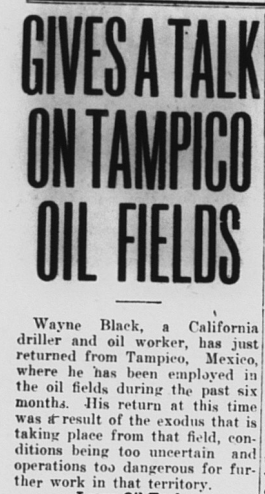
In another article, an American oilman who had fled Mexico because of the Revolution spoke to the Tribune. He was in favor of the United States actually invading Mexico to protect American oil interests. America invade a country for oil? Never!

Here are some excerpts from the article:
That an invasion of the whole of Mexico by the American fighting forces is the only solution of the present international difficulties, is the opinion of R.W. Parkin, who arrived today in Fullerton where he will remain until matters in the southern republic are settled. Mr. Parkin has extensive interests in the oil industry there and left reluctantly. He is connected with the Panice Drilling and Construction company. Panice is situated about 60 miles north of Tampico.
“The feeling of hatred against all Americans is strong as ever in Mexico,” said Parkin, “and before leaving I saw some of their anti-American demonstrations.
Speaking of the oil industry in Mexico, Mr. Parkin stated that the country, in his opinion, contains the greatest supply of oil of any country in the world, and that the ill feeling the natives harbor against Americans is because of the success the latter have met with in developing the industry.
“Practically all the oil wells have shut down since the present trouble has assumed such serious proportions, and the loss in money on this account will be enormous when you consider all the machinery that is lying there idle and will deteriorate rapidly when not cared for. Then, too, there is the fear among all the oil operators that the Mexicans may set fire to the wells or submerge the fields by flooding them with water. The situation is critical.”
World War I
Meanwhile, World War I had begun in Europe. The United States would not officially enter the war until 1917. The Tribune printed numerous articles on this topic.


As is often the case, war was good for American business, in this case oil.


Stay tuned for news stories from 1915!
-
Newspaper Headlines: 1913
The following is from a work-in-progress about the history of Fullerton. You can support my ongoing research and writing on Patreon.
The Local History Room of the Fullerton Public Library has microfilm from the Fullerton Tribune newspaper stretching back to 1893. I am in the process of reading over the microfilm, year by year, to get a sense of what was happening in the town over the years, and creating a mini archive. Below are some news stories from 1913.
Newspaper
Starting in 1908, the Fullerton Tribune became the Orange County Tribune.

Education
In 1913, Fullerton College was established. Today, Fullerton College is recognized as the oldest continuously operating community college in California.

The new college campus started on the newly-built high school campus on Chapman Avenue. This was built to replace the previous high school building on Commonwealth, which had burned down in 1911.


The state of California passed a child labor law which set limits on the number of hours a minor could work, and allowed children to go to work instead of school if the father had deserted the family.

Government
The city purchased a site for a City Hall on north Spadra (Harbor) Blvd.

Oil!
Fullerton continued to be a big oil producing town.


There was some discussion about making oil a public utility, like water or electricity. This, of course, did not happen.


At this time, California was producing one fourth of the world’s oil.

Water
In water news, there was discussion of cementing the path of the Santa Ana river so as to avoid flooding. It’s understandable why they would do this from a safety perspective. However, it’s unfortunate that it would ultimately turn a natural, flowing river into the ugly concrete gulch we see today.

In 1913, Fullerton built a new municipal water system with a pumping plant, a reservoir, and 12 miles of underground water pipes.


Additionally, the city was building a modern sewer system.

Transportation
1913 was a year of large expenditures on public works, including much street paving.


To celebrate the grand opening of his new store Commonwealth, William Wickersheim organized an auto parade downtown. The increasing popularity of cars made more road paving necessary.

Agriculture
Next to oil, Fullerton’s other main export was oranges.


Crime
As far as crime went, perhaps the most exciting thing that happened was a shoot out between some local cops and (alleged) robbers.

Among the lesser crime headlines, I found this one, which means something different in contemporary slang.

Racism
In 1913, the California legislature passed the California Alien Land Law (also known as the Webb–Haney Act), which prohibited “aliens ineligible for citizenship” from owning agricultural land or possessing long-term leases over it, but permitted leases lasting up to three years. It affected the Chinese, Indian, Japanese, and Korean immigrant farmers in California. Implicitly, the law was primarily directed at the Japanese.
It passed 35–2 in the State Senate and 72–3 in the State Assembly. According to Wikipedia, “The law was meant to discourage immigration from Asia, and to create an inhospitable climate for immigrants already living in California.”
The law was the culmination of years of anti-Asian sentiment in California, going back to the 1882 Chinese Exclusion Act.
The Tribune published many racist articles against Japanese immigrants.

Successful Japanese farmer George Shima (“The Potato King” of California) protested against the 1913 Alien Land Law.

A few Japanese farmers in Yorba Linda tried a clever way to (maybe) get around the law. They incorporated as a business (the Y.J. Orange Grove Co.) and purchased land in the name of their company, not themselves.
In his article on this topic, Edgar Johnson writes, “the inquisitive person has not been enlightened as to what the Y.J. part of the company means. There is nothing in the articles filed with the county clerk to show what these letters mean. They may mean Young Japanese Orange Grove company or You Jap Orange Grove company or Yokohama Jiu Jitsu Orange Grove Co. or something else equally as appropriate.”
Homelessness
Like today, homelessness was an issue.

International News
South of the border, the Mexican Revolution raged. This would cause thousands of immigrants to migrate north, to the United States.

Photos and Illustrations
The Tribune includes some interesting photos and illustrations on a wide range of topics. Below are some of them.


Stay tuned for highlights from 1914!
-
How Do I Address Climate Change When Writing About Local History?
The following is from a work-in-progress about the history of Fullerton. You can support my ongoing research and writing on Patreon.
“Someday, perhaps not long from now, the inhabitants of a hotter, more dangerous and biologically diminished planet than the one on which I lived may wonder what you and I were thinking, or whether we thought at all. This book is for them.”
–William T. Vollmann, No Immediate Danger: Volume 1 of Carbon Ideologies
As part of my research into the history of my hometown of Fullerton, California I’ve been reading over microfilm from the town’s oldest newspaper, the Fullerton Tribune. In the early days of the town, in the late 1800s, oil was discovered. For the first half of the 20th century, oil was a major export of the region. Oil derricks dotted the hills north of town, gushers came in and (for a while) produced thousands of barrels of oil a day. By 1912, Fullerton was producing hundreds of thousands of barrels per year. It was (for a while) one of the most oil-rich areas of California.

1909 article from the Fullerton Tribune newspaper. Courtesy of the Fullerton Public Library Local History Room. In the early 20th century, the Fullerton Tribune printed article after celebratory article about another gusher coming in, or about a big oil company buying up land, or how many barrels were being extracted from the local oil fields.
From a civic perspective, oil (for a while) meant prosperity. It meant jobs and wealth and tax revenue for things like roads and schools and irrigation projects, and a police department and a fire department and a city hall. Oil was (for a while) truly black gold.

From a 1901 issue of the Fullerton Tribune newspaper. Courtesy of the Fullerton Public Library Local History Room. Oil was, along with oranges, the economic foundation upon which the town was built up and prospered for decades. From the perspective of someone who lived in the first half of the 20th century, oil was amazing. It was liquid wealth to be extracted from under the ground, piped and shipped all around the country to power American industry and development. It made cars and trucks and ships and factories and farming machines go. Oil was awesome–from the perspective of those who didn’t know about how the burning of it could affect the planet long-term.
Unfortunately, I do. We do, by which I mean those of us living today, in the year 2023. I know what Edgar Johnson, editor of the Fullerton Tribune, did not. I know that the burning of fossil fuels like oil and natural gas produces carbon emissions, especially carbon dioxide, and that this invisible harmless-seeming gas accumulates in the atmosphere and (after a while) creates the greenhouse effect, which today is causing the Earth to get hotter, and this global warming is going to make life on planet Earth a lot more precarious and difficult for everyone, especially our children and grandchildren. I also know that carbon dioxide stays in the atmosphere for between 300 and 1,000 years.
In the year 2023, this global warming (or, to use a less ominous term, climate change) has already begun–causing not just hotter temperatures, but is making life precarious in all kinds of insidious ways–extreme weather events–bigger hurricanes, vast apocalyptic wildfires, sea level rise, ocean warming and acidification, deaths of coral reefs, the melting of permafrost and polar ice caps which releases still more previously trapped gases like methane, which accumulates in the atmosphere and adds to the greenhouse effect–a sort of cascading effect.
The rising sea levels are making life increasingly unlivable in certain coastal and island communities. Unfortunately, it turns out that changes in climate affect whole ecosystems, causing weird migrations and diseases and just really horrible mass dying and even extinction.
Living (as I do) in a wealthy or (to use a somewhat ironic term) developed nation where we’ve gotten really good at hoarding and exploiting resources, it’s possible to feel less impacted by climate change. I don’t live on the island of Tuvalu, which is becoming swallowed by the rising ocean. It’s possible for folks like me to kind of just ignore climate change (for a while).
Climate change is big picture. It is systemic. And thus, because of its scale, it can become hard for us to see. It’s like the David Foster Wallace joke about the wise old fish who swims up to two younger fish, and says, “Morning boys. How’s the water?” To which one of the younger fishes replies, “What’s water?”
But the question I’ve been thinking about as I learn about the oil industry of early Fullerton is: How do I, as a local historian, address climate change? Some might say “You don’t need to.” Why mention a current or future problem when writing about the past? But, to me, sitting alone in the library, reading on microfilm a new article from 1911 in which Edgar Johnson is gushing with excitement and admiration about the hundreds of thousands of barrels of oil being extracted annually from the local oil fields, I feel the opposite of excitement. I feel something verging on sorrow or despair, knowing more than Johnson did about the long game of oil extraction.
I feel it must be somehow acknowledged that the very substance that helped build the town is the same substance that is contributing to our collective demise.
I suppose this same acknowledgement is necessary in coal towns, or towns with lead mines. Fullerton was built on oranges and oil. And oil, to me, is not something to be remembered with nostalgia, and definitely not celebration.
If we knew then, say in 1900, what we know now, namely that oil is a long-term planet killer, would we still extract it from the ground? The answer, I think (unfortunately), is yes. We still have big oil companies today that continue to extract oil in much vaster quantities than their 1900 counterparts, and I (unfortunately) continue to purchase products and services that are made from fossil fuels. Hell, I’m writing these words in a jet airplane which is emitting greenhouse gases so that I can get from one location to another more quickly.
So, when I write about the past, lamenting their ignorance or greed or short-sightedness, I cannot do so from a place of any moral superiority or arrogance. We are in some ways worse than our ancestors. They didn’t know about the greenhouse effect. We do, and continue our extraction and burning.
My only hope in researching and writing about the past is that it may create a space for reflection–on the past, present, and future–where we have gone wrong, and how we might do a little better, if for no other reason that our own survival and those of our descendants, who may not look kindly upon us when they write their own histories.
-
Fullerton Tribune Headlines: 1912
The following is from a work-in-progress about the history of Fullerton. You can support my ongoing research and writing on Patreon.
The Local History Room of the Fullerton Public Library has microfilm from the Fullerton Tribune newspaper stretching back to 1893. I am in the process of reading over the microfilm, year by year, to get a sense of what was happening in the town over the years, and creating a mini archive. Below are some news stories from 1912.
Education
Fullerton’s second high school burned down in 1910, and so a new high school was built on Chapman, where the high school is today. There was some debate over the location of the school, but ultimately the Chapman site was chosen. The new high school opened in 1912.

Politics
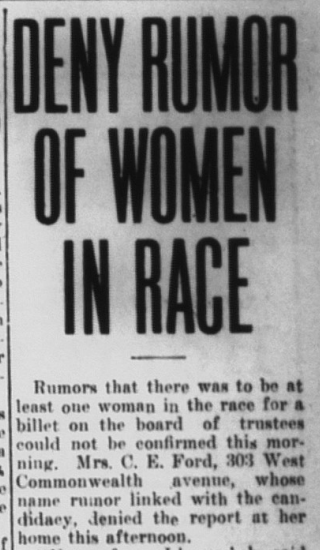
In 1911, women in California got the right to vote with Proposition 4. Locally, Carrie Ford was the first woman to express interest in running for office.

Ultimately, however, she withdrew from the race.

In 1912 there was a small but active Socialist Party in California. H. Gaylord Wilshire, an early developer of Fullerton, was probably the most vocal socialist in California. There were socialists running for local office.


Ultimately, the Socialists were not elected locally. The ones who were endorsed by the Chamber of Commerce won.

Nationally, politics were quite interesting in 1912. That was the year Theodore Roosevelt broke away from the Republican Party to form the Progressive (or Bull Moose) party. His running mate was California governor Hiram Johnson. These progressives were mostly former Republicans who were fed up with the corporate influence on politics, who wanted to make lots of reforms. Eugene V. Debs the Socialist was also running for President. Locally, supporters of these different candidates organized clubs and meetings. Hiram Johnson stopped in Fullerton to speak.


Ultimately, Democrat Woodrow Wilson defeated Roosevelt the Progressive, and Taft the Republican; however Roosevelt narrowly won California.

New Hospital
A new hospital was built at the corner of Pomona and Amerige. This building still stands today, although it is no longer used as a hospital.

Business
An issue of the Tribune highlights local businesses in town like the Benchley Fruit Company, the Brown & Dauser Lumber Company, and Clarence Boardway’s Amusement Hall.


Transportation
In 1912, cars were becoming increasingly popular. In those freewheeling early days of automobiles, there were few safety standards and lots of accidents.


Infrastructure
The City purchased 40 acres east of town, where the Fullerton Airport is today, for a sewer farm.

Deaths & Disappearances
In November of 1911, prominent local businessman Abe Pritchard disappeared in Los Angeles. Several months later, he returned to town with very little recollection of where he had been, or why. Apparently he had simply wandered the country, making it as far east as Florida, before returning back home. Weird.

M. Lovering, a pioneer resident of the Orangethorpe District, passed away.

Joseph Goodman, co-owner of the Stern & Goodman general store, passed away.

Colonel Robert “Diamond Bob” Northam, passed away after being assaulted in his home. Northam was for years the agent of the Stearns Rancho company–which owned and sold thousands of acres of prime southern California real estate. He was a colorful and wealthy local figure.

Crime
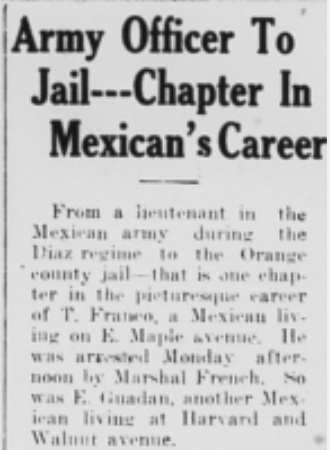
After an Anaheim marshal was shot and killed by a Mexican man, local law enforcement scoured the region searching for the killer. There was even talk of lynching.


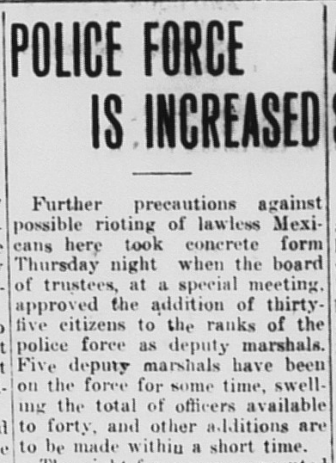
An ordinance was passed with the aim of “separating the bad element among the Mexicans from their guns.” Civil liberties were perhaps not being equally respected.

“It is my desire that all my deputies should enforce this ordinance at every instance, and especially among the Mexicans. It will be your privilege and duty to search every man you suspect of carrying a concealed weapon, and if found to bring him to the county jail, at the expense of the county,” OC sheriff Charles Ruddock stated.
In other crime news, a rancher named Gerorge Biggs brutally slayed his neighbor F.A. Montee and his wife in a debate over a strip of roadway. As far as I can tell, there was not a similar effort made by law enforcement “to separate the bad element among the whites from their guns.”

Oil!
Oil development continued in the fields north of Fullerton. At this time, oranges and oil were the main exports of Fullerton.


Homelessness
As it is today, homelessness was a social problem in Fullerton.

Labor
In labor news, members of the Industrial Workers of the World (or “Wobblies”) passed through Fullerton, spreading their message of working class solidarity. They were viewed with suspicion, fear, and hostility.


Meanwhile, the workers building the new high school went on strike, so the contractor brought in black workers to finish the job.

Religion
Maria Bastanchury, wife of pioneering sheep rancher turned citrus grower Domingo Bastanchuy, donated land to build the town’s first catholic church, at the southeast corner of Commonwealth and Malden.

Stay tuned for headlines from 1913!
-
Fullerton Tribune Headlines: 1911
The following is from a work-in-progress about the history of Fullerton. You can support my ongoing research and writing on Patreon.
The Local History Room of the Fullerton Public Library has microfilm from the Fullerton Tribune newspaper stretching back to 1893. I am in the process of reading over the microfilm, year by year, to get a sense of what was happening in the town over the years, and creating a mini archive. Below are some news stories from 1911.
Women’s Suffrage
1911 was an important year for democracy in California, as that was the year Proposition 4 passed, which granted women the right to vote. Note that this was fully 9 years before the passage of the 19th Amendment, which gave all women in the United States the right to vote.
Of course, not everyone was in favor of granting women the right to vote, as this advertisement in the Tribune demonstrates:

In the leadup to the vote, there were large gatherings on the issue of women’s suffrage, including in Fullerton.

Ultimately, Prop 4 passed, and women were allowed to vote in California.

Prohibition (again)
In just about every election cycle since Fullerton incorporated in 1904, petitioners put the liquor question on the ballot. With the large number of women registered to vote, the town voted (once again) to ban liquor licenses, thus making Fullerton a “dry” town.

Other Progressive Reforms
In 1911, the California state government was led by progressive Republicans like governor Hiram Johnson, who passed a number of reform laws, such as an 8-hour work day for women, free textbooks for public schools, and the petition, recall and referendum (which was approved by a majority of voters).

Of course, some business interests were not happy about the 8-hour day.


In 1911, there was a movement for U.S. Senators to be elected by popular vote. This would eventually become the 17th amendment. Prior to this, the U.S. Constitution stated that U.S. Senators were elected by state legislators. It’s interesting to remember that our Constitution is not “set in stone” and has been changed many times, as times change.

Education
In 1910, Fullerton’s second high school burned down. In 1911, Fullerton voters approved a bond measure to fund the construction of a new high school. There was some debate over the location. Ultimately, the site was chosen on Chapman Ave. where Fullerton High School is today.


Infrastructure/Utilities
The Southern California Gas Company was buying up local gas companies and consolidating their power.

When voters approved bonds for the high school, they also approved bonds for road and bridge improvements.

The Edison Company installed better electric street lighting downtown.

Agriculture
Charles C. Chapman was elected to the Citrus Protective Association, whose primary purpose was to lobby the government for tariffs on foreign citrus imports, so that local growers could compete. Not exactly “free market” capitalism, but there was much about the citrus industry that was not quite capitalistic, like the grower cooperatives (such as Sunkist).

Housing
Edward K. Benchley, a citrus grower, was also becoming a housing developer.

Racism
Anti-Asian racism was quite commonplace.

There was even talk of Japanese exclusion.

International Affairs
South of the border, the Mexican Revolution had begun.

Oil!
Large oil companies like Standard Oil and Union Oil were buying up properties of smaller local companies in the Fullerton Oil fields.


The New Town of Brea

National News


The Disappearance of Abe Pritchard
Prominent Fullerton businessman Abe Pritchard disappeared in Los Angeles (he would eventually be found).

“Diamond Bob” Northam’s Divorce
Colonel Robert “Diamond Bob” Northam was a colorful Orange County figure who was manager of the Stearns Ranchos company, and had an office in Fullerton for many years. Chapman Avenue was originally called Northam Avenue. In 1911, his wife Leotia sued him for divorce, stating that she was fed up with his drunkenness.

The Tribune paints an interesting picture of Diamond Bob: “He is now 65 years of age and a millionaire manufacturer and is widely known as a princely spender, bon vivant and general good fellow…Colonel Northam is a pioneer, coming here in 1870, and today, in addition to the manufacturing business at 110 West Twelfth street Los Angeles, has large realty holdings, including the beautiful country place, Los Robles Viejos at Santa anita, one of the well known show places of the big county.”
He had married his wife 10 years prior when he was 55. She was just 20, an aspiring actress.
Mrs. Northam said, “No one could have treated me better than Bob in every way…dresses, jewels, a beautiful home–I had all that heart could desire. But his constant drinking drove me to distraction…He is his own worst enemy and was fast becoming mine.”
Miscellaneous
Here are some random articles/clippings that I found interesting.


Stay tuned for headlines from 1912!