The following is from a work-in-progress about the history of Fullerton. You can support my ongoing research and writing on Patreon.
On December 22, 1977, a little more than three months before he died, Otto Evans, who owned a candy store in downtown Fullerton for nearly 40 years, was interviewed by C. Dean McComber. In a brief preface to the interview, McComber writes, “The elderly are not always treated with the respect they are given in other countries. I hope I have created an interview that shows that an 85 year old man did have a greater knowledge because he lived a full life. He was full of wisdom, love, and caring traits everyone admired. We can all learn something from a man named Otto.” Below are some excerpts from this interview.
I am originally from Missouri and moved to Fullerton in 1913. My parents and I put up a store at Amerige and Harbor [Spadra] in those days and I ran that from 1913 to 1940.

When I was running the confectionary, I used to put the game scores on the window and there would be two or three hundred people looking at the scores until midnight. There was not television or radio in those days. I’d call into the Los Angeles Times or the L.A. Examiner and get the scores of whoever was playing and put them on the windows in whitewash.
In those days…there was a big rivalry between Anaheim High School and Fullerton High School, Santa Ana Junior College and Fullerton Junior College…they’d come through town after their games and throw tomatoes at those windows with the scores on them.

Thanksgiving Day games between Santa Ana Junior College and Fullerton Junior College drew the crowds. Our old stadium was just packed. People were standing all around it. As many people standing in the field as there were in the stands. They drew crowds!
They used to have parades in town; Armistice Day (something they don’t have any more) was a big thing.
When I sold my cafe in 1945–Fullerton and Anaheim–10,000 people; now we’ve grown to 100,000, and Anaheim 200,000.
Inside the store those days high school kids would come in, great big football players, professors and preachers…it was the meeting place for everybody in town.
The El Camino Real bell that you find going from mission to mission I had in front of my store, and it’s still there.
The Athertons used to come in my store all the time. They had a big home with cages outside for ostriches about where the church–St. Juliana’s–is. They raised ostriches as a hobby I guess, but I suppose they sold some too. It was one of the attractions of Fullerton.

The Bastanchurys used to drive down the street in front of my store and put their horses or mules out in front and get a drink. There weren’t automobiles like there is today, so you’d just put the horses outside…The Bastanchury’s had a ranch of a about a couple thousand acres. Every bit of Sunny Hills was all the Bastanchury’s.
One day Louie Plummer [principal and superintendent of Fullerton High School] and Wally Mardsen came down to my store in the morning and saw all these hobos inside. Those bums would stay in the packing houses or boxcars and come up Harbor and you could smell them from across the street. I’d get them in my store and get a bunch of beans and hot water to make the beans thin and I’d get some bread for them. Louie Plummer and Wally Mardsen asked, “What are these men doing in here, how did they get in here?” I said, “I called them in. Fed them. I do that every morning.” First thing I did before a customer even came in.

I’ve been a charter member of Kiwanis since 1921 and was president in 1931.
What are some of the accomplishments that Kiwanis have done that you feel were most important?
We built a home for a little lady whose husband was killed at the Santa Fe railroad (down off Harbor and the railroad crossing) and she was raising a family of about four or five children, which we practically put through school.
We put wading pools and swimming pools in for the city. We went down to the Boy’s Club building and painted the whole thing.
I started a Salvation Army Board…I put Molly Thatcher on, she was head of the grammar school, I put Bob Ward and Louise Johnson on, she was in PTA, and all your lady organizations, and Chuck Davis, and Bob White, over at the police department, and Dr. Pettis.
Then I started ringing the bell on my own. I just got these little ol’ bells and a tripod and a kettle and went down to the Post Office–Commonwealth and Pomona–for the first 20 days. Not one person on the board would come down. A couple of Union Oil men who stayed at the California Hotel would relieve me, and then my wife would come down and relieve me for lunch. I’d stand down there 8:30 in the morning to 5 o’clock that first year. The second year I did the same thing. Pretty soon everyone wanted to help me. The third, fourth, and fifth year, my goodness sakes alive, it began to spread out, with the churches, a few little industries, and a few others. That took the responsibility off my shoulders.
I’d say for 12 to 15 years, since we’ve had the four post offices, we’ve had a hundred agencies help ring the bells.
Are you still in charge of the salvation bell ringing?
Yes, I am, but I try every year to give the job to someone else, but I always seem to end up in charge of it.
Were you in World War I?
I was in the Navy on the U.S. Seattle as a gunner for a year and then got a discharge. [During the war he got a young man named Bob Timmons to run the store.]
How did the Depression affect you?
With me running a store, meat and everything was scarce. To keep the store open, I’d go to the grocery stores and get as much meat as I could get. Candy, sugar, everything was scarce.
Did you have any problems with the Ku Klux Klan back then?
A man that was in one of my clubs, Dan O’Hanlon, went down to the City Hall where they were having a gathering. He got up and told them that he didn’t believe in them and how wrong they were. It never got really organized, but at one time it was in the schools, churches and everything. You were either for it or against it, but it finally petered out.
Was politics always a big issue in Fullerton?
Always has been, and always will be…some of the best citizens have been hurt in school politics, Orange County politics, national politics. I’ve got a birthday card from Pat and Richard Nixon, and here they are living in San Clemente by themselves…They both used to go to school around here.
I’ve got cards from Babe Ruth and from governors, a lot of people. Babe Ruth and Walter Johnson used to play baseball out at Brea.
We’ve had many good citizens; take Mr. C.C. Chapman. My wife worked as a private secretary for Mr. Chapman for all his business life in Fullerton.
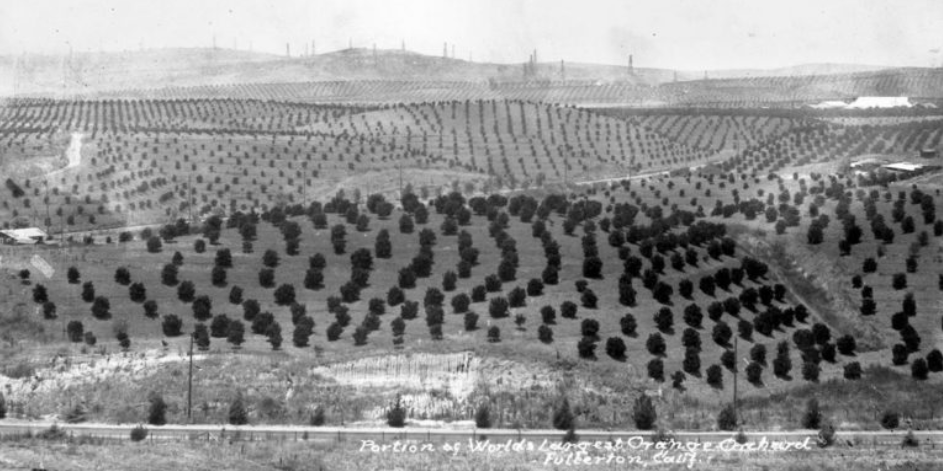
Down by the Santa Fe railroad track they had a Mexican camp to pick oranges. They had maybe three or four hundred Mexicans here to pick oranges. You couldn’t have got them picked otherwise because local people just wouldn’t get in there and pick the oranges.
We had thirteen packing houses here and they were all thriving, but now there’s only one packing house in town. The whole situation has changed and life has changed.
We’ve had floods come through here. [During the 1938 flood] the water came down through Anaheim. Dr. Nelson and his wife Ruth came up here and stated a week with us because of the damage.
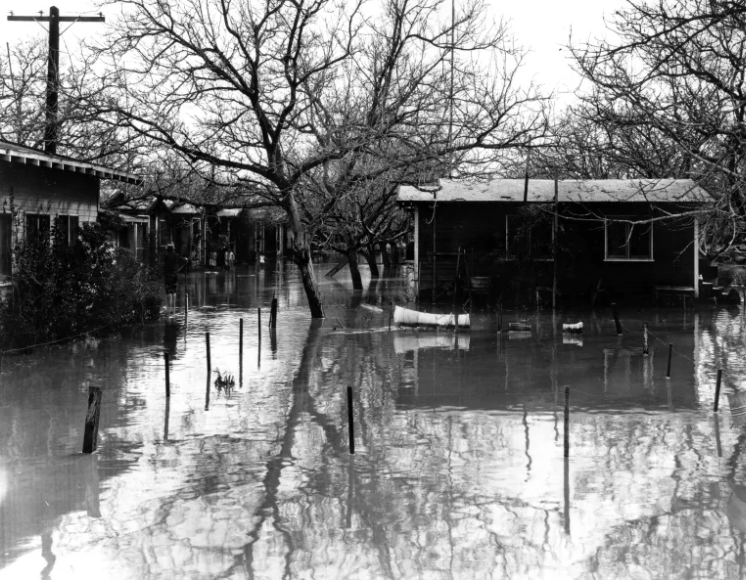
I was always a Legionnaire since World War I, so the Legionnaires got trucks and hauled people to safety. We took them to dry spots, like churches and clubs until the water receded.
We had some big packing house fires. We had a lot of bums come through Fullerton so the fires were probably started from cigarettes.
That Long Beach earthquake of 1933, my goodness sakes alive, shook me right out of my store. I jumped over my fountain and went out in the street. It didn’t shake any of our buildings down though, but in Long Beach they lost a lot of lives.
I had a car accident the 28th of June, 1976. They took me to the St.Jude Hospital, and my shoulder and five of my ribs cracked. It took a while getting over it, but I got hundreds of cards from everybody in town. The News Tribune wrote a card that said, “Get well soon, you’re needed.”
 Fullerton History
Leave a comment