The following is from a work-in-progress about the history of Fullerton. You can support my ongoing research and writing on Patreon.
The Local History Room of the Fullerton Public Library has microfilm from the Fullerton Daily News-Tribune newspaper stretching back to 1893. This year, thanks to a grant, I became a part-time library employee and my job is to digitize the microfilm archives of the News-Tribune.
After I finish digitizing a year, I’ll skim over every issue and create a mini archive of top stories, as research for my own local history project. I’m currently up to 1956.
This year took me a while because by the mid-50s, the News-Tribune was a substantial daily paper with a circulation of around 10,000. Each issue was between 16 and 36 pages. This means that I had to skim over around 6,000 pages! Below are some top stories from that year on such topics as growth, housing, civil rights, the Cold War, politics, culture, and more. Enjoy!
Growth
Fullerton continued to experience phenomenal postwar growth. A census listed the local population at 43,414.

The city was also expanding its borders with the annexation of 300 acres north of town.

Water
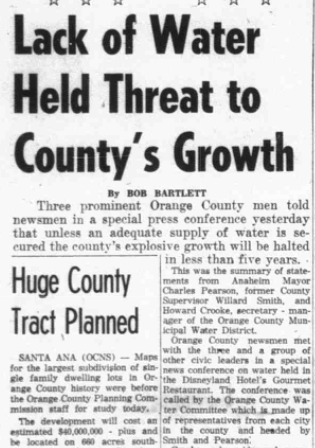
Countywide growth prompted local leaders to seek additional water sources, such as from the Colorado River (via the Metropolitan Water District), and to improve flood control measures.
Housing
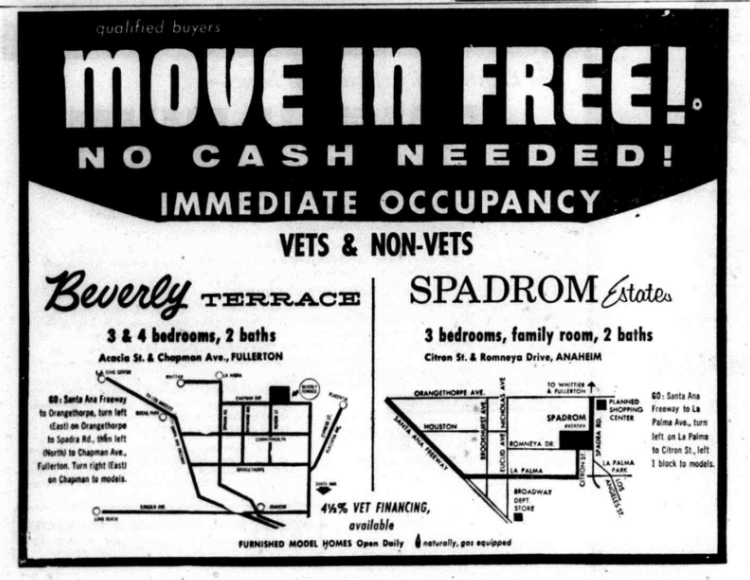
New housing subdivisions were advertised in the pages of the News-Tribune. In the mid-1950s, housing was much more affordable than it is today. For example, veterans could get homes with no money down. The ad below offers houses starting at $4,245. Adjusted for inflation, that would be about $52,000 in 2026 dollars. Today the median home price in Fullerton is around $1 million. The point is that, for those living in the 1950s, homeownership was a much more accessible dream than it is today.

New housing subdivisions were springing up all over Fullerton. On the more expensive end, homes were going for around $17,000, which is about $184,00 in today’s dollars. Today homes such as these can go for up to $2 million.
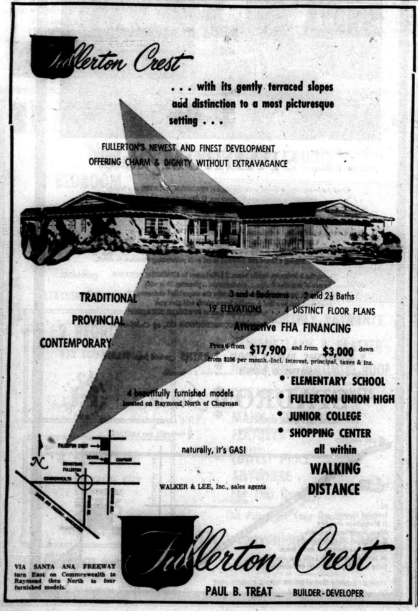
Homes were affordable due to their increasing supply and because of generous FHA (Federal Housing Administration) loans.
Civil Rights
Not everyone was equally welcomed into these new neighborhoods. When an African American family moved into a “white” neighborhood in Placentia, local racists threw two molotov cocktails into the window of their young children’s room. Nobody was hurt, but a message was sent. Below is an article in the News-Tribune about the indecent:

Throwing of two “molotov cocktails” last night has not altered the determination of Gerald Harris, 433 Missouri, to occupy the home he has purchased. Harris, head of the first Negro family to move into the area, stated that he is “not going to let a few hoodlums” chase him out.
Police Chief A.E. Simmen this morning pledged “every effort–24 hour duty if necessary” to the apprehension of the criminal or criminals involved. One of the homemade bombs exploded in a small bedroom occupied by two of Harris’ daughters about midnight last night. The other landed in the front yard.
A bedspread serving as a temporary drape enfolded the bomb and held the damage to a minimum, and the girl, Jean Ann, 15, and Pamela, 10, were not injured.
Simmen has called for assistance from the Orange County sheriff’s office and the district attorney’s investigative staff in solving the vandalism. “To me it’s one of the worst things I’ve ever encountered. It’s downright low,” Simmen said.
Harris explained that he feels it is just one or two people acting against him, and that his neighbors have been friendly and helpful, without exception. He added that when the family moved in Sunday there were several carloads of neighbors waiting to assist them, and the neighbors have given his family fruit, flowers, and food as well.
Simmen said the bombs were gasoline-filled wine bottles with flaming wicks. Patrols had been eased off in the area, since Wednesday, when things quieted down after an earlier act of vandalism against the home, before Harris, his wife and seven children moved in.
With only six officers and two patrol cars serving a 3,000 population Simmen said he had been unable to keep heavier watch on the area. Harris’ home and another sold to a Negro family were hit ast week by vandals, who cut up rugs and poured cement into all the plumbing.
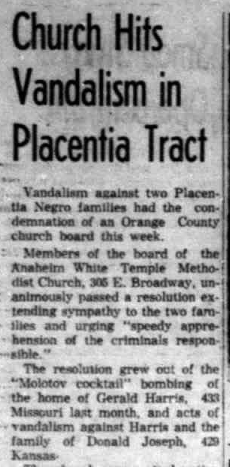
A local church and a union took a stand against the racial violence.
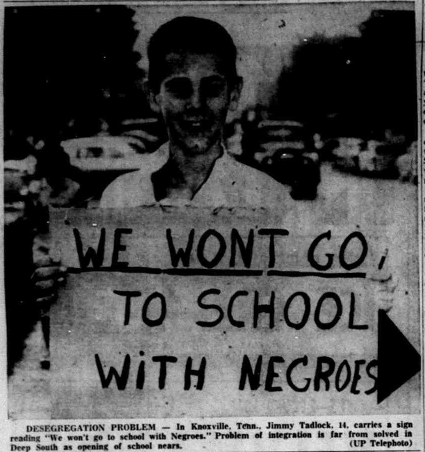
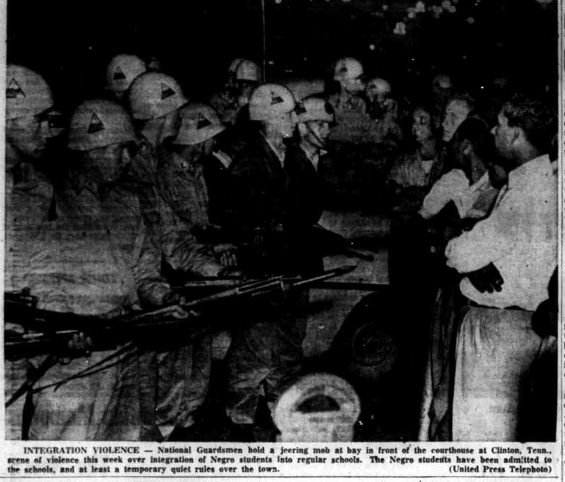
Speaking of civil rights, 1956 was a particularly fraught year for racial equality in the United States. The landmark 1954 Supreme Court case Brown v. Board of Education declared segregation unconstitutional. It was met with an enormous backlash in the South. Throughout 1956, the pages of the News-Tribune are filled with articles about white people (mostly in the South) pushing back against integration, sometimes with violence.
Industry
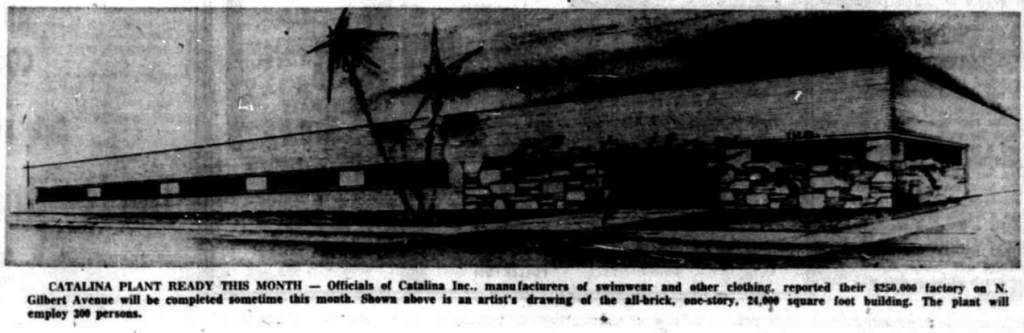
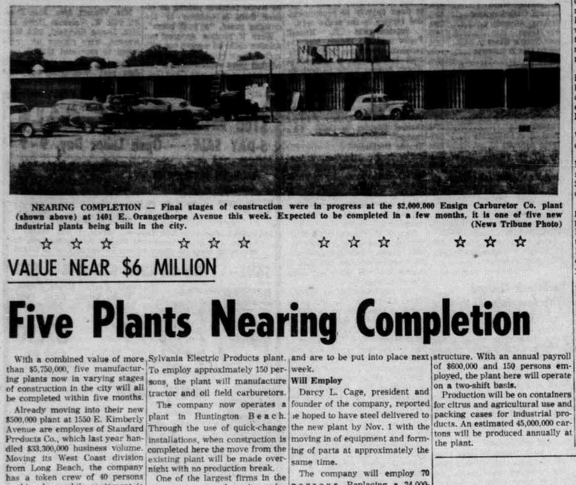
In addition to new housing, new plants were being built in Fullerton’s industrial areas.

Business
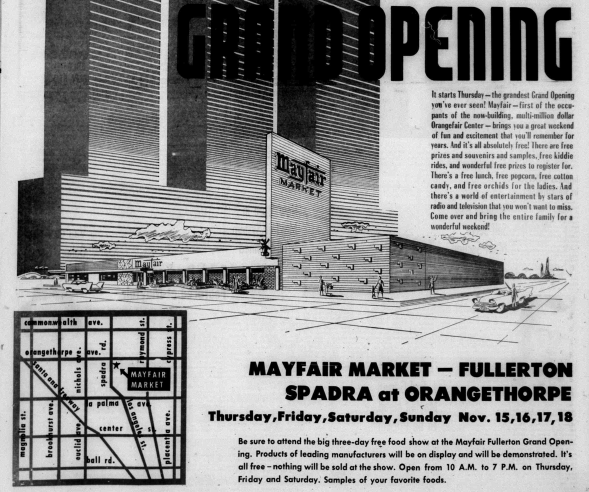
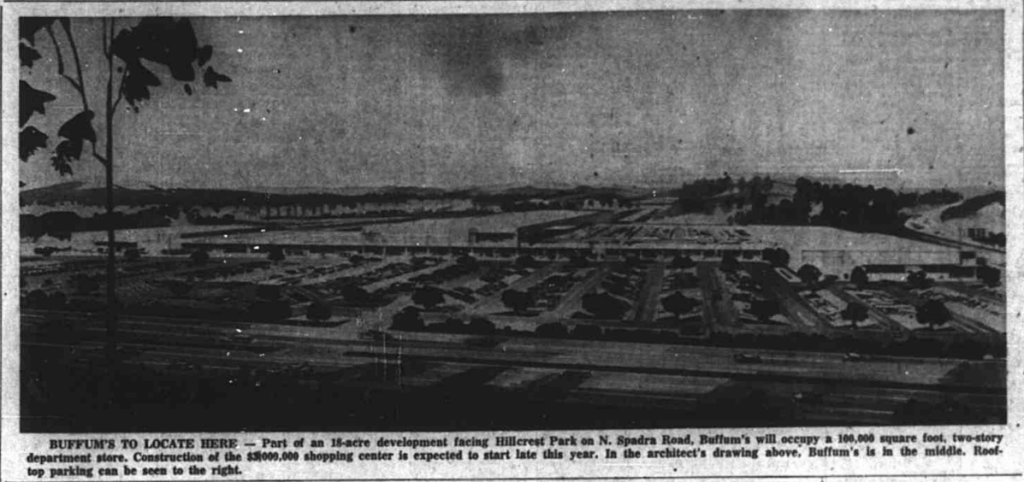
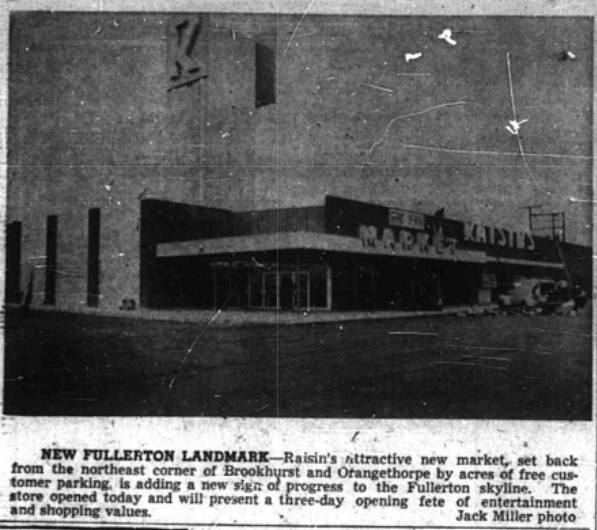
In addition to new housing subdivisions and industrial parks, large new shopping centers were built on former orange and walnut groves, like the Mayfair (on Orangethorpe), Alpha Beta (on Raymond), Buffums (on Harbor, now a Ralphs), Raisin’s, and more.
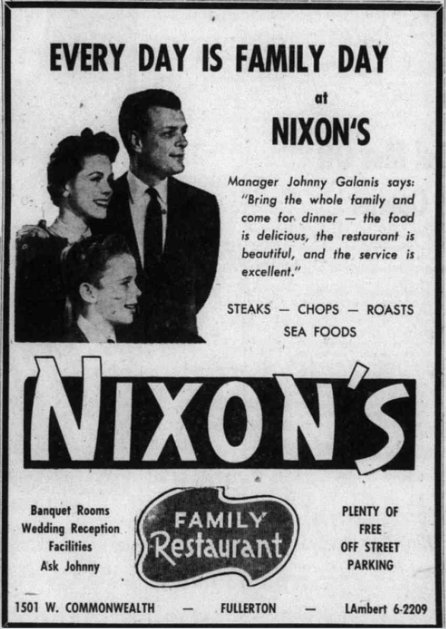
Richard Nixon’s brother Don opened a popular family restaurant/bakery called Nixon’s on Commonwealth Ave.
Religion
In religion news, a Fullerton pilot named Nate Saint with a ministry called Mission Aviation Fellowship was killed by indigenous people in Ecuador.
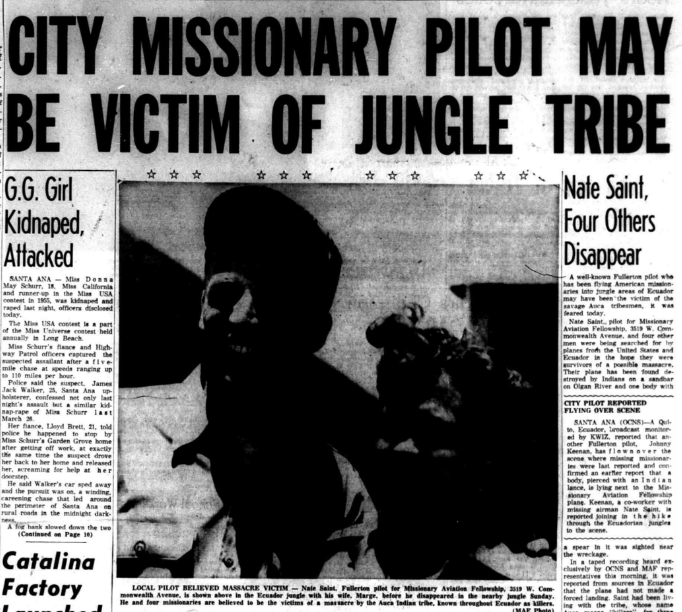
Saint was killed with another famous Christian missionary named Jim Eliot. Their story was eventually made into a movie called End of the Spear.
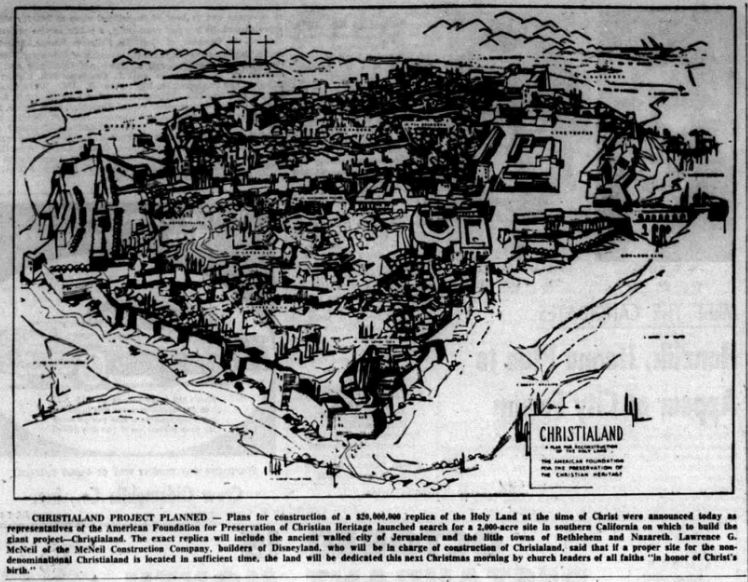
In other religion news, a new amusement park called Christialand was being planned, perhaps to rival Disneyland.
Sports
Local high school and college football games were hugely popular community events in the 1950s.
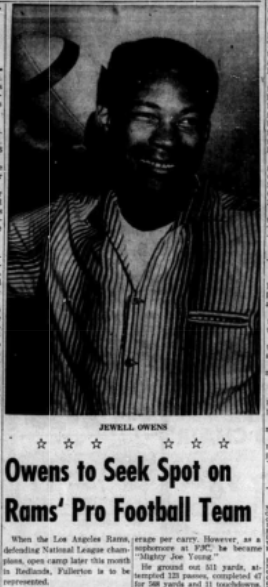
A prominent African American family in Fullerton, the Owens family, produced a number of champion athletes, some of whom went on to careers in professional sports.

Politics
Richard Nixon, who was from Yorba Linda, attended Fullerton High School, and had a law practice in La Habra, was re-elected Vice president of the United States, with Dwight Eisenhower as president.
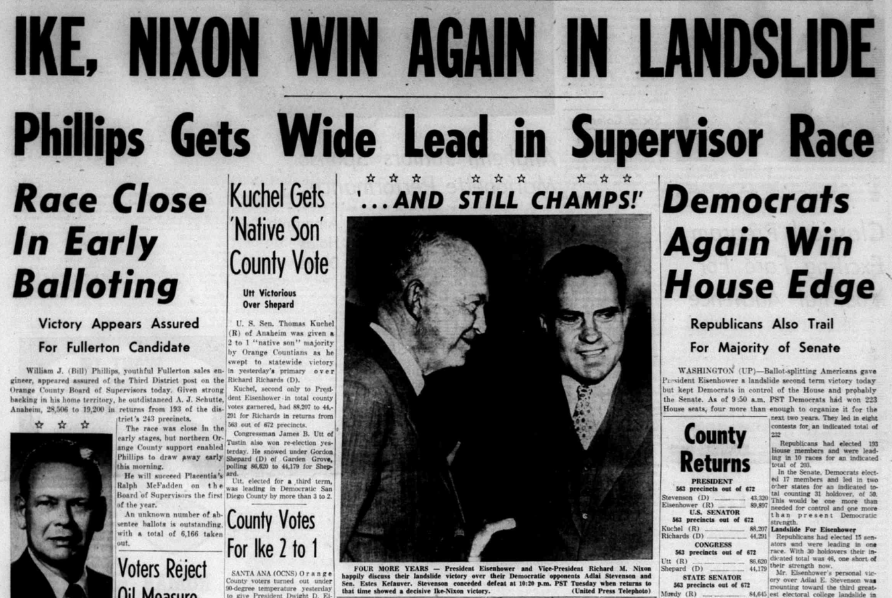
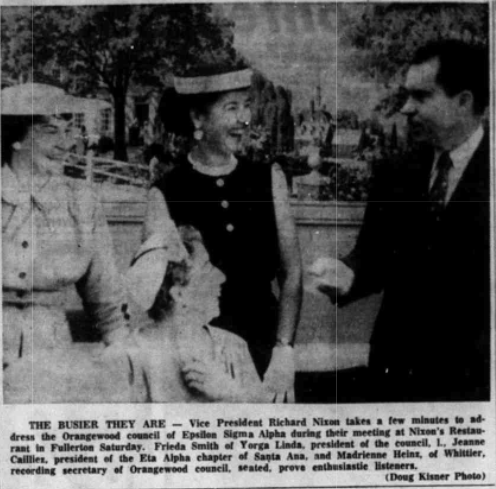
During the campaign, Nixon visited Orange County a few times, sometimes at his brother’s restaurant.
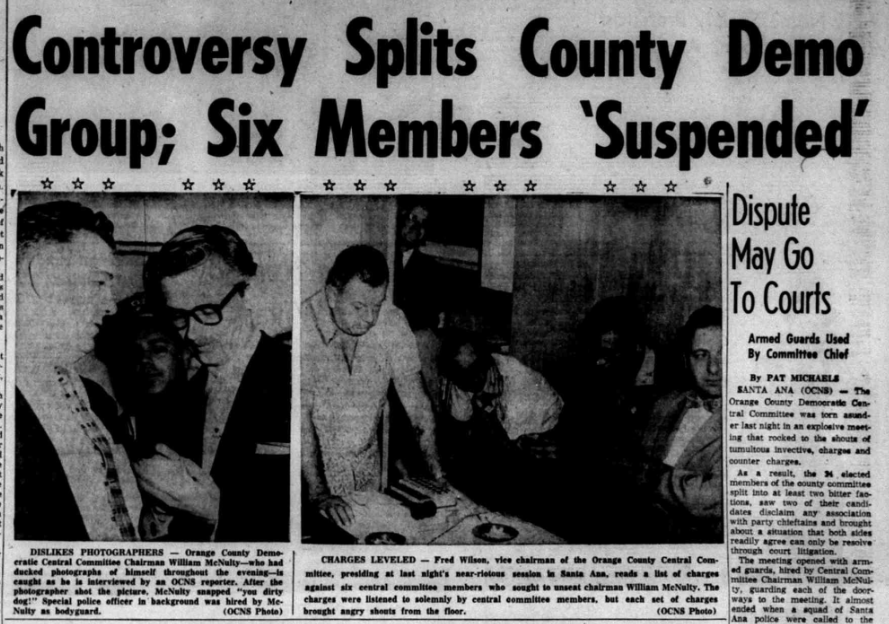
At this time, in the mid-50s, Orange County (including Fullerton) was a majority Republican place. The Orange County Democratic Party was fractured by scandal when its chairman allegedly misused party funds.
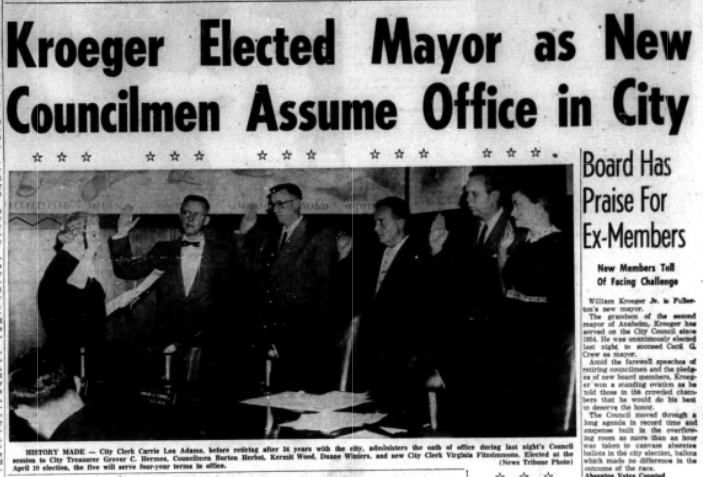
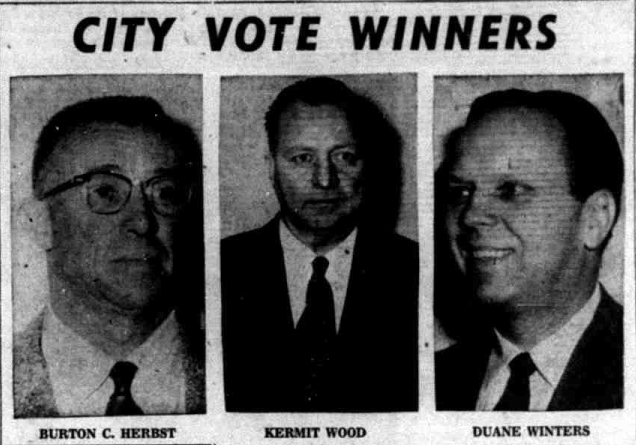
In the 1956 Fullerton City Council race Burton Herbst, Kermit Wood, and Duane Winters were elected. William Kroeger was chosen as mayor.
Transportation
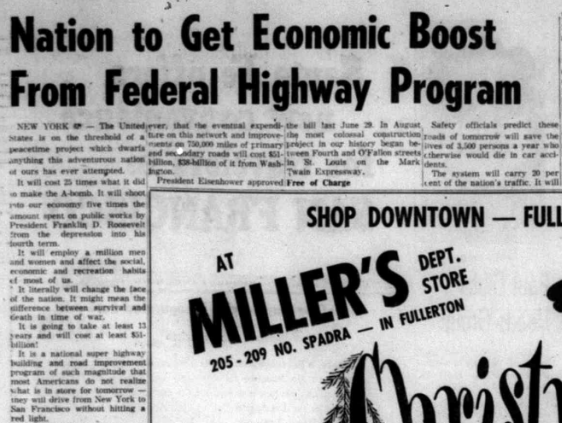
In 1956, President Eisenhower signed the Federal Aid-Highway Act, which created the modern American Interstate Highway System and dramatically improved automobile travel around the United States.
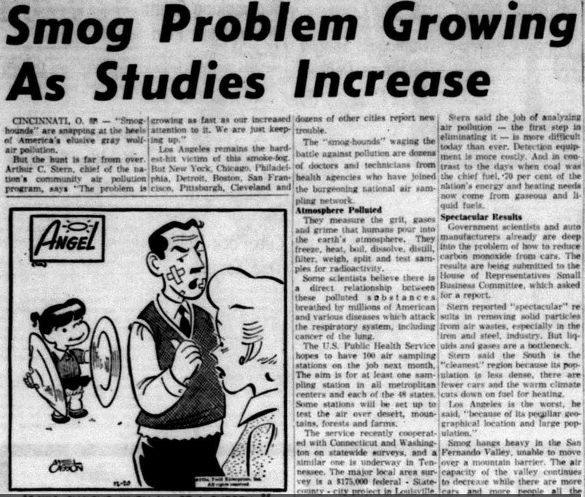
In other transportation news, Southern California was a victim of its own growth, as new cars and industries produced more pollution in the form of smog.
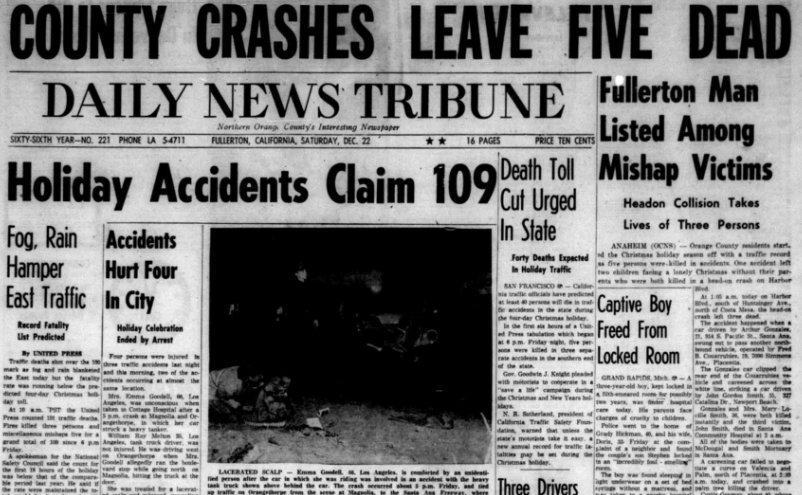
In the 1950s, there were very few car safety laws. Seatbelts were not required until the 1966 National Traffic and Motor Vehicle and Safety Act. Consequently, nearly every issue of the News-Tribune includes stories of deadly car crashes.

The Cold War
In 1956, the Cold War between the United States and the Soviet Union was in full swing, with the arms and space races.

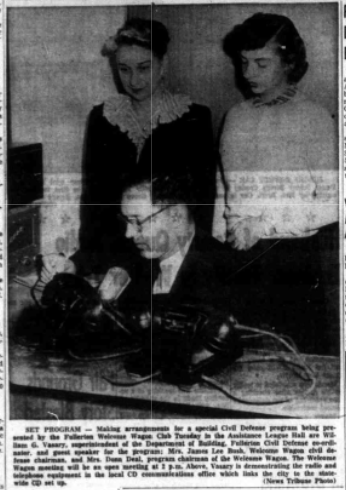
Locally, Fullerton (along with most towns) had a civil defense program aimed at protecting the community in the case of a Soviet attack, nuclear or otherwise.
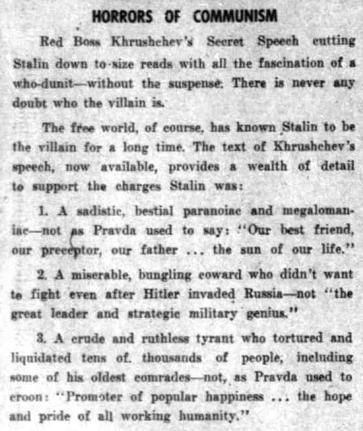
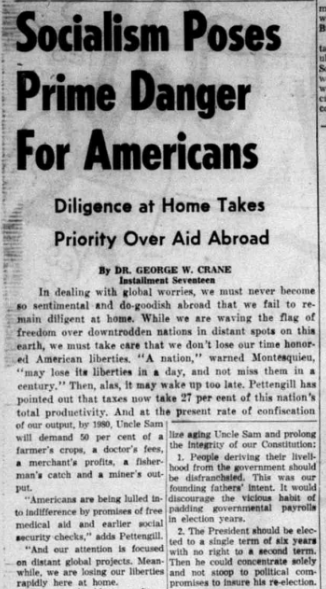
Articles and editorials in the News-Tribune blasted the “horrors of communism.”
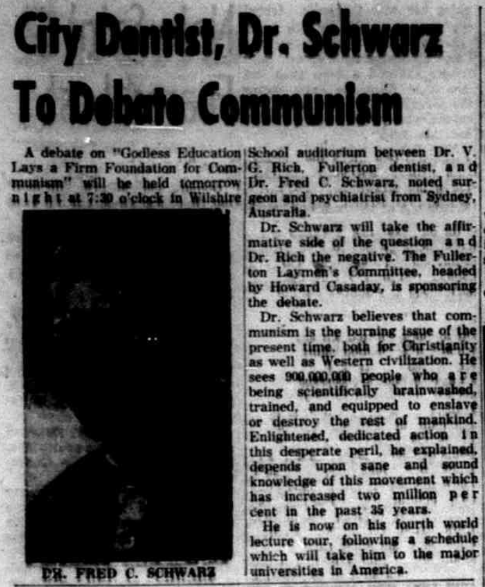
And speakers at local forums discussed and debated the communist threat.
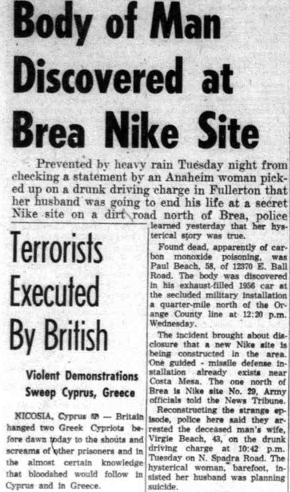
The discovery of a dead body in Brea revealed the presence of a Nike missile site.

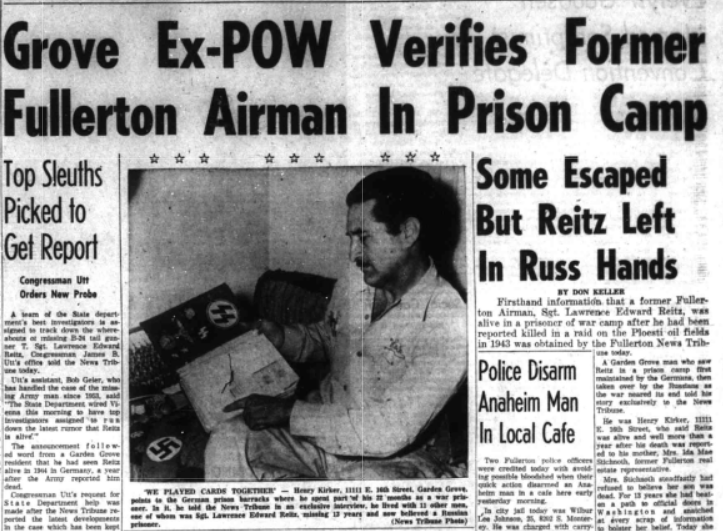
Fullerton airman Lawrence Reitz was reported missing in action and was supposedly being held in a Soviet prison camp.
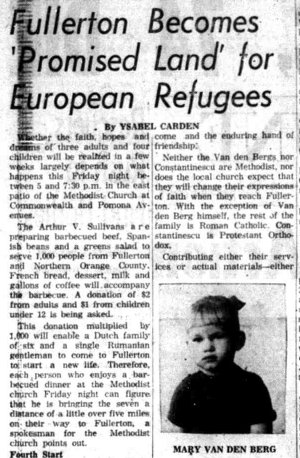
Some refugees from communist countries in Eastern Europe settled in America.
Culture & Social Life
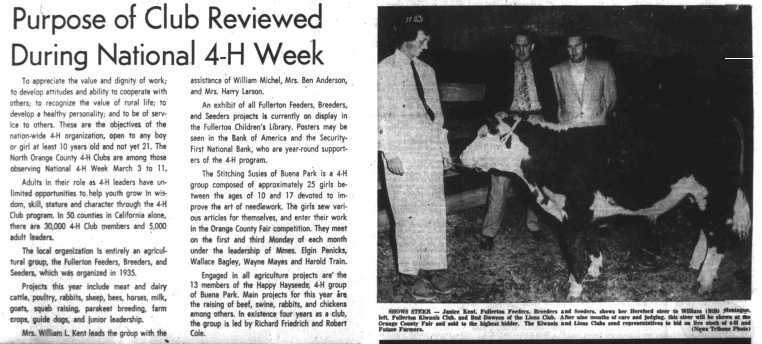
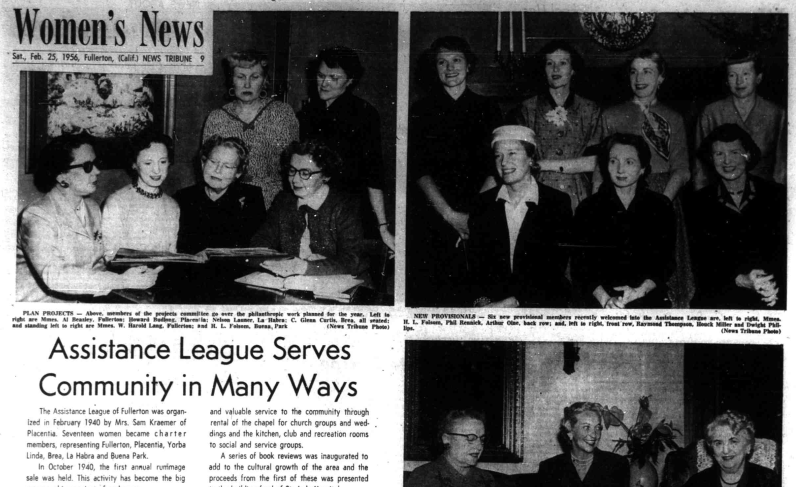
In the mid-1950s, Fullerton had a host of social groups such as the Masons, Welcome Wagon club, Native Sons, Kiwanis, Odd Fellows, Ebell Club, Knights Templar, Elks, Assistance League, Soroptomist Club, 4-H, YMCA, YWCA, and others.


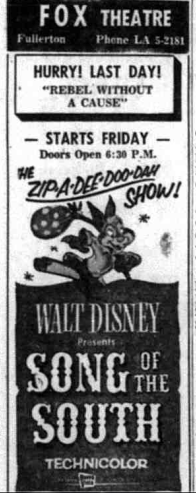
For entertainment, Fullertonians went to see movies at the newly-renovated Fox Theater.
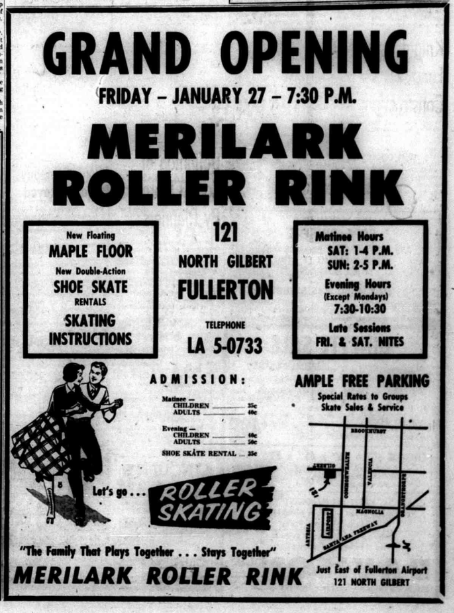
And a new roller rink opened in town.
Education
Growth prompted an increase in school enrollment. Commonwealth Elementary School opened, and Fullerton Junior College was expanded.

Gender Roles
Gender roles were famously more rigid in the 1950s. Women were generally expected to take care of children and household duties.
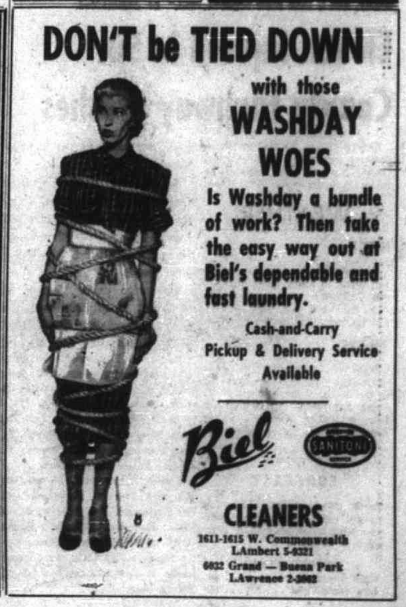
That said, the News-Tribune had a recurring feature called Women at Work, which chronicled local women in the workforce. One woman who was featured was Betty Masukawa, whose story is notable not just for the fact that she worked outside off the home, but because (as a Japanese American woman) she had been forced to leave town during the war years and live in an internment camp in Arizona. After the war, she returned with her family to Fullerton.
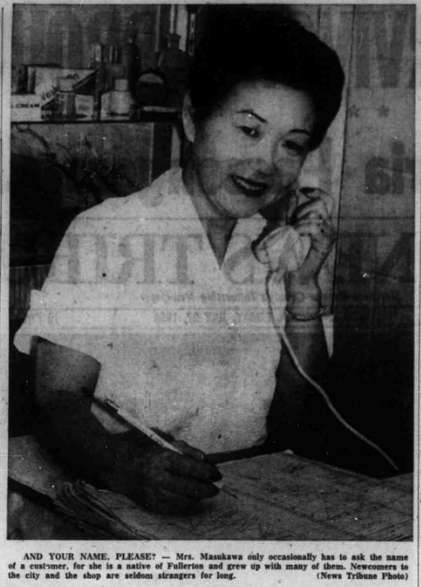
“A full life for Mrs. Mae (Betty) Masukawa means more than pots and pans and a scrubbing brush,” the News-Tribune reported. “Since October she has been manager of the She-She beauty salon on W. Amerige for her brother-in-law, Shim Masukawa. Before that she spent three years as receptionist for another local beauty salon.”
The article does not ignore her internment experience: “The war years brought a disruption to her life. Swiftly and suddenly she and her family found themselves in Arizona at the Poston Relocation Camp. They were not completely wasted years, nor particularly frustrating to Mrs. Masukawa, for she was able to take a year’s beauty course there and was also appointed police matron for her camp.”
As police matron of the camp, “It was Mrs. Masukawa’s duty to iron out domestic squabbles which flared, give advice, help in any way she could to keep the peace making taught her a lot about people and their problems.”
Betty had grown up in Fullerton, the daughter of Mr. and Mrs. K. Oba, who were Northern Orange County ranchers, “loved and respected by many Fullerton families.” She attended both high school and junior college in the city.
Betty was a charter member of the newly organized Business and Professional Women’s Luncheon Club. She lived at 1014 E. Commonwealth Ave.
Agriculture
Although acres of orange groves were being plowed under to accommodate new housing subdivisions, shopping centers, schools, and industrial parks, the citrus industry was still fairly strong in the 1950s.
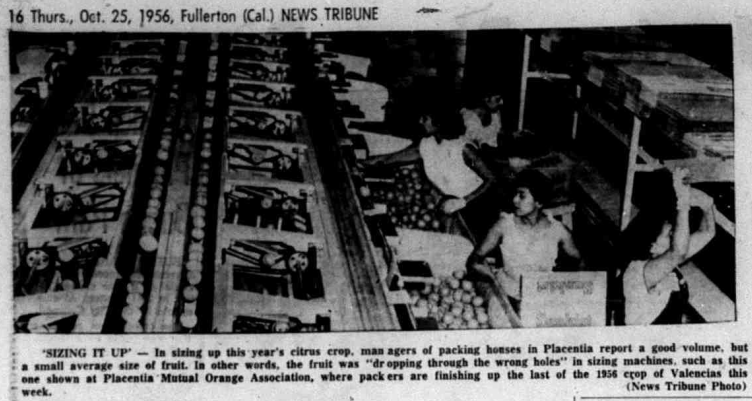
For decades, the vast majority of the orange crop was harvested by Mexican and Mexican-American workers, many of whom lived in segregated work camps, sometimes called “colonias.”
The News-Tribune includes an article about a visit by the vice consul of Mexico visiting and inspecting a large Mexican labor camp in Fullerton called the Raymond National Camp. Below is the article:
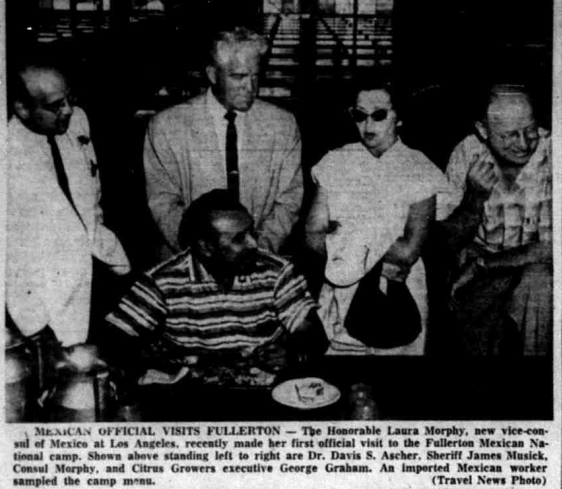
Raymond National Camp was given a clean “bill of health” this week during a visit here by the Los Angeles vice-consul of Mexico.
The Honorable Laura Morphy, the official in charge of the protection of her countrymen in southern California, was accompanied by Dr. David S. Ascher, prominent Orange County physician, and Sheriff James A. Musick. They were guests of George Graham, Citrus Growers Inc. executive.
An inspection was made of the camp, valued at more than $500,000, located at 501 S. Raymond Avenue. It is the model camp that has been inspected by high governmental officials from the Orient and Europe.
Recently assigned to this area, it was the vice-consul’s first official call on Orange County. The trip was made during the height of the “imported worker” season, with 2,500 such workers in the seven camps under Graham’s question. In 14 years he has brought more than 35,000 Mexican agricultural workers into the county.
Dr. Ascher reported that “during the brief period the nationals are housed at this type of camp there is an average gain of 20 pounds per man.” Conferring on health problems, he said that early high rate of intestinal illness found in the first few thousand Mexicans brought here in the mid-40s has been greatly reduced through “a diet similar to that of the old homegrown.”
Health Care
Plans were in the works to built St. Jude Hospital, which would open in 1957.
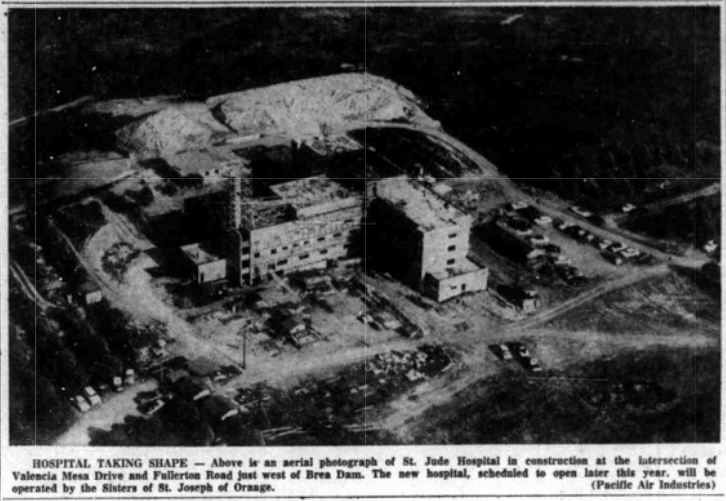
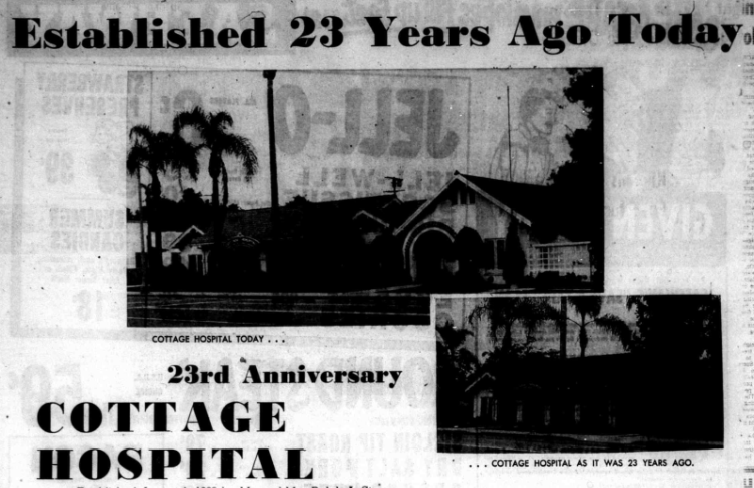
This was a major improvement on the existing hospital facilities.
Stay tuned for top stories from 1957!

