The following is from a work-in-progress about the history of Fullerton. You can support my ongoing research and writing on Patreon.
In my quest to better understand the larger context of my local (Fullerton) history project, I like to read books about California history more broadly, and then write book reports on what I learn.
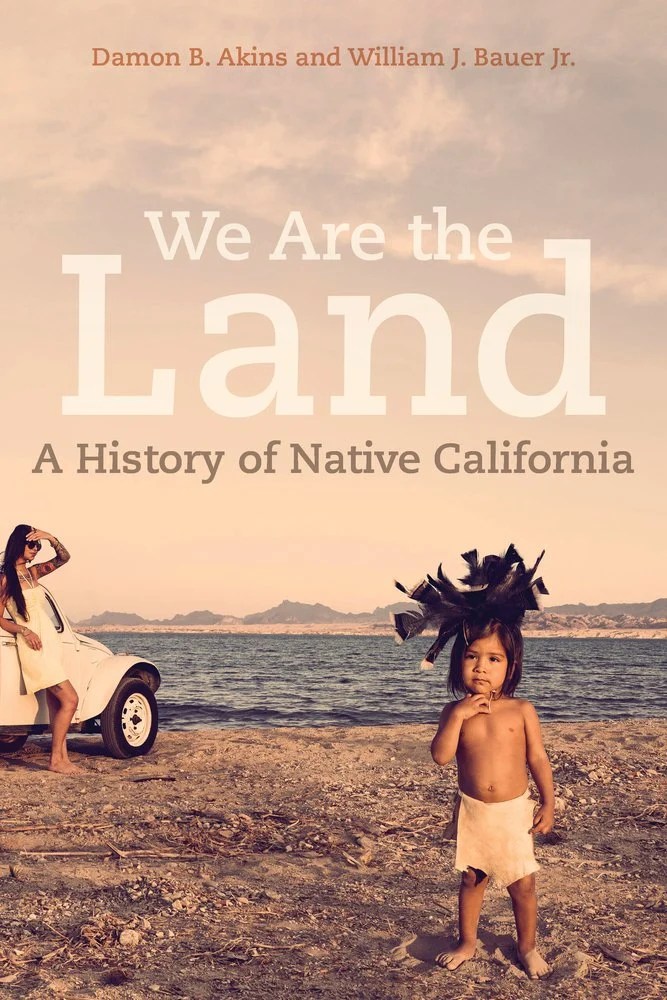
I’ve just finished reading a great book called We are the Land: a History of Native California by Damon B. Akins and William J. Bauer Jr. which gives a history of California from the perspective of its original inhabitants.
Too often California’s Indigenous People are given short shrift in the histories we are taught about the Golden State. Each semester, for example, I ask my students if anyone knows the name of the local tribe–those people who first inhabited north Orange County and Los Angeles. Rarely does anyone know about the Kizh (or as they are sometimes called, Tongva or Gabrieleno) tribe.
“Despite the long and rich history of Indigenous People in California, historians, anthropologists, and everyday people disconnected California Indian history from California history,” Akins and Bauer write. “California Indians often disappear from those histories after the demographic catastrophe of the California Gold Rush, in which the California Indians declined from about 150,000 to 30,000. In the twentieth century, many people believed California Indians vanished.”
We Are the Land seeks to correct the historical erasure of California’s Indigenous People, and to show the remarkable stories of how they survived waves of settler-colonialism and remain today.
“Beginning in the 1760s, Spaniards, Russians, Mexicans, and especially Americans attempted to control California and divorce Indigenous People from the land. All four colonial nations sponsored policies that uprooted Indigenous People and communities from the lands on which they were created, and all four deployed violence, in the form of slavery, genocide, and an administrative state bent on eliminating California Indian people,” Akins and Bauer write. “Yet California Indian people, nations, and lands remain. California Indians have built and rebuilt communities, developed practices to maintain ties with the land, and remade policies intended to separate them from their homes. At times, California Indians hid to survive, but they never left.”
Despite the injustices they suffered, it is important also to see California’s Indigenous People not just as victims, but as major players, who successfully resisted conquest and genocide, and creatively maintained their culture to today.
The various nations who invaded and claimed California as their own (Spain, Mexico, the United States), often saw the land and its resources as commodities to exploit for profit. By contrast, Indigenous People had both a material and a spiritual connection to the land.
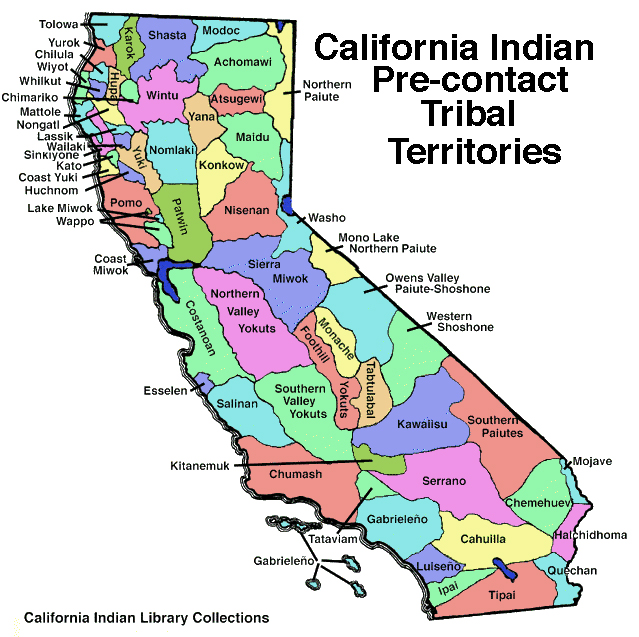
For the Kizh/Tongva (also called Gabrielino or Gabrieleno), the lands we now call north Orange County and Los Angeles were created by their god Nocuma. The world originated at Povuu’nga, now located on the CSU Long Beach campus.
“The Tongva people called the region Tovaangar,” Akins and Bauer write. “Across the region were more than 100 villages, mostly adjacent to rivers and creeks. Juyubit, one of the largest villages, was located in Buena Park. Hotuukgna, along the Santa Ana river near present day Yorba Linda, was another. Povuu’nga, where CSU Long Beach campus is today, is an important site owing to its connection to the creation stories. Yaanga, the largest Tonngva villate, sat just above the flood plain of the LA River, south of Olvera St.
Before colonization, California was one of the most populous and diverse regions in what is now the United States. Between 300,000 and one million people speaking over 100 distinct languages inhabited the coasts, forests, deserts, and mountains of California.
“Creation stories described the people’s relationship with the land, and situated people in specific places,” Akins and Bauer write.
Indigenous people worked with the land to ensure its productivity, developed irrigation systems, planted crops, hunted game like deer, elk, sheep, and sea mammals.
Tribes had unique religions that involved complex ceremonies and rituals. Stories, like creation stories, were passed down orally for generations.
Tribes engaged in extensive trade throughout the southwest.
“California looked like the sky, as many villages as stars, organized into constellations,” Akins and Bauer write.
Starting in the 1540s, European explorers like Juan Rodriguez Cabrillo and Sebastian Vizcaino came into contact with California’s Indigenous Peoples.
Some early histories present these first encounters as that of a “primitive” society acting in amazement and fear at the arrival of an “advanced” society. But this is likely not the case.
“Rather than fearing Spanish and English sailors, Indigenous People boarded their own seagoing vessels and went out to greet the newcomers,” Akins and Bauer write. “Indigenous People possessed a long history of trading with oceangoing vessels. Tongvas and Chumash, for instance, carried on maritime trade between the islands and the mainland.”
In fact, it was indigenous knowledge that allowed Europeans explorers to navigate the coast and begin mapping its terrain.
It is important to see these Europeans and Indigenous people as equals–each possessing valuable knowledge, technology, and culture worth sharing.
Unfortunately, the colonizers did not see Indigenous People as their equals, and saw their lands and resources as available for the taking.
“In 1513, the Spanish crown mandated that all explorers read the Requerimiento to the Indigenous People of the Americas, informing them that they were subjects of the Spanish crown,” Akins and Bauer write. “Across North America, the Spanish used the Requerimiento to justify colonization.”
Rather than bringing an “advanced” civilization to a “primitive” people, what European colonizers ultimately brought was disease and death.
In 1769, the Spanish empire began colonizing California in a systematic way, creating missions, presidios (forts), and pueblos (towns) along the California coast.
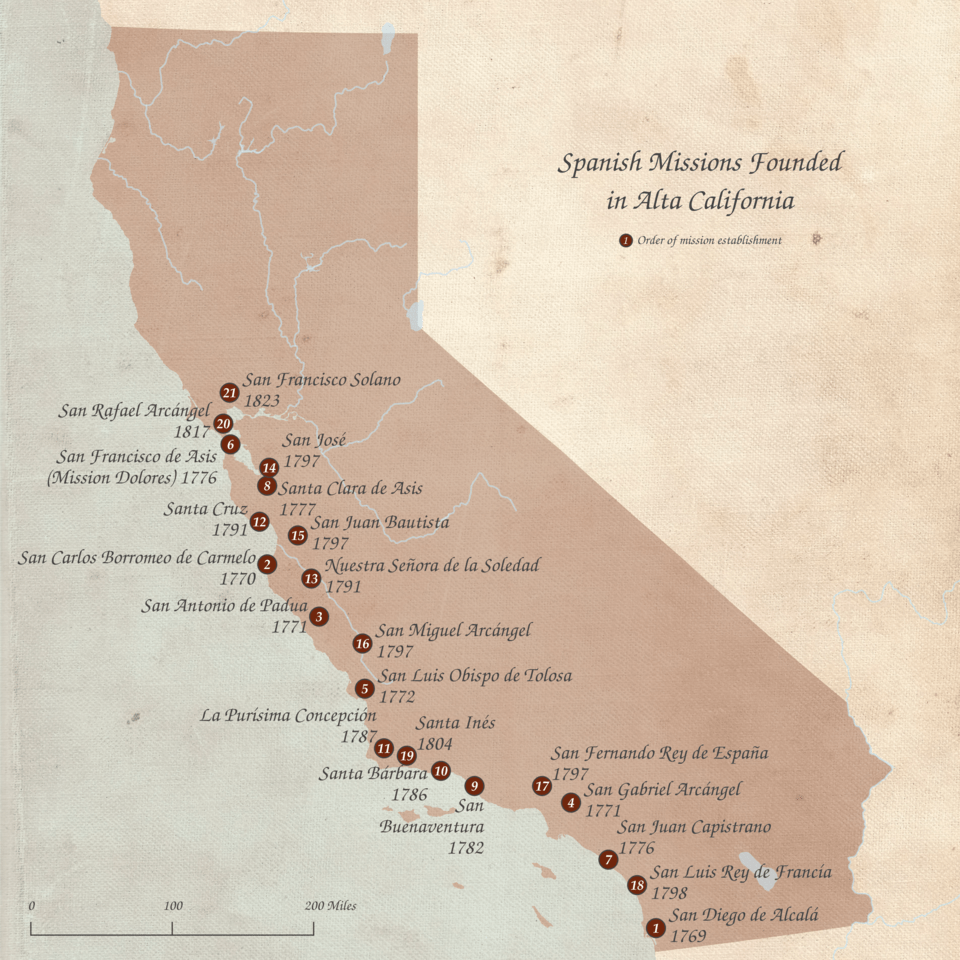
All of these proved destructive to Indigenous communities. Between 1769 and 1800 the number of Indigenous People on the California coast declined by nearly 50 percent due to disease and mistreatment.
“Spanish settler colonial policies attempted to separate Indigenous Peoples from the land and each other and, in doing so, altered California’s social and ecological makeup,” Akins and Bauer write. “Spanish missionaries believed in ‘reducing’ Indigenous People from their allegedly ‘wild and primitive’ state to what the Spaniards considered more ‘civilized’ missions. There, Indigenous People encountered new animals, germs, and social practices.”
Spanish missionaries like the famous Father Junipero Serra sought to stamp out native religions and “Christianize” the Indigenous people.
And while Spanish colonialism was highly destructive, Indigenous people resisted in many ways. In 1775, for example, Kumeyaay and Tipais people had had enough. They organized and carried out a successful revolt, in which they killed priests and soldiers and burned Mission San Diego to the ground.
When Spanish domesticated livestock depleted the native plants that Indigenous people lived on, they responded by killing livestock.
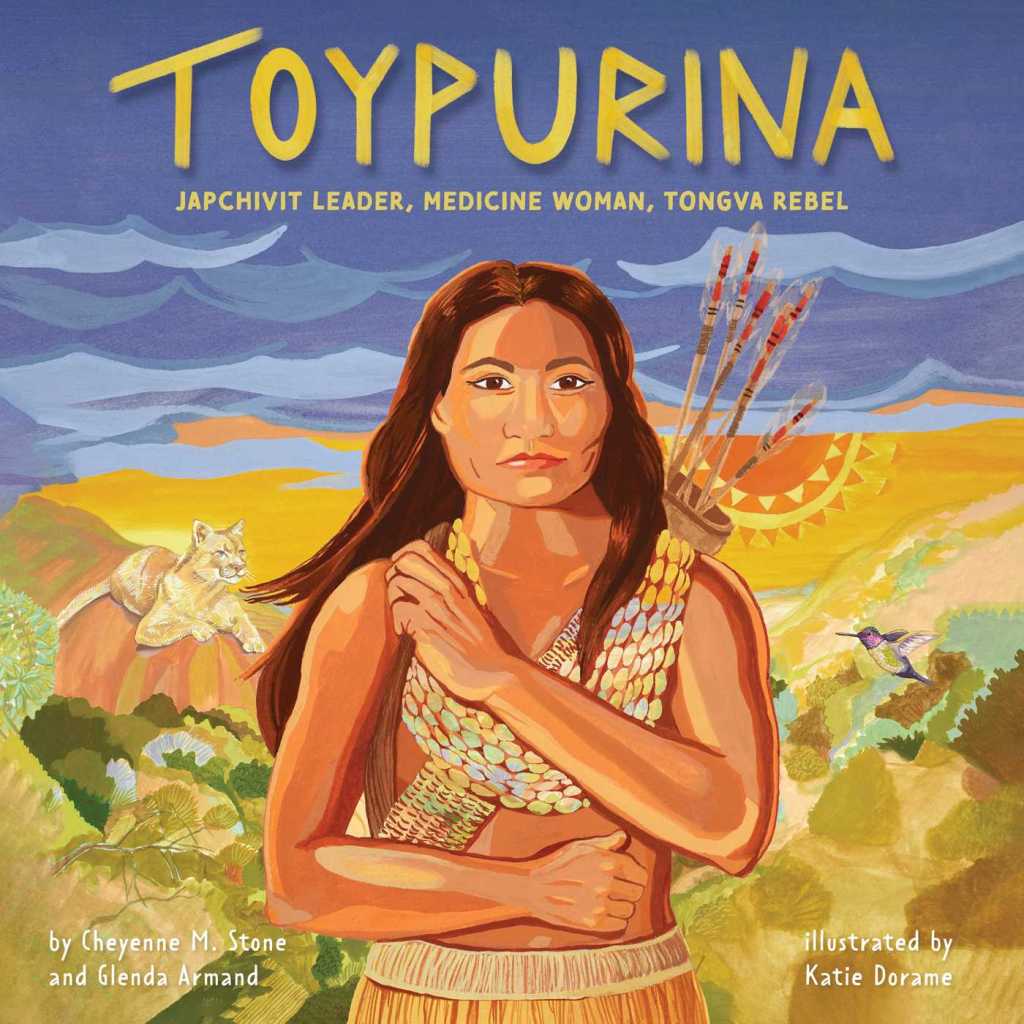
In 1785, there was another attempted revolt at Mission San Gabriel, led by a Kizh woman named Toypurina and a man named Nicolas Jose. Unfortunately, this one was foiled, but the transcripts of the trial that followed show remarkable and courageous resistance to colonization.
Some Indigenous people survived Spanish colonization by avoiding the missions altogether, or by running away.
Life in the missions was pretty brutal, a sort of west coast slavery. Indigenous People who “misbehaved” were whipped, placed in stocks, or locked up. If a baptized Indian tried to run away, they were pursued, brought back, and publicly flogged.
When an Indigenous Person was baptized, they were often given a new Spanish name–a way of erasing cultural identity.
Despite this, Native cultural practices persisted and were even sometimes incorporated into Mission Christianity.
“Native artists worked within and modified Catholic and Indigenous traditions,” Akins and Bauer write. “At Mission Santa Ines, a Chumash artist painted a portrait of Saint Raphael, holding a fish in one arm, a staff in the other, with enormous wings, blending Chumash and Catholic symbols.”
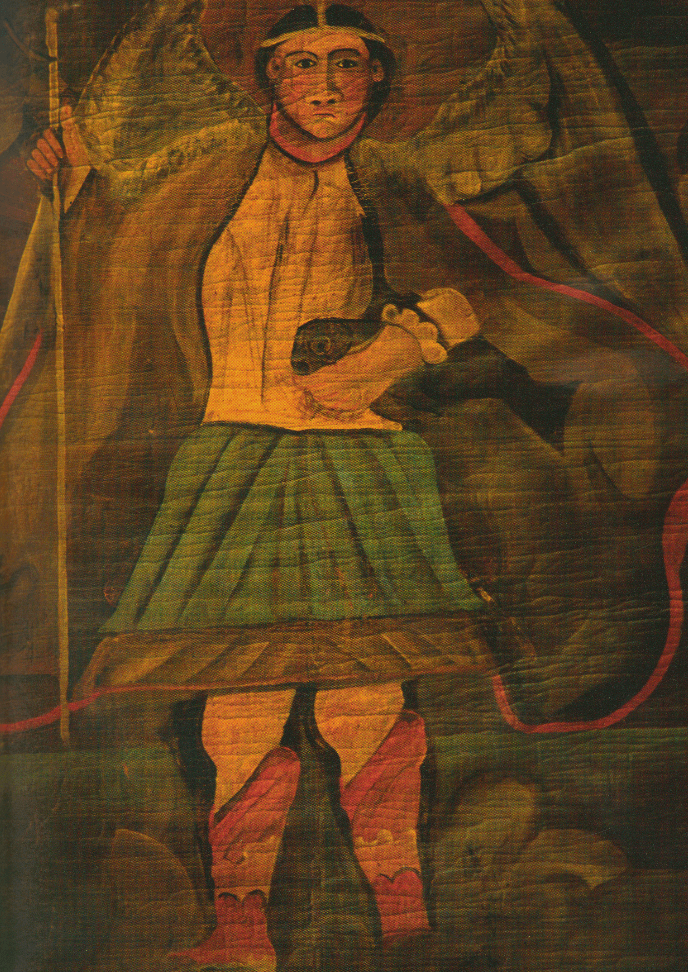
Native healers still used the old ceremonies and Indigenous people maintained ties with the land and with family outside the missions. For example, Missions that could not support indigenous people year round allowed them to return to their own towns for part of the year.
Indigenous people also assumed leadership roles within the missions, such as alcaldes.
“Indigenous people gravitated to ‘places of refuge’ where they could collect traditional foods, share stories, dance, and carry out old practices while simultaneously integrating new ones,” Akins and Bauer write. “In the interior, Indigenous People harbored those who escaped the missions…Chumash leaders refused to return runaways and fought Spanish soldiers over the fate of their newly returned people.”
In 1821, Mexico won its independence from Spain, and so California became a part of the newly formed Republic of Mexico. Many indigenous people found work on the large cattle ranchos that were created by Mexican land grants.
In 1824, a large and well-coordinated revolt occurred across the three missions in the heart of Chumash country. In 1826, California governor Jose Maria Echeandia gave a partial emancipation proclamation, allowing Indigenous People to petition for their freedom.
In 1834, the missions were “secularized” and their vast land holdings were made open for settlement. Although secularization was envisioned, at least by some, to return mission lands to Indigenous Peoples, this rarely happened.
Between 1846 and 1848, the United States waged an expansionist war of conquest against the Republic of Mexico, which ended with the Treaty of Guadalupe Hidalgo, and Mexico ceding half of its territory to the United States. California became part of the U.S.A. In 1849, the California Gold Rush brought waves of new settlers, and new perils for Indigenous People.
“While Spanish and Mexican colonists used Indigenous People as laborers, most Americans adhered to the settler colonial ‘logic of elimination,’ in which Indigenous People must disappear,” Akins and Bauer write. “According to most estimates, before the Gold Rush, 150,000 Native Peoples lived within the state’s boundaries; only 30,000 survived the following maelstrom. Americans caused the demographic catastrophe through genocide, ethnic cleansing, and the enslavement of Indigenous People.”
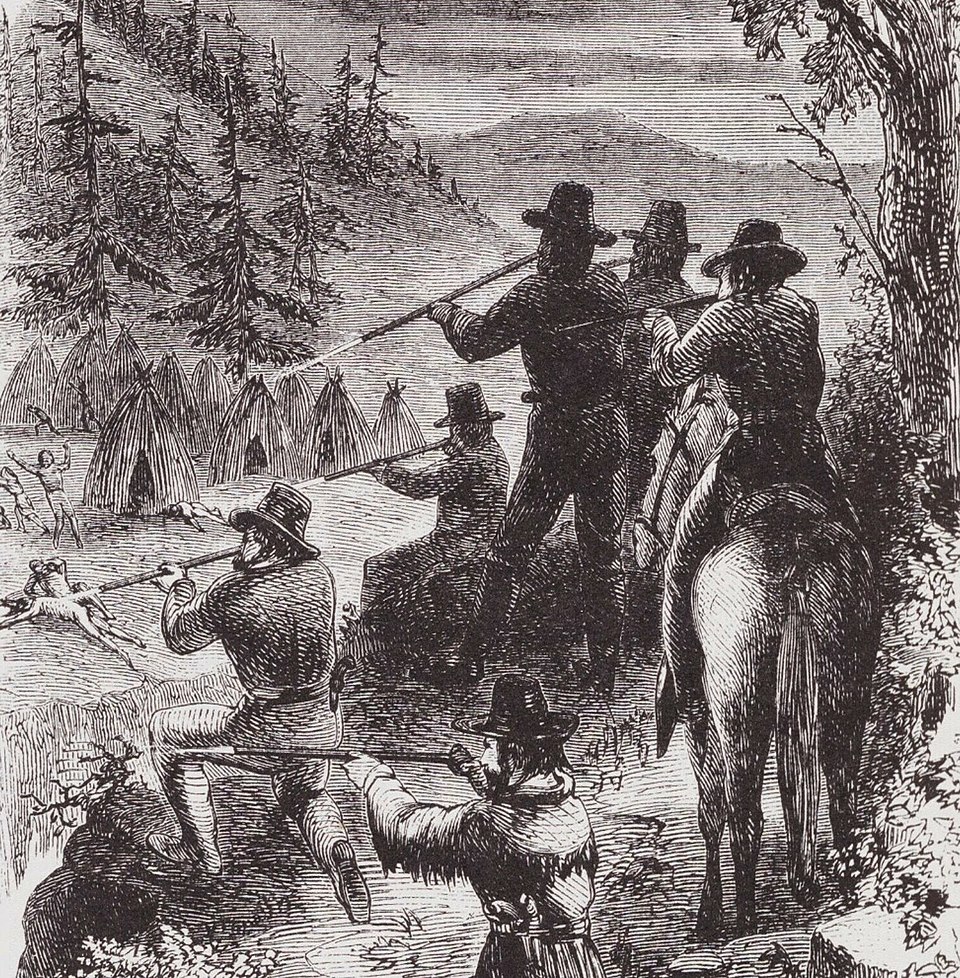
American settlers weren’t just exploiters of labor–they were straight up killers.
“Between 1850 and 1851, California politicians created what historian Benjamin Madley calls a ‘killing machine,’” Akins and Bauer write. “The governor authorized citizens to form compulsory and volunteer militias to hunt down and kill Indigenous People.”
These roving death squads were paid with government funds.
“Between 1846 and 1873, vigilantes, militias, the state of California and the United States initiated hundreds of campaigns that killed between 9,492 and 16,094 California Indians,” Akins and Bauer write.
Some attacks were large scale massacres like on Bloody Island, in Clear Lake, the site of the largest massacre in US history during which the US Army murdered as many as 800 Pomos.
Meanwhile, Native Californians were denied legal rights. Laws were passed preventing them from voting, testifying against whites, serving on juries, working as lawyers, and owning guns.
Those who survived the American genocide faced additional laws that exploited them for their labor, such as the 1850 Act for the Government and Protection of Indians, which created conditions for indentured servitude for thousands.
Shortly after California statehood, the US government negotiated 18 treaties with various tribes. However, these were not ratified by the Senate, and were held under secrecy for decades.
And yet, Indigenous people continued to survive and resist.
Antonio Garra, a Cupeno leader, attempted to create a pan-Indian alliance in Southern California to oppose the American invaders.
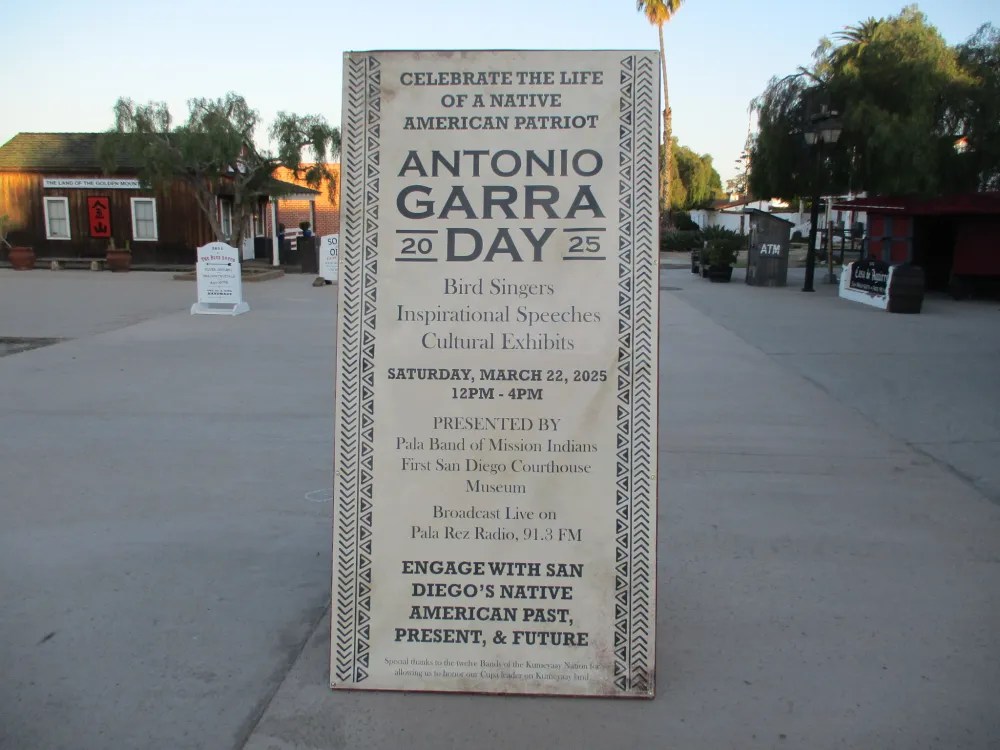
California Indians continued to work on ranches, in cities, and helped build infrastructure like railroads.
“California Indians used the relationships connecting land, labor, and the law to carve out spaces to preserve sovereignty and culture throughout the state,” Akins and Bauer write.
Meanwhile, non-Indian reformers sought to improve conditions for Indigenous people, often resulting in policies that hurt them, like breaking up tribally-held land in favor of individual allotment of land (the Dawes Act).
President Ulysses S. Grant established some California reservations by executive order.
Meanwhile, state agencies and private companies constructed dams across California, often resulting in the flooding of Indigenous lands.
As the 19th century came to a close, the recorded Indian population had fallen to its lowest point, just below 25,000 in 1900.
When the 18 unratified treaties were published in 1905, money was appropriated to purchase land for Indian lands, called rancherias.
“In the first three decades of the twentieth century, California Indians created economic and political relationships with Americans to secure their lands and advance programs of self-determination,” Akins and Bauer write. “Organizations such as the Mission Indian Federation, founded by and for California Indians, emerged as tools to claim land and sovereignty.”
Yet tribes throughout the United States, including California faced further attempts at erasing their identities through Indian boarding schools.
“Indian Boarding Schools, like Perris/Sherman (1892-present) followed an assimilationist policy, to ‘kill the Indian to save the man,” Akins and Bauer write. “School officials placed great attention on eradicating aspects of Indian culture, from the way students dressed to the language they spoke to the traditions and practices they treasured.”
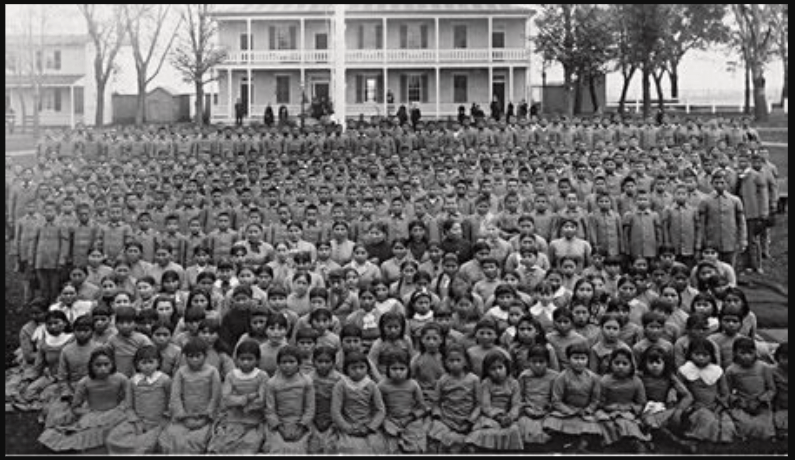
Despite the assimilationist intent of the boarding schools, they also were “fertile sites of growth, where powerful intertribal identities and lifelong relationships formed.”
In 1924, Congress passed the Indian Citizenship Act, granting citizenship to all Indians born in the US.
The 1934 Indian Reorganization Act outlined a process for restoring some lost tribal land, and for drafting tribal constitutions and creating tribal governments.
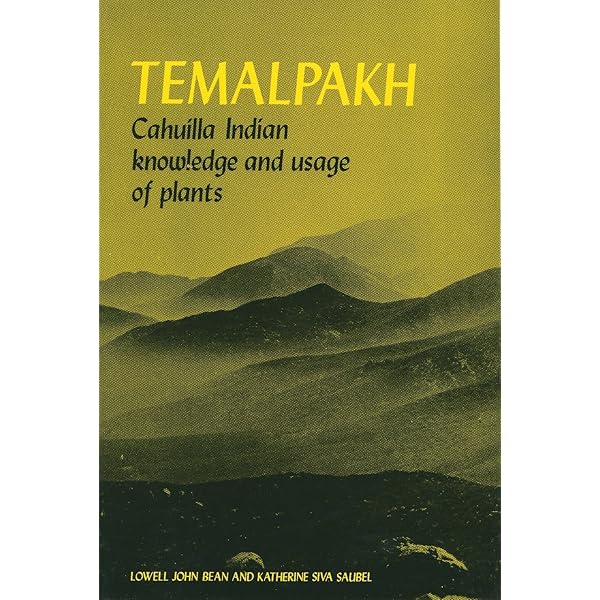
In the late 1950s, Cahuillas Jane Penn and Katherine Siva Saubel worked with anthropologist Lowell Bean and in 1964 they founded the Malki Museum on the Morongo Reservation in Banning to preserve Cahuilla culture.
Cahuilla Rupert Costo and his wife founded the American Indian Historical Society in San Francisco–in an effort to improve California history curriculum, “including Indians at all stages of California history to counter the images of lazy, immoral, dirty, and disappearing Indians, which the emphasis on the missions reinforced.”
Indian centers throughout the state hosted monthly powwows and meetings of intertribal organizations.
The California Indian Education Association (CIEA), helped promote the creation of Native American studies programs at colleges and universities, like the ones that were eventually created at Berkeley, CSU Long Beach, Sacramento State, UCLA, and UC Davis.
California Indian Legal Services and the Native American Rights Fund fought for the rights and sovereignty of tribes.
In the 1960s and 1970s, Indigenous Activist groups engaged in notable actions like the occupation of Alcatraz Island in 1969.
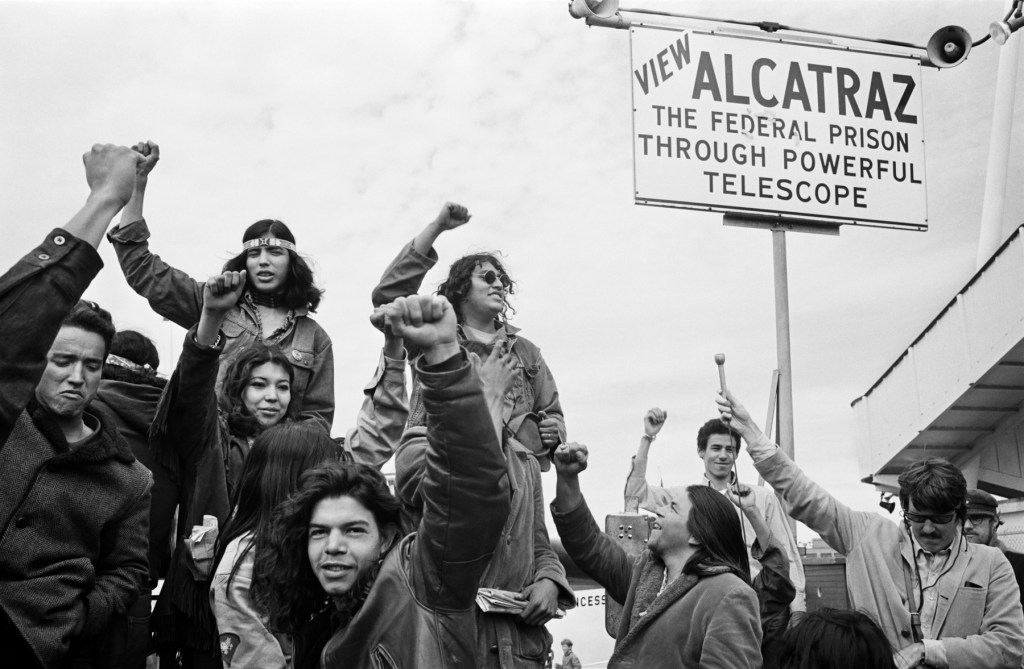
Ojibwe Dennis Banks was an early leader of the American Indian Movement (AIM).
In 1972, more than 69,000 Indians received payments of less than $700 each–$29 million for over 64,000,000 acres, or 45 cents per acre for lands lost because of the 18 unratified treaties. The money was hardly equivalent to the loss.
Economic Advancement for Rural Tribal Habitats (EARTH) formed in 1978 “to acquire federal and state money to buy land, repair housing, and build new homes and communities centers in Northern California rancherias.”
That same year (1978), the Bureau of Indian Affairs (BIA) created new guidelines for federal recognition of tribes.
Unfortunately, these guidelines made federal recognition more difficult, Native groups petitioning for recognition had to “establish a substantially continuous tribal existence and [to] have functioned as autonomous entities throughout history until the present.”
Many tribes found it difficult to show continuity because for decades federal and state governments had made it difficult to survive.
“In California, many Indigenous people hid their tribal identities in order to survive the genocide of the 19th century,” Akins and Bauer write.
For example, the local Kizh/Tongva tribe is still not federally recognized.
In the 1980s, some California tribes found a new source of economic advancement–opening casinos.
The Cabazon and Morongo Reservations in southern California were the first to gain permission to open gaming centers.
In 1988, President Regan signed the Indian Gaming Regulatory Act, which allowed gaming, with some limits and rules.
California voters passed Prop 1A, which allowed gaming on all federally recognized Indian lands.
Revenues from Indian gaming pays for youth programs and social services, provides jobs, improves infrastructure, allows tribes to purchase additional land, and creates centers for more robust cultural preservation.
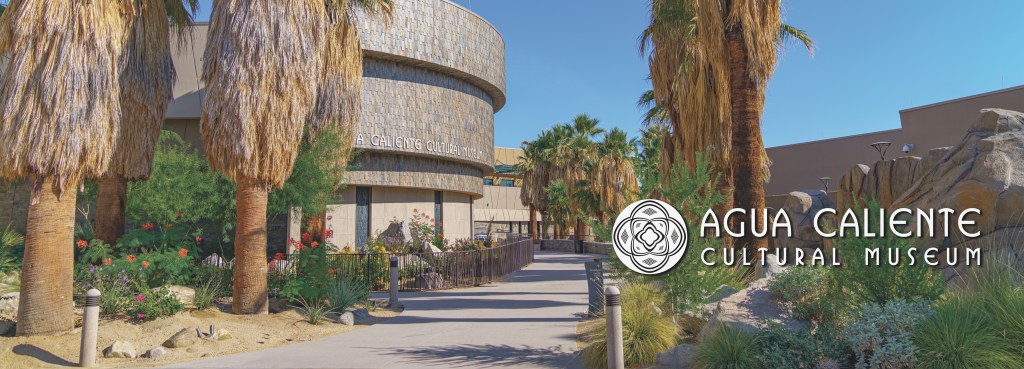
For example The Agua Caliente Tribe built a 100,000 square foot cultural museum, “which hosts academic presentations and language classes and collects Cahuilla artifacts.”
Despite all that California’s Indigenous people have suffered, they survived and continue to assert their sovereignty and culture.

