The following is from a work-in-progress about the history of Fullerton. You can support my ongoing research and writing on Patreon.
“Our inheritance is turned to strangers.”
–Lamentations 5:2
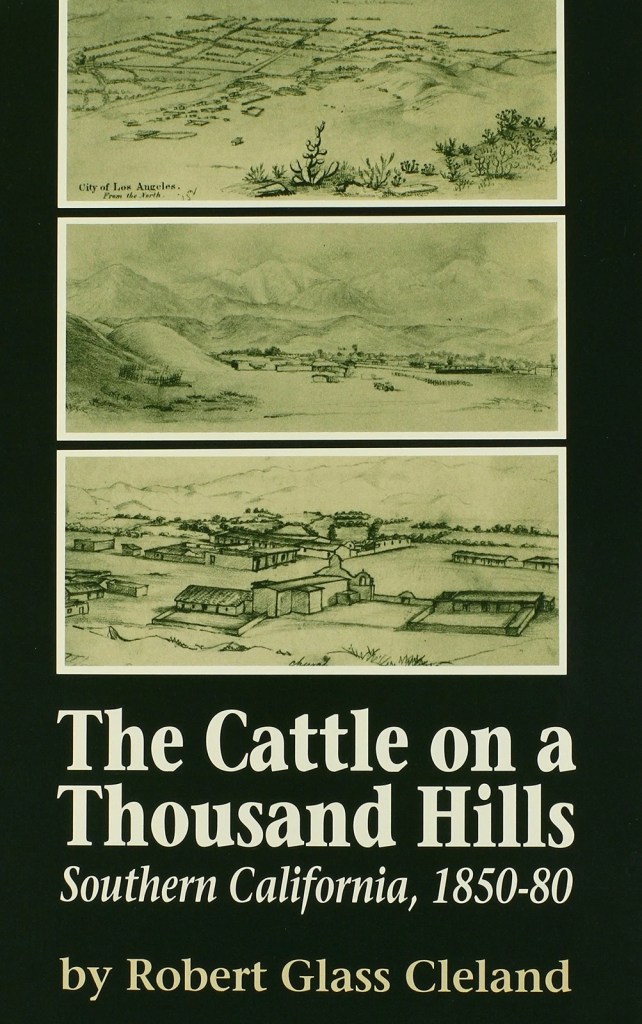
In my desire to understand the larger context of local history, I’ve just read a book entitled The Cattle on a Thousand Hills: Southern California 1850-1880 by Robert Glass Cleland. The book tells the story of how many of the large Spanish/Mexican cattle ranches in California passed out of the hands of the Californios (Spanish-speaking Californians) and into the hands of American settlers. Below is a book report on what I learned.
When Spain began colonizing California in 1769, they set up three main types of settlements: missions, presidios (military forts), and pueblos (towns).
In the Los Angeles area, there was Mission San Gabriel, and the pueblo of Los Angeles.
In 1784, Governor Pedro Fages began issuing the first private land grants, mostly to former soldiers like Juan Jose Dominguez, Manuel Nieto, Jose Maria Verdugo, Jose Bartolome Tapia, Jose Antonio Yorba, Miguel Pico, and Antonio Maria Lugo.
The Nieto grant, perhaps the largest in southern California, included nearly 300,000 acres. By the time he died in 1804, his huge land and cattle holdings made him the richest man in California.
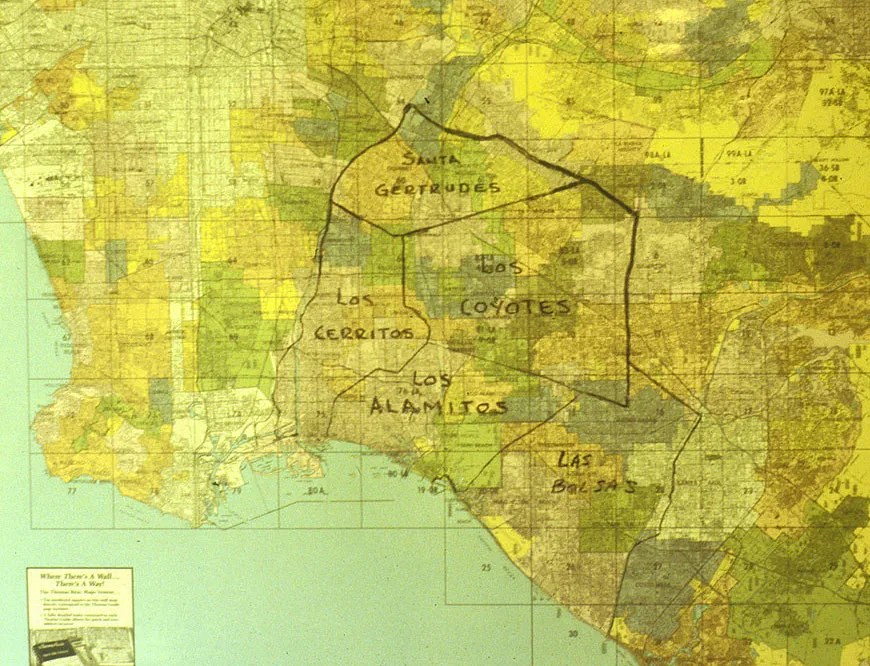
“A glance at a modern map of the Los Angeles basin will show to what an enormous extent the conversion of the original Fages concessions into cities, towns, factories, oil fields, and farming communities entered into the making of the Southern California of today,” Cleland writes.
After Mexico won independence from Spain in 1821, the new Republic passed the Colonization Act of 1824, which increased the number of land grants. The Secularization Act of 1833 transferred the vast land holdings of the missions into private hands.
“The new land policy was so liberal that California governors issued fully seven hundred concessions to private claimants between the Secularization Act of 1833 and the American occupation 13 years later,” Cleland writes.
After the secularization of the missions, many California Indians went to work on the large cattle ranches, as vaqueros.
The rancheros sold their cattle hides and tallow to foreign traders, as portrayed in Richard Henry Dana’s book Two Years Before the Mast. Between 1845 and 46, the region exported 80,000 hides and 1.5 million pounds of tallow (used mainly for candles).
The standard currency of the region was the cattle hide, sometimes called the “Caifornia bank note.”
Social life on the ranchos included music, dancing, fiestas, rodeos, and high stakes horse racing.
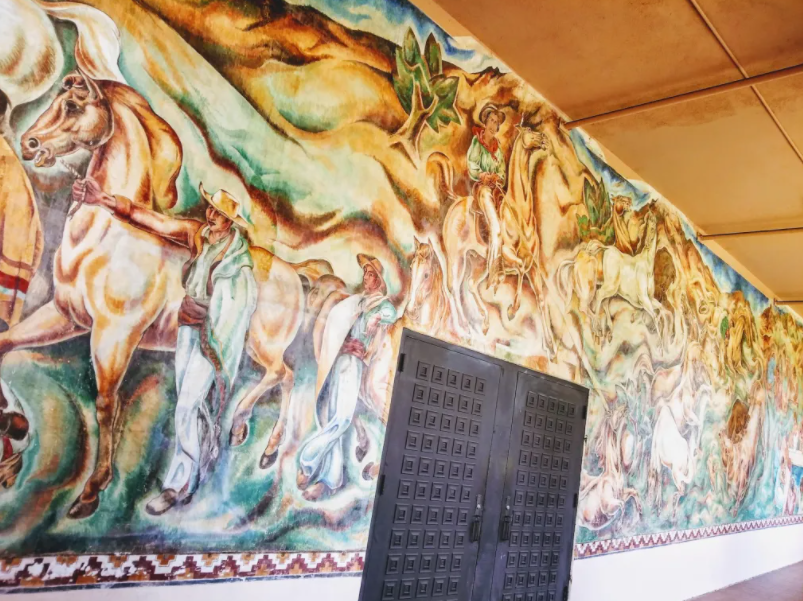
Although life was somewhat idyllic, the political scene in California was not exactly stable. A succession of revolutions saw the government change hands nearly once a year between 1831 and 1841.
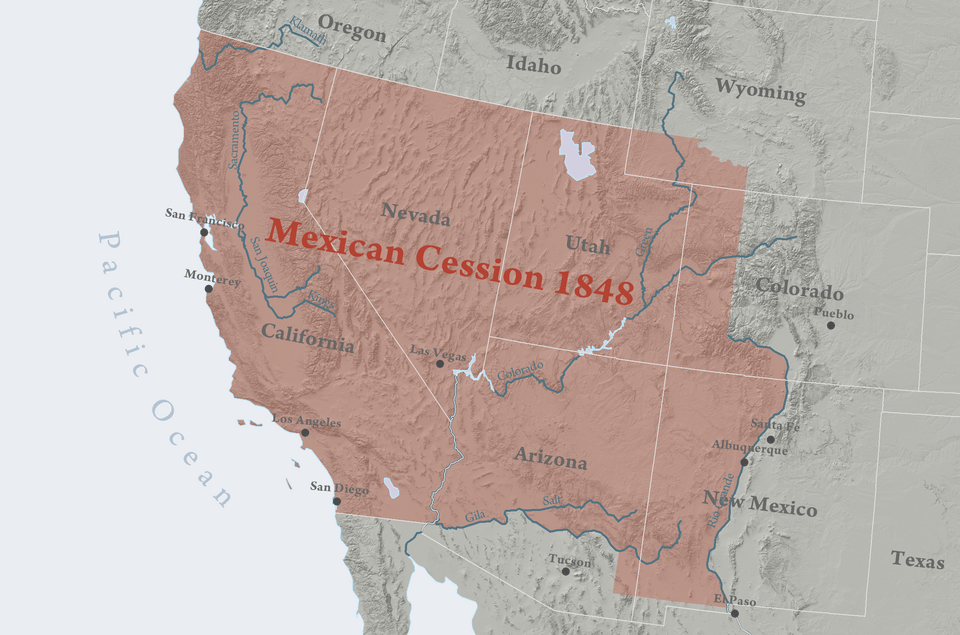
In 1846, the United States went to war with Mexico, an expansionist war waged in the name of “Manifest Destiny.” The war ended in 1848 with the Treaty of Guadalupe Hidalgo, in which Mexico ceded fully half of its country to the United States, including California.
The Treaty promised Spanish/Mexican landowners that their property rights would be respected and that the U.S. government would recognize “legitimate titles to every description of property, personal and real, existing in the ceded territories.”
That was the plan, at least. But it didn’t exactly work out that way.
Congress passed the Land Act of 1851, which created a 3-member Board of Land Commissioners whose job it was to determine the validity of existing grants. This proved disastrous to many owners of Spanish/Mexican land grants.
“Compliance with the Board’s instructions put the landowners to enormous trouble and expense and placed the Spanish-Californians, especially, at serious disadvantage,” Cleland writes. “Boundaries recognized by custom and tradition for a generation were arbitrarily challenged by the government…In the face of such conditions the validation of even the most perfect title presented serious difficulties, frequently involved ruinous expense, and often entailed years of uncertainty and delay.”
Many landowners lost their lands trying to defend their grants.
“One out of every ten bona fide landowners of Los Angeles County was reduced to bankruptcy by the federal land policy, and at least forty percent of the land legitimately owned under Mexican grants was alienated to meet the costs of complying with the Act of 1851,” Cleland writes.
The promise of the Treaty of Guadalupe Hidalgo was severely undermined by the Land Act of 1851.
“If the history of Mexican grants of California is ever written,” said Henry George in 1871, “it will be a history of greed, of perjury, or corruption, of spoliation and high-handed robbery, for which it would be difficult to find a parallel.”
Adding insult to injury, the Gold Rush of 1849 brought a chaotic wave of new settlers into California, who often squatted on land that was not theirs.
But the Gold Rush wasn’t all bad for southern California rancheros. Hungry miners created an increased demand for beef, and this led to a boom in beef prices.
After this boom, however, came a serious bust as natural disasters in the 1860s wrought desolation upon the southern ranches.
First came a massive flood in 1861 “which drowned thousands of head of cattle and destroyed possibly a fourth of the state’s taxable wealth.” The floods also destroyed whole communities, such as Agna Mansa and Placita along the Santa Ana river.
After the flood came the drought.
“The great flood of 1861-62 was followed by two years of unparalleled drought. Almost no rain fell during the ensuing fall or winter; and by Spring, cattle on many of the southern ranges were beginning to be in desperate straits,” Cleland writes. “Cattle died by the thousands on sun-baked ranges and beside waterless streams and sand-choked springs.”
The disasters of the 1860s were almost biblical. In addition to flood and drought came millions of grasshoppers which “swept across the country like a devastating fire,” and a virulent epidemic of smallpox, which was particularly devastating to the Indians of California.
“According to the federal census there were nearly 1.2 million cattle in California in 1860; by 1870 that number had decreased to 670,000–a drop of close to 46 percent,” Cleland writes. “During the same decade the number of cattle in Los Angeles County fell from 70,000 to 20,000–a loss of over 71 percent.”
These things proved disastrous to the Spanish/Mexican rancheros.
Of the “few Spanish Californians who had been able to maintain at least a portion of their original holdings until the coming of the drought…almost none, even of that small number, survived the widespread ruin of the mid-sixties…the little that was left of their once lordly estates passed forever into alien hands,” Cleland writes.
American settlers kept pouring into the Golden State, establishing farms and towns.
For example, in 1857, a group of fifty Germans bought a tract of 1,200 acres of the Rancho San Juan Cajon de Santa Ana from Don Bernardo Yorba and Don Pacifico Ontiveros, “and began the experiment on co-operative community development called Anaheim.”
“Under the stimulus of rapidly increasing immigration, the great cattle ranchos, one by one, gave way to orchards, vineyards, and grain fields,” Cleland writes.
An important transitional figure between the Mexican and American eras of southern California history was Abel Stearns.
Born in Massachusetts in 1798, Stearns left home at an early age for a life at sea, working on trading ships that went to South America and China.
In 1827, he moved to Mexico and became a naturalized citizen. He came to the pueblo of Los Angeles in 1829 and became a successful merchant and storekeeper.
“He bartered groceries, liquors, and dry goods for hides and tallow from the neighboring ranchos, and purchased furs from American trappers who came to California,” Cleland writes.
He bought a warehouse in San Pedro where he bought hides and tallow from local ranches and sold them to Yankee trading ships, becoming one of the wealthiest merchants in southern California.
Being an American, he sometimes came into conflict with Mexican authorities. Two Mexican governors tried unsuccessfully to get Stearns banished from the country for such alleged crimes as smuggling and other illegal activity. When a large amount of contraband goods was found in his San Pedro warehouse, Stearns avoided prosecution and instead got himself appointed customs administrator. He was the original “teflon Don.”
In 1835, Stearns face was badly disfigured in a knife attack with a drunk sailor, earning him the moniker “Cara de Caballo” or “Horse Face.”
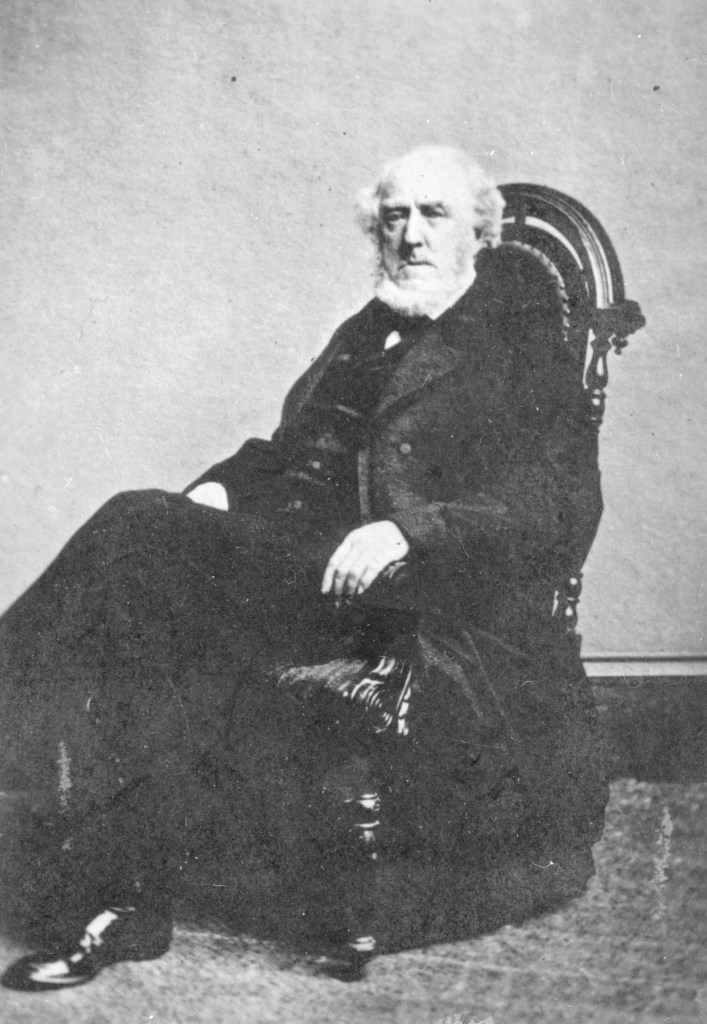
At age 40, Stearns married the 14-year-old daughter of an influential local ranchero, Don Juan Bandini.
Around this time, he began acquiring land, and lots of it from cash-strapped Californios, including is father-in-law.
“With Rancho Los Alamitos as a nucleus, Stearns built up the largest land and cattle empire in southern California,” Cleland writes. “His long residence in the country and intimate knowledge of the business affairs and financial difficulties of all the large landholders enabled him to add one ranch after another to his holdings on highly advantageous terms…By 1862 Stearns had acquired over 200,000 acres of the choicest land in the Los Angeles and San Bernardino areas.”
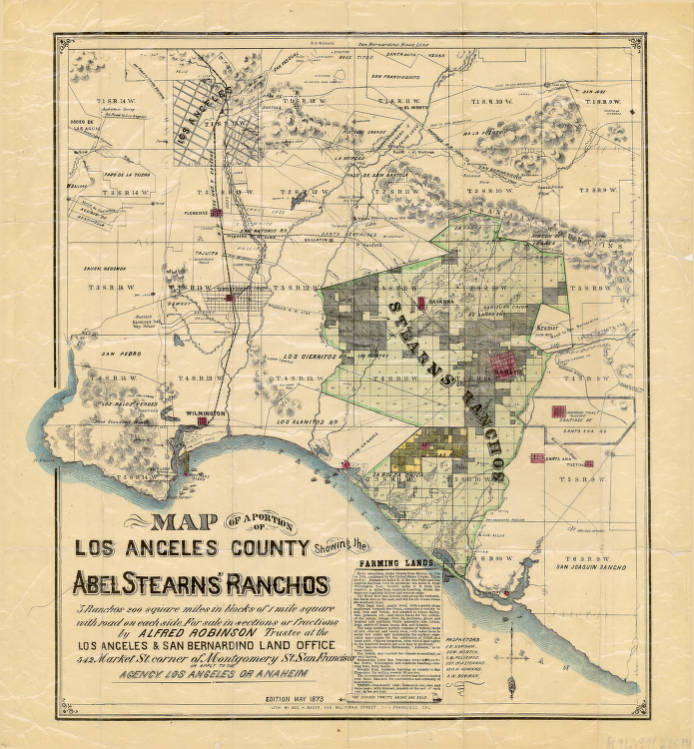
He may have been immune from legal consequences, but he was not immune from mother nature. He suffered huge losses during the drought of the mid-sixties.
In 1868, he and a few business associates formed a Trust, the Los Angeles and San Bernardino Land Company, to market, subdivide, and sell his vast land holdings.
Stearns died in 1871.
“He witnessed the development of the ranchos, the annexation of California by the United States, the revolutionary changes resulting form the Gold Rush, the cattle boom of the early fifties, and the Great Drought,” Cleland writes. “More than any other man of his generation, he thus personified both the southern California of the Mexican tradition and the southern California of the American period.”
By the 1870s, many of the large ranchos were being broken up and subdivided into smaller farms and towns.
The coming of the transcontinental railroad brought another boom of settlers and real estate in the 1880s.
It was in this context, in 1887, that two grain merchants from Boston, George and Edward Amerige, purchased land just north of Anaheim that once belonged to Juan Pacifico Ontiveros and then Abel Stearns to found a town. They called it Fullerton.

