The following is from a work-in-progress about the history of Fullerton. You can support my ongoing research and writing on Patreon.
Last year, authors Nate Jackson and Daniel Kohn released a book entitled Tearing Down the Orange Curtain: How Punk Rock Brought Orange County to the World. The book chronicles how a scrappy, underground local punk scene grew and morphed into a major force in popular music.
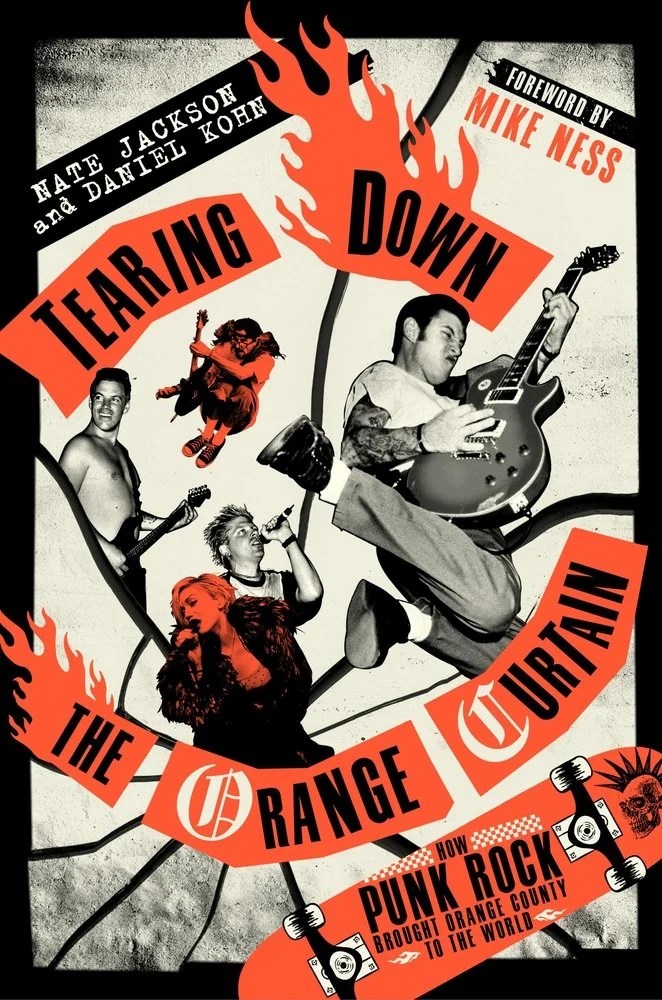
“In the surroundings of a seemingly placid suburban utopia with its patchwork of manicured lawns and cookie-cutter houses with crystal blue backyard pools and straitlaced parents in their corporate jobs, the children of these model citizens were looking for life outside of the American dream–they wanted to make their own dreams, or in some cases their own nightmares,” Jackson and Kohn write.
I’ve decided to organize this book report around cities, and some of the venues and bands that contributed to this influential musical subculture.
Costa Mesa
An early hub of OC punk was a club in Costa Mesa called the Cuckoo’s Nest, where in 1979 club owner Jerry Roach started booking punk bands like The Crowd, T.S.O.L., the Adolescents, Agent Orange, and Social Distortion.
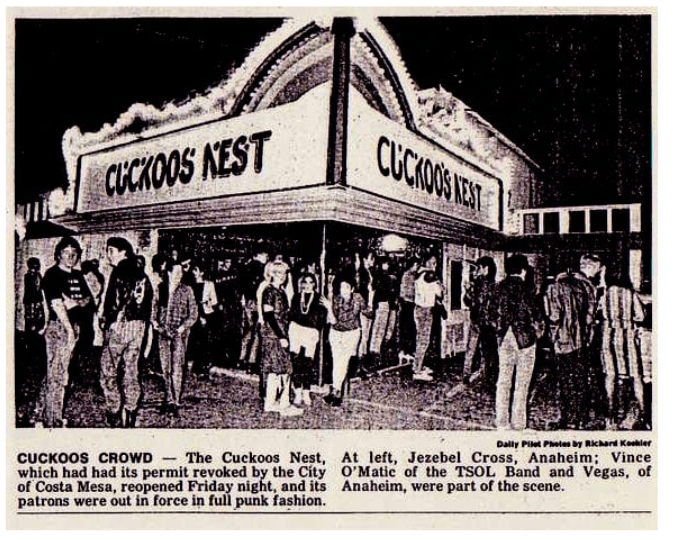
It is rumored that “slam dancing” and the “mosh pit” originated at the Cuckoo’s Nest.
Punks would gather in large numbers both inside the club and outside in the parking lot, where sometimes they would clash with patrons of a nearby cowboy bar called Zubies.
“But of all the foes of the Cuckoo’s Nest, the police and city council were the biggest,” Jackson and Kohn write. “Police began nightly sting operations, stationing themselves outside of the club and cracking down hard on both the punks and the club itself.”
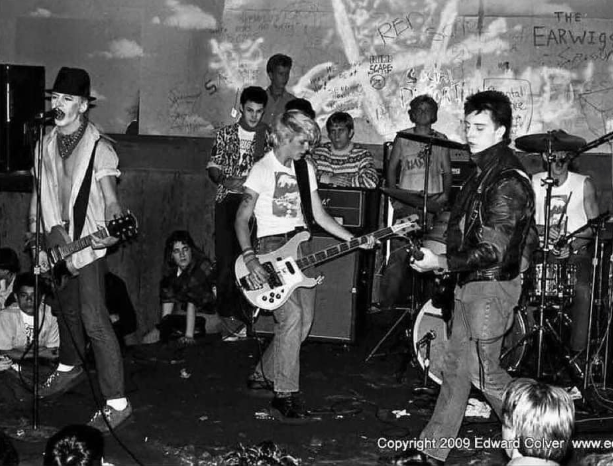
This clash is documented in the films Urban Struggle: The Battle of the Cuckoo’s Nest (1981) and We Were Feared (2010).
The crackdowns by the police and city officials resulted in the Cuckoo’s Nest closing in 1981.
“It was a long, hard road, it burned hot and fast, and it wasn’t meant to last,” Roach said.
Huntington Beach
An influential early band out of Huntington Beach was True Sounds of Liberty (T.S.O.L.), led by frontman Jack Grisham.
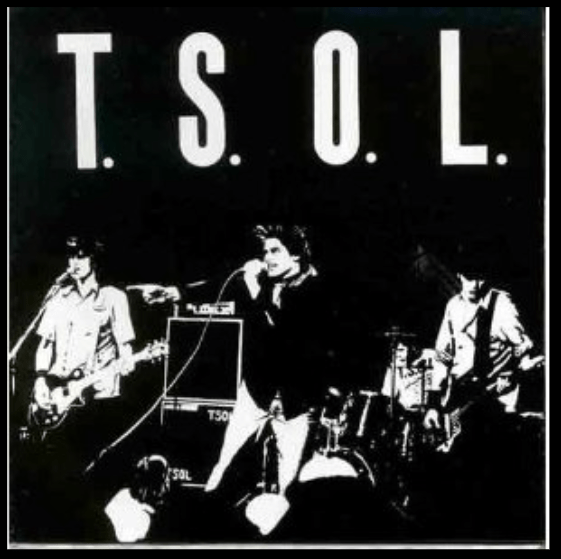
“Grisham’s voice and charisma onstage was a mix of poetic sensitivity, brutal violence, and cross-dressing theatrics,” Jackson and Kohn write. “Jack used to wear a dress and play in drag so that somebody would say something to him and he’d have an excuse to beat them up. That was fun for him.”
Other important Huntington Beach bands included The Crowd, The Outsiders, Love Canal, and the Vandals.
T.S.O.L, the Vandals, and Fullerton’s D.I. were featured in Penelope Spheeris 1983 film Suburbia, about the Southern California punk subculture.
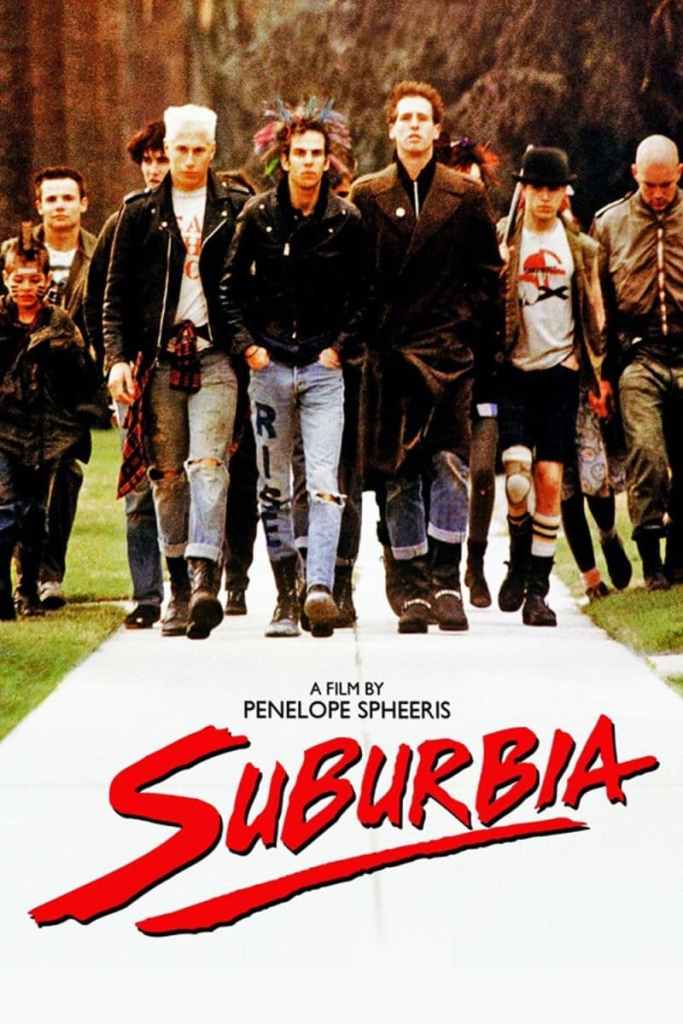
“Here was the surfing and the skating and the energy of the beach igniting with punk rock to kind of explode during that time,” Jackon and Kohn write.
Both skating and punk made kids targets for the police.
A popular punk venue in downtown Huntington Beach was Safari Sam’s, which provided a haven for local bands to gather and perform. Of course, these shows also became a magnet for the police.
After the infamous OP Pro Riots of 1986, “the city cracked down on venues like Safari Sam’s. Within two weeks, five clubs shut down, including the famous Golden Bear,” Jackson and Kohn write.
Another important entity to come out of Huntington Beach was Goldenvoice, a concert promotion company created by Gary Tovar.
“In 1981, most club promoters wanted no part of punk rock, especially in Orange County,” Jackson and Kohn write. “It wasn’t considered a sound or a culture–just a nuisance and a major liability. One of the few who embraced it was a guy named Gary Tovar. The prospect of teenage mayhem didn’t scare him, and neither did the raw magnetism of the sound and community that came with it.”
Tovar began creating opportunities for punk bands to reach bigger crowds. For example, between 1983 and 1985, Goldenvoice organized what were arguably the biggest punk shows in the world at the Olympic Auditorium in downtown Los Angeles. Bands like GBH, the Exploited, TSOL, Suicidal Tendencies, UK Subs, Circle Jerks, the Dickies, Dead Kennedys, the Vandals, Black Flag, and many others played for large crowds at rowdy shows.
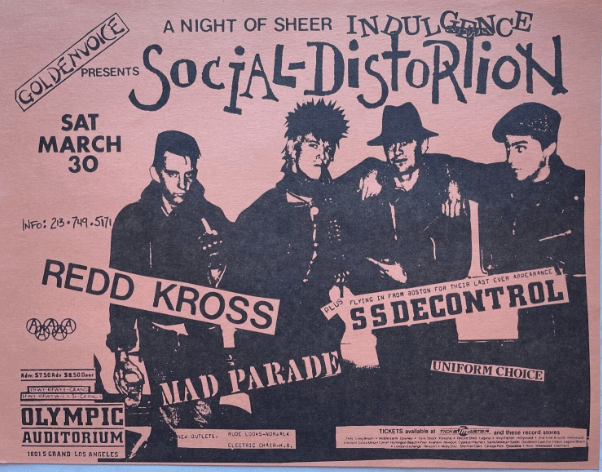
Tovar was also a major trafficker of marijuana, a lucrative business that helped to fund Goldenvoice in those wild early days. He eventually was arrested in 1991 and did prison time.
Today, Goldenvoice is one of the biggest concert promotion companies in the world, perhaps best known for putting on Coachella.
Santa Ana
A notable band to emerge from Santa Ana was The Middle Class.
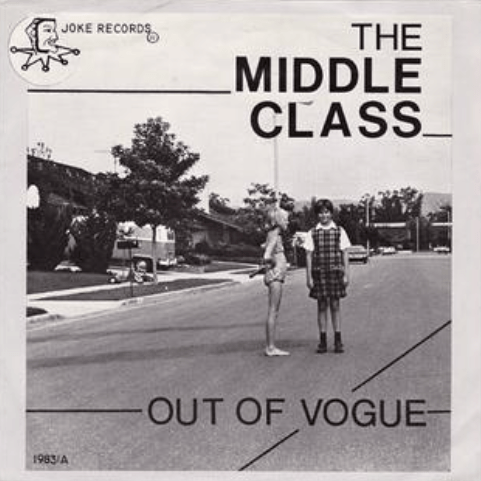
“The Middle Class consisted of the Atta brothers (Mike, Jeff, and Bruce) and bassist Mike Patton,” Jackson and Kohn write. “Formed in 1977…they were one of the first punk bands to emerge from Orange County. Their single “Out of Vogue” was played on KROQ by Rodney Bingenheimer and they’re widely considered the pioneers of hardcore.”
Fullerton
Of particular interest to me were the chapters on Fullerton’s contribution to the early punk scene with bands like the Mechanics, the Omlits, the Detours, Naughty Women, Social Distortion, the Adolescents, Agent Orange, D.I., and Eddie and the Subtitles.
“Fullerton was a very repressed, Republican majority in general,” former Social Distortion drummer Derek O’Brien said. “Outsiders who did not fit the perfect image of the status quo had a rough time and were judged harshly. The jocks ruled the schools and if you could not afford the cool cars, did not dress to their code, or fit into some obvious clique or category, not only did you not get the chicks–you were likely to get your ass kicked and had to watch your back!”
Mike Ness, frontman of Social Distortion, grew up in a chaotic household in Fullerton. He found solace and escape in punk rock.
As a youth, Ness also got into drugs and burglary. After being kicked out of Fullerton High School, he went to Troy, where he met Casey Royer. The two formed Social Distortion.
Ness’s apartment at 1801 Wilshire Avenue in Fullerton, dubbed “The Black Hole” became a haven for local punks, and immortalized in the Adolescents song “Kids of the Black Hole.”
Chaz Ramirez owned and operated Casbah Studios in Fullerton, where a number of important punk albums were recorded.
The Adolescents, formed in 1979, included Casey Royer, Rikk Agnew, Anthony Brandenburg and Steve Soto.
The Adolescents’ released their self-titled debut album (known as the Blue Album) in 1981.

“The songs, written by literal adolescents, became the blueprint for hardcore and even post-hardcore. It was an instant classic, and the band was surprised by its reception,” Jackson and Kohn write. “The Adolescents pushed punk forward and created a definitive Orange County sound to an audience outside the Southland.”
After the Adolescents broke up, Casey Royer founded the band D.I.
Many of these early OC punk bands received their first widespread exposure through Rodney Bingheimer’s show on KROQ called Rodney on the ROQ. Bingenheimer released popular compilation records featuring local bands.
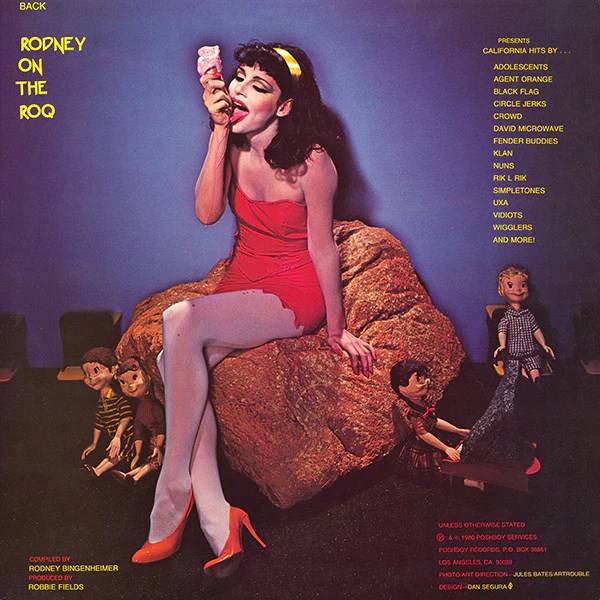
In those days, Fullerton had a few venues that would host punk shows. including Ichabod’s, the Galaxy (a roller rink), and the Commonwealth Pub downtown. Fullerton College and (a bit later) Cal State Fullerton would also host punk shows sometimes.
Social Distortion went on their first national tour in 1982 along with Youth Brigade and Minor Threat. This tour is chronicled in the documentary “Another State of Mind” (1984).
In 1983, Social Distortion released their now iconic record “Mommy’s Little Monster.”
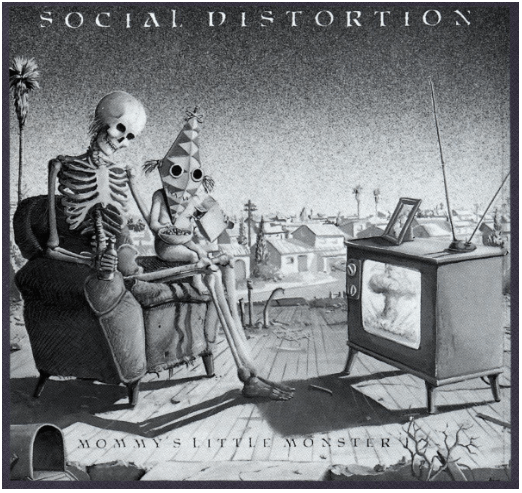
“Raw, a bit sloppy, and full of attitude, the album’s hardcore sound encapsulated the Fullerton scene,” Jackson and Kohn write. “Ness’s storytelling was vastly different from the punk that was emanating at the time.”
Unfortunately, Ness’s drug use (which included heroin) was getting out of control, culminating in an overdose that nearly killed him.
In 1985, thankfully, Ness got sober. In the process, he began exploring other genres of music that would become important to Social Distortion’s evolving sound–country, rockabilly, roots, and Americana music.
Their 1988 album “Prison Bound” leaned into these genres and storytelling. The band signed to Epic Records in 1989 and released their major label debut (the self-titled album “Social Distortion”) in 1990.
This album contains the hit songs “Ball and Chain” (about addiction) and the autobiographical “Story of my Life” which features “Ness ruminating on how Fullerton had changed and how things like gentrification had started to chip away the the city’s character. He points to how Farrells’ a pool hall that used to be at State College and Chapman, became a 7-11,” Jackson and Kohn write.
While still punk, Social Distortion had developed their own unique sound that was also more catchy and palatable to a wider audience.
This album went gold and made Social Distortion rock stars. By 1991, they were opening for Neil Young and Crazy Horse alongside Sonic Youth.
Garden Grove
The most famous punk band to come out of Garden Grove is The Offspring, formed in 1983 by high school buddies Bryan “Dexter” Holland and Greg Kriesel.
Holland was kind of the polar opposite of Ness. He was president of the math club and Pacifica High School’s valedictorian in 1984. Alongside his music career, Holland earned a Ph.D in molecular biology. He was definitely a nerd.
But he was also a punk.
“There was a rebellion against whatever the homogeneity of Orange County was because it was this weird feeling,” Holland recalls. “I don’t remember any of us being overtly political, but we were bored.”
The Offspring released “Smash” in 1994, which propelled them to punk stardom. Songs like “Come Out and Play” were in regular rotation on KROQ and MTV.
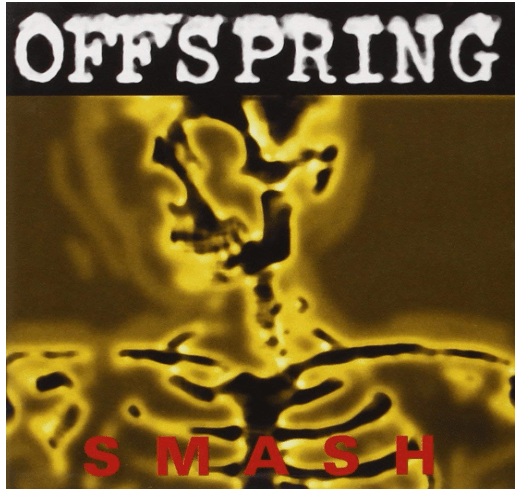
1994 was a big year for punk rock breaking through to the mainstream. That year, Green Day released “Dookie,” Bad Religion released “Stranger Than Fiction,” Rancid released “And Out Come the Wolves” and NOFX released “Punk in Drublic.”
1994 is also the year I discovered punk. I was a 15-year old freshman at Fullerton High School. I loved Green Day, the Offspring, Bad Religion, and Rancid. Although I was not a “punk” in the traditional sense, these catchy songs were played constantly on KROQ and pretty much all my friends were into them.
In high school, my friend Matt would occasionally share with me “older” punk bands like D.I. and Dead Kennedys, and I must confess I wasn’t really into them. It was too abrasive. I, like many of my contemporaries, preferred the more radio-friendly pop-punk.
It wasn’t until many years later, when I was like 30 years old, that I re-discovered old school punk rock bands like The Adolescents, Agent Orange, and the Middle Class–and started to appreciate their rawness and understood their rebellion against the popular music of their time.
In this sense, the pop punk breakthrough of the 90s was a double-edged sword. While it brought mainstream success and exposure to many bands, it also kind of softened the hard edge and raison d’etre of the original scene.
The 90s also saw the breakthrough of punk’s zany cousin, ska, which combined horns and catchy hooks with punk guitars.
Popular OC ska bands that emerged in the 90s included the Aquabats (Huntington Beach), as well as Save Ferris and Reel Big Fish (both from Garden Grove).
Anaheim
Probably the biggest ska/punk band to come out of Orange County was No Doubt, who were from Anaheim.
Their early music was influenced by older ska bands like the Specials, the Selector, Madness, and Fishbone.
No Doubt were unique in the male-dominated Orange County punk scene, as they had a female front person, Gwen Stefani.
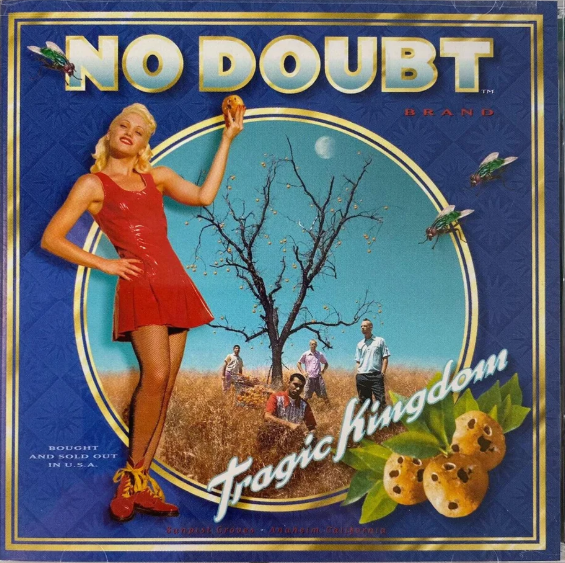
In 1995, No Doubt released “Tragic Kingdom,” their second album. The title was a play on the Magic Kingdom (aka Disneyland). The cover art also referenced Orange County, parodying orange crate label art, with Stefani holding a rotten orange.
“Tragic Kingdom” blew up and made No Doubt rock superstars.
“[Stefani] became a role model for women’s empowerment, and soon young girls all over the world replicated Stefani’s sense of glamorous tomboy style,” Jackson and Kohn write.
Another Anaheim contribution to local punk history was the Doll Hut, a small roadhouse off the 5 freeway, owned by Linda Jemison.
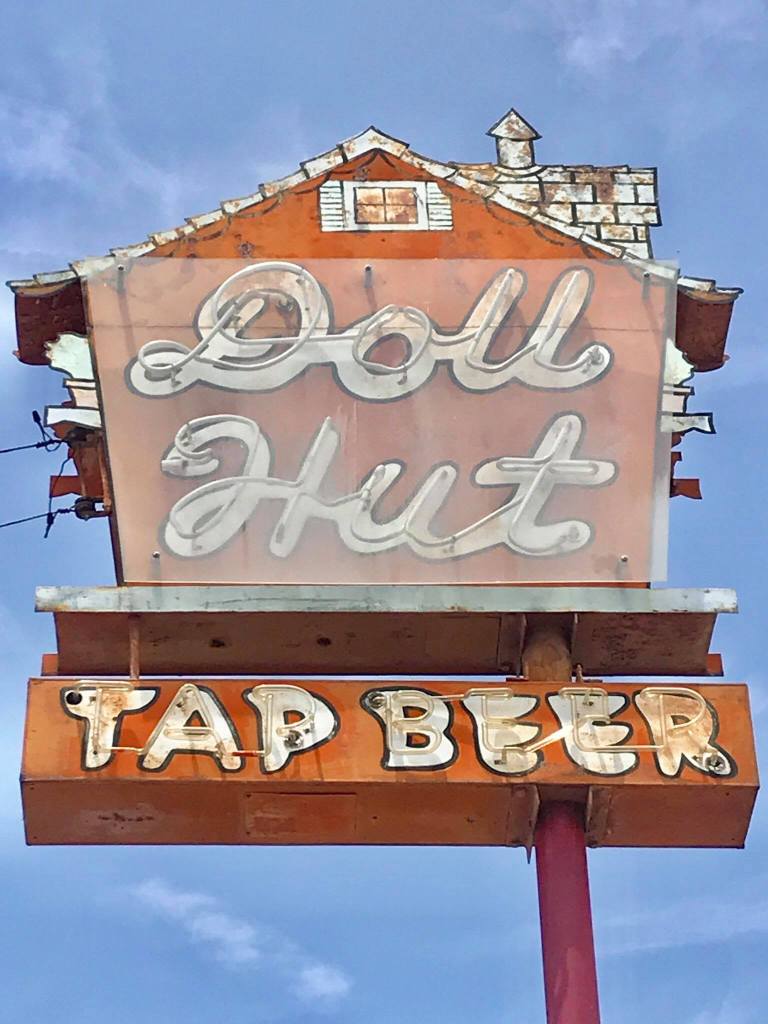
“The catalyst Jemison said inspired the Doll Hut was the closing of Commonwealth Pub in Fullerton. Known as a major hub for early punks in OC, its shuttering suddenly left a lot of musicians with nowhere to go,” Jackson and Kohn write.
“We thought well, you know, we’re gonna get them to come here,” Jemison said of the Hut.
This tiny club hosted some heavy punk hitters, including Social Distortion, Bad Religion, and the Offspring.
Although Linda sold the Doll Hut in the early aughts, the club continues to host punk shows regularly.
Epilogue
“On April 3, 2024, on Ness’s sixty-second birthday, he was presented with the key to the city of Fullerton. Yes, Mike Ness, the former Punk of the Month at the Fullerton Police Department who’d spent just as much time there as he would rehearsing, was honored as a city dignitary. The Mike Ness who was lucky to make to to 23. This day in Fullerton was declared Mike Ness Day,” Jackson and Kohn write. “The ceremony, which took place in downtown Fullerton, saw Ness presented by Mayor Nick Dunlap, who told the assembled crowd that he grew up listening to Social Distortion (imagine telling Ness the mayor of Fullerton listened to his music forty years ago?), and Ness had the classic ‘rags to riches tale, only it’s not fiction.”
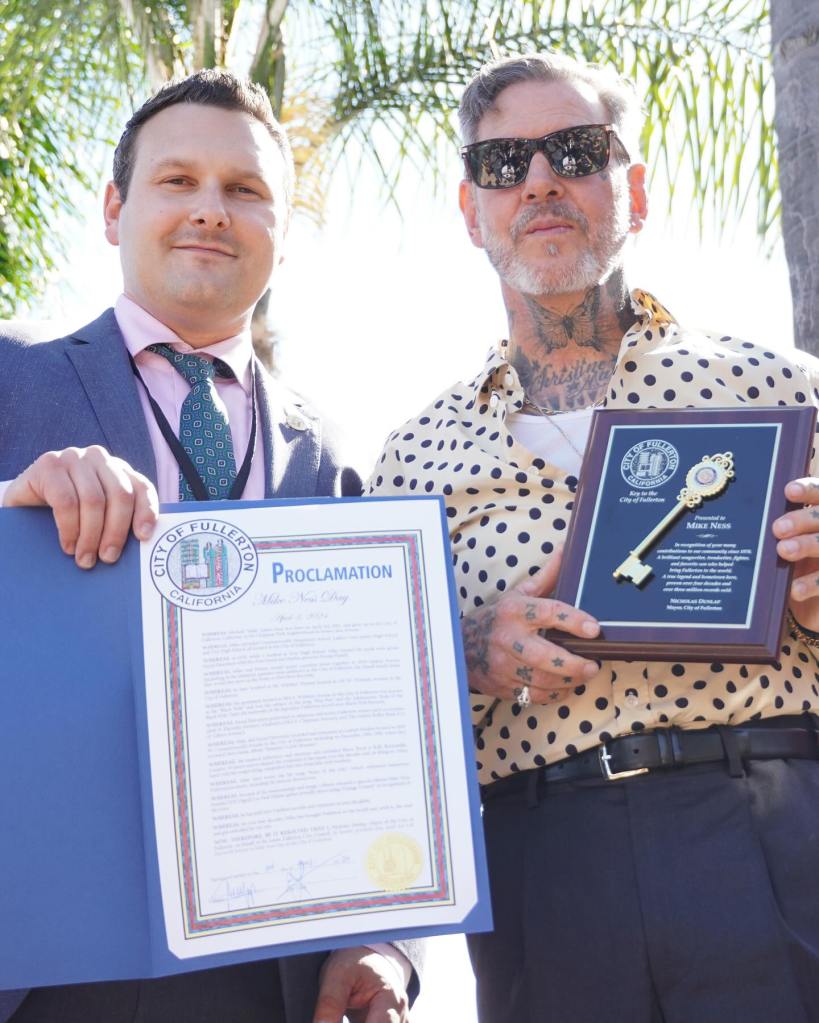
“Beyond our love for music is our love for our community,” Mayor Dunlap said. “That’s what brings us here today because we are able to celebrate a living legend who is among our greatest exports to the world, right there with the Fender Stratocaster.”
Tearing Down the Orange Curtain is an excellent chronicle of how an important local subculture became one of Orange County’s most interesting cultural contributions to popular music.
My one criticism of the book is that it kind of glosses over two aspects of the Orange County punk scene that are significant but kind of embarrassing.
The first is racist skinhead Nazi punk that historically found a home in Huntington Beach. I’ve recently been reading the 2026 book American Reich: A Murder in Orange County, Neo-Nazis, and a New Age of Hate by Eric Lichtblau, which chronicles this unfortunate subculture.
The other is the Christian punk and ska scene in Orange County. I grew up attending a mega-church in Fullerton, and was exposed to this side of the scene. Bands like the OC Supertones, Plankeye, and Slick Shoes would play at local churches. Some of them, like the Supertones, would play at OC’s big Christian youth event at Anaheim Stadium, the Harvest Crusade. Evangelical Christianity and punk rock..a match made in Orange County.
That said, I highly recommend Tearing Down the Orange Curtain. What inspires me about the early punk scene was how participatory and DIY it was. Oftentimes, we are encouraged to be merely consumers of culture. The early punks were often creators of culture–forming bands, making zines, being creative. They were also creating a meaningful rebellion against the boring, conservative suburban monoculture that was Orange County in the 1970s and 80s.

