The following is from a work-in-progress about the history of Fullerton. You can support my ongoing research and writing on Patreon.
The Fullerton Observer newspaper was formed in 1978 by Ralph and Natalie Kennedy and friends to provide a more progressive counterbalance to the more conservative Fullerton News-Tribune and Orange County Register. Back then, Orange County (including Fullerton) was dominated by Republicans, and the Observer crew were definitely in the minority. The Fullerton Public Library has digital archives of the Observer stretching back to 1979. I am in the process of reading over these archives and creating a year-by-year summary of top stories. Here are some top stories from 2004.
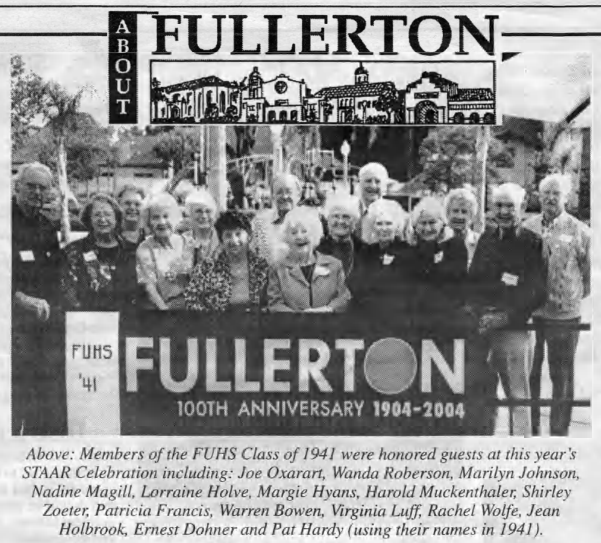
In 2004, Fullerton celebrated 100 years of incorporation as a city, although the town was founded in 1887.
Bush Re-Elected and The Iraq War Ramps Up
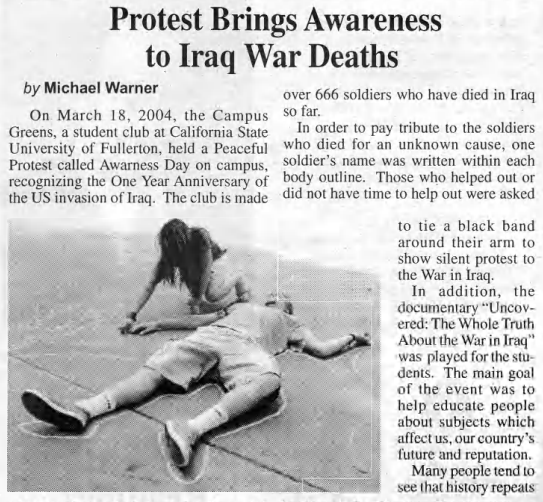
In national and international news, America was embroiled in the Iraq War, which, in retrospect, was not our finest hour.
Republican George W. Bush was re-elected as president.
“Seldom has a president faced so many challenging issues, many of his own making, and George Bush seems inclined to make all of them worse,” Observer political commentator Vince Buck wrote. “The Iraq situation has no acceptable solution, which will put further pressure on this limited president to which he may not react well.”
The Governator
In 2004, California’s governor was Hollywood actor/bodybuilder/Republican Arnold Schwarzenegger. One thing the “Governator” did was to veto a bill that would have raised the minimum wage in California by $5.00. Minimum wage at that time was $6.75 an hour.
According to Center for Continuing Study of the California Economy director Stephen Levy “even if the raise in wages was enacted immediately, it would still leave minimum wage lower, adjusted for inflation, than it was in 1970.” Thanks, Arnie!
Local Politics
For most of its history, Fullerton City Council was dominated by Republicans. However, in 2004, a female Latina Democrat named Sharon Quirk was elected.
Quirk, along with fellow Democrat Doug Chaffee, was endorsed by a newly created political group called Neighbors United for Fullerton (NUFF).
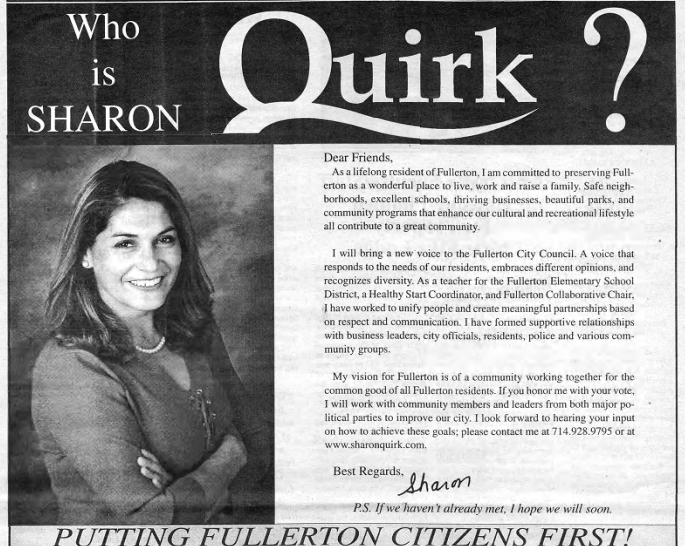
Important issues in the 2004 race were preserving Coyote Hills and the Fox Theater, $150 million in deferred infrastructure repairs, concerns about the density of development, and rowdiness in the downtown area.
Perhaps in direct contrast to NUFF was another newly-created political action committee called Friends for Fullerton’s Future, which was created with the sole purpose, according to their filing statement, “To Oppose Candidate Doug Chaffee.”
Who were Friends for Fullerton’s Future? In 2004, the organization consisted of one man, George Bushala Jr, a contributor to the campaign of incumbent Republican Shawn Nelson.
The other two City Council winners in 2004 were Nelson and Richard “Dick” Jones.
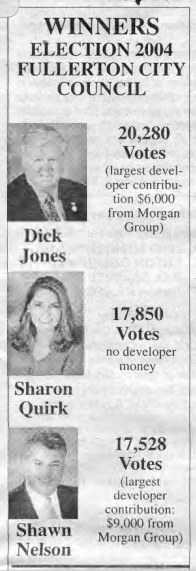
According to the Observer, Nelson “ran a campaign notable for its reliance on out-of-town and developer money. Much of the negative campaigning in this election was associated with Nelson supporters.”
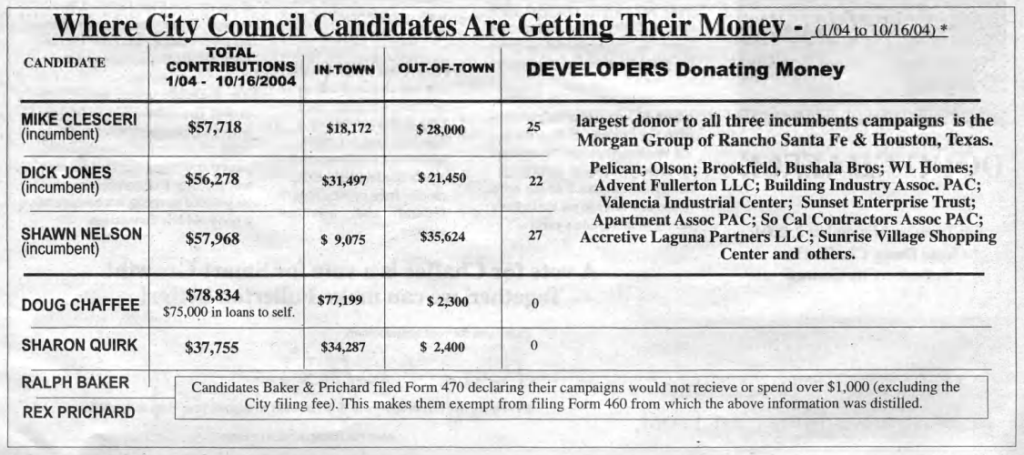
Despite spending a large amount of his own money, Doug Chaffee was roundly defeated. He was, according to the Observer, “the target of the most scurrilous barrage of negative material Fullerton has seen. The source of this material was an organization called Friends For Fullerton’s Future, whose sole purpose was to attack him.”
One of the main attacks against Chaffee was that he was supportive of “high density development” because he owned a 59-unit senior housing unit on Amerige.
Today, Friends for Fullerton’s Future is the name of a blog associated with Tony Bushala (George Jr.’s brother) and friends that continues to regularly criticize (mostly) Democratic City Council members as well as comment on city council doings from (mostly) libertarian perspective with a “take no prisoners” style. Because the blog is associated with a prominent property owner who spends a lot on local political campaigns, it is hard sometimes to determine whether blog’s purpose is genuine discourse or self-interest. Perhaps both.
Aside from local developers and property owners like the Bushalas, a major player in City Council politics were the police and fire unions, which spent thousands supporting their preferred candidates.
“The police and fire unions have been playing a high risk game in recent years in an effort to create a Council that will provide them with generous benefits,” Buck wrote. “The result this time should serve as a warning. They did not support the top vote-getters.”
Pollution
In 2004, Fullerton continued to have to deal with the lingering effects of industrial pollution, such as the former site of a manufactured gas site owned by Sempra Gas located at 144 W. Walnut Ave, on the new Paseo (Union Pacific) Park on Truslow Ave.
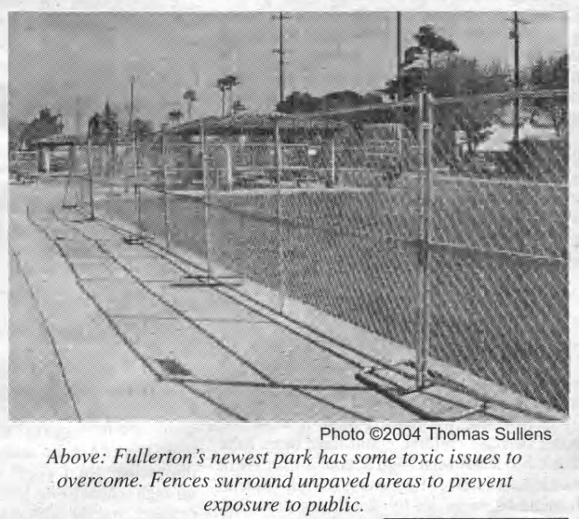
The Gas Company would have to remove about 3000 tons of soil that was contaminated with bad stuff like polycyclic aromatic hydrocarbons (PAHs), PCE, benzene and other toxins.
One wonders how the City could build a park without knowing that it was contaminated.
Another site of industrial pollution was the former Hughes Plant in west Fullerton, which was being developed into a housing and commercial center called Amerige Heights.
“The effects of years of disposing of pollutants at the former Hughes/ Raytheon site on Malvern, continues in the form of persistent 1,1- DCE, other VOCs and 1,4-dioxane still leaking into the drinking water aquifer underlying the property,” the Observer reported.
Art & Culture
Efforts were underway to raise enough money to save the Fox Theater from the wrecking ball. As a November deadline approached, the Fox Historic Theater Foundation had raised around $500,000 from community members.
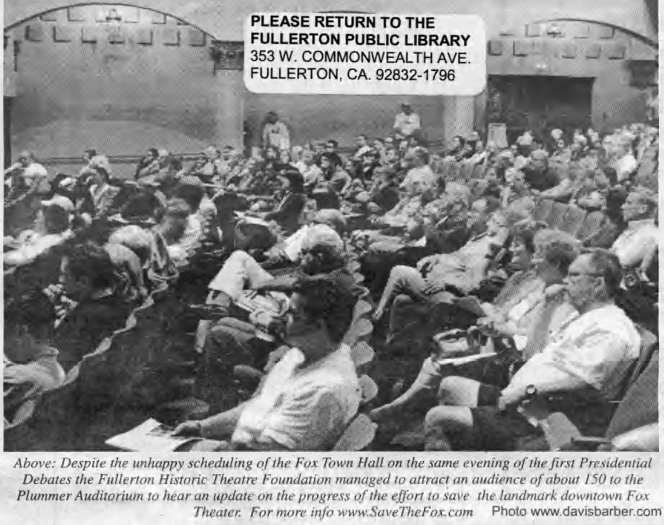
Fullerton’s Redevelopment Agency approved a $ 1.65 million “challenge” grant to the Fullerton Historic Theatre Foundation for the purchase of the Fox Theatre. This was about half of the funds necessary to purchase the theater.
Property developer the Morgan Group had the option to purchase the theater from its owner, Ed Lewis. They wanted to tear it down and build apartments. The Morgan Group had given campaign money to City Council members Mike Cleseri ($11,500), Shawn Nelson ($9,000), and Dick Jones ($6,000). These three voted against the loan proposal.
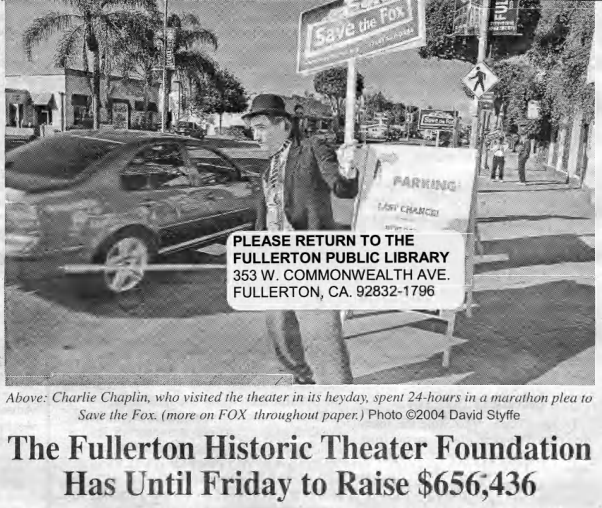
And then, at the eleventh hour, an anonymous donor gave the Fox Theater Foundation the $1 million that was needed to purchase the theater and save it from destruction.
Some of the people who were involved in these early efforts to save the Fox included Chuck Estes, Tom Dalton, Jane Reifer, Todd Huffman, and Richard Odle.
The Downtown “Renaissance”
In the early 2000s, Downtown Fullerton was experiencing a “renaissance” of sorts, with new businesses popping up in what had formerly been a pretty sleepy area.
Some of these businesses were arts-focused, like West End Gallery and Steamers Jazz Club.
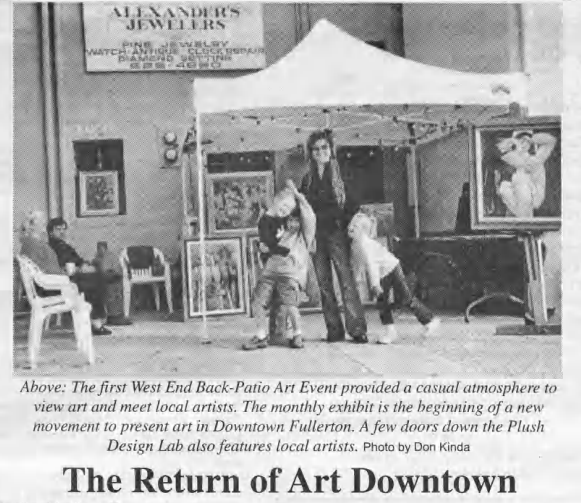
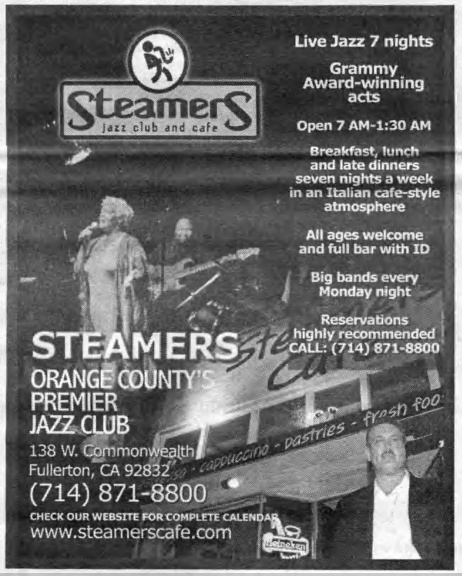
But this “renaissance” was not all galleries and jazz clubs. It also included a number of bars and nightclubs that brought some unwanted activity.
“The Fullerton Police Department continues to work with the downtown restaurant bars to thwart the fights that occur at closing time,” the Observer reported. “Several large fights have occurred in April including one on April 20th on Amerige involving an uncooperative crowd of over 100 people that took the entire ‘Watch’ to clear…Surrounding retail businesses have reported broken glass, vomit, cigarette butts, other trash and rattling of doors setting off false burglar alarms.”
Sometimes the blame for this rowdy late-night activity took on a racist tone.
The City Planning department ordered Revolucion cantina to remove its outdoor patio, citing rowdy activity, although police logs showed far fewer incidents at that location than surrounding bars like Back Alley and Rock ‘n Taco. The patrons of Revolucion were largely Latino. At one public meeting, city council member Mike Cleseri implied that the downtown fights were gang-related, a claim immediately denied by the police department.
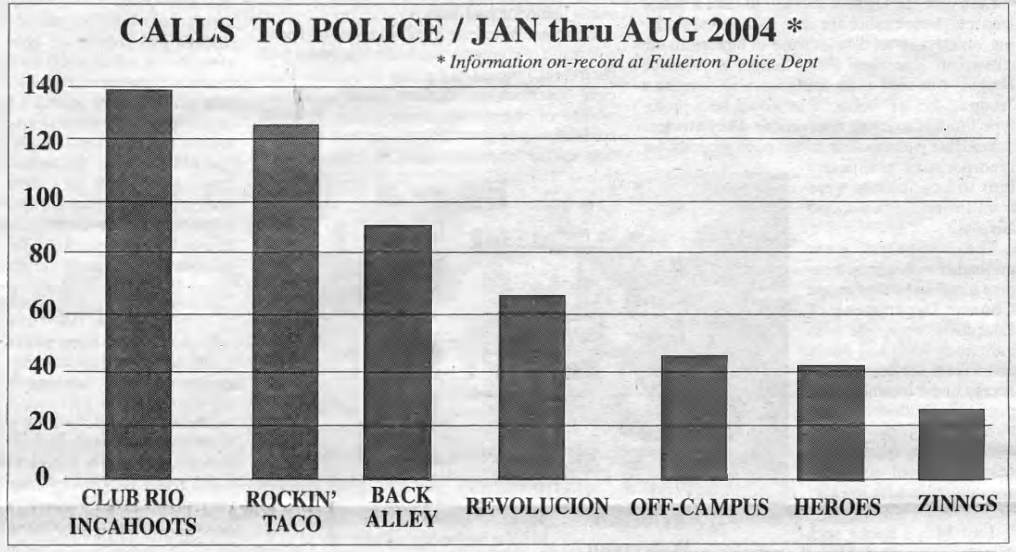
In 2004, I moved into an apartment in the heart of Downtown Fullerton, atop Mulberry St. Ristorante. I can attest that, at that time, the downtown bar scene was pretty wild, especially on the weekends. Being 24 at the time, I didn’t really mind the lively nighttime activity. But I remember many nights, standing on my patio around 2am when the bars let out, and watching the mayhem below, including several fights.
The story of how and why city officials approved so many bars and nightclubs in such a condensed area will be explored in a future post.
Housing & Development
By the early 2000s, much of Fullerton was built out with housing tracts, shopping centers, and some industry. To accommodate new residents, more and higher density housing had to be built. At least that was the thinking at the time.
The aforementioned Bushala Brothers had, over the years, acquired lots of property around the railroad tracks, and were trying to develop these into housing. They tried, and failed, to get a massive apartment project approved in 1989. In 2004, they were back with a proposed 120-unit condo project. The Bushalas were partnering with developers the Olson Company to build the project.
This project, which seemed relatively uncontroversial, would eventually be built. However, another more controversial project was in the planning stages.
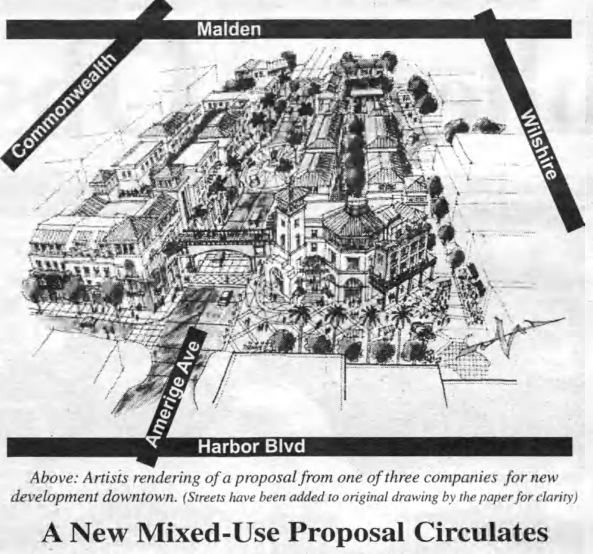
The City requested proposals from companies interested in building a mixed-use development on the downtown parking lots between Harbor and Malden and Wilshire and Commonwealth.
And proposals they did receive, such as one from Pelican Properties to develop both sides of Amerige with 160 homes plus restaurants, retail, office and live/work space, and a parking garage.
This project would eventually become the controversial Amerige Court, which was ultimately voted down by Council. Stay tuned for more on that.
Early on in this process, some downtown businesses expressed concern about parking and noise from the proposed new development.
In an effort to “clean-up” a low-income Latino neighborhood around Maple School, the City ramped up its code enforcement with an aggressive program called the Neighborhood Enhancement Project–handing out hundreds of code violation citations.
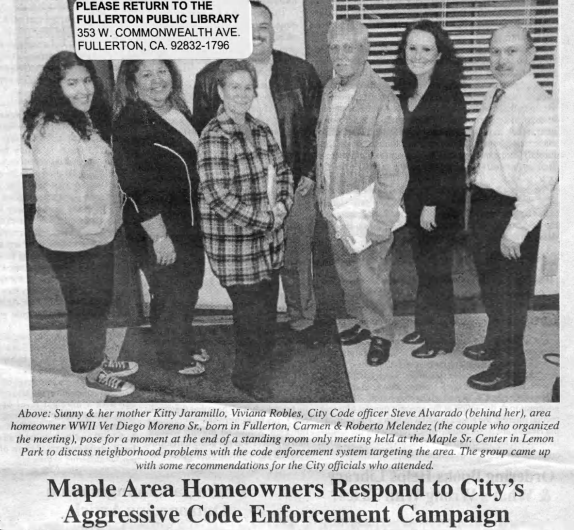
These aggressive tactics were reminiscent of the aggressive neighborhood sweeps conducted in the 1990s, in which (in the name of public safety), police ransacked dozens of homes.
Just as they had back then, the community responded by organizing. Over 150 homeowners from the Maple Area met with City staff to understand why they were being targeted so aggressively.
Neighborhood leader Bobby Melendez said that while the program may have some merit, “the process is not sensitive to homeowners who are senior citizens on fixed incomes and families with low incomes” and added that “neighborhood improvement is the responsibility of both homeowners and the City…If the City is citing homeowners to fix code violations, the City must also take actions to improve neighborhood streets, trim trees and clean up the Lemon Street (Santa Fe Railroad) Underpass.”
The residents made it clear that neighborhood improvement was a two-way street.
The City offered grants to help residents with needed repairs, but there was an obvious disconnect between residents and the city, as “the 13 residents that have signed up are still waiting for lengthy paperwork to be completed or inspections to take place, hampered further because the City has no inspector on duty.”
Homelessness
With housing costs quite high in Fullerton, homelessness continued to be a problem.
Fullerton has always had a kind of patchwork solution to homelessness, involving the city, the police, local churches, and nonprofits.
During cold months, the National Guard Armory in west Fullerton was used as an emergency shelter in which people experiencing homelessness could get a meal and a foam cot on a hard floor to sleep on.
“Shelters like the Fullerton Armory can alleviate suffering during the winter months, and perhaps even save lives,” the Observer reported. “But they are not the answer to homelessness.”
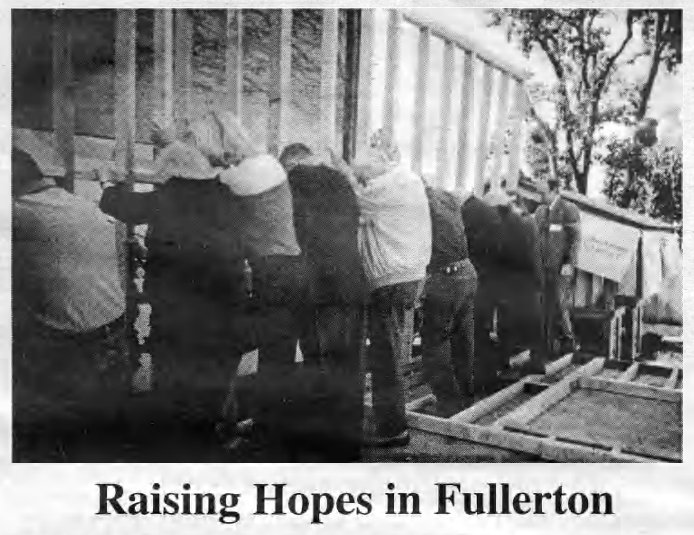
Local nonprofit Fullerton Interfaith Emergency Services (now called Pathways of Hope) was in the process of expanding their New Vista Shelter, which offered longer-term transitional housing for families experiencing homelessness.
Over 40 local building and supply companies donated products and services to help build the new housing.
Saving Coyote Hills
As the need for more housing became acute, it had to be balanced with a desire of local residents to preserve some local open space and access to nature.
Nowhere did this struggle play out more acutely than in the fight to preserve Coyote Hills from development by Chevron and its housing subsidiary Pacific Coast Homes. The plan was to build 760 homes and a shopping center on part of the 510-acre property, which was a coastal sage scrub habitat that contained numerous native plants and animal life, including the threatened California gnatcatcher bird.
“The Fullerton City Council and staff are taking all the comments from the community and from the Friends’ of Coyote Hills legal and biology experts into consideration before making a decision involving the last parcel of natural open space within city limits,” the Observer reported. “In the meantime, the Friends are researching funding sources to purchase the land as a park and nature preserve, as well as continuing with their efforts to increase public awareness of this treasure in Fullerton’s own back yard.”
Coyote Hills would become an increasingly important political issue.
Public Transit vs. OC’s Car Culture
As Orange County continued to grow in density, it also became more congested with traffic. One proposed solution to this was the construction of a light rail called Centerline, to be funded with Measure M funds obtained by a sales tax approved 1990.
Due to opposition from some quarters, the Orange County Transportation Authority (OCTA) shortened the proposed route by about half, from John Wayne Airport to the Civic Center in Santa Ana. The original Centerline route stretched from Fullerton to Irvine.
OC Supervisor Chris Norby (who had previously served on Fullerton City Council) voted against the project, stating that he felt the $900 million cost was too high for only 12,000 to 15,000 daily riders, which was the initial ridership forecast for the project.
Metrolink was started in 1994, with Measure M funds,
Norby argued that “CenterLine could well become a fiscal black hole, diverting precious transportation dollars that could benefit the whole county.”
Instead, Norby supported Metrolink, which was established in 1994 with measure M dollars.
Meanwhile, a survey conducted by CSUF and the OC Business Council, found that 69% of Orange County residents supported the 9.3- mile light-rail starter segment of the Centerline project.
Wealthier areas like Yorba Linda were less likely to support public transit.
“A $7.75 million Metrolink rail station planned for Yorba Linda since 1991 was recently rejected by unanimous vote of the city council, citing concerns of noise and traffic that it would bring to the area,” the Observer reported.
Most of the estimated 300 critics who turned out for the city council meeting belong to a group called Yorba Linda Residents Against the Metrolink Station.
As an occasional public transit user myself, I have noticed that there is definitely a social class element to users of public transit vs. drivers of cars in Orange County.
If some Orange Countians were against public transit, some were also against making the roads safer for bicycles.
In Fullerton, a Bicycle User’s Subcommittee had been established to recommend more bike-friendly policies.
According to long-time BUSC member Vince Buck, prior to the creation of the committee, “opportunities for improving the quality of life in Fullerton by encouraging non-motorized transportation were not being developed. The traffic staff and the T& CC were not interested–indeed were hostile–and would not address bicycle safety issues. They largely viewed bicycles as an impediment to traffic flow, rather than as an important contribution to the quality of life in Fullerton, an attitude that has not substantially changed.”
Fullerton, and Orange County in general, has for decades been a “car culture.”
Grocery Store Worker Strike
Back in 2003, thousands of local grocery workers went on strike against proposed pay and benefit cuts.
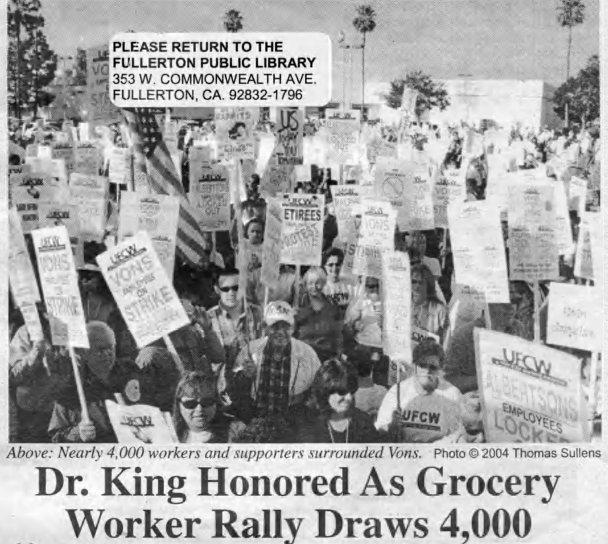
“Marking the 100th day of the grocery workers strike a huge rally drew nearly 4,000 citizens to the Vons on Chapman in Garden Grove on Saturday January 17th,” the Observer reported.
The Strike affected 13,000 United Food & Commercial Workers union members and their families in Orange County.
The strike lasted five months, resulting in a new contract between union representatives. and Safeway (Vons & Pavilions), Kroger (Ralphs), Albertsons and federal mediator, Peter Hurtgen.
The new agreement protected the wages and benefits of current workers, but kind of screwed over new hires, who would receive lower pay and reduced benefits.
Was this a win for the grocery workers? Observer columnist Jon Dobrer didn’t think so.
“Yes, they preserved their wage caps but allowed a two-tiered system, where new hires can be brought in at a lower salary and with fewer benefits,” Dobrer wrote.
Same-Sex Marriage
In 2004, same-sex marriage was illegal in California. For a brief window between February and March, San Francisco mayor Gavin Newsom began issuing same-sex marriage licenses in what came to be known as the “Winter of Love.” Unfortunately, the California Supreme Court invalidated these. Same-sex marriage would not be legalized in California until 2013.
In Fullerton, Rick Herrera and Randy Baxter, authors of the “Life Partners” column in the Observer, “committed their lives to each other before 90 friends and family, in a Holy Union Ceremony at the Spring Field Banquet Center on Sunday, March 28th,” the Observer reported.
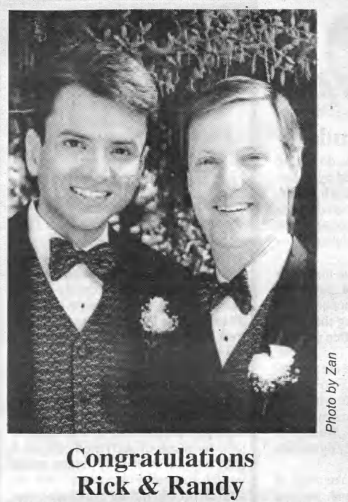
The ceremony was officiated by Pastor William R. Prickett of Dallas, Texas (an ordained Southern Baptist minister and longtime friend of Randy’s through the gay Christian group Evangelicals Concerned With Reconciliation).
Education
Fullerton celebrated the grand opening of its newest elementary school, Robert C. Fisler School, the first new school in 32 years. The new school had a theme of “Science and Technology.”
Fisler is located in the newly-built Amerige Heights development area and was named after retired Fullerton educator and longtime Fullerton School District Boardmember Robert “Bob” Fisler.
Fullerton has long struggled with the issue of educational equity between the more affluent schools in the north part of the city and the lower-income schools in the south.
Fisler was a brand new school in a new area with expensive homes and all of its students got laptops.
“Why not have Woodcrest or Richman become the “Science & Technology” school?” Observer education reporter Jan Youngman wondered. “And why should only Fisler have laptops for each student?”
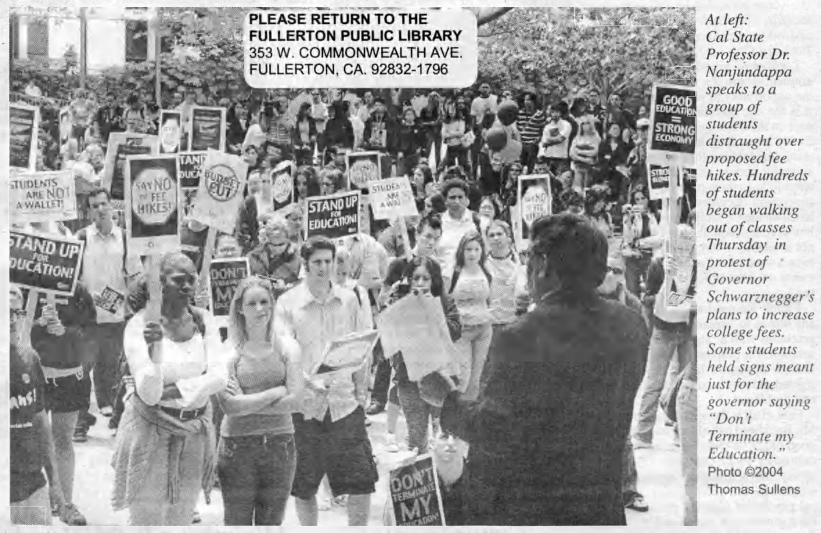
Over 600 Cal State Fullerton students walked out of classes in 2004 to protest Governor Schwarzenegger’s proposed additional budget cut of the CSU system.
“Protestors say balancing the state budget by raising student fees will cause many students, already on the financial edge, to drop out,” the Observer reported.
It’s interesting to note that the original vision for the CSU system, as laid out in the 1960 Master Plan for Higher Education in California, was that these public institutions be tuition-free.
Those who attended CSUF in the 1960s and 70s paid virtually no tuition. That vision would be abandoned, especially starting in the 1980s.
Old Bob
Old Bob, the large snapping turtle who lived at Laguna Lake for decades, was an attraction at the Fullerton Arboretum’s “Green Scene” plant sale. Bob had to be evacuated from Laguna Lake while it was being renovated.
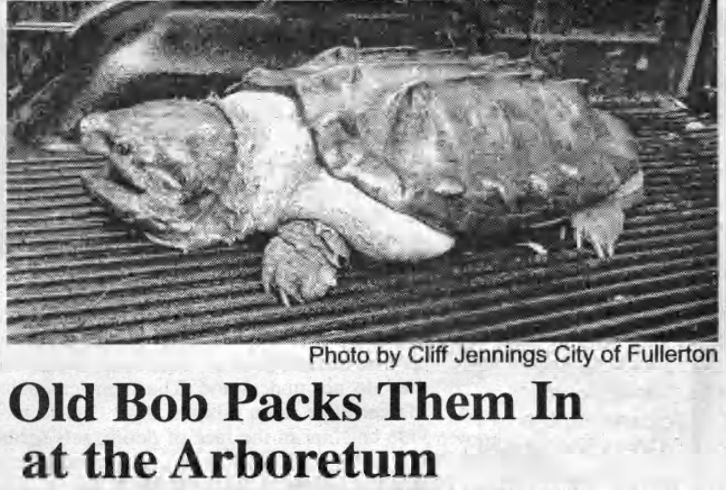
Sometimes called “The legend of Laguna Lake,” Old Bob’s ultimate destination was unknown. There was a petition to get him a home at the Santa Ana Zoo.
Deaths
Longtime Fullerton resident William “Bill” Kroeger died at his home in Borrego Springs.
Bill was born in Fullerton in 1902. His grandfather, Henry, was an early developer of North Orange County and the second mayor of Anaheim. Bill graduated from high school in Fullerton in 1921.
Bill worked in the citrus industry on his family’s ranch, and then for the Corcoran Paper Company, starting as a truck driver, moving into sales and becoming a partner.
He served on the planning commission and was elected to city council in 1954, serving as mayor from 1956 to 1958.
Stay tuned for top stories from 2005!
 Fullerton History