The following is from a work-in-progress about the history of Fullerton. You can support my ongoing research and writing on Patreon.
The Fullerton Observer newspaper was formed in 1978 by Ralph and Natalie Kennedy and friends to provide a more progressive counterbalance to the more conservative Fullerton News-Tribune and Orange County Register. Back then, Orange County (including Fullerton) was dominated by Republicans, and the Observer crew were definitely in the minority. The Fullerton Public Library has digital archives of the Observer stretching back to 1979. I am in the process of reading over these archives and creating a year-by-year summary of top stories. Here are some top stories from 2003.
The Iraq War
It’s interesting to write about history that I remember. In 2003, I was living in Fullerton. I was 23 years old. Having grown up in a somewhat conservative evangelical environment (in Fullerton), I remember being generally supportive of the Iraq War. At the time, I bought into the official Bush/Cheney narrative that Saddam Hussein was a murderous dictator who had weapons of mass destruction and was somehow connected to Al-Qaeda and terrorism.
With the hindsight of history, I know now that Saddam Hussein was a murderous dictator, but he did not have weapons of mass destruction and he was not connected to Al-Qaeda. Saddam was a secular leader. Al-Qaeda were religious fundamentalists. Such nuance was, I think, lost on many Americans, like me at the time.
It feels appropriate to think about the lead-up to 2003 American invasion of Iraq, because (as of this writing) America is currently involved in a new war against another middle eastern country, Iran. The rationale given by the Trump administration, nebulous as it has been, echoes many of the rationales given about the Iraq War. Iran, we were told, was a threat to the United States. I do not believe that is the case, as it was not the case with Iraq. Today, I am (I hope) more skeptical of claims made by political leaders.
In 2003, Fullerton was a more Republican place than it is today. So it has been fascinating to read the Fullerton Observer’s coverage of the leadup to the Iraq War in 2003. The Observer, being a generally liberal publication, tended to focus on protests against the war and reasons why it was a misguided endeavour. I’m sure this coverage angered many Fullertonians at the time. In hindsight, I think the Observer was generally correct.
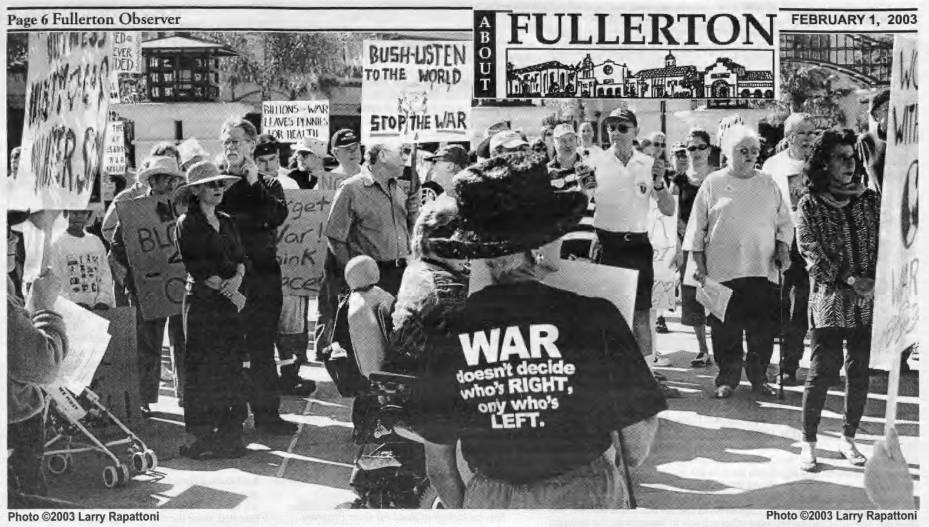
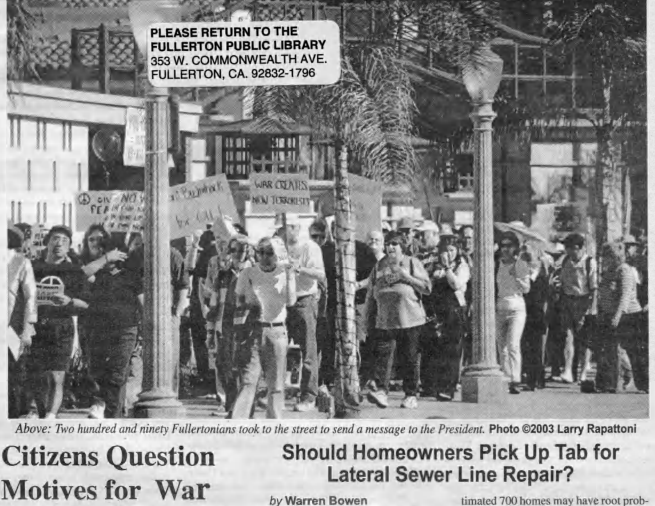
In early 2003, prior to the invasion of Iraq, “290 Fullertonians took to the streets to question the rush to war,” the Observer reported. “The event was sparked by neighbors Dorian Hunter and Sally Zivitz who invited other concerned citizens to join them at the Downtown Plaza at noon.”
“We hope this puts Fullerton on the map as having some citizens who want to stand up for their beliefs. It was a good demonstration of the right to free speech, the freedom to assemble and question our governments motives for war. Thanks to all of the participants it was a great day!” said Dorian Hunter.
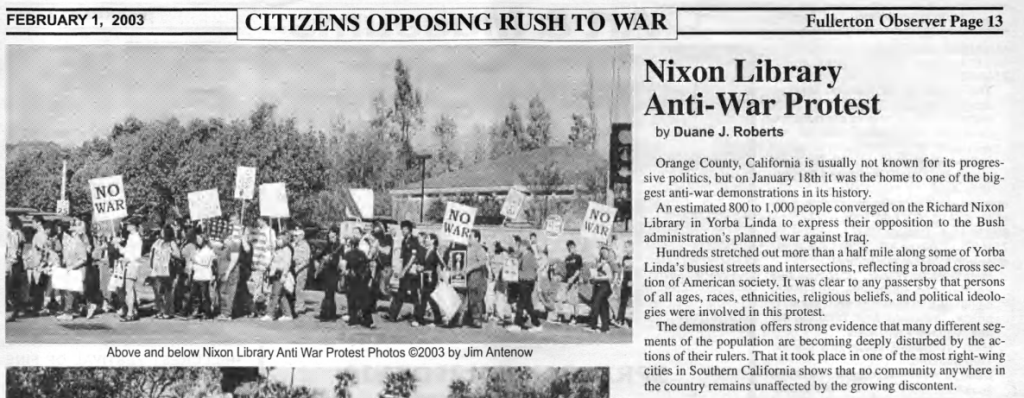
A resolution opposing the Iraq War was presented to Fullerton City Council, which was dominated by Republicans. Unsurprisingly, Council opposed the resolution.
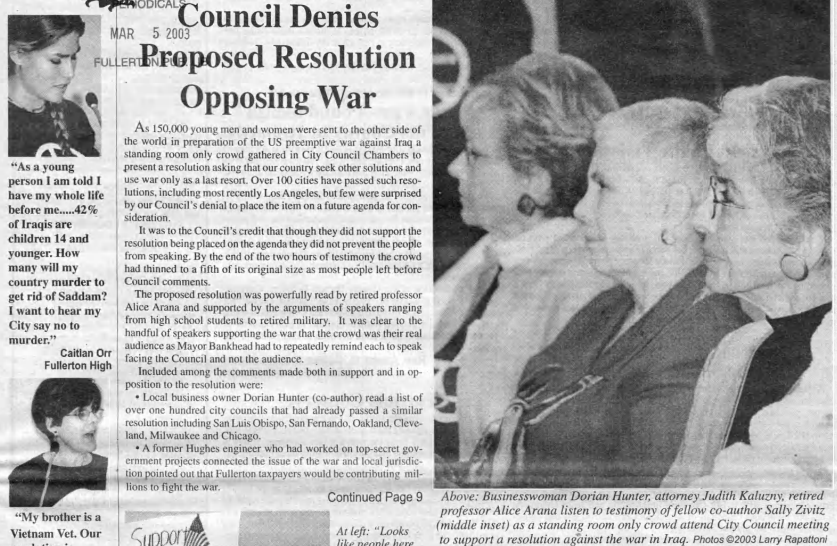
“As 150,000 young men and women were sent to the other side of the world in preparation of the US preemptive war against Iraq a standing room only crowd gathered in City Council Chambers to present a resolution asking that our country seek other solutions and use war only as a last resort,” the Observer reported. “Over 100 cities have passed such resolutions, including most recently Los Angeles, but few were surprised by our Council’s denial to place the item on a future agenda for consideration.”
“It was discouraging to listen to the reasons offered by our Councilmen for their opposition to the anti-war resolution,” Vince Buck wrote. “Councilman Jones stated that many of the arguments offered during the evening were based on ‘erroneous information, emotions, and misinformation.’ The Council itself demonstrated that it was subject to the same weakness.”
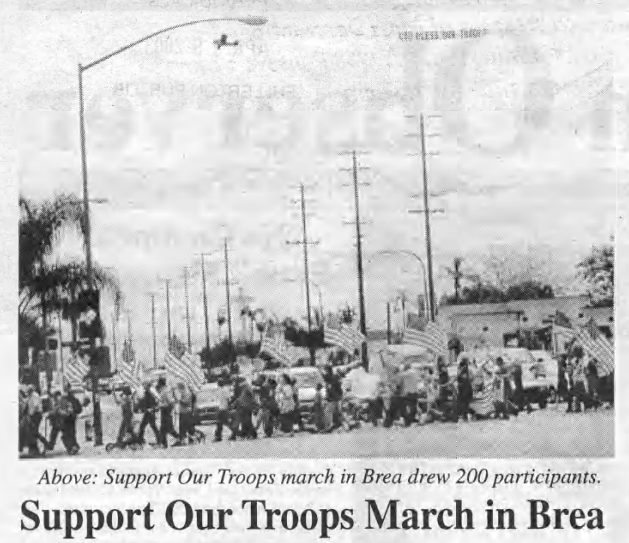
Not everyone was against the war, of course. In fact, lots of people in Orange County supported it. There were weekly flag-waving events in downtown Brea in support of the war, for example.
The Patriot Act and The Security State
A special event in Fullerton involved a discussion of the infamous PATRIOT Act, which allowed increased government surveillance of US citizens. It was a debate of sorts between FBI agent Louis Flores and ACLU representative Stephen Rhode.
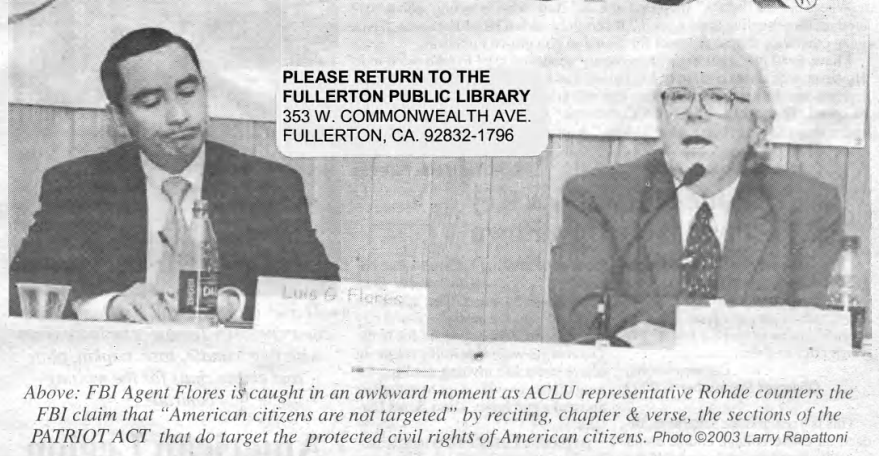
“Flores stated that the public should have no concern about the Bureau snooping into our buying or reading habits, because they don’t have time to monitor millions of people,” the Observer reported. “We should consider the FBI like our friendly local policeman who helps us when our home is broken into.”
Meanwhile Rohde, “expressed the hope that we may find a way to be both safe and free. He also reminded the audience that the struggle between power and civil rights is not a new problem in America…Rohde reviewed some of the historical precedents in which the USA has overreacted to threats by clamping down on civil rights” such as the internment of Japanese Americans during World War II.
Pollution
In industrial pollution news, the oil companies responsible for creating Fullerton’s first Superfund site, the McColl Dump Site, were now given responsibility for monitoring the site’s pollution. What could go wrong?
In other industrial pollution news, further clean-up of the former Hughes Aircraft site (now Amerige Heights Shopping Center and housing development) was needed.
“The last groundwater monitoring tests completed before construction began in 2000 showed that 1,1- DCE and 1,4- dioxane had reached the regional drinking water aquifer underlying the property,” the Observer reported. “The chemical has recently shown up in tests of the nearest drinking water well located at the Fullerton Airport which has been temporarily shut down. The report states that hazardous waste, substances or constituents have migrated or may migrate from the Facility into the environment through air, soil, and groundwater.”
And in other industrial pollution news, “A neighborhood bordering the new Paseo Park currently under construction on Truslow in Fullerton also lies in the pathway of possible problems related to the removal of toxins from a former gas manufacturing site at 144 W. Walnut, owned by Sempra Energy.”
“The site has been found to contain a series of chemicals called Polycyclic Aromatic Hydrocarbons (PAHs). Some of the chemicals at the site have been found to be of the cancer-causing variety,” the Observer reported. “Following its mandate to protect the public, the California EPA Department of Toxic Substance Control has accepted Sempra Energy’s voluntary plan to remove the top five feet of soil from the entire site…The site is set to become a city parking lot for the new Paseo Park being constructed on Truslow…No testing within the new park boundaries has been done although it does lie just south of the factory and may have offered an attractive dumping ground at one time.”
What could go wrong? Stay tuned.
Saving Coyote Hills
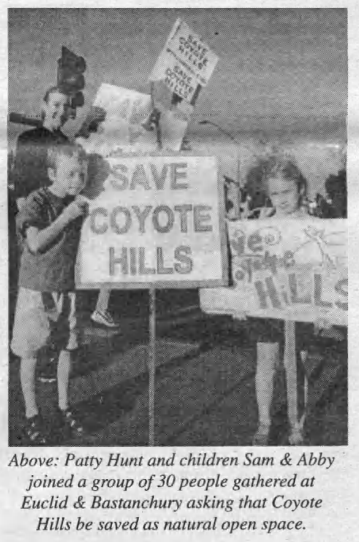
The Friends of Coyote Hills was trying to save Fullerton’s last largest natural open space from development.
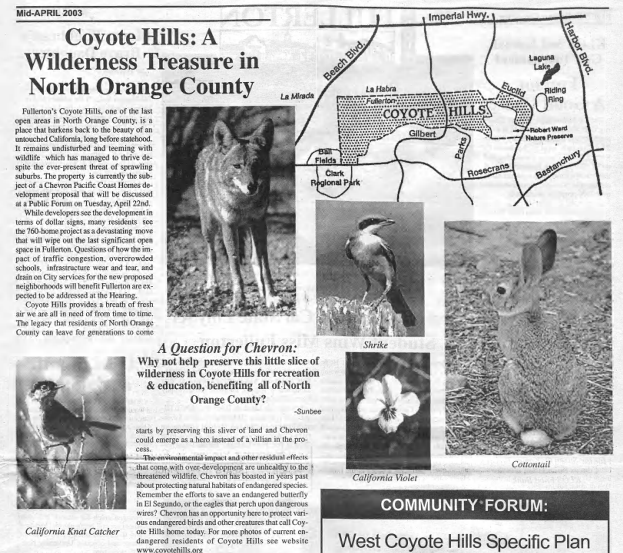
Meanwhile, “Chevron’s Pacific Coast Homes (PCH), applicant for the West Coyote Hills development, is launching an expensive advertisement and PR blitz to try to influence public support and win the support of Fullerton’s planning commission and city council. This is evident in their attendance of many events of late, the launching of a website, and the mass mailing of a newsletter,” the Observer reported. “The Fullerton community beware. Behind all this is a PR firm, Laer Pierce and Associates (LP&A), that specializes in helping developers win community and government support through slick advertising and other tricks of the trade.”
The Friends of Coyote Hills were critical of the Chevron proposal of 760 homes to be built on West Coyote Hills: “They have cited concerns of water quality and supply, traffic, overcrowding of schools, long-term economic burden for residents, and the destruction of a valuable natural habitat for a federally endangered species, the California gnatcatcher.”
“Instead of developing the property with more homes, The Friends of Coyote Hills propose a 510-acre public nature park and reserve that can be enjoyed in perpetuity by all,” the Observer reported.
According to Chevron’s web site, “Protecting the earth’s natural resources is as important to ChevronTexaco as providing the energy sources so essential to improving our quality of life. Beyond meeting the world’s energy needs, our goal is to be recognized and admired everywhere for having a record of environmental excellence.”
The Observer took Chevron’s claims of “environmental excellence” to task, pointing out decades of industrial pollution: “The US Environmental Protection Agency considers Chevron a PRP for 49 hazardous waste Superfund sites (including, along with other oil companies, the McColl Dump Superfund Site here in Fullerton adjacent to West Coyote Hills),”
In an article for the Observer, Angela Chen Lindstrom of the Friends of Coyote Hills questioned the Environmental Impact Report created by Chevron.
“Chevron’s consultants are performing the analysis and drafting the report, and then turning it over to the city for review and approval. The quality of the independent analysis is questionable,” Lindstrom wrote. “There is much at stake here. Though the lines between for-profit and public agencies have been blurred, it’s not hard to see who stands to gain the most from the development of West Coyote Hills. Times are good for Chevron.”
“To date, less than three acres of the 510-acre site has been cleaned-up. The report states that there was probably a sump (area where oil waste is dumped) related to each oil well on the property. There were over 400 oil wells,” the Observer reported.
A community meeting on Chevron’s proposal for West Coyote Hills drew a large crowd of around 400 interested residents.
“Many faces here are the same ones that attended the hearings on Amerige Heights where the City stood by as the developer presented us with pretty pictures of tree lined pedestrian friendly streets and darling houses,” Dede Ginter said. “Instead we got less than 5% green space, discount stores, cramped streets and houses within spitting distance of each other. My neighbor asked me if I thought we could trust Chevron. That is not the question, the question is can we trust our own City. No one is listening.”
Saving the Fox Theater
Fullerton Heritage, the group responsible for gathering petitions of 12,000 individuals interested in saving the Fox Theater, handed over responsibilities for saving the Fox to the newly formed Fullerton Historic Theatre Foundation.
“Created by a group of concerned citizens nearly two years ago, the Fullerton Historic Theatre Foundation was formed specifically to achieve the acquisition, stabilization, restoration and reactivation of Chapman’s Alician Court Theatre; now known as the Fox,” the Observer reported. “It has sponsored a series of public presentations aimed at educating the community about the artistic, architectural, historical and economic values of the unique structure. The Foundation, which has created a sophisticated business plan for the restoration and eventual operation of the theatre and its related properties, has also formed alliances with regional and national organizations and individuals prominent in historical restoration issues.”
In other arts & culture news, a new business called Plush Design Lab opened downtown at 207 N. Harbor Blvd.
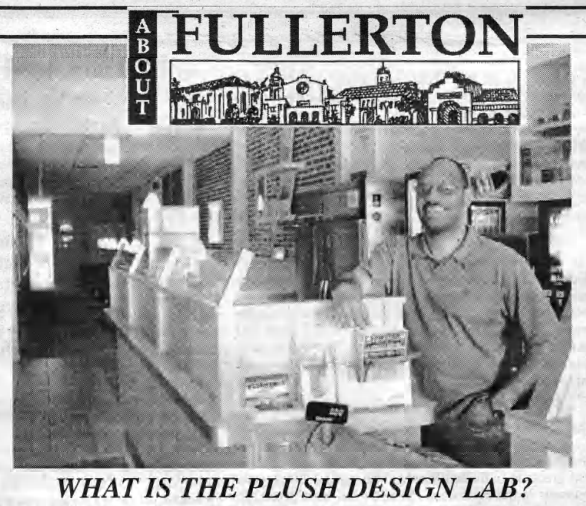
“The European style Internet cafe features Italian sodas, coffees, teas, Bobas, softdrinks, various energy drinks, desserts & snacks in a cool, contemporary high-tech environment,” the Observer reported. “The space promises to be popular with CalState & Fullerton College students, artists, writers, actors, musicians, hi-techs and anyone looking for a non-alcoholic alternative gathering place. Poetry jams are already taking place as well as open mic nights and soon the Plush will host art shows.”
A new mural next to Rutabegorz in a new downtown park next to the Museum Plaza was painted with the guidance of Fullerton artist Katherine England.
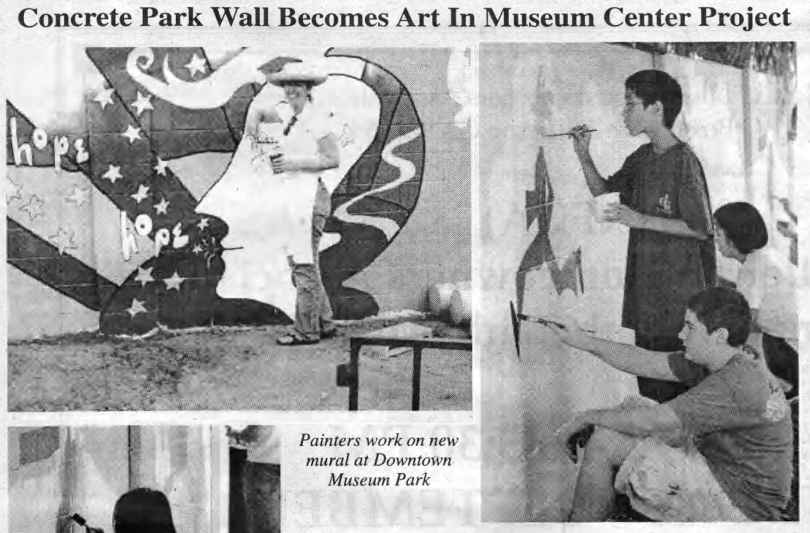
“Thirty students with representatives from each of Fullerton’s high schools worked on the colorful and bold design inspired by the art of Peter Max,” the Observer reported. “The new park located on land that was once considered for parking or yet another office building, adds a refreshing green space to downtown Fullerton.”
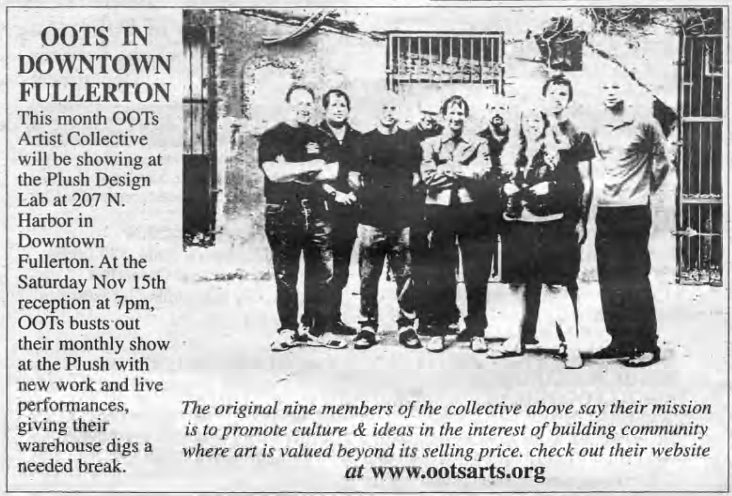
And and arts collective called OOTS began organizing art shows in Fullerton.
Transportation
In transportation news, a proposed light rail train called the Centerline was facing push back from some quarters.
“Following a 3.5 hour period of testimony from 75 members of the public, including the Mayor of Fullerton, Councilman Dick Jones, and 7 other Fullertonians, the Board spent about one hour of discussion before reaching a 9 to 2 vote in favor of continuing the Centerline Project,” the Observer reported. “Public comments were so overwhelmingly in favor of continuing the project that it is difficult to understand how the two “No” votes were possible.”
Chris Norby, former Fullerton Councilman, recently elected to the Orange County Board of Supervisors, voted against the majority.
“According to very recent survey findings from Cal State Fullerton’s Center for Public Policy, in partnership with the Orange County Business Council, some 55% of Orange County residents would – if the question were put before them today – vote in favor of building the light rail line, as proposed, from Santa Ana to John Wayne Airport,” the Observer reported.
Ray Young, professor of geography at CSUF, author of Commuting in Orange County, a report published by the Cal State Fullerton Center for Demographic Research (December 2002) wrote, “It is noteworthy that the public is more receptive to a light rail future than to bus system expansion. That may be linked to the prospect of greater speed as well as the novelty of a rail starter line, linking major activity nodes and job centers in the county.”
The light rail concept was approved as part of measure M funding initiative in 1990, a process that led to substantial freeway widenings and bus line improvements.
The Infamous Florentine Sidewalk Incursion
In 2003, Downtown Fullerton was experiencing a “renaissance” of sorts, with more restaurant/bars opening up, transforming a once sleepy downtown into a popular drinking/party destination.
In the midst of this, the Florentine family, owner of a proposed bar on the northeast corner of Harbor and Commonwealth, did a questionable thing by encroaching on a sidewalk with a built-out concrete patio with support from city bureaucrats.
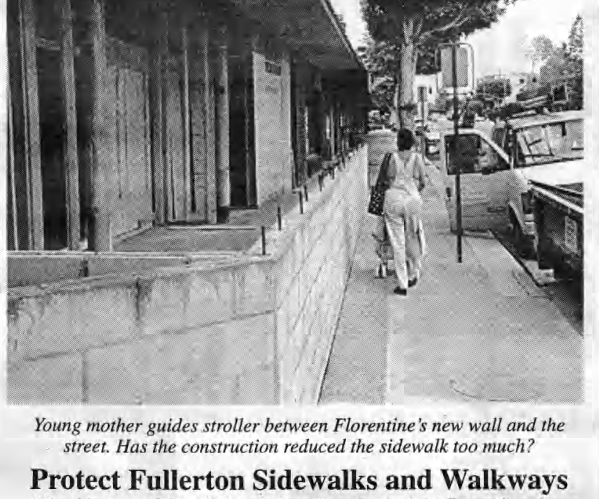
“Approval to build a 6-inch high patio that later turned out to include a 4-foot high concrete block wall enclosing a wide swath of city sidewalk on Commonwealth at Harbor in downtown Fullerton was given to “Intimate Inns of California, Inc., doing business as Florentine’s Downtown Bar and Grill,” unanimous City Council vote May 6, 2003,” the Observer reported.
Although a sign and two trees were removed for the construction and the sidewalk was reduced from 12-feet to 6-feet wide, Florentine’s application was not sent to the Planning Commission for discussion.
“The Agenda information sheet No. 14, presented to Councilmembers, the public and the press, failed to include diagrams, figures, or even a description of the concrete block wall running down the middle of the sidewalk,” the Observer reported. “Instead Council was shown an artist’s rendering which was not made available for publication and was not included in the Agenda backup information.”
Asked why the issue did not come before the Redevelopment Design Review Committee for review, City Manager Chris Meyer said “The RDRC has no political power but acts only as an advisory body to the City Council.”
“The sidewalk [should] be returned to its 12 ft. width and that the two trees removed be replanted to provide shade,” the Observer stated.
Meanwhile, Cameron Irons, president of the Downtown Fullerton Restaurant Association argued that the encroachment was a net win for Fullerton.
“Tony and Joe Florentine have been longtime business owners in our beautiful Downtown. They put their money and their efforts into creating a business in an area that had been woefully neglected by the city for many years,” Irons wrote. “The current renaissance in the downtown area is occurring for many reasons, one of which is the dedication and hard work of our Downtown restaurant owners. If those who complain about the Florentine’s patio feel that a wide sidewalk is more important than the increased success of a local business they only have to move a few blocks North to Brea where those city leaders have chosen to bulldoze historic areas so that restaurant patios can exist with wide sidewalks.”
Local Politics
In California politics, Democratic governor Gray Davis was recalled and Republican movie star/body builder Arnold Schwarzenegger was elected to replace him. Oh, California.
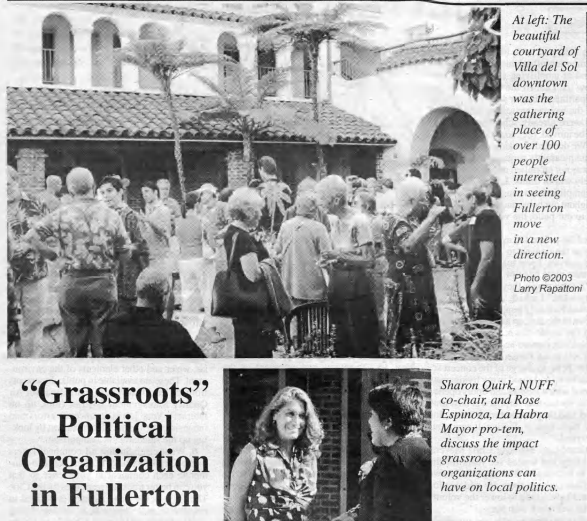
Closer to home, a new political advocacy group called Neighbors United for Fullerton (NUFF) was formed. This group sought to elect liberal candidates.
The Grocery Store Workers Strike
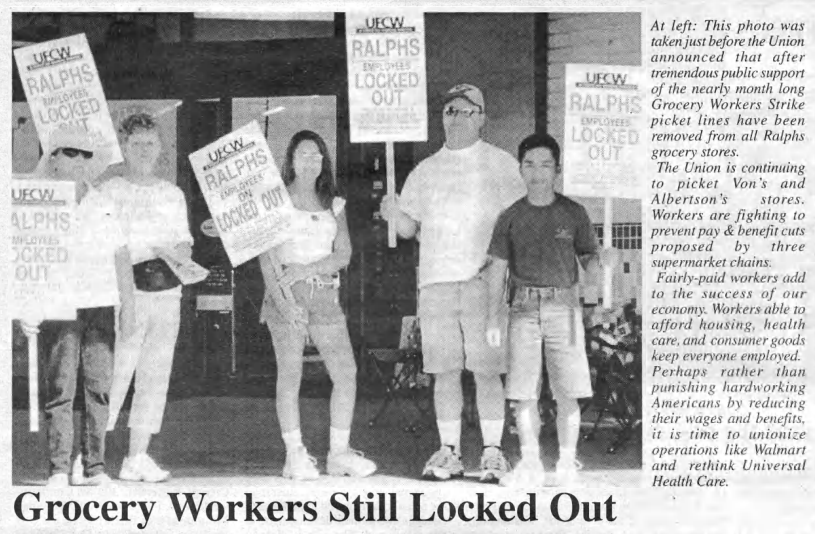
When large grocery store chains sought to cut workers’ wages, thousands of workers went on strike throughout Southern California, including Fullerton.
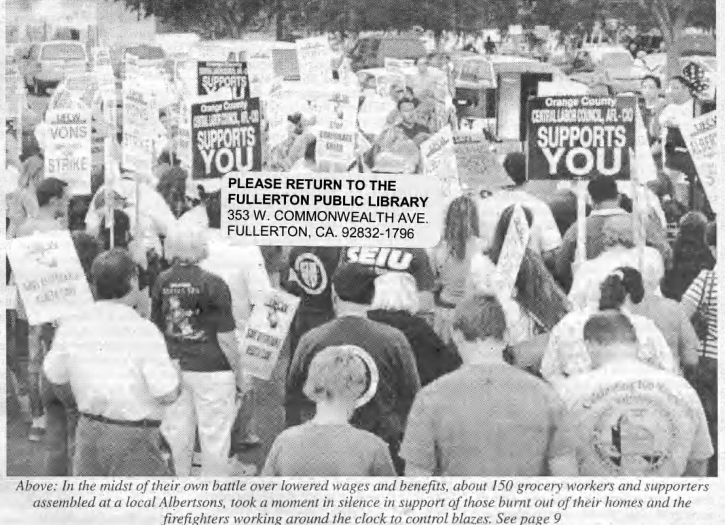
“When the United Food and Commercial Workers Union called the strike against Vons and Pavilions, both owned by Safeway, grocery chains owned by Albertson’s and Ralph’s locked out their workers even though they were not part of the strike,” the Observer reported. “Now picket lines have been placed at all 859 markets and customers are finding alternative places to shop.”
“Over 2000 marched from Albertson’s headquarters to the Albertson’s on Raymond in Fullerton,” the Observer reported. “The parking lot in front of the store served as a gathering place for workers, their families, members of supporting unions and other supporters of the 2-month long workers strike against grocery chains attempting to cut wages and benefits.”
Housing and Homelessness
A new housing unit for homeless families, called New Vista, broke ground in Fullerton, to be built and run by Fullerton Interfaith Emergency Services, now called Pathways of Hope.
The new units will be important in attacking the “plague of homelessness which afflicts Orange County,” said FIES President Jerry Brown. Between 26,000 and 30,000 people are homeless every night in Orange County.
Education
“Since 1985, the Fullerton School District has supported the D.A.R.E. Program and established a great relationship with the Fullerton Police Department,” the Observer reported. “This year’s DARE Officer Tony Cicciarelli teaches once a week for 10 weeks at 22 school sites in Fullerton.”
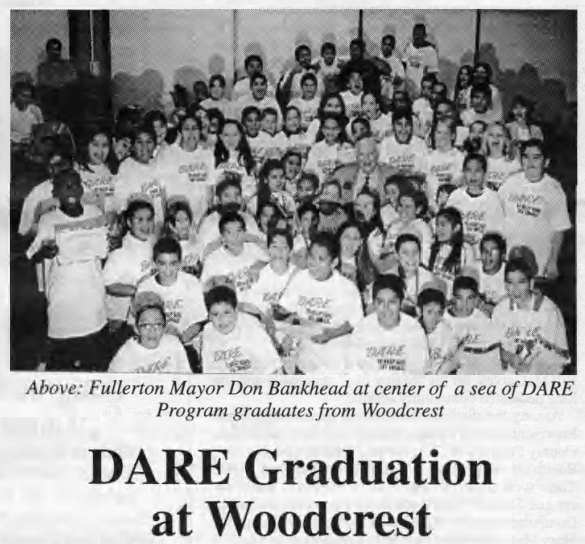
Based on numerous studies, the D.A.R.E. program was ineffective.
Deaths
CSUF professor Willis McNelly passed away.
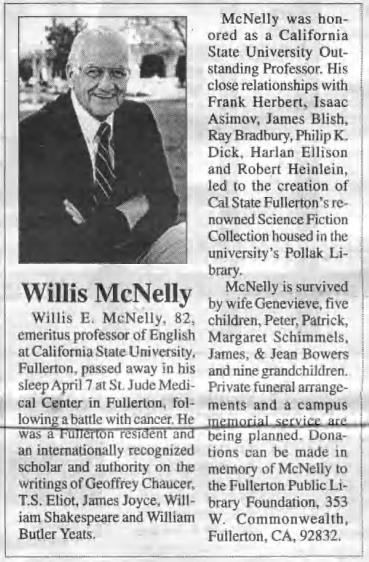
“His close relationships with Frank Herbert, Isaac Asimov, James Blish, Ray Bradbury, Philip K. Dick, Harlan Ellison and Robert Heinlein, led to the creation of Cal State Fullerton’s renowned Science Fiction Collection housed in the university’s Poliak Library,” the Observer reported.
Stay tuned for top stories from 2004!
 Fullerton History