The following is from a work-in-progress about the history of Fullerton. You can support my ongoing research and writing on Patreon.
The Fullerton Observer newspaper was formed in 1978 by Ralph and Natalie Kennedy and friends to provide a more progressive counterbalance to the more conservative Fullerton News-Tribune and Orange County Register. Back then, Orange County (including Fullerton) was dominated by Republicans, and the Observer crew were definitely in the minority. The Fullerton Public Library has digital archives of the Observer stretching back to 1979. I am in the process of reading over these archives and creating a year-by-year summary of top stories. Here are some top stories from 2002.
Hate Crimes on the Rise After 9/11
“This year hate crimes and incidents show an increase of 33% compared to last year,” the Observer reported. “This increase has disproportionately affected the Middle Eastern and Muslim communities who faced the brunt of irrational and hateful attacks in the wake of the September 11, 2001 tragedy on the East Coast.”
International Law? U.S. Says ‘No Thanks’!
“Despite strong opposition from the Bush Administration, the International Criminal Court became a reality on July 1st,” the Observer reported. “The World Court will try cases of genocide, war crimes, and crimes against humanity that the accused person’s home government has refused to try in a reasonable manner. Sixty-nine countries including all European allies, have ratified the treaty so far. ‘Justice will be strengthened and accountability will be reinforced,’ said Richard Dicker head of the-International Justice Program at Human Rights Watch.”
The Fullerton Indian Mascot Debate
Residents, students, school administrators, and Native American activists were debating whether the Fullerton Union High School Indian mascot was offensive and should be replaced.
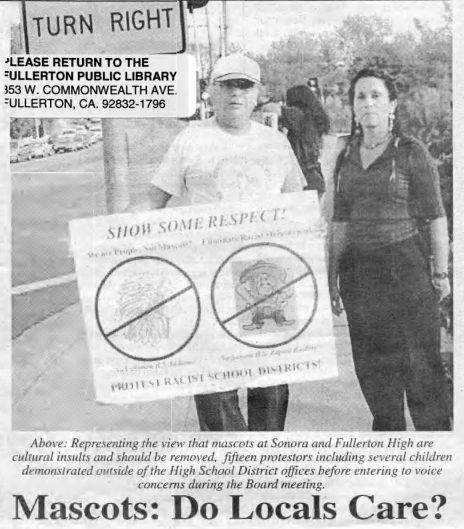
“The use of Native American mascots by educational institutions has come under increasing fire by civil rights groups and American Indians as the latter try to achieve equal status as an identifiable ethnic group within American society,” the Observer reported. “In spite of the goodwill of many Americans and Fullertonians, many individuals resist change and continue their ignorant ways. Such is the case with the Fullerton Joint Union High School District…Native American mascots perpetuate inappropriate, inaccurate, and harmful understandings of living people, their cultures, and their histories. These mascots reduce and belittle living Native Americans to a series of cliches and racist stereotypes overshadowing the complexities of Native American experiences and identities.”
“Native American mascots are constructed from the imaginations of the dominant society and as such are perceived as racist inventions by the Native American community,” anthropology professor E. Sky Scott wrote in the Observer. “Much of the stereotyping of Native Americans is used as a foundation upon which many Americans build their glorified national identity…These are symbols of dominance and superiority and expose feelings of entitlement not only to native land and resources but also to religious and cultural identities.”
Meanwhile, some older Fullertonians supported keeping the Indian mascot.
“FUHS should be proud to have the Indian as a representative of their school. It was an Indian who befriended the first settlers to this country. They gave thanks to God on the first Thanksgiving in Plymouth, Massachusetts many years ago. If you would like to change the use of Indian representing FUHS, perhaps you should take a step further and eliminate Thanksgiving,” FUHS alumni Bill Case wrote.
Meanwhile the US Commission on Civil Rights called for an end to the use of Native American images and team names by non-Native schools.
Fullerton Union High School (FUHS) officials conducted a meeting between themselves, selected students, and four speakers regarding the mascot.
School administrators were reluctant to make any changes.
“High School District Superintendent Escalante believes that Fullerton citizens don’t really care about the issue,” the Observer reported. “I get 20 letters in support of keeping the mascots to every one asking that they be removed,” he said at a Board meeting.
Boardmember Marilyn Buchi agreed, “Most of the protestors are from outside of the community. It’s not really an issue here. Changes are being made though at a slower pace than what the opposing groups want.”
Indeed, it would take another two decades for FUHS to change its mascot, as a result of a state law. As of 2026, the mascot is the Red Hawks.
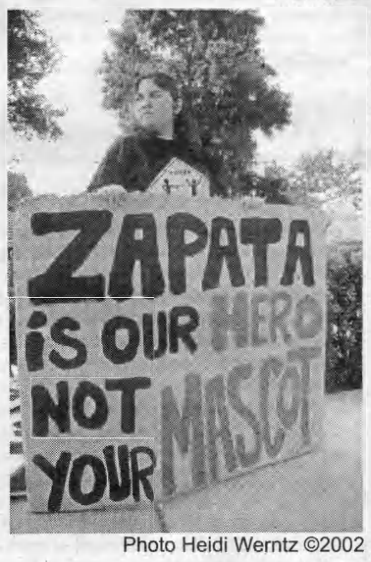
Some also felt that the Sonora High School “Raider” mascot, a depiction of Mexican revolutionary leader Emiliano Zapata, was also a disrespectful caricature and should be replaced.
Saving Coyote Hills: Oil vs. Soil
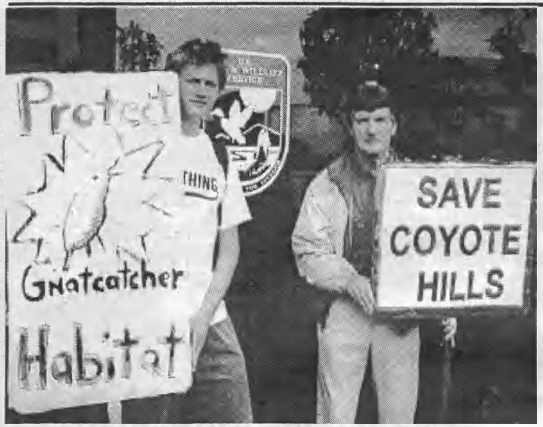
Facing a development proposal from Chevron, the Friends of Coyote Hills was working to preserve the 510 acres as open space.
“My responsibility is to provide value to the shareholders of ChevronTexaco, while serving the company and community in an appropriate and balanced manner,” a representative of Chevron wrote to the Observer. “I believe our proposed development plan accomplishes this.”
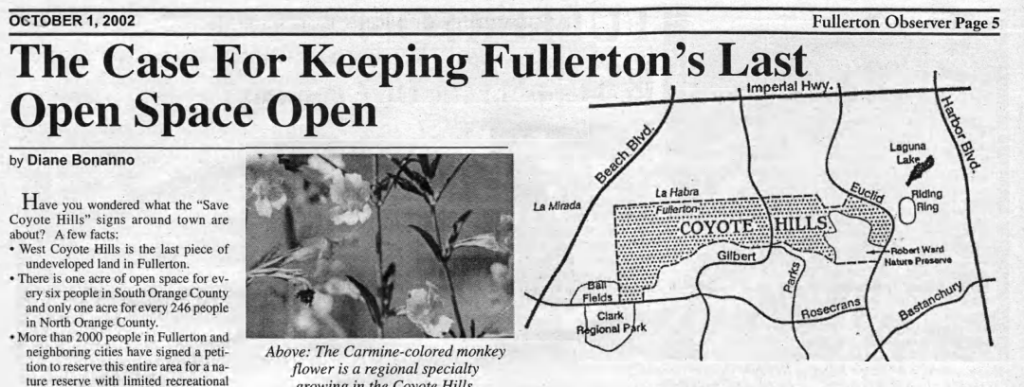
Chevron’s plan included housing development and preservation of about half of the open space; however, this figure was not entirely accurate.
“The developer disclosed that the ‘preserved 280 acres’ will be cleared of all ‘non-native plants, including trees,’ and there was not a concise plan to manage wildlife while the land is being ‘cleared’ i.e. bulldozed. In essence it sounds like most open space will be bulldozed and revegetated,” Kathleen Shanfield wrote in the Observer.
Meanwhile, a new Vista Park opened in East Coyote hills.
“The City’s newest park (Mountain View Park) is located at the northwest corner of State College Boulevard and Bastanchury Road,” the Observer reported. “The two-acre park offers sweeping views of Orange County and parts of Los Angeles County. Amenities include meandering walkways, picnic tables and benches, extensive landscaping, drinking fountain, safety lighting and on-site parking. The facilities are accessible to all. The cost of the park project was approximately $1-million with funding coming from developer fees paid by Van Daele Communities, which is constructing a development just west of the park.”
Still Saving the Fox
Fullerton’s other decades-long preservation effort, saving the historic Fox Theater, also continued.
“The Fullerton Historic Theatre Foundation has been meeting biweekly since last September in an attempt to understand and, we hope, alter the present status of the Fox Fullerton Theatre,” Chuck Estes wrote. “We are evolving new strategies to move the situation forward toward the theatre’s eventual restoration. Our vision for the Fox is a multi-use facility incorporating film, live theatre, concerts, community events and meetings.”
According to architectural historian Alfred Willis, “The Fox Fullerton Theatre is one of the finest surviving buildings designed by Raymond Kennedy, one of the most original architects in Los Angeles in the 1920’s. Kennedy worked for the prominent construction firm of Meyer & Holler whose designers perfected an innovative type of theatrical house: the courtyard theatre, in which an atmospherically decorated forecourt took the place of an interior lobby. Unfortunately, not many of them survive, and the Fox Fullerton is the ONLY survivor themed in Kennedy’s own favorite style, the Italian Baroque.”
What was needed to save the Fox, as well as Coyote Hills, was money, and lots of it. A Fox Historic Theater Foundation was created to receive donations.
Arts & Culture
In 2002, Fullerton was still hosting an annual arts and culture event called “A Night in Fullerton,” a tradition that stretched back to 1964.
“A Night in Fullerton is the city’s annual celebration of the Arts, featuring an evening of free music, art, drama and dance programs at numerous locations throughout the community,” the Observer reported. “The late artist Florence Arnold and other citizens began the celebration years ago. The festival attracts thousands of people each year at the many venues.”
The Observer includes a feature on one of the most unique restaurants in town–El Fortin, which serves authentic Mexican food from Oaxaca, with its various rich moles, huge handmade tortillas, fried crickets, and unique cheese.

El Fortin is located at 700 East Commonwealth Avenue.
No Room at the School
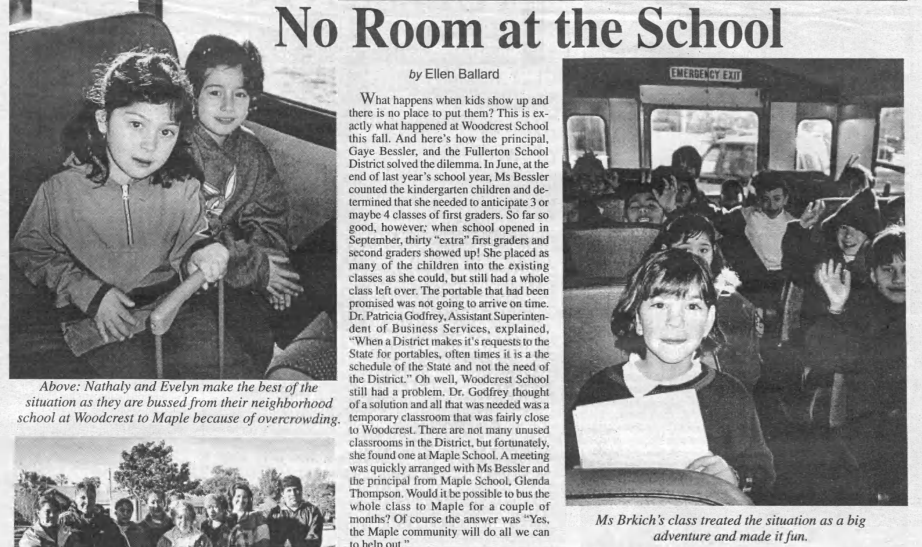
Some schools in Fullerton were feeling the impacts of increasing enrollment.
“The children of the baby-boomers have arrived, and “Tidal Wave II,” (the nickname CSU administrators have given them) are swamping the California State University System, and especially the Fullerton campus,” the Observer reported. “During the 1990s enrollment increased enormously systemwide, where it rose some 19% from about 320,000 students to more than 380,000. Cal State Fullerton, with a 30% growth rate since 1994, has experienced an even more significant expansion of its student population. That translates to some 8000 more students and a current enrollment of about 30,000.”
Accommodating the influx of college students meant an increasing reliance on lower-paid, part-time (adjunct) instructors.
“According to the faculty union, the California Faculty Association (CFA), between 1995 and 2001, tenure-track faculty positions grew by an anemic 2.27% while non-tenure track positions rose by 119.44%,” the Observer reported. “Moreover, these “part-timers” are increasingly becoming permanent fixtures on campus, rather than temporary instructors, and that trend will intensify with the new tentative contract between the CFA and the CSU administration.”
Meanwhile, those underpaid part-timers had formed a union, and were fighting for better pay, benefits, and working conditions.
“Presently, part-time faculty at Fullerton and Cypress Colleges make less than 50% of what full-timers receive for teaching the same class,” the Observer reported.
Industrial Pollution: The Gift That Keeps on Taking
Reading over local newspapers from the 1950s, I note how local leaders often spoke enthusiastically about new industrial plants locating in Fullerton because of the economic benefit. Five decades later, Fullertonians were having to deal with a consequence of industrial activity–pollution.
Oil companies were ordered to pay for cleanup costs of Fullerton’s first Superfund site–the McColl dump site where refinery waste had been dumped back in the 1940s and 50s, polluting the soil and groundwater.
“The court ruled that the oil companies are responsible and must pay for the nearly $100 million dollar clean up costs of the McColl Dump Site,” the Observer reported. “The companies argued that because the dumping was a byproduct of the production of jet fuel for the US military during WWII that the government should be held responsible. The court ruled that the oil companies were responsible for the clean-up costs.”
According to the Observer, “In the 1950s the waste sumps were ‘capped’ by the oil companies to allow for residential development nearby, even though approximately 100,000 cubic yards of hazardous waste remained. The effort to clean-up McColl Dump was a long, citizen-driven battle dating from 1978 when nearby residents began reporting illnesses and bad smells oozing from the site.”
Another site of pollution was a former Manufactured Gas Plant site located at 144 W. Walnut, owned by Sempra Energy, which in 2002 was in the process of being cleaned up.
“Tests have shown high levels of ten chemicals, seven of which are probable human carcinogens within the first five feet below ground surface, with the highest readings at one foot below ground,” the Observer reported. “As a result the company has proposed removing the top five feet. The Department of Toxic Substance Control is awaiting the submission of a work plan from Sempra.”
And a third site of industrial pollution was the former Hughes Aircraft facility in west Fullerton.
“The most recent tests in April 2002 of MW-16 and P-7 have shown that contamination is continuing to be a problem at the site, probably due to NAPL in the soil creating an ongoing source of chemical leaching into the perched zone and then into the aquifer,” the Observer reported. “This situation has been going on for over a year since clean-up efforts were halted for construction of Amerige Heights Shopping Center. No restart of remediation has been ordered by the DTSC because Raytheon is still on a “voluntary” clean-up plan but that could change at some point if Raytheon is seen as non-cooperative.”
Despite a breakdown of communication between Raytheon and and California EPA’s Department of Toxic Substance Control, construction of housing was occurring.
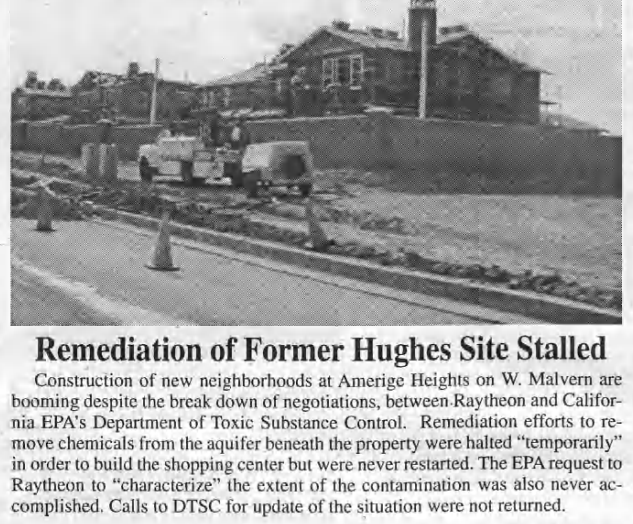
“Remediation efforts to remove chemicals from the aquifer beneath the property were halted ‘temporarily’ in order to build the shopping center but were never restarted,” the Observer reported. “The EPA request to Raytheon to ‘characterize’ the extent of the contamination was also never accomplished.”
Eventually, the California EPA Department of Toxic Substance Control (DTSC) requested that deed restrictions on the site “include a statement that would allow access by the DTSC for future remediation and added ‘Deed restrictions prohibiting the extraction and/or use of contaminated groundwater from the site will be imposed on the entire property.’”
Meanwhile, Fullerton School District Board unanimously approved the purchase of a new school site at Amerige Heights. This school would eventually be called Fisler Elementary School.
Public Transit in the OC: The Little Engine That Couldn’t
A proposed light rail connecting Irvine to Santa Ana got approval from the Federal Transit Administration (FTA).
“With almost 500,000 people residing 2 miles or less from the proposed alignment, we think the light rail can be a major success in providing mobility for central Orange County,” said OCTA CEO Art Leahy.
“Meanwhile a group of critics is working to place an initiative on the November ballot to stop the Centerline,” the Observer reported. “This group seems to have adopted the belief that transportation funding for anything other than roads is a big mistake.”
The Centerline would eventually be abandoned.
Local Politics: Republicans Only, Please
In 2002, Don Bankhead, Shawn Nelson, and Mike Cleseri were elected to City Council. They were all white male Republicans.
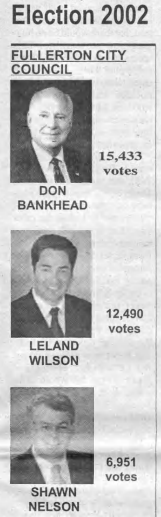
Cleseri defeated incumbent Democrat Jan Flory by running a negative campaign against her.
“He created a villainous, tax-raising, congestion-creating Flory and then ran as the Anti-Flory,” Vince Buck wrote in the Observer. “This dichotomy was wrong on both accounts. The criteria he used to paint Flory as evil was misleading, if not patently false; and there is no evidence to suggest that Wilson will be any different from Flory on those issues.”
One of Wilson’s campaign mailers claimed that Flory was against strong anti-prostitution laws, implying she was for prostitution.
The candidates supported by the police and fire unions, who spent nearly $40,000 on the election, all won.
In Memoriam
Long time Fullertonian Ada-Jane Greening passed away. Greening was involved in a lot of community groups in Fullerton.
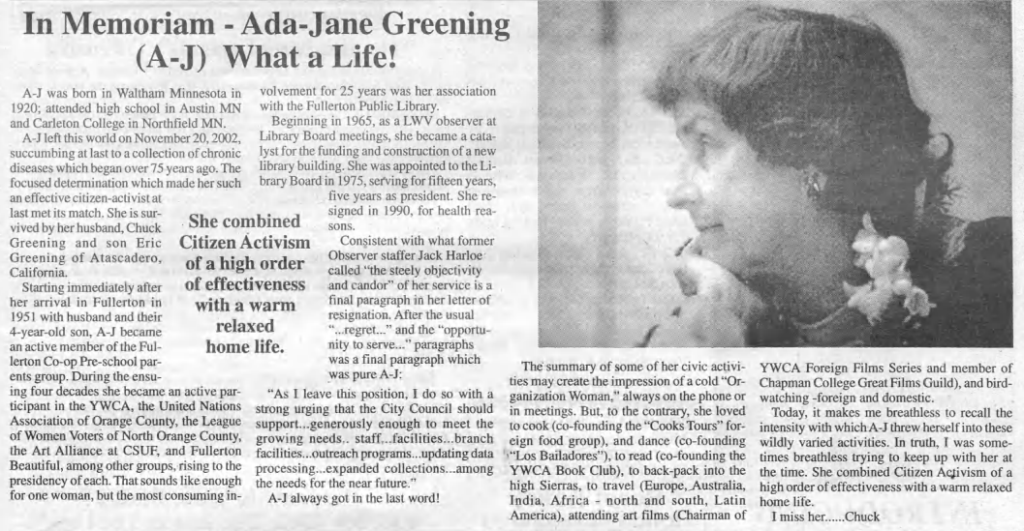
“Starting immediately after her arrival in Fullerton in 1951 with husband and their 4-year-old son, A-J became an active member of the Fullerton Co-op Pre-school parents group,” her obituary stated. “During the ensuing four decades she became an active participant in the YWCA, the United Nations Association of Orange County, the League of Women Voters of North Orange County, the Art Alliance at CSUF, and Fullerton Beautiful, among other groups, rising to the presidency of each…The most consuming involvement for 25 years was her association with the Fullerton Public Library. Beginning in 1965, as a LWV observer at Library Board meetings, she became a catalyst for the funding and construction of a new library building. She was appointed to the Library Board in 1975, serving for fifteen years, five years as president. She resigned in 1990, for health reasons.”
William B. Langsdorf, founding president of California State University, Fullerton, died at his home in Corona del Mar. He was 93.
“Langsdorf served as president of Cal State Fullerton from 1959 to 1970, during the time the 225-acre campus was transformed from a vast orange grove into one of the most populous campuses in the California State University system,” his obituary stated. “Mirroring the explosive growth of Orange County, enrollment grew from 452 students to more than 15,000 during his presidency.”
Stay tuned for top stories from 2003!
 Fullerton History