The following is from a work-in-progress about the history of Fullerton. You can support my ongoing research and writing on Patreon.
9/11
The biggest national news story of 2001 was the terrorist attack of 9/11.
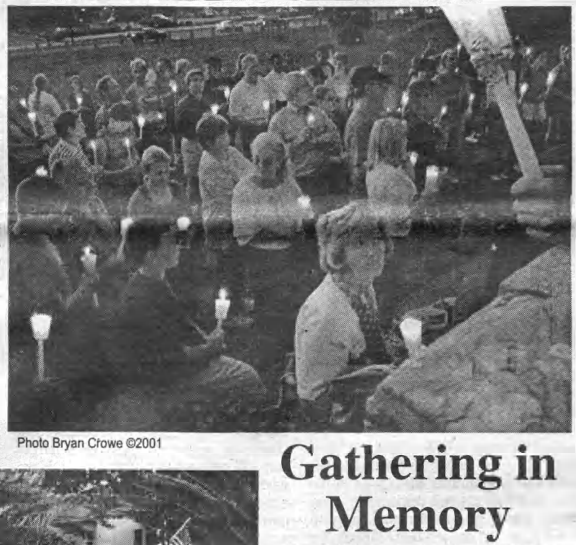
“Over 100 locals gathered on Friday, September 14th at the Hillcrest Park flagpole for a candlelight vigil in memory of those killed in the September 11th attacks,” the Observer reported.
Observer writers offered some fairly nuanced assessments of the meaning of the attack, and what our response might be.
“The major question posed by these events is how can a liberal, democratic state such as ours, contend with the threat of terrorism while maintaining our own commitment to justice and democratic ideals?” one writer wrote.
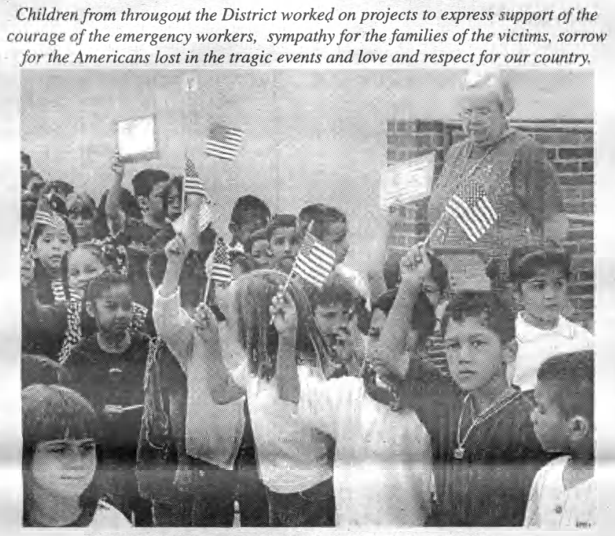
“We’re flirting with a world war between Islam and the West. And guess what: that’s Bin Laden’s program,” wrote Tamim Ansary. “That’s exactly what he wants. In the end the west would win, whatever that would mean, but the war would last for years and millions would die, not just theirs but ours. Who has the belly for that? Bin Laden does. Anyone else?”
The California Energy Crisis
California’s experiment in energy deregulation was proving to be a complete disaster, resulting in an energy crisis that saw prices go up, not down, and rolling blackouts throughout the state.
In response, the state legislature approved a massive bailout of Edison. Not everyone was happy.
“Edison pushed deregulation and reaped its rewards while sticking all the risks on the residential and small business ratepayers,” Harvey Rosenfield, President of The Foundation for Taxpayer and Consumer Rights, said.
The City of Fullerton implemented a number of measures designed to help curb electrical usage in City facilities and programs.
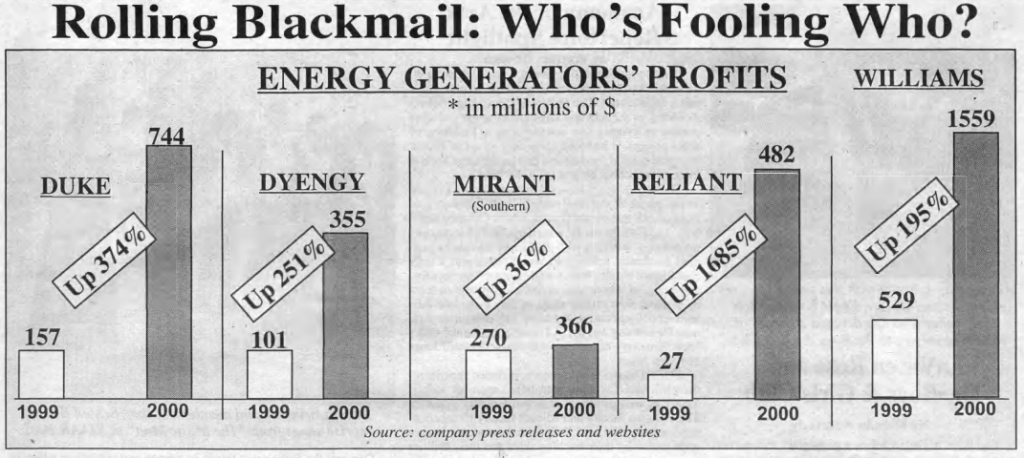
“After the utilities profited from the deregulation scheme, the private power generators began, last summer, to price gouge and achieved unprecedented earnings,” the Observer reported. “Throughout the deregulation debacle, however, consumers have received no benefits, despite the statutory promise of a 20% rate reduction in the 1996 legislation. Indeed, as a result of deregulation consumers have suffered through the state’s first rolling blackouts since World War II and the largest rate increases in California history.”
Light Rail Fail
Meanwhile, a proposed light rail system stretching from Irvine to Fullerton called CenterLine continued to hit political snags. In the 1990s, Orange County politics was still dominated by conservative Republicans who felt the role of government should be as small as possible. This meant minimal public investment in things like public transit, housing, etc.
The preferred solution to most things was the private sector, deregulation, etc. See above energy crisis for how well that worked out with electricity.
OCTA put the project on hold. “Unfortunately, the voices of the critics and NIMBYs were heard louder than the supporters, which prompted the shelving,” the Observer reported.
“All we’re doing is putting band aids on bleeding arteries,” said David Fleming, a former transportation commissioner, “freeway projects are just a band-aid on gridlock.”
Meanwhile, a local group called Transit Advocates of Orange County was organized to support the Centerline and other public transit projects.
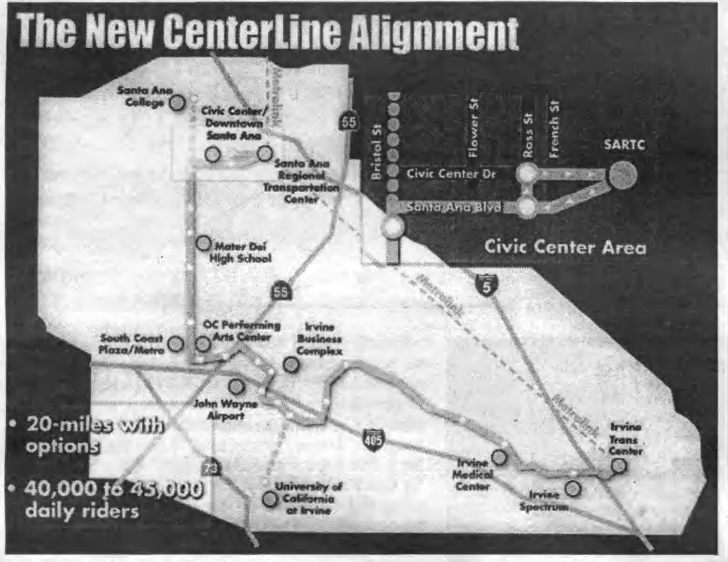
The mayors of Irvine, Santa Ana, and Costa Mesa thought the Centerline could be re-worked on a smaller scale, and supported more “study.”
“The original concept of the Centerline called for a 27-mile, $2.3-billion line from Fullerton to Irvine, a concept that collapsed for lack of support from some of the cities along the line,” the Observer reported. “The shortened version is proposed to cover approximately 20 miles at a cost of $ 1.4-billion, to run from the Irvine Transportation Center to the Santa Ana Transportation Center serving the Irvine Spectrum, medical center, business complexes, John Wayne Airport and South Coast Plaza.”
This, too, would ultimately die. This is, in part, why public transit in Orange County is so shitty–why it can take an hour and a half to get to the beach from Fullerton, on a bus.
A Slow-Gestating Housing Crisis
By the 1990s, Fullerton was becoming more and more built out, and housing production had slowed significantly. Those with single family homes were often determined to maintain the “character” of their neighborhoods, even if that meant preventing newer, higher density construction of housing. This led to a predictable shortage, and ever escalating housing prices. This, combined with political leaders unwilling to invest in affordable housing, and you get the slow-gestating housing crisis that we have today.
“Fullerton’s December 2000 Draft Housing Report proves a strong need for very-low and moderate housing. At the same time the report indicated that housing for upper income families dominated new construction and is expected to continue to dominate housing objectives through year 2005,” the Observer reported. “It appears that no new homes for those earning less than $55,700 per year are planned for Fullerton.”
Listening to homeowner interests, City Council voted unanimously “to join in a lawsuit launched by Southern California Association of Governments (SCAG) against the Department of Housing and Community Development” to block state-suggested affordable housing goals.
Homelessness
A predictable consequence of escalating housing costs was the persistent problem of homelessness.
“According to a recent County survey, there are more than 18,000 homeless in Orange County on any given night,” the Observer reported.
“Statistics show that 65% of Orange County’s homeless work. With escalating rents, many individuals and families have literally been priced out of the housing market.”
In 2001 there were 52 shelters in OC providing 2,374 homeless beds.
“Fullerton Interfaith Emergency Services (FIES) indicates it is turning away an average of 70 homeless persons per day,” the Observer reported. “Based on information from shelter providers, there is a need for at least 70 additional beds in Fullerton.”
During the cold weather months, the National Guard Armory in Fullerton was used as a homeless shelter, although guests there were subject to pretty strict rules, and were bussed out of the area early in the morning.
Pollution on the Former Hughes Site?
Despite concerns of lingering industrial pollution on the former Hughes Aircraft site in Fullerton, city council unanimously approved a massive housing/commercial development that today is called Amerige Heights. The Observer continued to report on findings of pollution on the site.
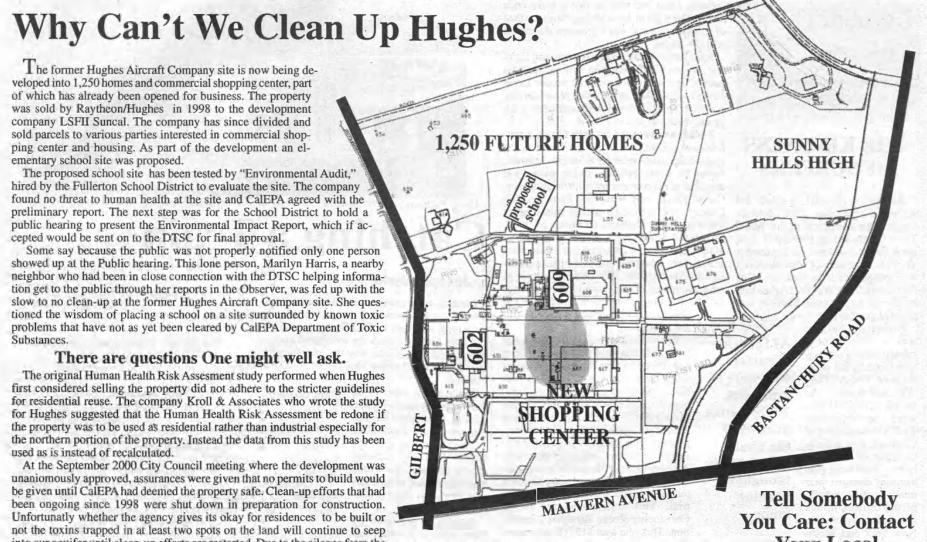
“As pressure from the developer LSF II Suncal and the 20-billion dollar Raytheon company, continues to push forward construction of the ‘Amerige Heights’ housing and commercial project the CalEPA Department of Toxic Substances Control has released several reports indicating further investigation and remediation of the property is needed. The Regional Water Quality Control Board has concurred with the CalEPA conclusions,” the Observer reported. “Unfortunately both companies are resisting further investigation of the contaminate source.”
Meanwhile the California EPA Department of Toxic Substances Control approved a preliminary environmental report on a proposed Amerige Heights Elementary School site located on the former Hughes Aircraft Company property on Malvern. Today, this is called Fisler Elementary School
“The company tested for various substances that plague other parts of the property and found that the 10-acre site held no threat to human health,” the Observer reported. “DTSC determined that no further environmental investigation or cleanup of the parcel is required.”
A treatment system failure resulted in over 5-million gallons of water “with 55-parts-per-billion of TCE being accidentally injected into the aquifer June 2001. The allowed limit for this chemical in drinking water is 5-parts-per-billion.”
Raytheon was fined a paltry $3000 fine for violating TCE limits required in its waste discharge agreement at 651 N Gilbert Street in Fullerton.
Tres Sheep & Saving the Fox
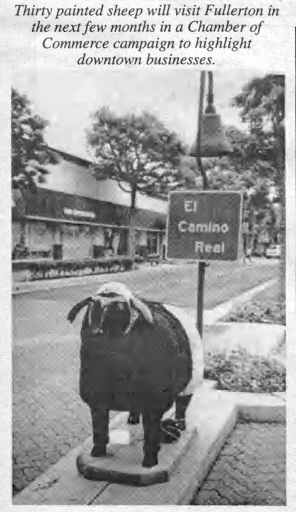
The Fullerton Chamber of Commerce launched a PR campaign to get 50 artists to paint large sheep that would be displayed downtown. Why sheep? Because one of Fullerton’s earliest residents, Domingo Bastanchury, was a sheep rancher before he got into citrus.

“Each Sheep, Ewe or Lamb will be decorated, titled and entertain Fullertonians and visitors through April when the entire herd will be sold one by one at auction,” the Observer reported.
The saga to save the historic Fox Theater downtown from demolition and re-open it as a theater continued.
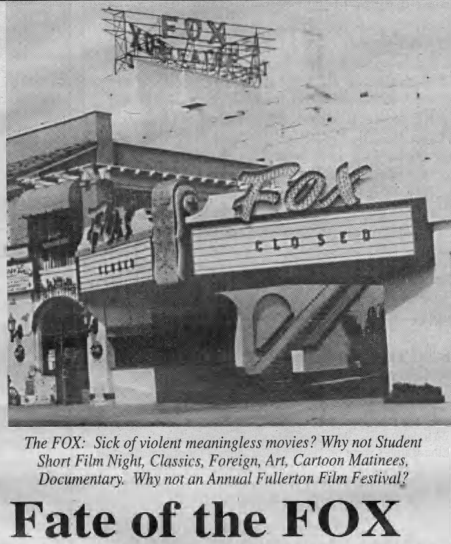
At a Downtown Business Association meeting Mayor Richard Jones was asked by a business woman, “About the Fox, anything happening there?” “Nothing, unless you people start a fire and burn it down,” the mayor replied. “And you,” nodding to the fire department chief, “should have a flat tire on the way there,” he advised. “We need to start over from scratch.”
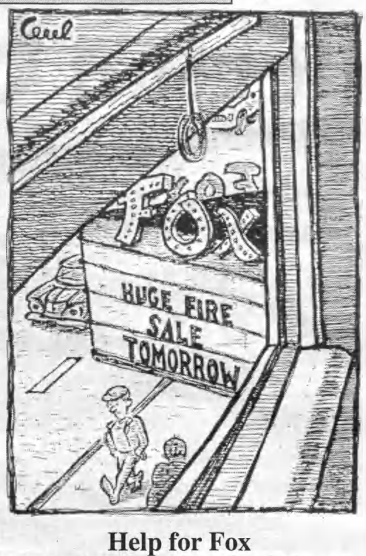
“The City of Fullerton continues to take no responsibility for saving the Fox Theater, except that it has refused absentee owner Ed Lewis’s repeated requests for a demolition permit,” the Observer reported. “Citizens have signed petitions, but have not taken steps to establish a foundation to preserve the Fox, as citizens have done for the Balboa Theater in Newport Beach, and the Egyptian.”
Incensed by the callous remarks of Mayor Jones, Fullerton resident Chuck Estes began to get the ball rolling to start a nonprofit foundation to save the Fox. This would eventually become the Fox Theater Foundation.
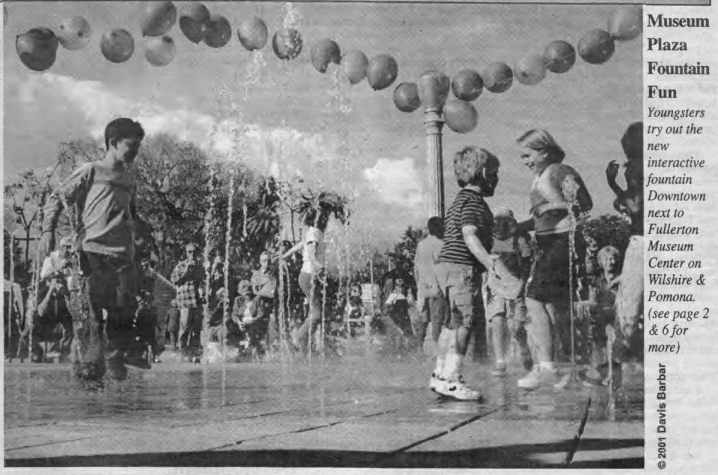
A fountain in the Downtown Plaza opened.
Fullerton legend Leo Fender was honored with an exhibit at the Fullerton Museum Center.
“Fender, who perfected the electric guitar which led to the musical revolution still reverberating around the world today is the focus of “A Shower of Brilliance: Leo Fender and His Electric Guitar,” the Observer reported
A mural, sponsored by CUFFS and the Fullerton Museum, was painted on the side of the Wilshire Parking Structure facing the Fullerton Museum Plaza.
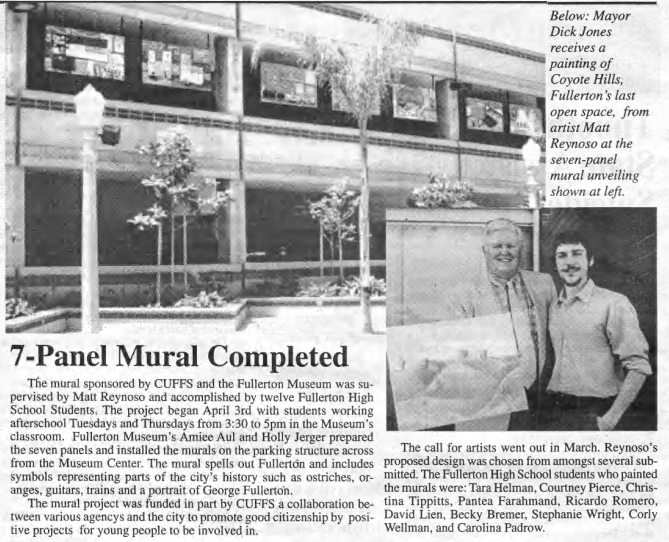
The mural was designed and supervised by Matt Reynoso with the help of Fullerton High School students.
“The mural spells out Fullerton and includes symbols representing parts of the city’s history such as ostriches, oranges, guitars, trains and a portrait of George Fullerton,” the Observer reported.
Meanwhile, on the other side of Downtown, on west Santa Fe, a possible Renaissance was occurring with the conversion of industrial buildings into restaurants/bars like Heroes and the Continental Room.
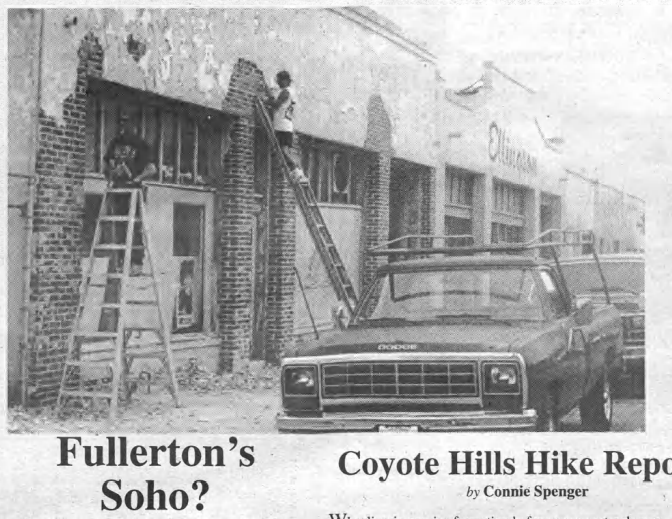
“West Santa Fe Avenue bordering the railroad tracks is going through some renovations including a soon-to-be-opened “Frank Sinatra” style bar called the Continental which has been under construction for the last year by owners of the Hub Cafe,” the Observer reported. “Presently the two block street is home to the Commonwealth Upholstery Shop, Elingson Aircraft Parts, Donald Duck Orange Juice Factory, a roofing company and a bunch of art studios. Wouldn’t it be fun if part of the plan included affordable warehouse style studios that would attract artists?”
In the early 2000s, downtown Fullerton underwent a fairly radical transformation from a quaint/sleepy one dominated by antique shops and vintage stores to one dominated by bars and nightclubs. While some welcomed (and sought to profit from) the change, others were not so thrilled.
Al Bushala, of the wealthy local Bushala family, wanted to create a dance club at 205-207 N. Harbor Blvd. that would be open from 4pm to 4am.
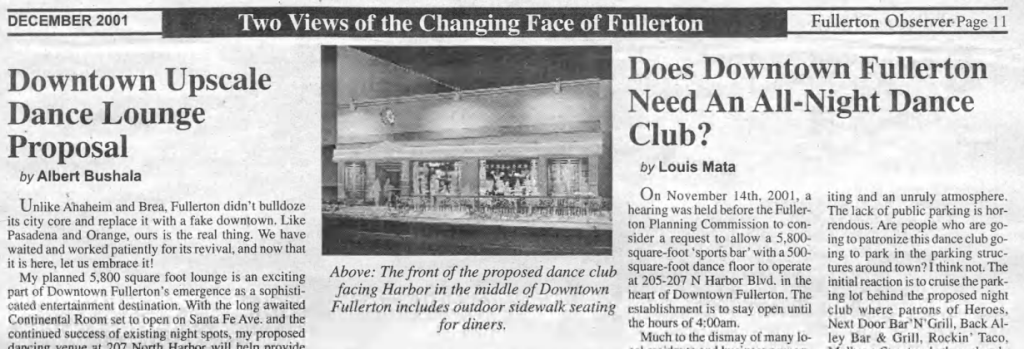
“My planned 5,800 square foot lounge is an exciting part of Downtown Fullerton’s emergence as a sophisticated entertainment destination. My proposed dancing venue at 207 North Harbor will help provide the synergy needed for a true downtown revival,” Bushala wrote in the Observer.
In a counter-argument piece, another writer questioned the approval of the dance club.
“An appeal was filed on November 21 along with 20 letters from local residents and business owners opposing the matter,” the writer wrote. “Take a close look at what has become of Downtown Fullerton over the past few years. The proliferation of drinking establishments has brought about vandalism, graffiti, public urination, vomiting and an unruly atmosphere…This quaint, charming and family friendly area is in severe danger of becoming a seedy district with bars, adult-oriented shops and the like. It is important to preserve the integrity of Downtown Fullerton by rejecting the proposed night club.”
Saving Coyote Hills
Like the saga to save the Fox Theater, the saga to save Coyote Hills from development has been a decades-long struggle.
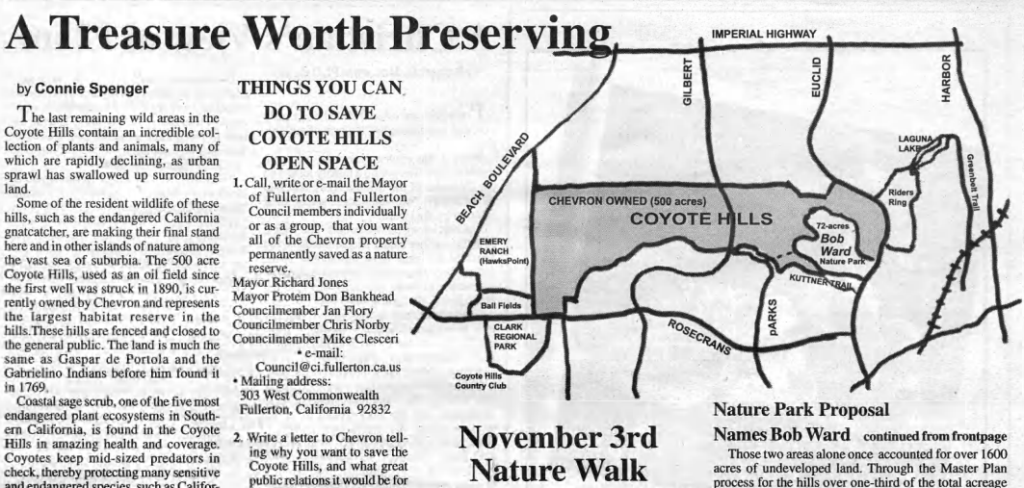
“Considered the last open space in Fullerton, the Coyote Hills property was oil well territory but is now home to many types of rare critters and plants including endangered species such as the California gnatcatcher,” the Observer reported.
The Friends of Coyote Hills, the group which has worked for decades to save Coyote Hills began hosting walking tours of a small part of the property open to the public.
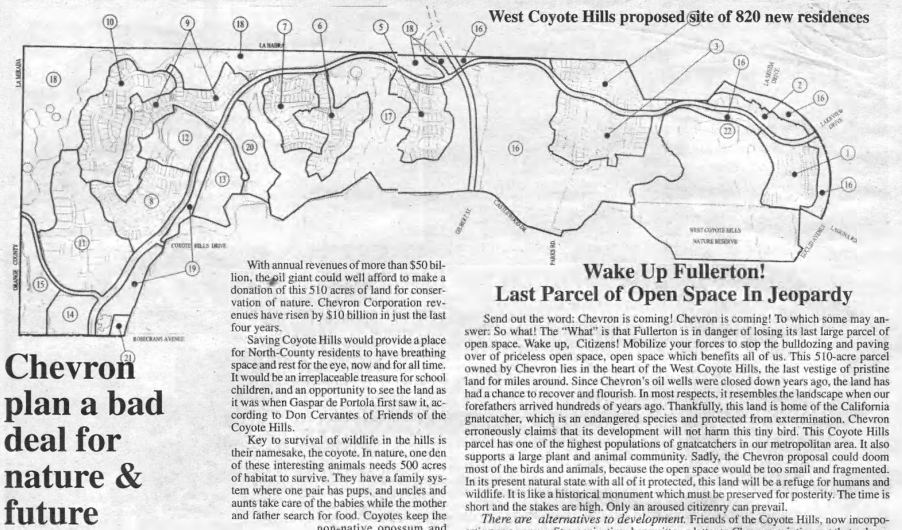
Meanwhile, the owner of Coyote Hills, Chevron, was proposing a large development there.
“A plan to put 810 dwelling units in west Coyote Hills is a bad deal for nature and for the future, says naturalist Shawn Bert of Friends of Coyote Hills,” the Observer reported. “With annual revenues of more than $50 billion, the oil giant could well afford to make a donation of this 510 acres of land for conservation of nature. The canary in the coal mine is the California gnatcatcher. The proposed development would wipe out most of this endangered songbird on the 510 acres.”
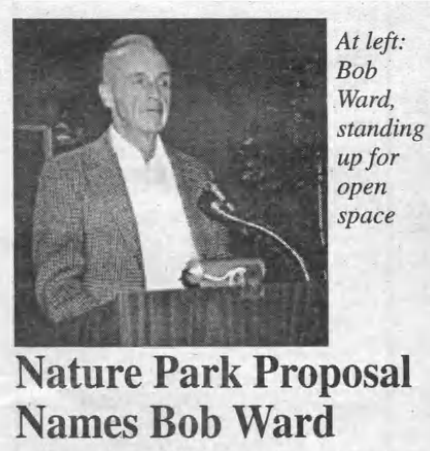
Meanwhile, City Council voted to name a city-owned 72-acre parcel of Coyote Hills the Robert E. Ward Nature Preserve. Robert Ward was a former mayor who worked to preserve the land back in the 1970s.
Education
In education news, adjunct (part-time) faculty at Fullerton and Cypress colleges had created a union and were fighting to improve their pay and to receive health benefits.
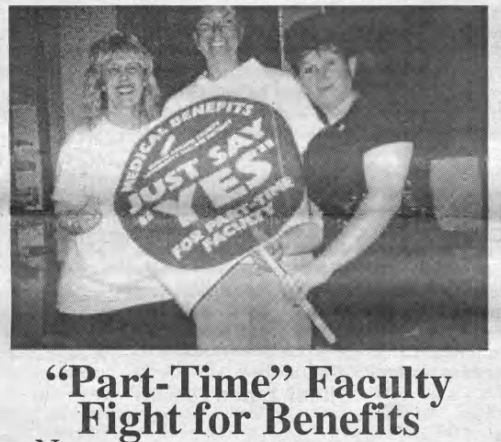
“Part time teachers are paid $39 per hour while full time teachers are at $71 with full benefits for teaching the same class. Part-time faculty are not compensated for office hours and do not receive any medical benefits,” the Observer reported. “These and other grievances were aired recently in an on-going protest by part-time faculty angered by the district’s refusal to grant “part-timers,” who hold the same academic credentials and teaching responsibilities as their full-time counterparts, adequate pay and benefits.
Maple School celebrated its full re-opening as a K-6 elementary school.
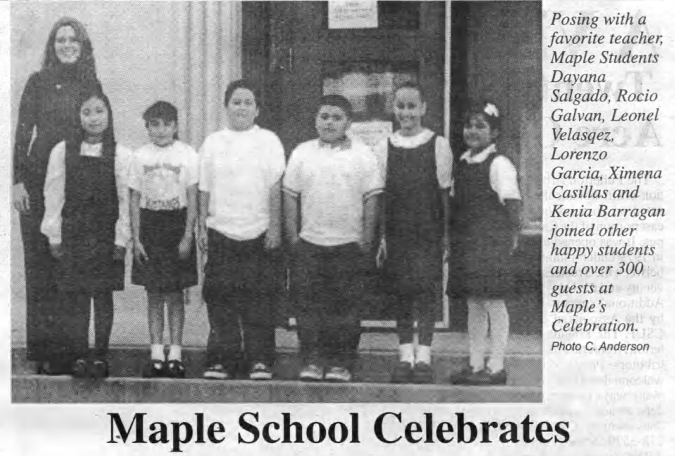
The majority-Latino Maple school was closed in 1972 as part of a desegregation plan. It partially re-opened in 1996 and fully re-opened in 2001.
To read a history of Maple School check out my article entitled “The Limits of Desegregation: a Story of Maple School.”
The Fullerton High School Mascot Debate
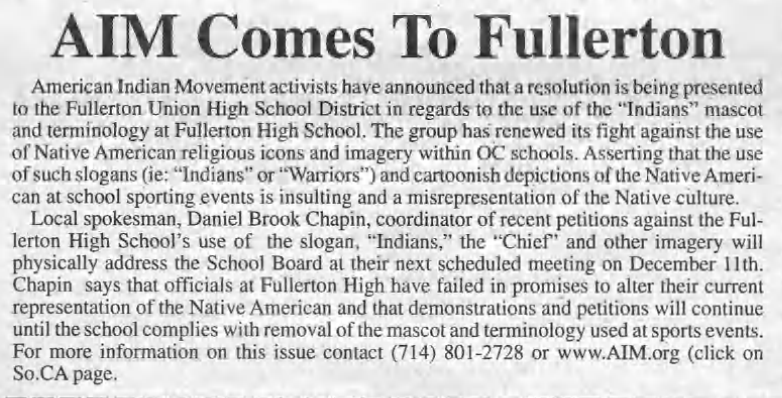
“American Indian Movement activists have announced that a resolution is being presented to the Fullerton Union High School District in regards to the use of the “Indians” mascot and terminology at Fullerton High School,” the Observer reported. “Asserting that the use of such slogans (ie: “Indians” or “Warriors”) and cartoonish depictions of the Native American at school sporting events is insulting and a misrepresentation of the Native culture. Local spokesman, Daniel Brook Chapin says that officials at Fullerton High have failed in promises to alter their current representation of the Native American and that demonstrations and petitions will continue until the school complies with removal of the mascot and terminology used at sports events.
The Indian mascot endured until this year, when the school was compelled by state law to change it. The new mascot is the Red Hawks.
Sage by the Side of the Road
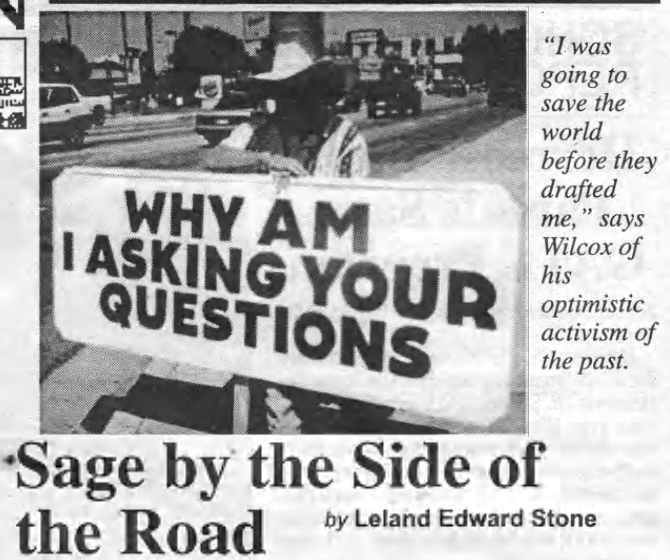
In 2001, I remember there was this guy who would post up for days at major intersections with large signs with very cryptic messages. Here’s a photo of him with one of his signs.
Stay tuned for top stories from 2002!
 Fullerton History