The following is from a work-in-progress about the history of Fullerton. You can support my ongoing research and writing on Patreon.
The Fullerton Observer newspaper was formed in 1978 by Ralph and Natalie Kennedy and friends to provide a more progressive counterbalance to the more conservative Fullerton News-Tribune and Orange County Register. Back then, Orange County (including Fullerton) was dominated by Republicans, and the Observer crew were definitely in the minority. The Fullerton Public Library has digital archives of the Observer stretching back to 1979. I am in the process of reading over these archives and creating a year-by-year summary of top stories. Here are some top stories from the year 2000.
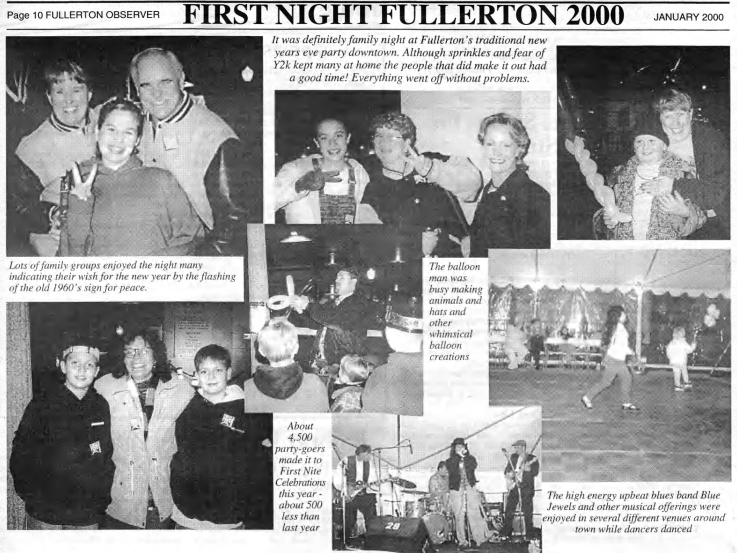
Despite Y2K worries of worldwide computer-induced chaos, Fullertonians rang in the new millennium without a hitch. The world spun on, computers still worked, and hopes were high.
2000 was also the year of the crazy voting/election fiasco in the contest between George W. Bush and Al Gore for president. For months after the election there remained no clear winner. Problems with voting machines in Florida prompted demands for recounts, political shenanigans ensued, and ultimately the U.S. Supreme Court chose the next U.S. president–George “Dubya” Bush. Not a great precedent.
Pollution on the Former Hughes Site?
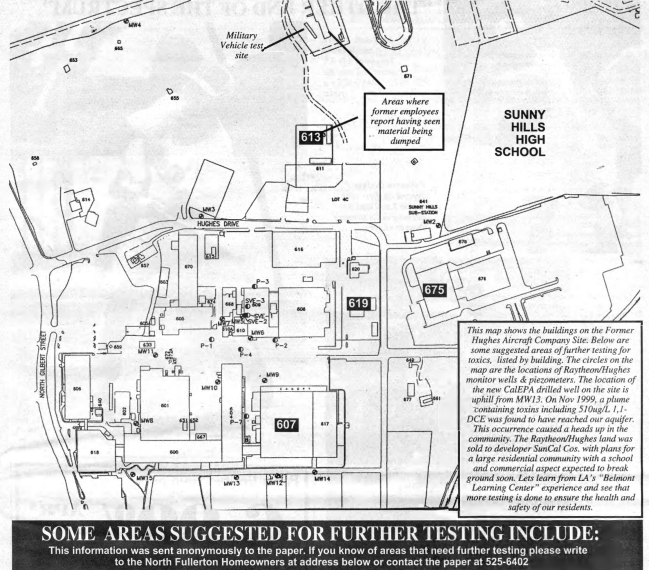
Perhaps the biggest local story, at least in the pages of the Fullerton Observer, was the presence of toxic industrial pollution on the site of the large former Hughes Aircraft facility in west Fullerton, which had closed down in 1994. The owners, including Raytheon, were seeking to convert much of the land into a large housing and commercial development plus an elementary school. Today, that development is called Amerige Heights.
Residents raised concerns about soil and water contamination from Hughes’ decades-long industrial activities, which could potentially pose human health risks, especially if homes and a school were built on the land.
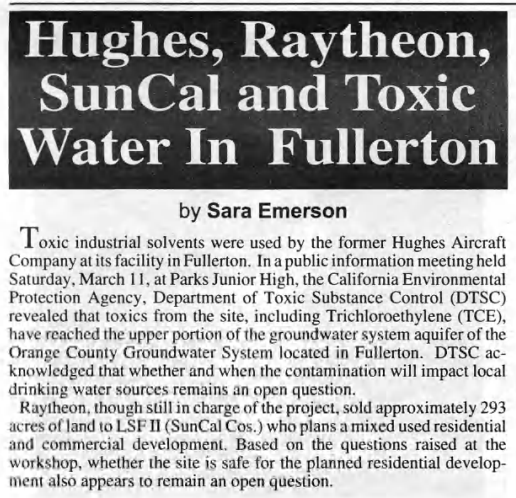
“The California Environmental Protection Agency, Department of Toxic Substance Control (DTSC) revealed that toxics from the site, including Trichloroethylene (TCE), have reached the upper portion of the groundwater system aquifer of the Orange County Groundwater System located in Fullerton,” the Observer reported. “DTSC acknowledged that whether and when the contamination will impact local drinking water sources remains an open question.”
Raytheon insisted that they were complying with all environmental laws and, ultimately, that the land was safe for humans. Raytheon had sold nearly 300 acres of the former Hughes property to a developer called SunCal. Although Raytheon had conducted an analysis in 1997 showing that the area was safe for humans, The Observer and many local residents believed that more testing and possible clean-up was needed before the site was deemed safe for human habitation.
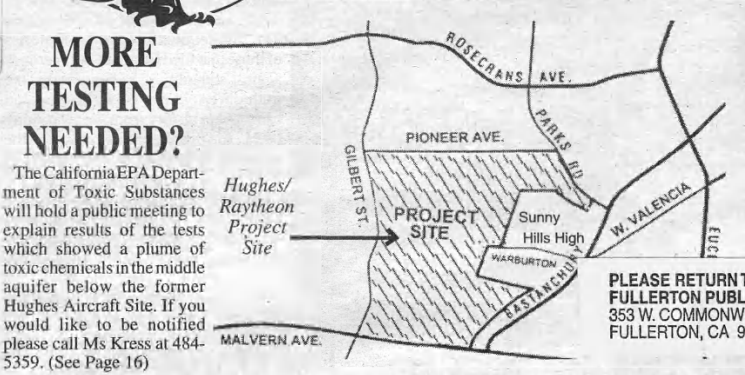
The Observer pointed to more recent testing showing that harmful contaminants were, in fact, present in the soil and water. “The results represent the highest concentration of 1,1-DCE that I have ever seen,” Will Rowe, an EPA Geologist, said.
After the Observer published a series of articles pointing out findings of more recent testing, as well as anonymous tips from former Hughes employees, SunCal sent a series of letters demanding corrections, retractions of certain statements, and even threatened a libel lawsuit against the paper.
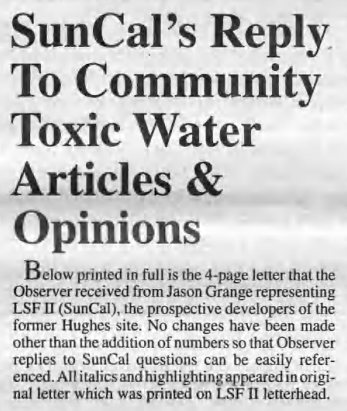
The Observer responded to each of SunCal’s concerns, sometimes making corrections, but more often countering their claims with additional information and questions.
I’ll admit, the amount of data in some of these articles is a bit daunting. Not being an environmental scientist, I feel sort of unqualified in determining who is actually correct in these exchanges between the Observer and SunCal.
“Clearly the Observer has an agenda,” the developer’s lawyers chided, “That agenda is to disparage Hughes, Raytheon, LSF II Fullerton, LLC and those involved in the environmental remediation process taking place at the Hughes Raytheon site.”
Sharon Kennedy, the Observer’s editor replied: “The paper seeks the truth in every instance. We happily make corrections whenever errors are pointed out.”
Despite being a small newspaper with an all-volunteer staff, the Observer did an impressive job of poring through voluminous environmental reports on the property–stuff not exactly written to keep the reader engaged, documents so technical and boring that most people would probably not bother to read them unless they had to. But Sharon read them, and did her best to report on pollution still present on the land, and what further testing and cleanup was warranted. Did the Observer get some details wrong? Probably. But I think the effort, time, and care she put in were admirable, and did some good in prompting additional testing by the EPA.
Meanwhile, the Observer published letters from local residents who lived near the former Hughes site and had lost family members young to brain cancer.
“Over the years, Wendy maintained contact with her fellow classmates from Sunny Hills and began to compile a list. The list included the names of students who attended Sunny Hills between 1966 and 1970 who developed brain tumors approximately 10 years after graduation. Listed are the names of 17 alumni who died and 4 who survived,” the Observer reported.
Some public meetings were held on the project. It seems the developer had assembled a dream team called the Suncal Leadership Club which included local elected officials like Dick Ackerman and Ed Royce who were enlisted to support the project.
When the project came before City Council, it was unanimously approved.
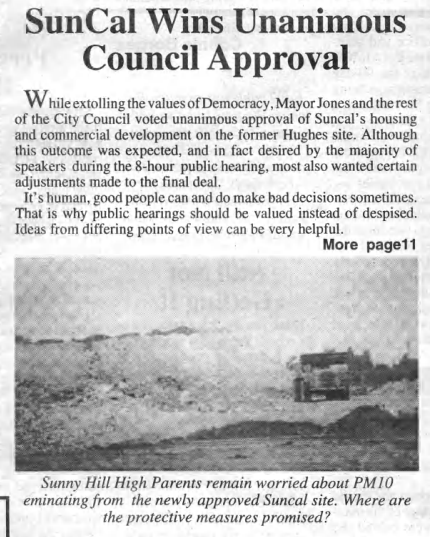
“While extolling the values of Democracy, Mayor Jones and the rest of the City Council voted unanimous approval of Suncal’s housing and commercial development on the former Hughes site,” the Observer reported. “Although this outcome was expected, and in fact desired by the majority of speakers during the 8-hour public hearing, most also wanted certain adjustments made to the final deal. Nearly everyone on all sides of the issue mentioned the need for the environmental situation both present and future to be addressed.”
Local Politics
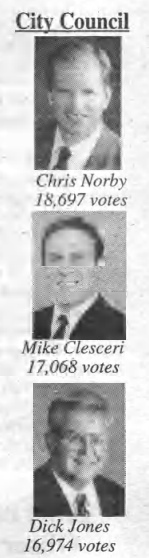
In the 2000 local election, Chris Norby, Dick Jones, and Mike Clesceri were elected to City Council. All were Republicans.
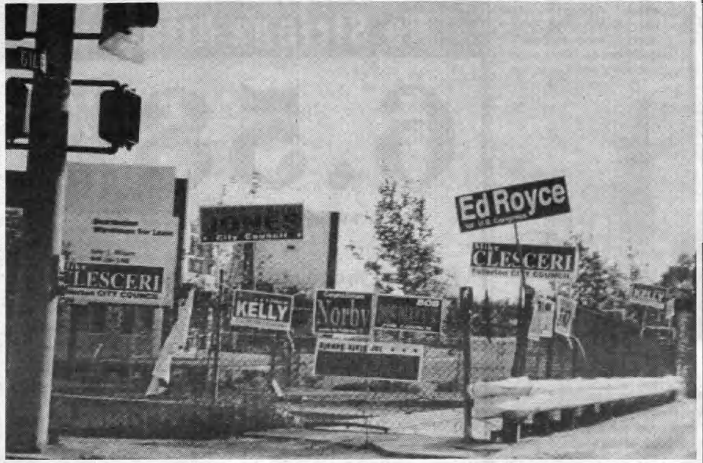
As usual, there was drama when it came to selecting a Mayor.
“Bridges were burned, laundry was washed in public, and lessons were learned. Flory learned that getting along with your colleagues is no guarantee of reciprocity. Jones learned the dangers of going back on a commitment. Several people learned that deals are never final,” the Observer reported.
Housing
Throughout the 1980s and 1990s, Fullerton’s conservative/Republican City Council majorities were generally opposed to building affordable housing projects, even (or perhaps especially) when the money came from the federal government.
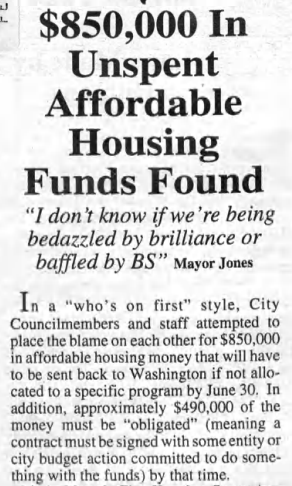
“City Councilmembers and staff attempted to place the blame on each other for $850,000 in affordable housing money that will have to be sent back to Washington if not allocated to a specific program by June 30,” the Observer reported.
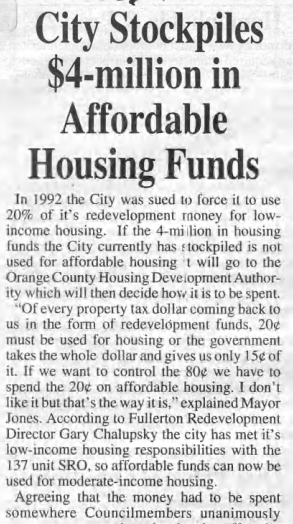
“In 1992, the City was sued to force it to use 20% of its redevelopment money for low income housing,” the Observer reported. “If the 4-million in housing funds the City currently has stockpiled is not used for affordable housing it will go to the Orange County Housing Development Authority which will then decide how it is to be spent.”
In addition to refusing to spend federal affordable housing dollars, City Council also joined a lawsuit against a local Fair Housing Foundation.
The need for affordable housing was acute, as demonstrated by the long waiting lists for existing affordable housing projects, like the East Fullerton Villas.

“The East Fullerton Villas affordable complex was dedicated in 1997 and has had a 100-family waiting list ever since,” the Observer reported.
During the cold weather months, the National Guard Armory was used as a homeless shelter, but the program had restrictions meant to keep Fullerton’s homeless out of sight during daylight hours.
“In a move both stunning in its heartlessness and ironic in this holiday season, Fullerton Police have ordered the Armory Homeless Shelter not to accept walk-ins or people who drive or bike to the shelter,” the Observer reported. “The homeless are to be picked up by bus at the outskirts of town, delivered to the shelter in the evening, and bused back to the city limits in the morning.”
Local Teachers Organize
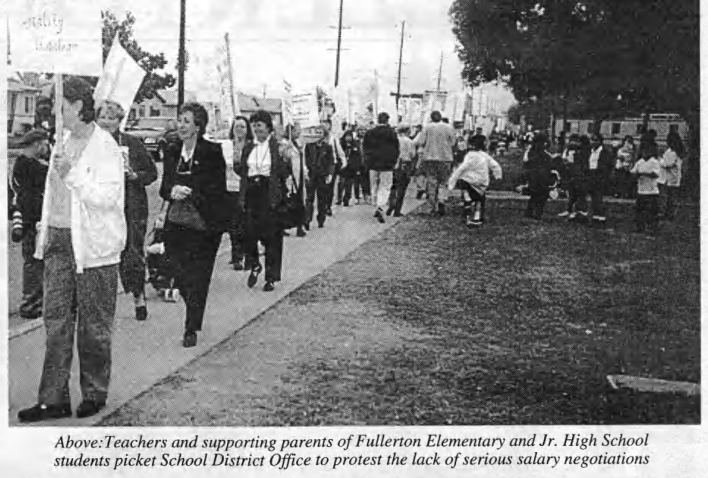
Local elementary school teachers organized and picketed in front of the district office for better pay and working conditions.
And adjunct (part-time) faculty at Fullerton College organized into their own union called Adjunct Faculty United.

“Part-time faculty make up two-thirds of all faculty in the North Orange County Community College District and are paid only thirty-two percent of what full time faculty receive class for class. In addition, unlike their full time counterparts, part-time faculty receive no health insurance and have no rehire rights,” a representative of AdFac told the Observer. “Many part-time faculty are forced to teach at three or even four colleges to try to make a living.”
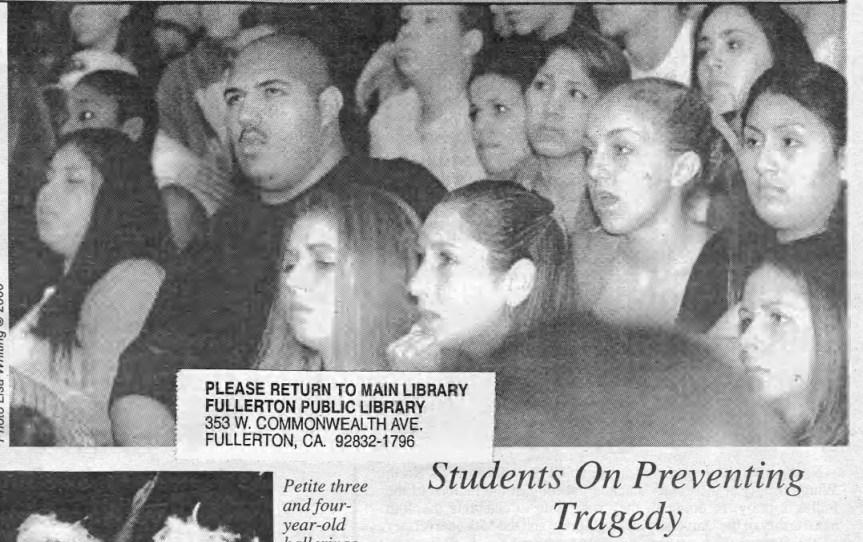
In other education news, students from Columbine High School in Colorado spoke to Fullerton High School students about preventing the kind of mass shooting tragedy that occurred at their school in 1999.
Sadly, as we all know, the number of mass shootings has increased dramatically since Columbine.
Postal Workers Fight for Their Rights
Local teachers were not the only ones fighting to improve their working conditions. A group of local postal workers filed formal complaints against and called for a full investigation of Postmaster Timothy Bomersback.
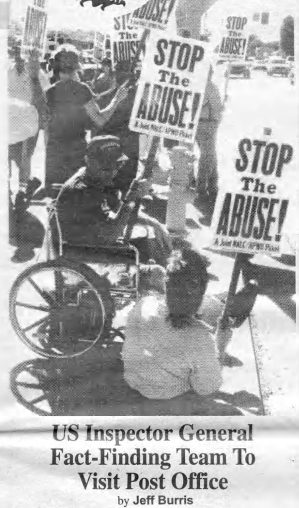
“Complaints accuse Bomersback and members of his management team with harassing, threatening, and intimidating employees through language and action, forcing workers to work off the clock in order to finish routes and discrimination against females and gay employees,” the Observer reported. “Over 100 current and former Fullerton postal workers and supporters picketed the Fullerton main office lining both sides of Chapman Avenue,. hey formed a gauntlet of neon signs that read ‘The Postmaster Must Go’ and ‘Stop The Abuse.’”
And in other public employee news, under a newly-passed California law, Fullerton firefighters gained the right to arbitration in labor disputes with the City.
Culture and Entertainment
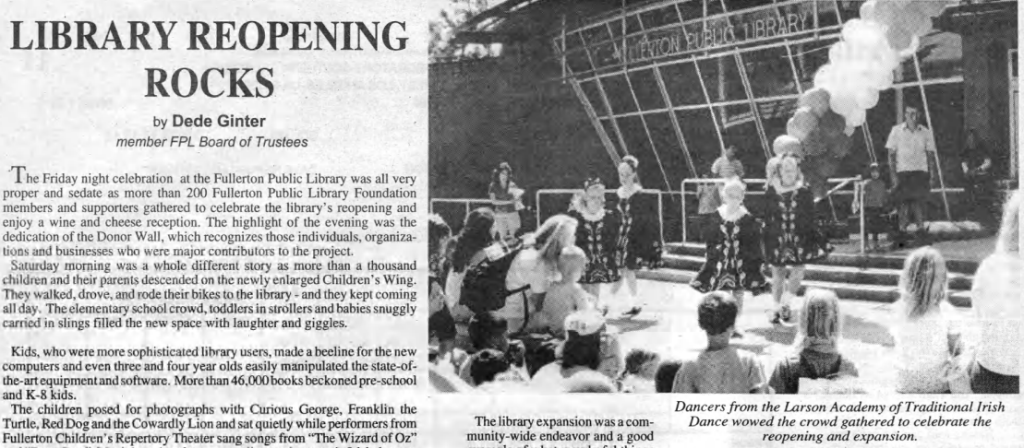
The Fullerton Public Library underwent a massive remodel.
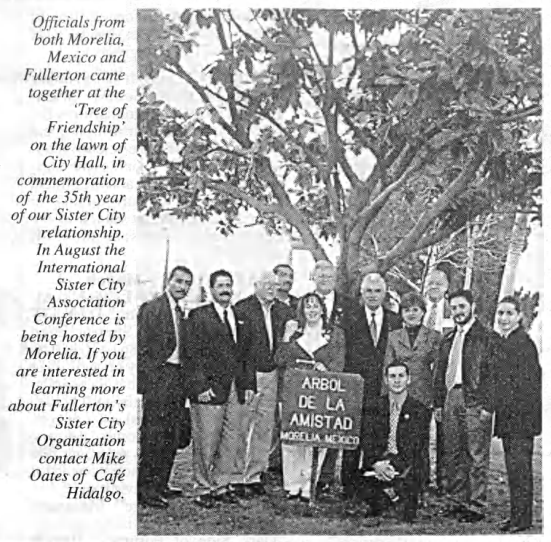
The City Planted a “Friendship Tree” at city hall as part its sister city program with Morelia, Mexico.
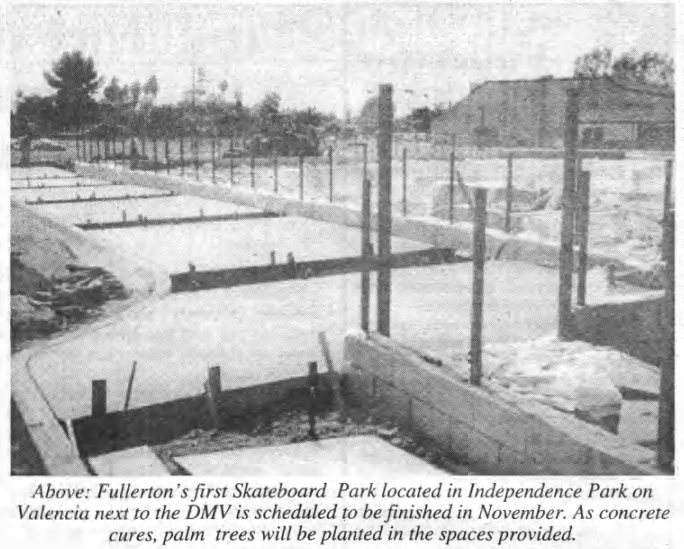
Fullerton built its first skate park at Independence Park.
Protecting the Arboretum
As has happened a few times throughout its history, CSUF administrators wanted to pave over part of the Fullerton Arboretum to make way for more parking.
“Three point five acres of Fullerton Arboretum will be paved over for a ‘temporary’ parking lot holding 320 automobiles if the Facilities Management Department has its way,” the Observer reported. “That space is now marked for a Mediterranean garden in the Arboretum general plan…At a recent meeting, 75 people expressed opposition to the paving, and no one from the public spoke in favor.”
CSUF President Milton Gordon sought to increase influence over the Arboretum Commission by appointing three members directly who were in favor of the parking lot.
“At a September meeting of the Fullerton Arboretum Commission held at the Arboretum’s Oak Hall, dozens of citizens, Arboretum supporters, CSUF employees and environmentalists vigorously objected to a proposal to turn a currently undeveloped portion of the Arboretum grounds into a ‘temporary’ parking lot for the University,” the Observer reported.
Eventually, the University administration caved to the Arboretum supporters and put the parking lot plan on hold.
Transportation
In transportation news, plans for a new light rail train system in Orange County called Centerline were faltering.
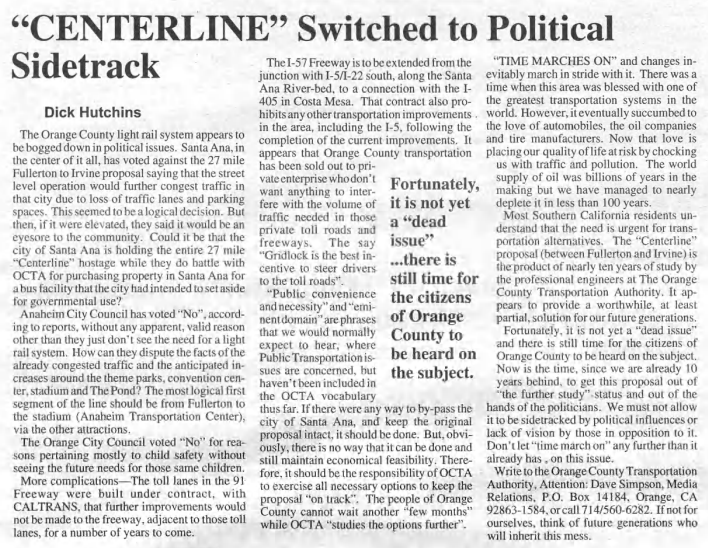
The cities of Santa Ana, Anaheim, and Orange voted against the Centerline. Fullerton city leaders were also not too thrilled about the project.
“Critics of a light rail system insist that it is a waste of time and money on a technology that no one will use. The proof that they are ignoring facts is reflected in the continued increase in ridership on the Metro-Link trains,” the Observer reported. “Also ignored is the fact Orange County) already have mass transit systems in operation and are reporting them to be successful. Whether or not the critics (lovers of freeways) want to admit it, support for an Orange County mass transit system is overwhelming. People just do not want to continue building more freeways (or toll roads).”
But the plan was not (yet) dead: “OCTA Board of Directors has made development of the Centerline corridor a priority, saying that its construction was promised during the passage of Measure M,” the Observer reported. “The unveiling of the revised lightrail plan showed the route is mostly elevated between Fullerton and Irvine and snakes among the county’s key commercial and entertainment centers, avoiding the street-level running which critics had opposed for traffic congestion and safety reasons.”
Deaths
Fullerton’s first elected female City Councilmember Frances Wood died.
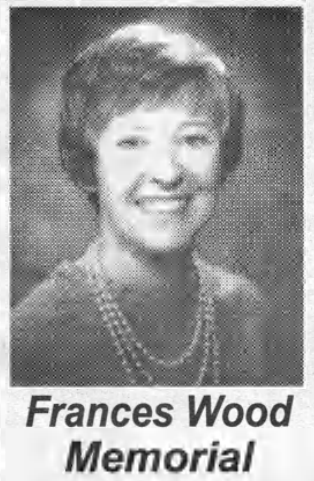
She served on the Park and Recreation Commission and in 1970 was the first woman to be elected to Fullerton City Council…Frances was the driving force behind the Independence Park facility and pool and the new library was constructed during her tenure in office.
“She believed strongly in women serving on public boards and commissions,” the Observer reported. “She was a role model and mentor for women wanting to enter public life, and encouraged their entry. Many were from her Southwest Fullerton neighborhood, where she was one of the founders of a volunteer program for children.”
The Activity Building at Independence Park was named in Wood’s honor.
Local businessman and photographer Chris Beard died. Beard ran the very cool Wilshire Theater, which sadly is no more. He also owned a photography business/gallery downtown, and wrote a regular column in the Observer called “The Last Boulevardier.”

“He was loved by his family and he built a business in this town that was an extension of the community that he loved so passionately,” the Observer reported. Many Fullertonians attended his memorial service.
Stay tuned for top local stories from 2001!
 Fullerton History