The following is from a work-in-progress about the history of Fullerton. You can support my ongoing research and writing on Patreon.
The Fullerton Observer newspaper was formed in 1978 by Ralph and Natalie Kennedy and friends to provide a more progressive counterbalance to the more conservative Fullerton News-Tribune and Orange County Register. Back then, Orange County (including Fullerton) was dominated by Republicans, and the Observer crew were definitely in the minority. The Fullerton Public Library has digital archives of the Observer stretching back to 1979. I am in the process of reading over these archives and creating a year-by-year summary of top stories. Here are some top stories from 1999.
Fullerton School Board Opposes LGBT Anti-Discrimination Bill
In 1999, some California legislators drafted Assembly Bill 222, “The Dignity for All Students Act” which sought to amend the Educational Code to include “sexual orientation” actual or perceived to the list of protected rights.
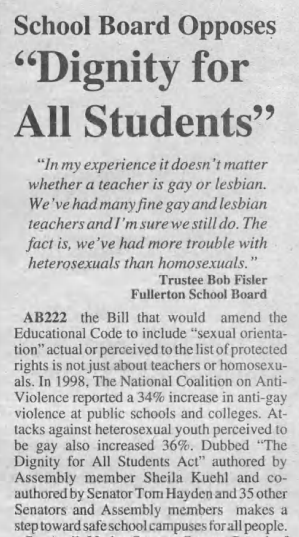
“This bill requires the administration of each public school and campus to ensure that programs and activities are free from discrimination based on sexual orientation, as they now must on the bases of race, ethnicity, religion, age, sex, color, and physical and mental disability,” the Observer reported. “Discrimination would be prohibited in interscholastic athletics, admissions, and financial aid.”
In 1998 a national survey found that there had been a 34 percent increase in anti-gay violence at public schools and colleges.
The conservative Orange County Board of Education voted 3-2 to pass a resolution opposing AB222.
In an action indicative of the political climate of Fullerton in the 1990s, the Fullerton School Board also voted to pass a resolution to oppose the bill.
“Materials [were] circulated to the board with extremely inflammatory language defining ‘sexual orientation’ as including ‘bestiality, pedophilia, necrophilia, sado-masochism and/or any other sexual habits, practices, predilections or compulsions,’” the Observer reported. “This five page document filled with homophobic scare tactics and misrepresentations is a perfect example of why the law it is railing against is needed.”
Another document given to Board members was entitled “Oppose the Homosexual Assault on Schoolchildren, Parents, Persons of Conscience, and the Institution of Marriage.”
Local Republican State Assemblymember Dick Ackerman submitted a letter to the Board opposing the bill.
Ultimately, Assembly Bill 222 did not pass.
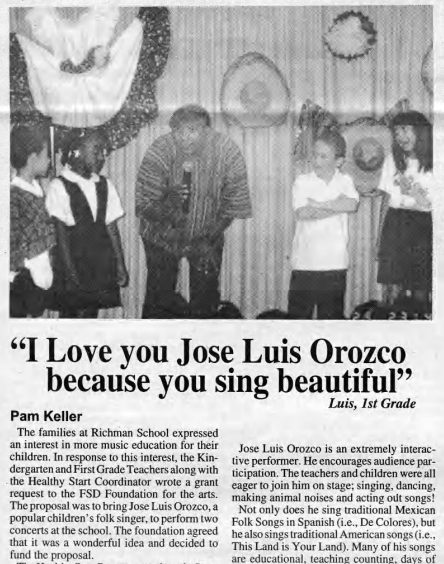
The School Board member who submitted the resolution opposing AB 222 was an outspoken conservative named Kim Guth. She also objected to a proposal inviting Latino singer Jose Luis Orozco to perform at Richman School, which had a large Latino population.
“[Guth] stated that she strongly objected to this since the students should only be taught in English and this is in violation of that law,” the Observer reported. “Trustee Fisler defended the program, stating that the District has always encouraged children to learn folk songs from other countries.”
Ultimately the Board approved the Orozco performance, and it was a huge hit with the students.
A plan was approved to expand the facilities at Maple School, which had re-opened in 1996 after being closed for over 20 years in the context of local desegregation efforts.
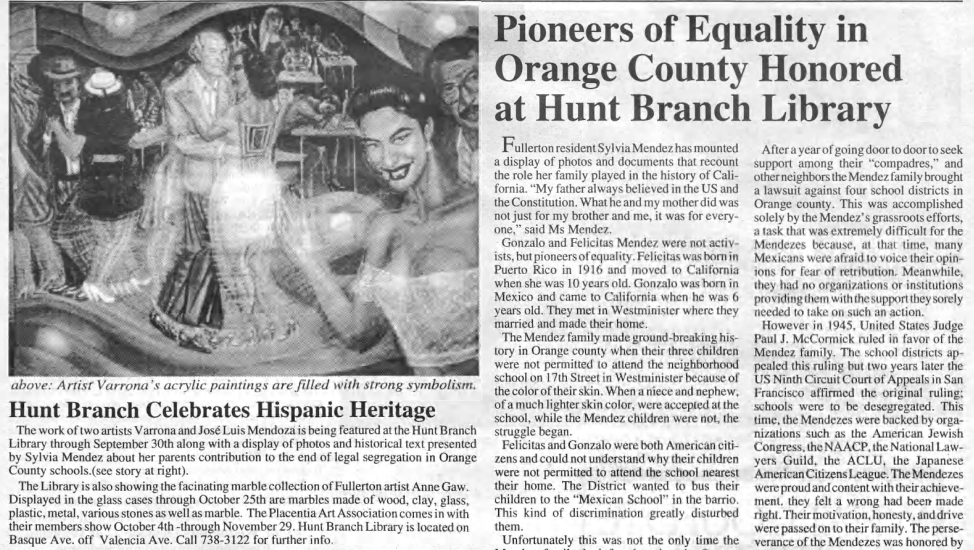
On the subject of school desegregation, Fullerton resident Sylvia Mendez was honored. Back in the 1940s, her parents had fought successfully against segregation of Mexican-American students in Orange County in the landmark case Mendez v. Westminster.
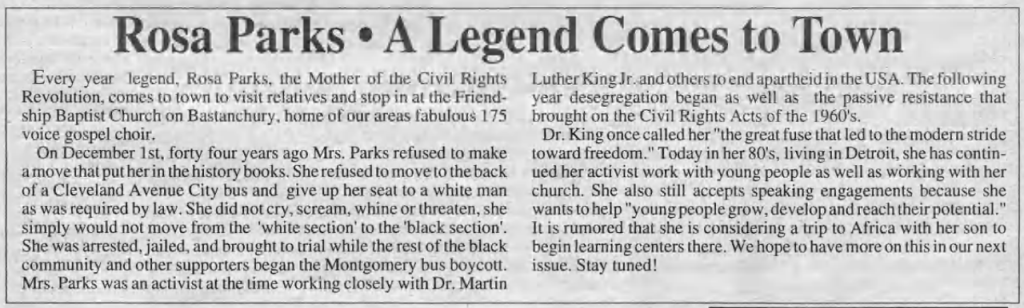
In other civil rights news, Rosa Parks visited nearby Friendship Baptist Church, in part because her Godson, Curtis Dean was a member there.
The Observer includes an article about a statewide education funding crisis.
“California was once noted for the quality of its educational system, being ranked in the top three states for years. In the latest year for which figures are available, California has plummeted to the bottom 3 or 4 or worse,” the Observer reported. “The biggest, and most long-lasting hit was Proposition 13, in 1978. That issue sailed to victory at the vanguard of a national tax revolt. Very little public debate was brought to bear on the “unintended consequences.”
A major effect of Prop 13 was that it shifted the burden for funding public education from local taxpayers to the State, which led to top-down mandates that were not always to the benefit of local districts.
Adjunct (part-time) instructors at Fullerton College began to organize against an unfair two-tier system of pay and benefits.
“Many part-timers are in fact full-time instructors, but are required to commute to two and three different campuses because employment policies restrict the number of classes they can teach in any one college district,” the Observer reported. “The system maintains the fiction that they are part-time temporary workers in order to justify low pay and administrative savings.”
In 1998, North OC Community College District part-time instructors opened an office in downtown Fullerton, and would eventually create their own union, Adjunct Faculty United.
Dr. Vera Martinez, who was removed as Fullerton College President in 1998 after the faculty’s nearly unanimous vote of no confidence in her, filed a $3 million defamation claim against the North Orange County Community College District (NOCCCD).
Martinez alleged in her claim that during her tenure as president, certain administrators and faculty members “communicated orally and in writing, on an ongoing basis, with malice, false and derogatory information about [her] job performance, skill level, conduct, honesty, integrity and other aspects of her personal character.”
“Disagreements between Martinez and the Faculty Senate over such matters as the interpretation of the Shared Governance Law and her refusal to adhere to long-standing curriculum procedures led to the Senate’s decision to conduct the no confidence vote,” the Observer reported.
The Future of Rail in OC
In 1999 there was discussion of a proposed new light rail system in Orange County called “The Center Line,” which would run from Fullerton to Irvine. Some of the funding would come from Measure M, approved by voters in 1990, which “promised a program of balanced transportation improvements, including an advanced rail transit system.”
The Orange County Grand Jury produced a negative report on the Centerline, suggesting that the light rail system “would not be a cost efficient solution to traffic congestion, air pollution and other urban problems.”
“The ‘cost-effectiveness’ of Urban Light Rail systems criticized by the Jury was characterized by OCTA as not supported by evidence,” the Observer reported. “In fact, many ‘disinterested experts’ will testify that light rail has provided positive benefits for many communities, has encouraged development, and has increased property values. In fact, light rail has been so successful that 191 cities are currently vying for federal funding to construct rail systems.”
“The inference that light rail can only be deemed successful when it convinces the majority of automobile drivers to leave their cars in favor of public transit ignores the thousands of people who depend on public transit as their sole source of transportation,” the Observer reported. “Seniors, disabled, students and visitors are dependent on public transportation and they are a growing sector of the County’s population. With annual ridership in the last four years jumping from 43-million to over 57-million expected this year, buses are currently experiencing capacity problems on many routes and simply adding buses to congested local roads will not solve traffic problems.”
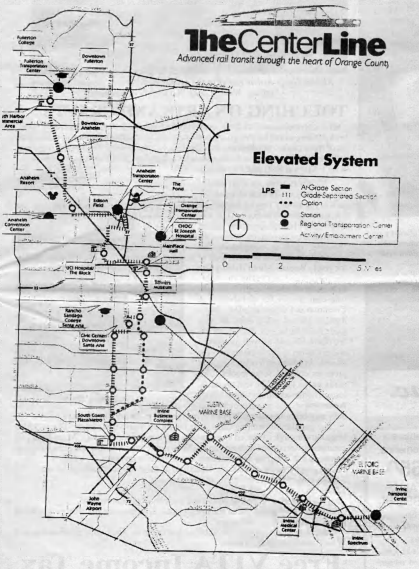
“OCTA has succumbed to the protests of Santa Ana and has now shortened the proposed line to be built between Costa Mesa and Irvine, completely eliminating the north segment from near South Coast Plaza to Fullerton,” the Observer reported. “This was apparently brought about by opposition to the rail line’s sharing of streets along the route that would result in loss of traffic lanes and parking spaces…However, this proposal eliminates Anaheim, with it’s theme parks; convention center; The Pond and Anaheim Stadium, as well as the route into Fullerton for connection to Metrolink and Amtrak’s Southwest Chief and San Diegans. This is the heart of the entire system and without it The Centerline becomes the line to nowhere that the critics had accused it of being from the start.”
The Observer pointed out that “More than $5-Billion from Measure M is already being invested in freeway expansion, street and road improvements and to increase bus service by 50%. However, those improvements alone will not be sufficient to meet the forthcoming demands and prevent the traffic congestion that is projected.”
Supervisor Tom Wilson, who chaired the OCTA board, said “When you look at a traffic study like that you see that what traffic is today, that’s what it was yesterday. Do we want it to be like that tomorrow?…We need to find some other mode of transportation other than pouring concrete and making another lane that will be congested as soon as it opens.”
When the light rail plan came before City Council, it specified that the light rail tracks be elevated within Fullerton, essentially killing the proposal within Fullerton.
“OCTA responded…with a decision to halve the route, citing strong opposition. It said that it was ‘no longer fruitful’ to plan the entire length from Irvine up to Fullerton,” the Observer reported. “The Council’s action has effectively killed the chance for rail service in the north at the very time that growth in this portion of the County is forecasted to increase by 2020 at a rate that will result in 55% of the County’s population, and 60% of its jobs to be in the north part of the County.”
Ultimately, the Center Line would not be built.
That same year, there was also a proposed statewide highspeed rail that would run from San Diego to two northern terminals, San Francisco and Sacramento.
California created a new agency called the California High-Speed Rail Authority to develop a plan to study and possibly implement this project.
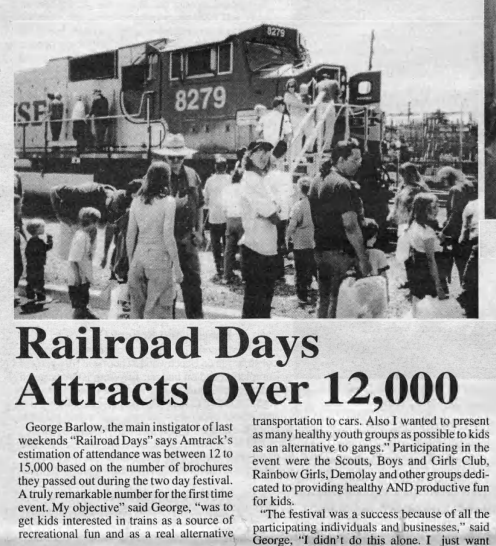
In 1999, Fullerton hosted its popular Railroad Days around the train station.
Arts and Culture
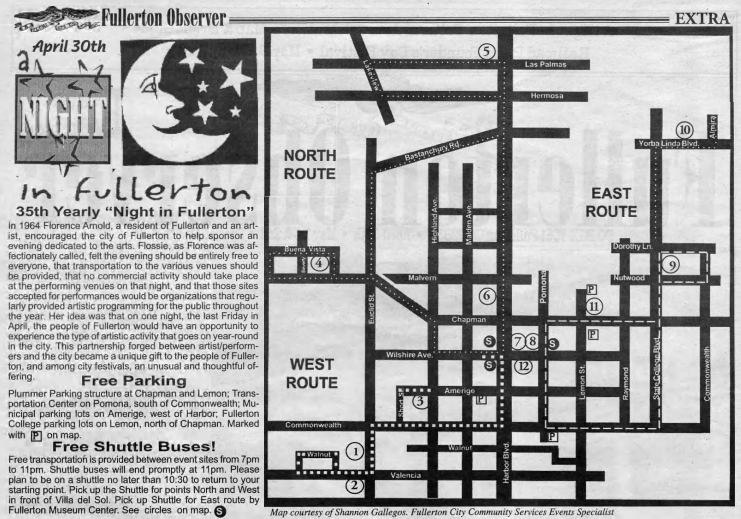
In 1999, Fullerton still celebrated its annual arts festival called “A Night in Fullerton.”
Back in 1999, Fullerton still had a Redevelopment Agency, and it was negotiating with the Fox Theater’s owner, a Mr. Lewis, in an effort to obtain an option on the Fox Theater complex.
Councilmember Dick Jones was opposed to the plan, saying, “The ugly theater is a liability. It would be just as nice to restore Fullerton to orange grove days, but impractical. I have a hunch we won’t go ahead with it as a theater, and I can’t support it.”
“City Redevelopment Director Gary Chalupsky said that the Agency had been in contact with about 60 prospective investors, all with differing plans for the theater and commercial property,” the Observer reported. “In order to get the best price and attract the most qualified investor with a plan that realistically looks at long term support of the theater, the Agency is moving ahead on marketing plans.”
Local preservation group Fullerton Heritage had circulated a petition that as signed by over 12,000 people who were in support of renovating and re-opening the Fox.
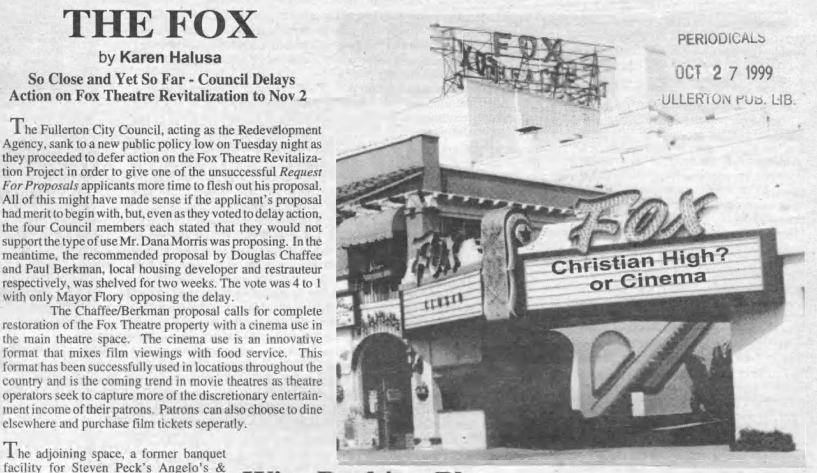
Doug Chaffee and Paul Berkman, local housing developer and restaurateur respectively, submitted a proposal to restore the Fox theater and open surrounding buildings for restaurants and other businesses, and build a senior housing project near the Fox. This proposal was supported by Fullerton Heritage.
“Financing for the project would come from an investment of $1 million of developer equity as well as a commercial loan from Fullerton Community Bank of $2 million,” the Observer reported. “Redevelopment Agency assistance of approximately $3 million in loans and land write-downs also was requested.”
Meanwhile, council received another proposal by Morris Productions to convert the Fox into a youth theatre academy with a possible church and Christian high school.
At the time, Morris operated a youth theatre company out of nearby Biola University.
Meanwhile, the Fox was still owned by a Mr. Ed Lewis.
Eventually, Morris dropped his proposal and City Council voted to enter into negotiations with Chaffee and Berkman.
Stay tuned for more on the Fox Theater saga.
The Observer includes a fun profile of George’s Hamburgers, a Fullerton institution.
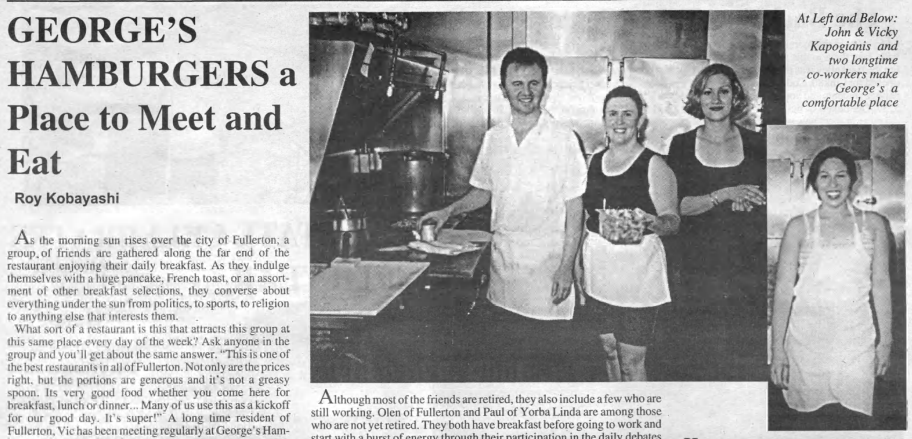
George’s is located at 815 W. Commonwealth, and has been owned and operated by John V. Kapogianis since 1981. He had acquired it from his brother-in-law George Papaspyropoulos–the namesake of “George’s.”
The small but mighty George’s remains a very popular spot, especially on weekend mornings. I recommend their breakfast burrito.
Immigration
Professor Donna L. Friess gave a presentation called “Southern California is the new Ellis Island.” In Orange County in 1999, one out of four residents was foreign-born.
She said the study revealed that immigrants to Southern California suffer a greater level of discrimination than most native-born residents might suspect, “From the sample of native-born residents, it appears that the main area of difficulty for citizens interacting with immigrants is the language.”
She spoke in favor of more education in intercultural communication: “If we can teach each other and look at the world through each others’ eyes, we can make very positive changes.”
Housing
The massive Hughes Aircraft facility in west Fullerton had closed down and 1994, and its owners were planning to build a massive housing/commercial space on the site.
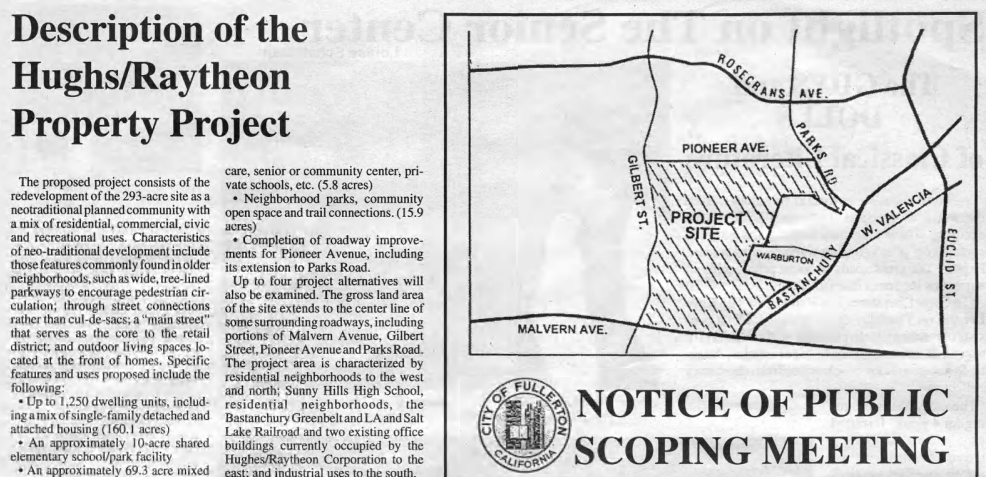
“The proposed project consists of the redevelopment of the 293-acre site as a neotraditional planned community with a mix of residential, commercial, civic and recreational uses,” the Observer reported.
This development would come to be known as Amerige Heights.
Local real estate owners the Bushala Brothers were got council to re-zone some of their land near the train tracks into to allow for high-density (apartment) use.
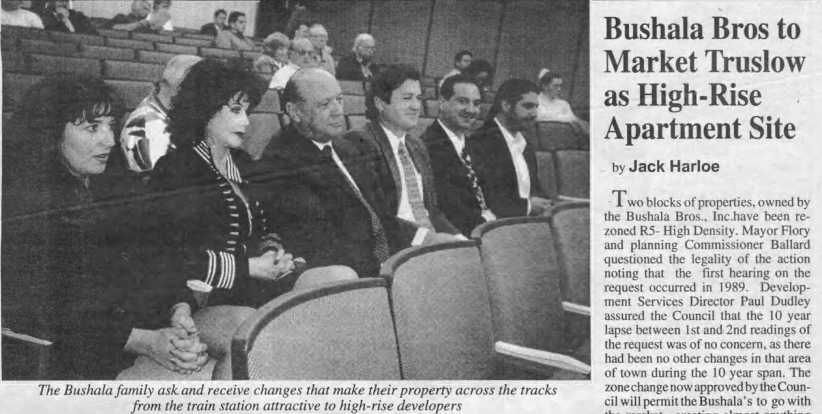
Claudia Casillas, a local resident of the area said, “I would like to speak for the parents of Maple School. We are very concerned about the proposal for R-5 zoning for the Bushalla project. We are concerned about the impact of a high density project on our community and on our school…Please consider approving only R-3 zoning for this project.”
Law and Order
At the request of Fullerton’s police chief Pat McKinley, Council approved use of State funding to purchase 16 modern automatic rifles with laser sighting, and the necessary ammunition.
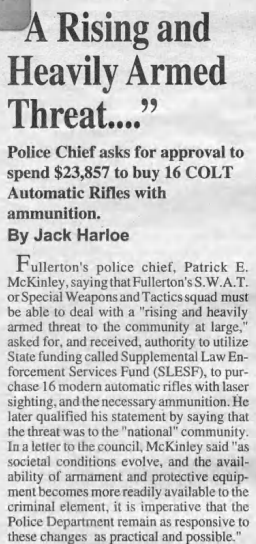
He said that Fullerton’s S. W. A.T. or Special Weapons and Tactics squad must be able to deal with a “rising and heavily armed threat to the community at large.”
In a letter to the council, McKinley wrote, “as societal conditions evolve, and the availability of armament and protective equipment becomes more readily available to the criminal element, it is imperative that the Police Department remain as responsive to these changes as practical and possible.”
Deaths
Paul Codispoti, owner of the popular Giovanni’s Pizza in Fullerton died of cancer at age 49.
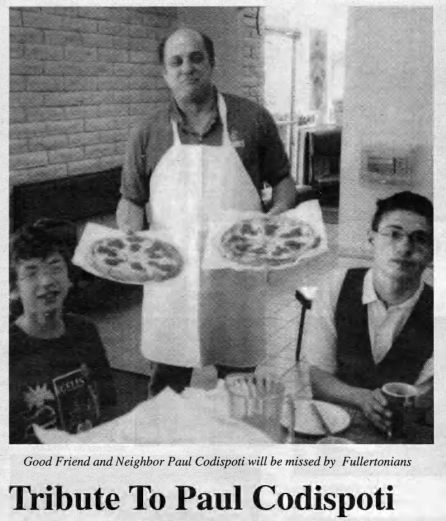
“Many a youth sports team had “the Pizza Man,” as Paul was affectionately called, to thank for both financial support and lots of free pizza,” the Observer reported. “Fullerton’s elementary and high schools, the Boys and Girls Club, and Fullerton Public Library also benefited from Paul’s generosity over the years.”
Paul had no health insurance and was facing mounting medical bills, “so the people who loved him chipped in to help in a big way. Aluminum can drives, benefit spaghetti dinners, and several other fundraising efforts netted over $10,000 to help offset the costs of his treatments.”
Paul had owned Giovanni’s Pizza since 1981, but his connection to the popular restaurant on Williamson Ave. went back further than that. It had been owned and operated by his father Tony since 1958, and at one time or another, all eleven Codispoti children helped their father at the restaurant.
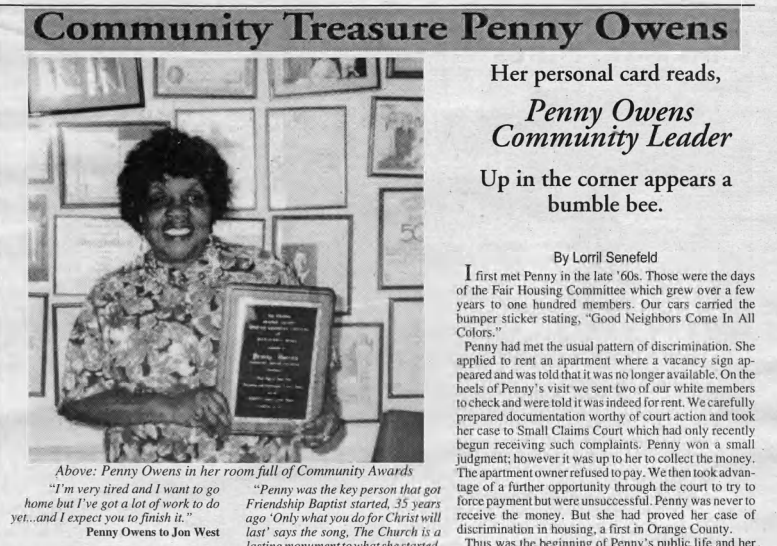
Local civil rights activist Penny Owens passed away.
“I first met Penny in the late ’60s,” an Observer wrote in a tribute. “Those were the days of the Fair Housing Committee which grew over a few years to one hundred members. Our cars carried the bumper sticker stating, ‘Good Neighbors Come In All Colors.’”
Penny, being African American, had experienced housing discrimination.
“She applied to rent an apartment where a vacancy sign appeared and was told that it was no longer available. On the heels of Penny’s visit we sent two of our white members to check and were told it was indeed for rent. We carefully prepared documentation worthy of court action and took her case to Small Claims Court which had only recently begun receiving such complaints,” the Observer reported. “Penny won a small judgment; however it was up to her to collect the money. The apartment owner refused to pay…But she had proved her case of discrimination in housing, a first in Orange County. Thus was the beginning of Penny’s public life and her unswerving dedication to the pursuit of justice for herself and others.”
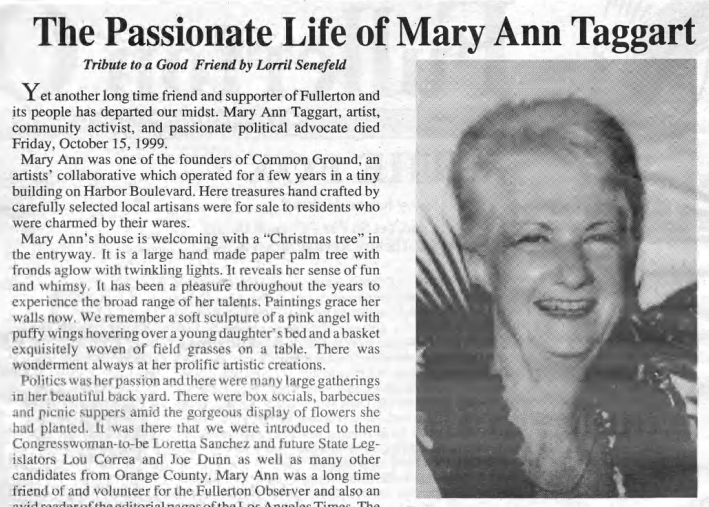
Artist and community activist Mary Ann Taggart died. She was one of the founders of Common Ground, an artists’ collaborative which operated for a few years in a small building on Harbor Boulevard.
According to the Observer, “She single-handedly built the membership of the Democrats of North Orange County from a handful of folk to a filled, sometimes standing room only capacity today.”
Stay tuned for stories from 2000!
 Fullerton History