The following is from a work-in-progress about the history of Fullerton. You can support my ongoing research and writing on Patreon.
The Fullerton Observer newspaper was formed in 1978 by Ralph and Natalie Kennedy and friends to provide a more progressive counterbalance to the more conservative Fullerton News-Tribune and Orange County Register. Back then, Orange County (including Fullerton) was dominated by Republicans, and the Observer crew were definitely in the minority. The Fullerton Public Library has digital archives of the Observer stretching back to 1979. I am in the process of reading over these archives and creating a year-by-year summary of top stories. Here are some top stories from 1998.
Fullerton Still Dominated by Republicans
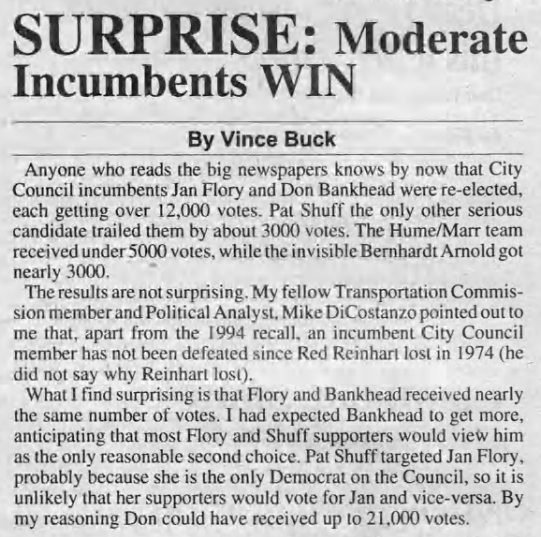
Don Bankhead and Jan Flory were re-elected to Fullerton City Council. Flory remained the only Democrat on this historically conservative body.
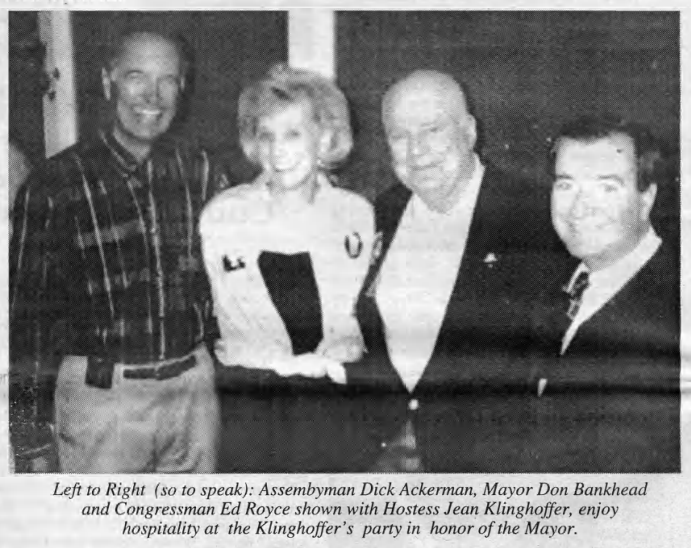
At both the state and federal levels, Fullerton remained represented by Republicans–Dick Ackerman in the State Assembly and Ed Royce in the House of Representatives.
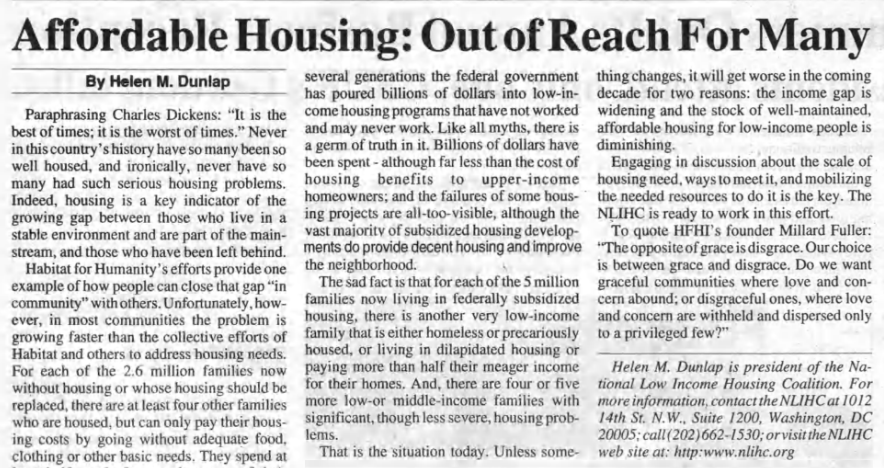
Affordable Housing Needs Fall on Faith Community
As the 1990s wore on, the issue of housing unaffordability was becoming more acute. Gone were the halcyon days (for some) of the 1950s, when it seemed almost anyone (who was white) could afford a single-family home, thanks to a buyer’s market, a booming postwar economy, and generous federal housing programs dating back to the New Deal.
Fullerton’s conservative City Council majority were generally opposed to approving affordable housing projects.
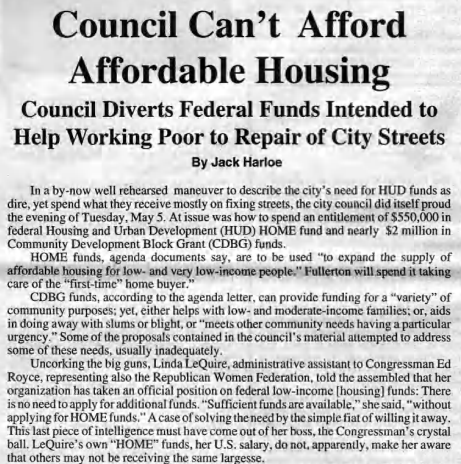
Each year, Fullerton gets federal funds that are generally meant to support local affordable housing programs. These are called HOME funds and CDBG funds. In 1998, Fullerton got $550,000 in HOME funds and nearly $2 million in CDBG funds.
City Council chose to use these funds in ways that didn’t expand the city’s supply of affordable housing. Instead, they chose to use HOME funds for a first-time homebuyer program and CDBG funds for (mostly) infrastructure improvement.
Thus, it would (mostly) fall to local non-profits and faith communities to get affordable housing projects built.
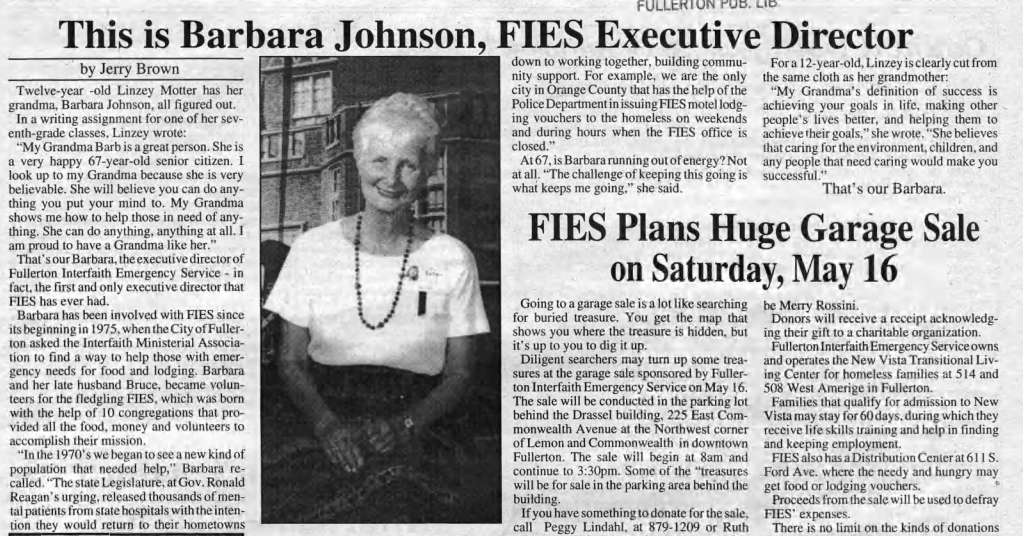
The Observer includes a profile of Barbara Johnson, executive director of Fullerton Interfaith Emergency Services (Now called Pathways of Hope), a local nonprofit that started in 1975, when the city asked local churches to find a way to help those with emergency needs, particularly housing and food assistance.
“In the 1970’s we began to see a new kind of population that needed help,” Barbara recalled. “The state Legislature, at Gov. Ronald Reagan’s urging, released thousands of mental patients from state hospitals with the intention they would return to their home towns and get care and treatment in a setting where they would have support of their families.” Things didn’t exactly work out that way.
The social safety net that was stitched together during the New Deal began to fray in the 1980s.
“The cost of housing just went out of sight,” Barbara said. “Families could no longer feed, clothe, house and educate their children.”
In 1986, FIES received a grant of $ 140,000 from the State of California and bought two homes at 514 West Amerige to house five homeless families in temporary transitional housing, called New Vista.
“Over the years we were able to pull together many elements in the community to help meet the growing needs. It was a total community-wide effort,” she said. “The model that we have created is well known for the diversity of support that we have and how we reach out to the private and government sectors to meet social needs.”
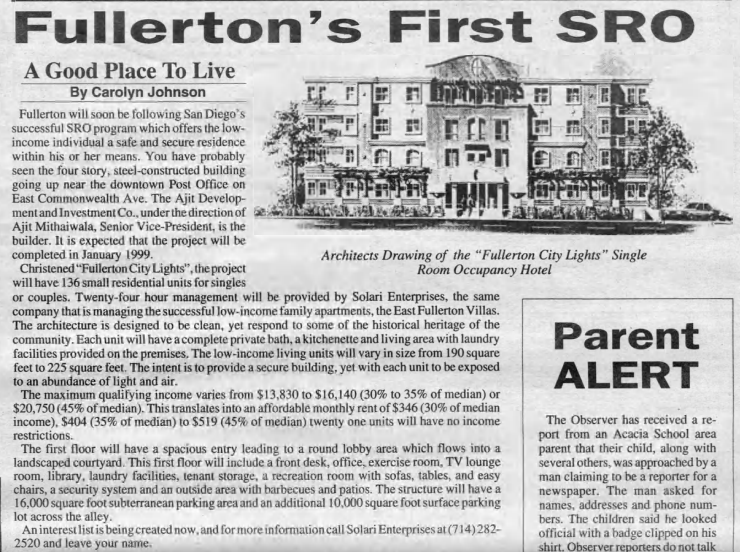
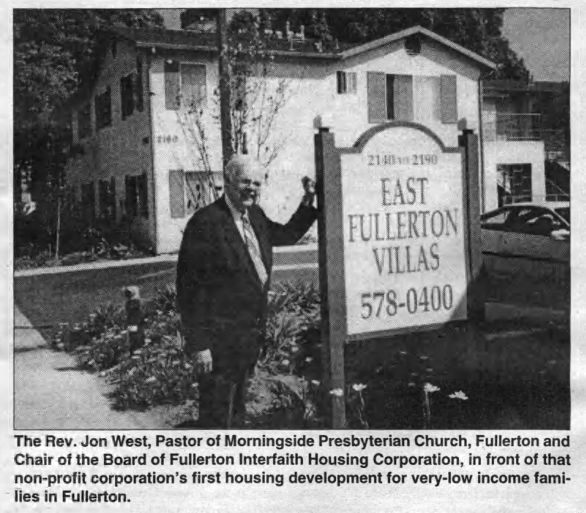
By 1998, New Vista wasn’t the only affordable housing facility in town. There were the East Fullerton Villas, and City Lights downtown. Council initially voted down the City Lights project, but reversed course when the city faced citizen support and legal pressure.
In 1998, the Heritage House in the Fullerton Arboretum was placed on the National Register of Historic Places. The house belonged to Dr. George C. Clark, an early Fullerton doctor.
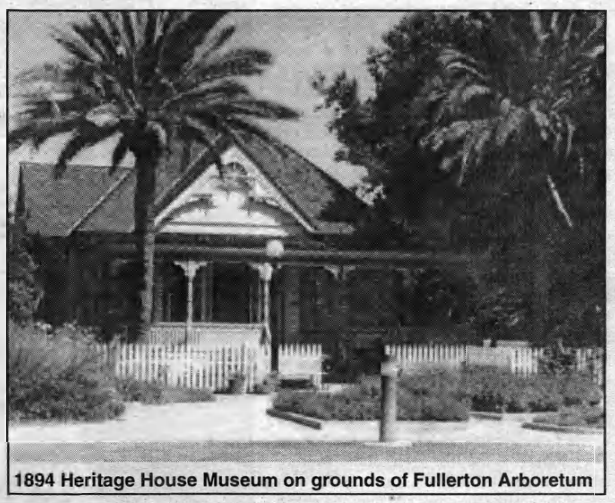
“Docents annually show hundreds of elementary school children through the house and office as part of their study of California history,” the Observer reported.
The Decades-Long Struggle to Save Coyote Hills
Since the 1970s, there has been a concerted citizen effort to save a 510-acre open space in northwest Fullerton called Coyote Hills. It is owned by Chevron and their housing subsidiary Pacific Coast Homes and since oil production ceased these companies have wanted to develop the land into housing and commercial space.
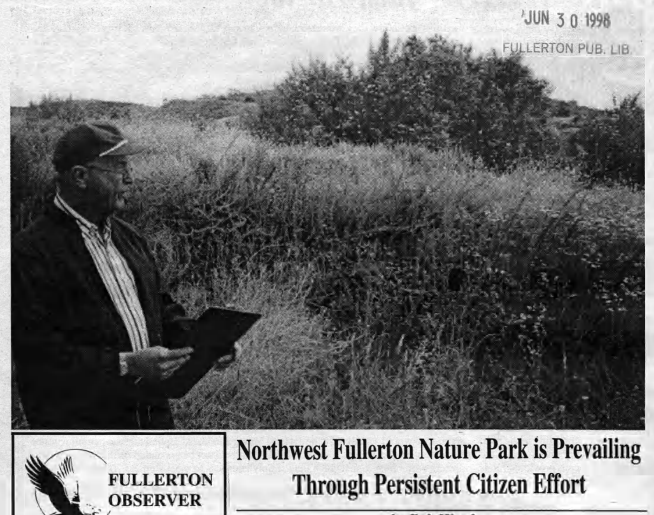
Back in the 70s, Fullerton City Councilmember Robert Ward, along with other local activists sought to preserve a large part of the land as open space.
Under Ward’s leadership, the city negotiated a plan to save much of the land, and allow for some development. The 1977 Master Plan for the West Coyote Hills was created, setting aside about one third of the land for open space.
In 1983, the City acquired 72 acres of open space. This would eventually become the Robert Ward Nature Preserve, which today contains miles of beautiful trails and a glimpse into what the land looked like before it was developed.
By 1998, things had stalled. The Nature Preserve was still not open to the public, and Chevron was moving forward with its development plans.
“Fourteen years have elapsed since the City acquired this hidden treasure. Sadly, the dream of the Nature Park has not yet been fully realized,” Ward wrote in a 1998 Observer article. “Severe cutbacks in funds available for parks and recreation and limitations imposed by closing out oil operations have put access to the Nature Park on hold. But things are moving toward fruition with Chevron’s pending development of their remaining land which will remove the chief obstacles. We are also blessed that another adjoining parcel will be set aside in its natural state as Gnatcatcher habitat so that something like 150 acres altogether will be preserved. Hopes are high that soon the people of Fullerton will have the opportunity to experience this hidden treasure first hand.”
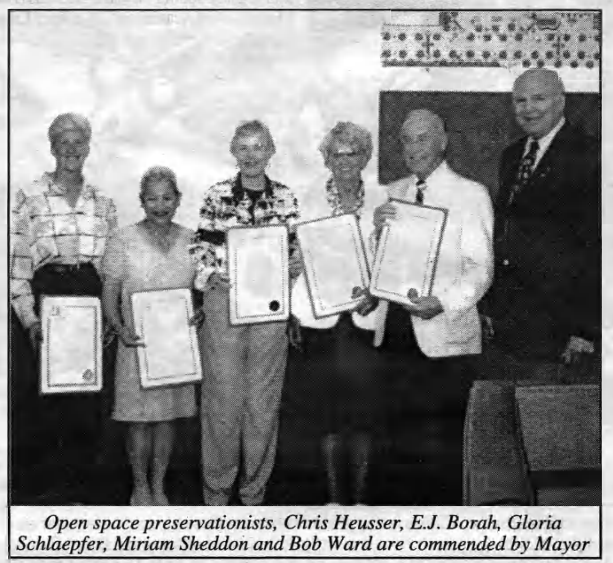
Ward was also the catalyst for an 11-acre Vista Park surrounding the Summit House restaurant, an 8-acre panorama nature preserve, and 30 miles of public trails.
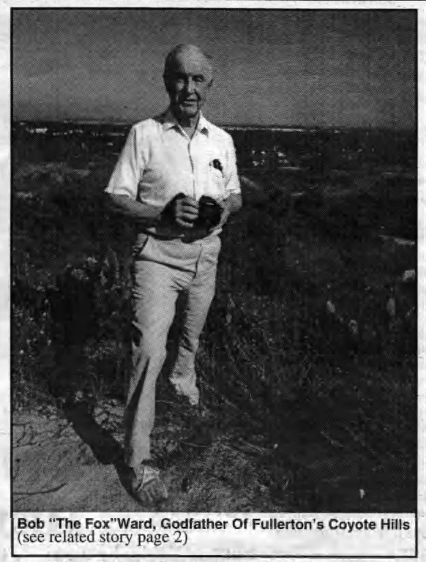
Within a few years, the Friends of Coyote Hills would form with the goal of acquiring all 510 remaining acres of West Coyote Hills. Additional land has been acquired, but not all of it. The struggle continues.
Culture and Entertainment
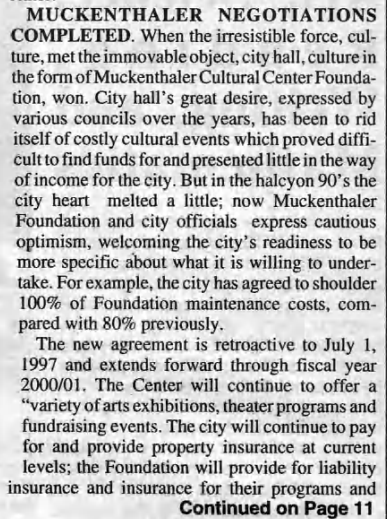
In 1998, the City of Fullerton agreed to pay 100% of the maintenance costs of the Muckenthaler Cultural Center. That city support would eventually end. Today, the Muck, like the Fullerton Museum Center, is self-funded.
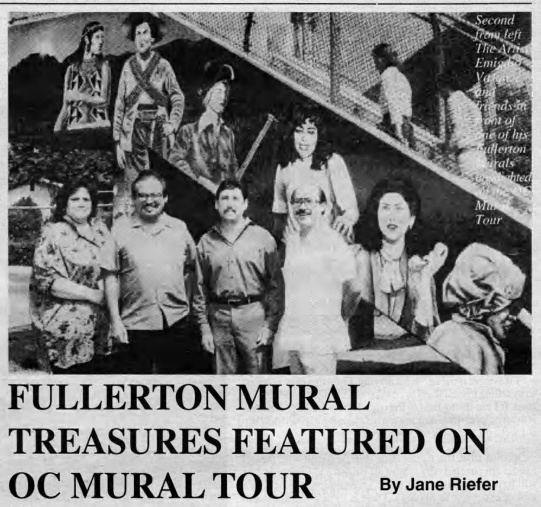
The Observer features an article on an Orange County Mural Tour hosted by the Mural Conservancy of Los Angeles. The tour included four Fullerton murals.
The first was Charles Kassler’s recently restored WPA-funded “Pastoral California” on the western wall of the Fullerton High School Auditorium. Check out a more complete history of that mural HERE.
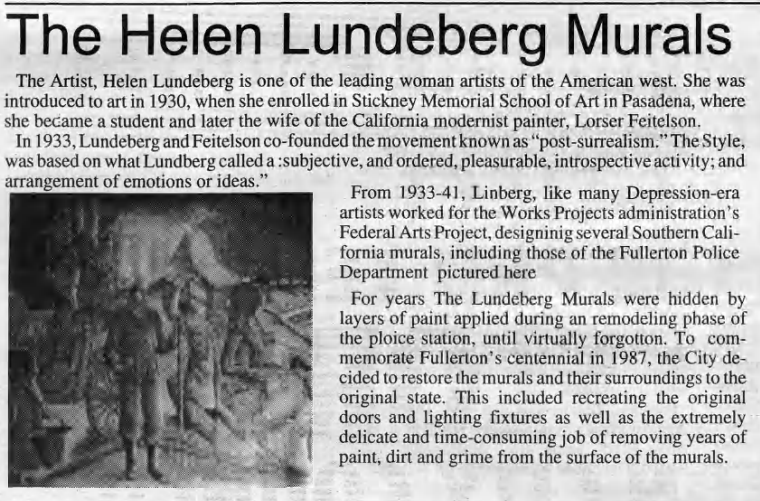
The second was the Helen Lundeberg’s 1942 WPA-funded mural called “History of the Development of Southern California,” originally painted when the building was Fullerton’s City Hall. Today it is located inside the Fullerton Police Department.
The third of the WPA murals was Paul Julian’s “Orange Pickers” at the Commonwealth Post Office, painted in 1942.
The last Fullerton mural on the tour was Chicano artist Emigdio Vasquez’s “Children of the World,” painted in 1994.
The Observer did a profile of Steven Peck, the eccentric founder of Angelo’s and Vinci’s Ristorante, a long time Fullerton institution that sadly closed in recent years.
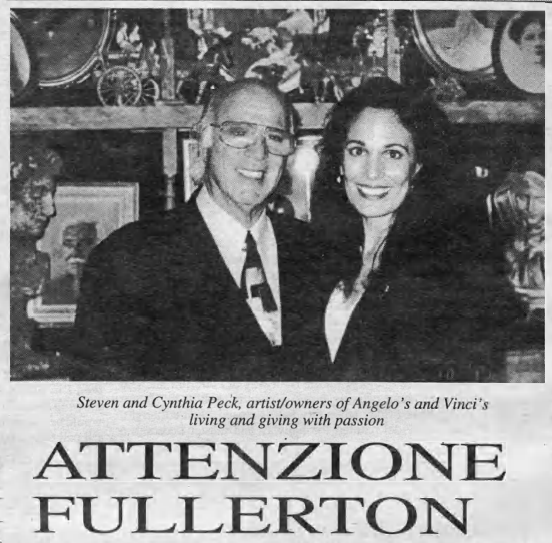
Peck was a “dancer, movie star, teacher, writer, chef, philanthropist, restaurateur, and raconteur.”
He originally came to Fullerton in 1971, establishing a dance studio in the historic Fox building, and eventually a restaurant.
When his lease ran out in 1992, he moved next door “to a-building that had served as a farmers’ market in the early 1900’s.”
“The popular eatery encompasses over 20,000 square feet divided among several rooms,” the Observer reported. “Walking into Angelo’s and Vinci’s is a bit like entering a fairyland. Strings of tiny lights illuminate stained glass and statues, ornate mirrors, cherubs and porcelain masks adorn the walls, ceramic trapeze artists hang from the ceiling of the main dining room, and ceramic jesters (reputed to act like guardian angels) watch over doorways.”
The restaurant was a maximalist tribute to Italian culture and Peck’s own family history.
“Nowhere is that more evident than in the main dining room. Decorated to capture the essence of an Italian town square, the room includes La Stride di Nonne (the Street of the Grandparents) and the Love Altar,” the Observer reported. “The former is a dedication to family members who immigrated to this country and worked at trades they had perfected in Italy. Diners will see a fruit store, a wedding dress boutique, a deli, an inn, and a wine shop The Altar showcases treasured photos from both sides of the family.”
Also included in Angelo’s and Vinci’s were posters from movies Peck had acted in, photos taken with celebrities, and tributes to Fellini, Gershwin, and Nino Rota, who composed the music for the Godfather movies.
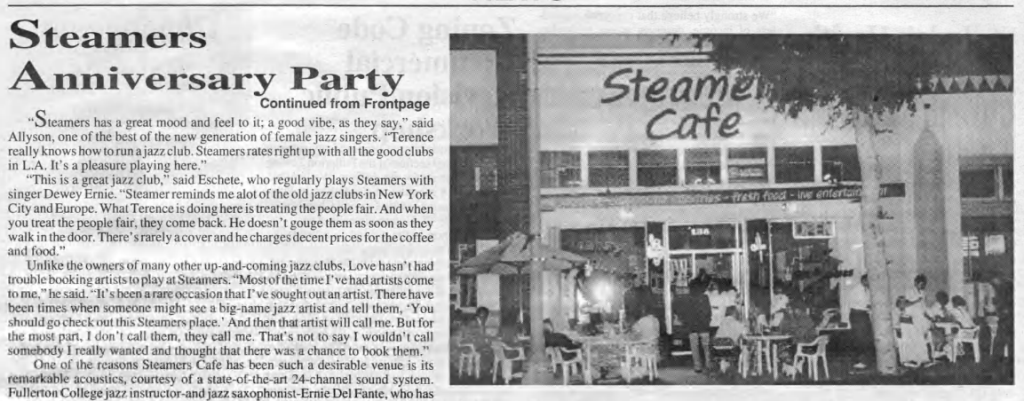
In 1998, Downtown Fullerton was home to a world-class jazz club called Steamers, which has sadly since closed.
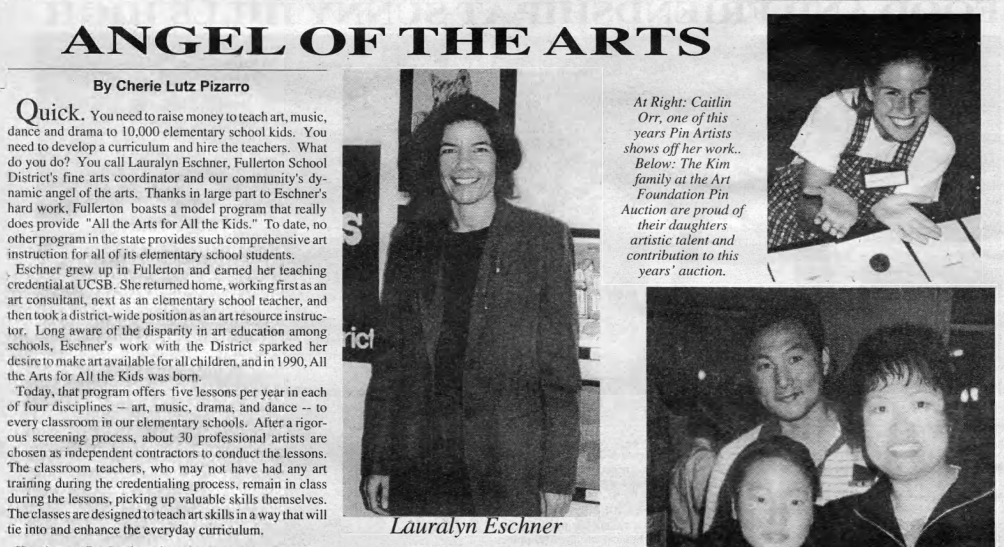
The Observer also contains a profile of Lauralyn Eschner, who founded All the Arts for All the Kids, a nonprofit arts program that still exists today.
Residents Win Against ConAgra
Fullerton faced a proposal by industrial giant ConAgra to build a massive flour mill on the west side of town very near to residential neighborhoods.
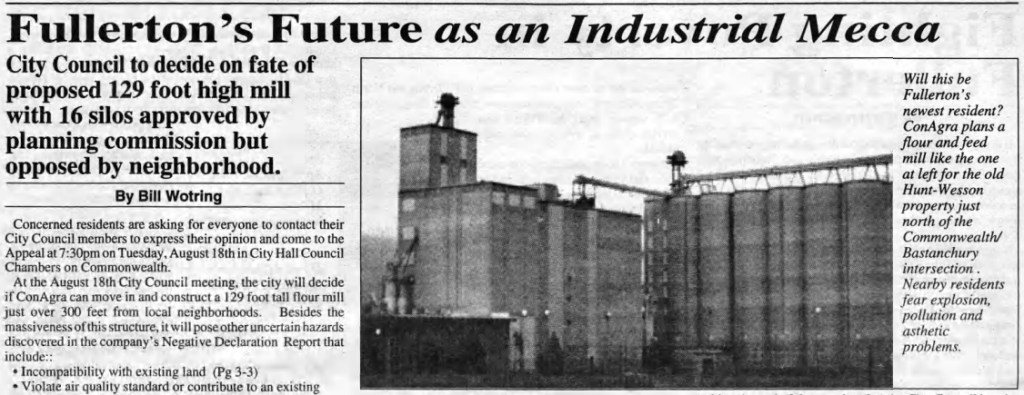
The Observer included a number of articles arguing against the mill, and numerous residents organized to protest its approval.
The Observer reported: “Besides the massiveness of this structure, it will pose other uncertain hazards discovered in the company’s Negative Declaration Report.” These included air quality pollutants, objectionable odors, water quality concerns, risk of accidental explosion, and many other public health hazards.
Hundreds of citizens signed a petition opposing the flour mill and flooded the Planning Commission and City Council chambers to voice their opposition.
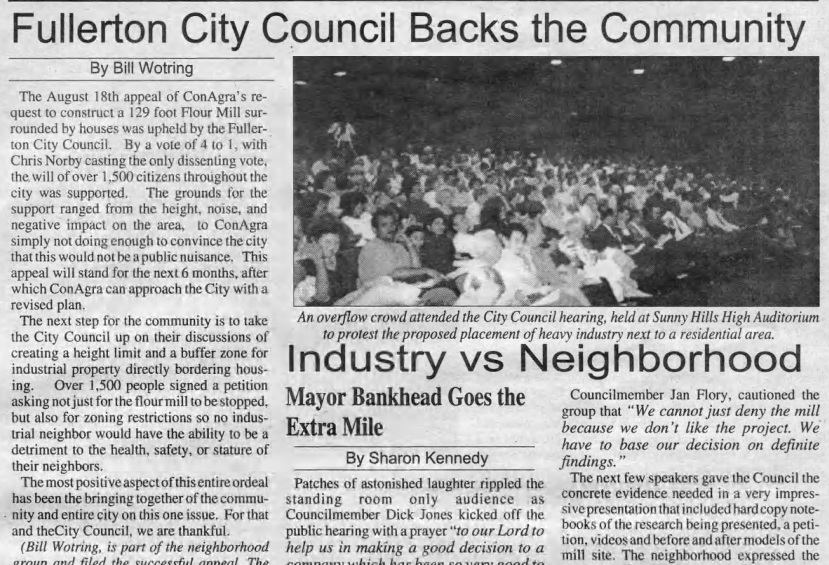
The community activism had a positive result. City Council voted 4-1 (Norby, no) to deny the construction of the flour mill.
California’s Calamitous Experiment in Electricity Deregulation
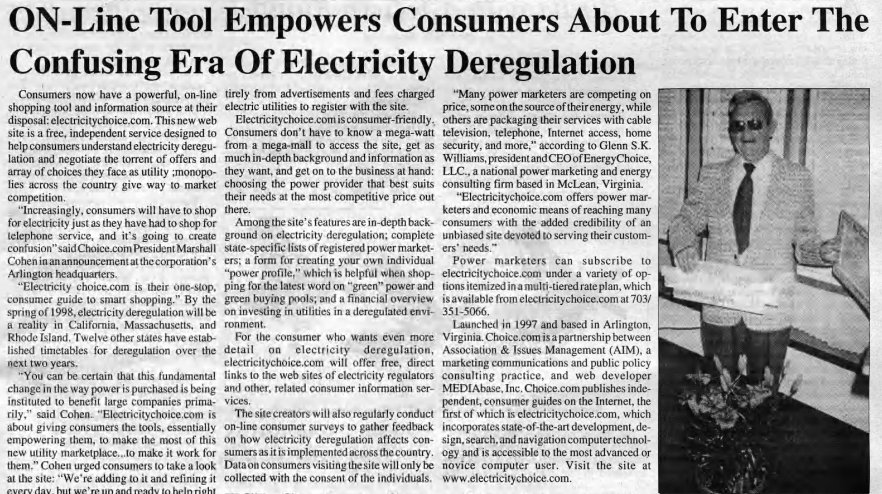
In 1996, California legislators passed Assembly Bill 1890 with the goal of deregulating electricity in the Golden State. While this was promoted as an effort to provide more consumer choice and “free market” competition, it led to a calamitous electricity crisis by 2000-2001.
But in 1998, hopes were still high that deregulation was the way to go.
Best Downtown?
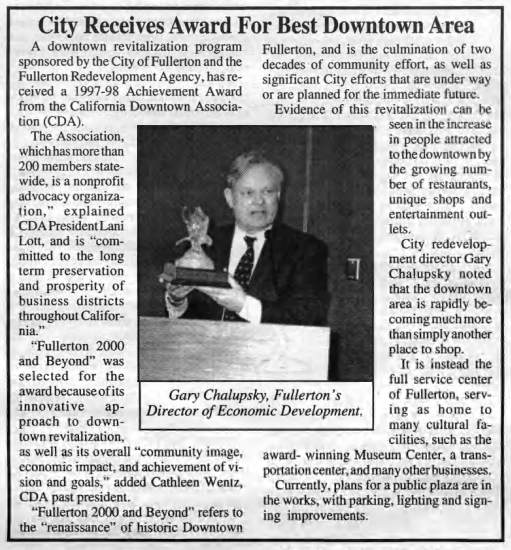
In 1998, Fullerton got an award for Best Downtown Area. I was a high school student at the time, and I respectfully disagree that Downtown Fullerton was great in the 90s. While it had some cool spots and historic buildings, it was still a pretty sleepy and boring place.
Education
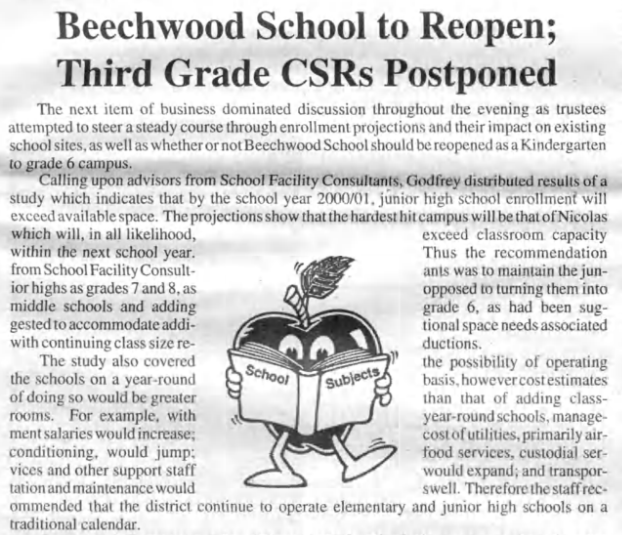
In 1998, plans were afoot to re-open Beechwood School.
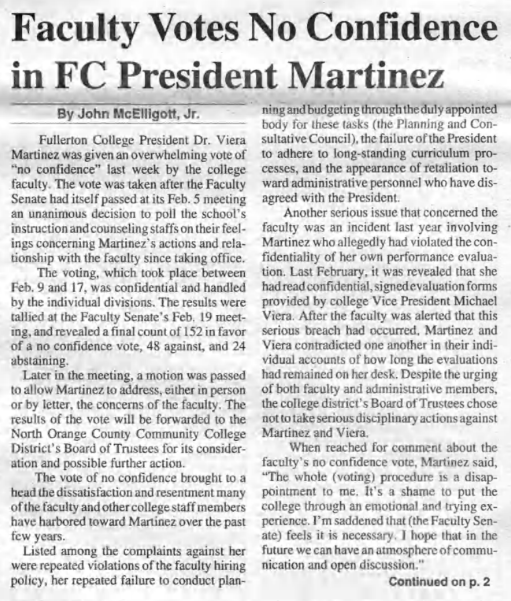
And Fullerton College faculty passed a vote of “no confidence” of its current president Martinez.
Human Relations
Fullerton Observer editor Ralph Kennedy had a son named Rusty, who became the director of an organization called Orange County Human Relations (now called Groundswell), which sought to fight against racism and bigotry in Orange County. In 1998, Rusty wrote an article in which he discusses his observations and experiences with historic racism in Fullerton.
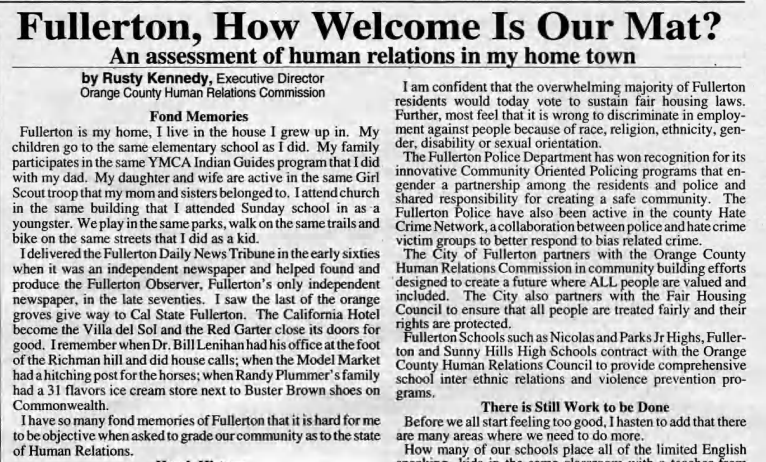
Rusty recalls the John Birch Society (once big in OC) “and the hate they directed at my family and others. He remembers “the hostility generated by the real estate industry at my parents for supporting the Rumford Fair Housing act which outlawed housing discrimination based on race.”
“I remember that our schools were segregated and the predominately Latino and Black Maple School seemed to get the least resources and was finally closed rather than forcing white students to integrate it,” Rusty writes. “I remember the chilly reception that Rev Jim Carrington of predominately Black Friendship Baptist Church got when he raised issues of discrimination at the City Council meetings of the day; and I remember the animosity directed at Cesar Chavez and the United Farm Workers for invading our comfortable suburb with the grape boycott.”
He describes the Fullerton neighborhood he grew up in where “almost everybody was like me, we were the middle class baby boomers in a suburb largely developed by white flight from Los Angeles.”
Rusty points out local advancements made in housing and school integration: “Today my street has old and young, Korean and Latino, different types of families and is characterized by the fact that 3 out of the 8 homes on my end of the block have ethnically mixed families. What was a predominately white suburban bedroom community has grown into a diverse urban area where a majority of our K-12 school students are ethnic minorities and over 50 languages are spoken in our homes.”
He also points out work that still needed to be done.
“How many of our schools place all of the limited English speaking kids in the same classroom with a teacher from whose class the informed parents have already pulled their kids?” he writes. “How many of our involved parents and leaders have focused only on our own children’s needs rather than the needs of ALL children? How many of the special efforts to involve parents of children bused out of their neighborhoods have been scrapped?”
He is talking about persistent de facto housing and school segregation, which I have described in my article on the history of Maple School desegregation efforts.
Observer Editor Ralph Kennedy Dies
In 1998, the Fullerton Observer celebrated its 20-year anniversary.
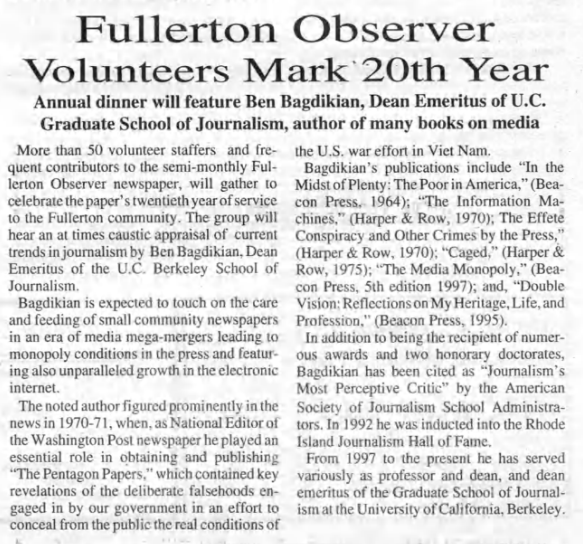
Tragically, that same year, Observer co-founder and editor Ralph Kennedy died of pancreatic cancer.
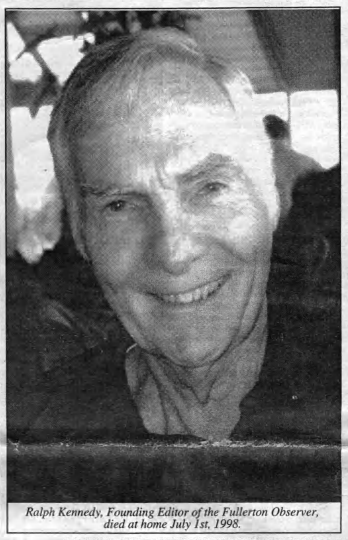
Chris Beard, who had a longtime column in the Observer called “The Last Boulevardier” wrote a touching tribute to Ralph. Sadly, Beard also died from pancreatic cancer.
“This is why the world needs Ralph Kennedy,” Beard (who was politically conservative) wrote. “A man driven to right the wrongs that we should be ashamed to admit exist. A true champion of the cause of mankind. After serving our nation in the military, and working for a living until retirement, Ralph chose the absolute most improbable, insane career imaginable. Publish and edit a liberal newspaper in a town so conservative that its people would routinely re-elect a homophobic congressman by landslide margins just because the shingle hanging outside of his office read Republican. But Ralph pulled it off…Ralph Kennedy was the embodiment of giving and goodness and awareness in our city and we have gained insight into the side of the good because of his energy. I know I am a better person because I knew him.”
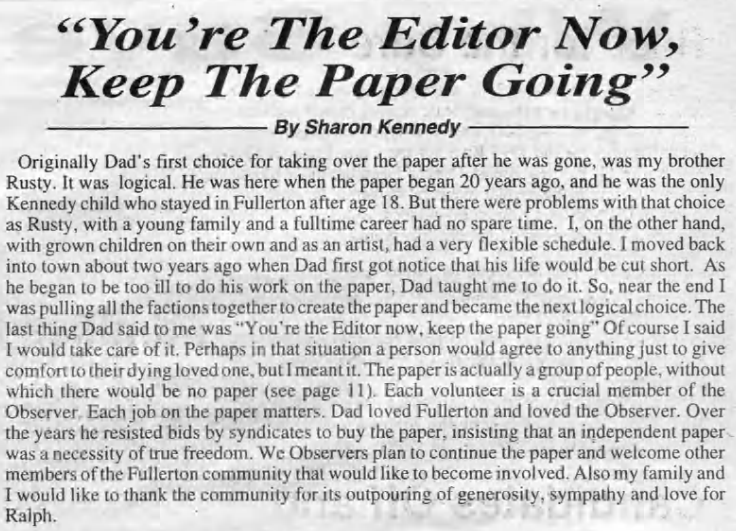
After Ralph died, he passed the reins of the Observer to his daughter Sharon, who would helm the paper for another 20 plus years. Today, the Observer continues under the editorship of Sharon’s daughter Saskia–a third generation Kennedy Observer.
Stay tuned for top news stories from 1999!
 Fullerton History