The following is from a work-in-progress about the history of Fullerton. You can support my ongoing research and writing on Patreon.
The Fullerton Observer newspaper was formed in 1978 by Ralph and Natalie Kennedy and friends to provide a more progressive counterbalance to the more conservative Fullerton News-Tribune and Orange County Register. Back then, Orange County (including Fullerton) was dominated by Republicans, and the Observer crew were definitely in the minority. The Fullerton Public Library has digital archives of the Observer stretching back to 1979. I am in the process of reading over these archives and creating a year-by-year summary of top stories. Here are some top stories from 1997.
Government and Politics
In 1997, Fullerton City Council was made up of four Republicans (Don Bankhead, F. Richard Jones, Chris Norby [mayor], Julie Sa, and one Democrat (Jan Flory).
In 1996, California voters passed Prop 208, which sought to limit campaign contributions to local candidates to $250 per individual. The measure sought to curb undue influence of wealthy donors on politicians.
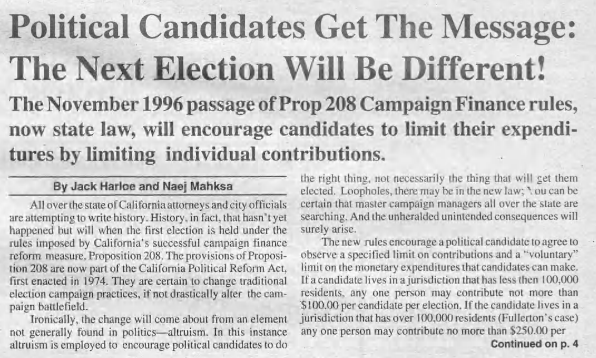
Unfortunately, the Proposition was declared unconstitutional and never went into effect. Fullerton has never imposed contribution limits; however state law sets the ceiling at $5,900. Local elections continue to be affected by the influence of large donors–developers, police and fire unions, etc.
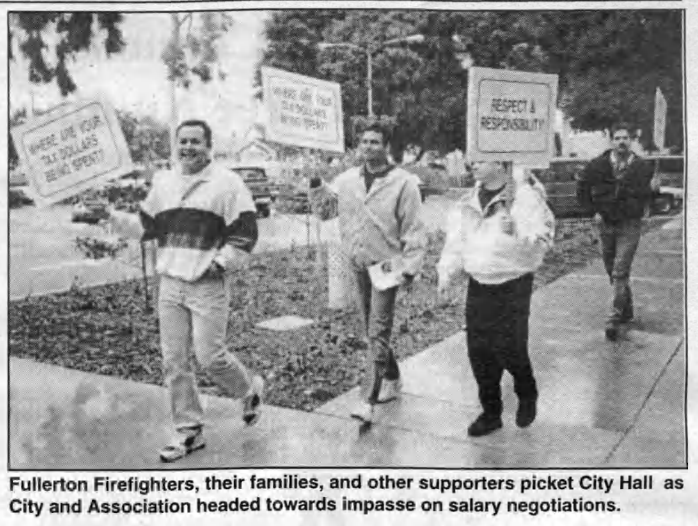
In 1997, City Council faced off against the Firefighter union over pay and working conditions.
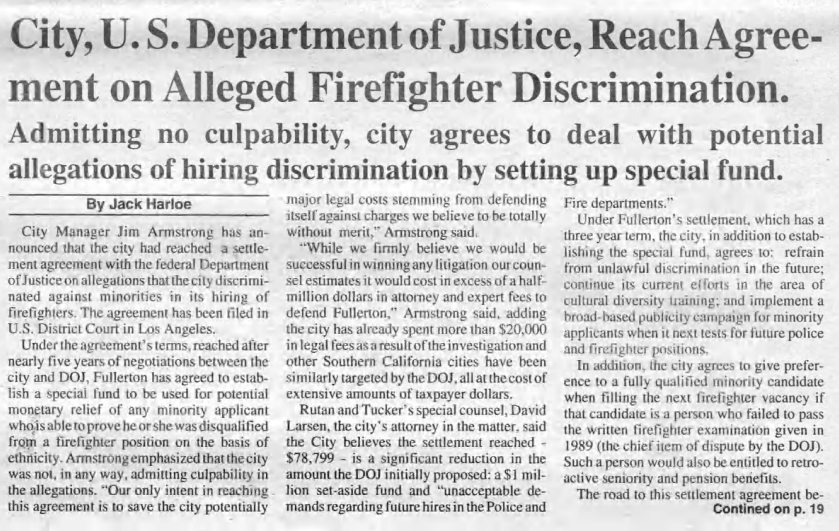
And the city settled a lawsuit alleging that it had discriminated against minorities in hiring of firefighters.
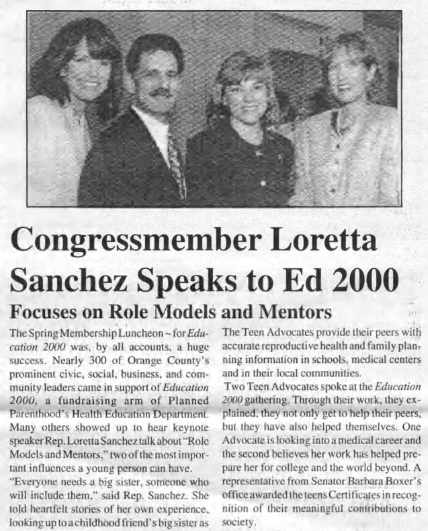
Orange County politics had long been dominated by Republicans; however in 1996, a Latina Democrat named Loretta Sanchez got herself elected to congress, perhaps signalling changing voter demographics.
Culture and Entertainment
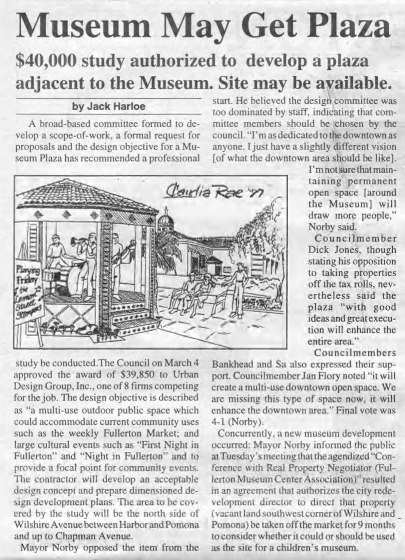
There was talk of building a community Plaza next to the Fullerton Museum Center, something that would eventually happen.
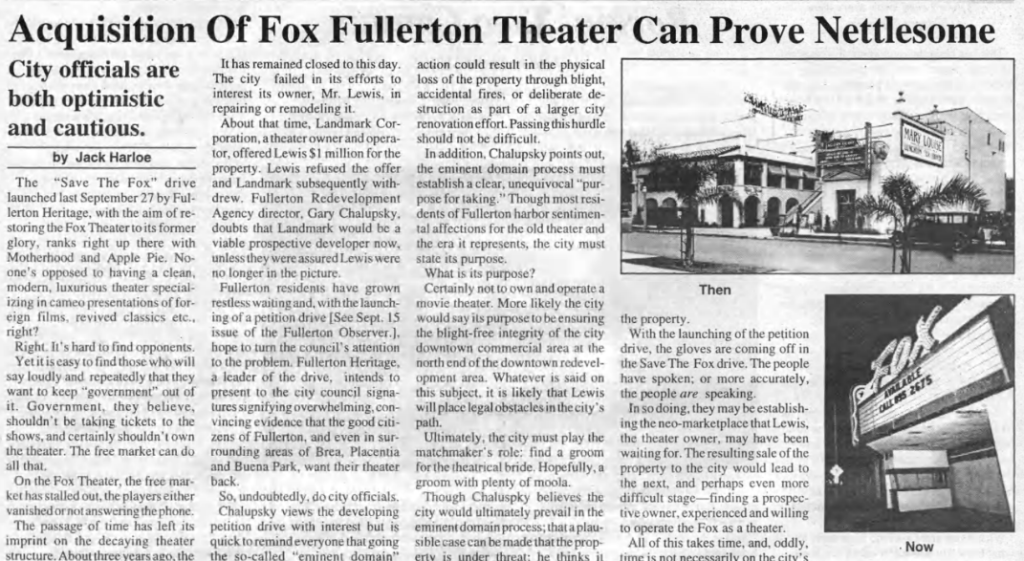
The Fox Theater in Fullerton had been closed down since 1987; however there was talk of restoring it, somehow.
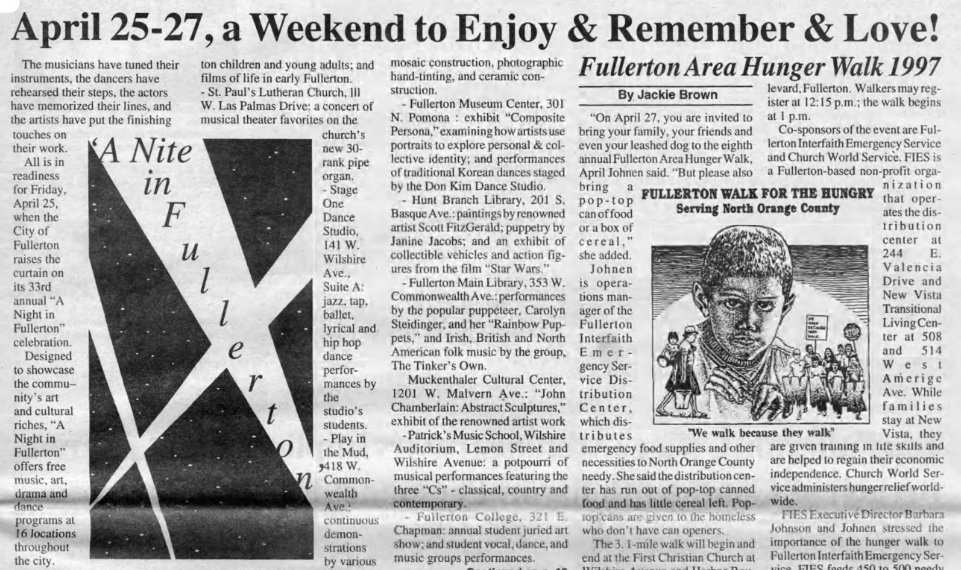
In 1997, Fullerton still celebrated “A Night in Fullerton”–an annual community arts celebration.
Fullerton residents joined together and restored the “Pastoral California” mural on the side of the high school auditorium, which had been painted over for nearly 60 years.

“After years of investigation and planning the Kassler painting is about to be restored,” the Observer reported. “Its blankets of five or more coats of wall paint will be removed by a chemical process and then the fresco will be restored in an authentic fashion by Conserv Art Associates, Duane Chartier and Susanne Friend…The current work is being financed by a combination of private contributions, City of Fullerton Redevelopment Agency money and the Calif. Heritage Fund.”
Fullerton High School art students also helped with the restoration.
Housing
Fullerton City Council, being dominated by conservative Republicans, was reluctant to support government-subsidized affordable housing, despite the growing need, and even when the projects involved federal (not city) money. This issue came to a head in 1997 over a proposed Single Room Occupancy (SRO) affordable housing project planned for downtown Fullerton.
At first, the conservatives on council voted the project down. This led to pushback from the progressive Fullerton Observer, and other supporters of affordable housing.
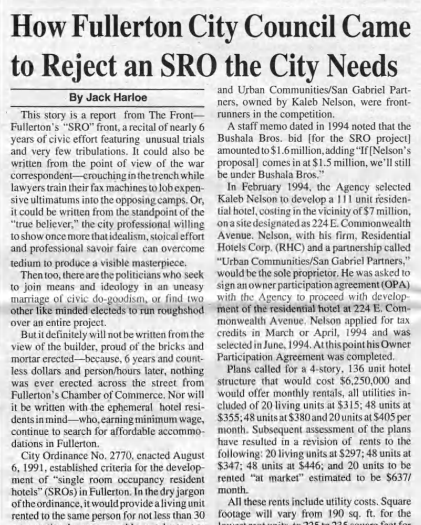
Eventually, perhaps because of the pushback, as well as legal pressure, council approved the project.
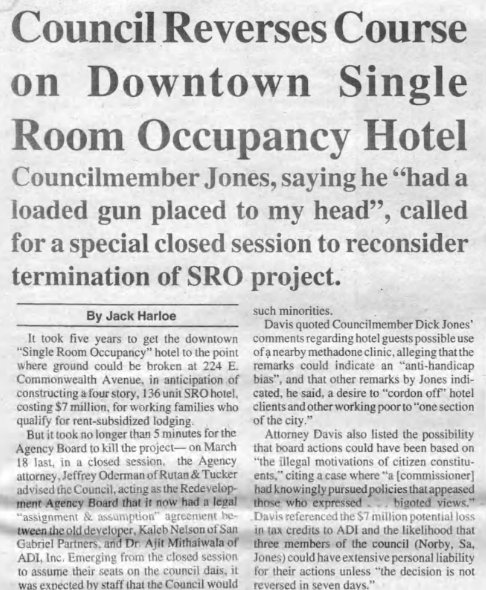
William J. Davis, attorney for the developer, “cited extensive case law, Federal Civil Rights statutes and California state law surrounding political actions affecting Federal and state housing, particularly where minority groups are involved and the actions of public officials reveal an animus toward such minorities,” the Observer reported. “Davis quoted Councilmember Dick Jones’ comments regarding hotel guests possible use of a nearby methadone clinic, alleging that the remarks could indicate an ‘anti-handicap bias,’ and that other remarks by Jones indicated, he said, a desire to “cordon off’ hotel clients and other working poor to ‘one section of the city.’”
In this case, City Council grudgingly approved the project, despite their reservations about approving housing for poor people. Today, the project still stands–it is called City Lights.
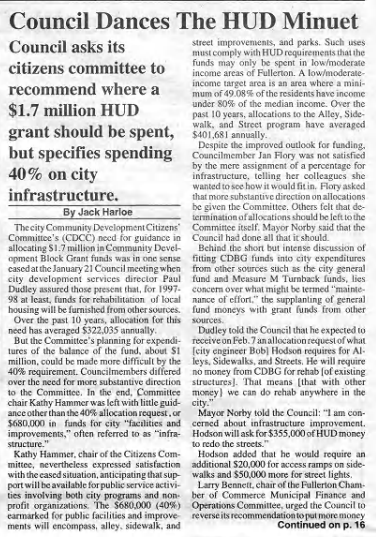
When it came to allocating federal HUD funds, the conservative majority preferred to allocate the least amount possible toward affordable housing.
Council also sought to tighten eligibility requirements for those who could access Fullerton’s affordable housing, with some suggesting that non-citizens were getting this benefit, although there was no evidence that this was happening.
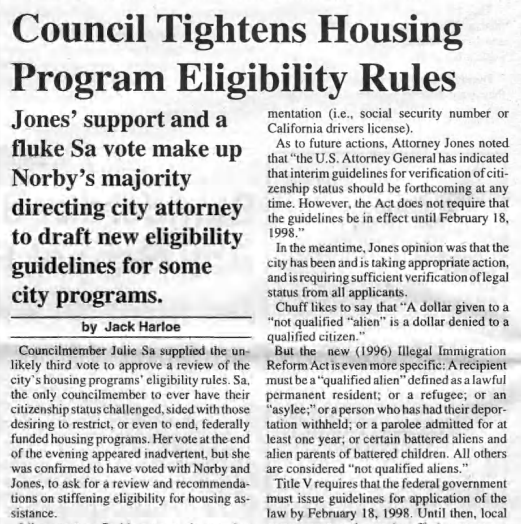
A resident named Patricia Shuff “told the city council that the city programs are vulnerable to fraud— fraudulent social security cards, fraudulent drivers licenses, fraudulent birth certificates,” the Observer reported.
“And I don’t think the program should be available to persons who don’t speak English,” she said.
Councilmember Don Bankhead said, “I fully agree we shouldn’t give money to illegal aliens, but there is no evidence we ever have.”
With regard to affordable housing, the Council’s conservatives seemed to believe that the “free market” would sort things out, although they had no problem placing numerous restrictions on what types of housing could be built where.
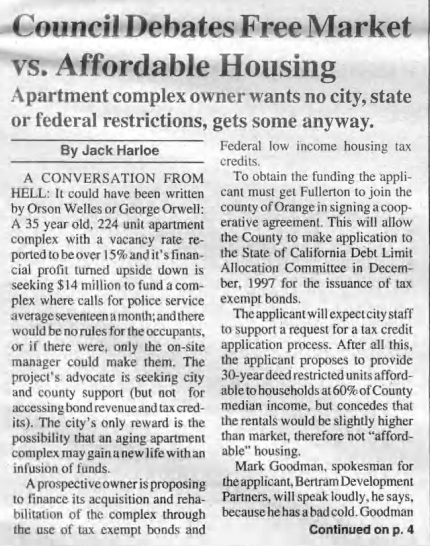
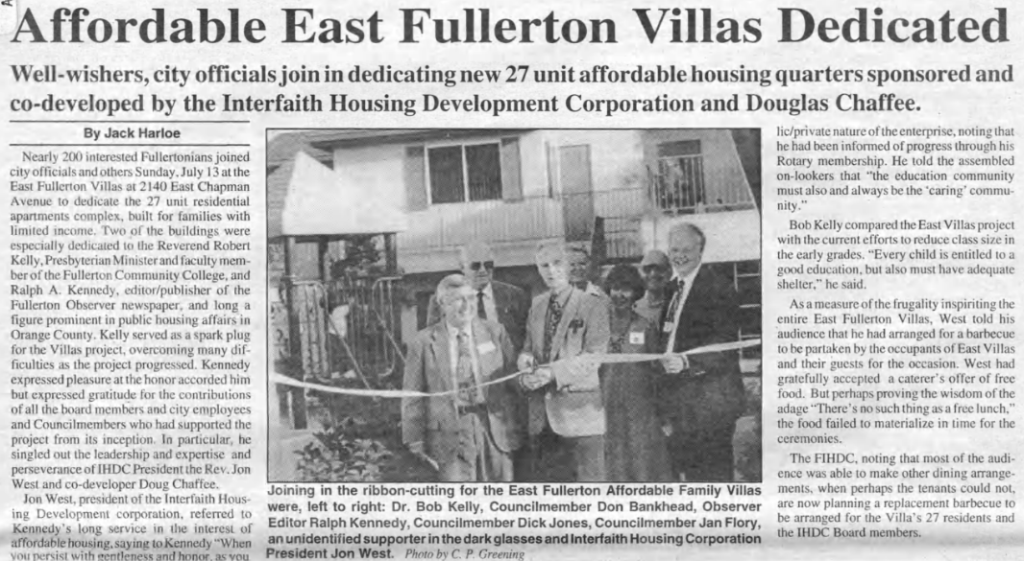
But perhaps things were softening (a little). An affordable housing project called East Fullerton Villas opened.
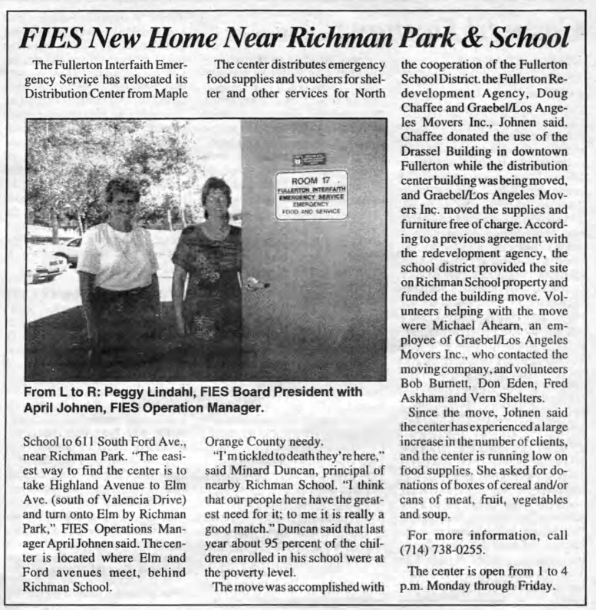
One of Fullerton’s best organizations (in my opinion) is Fullerton Interfaith Emergency Services (FIES), which is now called Pathways of Hope. They provide affordable and transitional housing, and they operate a distribution center where they offer free food and clothes to the poor.
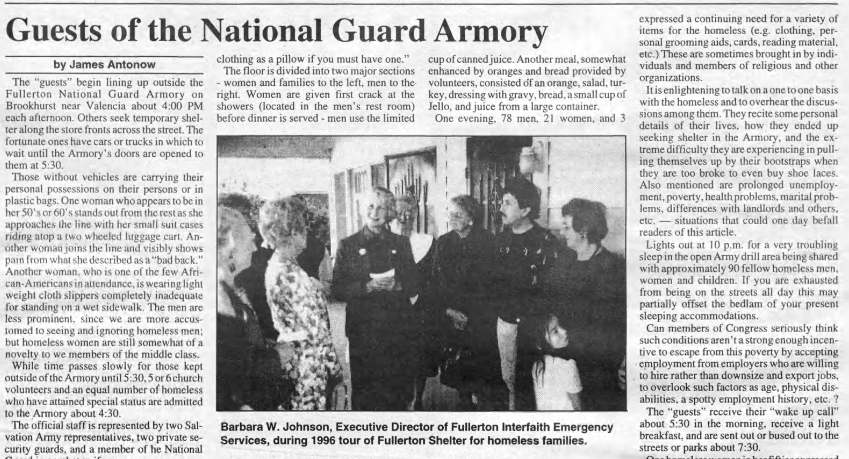
In 1997, as is the case today, Fullerton had its share of people experiencing homelessness. Although there was no year-round shelter, the National Guard Armory opened its doors during cold weather months for the homeless (unless the National Guard needed the space).
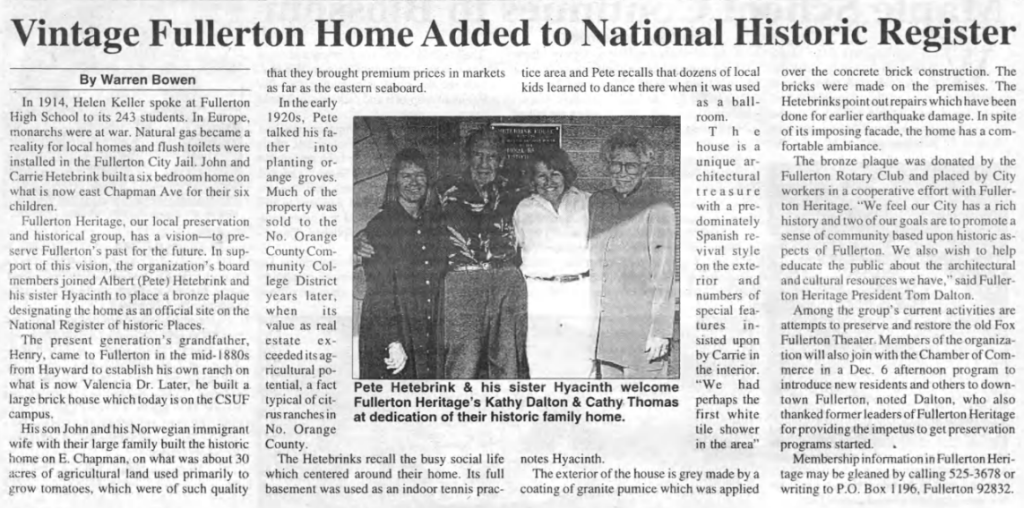
In 1997, the old Hetebrink House (that creepy mansion next to Fullerton College on Berkeley and Chapman) was added to the National Register of Historic Places. Albert Hetebrink, the house’s occupant at the time, was allegedly a member of the Ku Klux Klan in the 1920s. Bad vibes.
Street Vendors Banned
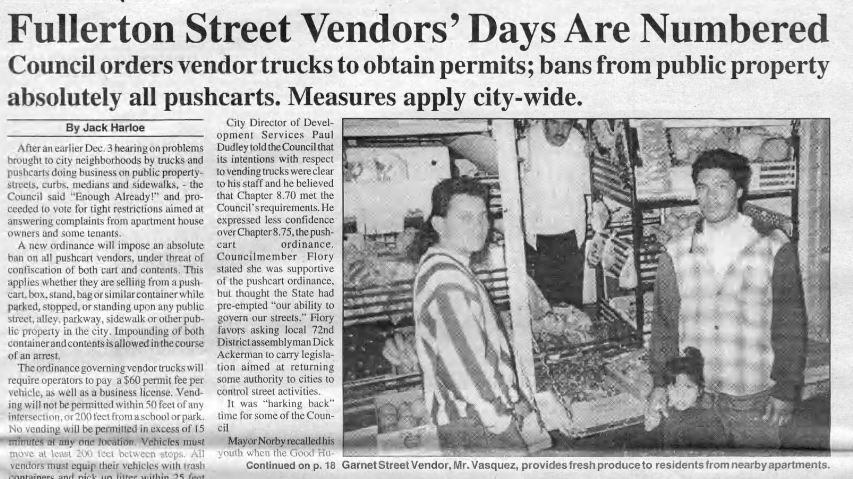
In another assault on the “free market” City Council sought to ban street vendors.
Transportation
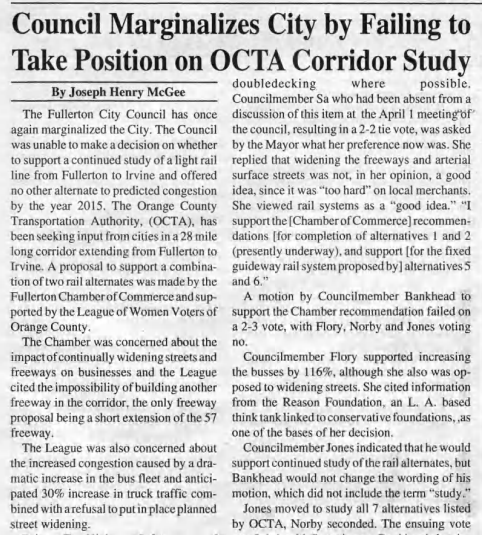
A big part of why Orange County has such shitty public transit is that local politicians for years refused to invest in this. In 1997, Fullerton City Council did not support a study to determine the feasibility of a light rail train. It would not be built.
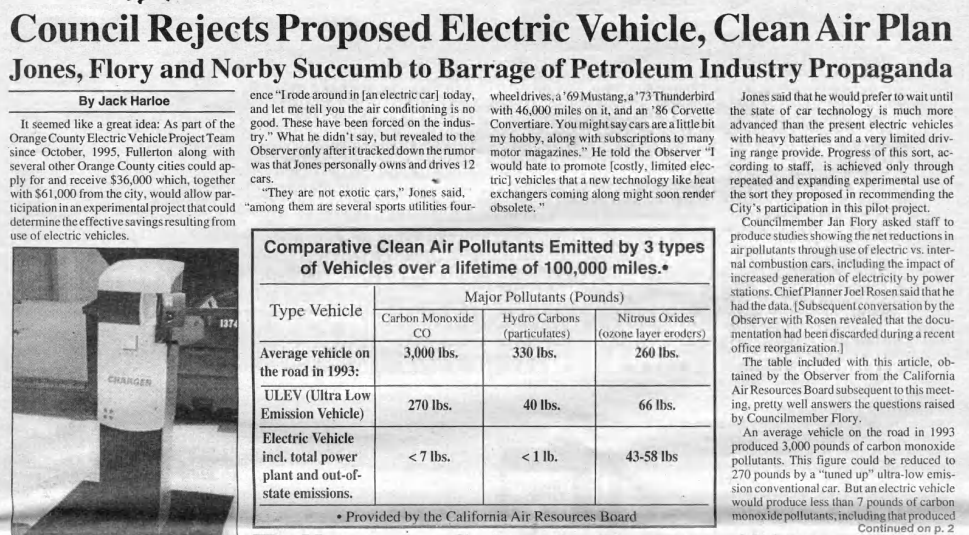
Fullerton City Council, being Republicans, rejected a proposed Electric Vehicle, Clear Air Plan.
Library
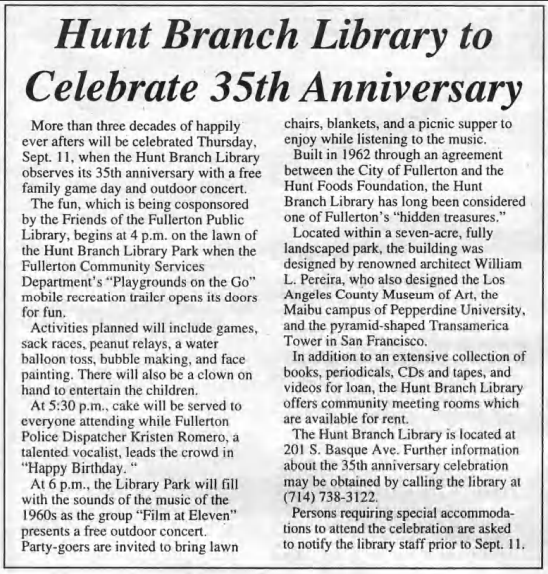
The Hunt Branch Library, gifted to the City by Norton Simon in 1962, celebrated its 35th Anniversary.
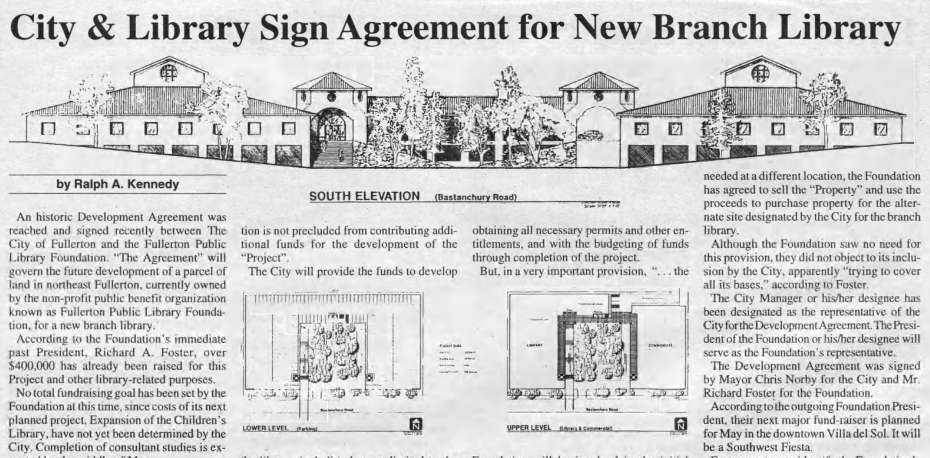
An agreement was made to acquire land and build a third branch library in north Fullerton along Bastanchury. Sadly, this branch would never come to fruition.
Education
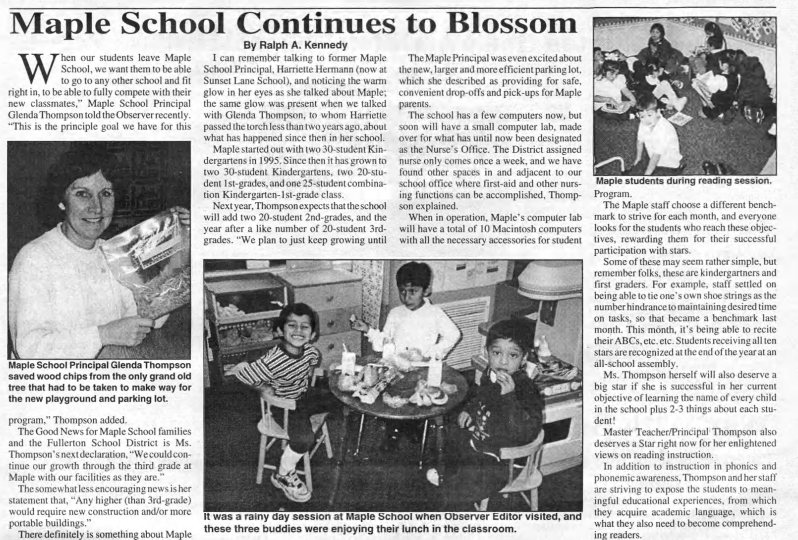
Meanwhile, Fullerton’s Maple School had re-opened in 1996 after having been closed for over two decades.
St. Jude
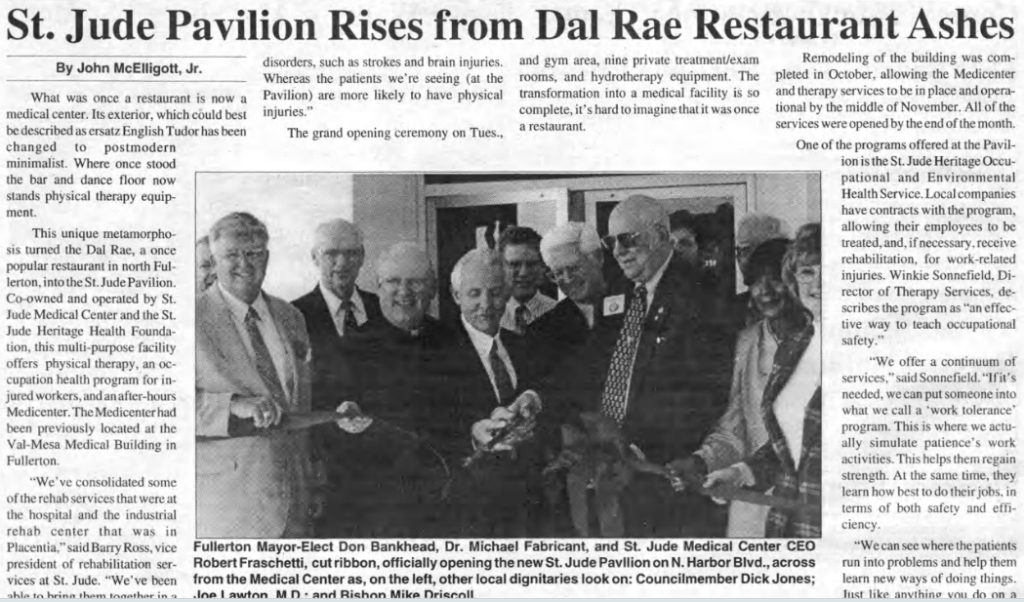
The St. Jude medical complex expanded by adding a large Pavilion across the street from the main hospital–displacing the old Dal Rae restaurant.
Police
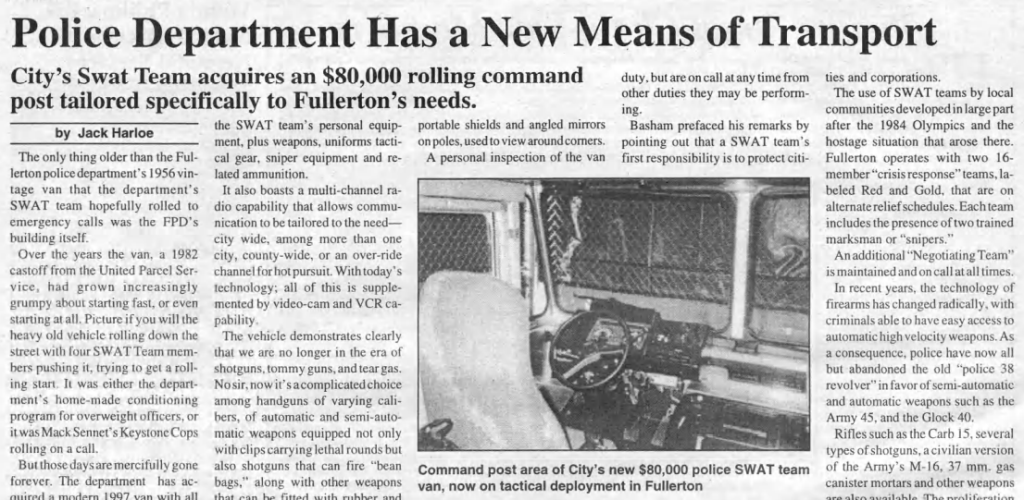
The Fullerton Police Department got a new SWAT vehicle.
Observer
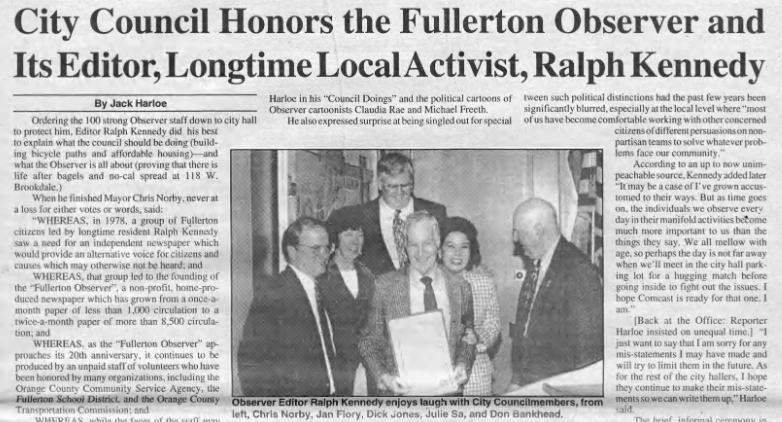
In 1996, longtime Fullerton Observer editor Ralph Kennedy was diagnosed with pancreatic cancer. He would pass away in 1998. In 1997, a number of local and civic organizations honored Kennedy for his service to the community.
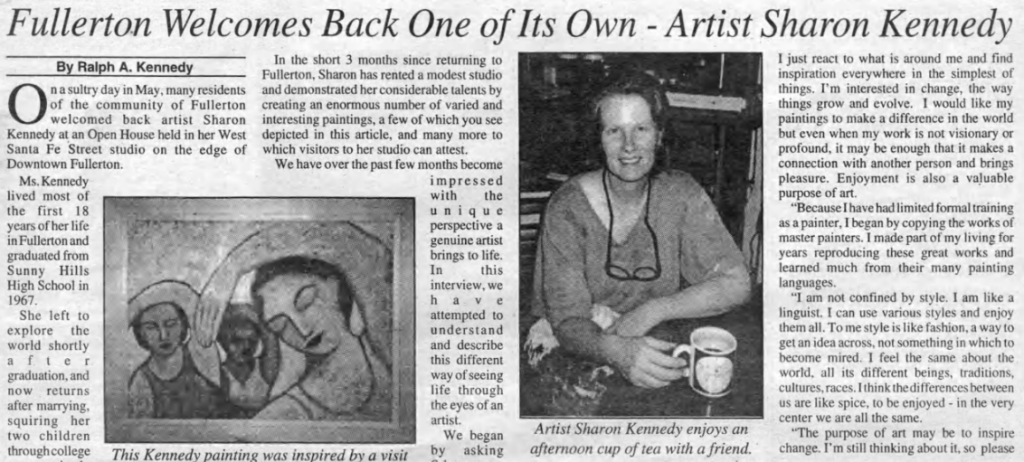
Ralph’s daughter Sharon, an artist who would eventually take over the paper, returned to town from northern California.
Stay tuned for stories from 1998!
 Fullerton History