The following is from a work-in-progress about the history of Fullerton. You can support my ongoing research and writing on Patreon.
The Fullerton Observer newspaper was formed in 1978 by Ralph and Natalie Kennedy and friends to provide a more progressive counterbalance to the more conservative Fullerton News-Tribune and Orange County Register. Back then, Orange County (including Fullerton) was dominated by Republicans, and the Observer crew were definitely in the minority. The Fullerton Public Library has digital archives of the Observer stretching back to 1979. I am in the process of reading over these archives and creating a year-by-year summary of top stories. Here are some top stories from 1996.
Government and Politics
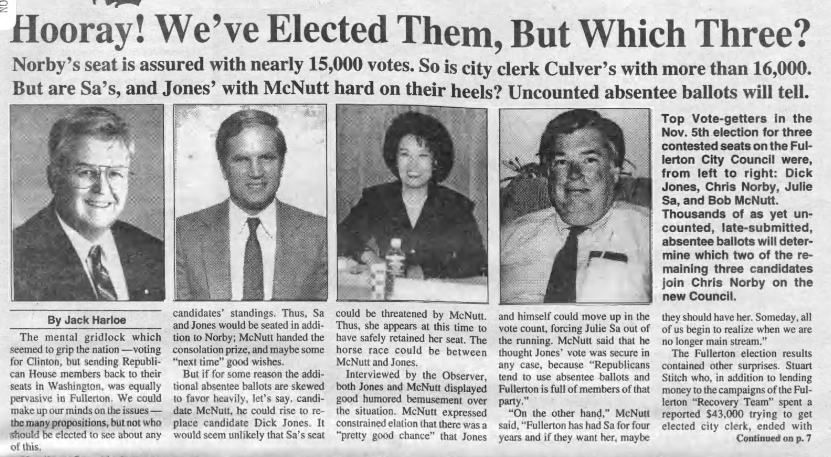
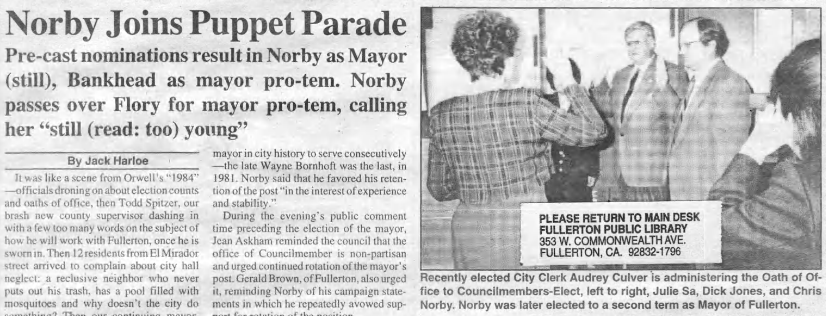
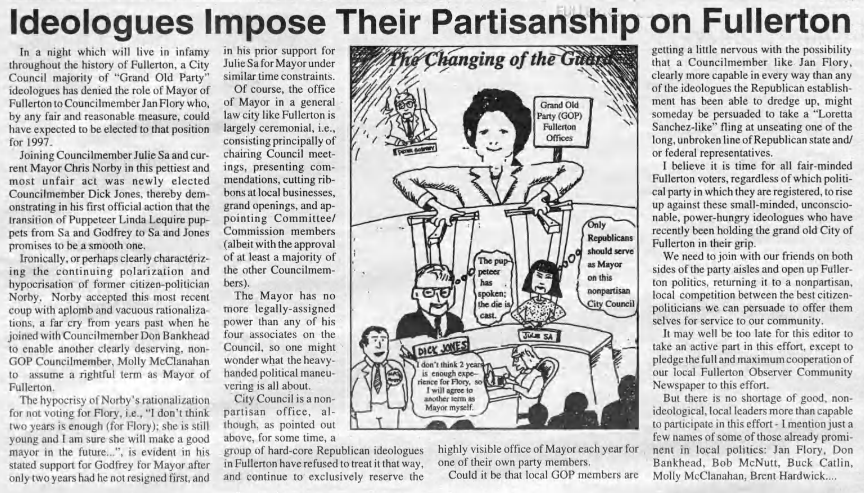
In the 1990s, Fullerton was still a fairly conservative place. In 1996, City Council was made up of four Republicans (Don Bankhead, Peter Godfrey, Chris Norby [mayor], and Julie Sa). The lone Democrat on council was Jan Flory. Just two years prior, in 1994, Flory had faced a Howard Jarvis-style tax revolt over a proposed utilities tax, and was recalled. She was, however, reelected shortly thereafter, and remained a force in local politics through at least 2016. Republican Richard “Dick” Jones was elected in 1996, and would replace Godfrey in 1997.
Both Jones and Bankhead, along with Pat McKinley (see below) would be recalled in 2012 in the aftermath of the murder of Kelly Thomas.
The Observer’s editor Ralph Kennedy and many of its writers were Democrats, so they tended to include articles that were critical of the Council’s conservatives.
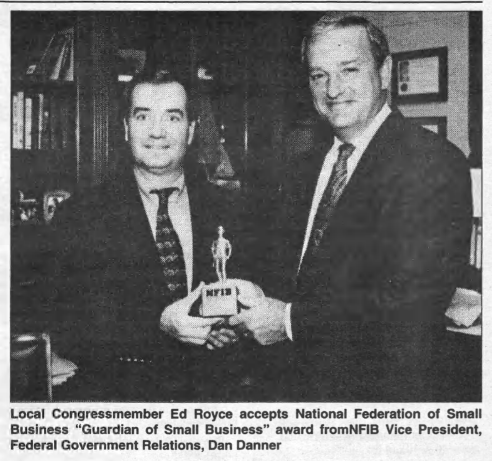
In Congress, Fullerton was represented by Ed Royce, who was a fairly typical 90s Republican.
Law and Order
In 1996, Fullerton’s Police Chief was Pat McKinley, who was hired in 1993 after a 29-year career with the LAPD. McKinley had been involved in the formation of the LAPD’s SWAT squad, which was the first in the nation. It was created following the 1965 Watts Riots and was an important step in militarizing the police, and ramping up aggressive policing tactics.
It was under the leadership of Pat McKinley that the community policing activity of “Operation Cleanup” in Fullerton’s Latino-heavy Maple area took a much more aggressive turn.
In 1996, The Fullerton Police department conducted an aggressive “sweep” of over 33 homes in the Maple area of South Fullerton, breaking down doors of suspected “drug dealers” and terrorizing families.
Reporting for the OC Weekly, Nick Schou wrote that the department “adopted operations reminiscent of Vietnam: an occupying army bent on separating the ‘bad guys’ from the ‘responsible’ population it claims to protect—and, at the same time, using brutal tactics that tend to punish both groups in equal measure.”
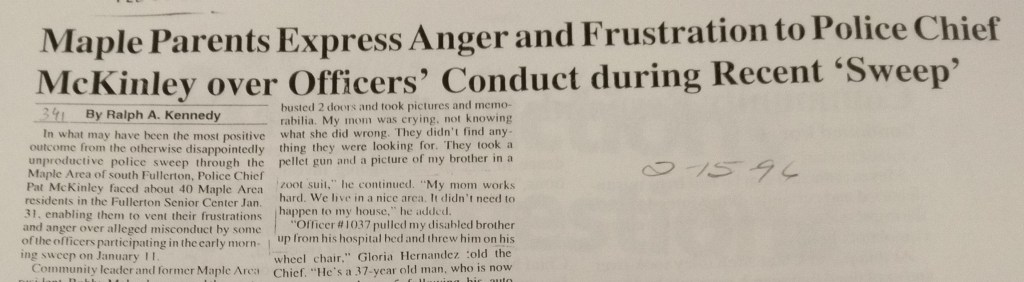
Following the sweep, McKinley faced a room full of angry residents at a meeting at the Senior Center.
An elderly Mr. Alberto Sambrano said, “I have lived here since 1939 and I have never seen anything like this before, the way they treated my 70-year-old wife. They destroyed my garage, a dresser in the house and a tool shed. We were treated like animals. They handcuffed my grandson Jonathan Navarro, who has never been in trouble. They took a gun my dad had given me 50 years ago.”
“Officer #1037 pulled my disabled brother up from his hospital bed and threw him on his wheel chair,” Gloria Hernandez told the chief.
Maple area resident Bobby Melendez said, “Use of stormtrooper tactics by the police and physically & verbally abusing people in their homes is not a minor matter.”
Education
In 1996, Fullerton’s Maple School re-opened after being closed since 1972 as part of an effort to de-segregate Fullerton schools. I have written a fairly comprehensive account of the story of Maple school and its desegregation efforts HERE.
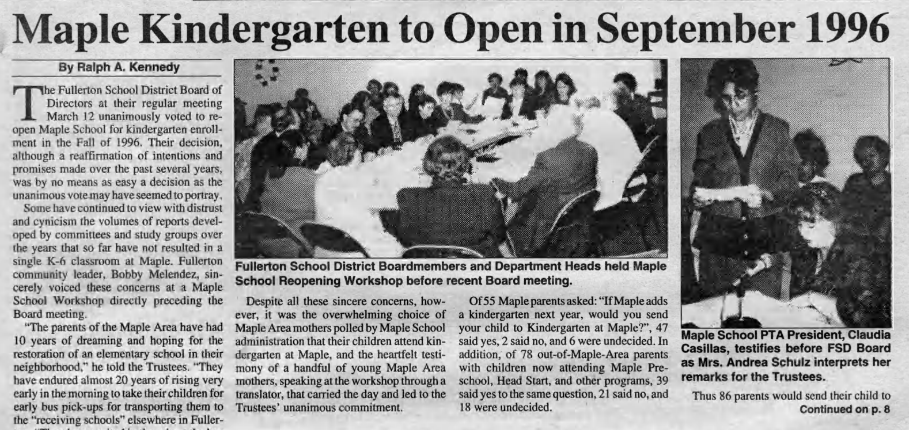
Efforts to desegregate Fullerton schools were hampered by historic housing segregation, leading to disparate test scores between the more affluent and white schools of the north part of the city and the more low-income and Latino schools of the southside.
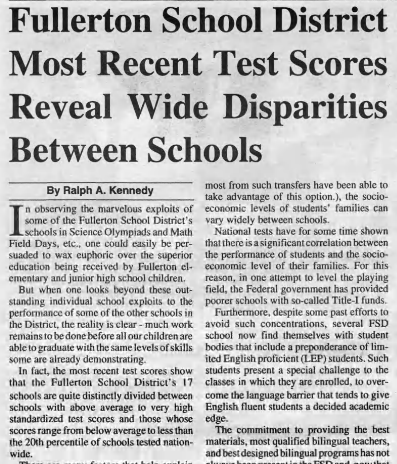
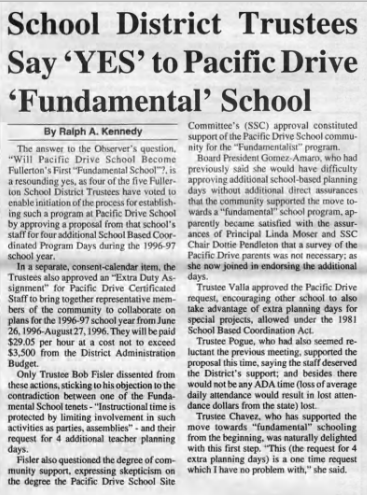
Meanwhile, conservative elements on the Fullerton School Board were pushing for a “fundamental” school at Pacific Drive.
Culture and Entertainment
In 1935, artist Charles Kassler painted the large “Pastoral California” mural on the western wall of the Fullerton High School Auditorium, formerly called Plummer Auditorium. The “Plummer” name was removed in 2020 following revelations that the auditorium’s namesake Louis Plummer was associated with the Ku Klux Klan in the 1920s, when he was Fullerton High School Superintendent.
The mural was a WPA-funded public art project. The result was one of the two largest frescoes commissioned by the WPA, a 75 foot long by 15 feet high depiction of a pre-American California. The mural depicts historical figures like Jose Antonio Yorba, a large landowner whom Yorba Linda is named after. In the background is Mission San Juan Capistrano. To the right is Pio Pico, the last Mexican governor of California. Most of the figures are Latinos doing everyday activities: washing clothes, riding horses, eating together.
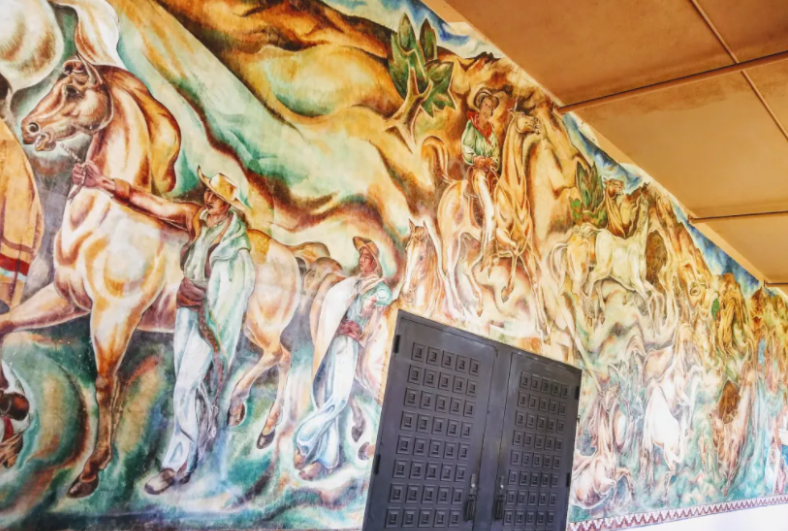
1930s LA art critic Merle Armitage praised the mural: “Kassler has adhered not only to the beautiful traditions of pastoral California, but at the same time has also borne in mind the splendid Spanish architecture, and, lastly, created a beautiful fresco of amazing vitality and freshness of viewpoint.”
But not everyone was happy with Kassler’s mural. In 1939, the High School Board of Trustees voted to paint over the mural. Why did they do this?
“It was too Mexican, that’s why,” Charles Hart told the LA Times. Hart was a student at the high school and remembers the mural before it was covered up. “The school board didn’t want to leave the impression that this town was anything else but Anglos. Too extreme for them, I guess.”
However, in 1996, a campaign was afoot to restore the mural.
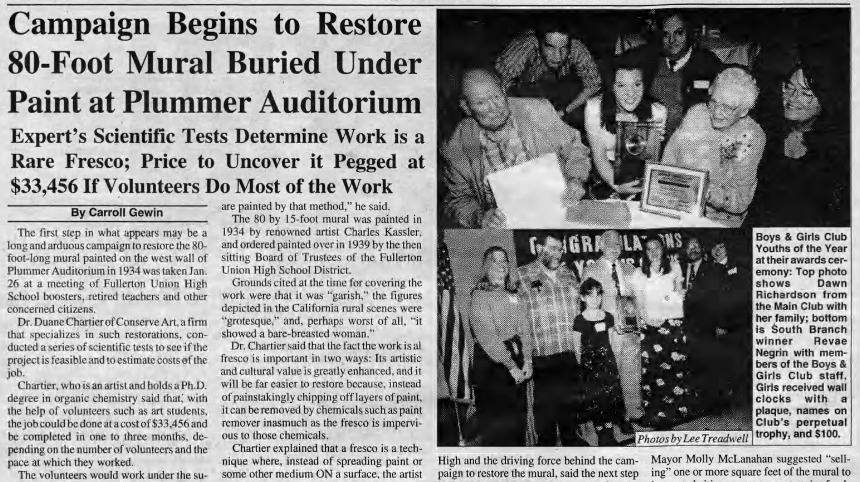
In 1997 the mural would be restored, thanks to a massive community effort. I was actually attending Fullerton High School at the time. Some of my friends, art students, helped with the restoration. I remember thinking, even then: Why would anyone have painted over something so beautiful?
I have written a fairly in-depth history of “Pastoral California” HERE.
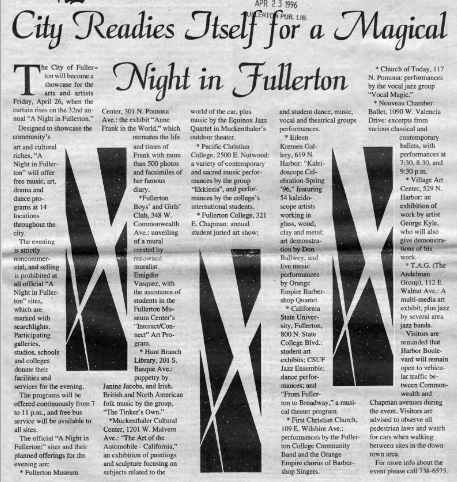
In 1964, “A Night in Fullerton” was conceived when local artist Florence Arnold wanted to create a cultural event to show Norton Simon (owner of Fullerton’s Hunt foods) that we were an art community. Norton Simon was a well-known collector of fine art, and he had offered to gift the city a world-class art museum. He built the Hunt Branch Library as a proposed site. Sadly, due to disagreements with the Fullerton City Council, Simon would take his work-class art collection elsewhere, to Pasadena in 1972.
I have written a history of “A Night in Fullerton” which you can read HERE. Despite the devastating loss of the Norton Simon Museum, Fullerton continued with “A Night in Fullerton” until 2009.
Housing
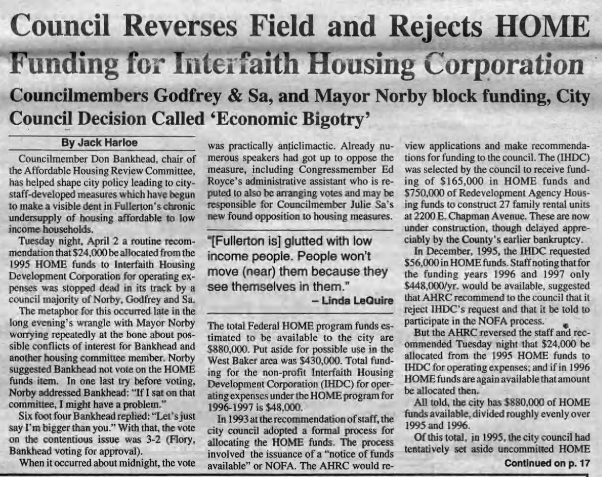
By the 1990s, housing in Fullerton had become increasingly unaffordable to working class people. A continuing theme starting at least in the 1980s was the question of whether the city would support federal and state-funded affordable housing projects. Mostly, in those days of Republican domination, the answer was a resounding “no”.
Civil Rights (or Wrongs)
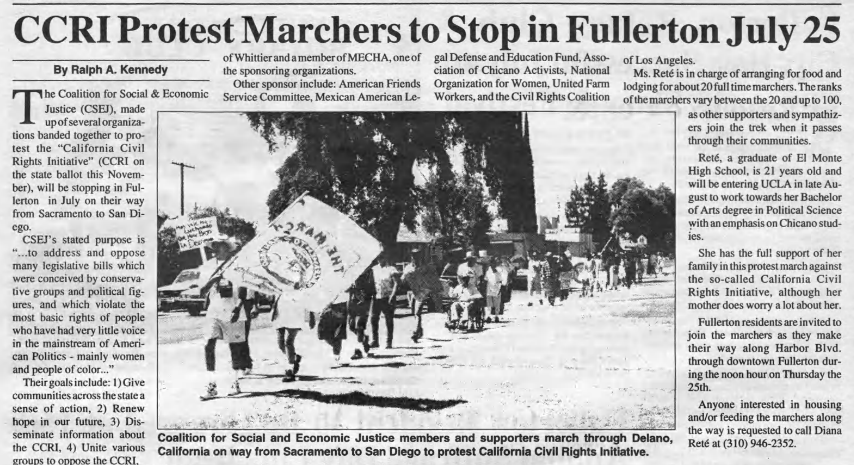
In 1996, Californian voters passed Proposition 209, which ended affirmative action programs in the state. California’s governor was Pete Wilson (a Republican) and the Republican Party was still a force to be reckoned with.
Prop 209 was called the California Civil Rights Initiative, and it used the language of civil rights to argue against programs aimed at aiding formerly underrepresented minorities. It was the original anti-woke, anti-DEI initiative.
The Observer reported on protests and argued against Prop 209.
Ralph Kennedy Diagnosed with Cancer
In 1996, longtime Observer editor Ralph Kennedy was diagnosed with pancreatic cancer.
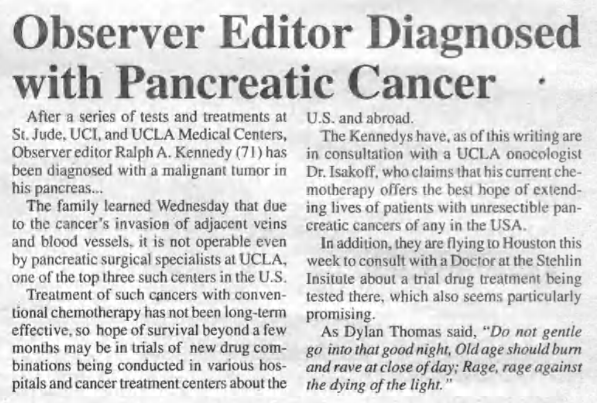
Ralph passed away in 1998, and his daughter Sharon Kennedy took over as editor of the Observer.
Stay tuned for top news stories from 1997.
 Fullerton History