The following is from a work-in-progress about the history of Fullerton. You can support my ongoing research and writing on Patreon.
The Local History Room of the Fullerton Public Library has microfilm from the Fullerton Daily News-Tribune newspaper stretching back to 1893. I am in the process of reading over the microfilm, year by year, to get a sense of what was happening in the town over the years, and creating a mini archive. Below are some news stories from 1952.
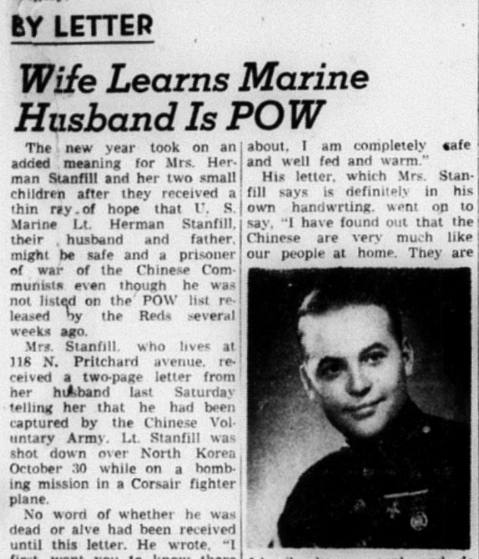
In international news, the Korean War raged on. Some local boys were drafted to fight, and sometimes die, in this early Cold War conflict.


The British Empire was still a thing.

The US Congress passed the McCarran-Walter Immigration Bill, which modified but still kept the racist restrictions that were first codified in the 1924 Johnson-Reed Act, and added new grounds for restricting and deporting immigrants who were thought to be “subversive”–this was in the context of the Cold War Red Scare.

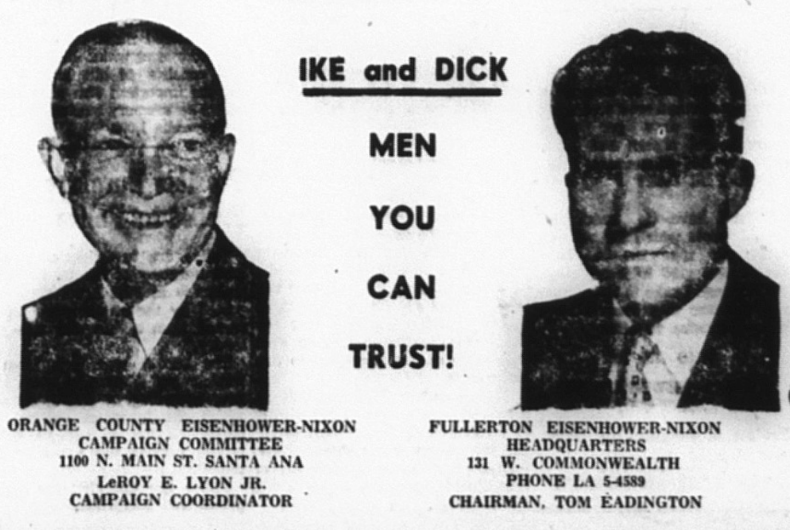
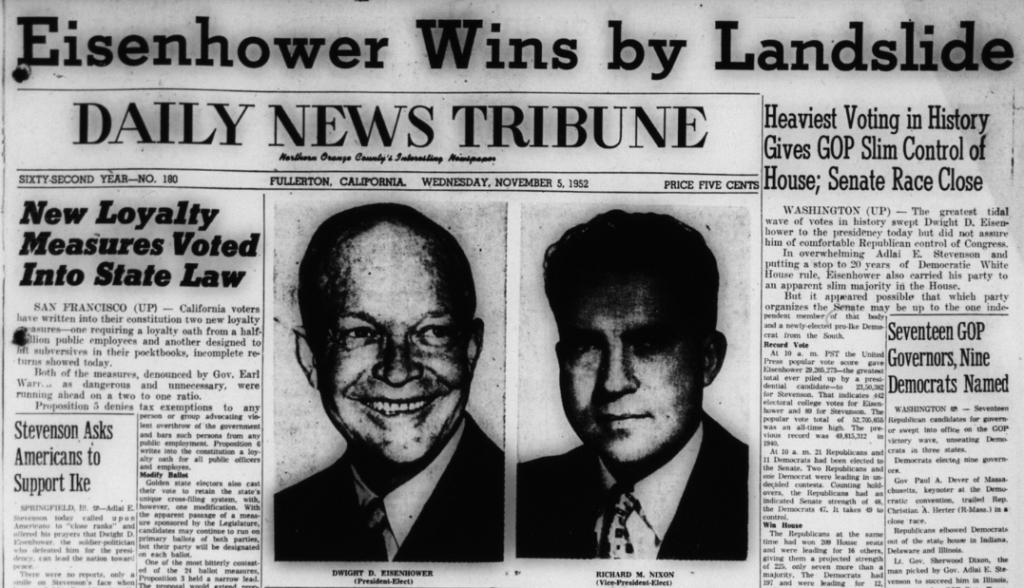
Dwight D. Eisenhower was elected president, and his Vice President was local boy Richard Nixon, who was born in Yorba Linda and attended Fullerton High School.
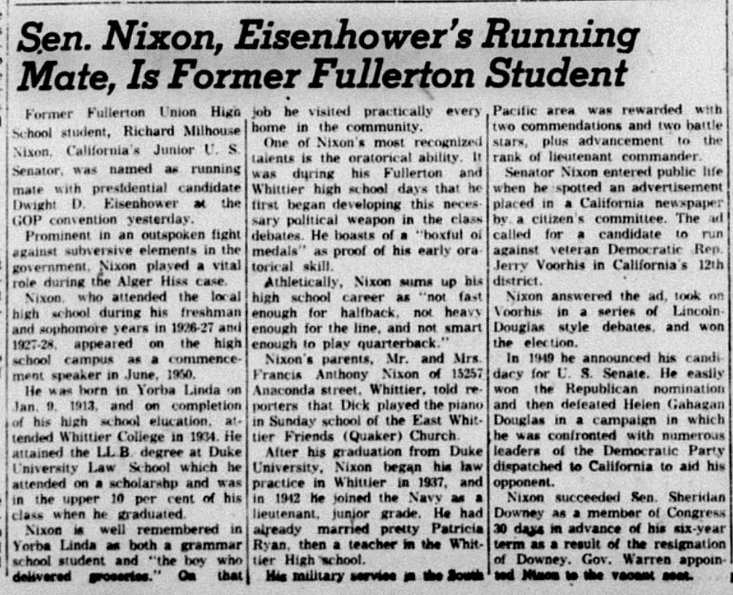
While Nixon is mostly remembered for the Watergate scandal, he first rose to power as a McCarthy-style Red Scarer. He was a member of the House Un-American Activities Committee, and famously investigated alleged communist spy Alger Hiss.
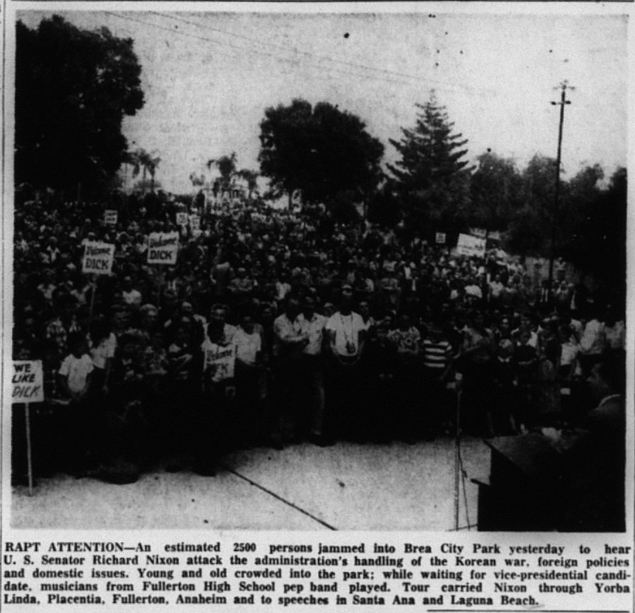
While running for Vice-President, Nixon held a number of campaign rallies in Orange County.
Six weeks before the 1952 presidential election, it was reported that Nixon had received between $16,000 and $18,000 (approximately $220,000 in 2025 dollars) not in campaign contributions, but directly from a fund bankrolled by a group of 76 wealthy Californians.
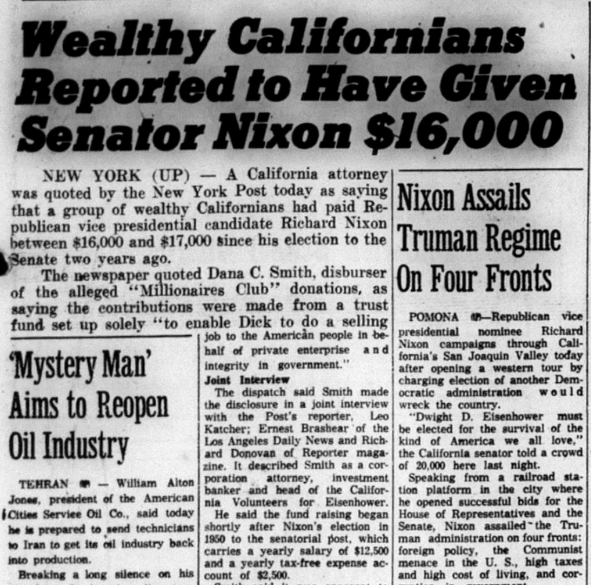
Dana C. Smith, disburser of the alleged “Millionaires Club” donations, told the New York Post that the contributions were made from a trust fund set up solely “to enable Dick to do a selling job to the American people in behalf of private enterprise and integrity in government.”
While Nixon called the story a “smear” from his opponents, he didn’t deny the fund, and this led to accusations of corruption. It was a major scandal.

Nixon said that, by taking the private funds, he was “saving you taxpayers money.”
Eisenhower and Nixon’s Democratic opponent Adlai Stevenson said the questions that arose were: “Who gave the money, was it given to influence the Senator’s position on public questions: and have any laws been violated?”
This was particularly embarrassing to the Eisenhower campaign, which was railing against “corruption” in government.
For a while, it was uncertain if Nixon would remain on the Eisenhower ticket. But then the Republican National Committee paid $75,000 (nearly a million dollars today) for a 30-minute televised speech by Nixon on September 23, 1952 in which he defended himself. This became known as the “Checkers Speech.”
The “Checkers Speech” (which you can watch HERE) is particularly infuriating because it’s an early example of a politician using an emotional appeal to a televised audience of around 60 million Americans to evade real accountability.
In the speech, Nixon claimed to give a full accounting of his personal finances, but what he actually did was give the impression that he was a public servant of modest means. He said that one gift he received was a cocker spaniel dog which his daughters named Checkers and that they were going to keep the gift.
What Nixon did NOT do was name the 76 wealthy Californians who had contributed to the fund, which would have enabled any reporter to have investigated whether he used his power as a congressman to benefit them. The full list of donors has never been made public.
And yet, somehow, the “Checkers Speech” worked.

Some notable Fullertonians told the Fullerton News-Tribune that they felt his speech had exonerated the candidate (it had not).
R.S. Gregory said, “Nixon is absolutely all right. He made a clear statement of his affairs. I think he is in the right.”
Verne Wilkinson said, “The speech was outstanding. He certainly redeemed himself, in fact, in my opinion he was above reproach in the first place.”
H.H. Kohlenberger said, “It was an excellent presentation which, in my opinion gained many votes for Nixon, and which was unprecedented in political history.”
And so, rhetoric won over substance, and Eisenhower and Nixon won.
Local Politics and Government
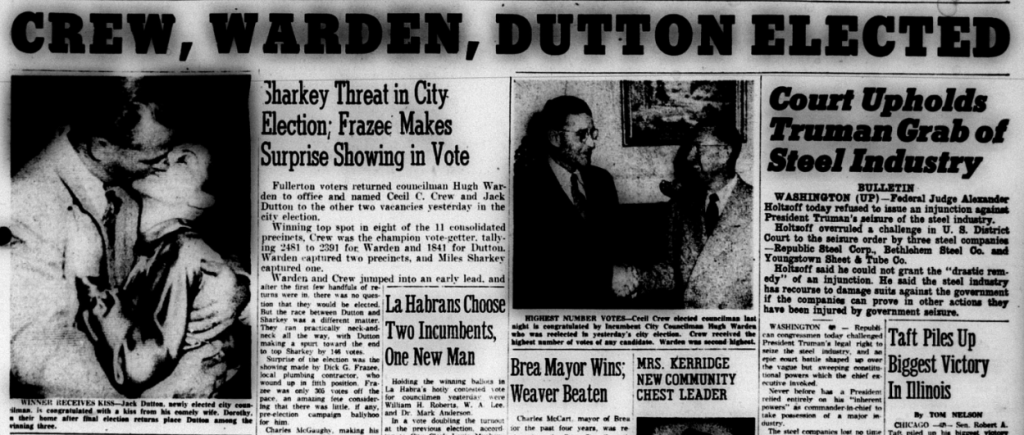
In local political news, Cecil Crew (car dealership owner), Hugh Warden (a roofing contractor), and Jack Dutton (owner of a salvage business) were elected to City Council. Warden was named mayor.
Not long after the election, Jack Adams (who had been elected previously) resigned from council, and Irvin Chapman (son of citrus grower Charles Chapman) was appointed to fill his seat.
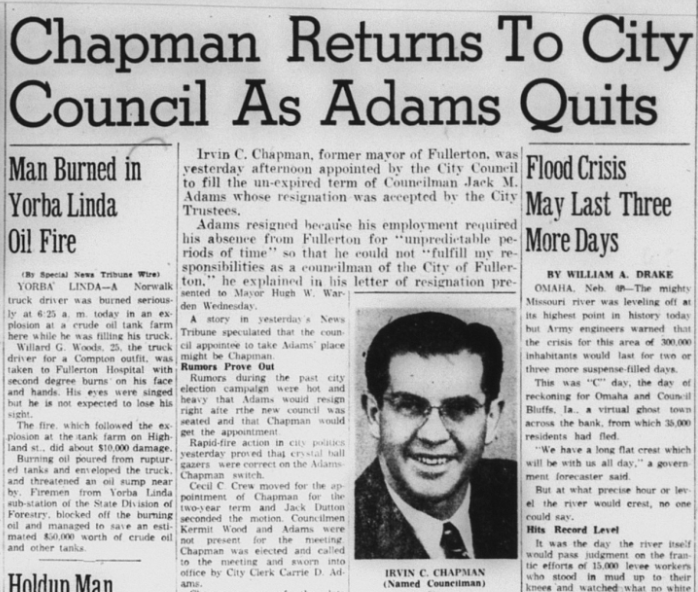
This prompted protests from some Fullertonians, who argued that Chapman had lost the last time he ran for council, and should therefore not be appointed.
“I believe the voters showed two years ago, beyond all doubt, that they did not want Chapman on the City Council!” a reader wrote in a letter to the editor of the Fullerton News-Tribune. “I believe it is a little-disputed fact that the incumbent always has the edge in an election, yet two generally unknown men came in ahead of the then-incumbent Irvin Chapman. There are going to be a lot of very unhappy voters if he is permitted to sneak in the back door after that had showed him out the front—they thought!”
Councilmember Kermit Wood strongly objected to Chapman’s appointment.
“With the help of his cohorts, the mayor has held the back door open for another councilman of his choosing,” Wood said. “No consideration has been given the voters of Fullerton. I charge that the action taken by the three councilmen is unethical and dictatorial and not in the best interests of the people of Fullerton…Such is the fiber of dictatorship and communism. Never in the annals of Fullerton has this flagrant disrespect for the right of the people and for decency and fairness been equaled.”
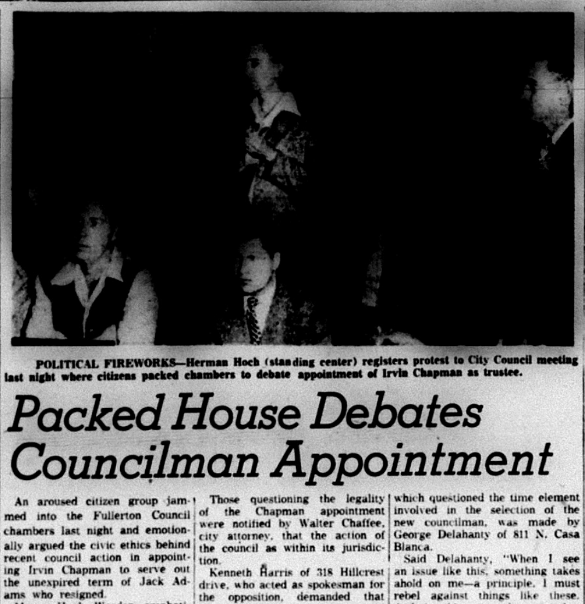
Lots of folks showed up to a City Council meeting urging that Chapman not be appointed. However, their pleas were unsuccessful. He was appointed.
“Kenneth Harris acted as spokesman of the opposition and demanded that Mayor Warden rescind the council action, backing up his demand with a petition signed by approximately 300 persons,” the News-Tribune reported.
Not long after this, newly elected councilman Jack Dutton also resigned, and was replaced by Miles Sharkey, manager of the vast Sunny Hills Ranch property.

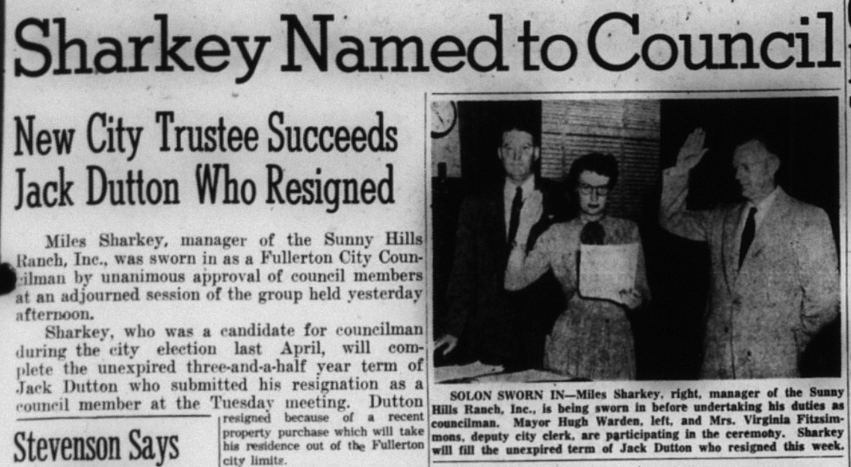
Thus, two of the three elected representatives were replaced by appointed ones–owners or managers of valuable large tracts of land. This did not bode well for truly democratic representation.
In another somewhat anti-democratic move, the new Council considered fundamentally changing the structure of local government by creating a new position of City Administrator (now called City Manager). This would be another appointed position. They chose long time city employee (and alleged former Klansman) Herman Hiltscher.
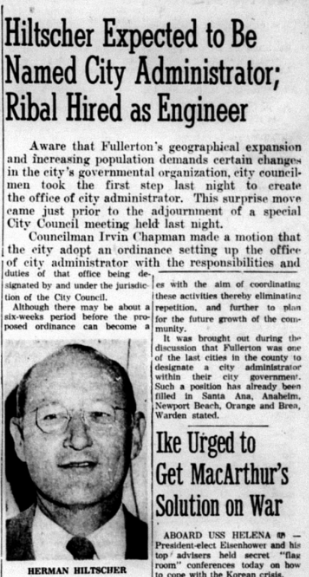
The stated reason for the change was that City Councilmembers did not have the time to oversee such a large and growing city, and thus required a full-time administrator. This makes sense in theory, but in practice it raised questions about true democratic governance for cities.
One of the few academic books focusing on Orange County is Postsuburban California: The Transformation of Orange County Since World War II. This book contains various articles written by historians and social scientists.
In a chapter entitled “Intraclass Conflicts and the Politics of a Fragmented Region,” UCI historian Spencer Olin describes the implications of a move to a Council-Manager system: “By the mid-1960s, then, several marked changes in political structures and practices had occurred that clearly favored the interests of a certain class segment, first of regional capitalists and next of owners of national and international corporations…an increased depoliticization of the municipal administration had taken place through the imposition of the council-manager system and the move away from elected officials toward appointed ones.”
This change happened in a number of Orange County cities in the mid-20th century, and it is currently the dominant model for many cities.
Olin continues: “If we carefully analyze the political forces behind such changes in municipal (city) government, while at the same time paying attention to underlying economic developments, we can uncover the antidemocratic implications of suburban policies…We can see, for example, that important areas of public authority were removed from the control of locally elected officials and were taken over by relatively autonomous and distant governmental agencies largely insulated from the political process.”
It is notable that the very year Fullerton sought to impose the Council-Manager system, two elected City Councilmen resigned and were replaced by unelected appointees who were just the sort of “regional capitalists” Olin describes: Irvin Chapman (of the wealthy, landowning Chapman family), and Miles Sharkey (manager of the vast Sunny Hills properties).
Land use decisions by the City Administrator and the newly-configured council would stand to benefit large landowners, especially as the city was undergoing a transformation from agriculture to suburban, commercial, and industrial development.
Even before he became City Administrator, Hiltscher was city engineer. According to the News-Tribune, “All recent subdividing throughout the community has been controlled by standards set by the engineering office under Hiltscher’s management, which has brought Fullerton to be known as ‘The City of Beautiful Homes.’”
In the “City of Beautiful Homes” those who owned (or managed) a lot of land stood to make a fortune. Two of these men were Chapman and Sharkey.
Others elected in 1952 included Leroy Lyon, John Murdy, and Ralph McFadden.

The Red Scare
As the Cold War ramped up, so did the Red Scare. Richard Nixon’s anti-communist activities was part of what made him popular locally among a generally conservative community.

Fullerton local William Wheeler took part in the House Un-American Activities Committee probe of suspected communists.
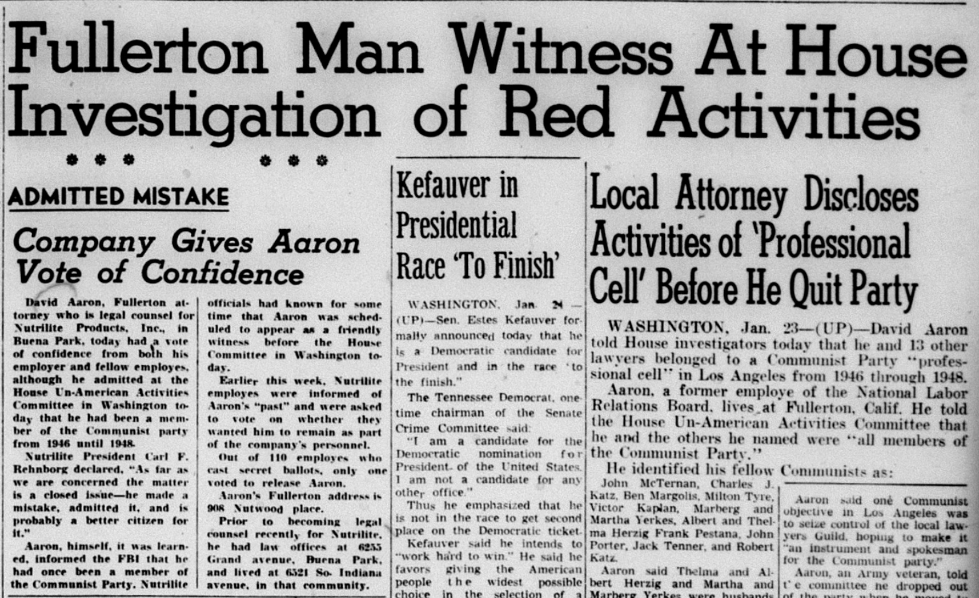
A Fullerton lawyer named David Aaron testified that he had been a communist in the late 1940s while serving on the National Labor Relations Board.
“Aaron said he joined the party in 1946 when his NLRB job ended after two or three months,” the News-Tribune reported. “His contact with persons engaged in labor disputes before the board, Aaron said, caused him to decide ‘there must be something wrong with the economic system when all these things were happening.’”
One problem with the “Red Scare” was that it tended to silence legitimate critiques of the inequalities created by the capitalist system. It served to cement capitalism as the only allowable economic system in American discourse.
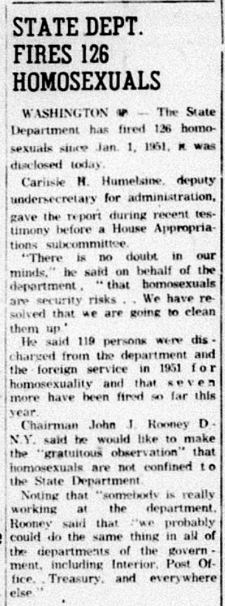
The Red Scare also weirdly associated homosexuality with communism, and many gay people were persecuted and lost their jobs.
Anti-communist crusaders like Fred Schwarz combined Christianity and conservative politics to paint the conflict between capitalism and communism as one of good vs. evil.

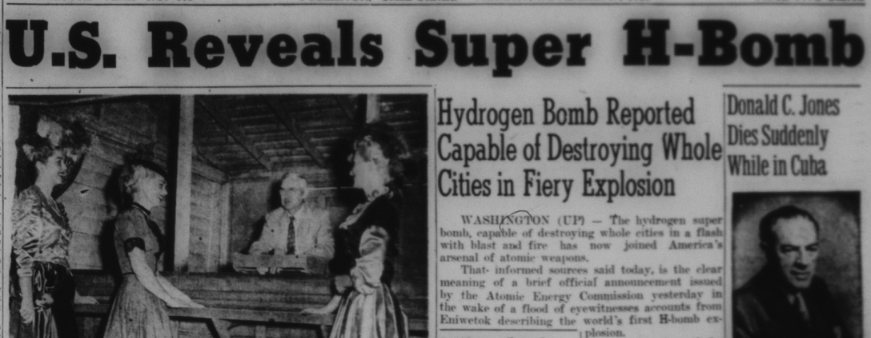
Probably the biggest real danger during the Cold War was the existence of atomic bombs. The US had developed the hydrogen bomb, which was many times more powerful than the bombs dropped on Hiroshima and Nagasaki during World War II.

The Russians were also developing atomic bombs in a perilous arms race. This prompted local programs like “Operation Skywatch” in which regular citizens would watch the skies for Russian bombers.

Growth
Fullerton continued its phenomenal post-war growth.
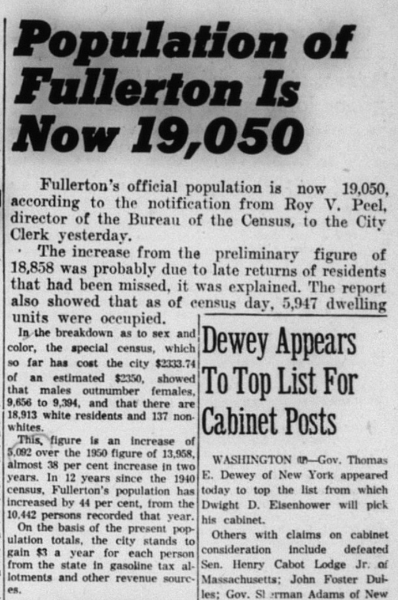

As Fullerton grew, many new housing subdivisions were being built.

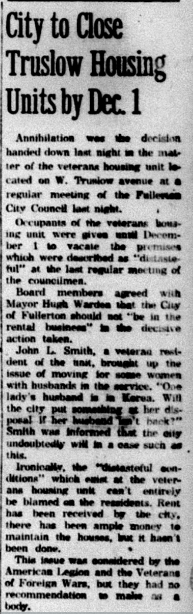
The preferred type of housing in Fullerton was the single family home. Residents and local leaders, as they are today, were generally opposed to low-income housing, apartments, and trailer parks.
For example, the city voted to remove the low-cost veteran’s housing near Fullerton College, and on Truslow.
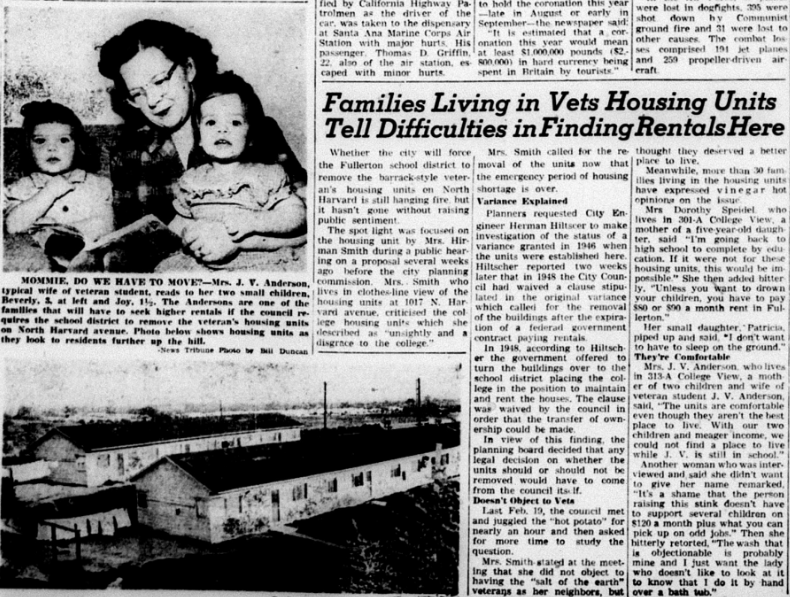

“City Planning Commission yesterday recommended that Fullerton high school and junior college district remove the veteran’s housing from North Harvard avenue on or before July 1, 1954,” the News-Tribune reported. “Two housing foes, one who called the establishment of the housing units ‘strictly a socialist measure,’ were present at the hearing to voice objections to the housing units being located on North Harvard avenue.”
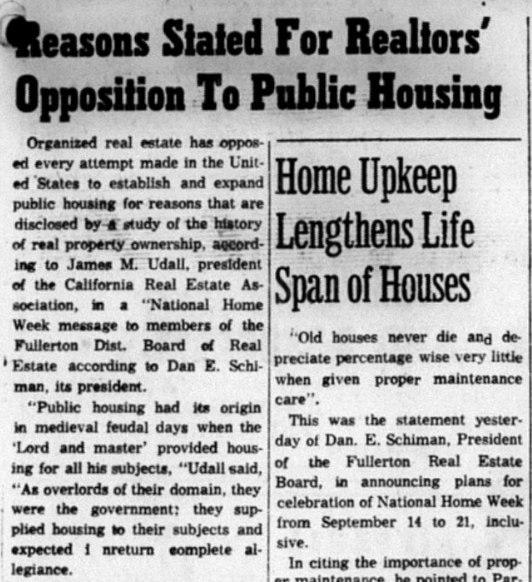
Local realtors lobbied hard against any kind of “public housing.”
Some residents and neighbors were even opposed to allowing more dense housing like apartments.

And the City Council adopted a strict trailer park ordinance.
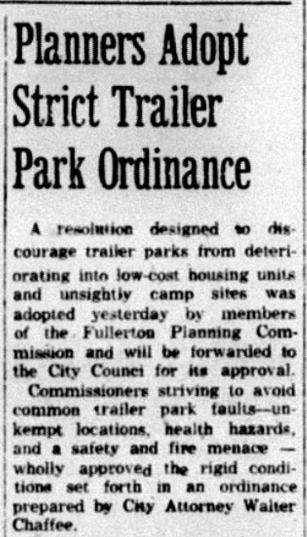
Building lower-cost housing was at odds with realtors, developers, and homeowners’ desire to maximize their property value–to the detriment of those less well off. This sentiment remains today, and has undoubtedly contributed to the present housing affordability crisis.
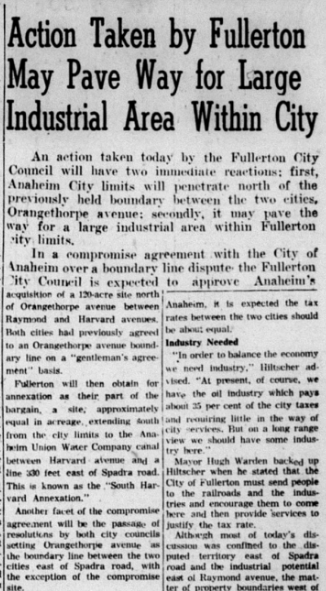
Along with increased residential development, Fullerton also saw increased industrial development as well. Northrop Aircraft built a large plant on Orangethorpe.

Beckman Instruments was planning to build a large facility just north of the city limits.

Hunt Foods in west Fullerton expanded their facilities.

In 1952, Hunt Foods, owned by Norton Simon, was the fourth largest company selling canned goods in the United States, with 12 facilities and an annual sales of over $60,000,000 (worth ten times that in 2025 dollars).
Part of what made Hunt’s successful was the power of acquisitions and branding. Simon would acquire smaller food canning companies and then bring them under the Hunt’s label.
The citrus industry was still large in the 1950s. The California Fruit Growers Exchange officially changed its name to Sunkist.
Oil was also still big business in Orange County, and offshore drilling was a new and controversial thing.
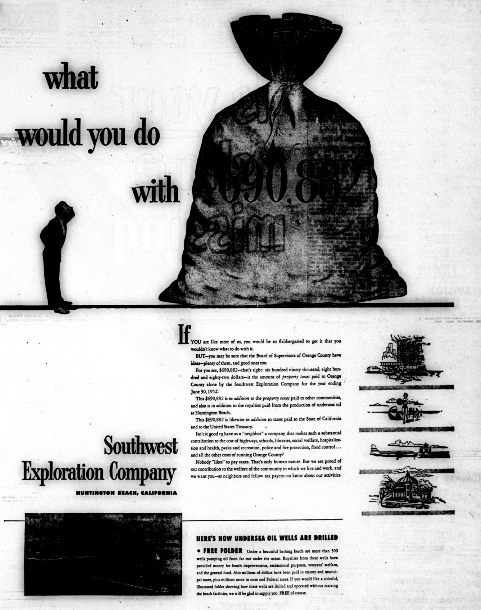
As the population grew, so did the need for new and larger schools.

Fullerton College purchased more land to expand its facilities.

As both Fullerton and Anaheim sought to expand, they agreed on a new boundary line separating the two towns.

Culture and Entertainment
For culture and entertainment, Fullertonians went to movies at the Fox Theater.

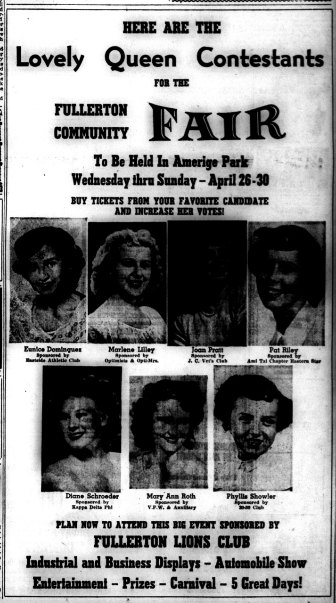
The city held a massive fair that drew thousands.


In the 1950s, it was a very popular thing to crown a “queen” for many community events. I think it had something to do with reinforcing normative gender roles.

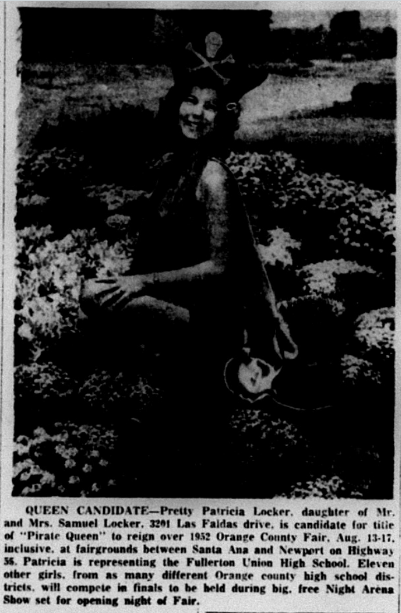
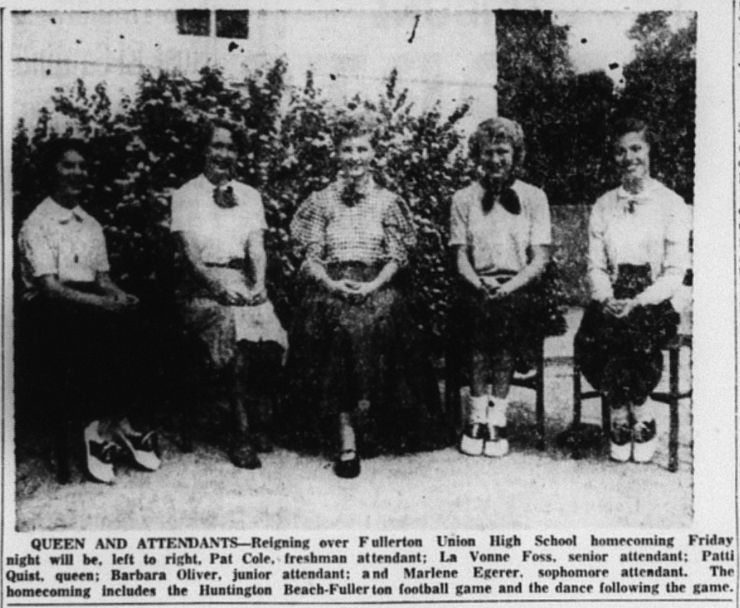

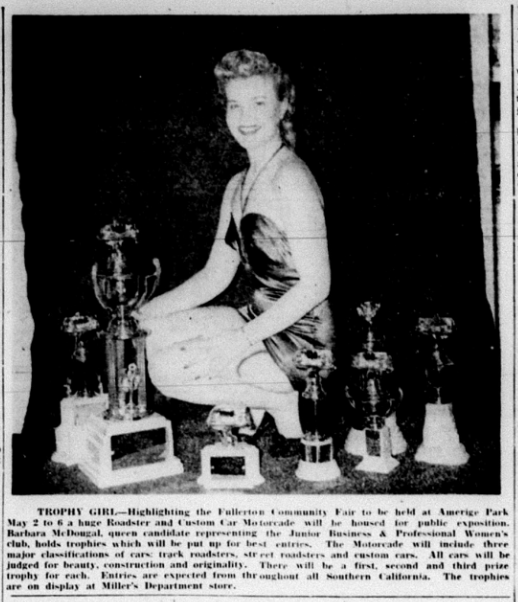

Another popular fun spot was Knott’s Berry Farm and Ghost Town, which was not quite the theme park it is today, but still probably a good time.

Crime
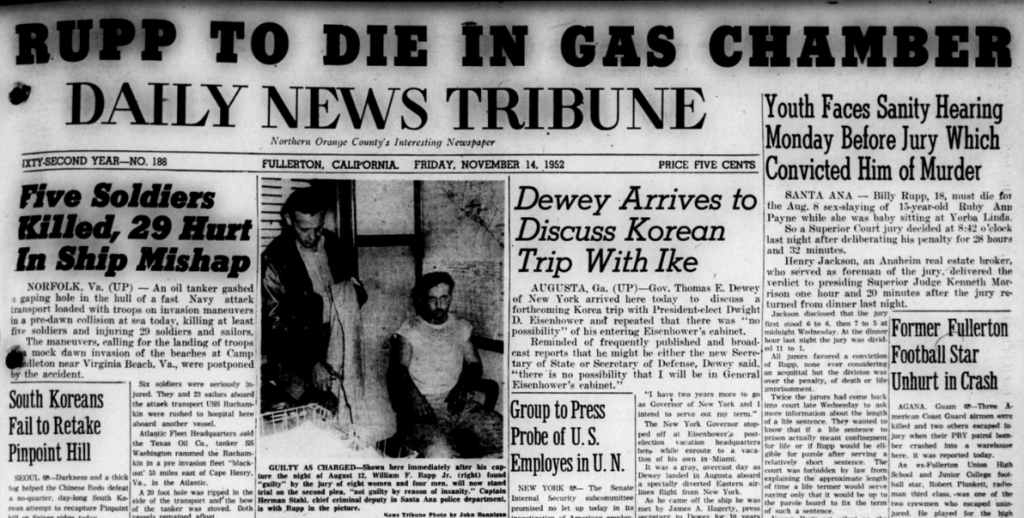
The highest profile local crime of 1952 was the murder of Ruby Ann Payne by William Rupp.
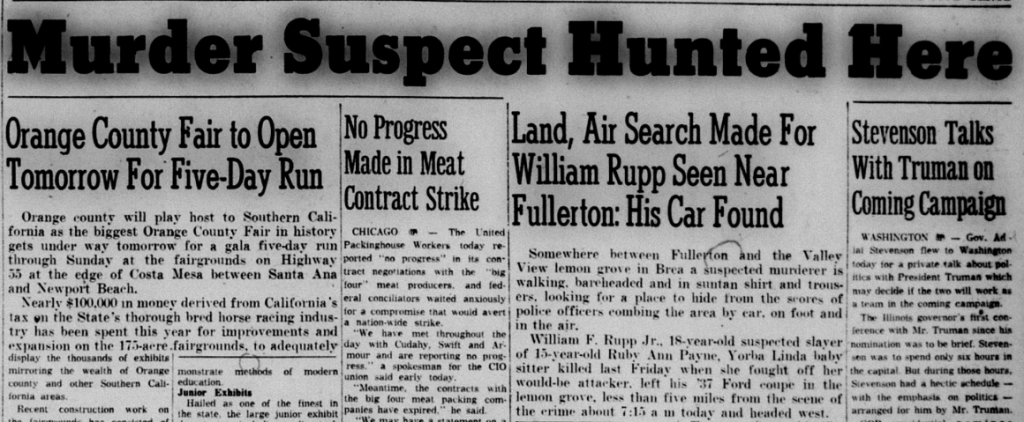
He was captured and arrested in a Brea Cafe, tried, and sentenced to death.
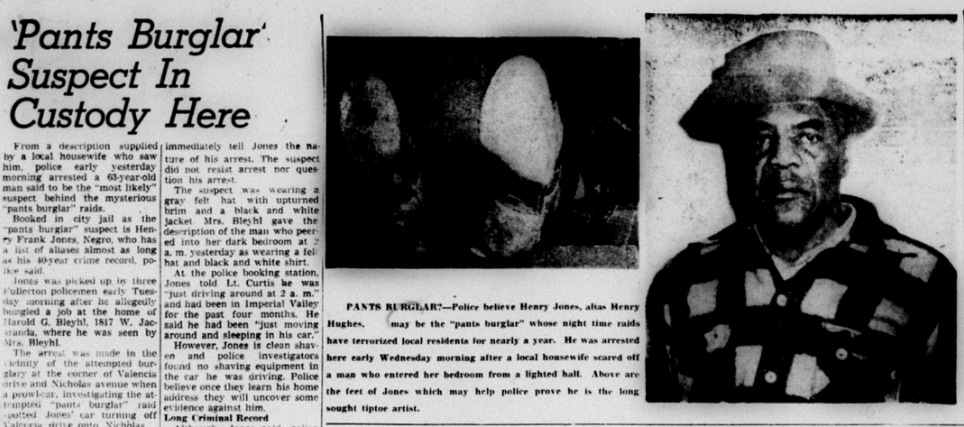
In less heinous crime news, the infamous “pants burglar” was finally captured.
Sports
Professional baseball teams like the Portland Beavers continued to train and play games at Amerige Park.

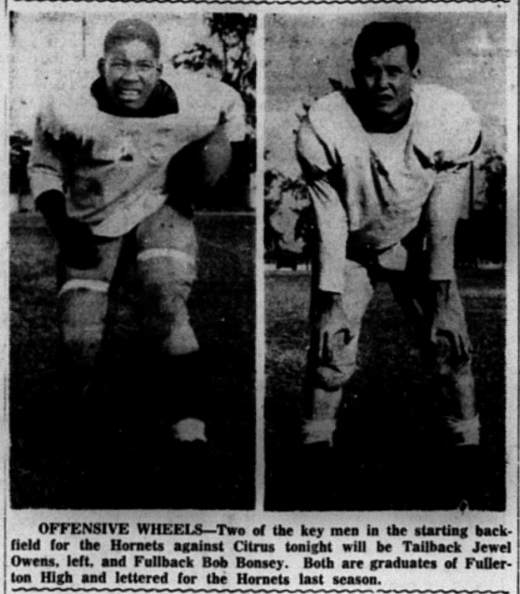
Here are a few more Fullerton sports stars:


Death
Pioneer rancher August Hiltscher passed away.

Stay tuned for top news stories from 1953!
 Fullerton History