The following is from a work-in-progress about the history of Fullerton. You can support my ongoing research and writing on Patreon.
The Local History Room of the Fullerton Public Library has microfilm from the Fullerton Daily News-Tribune newspaper stretching back to 1893. I am in the process of reading over the microfilm, year by year, to get a sense of what was happening in the town over the years, and creating a mini archive. Below are some news stories from 1950.
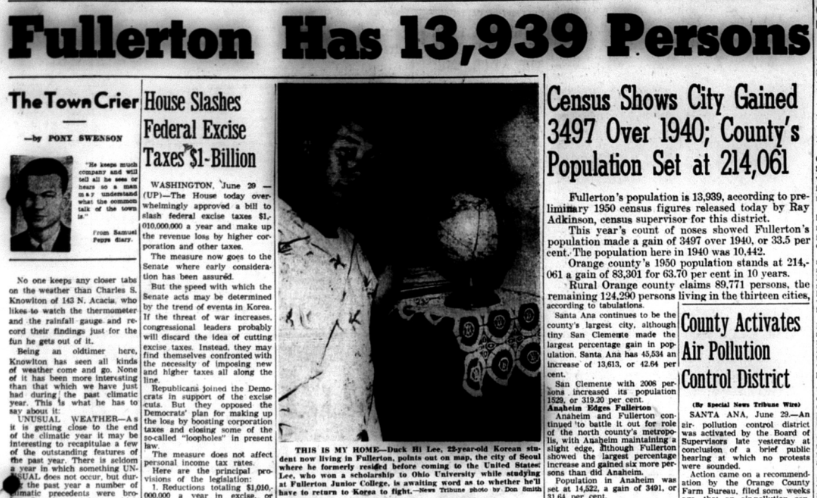
In 1950, Fullerton’s population was 13,939, and would continue to rise rapidly over the next two decades.
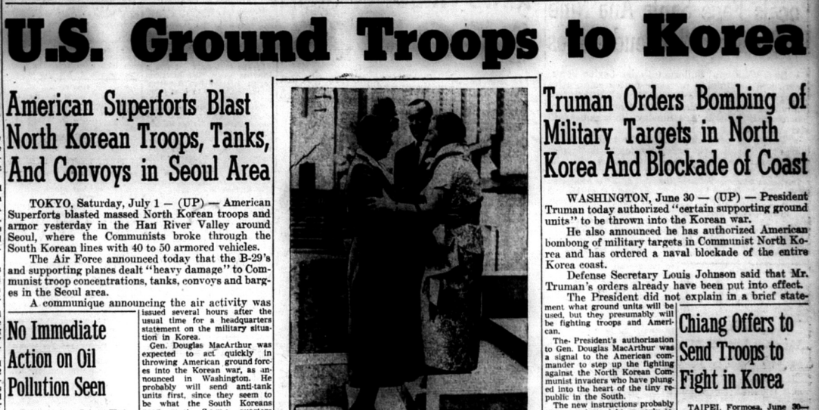
The Korean War
In international news, the Korean War was playing out as both a civil war between north and south, and as a proxy war between the communist east and the capitalist west in the context of the Cold War.
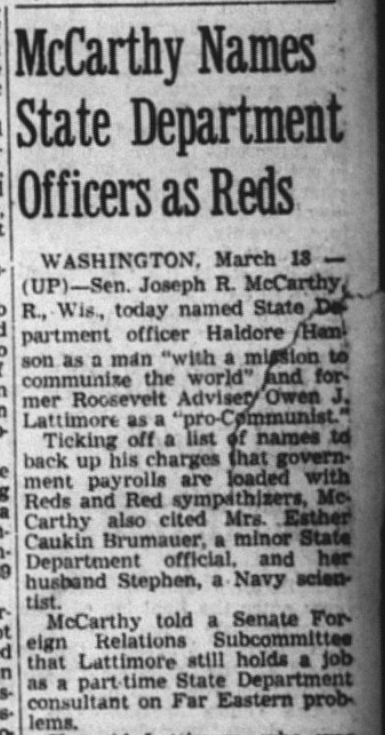
The Red Scare
On the homefront, Senator Joseph McCarthy was terrorizing American liberals and progressives by accusing many people of being communists, usually on the flimsiest of evidence.
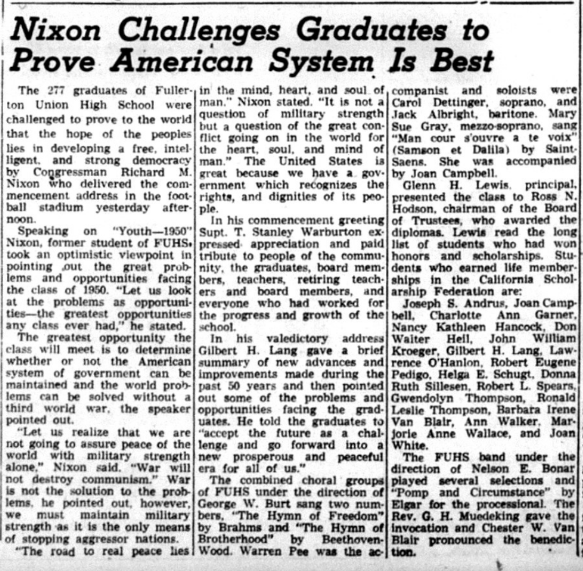
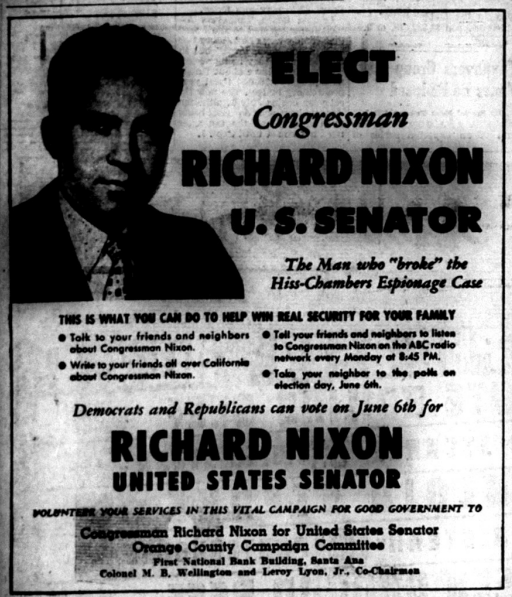
Richard Nixon (who was from Yorba Linda and had attended Fullerton Union High School) had been elected to Congress and was doing his part to fan the flames of the Red Scare. Fullerton in 1950 was a much more conservative place than it is today.
Being a local figure who was also running for Senate, Nixon made many appearances in Fullerton in 1950, including speaking at the FUHS commencement.
More Local Politics
In 1950, four men ran for two Fullerton City Council seats. They were:
Irvin “Ernie” Chapman, wealthy rancher, son of Fullerton’s first mayor/Valencia orange king Charles C. Chapman.

Homer Bemis, a general contractor.

Kermit Wood. Not sure what he did for a living, but he was likely a business owner and he ran on a platform of opposing a new business license ordinance.

Jack Adams, a former public relations man for Lockheed Martin, who also opposed the business license ordinance.

Ultimately, Adams and Wood upset the incumbents Chapman and Bemis–likely because of their opposition to the business license ordinance.

Thomas Eadington, fruit grower, was named Mayor.

Fires!
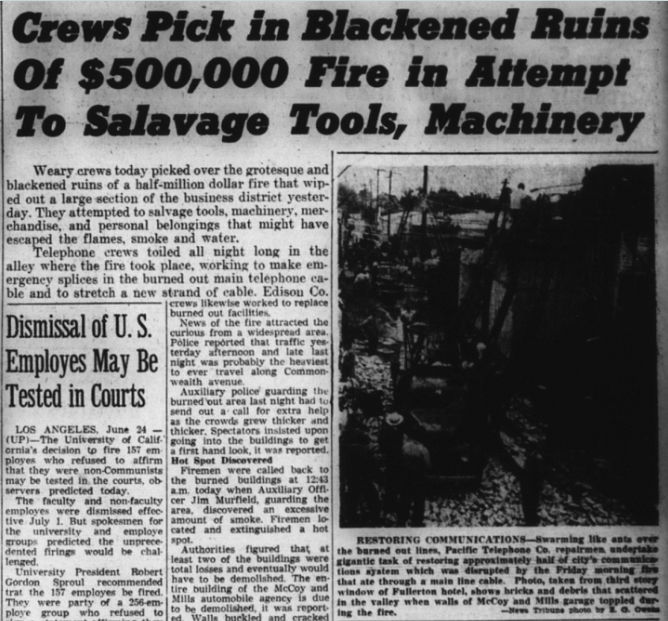
Probably the biggest and most tragic news story of 1950 was a massive fire that destroyed three major buildings downtown in the 100 block of West Commonwealth–the McCoy Mills Ford Agency, Pacific Citrus Products (famous for making Hawaiian Punch), and the old Fullerton Hotel. The damage was estimated at $500,000. Only one person was injured.

“An early morning fire, believed to be the worst in the history of the city, and probably the worst in Northern Orange County, totally destroyed an automobile agency, a citrus products plant, a 58-room hotel, and damaged a hardware store,” the News-Tribune reported.
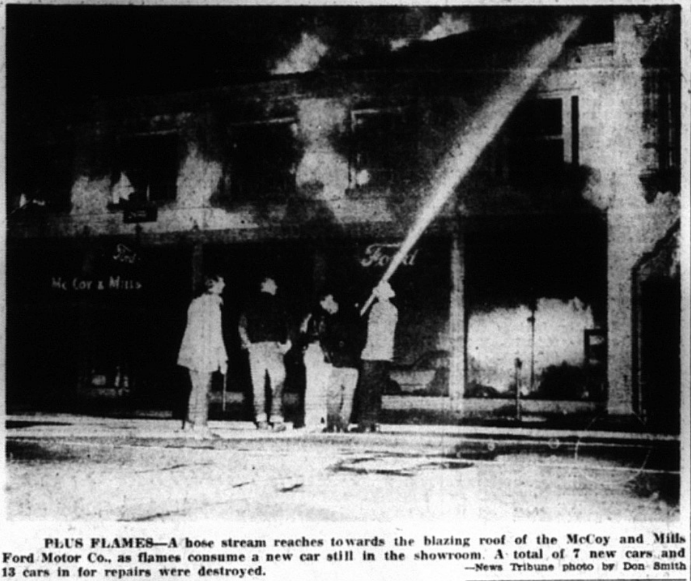
It was believed the fire began at the Ford Agency before spreading to Pacific Citrus Products.
“The juice plant went up in a hurry as citrus oils and alcohol caught fire and an early morning breeze fanned the flames,” the News-Tribune reported. “As the citrus plant burned and bottles and cans exploded, syrup concentrate ran ankle deep in the gutters. The smell of scorched syrup filled the air.”

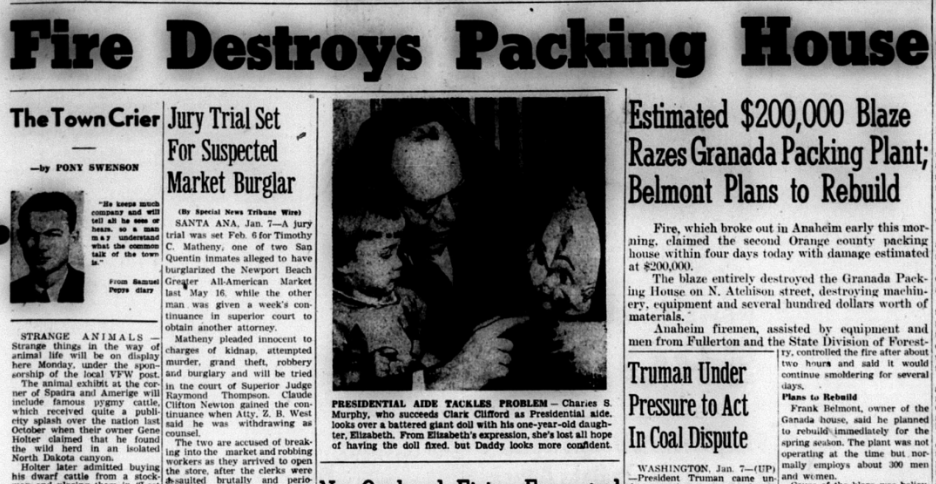
This was not the only fire in 1950. Another one destroyed a packing house.
Can a House be Built in Three Days?
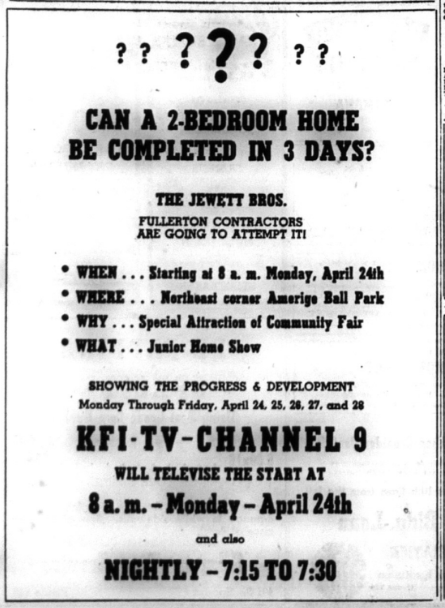
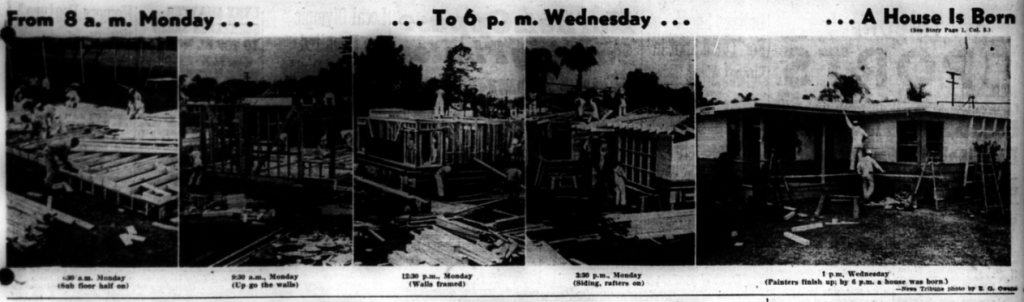
Fullerton continued to experience rapid growth, as many new housing subdivisions provided affordable homes. To demonstrate to the world that Fullerton was growing fast, local developers the Jewett Brothers hosted a big PR event in which workers built a whole house in three days.
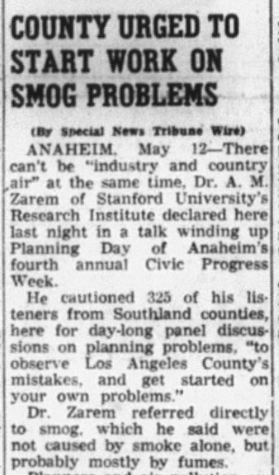
A By-Product of Growth…Smog
Fullerton Goes to the Movies
For culture and entertainment, Fullertonians went to the Fox Theater, which celebrated its 25th anniversary in 1950.


The Fullerton News-Tribune includes an article about two men, Kenneth A. Rogers and Richard L. Martin, who worked at the Fox Theater since it opened. Rogers was superintendent of maintenance, Martin was the projectionist.
“Few, if any, of the large crowd that packed the theater on opening night know that a fire took place in the basement during the performance,” the News-Tribune reported. “Paint used used to color lights caught fire and the blaze set off the automatic sprinkling system. All available personnel were pressed into duty, bailing out the water which was seeping into the wardrobe trunks of a vaudeville troupe. C. Stanley Chapman, president of the company that operated the theater, Rogers recaslls, stood in two inches of water with the others trying to head off the flood.”
The article explains how, in the late 1920s, the theater became a favorite place for Hollywood previews.
“Among movie stars who attended previews of their pictures here were Douglas Fairbanks, Mary Pickford, Sally Eilers, Harold Lloyd, Victor McLaglen, Buster Keaton, Colleen Moore, Janet Gaynor, Charles Farrell, and Edmund Lowe,” the News-Tribune reported.
The first movie shown at the theater was Tom Mix in “Dick Turpin,” (an English period piece) which was a flop.
Both Rogers and Martin got their jobs because they worked at the old Rialto Theater downtown. When Harry Wilbur left the Rialto to manage the new theater, he took the two men with him.
The other theater in town was the Wilshire Theater.

Cultural Appropriation
Fullerton Union High School hosted its annual “Pow Wow.”

Yass Queens!
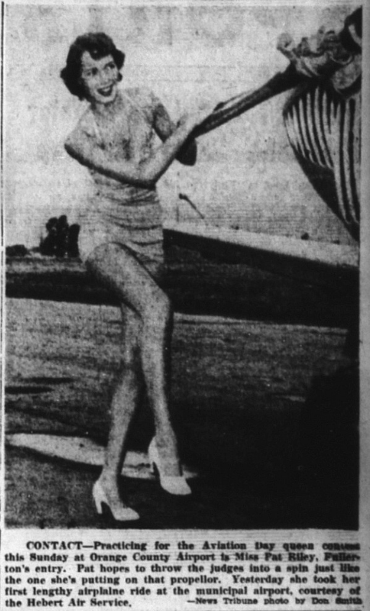
In the 1950s, Fullerton loved to crown queens for various public events.


The Midwest in SoCal
Fullerton hosted an “Arkansas Day” picnic on the Fourth of July that drew thousands.

New Schools
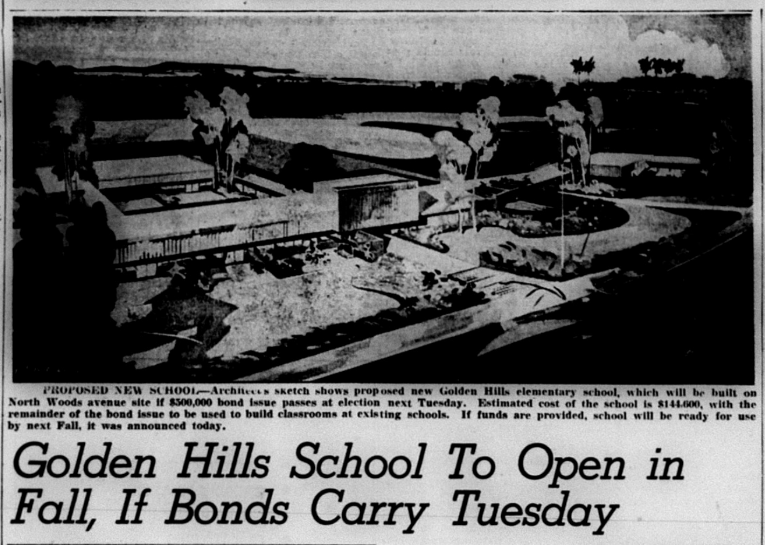
In education news, Golden Hills Elementary School was planned, to be built with bonds approved by the voters. Many new schools were built in the 1950s and 1960s as the area grew in population.
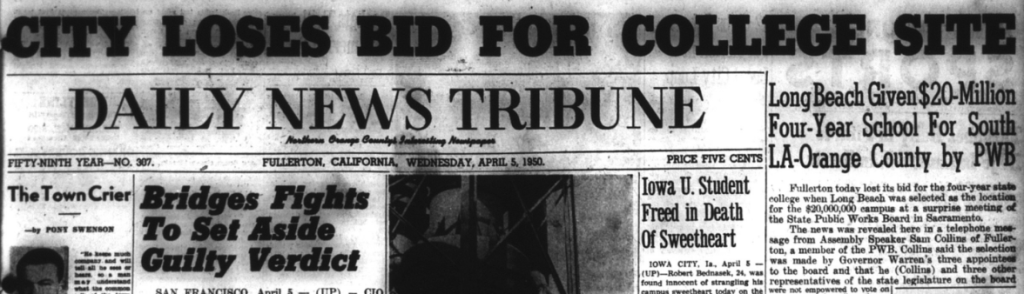
Fullerton put in a bid to be home to a new state college. Unfortunately, they lost out to Long Beach. It would be another decade before CSUF came to Fullerton.
Dr. H. Lynn Sheller succeeded William Boyce as head of Fullerton College.

The Big League Comes to Amerige Park
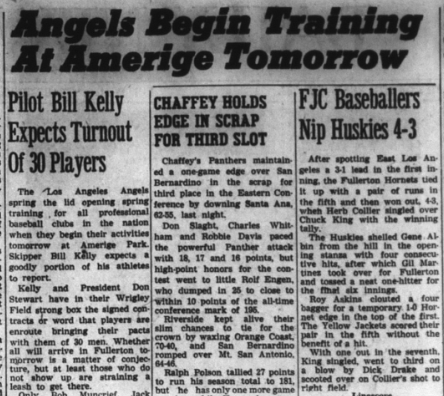
The Los Angeles Angels trained at Amerige Park in Fullerton.
Citrus Industry
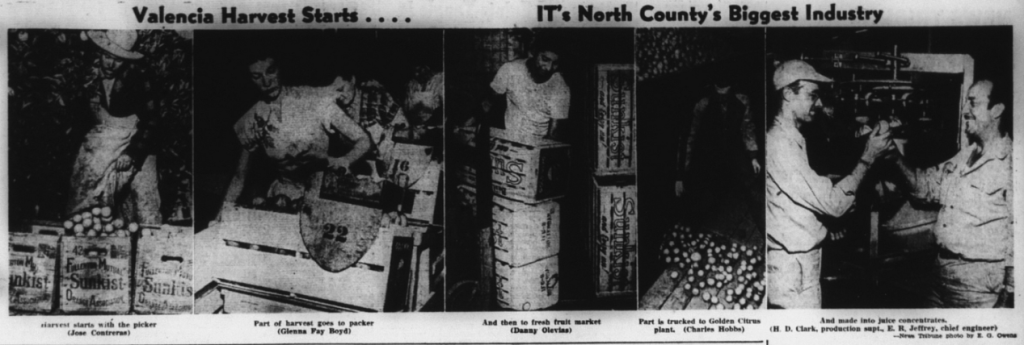
Although some orange groves were being plowed under for housing subdivisions, the citrus industry was still quite large in Fullerton and surrounding areas.
Stay tuned for top news stories from 1951!
 Fullerton History