The following is from a work-in-progress about the history of Fullerton. You can support my ongoing research and writing on Patreon.
Last week, I was in the Local History Room of the Fullerton Public Library browsing the shelves and came across a self-published autobiography of Thomas “Tommy” K. Gowen, who was an early rancher in Fullerton.

I had a personal connection to this person, as I grew up attending the First Evangelical Free Church of Fullerton, which Gowen also attended with his second wife Connie. As a young boy, I knew Connie Gowen–she was a well-loved elderly woman. Sadly, Tommy had died before I had the chance to meet him.
I read with great interest the story of Tommy’s life. Here is a summary of what I learned.
Gowen’s ancestors came to America in the 1550s from England, Scotland, and Wales, seeking religious freedom and to help establish a British colony.
His great grandfather James Gowen (“Uncle Jimmy”) was born in 1784. Uncle Jimmy settled near Lynchburg, Tennessee where started a farm. The adjoining farm was owned by none other than Davy Crockett!
Uncle Jimmy, being a Southern planter in the early 1800s, owned slaves. He fought in the War of 1812 under General Andrew Jackson in New Orleans.
Thomas K. Gowen was born in 1893 in Tennessee. Sadly, his father died of pneumonia four days before he was born, at age 30. Tommy grew up in a small farmhouse with his mother in Tennessee until he was 18. From age 12, he worked on local farms, including the Crockett farm.
Although he had limited schooling, “With the libraries of my two uncles at my disposal, I would sit up until midnight reading all kinds of books, learning more, I think, than the average college graduate,” Tommy writes
When Tommy was 20, he moved to Bakersfield and enrolled in Kern County High School and Junior College, living with his uncle Ben. He studied scientific farming.
“I got a job with the Kern Island Irrigation Company as a zanquero, delivering water to the Chinese gardeners, through the main ditches surrounding the city,” he writes.
When he arrived, most of the land was used for cattle grazing. It was here that he met and married Florence Burkett in 1915. The young couple briefly moved back to Tennessee, where their son Harlan was born.
After moving back to California, Tommy’s father-in-law, a relatively wealthy rancher, offered them a twenty acre orange grove in Fullerton.
In 1917, Tommy rode a horse-drawn wagon down to his new ranch in Fullerton. The family moved into a small farmhouse.
In 1919, Tommy took a job with the Union Oil Company, “working on the drilling derricks from midnight until 8am. In the daytime I would take care of sixty-five acres of oranges for my neighbors,” he writes. That year, their second son, Kenneth, was born.
It was while working for Union Oil that Tommy befriended Frank Nixon (Richard’s father): “In 1918 Frank Nixon (Dick’s father) and I became good friends. We went to work for the Union Oil Company of California and worked side by side for three years, then kept in contact with each other from time to time thereafter until he died in 1960.”
The family eventually moved into a house at 233 W. Santa Fe.
In 1921, he got into the fertilizer business. He traded his orange grove with Maxium Smith for a two-story house in Anaheim and 160 acres of desert land 12 miles west of Lancaster, where he planted barley.
In 1925 he bought a ten-acre orange grove on the south side of Valencia Dr, east of Brookhurst. Their son Kenneth, who had hemophilia, died of internal injuries after a kid pushed him off the bleachers at Ford School.
In 1928, they built a home at 1600 W. Valencia Dr. In 1932, Gowen was elected to Fullerton City Council. In 1936, he went to bat for his friend Walter Muckenthaler to be elected to city council.
“They said a Catholic had never served on the council and one could never be elected. I told them we had never had a Walter Muckenthaler run for the council, either,” he writes. “I went to twelve Protestant ministers in town and asked for their cooperation. They agreed to help. I think I oversold Walter; he got more votes than I!”
During Gowen and Muckenthaler’s tenure on City Council, they acquired WPA funds to build City Hall (now the police station). This was a controversial move, as other prominent businessmen wanted the city hall to be built on Spadra next to the California Hotel, instead of on Commonwealth, where it was built.
Gowen and Muckenthaler were also instrumental in getting more WPA funds to build the new library on Wilshire and Pomona, which is now the Fullerton Museum Center.
In the early 1930s, Tommy befriended Dr. John E. Brown, who was a leading evangelist of his day.
“In 1931 [Brown] sent his front man, Mr. C.A. Virgil, to Fullerton to build a temporary tabernacle on a vacant lot behind the Masonic Temple,” Gowen writes. “It had a capacity of 3,000 and was full every night for the three weeks he was there.”
Gowen was elected to be on the board of John Brown University to represent California. There he met Jesse H. Jones, who was chairman of the board. They enrolled Harlan at John Brown University in Arkansas.
Jones was a multi-millionaire who owned most of the skyscrapers in Houston, Fort Worth, and some in New York. He funded John Brown University. He was appointed by Herbert Hoover to be Chairman of the Reconstruction Finance Board, and was secretary of Commerce under Franklin D. Roosevelt.
Jones asked Gowen to help promote John Brown University, booking Dr. Brown to speak at 52 of the largest Rotary Clubs in the nation. There he met with many of the leading businessmen of America.
“Dr. Brown came to California and offered me the position of general manager of all the university’s holdings on the west coast: Brown Military Academy, the Brown School for Girls at Glendora, Radio Station KGER, twelve apartment complexes, and the Hotel Huntington in Long Beach,” Gowen writes.
In 1940, his wife Florence died.
Eventually, “Due to some of the financial practices of the administration of the school, Mr. Jones withdrew his support and I resigned from the organization, and reverted to being a farmer.”
In 1940, his fortunes considerably improved from when he first moved to Fullerton, Gowen “leased 110 acres of Valencia oranges in the Santa Fe Springs district from Standard Oil Company and others, and 700 acres of hay, grain and pasture land from Union Oil Company and Stern Realty Company from Fullerton to Brea, and from Brea to La Habra…With some partners, we leased 167 acres of Valencia oranges in front of Loma Vista Cemetery.”
After the death of his wife, he fell in love with his secretary Connie and they were married, they sold their home on West Valencia Drive and bought a two-story home on the southwest corner of Chapman and Balcom. They bought 160 acres on what is now Skyline Drive along with other property owners in what was known as the Skyline Syndicate. The area was subdivided into luxury homes. They moved into a home at 1701 Skyline Drive.
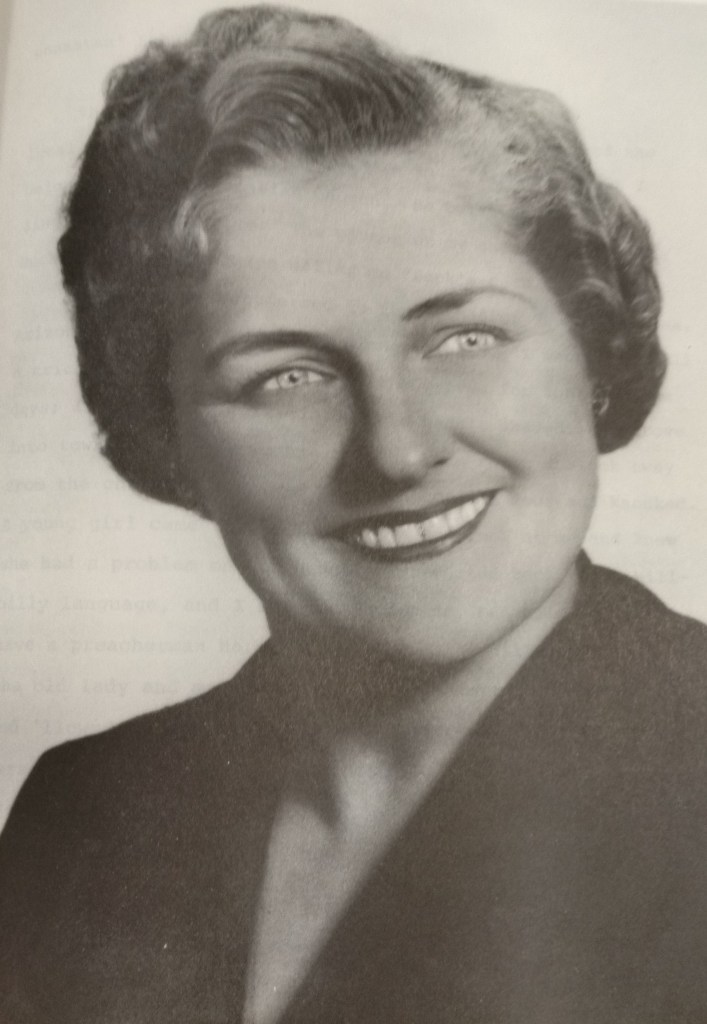
Now a wealthy rancher, Gowen befriended Walter Knott, who was a fellow advocate of Republican politicians.
In 1946, Tommy and Connie had their first child, Nancy. Their son, Tom Jr. was born in 1947. Sadly, Harlan (Tommy’s son from his first marriage) died in 1948. He was also a hemophiliac.
Gowen, now a gentleman rancher, part of the local landed gentry, acquired orange groves in Yuma, Arizona along with his friend California State Senator John Murdy.
In the early 1940s, he bought 165 purebred Hereford heifers from the Hearst ranch and ran them on land he rented north of Fullerton, and on his own land.
“Our whole family enjoyed having cattle running the two miles from what is now Longview Drive and Brea Boulevard to Rolling Hills and State College Blvd,” Gowen writes.
In 1947 he bought 47 acres of dead lemon trees, the piece that lies between Rolling Hills and Bastanchury Road, east of Brea Blvd. “We kept it about eight years and sold it to Ward and Harrington for a subdivision, helping the Fullerton Elementary School District obtain the site for Rolling Hills School,” Gowen writes.
He was instrumental in helping Chapman College (founded by local rancher Charles Chapman) move from Los Angeles to the site of the former Orange High School. Gowen served on the board of Chapman College until it became “too liberal.”
“Liberal professors refused to take the loyalty oath and the majority of the board let them get away with it,” so Gowen resigned.
In the 1950s, Gowen was the campaign manager for Republican John Murdy, who was elected to the California State Setate in 1956 and 1960.
“[Murdy] had 1,000 acres of land between Huntington Beach and Westminster on which he grew lima beans. Later on he became president of the California Lima Bean Growers Association, president of Hoag Memorial Hospital, a member of the Irvine Foundation Board, and many other worthwhile activities,” Gowen writes. “In 1952 some southern Orange County business men drafted John to run for the state senate…I was asked to be his campaign manager.”
Gowen was also instrumental in getting the state legislature to locate CSUF in Fullerton.
Gowen was an early supporter of Richard Nixon in his first presidential run in 1960. Tommy visited and had lunch with Richard Nixon at the capitol when he was vice president.
“During the presidential campaign in 1960, Mr. Knott hosted a big old fashioned Republican rally at the [Gowen] farm. The main speaker was Richard Nixon,” he writes.
In a letter to his daughter Nancy, Gowen describes Nixon’s famous “Southern strategy” to get conservative Southern Democrats to switch the Republican Party: “Dick had to have a vice president acceptable to Strom Thurman, the only man who could throw the south to the Republican party.”
Tommy visited and had lunch with Richard Nixon at the capitol when he was vice president.
Gowen wrote his memoir in 1975, shortly after the Watergate scandal and the resignation of Richard Nixon. Of this he wrote: “Having known the Nixon family personally for 56 years makes this tragedy a double shock for me.”
 Fullerton History