The following is from a work-in-progress about the history of Fullerton. You can support my ongoing research and writing on Patreon.
Post-War International News
World War II had ended the previous year, and the first frosts of the Cold War were being felt between the capitalist west and large communist countries like Russia and (eventually) China, despite the fact that these were our allies during the War. The existence of the atomic bomb, and Russia’s attempts to create one for itself, exacerbated these tensions.
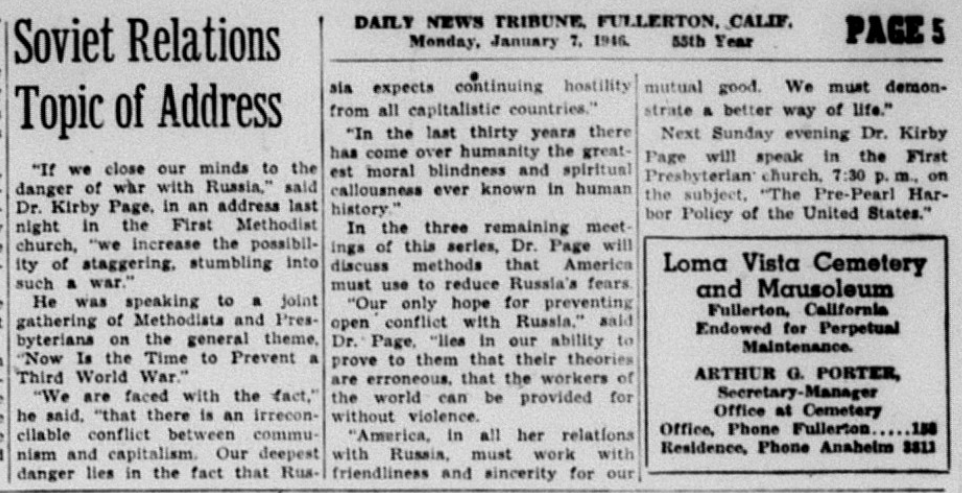
This tension between the US and Russia would also spark increased espionage and paranoia which in the US would eventually become the Red Scare.

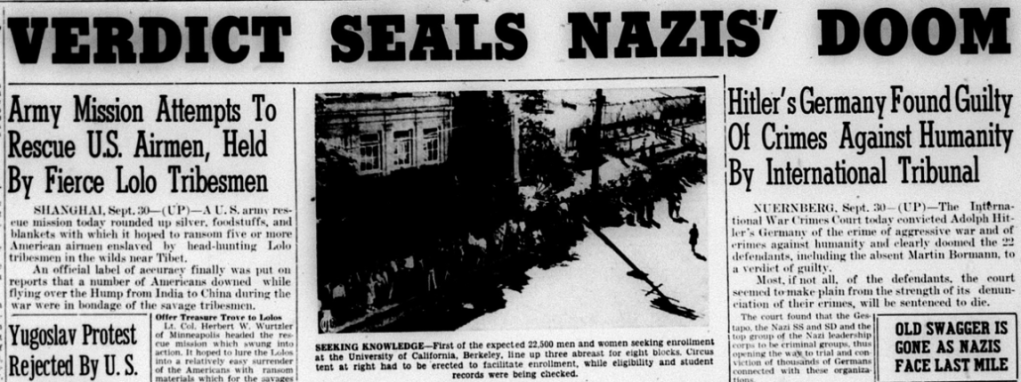
Defeated Axis powers Germany and Japan were occupied by Allied powers to ensure they would demilitarize and follow the political path the Allies wanted them to follow.

Both German and Japanese war criminals were tried and executed.
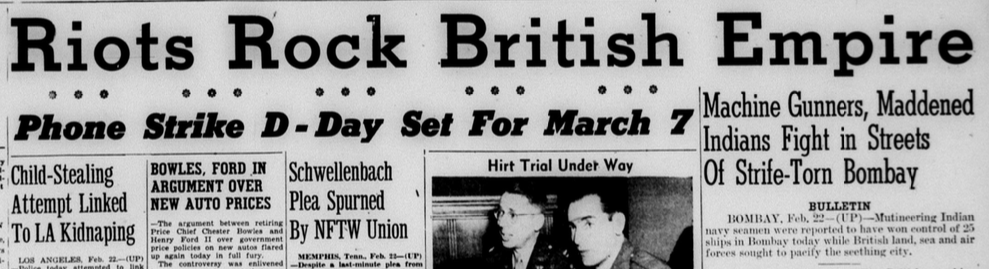
Just as World War I caused the end of old empires like the Ottoman Empire, the end of World War II brought about the beginning of decolonization of European empires like the British and Spanish. India, a former British colony, would achieve independence in 1947.
Conflict over the Holy Land would result in outright war between Israel (which would become a state in 1948) and Palestine. Also, the British were still present there, as a legacy of colonialism.

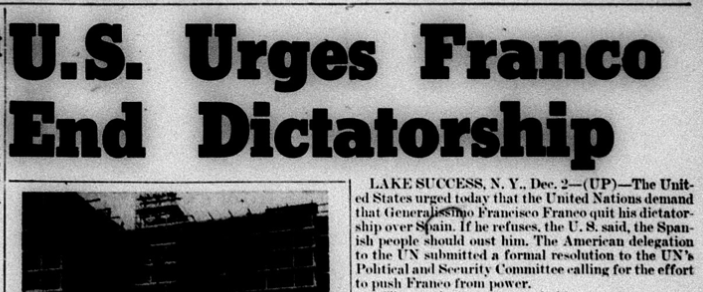
Fascism was not totally defeated in World War II. In Spain, Francisco Franco’s authoritarian regime would continue for decades.
Here, President Truman states the American post-war position.

Veterans Issues
Having won the war, American soldiers were eager to return home and resume their civilian lives. Many GIs protested delays in their discharge as the US was hesitant to remove occupation forces in places like Germany and Japan.

While European colonial empires were losing some of their power and global reach, the post World War II era saw a rise in the United States’ international military and economic presence around the world. This did not usually take the form of overt colonization (which was becoming out of fashion), but rather took the form of military bases, plus increased US business and political presence globally. Some might call this a new kind of empire.
For those thousands of GIs who were eventually discharged, a new problem emerged—a housing crisis. There was not enough housing for all the vets, and it much of it was too expensive. Both federal and local governments responded by building lots of new housing and establishing programs like the GI Bill that made is affordable for vets to get home loans and go back to college.
Here in Fullerton, homebuilding increased dramatically after the war, and some of the new homes were explicitly for veterans, such as the 25-unit College View adjacent to Fullerton College.
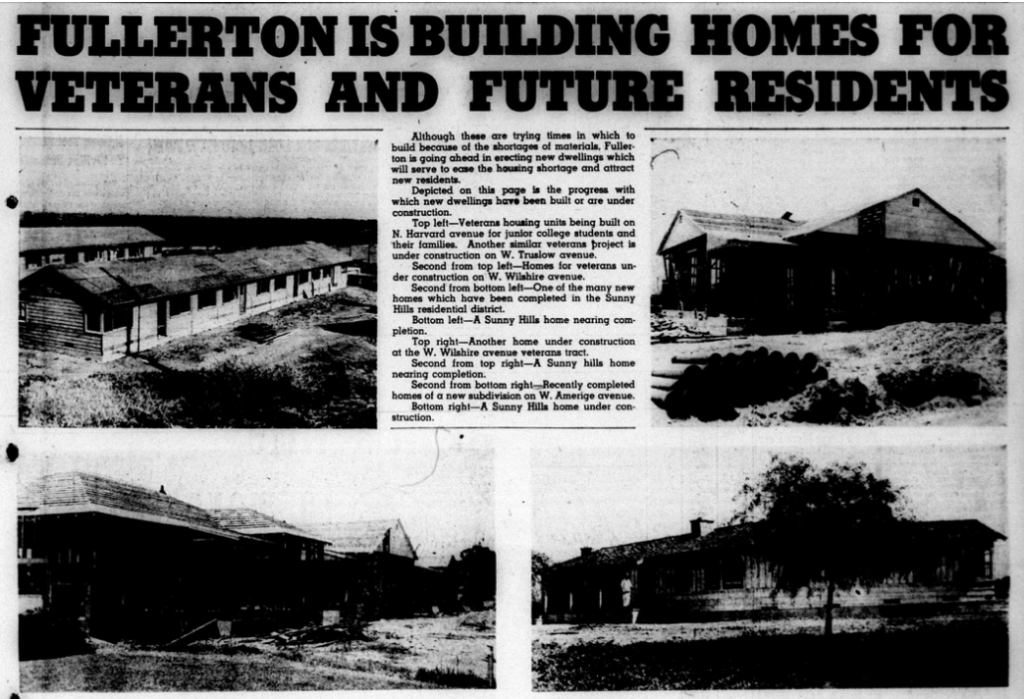
Because housing production and affordability was a national and local priority, both federal and state governments had some form of rent control.


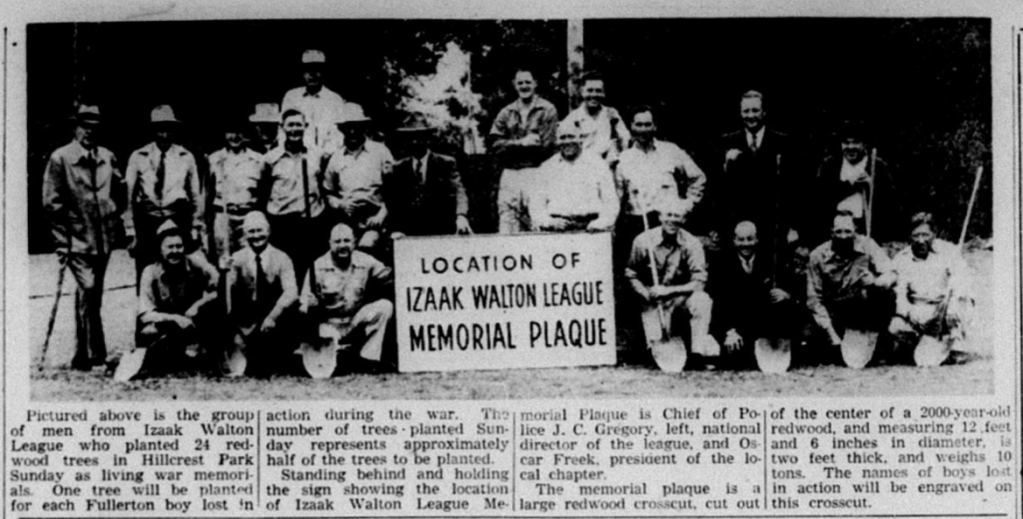
Both veterans and those who died in the War were honored with memorials. The Isaac Walton League planted a number of redwood trees as a “Living Memorial.”

The Boom Years
The post-war period has been rightly called the “Boom Years.” Fullerton grew quickly. It was a perfect location to build a suburban middle class lifestyle. By 1946, Fullerton’s population was a little over 12,000, with room to grow.
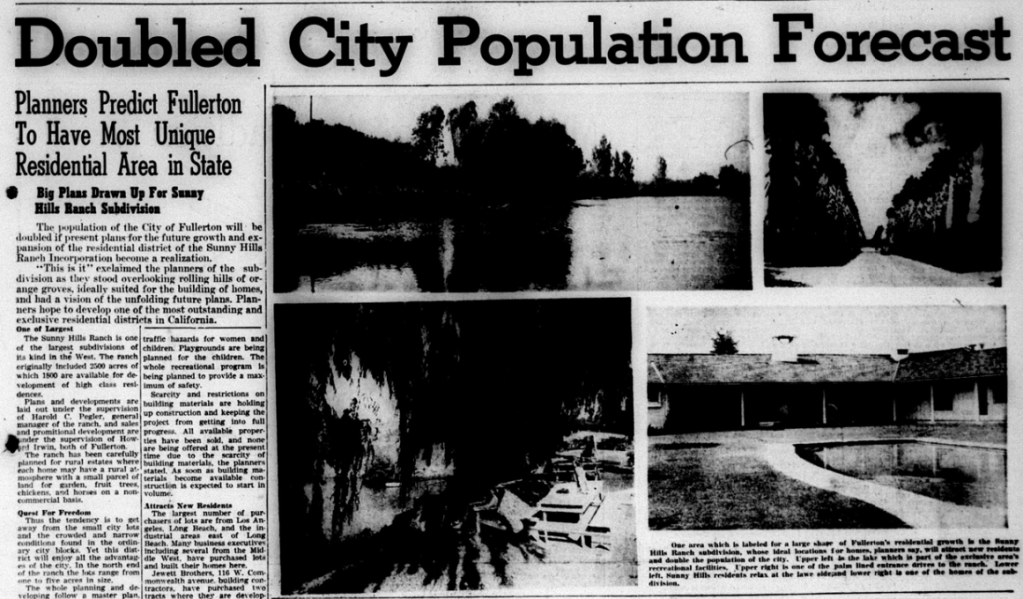

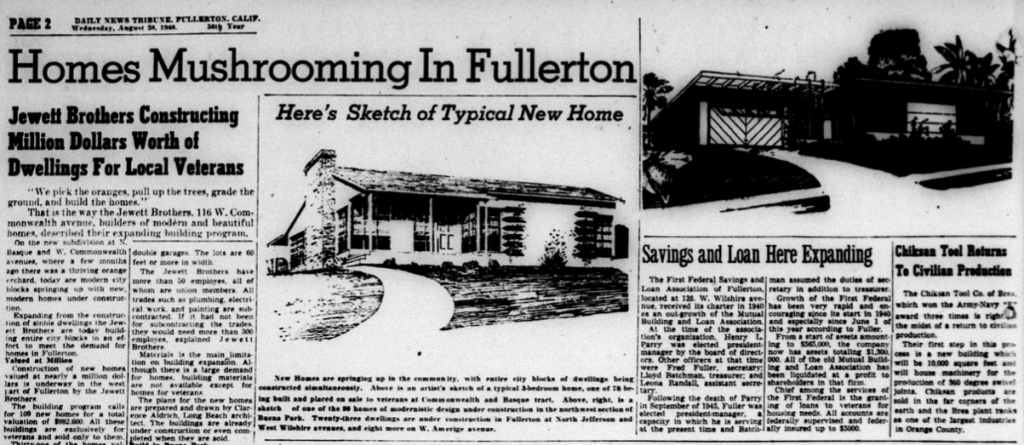
“Large, previously undeveloped areas are being subdivided and plans call for the erection of houses at the rate of city blocks at a time. In addition to lesser buildings programs on W. Wilshire and W. Amerige avenues, Jewett Brothers are preparing a tract on N. Basque ave for construction of 78 homes for sale to war veterans,” the News-Tribune reported. “In the northern hills of Fullerton is one of the largest subdivisions of its kind in the entire west. Eighteen hundred acres of the Sunny Hills Ranch in this are area available for development of residences. According to planners of this subdivision of rolling hills and orange groves, it will make up one of the most exclusive residential areas in California and will attract new citizens to the extent of doubling the population of the city of Fullerton.”
To accommodate this growth, the city also spent a lot of money expanding the city’s infrastructure, including roads and sewers.

“Most outstanding of city projects to be undertaken is street development, calling for an expenditure of nearly $1,000,000 within the next 10 years,” the News-Tribune states. “Under the program being considered the city will build new streets, widen, resurface, and improve existing arterials.”
Plans were drawn up for a large recreation complex next to Amerige Park (where the Community Center is today), although it appears these plans never materialized.
In addition to lots of new homes, Fullerton was also expanding its industrial base, with growing manufacturing firms here like Kohlenberger Engineering, Pacific Citrus Products (which made Hawaiian Punch!), and Hunt Brothers.
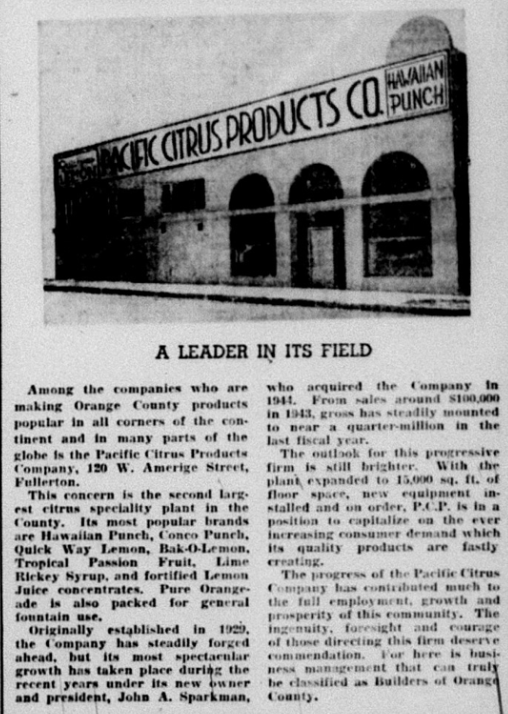
While large swaths of former orange groves were being removed to make way for buildings, the citrus industry was still a notable presence in Fullerton, and would remain so through the 1960s.

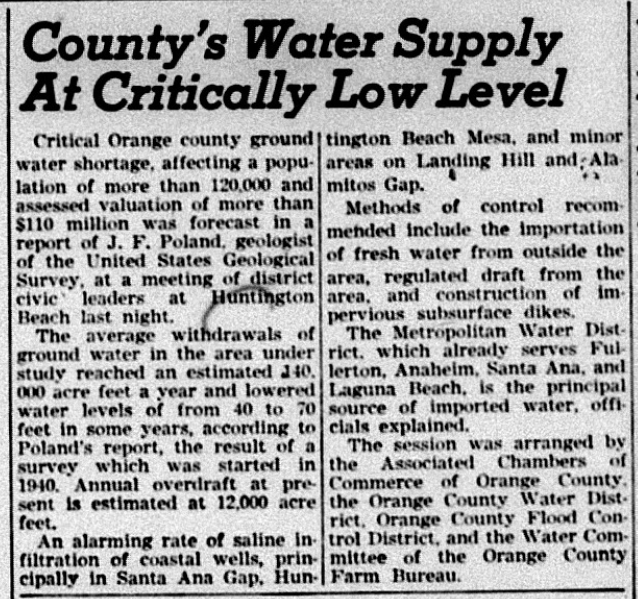
One problem of growth was the need to acquire more water. Stay tuned for more on this.
Fullerton’s health care needs were outgrowing its old hospital, and so the Sister’s of St. Joseph proposed construction of a new, larger hospital near Fullerton College.

However, the NIMBY forces were strong, and some nearby property owners objected to the proposed hospital location.

Eventually, City Council approved an alternate location for the hospital. Stay tuned for more on this.
In transportation news, City Council approved parking meters downtown.

Labor Strikes
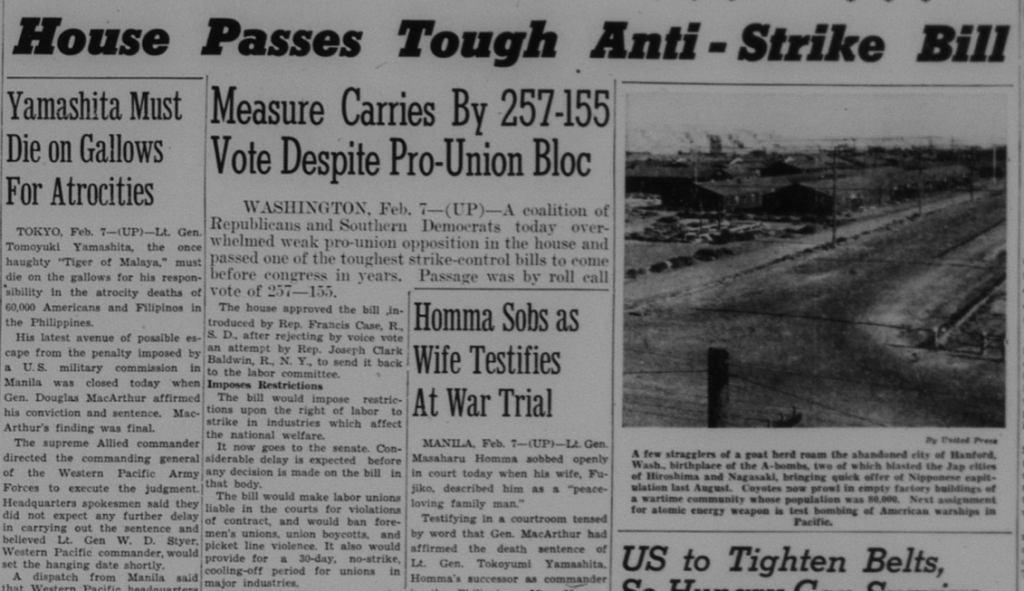
The immediate post-war years (1945-46) saw a massive wave of labor strikes rock the country, sometimes shutting down entire industries, prompting government intervention, and occasional rioting.
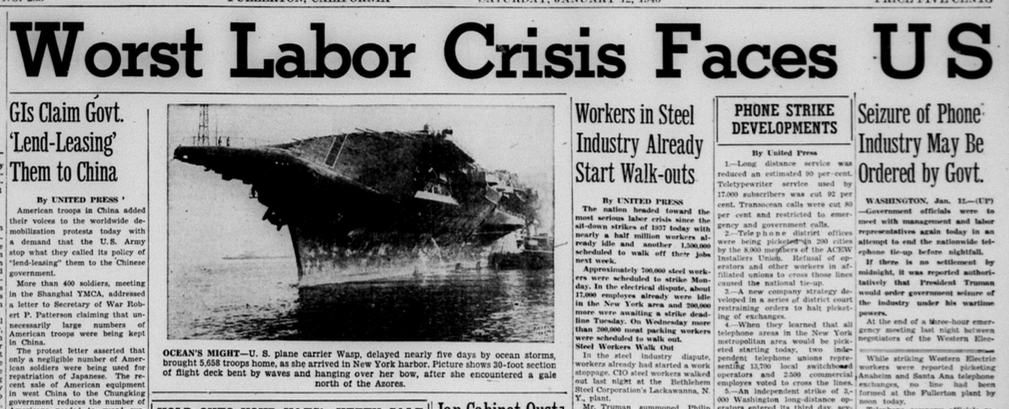
Industries that saw large-scale strikes included railroads, coal, steel, meat, postal workers, and more.
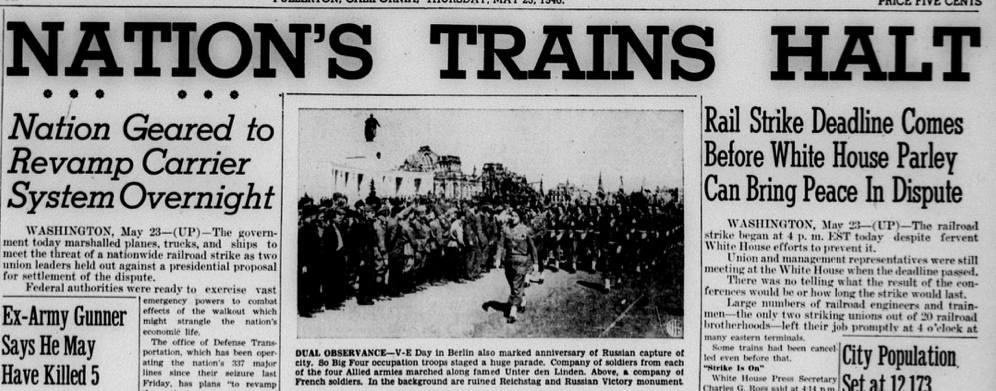
Both the Fullerton News-Tribune and local business elites tended to portray strikers negatively, sometimes associating strikers or unions with communism.

Powerful business interests, like the Associated Farmers and and Employers Industrial Relations Council, who had spent the depression colluding with government to suppress strikes and labor movements, did their part to paint the strikers as dangerous, lawless radicals and communists.

The labor troubles reached Fullerton, with over 400 workers at Hunt Bros. going on strike.

The strikes affected Fullerton in other ways by (briefly) stopping the postal service, travel, and shipping of goods.
“The processing of oranges in Fullerton has been stopped at some plants and greatly retarded in others due to the railroad strike,” the News-Tribune reported. “The California Fruit Distributors have stopped picking and packing until arrangement can be made to receive oranges in trucks…There is not much danger of losing the crop as the oranges are not too ripe yet.”
The strikes affected peoples’ ability to buy certain foods, like meat.

In response, congress passed a “tough” anti-strike bill, the Taft-Hartley Act.
Civil Rights
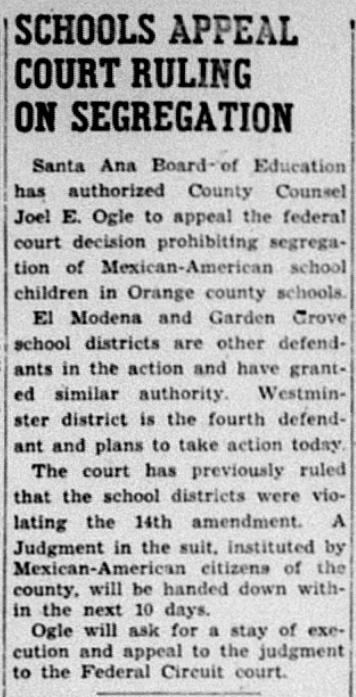
Speaking of constitutionality, a very important civil rights case was playing out in 1946—Mendez et al v. Westminster—in which a group of Mexican American parents sued a local school district for segregating Mexicans and whites. The case was an important local step in ending school segregation.

A recent census showed that, while Fullerton’s population was 12,173, there were only 96 Black people living in the city. Orange County has historically had a very low Black population due to housing (and other forms of) discrimination.
In a student essay, African-American student Robert Goodwin (son of famous Fullerton author Ruby Berkeley Goodwin), described the specific type of housing discrimination Black people faced in Fullerton at this time:
“Many people in Fullerton do not know that there are only certain sections where Negroes and Mexicans can live. This is due to the fact that years ago when Fullerton was first being settled, real estate men found out that they got lower prices for the property where Mexicans lived; so they enacted a law called the Restrictive Covenant. This forced the Negroes and Mexicans into one small section. This condition has caused many deaths in Fullerton because it forces large and small families to live in houses that are run down, badly roofed, and badly lighted. Such conditions are play grounds for Tuburculosis and other diseases.
“At present we have two drives on. One is to feed the starving children of the world and the other is to clothe and house them. We are taught that “Charity begins at home.” Such should be the case in Fullerton. “Restrictive Covenants” have been in effect too long. It’s time the people of Fullerton stopped talking about equality and started practicing it. When I was small I used to wonder about our “Pledge of Allegiance to the Flag.” When I’d get to the part, “With Liberty and Justice for All,” I knew that part of the pledge didn’t apply to me.
“Let us of Fullerton strive to do better. Let’s make the future Mexican an Negro children of Fullerton know that the “Pledge of Allegiance to our Flag,” isn’t just a bunch of fancy words: but that it is their guarantee of equal rights in the country that their fathers along with their white brothers fought for.”
Many Mexican Americans at this time did not live in regular neighborhoods, but rather in segregated citrus camps, or colonias, and white people did not not want these anywhere near their neighborhoods.
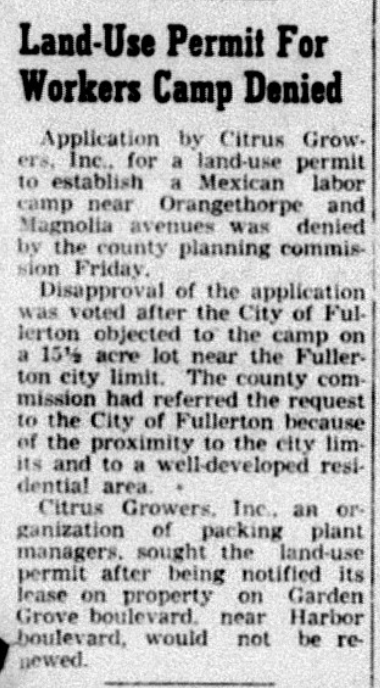
In 1946, when a new colonia was planned for the west side of town (at Orangethorpe and Magnolia), local white residents successfully blocked its construction.

“A group of property owners appeared before the council and presented a petition signed by 148 property owners and renters in that neighborhood voicing their objections,” the News-Tribune reported. “Objections raised were that since the neighborhood was fully developed as a residential district, the establishment of the camp would diminish the value of the residential area; that the quality of the usual people in such camps was not satisfactory and would create unwelcome problems.”
George A. Graham, manager of Citrus Growers, Inc., the company attempting to build the camp, argued that it “was the only site large enough and that there may be need for 3000 workers for next season who needed a place to live.”
After hearing the residents’ objections, Fullerton City Council, and then the Orange County Planning Commission, denied approval of the proposed camp.
Meanwhile, the Ku Klux Klan (which had a sizable local membership in the mid-1920s) was again raising its ugly head in Southern California.
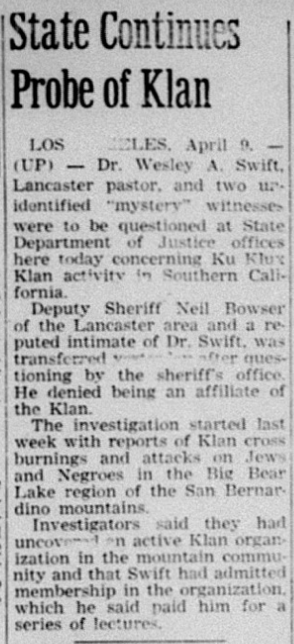
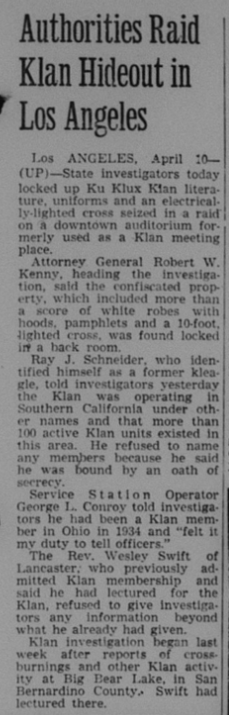

Here are some excerpts from the above articles:
“The burning of a cross the the lawn of a USC Jewish fraternity and the destroying of a sacred scroll in a synagogue across town, on whose walls were penciled two swastikas were being investigated today by police.
“The incidents were the latest outbursts involving racial prejudice in Southern California, where reported revival of the Ku Klux Klan is under investigation by the state.
“The flaming cross was discovered on the lawn of Zeta Beta Tau at 2:15am today by Stanley Schlessinger, a member of the fraternity. The letters “KKK” were painted in black on the front of the house, and kerosene had been used to etch the same letters in the lawn. Firemen were called to extinguish the blazes.
“Rabbi Max Nussbaum reported to Hollywood police that the sacred Hebrew Torah scroll, a handwritten document on rare parchment, was torn from its holy ark at Temple Israel and ripped to pieces. A section of it was stolen.
“Across the wall in the hallway where the torn pieces were left was scrawled the German words “Der Juden parasite” (the Jewish parasite). Two swastikas were drawn on the wall.
“Over the weekend, firemen also were called to fight a field fire that had been set by a fiery cross at Hill Drive and Eagle Rock boulevard.
“Police are seeking to determine whether the Klan is behind recent demonstrations.
“The City Council was asked to investigate the burning of a cross May 13 on the lawn of Mr. and Mrs. H.G. Hickerson, negro couple who have been fighting restrictions on real estate that prohibit negroes from living in a section of southwest Los Angeles.
“Officers have blamed the Klan for burning a cross in the downtown district of Palm Springs last month. Investigators from Kenny’s office have reported “progress” in their probe to determine responsibility.
When a local civil rights group met in Santa Ana to protest lynching of Black people, they were labeled as “communists” or “dupes” of communists by the very same George A. Graham, representing the powerful Associated Farmers group.
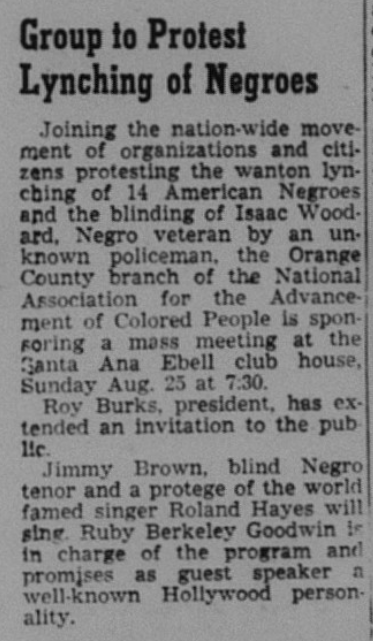
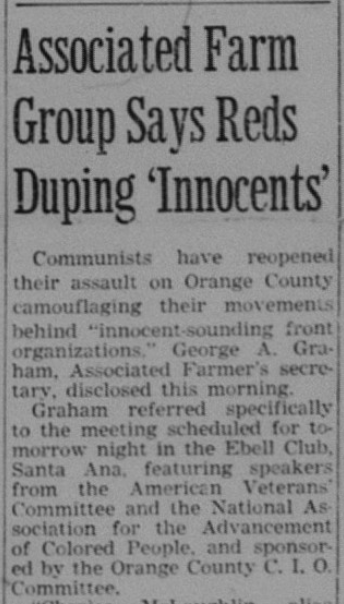
“Communists have reopened their assault on Orange County camouflaging their movements behind “innocent-sounding front organizations,” George A. Graham, Associated Farmer’s secretary, disclosed this morning,” the News-Tribune reported. “Graham referred specifically to the meeting scheduled for tomorrow night in the Ebell Club, Santa Ana, featuring speakers from the American Veterans’ Committee and the National Association for the Advancement of Colored People, and sponsored by the C.I.O. Committee.”
The NAACP is “notoriously pink,” Graham charged, “and the American Veterans’ Committee also is regarded with suspicion because of certain definite left-wing tendencies.”
Graham aid his organization which “combats and exposes subversive activities,” is principally interested in “protecting citizens from smearing their own reputations by innocently associating with Communist groups.”
As can be seen, there was real opposition to civil rights progress at this time. It should be noted that Martin Luther King Jr. was smeared as a communist by his opponents. In the context of the Cold War, it was an effective (if dishonest) tactic.
Politics
In local political news, Homer Bemis and Irvin C. Chapman (son of Fullerton’s first mayor and powerful citrus grower Charles C. Chapman) were elected to city council in 1946.
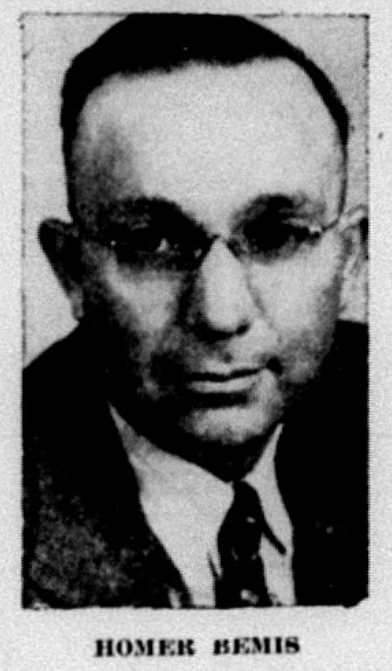
Bemis was “engaged in real estate, building, brokerage, and development,” according to the News-Tribune. “In the past four years he has been actively engaged in the construction of homes, having built more than 100 homes within this period, with his associates.”
Chapman, of course, helped manage the citrus and business empire his father built.

Local drug store owner Verne Wilkinson was chosen as mayor.
In other political news, James Musick was elected as Orange County Sheriff, and Sam Collins (who had previously served in Congress) was elected to represent Fullerton (and surrounding areas) in the State Assembly.

Sports
In sports news, local professional teams would train and play games at Amerige Park.


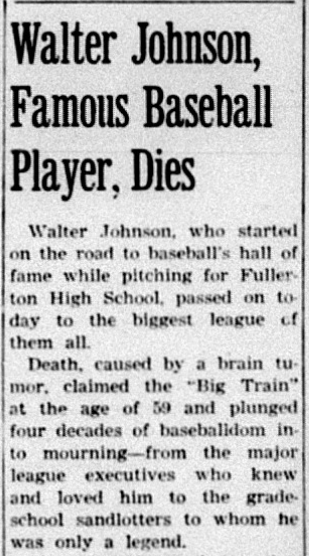
Local baseball legend Walter Johnson died.
Culture and Entertainment
For culture and entertainment, Fullertonians went to see movies at the Fox Theater.

Bowling was also popular downtown.

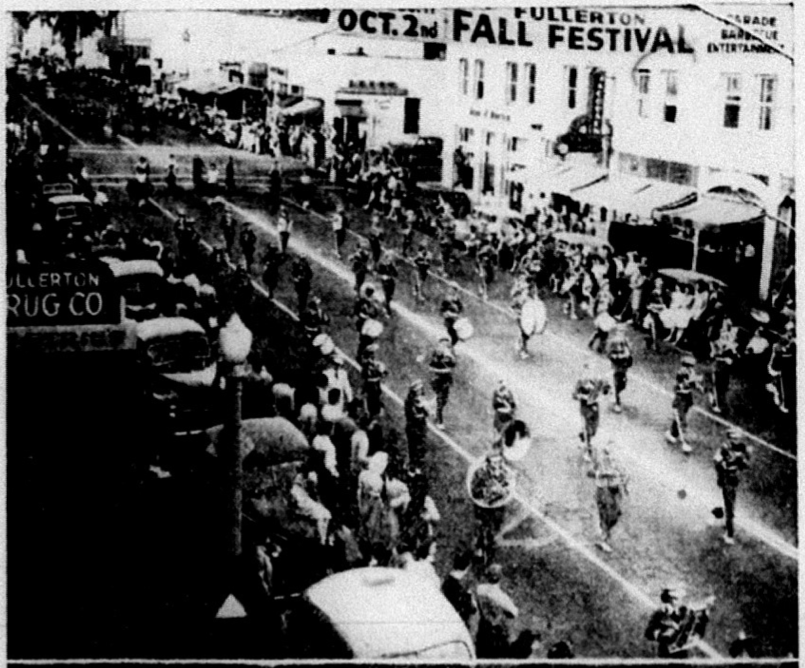
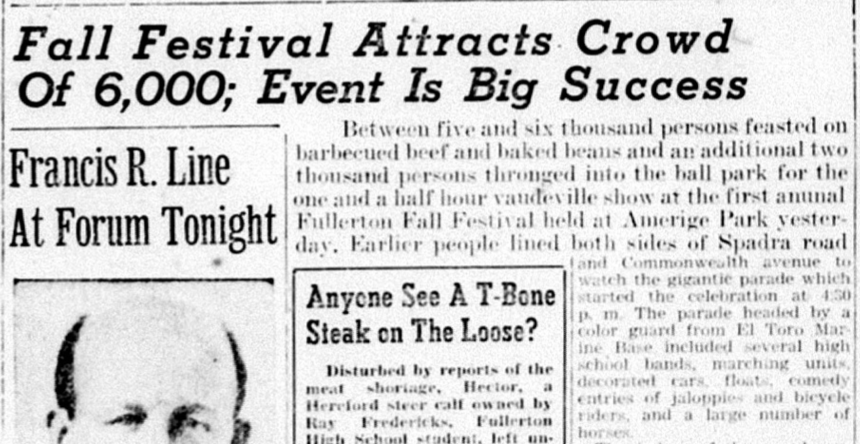
Fullerton hosted a Fall Festival that drew thousands.
Accidents and Tragedies
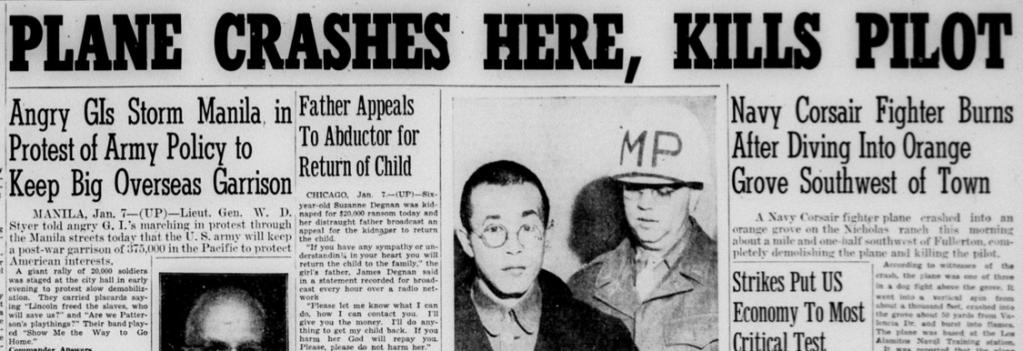
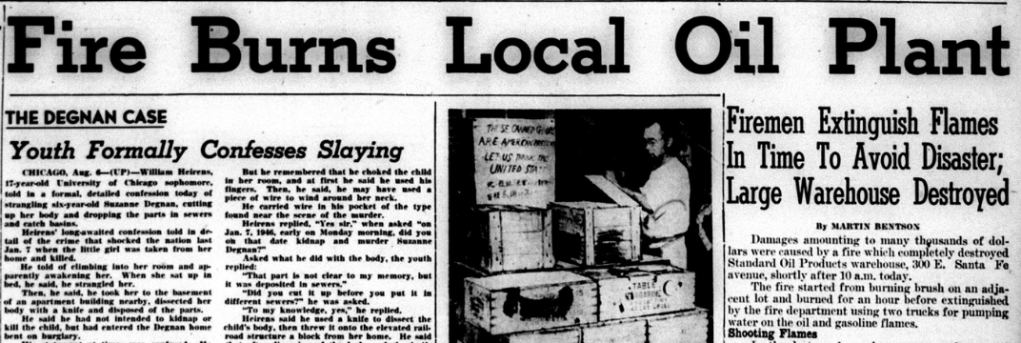
Below are some local accidents and tragedies that occurred in Fullerton in 1946:
There appears a story about oil waste dumping by an E.A. McColl of Long Beach in Fullerton. Decades later, this would be determined to be a Superfund Site–a site of large-scale toxic pollution.

Deaths
Local baseball legend Walter Johnson died.
Harry Lee Wilber, Fullerton’s beloved “Man About Town” columnist and managing editor of the News-Tribune, died.

Wilbur began his career as a journalist in Denver, then moved to Los Angeles where he worked for the LA Times. In 1917, he moved to Fullerton and switched careers by opening the Rialto Theater, Fullerton’s first movie theater.
In 1925 he was hired by the Chapman family to manager what became known as the Fox Theater. His daughter Alice had married C. Stanley Chapman.
After he retired from the movie business, he returned to journalism, writing a popular column in the News-Tribune called “Man About Town.”
“Harry Lee was more than just a columnist,” the News-Tribune reported. “He was a brilliant desk man, who could take a story, put a lively twist to it, write a sparkling headline, and present it to the reader in an interesting manner. He usually wrote his daily column between breaks in his laborious editing routine.”

Dr. Frank Gobar, who practiced in Fullerton from 1906 to 1939, died.
“Dr. Gobar saw Fullerton grow from a village with two dirt roads intersecting at Spadra and Commonwealth avenues to a ‘modern city’,” the News-Tribune reported. “Many of the babies he brought into this world are now grown and active in civic and community affairs here.”
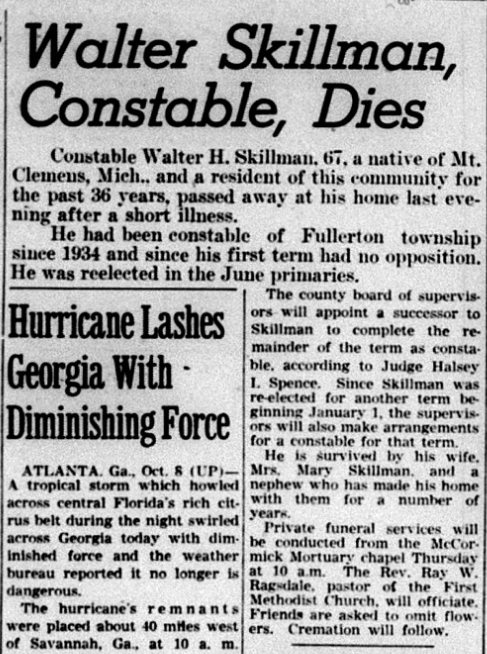
Local constable Walter Skillman died.
Early settler Bernard Arroues, a notable Basque immigrant, died.

Miscellaneous
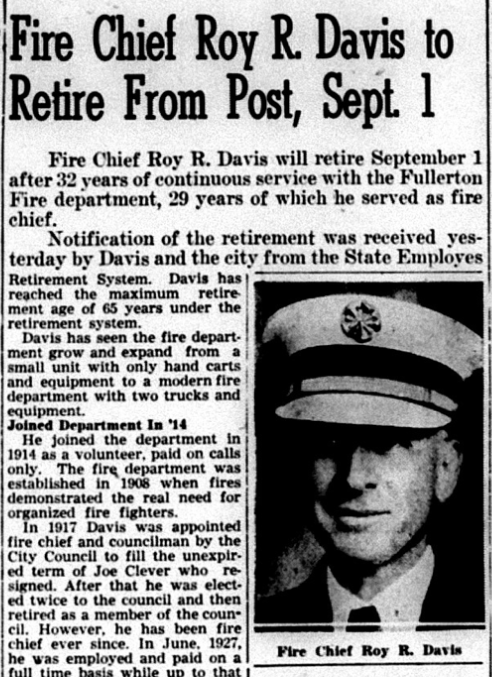
Long time Fullerton Fire Chief Roy R. Davis retired 32 years of service with the Fullerton Fire Department.
Here’s a brief history of the Fullerton Fire Department and Davis’ tenure there:
He joined the department in 1914 as a volunteer, paid on calls only. The fire department was established in 1908 when fires demonstrated the real need for organized fire fighters.
In 1917 Davis was appointed fire chief and councilman by the City Council to fill the unexpired term of Joe Clever who resigned. After that he was elected twice to the council and then retired as a member of the council. However, he has been fire chief ever since. In June 1927, he was employed and paid on a full time basis while up to that time he had only been paid on calls.
The fire department sponsored a bond issue drive in 1914 for $5000 to puchrase a modern fire truck. The issue carried and the truck was ordered and arrived early in 1915.
After the fire department purchased the first truck it was housed in the Albert Sitton garage where the Volk & Wiese store is now located. Later the department was housed where the McMahon Furniture company is now and then moved to 127 W. Amerige avenue before moving to its present location on 123 W. Wilshire avenue. The present fire hall was built in 1926, part of which was used by the city officials and served as a temporary city hall.
In July 1924 the second fire truck was purchased. Both trucks are still in operation.
Davis first made a trip to Pasadena and Orange in June, 1909. He was married at Pasadena in August 1909, and he and his wife took a trip to Seattle and took the norther route to Nebraska, their former home.
In March 1910, they came to Fullerton and settled here. His foiks also came out here at that time. His father W.R. Davis, and brother-in-law C.S. Orton, built the Fullerton Ice company which is now the Crystal Ice company under different ownership. Davis was associated with his father in the ice business.
Charles O. Potter was named the new Fire Chief.

Stay tuned for top stories from 1947!
 Fullerton History