
Yesterday morning, I attended a walking tour of some historic sites in Fullerton given by Gustavo Arellano and Elaine Lewinnek, co-authors of the book A People’s Guide to Orange County. This book focuses on telling stories of people and places that have often been overlooked in more traditional or “nostalgic” local histories–stories of immigrants, people of color, punks, the homeless, farmworkers, and more. As Elaine put it, “We are interested in the stories of people who don’t have streets named after them.”
I share their interest in these overlooked, sometimes uncomfortable, but also inspiring stories because if we truly want to learn from the past, we must face it with all its complexity.
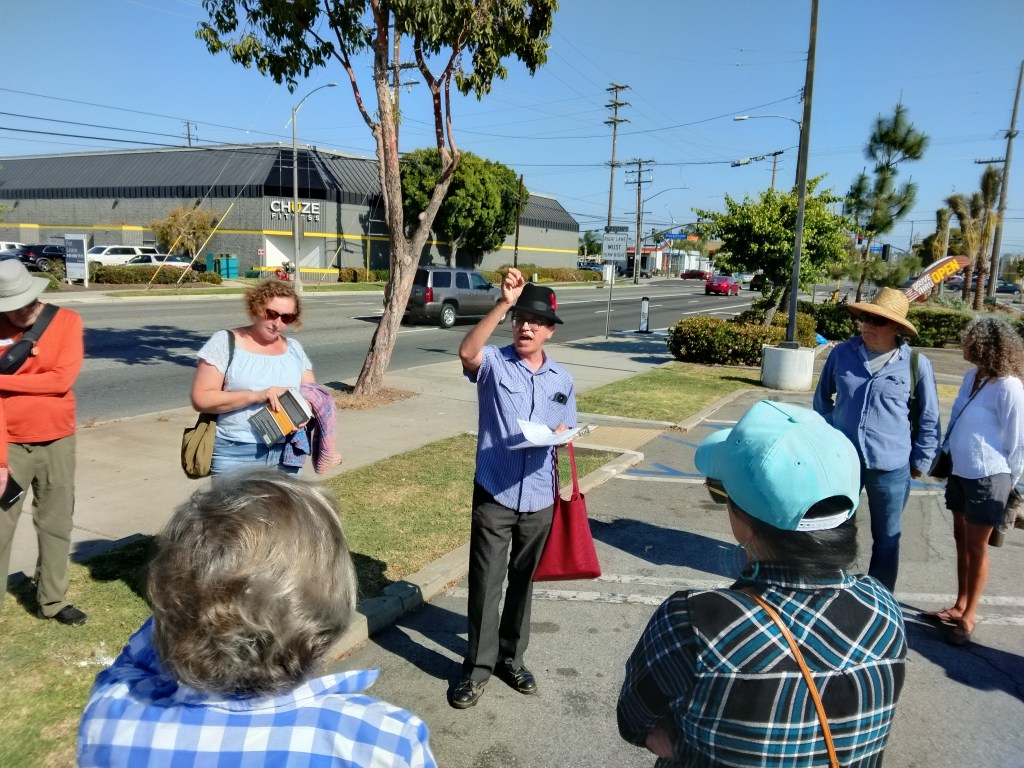
We began our tour at an unlikely spot–the parking lot of Sonic Burger on Lemon, near the Wal-Mart. Like much of Orange County, this used to be an orange grove. It was here, Arellano explained, that in 1953 an Anaheim police officer shot an undocumented immigrant named Juan Pena Diaz in the back after a high speed chase.
Little attention was paid to the story at the time, with the local newspaper referring to Diaz as a “wetback” and “alien.” His death was apparently accepted with little more than a shrug, and it was this lack of concern for undocumented immigrants that allowed the Eisenhower administration the following year to implement “Operation Wetback”–one of the largest mass deportations in American history. This story, like many of those in A People’s Guide, felt timely.
Our next stop was Lemon Park, where we learned about a mural painted by Chicano artist Emigdio Vasquez, who was one of Orange County’s most prolific muralists. While many of Vasquez’s murals deal with Mexican American identity, this one is called “Niños del mundo” and shows children of all races and backgrounds smiling and playing. Unfortunately, someone had recently defaced parts of the mural, with a black “X” over the face of a brown-skinned girl wearing a head covering.

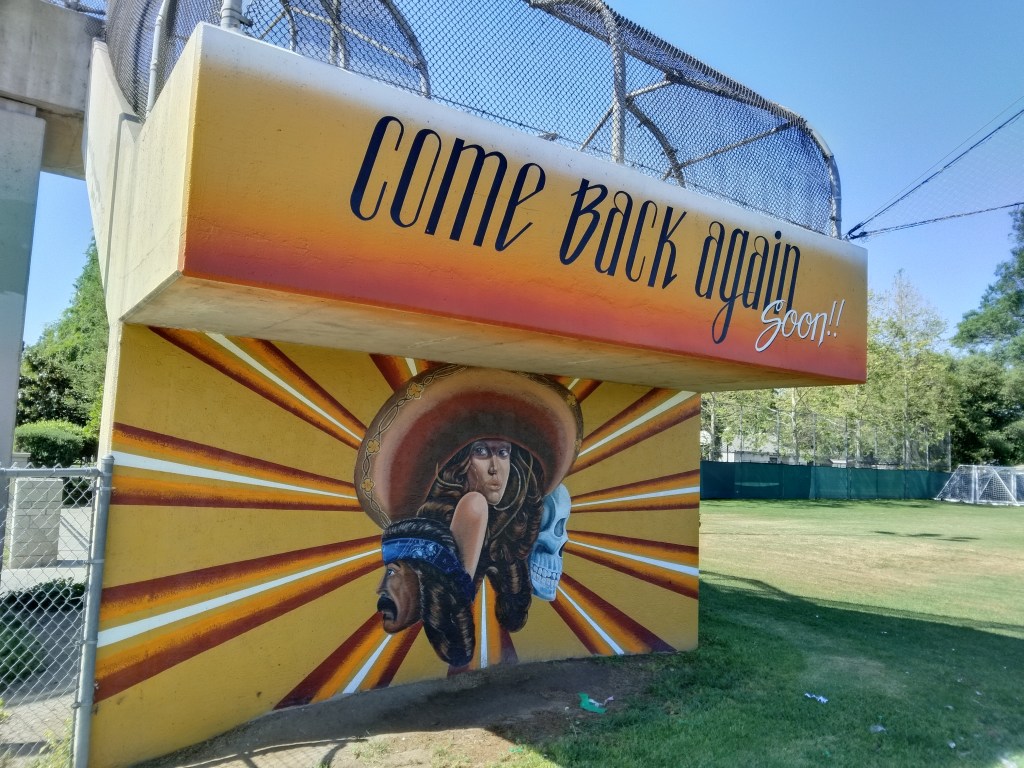
We continued under the Lemon underpass to see another series of murals painted by local youth in the 1970s. Arellano told the story about how, around 2008, then City Councilman Shawn Nelson said that he wanted the murals to be painted over, saying they were gang-related. In fact, the murals (by then faded but much beloved by the community) were painted as a gang prevention program. More recently, some of these murals (including “The Town I Live In” lowrider car mural and the Girl with a Hat urging visitors to “Come Back Again Soon”) have been restored thanks to the fundraising efforts of City Councilmember Ahmad Zahra.
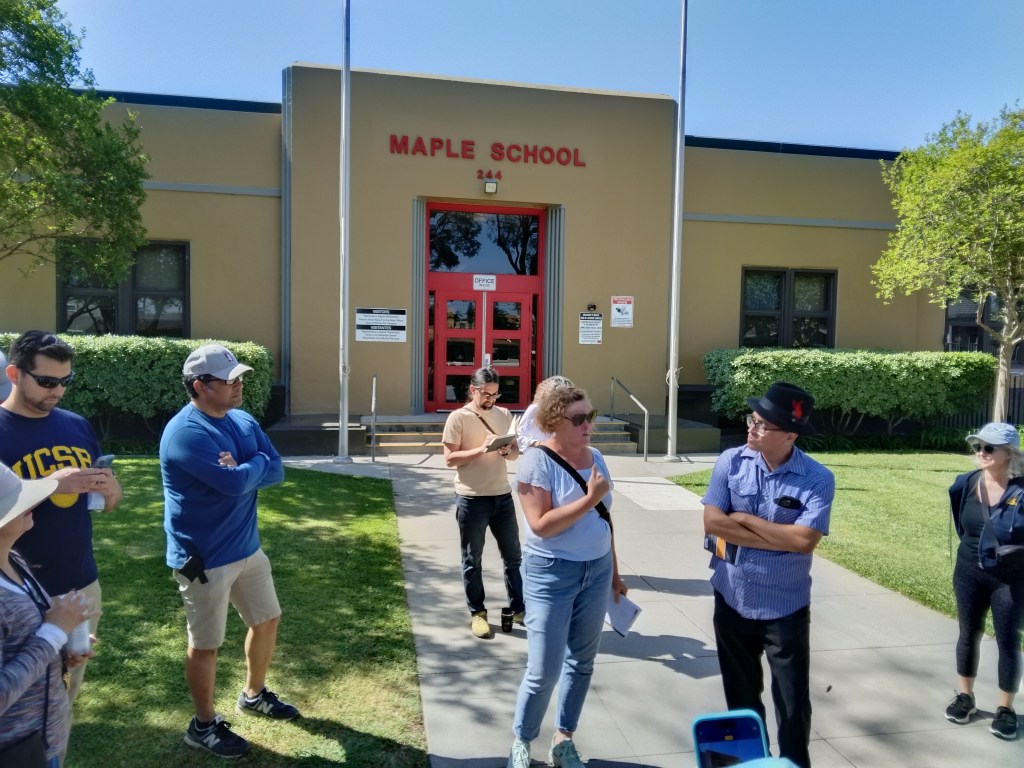
Our next stop was Maple Elementary School, where Lewinnek told the story of how this school became a segregated school in the 1950s, and faced legal orders to desegregate in the late 1960s and early 1970s. Rather than integrate via a voluntary two-way busing program, the school board voted to close Maple in 1972–forcing all the kids of the neighborhood to be bussed to other schools in the northern part of the city.
Community members fought back with a lawsuit alleging discrimination, but they lost. Maple would re-open in 1998 after much community involvement. I actually wrote an article about this history, which was published in Citric Acid literary journal. The story fascinates me because it shows that, contrary to popular notions, segregation existed outside of the South–even here in California.
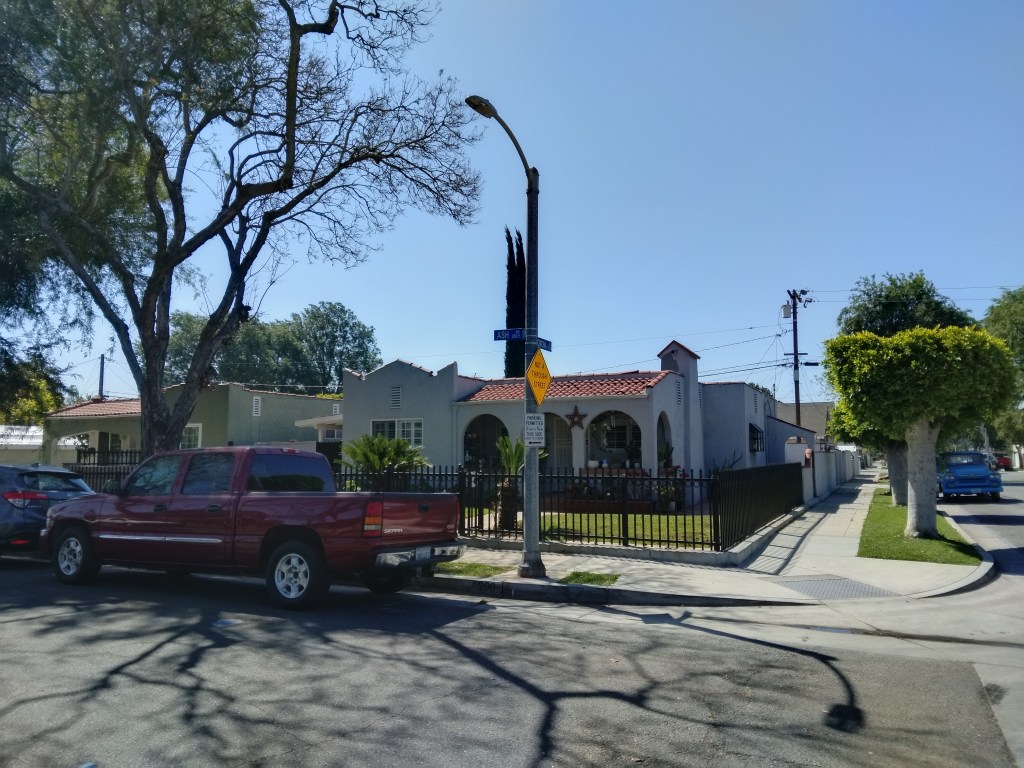
Next we walked to a modest, nondescript house that you would have no idea was the site of a landmark civil rights case in 1943. The house at 200 E. Ash Avenue was purchased by Alex and Esther Bernal, who were Mexican American. At that time, this neighborhood (and most neighborhoods) in Orange County had racially restrictive covenants on the actual property deeds that prevented non-whites from purchasing homes there.
Their white neighbors got a petition going and filed a lawsuit against the Bernals, trying to get them to leave. But with the help of lawyer David Marcus, the Bernals fought back, and won–thus paving the way to make racially restrictive housing covenants illegal. Again, this story shatters the myth that segregation was just a Southern thing.
We made our way north on Harbor toward downtown. We heard a bit about the early 1980s punk scene in Fullerton, about El Pachuco, Fullerton’s unique Zoot Suit store whose owner Vanessa Estrella was on the tour!
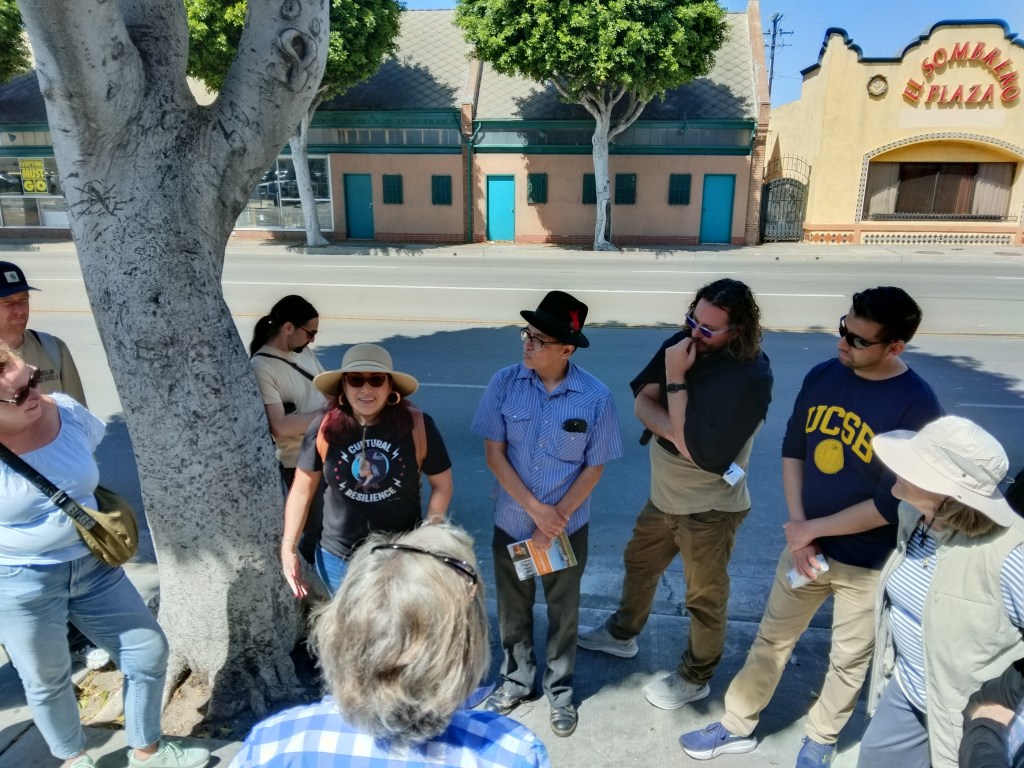
Finally, we reached the Fullerton Transportation Center, where both Lewinnek and Arellano talked about the killing of homeless man Kelly Thomas by the Fullerton police in 2011, about the protests and two cops being charged with murder (and ultimately acquitted). The murder of Kelly Thomas is a black eye on Fullerton, but it also opened up new and important conversations about police brutality and homelessness.
The spot of Thomas’ murder is now known as “Kelly’s Corner” and is decorated with flowers and food for the local homeless who still hang out at the Transportation Center.

Interestingly, near Kelly’s Corner, as Arellano and Lewinnek’s talk was concluding, a man was using a pressure washer to blast off several posters that had been glued to a wall. The posters read “Who Killed Alejandro Campos Rios?” and featured a drawing of a police officer. A quick Google search reveals that Rios was killed by Fullerton police in 2024 outside a McDonalds.

In all, the tour provided excellent information and food for thought. To learn more, check out the book A People’s Guide to Orange County, and follow them on social media to see when they will have more tours and other events!
 Fullerton History