The following is from a work-in-progress about the history of Fullerton. You can support my ongoing research and writing on Patreon.
The Local History Room of the Fullerton Public Library has microfilm from the Fullerton Daily News-Tribune newspaper stretching back to 1893. I am in the process of reading over the microfilm, year by year, to get a sense of what was happening in the town over the years, and creating a mini archive. Below are some news stories from 1941.
The United States Enters World War II
By far, the biggest news story of 1941 was the Japanese attack on Pearl Harbor, and the United States entry into World War II.

In national news, Franklin D. Roosevelt was inaugurated for an unprecedented third term.

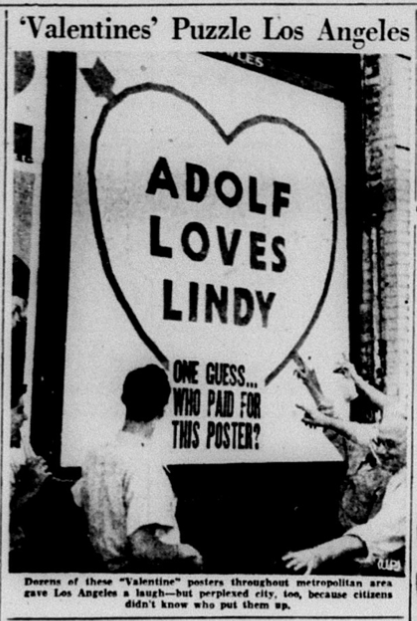
Prior to the United States entry into World War II, there was the first “America First” movement. This was an isolationist movement that wanted the US to stay out of the war, and sometimes flirted with fascism. Charles Lindberg, once a national hero of aviation, was a prominent spokesman of the first “America First” movement, which prompted reactions like this:
War Comes Home
In 1940, the United States had instituted a draft to beef up its military in the event of entry into the war. Some young Fullertonians went off to war.
Locally, Fullerton residents did their part for the war effort by buying defense savings stamps.

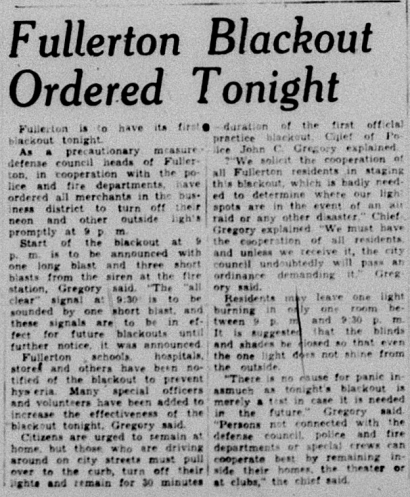
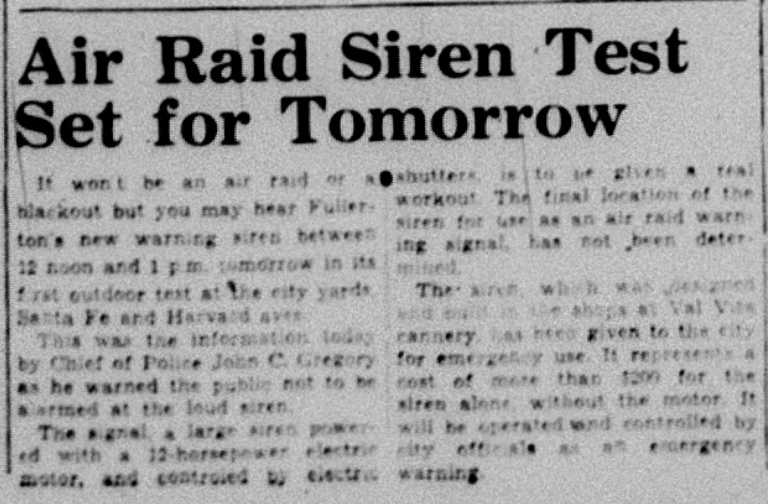
Preparations for blackouts (in the event of an air raid) were made.
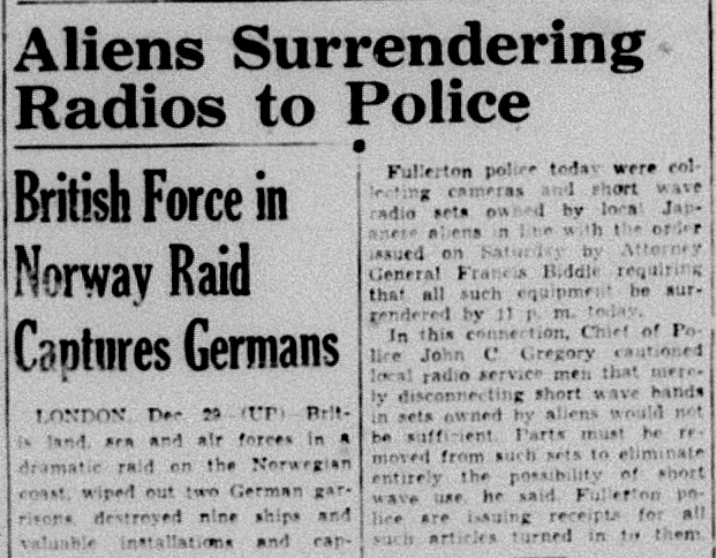
Japanese Internment
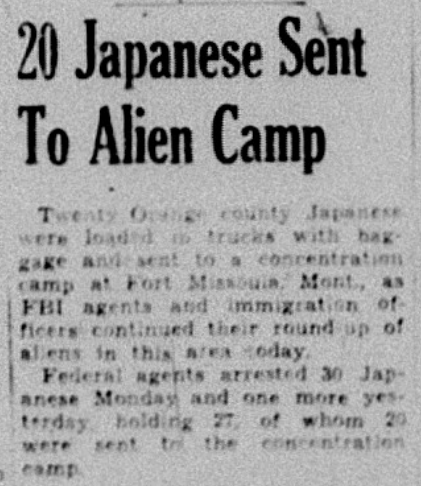
Although president Roosevelt would not sign Executive Order 9066 until 1942, prompting the internment/incarceration of Japanese Americans on the west coast, some Japanese Americans were taken by the FBI and sent to camps in 1941, including some living here in Orange County.

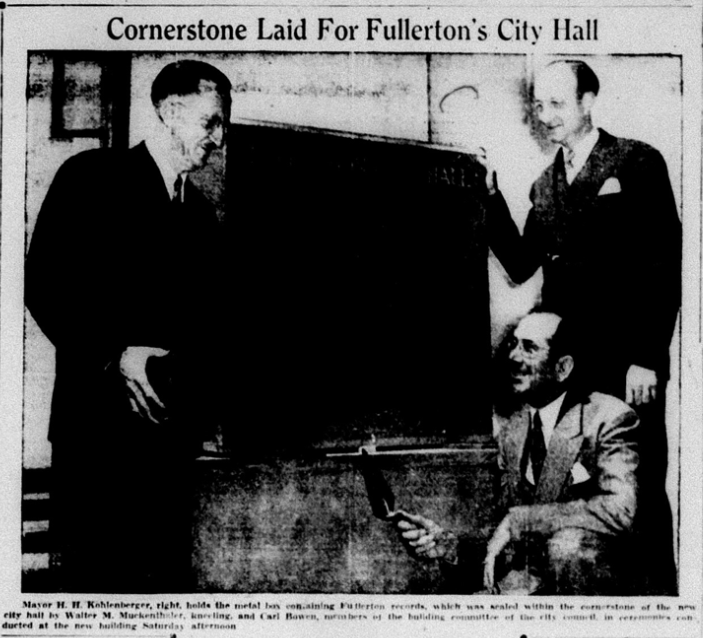
A New City Hall
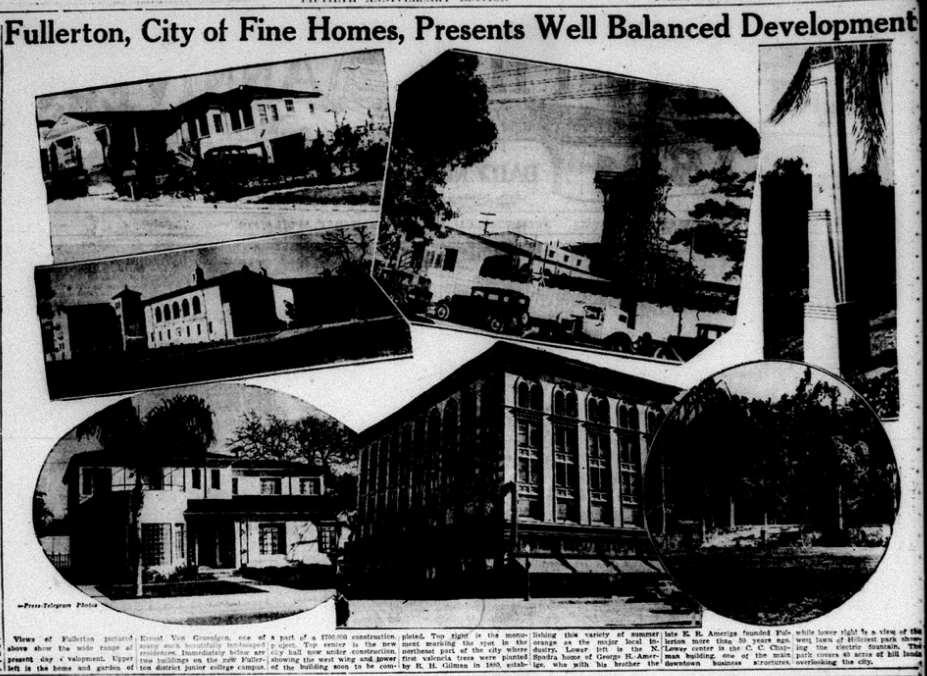
In 1941, Fullerton finally completed construction of City Hall at the corner of Highland and Commonwealth. The building now serves as the police station.

The building was designed by architect by G. Stanley Wilson, and was funded by the WPA, a New Deal federal program.
In addition to housing various city government offices, the building also was home to the Chamber of Commerce, the local welfare department, the police department, and the city jail.
The City Council chambers were also used as a court room for use by the city judge or justice of the peace.
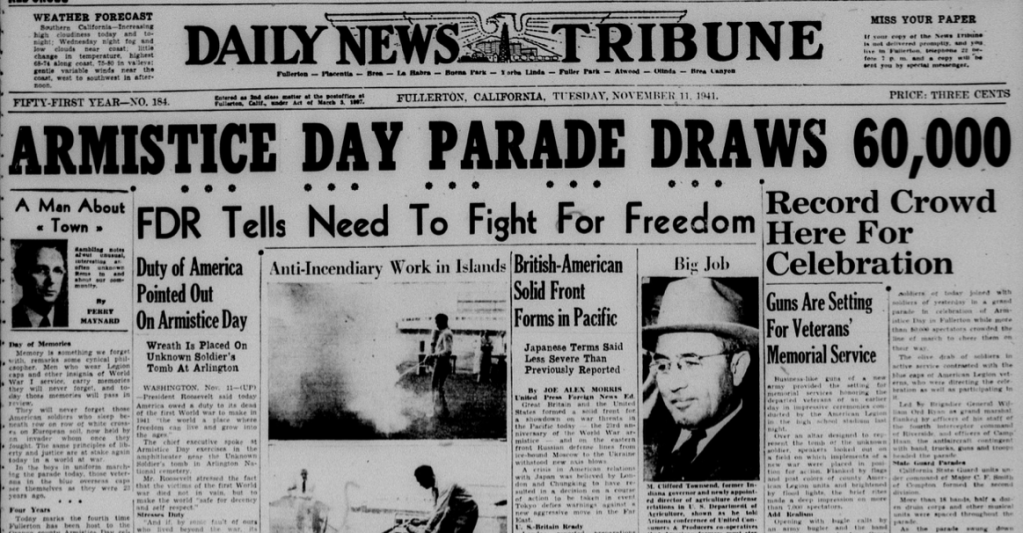
Armistice Day Parade
Fullerton hosted an Armistice Day parade that drew around 60,000 people.
Val Vita
One of Fullerton’s biggest industries in 1941 was Val Vita Foods, located on 35 acres on the west side of town. It was owned by Norton Simon, and would eventually become Hunt Foods.

“Established in 1932 with an annual output of 20,000 cases, Val Vita Food Products, Inc. has grown into the largest cannery west of the Mississippi, and now produces 2,000,000 cases of 50 different products,” the News-Tribune reported.
Val Vita canned all sorts of foods, from tomatoes to orange juice, to spinach.
It was the largest cannery in the west.
With the US entry into World War II, Val Vita got a contract to provide canned goods for the Army.

Interestingly, there were a number of industrial strikes in 1941, including at Val Vita.

As the war went on, strikes were seen as unpatriotic.
Housing
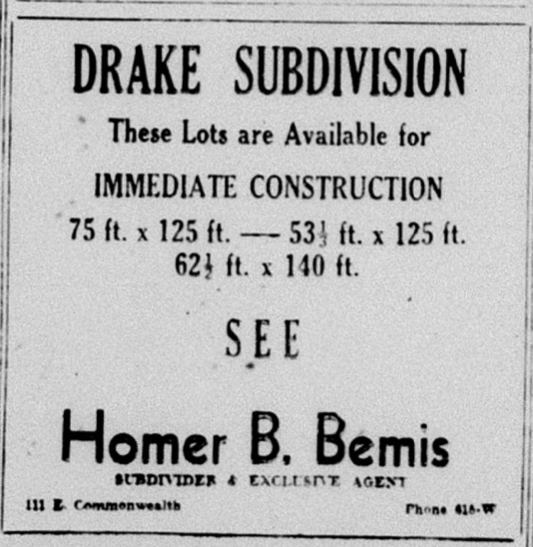
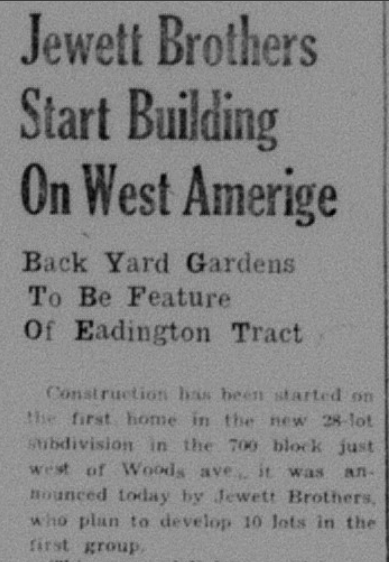
New housing subdivisions continued to be built. Although construction of new housing has slowed somewhat during the Great Depression, housing would explode after the War.
Spring Training at Amerige Park
In 1941, the baseball field at Amerige Park was a popular spot to see professional teams compete in Spring Training games.
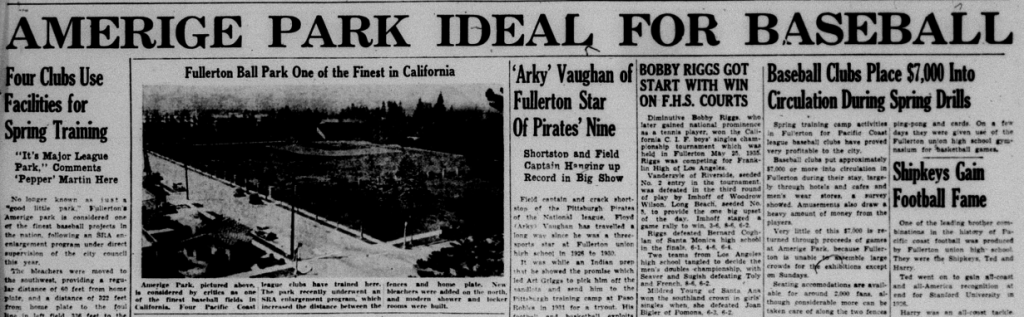
The field was used by the Hollywood Stars, which became the San Diego Padres for two seasons, followed by the Portland Beavers, then the Sacramento Solons.
“You have a major league park here,” Solons manager Pepper Martin told the News-Tribune.
Local teams also used the field, including the Fullerton Firemen.
There is a new book out called Spring Training in Fullerton, which is all about this interesting subject.
Water
Fullerton’s two large dams (the Fullerton Dam and the Brea Dam) were completed in 1941, as part of a larger countywide flood control program.

The dams were built by the U.S. Army Corps of Engineers.
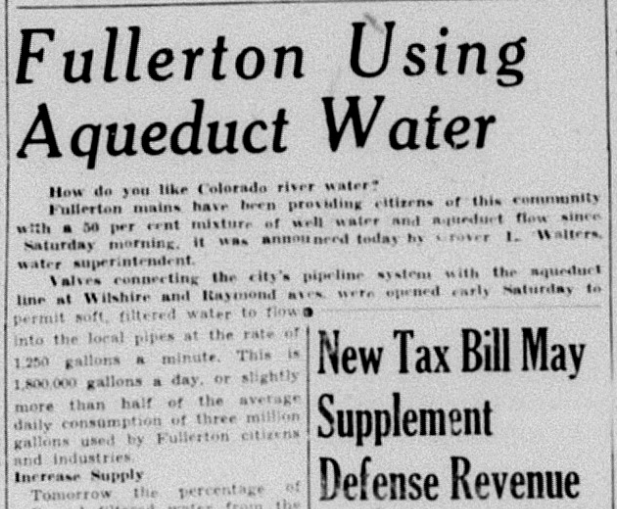
In 1941, Fullerton (being a member of the Metropolitan Water District) began to receive water from the Colorado River, courtesy of the Colorado River Aqueduct.
Death
Pioneer Fullerton pharmacist William Starbuck passed away at age 76.
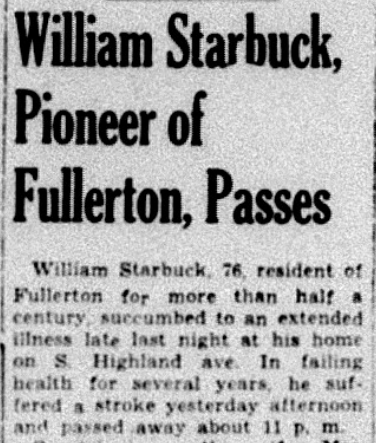
Starbuck opened the first drug store in Fullerton in November of 1888. He also built and operated the first telephone system in town, in his drug store. His Gem Pharmacy also housed Fullerton’s first library.
Starbuck helped to organize the Fullerton high school district, and served as a trustee for 15 years. He also helped organize the first community hospital. He was also allegedly a member of the Ku Klux Klan in the 1920, when the group had a sizable membership among local residents.
One of the Bastanchury sons, Joseph Francis, died.

Pioneer rancher Benjamin Franklin Porter died.

Born in Tennessee in 1849, he came to the area that would become Fullerton before the town was founded, settling in what became known as the Orangethorpe district.
In addition to ranching, he served for many years as a road engineer, having surveyed and built many of the main roads in the county.
He helped organize the California Walnut Growers Association, serving as a charter member of the board of directors for 25 years. He also served as president of the local walnut association.
He also helped to organize the Anaheim Union Water company, a precursor to the Orange County Water District, serving for many years as a director.
He too was instrumental in forming the Fullerton union high school district, serving on the board. He was also a director of the Security First national Trust and Savings Bank, Fullerton branch.
He and his wife Mary had 12 children, 19 grandchildren and 16 great grandchildren.
He is buried in Loma Vista cemetery.
Long recognized as Fullerton’s oldest resident, “Uncle WIllie” Addams died at the ripe old age of 103.
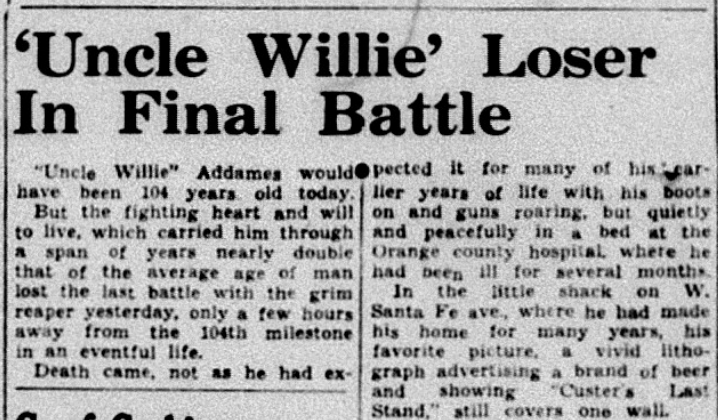
He lived in a little shack on W. Santa Fe ave,
According to the News-Tribune, “Little is known of Uncle Willie’s past, except that which he chose to tell.” And he told a lot of tales.
He said he was born on a sailing vessel owned and operated by his parents out of New York while it was anchored in the West Indies.
“In his earlier days he followed the sea and in 1852 made a trip by sailing vessel around Cape Horn to San Francisco…On this trip he made a journey by horseback through much of California…While in New Orleans as а young man, with his ship stranded, he was persuaded to join the Confederate army during the civil war and was wounded by a rifle ball in the Battle of Lookout Mountain. After the war, he came out west and joined Indian scouts. He spoke in familiar terms of Jim Bridger, famous Indian scout, of Wild Bill Hickok, Wyatt Earp and other famous characters of the early west, but his favorite of all was the notorious Billy the Kid…Uncle Willie told often the story of being with the scouts and troops who arrived too late Ito aid General Custer and found only massacre left by the Siouх at Little Big Horn.
Whether any of this is true or not, who knows, but what a story!
Funeral director Angus McAulay passed away at age 55.
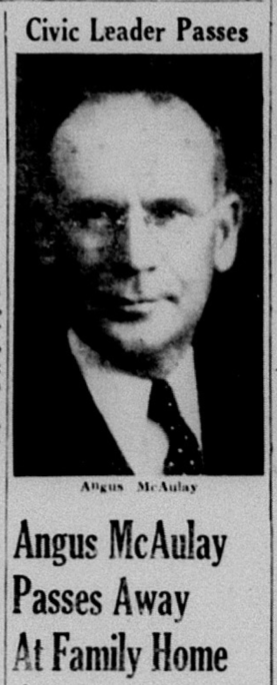
He came to Fullerton in 1914 to establish a funeral business–which still exists today–McAulay & Wallace.
Stay tuned for top news stories from 1942.
 Fullerton History