The following is from a work-in-progress about the history of Fullerton. You can support my ongoing research and writing on Patreon.
The Local History Room of the Fullerton Public Library has microfilm from the Fullerton Daily News-Tribune newspaper stretching back to 1893. I am in the process of reading over the microfilm, year by year, to get a sense of what was happening in the town over the years, and creating a mini archive. Below are some news stories from 1937.
National and International News
Fascism continued to gain strength in Europe, mostly in Germany (under Adolf Hitler) and Italy (under Benito Mussolini), threatening democratic countries.

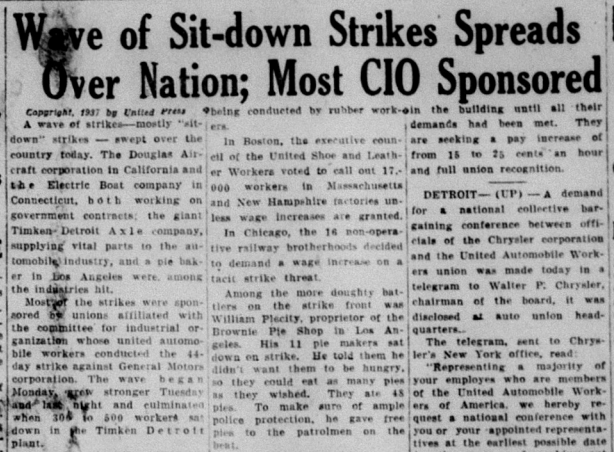
In the midst of the Great Depression, a major wave of labor strikes occurred throughout the country.
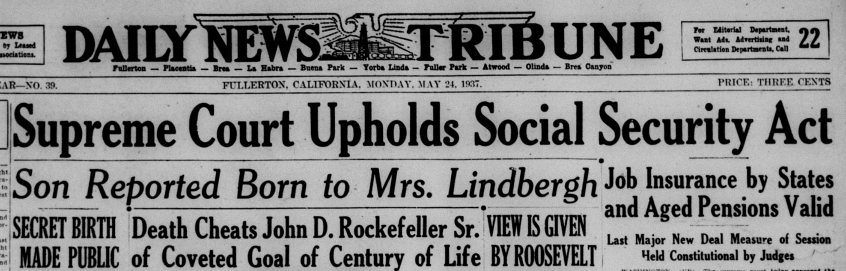
The US Supreme Court upheld the constitutionality of the Social Security Act.
Depression Relief Efforts
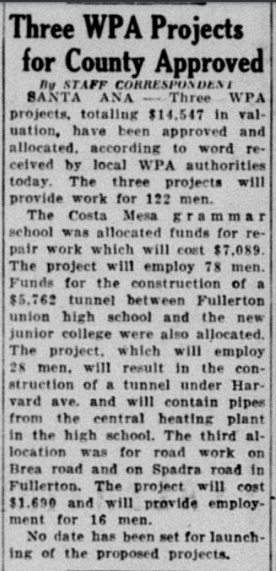
The Great Depression was still in effect. Federal relief programs like the Works Progress Administration (WPA) gave public works jobs to unemployed locals. One such project in 1937 was construction of the famous underground tunnels connecting Fullerton High School and Fullerton College. To learn more about all the WPA projects that benefited Fullerton, check out my article HERE.
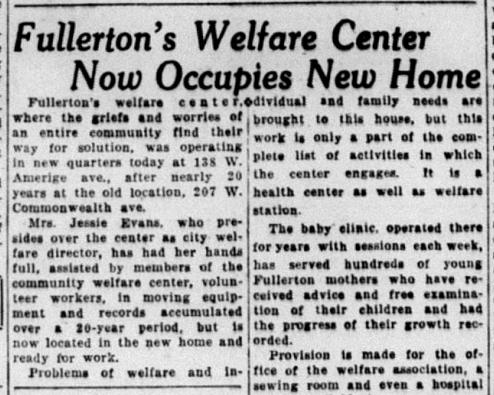
Fullerton also established a new Welfare Center to assist the poor and unemployed.
Local Politics
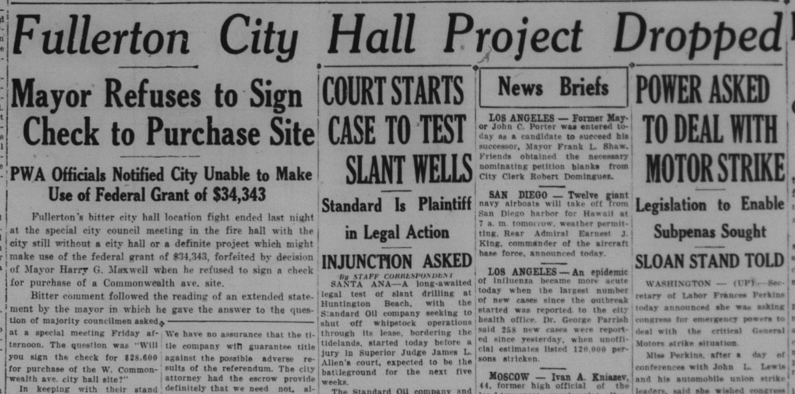
Disputes over the location of a new Fullerton City Hall led to Council dropping the proposal (for now).
The first woman, Sidney Chapman, was elected to the High School Board of Trustees.

Arts & Culture
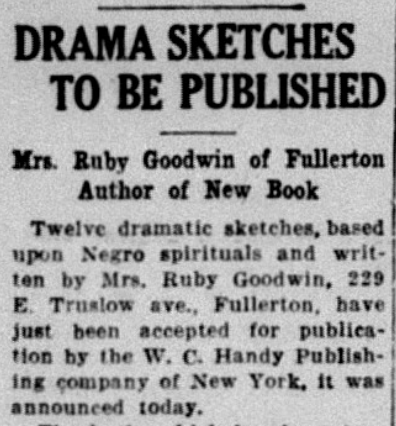
African American Fullerton author Ruby Berkley Goodwin published a book of dramatic sketches based upon Negro spirituals, in collaboration with composer William Grant Still, whose “Afro-American Symphony” was the first to be published by an African American.
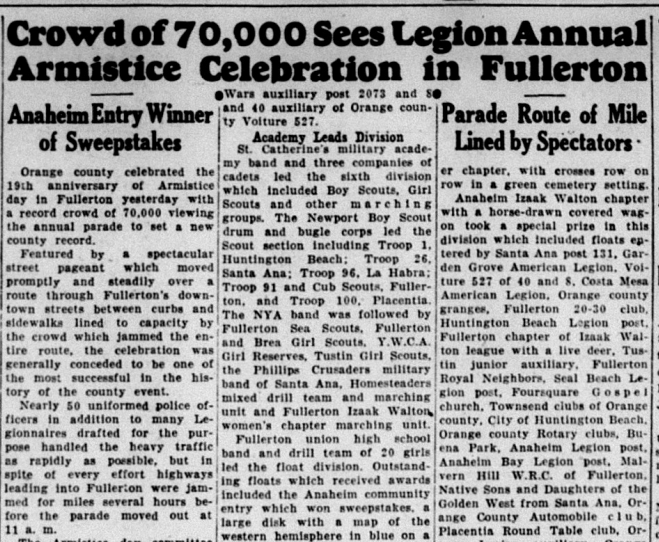
70,000 visitors came to see a massive Armistice Day parade through downtown Fullerton.
Agriculture
A cold spell led to frost that damaged the city’s citrus crop.

Maria Bastanchury, widow of pioneer rancher Domingo Bastanchury, was in a legal battle with the Times Mirror Company, over a mortgage on the sprawling ranch, which had gone into receivership and possible bankruptcy.

Flood Control
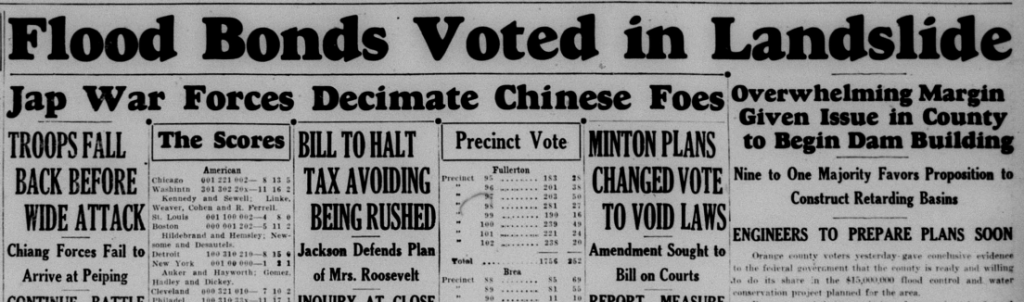
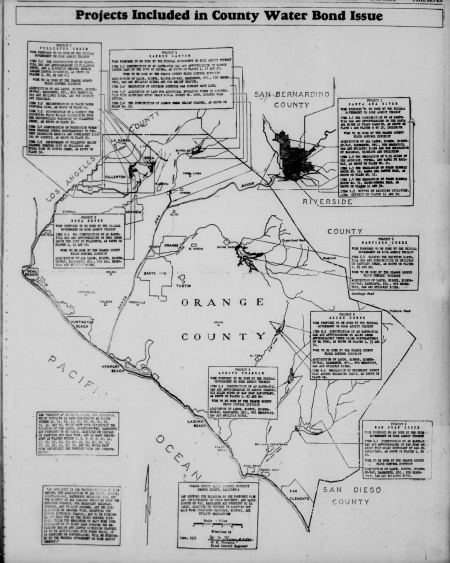
Another flood led to yet another attempt to pass a countywide flood control bond, which voters hard turned down at least twice.
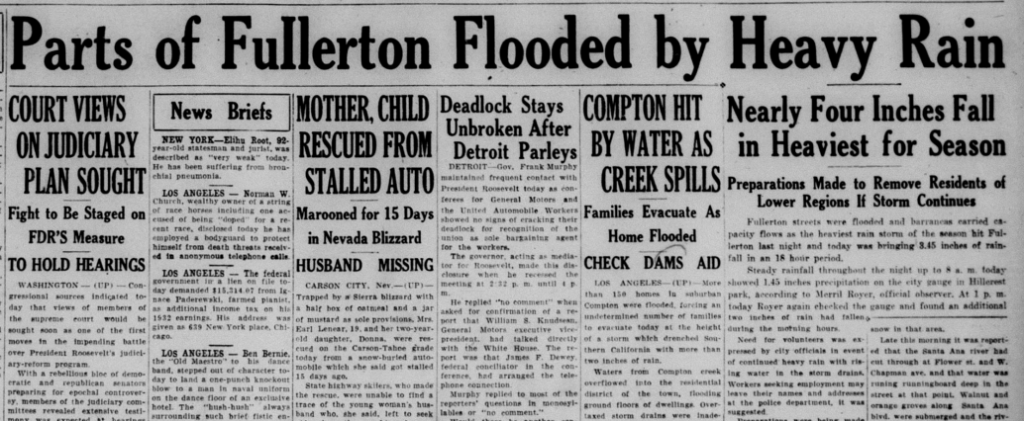
This time the bond issue finally did pass. Plans were drawn to erect dams and channelize flood control channels, including Brea and Fullerton Creeks. But was it too late? The 1938 flood was coming. Would the dams be built in time? Would they be enough? Stay tuned!
Labor Strikes
Workers in the Mississippie Glass Plant in Fullerton went on strike, demanding better pay and working conditions.
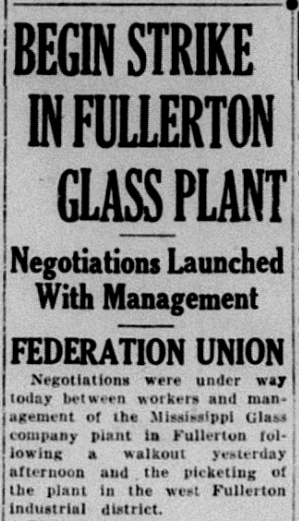
Eventually an agreement was reached with management, ending the strike.
Sports
Baseball games at Commonwealth (now Amerige) Park were hugely popular. The Portland Beavers did their spring training there.

City Celebrates 50 Years
Fullerton celebrated its 50-year anniversary with a huge three-day program, including “a colorful historical pageant including a cast of approximately 1,000 residents” which took place in the FUHS stadium and auditorium.
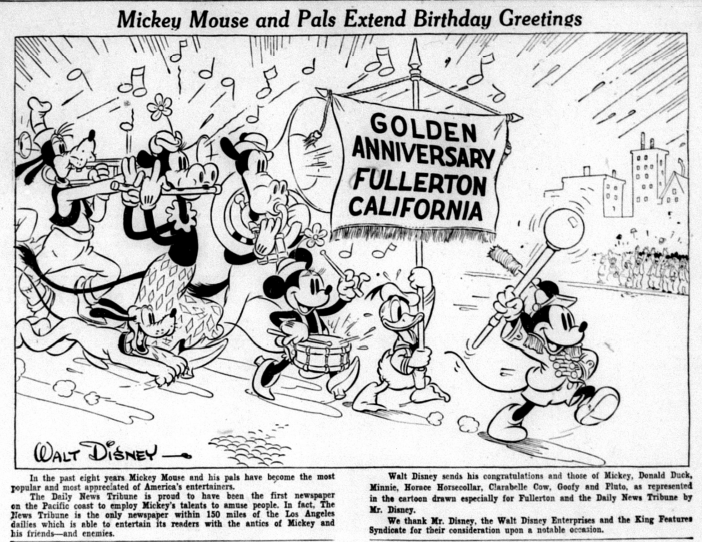

In addition to the pageant and baseball games, there was a coronation ball for the Golden Jubilee queen and “Miss Columbia,” Pearl McAulay Phillips and Mary Catherine Morgan.
The pageant, called “Conquest of the Years” featured scenes from local history, from Native Americans to the expedition of Don Gaspar de Portola, Spanish/Mexican hacienda days, Basque sheepherders, the appearance of town founders the Amerige brothers, to the first buildings, schools, and churches built.
“Conquest” feels like an appropriate sentiment for how Americans at this time saw their place in history. They were the latest proud beneficiaries of a series of conquests. Today, some Americans view this aspect of our history with ambivalence, perhaps not wanting to highlight the “conquest” part. But that is, unfortunately, the best way to describe how we came into possession of so much land, which had other owners before us.
A special 60-page issue of the News-Tribune featured several in-depth articles about the City’s history.

Deaths
Dallison “Dolly” Linebarger, a resident of Fullerton for nearly 40 years, died at his home at 333 E. Amerige ave.
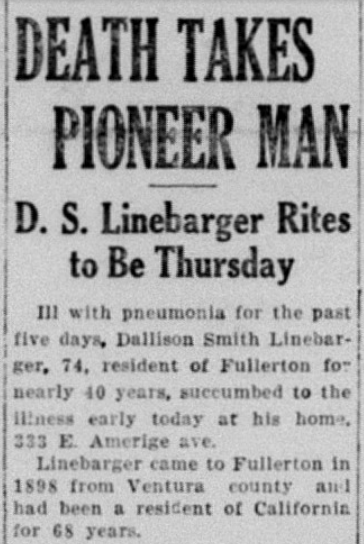
Linebarger came to Fullerton in 1898 from Ventura county and opened a livery stable. He was the first county supervisor from Fullerton, a position he held for 10 years. He was a founding member of Fullerton Odd Fellows lodge.

Joseph P. Des Granges died at age 80 from suicide.
Joseph’s father Otto des Granges, a native of Prussia, came to Fullerton in 1873, before the town was founded, and purchased 80 acres of land bounded by what is now State College and Acacia Avenue on the east and west and by Chapman Avenue and Commonwealth Avenue on the north and south. The property was devoted first to general farming and later to walnut and orange production.
Joseph was instrumental in setting up Anaheim’s modern electric light system, and setting up a grist mill in that town. He was considered an authority on weather conditions.
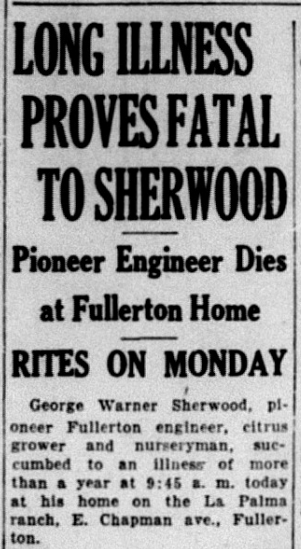
George W. Sherwood, pioneer Fullerton engineer and citrus grower, died.
Born in New York in 1862, Sherwood embarked on a storied career after graduating from college–as a railroad engineer in Oregon, teacher in Hawaii, engineer for the Nicaragua Canal Construction company, among other interesting posts.
He moved to California in 1891, by way of Panama, and acquired citrus and walnut properties in Fullerton, where he lived until his death.
Sherwood was a director and engineer of the Anaheim Union Water company for 20 years before resigning in 1920. He was a member of several societies, including the American Society of Civil Engineers, the Tri-counties Reforestation committee, and was a charter member of the prestigious Jonathan club of Los Angeles.
Stay tuned for more news from 1938!
 Fullerton History