The following is from a work-in-progress about the history of Fullerton. You can support my ongoing research and writing on Patreon.
In 1937, Fullerton celebrated its “Golden Jubilee” 50th anniversary with a three-day event featuring a massive historical pageant play, displays of historical artifacts and photos, and other social events. The Fullerton News-Tribune (which usually ran about eight pages), released a massive 60-page edition featuring an impressive array of articles profiling notable local figures and institutions. One of those articles was written by 82-year-old George Amerige, co-founder of Fullerton. Here is Amerige’s article, along with some historic photos courtesy of the Fullerton Public Library.
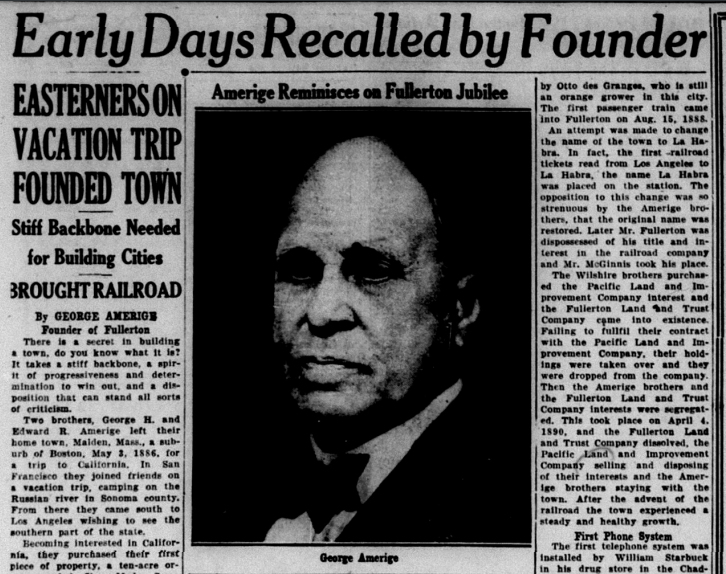
There is a secret in building a town, do you know what it is? It takes a stiff backbone, a spirit of progressiveness and determination to win out, and a disposition that can stand all sorts of criticism.
Two brothers, George H. and Edward R. Amerige left their home town, Malden, Mass, a suburb of Boston, May 3, 1886, for a trip to California. In San Francisco they joined friends on a vacation trip, camping on the Russian River in Sonoma county. From there they came south to Los Angeles wishing to see the southern part of the state.
Becoming interested in California, they purchased their first piece of property, a ten-acre orange ranch in Sierra Madre. Some friends form the east visited them there and persuaded them to rent this ranch home for the winter. The Amerige brothers then came to the coast for the duck shooting, which they had been informed was good. They made their headquarters at the Planters hotel in Anaheim, going down into the Westminster marshes to hunt.
Decided to Stay
This visit to the coast convinced them of the possibilities of this section of the country, so they went back to Sierra Madre, sold their ranch, and with their horses and bird dogs came back to Anaheim to stay, establishing a real estate office in the Albers building.
Driving out from Anaheim in all directions to shoot quail and dove, they became interested in what is now the Fullerton district, and conceived and formulated a plan to start a town, thinking here, of all they places they had examined, would be the location for a successful and permanent municipality.
They negotiated for 390 acres of land from the Miles brothers, bought 20 actress from Joseph Franz, to square out the townsite they had in mind. When they learned that the California Central Railroad company, a subsidiary of the Santa Fe railroad, would soon build a line from Los Angeles to San Diego, passing through Orange County, then a part of Los Angeles county, the Amerige brothers waited on George H. Fullerton who, at that time, was president of the Pacific Land and Improvement Company and also the “right-of-way” man for the railroad, who informed them that several surveys had been made, but none of them would take in their tract of land. By offering him a right-of-way thorough their land and an interest in the town-site, they prevailed upon him to change the survey to bring the railroad through their land and south into Anaheim.
May 14, 1887
Upon receipt of all deeds and titles to their land on May 14, 1887, they proceeded to form a closed stock company, consisting of the Amerge brothers, the Pacific Land and Improvement Company and the Wilshire brothers, who paid a bonus to come into the company. Up to this time much of the land had been rented by the Amerige brothers to a Frenchman named Morat for sheep grazing.

The services of Frank Olmstead of Los Angeles were obtained to survey and plat the town-site. On July 5, 1887, the first stake was driven in a field of mustard at what is now the northeast corner of Commonwealth ave. and Spadra rd, in Hotel Block 21 by Edward R. Amerige. The building of the town and the selling of lots was on. The clearing of the land and grading the streets was done by the Fuller brothers, of the Pioneer Transfer Company, Los Angeles.
Then came discussion of a name for the town. It was urged that it be called Amerige for the Founders, but they did not wish this and suggested that it be named Fullerton. Then the Amerige brothers named the streets.

Streets Named
Malden ave. and Highland ave. were selected for the town and street on which they were born, Amerige ave. for their family name, Commonwealth ave. for one of the finest avenues in Boston, Harvard for the college, Wilshire for the Wilshire brothers, Truslow for the general ticket agent of the Santa Fe Railroad, Northam ave. for Bob Northam, who at that time was agent for the Stearns Rancho Company, of which the town-site was part and parcel at one time. This avenue was later changed to Chapman. Whiting was named for Dwight Whiting owner of the El Toro Ranch, who was a friend of the brothers.
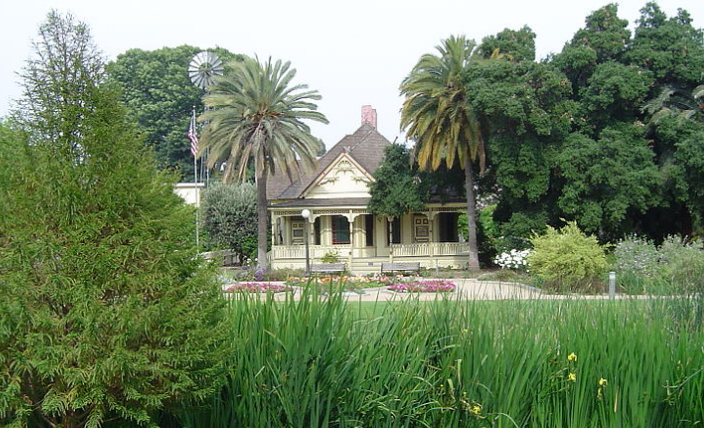
The first building was built by the Amerige brothers, on lot 8 block 29 for an office. Here they lived and transacted all their business of selling lots. This building is now in the Commonwealth city park, placed there by the historical section of the Ebell club.

The first residence was built by George Amerige on lots 1 and 2 block 22, the corner of Amerige and Harvard aves. George Amerige also installed the first water system, employing Chinamen to do the excavation work on the ditches. Hooker Bros. supplied the water pipes and made the connections. The first well was drilled by Padderatz Bros. on Block 7 on Sept 26, 1887. The first water was raised by an old-fashioned hot air engine and later by a windmill.
First Building
The first building of any importance was the St. George Hotel, built in Hotel Block 21. This block has never been surveyed into lots. The hotel consisted of 65 rooms, construction of which was started Aug. 20, 1887, and finished Feb 28, 1888. The architects were Calkin and Haas and the contractor W.H. McKillian. The building alone cost $54,000 and the furnishings $15,000. The lumber was bought through W.T. Brown, who at that time was agent for the Griffith Lumber Company of Anaheim. Brown later established a lumber yard and planing mill in Fullerton which is now known as the Brown and Dauser Lumber Company.

The first managers of the hotel were the Laidigs. They came from the Yosemite valley to Anaheim where George Amerige met them with a bus, as their family consisted of eleven children and two dogs.
The building owned by the Amerige brothers was sold in 1918 by George Amerige to the Whiting-Meade Wrecking Company for $1,300 and was razed to make room for business blocks which he later built.
Beazley Postmaster
The next building was built by H. Gaylord Wilshire on lots 25 and 26–at the corner of Commonwealth ave. and Spadra rd. Here the first grocery store was opened by Howell and Ford. This was also where the first postoffice was located with E.E. Beazley as the first postmaster. This was afterward the home of the first general department store, established by Stern and Goodman, who bought out the grocery store.

The next building was put up by Shindler, Schumacher and Grimshaw on lots 22, 23, and 24 block 28. These lots were given to them with the understanding they would build on them. Here the first drug store was established by William Starbuck, the first meat market by G.A. Brunswicker, and the first furniture store and undertaking parlor by a Mr. Brown.
In the second story of this building was held the first religious services, and a church organized with thirteen members, by Rev. F.R. Holcomb. He also officiated at the first wedding in town.
Chadbourne Block
The next building to be built was the Chadbourne block on lots 1,2,3 and 4 in block 20. These lots were also given with the understanding that buildings were to be put up on them. The contractor left town in the night with the buildings unfinished and hills unpaid, so George Amerige, who was bondsman for him, paid the bills and finished the building. This building was built for stores and a bank, with a public hall in the second story, and later became the home of the first bank established in Fullerton, which came into existence largely through the efforts of E.R. Amerige.
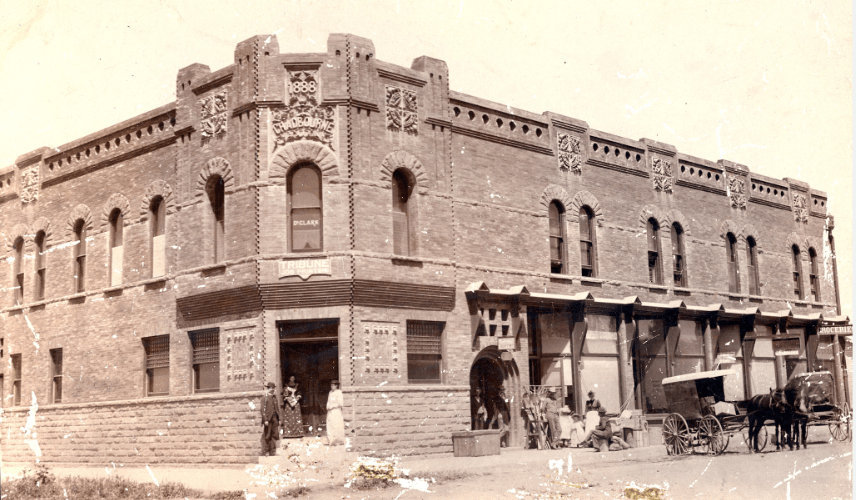
The first lumber yard to come to Fullerton was the Russel Lumber Company.
Canning Factory
In March 1888, a canning factory was built and operated by the Joslyn brothers.
The first livery stable was established by Jonathon Kraemer, in February, 1888, who was also building a cottage at the time. This was a very necessary asset to a town, as these were the “horse and buggy days” and the railroad had not yet reached Fullerton.

The first school was held in a little old wooden building on W. Commonwealth ave. in block 44. The teacher was Edwin Clark, whose daughter Norma was the first girl baby born in Fullerton. Roy Fullerton Schumacher, son of P.A. Schumacher was the first child born in Fullerton, April 7, 1888.
The first grade school was built on E. Wilshire ave. The first church building was erected at the corner of Wilshire and Pomona aves on lot 19-20 block 15 in 1889 with George Irwin as pastor.
The Amerige brothers had the first real estate office and insurance business.
Dr. George C. Clark was the first physician in Fullerton and is still practicing, with an office on Whiting ave.
Street Lighting
The first street lighting system was installed in 1887. It consisted of a wooden lamp post and a coal oil lamp presented by the street lighter of Anaheim to George H. Amerige, who brought it on his shoulder from Anaheim to Fullerton, walking all the way, and he installed it at the southeast corner of Commonwealth ave. and Spadra rd.
The first newspaper, a weekly called “The New Era,” was published by Mr. Field in 1888. This was first printed in Anaheim, but because of an interest held by George H. Amerige, it was later moved to Fullerton. About the same time the “Fullerton Star,” edited and published by Clark Hagaboon came to town. The first issue of this paper is now in the possession of George Amerige. These papers soon went out of existence and later Edgar Johnson started a weekly Tribune which was soon changed to a daily paper. This paper is now being published under the name of the Fullerton News-Tribune, one of the best papers in Orange County, and is owned and published by W. Kee Maxwell.
First Train
Fullerton did not receive any natural benefit from the boom, for, before the advent of the railroad, the boom was over. The railroad was delayed by heavy storms which made transportation a problem. Lumber for the depot was hauled from San Pedro by Otto des Granges, who is still an orange grower in this city. The first passenger train came into Fullerton on Aug. 15, 1888.
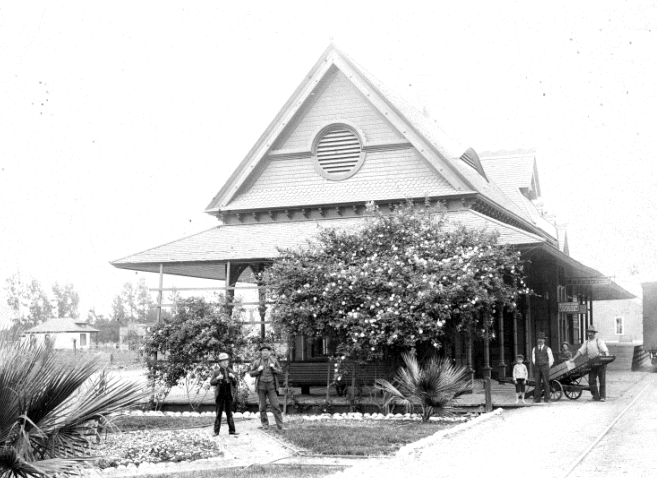
An attempt was made to change the name of the town to La Habra. In fact, the first railroad tickets read from Los Angeles to La Habra, the name La Habra was placed on the station. The opposition to this change was so strenuous by the Amerige brothers, that the original name was restored. Later Mr. Fullerton was dispossessed of his title and interest in the railroad company and Mr. McGinnis took his place.
The Wilshire brothers purchased the Pacific Land and Improvement Company interest and the Fullerton Land and Trust Company came into existence. Failing to fulfill their contract with the Pacific Land and Improvement Company, their holdings were taken over and they were dropped from the company. Then the Amerige brothers and the Fullerton Land and Trust Company interests were segregated. This took place on April 4, 1890, and the Fullerton Land and Trust Company dissolved, the Pacific Land and Improvement Company selling and disposing of their interests and the Amerige brothers staying with the town. After the advent of the railroad the town experienced a steady and healthy growth.
First Phone System
The first telephone system was installed by William Starbuck in his drug store in the Chadbourne block. The first blacksmith shop was established by A. Pendergrast, the first restaurant was opened by Mrs. Dierkson, and P.A. Schumacher was the first nurseryman. George Case had the first plumbing shop and the first hardware store was established by Buchanan and Lelpe.
Through the efforts of E.R. Amerige, Wm. McFadden, Dr. George C. Clark, Arthur Staley and others, a Masonic lodge was organized and a building erected on the corner of Amerige ave. Spadra rd. in block 17.
To the loyalty and support of many whose names are not mentioned here, we owe, to a great extent, the wonderful progress and growth of our town. Only a few of our original townspeople remain, as many of moved away and some have passed on.
Incorporated in 1904
Fullerton was enlarged and incorporated as a sixth class city July 15, 1904, and embraced 18 square miles, with a population of 3,000 people at this time.
The first trustees to be elected were E.R. Amerige, Dr. George C. Clark, J.R. Gardiner, E.K. Benchley and C.C. Chapman. Mr. Chapman was elected president of the board.

At the present time the population is 13,000. Fullerton now owns its own water plant, has a fine lighting system, its out-fall sewer to the sea and the best of paved streets. There are many packing houses and other industries. Fullerton has many fine buildings, good hotels, a fine library, theater, a beautiful clubhouse and all the lodges and societies are represented. There are three banks: the Security First National and F.C. Krause manager, the Bank of America with Harry Smith manager, and the First National Trust and Savings bank with Harry Williams manager.
It has the best of transportation facilities with three railroads and a bus line entering the city. Is it any wonder we are proud of this beautiful city and the wonderful growth it has made!
E.R. Amerige Death
E.R. Amerige, one of the brothers who founded this city, passed away May 3, 1915, after serving is city as one of the first trustees, and on the school board. He was president of the Anaheim Union Water Company in 1893, and was elected assemblyman for this district in 1903 and again in 1905. He was a Mason and Knight Templar.
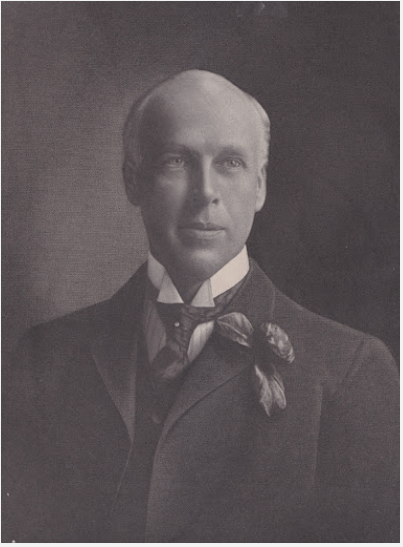
George H. Amerige is still living and active at the age of 82, still working and making improvements.
He is the nephew and namesake of George Amerige who came to San Francisco in 1849, who in 1850 owned and operated a printing establishment. He introduced the first steam power press into San Francisco and at one time nearly all the newspapers issued in that city were printed in his office.
I have had to leave out many interesting instances, not knowing where to end. I am placing original contracts, deeds, and many early interesting pictures on exhibition at the D.A.R. headquarters, 109 E. Commonwealth ave.
We celebrate our “Golden Jubilee,” the 50th anniversary of the founding of Fullerton on May 14, 1937.
 Fullerton History