The following is from a work-in-progress about the history of Fullerton. You can support my ongoing research and writing on Patreon.
The Local History Room of the Fullerton Public Library has microfilm from the Fullerton Daily News-Tribune newspaper stretching back to 1893. I am in the process of reading over the microfilm, year by year, to get a sense of what was happening in the town over the years, and creating a mini archive. Below are some news stories from 1936.
National and International News
Fascism was becoming more firmly entrenched in Europe, with Adolf Hitler in Germany, Benito Mussolini in Italy, and the nationalist forces of Francisco Franco in Spain. Germany hosted the Olympics, at which American runner Jesse Owens famously won three gold medals, challenging Hitler’s notions of Aryan racial superiority. Franklin D. Roosevelt was elected to a second term as U.S. president in a true landslide victory.

Thanks in part to Roosevelt’s New Deal policies which sought to help Americans suffering through the Great Depression, nearly all states had a Democratic majority.

The New Deal established things like social security to provide a safety net for citizens. It was an unprecedented attempt to use the federal government to help Americans.
“When human distress reaches the point that government assistance is necessary, government up to the limit of its local, its state and its federal resources must and does act,” Roosevelt said in a 1936 speech.
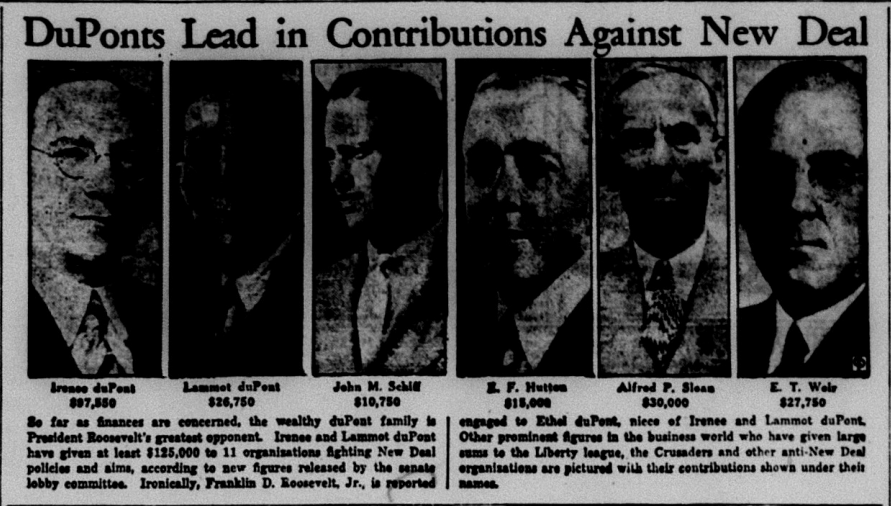
Not everyone was happy with the New Deal. Big business oligarchs and conservative Republicans, as today, fought against federal programs to help the poor, with some calling it socialism or communism.


Local New Deal Projects
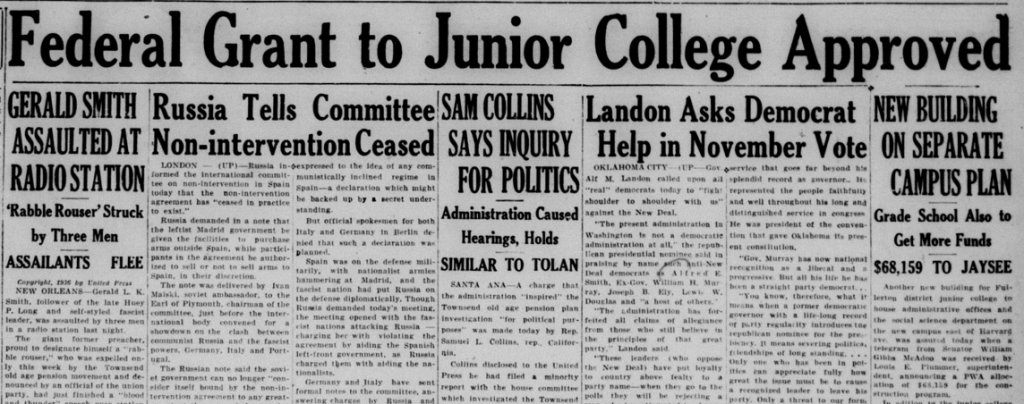
Fullerton benefited greatly from the New Deal. Some of the City’s most iconic and historic buildings were constructed by local residents using federal relief dollars. Projects completed in 1936 included improvements at Hillcrest Park (including the fountain), and the first building on the Fullerton College campus, the Commerce Building.

Whither City Hall?
Another project that received federal funds was the construction of City Hall.

Unfortunately, there was disagreement among City Council members regarding where to build the structure. Some wanted it to be built next to the California Hotel (now the Villa Del Sol), while others wanted it built at Commonwealth Park (now Amerige Park).
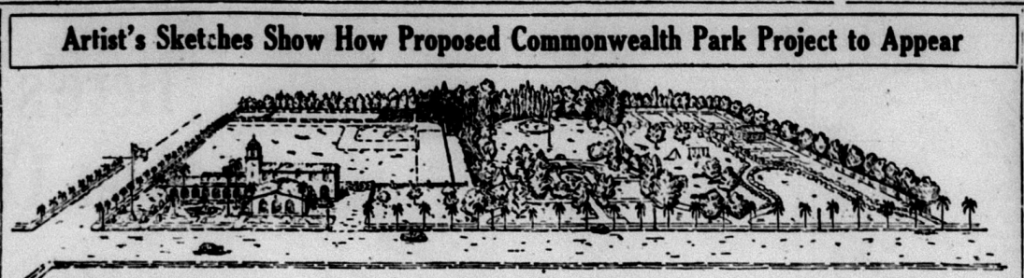
With City Council unable to agree on the Commonwealth site, the issue went to voters, who voted down that location.
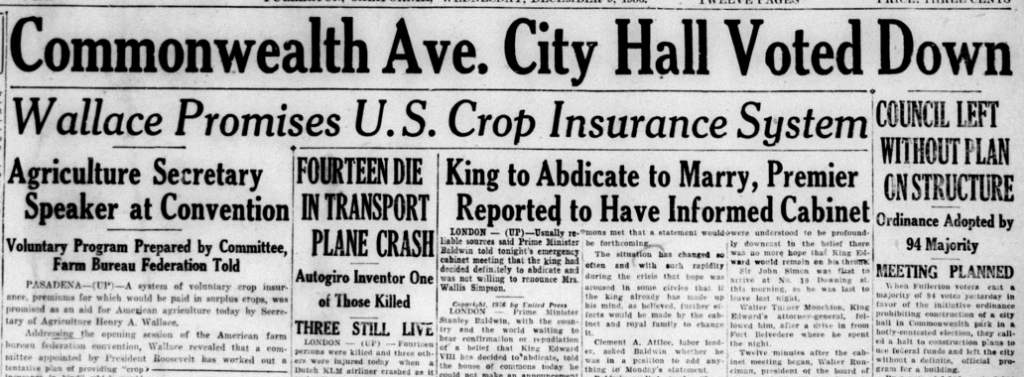
Because of all this disagreement, City Hall would not be built for another five years.
LA Police Seek to Keep Out the Poor
The financial troubles of the Great Depression led to a big increase in homelessness and poverty. The Los Angeles Police department took the extreme (and illegal) action of sending officers to the California border with neighboring states to block “Indigent Alien Transients” (aka, the poor) from entering California.

This led to widespread condemnation and ultimately legal action to prevent the movement of humans seeking to better their lot.
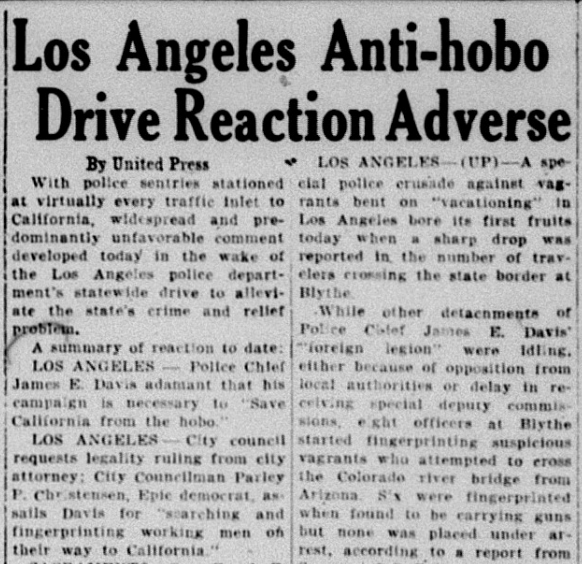

Actions such as this represent what historian Kevin Starr called fascist tendencies in Depression-era California.
“For a month at least, the entrepots of California, north, south, and central, seemed more like the border checkpoints of fascist Europe than those of an American state,” Starr writes in Endangered Dreams: The Great Depression in California.
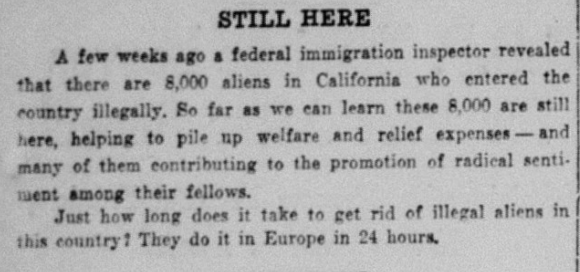
Efforts to keep out the poor also extended to Mexican immigrants. As has unfortunately happened throughout American history, hard times made immigrants convenient scapegoats for demagogues. In 1933, hundreds of Mexican farmworkers had been deported from Orange County.
The News-Tribune published editorials decrying the presence of “illegal aliens” and their supposed burden on taxpayers, despite the fact that Mexican farmworkers in particular were a foundation of the local economy.
The Murder of Francisco Gomez
Tensions between the Mexican community and the more affluent (and politically powerful) white community were inflamed when the dead body of 16-year old Francisco Gomez was found in a vacant lot in Placentia. The body had a .32 caliber bullet hole through the hip.
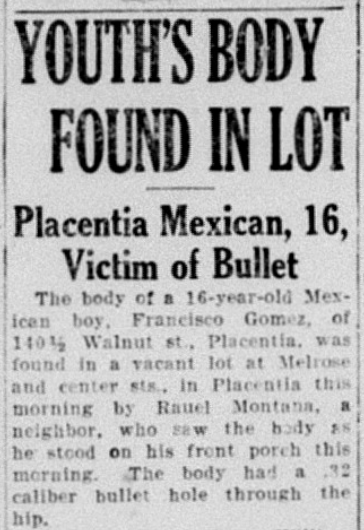
It was quickly learned that William Kraemer, of the wealthy Kraemer family, had shot Gomez whom he claimed was a “peeping Tom” outside the window of his home.
Kraemer was not convicted of any crime.

Hundreds of Mexican supporters of Gomez showed up at the courthouse to express their outrage.
The Citrus Strike
Throughout the 1930s, large scale labor strikes occurred throughout the United States, including in California. In 1936, the Mexican farmworkers of Orange County went on strike.
In his 1972 USC doctoral dissertation entitled The Orange County Citrus Stikes of 1935-1936: The Forgotten People in Revolt. Louis Reccow called it, “the largest and most violent citrus strike of the depression.”
Most of the Mexican pickers in Orange County lived in colonies, or “colonias,” which were segregated from the larger community.

In March strike leaders sent the growers of Orange County two lists of demands calling for better pay and working conditions as well as union recognition–demands which the growers ignored.
On June 11, as many as 2,500 workers went on strike.
The Fullerton News-Tribune characterized the strike leaders as outside agitators and communists. Police officers were organized to “protect” those who wanted to work from “threats of agitators.”
Sheriff Logan Jackson deputized hundreds of men. The American Legion and Veterans of Foreign Wars pledged their assistance to police and the growers.
During the strike, pickers who did not participate were escorted to work by armed guards.
“Police, deputy sheriffs and specially recruited deputies of police, sheriff and constables were in the field this morning keeping a constant watch for appearance of agitators,” the News-Tribune reported.
Scab crews and white students were hired to pick the oranges.
“From Placentia high school and Fullerton district junior college, scores of youths went today to orchards to take the place of the strikers,” the News-Tribune reported.
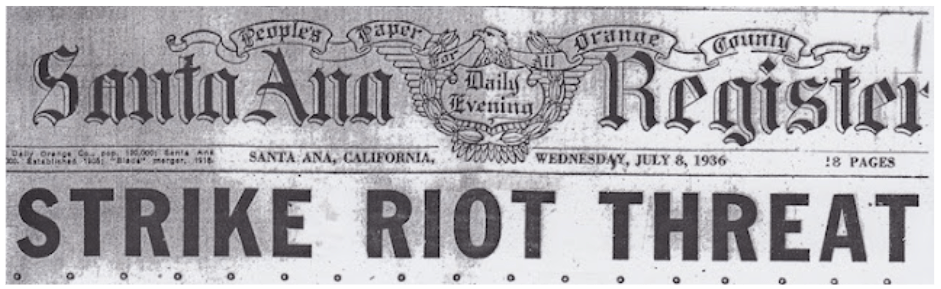
The first instance of “violence” occurred in Anaheim when striker Virginia Torres bit a police officer on the arm.
“Two hundred angry Mexican women spurned on the citrus picker’s strike today as the first riot call of the strike sent a score of officers into Anaheim early this morning to quell a disturbance led by the women,” the News-Tribune reported.
Torres and others were arrested.
Elsewhere, in Brea, strikers were arrested on flimsy grounds ranging from traffic violations to trespassing.
Charles McLaughlan, Orange county communist candidate for congress, was arrested on trespassing charges in the Mexican worker camp on Balcom in Fullerton. While the vast majority of strikers were not communist, there were some communists involved in the labor movement during the Great Depression.
Not long after McLauchlan’s arrest, some striking orange pickers were evicted from their homes in the worker’s camp.
Conflict between strikers, scabs, and law enforcement sometimes flared into violence.
“During the month of July (1936), northern Orange County experienced a kind of civil war,” Reccow writes. “Increased picketing, violence, armed deputies by the score, vigilante attacks, mass arrests and trials, shoot-to-kill orders, calls for State interference, along with California State Federation of Labor and federal government involvement–all contributed to the situation.”
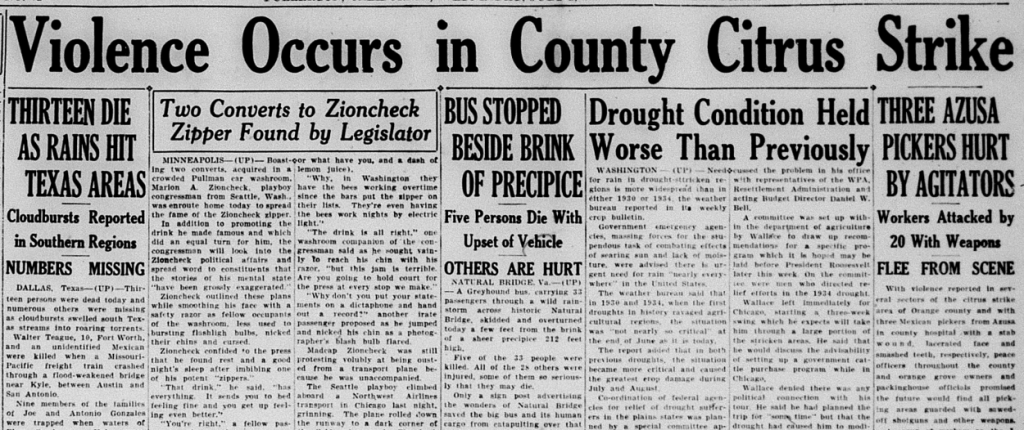
“With violence reported in several sectors of the citrus strike area of Orange county and with three Mexican pickers from Azusa in county hospital with a stab wound, lacerated face and smashed teeth, respectively, peace officers throughout the county and orange grove owners and packinghouse officials promised the future would find all picking areas guarded with sawed off shotguns and other weapons,” the News-Tribune reported.
“All Orange country was under heavy guard today as Sheriff Logan Jackson, following yesterday’s violence, began deputizing 170 additional special deputies to protect every picking crew and packinghouse in the county,” the News-Tribune reported.
The increased police presence did little to quell the conflict. In one day at the height of the strike, 159 Mexican strikers were arrested on charges of “rioting.”
As conflict and occasional violence continued, Sheriff Jackson issued a “Shoot to Kill” order to his men.
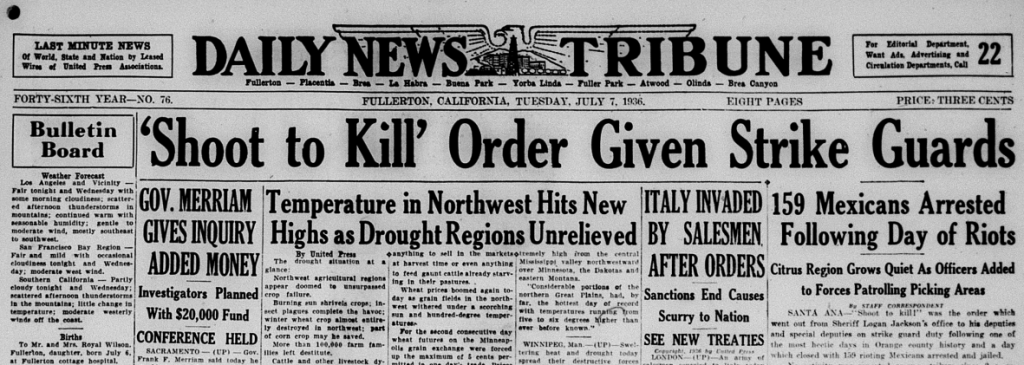
“New special deputies were being added rapidly to the sheriff’s office staff, which numbers 300 to 400 now, and 20 more California highway patrol officers were rushed here today from Los Angeles county to be added to 35 or 40 already on duty,” the News-Tribune reported.
In La Habra, 40 or 50 families were evicted from their homes on ranch property for participating in the strike.
In the conflict, the strikers had weapons like rocks and clubs. The police had tear gas guns, hand grenades, rifles, and shotguns.
Sometimes the police would arrest and jail Mexicans before any crime occurred.
“A strange parade it was from Placentia ave, at Pointsettia, near Anaheim, yesterday afternoon as California highway patrolmen and the sheriff intercepted 19 carloads of Mexicans, more than 100 in all, who said they were going to Orange for a meeting,” the News-Tribune reported. “The parade, enlarged by five more carloads intercepted in a neighboring road, ended at the jail.”
On July 8 the 119 Mexicans arrested on rioting charges were arraigned in the open courtyard behind the Fullerton courthouse under heavy guard from state highway patrol officers and deputy sheriffs armed with sub-machine guns and sawed off shotguns.
A couple weeks later this large group was again transported to Fullerton.
“The Odd Fellows Temple, selected by law officials as the site of the hearing for security reasons, soon resembled an armed fortress. Men armed with submachine guns, riot guns, revolvers, and clubs guarded all exits and entrances,” the News-Tribune reported.
Part of the reason the strike continued was because of the growers’ insistence that the strike was not a result of legitimate grievances, but rather part of some nefarious communist plot.
“Dr. W.H. Wickett of Fullerton, a member of the publicity committee of the growers organization, said today that the growers have definitely learned that the strike is not a walkout merely for the betterment of pickers but is directed and abetted by communist headquarters for the purpose of fomenting strife in the interests of communism,” the News-Tribune reported.
In fact, the workers’ demands, which were publicly sent to the growers well before the strike, had nothing to do with communism, and everything to do with improving pay and working conditions.
Whether growers like Wickett actually believed the strikers represented a communist threat or they were simply seeking to tarnish the strikers so as to avoid having to treat their workers better, is hard to say.
It wasn’t just the police who sought to disrupt and end the strikers’ activities. Vigilante activity also occurred.
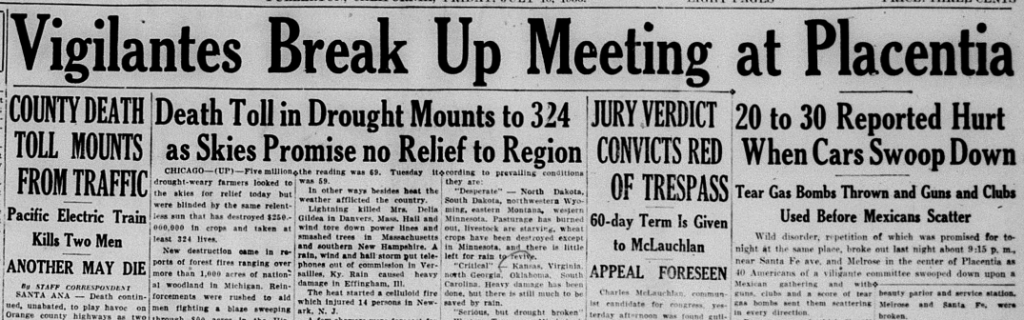
“Wild disorder, repetition of which was promised for tonight at the same place, broke out last night about 9:15pm, near Santa Fe ave. and Melrose in the center of Placentia as 40 Americans of a vigilante committee swooped down upon a Mexican gathering and with guns, clubs and a score of tear gas bombs sent them scattering in ever direction,” the News-Tribune reported. “Reports…stated 20 to 30 Mexicans and a few of the white men were injured, cars were smashed and other damage done. Several Mexicans among the group, who had gathered on the Luis Varcas handball court for a meeting told officers they definitely recognized ‘Stuart Strathman as the supposed leader of the raid.’”
Strathman was a leading representative of the growers and packinghouses, with an office at the Chamber of Commerce.
No arrests or charges were made against any of the vigilantes.
Eventually, an agreement between the strikers and growers was reached–insuring higher wages and a few other benefits, but not union recognition.

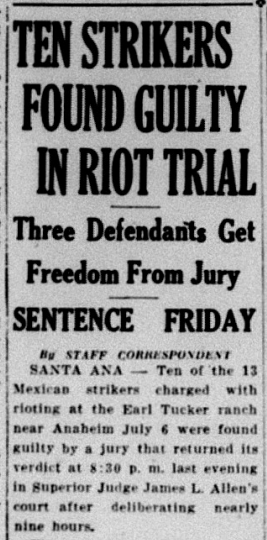
Charges against all but 13 of the strikers charged with rioting were dismissed. Of those, 10 were found guilty and faced fines and imprisonment.
Reflecting on the strike, Reccow writes, “The strike offers a classic study in the use of anti-strike tactics: the deputizing of hundreds of growers, blacklisting, the eviction of workers from company homes, the cries that agitators and communists were responsible for the strike, vigilante attacks, the strict enforcement of an anti-picketing ordinance, the jailing of large numbers of strikers and the deportation of alien Mexican workers.”
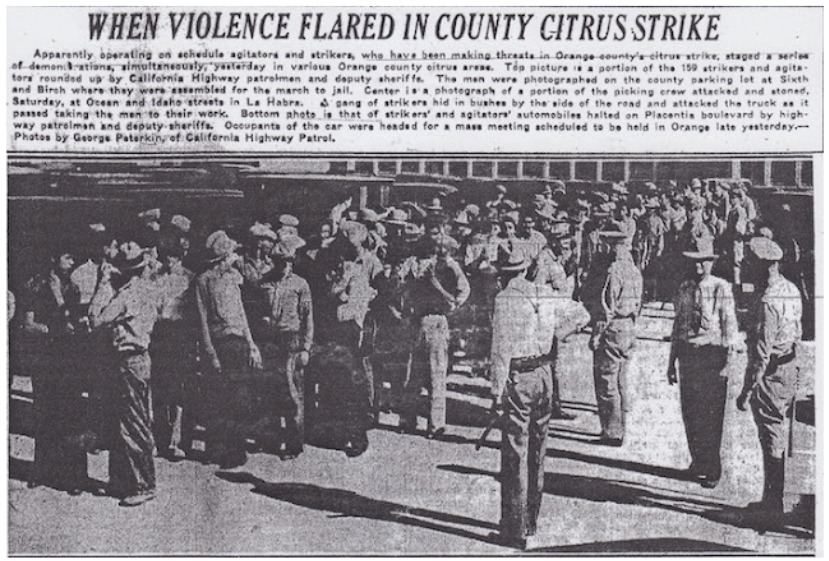
Journalist Carey McWilliams wrote, “No one who has visited a rural county in California under these circumstances will deny the reality of the terror that exists. It is no exaggeration to describe this state of affairs as fascism in practice.”

Local Politics
In local politics, Hans Kohlenberger, Walter Muckenthaler, and Thomas Gowen were elected to Fullerton City Council.
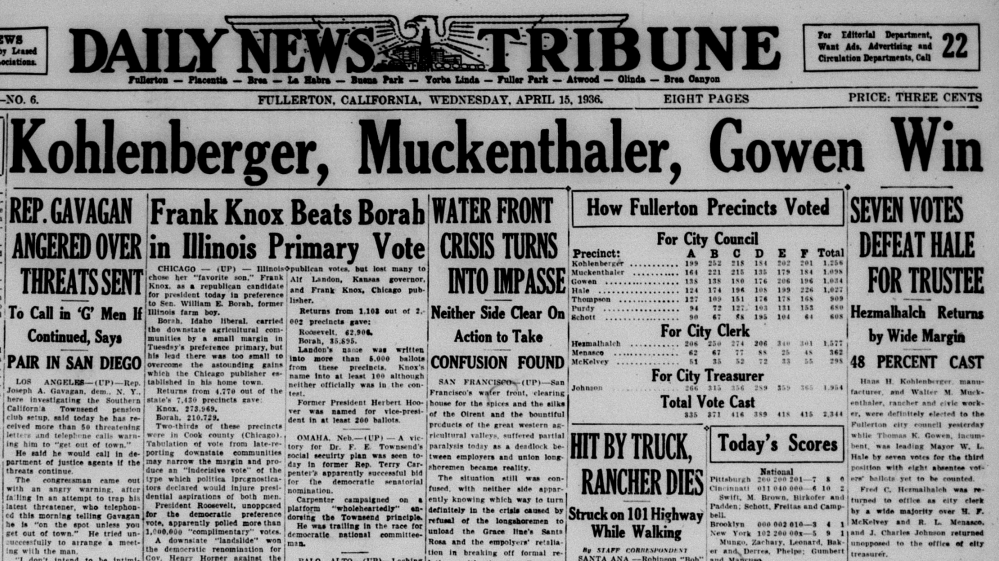
Harry Maxwell was chosen as mayor.

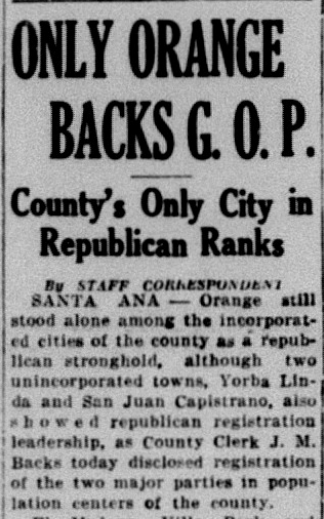
At this time, during the Great Depression, Democrats held a voting majority in all Orange County cities except Orange.
Culture and Entertainment
Two Fullertonians were listed in the annual Who’s Who in Art publication: Helena Dunlap and Lucile Bernice Hinkle. Fullertonian John Raitt was beginning his career as a singer.

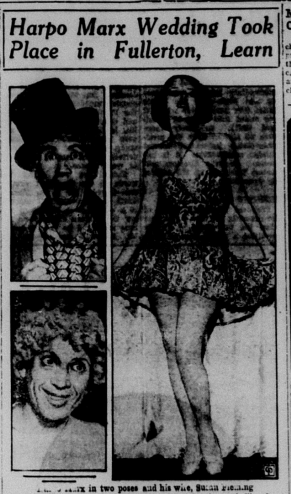
Harpo Marx of the Marx Brothers married Alva Fleming in Fullerton.
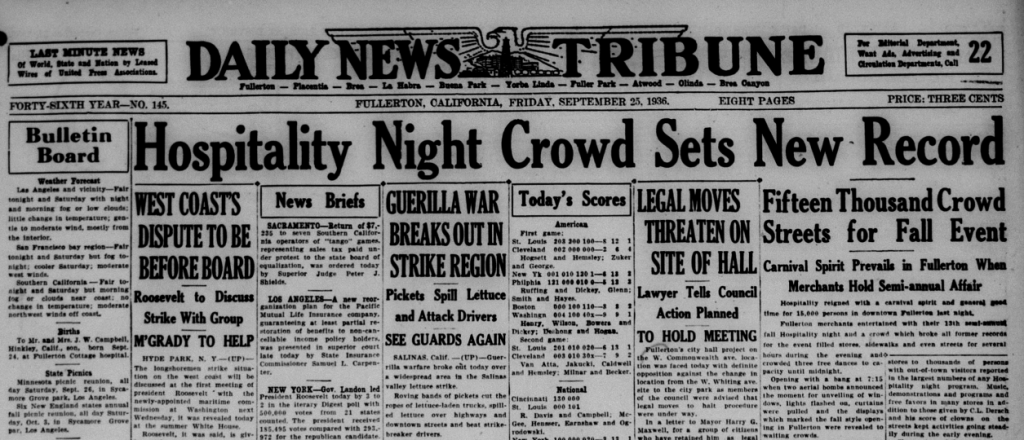
Fullerton held its annual “Hospitality Night” which drew thousands to downtown to see elaborate store window displays, clowns, musical performances, and more.
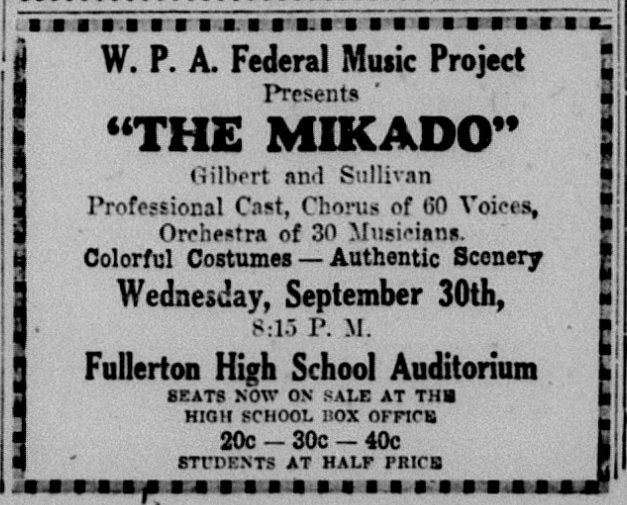
In addition to funding public works and building projects, the WPA also funded arts projects, like plays and murals. The News-Tribune called these “Literary Boondoggles.”
The News-Tribune featured a few comic strips including Mickey Mouse and Tim Tyler’s Flying Luck, both of which included some occasionally disturbing panels:

Sports
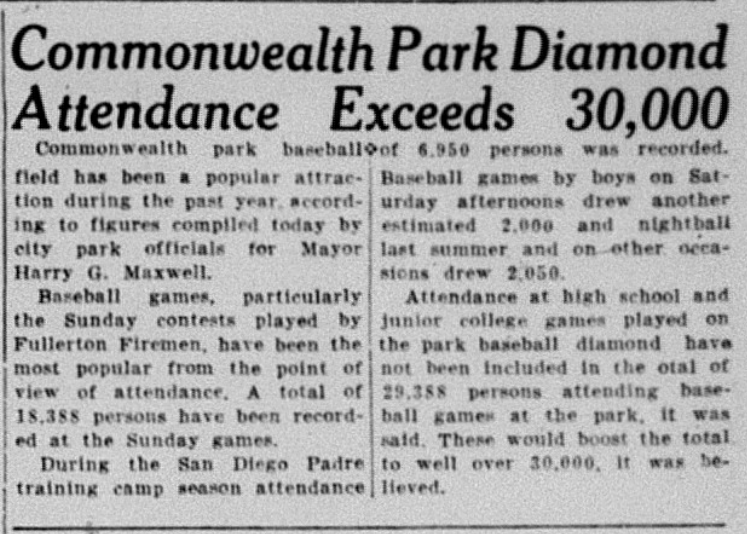
Baseball at Commonwealth (now called Amerige) Park was extremely popular.
Deaths
Fullerton pioneer Andrew Rorden passed away.
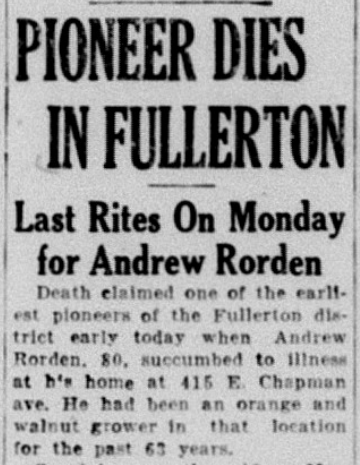
Rorder, a native of Germany was born in 1866 on the Island of Fohr, off Prussia. He came to the United States and to Fullerton in 1873 before the town was founded. He was a rancher.
Stay tuned for top news stories from 1937!
 Fullerton History