The following is from a work-in-progress about the history of Fullerton. You can support my ongoing research and writing on Patreon.
The Local History Room of the Fullerton Public Library has microfilm from the Fullerton Daily News-Tribune newspaper stretching back to 1893. I am in the process of reading over the microfilm, year by year, to get a sense of what was happening in the town over the years, and creating a mini archive. Below are some news stories from 1934.
The New Deal
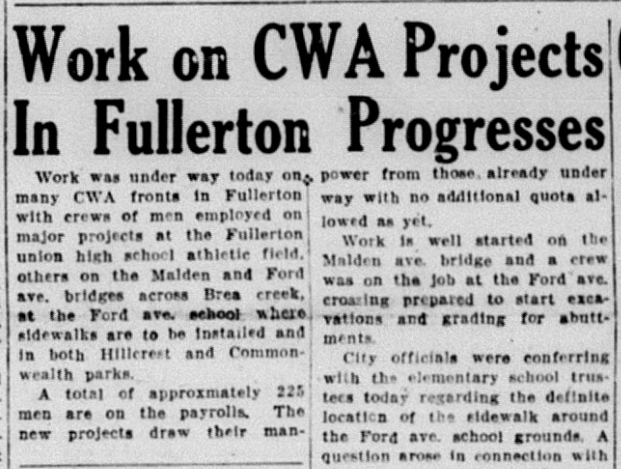
In 1934, the Great Depression was still in full swing, and president Franklin D. Roosevelt’s New Deal programs were being enacted, some of which involved federal spending on local projects.
Strike!
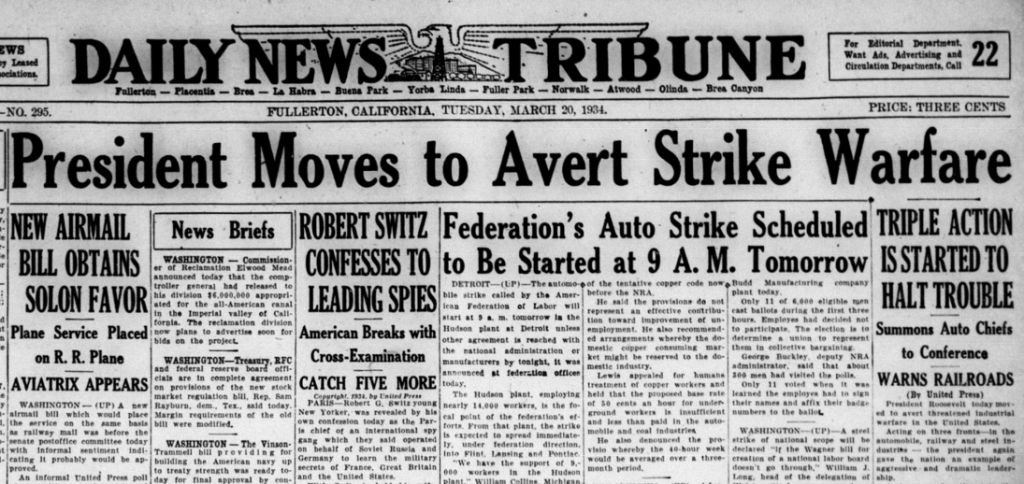
The 1930s were filled with labor strikes across the country. In the book Endangered Dreams: The Great Depression in California, historian Kevin Starr writes, “Between January 1933 and June 1939, more than ninety thousand harvest, packaging, and canning workers went out on some 170-odd strikes.
That was just agriculture. Major strikes in other industries, such as the 1934 West Coast waterfront strike, rocked California’s major coastal cities.

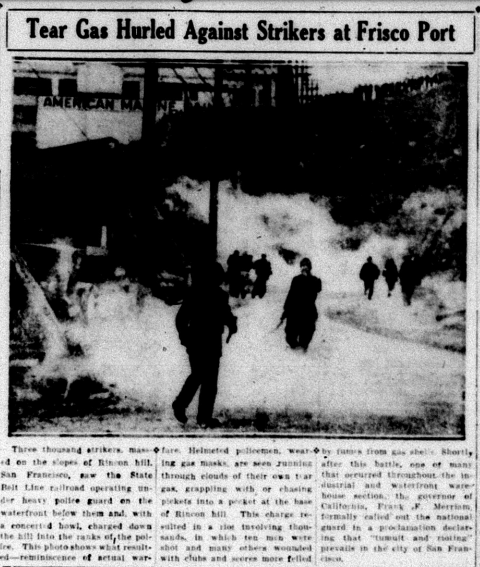
These strikes were massive and sometimes erupted into violent street fights between strikers and police.
Late in 1934, streetcar workers in Los Angeles went on strike.
Closer to home, dairy workers in Orange County went on strike.

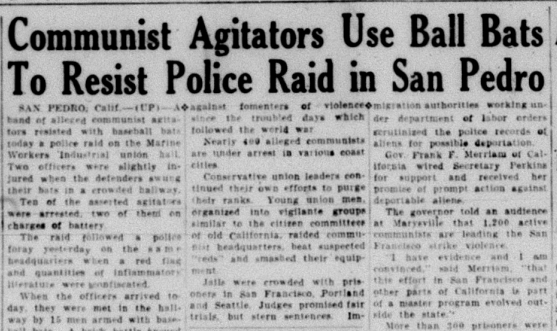
Those organizing labor strikes were often accused of being communists.

“Warning to citrus growers that they might expect communistic activities in this district as soon as the valencia season opens and methods of combating the agitation was given by H.O. Easton, packinghouse manager, at the regular meeting of the chamber of commerce here yesterday,” the Tribune reported.
Easton argued that local cities should pass anti-picketing ordinances (Fullerton already had one).
“He told citrus growers that they should impress upon workers they hire that any agitation is the work of communists attempting to start trouble among men employed in this district,” the Tribune reported.
Special guards were requested to protect packinghouses.
The truth is that most rank-and-file workers were not communists. They just wanted better working conditions. However, some of the organizers were, in fact, communists.
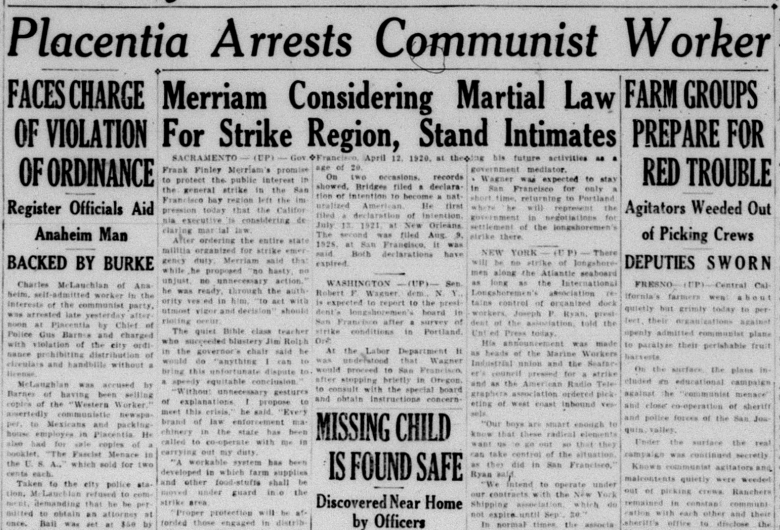
“Charles McLauchlan of Anaheim, self-admitted worker in the interests of the communist party, was arrested late yesterday afternoon at Placentia by Chief of Police Gus Barnes and charged with violation of the city ordinance prohibiting distribution of circulars and handbills without a license,” the Tribune reported.
McLauchlan was accused of selling copies of the Western Worker, a labor newspaper, to Mexican citrus workers in Placentia. He was also selling copies of a booklet, The Fascist Menace in the U.S.A.
If the strike organizers were sometimes communists, the growers and the legal system that sided with them often acted like fascists, cracking down hard on those trying to organize to better their lot.
Upton Sinclair’s EPIC Run for Governor
In the midst of these economic hard times and labor agitation, noted author and socialist Upton Sinclair ran for governor of California. Sinclair, most famous for his 1905 novel The Jungle, which portrayed the filthy and inhumane conditions of the meatpacking industry, had spent his life writing numerous books highlighting various injustices and corruption in American life.
Sinclair had moved to Southern California in 1916 and, in addition to writing, also involved himself in politics, running for congress twice (in 1920 and 1922) as a Socialist. He founded California’s chapter of the American Civil Liberties Union (ACLU).
In 1934, he decided to run for governor of the Golden State, this time as a Democrat. He won the party’s nomination and faced off against Republican Frank Merriam. Sinclair’s program was called End Poverty in California (or, EPIC). He wrote a pamphlet called I, Governor of California, and How I Ended Poverty, which laid out his plans and was widely distributed.
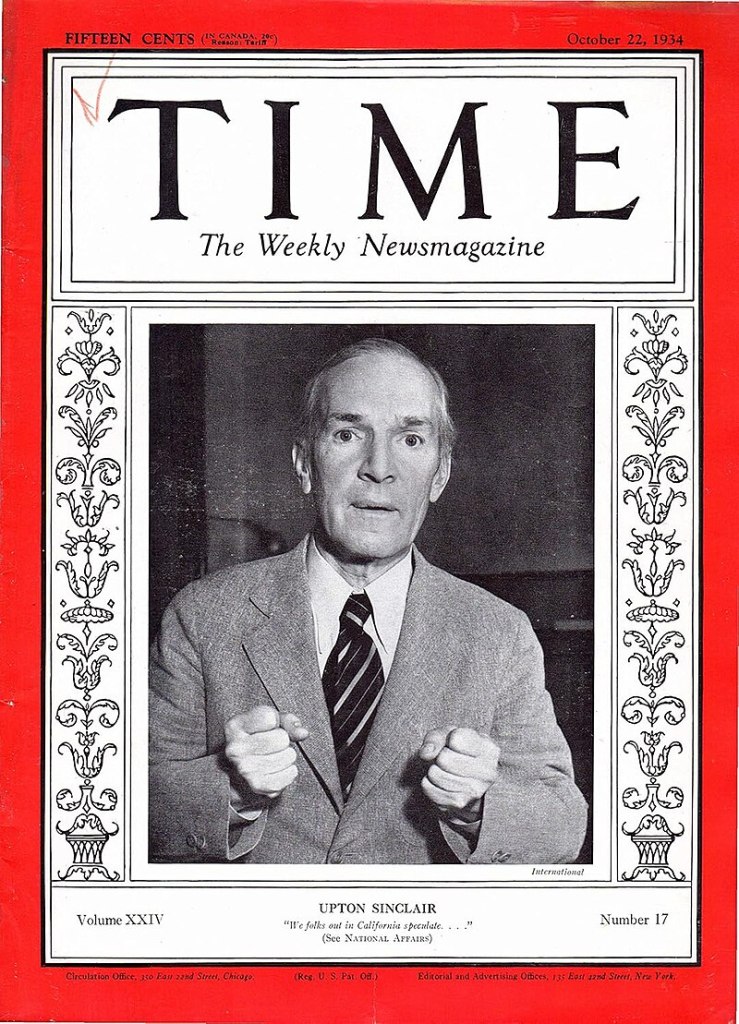
During the campaign, Sinclair came to Fullerton and spoke before a crowd of over 1,200 in the FUHS auditorium.

Today, Sinclair sounds a lot like Bernie Sanders.
“The trouble in America,” Sinclair began, “is that privilege entrenched itself in government and society and brought a condition where two percent of the people control 50 percent of the wealth. Wall Street tricks to control American finance by piling up wealth on one side and beating down wealth on the other made bums of twenty or thirty million people…”
Sinclair was particularly outraged with the practice of large agricultural interests destroying “surplus” crops to keep prices up.
“Limitation of production or the destruction of food or other wealth while millions of people are in need is the very apex of economic insanity,” Sinclair said.
This practice of destroying food for the benefit of big business while people starve is what gave the title to John Steinbeck’s 1939 novel The Grapes of Wrath, about farmworkers in California during the Great Depression:
“There is a crime here that goes beyond denunciation. There is a sorrow here that weeping cannot symbolize. There is a failure here that topples all our success. The fertile earth, the straight tree rows, the sturdy trunks, and the ripe fruit. And children dying of pellagra must die because a profit cannot be taken from an orange. And coroners must fill in the certificate- died of malnutrition- because the food must rot, must be forced to rot. The people come with nets to fish for potatoes in the river, and the guards hold them back; they come in rattling cars to get the dumped oranges, but the kerosene is sprayed. And they stand still and watch the potatoes float by, listen to the screaming pigs being killed in a ditch and covered with quick-lime, watch the mountains of oranges slop down to a putrefying ooze; and in the eyes of the people there is the failure; and in the eyes of the hungry there is a growing wrath. In the souls of the people the grapes of wrath are filling and growing heavy, growing heavy for the vintage.”
The backbone of Sinclair’s plan of ending poverty in California involved giving unemployed workers access to the means of production and letting them produce for themselves.
“The program…will offer land colonies and factories to the unemployed and a distributing system where the people can buy necessities at cost and thereby eliminate the middle man,” Sinclair said. “It will make production for and equal to consumption because the unemployed will produce for themselves only and will make the million in the state now leaning on charity self-supporting.”
The EPIC plan also called for a remedy to economic inequality through a revised and graduated tax system, with higher taxes on the wealthy.
Sinclair was clearly on the side of the workers. Meanwhile, the Republican Frank Merriam was on the side of business.

As is documented in his book I, Candidate for Governor, and How I Got Licked, despite his popularity, Sinclair faced formidable opposition from big business and mainstream media (including Hollywood), who ran a well-funded smear campaign against him.
The Fullerton Daily News-Tribune ran numerous articles and editorials portraying Sinclair as a dangerous radical who would bring ruin to California.
The editorial below attempts to paint Sinclair as an enemy of the church because of statements he made in his 1927 book The Profits of Religion, which was a criticism of how individuals and churches have perverted and used religion to make money. His book, which actually speaks very highly of Jesus Christ, offered valid (and unfortunately still relevant) criticisms of the marriage of capitalism and Christianity.

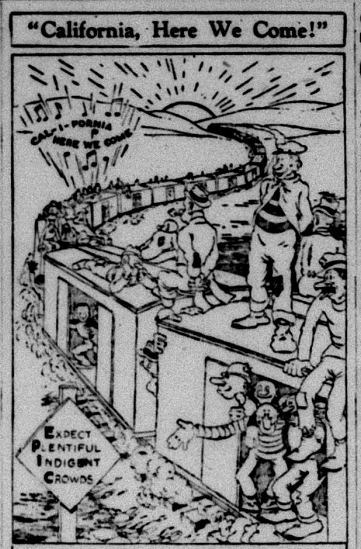
The cartoon below makes the argument that Sinclair’s programs to assist the poor and unemployed will make California a magnet for homeless and desperate people, with a sign parodying EPIC which reads: Expect Plentiful Indigent Crowds. Sound familiar? This sounds like the way Fox News talks about California today.
The California Real Estate association, unsurprisingly, came out against Sinclair.

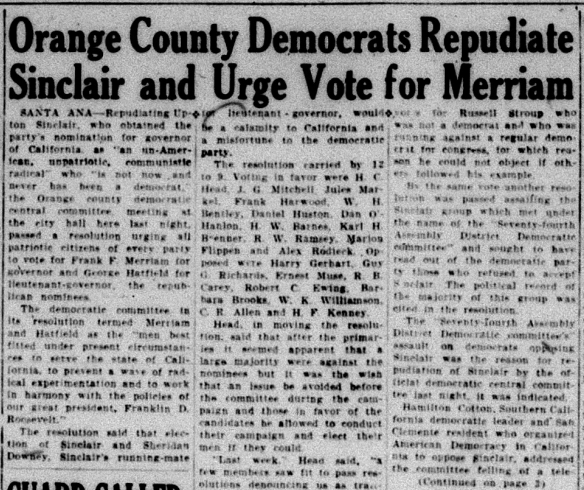
As did the Orange County Democratic party (just like the national Democratic Party did with Bernie Sanders in 2016).
Meanwhile, local leaders organized a parade in Merriam’s honor.
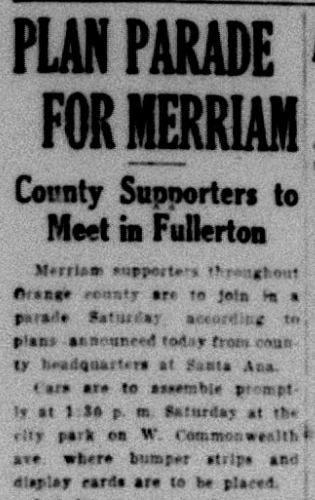
And the Tribune published numerous articles which painted Merriam in a very positive light.
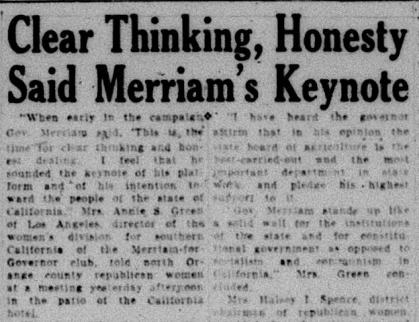
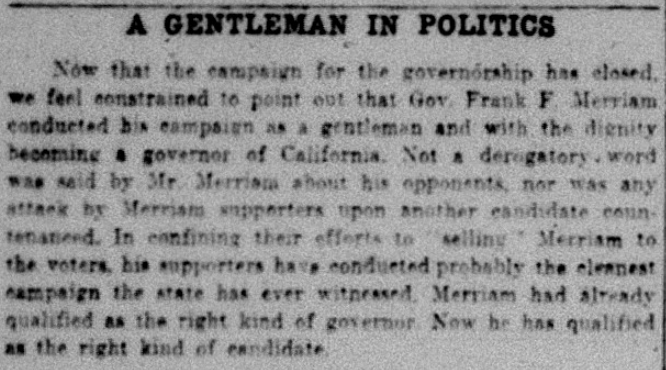
Ultimately, Merriam defeated Sinclair. Poverty would, unfortunately, not end.

Local Politics
In local political news, Harry Maxwell and George Lillie were elected to Fullerton City Council. Both were local businessmen and orange growers.
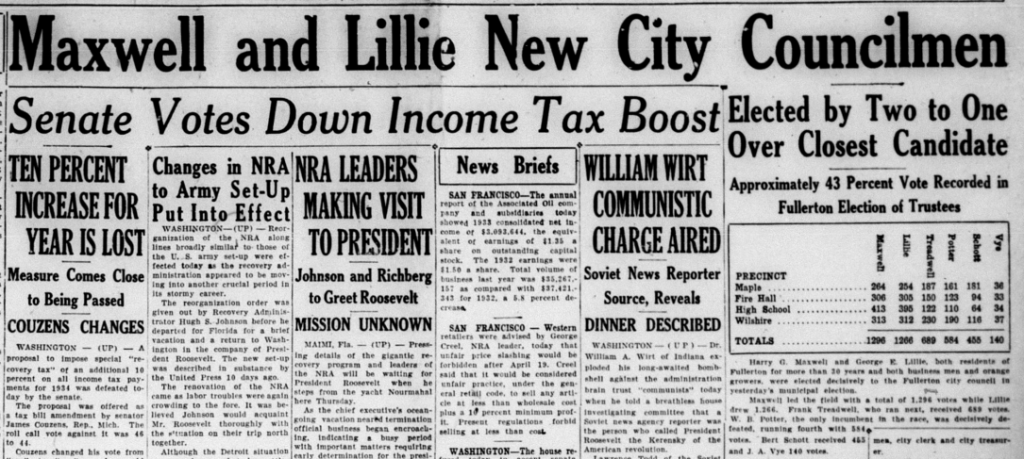
Below are photos of Harry Maxwell and George Lillie:


William “Billy” Hale was again chosen as Mayor.

In the races for District Attorney and Orange County Sheriff, Red-baiting was a common mudslinging tactic.
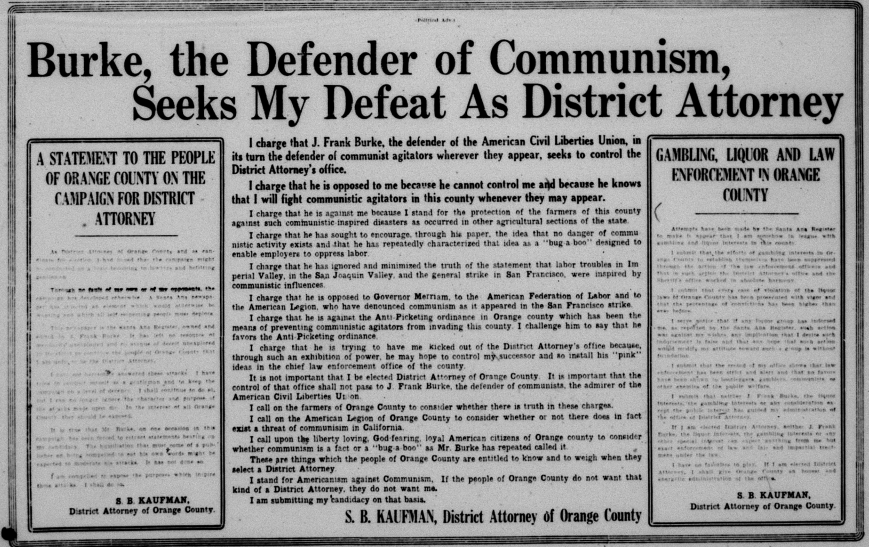
A campaign ad for OC Sheriff Logan Jackson stated: “Sheriff Jackson was ready for the agitator here and he didn’t get in. He was nipped, and nipped hard…Should trouble-makers try again to gain foothold here, Sheriff Jackson will again be ready for them…The milk strike and other threatened disturbances of that period, with disruption of the citrus industry next in view, would have cost our farmers countless thousands of dollars.”
Like his counterparts throughout California, Logan Jackson would use these “hard” tactics against striking orange workers in 1936. Read more about that HERE.
Ted Craig of Brea was made speaker of the California State Assembly.
Culture and Entertainment
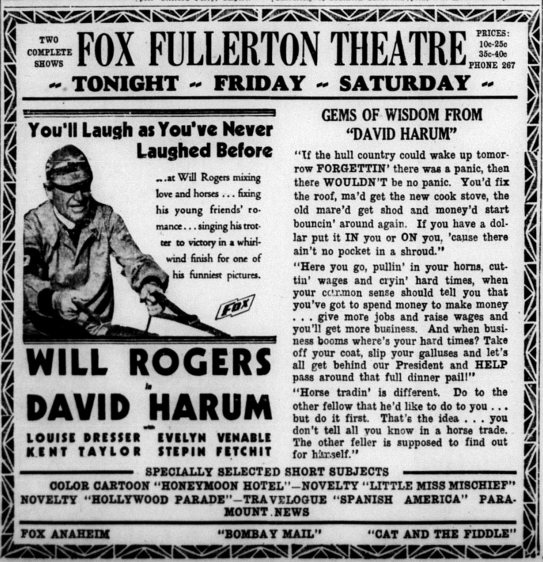
For culture and entertainment, Fullertonians went to see movies at the Fox Theater.

The iconic “Pastoral California” mural on the side of Plummer Auditorium was painted by Charles Kassler as a federal art project. Sadly, it would be painted over in 1939, and then restored in 1997. To learn more about the story of that mural, check out my article HERE.


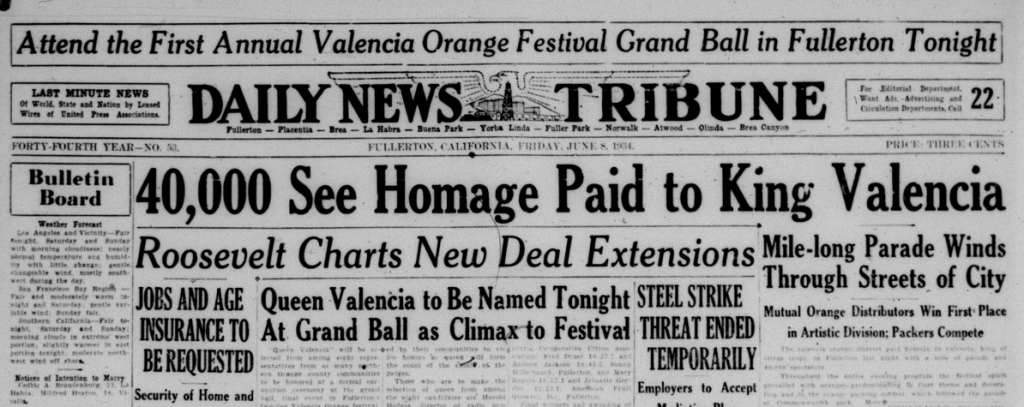
Fullerton celebrated a Valencia Orange Festival, which drew 40,000 attendees.

Sports
Locals celebrated hometown baseball star Willard Hershberger.
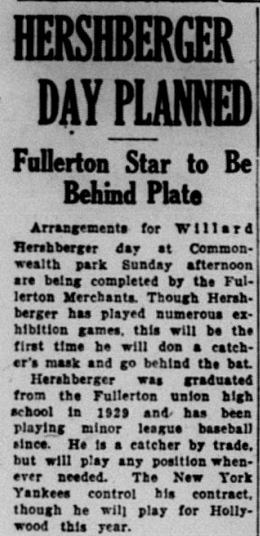
Baseball was very popular locally. Games at Commonwealth (now Amerige) Park drew lots of spectators. “Pep” Lemon was in charge of the Fullerton Merchants team.

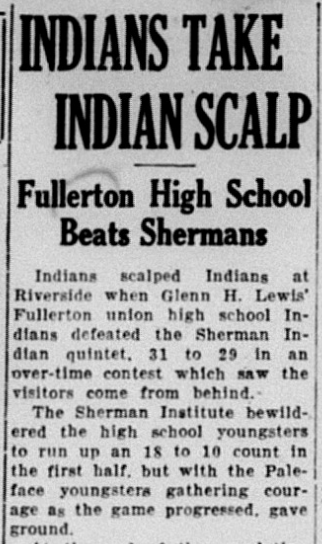
The Fullerton Union High School Indians sometimes played against the Sherman Indian High School (an actual Indian Boarding School) from Riverside, leading to sometimes offensive headlines.
Fullerton used to have a country club with a golf course.

Natural Disasters
During the 1930s, southern California experienced a few natural disasters: the 1933 Long Beach earthquake, the 1938 flood, and another flood in 1934.
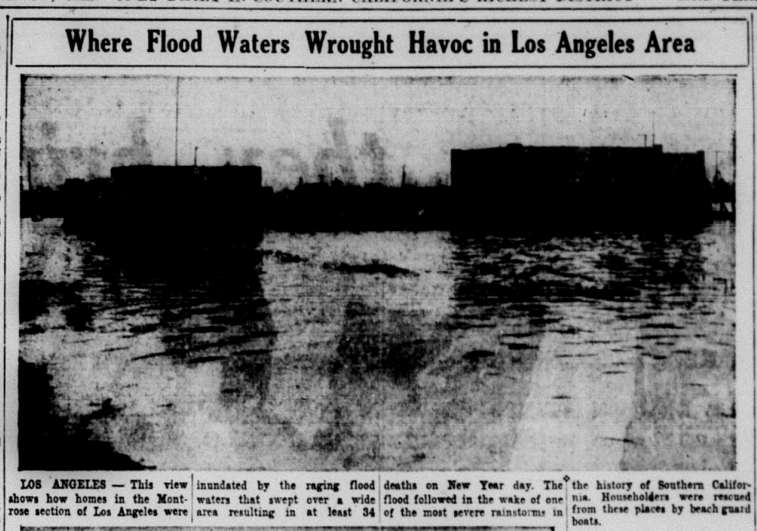
These floods are the reason why all the major rivers that flow through Los Angeles and Orange Counties are now concrete channels.
Housing
In 1934, a four-bedroom house atop a hill in Fullerton sold for $4000. In today’s dollars that would be about $94,000.
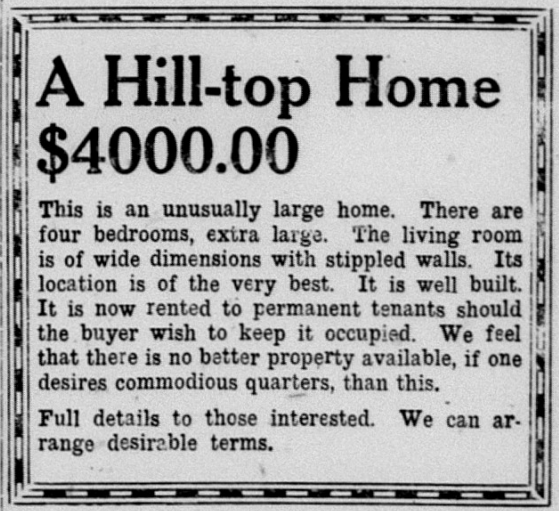
In the 1920s, Fullerton experienced a housing boom, with numerous new subdivisions being built. With the advent of the Great Depression, much new construction stopped, leading to a housing shortage.

To help with the housing situation, the New Deal established entitles like the Federal Housing Administration (FHA), which offered affordable home loans and other assistance to homeowners and home buyers. Given today’s housing crisis, lawmakers would do well to study the New Deal housing laws and reforms.

Leaded Gasoline
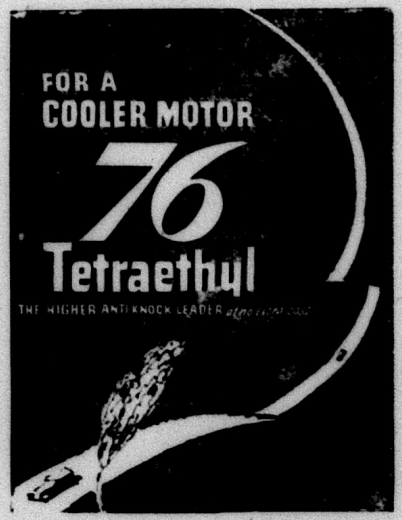
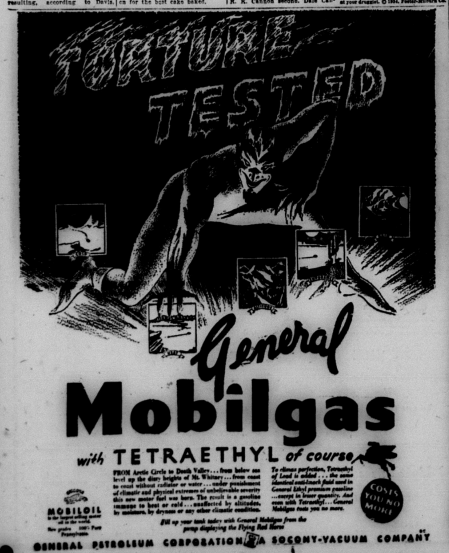
Starting in the 1920s, a compound called TEL was added to gasoline to improve performance. Unfortunately, it was discovered in the 1950s that this lead compound caused major health and environmental damage. It would ultimately be phased out, but not for decades. In 1934, gas companies celebrated the wonders of this toxic chemical.
Fashion
Education
The old high school building on Wilshire and Lemon (formerly called Harvard Ave.) was torn down and eventually replaced with the buildings that would make up Wilshire Junior High, and then the School of Continuing Education.

Death
Jacob Stern, co-owner of the first general store in town (Stern & Goodman), died. He became a very wealthy businessman and owned lots of real estate in southern California.

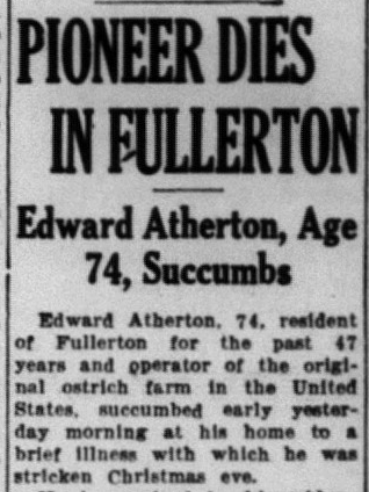
Edward Atherton, the famous Fullerton ostrich farmer, died.
Stay tuned for top stories from 1935!
 Fullerton History