The following is from a work-in-progress about the history of Fullerton. You can support my ongoing research and writing on Patreon.
The Local History Room of the Fullerton Public Library has microfilm from the Fullerton Daily News-Tribune newspaper stretching back to 1893. I am in the process of reading over the microfilm, year by year, to get a sense of what was happening in the town over the years, and creating a mini archive. Below are some news stories from 1933.
The 1933 Long Beach Earthquake

The disastrous Long Beach earthquake killed over 130 people, injured thousands, and caused tens of millions in property damage.
Some refugees from the earthquake took up temporary residence in their cars at Hillcrest Park and at the American Legion hall therein, where they were provided food and shelter by local volunteers and the Red Cross. The Izaak Walton Lodge was also opened to those who had fled the quake.
“Fullerton American Legion members continued to feed more than 100 persons at each meal at the Legion hall,” the Tribune reported. “Many of this group are lodged in Fullerton homes or camping in the park and are nearly without funds, their homes demolished or unsafe for occupancy in Long Beach, Compton, Bellflower and other points.”
Mrs. Clarence Spencer on W. Orangethorpe took in 27 quake refugees.
Most Fullerton buildings escaped damage, although a chimney fell at the California Hotel, crashing through the roof of the cafe kitchen and half filling it with bricks and shattered building materials. Thankfully, no one was there at the time. The Wilshire Elementary school also experienced some minor damage, although it was declared structurally sound.
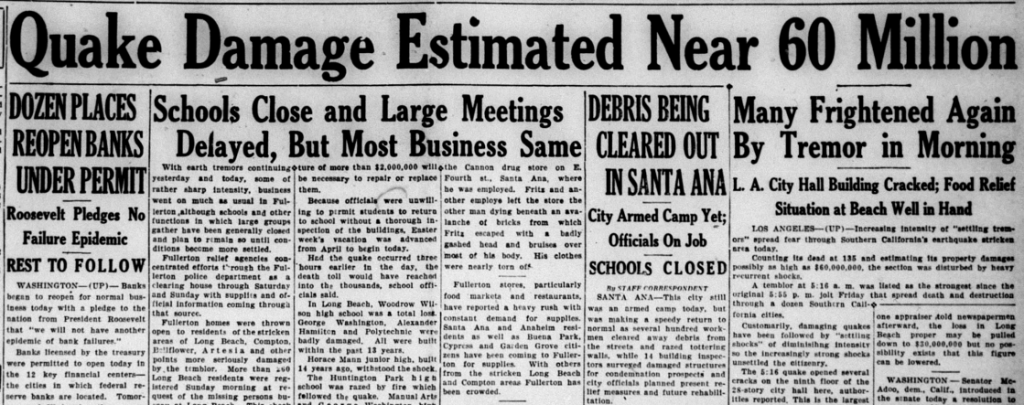
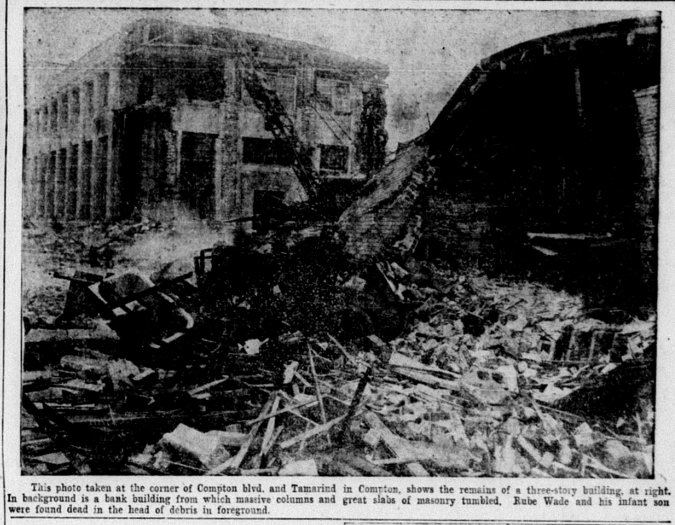

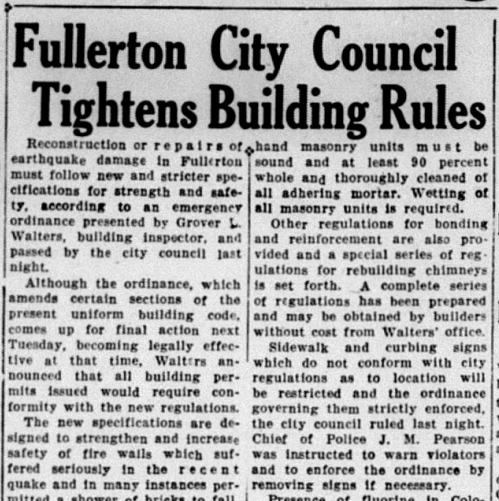
As a result of the earthquake, many cities including Fullerton passed stricter building codes.
Roosevelt’s New Deal
Democrat Franklin Delano Roosevelt was elected in 1932. His first 100 days of office in 1933 were filled with sweeping legislation aimed at combating the Great Depression. The idea of a president enacting major policy within their first 100 days began with FDR.
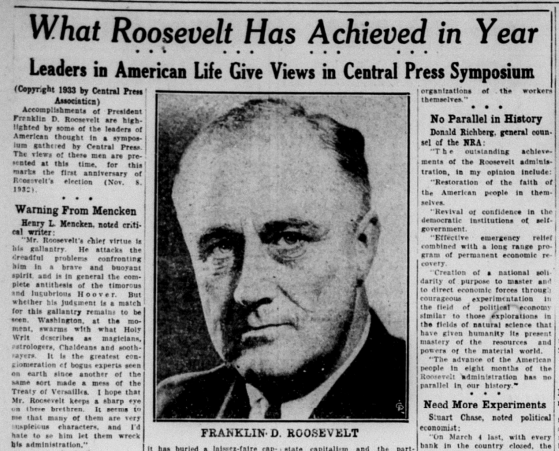
Roosevelt’s overall program was called the New Deal. Laws passed in 1933 sought to stabilize major aspects of the economy, such as banking (the Glass-Stegall Act and the creation of the FDIC), agriculture (Agricultural Adjustment Act and Farm Credit Act), and others (National Industrial Recovery Act). Other laws sought to provide government jobs for the unemployed by creating the Civilian Conservation Corps and the Federal Emergency Relief Administration (later called the Works Progress Administration).
The Reconstruction Finance Corporation provided funding for jobs for local unemployed men to improve public works.
“One hundred men were assigned to Hillcrest Park this morning,” the Tribune reported, “where they will work under direction of Harry Byerrum, park superintendent. Forty-five more men were at work under direction of Leo Fallert, road foreman, in clearing water courses and improving the waterway northwest of Buena Park.”

Unemployed Fullerton resident George Buxton joined the Civilian Conservation Corps and was stationed at Camp Radford in the San Bernardino mountains.
His company built fire breaks and roads in the mountains.
During his time there, he stayed in a cabin with other CCC members and by his own account, he was well fed and enjoyed the work, as well as the amenities of the camp, including a swimming pool, recreation hall, community singing, interdenominational church on Sunday, a small baseball field, volley ball court, putting course and horse shoe pits.
For his work, he was paid $30 a month, with $25 sent to his family.
Although many of Roosevelt’s policies and programs received some opposition, perhaps the most controversial was the National Recovery Act (NRA), which placed numerous regulations on business with the aim of improving wages and stabilizing prices. Businesses that participated in the NRA proudly displayed a blue eagle poster. Many Fullerton businesses participated.
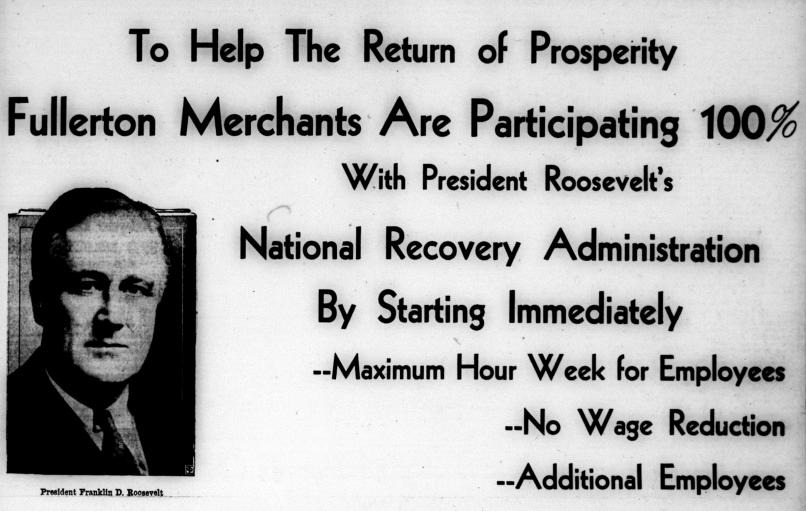
Local leaders even organized a parade to encourage employers to participate in the NRA program.
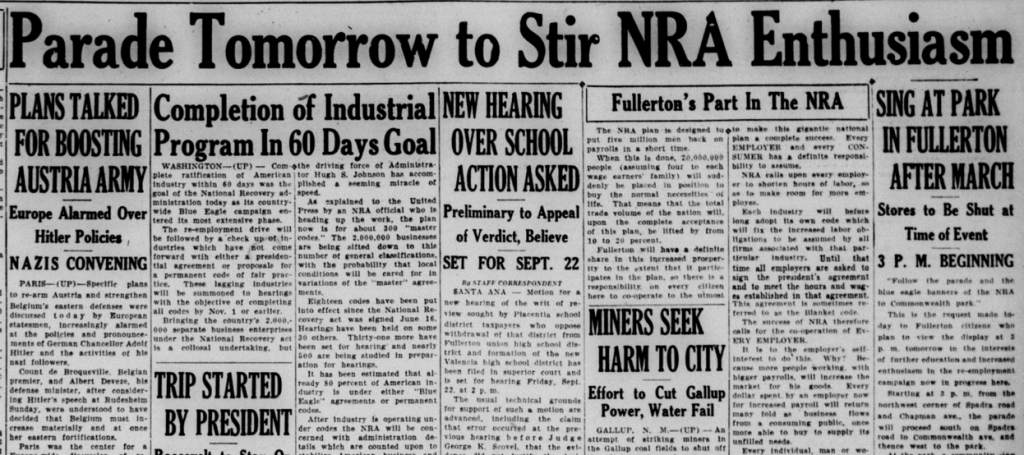
The parade down Spadra (now Harbor) was led by a police car with Congressman Sam Collins, civic leaders, and officials of the NRA participating.
Civil war, Spanish American War and World War veterans marched together with Boy Scouts, Girl Scouts, Girl Reserves and other similar groups
The parade ended at Commonwealth Park, where there was community singing and speakers explaining the NRA program.
Larger industries like coal and the U.S. Chamber of Commerce opposed the NRA. It eventually succumbed to legal challenge and was replaced by other New Deal programs.
One impact of the New Deal was to greatly increase the number of federal employees.
Local Depression Relief Efforts
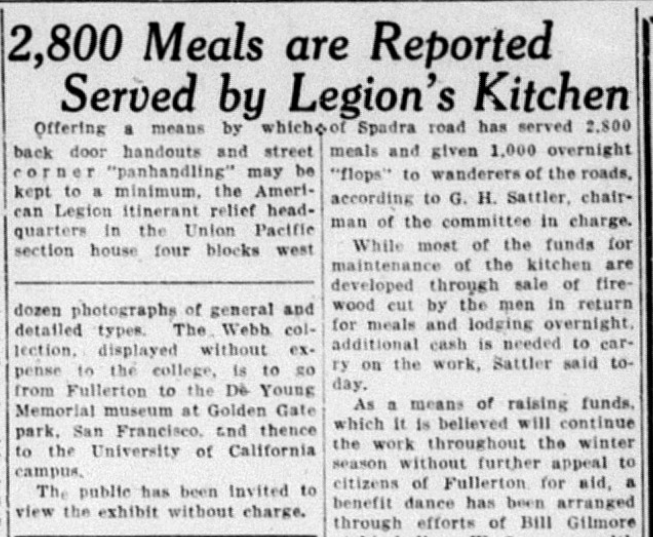
In addition to increased funding and support from the federal and state governments, local groups also sought to help those facing unemployment, poverty, and hunger caused by the Depression.
Prohibition Ends!
Prohibition on alcohol, which had begun in 1920 with the passage of the 18th Amendment, was repealed in 1933 with the passage of the 21st Amendment. President Roosevelt famously said, “What America needs now is a drink.”

Even prior to the repeal, congress passed a law permitting the sale of beer with an alcohol content of 3.2 or less.
Things played out a bit contentiously in Orange County. After the passage of the Beer law, the OC District Attorney declared alcohol still illegal under a county ordinance.

“Orange county remains bone dry, regardless of the new beer bill passed by congress, District Attorney S.B. Kaufman declared in a formal opinion today,” the Tribune reported. “The county still had a dry ordinance and because the new beer law allowed for local control…Meanwhile, LA county board of supervisors repealed their local ordinance, thus allowing beer.”
The battle between “wet” and “dry” supporters played out locally, as Fullerton City Council considered rescinding its dry ordinance. City Council declined to take a position on the contentious matter, instead putting it to a vote of the people, who decided they needed a drink.
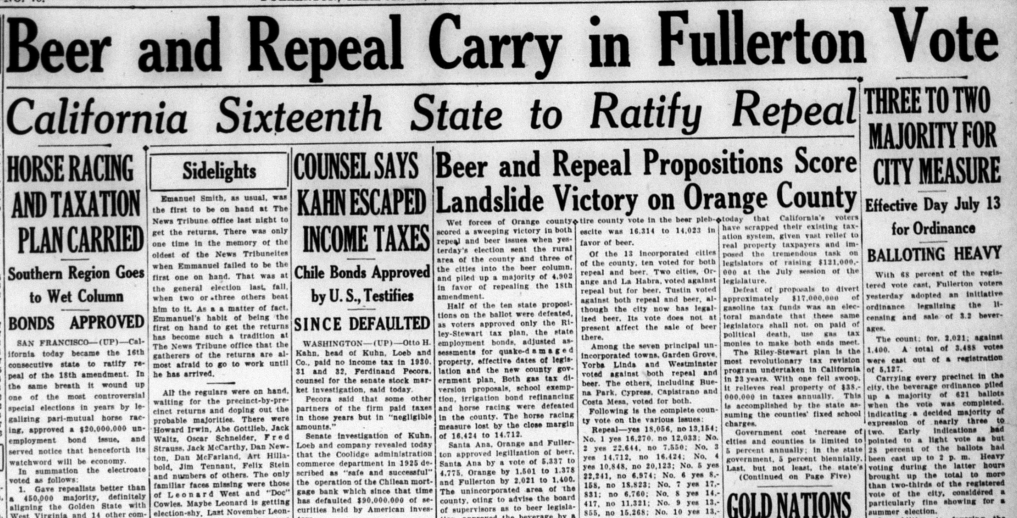
In short order, some Fullerton businesses began selling beer.
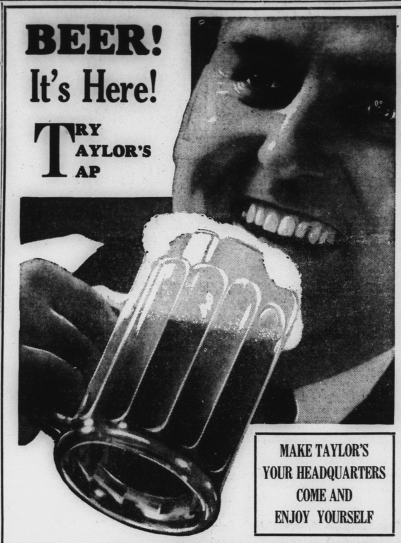
And with the passage of the 21st amendment, Prohibition was over.

Agriculture and Mexican Deportation
As a result of the Depression, the Bastanchury family lost control of their vast orange ranch, and it went into receivership.

Under its new owners, all of the Mexican workers on the ranch were deported.
“All of the Mexican camps on the ranch have been eliminated and all American labor is being used with 28 houses on the ranch now filled with regular employees, nearly all of whom have been continuously on the payroll since last April,” the Tribune reported.
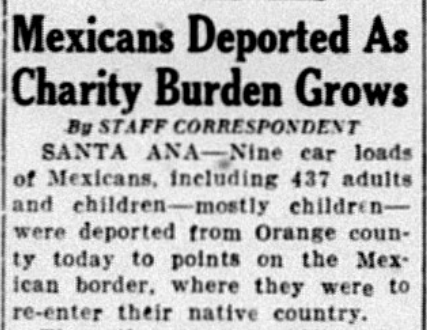
“Nine carloads of Mexicans, including 437 adults and children–mostly children–were deported from Orange county today to points on the Mexican border, where they were to re-enter their native country,” the Tribune reported.
The majority of those deported were likely from the Bastanchury Ranch. The deportation was seen as a way to provide jobs for white workers, and to reduce county welfare costs.
“Thus the county welfare department unburdened itself to an appreciable extent of a “relief” load. The trainload has been living on charity in this county and their deportation represents “relief” to the taxpayers, according to Byron Curry, county welfare director,” the Tribune reported. “One car-load will be sent to Nogales, opposite Notales, Arizona. The other eight car-loads will be sent to Juarez, opposite El Paso, Texas. The cost of deportation, $12 per fare for adults, $6 for children over 5 years of age and no charge for children under that age, is far less than maintaining the group in the county Curry pointed out.”
The figure of nine trainloads from the Bastanchury Ranch is corroborated by a narrative written by Druzilla Mackey, a teacher in the Americanization program at Fullerton Union High School, published in Louis Plummer’s history of the High School:
“In this time of stress and strain the American community no longer spoke of ‘Our’ Mexicans. They no longer considered that no ‘whiteman’ could pick oranges. Instead they felt that the jobs done so patiently by Mexicans for so many years should now be give to them. ‘Those’ Mexicans instead of ‘Our’ Mexicans should ‘all be shipped right back to Mexico where they belong.’ The Americanization centers in which these people had been taught how to buy and make themselves a part of the American community were now used for calling together assemblages in which county welfare workers explained to bewildered audiences that their small jobs would now be taken over by the white men, that they were no longer needed or wanted in the United States. They explained that the Welfare Department no longer had any money to aid them during times of unemployment, but would furnish them a free trip back to Mexico. And so—one morning we saw nine train-loads of our dear friends roll away back to the windowless, dirt-floored homes we had taught them to despise.
This mass deportation was part of a larger mass deportation of Mexicans in the United States during the Great Depression, which is chronicled in the book Decade of Betrayal: Mexican Repatriation During the 1930s by Francisco E. Balderrama and Raymond Rodriguez.
Water
In 1933, the Orange County Water District was created.
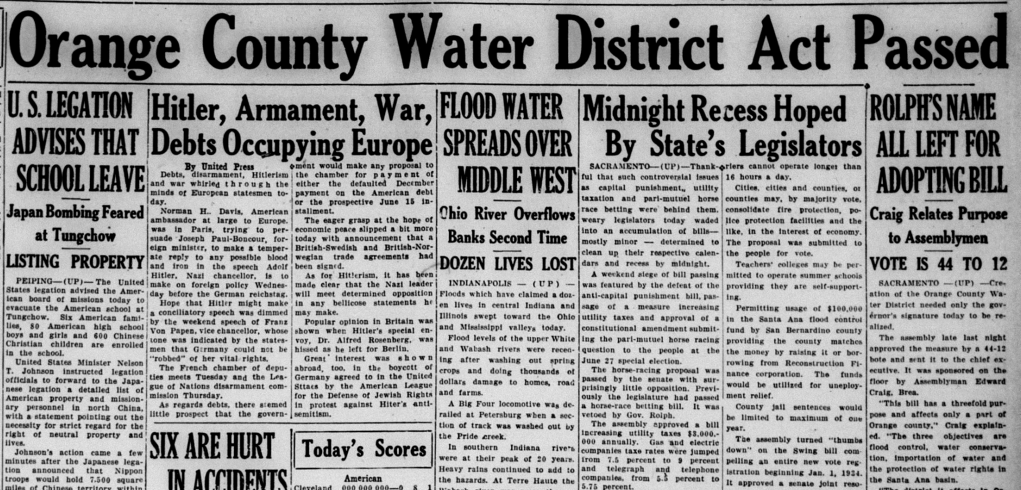
“This bill has a threefold purpose and affects only a part of Orange County,” State Assemblymember Ted Craig explained. “The three objectives are flood control, water conservation, importation of water and the protection of water rights in the Santa Ana basin.”
“The future of the district depends solely upon the underground supply of water, which has been receding for the past 25 years. With the formation of this district the three objectives can be carried out,” the Tribune reported.
Fascism Abroad and at Home
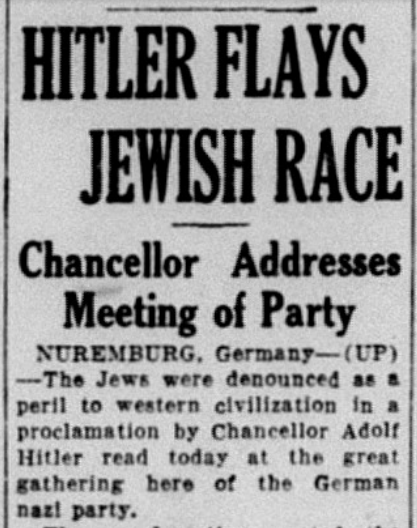
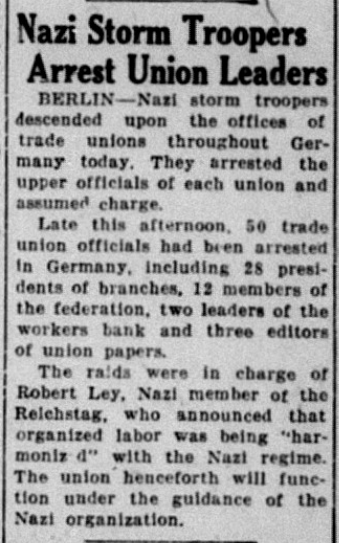
In Germany, Adolph Hitler and his Nazis continued to consolidate power.

The Reichstag fire, which burned down Germany’s Parliament building, was blamed on communists, gave a pretext for Hitler to crack down on his political opponents and seize power.
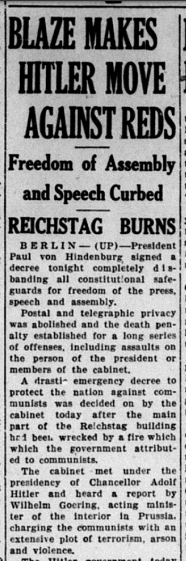

Hitler was applauded by the entire assembly when he said: “Treason against the people must be exterminated with barbarous ruthlessness.”
Hitler was also cracking down on Jews.

In Berlin, iron-clad discipline was enforced among the brown-shirted Nazis who closed Jewish stores and stood guard to prevent customers from entering.

“What happens to Germany with regard to Hitlerism will determine what happens to the whole European government in the next 15 or 20 years,” Rabbi Herman Lissauer of Los Angeles asserted in his address on “Germany, Hitler, and race Relations” last evening at the final spring dinner meeting of the Fullerton International Relations council in First Methodist Episcopal church banquet hall.
“A group has come into power in Germany which has put an end to the German republic, stripped Germany of her last vestige of honor, self-respect and dignity in the eyes of the rest of the world,” Rabbi Lissauer said.
“In Germany today, the whole power of the country is in the hands of a small group of people…Hitler has set about crushing out all minority factions excepting the Catholics, whom he has striven to ingratiate. His interest has centered on the Jews. The German people under his leadership have turned like wolves against the Jews who have lived and labored in Germany for 900 years and are an integral part of Germany. You have only to read the press of the nations of the world to see what atrocities have been committed against the Jews.
“It would be impossible to achieve the Hitler ideal, a race 100 percent German without amending theology to divest it of the very essence of Christianity. The only true racial fact is that each individual is one in a family among the other families of the world, and that each person must strive to raise the standard of human excellency among men.”
Under Hitler, Germany quit the League of Nations.

Albert Einstein, who was Jewish, moved to the United States to flee persecution and to accept a position at Princeton University.

Fascism at Home
Fascism wasn’t confined to Europe. In America, a fascist group called the Khaki Shirts was led by a man named Art. J. Smith.

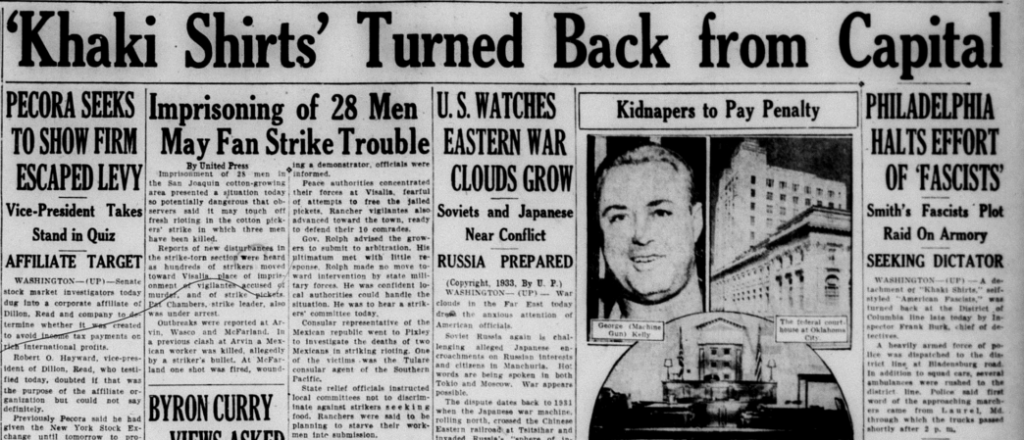
“We are a group of citizens who are fed up and disgusted,” Smith said. “We are an American Fascist organization. We are going to put a dictator over the United States. But we are not for revolution. We have 6,000,000 men now and we will have 10,000,000 by July. Our organization started only 13 months ago in California–and look at us now.”
In reality, the Khaki Shirts had less than 25,000 members.
When asked why the Khaki Shirts carried clubs and gas pipes, Smith responded, “For protection against Communists.”
Labor vs. Capital
Throughout the 1930s, many labor strikes occurred.

Mrs. Reba Crawford Splivalo, state director of social welfare, told an audience of around 300 in the high school auditorium: “I see in the sky the signs of rebellion. I am not crying ‘wolf, wolf.’ I am giving a warning. If the present economic situation is to survive the needs of the underprivileged must be met. Capital and labor must find a common meeting ground.”

Local Politics
In local political news, many citizens were outraged when a City Council majority dismissed judge Halsey Spence, without initially giving a reason. Citizens get together a petition with over 1,600 names calling for the reinstatement of the apparently popular judge. At first, the council majority dismissed the petition. It was only after the threat of a recall against the council majority that they started to listen.


Crime
In crime news, a spate of kidnapping of wealthy people and holding them for ransom spread throughout the United States.
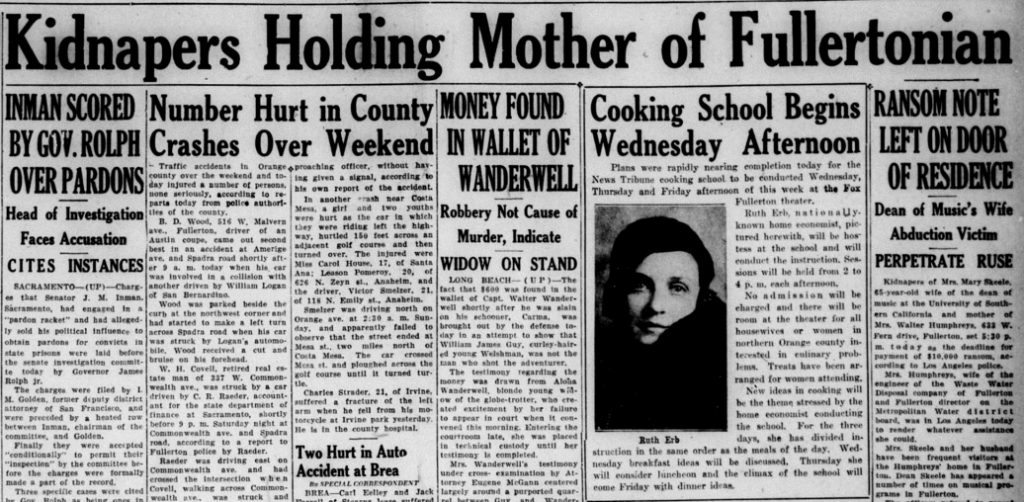
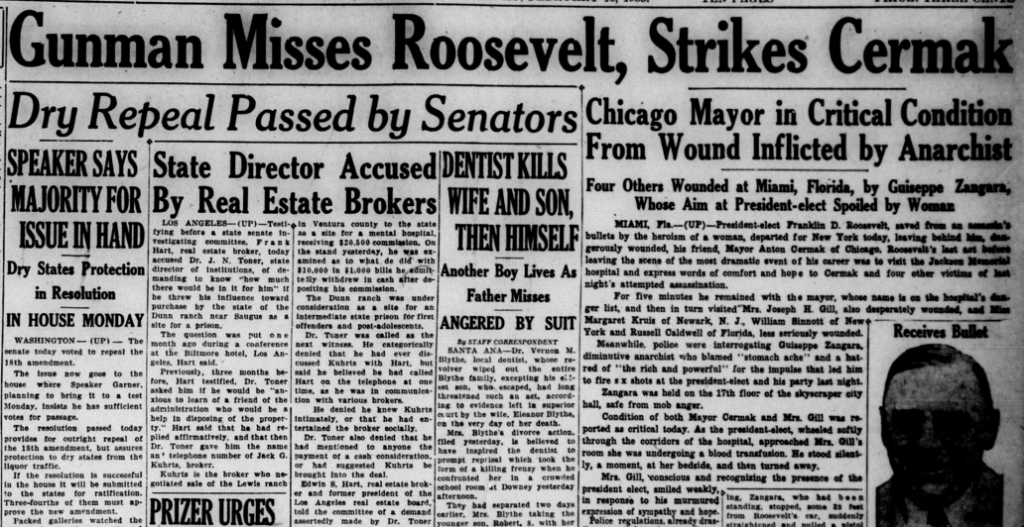
There was at least one attempted assassination of President Roosevelt.
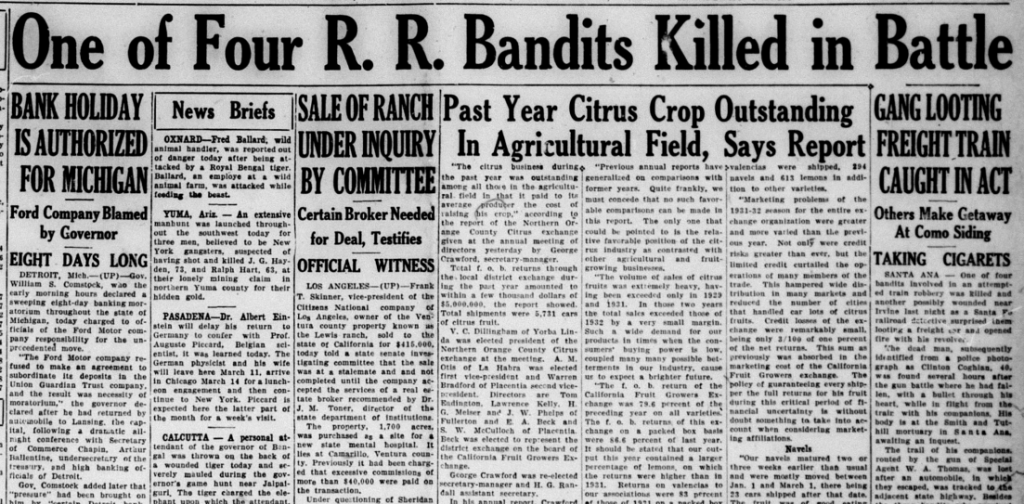
There were railroad robberies.
A group of Filipino farm workers couldn’t pay for their food at a rooming house. A fight ensued, and one of the laborers stabbed the owner of the boarding house.

“Fullerton police halted a miniature Philippine insurrection and incipient race riot shortly before noon today with the arrest of S. Sonico, 30, charged with suspicion of assault with a deadly weapon on Nesario Daza, 35, Mexican, who with his wife operates a lodging house on E. Truslow ave,” the Tribune reported. “More than 15 Filipino laborers were rounded up in the investigation, but only Sonico was held by police, although officers were drawn into the argument between friends of Daza and one group of Filipinos in regard to their proposed departure for Bakersfield with an unpaid board bill.”
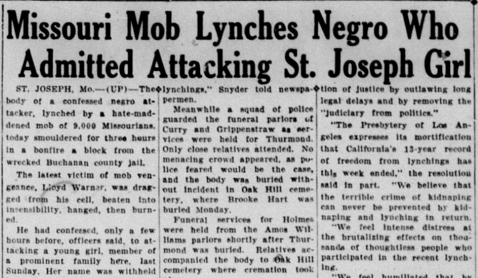
Unfortunately, lynching of African Americans was still a relatively common occurrence in 1933.

Sports
In sports news, Fullertonian Arky Vaughn was making waves in the Major Leagues.

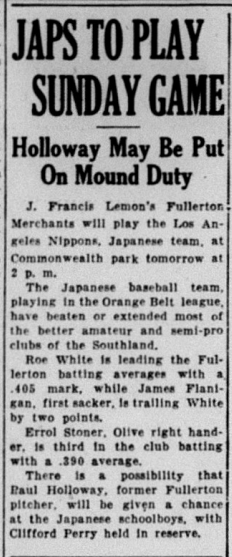
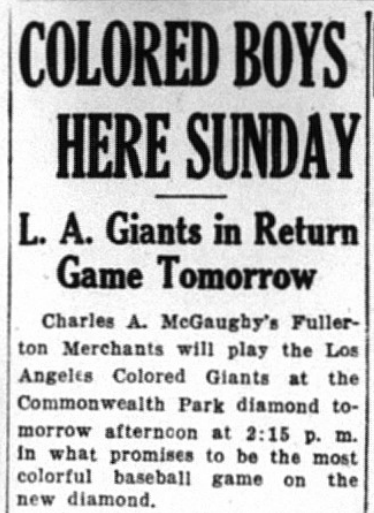
There was a local baseball league which played games at what is now Amerige Park. The teams seem to have been somewhat segregated.
Fullerton had a swimming pool at the northwest corner of Malden and Wilshire, which is now an apartment complex.


Deaths
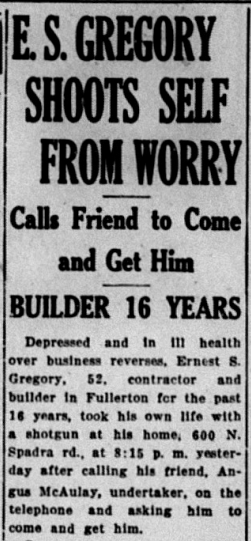
A number of local pioneers passed away in 1933.

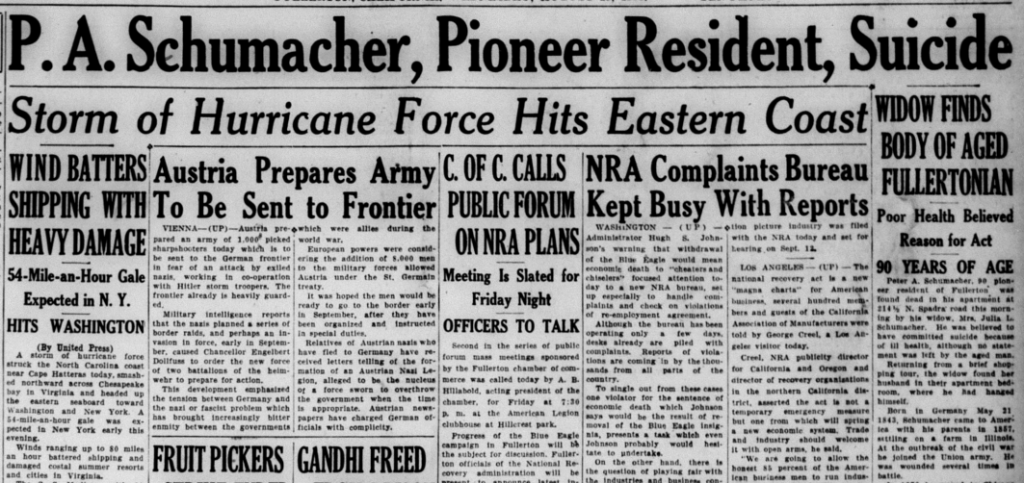
“Peter A. Schumacher, 90, pioneer resident of Fullerton, was found dead in his apartment at 214 ½ N. Spadra road this morning by his widow, Mrs. Julia L. Schumacher. He was believed to have committed suicide because of ill health, although no statement was left by the aged man. Returning from a brief shopping tour, the widow found her husband in their apartment bedroom, where he had hanged himself,” the Tribune reported.
Born in Germany May 21, 1843, Schumacher came to America with his parents in 1857. He fought for the Union Army in the Civil War, during which he was wounded.
In 1887, the year Fullerton was founded, he opened the Orange County nursery in town. He later entered into the real estate and insurance business. He built a notable building on the 200 block of N. Harbor, where he lived and died.
His son Roy Schumacher was the first child to be born in Fullerton.
In a nice tribute, the Tribune stated: “Pete” Schumacher was almost an institution in Fullerton. For almost half a century his name and person have been known to the men, women, and children of the community. In later years his cane and basket were familiar features of the downtown scene. His presence on the city streets, talking and visiting, was an established part of the local picture. To have him disappear from the daily round is like having an accustomed landmark taken from our view.”
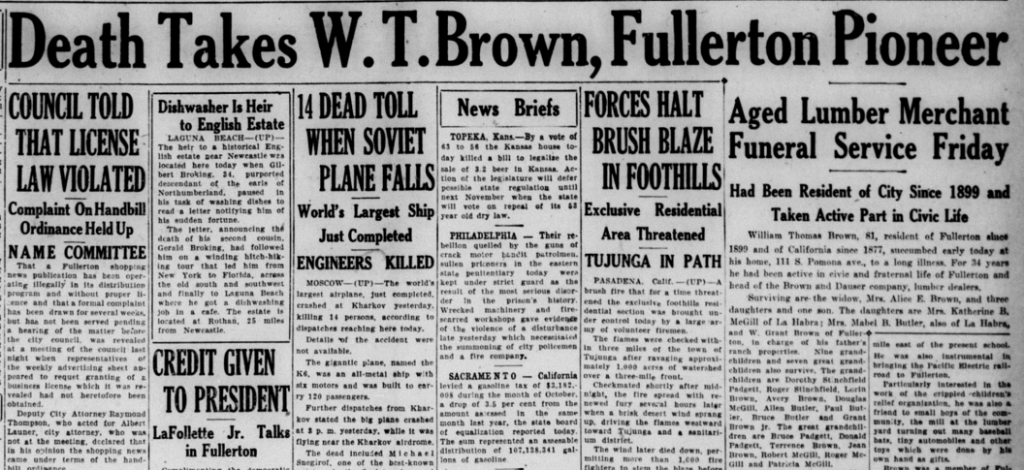
William Thomas Brown, 81, a resident of Fullerton since 1899 died at his home at 111 S. Pomona ave. For 34 years he was active in the civic and fraternal life of Fullerton and was head of the Brown and Dauser lumber company, which was the successor to the Grimshaw Lumber company.
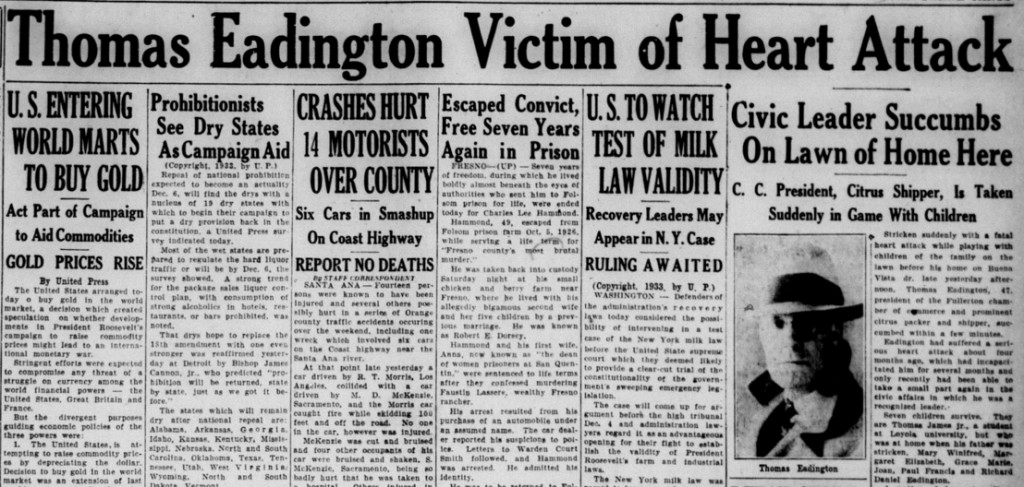
Thomas Eadington, 47, president of the Fullerton chamber of commerce and prominent citrus packer and shipper, died of a heart attack.
A native of Lancaster, England, Eadington came to the United States in 1911. After working for the Benchley Fruit company, he established the Eadington Fruit company in 1921, operating his own packing houses.
Stay tuned for top stories from 1934!
 Fullerton History