The following is from a work-in-progress about the history of Fullerton. You can support my ongoing research and writing on Patreon.
The Local History Room of the Fullerton Public Library has microfilm from the Fullerton Tribune newspaper stretching back to 1893. I am in the process of reading over the microfilm, year by year, to get a sense of what was happening in the town over the years, and creating a mini archive. Below are some news stories from 1928.
When Republicans Dominated Orange County
Republican Herbert Hoover was elected president, defeating Democrat candidate Al Smith.

Back in 1928, Orange County was largely Republican. In Orange County, Hoover got 30,100 votes, while Smith got only 7,597. Hoover received 2,966 votes in Fullerton while Smith only got 542.
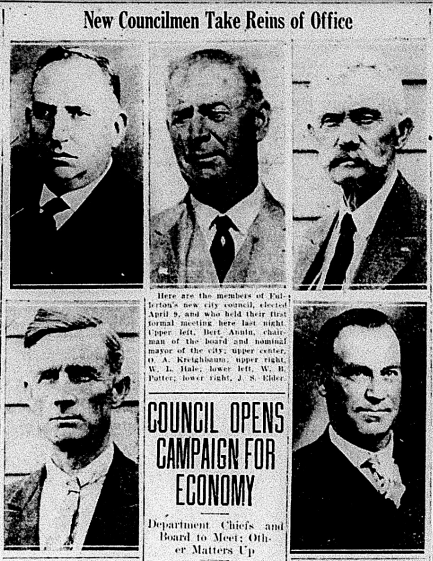
In the City Council election, voters chose William Hale, R.S. Elder, and O.H. Kreighbaum. Bert Annin, who was not up for election, was chosen as Mayor.
The St. Francis Dam Tragedy
In 1928, one of the greatest disasters in California history occurred, when the St. Francis Dam broke. Although this occurred in Los Angeles county, its devastating impact in terms of loss of life was felt across the region.

Water
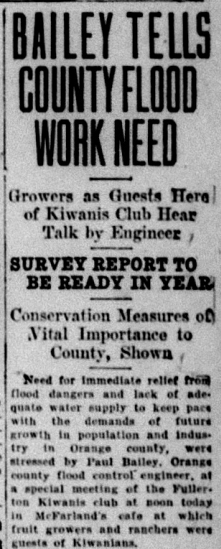
Water issues were at the forefront of local leaders’ minds. There was talk of how to prevent the Santa Ana River from flooding again.
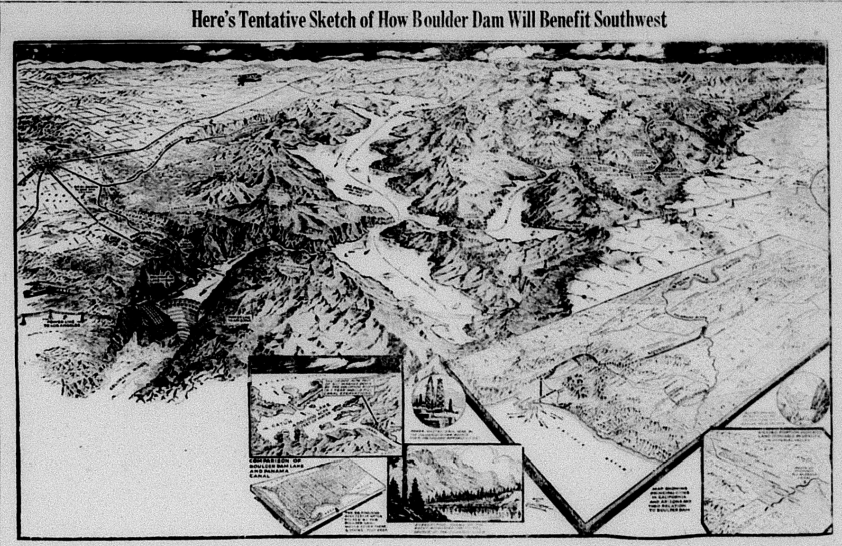
There was also a big political fight about building the Boulder Dam, which was supported by California agricultural and civic boosters. This would ultimately bring lots of water to the southland, including Fullerton.
King Citrus
Back in 1928, Fullerton and surrounding areas was largely agricultural, and citrus was king. The citrus industry operated in a unique way, with growers both co-operating and competing under the California Fruit Growers Exchange, also known as Sunkist.

Here’s a description of how the system worked:
One fundamental reason for the great success of the California Fruit Grower’s Exchange lies in the fact that its plan of operation effectively combines the constructive features of both competition and co-operation.
Under the Exchange system, all growers compete to produce the highest quality of fruit. The highest returns in any Exchange association go to growers who produce the most fruit per acre, or who have the largest percentage of their crops sorted into the higher-priced top grades.
Likewise each local association competes with the other 201 associations within the exchange. But the rivalry is in operating efficiency. The association that packs and handles its fruit better, builds a following for its labels and wins premiums for its gains.
Every Exchange grower and association has the maximum incentive for efficiency in management, economy in operation, and skill in method. Through this constructive competition the rewards of success automatically go to the winners in the form of higher returns.
But when the lid is nailed on a box of Exchange fruit, competition ceases and co-operation begins. The problem is then to systematically distribute all the California crop to all the markets. The real competition is not among Exchange growers and associations. It is between California lemons and Italian lemons, California oranges or grapefruit and Florida oranges or grapefruit, citrus fruits against other fruits, fruits against other foods.

In this common task Exchange growers and associations stand shoulder to shoulder.
Orderly distribution is possible only when the marketing is directed by a central organization that has all the facts about supply and demand everywhere. Marketing through unrelated agencies, each acting independently, inevitably leads to the over or under-supply of some or all markets. Sales competition within the industry can only result in lowering prices.
The achievement of the Exchange in successfully marketing the fruit of its 11,000 growers lies in the fact that it handles 75 percent of the yield.
As the percent of the crop marketed efficiency of the organization has steadily improved.
The most beneficial single thing that could happen to the California citrus industry would be to have every carload of California oranges, lemons and grapefruit marked through the California Fruit Growers Exchange.

Then there would be as much competition for quality among California growers and associations as though the Exchange did not exist.
But there would be 100 percent cooperation in perfecting the systematic distribution of the entire crop to the markets of the world…and increased returns for every grower.

What the exchange is…
The California Fruit Growers Exchange is a non-profit organization of 11,000 California citrus fruit growers, producing about 75% of the California citrus crop, operated by and for them on a cooperative basis. Its object is to develop the national and international market for California oranges, lemons, and grapefruit by continuous advertising, and to provide a marketing organization that will sell the fruit of its members most advantageously, and at least expense. Receipts from sales, less only actual costs of operation, are returned to the growers. Applications are received through all of the Exchange’s 201 local packing associations.
Another major aspect of the citrus industry was labor. Most of the picking of the fruit was done by migrant Mexican labor.
As they are today, these migrants were sometimes the target of politicians.

“Restriction of Mexican and other Central and South American immigration into the United States on a quota basis was urged by Rep. John C. Box, Democrat, Texas, author of a bill for this purpose, before the house immigration committee today,” the Tribune reported. “The country was being flooded with an oversupply of cheap labor which not only was driving out native white and colored labor in the west and southwest but also was spreading northward, Box said.”
“If I had but one reason for urging this bill it would be to protect the American farmer from a system of peasantry,” Box declared.
“Henry Deward read a statement from the immigration restriction league, Boston, urging passage of the measure and also warning that Mexican labor is spreading to other parts of the country,” the Tribune reported. “Chairman Albert Johnson of the committee said he had ‘hundreds of letters from prominent people not only in the west but all over the country,’ endorsed the proposed restriction.”
But not everyone wanted Mexican exclusion. Large growers from the southwest still relied largely on Mexican migrant labor, and some American diplomats felt such restrictions would negatively impact international relations.

Growth
Fullerton continued to experience a building and population boom throughout the 1920s. In 1928, it was the largest city in North Orange County, with an estimated population of 12,000.
New housing subdivisions continued to be built. Unfortunately, most of these had racially restrictive housing covenants, which prevented non-white people from purchasing or renting property there.


3000 students graduated from Fullerton Union High School.

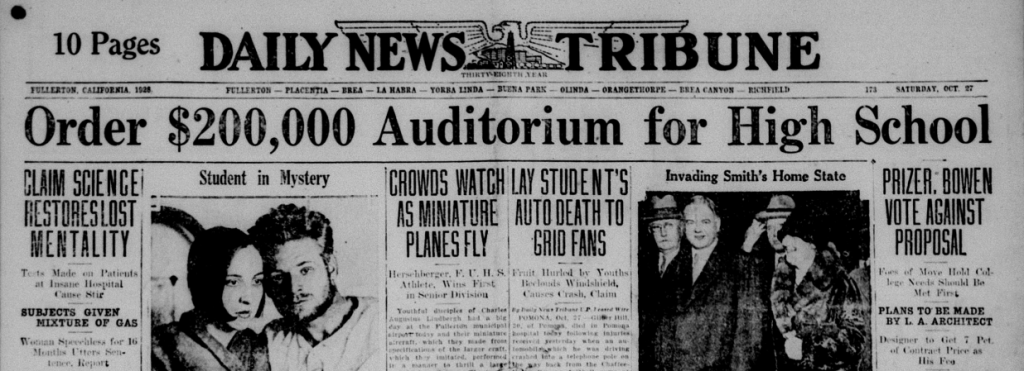
Additionally, plans were in the works for a new high school auditorium.

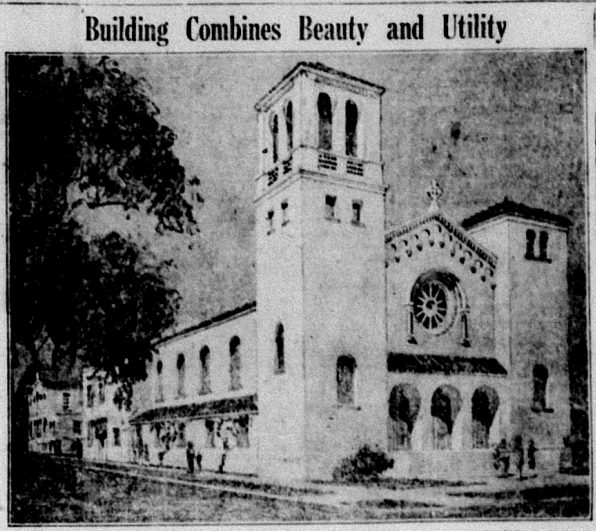
The Methodist church also broke ground on a new building.
Crime
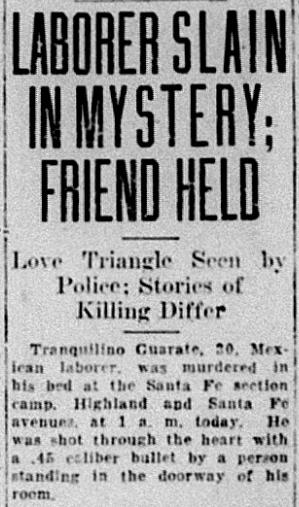
Among the various crimes reported in the Tribune, one stood out to me, because it happened right around where I live, which is in former railroad worker housing near the corner of Santa Fe and Highland. A man was murdered in one of the housing units. Was it mine? The Tribune doesn’t say. But perhaps this qualifies my residence for a stop on the Fullerton Ghost Tour.
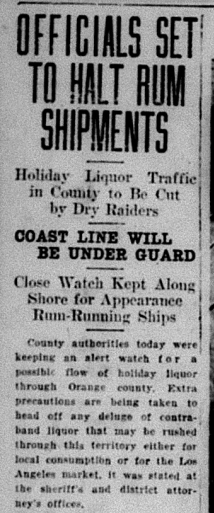
In 1928, Prohibition on liquor was in full effect, so there are many stories about people being arrested for booze.

Hollywood Stars Come to Fullerton
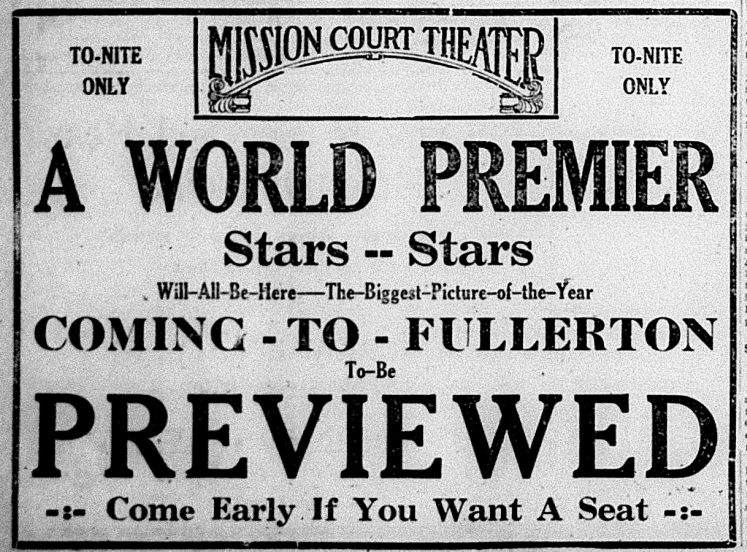
A major center for culture and entertainment was the Mission Court (later called the Fox) Theater. This local movie palace hosted several “Preview” screenings of major Hollywood films, where the stars would be in attendance, such as Harold Lloyd, Dolores Del Rio, and more. It must have been exciting to attend these star-studded events.


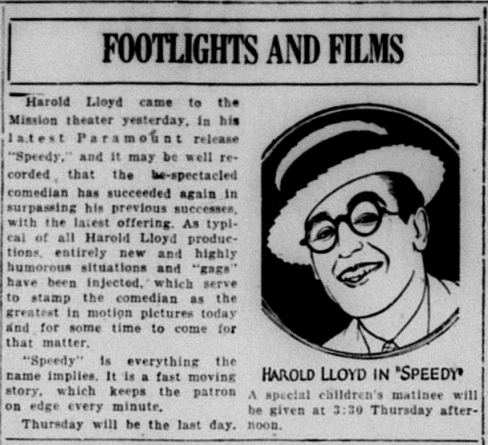
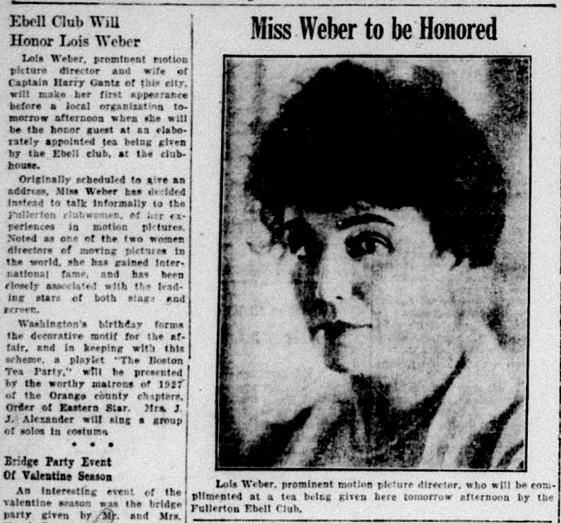
In the 1920s, Fullerton was home not only to a lovely movie palace, but also to a major movie director, Lois Weber–a pioneer female director.
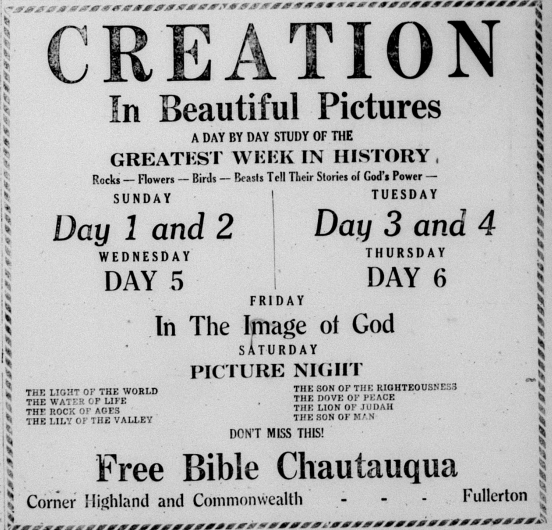
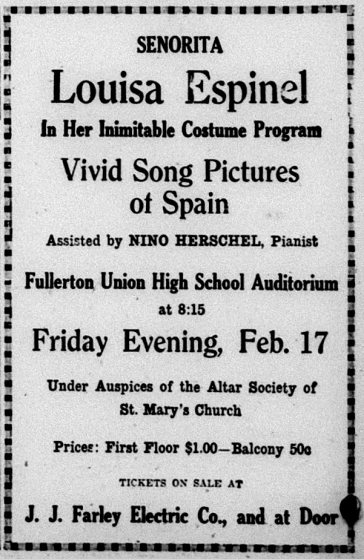
Here are ads for other cultural events in Fullerton in 1928:

Sports
Gaston Bastanchury, owner of the sprawling Bastanchury Ranch in the hills of north Fullerton, wanted to build an enormous venue to host a boxing match between world champion Jack Dempsey and Basque boxer Paulino Uzcudun. Unfortunately, this never came to fruition.


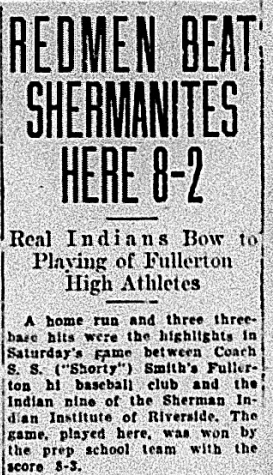
Fullerton Union High School’s mascot was, and remains, the Indian, which (in my view) is a problematic example of cultural appropriation. Nicknames for the team in 1928 included the “Red Men,” and the school would host “Pow Wows” featuring non-native people dressing up as Indians. These “Pow Wows” were still happening as late as the 1990s, when I attended high school there.

Planes, Trains, and Automobiles
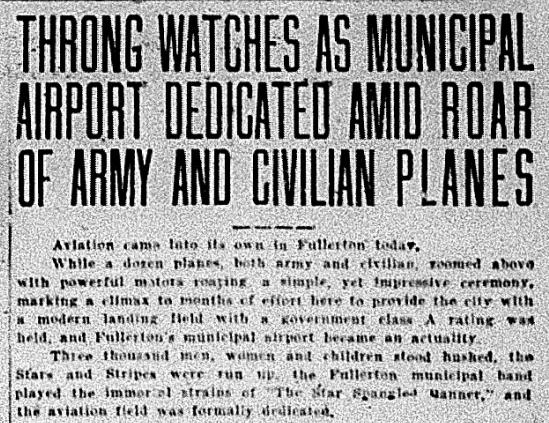
In 1928, the Fullerton Airport was brand new.
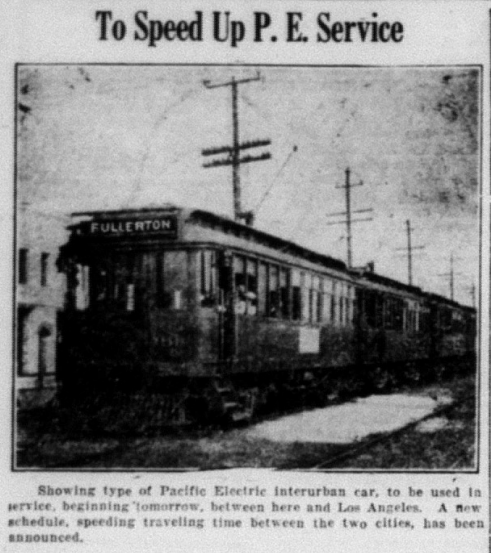
The sprawling Pacific Electric passenger rail service was the largest interurban rail network in the world.
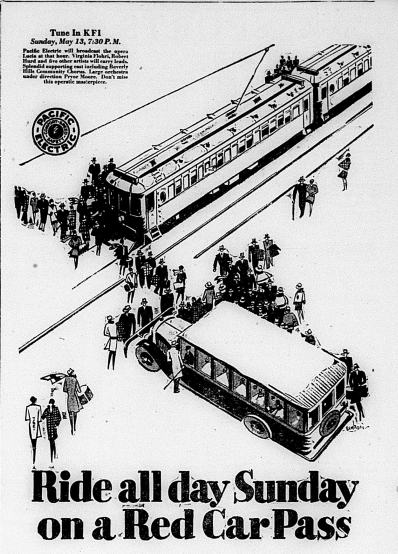
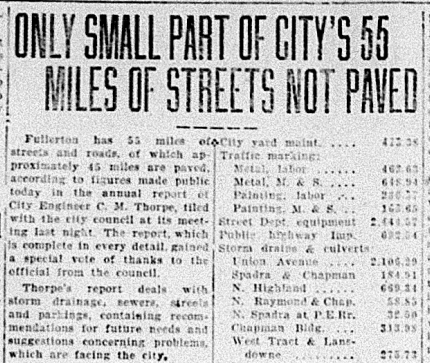
Cars were also quite popular, and more roads were being paved.
Oil!
In addition to citrus, another major export of Fullerton was oil. According to the chart below, Fullerton oil fields had 491 wells producing nearly 900,000 barrels.

Stay tuned for top stories from 1929!
 Fullerton History