The following is from a work-in-progress about the history of Fullerton. You can support my ongoing research and writing on Patreon.
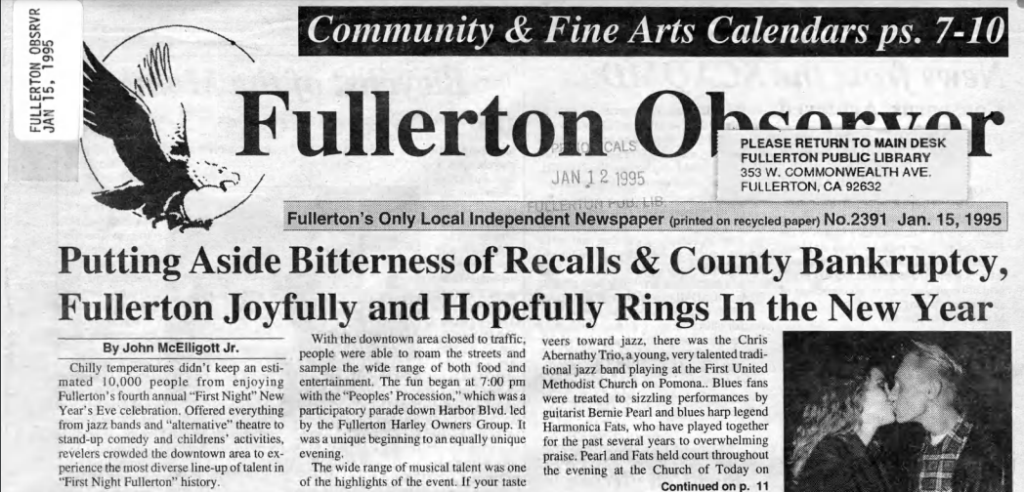
The Fullerton Observer newspaper was formed in 1978 by Ralph and Natalie Kennedy and friends to provide a more progressive counterbalance to the more conservative Fullerton News-Tribune and Orange County Register. The Fullerton Public Library has digital archives of the Observer stretching back to 1979. I am in the process of reading over each year and creating a mini-archive. Here are some top news stories from 1995.
The Great OC Bankruptcy & Other Budget Woes
In 1994, the county government of Orange County filed for bankruptcy following bad, risky investments. The county lost $1.7 billion, which trickled down to school districts and cities, including Fullerton.
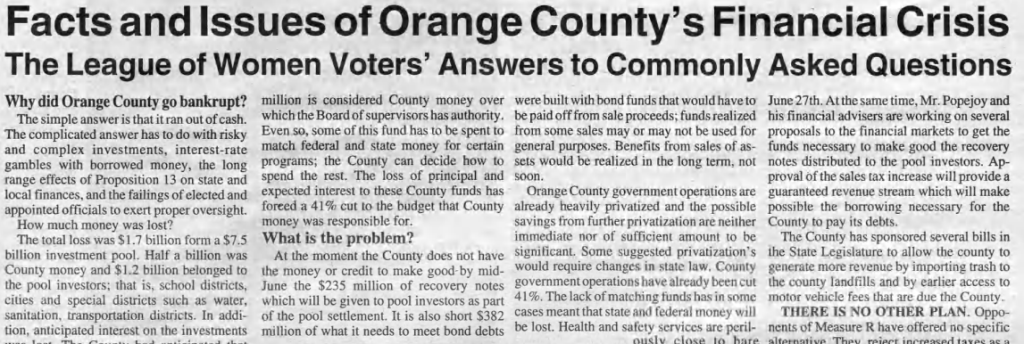
“The loss of principal and expected interest to these County funds has forced a 41% cut to the budget that County money was responsible for,” the Observer reported.
Some “small government” Republicans and Libertarians sought to embrace the opportunity to get the county to drastically cut its staff and services.
Other groups, like the League of Women Voters, urged another solution than massive cuts.
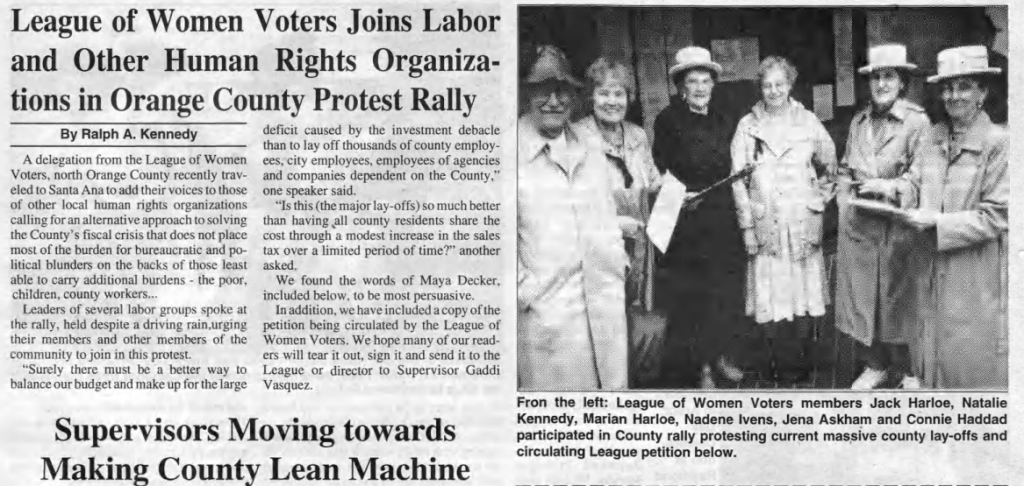
“Surely there must be a better way to balance our budget and make up for the large deficit caused by the investment debacle than to lay off thousands of county employees, city employees, employees of agencies and companies dependent on the County,” one speaker at the above-mentioned rally said.
At risk were things like the Fullerton School District’s Social Services program.
“The Social Services unit in the Fullerton School District is an example of an endangered program whose services are absolutely vital to the schools and families of the district,” an opinion piece in the Observer stated.
Ultimately, the OC Board of Supervisors voted to place a half-cent sales tax increase in the ballot to stem the budgetary bleeding. It was called Measure R. Did it pass? Stay tuned for my notes from 1996!
In Fullerton, fiscal matters were made worse by the fact that a newly elected council (following a recall) had voted to repeal the city’s utility tax. Even before the bankruptcy, the city was facing a $2 million budget shortfall.
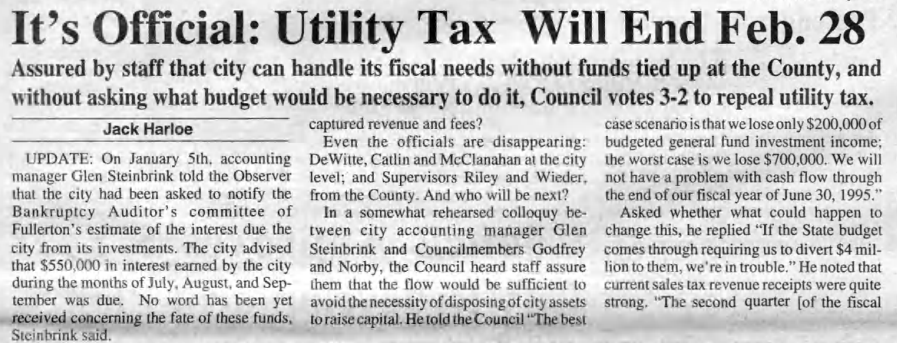
The Council voted 3-2 to repeal the utility tax (Councilmembers Flory and Bankhead voting no). The repeal is effective February 28, 1995.
A financial advisory committee was not in favor of repealing the tax.

A committee report noted that “there is no way the city can replace the “windfall” of $2.1 million that would have been realized if the tax had been allowed to continue to its sunset date of October 1, 1995.”
Instead, Fullerton plugged the budgetary hole with redevelopment funds (which no longer exist) and by selling city-owned property for a housing development.
The Observer ran a piece on how recent budget cuts had affected the quality of life of the city.
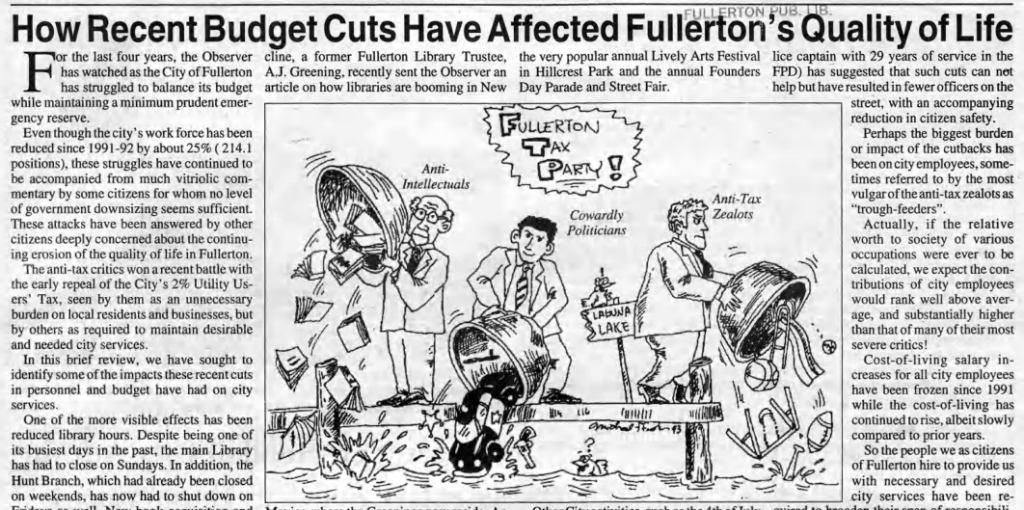
The city’s work force had been reduced since 1991-92 by about 25% (214.1 positions). Library hours were reduced. The Fullerton Museum Center lost about 29% of its annual allocation.
Streets will be getting patched more often and resurfaced less. Tree trimming, which used to done on demand, was reduced to every 4 years, except where city is notified a safety problem exists.
Street-sweepers eliminated alleys from their schedule. The annual Lively Arts Festival in Hillcrest Park and the annual Founders Day Parade and Street Fair were cancelled.
The number of firefighters on trucks was reduced by one and the Police Department lost 32.5 positions.
The McColl Toxic Waste Dump to be Capped
Regarding Fullerton’s first Superfund site, the McColl Toxic Dump site, 200,000 tons of oil waste under the northern part of what is now the Los Coyotes Golf Course, the oil companies responsible for the environmental degradation lobbied hard for the cheapest solution, capping the site and leaving the waste in place. The EPA had earlier proposed using chemicals to solidify the waste so it would be less likely to seep into the local groundwater aquifer.
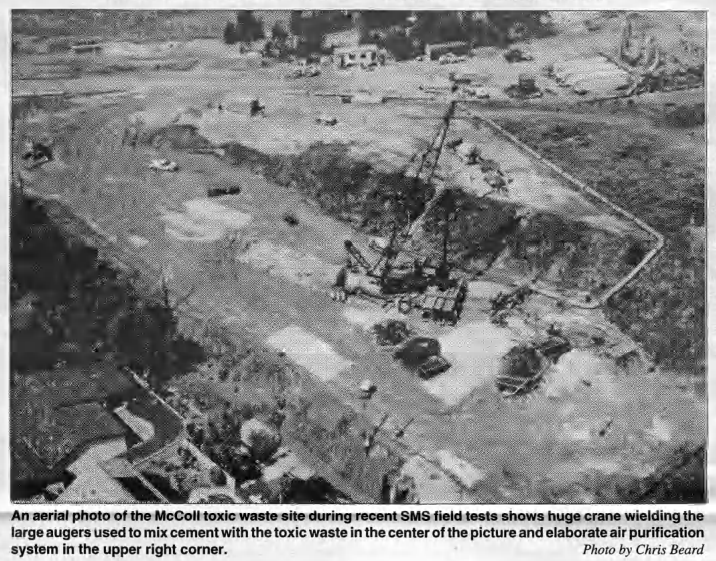
“With distribution of a slick and persuasive, 8-page, “Community Action Report”, the McColl Site Group (responsible oil companies) have thrown their anti-SMS (Soft Material Solidification) hat into the ring,” the Observer reported. “The two goals of SMS are: to neutralize the waste, and to solidify it sufficiently to prevent migration.”
Eventually, the EPA chose the oil companies’ preferred solution, capping the waste.
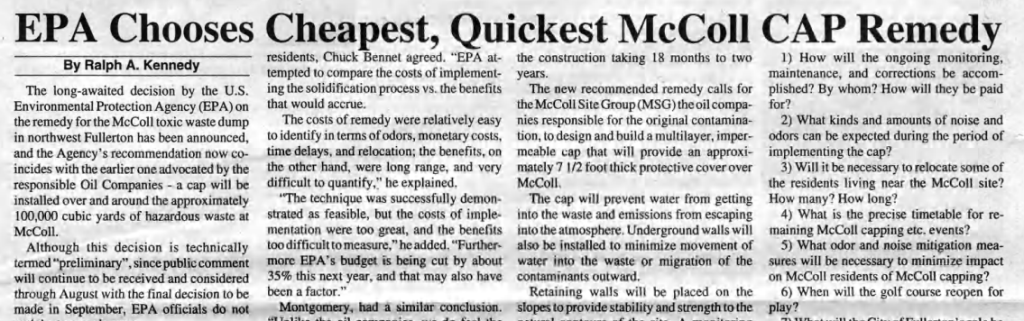
The EPA claimed that “The impact of the in-place solidification remedy (odors and time) were so great as to render this remedy invalid.”
“Furthermore EPA’s budget is being cut by about 35% this next year, and that may also have been a factor,” the Observer reported.
By this point, most residents were in favor of the quickest solution, as the problem had been dragged out for many years.
Here’s a description of the remedy that was ultimately selected, and this is what remains today:
“The new recommended remedy calls for the McColl Site Group (MSG) the oil companies responsible for the original contamination, to design and build a multilayer, impermeable cap that will provide an approximately 7 1/2 foot thick protective cover over McColl. The cap will prevent water from getting into the waste and emissions from escaping into the atmosphere. Underground walls will also be installed to minimize movement of water into the waste or migration of the contaminants outward. Retaining walls will be placed on the slopes to provide stability and strength to the natural contours o f the site. A monitoring system to detect future migration of the waste to adjacent areas will also be installed.”
The Struggle for Affordable Housing
Throughout the 1980s, a conservative majority Fullerton City Council regularly refused to use Redevelopment funds to support the construction of affordable housing, despite state mandates that it do so. Then a few local citizens sued the city and won, forcing the city to approve a number of affordable housing projects in 1994. But the conservative element remained.

Council voted 3-2, with Councilmembers Bankhead and Flory opposed, to reject a staff recommendation to approve funds to rehabilitate about 14 run-down apartments in an area of the city which the last few years had been deteriorating.
There was also a newly proposed state law SB-1257 (Costa) which would void vacancy controls in local ordinances, and void rent controls on single-family units, duplexes and condominiums.

Unfortunately, this bill passed. It remains in effect today.
But all was not lost. Ground was broken on an affordable housing project called East Chapman Villas.
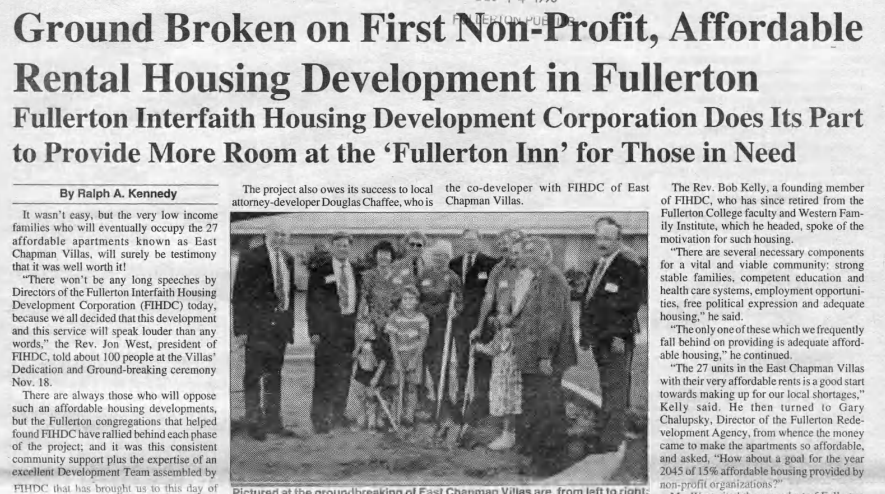
“It wasn’t easy, but the very low income families who will eventually occupy the 27 affordable apartments known as East Chapman Villas, will surely be testimony that it was well worth it!” the Observer reported. “There are always those who will oppose such an affordable housing developments, but the Fullerton congregations that helped found FIHDC have rallied behind each phase of the project; and it was this consistent community support plus the expertise of an excellent Development Team assembled by FIHDC that has brought us to this day of dedication.”
Transportation Center Improvements
Improvements were made to the Fullerton Train station.

However, there was some tension the city and Bushala Bros. over rehabilitation of the 1930 Fullerton Train Station.

The station was described as “Water stained and full of holes.”
“The city has nine yards of correspondence with the Bushalas trying to convince them there’s a problem, but no real response, according to city redevelopment director Gary Chalupsky,” the Observer reported. “The director also has an album full of large colored photographs, taken by a city consultant, depicting what he terms unacceptable conditions.”
The Bushala Bros. maintained they “have lavished loving care on the building in an effort to ‘refurbish’ it while preserving its historic appearance.”
Nonetheless, a big dedication ceremony took place of the recently-refurbished transit center.

“Fullerton Heritage will place National Register designation plaques on the Santa Fe and Union Pacific depots, and the City of Fullerton will dedicate the recent improvements at the Transportation Center, including the south passenger platform and a pedestrian bridge linking the new platform with the historic Santa Fe depot.” the Observer stated. “The Union Pacific depot, moved from the northwest corner of Harbor Boulevard and Truslow Avenue to its current location in 1980, is now home to the Old Spaghetti Factory Restaurant. The Santa Fe depot, one of the Southland’s oldest railroad stations still in service, serves an estimated 900 Amtrak and Metrolink passengers daily; more than 50 passenger and freight trains stop or pass through the station daily. The building was recently restored to National Historic Register standards by Bushala Brothers, Inc. of Fullerton.”
Norby and Ackerman Seek Higher Office
Councilmember Chris Norby announced his candidacy for the seat held by District 3 Orange County Supervisor Gaddi Vasquez.

“Norby joins practically every other politician in the county, including the man he hopes to succeed, Gaddi Vasquez, in reciting the litany ‘No New Taxes,’” the Observer reported. “A major part of his campaign platform is taken up with the buzzwords of ‘selling assets, contracting, privatizing, and divesting, and welfare reform, urging the county to cease spending [on welfare] $70 million in annual county funds.’”
Former Fullerton Mayor Richard “Dick” Ackerman announced his intention to run for the State Assembly in the 72nd District seat currently held by Ross Johnson.
Maple Gets a Facelift
Hundreds of people from throughout Fullerton gathered at the Maple Community Center for a ribbon cutting ceremony and open house celebrating the recent renovation of the historical building.

In a collaborative effort between the City of Fullerton and the Fullerton School District, the Maple Center received a $500,000 face-lift, made possible by Fullerton Redevelopment funds.
The Maple Center, formerly Maple Elementary School, included Head Start, State Preschool, Child Care, and food distribution by Fullerton Interfaith Emergency Services.
“I only wish we could have been celebrating the reopening of Maple School as a full K-6 elementary school,” said one attendee. Maple was scheduled to slowly re-open one grade a year, starting in 1996.
The Attack on Affirmative Action
Affirmative Action programs nationwide were under attack “as opportunistic politicians seek to gain favor with forces who throughout the program’s history have refused to accept it as one way to help set right two hundred years of inhumane exploitation of black Americans in the United States.”
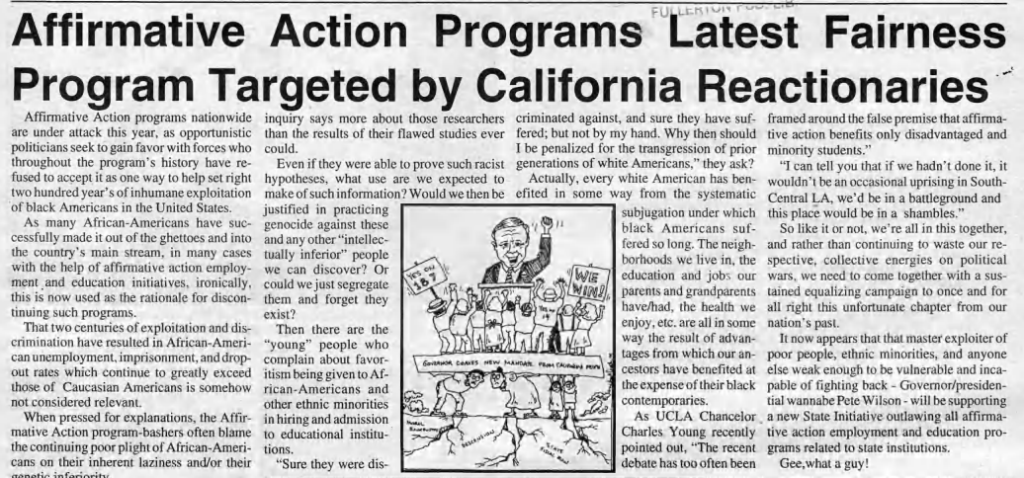
Pete Wilson supported a new State Initiative outlawing all affirmative action employment and education programs related to state institutions.
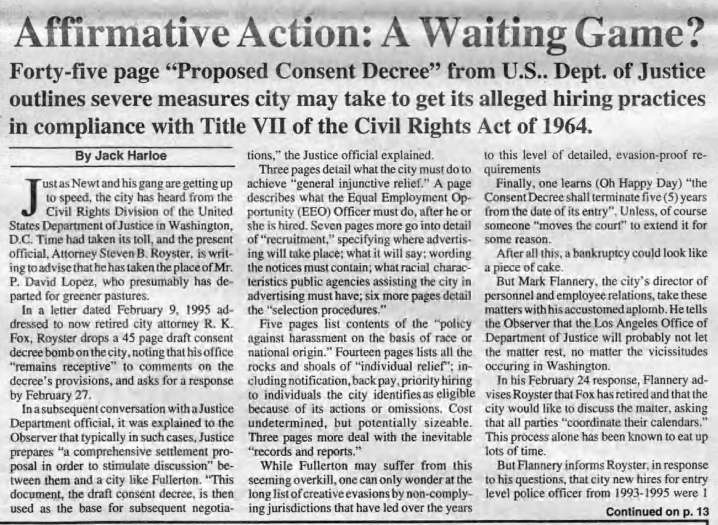
Meanwhile, Fullerton heard from the Civil Rights Division of the United States Department of Justice detailed what the city must do to achieve “general injunctive relief” regarding affirmative action programs.
The DOJ “alleged that between January 1, 1986 and December 31, 1993, the City hired approximately 86 entry-level Police Officers, of whom one was Black, five were Hispanic and four were Asian, and hired approximately 19 Firefighters of whom none were Black, Hispanic or Asian.”
Punk at the Ice House
The historic Fullerton Ice House, owned by the Bushala Bros., had its conditional use permit revoked after a series of rowdy “alternative music” concerts.
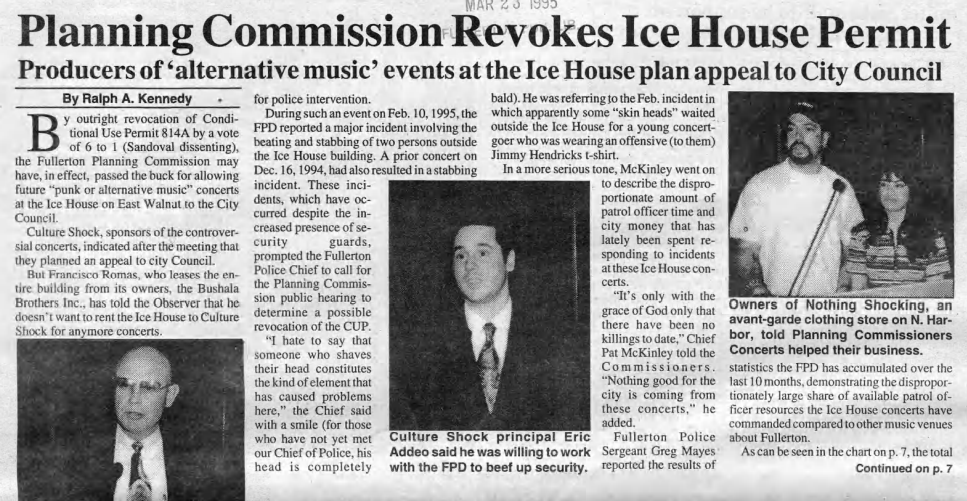
“The relatively large scale events put on by Culture Shock have resulted in an increasing number of calls for police intervention. During such an event on Feb. 10, 1995, the FPD reported a major incident involving the beating and stabbing of two persons outside the Ice House building,” the Observer reported, also describing “A Feb. incident in which apparently some ‘skin heads’ waited outside the Ice House for a young concertgoer who was wearing an offensive (to them) Jimmy Hendricks t-shirt.”
Later, council approved the re-opening the Ice House without the alternative/punk concerts.
More Fox Theater Delays
In the ongoing depressing saga of the delayed Fox Theater re-opening, Council voted to delay the construction of a parking structure.

By this time, the Fox Theater owner had “applied for a permit to demolish the Fox Fullerton.”
Fullerton’s Korean Population Grows
In the 1990s, Fullerton’s Korean population began to grow, making up 47 percent of the Sunny Hills High School student body.

Senior Helen Oh said, “In Korea, it is very hard to go to college. I came to America about six years ago because my parents wanted me to have a better chance of going to a college.”
“In the classified section of Korean-language newspapers in Koreatown, Los Angeles, Korean-Americans find advertisements for Sunny Hills, they offer places to board Korean-American students who want to attend Sunny Hills High School (SHHS),” the Observer reported.
Restoring the High School Auditorium Mural
Efforts began to restore the beautiful 15-by-70- foot mural on the west side of Plummer Auditorium, depicting California pastoral scenes and painted in 1934 by artist Charles Kassler.

The mural had been painted over by order of the High School Board of Trustees in 1939.
“Members of Fullerton’s Cultural and Fine Arts Commission are planning to appeal to the City Council at its Nov. 16 meeting to take a step toward restoration of the mural,” the Observer reported.

Deaths
James D. Henley died from a stroke.

Henley “lead the controversial Fair Housing effort in Fullerton in the 1960s, to his more recent crusades through the pages of the Fullerton Observer on behalf of an affordable, universal national health care plan – Jim Henley was always able to challenge his contemporaries in nonthreatening, non-judgmental ways,” the Observer reported.

Dr. Miles McCarthy of Fullerton, former acting president of Cal State University, Fullerton and a popular founding faculty member, died.
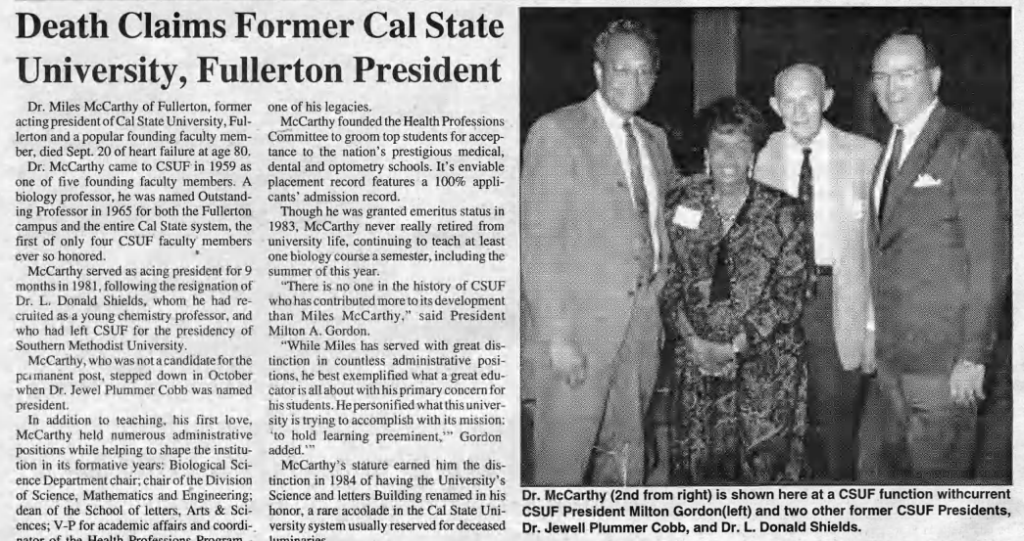
“Dr. McCarthy came to CSUF in 1959 as one of five founding faculty members. A biology professor, he was named Outstanding Professor in 1965 for both the Fullerton campus and the entire Cal State system, the first of only four CSUF faculty members ever so honored. McCarthy served as acting president for 9 months in 1981, following the resignation of Dr. L. Donald Shields, whom he had recruited as a young chemistry professor, and who had left CSUF for the presidency of Southern Methodist University,” the Observer reported. “McCarthy, who was not a candidate for the permanent post, stepped down in October when Dr. Jewel Plummer Cobb was named president.”
A building was erected in 1963 as the University’s first permanent structure, and its interior was designed by McCarthy to serve the multiple functions needed at the time – from classrooms and laboratories to library and administrative offices.

“An attorney and California Probate Referee, Ms. Lee was born Nov. 11, 1935 in Malvern, Arkansas, but had lived in California since the early 1960s,” the Observer reported. “She helped organize and lead a teachers’ union at Troy High School. Ms. Lee was also a member of the Democratic Foundation of Orange County, the Orange County Trial Lawyers Association, the American Civil Liberties Union, the National Organization for Women, and the League of Women Voters.”
 Fullerton History