The following is from a work-in-progress about the history of Fullerton. You can support my ongoing research and writing on Patreon.
The Fullerton Observer newspaper was formed in 1978 by Ralph and Natalie Kennedy and friends to provide a more progressive counterbalance to the more conservative Fullerton News-Tribune and Orange County Register. The Fullerton Public Library has digital archives of the Observer stretching back to 1979. I am in the process of reading over each year and creating a mini-archive. Here are some top news stories from 1994.
The 1994 Recall Election
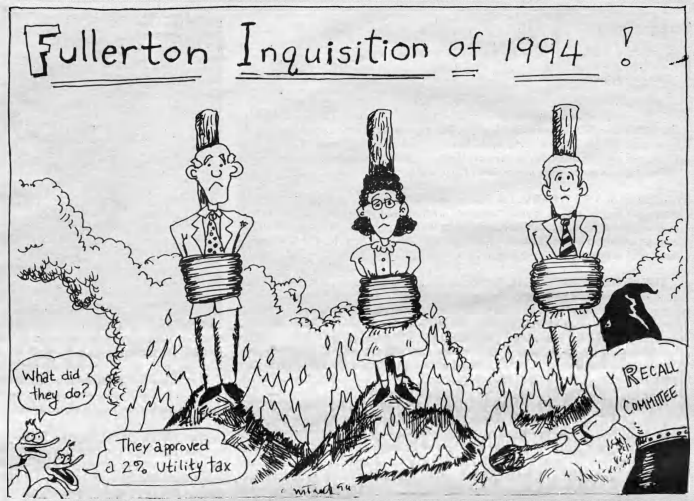
By far the biggest local news story of 1994 was the recall of three City Councilmembers: Buck Catlin, Molly McClanahan, and Don Bankhead. What was their crime? Facing a budget deficit, they voted for a 2% utility tax.

Nine former mayors of Fullerton expressed their opposition to the recall efforts: Richard C. Ackerman, Robert Ward, Francis Wood, Robert Root, Jerry Christie, Burton Herbst, Howard Cornwell, William Kroeger and Irving C. Chapman.
The Recall Campaign was a coalition of (mostly) Republicans and Libertarians who were generally against taxes and wanted a much smaller city government, including current city council member Bruce Whitaker. They published a list of 31 policy points which sought not only to repeal the utility tax, but to make other cuts and increase transparency for city government, like broadcasting City Council meetings (which Council was already considering).
The liberal-leaning Fullerton Observer came out clearly against the recall election with numerous editorials and a series of positive profiles of the three candidates facing recall, as well as officially endorsing candidates.
When given the choice, people in general like to vote against taxes, so ultimately, the recall was (sort of) successful.

All three councilmembers were recalled.
But then things get a bit complicated. Refilling the three council seats was achieved through both a special and a general election.
In the special election, Catlin and McClanahan’s seats would be filled for three weeks, until the general election November 8, for which the two Special Election winners would have to refile and compete with other possible candidates again.
The successful candidate for Bankhead’s unexpired 2 year term would not be required to run in the November election, serving out the full two years of remaining time in Bankhead’s seat.
Even though he was recalled, Bankhead was allowed to run for council in the general election.
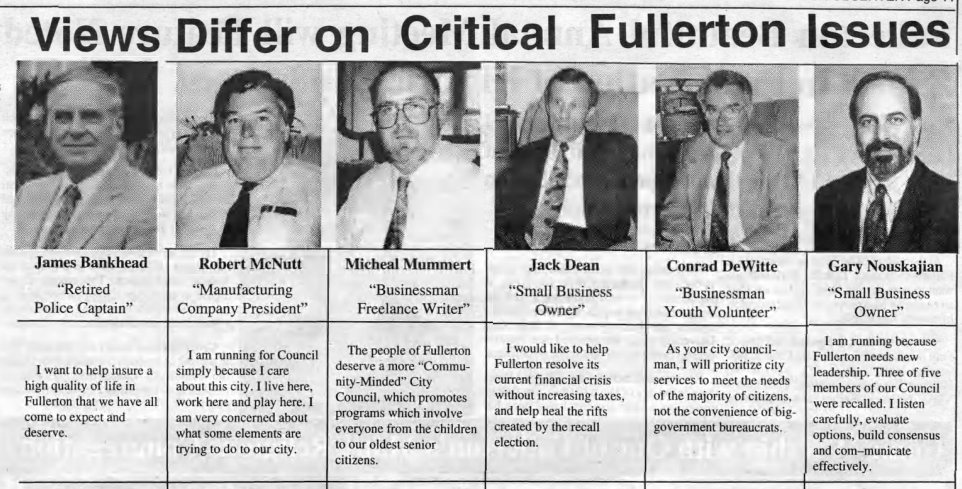
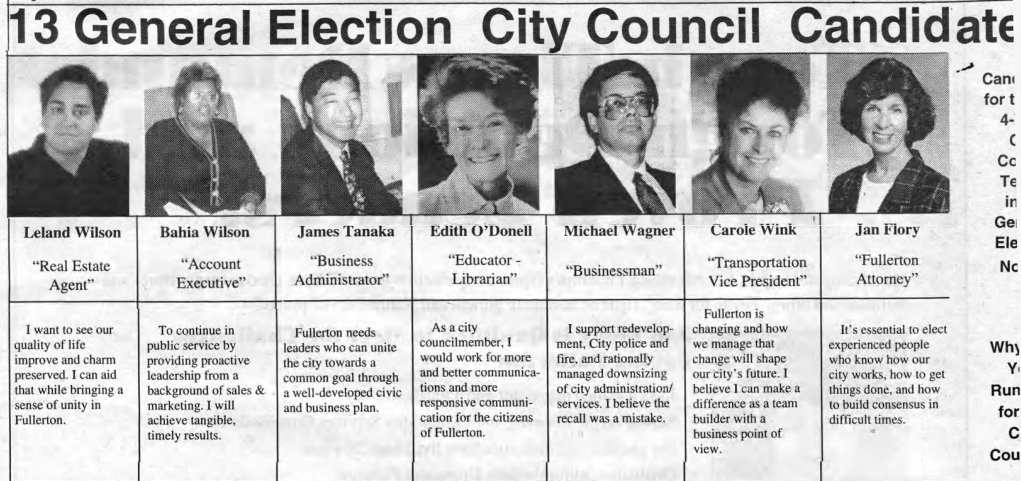
Lots of folks showed up to run in both the special and general elections.

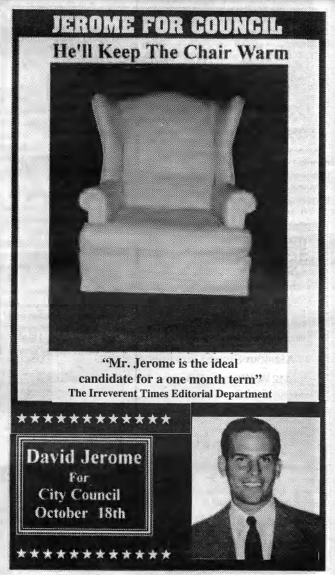
Some, like David Jerome, ran a humorous campaign for one of the three-week terms between the special and general election with the slogan, “He’ll Keep the Chair Warm.”
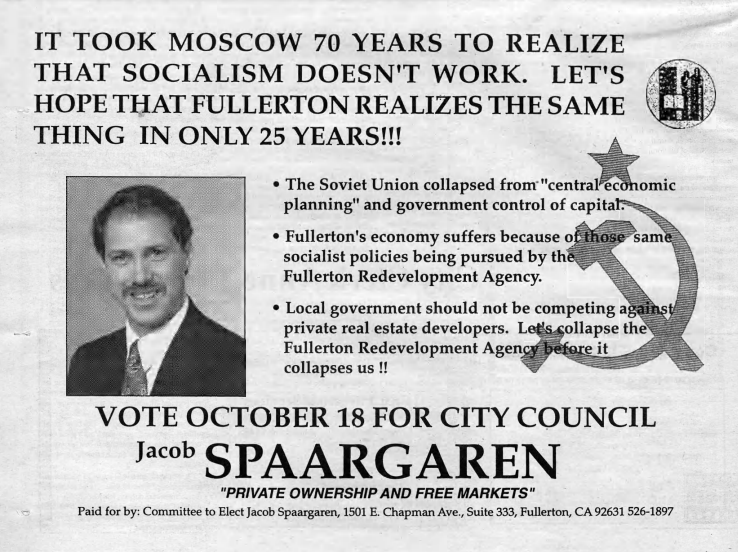
Others, like Jacob Spaargaren, ran ads that accused the former City Council of being Soviet-style socialists. Catlin and Bankhead were Republicans, and McClanahan was a moderate Democrat.
1994 saw the beginning of Jan Flory’s long political career, as she ran for office in the recall election, although she did not agree with the recall. She was endorsed by the Observer. Flory is currently running for City Council again.

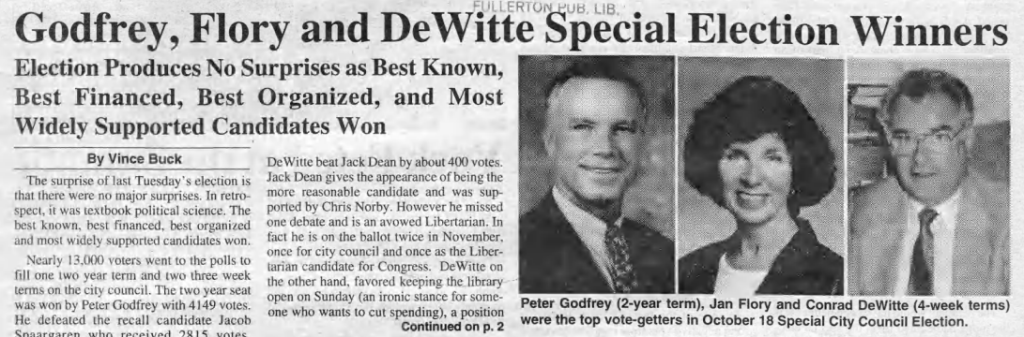
In the special election, Peter Godfrey won the two-year seat. He wouldn’t have to run in the general election. Jan Flory and Conrad DeWitte won the three-week seats. They would have to run again in the general.
Ultimately, Flory and Bankhead won the general election, much to the recallers’ chagrin.

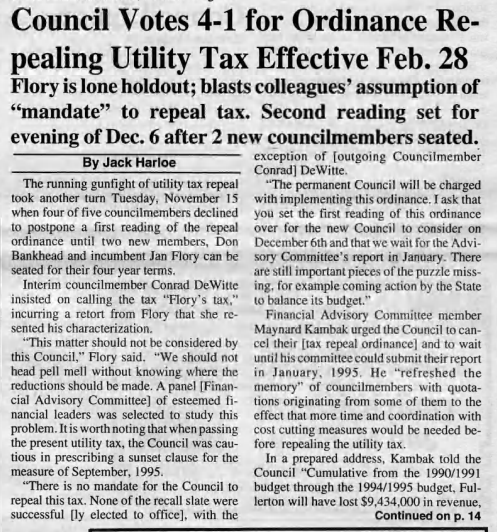
But it was not a total loss for the recall proponents. Taking the hint from voters, the newly-configured City Council voted to repeal the Utility Tax in the three weeks between the special and general elections, a brief window when they had a majority. Flory was the lone dissenter.
How they would fill the budget deficit was uncertain. And to make matters worse, the County of Orange was facing an embarrassing bankruptcy.

“Distracted by increasing signs of fiscal crisis in the county government the councilmembers voted 5-0 to defer a second reading of the tax repeal ordinance until its next regular meeting Dec. 20th,” the Observer reported. Stay tuned.
Hughes Leaves Town
Since 1957, Hughes aircraft had been one of the top employers in Fullerton. In 1994, they (mostly) closed their large plant. Check out my brief history of Hughes in Fullerton HERE.

“Hughes has announced that, as part of a cost-cutting consolidation, most of their Fullerton plant will be closed. Currently, 6,800 are employed at the plant; most of these employees will be relocated to Hughes facilities in El Segundo and Long Beach,” the Observer reported. “Seven hundred employees in a Systems Integration Group will remain in two leased buildings, with no current plans to change their location, according to Hughes Media Manager, Richard Dore.”
Some Progress on Affordable Housing
According to a 1987 state law, the city of Fullerton was required to set aside and spend 20% of its tax revenue dollars for affordable housing. But for years the city opted not to allocate monies for affordable housing. This prompted local residents to sue the city and under the terms of a settlement agreement, the City began actually approving and funding a number of affordable housing projects, such as the following:
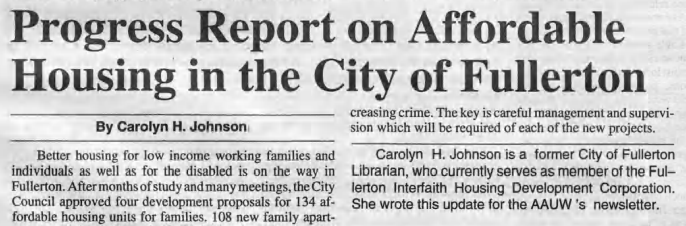
-Single Room Occupancy development (City Lights) in downtown Fullerton at 224 E. Commonwealth between Pomona and Lemon.
-108 new family apartments at 4119 W. Valencia Dr.
-Allen Hotel rehabilitation project for 16 family apartments.
-59-unit Amerige Manor apartment project for low-income seniors.
-27-unit affordable housing family apartment complex on East Chapman Avenue.
Sometimes, however, facing neighborhood opposition, council rejected affordable housing proposals.
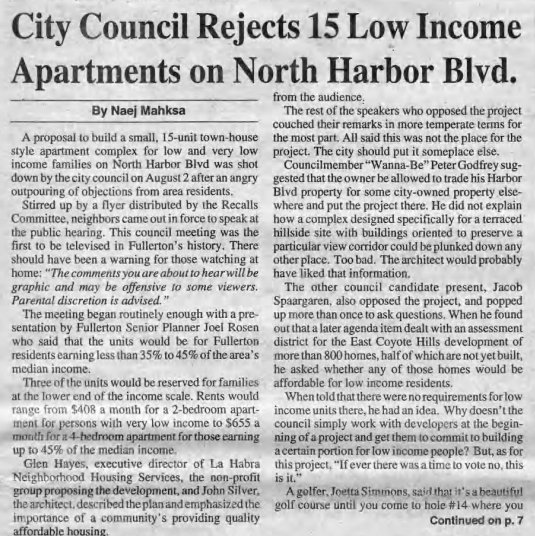
“A proposal to build a small, 15-unit town-house style apartment complex for low and very low income families on North Harbor Blvd was shot down by the city council on August 2 after an angry outpouring of objections from area residents,” the Observer reported.
Education
Funding problems continued to plague efforts to re-open Maple Elementary school, which was closed in 1972 for being segregated. To read about the Maple desegregation story, check out my article HERE.


Trustees approved a plan to open kindergarten classes at Maple in 1995, and (hopefully) more grades each year until it was a fully-functioning K-6 school.

On the subject of educational equity, school board trustees struggled with what to do with parent donations to specific elementary schools.

Schools in wealthier neighborhoods like Parks Jr. High were able to raise $265,091, while schools in poorer areas like Woodcrest raised $2,889.
“Board members Reyes Jones and Gomez-Amaro have raised questions at recent board meetings about the difficulty such disparities present to the School Board with its responsibility to provide equal educational opportunities for all students across the District,” the Observer reported.
Eventually, the trustees decided on a two-pronged approach allowing individual schools to continue with their efforts to raise funds for their schools, while at the same time establishing a District Educational Foundation to raise funds to help schools that have been unable to raise sufficient funds.
Environment
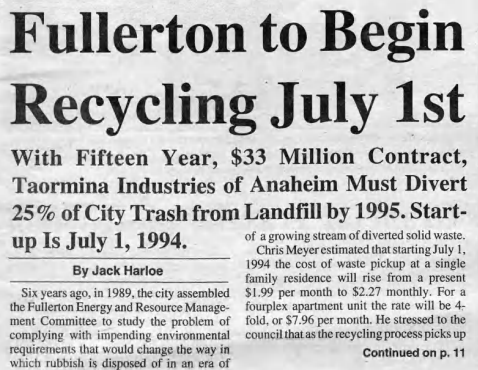
As a result of a state law, the city finally began a recycling program.
Transportation
The Bicycle Users Sub-Committee presented a ranked series of bicycle routes to be implemented as part of Fullerton’s new Bicycle Plan. This was the result of years of activism on the part of those advocating for an improved bicycle infrastructure for the City.

However, angry neighbors around Valencia Mesa were able to successfully lobby against a planned bike route in their area. NIMBYism wasn’t just about housing, it seems.

Immigration
As it is today, immigration was a hot-button political issue in 1994, especially in California. Facing an economic downturn, some chose to make political hay by blaming and scapegoating undocumented immigrants. This took the form of Proposition 187, which sought to deny education and all social services, except emergency medical help, to undocumented immigrants.
Prop 187 would have required all government agencies— including local police, hospitals, and schools — and all licensed medical professionals to determine the residential status of everyone who they “suspect” of being in this country illegally and then report those persons to the Immigration and Naturalization Service (INS). Prop. 187 would deny education and health care to more than 400,000 children and adults.

Ultimately, Prop 187 passed but was declared unconstitutional. It also had the unintended consequence of inspiring a generation of Latino activists, voters, and politicians. This, combined with demographic changes, contributed to the near demise of the Republican Party in California.

Deaths

Artist and educator Florence “Flossie” Millner Arnold died at 93. Back in 1964, Arnold spearheaded the effort to create the annual arts and culture event “A Night in Fullerton,” which lasted for 45 years.
To read more about Arnold, check out my summary of her oral history HERE.
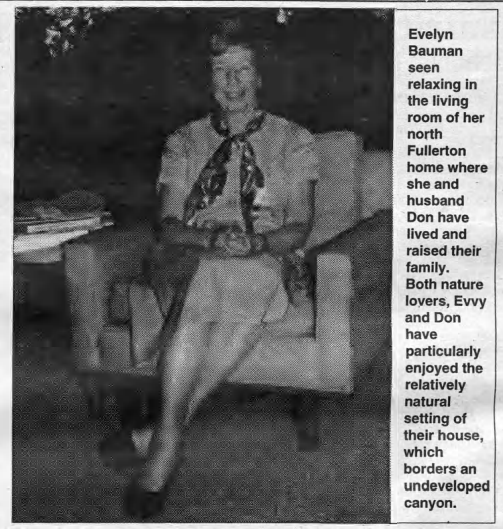
Evelyn Bauman died at age 75. She too was involved in many important community groups, including: YWCA Nursery School, Children’s League, Fullerton Friends of Music, Art Alliance, Friends of Fullerton Arboretum, Habitat for Humanity, El Dorado Ranch Preservation Committee, and the CSUF Women’s Studies Program Council.
Stay tuned for headlines from 1995!
 Fullerton History